Sunday bright spots

If with all your heart you truly seek me …

… ye shall ever truly find me. Thus saith our God. (Mendelsohn, Elijah, paraphrasing Jeremiah 29:13)

Martin Shaw, a notable in British Neo-Paganism, went out to to the woods for a 101-day vigil (!) of some pagan sort, roughly around the beginning of Covidtide. At the end, he had an attention-getting vision, and then began having the dreams — like Christ coming to him like a stag:

Shaw says he used to think Christianity was dull and domesticated. “I was wrong.”

His problem was that he thought the tame bourgeois Evangelicalism in which he was raised was the be-all and end-all of Christianity. He says, of that church, “What on earth would they have done with Blake?”

Shaw says that he believes he was in contact with the One who made the universe. It rendered him speechless. “I have been appropriately silent,” he tells Mark Vernon, adding that this is the first time he has revealed in public his conversion.

“You could not have argued me into Christianity,” Shaw says. It took this overwhelming experience of awe.

He goes on to say that Christianity is the fulfillment of all kinds of pagan myths.

“There was this deep interior announcement: ‘You knocked, and now I’m here. What should we do?”

On modern Christianity:

“We seem to have lost our saints, we’ve lost our monks, we’ve lost our connection to our bush soul, we’ve lost the angular, strange, weirdness of Christ.”

Shaw describes the call to Christ as “an invitation, not an imposition. … It’s chucking keys into cells to try to get you out into fresh air.”

He tells Mark Vernon that he’s been trying to figure out which church to embed himself in. He’s visited a Baptist church, an Anglican church, and a Catholic Church. “People will forgive almost anything except for becoming a Christian,” he says, alluding to the anti-Christian propaganda that’s everywhere. He found in all those churches “really kind, gracious, invested people.”

“But last Sunday, I walked into the Eastern Orthodox church, into the Divine Liturgy. I walked into a kind of Christian dream that was so deep. It had no beginning, and no end. It was absolutely unlike any form of Christianity I’ve yet come across.”

“It was as if every 15 minutes that passed, the door through the centuries was opening. I found in an almost unimaginably deep way a contact with … a sort of Christian dreaming.”

Shaw says he had never thought about Orthodoxy’s “aboriginal presence in Britain” before the great schism of 1054.

Vernon, a former Anglican priest, suggests that Orthodoxy, not having gone through the Reformation, could be more about drawing us into participation with the mysteries — doing something, rather than having something done to us.

Shaw responds by saying the last time he felt like he did after that liturgy was when he was in a sweat lodge with an American Indian twenty-five years ago. He was so dazed after the Divine Liturgy that he drove through a stop light, and almost caused a crash. Everybody was yelling at him. He rolled down his window and yelled, “I’ve just been to church! And I don’t know what’s going on!”

Shaw, who is best known says the truth about myth is that it’s not about the past at all, but about something always present. This resonated with me in light of what the Cambridge cultural anthropologist Paul Connerton said about the qualities traditional cultures that have successfully resisted modernity have in common. As I recall, they all 1) have a sacred story that tells them who they are; 2) celebrate the sacred story in an unvarying liturgy; 3) use their body in their liturgy; and 4) experience the liturgy as taking place in some sense outside of time.

Rod Dreher, writing about the conversion of Martin Shaw, "a big name in the neopagan/neopagan-ish world, who recently converted to Christianity." It appears that he isn’t going to be satisfied with anything less than the fulness of the faith that’s found in Christian Orthodoxy.

I would suggest that God saw Shaw’s heart and said "time to reclaim my own."

I also would suggest that Protestantism (perhaps Catholicism, too) may "have a sacred story that tells them who they are" and "use their body in their liturgy," but they vary their liturgies, which in no sense take place outside time.

Paul Kingsnorth and now Martin Shaw. God is up to something He hasn’t shared with me. He’s like that, you know. I have no other explanation for how Shaw could apprehend the timelessness of the Divine Liturgy on first exposure than that his paganism has kept his intuitive powers sharper than most of ours.

Elizabeth Oldfield perceives some commonalities in these and other "later in life" conversions:

[T]hey are slowly losing the youthful idealistic sense that they alone can locate the levers of change. They are butting up against the limits of their own intelligence and agency, and looking for something other than themselves to have faith in.

… Men who are arrogant or apathetic cause harm, and a path that requires humility, courage, vulnerability and service might just act as an antidote.

There was some of all that in my conversion, from deracinated to primal Christianity, at 48-49.

I’ve subscribed to Martin Shaw’s Substack, and it looks as if it could rise very near my favorites. He’s doing something I think is unique, valuable, and congruent with Orthodoxy (assuming that’s where he settles for a spiritual home).

A remarkable execution

I’ve never read last words like these:

First, thank you, my precious Father, for shepherding me for over 20 years and leading me to the edge of Paradise. I want to thank my beautiful wife who has loved me with everything she has. I want to thank my friends and legal team, and, most of all, Jesus Christ, through this unfair judicial process that led to my salvation. I pray the Lord will have mercy on all of us and that the Lord will have mercy on me. Lord Jesus Christ have mercy on me! Panagia Theotoke soson me! [All Holy Mother of God save me].

Last words of Monk Ephraim, formerly known as Frank Atwood, before his recent execution in Arizona for a murder which I doubt he committed:

on june 8, an american orthodox monk was executed for murder. how did this come to be? in 1987 frank atwood was convicted in arizona for the murder of a child. at the time of his arrest & trial, & ever since, he insisted on his innocence of the crime. (i have no way of knowing whether he was guilty or not, but that may also be true of those who tried & convicted him.) in prison, he read the mountain of silence: a search for orthodox spirituality by kyriakos markides. powerfully moved by it, he wrote to metropolitan athanasios of limassol in cyprus, who appears in the book. a correspondence began, which led to frank’s coming under the spiritual care of fr paisios at st anthony the great monastery in arizona. he was baptized & began to practice a life of prayer & asceticism. a few days before his execution, he was tonsured a monk & received the name ephraim, after fr ephraim, founder of st anthony’s monastery. his spiritual father paisios said that, regardless of his guilt or innocence, he had undergone a "complete transformation of life".

the case received great attention in greece, but as far as i know was ignored by american secular media outside of arizona. this account of his execution includes a powerful first-hand report from the arizona republic. you can see photos & video of his funeral at st anthony’s monastery here. metropolitan athanasios, who first received frank’s inquiries, has some remarks here.

frank.jpeg

as it happens, the assembly of canonical orthodox bishops of the united states of america has just published a "statement on the sacredness of human life & its untimely termination". it offers a whole-life teaching, rejecting abortion, euthanasia, & capital punishment.

o lord, remember us in thy kingdom.

From the rags of light monthly newsletter of my cyber-friend, John Brady, an Orthodox fellow of about my age (original formatting). You can subscribe here.

I formerly opposed the death penalty because our criminal justice system is more error prone than the powers and dominions want to admit. I’m aware, obviously, of the Innocence Project, but this is the first case I can recall where an innocent man was executed (rather than conclusively exonerated while on death row).

Now, with a push from my nation’s bishops, I’m opposed because it’s morally wrong even when they get the right guy.

From a reporter who witnessed the execution:

The Department of Corrections protocols ensure that few people see an execution, and there is little public awareness of this most serious and final act of justice. The death penalty is presented as a clean, sterile, administrative procedure carried out flawlessly and by the book. Now I know what they were trying to hide.

I have looked behind the curtain of capital punishment and seen it for what it truly is: a frail old man lifted from a wheelchair onto a handicap accessible lethal injection gurney; nervous hands and perspiring faces trying to find a vein; needles puncturing skin; liquid drugs flooding a man’s existence and drowning it out.

I have written extensively about Atwood’s case. I listened to the victim’s family talk about the pain and suffering the murder of Vicki Lynne, and subsequent court case, caused them — the generational trauma it left with their family and the community of Tucson. I talked with every attorney I know about the process and asked questions about what I was about to witness.

But I was not prepared to see the act of capital punishment carried out in front of me.

The state of Arizona conducts executions in all of our names. I thought I understood the weight of that process, but now I feel the reality of it. We killed a man today. I killed a man today. And I will live with that realization for the rest of my life.


If people have always said it, it is probably true; it is the distilled wisdom of the ages. If people have not always said it, but everybody is saying it now, it is probably a lie; it is the concentrated madness of the moment.

Anthony Esolen, Out of the Ashes

You can read most of my more impromptu stuff here (cathartic venting) and here (the only social medium I frequent, because people there are quirky, pleasant and real). Both should work in your RSS aggregator, like Feedly or Reeder, should you want to make a habit of it.

Feast of Saints Peter & Paul, 2022

SCOTUS

What’s wrong with the gun-rights decision?

If you’ve read me for very long, you’ll know I’m pretty tepid about gun rights. But I’m going to weigh in on last week’s Bruen decision anyway: I don’t like it.

What I don’t like is the approach Justice Thomas took to reach his results. For ease, and because I’m not so hot on guns to go any deeper, I’ll quote my beloved Morning Dispatch:

Thomas’ majority opinion does rework how courts should assess the constitutionality of gun legislation. Courts must drop their previous efforts to balance the interest of the state in preventing gun violence against the Second Amendment rights of individuals, Thomas wrote, and instead consider only the Second Amendment’s text and the “history and tradition” of gun legislation when the Second and 14th Amendments passed.

“They’re not looking for whether there was the exact same gun regulation,” Stephen Gutowski, founder of gun policy outlet The Reload, told The Dispatch. “They’re looking at whether there was a similar gun regulation.”

Thomas writes that courts are more equipped to perform a historical legal analysis than the cost-benefit analysis they’ve been attempting, but Breyer’s esoteric weapons list highlights that it could still be a challenge to properly identify and apply relevant regulations. “I just think [Thomas is] a little overconfident in the ability of particularly lower courts, which don’t have endless resources and immense law libraries,” Seth Chandler, a University of Houston law professor who has taught Constitutional law, told The Dispatch. “Even Justice Thomas acknowledges that this process of analogous reasoning, it’s not straightforward and obvious.”

(Italics added)

It’s not just that history offers only analogies in many cases but that, reportedly, Justice Thomas discarded some historic restrictions as not relevant for one reason or another. How are the lower courts supposed to evaluate history when he was kind of cavalier about it.

So Bruen has not added consistency and clarity to Second Amendment Jurisprudence. It may have diminished it.

Joseph Kennedy, the football-prayin’ fool

On Monday, SCOTUS decided Kennedy v. Bremerton School District, the praying football coach case.

On Monday, I began reading Samuel P. Huntington’s Clash of Civiliztion, which I’m enjoying very much, but not at the moment because I’m typing about a case I was surprisingly ambivalent about.

So let’s see if we can make some brief sense of it and get me back to Huntington. I am hugely indebted to the Advisory Opinions podcast because when I saw all those printed words I said “No, siree! I’m not going to cut-and-paste from all that! I just don’t care that much!”

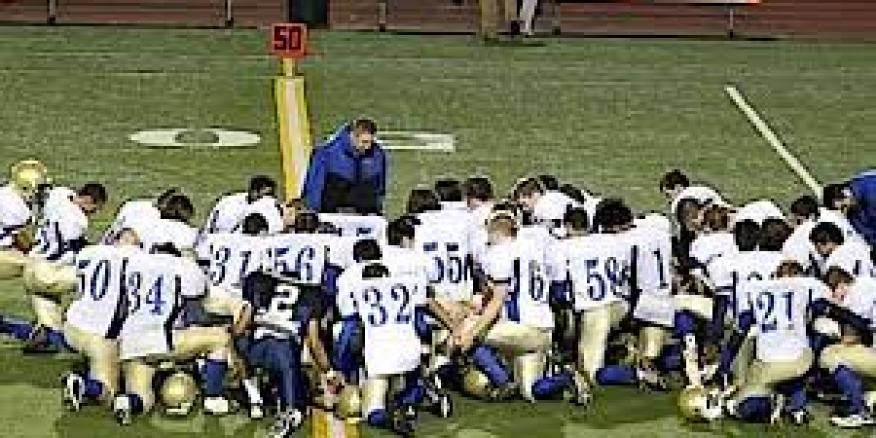
  • Majority version: Saintly Joseph Kennedy only wanted a moment of private, personal prayer at the 50 yard line immediately after the football games he’d just coached. Conscience-bound, he conscientiously violated oppressive directives from the school district, which suspended, then fired him. He wins on both religious speech and general free speech grounds, the gap between which we’re now narrowing. By the way, we hereby drive a stake through the heart of Lemon v. Kurtzman, one of several zombie precedents we’ve left haunting the countryside, while giving the side-eye to lower courts who don’t get the joke.
  • Dissent: WTF! You’re describing a completely different case! This is a case of a willful provocateur seeking to lead his players to Evangelical-Jesus, praying in a very public place, in front of most of the stadium, and by winks and nods inviting players to join him at mid-field and yelling “Neener! Neener! Neener!” at the School Board. If we allowed this sort of thing, it would lead to terrible places and he really should have lost.
Coach Pharisee  and his entirely "voluntary" congregation, with no perceived pressure that they must pray to play.
Coach Pharisee and his entirely voluntary flock. He has his reward.
  • Yes, the facts stated in the opinion and those stated in the dissent differed almost that wildly. My impression has been that the dissent’s version is closer to the whole truth, the majority’s version a bit — Ahem! — curated. (I also thought trials, not appeals, were supposed to determine the facts, but never mind.)
  • Net result: Kennedy wins and nobody should cite Lemon v. Kurtzman any more. Future courts are again told to consult “historical practices and understandings.” You may genuflect now and back out of the room slowly — and try to wipe that look of puzzled incredulity off your faces.

Hard cases make bad law, but this one seemingly made almost no law at all except that a zombie is now declared a corpse. That’s my story and I’m stickin’ to it unless I stumble across a more compelling version.

Do not forward; moved, left no forwarding address

The West Caldwell Police Department has responded to multiple calls at a residence formerly owned by Justice Samuel Alito. Erroneous information was circulating on the internet that indicated that Justice Alito still resides in West Caldwell, and individuals have been sending harassing packages to the current resident.

Justice Alito moved out of West Caldwell Just after being confirmed to the US Supreme Court, 15 years ago in 2007. The current homeowner has no affiliation with Justice Alito and deserves to live in peace in their home free from harassment, regardless of anyone’s political beliefs.

All incidents will be investigated and those responsible will be charged and prosecuted.

Please like and share this post to hopefully put an end to this activity.

Howard Bashman (How Appealing) via Eugene Volokh

I will never again complain about people who ignore my voicemail greeting and leave messages for an auto parts place with a number one digit off our home phone number.

Tallying the cost of Dobbs

It is done. The decision by the U.S. Supreme Court in Dobbs v. Jackson Women’s Health Organization overturned Roe v. Wade, ending 50 years in which abortion has been a constitutional right.  

Now Catholic and evangelical Christian leaders need to acknowledge the costs of their victory. The most visible is nearly a half-century of being in bed with the Republican Party, and most recently its leader Donald Trump, a man of low morals willing to lie, cheat and, to hear the Jan. 6 committee tell it, break the law in order to stay in office. 

It also meant becoming a single-issue constituency who sacrificed nearly every social justice issue to create a Supreme Court that would reverse Roe v. Wade.

Yes, the Republicans finally delivered on their promise to reverse Roe, but in every other way it is making the world less hospitable to life. To call this pro-life is absurd.

Thomas Reese, What has the demise of Roe v. Wade cost the Catholic Church?.

There’s not all that much more to the piece, but Reese lists areas of Catholic Social Teaching he thinks have been neglected.

Miscellany

The New Handmaiden’s Tale

I’m sure it’s just another form of sex work, and therefore liberating, but I find this exceedingly creepy.

H/T Rod Dreher

I would find just as creepy, I think, if it was an opposite-sex pair of yuppies staring into each others eyes, congratulating each other on outsourcing a job they just wouldn’t disrupt their careers for.

This instrumentalizes women and commodifies babies, so it’s in perfect keeping with the zeitgeist.


If people have always said it, it is probably true; it is the distilled wisdom of the ages. If people have not always said it, but everybody is saying it now, it is probably a lie; it is the concentrated madness of the moment.

Anthony Esolen, Out of the Ashes

You can read most of my more impromptu stuff here (cathartic venting) and here (the only social medium I frequent, because people there are quirky, pleasant and real). Both should work in your RSS aggregator, like Feedly or Reeder, should you want to make a habit of it.
Tuesday, 6/28/22

Still more on Dobbs

As I know the lay of the land uncommonly well, I am trying to say some genuinely useful things, that are not being said very commonly, on the reversal of Roe and Casey. I’m also trying to avoid worsening tensions. I even exited social media for a few days (maybe more than necessary — I’ve been peeking) when a discussion started getting unproductively heated.

Face-saving failure

Confirmation hearing vignettes:

Here’s Justice Gorsuch: “Roe v. Wade, decided in 1973, is a precedent of the U.S. Supreme Court. It has been reaffirmed. . . . So a good judge will consider it as precedent of the U.S. Supreme Court worthy as treatment of precedent like any other.”

He added that “If I were to start telling you which are my favorite precedents or which are my least favorite precedents, or if I viewed precedent in that fashion, I would be tipping my hand and suggesting to litigants that I have already made up my mind about their cases.”

And here’s Justice Kavanaugh: “Roe v. Wade is an important precedent of the Supreme Court. It has been reaffirmed many times. It was reaffirmed in Planned Parenthood v. Casey in 1992. . . . So that precedent on precedent is quite important as you think about stare decisis in this context.” He made no specific pledge about either case that we have seen. Justice Amy Coney Barrett expressly rejected the idea that Roe was a super precedent.

Wall Street Journal Editorial Board, which also explains why a nominee cannot pledge to uphold a precedent or to strike it down:

Sens. Susan Collins and Joe Manchin said Friday they feel Justices Brett Kavanaugh and Neil Gorsuch deceived them on the precedent point in testimony and in their private meetings with the Justices. We weren’t in those meetings, but we’d be stunned if either Justice came close to making a pledge about Roe.

The reason is that the first rule of judging is that you can’t pre-judge a case. Judges are limited under Article III of the Constitution to hearing cases and controversies, and that means ruling on facts and law that are specific to those cases.

No judge can know what those facts might be in advance of a case, and judges owe it to the parties to consider those facts impartially. A judge who can’t be impartial, or who has already reached a conclusion or has a bias about a case, is obliged to recuse himself. This is judicial ethics 101.

An authority on this point is no less than the late progressive Justice Ruth Bader Ginsburg, as she explained in 1993. “It would be wrong for me to say or preview in this legislative chamber how I would cast my vote on questions the Supreme Court may be called upon to decide,” she said. “A judge sworn to decide impartially can offer no forecasts, no hints, for that would show not only disregard for the specifics of the particular case, it would display disdain for the entire judicial process.”

Frankly, no nominee should ever pledge their vote on any issue at confirmation hearings. That alone would be a disqualifier. Any Senator worth his or her seat should understand that, and since I respect them as senateworthy, I suggest that both Collins and Manchin do understand it. Their face-saving isn’t convincing.

Now flooding the zone shamelessly

As I scan the New York Times Opinion page since Friday morning, it’s apparent that "flooding the zone with sh*t" is not a MAGAworld exclusive.

Do not trust the Grey Lady for reliable interpretation of Dobbs overruling Roe or for prognostications about what a supposedly agenda-driven court is going to do next. (Exception: Ross Douthat wrote one of the wisest things I’ve read in the aftermath, and they did publish it.)

Is the court going to ban contraception? Ban sodomy? Ban same-sex marriage? Overrule the precedents that dogmatized rights to each into existence?

Just remember: courts decide cases. They don’t go out and make mischief on their own. So how would SCOTUS even get a chance to rescind these other "unenumerated rights"?

Damon Linker (After Roe: The Reversals to Come), who I respect enough to read when it’s obvious we disagree, imputes a nefarious agenda to the court but skips any suggestion of how it would get the opportunity to realize that agenda.

I can think of no obvious way other than some jurisdiction banning contraception, sodomy or same-sex marriage, resulting in a fresh round of litigation.

What do you think of the life expectancy of a legislator, even in Texas, who proposed to outlaw contraception? Outlawing sodomy would be a hard sell in 2021 even in red states. I could imagine a performative bill to define marriage as sexually binary, but have trouble imagining it getting very far.

If it did, the lower Federal courts would almost certainly strike such a law down under Griswold, Lawrence or Obergefell. Then SCOTUS could just decline to grant certiorari.

If it granted "cert," the stare decisis analysis on those precedents would include factoring in some very, very concrete reliance on Obergefell in the SSM context.

I’m no prophet, and I’m not close enough to the political poles to be incapably of suffering rude surprises, but I just don’t see those other precedents falling until there’s I’m long in the grave and there have been some major wake-up calls from realities we’ve had on call-blocking for a while.

Heartening

After weeks of incendiary rhetoric, attacks on crisis pregnancy centers, and a foiled attempt on Justice Brett Kavanaugh’s life, Planned Parenthood and other pro-abortion groups formally disavowed violence in the name of their cause. Those who use “destruction and violence” do not speak for them or the movement, the groups said in a statement.

TMD

On a related note, one of my favorite Substackers, Freddie deBoer, scared me by opening that it’s time for the Left to engage in extralegal resistance. Fortunately, it turned out that he meant things like helping abortion-minded women get to states where abortion is legal, or even to help them find clandestine abortions in their own states.

I don’t even think the former could be criminalized; the latter, perhaps.

Victor Rosenblum

As I was writing yesterday that I wish Nat Henthoff had lived to see Friday’s Dobbs decision, I was wracking my brain for the name of his "country cousin" (also a prolife liberal Jewish Democrat) at Northwestern University Law School. I finally gave up. Of course, it finally came to me this morning. So: I also wish Victor Rosenblum had lived to see this day.

Advice for the despondent

After stylishly signaling his pro-choice virtue, Garrison Keillor shows some sympathy for the 6 justices who are now pariahs, and then turns to some good advice for his own tribe:

Meanwhile, remind yourself that other people have thrived under wretched governors so don’t be discouraged. The Duke of Saxe-Weimar threw Bach in jail for daring to think he had individual rights. Dante was sent into exile and he wrote the Inferno so he could put the politician Argenti into the Fifth Circle of Hell. Dostoevsky joined a liberal study group for which, in 1849, he was thrown into prison and sentenced to death by firing squad, and was third in line to be executed when a pardon arrived. He lit out for Paris, London, Berlin, and figured out how to survive, writing Crime and Punishment in serial installments for magazines, avoiding politics. While cruelty is in power, do what Mozart did. Exercise your gifts. Create beautiful things. Wolfgang stayed clear of emperors and did his work and he lives on today and the emperors are just moldy names on marble slabs covered with pigeon droppings. If you can’t write The Marriage of Figaro, write your own marriage and make it a work of art.

That’s kind of what I’ve been trying to do, in my very limited way, for more than a decade. I like to think of myself as that proverbial butterfly in the Amazon, very subtly changing the weather in Indiana.

Not Dobbs

Still flooding the zone

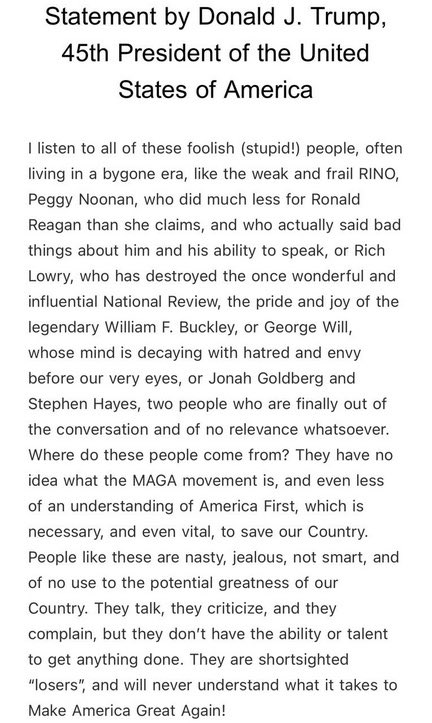
The Donald reads conservatives out of MAGAworld

Bozos on the bus

What we need as a nation, more than anything else I can think of, is a recommitment to basic competence, and, especially, a refusal to accept ideological justifications for plain old ineptitude. Too often Americans give a free pass to bunglers and bozos who belong to their tribe.

Alan Jacobs, I think we’re all bozos on this bus – Snakes and Ladders

Inauguration Day 2017 in a Nutshell

Speaking of clowns:

When a clown moves into a palace, he doesn’t become a king. The palace becomes a circus.

Turkish Proverb (reportedly)

A little levity

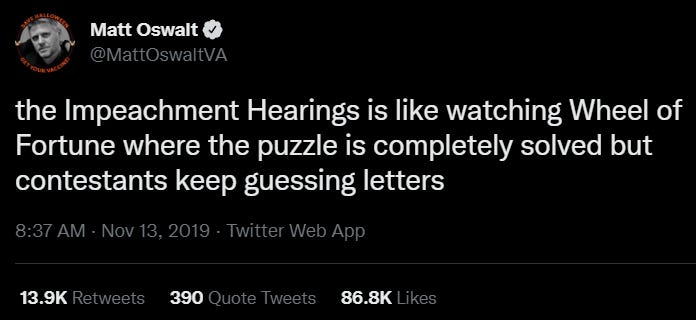
I probably have given too short shrift to the January 6 Committee hearings because … well, I didn’t think anything they said would change my life or my vote. But I sure got a chuckle out of this:

H/T Yassine Meskhout


If people have always said it, it is probably true; it is the distilled wisdom of the ages. If people have not always said it, but everybody is saying it now, it is probably a lie; it is the concentrated madness of the moment.

Anthony Esolen, Out of the Ashes

You can read most of my more impromptu stuff here (cathartic venting) and here (the only social medium I frequent, because people there are quirky, pleasant and real). Both should work in your RSS aggregator, like Feedly or Reeder, should you want to make a habit of it.
Mostly abortion-related

David French, Cassandra

I follow David French in podcasts and blogs because:

  • He’s a seasoned litigator aligned with me on abortion, free speech, and religious freedom; and
  • I have to put up with hearing him to hear the amazing Sarah Isgur.

But Sunday, I think his reflexive religious provincialism got the better of him in Roe Is Reversed, and the Right Isn’t Ready.

He starts off well enough:

I’ve been a pro-life advocate and activist for more than 30 years …

Through it all, I was guided by two burning convictions—that Roe represented a grave moral and constitutional wrong and that I belonged to a national Christian community that loved its fellow citizens, believed in a holistic ethic of life, and was ready, willing, and able to rise to the challenge of creating a truly pro-life culture.

I believe only one of those things today.

My feelings about Roe are unchanged. …

But then he paints a very bleak picture of the right generally and more specifically his corner of the religious right, which he reflexively equates with "the Church" (it’s one of his most annoying verbal tics, another is hyperbolicic use of "tremendous, tremendous"):

The two sides of the great American divide are now staring at each other and asking, “Now what?” The answer from pro-life America should be clear and resounding—the commitment to life carries with it a commitment to love, to care for the most vulnerable members of society, both mother and child.

But life and love are countercultural on too many parts of the right. In a time of hate and death, too many members of pro-life America are contributing to both phenomena. Is that too much to say? Is that too strong? I don’t think so.

In deep-red America, a wave of performative and punitive legislation is sweeping the land. …

… The vicissitudes of politics haven’t just linked the anti-abortion cause to various toxic forces on the right, they’ve transformed parts of the anti-abortion movement, making many of its members as toxic as their “libertine and hyperindividualist” allies.

In the meantime, the Republican branch of the American church is adopting the political culture of the secular right. With a few notable exceptions, it not only didn’t resist the hatred and fury of the MAGA movement, it was the MAGA movement.

(Emphasis added)

Now I suppose there are at least three possibilities here:

  1. He’s right about pro-life America, period, full stop.
  2. He’s right about Evangelicalism.
  3. He’s engaged in hyperbole to get Evangelicals to to better than settling for liberal tears.

I reject the first possibility. I’ve been pro-life a decade longer than French (mostly because I’m two decades older). I broke markedly, if not completely, with Evangelicism shortly before I became actively pro-life, and left Protestantism entirely a about a decade-and-a-half later.

I do not believe that lib-trolling and vindictiveness is any significant part of Orthodox Christianity, though Orthodoxy is anti-abortion (as the historic church always has been — i.e., before American Evangelicals got recruited to the cause by C. Everett Koop, Francis Schaeffer, and less principled actors).

I also don’t believe that it is a significant factor among observant Roman Catholics, "observant" being measured by adherence to Catholic Social Teaching as well as participation in their Church’s sacramental life. Indeed, Catholic Social Teaching (Christian Democracy) is the North Star of the American Solidarity Party, which party alone I support these days.

Bottom line: I believe French is wrong about the Church because his provincialism blinds him to the bigger picture. I certainly hope he’s wrong.

And French’s turn to anti-vaxx sentiment a red prolife America seems like totally gratuitous grievance-airing.

I suggest to David French that if he’s all that down on Calvinist-tinged Evangelicalism, he step out for a breath of incense-tinged air at one of the Anglophone Orthodox Churches in his area.

Come and see, David. Give it a month or two of Sundays.

Douthat on the risk of toxic response

Observant Catholic (see above) Ross Douthat puts French’s point less apocalyptically (I’m being very selective; read the whole column if you can):

While the pro-life movement has won the right to legislate against abortion, it has not yet proven that it can do so in a way that can command durable majority support … [T]he vicissitudes of politics and its own compromises have linked the anti-abortion cause to various toxic forces on the right — some libertine and hyperindividualist, others simply hostile to synthesis, conciliation and majoritarian politics.

… But among its own writers and activists, the movement has understood itself to also be carrying on the best of America’s tradition of social reform, including causes associated with liberalism and progressivism.

To win the long-term battle, to persuade the country’s vast disquieted middle, abortion opponents … need to show how abortion restrictions are compatible with … the health of the poorest women, the flourishing of their children, the dignity of motherhood even when it comes unexpectedly or amid great difficulty.

These issues … are essential to the holistic aspects of political and ideological debate. In any great controversy, people are swayed to one side or another not just by the rightness of a particular position, but by whether that position is embedded in a social vision that seems generally attractive, desirable, worth siding with and fighting for.

Here some of the pathologies of right-wing governance could pave a path to failure for the pro-life movement. You can imagine a future in which anti-abortion laws are permanently linked to a punitive and stingy politics, in which women in difficulties can face police scrutiny for a suspicious miscarriage but receive little in the way of prenatal guidance or postnatal support. In that world, serious abortion restrictions would be sustainable in the most conservative parts of the country, but probably nowhere else, and the long-term prospects for national abortion rights legislation would be bright.

In a part of French’s column, he quoted this Douthat column but said it didn’t go far enough. I think it does — because Douthat’s vision is more Catholic (and more catholic).

Making abortion unthinkable

Even in the Evangelical world, there are sane people wanting actually to make things better:

Roe was an unjust ruling. I have always believed it would be overturned, as other unjust decisions by the court were, although I thought it would take longer. I rejoice that it did not. But of course it will take longer for abortion to become unthinkable, which is the real goal of the pro-life movement.

Karen Swallow Prior

Prior continues:

Still, I was, like my fellow evangelicals, a Johnny-come-lately in a long line of people who have opposed abortion and infanticide and tried to defend vulnerable life.

Members of the early Christian church within the ancient Roman world rescued abandoned infants (often those who were female or otherwise deemed inferior) from certain death ….

I always appreciate it when Evangelicals admit, even if tacitly, that Evangelicalism is so unlike the earliest church that it cannot claim vicarious credit for what the earliest church did.

Orthodoxy (and even Catholicism) can.

Still more:

The judicial fiat of Roe v. Wade jump-started the culture wars that have poisoned our political process and brought us to a place of polarization and unbridgeable division. Indeed, this division has been capitalized on by far too many pundits and politicians, for whom a position on abortion does not appear to be a sincerely held belief, but merely an issue they can (and do) leverage for votes or monetize for financial gain. Such betrayal casts a shadow on the overturning of Roe, which has been for me and many others a long-awaited event.

Even so, making abortion unthinkable might start with the law, but it won’t end there. For it is not only the supply of abortion that matters but also the demand. I lament the impoverishment of a social imagination that cannot conceive of a world in which women can flourish without abortion.

Nat Henthoff

On this day, I remember with fondness the late Nat Hentoff, a Jewish atheist who nevertheless believed in the right to life of the unborn, and said so in a time and place where that cost him something. Here is a column Hentoff wrote after he hosted pro-life liberal Pennsylvania Democratic Gov. Bob Casey at Cooper Union in downtown Manhattan.

Rod Dreher.

Henthoff was a fierce member of the ACLU back when the ACLU was actually about civil liberties, and was one of the preeminent jazz critics of his age.

I wish he had lived to see last Friday.

He really didn’t need the Committee’s help …

This just seems to make Donald Trump look awful, just awful."

Neil Cavuto, Fox News, on the latest revelations from the January 6 Committee.

You’re surprised that Trump is awful, Neil?

Terrorist wishcasting

I note, with raised eyebrow, the terrorist plans underway to set about attacking Catholic churches and pregnancy resource centers. As someone put it in a dark joke-tweet, this is the state of the discourse in 2022: “You don’t care about pregnant women!” “Well no, we have numerous buildings and institutions expressly set up for that purpose actually, how can we help you?” “Oh really, where? Let’s go firebomb them!”

Bethel McGrew


If people have always said it, it is probably true; it is the distilled wisdom of the ages. If people have not always said it, but everybody is saying it now, it is probably a lie; it is the concentrated madness of the moment.

Anthony Esolen, Out of the Ashes

You can read most of my more impromptu stuff here (cathartic venting) and here (the only social medium I frequent, because people there are quirky, pleasant and real). Both should work in your RSS aggregator, like Feedly or Reeder, should you want to make a habit of it.

Sunday, 6/26/22

Observing a metaworld

When I’m not wowed by a Fr. Stephen Freeman blog, I often wonder if my head just isn’t on straight that day, so often has he wowed me in the past.

He wowed me again today. Fr. Stephen Freeman, Healing the Soul and Unbelief:

The Church describes human beings as made in the image of the Logos. On that basis, we are sometimes hymned as “rational (logikos) sheep.” Human beings think and speak. There is a relationship between the thing that we perceive (say, an Auroch) and its depiction (a wall painting). The walls of the caves are covered in logoi, “words,” if only we knew how to read them!

When human beings speak, we inadvertently offer a world-beyond-the-world. There is the experience (my vacation), and there is the telling of the tale (“you won’t believe what happened on my vacation”). Were someone to insist that only the thing-itself mattered (“therefore, I don’t want to hear about your vacation”), the world would soon collapse into a muteness that even the animals transcend.

In our modern period we see far less of the sky and animals, much less the plants and the movement of the seasons. Our houses are much the same temperature year-round. We are, instead, observant of a meta-world, the narrative of the endless news cycle, driven by disaster, fear, speculation, and distraction. Our advertising (always present) bathes us in oil, sugar, salt, and sex while promising an endless supply of dopamine.

Then he almost seems to change the subject:

I am struck by the preponderance of unbelief in our day and time. Frequently, the “problem of evil” is cited as an overwhelming obstacle to belief. I think of this in particular when I consider that antiquity was dominated by far more suffering on a daily basis than our present age. Our lives would seem magical in their easy dismissal of childhood diseases, our caloric intake, and the unending variety of all things offering themselves for consumption.

I have an aside that is worthy of note. I have been particularly struck over the years of my pastoral ministry at the abiding interest in the Church within the ever-shrinking community of young couples who are starting families. My experience is anecdotal, such that I can point to no statistics. But those conversations point me in the direction of transcendence. Few things in our modern lives are as primitive as child-bearing … So much can go wrong. To raise a child attentively, is (and should be) awe-inspiring. They are examples of transcendence embodied.

The experience of belief begins, I think, with the experience of transcendence, the questions of meaning and significance. It is a conversation that struggles to find its way in a sea of commodities and mundane pleasure. We are not immune to the transcendent – but simply distracted.

In Jesus Christ, we confess, Transcendence became flesh and walked among us ….

Smack-talkin’

I’ve recently begun enjoying the Unbelievable podcast, downloading a few back episodes to get started. This one was outstanding; another was immediately suspect from the teaser:

Shane Claiborne: "The cross and the gun give us two very different versions of power, and one of them says ‘I’m willing to die,’ the other says ‘I’m willing to kill.’"
Kyle Thompson: "If somebody comes in there — an evil person wants to come in there — and kill people, you and people like you will be some of the people who hide behind people like me, hoping I take that guy out before he gets to you."

I was fairly confident after that brief teaser that I would find Kyle Thompson, new to me, unbearable — and something about Shane Claiborne (who I’ve encountered before) often grates a bit, too. I really don’t want to listen to American fundagelicals calling each other hypocrites or fascists on a British Christian podcast.

I still recommend the podcast. I’ve sort of drifted into following a lot of podcasts that are occasionally good, but then deleting two-thirds to three-quarters of new episodes base on a summary that is either uninteresting or not interesting enough to edge out something else. I recommend the approach, at least for free podcasts.

Boundaries

A "God-fearing" person is one who recognizes boundaries, and that when one reaches one, one should go no further.

(I failed to record the source of that bit of wisdom.)


If people have always said it, it is probably true; it is the distilled wisdom of the ages. If people have not always said it, but everybody is saying it now, it is probably a lie; it is the concentrated madness of the moment.

Anthony Esolen, Out of the Ashes

You can read most of my more impromptu stuff here (cathartic venting) and here (the only social medium I frequent, because people there are quirky, pleasant and real). Both should work in your RSS aggregator, like Feedly or Reeder, should you want to make a habit of it.

Bless their hearts

Neo-Manicheans

Ten years ago, let’s say fifteen to be safe, if you saw an essay titled “Consequences are Good, Actually,” you might naturally assume that it came from the political right. Conservatives, after all, believe in law and order, retributive justice, and the God of the Old Testament. But nowadays, it’s liberals who constantly call for consequences, liberals who sneer at the concept of forgiveness, liberals who stand for a Manichean worldview that permits no deviation from white-hat/black-hat morality …

We’ve spent the past two years with the left-of-center world debating, and largely endorsing, quite radical ideas about ending policing and prisons. This would seem to suggest a certain predisposition to forgiveness and equanimity in human affairs, a communal understanding that life is complicated, all of us are sinners, and there but for the grace of God go we. But as the various groans about the New York piece show, the urge to defund the police etc. is really much less about a particular ethic of caring and much more about simply nominating a communally-approved target for progressive anger. It happens that the abstract category “the cops” is a good thing for people to target, but the broader point is that most liberal criminal justice reform energy isn’t derived at all from a desire to be more compassionate and understanding but simply to have a new designated hate object ….

Freddie deBoer, Ah, Carceral Liberalism

Also from that piece:

Pie chart showing the number of people locked up on a given day in the United States by facility type and the underlying offense using the newest data available in March 2022.

1.9 million people incarcerated in a nation of (roughly) 340 million. This is an extremely high rate in comparison to other nations.

What the heck is wrong with us? Are we more lawless? More punitive? Both?

Mencken Memorializes Machen

I’d never seen this before — an excerpt from H.L. Mencken’s obituary for J. Gresham Machen:

There was a time, two or three centuries ago, when the overwhelming majority of educated men were believers, but that is apparently true no longer. Indeed, it is my impression that at least two-thirds of them are now frank skeptics. But it is one thing to reject religion altogether, and quite another thing to try to save it by pumping out of it all its essential substance, leaving it in the equivocal position of a sort of pseudo-science, comparable to graphology, “education,” or osteopathy.

That, it seems to me, is what the Modernists have done, no doubt with the best intentions in the world. They have tried to get rid of all the logical difficulties of religion, and yet preserve a generally pious cast of mind. It is a vain enterprise. What they have left, once they have achieved their imprudent scavenging, is hardly more than a row of hollow platitudes, as empty as [of] psychological force and effect as so many nursery rhymes. They may be good people and they may even be contented and happy, but they are no more religious than Dr. Einstein. Religion is something else again — in Henrik Ibsen’s phrase, something far more deep-down-diving and mudupbringing, Dr. Machen tried to impress that obvious fact upon his fellow adherents of the Geneva Mohammed. He failed — but he was undoubtedly right.

H/T Alan Jacobs

Uvalde

The only thing worse, for a community, than what Radley Balko has famously called the “warrior cop” is a bunch of people who are cosplaying warrior cops.

Alan Jacobs. The whole thing is brief and worth reading.

Wordplay

Providence-washing

My very own coinage for baffling, bad or wicked decisions being justified, post hoc, by some good thing coming from it. Example: "Why did prissy Mike Pence ever agree to run with Donald Trump?" Answer: "Maybe God had January 6 in mind."


Phrase of the era: Gish-Galloping

The term “Gish Gallop” was coined by Eugenie Scott of the National Center for Science Education. The phrase refers to a debate tactic that was a favorite of Duane Gish, a young-Earth creationist who was also a highly skilled debater.

The Gish Gallop is the tactic of snowing your opponent under a mountain of supposed “pieces of evidence” or “problem cases” and claiming that the opponent’s inability to respond to this pile of evidence shows that your side is right. This tactic counts as a fallacy because its effectiveness doesn’t depend on presenting arguments that are right or even well-supported. Quantity is offered as a substitute for quality.

(Pseudo-)Science Blog » Gish Gallop (fallacy of the day)

Used in contemporary news:

As the January 6 hearings restarted today after the long weekend, I was thinking about the weird, psychotic fear that has overtaken millions of Americans. I include in those millions people who are near and dear to me, friends I have known for years who now seem to speak a different language, a kind of Fox-infused, Gish Galloping, “what-about” patois that makes no sense even if you slow it down or add punctuation.

Tom Nichols, What Are Trump Supporters So Afraid Of?

High marks to Nichols for applying "Gish Galloping" to the Trumpian patois. I was getting weary of "flooding the zone with shit," which really should be in the Urban Dictionary as a synonym for Gish-Galloping.


Conundrum of the week

May a baptismal regnerationist who never had a "born again experience" represent that he or she is born again for purposes of an Evangelical School requirement that teachers be "Born Again Christians"? (See, e.g., Carson v. Malkin, Breyer, J, dissenting) After all, the very essence of baptismal regnerationism is the belief that a proper baptism is how one actually gets born again.

How about a baptismal regnerationist who (like me) did have a childhood "born again experience" but no longer believes that such experience actually regenerated him or her? (I do not consider my experience worthless, however.)

I’m inclined to say "no" in both cases because, bless their hearts, those schools just don’t really know how one gets regenerate, and they’re using "born again" as a term of Evangelical art.

Did I remember to say "Bless their hearts"?

Breaking Religious News

The Presbyterian Church in America is withdrawing from the National Association of Evangelicals. The essential reason appears to be NAE’s political involvements in general and one political position in particular.

Had I remained in Dallas, I would have become a PCA Presbyterian because our "Independent Presbyterian" church (dear to us even though "Independent Presbyterian" is an oxymoron) was in the process of affiliating when we left.


If people have always said it, it is probably true; it is the distilled wisdom of the ages. If people have not always said it, but everybody is saying it now, it is probably a lie; it is the concentrated madness of the moment.

Anthony Esolen, Out of the Ashes

You can read most of my more impromptu stuff here (cathartic venting) and here (the only social medium I frequent, because people there are quirky, pleasant and real). Both should work in your RSS aggregator, like Feedly or Reeder, should you want to make a habit of it.

Proving the rule (and more)

Proving the rule

I have long said that when a denomination forms a committee to study whether they’ve been wrong about something that puts them at odds with the culture (and in recent years that almost always involves homosexuality), it invariably leads the denomination to capitulate to the culture.

I was wrong. Wrong about "invariably." Such studies are usually charades, but not, apparently, always.

The Christian Reformed Church in North America (the denomination in which I was an Elder until I left to become Orthodox, and in which my wife so far remains) studied sexuality from 2016 until last week. Then it "voted Wednesday at its annual synod to codify its opposition to homosexual sex by elevating it to the status of confession, or declaration of faith."

The vote, after two long days of debate, approves a list of what the denomination calls sexual immorality it won’t tolerate, including “adultery, premarital sex, extra-marital sex, polyamory, pornography, and homosexual sex.”

Christianity Today, Christian Reformed Church Brings LGBT Stance Into Faith Statement.

Note that homosexual sex is not singled out, though it leaps out on its own to everyone who knows what specific sexuality triggered the six-year study.

The reactions from the dissenters so far have run along predictable lines, which I resist critiquing except to say "It is not compassionate to affirm people’s sins." If you think "homosexual sex" is not a sin, and should be affirmed, then we do not agree.

(I do not mean by "sin" what most western people mean by "sin." Sin is "missing the mark." Deciding on the eternal consequences of particular sins, including the sin of the dissenters from the CRC synod’s decision, is infinitely above my pay-grade.)

The heaviest price the CRC will pay will almost certainly be at its highly-regarded Calvin University, a third of whose faculty publicly voiced opposition to the report from which the synod’s decision flowed:

What’s going to happen to Calvin? It’s going to lose its rock star faculty. But it’s probably going to remain Christian. These liberal faculty are going to go on to greater things, professionally, and be able to dine out on how they were badly treated by the homo-hating fundagelicals at Calvin. But the CRC has taken a brave and unpopular stand for the Gospel. God sees.

Rod Dreher. Most gay-affirming faculty will leave because they will no longer be able to subscribe (literally, as in "sign below" — I signed something analogous as an Elder) the denomination’s fortified faith statement; it would mark them as not among the cool kids to relent now by subscribing The Loathsome Thing, especially if they earlier subscribed the pre-emptive dissent.

Rod’s reader Andrew S. comments:

The momentary rush of conservative enthusiasm for this move will please Rod’s readers, but the fury of the left will be in full force over the next several weeks and months. Any university board contemplating a similar move better should study what will likely happen, and plan accordingly for a media siege of their institution. Watch for the following:

  1. a sudden drop in college rankings, unattributable to any objective criterion currently used by the major ranking media;

  2. a tsunami of requests, using already existing anonymous online reporting portals, for Biden’s Department of Education to open Title IX investigations at the universities in question;

  3. calls by social media talking heads to blacklist graduates of the schools;

  4. a sudden mysterious dearth of available federal and private grant money for faculty at these schools, along with the denial of conference platforms for faculty members.

Financial pressures are such that many if not most religiously-affiliated schools will quickly develop new “insights” into the Bible that permit them to cave in to the left, if they haven’t already. Board members sticking to Christian principles better raise prodigious sums of cash to plow into their endowments and strengthen ties with allied Christian schools to bolster their financial self-sufficiency. Woke winter is coming, and Calvin will provide an example of what other colleges should expect.

Do you doubt this? This manifests the "soft tyranny" that a few on the center-right ridicule, but which I take quite seriously, as recently as Tuesday morning:

It has now become indisputable that the liberal order not only uses a variety of quasi coercive legal instruments such as bureaucratic guidances, selective funding of NGOs, and so forth, but it also exploits the liberal version of the public-private distinction to full advantage. It deploys selective enforcement of the law against “private violence” and takes political advantage of background conditions of economic necessity (“the market”) and of the radical conformity of public opinion under liberalism, instigated by the media. It controls its subjects with mobs both virtual and real, threats of ostracism, loss of employment, and a sort of reputational death (the dreaded state of being “out of the mainstream,” enforced politically by a cordon sanitaire).

Adrian Vermeule.

I have said at least once before and will say it again: the Christian Reformed Church was a very good place from which to come to Orthodoxy. It never dove into the zaniness of broader evangelicalism (thought many parishes and individuals have dipped their toes, or even waded in up to the knees). Rather, from my earliest arrival struck me as sober and serious-minded.

Yet I expected it to cave in, because I do not trust Protestantism over the long haul to interpret their touchstone, their scriptures, in any seriously countercultural way.

I’m heartened that this was not the CRC’s year to swallow the zeitgeist. And they set such a firm precedent that it will be hard to backslide very soon. By then, the zeitgeist may have moved on, as zeitgeists are wont to do.

Why the rule remains generally valid

We are not in a post-Christian age, but in a post-Enlightenment age. The reason why these Christianities are collapsing is that they were rationalized.

Fr. Hans Jacobse on the WAWTAR podcast.

Calvinism ("the Reformed faith") is surely among the most rationalized. Its system fails, in my opinion, not for lack of rationality, but for lack of humanity: it’s hard to see daylight between Reformed predestination and simple fatalism, hard to see room for meaningful human agency.

Denialisms

I can have an argument with you about what to do about climate change. I can even accept somebody making an argument that, based on what I know about human nature, it’s too late to do anything serious about this—the Chinese aren’t going to do it, the Indians aren’t going to do it—and that the best we can do is adapt. I disagree with that, but I accept that it’s a coherent argument. I don’t know what to say if you simply say, “This is a hoax that the liberals have cooked up, and the scientists are cooking the books. And that footage of glaciers dropping off the shelves of Antarctica and Greenland are all phony.” Where do I start trying to figure out where to do something?

Jeffrey Goldberg, Why Obama Fears for Our Democracy – The Atlantic.

You can swap "climate change" with a lot of other issues, most famously Alex Jones’ claim that Sandy Hook was a hoax, the bereaved parents "crisis actors." On second thought, "the Democrats stole the 2020 Election" may be more famous.

Hard words

A. G. Sertillanges wrote in The Intellectual Life: “The mind is dulled, not fed, by inordinate reading, it is made gradually incapable of reflection and concentration, and therefore of production…. Never read when you can reflect; read only, except in moments of recreation, what concerns the purpose you are pursuing; and read little, so as not to eat up your interior silence.”

Kit Wilson, Reading Ourselves to Death.

Another excellent article read, on the perils of too much reading.

Babylon, not Israel

[S]ome see America as a new Israel, God’s chosen country that’s now being taken over by His enemies, rather than a new Babylon in which Jesus-followers are mixed in with many others.

Marvin Olasky, The Sixty Years’ War: Evangelical Christianity in the Age of Trump.

The oldest lie of all is the denial of death.

The cities lie. Their radical chic is stretched tight over the bare lust for money. Their cosmopolitan diversity hides the uniformity of clawing ambition. Their youth is stolen from elsewhere, used for a time, and discarded when its looks and gullibility begin to fade. They grow little food and make fewer objects every year. They offer only services no one needs and knowledge no one believes. A blustering businessman sinks deeper into debt; but, risking it all again and again, he’ll keep up his pretence until the bailiffs arrive. That is the soul of the city.

FFatalism, The dishonest land The whole short posting was excellent in a bleak sort of way.

And, God help me, I love cities anyway.‌

Dad theory

My kids—if I can even use the possessive—are a part of me, but I cannot see them if I reduce them to my own reflection. Parenthood entails limitless closeness; all parents see more of their very young children than their kids can see of themselves. Being a dad, though, means perceiving this intimacy from a distance and working to make it outwardly manifest through awkward, conscious effort. This dialectical relationship resembles good thinking, which brings us to the first moment of Dad Theory. Dads guard against losing themselves in particularity, on one hand, and losing themselves in abstraction, on the other. Being a dad means being neither too attached to one’s own concerns to see things clearly, nor too impressed by speculation to see the messiness of real life. To practice Dad Theory is to negotiate with the known unknowns—and to trust that love is a stable point you can use to navigate through ambiguity to reach something solid and sure.

Matt Dinan, ‌It’s Time for Some Dad Theory, via Leah Libresco Sargeant, Dads Choosing to be Dependable

When is a coup too stupid to be a coup?

The American Conservative‘s Peter Van Buren looks at January 6 and concludes that the coup attempt was so stupid and so deficient in his post-hoc markers of coup attempts (he sets a remarkably high bar) that it couldn’t possibly have been a coup attempt at all.

I’m so glad he cleared that up. It will be a relief when my subscription expires and I no longer feel duty-bound to rummage through such garbage in search of nourishment.

Word of the day:

Portent. Since portents don’t come with Divinely-inscribed subtitles, I’ll leave it to you to decide what this means.

But if you want to call it "mere coincidence," note that your case is no stronger than mine for "portent."


To the woke, discernment is discrimination and boundaries are oppression.

Richard Abbot, who I don’t know from Adam but who responded to this.

You can read most of my more impromptu stuff here (cathartic venting) and here (the only social medium I frequent, because people there are quirky, pleasant and real). Both should work in your RSS aggregator, like Feedly or Reeder, should you want to make a habit of it.

Curated just for you, whoever you are

Legalia

Why would a conservative want to serve on SCOTUS?

I can’t fathom why anyone would want to serve on the Supreme Court. To be more precise, I can’t fathom why any conservative would want to serve on the Supreme Court. Liberal jurists are feted with honors at every juncture. But conservative jurists are excoriated and personally attacked. I wonder, in hindsight, if Kavanaugh still would have pursued a position on the Supreme Court, knowing what we know now: the first confirmation hearing, baseball tickets, Spartacus, Christine Blasey Ford, Michael Avenatti, Ronan Farrow, the second confirmation hearing, yearbook, beer, Klobuchar, Saturday Night Live, Matt Damon, the Dobbs leak, and now an assassination attempt outside of his home. During this time, Kavanaugh and his family have been dragged through such painful experiences, one after the other. Was it all worth it? And to what end?

Eugene Volokh

303 Creative

Creative professionals routinely express their politics in their art—through the art they choose or refuse to create. Famously, for example, shortly after the election of Donald Trump, a number of fashion designers (artists, to be sure) declared that they would, under no circumstances, “dress” Melania or Ivanka Trump –this despite the fact that dresses themselves rarely (if ever) contain a political or cultural message as explicit as the words or image a web designer creates. Merely doing business with the Trumps was an intolerable notion to creative professionals who abhorred the Trump family’s political methods and messages.

In an open letter rejecting the idea of working with the Trumps, designer Sophie Theallet said, “We value our artistic freedom, and always humbly seek to contribute to a more humane, conscious, and ethical way to create in this world.” She said, “As an independent fashion brand, we consider our voice an expression of our artistic and philosophical ideas.” And another designer, Naeem Khan, asserted: “A designer is an artist, and should have the choice of who they want to dress or not.”

In reporting on the designer choices, the Washington Post’s Robin Givhan explained well how artists view their work:

Like other creative individuals, Theallet sees fashion as a way of expressing her views about beauty and the way women are perceived in society. Fashion is her tool for communicating her world vision. In the same way that a poet’s words or a musician’s lyrics are a deeply personal reflection of the person who wrote them, a fashion designer’s work can be equally as intimate. In many ways, it’s why we are drawn to them. We feel a one-to one connection.

A web designer’s work is similarly intimate ….

Brief of 15 Family Policy Organizations as Amici Curiae in Support of Petitioners in the 303 Creative case (internal citations omitted).

If you don’t know the case, you should get to know it.

Colorado, with the help of the 10th U.S. Circuit Court of Appealsl, has mounted the worst, and most explicit, attack on freedom from compelled speech since West Virginia v. Barnette in World War II (when West Virginia required recitation of the Pledge of Allegiance by schoolchildren on pain of expulsion).

Colorado claimed that even though 303 Creative was engaged in pure speech (a key legal category; Masterpiece Cakehop, in contrast, had a creative element but in the end produced not speech, but cake), it could be compelled to create a website for a same-sex wedding because none of the other wedding website creators had exactly the talents of 303 Creative, so 303 was effectively a monopoly and could be forced to create the desired site:

In its decision below, the 10th circuit noted that the petitioners’ artistry created something like a “monopoly,” a market where only the petitioners exist.

Id. Only madness-induced blindness could distinguish the relevant facts of this case from those in West Virginia v. Barnette to the detriment of 303 Creative. Read and enjoy the whole Amicus brief.

Understated

The problem is a reflection of a badly broken political culture and it won’t be easily fixed. But, in the meantime, the House should probably go ahead and pass that SCOTUS protection bill.

The Morning Dispatch on increasing political violence, prompted specifically by the plot against Justice Kavanaugh.

More generally, the Morning Dispatch’s coverage of the successful recall of San Francisco Prosecuting Attorney Chesa Boudin confirms its trustworthiness as a news source: It has more points in Boudin’s favor than I’ve noticed anywhere else, and they aren’t insubstantial.

Sexualia

Incoherent Pride

[I]t is interesting that the American Embassy to the Vatican is flying the rainbow flag for Pride month. Commentators have pointed out the obvious intent to cause offense to the Catholic Church. But the embassy’s decision also sends a message to the American people: Another flag has government endorsement. The message of “inclusion” that it represents signals to those Americans who might dissent from the LGBTQ+ movement that in these interesting times their membership in the republic for which the real national flag stands is more a matter of tolerance than full-blooded affirmation.

The problems with LGBTQ+ inclusion are, of course, manifold. First, there is the logical problem that any movement deploying the rhetoric of inclusion has to face: If everyone is included and nobody is excluded, then the movement is meaningless. Thus, the language of “inclusion” here is really a code word for precisely the opposite: It actually means exclusion and the delegitimizing of any person or group that dissents from what the movement’s movers and shakers deem to be acceptable opinion. Acceptable thought will typically tend toward a view of reality that regards such dissenters as mentally deficient, sub-human, or simply evil.

Carl R. Trueman

Succinct

There are masculine girls. There are feminine boys. What are we going to do? Carve them up?

Jordan Peterson on the Official Trailer for the Matt Walsh documentary (prank-a-thon?) What is a Woman?.

Politics

Relatively successful

Purdue University president Mitch Daniels is retiring at the end of the year. Consistent with his maverick ways over the last 10 years, his successor was announced concurrently with his retirement announcement. There was no public Presidential search, and we will doubtless be treated to days of complaints, petty and serious, about that.

His successor will be the professor and Dean, Dr. Mung Chiang, who served as his Executive Vice President for Strategic Initiatives, of which Purdue has formed a great many over the last 10 years, with some of the biggest corporate names in the world.

I’m very proud of Purdue, my neighbor just across the Wabash, but I would prefer that my loved ones not attend there.

First, like most major universities today, the streets of the campus flow with alcohol, which endangers students of both sexes with the ambiguities of sexual interactions between drunks.

Second, I prefer undergraduate liberal arts education to enlisting in the Technocracy fresh out of high school.

But it seems to me that Mitch Daniels has been a tremendously successful Ginormous Research University President, and I wish him well.

"A Crucial Element of Fascism"

The American militia movement is small, but in the early days of 2021, it nonetheless came to the aid of a lawless president seeking to use force to keep himself in power. It did so by attacking the national legislature and threatening to kill elected representatives of the American people. And when this happened, the president himself stood back and stood by, watching expectantly, refusing to call off the armed mob, hoping the violence might empower him to remain in the White House despite losing the election two months earlier. In doing so, Trump ended up injecting a crucial element of fascism into the country’s political system.

I don’t use the F-word lightly. Trump winning the presidency while losing the popular vote by three million isn’t fascism. Trump appointing a record number of judges and three Supreme Court justices who appear poised to overturn Roe v. Wade isn’t fascism. Trump attempting to close the southern border to immigrants and refugees isn’t fascism. Trump’s verbal attacks on the media aren’t fascism (though they could be said to lay the groundwork for it by stoking popular rage against a free press). Trump engaging in the politics of bullshit by lying constantly to the American people isn’t fascism (though it, too, can prepare the way for it by leading voters to despair of firmly distinguishing between fact and falsehood).

But groups of organized, armed thugs allied with the president acting at his request to prevent the peaceful and lawful transfer of power to his successor is absolutely a fascist act. We’ve seen nothing remotely like it elsewhere in the democratic world, no matter how bad the illiberal policies and rhetoric of newly emboldened right-wing populists in other countries have been.

Damon Linker

Holding up that hateful mirror

Republicans are the co-creators of Trump’s corrupt and unconstitutional enterprise. The great majority of them are still afraid to break fully with him. They consider those who have, like Liz Cheney, to be traitors to the party. They hate Cheney because she continues to hold up a mirror to them. They want to look away. She won’t let them.

Peter Wehner

Is racism a public health crisis?

My fair city has approved a resolution declaring racism a public health crisis.

The statistics on racial disparities are stark. But unless the reporting is botched — a very real possibility considering that our Gannett paper hovers near death — the response is one of those "OMG! WE’VE GOT TO DO SOMETHING!" responses, and implicitly accepts the dogma that all racial disparities are caused by racism.

My point would be mere pedantry were it not for the likelihood that a vague diagnosis of "racism" as the cause is likely to lead to errant treatment.

Stochastic Terrorism

I’m kind of a sucker for portentous names given to commonsense observations. My new one is "stochastic terrorism," introduced by David French with a link to Todd Morley.

As French puts the commonsensical translation:

The concept is both common-sense and controversial. The common-sense element is easy to explain. If you’re a normal person and five people hate you, what are the odds you’ll face targeted violence? Unless you’re engaged in criminal activity yourself (and the five people who hate you are other criminals), then the odds are almost impossibly low.

But what if 50,000 people hate you? Or five million? Then the odds change considerably, until they reach a virtual certainty that you’ll face a threat of some kind.

Why did the Californian last week go after Justice Kavanaugh instead of Justice Alito? How many million people hate Brett Kavanaugh? How did there come to be so many who hate him? D’ya think it might have something to do with the over-the-top attacks during his confirmation hearings?

That’s how you build a frenzy from which someone emerges to exact just retribution on some putative fiend. Todd Morely names a few names.

(FWIW: I cooled about 20 degrees on Kavanaugh as soon as it emerged that he has been a heavy recreational beer-drinker since years before he could drink legally. Call me extreme — and on this topic, I clearly am far out of the American mainstream — but I think a Supreme Court Justice should have a history of abiding even by annoying little laws like minimum drinking age, and of sobriety both literal and figurative. Drunken frat boys are a turnoff even when they don’t grope co-eds.)

Well, anyway, back to stochastic terrorism. French again:

Of course the ultimate recent example of hatred and fury spawning violence is the attack on the Capitol on January 6. It was perhaps the most predictable spasm of violence in recent American history. One cannot tell tens of millions of Americans that an election is stolen and that the very fate of the country hangs in the balance without some of those people actually acting like the election was stolen and the nation is at stake.

But if the concept of stochastic terrorism is so obviously connected to human experience, why is it controversial? In part because it aims responsibility upward, and it places at least some degree of moral responsibility for violent acts on passionate nonviolent people. While criminal responsibility may rest exclusively with the person who carries the gun (or his close conspirators), moral responsibility is not so easy to escape.

(Emphasis added).

Too long I have blithely and exclusively "blamed the person who carries the gun", discounting (if not ignoring) incitements that stop short of criminality. I remain a free speech advocate, and I detest the idea that any truth is too dangerous to be uttered lawfully. But it is becoming too, too obvious politicians and pundits who make careers of vilifying specific opponents, and internet jackasses who doxx the scapegoat du jour, are playing with fire, and at the very least should face political, social and commercial* sanctions.

And to the extent that I have dehumanizingly vilified Donald Trump over the last three years, mea culpa, mea culpa, mea maxima culpa!

(* I have in mind commercial sanctions like boycotting Tucker Carlson’s advertisers, but I don’t want to watch him to find out who they are.)

UPDATE: Jonah Goldberg alludes to who Tucker’s advertisers are:

Seb Gorka dron[ing] on about Relief Factor (a fish oil supplement that all super-patriots take before they put their heads on Mike Lindell’s pillows)

No chance for boycotting there.

Religion

Normally, I’d consider putting Religion in first position, but the following are not the kinds of dogma or dogma-adjacent things that cry out for that.

Here’s to you, Mrs. Robinson

In David & Bathsheba, we see a man in the act of either removing—or replacing—a jacket from a woman’s shoulders. Is this the moment before or after King David has committed adultery with the wife of his general? Mrs. Potiphar presents us not with a cartoonish harridan panting after the biblical Joseph, but an attractive, middle-aged woman staring pensively at her reflection in a mirror. McCleary treats the incident not in terms of mere lust, but in a larger psychological and spiritual context of loneliness and fear of death.

Gregory Wolfe, Beauty Will Save the World.

The "Mrs. Potiphar" Wolfe refers to is presumably this:

Mrs. Potiphar

If you don’t know the allusion, read Genesis 39. If you don’t know what Genesis 39 is, may God have mercy on your ignorant soul.

A Dangerous Inversion

To justify Christianity because it provides a foundation of morality, instead of showing the necessity of Christian morality from the truth of Christianity, is a very dangerous inversion; and we may reflect, that a good deal of the attention of totalitarian states has been devoted, with a steadiness of purpose not always found in democracies, to providing their national life with a foundation of morality — the wrong kind perhaps, but a good deal more of it. It is not enthusiasm, but dogma, that differentiates a Christian from a pagan society.

T.S. Eliot via Kevin D. Williamson, who continues:

Eliot’s “dangerous inversion” is very much the model for the intersection of religion with politics in our time: Religion is, and is almost universally assumed to be, the junior partner.

American Evangelicals as Cultural Christians

What has happened is that the Christian sense of collective identity has persisted even among those hollowed-out Christians who have abandoned Christian orthodoxy, reducing the Christian confession to a demographic box to check, one of many constituent parts of an American “national identity.” Never mind, for the moment, that one of the hallmarks of the authentic American identity is approaching Christian orthodoxy and Christian observance with a seriousness that brushes up against fanaticism: The story of the United States does not begin with the arrival of the first slave, as the 1619 Project would argue, but with the arrival of the first Separatist.

For a century or so, Americans have had friends and countrymen who are “culturally Jewish.” We know what that means: a Jewish sense of communal identity bound to that vague American religious sensibility that sits somewhere between Protestant and agnostic — not atheistic, but operatively secular. I have not heard many Catholics call themselves “culturally Catholic” — Catholics who have given up Catholicism mostly just continue to call themselves “Catholic,” with the “cultural” qualifier being understood. In the case of Catholics, the communal identity is not in the end religious at all but is instead only the detritus of immigrant ethnic identities that have been dissolved in the hot soup of modernity. Conservatives used to be the ones who preferred the “melting pot” model of communal life to ethnic and religious particularism, but the rightist element Hochman writes about has, to some considerable degree, abandoned that. And so we have that new thing, the “cultural Christian.” I believe the first time I ever heard the term used was by Richard Spencer, the white nationalist, who found his parents’ Episcopalianism insufficiently invigorating.

Evangelicals, particularly white Evangelicals, are an important part of the new coalition that was formed around the campaign and cult of Donald Trump, but Christian thinking per se plays almost no role in that cult. Indeed, it would be very difficult for these Christians if it were otherwise: Donald Trump is an idolator and a heretic, a blasphemer and a perpetrator of sacrilege, and much more ….

Kevin D. Williamson


You can read most of my more impromptu stuff here (cathartic venting) and here (the only social medium I frequent, because people there are quirky, pleasant and real). Both should work in your RSS aggregator, like Feedly or Reeder, should you want to make a habit of it.

Sunday, 6/5/22

The silver lining of collapse and defeat

[Gerhart] Niemeyer, in his typically tough and unsentimental fashion, was much less inclined to see signs of such spiritual recovery in the West, precisely because we have experienced neither the extremity of suffering, nor the shock of societal collapse and defeat.

Gregory Wolfe, Beauty Will Save the World: Recovering the Human in an Ideological Age, Kindle Location 4090.

Theological liberals unawares

A political ecumenism that pushes back against woke lunacy but causes Christians to adopt or excuse the disposition of cruelty and licentiousness is its own compromise. This is why it’s ever so important for religious conservatism to keep their modes distinct. A subtle but gradual shift that normalizes the ethos and pathos of secular conservatism is but another manifestation of theological liberalism.

Andrew T. Walker. I will be blogging about secular conservatism in my next posting.

Was there ever a "positive world" for Christianity?

I’ve become very suspicious of accounts of Christianity’s place in American life that leave out questions related to justice. Issues of justice, especially as they relate to race and class have vexed the church for nearly our whole history in these lands. Indeed, they have vexed the church to such a degree that many Christian critics—Frederick Douglass, David Walker, Martin Luther King Jr., Wendell Berry, Jemar Tisby, etc.—have suggested that it is more accurate to call the prevalent forms of Christian practice in America something other than plain Christianity. Douglass called it slave-owners Christianity. Tisby uses “compromised Christianity.” Whatever term you prefer—I talked about “white evangelical crap” last year—I think the point here is significant.

It would be news to Christians during the antebellum years who sheltered fugitive slaves at considerable risk to themselves that they were living in a “positive” world. They were obviously behaving Christianly, and yet doing so put them at great risk relative to their supposedly Christian nation. Similar problems pop up elsewhere as well. Consider slaves themselves, many of whom were Christian but whose marriages were not respected and whose baptisms were often delayed or modified to accommodate the vicious slavery regime. What would they say if you told them they were living in a Christian nation or a nation friendly to Christians? Would Native peoples whose children were taken from their homes believe they lived in a nation where “Christian moral norms are the basic moral norms of society”?

Jake Meador, on why he has changed his opinion on the usefulness of Aaron Renn’s The Three Worlds of Evangelicalism.

It don’t mean a thing, if you ain’t got that … ummm, enforcement

I’ll grant that the UMC [United Methodist Church] is more traditional than before, at least it is on paper. But it doesn’t matter. It doesn’t matter how traditional our Book of Discipline is because we have no mechanism or process for ordering our ecclesial life in a way that reflects what is found in our documents. You can write anything you want in the Discipline, but if those responsible for administering it only enforce the parts with which they agree, then it doesn’t matter.

Matt O’Reilly, The UMC is More Traditional than Ever, but it Doesn’t Matter

Pre-Roe

… an earlier, pre-Roe tradition, in which liberal clergy helped women obtain abortions.

The Economist

Wow! Deja vu! It has been five decades now, but I am reminded by this on Friday that I once attended a United Presbyterian Church where one of the younger ministers was engaged in abortion referrals.

Live and learn. But when I think why I attended there regularly (i.e., excellent music and more thoughtful preaching than I was accustomed to), I sympathize more with orthodox Christians who remain in liberal churches like TEC (Episcopal) or ELCA (Lutheran).


You can read most of my more impromptu stuff here (cathartic venting) and here (the only social medium I frequent, because people there are quirky, pleasant and real). Both should work in your RSS aggregator, like Feedly or Reeder, should you want to make a habit of it.

It’s Havel’s Greengrocer Month!

SBC’s numbers fetish

“a satanic scheme to distract us from evangelism.”

Augie Boto, Southern Baptist Convention Executive Council general counsel and former vice president, characterizing reports of sexual abuse by Southern Baptist pastors and church employees.

Evangelicalism, of which the SBC is a member in very good standing, had a problem with seeking numerical growth above all else for as long as I was part of it. Psychological trickery and deception were part of the deal (e.g. "Every head bowed and every eye closed. … I see that hand. Is there another?" when nobody had raised a hand.)

The EC’s publishing arm, the Baptist Press, “was also used to portray victims in an unflattering light and mischaracterize allegations of abuse,” according to the report. For example, in 2019 Jennifer Lyell—an abuse survivor and employee of SBC-affiliated Lifeway—was asked to write publicly about her sexual abuse by an SBC seminary professor, but the article was changed before publication to suggest a consensual relationship and only corrected months later.

(Emphasis added)

Hauerwas strikes again

Both the fundamentalist and the higher critic assume that it is possible to understand the biblical text without training, without moral transformation, without the confession and forgiveness that come about within the church. Unconsciously, both means of interpretation try to make everyone religious (that is, able to understand and appropriate scripture) without everyone’s being a member of the community for which the Bible is Scripture.

Stanley Hauerwas, Resident Aliens.

Not-quite-rank speculation

Maybe Mainline Protestantism is less prone to pervasive sex abuse partly because it has far fewer young people for predators to target. Not many Mainline churches have vibrant youth ministries or large programs for children. But Mainline churches do have a genuine institutional advantage with wider systems of accountability that are likelier to address sexual abuse.

In contrast, most of evangelicalism is effectively congregationalist with fewer authoritative structures beyond the local church. Self protective pastors or congregational governing boards can more easily evade accountability than congregations within denominations. Mainline denominations have bishops, superintendents, presbyteries and synods that oversee congregations and clergy. Often this oversight fails to work effectively, but it can be better than no oversight at all.

Perhaps more importantly, there is culturally less deference toward and trust for clergy and for church governance in Mainline Protestantism. As I recall growing up Methodist, critiquing and tearing down the pastor is often the local church’s most fervent sport, sadly. Preoccupation with pastoral flaws obviously is deeply unhelpful and may help explain part of Mainline Protestantism’s dysfunction. But Mainliners are typically not intimidated by clergy or distorted ideas about pastoral authority.

The typical Mainline cleric is not invested with the spiritual authority that many evangelicals accord their pastors. And of course Catholic priests have more spiritual authority than do Protestant clergy. The reasons are ecclesiological but also maybe sociological. Wealthy Ivy League educated parishioners at an Episcopal parish who belong to country clubs, have many lawyer friends, and know the mayor, are less likely to defer to their cleric or congregational leaders than maybe less culturally privileged members of an evangelical church.

Evangelicals maybe are more prone to idealize their pastors than Mainline Protestants, who are more prone to see clerics as the hired help.

Juicy Ecumenism, ‌Mainliners, Evangelicals, Catholics & Sexual Abuse – Juicy Ecumenism (Italics added)

This seemed timely, but don’t think that I’m siding with the Mainline. I have history in Evangelicalism, and write reactively against it, but I can’t say one way or the other whether the Mainline is healthier overall. I will, however, unequivocally endorse accountability — be it bishops, synods, presbyteries or whatever — over congregationalism, or what I call "fiefdoms."

Also, for what it’s worth, I’m skeptical of the claim I italicized, but it’s been a long time since I spent time around Protestants talking about their pastors.

Gun nuts, pro and con

Respected philosopher James K.A. Smith emotes:

We’ve taken too long. Habitualities built up over a 200 year history will not be undone by tweaks on policy and half measures.

We need the collective will to repeal the 2nd Amendment and confiscate guns.

Only Mammon and our idols prevent us from doing so.

Burn them down.

But Mark Tooley has some cautions:

Christian realism always counsels against ambitious absolutist solutions that override precedent, ignore human nature, and downplay the complex social factors that foster the conditions for catastrophe.

Tooley also has cautions for gun hobbyists, too (and by implication, for us all):

Christianity traditionally argues not only against malevolent violence, of course, but also against vain amusements. The vast, vast majority of gun enthusiasts are mainly devoted hobbyists. For most, their pursuits are benign. But traditional Christianity cautions against unhealthy enthusiasms for worldly hobbies, however benign. This is especially the case where a prurient fascination with guns bleeds over into the macabre.

For more than 2,000 years, Christianity often has preached against theaters, salacious literature, dancing, festivals, bear-baiting, carnivals, card playing, horse racing, and other recreations that many Christians see as mostly harmless in themselves. The argument against passions for such pursuits is that life is short and that Christians are called to redeem the time and be sober, alert, and focused on God’s work.

Life under soft totalitarianism*

If I gave in to the Inquisitors, I should at least know what creed to profess. But even if I yelled out a credo when the Eugenists had me on the rack, I should not know what creed to yell. I might get an extra turn of the rack for confessing to the creed they confessed quite a week ago.

G.K. Chesterton, The Established Church of Doubt, in The G. K. Chesterton Collection (Kindle Location 19750)

I had to read that a few times to get it when Readwise coughed it up this morning. It’s as true today as when Chesterton wrote it, though the actors have changed:

  • "Conservatives" who abandoned bog standard conservatism for Trumpist populism, but pre-eminently …
  • Wokesters, who positively make a cruel game out of cancelling anyone who still believes, say, that marriage is between a man and a woman (or other offenses again liberal groin pieties or racial identity politics).

* Soft totalitarianism is that totalitarianism that doesn’t command by pointing a gun barrel. Not yet.

Havel’s Greengrocers

Speaking of liberal groin pieties, it’s Pride Month, and more and more restaurants and other businesses are playing Havel’s Greengrocer.

It’s actually kind of nice of them: it tells me who to avoid this June and, conversely, what courageous little dissident shops I might want to patronize.


You can read most of my more impromptu stuff here (cathartic venting) and here (the only social medium I frequent, because people there are quirky, pleasant and real). Both should work in your RSS aggregator, like Feedly or Reeder, should you want to make a habit of it.