
Category: Orthodoxy
Dreher the Nominalist?
A tale of two (learned) men
It’s infamously hard to get a man to agree to something if his paycheck depends on it being false Continue reading “A tale of two (learned) men”
Benedict Option too tame?
Summa contra Stetzer
The Hank Hanegraaf teachable moment
Ed Stetzer’s Christianity Today blog on the conversion of the Bible Answer Man to Christian Orthodoxy has been eating at me.
Here’s the part that bugs me, in what I consider the relevant context:
The early church was indeed more focused on the Eucharist and was more liturgical in structure, nature, and expression. There are things we can learn from that today, but we have to also acknowledge that much of what we see was, indeed, cultural. As a missiologist, I’m not drawn into early Christian cultural forms and am concerned that some are equating them with eternal truth.
The question I want to answer: Are we looking for the right things? Do we want to model with exactitude the cultural form of the early church? Is that the ultimate value?
…
Don’t normalize cultural church forms.
I’m not moving toward Eastern Orthodoxy, so let me add why. For one, I think the tendency towards (big-O) Orthodoxy and its liturgy is missiologically unhealthy, not just theologically problematic. Many segments of Orthodoxy take Hellenistic (or other) cultural forms, consider them normative to today’s context, and apply them as the “true” or “authentic” way.
That’s not helpful and it actually hinders the advance of the gospel, which in part explains why American Orthodoxy has far more converts from evangelicalism than it does from secularism.
Don’t import, export.
A better approach than importing and normalizing cultural church forms is one that is built on Sola Scriptura. In the way of Jesus, and walking in the Spirit, I believe we need to go back to scripture for each and every generation of Christians and ask, “What would it look like to live out this timeless scriptural faith in this time and in this place?”
This, then, exports the truth of scripture to our modern context.
Perhaps the 500th anniversary of the Reformation is a good time to remember the value of Sola Fide, Sola Gratia, Solo Christo, and Sola Deo Gloria as signposts for our unique expression of the gospel that goes deeper than tradition. In fact, it brings us to principles which are expressed in different cultural languages using different cultural methods.
(Where would we be without “missiologists”?)
“In the way of Jesus, and walking in the Spirit, I believe we need to go back to scripture for each and every generation of Christians and ask, “What would it look like to live out this timeless scriptural faith in this time and in this place? …” That sounds benign, even noble. But — lex orandi, lex credendi — the attempt to separate “timeless” message from the liturgical medium strikes me insouciant at best, mad or disingenuous perhaps:
Lex orandi, lex credendi (Latin loosely translated as “the law of praying [is] the law of believing”) is a motto in Christian tradition, which means that it is prayer which leads to belief, or that it is liturgy which leads to theology. It refers to the relationship between worship and belief, and is an ancient Christian principle which provided a measure for developing the ancient Christian creeds, the canon of scripture and other doctrinal matters based on the prayer texts of the Church, that is, the Church’s liturgy. In the Early Church, there was liturgical tradition before there was a common creed and before there was an officially sanctioned biblical canon. These liturgical traditions provided the theological framework for establishing the creeds and canon.
After almost twenty years in Orthodoxy, serving a pretty rich array of parish-level portions of the Divine Service, I’m pretty confident in adding some qualifications to that description:
- The liturgical tradition, the lex orandi, was not superseded by creed. The creeds and canons of ecumenical councils were responses to particular heresies that were troubling the Church. The Church could recognize heresy, and refute it by creed and canons, partly because heresy departed from the tradition. The creed was not the telos of liturgy or a comprehensive distillation of the credendi. But doesn’t it hit “the essentials”? Darned if I know, though I doubt it. I have little interest in the putative “essentials” of the faith; I want the fullness.
- The liturgical tradition, the lex orandi, was not superseded by the biblical canon. I confess some tension here. Christians in richly liturgical ancient traditions can be tempted to neglect personal familiarity with scripture. But Christians who despise the tradition often butcher the scriptures beyond recognition. We don’t have thousands or tens of thousands of denominations because God spoke with forked tongue in the Scriptures, but because people have consecrated themselves as mini-Popes.
I have no great confidence in claims to follow “the way of Jesus, and walk[] in the Spirit.” To my ear, that sound like the standard of most every liberal Christian incitement to apostasy.
“… Many segments of Orthodoxy take Hellenistic (or other) cultural forms, consider them normative to today’s context, and apply them as the ‘true’ or ‘authentic’ way.“
I’m not sure exactly what missiologist Stetzer is alluding to here, but I know the counter-danger and I’m going to describe it bluntly and maybe even a bit hyperbolically. Adapting the faith to culture has no limiting principle. Applying putative essentials of the faith to, for instance, an individualist, consumerist, capitalist culture in the name of “contextualizing,” produces a faux and feckless faith. It treats as normative “Altar Calls” (in Altarless Churches), where one prays The Sinners Prayer and walks away with unjustified reassurance that he or she is now saved, once and for all, no matter what, for ever and ever. It’s not entirely certain that someone baptized as an infant who has implicit faith that has never wavered is a Real Christian without ever responding to such Altar Call.
Or maybe that was one or two generations ago. The irrepressible Babylon Bee hasn’t actually done any altar call parodies, now that I mention it. Who knows what hip missiologists are into today without following the fads contextualization assiduously?
Nicholas Kristoff of the New York Times has now twice interrogated iconic Evangelicals (Tim Keller, Jimmy Carter) on how little he can get away with believing in terms eerily reminiscent of Stetzer: “What does it mean to be a Christian in the 21st century?” He then adds specific questions that Stetzer avoids: “Can one be a Christian and yet doubt the virgin birth or the Resurrection?”
Is this not the spirit of the culture into which Stetzer wants to enculturate the “timeless scriptural faith”? What’s the minimum I can pay for this “salvation” thingy? Let’s make a deal. It’s 2017, after all. Let’s have another look at the (truncated Protestant) Bible and see if there aren’t some loopholes. Maybe all I need is a “Life Verse.”
Such is the eventuality of rolling your own faith in every new generation.
Apparently, at least one Evangelical radio network has cancelled the Bible Answer Man broadcast in the wake of host Hank Hanegraaf becoming Orthodox. I was reminded of an earlier parallel at Wheaton College:
Evangelicals and Catholics, Not-So-Together
In 1994, prominent Wheaton historian Mark Noll endorsed and promoted an ecumenical manifesto titled “Evangelicals and Catholics Together.” With the signing of that document, the once-yawning distance between Wheaton and South Bend seemed to close just a bit. But then, eight years later, an assistant professor named Joshua Hochschild felt called to join the Roman communion. Hochschild dutifully informed the administration and assured them that—as a Catholic—he could still fully endorse the Statement of Faith and the Community Covenant.
Litfin, however, disagreed on the grounds that no Catholic could share Wheaton’s commitment to the Reformation principle of sola scriptura. Hochschild disputed this in a series of letters and conversations, and most members of his department took his side. Ultimately Litfin conceded that there was nothing explicit in the Statement of Faith that Hochschild could not affirm; rather, it was Wheaton’s implicit interpretation of the preamble to the Statement—an interpretation of which Litfin claimed to be both arbiter and mouthpiece—that allows no wiggle-room for Catholics.
Thus, in an irony that was lost on no one, an academic administrator laying claim to magisterial interpretive authority fired someone for … not being a Protestant. “This is a matter of preserving our heritage,” Litfin said at the time. “Why change the DNA of the institution?” Hochschild was given a year to find a new job, and is now the Dean of the College of Liberal Arts at Mount St. Mary’s University in Maryland. Soon after the Hochschild affair, Mark Noll himself decamped for Notre Dame. When asked why he left after 27 years, Noll replied that it was more a matter of being drawn toward a new opportunity than of fleeing problems at Wheaton. But he also pointed to his comments in “The Future of Christian Learning: An Evangelical and Catholic Dialogue”—comments which clearly suggest that evangelical institutions would greatly assist their efforts by employing sympathetic Catholic faculty like Hochschild.
Litfin, for his part, offered an articulate defense of the all-Protestant policy in his book, and again on some Catholic blogs after the Hochschild affair. Still, English professor Alan Jacobs hopes that a new president will revisit the issue: “There are many Catholic and Orthodox teacher-scholars who are very sympathetic to Wheaton’s historic mission. Granted that incorporating such people into our community would be a complex task, one not without pitfalls, I think we have to ask ourselves whether it makes sense to deprive ourselves of those resources.”
(Whither Wheaton? See also The Hochschild Affair, the formatting of which has gotten mangled sometime in the past 11 years.)
Khouria Frederica Mathewes-Green addresses some of the salient fallacies about Orthodoxy in one report of Hanegraaf’s termination. As my friend Tavi put it, “This text is not about a radio show, but rather about how orthodoxy is lived. Worth reading”:
I have been away from the internet for several days, and only today saw the Baptist Press article reporting that one of the radio networks that carries Hank’s show has decided to replace him, since he has become Orthodox. (For some reason Facebook says the link to that article isn’t working.) The article questions the validity of his interpretation of Scripture, because of his chrismation.
The article is mistaken (understandably) at several points. First, it claims that there are many different Orthodox churches, eg Russian, Greek, etc, and you can’t join “the Orthodox Church” by itself, but have to go through one of those subsets. Yes, that is true, you have to join a specific local congregation. I think that is true of all churches, in every denomination. You can’t join a church in theory, you have to get along with other people in a local setting.
But there is no international administration or organization for Orthodoxy. When people band together naturally, it is along the lines of “people, tribes, tongues, and nations,” and that is the highest level at which the Orthodox Church is administratively united. While some other churches have an international organization that unites at the global level, the Orthodox Church does not. Orthodoxy rejects the idea of a “vicar of Christ” because Christ doesn’t need a vicar–he himself is with us. He is the head, not any earthly person or organization.
This author claims that there are “cultural and theological” differences, and of course there are cultural differences, eg what kind of foods people eat in different lands. There are similar cultural differences among Protestants who are in the same denomination but live on different continents. Cultural differences are not a problem. (I’ll get to theological differences below but, basically, they don’t exist.)
Traditionally, missionaries go out to a new “people, tribe” and bring them the Gospel. At first the missionaries might be Greeks going into Russia, for example, a thousand years ago. In time, the natives of Russia have their own Russian Orthodox Church and are no longer a part of the Greek Orthodox Church. In 1794, the Russian Orthodox Church sent missionaries into Alaska. Orthodoxy spread south and east from there, and then Eastern European immigrants spread from the East coast of America westward. At present most Orthodox churches will still have in their name the nation that originally sent the missionaries, but there will eventually be a single American Orthodox Church here. It is frustrating to some of us that this administrative unity is taking so long, but one reason it does is that these various-nationality churches in America already function as a single church. We attend each others’ services and take communion; if we move to a new city, we might join a church of a different background than our old church. It doesn’t make a lot of difference (I like to say, the main difference is the kind of pastries at coffee hour). Since we are already experiencing unity at the ground level, the irksome task of dismantling and re-building administratively doesn’t feel particularly urgent, to ordinary churchgoers.
Yet even though the Orthodox Church appears in various national groupings, they all have the same theology. This seems impossible in the West, where even very forceful leadership is unable to compel theological agreement. When I was Episcopalian, the Episcopal church one mile away taught different theology than we did. It seems impossible to have everyone willingly embrace and uphold a single theology. And yet Orthodoxy does.
One reason is that we didn’t have the intra-Christian struggles that the West did. Orthodox cities were attacked and conquered by people of other faiths, and Orthodox were clear about how their faith differed from non-Christian, which perhaps caused them to bond more closely to each other and overlook disagreements. Yet they grasped this unity without being overseen by a powerful international organization; it happened more organically than that, and voluntarily.
The main reason for this unity is that the faith is taught mainly by participation in worship. You don’t even have to be able to read–you can get the equivalent of a seminary education by just attending worship. And worship is held in the local language. The tradition has always been that Orthodox missionaries translate the Scriptures, prayers, and hymns into the local language; if there is no written language, they produce an alphabet and then translate. So there’s no language barrier; every member of the church, from a milkmaid to an empress, can learn the faith just by going to worship. If the priest starts preaching something wrong, the laity can recognize it and refuse to follow him. St. Basil the Great describes lay people praying in snowy fields rather than worship in a church led by a priest of the Arian heresy.
(I recount a story in “Welcome to the Orthodox Church” about a Brooklyn priest who went to a conference in Chicago in 1893, and talked about his belief that all religions are equal, they all worship the same god, it doesn’t matter what name you use. When he got home again he put his key in the lock and it wouldn’t turn. His congregation had already changed the locks on him.)
Since no one has the authority to change those prayers and hymns, the faith remains the same. What the grannies remember is what their grannies remember, and on back through time. A person who advocated changes could only demonstrate that he had left the Church.
The faith *constitutes* the Church. The faith *itself* is the authority.
The role of the Bible: No one believes literally in sola scriptura. Everyone believes that the bible has to be responsibly interpreted. Everyone believes that some interpretations of the bible are better, more accurate, than others. And everyone believes that leaving a wholly untaught person free to invent his own interpretation of the bible is dangerous.
The question is: where do you get your interpretation?
Protestants often look back to one or several of the Reformers: Calvin, Luther, etc. But these men lived only 500 years ago. What’s more, they were the inheritors of a deeply-established theology based on reading the Bible in Latin translation.
The early church, on the other hand, were people who spoke bible Greek (koine Greek) in their everyday life. It was the language of commerce, as English is today. The authors of the New Testament were members of that community, and wrote with that same community in mind, picturing them as their audience. The early-Christian interpretation of the Bible is going to be more accurate than that of other Christians–no matter how learned or sincere–who lived at a distant time and place. (Especially if they have already thoroughly absorbed an interpretation of the Bible based on century after century of reading it in Latin translation. Just one example is the word energy, or energeia in Greek, which St Paul uses some 30 times to describe God’s presence within us. Paul says God “energizes” in us, but there was no Latin equivalent, so modern bibles say, much more weakly, that he “works.”)
More-recent Bible interpreters are simply at a disadvantage, in comparison with the early church. This is not a claim that the early church was more holy than Christians today, only that they had a distinct advantage when it comes to understanding the Bible. Theirs is the interpretation held by the Orthodox Church.
The role of the Church Fathers is to be a chorus expressing that interpretation eloquently and usefully. No one of them is an expert, as Calvin or Luther might be seen to be. All Church Fathers are capable of asserting ideas that are mistaken (someone said “100% of the Church Fathers are right 80% of the time.”) The Church Fathers are not the authority; the faith itself is the authority, the faith handed down from the Apostles. But the Church Fathers often express that interpretation in a useful and clear way. They learned the faith the same way everybody did: through listening to worship over the years, as the cycle of the year repeated again and again and understanding deepens.
Every church and denomination offer an interpretation of the Bible. The Orthodox interpretation is the earliest, carried forward from the time of the Apostles.
I could write a whole other post about how the the Orthodox continually faces a test of “Is it working?” We Orthodox expect the faith to *do* something. We expect that life in Christ will transform people, most of us in quiet ways, but always some few in every generation who become so united with Christ that it shines out of them in miraculous ways. The existence of such saints in our own time, who repeat the pattern from every age and century, are the evidence that Orthodoxy actually *works.*
This is perhaps the biggest difference between Orthodoxy and Western versions of Christianity: that the latter became occupied with battling over ideas, and so ideas became the most important things, and personal transformation often ignored. In Orthodoxy we believe that, if your theology is right, then you will know God, you will shine with his light (in occasional cases, literally). Orthodoxy can continually test whether its theology is correct by checking to see whether it is still producing saints. Look up a few 20th century saints, like St Porphyrios, St Paisius, St. Silouan, St Sophrony, St. Gavrilia; you’ll see what they have in common, the marks of humility and love (and, in some cases, a good sense of humor) that are the proving ground of Orthodox theology.
* * * * *
“Liberal education is concerned with the souls of men, and therefore has little or no use for machines … [it] consists in learning to listen to still and small voices and therefore in becoming deaf to loudspeakers.” (Leo Strauss)
The “true Islam” delusion
Great and Holy Friday
It has been a long Holy Week already (we’ve had two services daily so far), and there’s more to come. Last night’s 3-hour service, with readings of twelve passion Gospels, struck me as especially grueling.
But I was blind-sided emotionally at the singing of the Beatitudes during the Royal Hours this morning.
Whether because of my emotional make-up, a longstanding distrust of religious emotionalism, or the discipline of actually serving services instead of just participating, that doesn’t happen often.
As is often the case, it’s difficult or impossible to articulate a feeling. This one probably emerged from the accumulation of impressions of the week combined with something I passed along earlier in the week.
The judgment of God is revealed in Holy Week. The crucified Christ is the fullness of the revelation of God. There is no further revelation to be made known, no unveiling of a wrath to come. The crucified Christ is what the wrath of God looks like.
…
[I]n the judgment of God, His own love is shown to be what it truly is – self-sacrificing, forgiving, relentless in its mercy. It is not a love that pronounces forgiveness from the Cross only to pronounce destruction on another occasion. The crucified Christ is not a revelation that is succeeded by another.
So this morning, there we stood, singing such things as “Blessed are the meek” in the presence of a large icon of Christ, hanging on the cross the wrath of God:
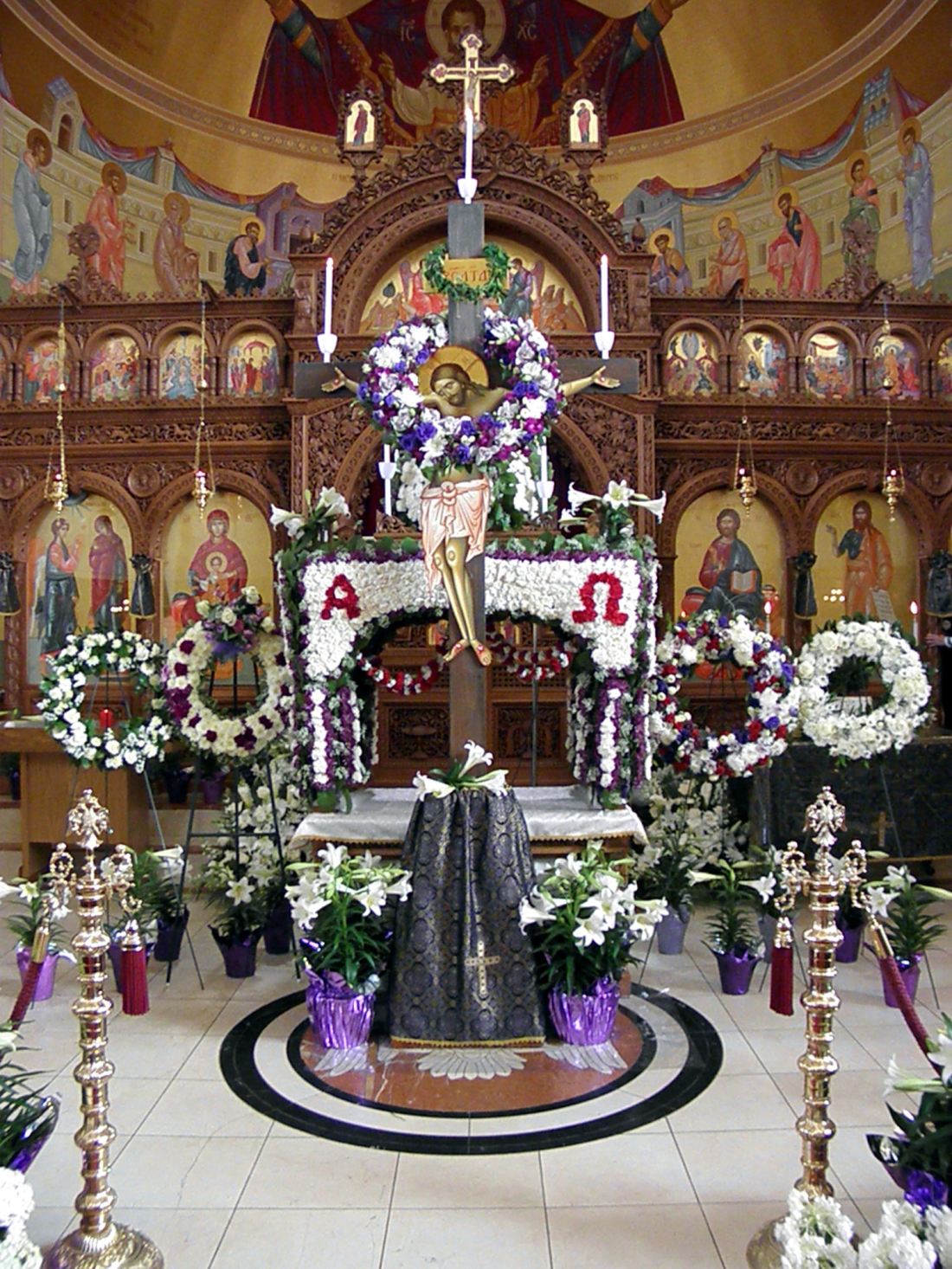
That’s not my little church, by the way. We’ll take that icon down from the cross this afternoon at 3 pm and put a cloth version in a symbolic tomb — one being decorated with carnations and other flowers by some folks at Church as I write this.
Add to that, we earlier in the week were greeted each time we entered Church by the icon of our most improbable “Bridegroom”:

This icon, the Nympios or Bridegroom, is also sometimes called “extreme humility.”
So what hit me this morning was roughly “this is not Christianity as I misunderstood it for nearly fifty years.”
Then tears of gratitude welled up that I was privileged to serve these grueling Holy Week services. I wouldn’t trade it for the world.
* * * * *
“Liberal education is concerned with the souls of men, and therefore has little or no use for machines … [it] consists in learning to listen to still and small voices and therefore in becoming deaf to loudspeakers.” (Leo Strauss)

