Potpourri 11/17/20

Wisdom of the Ages

We can endure neither our vices nor their cure.

Livy


This acceptance of the classical tradition, even in so partially and fragmentarily recovered a form, was a course completely at variance with one type of Christian teaching, influential to varying degrees throughout the middle ages, which dismissed all pagan teaching as the devil’s work and sought to find in the Bible an all-sufficient guide. Luther indeed was the heir of this medieval tradition.

Alasdair MacIntyre, After virtue

I do not reject all pagan teaching as demonic, and neither do the Eastern Church Fathers.


The assumption behind systematic theology is that the universe is actually a “uni-verse” – that is, it has a unity throughout …

This consistency and stability across creation is what is meant by “system” in “systematic theology” …

I recall someone presenting a paper on the doctrine of God in the writings of the radical feminist Catholic, Rosemary Radford Ruether. When the student finished reading the paper, there was a dead, stunned silence in the room. Finally, a sheepish voice piped up, “Isn’t that the Force in Star Wars?” We broke out in laughter because it was precisely what she had articulated. It might make for interesting reading, but it certainly could not be called “Christian.”

Orthodox theology is not studied or written in the manner of Protestant systematics. Orthodox thought is largely what has been traditioned and is drawn from the Fathers and our liturgical life ….

Fr. Stephen Freeman, Orthodoxy, Systematic Theology, and Music – Glory to God for All Things

Crooked Hearts

Here’s a quote for you:

“This crisis is more important than any crisis we’ve had in my time. Our people are waiting for the bishops to say, O.K., we’ve got it under control, we’re on the same page, we hear you and we’ve listened to you and now you can be sure that this will never happen again.”

Know who said that? Cardinal Ted McCarrick, on June 12, 2002.

I’m writing this to you, young man, but I’m also writing it to myself. You cannot imagine how much I need to believe this, to know that it is true. That sentimental saying you see on coffee mugs at gift shops? ‘Be Kind, For Everyone You See Is Fighting A Great Battle’?

Yeah, it’s true.

The Hidden Heroes – Daily Dreher

The one person you don’t see is fighting a great battle, too. Auden captured it:

You shall love your crooked neighbor
with your crooked heart


The number of people coming forward with sexual abuse claims against the Boy Scouts of America (BSA) was approaching 90,000 by the Monday deadline for filing such claims against the organization.

The Nov. 16 deadline was established by a Delaware bankruptcy court, where the BSA had filed as it sought to cope with lawsuit damages and to restructure.

The BSA spent millions of dollars advertising the deadline across the nation, and the claims have poured rivaling sexual abuse claims against the Catholic church. Abused in Scouting, a group of over 8,000 men who say they were abused in the Boy Scouts, said experts had expected over 50,000 claims.

“I knew there were a lot of cases,” Paul Mones, an attorney involved in BSA sexual abuse cases for nearly 20 years, told The New York Times. “I never contemplated it would be a number close to this.”

How much money claimants will eventually receive from the Boy Scouts will depend on the size of a compensation fund the bankruptcy court will establish and the length and severity of the abuse suffered by the individuals making claims against the organization.

The BSA national organization, insurers, and local councils will all contribute to a compensation fund for victims.

The BSA said it was “devastated by the number of lives impacted by past abuse in Scouting and moved by the bravery of those who came forward.”

“The BSA bankruptcy is an unmasking of … its decades’ long problem of sexual abuse that they deliberately concealed,” Mones said on Twitter when the BSA filed for bankruptcy in February.

Knowhere News

I will not wallow in this news, but how can we learn from it? Is it as simple as “Do not entrust the formation of your children to others”?

Carpe diem

An Arabian proverb of our time goes something like this: “My father rode a camel, I drive a Rolls-Royce, my son flies a jet airplane, and his son will ride a camel.”

James Howard Kunstler, The Long Emergency

Perhaps those Arabian boys will ride the Hendricks High-Wheel. (H/T Like Peloton but Analog, and With Alcohol – WSJ)

Politics

If you’re still doing a political purge after our four-year binge, you may stop here.

[I]t is fair to say that, despite what his critics on the left have said to the contrary, Obama did succeed in his stated ambition of fundamentally transforming the United States, albeit through inaction. Every bit as much as the conservative public intellectuals of the last two decades, Obama’s failure was not the result of Eliotic fatalism but (to quote his own letter) of ignorance. Even today he resembles them in his instrumentalization of religion, as a tool that will “restore a sense of meaning” to public life rather than as the activity of a body of believers undertaken for its own sake, as a divine mandate.

Matthew Walter, Barack Obama, failed conservative


… the occasional rapper who supported Trump. I have to remind myself that if you listen to rap music, it’s all about the bling, the women, the money. A lot of rap videos are using the same measures of what it means to be successful as Donald Trump is. Everything is gold-plated.

Barack Obama in Why Obama Fears for Our Democracy – The Atlantic

A great interview with a serious man who once, believe it or not, occupied the highest elective office in the land.


Obama is actually nicer to his enemies than Trump is to his friends. (Jeffrey Goldberg’s observation in Why Obama Fears for Our Democracy – The Atlantic)

Can anyone deny the truth of this?


No major American political figure in my lifetime has triggered the moral revulsion I feel toward Donald Trump; it explains why I was one of his earliest and toughest critics. (I continue to believe that moral revulsion was the proper response to Trump’s tenure.) So I understand how, in the twilight of his presidency, with the president engaging in a series of final civic desecrations, it’s easy to react with indignation one more time. And the fact that Trump supporters like Lindsey Graham and countless others are complicit in those desecrations shouldn’t vanish down the memory hole.

But Trump has dominated too much of our thinking for too long; his transgressions, provocations, and sheer abnormality have made him an omnipresent figure in our lives. Time and time again I’ve spoken with people who are not particularly political yet feel not only deeply unsettled by Trump but enveloped by him. He’s had too much power over too many of us. It’s time we move on from him.

> “My entire personality is hating Donald Trump,” Melissa Villaseñor’s character puts it in a Saturday Night Live political ad parody, “Trump Addicts for America.” “If he’s gone, what am I supposed to do? Focus on my kids again? No thanks.” (“You know he’s bad for you,” the ad concludes. “But it’s hard to imagine life without him.”)

Peter Wehner, Choose Repair, Not Revenge – The Atlantic.

Life without Trump will mean, for me, many more books read. Because, yes, he dominated too much of my time, this Orange Man. (What was his name?)


You can read most of my more impromptu stuff here or join me and others on micro.blog. You won’t find me on Facebook any more, and I don’t post on Twitter (though I do have an account for occasional gawking).
Another curated collection

There’s another strange point that I would add, and maybe we’ll talk about this a little bit more because it does touch on broader issues, but it would be a strange doctrine indeed [if] every time the government takes over a new function and starts to contract about it, the scope of free exercise or free speech rights just automatically shrinks. Because that would mean that in order for the government essentially to do what it wants it just has to occupy the field on any particular field …
The growth of the administrative state has been putting a lot more pressure on the exercise of religion, and this would be a good example of that. And this came up in oral argument: Justice Barrett asked this question at one point, “well could the city just take over running all the hospitals and then say that ‘we’re going to contract it out and everybody has to agree with our terms’?”

Marc O. DeGirolami and Mark Movsesian, respectively, Legal Spirits Episode 028: Oral Argument in Fulton v. Philadelphia – LAW AND RELIGION FORUM, starting at about the 12:05 mark (hyperlink added).

Fulton is last Wednesday’s SCOTUS oral argument over Philadelphia taking over foster care and then banning Catholic Social Services because, had a hypothetical gay couple (or any unmarried couple) shown up seeking to foster or adopt, CSS would have referred them elsewhere. Oh, the horror!

It was a strange oral argument, though, as noted both by these two and by David French and Sarah Isgur last week on Advisory Opinions (starting at 49:00).


“There’s a lot of parallels between a community that’s 96% Hispanic and a community that’s 96% white,” said Freddy Guerra, a former mayor of nearby Roma[, Texas]. “Racism is not something that people deal with in Starr County because everybody’s brown. Climate change isn’t something they feel. They prefer bread on the table.”

Elizabeth Findell, How Democrats Lost So Many South Texas Latinos—the Economy – WSJ

This reminds me of my six weeks in Europe and the British Isles in 1968, touring with the Wheaton College Men’s Glee Club.

When we were in Belfast and Northern Ireland more generally, I (good Protestant boy though I was) was appalled at the anti-Catholic bigotry. I was not surprised when the Catholics started fighting back the next year — The Troubles.

Ireland to the south, in contrast, was tolerant of its Protestant minority.

Seeking some explanation other than intrinsic Catholic tolerance (an answer that I’d have found most uncongenial at that point in my life), I was told that it was pretty simple: Protestants were too few in Ireland to worry about, while Catholics were a very large part of Northern Ireland.

I guess our American polarization could be caused by either of two things:

  • No place is so nearly homogenous as Ireland; there’s no place where a dissident minority can be ignored; or
  • We don’t perceive the United States as a bunch of places, so any dissent from our views anywhere is a threat.

Maybe there are other options, or maybe I’m generalizing too hastily.


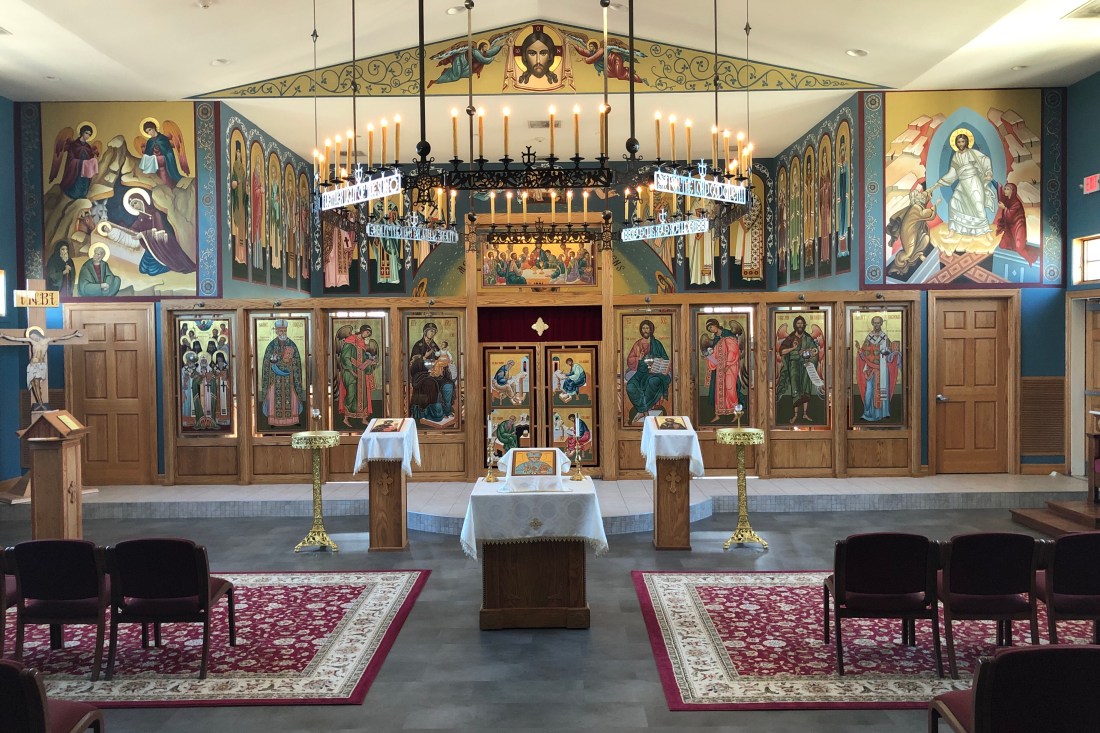
A great cry went up from Orthodox throats across the globe earlier this year when the Turkish government repurposed Hagia Sophia from museum to mosque. The cry was an echo of May 29, 1453, when the city of Constantinople fell to the forces of Sultan Mehmed II. That day, and its pain, have remained an iconic tragedy of a lost world and an abiding sadness. No one dared ask that the Church be returned to use as a Church – better a museum than a mosque. In truth, even as a museum, the loss remains intense. What is lost is not real estate, a building. It is the right place of beauty in the Christian experience. That loss is repeated in museums across the Western world.

Years ago, as a young Anglican priest, I visited the art museum at Bob Jones University in Greenville, SC (my home town). With me was an Anglican monk. Together we made our way through a surprising collection of Italian Church art, and, at the time, one of the largest collections of Russian icons outside of the Soviet Union. Guards followed us carefully through the museum – not that we were perceived as potential thieves. Rather, I think, we were perceived as potential idolaters. That “Christian” museum was, in many ways, a parallel of Hagia Sophia.

The Russian icons at Bob Jones were originally created not just as exemplars of an abstract beauty, but as objects of veneration. They were (and are) “windows into heaven.” The Fathers said of icons that they “make present that which they represent.” They are a means of communion. In the museum-world of modernity, what is contemplated is our own feelings and thoughts. Beauty becomes “art,” serving only our self-gratification.

That which is made present in an icon is perceived only in the act of veneration. In that action, the one who sees also participates through the extension of the self towards that which is made present ….

Fr. Stephen Freeman, Museums, Churches, and My Back Yard – Glory to God for All Things (emphasis added).

The reminder that a lot of museum’s misappropriate stuff (legally) was chastening. And I can’t resist poking a bit at BJU given a legitimate opportunity.


I corrected a shocking omission in my education today by finally reading Alexandr Solzhenitsyn’s 1978 Harvard Commencement Address, A World Split Apart:

The press too, of course, enjoys the widest freedom. (I shall be using the word press to include all media.) But what sort of use does it make of this freedom?

Here again, the main concern is not to infringe the letter of the law. There is no true moral responsibility for deformation or disproportion. What sort of responsibility does a journalist or a newspaper have to his readers, or to his history — or to history? If they have misled public opinion or the government by inaccurate information or wrong conclusions, do we know of any cases of public recognition and rectification of such mistakes by the same journalist or the same newspaper? It hardly ever happens because it would damage sales. A nation may be the victim of such a mistake, but the journalist usually always gets away with it. One may — One may safely assume that he will start writing the opposite with renewed self-assurance.

Because instant and credible information has to be given, it becomes necessary to resort to guesswork, rumors, and suppositions to fill in the voids, and none — and none of them will ever be rectified; they will stay on in the readers’ memories. How many hasty, immature, superficial, and misleading judgments are expressed every day, confusing readers, without any verification.

The press — The press can both simulate public opinion and miseducate it. Thus, we may see terrorists described as heroes, or secret matters pertaining to one’s nation’s defense publicly revealed, or we may witness shameless intrusion on the privacy of well-known people under the slogan: “Everyone is entitled to know everything.” But this is a false slogan, characteristic of a false era. People also have the right not to know and it’s a much more valuable one. The right not to have their divine souls [stuffed with gossip, nonsense, vain talk.] A person who works and leads a meaningful life does not need this excessive burdening flow of information.

Hastiness and superficiality are the psychic disease of the 20th century and more than anywhere else this disease is reflected in the press. Such as it is, however, the press has become the greatest power within the Western countries, more powerful than the legislative power, the executive, and the judiciary.

More:

Without any censorship, in the West fashionable trends of thought and ideas are carefully separated from those which are not fashionable; nothing is forbidden, but what is not fashionable will hardly ever find its way into periodicals or books or be heard in colleges. Legally your researchers are free, but they are conditioned by the fashion of the day. There is no open violence such as in the East; however, a selection dictated by fashion and the need to match mass standards frequently prevent independent-minded people giving their contribution to public life … There is, for instance, a self-deluding interpretation of the contemporary world situation. It works as a sort of a petrified armor around people’s minds. Human voices from 17 countries of Eastern Europe and Eastern Asia cannot pierce it. It will only be broken by the pitiless crowbar of events.

Still more:

If humanism were right in declaring that man is born only to be happy, he would not be born to die. Since his body is doomed to die, his task on earth evidently must be of a more spiritual nature. It cannot be unrestrained enjoyment of everyday life. It cannot be the search for the best ways to obtain material goods and then cheerfully get the most of them. It has to be the fulfillment of a permanent, earnest duty so that one’s life journey may become an experience of moral growth, so that one may leave life a better human being than one started it.


I also read some less enduring stuff.

The American people can have confidence that this election was fundamentally fair, its integrity will be upheld, and its outcome is clear.

Former Republican President George W. Bush, in a statement congratulating Joe Biden for winning the presidency, quoted in Knowhere News

Only in the fevered mind of Donald Trump is this statement not admirable, but I’ll be surprised if Trump hasn’t mean-Tweeted it.


The fine print on the campaign’s website shows that 60 percent of contributions to Trump’s new “Election Defense Fund” will actually be diverted toward retiring his campaign’s debt, and Axios reported last night that the president plans to “hold campaign-style rallies … in an effort to prolong his fight against apparent insurmountable election results.”

The Morning Dispatch: Biden Calls for Unity


Did you even read past the first sentence? Or are you just purposely lying so you can talk tough? No one said give up. I literally said investigate every irregularity and use the courts. You’re a member of Congress now, Marjorie. Start acting like one.

Congressman Dan Crenshaw to Congresswoman-elect Marjorie Taylor Greene, who spouted some chest-thumping misrepresentation of Crenshaw on Twitter.

Thank you, Mr. Crenshaw.


Out of the crooked timber of humanity no straight thing was ever made.

You shall love your crooked neighbour
With your crooked heart.

W.H. Auden


You can read most of my more impromptu stuff here or join me and others on micro.blog. You won’t find me on Facebook any more, and I don’t post on Twitter (though I do have an account for occasional gawking).
Timeless, ever-timely

I got inspired by a teaser for a Washington Post guest column April 11:

Their churches will be closed on Easter. Here’s what they would have said.

Featured were nine “faith leaders”:

You can judge their uneven offerings for yourself.

As we are never earlier in our Orthodox Christian Paschal celebration, and generally one to five weeks later than western Christendom, and are largely invisible in North America, no Orthodox clergy were included. But that’s okay.

It’s okay because I can tell you exactly “what they would have said” (give or take countless languages) every single one of them, this April 19, 2020, and many of them right around now, 1:30 in the morning (give or take 24 time zones).

It would have made no special mention of the current pandemic, and yet …

Well, here’s what they’d have said:

If any man be devout and love God, let him enjoy this fair and radiant triumphal feast. If any man be a wise servant, let him rejoicing enter into the joy of his Lord. If any have labored long in fasting, let him now receive his recompense. If any have wrought from the first hour, let him today receive his just reward. If any have come at the third hour, let him with thankfulness keep the feast. If any have arrived at the sixth hour, let him have no misgivings; because he shall in nowise be deprived thereof. If any have delayed until the ninth hour, let him draw near, fearing nothing. If any have tarried even until the eleventh hour, let him, also, be not alarmed at his tardiness; for the Lord, who is jealous of his honor, will accept the last even as the first; He gives rest unto him who comes at the eleventh hour, even as unto him who has wrought from the first hour.

And He shows mercy upon the last, and cares for the first; and to the one He gives, and upon the other He bestows gifts. And He both accepts the deeds, and welcomes the intention, and honors the acts and praises the offering. Wherefore, enter you all into the joy of your Lord; and receive your reward, both the first, and likewise the second. You rich and poor together, hold high festival. You sober and you heedless, honor the day. Rejoice today, both you who have fasted and you who have disregarded the fast. The table is full-laden; feast ye all sumptuously. The calf is fatted; let no one go hungry away.

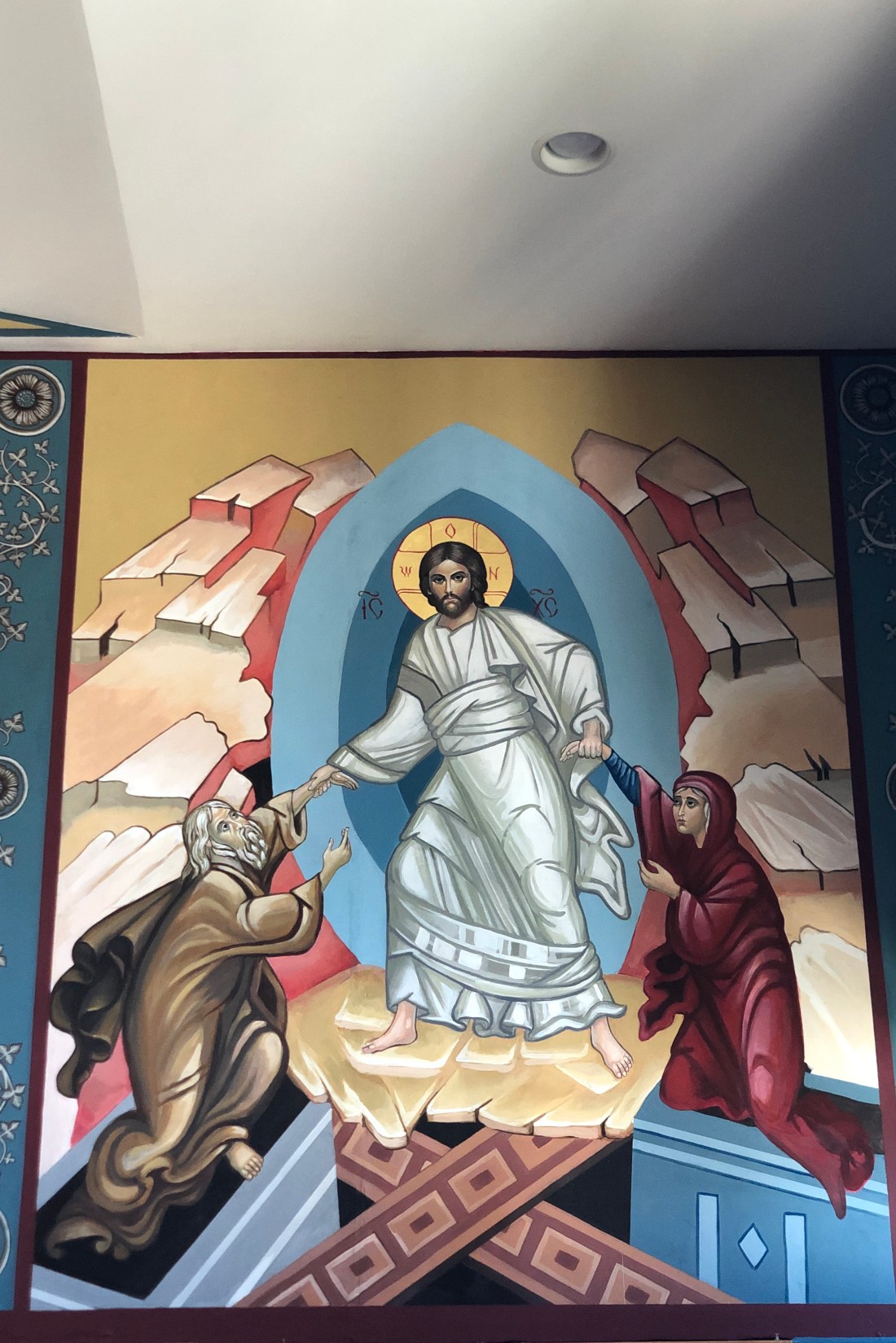
Enjoy ye all the feast of faith: Receive ye all the riches of loving-kindness. let no one bewail his poverty, for the universal kingdom has been revealed. Let no one weep for his iniquities, for pardon has shown forth from the grave. Let no one fear death, for the Savior’s death has set us free. He that was held prisoner of it has annihilated it. By descending into Hell, He made Hell captive. He embittered it when it tasted of His flesh. And Isaiah, foretelling this, did cry: Hell, said he, was embittered, when it encountered Thee in the lower regions. It was embittered, for it was abolished. It was embittered, for it was mocked. It was embittered, for it was slain. It was embittered, for it was overthrown. It was embittered, for it was fettered in chains. It took a body, and met God face to face. It took earth, and encountered Heaven. It took that which was seen, and fell upon the unseen.

O Death, where is your sting? O Hell, where is your victory? Christ is risen, and you are overthrown. Christ is risen, and the demons are fallen. Christ is risen, and the angels rejoice. Christ is risen, and life reigns. Christ is risen, and not one dead remains in the grave. For Christ, being risen from the dead, is become the first fruits of those who have fallen asleep. To Him be glory and dominion unto ages of ages. Amen.

The Paschal Sermon of St. John Chrysostom, delivered in the fourth or very early fifth century, which I submit has never been surpassed. It’s our tradition throughout Orthodoxy to read it verbatim, each Pascha. Because it’s timeless, it’s ever-timely.

* * * * *

Secularism, I submit, is above all a negation of worship. I stress:—not of God’s existence, not of some kind of transcendence and therefore of some kind of religion. If secularism in theological terms is a heresy, it is primarily a heresy about man. It is the negation of man as a worshiping being, as homo adorans: the one for whom worship is the essential act which both “posits” his humanity and fulfills it.

Alexander Schmemann, For the Life of the World, Appendix 1

You can read most of my more impromptu stuff at here. It should work in your RSS aggregator, like Feedly, should you want to make a habit of it.

Entangled musings

So long as worship of the Emperor as a God was required by law of all citizens, to become a Christian meant to become a criminal. In consequence, the Christians of the first four centuries A.D., subject like everyone else to the temptations of the Flesh and the Devil, had been spared the Temptations of the World. One could become a converted and remain a thorough rascal, but one could not be converted and remain a gentleman.

(W.H. Auden, in the Introduction to The Complete Poems of Cavafy)

My former activism on behalf of unpopular causes (e.g., against abortion, against mandatory social leveling on behalf of practitioners of trendy vices) was never a strategy to “get my name out there” so people would seek my legal services. Insofar as it did bring me clients, they strongly tended toward eccentricity if not outright crackpottery.

We were not formally criminals, my clients and I, but we knew that we could not aspire to unequivocal worldly respectability, either. (That is not a characterization of all my clients — just the ones who I knew as co-belligerents in lost causes.)

Most of these activism-related clients were “conservative” Protestants, as was I then. Most of them plainly were either tacitly Nominalists or at least utterly incapable of framing a confident argument in Realist terms. They were the proverbial “Bible-thumpers,” pulling out their favored proof-texts that sodomy is sinful, or that God knows each of us en ventre sa mère. The problem came connecting such things to law.

In a recent podcast, Fr. Patrick Henry Reardon opines that Nominalism is probably, “the deepest flaw in the whole Protestant enterprise” (Luther referred to William of Ockham, the Franciscan popularizer of Nominalism, as his “mein meister”, and the Church of England still commemorates Ockham on April 10.) Fr. Pat’s podcast is actually a pretty succinct introduction to the Nominalist-Realist contrast. (Quick: is adultery wrong because God forbade it or did God forbid it because is wrong — contrary to reality as he created it?)

Somehow, I was a Realist, or leaning strongly Realist, even before I knew the Nominalist-Realist distinction and well before Orthodoxy. I frequently lamented, if only in private, the embarrassing and counter-productive arguments of my co-belligerents in the causes we all supported (or, likelier, opposed).

My tacit Realism (which I’m fairly sure developed unawares after my adolescence) may have been another factor, along with my earlier-in-life onset of temperamental partiality to contemplation more than action, that made Orthodox Christianity click for me when I finally encountered it. I wish I were confident that North American Orthodox Christians, especially my fellow converts, were solidly Realist, because we’re living in parallel ecclesial realities if they’re not.

But I began talking about “my activism.” Do I contradict myself, interjecting contemplation? I think not. My “activism” was argumentation, verbal and in writing, which is a fairly contemplative form of activism. I’ve never raided a draft board, lain down in a street, or otherwise gotten into the physical scrum.

And is there some latent negativity in my oppositional activism (rather than supportive activism)? Again I think not, though it may, once more, dovetail with an aspect of Orthodoxy: apophasis, known in Latin as the via negativa. More specifically, I’m less confident of the location of the “this is right and good and pure” bullseye than I am about “wherever that bullseye is, it ain’t here.”

After more than 22 year in Orthodoxy, I’m still picking up threads that I think helped to lead me here. Picking them up, and acknowledging their entanglement and, sometimes, ineffability seems true to life — which is notoriously messy — more generally.

* * * * *

Secularism, I submit, is above all a negation of worship. I stress:—not of God’s existence, not of some kind of transcendence and therefore of some kind of religion. If secularism in theological terms is a heresy, it is primarily a heresy about man. It is the negation of man as a worshiping being, as homo adorans: the one for whom worship is the essential act which both “posits” his humanity and fulfills it.

Alexander Schmemann, For the Life of the World, Appendix 1

I appreciate Donald Trump’s judicial appointments and a few other things he has done, but I’m utterly opposed to allowing that hateful, unstable and completely self-serving man to serve as President. Maybe by saying it here, I’ll feel less compelled to fault his multiple daily outrages — mere corroboration of his dark soul and tormented mind — in the body of the blog.

You can read most of my more impromptu stuff at here. It should work in your RSS aggregator, like Feedly, should you want to make a habit of it.

Caveat Emptor

Michael Pakaluk proposes a prefatory disclosure to David Bentley Hart’s That All Shall Be Saved: Heaven, Hell, and Universal Salvation, implying that the book is a sort of theological fraud:

Warning. St. Basil the Great, a doctor of the Church—who loved Origen but nonetheless did not embrace universalism—as early as the fourth century, warned the faithful against teachings like those which you will find in this book by David Bentley Hart.

Basil taught firmly that such views could only be entertained by those who had, as it were, lost sight of the plain and repeated teachings of the Lord. It would be the height of daring to believe such things, he said—and so, obviously, to teach and promote them would be much worse. To do so, Basil would say, amounts to collaboration with the Devil, who, in his characteristically deceitful ways, would like nothing more than for people to suppose that the everlasting punishment of hell does not exist.

Pakaluk is presumably Roman Catholic. Hart, like me, is Orthodox.

But Hart, as brilliant as he is, is an increasingly arrogant and abusive provocateur, and this book is outside the Orthodox consensus, which I take to be that we may hope for the salvation of all, but we should not expect it.

I do hope for the salvation of all. I do not expect it.

It is also worth noting that Hart is an Orthodox layman and a philosopher, with no known credentials as a theologian (though one not infrequently sees him so identified).

Let the book-buyer beware.

* * * * *

Trump didn’t do the thing he’s accused of doing, but if he did it was fine, and in fact that’s exactly what he did, get over it, because it’s not only fine, it’s precisely what we want from a president, and can you believe that Biden did the same thing, shame on him.

Peter Sunderman

You can read most of my more impromptu stuff at here. It should work in your RSS aggregator, like Feedly, should you want to make a habit of it.

Liturgy, mimesis, humus

I went to a symposium over the weekend, the intimidating theme of which was For I Am Holy: The Command to Be Like God.

Like God?!

But this was my fifth year. I have people who are becoming like family to me. I wanted to see them.

Boy, am I glad I went.

There were no formulae. Holiness formulae can only turn us into delusional, self-righteous Church Lady prigs.

So the emphasis was how the liturgy and encountering great literature (sometimes with holy protagonists) and practicing humility at the most “humus” level can shape us toward holiness.

The Eighth Day Symposia are always ecumenical in the sense that the three main speakers are Orthodox, Catholic and Protestant. The commonality comes from moderate to deep knowledge of the Church Fathers.

Christians are divided. This is a fact. We have been since the schism between East and West at the turn of the first millennium and since the Protestant Reformations in the sixteenth century. This is a tragedy. That’s why we believe we have a duty to facilitate a dialogue of love and truth, one that acknowledges our real differences, but one that also seeks to achieve a common mind so we can stand reunited in the One who is the Truth.

There is a separate Florovsky-Newman week to focus on our differences. I’ve never been to one, but I think that’s going to change.

Eighth Day Institute is mutually and enthusiastically supportive of Eighth Day Books, a Christian bibliophile’s “happiest place on earth.”

EDB has just published a paper catalog for the first time in eight years. Get one before they’re gone!

* * * * *

All Christian readers could benefit from listening to the podcast The Struggle Against the Normal Life. It’s a short (11:05) detox for our toxic faux Christian environment.

You can read most of my more impromptu stuff at here. It should work in your RSS aggregator, like Feedly, should you want to make a habit of it.

This (sigh!) is as good as it gets

I’ve been waiting for decades for the orthodox to rout the progressives in a denominational split — which amounts to waiting for the progressives to overplay their hand just once.

The usual progressive ploy is to plead for dialog — again and again for as long as it takes to wear down the orthodox — then to give false assurances of pluralism once their heresy or immorality is grudgingly afforded the status of an option, then to crush the orthodox when they gain power. Or as Neuhaus’s Law puts it, “Where orthodoxy is optional, orthodoxy will sooner or later be proscribed.”

It looks like the United Methodist split over homosexuality and same-sex marriage is as close as we’re going to get to an orthodox rout, and even there the progressives are keeping the denomination name (which may prove a blessing in the long run):

This week, a group of church leaders announced a plan for the dissolution of the worldwide church that would allow conservative congregations and conferences to leave the main body and join a new conservative denomination. Under the proposal, the UMC would give the new denomination $25 million and allow departing congregations to keep their property, and departing clergy, their pensions.

(Law & Religion Forum) Keeping property and pensions, and getting a farewell gift to boot, is a smashing victory — relatively speaking.

God bless the Africans, who forced the progressives (a majority in North America) to sue for “peace.” My great-grandchildren may someday need to be evangelized by missionaries from the global south.

* * *

I must also issue a caveat at this point, because the dominant media falsely make disputes like this a matter of good guys versus wicked homophobes.

David French provides an easy way to do so:

The true fracturing point between [progressive and orthodox] churches is over the authority and interpretation of scripture. The debate over LGBT issues is a consequence of the underlying dispute, not its primary cause … [T]here is a strain of Protestant Christianity that views the Bible as valuable but not infallible or inerrant. Evangelical Christians, by contrast, strongly dissent from that view.

Thus, at heart, the disagreement between the [orthodox and progressive] isn’t over issues—even hot-button cultural and political issues—but rather over theology. Indeed, the very first clause of the United Methodist Church’s nine-page separation plan states that church members “have fundamental differences regarding their understanding and interpretation of Scripture, theology and practice.” …

I’m not for a moment going to pretend that there aren’t homophobes and bigots in [orthodox Christianity]. I’ve encountered more than a few people who turn a blind eye to or rationalize and excuse all manner of heterosexual sin while scorning their gay and lesbian friends and neighbors. But for the thoughtful and faithful dissenters on both sides of the theological aisle, sexuality is the side issue. Differences over scriptural authority and biblical theology represent the central dispute.

Orthodox Christian sexual ethics have absolutely nothing to do with animus against gays and lesbians. In fact, there should be zero animus against any person of any sexual orientation or gender identity. Instead, the orthodox Christian sexual ethic—which reserves sex for the marriage between a man and a woman—rests on a sincere conviction that it is not only directly commanded by God through scripture, it’s also best for human flourishing, and it is symbolic of the sacred relationship between Christ and His Church.

And then caveats to the caveat:

French is an Evangelical, which characteristically (and in French’s case) involves a fair amount of parochialism and ecclesiological cluelessness. So I have modified his over-simplified contrast between Evangelicals and Mainstream Protestants to refer to orthodox and progressive more broadly.

Second, for Catholics and capital-O Orthodox, the scriptural teaching on sexuality is important but not all-important, because each Church’s tradition is consistent about the meaning of sexuality. Were I still Protestant, however, I would stand with the lower-o orthodox, because the case that scripture is unclear is dishonest. Here’s an admission against interest to that effect:

I have little patience with efforts to make Scripture say something other than what it says through appeals to linguistic or cultural subtleties. The exegetical situation is straightforward: we know what the text says… . [However] we must state our grounds for standing in tension with the clear commands of Scripture… and appeal instead to another authority when we declare that same sex unions can be holy and good. And what exactly is that authority? We appeal explicitly to the weight of our own experience and the experience thousands of others have witnessed to, which tells us that to claim our own sexual orientation is in fact to accept the way in which God has created us.

(Pro-gay Roman Catholic scholar Luke Timothy Johnson)

That will have to suffice, for everything eventually connect to everything else, and I don’t have an eternity to qualify and ramify.

* * * * *

Sailing on the sea of this present life, I think of the ocean of my many offenses; and not having a pilot for my thoughts, I call to Thee with the cry of Peter, save me, O Christ! Save me, O God! For Thou art the lover of mankind.

(From A Psalter for Prayer)

You can read most of my more impromptu stuff at here. It should work in your RSS aggregator, like Feedly, should you want to make a habit of it.

Anecdotes and trends

One man in my parish is very frugal and doesn’t even own a car. He usually gets a ride to our rural church from someone else in the parish. But a few weeks ago, he had to hire a Lyft, and the driver, a Sikh man, asked if he could come in.

He ended up staying for the whole service and coffee hour, taking videos with his smartphone, and was welcomed warmly (there was even a staged photo of him with Father Gregory and another man in the parish with a notable beard).

A few years ago, a Texan Purdue student, from a Hindu family, completed a long catechumenate and was received into the Orthodox Church. Tomorrow, we receive a heavily-tattooed military veteran, formerly in one of the Arminian Christian traditions. A Protestant pastor is a respectful inquirer, and several Roman Catholics are in the catechumenate. Our founding Priest was Episcopalian, our current Priest Lutheran. I was Calvinist. One of my Godsons was Church of Christ, a Goddaughter raised without religion. Converts in our parish probably outnumber “cradle Orthodox,” though some of the converts have many “cradle Orthodox” children that I may be mistakenly thinking of as themselves converts.

[M]ore than every before, people are searching for the One True Church of Christ – they are searching for Orthodoxy.

Roman Catholics are aghast at the Amazonian Synod, the constant vague and confusing statements coming from Rome, and the consistent degeneration of their spirituality. They’re realizing that there is something serious has gone mission, and they know that there is more.

Protestant Christians are tired of the happy, clappy/seeker-friendly service which offers a spiritual experience a mile wide, an inch deep, and is often loaded with gnostic beliefs. They’re realizing that something is wrong, something is missing, and that there is something more.

Non-Christians in these latter days are turning from the world, desperate to find some beacon of Truth in a dystopian society. Many muslims, buddhists, and hindus are finding Christ. They’re having a spiritual awakening. They KNOW something is wrong. They want to fix it themselves, but they don’t know what it takes.

Father John at Journey to Orthodoxy. Need I add that this rings true?

It is also sadly true that some leave the Orthodox faith. That baffles me, but life is hard — harder for some than others — and people struggle with burdens they cannot (or do not) articulate.  But the trend seems to the contrary.

If any of Father John’s descriptions fit you, we’d love to see you.

* * * * *

The Lord is King, be the peoples never so impatient; He that sitteth upon the Cherubim, be the earth never so unquiet.

(Psalm 98:1, Adapted from the Miles Coverdale Translation, from A Psalter for Prayer)

You can read most of my more impromptu stuff at here. It should work in your RSS aggregator, like Feedly, should you want to make a habit of it.

Search-and-question mode

God does not always have us in a search-and-question mode. Rather, He gives us times, sometimes long periods of settled contentment right where we are. From my late twenties I confess to have been settled and content in Reformed Calvinism

… I also picked up a few stray Orthodox FB-friends liking or challenging their posts, who came from my own Reformed background. After gigging them playfully every now and then for months, they finally said, “Okay Rockett, you need to read some good Orthodox stuff, or shut up!” Seriously, I agreed only to learn their quirks & errors. I was a very happy, well-read confident Reformed Calvinist, twice elected as a Ruling Elder. I was content, assured…even a tad cocky!

Many of those words could have been mine, but they are David E. Rockett‘s (with emphasis added).

I, too, entered Reformed Calvinism in my late twenties, and abode there, content, for roughly 20 years (he lasted a bit longer). And I, too, started reading about and in Orthtodoxy with the intent of figuring out how it was wrong — in my case, not on a taunt from Orthodox friends, and pretty clearly to figure out how Orthodox-Wrong (of which I knew little) differed from Catholic-Wrong (which I thought I had figured out).

It proved Rockett’s undoing as a Calvinist, as it did mine.

How well do you know Orthodox Christianity? Do you wonder why so many are leaving Protestant traditions for it? Isn’t it time to find out?

* * * * *

You can read most of my more impromptu stuff at here. It should work in your RSS aggregator, like Feedly, should you want to make a habit of it.

I highly recommend blot.im as a crazy-easy alternative to Twitter (if you’re just looking to get your stuff “out there” and not pick fights).