Though most contemporary conservatives (who are really libertarians) would not agree, I think Berry is very much an old-fashioned conservative — so old that the moderns can’t recognize him. But the same thing could be said of Christianity in general these days.
Fr. Jonathan Tobias, recommending — nay, urging — his readers to read Wendell Berry’s Jayber Crow.
"Thinking"
The healing that is inherent in Christian salvation is not just found in what (Who) is known, but in the manner of knowing as well. The abstraction that we call “thinking,” etc., in the contemporary world is a diminishment of what it means to be human. We have learned to focus on a very narrow stream of information, and, in turn, have come to be possessed by the information on which we focus.
Thoughts on Pope Francis’s crackdown on the Traditional Latin Liturgy
Alan Jacobs
It is sad and strange to me that Francis can be so warm in his sympathy for those who openly reject his Church and its teachings, but so icy-cold, so corrosively skeptical, towards some of that Church’s most faithful sons and daughters. Sad, strange — and, I believe, profoundly unwise.
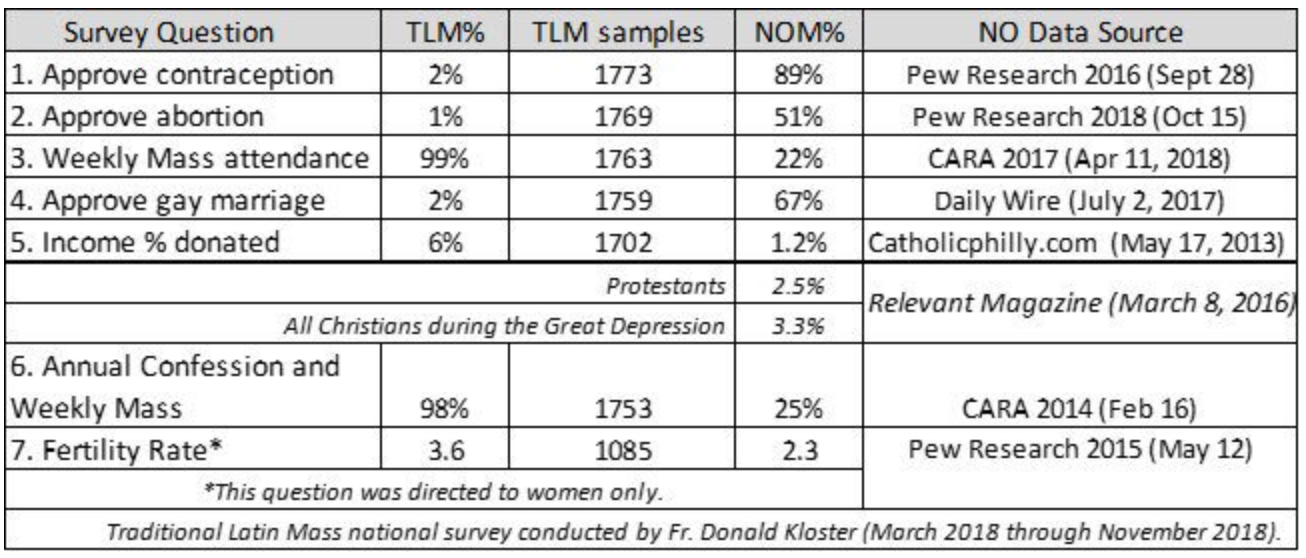
If this chart is accurate, "profoundly unwise" may be understatement. (TLM is Traditional Latin Mass; NOM is Novus Ordo Mass. Source via Rod Dreher.
Rorate Cæli
Bergoglio is in reality a man of vengeance. A pope of vengeance. An angry bitter Jesuit settling scores through vengeance.
What ought traditional Catholics to do in response to the latest attack on the Mass and all those who love tradition? Simply put: ignore it. Ignore its message. Ignore its motivation caused by pure hatred and vengeance. Keep calm and keep on going as if it does not even exist.
…
Ignore the Agent of Hatred and Vengeance, and all his works and all his pomps.
Commenting on Rorate Cæli (with which he sympatizes):
How can you do that and still be Catholic? How can you defy the Pope in good conscience, as if his order was never made? I honestly don’t know how one remains Catholic if that’s what one believes about the Pope and the exercise of his authority. The only truly stable thing within Catholicism of the last sixty years has been the papacy. If you cast that aside — and that’s what Rorate is calling for in effect here — what do you have left? If you defy the Pope, even in the name of Catholic orthodoxy, how are you not a de facto Protestant? How is that remotely tenable? Somebody needs to explain this to me.
It seems to me that some Trads are in the same place I was back in 2005 with regard to the faith. I found it impossible to believe — not just unpleasant to believe, but impossible to believe — that my salvation depended on being in communion with the Catholic bishops. I came to the conclusion that I had probably been wrong about papal infallibility, and about Catholic claims to exclusive authority ….
Moi
I have feelings about this — maybe even thoughts — but I try to take myself by the scruff of my neck and say "This is not your church and never was, so butt out." I’ll only say this:
The Novus Ordo mass is, per se, a big impediment to healing the Great Schism.
The traditional Latin Mass was not, per se, a big impediment to healing the Great Schism.
For all their claims to ancient wisdom, there’s nothing remotely countercultural about the Tolles and Winfreys and Chopras. They’re telling an affluent, appetitive society exactly what it wants to hear: that all of its deepest desires are really God’s desires, and that He wouldn’t dream of judging.
The loss of Christendom gives us a joyous opportunity to reclaim the freedom to proclaim the gospel in a way in which we cannot when the main social task of the church is to serve as one among many helpful props for the state.
Stanley Hauerwas, Resident Aliens. Hauerwas is one of a handful of Protestants who can still stir my Orthodox soul.
Evangelicals who by some accounts (see below) are grieving their loss of political power should take heart at this, too. When life gives you lemons, make lemonade. Make a virtue of necessity.
Futile persuasion
… you can’t fact-check, plead, or argue a person out of a conspiracy, because you’re trying to fact-check, plead, and argue them out of their community.
This is something I never thought I’d say. According to this landscape report, there are more Americans who are white mainline protestants (16%) than there are Americans who are white evangelicals (14%).
What accounts for this? There is no new big influx into the mainline churches. Most of their gain seems to be coming from those who had left the mainline community for the evangelical community years ago, but who are simply returning to the church of their upbringing.
The decline of white evangelicals seems mostly to result from the larger changing demographics of America. This is obvious. There is an irreversible change from a white majority to a plurality of ethnicities in the country. This is happening no matter what one thinks about immigration or voting policies.
But there is another factor that has contributed to the decline. When Dean Kelly wrote his book in 1972, the evangelical community was focussed upon concrete “Biblical lifestyle issues.” Since then, the focus has broadened to involvement in political, partisan issues and the “culture wars” — the very sort of involvement that Kelly had blamed for mainline decline 50 years before.
Now it seems that the chickens have come home to roost. The Pew report of 2019 observed that it was just because of explicit political partisanship that many young adults are leaving the evangelical community, most likely landing squarely in the “unaffiliated” category.
In addition to shrinking as a share of the population, white evangelicals were also the oldest religious group in the United States, with a median age of 56. “It’s not just that they are dying off, but it is that they’re losing younger members,” Jones told me. As the group has become older and smaller, Jones said, “a real visceral sense of loss of cultural dominance” has set in.
White evangelicals once saw themselves “as the owners of mainstream American culture and morality and values,” said Jones. Now they are just another subculture.
…
QAnon is essentially a millenarian movement, with Trump taking the place of Jesus. Adherents dream of the coming of what they call the storm, when the enemies of the MAGA movement will be rounded up and executed, and Trump restored to his rightful place of leadership.
“It’s not unlike a belief in the second coming of Christ,” said Jones. “That at some point God will reorder society and set things right. I think that when a community feels itself in crisis, it does become more susceptible to conspiracy theories and other things that tell them that what they’re experiencing is not ultimately what’s going to happen.”
… white evangelicals probably aren’t wrong to fear that their children are getting away from them. As their numbers have shrunk and as they’ve grown more at odds with younger Americans, said Jones, “that has led to this bigger sense of being under attack, a kind of visceral defensive posture, that we saw President Trump really leveraging.”
I was frightened by the religious right in its triumphant phase. But it turns out that the movement is just as dangerous in decline. Maybe more so. It didn’t take long for the cocky optimism of Generation Joshua to give way to the nihilism of the Jan. 6 insurrectionists. If they can’t own the country, they’re ready to defile it.
I wouldn’t bet too much on Goldberg’s construal of QAnon, but she may have gotten into it (for professional reasons only) more deeply than I.
Hymns, east and west
As I approached the Orthodox Church almost 25 year ago, I was astonished at how different it was in “feel” from anything I’d previously encountered. Timothy (Now Bishop Kallistos) Ware provides a glimpse:
Orthodox feel thoroughly at home in the language of the great Latin hymn by Venantius Fortunatus (530 – 609), Pange lingua, which hails the Cross as an emblem of victory: Sing, my tongue, the glorious battle, Sing the ending of the fray; Now above the Cross, our trophy, Sound the loud triumphal lay: Tell how Christ, the world’s redeemer, As a victim won the day. They feel equally at home in that other hymn by Fortunatus, Vexilla regis: Fulfilled is all that David told In true prophetic song of old: Among the nations God, said he, Hath reigned and triumphed from the Tree. But Orthodox feel less happy about compositions of the later Middle Ages such as Stabat Mater: For His people’s sins, in anguish, There she saw the victim languish, Bleed in torments, bleed and die: Saw the Lord’s anointed taken; Saw her Child in death forsaken; Heard His last expiring cry.
Expounding that glimpse is above my pay grade, but I’m pretty confident that it reflects a non-Anselmian view of atonement by us Orthodox (which is also a reason why most Protestant writers on religion leave me cold).
You can read most of my more impromptu stuff at here. It should work in your RSS aggregator, like Feedly, should you want to make a habit of it.
UPDATE: A premier sociologist of religion is not buying that mainline Protestants now outnumber Evangelicals. He explains why here.
Lots of American Churches do something special for the 4th of July. Well tomorrow, for a change, some American Orthodox Churches are doing something special, and rather patriotic, too.
I’m sort of putting you on, though what I say is stone cold true. We (i.e., some of the jurisdictions with ethnic roots in Slavic lands, at least) are in no way celebrating America’s Independence Day liturgically.
But this year, the second Sunday after Pentecost falls on July 4, and on the second Sunday after Pentecost, we commemorate regional Saints — in our case, the Saints of North America. (Last week we commemorated All Saints.)
So tonight, for Vespers, I sang all these:
Come, let us praise the saints of North America,
holy hierarchs, venerable monastics, and glorious martyrs,
pious men, women, and children, both known and unknown!
Through their words and deeds, in various walks of life,
by the grace of the Spirit they achieved true holiness.
Now as they stand in the presence of Christ Who glorified them,
they pray for us, who celebrate their memory with love.
Come, let us assemble today
and glorify the luminaries of the North American lands,
the glorious martyrs and holy bishops who confirmed our faith,
the righteous dwellers in the wilderness and guides of the spiritual life!
Let us cry out to them in joy:
“All Saints of North America, known and unknown, pray to God for us!”
As the brightest sun,
as the brilliance of the Morning Star,
the precious feast of the saints of North America has dawned for us,
to illumine us and to set our hearts on fire,
to imitate their godly lives,
and to follow their example of zeal for God.
Come, let us assemble today
and let us praise the elect of North America!
Having fought the good fight, you have persevered in the faith,
receiving your crowns of victory from God.
Beseech Him to deliver from every calamity and sorrow
all who keep your holy memory in faith and in love!
The earth rejoices and the heavens are glad,
O venerable Saints of America,
praising your labors and lives, your spiritual fortitude and purity of heart.
By driving away a multitude of demons
and enlightening many people with the light of the Orthodox Faith,
you have confirmed our land.
Rejoice, O mountains of Pennsylvania;
leap for joy, O waters of the Great Lakes;
rise up, O fertile plains of Canada;
for the elect of Christ who dwelt in you are glorified,
men and women who left their homes for a new land!
With faith, hope, and patience as their armor,
they courageously fought the good fight.
Comforted by the beauty of the Orthodox Faith,
they labored in mines and mills, they tilled the land,
they braved the challenges of the great cities,
enduring many hardships and sufferings.
Never failing to worship God in spirit and truth
and unyielding in devotion to His most pure Mother, they erected many temples to His glory.
Come, O assembly of the Orthodox,
and with love let us praise the holy men, women, and children,
those known to us and those known only to God,
and let us cry out to them:
“Rejoice, all Saints of North America and pray to God for us!”
Rejoice, O continent of North America, illumined by the holy Gospel!
Rejoice, every province, state, city, and town,
which raised up citizens of the heavenly Kingdom!
Rejoice, our venerable Father Herman, first saint of our land!
Rejoice O Martyrs Juvenaly and Peter,
for your blood has watered the seed of faith planted in Alaska!
Rejoice, O holy Hierarchs: Innocent, Tikhon, Nicholas, Raphael, and John!
Rejoice, O holy Fathers Alexis, John, and all you righteous priests!
Rejoice, all Saints of North America,
for your light has shone forth to the ends of the earth!
We beseech you to pray to Christ our God that our souls may be saved!
Today, as we celebrate the memory of all the Saints of North America,
let us praise them as is fitting,
for they lived all of Christ’s beatitudes.
Deprived of material wealth, they became rich in spirit;
meek, they inherited the earth;
mourning, they were comforted;
thirsting for righteousness, they were satisfied;
merciful, they obtained mercy;
pure in heart, they beheld the image of God;
as peacemakers, they became God’s children;
persecuted and tortured for righteousness’ sake, they now rejoice in heaven;
and they pray fervently to the Lord that He may have mercy on our souls.
Let us sound a hymn on the trumpet
and praise with one accord the Protectress of our land,
our Queen, the Theotokos:
Rejoice, for you have crowned our land with your favor,
pouring abundant grace upon it!
Therefore, the Church in America joyously celebrates your precious protection
and commemorates the multitude of your miracles.
And now deprive us not of your mercies, O Lady!
Look with favor upon us in our adversities and afflictions
and raise us up by your powerful intercession!
At Liturgy tomorrow, we’ll sing these, too:
As the bountiful harvest of Your sowing of salvation,
the lands of North America offer to You, O Lord, all the saints who have shone in them.
By their prayers keep the Church and our land in abiding peace
through the Theotokos, O most Merciful One!
Today the choir of Saints who were pleasing to God in the lands of North America
now stands before us in the Church and invisibly prays to God for us.
With them the Angels glorify Him,
and all the Saints of the Church of Christ keep festival with them;
and together they all pray for us to the Pre-eternal God.
Of course, we alway do something a little special on July 4:
On July 4, we commemorate our Father among the Saints Andrew, Archbishop of Crete, the Jerusalemite.
On this day we also commemorate the contest of the holy Hieromartyr Theodore, Bishop of Cyrene.
It is also the commemoration of the holy Martyrs Cyprilla, Aroa, and Lucia.
On this day we commemorate the holy Martyr Theodotus; and Saint Donatus, Bishop of Libya;
and the devout Martha, mother of Saint Symeon of Wonderful Mountain.
Saint Asclepias the Wonderworker reposed in peace.
The holy Hieromartyr Theophilus died by the sword.
The devout Menignus reposed in peace.
Not in a thousand years would I trade those for the mass choir at First Baptist of Dallas singing Make America Great Again. Heck, I wouldn’t even trade them for America the Beautiful and God Bless America no matter who sang them.
You can read most of my more impromptu stuff at here. It should work in your RSS aggregator, like Feedly, should you want to make a habit of it.
The birth of wokeism was a godsend to corporations, Mr. Ramaswamy says. It helped defang the left. “Wokeism lent a lifeline to the people who were in charge of the big banks. They thought, ‘This stuff is easy!’ ” They applauded diversity and inclusion, appointed token female and minority directors, and “mused about the racially disparate impact of climate change.” So, in Mr. Ramaswamy’s narrative, “a bunch of big banks got together with a bunch of millennials, birthed woke capitalism, and then put Occupy Wall Street up for adoption.” Now, in Mr. Ramaswamy’s tart verdict, “big business makes money by critiquing itself.”
Mr. Ramaswamy regards Klaus Schwab, founder and CEO of the World Economic Forum in Davos, Switzerland, as the “patron saint of wokeism” for his relentless propagation of “stakeholder capitalism”—the view that the unspoken bargain in the grant to corporations of limited liability is that they “must do social good on the side.”
Davos is “the Woke Vatican,” Mr. Ramaswamy says; Al Gore and Larry Fink, CEO of BlackRock, are “its archbishops.” CEOs “further down the chain”—he mentions James Quincey of Coca-Cola, Ed Bastian of Delta, Marc Benioff of Salesforce, John Donahoe of Nike and Alan Jope of Unilever —are its “cardinals.”
Ross Douthat on the rumors that American Catholic Bishops are (were?) considering “a document on the proper reception of communion that might propose, or at least suggest (the document does not actually exist yet), that the Eucharist be withheld from Catholic politicians who favor or vote to fund abortion”:
Withholding communion from politicians who are particularly implicated in those abortions, then, is both a political and a pastoral act. Political, because it establishes that the church takes abortion as seriously as it claims — seriously enough to actually use one of the few disciplinary measures that it has at its disposal. Pastoral, because the politicians in question are implicated in a uniquely grave and public sin, and taking communion in that situation is a potential sacrilege from which not only the Eucharist but they themselves need to be protected.
This kind of straightforward logic does not, however, make the plan to withhold communion from Joe Biden a necessarily prudent one. The first problem is that it is pastorally effective only if the withholding takes place, and in the structure of the church only Biden’s bishops (meaning the bishop of Wilmington, Del., or the archbishop of Washington, D.C.) and the priests under their authority can make that kind of call. So the most likely consequence of the United States Conference of Catholic Bishops issuing some sort of document is that Biden continues to attend Mass and receive communion from friendly priests and prelates, and the bishops as a corporate body, already weak and scandal-tarnished, look as if they’ve made a partisan intervention with no meaningful effect.
Which points to the second problem — that a direct attempt at a communion ban will inevitably be interpreted as a partisan intervention, at a time when the partisan captivity of conservative Christianity, Protestant and Catholic alike, is a serious problem for the witness of the church.
By this I mean that however reasonable the bishops’ focus on abortion as a pre-eminent issue, in a polarized nation it’s created a situation where Republicans can seemingly get away with a vast accumulation of un-Catholic acts and policies and simple lies — many of them on display in Donald Trump’s administration, which was amply staffed with Catholics — and be perpetually forgiven because the Democrats support Roe. v. Wade.
Rod Dreher weighs in in several ways, but this especially caught my eye:
I don’t know how Orthodox bishops have reacted in similar situations. I do know this: that in the Orthodox Church, when I’ve been traveling, I have been refused communion by priests who did not know me when I presented myself for communion. This is how I learned not to do so unless I have been able to speak to the priest before services to let them know that I am an Orthodox Christian who has had a recent confession. Generally speaking, Orthodox priests are zealous about what they call “guarding the chalice”. They do this because of their high view of what Holy Communion is — a view shared by Catholic teaching. They do this in part to protect the laity from receiving communion unworthily. You might not get this, but if you believe what Orthodoxy and Catholicism says about the Eucharist is true, then it should make logical sense to you.
…
It comes down to this: in this moment, is the Church (not just the Catholic Church) called to be prophetic, or therapeutic? I think that only by being prophetic — calling the world out — can it be therapeutic, and heal the world of its brokenness.
Surveillance capitalism. For instance …
The Sleep Number bed is typical of smart home devices, as Harvard business school professor Shoshana Zuboff describes in The Age of Surveillance Capitalism. It comes with an app, of course, which you’ll need to install to get the full benefits. Benefits for whom? Well, to know that you would need to spend some time with the sixteen-page privacy policy that comes with the bed. There you’ll read about third-party sharing, analytics partners, targeted advertising, and much else. Meanwhile, the user agreement specifies that the company can share or exploit your personal information even “after you deactivate or cancel” your Sleep Number account. You are unilaterally informed that the firm does not honor “Do Not Track” notifications. By the way, its privacy policy once stated that the bed would also transmit “audio in your room.” (I am not making this up.)
If there were no existential threats, we’d invent one
The post-WW2 military posture of the U.S. has been endless war. To enable that, there must always be an existential threat, a new and fresh enemy that can scare a large enough portion of the population with sufficient intensity to make them accept, even plead for, greater military spending, surveillance powers, and continuation of permanent war footing. Starring in that war-justifying role of villain have been the Communists, Al Qaeda, ISIS, Russia, and an assortment of other fleeting foreign threats.
According to the Pentagon, the U.S. intelligence community, and President Joe Biden, none of those is the greatest national security threat to the United States any longer. Instead, they all say explicitly and in unison, the gravest menace to American national security is now domestic in nature. Specifically, it is “domestic extremists” in general — and far-right white supremacist groups in particular — that now pose the greatest threat to the safety of the homeland and to the people who reside in it.
…
Within that domestic War on Terror framework, Gen. Milley, by pontificating on race, is not providing cultural commentary but military dogma. Just as it was central to the job of a top Cold War general to embrace theories depicting Communism as a grave threat, and an equally central part of the job of a top general during the first War on Terror to do the same for Muslim extremists, embracing theories of systemic racism and the perils posed to domestic order by “white rage” is absolutely necessary to justify the U.S. Government’s current posture about what war it is fighting and why that war is so imperative.
…
Whatever else is true, it is creepy and tyrannical to try to place military leaders and their pronouncements about war off-limits from critique, dissent and mockery. No healthy democracy allows military officials to be venerated to the point of residing above critique. That is especially true when their public decrees are central to the dangerous attempt to turn the war posture of the U.S. military inward to its own citizens.
Elsewhere, in a single observation, Leigh Fermor captures the essentially hysterical nature of Nazism better than any philosophical analyst. Watching people salute one another in the street, he writes:
“People meeting … would become performing seals for a second. This exchange, soon to become very familiar, seemed extremely odd for the first few days, as though the place were full of slightly sinister boy scouts.”
“A reader in Madrid sends me this photo from the Spanish city of Valencia. It’s a poster put up by the city government:
“It reads: “In Valencia, there are men with a vulva and women with a penis. Yes.”
“Well, no. This is a lie. This is a lie that the government of the city of Valencia is telling with big street signs. Yet to the European Union elites, Hungarian PM Viktor Orban is the real problem.“
(Emphasis added)
Yeah. The real problem is the ones who won’t salute. That’s the ticket.
Orbán is not “far right”
“A hero to Europe’s far right, Mr. Orban says he wants to overhaul education and reshape his country’s society to have a more nationalistic, conservative body politic. But his critics argue that the donation is legalized theft, employed to tighten Mr. Orban’s grip on power by transferring public money to foundations run by political allies.”
That “far right” smear again. The New York Times, like most Western journalism outlets, is incapable of telling the truth about Orban and his party. They are not “far right.” Fidesz is center-right. Hungary actually has a far-right party. It’s called Jobbik, and it’s openly anti-Semitic — or was, until it underwent some kind of strange makeover, and now says its Jew-hating is in the past. Last December, Jobbik formally teamed up with the left-wing opposition, in hopes of beating Orban in the 2022 race. Yes, the left-wing parties are now formally allied with a party whose stars have called their capital city “Judapest,” and called for making a list of Hungarian Jews who pose national security threats. But please, New York Times, tell us another story about Viktor Orban being mean to George Soros.
Among US journalists, you often hear bitter complaints about the bias of Fox News, and sometimes you hear expressed a grudging belief that the existence of Fox means there is balance in the American media. This is because journalists are so overwhelmingly liberal that they can’t perceive how far to the left, and how unbalanced, their viewpoint is. I’ve written before about a study, now over 20 years old, by two professors at Baruch College, who demonstrated that the US media did a good job of reporting on the rise of the religious right as a force within the Republican Party, but missed entirely the parallel rise of the secular left as a force within the Democratic Party. Their thesis was that the media didn’t see what was right in front of their eyes because to them, it was only natural that secular liberals would grow more dominant within the Democratic Party. It wasn’t news; it was nature.
Progressophobia
Last week Bill Maher of HBO’s “Real Time” did a commentary on something he believes deeply destructive. Maher, who has described his politics as liberal, libertarian, progressive and practical, is a longtime and occasionally brave foe of wokeness in its extreme manifestations. He zeroed in on one aspect that fuels a lot of grievance, and that is the uninformed sense that America has largely been impervious to improvement.
Mr. Maher called this “progressophobia,” a term coined by the cognitive psychologist Steven Pinker. Mr. Maher defines it as “a brain disorder that strikes liberals and makes them incapable of recognizing progress. It’s like situational blindness, only what you can’t see is that your dorm in 2021 is better than the South before the Civil War.”
His audience laughed uncertainly. You could tell they didn’t want to get caught laughing at the wrong thing and weren’t certain what the wrong thing was. Normally they’re asked to laugh at right-wing idiocy, which is never in (sic)
“If you think that America is more racist now than ever, more sexist than before women could vote, you have progressophobia,” Mr. Maher said. Look at the changes America has made on disputed issues like gay marriage and marijuana legislation. “Even something like bullying. It still happens, but being outwardly cruel to people who are different is no longer acceptable. That’s progress. Acknowledging progress isn’t saying, ‘We’re done,’ or, ‘We don’t need more.’ And being gloomier doesn’t mean you’re a better person.”
…
“The ‘Friends’ reunion we just had looked weird, because if you even suggested a show today about six people all of whom were straight and white, the network would laugh you out of the room and then cancel you on Twitter. And yet there is a recurrent theme on the far left that things have never been worse.”
[C]ompared with evangelicals, Mainline churches have “seemingly” been “less susceptible to pervasive sexual abuse,” and related cover-ups or minimizing of the problem.
Reporters should seek to eliminate the “seemingly” hedge word and figure out whether their performance is in fact superior. If so, are Mainliners simply more moral?
Tooley finds the explanation in church structures and cultures.
First, Mainline groups are rapidly aging and often lack the thriving youth ministries that supply ample targets for predators.
Second, Mainline churches have “a genuine institutional advantage with wider systems of accountability” whereas the bulk of evangelicalism is “congregationalist,” so each local church governs itself without oversight and accountability …
I think Tooley is spot-on in both observations, though I had only thought of poor “accountability” of independent founders/pastors before he pointed out the “youth ministry” angle.
Postscript: The Vaccines
I’m starting to regret, at least a little, trusting the government that Covid vaccines were safe:
So somehow there’s enough bias in the system to shut down anything generic, cheap, and safe and to amplify things that are dangerous, new, still under patent.
…
If there is an argument to be made about our economic and political system, it is that our system can allow you to evaporate trillions of dollars of wealth in the pursuit of billions of dollars of wealth. And that’s what we’re seeing here.
A fuller description of the participants in the podcast, which is very long (3 hours 16 minutes):
Dr. Robert Malone is the inventor of mRNA Vaccine technology. Mr. Steve Kirsch is a serial entrepreneur who has been researching adverse reactions to COVID vaccines. Dr. Bret Weinstein is an evolutionary biologist. Bret talks to Robert and Steve about the pandemic, treatment and the COVID vaccines.
So these are not some random crackpots.
They got me thinking about my own vaccine experience, but if I were to write about it, it would be:
unreliable (I’m not sure that this problem emerged after the vaccine)
anecdotal and
maybe just a denial that I’m a fat old man, and that age catches up with people like me quite brutally.
You can read most of my more impromptu stuff at here. It should work in your RSS aggregator, like Feedly, should you want to make a habit of it.
Over the weekend, I had coffee with a Hungarian friend who spent a lot of time in America as a kid and teenager, because his father is an academic. He has a critical view of the US system because of its tolerance for economic precarity for so many. He supports the Orban government, and agrees with me about how totally biased and distorting the news media are, based on the kinds of things that middle and upper middle class reporters care about. For example, said my friend, in the long wake of the 2008 global economic crash, Viktor Orban’s government passed a law forbidding banks from expelling people who had defaulted on their mortgages from their homes. “Barack Obama didn’t do that,” said my friend. And then we talked about how with the US left, as long as you fly the rainbow flag and say “Black Lives Matter,” you can do whatever you want with the economy, and you won’t hear a word of protest from the supposed champions of the little guy versus Capital.
[A] liturgical practice … in Orthodoxy … is a frontal assault on Hades.
The traditional name for these celebrations is “Soul Saturdays.” They are celebrations of the Divine Liturgy on Saturday mornings offered for the souls of the departed … They make a fitting prelude for Holy Week and Pascha. At Pascha, Christ Himself “tramples down death by death and upon those in the tombs bestows life.” This is the Great and Holy Sabbath – the true and Great Soul Saturday. This is the great theme of Pascha itself. Christ’s Resurrection is, strangely, not so much about Christ as it is about Christ’s action. Many modern Christians treat Pascha (Easter) as though it were a celebration of Jesus’ personal return after a tragic death. Orthodoxy views Christ’s Holy Week, Crucifixion, Descent into Hades and Resurrection as one unending, uninterrupted assault on Hades. This is the great mystery of Pascha – the destruction of death and Hades. Death is the “last enemy.” Those who forget this are like soldiers who have forgotten the purpose of the war in which they fight.
And so the battle forms a significant part of the liturgical effort of the Church. The boldness of the third prayer is quite striking …
I can recall the first time I offered this prayer in my priesthood. I had a copy in front of me, but had not read it before the service, nor had I ever heard it. I trembled as I offered the words … astounded by their boldness. I had never heard such boldness before the Throne of God within the walls of the Church itself. It is also a reminder of the weakness and infirmity of the legal imagery of salvation. The legal view requires of God that He be the enforcer of Hades. To such a prayer He could only reply: “I cannot grant such things because of my Justice!”
If there are alternative solutions, like finding another baker, why force the point? Why take up arms to coerce someone when you can easily let him be—and still celebrate your wedding? That is particularly the case when much of the argument for marriage equality was that it would not force anyone outside that marriage to approve or disapprove of it …
One reason we won that debate is because many straight people simply said to themselves, "How does someone else’s marriage affect me?" and decided on those grounds to support or acquiesce to such a deep social change …
It seems grotesquely disingenuous now for the marriage-equality movement to bait and switch on that core "live and let live" argument. And it seems deeply insensitive and intolerant to force the clear losers in a culture war into not just defeat but personal humiliation.
An old friend we visited Saturday en route to our favorite vacation spot asked my thoughts on Critical Race Theory, and I think I shocked him with my mild dismissiveness, which I couldn’t explain all that well on the spot. "Well, the reported excesses, like telling white school kids that their skin tone makes them irredeemable oppressors, already constitute racial harassment or a racially hostile environment under Title VII, so why do we need new laws?" was the gist of my answer. Very lawyerly.
The incompleteness of that answer has bothered me, and I’ve surfaced two more reasons:
Laws banning ideas are a bad idea, especially when the ideas sought to be banned are ill-defined or mis-defined, which is the case with most or all of the anti-CRT laws. Similarly, the inability to define CRT suggests that much of the murmuring about it is mostly Shibboleth.
The reported excesses of CRT exemplify progressive overreach, which generates its own cultural backlash. I don’t need to enter that fray.
Reading Between the Lines
There were three kinds of evangelical leaders. The dumb or idealistic ones who really believed. The out-and-out charlatans. And the smart ones who still believed—sort of—but knew that the evangelical world was shit, but who couldn’t figure out any way to earn as good a living anywhere else. I was turning into one of those, having started out in the idealistic category.
Frank Schaeffer, Crazy for God. I don’t really recommend Schaeffer, but it doesn’t take a whole lot of reading between the lines here to explain how Schaeffer became the equivocally-Christian author of kiss-and-tell Exvangelical books and Huffington Post columns.
You can read most of my more impromptu stuff at here. It should work in your RSS aggregator, like Feedly, should you want to make a habit of it.
Having largely lost our religion(s), modernity has seen fit to create new ones. If we wonder what constitutes a modern religion (or efforts to create one) we need look no further than our public liturgies. Various months of the year are now designated as holy seasons set-aside to honor various oppressed groups or causes. It is an effort to liturgize the nation as the bringer and guardian of justice in the world, an effort that seeks to renew our sense of mission and to portray our nation as something that we believe in. It must be noted that as a nation, we have not been content to be one among many. We have found it necessary to “believe” in our country. It is a symptom of religious bankruptcy. As often as not, major sports events (Super Bowls) are pressed into duty as bearers of significance and meaning. The pious liturgies that surround them have become pathetic as they try ever-harder to say things that simply are not true or do not matter. This game is not important – it’s just a game.
Rod Dreher spent a few days in Bucharest and gave a talk where they hoped to have maybe 100 people and to sell maybe 50 copies of the Romanian translation of Live Not By Lies. They had more like 500 (some traveled 12 hours by train), sold 400 books, and Rod spent a long time signing books and chatting with people:
As I was preparing my remarks, I reflected on something I have picked up on a lot in my nearly two months here in Central Europe. The peoples of this part of the world looked to the West for hope and direction when they suffered under Communist dictatorship. They still hold the West in high esteem. Yet they also experience a great deal of Western arrogance, mostly from western Europeans, but also Americans — liberal elites who treat them like primitive children who need to be taught how to be proper moderns. Perhaps the main source today of Western contempt has to do with the natural conservatism in this part of the world vis-à-vis LGBT rights. Billionaire George Soros, among others, has poured money into countries like Romania via his NGOs to try to undermine traditions on the family, and religious authority. I had heard on my first night in Romania, and in various conversations throughout the day, that political elites in Bucharest routinely mock social and religious conservatives, in particular over their views on family and sexuality.
Well, in my talk, I told the audience that they may hear from the West, and from their Western-oriented elites, that they should be ashamed of their faith, of their traditions, and of their moral beliefs. This is one of the big lies that they must reject with all their heart, soul, and mind, I said. You have looked up to America for so long, but look at us now: we are destroying ourselves, because we have forgotten God. With this woke ideology, we have nothing to offer you but destruction. You don’t need to learn anything from us; we Americans need to learn from you, and your saints.
I worried for a moment that I might be flattering the crowd, but I actually believe every word of this, one hundred percent. I felt the anger rising inside me — anger at American and EU elites, their NGO agents, and progressives within institutions and political life here, all doing their best to make these people ashamed of themselves, their history, and their traditions. I’m truly beginning to understand what Ryszard Legutko meant in his great book The Demon in Democracy, about how the Communist nomenklatura did an about-face after Communism’s fall, and easily re-invented themselves as Eurocrats. They already shared a common faith in materialist modernity, and a contempt for religion and tradition. The Western left is eager to condemn 19th century colonialism, but it hasn’t the faintest sense that what it’s doing now is a 21st century cultural version of the same. No, it considers what it’s up to today as liberation from ignorance and the chains of the past.
If I could sum up the message [Romanians in Bucharest] gave me, in comment after comments, it’s this:
“Thank you for telling us that we don’t have to be ashamed of our faith and our traditions to be decent democratic people. We hear all the time from Western Europeans and our own elites that there is something wrong with us, and that we have to throw away our inheritance to join the civilized world. You have reminded us who we are, and that we have nothing to be ashamed of.”
I’m not exaggerating here. When I was checking in at the airport for the flight back to Budapest yesterday, the young woman behind the counter saw my passport and said, “Oh, you’re the guy who had the conference this weekend.” We talked briefly about it, and I signed a copy of my book for her as a gift. She thanked me, and said, “They always try to make us feel ashamed.”
I can scarcely express how angry that makes me as an American, knowing that my country — its government, its NGOs, and its corporations — are behind all this. Over and over I heard that the political and cultural leaders of contemporary Romania, the ones seeking to curry favor with the West, look down on the Christians as backwards barbarians — “relic-kissers,” they call them.
“Behind all this” and also behind sometimes-nefarious population-control efforts. It’s things like this that confirm my impression that we’re not a force for unmitigated good in the world. Perhaps it’s even a net negative, more evil than good — but there’s no objective measure of that, and my suspicions are probably a matter of temperament (I did come of age in the 60s, after all).
George Packer, The Four Americas is a very broad-brush look at America’s current divisions, worth reading, but not so good I expect to buy his book.
You can read most of my more impromptu stuff at here. It should work in your RSS aggregator, like Feedly, should you want to make a habit of it.
I will not comply with another secret task force meant to silence me about issues I believe are issues of obedience to Christ. I will not sign another “unity” statement meant to “call off the dogs” of scrutiny so that the beatings may begin again in private. If the Southern Baptist Convention wants to be part of a house of prayer for all peoples, then that’s what I signed up for. If the Southern Baptist Convention wants to be one big retirement home for a furious royal family, then, that’s not what I signed up for.
…
When God called me to himself in Jesus, and when he called me to serve him in ministry, he called me to stand for the truth, to point the way to the kingdom, to die to self, and to carry the cross. He did not call me to provide cover for racial bigotry and child molestation.
The knives are out already, but it sounds as if the knives were out before he left the SBC, too.
David French is quite interested in all this:
Late last month, Religion News reported that the SBC has lost a stunning 435,632 members since its 2020 annual report. Some of those individuals have left for other churches. Some have left the faith entirely.
Why? It’s not hard to analyze. A tolerance for predation and corruption demonstrates no fear of God. A pervasive fear of the world (or “the left”) demonstrates no faith in God. Brazen abusers disregard God’s justice. Fearful believers behave as if the Maker of the heavens and earth needs corrupt politicians or corrupt pastors to preserve his people’s presence in this land.
I can’t put it better than Russell Moore. Writing in April, shortly before his departure from the SBC, Moore said young Evangelicals are “walking away from evangelicalism not because they do not believe what the church teaches, but because they believe the church itself does not believe what the church teaches.” In other words, young Americans are saying to church leaders, “Why should I believe when you so obviously do not?”
One last point. It’s hard to overemphasize how much the church’s defensiveness is at odds with the imperative of repentance. Standing in front of the world, when undeniable scandals rock so many of our most important institutions, and declaring, “We’re better than you think” is the opposite of a penitent spirit.
I probably — no, almost certainly — still spend too much time wallowing in the news despite a very great and intentional reduction of news consumption. Clickbait is effective more often than I like to admit. I really should be more like Gary:
I am going to focus on what I hear directly from people I know. I know two women who recently gave birth to their first babies and are joyful and so are their men and that is real news. A grandson is starting college. A daughter is moving. A friend has finished a novel. A widowed friend, marrying again at 84, writes to say he is well and adds, “And it’s none of your business but the sex is great.” A cousin attended a graduation ceremony at a school for intellectually disabled children and one poor graduate stammered through a speech of which little could be understood and the crowd clapped all the harder for him.
Life Goes On. That’s the news …
I believe in a fraction of what I was taught, my faith wavers … But I do believe that when Jesus, surrounded by the sick and impoverished and oppressed, the blind and demon-possessed, said to his disciples, “Whatsoever you do for the least of these, you do for me and your Father in heaven,” he spoke the truth, and if you wish for some truth in your life, along with your interesting attitudes and opinions, this is the one to go for.
With the benefit of hindsight, I see that much of Evangelicalism was (is?) about ginning up emotions, and affirming happiness as if saying it could make it true, and recruitment of others ("evangelism") as a kind of MLM buttress to one’s own faith. These days, I’ll take a humble faith like Garrison Keillor expresses here over any of that.
It’s not that my own faith is quite as weak as his — if he has a mustard seed, I’ve maybe got a corn kernel — but that all that emotional jag brought me no closer to God and distracted me from things that might.
It feels as if it could be a good time for Orthodox Churches to start advertising:
Sick of Evangelicalism but can’t shake Jesus? Come and see.
("Come and see" isn’t just for "exvangelicals," but I think, perhaps naïvely, that they have a relatively high proportion of "can’t shake Jesus" folks.)
TFPOTUS
1
In my reflections on Donald Trump when he was running for President in 2016, I made one significant error: I didn’t think he would nominate responsible judges and Justices. I thought he would hand out judicial appointments like candy to friends and toadies. But it turned out that the judiciary couldn’t capture his attention, so he farmed out the decisions to others who acted on sound conservative principles. (Given how many of the very judges he appointed ruled against his recent frivolous lawsuits, precisely because they were honest conservative jurists rather than toadies, I wonder if he’s belatedly reassessing his priorities.)
I, too, did not trust Trump to fulfill any campaign promise, however explicit and solemn.
2
Just how far out there is Trump’s theory? Consider that, even if it were true that the 2020 election had been stolen — which it is absolutely not — his belief would still be absurd. It could be confirmed tomorrow that agents working for a combination of al-Qaeda, Venezuela, and George Soros had hacked into every single voting machine in the country and altered the totals by tens of millions, and it would remain the case there is no mechanism within the American legal order for a do-over of any sort. In such an eventuality, there would be indictments, an impeachment drive, and a constitutional crisis. But, however bad it got, Donald Trump would not be “reinstated” to the presidency. That is not how America works, how America has ever worked, or how America can ever work. American politicians do not lose their reelection races only to be reinstalled later on, as might the second-place horse in a race whose winner was disqualified. The idea is otherworldly and obscene.
There is nothing to be gained for conservatism by pretending otherwise. To acknowledge that Trump is living in a fantasy world does not wipe out his achievements or render anything else he has said incorrect. It does not endorse Joe Biden or hand the Republican Party over to Bill Kristol or knock down an inch of the wall on the border. It merely demands that Donald Trump be treated like any other person: subject to gravity, open to rebuttal, and liable to be laughed at when he becomes so unmoored from the real world that it is hard to know where to begin in attempting to explain him.
On August 13, 2015, I predicted in my blog that Donald Trump had a 98 percent chance of winning the presidency based on his persuasion skills. A week earlier, the most respected political forecaster in the United States—Nate Silver—had put Trump’s odds of winning the Republican nomination at 2 percent in his FiveThirtyEight.com blog.
Scott Adams, Win Bigly
"… based on his persuasion skills"?! Trump is to persuasion as a rapist is to seduction.
Undermined democracy
I … consider the GOP’s efforts to use various institutional tricks to win maximal power while failing to win popular majorities or even pluralities to be civically corrosive — and its Trump-inspired flirtation with outright defiance of the results of free and fair elections genuinely dangerous.
But in truth, I don’t simply, or even mainly, fear these developments because I see authoritarianism on the horizon (to paraphrase the headlines of countless opinion columns over the past few months). I fear them far more because such efforts are an expression of political desperation — the actions of a party that considers losing unacceptable. I also fear them because they will drive Democrats to their own acts of desperation, which will justify more Republican panic which will justify more Democratic alarm — with all of it, on both sides, motivated by the intensifying conviction that the only legitimate outcome is for one’s own party to rule uncontested.
Partisan disagreement over policy and even zero-sum cultural disputes are one thing. But liberal democracy — self-government, the system itself — only works if the rules for the alternation of political power are considered legitimate by everyone. What just a few years ago was a sharply polarized partisan environment is now rapidly becoming a battle over these common rules, with the two parties no longer able to reach or maintain consensus about what those rules should be, about what should be considered legitimate.
America is a lonely place. When you hold to a conspiracy theory, you join a community. You’re suddenly part of something. You have new friends you can talk to on the internet to whom you’re joined at the brain. They see the world the way you do; it is a very intimate connection.
Church affiliation and practice have been falling for decades, but people always have a spiritual hole inside, and if God can’t fill it, Q will do.
Never forget the memorable saying: "If you don’t like the Religious Right, just wait ’till you see the Irreligious Right."
Cruelty is here to stay
I promise you that every single day high school students are absolutely savage to each other. What’s more, human nature being what it is, I’m sure that they now do so explicitly utilizing the politicized and therapeutic language that proponents of social justice norms foolishly assume is an antidote to that bad behavior. Because interpersonal cruelty is a universal aspect of the human condition and any philosophy can be bent to its use. This condition can perhaps at times be ameliorated but it can never be eliminated and learning this reality is an important part of growing up. Cruelty is here to stay.
I left the GOP when Dubya delusionally declared it our national policy to eradicate tyranny from the world. One of many reasons why I haven’t become Democrat is that they’re just as delusional about hate, cruelty, bullying and such.
As others see us
We had great conversation about the political and cultural situation here, and in the world. I heard some of the same sadness about America’s self-destruction that I’ve been hearing in Budapest. One of my dining companions said, “Maybe I’m cynical, but I don’t really care if America destroys itself. I worry that it’s going to destroy us too.”
“Yes,” said the man across the table. “Everything that starts in America eventually comes here.”
I always thought that if you lived through a revolution it would be obvious to everyone. As it turns out, that’s not true. Revolutions can be bloodless, incremental and subtle. And they don’t require a strongman. They just require a sufficient number of well-positioned true believers and cowards, like those sitting in the C-suite of nearly every major institution in American life.
That’s one of the lessons I have learned over the past few years as the institutions that have upheld the liberal order — our publishing houses, our universities, our schools, our non-profits, our tech companies — have embraced a Manichean ideology that divides people by identity and punishes anyone that doesn’t adhere to every aspect of that orthodoxy.
"What we have to do is make these attacks so costly and painful for the bad guys that they decide the rewards aren’t worth it,” [AEI’s Klon] Kitchen continued. “And specifically, we have to change the political calculus of government leaders like [Russian President Vladimir] Putin."
I’m aware of my tendency to blog like a mere aggregator or curator, but today, for whatever reason, I slowed down and thought.
Living consciously within limits
On the 15th of each month, a reminder pops up to read my maxims (they actually come from two American Orthodox Priests, one living, one reposed). Sometimes I don’t get around to it until, say, the 17th.
As I read them today, it occurred to me that they give a decent idea of how an Orthodox mindset should cash out in “practical” life (if only we weren’t always missing the mark).
I do try to live by them (that’s why I review them monthly). Even falling short, it’s a much saner way to live than not trying at all.
On a closely-related note, I read an article just now (as I write) that I thought good enough to save and index: Dedication: In Praise of the Long-Haulers. It uses the term "stickers," in contrast to "boomers," a contrast I’d seen before.
But this time, in conjunction with indexing, I decided to make "sticker" a tag in my system and to look for like articles. My system was crawling with them. For instance:
Granted, my system (a kind of database) is kind of young, after a computer crash garbled its predecessor. So I may have just been on a "making-a-virtue-of-Covidtide-necessity" binge of rootedness ruminations. But I think these really are the kinds of people I most admire, and that I’m gradually become more stickerlike myself.
Maybe this just means I’m getting too old to fight or rally in the streets.
Abortion back on the docket
The [U.S. Supreme] court said Monday it would review next term whether all state laws that ban pre-viability abortions are unconstitutional. The court’s 1973 ruling in Roe v. Wade declared that a woman has a constitutional right to terminate a pregnancy in the first six months of her pregnancy when the fetus is incapable of surviving outside the womb.
The test case is from Mississippi, which bans most abortions after 15 weeks, significantly before fetal viability. A panel of the 5th U.S. Circuit Court of Appeals, one of the most conservative in the country, blocked enforcement of the law, finding it in conflict with Roe v. Wade and subsequent abortion decisions.
The news, you may have noticed, is often over-hyped. This story really isn’t, whatever the ultimate outcome, because SCOTUS took the case even though there is no "Circuit split."
There is no Circuit split (inconsistent results from different U.S. Circuit Courts of Appeal) because under existing precedent, laws like Mississippi’s are clearly unconstitutional as unduly burdensome on the (court-created) right to abortion. The Supreme Court seldom takes discretionary review of issues on which all the Circuit Courts are agreed, and when it does, it’s thought to be likely that the court itself is doubting its precedents (or universal Circuit Court interpretation of those precedents).
So this case, more than any other since Planned Parenthood v. Casey thirty years ago, really could be the Big One. And if you think that a major change in the Supreme Court’s view on abortion would not be a bit deal, you haven’t thought it through or you have a crazy-high threshold for "big deal."
During a congressional hearing last week, … Health and Human Services Secretary Xavier Becerra, repeatedly denied the existence of a federal ban on barbaric partial-birth abortions that has been law for 18 years …
… In his confirmation hearings, Becerra dodged questions about his stance on partial-birth abortion, deflecting with repeated claims that he would “follow the law” as head of HHS. Now Becerra outright denies the existence of a statute that has been around for nearly two decades.
… Becerra can hardly plead ignorance on this topic. As a freshman congressman, he voted against the ban …
So what’s with Becerra’s denial? Is he just hair-splitting because he doesn’t like the "partial-birth abortion" label? The author anticipated that:
As for Becerra’s parroting of the abortion lobby talking point that partial-birth abortion “is not a medical term,” neither is a heart attack, but almost everyone understands what one is.
An entertaining bootleggers-and-Baptists moment
Mr. Sanders has become the chief obstacle to his party leaders’ hopes of restoring the full federal tax deduction for state and local taxes, known as SALT, capped at $10,000 by the 2017 Tax Cuts and Jobs Act. Speaker Nancy Pelosi of San Francisco calls the loss of that deduction “devastating.” Likewise New York Sen. Chuck Schumer, who vowed that “one of the first things” he would do as majority leader would be to see that the SALT cap is “dead, gone and buried.”
But not Bernie. Asked directly on “Axios on HBO” last week whether he supports this effort, Mr. Sanders proudly raised his progressive colors: “You can’t be on the side of the wealthy and powerful if you are going to really fight for working families.”
It’s making for an entertaining bootleggers-and-Baptists moment, with two opposing camps—low-tax Republicans and the leader of the Democratic Party’s progressive wing—finding themselves in the same foxhole. Each wants to keep the SALT cap, but for very different reasons.
I had forgotten the delightful colloquialism "bootleggers-and-Baptists" moment.
Congresslechers and Cicadas
Joel Greenberg, a former county tax collector with strong ties to Florida congressman Matt Gaetz, pleaded guilty Monday to federal crimes including sex trafficking a minor. The New York Timesreported last month that Gaetz himself is under federal investigation for possible sex trafficking crimes.
The Morning Dispatch. Joel Greenburg "pleaded guilty" and agreed to cooperate. If Matt Gaetz is guilty and not too sociopathic to know it, he should be getting very, very uncomfortable.
But if his goal is getting laid by as many undiscriminating women as possible, he’s had a relatively good run — as has Garrison Keillor:
[C]ompared to the male cicada who, after seventeen years underground, has one sexual experience, dies, and never gets to see his progeny, my life is a fairy tale.
The cicadas are out for survival of their species — survival is victory. Father David touched on this in his homily on Sunday and quoted the verse in 2nd Corinthians: We are hard pressed on every side, but not crushed; perplexed, but not in despair; persecuted, but not abandoned; struck down, but not destroyed. “Struck down but not destroyed” describes cicada existence pretty well. As for being “persecuted,” we Episcopalians have it pretty easy. Flocks of cicadas are carried by the wind over Manhattan and a few land in Central Park and some in flower pots on terraces and our persecution, believe me, is minimal.
Then I went forward for Communion and saw slight movement on Father David’s vestment sleeve as he held out the wafer to me and said, “The body of our Lord,” and I saw an insect on his extended thumb, perhaps a dying male, and he said, “Hang on,” which he’s never said before during Communion and I flicked the cicada away. “Thank you,” he said. “And also to you,” I said.
At my age, I no longer worry about Noah and the Ark and all those folks knocking on the door begging to be let in. I haven’t read Job in years. The city is noisy, the numerosity is staggering, crazy people yell at you, I don’t belong here but then neither do most of the others. And there have been times on the uptown C train, packed into a car with people on all sides standing within inches of each other and still not touching, avoiding eye contact, when I’ve thought, “We are all one in God and He loves us dearly,” and known it is true. It’s hard to explain this to Midwesterners. You have to be there.
Top Republicans on the Maricopa County Board of Supervisors blasted fellow Republicans pushing additional audits of the 2020 election results as conspiracy theorists and grifters. “We ran a bipartisan, fair election. That’s every piece of evidence that I’ve ever seen put in front of us,” said Clint Hickman, a Republican supervisor. “We are operating on facts and evidence presented to this board.” The county’s top election official, Stephen Richer, also a Republican, called new claims of irregularities from former President Donald Trump “unhinged.”
I was nurtured on stories as a child that contrasted Christ’s “non-judging” (“Jesus, meek and mild”) with Christ the coming Judge (at His dread Second Coming). I was told that His second coming would be very unlike His first. There was a sense that Jesus, meek and mild, was something of a pretender, revealing His true and eternal character only later as the avenging Judge.
This, of course, is both distortion and heresy. The judgment of God is revealed in Holy Week. The crucified Christ is the fullness of the revelation of God. There is no further revelation to be made known, no unveiling of a wrath to come. The crucified Christ is what the wrath of God looks like.
Contempt for the “working class” by North America’s “liberal educated elite,” is a major reason for his popularity, he says. “There aren’t very many people with an encouraging voice,”[Jordan] Peterson says. “Most of the things you read by intellectuals—not all, but it’s a failing of intellectuals—most of it is criticism. Look what you’re doing to the planet. What a detestable bunch of wretches you are, with your rapacious structures and your endless appetite and your desire for power. . . . Look at what your ambition has done to the planet. How dare you!”
Mr. Peterson doesn’t directly challenge the substance of these dreary criticisms. Rather he protests that they’re unnatural and unhealthy. “The proper attitude toward young people is encouragement,” he says—“their ambitions, their strivings, their desire to be competent, their deep wish for a trustworthy guiding hand. I think our culture is so cynical that it’s impossible, especially for the established intellectual chattering critics, to even imagine that encouragement is possible.”
When I ask what he thinks is driving the effort to destroy him and others who hold heterodox views, he diagnoses his persecutors as though they’re exactly the sort of young people who wander into his lectures or buy his books looking for structure and purpose. His admirers and his fiercest detractors are, in his mind, not so different from each other.
I can’t tell you how often … commenters on liberal blogs would preface a denunciation of Richard Dawkins by reassuring everyone that they themselves were agnostic or otherwise unaffiliated. “Of course Christianity isn’t literally true,” they would always say before excoriating arrogant atheists. What they never seemed to understand is that the “of course” was a more grievous insult to sincere Christians than Christopher Hitchens could ever come up with. What the atheists felt they needed to prove, the anti-atheists simply assumed away. They took as given that traditionally religious claims about the world were so ridiculous that they could dismiss them with a footnote. The difference is stark. Angry atheists think religion is wrong. Anti-angry atheist liberals think religion is not even wrong.
…
Since I begin writing about this topic – that is, since the very beginning, as the first thing I wrote online that more than a dozen people read was about being a certain kind of atheist – I have been known by religious people as a nice atheist, a respectful atheist. I am never sure how to feel about this condition. I still define my orientation the same way: that to come to atheism honestly and constructively you must come to it in loss and pain. You don’t accept atheism, when it is genuine. You surrender to it. Either way, I am an atheist. I think all metaphysical claims of religious are false. I think religion on balance has been a detriment to human life and human flourishing. And I think the gradual attrition of believers into nonbelievers, through apathy and distraction more than anything else, would be good for the world.
"I think all metaphysical claims of religious are false" is a sentence that may be worth my returning to some day, as the metaphysical content deBoer describes elsewhere in his essay is not true of all religion, and not (very) true of Orthodox Christianity. If I were being flippant, I could say "well, I don’t believe in that God, either."
Stake in the ground: Two sexes
Here’s what the science says: there are only two human sexes. That’s because there are only two types of gamete (the sex cells — egg and sperm). Humans (like all mammals) can develop along one of two pathways: towards making eggs (female) and towards making sperm (male). If anyone ever finds a third sex it would be a discovery on a par with finding a new continent — with a guaranteed Nobel prize. Until you see those headlines, you can rest assured there are exactly two sexes.
…
Biological sex exists and it matters — most obviously because the existence of the human race depends on it. You can’t make a human baby without a male and a female — yet the sex-denialists hardly ever mention reproduction. Which is odd since that’s precisely why sex exists.
“You are sitting next to the Fifth Avenue of Budapest,” he said, referring to nearby Andrassy Avenue. “The only people Western journalists ever seem to talk to live within a two-mile radius of this street.”
Later, as I was headed home from work, I thought about how someone could stand on Andrassy holding a sign saying, “Viktor Orban, Go To Hell,” and nothing would happen to them. What do you think would happen to someone standing on the corner of Fifth and 45th in Manhattan, holding up a sign saying, “Black Lives Matter Sucks,” or “Homosexuality Is A Sin”? …
But remember your catechism: countries like Hungary are the real illiberal democracies.
There has been talk in my neck of the internet about Prince Philip having reconnected with his Orthodox Christian roots, and here’s a sign, which I’m surprised hadn’t surfaced earlier, that he had:
There was one clear sign of this complex heritage during the funeral. Prince Philip had requested that, just before his body was lowered into the Royal Vault, the choir sing the famous Kiev setting of the Orthodox Kontakion of the Departed.
"Give rest, O Christ, to thy servant with thy saints: where sorrow and pain are no more; neither sighing but life everlasting," the singers chanted. "Thou only art immortal, the creator and maker of man: and we are mortal formed from the dust of the earth. … All we go down to the dust; and weeping o’er the grave we make our song: Alleluia, alleluia, alleluia."
Prince Charles also has frequented Mount Athos. One Athonite monk told The Guardian newspaper that there is "no question" that Charles is "Orthodox in his heart. Sadly, he is very constrained by his position." The Prince of Wales has maintained ties to the Vatopedi Monastery and, like his father, to the Friends of Mount Athos.
The older I get, and the more I learn about history, the more convinced I am that Western civilization committed suicide with World War I. The rubble is still bouncing from that unparalleled catastrophe.
The function that herbivores play, for example, in stimulating biomass accumulation is both powerful and real. Chickens have historically converted kitchen scraps into eggs. Pigs have historically scavenged domestic waste products as varied as whey, offal, forest mast, and spoiled grain. That a large percentage of landfilled material is animal-edible food waste should strike us as criminal. Rather than showering landfill administrators with greenie awards for injecting pipes into the anaerobic swill to collect biogas, we should be cycling all that edible waste through chickens and pigs so that it never goes to the landfill in the first place.
Food safety is completely subjective. I don’t think for a minute that most of what’s in the supermarket is safe. But it’s been deemed safe because it only kills you slowly. While thousands of people die due to unnatural food and nutrient-deprived food, the food police go after a cottage-industry cheesemaker because two people got diarrhea.
Chauvin Was Convicted. Something Is Still Very Wrong reminds me that I not only miss much of what Ross Douthat and David Brooks write these days by dropping the New York Times, but I also miss Elizabeth Bruenig (and Frank Bruni).
It’s tough when an institution is the pinnacle of professional ambition in a field yet has become boycottably corrupt.
You can read most of my more impromptu stuff at here. It should work in your RSS aggregator, like Feedly, should you want to make a habit of it.
Our society has attached a meaning to greatness that is not as far away from Hitler’s as it would like to believe, despite our cant about democracy and freedom. Our idols today are economic conquest, unending ‘growth’ built on turning all life into ‘resources’ for human consumption, scientism disguised as objective inquiry, manic forward-motion, and the same old quest for perfectability.
…
We in the West invented this thing called ‘modernity’, and then we took it out into the world, whether the world wanted it or not. Once we called this process ‘the white man’s burden’ and exported it with dreadnoughts. Now we call it ‘development’ and export it via the World Bank. But – and here is the point so often missed, especially by the ‘progressives’ currently leading the charge in the culture wars – before we could eat the world, we first had to eat ourselves. Or rather: our states, our elites, our ideologues and power-mongers, had to dispossess their own people before they could venture out to dispossess others. We were the prototype; the guinea pigs in a giant global experiment. Now we find ourselves rootless, rudderless, unmoored in a great sea of chaos; angry, confused, shouting at the world and each other. We have made of our world a nihil. We are both perpetrators and victims of a Great Unsettling.
…
[P]eople don’t tend to talk much about their ‘identity’ unless it is under threat. The louder you have to talk about it, the more you have lost. Once an entire country is talking about nothing else, that’s a pretty good sign that the Machine has sprayed the roots of its people with Roundup and ploughed the remains into the field.
[T]he most remarkable thing about Great Hearts’ college-admissions culture is its lack of emphasis on elite universities. Kathryn LeTrent, a drama and poetry teacher at Glendale Prep, reflects: “We ask our students to reflect and write on the connection between virtue and happiness. If we emphasized that they needed to attend an elite college, that would be very hypocritical.”
Nobody is going to cancel a Christian for his or her traditional beliefs and practices regarding luxury, avarice, gluttony, or any of the other so-called “deadly sins”. But resist the world’s view on lust, and you find yourself in a world of trouble.
… [T]he fundamental materialism of our consumerist, hedonistic society is profoundly anti-Christian. This challenge to fidelity would exist even if the Sexual Revolution had never happened.
…
The ugly truth is that far too many of us conservatives — Christian and otherwise — are not really conservatives, but anti-liberals.
I enjoy David French quite a lot on legal analysis, but the more he writes about religion, the more I recognize a gulf between his version of Calvinism and Orthodox Christianity. Rod Dreher apparently noticed something like that, too.
If I were to summarize, I’d make up a quote and put it in French’s mouth: "Original sin! Total depravity! Now what’s your question?"