Entangled musings

So long as worship of the Emperor as a God was required by law of all citizens, to become a Christian meant to become a criminal. In consequence, the Christians of the first four centuries A.D., subject like everyone else to the temptations of the Flesh and the Devil, had been spared the Temptations of the World. One could become a converted and remain a thorough rascal, but one could not be converted and remain a gentleman.

(W.H. Auden, in the Introduction to The Complete Poems of Cavafy)

My former activism on behalf of unpopular causes (e.g., against abortion, against mandatory social leveling on behalf of practitioners of trendy vices) was never a strategy to “get my name out there” so people would seek my legal services. Insofar as it did bring me clients, they strongly tended toward eccentricity if not outright crackpottery.

We were not formally criminals, my clients and I, but we knew that we could not aspire to unequivocal worldly respectability, either. (That is not a characterization of all my clients — just the ones who I knew as co-belligerents in lost causes.)

Most of these activism-related clients were “conservative” Protestants, as was I then. Most of them plainly were either tacitly Nominalists or at least utterly incapable of framing a confident argument in Realist terms. They were the proverbial “Bible-thumpers,” pulling out their favored proof-texts that sodomy is sinful, or that God knows each of us en ventre sa mère. The problem came connecting such things to law.

In a recent podcast, Fr. Patrick Henry Reardon opines that Nominalism is probably, “the deepest flaw in the whole Protestant enterprise” (Luther referred to William of Ockham, the Franciscan popularizer of Nominalism, as his “mein meister”, and the Church of England still commemorates Ockham on April 10.) Fr. Pat’s podcast is actually a pretty succinct introduction to the Nominalist-Realist contrast. (Quick: is adultery wrong because God forbade it or did God forbid it because is wrong — contrary to reality as he created it?)

Somehow, I was a Realist, or leaning strongly Realist, even before I knew the Nominalist-Realist distinction and well before Orthodoxy. I frequently lamented, if only in private, the embarrassing and counter-productive arguments of my co-belligerents in the causes we all supported (or, likelier, opposed).

My tacit Realism (which I’m fairly sure developed unawares after my adolescence) may have been another factor, along with my earlier-in-life onset of temperamental partiality to contemplation more than action, that made Orthodox Christianity click for me when I finally encountered it. I wish I were confident that North American Orthodox Christians, especially my fellow converts, were solidly Realist, because we’re living in parallel ecclesial realities if they’re not.

But I began talking about “my activism.” Do I contradict myself, interjecting contemplation? I think not. My “activism” was argumentation, verbal and in writing, which is a fairly contemplative form of activism. I’ve never raided a draft board, lain down in a street, or otherwise gotten into the physical scrum.

And is there some latent negativity in my oppositional activism (rather than supportive activism)? Again I think not, though it may, once more, dovetail with an aspect of Orthodoxy: apophasis, known in Latin as the via negativa. More specifically, I’m less confident of the location of the “this is right and good and pure” bullseye than I am about “wherever that bullseye is, it ain’t here.”

After more than 22 year in Orthodoxy, I’m still picking up threads that I think helped to lead me here. Picking them up, and acknowledging their entanglement and, sometimes, ineffability seems true to life — which is notoriously messy — more generally.

* * * * *

Secularism, I submit, is above all a negation of worship. I stress:—not of God’s existence, not of some kind of transcendence and therefore of some kind of religion. If secularism in theological terms is a heresy, it is primarily a heresy about man. It is the negation of man as a worshiping being, as homo adorans: the one for whom worship is the essential act which both “posits” his humanity and fulfills it.

Alexander Schmemann, For the Life of the World, Appendix 1

I appreciate Donald Trump’s judicial appointments and a few other things he has done, but I’m utterly opposed to allowing that hateful, unstable and completely self-serving man to serve as President. Maybe by saying it here, I’ll feel less compelled to fault his multiple daily outrages — mere corroboration of his dark soul and tormented mind — in the body of the blog.

You can read most of my more impromptu stuff at here. It should work in your RSS aggregator, like Feedly, should you want to make a habit of it.
Caveat Emptor

Michael Pakaluk proposes a prefatory disclosure to David Bentley Hart’s That All Shall Be Saved: Heaven, Hell, and Universal Salvation, implying that the book is a sort of theological fraud:

Warning. St. Basil the Great, a doctor of the Church—who loved Origen but nonetheless did not embrace universalism—as early as the fourth century, warned the faithful against teachings like those which you will find in this book by David Bentley Hart.

Basil taught firmly that such views could only be entertained by those who had, as it were, lost sight of the plain and repeated teachings of the Lord. It would be the height of daring to believe such things, he said—and so, obviously, to teach and promote them would be much worse. To do so, Basil would say, amounts to collaboration with the Devil, who, in his characteristically deceitful ways, would like nothing more than for people to suppose that the everlasting punishment of hell does not exist.

Pakaluk is presumably Roman Catholic. Hart, like me, is Orthodox.

But Hart, as brilliant as he is, is an increasingly arrogant and abusive provocateur, and this book is outside the Orthodox consensus, which I take to be that we may hope for the salvation of all, but we should not expect it.

I do hope for the salvation of all. I do not expect it.

It is also worth noting that Hart is an Orthodox layman and a philosopher, with no known credentials as a theologian (though one not infrequently sees him so identified).

Let the book-buyer beware.

* * * * *

Trump didn’t do the thing he’s accused of doing, but if he did it was fine, and in fact that’s exactly what he did, get over it, because it’s not only fine, it’s precisely what we want from a president, and can you believe that Biden did the same thing, shame on him.

Peter Sunderman

You can read most of my more impromptu stuff at here. It should work in your RSS aggregator, like Feedly, should you want to make a habit of it.

Liturgy, mimesis, humus

I went to a symposium over the weekend, the intimidating theme of which was For I Am Holy: The Command to Be Like God.

Like God?!

But this was my fifth year. I have people who are becoming like family to me. I wanted to see them.

Boy, am I glad I went.

There were no formulae. Holiness formulae can only turn us into delusional, self-righteous Church Lady prigs.

So the emphasis was how the liturgy and encountering great literature (sometimes with holy protagonists) and practicing humility at the most “humus” level can shape us toward holiness.

The Eighth Day Symposia are always ecumenical in the sense that the three main speakers are Orthodox, Catholic and Protestant. The commonality comes from moderate to deep knowledge of the Church Fathers.

Christians are divided. This is a fact. We have been since the schism between East and West at the turn of the first millennium and since the Protestant Reformations in the sixteenth century. This is a tragedy. That’s why we believe we have a duty to facilitate a dialogue of love and truth, one that acknowledges our real differences, but one that also seeks to achieve a common mind so we can stand reunited in the One who is the Truth.

There is a separate Florovsky-Newman week to focus on our differences. I’ve never been to one, but I think that’s going to change.

Eighth Day Institute is mutually and enthusiastically supportive of Eighth Day Books, a Christian bibliophile’s “happiest place on earth.”

EDB has just published a paper catalog for the first time in eight years. Get one before they’re gone!

* * * * *

All Christian readers could benefit from listening to the podcast The Struggle Against the Normal Life. It’s a short (11:05) detox for our toxic faux Christian environment.

You can read most of my more impromptu stuff at here. It should work in your RSS aggregator, like Feedly, should you want to make a habit of it.

This (sigh!) is as good as it gets

I’ve been waiting for decades for the orthodox to rout the progressives in a denominational split — which amounts to waiting for the progressives to overplay their hand just once.

The usual progressive ploy is to plead for dialog — again and again for as long as it takes to wear down the orthodox — then to give false assurances of pluralism once their heresy or immorality is grudgingly afforded the status of an option, then to crush the orthodox when they gain power. Or as Neuhaus’s Law puts it, “Where orthodoxy is optional, orthodoxy will sooner or later be proscribed.”

It looks like the United Methodist split over homosexuality and same-sex marriage is as close as we’re going to get to an orthodox rout, and even there the progressives are keeping the denomination name (which may prove a blessing in the long run):

This week, a group of church leaders announced a plan for the dissolution of the worldwide church that would allow conservative congregations and conferences to leave the main body and join a new conservative denomination. Under the proposal, the UMC would give the new denomination $25 million and allow departing congregations to keep their property, and departing clergy, their pensions.

(Law & Religion Forum) Keeping property and pensions, and getting a farewell gift to boot, is a smashing victory — relatively speaking.

God bless the Africans, who forced the progressives (a majority in North America) to sue for “peace.” My great-grandchildren may someday need to be evangelized by missionaries from the global south.

* * *

I must also issue a caveat at this point, because the dominant media falsely make disputes like this a matter of good guys versus wicked homophobes.

David French provides an easy way to do so:

The true fracturing point between [progressive and orthodox] churches is over the authority and interpretation of scripture. The debate over LGBT issues is a consequence of the underlying dispute, not its primary cause … [T]here is a strain of Protestant Christianity that views the Bible as valuable but not infallible or inerrant. Evangelical Christians, by contrast, strongly dissent from that view.

Thus, at heart, the disagreement between the [orthodox and progressive] isn’t over issues—even hot-button cultural and political issues—but rather over theology. Indeed, the very first clause of the United Methodist Church’s nine-page separation plan states that church members “have fundamental differences regarding their understanding and interpretation of Scripture, theology and practice.” …

I’m not for a moment going to pretend that there aren’t homophobes and bigots in [orthodox Christianity]. I’ve encountered more than a few people who turn a blind eye to or rationalize and excuse all manner of heterosexual sin while scorning their gay and lesbian friends and neighbors. But for the thoughtful and faithful dissenters on both sides of the theological aisle, sexuality is the side issue. Differences over scriptural authority and biblical theology represent the central dispute.

Orthodox Christian sexual ethics have absolutely nothing to do with animus against gays and lesbians. In fact, there should be zero animus against any person of any sexual orientation or gender identity. Instead, the orthodox Christian sexual ethic—which reserves sex for the marriage between a man and a woman—rests on a sincere conviction that it is not only directly commanded by God through scripture, it’s also best for human flourishing, and it is symbolic of the sacred relationship between Christ and His Church.

And then caveats to the caveat:

French is an Evangelical, which characteristically (and in French’s case) involves a fair amount of parochialism and ecclesiological cluelessness. So I have modified his over-simplified contrast between Evangelicals and Mainstream Protestants to refer to orthodox and progressive more broadly.

Second, for Catholics and capital-O Orthodox, the scriptural teaching on sexuality is important but not all-important, because each Church’s tradition is consistent about the meaning of sexuality. Were I still Protestant, however, I would stand with the lower-o orthodox, because the case that scripture is unclear is dishonest. Here’s an admission against interest to that effect:

I have little patience with efforts to make Scripture say something other than what it says through appeals to linguistic or cultural subtleties. The exegetical situation is straightforward: we know what the text says… . [However] we must state our grounds for standing in tension with the clear commands of Scripture… and appeal instead to another authority when we declare that same sex unions can be holy and good. And what exactly is that authority? We appeal explicitly to the weight of our own experience and the experience thousands of others have witnessed to, which tells us that to claim our own sexual orientation is in fact to accept the way in which God has created us.

(Pro-gay Roman Catholic scholar Luke Timothy Johnson)

That will have to suffice, for everything eventually connect to everything else, and I don’t have an eternity to qualify and ramify.

* * * * *

Sailing on the sea of this present life, I think of the ocean of my many offenses; and not having a pilot for my thoughts, I call to Thee with the cry of Peter, save me, O Christ! Save me, O God! For Thou art the lover of mankind.

(From A Psalter for Prayer)

You can read most of my more impromptu stuff at here. It should work in your RSS aggregator, like Feedly, should you want to make a habit of it.

Anecdotes and trends

One man in my parish is very frugal and doesn’t even own a car. He usually gets a ride to our rural church from someone else in the parish. But a few weeks ago, he had to hire a Lyft, and the driver, a Sikh man, asked if he could come in.

He ended up staying for the whole service and coffee hour, taking videos with his smartphone, and was welcomed warmly (there was even a staged photo of him with Father Gregory and another man in the parish with a notable beard).

A few years ago, a Texan Purdue student, from a Hindu family, completed a long catechumenate and was received into the Orthodox Church. Tomorrow, we receive a heavily-tattooed military veteran, formerly in one of the Arminian Christian traditions. A Protestant pastor is a respectful inquirer, and several Roman Catholics are in the catechumenate. Our founding Priest was Episcopalian, our current Priest Lutheran. I was Calvinist. One of my Godsons was Church of Christ, a Goddaughter raised without religion. Converts in our parish probably outnumber “cradle Orthodox,” though some of the converts have many “cradle Orthodox” children that I may be mistakenly thinking of as themselves converts.

[M]ore than every before, people are searching for the One True Church of Christ – they are searching for Orthodoxy.

Roman Catholics are aghast at the Amazonian Synod, the constant vague and confusing statements coming from Rome, and the consistent degeneration of their spirituality. They’re realizing that there is something serious has gone mission, and they know that there is more.

Protestant Christians are tired of the happy, clappy/seeker-friendly service which offers a spiritual experience a mile wide, an inch deep, and is often loaded with gnostic beliefs. They’re realizing that something is wrong, something is missing, and that there is something more.

Non-Christians in these latter days are turning from the world, desperate to find some beacon of Truth in a dystopian society. Many muslims, buddhists, and hindus are finding Christ. They’re having a spiritual awakening. They KNOW something is wrong. They want to fix it themselves, but they don’t know what it takes.

Father John at Journey to Orthodoxy. Need I add that this rings true?

It is also sadly true that some leave the Orthodox faith. That baffles me, but life is hard — harder for some than others — and people struggle with burdens they cannot (or do not) articulate.  But the trend seems to the contrary.

If any of Father John’s descriptions fit you, we’d love to see you.

* * * * *

The Lord is King, be the peoples never so impatient; He that sitteth upon the Cherubim, be the earth never so unquiet.

(Psalm 98:1, Adapted from the Miles Coverdale Translation, from A Psalter for Prayer)

You can read most of my more impromptu stuff at here. It should work in your RSS aggregator, like Feedly, should you want to make a habit of it.

Search-and-question mode

God does not always have us in a search-and-question mode. Rather, He gives us times, sometimes long periods of settled contentment right where we are. From my late twenties I confess to have been settled and content in Reformed Calvinism …

… I also picked up a few stray Orthodox FB-friends liking or challenging their posts, who came from my own Reformed background. After gigging them playfully every now and then for months, they finally said, “Okay Rockett, you need to read some good Orthodox stuff, or shut up!” Seriously, I agreed only to learn their quirks & errors. I was a very happy, well-read confident Reformed Calvinist, twice elected as a Ruling Elder. I was content, assured…even a tad cocky!

Many of those words could have been mine, but they are David E. Rockett‘s (with emphasis added).

I, too, entered Reformed Calvinism in my late twenties, and abode there, content, for roughly 20 years (he lasted a bit longer). And I, too, started reading about and in Orthtodoxy with the intent of figuring out how it was wrong — in my case, not on a taunt from Orthodox friends, and pretty clearly to figure out how Orthodox-Wrong (of which I knew little) differed from Catholic-Wrong (which I thought I had figured out).

It proved Rockett’s undoing as a Calvinist, as it did mine.

How well do you know Orthodox Christianity? Do you wonder why so many are leaving Protestant traditions for it? Isn’t it time to find out?

* * * * *

You can read most of my more impromptu stuff at here. It should work in your RSS aggregator, like Feedly, should you want to make a habit of it.

I highly recommend blot.im as a crazy-easy alternative to Twitter (if you’re just looking to get your stuff “out there” and not pick fights).

Inviting Jesus into her heart

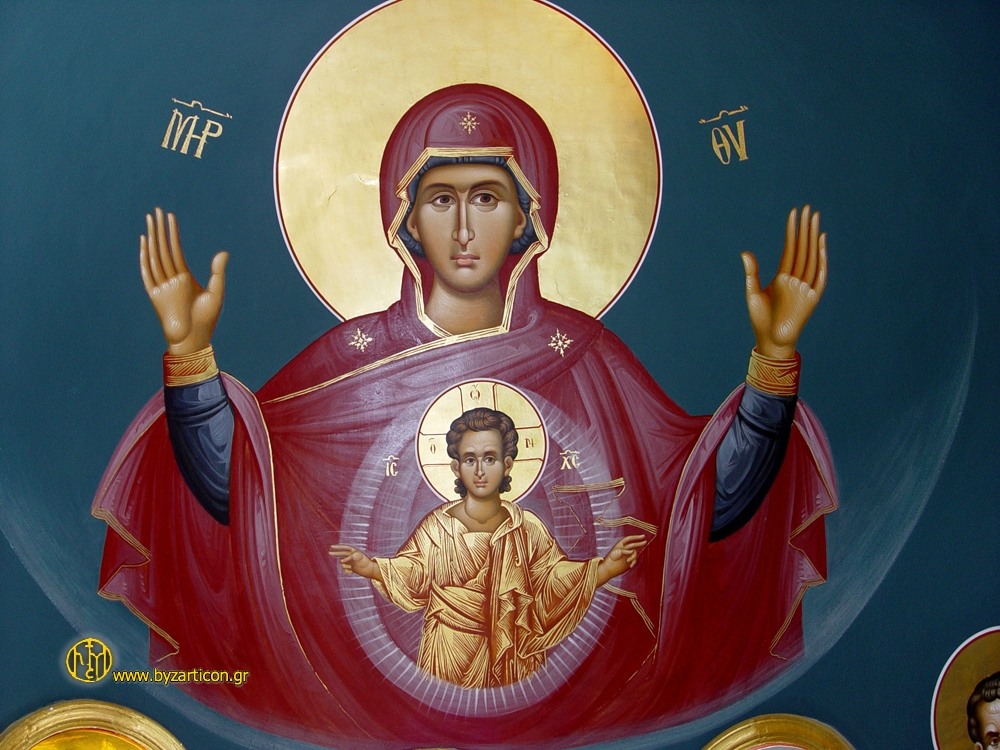
Today, both Latin (Roman Catholic) and Greek (Orthodox) Christians remember the falling asleep of the Mother of God.

THE_PLATYTERA_DETAIL-web

Using some of the terminology from our revivalist friends, Mary became the very first to accept Jesus as her personal Lord and Savior, and invited Him thus into her heart (which is exactly what the Platytera Icon shows).

Fr. Jonathan Tobias.

You cannot get any more “lifework” than a young virgin saying, in the Latin version, fiat mihi secundum verbum tuum, in response to the Archangel’s invitation.

* * * * *

You can read most of my more impromptu stuff at here. It should work in your RSS aggregator, like Feedly, should you want to make a habit of it.

I highly recommend blot.im as a crazy-easy alternative to Twitter (if you’re just looking to get your stuff “out there” and not pick fights).

An open letter to Josh Harris, seeker

Dear Josh:

I hope I can call you Josh, though we’ve never met and I was way too old in the 90s to get caught up in “purity culture.” (Heck, even my son was a bit too old.)

What I have to offer, despite that, is the different way to practice Christian faith that you reportedly are looking for and most certainly need. I was discovering that different way when purity culture was turning into a big deal, and I’ve been following it for more than twenty years now.

I thought of your recent announcements as a kind of “apostasy,” though I hadn’t focused on what you actually said. Still, since I was no longer in the Evangelical world, I wasn’t threatened by it. I had no “horse in that race” so to speak. I’ve known for a long time now that “Christian” doesn’t have a very clear, agreed meaning in the U.S., and leaving some kinds of “Christianity” may be a very good move (especially if you move toward the right kind).

I felt kindly toward you for honesty: not reinterpreting scripture so you could go on being a megachurch pastor and Christian celebrity. From the way I see you telling your story now, that may not even have been existentially possible for you.

In fact, I’m dropping the label “apostasy.” “Rehab.” “Recovery from PTSD.” Those seem more apt.

Not all those who wander are lost, J.R.R. Tolkien observed. The corollary is that not all who lead know where they’re going. Both these statements are true of Joshua Harris, the former pastor and author of “I Kissed Dating Goodbye” (1997), who acknowledged on Instagram last week that “by all the measurements that I have for defining a Christian, I am not a Christian.”

…

[*I Kissed Dating Goodbye]’s message became “a big part of my identity, and almost my own sense of self-worth,” Mr. Harris told me last December. “So to even open the door to think that maybe it was, on the whole, unhelpful, and hurt people—it was just hard to go there.”

Jillian Kay Melchior, Wall Street Journal (emphasis added).

Apparently you did open the door and go there, and got an earful that would shake up any conscientious person. I’ve read some of them, and my godson is one of those who got poisoned (he’s recovering well).

Thus:

In July, Mr. Harris made two personal announcements on Instagram: He and his wife were separating, and he had “undergone a massive shift in regard to my faith in Jesus,” he wrote. “Many people tell me that there is a different way to practice faith and I want to remain open to this, but I’m not there now.”

Many Christians responded with mourning, but I’m hopeful. Abandoning untrue beliefs is progress ….

(Emphasis added again)

I can whole-heartedly recommend “a different way to practice faith” than you’ve ever known, and of which you may even have no clue (having a clue and knowing something are not the same).

Ignore any “different way to practice faith” that baptizes the sexual revolution. Doing that would harm people as much or more than anything you’ve done before.

Ignore (I’m sure you will) any way that permanently anathematizes all who’ve ever sinned sexually. Ignore them if the first sexual sin gets you kicked out or branded with a scarlet letter of some sort.

Get thee to an Orthodox Church, with a capital-O, and just observe for a few months.

The Orthodox Church is probably a mystery to you because you grew up in the West, where the only visible claimant to the title The Church was Roman Catholicism. We Orthodox know that body well, because a thousand years ago, Roman Catholicism was Orthodox (and, to be fair, Orthodoxy more freely used the moniker “catholic”). We were one big family, with a few minor quarrels and personality differences. But then the Bishop of Rome, one of five Patriarchs of the Church, got too big for his britches (a crude shorthand, I know, but I’m not writing a theological treatise or Church history here) and eventually split — went into schism — from the other four Patriarchs and the Churches they represented.

That schism has never been healed. The Bishop of Rome increasingly took his church off the rails, adding doctrines that didn’t belong and tying down things that needed to remain freer.

The other four Patriarchs (Alexandria, Constantinople, Jerusalem and Antioch) never closed up shop, but they’ve been concentrated mostly east of Rome’s turf. They have preserved the ancient Christian faith without innovations and defining everything to death.

So Orthodoxy will probably look a lot like Roman Catholicism to you. (They’ve screwed up the Mass, bless their hearts, but it’s still recognizable.)

Like I say: Don’t commit. Just go and observe for a while. Russian, Greek, Romanian, Antiochian, even my own obscure Carpatho-Rusyn — Orthodox is Orthodox, and we’re working on shedding those ethnic labels in the U.S., since they don’t really belong.

That reminds me: If you stumble onto an Orthodox Church that doesn’t worship in English, keep moving. They’re not “wrong,” but you probably won’t get much out of it. There are plenty that use English now.

When you get there, open your heart and your mind. Those icons that may trouble you are stand-ins (and more) for the great cloud of witnesses in Hebrews.

Talk to the Priest with your questions. The people around you may be less knowledgeable, in a Protestant doctrinal sense, than you’re used to, because the center of the worship is Christ and His Eucharist, not the sermon. But the Priest almost certainly has formal education and has some idea where a Protestant inquirer is coming from. Odds are, he was once a Protestant, too, if you’re in the U.S.

Then settle in for the long haul. There will be some formal catechism and then a formal reception service if you decide to stay.  They may even conclude that you should be baptized again (though we don’t re-baptize if a prior baptism was done more or less as we baptize, as mine was, for instance).

Don’t count on being a leader again. Maybe, maybe not. But do expect that some well-meaning someone-or-other will make a big deal of it if you officially become Orthodox. We are in America, after all, and we’re sadly susceptible to celebrity culture. I wish it weren’t so. People can be destroyed by getting elevated too fast, as the Apostle Paul knew.

My advice: Say something like “I’m still healing from my past life and I don’t think it would be helpful for me to get into the limelight again.” Because that’s probably true, and I think you know it now.

Don’t let any elation about entering Orthodoxy make you think you’ve arrived. It means you’ve started in earnest. There’s going to be some serious interior remodeling, not just rearranging some furniture.

This is, after all, a really different way of practicing faith.

* * * * *

You can read most of my more impromptu stuff at here. It should work in your RSS aggregator, like Feedly, should you want to make a habit of it.

I highly recommend blot.im as a crazy-easy alternative to Twitter (if you’re just looking to get your stuff “out there” and not pick fights).

Sometimes, serendipity!

I blogged just yesterday, on the occasion of his death, about the odd metanarratives of “religion” Supreme Court Justice John Paul Stevens gratuitously spun in some of his religion clause opinions. I acknowledged (boasted?) that nobody else had noticed the falsity of his metanarrative.

And the response to yesterday’s blog seems to be that nobody noticed. Or they noticed and averted their eyes from my nakedness.

Today, in heat indices forecasted to reach 109° F and with a diagnosis of a torn ankle tendon requiring immobility, I decided to (among other things) catch up on some blogs I set aside because the author is always too substantive for a quick read.

And boy, was I ever rewarded! Sometimes, serendipity!

To appreciate why I was so delighted, you’ll need to go back to yesterday’s blog, painful though that may be, and see the parallels between what I wrote about what I called “integral Christianity” and what I found in The Struggle Against The Normal Life:

  • a better description of classical Christianity (I guess I was becoming a classical Christian long before I became one formally)
  • a contrast between it and modern Christianities (of the sort Justice Stevens had in mind),
  • acknowledgement that modern Christianities are ascendant, if facile and false, and
  • a call to the repentance and asceticism necessary to maintain classically Christian belief amid the hegemony of heterodoxy.

Excerpts (generous, but not exhaustive; this one needs to be read in full, then read again and again):

Within the Christianity of our time, the great spiritual conflict, unknown to almost all, is between a naturalistic/secular world of modernity and the sacramental world of classical Christianity. The first presumes that a literal take on the world is the most accurate. It tends to assume a closed system of cause and effect, ultimately explainable through science and manageable through technology. Modern Christians, quite innocently, accept this account of the world with the proviso that there is also a God who, on occasion, intervenes within this closed order. The naturalist unbeliever says, “Prove it.”

The sacramental world of classical Christianity speaks a wholly different language. It presumes that the world as we see it is an expression of a greater reality that is unseen. It presumes that everything is a continuing gift and a means of communion with the good God who created it. The meaning and purpose of things is found in that which is not seen, apart from which we can only reach false conclusions. The essential message of Christ, “The Kingdom of God is at hand,” is a proclamation of the primacy of this unseen world and its coming reign in the restoration of all things (apokatastasis, cf. Acts 3:21).

The assumptions of these two worldviews could hardly be more contradictory. The naturalistic/secular model has the advantage of sharing a worldview with contemporary culture. As such, it forms part of what most people would perceive as “common sense” and “normal.” Indeed, the larger portion of Christian believers within that model have no idea that any other Christian worldview exists.

The classical/sacramental worldview was the only Christian worldview for most of the centuries prior to the Reformation. Even then, that worldview was only displaced through revolution and state sponsorship. Nonetheless, the sacramental understanding continues within the life of the Orthodox Church, as well as many segments of Catholicism. Its abiding presence in the Scriptures guarantees that at least a suspicion of “something else” will haunt some modern Christian minds.

…

The classical model is, in fact, the teaching found in the Scriptures. It utterly rejects the notion of spiritual knowledge belonging to the same category as the naturalistic/secular world. It clearly understands that the truth of things is perceived only through the heart (nous) and that an inward change is required. It is impossible to encounter the truth and remain unchanged.

The classical model, particularly as found within Orthodoxy, demands repentance and asceticism as a normative part of the spiritual life. These actions do not earn a reward, but are an inherent part of the cleansing of the heart and the possibility of perceiving the truth.

…

The struggle between classical/sacramental Christianity and modernity (including its various Christianities) is not a battle over information. The heart of the struggle is for sacramental Christianity to simply remain faithful to what it is. That struggle is significant, simply for the fact that it takes place within a dominant culture that is largely its antithesis.

A complicating factor in this struggle is the fact that the dominant culture (naturalistic/secular) has taken up traditional Christian vocabulary and changed its meaning. This creates a situation in which classical Christianity is in constant need of defining and understanding its own language in contradistinction to the prevailing cultural mind. The most simple terms, “faith, belief, Baptism, Communion, icon, forgiveness, sin, repentance,” are among those things that have to be consistently re-defined. Every conversation outside a certain circle requires this effort, and, even within that circle, things are not always easy.

Such an effort might seem exhausting. The only position of relaxation within the culture is the effortless agreement with what the prevailing permutations tell us on any given day. Human instinct tends towards the effortless life – and the secular mentality constantly reassures us that only the effortless life is normal. Indeed, “normal, ordinary, common,” and such terms, are all words invented by modernity as a self-description. Such concepts are utterly absent from the world of Scripture. Oddly, no one lived a “normal” life until relatively recently.

That which is “normal” is nothing of the sort. It is the purblind self-assurance that all is well when nothing is well.

(Fr. Stephen Freeman, emphasis added)

So, among other (much more important) things, I should not be surprised that “the sacramental world of classical Christianity” was unknown to Justice Stevens, just as it is “unknown to almost all.”

This does nothing to relieve my concerns about his false metanarrative making its way into Supreme Court precedents. I can only hope that it’s seen as the obiter dicta that it is.

* * * * *

You can read most of my more impromptu stuff at here. It should work in your RSS aggregator, like Feedly, should you want to make a habit of it.

I highly recommend blot.im as a crazy-easy alternative to Twitter (if you’re just looking to get your stuff “out there” and not pick fights).

A soft answer?

We’ve reached a juncture where, I think, most people (even in my part of “flyover land”) know and have friendly relations with gays and lesbians who are remarkably normal. Involved in music and arts, I certainly do, and it has not, I think, “softened” my stance on the morality of same-sex erotic relationships.

At the same time, if you’re paying attention, you see at Pride Parades, on the left coasts at least, displays of extreme sexual perversity; and every “all we want is X” is followed by “all we want is Y” when the sexual revolutionaries get their X.

What is going on?

Rod Dreher has a generally conservative, very perceptive, same-sex-married reader who comments (not just in thin pseudonym, but anonymously to protect himself from feared professional consequences) as “Matt in VA.” Matt’s take seems very plausible to me:

I am not trying to say or claim that all or most gay men are peddlers of this suicidal and murderous sexual “ethic” — I am only saying that the most vocal and most committed and most will-to-power gays are. One of the drums I bang on constantly is that it doesn’t really matter so much what a “majority” believes or values deep in their hearts — the public square is shaped by those who are most committed to seeing their vision of society realized and made hegemonic. And of course the gay men with the most poisonous and toxic sexual priorities are the most committed and vocal — these are people who value their sexual practices and choices more, much more, than they value their own lives or the lives of their sexual partners.

If you read the well-documented accounts of Gaetan Dugas in And the Band Played On, or the stories about Foucault — this type of gay man may not be the majority, but it is not an exceedingly uncommon type, and it is the type that is committed to seeing its vision of what homosexuality means or should look like realized and affirmed (think of Foucault’s influence.) If others say it is false to declare these kinds of people murderers, that we are talking about consensual choices, then I would say at best they are the equivalent of heroin or fentanyl dealers, and gay male sexual communities are the equivalents of urban communities where hard-drug dealers and their “values” are aggressively and relentlessly normalized. These are failed communities.

… I am not talking about all nor even most gay men, here; but at the same time, I am talking about many of the most committed and loud and determined gay men, the ones who put great effort into normalizing and promoting their priorities and making the community into something that satisfies their desires as much as possible …

… to say “only within consenting adults” is to put up no guardrail whatsoever. Consenting adults are capable of “consenting” in the heat of the moment, or at certain points* over a lifetime of degraded and relentless mental and cultural grooming, to raping and being raped, to risking death to oneself or one’s sexual partners, to deliberately infecting others and/or deliberately, even fetishistically, exposing oneself to infection with anything and everything; to mutilating one’s body or somebody else’s body — to anything.

Matt in VA, via Rod Dreher.

I don’t know what to do about this. Smugly waiting for the backlash is a non-starter, but I’ve seen a possible model.

May 17 has somehow been designated the International Day Against Homophobia, Transphobia and Biphobia. The Republic of Georgia, in which I was traveling this May 17 past, is too tolerant to repress its observance, but too Orthodox Christian not to respond.

So the Orthodox Patriarch of Georgia declared (or persuaded the authorities to declare) May 17 “Family Sanctity Day“, an official holiday it appeared, which was celebrated with a parade, erection of a temporary massive stage at the open end of Sameba Cathedral Plaza, and displays of patriotism, traditional song and dance, and so forth.

I liked that tone and that substance.

[* This has obvious relevance to heterosexual “consenting adults” as well, as in Harvey Weinstein’s not entirely improbable claim that he never had non-“consensual” sex with {any aspiring starlet who he had the power to make or break}.]

* * * * *

You can read most of my more impromptu stuff at here. It should work in your RSS aggregator, like Feedly, should you want to make a habit of it.

I highly recommend blot.im as a crazy-easy alternative to Twitter (if you’re just looking to get your stuff “out there” and not pick fights).