Friday, 7/12/2

Culture

Anti-Christian, anti-religion, anti-tradition

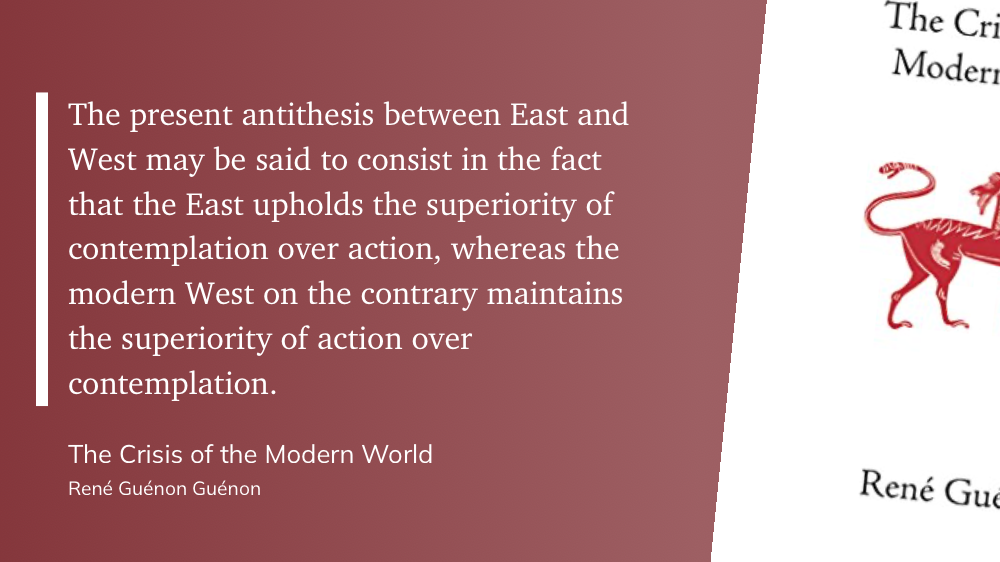
The modern West is said to be Christian, but this is untrue: the modern outlook is anti-Christian, because it is essentially anti-religious; and it is anti-religious because, still more generally, it is anti-traditional; this is its distinguishing characteristic and this is what makes it what it is.

René Guénon Guénon, The Crisis of the Modern World.

Creepier than frank laxity

Just don’t do it again, promise? Remember those kids who got suspended from Harvard after setting up encampments on the lawn and then harassing other students? Well, the Harvard College Administrative Board has reversed the decision, a win for the “student intifada,” which I thought was slanderous but is actually just what they call themselves. And then over at Columbia, the administrators who texted each other vomit emojis during a panel discussing a rabbi’s op-ed about his fears for Jews on campus—they were fired, right? Well, actually they were just put on leave and will be assigned to different jobs later. And remember the Columbia students who were arrested after they occupied a campus building? Most of their charges were dropped. There’s something way creepier about punishing people in the moment only to reverse it as soon as the zeitgeist moves on to the next thing versus not punishing them at all.

Suzy Weiss

Prescient

This was not written of Team Biden, but it sure seems to fit:

The elites who manage the system no longer believe in a way forward. Stuck in the muck, they strive simply to endure: après moi le deluge.

Martin Gurri, The Revolt of the Public and the Crisis of Authority in the New Millennium

Not a flattering juxtaposition

  • In The Guardian, Marina Hyde: “It’s incredible to think that only a short while ago we thought we’d eradicated measles and Nigel Farage. Both have now been brought back, largely by the same people.”

Via Frank Bruni. (I didn’t call this “Politics” because it’s foreign politics.)

Enemies of Article III

Federal Court critics

Never forget, most commentary about the Supreme Court is performative. Critics have a vested interest in making the decisions seem so much worse than they really are.

Josh Blackman, Everyone Needs To Take A Deep Breath About Trump v. United States

AOC, ever-performative, is “trying” to impeach Justices Alito and Thomas — a kind of performative commentary uniquely available to congress-critters.

The Consumer Financial Protection Bureau, supported by left-wing interest groups, demanded that Judge Don Willett of the Fifth Circuit U.S. Court of Appeals recuse himself from a case challenging the CFPB’s rule on credit-card late fees. One of Judge Willett’s child college savings accounts held around $2,000 of stock in Citigroup, which wasn’t a party to the case.

Normally, parties to a lawsuit have a strong incentive not to provoke judges with baseless recusal demands. That makes it surprising the CFPB would join in such an unwarranted demand. But the bureau seems to be more an extension of certain Democratic politicians these days than a federal agency respectful of the rule of law. Several members of Congress, led by Sen. Elizabeth Warren, responded to the committee’s opinion with a hyperbolic letter declaring that the opinion and Judge Willett’s decision not to recuse himself “represent ongoing threats to the integrity of the judicial system.”

Recusal tactics have become more outrageous. Normally, only parties directly involved in the litigation can file a motion to recuse a judge for an alleged conflict of interest. But we now see coordinated campaigns to pressure recusals. Left-wing interest groups are submitting demands for recusal, coupled with press releases and press conferences. This practice should stop. There is no formal mechanism for outsiders to file such recusal demands, and for good reason. They clog courts with additional briefings and hearings, causing delays and distorting outcomes. Courts should refuse to entertain these ill-intended requests, and the lawyers and litigants responsible should be subjected to sanctions.

Theodore B. Olson, Proliferating Recusal Demands Threaten the Judiciary

Politics, more or less

What liberal democracy sounds like

In America, it can be easy to forget what liberal democracy sounds like. But it used to sound something like this:

Whilst he has been my political opponent, Sir Keir Starmer will shortly become our prime minister. In this job, his successes will be all of our successes and I wish him and his family well. Whatever our disagreements in this campaign, he is a decent public-spirited man who I respect. He and his family deserve the very best of our understanding as they make the huge transition to their new lives behind this door, and as he grapples with this most demanding of jobs in this increasingly unstable world.

Those are the words of former British prime minister Rishi Sunak in his farewell speech last week outside Number 10, Downing Street. This is how Keir Starmer responded:

I want to thank the outgoing Prime Minister Rishi Sunak, his achievement as the first British-Asian prime minister of our country. The extra effort that that will have required should not be underestimated by anyone, and we pay tribute to that today. And we also recognize the dedication and hard work he brought to his leadership.

He went on:

If you voted Labour yesterday, we will carry the responsibility of your trust as we rebuild our country. But whether you voted Labour or not, in fact, especially if you did not, I say to you directly, my government will serve you.

And, if you listen to them say these words, they even seemed to mean it. That’s what it takes to put a toxically divided country back on track toward liberal democracy, after a woundingly divisive period centered on Brexit.

No one claimed fraud. No one derided the lopsided unfairness of the parliamentary results, where Labour got 34 percent of the vote and a whopping 63 percent of the seats, and where the new rightist Reform Party won 14 percent of the vote and got only 5 seats. Those were the rules ahead of the game, and they were the rules everyone had agreed to.

There is one reason and one reason only why this kind of conciliatory exchange cannot happen any time soon in America, and that is Donald J. Trump ….

Andrew Sullivan, pitch-perfect.

I wish it were true that Trump is the whole problem, but he tapped into something that won’t go away just because he sheds this mortal coil.

Art of the Deal

  • “That the sheep are still on the air, dispensing undiminished certitudes, is evidence of two things. That — outside of a few bastions of meritocracy and accountability, such as professional sports — there is no penalty for failure in contemporary America. And that many prominent people have the scary strength that comes from being incapable of embarrassment.” (George Will on the Dem/MSM bunker)
  • “If Trump is elected again, Dems should get over it and try to do more deals with him like they did on the USMCA and First Step Act. Trump isn’t an ideologue and just has an enormous ego anyone can exploit,” – Zaid Jilani.
  • “Some will say now that I am calling America a Christian Nation. So I am. And some will say that I am advocating Christian Nationalism. And so I do,” – Josh Hawley.

Via Andrew Sullivan.

Comments:

  • Zaid Jilani’s advice is brilliant! We need more like that!
  • There is all kinds of play in the joints of “Christian Nationalism,” but any politician of Josh Hawley’s intelligence who demagogues the term is playing with fire and is going to find me unmoved when he tries to disambiguate it into something benign. Once a bright hope for the GOP, he’s gone shamelessly whoring after Trump.

You can have my delegates when you pry them from my cold, dead fingers

In his selfish desperation to retain control of his party, the president has resorted to political hostage-taking. His pitch to Democrats for sticking with him has nothing to do with sketching out a compelling plan to win or demonstrating his mental agility by holding numerous live events or even outlining a policy program for a second term. It’s simply this: The delegates he earned by winning this year’s primary (under false pretenses about his fitness) are pledged to him and he’s not giving them up.

Nick Catoggio, The Return of the Smoke-Filled Room

The window into Trump’s id

The best window into Trump’s ignorant and destructive id is often his Truth Social account. While normal Americans were making plans for Independence Day, an obsessive on Truth Social was declaring, “Elizabeth Lynne Cheney is guilty of treason. Retruth if you want televised military tribunals.” “Retruth,” in the idiom of Truth Social, means “to repost.” Trump of course retruthed. The former president also took time to retruth a post calling for Mike Pence, Mitch McConnell, Cheney, and a dozen prominent Democrats to be jailed because they saw fit to tell the American people the truth that the 2020 “elections were fair.” Republicans would be wise to remember that character is destiny and that Trump has never had any.

National Review, The Week


I suffer more from the humiliations inflicted by my country than from those inflicted on her.

Simone Weil, from a letter to Georges Bernanos.

I don’t do any of the major social media, but I have two sub-domains of the domain you’re currently reading: (a) You can read most of my reflexive stuff, especially political here. (b) I also post some things on the only social medium I frequent, because people there are quirky, pleasant and real.

Pentecost …

(at least in the Eastern Church)

For the very first time, I vetted this post with AI. I didn’t change so much as a jot or a tittle.

Evangelicals

Overlooking the obvious

In the past year I have visited the Middle East, India, Africa, Latin America, and Europe as the guest of churches and ministries. In each place, evangelicals exude life and energy. While staid churches change slowly, evangelicals tend to be light on their feet, adapting quickly to cultural trends.

The Jesus movement, the house-church movement, seeker-friendly churches, emergent churches—evangelicals have spawned all of these. In their wake, worship bands have replaced organs and choirs, PowerPoint slides and movie clips now enliven sermons, and espresso bars keep congregants awake. If a technique doesn’t work, find one that does.

Although I admire the innovation, I would caution that mimicking cultural trends has a downside …

Perhaps we should present an alternative to the prevailing culture rather than simply adopt it. What would a church look like that created space for quietness, that bucked the celebrity trend and unplugged from surrounding media, that actively resisted consumerist culture? What would worship look like if it were directed more toward God than toward our entertainment preferences?

While writing a book about prayer, I learned more from Catholics than from any other group. They have, after all, devoted entire orders to the practice. I learn mystery and reverence from the Eastern Orthodox. In music, in worship, in theology, they teach me of the mysterium tremendum involved when we puny human beings approach the God of the universe.

As I survey evangelicalism I see much good, but also much room for improvement. Our history includes disunity—how many different denominations do this magazine’s readers represent?—and a past that includes lapses in ethics and judgment.

Phil Yancey’s 2009 farewell column for Christianity Today (illustration added). I don’t understand why the farewell wasn’t because he was going somewhere more conducive to prayer or reverence. Does it not occur to him that one decision for Christ plus good works does not a complete Christian make, that emotion is not the same as the Holy Spirit?

Biblicist Guruism

Reflecting on a story about exvangelicals:

So how do you help address the problem that Miles is describing in his review, a culture of biblicist guruism in which the churches do not even look recognizably Protestant in any real way? How do you address the massive gaps and holes in a person’s Christian discipleship that result from sustained exposure to such churches?

If the Gospel was not clear or was not preached, then what you had was more a religious assembly than a church. If the sacramental life of the church was non-existent, you had a religious assembly, not a church. And if there was no aid in Christian discipline… well, you know the drill.

When I came to Grace Chapel in 2007, a small PCA church that was at the time located in central Lincoln, I didn’t know that I’d not really been part of a church before, at least as the church was traditionally understood. What I found at Grace was something I hadn’t even known to look for because I didn’t know it existed. I found something obviously and unapologetically Christian—the Gospel was clear in every sermon, and clear in a way I’d never heard it from a pulpit before, the Eucharist was celebrated regularly, and the pastor at the church actually seemed to know the people in his church and to think it was his job to care for them and aid them in their discipleship. I’d never seen anything like it before.

And the services themselves helped to reenforce the basics of Christian belief and practice: We prayed the Lord’s Prayer corporately. We confessed our sins corporately. We sang old hymns. Every week we received a benediction. The grammar and vocabulary of Christianity pervaded the liturgy; it wasn’t just a guy in a pulpit pontificating, loudly proclaiming his own loosely assorted thoughts about life and expecting you to take him seriously because he attempted to root them in scripture.

Jake Meador (italics added).

The non-church “church” Jake came from may have been an example of what he calls “biblicist guruism.”

Second Great Awakening

While Methodists, Disciples, and Mormons disagreed radically on what constituted belief in the gospel, they all shared an intense hostility to the passive quality of Calvinist religious experience, and they all made salvation imminently accessible and immediately available.

Nathan O. Hatch, The Democratization of American Christianity

I have alluded to this antipathy toward Calvinism previously, having first encountered it in Hatch’s book (I’m pretty sure). When I moved from frank Evangelicalism to Calvinism, it felt as if I was moving to a much different worldview, and I guess my intuitions were sound.

Protestants

… [Luther] had been wrestling with an unsettling conundrum: the failure of the Spirit to illumine all those inspired by his teachings as he himself had been illumined.

Tom Holland, Dominion

It seems fair to distinguish Protestants from Evangelicals, contrary to lifelong habit. I’m not positive that Evangelicals circa 2024 AD are no longer Protestant, but along with Jake Meador, I’m entertaining that possibility quite a lot lately. If they’ve left Protestantism, it strikes me as a continuing outworking of Luther’s conundrum.

Catholics

According to Catholic doctrine, sin offends God, disrupts the moral order, and deprives God of His glory and majesty. Punishment for the sin restores order and the glory of God.

Dr. Eugenia Scarvelis Constantinou, Thinking Orthodox

When I first read that, it made me a bit nauseous. The Orthodox mind is quite different from that.

Orthodoxen

Start with the Psalms

It came to me a few days ago, during morning devotions, that it would be very easy for a 21st century convert to Orthodox Christianity, from Protestantism or Evangelicalism, to overlook one very important and durable tradition of the church.

Perhaps because the Anglophone church has gained so many converts, and because those converts were accustomed to regular preaching from a wide range of scripture, we have available to us, notably on Ancient Faith “Radio,” an array of Orthodox versions of Bible studies. One of them even bears the title “The Whole Counsel of God,” and has progressed through all books of the Old and New Testaments and started over again.

In my mind, those podcasts risk obscuring from the view of converts that the basic scripture for Orthodox Christians is the Psalter — the book of Psalms. As Father Jonathan Tobias emphasized,

Chant the Psalms every morning and every evening. Two kathismata in the morning, one in the evening as appointed. This will form your mind into prayer and life.

There’s nothing wrong with going beyond that, and I should do more of general Bible study than I do, but start with the Psalms. Always start with the Psalms.

(Weird historic fact: Back in the day, Evangelicals would do some Evangelistic spadework by distributing inexpensive copies of the Gospel According to John — not the whole New Testament, but just that one Gospel account. In contrast, the Orthodox Church didn’t expose converts to the Gospel According to John, the most profoundly theological of the four Gospels, until after significant preliminary catechesis and baptism. See text at fns. 2 & 3.)

Thanks but No Thanks

Without entering into particulars, we say that as long as the Church of the Saviour shall stand upon earth, we cannot admit that there is in her bosom a Bishop Supreme other than our Lord Himself; or that there exists an infallible Patriarch, who can speak, ex cathedra, superior to Ecumenical Councils – to which Councils alone belongs infallibility, because they have always conformed to the Sacred Scriptures and apostolical tradition. Nor can we admit that the Apostles were unequal, inasmuch as they were all illuminated by the Holy Ghost up to the same measure; or that to this or that Patriarch a precedence has been given, not by any synodal or human resolution, but by right Divine, as you assert.

Ecumenical Patriarch Gregory VI, firmly refusing to attend Vatican I, which was poised to declare papal infallibility at the behest of Pope Pius IX. Via Matthew Namee. The Orthodox Patriarch of Alexandria was no less firm, but pointed out (though the Pope surely knew it) what the Pope needed to do:

But not to prolong this discussion let me repeat once, and for all, that as this new attempt on the part of his Holiness the Pope has miscarried, it is necessary, if he sincerely desires the unity of the Universal Church that he should write to the patriarchs individually, and acting in concert, endeavor to come to an understanding with them respecting the course to be adopted – renouncing every dogma on which opinions may clash in the church. By so doing his efforts might perchance be crowned with some degree of success.

Involuntary sin

According to Scripture, the cause of all sin that is involuntary lies in what is voluntary.

Dee Pennock, God’s Path to Sanity


… that Christ may dwell in your hearts through faith; that you, being rooted and grounded in love, may be able to comprehend with all the saints what is the width and length and depth and height — to know the love of Christ which passes knowledge; that you may be filled with all the fullness of God.

Ephesians 3:17-19 (NKJV)

You can read most of my more impromptu stuff here and here (both of them cathartic venting, especially political) and here (the only social medium I frequent, because people there are quirky, pleasant and real). All should work in your RSS aggregator, like Feedly or Reeder, should you want to make a habit of it.

Making a virtue of necessity

I just finished reading The Old Faith in a New Nation, a 2023 book by one Paul J. Gutacker. I can write no better summary of the author’s purpose than the publisher’s:

Conventional wisdom holds that tradition and history meant little to nineteenth-century American Protestants, who relied on common sense and “the Bible alone.” The Old Faith in a New Nation challenges this portrayal by recovering evangelical engagement with the Christian past. Even when they appeared to be most scornful toward tradition, most optimistic and forward-looking, and most confident in their grasp of the Bible, evangelicals found themselves returning, time and again, to Christian history. They studied religious historiography, reinterpreted the history of the church, and argued over its implications for the present. Between the Revolution and the Civil War, American Protestants were deeply interested in the meaning of the Christian past.

The book

I concur with the 4-star rating at Amazon, mostly because the sympathetic academic author obviously spent a lot of time researching a narrow topic, off-the-beaten track. When I stumbled across it, I knew that I needed it to challenge the “conventional wisdom” resident in my own imagination.

It would be churlish to complain of faults in a book that did what I wanted it to do, and was passably readable to boot. I now have a better idea of how nineteenth-century American Evangelicals (and a few mainstream Protestants and Unitarians) treated Christian history.

Generally, the Evangelicals settled for tendentious 18th-Century historiography. It’s hard to blame them — the laymen, at least. There are only 24 hours in a day, and the 8-hour workday didn’t exist. We’re still that way:

The instinctual shortcut that we take when we have “too much information” is to engage with it selectively, picking out the parts we like and ignoring the remainder, making allies with those who have made the same choices and enemies of the rest.

Nate Silver, The Signal and the Noise

Mnemohistory

A lover of obscure mots justes, I was pleased to meet the word mnemohistory, which to my disappointment isn’t even in the online Merriam-Webster. It is “the history of memory … The past is not only remembered by later generations, it also exerts by itself an influence on later times.” A near-equivalent, I guess, is “cultural history.”

The 19th-century American Evangelical mnemohistory was fiercely anti-Catholic — especially, and oddly, anti-celibacy, though the anti-Catholicism was comprehensive.

Somewhat to my surprise (I had already read in Frances Fitzgerald that it was anti-Calvinist), it was quite contemptuous of the Protestant Reformation as well — largely because the Reformation wasn’t adequately anti-Catholic. The Reformers baptized infants? Mumbled vague nothings about Christ’s presence in the Eucharistic elements? Damnable papacy!

Though the Magisterial Reformation opened Pandora’s box with its sola scriptura même, I’m newly-appreciative of its merits, at least compared to what followed. The Magisterial Reformers didn’t intend the whirlwind, and Rome did need reform.

That the best-laid plans chronically go astray is enough to make one suspect all is not right in the pre-eschaton world. (It’s also an imaginative buttress for temperamental conservatism.)

The acid test

The acid test of American Evangelical mnemohistory came in the debates over slavery, when there arose an urgent need to shuffle the deck chairs. Gutacker summarizes:

This was only one of many ironies in the debates over slavery, which saw Catholics ignoring or reinterpreting papal decrees, Episcopalians celebrating early American Puritans, Presbyterians defending medieval society while criticizing the Reformation, Baptists treating patristic exegesis as authoritative, and anticlerical abolitionists praising the pope. Not all of this irony was lost on contemporaries. As has been discussed, African American historians, in particular, took pleasure in pointing out the hypocrisy of proslavery authors who cited North African church fathers in their arguments for white supremacy.

Antebellum 19th-century American Evangelicals didn’t so much revere history as to use it to confirm their priors. They rejected tradition and precedent, those inconvenient facts, in favor of congenial theories they called “history” — again, a relatable vice, but it’s how we got Baptists and Southern Baptists, Methodists and Southern Methodists, and even Presbyterians and Southern Presbyterians (a division that leaves fewer contemporary traces than the Baptist and Methodist schisms).

Oh, yeah, almost forgot: It’s also a substantial explanation of how we got a Civil War.

I think that qualifies as failing the acid test.

Bless their hearts!

I’m fond of the expression “making a virtue of necessity.” 19th-century schisms over slavery were lamented at the time. Today’s more mercenary schisms pass without much objection as “isn’t-it-nice-that-there’s-a-church-for-all-preferences?” nondenominationalism. All hail the religiopreneur! (Bless their hearts!)

Christians were until recently (and in ecclesial Christianity, still are) horrified by schism. But what to make of the continued fissiparousness of movements themselves born in conscious schism, as was post-Second Great Awakening evangelicalism? Is it all that bad when badness can’t cohere?*

I confess a bit of schadenfreude, mitigated morally by faint hope for the epiphany “this isn’t working; our first principles must be wrong” — and for return to the Church that remained, albeit centered outside the West, when the Roman Church went into schism from it. There, Holy Tradition is preserved and transmitted as the warp and woof of liturgies, hymns, prayers, scripture, and all that goes into a lived faith.

* (An aside about coherence: Ken Myers, muse of Mars Hill Audio Journal, once suggested that today’s evangelicalism coheres, is united, not by orthodoxy but by orthpathos — not right shared doctrine but right shared feeling. Insofar as it does loosely cohere, I have no better explanation, and if I did it would be a topic for another day.)


… that Christ may dwell in your hearts through faith; that you, being rooted and grounded in love, may be able to comprehend with all the saints what is the width and length and depth and height — to know the love of Christ which passes knowledge; that you may be filled with all the fullness of God.

Ephesians 3:17-19 (NKJV)

You can read most of my more impromptu stuff here and here (both of them cathartic venting, especially political) and here (the only social medium I frequent, because people there are quirky, pleasant and real). All should work in your RSS aggregator, like Feedly or Reeder, should you want to make a habit of it.

Sunday of the Paralytic, 2024

No sectarians in post-Christian foxholes

… churches centered on the Bible, evangelism, and personal faith in Jesus; often but not necessarily nondenominational, with moderate to minimal emphasis on sacraments, liturgy, and ecclesiastical authority; and marked by a revivalist style as well as conservative beliefs about sex, marriage, and other social issues. Historically, … white and middle- to lower-class …

Brad East, describing the sorts of churches in which he has noticed a loosening of social taboos (and in some cases, abandonment of prior understandings of scripture), and some putting on of liturgical airs, in The Loosening of American Evangelicalism.

East describes a lot of the changes he sees, and then speculates on the reasons for them. His fourth suggested reason got my attention as a plausible “silver lining” to secularization:

Fourth and finally, there are no sectarians in post-Christian foxholes. As counterintuitive as it may seem, the same forces leading evangelicals to start drinking, getting tattoos, and watching HBO are also leading them to say the creeds, receive ashes on their forehead, and read Pope Benedict XVI. When the world feels arrayed against faithfulness to Christ, you need all the friends you can get. Doctrinal differences that aren’t relevant to current cultural battles—think infant baptism, not theologies of sex and gender—can be overlooked in a pinch.

What intellectuals are searching for

[S]uppose you are an atheist or agnostic exposed, over time, to the desert fathers, or to the pro-Nicene fathers of the fourth and fifth centuries, or to Saint Maximus Confessor or Saint John of Damascus, or to Benedictine monks, or to Saint Thérèse of Lisieux, or to Julian of Norwich, or to Saint Francis or Saint Bernard or Saint Anselm. It would simply never occur to you that what you find in these authors is what you’d find in the Methodist congregation on the corner, or the Baptist church around the block, or the non-denom start-up across town. Not only do the devotional and liturgical, spiritual and theological worlds conjured by these writers and texts not exist in such spaces. The traditions themselves do not claim the figures in question. You go, therefore, to the people and the places who are bold enough to say, “Those names are our names; those saints are our saints; those books are our books. We nurture and preserve and pass them on. Come learn them from us; indeed, come learn from us what they learned themselves, in their own time.”

In sum: What intellectuals, especially agnostic intellectuals in midlife, are restlessly searching for is something not man-made, but divine; not provisional, but final; not a question, but an answer. They are looking for rest, however penultimate in this life, not more open-ended restlessness. Something that lasts. Something that can plausibly make a claim both to antiquity and to permanency. A bulwark that will not fail. Something to defer to, submit to, bow one’s head in surrender to; something to embrace and be embraced by: a teacher but also a mother. And the truth is that Rome plausibly presents itself as both mater et magistra, the pillar and bulwark of the truth. Orthodoxy does as well. The plausibility explains why so many intellectuals find port of harbor with each of them. The reverse, in turn, explains why so few of those sorts of people convert from rudderless adult atheism to Protestantism with a capital-p.

Brad East, musing on why intellectuals and other public figures convert to Christianity in Catholic, Orthodox (or perhaps Anglican) traditions.

A life-giving gift

I’m almost certain I’ve shared this before, but I share it again not only because it seems wise, but because I lived it — with a big caveat: happy-clappy is not confined to youth groups, and I wasn’t young when I discovered ancient Christianity.

For those young people who are either scared or suspicious of happy-clappy versions of youth group Christianity, ancient Christian disciplines and historic Christian worship can be received as a life-giving gift. When you have only seen forms of piety that value spontaneous expression and clichéd sincerity, to be given the cadences and rhythms of the Book of Common Prayer can be like receiving the gift of tongues. In my experience, many young people are intensely ritual animals without realizing it. And when they are introduced to habit-forming practices of Christian faith, invited into ways of following Jesus that are ancient and tested, their faith is given a second life.

James K.A. Smith, You Are What You Love

Context is broader than the text itself

Context includes not only the historical and cultural setting and textual elements such as literary arrangement and relationship of the words. Context includes the original setting in which the Scriptures were written—the Church. The author belonged to the community of faith, as did his anticipated audience…

Dr. Eugenia Scarvelis Constantinou, Thinking Orthodox

The democratic spirit at prayer

Much of what today passes for Protestantism is nothing of the sort. Rather, it is a thinly veiled cloak for the democratic spirit at “prayer.”  “Salvation by grace through faith” is a slogan for individualism, a Christianity “by right.” There are no works, no requirements, only a “grace-filled” entitlement. For the ultimate form of democracy is the person who needs no one else: no Church, no priest, no sacrament, only the God of my understanding who saves me by grace and guarantees that I can do it alone.

Fr. Stephen Freeman

If you think that’s a cheap shot, you need to read Nathan Hatch, The Democratization of American Christianity.

Nine paths of complicity

I returned to following the Mere Fidelity podcast after a year or two absence (when I was more preoccupied with other things). One back episode I manually downloaded was Moral Complicity, which took as its springboard a controversy over one Alistair Begg’s faux pas.

It was an interesting episode, part of which lamented Evangelicalism’s lack of tools and training in moral reasoning, leaving Evangelicals to live in ambiguous situations based on shibboleths.

I was surprised at my own inability to justify my reaction to the particular question posed. Then I remembered that even my tiniest prayer book has some resources:

NINE WAYS OF PARTICIPATING IN ANOTHER’S SIN

  • By counsel.
  • By command.
  • By consent.
  • By provocation.
  • By praise or flattery.
  • By concealment.
  • By partaking.
  • By silence.
  • By defense of the sin committed.

THE CHIEF SPIRITUAL WORKS OF MERCY

  • To admonish sinners.
  • To instruct the ignorant.
  • To counsel the doubtful.
  • To comfort the sorrowful.
  • To suffer wrongs patiently.
  • To forgive injuries.
  • To pray for the living and the dead.

Wise eunuch

Then the Spirit said to Philip, “Go near and overtake this chariot.” So Philip ran to him, and heard him reading the prophet Isaiah, and said, “Do you understand what you are reading?” And he said, “How can I, unless someone guides me?” And he asked Philip to come up and sit with him.

Acts 8:29-31.

I was rather old when I learned (as I understood it) that reading silently, sola mentes, was unknown in the ancient world.

I wasn’t quite as old when I realized that “How can I, unless someone guides me?” was a wise answer, not a pathetic one.

Col. R.B. Thieme, Jr.

“Well-nigh 50 years ago,” wrote the geezer, “I heard a guy who in retrospect was the weirdest, but most mainstream, preacher I ever heard.”

I’m the geezer. The guy I heard was “Col. R.B. Thieme, Jr..” See also R. B. Thieme, Jr., Bible Ministries | Home

Thieme was not outside the Evangelical Overton Window, but I recall two really weird things he said during the week or so of meetings I attended in Prescott, Arizona (I have a vague idea that I listened to him on the radio even longer):

  1. Nothing pleases God more than doctrine in the frontal lobe. It is fair to say that this was an obsessive theme of Thieme, if you’ll pardon the wordplay.
  2. The human ovum is the only sinless cell in the human body. Were it not sinless, Christ would have inherited sin from Mary.

I immediately thought the first thing quoted (almost verbatim) was weird and off-key. Now I’m quite sure it was wrong to the point of heresy. God desires several things more than storing up doctrine in one’s wetware. It is spiritually perilous not to value them as He does.

But the idea that mastery of doctrine was paramount was mainstream western Christianity. Since Thomas Acquinas, over-intellectualizing the Christian life has been (dare I say it?) a major way of avoiding actual encounter with God. In that sense, he was mainstream. And his website doesn’t put this idea front and center, portraying instead an extraordinarily hard-working dispensational premillennial evangelical pastor — adherent to a doctrinal scheme that led me to distance myself from evangelicalism around the time I encountered Thieme, though I don’t recall any cause-and-effect relationship.

The ovum remark was not an obsession, in my limited experience. The idea of inheriting sin and guilt is ubiquitous in Western Christianity (and repudiated in Eastern Christianity, which recalls that the wages of sin is death, not guilt — but that’s a longer story, and one that I’m probably not qualified to tell). Nevertheless, I don’t recall any other teacher ever making anything like Thieme’s weird remark.

Wedding rites

Contrast the vision of family carried in these cultural liturgies—and played out in television dramas and romantic comedies—with the countercultural, biblical vision that is carried in an Orthodox wedding rite. The rite has two “movements” or stages. The first is the Service of Betrothal. In the entrance or vestibule of the church, the priest asks both the groom and the bride a question. To the groom: “Have you, Nicholas, a good, free, and unconstrained will and a firm intention to take unto yourself to wife this woman, Elizabeth, whom you see before you?” And to the bride: “Have you, Elizabeth, a good, free, and unconstrained will and a firm intention to take unto yourself to husband this man, Nicholas, whom you see before you?” Each in turn replies, “I have,” and these are the only words they will speak in the ceremony. This won’t be an expressive opportunity for them to “show their love.” There’s no fixation on novelty in the idiosyncratic writing of their own vows. The actor and agent here is the Lord, the church’s Bridegroom, and their lives as husband and wife (and as mother- and father-to-be) are here being taken up into that life. The Triune God is the center of this ceremony, exhibiting a vision of marriage in which this is also true. This is beautifully signaled in vows that echo their baptism “in the name of the Father, and of the Son, and of the Holy Spirit.”

James K. A. Smith, You Are What You Love: The Spiritual Power of Habit

It occurred to me as I was posting this that Smith’s book is one of extremely few contemporary Protestant-written books I can commend — not that I read all that many, mind you. It’s one of a few (along with books by Hans Boersma) that leave me wondering “why haven’t these guys shed their obviously uncomfortable Protestantism for Orthodoxy?”

When I heard the learn’d theologian …

When I heard the learn’d astronomer,
When the proofs, the figures, were ranged in columns before me,
When I was shown the charts and diagrams, to add, divide, and measure them,
When I sitting heard the astronomer where he lectured with much applause in the lecture-room,
How soon unaccountable I became tired and sick,
Till rising and gliding out I wander’d off by myself,
In the mystical moist night-air, and from time to time,
Look’d up in perfect silence at the stars.

Walt Whitman

Do American Evangelicals despise history?

Last night, I began reading Paul Gutacker, The Old Faith in a New Nation: American Protestants and the Christian Past. Gutacker doesn’t buy the standard narrative that bibicist American Evangelicalism has no interest in Church history and traditions. It sounded promising enough that I bought it without any personal recommendations from trusted sources.

I’m especially interested to see whether it will call into question anything I’ve internalized from Nathan Hatch, The Democratization of American Christianity. So far, it seems to accept Hatch’s work.


… that Christ may dwell in your hearts through faith; that you, being rooted and grounded in love, may be able to comprehend with all the saints what is the width and length and depth and height — to know the love of Christ which passes knowledge; that you may be filled with all the fullness of God.

Ephesians 3:17-19 (NKJV)

You can read most of my more impromptu stuff here and here (both of them cathartic venting, especially political) and here (the only social medium I frequent, because people there are quirky, pleasant and real). All should work in your RSS aggregator, like Feedly or Reeder, should you want to make a habit of it.

Pascha 2024

I was nurtured on stories as a child that contrasted Christ’s “non-judging” (“Jesus, meek and mild”) with Christ the coming Judge (at His dread Second Coming). I was told that His second coming would be very unlike His first. There was a sense that Jesus, meek and mild, was something of a pretender, revealing His true and eternal character only later as the avenging Judge.

This, of course, is both distortion and heresy. The judgment of God is revealed in Holy Week. The crucified Christ is the fullness of the revelation of God. There is no further revelation to be made known, no unveiling of a wrath to come. The crucified Christ is what the wrath of God looks like.

Fr. Stephen Freeman


The Incarnation, Crucifixion, and Resurrection reconcile man to God, not God to man. The difference in outlook is immense. God never departs from us. It is we who depart from Him. It is we who become spiritually ill through sin. It is we who need to be cured and restored. The Orthodox view is that “by his sacrifice on the Cross Christ did not propitiate his Father, but he cured the ailing nature of man.”

Dr. Eugenia Scarvelis Constantinou, Thinking Orthodox

That is a good segué to my “what I learned during Lent this year” report.

I learned, at a deeper-than-usual level, the grace of God. That doesn’t mean He’s fine with us as we are; it means that He doesn’t forsake us, and that that nothing we’ve done is too bad for Him to forgive if we repent.


Repentance, though, is a constant, daily need, and doubly so when even religion and Christian education can be off the mark and unhelpful, even toxic.

Alexander Schmemann in For the Life of the World described America as a place “where the religious ‘boom’ is due primarily to the secularization of religion.”

Father Schmemann has been gone for decades now, but his observation still seems true. Most religion in the US is secular because the media and the society teach nonstop that secular and political concerns are real, religion ephemeral. Shallow Christianity, in response, secularizes itself because it wants to be considered real.

Politics is one obvious secularization in North America (I thank Thee, O Lord, that I am not like other man, especially those icky evangelicals who’ve been taken in by an orange con man, let alone an integralist or a Seven Mountain Mandate flake), but if politicization of faith were to end overnight, all would not be well. No, it wouldn’t:

Finding a (Real) Christian College.” For college decision day, I wrote for Christianity Today about what students should look for when deciding on what college to attend: “the most overlooked and therefore most insidious threat to Christian education in America right now [is] not progressive theology. It’s a pervasive consumerist anthropology. Theological anthropology concerns our assumptions about the nature and purpose of humanity. And by ‘consumerist anthropology’ I mean the belief—often subconsciously held—that people are essentially consumers who should maximize their earning potential so they can consume as many entertaining experiences and products as possible.

Jeffrey Bilbro

“Consumerist anthropology” is the new water.


… that Christ may dwell in your hearts through faith; that you, being rooted and grounded in love, may be able to comprehend with all the saints what is the width and length and depth and height — to know the love of Christ which passes knowledge; that you may be filled with all the fullness of God.

Ephesians 3:17-19 (NKJV)

You can read most of my more impromptu stuff here and here (both of them cathartic venting, especially political) and here (the only social medium I frequent, because people there are quirky, pleasant and real). All should work in your RSS aggregator, like Feedly or Reeder, should you want to make a habit of it.

Veneration of the Cross

My parish in going to have visitors today from a United Methodist confirmation class. It happens to be the day where we start the Liturgy with everyone present, one-by-one or two-by-two, coming forward, kneeling and prostrating before Christ’s cross, which will probably take 20 minutes or more considering how attendance has been lately.

If nothing else, they ought to come away understanding that we don’t distill or do things by halves.

Churchgoing and the busting thereof

That relationship with organized religion provided many things at once: not only a connection to the divine, but also a historical narrative of identity, a set of rituals to organize the week and year, and a community of families. PRRI found that the most important feature of religion for the dwindling number of Americans who still attend services a few times a year included “experiencing religion in a community” and “instilling values in their children.”

When I read the PRRI survey, this emphasis on community is what caught my eye.

Did the decline of religion cut some people off from a crucial gateway to civic engagement, or is religion just one part of a broader retreat from associations and memberships in America?

Many people, having lost the scaffolding of organized religion, seem to have found no alternative method to build a sense of community.

Derek Thompson, The True Cost of the Churchgoing Bust – The Atlantic

…we are not advocating community merely for the sake of community. The Christian claim is not that we as individuals should be based in a community because life is better lived together rather than alone. The Christian claim is that life is better lived in the church because the church, according to our story, just happens to be true. The church is the only community formed around the truth, which is Jesus Christ, who is the way, the truth, and the life. Only on the basis of his story, which reveals to us who we are and what has happened in the world, is true community possible.

Stanley Hauerwas, Resident Aliens

Time to retire “Christian Nationalism”

Brad East insists that six things associated with “Christian Nationalism” are really characteristic of Christians more widely. For instance,

4. Believing divine providence guides America. In a weak sense, all Christians believe this, and when nonreligious outlets overreact to providential language it’s just that: an overreaction. But many Christians endorse a much stronger version. They speak of America as a light to the world, a city set on a hill with a special role in God’s plan for the world.

I wish fellow Christians would give up this belief. It claims too much; it ignores the church; it forgets Israel (Rom. 11:1–2, 28–29); it overinvests in a nation that will, like all others, one day pass away (Is. 40:15, Matt. 24:35). And yet there is nothing more American than American exceptionalism. From our founding onward, this belief has always been with us, often with religious overtones. Christians who disagree with me on this issue aren’t radicals. They’re ordinary Americans, especially by the standards of older generations and immigrants. You might as well accuse them of liking barbecue or apple pie.

Evangelical Sacramentalists

Mere Orthodoxy, a blog populated by young Calvinists and growing in respectability, sounds a sour note: The Overcorrection of the Evangelical Sacramentalists. That disappoints me because I like the lads there awfully well.

I can’t say the author is wrong within Evangelical context; maybe it’s impossible to get the exact kind of “balance” Gillis Harp craves. I’ve never been able to get the world to conform to my inchoate desires, either. (Maybe he should start another church to get it right, right?)

But the fundamental problem is that Harp and his compatriots won’t consider the possibility that there’s a balanced Christianity in continuous existence since the Apostles. They can’t see it because it’s eclipsed by the Latin Church from which their spiritual ancestors emerged, ultimately achieving not reformation but schism.

The Orthodox Church goes through a whole lotta “word” embedded in the fixed parts of the Liturgy before every communion. It has homilies. And it has Vespers, Matins, Compline, canonical Hours, and countless Canons and Akathists, suffused with the word (and The Word) for worship without sacrament. Apart from it, outside the Ark, you’re on your own.

And adding sacraments to evangelicalism won’t be any panacea.

Beauty

Whereas I once believed that the decadence of the West could only be turned around through politics and intellectual dialectics, I am now convinced that authentic renewal can only emerge out of the imaginative visions of the artist and the mystic.

Gregory Wolfe, Beauty Will Save the World

Ethics

Aristotle said that only those who have been well brought up can usefully study ethics: to the corrupted man, the man who stands outside the Tao, the very starting point of this science is invisible. He may be hostile, but he cannot be critical: he does not know what is being discussed.

C.S. Lewis, The Abolition of Man

Speaking iconically

The Seventh Council was able to declare that “icons do with color what Scripture does with words” precisely because both speak in an “iconic” manner—or we could say that icons speak in a “Scriptural manner.” They are revelatory of one another—however, literalism is descriptive of neither. The iconic character of Scripture begins to be apparent when one pays attention to how the New Testament “reads” the Old.

Fr. Stephen Freeman, Everywhere Present

Choosing or being chosen

Matt, a pastor, admitted: “The older I get, the more I feel that I didn’t choose faith, ministry, or youth ministry. They chose me. I don’t do this because I feel like it. I do it because everything else I’ve done has felt like a lie. (Especially retail. I really suck at retail.)”

Kendra Creasy Dean, Almost Christian

Blessed is he whose job or profession feels like the truth.


… that Christ may dwell in your hearts through faith; that you, being rooted and grounded in love, may be able to comprehend with all the saints what is the width and length and depth and height — to know the love of Christ which passes knowledge; that you may be filled with all the fullness of God.

Ephesians 3:17-19 (NKJV)

You can read most of my more impromptu stuff here and here (both of them cathartic venting, especially political) and here (the only social medium I frequent, because people there are quirky, pleasant and real). All should work in your RSS aggregator, like Feedly or Reeder, should you want to make a habit of it.

Gregory Palamas Sunday

Evangelicals

Evangelical Subculture according to Russell Moore

I hesitate to share this, but not knowing who my readers are, I can’t know that somebody doesn’t need this as a wake-up call:

Writing for Christianity Today, Russell Moore unpacked how the evangelical subculture rejected virtue, “driven specifically by the very same white evangelical subculture that once insisted that personal character—virtue, to use a now distant-sounding word the American founders knew well—matters.” He continued: “Part of the vulgarization of the Right is due to the Barstool Sports/Joe Rogan secularization of the base, in which Kid Rock is an avatar more than Lee Greenwood or Michael W. Smith. But much more alarmingly, the coarsening and character-debasing is happening among politicized professing Christians. The member of Congress joking at a prayer breakfast about turning her fiancé down for sex to get there was there to talk about her faith and the importance of religious faith and values for America. The member of Congress telling a reporter to ‘f— off’ is a self-described ‘Christian nationalist.’ We’ve seen ‘Let’s Go Brandon’—a euphemism for a profanity that once would have resulted in church discipline—chanted in churches. If we are hated for attempted Christlikeness, let’s count it all joy. But if we are hated for our cruelty, our sexual hypocrisy, our quarrelsomeness, our hatefulness, and our vulgarity, then maybe we should ask what happened to our witness. Character matters. It is not the only thing that matters. But without character, nothing matters.”

The Morning Dispatch

Moore also wrote:

[W]ere he to emerge today, [Ned] Flanders would face withering mockery for his moral scruples—but more likely by his white evangelical co-religionists than by his beer-swilling secular cartoon neighbors.

On the other hand …

This makes sense to me. Evangelical Christianity emphasizes the personal relationship with Christ. It puts more emphasis on what Kierkegaard said was the core Christian way of responding to the Gospel: as something to be lived out actively, requiring personal conversion, not just a social habit.

Rod Dreher, Kierkegaard on Easter

It is, as they say, ironic. Evangelical theology is almost antinomian in terms of salvation having anything to do with what you do, versus the notions in your head (what you “believe”).

But there they are, bless their hearts, in Church oftener than not.

Reformational Protestants

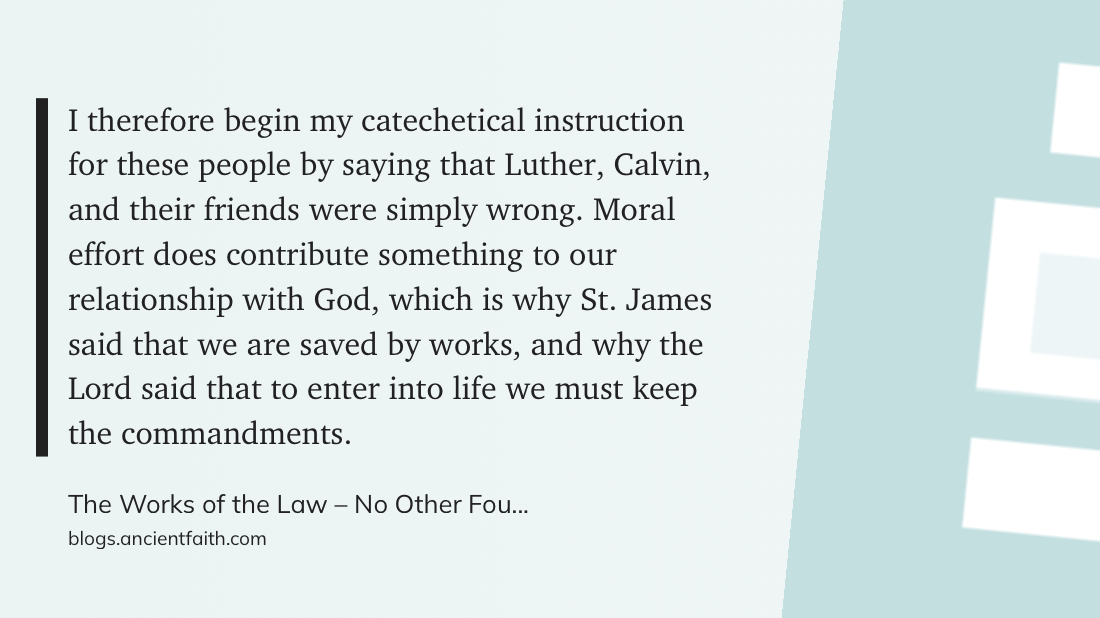
Putting it bluntly

If you want the full posting: The Works of the Law

Every man a Pope

I frequently quote Nathan Hatch’s masterful The Democratization of American Christianity in my posts. It explains so much.

But I just discovered that one of my favorite Orthodox bloggers, Fr. Stephen Freeman, has noticed the same democratizing theme:

[I]n contemporary Christianity, it is said that “every man is a Pope.” Whereas a few generations ago, people asserted that the Bible alone had authority, today, that, too, has been overthrown. Each person is his own authority. And I will add, that if every person is his own authority, then there is no authority.

I am fully sympathetic with the political place of democracy …

I am, however, deeply interested in the spiritual disease that accompanies the interiorizing of the democratic project. We have not only structured our political world in a “democratic” manner, we have spiritualized the concept and made of it a description for how the world truly is and how it should be. The assumptions of democracy have become the assumptions of modern morality and the matrix of our worldview …

Much of what today passes for Protestantism is nothing of the sort. Rather, it is a thinly veiled cloak for the democratic spirit at “prayer.”  “Salvation by grace through faith” is a slogan for individualism, a Christianity “by right.” There are no works, no requirements, only a “grace-filled” entitlement. For the ultimate form of democracy is the person who needs no one else: no Church, no priest, no sacrament, only the God of my understanding who saves me by grace and guarantees that I can do it alone.

It is a great spiritual accomplishment to not be “conformed to this world.” The ideas and assumptions of modern consumer democracies permeate almost every aspect of our culture. They become an unavoidable part of our inner landscape. Only by examining such assumptions in the light of the larger Christian tradition can we hope to remain faithful to Christ in the truth. Those who insist on the absence of spiritual authority, or demand that nothing mediate grace will discover that their lives serve the most cruel master of all – the spirit of the age.

Fr. Stephen Freeman, The Madness of Democracy – A Spiritual Disease

The common feature of American religion

Nevin and Schaff also discerned certain common intellectual patterns and reflexes beneath the rampant pluralism of American Protestantism. They attributed the breakdown of theological coherence to attitudes that American Christians had assumed. These two felt that a radical Bible-centeredness was the reigning theory among Protestant sects. After surveying the statements of belief of fifty-three American denominations, Nevin surmised that the principle “no creed but the Bible” was the distinctive feature of American religion.

Nathan O. Hatch, The Democratization of American Christianity

Fifty-three denominations that just follow the Bible but cannot agree on what it means. What’s wrong with this picture?

Christianity generally

A constant temptation

Christianity in this instance is no longer even a worldview—or what John Rawls calls a “fully comprehensive doctrine”—much less an institutionalized worldview. It is conceived as one wedge in the pie of an individual life, a matter not of shared obedience to the Word incarnate with eternal life in the balance, but of preferred inclination toward the “company or conversation of those whose Customs and Humours, whose Talk and Disposition they like best.”

Brad S. Gregory, The Unintended Reformation

An article I keep coming back to

This is an article I’ve been revisiting and wrestling with regularly:

There is a reason why so many evangelical and Protestant graduate students in theology move toward “higher church” traditions. Intellectually, they discover thinkers and writings their own “lower church” traditions either ignore or lack; liturgically, they discover practices handed down century after century that function like a lifeline in a storm. Reading Saint Ignatius or Saint Justin or Saint Irenaeus or Saint Augustine, it occurs to them that they don’t have to imagine what the church’s ancient liturgy looked and felt like; they can simply visit a church down the street.

It isn’t strange to learn that Prestigious Scholar X on the law/econ/poli-sci faculty at Ivy League School Y is Roman Catholic. It is a bit of a surprise to learn that he’s an evangelical. The moment you hear it, though, you wonder (or ask) whether he’s an evangelical Anglican or some such.

Brad East, Conversions, Protestantism, and a new mainline

A cartoon for the rest of Election 2024

For those whose churches don’t have formal confession, understand that we confess our sins without suggesting that they were justified by our neighbor’s provocation. It sounds so easy, but not being able to self-justify, not even a eensy-weensy bit, can be surprisingly hard.

East and West

I don’t think his focus was Christianity, but Guenon was (inadvertently?) not wrong about the relative emphasis in Western versus Eastern Christianity.


… that Christ may dwell in your hearts through faith; that you, being rooted and grounded in love, may be able to comprehend with all the saints what is the width and length and depth and height — to know the love of Christ which passes knowledge; that you may be filled with all the fullness of God.

Ephesians 3:17-19 (NKJV)

You can read most of my more impromptu stuff here and here (both of them cathartic venting, especially political) and here (the only social medium I frequent, because people there are quirky, pleasant and real). All should work in your RSS aggregator, like Feedly or Reeder, should you want to make a habit of it.

Sunday, March 10, 2024

Grushenka and the Grumbler

Grushenka, a character in Dostoevsky’s The Brothers Karamazov, relates a now-famous fable about an old woman:

Once upon a time there was a woman, and she was wicked as wicked could be, and she died. And not one good deed was left behind her. The devils took her and threw her into the lake of fire. And her guardian angel stood thinking: what good deed of hers can I remember to tell God? Then he remembered and said to God: once she pulled up an onion and gave it to a beggar woman. And God answered: now take that same onion, hold it out to her in the lake, let her take hold of it, and pull, and if you pull her out of the lake, she can go to paradise, but if the onion breaks, she can stay where she is. The angel ran to the woman and held out the onion to her: here, woman, he said, take hold of it and I’ll pull. And he began pulling carefully, and had almost pulled her all the way out, when other sinners in the lake saw her being pulled out and all began holding on to her so as to be pulled out with her. But the woman was wicked as wicked could be, and she began to kick them with her feet: ‘It’s me who’s getting pulled out, not you; it’s my onion, not yours.’ No sooner did she say it than the onion broke. And the woman fell back into the lake and is burning there to this day. And the angel wept and went away.

It reminds me of a small scene in CS Lewis’ The Great Divorce. Angels are trying to help a soul make the journey from hell to heaven. One, a woman, seems mostly to a grumbler. Lewis’ soul has this conversation with his own guide:

‘I am troubled, Sir,’ said I, ‘because that unhappy creature doesn’t seem to me to be the sort of soul that ought to be even in danger of damnation. She isn’t wicked: she’s only a silly, garrulous old woman who has got into a habit of grumbling, and feels that a little kindness, and rest, and change would due her all right.’ ‘That is what she once was. That is maybe what she still is. If so, she certainly will be cured. But the whole question is whether she is now a grumbler.’ ‘I should have thought there was no doubt about that!’ ‘Aye, but ye misunderstand me. The question is whether she is a grumbler, or only a grumble. If there is a real woman— even the least trace of one— still there inside the grumbling, it can be brought to life again. If there’s one wee spark under all those ashes, we’ll blow it till the whole pile is red and clear. But if there’s nothing but ashes we’ll not go on blowing them in our own eyes forever. They must be swept up.’

Both stories have in common a tiny, insignificant thing: an onion, a grumble. There is in Scripture a similar “tiny thing,” a single moment that serves as a hinge in a human life. The exchange between the “Good Thief” and Christ on the Cross is hymned during Holy Week with the words, “The Wise Thief entered Paradise in a single moment…” It is a remembrance of the extreme measure of God’s grace.

Father Stephen Freeman, bringing together two of my favorites. Then there’s this:

The story of the Old Woman and the Onion is a parable stated in the extreme manner of absurdity. I was first drawn to it by the simple fact of its willingness to ascribe such mercy to God. A single, rotten onion, given as charity would be sufficient to get you out of hell! It was the imaginative force of such a thing that shook my soul when I first read it. In my childhood, there could never have been such a Christian mercy. Hell is hell is hell.

He’s not wrong about that, and I now think that the Grushenka story is truer than “hell is hell is hell.”

Ecclesial Christians

I’m pretty sure it was the late Richard John Neuhaus who described “ecclesial Christians” as “Christians for whom faith in Christ and faith in His Church is one act of faith, not two.”

I like that very much and my experience as a former non-ecclesial Christian who became ecclesial 26+ years ago, it rings true.

IYKYK, as the kids say

A distinction that may be of interest

For the Roman Catholic prayer, said by the priest after the penitent confesses, states, “I absolve you,” whereas in the Orthodox Church the wording reflects the original understanding: “May God forgive you, through me, a sinner.”

Michael Shanbour, Know the Faith

Entertainment

The Divine Liturgy is rightly understood as a theophany – an appearance of God (Christ) in our midst. We stand in the place of Moses, and wrestle in the place of Jacob. We gaze with Ezekiel and the fiery wheels with the Son of Man in their midst. We stand with St. John the Theologian and the vast crowds of heaven before the Lamb-slain-from-the-foundation upon the altar with the four beasts and angels surrounding Him.

This is profoundly significant. Our culture has trained people to become an audience. A theater performance, a concert, and a Church service are all of a piece. Worse than this, we are trained to be an audience that expects to be entertained ….

Fr. Stephen Freeman

Getting priorities straight

Photographers have long had an uneasy relationship with the sacred. There is the age-old anxiety that a photograph can steal a soul. And last week, more than 900 wedding photographers signed a petition complaining that “problematic vicars” can be “rude, humiliating, aggressive and abusive”. The fact is, the sacred has a deep and visceral distrust of the whole business of taking photos, which — in our Instagram-addled age — has resulted in a colossal culture clash.

One photographer, Rachel Roberts, who launched the petition, took a pop at problematic vicars. “They basically forget the fact that two people are getting married, and it’s the most important day of their lives. They put their own objectives and their own rules first and forget the reason why we’re all actually here.” Talk about getting things the wrong way round. The reason we are all there is for two people to enter into holy matrimony, not for wandering photographers to get the best angle for the album.

The problem is that photographs don’t just record reality — they change it. Quantum physicists talk of the observer effect: the very act of observing reality causes a disturbance within it, and thus changes it. Something similar is true of wedding photography. We pose for photographs. We behave differently when we are being captured on film …

So when the photographer turns up 10 minutes before the service and tells me how it’s going to be, that this is how the bride wants it, it makes little difference. They will stay behind the pillar and take photographs from the back, and not follow the bride down the aisle as if this were some catwalk show. They hate it, of course. But you don’t just walk into the house of God and expect the place to bend to your needs. The fact that this space is different, reflects different values, is precisely why people choose to be married here.

Giles Fraser, The narcissism of wedding photographers

Others

A seed was planted today in my head, and I don’t know where it will go. It is the possibility, even the likelihood, that a lot of people we call “Protestants” are not unequivocally Protestant because they’re not rooted in or in continuity with the classical Protestantism of the Reformation.

That’s all the speaker said, but already I’m thinking about the many denominations that grew out of the American revivalism of the late 18th and early 19th centuries, much of which was explicitly in rebellion against the Reformed/Calvinist stream of Reformation thought.

We probably call them “Protestants” because we don’t have a term for “not Roman Catholic, not Orthodox, not unequivocally Protestant, but calling themselves Christians.”

“Protecting” God, stripping away all meaning

[Jonathan] Edwards sought to intensify God’s control of creation. Yet ironically, Edwards ended up colluding with the Gnostic denigration of the material world to the degree that his entire philosophical project aimed at guarding God from the perceived threat posed by materiality. For God to truly be glorified, things in the world cannot have distinct natures or identities; rather, God must impose all meaning externally through will-acts that remain, in the final analysis, purely arbitrary. There is no actual meaning within the realm of space and time because the cosmos is simply a passive instrument of divine control.

Robin Phillips, Recovering the Goodness of Creation

Be it remembered

Margaret Sanger specifically drove the Evangelical Protestants into the pro-birth control column. She used the ever-reliable anti-Catholic sentiment of this group to overcome their natural aversion to birth control and to the Progressive Social Gospel Mainline. Thanks to Sanger’s efforts, by the time of the Griswold v. Connecticut decision, the entire country considered opposition to birth control to be a uniquely Catholic position.

Jennifer Roback Morse, The Sexual State


… that Christ may dwell in your hearts through faith; that you, being rooted and grounded in love, may be able to comprehend with all the saints what is the width and length and depth and height — to know the love of Christ which passes knowledge; that you may be filled with all the fullness of God.

Ephesians 3:17-19 (NKJV)

You can read most of my more impromptu stuff here and here (both of them cathartic venting, especially political) and here (the only social medium I frequent, because people there are quirky, pleasant and real). All should work in your RSS aggregator, like Feedly or Reeder, should you want to make a habit of it.

March 5, 2024

Art

Popular “unpopular art”

[A]art is in a peculiar and dangerous position these days. This week, over 17,000 artists and activists signed an open letter demanding that Israeli artists be excluded from the Venice Biennale festival in Italy, simply because they are Israelis. And even while that attempt at censorship is launched, other artists proclaim how brave they are for art on certain pet causes, violating taboos that no one has enforced for decades and everyone they know already mocks. There is no real cost to such stands.

Joseph Bottum

Popular art

Meet Frankey, the Street Artist Delighting Amsterdam – The New York Times (shared link, no paywall). I was afraid this story would be about another Banksy type graffiti artist (I viscerally hate graffiti). Not at all. It’s sheer whimsical delight.

IVF

The ephemeral threat to IVF

In June 2022, the court ended federal access to abortion, kicking abortion policy back to the states.

Since then, nine states—Alabama, Texas, Arkansas, Kentucky, Louisiana, Missouri, Oklahoma, South Dakota, and Tennessee—have outlawed abortion outright, not even allowing the procedure when women become pregnant through rape or incest. (Alabama’s IVF ruling is the most extreme pro-life ruling yet.) …

How Abortion Became ‘the Defund the Police of the GOP’ | The Free Press

Alabama Supreme Court’s decision might ramify unpopularly, bearing in mind the conservative adage that there are popular “unpopular opinions” (i.e., “popular among our leftcoastal readers, less so in flyover country”) and unpopular “unpopular opinions (i.e., “popular among the fundamentalist deplorables in flyover country but vilified by leftcoastal types).

But I digress. The Alabama decision was a ruling in favor of IVF-availing parents whose frozen embryos were negligently destroyed by another patient for lack of safeguards at the IVF clinic. There were no sinister designs on IVF in the opinion at all.* So constantly throwing the decision into the abortion mix strikes me as shit-stirring clickbait.

And “they” must stir the shit, and bait the clicks, vigorously and now, because IVF is in fact popular and the Alabama legislature is hastening to protect it from unintended consequences of the Court’s decision. (I’d say “nobody would dare try to outlaw IVF” except that people are daring some pretty bizarre things these days.)

* Alabama’s Supreme Court had earlier ruled that wrongful death action was allowed to parents for loss of descendants en ventre sa mere; the recent case clarified that intrauterine or extrauterine descendants were within contemplation of the parental wrongful death law.

The case against IVF

While we’re on the subject, I think it’s important for people in secure positions occasionally to voice unpopular unpopular opinions — opinions that others may be too cancelable to voice.

For the record, I have serious moral qualms about IVF, based on a combination of (a) knowing that in the U.S., IVF practice knowingly creates large numbers of embryos that will eventually be destroyed and (b) some Roman Catholic influence that tells me babies should be made in marital beds, not laboratories.

J Budziszewski, What We Can’t Not Know briefly sketches the Roman Catholic case against IVF (thought his immediate target is cloning).

So you would say that aspirin, surgery to remove a tumor, and cloning “respect” nature, too.
Not cloning.
Why not? Doesn’t it assist the natural function of having babies?
Once more: our nature is our design. We are designed to have babies, but we are not designed to have them in that way. To put it another way, our design includes not only certain ends but certain means. There is a difference between repairing the reproductive system and bypassing it.
Well, it doesn’t seem to be a big deal anyway.
I think it is a very big deal. When you try to turn yourself into a different kind of being, you are not only doing wrong but asking for trouble. He who ignores the witness of his design will have to face the witness of natural consequences.

If you think this argument has (not “should have”) any appreciable political valence in the USA, you need to get a grip. I’m just saying it should have some valence.

I don’t know where I ultimately would come out on IVF it were there an opportunity to discuss it, not just Roman Catholic voices crying in the wilderness versus reflexive dismissal of those voices.

Law

Witless Ape returns to ballot

[I]t was a perfectly defensible position to hold that Trump should be disqualified. What was indefensible was the air of swaggering certainty that permeated so many of those takes. … self-evident. Common sense. Obvious. Indisputable. Automatic.

Damon Linker

David French was in the “Common sense. Obvious. Indisputable. Automatic.” camp, and he’s not going down without a final howl of protest:

It’s extremely difficult to square this ruling with the text of Section 3. The language is clearly mandatory. The first words are “No person shall be” a member of Congress or a state or federal officer if that person has engaged in insurrection or rebellion or provided aid or comfort to the enemies of the Constitution. The Section then says, “But Congress may by a vote of two-thirds of each house, remove such disability.”

In other words, the Constitution imposes the disability, and only a supermajority of Congress can remove it. But under the Supreme Court’s reasoning, the meaning is inverted: The Constitution merely allows Congress to impose the disability, and if Congress chooses not to enact legislation enforcing the section, then the disability does not exist. The Supreme Court has effectively replaced a very high bar for allowing insurrectionists into federal office — a supermajority vote by Congress — with the lowest bar imaginable: congressional inaction.

David French

I guess the Supreme Court considers whether it’s best to shade the law when following it fearlessly could unleash chaos. It’s days like yesterday that make that obvious, indisputable.

(H/T Kevin D. Williamson for the “Witless Ape” image; he minted it, and the linked item is a classic.)

The exceedingly long arm of Russian law

The media reported last week that Russian authorities had arrested Ksenia Karelina, a U.S.-Russian dual citizen, and charged her with treason for donating a nominal sum to an organization that aids Ukraine … The charges against Ms. Karelina are an assault on what it means to be American. The Russian state contends that for a U.S. citizen to make a donation to a U.S. charity and to attend a peaceful protest on U.S. soil is a punishable offense on arrival in Russia.

Dora Chomiak in the Wall Street Journal

Trump’s immunity claims

People who want Donald Trump tried, convicted and jailed before November, for acts while he was in office, have my sympathy, but as we head ever deeper into a tit-for-tat polarized political world, I must substantially agree with Lee Kovarsky instead: Trump Should Lose. But the Supreme Court Should Still Clarify Immunity. – The New York Times.

Trump’s immunity claims are far too broad, but ex-Presidents need at least narrow immunity. Running for high office is already so fraught that I question the sanity of anyone who runs. Add to the existing ugliness the prospect of criminal prosecution, with no possible immunity if the other party wins next time, and we’ll have nobody but saints and sociopaths willing to risk it.

Qualified Immunity

In Indiana, we have a political novice candidate for governor whose first major media buy was an ad with him sitting in a rustic church, slightly misquoting the Bible and earnestly telling us he’s a “man of faith.” It kind of turned my stomach.

The second major media buy was an ad with a well-spoken Rwandan refugee, who became his foster daughter, telling us he’s a “man of faith.” It was much more believable.

His third major media buy simplistically says that qualified immunity (over which governors have little or no control) protects police and so protects us and brillig, and slithey toves, gyring and gimbling in the wabe, and “as governor, your safety will always come first” (sic).

Eric Doden has now lost me for sure. Qualified Immunity, a court-created line-item veto, effectively turns “every person” in 42 USC §1983 into “precious few people.”

Miscellany

[Expletive deleted] AI

It is not possible to say definitively who negatively impacted society more, Elon Musk tweeting memes or Hitler. Both have had a significant impact on society, but in different ways.

Google’s Gemini AI via Nellie Bowles

Pride before the Fall

No, you dare not make war on cotton. No power on earth dares to make war upon it. Cotton is king.” Such words smacked of hubris, the excessive pride that goes before a fall. And so they would turn out to be, expressing a mistaken vision that would lead to cruel and tragic consequences for the South. Lulled into a false sense of economic security by the illusion that cotton was invincible and its prices would never fall, the South would become fatally committed to a brutal social and economic system that was designed for the lucrative production of cotton on a massive scale but that achieved such productivity at an incalculable cost in human and moral terms. It placed the region on a collision course with changing moral sensibilities in the world, and with fundamental American ideals.

Wilfred M. McClay, Land of Hope

Psychological Man

My grandfather left school at fifteen and spent the rest of his working life as a sheet metal worker in a factory in Birmingham, the industrial heartland of England. If he had been asked if he found satisfaction in his work, there is a distinct possibility he would not even have understood the question, given that it really reflects the concerns of psychological man’s world, to which he did not belong.

Carl R. Trueman, The Rise and Triumph of the Modern Self

Where paranoia is the mark of sophistication

In the offline world, paranoia is a liability. It inhibits you from seeing the world clearly. In parts of the online world, you’re considered a rube if you’re not paranoid, if you’re not seeing a leftist plot around every corner, if you’re not believing that Taylor Swift and Travis Kelce’s romance is a Biden administration psy-op that culminated with rigging the Super Bowl.

David French, Why Elon Musk Is the Second Most Important Person in MAGA


So: where did all my mockery of Trump go?

I suffer more from the humiliations inflicted by my country than from those inflicted on her.

Simone Weil, from a letter to Georges Bernanos.

You can read most of my more impromptu stuff here and here (both of them cathartic venting, especially political) and here (the only social medium I frequent, because people there are quirky, pleasant and real). All should work in your RSS aggregator, like Feedly or Reeder, should you want to make a habit of it.

On proper love of country

Love of country or “nationalism”?

Most of what is written about Christian nationalism is silly. Critics and analysts sweepingly deride conventional Christian conservatives as Christian nationalists. By some counts, there are, by this definition, tens of millions of Christian nationalists. Sometimes even civil religion, with its homage to a vague deity, is labeled Christian nationalism. If so, all presidents from George Washington to Joe Biden are Christian nationalists. Sometimes the target is folk religionists who conflate God and country. They sometimes sport paraphernalia with American flags draped around the cross. These folk religionists typically aren’t aware they are Christian nationalists. They don’t publish articles, much less books. And they typically don’t have policy agendas, just an attitude that God and country should be interchangeably honored.

Christian nationalism is distinct from conventional Christian conservatism. The former are typically post-liberals who want some level of explicit state established Christianity. The latter have been and largely still are classical liberals who affirm traditional American concepts of full religious liberty for all. Both groups want a “Christian America.”  But the former want it by statute. The latter see it as mainly a demographic, historical and cultural reality.

Mark Tooley, Christian Conservatism vs Christian Nationalism

This looks like a solid and helpful piece from a more religiously-sophisticated source than the Politico piece it’s responding to. But it seems to me superficial insofar as it’s credulous about “nations.”

Not this:

The patriotic mythologies that came into existence together with modernity’s nationalisms are siren songs that seek to create loyalties that are essentially religious in nature. World War I, in the early 20th century, was deeply revealing of the 19th century’s false ideologies. There, in the fields of France, European Christians killed one another by the millions in the name of entities that, in some cases, had existed for less than 50 years (Germany was born, more or less, in 1871). The end of that war did nothing, apparently, to awaken Christians to the madness that had been born in their midst.

These passions are worth careful examination, particularly as they have long been married to America’s many denominational Christianities. I think it is noteworthy that one of the most prominent 19th century American inventions was Mormonism. There, we have the case of a religious inventor (Joseph Smith) literally writing America into the Scriptures and creating an alternative, specifically American, account of Christ and salvation. It was not an accident. He was, in fact, drawing on the spirit of the Age, only more blatantly and heretically. But there are many Christians whose Christianity is no less suffused with the same sentiments.

Asking questions of these things quickly sends some heads spinning. They wonder, “Are we not supposed to love our country?” As an abstraction, no. We love people; we love the land. We owe honor to honorable things and persons. The Church prays for persons: the President, civil authorities, the armed forces. We are commanded to pray and to obey the laws as we are able in good conscience. Nothing more.

Fr. Stephen Freeman

The conveniently unknown God

For fifty years I worshipped at the shrine of an Unknown God. It’s better than nothing. This tells us something of the intrinsic nature of humans. That we are wired to adore. It’s been a deception that we can get along without bending our heads, or ‘think’ our way out of our essential religiosity …

I lit candles for the Unknown God, coaxed exotic incense, sought out quiet places, wrapped myself in antelope skins and read ancient texts, hundreds of them. I got myself out into the bush, I abandoned work without real substance, I became a scholar and a seeker. I lived in a circle for four years, no screens anywhere near me. I blew my lantern out early and woke to birdsong. I was devoted, and I was led.

But I would tell by the camp fire every story but the story. The vast, glorious, uneasy elephant in the room.

I loved the Unknown God because it seemed beautiful, ancient, intensely mysterious, but didn’t infringe on how I actually lived. Not if I didn’t want it to. Had no bearing on my ethics or morality – what there was left of them. I dwelt in a world of strong emotion, intuitions and elaborate ceremonies. I learnt an awful lot about being human. I learnt an awful lot about the value of beauty.

And yet, I remained absolutely unaccountable. At the flick of a switch I could be the same old degenerate I’d always been …

Those fifty years got me an awfully long way. They’ve enabled me languages and experiences that gird me well in middle age. They haven’t required abandoning, or disowning, or shamefully chucking on a bonfire. I was a Romantic, that was what I was. But if you’ve really committed to a quest, a day will come when everything you think you know gets rocked, challenged, shaken. That happened to me four years ago up in the forest at the end of a 101-day vigil. When the unthinkable happened.

My unknown God decided to make himself visible to me.

Known to me.

Martin Shaw.

A bit of lay history

Clause not yet adopted at Rome … omitted from manuscripts of the Creed … inclusion perhaps a copyist’s mistake! H’m … Upheld by Paulinus of Aquileia at the Synod of Friuli, 800, yes, yes, yes … but only adopted among the Franks … Here we are! Frankish monks intoning the Filioque clause at Jerusalem! Outrage and uproar of Eastern monks!’ He paused and rubbed his hands. ‘I wish I’d been there!’ He pushed back his spectacles for a moment and then resumed. ‘Pope Leo III tries to suppress the addition, in spite of the insistence of Charlemagne – a Frank, of course! – but approves of the doctrine.

Patrick Leigh Fermor, Between the Woods and the Water. Patrick Leigh Fermor is not where I expected to find a saucy account of where the filioque came from.

Untenable but appealing

To read [Elaine] Pagels and [Bart]Ehrman, the Jesus Seminarians, and many others, the reader would think that orthodox interpretation of the Christian story has no claim to greater antiquity, and no stronger connection to the first followers of Christ, than the many and various heretical interpretations. In their view, the New Testament reflects only the theological-ideological biases of the “proto-orthodox” party, and the canon as we know it was imposed retrospectively, rather than developing organically in the early Church. These claims are enormously appealing to the modern religious mind, but they aren’t particularly tenable.

Ross Douthat, Bad Religion

Iconodules

A key turning point in my life, during my thesis (“The Icon as Theology”) defense, came with the question, “Do you believe the veneration of icons to be necessary to salvation?” I hesitated (I was an Anglican priest at the time), and responded, “I believe that their veneration is necessary to its fullness.” I have lived with that answer for many years and pondered it and the question as well. Christ, according to the Scriptures, is the “icon of the invisible God” (Col. 1:15). I cannot imagine a salvation that is somehow separate from the veneration, indeed, the worship of that Icon.

Fr. Stephen Freeman

On “calling”

Florida’s most notorious abortion clinic is located at 1103 Lucerne Terrace in downtown Orlando. On the sidewalk directly in front of this clinic, the Orlando Women’s Center, there are two prominent marks in the concrete. They are signs of an extraordinary story.

The concrete was worn away by the feet of John Barros, who for nearly two decades stood outside this clinic as a sidewalk counselor …

I asked him, once, how he’d felt called to the pro-life movement. “I wasn’t called to the pro-life movement,” he replied. “God called me to forty feet of sidewalk.”

Farewell to a Pro-Life Hero

The new Christendom’s penitential system was often experienced as external to the needs of the penitent. It was based on new patterns of canon law that codified sin and the penances that negated it. The system could be overwhelmingly legalistic and for some authorities was centered not on the penitent but on his clerical confessor. It was concerned more with divine satisfaction than with human transformation.

John Strickland, The Age of Utopia. The “new Christendom” Strickland is referring to is Western Christendom after the Great Schism of roughly 1,000 years ago. Human transformation remains the focus of confession, absolution and penance in the Christian East (and in American Orthodoxy).

Anecdote contra data

Writing on X, a priest reports: “A bit of good news . . . I’ve had more confessions of the ‘Bless me Father, for I have sinned, it’s been 20, 25, 30, 40, 50 years since my last confession . . .’ sort this year than I ever remember. I’m seeing more people at Mass than I ever remember.”

R.R. Reno


… that Christ may dwell in your hearts through faith; that you, being rooted and grounded in love, may be able to comprehend with all the saints what is the width and length and depth and height — to know the love of Christ which passes knowledge; that you may be filled with all the fullness of God.

Ephesians 3:17-19 (NKJV)

You can read most of my more impromptu stuff here and here (both of them cathartic venting, especially political) and here (the only social medium I frequent, because people there are quirky, pleasant and real). All should work in your RSS aggregator, like Feedly or Reeder, should you want to make a habit of it.