Fanatics and others

Fanaticism

The Minnesota Assassin

The Minnesota political assassin (who I won’t name) had some red flags in initial biographical information. From my perspective (Eastern Orthodox, formerly Evangelical and Calvinist, always active in my faith and never “charismatic”), the biggest one was his invocation of new apostles and prophets as what America needs spiritually — an indication of New Apostolic Reformation beliefs or something adjacent.

(Surprisingly few NAR advocates will own up to it; either it’s so loosely structured that adherence is ambiguous – which I suspect is the case – or they’re told to lie, or something.)

Now Stephanie McCrummen at the Atlantic has dug a little deeper and confirmed my suspicions.

Now comes the hard part: Assuming his guilt (which I’m allowed to do because I’m not a criminal court), dare we blame his assassinations, and the apparent intention to assassinate as many as 70 others, on his NAR ideas, or do we hold open the possibility of insanity or some other explanation?

Blaming NAR is tempting for me because I so detest it. But I have seen no information that NAR actually encourages physical violence, and not just vehement rhetoric. (Their “violent prayer” talk seems, preliminarily, to be a red herring.) The theory of stochastic terrorism has always struck me as plausible, but it’s hard to imagine any forcefully-expressed opinion that has zero chance of pushing some random person over some edge.

So I’m glad Stephanie McCrummen withheld judgment about causation. It’s still the extremely early days in the criminal proceedings, and more, if not all, will be revealed eventually.

Christianity is not an instrument of political power

David French comes closer than McCrummen to linking the assassination effect to the N.A.R. cause, and also had this observation:

Last election cycle I helped create a new Christian curriculum for political engagement …

As I talked about the curriculum in gatherings across the country, I was struck by the extent to which I was asked the same question time and again. “Sure,” people would say, “we need to be kind, but what if that doesn’t work?”

The implication was clear — victory was the imperative, and while kindness was desirable, it was the contingent value, to be discarded when it failed to deliver the desired political results.

David French

A “Christian” who thinks political victory is more important than living as Christ taught (let’s say, in the Beatitudes for instance) is a sorely confused Christian.

I’ve probably said it before, but I’ll say it again. One of the countless blessings I’ve received in Orthodox Christianity is the company of martyrs, many of whom died because they knew that gaining the world wasn’t worth losing one’s soul. If you’re in a “Christian” tradition where leaders or laity act as if that’s a good trade (none of them are wicked enough to actually teach it), get out before it’s too late.

Who are the fanatics?

We know now that the FBI’s infamous Richmond Memo, targeting traditional Catholics as potential terrorists and comparing them with Islamists, was not merely the product of a few rogues in a single field office, as the agency had claimed.  Multiple offices were involved in drafting it, and it was distributed to over a thousand employees.

This post is not going to be a rant against the Biden administration.  What interests me is what was going on in the analysts’ heads.  I credit them with sincerity.  But why did they think traditional Catholicism is comparable to the ideology of radical Islam?

The most generous interpretation which can be placed on the memo is that the analysts thought of fanaticism simply as strong belief, and assumed that any strong belief is potentially violent.

But a sensible definition of fanaticism would emphasize the content of belief, not its strength.  You aren’t a fanatic for believing very strongly that you should “Love your enemies and pray for those who persecute you, that you may be children of your Father in heaven.”  The more strongly you believe that, the less likely you are to be a terrorist.

On the other hand, you really are a fanatic for believing that you should “kill them wherever you find them,” meaning Jews and infidels.  The more strongly you believe that, the more likely you are to be a terrorist.

The content of belief did come into the analysts’ definition in one way.  They plainly believed strongly in their own ideology, yet it seems never to have occurred to them to view themselves as fanatics.  It seems, then, that in their view, the term “fanatic” must have meant not just “anyone who believes strongly,” but rather something like “Anyone who believes strongly enough in God, rather than in progressive dogma, for his belief to influence the rest of his life” – and the full force of the federal government must be used to surveil and suppress all such people.

So by their definition, yes, traditional Catholics are fanatics.  But by a more sensible definition, which ideology is a better candidate for being called by that label?

J Budziszewski

Evangelical Religion

I return to the subject of Evangelicalism so often, I think, because there is some stubborn something within me that believes, against so much journalistic “evidence” (thousands of profiles of self-identified Evangelicals doing bizarre things), that a significant number of Evangelicals are acting and believing in perfect good faith, and that I simply need to find the magic words to help them see what I can’t un-see.

There is some tenderness mixed with my frustration at 28 years of almost complete failure in that regard. And there is some perversity in my rejection of the wisdom of Orthodoxy, which really does not encourage trying to argue people into the Orthodox faith. “Acquire the Holy Spirit and thousands around you will be saved,” said Saint Seraphim of Sarov, but something there is about an American ex-Evangelical that still loves a short-cut.

Over the years, I have cast a lot of shade on the concept of “religion.” I’m starting to think I should have self-critically cast similar shade under the concept of “Evangelicalism.”

Here’s what I think I’ve been doing that’s sorely mistaken:

  1. The “good faith” Evangelicals I’m trying to persuade are basically wealthy white church-going Evangelicals in, or in orbit around, Wheaton, Illinois (and maybe Grand Rapids, Michigan). The former are the kind of people I hung out with for roughly 6 years of my life (five years in school plus one year in my young adulthood), the latter for 15 years. They are the kind of people I see at my Wheaton Academy homecomings every five years. I like them; no, I love them. We don’t talk politics when we get together. I fancy they’re not Trump fans, but I really don’t know and I fear I’d be disappointed if I found out.
  2. The evangelicals I’m yelling about are random self-identified Evangelicals or flakes identified as Evangelical by journalists in mainstream media, who may or may not attend church and who may have adopted the Evangelical label simply because they’re Trump supporters. I have little experience of them. The “good faith” Evangelicals may be as baffled by them as I am.

My impression, which I’ve had but suppressed for rather a long time, is that “Evangelicalism” isn’t coherent, though we seem not to be able to live without it. So when I shout at Evangelicals, it’s like shaking my fist and cursing at the clouds.

It has always been notoriously difficult to define what an Evangelical is. Probably the most widely-accepted attempt is the Bebbington Quadrilateral. But my favorite is from Ken Myers of Mars Hill Audio Journal. I’m not going to take the time to dig it up verbatim, but the gist was that Evangelicals recognize one another not by right doctrine, orthodoxy, but by “right feeling,” orthopathos. They sing the same songs, and pray similar extemporaneous prayers, supported Billy Graham Crusades, and so forth.

I don’t know whether that is even true today of the motley crew that journalists identify as Evangelical.

“Briefly stated, the Gell-Mann Amnesia effect is as follows: You open the newspaper to an article on some subject you know well … Often, the article is so wrong it actually presents the story backward—reversing cause and effect. I call these the ‘wet streets cause rain’ stories. Paper’s full of them.

In any case, you read with exasperation or amusement the multiple errors in a story—and then turn the page to national or international affairs, and read as if the rest of the newspaper was somehow more accurate about Palestine than the baloney you just read. You turn the page, and forget what you know.”

Michael Crichton (via ChatGPT because I couldn’t remember “Gell-Mann Amnesia effect”).

The press tends to garble Eastern Orthodoxy, so why should I believe them about Evangelicalism?

Many of them probably labeled the Minnesota assassin “evangelical.” Was he? Is the evidence that he wasn’t a No True Scotsman fallacy?

I know Orthodoxy; I just really don’t know Evangelicalism or its outer boundaries any more, if ever I did.

So you have my permission to go back to everything I’ve written about Evangelicals and Evangelicalism and say “he doesn’t know what he’s talking about,” because much of the time I’ve been Gell-Mann-ing it.

I’ll try to do better, but old habits die hard.

Sanity (a/k/a The Gospel for people battered by bad religion)

Having dwelt long on some pretty sorry stuff, a very long but infinitely more positive note:

I know that what I’m about to talk about is something I’ve talked about probably even fairly recently on the show, but I find myself in real life — meaning as a priest dealing with a group of parishioners, and trying to help them and guide them and just family members and everybody in general — I find myself having to say this over and over and over again, which tells me that probably if I say it over this microphone to people, there’s probably at least some folks out there who need to hear it again, even if I have talked about it recently.

The Christianity that those of us, at least in the United States — and I can only speak about that experience because I haven’t had any others — the Christianity we grew up around came from one of two categories largely. And people who want to defend those types of Christianity will call this a caricature. I don’t care anymore. But what I’m about to say, even if you think it’s a caricature of what they’re trying to teach, this is what a lot of the people within these traditions have actually received. Right? So it’s very easy to defend some tradition based on what’s in the books, and what we would mean to say, right? But I’m talking about what the people who I encounter, the people who talk to me about spiritual things. come to me and give confessions, what they’ve received from the Christianity they’ve grew up around, how that has shaped them, how they think because of it. And if people, representatives of those groups want to say that’s not what they meant to teach, cool, but maybe some introspection on why that’s not what people are receiving.

Anyway, what people have received comes in two categories. One is sort of the smilin’ Bob Shuler School of, “God loves you just the way you are and you don’t have to do anything. Just don’t worry about it. Just smile and be happy and listen to the hymns of your choice that you enjoy.” … That worked really well with boomers. That seemed to answer something they needed to hear. Maybe they’re a generation who grew up with very dissatisfied perfectionist parents, and so just hearing you’re fine just the way you are was what they needed, right? But that doesn’t work on subsequent generations, because subsequent generations are more realistic or nihilistic depending on your point of view, and know there’s something deeply wrong with themselves and with the world around them. So just telling them over again, “No, no, you’re fine, everything’s fine, it doesn’t work.” That’s why those kind of churches are all empty now.

The other school of thought is pretty much the exact opposite. It’s God doesn’t really love you. Right. In fact He’s pretty angry with you and He’s getting ready to send you to hell. Right? And the only way to avoid that is, depending on your tradition, right, is, for you to love him nonetheless, really sincerely — and there’s a rabbit hole to go down. How sincere am I ever really? — and do that plus live your life at a certain way and follow certain rules. Which will differ based on tradition, and which you will inevitably fail at.

That second one is most of the people who I interact with on spiritual matters, and it’s almost like they’ve been taught and they’ve internalized that. Their life in this world is this sort of really horrible reality show, almost like Squid Games, and like God is about weeding out contestants and narrowing it down to this faithful few and everybody else goes to hell, goes to eternal punishment except for this faithful few who, again, depending on your tradition, he may just pick. Or, you know, they’re the ones who really did it right. They’re the ones who really loved him sincerely, or they’re the ones who really lived their life the right way.

And any way you slice those things, most people again are realistic enough that when they look at their life, they don’t see a lot of evidence in their life and their actions that they’re one of the people God picked, or they don’t see a lot of evidence of their life that they’re really sincere about following God, or they don’t see a lot of evidence of their life that they’re really toeing the line and living the life they know they should be living, meaning most people are walking around — like religious people — walking around thinking they’re probably going to end up in hell. That God is probably mad at the most of the time, and that He’s looking for them to make some missteps so, boom!, they can get nailed.

Also most atheists are walking around doing the same thing they’re protesting constantly that there is no God because they can’t deal with that guilt and stuff that they’ve internalized. They can’t live like that. No one can live like that their route to trying to live like that and deal with the cognitive dissonance is just to deny that any of it’s true, over and over and over again publicly, loudly to everyone who will listen. Right.

Whereas the religious people are just in this kind of quiet desperation of how do I figure this out. Right.

So let me reiterate again, right, and Penal Substitution plays a big part in this. That’s why I’m bringing it up in this context:

God loves you. Jesus said so. St. John’s Gospel, the Father Himself loves you. He is not angry at you. He does not want to destroy you for your sins. There is no power of justice that commands him to do so. No one commands him to do anything. He loves you. He wants you to find salvation, but salvation is a thing you have to actually do. He wants you to do it. The Bible says so. God wills that all men be saved and come to the knowledge of the truth. But you have to do it. He empowers you to do it. He forgives you when you mess up trying to do it. He heals you when you damage yourself trying to do it and failing. He is entirely on your side. The God who created the universe is entirely on your side and the saints are on your side and the church is on your side. Everyone is on your side. Christ is advocating for you. Everything is set up for us.

When Saint Paul says to us, continue to work out your salvation with fear and trembling. You don’t stop them like Kierkegaard did. Read the next verse because it is God who is working in you to will and to do according to his pleasure. We continue on and we work out our salvation because we know that God is on our side and empowering us to do it and loving us and loving other people through us. We need to pray about that. We need to pray it. We need to repeat it. We need to kind of imitate what the atheists are doing. We need to say it out loud. We need to say it to each other. We need to say it to everyone who will listen right? That God loves you and wants you to find salvation, wants you to be healed, wants you to be set free from sin. He wants all these things for you. It doesn’t mean you have nothing to do. That doesn’t mean you’re fine just the way you are. You know you’re not fine just the way you are, right? But it means that He is there to help you to grow to be transformed into the person who you need to be and want to be. The person he created you to be for eternity. That’s the actual message of Christianity. Don’t accept any substitutes for that, ever at all for any reason.

Fr. Stephen De Young.

I probably will publish this from time to time for the rest of my blogging life.


Religious ideas have the fate of melodies, which, once set afloat in the world, are taken up by all sorts of instruments, some woefully coarse, feeble, or out of tune, until people are in danger of crying out that the melody itself is detestable.

George Elliot, Janet’s Repentance, via Alan Jacobs

[N]one of the things that I care about most have ever proven susceptible to systematic exposition.

Alan Jacobs, Breaking Bread With the Dead

You can read most of my more impromptu stuff here and here (both of them cathartic venting, especially political) and here (the only social medium I frequent, because people there are quirky, pleasant and real). All should work in your RSS aggregator, like Feedly or Reeder, should you want to make a habit of it.

Father’s Day 2025

Secularism

A modern secularist quite often accepts the idea of God. What, however, he emphatically negates is precisely the sacramentality of man and world.

Alexander Schmemann, For the Life of the World

The prophet Stanley speaks

Atheism slips into the church where God really does not matter, as we go about building bigger and better congregations (church administration), confirming people’s self-esteem (worship), enabling people to adjust to their anxieties brought on by their materialism (pastoral care), and making Christ a worthy subject for poetic reflection (preaching). At every turn the church must ask itself, Does it really make any difference, in our life together, in what we do, that in Jesus Christ God is reconciling the world to himself?

Stanley Hauerwas, Resident Aliens

Undermining Early Power

Israel seems to be the first instance in which the forgiveness of debt and the practice of Sabbatarian rest – for people, land, and animals, came to be written into the very fabric of life and given divine sanction. And, even in the non-Sabbath years, there was a prohibition against harvesting an entire field. A portion had to be left standing so that the poor could “glean” the fields for their needs. Maximum efficiency was forbidden. This way of life was not an effort to solidify earthly power, but to undermine it with a radical understanding of the purpose of human existence.

Fr. Stephen Freeman

Doing the next thing

I was very struck as a young man reading the fiction of Iris Murdoch, particularly her novel “The Bell.” At the end of that, you’re faced with a chapter about the experience of somebody who has been intensely involved in religious activity and has just had an absolutely traumatic shock to everything that he believes in and everything he holds dear.

He’s living next door to a convent, and all he can do is to go to Mass every morning. And I thought, “Yes, I see what’s going on there. He’s doing the next thing.” He’s treading water, you might say, but also he knows something can be done — not to keep the darkness at bay but to keep breathing, to keep moving, to keep open to something. I think that sense of wanting to keep open to something is probably quite near the center of what I believe about a spiritual life. You don’t pray or meditate or contemplate in order to get results, exactly.

Rowan Williams with Peter Wehner.

More:

I discovered Dostoyevsky as a teenager and read him fairly intensely as a student and as a graduate student. What struck me most was two things. One is he’s very good at depicting characters who are holy, who are in some sense transparent to the divine and also letting you see that they’re not going to have all the answers. They’re going to be the window that lets the light in. And I thought, “That tells me something about holiness. Don’t look for the leader, the controller, the problem solver. Look for where the light gets in.” In Leonard Cohen’s famous image, the persons who are part of the crack that lets the light in.

Hiding God’s word in our hearts

“Thy word have I hid in my heart, that I might not sin against Thee” (Ps. 119:11) does not, I think, mean “I’ve memorized a lot of proof-texts for my tribe’s view of things.” I even suspect that someone with very few proof-texts on the tip of their tongue may have more of God’s word hidden in their heart than, say, Jack Van Impe.

New Measures then, Standard Operating Procedure now

The most prominent evangelist of the [Second Great Awakening] was Charles Finney. Often painted as a religious salesman and professional revivalist, Finney believed that success as an evangelist was measured by the number of conversions one could elicit. When accused of using emotional manipulation to push people toward accepting Christ, Finney responded by saying,

“The results justify my methods. Thousands upon thousands of converts prove my methods are sound.”

What methods exactly did Finney utilize? In his evangelistic crusade, Finney implemented what he called the New Measures, which can more accurately be described as mood management. Finney often used hymns to emotionally prepare audiences for a religious experience, creating an atmosphere that was conducive to conversions. As the genesis of today’s altar call, Finney called unsaved men to come sit at the mourner’s bench, or mercy seat, in front of the crowd and receive a special prayer for salvation. Finney popularized the mourner’s bench, which led to it appearing more often in different churches. From the pulpit, Finney also occasionally called out non-Christians by name, increasing the pressure on them to make a conversion to Christianity. According to Finney, conversions would certainly occur if evangelists planned, advertised, utilized the emotional impact of music, and strategically managed emotions.

In many ways, it could be argued that modern evangelical megachurches operate in the same way as Finney’s SGA meetings.

Many megachurches seem to ascribe to Finney’s New Measures, using emotional music, lighting programs, and foggy haze to create an emotional atmosphere. Modern megachurch pastors rarely call out non-believers by name, but altar calls are common as an emotional culmination for a worship service.

Isaac Cullum, Megachurches: A Striking Resemblance to the Second Great Awakening? – Juicy Ecumenism (bold added).

I cannot vouch for altar calls being common in megachurches, but coincidentally, these techniques are another instance of the “man behind the curtain” I described last week.

On leaving a church

Yesterday I saw a man in his late thirties who recognized me, and approached to say he is a fellow convert to Orthodox Christianity. I asked him for his story. He said he was raised in a Protestant church (he didn’t specify which kind), but it left him cold. It was cold, formal, and devoid of any passion for the faith. He drifted away.

“When I attended my first Divine Liturgy, it was — I don’t know how to describe it,” he said, with tears coming to his eyes. “This was ten years ago, and I still get shivers. I didn’t understand the Old Church Slavonic language, but it didn’t matter. It was like I didn’t have to think of anything — God was so present.”

I mentioned to him a story of mine familiar to you readers: that during Covid, we began to see at my old parish an influx of younger people — married couples and single men, most of them from Evangelical megachurch backgrounds. They all had more or less the same stories: that Covid shook them to the core about the fragility of our civilization, and they concluded that their normie middle-class suburban churches were not forming them as Christians with the kind of spiritual depth that would allow them to endure a severe social crisis. They showed up seeking more.

He then said something profound: “In the old days, people left their churches because they didn’t believe in God. Now they leave them because they do.”

Rod Dreher (who I’m trying again after a sabbatical)

The guy can write every day more than I’m willing to read every day. I’ve got to learn to skim better.

Poetic Theodicy

The Knockdown Question

Why does God not spare the innocent?

The answer to that is not in
the same world as the question
so you would shrink from me
in terror if I could answer it.

(Les Murray, New Selected Poems)

Philistines

[T]rue Philistines are not people who are incapable of recognising beauty; they recognise it all too well; they detect its presence anywhere, immediately, and with a flair as infallible as that of the most sensitive aesthete—but for them, it is in order to be able better to pounce upon it at once and to destroy it before it can gain a foothold in their universal empire of ugliness. Ignorance is not simply the absence of knowledge, obscurantism does not result from a dearth of light, bad taste is not merely a lack of good taste, stupidity is not a simple want of intelligence: all these are fiercely active forces, that angrily assert themselves on every occasion; they tolerate no challenge to their omnipresent rule. In every department of human endeavour, inspired talent is an intolerable insult to mediocrity. If this is true in the realm of aesthetics, it is even more true in the world of ethics. More than artistic beauty, moral beauty seems to exasperate our sorry species. The need to bring down to our own wretched level, to deface, to deride and debunk any splendour that is towering above us, is probably the saddest urge of human nature.

Simon Leys, “An Empire of Ugliness,” which I gather is one essay in The Hall of Uselessness: Collected Essays (via Brad East)


Religious ideas have the fate of melodies, which, once set afloat in the world, are taken up by all sorts of instruments, some woefully coarse, feeble, or out of tune, until people are in danger of crying out that the melody itself is detestable.

George Elliot, Janet’s Repentance, via Alan Jacobs

[N]one of the things that I care about most have ever proven susceptible to systematic exposition.

Alan Jacobs, Breaking Bread With the Dead

You can read most of my more impromptu stuff here and here (both of them cathartic venting, especially political) and here (the only social medium I frequent, because people there are quirky, pleasant and real). All should work in your RSS aggregator, like Feedly or Reeder, should you want to make a habit of it.

Great and Holy Race Day

I’m situated geographically in a place so sports- and Indy500-obsessed that in my former Church, men would disappear en masse on “Race Day.” Granted, I lived away from here 20-ish years, but it’s still a point of sinful pride that I’ve never been. Not to the race, not to the trials, not to carburation day.

(I apologize for some funky formatting today. After all these years, I still have trouble dealing with numbered or bulleted lists within block quotes.)

Filioque

As a protestant, I had no idea that the filioque (the words “and from the Son” in the Nicean Creed concerning the procession of the Holy Spirit) was added to the Creed hundreds of years later, nor that it was rejected from the beginning by Christians outside the jurisdiction of the Roman Patriarch, nor even (very distinctly at least) that there were catholic Christians outside the jurisdiction of the Roman Patriarch.

Since becoming Orthodox, I have taken it as a matter of high importance to reject the filioque, but I don’t recall previously seeing all of these reasons for the rejection:

Eastern Europe was converted to Christianity by Byzantine missionaries, the most prominent of whom are Saint Cyril and Saint Methodius. These bonds of religion created a deep sympathy between Bulgar to Byzantine. The Franks attempted to sever these bonds by sending missionaries into Eastern Europe, claiming that the Byzantines had taught them a heterodox version of Christianity and encouraging them to use the filioque.

I know Catholics are tired of Orthodox apologists going on about the Franks. But this really is an important test-case, for the following reasons:

  1. The threat of Arianism was resolved 300 years before the Schism. So, adding the filioque served no pastoral function. On the contrary, it was deeply divisive.  
 2. The underlying theology of the filioque was hotly disputed, especially by the Eastern patriarchs. So, adding the filioque did not express the mind of the universal Church.  
 3. The original Creed had been drafted in Council for a reason: it was supposed to express the *consent* and *concensus* of the orthodox, catholic bishops. So, adding the filioque defeated the whole purpose of the Creed.  
 4. For about six hundred years, Popes had taught the dangers of inserting the filioque into the Creed. So, adding the filioque violated even Rome’s local customs.  
 5. The Ecumenical Councils had ruled that the Creed should not be modified. So, adding the filiioque violated the Holy Canons.  
 6. Rome was advancing the *filioque* for worldly reasons only. So, adding the filioque would have allowed a single bishop to advance his own political and economic interests at the whole Church’s expense.  

The Eastern Patriarchs had every reason to reject the insertion of the filioque, and no reason to accept it—none except, “The pope said so, and we have to do whatever the pope says.”

Michael Warren Davis, ‘Papal Minimalism’ Is Eastern Orthodoxy

Worship

To anyone who has had, be it only once, the true experience of worship, all this is revealed immediately as the ersatz it is. He knows that the secularist’s worship of relevance is simply incompatible with the true relevance of worship. And it is here, in this miserable liturgical failure, whose appalling results we are only beginning to see, that secularism reveals its ultimate religious emptiness and, I will not hesitate to say, its utterly anti-Christian essence.

Alexander Schmemann, For the Life of the World

Protestant, Catholic, Non-Denom

As my readers know, I’ve been an Orthodox Christian ever since I began blogging. The more attentive readers may know that before that I was Reformed (i.e., Calvinist, and specifically Christian Reformed) and before that, I was a generic Wheaton-College type evangelical.

Or maybe I should say “a generic Wheaton-College type evangelical as evangelicalism was configured in the 1950s through the mid-1970s.” Because it has come to my attention more forcefully, and in a way that more painfully implicates and pronounces doom on the kinds of Christian I once was, that things are changing. The evangelicalism I knew is not as powerful as it once was; evangelical denominations are shrinking and dying. So are Calvinist denominations. The Protestantism I knew most closely is increasingly nondenominational, and doesn’t care much about doctrine or sacraments, and increasingly doesn’t even want to be called “evangelical” or even “Protestant.”

This affects me closely because my wife remains Christian Reformed, and I consider it a pretty good penultimate tradition for an Orthodox Christian. And there is a very strong trend toward those denominational Churches dying out in favor of non-denoms.

And it worries me because those nondenominational Churches tend far too much to be personality cults and hotbeds of rampant sexual and other clergy abuse. And God only knows what they’re teaching, insofar as they’re teaching anything other than a mooshy-gooshy relationship with Jesus and a firm commitment to the GOP as a way of gaining power.

Yeah, this means I’ve gained some fresh respect even for the progressive Protestant denominations (which are also dying, even faster than the conservatives). At least there’s some accountability to hierarchies less likely than local parishioners to be mesmerized by Mr. Charisma. And some of them retain a liturgy that will expose worshippers to more scripture and doctrine than Joel Osteen can even imagine.

In any event, I say all that to introduce you to four of the thought-provoking articles (presented in the order in which I encountered them) that brought to my attention how much things are changing in my former haunts. A common thread is that denominational Protestantism is in deep, deep trouble; one goes so far as to suggest that nondenominational Churches are not really Protestant, but a whole new tradition:

  1. Goldilocks Protestantism – First Things
  2. LONG FORM: Does Traditional Protestantism Have a Future?
  3. How ‘Christian’ Overtook the ‘Protestant’ Label – Christianity Today
  4. Low Church in High Places: The Fate and Future of American Protestantism – Public Discourse

Religious ideas have the fate of melodies, which, once set afloat in the world, are taken up by all sorts of instruments, some woefully coarse, feeble, or out of tune, until people are in danger of crying out that the melody itself is detestable.

George Elliot, Janet’s Repentance, via Alan Jacobs

[N]one of the things that I care about most have ever proven susceptible to systematic exposition.

Alan Jacobs, Breaking Bread With the Dead

You can read most of my more impromptu stuff here and here (both of them cathartic venting, especially political) and here (the only social medium I frequent, because people there are quirky, pleasant and real). All should work in your RSS aggregator, like Feedly or Reeder, should you want to make a habit of it.

Third Sunday of Lent

Same data, different conclusions

Graham takes comfort in Trump’s election. “He did everything wrong, politically,” Graham told me. “He offended gays. He offended women. He offended the military. He offended black people. He offended the Hispanic people. He offended everybody! And he became president of the United States. Only God could do that.”

Emma Green, Franklin Graham Is the Evangelical ID

It seems to me that Franklin Graham thinks this proves Trump is okay. I thought then (2017) and think now (March 2025) that it proves God’s judgment is falling on us. And in the end, I’m okay with that. When I pray for America, as I do every morning, my first petition is “Let your judgment be merciful.”

Baptism in the fundagelical world

Brad East, writing in Christianity Today, on baptism, and how his nondenominational students marginalize it:

First, my students see baptism as purely symbolic. It does not do anything. Nothing “happens.” In terms of God’s action or presence, it is no different from any other spiritual practice ….

Bearing in mind that I’ve been out of this world for more than 45 years now, I suggest that they believe that because they’ve been taught it. It’s my second- or third-hand understanding that many nondenominational pastors take a few moments before baptism to explain that it’s purely symbolic and does nothing.

With the same caveat, I do not understand how anyone who purports to have the Bible as their final authority on matters of faith can teach that with so few of them being struck down by lightning as they do. But then I do not understand how scripture-twisting fundagelicals can so reliably make scripture teach something they want to believe — perhaps because it is a repudiation of that the Catholic Church believes.

I’m not going to say (or deny) that Brad East gets to the orthodox understanding in his item, but he gets a whole lot closer than his students have heard.

Porn

Caitlin Flanagan:

The internet’s biggest by-product is loneliness; porn isn’t special in that regard. You and I weren’t made to live this way; we barely are living this way. Many of the traits that make us human—our compassion, our ability to devote sustained thought to a problem, our capacity to fall in love and to sacrifice for the people we love—are meaningless to the algorithms that rule us. They’ve deformed us. Every time I hear a middle-class young woman make the utilitarian argument for why she makes sexual videos on OnlyFans—because she can make in two hours of work what would take her 40 hours to earn waitressing—I think, Here it is at last: end-stage capitalism. The phase in which nothing has any value or meaning other than its sale price. (Source: theatlantic.com/Read the rest)

via News Items

That’s quite a quote, but to my way of thinking it can’t top this one, which carries a weighty moral challenge:

As far as the moral equations of watching porn go, the one that matters is: Are you excited by the obvious abuse of women, or have you learned to countenance that abuse as a necessary cost of your own pleasure? And which of those is worse?

Caitlin Flanagan

If C.S. Lewis were to write The Great Divorce today, I think one of the vignettes would be of a male wraith from the hell-bus, met in heaven by his beautiful wife, made more beautiful by her heavenly transformation. They would discuss how they had drifted apart in life. He’d try to abuse her again (and fail — of course he would fail in The Great Divorce setting).

He ultimately would decide that he wouldn’t remain in heaven if the price were giving up porn.

And I think that may just be the price.


Religious ideas have the fate of melodies, which, once set afloat in the world, are taken up by all sorts of instruments, some woefully coarse, feeble, or out of tune, until people are in danger of crying out that the melody itself is detestable.

George Elliot, Janet’s Repentance, via Alan Jacobs

[N]one of the things that I care about most have ever proven susceptible to systematic exposition.

Alan Jacobs, Breaking Bread With the Dead

You can read most of my more impromptu stuff here and here (both of them cathartic venting, especially political) and here (the only social medium I frequent, because people there are quirky, pleasant and real). All should work in your RSS aggregator, like Feedly or Reeder, should you want to make a habit of it.

Sunday of the Prodigal Son

What if …?

What happens when a biblicist church (non-creedal, non-liturgical, congregationalist) becomes biblically illiterate? Brad East (Biblicist Churches that Don’t Read the Bible) thinks it’s happening, and that:

there is nothing left; at least, not if you remain, on the surface or even beneath the skin, biblicist-primitivist-congregationalist in polity, doctrine, and practice. The rug has been pulled out beneath your feet, the branch you were sitting on has been sawed off, the pillars have all been thrown down: there is nothing left.

Besides, that is, the Zeitgeist. But discerning the spirits is no longer possible when the word of the Lord in Holy Scripture is no longer known, cherished, prized, read. Where else is there to turn? Either to tradition or to the culture. I see no third option.

As he has defined the problem, the only third option probably is, as he “Updated,” “the singular authority of a charismatic, entrepreneurial, popular pastor.”

But as a former member of biblicist, non-creedal, notionally non-liturgical, congregational churches, I’d suggest thinking outside that box: creed, liturgy, hierarchy. That means admitting you’ve been wrong, but I ate that humble pie 27-plus years ago, and it was awfully good.

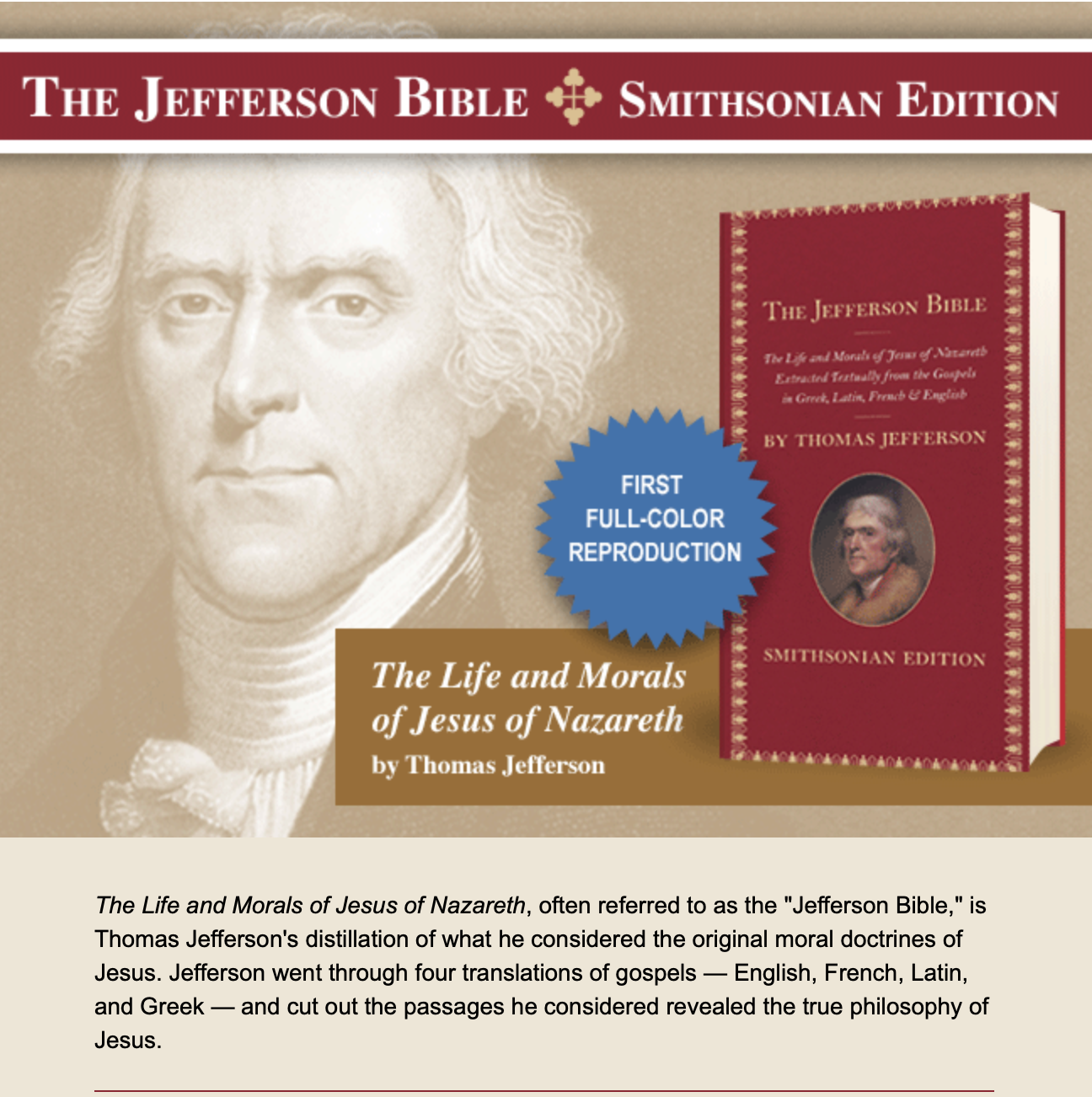
The Jefferson Bible

What was that again you were saying about our Christian Founding Fathers?

Practical Atheism in the Church

Atheism slips into the church where God really does not matter, as we go about building bigger and better congregations (church administration), confirming people’s self-esteem (worship), enabling people to adjust to their anxieties brought on by their materialism (pastoral care), and making Christ a worthy subject for poetic reflection (preaching). At every turn the church must ask itself, Does it really make any difference, in our life together, in what we do, that in Jesus Christ God is reconciling the world to himself?

Stanley Hauerwas, Resident Aliens

The Grand Myth

That grand myth which I asked you to admire a few minutes ago is not for me a hostile novelty breaking in on my traditional beliefs. On the contrary, that cosmology is what I started from. Deepening distrust and final abandonment of it long preceded my conversion to Christianity. Long before I believed Theology to be true I had already decided that the popular scientific picture at any rate was false.

C.S. Lewis, The Weight of Glory


Religious ideas have the fate of melodies, which, once set afloat in the world, are taken up by all sorts of instruments, some woefully coarse, feeble, or out of tune, until people are in danger of crying out that the melody itself is detestable.

George Elliot, Janet’s Repentance, via Alan Jacobs

[N]one of the things that I care about most have ever proven susceptible to systematic exposition.

Alan Jacobs, Breaking Bread With the Dead

You can read most of my more impromptu stuff here and here (both of them cathartic venting, especially political) and here (the only social medium I frequent, because people there are quirky, pleasant and real). All should work in your RSS aggregator, like Feedly or Reeder, should you want to make a habit of it.

Sunday of the Publican and Pharisee

An American Orthodox Church?

There is no American Orthodox Church. It’s going to take centuries for there to be an American Orthodox Church. It took centuries for there to be a Russian Orthodox Church. There was a metropolitan of Kiev … who was appointed by the patriarch of Constantinople, who was a Greek for a long time, the metropolitan of Kiev. Because Russian Orthodoxy didn’t exist yet. It took centuries for it to come into existence.

Gentile Christianity took a long time to come into existence. The core of every church St. Paul founded was Jewish Christians, and he argued vehemently that that did not mean the Gentiles did not need to become Jews to become part of the community. So the fact that we have— Well, there have been attempts, but the fact that the Orthodox Church has not tried to boot-strap an American Orthodoxy is a very good thing, because the thing that would be produced by that would be a nightmare. It would be American in all the worst ways. There are forms of Christianity in the United States that are very, very American in all the worst ways: consumerism, obsession with entertainment culture and celebrity, this men’s conference this week that was like: “Saturday, Saturday, Saturday, monster trucks! UFC fights…” Like, it’s pathetic. It’s a distortion of Christianity in favor of Americanism.

[T]he Orthodox Church [in the USA] is still very close to its immigrant roots. That’s a good thing. That’s one of the things that’s protected Orthodox Christianity in this country from the way that American culture colonizes everything and corrupts it, frankly, with consumerism and these other traits, these other negative traits. It’s not just consumerism either. It’s pornification; it’s all kinds of things in American culture … But those immigrant ties have protected the Orthodox Church from that, and those immigrant ties are not going to last forever. My concern is less with how do we make the Orthodox Church more American; my concern is how do we stop it from becoming too American too fast and becoming some weird chimera.

Our goal has to be preserving what’s been handed down to us, preserving it intact, preserving it free from corruption, and then presenting it to people because it will bring about their salvation. But it’s going to challenge them. It’s going to be difficult.

Fr. Stephen De Young

Muscular Christianity?

One reason I became Orthodox is that the heart of this faith is not to be found in the legacy of Imperial Byzantium but in the spirit of the Desert Fathers, the hesychasts and the saints of the prisons. I don’t think many of my critics really understand Orthodoxy; but the life and teachings of, say, St John Chrysostom, St Isaac the Syrian, St Moses the Black or modern saints such as St Porphyrios or St Nektarios are more than enough to refute some of the cruder arguments for a ‘muscular Christianity’ that the Internet is currently coughing up.

Paul Kingsnorth

White Man’s Burden

My morning prayers used to include “thwart our meddling in traditional cultures, teaching them acquisativeness and perversion as the new White Man’s Burden.” If you have no idea why I would pray such a thing, go back and read this week’s news stories about some of the liberal groin pieties that USAID has been funding of late. Or this distilled version:

I doubt that it was necessary (not to mention legal) to feed USAID to the wood chipper to stop that crap, and I strongly suspect that some very meritorious work that enhances our image in the world will be collateral damage of Elon and his band of snot-nosed barbarians.

But my prayer for thwarting has been answered — a reminder to “be careful what you pray for.”

What’s better than joy?

‘Milton was right,’ said my Teacher. ‘The choice of every lost soul can be expressed in the words “Better to reign in Hell than serve in Heaven.” There is always something they insist on keeping even at the price of misery. There is always something they prefer to joy—that is, to reality.

C.S. Lewis, The Great Divorce


Religious ideas have the fate of melodies, which, once set afloat in the world, are taken up by all sorts of instruments, some woefully coarse, feeble, or out of tune, until people are in danger of crying out that the melody itself is detestable.

George Elliot, Janet’s Repentance, via Alan Jacobs

[N]one of the things that I care about most have ever proven susceptible to systematic exposition.

Alan Jacobs, Breaking Bread With the Dead

You can read most of my more impromptu stuff here and here (both of them cathartic venting, especially political) and here (the only social medium I frequent, because people there are quirky, pleasant and real). All should work in your RSS aggregator, like Feedly or Reeder, should you want to make a habit of it.

Sunday, January 12, 2025

America’s Puritan-Lockean synthesis

A few months back, I decided once again to subscribe to Touchstone magazine, a subscription I had allowed to lapse for many years.

The first issue to arrive I found disappointing,, but the second included Carlo Lancelotti’s America verus Europe, which advances the idea that the:

notion of a “delayed” American secularization stands in contrast to the views of many prominent European thinkers of the last century. Curiously, they also thought that America was “special” but in the opposite sense. They deemed the United States to be far more advanced than Europe in terms of a scientistic, utilitarian, individualistic, and materialistic worldview. For example, as early as 1943, when Simone Weil returned from New York to London a few months before dying, she wrote that the great danger threatening European Christianity was “Americanization,” by which she meant detachment from the past, which was slowly killing people’s ability to perceive the supernatural. The “Western” spirit of the Enlightenment “is found in America in its pure state and to the second power, and we are in danger of being devoured by it. . . . the Americanization of Europe would lead to the Americanization of the whole world.”

This view rings true to me, as does the idea that this outcome was baked into our founding by a “Puritan-Lockean synthesis.” But I’m still chewing on it, especially the thought of that founding synthesis, which I’m unprepared to expound. The whole constellation of critique is likely to reappear here in the future. Meanwhile, it appears to me that the article already is unlocked for the curious.

Something to chew on

It is a strange yet incontrovertible fact that, when God did take flesh, He in many ways (though certainly not all) revealed himself to be closer in spirit to the Tao of Lao Tzu then to God as conceived by the Hebrews at that time, even though the Hebrews had the revelation of Moses. This might be difficult to accept by those who are accustomed to thinking of Christ as the fulfillment of the expectation specifically of the Hebrews. Ancient Christian tradition, however, holds that Christ satisfied the longing of all the nations.

Hieromonk Damascene, Christ the Eternal Tao

American Pharisaism

I have wondered much that Christianity is not practiced by the very people who vouch for that wonderful conception of exemplary living. It appears that they are anxious to pass on their religion to all other races, but keep little of it for themselves …

It is my personal belief, after thirty-five years experience of it, that there is no such thing as “Christian civilization.” I believe that Christianity and modern civilization are opposed and irreconcilable, and the spirit of Christianity and of our ancient religion is essentially the same.

Charles Alexander Eastman, whose American Indian name was Ohiyesa. Quoted by Paul Kingsnorth in his 2024 Erasmus Lecture.

More of Kingsnorth’s Lecture:

What, actually, is spiritually beneficial about this “Western civilization”—or any civilization? After all, Babylon and Babel, Sodom and Gomorrah, were as civilized as the ancient world got.

To find out, we might hold up the stated values of our civilization against the famous list of seven deadly sins. The list was compiled in the sixth century by Pope Gregory I. He based it on an earlier list of eight passions, compiled by the fourth-century monk Evagrius Ponticus, which is still current in the Eastern Church. How is Western civilization doing today at fending off these sins?

Pride is celebrated everywhere—pride in nation, status, wealth, ethnic group, identity, religion. We have a month-long festival named for it. Greed is the basis of our economy. Along with envy, it is the cornerstone of the idol of our time, the universally worshiped god known as “economic growth.” If we were neither greedy nor envious, the economy would collapse in five minutes. Wrath is the fuel beneath the culture wars and all of our political factions. As for lust—find me a billboard or a film or a song or a brand of shoes that doesn’t piggyback on this most primal human passion. It is perhaps behind only gluttony in its ubiquity. Even sloth has been monetized. How else could something as oxymoronic as a “leisure industry” even exist?

Macho-Man Orthodoxy

There seems to be a surge of interest in the secular and the heterodox press, blogosphere and podcast worlds in the distinctly masculine flavor of Orthodox Christianity’s growth in the USA.

I’m happy that my parish has seen a surge in attendance and people joining. Our growth does skew toward young men, but I have a God-daughter who came on her own, and we recently added a single mom with two kids. A godson, older than me, came with his wife at first from dissatisfaction with his United Methodist church coupled with the ethnic tag on our diocese, which matched his ancestry!

But one particular recent article, in “secular” press, about the male-skewed growth of Orthodox Christianity, rang false more often than it rang true.

False notes:

  • tougher form of Christianity (a Priest lamentably said that, so I can’t blame the author)
  • They must fast, too … (fast from many foods, but not from all food)
  • puts emphasis on denial and pushing yourself physically (superficial and misleading; a good priest likely would tell someone going to extremes to lighten up because they’re missing the point)
  • the strict church (nobody’s monitoring compliance)
  • pushes them physically and mentally
  • masculine

These snippets are not so much false factually as false to my experience of Orthodoxy.

It has been notable since I entered Orthodoxy (or earlier), long before the present growth surge, that converts skewed male, and that if a whole family came in, it likely was the dad who instigated and led the conversion. People puzzled over the reason for that, but the idea of men consciously motivated by “more masculine” wasn’t front and center.

I doubt that it should be so today, but I’m not positive about that. My experience of the Orthodoxy faith is largely confined to one parish, which I’ve served as a tonsured Reader and de facto Cantor/Psaltis from my earliest days in the Church. In other words, I don’t get out much, but I wouldn’t agree that I need to get out more. Sampling other parishes is likely to prove superficial, and as they say “the plural of anecdote is not data.”

In that vein, these are the only two paragraphs that didn’t feel a bit “cringe”:

Father Timothy Pavlatos, who leads St Katherine Greek Orthodox Church in Chandler, Arizona, agrees that the “challenge” of the Orthodox church appeals to many young men.

“Orthodoxy is challenging in the physical sense too, and it requires a lot… they live in a world where it’s instant gratification and just take what you want, what you feel you want, what you think you need, Orthodoxy is the opposite of that, it’s denying yourself.”

The article emphasizes the sentiments of recent male converts, but Orthodoxy is capacious and somewhat disorienting for someone new to it. We (thinking back to myself 27 years ago) ask dumb questions and utter dumber opinions. To the degree that men are interested in Orthodoxy as a kind of spiritual testosterone, promoting distinctly masculine growth, I foresee them dropping out when the reality dawns on them.

We all, converts from other Christianities or not, bring baggage into the Church, and the doors shouldn’t be closed to those kinds of baggage but open to my kind. The important thing is whether a convert wants to conform his (or her) life to Christ through the life of the Church, and is prepared to renounce and repent of un-Christlike opinions along the way.


Religious ideas have the fate of melodies, which, once set afloat in the world, are taken up by all sorts of instruments, some woefully coarse, feeble, or out of tune, until people are in danger of crying out that the melody itself is detestable.

George Elliot, Janet’s Repentance, via Alan Jacobs

[N]one of the things that I care about most have ever proven susceptible to systematic exposition.

Alan Jacobs, Breaking Bread With the Dead

You can read most of my more impromptu stuff here and here (both of them cathartic venting, especially political) and here (the only social medium I frequent, because people there are quirky, pleasant and real). All should work in your RSS aggregator, like Feedly or Reeder, should you want to make a habit of it.

Sunday 12/8/24

Yesterday was the 10th anniversary of my parish’s first Divine Liturgy in our purpose-built building. I have a handy way of remembering the date.

Two living churches

In England, the two kinds of churches I do still see filling appear rather different. In a local baptist church the pews are crammed with young families having powerful, intimate encounters with their faith. Something immediate is being accommodated. I remember seeing a guy fresh from a building site, dusty with a high viz jacket. Family with him, arms outstretched, tears on his cheeks. It would bring a lump to your throat.

Then I see my own parish, hushed and seemingly antique, but with more young people than ever before. In both I see people who look spiritually fed. Then out there in the wider audit of emptying churches there seems often to be a sense of weariness, or simple lack of oomph. There will be exceptions to this last sentence, I have no sneer in writing it. I sometimes go sit in those congregations simply out of love for the yards they’ve put in as parishioners. Solidarity, a hand held across the fence to a fellow worker bee.

It seems, from a distance, the two churches are very different, and I am well aware of the theological wrestles that create distance. What I don’t go along with is the notion that one is completely improvisational and unencumbered by tradition, and the other set-and-only-set in a kind of endless, ancient theatre or lifeless ceremony. Dame Mary Douglas, a cultural anthropologist, encapsulates something she calls the ‘anti-ritualist’ approach:

The confirmed anti-ritualist mistrusts external expression. He values a man’s inner convictions. Spontaneous speech that flows from the heart, unpremeditated, irregular in form, even somewhat incoherent, is good because it bears witness to the speaker’s real intentions.

I think actually, ritual is inevitable, even when tacit. We are ceremony people, no matter how spontaneous we think we may be. There will be a loved formula, a linguistic groove long established, a shared initiatory language in common for any community that lasts. It’s about the dynamic counterpoints of tradition and innovation. We may have done away with the candles, offerings and holy smoke, but simply to feel safe repetition will always have value.

Martin Shaw. I finally was able to begin reading Rituals of Spontaneity, which (if I’m not sorely mistaken) elaborates the folly of Christians dispensing with ritual.

Puritan Phobia

The Puritans quickly developed a phobia about ritual, going so far as to resist “rote” recitation of the Lord’s Prayer:

Henry’s Method culminates with his most fascinating phrase-collection of all, “A Paraphrase on the Lord’s Prayer, in Scripture Expressions.” Christ’s own form of prayer given to his disciples had long been a thorn in Puritans’ sides, to be plucked out by being understood as only a general guideline. Henry’s strategy is to neutralize the prayer’s form in a pages of verses elaborating on the one phrase “Our Father, who art in similar method; he provides, for instance, an amazing two and a half Heaven” (MP, 163-65), a general topos, he says, from which begins. Many editions of the Method were printed as Henry intended, interleaved with one blank page between each printed one, to enable the reader to pen in his own collection of phrases to supplement Henry’s own. Like Bunyan’s demand for scrupulous sincerity, Henry’s lists and blank pages, figures of accumulation and abstraction, combine literally to efface the Lord’s Prayer and erase it from Dissenting practice.

Between the ledgerlike pages of Henry’s collected phrases and the blank sheets for scribbled lists of readers’ personal prayer phrases, one senses of variety of fears: that without this careful accounting, the business might go bankrupt, that in the copious, nervous quoting from God’s word to talk and talk and talk to God, God might not listen or respond at all.

Lori Branch, Rituals of Spontaneity

Best listicle ever?

I have three lists of Maxims or such that I review regularly. This one, which I think was embedded in a longer blog post, seems more precious (in the good sense, not the snarky sense) every time I read it:

  1. First, live as though in the coming of Jesus Christ, the Kingdom of God has been inaugurated into the world and the outcome of history has already been determined. (Quit worrying)
  2. Second, love people as the very image of God and resist the temptation to improve them.
  3. Third, refuse to make economics the basis of your life. Your job is not even of secondary importance.
  4. Fourth, quit arguing about politics as though the political realm were the answer to the world’s problems. It gives it power that is not legitimate and enables a project that is anti-God.
  5. Fifth, learn to love your enemies. God did not place them in the world for us to fix or eliminate. If possible, refrain from violence.
  6. Sixth, raise the taking of human life to a matter of prime importance and refuse to accept violence as a means to peace. Every single life is a vast and irreplaceable treasure.
  7. Seventh, cultivate contentment rather than pleasure. It will help you consume less and free you from slavery to your economic masters.
  8. Eighth, as much as possible, think small. You are not in charge of the world. Love what is local, at hand, personal, intimate, unique, and natural. It’s a preference that matters.
  9. Ninth, learn another language. Very few things are better at teaching you about who you are not.
  10. Tenth, be thankful for everything, remembering that the world we live in and everything in it belongs to God.

A catholic vision of Christian faith

When I first opened A Severe Mercy nearly 20 years ago I had needed a vision of Christian faith that was unapologetically devoted to Christian doctrine without being materialistic, more American than Christian, and completely uprooted from history. Up to that point, the expressions of Christianity I had encountered were simply different forms of sectarian faith—a vapid progressivism or a parochial and narrow fundamentalism. Vanauken gave me catholicity ….

Jake Meador (hyperlink added)

Delusion

Christians can give their bodies over to the nation-state while continuing to express in textual terms that worship belongs to God alone.

William T. Cavanaugh, The Uses of Idolatry

Flipping the Script

On regular Christian campuses, there “are higher expectations for presidents than members of the faculty, and members of the faculty live with greater expectations than students,” noted religious-liberty activist David French, writing at The Dispatch. “Liberty flipped this script. The president lived life with greater freedom than his students or his faculty. The message sent was distinctly unbiblical – that some Christian leaders can discard integrity provided their other qualifications, from family name to fund-raising prowess, provided sufficient additional benefit.”

Terry Mattingly, What Next for Liberty University? Press Should Watch Future Campus Worship Services (September 2020)

Know-it-alls

In practical terms, the Reformed commitment to the theological significance of everyday life led to the development of something like Protestant metaphysics, Protestant epistemology, Protestant science, Protestant politics, Protestant social and economic theory, Protestant art, and Protestant poetics.19 The development of these Reformed spheres of intellectual and cultural activity never occurred without substantial influence from sources not specifically religious. In Switzerland, the southern German regions, Hungary, Holland, and the British Isles, the Reformed perspective could be used to mask economic or political aggression. More commonly, it emerged from a complicated mix of sacred and secular motives. Yet wherever sufficient Reformed strength existed, the assumption also existed that biblical Christianity had something fairly definite to say about everything.

Mark A. Noll, America’s God

Theology isn’t all deductive

Catholics find it impossible to theologize without deductive reasoning—a characteristic shared by virtually all Western Christians…

Dr. Eugenia Scarvelis Constantinou, Thinking Orthodox


Sometimes this whole 2000-year-old faith seems like a living koan. Chew on this until you are enlightened. Keep walking.

Paul Kingsnorth

You can read most of my more impromptu stuff here and here (both of them cathartic venting, especially political) and here (the only social medium I frequent, because people there are quirky, pleasant and real). All should work in your RSS aggregator, like Feedly or Reeder, should you want to make a habit of it.

Sunday, 11/17/24

Permeable walls

Yesterday was the 27th anniversary of my formal entry into the Orthodox Christian Faith. Unlike my departure from frank evangelicalism for Calvinism two decades earlier, this felt like a conversion, not an incidental change of denomination.

Part of that feeling may have been that the evangelical-to-Calvinist transition was largely invisible to observers: I didn’t quit our Baptist church and go to the tiny PCA startup in town; instead I moved across the country to go back to school, so of course I had to find a new church; I graduated, moved, and began practicing law in my hometown, so again I had to find a new church.

That each of those steps was away from evangelicalism and toward Calvinism would have been apparent only to someone for whom the permeability of denominational walls in Protestantism seems odd, and I think there most Protestants who take that permeability for granted (if they even think about “denominations” in an age of tens of thousands of crypto-baptist nondenominational pastoral fiefdoms). Indeed, during this transition, I published a law journal note titled Church Property Disputes in an Age of Common-Core Protestantism, based on the premise that someone who became a Presbyterian or Methodist or Episcopalian was unlikely to be buying into denominational ownership or control of the local church’s temporalities that he (or she) now donated to maintaining.

But another part of the “conversion” sensation certainly was that I had to be catechized to enter Orthodoxy. Its walls are not permeable. I became an “ecclesial Christian” as Richard John Neuhaus described it: one for whom faith in Christ and faith in His Church is one act of faith, not two. I finally believed that the one holy, catholic and apostolic church is visible and distinct, not invisible and amorphous.

Today, I’m more interested in a question one could phrase in an article title as Church Discipline in an Age of Permeable-Wall Protestantism. Others have doubtless gone deeper into the topic of how there can be effective church discipline, how can flagrant sinners be brought to repentance, when they can just move to another church before the heat melts their hearts? Maybe he can even start and pastor his own church (or get nominated as Attorney General). In a largely Protestant nation, it’s hard for an ecclesial Christian convert not to at least dabble in other people’s business.

A bold claim

I’ve been reading Fr. Stephen De Young’s book St. Paul the Pharisee, which I hoped would focus on this bold claim:

Mostly it doesn’t, or it doesn’t do so explicitly except for that quote.

But Fr. Stephen’s “interpretive translation” of Paul’s epistles subtly undermines the tendency to view them as theological treatises rather than pastoral guidance.

Instrumentalist faith

In the last few years, there has been no shortage of political commentary—much of which I agree with—that has argued that Christianity is needed for Western civilization and its guiding principles to survive. Famously, the essay in which the writer and activist Ayaan Hirsi Ali spoke about her conversion—the authenticity of which I do not doubt —focused on the role that Christianity plays in Western civilization. But one should be clear-eyed about this matter. If the point of Christianity is the survival of the West, then Christianity may be treated as a useful fiction or a necessary evil alongside things like police forces and the military. The place of Jesus in such a Christianity is clear: he is a mascot, a long-dead victim of Roman imperialism and religious zealotry whom we invoke when we need a symbol, so that we may display him for all to see, pinned to the cross by our highest values and current political aspirations.

The outcome is not a secret. The churches that live as though Jesus is optional have been, despite their best verbal efforts, saying effectively and forcefully to their members and to the world that what the church uniquely has to offer is not needed, and that the church is here to serve those realities which already exist beyond the church’s baptismal boundaries.

I have become convinced that one of the primary challenges for Christians today is to come to terms with the overwhelming success of secularized Christianity. It is a great comfort to a Christian to say to himself or herself that secularized faith doesn’t actually work: it is how we tell ourselves that secularism will collapse under its own weight and that we’ll be here waiting when it happens, ready to welcome the world back into our arms. But of course, this is a fantasy about our own relevance. We are the secular culture’s ex-girlfriend, and telling ourselves that the new girlfriend isn’t pretty and that the culture will eventually see that it needs us is a pathetic expression of our need, not the world’s.

Matthew Burdette, Is the Church Obsolete? (H/T Brad East)

I honestly don’t think I’ve heard any Orthodox Christian talking about the importance of the Orthodox Church in secular instrumental terms. But to be honest, I sometimes think of the Catholic and Protestant churches as important to the survival of western civilization — and for some of its peculiarities.

Enculturation

Sometimes I have the unsettling sense that everyone possesses a spiritual secret but me. Other students speak of God as an intimate friend. They seem perfectly content studying the Bible all day, and unquestioningly accept whatever the professors say. More often, I conclude there is no secret, just a learned pattern of conformity, of mimicking others’ behavior and parroting the right words.

Philip Yancey, Where the Light Fell

Of this “learned pattern of conformity, of mimicking others’ behavior and parroting the right words,” I recently heard the sympathetic observation that people can believe absurd things, even contradictory things, because of where they are enculturated.

For anyone who thinks he (or she) has found the truth, and who can’t understand why others cannot see it, this is helpful to remember — in both directions. I don’t mean there’s no truth, only enculturation, but something about empathy and humility.

The American Hermeneutic

The problem with race and the Bible was far more profound than the interpretation of any one text. It was a problem brought about by the intuitive character of the reigning American hermeneutic. This hermeneutic merged three positions: (1) The Bible was a plain book whose meanings could be reliably ascertained through the exercise of an ordinary person’s intelligence; (2) a main reason for trusting the Bible as true was an intuitive sense, sealed by the Holy Spirit; (3) the same intelligence that through ordinary means and intuitions could trust the Bible as true also gained much additional truth about the world through intuitive processes that were also deliverances of universal common sense. The first position was a traditional Protestant teaching intensified by the American environment; the second was historically Protestant and Reformed; the third was simply a function of the American hermeneutic.

Mark A. Noll, America’s God

Of Nietzsche

Ironically, the fallen antichrist spent his long years of decline in the same female company that he claimed to have detested as a boy. He ended his life as the charge of his sister, but for many years after his collapse he was cared for by his mother. We know almost nothing about this quiet, pious woman, the widow of a Lutheran minister. But her act of taking the invalid into her home and enduring his catatonic silence, marked by occasional screaming fits, could only have been motivated by maternal love and Christian pity, two of the most debilitating values in what the philosopher had called the “slave morality.”

John Strickland, The Age of Nihilism

The flight into nondenominationalism

I’ve noticed Churches changing names to drop denominational identifiers. The Church I grew up in is considering dropping “Evangelical” from its name, not because it identifies the denomination but because of the debasement of the term into a political category.

Mites and motes

People who want to bring heaven upon earth have turned the earth into hell and made rivers run red with blood, because the first thing they must do is the one thing they cannot do, which is to cure themselves.

Anthony M. Esolen, Out of the Ashes

Complicit

The spectacle of [John] Lennon imagining a world without possessions while sitting in a huge mansion did nothing to put off his admirers. As Nietzsche spun furiously in his grave, ‘Imagine’ became the anthem of atheism.

Tom Holland, Dominion

Command performance

The logic of those prayers, if one was reading between the lines, was something like this:

“Dear Heavenly Father, in Your Word You say that when two or three are gathered together, You will be in the midst of them. Well, we’re gathered here, so do what we’re telling You to do because we have You over a barrel and can quote Your own book back at you! And in case You’re thinking of weaseling out of this deal, we claim Your promises, and because You can’t break any of those since You wrote it all in the Bible, You’ll do what we say, and You’ll do it NOW! Amen!”

Frank Schaeffer, Crazy for God

Any questions?

The early Church had no Scripture of its own, and the Jews had no defined canon of Scripture; therefore, sola scriptura as the foundation for what Christians believed was absolutely impossible.

Dr. Eugenia Scarvelis Constantinou, Thinking Orthodox


Religious ideas have the fate of melodies, which, once set afloat in the world, are taken up by all sorts of instruments, some woefully coarse, feeble, or out of tune, until people are in danger of crying out that the melody itself is detestable.

George Elliot, Janet’s Repentance, via Alan Jacobs

You can read most of my more impromptu stuff here and here (both of them cathartic venting, especially political) and here (the only social medium I frequent, because people there are quirky, pleasant and real). All should work in your RSS aggregator, like Feedly or Reeder, should you want to make a habit of it.

Sunday, November 10

On an American Orthodox Church

The beginning is context, analogy; just wait for the provocative “aside.”

Fr. Stephen: … [R]eligions that are separate things … didn’t exist in the ancient world. What it meant to be a Greek was not just to have grown up in Hellas or to have your people be from there for many generations; what it meant to be a Greek was also to worship the Greek gods and to participate in the ritual life of Greece that surrounded the gods, the public festivals, all of those things. That’s what it meant to be Greek.

So what does it mean to be a Greek Christian? Now we take that for granted, but for St. Paul that wasn’t something you could take for granted. And so you can understand why, in the early Church, you get the opponents of St. Paul in Galatians who were saying, “Well, okay, you can’t be pagans any more. So why don’t, uh, you be Jews? You can’t be a Greek any more. You have to have some culture. You have to be something. So you need to get circumcised, you need to keep Torah, you need to do all these things. You need to be Jewish. You can’t be Greeks any more, because being Greek is being a pagan.” And St. Paul is saying, “No! You’re not to become Jews, because you’re not Jews. You’re going to remain Greeks, but what it means to be Greek is going to change.” So a Greek Christian identity is forged, and that takes a couple centuries. St. Paul starts it, but you read all the problems he’s having, for example, in 1 and 2 Corinthians that we already referred to. This is a difficult process.

Fr. Andrew: And even while the concept and the way of life gets worked out, the terminology largely isn’t kept even, early on. By the time you get to the Cappadocians and so forth, “Greek” in terms of something other than language, “Greek” is used to refer to pagans. If you’re Christian, you’re a “Roman.”

Fr. Stephen: Right. Greeks are the ones still following that way of life.

Fr. Andrew: Right. I mean, the word “Greek” in various ways gets revived again in the 18th, 19th century for other reasons, but, yeah, that identification of “Greek” with “pagan” holds on for a long time, even while they’re kind of developing a Greek Christian life, just calling it something different

Fr. Stephen: Yeah. And so St. Paul is going to affirm… So he’s got those folks on the one side who want people to become Jewish; on the other side, he’s got the Jewish zealot tradition that wants to overthrow societal structures within Roman life. And St. Paul is going to want to keep those social structures. That’s the part of the Gentile identity that he can keep, sort of, you know: families! Marriage in general! We don’t need to get rid of marriage in general. All of these relationships, all of these structures we can keep, but they need to be re-infused. Paganism needs to be drawn out; they need to be re-infused with Christ. So that’s part of this transformation.

And as a kind of aside, when folks… One of many things I’m a pessimist about is there being an American Orthodox Church any time soon. The big reason is that we still have to do precisely this. Not figure out what it means to be American and Christian, because there’s an American Christianity, and the more American it gets, the less it looks like Christianity, frankly. But figuring out what it means to be American and Orthodox Christian: we can’t just take for granted that that’s just an easy sub.

In fact, the fact that America is deeply steeped in another form of Christianity—a sort of Puritan, Calvinist, Protestant Christianity—sometimes makes it harder for us to make the distinctions that we need to make in order to form an American Orthodox identity. If America was a Muslim country or a Hindu country, when we looked at cultural institutions, it would be a little easier for us to spot, in the Hinduism case, the paganism, in the Muslim case, the Islamic parts, but when it’s another form of Christianity, the distinctions get more subtle and more tricky, and that identity can be a little harder to form.

(Underlining added)

When an American Orthodox Christian steps to either side of the safe corridor cleared by the Church, she’s likely to hit a Puritan land mine or a Calvinist IED. When an American Orthodox Christian feels we’re missing out on something good in the larger society, what he wants us to import may well be a Puritan version of a Trojan Horse.

About that American brand of Christianity

William Craig Brownlee “contrasted the genuine religion that flourished in America with ‘the mixed Christianity that began its career at an early period in the history of the church’”.

Paul J. Gutacker, The Old Faith in a New Nation: American Protestants and the Christian Past.

To these Orthodox Christian eyes, that reads as perversely the opposite of reality. The religion that flourished in America, and of which we are still heirs, is the later, entropic version.

The starting point of Christian faith

To be Christian, to believe in Christ, means and has always meant this: to know in a transrational and yet absolutely certain way called faith, that Christ is the Life of all life, that He is Life itself and, therefore, my life. “In him was life; and the life was the light of men.” All Christian doctrines—those of the incarnation, redemption, atonement—are explanations, consequences, but not the “cause” of that faith. Only when we believe in Christ do all these affirmations become “valid” and “consistent.” But faith itself is the acceptance not of this or that “proposition” about Christ, but of Christ Himself as the Life and the light of life. “For the life was manifested and we have seen it, and bear witness, and show unto you that eternal life, which was with the Father, and was manifested unto us” (1 Jn. 1:2). In this sense Christian faith is radically different from “religious belief.” Its starting point is not “belief” but love.

Alexander Schmemann, For the Life of the World

When will they ever learn?

Only slightly tempered by a sense of their own limitations, these reformers espoused private judgment as the sure route to coherence and harmony. Unfortunately, the more confidently they attacked the traditional order and espoused individual autonomy, the more confusing their limitless world became. In one of the early republic’s severest ironies, the determination to quiet theological wrangling resulted in a proliferation of voices.

Nathan O. Hatch, The Democratization of American Christianity

Iconoclasm

God was understood to have physical form, but that form was to be described only verbally, not represented iconographically.

William T. Cavanaugh, The Uses of Idolatry

Purging

I am greatly looking forward to reading St. Paul the Pharisee by Fr. Stephen De Young. An ex-Calvinist Orthodox Priest with deep knowledge should be perfect for purging my involuntarily-retained Calvinist readings of St. Paul.

Mute

It is very difficult to make our contemporaries see that there are things which by their very nature cannot be discussed.

René Guénon Guénon, The Crisis of the Modern World


Religious ideas have the fate of melodies, which, once set afloat in the world, are taken up by all sorts of instruments, some woefully coarse, feeble, or out of tune, until people are in danger of crying out that the melody itself is detestable.

George Elliot, Janet’s Repentance, via Alan Jacobs

You can read most of my more impromptu stuff here and here (both of them cathartic venting, especially political) and here (the only social medium I frequent, because people there are quirky, pleasant and real). All should work in your RSS aggregator, like Feedly or Reeder, should you want to make a habit of it.