Saturday, 1/7/23

Culture

Jordan Peterson

The Campaign to Re-Educate Jordan Peterson” reminds me of how little written about Peterson. That isn’t likely to change because I just can’t take the time to get more than a smattering of the Jordan Peterson content available, and I don’t want to write in ignorance.

I like what I’ve heard and read and seen, but I was making my bed before Jordan Peterson was out of diapers, and I don’t personally need his coaching on how to do life. If a lot of younger (mostly-)men find it beneficial, I’m sure they could do far worse than taking advice from him.

In recognition of his influence, though, I pray for him daily.

AI’s limits

I have been an AI skeptic, which extended to Chat GPT. Ezra Klein has a fantastic podcast on the topic, which I haven’t even finished yet.

My fundamental instinct was right: AI is closely akin to bullshit in the Harry G. Frankfurt sense that it bears no relationship to truth. What AI does — so far at least if not ever and always — is basically pastiche of things that it has read and stored in its memory banks.

But my skepticism overlooked the harm AI can do. To make a long story short, I don’t think I can ever trust the internet again for important research; it’s too easy for a single AI “clickfarms” to create a web of websites all pointing in the wrong direction, or pointing aimlessly, with alluring headlines and reciprocal hyperlinks to reinforce the bullshit.

And of course our enemies will be using AI in elections to make any Russian interference in the 2016 election negligible in comparison.

Conservatism and Woke Capital

When I see stories about how Indiana’s conservatism makes it hard to recruit and retain tech workers, I detect a PR campaign at work.

Big Business has been a solvent dissolving families and communities for at least a century, and the press increasingly is a lazy accomplice.

Launch credentials

Aaron Renn has moved to Substack, and The Masculinist is no more. I’m not shedding many tears over that, but I endorse this from #48:

I have a three-year-old, and my ambition for him is that he will not have to go to college. I hope that by the time he turns 18, there will be alternative paths for him to launch himself into life without having to spend the time and money that were previously expended to obtain these “launch” credentials.

Let’s be honest, for 95% of people, college is purely about vocational credentialing. They go to college so they can get a good job coming out of it. For most high paying positions today, a college degree is still the price of entry. In some professions, the amount of formal education required to practice is still going up.

But in others it’s changing in the opposite direction. And that change is a good thing, though we need a lot more of it.

Nellie Bowles excerpts

Red-letter day

I almost never agree with Josh Hawley since he re-invented himself as a populist pugilist, but he hit a right note here:

Standing with me is Josh Hawley, who this month encouraged young men to “log off the porn and go ask a real woman on a date.”

Nellie Bowles, TGIF. All subsequent Nellie Bowles excerpts from the same January 6 post.

Enforcing a dubious orthodoxy

A new law in California paves the way for doctors to lose their license for “dissemination of misinformation or disinformation related to the SARS-CoV-2 coronavirus.” That sort of behavior is now considered “unprofessional conduct.” 

Longtime TGIF readers know my stance, but for all the newcomers: Misinformation and disinformation are real phenomena. But most of the time these days the words are political terms applied to any information a ruling clique doesn’t like. Often, it’s used by progressive journalists who want to see various voices censored on social media. 

In the case of Covid, many, many very real facts were considered mis-and-disinfo. Like: The vaccine does not prevent transmission of Covid. That was considered fake news, verboten. Had this law been in place you would have lost your medical license for saying it. In that case, people saw with their own bodies that, although vaccinated, they were very much coughing. But thanks to this new law that muffles doctors, who knows what we won’t know going forward.

Pretendians

Another fantastically insane fake Native American: I’m beginning to think that any high profile Native American influencer should be assumed to be a white girl with a spray tan. The latest Pretendian, who is quite literally a white girl with a spray tan: Kay LeClaire. A major leader in the Indigenous movement, LeClaire has claimed Métis, Oneida, Anishinaabe, Haudenosaunee, Cuban and Jewish heritage. She was a co-owner of giige, a “Queer and Native American-owned tattoo shop and artist collective in Madison, WI.” She was a community leader-in-Residence at UW-Madison’s School of Human Ecology and was part of the Missing and Murdered Indigenous Women Task Force. She has had copious speaking engagements, and she even led a name-change-mob, forcing the local music venue Winnebego to change its name for Indigenous sensitivity (it was named after its street). She sold crafts and clothes, all while pretending to be a Native American (that’s a federal crime, by the way). Obviously she also claims to be Two-Spirit, a sort of nonbinary identification long-practiced in Native cultures. 

She is in fact German, Swedish and French Canadian. An anonymous blogger identified the fraud.

On a related note, it’s a good time to read this article about how the official “Native American” population in the U.S. between the years 2010 and 2020 . . . doubled. Pretty soon every high school senior will be Native American. Little Harrison and Haisley will be touring the Princeton campus like, “why, yes, this is my ancestral feathered headdress, thanks for asking.”

Governors putting immigrants on buses to NYC

Wait . . . now Democrats are busing migrants to New York? Gov. Jared Polis, the governor of Colorado, is busing migrants to New York City. And New York mayor Eric Adams is not happy about it, saying: “This is just unfair for local governments to have to take on this national obligation.”

Recall not three months ago, when busing migrants to New York was considered outrageous, potentially human trafficking, worthy of huge splashy headlines and endless features about the suffering these trips were causing. When the buses come from Colorado, surely the response will be the same? Of course not.

I just checked, and there is not a single story on The New York Times homepage right now. Polis describes his busing program to NYC versus the essentially identical Republican busing program to NYC as “night and day.” Because, Polis says: “We are respecting the agency and the desires of migrants who are passing through Colorado. We want to help them reach their final destination, wherever that is.”

You really should subscribe to the Free Press on Substack.

Politics

From earlier in the week:

Wise words

In 1992 [David Letterman] was famously passed over to succeed Johnny Carson as host of “The Tonight Show” in favor of Jay Leno. Months passed, Mr. Leno’s ratings wobbled, NBC offered Mr. Letterman a second chance. And even though he was now fielding better offers from other networks and syndicators, he still had to have Carson—it was his dream from childhood to succeed that brilliant performer, have that show. He couldn’t give it up.

His advisers, in the crunch, told him a truth that is said to have released him from his idée fixe. There is no Johnny Carson show anymore, they said, it’s gone. It’s the Jay Leno show now, and you never wanted to inherit that.

Soon after, Mr. Letterman accepted the CBS show where he finally became what he wanted to be, No. 1 in late night.

Sometimes you have to realize a dream is a fixation, its object no longer achievable because it doesn’t exist.

Some of the [House Speaker election] spectacle connects in my mind to the fact that Majority Leader Kevin McCarthy had a longtime idea that he must be speaker, and would do anything for it, and left his colleagues thinking eh, he just wants to be speaker—he’s two-faced, believes in little, blows with the wind. So they enjoyed torturing him. And in the end he made the kind of concessions that make a speakership hardly worth having.

This introduced an unusually white-hot Peggy Noonan column, and her no-holds barred take-down of the Freedom Caucus (“stupid,” “highly emotional,” “nihilis[ts],” no “historical depth”) is spot-on.

Remembering January 6

At 6:01 p.m. on January 6, with the day’s carnage behind him, Trump issued his last tweet of that day.

“These are the things and events that happen when a sacred landslide election victory is so unceremoniously & viciously stripped away from great patriots who have been badly & unfairly treated for so long,” he wrote. “Go home with love & in peace.” Trump ended with this admonition: “Remember this day forever!”

We will, just not in the way Trump and his party want us to.

Peter Wehner

Hunter Biden

… The House inquiry into Hunter Biden damages him but not his father ….

One of Karl Rove’s predictions for 2023. I have no opinion on most of them, but this one’s spot on, and the obsession of the GOP Congress-in-Waiting (there is no Congress until a Speaker is elected, which hasn’t happened as I write) is contemptible.

Speaker Pelosi

I know Nancy Pelosi was (is?) almost as hated by Republicans as Hillary Clinton. In reaction, I was inclined to praise her effectiveness as Speaker of the House.

But I must admit that her effectiveness was purchased at the cost if further infantilizing our feckless Congress. Pelosi was effective at advancing Democratic goals not purely by management and persuasion. She tended to formulate massive omnibus bills in secret and then introduce them at the last minute before something dreadful like a government shutdown would arrive. Last year’s $1.7 trillion year-end bill was a classic example.

Her sobriquet probably should be “Take It or Leave It Nancy.”

And Kevin McCarthy’s complicity is why at least one House GOP member opposed him.


[S]ubordinating truth to politics is a game which tyrants and bullies always win.

Jonathan Rauch, The Constitution of Knowledge

To believe that wealth is the only significant measure of the worth of an individual, a family, or a community is to reject the teaching of nearly every religion and wisdom tradition that ever was.

Mark Mitchell and Nathan Schlueter, The Humane Vision of Wendell Berry

The Orthodox “phronema” [roughly, mind-set] cannot be programmitized or reduced to shibboleths.

Fr. Jonathan Tobias

You can read most of my more impromptu stuff here (cathartic venting) and here (the only social medium I frequent, because people there are quirky, pleasant and real). Both should work in your RSS aggregator, like Feedly or Reeder, should you want to make a habit of it.

Monday, 12/19/22

How we differ from traditional cultures

Choose ye this day

You can believe exactly what people in 1450 believed, but you cannot believe it in the same way they believed it because you have a choice.

Paraphrase of Carl Trueman, interviewed by Andrew Sullivan

This is a modern conundrum. I can say “I had no choice but to become Orthodox when I saw and learned what I did,” but of course I did have a choice. Choosing has been unavoidable for centuries now — at least in upper strata in Western Christendom (perhaps it’s one of those proverbial “first-world problems”).

Choosing to change religion is not even a costly choice here as it is still elsewhere in the world. Yet there is a toll to be paid, coming from banks of integrity, for not choosing what overwhelmingly commends itself.

(Sullivan/Trueman was a great interview, by the way, between very smart Oxbridge men with significant differences of opinion but an ability to converse civilly. Go thou and do likewise.)

East and West

Further:

To say that Orthodoxy is “Eastern” and that Catholic and Protestant Christianity are “Western” is not a poetic description or a mere matter of geography. The terms have long been employed to indicate real differences in historical experiences and thought—not simply the final conclusions but the process by which we arrive at those conclusions.

Eugenia Scarvelis Constantinou, Thinking Orthodox. I do not have, even by inheritance, the historical experience of the Eastern Church. My heritage is Western. So while I believe and practice Eastern Orthodoxy, I cannot believe and practice it in quite the way a devout “cradle Orthodox” would.

I like to think that converts like me bring something of value nonetheless, particularly where the faith may have tended toward a complacent cultural club or, as in my parish, where no single cultural group of Orthodox Christians coalesced to to support a church, and converts both added numbers and served as a catalyst for a new, more American (i.e., “pan-Orthodox”) parish. That my parish is in the relatively obscure Carpatho-Rusyn diocese may make it easier to avoid an ethnic identification — as in when people ask whether my Orthodoxy is Greek or Russian.

Traditional civilizations

In a traditional civilization it is almost inconceivable that a man should claim an idea as his own; and in any case, were he to do so, he would thereby deprive it of all credit and authority, reducing it to the level of a meaningless fantasy: if an idea is true, it belongs equally to all who are capable of understanding it; if it is false, there is no credit in having invented it.

René Guénon Guénon, The Crisis of the Modern World

Culture generally

Journalistic murmurations

I’ve heard, and find it plausible, that the New York Times tacitly decides what’s “news” worthy of mainstream attention.

I’m starting to think there is some similar organ on the Christian and Christianish Right, because (for instance) all of a sudden “everyone” (i.e., many on the Christian Right, from which orientation I gain much daily commentary — this, for instance) is writing about MAID, Medical Assistance in Dying, as implemented in Canada and increasingly “recommended” in heavy-handed ways.

It’s a worthwhile story, but I don’t think you’ll see it in the New York Times. It may have started with advance copies of The New Atlantis.

It occurs to me that this phenomenon is rather like a murmuration. (I hope that apt metaphor is original. I certainly am not conscious of having encountered it elsewhere.)

The Promise of Pluralism imperiled

In the seven years since Obergefell was decided, the American left has been on a mission to diminish the legal and practical foundations of the Constitution’s free-speech rights.

They argue that antidiscrimination laws should be recognized as more important and that the Supreme Court in Ms. Smith’s case, 303 Creative v. Elenis, should affirm this new reality. Colorado’s law lists the classes of discrimination as “race, color, disability, sex, sexual orientation (including transgender status), national origin/ancestry, creed, marital status.”

This Supreme Court is likely to decide in Ms. Smith’s favor, maintaining the prohibition established in 1943 by Justice Robert Jackson as the “fixed star in our constitutional constellation” that the government can’t compel, or coerce, an individual to adopt the majority’s opinion.

Still, this case is among the reasons you have been seeing a public assault on the high court’s conservative members. The left’s playbook, across politics, is to stigmatize its opposition as outside acceptable opinion.

Daniel Henninger, They Want to Shut You (and 303 Creative) Up.

I’ll be blunt: I think free speech rights trump antidiscrimination rights. The only issue is whether what the state is forbidding or commanding qualifies as “speech.” In the 303 Creative case, it so clearly was speech that Colorado admitted it.

Western Civ

The argument now that the spread of pop culture and consumer goods around the world represents the triumph of Western civilization trivializes Western culture. The essence of Western civilization is the Magna Carta, not the Magna Mac.

Samuel P. Huntington, The Clash of Civilizations and the Remaking of World Order

Your periodic reminder

The shift from church power to state power is not the victory of peaceable reason over irrational religious violence. The more we tell ourselves it is, the more we are capable of ignoring the violence we do in the name of reason and freedom.

William T. Cavanaugh, The Myth of Religious Violence

Questioning whether violence really is religious risks the “No True Scotsman” fallacy, but I’ve believed that violence doesn’t come from true Christianity for more than 50 years. I probably was guilty of scripture-twisting, but I cited James 4:1-4 as my prooftext.

My conviction, and the bloody wars provoked by non-Christian ideologies in the last century, gives me cause for grave concern as we arguably are abandoning a real, if flawed, Christian heritage now that our great atheist enemy is defunct.

Politics (sigh!)

Marshall Law

Here at The Dispatch, we are mostly anti-snark and anti-sneer, so I will try to consider this question earnestly: What does it say about our country that we are governed by illiterates?

One “Marshall Law” is a typo. Two is a trend. And the recently published trove of January 6-related texts is a testament to the illiteracy of the people who represent millions of Americans in Congress ….

Kevin D. Williamson

Ron DeSantis

I want two things out of the 2024 presidential cycle. One is the end of Donald Trump’s political career, whether in the primary or general election. I don’t care when or how it happens as long as it happens.

The other is a greater willingness among conservatives to criticize their leadership. We’ve spent seven years encased in a repulsive personality cult devoted to a repulsive personality. If the cult disbands in the next election, one obvious lesson in the aftermath is that it shouldn’t be replaced by a new one.

Nick Cattogio

Cattogio thinks the best way to end Trump’s political career is an incumbent Florida Governor, Ron DeSantis (you may have heard of him).

I’m agnostic on what it will take to drive a stake through Trump’s blackened heart, but I’m tending negative on DeSantis.

He’s smart enough to know that some of the culture war laws he has backed are unconstitutional, but backed them anyway despite his oath to uphold the constitution. Maybe the Morning Dispatch’s satirical summary of the Bill of Rights is his for real:

On this day in 1791, the fledgling United States of America ratified its Bill of Rights, conferring on its citizens a host of fundamental freedoms that can only be infringed upon if doing so helps one’s political team win culture war fights.

That’s not my view of the Bill of Rights.

I can forgive Marjorie Taylor Green her illiterate outbursts before I forgive the likes of Ted Cruz, Josh Hawley and Ron DeSantis. All of them are better-educated and probably smarter than me, but they tend toward unprincipled pandering and willing to subvert the Constitution for political gain. For all I know, DeSantis seems better than the other two only because I’m less familiar with him.

The Coverup is the Crime

Remember that dad who got dragged out of a school board meeting in Loudon County, Virginia, after pressing school officials about in-school sexual assaults on girls by a cross-dressing boy? The idea of the problem being the dad fit a leftish narrative so well that Merrick Garland directed the FBI to investigate threats against teachers and school officials and people began viewing vocal parental involvement in Board meetings as terroristic.

Well, it turns out the dad may have been right and that school officials were criminally covering up the assaults.

Caveat: There are twists and turns in this story. The charges are mostly misdemeanors and potentially somewhat political. I doubt that the dust has settled enough for clarity. It’s now well-known that a cross-dressing male sexually assaulted two girls in two bathrooms, but those bathrooms apparently were not yet subject to a “come as the gender you feel today” policy.

Let the healing begin

Republicans actually turned out more voters than Democrats in November. They even won the national popular vote. But in races involving Trump’s candidates, many Republican voters split their tickets, punishing Trump favorites like Arizona’s Blake Masters and Kari Lake who questioned the 2020 results. It turns out that running against democracy is not a recipe for democratic success.

It’s sobering to realize that history can turn on the personal quirks of one person. But it’s also comforting, because as the 2022 midterm results suggest, some of the ugliest aspects of the Trump era aren’t inherent to our system or deeply embedded in our society. They are the downstream effects of one bad actor. Remove him and the pollution he caused will remain, but once disconnected from its source, it can slowly be cleansed, as we saw in this past election.

Yair Rosenberg, Deep Shtetl. The idea of a “national popular vote” in Congressional and Senate elections is quite bogus for most purposes, but it somehow feels instructive here.

Hard fact

You can’t fact-check a person out of hope and purpose. They’ll resent you even if you’re right.

David French

Just for fun

France can still pull it off if Mike Pence has the courage

@EricMGarcia


[S]ubordinating truth to politics is a game which tyrants and bullies always win.

Jonathan Rauch, The Constitution of Knowledge

To believe that wealth is the only significant measure of the worth of an individual, a family, or a community is to reject the teaching of nearly every religion and wisdom tradition that ever was.

Mark Mitchell and Nathan Schlueter, The Humane Vision of Wendell Berry

The Orthodox “phronema” [roughly, mind-set] cannot be programmitized or reduced to shibboleths.

Fr. Jonathan Tobias

You can read most of my more impromptu stuff here (cathartic venting) and here (the only social medium I frequent, because people there are quirky, pleasant and real). Both should work in your RSS aggregator, like Feedly or Reeder, should you want to make a habit of it.

We’ve Been Lucky Day

We’ve Been Lucky Day

What we are experiencing isn’t truly thankfulness, but only something like delight over good fortune. In this case, I wonder why we even call it thankfulness. Perhaps we should be celebrating a Gee We’ve Been Lucky Day, or, if times have been hard, maybe an It Could Have Been Worse Day. If a shorter name is needed, we could call it Okayness Day. I guess it would be something like Happy Hour.

J Budziszewski, wrested from context (i.e., this is not his position)

Eulogy — Mike Gerson

It’s nice to read Peter Wehner writing a eulogy instead of invective, however deserved.

Excerpts:

Mike [Gerson] was appalled at those who disfigured Jesus and used their faith for the purposes of dehumanization. It is one of the reasons why he was so thankful to publish an extraordinary essay in the Post before his death, lamenting Christians whose view of politics “is closer to ‘Game of Thrones’ than to the Beatitudes.”

Very few people knew the full scope of the health challenges Mike faced. He suffered a heart attack in 2004, when he was 40. Kidney cancer in 2013. Debilitating leg pain, probably the result of surgical nerve damage. The kidney cancer spread to his lungs. Then Parkinson’s disease and metastatic adrenal cancer. And finally, metastatic bone cancer in multiple locations, intensely painful. At one point he told me he was on 20 different medications. Mike and I joked that of all the figures in the Bible he could model himself after, he chose Job.

I am among those who had no idea of Gerson’s health problems. I admired his opinion pieces, but not quite enough to keep my Washington Post digital subscription.

Buying off the bloodhounds

[Y]ou don’t have to have a granular understanding of blockchain to understand [Sam Bankman-Fried] was a fraud. I think there are a lot of reasons he got away with it for as long as he did. Buying political cover from politicians with donations (Bankman-Fried was the Dems’ second biggest donor in the last cycle) and purchasing political cover from the media with woke gobbledygook about philanthropy is not a bad strategy. Also, hiding your malfeasance in the squid ink of technical jargon few people understand is pretty savvy as well.

But I think he had something else going for him. Democrats and the left love having billionaires in their corner. It’s a great way to blunt charges of “Marxism” and whatnot, and it’s also a fun way to advance the argument that there’s no real tension between progressive policies and profit. Having token billionaires is even better when those billionaires seem like they’ve broken the old paradigms of heavy industry and are on the cutting edge of innovation. Having dinosaurs who made their money the old-fashioned way—especially the ones who made their money from liquified dinosaurs—can trigger psychological or ideological second thoughts. Peddling ones-and-zeros just sounds so cutting edge.

One lesson from this is that new ideas and new technologies—not to mention getting rich off them—can blind you to the importance of due diligence. Say what you will about old-fashioned accountants and lawyers from prestigious firms—they at least have a vested interest in protecting their reputations and brands. Thinking that the rules of the past don’t apply to you is a great way to give yourself permission to break rules that definitely do apply to you.

Jonah Goldberg

I’d rather drink muddy water

My least-favorite series in the New York Times travel section is “36 Hours in [major city].” I would not enjoy dashing around and bar-hopping at night as they invariably describe.

Let me settle into a city for a bit, and give me time to catch my breath without liquor.

Is Orbán a Cosplayer?

There has always been a whiff of the fake about Mr. Orbán’s war on Brussels. That he never proposed the obvious solution to this impasse—Hungary’s exit from the European Union—exposed the limit of his gamesmanship. More fool the American conservatives who didn’t notice this sooner.

Joseph C. Sternberg, Orbán and the Collapse of the Trump Intellectuals

I don’t fully agree with Sternberg, but I welcome his pushback against Orbán if only because it doesn’t follow the usual script of name-calling and “everybody knows.”

Epistemic humility

Appealing to a higher, theological standard of judgment above politics can, in theory, act as a moderating influence that inspires humility, restraint, and even wisdom. But it often does the opposite—inspiring imprudent acts and judgments …

Of course, the religiously devout aren’t the only people who are prone to act in a way that fails to exemplify the spirit of liberality or civic generosity …

Liberalism is better off when these tendencies are tamed. The best way to accomplish that goal is to rely on civic education that instills lessons in epistemic humility and mutual respect for fellow citizens. But of course, such education will only receive political support if our fellow Americans already want to produce humble and respectful citizens in the first place.

Damon Linker, The Endless Skirmish Between Liberalism and Religion

I have a nit-picky disagreement with Linker. I doubt that we can maintain liberalism at all without the epistemic humility he commends, not just that “liberalism is better off when these tendencies are tamed.” Indeed, liberalism almost seems definitionally a polity of epistemic humility, a recognition that the other guy just might be right, and therefore can be worth close attention.

Florida Man and the Pro-life cause

The ethos of the Trumpist-dominated G.O.P. is fundamentally incompatible with the ethos of a healthy pro-life movement. The reason is simple: Trumpism is centered around animosity. The pro-life movement has to be centered around love, including love for its most bitter political opponents.

David French, The Pro-Life Movement Has to Break With Trumpism

An honest, full-cost accounting

[W]e need to replace fanciful dreams of endless energy from renewables with full-cost accounting, which an increasing number of experts are taking seriously. There are destructive environmental and social consequences to constructing the infrastructure for that energy production.

Wes Jackson and Robert Jensen, No Easy Answers: Facing Ecological Crises Honestly

I often post controversial or negative things with no comment. Not this time. I believe that Jackson and Jensen are right.

If wishes were horses …

[M]y friends at National Review plead[] with Republican hopefuls to clear the field for a Trump-DeSantis showdown.

That’s the right strategy if you’re a conservative whose goal is to maximize the GOP’s chances of nominating a superior candidate, but it’s eye-roll material if you’re an ambitious Republican politician who looks in the mirror and sees a president staring back.

That’s a great irony of the next cycle, incidentally. As selfish as Trump is in routinely placing his own interests above the GOP’s, the Chris Christies and Nikki Haleys who’ll end up piling into the 2024 field and splintering the anti-Trump vote will be guilty of having done the same.

Nick Cattogio, Trump Is About to Wreck His Legacy

Respect for Marriage Act

Yet the gains here are not negligible, either, and what is lost is—well, the answer to that depends on how realistic it is to think that Obergefell will be overturned within the next 10 years.

Matthew Lee Anderson, regarding the Respect for Marriage Act, quoted at The Dispatch (italics added)

I don’t think there’s a significant chance that Obergefell gets overruled for a long time. (Eventually, it probably will be overruled because it’s contrary to the nature of marriage and came about through an ideological mania. We’ll come to our senses eventually.) So, we (those concerned to preserve religious liberty) are getting something for essentially nothing.

Sounds like a presumptively good deal. Tell me how I’m wrong.

David French endorses RFMA, and has caught a lot of crap for it. Even Kristen Waggoner has misrepresented RFMA, but she’s now head of ADF, which may explain her factual flexibility.

Have I mentioned lately that my pen always totally dries up if I think of writing a check to ADF, but always works just fine for checks to Becket Fund?


[S]ubordinating truth to politics is a game which tyrants and bullies always win.

Jonathan Rauch, The Constitution of Knowledge

The Orthodox "phronema" [roughly, mind-set] cannot be programmitized or reduced to shibboleths.

Fr. Jonathan Tobias

You can read most of my more impromptu stuff here (cathartic venting) and here (the only social medium I frequent, because people there are quirky, pleasant and real). Both should work in your RSS aggregator, like Feedly or Reeder, should you want to make a habit of it.

Thursday, 11/17/22

Embodied Perception

To emphasize the role that our bodies play in determining how we inhabit and therefore perceive the world, and to entertain the notion of cognitive extension, is to put oneself on a collision course with the central tenets of the official anthropology of the West. As we have already noted, embodied perception poses a direct challenge to the idea that representation is the fundamental mental process by which we apprehend the world.

Matthew Crawford, The World Beyond Your Head

I think Crawford calls this “the official anthropology of the West” because of our fetish that everyone must go to college to encounter more representations of the world, less actual world.

Long-term readers may justly suspect that, in my behavior, I am slave to this official anthropology. I tend to prefer reading to getting up and going for a walk or making something with my hands.

An opportunity, not a death knell

Let’s start with what the pro-life pessimists get right. Tuesday’s results confirm the anti-abortion movement’s fundamental disadvantages: While Americans are conflicted about abortion, a majority is more pro-choice than pro-life, the pro-choice side owns almost all the important cultural megaphones, and voters generally dislike sudden unsettlements of social issues.

You can strategize around these problems to some extent, contrasting incremental protections for the unborn with the left’s pro-choice absolutism. But when you’re the side seeking a change in settled arrangements, voters may still choose the absolutism they know over the uncertainty of where pro-life zeal might take them.

However, when abortion wasn’t directly on the ballot, many of those same voters showed no inclination to punish politicians who backed abortion restrictions. Any pro-choice swing to the Democrats was probably a matter of a couple of points in the overall vote for the House of Representatives; meanwhile, Republican governors who signed “heartbeat” legislation in Texas, Georgia and Ohio easily won re-election, and there was no dramatic backlash in red states that now restrict abortion.

In other words, Republicans in 2022 traded a larger margin in the House and maybe a Senate seat or two for a generational goal, the end of Roe v. Wade. And more than that, they demonstrated that many voters who might vote pro-choice on an up-down ballot will also accept, for the time being, pro-life legislation in their states.

For a movement that’s clearly a moral minority, that’s an opportunity, not a death knell ….

Ross Douthat

FTX

I have generally avoided getting into discussions about cryptocurrencies, because I am a perennial late-adopter who never understands how the big new thing is supposed to work or why anyone would even be interested in it. Aware of that bias, the fact that crypto always struck me as an elaborate Ponzi scheme wasn’t quite enough for me to be sure that it was an elaborate Ponzi scheme. Besides, even if I was sure, that wouldn’t be reason enough to confidently predict collapse; flim-flam operations sometimes get bought by companies with real businesses—or may even monetize their hype into real currency that they use to buy real companies—and thereby achieve something like an enduring presence in the business landscape that they might not have been able to achieve on their own merits.

So what interests me primarily about the collapse of FTX is this business could ever have been idealized. The premise behind FTX is that, even though nobody is totally sure what crypto is ultimately good for, people love to trade it, and to concoct ever more elaborate schemes for leveraging waves of investor enthusiasm.

Noah Millman

Priorities

My wife and I had a conversation one day with a pleasant couple who were much younger, and much more prosperous, than we were.  Husband and wife were both high-dollar attorneys.  She expressed strong frustration because the kids were in day care, but she wanted to stay with them herself.  “Why don’t you?” we asked.  They answered that they had expenses.  “Like what?” we asked.  Well, they had to keep up the payments on their big, expensive boat and their big, expensive house on the lake.

The difference between her facial expression and his were intriguing.  She became nervous.  He became alarmed.  There was some history here, and he didn’t want his wife going down this road.  She didn’t want to displease him.  We changed the subject.

To one degree or another, almost all husbands and wives divide labor, and they are generally happier doing so.  Obviously, not all women desire an exclusively domestic life, and there is nothing wrong with that.  But there is a great deal wrong with the fact that we force women to act against their domestic inclinations for reasons that have nothing to do with their fulfillment.  We call it being liberated, but it is really about serving the interests of men — and economic managers.

J Budziszewski I have seen another variation on this: high-earners who “can’t afford” to pay the tuition they agreed for private Christian education.

Letting the cat out of the bag

It is important that we start on time. We are training our children for the work force.

Remark from the school on a first-grader’s report card, via Jonathan Malesic, When Work and Meaning Part Ways

There’s another cat in the bag, too. We’re training our children in a second role of consumers. A hyperbolic account:

[S]trange to think that even in Our Ford’s day most games were played without more apparatus than a ball or two and a few sticks and perhaps a bit of netting. Imagine the folly of allowing people to play elaborate games which do nothing whatever to increase consumption. It’s madness. Nowadays the Controllers won’t approve of any new game unless it can be shown that it requires at least as much apparatus as the most complicated of existing games.

Aldous Huxley, Brave New World.

This is one of the reasons I think Huxley far surpasses Orwell as a prophet of dystopia (although I’m pretty sure I had no opinion either way before the year 1984.)

Things they told you that weren’t, now that you think about it, true.

On a note related to the preceding item, this:

The transformation of work into a spiritual enterprise, the site of our highest aspirations—to transcend ourselves, to encounter a higher reality, to serve others—is the work ethic’s cruelest unfulfilled promise.

Jonathan Malesic, When Work and Meaning Part Ways

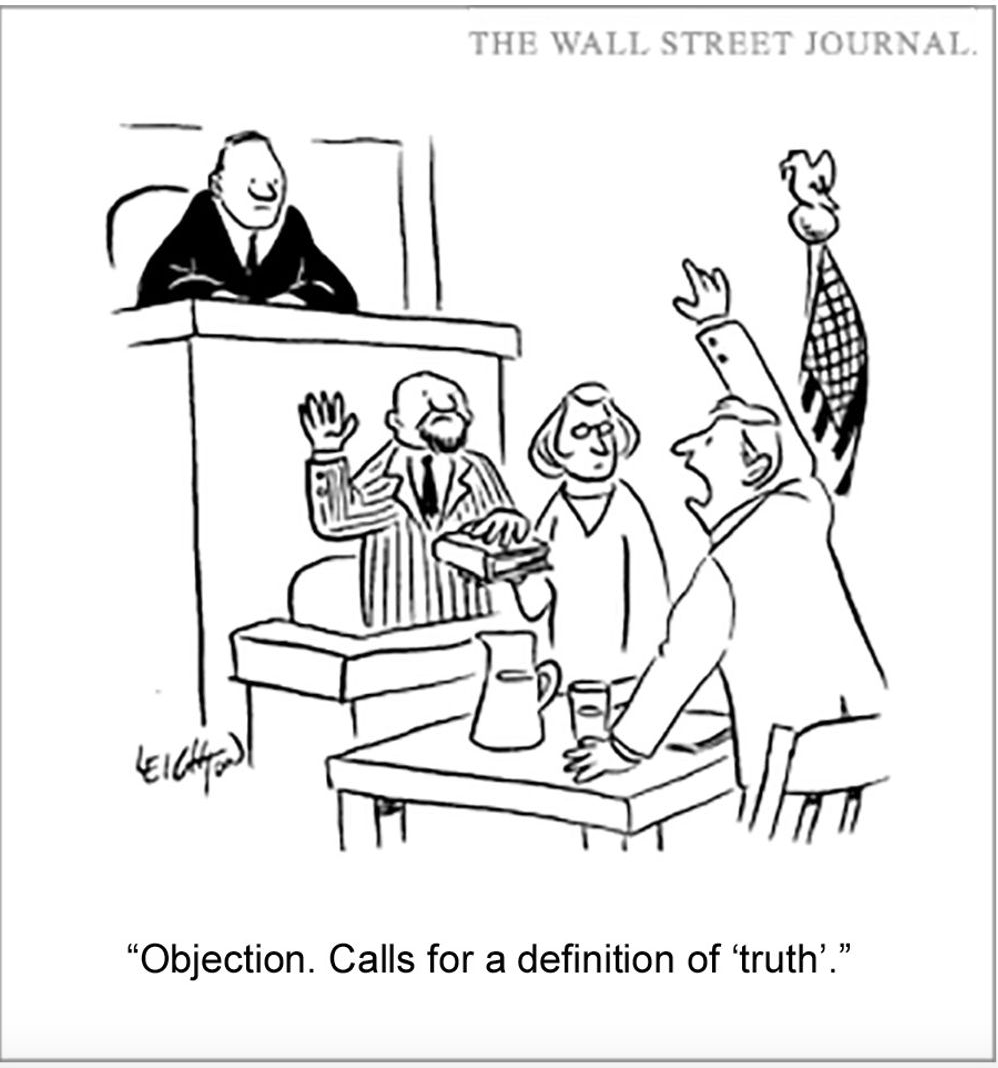
Speaking of truth, the Wall Street Journal’s Pepper & Salt cartoon is one of few cartoons I view regularly. Wednesday’s gave me a rueful chuckle:

Guilty and unashamed

Caffeine is so widely used and normalised that we don’t think of it as a drug or notice how it alters our minds. Research into its effects is often hampered by the difficulty of finding people who aren’t already dependent on it.

Sophie McBain, The psychoactive plants that change our consciousness, reviewing Michael Pollan, This is Your Mind on Plants.

A Hoosier teetotaler on the Isle of Islay

I opened my first-ever bottle of Laphroaig, “the most richly flavoured of all Scotch whiskies,” Monday night, as nightcap and to usher in the Nativity Fast that began Tuesday (a sort of personal “fat Monday”).

Wow! Now I think I know what Cutty Sark was trying to do when it produced a liquor that tasted like Listerine. In fact, that’s what the smell of Laphroaig reminded me of. Mercifully, the taste is not Cutty Sark.

Laphroaig is to every other scotch I’ve had as Dogfish Head 120 minute IPA is to Bud Light. It’s more — much more — but not just more. It’s different, too. From the label, that difference may be peat and smoke, but I’m forever hearing scotch afficianados talk about “peatiness,” so maybe I’m way off base. My palate and liquor vocabulary reflect my teetotaler roots.

Truth be told, I’m not sure how well I really like it. I’m not exactly alone. It was a shock. But I’ll know by the end of the bottle in a few months.

My last two items are about someone I hate even to name. Skip them if you like.

Trumpism without Trump?

Trumpism can survive without Mr. Trump.

Peter Wehner, Never-Trumper from the early days.

Isolating this phrase, I could hope that we get “Trumpism without Trump,” but that totally depends what one means by that phrase.

I could, and probably would, endorse the GOP continuing toward making itself the party of working-class middle-Americans of all races. Highlighting their plight is one of the (few, but consequential) good things Trump did.

Wehner, though, means by “Trumpism without Trump” a GOP that is malicious, dishonest and destructive. No thanks.


[S]ubordinating truth to politics is a game which tyrants and bullies always win.

Jonathan Rauch, The Constitution of Knowledge

The Orthodox "phronema" [roughly, mind-set] cannot be programmitized or reduced to shibboleths.

Fr. Jonathan Tobias

You can read most of my more impromptu stuff here (cathartic venting) and here (the only social medium I frequent, because people there are quirky, pleasant and real). Both should work in your RSS aggregator, like Feedly or Reeder, should you want to make a habit of it.

It’s about time

Jonathan H. Adler, Trump Lawyers Sanctioned for Frivolous Lawsuit Against Political Opponents

There’s apparently no deterring Trump, but maybe his legal prostitutes (that’s what I consider lawyers who file frivolous lawsuits just because a client is willing to pay them to do so) can be deterred.

An Anniversary

November 16 is the 25th anniversary of my reception into Orthodox Christianity, from a background of Calvinism (proximate) and generic evangelicalism (20 years remote).

This post isn’t meant as an apologetic, though if it convicts someone that they should give Orthodoxy a look, I’d be glad. It’s also not intended to be a comprehensive story of why I didn’t, say, become Roman Catholic, or how all the little things, not just a few big things, pointed toward Orthodoxy. Something closer to a comprehensive story, or at least a complement to this post, is here.

I can’t give a neat connect-the-dots account of going from Christian Reformed Elder to Orthodox layman because I don’t remember everything I read or in what order I read them. But I tend to mention Peter Gilquist’s Becoming Orthodox: A Journey to the Ancient Christian Faith, The Orthodox Church: An Introduction to Eastern Christianity by Timothy Ware (later Metropolitan Kallistos Waare), and the monograph Sola Scriptura by then-Deacon, now Priest John Whiteford.

The first made conversion fairly “thinkable.” The second familiarized me with Orthodoxy at a basic level. The monograph disenthralled me of sola scriptura, the battle cry and foundation of the Protestant Reformation. When pondering why I remain Orthodox, I think of this monograph and say “there are some things you just can’t un-see.”

For some reason, I too rarely mention C.S. Lewis’s The Great Divorce, which played what feels like a very important (if idiosyncratic) role as well — perhaps because it was not a direct apologetic for Orthodoxy.

If you’re not familiar with The Great Divorce, you can fix that in one evening. Summarizing, many in Lewis’s tale of a day trip from hell to heaven, where they were given the option of staying, found that heaven was just a bit too real, or too little about them, or too inhospitable to their petty grudges, and so got back on the bus for hell.

Re-reading it a bit more than 25 years ago, I for the first time saw in myself hellion habits that could lead me back onto that bus, though I was offered heaven and had thought my salvation eternally secure. I asked myself: “What are you doing to become the kind of person who would stay in the hyper-real place, who wouldn’t get back on the bus to the grey city? Are you certain that some post-death miracle is going to eradicate a lifetime of cherished vices and self-regard? Shouldn’t you be starting a bit of self-mortification now?”

So what does that have to do with Orthodoxy? Orthodoxy is, so far as I know, uniquely urgent about the necessity of cooperating with God in our salvation (synergy). Most Protestant traditions I know seem utterly unable to distinguish cooperation with God from “earning salvation,” which they rightly believe is impossible. So they have nothing to offer one who wants to know how merely to cooperate.

It helps that Orthodox worship is distinctively “not about me” — if not uniquely, then at least counter-culturally. Decades before I found Orthodoxy, I was dissatisfied with most of the music we sang (in the whole succession of Churches I attended in my very mobile younger year), the gist of which was how God makes me feel — i.e., they weren’t really about God.

But “[w]e are homo adorans, creatures capable of self-transcendence through worship. Without this ability and capacity for worship, we are not fully human; even in our pomp we are like the beasts that perish (Psalm 49:20).” (Fr. Lawrence Farley)

Not even fully human without worship. That rings so very true to me! Whatever my faults, and they are many, inconstancy in Sunday church attendance has never been one of them. Because I need it — need to worship, and (I now recognize) need this stiff and willful stuff called “me” to be molded into a godlier likeness.

More than rejection of any particular Protestant doctrine, the awareness of the need — in this present life — to grow toward God, to become more Christlike, to work out my salvation with fear and trembling, has guided my past 25 years.

For some reason, I thought you might want to know that.

One more thing, not at all unrelated:

I believe the greatest heresy of all is the belief of some Christians that they are “saved.” If we believe we are categorically and without question already saved, it is a good sign that we have been dominated by demonic pride. St. Paul’s statement, “If you confess with your mouth the Lord Jesus and believe in your heart that God has raised Him from the dead, you will be saved” (Rom. 10:9), must be read in the context of Christ’s words: “Not everyone who says to me, ‘Lord, Lord,’ will enter the kingdom of heaven, but only the one who does the will of my Father who is in heaven.

Vassilios Papavasiliou, Thirty Steps to Heaven


You can read most of my more impromptu stuff here (cathartic venting) and here (the only social medium I frequent, because people there are quirky, pleasant and real). Both should work in your RSS aggregator, like Feedly or Reeder, should you want to make a habit of it.

Happy Birthday to Me

Social Media, Crypto, and such

Trump, Musk, Ye

When Jaron Lanier writes, I read:

I encountered Donald Trump a few times in the pre-social-media era, and he struck me as someone who was in on his own joke. He no longer does. Elon Musk used to be a serious person more concerned with engineering and building businesses than with petty name-calling. He didn’t seem like the kind of person to amplify a preposterous, sordid story about Paul Pelosi. Kanye West was once a thoughtful artist. Now known as Ye, he radiates antisemitism on top of his earlier slavery denialism.

I have observed a change, or really a narrowing, in the public behavior of people who use Twitter or other social media a lot. (“Other social media” sometimes coming into play after ejection from Twitter.) When I compare Mr. Musk, Mr. Trump and Ye, I see a convergence of personalities that were once distinct. The garish celebrity playboy, the obsessive engineer and the young artist, as different from one another as they could be, have all veered not in the direction of becoming grumpy old men, but into being bratty little boys on a schoolyard. Maybe we should look at what social media has done to these men.

I believe “Twitter poisoning” is a real thing. It is a side effect that appears when people are acting under an algorithmic system that is designed to engage them to the max. It’s a symptom of being part of a behavior-modification scheme.

The same could be said about any number of other figures, including on the left. Examples are found in the excesses of cancel culture and joyless orthodoxies in fandom, in vain attention competitions and senseless online bullying.

Twitter poisoning is a little like alcoholism or gambling addiction, in that the afflicted lose all sense of proportion about their own powers. They can come to believe they have almost supernatural abilities. Little boys fantasize about energy beams shooting from their fingertips.

Jaron Lanier in the New York Times.

Tulip mania

I started to read a story on Sam Bankman-Fried and the collapse of FTX, his cryptocurrency venture. But I stopped when aI realized that I still don’t understand crypto, which I accordingly never trusted, and that I was reading the story mostly for the schadenfreude.

That I mention this, and allude to tulip mania, shows that I, a sinner, still take pleasure in being vindicated.

… an endless stream of content

Instead of facilitating the modest use of existing connections—largely for offline life (to organize a birthday party, say)—social software turned those connections into a latent broadcast channel. All at once, billions of people saw themselves as celebrities, pundits, and tastemakers. A global broadcast network where anyone can say anything to anyone else as often as possible, and where such people have come to think they deserve such a capacity, or even that withholding it amounts to censorship or suppression—that’s just a terrible idea from the outset. And it’s a terrible idea that is entirely and completely bound up with the concept of social media itself: systems erected and used exclusively to deliver an endless stream of content.

Ian Bogost via The Morning Dispatch

What a waste!

The best minds of my generation are thinking about how to make people click ads. That sucks.

Data scientist Jeff Hammerbacher via Nellie Bowles

Please, God, let Twitter live!

The best argument I’ve heard for praying fervently that Twitter survives is this:

Just FYI if Twitter dies, TGIF goes with it. (Nellie Bowles)

Election 2022

The Democrats’ greatest electoral asset

What will Democrats do when Donald Trump isn’t around to lose elections? We have to wonder because on Tuesday Democrats succeeded again in making the former President a central campaign issue, and Mr. Trump helped them do it.

Trumpy Republican candidates failed at the ballot box in states that were clearly winnable …

Since his unlikely victory in 2016 against the widely disliked Hillary Clinton, Mr. Trump has a perfect record of electoral defeat. The GOP was pounded in the 2018 midterms owing to his low approval rating. Mr. Trump himself lost in 2020. He then sabotaged Georgia’s 2021 runoffs by blaming party leaders for not somehow overturning his defeat. That gave Democrats control of the Senate …

Now Mr. Trump has botched the 2022 elections, and it could hand Democrats the Senate for two more years. Mr. Trump had policy successes as President, including tax cuts and deregulation, but he has led Republicans into one political fiasco after another.

Wall Street Journal Editorial Board, Trump Is the Republican Party’s Biggest Loser

Smartest political money of 2022

The smartest money spent in this whole election was the tens of millions the Democratic party spent to help ensure Republicans picked the craziest candidates in nine different state primaries. It was a risky, cynical move for Dems to boost the most radical Republicans—and it paid off. The most effective (i.e.: dangerous) Republican candidate is someone reasonable like Virginia governor Glenn Youngkin. Trumpist Republicans reject these types as RINOs, and Dems were only too happy to help. 

Americans also rejected the #resistance stars. Georgia gubernatorial candidate Stacey Abrams lost again. And Texas’s Beto O’Rourke lost, again again. Not that it will deter either of them from running for President (certainly not from fundraising at least). TGIF looks forward to the Abrams-O’Rourke ticket in 2024.

Nellie Bowles

Look for the Republicans to copy “back the Dems’ craziest primary candidates” to their own playbook.

A Teachable Moment

An esteemed Tory political figure summed it up succinctly in London in August: “Donald Trump ruined the Republican Party’s brand.”

It will now stick with him or not. It will live free or die.

If, in 2024, Republicans aren’t serious about policy—about what they claim to stand for—they will pick him as their nominee. And warm themselves in the glow of the fire as he goes down in flames. If they’re serious about the things they claim to care about—crime, wokeness, etc.—they’ll choose someone else and likely win.

[Of a Trump rally in Ohio:] What I am seeing is the end of something. I am seeing yesterday. This is a busted jalopy that runs on yesteryear’s resentments. A second term of this would be catastrophic, with him more bitter, less competent, surrounded by collapsed guardrails. He and his people once tried to stop the constitutionally mandated electoral vote certification by violently overrunning the U.S. Capitol. If America lets him back, he will do worse. And America knows.

… All About Me is a losing game, because politics is all about us …

The old saying is there’s no education in the second kick of a mule. This is the third kick, after 2018 and 2020. Maybe they will learn now.

Peggy Noonan

The weakness of our major parties

The election of 2022 marked the moment when America began to put performative populism behind us. Though the results are partial, and Trump acolytes could still help Republicans control Congress, this election we saw the emergence of an anti-Trump majority.

According to a national exit poll, nearly 60 percent of voters said they had an unfavorable view of Trump. Almost half of the voters who said they “somewhat disapprove” of Biden as president still voted for Democrats, presumably because they were not going to vote for Trumpianism.

The telling election results were at the secretary of state level. The America First Secretary of State Coalition features candidates who rejected the 2020 election results and who would have been a threat to election integrity if they had won Tuesday. Most either lost or seem on their way to losing. Meanwhile, Brad Raffensperger, the secretary of state of Georgia who stood up to Trump’s bullying, won by a wide margin.

There are two large truths I’ll leave you with. The first is that both parties are fundamentally weak. The Democrats are weak because they have become the party of the educated elite. The Republicans are weak because of Trump. The Republican weakness is easier to expunge. If Republicans get rid of Trump, they could become the dominant party in America. If they don’t, they will decline.

Second, the battle to preserve the liberal world order is fully underway. While populist authoritarianism remains a powerful force worldwide, people, from Kyiv to Kalamazoo, have risen up to push us toward a world in which rules matter, practicality matters, stability and character matter.

David Brooks

This is one of Brooks’ best in a while.

Why Biden should announce his 2024 retirement

By saying he would not run again, Mr Biden would not surrender political leverage so much as enhance his chance to reach at least some deals. And he would make any Republican investigations of him and his family seem like malicious irrelevancies.

Joe Biden should not seek re-election | The Economist

Freddie’s not-so-grand conclusions

  • Trumpism continues to define American politics in many ways. Trumpian candidates appeared to do not great – JD Vance won, but he has a relationship to Trump that’s more complicated than Oedipus’s with Jocasta – but every single Republican Senate candidate had to define him- (or her-, but really him-) self in relationship to Trump. He wasn’t on the ballot, but our country’s political gravity sucks toward him at all times. What’s scary about him is knowing that, for him, nothing else matters – I don’t think he gives a single merciful shit about passing a conservative agenda, so long as people are talking about him. Including – especially – the haters!
  • I think people continue to underestimate the downsides of Trump’s influence on American politics. Yes, he served as president for a term, and just about everyone in politics (if speaking honestly) would say that electing your guy to the presidency is worth any cost. But Trump’s benefits are in some tension – he famously refused to put Social Security or Medicare in harm’s way, defying Paul Ryan’s previous stewardship of the GOP; he made just enough substance-free waves at economic populism and trade protectionism to let some people look past the fact that he’s a lunatic who says wild shit about whatever he wants and appears to barely be holding it together, cognitively. That’s one set of advantages. The other advantage is that he’s a lunatic who says wild shit about whatever he wants and appears to barely be holding it together, cognitively. A lot of Republican primary voters loved him because he would say absolutely whatever it took to most insult his enemies.
  • Finally, I continue to think that the outlook can’t look too rosy for Democrats given a basic question: what happens if an actually-competent populist Republican rises out of the morass of the party? What happens if someone takes Trump’s refusal to threaten SS and Medicare, takes his populist feints, and keeps a little bit of the performative rudeness, but isn’t, you know, absolutely fucking nuts? What if we get a Trump that hasn’t admitted to sexual misconduct on video? What if we get a Trump who doesn’t mock disabled reporters? What if we get a Trump who doesn’t have a mountain of oppos sitting out in the open for any reporter to get a hold of? What happens if, instead, we get a Reaganite figure who preaches a small government gospel while being smart enough to leave entitlements for the elderly alone, can give a speech without telling a thousand lies, and who doesn’t appear seriously cognitively compromised? Hypothetically, that figure could win 40 states. I truly believe that.

Freddie deBoer’s modest post-election analysis. Oddly, Freddie doubts that Ron DeSantis is the hypothetical candidate in his third-quoted excerpt.

Attempted extortion

Ron DeSantis, a Republican, won re-election as governor of Florida by a whopping margin. He is now well placed to run for the presidency in 2024. Donald Trump warned “Mr DeSanctimonious” to stay out of that race, hinting that he might dish up dirt on him if he challenges Mr Trump for the Republican nomination.

True Leadership

The voters have spoken, and they’ve said that they want a different leader. And a true leader understands when they have become a liability.

Virginia Lt. Gov. Winsome Sears on why she will not support 45 if he tries to become 47.

Groveling businesses

In the Holy Land and Jordan in late-October, I encountered the occasional pay toilet (usually, an attendant outside).

Considering the direction of American business, and even my big-clinic doctor, I’m almost surprised I haven’t gotten texts asking me to “Rate you experience breaking wind in our loo” — with a followup robocall if I don’t take the original bait.


[S]ubordinating truth to politics is a game which tyrants and bullies always win.

Jonathan Rauch, The Constitution of Knowledge

The Orthodox “phronema” [roughly, mind-set] cannot be programmitized or reduced to shibboleths.

Fr. Jonathan Tobias

You can read most of my more impromptu stuff here (cathartic venting) and here (the only social medium I frequent, because people there are quirky, pleasant and real). Both should work in your RSS aggregator, like Feedly or Reeder, should you want to make a habit of it.

Tuesday, 10/11/22

Come out from among them and be ye separate

Between two worlds

The people here were heart-broken over the shelling going on in the Donbass. I saw a video posted by an American in Ukraine showing a march of parents in Donetsk carrying photos of their children who had been killed as a result of the shelling. I had tears in my eyes watching. We all knew it was the U.S. that blocked efforts to implement the Minsk Accords set forth by France and Germany which called for the cessation of the shelling. The people in the Donbass are essentially Russians living in Ukraine. I’ve stated several times that Ukraine refused them independence after the coup removing the democratically elected president of Ukraine. The residents were not allowed to speak Russian, their native language, or, in some cases, even to worship in the Russian Orthodox church. Yet it is still a practical requirement that journalists refer to Russian troops going into Ukraine as an “unprovoked invasion.”

Hal Freeman, an Orthodox American expatriate living in Russia. He is probably too credulous about Russian news of the war, as are most Americans about the American-flavored version, but I consider his blog that of an honest Christian living between two worlds. He’s especially valuable for things like reminding Americans that the U.S., through proxies, subverted and overthrew a democratically-elected Ukrainian government we considered too pro-Russia — things our press will rarely remember.

His final paragraph, as he updates his personal status (his younger Russian wife died leaving him an aging widower with young children) is worth chewing on:

I have had some family members in America encourage me to come back there. But I still think it would be too disruptive to the children. And, furthermore, the U.S. does not look like an attractive place to live anymore. It continues on a trajectory that I do not want to move my children back to. I wish it were not so. I would love to see my family there and have not given up the dream that my toes will be in the South Carolina sand when we hopefully can visit next summer.

(emphasis added)

Why Conservatism failed

The modern conservative project failed because it didn’t take into account the revolutionary principle of technology, and its intrinsic connection to the telos of sheer profit. Decrying left-wing revolutionary politics and postmodern anarchy, conservatives missed that the real moral relativism was to believe that one could change the material form of society without directly affecting its substance or its ends.

In between great-books seminars, conservatives have decried any interference in what technologies the all-knowing market chooses to build, while taking no stance on what technologies we ought to build and accepting with equanimity massive research investment from the private economy and military-industrial complex, at most wringing their hands about the speed and direction of social change (while accepting its inevitability). Not for nothing did the Canadian philosopher George Grant, in an essay on “the impossibility of conservatism as a theoretical stance in the technological society,” describe them as “those who accept the orientation to the future in the modern but who want to stop the movement of modernity at points which touch their special interests.”

Geoff Shullenberger, Why Conservatism Failed.

Shullenberger adds more weight to the argument that to live conservatively is deeply counter-cultural and might even require substantial withdrawal from society — maybe as Hal Freeman has. But even Hal has American Social Security.

We’re all complicit even when we’re not guilty.

Anaxios!

Of the Georgia Senate race:

We don’t know if Reverend Warnock himself has ever personally facilitated an abortion, but we do know he will do everything in his power to keep facilitating them for countless women he will never know. And this is supposed to give him the moral high ground? An old Norm Macdonald line comes to mind, from the scene in Comedians With Cars Getting Coffee where he’s discussing Bill Cosby with Jerry Seinfeld. “The worst part is the hypocrisy,” Seinfeld says earnestly. “Huh,” Norm goes, poker-faced. “I kinda thought it was the rape.”

So, in the end, neither candidate can hide behind a veneer of moral respectability here. This is a choice between two evils. And yet, many voters who share my convictions remain convinced that they must choose …

… My concern is those earnest voters who have still constructed such a consequentialist frame around their vote that there truly seems to be nothing that would cause them to withhold it from a Republican, provided the Democrat was always worse.

I hate to bring him up, but Trump obviously hovers behind all this. Cards on the table, I didn’t vote for him in 2016 or 2020. Many people didn’t vote for him in 2016 but decided to do so in 2020. Now, in the wake of Dobbs, they feel vindicated …

I have seen this presented as a “conundrum” for the conservative voter, something that has to be reckoned and wrestled with. This might have an effect on some people, but I’ve always been singularly immune to this sort of challenge once my mind is firmly made up. I cheered the fall of Roe as loudly as any Trump voter. Yet, in my own mind, I remain quite happy not to have cast a vote for Trump in either year. Because a vote, to me, is more than a utilitarian ticking of a box. It’s more than getting the right warm body in the right seat so that he can vote the right way. To me, a vote is a statement: This candidate is worthy.

When the game is this cynical, we are under no obligation to keep playing. What happens next, whatever happens, is not on us. It is on the people who forgot what it means to be worthy.

Bethel McGrew, Notes from a Christian Humanist (emphasis added)

The mystic among us

Community life loves to flog mystic.

Martin Shaw, commenting on the Inuit story The Moon Palace.

This is my favorite Martin Shaw podcast yet.

Working with What We’ve Got

In stark contrast to the impulse to withdraw for Christian or conservative integrity is the impulse to seize control. There are Christian people who aren’t stupid or notably power-hungry who advocate that option.

Return of the Strong Gods

The way we do education in America results in the “overproduction of elites,” [Patrick] Deneen declared. “There need to be fewer people like me, with jobs like mine.” When I laughed at this, he smiled and said: “I mean, gosh! Just try getting someone to do brick work on your house.”

“So instead of stripping society down to atomized individuals in a ‘state of nature’ and then building up Lockean rights,” I asked Deneen clumsily, “you’re starting with the family, and then society grows out of that?”

“That’s exactly right,” Deneen told me. “It’s conceptually and anthropologically different from liberal assumptions. If you begin by building from that point and you think about the ways that those institutions are under threat from a variety of sources in modern society… to the extent that you can strengthen those institutions, you do the things that someone like David French wants, which is to track a lot of the attention away from the role of central government. One of the reasons liberalism has failed in the thing it claims to do—which is limiting central government—is precisely because it is so fundamentally individualistic that radically individuated selves end up needing and turning to central governments for support and assistance.”

[C]itizens, [R.R.] Reno argues, will not tolerate a society of “pure negation” for long. The strong gods always return. Public life requires a shared mythos and a higher vision of the common good—what Richard Weaver called a “metaphysical dream.” Human beings long to coalesce around shared loves and loyalties.

Jordan Alexander Hill, Return of the Strong Gods: Understanding the New Right. I apparently read this before it was paywalled.

We must pass a law — many laws!

J Budziszewski replies to an anguished postliberal, who’s ready to take some real action against the perceived existential threat of secularism and bad religion. This strikes me, with my long interest in religious freedom law, as a key part of the reply:

It is one thing to say that moralistic monotheism should enjoy some special recognition or privilege over and above the protections that all systems of belief receive through the Free Speech and Assembly Clauses.  It is quite another to say that systems of belief outside of it should be denied freedom of speech and assembly, or that we should round up their adherents and put them in jail.

I would add that I always thought “we must pass a law!” was an anti-conservative impulse.

Five proposed Constitutional Amendments

National Constitution Center Project Offers Constitutional Amendment Proposals with Broad Cross-Ideological Support

Miscellany

NYC

Anarchy is in the water here, like fluoride, and toilet alligators.

Jason Gay, ‘Anarchy’ Is Not a New York City Crisis. It’s a Lifestyle.

Pandemic apocalypse

The pandemic has illustrated all too vividly the meaning of terms like systemic racism and structural inequality in a way anyone can grasp: “Oh, you mean black people are at greater risk from Covid-19 because they’re more likely to be working in supermarkets or other essential jobs, and to use public transportation, and to live in housing that doesn’t allow for social distancing? And their mortality rate is higher because they’re more likely to have pre-existing health conditions?”

Black Lives Matter and the Church: An Interview with Eugene F. Rivers III and Jacqueline Rivers

Wordplay

It isn’t only Hart’s view of the world that has been consistent. It’s also his style. Clause follows clause like the folds in a voluminous garment, every noun set off by beguiling and unusual modifiers (plus some of his old favorites, like “beguiling”). In one way, at least, he is the least American of writers, in that adjectives and adverbs do not give him that twinge of guilt that so many of us have picked up from Hemingway and Twain, the suspicion that we are using them to distract the reader from our failure to describe some particular action or detail—some verb or noun—precisely enough.

Written of David Bentley Hart by Phil Christman, via Front Porch Republic.

I feel that twinge of guilt, but so far as I know, I picked it up by precept from Strunk & White, not by example from Twain and Hemingway.


[S]ubordinating truth to politics is a game which tyrants and bullies always win.

Jonathan Rauch, The Constitution of Knowledge

The Orthodox "phronema" [roughly, mind-set] cannot be programmitized or reduced to shibboleths.

Fr. Jonathan Tobias

You can read most of my more impromptu stuff here (cathartic venting) and here (the only social medium I frequent, because people there are quirky, pleasant and real). Both should work in your RSS aggregator, like Feedly or Reeder, should you want to make a habit of it.

Saturday 10/8/22

Personal

On a personal note, I am excited and optimistic about something, and that doesn’t happen very often.

Late Monday afternoon, a package arrived in the mail. I opened it, watched a YouTube video on getting started one more time, and attached a Continuous Glucose Monitor (CGM) to my upper left arm. Two hours later, after warming up, the monitor began sending information to my smart phone — and my life may have changed.

What I discovered starting with a snack Monday evening was that what I considered a fairly healthy snack or meal could produce alarming blood sugar spikes — spikes that had never shown up on a fasting blood panel and were much higher than the blood sugar levels reflected in my A1C. Such spikes promote responsive insulin spikes, fat storage, and more, in a vicious circle.

Tuesday and Wednesday were eye-openers, too.

Until recently, CGM has been associated mostly with controlling blood sugar levels for Type 1 diabetics and for Type 2 diabetics who have had unusually great difficulty controlling their blood sugar. But I’m neither of those. I am wearing CGM as part of a metabolic study.

But being part of that study is not what motivated me. I’m not altruistic enough for that. What motivated me is the knowledge that I have had metabolic syndrome for more than 30 years, I have been as much is 100 pounds overweight, and my septuagenarian body is starting to feel very vulnerable. My participation in the study, at my own not inconsiderable expense, is motivated by the desire to lose maybe 55 pounds (I’ll settle for 90 pounds!) from my current weight and otherwise to heal my metabolic system so as to slow the aging process.

Essentially every credible thing I have read about metabolic syndrome over the past 30 years has convinced me that uncontrolled spikes of serum glucose (blood sugar) is a root cause of many if not most of America’s chronic health problems, and that the medical profession’s ability to medicate my blood pressure, lipids, and blood sugar “successfully,” grateful as I am for it, is no assurance of true metabolic health. Much of what I have read also has convinced me that metabolism varies quite a bit between individuals, and that what my wife may eat safely may be quite bad for my health.

30 years ago, I lost 35 pounds on a very low carbohydrate diet, but that’s not a diet for a lifetime, and I gradually put it all back on — plus a 30 pound bonus.

But for the last 48 hours or so, I’ve kept my blood sugar in control — no big spikes — without elimination of carbs. Indeed, a favorite bread (Great Harvest’s Dakota Seed bread) is not a real disrupter. Blood sugar’s still too high, but at least it’s stable at “a little too high.” And a few pounds seem to have come off.

Seeing in real time what that food 30 minutes ago is doing to me now now is very empowering. Getting context-sensitive feedback on the app from the study sponsor (which knows my personal goals) multiplies that. I’m pumped!

Now onto the customary kvetching.

Culture

Not the ideology you think

People who think that leftist agitators for gender fluidity are driven by ideology are correct, but it’s probably not the ideology they think it is: it’s good old capitalism — capitalism extended into the deepest recesses of personal identity. We can create that for you wholesale.

Alan Jacobs.

Metaphysical capitalism at work.

Success looks like kin to slavery

Wendell Berry has a new book, The Need to Be Whole: Patriotism and the History of Prejudice. My copy is on the way, but reviews precede it.

[Wendell] Berry reports on an 1820 exchange between the Southern apologist and politician John C. Calhoun and future President John Quincy Adams … During a walk together, Calhoun praised Adams’s principles regarding free labor as “just and noble.” However, he added, in “the Southern Country…they were always understood as applying only to white men.” Hard domestic and manual labor was reserved to black slaves, an approach that was actually “the best guarantee to equality among the whites.” Adams denounced “this confounding of the ideas of servitude and labor,” this “perverted sentiment…mistaking labor for slavery and dominion for Freedom,” as a terrible consequence of slavery.

Adams indirectly affirmed here the immense value to American democracy of the simple freemen who toiled for subsistence on their own family farms or in their own shops. Berry argues, though, that “Calhoun’s values” have in fact won out in America. Success today means to go to the university and so be lifted above the “mind numbing” work of the body and the hands, no matter who gets hurt by the individual’s climb upward. Bluntly put: “We all, black and white together, [now] want to be John C. Calhoun,” leaving the hard and essential work to lesser men and women.

Allan Carlson (emphasis added)

And as lesser the untermenschen do the hard and essential work, we can wank away at bullshit jobs.

Truths that dare not speak their names

An excerpt from Berry’s new book via Katherine Dalton’s review:

I have received a number of warnings of the retribution that will surely follow. But I wonder if they have considered well enough what they have asked of me, which amounts to a radical revision of my calling. They are not asking me for my most careful thoughts about what I have learned or experienced. They are asking me to lay aside my old effort to tell the truth, as it is given to me by my own knowledge and judgment, in order to take up another art, which is that of public relations.

How common such warnings are, and how priceless is Berry’s refusal to abandon the effort to tell the truth!

[T]he courage to ask for historical understanding, charity, and free political speech from a position that will very possibly be labeled “racist” is rare at the moment.

What will we do without Wendell Berry when the day comes? But I wonder, probably not often enough, whether reading and praising Wendell Berry is some kind of cheap grace for over-educated rich people who sense that all is not well but who act as if it’s good enough. People like me.

Superlatively poor medical performance

America’s superlatively poor performance cannot solely be blamed on either the Trump or Biden administrations, although both have made egregious errors. Rather, the new coronavirus exploited the country’s many failing systems: its overstuffed prisons and understaffed nursing homes; its chronically underfunded public-health system; its reliance on convoluted supply chains and a just-in-time economy; its for-profit health-care system, whose workers were already burned out; its decades-long project of unweaving social safety nets; and its legacy of racism and segregation that had already left Black and Indigenous communities and other communities of color disproportionately burdened with health problems. Even in the pre-COVID years, the U.S. was still losing about 626,000 people more than expected for a nation of its size and resources. COVID simply toppled an edifice whose foundations were already rotten.

It would be nice to say that the pandemic revealed deep-seated problems that we had managed to avoid facing — but now we must face them! Nah. We mustn’t, and we probably won’t. It turns out that reality has limited power over an infinitely distractible and distracted society.

Alan Jacobs, block-quoting Ed Yong

First, they cheated at chess …

A cheating scandal has rocked the professional fishing world after two men competing in a tournament Friday were caught stuffing their fish with golf ball-sized weights and fish fillets to, er, tip the scales in their favor.

The Morning Dispatch

The world of Irish step dancing convulsed with cheating allegations after evidence surfaced this week that teachers have been fixing competitions for their students.

The Morning Dispatch

News and not

[T]he third openly transgender actor isn’t news.

Kevin D. Williamson

Award-Winning photo

I always enjoy Atlantic’s photo collections:

“On either side of a highway, gullies formed by rainwater erosion span out like a tree, in Tibet, an autonomous region in southwest China. To capture this image, photographer Li Ping slept alone in a roadside parking lot overnight before using a drone in the early morning hours.”

Politics

Involuntarily moderate

Last month The Atlantic’s Jeffrey Goldberg published a fascinating interview with Israeli prime minister Yair Lapid. … “Everybody is stuck in this left-versus-right traditional dynamic,” he said. “But today, all over the world, it’s centrist versus extremist.”

I wanted to stand up and cheer. Now, to be clear, this is a strange position for me. I’ve always been conservative. In the left versus right context, I’ve always considered myself a man of the right—the Reagan right. But when the extremes grow more extreme, and the classical liberal structure of the American republic is under intellectual and legal attack, suddenly I’m an involuntary moderate.

… [O]utside of criminal law, it’s difficult to think of an exercise of state power more raw, immediate, and devastating than the use of state power to sever the bond between parent and child [as both California and Texas do on adolescents with gender identity issues].

David French.

“Involuntary moderates” indeed. Parents care more about their own kids than do California or Texas, to whom the kids are mere political pawns.

Hecklers, trying to veto SCOTUS

Justice Elena Kagan has warned repeatedly about the risk of courts becoming politicized, but others seem less concerned. “The court has always decided controversial cases, and decisions always have been subject to intense criticism, and that is entirely appropriate,” Chief Justice John Roberts said in September. “I don’t understand the connection between opinions that people disagree with and the legitimacy of the court.”

“A lot of the criticism of the court’s legitimacy is basically a heckler’s veto,” [Adam White of AEI] said. “You now have waves of Democrats and progressive activists denouncing the court as illegitimate and then pointing to complaints about the court’s legitimacy as proof of their own accusations.”

The Morning Dispatch

Nobody today is heckling louder than the New York Times:

Re-Christianizing America

You would think that the most controversial claim made at the recent National Conservatism Conference—that the re-Christianization of American culture is the greatest hope for preserving the republic for future generations—would have been made by a Christian.

It wasn’t. It came from Yoram Hazony, chairman of the Edmund Burke Foundation, who argued that, despite being an Orthodox Jew, he believes Christianity to be the only force strong enough to defeat leftist authoritarianism in America.

Delano Squires, Drag Queen Conservatism Is the Real Threat to Religious Freedom.

Did you catch the meaning of that consequentialist opening: we should re-Christianize American not because Christianity is true but because it’s anti-woke. I do not wish to be governed by consequentialist pseudo-Christians, so I’m still in center-right classical liberal camp.

Why should we support the GOP?

Nobody on the right seems able to stop and ask: “Why? Why do we want a party whose leading lights are such figures as Donald Trump and Herschel Walker to control the Senate? Why would we want such figures as Lindsey Graham or Josh Hawley to control anything?”

Maybe there is a case for that. But I spend a lot of time around politicians, especially Republican politicians, taking copious notes on their emissions, and I have not heard a case for Republicans worth repeating in years—only a case against Democrats.

Democrats, for their part, are in essentially the same rhetorical position.

… Mitch McConnell, shrewd carnivore that he is, has tried to dissuade Republicans from producing any kind of legislative to-do list at all, and his argument for that—Why give the Democrats something to run against?—gives away the game: McConnell knows that Republicans are, at this curious political moment, entirely incapable of producing a positive agenda that is anything other than a net loss for them politically. …

The argument ends up being ridiculous for Republicans: Vote for Donald Trump so that he can snog with Kim Jong-un because Joe Biden is a … socialist? Communist? Fascist? Stalinist? Whatever. Trump was buddies with pretty much every extant Stalinist wielding real political power today, while Biden spends his days mumbling into his tapioca about the glories of the WPA.

Kevin D. Williamson

The tiresomeness of it all

There are times, I confess, when I decide to pass on writing another column on how degenerate the Republican Party is. What else is there to say? It’s not as if the entire media class isn’t saying it every hour of every day.

Andrew Sullivan

This was not a day when Sullivan or I could pass on that topic.

Georgia Senate

Noonan

[V]oters don’t expect much. They’ve had their own imperfect lives, and they long ago lost any assumption that political leaders were more upstanding than they. We are in the postheroic era of American politics. What voters want is someone who sees the major issues as they do. Conservatives especially see America’s deep cultural sickness and wonder if the country is cratering before our eyes. In such circumstances personal histories don’t count as once they did.

But I see the [Herschel] Walker story differently and expect a different outcome.

“The question going forward is how transactional is the average voter going to be?” If you’re sincerely pro-life, how does the Walker story reflect on the pro-life movement?

Peggy Noonan, quoting former DeKalb County GOP Chairman Lane Flynn. Noonan’s focus is not on Walker paying for an abortion, but for his failure to father any of his four (or more) children.

Power, with or without virtue

Conservative radio host Dana Loesch: “I am concerned about one thing, and one thing only, at this point. So I don’t care if Herschel Walker paid to abort endangered baby eagles — I want control of the Senate.”

Sahil Kapur on Twitter (H/T The Morning Dispatch)

Well! That settles that! (What were we talking about again?)

At one time, science said that man came from apes, did it not? But if that’s true, why are there still apes? Think about it.

Herschel Walker, Republican Candidate for the Unites States Senate, via Andrew Sullivan

All Things 45

Writing for the Ages

Kevin D. Williamson’s Bye, Donald Trump — Witless Ape Rides Helicopter is writing for the ages, even if it is going on two years old:

Let me refresh your memory: On the day Donald Trump was sworn in as president, Republicans controlled not only the White House but both houses of Congress. They were in a historically strong position elsewhere as well, controlling both legislative chambers in 32 states. They pissed that away like they were midnight drunks karaoke-warbling that old Chumbawumba song: In 2021, they control approximately squat. The House is run by Nancy Pelosi. The Senate is run, as a practical matter, by Kamala Harris. And Joe Biden won the presidency, notwithstanding whatever the nut-cutlet guest-hosting for Dennis Prager this week has to say about it.

Donald Trump is, in fact, the first president since Herbert Hoover to lead his party to losing the presidency, the House, and the Senate all in a single term …

“But the judges!” you protest. Fair point: Trump’s absurd attempts to overturn the election through specious legal challenges were laughed out of court by the very men and women he appointed to the bench. Even his judges think he’s a joke.

Everybody has figured that out. Except you.

Seemingly a new point about Trump

Ms Haberman makes a particular contribution with this book by describing how the annealing interplay of politics and commerce in the New York of the 1970s and 1980s equipped Mr Trump with the low expectations and cynical convictions that would carry him so far: that racial politics is a zero-sum contest among tribes; that allies as well as enemies must be dominated; that everything in life can be treated as a transaction; that rapidly topping one lie or controversy with the next will tie the media in knots; that celebrity confers power; that not only politicians but even prosecutors are malleable.

Yet these same convictions would also carry Mr Trump only so far. They doomed his presidency. After Mr Trump was elected, James Comey, the FBI director, warned him that a dossier was circulating that alleged Mr Trump had compromised himself in Russia. New York had taught Mr Trump that damaging information was a means of leverage, and so he assumed Mr Comey was threatening him. “Comey was blind to the depths of Trump’s paranoia and to his long history of gamesmanship with government officials,” Ms Haberman writes. Mr Trump would later fire Mr Comey, with disastrous repercussions for himself. The first exchange “set the terms” for Mr Trump’s subsequent interactions with intelligence and law-enforcement officials, according to Ms Haberman.

What Donald Trump Understands, a review of Maggie Haberman’s new book The Confidence Man (emphasis added).

Eating crow

Hunter Baker voted for Trump in 2016.

A binary system dictates binary choices. The Democrats were out for me. Donald Trump was the alternative.

He privately despised the never-Trumpers:

My judgment of colleagues and of various conservatives who opposed Trump was privately severe. On the surface, I fully granted the strength of their concerns. But in the confines of my mind, I concluded that they were moral free riders.

He eventually came to his senses:

I don’t apologize for the votes I cast after careful (indeed, searching) consideration. However, I do have to apologize for my view of the never Trumpers whom I found to be histrionic and unrealistic. They saw further that there were significant risks involved with Donald Trump that could very well outweigh the policy outcomes. They were right about that, and they deserve an apology from me (and perhaps others who saw it the way I did) for not perceiving that their concerns were grounded in reality, not merely some idealistic moral fragility. They perceived a legitimate threat, which did come to significant fruition.

When Pragmatic Politics Goes Bad: An Apology to the Never-Trumpers

I probably haven’t said this in months, so consider this a reminder. I could, given time, come up with thousands of reasons why I can never vote for Donald Trump (if nothing else, I’d chronicle some of his tens of thousands of lies). But the bottom line for me, from the very beginning, was his narcissism along with his sociopathic abuse of people who crossed him. That narcissism sooner or later was going to lead him to dangerously misjudge reality, which does not revolve around him as the planets around the sun. Either he’s lying (again) or it did lead him to his inability to admit losing the 2020 Election.


[S]ubordinating truth to politics is a game which tyrants and bullies always win.

Jonathan Rauch, The Constitution of Knowledge

The Orthodox "phronema" [roughly, mind-set] cannot be programmitized or reduced to shibboleths.

Fr. Jonathan Tobias

You can read most of my more impromptu stuff here (cathartic venting) and here (the only social medium I frequent, because people there are quirky, pleasant and real). Both should work in your RSS aggregator, like Feedly or Reeder, should you want to make a habit of it.

Elevation of the Holy Cross (a/k/a 9/14/22)

Culture

Building on vice

As Augustine of Hippo noticed, what the Romans called virtue was really a vicious craving for glory, for the approval of others who think well of one. This vice helped prop up the Roman republic, because the political class could win glory by performing deeds of conspicuous benefit to the commonwealth. In this way, the vice of glory protected against other vices that were even worse. The problem was twofold.  First, this strategy worked only because some little bit of real virtue remained; otherwise, one might pursue glory by foul means rather than fair. Second, indulging the itch for glory gradually undermined that little bit of real virtue, so that one did use foul means, for example buying votes. At that point the entire motivational structure begins to collapse, as the political class comes to lust not after simple glory, but after wealth and power. The curtain fell on the republic.

… Our society has a version of the Roman strategy too, but in our case the vice that protects against still worse vices is the lust for wealth itself. As Adam Smith noticed, the sheer desire for acquisition, as though by an invisible hand, can motivate people to benefit others, not because they love them but because that is how they earn a profit. Just as in the Roman case, this strategy works only if there a little bit of virtue remains; otherwise, one might pursue wealth by fraud and by governmental favors rather instead of by making a better and cheaper product. Just as in the Roman case, indulging the itch for wealth eventually undermines that little bit of virtue; today our corporations compete by gaming the system of regulations and subsidies. And just as in the Roman case, at this point the whole motivational structure begins to collapse, and the elite classes begin to scratch far baser itches than simple desire for honest profit.

J Budziszewski, Why Do We Always Hit a Wall?

This has haunted me since I read it, in part because it haunted me maybe 55 years before I read it.

No, I wasn’t conscious that Roman “virtue” was built on vice, but I did know that our system was built on the desire for wealth, and that a system like that seemed unlikely to come to a good end.

The longer I live, the closer I come to internalizing a key truth: there are no “good ends.” That’s what it means to live in a “fallen world.” But another part of what a “fallen world” means is that we are drawn, (almost?) irresistibly, to shuffle the deck chairs as it all goes down.

See also Jack Leahy, Cloud-Hidden.

The demand to be political first

Stop me if you’ve heard this one before! A piece of pop culture has been announced, one with a diverse cast of characters and themes of female empowerment. Some conservative idiots lose their minds because they’re conservative idiots. Liberals respond by taking to the ramparts to defend the honor of the piece of pop culture against MAGA or whatever. Meanwhile, the actual artistic value of the pop culture in question is completely lost. Aesthetic concerns are buried beneath the demand to be political first. If you aren’t actively singing the praises of worthless shlock that’s vaguely associated with progressive politics, you’re one of them. My god, that She-Hulk show is f***ing dreadful, and its feminist politics are warmed-over Sheryl Sandberg tripe, but people are like “actually the CGI is supposed to look like dogshit, it’s artistic” because they think defending Disney’s latest blast of entertainment Soylent Green is the same as storming the Bastille. Conservatives freak about diversity, liberals defend art without any reference to artist, rinse and repeat. I could be talking about 2016’s Ghostbusters, or I could be talking about the upcoming Little Mermaid remake. Nothing ever changes, and it is all so, so tiresome.

Freddie deBoer, Why Are Identitarians Such Cheap Dates? (bowdlerization gently added). That opening paragraph was terrific, and the title of the posting makes it even better.

The special costs of being poor

Early in Nickel and Dimed, the great Barbara Ehrenreich offered up a blunt observation. “There are no secret economies that nourish the poor; on the contrary, there are a host of special costs,” she wrote. “If you can’t put up the two months’ rent you need to secure an apartment, you end up paying through the nose for a room by the week,” she explained. “If you have only a room, with a hot plate at best, you can’t save by cooking up huge lentil stews that can be frozen for the week ahead. You eat fast food or the hot dogs and Styrofoam cups of soup that can be microwaved in a convenience store.” For the poor this is no revelation, merely a description of daily life. For many others, though, it was something else, a glimpse into a world that could feel distant. Yet it was not so far away, as she understood: The poor were all around. They worked, they loved, they tried to make do. The poor carried America on their backs and debunked its self-mythologies. So, too, did Ehrenreich, who showed no patience for pretense. She always looked for the truth of a thing, and for decades, she shared her search with all of us.

Sarah Jones, Barbara Ehrenreich Knew There Was a Fight

The platonic ideal of an NYT opinion piece

Maya Jasanoff’s idea that “The new king now has an opportunity to make a real historical impact by scaling back royal pomp and updating Britain’s monarchy to be more like those of Scandinavia” — because Colonialism! — is (a) the platonic ideal of an NYT opinion piece and (b) a perfect illustration of Clement Atlee’s comment that “the intelligentsia … can be trusted to take the wrong view on any subject.” The pomp of the British monarchy is the point; the ceremony is the substance — for good reasons and bad. When the ceremony is discarded the monarchy will be too. And rightly so. 

Alan Jacobs

Sheer drudgery, with a dose of despair

Teaching has its own rewards, to be sure. But you’re a lot more likely to wax eloquent about the privilege of shaping the minds, hearts, and souls of our youth when you aren’t grading their papers.

Peter C. Meilaender, I Don’t Care If My Students Get Jobs

Not a promising review

[T]o their credit, the characters managed to exchange an endless series of ponderous aphorisms without giggling. So it was that we learned how ‘the wine is sweetest for those in whose bitter trials it has fermented’; how ‘the same wind that seeks to blow out a fire may also cause it to spread’; and, more pithily, how ‘there can be no trust between hammer and rock’.

Will you be able to get through the ponderous aphorisms without giggling? The Lord of the Rings: The Rings of Power reviewed | The Spectator

Political (after a fashion)

The difference between Russian and Ukrainian soldiers

The fundamental difference between Ukrainian soldiers, who are fighting for their country’s existence, and Russian soldiers, who are fighting for their salary, has finally begun to matter.

Anne Applebaum

Dance with the one what brung ya

In the post-Roe era, Ramesh Ponnuru argues, the pro-life movement should remember the approach that got them to to where they are today: incrementalism. “Passionate pro-lifers, in their impatience at what they recognize to be a grave injustice, are forgetting the need for patient persuasion of the public,” he writes for Bloomberg. “Some pro-lifers have made a point of claiming that abortion is never medically necessary. That’s because they don’t consider ending an ectopic pregnancy, for example, as a ‘direct abortion’—an intentional taking of human life. That’s needlessly confusing, and pro-lifers should simply say they’re for an exception in such cases. They should also broaden their agenda to include measures to aid parents of small children—such as the proposals of various Republican senators to expand the child tax credit and to finance paid leave. Promoting a culture of life includes fostering the economic conditions that help it thrive.”

The Morning Dispatch

Wordplay

Taking leave of senses

[I]f you have paid much attention to the conservative movement and conservative media, you’ve seen a few formerly sober-minded men take off the bow tie, put on the red cap, and bark at the moon.

Kevin F. Williamson, Steve Bannon Charges: Gravy Train Derailed

Truth Social

Truth Social: The media penal colony to which Twitter and Facebook sentenced Donald Trump.

Frank Bruni

Words failed them

The families and former FBI agent William Aldenberg say they have been confronted and harassed in person by [Alex] Jones’ followers because of the hoax conspiracy.

Associated Press story on a second civil trial against Jones arising from his claim that the Sandy Hook school shooting was a hoax. (Emphasis added)


[S]ubordinating truth to politics is a game which tyrants and bullies always win.

Jonathan Rauch, The Constitution of Knowledge

The Orthodox “phronema” [roughly, mind-set] cannot be programmitized or reduced into shibboleths.

Fr. Jonathan Tobias

You can read most of my more impromptu stuff here (cathartic venting) and here (the only social medium I frequent, because people there are quirky, pleasant and real). Both should work in your RSS aggregator, like Feedly or Reeder, should you want to make a habit of it.

Thursday, 9/8/22

Culture

Bravery

“Many people praised me for my bravery for having done this — to which I could only say: Millions of people do this kind of work every day for their entire lives — haven’t you noticed them?” she said in 2018 in an acceptance speech after receiving the Erasmus Prize, given to a person or institution that has made an exceptional contribution to the humanities, the social sciences or the arts.

From the New York Times obituary for Barbara Ehrenreich, author of Nickel and Dimed: On (Not) Getting By in America. Ehrenreich went “underground,” trying to live on various minimum wage jobs.

I’m sure I read some of her journalistic writing, and even looked forward to the byline as a harbinger of good writing, but I apparently missed how well-regarded she really was.

Conservative academia

Do ten conservative American academics even exist? (Try naming ten outside of Hillsdale College. I’ll go: Harvey Mansfield, Niall Ferguson, Ruth Wisse, Robby George. Struggling to come up with a fifth without Google.) Then again, we wouldn’t know because they are closeted.

Bari Weiss, Dissidents and Doublethinkers in our Democracy

Too stupid for ranked-choice voting?

It seems to me that Damon Linker is arguing “America is too paranoid and too stupid for ranked-choice voting.”

I agree, though, that it’s not likely to prove a panacea.

Todd Rokita does something right for a change

In a stunning development, Indiana Attorney General Todd Rokita has done something necessary and with minimal fanfare:

Nineteen state attorneys general wrote a letter last month to BlackRock CEO Laurence D. Fink. They warned that BlackRock’s environmental, social and governance investment policies appear to involve “rampant violations” of the sole interest rule, a well-established legal principle. The sole interest rule requires investment fiduciaries to act to maximize financial returns, not to promote social or political objectives. Last week Attorneys General Jeff Landry and Todd Rokita of Louisiana and Indiana, respectively, went further. Each issued a letter warning his state pension board that ESG investing is likely a violation of fiduciary duty.

ESG Can’t Square With Fiduciary Duty

I am inclined to think that these (presumably Republican) Attorneys General are “on the wrong side of history.” I think the sole interest rule will fall because it ignores corporate externalities.

Think of it this way: would an institutional investor before the Clean Water Act have been morally justified in avoiding companies that used streams and rivers as a dumping ground for toxic byproducts? But it would have been unlawful under the sole interest rule.

Now draw analogies.

But meanwhile, we don’t elect attorneys general to be on the right side of history. We elect them to enforce the laws as they are.

A question not worth researching

Cable news is for idiots, so I’m not going to subject myself to hours and hours of watching it to evaluate whether the average political positioning of a CNN guest has changed. But I think the circulation of the particular Francesca Chambers clip you cite as supposed evidence of a Trumpy shift at CNN is weaksauce — and boy have I been seeing a lot of apoplectic liberals share it on Twitter. (Jesus, people, will you get a hobby already?)

Chambers, who covers the White House for USA Today, has been a fixture on cable news for years, not just on CNN but also on MSNBC and Fox News. That she made an inane jump to “optics” when asked about Trump bringing the aunt of Timothy Hale-Cusanelli on stage at a Pennsylvania rally — Hale-Cusanelli is the January 6 riot convict who praised Hitler and posed with a Hitler mustache (in order to be “ironic”, he says, of course) — does not say anything about CNN changing. It just reflects that cable news political panel discussions have always consisted of replacement-level-or-lower armchair political strategizing and posturing — there are hours and hours and hours of time to fill, and they have been filled with this crap my entire adult life. (By the way, Sara Fay and I wrote back in January about how to book an actually good political conversation panel, based on our experience at Left, Right & Center.)

Josh Barro

Politics

Metapolitics

The Right denies the reality of events, clueless to its eventual Emperor Has No Clothes moment. The Left, however, seeks to deny the very nature of humanity itself. Both worship at the same altar, but their beliefs are predicated upon differing hermeneutical approaches within the Cult of Progress. The former believes the fantasy of a technological harnessing of apparently limitless resources to produce an ever-expanding material prosperity, all without consequential damage to the society at large. The Left believes in the fantasy of a technological harnessing of the apparently limitless ability to refashion mankind itself, regardless of the demolition of existing societal structures, and again, all without serious consequences. This latter one, while indeed the more extreme, worries me the least, as it is the more difficult case to make—indeed, often farcical in its extremities—and seems likely to eventually collapse in upon itself. The former, however, I consider the more dangerous at this moment in history, as they appear fully ready and prepared to project and maintain their Will to Power. At these times, you cannot go wrong by referencing Shakespeare, “a plague of both your houses.”

Terry Cowan, Grand Delusions, Past and Present

Political promises then and now

It is, of course, true that wars never do half the good which the leaders of the belligerents say they are going to do. Nothing ever does half the good—perhaps nothing ever does half the evil—which is expected of it. And that may be a sound argument for not pitching one’s propaganda too high. But it is no argument against war.

C.S. Lewis, “Why I Am Not a Pacifist” in The Weight of Glory

Our last Conservative President

When I hear politicians promising that we can have it all — particularly that our postwar “happy motoring” can continue forever, only electrified instead of gas-powered — I’m reminded that Jimmy Carter, who urged some voluntary austerity, was our last conservative President.

Election heuristics

Years ago my friend Bill, an Army officer and fellow grad student, hosted our department for a cookout. While everyone was happy to eat his food and drink his beer, most of our colleagues despised Bill’s beliefs. One of them—call her Jane—took Bill’s small children aside, taught them a left-wing chant, then led them, her eyes glittering with hateful glee, on a little protest march through the gathering. Ever since that day, I’ve found voting to be a snap. I simply identify the candidate most likely to embody Jane’s hopes for America, and I vote against that son of a bitch with everything I’ve got.

Tony Woodlief, The American Conservative 2020 Presidential Symposium

That’s a pretty lousy heuristic, but a pretty good story.

Amtrack Joe’s Big Warning

Spare us the pieties while you knee-cap us, please

How can an American president go wrong in identifying threats to democracy? Biden offered a master class.

[I]n describing their goals, he cast a net so wide it included everyone from those who cheered the attack on the Capitol and the efforts to overturn the 2020 election, to those who oppose abortion rights and gay marriage.

As categories go, this one is capacious.

It includes violent Oath Keepers and Proud Boys — as well as every faithful Catholic or evangelical Christian whose deeply held moral convictions bring them to oppose legalized abortion.

In other words, Biden claimed to distinguish MAGA Republicans from mainstream ones and then proceeded to conflate them. That may resonate with partisan Democrats who have never seen a conservative they didn’t consider a bigot or a fool. But it gives the lie to the idea that dismantling MAGA Republicanism is the prime objective of the president or his party.

Bret Stephens, ‌With Malice Toward Quite a Few

I did not listen to the speech, but when someone as sober as Bret Stephens says Biden lumps together January 6 insurrectionists and faithful Catholics who vote Republican based on the abortion issue, I’ve got to think that’s a fair characterization.

And “devout Catholic” Biden invites just contempt for doing that.

Stephens again:

Is that smart as hardball politics? Maybe. But Biden could have spared us the pieties about timeless American values. As far as I can tell, he has yet to say a word in public against the [Democrat] ad buys [to elect MAGA candidates in GOP primaries], much less tried to stop them. Instead, his speech makes a neat bookend to a strategy of promoting MAGA extremists so they can be denounced as MAGA extremists. Some liberals took a similar approach in 2016, all but rooting for Trump to win the nomination on the theory that he’d be Hillary Clinton’s weakest opponent. Look how that worked out.

Dark Brandon

Surely it’s damning that what so many people seem to remember isn’t Mr. Biden’s message but the nakedly political use of the uniformed Marines behind him (calling Gen. Mark Milley)—and the neon illumination that made the stately face of Independence Hall look like the entrance to a bordello in some red-light district.

Even more striking was the tone. Gone was genial Joe from Scranton, the man who persuaded Americans that he would give them a calm and drama-free presidency. In its place was Dark Brandon, a superhero saving America from imaginary armies of fascism.

William McGurn, Biden is Angry, But Not Serious

Is his church the enemy?

Biden’s speech conflated the refusal to accept election outcomes with opposition to abortion and same-sex marriage — implying that the positions of his own Catholic Church are part of a “MAGA Republican” threat to democracy itself — while touting a State of the Union-style list of policy achievements, a cascade of liberal self-praise.

Ross Douthat, Does Biden Really Believe We Are in a Crisis of Democracy?

Realignment

Today’s Right implicitly understands itself as the outside party, oppressed by the powerful and banging on the windows of the institutions. Today’s Left implicitly understands itself as the insider, enforcing norms and demanding conformity.

Yuval Levin via Jason Willick

How small this narcissist is!

Yesterday, in Wilkes-Barre, Pennsylvania, Trump addressed a rally supposedly in support of Republican candidates in the state: Mehmet Oz for the Senate; the January 6 apologist Doug Mastriano for governor … [T]his was what led local news: “Donald Trump Blasts Philadelphia, President Biden During Rally for Doug Mastriano, Dr. Oz in Wilkes-Barre.”

Yes, you read that right: Campaigning in Pennsylvania, the ex-president denounced the state’s largest city …

The rally format allowed time for only brief remarks by the two candidates actually on the ballot, Oz and Mastriano. Its message was otherwise all Trump, Trump, Trump. A Republican vote is a Trump vote. A Republican vote is a vote to endorse lies about the 2020 presidential election.

On and on it went, in a protracted display of narcissistic injury that was exactly the behavior that Biden’s Philadelphia speech had been designed to elicit.

David Frum, Biden Laid the Trap. Trump Walked Into It.


[S]ubordinating truth to politics is a game which tyrants and bullies always win.

Jonathan Rauch, The Constitution of Knowledge

The Orthodox "phronema" [roughly, mind-set] cannot be programmitized or reduced into shibboleths.

Fr. Jonathan Tobias

You can read most of my more impromptu stuff here (cathartic venting) and here (the only social medium I frequent, because people there are quirky, pleasant and real). Both should work in your RSS aggregator, like Feedly or Reeder, should you want to make a habit of it.