From grim to grimmer

Bummer

I could have filled this post with many clippings colorfully describing how bad things are. I’ve done it before and I’ll probably do it again. That’s just the kind of guy I am: melancholic.

But it just seems too much this week. I’m having trouble identifying anything going right in the USA.

I came of age in the 60s, and although I’ve been expecting our collapse for a long time, the manner and speed of the seeming collapse are a surprise.

I’ll summarize what’s a bit unsettling, even for me, thus:

  • We are moving rapidly from American hegemony to a multipolar world.
  • The very best President imaginable couldn’t stop, but could at best slow, our relative decline.
  • The very best President imaginable wouldn’t even run because of the politics of personal destruction.
  • But a toxic narcissist, jilted by voters in 2020, would run again in 2024 on a platform of vengeance. “Vengeance” turned out to mean turning America into a “shithole country.” (That will teach us!)
  • The Mainstream media are whistling past the cemetery as all this goes down.
  • UPDATE: Charlie Kirk, who it seems was more consequential than I had realized, gunned down Wednesday. I wrote everything in this post, other than this bullet point, before the murder of young Kirk. I knew little about him. My first impression was unfavorable because he was associated with Jerry Falwell, Jr. at the time that Falwell’s Potemkin Piety was collapsing. Thereafter? Well, I’m about 50 years older than his target demographic. (My wife didn’t even know who he was.) I’ve read a lot about him this morning, but the most interesting observation I read was too frank for this raw moment, so I’ll let you ferret out your own information if you care to.

With that off my chest, I’ll try to edify y’all for a while.

Repelled by conservatism, but not a liberal

Conservatism, as you know, is a complete mess in America right now. But reading conservative authors like Edmund Burke, Samuel Johnson, Fyodor Dostoyevsky, Gertrude Himmelfarb and James Q. Wilson does give you an adequate appreciation for the power of nonmaterial forces — culture, moral norms, traditions, religious ideals, personal responsibility and community cohesion.

I’ve been driven away from the right over the past decade, but I can’t join the left because I just don’t think that tradition of thought grasps reality in all its fullness. I wish both right and left could embrace the more complex truth that the neocon Democrat Daniel Patrick Moynihan expressed in his famous maxim: “The central conservative truth is that it is culture, not politics, that determines the success of a society. The central liberal truth is that politics can change culture and save it from itself.”

David Brooks, Why I Am Not a Liberal. This pretty clearly was one of the ten best things I’ll see in the New York Times this month, so that’s one of my gift links.

Breakneck: what you get in an engineered society

Publishers have figured out how to get limelight for their new titles, and one new title that’s deservedly getting a lot is Dan Wang’s Breakneck, about the astonishing ascendancy of China.

For a solid interview with Dan Wang (interviewer Ross Douthat), click this shared link: This Is Why America Is Losing to China.

Wang attributes this in substantial part to the relative influence of engineers in China versus that of lawyers in the USA. Engineers build; lawyers obstruct.

I find that somewhat plausible. But I write this precis not as an uncritical defense of my former profession, but to call attention to where engineered China went off the rails: trying to engineer China’s demographics led to over 300,000,000 abortions, over 100,000,000 sterilizations, and a population that’s skewed toward males.

That is, in my experience of engineers, classic engineering myopia. China could have benefitted from a bit more rule of law, less engineering “logic.”

What’s “fair” got to do with it?

There are people who get outraged when a court — especially the Supreme Court — impose or affirm what seems like an “unfair” result.

The scare-quote is not because fairness is a fantasy. It’s there because courts’ “unfair” decisions are mostly decisions to follow the law despite any countervailing sense of fairness.

And I approve of that approach. Consider: what is truly “fair” about denying a win to a guy who followed all the legal rules and then got sued by a guy who ignored the rules but somehow feels cheated (and has a good lawyer to sell his sob story)?

Liberalism without illusions

William A. Galston, a blast from the Clintonian past, has a wonderful article in Democracy Journal. I summarize, but I fully intend to read it several more times.

My summary:

Liberal democracy (a/k/a classical liberalism) has some inherent weaknesses:

  1. Because liberal democracy restrains majorities and gives even small minorities a say, it slows the achievement of goals that majorities support. In other words, it requires more patience than many possess.
  2. Liberal democracy requires tolerance for minority views and ways of life to which many citizens are deeply opposed.
  3. Liberal democracy requires a distinction between civic identity and personal or group identity.
  4. Liberal democracy requires compromise.

Liberals (left-liberals, or “liberals” in the modern pejorative sense) complicate these weaknesses with characteristic illusions:

  1. Myopic materialism: the belief, especially pervasive among elites, that economic issues are the real issues and that cultural issues are diversionary, deliberately heightened by unscrupulous leaders to gain support for their anti-liberal agendas.
  2. Parochialism. Yes, transnationalism is the parochialism of elites, because most people in advanced democracies as well as “developing” nations value particular attachments—to local communities and to the nation, to friends and family and compatriots.
  3. Naivete about the course of human events and the possibilities of human nature.

Credit for my discovery of this article goes to Rod Dreher.

Broken Windows

Okay, everyone is writing about it, and Trump’s vehement denials and $10 Billion lawsuit against Dow Jones makes it newsworthy that there’s now potent corroboration of Dow Jones’ (via the Wall Street Journal) claim about Trump’s hand-rendered birthday card for ephebophile Jeffrey Epstein’s 50th birthday. But I can’t say anything smarter than this:

From what I can tell, in fact, there’s no actual theory underlying the impromptu new conspiracy theory that the letter was forged. No one can explain how or why a birthday message purporting to be from Trump to one of his close associates would have been doctored for a privately published book compiled in 2003. Did time-travelers from the present day fake the letter and plant it knowing that it would come out someday and damage him—after he’d already been elected president twice?

If so, their plot failed. This isn’t going to damage him. It’s just another broken window in a neighborhood that’s full of them.

Andrew Egger explains at The Bulwark:

In a way, Donald Trump and his allies have spent their entire political lives preparing for this moment. The whole miserable decade of “alternative facts,” of witch hunts, of flooding the zone with sh-t—it all amounted to a long, powerful education for his base. It’s a training in a certain kind of zen meditation, in which stories damaging to Trump pass from the eyes and ears directly out of the body without ever intersecting the brain. By now, the base has gotten in their 10,000 hours. They’ve become masters of the craft. They can perform all sorts of remarkable feats—the media-cope equivalent of lying on beds of nails while cinderblocks are smashed on their chests. These cinderblocks, they whisper serenely, are just a liberal plot. If I pay attention, the Democrats win.

The Epstein scandal is the “final boss” of Trump scandals, the supreme test of reality-defying propaganda skills that MAGA has acquired over the course of 10 years. The crime involved, pedophilia, is one of their obsessions; the villain, Jeffrey Epstein, is a lead character in their hysteria about an elite child-abuse cabal; yet the evidence continues to mount that their own messiah, Donald Trump, knew what was happening as it happened and—at best—did nothing to stop it. It’s like the Access Hollywood scandal but with the spin difficulty dialed up by a factor of 10. 

Think of American government as a big neighborhood. The neighborhood has started to go to hell. Its residents are adjusting their expectations for it accordingly.

Bad things happen when neighborhoods start to go to hell. As public evidence of minor disorder and neglect rises, crime gets worse. That’s the “broken windows” theory of criminology—the idea that letting lesser offenses like window-breaking go unpunished signals to good guys and bad guys alike that laws won’t be enforced. Criminals respond by escalating to more serious offenses and law-abiding locals become fatalistic or apathetic.

Trump has broken a lot of windows in our government. How can we expect Americans to maintain the same expectations for civic order that they used to have as the proverbial neighborhood falls into disrepair?

Nick Catoggio.


Somehow, this seemed like the time to resurrect an item I only recently deleted from my footer:

Your enemies are not demonic, and they are not all-powerful and the right hasn’t always lost and the left hasn’t always won. But if you convince yourself of that, you give yourselves all sorts of permission to do a lot of stupid and terrible things under the rubric of “Do you know what time it is?”

Jonah Goldberg.

[A] critical mass of the American people … no longer want[s] to govern themselves, … are sick of this republic and no longer want to keep it if it means sharing power with those they despise.

Nick Catoggio

I don’t do any of the major social media, but I have two sub-domains of the domain you’re currently reading: (a) You can read most of my reflexive stuff, especially political here. (b) I also post some things on my favorite social mediu

June!

Culture

Summertime wordplay

[I]n The Star Tribune of Minneapolis, James Lileks described the “glorious boredom” of a child’s summer with its “endlessly attenuated twilight, as the sun slides down like a hot coin and starts up the jukebox of crickets and frogs.” (Rudy Brynolfson, Minneapolis)

(Via Frank Bruni)

The fate of the humanities

There’s no shortage of voices lamenting the state of the humanities, or at least of humanities departments. I was going to compile some samples, but if you’re interested, you’re already aware of them.

Are they wrong? Are the humanities actually at a new dawn?

The math nerds built our world, from the apps we use to get to work to the way we order our toilet paper. But with the rise of AI, are the coders set to become victims of their own success? Peter Thiel thinks so. In a recent conversation with Tyler Cowen, the PayPal co-founder predicted that the new technology would be “worse for the math people than for the word people.” What use is spending four years learning how to code when AI can do it all for you? 

The author Luke Burgis, echoing Thiel, predicts a “bull market in the humanities.” As he put it in a recent post on his Substack, “the humanities, rightly understood, are things that technology cannot take away or substitute for.” By the humanities, Burgis doesn’t mean the “ideological programs of cultural change” at elite universities. He means the humanities broadly understood as the study of history, philosophy, religion, language, and arts that explores “what it truly means to be human.” 

We may be in the middle of a technological revolution, but paradoxically, what’s timeless and ancient might be more valuable than what’s timely and modern.

The Free Press

From a somewhat different perspective:

The best books about technology are about humanity—about what it means to be human and about life well lived and urgent threats to the good life. Because technology is essentially a human thing, good writing about technology is good writing about human things. A doctrine of technology is only as good as its doctrine of man; indeed, not only depends upon but is a doctrine of man. The technologist is an anthropologist, from first to last.

What, then, are the best books (not) about technology that I have read? A short list would include Abraham Joshua Heschel’s The Sabbath; Walker Percy’s Lost in the Cosmos; François Mauriac’s The Eucharist; Wendell Berry’s A Timbered Choir; Josef Pieper’s Leisure, the Basis of Culture; Jonathan Lear’s Radical Hope; Stephen King’s On Writing; Albert Murray’s The Omni-Americans; Pascal’s Pensées; and many more.

Brad East

Sportsball

[M]uch of the modern sports world has lost its luster for me.

The era is long gone when the lineups of professional teams had enough year-to-year continuity that one knew all the players’ names and stats. But the rotation in and out of teams, including now in college sports, has become such a blur that only TV commentators afflicted with hyperfocus can keep track.

Sure, money-ball’s metrics rule, but the reality remains that now you’re mostly rooting for mercenaries. And as cable TV fades, pro and college sports teams are disappearing into the permanent fog called streaming. Looking for the airtime of your favorite team can turn into a constant and costly snipe hunt. Is it worth it?

Daniel Henninger

Tap-dancing around the “W” word

Whether and when someone with a uterus gets their period — for the first time, and throughout their life — can reflect not only their reproductive health, but their risk of cardiovascular disease, cancer, miscarriage, and premature death ….

STAT, H/T John Ellis

Let’s see now. Slightly more than half the human race comes equipped with a uterus. Wouldn’t it be nice if there was a word for them less kludgy than “persons with uteruses” or the equivalent?

I wish they’d stop doing this

To journalists, this is a lazy visual for “this is a story about something-or-other related to Russia.”

To this American Orthodox Christian, it insinuates “Russian Orthodoxy is up to something sinister again.”

I object!

MAGA flag

Nobody knew the flag was MAGA until Justice Alito flew it. Justice Alito, however, should have known it was evil, so the argument goes, since by flying it he made it evil. Okay, well. Commenters, please add what else Justice Alito needs to endorse so that it can become shameful, and if you agree that he should start with the term fur baby. As for the other Alito flag controversy, the upside-down American flag, turns out The Washington Post saw that when it was briefly flying in 2021 and decided not to report on it since it wasn’t really a story, but now that the election’s coming up, everyone’s going through their diaries.

Nellie Bowles

Unplanned unparenthood

The obvious reasons for postponing or forgoing parenthood, such as lack of money or building a career, no doubt play a part. But another, more welcome, trend is also evident. Breaking the data down by age shows that fertility is in serious decline only among America’s youngest women. Since the 1990s the fertility rate for those aged between 15 and 19 has fallen by 77%; that for 20- to 24-year olds is down by 48%. Meanwhile, it is slowly increasing for women aged 30 and over (see charts). In 1990 teenage pregnancies accounted for one in eight births. By 2022 this had fallen to one in 25.

The Economist

Politics

Vice-signaling

“Vice-signaling.” Surely I’ve heard it before, but Michelle Goldberg brought it back as the overall branding of today’s GOP. (Killing Dogs. Taunting the Homeless. Praising Al Capone. This Is Trump’s Party.) To that list we can ad “voting for convicted felons if they’re really brazen about it.”

Speaking of which:

The blasphemy of the radical left is to deny human depravity; the radical right’s blasphemy is to enshrine this depravity as noble.

Matthew Beringer

Choosing

Eight years ago, I published an essay for Public Discourse about why I could not vote for either Hillary Clinton or Donald Trump. “Vote as if your ballot determines nothing whatsoever—except the shape of your own character,” the piece concluded. “Vote as if the public consequences of your action weigh nothing next to the private consequences. The country will go whither it will go, when all the votes are counted. What should matter the most to you is whither you will go, on and after this November’s election day.”

There is nothing in what I said then that I would now retract. I rejected the idea that I, as one individual, must treat my choice as confined to the binary of Clinton versus Trump, as though the weight of the outcome were on me alone. It is frequently the case that we vote for one major-party presidential candidate principally because we are against the other one—usually because we find “our guy” a less than optimal choice but “the other guy” strongly repellent. But when we conclude that both of them are wholly unfit for office, our habitual partisan commitments, and our fond hope that the one representing “our side” will be normal, or guided by normal people, do not compel us to cast a vote in that direction. What we must consider, I argued, is not our role in the outcome of the election (which is negligible, and unknown to us when voting), but the effect on our conscience and character of joining our will to a bad cause.

The last eight years have made me more certain I was right.

Matthew J. Franck, Choosing Not to Choose

Choosing Not to Choose” is the title of a new piece by Matthew Franck published today on the site. Trump is wholly unfit for office, Franck allows, but so is Biden for different reasons. And it’s important that Americans not vote for a political candidate they believe is unfit, as one’s vote inevitably influences one’s character. Invest in a corrupt political cause on lesser-of-two-evils grounds and eventually, by feeling obliged to defend it and perhaps embrace it, you too will be corrupted.

My dispute with Franck is simple. I disagree with how he’s framed the choice before voters.

The question isn’t “Biden or Trump?” so much as it’s “Should we continue with the constitutional order as we’ve known it or try something radically different?”

I’ll guarantee here and now that if Trump becomes president again and remains in good health he’ll try to extend his term in office past 2029. I won’t guarantee that he’ll succeed, but the attempt will be made as surely as you’re reading this. Trump is less a person than a personality type and his type is compelled to pursue its own interests remorselessly above all things. I think he’d honestly find it hard to comprehend why someone in his position shouldn’t try to extend their time in power.

Biden won’t do that if reelected. (And not just because he might be catatonic by 2029.) He won’t defy court orders. He won’t stock the leadership of the Justice Department with fanatics who have sworn an oath of allegiance to him personally. He won’t call the military out into the streets to confront people protesting him. And, contra Franck, I don’t believe he’ll claim a “mandate” if he wins, since he’s all but certain to do so with fewer electoral votes than he received in 2020 and with a Republican takeover of the Senate.

Nick Cattogio, Choosing to Choose


I suffer more from the humiliations inflicted by my country than from those inflicted on her.

Simone Weil, from a letter to Georges Bernanos.

I don’t do any of the major social media, but I have two sub-domains of the domain you’re currently reading: (a) You can read most of my cathartic venting, especially political here. (b) I also post some things on the only social medium I frequent, because people there are quirky, pleasant and real.

Winter’s reprise, 2024

We got 5 inches of snow yesterday and it’s icy roads today. Next week, we’re expected to get into the upper 50s.

Culture

Why we read

We read to know we’re not alone.

C.S. Lewis via Douglas Murray

Murry continues:

When people wonder or worry about AI, and how it might one day eclipse the human brain, I think of poetry, the arts. The computer brain may be able to store an infinite amount of information, but it cannot have the sense of memory that we humans can. It will not refine its translations of Byron in the Gulag or write poems on a scaffold. It will not be able to leave a few lines that say: “I was here, too.” 

So long as we do these things, and remember these things, the beating human heart will never be burned up utterly.

The inevitability of choice

I think I’ve mentioned dropping Rod Dreher’s Substack, though I’ve been a fan of his since Crunchy Cons. I probably used phrases like logorrhea and low signal-to-noise ratio. The first would come as no surprise to Dreher; the latter may just mean that I’ve read much of his signal multiple times over 18 years and it’s not worth the effort to filter out the noise to read it once more.

But I’ll say this for him: he’s still capable of good writing that’s not overly-larded with catastrophism, as witness this column in the European Conservative, by the reading of which I feel less alone (see preceding item):

[A]ll traditionalism in our wretched age is a bit fake. How could it not be? The fundamental experience of modernity is the shattering of all authoritative traditions and narratives. We can’t escape that. As Charles Taylor, pre-eminently among many others, has observed, even when we affirm tradition today, we do so with the knowledge that we could do otherwise.

I saw this play out in my own family, when as a young man I told my father that I was going to convert to Catholicism. He was dumbstruck by the thought. “But the Drehers have always been Methodist!” he protested. In fact, the first Drehers to move to North America were Lutherans, and not too many generations before that, were Catholics. And for that matter, my dad rarely went to church, which sent a signal to me about how lightly he took his Methodism.

Decades later, having left Catholicism for Orthodoxy in part because I was seeking even deeper roots in tradition, I had to face the fact that my father had a more traditional mindset, and I was, paradoxically, the modernist. That is, my father may not have had much belief in Methodist Christianity, but he accepted that Methodism was part of our collective identity. The Drehers rarely go to church, and the church they rarely go to is the Methodist church, because that’s how it has always been.

What my late father, who was born in 1934, failed to understand is that his children were born into a world that takes almost nothing for granted. His son, in his mid-twenties, was becoming Catholic because he had become more serious about the Christian faith, and had come to believe that the pursuit of truth led him in this direction. Yet when I took up the practice of the Catholic faith, for a long time I felt like an impostor, performing rituals that did not come naturally to me, though they would in time.

It was even more radical when I lost my Catholic faith, and was rescued by Orthodoxy, a form of Christianity that is alien to the West. A well-known Orthodox theologian once, in my presence, called us converts fake—as if Orthodoxy was something that you had to be born into. This is an absurd position for a theologian of a universalist religion that spreads by evangelism to take.

… it’s the LARPers, the eccentrics, and all others willing to be criticized as ‘fake’ are the very people whose devotion to tradition, however skewed and silly, will carry us through the darkness and confusion of the present moment.

(Emphasis added)

An earlier draft included my interjection after the first paragraph, but on second thought, Dreher makes my point better in his remaining paragraphs. The European Conservative brings out the better in him.

Can’t or Won’t?

We live in comforts that the richest of aristocrats not very long ago could never have dreamed of, and yet we claim that we are too poor to have more than a child or two. The truth is the reverse: we are too rich to have more than a child or two, too committed to work for work’s sake and to the purchase of prestige, mansions, the “best” schools, and toys for grown-ups.

Anthony M. Esolen, Out of the Ashes

Scamify

I’ve griped a lot about the fake artists problem at Spotify. It’s like a stone in my shoe, and just gets worse and worse.

I’m especially alarmed by those strange playlists—filled with mysterious artists who may not really exist, or almost identical tracks circulating under dozens of different names.

Here’s a new example—a 20 hour playlist called “Jazz for Reading.”

I’m supposed to be a jazz expert. So why haven’t I heard of these artists? And why is it so hard to find photos of these musicians online?

I’m supposed to be a jazz expert. So why haven’t I heard of these artists? And why is it so hard to find photos of these musicians online?

I listened to twenty different tracks. There’s some superficial variety in the music, but each track I heard had the same piano tone and touch. Even the reverb sounds the same.

When Spotify first listed its shares on the stock exchange, I expressed skepticism about its business model—declaring that “streaming economics are broken.”

I did the math. The numbers told me that you simply can’t offer unlimited music for $9.99 per month. Somebody would get squeezed—probably the musicians (for a start).

And now?

I note that Spotify has sharply increased its subscription price and recently laid off 1,500 employees.

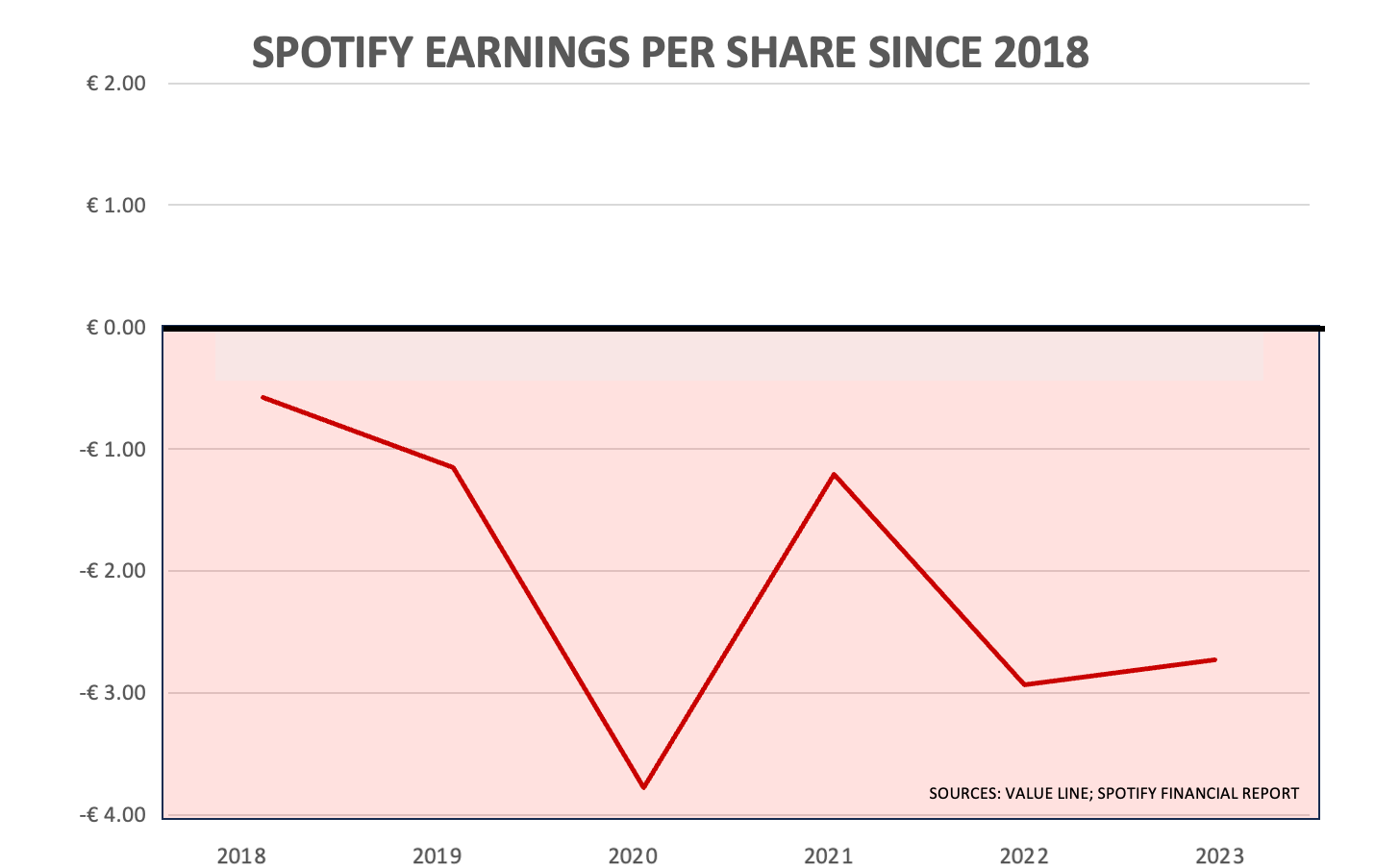
But the company released quarterly earnings this week—and it is still losing money!

chart of spotify's earnings per share since 2018

Meanwhile the CEO continues to sell his shares—another $57.5 million in the last few days.

Let me put this into perspective: Spotify was founded in 2006, and has now been operating for almost 18 years. It has 236 million subscribers in 184 countries. But the business still isn’t profitable.

Ted Gioia

Maybe one path to profitability is to pass off royalty-free AI Muzak as easy-listening jazz. It used to be a mild insult to call any work of art “derivative,” but with AI, it’s turtles all the way down.

Civilization

To realize the relative validity of one’s convictions and yet stand for them unflinchingly is what distinguishes a civilized man from a barbarian.

Joseph Schumpeter, third- or fourth-hand

From the same Damon Linker post that quotes Schumpeter:

Niebuhr rightly remarked that Americans nearly always mean well when they act in the world. Our moral perils are thus “not those of conscious malice or the explicit lust for power.” Yet the rules of the world are such that good intentions—even our own—often lead to unintended bad consequences. This is a lesson we seem incapable of learning, or remembering, so eager are we to deny that the actions of even “the best men and nations” are “curious compounds of good and evil.”

The danger of crafting policy and acting in the world on the basis of an overly exalted view of our ourselves isn’t just that we’ll make foolish decisions that lead to immense suffering and harmful setbacks to our broader strategic aims. It’s also that in raising and dashing lofty expectations, we run the risk of inadvertently inspiring the cynicism to which Niebuhr also thought we were prone, as the inverse of our over-confident moralism.

This happened on the left during the 1970s, in the wake of the Vietnam debacle, with George McGovern’s call for America to “come home” after its ruinous misadventure in southeast Asia. And it’s happening in our own time on the right, after George W. Bush displayed hubris in deciding to topple the regime of Saddam Hussein and then adopted an unmodulated form of theologically infused American exceptionalism to justify the policy once its original rationale (ridding Iraq of weapons of mass destruction it didn’t possess) crumbled to dust. (If you’ve forgotten its details, I urge you to read Bush’s 2005 Inaugural Address, with its 50-odd invocations of “freedom” or “liberty,” and jaw-dropping declaration that the ultimate goal of American foreign policy is nothing less than “ending tyranny in our world.”)

The instant before that “jaw-dropping declaration” was my last as a Republican, as I’ve written about before.

World Affairs

Made in America

Only naive arrogance can lead Westerners to assume that non-Westerners will become “Westernized” by acquiring Western goods. What, indeed, does it tell the world about the West when Westerners identify their civilization with fizzy liquids, faded pants, and fatty foods?

Samuel P. Huntington, The Clash of Civilizations and the Remaking of World Order

Rulers

It pains me to channel this, but Dreher’s right, at least up to the break:

Whatever you think of Vladimir Putin, who is ten years younger than Biden, he is vigorous, sharp, and combative. He gave his American interlocutor a coherent lesson on the past thousand years of Russian history, and hesitated only to tell the Yank to hush, and let him finish. Meanwhile, in Washington yesterday, Joe Biden confused President Sisi of Egypt with the leader of Mexico.

Toggling back and forth online from the Carlson interview to the Biden press conference, staged to address the humiliating Special Counsel’s report, was like moving out on a frail, narrow footbridge over a chasm. It is truly terrifying to consider that the feeble, senile old man desperately trying to rebut charges of dementia is what the U.S. sends to “battle” against a man like Putin.

Even worse, nobody doubts that Putin, for better or for worse, governs Russia. Who is governing America from the White House? Because it is not Joe Biden, that’s for sure.

It is hard for many Europeans to understand, but Americans scarcely know what happened in our country more than five minutes ago. And we only seem to care about it insofar as we can cite history as a reason to justify whatever it is that we want to do now. This is why Americans are living through the catastrophic, indeed totalitarian, leftist stripping of significant historical figures from public life—taking down their monuments, expelling a considered, nuanced treatment of them from history books—without protest. Too few Americans understand why this matters, and why they should care.

Isn’t Vladimir Putin doing the same thing—putting history to use to justify his attack on Ukraine? Yes, but there’s a difference. Russia really does have this incredibly long, dense, and difficult history with the territory we now call Ukraine. One does not have to accept Putin’s conclusion at the end of the story—‘therefore, Russia had to invade’—or accept his version of historical events to grasp that history matters to him in ways that many Americans will fail to appreciate.

National Affairs

Now and then

Is the New York Times suffering cognitive decline?

A tip of the tendentious hat to Nellie Bowles.

What’s wrong with the GOP?

As I frequently remind readers, I’m a former conservative who hasn’t voted for the GOP since 2002. Why?

Because I think the Republican Party and its right-wing media allies intentionally spew demagogic toxins into the civic atmosphere of the nation for the sake of political gain.
Because that isn’t going to change. (Like a three-pack-a-day smoker waiving away the possibility of lung cancer even after symptoms of serious illness have appeared, Republican voters have become addicted to the poison and demand more of it with each new election.)
And most of all, because, like a highly skilled conman/drug pusher, Donald Trump deepens the deadly addiction every day, along with posing a potentially fatal threat to the country’s democratic institutions.

Damon Linker

Another reason to despise the GOP

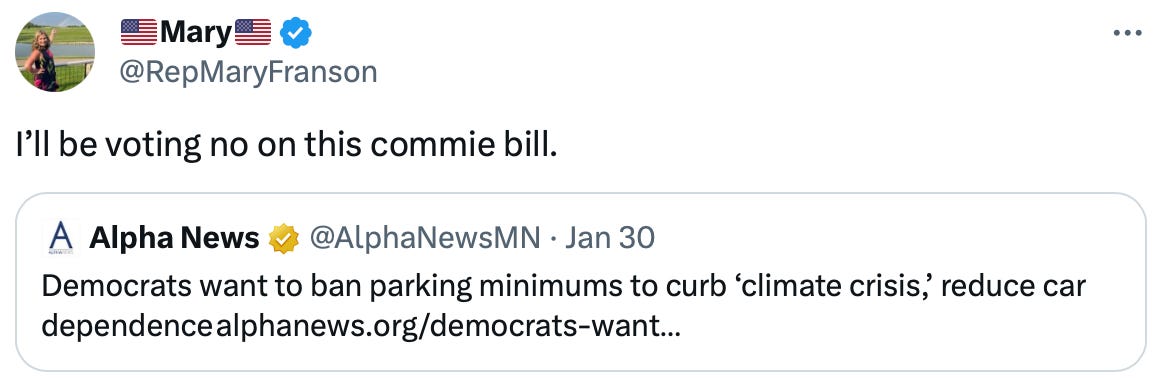
Republicans vs. property rights: Democrats in Minnesota, including Ilhan Omar, are supporting a new bill that would ban something called parking minimums. Parking minimums require property owners and developers to include a certain number of parking spots per apartment or business, and it was useful in the 1950s construction boom but it’s now one of the ways the government forces everyone into sprawling, low-density communities that rely on cars. Left to the free market, people often freely choose to live close together. They like it. I like it! Ever wonder why Paris and London are so charming? Anyway, I’m for freedom and so I err on the side of people being able to do more of what they want with their land, especially when parking lots are genuinely ugly. So oddly enough, when it comes to parking minimums, I’m with Ilhan Omar. The Republican opposition to the bill—again, which would limit the power of government and give property owners more rights to do what they want—goes something like this:

Right. That’s exactly how communism works. 

Nellie Bowles

Apart from the knee-jerk response of “freedom,” which ought to resonate with a Republican (at least as I remember the party), removing that impediments to higher-density living arrangements is the right policy because it promotes more sustainable living.

Another good one steps away from DC

Another respected Republican, Rep. Cathy McMorris Rodgers, also revealed she will retire at the year’s end, despite being the chair of the influential House Energy and Commerce Committee. The 54-year-old lawmaker from Washington state has served in Congress since 2005. McMorris Rodgers and Gallagher join a growing exodus of members of both parties who are leaving Congress frustrated that political infighting has made legislating harder than usual.

Dispatch Politics

Rep. Rodgers is one of a few candidates I supported financially (1) because she was endorsed by the pro-life Susan B. Anthony List and (2) then-35 year-old Rodgers looked electable. I am grateful that she has never engaged in the kind of jackassery that would make me regret my support.

Too many other SBA List endorsees who got elected have turned into embarrassments. One of them was foregrounded at new Speaker Mike Johnson’s coming out party snarling “SHUT UP!” at a reporter for asking an obvious and appropriate question.

I don’t look at SBA List endorsements any more.

Separating the man from the movement

Trigger Warning: If you don’t want to see anything about DJT here, stop. I’m quoting this because the mention of him is incidental to a more important point about how to heal our politics:

I think I detest Donald Trump as much as the next guy, but Trumpian populism does represent some very legitimate values: the fear of imperial overreach; the need to preserve social cohesion amid mass migration; the need to protect working-class wages from the pressures of globalization.

The struggle against Trump the man is a good-versus-bad struggle between democracy and narcissistic authoritarianism, but the struggle between liberalism and Trumpian populism is a wrestling match over how to balance legitimate concerns.

David Brooks, The Cure for What Ails Our Democracy – The New York Times (italics added). This column is so good (edifying good, not trolling good) that I’m using one of my ten monthly New York Times shareable links for it.

Yes, I suppose this is another insouciant assumption that there can be Trumpism without Trump. But we ignore populism’s legitimate values, we’ll see other demagogues arise to exploit them when Trump’s gone.

Resolute yet humble

Isaiah Berlin, concluded one of his most famous essays by quoting an observation by political economist Joseph Schumpeter: “To realize the relative validity of one’s convictions and yet stand for them unflinchingly is what distinguishes a civilized man from a barbarian.” This is also what distinguished postwar liberals such as Berlin and literary critic Lionel Trilling (the subject of this series’ second post) from just about everyone writing and thinking about politics today.

Damon Linker

ICMY, I think he called “just about everyone writing and thinking about politics today” barbarian, and I won’t disagree if one allows for a bit of hyperbole in “just about everyone.”


So: where did all my mockery of Trump go?

You can read most of my more impromptu stuff here and here (both of them cathartic venting, especially political) and here (the only social medium I frequent, because people there are quirky, pleasant and real). All should work in your RSS aggregator, like Feedly or Reeder, should you want to make a habit of it.

Tuesday, 11/14/23

Middle East

Evidence is what confirms your priors

It’s not just the activists. Congresswoman Tlaib has accused Biden of “funding Netanyahu’s genocide,” and said “We are literally watching people commit genocide” — referring to the blast next to a Gaza hospital caused by a Hamas rocket. Congresswoman Omar retweeted a photo of dead kids with the caption “CHILD GENOCIDE IN PALESTINE” — but the photo was from a 2013 chemical weapons attack in Syria.

Andrew Sullivan

Culpably loose translation

At the pro-Palestine/anti-Israel protests and in various “We Will Not Condemn Hamas” letters from academia, there are a lot of Arabic phrases bandied about. A lot of Arabic words showing up on posters. And those words are a translation, of a sort. So: when it says Free Palestine in English, in Arabic it often says Palestine Is Arab. The phrase Free Palestine sounds nebulous and nice. And sure! Free Everyone, I say! In Arabic, it’s a little less subtle: Palestine Is Arab. Palestine is not Jewish. It’s a call for the end of Jews in the area. (H/t Matt Yglesias for pointing this out.) You see, the same translation in the big “Academics and Intellectuals for a Free Palestine” letter. There, in English, it says Free Palestine. In Arabic: Palestine Is Arab.

Nellie Bowles

One picture’s worth …

Via Nellie Bowles

Anti-Zionist, antisemitic

Anti-Zionists claim the moral high-ground and often take great offense at any suggestion they are antisemitic. 

But that’s the amazing thing. 

We spend so much time on that debate, everyone thinks it’s just normal to say, “I don’t think Israel should exist.” Because that’s what anti-Zionism means. Zionism is the idea that Israel should exist as a Jewish homeland. It’s not more complicated than that. Anti-Zionism is the idea that Israel shouldn’t exist as a Jewish homeland.

Jonah Goldberg, How Anti-Zionism Shrugs Off Antisemitism

Moral clarity on Gaza

Barack Obama returns to the arena: Former president Obama jetted in from Martha’s Vineyard to say one quick thing, guys: the war’s kinda Israel’s fault! Or at least, we’re all guilty here, man. Hamas is the same as you and me. I’m reactive and need to learn how to take a deep breath before writing emails; Hamas tortured children and livestreamed it. Point is, we’ve all got issues. Here’s Obama: “If you want to solve the problem, then you have to take in the whole truth. And you then have to admit nobody’s hands are clean, that all of us are complicit to some degree.” It takes two to tango. Hamas killed infants point-blank; I never replace the toilet paper roll. 

You know who’s not talking like that? My woman, Hillary Rodham Clinton, who went on The View to deliver a shot of moral clarity straight into Stay-at-Home America’s veins. Here’s Mrs. Clinton: “Remember, there was a cease-fire on October 6 that Hamas broke by their barbaric assault on peaceful civilians and their kidnapping, their killing, their beheading, their terrible, inhumane savagery. It did not hold because Hamas chose to break it.” Moms around the country heard that call and are gathering arms. Hillary’s been through everything, so tarnished in battle she actually became clean again. I’m. With. Her, we all bellowed.

Trendy cultural relativists like 2023-era Obama can never really believe there’s a good guy. Nothing is ever better or worse than anything else. To the cultural relativists, Hamas is just another modern dance—a wild and beautiful expression of the human condition. The old-school feminists like Hilz are not so easily taken. They cut their teeth on brass tacks. They spend Saturday night preparing for the Model UN Conference, where they will crush. It does not take two to tango in the mind of Hillary Rodham Clinton.

Nellie Bowles

Abortion

Abortion in perspective: politique and mystique

The string of political losses since Dobbs overturned Roe has some thoughtful Christian conservatives reconsidering — and a few suggesting that their past writings have been vindicated:

Several years ago Matthew Lee Anderson wrote in these pages that there is no pro-life case for Donald Trump …:

If abortions happen because of the breakdown of marriage, then there is nothing ‘pro-life’ about electing someone who is at best a serial monogamist. If the abortion culture has anything to do with the wider degradation of our society’s sex and morals — as pro-lifers have argued it does for as long as I have been alive — then there is nothing pro-life in endorsing a candidate who has bragged about the number of his sexual partners. It matters that Trump is unwilling to answer whether he personally has funded abortions. It matters a great deal.

Let me be as explicit as possible about what pro-lifers supporting Trump means: It means lending their aid to someone who (with Bill Clinton) was friends with Jeffrey Epstein who was eventually convicted of pedophilia. And Trump knew of it and commended Epstein. I mean, look at this glowing endorsement: “I’ve known Jeff for fifteen years. Terrific guy. He’s a lot of fun to be with. It is even said that he likes beautiful women as much as I do, and many of them are on the younger side. No doubt about it — Jeffrey enjoys his social life.”

Think about that for a second: Conservative evangelicals and other pro-lifers have rushed to find any justification they can think of to vote for a fellow who almost certainly knew of pedophilia occurring, and, for all we do know of him, did nothing to prevent it. At the very least, he was not the one who went to the police about it. That pro-lifers have been reduced to this beguiles the mind, to put it gently.

As long as our laws allow for the killing of the unborn we cannot claim to be such a society. But the erasure of such laws will not, in itself, absolve us of the charge of being a society that is deeply inhumane and hostile to life.

[T]his is what makes the embrace of Trump as a pro-life champion so damaging to the movement: It … diminishes the goals of the pro-life movement, reducing them from the lofty and inspiring ideal of creating a society hospitable to life down [mystique]to simply overturning a badly argued Supreme Court ruling [politique]. And by reducing the ideal in this way it actually drains the life from the pro-life movement, rendering it equivalent to any other political advocacy group whose sole objective is narrowly political in nature.

To secure an admittedly significant political victory the pro-life movement has had to give up this broader vision, for how can you credibly claim to resist the culture of death when your champion is Donald Trump?

Of course, that may be precisely the point. There may be no eulogy more fitting for American Christian conservatism than this: That we secured our continued relevance in American society by giving up the things that might have made us a distinctive society ourselves. We have gained a political victory but even if we triumph, what will we have to say? And can we say any of it with even a modicum of credibility?

Jake Meador, The Mystique of the Pro-Life Movement: On Trump & the March for Life, a reprint from January 24, 2020.

Why Abortion is a losing issue for the GOP

In the eight years since the so-called New Right emerged on the scene and Trump began to dominate the Republican landscape, the Republican Party has become less libertarian but more libertine, and libertinism is ultimately incompatible with a holistic pro-life worldview … Libertarianism says that your rights are more important than my desires. Libertinism says my desires are more important than your rights, and this means that libertines are terrible ambassadors for any cause that requires self-sacrifice.

David French

(Note the congruence of these two perspectives.)

Culture

Liberal democracy’s tacit orthodoxy

Liberal democracy has created its own orthodoxy, which causes it to become less of a forum for articulating positions and agreeing on actions than—to a much higher extent—a political mechanism for the selection of people, organizations, and ideas in line with the orthodoxy. This phenomenon can be seen especially in Europe, where in the past few decades there has been a major ideological rapprochement of the right-and left-wing parties. This resulted in the formation of what is called “the political mainstream,” which includes Socialists, Christian Democrats, the Greens, Social Democrats, Liberals, and even Conservatives. The mainstream that runs in Europe today is tilted far more to the left than to the right. Within it, the left has made a slight shift to the right in some matters (mostly economic) and made a further move to the left in other matters (mainly moral), while the right-wing movement’s shift to the left was huge.

Ryszard Legutko, The Demon in Democracy

Bittersweet resolution of nostalgia

(James Matthew Wilson ached for Michigan during his long exile:)

We had chosen a difficult time to return. Michigan had legalized recreational marijuana use in 2018, and cannabis shops had sprung up all over the place, with their ridiculous names and vulgar slogans appearing on billboards along the highways. The whole state has been defaced with bad puns on words like “high” and “stoned.” And in 2022, the citizens of the state voted to lock abortion rights into the state constitution. It also elected its first Democratic legislature in forty years, and in the short time that coalition has been in power, it has pushed through a slew of left-leaning programs that will further erode the moral and educational standards of the place—all done, ironically, in hopes of luring new residents to the state. Michigan risks becoming a state where the slaughter of the innocent and the drugging of citizens into inertia and schizophrenia are celebrated as pastimes. Its governor proudly speaks of these things as part of a golden vision of the future, alongside the construction of a new Chinese-owned plant for electric vehicle batteries.

These changes have given my family occasion to see why the love of country, the piety of Virgil, is so essential. When one feels betrayed or disappointed—or wounded by the legal establishment of grave evil—the loving reaction is not to withdraw but to abide, to recommit oneself to the saving of what risks being lost. “It is good that you exist!” Love sees through the faults and perversions of the hour. It stands firm, when other kinds of commitment or affection would crumble. This kind of love has to be wound about the bone and deep within the sinew, just as its vision of the object loved is not subject to present appearances. Our truest loves are not universalizing, free, and deliberate, but stubborn, unaccountable, and particular. We do not love immutability, eternity, or omniscience. We yearn to see God’s face, which we find in the human countenance of Jesus. The same holds for natural pieties, especially love of one’s home.

I have a favorite Michigan vacation destination, Traverse City, and agree with him on the “ridiculous names and vulgar [marijuana] slogans.”

What happened to the ACLU

The ACLU really did stand for sincere liberalism during the middle decades of its existence, and perhaps for even longer than that. In the 1990s, when New York City’s Ancient Order of Hibernians wanted to keep a gay pride float out of its century-old St. Patrick’s Day Parade, the local affiliate of the ACLU took the parade organizers’ side. From the 1980s until recently, ACLU lawyers filed numerous amicus briefs against ordinances that banned protest and prayer outside abortion clinics, even though the organization was institutionally pro-choice and had its own “reproductive rights” division. For ACLU lawyers, it was a point of pride that they defended the free speech rights of pro-lifers with whom they disagreed.

Recently, something changed. Impartial liberalism is no longer the ruling ideology at the ACLU. The organization’s social media accounts now regularly weigh in on matters in which civil liberties either are not at issue or seem to lie on the other side. When Kyle Rittenhouse was acquitted on grounds of self-defense after shooting three assailants at a protest in Kenosha, Wisconsin, the ACLU Twitter account lamented that Rittenhouse “was not held responsible for his actions.” In a departure from longstanding practice, the organization began making political ads on behalf of candidates, $25 million worth in the 2018 midterm cycle. A million dollars were spent on an ad opposing Brett Kavanaugh’s Supreme Court confirmation, not because of his legal views but because he had been accused, on flimsy evidence, of sexual assault.

In 2018, a memo titled “ACLU Case Selection Guidelines: Conflicts Between Competing Values or Priorities” formalized the end of the old era. Due to “limited resources” and the ACLU’s need “to recruit and retain a diverse staff,” its lawyers would now avoid taking clients whose “views are contrary to our values.” Among the criteria its lawyers would use when choosing cases were “the potential effect on marginalized communities” and the “harmful impact on the equality and justice work to which we are also committed.”

The ACLU had come full circle. The new generation of left-wing “woke” lawyers is trying to impose on the American justice system the attitude to the law that prevails in Communist countries, where the most important question in any trial is whether a person belongs to a favored class, and where rights such as free speech and the presumption of innocence are derided as bourgeois proceduralism. And they are well on their way to succeeding.

Helen Andrews, What Happened to the ACLU

Things at hand

Now if it is my inclination to tune out the national news, or if I claim that being obsessed with it is a sign not of engagement in the world but of a pathological boredom with it, I do so because I believe that, by comparison, what’s “at hand” is far more important. And I leave aside asking whether there are no Shakespeare plays or sonnets or Melville novels we haven’t read yet that we could go and read instead of glutting our boredom on Fox and CNN. Are we really going to surrender our attention to what the precious twenty-somethings on NPR believe we should care about when we ourselves can take charge of our own attention and attending?

I am not suggesting that anyone abstain from voting in presidential elections, though I confess to having abstained on grounds that seem perfectly reasonable to me: I didn’t want to be implicated in the shenanigans of either of the clowns on offer. But what I am saying is that there are duties of citizenship confronting us not once every four years but every day. And those who account themselves citizens because they vote in abstract elections but cannot be bothered by the “things at hand” are, in my view, not citizens in any sense of the word. They are people sitting on their couches watching the Super Bowl or the Election News, elbow deep in Cheeze Doodles, too busy being consumers of far-away news or sports to be citizens of the near-at-hand—citizens performing, at scale, the offices of neighbor.

Jason Peters, in an essay well worth a few minutes, Citizens of the Things at Hand.

Why is such advice so hard to follow?

Politics

Long-term consquences of Trumpism

One of the many tragedies of this era for the American right is how Trump and Trumpism have consumed young Republican political talent.

The most promising young governor in the party is being steamrolled in this year’s presidential primary, a casualty of Trump’s hubris and ambition. He may never recover from the ridicule he’s endured for his “disloyalty.”

Successful young(-ish) governors like Chris Sununu and Doug Ducey are either out of politics or soon will be, despite how formidable they’d be as Senate candidates. They ran afoul of Trump and therefore would struggle to get through a primary, so they’ve decided not to bother.

Smart young conservatives like Elise Stefanik converted to Trumpism for the same reason, to not run afoul of him or his voters. There’s little left to distinguish phony, opportunistic populists like Stefanik from true believers like Marjorie Taylor Greene. They’re rubber stamps for Trump in equal measure; the only difference is that one mutters sotto voce while doing the stamping.

Right-wing political stars now tend to be made from charismatic charlatans who are good on television, in the image of the party’s leader, not from policy mavens. Kari Lake and Vivek Ramaswamy are better known than most Republican officeholders despite never having won an election.

The closest thing Trumpism has to a next-gen political success story is J.D. Vance in Ohio. In unguarded moments, Vance sounds like a fascist.

That’s a lot of political capital that Republicans have spoiled or squandered.

Nick Cataggio

Our libertarian land

Ross Douthat

I don’t find this surprising at all. I think America is a pro-choice, pro-pot, and pro-gun society. I think the legalization of marijuana in Ohio is going to be a total disaster. But I think social conservatism is largely correct, and unfortunately, fairly unpopular, and that’s bad for the country. But such is life.

Michelle Cottle

Such is a democracy. So you’re saying you believe in thermostatic voting, more or less.

Ross Douthat

I think that America has shifted meaningfully to the individualist left on a range of, quote unquote, “social issues” over the last 20 years, including not just issues about sex and reproduction, but also issues like marijuana.

And I think guns falls into this category. One reason I think the liberals lose on guns in certain ways for the same reason maybe pro-lifers lose on abortion, where if you poll people about specific gun control provisions, they might support them, but they don’t trust Democrats because they think Democrats want to take away their guns. And in the same way, I think it might be that people who would support a 12-week abortion ban in theory don’t trust Republicans to implement it because they think Republicans want to just ban all abortions. I think there may be similar dynamics in play there, in a very libertarian country.

New York Times

Don’t say he didn’t tell us

“If I happen to be President and I see somebody who’s doing well and beating me very badly, I say, ‘Go down and indict them.’ They’d be out of business. They’d be out of the election,” – likely future president Donald Trump, to Univision.

Via Andrew Sullivan

Humpty Elon

“When I use a word,’ Humpty Dumpty said in rather a scornful tone, ‘it means just what I choose it to mean — neither more nor less.’

’The question is,’ said Alice, ‘whether you can make words mean so many different things.’

’The question is,’ said Humpty Dumpty, ‘which is to be master — that’s all.”

Lewis Carroll, Through the Looking Glass, via Goodreads.

We tweeted a line from Louise Perry’s remarkable essay, “We Are Repaganizing” (October 2023): “Abortion is not just ‘healthcare’; it is not at all like getting a tooth or a tonsil removed.” When we turned to promote the tweet as part of an X Ads campaign, the Ministry of Truth at X (formerly known as Twitter) informed us that the ad would not run. Its communication specified a violation of a policy that prohibits the promotion of health and pharmaceutical products and services. But the thrust of Louise’s observation is analytical, not promotional. It concerns what abortion is. Welcome to the Free Society™, brought to you by Silicon Valley. (Via First Things)

When we apply a rule, it means just what we choose it to mean — neither more nor less. The question is who is to be master — that’s all.

Living your faith

For me, faith is about uniting all people. It says all children are children of God. And if you’re truly living out your faith, you’re not playing into these anger and hatred games.

Kentucky Governor Andy Beshear, who won re-election November 7, via E.J. Dionne and David Brooks.

If divine law and human reason condemn hatred of anyone who is “Other” simply because of who he or she is, then even more so do they condemn the irrational and too-often lethal hatred of the People to whom God first made his promises—promises, the Second Vatican Council taught, of which God has never repented (see Nostra Aetate 4). Jew-hatred that leads to cries of “Kill the Jews!” and “Gas the Jews!” is as clear an example of a deliberate choice that “destroys in us the charity without which eternal beatitude is impossible” as one can imagine. It is loathsome. It is a gangrenous wound eating away at everything from higher education to politics. It cannot be tolerated, and those who advocate such barbarities should not be tolerated either. 

For Christians to engage in any form of anti-Semitism is to add further blows to the smitten back of Christ, tied to the Pillar of Flagellation. It is to press more thorns upon his bleeding brow. It is to pound more nails into his hands and feet. It is to thrust another spear into his side. For he was and is, eternally, the Son of David as well as the Son of God, and to scorn his kinsmen is to scorn him.

George Weigel


The human voice: That we can sing seems basis for conjecture that, despite our stupidities and our sinfulness, we might be the reason the universe exists.

Alexander Riley

You can read most of my more impromptu stuff here (cathartic venting) and here (the only social medium I frequent, because people there are quirky, pleasant and real). Both should work in your RSS aggregator, like Feedly or Reeder, should you want to make a habit of it.

Friday, 10/6/23

The Culture Generally

Ninth Commandment, RIP

The Ninth Commandment is dead. People think nothing of spouting completely crazy stuff as gospel truth. Conspiracy Theories Spread Online About FEMA Emergency Alert Test: Some say it will trigger reactions among vaccinated individuals

Banned Book B.S.

The attacks are the work of a minuscule minority of conservatives. When The Washington Post analyzed 986 complaints against specific books filed during the 2021-2022 school year, it found that the majority were issued by the same 11 people. (You read that right. 11.) Across the red states, hundreds of popular titles have been removed from public school and community libraries, in many cases on the basis of a single complaint.

Margaret Renkl

When a book is removed because of a single complaint from one full-time U.S. Crackpot Laureate, I blame the administration — not America, not even the crackpot. It’s almost as if they want to gin up another yarn for Banned Book Week, knowing that the press will overlook the pussilanimity and label complaints “terror campaigns” (as Renkl did).

Am I wrong?

Performing malady

Today, people perform trauma. They perform trauma because they’re rewarded for doing so with attention and sympathy. The desire to get those things is natural; the incentive structure that produces that behavior is toxic. The social assumptions that once pushed people to valorize being healthy, which we now often dismiss as “stigma,” have no purchase in online communities like TikTok, Tumblr, or Instagram. What has great purchase is presenting a comprehensible identity to others, a vision of a self made legible by some simplistic and overarching factor.

It’s a basic fact of human life in the digitally-connected era: when a discourse gets empowered, in some way, it will be abused. We’re just now starting to count all of the ways that the discourse of racial justice and LGBTQ rights and feminism and related concepts have been weaponized and misused, invoked in bad faith to destructive ends. People found that when they invoked those discourses, others were often unwilling to push back, for fear of being branded racist, or sexist, or homophobic, etc. We had created an incentive structure, and people responded to those incentives. And we have now spent years and years living in the consequences of that scenario – freed from any responsibility to truth or sense or pragmatism by their cloak of social justice, a lot of hucksters have carved out careers of influence and reward, while bad ideas have proliferated due to the lack of an appropriately skeptical environment. Perhaps things have recently begun to thaw, but it will take time to tell.

Freddie de Boer.

Not enough models available

When people obsess over the college pipeline, they do so because they think that college can turn everybody into a busy little meritocrat, the kind who go on to get jobs at Google or a SLAC or the Ford Foundation or the Department of the Interior. But the high school excellence to college to enviable PMC employment cycle depends on a level of natural intellectual talent, plus the ability to delay gratification and keep to a schedule etc., that many people don’t have. So we need other models ….

Freddie de Boer

Aspirations for our children

I must study politics and war that my sons may have the liberty to study mathematics and philosophy. My sons ought to study mathematics and philosophy, geography, natural history, naval architecture, navigation, commerce, and agriculture in order to give their children a right to study paintings, poetry, music, architecture, statuary, tapestry, and porcelain.

Henry Adams, via David McCullough, The Greater Journey

Children? What children?

We live in comforts that the richest of aristocrats not very long ago could never have dreamed of, and yet we claim that we are too poor to have more than a child or two. The truth is the reverse: we are too rich to have more than a child or two, too committed to work for work’s sake and to the purchase of prestige, mansions, the “best” schools, and toys for grown-ups.

Anthony M. Esolen, Out of the Ashes

Politics

Taking sides

Do you take “sides” or do you have “positions”? For the good of democracy, William Deresiewicz hopes it’s the latter. “‘Side’ carries with it an entire worldview; it tells us how to think and feel,” he writes for Persuasion. “As soon as you say ‘side,’ you’re saying there are only two: the right one and the wrong one, us versus them, good versus evil. ‘Positions’ involves a very different set of practices than ‘sides.’ ‘Sides’ goes with debates, where each party tries to ‘win,’ to show that they are ‘right,’ by bashing away at the other. At best you might decide the truth lies somewhere ‘in the middle.’ ‘Positions’ goes with conversations. You listen; you acknowledge doubt; you think out loud; you learn. You both learn. You discover things together neither of you would have come to on your own. You might meet in the middle, but you’re as likely to decide that the truth, or at least your next best approximation of the truth, lies somewhere else altogether—in a different direction, or another dimension. And you can do all this because the stakes aren’t existential anymore. Your identity—as a member of your ‘side’—is no longer riding on the outcome. You can breathe. You can think.”

Via The Morning Dispatch

Captured by false dichotomies

On a related note:

The foundations of our political consensus are eroding. The establishment is noticing. Writing in The Atlantic, Graeme Wood dwells on the influence of Bronze Age Pervert, a transgressive internet personality. For a moment, though, Wood surveys a wider scene. He recognizes that Bronze Age Pervert’s antics can so transfix us that we fail to see something real happening among bright and normal young people. Here’s what Wood observes on the basis of an exchange between Yale professor Bryan Garsten and First Things contributor Matthew Rose:

Last year, at a conference of political philosophers at Michigan State University, a Yale professor named Bryan Garsten told his colleagues [in response to a paper by Rose, later published in First Things as “Leo Strauss and the Closed Society,” December 2022] that they were in trouble. The topic of the conference was liberalism—not Ted Kennedy liberalism, but the classical version that predates the modern Democratic Party and indeed America itself. Liberalism is the view that individuals have rights and beliefs, and that politics involves safeguarding rights and making compromises when beliefs conflict. It has existed for only a few centuries and is by some measures the most successful idea in history. Just look where people want to live: the United States, the European Union, Canada, Australia, and the United Kingdom, all liberal places that people will risk their life to reach.

But Garsten said liberalism had some of his best students hopping into rafts and paddling in other intellectual directions. He said they had been “captured” by the belief “that to be morally serious, one faces a choice.” The choice, he said, is not between liberalism and illiberalism. Liberalism had already lost. Its greatest champion, the United States, had run aground after pointless wars, terminal decadence, and bureaucratic takeover by activists and special interests. Garsten said his best students were choosing between the protofascism of Nietzsche and a neomedieval, quasi-theocratic version of Catholicism opposed to Enlightenment liberalism. These students considered liberal democracy an exhausted joke, and they hinted—and sometimes did more than hint—that the past few centuries had been a mistake, and that the mistake should now be corrected.

In my experience, the choices are not so stark. Most young people whom I meet are not interested in protofascist or quasi-theocratic options. But they do express doubts about the present regime. This is because they are not stupid. They can see that the regime is quick to speak of “our democracy,” but works to censor and control our lives, even our use of pronouns. I regard Bronze Age Pervert as a symptom (a minor one), not a cause. The source of growing dissent from our illiberal liberal regime rests in its failures, which are masked by self-serving propaganda and tactics of intimidation.

R.R. Reno

Progress against Porn

More Reno:

On a number of occasions I’ve lamented that our leaders have done nothing to stem the surging tide of pornography on the web. A friend recently told me that I’m behind the times. In 2022 Louisiana State Representative Laurie Schlegel introduced legislation requiring websites that host pornography to “perform reasonable age verification methods.” In effect, those wishing to access pornography need to show government-issued ID in one or another electronic form. The bill passed the Louisiana House by a vote of 96–1 and the State Senate by a vote of 34–0. Similar legislation has been enacted in Arkansas, Montana, Mississippi, Utah, Virginia, and Texas. The effects have been dramatic, and not only where underage users are concerned. Not surprisingly, adults who are legally entitled to view pornography aren’t keen to upload screenshots of their driver’s licenses onto pornography websites. One source reports that Pornhub, the biggest global company in the porn industry, has suffered an 80-percent drop in traffic in Louisiana. Pornhub has stopped operating in Utah, Mississippi, and Virginia. As an industry representative observed, age verification requirements are “business-killing.” More states have legislation pending.

(Yes, two Reno quotes means I’m belatedly reading the current First Things. I no longer rejoice on its arrival, but rather sigh. I’m not sure I’ll renew, although I think I’m a charter subscriber, as Richard John Neuhaus moved from the Rockford Institute to this new publication. It has gradually changed under Reno, then more rapidly changed under Trump-Reno. The ratio of religion to politics was way out of kilter in this issue especially.)

Cui bono?

I’m suspicious of the congealing conventional wisdom that Robert F. Kennedy Jr. would do more damage to Donald Trump as a third-party candidate than to Joe Biden.

Even though some of its proponents, like our own Chris Stirewalt, have forgotten more about politics than I’ll ever know.

What makes me suspicious is the delight I take in the prospect. I don’t care how Trump ends up losing so long as he loses, but to have him lose because a far-left nut ended up stealing the right-wing crank vote from him would be sweet beyond words. Live by the conspiracy theory, die by the conspiracy theory.

Nick Cattogio

Your Guide to the New Right

Your Guide to the New Right, the current Ezra Klein podcast (guest-hosted by David French) is very, very good. Guest Stephanie Slade really knows her stuff (or is faking it well enough to fool me — one who has spent too much time reading about the new right antics, so appalled am I by the disappearance of conservatism).

Gerontocracy and Gaetz

The basic gerontocratic fiscal trap is easy to describe: As societies grow older, with longer life expectancies and fewer kids, their old-age commitments become steadily more costly even as the share of voters who benefit from those commitments (and turn out to vote) increases. This makes it harder to fix fiscal problems, and it makes the path of least political resistance the protection of the old and the shortchanging of the young — who, thus shortchanged, start fewer families and deepen societal senescence.

But there is a further twist in American politics, which is that the party that would normally be the ideological vehicle for resisting the drift into gerontocratic stasis — the party of free markets and limited government — is also increasingly dependent on the votes of culturally conservative older voters. Which makes it especially politically challenging, even self-undermining, to actually undertake the kind of fiscal reforms that the right’s philosophy officially supports.

Ross Douthat, How Gerontocracy Explains the Matt Gaetz Clown Show

Many people have been commenting on this, so perhaps it’s even better than I thought.

Trump

Winning, but dysfunctionally

In the 2022 elections,

Democrats had lost the majority, but Republicans had not won a functioning majority of their own.

They tried to act otherwise. They tried to advance a big agenda, even tried to launch an impeachment inquiry into President Biden. To propel that agenda required their tiny majority to march in unison, each member subordinating his or her own wishes to the collective will.

Predictably, that did not happen.

Which left Plan B: Accept reality; acknowledge that the GOP had not won a functioning majority; and reach across the aisle, make deals, and do your business that way.

That’s what McCarthy did in May with the debt-ceiling deal and tried to do again with the budget this past weekend. The first foray wounded him. The second finished him.

The rules of contemporary Republican politics make it hard to accept reality. Reality is just too awkward.

In reality, Trump has been a big vote loser for Republicans. He fluked into the presidency with a Dukakis-like share of the vote in 2016, then lost his party its majority in the House in 2018. Trump got decisively booted from the presidency in 2020; rampaged illegally on January 6, 2021; and then cost his party its Senate majority in the January 2021 runoff elections. His election-denier message damaged his party further in the elections of 2022. His demand for a Biden investigation and impeachment in 2023 is producing an embarrassing fiasco. But no Republican leader dares say these things out loud.

Most taboo of all is working with Democrats, on any terms other than total, one-sided domination: We win, you lose.

Where we are is a country with a solid anti-Trump majority confronting a pro-Trump minority that believes it has a right to rule without concession or compromise.

David Frum, The Republican Delusion Machine

Sir Thomas More lives!

I consider Matt Gaetz to be a maliciously cynical lawmaker, but I can’t say I’m sorry to see McCarthy deposed. After all, he has been a key figure in transforming the GOP into a monstrous political party, one whose contempt for constitutional and democratic norms poses the greatest threat to the republic since the Civil War.

McCarthy was careful never to get crosswise of Trump, aware of what a dominant figure Trump is within the Republican Party. McCarthy has been so obeisant to Trump—a lawless, cruel, and uniquely destructive figure—that Trump once referred to him as “my Kevin.”

McCarthy also did something unprecedented, campaigning in his role as speaker in a primary against a sitting incumbent in his own party, Liz Cheney, a one-time ally and member of his leadership team. Cheney’s sin? She voted to impeach Trump for inciting the attack on the Capitol; she served as vice chair of the House select committee investigating the January 6 attack; and she continued to call out Trump’s lies about the election being stolen. Cheney acted honorably, placing country above party. She put her political career at risk in order to defend the Constitution. And that was simply too much for “my Kevin.”

In Robert Bolt’s A Man for All Seasons, Sir Thomas More has an exchange with Richard Rich, an ambitious young man whom More, early in the play, warns against getting into politics. Rich doesn’t possess the moral fortitude to resist the temptations that accompany a political life. It isn’t so much that Rich is bad; it’s that he’s weak.

Rich eventually betrays More, and in one of the play’s most famous lines, More tells Rich, “Why, Richard, it profit a man nothing to give his soul for the whole world … but for Wales!”

Kevin McCarthy gave up his soul not for Wales but for something worse—Donald Trump. It will be of little comfort to McCarthy to know that he’s hardly the only one to have done so.

Peter Wehner, The Revolution Devours Kevin McCarthy

Wordplay

Plogging

A combination of jogging and picking up trash. It’s becoming a competitive sport, with a world championship scheduled.

(H/T WSJ)

Snaffle

to take something quickly for yourself, in a way that prevents someone else from having or using it.

Cambridge Dictionary.

So, if the Dutch gain a financial advantage through public debt, joint stock companies, and South Asian trade, then the English can simply snaffle their ideas.

Remaking the World page 237.

Idyllic

Wikimedia Commons

Yeah. Maybe that’s cheating. But I loved the photo and wanted to share it.

bland ambition

Ross Douthat’s characterization of the fallen Speaker Kevin McCarthy

Romanticizing the past

“Romanticizing the past” is a familiar accusation, made mostly by people who think it is more grown-up to romanticize the future.

Paul Kingsnorth


A fundamental reality of human existence is that vice often leaves virtue with few good options. Evil men can attach catastrophic risks to virtually any course of action, however admirable.

David French

You can read most of my more impromptu stuff here (cathartic venting) and here (the only social medium I frequent, because people there are quirky, pleasant and real). Both should work in your RSS aggregator, like Feedly or Reeder, should you want to make a habit of it.

Friday, 2/10/23

Culture

Malodorous and malarial overtones

” How has it come about,” C. S. Lewis once asked, “that we use the highly emotive word ‘stagnation,’ with all its malodorous and malarial overtones, for what other ages would have called ‘permanence’?” It is, Lewis suggests, because the dominance of the machine in our culture altered our imagination. It gave us a “new archetypal image.”

Ken Myers, All God’s Children and Blue Suede Shoes

Enabling the trans social contagion

There’s a reckoning coming for this — or so I hope. The alternative to a reckoning is people like assistant secretary for health Dr. Rachel Levine continuing to lie and cover up this scandal, and getting away with it.

Before I published, there were signs of a reckoning coming, from Senator Josh (“I used to be a conservative till I discovered the joy of demagoguery”) Hawley and the Missouri Attorney General.

Hold off on the funeral plans

Red states like Florida and Texas are growing at the expense of Blue states like New York and California. The main driver is said to be housing costs.

But beware jumping to a triumphalist conclusion, Red-staters:

Blue states aren’t doomed or dying. At any rate, high housing costs generally reflect very high demand from lots of people to live in a particular area; New York City isn’t some dystopian wasteland where no one can see their future. But even relatively small changes (minorities of workers working from home or moving away) can still lead to acute crises for cities ….

Jerusalem Demsas, How Florida Beat New York

The telltale need for affirmation

Stalinism made courage in thought especially dangerous, but the pressure to align one’s opinions with those of a favored group is universal. Solzhenitsyn detected this pressure even before the Revolution. Vorotyntsev, the hero of his novel November 1916, finds himself at a meeting of Kadets (the Russian liberal party). He listens as everyone voices the proper views they all already hold. He is struck that their confidence needs constant reinforcement and that those with progressive opinions regard it as “imperative . . . to meet and hear all over again what they collectively knew. They were all overpoweringly certain they were right, yet they needed these exchanges to reinforce their certainty.” An experienced colonel, Vorotyntsev knows that their opinions about common soldiers are absurd, but for a reason he cannot explain, he finds himself expressing agreement.

Gary Saul Morson

Oddballs

Age six, I once ruined Pass the Parcel at a schoolfriend’s birthday party, because I was distracted by a headline on a layer of discarded newspaper. MIND BOMBED BY THE MOONIES. I remember being intensely annoyed when it was taken off me before I could find out what that meant, and confused as to why all the adults thought my outrage was funny. It marked me out as one of those oddballs generally more interested in ideas than in who and what is immediately present. That trait has persisted: my mad professor streak is trying to friends and family, to this day.

Mary Harrington, Are effective altruists more horny?.

I watched Harrington in a YouTube dialog, and her physical mannerisms were completely consistent with the “oddball” she describes.

They also reminded me of me.

IDW Alums

Interesting podcast about the Intellectual Dark Web (you remember that, don’t you?). It seems that if you put like-minded extremists in a room and close the door for a while (literally or by lumping them under a label like “IDW”), they emerge more extreme.

Still, I’m puzzled that so many of the IDW figures started on the Left but the whole thing now (apparently) codes Right.

Bingo

Now is not the time to discuss this is not an argument — it’s a derailing tactic.

Jesse Singal, The New, Highly Touted Study On Hormones For Transgender Teens Doesn’t Really Tell Us Much Of Anything

Politics

SOTU 1

You can say Mr. Biden fibbed, misled and exaggerated, and you wouldn’t be wrong, but in rope-a-doping Republicans on Medicare and Social Security he showed real mastery. “Some Republicans—some Republicans—want Medicare and Social Security to sunset. I’m not saying it’s the majority.” When they catcalled and booed he said he was glad to see it—“I enjoy conversion.”

I don’t care how planned that line was, it was good.

“So folks, as we all apparently agree, Social Security and Medicare is off the books now, right?” He meant off the table. “All right. We’ve got unanimity.”

The Republicans, as we all know, made a mistake in taking his bait. They should have laughed. Instead, when he painted them as dogs they barked and snarled. Much has been made of Marjorie Taylor Greene and her grimacing and jeering. In her flamboyant fur-collared jacket she was compared, on social media, with Cruella de Vil and late-stage Sharon Stone in “Casino.” That was unkind. She seemed to me more like the colorful Belle Watling, although without the kindness and dignity.

Peggy Noonan

SOTU 2

“I thought [Sarah Huckabee Sanders’] speech was terrible. If you’re going to give a counter speech, you’ve got to talk about important issues. Don’t get me wrong, the wokeism is very important. But it’s not quite the heart of the matter right now, right? It’s not the heart of the matter. Let’s be blunt,” – Steve Bannon, via Andrew Sullivan.

SOTU 3

Biden was triangulating hard. Stylistically, this was not-Trump at all. Substantively, it was Trump all the way. If Trump were not mentally ill, he’d sit back and bask in his legacy of reorienting US politics — including the Democrats — toward all the themes he stressed from 2015 on. He’d be happy to go down in history as populism’s bipartisan legitimizer. (But of course he’s out of his mind.)

Andrew Sullivan, William Jefferson Biden

An extremely sensible proposal

Kevin D. Williamson:

My own belief is that the senior figures in the Trump administration—Donald Trump himself, Mike Pence, the various Cabinet secretaries and agency chiefs, etc.—should never again hold any position of public trust—or, if not never again, at least not in the foreseeable future … The same is true for those in Congress who voted against certifying the 2020 election results and those who were otherwise involved with the attempted coup d’etat of 2020-2021. Trumpworld lawyers such as John Eastman, Rudy Giuliani, and Cleta Mitchell should be disbarred.

I do not think that any of this should be done in a spirit of vengeance, nor do I believe that we should work to socially ostracize these people or go out of our way to ruin them financially, though, of course, their employment prospects would be narrowed in some cases. Rather, I think that we should think of them the way Marcus Aurelius thought about his hypothetical sparring partner: We have had a bad experience with them, and we should take such steps as are necessary to avoid repeating that experience. Once is enough. 

Put another way: The point of keeping Trump administration veterans out of positions of public trust is not to punish them—it is to keep them out of positions of public trust.

I am not saying that Nikki Haley and other veterans of the Trump administration are necessarily villains or dishonorable people or anything like that. I am saying that they are an avoidable risk—and we should avoid them.

I shall do my part.

Russia, Ukraine, U.S.

Beyond a certain point, the United States is no longer “helping” or “advising” or “supplying” the Ukrainians, the way it did, say, the Afghan mujahedeen during the Cold War. It is replacing Ukraine as Russia’s main battlefield adversary. It is hard to say when that point will be reached or whether it has been already. With whom is Russia at war — Ukraine or the United States? Russia started the war between Russia and Ukraine. Who started the war between Russia and the United States?

In an age of smart devices, robotics and remote control, the United States’ involvement in the war has always been greater than it appeared. The computer-guided rocket artillery that Ukraine has received from the United States may seem analogous to the horses and rifles that a government might have sent to back an insurgency in the old days. They look at first like traditional weapons, albeit advanced ones.

But there is an important difference. Most of the new weapons’ destructive power comes from their being bound into an American information network, a package of services that keeps working independently of the warrior and will not be fully shared with the warrior. So the United States is participating in these military operations at the moment they happen. It is fighting.

Russians say the war is about preventing the installation of an enemy military stronghold on the Black Sea, strong enough to close off what has for centuries been Russia’s main access to the outside world. Without Ukraine, Russia can be turned into a vassal state. That NATO intends to bring about the subjugation, breakup or even extinction of Russia may be true or false — but it will not sound implausible to a Russian.

We should not forget that, whatever values each side may bring to it, this war is not at heart a clash of values. It is a classic interstate war over territory and power, occurring at a border between empires. In this confrontation Mr. Putin and his Russia have fewer good options for backing down than American policymakers seem to realize, and more incentives to follow the United States all the way up the ladder of escalation.

Christopher B. Caldwell, Russia and Ukraine Have Incentives to Negotiate. The U.S. Has Other Plans. (The link is to an unlocked NYT article; no subscription necessary.)

Personal immunity, hard-won insight

Donald Trump’s detractors—including yours truly—would often make the mistake of downplaying his political effectiveness simply because we were utterly immune to his (alleged) charms.

Jonah Goldberg, Falling in Line, Not in Love

I’m in that camp with Goldberg: utterly immune. I struggled to figure out his effectiveness even intellectually, but I’ve eventually settled on something like these:

  • When you tell a large chunk of the country that their voices are not worth hearing, they are going to react badly—and they have. (David Brooks, How the Bobos Broke America)
  • Telling parents they’re bigots or are unenlightened for not embracing the latest faddish orthodoxy is not a winning message. (Pamela Paul, What Liberals Can Learn From Ron DeSantis)

Prudential calculation

[T]he classical statesman permits errors and vices, not because he believes in tolerance for its own sake, but because state action would, in his estimation, harm the common good of the polity more than the vices or errors do.

Ius & Iustitium, The Iron Law of Tolerance

This very much was why I opposed criminal laws against sodomy 50+ years ago — not because I thought that vice was a virtue or even neutral.

It seems quaint even to mention that now, but my position remains substantially the same today.


Tradition is a bulwark against the power of commerce and the dissolving acid of money, and by removing these, all revolutions in the modern period have ended up accelerating the commercial and technological shift towards the Machine.

Paul Kingsnorth

You can read most of my more impromptu stuff here (cathartic venting) and here (the only social medium I frequent, because people there are quirky, pleasant and real). Both should work in your RSS aggregator, like Feedly or Reeder, should you want to make a habit of it.

Monday, 8/28/22

Student Loan Forgiveness

Student Loan Forgiveness 1

The bigger problem with student debt cancellation, however, is that it’s an ad-hoc, one-off move that does absolutely nothing to fix the deep pathologies in the way America financed undergraduate education. Matt Yglesias was exactly right to ask [on Twitter] what happens on the morning after the debt cancellation:

What is the plan for the day after universal debt cancellation when masters programs raise tuition and tell prospective students not to worry about it because the debt will be cancelled down the road?

But this perverse incentive, which economists call moral hazard, will only exacerbate an underlying problem. For decades, our strategy has been to limit the supply of available college seats while using subsidized loans to pump up the demand for those limited spots.

So we need to ask ourselves why we’re merely applying an expensive band-aid instead of addressing the deeper issue — and why we’re still so enamored of the idea of hurling big wads of cash at already-overpriced service industries.

Noah Smith, America is not fixing its college financing system (H/T The Morning Dispatch)

Student Loan Forgiveness 2

We were propagandized my entire high school simply to go to college, and we were promised if we did we would make more money and have a better life (“College graduates make 1 million dollars more than those who only graduate from high school!”). We received no guidance about which colleges to go to, how much money to take out, what to major in if we wanted return-on-investment, etc. Every guidance counselor told us this; every hallway had a poster proclaiming this; every teacher drilled it into us; from ages 13-18.

And we listened to them. And then we (as a generation) found out we’d have the equivalent of mortgages to pay off before we could get a real house and also that Boomers were not retiring so we couldn’t get jobs.

To put the question simply: In sussing out responsibility for the choice to take on debt, I don’t think “was someone holding a gun to your head when you took out the loan?” is the right question. I think something closer to “when you took out this loan—almost certainly while still a teenager or in your extremely early 20s—did anyone help you understand what you were doing and what the real ramifications of this choice would be?” In most cases, I think the answer is “not really.” Does it follow, therefore, that all the loan must be forgiven? Perhaps not. But at the very least we need to reckon with agency in a serious, thoughtful way and not in the simplistic terms being put forward by many commentators.

Jake Meador, Two Bad Reasons to Oppose Loan Debt Forgiveness and Two Better Ones

No comment

Harvard Law School professor Laurence Tribe made the economic realities inadvertently stark when he tweeted on the day of Biden’s [student loan forgiveness] announcement, “Good news for thousands of my former students. I’m grateful on their behalf, Mr. President.”

David French, Is There a Christian Case for Biden’s Debt Relief Plan?.

Yes, I relented on my intention to pay no more heed to French on the intersection of politics and religion. And, yes, the wisdom of that resolve was confirmed; IMHO, French shed no real religious light on his stated topic.

Rank politics

The Rarest Thing in Politics

Like my friend, I disagree with Liz Cheney’s political positions.

But there is something about her.

As much as I disagree with her, I trust her.

Why? Because she has demonstrated a quality that is so rare in American politics today — perhaps, also, in American life — that we cannot help but find that quality to be attractive.

Liz Cheney has integrity.

When I see Liz Cheney, I feel that I am in the presence of an American patriot. True, I disagree with her. But I know we would have a respectful conversation. Like I said, I trust her.

Liz Cheney makes me think of one of the later verses of “America the Beautiful” — the ones that we rarely sing, but which I think are among the finest lyrics to ever appear in a patriotic song.

O beautiful for heroes proved
In liberating strife,
Who more than self their country loved
And mercy more than life

The verse might have been referring to American heroes who proved themselves in military battle. They loved their country more than they loved their own lives. That is the meaning of sacrifice.

Liz Cheney exemplifies those words as well. When she led a principled fight against Donald Trump, she knew she was sacrificing her run for reelection. “Nevertheless, she persisted.”

Jeffrey Salkin, It’s Cheney-mania!

Whatever happened to the Emerging Democratic Majority?

We didn’t anticipate the extent to which cultural liberalism might segue into cultural radicalism and the extent to which that view, particularly as driven by younger cohorts, would wind up imprinting itself on the entire infrastructure in and around the Democratic Party—the advocacy groups, the foundations, academia of course, certainly the lower and middle levels of the Democratic Party infrastructure itself.

Ruy Teixara, interviewed by the Wall Street Journal, on why his Emerging Democratic Majority hasn’t emerged.

A Real Problem for Republicans

The main thing holding the GOP back from a complete takeover? The Daily Beast’s Matt Lewis is surely onto something when he notes that the Party of Lincoln, in its Trumpified version, has a fondness for nominating “idiots” to run for office.

Indeed, as Nellie [Bowles] noted only last week, there isn’t enough cocaine in the world to keep Mitch McConnell and voters everywhere from recognizing that “candidate quality” is a real problem for Republicans. They tend to nominate people with absolutely zero experience even running for office, much less holding it. The results aren’t just Dr. Oz alienating Pennsylvania voters by suggesting that John Fetterman brought about his own stroke, but Georgia’s favorite son, Herschel Walker, yammering on about too many trees while being unable to accurately count his own children. 

Hillbilly Elegy author J.D. Vance managed to win his primary in Ohio with just 32 percent of the vote but rarely goes a week without some sort of gaffe, such as suggesting that women should stay in violent marriages.

Nick Gillespie

Democrats nominate an occasional loose cannon, but I wouldn’t be all that keen on eliminating party primaries were I a Democrat: the Republican base keeps delivering candidates that a relatively easy to beat.

Russia 2016, USA 2022

A report published this week by Graphika and the Stanford Internet Observatory indicated that Twitter and Meta, for the first time, recently removed a set of fake accounts from their respective platforms for “using deceptive tactics to promote pro-Western narratives in the Middle East and Central Asia.” The influence campaign had reportedly been active for years, promoting the interests of the United States and its allies, spreading anti-extremism messaging, and opposing countries like Russia, China, and Iran. Neither tech platform directly attributed the activity to the U.S. government, but the U.S. and United Kingdom were listed as the “presumptive” countries of origin.

The Morning Dispatch.

Could you remind me again how evil Russia is for trying surreptitiously to influence things like our 2016 election?

Just because it’s a fun simile

We remember Bill Clinton’s sex scandals and not Hillary Clinton’s almost-certainly criminal cattle-futures shenanigans because most people know what sex is and understand that you’re not supposed to cheat on your spouse, but trying to explain futures trading to the typical voter is like trying to get a dachshund to bark in terza rima — they just aren’t equipped. But people naturally get hypocrisy, or at least a dumbed-down version of it.

Kevin D. Williamson, Hypocrisy for Dummies

Culture

Whence cancel culture?

I had to drive a couple of hours yesterday, and I heard on a podcast a sober but startling theory I really need to pass along.

Roughly one-third (I believe he said) of college graduates are supporting themselves through jobs that require no more than a high-school education because there are not enough jobs in “the managerial class” for which they’ve been groomed. We are college-educating more people than the market requires. So the competition for managerial class jobs is fierce.

Whence cancel culture. If you can pick off a superior with a grainy home movie of him in blackface decades ago, you might just move up the ladder — assuming you’re on the ladder. If you’re not on the ladder but want on, picking off a peer by exposing a tasteless Tweet just might eliminate her from consideration.

The dynamics of the New York Times staff as described by escapees seems to fit this theory “to a T.” Restless youngsters have knocked off a number of their bosses, older colleagues and peers.

So cancel culture is (just?) the war of all against all in modern garb.

Do the math

It’s not difficult to see what’s going on here: oil companies haven’t invested in new and better domestic refineries because they know that, even in this hour of essentially free money, their profit margins are shrinking and there aren’t 30 years of crude in the ground to pay off 30-year mortgages on new refineries. The oil companies are in a “sunset industry” and they know it.

James Howard Kunstler, Adapt or Die: Kunstler’s Guide to Living in the Long Emergency.

I like the epigram to this article, too:

It is broadly true that political writing is bad writing. Where it is not true, it will generally be found that a writer is some kind of rebel, expressing his private opinions and not a “party line.”

—George Orwell, “Politics and the English Language”

Maggots doing what comes naturally

A sprawling campus, part of the University …, covers their eastern reaches. The waters are channelled into generic, forgettable pools fringed with generic, forgettable buildings. It is, of course, the modern kind of forgettable architecture. Every chunk of grey and glass has its own unique variation on the shape of a shoebox. The innovations are of the type that everyone in the world has seen so much of that only those paid to do so can even pretend to care anymore.

In this, the University … is no better or worse than every other university. They have all spread their aggressively mediocre buildings across the cities and towns: shiny lumps of architectural conformity that advertise the shallowness, greed, and transience of the institutions to the whole world. We should be thankful for them. They physically represent the death of the modern university’s soul, and so make it obvious. Now a university is just a machine for uprooting humanity. It takes the young from home but gives then no adult responsibilities, drops them into a society of other uprooted youth, habituates them to the mentality of the virtual class, and leaves them drifting in debt and doubt.

At this point, some readers may hope I will criticise the ‘woke’. I will not. A worm digesting a living human being is a problem. A worm digesting a corpse is just the natural order of things. The universities are corpses and fashionable ideologies are maggots.

A terrible decision killed the universities. History, always Sphinx-like, showed them three good things, but only let them keep two. The one that they left on the table was the one that they should have treasured. Without it, their wyrd was written. The three gifts history offered were called ‘important’, ‘new’, and ‘true’.

FFatalism, Academic landscapes.

More: An earnest young postgraduate once told me that texts have no meaning. I said I didn’t know what he meant. He tried to explain it to me again. I’m not sure why. He must have thought that he was saying something.

Quintessentially Legal and Quite Mad

Arkansas banned healthcare professionals providing gender transition procedures to anyone under 18. A Federal District (trial) Court and Circuit (appellate) court have both now held that the law violates the Equal Protection Clause:

[U]nder the Act, medical procedures that are permitted for a minor of one sex are prohibited for a minor of another sex. A minor born as a male may be prescribed testosterone or have breast tissue surgically removed, for example, but a minor born as a female is not permitted to seek the same medical treatment. Because the minor’s sex at birth determines whether or not the minor can receive certain types of medical care under the law, Act 626 discriminates on the basis of sex.

H/T Religion Clause.

I have seen this kind of reasoning over and over as the courts impose on us, and on legislators who beg to differ, their view of “discrimination on the basis of sex.” For instance, if John can marry Suzy then Sally should be allowed to “marry” Suzy.

I’m not alone:

As the [Franciscan Alliance] argues in its brief, in 2016 the government interpreted ObamaCare’s nondiscrimination provisions “to require doctors and hospitals nationwide to perform and insure gender-transition procedures and abortions or else be liable for ‘sex’ discrimination.”

Specifically, the feds read the law to require that services be offered on an equal basis. “If a gynecologist performs a hysterectomy for a woman with uterine cancer,” the alliance’s brief says, “she must do the same for a woman who wants to remove a healthy uterus to live as a man.”

This cultural clash isn’t going away, and the country is in for more trouble if progressives can’t rediscover the principle of pluralism. The government’s appeal shows a bloody-mindedness that is difficult to fathom.

Transgender Patients vs. Religious Doctors – WSJ

However often I’ve seen it, I’ve never been able to get used to such reasoning as being sane. It strikes me as sophistry, though when we set out to outlaw sex discrimination, we implicitly set out to eradicate invidious sexual stereotypes. If we leave it to individual judges to determine what’s invidious, won’t decisions be all over the map? Isn’t a stupid, sophistical woodenness better than that?

Nah!

A Child’s Purpose

“Because children grow up, we think a child’s purpose is to grow up,” Herzen says. “But a child’s purpose is to be a child. Nature doesn’t disdain what only lives for a day. It pours the whole of itself into each moment … Life’s bounty is in its flow. Later is too late.”

Oliver Burkeman, Four Thousand Weeks


[S]ubordinating truth to politics is a game which tyrants and bullies always win.

Jonathan Rauch, The Constitution of Knowledge

The Orthodox “phronema” [roughly, mind-set] cannot be programmitized or reduced into shibboleths.

Fr. Jonathan Tobias

You can read most of my more impromptu stuff here (cathartic venting) and here (the only social medium I frequent, because people there are quirky, pleasant and real). Both should work in your RSS aggregator, like Feedly or Reeder, should you want to make a habit of it.

Culture Wars, Hot War

Canadian Truckers

Organized fear

Since politics exists to organize fears, a major question for people caught between these two camps is which kind of power seems more frightening. The power to shut down the heart of a major city, perhaps even with the sympathy of some of the police, or the power over money and information that the Trudeau government is relying upon in its response? The specter of an insurrection or the specter of a digital police state? A revolt of the disaffected middle or a revolt of the elites?

At the moment, judging by the Canadian polls, people are unhappy with Trudeau but seem to fear the disruptions and shutdowns more than the government response. A similar preference for a disliked elite over a chaotic and disreputable opposition is why Joe Biden is president rather than Donald Trump, and why Emmanuel Macron may yet be re-elected in France.

Ross Douthat, on the “Class War” between Canadian Truckers and Canadian Meritocracy (emphasis added).

Class War

The Canadian trucker protest was a class war, Ross Douthat writes in his latest column, between what N.S. Lyons described as the “virtuals” who live in the digital world and the “practicals” who work in the “mundane physical reality” upon which the virtual society depends. “The truckers have leveraged the imposing presence of their trucks and the sympathy of other Practicals—from tow-truck drivers to cops—to attack the physical underpinnings of the capital’s economy,” he writes. “The counterstrike, while it’s finally evolved to actual physical removal, has been strikingly virtual: first a PR blitz to encourage friendly media to brand all the truckers as racists and anti-Semites and Trump supporters, then the convenient hacking and ‘doxxing’ of donors to the convoy, and then an invocation of the Emergencies Act which lets the government attack the protesters via the digital realm, freezing bank accounts and even cryptocurrency funds connected to the protests.”

The Morning Dispatch.

Ross Douthat has the condensed version, but I read N.S. Lyons’ longer substack (Reality Honks Back), which is one of the best — and most ominous — things I’ve read in weeks. Synopsis follows.

The Physicals and the Virtuals

It’s my understanding that N.S. Lyons is a pseudonym, but I’ll put still say it: “N.S. Lyons is a very smart person.”

In the recent essay ‌Reality Honks Back, Lyons reflects on the Canadian trucker convoy/strike as pitting elites (“the Virtuals,” who trade in thinking and narrative-spinning, not physical reality; in fact, they think reality is socially constructed) against “the Physicals” who trade in actual physical stuff. (Think “deplorables.”)

When the parked trucks became too intolerable a reminder that the Virtuals are utterly dependent on the Physicals (socially construct your way out of that reality if you can!), the Virtuals, having spun a narrative of neo-nazis and other deplorables, played their trump card: they incited their co-conspirators to create a new caste of economic untouchables, cutting off GoFundMe, hacking another crowdfunding site (GiveSendGo) and Doxxing donors to the truckers’ cause, and threatening economic ruin and criminal prosecution against anyone who dared try help them again.

So the Virtuals won because we don’t recognize what they did as virtual violence, whereas the Physicals, this time at least, could have retaliated only by engaging in physical violence.

Something tells me that this is only round one.

Maybe I got some of the details wrong, but I highly recommend the whole piece, and particularly the suggestion that the enmity of the Virtuals toward the Physicals (and vice-versa) is maybe the top conflict driver extant today. (It’s a theory that rhymes with the theory that we’re over-producing and under-employing college-debt-ridden elites, too.)

Update: Justin Trudeau has decided that the emergency is over and the deplorables can have their money back.

Virtuals and Physicals in the USA

Of the nation’s total 3,143 counties, the number of super landslide counties — where a presidential candidate won at least 80% of the vote — has jumped from 6% in 2004 to 22% in 2020.

“Trump’s blowouts were concentrated in white, rural counties in the Greater South, Interior West, and Great Plains,” Sabato writes, “while Biden’s were in a smattering of big cities, college towns, and smaller counties with large percentages of heavily Democratic nonwhite voters.”

Put another way, Biden won 85% of counties with a Whole Foods and only 32% of counties with a Cracker Barrel.

NPR

I thought this was an interesting tidbit until I started thinking “How many counties have both Cracker Barrel and Whole Foods? And then “Is this just a rough proxy for bigger cities versus smaller?

Paul Farmer, RIP

Paul Farmer proves that there are wonderful people doing wonderful work who for some reason never come into my field of vision until there are lamentations and obituaries at their departure. Here, here, here, here.

It’s difficult to find much discussion of religion in the life of this man whose self-sacrificial life had to be inspired by something. Get Religion calls those “God-shaped holes,” and the New York Times, Wall Street Journal and Bill Gates all had huge ones. Even Alan Jacobs didn’t hit it head-on.

But Friends University’s Russel Arben Fox comes to the rescue:

Farmer was raised a Christian believer, but only became truly committed during his years of going back and forth between Harvard and Haiti: “The fact that any sort of religious faith was so disdained at Harvard and so important to the poor–not just in Haiti but elsewhere too–made me even more convinced that faith must be something good” [MBM, pg. 85]. He became a fierce advocate of that element of Catholic social justice teaching that emphasizes giving preference to the poor, or the “option for the poor.” For Farmer, this has meant liberation theology, and a thoroughgoing critique of the failures of the rich capitalist nations of the world to attend to the manifest and desperate needs of the poorest of the poor.

Hyperbolic outrage

I should have known better than to waste any time on Olga Khazan, The New Partisan Fight Over Schools‌. It meandered around teapots, and when it found this tempest I knew I was done reading:

The most explosive example of the Republican crackdown on schools occurred when a school district in a very conservative area of Tennessee removed the Pulitzer Prize–winning Holocaust book Maus from its eighth-grade curriculum because it contains eight swear words and a bit of cartoon nudity. “It looks like the entire curriculum is developed to normalize sexuality, normalize nudity and normalize vulgar language,” the McMinn County school-board member Mike Cochran said, according to meeting minutes. “You put this stuff just enough on the edges, so the parents don’t catch it but the kids, they soak it in.” His view presumes that parents should monitor what their kids are learning.

When removing a glorified comic book from a curriculum is the most “explosive example” you’ve got, and you have to make it sound ominous-by-association that some deplorable thinks “parents should monitor what their kids are learning,” you’ve not got much.

Again, I prefer the lot of a blogger to the lot of a professional who must write even when there’s nothing much to say.

SSM and Creative Artistry

Another artisan is going to SCOTUS seeking exemption from providing creative services for same-sex “weddings”:

Tuesday’s order phrased the question before the court as “whether applying a public-accommodation law to compel an artist to speak or stay silent violates the Free Speech Clause of the First Amendment.”

Granting 303 Creative an exception “would necessarily relegate LGBT consumers to an inferior market because [Ms. Smith’s] unique services are, by definition, unavailable elsewhere,” a 2-1 panel of the 10th U.S. Circuit Court of Appeals, in Denver, said in July.

“The government doesn’t have the power to silence or compel creative expression under the threat of punishment. It’s shocking that the 10th Circuit would permit Colorado to punish artists whose speech isn’t in line with state-approved ideology,” said Kristen Waggoner, general counsel of Alliance Defending Freedom, a religious advocacy group that represents 303 Creative.

Supreme Court to Hear Case of Website Designer Who Won’t Do Same-Sex Weddings – WSJ‌ (emphasis added).

I’ve just seen reports of this case for the first time the day I wrote this item, but it seems to me that the 10th Circuit’s decision says the silent part out loud: it is willing to compel an artist of unique abilities to serve all state-sanctioned “weddings” if she serves any.

The way SCOTUS (Supreme Court of the United States in shorthand) frames the question is highly favorable to 303 Creative, but I get bogged down when I think of the ramifications of this being a declaratory judgment action, where 303 Creative is not in (but wants to expand into) the wedding website business. Thus, it is not currently being compelled to use its creativity contrary to the owner’s conscience.

But I’ve got to ask, in summary of a much earlier and longer blogpost: what kind of creep would want to compel an unwilling creative-type to create for them? What kind of idiot would assume that the resulting work will be as high-caliber as work the creative actually wants to perform?

Self-referentially absurd

After an epiphany of sorts, things came into focus for Paul Kingsnorth. Among other things,

I understood why a (white male) BBC editor would stand before an audience of mostly similarly pale-skinned people and explain that nobody wants to hear white men explaining things anymore..

Russia invading Ukraine

This would deserve top placement, perhaps, if I intended to say much about Russia’s invasion of Ukraine — an invasion which I condemn but probably understand better than most Americans because I’ve been reading guys like Paul Robinson and Gilbert Doctorow as antidotes to mainstream press.

In the case of Robinson, no more:

February 23:

Regular readers will know that I have been decidedly sceptical of the idea that the Russian Federation is about to launch a full-fledged assault on the Ukraine. To be quite frank, I don’t want to believe it, as it would be an act of criminal folly – both criminal and folly, to be precise.

It would also be a humanitarian tragedy, as such an assault could not but result in a large amount of completely unnecessary death and destruction. Let us be quite clear, if it happens, I will condemn it totally and unreservedly. At that point, I will terminate this blog, as its mission to contribute to more rational discussion of both Russia and foreign policy in general will have failed absolutely and without any hope of redemption for many a year. It will be time to call an end to it all. Following a Russian invasion of Ukraine, no even remotely nuanced discussion of things Russian will be conceivable for quite possibly the rest of my life. It will be time for me to drop all punditry, cut all ties with Russia (including ending my relationship with RT), and return to being a historian safely digging in the archives of the past.

I have repeatedly condemned the West’s wars of aggression in recent years. A Russian war against Ukraine would be no worse than, for instance, the invasion of Iraq, but it would be equally criminal.

Let us hope that it doesn’t happen. If it does, you’ve seen the last of me.

(emphasis added)

February 24

In line with my last post, Irrussianality has ceased operation as of today.

God bless you all!

I think I’ll move up Robinson’s book, Russian Conservatism, on my reading list.


You can read most of my more impromptu stuff here (cathartic venting) and here (the only social medium I frequent, because people there are quirky, pleasant and real). Both should work in your RSS aggregator, like Feedly or Reeder, should you want to make a habit of it.

Ye olde variety store

Reminder to self

I’ve been seeing a lot of accusations lately that various conservatives are white supremacists, or, somewhat more narrowly, that they are adherents of "white replacement theory." My initial reaction was to treat this as a way of mainstream media saying that conservatives have cooties.

But when it comes to white replacement theory, there’s a very important line: it is on one side of the line to think that there is a conspiracy to replace white people with darker skinned people, and that the southern border (for instance) has been thrown open by the Democrats as part of that conspiracy. It is on the other side of the line to note that much of our immigration is darker-skinned people, and that white folks have sub-replacement fertility levels, and that as a matter of fact we are on track for white people to be outnumbered by the year 2050 — without carrying on luridly about how that, ipso facto, will be "the end of America.”

My personal history of dismissing warnings too casually is cautionary. I was slow to see that the charges of anti-Semitism against conservative columnists Joseph Sobran and Samuel Francis were not just epithets thrown by liberals, but true. (Both were brilliant, but both really were antisemitic, though Sobran at least wrote a lot that was not tinged with antisemitism.) I was also slow to see that Patrick J. Buchanan was coming unhinged, as I think he was (and is).

So in dealing with charges of white replacement theory, and giving due allowance to the possibility that somebody like Tucker Carlson is insincerely talking about it just to attract viewers, I need to be aware that even if the comments, prima facie, fall on the right side of the afore-described line, bringing the subject up obsessively is a very bad sign. That’s what should have tipped me off earlier on Sobran.

Meatloaf on side constraints

The Federalist Society is committed to advancing the rule of law, which is why many of its members, in their individual capacities, have worked so hard for the appointment of judges who believe in the rule of law. And many of those judges, in ruling against meritless election challenges brought by the man who appointed them, stood up for the rule of law in the past few months, to their great credit.

But to sacrifice the rule of law as a value, in the hope of getting four more years of a president who might appoint good judges but is otherwise anathema to the rule of law (sic), is simply perverse. I am the last person to underestimate the importance of judges, but if you will allow me to close by paraphrasing Meatloaf, here is my bottom line:

“I would do anything for judges — but I won’t do that.”

David Lat, ‌The Federalist Society And The Capitol Attack: What Is To Be Done?. Lat was commenting in the second paragraph on some individual Federalist Society members. The Society itself cannot lawfully back a candidate, nor did it do so unlawfully.

On choosing to cease choosing

[H]uman flourishing depends, [Antonio García Martínez] says, on the acceptance of various "unchosen obligations" (to family, to community, to God) that form the backdrop of a morally and spiritually satisfying life. Hence his attraction to Judaism, an ancient, communally based system of laws that seems far more secure than our confusingly fluid world of freely choosing individuals.

Which means that García Martínez is converting to Judaism in order to escape secular modernity — but isn’t his own decision to convert itself an individual choice? And as such, isn’t it just as much an expression of the modern mindset as any of the trends he denounces here and in his broader social media commentary?

Yes, it’s a choice to stop choosing, but that still grounds his conversion in an act of the individual mind and will. García Martínez will always know that what can be chosen can also be unchosen — that he can choose to leave Judaism with an ease that would have felt quite foreign to a premodern Jew.

This doesn’t mean that García Martínez is making a mistake in becoming Jewish. (I have my own complicted history with Judaism, Catholicism, and conversion.) But it does mean that doing so isn’t likely to liberate him from modernity, returning him to the premodern world as conservatives like to imagine it — a world defined by fated obligations individuals have no choice but to take on and accept with gratitude and fulfillment.

Choosing is the destiny of human beings, from which we will never be rescued.

Damon Linker

I wish Antonio García Martínez were choosing Orthodox Christianity instead of Judaism, but I had the same types of taunts tossed at me as I approached Orthodoxy: "So, you’re choosing to stop choosing, huh?! Har-de-har-har-har!"

I gotta live in the world as it is. In American law and the American mind, one’s church is a "voluntary association." You can opt in; you can opt out. Nobody can stop you legally and few will try socially*. But I can choose wisely and resolve to let the faith, in that chosen setting, do its work on me, not looking for greener grass elsewhere.

Or looking for sheer novelty, as if it doesn’t matter:

To assert that all religions are really just different paths to God is a denial of the central tenets of these religions. The Hindu Yogin trying to achieve oblivion and utter absorption into the faceless universe is not on the same path as the Jew bowing down before the God of Abraham, Isaac, and Jacob, or the Scientologist working to become “clear” of alien beings called “thetans.” To suggest that all these believers are really on the same path is to do damage to their theological systems—to assert that somehow we know better than these people do what their teachings really are.

Fr. Andrew Stephen Damick, Orthodoxy and Heterodoxy

[* The late Jaroslav Pelikan, perhaps the greatest Anglophone church historian of the 20th Century, left his natal Lutheranism for Orthodoxy very late in life. A Calvinist friends who had studied at Yale said that would "shake Yale up." "Why?" I asked. "I didn’t think Yale still had strong religious identity." "It doesn’t," he replied, "and it will shake them up that one eminent among them cares enough about religion to actually change his."]

I just can’t figure this out

New York Times’s criteria for considering a story religious continue to baffle. Why, for instance, is a call for blessing same-sex couples, from German Bishops in the Roman Catholic Church, not there?! It clearly is a religion story and it even flatters the Times’ notion of how arc of history is bending!

My, we are hard to please!

One accusation against Christianity was that it prevented men, by morbid tears and terrors, from seeking joy and liberty in the bosom of Nature. But another accusation was that it comforted men with a fictitious providence, and put them in a pink-and-white nursery. One great agnostic asked why Nature was not beautiful enough, and why it was hard to be free. Another great agnostic objected that Christian optimism, “the garment of make-believe woven by pious hands,” hid from us the fact that Nature was ugly, and that it was impossible to be free. One rationalist had hardly done calling Christianity a nightmare before another began to call it a fool’s paradise.

G.K. Chesterton, Orthodoxy (a delightful book, but not Orthodox-with-a-capital-O; it’s Roman Catholic, but in a sort of anticipation of C.S. Lewis’ Mere Christianity).

Nothing to see here. Move along now.

"A recent survey by the American College Health Association showed that, in 2008, one in 2,000 female undergraduates identified as transgender. By 2021, that figure had jumped to one in 20."

But any suggestion that there’s a social contagion involved is a Hateful Transphobic Lie.

The surge doesn’t exist, and it exists because Republicans are adding testosterone to our public water supplies to try to shore up the Eurocentric Heteronormative Patriarchy, and the one in 20 were there all along, but just too embarrassed to say it. Yeah! That’s the ticket!

[In this mad age, I probably should note that this was sarcasm.]

Zeal has its limits

Question: When is a person sure of having arrived at purity?

Answer: When that person considers all human beings are good, and no created thing appears impure or defiled. Then a person is truly pure in heart.

St. Isaac of Syria, quoted here

And again:

If zeal had been appropriate for putting humanity right, why did God the Word clothe himself in the body, using gentleness and humility in order to bring the world back to his Father?

How we live today

“After the games and idle flourishes of modern youth,” we use our bodies “only as shipping cartons to transport our brains and our few employable muscles back and forth to work."

Mark Mitchell and Nathan Schlueter, The Humane Vision of Wendell Berry.

No tribe wants him

I grow weary of the Covid discourse. So, so weary. I am particularly exhausted by the fact that the side that is more correct on the epidemiology, the pro-vaccine side, is also worshipful of expertise, incurious about basic questions, contemptuous of good-faith questions, and shrill in all things. I hate it all.

Freddie DeBoer, reprising this blog

Practicing silence

Sit in silence 20 to 30 minutes each day, not to become more "productive", but to become more human and, ultimately, more Christlike.

This is advice to myself.

Silence?! 20-30 minutes of silence!? It’s so terrifying that I must try it.

UPDATE: A 300- knot prayer rope helps. I couldn’t imagine remaining silent for that long without my scattered mind going hither, thither and yon. But the same faith that (through one of its wise priests) counseled sitting in silence 20 to 30 minutes each day knows how to do that: repetitive prayer — not, I hasten to add, that God will hear me because of repetition, but that my heart (and who knows what else) will be changed by it.

The nice thing about this gigantic rope is that praying the full rope takes me about 21 minutes, and if I add another hundred knots (to the first bead, which is a tactile clue) I’m at almost 28 minutes. I don’t have to try to remember how many times I’ve prayed a 50-knot rope — which is itself a distraction from "silence."

Just for fun

I don’t know if I want to cheer or jeer Dutch artist Jens Haaring.


You can read most of my more impromptu stuff at here. It should work in your RSS aggregator, like Feedly, should you want to make a habit of it.

Disenthralling again

I probably had gone 18-24 hours without disenthrallment, and was going into a giddy mania.

Or something like that.

Then Paul Kingsnorth’s latest Substack post rescued me.


If we can convince ourselves that we live in ‘liberal democracies’, for example, we can tell a comforting story that such horrors as slavery, forced labour, colonialism and the mass destruction of nature for profit are either things of the past or are being steadily wiped out by ‘progress’. We don’t have to look at the reality: that our entire way of life is dependent on these things continuing – though usually at a convenient distance. What George Orwell wrote in 1942 of the British empire and its critics remains true of today’s empire, the ‘global economy’, and of the elite classes who shill for it:

We all live by robbing Asiatic coolies, and those of us who are ‘enlightened’ all maintain that these coolies ought to be set free; but our standard of living, and hence our ‘enlightenment’, demands that the robbery shall continue.

The Machine, in short, is a creature of the cities, and the cities are the creation of the Machine.

… The city provides opportunities for wealth that the village never could, but it treats its poor and marginalised with a contempt that the village would regard with incomprehension.

Paul Kingsnorth, The Great Wen


City: an impermanent collection of structures for making money. (Paul Kingsnorth)


‌I met a traveller from an antique land
Who said: "Two vast and trunkless legs of stone
Stand in the desert . . . Near them, on the sand,
Half sunk, a shattered visage lies, whose frown, And wrinkled lip, and sneer of cold command,
Tell that its sculptor well those passions read
Which yet survive, stamped on these lifeless things,
The hand that mocked them, and the heart that fed:
And on the pedestal these words appear:
‘My name is Ozymandias, king of kings:
Look on my works, ye Mighty, and despair!’
Nothing beside remains. Round the decay
Of that colossal wreck, boundless and bare
The lone and level sands stretch far away."

(Percy Bysshe Shelley, Ozymandias; H/T Paul Kingsnorth)


You can read most of my more impromptu stuff at here. It should work in your RSS aggregator, like Feedly, should you want to make a habit of it.