(Sigh!) Politics, 10/30/25

General

History rhyming

In the 1991 Louisiana governor’s race, voters were faced with two revolting choices: David Duke, a neo-Nazi and former grand wizard of the Ku Klux Klan, and Edwin Edwards, a former three-term Democratic governor who had been indicted and acquitted on corruption charges.

Edwards’ supporters printed bumper stickers with what became an unofficial slogan of his campaign: “Vote for the Crook: It’s Important.”

Well, today, New Yorkers face an equally unpalatable choice between the Marxist Zohran Mamdani and Andrew M. Cuomo, the sleazy former three-term Democratic governor who was forced to resign in a sexual harassment scandal and whom many New Yorkers blame for the deaths of their grandparents during the covid pandemic.

Well, to those New Yorkers I say: “Vote for the Sleazeball: It’s important.”

Mark A. Thiessen.

I’m inclined to think the national press is paying too much attention to the NYC mayoral race, but maybe Mamdani really is the Democrats’ future, not just a lefty press reverie. But I always chuckle at the old “Vote for the Crook” story from Huey Longistan.

Not even subtle

They say” that some guy named Jack Posobiec is the heir apparent of Charlie Kirk as top MAGA influencer. Among other things, he’s author of a book titled Unhuman, which is a polemic against progressives.

The working title for the German translation surely is “Untermensch.”

National

Incorrigibly ignorant

[V]arious right-wingers feigned confusion earlier this month about the “No Kings” rallies across the country. What exactly were the protesters protesting, they wondered? Where did they get the idea that Donald Trump presumes himself a king?

Well, in the nine days since those protests were held, the president slapped a new 10 percent tax on Americans for no better reason than that he’s mad about a TV commercial; he’s preparing to go to war with Venezuela without authorization or even meaningful input from Congress; he’s told people privately that he’s effectively the speaker of the House now, insofar as the House still exists after being out for about a month; he’s pardoned a corrupt Chinese crypto mogul who helped enrich him and the Trump family; he’s thinking of looting nearly a quarter billion dollars from the U.S. Treasury to reward himself for beating the rap on various crimes he almost certainly committed; and he demolished part of the White House so that he could build himself a ballroom worthy of a proper palace.

As others have noted, some of Trump’s sins against democracy are so quintessentially monarchical that they appear in the bill of particulars against George III in the Declaration of Independence. If you can digest all of that and still end up scratching your head at what the “No Kings” demonstrators were on about, it’s not because you don’t understand. It’s because you won’t understand. You’ve resolved psychologically not to take Trump’s autocratic desires seriously because doing so would force you to choose between loyalty to your tribe and loyalty to the Founders’ vision.

Nick Catoggio

Small favors

Kudos to Republicans for passive-aggressively monkey-wrenching, at least as to the Federal District courts, Trump’s effort to pack the federal courts with political cronies rather than qualified judges.

Senate Republicans are holding firm against President Donald Trump’s pressure to scrap a longtime tradition in Congress’ upper chamber, issuing a substantive rebuke to his desires and openly disagreeing with him on the issue.

Trump has repeatedly called on the Senate GOP to eliminate its blue slip practice, which allows senators from the minority party to block judicial appointments such as lower court nominees and U.S. attorneys who hail from their states. The president has argued that Democratic senators are obstructing his nominees, but Senate Judiciary Committee Chairman Sen. Chuck Grassley of Iowa is staunch in his resolve not to take away the century-old tradition.

“After a hundred years, why would you do away with it?” he told The Dispatch. “It’s supported by a hundred members of the United States Senate.”

Senate Republicans’ defiance of Trump here is perhaps the most substantive stand they have taken since they stonewalled the nomination of former Rep. Matt Gaetz to be his attorney general after last year’s election. To this point, members of the congressional GOP have often raised concerns or pushed for more information about Trump’s actions, but rarely have they obstructed his agenda. This time, however, they are refusing to sacrifice one of the Senate’s time-honored traditions, one that guards Congress’ power in an age where the legislative branch is often happy to cede authority to the executive.

Charles Hilu, Senate Republicans Are Actually Defying Donald Trump.

Passive-aggression is probably all we can hope for from Republican Senators who often appear emasculated by Trump.

But continuing the blue slip tradition is only part of it. Unusually high numbers of nominees to various offices have been withdrawn after back-channel communication:

[T]he Trump administration has faced some very significant resistance more privately to a large number of nominees, and that this has led a surprising number of them to be withdrawn. So far this year, the White House has withdrawn 49 nominations for Senate-confirmed positions. As Gabe Fleisher pointed out earlier this week, that is a (much) larger number of nominees than any modern president has had to withdraw from consideration in any year of his presidency.

And it is a particularly large number of withdrawn nominees in the first year of a new presidency. Ronald Reagan withdrew five nominations in his first year; for George H.W. Bush it was three; for Bill Clinton six; for George W. Bush seven; for Barack Obama twelve; for both Donald Trump in his first term and for Joe Biden the number was 13. The year is not even over and Trump has had to withdraw 49 nominations.

This is surely in part because it is in no one’s interest to draw attention to it. The administration wants to always look triumphant, regardless of reality. Republican senators want to appear to be firmly backing the president, which they mostly are ….

Yuval Levin

Your tax dollars at work

Who says government can’t do anything right? ICE is advertising for thuggish goons and it’s getting them.

In today’s hiring binge, ICE recruiting ads ask: “Which way, American man?” Testosterone is the not-very-sub subtext. Recruits will “defend the homeland,” “recapture our national identity,” stymie an “invasion,” halt “cultural decline” and even save “civilization.”

Something uncivilized is indeed happening. What jobs, if any, are recruits leaving for the glory of donning battle gear and masks (hiding what from whom?) and roaming U.S. communities, throwing their weight around and throwing unarmed people to the ground?

Says who? Says mild-mannered true conservative octagenarian George Will (When ICE came for a U.S. citizen and Army veteran).

And just like that, bribes are a normal business expense in Trumpistan

To bribe or not to bribe: When voters turn their country into a banana republic by making a gangster president, kickbacks become part of the cost of doing business. If I were a CFO in 2025 in need of government approval for some new project, I’d feel obliged to allot a certain amount of the budget for a “donation” to the Donald J. Trump Presidential Library and Casino.

Nick Catoggio, To Bribe or Not to Bribe

The kid with the Golden Shield

This kid (who supposedly has a law degree already) can magically provide a “Golden Shield” of immunity from prosecution for assassination, murder, torture and other governmental passtimes by writing a secret opinion that they’re legally A-Okay. Jack Goldsmith tells us all about it.

Not that the President needs it, mind you.

I wonder where the snowflakes are?

Any writer these days, who hasn’t been radicalized or redpilled, can tell you who the snowflakes are now. The people who were not long ago the loudest in preaching free speech are today the quickest to silence anyone who uses it to disagree with them. The people who railed against cancel culture are now trying to use the machinery of the state to try to destroy anyone who dares to posthumously criticize Charlie Kirk and the stances he took—which, it should be continually pointed out, included proudly sending buses to the Capitol on January 6, 2021.

It’s the people who love to dish out jokes and criticisms, but are not only outraged at Jimmy Kimmel’s distasteful jokes about Kirk, but fine with overt government pressure to take him off the air.

Ryan Holiday.

50 days after assassination, I think de mortuis nil nisi bonum passes its freshness date.

A real downer

Charles de Gaulle began his war memoirs with this sentence: “All my life I have had a certain idea about France.” Well, all my life I have had a certain idea about America. I have thought of America as a deeply flawed nation that is nonetheless a force for tremendous good in the world. From Abraham Lincoln to Franklin D. Roosevelt to Ronald Reagan and beyond, Americans fought for freedom and human dignity and against tyranny; we promoted democracy, funded the Marshall Plan, and saved millions of people across Africa from HIV and AIDS. When we caused harm—Vietnam, Iraq—it was because of our overconfidence and naivete, not evil intentions.

Until January 20, 2025, I didn’t realize how much of my very identity was built on this faith in my country’s goodness—on the idea that we Americans are partners in a grand and heroic enterprise, that our daily lives are ennobled by service to that cause. Since January 20, as I have watched America behave vilely—toward our friends in Canada and Mexico, toward our friends in Europe, toward the heroes in Ukraine and President Volodymyr Zelensky in the Oval Office—I’ve had trouble describing the anguish I’ve experienced. Grief? Shock? Like I’m living through some sort of hallucination? Maybe the best description for what I’m feeling is moral shame: To watch the loss of your nation’s honor is embarrassing and painful.

[I]f Trumpism has a central tenet, it is untrammeled lust for worldly power. In Trumpian circles, many people ostentatiously identify as Christians but don’t talk about Jesus very much; they have crosses on their chest but Nietzsche in their heart—or, to be more precise, a high-school sophomore’s version of Nietzsche.

To Nietzsche, all of those Christian pieties about justice, peace, love, and civility are constraints that the weak erect to emasculate the strong. In this view, Nietzscheanism is a morality for winners. It worships the pagan virtues: power, courage, glory, will, self-assertion. The Nietzschean Übermenschen—which Trump and Musk clearly believe themselves to be—offer the promise of domination over those sick sentimentalists who practice compassion.

As the conference went on, I noticed a contest of metaphors. The true conservatives used metaphors of growth or spiritual recovery. Society is an organism that needs healing, or it is a social fabric that needs to be rewoven. A poet named Joshua Luke Smith said we needed to be the seeds of regrowth, to plant the trees for future generations. His incantation was beatitudinal: “Remember the poor. Remember the poor.”

But others relied on military metaphors. We are in the midst of civilizational war. “They”—the wokesters, the radical Muslims, the left—are destroying our culture. There were allusions to the final epochal battles in The Lord of the Rings. The implication was that Sauron is leading his Orc hordes to destroy us. We are the heroic remnant. We must crush or be crushed.

David Brooks, I Should Have Seen This Coming.

I got over naïve American exceptionalism a very long time ago — or so I like to imagine. The speed of our descent astonished (astonishes? do we have further to go?) me; that America was capable of deep descent does not.

And I don’t know how to climb out of the hole in an America where thinking outside the tribe will draw death threats for both the politician and his or her family.


We are all gatekeepers now.

Peggy Noonan

Your enemies are not demonic, and they are not all-powerful and the right hasn’t always lost and the left hasn’t always won. But if you convince yourself of that, you give yourselves all sorts of permission to do a lot of stupid and terrible things under the rubric of “Do you know what time it is?”

Jonah Goldberg.

[A] critical mass of the American people … no longer want[s] to govern themselves, … are sick of this republic and no longer want to keep it if it means sharing power with those they despise.

Nick Catoggio

I don’t do any of the major social media, but I have two sub-domains of the domain you’re currently reading: (a) You can read most of my reflexive stuff, especially political here. (b) I also post some things on my favorite no-algorithm social medium.

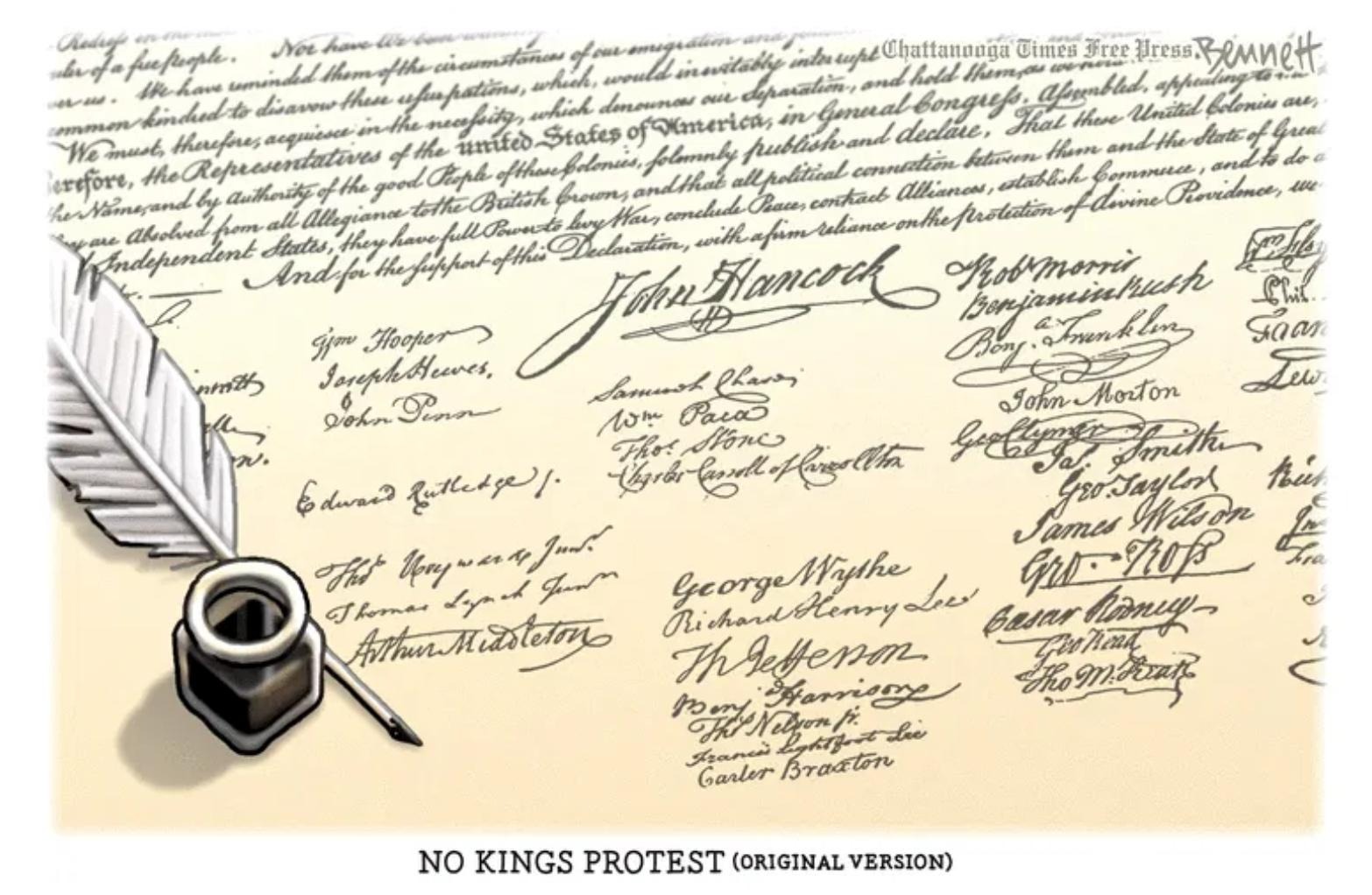
No Kings Saturday, 10/18/25

No kings!

Binding precedent

Protesters have protested at an ICE facility a few miles west of Chicago for the past 19 years—with somewhat more intensity recently following the announcement of Operation Midway Blitz. A month after the announcement, the president federalized the Illinois National Guard. District court: Enjoined. Seventh Circuit: Just so. Political opposition is not rebellion, and a protest doesn’t become a rebellion merely due to a few isolated incidents of violence. Without that, none of the statutory predicates for federalizing the National Guard have been met.

Institute for Justice, Short Circuits for 10/17/25 (bold added). This is now the law in the 7th U.S. Circuit – Indiana, Illinois and Wisconsin.

Look for the Administration to try to provoke a rebellion it can crush. Everyone who’s paying attention knows Trump wants to invoke the Insurrection Act (as he stuffs his pockets and those of his family).

Wanted: a viable counternarrative

Trump’s actions … are part of one project: creating a savage war of all against all and then using the presidency to profit and gain power from it. Trumpism can also be seen as a multipronged effort to amputate the higher elements of the human spirit—learning, compassion, science, the pursuit of justice—and supplant those virtues with greed, retribution, ego, appetite. Trumpism is an attempt to make the world a playground for the rich and ruthless, so it seeks to dissolve the sinews of moral and legal restraint that make civilization decent.

Trumpism, like populism, is more than a set of policies—it’s a culture. Trump offers people a sense of belonging, an identity, status, self-respect, and a comprehensive political ethic. Populists are not trying to pass this or that law; they are altering the climate of the age. And Democrats think they can fight that by offering some tax credits?

To beat a social movement, you must build a counter social movement. And to do that, you need a different narrative about where we are and where we should be heading, a different set of values dictating what is admirable and what is disgraceful. If we fail to build such a movement, authoritarian strongmen around the globe will dominate indefinitely.

David Brooks.

You can’t beat something with nothing. I can’t come up with a political counternarrative to Trumpism. The Democrats can’t come up with a political counternarrative, either. Brooks couldn’t come up with a strong political counternarrative.

I can only hope and pray that people will look for their compelling (counter-)narrative to the Gospel of Jesus Christ. (And that meantime there will be some legal counternarratives to prevent irretrievable damage, as in the preceding item.)

Music Reviews

There may be nothing better than old music reviews to let you know that it’s okay to like what you like, critics be damned.

I like Debussy’s La Mer, and I don’t care what the stupid early reviews said:

On today’s date in 1905, Claude Debussy’s orchestral suite La Mer or The Sea was performed for the first time in Paris. Today this music is regarded as an impressionistic masterpiece, but early audiences — especially those in America — found it rough sailing.

“We clung like a drowning man to a few fragments of the tonal wreck,” wrote a 1907 Boston critic, and suggested that instead of The Sea Debussy should have titled his piece Sea-Sickness.

“The Sea is persistently ugly,” wrote The New York Times that same year. “Debussy fails to give any impression of the sea … There is more of a barnyard cackle in it than anything else.”

And in 1909, this on La Mer from The Chicago Tribune: “It is safe to say that few understood what they heard and few heard anything they understood … There are no themes … There is nothing in the way of even a brief motif that can be grasped securely enough by the ear and brain to serve as a guiding line through the tonal maze. There is no end of queer and unusual effects, no end of harmonic complications and progressions that sound so hideously ugly.”

Ah, the perils of “modern music” in the early 20th century!

Giving the Devil his due, impressionism had to be a real mind-blower for critics attuned to, say, the sonata-allegro form.

Comprehensive tradition

We’re often not very aware of the “tradition” in which we live. A student in a classroom would readily agree that the words of a teacher or professor were a “traditioning” of sorts. But they will fail to notice that how the room is arranged, how the students sit, what the students wear (or don’t wear), how the professor is addressed, how students address one another, what questions are considered appropriate and what are not, and a whole world of unspoken, unwritten expectations are utterly required in the process. The modern world often imagines that “online” education is equivalent to classroom education since the goal is merely the transmission of information. But the transmission of information includes the process of acquiring the information and everything that surrounds it. Those receiving the “tradition” online will have perhaps similar information to those receiving it in a classroom – but they will not receive the same information.

Fr. Stephen Freeman, The Tradition of Being Human

Stages of life

Two questions:

  1. Do I want to read/watch/listen to this?
  2. Should I read/watch/listen to this?

When I was younger the second question often dominated my decision-making. Now that I am officially ancient that question has virtually disappeared and the first one is usually the only one I ask. That’s been the single most notable change in my personality in these my declining years.

Alan Jacobs

Alan is a decade or more younger than me, yet I only very recently seem to have arrived at this point, especially regarding political matters.

Note that he’s talking about a change in personality. This isn’t a life rule. There are things that younger people should read/watch/listen to, in order to become well-formed human beings.

Two ways

[R]evival begins with the people proclaiming, by word and deed, “I have sinned.”

MAGA Christianity has a different message. It looks at American culture and declares, “You have sinned.”

David French

Noteworthy

In the aftermath of Kirk’s murder, we witnessed young people at vigils rather than at “mostly peaceful” demonstrations.

R.R. Reno in First Things


We are all gatekeepers now.

Peggy Noonan

Your enemies are not demonic, and they are not all-powerful and the right hasn’t always lost and the left hasn’t always won. But if you convince yourself of that, you give yourselves all sorts of permission to do a lot of stupid and terrible things under the rubric of “Do you know what time it is?”

Jonah Goldberg.

[A] critical mass of the American people … no longer want[s] to govern themselves, … are sick of this republic and no longer want to keep it if it means sharing power with those they despise.

Nick Catoggio

I don’t do any of the major social media, but I have two sub-domains of the domain you’re currently reading: (a) You can read most of my reflexive stuff, especially political here. (b) I also post some things on my favorite no-algorithm social medium.
Wenesday evening

Poking the Bear

Many sober voices warned that an expansion of NATO to Russia’s border would poke the Bear, leading to an inevitable war. As long ago as 1998, following the U.S. decision to expand NATO eastwards, George Kennan said the following to Thomas Friedman:

I think it is the beginning of a new cold war. I think the Russians will gradually react quite adversely and it will affect their policies. I think it is a tragic mistake. There was no reason for this whatsoever. No one was threatening anybody else. This expansion would make the founding fathers of this country turn over in their graves.

Patrick Deneen. (Link may be inaccurate; I don’t think it was on Substack when I read it.)

Unless we’re prepared to drop our Monroe Doctrine, we ought to be able to understand Russia’s prickliness about Ukraine’s loving glances at the West and the West sidling up to Russia’s “near abroad.”

Spencer Cox

If you had asked me last week to handicap Utah Gov. Spencer Cox’s chances of winning the 2028 Republican presidential primary, I’d have said 1 percent. But after watching him demonstrate impressive moral leadership in calling on Americans to unite after Charlie Kirk’s murder, I’ve changed my mind. It’s zero percent.

The governor is a good man in a party that’s led by hideous people and backed by voters who consider being a hideous person a political virtue

Nick Catoggio

Catoggio continues, pivoting to an important distinction I hadn’t made and that few others seem to have made, either:

Cancel culture, properly understood, is an attempt to bully institutions like businesses into enforcing one faction’s cultural preferences in the absence of moral consensus around those preferences. It doesn’t involve subjects about which we’re all in broad moral agreement, like whether pedophilia should be a crime. It involves subjects about which we disagree, like whether trans women are women. As Thomas Chatterton Williams put it in The Atlantic, “Cancel culture is more fundamentally about solidifying norms that haven’t yet been established.”

That seems like a very sensible way to distinguish “cancellation” of those who celebrate Kirk’s murder from cancellation of those who pointed out that Kirk was no saint (e.g., me, humanizing him) or even demonized him (tastelessly, given the timing).

Is this possible, circular-firing-squad style?

Vacationing in Michigan, I’m struck by all the Marijuana stores. People have spent a lot of money to build or remodel stylish stores in densities that boggle the mind (at least along major roads).

I hate it. So I was heartened by the account of a native Michigander who tells me that competition is so fierce that prices have dropped 91%. That’s one of those facts that’s too good to check. I hope every last one of them is driven out of business by every last one of them.

I’ll spare you catching up on commentary

I’ve been wading through a backlog of reading as my vacation permits. A lot of it, from guttersnipes to established journalists at major publications, comes down to arguing that the other guys are more prone to lethal political violence.

I have concluded (actually, had concluded before Charlie Kirk’s murder) that lethal political violence is bad. I’ve also concluded that the argument about which side is guiltier of it is stupid and likely to be forever inconclusive.

You’re welcome.

Loyalty over competence

Word on the street is that the attorney general is a moron.

Could be. I’m open to the possibility.

Accusing the head of the Justice Department of being an idiot would seem like a lazy smear during any other administration, but Pam Bondi wasn’t selected for her legal acumen. She was picked for the same reason that Kash Patel and Pete Hegseth were, because the president wants the most dangerous arms of the federal government led by people whom he knows will choose him over the law.

When you select for loyalty instead of competence in staffing your government, you’re guaranteeing yourself a higher than usual quotient of morons ….

[Bondi’s moronic comments about “hate speech” and “discrimination” omitted.]

We’re left with two explanations, then. One is that Pam Bondi truly is a moron, irresponsibly BS-ing her way through questions on what can and can’t legally be said in the United States like a 1L who hasn’t done the reading. The other is that Pam Bondi knows what time it is.

In a government distinguished by extreme malevolence and extreme incompetence, it’s hard to tell.

Postliberals don’t worry about what Democrats will do when they return to power because they have the ability right now, or so they believe, to make sure that Democrats never do.

That’s the alternate explanation for Pam Bondi’s “hate speech” comments. She’s not stupid. She just “knows what time it is” and is proceeding accordingly.

Nick Catoggio, riffing off Pam Bondi’s unironic rant and declaration of war against “hate speech.”

Why Tyler Robinson shot Charlie Kirk

I submit that we don’t really know why, and that Nick Cattogio raced just a bit ahead of the evidence here:

Unless the indictment omitted something important, though, the motive was straightforward: Like practically every progressive in this country, he abhorred Kirk’s condemnations of transgenderism. That’s legibly leftist.

Nick Catoggio.

I find that very plausible, but I don’t think we’re to the point where the official allegations or known evidence compel it.

In point of fact, Catoggio and I, as inactive and retired lawyers respectively, probably should be saying “it’s not looking good for him, but Robinson is innocent until proven guilty.”


Your enemies are not demonic, and they are not all-powerful and the right hasn’t always lost and the left hasn’t always won. But if you convince yourself of that, you give yourselves all sorts of permission to do a lot of stupid and terrible things under the rubric of “Do you know what time it is?”

Jonah Goldberg.

[A] critical mass of the American people … no longer want[s] to govern themselves, … are sick of this republic and no longer want to keep it if it means sharing power with those they despise.

Nick Catoggio

I don’t do any of the major social media, but I have two sub-domains of the domain you’re currently reading: (a) You can read most of my reflexive stuff, especially political here. (b) I also post some things on my favorite social medium.

Dateline, Weimar America, 8/28/25

CrackerBarrelGate

This story strikes me as stupid, stupid, stupid. Here, through the voices of others, is why.

The chain was founded in 1969 — not 1776. It adopted the country branding because down-home cooking and folksy kitsch were trendy back then, not because they were trying to restore America to the Good Ole Days. Now, the market has moved on, and Cracker Barrel has been trying to adapt …

We have confused brands with moral values, and we demand to see our politics reflected everywhere, even in restaurant signage. We have also confused social media with social lives. And alone with our screens, too many of us have become addicted to rage, mashing the refresh button for the dopamine that rushes through us every time we discover that someone, somewhere, is wrong on the internet.

The addiction is so consuming that when no ready source of rage is available, we start cooking up our own out of whatever we can find in the cupboard. But if the cupboard is really this bare, I suggest people put down the phone and head to Cracker Barrel, rock themselves to serenity in the chairs on the porch, then head inside for a delicious helping of hashbrown casserole.

Megan McArdle

This, too:

The Cracker Barrel farce … is the first case of “cancel culture” I’m aware of in which the accusers couldn’t articulate why the accused was being canceled. 

Which was to their advantage, I think. An offender charged with a particular thoughtcrime can answer the charge but an offender charged with nothing in particular has little choice but to surrender. Which is what the company did on Tuesday.

Christopher Rufo, probably the New Right’s most influential culture warrior, admitted that he’s never set foot in the restaurant but declared war on it nonetheless in the name of making an example of any business “considering any move that might appear to be ‘wokification.’”

“The Barrel must be broken,” he announced with no apparent irony. If a progressive culture warrior had said something as clownishly imperious, self-important, and Stalinist as that 10 years ago, right-wingers would still be making scornful jokes about it today.

Nick Catoggio.

In a Man-Bites-Dog story, Christopher Rufo recently wrote a little piece that was not knee-jerk shit-stirring! But this episode tells me he hasn’t really mended his ways.

I expect no better from Rufo, frankly, but Hillsdale College has no excuse — and no more respect from me, though I thought very highly of it ten years ago when it was, like I was and am, conservative, not Trumpist. (Two Hillsdale alums, who became expats for a while, were cool on their alma mater well before I was. I guess they read the signs: Hillsdale becoming a caricature of anti-woke education.)

Television rights, National rites

They will never do it, because it’s too tacky to bear, and they don’t need the money, but here’s an interesting thought exercise for media dorks: What would the price be if Swift and Kelce were to sell the live rights to their wedding for television? 

We know the NFL collects more than $110 million for a single playoff game—that’s what Peacock paid, and that was two whole years ago. Your standard live sports deal now hits 10 figures, easy. March Madness gets a billion annually to show college kids bricking 3-pointers. Paramount is set to pay more than $1 billion a year for humans pounding each other inside a steel cage.

A Swift-Kelce nuptial is bigger than all of that, mainly because of Swift, whose fame is vast and fierce, and if you don’t believe that, try criticizing one of her singles on Reddit sometime. There would be outrageous interest for both a live telecast and repeat viewing—you could do remixes, Taylor’s versions, on and on.

I think $500 million. That would be the absolute floor.

Jason Gay, Wall Street Journal

My better half wants a televised wedding opposite the State of the Union address, but that would reduce revenues quite a bit.

That is, I suppose it would reduce revenues. Who knows? I didn’t even know that Travis Kelce wasn’t a quarterback.

Nobel Laureate

FBI agents searched the Maryland home and Washington, D.C., office of former national security adviser John Bolton on Friday morning, reportedly as part of an investigation into his potential mishandling of classified documents. Bolton was not charged or detained during the operation. President Donald Trump—who revoked Bolton’s security clearance and Secret Service protection days into his second term—told reporters he had no prior knowledge of the searches but described Bolton, who has been a sharp critic of Trump in recent years, as “a real sort of a low life” and “not a smart guy.”

The Morning Dispatch

Congratulations, Mr. Bolton! Being described by Donald Trump as “a real sort of a low life” and “not a smart guy” is like winning a Nobel Prize for Integrity and Rectitude.

UPDATE: Even a blind pig finds the occasional acorn, or even a truffle: John Bolton Inquiry Eyes Emails Obtained by Foreign Government – The New York Times. So maybe Bolton actually, technically kinda broke a law. “Show me the man and I’ll show you the crime” (Lavrentiy Beria, Soviet secret police chief).

The most miserable habitation in the world

The fundamental structural problem of our government during the Trump administrations is this: our constitution assumed the George Washington was President. It assumed that our high officials would be men of high character, virtuous men. It assumed that of the American people as well.

So John Adams was dead right in this quote, the last sentences of which are fairly well-known:

While our country remains untainted with the principles and manners which are now producing desolation in so many parts of the world; while she continues sincere, and incapable of insidious and impious policy, we shall have the strongest reason to rejoice in the local destination assigned us by Providence. But should the people of America once become capable of that deep simulation towards one another, and towards foreign nations, which assumes the language of justice and moderation while it is practising iniquity and extravagance, and displays in the most captivating manner the charming pictures of candor, frankness, and sincerity, while it is rioting in rapine and insolence, this country will be the most miserable habitation in the world; because we have no government armed with power capable of contending with human passions unbridled by morality and religion. Avarice, ambition, revenge, or gallantry, would break the strongest cords of our Constitution as a whale goes through a net. Our Constitution was made only for a moral and religious people. It is wholly inadequate to the government of any other.

John Adams, October 11, 1798

This President of the United States is not a virtuous man, but a vicious one. Empowered by shrewd and evil advisors (no more “adults in the room”) and motivated by avarice, ambition, and revenge, he is the whale breaking through the net, pushing the “unitary executive theory” (which wouldn’t be a problem were George Washington President) to the breaking point, turning the Department of Justice into the Department of Revenge and now trying to take over the Federal Reserve System – the better to blow a bubble from the bursting of which we may never recover.

I’m not going to resume lamenting what else bothers me about this administration (David French has some of the receipts), but I thought the fundamental problem, though it is not my original insight, might be helpful to pass along.

Do we have any reason to hope that men and women of high virtue will fill the Oval Office and Congress come 2029?

To be a conservative in 2025 …

To be a conservative in 2025 is to be politically homeless—but perhaps not entirely politically friendless.

At home, the party of Donald Trump—the party of J.D. Vance and Ted Cruz and Marco Rubio and Tucker Carlson, not to mention supposed normies such as Mike Pence, et al.—currently is engaged in answering a question I hadn’t thought anyone was asking: “What would national socialism look like if antisemitism were less of a political priority?”

Kevin D. Williamson

Apropos of the first paragraph, the bulk of Williamson’s column is about how liberals-in-the-American-polarity-sense are starting to discover some timeless truths that just might allow conservatives to become allies if not intimates.

On that lone hopeful note, adieu!


Nick Catoggio:

[A] critical mass of the American people … no longer want[s] to govern themselves, … are sick of this republic and no longer want to keep it if it means sharing power with those they despise.

I don’t do any of the major social media, but I have two sub-domains of the domain you’re currently reading: (a) You can read most of my reflexive stuff, especially political here. (b) I also post some things on my favorite social medium.

May 9, 2025

Trump, Trumpism

Two Americas in a nutshell

America continues divided into two groups. One thinks, “He is something that happened to us.” The tone is shocked, still, and bewildered: Did I live in this country all this time and not understand it? The other thinks, “He is something we did.” The tone is pride and, still, surprise: I didn’t know we could seize things back.

Peggy Noonan

Ends and means

How can it be wrong when it feels so right?

I’ve now listened to two podcasts in which journalist Batya Ungar-Sargon defends Trump.

I don’t think she really believes it. Some verbal tics when challenged suggest she doesn’t really believe it (notably, her repeated retreats into “I’m just a journalist explaining why people like him” when that’s plainly false). I suspect she has just found a niche (Center-Left Journalist Becomes Ardent Trump Defender!) that gets attention.

But whether or not she believes it, most of it is gibberish, nonsense-on-stilts — and it ignores Trump’s norm-breaking, due process and other constitutional violations, focusing on the (supposed) policy goals which (refrain) 80% of voters want, so they’re entitled to it immediately.

Well no, they’re not necessarily entitled to it at all, let alone immediately. The Constitution of the United States is deliberately counter-majoritarian in several of its structural provisions (e.g., the Electoral College and the Senate) and even more of the Bill of Rights.

Even the “right” policy, if executed unconstitutionally, is wrong.

I’m resolved not to inflict Batya Ungar-Sargon on myself again. She’s a vexation to my soul. But I’m still waiting for a coherent defense of Trump. Surely I’m missing something.

Conservative critics of Trumpism

Perhaps the most frustrating thing about being a conservative critic of Trumpism is that you often start by agreeing with Trumpworld about ends while disagreeing about means.

This pleases nobody. The left, broadly speaking, considers the ends as illegitimate as the means, and the pro-Trump right thinks that if you’re against the means you really don’t desire the ends. I’m against the abuse of power, even for my own “side.”

Jonah Goldberg, Right Ends, Wrong Means

Gangster government

When Amazon reportedly considered displaying the added cost of tariffs on the price of items, Trump was furious. Here’s what an official anonymously told CNN: “Of course he was pissed. Why should a multibillion-dollar company pass off costs to consumers?” Fascinating. This is like when socialists, during the pandemic inflation, were talking about how greedy grocery store owners were to let prices go up. This is so phenomenally economically illiterate. Their argument is that Amazon should absorb the cost of the tariffs? What they really want is for Amazon not to point the tariffs out.

So Trump called Jeff Bezos, perhaps threatening to use the full weight of the U.S. government to make his life miserable (though Trump later described him as a “good guy” and said that Bezos “solved the problem very quickly.”). Amazon then told CNN “this was never approved and [was] not going to happen.” Right. . . so we’re in a gangster government now. The White House will personally target you if you don’t comply with their harebrained schemes. That’s a nice logistics and web services company you got there, Jeff, would be a real shame if the U.S. government went after it. Even Jeff Bezos—a man who is flying ladies to space for fun—caved. Our gangster government means conservative values are whatever Trumpo says they are, capisce? And Trumpo says it’s tariffs—or your other option is to buy $MELANIA coin, do you hear me? [Knee digs deeper into neck.] Am I not being clear, Jeff? Do I gotta enunciate more, Jeff?

Speaking of gangsters, a new private club for MAGA has launched in D.C. It’s called Executive Branch, and the membership fee is $500,000. Well, do you want your corporate merger approved or not?

Nellie Bowles

The great film menace

Of Trump’s Tweeted Truthed declaration Sunday, declaring that foreign flicks are a National Security threat and authorizing institution of “a 100% Tariff on any and all Movies coming into our Country that are produced in Foreign Lands.” (Since when do we tariff national security threats, by the way!?)

Hollywood and its foreign counterparts are “reeling” today from Sunday’s post, with studio executives reportedly convening emergency calls to plot a way forward financially. Billions of dollars and countless jobs here and abroad will turn on a random thought that the president had, one which he may or may not lift a finger to follow through on … We’re all living in a demented baby boomer’s endless nostalgia trip.

Nick Catoggio (emphasis added).

It never was about antisemitism

What you will not find in the [Secretary of Education Linda] McMahon letter [to Harvard] is any mention of the original justification for the Trump administration’s ongoing assault on elite universities: anti-Semitism. As a legal pretext for trying to financially hobble the Ivy League, anti-Semitism had some strategic merit. Many students and faculty justifiably feel that these schools failed to take harassment of Jews seriously enough during the protests that erupted after the October 7, 2023, terrorist attack on Israel by Hamas. By centering its critique on that issue, the administration was cannily appropriating for its own ends one of the progressive left’s highest priorities: protecting a minority from hostile acts.

Now, however, the mask is off. Aside from one oblique reference to congressional hearings about anti-Semitism (“the great work of Congresswoman Elise Stefanik”), the letter is silent on the subject. The administration is no longer pretending that it is standing up for Jewish students. The project has been revealed for what it is: an effort to punish liberal institutions for the crime of being liberal.

Rose Horowitch, Trump Finally Drops the Anti-Semitism Pretext

Crypto

Were I not already leery of cryptocurrency as a scam, Trump’s creation of a même-coin on the cusp of his second term, and the way it’s being openly used to buy access to him (putting untold millions of actual U.S. dollars into his pockets), would have made me leery.

Another impeachable offense (foreign emoluments clause, for instance), but I’m pissing into the wind to note that.

Congress’ default

Congress is not doing its job, and the vacuum that its dereliction has created is encouraging presidential and judicial overreach. Congress’s weakness is our deepest constitutional problem, because it is not a function of one man’s whims and won’t pass with one administration’s term. It is an institutional dynamic that has disordered our politics for a generation. It results from choices that members of Congress have made, and only those members can improve the situation. It is hard to imagine any meaningful constitutional renewal in America unless they do.

[Newt] Gingrich advanced an almost-parliamentary model of the House of Representatives. He empowered the speaker and majority leader at the expense of the policy-focused committees, and set in motion a process that robbed most members of the opportunity for meaningful legislative work. His moves dramatically accelerated what was by then a 20-year trend toward the centralization of authority in the hands of congressional leaders. House leaders of both parties have pushed further in that direction in this century, and the Senate has largely followed suit. These efforts were intended to make Congress more effective, but in practice, they rendered most legislators almost irrelevant.

As a result, many ambitious members of Congress have concluded that their path to prominence must run not through policy expertise and bargaining in committees but through political performance art on social media and punditry on cable news. Our broader political culture has pushed in the same direction, encouraging performative partisanship. And the narrowing of congressional majorities has put a premium on party loyalty, further empowering leaders, and leaving many members wary of the cross-partisan bargaining that is the essence of legislative work.

In his first 100 days, Donald Trump signed only five bills into law—fewer than any other modern president. In a period rife with constitutional conflict in Washington, the first branch has done essentially nothing.

Yuval Levin

Since Levin wrote this, Congress has gotten on the stick by passing the vital bill to rename the Gulf of Mexico. Marjorie Taylor Greene led the charge. And if that’s not serious enough for you, you’re probably out of luck.

Excerpts from Sully

  • “The Trump admin was about to send a former POLICE OFFICER to be imprisoned in El Salvador without trial because an ICE officer looked at his social media and said his ‘hand gestures’ meant he was a gang member,” – Aaron Reichlin-Melnick.
  • Bonus track (Not Suitable For Work) about the decor of the Trump Oval Office.

Andrew Sullivan

Without Comment

Other stuff

Transing the gay away isn’t entirely new

“It is of interest to note that [the patient’s family] were all reassured to discover that George was not a homosexual. The diagnosis of ‘transexual’ provided an explanation for his feminine behavior and was, especially for the parents, psychologically relieving,” – a 1970 report on teen transition..

Andrew Sullivan

Sports stadiums, data servers, and other boondoggles

Writing in Reason, Marc Oestreich explores what data server farms and new sports stadiums have in common. “The recent announcement that Microsoft is investing over a billion dollars into a vast new data center campus in La Porte, [ Indiana], is expected to be transformational for the town of 22,000 people. Microsoft was given a 40-year tax abatement on equipment, a renewable state sales tax exemption through 2068, and just $2.5 million of payments in lieu of taxes (PILOT) over four years—roughly 30 percent of what it would normally owe. After that? Nothing. Local utilities would cover the infrastructure.” For Oestreich, this sounds familiar. “Just 60 miles up the toll road sits Soldier Field, home of the Chicago Bears. The stadium’s 2002 post-modern renovation cost $587 million, $387 million of which was shouldered by taxpayers. Two decades and two dozen quarterbacks later, Chicago only has $640 million (thanks to $256 million in interest) left to pay,” Oestreich writes. “Today’s stadium boondoggle is a server farm … The sales pitch is nearly identical to the stadium era: ‘It’ll create jobs. It’ll put us on the map. It’s worth the investment.’”

The Dispatch

NYT stylesheet

A friend drew my attention to a January 21, 2025 article in the New York Times. The topic was the Trump administration’s effort to limit the scope of birthright citizenship, the constitutional provision that accords citizenship to anyone born in the United States. The article’s title: “Undocumented Women Ask: Will My Unborn Child be a Citizen?” When the issue is abortion, the New York Times would never dream of referring to an “unborn child.” Apparently, that editorial discretion falls away when illegal immigration is under discussion.

R.R. Reno (hyperlink added)

Datapoint

College is just how well I can use ChatGPT at this point.

Quoted in the Dispatch from a New York Magazine article.

A lighter note

We have seen some of the most grotesque costumes, along the line of the railroad, that can be imagined. I am glad that no possible combination of words could describe them, for I might then be foolish enough to attempt it.

Mark Twain, The Innocents Abroad


Your enemies are not demonic, and they are not all-powerful and the right hasn’t always lost and the left hasn’t always won. But if you convince yourself of that, you give yourselves all sorts of permission to do a lot of stupid and terrible things under the rubric of “Do you know what time it is?”

Jonah Goldberg.

Regarding said “lot of stupid and terrible things,” my failure to call out anything about the current regime does not mean I approve. There’s just too much, and on some of the apparent illegalities I don’t want to abuse my credentials without thinking it through.

I don’t do any of the major social media, but I have two sub-domains of the domain you’re currently reading: (a) You can read most of my reflexive stuff, especially political here. (b) I also post some things on the only social medium I frequent, because people there are quirky, pleasant and real.

Saturday. 3/29/25

Our third-leading export

Much of what Illich had to say to those bright-eyed students preparing to spend their summer volunteering in Mexico are summed up in these early lines:

“I do have deep faith in the enormous good will of the U.S. volunteer. However, his good faith can usually be explained only by an abysmal lack of intuitive delicacy. By definition, you cannot help being ultimately vacationing salesmen for the middle-class ‘American Way of Life,’ since that is really the only life you know.”

Illich recognized that “development” work, as it was happening in the 1960s, was, in fact, a vehicle by which a whole complex nexus of values and systems was being exported to and imposed upon the “under-developed” world, and ultimately in such a way that the recipients of this aid would be subjected to new forms of poverty and dependence—“modernized poverty,” as Illich called it elsewhere.

Illich tells his audience that “next to money and guns, the third largest North American export is the U.S. idealist, who turns up in every theater of the world: the teacher, the volunteer, the missionary, the community organizer, the economic developer, and the vacationing do-gooders”—to which list, of course, we can add the tech evangelist. It is then that he drops this devastating line:

Perhaps this is the moment to instead bring home to the people of the U.S. the knowledge that the way of life they have chosen simply is not alive enough to be shared.

L. M. Sacasas, To Hell With Good Intentions, Silicon Valley Edition

On “going home again”

‘Young man,’ he said, ‘don’t you know you can’t go home again?’ And he went on to speak of the advantages, for a young writer, of living in New York among the writers and the editors and the publishers.

The conversation that followed was a persistence of politeness in the face of impossibility. I knew as well as Wolfe that there is a certain metaphorical sense in which you can’t go home again – that is, the past is lost to the extent that it cannot be lived in again. I knew perfectly well that I could not return home and be a child, or recover the secure pleasures of childhood.

But I knew also that as the sentence was spoken to me it bore a self-dramatizing sentimentality that was absurd. Home – the place, the countryside – was still there, still pretty much as I left it, and there was no reason I could not go back to it if I wanted to.

Wendell Berry, The World-Ending Fire

More from the same source:

Our model citizen is a sophisticate who before puberty understands how to produce a baby, but who at the age of thirty will not know how to produce a potato.

Extremisms

Knee-jerk whataboutism—citing left-wing extremism to brush away concerns of right-wing extremism—is a way of saying, effectively, “I don’t actually care about right-wing extremism. Left-wing extremism is so overwhelmingly bad it’s okay to turn a blind eye to the conspiracy theorists, thugs, and terrorists on my side.”

Paul D. Miller, The Deer, the Lion, the Beast, and the Serpent

Capital rights, human rights

Slavery was never less than a statement about the sovereignty of capital, and its rights, in relation to human rights. In the South, economic restrictions on religious organization by black Christians was part and parcel of the racial system undergirding slavery and the marginalization of free African Americans.

Mark A. Noll, America’s God

Terribly prophetic

When you have attention, you have power, and some people will try and succeed in getting huge amounts of attention, and they would not use it in equal or positive ways.

Daniel Goldhaber, “the Cassandra of the Internet Age.”

The big tech platform debates about online censorship and content moderation? Those are ultimately debates about amplification and attention. Same with the crisis of disinformation. It’s impossible to understand the rise of Donald Trump and the MAGA wing of the far right or, really, modern American politics without understanding attention hijacking and how it is used to wield power … the attempted Capitol insurrection in January [2021] was the result of thousands of influencers and news outlets that, in an attempt to gain fortune and fame and attention, trotted out increasingly dangerous conspiracy theories on platforms optimized to amplify outrage.

Charlie Warzel

Laying waste to cynicism

Unlike cynicism, hopefulness is hard-earned, makes demands upon us, and can often feel like the most indefensible and lonely place on Earth. Hopefulness is not a neutral position either. It is adversarial. It is the warrior emotion that can lay waste to cynicism.

Nick Cave via Annie Mueller via Dense Discovery 331


I suffer more from the humiliations inflicted by my country than from those inflicted on her.

Simone Weil, from a letter to Georges Bernanos.

[N]one of the things that I care about most have ever proven susceptible to systematic exposition.

Alan Jacobs, Breaking Bread With the Dead

I don’t do any of the major social media, but I have two sub-domains of the domain you’re currently reading: (a) You can read most of my reflexive stuff, especially political here. (b) I also post some things on the only social medium I frequent, because people there are quirky, pleasant and real.

Of adolescent “gender medicine”

A few years ago (confirmation hearings, I suspect):

[U.S. Surgeon General nominee Rachel] Levine refused to answer, choosing merely to say that “transgender medicine is a very complex and nuanced field with robust research and standards of care that have been developed.” Paul hit back that “the specific question was about minors,” and accused Levine of having “evaded the question.” Paul continued: Do you support the government intervening to override the parent’s consent to give a child puberty blockers, cross-sex hormones, and/or amputation surgery of breasts and genitalia? You have said that you’re willing to accelerate the protocols for street kids. I’m alarmed that poor kids with no parents, who are homeless and distraught, you would just go through this and allow that to happen to a minor.

Rand Paul Demands Answers on Puberty Blockers for Minors (February 2021)

That “robust research and standards of care” is essentially a incestuous echo chamber. In that echo chamber, “everybody knows” some things that aren’t true. But gradually, clarity intrudes, first in the Cass Report from Great Britain, most recently on Thursday just passed:

There were a couple of moments in the oral arguments in US vs. Skrmetti this week that were truly clarifying, I think. The first was about suicides among children and teens with gender dysphoria. They are — as the ACLU lawyer, Chase Strangio, finally conceded when questioned by Justice Alito — “thankfully and admittedly rare.”

That’s a big deal. It’s a big deal because the most common argument used by doctors and activists for child sex-changes for years is that if the kids do not transition, they will kill themselves. “Do you want a dead son or a live daughter?” is the question that has been repeatedly, routinely, posed to freaked-out parents with a dysphoric child. That’s why the Biden administration routinely refers to life-saving “gender-affirming care.” It’s transition or death. In every discussion I have ever had on this topic with someone who supports sex changes for kids, this has always been the first point raised.

We sometimes think of this trans controversy as a debate about civil rights and medicine. But it is useful at times to step back and truly grasp the radicalism of the ideology fueling the “LGBTQIA+” movement, to see what its vision of humanity is. We are socially constructed abstractions, not bodies. We have no core sex. The core goal of critical gender and queer theory — which is what is behind the child sex change craze — is to end the sex binary entirely as an organizing principle for our society. It is to remove nature from our understanding of what it means to be human. It is as extreme in its epistemological gnosticism as in its philosophical nihilism.

It is not about helping the few, and never has been. It’s about revolutionizing us all.

Andrew Sullivan

He’s not wrong. But M. Gessen seems more wrong than right:

Trans and gender-nonconforming people have existed as long as humans have used gender to organize themselves — think Joan of Arc; think Yentl; think many, many real and fictional people in-between — but in Western culture, it’s only in the last half-century that trans people have asserted ourselves as a group. It was only when we became more visible that the onslaught of new discriminatory laws began.

M. Gessen (f/k/a Masha Gessen) at the New York Times.

Two observations:

  1. “Trans and gender-nonconforming people” don’t belong together as a category. Lumping them together feeds the fad Andrew Sullivan calls “transing away the gay,” whereby gender-nonconforming adolescents are told “Maybe you’re a boy in a woman’s body” (or vice-versa), which isn’t a real thing.
  2. It’s nothing new for subterranean activity to be ignored by the law until it surfaces (“asserts itself”). Then, sometimes, the law decides it’s bad and disfavors it in various ways. There’s even a maxim for it: the law isn’t made until first it’s broken. An assertive movement based on the fantasy of women in men’s bodies and vice-versa is likely to be rejected fairly decisively.

Finally, Nellie Bowles may have the best response to the nonsense — mockery:

Chase Strangio is on the wrong side of the vibe shift: The Supreme Court this week heard arguments over whether to strike down Tennessee’s ban on medical gender transitions for minors (i.e., no puberty blockers, cross-sex hormones, or surgeries till 18). The ACLU sent their most famous lawyer and the face of the organization, Chase Strangio, to argue the case. Before things started, Chase laid out the stakes to CNN’s Jake Tapper: “These are young people who may have known since they were two years old exactly who they are, who suffered for six, seven years before they had any relief.” So: a two-year-old. When I say to my two-year-old that she’s a funny bunny, she says, “No, kitty cat.” Which to me indicates an extremely advanced and gifted conception of herself. Anyway. Surgery for her tail is next week. She has been consistent that she’s a “kitty cat” for months now. She wears kitty cat ears, a woeful stand-in for the real thing that I’m sure some excellent doctors can arrange.

Justice Ketanji Brown Jackson compared banning medical transitions for minors to bans on interracial marriage. I’m no legal scholar, but it honestly must be fun for your job to just come up with crazy analogies and throw them back at terrified lawyers. I’m just not sure I see the connection she’s making, but I also sometimes throw spaghetti at the wall when nothing’s working. It’s my “why not” business strategy. It’s the “you know what else was illegal once? Interracial marriage” approach.

Nellie Bowles

The reality as it comes to me is that many kids with gender dysphoria are working through a growing awareness of attraction to their own sex. We know how tumultuous modern adolescence is, and confusion about sexuality adds yet another layer of tumult.

Given time, and denied “affirmation” that the real them is trapped in the wrong body (though not denied love and “watchful waiting” medical and psychological care), they emerge as fairly well-adjusted homosexuals. Affirmed, too many of them only later realize that they and they enablers were too hasty, and they de-transition insofar as the changes wrought are reversible.

Maybe that’s just something I picked up in my echo chamber, but I haven’t heard anyone deny the part about “watchful waiting” leading to resolution without transition — or, rather, the only denial I’ve heard is the bogus “live daughter or dead son” trope.


I suffer more from the humiliations inflicted by my country than from those inflicted on her.

Simone Weil, from a letter to Georges Bernanos.

I don’t do any of the major social media, but I have two sub-domains of the domain you’re currently reading: (a) You can read most of my reflexive stuff, especially political here. (b) I also post some things on the only social medium I frequent, because people there are quirky, pleasant and real.

Sunday, October 27

Booknotes

From Mark A. Noll, America’s God from Jonathan Edwards to Abraham Lincoln.

The startling reversal in which America’s religious leaders took up the language of republicanism was the most important ideological development for the future of theology in the United States.

Mark A. Noll, America’s God from Jonathan Edwards to Abraham Lincoln.

[I wish I had a better handle on this very central thesis of Noll’s dense book. All I really can say is that American Christians were essentially alone in embracing republicanism; European Christians rejected it fairly vehemently.]

Although identifiably evangelical churches by 1860 made up the vast majority of American congregations (at least 85%), these churches did not present a homogeneous faith. In fact, evangelicals fought each other over a host of Streitpunkte—over how to interpret the Scriptures; over the definition of many Christian doctrines, including human free will, the atonement, eschatology, the meaning of the sacraments, and the nature of the church; over slavery and other social issues; over the ecclesiastical roles of women and laymen; over whether to sing hymns or psalms only; over whether churches should use creeds; over principles and practices of the market economy; and over every imaginable kind of personality conflict. … Evangelicals called people to acknowledge their sin before God, to look upon Jesus Christ (crucified—dead—resurrected) as God’s means of redemption, and to exercise faith in this Redeemer as the way of reconciliation with God and orientation for life in the world.

The most important conclusion that can be drawn from a survey of writings about money, markets, and the economy in this period is that Protestants regularly, consistently, and without sense of contradiction both enunciated traditional Christian exhortations about careful financial stewardship and simply took for granted the workings of the United States’ expanding commercial society.

Finney’s Lectures on Revivals of Religion (1835), which is discussed at greater length below in chapter 15, was important for summarizing a new approach toward reaching the lost. Since God had established reliable laws in the natural world and since humans were created with the ability to discern those laws, it was obvious that the spiritual world worked on the same basis. Thus, to activate the proper causes for revivals was to produce the proper effects: “The connection between the right use of means for a revival and a revival is as philosophically [i.e., scientifically] sure as between the right use of means to raise grain and a crop of wheat. I believe, in fact, it is more certain, and there are fewer instances of failure.” Because the world spiritual was analogous to the world natural, observable cause and effect must work in religion as well as in physics. The wine of revival—confidence in God’s supernatural ability to convert the sinner—may have looked the same in antebellum America as it had in earlier centuries, but the wineskin was of recent manufacture.

[Finney’s “scientific” revivalism strikes me as a terrible error, but a persistent one. However, this mechanistic approach has been instantiated in evangelistic crusades during my adolescence, and I assume since then as well. The rising and falling of the preaching voice; the shouting followed by the whisper; these are the rhetorical tricks (science) to get people to “make decisions for Jesus” – or Amway or Tupperware or just about anything else.]

On that score there was for Smith not a dime’s worth of difference between Samuel Miller and John Henry Hobart. Through a life of energetic peripateticism (from Lyme, Connecticut, to Vermont and then Portsmouth, New Hampshire, later to Boston, Philadelphia, Providence, and Portland, Maine), as well as frequent redirection of career (as minister—successively Baptist, “Christian,” Universalist, and “Christian” again—physician, dentist, publisher, and merchant), and in the midst of incessant polemical creativity, one thing remained constant for Elias Smith. His anchor was unshakable belief in a radically egalitarian biblicism. If the religion of formalist Presbyterians and Episcopalians was tinctured with American values, Smith’s religion represented a more complete assimilation. That religion was, in the words of a solid recent biography, “a specifically Christian republicanism growing out of a New Light evangelical heritage, conjoined with a rapidly evolving national political culture in a climate of strident partisan conflict.”46 Smith was especially important as a founder of New England’s “Christian” movement, a radically antielitist drive that sought a harmonious, unified church for all who wished to live according to the New Testament’s “perfect law of liberty.” To build such a church, however, it was necessary to clear away traditional biblical interpretations, traditional denominations, and traditional clerical authority.

“The Bible is to the theologian what nature is to the man of science. It is his store-house of facts; and his method of ascertaining what the Bible teaches, is the same as that which the natural philosopher adopts to ascertain what nature teaches…. The duty of the Christian theologian is to ascertain, collect, and combine all the facts which God has revealed concerning himself and our relation to Him. These facts are all in the Bible.” On the basis of these assertions, Hodge then went on to suggest that “the Theologian [is] to be guided by the same rules as the Man of Science.”

[I once admired Hodge, and would have been pleased, if not thrilled, by this declaration.]

[No longer. But this sort of approach was part of how “America’s God” became so unlike the true God.]

Selective resistance to secularity

In his book Fault Lines, Voddie Baucham argues that

The social sciences may be useful tools, but they are far from necessary. ‘All Scripture is breathed out by God and profitable for teaching, for reproof, for correction, and for training in righteousness, that the man of God may be complete, equipped for every good work’ (2 Timothy 3:16–17). In no area does God require me to walk in a level of righteousness for which the Scriptures do not equip me — including any and all aspects of justice.

The logic of Baucham’s argument, which permeates his book, is that the Bible is enough. It is enough to parse the complexity of race in the United States, and enough to provide a roadmap for justice. Let’s be clear: Baucham agrees that the gospel has social implications. He is also clear that the social sciences are simply unnecessary to illuminate what those social implications are, and how the gospel compels us to act.

This is, in fact, explicitly outlined in the Dallas Statement:

We deny that Christian belief, character, or conduct can be dictated by any other authority, and we deny that the postmodern ideologies derived from intersectionality, radical feminism, and critical race theory are consistent with biblical teaching. We further deny that competency to teach on any biblical issue comes from any qualification for spiritual people other than clear understanding and simple communication of what is revealed in Scripture.

According to Baucham and the signers of the Dallas Statement, the claim that secular scholarship is necessary to understand and address the contemporary racial landscape are violating the doctrine of sufficiency, and compromising their fidelity to Scripture. Despite passing affirmations that Christians ought to read broadly, insofar as it pertains to matters of race and justice, Baucham, et al., clearly view secular scholarship as suspect, and inessential to comprehending and shaping responses to the social problems we face.

Of course, in their view, not all secular sources are suspect. Many of the signers of the Dallas Statement happily employ the work of James Lindsay or Thomas Sowell in their analysis of our social realities. The real concern lies in a particular set of sources: “postmodern ideologies derived from intersectionality, radical feminism, and critical race theory.” It is these sources which consume massive amounts of energy expended by Owen Strachan, Voddie Baucham, Tom Ascol, and many others. Summarized by many under the slushy appellation “wokeness,” these writers are convinced that reliance on anything that smacks of woke is deleterious to the faith given once for all to the saints.

Josh Fenska, Thin Discipleship


Religious ideas have the fate of melodies, which, once set afloat in the world, are taken up by all sorts of instruments, some woefully coarse, feeble, or out of tune, until people are in danger of crying out that the melody itself is detestable.

George Elliot, Janet’s Repentance, via Alan Jacobs

You can read most of my more impromptu stuff here and here (both of them cathartic venting, especially political) and here (the only social medium I frequent, because people there are quirky, pleasant and real). All should work in your RSS aggregator, like Feedly or Reeder, should you want to make a habit of it.

Sunday, 10/20/24

Good news for Kings and Princes

Predictably, secular authorities convinced by the reformers’ truth claims liked the distinction drawn between the necessity of obedience to them and of disobedience to Rome. They liked hearing “the Gospel” accompanied by such “good news”—it would allow them, for starters, to appropriate for themselves all ecclesiastical property, including the many buildings and lands that belonged to religious orders, and to use it or the money from its sale in whatever ways they saw fit. In two stages during the late 1530s, seizing for himself the vast holdings of all the hundreds of English monasteries and friaries, Henry VIII would demonstrate how thoroughly a ruler could learn this lesson without even having to accept Lutheran or Reformed Protestant doctrines about grace, faith, salvation, or worship.

Brad S. Gregory, The Unintended Reformation

Repentance in a nutshell

Repentance is everything you do to get sin, those inborn passions, out of you. It’s reading, thinking, praying, weeding out disruptive influences in your life, sharing time with fellow Christians, following the guidance of the saints. Repentance is the renunciation of what harms us and the acquisition of what is beneficial to us, writes a holy counselor.

Dee Pennock, God’s Path to Sanity

Prayer of Penitence

The prayer of penitence leads us to reflect critically on our own lives. If it is uttered sincerely, it leads us to repent in humility, not just of particular wrongs we have done, but of our whole shameful and degraded state of being. The paradox is that, far from leading to lethargy or despair, such penitence brings a new kind of strength. Sexual sin is never merely sexual, but always has motives that are rooted in the passions—whether the need to be loved, or the lust for domination, or the desire to prove oneself attractive, or any of a dozen other motives that come readily to mind.

Frederica Mathewes-Green & Rod Dreher, Healing Humanity

The worth of a man

… to believe that wealth is the only significant measure of the worth of an individual, a family, or a community is to reject the teaching of nearly every religion and wisdom tradition that ever was.

Mark Mitchell and Nathan Schlueter, The Humane Vision of Wendell Berry

Option preclusion

[T]he move from taking God for granted to disputing God’s existence is a move from naïve to reflective, from a position where one set of options is precluded to a position where that set of options is fully available. Underlying that move, however, is the move from porous to buffered selves, and that is a move from naïve to naïve. It is, in other words, a move from a position where one set of options is precluded to a position where another set of options is precluded.

William T. Cavanaugh, The Uses of Idolatry

Perdition

Miles Smith, Perdition. Potent.

Caveat: This touches on American electoral politics.

Historical views of the Rapture

Do you want to be like Tim?

If you are a writer or pastor who wants to preach like [the late Tim] Keller, you won’t get there if your strategy is “listen to Keller and copy him.” Keller himself would tell you that that’s a terrible idea.

Instead, do what Tim did: Go to seminary. After seminary, read everything George Whitefield wrote. Read Calvin’s Institutes and his sermons. Read The Lord of the Rings over and over and over. Read everything C. S. Lewis ever wrote. Read every Puritan paperback from Banner of Truth. Read sociology. Read social theory. Read Bavinck. Read current events books and a steady line up of journalists. Do all of that within the context of a family alongside your spouse and while talking to people facing ordinary life problems who are in need of counsel and aid and think about how to explain what you’re learning to them in ways that are sensible to them. Lewis had a rule that if he couldn’t say something in a way an ordinary British person could understand it meant that he wasn’t ready to say that thing yet. Follow that rule.

That is how you become a good missionary.

Jake Meador.

Heh, heh, heh! You had me going there for a minute, Jake. What’s the quick way to preaching like Tim Keller? I don’t want to be faithful for decades and decades with no assurance that I’ll ever become famous; I want a surefire to fame by next year.

East versus West

The thing is the cultural habit of rationalizing and abstracting has also made serious inroads into Catholic life and practice in the West. The crisis, Kingsnorth concluded, is not so much one of Catholic versus Protestant as it is of Eastern Christianity versus Western Christianity. It is a conclusion I arrived at not long after I left Catholicism for Orthodoxy in 2006, the result of a great spiritual trauma. I had thought of Catholicism as a mystic-friendly form of Christianity—which it is, but only by comparison to Protestantism. When seen from the East, both Catholicism and Protestantism—in the West, at least—are marooned primarily in the head and are futilely trying to think their way out of the civilizational shipwreck of the modern West.

Though Orthodoxy shares with Catholicism a fundamentally sacramental metaphysics, in practice Orthodoxy is far more mystical, emphasizing that the conversion of the heart must precede the conversion of the intellect. It does not deny the intellect, only orders it within an anthropological hierarchy.

One aspect of Orthodoxy that particularly appealed to Kingsnorth is its panentheism—the principle that God is, as the Orthodox prayer says, “everywhere present and filling all things.” It’s not the same as pantheism, which says that the material universe is God. Orthodoxy teaches that God is separate from his creation but also interpenetrates it with his energies, or his force. Consider how the warmth and pleasant glow of an English hillside on an August afternoon occur because the faraway sun penetrates the grass, the flowers, and the earth with its energies. The hillside is not the sun, but it testifies to the presence of the sun in its material being.

“The earth is not God, but God is there, present in nature, not in some far-off heaven,” Kingsnorth says. He goes on: “He’s deeply entwined in everything. Creation is the book of God, as Augustine said, I think. That is explicitly recognized in Orthodoxy. So what I was finding, weirdly enough, was a sort of ancestral Christianity that my ancestors in England would have had access to, and that the early Celtic saints certainly had access to. When I became Orthodox, a lot of people said to me, ‘Welcome home,’ and, strangely, it did feel like I was coming home. It felt like there’s something here that we had, that we lost.”

Rod Dreher.

I’ve been a fan of most of Rod Dreher’s books since Crunchy Cons. I want to distinguish his books from his columns, which I have frequently disagreed with. I also concede that one of his books was too raw, too transparent, too kiss-and-tell for my tastes.

Rod has been through a lot — openly for the last two years or so, quietly for a decade before that. Oh, heck: he’s been through a lot his whole life, much at the hands of family who lived in Louisiana at an extreme end of insularity. It’s hard to imagine a family that felt no pride in a member making it fairly big in New York City publishing because he dared to leave home, a family that affirmatively poisoned the minds of the next generation with refrains that Uncle Rod was uppity and no damn good.

I think he’s coming out of it, but he thought he had come out of it when he wrote How Dante Can Save Your Life. He’s voting for Donald Trump because Trump is the enemy of his enemies.. I cannot. I’m more with Miles Smith: “don’t tell me it is anything other than tragic that either of the two leading candidates for the presidency will eventually govern the American republic.”

Rod has a new book coming out tomorrow. It may be his most important; I’ve had it on pre-order for months.

This rave review struck me as capturing what’s special about Rod:

Dreher has an uncanny ability to articulate how religious conservatives feel, even to pre-empt it. Previous books gave us the Crunchy Cons (2006), whose eponymous conservatives want to turn the clock back; The Benedict Option (2017), which meant opting out of liberal culture; and Live Not By Lies (2020), which drew a line between “Marxist” and “woke”.

I can attest, spending much time among devout Christians, that Dreher has done it again, capturing our present mood: we’re trapped between wanting to throw ourselves into movement politics to defeat The Beast, or looking inwards in the hopes of becoming the change one wants to see in the world. Many of us are asking whether the best service we could do to Christianity is simply to become better Christians.

(Boldface added.) If you doubt that he has pre-empted conversations, ask yourself how often you’ve encountered the term “the Benedict Option,” which is literally his coinage.

These are a few of my favorite things

[N]one of the things that I care about most have ever proven susceptible to systematic exposition.

Alan Jacobs, Breaking Bread with the Dead

Christian fruits

“My people have been oppressed for nearly 2000 years. For 1200 years they endured Dhimmitude, a system of oppression made for the sole purpose of humiliating & breaking them. Today they face persecution in their homeland. And yet I don’t know of a single Coptic terrorist. Do you?”

Samuel Tadros.

Preaching the Gospel

“How do I get saved?” is not the gospel. And “So, would you like to get saved?” is not preaching the gospel.

Fr. Andrew Stephen Damick, Arise, O God

Pride

If you hide the gifts you have been given in order to appear humble, then you are very proud indeed. Wishing to appear humble is the worst form of pride.

Vassilios Papavassiliou, Thirty Steps to Heaven


Religious ideas have the fate of melodies, which, once set afloat in the world, are taken up by all sorts of instruments, some woefully coarse, feeble, or out of tune, until people are in danger of crying out that the melody itself is detestable.

George Elliot, Janet’s Repentance, via Alan Jacobs

You can read most of my more impromptu stuff here and here (both of them cathartic venting, especially political) and here (the only social medium I frequent, because people there are quirky, pleasant and real). All should work in your RSS aggregator, like Feedly or Reeder, should you want to make a habit of it.

Wednesday, 10/16/24

Not Politics

Iatrogenic Customer Dissatisfaction

I took my Lincoln into the dealer last week because wiper fluid wouldn’t spray. They fixed it and suggested wiper blades, too.

I of course got a Customer Satisfaction Survey afterword because — well, this is Weimar America 2024.

In my value system, a 3 out of 5 means this was a perfectly okay experience, no problem. I don’t expect bliss or epiphanies from a car repair.

But to Ford-Lincoln, anything less that straight 5s triggers a message to the dealer that it desperately needs to call me to fix things. So the dealer called, and I told him his corporate overlords are idiots.

And then, incredibly, another survey came to ask whether the dealer called me, and now what are my answers to the other questions (how likely are you to recommend, etc.)? I couldn’t just say the dealer called me; the other questions were mandatory so I couldn’t submit the form without answering them.

But, aha!, they had a field for free-form comments, which I filled and submitted thus:

I am never going to answer another customer satisfaction survey. You won’t be satisfied until I’ve lied and given you all fives, so I’m going to lie like a dog and give them to you. But the truth is that Ford-Lincoln has burnt some goodwill by the refusal to accept “this was a satisfactory service call.” You won’t even let me say the dealer followed up and leave it at that, because I can’t say that (which is true) without answering all the other questions and risking another round of fawning attention if the answers are less than 5.
I DON’T WANT FAWNING ATTENTION. I WANTED MY CAR FIXED. I GOT MY CAR FIXED. NOW LEAVE ME ALONE! WHAT KIND OF IDIOTS ARE TELLING YOU THAT THIS HARASSMENT IS A WAY TO BUILD CUSTOMER SATISFACTION?!

(That felt good, but I’m not sure my pulse and blood pressure are back down yet. I claim no copyright on this, and you can substitute another “f-word” for “fawning.”)

Gratitude Grievance

I beam with pride when I see companies like Shopify, GitHub, Gusto, Zendesk, Instacart, Procore, Doximity, Coinbase, and others claim billion-dollar valuations from work done with Rails. It’s beyond satisfying to see this much value created with a web framework I’ve spent the last two decades evolving and maintaining. A beautiful prize from a life’s work realized.

But it’s also possible to look at this through another lens, and see a huge missed opportunity! If hundreds of billions of dollars in valuations came to be from tools that I originated, why am I not at least a pétit billionaire?! …

This line of thinking is lethal to the open source spirit.

The moment you go down the path of gratitude grievances, you’ll see ungrateful ghosts everywhere. People who owe you something, if they succeed. A ratio that’s never quite right between what you’ve helped create and what you’ve managed to capture. If you let it, it’ll haunt you forever.

Thou shall not lust after thy open source’s users and their success.

David Heinemeier Hansson

The Meaning of Existence

Everything except language
knows the meaning of existence.
Trees, planets, rivers, time
know nothing else. They express it
moment by moment as the universe.

Even this fool of a body
lives it in part,
and would have full dignity within it
but for the ignorant freedom
of my talking mind.

Les Murray, New Selected Poems

Religion (whatever that is)

Papering over an abyss of waste and horror

[T]he 2024 presidential campaign is a type of tragedy. For many Evangelicals, choosing between the two is a near-existential psycho-intellectual crisis. Because we lack an understanding of the tragic, we tend to think that everything we do must somehow be “redemptive.” …

Evangelical treatment of politics as nearly sacramental, rather than a part of temporal or natural life, has left them unable to conceive of political tragedy. Greg Wolfe in Image sees this as an essentially American failing, and he’s probably right. “My youthful, earnest religiosity” Wolfe writes, papered over “an abyss of waste and horror with innocuous pieties.”

Evangelicals seem convinced that they could never be a part of a national political tragedy, and their refusal to concede the essentially tragic nature of American politics is to their peril. Every succeeding generation of evangelicals, left right and center, seem convinced that salvation lies in their own political exertions, seemingly unaware that they too could be a part of a national political tragedy, wherein God’s judgment comes on the moral and immoral, on the pious and impious. There are cases, I am sure, to be made for voting for Trump, and that is who most of my tribe will tend towards. Maybe it is necessary. Maybe it is prudent. But don’t tell me it is anything other than tragic that either of the two leading candidates for the presidency will eventually govern the American republic.

Miles Smith at Mere Orthodoxy.

“Charismatics” didn’t used to be “Evangelicals”

There was in fact a strange mix of Evangelicalism clericalism and charismatic political action that Trump effectively harnessed in unique ways.

It is not coincidental that many, if not most, exvangelical memoirs are written by people who have had some background with charismatic influence, and why the specific Cold War confluence of legacy Evangelicals and charismatics created the conditions for the exvangelical movement. In their Washington Post piece Erica Ramirez and Leah Payne rightly note that while the “Pentecostal-Charismatic movement overlaps with evangelical traditions in many ways, especially in their conservative ideas about political issues such as abortion, marriage and prayer in schools,” evangelicals and Pentecostals are “historically distinct — until the mid-20th century, Pentecostals and their Charismatic descendants weren’t routinely grouped with their evangelical counterparts.”

There was in fact a strange mix of Evangelicalism clericalism and charismatic political action that Trump effectively harnessed in unique ways.

Miles Smith, Reading the Exvangelicals

It’s tempting to muse about why both “sides” consented to the conflation of pentecostal/charismatic and evangelical.

Perhaps another day. If I tried it today, I’d be neglecting other things and my take would probably be too cynical.

Politics

New Nadir

The Rutherford County, North Carolina, Sheriff’s Office said on Monday that police officers arrested a 44-year-old man on Saturday suspected of threatening violence against Federal Emergency Management Agency (FEMA) disaster workers. The Washington Post reported over the weekend that FEMA ordered its employees to temporarily evacuate the county after National Guard service members reported seeing a truck of armed militants who were “out hunting FEMA,” though law enforcement said the suspect acted alone. The man—carrying a handgun and rifle at the time of his arrest—was charged with “going armed to the terror of the public” and released later that day on $10,000 bail.

Via The Dispatch.

Militants hunting for FEMA workers in hurricane devastation because — why, in God’s name!? Can we sink any lower?

Kamala’s best case?

Bret Stephens, Harris Needs a Closing Argument. Here’s One. is very appealing.

With Harris I’m pretty sure there will be another Election in four years; I’m not at all sure with Trump. But with Trump at +16 in my state, I have the luxury of voting for neither of them.

Poetic justice

Less than four weeks from the election, Michigan’s Democratic governor made an in-kind contribution to Donald Trump’s campaign. Gretchen Whitmer appeared last week in a video featuring her placing a Dorito chip on the tongue of a kneeling social-media influencer. After Michigan’s bishops denounced the clip as “specifically imitating the posture and gestures of Catholics receiving the Holy Eucharist,” Ms. Whitmer apologized.

The kicker: She was wearing a Harris-Walz campaign hat in the video.

The swing-state governor says she had no idea people might find the post offensive, which speaks to how out of touch Democratic elites are ….

William McGurn

This may qualify as poetic justice. Kamala Harris deserves to be outed as anti-Catholic (see this as well as the McGurn column) quite apart from Gretchen Whitmer’s mockery of the eucharist.

But I’m kind of waiting for the rest of the Whitmer story. What’s above is suspiciously weird; I just don’t know how Whitmer could have blundered her way into that highly-scripted gaff unless it was some kind of Borat or Project Veritas entrapment. Maybe that kneeling social-media influencer was a conservative provocateur, in which case I’d fault her (him?) equally with Whitmer in staging the mockery.

Russian 1988, China 2024

So: Why didn’t Gorbachev’s reforms succeed and save an empire?

Regarding the key figure, opinion was split at least five ways: some said it had been Ukrainian President Leonid Kravchuk; others, Russian President Boris Yeltsin; still others, Soviet President Mikhail Gorbachev or KGB Chairman Vladimir Kryuchkov. Finally, one or two passed the credit (or guilt) back to Leonid Brezhnev.

Each had a cogent reason for his answer. Moscow’s Mayor Gavriil Popov and Alexander Yakovlev fingered Kravchuk because his action in leading Ukraine to complete independence had removed an essential component of any possible union. Without Ukraine, their argument went, a union would be unworkable, since the discrepancy in size between Russia and each of the other republics was so great. At least one unit of intermediate size was needed to create the sort of balance a federation, or even confederation, would require.nov Others, such as Anatoly Sobchak and Konstantin Lubenchenko, the last speaker of the USSR Supreme Soviet, did not agree with this logic.

Russia, Belarus, the countries of Central Asia, and perhaps one or two from the Transcaucasus could have formed a viable union even without Ukraine, they argued. Only one republic was irreplaceable, and that was Russia. Ergo, Yeltsin had been the key figure. If he had not conspired with the leaders of Ukraine and Belarus to form the Commonwealth of Independent States, some form of confederation could have been cobbled together to the benefit of all.

“No,” said others, including Vladislav Starkov and Sergei Stankevich, who felt that Gorbachev’s stubbornness, his failure to understand the force of nationalism, his devotion to a discredited socialism, and the authoritarian streak in his personality had prevented him from voluntarily transferring the sort of power to the republics that their leaders demanded. His failures in leadership, in short, had determined the collapse of the state he headed, and no other political figure could have saved it.

Anatoly Chernyayev, ever loyal to his boss, would have none of that. He felt that a union treaty would have been signed if the attempted coup had not occurred in August. This implied that Vladimir Kryuchkov had been the key figure. He, after all, had organized the coup, and nobody else could have done it without his cooperation.

Starkov, who named Gorbachev as the principal culprit, also pointed out that Leonid Brezhnev had shared much of the responsibility, for he was the Soviet leader who had set the stage for collapse by neglecting the country’s economic, social, and ethnic problems and by permitting local “mafias” under the guise of the Communist Party to obtain a hammerlock on power in many of the union republics.

Jack Matlock, Autopsy on an Empire

This stuff’s complicated and most of us Americans haven’t got a clue what Russia is about. Gobachev tried major reform, but there were too many moving pieces and personalities — so he got collapse in the end.

China seems to be in similar bind as Gorbachev: economic dysfunction, the cure of which might bring down the CCP.


I suffer more from the humiliations inflicted by my country than from those inflicted on her.

Simone Weil, from a letter to Georges Bernanos.

I don’t do any of the major social media, but I have two sub-domains of the domain you’re currently reading: (a) You can read most of my reflexive stuff, especially political here. (b) I also post some things on the only social medium I frequent, because people there are quirky, pleasant and real.