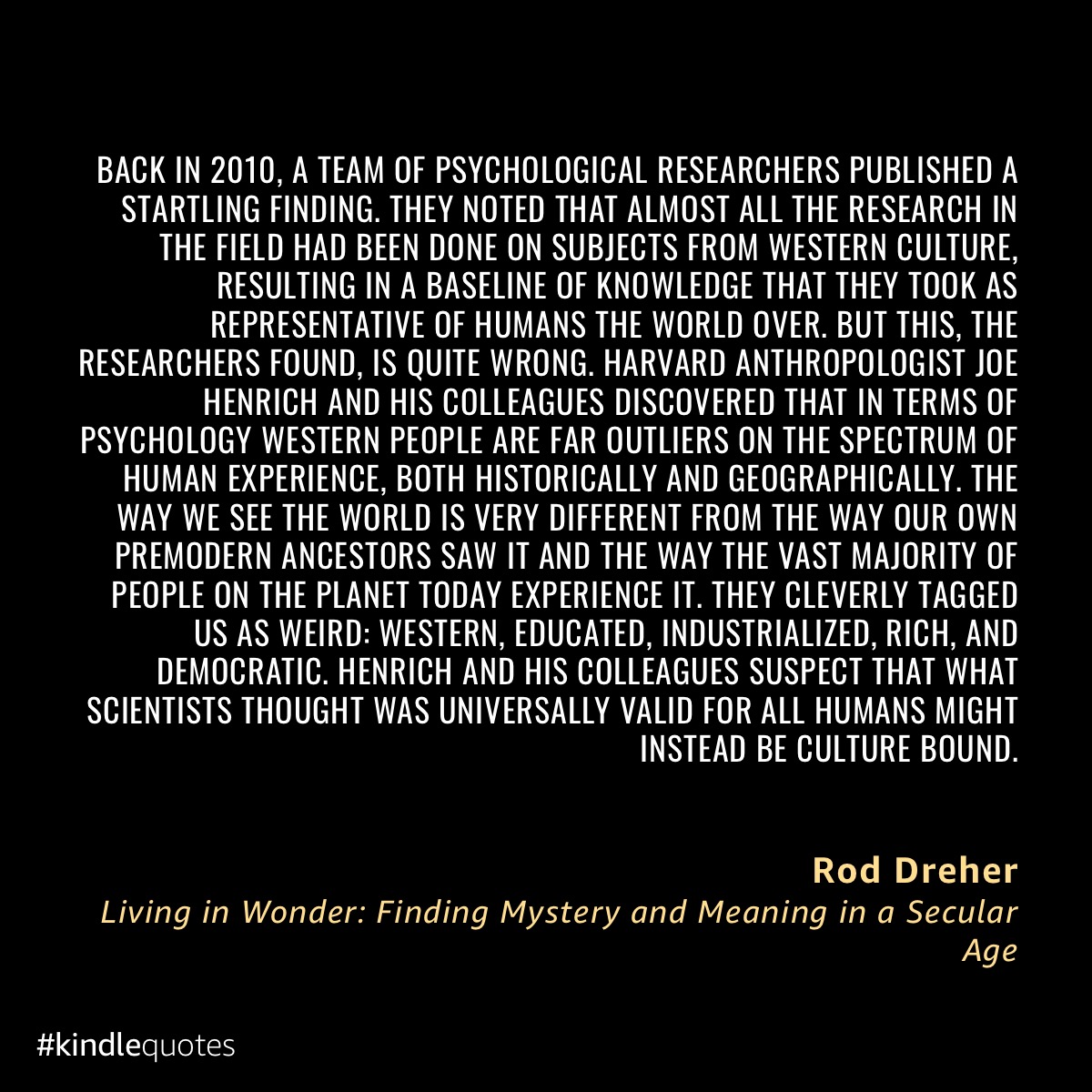
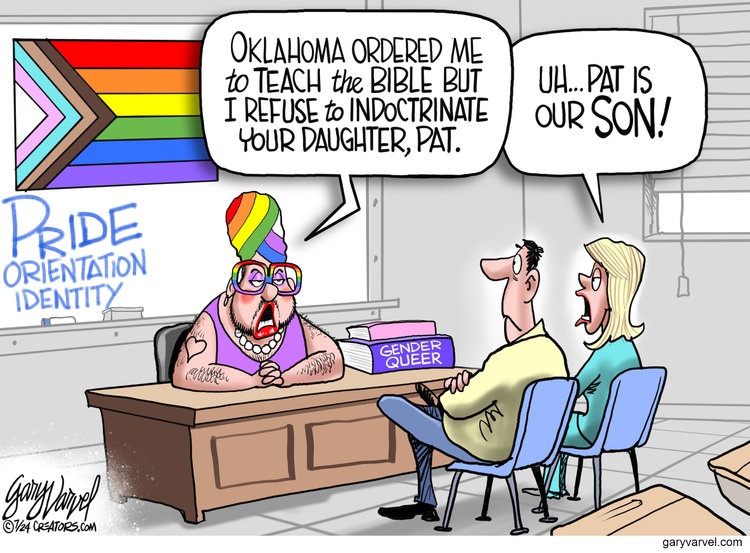
We had a lot of trouble with western mental health workers who came here immediately after the genocide and we had to ask some of them to leave. They came and their practice did not involve being outside in the sun where you begin to feel better, there was no music or drumming to get your blood flowing again, there was no sense that everyone had taken the day off so that the entire community could come together to try to lift you up and bring you back to joy, there was no acknowledgement of the depression as something invasive and external that could actually be cast out again. Instead they would take people one at a time into these dingy little rooms and have them sit around for an hour or so and talk about bad things that had happened to them. We had to ask them to leave.
A Rwandan talking to a western writer, Andrew Solomon, about his experience with western mental health and depression. I regret losing the URL, but offer the following in complement:
Serenity in leisure
There is a certain serenity in leisure. That serenity springs precisely from our inability to understand, from a recognition of the mysterious nature of the universe; it springs from the courage of deep confidence, so that we are content to let things take their course; and there is something about it which Konrad Weiss, the poet, called “confidence in the fragmentariness of life and history.”
Visit a graveyard; you will search in vain for a tombstone inscribed with the words “steam-fitter,” “executive vice president,” “park ranger,” or “clerk.” In death, the essence of a soul’s being on earth is seen as marked by the love they felt for, and received from, their husbands, wives, and children, or sometimes also by what military unit they served with in time of war. These are all things which involve both intense emotional commitment, and the giving and taking of life. While alive, in contrast, the first question anyone was likely to have asked on meeting any of those people was, “What do you do for a living?”
David Graeber, Bullshit Jobs
… but liars can figure
I saw an item in the Wall Street Journal very recently:
Here’s a statistic to remember next year, as Congress debates extending President Trump’s 2017 tax cuts: The top 1% of income-tax filers provided 40.4% of the revenue in 2022, according to recently released IRS data. The top 10% of filers carried 72% of the tax burden. Self-styled progressives will never admit it, but U.S. income taxes are already highly progressive ….
Then I saw a Politico item lamenting how little income tax the super-wealth pay on their increase wealth.
So, is someone lying?
Yeah, pretty much. Increased wealth doesn’t imply taxable income. I’m confident that the increased wealth figures Politico cited were mostly unrealized capital gains, which we don’t tax for a number of very good (if not ironclad) reasons.
Infrastructure century
Because the highways were gold-plated with our national wealth, all other forms of public building were impoverished. This is the reason why every town hall built after 1950 is a concrete-block shed full of cheap paneling and plastic furniture, why public schools look like overgrown gas stations, why courthouses, firehouses, halls of records, libraries, museums, post offices, and other civic monuments are indistinguishable from bottling plants and cold-storage warehouses. The dogmas of Modernism only helped rationalize what the car economy demanded: bare bones buildings that served their basic functions without symbolically expressing any aspirations or civic virtues.
One of the things I worry about is unaccountable local officials now that the internet has killed smaller local media. The Lafayette Journal & Courier is a wraith, all but invisible were it not for stories fed from other Gannett papers. WLFI has been gutted with departures as its owner, Allen Media Group, bids billions for new acquisitions but doesn’t pay its bills. Only national politics is really covered any more, and that in only a selective way:
Trans teen health
In oral arguments at the Supreme Court Wednesday, ACLU lawyer and transgender ideologue Chase Strangio was forced to admit that gender realignment surgery for children does not prevent suicide—a core claim of many trans activists, notoriously communicated to parents by doctors as “do you want a live girl or a dead boy?” (Source: The Free Press)
What’s left of the trans argument against Tennessee law, in my view, boils down to “it’s sex discrimination to allow estrogen for girls, testosterone for boys, but not vice versa” — an argument that begs the question of whether the brute fact of sexual binary has any implications for law and medicine.
Wordplay
as man became disenchanted with regards to God and the cosmos, he became enchanted instead with himself and his own potential
The Free Press has its people weigh in on what they’re thankful for at Thanksgiving. Martin Gurri responds:
This year, the petty little man in me is thankful that I won’t have to listen to Joe Biden’s double-dribbling sentences or Kamala Harris’s sitcom canned laughter ever again. The greedy analyst in me is thankful that Donald Trump is coming to burn Washington, D.C., to the ground, so Bari Weiss can keep telling people that I’m the only human on Earth who understands this dread pirate. The lonesome immigrant in me is thankful for my wife, and children, and grandchildren, my country and my street, my plans and my memories—because they make high politics feel like a trivial dream that I wake up from, when I step away from my laptop.
Pete Hegseth
I don’t trust Trump, and it seems to me as if he’s deliberately staffing up with sexual predators — as if that was proof of a decisive “get-things-done” manliness.
Moreover, I distrust pretty boys like Pete Heseth, Gavin Newsom, etc. (Yeah. Maybe there’s a little envy there.)
Nevertheless, I’m withholding my final judgment on Hegseth’s suitability for DoD because his accusers are hiding behind anonymity.
Pardon power
[T]he President is only accountable to the electorate so long as he or his party are up for election. Once the election is over, there’s no one for voters to punish. That’s why Biden waited until after the election to pardon Hunter; why Trump did the same for Steve Bannon and Roger Stone; why Obama did the same when commuting the sentences of Chelsea Manning and the terrorist Oscar López Rivera. And, most notoriously, that’s why Bill Clinton waited until his last full day in office to pardon the fugitive Marc Rich, who had fled to Switzerland to avoid prosecution and whose ex-wife donated $450,000 to the Clinton Library.
It is true that in some matters, including a considerable swath of policy issues that he neither understands nor cares about, Trump can be like Lord Derby, who, “like the feather pillow, bears the marks of the last person who has sat on him”—which is no small thing given the assortment of asses we are talking about. But Trump makes a big impression of his own on the feather pillows he encounters.
I don’t do any of the major social media, but I have two sub-domains of the domain you’re currently reading: (a) You can read most of my reflexive stuff, especially political here. (b) I also post some things on the only social medium I frequent, because people there are quirky, pleasant and real.
Finally grokking Trump — as a repudiation of Democrat attitudes and positions
I don’t recall how much, or even whether, I have written about my little epiphany in the last two weeks or so before November election.
I was “never Trump” since I first realized that his candidacy was serious in 2015 or 2016. I confess that I could not imagine anything other than a “tear it all down!” mentality motivating Trump voters. The way I avoided contemning them was to assume that there was some nobler reason that was invisible to me for some mysterious reason.
My little epiphany in the weeks before the election was that the evils of the Democrat party could make it plausible to vote against them, even if doing so meant voting for Trump.
I considered writing about this in last Thursday’s post, but I thought it would be tedious to try to name all the Democrat evils that could repel a voter. After I posted on Thursday, though, Mary Eberstadt kindly posted an item at First Things that listed many of them for me. As does this:
Although Eberstadt specifically refers to Democrat antipathy toward Roman Catholics and Catholic teaching, I’m in the same target zone, just as when I was a conservative Protestant in my beforetimes.
Were my vote determined solely by which party is likelier to persecute me and mine over the next four years, I could imagine voting for Trump, pretty darned confident that he’ll leave me and mine alone. (Even though this little blog has dissed him for 8 years, I don’t flatter myself that he’s noticed.) But my vote tends less toward short-term self-protection and more toward fiat justitia ruat caelum.
Still: the people have spoken, and what they said means I’m likely to be left alone at least until 2029. There’s some small comfort in that.
Is identitarianism a dying delusion?
David Brooks looks at many of the ways the pre-election expectations (of how groups would vote) were dashed.
Why were so many of our expectations wrong? Well, we all walk around with mental models of reality in our heads. Our mental models help us make sense of the buzzing, blooming confusion of the world. Our mental models help us anticipate what’s about to happen. Our mental models guide us as we make decisions about how to get the results we want.
Many of us are walking around with broken mental models. Many of us go through life with false assumptions about how the world works.
Where did we get our current models? Well, we get models from our experience, our peers, the educational system, the media and popular culture. Over the past few generations, a certain worldview that emphasizes racial, gender and ethnic identity has been prevalent in the circles where highly educated people congregate …
The crucial assertion of the identitarian mind-set is that all politics and all history can be seen through the lens of liberation movements. Society is divided between the privileged (straight white males) and the marginalized (pretty much everyone else). History and politics are the struggle between oppressors and oppressed groups.
In this model, people are seen as members of a group before they are seen as individuals …
In this model, society is seen as an agglomeration of different communities. Democrats thus produce separate agendas designed to mobilize Black men, women and so on. The goal of Democratic politics is to link all the oppressed and marginalized groups into one majority coalition.
…
But this mind-set has just crashed against the rocks of reality. This model assumes that people are primarily motivated by identity group solidarity. This model assumes that the struggle against oppressive systems and groups is the central subject of politics. This model has no room for what just happened.
It turns out a lot of people don’t behave like ambassadors from this or that group. They think for themselves in unexpected ways.
For those bewildered by why so many Americans apparently voted against the values of liberal democracy, Balint Magyar has a useful formulation. “Liberal democracy,” he says, “offers moral constraints without problem-solving” — a lot of rules, not a lot of change — while “populism offers problem-solving without moral constraints.” Magyar, a scholar of autocracy, isn’t interested in calling Donald Trump a fascist. He sees the president-elect’s appeal in terms of something more primal: “Trump promises that you don’t have to think about other people.”
Around the world, populist autocrats have leveraged the thrilling power of that promise to transform their countries into vehicles for their own singular will … What they delivered was permission to abandon societal inhibitions, to amplify the grievances of one’s own group and heap hate on assorted others, particularly on groups that cannot speak up for themselves. Magyar calls this “morally unconstrained collective egoism.”
When I opened your Dish email last Friday, I fully expected a big serving of both-sides-y handwringing — as in, “Trump is bad, but Harris is also bad, because wokeness/inflation/illegal immigrants … poor voters, what were they to do?” But I was also hoping for an acknowledgement of how terribly painful it is that the lawless kakistocrat has been reelected, more resoundingly than the first time.
Instead, I got a celebration of the multiracial, multiethnic coalition that brought us Clown Car Horror Show 2: Electric Boogaloo.
Not a single solitary goddamn word about all the reasons why Agent Orange deserved to lose. Attempting to overturn a free election in 2020? Inciting a mob to attack the Capitol? Running on “retribution” and promising to deploy the justice system against his political opponents? Routine use of crass, ugly insults and normalizing his surrogates’ use of same? Musing about how he wants to be “dictator for a day”? Wanting to fire government workers and replace them with incompetent sycophants? Never heard of it.
Sullivan responded:
In the immediate wake of the Trump victory, did we really need another account of why I didn’t vote for him? Especially when those arguments failed to work in the campaign yet again? Go read The Bulwark.
The Clown-Car Nominations
A sober lament
On Trump’s choice of Matt Gaetz as Attorney General:
The choice obviously isn’t meant to reassure anyone outside the MAGA base—or even those within it who are intelligent. It is an insolent appointment, guaranteed to cause trouble and meant to cause friction.
We are back to the Island of Misfit Toys. What a mistake. Mr. Trump often confuses his own antic malice for daring, his own unseriousness for boldness. How amazing that in the rosy glow of election, he will spend so much political capital and goodwill on confirmation fights he may well, and certainly deserves to, lose.
[H]ere is a glimmer of hope: Team Trump’s most human failings may thwart some of their most evil plans.
Take, for instance, appointing Representative Matt Gaetz to be the Attorney General of the United States. If this is a sincere appointment — in other words, if it isn’t a head-fake to get the Senate to accept another candidate later, or a ruse to let Gaetz resign from Congress and avoid a damaging ethics report — it’s an example of self-indulgence thwarting malign intent. Gaetz is a buffoon. He has absolutely no qualifications to run the Department of Justice. Can he wander around firing everyone? Yes. Does he understand how the Department of Justice works in a way that would allow him to maximize its potential for abuse? No. Is he smart enough to figure it out? Also no. Is he charismatic enough to persuade insiders to help him use it effectively? Very much no. Gaetz as Attorney General will do petty, flamboyant, stupid things in clumsy ways. Some of those things will be very bad. But clown shoes are preferable to jackboots. We’d be in much more trouble if someone evil in a smart and competent way who understands how the machine works — say, Jeff Clark or Ken Paxton — took over. That would be terrifying.
Trump’s decision shows his tendency to vent his spleen. Appointing Gaetz owns the libs, humiliates the hated Justice Department, elevates someone who is a vulgar elbow-thrower like him, and is a thumb in the eye to the Republicans who hate Gaetz. It’s not a decision reflecting self-control; it’s a decision reflecting unconstrained anger and resentment. It’s like making your horse a Senator. The point isn’t that the horse will vote the way you want it to. The point is to humiliate the senate and show them you can do what you want. It’s bad, but it’s not smart bad.
…
[P]erhaps they will not be as bad as they could be because God, in His wisdom, has chosen to make these people weird freaks along the way to letting them run the place. This is a time to cherish every hope and embrace every ally. Trump and Trumpists are dysfunctional weirdos and that fact is our ally. Cold comfort is still comfort.
I don’t do any of the major social media, but I have two sub-domains of the domain you’re currently reading: (a) You can read most of my reflexive stuff, especially political here. (b) I also post some things on the only social medium I frequent, because people there are quirky, pleasant and real.
As it turned out, Yeltsin probably did not need to conduct a political campaign in the usual sense. As the Party’s hostility became more evident, Yeltsin’s popularity rose. The public attitude was that anybody the Communist apparatchiks detested must be a hero. The campaign the Party waged against Yeltsin was not merely futile; it was Yeltsin’s strongest political asset.
Jack F. Matlock, Autopsy on an Empire
Hostage situations
Republicans can’t unequivocally say that Joe Biden won the 2020 Presidential election.
But Democrats can’t say that a human being with a penis is not a woman.
Both major parties are hostage to crazies.
Hearsay High Dudgeon
Of Ta-Nahesi Coates
“Part of me would have done anything to go home,” he writes in his new book The Message, about his 10-day trip to Israel and the Palestinian territories in the summer of 2023. “The part that always grouses about the rigors of reporting, the awkwardness of asking strangers intimate questions, the discipline of listening intently.” Readers, if listening to other people is a chore, then journalism might not be the career for you.
It could also be that Coates hates reporting because he is bad at it. Every reporter knows the a-ha moment of living through the anecdote that will make the perfect lead or kicker. No such perfect anecdotes have ever happened to Coates or, if they did, he was oblivious to them. His previous book, Between the World and Me, was an indictment of America as a racist hellscape, yet the worst act of racism he recounted from his own life—not something he read about in a newspaper or a history book—was a white lady on an escalator who shouted at his dawdling son, who was blocking her way, “Come on!”
I have no personal opinion of Mr. Coates. One of my then-favorites, Rod Dreher, was in awe of him as a writer, but before I read anything of his (save possibly a magazine article or such), he turned dour (that much I knew) and pretty much dropped off my radar.
But Andrews’ description of the worst active racism he personally experienced reminds me of a pattern I’ll call “hearsay high dudgeon.”
One notices such things, first, in one’s adversaries. 30+ years ago, my fair city, followed by the sister city across the river and my fair county, decided that we desperately needed to add sexual orientation to our human relations codes. There was no precipitating hate crime. The precipitant was merely that a liberal city councilman’s son came out, and the ordinance amendment felt like a father’s homage to his son.
As I listened to the heated public comments, I waited for evidence that we had unjust discrimination in our collective hearts. In three sets of public comments (one in each of the three jurisdictions in question), I heard one first-hand complaint from a lesbian whose military career was somehow deflected (I do not remember the details) before the military began liberalizing on such matters under the Clinton administration. (Of course, our local ordinance wasn’t going to change how the United States military treated such matters.)
But then there was one other first-hand account of local adverse effects: a male college student’s two male roommates no longer wanted to live with him after they found his stash of gay porn. Arguably, the Ordinances would have made that actionable as “discrimination in housing.” But was that discrimination “unjust”? Do we really want government intruding on roommate preferences?
Yes, we do in my community. Or maybe the testimony was irrelevant because our representatives just know, without evidence, what homophobic blackguards their constituents are.
Only later did I begin noticing similar things said by my allies. Various Christians also live in hearsay high dudgeon, collecting and cherishing accounts of “persecution” against other Christians.
Isn’t it pretty debilitating to present yourself or your tribe as victims to gain sympathy?
* * * * * * *
I have a sequel to the preceding. Some readers might wonder why I opposed extending anti-discrimination measures to the attribute of sexual orientation. They might even be indignant that I did that.
In large part, it was because I don’t think all “discrimination” is invidious (or unjust, if you prefer). “Discrimination” can be the epithet version of “discernment,” a very good and important word.
Let me illustrate. Suppose you run a government institution for troubled adolescent girls. Suppose you need staff and are determined not to “discriminate.” Suppose a 24-year-old man applies for a position that will allow him unsupervised access to those troubled adolescent girls.
Of course you have rules as safeguards against sexual predation, but rules can be broken.
Should you be discerning and recognize that hiring a man likely to be sexually attracted to some of his charges, in a position that allows unsupervised access to the objects of his desire, is a formula for disaster and scandal? Or should you follow your nondiscrimination ideology and hire him if he is otherwise the best candidate, perhaps giving yourself a pat on the back for open-mindedness?
Now flip that script. Suppose one runs a government institution for troubled adolescent boys. Suppose one needs staff and is determined not to “discriminate.” Suppose a 24-year-old “out” gay man applies for a position that will allow him unsupervised access to those troubled adolescent boys.
Ledbetter was hired by a home for troubled boys after he was “out” to anyone in town who paid any attention. A few years later, two of those troubled boys came forward to say he preyed on them sexually. The local press declared editorially that they were put up to the accusations by fundamentalist homophobes and that the episode was an illustration of blackguard homophobia. Somehow, Ledbetter’s defense attorneys got a signed retraction from one of the boys and the charges went away.
But the accusations were true. Ledbetter had even videotaped the encounters, as Wisconsin police discovered when they investigated him for similar sexual predation up there more than a decade later.
He’s in custody for the rest of his years. His journalistic enablers are complicit in the abuse of dozens of boys — and they didn’t do Ledbetter any favors either.
I didn’t know at the time whether the 1990s accusations were true or false (I had spoken to the boys, but did not undertake to represent them legally) nor do I expect that the journalists would have known. What I expected from the journalists was something better than damnable conspiracy theories about fundamentalist Christians, a fundamentalist being anyone more conservative than the journalist. The journalistic reaction was tribal, not rational; gay is good, conservative Christian bad.
I did not think that a gay man inevitably would bugger boys in his charge if given the chance any more than a straight man would copulate willy-nilly with nubile girls. But I was good and damn sure, from personal experience of male adolescence and young adulthood (from which vantage point some adolescent girls remained alluring), that the chances were way too high for his hiring to have been defensible.
Saying “no” to his application would have been “discernment,” not “discrimination.” But the Ordinance we passed categorically forbids any “difference in treatment in the areas of employment, housing and public accommodations” based on sex or sexual orientation (or other attributed). No discernment is allowed.
Democrat conspiracy kooks
The claims had a powerful effect on public opinion among Democrats, just as Trump’s ranting and raving is doing now among Republicans. In March 2018, a YouGov poll revealed that an astonishingly high 66 percent of Democrats believed that in 2016 Russia tampered with vote tallies in order to get Donald Trump elected president — a claim with no more evidence behind it than Trump’s current assertions about being deprived of victory by voter fraud.
Remember that, dear Christian, next time you’re tempted to paint us as uniquely victims of the Zeitgeist. The Zeitgeist varies from place-to-place.
Empty pantsuit
The closest Harris has gotten to articulating her agenda is the following, from the 60 Minutes interview:
In the last four years, I have been vice president of the United States. And I have been traveling our country. And I have been listening to folks and seeking what is possible in terms of common ground. I believe in building consensus. We are a diverse people. Geographically, regionally, in terms of where we are in our backgrounds. And what the American people do want is that we have leaders who can build consensus. Where we can figure out compromise and understand it’s not a bad thing, as long as you don’t compromise your values, to find common-sense solutions. And that has been my approach.
This is a classic Harris quote. It’s impossible to disagree with, but it’s also so empty that it’s hard even to agree with it either. It doesn’t tell us what she personally would push for before she’d compromise, what she really has conviction about, what she really believes in. In fact, the more I listened to her in these interviews, the more worried I became that she doesn’t actually believe in anything.
… Trump knows how to sell — in fourth grade language. Harris only knows how to charm elite liberals — in language only elite liberals use. It’s the only political skill she’s ever needed to have. And it’s not going to be enough.
…
Look: I’m voting for her. Or rather, I’m voting against Trump. (The most striking aspect of the various endorsements of Harris — from The New Yorker to The Atlantic — is that they were almost entirely about Trump.) But I’ll tell you this: catching Trump’s various podcast and radio spots gives a very different impression. He is as reckless as she is careful; as conversational and natural as she is stilted and scripted. He is much more comfortable in the new media universe than she is.
Check out his interview with Theo Von, and watch him and Theo talk about cocaine addiction; or see Trump’s appearance on comic Andrew Shulz’s show. Here’s Schulz bursting out laughing when Trump says he’s “a basically truthful person” — and Trump carries on.
In his newsletter, Political Wire, Taegan Goddard surveyed that fabulist’s unfabulous merch: “The constant stream of Trump infomercials — hawking watches, silver coins, sneakers, bibles, coffee table books, NFTs — is beginning to feel like a going-out-of-business sale.” (Nancy Jones, Iowa City)
At Defector, David Roth recapped The Washington Post’s interviews with Trump rallygoers who weren’t staying for the whole show: “Some of the people The Post spoke to left because they were sick of ‘the insults,’ which feels a bit like storming out of a steakhouse dinner just before dessert because you don’t eat meat.” (Matt Keenan, Sharon, Mass.)
I don’t do any of the major social media, but I have two sub-domains of the domain you’re currently reading: (a) You can read most of my reflexive stuff, especially political here. (b) I also post some things on the only social medium I frequent, because people there are quirky, pleasant and real.
I’m on vacation, so I’m not going to take the time to sort these into topics.
Also, it’s a major Feast day in the Eastern Church. The Orthodox Church at my vacation destination appears to be postponing observance to tomorrow — an Orthodox oddity in my limited experience.
Selling hoi polloi a delusion
Those with a material interest in doing so have learned to speak autonomy talk, and to tap into the deep psychology of autonomy in ways that lead to its opposite.
Matthew Crawford, The World Beyond Your Head
Purposeful to a fault
Himmler quite aptly defined the SS member as the new type of man who under no circumstances will ever do “a thing for its own sake.”
Hannah Arendt, The Origins of Totalitarianism
Sit quietly with that one for a minute. Then consider Josef Pieper, Leisure, The Basis of Culture.
“Televangelists”
Fugitive Televangelist Wanted by F.B.I. Is Caught in the Philippines Weeks of tense standoff in the Philippines have ended in the capture of a pastor accused of leading an international ring of sex abuse and trafficking of young women and girls.
I don’t believe it would be fair to saddle any Christian tradition or denomination with this guy. From what the Times says about the idolatrous adulation he cultivated, he was plainly some kind of one-off cultist.
But I have no idea how many one-off cultists are abroad in the world, when this admonition currently being featured at the end of my Sunday blog posts:
Religious ideas have the fate of melodies, which, once set afloat in the world, are taken up by all sorts of instruments, some woefully coarse, feeble, or out of tune, until people are in danger of crying out that the melody itself is detestable.
George Elliot, Janet’s Repentance, via Alan Jacobs
Huge (if true)
Donald Trump runs no risk of going to prison in the middle of his campaign, thanks to Judge Juan Merchan’s decision Friday to postpone sentencing until Nov. 26. The delay gives his lawyers more time to prepare an appeal. Fortunately for Mr. Trump, his trial was overwhelmingly flawed, and a well-constructed appeal would ensure its ultimate reversal.
A central problem for the prosecution and Judge Merchan lies in Article VI of the U.S. Constitution, which makes federal law the “supreme law of the land.” That pre-empts state law when it conflicts with federal law, including by asserting jurisdiction over areas in which the federal government has exclusive authority.
Mr. Trump’s conviction violates this principle because it hinges on alleged violations of state election law governing campaign spending and contributions. The Federal Election Campaign Act pre-empts these laws as applied to federal campaigns. If it didn’t, there would be chaos. Partisan state and local prosecutors could interfere in federal elections by entangling candidates in litigation, devouring precious time and resources.
That hasn’t happened except in the Trump case, because the Justice Department has always guarded its exclusive jurisdiction even when states have pushed back, as has happened in recent decades over immigration enforcement.
The normal approach would have been for the Justice Department to inform District Attorney Alvin Bragg, who was contemplating charges against Mr. Trump, of the FECA pre-emption issue. If Mr. Bragg didn’t follow the department’s guidance, it would have intervened at the start of the case to have it dismissed. Instead the department allowed a state prosecutor to interfere with the electoral prospects of the chief political rival of President Biden, the attorney general’s boss.
In the summer of 2015, back when he was still talking to traitorous reporters like me, I spent extended stretches with Donald Trump. He was in the early phase of his first campaign for president, though he had quickly made himself the inescapable figure of that race—as he would in pretty much every Republican contest since. We would hop around his various clubs, buildings, holding rooms, limos, planes, golf carts, and mob scenes, Trump disgorging his usual bluster, slander, flattery, and obvious lies. The diatribes were exhausting and disjointed.
But I was struck by one theme that Trump kept pounding on over and over: that he was used to dealing with “brutal, vicious killers”—by which he meant his fellow ruthless operators in showbiz, real estate, casinos, and other big-boy industries. In contrast, he told me, politicians are saps and weaklings.
“I will roll over them,” he boasted, referring to the flaccid field of Republican challengers he was about to debate at the Ronald Reagan Presidential Library that September. They were “puppets,” “not strong people.” He welcomed their contempt, he told me, because that would make his turning them into supplicants all the more humiliating.
“They might speak badly about me now, but they won’t later,” Trump said. They like to say they are “public servants,” he added, his voice dripping with derision at the word servant. But they would eventually submit to him and fear him. They would “evolve,” as they say in politics. “It will be very easy; I can make them evolve,” Trump told me. “They will evolve.”
Like most people who’d been around politics for a while, I was dubious. And wrong. They evolved.
The eighteenth-century Humean slave of the passions is thus indistinguishable from the liberated, twentieth-century Sartrean individual living authentically.
Brad S. Gregory, The Unintended Reformation
All that matters is strength
Part of the reason Trump is less constrained on [the abortion] issue than his predecessors is that he’s transformed the Christian right just as he has the broader conservative movement, dethroning serious-seeming figures while promoting those once regarded as flamboyant cranks. In Republican politics, Steve Bannon and Alex Jones now have far more influence than erstwhile conservative stalwarts like Paul Ryan and Dick Cheney. Similarly, in the religious realm, the ex-president has elevated a class of faith healers, prosperity gospel preachers and roadshow revivalists over the kind of respectable evangelicals who clustered around George W. Bush. “Independent charismatic leaders, who 20 years ago would have been mocked by mainstream religious right leaders, are now frontline captains in the American culture wars,” writes the scholar Matthew D. Taylor in his fascinating new book, “The Violent Take It by Force: The Christian Movement That Is Threatening Our Democracy.”
The churches Taylor is writing about exist outside the structures and doctrines of denominations like the Southern Baptists. They’re led by flashy spiritual entrepreneurs who fashion themselves as modern apostles and prophets with supernatural spiritual gifts, and they represent one of the fastest-growing movements in American Christianity. Among many of these churches, Trump remains the anointed one, chosen by God to restore Christian rule to the United States. These Christians care a great deal about abortion, but they appear to care at least as much about Trump. Many of them see him as a modern-day version of the Persian emperor Cyrus, a heathen who, in the sixth century B.C.E., rescued God’s chosen people from Babylonian captivity. In this framework, Trump’s piety is irrelevant; all that matters is his strength.
I think Goldberg, no Christian, is right. And that means that it’s hard to say that MAGA and I share the Christian tradition; their religion seems from a darker source.
Ted Cruz is no dummie
Liz Cheney famously endorsed Kamala Harris over Donald Trump, and less famously endorsed Democratic U.S. Representative Colin Allred over Ted Cruz for Cruz’s Texas Senate seat.
So has she abandoned the GOP?
I can’t speak for Cheney, but I can tell you why I’m voting for Allred over Cruz—and it has nothing to do with policy or burning anything down.
Since January 6, the threshold question I ask when considering whether to vote for a Republican is how that candidate responded to Trump’s coup attempt. There’s a spectrum of behavior on that point, with Cheney and Kinzinger on one end, Trump himself on the other, and the mass of congressional Republicans somewhere in between.
At the two extremes of the spectrum, policy doesn’t matter to me. Policy debates are things you get to have when everyone agrees on the rules of the game. Rewarding those who defended democratic norms and punishing those who undermined them is more important.
I would vote for Cheney and every other Republican who voted to impeach or convict Trump following the insurrection in hopes that their victories would embolden others in the party to resist his power grabs in a second term. And I would vote against Trump and all of his co-conspirators for the opposite reason, in hopes that their defeats would convince others that civic crime, like trying to overturn an election on false pretenses, doesn’t pay.
Ted Cruz was Trump’s chief co-conspirator in the Senate after the 2020 election, initially agreeing to argue before the Supreme Court that the electoral votes of swing states won by Joe Biden should be thrown out. When the court declined to hear that case, Cruz switched to Plan B and ring-led a scheme on January 6 to stop Congress from certifying Biden’s victory by objecting to those swing-state electoral votes. Had he gotten his way, some sort of chaotic ad hoc election “commission” would have been thrown together before Inauguration Day to decide who the next president should be.
He did all of this knowing full well that Trump was and is a loon and that egging on Americans to doubt the fairness of their own elections will destabilize the country long-term. But he was willing to pay that price because he thought making himself useful to the coup would give him a leg up with Trump’s base when he runs for president again someday.
You don’t need to agree with Colin Allred on a single policy issue to grasp that a person like Ted Cruz cannot be trusted to defend the constitutional order. He was tested and failed grievously. If you believe that a second Trump presidency would create a “unique threat” to American government, as Liz Cheney and I do, it’s urgent that Trump’s most unethical enablers in Congress be replaced by people who won’t rubber-stamp anything he does.
Republicans in Texas had their chance to replace Cruz with a candidate like that in this year’s primary, just as Republicans nationally had their chance to replace Trump. They made their choice. Cheney and I have made ours.
It’s frankly amazing to me that so many conservatives have been left struggling to understand Cheney’s endorsement of Allred. To a certain sort of partisan, it seems, Trump is the only elected Republican who bears meaningful responsibility for the attempt to overturn the 2020 election. Ted Cruz, Mike Lee, the scores of House GOPers who voted to object on January 6—they’re all off the hook because, well, there are just too many of them to punish. Beating them at the polls would wipe out the party, and partisans won’t tolerate that. Even for just one election cycle, to teach their representatives a hard lesson about authoritarian bootlicking.
If you feel obliged to excuse Ted Cruz for his role in a coup plot because that’s what hating Democrats requires of you, you do you. But let’s please stop memory-holing his part in it by feigning confusion as to why Liz Cheney might want to drive him from politics. It’s pathetic.
Ted Cruz is no dummie. He’s whip-smart and cunning. He also is a contemptible human being with no core. His mentor, Princeton’s Robert P. George, must be deeply grieved.
Shanghaied
Few cities in Asia match Shanghai’s level of economic development. In the fanciest shopping streets in the city center you can go miles without leaving the realm of luxury stores, with a Hermes outlet abutting a Louis Vuitton outlet, which in turn abuts a Rolex outlet. At times, the city reminded me of an acquaintance’s semi-humorous observation that, in a hundred years, luxury brands may be all that remains of Europe’s once enormous influence on the world.
In Postwar, Tony Judt argues that in the 1960s, the restive mood of Europe’s young was in part fueled by the ugliness of the homes in which they had been raised and the new universities in which they were being educated. Comparisons between Europe sixty years ago and China today are certain to be wrong for any number of reasons, but my mind kept going back to Judt’s observation every time I drove past another island of identical, unadorned housing blocks.
Preferences about the next American president seem to be nearly as divided among Chinese intellectuals as they are among the American electorate. A senior scholar of international relations told me that Donald Trump would likely be more willing to cut deals with China but that he preferred Kamala Harris because of her greater predictability on the international stage. A senior economist told me that Kamala Harris might prove softer on tariffs but that she would prefer Donald Trump because of his greater predictability on economic policy. The only consistent refrain was the preference for perceived predictability: Chinese elites seem as discombobulated by the sense that it’s impossible to predict what Washington might do as they are by any specific action the next president might take.
The chief petty officers aboard the USS Manchester (LCS-14) were caught illicitly placing and using a Starlink satellite-internet antenna while the ship was under way. The conspiracy, involving all senior enlisted sailors attached to the littoral combat ship, came to light after months of use, when a civilian contractor came aboard and stumbled upon the bootleg setup. The ship’s command senior chief and ringleader of the operation was convicted at court-martial and reduced in rank from E-8 to E-7: an outrageously light penalty considering her repeated lies to her commanding officer, her background in Navy IT that ensures she was absolutely aware of her transgression, and the cover-up campaign that involved the intimidation and silencing of those below her. This betrayal of the ship’s whereabouts in service to movie-streaming, texting, and other forms of personal entertainment is especially egregious because of the role that chiefs have in preserving good order and discipline among the ranks while upholding Navy traditions. A bad chief is the ruin of a ship and its crew, and the legal equivalent of keelhauling the only correct recourse.
National Review’s The Week Friday email. See also the Navy Times.
Donald Trump after the debate
The Hill: Trump Floats Punishment For ABC After Debate
I mean, to be honest, they’re a news organization. They have to be licensed to do it. They ought to take away their license for the way they did that.
This response is fractally wrong. ABC doesn’t need a license to be a news organization (thank God and the First Amendment).
If they did have a license, it would be dictatorial to revoke it for displeasing the President or anyone else.
Trump once again exhibits his anti-democratic impulses, though once again it probably will deter no fans.
Lesser evils
“Sending migrants away, not allowing them to grow, not letting them have life is something wrong; it is cruelty,” Francis said in a news conference on the plane as he returned to Rome after his long trip to Southeast Asia and Oceania. “Sending a child away from the womb of the mother is murder because there is life. And we must speak clearly about these things.”
…
But when asked whether it would be morally admissible to vote for someone who favored the right to abortion, he responded: “One must vote. And one must choose the lesser evil. Which is the lesser evil? That lady or that gentleman? I don’t know. Each person must think and decide according to his or her own conscience.”
Donald Trump seemingly is Teflon-coated, but explicit Papal permission to vote for the (more) pro-abortion candidate could logically be a factor in this election.
Even WSJ is appalled
Ms. Loomer is usually described in the press as “far right,” but that’s unfair to the fever swamps. On Sunday she posted on X that if Ms. Harris wins the election, “the White House will smell like curry,” a gibe against Ms. Harris’s Indian heritage.
She added that Ms. Harris’s speeches “will be facilitated via a call center.” U.S. companies often farm out their information lines to Indian firms, get it? We wonder if JD Vance’s Indian-American wife thinks that’s funny.
In 2018 Ms. Loomer chained herself to Twitter’s New York headquarters after the platform banned her. She suggested that Casey DeSantis, the wife of Florida Gov. Ron DeSantis, might have lied about having breast cancer: “I’ve never seen the medical records.” This week she smeared Sen. Lindsey Graham after he criticized her association with Mr. Trump.
All of this would be ignorable, except that others close to Mr. Trump say he is listening to Ms. Loomer’s advice. People in the Trump campaign are trying to get her out of the former President’s entourage, to no avail. Even Rep. Marjorie Taylor Greene thinks Ms. Loomer is damaging the former President’s election chances.
As North Carolina Sen. Thom Tillis put it on Friday: “Laura Loomer is a crazy conspiracy theorist who regularly utters disgusting garbage intended to divide Republicans. A DNC plant couldn’t do a better job than she is doing to hurt President Trump’s chances of winning re-election. Enough.”
If anyone is looking for facts to support a vote for Trump despite loony Loomer (and everything else), these two graphs may be just the ticket. The Biden administration has not covered itself in glory on illegal immigration.
The yellow bar is illegal immigrants and those awaiting adjudication of asylum claims or other claims to remain.
Delta wants to know what I thought of my flight. Honda wants to know what I thought of my oil change. The company that inspects my HVAC system twice yearly wants to know what I thought of … the air filter replacements? The technician’s demeanor? I’m not sure because I’ve read only the subject lines of the emails, which keep coming, imploring me to reflect on the experience and charting some strange new territory where customer service and stalking overlap. It may be time for a restraining order. Or, minimally, a different kind of filter, the one that consigns certain senders’ electronic missives to the Spam or Trash folders.
I don’t do any of the major social media, but I have two sub-domains of the domain you’re currently reading: (a) You can read most of my reflexive stuff, especially political here. (b) I also post some things on the only social medium I frequent, because people there are quirky, pleasant and real.
Two years ago, Democratic outfits spent money in GOP primaries on ads designed to help crank populist candidates prevail over more formidable mainstream opponents. “Cynical” doesn’t begin to describe the mindset of liberals who routinely warn voters that MAGA Republicans are a threat to democracy and then quietly spend millions of dollars to help those same Republicans advance to the general election.
Recall that gender ideology was never sold to the American people. Parents were sold on “inclusivity.” Gender ideology itself was sold to their grade-school kids. This was another of the Left’s “bait-and-switch” maneuvers, and it succeeded so well, the gender ideologues had essentially a decade’s head start on American parents.
Metaphors matter. They can elucidate, but they can also elide and confuse. For a long time, the conservative metaphor for the Left’s tactics has been “slippery slope.” It’s a bad metaphor. It suggests that radical efforts to harm American families are all just the result of the gravitational pull of the earth, or the inevitability of logical progression. That isn’t the case. The tactics used against American families are far more clever. And they invariably involve a “Bait and Switch.” Sell the American people on a principle we can all agree on: “inclusivity,” “tolerance” and “anti-bullying.” Then, smuggle in an entirely different program under its name. That is how gender ideology ended up part of the mandatory “anti-bullying” curriculum, as opposed to the “sex education curriculum,” which is subject to parental opt out.
We keep looking for an issue, any issue, on which Kamala Harris differs with the Democratic left, but we keep coming up empty. That includes her party’s use of lawfare against political opponents, as an episode while she was California Attorney General reminds us.
Ms. Harris made headlines a decade ago by threatening to punish nonprofit groups that refused to turn over unredacted donor information. She demanded they hand to the state their federal IRS Form 990 Schedule B in the name of discovering “self dealing” or “improper loans.” The real purpose was to learn the names of conservative donors and chill future political giving—that is, political speech.
…
Free-market nonprofits challenged the Harris dragnet, suing the AG’s office in a case that went to the U.S. Supreme Court. In Americans for Prosperity Foundation v. Bonta in 2021, the High Court ruled 6-3 that the AG’s disclosure demand broke the law. The Court pointed out that a lower court had found not “a single, concrete instance in which pre-investigation collection of a Schedule B did anything to advance the Attorney General’s investigative, regulatory or enforcement efforts.”
The Court said California’s claim that it would protect donor information lacked credibility, since during the litigation plaintiffs discovered nearly 2,000 Schedule B forms “inadvertently posted to the Attorney General’s website.” It noted that the petitioners and donors faced “threats” and “retaliation.”
The Supreme Court said Ms. Harris’s policy posed a risk of chilling free-speech rights, and it cited its 1958 NAACP v. Alabama precedent, which protected First Amendment “associational” rights. Ms. Harris is citing her experience as state AG as a political asset, but the Bonta case is a warning to voters that she’s willing to use the law as a weapon against political opponents.
The outrageousness of Trump’s remarks at the National Association of Black Journalists’ annual convention on Wednesday afternoon reminded everyone that Trump will always choose the low road of bigotry and smarmy insinuation over any kind of debate about ideas or policy. This is a man who launched his political career by suggesting, without evidence, that the country’s first black president held the office illegitimately because he was born abroad and therefore not a true American.
Can Mr. Trump shift gears? He grew up, as I did, watching “The Ed Sullivan Show.” I’m sure it was on every Sunday night at 8 at the Trump house in Queens. On that show you saw every week the great Borscht Belt comics of 1950-70. Their timing—“Take my wife—please!”—is ingrained in him. What he does now is shtick, because he likes to entertain and is a performer. The boat’s sinking, the battery’s spitting, the shark’s coming! As Hannibal Lecter said, “I’d love to have you for dinner!”
This works so perfectly for those who support him. For everyone else it’s just more evidence of psychopathology. He has to freshen up his act. Can he?
It had never in the last nine years occurred to me that what Trump is doing is shtick. That’s just perfect!
If Trump continues his bizarre race-baiting instead of beating up the Border Czar on her failures and her past radical positions, he deserves to lose. (He deserves to lose categorically, but that’s another matter; I’m writing about political stupidity here.)
“But wait!”, you say. “Kamala has repudiated all her past radical positions!”
Yeah, right. And Barack Obama was against same-sex marriage, too. On that, too, Noonan is pitch-perfect:
On policy she is bold to the point of shameless. This week she essentially said: You know those policies I stood for that you don’t like? I changed my mind! Her campaign began blithely disavowing previous stands, with no explanation. From the New York Times’s Reid Epstein: “The Harris campaign announced on Friday that the vice president no longer wanted to ban fracking, a significant shift from where she stood four years ago.” Campaign officials said she also now supports “increased funding for border enforcement; no longer supported a single-payer health insurance program; and echoed Mr. Biden’s call for banning assault weapons but not a requirement to sell them to the federal government.” It’s remarkable, she’s getting away with it, and it’s no doubt just the beginning. It will make it harder for the Trump campaign with its devastating videos.
Will the left of her party let her tack toward moderation? Yes. She’s what they’ve got, and in any case people on the wings of both parties have a way of recognizing their own. Progressives aren’t protesting her new stands: That’s the dog that didn’t bark.
Critical factions of the new right at home and the far right in Europe have latched on to Tolkien’s work. By “new right” I mean the post-Reagan right, a movement that embraces state power as a means of fighting and winning the culture war.
I still can’t quite believe it. It’s just so utterly tone-deaf.
Tolkien, in fact, was concerned with the way that good can become evil. He understood that even the best of people are vulnerable to the temptations of evil, and that that temptation is perhaps most powerful when we believe we are engaged in a fight against darkness.
That’s the brilliance of the conceit of the One Ring, the ring of ultimate power, in Tolkien’s trilogy. Throughout the story the ring calls out to the heroes, speaking to their hearts, telling them that only by claiming power can they defeat power. In a very real way, the will to power is the true enemy in Tolkien’s work. The identity of the villain, whether it’s Morgoth and Sauron in “The Silmarillion” or Sauron and Saruman in “The Lord of the Rings,” is less relevant than grasping after power.
Anyone over the age of 14 or so (where’s Jean Piaget when I need him?) who reads LOTR and doesn’t get a glimmering of what the One Ring is about is not very ight-bray.
Thanks, I think, to David French for so heavily taxing my credulity.
Childless Cat Ladies
I’ll concede that it’s super-smelly to the tone-sniffing police dogs to quip, during a campaign for U.S. Senate (as I recall), about “childless cat ladies” being a problem. But J.D. Vance was at fault for being too colorful, not for being entirely wrong:
I have seen in the political discourse around J.D. and children a sense of resentment over the idea that having children gives one greater wisdom.
I’m sorry, but it does. Not in every case — it is possible to be a bad mother or bad father, and to learn nothing from the experience of parenthood (J.D.’s own troubled childhood testifies to this — but generally, yes, of course it does. This doesn’t make the childless morally less worthy, or the childbearing morally greater. But for most people, having kids gives you more wisdom about life — wisdom to which the young and childless ought to defer.
…
having a baby changed the way I thought about politics and a lot of things, and it did so for a predictable reason: when you have kids, you have a stake in the future in a way you could not have had as a childless person. I moved away from liberalism toward conservatism dramatically after 1989, when I graduated from college and moved off campus. Suddenly having to pay taxes, and having to deal with the reality of crime, made me start thinking hard about what the world would be like if most people held the liberal views I did. I saw — and I felt — that my liberal ideals were incommensurate with lived reality. So I changed.
In a similar way, some of my untested conservative views began to change after my son was born. Without realizing what was happening to me at first, I suddenly became aware of how thin some of my libertarian views were when I thought about the kind of world that libertarianism would create for my son to grow up in.
…
Being a parent doesn’t immunize you against stupidity, but it really is an apprenticeship for life beyond the confines of the home. Future historians, I suspect, will look back on our culture and civilization and see a people who had an insane disregard for the future. This is not a point I’m making against liberals. It’s almost as true of conservatives. We are not a civilization that makes proper provision for our descendants.
…
A people that ceases having children will cease to exist. It is not the case that everyone who can have children should have children, but a culture in which childbearing isn’t seen as the norm, and indeed a good and noble thing that all members of society should support, is a culture that is already dead and doesn’t know it.
Be it remembered that Dreher is thick with JD Vance, and indeed did an interview with him that launched Hillbilly Elegy, theretofore languishing, to the Best Seller list. But don’t you dare dismiss his argument on that basis.
Seduced and abandoned
The postliberal Right, heavily Christian, went almost overnight from Benedict Option to MAGA:
The outcome is that the postliberal right, which began in conversations around The Benedict Option about how to better catechize young people and create thick communities of Christian belief has, in just under 10 years, shifted into something primarily partisan and quite often linked to white nationalism.
The irony in all this is that just as the postliberal right has become maximally partisan in its outlook and sensibilities, it has been abandoned by the very party and leader it looked to for security. Last month’s Republican National Convention included the GOP abandoning its commitment to the cause for life, leaving behind what little remained of its support for natural marriage, and platforming Amber Rose, a social media star who routinely posts pornographic images on her social media handles and only a few months ago praised Satanist groups for helping women secure abortions. Five years after Ahmari sold many on the notion that the authoritarian leadership of Trump was necessary to advance the good life, the party of Trump now resembles a more sexually progressive version of the 1990s-era Democratic Party.
… The false human story told by many progressives and conservatives alike in the years since Reagan, a story built around individual identity creation and the limitless pursuit of wealth through “free” (but to what end?) markets, often at the cost of transcendent truth, had left many people and places adrift.
The signs are not hard to identify even now: soaring rates of reported loneliness, an increased openness to euthanasia, shattered trust within communities, a strong anti-natal turn among many young Americans which has correlated unsurprisingly with freefalling birth rates, and all of that with a rising generation coming that is racked by anxiety and depression. These realities were present in 2015 and still are a decade later. If anything, the GOP’s capitulation on life and marriage suggests it will become even more entrenched on the American right as the GOP comes to be ever more dominated by what Matthew Walther has called the barstool conservatives. Yet the devouring need for truth, for genuine life together, and for higher goods than a purely individualistic freedom remain.
Jake Meador, normally of Mere Orthodoxy but writing this time for The Dispatch
Institutional arsonist new media grifters
Given this inclination toward mistrust it is not surprising that media producers, often working in fairly desperate financial positions themselves, are finding ways to profit off that mistrust and sell it to others.
Viewed sympathetically, media projects working in this space are good and legitimate journalistic endeavors meant to shine a light on corruption or injustice and to aid those who wish to correct that problem. Corruption should be exposed, of course. But also presumptions of corruption should not be normalized or encouraged. In practice what these works can do is provide ordinary people with scripts that teach them how to interpret the behavior of institutional leaders: That pastor said something that made me uncomfortable (maybe it was the Holy Spirit convicting you?), therefore he must be abusive. That pastor quoted Tim Keller favorably, therefore he must be a shepherd for sale. In short, these projects of institutional arson encourage community members in habits and practices that corrode common life because they encourage them to assume the worst of their own leaders and ascribe motivations to them which may or may not even be true. The problem, at bottom, is simply this: Common life is not safe, nor does it necessarily tend toward each individual becoming exactly who they wish to be defined purely by themselves. To live in community is to be obstructed and offended and frustrated and then learning that oftentimes in those offenses and obstructions and frustrations that you were the one at fault. It is, in short, to be confronted by the truth that Eliot spoke of here:
You are not the same people who left that station … Fare forward, you who think that you are voyaging; You are not those who saw the harbour Receding, or those who will disembark. Here between the hither and the farther shore While time is withdrawn, consider the future And the past with an equal mind.
The common life we experienced through RUF and the church and the university and through many other places besides was a life that forced us to recognize that we needed to change, that we could not be the people who had once left that station, nor were we now the people who would one day disembark.
What is troubling about institutional arsonist media is that in its attempt to spotlight genuine abuses it often overreaches and consumes many good people and good places that unfortunately found themselves in the blast radius. And when those good institutions and good leaders are gone, how will the next generation have that experience that we did? Who will tell them the things we needed to hear? Who will walk with them as they learn and grow?
I cannot speak to the motives of the people who produce these works, of course. But I can see the ramifications by simply looking around and observing: Sometimes the sin of one institutional leader becomes a template that is then retroactively applied to anyone unfortunate enough to slightly resemble that failed leader. In other cases, the habits of suspicion and cynicism have caused us to leap to conclusions, ascribing the least charitable motives and not even pausing to consider if we might be wrong.
Healthy institutions, above all else, require trust. I am grateful that in my formative years that trust still held. I hope that by the time my kids are the age I was in those vital years that they will be as fortunate as I was. But that hope now hangs from rather slender threads.
Jake Meador again, back on his home turf (emphasis added).
I suffer more from the humiliations inflicted by my country than from those inflicted on her.
I don’t do any of the major social media, but I have two sub-domains of the domain you’re currently reading: (a) You can read most of my reflexive stuff, especially political here. (b) I also post some things on the only social medium I frequent, because people there are quirky, pleasant and real.
Nor does this allow for any kind of Roman Catholic or Eastern Orthodox triumphalism, whereby the historical continuity and unity of the institutions can be presented as an antidote to Protestant fragmentation. To be a Roman Catholic today is to make a choice. Thoughtful Roman Catholics may object to this claim by pointing to the sacramental power that they ascribe to baptism. But that does not really address the matter of lived experience: every faithful cradle Catholic has still made a decision to live his or her Christian life as a Catholic amid a world of other possible options, from atheism to Islam to Bible churches and Pentecostalism. When it comes to how we think of ourselves, we are all expressive individualists now, and there is no way we can escape from this fact. It is the essence of the world in which we have to live and of which we are a part.
It has always seemed to me that this argument, which is important for someone to make, is missing some things: truth, historicity, holiness, apostolicity, catholicity. I’m only free to leave the Orthodox Church in the way Shem, Ham or Japheth would have been free to leave the ark on day 30 of The Deluge. We’ve been in a sort of Deluge — the last days — for 2000 years now.
For good reason, though I was nearly 50 years discovering it, I never felt that the Evangelical Covenant Church, Wheaton Bible Church, Lakewood Presbyterian Church in Dallas, First Baptist Church in Prescott, or the Christian Reformed Church in my hometown was the Ark of Salvation.
Western Modernity
It might not be too much of a stretch … to suggest that modernity in itself is primarily a war against religion – and that Western modernity is therefore primarily a war against our Christian heritage.
Images flying around the internet, of a drag Last Supper tableau in the Olympic opening ceremonies, make the snippet more salient than when I first snipped it.
Kill your enemies, but not so much
Do not be overcome by evil, but overcome evil with good.
It is a very simple statement. However, when anyone begins to suggest what that might look like, critics quickly begin to offer egregious examples that would ask us to bear the unbearable, with the inevitable conclusion: “Kill your enemies.” What is suggested, in effect, is that Christians should respond in the same way as any tyrant would, only a little less so. “Kill your enemies, but not so much.”
…
The patriotic mythologies that came into existence together with modernity’s nationalisms are siren songs that seek to create loyalties that are essentially religious in nature. World War I, in the early 20th century, was deeply revealing of the 19th century’s false ideologies. There, in the fields of France, European Christians killed one another by the millions in the name of entities that, in some cases, had existed for less than 50 years (Germany was born, more or less, in 1871). The end of that war did nothing, apparently, to awaken Christians to the madness that had been born in their midst.
…
These passions are worth careful examination, particularly as they have long been married to America’s many denominational Christianities. I think it is noteworthy that one of the most prominent 19th century American inventions was Mormonism. There, we have the case of a religious inventor (Joseph Smith) literally writing America into the Scriptures and creating an alternative, specifically American, account of Christ and salvation. It was not an accident. He was, in fact, drawing on the spirit of the Age, only more blatantly and heretically. But there are many Christians whose Christianity is no less suffused with the same sentiments.
…
Asking questions of these things quickly sends some heads spinning. They wonder, “Are we not supposed to love our country?” As an abstraction, no. We love people; we love the land. We owe honor to honorable things and persons. The Church prays for persons: the President, civil authorities, the armed forces. We are commanded to pray and to obey the laws as we are able in good conscience. Nothing more.
Late last week on his Substack Jemar Tisby shared with his readers some simple counsel:
You, presumably all of you, need to go to therapy:
You need to go to therapy. This is your gentle but firm reminder that mental health is part—perhaps the most crucial one—of your overall health. Physical exercise, a healthy diet, getting enough sleep–all of those matter and impact your mental health. But there is nothing quite like talking to someone who is trained in all the ways our mind can help and hinder us.
…
… It’s not that therapy is bad, of course. Tisby is correct that there can be value in talking to someone with a particular sort of expertise who will help you think through a problem, make better sense of a painful experience, or develop new ways of understanding or handling complicated relationships. That is certainly true.
Yet to suggest that everyone needs therapy is an excellent example … in which therapeutic concepts effectively become our doctrine of sin. … If you can’t think of anyone who does not need therapy or any time when someone might not need therapy, then you’ve elevated therapy to a place it oughtn’t occupy.
There is no doubt that the J. D. Vance of Hillbilly Elegy has changed. While news outlets will be tempted to tell this story of Vance’s transformation as a simple parable of power’s corrupting effects, there is a more illuminating account of what happened to Vance: namely, his own.
In 2020, Vance wrote an essay about his conversion to the Catholic faith: “How I Joined the Resistance.” Hillbilly Elegy has often been hailed as essential reading for “anyone wanting to understand Trump’s rise.” Vance’s 2020 essay might be the same for anyone wanting to understand the shifting currents in conservative Christianity and politics. Vance’s journey toward religion—the first millennial on a major party ticket—is the same that is and will be trekked by many millennial and Gen Z Christians of a political orientation.
…
Some conservatives (even religious conservatives like myself) still hold to the same economic outlook Vance did in his 2016 memoir. Some of us even hold to that economic program of tax cuts, Social Security cuts, and a suspicion of even the best-intended of regulations for reasons we find consonant with the Christian faith. But it’s important to note that J. D. Vance abandoned that outlook for religious reasons. While Vance blasts his journey to atheism as “both conventional and boring,” the truth is that his journey to Catholicism and a certain set of politics is becoming increasingly conventional as well—in ways that students of both politics and religion would be foolish to ignore.
Hauerwas also addressed his emphasis upon concern around self-deception and his disagreement with piety, which he sees as an invitation to setting oneself up as a self-exemplar.
The Duke theologian is a curiosity for his disavowal of theological liberalism and simultaneous extreme dislike for evangelicalism. “I’m not a follower of either, because, one, I don’t think you get to make Christianity up: you receive it through the exemplification of people who live in a way that scares you.”
… I just don’t know the Evangelical world, but what I know of it I dislike intensely. I mean, the last thing one should want is a personal relationship with Jesus – I mean, that’s letting yourself control who Jesus is.
… that Christ may dwell in your hearts through faith; that you, being rooted and grounded in love, may be able to comprehend with all the saints what is the width and length and depth and height — to know the love of Christ which passes knowledge; that you may be filled with all the fullness of God.
You can read most of my more impromptu stuff here and here (both of them cathartic venting, especially political) and here (the only social medium I frequent, because people there are quirky, pleasant and real). All should work in your RSS aggregator, like Feedly or Reeder, should you want to make a habit of it.
The mark of an iconic Supreme Court decision is timelessness. With every read, the opinion teaches new insights and provides new lessons on our Constitution. Each semester when I prepare a case like Marbury or McCulloch, I learn something new.
Opinions from Chief Justice Roberts, however, are just the opposite. They are best read once. After the first read, you will come away entirely persuaded that Roberts’s analysis was not only the best answer (to use the Loper Bright framing), but the only conceivable answer, as any contrary positions are unfounded. That’s the first read.
But when you read a Roberts decision a a second, a third, and a fourth time, all of the fancy veneers and window dressing start to come off ….
On Trump v. United States, people I trust who’ve taken the time to work through the case (I was never a prosecutor, rarely a criminal defense attorney) say it’s going to be very hard to prosecute a President for anything. That is not the impression Justice Roberts created on first reading of his opinion.
That means, in essence, that “the President is not above the law” is substantially false now.
And that means that Trump may soon no longer be a convicted felon (because Judge Merchan admitted testimony of a sort that Justice Roberts dubiously says may not be admitted).
I guess we’ll just have to elect someone else. What crueler punishment for Trump than an emphatic electoral drubbing? (But what crueler punishment for the USA than to re-elect the zombie currently in the Oval Office?)
Some thoughts, though:
I just about freaked out when, in law school, I learned that “immunity” was a thing. Lots of people are “above the law” in various circumstances, including crooked prosecutors, judges, policemen (“qualified immunity” in too many circumstances), trash-talking Congressmenpersons. I’ve even figured out why that’s often the lesser evil compared to no immunity. So get it out of your head that keening about “they made him above the law” communicates anything salient.
This isn’t just about Trump. It’s about all Presidents. Good luck prosecuting Joe Biden, Cheeto Benito — or Mike Pence, or Barack Obama, for that matter.
Do you really think that none of the Presidents in your lifetime until Trump has crimed — if only to protect the country from, for instance, terrorists whose location we knew?
That we have an ex-President who is almost certainly guilty of vile, self-serving, delusional crimes is a very, very, very sorry commentary. That his crimes commend him to so many voters is even worse.
Just about everyone agreed that the court would extend, and should extend, some measure of immunity from criminal prosecution to our Presidents. The decisions of the lower courts that Presidents have zero immunity were surprising (likelier, shocking) and unlikely to stand. But few expected the court to give Presidents the extensive practical immunity that emerges from the weeds when you get deeply enough into them.
The lack of constitutional language making the President immune to criminal prosecution is barely interesting, let alone dispositive. There’s no “separation of powers” clause, either and for instance, but it’s fundamental to our system and implied by what is specified.
If and when Trump issues a lawless order, the people he orders should consider refusing to carry it out because I don’t believe they’ll ride his immunity coat-tails. I can only hope that Project 2025 hasn’t vetted a full slate of Trumpist sociopaths who’ll never threaten mass walkouts.
We need to get it through our heads that our Presidents are, pretty much, above the law and that we should try to elect people who aren’t, for instance, promising a retributive crime spree against their adversaries.
When Trump crimes in his second term, I hope we’ll have a Congress willing to impeach, because the Senate will no longer have the excuse that the criminal justice system can deal with it.
I don’t mean to say it will all work out okay. We’re in unchartered territory with Zombie Joe v. Cheeto Benito and his merry band of Project 2025 vandals. I’ve been bearish on the USA for quite a while now, heaven help me — the cultural equivalent of “the financial doomsayers who has correctly predicted 10 of the last three recessions” (see below).
The Unitary Executive
Not unrelated to the matter of Presidential immunity is the “unitary executive” theory.
I thought I was fairly sophisticated on matters of Constitutional Law, but an article in the New York Times lays out with unusual clarity a sort of meta-battle going on in the legal ether above some recent SCOTUS decisions: Charlie Savage, Conservative Legal Movement’s Agenda Unites Court’s Rulings on Executive Power. That’s freebie “shared link,” by the way.
It leaves me feeling freshly conflicted about the independent regulatory agencies we have. They’re “a headless fourth branch of the U.S. government” as Justice Kavanaugh once put it in his pre-SCOTUS days. But the Project 2025 vandals are not at all conflicted; they want to domesticate all regulatory agencies. That would mean that we would have even wider swings in policy from Administration-to-Administration, as far fewer career civil servants would carry over, and far fewer good people would be willing to go into low-profile career governmental service.
I highly recommend the article, and plan to re-read it at least once in a few weeks.
Earlier this year, New York Times columnist Paul Krugman was boasting of the personal time he spent with Biden, who he proclaimed to be “completely lucid and with excellent grasp of detail”. After the debate, Krugman called on Biden to step down. Senile dementia is a clever disease. Or maybe Krugman didn’t like the face he saw in the mirror the morning after Biden’s debate performance.
What astounded Krugman and his fellow bold-faced journalist types about Biden’s rotten debate performance wasn’t the obviousness of Biden’s mental decline, but the fear that they were now publicly shown to have been lying. Krugman’s fellow in-house NYT author of Soviet state propaganda, Thomas Friedman, who fancies himself an “old friend” of Biden’s, was writing fibs about Biden as late as last month while boasting of his long off-the-record conversations with the President about the future of the Middle East. It took Friedman less than 24 hours to proclaim that Biden’s debate performance had made him “weep”. Poor man — no doubt it did. David Remnick of TheNew Yorker, who authored a door-stopper-sized hagiography of Barack Obama during the President’s first year in office, was equally quick to go public with his discovery that Joe Biden was maybe not exactly up to sorting marbles by size or colour, just in time to become a virgin for the next election.
It’s hard to be revealed as a fibber — especially when your job is ostensibly to tell the truth. But the sight of journalistic worthies suddenly grabbing hand towels to cover their proximity to power was not by itself enough to explain the Night of the Journalistic Long Knives.
On the center-left, Mark Leibovich isn’t pulling his punches in a piece on the Democrats sticking with Biden: “Since President Joe Biden’s debate debacle on Thursday, I’ve learned two things for sure: first, that Republicans are not the only party being led by a geriatric egotist who puts himself before the country. And second, that Republicans are not the only party whose putative leaders have a toxic lemming mindset and are willing to lead American democracy off a cliff.” (The Atlantic)
History will, if necessary, judge between the harm wrought by the two geriatric egotists.
Without comment
Lighter fare
One movie is worth how many words?
The shocking decline of the city—driven by any number of factors, but most certainly liberal policies high among them—drove massive white flight and deindustrialization of the city. Vast numbers of New Yorkers moved to the suburbs in Long Island, New Jersey, or in enclaves in the outer boroughs.
(An interesting exercise is to look at the movies set in the Big Apple in the early sixties compared to those in the early 70s and you can see the suddenness of the decline. From Breakfast at Tiffanys, That Touch of Mink, and Barefoot in the Park_to _Death Wish, Taxi Driver, Dog Day Afternoon, and Serpico in about a decade.).
MoveOn is the textbook example of an organization that has outlived its purpose. Founded more than a quarter-century ago to argue that the country needed to “move on” from Bill Clinton’s intern-diddling impeachment drama, it had two things that confer a very long life in American politics: office space and a good fundraising list. And so, while the country has moved on, MoveOn hasn’t. Which is weird, but this is America.
In The New Yorker, Susan B. Glasser reflected on a micro-tussle toward the end of last Thursday night’s presidential debate: “Is this how democracy dies, in a shouting match between two seniors about their golf game?” (Thanks to Mike Greenwald of Melville, N.Y., for nominating this.)
In The Connecticut Post, Colin McEnroe pondered the president’s proper course: “I’m guardedly a ‘replace him’ guy. Some of you may recall that in 2019, I compared Biden to a Subaru with 310,000 miles on the odometer … But Thursday night was 90 minutes of the ‘check engine’ light flashing desperately in the darkness.” (Holly Franquet, Fairfield, Conn.)
In The Atlantic, Caitlin Flanagan evaluated Americans’ attitudes toward NATO … NATO is the rotary phone of geopolitical alliances.” (Richard Reams, San Antonio)
This view would understand the division of man into male and female as, of course, a biological actuality; i.e., this is the way it is. It seems to be a necessity; it is at least a convenience; and it is certainly a delight.
Thomas Howard, Chance or the Dance?, written before gender ideology was a thing.
I suffer more from the humiliations inflicted by my country than from those inflicted on her.
I don’t do any of the major social media, but I have two sub-domains of the domain you’re currently reading: (a) You can read most of my reflexive stuff, especially political here. (b) I also post some things on the only social medium I frequent, because people there are quirky, pleasant and real.
Copyright law is just a big steaming mess. Whenever you think it can’t get crazier, it always does.
YouTube is the ultimate battlefield for copyright claims gone wild. Even when I do a short YouTube video about music, I can never play examples from actual recordings. (That’s why I’ve never given an online course on music history. Corporate lawyers would shut me down in a New York minute.)
Consider the case of the YouTuber whose video got demonetized because his “Samsung washing machine randomly chimed to signal a laundry cycle had finished while he was streaming.”
How is that even possible? But it gets even stranger.
Ashley Belanger reports in Ars Technica:
Apparently, YouTube had automatically scanned Albino’s video and detected the washing machine chime as a song called “Done”…[but it] actually comes from the song “Die Forelle” (“The Trout”) from Austrian composer Franz Schubert.
The song was composed in 1817 and is in the public domain. Samsung has used it to signal the end of a wash cycle for years.
I’m not sure what Schubert would make of all this. But I can assure you that none of his heirs will get a penny from this. That’s not the purpose of song copyrights anymore.
I have added a P.S. to my recent post “34 Counts!”:
I don’t think I’ll dwell on the 34 counts any more, and regret having done so. The 34 counts were 34 bookkeeping entries. In most courts — and in best practice — this would have been charged as one crime, or so I’m told.
Politics
Sheep
Most Church leaders—conscious that to condemn Nazis for blasphemous kitsch might prove risky—opted to bite their tongues. Some, though, actively lent it their imprimatur. In 1933, the year that Hitler was appointed chancellor, Protestant churches across Germany marked the annual celebration of the Reformation by singing Wessel’s battle hymn. In Berlin Cathedral, a pastor shamelessly aped Goebbels. Wessel, he preached, had died just as Jesus had died. Then, just for good measure, he added that Hitler was ‘a man sent by God’.
This is the story of Chris Kyle. And it was — I remember seeing it here in Tennessee. And you couldn’t find a parking spot in our theater. That movie was an absolute sensation.
And one of the most memorable parts of that movie is when Chris Kyle is involved in a playground fight, and his father goes through this sheepdog, sheep, wolf analogy. And that is there’s three kinds of people in this world. There’s the sheep, there are the wolves who prey on the sheep, and the sheepdogs who protect the sheep from the wolf.
And he says, I’m not raising any sheep in this household. So what are you? And at that point, Chris Kyle identifies himself as a sheep dog, as somebody who protects the weak against the wolf. OK? And so it’s a very anti-bullying sort of vision of male courage.
And then here comes Donald Trump, who fits to a T the definition of a wolf, of a bully. The story the right told about itself was that they would be inoculated against the wolf, against the bully, because they have this ethos of the sheepdog.
But then when the wolf arose and the bully arose, they went with the bully, the very person that a generation of young right-wing men were warned about. And so that’s what makes this, in many ways, so much more deeply disturbing even than it otherwise been (sic), because it called into question kind of the cultural enterprise that was happening before Trump.
On that same podcast, Jamelle Bouie, riffing on Trump’s first post-conviction public appearance being UFC (Universal Fight Club), quipped that “Professional wrestling is camp for straight men..”
Not a referendum on Trump?!
I believe I recently passed on an opinion that both Trump and Biden want this election to be a referendum on Trump. Now I pass along the opinion that it’s a referendum on Biden:
[Y]ou can just look at the polls in the US: 51 percent of Americans now support mass deportations of the kind Trump is proposing; including 42 percent of Democrats, and 45 percent of Hispanics. That was unthinkable four years ago — and it’s entirely on Biden. The revolt against this basic failure of governance is now strong even in big cities, run by Democrats, and among non-whites, who are moving toward Trump.
Joe Biden’s main campaign theme seems to be that he alone can defend liberal democracy from Donald Trump. What Biden has never understood is that restricting immigration is absolutely critical to defending liberal democracy. Everything else is just words, condescending words. If Trump triumphs in November, Biden will be responsible for simply ignoring basic political reality, alienating the very people he needs.
…
One person was responsible for Trump’s first term: Hillary Clinton. And one will be responsible for his second: Joe Biden.
I guess it’s worth reiterating at this point that I’m not anti-immigration. It remains the lifeblood of America, and immigration is vital for our future fiscal balance. I’m a proud immigrant myself — and America will always be able to integrate newcomers in ways European countries simply cannot. But, like a huge majority of Americans, I’m in favor of legal, orderly, controlled immigration — and not the chaos we now see everywhere in the West. This is not racism or xenophobia; it’s a recognition that borders and the rule of law matter; and that without secure borders, we risk losing the core reality of a nation-state; and without a better-paced influx, we risk delegitimizing immigration altogether, and balkanizing our societies.
Trump’s base does not win elections outside of party primaries. It did not win the midterms for the Republican Party in 2018, it did not win re-election for the Trump in 2020, and it did not win a red wave for Republicans in 2022. The signature Republican victory of the last four years, the election of Glenn Youngkin over Terry McAuliffe in the 2021 Virginia race for governor, rested on an effort to marginalize the Trump base so that party leaders could engineer a nominee with the ability to distance himself from the former president and his movement.
And true to form, the RNC’s Lara Trump has issued a fatwa against Larry Hogan, Republican candidate from U.S. Senate from Maryland, for saying the public should respect the process and the verdict in the Trump felony trial. Kiss that seat goodbye, GOP.
Chicken Littles of the Left
Some people reportedly (I haven’t met one outside of click-bait stories) are worked up that some Trump supporters want to ban IVF, contraception, and recreational sex. Though I know some arguments against each of those sacred cows, this strikes me as a reverse mirror-image of QAnon.
I would welcome more careful thought about IVF, but I’m an outlier. Anyone who thinks that a lame duck Donald Trump is going to pander to a very small group of ideologues who are seriously out of step with 90%+ of their countrymen needs to take a deep breath. Anyone who thinks that Donald Trump (who probably has frequent sperm donor perks at the fertility clinics of Manhattan) is personally opposed to IVF, contraception and recreational sex (“I never did anything that needed forgiveness” or something like that, he said) needs inpatient psych care.
Culture
Defining deviancy down … and up
When and why did American life become so coarse, amoral and ungovernable? In his classic 1993 essay, “Defining Deviancy Down”, the late Senator Daniel Patrick Moynihan offered a semantic explanation. He concluded that, as the amount of deviant behaviour increased beyond the levels the community can “afford to recognise”, we have been redefining deviancy so as to exempt conduct we used to stigmatise, while also quietly raising the “normal” level in categories where behaviour is now abnormal by any earlier standard. The reasons behind this, he said, were altruism, opportunism and denial — but the result was the same: an acceptance of mental pathology, broken families and crime as a fact of life.
In that same summer, Charles Krauthammer responded to Senator Moynihan with a speech at the American Enterprise Institute. He acknowledged Senator Moynihan’s point but said it was only one side of the story. Deviancy was defined down for one category of society: the lower classes and black communities. For the middle classes, who are overwhelmingly white and Christian, the opposite was true. Deviancy was in fact defined up, stigmatising and criminalising behaviour that was previously regarded as normal. In other words, there was a double standard at work.
A new poll from Ipsos has found that support for same-sex marriage among Americans has fallen to just 51% approval.
…
Following a years-long rise in support for gay marriage, a groundswell of anti-woke sentiment emerged around 2021, much of it directed at LGBT activism as parents gained a new window into their children’s curriculum when schooling went remote during the Covid-19 pandemic …
Gay rights have since been lumped in with trans rights in the popular imagination, which may have chipped away some public support for gay marriage at the margins. …
Bev Jackson, co-founder of the LGB Alliance, said the decline in support for same-sex marriage had causes on both the Left and the Right. “Blame for the fall in US support for gay marriage lies partly with the homophobic religious Right. But equally to blame are treacherous organisations like GLAAD and the ACLU which promote insane, deeply unpopular concepts such as gender self-ID and child ‘transition’,” she said. “Gender identity ideologues have been riding on LGB’s coattails for too long, and they’re helping to destroy support for the rights we fought for decades to win.”
Junk info is often false info, but it isn’t junk because it’s false. It’s junk because it has no practical use; it doesn’t make your life better, and it doesn’t improve your understanding. Even lies can be nourishing; the works of Dostoevsky are fiction, yet can teach you more about humans than any psychology textbook. Meanwhile, most verified facts do nothing to improve your life or understanding, and are, to paraphrase Nietzsche, as useful as knowledge of the chemical composition of water to someone who is drowning.
The intuitive moral structure of our modern social imaginary prioritizes victimhood, sees selfhood in psychological terms, regards traditional sexual codes as oppressive and life denying, and places a premium on the individual’s right to define his or her own existence.
They want revolutionary ends, but they want to hide behind establishment credibility.
Jonah Goldberg, describing the successor ideology, which has famously “march[ed] through the institutions.”
Tipsy the squish
I finally had to replace the color toner cartridges on my laser printer. I opened the red-and-white Canon box I’d ordered months ago. I found unfamiliar packaging of the cartridges and unfamiliar cartridge configuration. I figured out how to install them and then looked for the instructions on recycling them (back to Canon). It was nowhere to be found.
Having seen the word “compatible” a few times, I looked more closely at the box. Where the word Canon should have been, the word “Cartridge” appeared.
I remembered when I purchased them my shock at the low price, but I double- and triple-checked. I thought I was getting an inexplicable price on Canon goods. They still conned me with the Canon-looking box.
Now I’ve got three laser cartridges I can’t recycle, and it bothers me more than such a thing is supposed to bother a conservative.
Which reminds me again of how close “conservative” today is to “barbarian.” My gut-identification today remains “conservative,” but my considered identification is center-right.
Progress
Progress should be about improving the quality of life and human flourishing. We make a grave error when we assume this is the same as new tech and economic cost-squeezing.
Mainstream coverage of this issue is a buffet of sanctimonious overclaiming. It says authoritatively that kids in the US can’t go on blockers or hormones prior to lengthy, in-depth assessment (false). That no one under 18 is getting surgery (false). That the worldwide rise in referrals to youth GD clinics is almost entirely the result of reduced stigmatization (no one knows). That GD, or the perception that one has GD, can’t spread through adolescent social networks (almost certainly false on the basis of anecdotal evidence and any familiarity with developmental psychology). That it’s a ‘myth’ that significant number of kids who believe themselves to be trans will later feel differently (false, according to all the existing data). That only a tiny percentage of people detransition (we have no data at all on this in the context of youth gender care in the States).
What the Media Gets Wrong on Gender Reassignment. This is from 2021 when the elites were uniformly purveying lies about Covid, gender dysphoria and who knows what all else. Things have gotten markedly better in recent months on adolescent gender dysphoria.
Capitalistic algorithmic ideological hairball
For many of our applicants—and this, of course, is what the program is about, what the humanities are about—learning has, or ought to have, an existential weight. Beneath their talk of education, of unplugging from technology, of having time for creativity and solitude, I detected a desire to be free of forces and agendas: the university’s agenda of ‘relevance,’ the professoriate’s agenda of political mobilization, the market’s agenda of productivity, the internet’s agenda of surveillance and addiction. In short, the whole capitalistic algorithmic ideological hairball of coerced homogeneity. The desire is to not be recruited, to not be instrumentalized, to remain (or become) an individual, to resist regression toward the mean, or meme.
The characteristic feature of the loser is to bemoan, in general terms, mankind’s flaws, biases, contradictions, and irrationality-without exploiting them for fun and profit.
I don’t do any of the major social media, but I have two sub-domains of the domain you’re currently reading: (a) You can read most of my reflexive stuff, especially political here. (b) I also post some things on the only social medium I frequent, because people there are quirky, pleasant and real.
“Georgians fear their country is becoming like Russia,” proclaims the Economist headline. It’s a bit confusing because most of the Georgians the article discusses actually seem more concerned, if only tacitly, about their country becoming like America. (Did the author hear explicit concerns about Americanization but didn’t report them?)
Witness:
By the Kura river in Georgia’s capital, Tbilisi, a group of old women wearing black clothes and headscarves had stopped on the pavement, clearly lost. They were trying to work out how to get to Rustaveli Avenue, the city’s main thoroughfare, where a large crowd was forming. It included Orthodox priests, people carrying framed icons, families with children waving small Georgian flags and teenagers from a dance school dressed in traditional clothing.
The throng was markedly different from the young, mainly English-speaking protesters who had massed on the tree-lined avenue a few days before. On Tuesday May 14th the government, led by the Georgian Dream party, passed a law that will force organisations that receive more than 20% of their funding from abroad to register as foreign agents. …
This gathering, on the Friday after the law was passed, was more subdued. It was in honour of Family Purity Day, a celebration of “traditional values” that the Georgian Orthodox church has held annually since 2014 (a riposte to the International Day against Homophobia, Biphobia and Transphobia). This year, Family Purity Day was a public holiday for the first time.
…
The Georgian Dream party claims that Orthodox Christian family values are threatened by a foreign “LGBT agenda”, and that rich foreigners fund NGOs in Georgia to promote this sinister plot. It’s a narrative copied almost word for word from Russia and Hungary, whose scaremongering leaders, Vladimir Putin and Viktor Orban, it has served well. Since pro-democracy and anti-corruption NGOs do indeed depend heavily on western philanthropy, labelling them “foreign agents”, which sounds a lot like “spies”, is a handy way to stifle scrutiny of ruling parties.
…
Bells rang out as we reached the cathedral. We stood outside, on a huge plaza with views across the city. Some of the people I met seemed sincerely committed to the cause. Other marchers’ motivations were less clear. Before I had a chance to ask them where they were from, several told me that they were locals and hadn’t been paid to be there. Clearly they were sensitive to the rumours that a recent pro-government rally had been populated by rent-a-crowds, bussed in from outside the city.
The Economist free-lancer is worried about where in Georgia the demonstrators for Family Purity Day came from, but strangely dismissive of their concerns. It doesn’t cross her mind that a concern shared by Russia, Hungary and Georgia just might possibly be valid; it’s just a cut-and-paste “narrative.”
Meanwhile, she’s utterly incurious about the bona fides of the “English-speaking protesters who had massed” on those streets days before, demonstrating in favor of unfettered foreign influence. In my admittedly limited experience it would be hard to assemble a “mass” of Anglophones from among the Georgian population. Where did they all come from?
If you read between the lines, even assuming the bona fides of the Anglophone protesters, Georgia is divided between people wanting to westernize and people wanting to maintain traditional values. Since Putin also purports to favor traditional values, it’s low-hanging fruit to draw analogies between traditionalist Georgians and Russia. That, too, is a convenient “narrative.”
It’s not just the Economist writing unself-aware critiques of Georgia, though. From Sunday’s New York Times:
America’s Foreign Agents Registration Act, or F.A.R.A., written in 1938 to combat Nazi propaganda and all but forgotten until Russia began meddling in American elections, basically requires persons or entities engaged in lobbying or advocacy for foreign governments to register with the Department of Justice. It has now become a major tool for exposing efforts by Russia, China and other autocratic states to manipulate the Western public through media, governmental or commercial outlets they control. The European Union is now working on a similar law.
…
On balance, a law that helps the public understand who is funding foreign influence operations is useful and needed at a time when foreign meddling in elections or other domestic processes is becoming more insidious and widespread. The fact that democratic countries have such legislation does not negate their obligation to speak and act against its perversion by governments and politicians seeking to destroy the very transparency that such laws are intended to provide.
Schmemann is far more cosmopolitan than I, but here he sounds provincial. The logic seems to be “OurForeign Agents Registration Act is directed against foreign subversion, but when they require that “foreign agents” self-identify, it is sinister, directed at NGOs that are all about sweetness and light and all that America currently stands for by gorry by jingo by gee by gosh by gum.” Ipse dixit.
Too many of us assume that the desire of the nations is the USA. But it’s not that simple. It’s really not that simple.
A cyber-friend who follows world affairs more closely than I do (and spends far more time in Georgia, too), weighs in not specifically on Georgia, but on the world more widely:
Yesterday I saw an interview with Tony Blinken. … [H]e said that, in talking with people from around the world, he finds that there is a real “thirst” for American leadership. If you think that is true, or even marginally so, then I predict that the next several decades are going to be disquieting ones for you. … I rather assiduously follow news on the five other inhabited continents, and with the exception of the British, I have found exactly no one “thirsting” for American leadership (and with the British, this is largely due to the fact that we are basically them with a twang.)
If you were to compare, for instance, American global hegemony to a hotel, you would find most guests checking out of the Hotel Americano. The most attentive and independent have already left, while others are following suit-out at the curb, awaiting their taxis. Stragglers remain in their rooms, but packing or googling to find better accommodations. No one is staying other than a few hard-core residents, ensconced in their lounge chairs in the lobby asking What? What? That is what happens when Management becomes insufferable.
… The Cold War bloc mentality is how we still look at the world, and it saves us from having to confront real history, one in which we are complicit up to our eyeballs; one that includes just about everything that has happened since the Cold War actually ended, by negotiation, in 1989. …
… When we speak of American “values,” we still think it means something. Perhaps it does, but to the rest of the world it is not at all what we think it is. We have become a shambolic nation, stumbling blindly forward in the only way we know, impervious to warning signs and flashing lights.
The future is Multipolarity, which is the old Westphalian balance of power expanded globally; to-wit: BRICS. That should not scare us at all. Why should it? Failure at unipolarity is actually, on a real level, success. We think we have to be “Great,” Number one, with all the power, making all the rules. We even have a name for it: the rules-based international order. Who makes the rules? We do. What are the rules? Whatever we say they are at the time.
We believe that if we are not on top, then we have lost. That is true only if Power is your guiding principle (and to nearly all politicians, it is that.) If we even had the slightest and most tenuous attachment to the tenets of the Faith we supposedly espouse, then we would realize that that kind of thinking is of the Devil. If we were a schoolkid on the playground, would you want to play with us?
Wouldn’t it be okay just to be a “good nation,” rather than a great one? Frankly, the fact that we are not going to be leading the future world doesn’t bother me one whit.
On Monday, not a holiday in Georgia, the veto override on the foreign agents law began. If I wait for the smoke to clear, I may never publish. So I’ll put a bow on it and send it out: Any Georgian who sees wisdom in staying on friendly terms with Russia has ample “Made in America” justification.
I fear the Greeks, especially bearing gifts.
Virgil, The Aeneid
Men will not accept truth at the hands of their enemies, and truth is seldom offered to them by their friends: for this reason I have spoken it.
Alexis de Tocqueville , Democracy in America
I suffer more from the humiliations inflicted by my country than from those inflicted on her.
I don’t do any of the major social media, but I have two sub-domains of the domain you’re currently reading: (a) You can read most of my cathartic venting, especially political here. (b) I also post some things on the only social medium I frequent, because people there are quirky, pleasant and real.
On the one hand, I express no profound personal opinions here; on the other, I have some smart and provocative “takes” from others and some comments on them.
Stupid opinions on why a Trump conviction will be reversed
Any conviction obtained at the so-called “trial” of former President Donald Trump’s alleged alteration of financial records will be reversed on appeal, if necessary by the U.S. Supreme Court, because altering financial records is only a crime in New York if you do it to conceal some other crime. Paying Stormy Daniels money is NOT a crime. …
I would wager a substantial sum that the U.S. Supreme Court will not reverse a New York conviction of Trump at all, let alone on the basis that New York Courts misapplied New York law.
If the law is as Calabresi says, State appeal courts should reverse, but state Courts have the last word on what state law is.
Steven Calabresi is not a stupid man. This outburst was an example of motivated reasoning.
It’s still quite possible that the Manhattan jury will convict Trump on the 34 felony charges Bragg has brought. But there is no chance the conviction will withstand appeal, particularly given that it relies so heavily on Cohen’s testimony.
I would wager even more that a conviction will not be reversed because it relies too heavily on Michael Cohen’s testimony. No Courts will have any idea what the jury relied on. That’s not how jury trials work.
I cannot vouch for Elli Lake not being stupid on legal matters. It rather appears that he is.
Note: This is not to say that Courts won’t reverse because particular testimony of Cohen was admitted over timely objection. Nor am I saying that this prosecution is solid and will not be reversed. There’s a lot of non-dopey analysis that thinks if very shaky. I’m just faulting stupid arguments that mislead non-lawyer readers.
History Rhyming?
I’ve been surprised at the intensity of the electorate’s hostility to post-Roe restrictive abortion legislation. I thought public opinion was more closely divided.
As we think about why voters are so hostile, though, it may be illuminating to remember the Protestant landscape pre-Roe. For one common instance:
The great majority [of pre-Roe Southern Baptists] favored such “therapeutic” abortions, but a small minority objected that abortion was murder, and another small minority argued that it should be legal in all cases. The divide, however, did not fall along the usual conservative-moderate lines, but rather, it seems, along the spectrum of anti-Catholicism.
Frances FitzGerald, The Evangelicals. Voters may just be reverting to pre-Roe positions.
I care a bit about what the various states do. But I’m still committed to federalism, unconvinced that this is an appropriate topic for national legislation.
Commencement Addresses
It’s like the opening parable of David Foster Wallace’s Kenyon College commencement address: “There are these two young fish swimming along and they happen to meet an older fish swimming the other way, who nods at them and says ‘Morning, boys. How’s the water?’ And the two young fish swim on for a bit, and then eventually one of them looks over at the other and goes ‘What the hell is water?’”
But what sort of use does it make of this freedom? Here again, the main concern is not to infringe the letter of the law. There is no true moral responsibility for deformation or disproportion. What sort of responsibility does a journalist or a newspaper have to his readers, or to his history — or to history? If they have misled public opinion or the government by inaccurate information or wrong conclusions, do we know of any cases of public recognition and rectification of such mistakes by the same journalist or the same newspaper? It hardly ever happens because it would damage sales. A nation may be the victim of such a mistake, but the journalist usually always gets away with it. One may — One may safely assume that he will start writing the opposite with renewed self-assurance.
In these powerfully written essays Oakeshott points to the damage done when politics is directed from above towards a goal – whether liberty, equality or fraternity – and where all policies and negotiations are formulated by reference to that goal.
We in the US are suffering from a putative commitment to the goal of equality, “where all policies and negotiations are formulated by reference to that goal.”
I say “putative” because we seem to have lost the ability to identify which things truly are alike, and so should be treated alike, the ability to recognize that not all discrimination is invidious. Sometimes “discrimination” is the necessary consequence of discernment.
If the preceding seems impenetrably opaque, think about the dogma “trans women are women.” If that makes perfect, incontestable sense to you, you probably are loving our present love affair with “equality.” If you hesitate or disagree with “trans women are women,” you may be on my wavelength.
Elites and normies
Elites require control over the information sphere because their policy obsessions—on immigration, gender, and climate, for example—are not popular with the normies. By necessity, progressive fantasies must be imposed on our mediated reality, even as dissenting opinions are cast out into the dark. The internal combustion engine will destroy the earth; windmills will save it. Trump is a wannabe dictator; Biden, the adult in the room. Antagonists are always “far right”; there’s no such thing as “far left.” The ambition to conquer the empirical world with words approaches magical thinking.
It rarely works. The chaos and contingencies of the digital age allow the normies and their chosen tribunes, the populists, too much room to maneuver. Trump’s rise in the opinion polls would otherwise be inexplicable.
Why the meritocracy is not viewed as a legitimate ruling class
Now comes the kicker. By the competition it unleashes, bourgeois society creates unprecedented wealth, but also unprecedented inequality of wealth. It does so even while proclaiming equality to be its great insight, innovation and foundation, an inalienable right of man. The contradiction of bourgeois society is such that “its development belies its principle, and its dynamic undercuts its legitimacy.”
In earlier societies, inequality held a legitimate status, assigned by nature, tradition, or providence. In bourgeois society, inequality is an idea that circulates sub rosa in contradiction with the way individuals view themselves; it nevertheless pervades the environment in which they live…. The bourgeoisie did not invent the division of society into classes, but by cloaking that division in an ideology that renders it illegitimate, they tinged it with suffering.
One result is that we are deprived of a fundamental requirement of any polity: a ruling class that will be perceived as legitimate.
…
At bottom, we see a refusal of the ruling class to take responsibility for its rule, preferring to LARP at the barricades.
There aren’t many pro-Trump columnists at major papers because there aren’t many pro-Trump columnists anywhere.
In past years, it hardly seems possible that a major publication wouldn’t have a supporter of Ronald Reagan on George W. Bush on its staff. That is why in 2024, newspapers would love nothing more than to have an in-house columnist on Team Red Hat/Tie.
But Trumpism is a visual medium – it cannot withstand the scrutiny of a written column. Trump supporters can go on Fox News or Newsmax or OAN and say whatever they want in the moment without being fact-checked beforehand. But writing a column means having editors and fact checkers verify the claims you’re making.
And because no editor will rubber-stamp a claim like “the 2020 election was stolen,” someone who tries to argue Biden didn’t win the last election or that the Jan. 6 insurrectionists were “political prisoners” will never be able to make their way to a legacy print outlet. A columnist that wanted to say, for instance, Vice President Mike Pence had the ability to choose his own electors in 2020 would be like a columnist earnestly arguing a woman is safer if she encounters a bear rather than a human man in the woods.
This phenomenon is glaringly obvious any time Trump goes on a network like CNN for a town hall or a debate. The falsehoods come so fast out of his mouth, the moderator can’t keep up, leaving 90 percent of his claims unchallenged. If the reporter stopped Trump to correct him on every lie he told, the event would be more moderator than candidate.
That is because being a Trumper is based almost solely on emotion and doesn’t rely on facts. Trumpism is a clenched fist, not an argument. And newspapers print arguments.
I am predisposed to credit Schneider’s argument because of people like Eric Metaxas.
Metaxas, a Yale grad, is an intellectual of sorts. He writes books. He hosts high-tone “Socrates in the City” conversations. I have it on fairly good authority that he’s genial and fun to talk to.
But he’s bereft of arguments for his election denialism. He has rock-solid certainty. As a word guy, he makes reductio ad Hitlerum analogies. He may have had mystical visions. But he has zero evidence. (Did I mention the rock-solid certainty?)
Checking in on the further-right
Charlie Kirk is worked up. “The world is in flames, and Bidenomics is a complete and total disaster,” the conservative influencer said during a recent episode of his podcast The Charlie Kirk Show. “But it can’t and won’t ruin my day,” he continued. “Why? ’Cause I start my day with a hot America First cup of Blackout Coffee.” Liberals have brought about economic Armageddon, but first, coffee.
… “Rest assured knowing that you’re ready for whatever the globalists throw at us next,” Kirk said at the end of one ad for medical-emergency kits … The commercial breaks sounded like something from an alternate universe. The more I listened to them, the more I came to understand that that was the point.
…
Some of Kirk’s ads … sound a little jarring: “You are nine meals away from anarchy,” he said in one ad for buckets of food rations, from a website called MyPatriotSupply.com. Yet as the world of right-wing-coded products has expanded, so has the weirdness of ads for them. “For 10 years, Patriot Mobile has been America’s only Christian-conservative wireless provider,” started another ad. Switching to Patriot Mobile, Kirk explained, would mean that “you’re sending the message that you support free speech, religious liberty, the sanctity of life, the Second Amendment, our military veterans and first-responder heroes” while getting “the same coverage you’ve been accustomed to without funding the left.”
Just as the Bishop of Oxford refused to consider that he might be descended from an ape, so now are many in the West reluctant to contemplate that their values, and even their very lack of belief, might be traceable back to Christian origins.
I don’t do any of the major social media, but I have two sub-domains of the domain you’re currently reading: (a) You can read most of my cathartic venting, especially political here. (b) I also post some things on the only social medium I frequent, because people there are quirky, pleasant and real.