November 1

MAGA nihilists

Sometime in 1985 I had lunch with Sam Francis in the cafeteria of The Washington Times, where we both worked. You may never have heard of Sam Francis, but MAGA people (at least the more intellectual ones) know him as one of the seminal thinkers of their movement.

The lunch was awkward because I found him dark and creepy (and he probably found me naïve). Back then I didn’t understand that his way of thinking would triumph in conservative circles and my way of thinking would be vanquished. I don’t think he won because he was a flat-out racist, though he was. (He was later fired for writing a column arguing that “neither ‘slavery’ nor ‘racism’ as an institution is a sin.”) I think he won because he was a revolutionary, while I was a conservative. I wanted to reform things; he wanted to burn it all down.

Sam Francis (who died in 2005) explicitly cited Gramsci as his role model as he waged his culture war struggles. Christopher Rufo does the same today. This is why Trump is going after the universities, public broadcasting and the Kennedy Center. Francis once wrote, “The main focus should be the reclamation of cultural power, the patient elaboration of an alternative culture within but against the regime — within the belly of the beast but indigestible by it.”

David Brooks, Hey, Lefties! Trump Has Stolen Your Game (Gift link)

I was reading Sam Francis at roughly the time Brooks had lunch with him and for some years thereafter. He was brilliant (which is little assurance of a sound mind). He also was purged by more respectable conservatives—my kind of conservatives—for his increasingly explicit antisemitism.

Joseph Sobran followed a similar trajectory. He, too, was brilliant, but less radical than Francis (and thus less consequential). He was a devout Catholic, and his antisemitism was never explicit, but William F. Buckley wouldn’t tolerate even a whiff of it.

I viscerally detested Christopher Rufo almost from my first notice of him, which involved his gloating over making the term “Critical Race Theory” toxic while leaving it vague enough that it could beslime anyone he cared to beslime. I doubt that Rufo will be as consequential as Francis or even Sobran in the long run, but we’re in an era of pas d’ennemis á Droite, and there’s no magisterial authority trying to purge him.

Sentient and respectable conservatives like me necessarily ask ourselves if MAGA was always the eventuality of our political preferences, if we were all embryonic Sam Fracises and Joe Sobrans all along.

I don’t think so, but I’m increasingly appreciating that some truths simply need not be uttered—because of how very, very foreseeably they can be abused. To deny them would be sin, to utter them, imprudent. I save them for my private journal now when I recognize that.

Pardon me?

On Tuesday morning, the Republican-led House Oversight Committee released a report on former President Joe Biden’s use of autopen signatures on the many pardons and commutations he handed out during his term, and particularly near its end. Many of these were scandalous enough taken on their own terms, but what made them particularly outrageous was the suspicion that the bulk of these acts were the work of Biden’s staff, not the senescent president himself. One might reasonably understand how Biden found the time to preemptively pardon his family members, breaking frequent promises never to do so, but it was harder to believe that he was setting aside personal time to commute the sentences of people like Maryland’s thrice-murdering “Black Widow” killer. The House report confirms what voters long suspected: Biden’s inner circle hid the extent of his mental decline from the American people and, after he dropped out of the race, used his autopen as part of their campaign to set a new record for presidential clemency.

The GOP argument that Biden abused his pardon power in an unacceptable way is undermined, however, by Trump’s nonchalant, even gleeful pardoning of absolute sleazeballs who have ties to his own family business. There aren’t a lot of large financial institutions that are willing to simultaneously do work with al-Qaeda, ISIS, Hamas, ransomware hackers, and kiddie-porn enthusiasts, but the crypto firm Binance did so. Back in November 2023, Binance founder Changpeng Zhao pleaded guilty to failing to maintain an effective anti-money-laundering program. In a court filing, U.S. Attorney Tessa Gorman said Zhao caused “significant harm to U.S national security” through his criminal acts and “violated U.S. law on an unprecedented scale.” But not only did Trump pardon him earlier this month, he claimed Zhao was in fact persecuted by the Biden administration. It gets worse. The Wall Street Journal reported in August: “The Trump family’s crypto venture has generated more wealth since the election—some $4.5 billion—than any other part of the president’s business empire.” Trump’s crypto fortune is of course facilitated by a partnership with “an under-the-radar trading platform quietly administered by Binance, the world’s largest crypto exchange.” It’s an egregious decision that is unlikely to generate more than a peep of objection from congressional Republicans.

National Review email.

Who damaged the nation more: Biden with his autopen pardons or Trump with his blanket pardon of the January 6 rioters and targeted pardons of lucrative cronies? (That’s a rhetorical question, of course.)

Indictment

Let us not belabor the obvious truth that what the Western world calls an “energy” crisis ineptly disguises what happens when you can no longer control markets, are chained to your colonies (instead of vice versa), are running out of slaves (and can’t trust those you think you still have), can’t, upon rigorously sober reflection, really send the Marines, or the Royal Navy, anywhere, or risk a global war, have no allies only business partners, or “satellites” and have broken every promise you ever made, anywhere, to anyone. I know what I am talking about: my grandfather never got the promised “forty acres, and a mule,” the Indians who survived that holocaust are either on reservations or dying in the streets, and not a single treaty between the United States and the Indian was ever honored. That is quite a record.

James Baldwin, Open Letter to the Born Again, p. 785.

My name is Ozymandias, King of Kings

The problem is that Trump, perhaps owing to his nouveau riche background and the carefully wrought deformity of his soul, has a taste for the trappings of aristocracy—a princely estate as imagined by a trust-fund dork from Queens. You can see it in his enthusiasm for ghastly imperial furnishings, in his love of monarchical pomp, and even in his sometimes evident desire to pass something of his political position along to the sons he obviously despises. … But what is most objectionably kingly about Trump is not his Caligula-by-way-of-Liberace bad taste but his personalist posture, e.g., treating the White House as though it were his personal property, to be knocked down and rebuilt at his whim, treating the Department of Justice as though it were his personal goon squad, treating judges as though they were his personal servants and factota, etc. Trump talks about “my generals” and unilaterally raised tariffs on Canadian goods because someone in Ontario hurt his personal feelings.

L’État, c’est moi—it is not only gilt moldings that Trump has taken from Louis XIV.

The king spoke, and said, “Is not this great Babylon, that I have built for the house of the kingdom by the might of my power, and for the honor of my majesty?”

While the word was in the king’s mouth, there fell a voice from heaven, saying, Oh, king Nebuchadnezzar, to thee it is spoken; The kingdom is departed from thee.

Nebuchadnezzar had to learn things the hard way. Julius Caesar, too. Why should Americans be any different?

Kevin D. Williamson

Pas d’ennemis à Droite, Heritage Foundation Edition

[A] video of Kevin Roberts, head of the Heritage Foundation, went viral. “There has been speculation that Heritage is distancing itself from Tucker Carlson over the past 24 hours,” Roberts tweeted, reacting to the uproar over Carlson’s notorious interview with head groyper Nick Fuentes. “I want to put that to rest right now.”

And that’s what he did. “We will always defend our friends against the slander of bad actors who serve someone else’s agenda,” he said in the clip, declining to explain why criticism of Carlson is “slander” and who that “someone else” whose agenda is being served might be. “That includes Tucker Carlson, who remains—and, as I have said before, always will be—a close friend of the Heritage Foundation. The venomous coalition attacking him are sowing division. Their attempt to cancel him will fail.”

Nick Catoggio

Stagnation

Today’s suburbs are different. Highways and zoning have broken the feedback loop between location and value. These developments are typically built to a fixed, finished state and then locked down through zoning codes that discourage or prohibit change. There’s no natural process of maturing or intensification. No organic evolution. Just a one-time buildout, followed by stagnation and decline.

America Should Sprawl? Not if We Want Strong Towns

Snippets

  • “Quantity is a quality of its own.” (Shyam Sankar, CTO of Palantir, on the United States advantage in WW II. German stuff was engineered better, but we made up for it with more stuff, much more stuff. Via Ross Douthat’s Interesting Times podcast (Gift link))
  • “[E]very good earnings report further entrenches Nvidia as a precariously placed, load-bearing piece of the global economy … What if AI’s promise for American business proves to be a mirage? What happens then?” (Matteo Wong, Charlie Warzel, Here’s How the AI Crash Happens)

I don’t do any of the major social media, but I have two sub-domains of the domain you’re currently reading: (a) You can read most of my reflexive stuff, especially political here. (b) I also post some things on my favorite no-algorithm social medium.
Potpourri

Not (especially) political

Wisdom from the third world

We had a lot of trouble with western mental health workers who came here immediately after the genocide and we had to ask some of them to leave. They came and their practice did not involve being outside in the sun where you begin to feel better, there was no music or drumming to get your blood flowing again, there was no sense that everyone had taken the day off so that the entire community could come together to try to lift you up and bring you back to joy, there was no acknowledgement of the depression as something invasive and external that could actually be cast out again. Instead they would take people one at a time into these dingy little rooms and have them sit around for an hour or so and talk about bad things that had happened to them. We had to ask them to leave.

A Rwandan talking to a western writer, Andrew Solomon, about his experience with western mental health and depression. I regret losing the URL, but offer the following in complement:

Serenity in leisure

There is a certain serenity in leisure. That serenity springs precisely from our inability to understand, from a recognition of the mysterious nature of the universe; it springs from the courage of deep confidence, so that we are content to let things take their course; and there is something about it which Konrad Weiss, the poet, called “confidence in the fragmentariness of life and history.”

Josef Pieper, Leisure the Basis of Culture, page 47.

What do you do for a living?

Visit a graveyard; you will search in vain for a tombstone inscribed with the words “steam-fitter,” “executive vice president,” “park ranger,” or “clerk.” In death, the essence of a soul’s being on earth is seen as marked by the love they felt for, and received from, their husbands, wives, and children, or sometimes also by what military unit they served with in time of war. These are all things which involve both intense emotional commitment, and the giving and taking of life. While alive, in contrast, the first question anyone was likely to have asked on meeting any of those people was, “What do you do for a living?”

David Graeber, Bullshit Jobs

… but liars can figure

I saw an item in the Wall Street Journal very recently:

Here’s a statistic to remember next year, as Congress debates extending President Trump’s 2017 tax cuts: The top 1% of income-tax filers provided 40.4% of the revenue in 2022, according to recently released IRS data. The top 10% of filers carried 72% of the tax burden. Self-styled progressives will never admit it, but U.S. income taxes are already highly progressive ….

Then I saw a Politico item lamenting how little income tax the super-wealth pay on their increase wealth.

So, is someone lying?

Yeah, pretty much. Increased wealth doesn’t imply taxable income. I’m confident that the increased wealth figures Politico cited were mostly unrealized capital gains, which we don’t tax for a number of very good (if not ironclad) reasons.

Infrastructure century

Because the highways were gold-plated with our national wealth, all other forms of public building were impoverished. This is the reason why every town hall built after 1950 is a concrete-block shed full of cheap paneling and plastic furniture, why public schools look like overgrown gas stations, why courthouses, firehouses, halls of records, libraries, museums, post offices, and other civic monuments are indistinguishable from bottling plants and cold-storage warehouses. The dogmas of Modernism only helped rationalize what the car economy demanded: bare bones buildings that served their basic functions without symbolically expressing any aspirations or civic virtues.

James Howard Kunstler, The Geography of Nowhere

How long will this hold?

Most Americans say media criticism helps hold politicians accountable | Pew Research Center

One of the things I worry about is unaccountable local officials now that the internet has killed smaller local media. The Lafayette Journal & Courier is a wraith, all but invisible were it not for stories fed from other Gannett papers. WLFI has been gutted with departures as its owner, Allen Media Group, bids billions for new acquisitions but doesn’t pay its bills. Only national politics is really covered any more, and that in only a selective way:

Trans teen health

In oral arguments at the Supreme Court Wednesday, ACLU lawyer and transgender ideologue Chase Strangio was forced to admit that gender realignment surgery for children does not prevent suicide—a core claim of many trans activists, notoriously communicated to parents by doctors as “do you want a live girl or a dead boy?” (Source: The Free Press)

What’s left of the trans argument against Tennessee law, in my view, boils down to “it’s sex discrimination to allow estrogen for girls, testosterone for boys, but not vice versa” — an argument that begs the question of whether the brute fact of sexual binary has any implications for law and medicine.

Wordplay

as man became disenchanted with regards to God and the cosmos, he became enchanted instead with himself and his own potential

Jake Meador

Just as clean air makes it possible to breathe, silence makes it possible to think.

Matthew Crawford

All that is not eternal is eternally out of date.

C.S. Lewis

[T]he forces that are destroying the things I cherish most in the world — faith, family, nation, tradition — all originate in the United States.

A Catholic expat friend of Rod Dreher

Two from Dreher’s latest book

Politics

Thankfulness

The Free Press has its people weigh in on what they’re thankful for at Thanksgiving. Martin Gurri responds:

This year, the petty little man in me is thankful that I won’t have to listen to Joe Biden’s double-dribbling sentences or Kamala Harris’s sitcom canned laughter ever again. The greedy analyst in me is thankful that Donald Trump is coming to burn Washington, D.C., to the ground, so Bari Weiss can keep telling people that I’m the only human on Earth who understands this dread pirate. The lonesome immigrant in me is thankful for my wife, and children, and grandchildren, my country and my street, my plans and my memories—because they make high politics feel like a trivial dream that I wake up from, when I step away from my laptop.

Pete Hegseth

I don’t trust Trump, and it seems to me as if he’s deliberately staffing up with sexual predators — as if that was proof of a decisive “get-things-done” manliness.

Moreover, I distrust pretty boys like Pete Heseth, Gavin Newsom, etc. (Yeah. Maybe there’s a little envy there.)

Nevertheless, I’m withholding my final judgment on Hegseth’s suitability for DoD because his accusers are hiding behind anonymity.

Pardon power

[T]he President is only accountable to the electorate so long as he or his party are up for election. Once the election is over, there’s no one for voters to punish. That’s why Biden waited until after the election to pardon Hunter; why Trump did the same for Steve Bannon and Roger Stone; why Obama did the same when commuting the sentences of Chelsea Manning and the terrorist Oscar López Rivera. And, most notoriously, that’s why Bill Clinton waited until his last full day in office to pardon the fugitive Marc Rich, who had fled to Switzerland to avoid prosecution and whose ex-wife donated $450,000 to the Clinton Library.

Stephen E. Sachs, How To Ban Lame-Duck Pardons

Feather pillows

It is true that in some matters, including a considerable swath of policy issues that he neither understands nor cares about, Trump can be like Lord Derby, who, “like the feather pillow, bears the marks of the last person who has sat on him”—which is no small thing given the assortment of asses we are talking about. But Trump makes a big impression of his own on the feather pillows he encounters.

Kevin D. Williamson


I suffer more from the humiliations inflicted by my country than from those inflicted on her.

Simone Weil, from a letter to Georges Bernanos.

I don’t do any of the major social media, but I have two sub-domains of the domain you’re currently reading: (a) You can read most of my reflexive stuff, especially political here. (b) I also post some things on the only social medium I frequent, because people there are quirky, pleasant and real.

Saturday Truth in Advertising

Not really politics

Res ipsa loquitur

It is satisfying to manifest oneself concretely in the world, through manual competence; it has been known to make a person quiet and easy. It seems to relieve him of the need to offer chattering interpretations of himself, to vindicate his worth. He can remain quiet and simply point: The building stands, the lights are on, the car now runs.

Matthew Crawford, What School Didn’t Teach Us: Your Place in the World

I tend to forget how strange was the childhood of the brilliant and quirky Matthew Crawford. Read the item to see what I mean.

Bon mots

  • In The Washington Post, Amanda Katz noted that Kennedy had terminated his presidential campaign and endorsed Trump, “ending a dilemma for voters torn between their love of deportation camps and their love of measles.”
  • In The New Yorker, Helen Rosner sampled the classic fare at a nearly 90-year-old French restaurant in Manhattan that received a recent sprucing-up: “You can hardly go wrong, though it would be the height of tragedy if not one person at the table ordered the frogs’ legs persillade, a cancan line of amphibian gams in an audibly sizzling bath of butter and garlic that a server oomphs up, upon presentation, with a squeeze of lemon.”

Via Frank Bruni

  • “I don’t know if Democrats fully realize how damaging the image of the possible first woman president being incapable of giving an interview alone without the presence of a man to help her is,” – Meghan McCain.
  • “It’s disappointing to say — but perhaps he personally lacks principle on this issue,” – Lila Rose, anti-abortion activist, on Trump’s latest pivot. (D’ya think?)

Via Andrew Sullivan

Politics generally

A Thrill for Nerds

Political highlight of 2024: The Democrats selecting a successor to feeble President Joe Biden without panic about needing to re-do the primary elections.

I wasn’t politically sophisticated when the parties decided to turn over the selection of their Presidential candidates to whoever deigned to show up at a primary election (run at government expense, with government’s thumb on the scales to maintain the present two parties), but I was alive and aware. Because I was a snot-nosed kid, I probably thought it was a great idea.

It wasn’t. It took the selection from pros who wanted to win the election and turned it over to “the base”, which eventually would want maximalist trolling of the other duopoly party. Therein is a major source of our notorious “polarization,” at least among the noisier members of the parties.

If I haven’t said it before, I’m in favor of “smoke-filled rooms” or whatever other technique the parties choose to select candidates at their own expense. I heard one where they suggested non-binding primaries — a way to create a presumptive nominee, but giving the party a opportunity to bail out if the people’s choice is an idiot or semi-comatose.

(This rant inspired by Thursday’s Advisory Opinions podcast with the fabulous Yuval Levin.)

One picture, many words

Two things about the image stood out. One is the preposterous idea that “America” is accurately represented by five populist edgelords, all of whom live in close proximity at the ends of the proverbial horseshoe. But that’s in keeping with modern Republican mythology about Trump’s movement reflecting a supposed silent majority: If the only people who count as “real Americans” are those on Team MAGA, then sure, a coalition that runs the gamut from left-leaning Putin apologists to right-leaning Putin apologists is a fair portrait of America.

The other thing that struck me was that Republicans evidently believe this image benefits them politically. Somehow we’ve arrived at a place as a country where Donald Trump is no longer weird enough in his own right to lock down “the weird vote” this fall and needs cover on his weirdo flank from the likes of Kennedy and Gabbard. Worse, he and his party seem to think there are more votes to be had by appealing to that weirdo bloc than there are to be lost among normie voters by doing so.

Nick Cattogio

The Dumb Crank Party

The partisan shifts of both Trump and RFK Jr. are part of a long term cycle in which educated professionals have gravitated toward the Democratic Party coalition and a generic suspicion of institutions and the people who run them has come to be associated with conservative politics. … The problem is that this hasn’t actually changed the fact that lots of people are dumb cranks; it’s simply created a Dumb Crank Party. And on balance, I think that has eroded the epistemic quality of both coalitions.

Matt Yglesias via The Morning Dispatch

Snare

My worry is that liberals will get so caught up in countering his every move, essentially playing his game, that they will fail to seize—or even recognize—the opportunity he has given them. Now that he has destroyed conventional Republicanism and what was left of principled conservatism, the playing field is empty. For the first time in living memory, we liberals have no ideological adversary worthy of the name. So it is crucial that we look beyond Trump.

Mark Lilla, The Once and Future Liberal

CPAC

CPAC was still a depressing place to be, a revival meeting for political fanatics. Only, instead of selling hope, the speakers were preaching anger and resentment.

Jon Ward, Testimony

Trump

Railing against the unpersuadables

A wise man once said that the business of punditry is persuasion. Assuming that’s true, we won’t be conducting any business today.

That’s because the subject of Donald Trump’s toothy thumbs-up photo op amid the fallen at Arlington National Cemetery is persuasion-proof. There are already a thousand reasons to despise him; either you came around to doing so long ago or you’ve managed to rationalize away each of them, in which case this latest one won’t pose any problem.

Years ago, it was possible to believe there might be something he could do to alienate his apologists. Callousness toward the military was an obvious one: The right prides itself on being patriotic, and patriots rightly celebrate service members for the sacrifices they’ve made to defend America. If Trump were to stoop to his usual boorishness in attacking an opponent’s military record, it was thought, he might at last discover a line he’s not allowed to cross.

How naive we were. The rest of this column could be spent revisiting his various affronts to military honor over the years: goofing on John McCain for being captured in Vietnam; “feuding” with a Muslim Gold Star family in 2016; confiding in aides that he didn’t want wounded veterans in a parade because it “doesn’t look good for me;” declining to visit an American military cemetery outside Paris in 2018 for fear, allegedly, that his hair would get wet in the rain; saying on the same trip, according to four separate sources cited by The Atlantic, that the cemetery was “filled with losers” and that the Marines at Belleau Wood were “suckers” for having sacrificed their lives.

John Kelly, a four-star Marine general who went on to become Trump’s chief of staff, confirmed all of it on the record to CNN last October. According to The Atlantic, when Trump accompanied Kelly in 2017 on a visit to the grave of the general’s son Robert, who was himself killed in Afghanistan years earlier, he turned to Kelly and said of the fallen, “I don’t get it. What was in it for them?”

In a test of credibility between a man with a dubious record of draft deferments on the one hand and a highly decorated officer who lost his son in combat on the other, it’s no contest: The right chooses to believe that Kelly, not Trump, is the liar. That’s what being “persuasion-proof” means …

All of this feels familiar, no?

Not the setting, that is, but Trump’s M.O. It’s the classified documents fiasco all over again. He wanted something he couldn’t have; that something was minor enough that he calculated the relevant authorities wouldn’t go to war with him to block him from getting it; so he simply ignored the rules and dared them to do something about it.

He succeeded at Arlington and might yet succeed in the other matter. That’s what happens when a gangster by temperament leads a gang that includes millions of people: In nearly every dispute, the personal cost of litigating that dispute will be greater for his opponents than it will be for him. Not coincidentally, according to military sources who spoke to the New York Times, the reason the cemetery employee chose not to press charges over the alleged altercation is that “she feared Mr. Trump’s supporters pursuing retaliation,” an entirely reasonable concern.

Law simply shouldn’t matter here. The way you deter Trump and other sociopathic politicians from treating gravesites as stage sets is by shaming them and punishing them politically for their callousness. But … how you do that when the people in the best position to inflict that punishment, right-wing voters, refuse to do so?

Nick Catoggio, Mourning in America

Transactional Trump

Trump was never on the social conservatives’ side. He courted them and sought their approval as a function of his desire for status, power, and his own aggrandizement. If they had achieved political results that could benefit him, he would still be seeking their support, but now he sees them as an obstacle and an embarrassment. If you are seeking to manipulate, influence, or transact business with Trump by all means flatter him, but always understand that he was never your friend and will always turn on you the moment you pose an obstacle to his ambitions.

Analysis of an anonymous friend of Rod Dreher

No Pro-Life Case for Trump

When you announce that one can be pro-life and support a philandering womanizer and twice divorced serial adulterer who has been credibly accused of rape, you discredit the cause and tell people you aren’t really serious.

When you announce that one can be pro-life and support a man who was closely associated with Jeffrey Epstein and even joked about Epstein’s alleged pedophiliac assaults of children, you discredit the cause and tell people you aren’t really serious.

When you announce that one can be pro-life and support a man who refused to straightforwardly answer when asked if he has ever paid for an abortion, you discredit the cause and tell people you aren’t really serious.

Jake Meador, There Never Was a Pro-Life Case for Trump


I suffer more from the humiliations inflicted by my country than from those inflicted on her.

Simone Weil, from a letter to Georges Bernanos.

I don’t do any of the major social media, but I have two sub-domains of the domain you’re currently reading: (a) You can read most of my reflexive stuff, especially political here. (b) I also post some things on the only social medium I frequent, because people there are quirky, pleasant and real.

Saturday, 8/17/24

A hectic week in which I forgot things, including blogging (though not clipping blog fodder). Enjoy.

Culture

America the unadorned ugly

While I was driving through some of America’s most majestic natural beauty, almost everything in it built by humans was unadorned ugliness. Pre-fab bland buildings that look like they were airlifted in and plopped down in plots of land bulldozed flat, with zero shade or attempt to integrate them into the surrounding nature.

It didn’t help that I was also feeling physically gross, unable to walk, and eating trash, since that’s what’s almost exclusively available on the road in the US, because that’s what most Americans eat — prepackaged globs of fat and sugar.

America’s diet, outside of a minority of successful neighborhoods, has gotten worse since my last American Dream trip, with everything now somehow bigger, sweeter, and fattier: Mass produced, highly processed gunk, that has as much connection to what the rest of the world considers food as pornography does to intimacy.

… [M]y last three years of trips to countries as different as Vietnam, France, Uganda, and Istanbul, has highlighted and strengthened my view that while the US certainly provides our citizens with the most opportunity, and the most stuff, we don’t provide them with the most fulfilling, beautiful, and elevating life.

Chris Arnade

Changing from Häftlinge to men again

When the broken window was repaired and the stove began to spread its heat, something seemed to relax in everyone, and at that moment Towarowski (a Franco-Pole of twenty-three, typhus) proposed to the others that each of them offer a slice of bread to us three who had been working. And so it was agreed. Only a day before a similar event would have been inconceivable. The law of the Lager said: “eat your own bread, and if you can, that of your neighbor,” and left no room for gratitude. It really meant that the Lager was dead. It was the first human gesture that occurred among us. I believe that that moment can be dated as the beginning of the change by which we who had not died slowly changed from Häftlinge to men again.

Primo Levi, Survival in Auschwitz

My pet peeve

When Sarah Kate Ellis was named president of GLAAD more than a decade ago, the LGBTQ advocacy organization was in dire financial straits. “I was given a scary mandate,” she told The New York Times in 2019: “Fix it or shut it down.”

She should have done the latter.

Founded in 1985 as the Gay and Lesbian Alliance Against Defamation, the nonprofit originally had the mission of promoting more empathetic media coverage of people with AIDS. Over the years, its remit expanded to countering negative portrayals of gay, lesbian, bisexual, and transgender people in advertising and entertainment. Today, the proliferation of LGBTQ characters on our screens, largely sympathetic coverage in mainstream media, and the ubiquity of same-sex couples in advertisements and commercials all suggest that GLAAD achieved its mission. The group should have long ago taken the win and dissolved—just as the organization Freedom to Marry announced it would do shortly after the Supreme Court legalized same-sex marriage in the summer of 2015.

Accepting victory, however, can be difficult for people who devote their lives to a cause, and not only for emotional reasons. The impulse among activists, once successful, to keep raising money necessitates that they find things to spend it on ….

James Kirchick, How the Gay-Rights Movement Lost Its Way

I may be particularly sensitive to this sort of thing because my father once joined “Ad hoc Committee [to Accomplish Somethingorother].” They accomplished it, but soon Dad got a letter, on the Committee’s letterhead, supporting some other cause, and listing him as a committee members. I don’t recall if he didn’t support the new cause at all of if he merely had not enlisted to go on record on that cause, but some co-belligerent failed to grok “ad hoc.”

I’m confident there are conservative groups that should have declared victory and gone home (some have crossed my mind in the past but I don’t now recall them. Right to Life is not an example because it wanted to outlaw abortion, not just reverse Roe.). Human Rights Campaign is another example on the sexual-liberation Left:

Flailing about for relevance since the legalization of same-sex marriage, many gay-rights groups pivoted to a related but fundamentally different cause: transgender rights. Rather than emulate the movement’s past approach—seeking allies across the political spectrum and accepting compromise as a precondition for legal and social progress—they have taken hard-line left-wing positions. LGBTQ groups repeat the mantra “the science is settled” on the extremely complex and fraught subject of youth gender medicine and insist that anyone who questions the provision of puberty blockers to gender-dysphoric children is transphobic. They continue to spread this message even as many European countries have backed away from such treatments after concluding that the evidence supporting them is weak. The reflexive promotion of major medical interventions for minors should be a red flag for gay men and lesbians, considering the research indicating that many gender-distressed and gender-nonconforming children grow up to be gay.

Whence the phrase “transing away the gay” as the newest iteration of “praying away the gay” (and checking some of the same emotional boxes). The whole Kirchick article is quote-worthy, and I commend it to you.

Politics generally

BOTS

Blunt talk:

[T]he key to a Harris win in November won’t be the support of black Americans or Indian Americans or even “brown Americans” — though she has identified at various points in her political life as all three. Rather, Harris is a flesh-and-blood avatar of a much more numerous, powerful, and radically dissatisfied demographic: never-married and childless American women between the ages of 20 and 45.

Aside from mass immigration, the most striking demographic development of the past decade is the large cohort of American women who have embraced the helping hand of the state in place of the increasingly suspect protections of fathers, brothers, boyfriends and husbands. In doing so, they have become the Democratic Party’s most enthusiastic and decisive constituency. According to a recent Pew survey, these Brides Of The State (BOTS) support Democrats over Republicans by a whopping 72-24%, providing the Party with its entire advantage in both national and most state elections. Married American women, by contrast, support Republicans by 50-45, which more or less matches the pro-Republican margin in every other age and gender demographic. Without the overwhelming support of BOTS for the Democrats, in other words, America would be a solid-majority Republican country in which Trump would win a likely electoral landslide.

The Democratic Party’s political engineers first sensed the centrality of BOTS to the Party’s power base during Barack Obama’s re-election campaign in 2012. The Obama campaign then duly rolled out a storybook ad called “the Life of Julia”, which explained how Obama’s policies, from Head Start to Obamacare to contraception coverage to Medicare reform, would care for Julia from graduation through motherhood and finally to the grave without her needing to form a human relationship with anyone outside the government.

David Samuels, The march of Kamala’s brides

Fundamentalist America at Defcon 2

What you’re seeing throughout American Christianity now is the fundamentalist wing is really exerting itself. And so what that means is when you encounter somebody who’s a fundamentalist and you say, “I’m not voting for Trump,” they often don’t look at that as a debatable point for which Christians in good will can disagree. They will look at this and say, “It is the natural and inevitable consequence of applying Christian principles that you will support Donald Trump.”

David French

As long-time readers know, I spent most of my first three decades as a Wheaton College/IVCF-flavored Evangelical. What I’ve mentioned less often is that schools of that flavor had some taboos that, although mostly sensible, did not merit the label “biblical.” How often Christians who purport to base everything on the Bible come up with extrabiblical Shibboleths is telling.

Political violence and threats of violence

Political violence and threats of violence have no place in the American democratic process. Yet threats and intimidation follow the MAGA movement like night follows day. One of the saddest stories of our time is the way in which even local election officials and local school board members fear for their safety. The level of threat against public officials has escalated in the MAGA era, MAGA Republicans often wield threats as a weapon against Republican dissenters, and every American should remember Jan. 6, when a mob of insurrectionists ransacked the Capitol.

David French, To Save Conservatism From Itself, I Am Voting for Harris

I appreciate French reminding me about the violence and intimidation that follows MAGA, even quite apart from January 6. He will suffer attempts at intimidation as a result of this piece.

(For the record, though, some Trump supporters allegedly fear the consequence of letting it be known that they support Trump)

French also points out some legitimate complexifiers even on abortion, which so many millions consider a categorical reason to vote Republican: (1) the 2024 GOP platform plank on abortion is effectively pro-choice; (2) abortion rates and ratios have been lower under pro-abortion democrats.

“Caring” politicians

About 4 in 10 say Harris is someone who “cares about people like you” while about 3 in 10 say that about Trump.

Via John Ellis news items. It’s gratifying that a majority is directionally correct about politicians caring about people like them. But nobody, not even 1 in 10, should be so stupid as to think that Trump cares about anybody but Trump.

Trump in particular

On message?

The silliest spectacle in politics this month has been Republicans pleading with Trump to get back on message, as if he’s somehow forgotten that inflation and immigration are his strongest lines of attack against Harris.

He didn’t forget. And he assuredly does want to win. He’s off-message because he can’t help himself. There’s something wrong with him.

The New York Times reported this weekend on a dinner he held with wealthy donors in New York on August 2. “Some guests hoped Mr. Trump would signal that he was recalibrating after a series of damaging mistakes,” the paper noted. Instead he babbled about stolen elections, repeated his “black or Indian?” critique of Harris, and assured the crowd that he’s “not nicer” following the attempt on his life last month that had supposedly left him a changed man.

One attendee told the New York Post’s Charles Gasparino that when a donor advised him to tone down some of his attacks, Trump replied, “They tried to put me in jail; they tried to ruin my reputation and then they tried to assassinate me. At some point, you have [to] be truthful to yourself.”

Being true to himself is the whole problem. His advisers are “deeply rattled by his meandering, mean and often middling public performances since the failed assassination attempt,” per Axios. One source claimed that Trump “is struggling to get past his anger,” the sort of thing one might say about a temperamental child (no wonder), not the nominee of a major party fewer than 100 days out from an election.

Trump being undisciplined and self-indulgent isn’t news, though, any more than him resorting to childish cruelty toward his enemies is. What’s newsy is how his anxiety about Harris’ surging popularity has led him into outright fantasy to try to explain it.

Nick Catoggio

Ominous words, especially from this quarter

“It’s not over until he puts his hand on the Bible and takes the oath,” LaCivita said in a recent interview with Politico at the Republican National Convention. “It’s not over on Election Day, it’s over on Inauguration Day.” An investigation by Rolling Stone last month found that nearly 70 pro-Trump election deniers serve as election officials in key battleground counties.

In Georgia, Trump supporters on the state election board have adopted rules requiring “reasonable inquiry” before election results are certified, a move that could give GOP county-election-board members the ability to reject the 2024 election’s outcome. And as The Guardian reports, the lawyer and Trump ally Cleta Mitchell “has spent the last few years building up a network of activists focused on local boards of elections.” At the national level, the Republican National Committee says that it hopes to mobilize 100,000 volunteers, including thousands of poll watchers, to focus on “Democrat attempts to circumvent the rules.” Meanwhile, one RNC senior counsel for election integrity, Christina Bobb, was criminally indicted earlier this year for her role in trying to overturn the 2020 election (she pleaded not guilty).

Then there is the mood of the MAGA base. Trump’s lies about the 2020 election have become a litmus test in the GOP, and a recent Pew Research Center poll found that although 77 percent of Democratic voters believe that the election will be conducted “fairly and accurately,” less than half of Republican voters have faith in the system. Despite Harris’s recent surge, the majority of Trump supporters are confident that he will be victorious. (A recent YouGov poll found that nearly eight in 10 Trump supporters think he would win if pitted against Harris.) Trump fully intends to stoke his supporters’ disbelief and anger at the possibility that he could lose. As Wehner warned recently: “If you have friends who are Trump worshippers, a word of counsel: They’re heading to a very dark place psychologically … They felt this race was won; now it’s slipping away. Expect even greater self-delusion and more toxic rants.”

Charles Sykes, Trump Is Setting the Stage to Challenge the Election. The only steal of the 2024 Election is the one Trump and his minions are planning — and strategically placed to advance.

Not the unity they craved

Never has the GOP been more unified, and Donald Trump deserves all the credit. The issue uniting pundits, editorial boards, virtually all Republican politicians, GOP consultants, MAGA warriors, and rallygoers: the need for Trump to lay aside personal gripes and grievances and to stick to the issues and attack Vice President Kamala Harris and Gov. Tim Walz on their records.

Jonah Goldberg

A Political Fat Elvis

The whole landscape of the campaign has been transformed. The rise of Harris instantly cast Trump in a new light. He formerly seemed more ominous and threatening, which, whatever its political drawbacks, signaled strength; now he seems not just old but low-energy, stale, even pathetic. He has become the political version of Fat Elvis.

Trump is much better equipped psychologically to withstand ferocious criticisms than he is equipped to withstand mockery. Malignant narcissists go to great lengths to hide their fears and display a false or idealized self. Criticism targets the persona. Mockery, by contrast, can tap very deep fears of being exposed as flawed or weak. When the mask is the target, people with Trump’s psychological profile know how to fight back. Mockery, though, can cause them to unravel.

Peter Wehner, Trump Can’t Deal With Harris’s Success

Lazy, stupid, childish

Trump’s three big problems as a candidate are precisely the same qualities that mitigated the worst of what might have been a much worse Trump presidency the last time around: He is lazy, he is stupid, and he is childish. 

I can hear you objecting: “Hey, we came here for serious analysis, not name-calling!” But, in this case, the analysis and the name-calling end up in the same place: finding that the most politically relevant traits of Donald Trump are that he is lazy, stupid, and childish.

… Anyone who has heard Trump speak or read his unedited writing knows that he is not an especially intelligent man. But his native stupidity is compounded by his ignorance—which is to say, by the fact that he is too lazy to do his homework and acquire the kind of grasp of the issues that would make him a more effective candidate.

… There is a reason he wanders all over the place in his speeches—it isn’t only arrogance and self-centeredness. He’s dumber than nine chickens. That’s why he was an incompetent real-estate investor even though he was a successful reality-television grotesque. He isn’t the first dumb person to find success in the celebrity business, where stupidity seems to be an asset.

His penchant for using demeaning nicknames as a substitute for political argument might be thought of as an aspect of his laziness or his stupidity, but it is, at heart, part of his childishness. The same childishness is what has him insisting that he doesn’t need to run a conventional campaign, because he is a very special little boy. Never mind that after his fluke win in 2016, he has led his party from one electoral defeat to another—often in close succession, as when he pissed away Republicans’ chances in Georgia in a snit after his humiliating loss to the human eggplant in 2020.

Trump’s personality defects were, perversely enough, this country’s saving grace while he was president. He wanted to be a caudillo but ended up being very little more than a poisonous buffoon thanks to the laziness, stupidity, and childishness that kept him from realizing the worst of his ambitions as president. That very well may keep him from realizing any of his political ambitions in 2024.

I am not quite sure that I believe the maxim that “character is destiny.” Stupidity, on the other hand …

Kevin D. Williamson


I suffer more from the humiliations inflicted by my country than from those inflicted on her.

Simone Weil, from a letter to Georges Bernanos.

I don’t do any of the major social media, but I have two sub-domains of the domain you’re currently reading: (a) You can read most of my reflexive stuff, especially political here. (b) I also post some things on the only social medium I frequent, because people there are quirky, pleasant and real.

Notebook Dump 6/13/24

Culture

Incentivizing misery (bad urbanism)

There is nothing economically or socially inevitable about either the decay of old cities or the fresh-minted decadence of the new unurban urbanization. On the contrary, no other aspect of our economy and society has been more purposefully manipulated … to achieve precisely what we are getting. Extraordinary governmental financial incentives have been required to achieve this degree of monotony, sterility and vulgarity. Decades of preaching, writing and exhorting by experts have gone into convincing us and our legislators that mush like this must be good for us, as long as it comes bedded with grass.

Jane Jacobs, The Death and Life of Great American Cities

“Assignable Curiosity” — ouch!

As Jeff Schmidt writes in Disciplined Minds (Rowman & Littlefield, 2001), academia and the other high-ranking professions are good at maintaining “ideological discipline” within their ranks, and people who do well in the academy tend to have “assignable curiosity,” which is to say, they are obediently interested in the things they’re told to be interested in.

Alan Jacobs, How to Think

By what authority?

The newest [Covid conspiracy theory] I’ve heard is that Covid is ravaging people’s immune systems on a mass scale comparable to that of H.I.V. On what authority can such a falsehood now be debunked?

As the expression goes, trust is built in drops and lost in buckets, and this bucket is going to take a very long time to refill.

Zeynep Tufekci, A Lesson From Covid on How to Destroy Public Trust (emphasis added)

And then there’s the National Security officials who prostituted themselves to declare Hunter Biden’s laptop a made-in-Russia hoax.

If I were on the Left, I hope I’d have the objectivity to reject most of what comes out of HRC and SPLC, both of them media-coddled bullshit factories, dependent on fear to stay in business. (By all rights, HRC should have declared victory and closed up shop after Obergefell; instead, it took up a version of transgender rights that many gays and lesbians reject.) But the Media lap up their stuff.

I don’t know who’s trustworthy any more. Whereas I formerly read stuff regularly from sources on the fairly far Left and Right, I now try to stick to sane-seeming, more-or-less-centrist sources, the fairly far Left and Right having become chronic liars. But I have no conclusive reason to think the center isn’t lying, too.

Any glimmers of absolute certainty I saw in the past were probably unwarranted, but these days it’s hard to find “beyond reasonable doubt.”

Elusive higher purposes

L.M. Sacacas attempts to disenthrall us from a subtle delusion:

Implicit in the promise of outsourcing and automation and time-saving devices is a freedom to be something other than what we ought to be. The liberation we are offered is a liberation from the very care-driven involvement in the world and in our communities that would render our lives meaningful and satisfying. In other words, the promise of liberation traps us within the tyranny of tiny tasks by convincing us to see the stuff of everyday life and ordinary relationships as obstacles in search of an elusive higher purpose—Creativity, Diversion, Wellness, Self-actualization, whatever. But in this way it turns out that we are only ever serving the demands of the system that wants nothing more than our ceaseless consumption and production.

Perhaps the best expression I know of the sentiment I’m trying to convey is from a poem by Marylin Chandler McEntyre, “Artists at Work,” from her collection inspired by Vermeer’s women:

The craftsman who made the rose window at Chartres
rose one morning in the dead of winter,
shivered into what layers of wool he owned,
and went to his bench to boil molten lead.
This was not the day to cut the glass or dye it,
lift it to the sun to see the colors dance
along the walls, or catch one’s breath
at peacock shades of blue: only, today,
to lay hot lead in careful lines, circles,
wiping and trimming, making
a perfect space for light.

When Wren designed St. Paul’s, he had to turn away
each day from the vision in his mind’s wide eye
to scraps of paper where columns of figures measured
tension and stress, heft and curve, angle and bearing point.
Whole days he spent considering the density
of granite, the weathering of hardwoods,
the thickness of perfect mortar; all
to the greater glory of God.

And Vermeer with his houseful of children
didn’t paint some days, didn’t even mix
powders or stretch canvasses, or clean palettes,
but hauled in firewood, cleaned out
a flue, repaired a broken cradle, remembering,
as he bent to his task, how light shone gold
on a woman’s flesh, and gathered
in drops on her pearls.

Teflon Sam

A liberal (maybe even left-wing) provocateur named Lauren Windsor attended a dinner of the Supreme Court Historical Society and, with hidden recording device and pretending to be a fervent Catholic conservative, tried to bait Justices John Roberts and Samuel Alito into saying something inflammatory. She utterly struck out with Roberts but got an polite, anodyne response from Alito. The liberal media are now dishonestly engaged in trying to distill something sinister, even theocratic, from the weak tea of what he said.

But …

To start with the question of judicial ethics: Where was the justice’s error? He did not mention any pending case or litigation. He did not name any person or party. He did not discuss any specific political or moral matter. Most of the exchange consists of the filmmaker’s own goading remarks, followed by the justice’s vague and anodyne affirmations and replies. About what you might expect when cornered at a boring cocktail party.

Setting aside judicial ethics, I can think of two possible objections to what Justice Alito said: that he should not hold these views; or that he should not express them in public.

As to whether he should hold these views, I would suggest that they are not so extreme as to merit denunciation. On the contrary, they are reasonable, even commonplace.

Marc O. DeGirolami. And:

Alito wasn’t wrong. What’s wrong is what this Windsor woman did: misrepresented herself in an attempt to bait these Justices into saying something she could weaponize on social media.

To be fair, the right-wing activists of Project Veritas have famously done the same kind of thing. I’ve praised it before, but on reflection, I regret that. It is a bad thing to turn even private life into an ideological battleground. When activists of either Left or Right go picket outside a public figure’s house, they claim that their cause (pro-life, gay rights, whatever) is so morally urgent that it justifies violating the unwritten taboo that separates public from private. Both sides do it, and it’s wrong. They’re making life together impossible.

Project Veritas has landed some excellent scoops with its undercover activism, and has exposed some bad actors, for sure. Yet I have come to believe the price for doing so is too high. If we lose the ability to socialize with each other out of fear that the stranger we have just met might not be who he or she claims to be, and that they might be leading us into a trap, then we have lost something fundamental to civilized life, haven’t we?

Rod Dreher.

Errata

In March, I wrote:

IVF is in fact popular … (I’d say “nobody would dare try to outlaw IVF” except that people are daring some pretty bizarre things these days.)

I stand at least semi-corrected:

The Southern Baptist Convention, the nation’s largest and most politically powerful Protestant denomination, voted Wednesday to oppose in vitro fertilization. The move may signal the beginning of a broad turn on the right against IVF, an issue that many evangelicals, anti-abortion advocates and other social conservatives see as the “pro-life” movement’s next frontier — one they hope will eventually lead to restrictions, or outright bans, on IVF at the state and federal levels. (Source: politico.com)

Via John Ellis, whose daily new curation I recently discovered.

I note that the SBC resolution does not call for legislation, but I’m placing no bets on this being the end of the subject.

If you have no idea why anyone might opposed IVF, you need to get out more. As an oblique reminder, I again dig into my archives:

When the industry makes promises to prospective parents about in vitro fertilization, it leans on images of cherub-cheeked babies. And when it pitches to egg donors, it speaks the language of altruism: You can help make a family. But when something goes wrong, the liability-shy industry is quick to retreat to the language of cells and property. IVF relies on treating the embryos it creates, freezes, and often discards as Schrödinger’s persons: we cannot make a moral pronouncement about what they are until we know whether they’re intended for life or death.

Leah Libresco Sargeant

Beginning with the paragraph “The media’s manipulations …”, Ryan Anderson critiques IVF more directly.

Politics

Trading Power for Liberty

So why are parts of the right so discontent? The answer lies in the difference between power and liberty. One of the most important stories of the last century — from the moment the Supreme Court applied the First Amendment to state power in 1925, until the present day — is the way in which white Protestants lost power but gained liberty. Many millions are unhappy with the exchange.

David French, MAGA Turns Against the Constitution

Western Hegemony has ended

Five hundred years of Western hegemony has ended, while the global majority’s aspiration for a world order based on multipolarity and sovereign equality is rising. This incisive book addresses the demise of liberal hegemony, though pointing out that a multipolar Westphalian world order has not yet taken shape, leaving the world in a period of interregnum. A legal vacuum has emerged, in which the conflicting sides are competing to define the future order.

NATO expansionism was an important component of liberal hegemony as it was intended to cement the collective hegemony of the West as the foundation for a liberal democratic peace. Instead, it dismantled the pan-European security architecture and set Europe on the path to war without the possibility of a course correction. Ukraine as a divided country in a divided Europe has been a crucial pawn in the great power competition between NATO and Russia for the past three decades.

The war in Ukraine is a symptom of the collapsing world order. The war revealed the dysfunction of liberal hegemony in terms of both power and legitimacy, and it sparked a proxy war between the West and Russia instead of ensuring peace, the source of its legitimacy.

The proxy war, unprecedented sanctions, and efforts to isolate Russia in the wider world contributed to the demise of liberal hegemony as opposed to its revival. Much of the world responded to the war by intensifying their transition to a Eurasian world order that rejects hegemony and liberal universalism. The economic architecture is being reorganised as the world diversifies away from excessive reliance on Western technologies, industries, transportation corridors, banks, payment systems, insurance systems, and currencies. Universalism based on Western values is replaced by civilisational distinctiveness, sovereign inequality is swapped with sovereign equality, socialising inferiors is replaced by negotiations, and the rules-based international order is discarded in favour of international law. A Westphalian world order is reasserting itself, although with Eurasian characteristics.

The West’s defeat of Russia would restore the unipolar world order while a Russian victory would cement a multipolar one. The international system is now at its most dangerous as the prospect of compromise is absent, meaning the winner will take all. Both NATO under US direction and Russia are therefore prepared to take great risks and escalate, making nuclear wan increasingly likely.

Summary blurb for Glenn Diesen, The Ukraine War & the Eurasian World Order, recommended by cyberfriend and blogger Terry Cowan.

Although Diesen, even Cowan, pay closer attention to such things than I do, this is very much my view as well. So do I buy the book to confirm my priors or move on to another topic? If the Russia-Ukraine war ends before I buy it, I’ll probably move on.

But first, a key quote, from 1987 and from an eminent source, to keep and ponder:

George Kennan:

Were the Soviet Union to sink tomorrow under the waters of the ocean, the American military-industrial complex would have to go on, substantially unchanged until some other adversary could be invented. Anything else would be an unacceptable shock to the American economy.

Via Diesen and Terry Cowan

Nothing has changed. It is literally true that we invent enemies to justify feeding what Dwight Eisenhower presciently called “the military-industrial complex.”

J.D. Vance (see below) also thinks the world is becoming multipolar.

J.D. Vance

Ross Douthat has an important interview: J.D. Vance on Where He’d Take the Republican Party. I’m sharing an unlocked version which, if you wonder, as I do, “What happened to the never-Trump author of Hillbilly Elegy?” is worth reading.

I’ll probably wrestle with it more if he becomes Trump’s running mate. For now, I’m slightly less cynical about his change(s) over eight years than I was before, and I find that I’m of one mind with him substantively on a few things.

Balancing Sociopathy against policy

I don’t apologize for the votes I cast after careful (indeed, searching) consideration. However, I do have to apologize for my view of the never Trumpers whom I found to be histrionic and unrealistic. They saw further that there were significant risks involved with Donald Trump that could very well outweigh the policy outcomes. They were right about that, and they deserve an apology from me (and perhaps others who saw it the way I did) for not perceiving that their concerns were grounded in reality, not merely some idealistic moral fragility. They perceived a legitimate threat, which did come to significant fruition.

Hunter Baker, When Pragmatic Politics Goes Bad: An Apology to the Never-Trumpers

This, published 9 days after the January 6 insurrection (or whatever you want to call it, except “patriot rally” or its cognates) remains worth reading — if only for his rationale for voting as he did. I consider his rationale incoherent; one need not vote for a menace who might do some good things in order avoid being a “free rider” if the menace actually does them. One can say “I think the menace outweighs the possible benefits.”

Reminder …

I’ve moved most political stuff to another blog, but if you’re curious, they’re just a click away.


So: where did all my mockery of Trump go? Well, first, I resolved to stop harping on it. But then, I just moved it off to my reflexive blog, trying to keep this one relatively reflective.

I suffer more from the humiliations inflicted by my country than from those inflicted on her.

Simone Weil, from a letter to Georges Bernanos.

I don’t do any of the major social media, but I have two sub-domains of the domain you’re currently reading: (a) You can read most of my reflexive stuff, especially political here. (b) I also post some things on the only social medium I frequent, because people there are quirky, pleasant and real.

Winter’s reprise, 2024

We got 5 inches of snow yesterday and it’s icy roads today. Next week, we’re expected to get into the upper 50s.

Culture

Why we read

We read to know we’re not alone.

C.S. Lewis via Douglas Murray

Murry continues:

When people wonder or worry about AI, and how it might one day eclipse the human brain, I think of poetry, the arts. The computer brain may be able to store an infinite amount of information, but it cannot have the sense of memory that we humans can. It will not refine its translations of Byron in the Gulag or write poems on a scaffold. It will not be able to leave a few lines that say: “I was here, too.” 

So long as we do these things, and remember these things, the beating human heart will never be burned up utterly.

The inevitability of choice

I think I’ve mentioned dropping Rod Dreher’s Substack, though I’ve been a fan of his since Crunchy Cons. I probably used phrases like logorrhea and low signal-to-noise ratio. The first would come as no surprise to Dreher; the latter may just mean that I’ve read much of his signal multiple times over 18 years and it’s not worth the effort to filter out the noise to read it once more.

But I’ll say this for him: he’s still capable of good writing that’s not overly-larded with catastrophism, as witness this column in the European Conservative, by the reading of which I feel less alone (see preceding item):

[A]ll traditionalism in our wretched age is a bit fake. How could it not be? The fundamental experience of modernity is the shattering of all authoritative traditions and narratives. We can’t escape that. As Charles Taylor, pre-eminently among many others, has observed, even when we affirm tradition today, we do so with the knowledge that we could do otherwise.

I saw this play out in my own family, when as a young man I told my father that I was going to convert to Catholicism. He was dumbstruck by the thought. “But the Drehers have always been Methodist!” he protested. In fact, the first Drehers to move to North America were Lutherans, and not too many generations before that, were Catholics. And for that matter, my dad rarely went to church, which sent a signal to me about how lightly he took his Methodism.

Decades later, having left Catholicism for Orthodoxy in part because I was seeking even deeper roots in tradition, I had to face the fact that my father had a more traditional mindset, and I was, paradoxically, the modernist. That is, my father may not have had much belief in Methodist Christianity, but he accepted that Methodism was part of our collective identity. The Drehers rarely go to church, and the church they rarely go to is the Methodist church, because that’s how it has always been.

What my late father, who was born in 1934, failed to understand is that his children were born into a world that takes almost nothing for granted. His son, in his mid-twenties, was becoming Catholic because he had become more serious about the Christian faith, and had come to believe that the pursuit of truth led him in this direction. Yet when I took up the practice of the Catholic faith, for a long time I felt like an impostor, performing rituals that did not come naturally to me, though they would in time.

It was even more radical when I lost my Catholic faith, and was rescued by Orthodoxy, a form of Christianity that is alien to the West. A well-known Orthodox theologian once, in my presence, called us converts fake—as if Orthodoxy was something that you had to be born into. This is an absurd position for a theologian of a universalist religion that spreads by evangelism to take.

… it’s the LARPers, the eccentrics, and all others willing to be criticized as ‘fake’ are the very people whose devotion to tradition, however skewed and silly, will carry us through the darkness and confusion of the present moment.

(Emphasis added)

An earlier draft included my interjection after the first paragraph, but on second thought, Dreher makes my point better in his remaining paragraphs. The European Conservative brings out the better in him.

Can’t or Won’t?

We live in comforts that the richest of aristocrats not very long ago could never have dreamed of, and yet we claim that we are too poor to have more than a child or two. The truth is the reverse: we are too rich to have more than a child or two, too committed to work for work’s sake and to the purchase of prestige, mansions, the “best” schools, and toys for grown-ups.

Anthony M. Esolen, Out of the Ashes

Scamify

I’ve griped a lot about the fake artists problem at Spotify. It’s like a stone in my shoe, and just gets worse and worse.

I’m especially alarmed by those strange playlists—filled with mysterious artists who may not really exist, or almost identical tracks circulating under dozens of different names.

Here’s a new example—a 20 hour playlist called “Jazz for Reading.”

I’m supposed to be a jazz expert. So why haven’t I heard of these artists? And why is it so hard to find photos of these musicians online?

I’m supposed to be a jazz expert. So why haven’t I heard of these artists? And why is it so hard to find photos of these musicians online?

I listened to twenty different tracks. There’s some superficial variety in the music, but each track I heard had the same piano tone and touch. Even the reverb sounds the same.

When Spotify first listed its shares on the stock exchange, I expressed skepticism about its business model—declaring that “streaming economics are broken.”

I did the math. The numbers told me that you simply can’t offer unlimited music for $9.99 per month. Somebody would get squeezed—probably the musicians (for a start).

And now?

I note that Spotify has sharply increased its subscription price and recently laid off 1,500 employees.

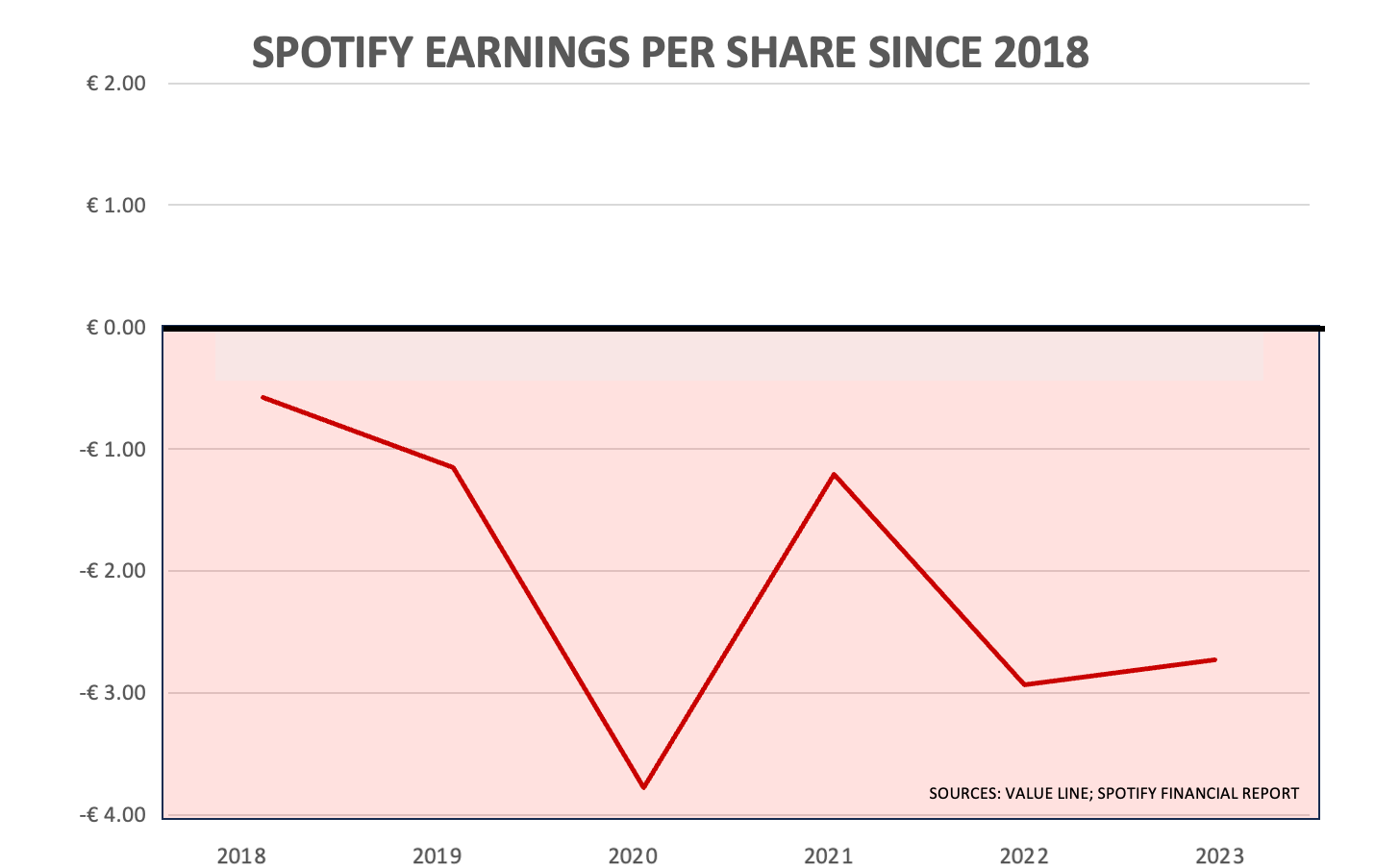
But the company released quarterly earnings this week—and it is still losing money!

chart of spotify's earnings per share since 2018

Meanwhile the CEO continues to sell his shares—another $57.5 million in the last few days.

Let me put this into perspective: Spotify was founded in 2006, and has now been operating for almost 18 years. It has 236 million subscribers in 184 countries. But the business still isn’t profitable.

Ted Gioia

Maybe one path to profitability is to pass off royalty-free AI Muzak as easy-listening jazz. It used to be a mild insult to call any work of art “derivative,” but with AI, it’s turtles all the way down.

Civilization

To realize the relative validity of one’s convictions and yet stand for them unflinchingly is what distinguishes a civilized man from a barbarian.

Joseph Schumpeter, third- or fourth-hand

From the same Damon Linker post that quotes Schumpeter:

Niebuhr rightly remarked that Americans nearly always mean well when they act in the world. Our moral perils are thus “not those of conscious malice or the explicit lust for power.” Yet the rules of the world are such that good intentions—even our own—often lead to unintended bad consequences. This is a lesson we seem incapable of learning, or remembering, so eager are we to deny that the actions of even “the best men and nations” are “curious compounds of good and evil.”

The danger of crafting policy and acting in the world on the basis of an overly exalted view of our ourselves isn’t just that we’ll make foolish decisions that lead to immense suffering and harmful setbacks to our broader strategic aims. It’s also that in raising and dashing lofty expectations, we run the risk of inadvertently inspiring the cynicism to which Niebuhr also thought we were prone, as the inverse of our over-confident moralism.

This happened on the left during the 1970s, in the wake of the Vietnam debacle, with George McGovern’s call for America to “come home” after its ruinous misadventure in southeast Asia. And it’s happening in our own time on the right, after George W. Bush displayed hubris in deciding to topple the regime of Saddam Hussein and then adopted an unmodulated form of theologically infused American exceptionalism to justify the policy once its original rationale (ridding Iraq of weapons of mass destruction it didn’t possess) crumbled to dust. (If you’ve forgotten its details, I urge you to read Bush’s 2005 Inaugural Address, with its 50-odd invocations of “freedom” or “liberty,” and jaw-dropping declaration that the ultimate goal of American foreign policy is nothing less than “ending tyranny in our world.”)

The instant before that “jaw-dropping declaration” was my last as a Republican, as I’ve written about before.

World Affairs

Made in America

Only naive arrogance can lead Westerners to assume that non-Westerners will become “Westernized” by acquiring Western goods. What, indeed, does it tell the world about the West when Westerners identify their civilization with fizzy liquids, faded pants, and fatty foods?

Samuel P. Huntington, The Clash of Civilizations and the Remaking of World Order

Rulers

It pains me to channel this, but Dreher’s right, at least up to the break:

Whatever you think of Vladimir Putin, who is ten years younger than Biden, he is vigorous, sharp, and combative. He gave his American interlocutor a coherent lesson on the past thousand years of Russian history, and hesitated only to tell the Yank to hush, and let him finish. Meanwhile, in Washington yesterday, Joe Biden confused President Sisi of Egypt with the leader of Mexico.

Toggling back and forth online from the Carlson interview to the Biden press conference, staged to address the humiliating Special Counsel’s report, was like moving out on a frail, narrow footbridge over a chasm. It is truly terrifying to consider that the feeble, senile old man desperately trying to rebut charges of dementia is what the U.S. sends to “battle” against a man like Putin.

Even worse, nobody doubts that Putin, for better or for worse, governs Russia. Who is governing America from the White House? Because it is not Joe Biden, that’s for sure.

It is hard for many Europeans to understand, but Americans scarcely know what happened in our country more than five minutes ago. And we only seem to care about it insofar as we can cite history as a reason to justify whatever it is that we want to do now. This is why Americans are living through the catastrophic, indeed totalitarian, leftist stripping of significant historical figures from public life—taking down their monuments, expelling a considered, nuanced treatment of them from history books—without protest. Too few Americans understand why this matters, and why they should care.

Isn’t Vladimir Putin doing the same thing—putting history to use to justify his attack on Ukraine? Yes, but there’s a difference. Russia really does have this incredibly long, dense, and difficult history with the territory we now call Ukraine. One does not have to accept Putin’s conclusion at the end of the story—‘therefore, Russia had to invade’—or accept his version of historical events to grasp that history matters to him in ways that many Americans will fail to appreciate.

National Affairs

Now and then

Is the New York Times suffering cognitive decline?

A tip of the tendentious hat to Nellie Bowles.

What’s wrong with the GOP?

As I frequently remind readers, I’m a former conservative who hasn’t voted for the GOP since 2002. Why?

Because I think the Republican Party and its right-wing media allies intentionally spew demagogic toxins into the civic atmosphere of the nation for the sake of political gain.
Because that isn’t going to change. (Like a three-pack-a-day smoker waiving away the possibility of lung cancer even after symptoms of serious illness have appeared, Republican voters have become addicted to the poison and demand more of it with each new election.)
And most of all, because, like a highly skilled conman/drug pusher, Donald Trump deepens the deadly addiction every day, along with posing a potentially fatal threat to the country’s democratic institutions.

Damon Linker

Another reason to despise the GOP

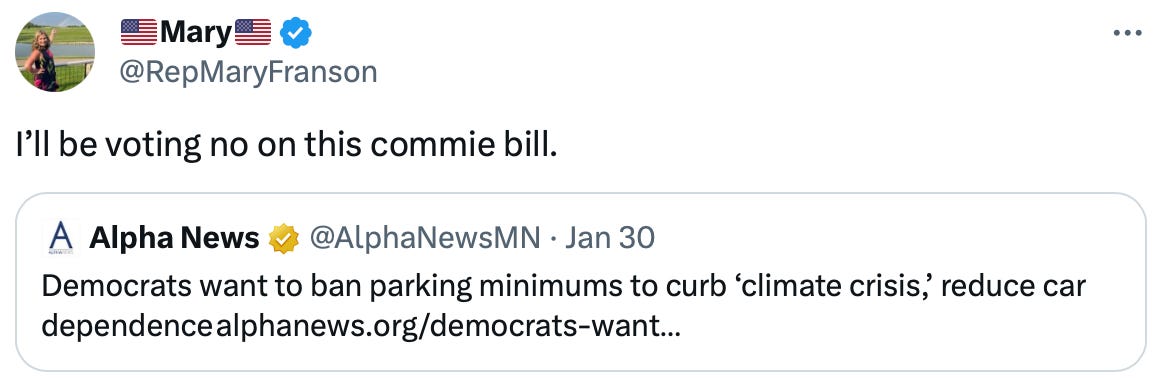
Republicans vs. property rights: Democrats in Minnesota, including Ilhan Omar, are supporting a new bill that would ban something called parking minimums. Parking minimums require property owners and developers to include a certain number of parking spots per apartment or business, and it was useful in the 1950s construction boom but it’s now one of the ways the government forces everyone into sprawling, low-density communities that rely on cars. Left to the free market, people often freely choose to live close together. They like it. I like it! Ever wonder why Paris and London are so charming? Anyway, I’m for freedom and so I err on the side of people being able to do more of what they want with their land, especially when parking lots are genuinely ugly. So oddly enough, when it comes to parking minimums, I’m with Ilhan Omar. The Republican opposition to the bill—again, which would limit the power of government and give property owners more rights to do what they want—goes something like this:

Right. That’s exactly how communism works. 

Nellie Bowles

Apart from the knee-jerk response of “freedom,” which ought to resonate with a Republican (at least as I remember the party), removing that impediments to higher-density living arrangements is the right policy because it promotes more sustainable living.

Another good one steps away from DC

Another respected Republican, Rep. Cathy McMorris Rodgers, also revealed she will retire at the year’s end, despite being the chair of the influential House Energy and Commerce Committee. The 54-year-old lawmaker from Washington state has served in Congress since 2005. McMorris Rodgers and Gallagher join a growing exodus of members of both parties who are leaving Congress frustrated that political infighting has made legislating harder than usual.

Dispatch Politics

Rep. Rodgers is one of a few candidates I supported financially (1) because she was endorsed by the pro-life Susan B. Anthony List and (2) then-35 year-old Rodgers looked electable. I am grateful that she has never engaged in the kind of jackassery that would make me regret my support.

Too many other SBA List endorsees who got elected have turned into embarrassments. One of them was foregrounded at new Speaker Mike Johnson’s coming out party snarling “SHUT UP!” at a reporter for asking an obvious and appropriate question.

I don’t look at SBA List endorsements any more.

Separating the man from the movement

Trigger Warning: If you don’t want to see anything about DJT here, stop. I’m quoting this because the mention of him is incidental to a more important point about how to heal our politics:

I think I detest Donald Trump as much as the next guy, but Trumpian populism does represent some very legitimate values: the fear of imperial overreach; the need to preserve social cohesion amid mass migration; the need to protect working-class wages from the pressures of globalization.

The struggle against Trump the man is a good-versus-bad struggle between democracy and narcissistic authoritarianism, but the struggle between liberalism and Trumpian populism is a wrestling match over how to balance legitimate concerns.

David Brooks, The Cure for What Ails Our Democracy – The New York Times (italics added). This column is so good (edifying good, not trolling good) that I’m using one of my ten monthly New York Times shareable links for it.

Yes, I suppose this is another insouciant assumption that there can be Trumpism without Trump. But we ignore populism’s legitimate values, we’ll see other demagogues arise to exploit them when Trump’s gone.

Resolute yet humble

Isaiah Berlin, concluded one of his most famous essays by quoting an observation by political economist Joseph Schumpeter: “To realize the relative validity of one’s convictions and yet stand for them unflinchingly is what distinguishes a civilized man from a barbarian.” This is also what distinguished postwar liberals such as Berlin and literary critic Lionel Trilling (the subject of this series’ second post) from just about everyone writing and thinking about politics today.

Damon Linker

ICMY, I think he called “just about everyone writing and thinking about politics today” barbarian, and I won’t disagree if one allows for a bit of hyperbole in “just about everyone.”


So: where did all my mockery of Trump go?

You can read most of my more impromptu stuff here and here (both of them cathartic venting, especially political) and here (the only social medium I frequent, because people there are quirky, pleasant and real). All should work in your RSS aggregator, like Feedly or Reeder, should you want to make a habit of it.

The End of an Eventful Week

Culture

Wry truism

Paul Krugman compared the welfare of Europeans with that of Americans: “It should count for something that there’s a growing gap between European and U.S. life expectancy, since the quality of life is generally higher if you aren’t dead.”

Frank Bruni

Über-speak

  • One suspects, rather, that noisily associating with driverless cars helps to preserve Uber’s image as a “tech” company, rather than as an especially aggressive practitioner of labor and financial arbitrage. Beneath the cutting-edge hocus-pocus, Uber’s “driver-partners” appear to have entered a sharecropper economy from which it is difficult to exit.
  • We should notice that while driverless cars hold real potential to ease congestion, and thereby contribute to the common good, there has been no talk of treating as a public utility the infrastructure that will make driverless cars possible, nor of making their programming available for inspection. What is being proposed, as near as one can make it out through the fog of promotional language, is an “urban operating system” of mobility that would be owned by a cartel of IT companies, participation in which would not be optional in any meaningful sense. … In the mentality of corporate libertarianism, there is no concept of legitimate public authority as that which secures the interests of citizens against the power of monopoly capital.

Matthew B. Crawford, Why We Drive

Transing the gay away

There’s a genre of aphorism in the form “If you don’t like X, just wait ’till you see Y.”

I’m not sure “transing the gay away” is any improvement over “praying the gay away,” but it’s what we’ve now got.

[T]he vast majority of children with gender dysphoria are gay or lesbian; and this is the target population for child sex changes. How can you tell which kids are going to end up as transgender and which will become gay or lesbian? The official answer is that it is clear in every single case. The actual answer is that we can’t know for sure. But if the policy is that any child who merely says they are the opposite sex cannot be questioned, and must be fast-tracked toward an irreversible sex change, we have a huge danger: that gay children will have their bodies wrecked, their fertility ended, and their sex lives stunted because we have erased the trans and gay distinction, and, in fact, merged the two.

Andrew Sullivan on The Meaningless Incoherence Of “LGBTQ+”.

Miscellancy from TGIF

  • Tucker Carlson went to Russia to interview Vladimir Putin. In his announcement prefacing the interview, he says that while many American journalists have interviewed Ukraine’s president Volodymyr Zelensky, “not a single Western journalist has bothered to interview the president of the other country involved in this conflict, Vladimir Putin.” Well. I’m sure every major outlet has tried: Putin, who hates free speech and hates a free press, simply refuses … Putin is the reason we don’t hear from Putin. And there is a real American journalist in Russia right now: that’s Wall Street Journal reporter and current Russian prisoner Evan Gershkovich, who we see only when he’s marched into a plexiglass box for another hearing in his show trial. ….
  • Nextdoor’s stock is collapsing, which personally makes me a little happy. You see, Nextdoor started as a useful neighborhood communication tool. The trouble is, neighbors like talking about things that the idealistic young workers of Nextdoor don’t approve of, namely crime. You guessed it. Yes, among each other, neighbors, at least in my area of Los Angeles, often talk about which house on the block was broken into and whether they were attacked or just robbed, things such as that. Bad talk, you baddie homeowners … Bad talk has been suppressed on Nextdoor, where you may discuss only things that twentysomething engineers (who live in guarded apartment towers with doormen) agree is healthy. Like juice cleanses. …
  • Speaking of places I don’t need the government, this week Florida’s Ron DeSantis is supporting a state ban on lab-grown meat. “You need meat, OK? We’re gonna have meat in Florida,” DeSantis said. “We’re not going to do that fake meat. Like, that doesn’t work.” …
  • Dartmouth is bringing back the SAT requirement for all applicants, a first for the Ivy League, which made the SAT and ACT optional in 2020. The argument was that all tests are racist, and what’s not racist are extracurricular activities and teacher recommendations. Yes, there is nothing more egalitarian than being the goalie on a travel hockey team, a $10,000 trip to Ecuador to volunteer, and a stunning letter of recommendation from a teacher who has eight kids in her class. Sure, all studies show that the SAT has a surprisingly egalitarian effect across race and class. But dropping the test was worth it for these schools. Why? Because knowing SAT scores makes it much harder for Harvard and Yale to legally discriminate against Asians. Anyway, Dartmouth really does want to know who’s actually smart, so they’re bringing it back. What else is happening in education?

Nellie Bowles

The late, great David Graeber

There seems a broad consensus not so much even that work is good but that not working is very bad; that anyone who is not slaving away harder than he’d like at something he doesn’t especially enjoy is a bad person, a scrounger, a skiver, a contemptible parasite unworthy of sympathy or public relief.

David Graeber, Bullshit Jobs

Recommendations

  • There is a young, Christian writer named Bethel McGrew who is now on my radar and probably should be on yours. Taste her Substack.
  • Poems Ancient and Modern is a publication about poetry. Joseph Bottum, a writer in the Black Hills of South Dakota, and Sally Thomas, in the Western Piedmont of North Carolina, choose and comment on poems, old and new, ancient and modern. Drawn from the deep traditions of English verse — the great work of the past and the living poets who keep those traditions alive — the poetry, with its accompanying commentary, demonstrates that poetry still enthralls the ear, instructs the mind, and aids the soul.
  • Rebecca Solnit, How to Comment on Social Media.

Sporty

The story that’s almost as big as the game

I had some reasonably good quotes here from David French on the supposed political conspiracy behind — oh, I dunno — Taylor Swift becoming popular and getting a hunky NFL boyfriend, all the better to re-elect Joe Biden.

I’m not going to blog them because I think this “story” is nut-picking that turned into a journalistic murmuration.

In other words, I know I’m out of touch with MAGA-America, but it appears to me that the people obsessing about this “story” are opportunistic journalists and pundits (sorry David), not Trumpists.

I wrote every word of the preceding three paragraphs before Freddie deBoer came along and did an even better job of debunking this stuff: Perhaps Taylor Swift Isn’t the Defining Political Issue of Our Times. (Trigger warning: the full article contains Marxism.):

[I]t turns out that when you spend your time making fun of the stupid nonsense conservatives are spending their time freaking out about, you are also spending your precious time on earth on stupid nonsense … There’s zero stakes here, but the fact that so many people are so animated about zero stakes reveals a rot that is itself genuinely high-stakes.

After reading Freddie, I didn’t have the stomach to read an Atlantic story on the cosmic significance of Joni Mitchell at the 2024 Grammy Awards.

Wherein I comment on a sportsball

I generally am not a big fan of sportsball of any kind, but I’ve become more of a fan of Premier League soccer (the stamina of those guys is a marvel) and I’m an intense (if fair-weather) fan of Purdue Men’s basketball.

After #2 Purdue’s road win over #6 Wisconsin, sportswriters are saying things like “Purdue basketball shows it is elite, even when not its best” (Sam King) and the equivalent, elaborated nicely by Greg Doyel.

I’ve got to disagree. The team play on the road against Wisconsin is Purdue at its best. Its best is not Edey scoring 30 points, or Loyer raining down 3-pointers. Not when an opponent defends Edey and gives few open looks on 3s like Wisconsin did.

Lance Jones 20, Braden Smith 19, Zach Edey 18. That inversion is Purdue at its best, and it’s why they’ve got an unusually good shot at the NCAA Tournament.

Just sayin’.

Trump-adjacent

ICYMI

February 8, 2024 was a very, very, very good day for a certain Donald J. Trump.

  • All who listened to SCOTUS are confident he’s headed back to the ballot in Colorado.
  • The Special Counsel report on Joe Biden’s handling of classified documents was devastating to Team Biden.

(H/T Advisory Opinions podcast for that insight.)

I’d sooner drink muddy water than say “congratulations;” I’m just laying out the facts.

The limits of democracy

Trump Doesn’t Threaten Democracy—He Embodies It – WSJ

I know there’s a meta-argument that Trump “threatens democracy.” But the more obvious argument is that he embodies it, and it’s making a lot of people understandably sick with anxiety.

My point is that “democracy” is not worthy of our worship and never was.

Our Constitution was made only for a moral and religious people. It is wholly inadequate to the government of any other.

John Adams

That, gentle reader, is our problem.

What can a traditional Republican do?

The moment Trump launched his insurgent campaign in June 2015, the old [Republican] order began to crumble. Now the rabble was calling the shots—and it had found its tribune.

This displaced a lot of intellectuals who had gotten used to the old way of doing business. They now had three options: They could find another line of work and thereby disappear into the American woodwork; they could become Never Trump dissenters, which either meant keeping the old fusionist-conservative remnant alive for some hoped-for fantasy future (The Dispatch) or becoming post-Republican centrist Democrats (The Bulwark); or they could try and adapt to the new Trumpian order of things on the right.

The staff of First Things, long after I’d departed, took the third path, as did many others at both old and new magazines, think tanks, and digital media outlets. Some of the work these people did and continue to do is worthwhile in trying to put policy meat on the bare bones of right-wing populism/nationalism.

Damon Linker, The Right’s New Abnormal Normal.

Linker is not wrong about First Things, to which I’ve subscribed since its sane beginnings. As a charter subscriber to The Dispatch, I guess I’m now basically a fusionist-conservative, waiting for “some hoped-for fantasy future.” I know that I frequently think “if that’s what ‘conservatism’ is today, then I’m not conservative,” but I’m as yet unconvinced that the present populist moment is what conservatism is.

“Trump? we already did that one.”

It is well to remember that pundits fail:

The Constitution says that if Trump is impeached and then convicted, he can be banned from running for president again. Trump run again? Democrats should only be so lucky. The media culture does not allow second chances, whatever the Constitution may say. “Trump? we already did that one.” He’s over. He lost the election by 10 million votes. Is there anyone who has become more sympathetic to Trump since Election Day?

Michael Kinsley: Against Impeachment

Peggy Noonan schools the press

How should the press cover a presumable Trump-Biden presidential rematch? More pointedly, how should it cover Donald Trump?

The history that precedes that question is well known. In 2015-16 the media, having discovered that Mr. Trump was a walking talking ratings bump and being honestly fascinated by his rise, turned the airwaves over to him knowing he couldn’t win. He won. In a great cringe of remorse and ideological horror, many did penance by joining the “resistance.” The result: Mr. Trump wasn’t stopped—he got a whole new fundraising stream out of “fake news”—but journalism’s reputation was drastically harmed.

Peggy Noonan, who goes on to share detailed ideas on how the press needs to rehabilitate that damaged reputation.

Election 2024

We’re now looking at an election pitting the 14th Amendment against the 25th.

National Review

I don’t know what it will take for some folks to acknowledge that our American Experiment can fail.
As already noted,

Our Constitution was made only for a moral and religious people. It is wholly inadequate to the government of any other.

John Adams

If it seems like a nonsequitur to blame two notoriously unsuitable major-party candidates on immorality and apostasy, you’ve got a distorted idea of how judgment works: sometimes, it’s just a matter of God stepping back and saying “Okay, have it your way.”


So: where did all my mockery of Trump go?

You can read most of my more impromptu stuff here (cathartic venting) and here (the only social medium I frequent, because people there are quirky, pleasant and real). Both should work in your RSS aggregator, like Feedly or Reeder, should you want to make a habit of it.

Tuesday, 3/28/23

Florida

Helen Lewis, Brit, visits Ron DeSantis’ Florida

This one goes out to a certain gun-lover in my life:

When I first arrived in Orlando, in late October, I rented what to me was a comically large Ford SUV and drove to McDonald’s for hash browns and a cup of breakfast tea (zombie-gray, error). Then I went to a gun range, where I began by firing two pistols. The very serious man behind the desk had clocked my teeth (British), accent (Hermione Granger), and sex (female), and expressed skepticism that I would want to fire an AR‑15 assault rifle too. But I did. In the past decade, semiautomatic rifles like the AR-15 have become the weapon of choice for young killers, and I needed to see what America was willing to put into the hands of teenagers in the name of freedom.

With the pistols, my shots pulled down from the recoil or the weight. But the AR‑15 nestled into my shoulder pad, and the shots skipped out of it and into the center of the target. I felt like I was in Call of Duty, with the same confidence that there would be no consequences for my actions; that if anything went wrong, I could just respawn.

Later, a friend texted to ask how firing the rifle had been. I loved it, I said. No one should be allowed to have one_._ This is not a sentiment to be expressed openly in DeSantis’s Florida. When the Tampa Bay Rays tweeted in support of gun control after the Uvalde, Texas, massacre last year, the governor vetoed state funding for a new training facility, saying that it was “inappropriate to subsidize political activism of a private corporation.” You might think: How petty. Or maybe: How effective.

Helen Lewis, How Freedom-Loving Florida Fell for Ron DeSantis

Florida as educational microcosm

[Florida] is a textbook example of academic bloat. The State University System of Florida consists of 12 public universities, with 341,000 enrolled students, of which only four are engaged in what the Carnegie Classification of Institutions of Higher Education refers to as “very high research activity”. The rest of these institutions, such as the enormous Florida Atlantic University, are vast and shabby post-secondary “student warehouses”, similar to UT-Arlington.

It is these universities, not the tiny New College of Florida, that constitute the real threat to public education — and not because they are “woke”, but because their retention and graduation rates are horrific. They are enrolling students, taking their federally-subsidised student loans, and barely graduating around 50% of them.

Oliver Bateman, America is fighting the wrong university wars

Culture

AI Status Report

All signs that I’ve registered counsel me that I’d been wasting my time trying to decide if Artificial Intelligence is boon, bane, or something even further out on the spectrum than those markers. I haven’t chatted with ChatGPT or immersed myself in a single longform essay on how “transformative” (grammatically neutral but functionally adulatory) or “apocalyptic” (mirror-image opposite) the technology is.

They’re all surely speculations by people who don’t really know because nobody knows the future, and I’d be astonished if I found a smoking-gun argument on either side.

I have spent a few minute, though, chuckling at AI screwups.

Routine corporate behavior

Fox News pandering to what its viewers wanted to hear after the last Presidential election is not really out of the mainstream of corporate behavior:

Sycophancy toward those who hold power is a fact in every regime, and especially in a democracy, where, unlike tyranny, there is an accepted principle of legitimacy that breaks the inner will to resist…. Flattery of the people and incapacity to resist public opinion are the democratic vices, particularly among writers, artists, journalists and anyone else who is dependent on an audience.

Allan Bloom, The Closing of the American Mind

Education more generally

The New York Times’ Frank Bruni opines on The Problem With College Rankings, and How We Fix It. The problem revolves around choosing for prestige.

The “fix” he alludes to is an interactive college selector of the Times’ own devising.

Here are the Times’ selection criteria:

Here’s the closest I thought I could come to what I value in a college or university (though “Academic Profile” seems a belamed version of “will they try to make me an educated person?”):

And here’s where I should go based on those criteria:

It was kind of interesting. If I actually were looking for a college, I’d definitely put this in the mix of tools.

Politics

Eric Metaxas and his kin

Eric Metaxas appeared to be a pretty solid guy until he sold his soul to a politician who remains too much in the news. His over-the-top comments between Election 2020 and the cool-down period after January 6 (see this) destroyed any trust I might have felt.

But I recently listened to a podcast discussion of his presumptuous newish book Letter to the American Church. I discerned very little thought, but a lot of rhetorical cunning: staccato riffs salted with endless straw men. I assume that sort of thing persuades some people. His resort to straw men in support of his inexplicably pre-ordained conclusions is of longstanding (see the Emma Green Atlantic story, the first link above).

Specifically, Mr. Metaxas,

  • I did not vote for Hillary Clinton just because I didn’t vote for Trump (have you heard of the “Electoral College” and “Red States”? A protest vote in a Red State need not be a Blue vote); and
  • I didn’t withhold my vote from Trump because I thought his supporters were yucky, tacky or whatever that straw man was. I refused to vote for him (twice now, and the second time the alternative was not Hillary, Trump’s biggest 2016 advantage) because he is a toxic narcissist and because sooner or later his pathological self-regard was going to make him misapprehend reality. (As we see his current deranged output on Truth Social, it’s obvious that I was right.)

I’ve thought about what would make someone like Metaxas lose his mind over this. There are people closer to me than him who’ve done much the same thing, such as the friend who recently faulted “SJW” jackboots at Purdue for disrupting a “conservative speaker.” That version has a few problems:

  1. Purdue has a strong free speech policy.
  2. So the SJWs did not disrupt, but rather counter-protested and acted up nearby.
  3. The dramtis personnae were not a benign conservative and malign SJWs, but rather a Right provocateur (“we must eradicate transgenderism from America”) eager to give offense and Leftish provocatees eager to take it.

What happened was that my friend had taken his Right narrative and applied it to facts that he assumed fit. He hadn’t bothered to ascertain what actually went on.

This suggests to me a possible causal sequence:

  1. My friend (and Metaxas?) assume that, this being America, if there’s a bad American guy or group, there must be a countervailing good American guy or group. It’s unthinkable that God would forsake America, His special darling, leaving its people with only miserably bad political choices (my strong suspicion of what happened).
  2. Having identified the Democrats as bad, the Republicans must be good (because only they are big enough to countervail; a vote for a third party candidate is “wasted”).
  3. Having identified the Republicans as good, their nominees and elected officials must be good — not just “less bad most of the time” but “good,” or “very good” or (as spoke another evangelical friend in 2016) “the best candidate I’ve had the privilege to vote for in my entire life.”
  4. Thus do we get Christian folk who have syncretized the faith with Manicheanism. Pas d’ennemies áu droit.

I suggest that narrative, which I shall for a while be tempted to use to structure what I observe and what I hear vague rumors about.

Where’s the beef? Maybe Georgia

In April 2020, businesses in Georgia were shuttered by government decree as in most of the rest of the country. Mr. Kemp was hearing from desperate entrepreneurs: “ ‘Look man, we’re losing everything we’ve got. We can’t keep doing this.’ And I really felt like there was a lot of people fixin’ to revolt against the government.”

The Trump administration “had that damn graph or matrix or whatever that you had to fit into to be able to do certain things,” Mr. Kemp recalls. “Your cases had to be going down and whatever. Well, we felt like we met the matrix, and so I decided to move forward and open up.” He alerted Vice President Mike Pence, who headed the White House’s coronavirus task force, before publicly announcing his intentions on April 20.

That afternoon Mr. Trump called Mr. Kemp, “and he was furious.” Mr. Kemp recounts the conversation as follows:

“Look, the national media’s all over me about letting you do this,” Mr. Trump said. “And they’re saying you don’t meet whatever.”

Mr. Kemp replied: “Well, Mr. President, we sent your team everything, and they knew what we were doing. You’ve been saying the whole pandemic you trust the governors because we’re closest to the people. Just tell them you may not like what I’m doing, but you’re trusting me because I’m the governor of Georgia and leave it at that. I’ll take the heat.”

“Well, see what you can do,” the president said. “Hair salons aren’t essential and bowling alleys, tattoo parlors aren’t essential.”

“With all due respect, those are our people,” Mr. Kemp said. “They’re the people that elected us. They’re the people that are wondering who’s fighting for them. We’re fixin’ to lose them over this, because they’re about to lose everything. They are not going to sit in their basement and lose everything they got over a virus.”

Mr. Trump publicly attacked Mr. Kemp: “He went on the news at 5 o’clock and just absolutely trashed me …

At that point, Florida was still shut down. Mr. DeSantis issued his first reopening order on April 29, nine days after Mr. Kemp’s. On April 28, the Florida governor had visited the White House, where, as CNN reported, “he made sure to compliment the President and his handling of the crisis, praise Trump returned in spades.”

Three years later, here’s the thanks Mr. DeSantis gets: This Wednesday Mr. Trump issued a statement excoriating “Ron DeSanctimonious” as “a big Lockdown Governor on the China Virus.” As Mr. Trump now tells the tale, “other Republican Governors did MUCH BETTER than Ron and, because I allowed them this ‘freedom,’ never closed their States. Remember, I left that decision up to the Governors!”

James Taranto, Brian Kemp, Georgia’s Affable Culture Warrior.

Res ipsa loquitur.

Ron DeSantis, George Soros and Peter Thiel

Governor Ron DeSantis should be ashamed.

In contemplating the possible criminal indictment of former President Donald Trump, the Florida governor tweeted: “The Manhattan District Attorney is a Soros-funded prosecutor.”

Let us review.

George Soros, the wealthy Hungarian-American financier and philanthropist, is the bogey man of the American right wing. They trace whatever they don’t like about liberalism or progressive politics back to Soros’ imaginary machinations. Soros is the puppet-master.

George Soros is a Jew.

These are antisemitic conspiracy theories. That is what makes antisemitism so potent, and unique among hatred — it has always existed as a network of conspiracy theories. You just have to say the name “Soros,” and you wind up with an antisemitic dog whistle — in much the same way as “Rothschild” has been, and continues to be.

Jeffrey Salkin, Call it Soros-phobia.

I completely agree that George Soros “is the bogey man of the American right wing.” I do not share that feeling about him.

I have no reason to doubt that Soros is a Jew.

I consider DeSantis’s comment about Alvin Bragg a combination of craven servility to Trumpist voters and hackneyed demagoguery about a bogey man.

But it does not follow that criticism of Soros is antisemitic, unless one absurdly considers any criticism of a Jew, at least if coupled with some dark hint that “he’s up to something,” antisemitic. And both Salkin and the ADL seem to have little more than that. (James Kirchik makes a similar point.)

They may nevertheless be right (I’ve been wrong about my “conservative” countrymen before). Let’s try a thought-experiment: Is Left criticism of Peter Thiel’s influence anti-gay?

Trump’s “Retribution Tour”

The accompanying article wasn’t revelatory, but I love Elaine Godfrey’s title: Trump Begins the ‘Retribution’ Tour


For all its piety and fervor, today’s United States needs to be recognized for what it really is: not a Christian country, but a nation of heretics.

Ross Douthat, Bad Religion

You can read most of my more impromptu stuff here (cathartic venting) and here (the only social medium I frequent, because people there are quirky, pleasant and real). Both should work in your RSS aggregator, like Feedly or Reeder, should you want to make a habit of it.

Wednesday, 2/21/22

Welcome to Winter. We’re really in for it from at least the Great Lakes to the Great Plains.

Culture

To see ourselves as others see us

I ask Oizumi why he is so drawn to this country. “I like to go places where there are people with a real history. In Korea, that same tribe, that same culture has been there for a very long time.” “Well,” I say, “Europe has a long history too.” “No way! That place is frightening.” “Frightening?” “Yes. I went to Italy, Spain, Milan, Florence, and all the buildings were made from stone—the churches, the castle walls, and ramparts. Now, how did they make that? That would take a tremendous amount of energy. In those days there were no bulldozers. Everything was done by hand. A place with that many stone buildings would have needed some kind of slavery system to build them. When I saw that I thought, Wow, Asia was still relatively peaceful back in the olden days.

Andy Couterier, The Abundance of Less.

That kind of serendipitous blind-siding is why I try to keep from reading in a rut.

Solidarity — in peace as in war

When rationing ended in Britain in 1954, there were those who felt that something important had been lost. At one point, the Labour Party had argued for indefinite rationing. The commonality of shared suffering, it seemed, was a stronger bond than the commonality of shared prosperity. Interesting that.

No one was nostalgic for the war itself. The fighting, bombing and the certainty of death and injury were gladly left behind. But the common bond of a common effort remained a lively part of a generation’s memory. The stories only ended when they were laid to rest. The nostalgia, I think, was for the commonality, an experience that banished loneliness and gave meaning to even the smallest actions. The prosperity that followed was hollow. For what purpose do we now shop?

Fr. Stephen Freeman

Serving God or Truth, Beauty and Goodness

[A] look back at the archives of this newsletter in 2022 reminds me how much knowledge, both intellectual and spiritual, I gained from reading Iain McGilchrist, Hartmut Rosa, and so many others. The evil in the world can sometimes feel overwhelming, but there are so many good people trying to serve God, or at least serve Truth, Beauty, and Goodness, and pouring our their hearts and minds in that labor.

Rod Dreher, Lift Up Your Head to Receive the Light.

I like that: good people trying to serve God, or at least serve Truth, Beauty, and Goodness. That rings so true to me!

To Rod’s list, I’d add Andrew Sullivan (with one big gay marriage caveat), Bari Weiss (ditto, though she writes about it only rarely), Jesse Singal, Damon Linker and Freddie DeBoer, only one of them a Christian. I’ve benefitted from reading all of them, though a few seem to have started repeating themselves or churning out Substack posts without much real enthusiasm or fresh insight. That’s a hazard of writing to deadline for a living, it seems.

A word about Rod. I first encountered him decades ago (it only feels like decades) around 2010 in his book Crunchy Cons, and began following his doings. I’ve read each of his books since then, even the ones that made me cringe or scratch my head. I’ve attended a conference where he was a keynoter and chatted with him briefly there.

But I’ve stopped reading what he writes for American Conservative magazine; there, he makes bank on stirring up “conservative” contempt for progressive oddballs and attention-grabbing extreme gender nonconformists. I wish he’d quit. I don’t listen to his podcast (I even forgot it existed). And at the moment, I doubt that I’ll buy his newest book, because I fear he’s bitten off more (re-enchanting the imagination) than he can communicate. I only read his “Diary” on Substack.

2022 saw the end of his marriage, after (he now reveals) ten years of bad family turmoil. If you don’t follow him, I’d not particularly recommend that you start just now, as he tends still to obsess about that, as divorced people, with a keen sense of personal failure, tend to do.

But I also would caution against reading what anyone else writes about his divorce because there are apparently people making bank on sheer speculation, Rod and his wife having agreed not to discuss the details of what led to divorce beyond that neither was involved in extramarital relations. (Pro Tip: If you want to break into internet virality, try attaching yourself to someone further up the food chain and spreading slanderous rumors about them.) I’m enough of a sinner to have injected my imagination into their marriage and developed a little narrative of my own about how things went wrong and who was to blame, but thank God I’ve had the decency not to share it, and I try not to return to such speculation even privately.

In short, Rod’s a very flawed, and presently quite broken, person with a gift for writing. But I’ve followed him so long that I consider him a friend. In fact, we’re kin not only because he’s also Orthodox, but because we’re both flawed (DUH!). You need not do likewise, but don’t try to get me to criticize him harshly and in general.

Pro David Frenchism

As long as I’ve resorted to writing about people I read, let me touch on an emerging favorite: David French (he to whom the lesser-known Sohrab Ahmari attached himself, thus achieving virality). It’s a heck of an honor to be the illiberal right’s poster boy for classical liberalism — the guy they’d have tarred and feathered and “rode out of town on a rail” 150 years ago.

Counterfactuals always are dangerous, but I suspect I’d be a lot friendlier to post-liberalism/illiberalism today had I not kept on reading French (who writes in the same vein as David Bahnsen, below).

In other words, I’m broadly (if not fully) aware of the shortcomings of classical liberalism, but I see no better alternative for life in a pluralistic reality. If we decided that pluralism was the problem and succeeded in eliminating it, especially in favor of some version of “Christian America,” that could well mean eliminating me, because the dominant Christianities in this culture are so very different from Orthodoxy.

Indeed, were it not for his classical liberalism, I’d not want to live in a Christian America with French as tsar. I’ve begun turning away from his religious musings because they just don’t “speak to me,” and it’s hard to imagine that they once would have. But on politics and the intersection of religion/philosophy and governance, he’s been a boon.

Anger

Offered without comment:

Anger is less an emotion than an armor against feeling emotions. In most cases, we would be better off acknowledging the emotions from which anger seeks to protect us.

Damon Linker, citing Matt Yglesias

Politics

Why are they whistling a new tune?

[H]ow should those of us who, for years, have repeatedly warned Republicans about Trump view those who have finally done an about-face, in some cases mimicking the very criticisms that Never Trumpers have been making since the start of the Trump era?

We ought to welcome their turnabout. This is, after all, what many of us have been urging them to do. Everyone makes mistakes, and everyone should have the chance to correct those mistakes, including onetime Trump enthusiasts. Just as important, purging Trump from America’s political landscape can only happen if the Republican Party first purges him from its ranks. If people who once supported Trump are, at last, willing to cast him aside, that is all to the good.

But we shouldn’t see a moral awakening where there is none. The reason many longtime Trump supporters are deserting him is because they believe he is a loser, and an impediment to their quest for power.

Peter Wehner

Emotion blackmail as usual

Someone in the Indiana legislature is apparently planning to introduce what the press insists on calling a “Don’t Say Gay” Bill in January, when the legislature convenes.

I disclaim any knowledge of whether we have much or any problem in Indiana with age-inappropriate instruction on sexuality. And I’m aware of the argument that any instruction on sexuality in public schools usurps the role of parents. What this bill reportedly does is forbid any instruction in sexuality in K-3 and forbid any instruction that isn’t “age-appropriate” thereafter.

But what really gets to me is the all-too-predictable emotional blackmail that followed from Chris Paulsen, CEO of Indiana Youth Group:

“The damage even having the bill introduced will cause to young people is immeasurable,” Paulsen said. “We will see youth die by suicide because of this. I think it’s that dire and I’m sad that lawmakers don’t realize their actions have really bad consequences, even if the bill doesn’t pass.”

Indianapolis Star/USA TODAY NETWORK (emphasis added)

I call bullshit on the parts I emphasized.

Heckuva way to defend and uphold the Constitution

“I want to thank Judge Benitez. We have been saying all along that Texas’ anti-abortion law is outrageous. Judge Benitez just confirmed it is also unconstitutional,” Newsom said in a statement Monday. “The provision in California’s law that he struck down is a replica of what Texas did, and his explanation of why this part of SB 1327 unfairly blocks access to the courts applies equally to Texas’ SB 8.”

Politico

California Governor Gavin Newsom, thanking a federal judge for striking down a California gun law that mirrored a Texas abortion law, which gun law he supported.

Maybe I’m too literal-minded — no, make that “I’m often too literal-minded” (I have a hypotesis on what I am) — but it’s hard for me to see how Newsom’s support of a law he knew was unconstitutional isn’t a violation of his oath of office.

No option for rule by Angels

In a piece for National Review, frequent Remnant guest David Bahnsen pushes back on arguments made by First Things editor Rusty Reno against free markets and in favor of using political power to ensure virtue. “The cabal of new-right market skeptics are stuck with the age-old problem identified by the Founders, and yes, by 20th-century giants such as Friedman and Hayek: We have no option to be ruled by angels,” Bahnsen writes. “The doctrine of the Fall does not merely inform our understanding of the original sin plaguing individuals and families, but also and especially the state itself. That an individual left unchecked and free of moral enlightenment may suffer in weak discipline and low taste is both true and tragic. But that a civil magistrate granted the power Reno envisions for it represents a more potent and damaging fruit of original sin is, indeed, the testimony of history. On this point there can be no refutation. I prefer that the low-brow permeation of social-media obsession die a holy death, yet inviting the ghosts of 20th-century past to regulate consumer preferences strikes me as a ghastly trade-off.”

The Morning Dispatch


[S]ubordinating truth to politics is a game which tyrants and bullies always win.

Jonathan Rauch, The Constitution of Knowledge

To believe that wealth is the only significant measure of the worth of an individual, a family, or a community is to reject the teaching of nearly every religion and wisdom tradition that ever was.

Mark Mitchell and Nathan Schlueter, The Humane Vision of Wendell Berry

The Orthodox “phronema” [roughly, mind-set] cannot be programmitized or reduced to shibboleths.

Fr. Jonathan Tobias

You can read most of my more impromptu stuff here (cathartic venting) and here (the only social medium I frequent, because people there are quirky, pleasant and real). Both should work in your RSS aggregator, like Feedly or Reeder, should you want to make a habit of it.

Mostly political

David Shor

I do hope the Democrats listen to [David Shor] even if it means they do better in elections. Why? Well, for several reasons. First, because if they listened to him, the Democratic Party would move rightward. Second, I think the actual policies associated with “defund the police,” “birthing persons,” “Latinx,” etc. are profoundly bad for America. And third, because if the Democrats stopped talking about ridiculous things, it would deny many Republicans the psychological permission to behave like idiots or support demagogic buffoons.

Jonah Goldberg, That Shor Sounds Good

So what’s Shor saying that the Dems should listen to?

At its most basic, Shor’s theory goes something like this: Although young people as a whole turn out to vote at a lower rate than the general population, the aforementioned type of young person is actually overrepresented within the core of the Democratic Party’s infrastructure. According to Shor, the problem with this permanent class of young staffers is that they tend to hold views that are both more liberal and more ideologically motivated than the views of the coveted median voter, and yet they yield a significant amount of influence over the party’s messaging and policy decisions. As a result, Democrats end up spending a lot of time talking about issues that matter to college-educated liberals but not to the multiracial bloc of moderate voters that the party needs to win over to secure governing majorities in Washington.

Ian Ward, ‌The Democrats’ Privileged College-Kid Problem

David Brock

(David Brock left the GOP long before Donald Trump:)

Issues like racial justice, the environment and immigration are already resonating online with audiences Democrats need to win over, such as young people, women and people of color. Democratic donors have long overlooked efforts to fund the media, but with so much of our politics playing out on that battlefield, they can no longer afford to.

David Brock

It would be interesting to hear the two Davids, Shor and Brock, debate Democratic Party messenging.

Full disclosure for invitees

Alan Jacobs has a modest proposal:

This is related, in a way, to my previous post: After reading yet another invitation-disinvitation story, I think every university should – in the interests of full disclosure, honesty, and charity – prepare a list of Topics On Which Dissent Is Not Permitted and send that list to everyone who is invited to speak. That way prospective lecturers will know in advance whether they hold views that are not tolerated at those universities and can decline the invitation immediately rather than having to be canceled later on.

When Pandemic becomes Endemic, can we take off our masks?

I didn’t have much hope for ‌How Will Blue America Live With Covid? but it raises good questions.

As we saw after Sept. 11, certain forms of security theater, once established, become extremely difficult to dislodge as long as there is still any arguable threat. So as long as Covid stays in the news, it’s not hard to envision masking requirements for airplanes and trains persisting far into the future, much as we still try to foil Al Qaeda by taking off our shoes for airport security lines. It’s also possible to imagine a future in which the weird emergent norm of “masks for the help but not the V.I.P.s” — visible everywhere from the Met Gala to political fund-raisers to posh hotels — becomes an expected feature of life among the blue-state upper class (as well as a potent symbol for its critics).

Then there are blue-state elementary schools, where some of the constituencies that support mask requirements may not be assuaged even after vaccines are available for younger kids. At that point, according to both polls and personal experience, there will still be lots of vaccine hesitancy among even liberal parents — and you could imagine a coalition of more Covid-fearing parents and teachers’ unions demanding masking requirements until a school hits a vaccination threshold that remains perpetually out of reach.

Endemic Covid ensures that this dynamic will never simply vanish … deep-blue America will have to decide, in a world that’s postpandemic but not post-Covid, whether it wants to become the safety-above-all caricature that deep-red America has made of it — or if it can settle instead on masking a little more every December and January, a reasonable adaptation to the coronavirus experience, while otherwise leaving the age of emergency behind.

Ross Douthat

I’m seeing signs of this division among my acquaintances. And I suspect that public schools that veer into safetyism will find that a straw that breaks the camel’s back and sends more students off to private schools.

… boring me to death

Roughly a half decade or so ago, I started noticing that everyone began to believe that their political opinions were the most interesting thing about them.  When it’s usually exactly the opposite.  As a journalist, I always found that talking to people about their actual lives – their hurts, ambitions, failures, families, amusing asides – produced infinite and pleasant surprises. Only when they started talking politics could I finish all their sentences.  As a right-leaning person throughout my life, I became unwittingly involved in more and more conversations, feeling like a trapped rat all the while, in which my conversational companions gave me their harangues on how biased the liberal media was.  In fairness, the mainstream media does lean liberal, and often is biased.  (Who isn’t, these days?)  But if every other sentence you utter ends in the refrain “liberal media bias,” it doesn’t necessarily mean you’re lying or wrong, just that you’re boring me to death over dinner. I get it. But that’s been settled law for decades. Try to be more interesting.

Besides, achieving equanimity isn’t just a natural state, but a choice.  These days, it very much involves swimming against the tide. You nearly have to choose not  to get riled by all the manufactured outrages, Kabuki-theater conflagrations, and faux-Twitter fights that are conducted by catty people, for catty people.  The rage merchants abound, and are all too willing to make a buck from stoking your anger and wet-nursing your resentments  over  “issues” you’d never even heard of five minutes prior.  Don’t be such an easy mark.

Matt Labash

No senses

I’ve long known that ultra-progressives have no sense of humor. Now it appears that perhaps they have no sense of chronology, either:

When I appeared on Megyn Kelly’s podcast, she shared an anecdote (at 46:00 minute mark) about a friend of hers who worked as an editor at a major publishing house. The editor had received a manuscript of a historical novel, based on a true story, of a woman who had to pose as a man in order to receive a medical education and become a surgeon in the 1920’s1. The editor admired the novel and circulated it for feedback from some junior editors.

Perhaps you can anticipate what happened next. The book was attacked by other staffers for its failure to portray the woman who posed as a man in order to practice medicine as transgendered. The author had failed to frame her story through an anachronistic projection of today’s gender ideology onto a past in which the ideology did not yet exist. This meant her work was therefore “transphobic.” The editor was reported to HR for forcing them to read the book and subject to a disciplinary process. He was unable to move forward with the acquisition he had intended.

J.K. Rowling, Joe Rogan, Dave Chappelle. They exist in a strange form of cossetted duress. They are still beloved by millions, wealthier and more widely exposed than ever before. But they are pariahs from the official pseudo-consensus that the Successor Ideology has captured and that a growing body of the gullible and the opportunistic alike have signed on to join with the forces that they anticipate will be in the ascendancy soon.

Wesley Yang, Cancellation, or Cultural Change

How do you marginalize normalcy?

No amount of effort at revising my attitudes (not that I’m especially inclined to try, sorry) would do much to change the fact that however effete and aloof and sensitive I may be, (and I am surely in the 95th percentile among men along both of these dimensions), I am nonetheless, for better or worse, unambiguously a cisgendered, (a term that the late comedian Norm MacDonald characterized “a way of marginalizing a normal person), heterosexual man, and all that entails.

Wesley Yang, ‌Preface to a 20-volume Dave Chappelle Review

Pregnant women at SCOTUS

SCOTUS is going to hear the Texas abortion law case on its "rocket docket;" briefing next week, argument November 1:

Justice Sotomayor wrote a six-page dissent. She repeatedly referred to pregnant "women," without a footnote about gender identity. Call the cancellation squad.


You can read most of my more impromptu stuff at here. It should work in your RSS aggregator, like Feedly, should you want to make a habit of it.