Saturday, 11/29/25

As December impends, we have our first substantial snowfall of the year in my fair city. I am belatedly thankful for snow blowers.

Right Relativism

Jonah Goldberg, who I don’t read that often, grabbed my attention with the title of his Thanksgiving Day post: The Truth, the Whole Truth, Everything but the Truth. It was good enough for promotion to my lead item today.

Just one little snip:

It’s amazing to me how many people on the right can (rightly!) denounce the 1619 Project … but yawn at the … tendentious denunciations of the American regime by conservative intellectuals and various “influencers.” As shoddy as the 1619 Project was, it was vastly more serious and grounded in facts than “the Jews did Pearl Harbor” or the idea peddled on Carlson’s show that the Holocaust was an accident of poor planning by the Nazis.

When I was in university, Saul Alinsky didn’t come to my attention (neither did Foucault, Derrida and other figures now widely blamed for various ills). But some on the right, tired of losing and convinced that the Left’s tactics were giving them victories, have now embraced Alinsky for their own purposes. For instance:

We have successfully frozen their brand—”critical race theory”—into the public conversation and are steadily driving up negative perceptions. We will eventually turn it toxic, as we put all of the various cultural insanities under that brand category.

That’s “national conservative” Alinskyite Christopher Rufo, boasting in 2021. He’s my personal “Exhibit A” in indicting the Right. Compare Alinsky (via Goldberg):

“Pick the target, freeze it, personalize it, and polarize it,” and “Ridicule is man’s most potent weapon. It is almost impossible to counterattack ridicule. Also it infuriates the opposition, who then react to your advantage.”

I didn’t recognize the echo of Alinsky when I first read Rufo’s Tweet back in ’21, but I knew immediately that Rufo was being dishonest and thus was not my idea of a conservative. (Yeah, I guess I’m one of those “beautiful losers.”) He still isn’t my idea of a conservative, and remains one of my top two or three least favorite “respectable” conservatives. (I will grant that he’s “consequential”—my favorite way of damning with pseudo-praise.)

It may not be pas d’ennemis à droite, but I don’t recall any other conservatives condemning him. So I will: Lines must be drawn somewhere, and Rufo belongs on the same side of the respectability line as Tucker2025.

Rant over.

Goldberg (without citing Rufo, though I absolutely couldn’t help going there) explains some of the bad metaphysics of it. I recommend his piece to everyone, but I implore people who think of themselves as American conservatives (a habit I can’t shake) to read it carefully, because it hit bullseye after bullseye on the intellectual defeat of what passes for conservatism in the U.S. these days. Would that Rufo were one of his targets.

The American Right

Even apart from the widespread dishonesty on the American Right, I don’t hold out much hope for it to cohere rather than falling into civil war with one another.

Damon Linker made that point, outlining the multiple factions:

FactionPersonalitiesCore Beliefs
National ConservativesYoram Hazony, Josh Hammer, Christopher Rufo, Kevin Roberts, R.R. Reno, Viktor Orbán, JD Vance (honorary)Nationalism modeled on Israeli Zionism; view liberalism as imperialist and neo-Marxist; anti-wokeness; hawkish realism or restrained foreign policy.
PostliberalsSohrab Ahmari, Patrick Deneen, Adrian Vermeule, Gladden Pappin, JD VancePolitics oriented toward a theological “Highest Good”; critical of U.S. liberal founding; push for social conservatism combined with pro-family/worker policies; skeptical of foreign military aid.
ClaremonstersMichael Anton, Thomas Klingenstein, John Eastman, Charles Kesler, Larry Arnn, JD VanceStrongly defensive of a traditionalist interpretation of the American founding; view modern progressive changes as heretical; advocate aggressive opposition to “leftist” forces.
Hard Right UnderbellyCurtis Yarvin, Costin Alamariu (Bronze Age Pervert), Charles Cornish-Dale (Raw Egg Nationalist), Darren Beattie, Nick Fuentes, Steve Bannon, Tucker Carlson.Reactionary extremism; engage with fascist and anti-establishment conspiracy theories often ironically.
Silicon Valley Tech BrosPeter Thiel, Elon Musk, Marc AndreessenWealth-driven influence on right-wing politics; skepticism about democracy; interest in economic monopolies and authoritarian tendencies; cultural dynamism and natalism.
Foreign Policy RestrainersStaff of The American Conservative, Quincy Institute, Tucker Carlson (partially), JD Vance (occasionally)Oppose hawkish neoconservative foreign policy; skeptical of U.S. support for Ukraine and Israel in current conflicts.
Make America Healthy AgainRobert Kennedy Jr., writers linked to Tablet magazine and The Free Press, novelist Walter Kirn.Anti-vaccine skepticism; anti-establishment public health stance arising from pandemic distrust.
Zombie ReaganitesChristopher Long, Thomas Lynch (former ISI leaders)Opposition to federal government expansion since the New Deal; radical libertarian Old Right ideas

In addition to the inconsistent core beliefs, there are temperamental tendencies to further complicate things.

If you noticed one name over and over again, though, you’re right. JD Vance is enough of a chameleon (my characterization) that he might be capable of unifying most of the larger factions.

On avoiding information bubbles

I wrote some time previously (probably years ago) about my catholic reading habits, spanning a very wide spectrum of Left, Right and Center. I realized recently that I’ve narrowed my reading since then.

I haven’t narrowed my Overton Window—my conception of what opinions are admissible in a good society—but I’ve lost interest in reading some admissible opinions.

This narrowing is partly from a rather recent forsaking of political controversy. If I can barely be roused to rail against Donald Trump (from a truly conservative, not populist or progressive, promontory), then what else should rouse me?

But I think a bigger part is that I’m getting old and I have a fairly fixed vision of the world—a constrained vision, in the distinction made by Thomas Sowell.

For my reading habits, the constrained vision leaves me viewing writings from an unconstrained vision as at best tending toward delusion. For my politics, the constrained vision led me to repudiate my identification with the GOP when George W. Bush declared in his second inaugural an American goal of ending tyranny in the world, an unconstrained vision.

I’m just not interested any more in reading things that are incompatible with my vision of the world. Nothing has fundamentally shaken my vision during my long adult lifetime, and I don’t reasonably expect that anything ever will. I don’t (necessarily) hate opinions from a unconstrained vision, but I think there are better things to do with what time remains to me than to read them just to avoid the charge of living in an information bubble.

Call that “hydebound” if you must, but I prefer to think of it as stopping the search for the truth now that I think I’ve found that. C.S. Lewis and G.K. Chesterton would approve.

An Open Note to My Congressmen

To: Jim Baird, Todd Young, Jim Banks

I only joined AARP to get discounts on stuff. I’ll let you know when I really care about you supporting an AARP position. Don’t assume it.

Very truly yours,
Your cantakerous constituent
(who just got a letter asking him to lobby you along the AARP party line)

Shorts

  • As Bette Midler once said: “When it’s 3 o’clock in New York, it’s still 1938 in London.” (Keith McNally)
  • Silence, remember, is violence — perhaps the most profoundly anti-liberal slogan ever invented. (Andrew Sullivan)

Elsewhere in Tipsyworld


We are all gatekeepers now.

Peggy Noonan

Your enemies are not demonic, and they are not all-powerful and the right hasn’t always lost and the left hasn’t always won. But if you convince yourself of that, you give yourselves all sorts of permission to do a lot of stupid and terrible things under the rubric of “Do you know what time it is?”

Jonah Goldberg.

[A] critical mass of the American people … no longer want[s] to govern themselves, … are sick of this republic and no longer want to keep it if it means sharing power with those they despise.

Nick Catoggio

I don’t do any of the major social media, but I have two sub-domains of the domain you’re currently reading: (a) You can read most of my reflexive stuff, especially political here. (b) I also post some things on my favorite no-algorithm social medium.


Saturday, 8/23/25

Public Affairs

Ted Cruz knows better

[Ted] Cruz was an intellectually serious politician of the kind who would quote Hayek and reference Milton Friedman off-the-cuff in private conversation until he discovered—and this is a thing with Texas politicians—that there was more juice to be had from pretending to be the good ol’ boy that he is not than in simply being the Ivy League lawyer he is. Cruz’s current position in American public life is that of a piteous and contemptible figure. … [F]or the moment, he is still a senator caught between the fringeward push of his radicalizing party and the centerward pull of his state’s urbanizing electorate. 

Cruz is (or should be) smart enough to have figured out by now that he is never going to be president, and he ought to allow himself to be liberated by this and take on a new role—one that the genuine Ted Cruz, if there is anything left of him inside the chrysalis of grotesque opportunism and self-degradation in which he has enveloped himself, would be well-suited to undertake: defending the Constitution and the American order from a sustained assault that is coming from within his own party.

It would not take very much: “No, Mr. President, you may not willy-nilly create a new national sales-tax regime with rates based on how you’re feeling that day, even if you call it a tariff; no, you may not federalize the Philadelphia police department or deploy troops in U.S. cities based on whatever phony emergency pretext occurs to you in between social media posts; no, the states are not your ‘agents,’ and they most certainly do not have to do ‘whatever the president of the United States tells them’ to do, even if you put ‘FOR THE GOOD OF OUR COUNTRY’ in capital letters. And if you refuse to honor the constitutional limits on your office, then you can be removed from that office—with my vote, if necessary, though I would regret it and would probably lose my Senate seat as a result. But there are things more important than winning the next election.” 

No, I do not think Cruz has it in him. 

But he is starting to reach the stage of life when, to borrow David Brooks’ formulation, it is time to stop thinking about one’s résumé and start thinking about one’s eulogy.

Kevin D. Williamson, Ted Cruz Knows Better.

In which I reveal an unpopular opinion

Almost everything I knew about him, and particularly his professional accomplishments and opinions, made me think that Brett Kavanagh would be a good Supreme Court justice, and I haven’t been disappointed.

Why “almost”? It wasn’t really the Christine Ford Blasey accusations, but it was related to them: Brett Kavanaugh was an underage, binge-drinking party boy.

That was never in dispute. And I hate that. From him, there wasn’t so much as a “when I was young and foolish, I was young and foolish” acknowledgment. I don’t care if his parents winked at it or even bought the beer.

Now I don’t recall anyone else who was bothered enough even to shrug it off with “boys will be boys.” I seemingly stood alone in thinking underage binge drinking a blot on his character and fitness to uphold the law — all of it, including the parts that inconvenience him.

It’s not okay, and if that makes me a prig, so be it.

There is no possible religious neutrality in schools. So there!

J Budziszewski wants to make Catholic education more widely available without the governmental “strings attached” of Charter School (or presumably vouchers):

Please let’s not blather about religious “neutrality.”  So called secular education is not neutral, but reflects a bias against faith in favor of irreligion.

In fact, even that way of putting it is not precisely accurate. It isn’t that public schools have no god; in fact they place many gods before God. Superficial thinkers suppose that unconditional loyalties – whether of the “woke” or another variety — don’t count as religion just because they don’t use the word “god” for their gods. But the crux of the matter does not lie in the words they use.

I take a different minor issue with the first paragraph quoted than Budziszewski himself does. What “secular education” does is inculcate indifference. Purporting to teach children what they need to know without telling them anything about religion tacitly tells them that they need not know anything about it.

And this is not a straw man. The two-hundred-page course guide for Advanced Placement (AP) course in U.S. government and politics “doesn’t mention Christianity or the Bible—not once, even though it professes to cover ‘the intellectual traditions that animated our founding.’” (Mark Bauerlein)

But that’s not the same as teaching hostility toward religion (“irreligion”).

On the point about unconditional loyalties I couldn’t agree more. I just don’t know what we do about it. Deschooling Society?

DOGE

I have had a faint hope that we would discover that DOGE has begun modernization of software and strategic use of AI in the agencies they blitzkrieged immediately after our latest Presidential inauguration.

But they appears at this point to have been engaged in pure, nihilistic destruction — a style that, along with vengeance-destruction, appears to be what this 47th Presidency is all about.

Capitalist Economy

Pay no heed to the man in the management handcuffs

Ted Gioia was writing a book and looking for a publisher:

This person ran a legendary publishing house, and was also a jazz lover. He was a fan of my writing. We exchanged some emails, and then had a phone conversation.

“Ted, I love the book you’re writing,” he told me. “The sample chapters you sent are outstanding. You’re a special writer, and I’d love to sign you a contract. But…”

My head was already spinning. These people typically pay out big advances. I could finish the book and pay all my bills—no sweat! But before I could pursue these daydreams any further, this famous editor went on:

“I’d love to sign you to a contract. But I can’t.”

“Why not?” I asked—and even I could hear the plaintive note in my voice.

“Well, I’m sure your book would sell. But we evaluate books on their projected sales during the three years following release. If a book doesn’t have a three-year payback, we don’t do it.”

“I don’t think I understand this,” I whimpered in reply. “What are you saying?”

“It’s simple. Your book will probably sell for the next ten years or more. But I can only consider the first three years in making an offer—that’s why I have to turn you down.”

Okay, I understood discounted cash flow even better than this editor. I could give you a lecture on the Capital Asset Pricing Model in my sleep. In my early days, I made a living doing this kind of analysis.

But this way of thinking is wrong in the world of arts and culture.

When I tell editors that my books demonstrably sell for 25-50 years and longer, this is a turn-off. They actually hate it when I say it.

They won’t be around that long—editors constantly change jobs. They don’t give a hoot what sales will be like in the year 2050. They want something with cocktail party buzz for the six weeks following publication.

That’s the world they live in. But I don’t—and I refuse to move there.

How I Learned to Stop Worrying About Short-Term Results in My Career (bold added)

There’s a lot more where that came from because Ted Gioia is a freakin’ polymath. His has become (probably) my favorite Substack that doesn’t focus on religious subjects.

Work-life balance

I’m 22 and I’ve built two companies that together are valued at more than $20 million. I’ve signed up my alma mater as a client, connected with billionaire mentors and secured deferred admission to Stanford’s M.B.A. program. When people ask how I did it, the answer isn’t what they expect—or want—to hear. I eliminated work-life balance entirely and just worked. When you front-load success early, you buy the luxury of choice for the rest of your life.

… I averaged 3½ hours of sleep a night and had about 12½ hours every day to focus on business. The physical and mental toll was brutal: I gained 80 pounds, lived on Red Bull and struggled with anxiety. But this level of intensity was the only way to build a multimillion-dollar company.

Emil Barr, ‘Work-Life Balance’ Will Keep You Mediocre

So that’s the world he lives in. I don’t, never have, and I refuse to move there — or to recommend it to anyone I care about.

Culture

Gay race communism

Now, Cracker Barrel is updating its décor and branding—slightly. The bulk of the update is a brighter, less cluttered interior design, but the “controversial” decision is to change its logo. The company removed the old white guy in overalls sitting by a barrel, and now just has a text-only sign that reads “Cracker Barrel.” 

And people are losing their minds, claiming that it has gone “woke.” What seems to have sparked this brouhaha is a tweet saying that the store has “scrapped a beloved American aesthetic and replaced it with sterile, soulless branding.” 

This prompted an outraged “WTF is wrong with @CrackerBarrel??!” tweet from Donald Trump Jr., that loyal guardian of all that is homey and traditional in American life. The very popular End Wokeness Twitter account proclaimed: “Cracker Barrel CEO Julie Masino should face charges for this crime against humanity.”

Chris Rufo then came out with a Cracker Barrel delenda Est pronunciamiento:

Alright, I’m hearing chatter from behind the scenes about the Cracker Barrel campaign and, on second thought: we must break the Barrel. It’s not about this particular restaurant chain—who cares—but about creating massive pressure against companies that are considering any move that might appear to be “wokification.” The implicit promise: Go woke, watch your stock price drop 20 percent, which is exactly what is happening now. I was wrong. The Barrel must be broken.

Now, it’s true that Cracker Barrel has done some LGBT marketing stuff, probably as a result of being criticized for alleged discriminatory policies in the 1990s. But maybe also because gay people—and people who aren’t particularly horrified by gay people—might like good, affordable breakfasts, too. They’ve also tried to cultivate Hispanic customers. I’m not sure this means they’ve been taken over by the Latinx reconquista

I am also, shall we say, skeptical that a few old website screenshots of these efforts are proof that, in the words of Federalist co-founder Sean Davis, “Cracker Barrel’s CEO and leadership clearly hate the company’s customers and see their mission as re-educating them with the principles of gay race communism.”

Jonah Goldberg. It’s enough to make me want to try to remember that I keep forgetting to eat at Cracker Barrel.

What nihilists can’t believe

It’s hard enough to get people to believe something, but it’s really hard to get people to believe in belief — to persuade a nihilist that some things are true, beautiful and good.

David Brooks, The Rise of Right-Wing Nihilism (gift link)

I just can’t root for a guy who looks like Caligula

My libertarian and anti-state impulses incline me to be favorable toward Julian Assange, but I’ve never been able to shake how much he looks like John Hurt’s Caligula.

Technology

The technologies we use to try to “get on top of everything” always fail us, in the end, because they increase the size of the “everything” of which we’re trying to get on top.

Oliver Burkeman, Four Thousand Weeks

Brought to you by the letter “D”

Dust and decay,
ditherers upon the doorstep
of death itself; dried-
up ghosts of daisy-chain
days that were once dappled
with dew and delight.

R.S. Thomas, Anybody’s Alphabet, Collected Later Poems 1988-2000.

The Los Alamos Sin

As Freeman Dyson put it, the “sin” of the scientists at Los Alamos was not that they made the bomb but that they enjoyed it so much.

Walker Percy, Lost in the Cosmos


I don’t do any of the major social media, but I have two sub-domains of the domain you’re currently reading: (a) You can read most of my reflexive stuff, especially political here. (b) I also post some things on my favorite social medium.

Thursday, 11/16/23

Culture

Mind-bender

As we are wont to do, we sent “help” to Rwanda after genocide there. At least one, they got a tart and stinging reception:

We had a lot of trouble with western mental health workers who came here immediately after the genocide and we had to ask some of them to leave. They came and their practice did not involve being outside in the sun where you begin to feel better, there was no music or drumming to get your blood flowing again, there was no sense that everyone had taken the day off so that the entire community could come together to try to lift you up and bring you back to joy, there was no acknowledgement of the depression as something invasive and external that could actually be cast out again. Instead they would take people one at a time into these dingy little rooms and have them sit around for an hour or so and talk about bad things that had happened to them. We had to ask them to leave.

A Rwandan talking to a western writer, Andrew Solomon, about his experience with western mental health and depression. Via Letters.

Strange congruence

It’s a real dog-bites-man story, to write about how religious liberalism is dying. But Ryan Burge, a political scientist who specializes in religion (and a pastor of a liberal Baptist congregation), notes a new academic paper producing more evidence that liberals abandon religion, while conservatives find churches where they feel comfortable with their politics. Read the paper via the link.

Via Rod Dreher (emphasis added).

I consider it a shame and a scandal that there should be a measurable link between conservative politics and religiosity. I could be wrong — specifically, I could be over-reacting to the toxicity of so much of American politicized religion (the bane of my existence for more than 30 years) — but I think authentic Christianity is substantially orthogonal to American political categories, or at least can accommodate a bit more than center-left to center-right. Churches should make very few feel like aliens because of their politics.

Magnificent scatological rant

Silicon Valley’s worldview is not just an ideology; it’s a personality disorder. It even drove me to the dictionary twice. (I had no idea what a fluffer was.)

City Lights go out

On Monday, Rachel Swan reported for the San Francisco Chronicle:

Czech TV journalist Bohumil Vostal was capturing what he thought would be a majestic shot — San Francisco’s iconic City Lights bookstore, steeped in the gathering dusk — when three masked assailants approached with guns pointed.

“They were heading at my camera man, aiming a gun at his stomach, and one at my head,” Vostal said in an interview Monday, growing breathless as he recounted the harrowing incident at 5 p.m. the night before.

…Like many reporters, Vostal had seen news coverage of unruly shoplifters, open-air drug markets and commercial vacancies, but he hoped to portray the city in a more positive light…

The Chronicle notes that Mr. Vostal and his colleagues are from a public television station, so perhaps they were just as eager as U.S. public broadcasters to paint flattering portraits of jurisdictions run by leftists. But that was before the harrowing incident. And if you’ve lost Bohumil Vostal, you’ve lost middle America.

Heather Knight [reports](https://www.nytimes.com/2023/11/14/us/san-francisco-apec-czech-reporter.html#:~:text=The thieves grabbed $18,000 worth,lost all of his footage.) for the New York Times:

The thieves grabbed $18,000 worth of equipment, including a camera, lights and a tripod, and jumped into a getaway car as a stunned Mr. Vostal futilely tried to memorize its license plate.

“They took my research, my time, my ideas,” Mr. Vostal said, distraught that he lost all of his footage. “That is why I’m angry, you know?”

James Freeman, Wall Street Journal

I’m not gloating. I’m not feeling schadenfreude. I was fond of San Francisco, though I visited only once and only very briefly. Now they’ve taken it away by crime.

I’m not certain, though, about the Wall Street Journal’s habitual spin about “jurisdictions run by leftists” or such. My midwestern city is hugely more crime-ridden than when I was growing up, and it’s run by Chamber of Commerce types from center left to, occasionally, center-right (the further right seems unable to field appealing candidates).

Authoritarian, Totalitarian

“To grasp the threat of totalitarianism, it’s important to understand the difference between it and simple authoritarianism. Authoritarianism is what you have when the state monopolizes political control. That is mere dictatorship—bad, certainly, but totalitarianism is much worse. According to Hannah Arendt, the foremost scholar of totalitarianism, a totalitarian society is one in which an ideology seeks to displace all prior traditions and institutions, with the goal of bringing all aspects of society under control of that ideology.

Rod Dreher, Live Not by Lies.

Two lawyers agree: lawyering is for lawyers, and in courtrooms

David French: You know, I’m glad you said what you said about the importance of legal advocates because I mean, it’s just absolutely indispensable as a truth seeking mechanism to have smart people on 100% on the side of their respective clients, but I haven’t found a better way to get to truth.

Sarah Isgur: Haven’t found a better way.

David French: But for that Sarah that I think people haven’t really absorbed and that the “but” is that only works in the court system, okay.

Because in the court system you have rules of evidence you have rules of decorum you have all of that energy, and advocacy is channeled through a code of ethics into a formalized system where your advocacy is tested in front of an impartial judge or impartial jury, where you have a capable opponent, where you have rules of evidence.

Here’s what’s really hurting our society, is we have people who adopt a lawyer mentality in life, in activism writ large, where there aren’t rules of evidence, where there aren’t codes of ethics, and so what’s happening is we’re having this activism-driven world, where people are approaching their political cause, or their political candidate, with all the zeal that a lawyer has for their client and none of the rules and none of the limitations. And it’s creating this activist-driven culture where, as opposed to in courts, where the two advocates going at each other is a truth-seeking function because it’s channeled through all the rules with an impartial jurist. And outside of the courtroom, that same zealous advocacy mindset. becomes a truth-obscuring function. And it’s one of the reasons why we have such a problem with just knowing basic simple facts in this country right now is that we have two sides that are treating their life as partisans as if they’re lawyers unbounded by rules of ethics.

And that is really destroying … our society’s truth-seeking ability because it’s a bastardized form of the truth-seeking function we pour into our court system. And this activist mindset and the sort of activist ethos is really sort of eating our institutions alive, and so, yeah, it’s honorable to be a lawyer as a lawyer in a court system. If you’re going to take the lawyer mindset, just as a citizen, talking about your sort of favorite ideas or your political ideas. political party or your candidate, et cetera, you’re missing it, you’re missing it.

We need a lot more jurists, people who are trying to discover the truth, then we need more activists, and we’re overrun with activists right now.

Advisory Opinions

Add the vote of this retired lawyer to those of David and Sarah.

Half right

Subsidies for electric vehicles are a huge mistake. These cars are conceptually the same battery and motor as a fourth-grade science project—not a great innovation. And given high prices for EVs, subsidies are mainly a giveaway to the already well-off. If you add up carbon emissions from manufacturing, daily use and end of life, EVs have total life-cycle emissions 30% lower than gasoline-powered autos. In Silicon Valley, something is considered truly transformational if it’s 10 times better, not a third.

Andy Kesler, Wall Street Journal. Kesler thinks that infrastructure for autonomous cars is a better investment. He makes a good case, but I can’t entirely shake Matthew Crawford’s Why We Drive

Political-ish

Looking back

The reality of Biden becoming president on Wednesday is too difficult to square away, so it is simply not being squared. Instead, some are falling deeper into delusion, expanding a divide on the right that New York Times columnist Ross Douthat called “not a normal ideological division or an argument about strategy or tactics, but a split between reality and fantasy that may be uniquely hard for either self-interest or statesmanship to bridge.”

Rosie Gray, Trump Supporters’s Break With Reality Will Outlast Him, January 18, 2021.

I’d say she nailed that. We have not bridged it yet, nearly three years later, and I don’t even see much progress on bridge-building.

Contrasting demeanors

Trump has built a base of fanatic messianic support on the right preaching that America is terrible and only he can save it. Scott, essentially, is arguing that America is wonderful and his ascension to the Senate in the first state to secede from the Union before the Civil War proves it. For the party to suddenly shift from Trumpism to Scottism would be as disorienting and unlikely as shifting from, er, Tea Party conservatism to Trumpism.

Nick Cattogio, How Tim Scott Wins, published May 5 of this year.

Judging by his own rhetoric, Trump’s become the most overtly fascist major-party candidate in American history, yet he’s trouncing respectable opponents like Tim Scott in the Republican primary and would likely defeat Biden if the election were held today. How can that be? Do American voters agree with the right about “what time it is”? (You wouldn’t know it from last week’s election result.) Or have they not realized yet what they’re getting themselves into?

Nick Cattogio, What Time It Is

I hope you don’t need my commentary on this

Mike Davis, who’s a likely pick for Attorney General in a restored Trump administration, has listed five top-priority agenda items for such a restoration:

  1. Fire members of the deep state executive branch [using Schedule F reform];
  2. Indict the entire Biden family;  
  3. Deport 10 million people;
  4. Detain people at Gitmo;
  5. Pardon all people serving time or on trial for acts undertaken on January 6.

Via Damon Linker


The human voice: That we can sing seems basis for conjecture that, despite our stupidities and our sinfulness, we might be the reason the universe exists.

Alexander Riley

You can read most of my more impromptu stuff here (cathartic venting) and here (the only social medium I frequent, because people there are quirky, pleasant and real). Both should work in your RSS aggregator, like Feedly or Reeder, should you want to make a habit of it.

Monday, 8/7/23

Trump

Stopping Trump

[A]s has been the case since Mr Trump’s political rise began, the surest protection against his return to the White House would be for other Republican leaders to tell the truth, as [key GOP] state officials did after the 2020 election.

The Economist, Only politics, not the law, can stop Donald Trump

The more I think about it, the more I view Mitch McConnel’s wimping out on the second Trump impeachment as a terrible, terrible chapter in a distinguished political life. We could have avoided this narcissistic madman running for office again had the GOP any real balls.

Scienter and Trump’s deranged mind

In criminal law, “scienter” involves knowledge and intention. Premeditated murder is more serious than involuntary homicide, for instance.

Against that background, I think Peggy Noonan put her finger on something that could become important in the prosecution of last Tuesday’s indictment of Donald Trump”

It is argued that the indictment goes, uncomfortably, at Mr. Trump’s thinking: Did he believe what he said about the stolen election, or was he lying? This speaks to intent. His defenders argue that he believed it, and that even if he didn’t, he’d still be operating under First Amendment protections …

The question of what Mr. Trump believed strikes me as beside the point. Based on long observation, he doesn’t “believe”; he’s not by nature a believer. His longtime method of operation is to deploy concepts and approaches strategically to see what works. Put another way, he makes something up, sticks with it if it flies, drops it if it doesn’t, and goes on to “believe” something else.

Peggy Noonan

I’m not sure how that will play out in the hands of prosecutors, but it strikes me as astute and potentially an achilles heel for Trump.

A somewhat different take, or perhaps a different approach to the same basic take, is that of Michael Wolf, who has written three books about Trump:

… Mr. Trump’s unmediated fire hose of verbiage, an unstoppable sequence of passing digressions, gambits and whims, more attuned to the rhythms of his voice than to any obligation to logic or, often, to any actual point or meaning at all and hardly worth taking notice of.

I’ve had my share of exposure to his fantastic math over the years — so did almost everyone around him at Mar-a-Lago after the election — and I don’t know anyone who didn’t walk away from those conversations at least a little shaken by his absolute certainty that the election really was stolen from him.

The chaos he creates is his crime; there is, however, no statute against upsetting the dependable order. Breaking the rules — often seemingly to no further purpose than just to break the rules as if he were a supreme nihilist or simply an obstreperous child — is not much of a grand criminal enterprise, even though for many, it’s infuriating coming from someone charged with upholding the rules.

[T]he larger pattern, clear to anyone who has had firsthand experience with the former president, is that he will say almost anything that pops into his head at any given moment, often making a statement so confusing in its logic that to maintain one’s own mental balance, it’s necessary to dismiss its seriousness on the spot or to pretend you never heard it.

Politics

BoBos in Purgatory

The author of Bobos in Paradise takes a critical look at his own class:

[W]e’re the bad guys. We built an entire social order that sorts and excludes people on the basis of the quality that we possess most: academic achievement. It’s easy to understand why people in less-educated classes would conclude that they are under economic, political, cultural and moral assault—and why they’ve rallied around Trump as their best warrior against the educated class. He understood that it’s not the entrepreneurs who seem most threatening to workers; it’s the professional class. Trump understood that there was great demand for a leader who would stick his thumb in our eyes on a daily basis and reject the whole epistemic regime that we rode in on. If distrustful populism is your basic worldview, the Trump indictments seem like just another skirmish in the class war between the professionals and the workers, another assault by a bunch of coastal lawyers who want to take down the man who most aggressively stands up to them.

David Brooks

This is a recurring theme of Brooks:

Yet wokeness is not just a social philosophy, but an elite status marker, a strategy for personal advancement. You have to possess copious amounts of cultural capital to feel comfortable using words like intersectionality, heteronormativity, cisgender, problematize, triggering, and Latinx. By navigating a fluid progressive cultural frontier more skillfully than their hapless Boomer bosses and by calling out the privilege and moral failings of those above them, young, educated elites seek power within elite institutions. Wokeness becomes a way to intimidate Boomer administrators and wrest power from them.

How the Bobos Broke America (2021)

I can’t blame him for a bit of repetition or variations on a theme. Some things once seen can’t be unseen, and a sincere writer is apt to want others to really see them, too.

Of course, such sobriety can’t stand unchallenged, so at least one article I read opined that Brooks is wrong.

Late-stage democratic collapse

The 45-page indictment, in this respect, is simply sickening. But just as sickening has been the response from the right. National Review penned a disgraceful and error-ridden editorial, providing cover for behavior that no Constitutional conservative could ever defend. (At least they published an internal dissent from Noah Rothman.) The Wall Street Journal was mealy-mouthed. Right-Twitter was unhinged. Two desperate arguments were invoked: that the contrast with the prosecution of Hunter Biden by a Trump-appointed prosecutor proved a two-tier justice system (for all Hunter’s depravity and corruption, it does nothing of the kind); and that organizing an attempt to nullify a fair election was protected under the First Amendment (seriously?). Butters is even declaring that a jury is somehow invalid because of where it will be convened — another assault on the rule of law.

There is no rationality at work here; merely rationalization. But it is a rationalization powered by a tribalism so intense it now obliterates everything before it: truth, reality, civility, and every virtue, large and small, that keeps a liberal democracy intact. This is not a democratic debate or discussion anymore. It is not a fight within our existing system. It is the effective delegitimization of the entire system — because its procedures and norms cannot validate one deranged man’s sick psyche.

We are entering late-stage democratic collapse, where tribalism overwhelms reason, common trust evaporates, debate is gone, norms destroyed, and all that matters is the purity of the extremes, and who can win power by any means. The latest indictment of Trump — and more specifically, the reaction to it — is proof that the “extinction-level event” of liberal democracy is here. Future historians may look back and conclude, in fact, that it has already happened.

Andrew Sullivan

I wish I thought Sullivan was wrong. I’m too old and too married to emigrate, though, so I’ll just keep riding this out, remembering that the end of America as we’ve known it isn’t the end of the world.

I read a few Pollyannas, but find declinism more compelling.

American Postliberal says the silent part out loud

When the late-stage democratic collapse is over, there are new authoritarians waiting in the wings: McCarthyism 2.0 Through a new McCarthyism, we will enforce the standards our culture has so egregiously ignored.

When the US started the new cold war

I think it is the beginning of a new cold war. I think the Russians will gradually react quite adversely and it will affect their policies … I think it is a tragic mistake. There was no reason for this whatsoever … Of course there is going to be a bad reaction from Russia, and then (the NATO expanders) will say that we always told you that is how the Russians are — but this is just wrong. This has been my life, and it pains me to see it so screwed up in the end.

George Kennan on NATO expansion, 1998 (via Andrew Sullivan)

Promoting democracy versus Promoting Democracy®

I agree that Donald Trump is a “threat to democracy,” in the sense that one generally means. But you know, I live now in a Western democracy — Hungary — in which the people have voted in four consecutive elections for Viktor Orban and his party, much to the chagrin of Washington. So, the media and the Washington ruling class condemns Orban as an enemy of democracy because he keeps winning free and fair elections. In fact, the head of USAid came over in February to deliver $20 million to anti-government NGOs in the name of defending democracy (that is, to foment a Color Revolution). Whenever I hear people from the transatlantic ruling class talk about their commitment to democracy, in the same breath that they condemn Hungary and Poland for supposedly being its enemies, I have exactly the same confidence as I do when I hear these same people talking about how we need to go to war again to defend democracy: None.

Rod Dreher

Culture

History echoes

It is extremely difficult to maintain the freedom of the press, when that is used by different parties to advocate the assassination of each other’s leaders. It is extremely difficult not to throw people into prison without trial if disorder is so great that the law courts dare not convict the most guilty disturbers of the peace. And the King could not discuss his difficulties with his liberal subjects, because he was incapable of understanding intellectuals.

Rebecca West, Black Lamb and Grey Falcon, writing about early 20th-century in the Balkans.

Moral equivalence?

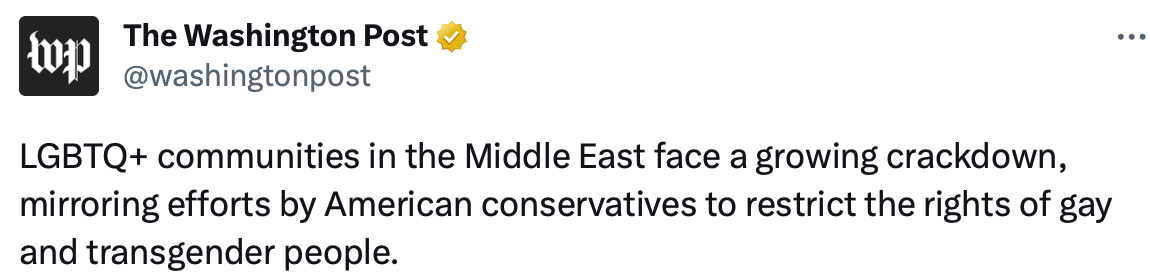
Okay, last crazy headline: Apparently ISIS is anti-gay the same way as America’s conservative Christians are. 

As Seth Mandel summarized it: “Iran hangs gays from construction cranes because America still has separate sports leagues for men and women.” I think a lot of the young newspaper writers who argue America is just as bad as Al-Qaeda and that our conservatives are literally ISIS should simply go visit Syria. Frolic in Egypt. Rock out in Yemen. When an American soldier saves you, I doubt you’ll be worrying about whether he’s a Southern Baptist.

(Nellie Bowles)

The fundamental flaw that wasn’t

Amazon’s Shiny Happy People: Duggar Family Secrets was a documentary waiting to happen ever since the Josh Duggar scandal broke eight years ago. In many ways, it is a documentary that needed to be made. It discusses real problems within the homeschooling movement that many homeschoolers would prefer to ignore. It tells the stories of women and men whose upbringing ranged from deeply flawed to abusive; and it helps to illustrate how one of the most religiously conservative elements in American society, the homeschooling community, might actually contribute to the rise of the Nones. For all this, however, the documentary suffers from a fundamental flaw: it fails to say anything about the millions of ordinary homeschoolers who are raising children in perfectly healthy (and sometimes quite secular) ways.

Sophia M. Feingold, Shiny, Happy Propaganda (italics added)

There is no “fundamental flaw” in failing to balance a story to the satisfaction of every possible critic with an obsession. It’s perfectly legitimate to tell a story about failure without telling a parallel story about success.

I did not view Shiny Happy People as a screed against home schooling, and I think you’d need to be pretty prickly and ideological to view it so. Sadly, many homeschoolers do seem to be prickly and ideological.

Christopher Rufo’s America

Graeme Wood reviews Christopher Rufo’s new book, a detour from Rufo’s usual route, America’s Cultural Revolution.

Winding up for his pitch, he describes my attitude toward Rufo (emphasis added):

Christopher F. Rufo is what is sometimes known as a shit-stirrer—a particular type of troublemaker whose game is to find something stinky, then waft its fumes toward the noses of those mostly likely to be outraged by it … Even those who find their behavior outrageous often find Rufo’s tactics distasteful as well.

Soon comes the key paragraph:

Your appreciation of this book will depend in part on whether you prefer Rufo the carnival barker, luring in members of the public to see the lefty freakshow he curates, or Rufo the intellectual historian. The first is more fun but the second is just as biased. His description of the careers of these intellectual figures is meant for readers who know nothing of their work, and do not care to learn about it from a sympathetic source. The narrative is meant to build them up only to villainize them—and this is not difficult. Like Rufo’s TikTok freaks, his woke progenitors often said and did things that need no additional commentary to make them into villains.

I’ll take a pass. It has been, I think, more than a decade now since I stopped reading stuff with the tacit goal of winding myself up.

Hippie collectives and corporations

Why did the Dutch publishing outfit need a receptionist? Because a company has to have three levels of command in order to be considered a “real” company. At the very least, there must be a boss, and editors, and those editors have to have some sort of underlings or assistants—at the very minimum, the one receptionist who is a kind of collective underling to all of them. Otherwise you wouldn’t be a corporation but just some kind of hippie collective.

David Graeber, Bullshit Jobs

Property

‘C‘est un bon pays; personne n’est riche là-bas mais tout le monde a des biens.‘

Via Rebecca West, Black Lamb and Grey Falcon. This could be the Distributist Vision Statement: This is a good land; nobody’s rich but everyone has property.

A great modern factory is a waste from the point of view of the need of property; for it is unable to provide either the workers, or the manager who is paid his salary by the board of directors, or the members of the board who never visit it, or the shareholders who are unaware of its existence, with the least satisfaction in connexion with this need.

Simone Weil, The Need for Roots (italics added)

Shorts

Dianne Feinstein, 90, Cedes Power of Attorney to Daughter—But Still Serves in Congress

New York Post:


DeSantis Vows to ‘Start Slitting Throats’ of Federal Workers on Day One of Presidency

Government Executive

Capital punishment is indifferent to redemption.

Elizabeth Breunig

We keep looking at the prosecutors as the problem rather than Donald Trump. He did these things.

Chris Christie

… the West has achieved a more fully realized atheism than the Soviet Union ever did.

Rod Dreher’s characterization of an Augusto Del Noce observation.

You may choose to look the other way but you can never say again that you did not know.

William Wilberforce

The role of the community is to torture the mystic to death.

Joseph Campbell (Source)


You can read most of my more impromptu stuff here (cathartic venting) and here (the only social medium I frequent, because people there are quirky, pleasant and real). Both should work in your RSS aggregator, like Feedly or Reeder, should you want to make a habit of it. I’m even playing around a bit here, but uncertain whether I’ll persist.

Wednesday, 4/26/23

Cognitive dissonance in Texas

[T]he gun rights movement is changing. In many quarters of America, respect for firearms has turned into a form of reverence. As I wrote in 2022, there is now widespread gun idolatry. “Guns” have joined “God” and “Trump” in the hierarchy of right-wing values.

David French

Texas has one of the strongest ‘Stand Your Ground’ laws of self-defense that cannot be nullified by a jury or a progressive District Attorney.

Texas Governor Greg Abbott, Tweeting in effect that he knows better than the jury who heard the evidence, and that he knows that this white man was merely “standing his ground,” not looking for trouble and finding it.

It took an Atlantic Ocean of distance to let the Economist spot this juicy bit of weirdness:

The convergence of broad “stand your ground” laws and more permissive gun laws is a toxic combination, says Kami Chavis, a professor at William and Mary Law School. Messrs Perry and Foster were both armed when they encountered each other, thanks to Texas’s lax gun laws. But there is an inconsistency in the logic of Mr Perry’s supporters, who say that he justifiably felt threatened and needed to act in self-defence because his victim was carrying an assault rifle.

If openly carrying a gun constitutes such a threat that someone can shoot you dead for it, why in the hell is it legal to openly carry?

I’m sick of the culture of vigilanteism created by these damned “stand your ground” laws, and open carry only makes it worse. Open carry and stand your ground are perversely lethal laws in the performative name of “safety.”

Civil Service mischief mayhem

While there is a good case to be made for great flexibility in the hiring and firing of federal officials, the wholesale replacement of thousands of public servants with political cronies would take the nation back to the spoils system of the 19th century. Republicans think that they will be undermining the deep state, but they will simply be politicizing functions that should be carried out in an impartial way, and will destroy the ethic of neutral public service that animates much of the government. When they lose power, as they necessarily will, the other party will simply get rid of their partisans and replace them with Democratic loyalists in a way that undermines any continuity in government. Who will want a career in public service under these conditions?  Only political hacks, opportunists, and those who see openings for personal enrichment in the bureaucracy.

Damon Linker, on the virtual abolition of merit-based civil service positions in the Federal Government that Trump began shortly before the 2020 Election.

Was Tucker a money-maker?

I can’t help but notice that commentators on Tucker Carlson’s firing from Fox News can’t agree on whether his show was (1) hugely profitable or whether instead (2) boycotts of his advertisers had “intimidated woke capitalists, who declined to advertise on his show” (Rod Dreher) and thus made it marginal or even a money-loser.

I have no idea which, if either, is true.

I do know that my long Dreher fandom has greatly cooled. I suspect it’s because he and I have both changed during the Trump era: he increasingly supportive of illiberal democracy; I, after flirtation with illiberal democracy, returning uneasily to center-right classical liberalism. “Better the devil you know,” y’know.

Constraints on Single-Payer healthcare

“Health” is an extraordinarily difficult concept to pin down, and if unchecked, it will expand to encompass anything and everything as Leviathan’s vanguard and advance scout.

A conservative “healthcare system” is one that protects life and prevents disability. Modern medicine is good at resuscitation, reducing the risk of severe yet preventable incidents such as heart attacks and strokes, catching cancers when they can still be treated, and managing chronic illnesses such as asthma and depression. Caring for illnesses both catastrophic and chronic is what a healthcare system is for, and only when there is a strong focus on applying the technical power of medicine to prevent or treat disease, rather than an all-encompassing quest for health, can we speak coherently of a healthcare system worth funding.

Matthew Loftus, The Conservative Christian Case for Single-Payer Healthcare

Bobo power and powerlessness

As the bobos achieved a sort of stranglehold on the economy, the culture, and even our understanding of what a good life is, no wonder society has begun to array itself against them, with the old three-part class structure breaking apart into a confusing welter of micro-groups competing for status and standing in any way they can. So, for instance, the bobos have abundant cultural, political, and economic power; the red one-percenters have economic power, but scant cultural power; the young, educated elites have tons of cultural power and growing political power, but still not much economic power; and the caring class and rural working class, unheard and unseen, have almost no power of any kind at all. Our politics, meanwhile, has become sharper-edged, more identity-based, and more reactionary, in part because politics is the one arena in which the bobos cannot dominate—there aren’t enough of us.

David Brooks, How the Bobos Broke America

The last straw

[M]ost right-wing institutions that depend on a large customer or donor base have embraced a strategy of monetizing the constant stoking of crisis and paranoia as the new True Faith. If the real-world facts prove inconvenient to the narrative, invent new facts to fit. 

And Tucker [Carlson] was the high priest of that faith.  

I quit Fox after more than a decade as a contributor when Carlson released a “documentary” for Fox Nation, a streaming service for Fox-addicts who can’t get sufficiently high off the basic cable junk anymore. His Patriot Purge, a farrago of deceptions, fearmongering and “just asking questions” conspiracy theories, was put together to leave the viewer with the distinct impression that the January 6 assault on the U.S. Capitol was some kind of false flag operation or Deep State operation. It was the last straw for me.

Jonah Goldberg at the Dispatch

Vikings and Ninjas

The right wing are censorship vikings and the left wing are censorship ninjas.

Sherman Alexie. (H/T Alan Jacobs)


For all its piety and fervor, today’s United States needs to be recognized for what it really is: not a Christian country, but a nation of heretics.

Ross Douthat, Bad Religion

You can read most of my more impromptu stuff here (cathartic venting) and here (the only social medium I frequent, because people there are quirky, pleasant and real). Both should work in your RSS aggregator, like Feedly or Reeder, should you want to make a habit of it.

Sunday, 8/28/22

Memory eternal!

Metropolitan Kallistos Ware has reposed in the Lord

Metropolitan Kallistos Ware reposed in the Lord last Tuesday.

“Let me keep my distance, always, from those who think they have the answers.

Let me keep company always with those who say "Look!" and laugh in astonishment, and bow their heads.”

Mary Oliver, Evidence: Poems

Against David Frenchism

I may have finally reached a tipping point trying to process David French’s commentaries on religion and politics. Henceforth, I will either not bother at all or at least approach his columns and podcasts with an attitude of “tell me, in the first paragraph or two, why I should stick around and hear you out.”

I’ll still listen to him on law, but I don’t think he has anything I need to hear about the intersection of religion and politics.

That problem isn’t that he’s anti-Trump, goodness knows. The problem is that he’s reflexively parochial, and his “parish” is white Evangelicalism; that he says “Christians” when he means “white Evangelicals” drives me to distraction.

(Deep breath.)

I suppose this bugs me so much because French is writing and podcasting in secular, not Evangelical, spaces. He’s being read by people who may judge all of Christianity by his fixations on North American white Evangelical grotesqueries.

There is a Church that is rooted far deeper in history than the Second Great Awakening, utterly orthodox in its Christianity, and ambivalent-to-indifferent in its politics (the impressions of some American converts notwithstanding). If you’ve read me for long, you know where I think it’s found. All we ask of a polity is that we may lead a calm and peaceful lives in all godliness and sanctity.

But you’d never appreciate that by reading David French, who basically tells the Western world that “Christians be like Falwell Jr. and Orange Man.” That’s just not true, and eliding Christianity with Evangelicalism turns people off to the holy and life-giving potential of authentic, historic Christianity.

Up with Jake Meadorism

Here is one of the arguments some friends have made in defending the evangelical hard pivot toward Trump and right-wing politics more generally: The country is changing. No one will be friendly to all of our beliefs or values. However, if the progressives win, the likeliest outcome is some blending of dhimmitude and persecution. On the other hand, if the right wins, religious liberty will at least mostly be safe and we’ll be left alone. So it makes sense for orthodox Christians to migrate rightward.

The difficulty I see with this: Our churches do not exist within sealed spaces closed off from the world outside the congregation. Rather, our parishioners are being discipled all the time by the networks they participate in. So when we strengthen our ties to the political right and, in particular, when we tend to look past or gloss over the right’s sins for sakes of the political coalition (which is just a reality of life with any political coalition you try to participate in), we aren’t simply retreating into a stable space where right-wing governments protect our stable, faithful Christian communities. Rather, our communities are being shaped through the very act of partnering with specific groups, of speaking about some sins and not speaking about others. These things are, in themselves, formative.

To get his core insight, I had to quote most of his short post, but there is a bit of good stuff left, and with no paywall, either.

Jake Meador, Places of Refuge are Places of Discipleship. Meador, too, is Protestant, and as a Reformed Christian, he (as did I) appears to think himself Evangelical or Evangelical-adjacent. Unlike French, he doesn’t parochially collapse Christianity into Evangelicalism.

Why I Will Disregard any American Episcopalian Who Complains About Small States Getting As Many Senators as Big States

“Yes, a bishop’s episcopal charism does not depend on the number of worshipers in their see. But when almost all the micro-dioceses are in the west, and when western bishops are disproportionately present at Lambeth 2022, this is white privilege in action," he wrote. "Lambeth 2022 is taking place even though the bishops of half of African Anglicans have refused to come. Their dioceses constitute a third of the total Anglican Communion. Western bishops may say ‘it was their choice not to come.’ But this is not a good look."

Terry Mattingly, Some trends in global Anglican Communion are starting to look rather Black and White — GetReligion

Context:

  • Many western bishops lead "micro-dioceses" with under 1,000 active members or "mini-dioceses" with fewer than 5,000.
  • The Church of Nigeria claims 17 million members and 22 million active participants.
  • Uganda has 10 million members
  • Rwanda has 1 million members.

A Christian Culture (for the very first time)

By pretty much all measures, the Orthodox Christian countries of Eastern Europe take their faith more seriously than the Catholic countries further West or the Protestant countries which mainly lie around the continent’s fringes. I should really say ‘former Protestant countries’ because, as I have written here in the past, these countries – including mine, Britain – are now post-religious. Faith has been replaced by politics, ideology, activism or the material and technological idolatry which we call ‘progress.’

All of which means that I have until recently never seen a real Christian culture, of the kind my country used to be many centuries ago, and my adopted country, Ireland, used to be until more recently.

Paul Kingsnorth, Intermission: Monasteries of Romania #1

Godsplaining to the Archbishop

“If we say our God is an all-loving god, how do you explain that at any given time probably 400 million living on the planet at one time would be gay?” he asked. “Are the religions of the world, as does Catholicism, saying to those hundreds of millions of people, ‘You have to pass your whole life without any physical, genital expression of that love?’”

Archbishop Rembert G. Weakland, recently deceased, to the New York Times in 2009, roughly seven years after exposure of his hush money payment to a male lover (or rape victim).

It is suggestive that “the religions of the world” seem, to the disgraced Archbishop, to speak with one voice. How could that be if the idea of lifelong sexual abstinence is so stupid? Might it be that the spirit of our age is the anomaly, the deviation from the wisdom of the ages?

Did the Archbishop not confess that Mary, the “Mother of God,” remained ever a virgin? Or did he, like a highly multiparous protestant I corresponded with at some length, rule out Mary’s ever-virginity because that would be “perverted”?

Further, it is famously not just the Church that tells people “You have to” do something you’d rather not do, See, e.g., decalogue.

Still further, surely a substantial part of the work of the Church is dealing sacramentally and pastorally with people who fail to live up to divine expectations. See, e.g., confession.

Finally, the surmised number of gay people is irrelevant to the correct answer to the Archbishop’s tendentious question.

To get other glimpses of the odious decedent, see Rembert Weakland, Proud Vandal

Youth alienation then and now

[T]he thing that disturbs me the most right now is that the conversations often that I’m having with younger evangelicals. When someone says to me I’m thinking about walking away, it’s usually a very different conversation than I would have had 10 years ago. 10 years ago, it would have been with a younger person saying I just can’t believe the supernatural stuff that we believe anymore. Or I really think the moral ideas of the church are too strict and too judgmental, and I want to walk away.

Now it’s almost the reverse, almost directly the reverse. It’s people who are saying, I don’t think the church believes what it says it believes and what it’s taught me, or at least I fear that it doesn’t.

[W]e’re not looking for some Christian America in the past because in order to do that, we would have to redefine what we mean by Christian … [i]n all sorts of ways that I think are harmful.

Russell Moore

Repentance

Repentance is everything you do to get sin, those inborn passions, out of you. It’s reading, thinking, praying, weeding out disruptive influences in your life, sharing time with fellow Christians, following the guidance of the saints. Repentance is the renunciation of what harms us and the acquisition of what is beneficial to us, writes a holy counselor.

Dee Pennock, God’s Path to Sanity

Demoting free exercise

In essence, [Employment Division v.] Smith demoted the Free Exercise Clause of the First Amendment to a glorified nondiscrimination doctrine. Rather than granting Americans an affirmative right to practice their religion absent compelling governmental reasons to restrict that practice, the Free Exercise Clause becomes almost entirely defensive—impotent against government encroachment absent evidence of targeted attack or unequal treatment.

David French


[S]ubordinating truth to politics is a game which tyrants and bullies always win.

Jonathan Rauch, The Constitution of Knowledge

The Orthodox "phronema" [roughly, mind-set] cannot be programmitized or reduced into shibboleths.

Fr. Jonathan Tobias

You can read most of my more impromptu stuff here (cathartic venting) and here (the only social medium I frequent, because people there are quirky, pleasant and real). Both should work in your RSS aggregator, like Feedly or Reeder, should you want to make a habit of it.

Sunday, 7/17/22

Poetry and Myth

Christianity and Poetry

The Incarnation requires an ode, not an email.

Poet Dana Gioia, Christianity and Poetry commenting on the poetry of the Magnificat.

More:

  • For most believers, the truths of their faith have become platitudes taught in catechism or Sunday school. The mysteries of faith—those strange events such as the Incarnation, Transfiguration, and Resurrection—have lost their awe and wonder and become replaced by sensible morality and proper reverence. There is nothing wrong with morality or reverence, but pious propriety is a starvation diet for the soul. Modern versions of the Bible, which translate verse passages into prosaic language for the supposed sake of clarity, are mistranslations, since they change the effect of the text.
  • When Jesus preached, he told stories, spoke poems, and offered proverbs. The Beatitudes are a poem about the merciful Kingdom of God in contrast to the selfish world of mankind. Jesus was not much concerned with theology. He left that to posterity. He did not ask his listeners to think their way to salvation; he wanted them to taste and see the goodness of God. He told them stories in which they could see themselves. He spoke to people as creatures with both a body and soul. He addressed them in the fullness of their fallen humanity, driven by contradictory appetites, emotions, and imagination.
  • When the Second Vatican Council dropped these sequences from the Catholic missal, it demonstrated how remote the Church had become from its own traditions. The new Church wanted to reengage the broader world and get rid of the musty traditions of the past. Vatican II wanted to be practical, positive, and modern; its motto was aggiornamento, Italian for “bringing things up to date.” The poetic sequences, which had seemed so splendid to the old Church—rapturous artistic vehicles for the contemplation of divine mysteries—felt too pious, formal, and elaborate for modern worship.
  • William Wordsworth was a religious man who saw the poet’s role as prophetic, but his Christianity expressed itself most eloquently in pantheistic Deism. He grew more devout and conventional in middle age, to the detriment of his verse. His pious Ecclesiastical Sonnets (1822) marked the lowest point of his career. Read any page of it outdoors—the stupefied bees will stop buzzing and the birds fall senseless from the trees.
  • Minor poets with major minds, Chesterton and Belloc were smart, brash, and wickedly funny. Unintimidated by their intellectual foes, they swaggered when others would have taken cover. For the first time since the Elizabethan Age, there was an outspoken Catholic presence in English verse.

And then, in conclusion:

Christianity has survived into the twenty-first century, but it has not come through unscathed. It has kept its head and its heart—the clarity of its beliefs and its compassionate mission. The problem is that it has lost its senses, all five of them. Great is the harvest, and greater still the hunger it must feed, but its call into the world has become faint and abstract. Contemporary Christianity speaks mostly in ideas. Potent ideas, to be sure, but colorless and hackneyed in their expression …

A major challenge of Christianity today is to recover the language of the senses and to recapture faith’s natural relationship with beauty. There is much conversation nowadays about beauty among theologians and clergy. They seem to consider it a philosophical problem to be solved by analysis and apologetics. Those are the tools they have. Their relation to beauty is passive rather than creative. Even the clearest thinking can’t close the gap between how people experience their existence—a holistic mix of sensory data, emotions, memories, ideas, and imagination—and how the Church explains it—moral and spiritual concepts organized in a rational system. The theology isn’t wrong; it’s just not right for most occasions. It offers a laser when a lamp is what’s needed.

These things matter because we are incarnate beings. We see the shape and feel the texture of things. We instinctively know that the form of a thing is part of its meaning. We are drawn to beauty, not logic. Our experience of the divine is not primarily intellectual. We feel it with our bodies. We picture it in our imaginations. We hear it as a voice inside us. We are grateful for an explanation, but we crave inspiration, communion, rapture, epiphany.

It probably will come as no surprise to you that I do not think that Orthodoxy has "lost its senses."

But I am one man, formed in the West, which has lost its senses, so I face extra hurdles acquiring the mind of the Church.

(A "brilliant and substantive new essay" like this pops up just often enough that I still subscribe to First Things.)

Deep magic

I read more on Saturday of his first book, A Branch from the Lightning Tree, and it was so overwhelming that despite having had two giant cups of coffee, I had to come back to the room to sleep. There is deep magic in his words. I see now why Guite, an Anglican priest, told me that only Orthodox Christianity will be able to contain the immensity that is Martin Shaw’s imagination and sensibility.

Rod Dreher.

I’m experiencing Martin Shaw that way, too, though I’ve only caught snippets and haven’t yet read the book I bought.

C.S. Lewis, reacting to the claim that society was returning to paganism, said something to the effect of "Would that it were so! The pagan is an eminently convertible man." Paul Kingsnorth and Martin Shaw may be the first fruits that add "prophet" to Lewis’ encomiums.

What Athos has on offer

Why have western scholars virtually ignored this experiential form of mystical Christianity at a time when numerous Westerners have turned their gaze toward Hinduism and Buddhism? What does Mount Athos have to offer to the Western world today that is not available within the mainstream churches?

Kyriacos C. Markides, The Mountain of Silence

What myths mean

However nonrational myths were, they betrayed man’s urge to explain what he found in himself and in the world, as well as his belief that explanation was somehow possible.

David V. Hicks, Norms and Nobility

Analysis

Hypocrisy or Mimesis?

Remember that old saw "hypocrisy is the tribute vice pays to virtue"?

Gilbert Meilander, with help from C.S. Lewis throughout, reminds me that a charge of "hypocrisy" ought to be used very sparingly. Excerpt from the introduction:

Discussing his experience as a soldier in the Great War, he writes of a fellow soldier who was not only (like Lewis) a scholar from Oxford, but also—alarmingly to Lewis—“a man of conscience,” committed to adhering to taken-for-granted moral principles.

Embarrassed by the contrast with his own life, Lewis did his best to conceal the fact that he himself had not taken moral obligations so seriously. “If this is hypocrisy,” Lewis writes:

then I must conclude that hypocrisy can do a man good. To be ashamed of what you were about to say, to pretend that something which you had meant seriously was only a joke—this is an ignoble part. But it is better than not to be ashamed at all. And the distinction between pretending you are better than you are and beginning to be better in reality is finer than moral sleuthhounds conceive. . . . When a boor first enters the society of courteous people what can he do, for a while, except imitate the motions? How can he learn except by imitation?

Belonging, truthing

For human beings, the ability to belong is more [evolutionarily] adaptive than the ability to see what’s true.

Alan Jacobs citing Jonathan Haidt.

I’m thinking of an American-made religion with (1) what strikes me as an unusually implausible founding story, but (2) a very strong sense of community. That religion was still growing rapidly last time I looked at the stats (though that has been a while). Score one datapoint for Haidt and Jacobs.

Tonic

You’re churches, for God’s sake. Quit fighting for social justice. Quit saving the bloody planet. Attend to some souls. That’s what you are supposed to do. That’s your holy duty. Do it. Now. Before it’s too late. And the hour is nigh.

Jordan Peterson via Aaron Renn

Well, that’s bracing — unless your church was already doing that.


If people have always said it, it is probably true; it is the distilled wisdom of the ages. If people have not always said it, but everybody is saying it now, it is probably a lie; it is the concentrated madness of the moment.

Anthony Esolen, Out of the Ashes

You can read most of my more impromptu stuff here (cathartic venting) and here (the only social medium I frequent, because people there are quirky, pleasant and real). Both should work in your RSS aggregator, like Feedly or Reeder, should you want to make a habit of it.

“This demonic murder lottery of schoolchildren”

I didn’t have anything to say yet about Uvalde, TX in my last blog. I have a (very) little to say now.

First, a timeless bur under our saddles: ‘No Way To Prevent This,’ Says Only Nation Where This Regularly Happens.

Second, a caution: "We must do something!" is true. But we mustn’t do performative (dare I say "masturbatory"?) things — things that we already know or should know won’t bear any fruit beyond giving supporters momentary catharsis.

Third, two proposals that might actually improve things:

  • David French, Pass and Enforce Red Flag Laws. Now. (I am reliably informed that French is incorrect about only one red state having such a law; my fair state, Indiana, also has one. Surely we’re not considered "purple" because we went for Obama in 2008!) But Red Flag Laws won’t do any good until people hate slaughter of the innocents enough to risk destroying a friendship with someone who is taking leave of reality while stockpiling weapons.
  • Nicholas Kristof, These Gun Reforms Could Save 15,000 Lives. We Can Achieve Them

The nature of the problem, as best I can tell, is that American life isn’t about what is good but is rather about nothing at all (which is, at least, broadly inoffensive and inclusive of most tastes and creeds) or about violence itself. The scope of the problem includes every facet of life that culture touches, which means most every element of daily life.

… [A] culture of death is like a prophecy, or a sickness: It bespeaks itself in worsening phases. Right now, we find ourselves foreclosing upon our own shared future both recklessly and deliberately—and perhaps, gradually, beginning to behave as if there is no future for us at all; soon, I sometimes worry, we may find ourselves faced with a darkening present, no faith in our future, and a doomed tendency to chase violence with violence.

… this demonic murder lottery of schoolchildren …

When we say, in despair, that “these men are byproducts of a society we’ve created; how could we possibly stop them?,” we could be referring to almost anyone in the great chain of diffuse responsibility for our outrageous, inexcusable gun-violence epidemic—the lobbyists who argued for these guns to be sold like sporting equipment, the politicians who are too happy to oblige them, the shooters themselves.

Elizabeth Bruenig, as dark as I’ve ever seen her. I can’t unequivocally agree with every word of that ("these guns," as I understand it, are "sporting equipment" even if they’re tricked out to look military) but I surely agree with “these men are byproducts of a society we’ve created.”


I am not a liberal.

At least, not in the way that some people think.

Having grown up in the evangelical community, someone who was “liberal” meant that he did not believe that Jesus is God, or that He was born of a virgin by the Holy Spirit, or that He rose from the dead, or that His crucifixion saved humanity from sin, or that the Bible stories of miracles are true, or that Scripture is authoritative and communicates God’s Word.

I believe all these things.

In this sense, when I became Orthodox, I became even “less liberal.” In addition to the above, I also believe things that are even older than the evangelical community. I believe in the necessity of baptism for the remission of sins. I believe that the Eucharist is the bread and wine transmuted into the Body and Blood of Christ. I believe in the continuing presence of the saints, led by the greatest worshiper, pray-er, and worker of all, the Virgin Mary.

But there has been something of a “confusion of categories.” In the aftermath of the mass shooting of 19 children and 2 teachers on Tuesday (May 24th), I was called “liberal.” Why? Because I called for the minimum age for gun purchase to be raised to 21, nationwide. Because I called for universal background checks at every gun purchase – including gun shows and private sales. Because I called for the ban of the sale of military weaponry – including assault rifles – to civilians.

Fr. Jonathan Tobias. There’s more there.

His positions are not a good proxy for political liberalism in the modern American sense and they’re absurd as a proxy for deviation from Christian orthodoxy.


Sarah Isgur, Harvard-trained lawyer, central advisor to a Republican Presidential campaign, wife of one of the nation’s top SCOTUS advocates, and mother of a Texas toddler, broke down over Uvalde on the Advisory Opinions podcast when she thought about her shopping quest for a backpack for her son to start preschool. (She recovered nicely.)


You can read most of my more impromptu stuff here (cathartic venting) and here (the only social medium I frequent, because people there are quirky, pleasant and real). Both should work in your RSS aggregator, like Feedly or Reeder, should you want to make a habit of it.

Raging against the Machine

Raging against the Machine

  • Jyoti [the writer’s wife] was a psychiatrist who earned actual money. But psychiatry was killing her, her role was not to cure people but to medicate them, to stick plasters on the wounds the Machine had gouged into the people at the bottom of the pile. There was nothing she could do about the wounds, and they kept coming.
  • My culture comes, most recently, from the southeastern suburbs of England. It’s a culture of hard work, of ‘getting on,’ of English Protestantism channeled into secular ambition. It’s about settling down and having a family, contributing, progressing, climbing up; not bad things, necessarily, not for a lot of people. But it’s also about selling up, moving on, about property ladders and career ladders, about staking your place on the consumer travelator that represents progress in a burning world. It’s about feeding the Machine that rips up the people and rips up the places and turns them all against each other while the money funnels upwards to the people who are paying attention. This is the crap our children are learning. There is not much sign at all that the tide is turning.
  • The only possible opening for a statement of this kind is that I detest writing. The process itself epitomizes the European concept of ‘legitimate’ thinking; what is written has an importance that is denied the spoken. My culture, the Lakota culture, has an oral tradition, so I ordinarily reject writing. It is one of the white world’s ways of destroying the cultures of non-European peoples, the imposing of an abstraction over the spoken relationship of a people. … Newton, for example, ‘revolutionized’ physics and the so-called natural sciences by reducing the physical universe to a linear mathematical equation. Descartes did the same thing with culture. John Locke did it with politics, and Adam Smith did it with economics. Each one of these ‘thinkers’ took a piece of the spirituality of human existence and converted it into a code, an abstraction … Each of these intellectual revolutions served to abstract the European mentality even further, to remove the wonderful complexity and spirituality from the universe and replace it with a logical sequence: one, two, three. Answer! (Quoting Russell Means)
  • ‘In Western Civilization,’ says the poet Gary Snyder, ‘our elders are books.’ Books pass on our stories. Books carry the forbidden knowledge and the true. Books are weird things, inhuman things, abstract things, but they are gateways, at their best, to the world to which the drum and the fire and the sweat lodge used to take us. The Otherworld. At her best, the writer is a shaman, a priestess, a summoner.

Paul Kingsnorth, in Savage Gods.

Hungary

Tucker in Hungary

Of Tucker Carlson in Hungary, Bill Kristol says out loud what others have been insinuating:

The New American Right is now explicitly embracing the Old European Right. Not to put to fine a point on it, the New American Right is…anti-American.

Rod Dreher is having none of it — from Kristol the rest of the Sacred Confraternity of Circle-Jerking Pundits:

Is anybody really moved by an older man calling a younger man “anti-American” because he goes to a NATO country and American ally, and speaks well of it? Isn’t that, you know, nuts?

The idea that an American conservative who admires some of what Viktor Orban does, and believes, is somehow “anti-American” is not only insulting, but is a smear designed to make people believe that to be a real American, you have to endorse selling your country, its institutions, and its traditions out to globalist liberals and American hegemons willing to start wars to turn the whole world into America. Forget it. I love my country, though I don’t love what it’s becoming. If I can learn from the Hungarians how to better resist what the people who are ruining America are doing, then that’s pro-American to me.

Rod Dreher

Which is less bad?

I would rather have honest government over dishonest government, but if I had to choose between a corrupt president who rewarded his cronies, and a president who was morally fastidious, but whose administration stopped using the word “mother” in federal documents, substituting instead “birthing people” — well, that’s not a hard choice to make. A society can survive Huey P. Long; it cannot survive losing the meaning of “mother”.

Rod Dreher, ‌Why Conservatives Should Care About Hungary

The last word on Andrew Cuomo

Are you getting tired of news about Andrew Cuomo? Me too.

Peggy Noonan has the mike-drop line:

No one in New York is walking around saying “I don’t believe it” or “That’s not the Andrew I know.” It’s apparently the Andrew Cuomo a lot of people knew.

You may now resume your regularly-scheduled activities.

Another inversion, realignment

I’ve said since Election 2016 that a major political realignment was under way (though I said it much more in the early days, before the daily assaults from Trump became too dominant in my thoughts). Here’s an emergent example:

We’ve come to an odd pass in American politics. The people who have the deepest suspicions about the way government works are increasingly enthusiastic about the use of government power.

Somehow, many of the same folks who say that government authorities shouldn’t be trusted to make sure vaccines are safe or that elections are fairly conducted also say that we should have the government set industrial policy, regulate speech on the internet, or even engineer the size and shape of American families. How can institutions so corrupt as the ones described by right-wing nationalists be trusted with the power to administer matters far more complicated than testing vaccines or counting ballots?

Chris Stirewalt, ‌The Contradictions of Paranoid Nationalism.

This is perhaps hyperbolic, but it is at least directionally right as to some of Rod Dreher’s recent utterances, for instance:

Hungary is an important example for American conservatives in part because it compels us to recognize that the state is the only means we have left to defend ourselves from those who despise us and our institutions, and want to force us to bow to soft totalitarianism. This is a hell of a thing for an American conservative raised in the Reagan era to grasp, but that’s where we are. Just as the king’s role was in part to protect the people from the depredations of the nobility, in this current era of leftist capture of US institutions (including the military!), the state is the only means by which we conservatives can exercise power in our own self-defense.

Sullivan the Prophet

[Andrew Sullivan’s] term “Christianist” felt like a mild slap in the face, right until the afternoon of Jan. 6, when a mob of believers stormed the Capitol on a “righteous” mission to overturn an election — with crosses in the crowd and prayers on their lips.

David French, reviewing Out on a Limb


You can read most of my more impromptu stuff at here. It should work in your RSS aggregator, like Feedly, should you want to make a habit of it.

My Grudges

Lafayette Journal & Courier in high dudgeon, January 11, 1997

Predators at Work

Sexual abuse at group home prompts questions about oversight

by Jason Shepard

January 18, 2007RSS

In 1998, when Walden Homes hired Gregory Ledbetter as a counselor for troubled boys at Spring House, a group foster home funded by Dane County taxpayers, he was already an experienced sexual predator.

Ledbetter had moved to Madison less than a year before, after escaping 43 charges of sexually molesting boys at a group home in Indiana. His new job afforded him fresh opportunities, and he took prompt advantage of them, as ‘Henry’ would soon find out.

Henry (a pseudonym, like all names of juveniles in this article) was 15 when he ended up at Spring House, on Madison’s near east side, in 1999. ‘Almost every night,’ Henry later told police, he went to Ledbetter’s apartment, where they would ‘smoke marijuana, play videogames and watch porno movies.’

Ledbetter manipulated Henry into sexual acts, as he had with many other boys before and after, according to hundreds of pages of police and court records reviewed by Isthmus. Sometimes Ledbetter would perform oral sex on the boys; other times it was anal sex. A camcorder next to Ledbetter’s bed recorded the encounters.

Then Ledbetter would return his victims to Spring House, where he was paid to make meals, lead group discussions and serve as a role model for boys who’d been abandoned and suffered from emotional and behavioral problems.

Ledbetter, 39, was convicted last year of molesting several Spring House residents, among other victims. His crimes were so heinous that a Dane County judge sentenced him to life in prison, rejecting Ledbetter’s offer to be castrated.

Strikingly, Ledbetter is not the only sexual predator hired in recent years by Walden Homes to support and nurture some of Dane County’s most vulnerable teenagers. Angela Kalscheur, 26, faces more than 40 years in prison on charges related to sexual acts with four boys at Spring House. She has admitted to the crimes and will likely strike a plea bargain to avoid trial, now set for Feb. 7.

Both cases highlight breakdowns in a system that is supposed to provide care for kids in government custody. Background checks obviously failed, since Walden hired Ledbetter despite a dangerous and troubled past. And staff supervision was so poor that both counselors were able to prey on multiple youths over many months.

The cases also reveal insufficient oversight of private facilities that operate with public money. Even after the fact, county and state officials failed to aggressively investigate how such crimes could have happened. County and state officials operated in isolation so extreme that county officials praise Walden for its oversight efforts while the state accuses Walden of malfeasance. And elected officials with oversight responsibilities were kept in the dark.

County officials stress the assurances they’ve received from state regulators that Walden is in compliance with licensing rules.

‘We have nothing to hide,’ says Lynn Green, Dane County’s director of human services. ‘I am going to stand behind the work we’ve done in this situation 100 percent.’

Adds Bob Lee, administrator for Dane County’s division of children, youth and family services: ‘We feel as badly or more badly than anyone that some kids did not have good experiences there. But the totality of the agency’s experiences with Walden Homes is what’s most important to us.’

That may not be good enough for local elected officials. County Supv. David Worzala, chair of the county’s Health and Human Needs Committee, was ‘astounded’ to learn of the abuse from Isthmus last week. County Supv. Barb Vedder, the committee’s vice chair, also professed ignorance: ‘I am surprised we weren’t told about this.’ (Charges in both cases drew media attention, but some accounts did not mention Spring House by name.)

This week Worzala launched an investigation into oversight of Walden Homes, which continues to annually receive about a million dollars in county funding.

‘My conclusion is it’s outrageous that this has occurred in group homes in Dane County,’ says Worzala. ‘These kids are in our care. They’re vulnerable, and we need to provide a safe environment.’

Where is the oversight?

Worzala, a member of the Dane County Board since 2004, doesn’t like to criticize county government. He uses the word ‘we’ when referring to it, and says he’s a ‘big fan’ of Green and her department.

But Worzala is at a loss to explain why he first learned of these incidents from a reporter: ‘I don’t know what to say. However, I will say this: Now I know about it, and it will be addressed.’

Next Tuesday, Worzala plans to call officials from Dane County and the state Department of Health and Family Services to account for their actions before his committee.

‘These are horrific cases,’ he says. ‘The system’s broken. We need to look at it. Clearly county and state oversight needs to be reviewed and discussed. We need to do something to make sure this never happens again.’

Walden Homes Ltd. is a nonprofit corporation that continues to run three group homes in Dane County: Coventry Group Home on the north side, and Horizon House and Thoreau House on the isthmus.

Dane County taxpayers have paid Walden $4.7 million over the past five years to care for children ordered into its group foster homes. A tax filing for 2004 shows county taxpayers, at $910,882 that year, were by far Walden’s largest source of income; next in line was the state Department of Corrections, at $44,550. The money went in part to Walden’s longtime director, George Nestler, who received a salary of about $90,000.

Nestler did not return repeated calls seeking comment on this article.

According to the tax filing, Walden Homes aims to provide ‘a stable, highly supervised group foster home environment’ for adolescents. But that’s hardly what it did for nearly a dozen of Dane County’s most troubled teens, who were victimized by these two counselors.

Indeed, records suggest that Spring House, 511 S. Ingersoll St., was a deeply troubled operation. Police have been called to the group home 151 times since 2000, often in response to neighbor concerns. Police logs reviewed by Isthmus show complaints about disturbances, thefts, damaged property, liquor law violations and general juvenile complaints. Other calls involved battery, drugs and an overdose.

‘There were police over there all the time,’ says Scott Thornton, who lives nearby. Neighbors also complained to state regulators about lax supervision. (Walden’s corporate office is located at 1102 Spaight St., just around the corner from Spring House.)

But the decision to close Spring House in June 2006 purportedly had nothing to do with child molestation or complaints from neighbors. Rather, Walden told the state it wanted ‘to make better use of our resources.’ Agrees Dane County’s Green, ‘It was purely a financial decision on their need to fill beds.’

From Indiana to Wisconsin

On Oct. 15, 2005, after being tipped off by a neighbor that Ledbetter, then 38, was having sex with a 16-year-old boy, Madison police executed a search warrant on his apartment. They discovered a jackpot of evidence in his bedroom: 150 videotapes stashed in a locked dresser drawer and a safe. The tapes, spanning more than a decade, were meticulously labeled with the boys’ names, ages and dates.

In letters and testimony to Dane County Judge Dan Moeser, Ledbetter and his parents traced his predatory pedophilia to his troubled childhood. They said Ledbetter had a sexual relationship with an older man when he was a teen. And, when he was around 17, his best friend committed suicide with Ledbetter’s shotgun after announcing that he was gay and being rejected by his family.

‘He gave me an ultimatum about him killing himself, and I didn’t stop him,’ Ledbetter wrote. ‘I carry that guilt with me for the rest of my life.’

‘Greg was never the same after that,’ his parents wrote. Following his own suicide attempt around this time, Ledbetter was committed to a mental hospital in Washington, D.C., where his sister lived, but was released after a few months when the insurance money ran out. ‘We regret to this day not keeping him institutionalized.’

Court records say Ledbetter graduated from Purdue University with an education and fine arts degree and worked as a student teacher in an elementary school. At about age 26, he began working at the Cary Home for Children in Lafayette, Ind. He was there for two years.

In January 1996, prosecutors charged Ledbetter with 43 counts of child seduction based on allegations from two group home residents.

According to Indiana police reports obtained by Isthmus, one boy said he had dozens of sexual encounters with Ledbetter between December 1993 and May 1995, when he was 16 and 17. It began with oral sex at Ledbetter’s parents’ house and escalated to anal intercourse, with the use of marijuana almost always preceding the sex. A second group home boy, 17 at the time, reported having at least 35 sexual encounters with Ledbetter.

Indiana newspapers reported that the allegations against Ledbetter were the second sexual allegations against Cary Home staffers in two years, and local politicians called for the firing of the home’s director.

The arrest also captured local headlines because Jerry Ledbetter, Greg’s father, was a city councilman who supported a local ordinance banning discrimination based on sexual orientation. The family said Ledbetter was arrested in retaliation for his father’s progressive politics, and spent $19,000 in legal fees fighting the charges.

In January 1997, prosecutors dropped the charges after Ledbetter’s defense attorney secured an affidavit from one of the boys, saying he made up the allegations.

Eight years later, Madison police would discover what Indiana police did not: videotapes of Ledbetter having sex with at least three boys from the Indiana group home.

From Spring House to prison

By 1998, Ledbetter had moved to Madison and was looking for a job. The Spring House group home had just opened, and it was hiring. Ledbetter’s first day was April 20, 1998.

Ledbetter had already spent at least five years preying on vulnerable boys in Indiana. Over the next 22 months, he was given regular access to troubled boys in Dane County’s care. He made the most of it.

Police reports and a detailed criminal complaint relate the accounts of several group home victims, including ‘Billy,’ who was 14 when the abuse began.

‘The situation has made things hard for me,’ he told a detective. ‘You know, it was hard to go on with my life.’

Henry, mentioned above, told police he once complained that Ledbetter would openly tell the boys in his care that he ‘loved to suck cock.’ Henry said Ledbetter let the residents ‘smoke dope and go wherever they wanted,’ for which he ‘expected something in return.’ Henry also said Ledbetter once showed him a .45 caliber handgun.

‘Jeff,’ who was 16 when he engaged in sexual encounters with Ledbetter at Spring House, told police he ‘felt obliged to do this with the defendant since the defendant was making their life at the group home fun.’

In February 2000, Ledbetter left Spring House. Over the next five years, records show he met other boys through his jobs at a Walgreen’s, a Blockbuster video store, a Marcus movie theater and a store in South Towne Mall.

One of these was a 16-year-old who, his mother told police, had brain damage stemming from childhood abuse and suffered from learning disabilities, cancer and cerebral palsy. Court documents offer a particularly disturbing summary of one videotaped encounter. The boy, who appeared to ‘act more like an 8-year-old than his own age,’ expressed ‘random thoughts regarding eating at Old Country Buffet and videogames and his mother and his curly hair’ during unprotected anal intercourse with Ledbetter.

Yet another boy told police that Ledbetter handcuffed him and used duct tape on his mouth before anally penetrating him.

It’s not clear from court documents and police reports how many boys Ledbetter molested during his eight years in Madison. Ultimately, Dane County prosecutors charged him with 92 felony counts of child sexual assault, enticement and sexploitation, relating to 10 boys.

In July 2006, Ledbetter was convicted following a plea agreement; he received a 90-year prison sentence. Under the state’s truth-in-sentencing law, he won’t be eligible for parole until he is 129 years old.

‘I am viewed more as someone who was over-punished and denied the right of rehabilitation as a sex offender,’ Ledbetter wrote to Judge Moeser in October from prison in Waupun. He now spends his days playing classical music on a piano, painting and drawing in his cell, and attending Alcoholics Anonymous meetings.

‘There’s things I need’

Angela Kalscheur graduated from Mankato State University in Minnesota in 2004 with a degree in criminal justice, records show. She interned at a center for juvenile sex offenders before Walden Homes hired her in November 2004 to work at Spring House.

Like Ledbetter, Kalscheur worked the 3 to 11 p.m. shift as an assistant counselor at Spring House. Her duties included preparing meals, supervising homework and leading group talks. And while she and Ledbetter likely never met, Kalscheur used many of the same strategies to entice boys into satisfying her sexual desires.

According to a criminal complaint, ‘Nick,’ then 15, arrived at the group home in March 2005 and quickly learned that Kalscheur was having sex with several boys; he later told police this was ‘common knowledge.’ Nick said he didn’t report Kalscheur because he used this information as leverage to extend his curfew and get an allowance without doing work. Once he walked in on Kalscheur having intercourse with ‘Joe,’ and was invited to participate.

Joe told police that within a week of arriving at Spring House in the spring of 2005, when he was 17, Kalscheur told him something to the effect of, ‘There’s things I need,’ then hugged him and put his hand down her pants. Joe estimated that he and Kalscheur had sexual contact about 35 times, including twice at her house.

A third boy, ‘Damon,’ told police that Kalscheur performed oral sex on him about five times, starting on his 16th birthday. He said he knew other residents were having sex with Kalscheur, and that she asked him not to tell because she could lose her job.

‘Just keep giving me head,’ Damon said he told her, ‘and you won’t need to worry about it.’

Kalscheur, the complaint says, regularly gave the boys alcohol and cigarettes. She also drove them to a location on the south side, where they bought marijuana. The boys would get high as Kalscheur returned to the group home.

In June 2005, another Spring House counselor had a chance meeting with a former resident, who told of sexual encounters with Kalscheur when he was at the home. The counselor reported the allegations to Walden Homes’ director Nestler, who, as required by law, reported the allegation to Dane County officials.

Kalscheur continued to work at Spring House for the next month, and was fired on July 27 on a matter unrelated to sexual abuse, county officials say.

On May 25, 2006, Madison police detective Dave Gouran spoke with Kalscheur at her home. After initially denying any wrongdoing, Kalscheur eventually admitted to having sexual contact with Joe, Nick and Damon, as well as other boys from the group home.

Kalscheur’s attorney, Eric Schulenburg, expects to reach a plea agreement in the near future, and will argue at sentencing that her crimes don’t merit prison.

‘To send her to prison is a crime, and there’s no need to make this two crimes,’ says Schulenburg, adding that he has trouble viewing the 16- and 17-year-old boys in this case as victims.

Appropriate action?

The unprecedented abuse at Spring House ‘ going back decades, county officials can’t remember another substantiated molestation case at a juvenile group home ‘ has local politicians worried.

‘Clearly, two makes a pattern,’ says Supv. Worzala. ‘The Ledbetter case is frightening. You’re talking about border hopping of predators. It’s unacceptable.’

But Dane County’s Bob Lee says that after learning of misconduct, local officials ‘did what was required’ and took ‘appropriate action.’ These actions included interviewing group home residents and attending Spring House staff meetings.

Regulating group homes, county officials stress, is the state’s responsibility. ‘The state is required to license and monitor. The onus is on them,’ says Marykay Wills, the county’s mental health and alternative care manager. ‘The state assured us that Walden did what they were supposed to do.’

But state officials and records provided to Isthmus undercut many of these claims and suggest that county officials either aren’t being forthcoming or remain uninformed as to the state’s apparently grave concerns about Walden Homes, both before and after these molestation cases came to light.

‘It is very likely that we would have taken the steps to revoke the license at Spring House if they had not voluntarily closed,’ says Stephanie Marquis, spokeswoman for the Department of Health and Family Services.

State officials accused Walden Homes of a ‘lack of cooperation with the department in its attempt to thoroughly investigate the allegations,’ according to a letter sent to Walden dated Oct. 25, 2006, written after Isthmus began making inquiries into the state and county’s handling of the matter.

That letter, and a follow-up (click HERE), allege that Walden staff members were told by a Walden supervisor and in a written memo not to cooperate with investigators. The letters criticized Walden’s management and accused Walden supervisors of overlooking complaints from other staff about Kalscheur’s behavior.

County officials are also apparently clueless as to the rules regarding background checks. Lee explains Ledbetter’s hire by saying ‘the state does not require out-of-state background checks. Now should they? Maybe. But they don’t.’

Marquis contradicts this, saying state law does indeed require out-of-state criminal background checks for any state in which an applicant may have lived in the past three years, information he or she is required to provide.

How Ledbetter passed his background check after being charged with 43 counts of child molestation at his last group home job may never be known. When state regulators sought to review Walden’s records, they discovered that ‘all terminated staff files and discharged resident files’ from Spring House had been destroyed by Walden’s director in December 2005. The destruction of these files occurred in the middle of police investigations into both the Ledbetter and Kalscheur cases.

State officials fined Walden $1,000 in the Kalscheur case, which Walden initially appealed. Walden dropped its appeal after it closed Spring House and moved its residents to Thoreau House, located around the corner in the same building as Walden Homes’ Spaight Street headquarters.

Walden Homes continues to reap county contracts for its three other group foster homes, into which troubled teens are regularly ordered. In 2006, Walden received $986,766 in county funding. Lynn Green, the county’s human services director, thinks the relationship is working well.

‘Walden has a long history of providing very good group home services in Dane County,’ she says. ‘They were one of the early group homes, and George Nestler has been with them 20-plus years. Hundreds if not thousands of Dane County kids have received excellent services from the Walden Homes system.’

(From Isthmus, a publication in Madison, Wisconsin)


I don’t hold a lot of grudges, but I hold a few related to this sorry case.

It’s not that “everyone knew” the Lafayette charges were true and that the local scribes were ignoring what everybody knew. I had spoken to one of the accusers professionally, and I wasn’t certain. One seldom is.

When the boys withdrew their accusations, I considered possible both that the charges had been false and that Defense counsel for Ledbetter had “gotten to” the accusers somehow. I wasn’t sure which.

My grudge is that the Journal & Courier didn’t know, either. Yet it wagged its corporate finger at everyone who believed (or dutifully investigated) the adolescent boys who accused Ledbetter, and turned a secret abuser into a martyred saint. Everyone should have had the Journal & Courier’s confidence that the charges were false, though the confidence was unwarranted and turned out to be false. I was at the very least adjacent to those the santimonious ink-stained wretches were excoriating.

My grudge also is that hiring an “out” homosexual to have unmonitored supervisory access to troubled adolescents (that’s the kind of facility that employed Ledbetter) of the same sex, whatever the written rules may have said, was recklessly in defiance of common sense — as it would have been reckless to hire a heterosexual to have unmonitored supervisory access to troubled adolescents of the opposite sex. This was not, in other words, a “freak accident.” It was completely foreseeable. More heads should have rolled than did (though Commissioner Nola Gentry’s replacement was a Marjorie Taylor Greene type, far inferior to Nola).

So my grudge, finally, is that not all “discrimination” is invidious (some is utterly sensible), and thus not all discrimination should be legally forbidden, as it increasingly is — and as the Journal & Courier supports.


You can read most of my more impromptu stuff at here. It should work in your RSS aggregator, like Feedly, should you want to make a habit of it.