Saturday, post-Ides, pre-Paddy

Culture

I’ve been soaking in a culture for a few days — the culture of Hoosier basketball mania. It’s a great year to be a fair weather fan living in Purdue-land. I’ll be tuning in again in moments.

Right too early, they’d like their lives back, please

NHS England has just announced it will no longer be prescribing puberty blockers to children with gender dysphoria (a fancy term for distress at being the sex you are, which explains precisely nothing). There is, it turns out, “not enough evidence to support the safety or clinical effectiveness” of this form of treatment. Other countries, such as the Netherlands, home of “the Dutch protocol”, are now acting with greater caution. It seems as though the doubters — those of us “radicalised” into believing what everyone else believed until six or seven years ago — were right all along.

As I’d often be reminded when I raised objections, I’m not an endocrinologist, or a psychologist, or a queer theorist, or a porn-addled New York writer, or a four-year-old child speaking in gendered tongues. It is hard to pinpoint precisely which field makes you an expert on whether puberty blockers are a good idea, because for so long the only acceptable qualification has been insisting that they are a good idea.

As Hannah Barnes documented in Time to Think, experienced clinicians at London’s Tavistock clinic ceased to be considered experts the moment they no longer toed the line …

It is staggering to realise just how flimsy the evidence in favour of all this was. Experiments have been conducted on the bodies of children due to the political cowardice of adults. Humans cannot change sex. We cannot go through any other puberty than the one our body is destined to go through. This is what makes us adults. It is obscene that so many have lied to children, and by doing so put them at risk of so much long-term damage ….

Victoria Smith, NHS puberty blocker ruling will save lives

Puberty blockers to be discontinued in England: In a seismic moment in this long debate, the National Health Service in England has officially ended the use of puberty blockers for gender-dysphoric children. From the NHS: “We have concluded that there is not enough evidence to support the safety or clinical effectiveness of (puberty blockers) to make the treatment routinely available at this time.” The drugs will be prescribed only as part of carefully watched clinical trials. You don’t need me to remind you what these drugs do but I will anyway: prescribed at the start of puberty, they impact bone density and height and can do things like cause teeth enamel to shed and crack; if followed with cross-sex hormones, they can leave the child entirely sterile and unable ever to orgasm. There is no evidence of improved mental health outcomes from this treatment plan.

Now, the early critics of puberty blockers are asking for their lives back. Here’s James Esses, who was studying to be a therapist: “For daring to say that children should not be prescribed irreversible and harmful puberty blockers, I was expelled from my Masters’ degree. As of today, it is official NHS England policy. Yet, I remain expelled.” Will James see this reversed? Will any of the people who fought to achieve this protection for kids get apologies? Doubtful. Their arguments may be official English medical policy now, but it’s best to leave them in the gulags of their professions anyway. It’s a shame they had to be right so early.

Nellie Bowles

It’s interesting to me that some gays and lesbians are the most trenchant critics of trans ideology. Nellie’s lesbian, and gay Andrew Sullivan is particularly eloquent in voicing his concerns.

Ideology

Speaking of ideology:

An ideology is quite literally what its name indicates: it is the logic of an idea … its thought movement does not spring from experience but is self-generated, and … it transforms the one and only point that is taken and accepted from experienced reality into an axiomatic premise…. Once it has established its premise, its point of departure, experiences no longer interfere with ideological thinking, nor can it be taught by reality.

Hannah Arendt via Mark Shiffman guest-writing at Matt Crawford’s Substack

Turning a discussion into a power relation

Over the past decade a new, and very revealing, locution has drifted from our universities into the media mainstream: Speaking as an X . . . This is not an anodyne phrase. It tells the listener that I am speaking from a privileged position on this matter. (One never says, Speaking as a gay Asian, I feel incompetent to judge this matter.) It sets up a wall against questions, which by definition come from a non-X perspective. And it turns the encounter into a power relation: the winner of the argument will be whoever has invoked the morally superior identity and expressed the most outrage at being questioned.

Mark Lilla, The Once and Future Liberal

Nexuses* of power

Comparisons between Silicon Valley and Wall Street or Washington, D.C., are commonplace, and you can see why—all are power centers, and all are magnets for people whose ambition too often outstrips their humanity.

Adrienne LaFrance, The Rise of Techno-authoriarianism.

(* Yes, I checked. The plural is “nexuses”.)

Conspiracy theorists

There was a time, not that long ago, when mainstream-news consumers pitied people who had succumbed to the sprawling conspiracies of QAnon. Imagine spending your days parsing “Q Drops,” poring over cryptic utterances for coded messages. Imagine taking every scrap of new information and weaving it into an existing narrative. Those poor, deluded, terminally online saps. What a terrible modern affliction.

And then some of my friends became Kate Middleton truthers ….

Helen Lewis, QAnon for Wine Moms

Election 2024

There’s more to a quadrennial US election than the Presidency, but just for the sake of old-timey water-cooler talk, let’s act like there isn’t much more.

The darkest timeline

Not for another seven and a half months will there be truly meaningful news at the polls to analyze, but I suppose Tuesday night’s primary results warrant a word or two.

So here’s a word or two: We remain, as a people, trapped in the darkest timeline.

By choice, of course. Most Americans oppose having Joe Biden or Donald Trump back on the ballot in November, but partisans are comfortable with it. And in our terrible system of choosing party nominees via primaries, partisans call the tune.

Democratic primary voters weren’t offered a serious alternative to the president this year and never put pressure on their leadership to provide one. Republican primary voters were offered serious alternatives to their own nominee but preferred to stick with an adjudicated rapist who attempted a coup on January 6.

The fact that we’ve saddled ourselves with a rematch between two unfit geriatrics whom most of the population dislikes is a window onto a decadent country’s depleted civilizational will. A people that no longer takes politics or its role in the world seriously predictably can’t muster the effort to provide itself with capable leadership options for its most important job. No wonder Aaron Rodgers is suddenly being touted as a potential vice presidential candidate; in 2024 America, why wouldn’t he be?

Nick Catoggio, It’s Later Than You Think

Stuck with these crazy old coots

[O]verall this is an absurd moment. Everything’s settled but nothing feels stable. A nation now knows who its two major party candidates will be, after relatively easy contests, and that nation doesn’t want those candidates! The polls show it. The general feeling: We’re stuck with these crazy old coots.

Neither candidate can, as they say in politics, do optimism. Neither can make you see a better tomorrow. Mr. Trump is American carnage; everything’s terrible and only he can repair it; the worse things are, the better his chances. That’s why he didn’t want the recent bipartisan immigration bill. On a problem that’s, say, a foot long, it offered 2 inches of progress. Can’t have that! Mr. Biden can’t do optimism because when he speaks of the sunny side he sounds out of touch. He’s not believable and does not have a plan beyond keep on keepin’ on. He sounds like a politician who’s just word-saying.

Peggy Noonan

Who would vote for these hucksters?

What to say about these characters of 2024?  Representing the “Outs” is a grifting bullsh*t artist who will spend the next four years monetizing his entire administration. Meanwhile, representing the “Ins” is a mumbling, bumbling old Cold Warmonger, slave to a soulless and increasingly discredited ideology who will continue to project our power abroad like it is 1991, arrogantly clueless to how both the world and his own country have shifted under his feet since he first entered the Senate during the Nixon administration.

Who would vote for either of these hucksters?  I will tell you.  It is your brother-in-law; your favorite cousin; your neighbor; your best friend from college; your co-worker; the nice lady you talk to at the dog park; the server at your favorite restaurant; and that cute young couple with the adorable new baby.  In our unique political culture, the sublime and the lovely and beautiful merge seamlessly with the hideously absurd.

Terry Cowan, Pogoland

Why Biden’s struggling

Trying to explain why Biden is struggling despite the availability of so many arguments that things are going well:

Something like the following process appears to happen: A group of left-leaning activists declares that certain words, claims, or arguments should be considered anathema, tainted as they supposedly are with prejudice, bigotry, racism, sexism, xenophobia, homophobia, or transphobia; then people in authoritative positions within public and private institutions (government, administrative and regulatory agencies, universities, corporations, media platforms, etc.) defer to the activists, adjusting the language they use to conform to new norms; and then, once the norms and expectations have been adjusted, a new round of changes gets mandated by the activists and the whole process repeats again, and again, and again.

I suspect that to many millions of Americans (and to lots of people living in democracies across the world where something similar is going on) the process feels a bit like a rolling moral revolution without end that makes them deeply uncomfortable … I’d be willing to bet that for many … the negative reaction follows from the sheer bossiness of it, with schools, government bureaucrats, HR departments at work, movie stars, and others constantly declaring: You can’t talk that way anymore; you must speak this other way now; those words are bad; these words are the correct ones. A lot of people are ok with this. But many others respond with: Who the f-ck are you to tell me how I’m allowed to talk? Who elected or appointed you as my moral overseer and judge?

[C]onsider what happened after Biden, in an unscripted remark during the SOTU, used the words “an illegal” to describe a foreign national who allegedly murdered a 22-year-old nursing student in Georgia last month. Immigration activists and others on the left wing of the Democratic Party sharply criticized Biden for this, calling the term “dehumanizing,” and two days later, he apologized, saying: “I shouldn’t have used ‘illegal.’ It’s ‘undocumented.’”

The president misused the official moral vocabulary of our moment.

But who set those rules in the first place? Who made them so official that violating them required a public apology from the president? Who is Biden afraid of offending? The answer in this case is single-issue pro-immigration activists and social-justice progressives on the leftward edge of the Democratic Party. The self-correction therefore announced to the world that when it comes to such matters as how one speaks and thinks about the status of immigrants in our country, the president takes his orders from—he defers to—moral busybodies on the left wing of his party.

The reason the subterranean influence of social-justice progressivism is worth focusing on is that it may be a major contributing factor to the collapse of the center-left bulwark against the populist right. The rolling moral revolution is intensely disliked by a sizable faction of the electorate …

The problem for Democrats, very much including Joe Biden, is that the activists pushing the new moral dispensation are part of the Democratic Party’s electoral coalition. For that reason, any time a person unhappily encounters an example of social-justice progressivism in their lives, it’s easy and not unreasonable to direct the resulting anger at the Democratic president, even though he’s not leading the charge but merely going along with and deferring to it.

This might not be the sole or even primary factor behind Biden’s persistently soft approval numbers. But I’m quite sure it’s one important factor—and one the Democratic Party’s leading officeholders and professional strategists seem reluctant even to acknowledge, let alone address.

Damon Linker (boldface added), in some of his very sharpest commentary of this election cycle.

The downticket – or maybe even RFKJr.

Two years ago, Democratic outfits spent money in GOP primaries on ads designed to help crank populist candidates prevail over more formidable mainstream opponents. “Cynical” doesn’t begin to describe the mindset of liberals who routinely warn voters that MAGA Republicans are a threat to democracy and then quietly spend millions of dollars to help those same Republicans advance to the general election.

But that’s what Democrats did in 2022, believing that their own candidates would have an easier time defeating cranks in November. Annnnnnd … they were right.

Nick Catoggio


So: where did all my mockery of Trump go?

I suffer more from the humiliations inflicted by my country than from those inflicted on her.

Simone Weil, from a letter to Georges Bernanos.

You can read most of my more impromptu stuff here and here (both of them cathartic venting, especially political) and here (the only social medium I frequent, because people there are quirky, pleasant and real). All should work in your RSS aggregator, like Feedly or Reeder, should you want to make a habit of it.
Tuesday, March 12, 2024

Why I read Damon Linker

But several of the comments said much the same thing—and others left similar remarks in response some statements I (and others) made about Biden on to the “Beg to Differ” podcast last week (which was recorded before the SOTU). I’m going to quote one of those comments, anonymously, because it so nicely distills the criticism I keep hearing in both places.

Damon [and others on the podcast] are so completely negative and pessimistic that they are contributing to the downfall of our Democracy. … It is past time to put aside your trepidation about Biden’s candidacy and policies and do everything you can to get him elected. Hopelessness and apathy are friends to authoritarians. They lead to people staying home. You can offer suggestions for changes in policy without gloom and doom and trashing Biden.

The message here is admirably clear: The critic wants me to write and say things that will contribute to Biden winning and stop saying things that will supposedly demoralize voters, leading them to give up hope for victory and so possibly skip voting on Election Day. Which means the critic wants me to suppress my critical intellect or otherwise bring it into alignment with the kind of talking points that might be released by the Biden campaign’s communications office.

I very much want Trump to lose—and by the widest possible margin. But nothing I write can make that happen. So instead of writing things with an eye to contributing to Biden’s campaign, I devote my time and talents (such as they are) to trying to understand what is happening—above all: Why has Trump succeeded in taking over the Republican Party? And how does this manifestly unfit, seditious, and corrupt bullshit artist manage to command enough support in the electorate that he will be seriously competitive for the presidency for the third election in a row?

Democracy is being threatened democratically, in other words, which means, as the old horror-movie tag line has it, the call is coming from inside the house. It’s important to remember that. Trump isn’t some foreign agent. He’s as American as can be, and so are those who have voted for him in the past and will vote for him in November. They are our fellow citizens. This is their country, too—as much theirs as it is ours. If we outnumber them, we will win and America will remain a liberal democracy for another four years. If they outnumber us, they will prevail and our liberalism will be tested, again—and, I fear, more severely than the last time.

But that won’t be the end of the story, because the story never ends ….

Damon Linker

This is why I expect to continue reading Damon Linker even as I cut away political reading that tends merely to inflame the reader.

As for that last paragraph, remember that neither party’s win in November is “the end of the world.” It is at worst “the end of a world.”

There is no “labor shortage”

I’m a libertarian, let-markets-work kind of guy, and some of my lefty or populist friends sometimes act like they’ve pulled a dispositive rabbit out of the rhetorical hat when they point out that there exist—angels and ministers of grace, defend us!—badly run businesses, dysfunctional markets, dishonest businessmen, etc. They don’t seem to understand that the choice is between stupid, greedy men and stupid, greedy men with an army and a police force. One of these groups of stupid, greedy men has to compete for your business, and you can say “no” to them; the other kind doesn’t have to take “no” for an answer. That’s the whole enchilada, really: I want more decisions affecting my life made in the context of negotiations I can walk away from and fewer of them made at the point of a bayonet.

… when it comes to immigration, I keep coming back to one thing: We have enough poor people in our country, and we don’t need to import more of them. There’s a lot more to citizenship than economic calculation, but if it’s just green cards or the equivalent we’re talking about, then I’m all for opening the national door to people who have offers for jobs at, say, $200,000 a year, or people with seven-to-10-figure sums to invest in businesses and projects. But unskilled and low-wage workers? We have plenty. And if I have to pay more for an avocado to get control of our runaway illegal (literally illegal, Mr. President—literally) immigration problem—fine.

Kevin D. Williamson

Not a strong draw

We’ve reached the stage of American decline in which smashing the constitutional order is just another issue in the upcoming election, something to be weighed alongside the candidates’ respective positions on taxes, say.

It’s not clear anymore that Trump even has a firm position on most policy issues.

He fights! his fans insist. But what, at this point, is he fighting for?

Trump’s policy preferences can usually be explained straightforwardly by ignorance, selfishness, or, in rarer cases, ideological nationalism.

None of which is a strong draw for conservative voters, I hope you’ll agree.

Nick Catoggio

Personality profiles

“We are unknown to ourselves, we knowers…and there is good reason for this. We have never looked for ourselves—so how are we ever supposed to find ourselves?” Much has changed since the late nineteenth century, when Nietzsche wrote those words. We now look obsessively for ourselves, and we find ourselves in myriad ways. Then we find more ways of finding ourselves. One involves a tool, around which grew a science, from which bloomed a faith, and from which fell the fruits of dogma. That tool is the questionnaire. The science is psychometrics. And the faith is a devotion to self-codification, of which the revelation of personality is the fruit.

[T]he self has never been more securely an object of classification than it is today, thanks to the century-long ascendence of behavioral analysis and scientific psychology, sociometry, taxonomic personology, and personality theory. Add to these the assorted psychodiagnostic instruments drawing on refinements of multiple regression analysis, and multivariate and circumplex modeling, trait determination and battery-based assessments, and the ebbs and flows of psychoanalytic theory. Not to be overlooked, of course, is the popularizing power of evidence-based objective and predictive personality profiling inside and outside the laboratory and therapy chambers since Katherine Briggs began envisioning what would become the fabled person-sorting Myers-Briggs Type Indicator (MBTI) in 1919. A handful of phone calls, psychological referrals, job applications, and free or modestly priced hyperlinked platforms will place before you (and the eighty million or more other Americans who take these tests annually) more than two thousand personality assessments promising to crack your code. Their efficacy has become an object of our collective speculation. And by many accounts, their revelations make us not only known but also more empowered to live healthy and fulfilling lives. Nietzsche had many things, but he did not have PersonalityMax.com or PersonalityAssessor.com.

Christopher Yates, Sorting the Self

I must confess that I read no further. Spritely writing just could not overcome my indifference to the topic (relative to other topics). Your mileage may vary.

A picture worth how many words

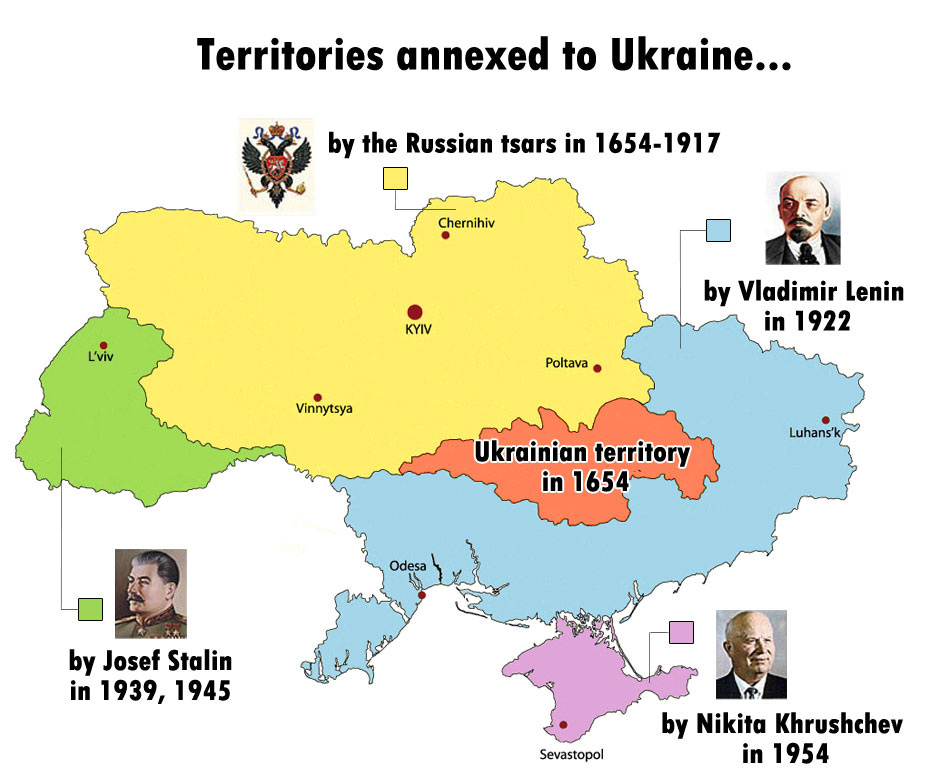
This map has kind of bothered me since I first saw it:

Look at tiny Ukraine, 1654, the orange mass in the middle, before Russia expanded it.

I can’t put it in words, but this somehow seems relevant to current travails. The heart of it, I suspect, is the question “just what is a nation-state?”

I’m sure smart people have pondered that a lot, though I don’t hear it spoken of very often. I have no illusions that I have anything to add.

Wordplay

Sexual creationism

The narrow progressive stance on gender ideology. (Pamela Paul, discussing John B. Judis and Ruy Teixeira’s Where Have All the Democrats Gone?)

Thermostatic voting

Used by a New York Times pundit to describe voters’ preference for moderate candidates.

Bafflegab

A good alternative to gobbledygook if you fear you’ve overused it.

Dirigiste

relating to a system in which a government has a lot of control over a country’s economy

Egregious

The etymology is the fun part here, via Merriam-Webster:

Some words originally used for animals that gather in flocks have been herded into use for people, too. The Latin word grex means “flock,” “herd,” or “group,” and is the root of several English words. Gregarious originally meant “tending to live in a flock, herd, or community rather than alone” but has become a synonym for “sociable.” Egregious literally meant “out of the herd” in Latin — something that stands apart. Its first meaning in English was consequently “outstanding” or “remarkable for good quality,” but over time that changed to become “very bad and easily noticed” or “flagrant.”

Interpellate/Interpolate

Stolpersteine

Literally stumbling-stones: brass plates, embedded in concrete, in the streets where victims of the Nazi Holocaust lived. 100,000 Stopersteines have now been laid.

Fluffers

Tech bros like Thiel, Musk and Andreesen are the fluffers in the global authoritarian circle jerk.

Maria, Silicon Valley’s worldview is not just an ideology; it’s a personality disorder (Crooked Timber) (hyperlink added)

Bon mots

Politicians and diapers must be changed often, and for the same reason.

Not Mark Twain

… a strangulated piety which was little more than a mask ….

Martin Shaw, The Problem With Peace

Weeds are flowers, too, once you get to know them.

A.A. Milne

Imagine a double-masked bureaucrat running a white-privilege workshop, forever.

Ross Douthat

You can make a throne of bayonets, but you can’t sit on it for long.

Boris Yeltsin

Paranoia is the opiate of those who fear they may be insignificant.

David Brooks

[T]o be human is to long for constancy, to crave the touchingly impossible assurance that what we have and cherish will be ours to hold forever, just as it is now. We build homes — fragile haikus of concrete and glass to be unwritten by the first earthquake or flood. We make vows — fragile promises to be upheld by selves we haven’t met in a future we can’t predict.

Maria Popova

Ill fares the land, to hast’ning ills a prey,
Where wealth accumulates and men decay.

Oliver Goldsmith, The Deserted Village (1770)


So: where did all my mockery of Trump go?

I suffer more from the humiliations inflicted by my country than from those inflicted on her.

Simone Weil, from a letter to Georges Bernanos.

You can read most of my more impromptu stuff here and here (both of them cathartic venting, especially political) and here (the only social medium I frequent, because people there are quirky, pleasant and real). All should work in your RSS aggregator, like Feedly or Reeder, should you want to make a habit of it.

Why history didn’t end

Negation rather than contradictions

Following the horrors of 9/11, Fukuyama and his ideas were derided as triumphalist nonsense. But he was only half wrong. Fukuyama, a Hegelian, argued that Western democracy had run out of “contradictions”: that is, of ideological alternatives. That was true in 1989 and remains true today. Fukuyama’s mistake was to infer that the absence of contradictions meant the end of history. There was another possibility he failed to consider. History could well be driven by negation rather than contradiction…

In the end, Trump was chosen precisely because of, not despite, his apparent shortcomings. He is the visible effect, not the cause, of the public’s surly and mutinous mood.

Martin Gurri, The Revolt of the Public and the Crisis of Authority in the New Millennium

Joe Biden did not expire on camera

The State of the Union should be an easy topic for a writer. It’s a televised event; you watch it; you react. 

But it’s actually quite challenging to find anything non-obvious to say about it, especially in 2024. Suspense around the address used to derive from what the president might say. Now, given his age, it derives from whether he might expire before the speech ends.

Joe Biden did not expire last night. Read any analysis today and that’s the top-line takeaway.

Then came Sen. Katie Britt to deliver the Republican rebuttal to Biden’s speech. Of her performance, the less said, the better. Watching it, I found myself wondering whether she had seized the opportunity to deliberately sabotage her chances of becoming Donald Trump’s running mate, mindful of how close the last guy who held that position came to being murdered.

There isn’t much else to say about Thursday night. Biden is plainly too old to serve competently for another four years, one “fiery and confident” address notwithstanding, and his agenda is too liberal to make any conservative happy.

I’ll be at the polls early on Election Day to vote for him.

Nick Catoggio, The State of Our Union

I’ve probably said this before, but I plan to vote for neither. Why? The Electoral College.

I fully expect the polls to show that my fair state is going, again, to deliver its Electors to Donald Trump. Therefore, I’m at liberty to write in the American Solidarity Party slate.

That’s how I’ve calculated whether to hold my nose and vote for one of the major party candidates starting in 2008, when I chose John McCain over Barack Obama (whose affect I liked almost as much as I abhorred his brief political policy record) because the polls said my state was a toss-up (Obama won). I may have voted for Romney without holding my nose; I honestly don’t remember. If I did, it wasn’t under the misimpression that he was a stellar conservative.

The corrosion of American character

[Emmanuel] Todd is a critic of American involvement in Ukraine … He believes American imperialism has not only endangered the rest of the world but also corroded American character.

In interviews over the past year, Mr. Todd has argued that Westerners focus too much on one surprise of the war: Ukraine’s ability to defy Russia’s far larger army. But there is a second surprise that has been underappreciated: Russia’s ability to defy the sanctions and seizures through which the United States sought to destroy the Russian economy. Even with its Western European allies in tow, the United States lacked the leverage to keep the world’s big, new economic actors in line. India took advantage of fire-sale prices for Russian energy. China provided Russia with sanctioned goods and electronic components.

As Mr. Todd sees it, the West’s decision to outsource its industrial base is more than bad policy; it is also evidence of a project to exploit the rest of the world. But ringing up profits is not the only thing America does in the world — it also spreads a system of liberal values, which are often described as universal human rights. A specialist in the anthropology of families, Mr. Todd warns that a lot of the values Americans are currently spreading are less universal than Americans think.

Mr. Todd is not a moralizer. But he insists that traditional cultures have a lot to fear from the West’s various progressive leanings and may resist allying themselves on foreign policy with those who espouse them.

Christopher Caldwell, The Prophetic Academic Emmanuel Todd Now Foresees the West’s Defeat

Rod Dreher elaborates on how the US pushes dubious “universal human rights:”

Boy, do we ever see that in Hungary, and throughout Eastern Europe. The US and the EU are fanatical about promoting LGBT. I mean, truly fanatical. When the Hungarian parliament in 2021 passed a law forbidding what it (accurately, in my view) sees as LGBT propaganda for children and minors, European elites went berserk. Mark Rutte, at the time the prime minister of the Netherlands, said that Hungary ought to be kicked out of the European Union over it.

Mind you, it’s routine for European governments to ban information aimed at children, who are (correctly) believed to be incapable of discerning truth and falsehood in them. In 2021, for example, the European Parliament voted to ban online advertising aimed at kids. So you can’t sell kids candy bars online, but Hungary’s refusal to allow people to sell transgenderism and sodomy to children is thought so egregious by European elites that many of them want the country thrown out of Europe.

Readers of this newsletter are well aware of how passionate the US State Department is about shoving LGBT in the faces of the world. Much of the world hates this, and sees it as a vivid sign of US cultural imperialism. Hungary is fairly tolerant on LGBT matters; same-sex couples can have registered partnerships, and almost every time I go out on the street in Budapest, I see at least one same-sex couple holding hands. But as we all know, in the eyes of these elites, to decline to accept the full and ever-changing panoply of LGBT demands is to be a horrible bigot not fit for civilized society.

(Emphasis added)

I’ll put in my 2 cents’ worth. I thought that surely 9/11 would open our eyes to how odious we are to much of the world. It didn’t. I’ve felt since then that we’re past the point of no return (I should add “humanly speaking”) when that became apparent. It hasn’t been an entirely unbroken descent; people have occasionally been red-pilled on some minor issue or another while the major trends continue downward.

So what are we to do?

Keep on keeping on, that’s what.

As C.S. Lewis preached in the Fall of 1939, shortly after Great Britain was undeniably at war with the Nazis:

I think it important to try to see the present calamity in a true perspective. The war creates no absolutely new situation; it simply aggravates the permanent human situation so that we can no longer ignore it. Human life has always been lived on the edge of a precipice. Human culture has always had to exist under the shadow of something infinitely more important than itself. If men had postponed the search for knowledge and beauty until they were secure, the search would never have begun. We are mistaken when we compare war with “normal life.” Life has never been normal. Even those periods which we think most tranquil, like the nineteenth century, turn out, on closer inspection, to be full of crises, alarms, difficulties, emergencies. Plausible reasons have never been lacking for putting off all merely cultural activities until some imminent danger has been averted or some crying injustice put right. But humanity long ago chose to neglect those plausible reasons. They wanted knowledge and beauty now, and would not wait for the suitable moment that never comes. Periclean Athens leaves us not only the Parthenon but, significantly, the Funeral Oration. The insects have chosen a different line: they have sought first the material welfare and security of the hive, and presumably they have their reward. Men are different. They propound mathematical theorems in beleaguered cities, conduct metaphysical arguments in condemned cells, make jokes on scaffolds, discuss the last new poem while advancing to the walls of Quebec, and comb their hair at Thermopylae. This is not panache; it is our nature.

I’d bet that if we are supernaturally spared the destruction I expect (which may be something like a definitive demotion from “indispensable nation” to “just another large chunk of geography” — “the end of a world,” not “the end of the world”), our supernatural saviors will make their activity deniable, so we can attribute it proximately to people who just faithfully kept on going, like humans rather than LARPing caricatures.

The One Phone of Power

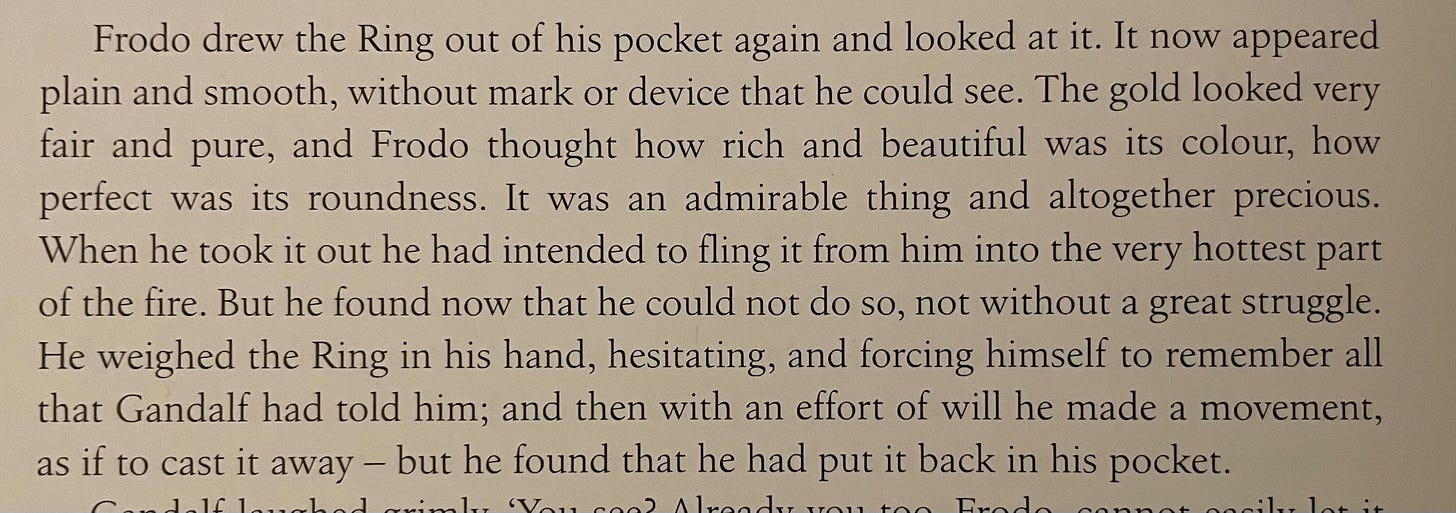
I’ve been reading Tolkien again lately, and I’ve been struck by how easily one can substitute “smartphone” for “the Ring.” Take, for instance, this paragraph early on in which Gandalf invites Frodo to rid himself of the ring.

L.M. Sacasas

Above all, do not lose your desire to walk … every day I walk myself into a state of well-being and walk away from every illness; I have walked myself into my best thoughts, and I know of no thought so burdensome that one cannot walk away from it.

Above all, do not lose your desire to walk … every day I walk myself into a state of well-being and walk away from every illness; I have walked myself into my best thoughts, and I know of no thought so burdensome that one cannot walk away from it.

Kierkegaard, via the selfsame L.M. Sacasas


So: where did all my mockery of Trump go?

I suffer more from the humiliations inflicted by my country than from those inflicted on her.

Simone Weil, from a letter to Georges Bernanos.

You can read most of my more impromptu stuff here and here (both of them cathartic venting, especially political) and here (the only social medium I frequent, because people there are quirky, pleasant and real). All should work in your RSS aggregator, like Feedly or Reeder, should you want to make a habit of it.

March 5, 2024

Art

Popular “unpopular art”

[A]art is in a peculiar and dangerous position these days. This week, over 17,000 artists and activists signed an open letter demanding that Israeli artists be excluded from the Venice Biennale festival in Italy, simply because they are Israelis. And even while that attempt at censorship is launched, other artists proclaim how brave they are for art on certain pet causes, violating taboos that no one has enforced for decades and everyone they know already mocks. There is no real cost to such stands.

Joseph Bottum

Popular art

Meet Frankey, the Street Artist Delighting Amsterdam – The New York Times (shared link, no paywall). I was afraid this story would be about another Banksy type graffiti artist (I viscerally hate graffiti). Not at all. It’s sheer whimsical delight.

IVF

The ephemeral threat to IVF

In June 2022, the court ended federal access to abortion, kicking abortion policy back to the states.

Since then, nine states—Alabama, Texas, Arkansas, Kentucky, Louisiana, Missouri, Oklahoma, South Dakota, and Tennessee—have outlawed abortion outright, not even allowing the procedure when women become pregnant through rape or incest. (Alabama’s IVF ruling is the most extreme pro-life ruling yet.) …

How Abortion Became ‘the Defund the Police of the GOP’ | The Free Press

Alabama Supreme Court’s decision might ramify unpopularly, bearing in mind the conservative adage that there are popular “unpopular opinions” (i.e., “popular among our leftcoastal readers, less so in flyover country”) and unpopular “unpopular opinions (i.e., “popular among the fundamentalist deplorables in flyover country but vilified by leftcoastal types).

But I digress. The Alabama decision was a ruling in favor of IVF-availing parents whose frozen embryos were negligently destroyed by another patient for lack of safeguards at the IVF clinic. There were no sinister designs on IVF in the opinion at all.* So constantly throwing the decision into the abortion mix strikes me as shit-stirring clickbait.

And “they” must stir the shit, and bait the clicks, vigorously and now, because IVF is in fact popular and the Alabama legislature is hastening to protect it from unintended consequences of the Court’s decision. (I’d say “nobody would dare try to outlaw IVF” except that people are daring some pretty bizarre things these days.)

* Alabama’s Supreme Court had earlier ruled that wrongful death action was allowed to parents for loss of descendants en ventre sa mere; the recent case clarified that intrauterine or extrauterine descendants were within contemplation of the parental wrongful death law.

The case against IVF

While we’re on the subject, I think it’s important for people in secure positions occasionally to voice unpopular unpopular opinions — opinions that others may be too cancelable to voice.

For the record, I have serious moral qualms about IVF, based on a combination of (a) knowing that in the U.S., IVF practice knowingly creates large numbers of embryos that will eventually be destroyed and (b) some Roman Catholic influence that tells me babies should be made in marital beds, not laboratories.

J Budziszewski, What We Can’t Not Know briefly sketches the Roman Catholic case against IVF (thought his immediate target is cloning).

So you would say that aspirin, surgery to remove a tumor, and cloning “respect” nature, too.
Not cloning.
Why not? Doesn’t it assist the natural function of having babies?
Once more: our nature is our design. We are designed to have babies, but we are not designed to have them in that way. To put it another way, our design includes not only certain ends but certain means. There is a difference between repairing the reproductive system and bypassing it.
Well, it doesn’t seem to be a big deal anyway.
I think it is a very big deal. When you try to turn yourself into a different kind of being, you are not only doing wrong but asking for trouble. He who ignores the witness of his design will have to face the witness of natural consequences.

If you think this argument has (not “should have”) any appreciable political valence in the USA, you need to get a grip. I’m just saying it should have some valence.

I don’t know where I ultimately would come out on IVF it were there an opportunity to discuss it, not just Roman Catholic voices crying in the wilderness versus reflexive dismissal of those voices.

Law

Witless Ape returns to ballot

[I]t was a perfectly defensible position to hold that Trump should be disqualified. What was indefensible was the air of swaggering certainty that permeated so many of those takes. … self-evident. Common sense. Obvious. Indisputable. Automatic.

Damon Linker

David French was in the “Common sense. Obvious. Indisputable. Automatic.” camp, and he’s not going down without a final howl of protest:

It’s extremely difficult to square this ruling with the text of Section 3. The language is clearly mandatory. The first words are “No person shall be” a member of Congress or a state or federal officer if that person has engaged in insurrection or rebellion or provided aid or comfort to the enemies of the Constitution. The Section then says, “But Congress may by a vote of two-thirds of each house, remove such disability.”

In other words, the Constitution imposes the disability, and only a supermajority of Congress can remove it. But under the Supreme Court’s reasoning, the meaning is inverted: The Constitution merely allows Congress to impose the disability, and if Congress chooses not to enact legislation enforcing the section, then the disability does not exist. The Supreme Court has effectively replaced a very high bar for allowing insurrectionists into federal office — a supermajority vote by Congress — with the lowest bar imaginable: congressional inaction.

David French

I guess the Supreme Court considers whether it’s best to shade the law when following it fearlessly could unleash chaos. It’s days like yesterday that make that obvious, indisputable.

(H/T Kevin D. Williamson for the “Witless Ape” image; he minted it, and the linked item is a classic.)

The exceedingly long arm of Russian law

The media reported last week that Russian authorities had arrested Ksenia Karelina, a U.S.-Russian dual citizen, and charged her with treason for donating a nominal sum to an organization that aids Ukraine … The charges against Ms. Karelina are an assault on what it means to be American. The Russian state contends that for a U.S. citizen to make a donation to a U.S. charity and to attend a peaceful protest on U.S. soil is a punishable offense on arrival in Russia.

Dora Chomiak in the Wall Street Journal

Trump’s immunity claims

People who want Donald Trump tried, convicted and jailed before November, for acts while he was in office, have my sympathy, but as we head ever deeper into a tit-for-tat polarized political world, I must substantially agree with Lee Kovarsky instead: Trump Should Lose. But the Supreme Court Should Still Clarify Immunity. – The New York Times.

Trump’s immunity claims are far too broad, but ex-Presidents need at least narrow immunity. Running for high office is already so fraught that I question the sanity of anyone who runs. Add to the existing ugliness the prospect of criminal prosecution, with no possible immunity if the other party wins next time, and we’ll have nobody but saints and sociopaths willing to risk it.

Qualified Immunity

In Indiana, we have a political novice candidate for governor whose first major media buy was an ad with him sitting in a rustic church, slightly misquoting the Bible and earnestly telling us he’s a “man of faith.” It kind of turned my stomach.

The second major media buy was an ad with a well-spoken Rwandan refugee, who became his foster daughter, telling us he’s a “man of faith.” It was much more believable.

His third major media buy simplistically says that qualified immunity (over which governors have little or no control) protects police and so protects us and brillig, and slithey toves, gyring and gimbling in the wabe, and “as governor, your safety will always come first” (sic).

Eric Doden has now lost me for sure. Qualified Immunity, a court-created line-item veto, effectively turns “every person” in 42 USC §1983 into “precious few people.”

Miscellany

[Expletive deleted] AI

It is not possible to say definitively who negatively impacted society more, Elon Musk tweeting memes or Hitler. Both have had a significant impact on society, but in different ways.

Google’s Gemini AI via Nellie Bowles

Pride before the Fall

No, you dare not make war on cotton. No power on earth dares to make war upon it. Cotton is king.” Such words smacked of hubris, the excessive pride that goes before a fall. And so they would turn out to be, expressing a mistaken vision that would lead to cruel and tragic consequences for the South. Lulled into a false sense of economic security by the illusion that cotton was invincible and its prices would never fall, the South would become fatally committed to a brutal social and economic system that was designed for the lucrative production of cotton on a massive scale but that achieved such productivity at an incalculable cost in human and moral terms. It placed the region on a collision course with changing moral sensibilities in the world, and with fundamental American ideals.

Wilfred M. McClay, Land of Hope

Psychological Man

My grandfather left school at fifteen and spent the rest of his working life as a sheet metal worker in a factory in Birmingham, the industrial heartland of England. If he had been asked if he found satisfaction in his work, there is a distinct possibility he would not even have understood the question, given that it really reflects the concerns of psychological man’s world, to which he did not belong.

Carl R. Trueman, The Rise and Triumph of the Modern Self

Where paranoia is the mark of sophistication

In the offline world, paranoia is a liability. It inhibits you from seeing the world clearly. In parts of the online world, you’re considered a rube if you’re not paranoid, if you’re not seeing a leftist plot around every corner, if you’re not believing that Taylor Swift and Travis Kelce’s romance is a Biden administration psy-op that culminated with rigging the Super Bowl.

David French, Why Elon Musk Is the Second Most Important Person in MAGA


So: where did all my mockery of Trump go?

I suffer more from the humiliations inflicted by my country than from those inflicted on her.

Simone Weil, from a letter to Georges Bernanos.

You can read most of my more impromptu stuff here and here (both of them cathartic venting, especially political) and here (the only social medium I frequent, because people there are quirky, pleasant and real). All should work in your RSS aggregator, like Feedly or Reeder, should you want to make a habit of it.

Wanted: a robust culture of free speech

David French had a powerful New York Times column (shared link) detailing how much the constant threat of violence, principally from MAGA sources, is warping American politics. “If you wonder why so few people in red America seem to stand up directly against the MAGA movement, are you aware of the price they might pay if they did?”

I’m sufficiently fed up with almost all things MAGA that I’m disinclined to engage in any whataboutism in its defense. But this bit from French seemed a little too facile:

And no, threats of ideological violence do not come exclusively from the right. We saw too much destruction accompanying the George Floyd protests to believe that. We’ve seen left-wing attacks and threats against Republicans and conservatives. The surge in antisemitic incidents since Oct. 7 is a sobering reminder that hatred lives on the right and the left alike.

But the tsunami of MAGA threats is different. The intimidation is systemic and ubiquitous, an acknowledged tactic in the playbook of the Trump right that flows all the way down from the violent fantasies of Donald Trump himself. It is rare to encounter a public-facing Trump critic who hasn’t faced threats and intimidation.

There’s a lot of play in the joints of “an acknowledged tactic in the playbook of the Trump right” — I wish he had corroborated that —but even apart from that it seems too facile not because the Left is engaged in systemic and ubiquitous threats of death to officials and their families, but because the Left’s less violent version of cancel culture does have some pretty deep systemic effects of its own, starting with epistemology:

  • When comes to science—whether something like vaccines, or climate change (which I use as examples in my book)—there’s a fear of going against the grain. It’s the same with things like conversations around gender, diversity, and geopolitics. The problem is that as a society, we do not know if we are making the right decisions on these fronts, or are even presented with all the relevant information because there’s this silencing culture where the moderate voices are too often afraid to speak due to the heavy consequences for doing so, and those on either extreme of an issue have a monopoly on the discourse, because they are loud and aggressive.
  • There’s no need for overt state enforcement if people voluntarily conform to oppressive ideologies and behaviors, policing themselves—often defined by those in power, even if not directly.  And like we discussed earlier, power isn’t always about the state—it’s also those on the fringes who are willing to, essentially, bully others into submission. They don’t necessarily need to use force. We are social creatures, so social ostracism, condemnation, and shaming are all really powerful tools when it comes to suppressing dissenting views that might goes against a seemingly prevailing ideology.
  • What kind of person demands or feels entitled to an apology for something that wasn’t even done to them? By answering that question, you’ll begin to understand who you’re really dealing with. It’s not about accountability, redemption, self-reflection, or protecting society. It’s about power.

Katherine Brodsky, a liberal who has experienced the Left’s version a lot.

Yes, one could say that you resist the Left be growing some balls, whereas resisting the Right could put spouse and children at risk of death, but the Left version ain’t nothing.

Our first amendment has held fairly well as a legal matter, but we need a more robust culture of free speech.


So: where did all my mockery of Trump go?

You can read most of my more impromptu stuff here and here (both of them cathartic venting, especially political) and here (the only social medium I frequent, because people there are quirky, pleasant and real). All should work in your RSS aggregator, like Feedly or Reeder, should you want to make a habit of it.

Purdue at Rutgers

I have nothing to say about basketball. That title is just my answer to the question “how is this Saturday different than all others?”

Update: Purdue plays Rutgers Sunday the 28th. I blew that.

Culture

Fairy tales

Fairy tales do not give the child his first idea of bogey. What fairy tales give the child is his first clear idea of the possible defeat of bogey. The baby has known the dragon intimately ever since he had an imagination. What the fairy tale provides for him is a St. George to kill the dragon.

G.K. Chesterton, writing the original lines, in Tremendous Trifles, Book XVII: The Red Angel (1909)

If Hef had died eight days later

Half the trick of business is knowing when to get out, and Hugh Hefner was a great businessman. “His timing was perfect,” said the New York Times obituary, when he died in September 2017 … But the obituarist was more right about Hefner’s timing than she could have known. Eight days after his death, the same paper published its devastating expose of Harvey Weinstein’s serial sexual assaults against women, and the #MeToo movement quickly assembled in response. You can’t exactly call it luck when a 91-year-old dies, but if Hefner had lasted two weeks longer, the memorials would have been far harsher judgement about his influence on the 20th century.

Sarah Ditum, Crystal Hefner came too late.

(Beyond that nice lead-in, there’s not an awful lot to see in Ditum’s article. Take it or leave it.)

Right-Wing Progressives

Who/what is a Right-Wing Progressive (RWP)? Start by picturing a Silicon Valley elite who is by now well-and-truly fed up with the Woke left. But the causes for the RWP’s objection to the Woke mind-virus and its regnant regime differ significantly from those of a traditional conservative. The conservative loathes the Woke for their revolutionary assault on the moral, cultural, and social order, on foundational structures of civilization like the family, and on the True, the Good, and the Beautiful writ large. In contrast, the RWP is likely to consider these things to be at most tangential to his main concern. His anti-Wokeness is motivated mostly by an assessment that the ideology is degrading meritocracy, promoting irrational stupidity, inhibiting scientific innovation, diverting investment into worthless causes, and limiting long-term economic performance – in other words that it is holding back progress.

RWPs are what Virginia Postrel, in her 1998 book The Future and Its Enemies, approvingly dubbed “dynamists”: individuals whose primary vision for a good society is a state of constant Promethean invention, discovery, growth, and transformation. They see their true enemies as what Postrel labels “stasists”: nostalgia-ridden, backwards-looking brutes who hate change and for some unimaginable reason want to keep everything old and therefore obsolete from being replaced by new and better things. Today, from the RWP’s point of view, the forces of stasism just happen to include the Woke left in addition to conservatives.

N.S. Lyons, The Rise of the Right-Wing Progressives

Cute. Maybe even valuable (if you’re a sucker for clickbait)

Downworthy: A browser plugin to turn hyperbolic viral headlines into what they really mean. The concept is amusing and the webpage thus worth a view.

The arts

The hard sciences help us understand the natural world. The social sciences help us measure behavior patterns across populations. But culture and the liberal arts help us enter the subjective experience of particular people: how this unique individual felt; how this other one longed and suffered. We have the chance to move with them, experience the world, a bit, the way they experience it.

David Brooks, * How Art Creates Us*

Substack Nazis

Virtue signalling on Substack

[I]t’s … my belief in original sin that makes me skeptical of one particular kind of story: the “Doing this hurts me but darn it I simply must stand up for my principles” story — which is the tale that a number of former Substackers are telling these days. “Substack is great for me but I simply can’t be on the same platform with all these Nazis” — though as many people have pointed out, Substack has maybe half a dozen Nazis among its zillions of users, and none of the platforms these people are decamping for are Nazi-free either. 

Here’s what I believe: This has absolutely nothing to do with Nazis. The purpose of the campaign is not to expel Nazis from Substack but to create a precedent. If Substack said “Okay, the Nazis are gone, the response would not be “Thanks!” It would be, “Cool, now let’s talk about Rod Dreher.” And then Bari Weiss, and then Jesse Singal, and then Freddie DeBoer, etc. etc. The goal is not to eliminate Nazis; the goal is to reconstitute the ideological monoculture that Substack, for all its flaws — it’s not a service I would ever use —, has effectively disrupted.

Alan Jacobs.

It’s especially affirming that Jacobs lists three Substackers I subscribe to plus one I dropped fewer that two weeks ago (because his logorrheic posts have what feels like a very low signal-to-noise ratio).

A lighter touch

Checking my cellphone bill the other day, I found myself wondering just how many Nazis use the same service as me. Probably hundreds, since I use one of the three biggest cell providers in the country. What were the ethics, I wondered, of paying a company that was being used to spread hate?

Megan McArdle, on the absurdity of “Nazis on Substack.” H/T Andrew Sullivan

Legalia

The judge-made doctrine of “qualified immunity” makes a mockery of our civil rights laws, over and over and over again, as police get away with outrages. Judge Don Willet is fed up with it:

[O]ne of the justifications so frequently invoked in defense of qualified immunity—that law enforcement officers need “breathing room” to make “split-second judgments”—is altogether absent in this case. This was no fast-moving, high-pressure, life-and-death situation. Those who arrested, handcuffed, jailed, mocked, and prosecuted Priscilla Villarreal, far from having to make a snap decision or heat-of-the-moment gut call, spent several months plotting Villarreal’s takedown, dusting off and weaponizing a dormant Texas statute never successfully wielded in the statute’s near-quarter-century of existence. This was not the hot pursuit of a presumed criminal; it was the premeditated pursuit of a confirmed critic.

Also, while the majority says the officers could not have “predicted” that their thought-out plan to lock up a citizen-journalist for asking questions would violate the First Amendment—a plan cooked up with legal advice from the Webb County District Attorney’s Office, mind you—the majority simultaneously indulges the notion that Villarreal had zero excuse for not knowing that her actions might implicate an obscure, never-used provision of the Texas Penal Code. In other words, encyclopedic jurisprudential knowledge is imputed to Villarreal, but the government agents targeting her are free to plead (or feign) ignorance of bedrock constitutional guarantees.

In the upside-down world of qualified immunity, everyday citizens are demanded to know the law’s every jot and tittle, but those charged with enforcing the law are only expected to know the “clearly established” ones. Turns out, ignorance of the law is an excuse—for government officials. Such blithe “rules for thee but not for me” nonchalance is less qualified immunity than unqualified impunity. The irony would be sweet if Villarreal’s resulting jailtime were not so bitter, and it lays bare the “fair warning” fiction that has become the touchstone of what counts as “clearly established law.”

H/T Eugene Volokh

Politics

Scene: The US Senate, January 6, 2025

Having so recently pledged not to blog about Donald Trump, I find myself needing to clarify that pledge: it does not extend to commenting on procedures by which we elect presidents.

Which brings me to this stunner:

[N]o matter how the Court rules in Trump v. Anderson [the Colorado ballot excusion of Trump], do not expect Senate President Kamala Harris or a Democratic majority in the House of Representatives, on January 6, 2025, to count electoral votes cast for Donald Trump who all Democrats believe is disqualified from being re-elected as President by Section 3 of the Fourteenth Amendment. The President of the Senate and a Democratic majority in the House of Representatives will not feel bound to follow the ruling of a Republican Supreme Court. And, that is even without factoring in the likelihood that Trump will be convicted of at least some of the 91 charges on which he has been indicted and that he may lose the popular vote even if he wins in the Electoral College.

Do I think this would be unfair and wrong as a matter of constitutional law? Of course, I do! I, after all, signed a brief by three former Republican Attorneys General in Trump v. Anderson saying that Donald Trump is not barred from being re-elected by Section 3 of the Fourteenth Amendment. But, if you want to know what Democrats think about this, and what they will do on January 6, 2025, take the time to read Yale Sterling Professor of Law Akhil Reed Amar’s amicus brief, co-written with his brother Vikram, in Trump v. Anderson. The Amar brothers think a Democratic President of the Senate and a Democratic majority in the House are not bound by the Republican Supreme Court’s ruling in Trump v. Anderson. I would be stunned if all of legal academia and the press did not end up agreeing with them along with some conservative legal academics. So, even if Donald Trump were to win in the Electoral College in 2024, Kamala Harris and the House of Representatives would not count his electoral votes. There is simply no way that Donald Trump can win the 2024 presidential election.

Steven Calabresi, who I don’t think is a “Democrats are utterly evil” nut-case.

So imagine January 6, 2021 in reverse. Mob or not (and if the Dems talk about it in advance, there will be a mob or two or four …), the Senate may do what Mike Pence refused to do: throw out electoral votes for the opposing party. And they’ve got one legal heavyweight behind them already, not a John Eastman whispering deranged theories in secret.

If the Senate does that, all bets on a swell coming decade or two are off. Better for the Country would be that Biden win fair and square. Best of all (I suspect, but dare not pray): that Providence remove both of the geriatric candidates from the race, and soon.

The Republican Party is now useless for conservatives

Accepting Dobbs as the long-term compromise [on abortion] at the federal level is desirable and necessary for reasons unrelated to the abortion issue itself. My own belief—as a pro-lifer and a conservative who also cares a great deal about the rest of the conservative agenda—is that the Republican Party is a lost cause. Right-wing populists–the people who now dominate the GOP–ultimately have no enduring interests beyond symbolic culture war skirmishing and maintaining long-term welfare benefits and other economic subsidies important to white people (SNAP and other programs associated rightly or wrongly with nonwhite urbanites will be on the chopping block, while Social Security and Medicare must be held sacrosanct and corporate welfare remains popular). A new center-right coalition will have to be forged, and a party organized to support it, if conservative policies are to be advanced by democratic and legislative means. The Republican Party is no longer available, in a practical sense, as a vehicle for those purposes.

Kevin D. Williamason


So: where did all my mockery of Trump go?


You can read most of my more impromptu stuff here (cathartic venting) and here (the only social medium I frequent, because people there are quirky, pleasant and real). Both should work in your RSS aggregator, like Feedly or Reeder, should you want to make a habit of it.

A change in blog direction

The pundits all agree that the Republican Presidential Primary is over and that Donald Trump is the winner.

There’s no sign that Joe Biden will step down.

So we’re headed for a General Election between two geriatric cases (one of whom feels non-geriatric because of his manic narcissism).

I probably didn’t start railing against Trump when first he descended the Golden escalator if only because I did not take him seriously. Unfortunately, he soon became somebody who needed to be taken seriously and I have been contemning him loudly ever since at least since June 2016. It’s getting pretty old.

I never intended any implied endorsement of Hillary Clinton or Joe Biden. But then I never was a Democrat, and I don’t think I’ve ever written anything that would cause a reasonable person to think I was a Democrat. Let them sort out their own problems.

Rather, I was a lifelong Republican until age 56 when a Republican president I had voted for twice used his second inaugural address to commit the United States to a foreign policy that, if taken seriously, meant that the United States would be at perpetual war. “Eradicate tyranny from the world” is how he put it, as I recall.

Despite my having at that moment repudiated the Republican party, my atavistic political impulses still tilted Republican, and that’s why I’ve cared to warn about Trump.

Today’s Republican party is not the one I repudiated. I’m not entirely sure what it is, other than Donald Trump’s party. And neither are you, because it hasn’t adopted a platform since 2016. It’s still metamorphizing.

I think, however, that it is more anti-war than the old party was and by all accounts is a better representation of middle America than the old Republican party or the Democrat party. However, it has chosen as its avatar, a man who is utterly unfit to hold high office, and who wouldn’t care about a party platform even if there were one. And I’m not completely sold on the values of “middle America,” though it’s important to hear its voices. So whatever I might someday like about the GOP when it has finished its makeover, it’s still my former party, not my current party.

“But the Supreme Court!” doesn’t even work any more. Trump II will nominate cronies and certified jackasses, having discovered as Trump I that Leonard Leo‘s favorites take their oaths to the Constitution seriously and are not Trump lackeys.


Within the past few days, my logorrheic buddy, Rod Dreher and Friend of Bari Martin Gurri both have both detailed how far toward the insane Left the Biden administration has drifted (or sprinted). Duly noted, guys. Thanks. I probably was paying insufficient attention.

Both parties think, for reasons that make sense within their respective echo chambers, that the victory of the other spells the end of America as they’ve known it.

I have consistently registered my opposition to Donald Trump. (I withhold judgment on notional “Trumpism without Trump.”)

I now register my opposition to Joe Biden for some of the reasons Dreher and Gurri spotlight but mostly because he seems to have lost most of whatever he once had as a leader and, assuming the best about his intentions, to be captive of the crazies in his party for lack of the chops to fight back.

America is in bad Presidential shape for the third Presidential cycle. Trump’s problems don’t mean Biden’s okay. Biden’s problems don’t mean Trump’s okay. A fortiori, neither’s problems make the other a prince among men. I’m not taking any comfort in any Presidential politics, let alone putting any trust in princes, in sons of men in whom there is no salvation.

I plan to write in the candidates of the American Solidarity Party for the third Presidential election in a row. I would do so even if my state was “in play,” which it almost certainly will not be.


If any of this changes, I’ll let you know. Meanwhile, I intend to stop harping on it. As they say of sermons, “nobody gets saved after the first 20 minutes,” and I’ve been going on much longer than that.

I’m trying not even to read about the election, but political clickbait is something of a weakness. I only regret that this means I can’t share things like the image of Trump as a cocaine-crazed squirrel with a stick of dynamite.

All this will probably lessen this blog’s frequency, as politics is convenient filler for lazy writing. I hope it will free up headspace for better things, and that my quality, if not my quantity, will improve.

Conservatisms

I’m a David Brooks kind of conservative …

Every once in a while, David Brooks writes something that makes me want to say “I’m a David Brooks kind of conservative.” This was one of those times:

How do you stay mentally healthy and spiritually whole in brutalizing times? How do you prevent yourself from becoming embittered, hate-filled, calloused over, suspicious and desensitized?

Ancient wisdom has a formula to help us, which you might call skepticism of the head and audacity of the heart.

The ancient Greeks knew about violent times. They lived with frequent wars between city-states, with massacres and mass rape. In response, they adopted a tragic sensibility. This sensibility begins with the awareness that the crust of civilization is thin. Breakdowns into barbarism are the historic norm. Don’t fool yourself into believing that you’re living in some modern age, too enlightened for hatred to take over.

In these circumstances, everybody has a choice. You can try to avoid thinking about the dark realities of life and naïvely wish that bad things won’t happen. Or you can confront these realities and develop a tragic mentality to help you thrive among them. As Ralph Waldo Emerson would write centuries later, “Great men, great nations have not been boasters and buffoons, but perceivers of the terror of life, and have manned themselves to face it.” And that goes for great women, too.

This tragic sensibility prepares you for the rigors of life in concrete ways. First, it teaches a sense of humility …

Second, the tragic sensibility nurtures a prudent approach to life. It encourages people to focus on the downsides of their actions and work to head them off …

Third, this tragic mentality encourages caution. …

Fourth, the tragic mentality teaches people to be suspicious of their own rage. …

Fifth, tragedies thrust the harsh realities of individual suffering in our faces, and in them we find our common humanity. …

So far, I’ve been describing the cool, prudent and humble mentality we learn from the Athenians. Now I turn to a different mentality, a mentality that emerged among the great Abrahamic faiths, and in their sacred city, Jerusalem. This mentality celebrates an audacious act: the act of leading with love in harsh times.

… During a recent Zoom call, someone asked me: Isn’t it dangerous to be vulnerable toward others when there is so much bitterness, betrayal and pain all around? My answer to that good question is: Yes, it is dangerous. But it is also dangerous to be hardened and calloused over by hard times. It is also dangerous, as C.S. Lewis put it, to guard your heart so thoroughly that you make it “unbreakable, impenetrable, irredeemable.”

David Brooks, Love in Harsh Times and Other Coping Mechanisms.

… but I’m not deaf to Wendell Berry conservatism

I believe I have given a fair representation of the plight of rural America, a land of worsening problems that it did not cause and cannot solve, from which urban America derives its food, clothing, and shelter, plus “raw materials.” For these necessary things rural America receives prices set in urban America. For the manufactured goods returned to it, rural America pays prices set in urban America.

This rural America Mr. Burns treats as an enemy country, “rural and white,” inhabited by voters for Trump who are “animated most intensely by feelings of racial resentment or male self-pity,” and by “working-class voters who feel victimized by a distant and dysfunctional government, by wealthy elites, by nefarious foreign regimes, and all-powerful multinational corporations.” Mr. Burns is a political expert, who writes from a posture of authority, but his authority comes from no close acquaintance with rural places or with Trump voters or with people of the working class. He identifies only two reasons rural people might have had for voting for Trump, without asking, for instance, why they might have voted against Clinton or Biden. And he says that working-class voters “feel” victimized, apparently without considering that they may “feel” so because they know so. He might have added that many of them know also that they are disregarded or disdained by another set of elites who think them ignorant because they have not been to college. This is a prejudice, resting upon a cruel and extremely destructive falsehood of the same kind as white supremacy. To be fair, or at least more complete, Mr. Burns might have added to his collection of deplorables the rural voters who vote for Democrats only because the Democrats are not Republicans.

Because I have watched for half a century and more the decline of my own community and others like it everywhere in rural America, along with the increasing ecological and cultural damages of industrial agriculture, I have made a practice of reading newspaper and magazine articles by Democratic or leftward experts of politics and economics, hoping that I would see an acknowledgement, first of the economic importance of the natural world, and then of the importance of the land-use economies of agriculture, forestry, and mining, by which the goods of the natural world are made available for human use. I have not made a “survey,” but I have read enough to know that Alexander Burns’s article is conventional. Like his fellow experts, he appears to assume the inexhaustibility of the non-human world, and likewise the forever availability of the rural and working-class humans who do, well or poorly, the fundamental work of every economy. Like most of his fellow experts, he consents to and takes for granted the corporate destruction of the land and the human communities of rural America.

My impression is that the writers of the articles I have read have never ventured into rural America to ask in good faith what the problems are and what might be the remedies. And so I have made a sort of practice also of inviting writers and editors to come here where I live to allow me (and some younger people) to show them what we are up against. So far, nobody has showed up.

Wendell Berry

Trump officials against Trump

The fact of the matter is he is a consummate narcissist and he constantly engages in reckless conduct that puts his political followers at risk and the conservative and Republican agenda at risk. … He will always put his own interest and gratifying his own ego ahead of everything else, including the country’s interest. There’s no question about it. … He’s like a 9-year-old, a defiant 9-year-old kid, who’s always pushing the glass toward the edge of the table defying his parents to stop him from doing it.

William Barr, who together with a few other former high officials in Trump’s administration have ruled out voting for him in 2024:

  • Nikki Haley
  • Mike Pence
  • Mike Pompeo
  • John Bolton
  • William Barr
  • Mick Mulvaney
  • Betsy DeVos
  • Dan Coats
  • Rex Tillerson
  • Alex Azar
  • Elaine Chao
  • John Kelly
  • Mark Esper
  • James Mattis
  • H.R. McMaster
  • Richard Spencer
  • Mark Milley

The ubiquitous machine

The body is mine and the soul is mine’
says the machine. ‘I am at the dark source
where the good is indistinguishable
from evil. I fill my tanks up
and there is war. I empty them
and there is not peace. I am the sound,
not of the world breathing, but
of the catch rather in the world’s breath.’

Is there a contraceptive
for the machine, that we may enjoy
intercourse with it without being overrun
by vocabulary? We go up
into the temple of ourselves
and give thanks that we are not
as the machine is. But it waits
for us outside, knowing that when
we emerge it is into the noise
of its hand beating on the breast’s
iron as Pharisaically as ourselves.”

R.S. Thomas, Collected Later Poems 1988-2000

Sleazy but legal?

Remember this?

I had mixed, but mostly negative, feelings about it at the time. (The positive feelings boiled down to “anyone who doesn’t know you can’t vote by text message is someone I’d prefer not vote anyway.”)

But UCLA libertarian law professor Eugene Volokh opposes the criminal prosecution of the guy who perpetrated this hoax.

Poetry needs to vibrate the air

Reading in silence is the source of half the misconceptions that have caused the public to distrust poetry. Without the sound, the reader looks at the lines as he looks at prose, seeking a meaning. Prose exists to convey meaning, and no meaning such as prose conveys can be expressed as well in poetry. That is not poetry’s business.

Basil Bunting, “The Poet’s Point of View” via Christian Wiman, Zero at the Bone

The attention economy rewards shamelessness

In subsequent obscure journal articles, Mr. Goldhaber warned of the attention economy’s destabilizing effects, including how it has disproportionate benefits for the most shameless among us. “Our abilities to pay attention are limited. Not so our abilities to receive it,” he wrote in the journal First Monday. “The value of true modesty or humility is hard to sustain in an attention economy.”

Charlie Warzel, Michael Goldhaber, the Cassandra of the Internet Age – The New York Times

The perfect candidate for the attention economy

Former President Donald Trump in a post on Truth Social:

“A PRESIDENT OF THE UNITED STATES MUST HAVE FULL IMMUNITY, WITHOUT WHICH IT WOULD BE IMPOSSIBLE FOR HIM/HER TO PROPERLY FUNCTION. ANY MISTAKE, EVEN IF WELL INTENDED, WOULD BE MET WITH ALMOST CERTAIN INDICTMENT BY THE OPPOSING PARTY AT TERM END. EVEN EVENTS THAT ‘CROSS THE LINE’ MUST FALL UNDER TOTAL IMMUNITY, OR IT WILL BE YEARS OF TRAUMA TRYING TO DETERMINE GOOD FROM BAD. THERE MUST BE CERTAINTY. EXAMPLE: YOU CAN’T STOP POLICE FROM DOING THE JOB OF STRONG & EFFECTIVE CRIME PREVENTION BECAUSE YOU WANT TO GUARD AGAINST THE OCCASIONAL ‘ROGUE COP’ OR ‘BAD APPLE.’ SOMETIMES YOU JUST HAVE TO LIVE WITH ‘GREAT BUT SLIGHTLY IMPERFECT.’ ALL PRESIDENTS MUST HAVE COMPLETE & TOTAL PRESIDENTIAL IMMUNITY, OR THE AUTHORITY & DECISIVENESS OF A PRESIDENT OF THE UNITED STATES WILL BE STRIPPED & GONE FOREVER. HOPEFULLY THIS WILL BE AN EASY DECISION. GOD BLESS THE SUPREME COURT!”

TMD

“People do these elaborate takes about Trump’s authoritarian aspirations and then he just comes out and says the president should be allowed to do infinite crimes,” Matt Yglesias marveled.

Nick Catoggio

Your government scamming you

When carmakers test gasoline-powered vehicles for compliance with the Transportation Department’s fuel-efficiency rules, they must use real values measured in a laboratory. By contrast, under an Energy Department rule, carmakers can arbitrarily multiply the efficiency of electric cars by 6.67. This means that although a 2022 Tesla Model Y tests at the equivalent of about 65 miles per gallon in a laboratory (roughly the same as a hybrid), it is counted as having an absurdly high compliance value of 430 mpg. That number has no basis in reality or law.

For exaggerating electric-car efficiency, the government rewards carmakers with compliance credits they can trade for cash. Economists estimate these credits could be worth billions: a vast cross-subsidy invented by bureaucrats and paid for by every person who buys a new gasoline-powered car.

Until recently, this subsidy was a Washington secret. Carmakers and regulators liked it that way. Regulators could announce what sounded like stringent targets, and carmakers would nod along, knowing they could comply by making electric cars with arbitrarily boosted compliance values. Consumers would unknowingly foot the bill.

The secret is out. After environmental groups pointed out the illegality of this charade, the Energy Department proposed eliminating the 6.67 multiplier for electric cars, recognizing that the number “lacks legal support” and has “no basis.”

Carmakers have panicked and asked the Biden administration to delay any return to legal or engineering reality. That is understandable. Without the multiplier, the Transportation Department’s proposed rules are completely unattainable. But workable rules don’t require government-created cheat codes. Carmakers should confront that problem head on.

Michael Buschbacher and James Conde, The Electric-Vehicle Cheating Scandal – WSJ


You can read most of my more impromptu stuff here (cathartic venting) and here (the only social medium I frequent, because people there are quirky, pleasant and real). Both should work in your RSS aggregator, like Feedly or Reeder, should you want to make a habit of it.

Theophany 2024

Metapolitics

Zero-sum or positive-sum?

I start here because I really think the author had distilled a major temperamental difference between MAGA populists and wokesters on the one hand, traditional conservatives (and classical liberals generally) on the other. I plan to revisit this to see how well it stands up to repeated critical engagement.

Populism thrives on a zero-sum mind-set. The central story that populists tell is: They are out to destroy us. Populist leaders invariably inflame ethnic bigotry to mobilize their own supporters.

America’s populist in chief, Donald Trump, exemplifies this mentality. Trump grew up in a zero-sum world. In the world of New York real estate, there’s a fixed amount of land. Trump didn’t have to invent a new concept, just screw the other side. In 2017, the Vox writer Dylan Matthews and his colleagues read all of Trump’s books on business and politics, and concluded that zero-sum thinking is the core of his mind-set. “You hear lots of people say that a great deal is when both sides win,” Trump and his co-author wrote in “Think Big and Kick Ass.” “That is a bunch of crap. In a great deal you win — not the other side. You crush the opponent and come away with something better for yourself.”

MAGA is the zero-sum concept in political form. What’s good for immigrants is bad for the American-born. What’s good for Black people is bad for whites. Trade deals are exploitation. Our NATO allies are out to screw us. Every day for Trump is an Us/Them dominance game.

Zero-sum thinking is surging on the left as well. A generation of college students has been raised on the dogma that life is a contest between groups — oppressor versus oppressed, colonizers versus colonized.

This thinking is rising across the globe …

We all have complaints about the age of go-go globalization, but what’s followed is far worse — global economic competition being replaced by political and military confrontation. And the thugs are winning. Russia now has the momentum in Ukraine. China is growing increasingly aggressive in the waters around Taiwan. Trump is leading in many polls.

Many of us greet 2024 with a sense of foreboding. We need Joe Biden to be as big as this year demands. We need a leader who shows that he grasps the scope of global crisis and has a vision for how to return to a positive-sum world of growth, innovation and peace.

David Brooks

Grubbier politics

“Plagiarism” is just another weapon for the deplorables

→ Who came up with this plagiarism idea? The Associated Press set the tone for how this would be covered. Plagiarism being bad is a monstrous and deceitful new concept, developed in a lab by right-wing activists and unleashed on unsuspecting academics. 

As my favorite, Nate Silver, put it: “Pretty worried about this new chronoweapon that can force you to go back as many as 27 years in time and commit plagiarism.”

Nellie Bowles

Misogynoir?

If you are black and in the fourth lowest decile of SATs and GPAs among Harvard applicants, you have a higher chance of getting into Harvard (12.8 percent admitted) than an Asian-American in the very top decile (12.7 admitted). It’s rigged, which is why it was shut down by SCOTUS. When you look at these cold, hard stats — which Harvard, of course, did all it could to conceal — there is no debate. There’s a trade-off. But once you make identity a core qualification, you’re opening up a whole world of racist anti-racism.

The response to all this from the CRT crowd has been to insist — ever more strongly — that Gay is simply and only a victim of racism, or, in woke terminology, a victim of misogynoir. The fact that a white female university president at those same hearings lost her job before Gay did — and without any plagiarism questions — doesn’t count. The fact that a male, white university president also recently stepped down for academic misconduct, also doesn’t count. The fact that the president of Harvard violated rules that a Harvard undergraduate would be disciplined for doesn’t count. Nothing counts, in the end, except her race and sex and ideology. The defenses of her make this explicit. Which is why they have been salutary.

Andrew Sullivan

Trump ballot disqualification

Everything is on the table

Significantly, the Court has not limited the questions presented. That means the justices could potentially consider the full range of issues raised by the case, including whether the January 6 attack on the Capitol qualifies as an “insurrection,” whether Trump’s actions amount to “engaging” in insurrection, whether the president is an “officer of the United States” covered by Section 3, whether Section 3 is “self-executing,” whether it is a “political question,” and whether Trump got adequate due process in the state court.

I think many are underrating the likelihood that the justices will affirm the Colorado ruling. The latter is based on strong reasoning, including from an originalist point of view. And to the extent the justices may be motivated by reputational considerations, disqualifying Trump is the perfect opportunity for them to show once and for all that they are not adjuncts of the GOP and especially not the “MAGA Court.” In my view, much of the left-wing criticism of the Court is wrong or over overblown; but my opinion is not what’s decisive for the Court’s public and elite standing.

Ilya Somin

French’s flawed but evocative case against Trump ballot access

This is where we are, and have now been for years: The Trump movement commits threats, violence and lies. And then it tries to escape accountability for those acts through more threats, more violence and more lies. At the heart of the “but the consequences” argument against disqualification is a confession that if we hold Trump accountable for his fomenting violence on Jan. 6, he might foment additional violence now.

David French, The Case for Disqualifying Trump Is Strong.

The counterpart to “but the consequences” is “we’ll show them we can’t be intimidated.” Both reactive approaches can color our interpretation of the law.

It’s dangerous to read minds, but I think David is so fed up with “but the consequences” that he’s fallen into the opposite error.

I’m convinced by the history of the 14th Amendment’s drafting that the framers didn’t intend for the President to be covered. Given that history, the Supreme Court can easily and legitimately reverse the Colorado decision.

But there has been a tendency on the court to follow the “plain meaning” of legislative texts without worrying about what legislators intended. That’s how, for example, homosexuals and transgendered people gained coverage, under a broad reading of “on account of sex” in some of our 20th century civil rights laws, even though everyone was thinking “male and female” at the time.

If SCOTUS looks to legislative history, it will be abandoning its recent more textualist approach. I think there are enough conundrums presented by the textualist approach — above all, why would the 14th Amendment’s framers hide the presidential elephant in the “any office” mouse-hole, after enumerating Senators, Representatives and electors — that looking beyond the text, all the way back to legislative history, is well warranted.

Damon Linker spends more time eviscerating French’s uncharacteristically flawed argument just from a logic standpoint.

Other legalia

Unlawful discrimination

Some civil libertarians have attempted to finesse the issue by redefining civil liberties to include protection from the discriminatory behavior of private parties. Under this view, conflicts between freedom of expression and antidiscrimination laws could be construed as clashes between competing civil liberties. For purposes of this book, however, civil liberties retains its traditional definition, referring to constitutional rights protected by the First Amendment and related constitutional provisions.”

David Bernstein, You Can’t Say That!

Asylum

Western Europe and the U.S. are still largely governed by a 1951 Convention Relating to the Status of Refugees, which was expanded in 1967 to cover anyone living in what can be considered a “dangerous” place. That definition allows potentially hundreds of millions of people worldwide to qualify as refugees. The U.N, High Commission on Refugees estimates that there were 26 million likely candidates for resettlement at the end of 2019. All that is needed is to arrive in a hospitable country and claim asylum.

Ayaan Hirsi Ali, To Even Debate Immigration, We Must Use the Right Language. If she’s right, we may need to break the law.

A curmudgeon looks at our moon landing

… Hybris comes to
        an ugly finish, Irreverence
        is a greater oaf than Superstition.

Our apparatniks will continue making
    the usual squalid mess called History:
        all we can pray for is that artists,
        chefs and saints may still appear to blithe it.

From W.H. Auden, Moon Landing, via Douglas Murray

When men landed on the moon, I was too young and too techy to have developed full-blown case of faux Ludditism, but I don’t recall being swept up in elation at the accomplishment, either.

These days, I love the whole poem (a few obscure words or allusions aside).


… that Christ may dwell in your hearts through faith; that you, being rooted and grounded in love, may be able to comprehend with all the saints what is the width and length and depth and height — to know the love of Christ which passes knowledge; that you may be filled with all the fullness of God.

Ephesians 3:17-19 (NKJV)

You can read most of my more impromptu stuff here (cathartic venting) and here (the only social medium I frequent, because people there are quirky, pleasant and real). Both should work in your RSS aggregator, like Feedly or Reeder, should you want to make a habit of it.

Saturday, 12/23/23

Smelling the Roses

I’ll turn too soon to less edifying thoughts, but let’s start with two observations, the first of which I practice while I mostly aspire to the second.

A little humanity

When I fell in love with English on a college campus many years ago, it was precisely because studying John Milton and James Joyce and Octavia Butler was so intoxicatingly useless in market terms. It rejected the assumption that value and utility are synonyms. The humanities captivated me — and foiled the best-laid plans of mice and pre-med — because literature and philosophy seemed to begin from a quietly revolutionary premise: There is thinking that does not exist merely to become work, and knowledge that does not exist merely to become capital.

Tyler Austin Harper via Frank Bruni

The French difference

“The French seemed to take every meal in public, even breakfast, and whenever dining, showed not the slightest sign of hurry or impatience. It was as if they had nothing else to do but sit and chatter and savor what seemed to the Americans absurdly small portions. Or sip their wine ever so slowly. “The French dine to gratify, we to appease appetite,” observed John Sanderson. “We demolish dinner, they eat it.””

David McCullough, The Greater Journey

Segue

In the popular piety of the formerly-Christian West, Monday’s Feast is the equal of Easter, and it’s first runner-up to Pascha (Easter) in the Eastern Church.

So if you want don’t want it to be your “miserable fate to spend the holidays this year listening to people complain about ‘anti-democratic’ attempts to strike a presidential frontrunner from the ballot” and similar things, you might want to stop reading now.

Politics and law

Of Rudy’s $175 million judgment and bankruptcy

I genuinely am curious who Trump could even staff a cabinet with. Literally everyone who comes near him is either publicly humiliated or impoverished through lawsuits and then also. . . publicly humiliated.

Nellie Bowles.

Suffice that they would not be our best people.

Regarding Colorado

Insurrection

January 6 qualifies as an “insurrection” even under a fairly narrow definition of the term that is limited to the use of force to take over the powers of government. We don’t need to rely on much broader definitions advocated by some legal scholars.

As our detailed recitation of the evidence shows, President Trump did not merely incite the insurrection. Even when the siege on the Capitol was fully under way, he continued to support it by repeatedly demanding that Vice President Pence refuse to perform his constitutional duty and by calling Senators to persuade them to stop the counting of electoral votes. These actions constituted overt, voluntary, and direct participation in the insurrection.

As I pointed out in a recent Bulwark article about the case, this goes beyond encouraging violence (as Trump did before the attack) or failing to try to stop it. It amounts to using the attack as leverage to try to force Congress to keep him in power. Using a violent insurrection in this way surely qualifies as “engaging in it,” even if Trump’s other actions fell short of doing so. Even if this somehow still falls short of “engagement,” this and Trump’s other actions surely at least gave “aid and comfort to the enemies” of the United States.

Ilya Somin, quoting the Colorado Supreme Court’s ruling.

Don’t take the bait

You’ll find no shortage of arguments against the decision of the Colorado Supreme Court that Donald Trump is barred by Section 3 of the 14th Amendment from serving as President, and therefore will be barred from Colorado ballots.

I’ll not rehearse them here except to beg you: Don’t fall for the simplistic line that the decision is bad because it’s “anti-democratic.”

Section 3 of the 14th Amendment was intended to be anti-democratic. It assumes that voters might elect an insurrectionist and says, in effect, “We don’t care. Insurrectionists can’t serve. Period. Full stop.”

Oh, yes: One more thing. It may be politically embarrassing that all seven Colorado Justices were appointed by Democrat Governors, but courts shouldn’t let political appearances sway them.

  • Somebody filed a lawsuit.
  • A lower court decided it and one side appealed.
  • From what I hear, the opinions and dissents in 213 pages of Colorado show great effort to get things right, not to carry partisan water or reject the cup handed them.

I wonder how SCOTUS will reverse? I strongly suspect it will. But the rationale will matter.

Our miserable fate

It’s our miserable fate to spend the holidays this year listening to people complain about “anti-democratic” attempts to strike a presidential frontrunner from the ballot who were adamant about disqualifying Barack Obama in 2008 absent proof of his status as a natural-born citizen.

I am confident that this would have been a different conversation on January 6, 2021. On that day, right-wingers who now scoff at the left for using the word “insurrection” for political purposes were using the word “insurrection” themselves. An earnest effort in court at the time to disqualify Trump from any future candidacy would have been received enthusiastically on the left and probably not much worse than ambivalence on the right. He was done in politics anyway at that point, right? Who would care if some court made it official?

We didn’t have that conversation on January 6, though. Or during the rest of 2021. Or 2022. Only this year did it become a live issue, and by then it was too late.

Meritorious or not, challenging Trump on 14th Amendment grounds wasn’t tenable politically once he had reestablished himself as the frontrunner for the Republican nomination.

Nick Catoggio

On the other hand

I bristle at criticism of the Colorado Supreme Court for having the temerity actually to decide a case presented to it without fear or favor.

But Nellie Bowles levels a different criticism, aimed at the people who brought the suit:

The only way to protect democracy is to end democracy: The Colorado Supreme Court decided this week that Trump is disqualified from holding the presidency and so cannot appear on the Republican primary ballot in the state. Meanwhile, California’s lieutenant governor ordered the state Supreme Court to “explore every legal option” to remove Trump from the ballot. In doing so, she said that the rules for the presidency are simple: “The constitution is clear: You must be 40 years old and not an insurrectionist.” Yet even there she is wrong: you only have to be 35. [Tipsy: You also have to be a natural-born citizen, Nellie.]

Anyway, for a long time the standard liberal take has been that Democracy Is Under Threat from Republicans. And Trump certainly tried schemes in Georgia and whatnot, like, the man gave it a shot. But I would say that banning the opposition party’s leading candidate. . . is pretty much the biggest threat to democracy you can do. It’s a classic one, really. Timeless. Oldie but Goodie. The American left was so committed to protecting democracy that they had to ban voting. 

All I’ll say is that once you ban the opposition party’s top candidate, you can no longer, in fact, say you’re for democracy at all. You can say you like other things: power, control, the end of voting, choosing the president you want, rule by technocratic elites chosen by SAT score, all of which I personally agree with. But you can’t say you like democracy per se.

So Colorado, listen, I dream every day of being a dictator. I would seize the local golf course and turn it into a park on day one; day two, expand Austin breakfast taco territory to the whole country; day three, invade Canada. Day four, we ban zoos. My fellow fascists, we’re on the same page. Let’s just drop the democracy stuff and call it what it is.

I’ve become persuaded that somebody ideally should have brought this sort of lawsuit years ago, when Trump wasn’t the GOP POTUS favorite by a commanding margin. But then most of us thought he was politically dead after January 6, so why would anyone bother?

“Eugenicons”

If the eugenicons were without influence, they could safely be ignored. The problem is that the they have a large and apparently growing influence.

Michael Lind

I spent a lot of time wading through Lind’s exposé of conservatives with eugenic sympathies, waiting for him to reveal the smoking gun. He never did.

I’m far from infallible on what’s going down in the world. I’m interested in what I’m interested in and within recent memory began consciously trying to forsake the fool’s errand of understanding everything.

That said, I’m not convinced that “eugenicons” (Lind’s failed attempt at coining a major concept) “have a large and apparently growing influence.” This felt like an article wherein the author got so invested in a theory that he couldn’t face up to its failure at his own hands.

Rank hypocrisy watch

House Speaker Mike Johnson of Louisiana was once perfectly content to use the courts to overrule a democratic process, spearheading an effort in late 2020 to collect lawmakers’ signatures in support of a lawsuit in Texas challenging the results of the that year’s election—which, if successful, would have voided millions of votes in four other states. Tuesday, though, Johnson—who formally endorsed Trump’s reelection campaign last month—was impugning the decision in Colorado that, in his view, would short-circuit the democratic process. “Today’s ruling attempting to disqualify President Trump from the Colorado ballot is nothing but a thinly veiled partisan attack,” he said. “Regardless of political affiliation, every citizen registered to vote should not be denied the right to support our former president and the individual who is the leader in every poll of the Republican primary. We trust the U.S. Supreme Court will set aside this reckless decision and let the American people decide the next President of the United States.”

TMD

Blood

It’s true; they’re destroying the blood of our country …

Donald J. Trump

All the great civilizations of the past became decadent because the originally creative race died out, as a result of contamination of the blood.

Adolph Hitler

Assuming arguendo

Let us assume for the sake of argument that there is an absolutely massive conspiracy of Democrats against Donald Trump.

Does that assumed fact make him fit for the Presidency? Are we going to elect a manifestly unfit candidate — one who either is ignorant of holocaust history or who consciously is mimicking Adolph Hitler — to punish the Democrats for some underhanded opposition to him?

I’m sorry that Americans are so well-conditioned that they won’t consider voting for third-party candidates, and that a vote against Trump effectively becomes a vote for Biden*, but I can’t vote for him and will probably vote for the American Solidarity Party slate.

(* A reminder that this common trope is sometimes false. We do not elect Presidents by national popular vote. I have several times now voted for third-party candidates when it was apparent from polling that, for instance, my state was going to deliver its electors to Donald Trump rather than Joe Biden, and my vote wasn’t going to change that.)

Culture

Real men, good men, violent men

Pearcey noted first that there is a sharp dissonance culturally between how we think of “real men” vs “good men.” The former are often moral abysses but they display a certain kind of chest-thumping bravado that many associate with masculinity. The latter is honorable, devoted, and principled, but often despised culturally for precisely those reasons, and this applies as much within many churches as it does the culture.

The other point she made: There is a sharp gap in behavior between self-identified evangelical men who don’t go to church (they are statistically the most likely group in most studies to engage in domestic abuse) and evangelical men who do attend church (statistically the least likely to be abusive). At a time when many in the young Christian right are making their peace with manosphere internet Nazis, those two facts fill me with dread. But we owe Pearcey a debt for helping to document not only these two points, but many others.

Jake Meador, * 23 Books for 2023*, recommending Nancy Pearcey’s * Toxic War on Masculinity*.

Dechurching

Meador also recommends The Great Dechurching by Michael Graham and Jim Davis.

There are many, many wrong ideas out there right now about the place of religion in American life: The dominant driver of dechurching is abusive churches. The most common intellectual shift in people who dechurch is toward progressivism. American churches are basically doing fine and the noise about dechurching is largely just a digital artifact, not something tied to life on the ground in local churches.

All of those things are wrong.

The reality is that the biggest drivers of dechurching right now are changes of life, above all moving to a new place. More people dechurch into a secular right wing ideology than progressivism. And the current dechurching wave is the single biggest shift in churchgoing practice in American history.

Graham and Davis will walk you through the data from the study they did with Ryan Burge and then offer application to help call people back to church. And that’s another misconception, by the way: Most people who have stopped attending church are actually willing to come back.

The persistence of religion

A common critical fallacy among liberals of most stripes is the affirmation that reasoned debate is the currency of politics. We want to believe that one simple Rachel Maddow or Jon Stewart video will convince people that Pizzagate isn’t real or that Hilary Clinton doesn’t drink the blood of infants. The problem is pretending that logic, evidence, or reason have anything to do with such beliefs. The situation is much more dire, what we’re up against far more insidious; don’t expect to use logic when you’re at a Black Mass. “Everything may be religion,” I said, “but not all religions are good.” Irrationality, superstition, the numinous, and the transcendent—for both good and bad—can never be definitively pruned from our garden. You may as well pretend that language could be abolished as imagine the taming of the religious impulse, even when the aromatic censers of the church have been replaced by some weirdo’s keyboard.

Ed Simon

Simon also referred to Chris Rufo as a “Svengali opportunist.” I liked that very much. I distrust Rufo and have distrusted him since I first encountered him waging dishonest war on critical race theory. (Honest war on CRT is fine, but Rufo once boasted something like:

We’re going to render this brand toxic. Essentially what we’re going to do is make you think, whenever you hear anything negative, you will think critical race theory.

(Paraphrased from here.)

What’s even better than emission reduction?

Following up on this item, it occurs to me that mass disenthrallment with the automobile and a return to walking and cycling would be far better that reducing emissions from tailpipes or building overweight EVs that require a lot of mining of rare earths.

Exasperation speaking

“It’s part of this extreme right-wing attack on elite institutions,” said Charles Fried, a professor at Harvard Law School and a former solicitor general in the Reagan administration. “The obvious point is to make it look as if there is this ‘woke’ double standard at elite institutions.”

“If it came from some other quarter, I might be granting it some credence,” he said of the accusations. “But not from these people.”

Harvard Finds More Instances of ‘Duplicative Language’ in Claudine Gay’s Work – The New York Times

I assume Prof. Fried understands that truth is true regardless of who bears it, so I can only attribute this logical lapse to exasperation at Svengali opportunist Christopher Rufo.

When did foul language become invisible?

I occasionally see glowing reviews of some streaming series or another and wonder “why am I not watching that?” Then I go to the appointed streaming service and recall “Oh, yeah. I watched the first episode. It was so full of foul language that I couldn’t bear it.”

This is not a way of claiming that my own vocabulary is free of expletives, scatology, and occasional profanity. I adopted some of that stuff in my late teens and early twenties to shock my elders into recognition of their folly. Fifty-plus years later, that proto-trolling has proven one of my own lifetime follies.

My point is that foul language is invisible to most critics. There is a prominent Evangelical pundit, generally sound, who I’m nevertheless unable fully to trust because of how he raved about Ted Lasso without noting that its landscape was blanketed with F-bombs.

Saints and Sinners

[O]ne of the first things they teach you is that in the act of reporting, you will inevitably have to depend on information acquired from dodgy people. Saints, being saintly, often don’t know what’s going on; you have to talk to the people who are great sinners.

Rod Dreher

To salvage what’s left of the right’s faith in elections and the judiciary, and frankly to prevent civil unrest encouraged by Trump, the justices will need to reach a certain outcome in this matter regardless of whether they sincerely believe the law supports it. The Colorado Supreme Court accordingly may have viewed its own ruling as an opportunity to rebuke Trump constitutionally in a way that the U.S. Supreme Court won’t be able to, even if it’s privately inclined to do so.

I am confident that this would have been a different conversation on January 6, 2021. On that day, right-wingers who now scoff at the left for using the word “insurrection” for political purposes were using the word “insurrection” themselves. An earnest effort in court at the time to disqualify Trump from any future candidacy would have been received enthusiastically on the left and probably not much worse than ambivalence on the right. He was done in politics anyway at that point, right? Who would care if some court made it official?

We didn’t have that conversation on January 6, though. Or during the rest of 2021. Or 2022. Only this year did it become a live issue, and by then it was too late.

… Why, then, did his opponents wait so long to pursue this legal avenue against him?

Ironically, I think the answer is that they gave Republican voters more credit than those voters deserve.

As I explained previously, those voters have argued at varying times that it’s improper to impeach and remove him from office over January 6 because the criminal courts would punish him; that it’s improper for the criminal courts to punish him because voters would punish him; and that it’s improper if voters punish him because in that case the election must have been “rigged.” That’s the accountability vacuum. Many critics of the new 14th Amendment challenge to Trump’s candidacy have added another facet to it, that it’s improper to use the Constitution itself to punish him because to do so would be “anti-democratic.”

Nick Catoggio

I don’t know if Nick’s a great sinner and I’m a saint, but I’d like to think that SCOTUS doesn’t think that way, because it would mean, in practical effect, that the 14th Amendment Section 3 becomes unenforceable precisely when it’s needed — on the rationale that an electorate poised to elect an insurrectionist is capable of civil unrest at a level that trumps the law.


So walk on air against your better judgement

(Seamus Heaney)

You can read most of my more impromptu stuff here (cathartic venting) and here (the only social medium I frequent, because people there are quirky, pleasant and real). Both should work in your RSS aggregator, like Feedly or Reeder, should you want to make a habit of it.