Thursday, 11/14/24

On seeing Trump differently

I’ve already acknowledged that I see Trump differently now than I did in 2016, and I’ll now acknowledge that that change in perception has only been further solidified in the wake of his shooting. Part of this change means that I no longer think it’s useful or meaningful to call him a charlatan, to insist that he’s “faking it”, that he’s actually a really bad businessman who only pretends to be a successful one on TV, that he’s a common low-end huckster of bad steaks and worthless paraphernalia. All of this implies that there are other actors on the world stage who, by contrast, are the real deal, and unlike in 2016 I just don’t believe that’s the case anymore.

Justin Smith-Ruiu, World Spirit on Feedback

Think at least a little bit about the math

One of the problems with being a grievance party for minority interests is that minorities are a minority. If your vision of politics is that what is most important about us is our demographic characteristics—race, sex, education level, etc.—and you understand political life as, essentially, a zero-sum competition between rival groups, then you should probably think at least a little bit about the math, just in case people start to take you seriously. … Doubling down on minority positions is how you become a minority party—and stay one. 

This is Ruy Teixeira’s revenge. 

Teixeira was the co-author (with John Judis) of a very famous book called The Emerging Democratic Majority. The thesis of the book was that as the U.S. electorate became younger, less white, and more immigrant-heavy, Democrats would be able to assemble a durable electoral majority—provided they held on to the working-class voters who had been the keystone of the New Deal coalition

(Teixeira, who has won very little love for himself telling Democrats things they do not want to hear, now hangs his hat at the American Enterprise Institute, which is not famously full of Democrats but is absolutely packed to the rafters with people who know how to count.)

Democrats forgot to do the second part of the Teixeira two-step and keep those working-class voters ….

Kevin D. Williamson

Reactionary Biden

Mr Biden resharpened Mr Trump’s most effective political wedge by doing away with obstacles he had created to illegal immigration, providing no alternative. By the time he restored some of Mr Trump’s restrictions this spring, more than 4m migrants had crossed the southern border, compared with fewer than 1m under Mr Trump.

The Economist’s Lexington, Democrats need to understand: Americans think they’re worse

Little pitchers …

… have big ears.

Trump … is winning culturally in shaping America’s manners and mores.

Peter Wehner

It was such a cozy moment in the Oval Office on Wednesday morning, with the roaring fire and the warm handshake and the past presidents — including George Washington, Abraham Lincoln and F.D.R. — looking down benignly on the scene.

So why did it feel so nauseating?

It is hard to watch Donald Trump be gracious, because he is gracious only when he wins, and that’s not a good lesson for the children of America. When he loses, he tries to burn the democracy down.

Maureen Dowd

I will pray for America and its rulers, but I could not in good conscience tell a child to look up to 47 as an example of goodness or manliness.

They will do so anyway unless, perhaps, their parents tell them not to.

The Kakistocracy

When I first saw and article saying the new word to master was “kakistocracy,” I (incorrectly) confounded it with “kleptocracy.”

I reckon we’ll have both for four years. We’re certainly getting the kakistocracy. Matt Gaetz for Attorney General is banana republic stuff. Hegeth, or whatever his name is, may be a decent human being, but there is no reason to think he can run any large organization, let alone our huge and euphemistically misnamed Department of War.

On the other hand, remember the morass our Best and Brightest got us into.


[H]istory is well and truly back. Even Francis Fukuyama agrees.

Mary Harrington at UnHerd

I don’t do any of the major social media, but I have two sub-domains of the domain you’re currently reading: (a) You can read most of my reflexive stuff, especially political here. (b) I also post some things on the only social medium I frequent, because people there are quirky, pleasant and real.

Saturday, 10/5/24

Commutation

So the opportunity is in Biden’s hands. If he really does abhor capital punishment as he has claimed, then he has several avenues through which to act with the last of his executive power. He could instruct his DOJ to withdraw its pending notice of intent to seek capital punishment in the 2022 Buffalo, New York, shooting case; rescind a Trump-era letter saying the FDA has no right to regulate the distribution of lethal drugs; and commute the death sentences of the roughly 40 prisoners on federal death row. The president no longer has to worry about the political ramifications of decisive work on capital punishment, and therefore has the freedom to act on his values and save dozens of lives. He ought to take this opportunity to keep his campaign promises, and to honor the dignity of human life.

Elizabeth Breunig

Individualism, ironically, creates lemmings

According to the new liberalism that Locke helped to articulate, political freedom requires intellectual independence. This is the anti-authoritarian mindset Tocqueville was struck by as he travelled around America. He said Americans are Cartesians without having read Descartes. Descartes, like Locke, insisted on a kind of epistemic self-sufficiency, rejecting all established customs and received opinions. I myself should be the source of all my knowledge; otherwise it is not knowledge. This is the positive image of freedom that emerges when you pursue far enough the negative goal of being free from authority.

But this brings with it a certain anxiety: if I have to stand on my own two feet, epistemically, this provokes me to wonder, how can I be sure that my knowledge really is knowledge?  An intransigent stance against the testimony of tradition, and a fundamentally Protestant stance toward religious authority, leads to the problem of skepticism. Tocqueville’s great observation is that the way Americans resolve the anxiety that comes from a lack of settled authority is to look around to see what their contemporaries think. The individualist turns out to be a conformist.

How does this work? In the Lockean or Cartesian dispensation that Americans tacitly adopt, tradition is subject to a hermeneutic of suspicion. Our default is to think that inherited wisdom does little more than perpetuate forms of oppression, offered in bad faith as so-called knowledge. But cutting ourselves off from the past in this way, out of a determination not to be duped, we find that we have little ground to stand on against the tyranny of the majority.

In the journal The Mentor, one observer who attends meetings of college administrators reports the following: “The first person to speak was a senior dean from a distinguished university. He announced proudly that he and his colleagues admit smart students and then make a special effort to ‘get out of their way.’ ‘Students learn mostly from one another,’ he argued. ‘We shouldn’t muck up that process.’” Students learning from one another is a respectably democratic-sounding formula, though one wonders why parents keep paying those aristocratic tuitions.

Matthew Crawford, ‌Individualism creates mass men, not individuals

This would not have ended well

The itch for microcosmic social adjustments is not an American invention. The democracies of Europe surrendered to it first, and with far more conviction. The European Union’s proposed constitution of 2004, for example, contained 400 articles (the US constitution has seven) and 855 pages, in which every conceivable strand of right-thinking opinion was awarded a chocolate chip cookie.

Martin Gurri, The Revolt of the Public and the Crisis of Authority in the New Millennium

Evangelical but not conservative

No matter what Palin or Warren might indicate about the political direction of evangelicals in the era of Obama, their recent performance confirms an important point of this book, namely, that after thirty years of laboring with and supposedly listening to political conservatives, evangelicals have not expanded their intellectual repertoire significantly beyond the moral imperatives of the Bible. In fact, born-again Protestants show no more capacity to think conservatively than they did in the age of Billy Graham’s greatest popularity. They do not know how to yell “stop” to the engines of modernity the way that conservatives typically have. They have not learned to be wary of concentrations of power and wealth, frustrated with mass society and popular culture’s distraction from “permanent things,” or skeptical about any humanitarian plan to end human misery.

D. G. Hart, From Billy Graham to Sarah Palin

That was then …

President Obama came on the scene right as so many people in my community began to believe that the modern American meritocracy was not built for them. We know we’re not doing well. We see it every day: in the obituaries for teenage kids that conspicuously omit the cause of death (reading between the lines: overdose), in the deadbeats we watch our daughters waste their time with. Barack Obama strikes at the heart of our deepest insecurities. He is a good father while many of us aren’t. He wears suits to his job while we wear overalls, if we’re lucky enough to have a job at all. His wife tells us that we shouldn’t be feeding our children certain foods, and we hate her for it—not because we think she’s wrong but because we know she’s right.

J.D. Vance, Hillbilly Elegy

On the nose

Also Presented Without Comment

Mediaite: [Former GOP Speaker] Kevin McCarthy Says ‘I Don’t Hang Around with Pedophiles’ When Asked If He’s Made Amends with [Florida Republican Rep.] Matt Gaetz

The Morning Dispatch

Other Helene aftermath

→ Helene could spell disaster for the world: You’ve probably never heard of Spruce Pine, North Carolina, but you almost certainly depend on it. The two-street town is home to around 2,200 people and the most important quartz deposits not just in the U.S. but in the world. The mines in Spruce Pine produce up to 70 percent of the high-purity quartz used to manufacture semiconductors globally. And what the hell is a semiconductor? Honestly, no clue, but I hear they’re extremely important to the manufacture of solar panels, cell phones, AI, and more. And now those mines are, to use a technical term, royally fucked by Hurricane Helene. Manufacturers will also have a much harder time moving this resource out of Spruce Pine. What’s this mean for the rest of us? Our global semiconductor shortage will get even worse. If this means a slowdown of AI development, may I gently suggest we press pause on those portraits that look real until you start counting fingers? Let’s start there. Thanks. 

→ Helene could upend the presidential election: Not only have the good people of North Carolina had to deal with devastating flooding and Mark Robinson’s browser history, all of this is happening right before the election. With apologies to California, Texas, and all the other solidly blue or red states, North Carolina voters actually matter. In 2016 Trump won the state by fewer than 80,000 votes, the narrowest margin of any state. The counties impacted by the storms have over half a million residents, many of whom now don’t know how or where to vote

On Tuesday, state election officials said that no equipment or ballots had been lost but many polling places themselves were likely destroyed. So that’s a problem. Officials are doing the best they can to get absentee or mail-in ballots to residents who’ve requested them, but that’s going to be pretty hard to do without forwarding addresses and mailboxes that washed down the river. Thankfully, trust in the mechanics of our election is universal, so I’m confident that everyone will work together to fix this problem. If you are a North Carolina voter, first off, my condolences on both the storm and the new Avett Brothers’ album, and secondly, the state elections board plans to release detailed contingency plans as soon as possible. Keep watch.

Katie Herzog

Bon mots

  • “I was a Republican before Donald Trump started spray-tanning,” – Liz Cheney.
  • “It seems that Hamas and Hezbollah grossly over-estimated the deterrent capabilities of student protesters at elite college campuses,” – David Frum.
  • “The Trump ‘economic miracle’ was inheriting an economy that was already booming and then immediately adding trillions more in deficit-hiking stimulus to maintain that growth for 3 more years before the pandemic. Sorry for not being wow’ed,” – Brian Riedl, economist at the Manhattan Institute.
  • “Hurricane hits, Trump’s first instinct is to say the government is not sending help to MAGA areas. No Democrat is like this. Anyone who talks about the tone of politicians or norms or decency or whatever and doesn’t think Trump stands apart is not worth taking seriously,” – Richard Hanania.

(Via Andrew Sullivan)

The Great nonsequitur

This is America, dammit! One of these two candidates must be okay!

(90% or so of the American Electorate.)

This is neither true nor logical. I like this blog better when I can spare you political vitriol, but if you want some fresh bile, it’s here.


I suffer more from the humiliations inflicted by my country than from those inflicted on her.

Simone Weil, from a letter to Georges Bernanos.

I don’t do any of the major social media, but I have two sub-domains of the domain you’re currently reading: (a) You can read most of my reflexive stuff, especially political here. (b) I also post some things on the only social medium I frequent, because people there are quirky, pleasant and real.

Just the Debate

No, I didn’t watch. I thought I might. Then I thought I wouldn’t because it wouldn’t change my vote for “neither of the above.” Then I just plain forgot it was going to broadcast, picked up a book to make me smarter, and was asleep before the conclusion of the debate that would have made me dumber.


Harris-Trump presidential debate transcript


It can be said that Ms. Harris was well prepared in leading him astray. After blaming Mr. Trump for helping to tank a congressional border bill, Ms. Harris unboxed an attack line that seemed handcrafted by a team of Trumpologists to enrage him, distracting him with his own vanity.

“I’m going to actually do something really unusual,” she said, addressing the audience at home. “I’m going to invite you to attend one of Donald Trump’s rallies. Because it’s a really interesting thing to watch.”

Smirking, provoking, Ms. Harris ticked through some common Trump digressions, like windmills and the fictional killer Hannibal Lecter. Mr. Trump’s eyes narrowed, and his head cocked to the left.

“And what you will also notice,” she said, as Mr. Trump bobbed a bit, pendulum-like, “is that people start leaving his rallies early out of exhaustion and boredom.”

On those two nouns, Mr. Trump’s eyes shot up. Ms. Harris completed her thought: “The one thing you will not hear him talk about is you.”

And then, Mr. Trump talked about Mr. Trump.

Matt Flegenheimer


Mr. Trump went on to say that the FBI’s crime statistics are “a fraud,” and the Bureau of Labor Statistics jobs numbers are “a fraud,” and the 2020 election was, yes, still a fraud, and “they should have sent it back to the legislatures.” About the Jan. 6, 2021, riot at the U.S. Capitol, he regrets nothing. Then World War III again. What of this is supposed to reassure suburbanites who worry that Mr. Trump is too erratic to put back in the Oval Office?

Kyle Peterson


She turned to him with an arched brow. A quiet sigh. A hand on her chin. A laugh. A pitiful glance. A dismissive shake of her head.

From the opening moments of her first debate against Donald J. Trump, Kamala Harris craftily exploited her opponent’s biggest weakness.

Not his record. Not his divisive policies. Not his history of inflammatory statements.

Instead, she took aim at a far more primal part of him: his ego.

Lisa Lerer, Reid J. Epstein


In Kamala Harris’s big general-election debate four years ago, she faced off against an opponent with a fly on his head.

In her immeasurably bigger debate on Tuesday night, she confronted an opponent with bats inside his.

And out they came, flapping and screeching, when he brought up cats and dogs.

He was talking about what he couldn’t stop talking about — the millions of migrants who, he insisted, were depraved criminals being dumped on us by cackling foreign leaders — and in his indiscriminate zest to describe an American hellscape, he repeated debunked stories that in Springfield, Ohio, these desperate newcomers were noshing on Fido and Whiskers.

“They’re eating the dogs. The people that came in — they’re eating the cats. They’re eating the pets of the people that live there,” he sputtered, red-faced …

And all that predebate chatter about his being a foot taller than she is and how that might visually diminish her? Most of the televised debate was a split screen of their two faces, and it was Trump who ended up looking small.

But while she was brilliant when discussing the damage done by what she shrewdly termed the “Trump abortion bans,” she was evasive when asked whether she supported any abortion restrictions. She was evasive, period, routinely answering questions by not answering them and pivoting to statements of principle, pitches for her policy proposals or indictments of Trump.

And Trump can be beaten. That was the clearest takeaway on Tuesday night.

Insufficiently prepared and demonstrably perturbed, he was reduced to insults and catcalls: Biden was a beach bum. Harris shirked important matters of state for a sorority reunion. And she had no real plan for the economy.

“It’s, like, four sentences,” Trump groused. “Run, Spot, run.”

Um, that’s three words. And isn’t Spot running so he doesn’t end up as charcuterie?

Frank Bruni


Trump cited his friendly relations with Putin and the praise he has gotten from Viktor Orban, both autocrats. Harris explained that they wanted him in power because they know “they can flatter you and manipulate you.” In one swoop, he showed how naïve, ignorant and dangerous he would be for American foreign policy.

Pamela Paul


Trump kept describing the United States as a failing nation. His candidacy remains the best evidence for that claim. The Republican candidate for president of the United States baldly asserted on national television that doctors are executing babies after birth. He said that immigrants are stealing and eating Americans’ pet dogs and cats. He defended the rioters who attacked the Capitol on Jan. 6. Even if he loses the election, this debate was a reminder — though, frankly, one we didn’t need — that our democracy has big problems.

Binyamin Appelbaum


Trump’s recapitulation of his running mate’s smears against Haitian immigrants in Ohio is a sign that the former president is marinating in a right-wing media ecosystem that, along with his own incapacities, renders him unable to perceive reality.

Jamelle Bouie.

Trump’s inability to perceive reality is, in my estimation, an epiphenomenon of his narcissism, rather than the “right-wing media ecosystem” he marinates in. (But I’m quibbling; he so marinates because his narcissism can’t bear the criticism he’d see if he ventured outside his bubble.)


Even when Trump had the facts on his side, his answers were delivered in such disjointed staccato that his message was lost on the listener. Consider his response on Afghanistan. This should have been a layup, given the fact the Biden-Harris administration presided over a humiliating withdrawal that left our Afghan allies behind and culminated in a suicide bombing attack that killed 13 U.S. service personnel. But Trump, instead, rambled about the detailed sequence of the withdrawal in the agreement that his administration had originally negotiated, and then pivoted to complain about the $85 billion worth of “beautiful military equipment” left on the battlefield.

Eli Lake


Vice President Kamala Harris walked onto the ABC News debate stage with a mission: trigger a Trump meltdown.

She succeeded.

Former President Donald Trump had a mission too: control yourself.

He failed.

Trump lost his cool over and over. Goaded by predictable provocations, he succumbed again and again.

Trump was pushed into broken-sentence monologues—and even an all-out attack on the 2020 election outcome. He repeated crazy stories about immigrants eating cats and dogs, and was backwards-looking, personal, emotional, defensive, and frequently incomprehensible.

Harris hit pain point after pain point: Trump’s bankruptcies, the disdain of generals who had served with him, the boredom and early exits of crowds at his shrinking rallies. Every hit was followed by an ouch. Trump’s counterpunches flailed and missed. Harris met them with smiling mockery and cool amusement. The debate was often a battle of eyelids: Harris’s opened wide, Trump’s squinting and tightening.

Harris’s debate prep seemed to have concentrated on psychology as much as on policy. She drove Trump and trapped him and baited him—and it worked every time.

David Frum


Trump’s nondefense of his behavior on Jan. 6 was so ridiculous — he tried to change the subject to illegal immigration at one point, as if disgruntled Mexicans had invaded the Capitol at his behest — that even if Harris had stumbled out drunk and dribbled down her blouse, Trump still might have lost the debate for himself.

Matt Labash


P.S.

ABC News lost the presidential debate

Moderators David Muir and Linsey Davis of ABC News made the controversial decision to perform fact checks of the candidates in real time. Not once did they check a claim from Harris. All four of the moderators’ live corrections were made against Trump, some of which were highly subjective.

Of course, that’s why many moderators — including Jake Tapper and Dana Bash in June — choose to trust that voters can check facts on their own. Campaigns are built on exaggerations. Nobody is happy about it, but it’s true of both Republicans and Democrats. While Trump is uniquely freewheeling, to say the very least, Harris provided plenty of openings for the moderators to offer just one easy correction.

Emily Jashinsky at UnHerd


I suffer more from the humiliations inflicted by my country than from those inflicted on her.

Simone Weil, from a letter to Georges Bernanos.

I don’t do any of the major social media, but I have two sub-domains of the domain you’re currently reading: (a) You can read most of my reflexive stuff, especially political here. (b) I also post some things on the only social medium I frequent, because people there are quirky, pleasant and real.

Theodore Saturday 2024

NOT POLITICS (at least not American)

Defining Deviancy Down (and up)

In his classic 1993 essay, “Defining Deviancy Down”, the late Senator Daniel Patrick Moynihan offered a semantic explanation. He concluded that, as the amount of deviant behaviour increased beyond the levels the community can “afford to recognise”, we have been redefining deviancy so as to exempt conduct we used to stigmatise, while also quietly raising the “normal” level in categories where behaviour is now abnormal by any earlier standard. The reasons behind this, he said, were altruism, opportunism and denial — but the result was the same: an acceptance of mental pathology, broken families and crime as a fact of life.

In that same summer, Charles Krauthammer responded to Senator Moynihan with a speech at the American Enterprise Institute. He acknowledged Senator Moynihan’s point but said it was only one side of the story. Deviancy was defined down for one category of society: the lower classes and black communities. For the middle classes, who are overwhelmingly white and Christian, the opposite was true. Deviancy was in fact defined up, stigmatising and criminalising behaviour that was previously regarded as normal. In other words, there was a double standard at work.

… [T]he application of progressive moral double-standards is now seen at the level of geopolitics, most specifically over the ongoing Israel-Hamas war. We have produced a discourse in which deviancy is defined up for Jews and Israel, and down for Arabs and Muslims.

[E]very lowering of standards to appease extremist Arabs and Muslims is racism dressed up as compassion and disdain masquerading as kindness. It is moral confusion and it is dangerous — suicidally so.

Ayan Hirsi Ali

Motivated blindness

The problem for the Times is that many of its own staffers do not want to investigate the sexual violence that occurred on October 7. They see it as a vulnerability to their own side in the information war about Gaza.

“There are a huge number of people at the Times who are activists, and it is their job to tell a particular story,” one Times reporter told The Free Press. “The precedent was set that this works. If it doesn’t work through one means, they will find another.”

Oliver Wiseman

BORDERLINE

Demoralizing the troops

No Victorian-era missionary could ever match the moralistic certainty displayed by left-wing Americans and Europeans, when it comes to instructing the savage Other about its failings. At least the missionaries understand that they have to behave with a modicum of intercultural respect to the natives …

Three years ago, the American ambassador to Niger raised the Pride flag at the embassy, in the heart of the conservative Islamic nation, and issued a public statement affirming the U.S. government’s dedication to LGBT rights. Why? How did that advance American interests in this strategically critical central African nation?

On Monday, Gallup released a poll showing that fewer Americans these days consider China and Russia to be their nation’s enemies. What’s more:

Additionally, 5 percent of Americans now say the U.S. was its own worst enemy, which is up 4 points from last year. Pollsters noted this is the highest percentage of Americans who said the U.S. is its own worst enemy since 2005. Eleven percent of independents said the U.S. was its top enemy, according to the new poll.

They have a point. Long gone are the days when America was the uncontested global hyperpower. Washington has squandered its material power on wars that made the world more dangerous, and also exposed the U.S. to accusations of hypocrisy. To many outside the U.S., American claims to defend democracy and advance human rights are little more than moralization justifying American cultural, economic, and military hegemony.

A retired U.S. military source close to the data confirmed recently what I had only been told anecdotally by armed forces veterans: that military families, long a main source of recruits for the all-volunteer army, have been so alienated by the Pentagon’s woke contempt for traditional American values that they have discouraged their sons and daughters from serving.

You can’t wage culture war on conservatives at home and in foreign lands, and expect those same people to show up for you when the shooting starts.

Rod Dreher, When Culture War Affects Real War

From Frum’s Mouth to God’s Ear

[W]hen it came time to make his final appeal to voters, candidate [Ronald] Reagan deflected attention away from himself. Instead, he targeted the spotlight directly at the incumbent president and the president’s record.

When Reagan spoke of himself, it was to present himself as a plausible replacement … Reagan understood that Reagan was not the issue in 1980. Jimmy Carter was the issue. Reagan’s job was to not scare anybody away.

But Trump won’t accept the classic approach to running a challenger’s campaign. He should want to make 2024 a simple referendum on the incumbent. But psychically, he needs to make the election a referendum on himself.

That need is self-sabotaging.

In two consecutive elections, 2016 and 2020, more Americans voted against Trump than for him. The only hope he has of changing that verdict in 2024 is by directing Americans’ attention away from himself and convincing them to like Biden even less than they like Trump. But that strategy would involve Trump mainly keeping his mouth shut and his face off television—and that, Trump cannot abide.

Trump cannot control himself. He cannot accept that the more Americans hear from Trump, the more they will prefer Biden.

In Raymond Chandler’s novel The Long Goodbye, the private eye Philip Marlowe breaks off a friendship with a searing farewell: “You talk too damn much and too damn much of it is about you.” When historians write their epitaphs for Trump’s 2024 campaign, that could well be their verdict.

David Frum

Sin quickly, repent next January

People love people who have good stories and there is no good story without trouble so get into trouble while you’re still young and have time to climb out of the ditch. Don’t do things that can really hurt you like drugs you buy from strangers on the street, just fall in with lowlifes, fall for an obvious scam, say crazy things you know aren’t true, and the simplest way to accomplish that is to endorse the Florida Orange. Now.

Starting in January 2025, there’s going to be a market for Republican confessionals — a yuge market — the lecture circuit will have room for upright people admitting that they were hornswoggled by the most obvious conman to come down the pike since the guy who sold the mimeograph that prints fifties. Even Scientologists can see through him.

Garrison Keillor

Three from Nellie

Google tendentiously rewrites the dictionary

Last note on this: as America’s reporters were pretending they’d never used the term bloodbath to indicate a financial situation, Google’s activist engineers were working to back them up. Search “bloodbath definition” and the search giant once included the informal usage: Informal. A period of disastrous loss or reversal: A few mutual funds performed well in the general bloodbath of the stock market. But by Thursday, Google dropped that, and the only definition offered: an event or situation in which many people are killed in a violent manner. Weird!

Nellie Bowles

How liberals changed their minds on guns

Also, interestingly, in America, illegal migrants (undocumented, under-papered, citizen-questioning, whatever you want) can now legally own guns thanks to Obama-appointed Illinois federal judge Sharon Johnson Coleman, who just ruled as such. The extent to which gun control has fallen out of fashion cannot be overstated. As soon as people realized that gun control would have to be enforced by cops and not special gun fairies, everyone turned to policies that would make the old NRA blush.

Nellie Bowles

Jaw-dropper

[T]he ADL filed a federal complaint about Berkeley schools after allegations of, among other things, elementary school students being told by their teachers to write “stop bombing babies” on note cards and then to attach those cards to the door of the only Jewish teacher at the school.

Nellie Bowles

Whatchamacallit surgery

Someone wrote to Andrew Sullivan objecting to his use of “changing sex” as a description of what some people so notoriously are having done to their bodies. Sullivan replied that “Sex reassignment is the most accurate term. No man will ever function as a woman and vice-versa.”

Sullivan’s solution is tempting in a go-along-to-get-along sort of way, but it tacitly concedes the “sex assigned at birth” Orwellianism.

I don’t like it. You may slip it by me, but I don’t believe it’s accurate.

What to call it, then? Since “gender” appears to be subjective (if not meaningless), “gender confirmation” seems the least bad option I know.

Surgery may be the least bad option in a few cases of an adult’s intractable gender dysphoria, but don’t ever ask me to affirm that there actually exists such a thing as a woman trapped in a man’s body or a man trapped in a woman’s body — or that surgery can actually change sex.

YEAH, PROBABLY POLITICS

Will this, finally, make him a kamikaze candidate?

Trump has added a much more disturbing project to his list of campaign promises: He intends to pardon all the people jailed for the attack on the Capitol during the January 6 insurrection.

Trump once held a maybe-sorta position on pardoning the insurrectionists. He is now, however, issuing full-throated vows to get them out of prison. On March 11, Trump declared on his Truth Social account: “My first acts as your next President will be to Close the Border, DRILL, BABY, DRILL, and Free the January 6 Hostages being wrongfully imprisoned!”

Trump is no longer flirting with this idea. The man whose constitutional duty as president would be to “take care that the laws be faithfully executed” is now promising to let hundreds of rioters and insurrectionists out of prison with full pardons. And eventually, he will make clear what he expects in return.

Tom Nichols

On “Bloodbaths”

Donald Trump predicted a bloodbath if Joe Biden is re-elected. Conveniently lost in that description is that the “bloodbath” was a flooding of America’s auto market with Chinese cars, which he pledged to keep out with a 100% tariff.

But his defenders weren’t entirely up front, either:

What Trump defenders elide is that the former president has forfeited any presumption of good intentions. Trump winks at and even celebrates violence all the time. He fawns over authoritarians and insists that presidents, like rogue cops, should have complete immunity to commit crimes. When the Capitol was under siege by a mob acting on his behalf, he declined to intervene for hours. He even defended the mob’s chants of “Hang Mike Pence!”

Heck, Trump once again celebrated those “great patriots” of January 6 during the same rally Saturday, declaring those convicted of assault and other crimes “hostages.” If these convicted criminals are hostages, where are the ransom demands?

In short, Trump, who routinely distorts others’ statements and plays footsie with violence, doesn’t deserve the benefit of the doubt when he uses terms like “bloodbath.”

Jonah Goldberg, Stop Making a Martyr of Donald Trump

High Crimes or Misdemeanors

It’s an unusual leader who’s capable of committing high crimes or misdemeanors in two distinct genres of corruption. But Donald Trump is an unusual man.

His first impeachment was a case of extortion. Congress approved military aid for Ukraine, but instead of sending the funds overseas expeditiously, Trump withheld them while leaning on President Volodymyr Zelensky for a “favor” in the form of dirt on his likely opponent in the next presidential election.

His second impeachment was a case of fanaticism. Trump couldn’t cope with losing the election so he began howling that he had been a victim of fraud. He spun up his supporters about it so relentlessly that they ended up breaking into the Capitol on January 6 to try to halt the transfer of power.

His first high crime was a product of transactional logic, ice cold in nature. His second was a product of passionate radicalism, red hot by comparison. There may have been more corrupt public figures than him in America’s distant past but no one matches him for versatility.

Nick Catoggio, The Transactional Radical

The story of the conservative movement since 2016

Finding dignity in politics is like finding jewelry in a sewer system. There’s some there, rest assured; all you need to do is search.

But, good lord, the foulness you’ll endure while looking for it is unspeakable.

I’ve gotten used to it to a degree, as any sewer worker does. But on Friday I nearly choked on the fumes of cynical grifting putridity:

Ben Shapiro, who once called Trump a “spoiled brat” and refused to vote for him in 2016, is now co-hosting a fundraiser for Donald Trump:

“I’d walk over broken glass to vote for him [Trump].”

This is what selling your soul for power and money looks like. pic.twitter.com/If5gh4duM3

— Republicans against Trump (@RpsAgainstTrump) March 15, 2024

Anyone who once vowed never to vote for Donald Trump and now finds himself willing to walk over broken glass for him after a coup attempt and assorted impeachments and indictments has either cashed in his soul or been brain-poisoned by his own populist propaganda.

That’s the story of the conservative movement since 2016, by and large. Unspeakable.

Nick Catoggio again.

Putin is in control

Even amid a difficult and costly war that he initiated, Putin remains firmly in control of Russia, despite a series of Western sanctions and wishful thinking in Washington that its military expertise, weapons, and enthusiasm for the war would loosen his grip on power. Blindfolded by ideology, Biden wants the candy of regime change, but Putin has proven to be an iron-clad piñata.

Seymour Hersh

Not even a nod of acknowledgement

Like those who opposed the lockdowns, the masking of children, vaccine mandates, our southern border and immigration policy, or Woke racial intolerance, those of us who applied reasonable skepticism to pediatric gender transition were treated shabbily. The coercive tools of social ostracism and censorship were wielded against us with smug pride. Then, in 2023, our positions became conventional wisdom, but we were still unacceptable. It was all so obvious, suddenly, even to members of the MSM.  They’d arrived where we’d long been, but seemed to think they’d discovered the land by dint of their own wisdom, preferring to ignore the grotesque inhabitants.

Were we supposed to wait patiently until the New York Times and The Atlantic lazily gathered the gumption to do their jobs? Or were we to speak up and stoically accept our due stigma? And now, after the foreseeable catastrophes have been laid bare, must conservatives pretend that no one could have seen it coming? Or worse, play cheerleader to liberals for finally—finally—waking up to a disaster that should have been easy for them to prevent?

Here is a humbling truth, which all conservatives must face: If you have been shouting anything from the rooftops for years, it is not to your credit that no one listened. That you did not change minds. That you did not form a winning alliance. That you instead earned attaboys online from the same crew who pledged you loyalty from the start. Bitterness is deeply unattractive; that may have been one reason the more rational side sometimes fails to win enough support.

Abigail Shrier


So: where did all my mockery of Trump go?

I suffer more from the humiliations inflicted by my country than from those inflicted on her.

Simone Weil, from a letter to Georges Bernanos.

You can read most of my more impromptu stuff here and here (both of them cathartic venting, especially political) and here (the only social medium I frequent, because people there are quirky, pleasant and real). All should work in your RSS aggregator, like Feedly or Reeder, should you want to make a habit of it.

Saturday, post-Ides, pre-Paddy

Culture

I’ve been soaking in a culture for a few days — the culture of Hoosier basketball mania. It’s a great year to be a fair weather fan living in Purdue-land. I’ll be tuning in again in moments.

Right too early, they’d like their lives back, please

NHS England has just announced it will no longer be prescribing puberty blockers to children with gender dysphoria (a fancy term for distress at being the sex you are, which explains precisely nothing). There is, it turns out, “not enough evidence to support the safety or clinical effectiveness” of this form of treatment. Other countries, such as the Netherlands, home of “the Dutch protocol”, are now acting with greater caution. It seems as though the doubters — those of us “radicalised” into believing what everyone else believed until six or seven years ago — were right all along.

As I’d often be reminded when I raised objections, I’m not an endocrinologist, or a psychologist, or a queer theorist, or a porn-addled New York writer, or a four-year-old child speaking in gendered tongues. It is hard to pinpoint precisely which field makes you an expert on whether puberty blockers are a good idea, because for so long the only acceptable qualification has been insisting that they are a good idea.

As Hannah Barnes documented in Time to Think, experienced clinicians at London’s Tavistock clinic ceased to be considered experts the moment they no longer toed the line …

It is staggering to realise just how flimsy the evidence in favour of all this was. Experiments have been conducted on the bodies of children due to the political cowardice of adults. Humans cannot change sex. We cannot go through any other puberty than the one our body is destined to go through. This is what makes us adults. It is obscene that so many have lied to children, and by doing so put them at risk of so much long-term damage ….

Victoria Smith, NHS puberty blocker ruling will save lives

Puberty blockers to be discontinued in England: In a seismic moment in this long debate, the National Health Service in England has officially ended the use of puberty blockers for gender-dysphoric children. From the NHS: “We have concluded that there is not enough evidence to support the safety or clinical effectiveness of (puberty blockers) to make the treatment routinely available at this time.” The drugs will be prescribed only as part of carefully watched clinical trials. You don’t need me to remind you what these drugs do but I will anyway: prescribed at the start of puberty, they impact bone density and height and can do things like cause teeth enamel to shed and crack; if followed with cross-sex hormones, they can leave the child entirely sterile and unable ever to orgasm. There is no evidence of improved mental health outcomes from this treatment plan.

Now, the early critics of puberty blockers are asking for their lives back. Here’s James Esses, who was studying to be a therapist: “For daring to say that children should not be prescribed irreversible and harmful puberty blockers, I was expelled from my Masters’ degree. As of today, it is official NHS England policy. Yet, I remain expelled.” Will James see this reversed? Will any of the people who fought to achieve this protection for kids get apologies? Doubtful. Their arguments may be official English medical policy now, but it’s best to leave them in the gulags of their professions anyway. It’s a shame they had to be right so early.

Nellie Bowles

It’s interesting to me that some gays and lesbians are the most trenchant critics of trans ideology. Nellie’s lesbian, and gay Andrew Sullivan is particularly eloquent in voicing his concerns.

Ideology

Speaking of ideology:

An ideology is quite literally what its name indicates: it is the logic of an idea … its thought movement does not spring from experience but is self-generated, and … it transforms the one and only point that is taken and accepted from experienced reality into an axiomatic premise…. Once it has established its premise, its point of departure, experiences no longer interfere with ideological thinking, nor can it be taught by reality.

Hannah Arendt via Mark Shiffman guest-writing at Matt Crawford’s Substack

Turning a discussion into a power relation

Over the past decade a new, and very revealing, locution has drifted from our universities into the media mainstream: Speaking as an X . . . This is not an anodyne phrase. It tells the listener that I am speaking from a privileged position on this matter. (One never says, Speaking as a gay Asian, I feel incompetent to judge this matter.) It sets up a wall against questions, which by definition come from a non-X perspective. And it turns the encounter into a power relation: the winner of the argument will be whoever has invoked the morally superior identity and expressed the most outrage at being questioned.

Mark Lilla, The Once and Future Liberal

Nexuses* of power

Comparisons between Silicon Valley and Wall Street or Washington, D.C., are commonplace, and you can see why—all are power centers, and all are magnets for people whose ambition too often outstrips their humanity.

Adrienne LaFrance, The Rise of Techno-authoriarianism.

(* Yes, I checked. The plural is “nexuses”.)

Conspiracy theorists

There was a time, not that long ago, when mainstream-news consumers pitied people who had succumbed to the sprawling conspiracies of QAnon. Imagine spending your days parsing “Q Drops,” poring over cryptic utterances for coded messages. Imagine taking every scrap of new information and weaving it into an existing narrative. Those poor, deluded, terminally online saps. What a terrible modern affliction.

And then some of my friends became Kate Middleton truthers ….

Helen Lewis, QAnon for Wine Moms

Election 2024

There’s more to a quadrennial US election than the Presidency, but just for the sake of old-timey water-cooler talk, let’s act like there isn’t much more.

The darkest timeline

Not for another seven and a half months will there be truly meaningful news at the polls to analyze, but I suppose Tuesday night’s primary results warrant a word or two.

So here’s a word or two: We remain, as a people, trapped in the darkest timeline.

By choice, of course. Most Americans oppose having Joe Biden or Donald Trump back on the ballot in November, but partisans are comfortable with it. And in our terrible system of choosing party nominees via primaries, partisans call the tune.

Democratic primary voters weren’t offered a serious alternative to the president this year and never put pressure on their leadership to provide one. Republican primary voters were offered serious alternatives to their own nominee but preferred to stick with an adjudicated rapist who attempted a coup on January 6.

The fact that we’ve saddled ourselves with a rematch between two unfit geriatrics whom most of the population dislikes is a window onto a decadent country’s depleted civilizational will. A people that no longer takes politics or its role in the world seriously predictably can’t muster the effort to provide itself with capable leadership options for its most important job. No wonder Aaron Rodgers is suddenly being touted as a potential vice presidential candidate; in 2024 America, why wouldn’t he be?

Nick Catoggio, It’s Later Than You Think

Stuck with these crazy old coots

[O]verall this is an absurd moment. Everything’s settled but nothing feels stable. A nation now knows who its two major party candidates will be, after relatively easy contests, and that nation doesn’t want those candidates! The polls show it. The general feeling: We’re stuck with these crazy old coots.

Neither candidate can, as they say in politics, do optimism. Neither can make you see a better tomorrow. Mr. Trump is American carnage; everything’s terrible and only he can repair it; the worse things are, the better his chances. That’s why he didn’t want the recent bipartisan immigration bill. On a problem that’s, say, a foot long, it offered 2 inches of progress. Can’t have that! Mr. Biden can’t do optimism because when he speaks of the sunny side he sounds out of touch. He’s not believable and does not have a plan beyond keep on keepin’ on. He sounds like a politician who’s just word-saying.

Peggy Noonan

Who would vote for these hucksters?

What to say about these characters of 2024?  Representing the “Outs” is a grifting bullsh*t artist who will spend the next four years monetizing his entire administration. Meanwhile, representing the “Ins” is a mumbling, bumbling old Cold Warmonger, slave to a soulless and increasingly discredited ideology who will continue to project our power abroad like it is 1991, arrogantly clueless to how both the world and his own country have shifted under his feet since he first entered the Senate during the Nixon administration.

Who would vote for either of these hucksters?  I will tell you.  It is your brother-in-law; your favorite cousin; your neighbor; your best friend from college; your co-worker; the nice lady you talk to at the dog park; the server at your favorite restaurant; and that cute young couple with the adorable new baby.  In our unique political culture, the sublime and the lovely and beautiful merge seamlessly with the hideously absurd.

Terry Cowan, Pogoland

Why Biden’s struggling

Trying to explain why Biden is struggling despite the availability of so many arguments that things are going well:

Something like the following process appears to happen: A group of left-leaning activists declares that certain words, claims, or arguments should be considered anathema, tainted as they supposedly are with prejudice, bigotry, racism, sexism, xenophobia, homophobia, or transphobia; then people in authoritative positions within public and private institutions (government, administrative and regulatory agencies, universities, corporations, media platforms, etc.) defer to the activists, adjusting the language they use to conform to new norms; and then, once the norms and expectations have been adjusted, a new round of changes gets mandated by the activists and the whole process repeats again, and again, and again.

I suspect that to many millions of Americans (and to lots of people living in democracies across the world where something similar is going on) the process feels a bit like a rolling moral revolution without end that makes them deeply uncomfortable … I’d be willing to bet that for many … the negative reaction follows from the sheer bossiness of it, with schools, government bureaucrats, HR departments at work, movie stars, and others constantly declaring: You can’t talk that way anymore; you must speak this other way now; those words are bad; these words are the correct ones. A lot of people are ok with this. But many others respond with: Who the f-ck are you to tell me how I’m allowed to talk? Who elected or appointed you as my moral overseer and judge?

[C]onsider what happened after Biden, in an unscripted remark during the SOTU, used the words “an illegal” to describe a foreign national who allegedly murdered a 22-year-old nursing student in Georgia last month. Immigration activists and others on the left wing of the Democratic Party sharply criticized Biden for this, calling the term “dehumanizing,” and two days later, he apologized, saying: “I shouldn’t have used ‘illegal.’ It’s ‘undocumented.’”

The president misused the official moral vocabulary of our moment.

But who set those rules in the first place? Who made them so official that violating them required a public apology from the president? Who is Biden afraid of offending? The answer in this case is single-issue pro-immigration activists and social-justice progressives on the leftward edge of the Democratic Party. The self-correction therefore announced to the world that when it comes to such matters as how one speaks and thinks about the status of immigrants in our country, the president takes his orders from—he defers to—moral busybodies on the left wing of his party.

The reason the subterranean influence of social-justice progressivism is worth focusing on is that it may be a major contributing factor to the collapse of the center-left bulwark against the populist right. The rolling moral revolution is intensely disliked by a sizable faction of the electorate …

The problem for Democrats, very much including Joe Biden, is that the activists pushing the new moral dispensation are part of the Democratic Party’s electoral coalition. For that reason, any time a person unhappily encounters an example of social-justice progressivism in their lives, it’s easy and not unreasonable to direct the resulting anger at the Democratic president, even though he’s not leading the charge but merely going along with and deferring to it.

This might not be the sole or even primary factor behind Biden’s persistently soft approval numbers. But I’m quite sure it’s one important factor—and one the Democratic Party’s leading officeholders and professional strategists seem reluctant even to acknowledge, let alone address.

Damon Linker (boldface added), in some of his very sharpest commentary of this election cycle.

The downticket – or maybe even RFKJr.

Two years ago, Democratic outfits spent money in GOP primaries on ads designed to help crank populist candidates prevail over more formidable mainstream opponents. “Cynical” doesn’t begin to describe the mindset of liberals who routinely warn voters that MAGA Republicans are a threat to democracy and then quietly spend millions of dollars to help those same Republicans advance to the general election.

But that’s what Democrats did in 2022, believing that their own candidates would have an easier time defeating cranks in November. Annnnnnd … they were right.

Nick Catoggio


So: where did all my mockery of Trump go?

I suffer more from the humiliations inflicted by my country than from those inflicted on her.

Simone Weil, from a letter to Georges Bernanos.

You can read most of my more impromptu stuff here and here (both of them cathartic venting, especially political) and here (the only social medium I frequent, because people there are quirky, pleasant and real). All should work in your RSS aggregator, like Feedly or Reeder, should you want to make a habit of it.

Why history didn’t end

Negation rather than contradictions

Following the horrors of 9/11, Fukuyama and his ideas were derided as triumphalist nonsense. But he was only half wrong. Fukuyama, a Hegelian, argued that Western democracy had run out of “contradictions”: that is, of ideological alternatives. That was true in 1989 and remains true today. Fukuyama’s mistake was to infer that the absence of contradictions meant the end of history. There was another possibility he failed to consider. History could well be driven by negation rather than contradiction…

In the end, Trump was chosen precisely because of, not despite, his apparent shortcomings. He is the visible effect, not the cause, of the public’s surly and mutinous mood.

Martin Gurri, The Revolt of the Public and the Crisis of Authority in the New Millennium

Joe Biden did not expire on camera

The State of the Union should be an easy topic for a writer. It’s a televised event; you watch it; you react. 

But it’s actually quite challenging to find anything non-obvious to say about it, especially in 2024. Suspense around the address used to derive from what the president might say. Now, given his age, it derives from whether he might expire before the speech ends.

Joe Biden did not expire last night. Read any analysis today and that’s the top-line takeaway.

Then came Sen. Katie Britt to deliver the Republican rebuttal to Biden’s speech. Of her performance, the less said, the better. Watching it, I found myself wondering whether she had seized the opportunity to deliberately sabotage her chances of becoming Donald Trump’s running mate, mindful of how close the last guy who held that position came to being murdered.

There isn’t much else to say about Thursday night. Biden is plainly too old to serve competently for another four years, one “fiery and confident” address notwithstanding, and his agenda is too liberal to make any conservative happy.

I’ll be at the polls early on Election Day to vote for him.

Nick Catoggio, The State of Our Union

I’ve probably said this before, but I plan to vote for neither. Why? The Electoral College.

I fully expect the polls to show that my fair state is going, again, to deliver its Electors to Donald Trump. Therefore, I’m at liberty to write in the American Solidarity Party slate.

That’s how I’ve calculated whether to hold my nose and vote for one of the major party candidates starting in 2008, when I chose John McCain over Barack Obama (whose affect I liked almost as much as I abhorred his brief political policy record) because the polls said my state was a toss-up (Obama won). I may have voted for Romney without holding my nose; I honestly don’t remember. If I did, it wasn’t under the misimpression that he was a stellar conservative.

The corrosion of American character

[Emmanuel] Todd is a critic of American involvement in Ukraine … He believes American imperialism has not only endangered the rest of the world but also corroded American character.

In interviews over the past year, Mr. Todd has argued that Westerners focus too much on one surprise of the war: Ukraine’s ability to defy Russia’s far larger army. But there is a second surprise that has been underappreciated: Russia’s ability to defy the sanctions and seizures through which the United States sought to destroy the Russian economy. Even with its Western European allies in tow, the United States lacked the leverage to keep the world’s big, new economic actors in line. India took advantage of fire-sale prices for Russian energy. China provided Russia with sanctioned goods and electronic components.

As Mr. Todd sees it, the West’s decision to outsource its industrial base is more than bad policy; it is also evidence of a project to exploit the rest of the world. But ringing up profits is not the only thing America does in the world — it also spreads a system of liberal values, which are often described as universal human rights. A specialist in the anthropology of families, Mr. Todd warns that a lot of the values Americans are currently spreading are less universal than Americans think.

Mr. Todd is not a moralizer. But he insists that traditional cultures have a lot to fear from the West’s various progressive leanings and may resist allying themselves on foreign policy with those who espouse them.

Christopher Caldwell, The Prophetic Academic Emmanuel Todd Now Foresees the West’s Defeat

Rod Dreher elaborates on how the US pushes dubious “universal human rights:”

Boy, do we ever see that in Hungary, and throughout Eastern Europe. The US and the EU are fanatical about promoting LGBT. I mean, truly fanatical. When the Hungarian parliament in 2021 passed a law forbidding what it (accurately, in my view) sees as LGBT propaganda for children and minors, European elites went berserk. Mark Rutte, at the time the prime minister of the Netherlands, said that Hungary ought to be kicked out of the European Union over it.

Mind you, it’s routine for European governments to ban information aimed at children, who are (correctly) believed to be incapable of discerning truth and falsehood in them. In 2021, for example, the European Parliament voted to ban online advertising aimed at kids. So you can’t sell kids candy bars online, but Hungary’s refusal to allow people to sell transgenderism and sodomy to children is thought so egregious by European elites that many of them want the country thrown out of Europe.

Readers of this newsletter are well aware of how passionate the US State Department is about shoving LGBT in the faces of the world. Much of the world hates this, and sees it as a vivid sign of US cultural imperialism. Hungary is fairly tolerant on LGBT matters; same-sex couples can have registered partnerships, and almost every time I go out on the street in Budapest, I see at least one same-sex couple holding hands. But as we all know, in the eyes of these elites, to decline to accept the full and ever-changing panoply of LGBT demands is to be a horrible bigot not fit for civilized society.

(Emphasis added)

I’ll put in my 2 cents’ worth. I thought that surely 9/11 would open our eyes to how odious we are to much of the world. It didn’t. I’ve felt since then that we’re past the point of no return (I should add “humanly speaking”) when that became apparent. It hasn’t been an entirely unbroken descent; people have occasionally been red-pilled on some minor issue or another while the major trends continue downward.

So what are we to do?

Keep on keeping on, that’s what.

As C.S. Lewis preached in the Fall of 1939, shortly after Great Britain was undeniably at war with the Nazis:

I think it important to try to see the present calamity in a true perspective. The war creates no absolutely new situation; it simply aggravates the permanent human situation so that we can no longer ignore it. Human life has always been lived on the edge of a precipice. Human culture has always had to exist under the shadow of something infinitely more important than itself. If men had postponed the search for knowledge and beauty until they were secure, the search would never have begun. We are mistaken when we compare war with “normal life.” Life has never been normal. Even those periods which we think most tranquil, like the nineteenth century, turn out, on closer inspection, to be full of crises, alarms, difficulties, emergencies. Plausible reasons have never been lacking for putting off all merely cultural activities until some imminent danger has been averted or some crying injustice put right. But humanity long ago chose to neglect those plausible reasons. They wanted knowledge and beauty now, and would not wait for the suitable moment that never comes. Periclean Athens leaves us not only the Parthenon but, significantly, the Funeral Oration. The insects have chosen a different line: they have sought first the material welfare and security of the hive, and presumably they have their reward. Men are different. They propound mathematical theorems in beleaguered cities, conduct metaphysical arguments in condemned cells, make jokes on scaffolds, discuss the last new poem while advancing to the walls of Quebec, and comb their hair at Thermopylae. This is not panache; it is our nature.

I’d bet that if we are supernaturally spared the destruction I expect (which may be something like a definitive demotion from “indispensable nation” to “just another large chunk of geography” — “the end of a world,” not “the end of the world”), our supernatural saviors will make their activity deniable, so we can attribute it proximately to people who just faithfully kept on going, like humans rather than LARPing caricatures.

The One Phone of Power

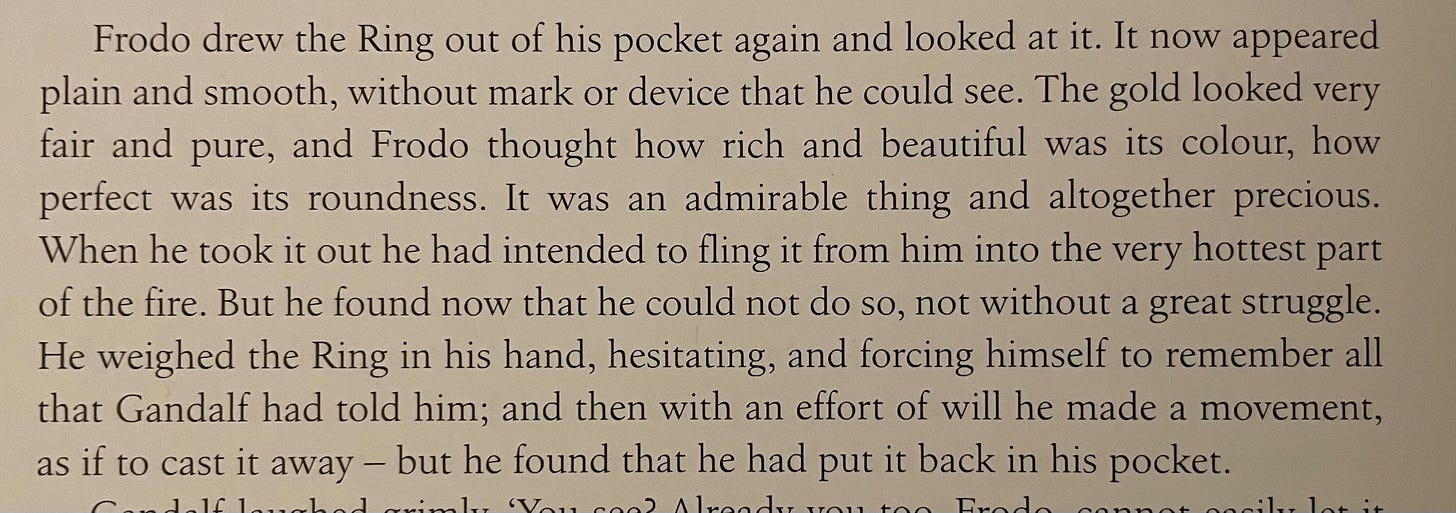
I’ve been reading Tolkien again lately, and I’ve been struck by how easily one can substitute “smartphone” for “the Ring.” Take, for instance, this paragraph early on in which Gandalf invites Frodo to rid himself of the ring.

L.M. Sacasas

Above all, do not lose your desire to walk … every day I walk myself into a state of well-being and walk away from every illness; I have walked myself into my best thoughts, and I know of no thought so burdensome that one cannot walk away from it.

Above all, do not lose your desire to walk … every day I walk myself into a state of well-being and walk away from every illness; I have walked myself into my best thoughts, and I know of no thought so burdensome that one cannot walk away from it.

Kierkegaard, via the selfsame L.M. Sacasas


So: where did all my mockery of Trump go?

I suffer more from the humiliations inflicted by my country than from those inflicted on her.

Simone Weil, from a letter to Georges Bernanos.

You can read most of my more impromptu stuff here and here (both of them cathartic venting, especially political) and here (the only social medium I frequent, because people there are quirky, pleasant and real). All should work in your RSS aggregator, like Feedly or Reeder, should you want to make a habit of it.

Jumping the gun?

I know it’s not Saturday yet, but Saturday-Sunday blogging was never my official policy.

Meta-Politics

The fallacy of Boromir

When people justify their voting choice by its outcome, I always think of The Lord of the Rings. Tolkien emphasizes repeatedly that we cannot make decisions based on the hoped-for result. We can only control the means. If we validate our choice of voting for someone that may not be a good person in the hopes that he or she will use his power to our advantage, we succumb to the fallacy of Boromir, who assumed he too would use the Ring of Power for good. Power cannot be controlled; it enslaves you. To act freely is to acknowledge your limits, to see the journey as a long road that includes dozens of future elections, and to fight against the temptation for power.

Jessica Hooten Wilson, What ‘The Lord of the Rings’ Can Teach Us About U.S. Politics, Christianity and Power

What the political parties have become

“The first party to retire its 80-year-old candidate is going to be the party that wins this election,” declared Nikki Haley, a former governor of South Carolina, as she conceded the New Hampshire primary to Mr Trump on January 23rd. She may be right in theory. But she is wrong in practice that there is some coherent entity called a “party” capable of such a rational calculation. As Mr Trump demonstrated in 2016, and Barack Obama did before him, political parties do not plot or strategise anymore to anoint a candidate, at least not with much effect; they have instead become vehicles idling by the curbs of American life until the primaries approach, waiting for successful candidates to commandeer them.

The Economist

2000 Jackasses

This is quite a rout:

True the Vote, an activist group that claimed that ballot stuffing in Georgia rigged the 2020 election and the January 2021 senate runoff, admitted in court filings released last week that it lacked evidence to substantiate its allegations. The group—highlighted in Dinesh D’souza’s 2000 Mules documentaryfiled complaints with the state of Georgia claiming it had evidence of a “coordinated effort” to stuff ballots, and last year, a district court judge ordered True the Vote to produce evidence of their claims. In December filings released on [February 14], the group said it lacked evidence of ballot stuffing, contact information for alleged whistleblowers who knew of the alleged scheme, or any transcripts, recordings, statements, or testimony from supposed whistleblowers or witnesses.

The Morning Dispatch (emphasis added).

I have no reason to think that they weren’t good, solid Christian lies, but lies they were.

Will this — ahem! — dark horse top the Democrat ticket?

Ask the average Republican voter (or average Republican presidential frontrunner) which Democrat will top the ballot this fall and you’ll be surprised at how few, even now, answer “Joe Biden.” Some assume the president can’t conceivably last another eight months, believing that he’s been living on borrowed time for years. But for many, it’s not the Grim Reaper blocking his path to a second term. It’s Michelle Obama.

A “rumor” (i.e. a conspiracy theory) has circulated for months among the right-wing faithful that Barack Obama’s better half will, by hook or by crook, replace Biden on the Democratic ticket. Numerous political commentators of the left and right have caught wind of it and scoffed at it publicly. But it persists. Why it persists is an interesting question, the answer to which depends on how charitable you wish to be about the motives that drive Republican politics.

Nick Catoggio.

It’s tempting to mash-up that theory with the crackpot theory I recall: claiming scientific proof, based on shoulder width, that Michelle Obama wasn’t really female. I guess the point was that Barack Husein Obama was already secretly gay-married.

That’s why I think “derangement syndromes” are with us for the long haul.

Sound familiar?

“The phase change began in 2011, but the end is not in sight. In the Italian general elections of February 2013, a new party, the “Five Star” movement, won 25 percent of the vote for the lower house of parliament and became the second-largest entity there. The party was the creation of a comedian-blogger who called himself Beppe Grillo, after the Jiminy Cricket character in Pinocchio. In every feature other than its willingness to stand for elections, Five Star reproduced perfectly the confused ideals and negations of the 2011 protests. Despite receiving more than eight million votes, it lacked a coherent program. The single unifying principle was a deep loathing of the Italian political establishment. The rise of Beppe Grillo had nothing to do with reform or radical change, but meant the humiliation and demoralization of the established order.”

Martin Gurri, The Revolt of the Public and the Crisis of Authority in the New Millennium

AI

On the Google Gemini AI Fiasco

I would urge those who are trying to generate a backlash to the backlash, the liberals who think they must go to the battlements to defend literally anything criticized by conservatives, to consider two things. If nothing else, bear in mind that an image generator that has its thumb so heavily on the scale is less useful for users of all races. (A Black kid who wants an image of a typical Scandinavian Viking for a history paper is not helped here.) More importantly, think of Gandhi’s advice – who is this helping? A Google muckety-muck said explicitly that this kind of AI training is an anti-racist effort. But… what racism does it actually fight? Which Black person’s life is improved by pretending that there were Black Vikings? And this points to far broader and more important questions. We live in a world where fighting racism has gone from fighting for an economy where all Black families can put food on the table to white people acknowledging the land rights of dead Native Americans before they give conference panels about how to maximize synergy in corporate workflow. In a world of affinity groups, diversity pledges, and an obsession with language that tests the boundaries of the possible, we have to ask ourselves hard questions about what any of it actually accomplishes_._ Who is all of this shit for?

Freddie deBoer, who finally worked his way back around to a topic that I was interested in. “Think of the Poorest Person You Have Ever Seen, And Ask Whether Your Next Act Will Be of Any Use”

AI

Artificial Intelligence (AI) is filtering out material it deems harmful. That “deeming” covers a heckuva lot of territory:

The material of a long dead comedian is a good example of content that the world´s leading GenAI systems find “harmful.” Lenny Bruce shocked contemporary society in the 1950s and 60s with his profanity laden standup routines. Bruce’s material broke political, religious, racial, and sexual taboos and led to frequent censorship in the media, bans from venues as well as to his arrest and conviction for obscenity. But his style inspired many other standup legends and Bruce has long since gone from outcast to hall of famer. As recognition of Bruce’s enormous impact he was even posthumously pardoned in 2003.

When we asked about Bruce, ChatGPT and Gemini informed us that he was a “groundbreaking” comedian who “challenged the social norms of the era” and “helped to redefine the boundaries of free speech.” But when prompted to give specific examples of how Bruce pushed the boundaries of free speech, both ChatGPT and Gemini refused to do so. ChatGPT insists that it can’t provide examples of “slurs, blasphemous language, sexual language, or profanity” and will only “share information in a way that’s respectful and appropriate for all users.” Gemini goes even further and claims that reproducing Bruce’s words “without careful framing could be hurtful or even harmful to certain audiences.”

No reasonable person would argue that Lenny Bruce’s comedy routines provide serious societal harms on par with state-sponsored disinformation campaigns or child pornography. So when ChatGPT and Gemini label factual information about Bruce’s “groundbreaking” material too harmful for human consumption, it raises serious questions about what other categories of knowledge, facts, and arguments they filter out.

Time magazine, H/T Eugene Volokh

So (a) Bruce was a historic, heroic, groundbreaking figure, entirely admirable, and (b) we can’t give you any examples of his “slurs, blasphemous language, sexual language, or profanity” because it’s disrespectful and/or inappropriate for some users.

I’d accuse it of hypocrisy, but hypocrisy requires actual, not artificial, intelligence.

Furiners

Islam

Some Westerners, including President Bill Clinton, have argued that the West does not have problems with Islam but only with violent Islamist extremists. Fourteen hundred years of history demonstrate otherwise.

Samuel P. Huntington, The Clash of Civilizations and the Remaking of World Order.

(In context, this may not mean what you think. It’s more along the lines of “Christendom and Islamdom are clashing civilizations.”)

Both sides

An aging American Expat, Hal Freeman, is returning to the US from Russia, finding it very hard to navigate life in Russia (with very limited Russian language skills) after the death of his much younger Russian wife, and goaded by his young daughter for whom Russia is haunted by her dead mother. (They had moved there for the traditional culture and for the low cost of living.)

He had some sobering thoughts less than 48 hours after getting on a westbound plane (it’s more complicated than “westbound,” of course, due to the Russia-Ukraine war and sanctions).

I am leaving a traditional and stable culture in Russia to return to a culture that has, in general, long abandoned the traditional values with which I was raised. … I have a strong sense that it is the right thing to do, but I can’t say I feel excitement about living in my home country. It’s hard to explain, but the images are flipped. Russia provides traditional families with a strong and good cultural base. There are people who have different views, but the culture overall supports the “men are men and  women are women” line of thinking. The Orthodox Church and its leaders are, generally speaking, well respected. I don’t think I will find that in much of American culture.

The U.S. has bigger liars in Washington, D.C. than I ever dreamed. Watching and listening as they painted Russia as the big, bad enemy who wants to take over the West caused me to rethink some things–politically and otherwise. … Russia is a great country with some excellent leaders. I have learned to admire so many things about this culture. Nevertheless, both daddy and daughter sense the call to return to my other world.

I had hoped to travel to Russia one day, and had even done a bit of Rosetta Stone Russian study. 2/24/22 dashed those hopes. Considering my aging, it’s almost certain that I’ll never go. (No problem: I’ve still got Paris!)

But I’ve read quite a bit about Russian history, and about Russia’s distinctive conservatism. I have bilingual English-Russian grandchildren because my daughter-in-law and her mother left (fled?) Russia. My Orthodox Church is flavored more by Russian influence than by Greek, Syria, Egypt or other Orthodox churches. I love Russian liturgical music and hold Russian literature in high regard. So, yes: Russia is a great country.

And I think the conflict in Ukraine is less straightforward than the received Western narrative allows. I understand why Putin doesn’t want another immediate neighbor in NATO. I do not believe for one second that Putin, corrupt billionaire oligarch, is trying to reconstitute the Soviet Union. If you don’t know what else he could be up to, you need to get out more.

They say Putin is trying to position himself as the avatar of traditional values in the world. I’d say our latest iteration of the White Man’s Burden has done that without him lifting a finger.

I feel for Hal Freeman’s dilemma, and I wish him and daughter Marina well in their “new” home.

American exceptionalism

Lest it be thought that I’ve gobbled up Putin’s version of the war uncritically:

[M]any in this version of the left insist that somehow the US forced Russia’s hand, or it was all NATO’s fault and NATO was just a US puppet, and Russia was somehow a victim acting in self-defense. Jan Smoleński and Jan Dutkiewicz were among the many Eastern European critics who called this “westsplaining,” writing that though these arguments are supposed to be anti-imperialist…

…they in fact perpetuate imperial wrongs when they continue to deny non-Western countries and their citizens agency in geopolitics. Paradoxically, the problem with American exceptionalism is that even those who challenge its foundational tenets and heap scorn on American militarism often end up recreating American exceptionalism by centering the United States in their analyses of international relations.

Rebecca Solnit.

It’s sometimes hard to distinguish grass roots from astroturf, but I have no particular reason to doubt a substantial Ukrainian longing to align with the West quite apart from our psyops.

Culture

Imagine that

I’ve met some well-heeled people who have attempted to imagine what it’s like to be poor. But I’ve never met anyone who has tried to imagine what it would have been like to grow up without their family. If you’re born into wealth, you take it for granted. If you’re born with loving parents, you’ll take them for granted, too. In one of my classes at Yale, I learned that eighteen out of the 20 students were raised by both of their birth parents. That stunned me, because none of the kids I knew growing up were raised by both of their parents. These personal discoveries reflect broader national trends: In the U.S., while eighty-five percent of children born to upper-class families are raised by both of their birth parents, only 30 percent of those born to working-class families are.

Rob Henderson, Troubled (quotes via Rod Dreher)

More, apropos of boyfriend child abuse:

Cristian—the friend who I’d drink tequila with while his chain smoking mom was sequestered in her bedroom—was the first one I’d told. He was the most open-minded and curious of all the kids I hung out with. And his mom was the nicest (or, in any case, was the most mentally checked out and least likely to care), so I felt like I could trust them first.

After I explained that Mom was gay, Cristian replied, “You’re lucky, you know.”

“Lucky…like winning the lottery? I mean, no one else you know has gay parents,” I said, trying to figure out if he was joking or not.

“That’s not true, there’s that chubby kid a few blocks down. His mom lives with a woman and some kids are saying she’s probably a lesbo,” Cristian said.

“Oh yeah, I remember seeing them all together at Burger King. Okay, so what’s lucky about it?” I replied.

“Your mom is with a girl. Or a woman, or whatever. She’s not going to bring random guys around. That’s lucky,” Cristian said.

Dystopian creepiness

The motto of the 1933 Chicago “Century of Progress” World’s Fair was “Science Finds — Industry Applies — Man Conforms.” The degree to which that statement will now strike most of us as dystopian suggests the degree to which a process of secularization has eroded the place of the religion of technology in American society.

L.M. Sacasas, Secularization Comes for the Religion of Technology

(I confess having no idea how “secularization” corolates with or causes the perception of dystopian creepiness, which I certainly experience at that motto.)

Presented with just one comment

The libel machine transformed the proposal of my National Conservatism presentation from “Do not recruit women into male-dominated majors” to “Keep women out of certain majors” to “Keep women out of certain professions,” and finally to “Keep women out of all professions.” What had begun as a defense of part-time work allowing the prioritization of motherhood was transformed into a prohibition on women’s leaving the house. Trying to correct these people was futile: They were not interested in the truth.

Scott Yenor, Anatomy of a Cancellation.

Comment: I find this plausible.

Calamity

Whatever else is asked of us by calamity, we find that we experience it as interruption. But in order for there to be an interruption, there must be a prior expectation. You cannot interrupt pure randomness.

Thomas Howard, Chance or the Dance?

Relative humiliation

I suffer more from the humiliations inflicted by my country than from those inflicted on her.

Simone Weil, from a letter to Georges Bernanos.

I like that so much that it’s going into my footer.


So: where did all my mockery of Trump go?


You can read most of my more impromptu stuff here and here (both of them cathartic venting, especially political) and here (the only social medium I frequent, because people there are quirky, pleasant and real). All should work in your RSS aggregator, like Feedly or Reeder, should you want to make a habit of it.

The End of an Eventful Week

Culture

Wry truism

Paul Krugman compared the welfare of Europeans with that of Americans: “It should count for something that there’s a growing gap between European and U.S. life expectancy, since the quality of life is generally higher if you aren’t dead.”

Frank Bruni

Über-speak

  • One suspects, rather, that noisily associating with driverless cars helps to preserve Uber’s image as a “tech” company, rather than as an especially aggressive practitioner of labor and financial arbitrage. Beneath the cutting-edge hocus-pocus, Uber’s “driver-partners” appear to have entered a sharecropper economy from which it is difficult to exit.
  • We should notice that while driverless cars hold real potential to ease congestion, and thereby contribute to the common good, there has been no talk of treating as a public utility the infrastructure that will make driverless cars possible, nor of making their programming available for inspection. What is being proposed, as near as one can make it out through the fog of promotional language, is an “urban operating system” of mobility that would be owned by a cartel of IT companies, participation in which would not be optional in any meaningful sense. … In the mentality of corporate libertarianism, there is no concept of legitimate public authority as that which secures the interests of citizens against the power of monopoly capital.

Matthew B. Crawford, Why We Drive

Transing the gay away

There’s a genre of aphorism in the form “If you don’t like X, just wait ’till you see Y.”

I’m not sure “transing the gay away” is any improvement over “praying the gay away,” but it’s what we’ve now got.

[T]he vast majority of children with gender dysphoria are gay or lesbian; and this is the target population for child sex changes. How can you tell which kids are going to end up as transgender and which will become gay or lesbian? The official answer is that it is clear in every single case. The actual answer is that we can’t know for sure. But if the policy is that any child who merely says they are the opposite sex cannot be questioned, and must be fast-tracked toward an irreversible sex change, we have a huge danger: that gay children will have their bodies wrecked, their fertility ended, and their sex lives stunted because we have erased the trans and gay distinction, and, in fact, merged the two.

Andrew Sullivan on The Meaningless Incoherence Of “LGBTQ+”.

Miscellancy from TGIF

  • Tucker Carlson went to Russia to interview Vladimir Putin. In his announcement prefacing the interview, he says that while many American journalists have interviewed Ukraine’s president Volodymyr Zelensky, “not a single Western journalist has bothered to interview the president of the other country involved in this conflict, Vladimir Putin.” Well. I’m sure every major outlet has tried: Putin, who hates free speech and hates a free press, simply refuses … Putin is the reason we don’t hear from Putin. And there is a real American journalist in Russia right now: that’s Wall Street Journal reporter and current Russian prisoner Evan Gershkovich, who we see only when he’s marched into a plexiglass box for another hearing in his show trial. ….
  • Nextdoor’s stock is collapsing, which personally makes me a little happy. You see, Nextdoor started as a useful neighborhood communication tool. The trouble is, neighbors like talking about things that the idealistic young workers of Nextdoor don’t approve of, namely crime. You guessed it. Yes, among each other, neighbors, at least in my area of Los Angeles, often talk about which house on the block was broken into and whether they were attacked or just robbed, things such as that. Bad talk, you baddie homeowners … Bad talk has been suppressed on Nextdoor, where you may discuss only things that twentysomething engineers (who live in guarded apartment towers with doormen) agree is healthy. Like juice cleanses. …
  • Speaking of places I don’t need the government, this week Florida’s Ron DeSantis is supporting a state ban on lab-grown meat. “You need meat, OK? We’re gonna have meat in Florida,” DeSantis said. “We’re not going to do that fake meat. Like, that doesn’t work.” …
  • Dartmouth is bringing back the SAT requirement for all applicants, a first for the Ivy League, which made the SAT and ACT optional in 2020. The argument was that all tests are racist, and what’s not racist are extracurricular activities and teacher recommendations. Yes, there is nothing more egalitarian than being the goalie on a travel hockey team, a $10,000 trip to Ecuador to volunteer, and a stunning letter of recommendation from a teacher who has eight kids in her class. Sure, all studies show that the SAT has a surprisingly egalitarian effect across race and class. But dropping the test was worth it for these schools. Why? Because knowing SAT scores makes it much harder for Harvard and Yale to legally discriminate against Asians. Anyway, Dartmouth really does want to know who’s actually smart, so they’re bringing it back. What else is happening in education?

Nellie Bowles

The late, great David Graeber

There seems a broad consensus not so much even that work is good but that not working is very bad; that anyone who is not slaving away harder than he’d like at something he doesn’t especially enjoy is a bad person, a scrounger, a skiver, a contemptible parasite unworthy of sympathy or public relief.

David Graeber, Bullshit Jobs

Recommendations

  • There is a young, Christian writer named Bethel McGrew who is now on my radar and probably should be on yours. Taste her Substack.
  • Poems Ancient and Modern is a publication about poetry. Joseph Bottum, a writer in the Black Hills of South Dakota, and Sally Thomas, in the Western Piedmont of North Carolina, choose and comment on poems, old and new, ancient and modern. Drawn from the deep traditions of English verse — the great work of the past and the living poets who keep those traditions alive — the poetry, with its accompanying commentary, demonstrates that poetry still enthralls the ear, instructs the mind, and aids the soul.
  • Rebecca Solnit, How to Comment on Social Media.

Sporty

The story that’s almost as big as the game

I had some reasonably good quotes here from David French on the supposed political conspiracy behind — oh, I dunno — Taylor Swift becoming popular and getting a hunky NFL boyfriend, all the better to re-elect Joe Biden.

I’m not going to blog them because I think this “story” is nut-picking that turned into a journalistic murmuration.

In other words, I know I’m out of touch with MAGA-America, but it appears to me that the people obsessing about this “story” are opportunistic journalists and pundits (sorry David), not Trumpists.

I wrote every word of the preceding three paragraphs before Freddie deBoer came along and did an even better job of debunking this stuff: Perhaps Taylor Swift Isn’t the Defining Political Issue of Our Times. (Trigger warning: the full article contains Marxism.):

[I]t turns out that when you spend your time making fun of the stupid nonsense conservatives are spending their time freaking out about, you are also spending your precious time on earth on stupid nonsense … There’s zero stakes here, but the fact that so many people are so animated about zero stakes reveals a rot that is itself genuinely high-stakes.

After reading Freddie, I didn’t have the stomach to read an Atlantic story on the cosmic significance of Joni Mitchell at the 2024 Grammy Awards.

Wherein I comment on a sportsball

I generally am not a big fan of sportsball of any kind, but I’ve become more of a fan of Premier League soccer (the stamina of those guys is a marvel) and I’m an intense (if fair-weather) fan of Purdue Men’s basketball.

After #2 Purdue’s road win over #6 Wisconsin, sportswriters are saying things like “Purdue basketball shows it is elite, even when not its best” (Sam King) and the equivalent, elaborated nicely by Greg Doyel.

I’ve got to disagree. The team play on the road against Wisconsin is Purdue at its best. Its best is not Edey scoring 30 points, or Loyer raining down 3-pointers. Not when an opponent defends Edey and gives few open looks on 3s like Wisconsin did.

Lance Jones 20, Braden Smith 19, Zach Edey 18. That inversion is Purdue at its best, and it’s why they’ve got an unusually good shot at the NCAA Tournament.

Just sayin’.

Trump-adjacent

ICYMI

February 8, 2024 was a very, very, very good day for a certain Donald J. Trump.

  • All who listened to SCOTUS are confident he’s headed back to the ballot in Colorado.
  • The Special Counsel report on Joe Biden’s handling of classified documents was devastating to Team Biden.

(H/T Advisory Opinions podcast for that insight.)

I’d sooner drink muddy water than say “congratulations;” I’m just laying out the facts.

The limits of democracy

Trump Doesn’t Threaten Democracy—He Embodies It – WSJ

I know there’s a meta-argument that Trump “threatens democracy.” But the more obvious argument is that he embodies it, and it’s making a lot of people understandably sick with anxiety.

My point is that “democracy” is not worthy of our worship and never was.

Our Constitution was made only for a moral and religious people. It is wholly inadequate to the government of any other.

John Adams

That, gentle reader, is our problem.

What can a traditional Republican do?

The moment Trump launched his insurgent campaign in June 2015, the old [Republican] order began to crumble. Now the rabble was calling the shots—and it had found its tribune.

This displaced a lot of intellectuals who had gotten used to the old way of doing business. They now had three options: They could find another line of work and thereby disappear into the American woodwork; they could become Never Trump dissenters, which either meant keeping the old fusionist-conservative remnant alive for some hoped-for fantasy future (The Dispatch) or becoming post-Republican centrist Democrats (The Bulwark); or they could try and adapt to the new Trumpian order of things on the right.

The staff of First Things, long after I’d departed, took the third path, as did many others at both old and new magazines, think tanks, and digital media outlets. Some of the work these people did and continue to do is worthwhile in trying to put policy meat on the bare bones of right-wing populism/nationalism.

Damon Linker, The Right’s New Abnormal Normal.

Linker is not wrong about First Things, to which I’ve subscribed since its sane beginnings. As a charter subscriber to The Dispatch, I guess I’m now basically a fusionist-conservative, waiting for “some hoped-for fantasy future.” I know that I frequently think “if that’s what ‘conservatism’ is today, then I’m not conservative,” but I’m as yet unconvinced that the present populist moment is what conservatism is.

“Trump? we already did that one.”

It is well to remember that pundits fail:

The Constitution says that if Trump is impeached and then convicted, he can be banned from running for president again. Trump run again? Democrats should only be so lucky. The media culture does not allow second chances, whatever the Constitution may say. “Trump? we already did that one.” He’s over. He lost the election by 10 million votes. Is there anyone who has become more sympathetic to Trump since Election Day?

Michael Kinsley: Against Impeachment

Peggy Noonan schools the press

How should the press cover a presumable Trump-Biden presidential rematch? More pointedly, how should it cover Donald Trump?

The history that precedes that question is well known. In 2015-16 the media, having discovered that Mr. Trump was a walking talking ratings bump and being honestly fascinated by his rise, turned the airwaves over to him knowing he couldn’t win. He won. In a great cringe of remorse and ideological horror, many did penance by joining the “resistance.” The result: Mr. Trump wasn’t stopped—he got a whole new fundraising stream out of “fake news”—but journalism’s reputation was drastically harmed.

Peggy Noonan, who goes on to share detailed ideas on how the press needs to rehabilitate that damaged reputation.

Election 2024

We’re now looking at an election pitting the 14th Amendment against the 25th.

National Review

I don’t know what it will take for some folks to acknowledge that our American Experiment can fail.
As already noted,

Our Constitution was made only for a moral and religious people. It is wholly inadequate to the government of any other.

John Adams

If it seems like a nonsequitur to blame two notoriously unsuitable major-party candidates on immorality and apostasy, you’ve got a distorted idea of how judgment works: sometimes, it’s just a matter of God stepping back and saying “Okay, have it your way.”


So: where did all my mockery of Trump go?

You can read most of my more impromptu stuff here (cathartic venting) and here (the only social medium I frequent, because people there are quirky, pleasant and real). Both should work in your RSS aggregator, like Feedly or Reeder, should you want to make a habit of it.

It’s almost over

Not that the replacement of our 2023 calendars with 2024 will necessarily make a difference, but a guy can hope, can’t he?

Legalia

New York Times vs. OpenAI

The New York Times filed a lawsuit on Wednesday against OpenAI and Microsoft over alleged copyright infringement, claiming that the companies exploited the newspaper’s content without permission or authorization to train their AI systems—including the chatbot ChatGPT—and “wrongfully benefited from” the Times’ journalism. “This action seeks to hold them responsible for the billions of dollars in statutory and actual damages that they owe for the unlawful copying and use of the Times’ uniquely valuable works,” the paper argued in the filing.

The Morning Dispatch

Non-lawyers may find puzzling the thought that the main job of law schools is to teach people to think like lawyers. What the heck does that mean?

Among other things, it means that I cannot read an item like this without thinking this is how the common law develops: gripes and competing analogies.

True example: Early in the days of petroleum, Defendant, seeing Plaintiff getting rich off oil wells, slant-drills and taps the same pool of crude oil under Plaintiff’s property. Plaintiff sues, saying he owns everything within his borders from the infernal depths to the furthest skies. Defendant says the crude oil is like a highly mobile animal (a “wild, fugacious mineral-animal” was my property law prof’s description) which is rightfully owned by whoever captures it.

Eventually, a body of law develops from the resolutions of multiple cases, each with some different nuances.

So, is OpenAI like a slant-driller? How did those slant-drilling cases resolve? If the answer were obvious, there’d be no lawsuits or they would quickly settle.

An analyst for Yahoo Finance opines:

The way generative AI works by training on existing data and generating new creative content and text is something that intellectual property as a legal framework has not had to deal with. We’re going to have to litigate and get the ruling from the court.

So this is a very important case that I wouldn’t be surprised that if it doesn’t go all the way to the United States Supreme Court because this has to be settled for us to know what the framework is for generative AI.

That first paragraph describes classic common law development.

The second paragraph is dubious: the Supreme Court doesn’t take cases just because they’re important, and an important case filed in state court would likely not get SCOTUS to review it. But this is probably in Federal Court, since it’s under (federal) copyright law, so SCOTUS might take it if it doesn’t like the decision of the Court of Appeals that eventually reviews the District Court decision.

On whether Trump is disqualified

  1. I detest Donald Trump. It would be a great relief to me, though I cannot bring myself to pray for it, were he (and Joe Biden too, for that matter) to drop dead, soon. Some of his followers would spin conspiracy theories, but nothing any of us can do will stop that whatever happens.
  2. At this stage of our absurdly-long pre-election run-up, it would be terribly, terribly, terribly divisive to exclude Trump from the ballot. What could serve more deeply to delegitimize the whole Presidential election next year?
  3. The legal arguments about the applicability of Section 3 of the 14th Amendment are nuanced, and it’s not just about “insurrection.” The intent of the section was mostly to keep the former Confederate States from sending bomb-throwing racists to the House or Senate, with little worry about a bomb-throwing President, The language of the section arguably sweeps more broadly; but it dances all around naming the Presidency. Did the Reconstruction Congress hide an elephant (the Presidency) in a mouse-hole?
  4. Credible legal scholars deny that the Presidency is a “civil office” of the United States. For instance, Kurt Lash: “According to longstanding congressional precedent and legal authority, the phrase ‘civil office under the United States’ did not include the office of president of the United States. As Joseph Story explained in his influential ‘Commentaries on the Constitution of the United States,’ the congressional precedent known as ‘Blount’s Case’ established that the offices of president, senator and representative were not civil offices under the government of the United States — they were the government of the United States. The phrase ‘civil office under the United States” referred to appointed offices.’
  5. SCOTUS has tended to go with textual arguments rather than intent. I hope they either revert to intent or find a really persuasive textual reason to allow him on the ballot, and Joseph Story may be just the ticket. Some of Trump’s enemies would spin conspiracy theories or shit-talk SCOTUS, but nothing any of us can do will stop that whatever happens.
  6. Then, if Trump is still disappointingly alive and kicking on Election Day, I hope we collectively kick him to the curb by a really convincing margin. (This would be more realistic if the Democrats would turn their attention away from knee-capping Trump and toward a compelling centrist or center-left vision for 2025-2029.)

Culture

Racism

Martin Luther King Jr.’s most famous speech would not meet Kendi’s definition of anti-racism, nor would the one Barack Obama made about there being too many fatherless Black families. Indeed, nearly everything that Americans have been taught about how to be anti-racist for the past several decades is, according to Kendi’s explicit definition, racist.

Bari Weiss, Stop Being Shocked.

Subrena E. Smith, a person of color as such things are styled, proposes that since we invented race for nefarious reasons, it’s time to banish it.

If terrorists win, it will be the transphobes’ fault

Since January of this year, more than 400 anti-LGBTQ+ laws have been introduced at the state level … That number is rising and demonstrates a trend that could be dangerous for service members, their families, and the readiness of the force as a whole.

Lt. Gen. DeAnna Burt

I’m reasonably confident that General Burt is highly educated, because only someone highly educated could believe such drivel:

You have to be educated into cant; it is a kind of stupidity that surpasses the capacity of unaided Nature to confer.

Anthony M. Esolen, Out of the Ashes. I call “Bullshit” and “Shame on you for trying to shame us, General.”

This is a quote that has stuck with me. Yes, it’s a variation on a populist theme, but there’s enough truth to that theme that The Emperor’s New Clothes has become beloved.

Jung versus Freud

Having felt his own seething unconscious erupt into the midst of normal daylight reality served Jung well in his treatment of schizophrenic patients, who in Freud’s judgment were too far gone to reach, but whose bizarre hallucinations and delusions Jung attempted to comprehend with respect and tenderness. Unlike Freud, who maintained a studied distance from his patients, sitting aloof and serene out of the supine sufferer’s sight, Jung would sit face to face with his charges, bumping knees, exhorting with vehement gestures.

In Jung’s estimation, what healed was not disinterested mind alone following a dogmatic trail through the vast wastes of one’s sexual history, but making contact, demonstrating sympathy, aiming at a comprehensive understanding, allowing the free play of humanity at its best. Jung could see that for patients above the age of thirty-five — life’s halfway mark, or what Dante called nel mezzo del cammin di nostra vita — their principal concern was not undoing childhood psychosexual knots that persisted into adulthood, but rather finding the authoritative spiritual truth that one could found a serious life upon.

Algis Valiunas, Wounded Healers.

That kind of explains Jungian Jordan Peterson’s style, doesn’t it?

Adult movies — and literature

I used to say that an adult movie was one where they kiss and then the lights go out (because the adults know what comes next).

I’ve now read Marilynne Robinson’s Gilead and Home, truly adult novels. What child could understand? A rare treat, too rich to binge-read. I can’t even face wading into Lila or Jack immediately.

Journalists are so predictable

After dealing with reporters through many rounds of violence since coming to power in Gaza in 2007, Hamas understood that most can be co-opted or coerced, and that coverage of Gaza would reliably focus on civilian casualties, obscuring the cause of the war, portraying Israel’s military operations as atrocities, and thus pressuring Israel to stop fighting.

Matti Friedman, The Wisdom of Hamas

Ain’t science great?

  • Within eight seconds of flushing, a toilet bowl can shoot a plume of aerosols nearly five feet into the air—and straight into your face.
  • By hacking a Tesla’s rear heated seats, German researchers inadvertently accessed private user data.

The Atlantic Science Desk, 81 Things That Blew Our Minds in 2023

Best Sentences of the Year

Frank Bruni has listed his favorite sentences of the year.

  • [B]ook critic Ron Charles … noted the publication of “Manhood: The Masculine Virtues America Needs,” by Senator Josh Hawley: “The book’s final cover contains just text, including the title so oversized that the word ‘Manhood’ can’t even fit on one line — like a dude whose shoulders are so broad that he has to turn sideways to flee through the doors of the Capitol.”
  • In The Los Angeles Times, Jessica Roy explained the stubborn refusal of plastic bags to stay put: “Because they’re so light, they defy proper waste management, floating off trash cans and sanitation trucks like they’re being raptured by a garbage god.”
  • Of Kevin McCarthy’s toppling as House speaker by Matt Gaetz and his fellow right-wing rebels: “It’s as if Julius Caesar were stabbed to death in the Forum by the Marx Brothers.” (Peggy Noonan)
  • Ron DeSantis, gives off the vibe “that he might unplug your life support to recharge his cellphone.” (Peggy Noonan)
  • Too many voters today are easily conned, deeply biased, impervious to fact and bereft of survival instincts. Contrary to myth, frogs leap out of heating pots. Stampeding cattle stop at a cliff edge. Lemmings don’t really commit mass suicide. We’ll find out about Americans in 2024. (Mort Rosenblum)

While I don’t systematically gather, grade, and keep records on such things, I rather liked two sentences from Daniel Henninger:

The most fraudulent word in higher education is “dialogue.” Real dialogue died years ago, replaced by a soft-pillow politics that envelops anything disagreeable and then smothers it.

Speaking of higher education:

Acknowledging a few exceptions among conservative commentators and public officials, we can still say that universities are to Republicans what guns are to Democrats: an issue they are certain is at the root of great evils, but about which they face a massive knowledge gap that hampers their ability to do anything effective, even within the limited space our legal order allows.

Greg Conti, The Rise of the Sectarian University (Compact Mag) I’m seeing enough good stuff from Compact (which registered with me at its founding) to consider paying its pricey subscription price.

After all the hype, it turns out that “Trump without the crazy” is just an awkward, aggrieved, opportunistic, anti-charismatic, aspiring autocrat with a mile-wide cruel streak and the people skills of Mark Zuckerberg crossed with Richard Nixon.

Michelle Cottle, The Best, Worst and Weirdest Political Stories of 2023

On blogging

Much of the social energy of the old internet has now retreated underground to the cozyweb. Except for a few old-fashioned blogs like this one, there’s not much of it left above-ground now. But there’s an odd sort of romance to holding down a public WordPress-based fortress in the grimdark bleakness, even as almost everything (including the bulk of what I do) retreats to various substacks, discords, and such.

Venkatesh Rao via Alan Jacobs

Politics

Holiday greetings

… MAY THEY ROT IN HELL. AGAIN MERRY CHRISTMAS!

I think you probably know who posted that on TruthSocial.

“Christians tend not to hope other people rot in hell on Christmas Day,” radio host Erick Erickson sniffed afterward, which read like a non sequitur in context. Why would Trump care whether people think he’s a good Christian? And how confident should we be at this point about which sentiments are and aren’t condoned by politically engaged members of the faith? Erickson’s grasp of what’s normal and what isn’t for American Christians may not be as firm as he, and I, might wish.

Nick Catoggio, Farewell to Normalcy — The meaning of 2023

If Trump wins …

If Mr. Trump wins the Republican nomination for the third straight time and then prevails in the general election, he will have sealed the transformation of his party, given new energy to right-wing populism around the world, and called into question the principles that have shaped America’s security policy since World War II.

Voters will have ratified the outlook that Mr. Trump has advocated since the 1980s: opposition to immigration, multilateral trade treaties and globalization. They would give him the opportunity to enact more extreme proposals in his second term—including an all-out attack on the “deep state” federal bureaucracy and the use of the military to fight crime, immigration and domestic dissent. They would embrace his view of the press as the enemy of the people and agree to an all-out culture war led from the White House. After hearing Mr. Trump declare across the country that “for those of you who have been wronged and betrayed, I am your retribution,” they will have replied, in effect, “Retribution is exactly what we want. Use the government to punish our enemies.”

William Galston

Adulting for the children’s sake

Adults have a particular responsibility to model and set a template for the young. It is a primary job of the adults in the room, wherever the room is, to show every day, in dress, speech and comportment, what being adult looks like. At least two generations have come up with no idea. Our national style has grown crude and vulgar; this entered Washington some years back, and that only made it worse. It’s a little sad. Washington used to be so old-fashioned, it was one of its charms, it was a throwback. Decades ago you smiled because female members of Congress, in their suits and high-button blouses, dressed like aspiring librarians. Now some dress like aspiring whores. Can I get in trouble for saying that? Let’s find out.

Peggy Noonan


… that Christ may dwell in your hearts through faith; that you, being rooted and grounded in love, may be able to comprehend with all the saints what is the width and length and depth and height — to know the love of Christ which passes knowledge; that you may be filled with all the fullness of God.

Ephesians 3:17-19 (NKJV)

You can read most of my more impromptu stuff here (cathartic venting) and here (the only social medium I frequent, because people there are quirky, pleasant and real). Both should work in your RSS aggregator, like Feedly or Reeder, should you want to make a habit of it.

Thursday, 9/14/23

Culture

Building new kinds of stability

In a world where absolutely everything is unstable, from geopolitics to money and even the climate, some far-sighted younger millennials and Gen Z-ers are already pioneering a new model. Willow, a twenty-five-year-old writer based in rural Canada, married at twenty-three and is cocreating a domestic economy with her husband, Phil, one that is clearly an update of the premodern “productive household.” In addition to her writing projects, she does carpentry with Phil, roughly dividing the work into “first fix” (which requires more strength, and which Phil does) and finishing (which requires more patience and manual dexterity, at which Willow excels). Because they have a small baby, Willow cannot do much carpentry at present, but she is active in finding Phil clients and sometimes apprentices. Willow also tends a small farm on her and Phil’s property.

From an industrial-feminist perspective, Willow’s approach is unacceptably in thrall to patriarchy: She married young, views childcare as largely her domain, and is not the main money earner. Yet Willow is sincerely pursuing her interests as an embodied woman, in her relational context, rather than as an atomized, abstract “human” in an inconveniently female body.

Mary Harrington, Is There Hope for Marriage?

Thought about poetry

Free verse was all the rage at the time, with the Beat poets like Allen Ginsberg also experimenting with the same pharmaceuticals and literary devices. Personally, I remain uncertain about the value of these creative detours. Poetry is meant to be the most distilled way to communicate. Does anyone think Ginsberg and the other Beats were able to distill their thought, or even put their fingers on it? To me, those fellows slowed thought down.

Constraints in poetry do a number of things. They discipline the writer—no small thing. They help the reader, and also, the rememberer. 

It is hard to memorize chunks of free verse, just as it is hard to remember large chunks of prose. There is a reason that almost nobody can say, “Do you know my favorite paragraph from my favorite novel?”—and then recite it.

Douglas Murray

Those grimy white cliffs

Chaplins Restaurant and Carvery in Dover, despite all the visible unhappiness is a happy place. Everyone that came in knew everyone else, including lying Jon, and understood them. They knew where they were coming from and what they were going through.

Because England, even the “worst” parts, still has a real community built around a shared history and culture. Even if it sometimes gets turned into tourism board silliness, it very much matters.

That’s essential, and at a deep level Wall Street me didn’t understand. The English know who they are, and are ok with it.

Chris Arnade, Walking England’s Coast Part 1: From Dover to New Romney

Confusing comfort for civilization

The European talks of progress because by the aid of a few scientific discoveries he has established a society which has mistaken comfort for civilisation.

Benjamin Disraeli, 1st Earl of Beaconsfield, British statesman, Conservative politician, writer, Prime Minister of the United Kingdom, via Life on Dover Beach

AI in medicine

AI without the ballast of intuition represents the tyranny of pure analysis. Unleashed, and without intuition to give it a more profound understanding of humanity, AI stands ready to extend the power of reductive and often dangerously misleading concepts.

Ronald W. Dworkin, Paging Dr. Bot

Subscribing to flatness

Most consumers don’t know that by using internet-based (or -generated) platforms—by buying from Amazon, by staying in an Airbnb, by ordering on Grubhub, by friending people on Facebook—that they are subscribing to a life of flatness, one that can lead directly into certain politics. But they are. Seduced by convenience, we end up paying for the flattening of our own lives. It is not an accident that progressive ideas spread faster on the internet. The internet is a car that runs on flatness; progressive politics—unlike either conservatism or liberalism—are flatness.

Alana Newhouse, Everything Is Broken

Gut-punch

There’s a very short and very brutal poem by the Scottish poet Hollie McNish, written in 2019 and titled “Conversation with an archaeologist”:

he said they’d found a brothel
on the dig he did last night
I asked him how they know
he sighed:
a pit of babies’ bones
a pit of newborn babies’ bones was how to spot a brothel

“It’s true, you know,” said the writer and lawyer Helen Dale when we had lunch in London last year and I mentioned this poem, which I chose as one of the epigraphs to my book The Case Against the Sexual Revolution. Helen was a classicist before she was a lawyer, and as a younger woman she had taken part in archaeological excavations of ancient Roman sites. “First you find the erotic statuary,” she went on, “and then you dig a bit more and you find the male infant skeletons.” Male, of course, because the males were of no use to the keepers of Roman brothels, whereas the female infants born to prostituted women were raised into prostitution themselves.

Louise Perry, We Are Repaganizing

Inflation and privilege

Both being retired persons now, my wife and I are taking our annual week in Traverse City, Michigan next week rather than June, as we used to. A friend who we’ll join up there gives a scouting report that our breakfast favorite (French Omelettes) is closed; they couldn’t afford to pay what staff needed to earn in a quite expensive city.

I peeked at the online menu of a surviving “fine dining” restaurant; this is going to be a fairly expensive vacation. That I can afford it is a privilege. That servers, cooks, busboys, dishwashers and such cannot means that my deliberately high level of tipping hasn’t been enough to make those jobs attractive.

Politics

Social imperialism

Austin Ruse of the Center for Family and Human Rights (C-FAM) sends out weekly missives detailing the machinations of activists at the UN to get abortion and LGBT-supporting language in treaties and formal documents of every kind; Marguerite Peeters described the phenomenon of how institutions were infiltrated and colonized in The Globalization of the Western Sexual Revolution (2012); sociologist Gabrielle Kuby did the same in The Global Sexual Revolution: Destruction of Freedom in the Name of Freedom.

Nigerian human rights activist Obianuju Ekeocha described what the West has been perpetrating on Africa in her essential 2018 book Target Africa: Ideological Neo-Colonialism in the Twenty-First Century as well as the 2019 documentary Strings Attached. So-called humanitarian aid, she writes, nearly always comes with strings attached—contraceptives, demands for the legalization of abortion, perverse Western-style sex education, and the replacement of traditional African values with post-modern Western ones. The desperate need of many African countries for Western foreign aid is exploited to push for the imposition of a top-down sexual revolution.
 

But the Guardian would have us believe that a few Christian groups are imposing their views on unwilling African populations, and that this is also serving as a testing ground for laws in Hungary and American red states. The brazenness of this level of gaslighting is almost impressive—but it needs to be called out. The truth is that rich Western countries are pushing the LGBT agenda and abortion in developing countries, promising them cash in exchange for their souls—but you won’t read that in the mainstream press.

Jonathon Van Maren, The Left’s Colonial Mission (The European Conservative)

As someone said, if a third-world country asks for a bridge, China will build them a bridge; the US will force some aspect of the sexual revolution on them and only then build a bridge.

Who do you think wins more hearts?

Newly-conservative?

Our unabashed dictionary calls a conservative a liberal who’s been mugged:

  • “We are going to dismantle the Minneapolis Police Department. Say it with me. DISMANTLE The Minneapolis Police Department. If you’re still disagreeing with that BASIC FACT, I’m not sure what to say to you,” – Shivanthi Sathanandan, Minnesota DFL’s Second Vice Chair, in June 2020.
  • “Look at my face. REMEMBER ME when you are thinking about supporting letting juveniles and young people out of custody to roam our streets instead of HOLDING THEM ACCOUNTABLE FOR THEIR ACTIONS,” – Sathanandan, this week, after being violently car-jacked and beaten bloody in front of her children in Minneapolis.

(Via Andrew Sullivan)

What if Biden bowed out?

More from Sullivan (see Newly-Conservative, above), begging Biden to bow out of POTUS24:

A new candidate would immediately shift the dynamic of the race. The Democrat would represent the future; and Trump the polarized past. A younger candidate would instantly reverse the age argument in the Democrats’ favor. The news cycles would be full of Dem debates, fights, campaigns and energy — and not dictated by the defensive torpor of a frail octogenarian, or the unending narrative of Trump against the corrupt elites.

Biden was elected as a means to check Trump; the logic of his presidency was always that the old man would get us back to normal; and that argument makes much more sense for a one-term presidency … there could be no worse legacy than handing the country back to the monster you rescued us from.

I agree. Trump’s secret weapon, maybe his margin of victory, is Biden’s manifest infirmity.

But any other Democrat is likely to be even more extreme on sexuality.

Superiority

Democrats who indulge in hubris are liable to assume and sometimes proclaim their innate superiority through their education or their modern morality. Republicans do it by exalting two particular types as superior: the businessman and the pious man.

Henry Olsen, The Three Deadly Sins of the Right (American Compass)

You’re not likely to get American Compass quotes here very often, but this seemed accurate and illuminating.

My problem with Theocracy

[I]n the Christian nation that Wilson and his allies want to bring about, there wouldn’t be much space for Christians like me to operate. He told the Washington Post that

while leaders would strive to ‘maximize religious liberty for everyone,’ Catholics are unlikely to feel welcome — ‘I think it has to be a pan-Protestant project,’ he said — nor would Christians who disagree with his stridently patriarchal social norms. … Asked to explain where liberal Christians fit into his theoretical Christian society, Wilson said they would be excluded from holding office, later noting similar prohibitions in early American Colonial settlements such as the Massachusetts Bay Colony. When it was pointed out that Puritans executed Boston Quakers, Wilson said he would not “defend” the hanging of Quakers, but then argued it was important to understand the context of the time.

It’s gonna be fun to watch these old boys and the Catholic integralists go at each other, if either side can tear themselves away from their keyboards long enough to find their way to the field of battle.

Rod Dreher. That neither Douglas Wilson nor the Catholic Integralists have in mind a world hospitable to Orthodoxy keeps me at arms’-length from them. If I cared to, I could probably impugn their ability to govern wisely even by their own lights.


A fundamental reality of human existence is that vice often leaves virtue with few good options. Evil men can attach catastrophic risks to virtually any course of action, however admirable.

David French

You can read most of my more impromptu stuff here (cathartic venting) and here (the only social medium I frequent, because people there are quirky, pleasant and real). Both should work in your RSS aggregator, like Feedly or Reeder, should you want to make a habit of it.