Sunday before Nativity, 2024

David Brooks

I have long admired David Brooks, and a few years ago I heard fairly detailed rumors about his embrace of Christian faith — without ceasing to identify as Jewish.

This week, he wrote at some length about his pilgrimage (unlocked article). So far as I know, this is his public “coming out”:

When I was an agnostic, I thought faith was primarily about belief. Being religious was about having a settled conviction that God existed and knowing that the stories in the Bible were true. I looked for books and arguments that would convince me that God was either real or not real.

Some people are spiritual but not religious; during that time, you could say I was religious but not spiritual.

When faith finally tiptoed into my life it didn’t come through information or persuasion but, at least at first, through numinous experiences …

Sometimes people hear about my religious journey and ask me about my “conversion,” but that word is a relic from the rationalist mentality — as if I traded one belief system for another. The process felt more like an inspiration, like someone had breathed life into those old biblical stories so that they now appeared true.

Today, I feel more Jewish than ever, but as I once told some friends, I can’t unread Matthew. For me, the Beatitudes are the part of the Bible where the celestial grandeur most dazzlingly shines through. So these days I’m enchanted by both Judaism and Christianity. I assent to the whole shebang. My Jewish friends, who have been universally generous and forbearing, point out that when you believe in both the Old and New Testaments, you’ve crossed over to Team Christian, which is a fair point.

We religious people talk about virtue so much you’d think we’d behave better than nonreligious people. But that’s not been my experience. Over the past decade, especially in the American church, I’ve seen religious people behaving more viciously, more dishonestly and, in some ways, more tolerant of sexual abuse. I sometimes joke that entering the church in 2013 was like investing in the stock market in 1929. My timing could have been better.

Still, I’ve been grateful to live in an enchanted world, to live toward someone I can seek and serve. I’ve been grateful to have to learn and relearn yet another startling truth, that faith is about yearning but it’s not about striving. You can’t earn God’s love with good behavior and lofty thoughts, because he’s already given it to you as the lavish gift that you don’t deserve. “I prayed for wonders instead of happiness, Lord,” Abraham Joshua Heschel wrote, “and you gave them to me.”

Three decades ago, I might have snorted and said “this guy is no Christian!” Or maybe I wouldn’t have. It’s hard to remember all of my past attitudes, and tempting to caricature them. But I’m confident that I would at least have felt that this account was alien and challenging to my then-understanding of Christian faith. Today, I find his account quite sympathetic, as, I think, the late Bishop Kallistos Ware would have as well:

Faith is not the supposition that something might be true, but the assurance that someone is there.

And I have it on reasonably good authority that most uses of “faith” in English-language Bibles would better be rendered as “faithfulness,” which is especially salient this morning as the gospel reading (on the Orthodox “new calendar”) is much of Hebrews chapter 11.

Chistianities: thin, sharp, thick

Jonathan Rauch, in conversation with David French (unlocked), divides Christianity in the US into thin, sharp, and thick versions. It’s of concern to him — gay, atheist and Jewish — because he has come to see that Christianity is congruent with liberal democracy and our liberal democracy may need it for survival.

I’ve rejected untold times the idea that Christianity is only important in publicly instrumental ways, but that doesn’t mean it isn’t important in those ways. And I thought Rauch’s descriptions of thin and sharp Christianities are pretty well on target.

It seems to me, though, that Rauch’s example of what constitutes thick (i.e., useful) Christianity is off-base:

This is what’s been missing. Christians have a teaching about how individuals should relate to the world around them. If there’s a hurricane in Asheville, the stories of what the church is doing are fantastic. But they don’t have a teaching about how to engage politics as Christians. And that leads me to realize what the Church of Jesus Christ of Latter-day Saints is actually modeling is a whole civic theology, and that’s what Christianity needs more of: teachings about how would Jesus approach politics.

I think my concern arises because Rauch is seeing Christianity largely in instrumental terms. Or maybe it’s because I’m having trouble figuring out how a Church stays thick while diverting attention to thinning civics (“teaching about how to engage politics as Christians”). Or maybe I recoil at the thought that anything good could come out of Salt Lake City.

The inevitability of ritual

In England, the two kinds of churches I do still see filling appear rather different. In a local baptist church the pews are crammed with young families having powerful, intimate encounters with their faith. Something immediate is being accommodated. I remember seeing a guy fresh from a building site, dusty with a high viz jacket. Family with him, arms outstretched, tears on his cheeks. It would bring a lump to your throat.

Then I see my own parish, hushed and seemingly antique, but with more young people than ever before. In both I see people who look spiritually fed. Then out there in the wider audit of emptying churches there seems often to be a sense of weariness, or simple lack of oomph. There will be exceptions to this last sentence, I have no sneer in writing it. I sometimes go sit in those congregations simply out of love for the yards they’ve put in as parishioners. Solidarity, a hand held across the fence to a fellow worker bee.

It seems, from a distance, the two churches are very different, and I am well aware of the theological wrestles that create distance. What I don’t go along with is the notion that one is completely improvisational and unencumbered by tradition, and the other set-and-only-set in a kind of endless, ancient theatre or lifeless ceremony. Dame Mary Douglas, a cultural anthropologist, encapsulates something she calls the ‘anti-ritualist’ approach:

The confirmed anti-ritualist mistrusts external expression. He values a man’s inner convictions. Spontaneous speech that flows from the heart, unpremeditated, irregular in form, even somewhat incoherent, is good because it bears witness to the speaker’s real intentions.

I think actually, ritual is inevitable, even when tacit. We are ceremony people, no matter how spontaneous we think we may be. There will be a loved formula, a linguistic groove long established, a shared initiatory language in common for any community that lasts. It’s about the dynamic counterpoints of tradition and innovation. We may have done away with the candles, offerings and holy smoke, but simply to feel safe repetition will always have value.

Martin Shaw.

Don’t forget the Christian East

It is noteworthy that no institutional form of religious persecution was ever introduced in the Christian East. Because of Western historiographical ignorance of the Orthodox Church, however, the inquisition would come to represent, for secular intellectuals in modern times, the illegitimacy of any civilization grounded in Christianity, whether Western or Eastern.

John Strickland, The Age of Division

Fully God, fully man

And from this we draw a refutation of Eutyches: since Christ is declared to be the fruit of the womb. And all fruit is of the same nature as the parent plant: so it follows that the Virgin also was of the same nature as the Second Adam, Who takes away the sins of the world. And let those be ashamed at the true child-bearing of the Mother of God, who have invented some fantastic notion concerning Christ’s Body; for the fruit proceeds from the very substance of the tree. And what of those who say that Christ passed through Mary as water through a channel? Let them hearken to the words of Elizabeth, who was filled with the Holy Ghost; saying that Christ was the fruit of the womb.

Severus (of Antioch) via Jonah (of micro.blog). Emphasis added because I heard somebody on WMBI say exactly that (actually, she said “pipe” rather than “channel”).

If Christ passed through Mary as water through a pipe, where did He get His humanity, which all Christians now confess? How do you get to “fully God and fully man” if Mary was just a pipe?

Denying Christ’s humanity is a pretty high price to pay for dodging her whose “fiat mihi secundum verbum tuum” is a crucial element in the story of our salvation.

A terrible choice

Christians in Germany will face the terrible alternative of either willing the defeat of their nation in order that Christian civilization may survive, or willing the victory of their nation and thereby destroying our civilization.

Dietrich Bonhoeffer


Sometimes this whole 2000-year-old faith seems like a living koan. Chew on this until you are enlightened. Keep walking.

Paul Kingsnorth

You can read most of my more impromptu stuff here and here (both of them cathartic venting, especially political) and here (the only social medium I frequent, because people there are quirky, pleasant and real). All should work in your RSS aggregator, like Feedly or Reeder, should you want to make a habit of it.
Thursday, 12/19/24

Huzzah for the new Tory leader!

The thing that drove me crazy was seeing how the lives of young gay, sometimes autistic, children were being destroyed on the altar of trans activism … and meeting young people who had effectively been sterilized. It’s horrific,” –

Kemi Badenoch, the new British Tory leader, on child sex reassignment. Via Andrew Sullivan.

Long-term forecast: deja vu

The resentment over the expulsion of Stephen Kappes as chief of the clandestine service was ferocious. Kappes, an ex-marine and former station chief in Moscow, represented the very best of the CIA. In partnership with the British intelligence service, he had only recently played a leading role in a triumph of intelligence and diplomacy by persuading Libya to abandon its long-running program to develop weapons of mass destruction. When he questioned Goss’s judgment, he was shown the door. The new director surrounded himself with a team of political hacks he had imported from Capitol Hill.

Tim Weiner, Legacy of Ashes

If you think Team Trump values competence over sycophancy, you haven’t been paying attention.

Destruction — creative or not

On the other side of the Channel, the mass protests of the London taxi drivers both expressed and contributed to the Brexit mood. This was a fight for economic sovereignty by highly trained professionals against the threat posed by foreign ride-hailing firms that rely on map software, U.S. military satellites, and the subsistence drivers of the gig economy. Essentially, Uber created a system of labor arbitrage to sidestep and nullify local control.

Matthew B. Crawford, Why We Drive

(Crawford is talking about Uber/GPS displacing London Cabbies, who take years learning every street in London by heart in order to be licensed.)

Shorts and Wordplay

The inability of some critics to connect the dots doesn’t make pointillism pointless.

Georges Seurat

Notes to self: Don’t take criticism from someone you wouldn’t take advice from.

Steve Brady on micro.blog, though I doubt that it’s original with him.

If people never did silly things nothing intelligent would ever get done.

Ludwig Wittgenstein (Sounds like the Lord of Spirits guiding principle.)

… the eerie, vaguely-writing-flavored products that programs like ChatGPT generate ….

Phil Christman, Does Teaching Literature and Writing Have a Future?

Trump is history in a golfcart

Ross Douthat (who’s pretty sure he stole it but can’t remember from whom)

There is nothing that I may decently hope for that I cannot reach by patience as well as by anxiety.

Wendell Berry

Trump’s super power has always been to get his opponents to bust norms in the name of shutting him down.

Nick Gillespie

Your life is not about you.

Bp. Robert Barron, quoted by Molly Worthen

It was a pleasure to have dinner the other night with Governor Justin Trudeau of the Great State of Canada.

Donald Trump.

Trump Tells Trudeau He Won’t Annex Canada if They Admit Their Bacon Is Just Ham.

The Babylon Bee

[T]he idea that Russia always wins wars of attrition may have exceeded its expiration date.

Andrew Sullivan


I suffer more from the humiliations inflicted by my country than from those inflicted on her.

Simone Weil, from a letter to Georges Bernanos.

I don’t do any of the major social media, but I have two sub-domains of the domain you’re currently reading: (a) You can read most of my reflexive stuff, especially political here. (b) I also post some things on the only social medium I frequent, because people there are quirky, pleasant and real.

Sunday, 12/15/24

Theology isn’t all deductive

Catholics find it impossible to theologize without deductive reasoning—a characteristic shared by virtually all Western Christians…

Dr. Eugenia Scarvelis Constantinou, Thinking Orthodox

Puritan Phobia

The Puritans quickly developed a phobia about ritual, going so far as to resist “rote” recitation of the Lord’s Prayer:

Henry’s Method culminates with his most fascinating phrase-collection of all, “A Paraphrase on the Lord’s Prayer, in Scripture Expressions.” Christ’s own form of prayer given to his disciples had long been a thorn in Puritans’ sides, to be plucked out by being understood as only a general guideline. Henry’s strategy is to neutralize the prayer’s form in a pages of verses elaborating on the one phrase “Our Father, who art in similar method; he provides, for instance, an amazing two and a half Heaven” (MP, 163-65), a general topos, he says, from which begins. Many editions of the Method were printed as Henry intended, interleaved with one blank page between each printed one, to enable the reader to pen in his own collection of phrases to supplement Henry’s own. Like Bunyan’s demand for scrupulous sincerity, Henry’s lists and blank pages, figures of accumulation and abstraction, combine literally to efface the Lord’s Prayer and erase it from Dissenting practice.

Between the ledgerlike pages of Henry’s collected phrases and the blank sheets for scribbled lists of readers’ personal prayer phrases, one senses of variety of fears: that without this careful accounting, the business might go bankrupt, that in the copious, nervous quoting from God’s word to talk and talk and talk to God, God might not listen or respond at all.

Lori Branch, Rituals of Spontaneity

Hyperpluralism’s roots

Moreover, Reformation scholars tend analytically and in their division of labor to hive off the magisterial Reformation-Lutheranism, Reformed Protestantism, and the Church of England-from the radical Reformation. Consequently, whether oriented primarily toward theology or toward social history, they have overlooked the significance of the principle of sola scripture for contemporary hyperpluralism.

Brad S. Gregory, The Unintended Reformation

A catholic vision of Christian faith

When I first opened A Severe Mercy nearly 20 years ago I had needed a vision of Christian faith that was unapologetically devoted to Christian doctrine without being materialistic, more American than Christian, and completely uprooted from history. Up to that point, the expressions of Christianity I had encountered were simply different forms of sectarian faith—a vapid progressivism or a parochial and narrow fundamentalism. Vanauken gave me catholicity ….

Jake Meador (hyperlink added)

Know-it-alls

In practical terms, the Reformed commitment to the theological significance of everyday life led to the development of something like Protestant metaphysics, Protestant epistemology, Protestant science, Protestant politics, Protestant social and economic theory, Protestant art, and Protestant poetics. The development of these Reformed spheres of intellectual and cultural activity never occurred without substantial influence from sources not specifically religious. In Switzerland, the southern German regions, Hungary, Holland, and the British Isles, the Reformed perspective could be used to mask economic or political aggression. More commonly, it emerged from a complicated mix of sacred and secular motives. Yet wherever sufficient Reformed strength existed, the assumption also existed that biblical Christianity had something fairly definite to say about everything.

Mark A. Noll, America’s God

Some of us have been glued to the BBC on a Sunday evening this autumn watching Mark Rylance return mesmerically as Thomas Cromwell in the second series of Wolf Hall. This all takes place in the era of the Reformation, and a particular scene has stayed with me. Surrounded by crosses lifted from churches, Cromwell says the following:

The English will discover God in daylight, not hidden in a cloud of incense. They will hear his word in their own language from a minister who faces them, not turning his back and muttering in some obscure, foreign tongue…no one will ever believe the poor once bowed and scraped to stocks of wood, and prayed to lumps of plaster.

I have such a mixed response to this brilliant bit of writing.

I went to such a daylight church and could not find God there. I didn’t find him in a cloud of incense either. I found him in a moonlit, midnight forest. I found him in a place with almost no human imprint. That was where he suddenly said NOW.

And I suppose I have become someone who ‘bows and scrapes’ to icons and prays to ‘lumps of plaster’. But, of course, to reduce them as Cromwell does is to misunderstand their function, what they do to the spirit and heart of the faithful. It’s not to the wood or plasterness of them I am praying. It’s just that I am not entirely just a brain on legs fed by sermons. These scorned ‘lumps’ of Cromwell become luminous by attention and repetition, by their physicality, by their evocation of tradition, what exudes through them. They gather and focus devotion, taking it from a lyric (entirely personal) into an epic (collective) encounter with the divine. Their materials are not the thing.

I have sympathies with all that want to hear gospel in their own language, and I’m glad that happened. Surely we all, really, want a profound sense of both tradition and innovation?

Maybe we long for a God of daylight and moonlight, of lyric and epic, of straight talking and unknowable mystery. I’d find it hard to imagine someone who didn’t. We stand on the Mount of Olives with our teacher and surely all is possible. Surely anything less than this is just silly.

But human history is human history and we make our choices. They are rarely ideal, but we chew, we rail, then we decide.

Martin Shaw

A personal favorite

I have three lists of Maxims or such that I review regularly. This one, which I think was originally embedded in a longer blog post by Father Stephen Freeman, seems more precious (in the good sense, not the snarky sense) every time I read it:

  1. First, live as though in the coming of Jesus Christ, the Kingdom of God has been inaugurated into the world and the outcome of history has already been determined. (Quit worrying)
  2. Second, love people as the very image of God and resist the temptation to improve them.
  3. Third, refuse to make economics the basis of your life. Your job is not even of secondary importance.
  4. Fourth, quit arguing about politics as though the political realm were the answer to the world’s problems. It gives it power that is not legitimate and enables a project that is anti-God.
  5. Fifth, learn to love your enemies. God did not place them in the world for us to fix or eliminate. If possible, refrain from violence.
  6. Sixth, raise the taking of human life to a matter of prime importance and refuse to accept violence as a means to peace. Every single life is a vast and irreplaceable treasure.
  7. Seventh, cultivate contentment rather than pleasure. It will help you consume less and free you from slavery to your economic masters.
  8. Eighth, as much as possible, think small. You are not in charge of the world. Love what is local, at hand, personal, intimate, unique, and natural. It’s a preference that matters.
  9. Ninth, learn another language. Very few things are better at teaching you about who you are not.
  10. Tenth, be thankful for everything, remembering that the world we live in and everything in it belongs to God.

Sometimes this whole 2000-year-old faith seems like a living koan. Chew on this until you are enlightened. Keep walking.

Paul Kingsnorth

You can read most of my more impromptu stuff here and here (both of them cathartic venting, especially political) and here (the only social medium I frequent, because people there are quirky, pleasant and real). All should work in your RSS aggregator, like Feedly or Reeder, should you want to make a habit of it.
Friday the 13th

More political

From TGIF

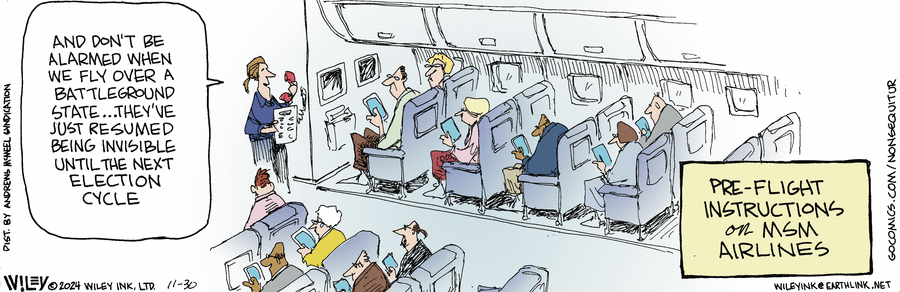
Unfortunately, America’s liberal pundits weren’t clued in to the game [the Hunter Biden pardon], and they used Biden’s supposed restraint as an example of his beautiful righteousness. Their gullibility is almost sweet. They really think Biden is so pure of heart.

Anyway, the official policy of the UCLA Cultural Affairs Commission is: “We reserve the right to remove any staff member who dispels antiBlackness [sic], colorism, racism, white supremacy, zionism, xenophobia, homophobia, transphobia, sexism, misogyny, ableism, and any/all other hateful/bigoted ideologies.” I don’t know that it’s legal to ban “Zionists” at a state-funded school. But it’s the word dispel that kills me. It’s so cute and tells you everything. Groping around, trying to use big-ish words but not knowing what they mean, propped up by government funding, the new movement can’t articulate and yet the point comes across. Because the inability to articulate is a sign of the movement’s success. Words, after all, are violence.

Take this story about San Francisco this week. Public school enrollment has fallen as parents pull kids out, and so the decision was made to shut down a school or two with “equity” as the primary decider of which school goes, and the one that was chosen: the highest-performing elementary school, which happens to be 75 percent Asian. Basically: If a school effectively teaches kids what the word dispel means, that’s sus.

Nellie Bowles

Endless litmus tests

Populism under Donald Trump is an endless series of litmus tests designed to separate the holy Us from the heathen Them. No matter how many tests a Republican has passed, he or she is forever one failure away from becoming a heretic.

The new litmus test has to do with the career prospects of a former host of Fox & Friends Weekend.

“Pete Hegseth is the hill to die on,” David Limbaugh tweeted on Thursday of Trump’s flailing nominee to lead the Pentagon. “We must be fierce, loud, relentless, united and engaged.” Similar sentiments echoed across MAGA media, with special venom aimed at GOP Sen. Joni Ernst of Iowa for her heresy in announcing that she wasn’t yet sold on confirming Hegseth after meeting with him privately.

“Pete Hegseth is the hill to die on.” What would possess any human being not related to him to write that sequence of words?

Nick Catoggio

Scandal yet again

Trump, preparing for his second term as president, has decided to replace the FBI director again. The figure he picked to replace Comey—the lifelong Republican Christopher Wray—proved unable to meet Trump’s expectations for the position, which are (1) to permit Trump and his allies to violate the law with impunity, and (2) to investigate anybody who interferes with (1). Wray, wrestling with the problem of Trump’s desire to separate him from a job he apparently liked, chose to step down on his own. This raises the likelihood that the media will treat the replacement of Wray as normal administrative turnover rather than as a scandal.

But a scandal it most certainly is.

Jonathan Chait

Trump’s obvious intent to weaponize the FBI (and DOJ) against his enemies is the most nauseating prospect of the next four years — though my decades in the legal system may be skewing my perceptions.

Less political

Chew ‘em up, spit ‘em out

Another TGIF:

Poor Rudy: Lest we forget what Trump does to people after he tires of them or gets what he needs, let’s check in on former New York City mayor Rudy Giuliani. “I have no cash,” Giuliani said in a press conference. “Right now, if I wanted to call a taxicab, I can’t do it. I don’t have a credit card. I don’t have a checking account.” Yikes.

See, Giuliani led the campaign to claim that Trump won Georgia in 2020. And in doing so, he defamed some Georgia election workers and owes them a huge sum ($148 million). Rudy, you served your purpose. Now you’re broke and probably going to jail. Do we think Trump cares? Trump does not care. Trump is selling perfume this week. Trump says if you don’t have money for a cab, it’s called use your feet and walk. Trump says, “Did you say Ruby? I don’t know a Ruby.”

Democracy is what I say it is: Barack Obama came out again this week to scold American voters for voting but doing it badly, which means doing anti-democracy. Here’s Barack: “The election proved that democracy is pretty far down on people’s priority list.” Everyone knows that democracy is when there is one good party and you vote for that one. One idea for Democrats is they could try to have policies and make arguments for why they’re better (I will literally write these for you, just call me). In other signs that Democrats are learning deep, important lessons from the shellacking in this past election, they are still beginning meetings with land acknowledgments.

I swear to god, Republicans are going to funnel our Social Security money to President Tiffany Trump’s new shoe line, and Dems will still complain that Joe Rogan once made a joke about lesbians. Republicans will be gearing up to elect a Trump steak as the next president, and Dems will be like, please, Latinxs, join us while we lie in the street to stop fracking. Republicans will start deporting people who still use seed oils, and Dems will just attack them for not being body positive enough.

Nellie Bowles

What do you call fungible humans?

If you think cultures can be added to and subtracted from human populations over time, without changing anything substantial about their communities, then what do you think human beings actually are? [Renaud] Camus has the answer: resources.

To resolve the tension between many cultures and one people, the presupposition of multiculturalism is that a people is not defined by a shared culture, but as a productive material unit. People are defined not by culture, but by economic output.

For Camus, the Great Replacement—mass immigration—may be the political issue of our times, but it is not the issue. The issue is the managerial, mechanical, technological revolution that substitutes us out for machines. We have learned that our humanity is replaceable.

Nathan Pinkowski, The Humanism of Renaud Camus

Our founders were geniuses

The genius of the authors of the United States constitution was to garb in the robes of the Enlightenment the radical Protestantism that was the prime religious inheritance of their fledgling nation.

Tom Holland, Dominion

CAFO math

… our fuel costs per dollar in gross sales are only 10 percent of an industrial farm’s fuel costs as a percentage of gross sales. That’s a lot less energy used per dollar in sales. Make no mistake, the efficiencies ascribed to CAFOs can last only as long as energy is cheap. The day energy costs return to normalcy, CAFOs will no longer enjoy “economies of scale.” They will instead be obsolete.

Joel Salatin , Folks, This Ain’t Normal

Sometimes we’re the baddies

[B]y far the most worrisome Syrian weapons of mass destruction are the ones that simply disappeared.

Washington Post via John Ellis

Hypothesis: They never existed outside our propaganda organs.

It’s a terrible thing to realize that sometimes we’re the baddies (for example), because sometimes we’re not, and I don’t always feel I can sort out which is which.

The U.S. legacy in the Middle East

My concern for Syria comes from some associations I made there at the time, and from dear friends here with family remaining in Aleppo and Damascus. Bashir al-Assad was an Alawite, an off-beat offshoot of Islam. As a minority, he ensured the rights of the other minorities—Christian and Druze. I expect what will happen next to the 2,000 year-old Christian presence in Syria will mirror what happed to the equally ancient Christian community in Iraq. They will be roughly and summarily squeezed out. That, my friends, is the real legacy of U.S. involvement in the Middle East, and of course, Greater Israel. We forget that Christianity is an Eastern religion, and its extinction here in its birthplace will be a great tragedy.

Terry Cowan


I suffer more from the humiliations inflicted by my country than from those inflicted on her.

Simone Weil, from a letter to Georges Bernanos.

I don’t do any of the major social media, but I have two sub-domains of the domain you’re currently reading: (a) You can read most of my reflexive stuff, especially political here. (b) I also post some things on the only social medium I frequent, because people there are quirky, pleasant and real.

Sunday 12/8/24

Yesterday was the 10th anniversary of my parish’s first Divine Liturgy in our purpose-built building. I have a handy way of remembering the date.

Two living churches

In England, the two kinds of churches I do still see filling appear rather different. In a local baptist church the pews are crammed with young families having powerful, intimate encounters with their faith. Something immediate is being accommodated. I remember seeing a guy fresh from a building site, dusty with a high viz jacket. Family with him, arms outstretched, tears on his cheeks. It would bring a lump to your throat.

Then I see my own parish, hushed and seemingly antique, but with more young people than ever before. In both I see people who look spiritually fed. Then out there in the wider audit of emptying churches there seems often to be a sense of weariness, or simple lack of oomph. There will be exceptions to this last sentence, I have no sneer in writing it. I sometimes go sit in those congregations simply out of love for the yards they’ve put in as parishioners. Solidarity, a hand held across the fence to a fellow worker bee.

It seems, from a distance, the two churches are very different, and I am well aware of the theological wrestles that create distance. What I don’t go along with is the notion that one is completely improvisational and unencumbered by tradition, and the other set-and-only-set in a kind of endless, ancient theatre or lifeless ceremony. Dame Mary Douglas, a cultural anthropologist, encapsulates something she calls the ‘anti-ritualist’ approach:

The confirmed anti-ritualist mistrusts external expression. He values a man’s inner convictions. Spontaneous speech that flows from the heart, unpremeditated, irregular in form, even somewhat incoherent, is good because it bears witness to the speaker’s real intentions.

I think actually, ritual is inevitable, even when tacit. We are ceremony people, no matter how spontaneous we think we may be. There will be a loved formula, a linguistic groove long established, a shared initiatory language in common for any community that lasts. It’s about the dynamic counterpoints of tradition and innovation. We may have done away with the candles, offerings and holy smoke, but simply to feel safe repetition will always have value.

Martin Shaw. I finally was able to begin reading Rituals of Spontaneity, which (if I’m not sorely mistaken) elaborates the folly of Christians dispensing with ritual.

Puritan Phobia

The Puritans quickly developed a phobia about ritual, going so far as to resist “rote” recitation of the Lord’s Prayer:

Henry’s Method culminates with his most fascinating phrase-collection of all, “A Paraphrase on the Lord’s Prayer, in Scripture Expressions.” Christ’s own form of prayer given to his disciples had long been a thorn in Puritans’ sides, to be plucked out by being understood as only a general guideline. Henry’s strategy is to neutralize the prayer’s form in a pages of verses elaborating on the one phrase “Our Father, who art in similar method; he provides, for instance, an amazing two and a half Heaven” (MP, 163-65), a general topos, he says, from which begins. Many editions of the Method were printed as Henry intended, interleaved with one blank page between each printed one, to enable the reader to pen in his own collection of phrases to supplement Henry’s own. Like Bunyan’s demand for scrupulous sincerity, Henry’s lists and blank pages, figures of accumulation and abstraction, combine literally to efface the Lord’s Prayer and erase it from Dissenting practice.

Between the ledgerlike pages of Henry’s collected phrases and the blank sheets for scribbled lists of readers’ personal prayer phrases, one senses of variety of fears: that without this careful accounting, the business might go bankrupt, that in the copious, nervous quoting from God’s word to talk and talk and talk to God, God might not listen or respond at all.

Lori Branch, Rituals of Spontaneity

Best listicle ever?

I have three lists of Maxims or such that I review regularly. This one, which I think was embedded in a longer blog post, seems more precious (in the good sense, not the snarky sense) every time I read it:

  1. First, live as though in the coming of Jesus Christ, the Kingdom of God has been inaugurated into the world and the outcome of history has already been determined. (Quit worrying)
  2. Second, love people as the very image of God and resist the temptation to improve them.
  3. Third, refuse to make economics the basis of your life. Your job is not even of secondary importance.
  4. Fourth, quit arguing about politics as though the political realm were the answer to the world’s problems. It gives it power that is not legitimate and enables a project that is anti-God.
  5. Fifth, learn to love your enemies. God did not place them in the world for us to fix or eliminate. If possible, refrain from violence.
  6. Sixth, raise the taking of human life to a matter of prime importance and refuse to accept violence as a means to peace. Every single life is a vast and irreplaceable treasure.
  7. Seventh, cultivate contentment rather than pleasure. It will help you consume less and free you from slavery to your economic masters.
  8. Eighth, as much as possible, think small. You are not in charge of the world. Love what is local, at hand, personal, intimate, unique, and natural. It’s a preference that matters.
  9. Ninth, learn another language. Very few things are better at teaching you about who you are not.
  10. Tenth, be thankful for everything, remembering that the world we live in and everything in it belongs to God.

A catholic vision of Christian faith

When I first opened A Severe Mercy nearly 20 years ago I had needed a vision of Christian faith that was unapologetically devoted to Christian doctrine without being materialistic, more American than Christian, and completely uprooted from history. Up to that point, the expressions of Christianity I had encountered were simply different forms of sectarian faith—a vapid progressivism or a parochial and narrow fundamentalism. Vanauken gave me catholicity ….

Jake Meador (hyperlink added)

Delusion

Christians can give their bodies over to the nation-state while continuing to express in textual terms that worship belongs to God alone.

William T. Cavanaugh, The Uses of Idolatry

Flipping the Script

On regular Christian campuses, there “are higher expectations for presidents than members of the faculty, and members of the faculty live with greater expectations than students,” noted religious-liberty activist David French, writing at The Dispatch. “Liberty flipped this script. The president lived life with greater freedom than his students or his faculty. The message sent was distinctly unbiblical – that some Christian leaders can discard integrity provided their other qualifications, from family name to fund-raising prowess, provided sufficient additional benefit.”

Terry Mattingly, What Next for Liberty University? Press Should Watch Future Campus Worship Services (September 2020)

Know-it-alls

In practical terms, the Reformed commitment to the theological significance of everyday life led to the development of something like Protestant metaphysics, Protestant epistemology, Protestant science, Protestant politics, Protestant social and economic theory, Protestant art, and Protestant poetics.19 The development of these Reformed spheres of intellectual and cultural activity never occurred without substantial influence from sources not specifically religious. In Switzerland, the southern German regions, Hungary, Holland, and the British Isles, the Reformed perspective could be used to mask economic or political aggression. More commonly, it emerged from a complicated mix of sacred and secular motives. Yet wherever sufficient Reformed strength existed, the assumption also existed that biblical Christianity had something fairly definite to say about everything.

Mark A. Noll, America’s God

Theology isn’t all deductive

Catholics find it impossible to theologize without deductive reasoning—a characteristic shared by virtually all Western Christians…

Dr. Eugenia Scarvelis Constantinou, Thinking Orthodox


Sometimes this whole 2000-year-old faith seems like a living koan. Chew on this until you are enlightened. Keep walking.

Paul Kingsnorth

You can read most of my more impromptu stuff here and here (both of them cathartic venting, especially political) and here (the only social medium I frequent, because people there are quirky, pleasant and real). All should work in your RSS aggregator, like Feedly or Reeder, should you want to make a habit of it.
Of adolescent “gender medicine”

A few years ago (confirmation hearings, I suspect):

[U.S. Surgeon General nominee Rachel] Levine refused to answer, choosing merely to say that “transgender medicine is a very complex and nuanced field with robust research and standards of care that have been developed.” Paul hit back that “the specific question was about minors,” and accused Levine of having “evaded the question.” Paul continued: Do you support the government intervening to override the parent’s consent to give a child puberty blockers, cross-sex hormones, and/or amputation surgery of breasts and genitalia? You have said that you’re willing to accelerate the protocols for street kids. I’m alarmed that poor kids with no parents, who are homeless and distraught, you would just go through this and allow that to happen to a minor.

Rand Paul Demands Answers on Puberty Blockers for Minors (February 2021)

That “robust research and standards of care” is essentially a incestuous echo chamber. In that echo chamber, “everybody knows” some things that aren’t true. But gradually, clarity intrudes, first in the Cass Report from Great Britain, most recently on Thursday just passed:

There were a couple of moments in the oral arguments in US vs. Skrmetti this week that were truly clarifying, I think. The first was about suicides among children and teens with gender dysphoria. They are — as the ACLU lawyer, Chase Strangio, finally conceded when questioned by Justice Alito — “thankfully and admittedly rare.”

That’s a big deal. It’s a big deal because the most common argument used by doctors and activists for child sex-changes for years is that if the kids do not transition, they will kill themselves. “Do you want a dead son or a live daughter?” is the question that has been repeatedly, routinely, posed to freaked-out parents with a dysphoric child. That’s why the Biden administration routinely refers to life-saving “gender-affirming care.” It’s transition or death. In every discussion I have ever had on this topic with someone who supports sex changes for kids, this has always been the first point raised.

We sometimes think of this trans controversy as a debate about civil rights and medicine. But it is useful at times to step back and truly grasp the radicalism of the ideology fueling the “LGBTQIA+” movement, to see what its vision of humanity is. We are socially constructed abstractions, not bodies. We have no core sex. The core goal of critical gender and queer theory — which is what is behind the child sex change craze — is to end the sex binary entirely as an organizing principle for our society. It is to remove nature from our understanding of what it means to be human. It is as extreme in its epistemological gnosticism as in its philosophical nihilism.

It is not about helping the few, and never has been. It’s about revolutionizing us all.

Andrew Sullivan

He’s not wrong. But M. Gessen seems more wrong than right:

Trans and gender-nonconforming people have existed as long as humans have used gender to organize themselves — think Joan of Arc; think Yentl; think many, many real and fictional people in-between — but in Western culture, it’s only in the last half-century that trans people have asserted ourselves as a group. It was only when we became more visible that the onslaught of new discriminatory laws began.

M. Gessen (f/k/a Masha Gessen) at the New York Times.

Two observations:

  1. “Trans and gender-nonconforming people” don’t belong together as a category. Lumping them together feeds the fad Andrew Sullivan calls “transing away the gay,” whereby gender-nonconforming adolescents are told “Maybe you’re a boy in a woman’s body” (or vice-versa), which isn’t a real thing.
  2. It’s nothing new for subterranean activity to be ignored by the law until it surfaces (“asserts itself”). Then, sometimes, the law decides it’s bad and disfavors it in various ways. There’s even a maxim for it: the law isn’t made until first it’s broken. An assertive movement based on the fantasy of women in men’s bodies and vice-versa is likely to be rejected fairly decisively.

Finally, Nellie Bowles may have the best response to the nonsense — mockery:

Chase Strangio is on the wrong side of the vibe shift: The Supreme Court this week heard arguments over whether to strike down Tennessee’s ban on medical gender transitions for minors (i.e., no puberty blockers, cross-sex hormones, or surgeries till 18). The ACLU sent their most famous lawyer and the face of the organization, Chase Strangio, to argue the case. Before things started, Chase laid out the stakes to CNN’s Jake Tapper: “These are young people who may have known since they were two years old exactly who they are, who suffered for six, seven years before they had any relief.” So: a two-year-old. When I say to my two-year-old that she’s a funny bunny, she says, “No, kitty cat.” Which to me indicates an extremely advanced and gifted conception of herself. Anyway. Surgery for her tail is next week. She has been consistent that she’s a “kitty cat” for months now. She wears kitty cat ears, a woeful stand-in for the real thing that I’m sure some excellent doctors can arrange.

Justice Ketanji Brown Jackson compared banning medical transitions for minors to bans on interracial marriage. I’m no legal scholar, but it honestly must be fun for your job to just come up with crazy analogies and throw them back at terrified lawyers. I’m just not sure I see the connection she’s making, but I also sometimes throw spaghetti at the wall when nothing’s working. It’s my “why not” business strategy. It’s the “you know what else was illegal once? Interracial marriage” approach.

Nellie Bowles

The reality as it comes to me is that many kids with gender dysphoria are working through a growing awareness of attraction to their own sex. We know how tumultuous modern adolescence is, and confusion about sexuality adds yet another layer of tumult.

Given time, and denied “affirmation” that the real them is trapped in the wrong body (though not denied love and “watchful waiting” medical and psychological care), they emerge as fairly well-adjusted homosexuals. Affirmed, too many of them only later realize that they and they enablers were too hasty, and they de-transition insofar as the changes wrought are reversible.

Maybe that’s just something I picked up in my echo chamber, but I haven’t heard anyone deny the part about “watchful waiting” leading to resolution without transition — or, rather, the only denial I’ve heard is the bogus “live daughter or dead son” trope.


I suffer more from the humiliations inflicted by my country than from those inflicted on her.

Simone Weil, from a letter to Georges Bernanos.

I don’t do any of the major social media, but I have two sub-domains of the domain you’re currently reading: (a) You can read most of my reflexive stuff, especially political here. (b) I also post some things on the only social medium I frequent, because people there are quirky, pleasant and real.

Potpourri

Not (especially) political

Wisdom from the third world

We had a lot of trouble with western mental health workers who came here immediately after the genocide and we had to ask some of them to leave. They came and their practice did not involve being outside in the sun where you begin to feel better, there was no music or drumming to get your blood flowing again, there was no sense that everyone had taken the day off so that the entire community could come together to try to lift you up and bring you back to joy, there was no acknowledgement of the depression as something invasive and external that could actually be cast out again. Instead they would take people one at a time into these dingy little rooms and have them sit around for an hour or so and talk about bad things that had happened to them. We had to ask them to leave.

A Rwandan talking to a western writer, Andrew Solomon, about his experience with western mental health and depression. I regret losing the URL, but offer the following in complement:

Serenity in leisure

There is a certain serenity in leisure. That serenity springs precisely from our inability to understand, from a recognition of the mysterious nature of the universe; it springs from the courage of deep confidence, so that we are content to let things take their course; and there is something about it which Konrad Weiss, the poet, called “confidence in the fragmentariness of life and history.”

Josef Pieper, Leisure the Basis of Culture, page 47.

What do you do for a living?

Visit a graveyard; you will search in vain for a tombstone inscribed with the words “steam-fitter,” “executive vice president,” “park ranger,” or “clerk.” In death, the essence of a soul’s being on earth is seen as marked by the love they felt for, and received from, their husbands, wives, and children, or sometimes also by what military unit they served with in time of war. These are all things which involve both intense emotional commitment, and the giving and taking of life. While alive, in contrast, the first question anyone was likely to have asked on meeting any of those people was, “What do you do for a living?”

David Graeber, Bullshit Jobs

… but liars can figure

I saw an item in the Wall Street Journal very recently:

Here’s a statistic to remember next year, as Congress debates extending President Trump’s 2017 tax cuts: The top 1% of income-tax filers provided 40.4% of the revenue in 2022, according to recently released IRS data. The top 10% of filers carried 72% of the tax burden. Self-styled progressives will never admit it, but U.S. income taxes are already highly progressive ….

Then I saw a Politico item lamenting how little income tax the super-wealth pay on their increase wealth.

So, is someone lying?

Yeah, pretty much. Increased wealth doesn’t imply taxable income. I’m confident that the increased wealth figures Politico cited were mostly unrealized capital gains, which we don’t tax for a number of very good (if not ironclad) reasons.

Infrastructure century

Because the highways were gold-plated with our national wealth, all other forms of public building were impoverished. This is the reason why every town hall built after 1950 is a concrete-block shed full of cheap paneling and plastic furniture, why public schools look like overgrown gas stations, why courthouses, firehouses, halls of records, libraries, museums, post offices, and other civic monuments are indistinguishable from bottling plants and cold-storage warehouses. The dogmas of Modernism only helped rationalize what the car economy demanded: bare bones buildings that served their basic functions without symbolically expressing any aspirations or civic virtues.

James Howard Kunstler, The Geography of Nowhere

How long will this hold?

Most Americans say media criticism helps hold politicians accountable | Pew Research Center

One of the things I worry about is unaccountable local officials now that the internet has killed smaller local media. The Lafayette Journal & Courier is a wraith, all but invisible were it not for stories fed from other Gannett papers. WLFI has been gutted with departures as its owner, Allen Media Group, bids billions for new acquisitions but doesn’t pay its bills. Only national politics is really covered any more, and that in only a selective way:

Trans teen health

In oral arguments at the Supreme Court Wednesday, ACLU lawyer and transgender ideologue Chase Strangio was forced to admit that gender realignment surgery for children does not prevent suicide—a core claim of many trans activists, notoriously communicated to parents by doctors as “do you want a live girl or a dead boy?” (Source: The Free Press)

What’s left of the trans argument against Tennessee law, in my view, boils down to “it’s sex discrimination to allow estrogen for girls, testosterone for boys, but not vice versa” — an argument that begs the question of whether the brute fact of sexual binary has any implications for law and medicine.

Wordplay

as man became disenchanted with regards to God and the cosmos, he became enchanted instead with himself and his own potential

Jake Meador

Just as clean air makes it possible to breathe, silence makes it possible to think.

Matthew Crawford

All that is not eternal is eternally out of date.

C.S. Lewis

[T]he forces that are destroying the things I cherish most in the world — faith, family, nation, tradition — all originate in the United States.

A Catholic expat friend of Rod Dreher

Two from Dreher’s latest book

Politics

Thankfulness

The Free Press has its people weigh in on what they’re thankful for at Thanksgiving. Martin Gurri responds:

This year, the petty little man in me is thankful that I won’t have to listen to Joe Biden’s double-dribbling sentences or Kamala Harris’s sitcom canned laughter ever again. The greedy analyst in me is thankful that Donald Trump is coming to burn Washington, D.C., to the ground, so Bari Weiss can keep telling people that I’m the only human on Earth who understands this dread pirate. The lonesome immigrant in me is thankful for my wife, and children, and grandchildren, my country and my street, my plans and my memories—because they make high politics feel like a trivial dream that I wake up from, when I step away from my laptop.

Pete Hegseth

I don’t trust Trump, and it seems to me as if he’s deliberately staffing up with sexual predators — as if that was proof of a decisive “get-things-done” manliness.

Moreover, I distrust pretty boys like Pete Heseth, Gavin Newsom, etc. (Yeah. Maybe there’s a little envy there.)

Nevertheless, I’m withholding my final judgment on Hegseth’s suitability for DoD because his accusers are hiding behind anonymity.

Pardon power

[T]he President is only accountable to the electorate so long as he or his party are up for election. Once the election is over, there’s no one for voters to punish. That’s why Biden waited until after the election to pardon Hunter; why Trump did the same for Steve Bannon and Roger Stone; why Obama did the same when commuting the sentences of Chelsea Manning and the terrorist Oscar López Rivera. And, most notoriously, that’s why Bill Clinton waited until his last full day in office to pardon the fugitive Marc Rich, who had fled to Switzerland to avoid prosecution and whose ex-wife donated $450,000 to the Clinton Library.

Stephen E. Sachs, How To Ban Lame-Duck Pardons

Feather pillows

It is true that in some matters, including a considerable swath of policy issues that he neither understands nor cares about, Trump can be like Lord Derby, who, “like the feather pillow, bears the marks of the last person who has sat on him”—which is no small thing given the assortment of asses we are talking about. But Trump makes a big impression of his own on the feather pillows he encounters.

Kevin D. Williamson


I suffer more from the humiliations inflicted by my country than from those inflicted on her.

Simone Weil, from a letter to Georges Bernanos.

I don’t do any of the major social media, but I have two sub-domains of the domain you’re currently reading: (a) You can read most of my reflexive stuff, especially political here. (b) I also post some things on the only social medium I frequent, because people there are quirky, pleasant and real.

Hal Lindsey, Nihilist Cathedral (and more)

Hal Lindsey

… it is appointed for men to die once, but after this the judgment …

Hebrews 9:27

Hal Lindsey’s appointed time came November 25.

Lindsey was the author of the notorious 1970 The Late Great Planet Earth.

Lindsey seemingly came by his kookery honestly, having studied at the feet of “Colonel” R.B. Thieme, Jr. (I once heard Thieme say that “the ovum is the only sinless cell in the human body”) and then pursuing a degree at Dallas Theological Seminary, a hotbed of dispensational premillenialism that was inordinately esteemed by Evangelicals back in the beforetimes.

Lindsey’s influence was such that his eschatology, or understanding of the Last Days, virtually became a part of accepted Christian orthodoxy for much of the church. Christians who did not understand the Trinity or know the Nicene Creed knew a lot about Lindsey’s End Times scenarios.

Mark Tooley, Juicy Ecumenism.

Tooley is correct — and though I had been heavily exposed to that genre of eschatological flakiness starting around 1964, Lindsey dialed it up to 11 in the Evangelical world.

By the end of the ’70s, having providentially discovered that dispensationalism was the worst and most novel of four basic Protestant eschatological schemes, I could bear its imposition as Evangelical dogma no longer. I left frank Evangelicalism for the Christian Reformed Church, which at least locally turned out to be Evangelical-adjacent in the pews because Lindseyist preoccupations were so contagious. It took even me a long time to realize that I, though born in 1948, was not particularly unlikely to celebrate my 40th birthday in the land of the living.

Well, apparently the novelty wore off while I wasn’t looking any more:

In the midst of his professional success, Lindsey’s personal life suffered. His first marriage failed around the time of his conversion. He got divorced and remarried to Jan Houghton, who worked alongside him at Campus Crusade and appeared with Lindsey in author photos until the mid-1980s, when an updated edition of Late Great Planet Earth used a different picture and removed her name from the dedication.

Lindsey’s second divorce—and subsequent third and fourth marriages—raised questions about his character for many evangelicals. But the biggest blow to his reputation was his failed predictions.

In his early books, Lindsey said all of the Bible’s prophecy would likely be fulfilled “within forty years or so of 1948,” when the nation of Israel was founded, based on his typological reading of Matthew 24. He qualified his prediction, giving himself an escape hatch with phrases like “or so.” But few readers came away with the impression that Lindsey was unsure whether Christ would return by 1988.

When 1988 came and went and the Soviet Union, one of the main objects of dispensational analyses, ultimately collapsed, Lindsey was forced to defend himself and his end times speculation. He directed his book The Road to Holocaust at evangelicals and fellow conservatives in 1989, making the case for the continued relevance of dispensationalist interpretations of Scripture and current events. 

While he was dismissed and marginalized by many evangelicals, Lindsey continued to see commercial success. Retooling his analysis for a post–Cold War geopolitics, he returned to bestseller lists with Planet Earth Two Thousand AD: Will Mankind Survive? in 1994.

That Hal Lindsey did not repent and shut up after 1988 came and went without a “Rapture” is one of life’s least vexing mysteries: he made beaucoups bucks off his spiritual thalidomide.

I hate dispensational premillenialism with a passion. I’d be more relieved at learning that it now is a bit passé were the Evangelical world in North American not running after political power instead now.

His appointed time having come, I strain to pray mercy on his soul at the judgment, but I do so anyway, as I would wish others to do for me.

One more thing

Here’s a suggestion about the influence of Hal Lindsey that had not occurred to me:

In retrospective (sic), Hal Lindsey’s popularity was a major harbinger of the decline of denominations. No longer were they the definitive teaching source for their flocks. Emerging new post denominational evangelicalism, with its own books, radio stations, television and entrepreneurial personalities displaced the old denominations and their traditional teachings.

The most favorable interpretation of Lindsey’s work is that hopefully many who read him or were influenced by him at least were drawn closer to God, even if amid much confusion and foreboding. It’s tempting to find in the Bible a direct explanation for disturbing events. It’s harder to live in the mystery of trusting God without knowing all His plans.

Mark Tooley, Juicy Ecumenism.

A place for perverse prayer

Continuing my drumbeat of dread and decline, the dead German Roman Catholic Church has a new Cathedral in Berlin — a whited sepulchre signaling fealty to something nihilistic:

Rod Dreher, writing for the European Conservative, is duly appalled:

There is scarcely anything visibly Christian about the space. Aesthetically and symbolically, it invites visitors to worship the sacred Nothing. It is a “clean, well-lighted place,” in the nihilistic sense of Ernest Hemingway’s 1933 short story of the same name. It is a hauntingly spare tale about an elderly, suicidal Spanish man who frequents a certain café, described in the story’s title, seeking refuge from nihilism. In the tale, an older waiter in the café reflects on why the clean, well-lighted café drew men like the suicidal customer:

What did he fear? It was not a fear or dread. It was a nothing that he knew too well. It was all a nothing and a man was a nothing too. It was only that and light was all it needed and a certain cleanness and order. Some lived in it and never felt it but he knew it all was nada y pues nada y nada y pues nada. Our nada who art in nada, nada be thy name thy kingdom nada thy will be nada in nada as it is in nada. Give us this nada our daily nada and nada us our nada as we nada our nadas and nada us not into nada but deliver us from nada; pues nada. Hail nothing full of nothing, nothing is with thee.

This is the perverse prayer one imagines visitors to the bleached-out St. Hedwig’s will pray, if they pray at all.

Devolution

It is not an exaggeration to claim that this nineteenth-century Protestant evangelicalism differed from the religion of the Protestant Reformation as much as sixteenth-century Reformation Protestantism differed from the Roman Catholic theology from which it emerged.

Mark A. Noll, America’s God

How many times can such devolutionary leaps happen before the result is not authentically Christian?

Spontaneity is the new requirement

Speaking of which:

I laughed out loud, paused the podcast where I heard the phrase, and wrote down Rituals of Spontaneity, which now sits in my book queue to complement America’s God and The Democratization of American Christianity. Although none of them writes as well as Kevin D. Williamson, I’m more interested in the religious aspects than in the prospect of President Dwayne Elizondo Mountain Dew Camacho in 2028.

Elastic “religion”

Taylor is not unaware that the term “religion” is fraught, but, as we have seen, he thinks the reason it defies definition is that its different manifestations are so diverse. But how do we know that these different manifestations are all “religion” to begin with? Taylor says “the phenomena we are tempted to call religious are so tremendously varied in human life.”175 But why are we “tempted” to call them all religious if they are so varied? More to the point, why do we want to call some things religious and some other, very similar things nonreligious? What makes nontheistic Buddhist rituals “religious,” by Taylor own reckoning, but rituals surrounding the proper treatment of the American flag—very precise rules for folding, displaying, venerating, and keeping it from touching the ground or being otherwise “desecrated”—are not? Taylor uses “religion” broadly when he wants to include Buddhism, but narrowly when he wants to exclude nationalism.

William T. Cavanaugh, The Uses of Idolatry

Migration of the Holy

After only a few years, America’s religious population, with Protestant evangelicals in the forefront, began in similar fashion to tailor their religious projects to fit the language of republicanism. The implications for both politics and religion from this tailoring were momentous. In the immediate context, the argument against Parliament acquired the emotive force of revival. In the longer term, religious values migrated along with religious terms into the political speech and so changed political values. But the migration also moved the other way: a religious language put to political use took on political values that altered the substance of religion.

Mark A. Noll, America’s God


Sometimes this whole 2000-year-old faith seems like a living koan. Chew on this until you are enlightened. Keep walking.

Paul Kingsnorth

You can read most of my more impromptu stuff here and here (both of them cathartic venting, especially political) and here (the only social medium I frequent, because people there are quirky, pleasant and real). All should work in your RSS aggregator, like Feedly or Reeder, should you want to make a habit of it.
Black Friday?

For how much longer will “Black Friday” remain a thing when its sales started at least over the last weekend?

Miscellany

Nellie Bowles gives thanks

  • After watching a funny short video that shows Joe Biden seeming to wander into an Amazon rainforest, I realized to my shock that Joe Biden is still there. He’s still standing at podiums looking translucent and confused, but technically upright. When I see him, every fiber in my body wants to put a blanket over his shoulders. And so this year, I’m thankful for our presumed president: Dr. Jill Biden.
  • I’m thankful for Kamala Harris’s campaign. First of all, they raised $1.5 billion dollars and spent it in 15 weeks. It sounds wasteful. But in fact, taking $1.5 billion dollars from some of America’s silliest people and then giving it away to hardworking ones is what I call distributive justice. Just think of the caterers who had to work around literally dozens of Kamala staff’s allergies and gluten intolerances. They deserved that cash. Think of the event planners, young women who want to save up for their own extravagant eco resort weddings. Kamala gave them a shot at Hawaii instead of the Dominican Republic. Think of the driver of that abortion van clocking overtime during the DNC who just told himself “eyes ahead, not your problem, eyes ahead.” So many worthy Americans.
  • I’m thankful this year for the First Amendment. I never understood how precious it was, or how rare, but watching European countries send cops to people’s houses for barely controversial Facebook posts has shocked me. I know we have European readers and writers, so please know I stand with you, and I hope you don’t take it personally when I say I’m so glad our forefathers fled your lands and burned the boats. We’ll do our best now to save you through a process that I can only describe as colonialism (Free Press expansion into Europe). God bless America. And Little America, as we’ll call England!

TGIF

How the Ivy League Broke America

James Conant and his colleagues dreamed of building a world with a lot of class-mixing and relative social comity; we ended up with a world of rigid caste lines and pervasive cultural and political war. Conant dreamed of a nation ruled by brilliant leaders. We ended up with President Trump.

David Brooks, How the Ivy League Broke America

Let’s blame Occam’s nominalism

Ideas, he said, was not a work of philosophy but “an intuition of a situation,” namely, a situation in which the “world . . . has lost its center.” Weaver traced that loss back to the rise of nominalism in the twelfth century, a familiar pedigree that is both accurate and comical. It is accurate because the modern world—a world deeply shaped by a commitment to scientific rationality—does have a root in the disabusing speculations of nominalism. It is comical because to locate the source of our present difficulties on so distant and so elevated a plane is simply to underscore our impotence. If William of Occam is responsible for what’s wrong with the world, there’s not much we can do about it.

Richard M. Weaver, Ideas Have Consequences

Understanding Russia (a little better)

Finding a way in which Russia could make a genuine contribution to the “common good of mankind” was a key objective of Russian intellectuals at this time. Some concluded that the only way of doing so was by deepening the process of Westernization. Others felt that Russia could never contribute original ideas to humanity if all it did was copy the West. Thus was born the split between the Westernizers and the Slavophiles. It is necessary to bear in mind, however, that the Westernizers and the Slavophiles had the same objective—to enable Russia to contribute to universal progress.

Paul Robinson, Russian Conservatism

Politics

Perfidious political coin

Challenged by a letter to the editor for his former column, Liel Leibovitz gives nary an inch:

Never do I argue that the perfidy which is our political coin emanates exclusively from one side of the political aisle. But any dispassionate student of American history, observing the chaos of the previous decade, will emerge with a rather clear picture and a rather clear culprit.

It was the omnivorous machine, controlled by Barack Obama’s Democratic Party but now incorporating everything from our newsrooms to our classrooms to our boardrooms, that spread the wild conspiracy that America’s forty-fifth president was a Russian asset. It was the same machine that refused to repudiate this story, even when the facts were available and clear. It was the same machine that harnessed law enforcement agencies to harass and intimidate public servants, and that pursued the flimsiest of legal pretexts to pursue political enemies.

This sordid history doesn’t lack documentation. Nor is it, sadly, history: When fifty-one former heads of our intelligence community, including several retired heads of the Central Intelligence Agency, vow that the “rumor” concerning Hunter Biden’s laptop is misinformation peddled by Moscow, only to remain completely silent when said laptop appears in court and confirms precisely what anyone willing to listen and think had known all along—namely, that Hunter Biden Jr., and most likely his father as well, have had some questionable dealings for fun and profit with Ukrainian magnates and other shady characters—then you know we’re in Screwtape territory.

None of this is to suggest that the only morally commendable solution is a vote for Donald J. Trump come November, or, for that matter, that the Republican candidate is an unblemished moralist worthy of the priesthood. That, of course, is equally untrue. But, as a great American once said, the bastards changed the rules and they didn’t tell us. Now that we know, though, we’ve but one obligation: Fight back, fight hard, and win.

I don’t agree with his conclusion about our “obligation” (my convictions are with Paul Kingsnorth’s Moses Option on that), but his premises seem sound — which is why, in the end, I endure the Election of Donald Trump with substantial equanimity.

On the oddly disparate cabinet picks

Ross Douthat, Three Theories of the Trump Cabinet (unlocked). Douthat seldom disappoints me, and this wasn’t one of those occasions.

Destruction in the wake

It has long been clear that the rise of Donald J. Trump meant the end of the Republican Party as we once knew it.

It has belatedly become clear that his rise may have meant the end of the Democratic Party as we knew it as well.

After three Trump elections, almost every traditional Democratic constituency has swung to the right. In fact, Mr. Trump has made larger gains among Black, Hispanic, Asian American and young voters in his three campaigns since 2016 than he has among white voters without a college degree, according to New York Times estimates. In each case, Mr. Trump fared better than any Republican in decades.

Nate Cohn, How Democrats Lost Their Base and Their Message

If you have any appreciation at all for silver linings, surely you should appreciate that Trump was not, relatively speaking, elected along racial lines.

The Very Online Culture Wars

Whether it calls itself the Right or the Left, the real content of all online politics is the internet itself, and the arc of online politics always bends towards a bunch of strangers who spend their entire lives on the computer demanding that you publicly denounce your friends.

… To pun on Wilde, it would take a heart of stone not to laugh at the ritual outrage performed by the [Very Online Left] in the wake of the 2024 election.

Insofar as the election was an affirmation of the [Very Online Right], I find much less to applaud …

Pretending to ourselves that Trump II represents a culture war victory threatens to render traditionalist accounts of the true, the good, and the beautiful incoherent …

Is there anything truly conservative about Trump II? Can a party whose convention platforms an unrepentant stripper with a face tattoo be conservative? Can a party that valorizes a techno narcissist who has proudly fathered twelve children, one of whom is named X Æ A-Xii and another of whom is named Techno Mechanicus, with three different mothers still pretend to be conservative? And this is not even to mention Trump himself, whose public persona is built on violations of nearly every verse from Proverbs and the Sermon on the Mount. The VOR represents the Silicon Valley mantra “move fast and break things” with more enthusiasm than it does any of the principles articulated by Kirk.

There is no place in the [Very Online Right] for Kirk’s elaboration of the conservative principle “that there exists an enduring moral order” and that this order “is made for man, and man is made for it: human nature is a constant, and moral truths are permanent”.

Matt Stewart, The Very Online Culture Wars

Kudos to Seth Moulton, truth-teller

Here we are calling Republicans weird, and we’re the party that makes people put pronouns in their email signature

Rep. Seth Moulton, (D. Mass) via this Times article (paywall)

Now is the FIRE’s hour

Trump’s team has announced an aggressive agenda to do exactly what his critics called for: use the power of government to attach expression they think is false, misleading, disloyal, or otherwise bad. The Trumpists want the FCC to assert more power over cable and the internet and use that power to punish enemies. They want the government to use its power to attack journalists they hate. They want to protect protestors they agree with, however violent they were, but use state force and authority and deportation to suppress protests they don’t agree with. The Trumpists have a long record of abuse of defamation lawsuits and are aligned with Federalist Society luminaries who want to make it easier for the rich and powerful to sue for defamation. Trumpists want to impose ideological requirement for vast numbers of civil servants and to investigate government employees for disloyalty. In short, they want to flex government power to punish speech they don’t like.

… Private actors, emboldened, may escalate violence and abusive litigation. Norms and traditions and values, we’ve seen, can fail.

Popehat


[H]istory is well and truly back. Even Francis Fukuyama agrees.

Mary Harrington at UnHerd

I suffer more from the humiliations inflicted by my country than from those inflicted on her.

Simone Weil, from a letter to Georges Bernanos.

I don’t do any of the major social media, but I have two sub-domains of the domain you’re currently reading: (a) You can read most of my reflexive stuff, especially political here. (b) I also post some things on the only social medium I frequent, because people there are quirky, pleasant and real.

Sunday, 11/24/24

Formatting things a bit differently today, without “headlines.”

  • After he had twice visited the United States in the 1930s, Dietrich Bonhoeffer wrote a perceptive essay contrasting Christian development in America with parallel developments in the parts of Europe most directly shaped by the Protestant Reformation. His assessment included an observation that was as shrewd in its comparative wisdom as it is relevant for the themes of this book: “The secularization of the church on the continent of Europe arises from the misinterpretation of the reformers’ distinction of the two realms [of church and society]; American secularization derives precisely from the imperfect distinction of the kingdoms and offices of church and state, from the enthusiastic claim of the church to universal influence in the world.” What Bonhoeffer saw has been described with other terms here: The key moves in the creation of evangelical America were also the key moves that created secular America.
  • It is a matter of great historical significance that American Protestants almost never cited biblical chapter and verse to defend their interpretive practices. Precisely as it worked on Scripture, the Reformed, literal hermeneutic revealed most clearly how it arose from the special circumstances of American life. Yet even if this hermeneutic itself was not necessarily rooted in a literal reading of Scripture, it was nonetheless the American norm for the generations between the writing of the Constitution and the end of the Civil War.

Mark Noll, America’s God. (You may need to chew on that a bit. Or read the book.)


Religions devised for a social purpose, like Roman emperor-worship or modern attempts to ‘sell Christianity as a means of saving civilisation’, do not come to much. The little knots of Friends who turn their backs on the ‘World’ are those who really transform it.

C.S. Lewis via Paul Kingsnorth, who situates Lewis’ insight in our age.


Brad East once pondered:

Why do people convert to Christianity? Why do intellectuals and other public figures convert so often to Catholicism (or Eastern Orthodoxy) and so rarely to Protestantism?

Conversions, Protestantism, and a new mainline. I suspect he’s still pondering, though I don’t think he’s addressed the topic as explicitly as in the quoted article.

I keep coming back to the article deliberately, feeling as if I haven’t exhausted it. Maybe you’d find it helpful, too.


The west, so it seems to them, tends to think of the Crucifixion in isolation, separating it too sharply from the Resurrection. As a result the vision of Christ as a suffering God is in practice replaced by the picture of Christ’s suffering humanity: the western worshipper, when he meditates upon the Cross, is encouraged all too often to feel an emotional sympathy with the Man of Sorrows, rather than to adore the victorious and triumphant king.

Timothy Ware, The Orthodox Church


No, St. Paul wasn’t a perv:

When teaching non-Jewish Christians, one of the most radical disjunctions with their former way of life was sexual morality. Sexual continence had simply not been a concern for most of them before, so it became Paul’s focus. Paul’s frequent emphasis on this area was not based on prurient interest but on the continuing education and reorientation of former pagans.

Fr. Stephen De Young, Saint Paul the Pharisee. Actually (I’m sure Fr. Stephen noted it elsewhere), fornication with temple prostitutes was the former practice of some of these non-Jewish Christians. That’s why Paul had to focus there.


“Man is what he eats.” With this statement the German materialistic philosopher Feuerbach thought he had put an end to all “idealistic” speculations about human nature. In fact, however, he was expressing, without knowing it, the most religious idea of man. For long before Feuerbach the same definition of man was given by the Bible.

Fr. Alexander Schmemann, For the Life of the World


“The clock,” [Lewis] Mumford has concluded, “is a piece of power machinery whose ‘product’ is seconds and minutes.” … [A]s Mumford points out, with the invention of the clock, Eternity ceased to serve as the measure and focus of human events.

Neil Postman, Amusing Ourselves to Death


It’s profoundly significant that of all the Christian groups, only the Orthodox include the babies at the Holy Chalice, completely recognizing and demon-strating their full incorporation into the Church, the Body of Christ. This alone, it seems to me, shows forth the truthfulness of our Church’s claim to be the One, Holy, Catholic, and Apostolic Church, alone preserving the fullness of the Christian Faith.

Frederica Mathewes-Green & Rod Dreher, Healing Humanity


  • Only a few peoples—the odd German tribe and, inevitably, the Jews—had stood aloof from the exposure of unwanted children. Pretty much everyone else had always taken it for granted. Until, that was, the emergence of a Christian people.
  • Islamic the Islamic State may have been; but it also stood in a line of descent from Anabaptist Münster. It was, perhaps, the most gruesome irony in the whole history of Protestantism.
  • When scholars in Europe sought to justify the Spanish conquest of the New World, they reached not for the Church Fathers, but for Aristotle. ‘As the Philosopher says, it is clear that some men are slaves by nature and others free by nature.’
  • The concept of secularism—for all that it was promoted by the editor who invented the word as an antidote to religion—testified not to Christianity’s decline, but to its seemingly infinite capacity for evolution.

Tom Holland, Dominion

Several narrower books linger more persistently in my mind, but Dominion has in a sense penetrated deeper than mere “mind.”


  • Even after His Resurrection, Christ instructed disciples on the road to Emmaus when “beginning with Moses and all the prophets, he interpreted to them in all the scriptures the things concerning himself” (Luke 24:27). The Christological key to unlock the Jewish Scriptures was given to the Church by Christ Himself…
  • Two centuries later, fundamental differences in phronema would again be an obstacle to union between the West and the East at the Council of Florence in 1439. Catholics presented rational arguments for their positions, and the Orthodox responded by citing apostolic Tradition. It was “the constant conviction of the Latins that they always won the disputation, and of the Greeks that no Latin argument ever touched the heart of the problem.”

Dr. Eugenia Scarvelis Constantinou, Thinking Orthodox


Sometimes this whole 2000-year-old faith seems like a living koan. Chew on this until you are enlightened. Keep walking.

Paul Kingsnorth

You can read most of my more impromptu stuff here and here (both of them cathartic venting, especially political) and here (the only social medium I frequent, because people there are quirky, pleasant and real). All should work in your RSS aggregator, like Feedly or Reeder, should you want to make a habit of it.