247 and counting

Politics

Trump

Lies and lies

All politicians lie, I dutifully concede, but there are lies and there are lies. [Speaker Kevin] McCarthy’s claim that the second impeachment was rash and ill-considered after Trump had spent two months trying to orchestrate a coup in plain sight, hour by hour on TV and Twitter, is a lie. Granted, it’s a common lie among Republicans who lacked the courage to vote for impeachment and then hid behind a flimsy procedural excuse, the same way Senate Republicans did in declining to convict Trump because his term as president had already run out. But it’s a lie nonetheless.

Nick Cattogio

Grifts

The other grift that’s really bothering me right now is Trump taking money from middle-class Americans who think they’re supporting his campaign for president and then he’s using it, as a billionaire, to pay his own lawyers. It’s disgusting. But this is Donald. As I said, he’s the cheapest SOB I’ve ever met in my life. He’s just better at spending other people’s money than he is at spending his own. Frankly, this is why he went bankrupt three different times in New Jersey in the casino business. He would borrow other people’s money, run through it, and then not pay it back. In this instance, he’s taking money from middle-class people who are working hard and sending him $25, $50, $100 multiple times a year through his website. And then he has the audacity, while he’s sitting on billions of dollars of his own personal wealth, to not use that personal wealth to pay his personal legal fees. Instead, he uses the money of middle-class Americans to pay it off. That’s a grift.

Chris Christie

Some countries work differently

Brazil’s top electoral court banned Jair Bolsonaro, a former president, from holding public office until 2030. The court found that Mr Bolsonaro abused his powers by casting doubt over the trustworthiness of Brazil’s electronic voting machines and implying that the 2022 election was rigged . He lost his bid for re-election to Luiz Inácio Lula da Silva, a left-wing rival.

The Economist World in Brief for July 1. No doubt many wish the U.S. had an equivalent procedure.

Oafs

I suggested in 2020 that “it’s a class thing.” A certain kind of oafishness is considered lovable by the political classes, and not even recognized as oafish because it is their sort of oafishness. Another kind of oafishness is considered lovable by those whom they disdain. Obama was a smooth rich fellow who flattered the elites. Biden is a coarse rich fellow who sneers at the common people in the same breath as he boasts of his humble origins. The elites think this kind of talk is merely telling it like it is.

Trump is a coarse rich fellow who flatters the common people. Since he sneers at the elites and adopts a popular tone in doing so, it enrages them.

J Budziszewski, Elites, Deplorables, and Political Style

I find Budziszewski worth reading even when I disagree, as I did with most of this column. This excerpt may be onto something. It’s hard for me to judge because I bear many marks of being among the elites but also countersigns that I’m closer to the common people.

Cultural

Renaissance men (and women)

Excited to read this: Beauty Makes a Comeback. You see, I’ve got this 15-year-old grandson, and neither he nor anyone else has quite figured out who he is yet. American College of the Building Arts seems like a via media; I’d feel pretty good about it.

Dietary dogma

Not a single one of those promoting the “three meals a day,” “eat in moderation” idea has tested it empirically to see whether it is healthier than intermittent fasts followed by large feasts.

Nassim Nicholas Taleb, The Black Swan

Unseemly Modesty

“Kyle from Chicago,” visiting Nashville for the NHL Draft last night, was stopped on the street this week by the crew from The Penalty Box podcast for a man-on-the-street interview about hockey and the Chicago Blackhawks’ pick of once-in-a-generation talent, Connor Bedard, as the number one overall selection. “On a scale of one to ten, how much would you say you know about hockey?” He responded: “I didn’t play professionally or anything, so probably like a four?” He was being…modest. Unbeknownst to the interviewer, “Kyle from Chicago” was Blackhawks General Manager, Kyle Davidson. Well played.

TMD

Bracing:

Affirmative Action Thoughts in an Inelegant List Format. It’s Freddie, and defies summary.

Feminisms

[The] women’s movement, from the outset, was marked by a tension between what Harrington calls a “feminism of care,” which resisted the logic of the market, emphasizing interdependence and the domestic realm, and a “feminism of freedom,” which “embraced the individualist market logic, and sought women’s entry into that market on the same terms as men.” The movement, Harrington contends, was more or less balanced in an “ambivalent tension” until the mid-twentieth century, when feminism’s embrace of contraception and abortion tipped the movement decidedly toward the market. From this point on, “feminism largely abandoned the question of how men and women can best live together, and instead embraced a tech-enabled drive to liberate humans altogether from the confines of biology.”

Abigail Favale, A Feminism Embedded in Human Nature, discussing Mary Harrington’s Feminism against Progress.

Legal

Freedom from compelled speech

I assume my readers all know at least vaguely about the Supreme Court’s decision in 303 Creative, but here’s something about it that’s under-reported and even mis-reported:

This case was not, as it has been widely described, about whether a website designer could refuse gay customers. … Indeed, the parties stipulated that the web designer, Lorie Smith, was “‘willing to work with all people regardless of classifications such as race, creed, sexual orientation and gender,’ and she ‘will gladly create custom graphics and websites’ for clients of any sexual orientation.” She was simply not willing to design websites that contained messages that violated her religious beliefs.

The case was not about whether a business could refuse to provide goods or services but whether it could refuse to generate specific expressions with which it disagreed …

The 303 Creative case was … about compelled speech. When could the government require a commercial provider of expressive services to say things she found objectionable? Could the government compel a portrait artist to paint a heroic picture of a white supremacist? Could the government compel a speechwriter to pen an anti-gay screed on behalf of a right-wing politician?

Under traditional First Amendment doctrine, the answer was a clear and emphatic no. The First Amendment doesn’t just protect my right to say things I believe, it also protects my right not to say things I don’t believe.

David French, How Christians and Drag Queens Are Defending the First Amendment.

In a very important sense, this was not even a case about homosexuality or same-sex marriage. A retired lawyer and longtime advocate for religious freedom and free speech, I downloaded and highlighted the court’s decision. But when it came to tagging it for ease of subsequent retrieval, my tags were #discrimination, #free_speech, #compelled_expression, #websites, #weddings, and #public_accommodations — and I only tagged “weddings” in case I was lazily focusing on peripheral issues. I did not tag “free_exercise” because this was a free speech case. Elizabeth Sepper, a law professor at the University of Texas, Austin, seems to get this part right:

[W]hile Smith asserted religion as her motivation, this is a speech case, so it won’t matter whether business owners are motivated to discriminate by sincere religious values, secular bigotry or no reason at all.

(italics added)

The core was freedom from compelled expression (speech in constitutional terms), whether that expression be celebration of a faux wedding (from the website designer’s perspective) or biting atheist advocacy or anything else she did not want to express.

As Dale Carpenter, a constitutional scholar at SMU put it:

I read [the majority in 303 Creative] to say we’re not stripping any protection from classes of people or people based on status. We are protecting expressive activity, regardless of protected and class status.”

“The court here was talking about basically a commission-based service that is customized and expressive,” Carpenter adds. “That’s a really narrow range.”

Quoted in TMD

Student Loan forgiveness

As we’ve previously reported, research suggests blanket partial forgiveness would disproportionately benefit wealthy and upwardly mobile graduates over low-income, debt-burdened borrowers. An analysis published by the left-leaning Brookings Institution found the richest 20 percent of households hold about a third of all student debt, compared to 8 percent held by the poorest 20 percent. Meanwhile, it’s possible a debt forgiveness precedent would incentivize students to take on more debt, allowing colleges to raise prices further. According to a DataStream analysis of Labor Department data, the cost of a college education has increased by 1,200 percent since 1980, compared to overall inflation of 236 percent.

TMD

These facts are probably what ticked off red states: student loan forgiveness was a payoff to a demographic already inclined to vote blue.

But they are not sufficient to warrant striking down the loan forgiveness. I don’t disagree with the Supreme Court majority that Biden lacked the power to forgive student loans en masse under the HEROES Act based on the “emergency” of Covid. Biden has promised to try again under other law.

Here’s what does trouble me about the Supreme Court decision: Did Missouri really have standing to bring the challenge? I do not like lawless government actions that try to evade court review, as the loan forgiveness was immediately understood to do because of standing issues. Similarly, I include the now-mostly-forgotten Texas abortion law of a very few year ago that defied pre-enforcement challenge by creating uncertainty about who to sue in such a challenge.

There ought be a law

Fake reviews might soon be illegal: “The Federal Trade Commission on Friday proposed new rules to take aim at businesses that buy, sell and manipulate online reviews. If the rules are approved, they’ll carry a big stick: a fine of up to $50,000 for each fake review, for each time a consumer sees it.”

Prufrock


We are in the grip of a grim, despairing rebellion against reality that imagines itself to be the engine of moral progress.

R.R. Reno

The end of the world as we know it is not the end of the world.

You can read most of my more impromptu stuff here (cathartic venting) and here (the only social medium I frequent, because people there are quirky, pleasant and real). Both should work in your RSS aggregator, like Feedly or Reeder, should you want to make a habit of it. I’m even playing around a bit here, but uncertain whether I’ll persist.
Sunday, July 2, 2023

Fretting about Orthodoxy in America

My priest went to a diocesan retreat this Spring and reported upon his return that our parish is relatively healthy. But our Bishop will be closing a lot of parishes this year because people haven’t returned after Covidtide and there’s a shortage of priests to boot.

This got me thinking again about a fact that I need better to reckon with: not all Orthodox parishes are both healthy and welcoming to American inquirers.

I’ve heaped much praise on Orthodox Christianity, but the truth is that I always had in mind some amalgam of my parish, a handful of other parishes I’ve visited, and the great Saints we venerate. I consistently block memories of perhaps half the parishes I’ve visited — parishes that, had they been the first Orthodox Churches I’d entered, might well have sent me away thinking “this isn’t for me.” I won’t name names (nor even ethnic adjectives).

But my bad impressions, too, are anecdotal, completely lacking in rigor. So I’m not going to say to inquirers “avoid parishes of [this or that] ethnic identity.” I’ll only give a rule of thumb to “find a parish that uses English for most of its liturgy.” I probably could find my way through the Divine Liturgy in just about any language, but that’s after 25+ years of being Orthodox.

I’m grateful for the lively, diverse and youthful parish I serve in my way as a tonsured Reader. I’m grateful because I’m human, and while I like decency and order in worship, those aren’t incompatible with a bit of enthusiasm, lusty congregational singing, beautiful icons and all that.

So maybe I need to focus on inviting local folks to my parish rather than inviting people on social media to visit an anglophone parish in their area.

But what advice can I give those social media “friends,” whose local parish may be pretty unattractive?

That question kind of stumps me. All I can think of is that we’re lucky to live in an age where we have many excellent resources available, both online and, even more, in print from major Orthodox publishers. That’s no substitute for Church, but since even good priest can have hobby-horses and skewed perceptions, it’s a good idea even for those in attractive parishes to supplement their church experience with reading.

Rough edges

I continue to be amused at the alarm sounded by our online Orthodox “Guardians of the Faith” regarding the growth of Orthodoxy in the South.  Apparently, there are Southern conservatives becoming Orthodox.  Lord, help us!  I think my sons and I must have been the last semi-moderate converts to Orthodoxy down here–everyone since has been more conservative than us.  Somehow, we worship together just fine.  And, if  these converts stick with it, Orthodoxy will hone off the rough edges; as it did for me.  It is not the end of the world.

Terry Cowan (bold added).

Quest for Certainty

The Reformation is the first great expression of the search for certainty in modern times. As Schleiermacher put it, the Reformation and the Enlightenment have this in common, that ‘everything mysterious and marvellous is proscribed. Imagination is not to be filled with [what are now thought of as] airy images.’ In their search for the one truth, both movements attempted to do away with the visual image, the vehicle par excellence of the right hemisphere, particularly in its mythical and metaphoric function, in favour of the word, the stronghold of the left hemisphere, in pursuit of unambiguous certainty. … What is so compelling here is that the motive force behind the Reformation was the urge to regain authenticity, with which one can only be profoundly sympathetic. The path it soon took was that of the destruction of all means whereby the authentic could have been recaptured.

Iain McGilchrist, The Master and His Emissary

Undeniable propositions versus rites, ceremonies and sacred mysteries

These five Common Notions, described as “five undeniable Propositions” in De religione gentilium, are: 1. That there is one Supreme God. 2. That he ought to be worshipped. 3. That Vertue and Piety are the chief Parts of Divine Worship. 4. That we ought to be sorry for our Sins, and repent of them. 5. That Divine Goodness doth dispense Rewards and Punishments both in this Life, and after it … By shearing away all the practices of ancient people in his discussions of what was essential and original in these religions, Herbert contributed to the growing sense that religion was a matter of beliefs apart from “various Rites, Ceremonies, and Sacred Mysteries.” Religion was for Herbert a mental phenomenon. This view of religion as a set of beliefs that could be either true or false would become standard in the next century.

Brent Nongbri, Before Religion: A History of a Modern Concept (emphasis added)

Larping Christendom

Note, however, that reentry by travel and also exile (see below) nearly always takes place in a motion from a northern place to a southern place, generally a Mediterranean or Hispanic-American place, from a Protestant or post-Protestant place stripped by religion of sacrament and stripped by the self of all else, to a Catholic or Catholic-pagan place, a culture exotic but not too exotic (Bali wouldn’t work), vividly informed by rite, fiesta, ceremony, quaint custom, manners, and the like. This is by no means a Counter-Reformation victory because the attraction is not the Catholic faith— which is absolutely the last thing the autonomous self wants—but the decor and artifact of Catholic belief: the Pamplona festival, the Taxco cathedral, Mardi Gras, and such.

Walker Percy, Lost in the Cosmos (italics added).

(Yes, I’m aware that Lost in the Cosmos is a mock self-help book.)

Going to the gym

Worship is the arena in which God recalibrates our hearts, reforms our desires, and rehabituates our loves. Worship isn’t just something we do; it is where God does something to us. Worship is the heart of discipleship because it is the gymnasium in which God retrains our hearts.

James K.A. Smith, You Are What You Love

Chastening

For those who, like me, have led charmed lives, one of the really disturbing scriptures is “whom the Lord loveth, He chasteneth.“

Is my “chastening” to bear a few annoyances with less petulance? Really?

Platonic Christianity

That the soul was immortal; that it was incorporeal; that it was immaterial: all these were propositions that Augustine had derived not from scripture, but from Athens’ greatest philosopher. Plato’s influence on the Western Church had, in the long run, proven decisive.

Tom Holland, Dominion

No fundamental divide?

Although Europeans universally acknowledge the fundamental significance of the dividing line between Western Christendom, on the one hand, and Orthodoxy and Islam, on the other, the United States, its secretary of state said, would “not recognize any fundamental divide among the Catholic, Orthodox, and Islamic parts of Europe.”

Samuel P. Huntington, The Clash of Civilizations and the Remaking of World Order

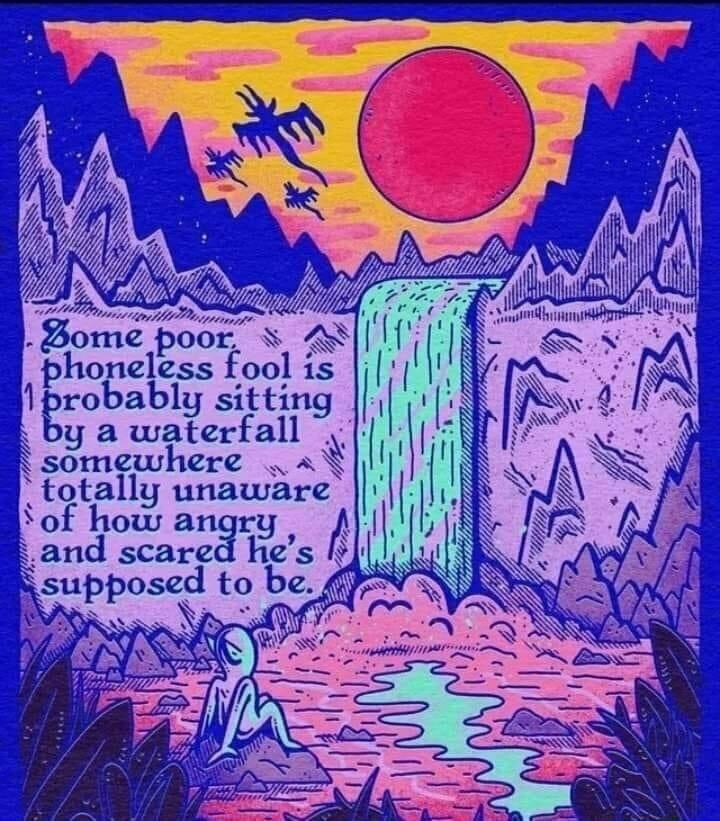
Some poor, phoneless fool

Via @letters on micro.blog


We are in the grip of a grim, despairing rebellion against reality that imagines itself to be the engine of moral progress.

R.R. Reno

The end of the world as we know it is not the end of the world.

You can read most of my more impromptu stuff here (cathartic venting) and here (the only social medium I frequent, because people there are quirky, pleasant and real). Both should work in your RSS aggregator, like Feedly or Reeder, should you want to make a habit of it. I’m even playing around a bit here, but uncertain whether I’ll persist.

Theme, restatement, and variation

We’re Electing Idiots

Liz Cheney On What’s Wrong With Politics via TMD.

There will always be people whose ambition is greater than their pride and they will always curry favour with anyone closer to power than they are.

Jacob T Levy via DenseDiscovery.

Last week two of Trump’s most slavish cronies in the caucus introduced resolutions that aim to undo his two impeachments. Marjorie Taylor Greene’s legislation, targeting the first one, is short and sweet; Elise Stefanik’s counterpart, targeting the second, is more elaborate. The resolutions don’t purport to “repeal” or “overturn” the House impeachment votes held in 2019 and 2021, notably, but to banish them from official existence entirely. If enacted, each would have the effect of expunging the record “as if such … Articles had never passed the full House of Representatives.”

In theory, at least. Per Charlie Sykes, legal experts find the idea of the House retroactively disappearing an impeachment to be cockamamie, including the normally Trump-friendly Jonathan Turley. “It is not like a constitutional DUI. Once you are impeached, you are impeached,” he told one news outlet. Even if the resolutions pass, there’s nothing stopping a future Democratic House majority from expunging the GOP’s expungement—an un-un-impeachment, as it were.

Of course, a subsequent Republican House majority could expunge that expungement, amounting to an un-un-un-impeachment. And then a later Democratic House majority could—you get the idea.

Perhaps, centuries from now, it’ll be a House tradition whenever the out-party wins control of the chamber that they undertake to un-impeach or re-impeach Donald Trump, as the case may be, on their first day in power.

Nick Cattogio


We are in the grip of a grim, despairing rebellion against reality that imagines itself to be the engine of moral progress.

R.R. Reno

The end of the world as we know it is not the end of the world.

You can read most of my more impromptu stuff here (cathartic venting) and here (the only social medium I frequent, because people there are quirky, pleasant and real). Both should work in your RSS aggregator, like Feedly or Reeder, should you want to make a habit of it. I’m even playing around a bit here, but uncertain whether I’ll persist.

Sunday, 6/25/23

What if we thought Christianity was about reality?

If it were seriously imagined that the teachings of Christianity or other religions constituted a vital and irreplaceable knowledge of reality, there would be no more talk of the separation of church and state than there is of the separation of chemistry or economics and state.

Dallas Willard (1935–2013) via Francis Beckwith, Taking Rites Seriously.

That word “irreplaceable” is a key; it challenges me in my approach to public affairs, which tends toward Rawlsian public reason even though I’ve read no Rawls.

Maybe I tend that direction because I’ve so rarely heard Christian voices in the public square seasoning the discussion subtly, like salt in a recipe, rather than waving the Bible (sometimes literally) and declaiming what they perceive as God’s “rules” rather than persuading about “reality.”

Or put more philosophically, most of the putatively Christian voices seem to be think that something is good because God commanded it rather than God commanding it because it’s good.

Simile of the week

If we can see that the pre-Christian philosophers did seek the truth, and that they did catch glimpses of it, it only stands to reason that their teachings should bear some similarities, like a broken reflection of the moon in water, to the fullness of truth in Jesus Christ. Therefore, these similarities need not appear as a threat to Christianity; instead, they offer one more proof of Christ as universal truth.

Hieromonk Damascene, Christ the Eternal Tao

I love that “like a broken reflection of the moon in water.”

Parable of the week

A certain man went down from Athens to Atlanta and fell among thieves, which stripped him of his raiment and wounded him and departed, leaving him half dead. And by chance there came down a certain conservative megachurch head pastor that way. Now, this pastor had 14,000 sheep, and 6,000 camels, and a thousand yoke of oxen, and a thousand she-asses, and a 10,000-person auditorium, and much gyms. He had also seven sons and three daughters, for unto him was a smokin’ hot wife named Cyndi. She did teach yoga, but she sinned not for she called the class Stretching Our Faith and never used Sanskrit words.

And when he saw the man, he passed by on the other side and he said unto himself, “This is what comes with woke politicians, slimy, dirty people everywhere. A decent person can’t even ride the bus. The Uber drivers always want a tip.” And he passed by on the other side.

And came then two Duke Divinity School post-liberals, for there was in those days in that city a theology conference. And they saw him and were moved to pity. And one went to help him. But his friend said unto him, “Ho, consider and be sure. Art thou moved by the charity that is from the Lord? Or doth thou proceed from the superficial liberal humanitarianism of the Enlightenment?”

And the other paused and did bethink himself, for he did not want to proceed from the superficial liberal humanitarianism of the Enlightenment lest the Lord wax wroth with him. And at last, he did say to his friend, “Look, this man suffereth! and would thou be treated thus? Consider that if thou were this man, thou would swap the most of for the least of these.” And his friend replied, “Whoa, buddy, thou soundeth like Rawls.” And they did argue, and growing distracted, did pass by on the other side.

But a certain disenchanted liberal technocrat, as he journeyed, came to where he was. And when he saw him, he had compassion on him and went to him and bound up his wounds, pouring in oil and wine and set him on his own beast and brought him to an inn and took care of him and did exchange with him Reddit handles.

And on the morrow when he departed, he took out two pence and gave them to the host and said unto him, “Take care of him. And whatsoever thou spendest more, when I come again, I will repay thee.” And the host did say, “The doctors say he needeth a new kidney.” And the man was sore afraid, but he was an effective altruist. And he said, “Lo, I have an extra one that I’m not using. And hoarding it would be irrational under the circumstances.” And he gave the man his kidney. And being recovered, he went back to his job as a consultant and great was his reward in the kingdom of God, if he would allow himself to know it.

Phil Christman, The Effective Samaritan, quoted here.

Religious liberalism

Ross Douthat has a fine column on why he’s not a liberal Catholic. With a little effort, you can translate it to liberal versus conservative in other churches, too.

Excerpt:

If liberal forms of Catholicism claimed to be comfortable as a remnant out of step with the spirit of the age, then diminished numbers wouldn’t necessarily demand a self-critique. But again, liberals are the ones most likely to insist that the signs of the times should compel the church to shift in their direction, as an alternative to marginalization or extinction. And there is just no serious or compelling proof of concept here, after so many decades of experiments. “Join or die” is just not a compelling argument if your own movement seems to be dying even faster.

A Christendom vision

Accessing things that are extremely bad for you, like marijuana, gambling, and porn, should be harder than it is. Being able to get married, buy a house (or just afford good housing), and have children should be easier than it is. A great many of our problems, I think, exist because we’ve made a world in which it is desperately difficult to be good, far more difficult than it needs to be. When I envision a Christian society, the ideas near the forefront of my mind mostly have to do with protecting and preserving family life, promoting organized labor so that workers can command better wages and more easily build and form families, and taking some reasonable steps to limit access to some especially dangerous vices, such as gambling and porn, for starters.

Jake Meador’s vision of Christendom.

Baptizing sin

What the Fathers decried as schism is now regarded as normal church growth. So long as the new church does not make a point of denying the Trinity, it remains a part of the una sancta.

Fr. Lawrence Farley, The Necessary Revolution

Christian Anthropologies contrasted

Basil, a consistent witness to the Eastern principle of deification, wrote about free will in a way that contrasted sharply with that of Augustine: “Good action arising from free choice,” he insisted, “is . . . present in us by nature.”

Fr. John Strickland, The Age of Paradise

The clash of cultures

Several scholars distinguish a separate Orthodox civilization, centered in Russia and separate from Western Christendom as a result of its Byzantine parentage, distinct religion, 200 years of Tatar rule, bureaucratic despotism, and limited exposure to the Renaissance, Reformation, Enlightenment, and other central Western experiences.

Samuel P. Huntington, The Clash of Civilizations.

Short of constituting a separate civilization, it seems to me that American Orthodox converts are building at least a distinct subculture.

One hundred years of platitudes

Then Almata cried, Why is he called The Prophet? And Gibran spoke, It is a misprint for The Profit. For that is what I have made of the Gullible’s insatiable desire for Platitudes.

John Crace quoted by Giles Fraser, One hundred years of platitudes

The late ‘60s and early ’70s felt like Peak Gibran, but I managed to avoid both Gibran and weed.

Lucky me.

Why do I read anything but poetry …?

Where is the Life we have lost in living?
Where is the wisdom we have lost in knowledge?
Where is the knowledge we have lost in information?
The cycles of Heaven in twenty centuries
Bring us farther from God and nearer to the Dust.

T.S. Eliot, Choruses from “The Rock”


We are in the grip of a grim, despairing rebellion against reality that imagines itself to be the engine of moral progress.

R.R. Reno

The end of the world as we know it is not the end of the world.

You can read most of my more impromptu stuff here (cathartic venting) and here (the only social medium I frequent, because people there are quirky, pleasant and real). Both should work in your RSS aggregator, like Feedly or Reeder, should you want to make a habit of it. I’m even playing around a bit here, but uncertain whether I’ll persist.

Summer Solstice 2023

Culture

Commencement Wisdom

I’ve always liked the story with the punchline “What the hell is water?” But I don’t think I’d ever read the full commencement address from which I got it.

Quite good, with anticipations of Iain McGillchrist and of “pay attention to what you’re paying attention to;” but David Foster Wallace’s way may be better.

Is SCOTUS out of step?

About the Supreme Court, the New York Times wants to know “whether the court’s decisions are out of step with public opinion.” Here is the answer to that question:

It does not matter.

The law says what the law says. The job of the Supreme Court is to apply the law, not to make up the law, not to reform the law, not to ensure that the law accords with public opinion. If public opinion is opposed to the law, then the public can elect new lawmakers and write new laws. It is not up to the Supreme Court to do that for them. If representative democracy means anything, it is that the law is made by lawmakers who are elected by the people and democratically accountable to them.

Even Nina Totenberg has noticed that the progressives on the Supreme Court are more inclined toward bloc voting while the so-called conservatives are more inclined toward intellectual disagreement. If your bookie took bets on how individual justices were going to vote in any given hot-button case, you’d make more money betting on the progressives, who are predictable. When it comes to their most important political commitments, they sometimes have reached their decision before the first arguments are made.

Kevin D. Williamson, When Public Opinion Is Irrelevant.

I’m not sure how Williamson supports that last sentence, but otherwise it’s solid.

Damon Linker’s sober assessment

I’m not really interested in debating the substance of the issue. I’m fully vaccinated, so is my wife, and so are my kids. That includes several rounds of Pfizer’s mRNA COVID vaccine. But I’m not anything close to being a medical doctor or an expert on immunology or epidemiology. I’m not even an especially informed amateur observer of issues in public health. What I am is a broadly well-educated writer and citizen who trusts doctors, public-health professionals, government agencies, and the media’s myriad mechanisms of publicity to provide me with accurate information about the world. I trust that since tens of millions of Americans (and hundreds of millions more all over the world) have taken these vaccines, I would have heard about it in the form of a blockbuster news story if they actually did more harm than good.

But note: I don’t know that vaccines are safe in the same way that I know it’s a cloudy day in the Philadelphia suburbs, where I live and am writing this post. And this is true about an enormous number of things. Anytime anyone says “I know X” about a matter that goes beyond direct personal experience—I can see the clouds outside my window with my own eyes—it implicitly involves an act of trust: “I know X because Y says X, and I trust that Y knows what s/he is talking about and wouldn’t deceive me.”

Do you distrust the pronouncements of Anthony Fauci? Fine. But why would that lead you to trust RFK or Joe Rogan more? Just because they’re not employed by the government?

Why indeed? I know full well that governments lie to me constantly — but nowhere near so constantly that I can say “government said it so it must be a lie.” But what I also know believe is that crackpots and grifters are even less reliable than the government (do I really need to cite examples?), and that I lack the time and the knowledge to personally check out every contrarian claim.

Especially at age 74, I am very aware of my mortality, and of the much higher priorities for spending the time until that day.

Maslow’s Hierarchy, level 1

For all I complain about the empty materialism of the West, there is a certain level of wealth essential to human happiness, below which family, faith, and work as a craft, isn’t solace enough. We need a certain amount of stuff to escape the drudgery and toil of existence. That level is probably somewhere above Senegal ($1,800 per capita GDP) and below Vietnam ($4,000).

Chris Arnade

Vote your vice

The policies implementing the Sexual Revolution now have the priority that peace and prosperity used to occupy in political loyalties and discourse. The revolutionary ideology now holds the place of esteem once held by the Judeo-Christian religions.

Jennifer Roback Morse, The Sexual State.

In general, I did not care for this book, but this particular point is powerful. The Biden administration has proven the truth of it vividly in its enthusiastic celebrations of Pride Month. (If you missed the details, Rod Dreher is ever ready to fill you in.)

The late Joseph Sobran said decades ago that the Democrats had become the “vote your vice” party. It has only gotten worse (with an admixture of perverse obsequiousness toward transgender ideology).

(I grant that there are vices other than sexual, and that when Republicans are in power they either leave the declining status quo untouched or else pass performative and draconian bans that the courts strike down on various grounds, some of those grounds being solid.)

Scotomas

Speaking of vice, the current issue of The American Conservative devotes its current issue to the topic.

Yup. They’ve got the biggies:

  • Porn
  • Gambling
  • Marijuana
  • Witchcraft
  • Social Media

But I almost laughed out loud at the absence of binge drinking and at the article titled and subtitled The No Smoking Garden: The crusade against tobacco has depended on shameless propaganda.

I’m thinking the common thread here is “calls to legalize newer vices are bad; traditional legal vices are fine.”

This is typical of why I keep waiting for The American Conservative to realize that my subscription has lapsed.

Don’t worry; science has it all figured out

(An archaeologist finds a motel centuries hence:)

Surrounding almost the entire complex was a vast flat area, marked with parallel white lines. In several of the spaces stood freely interpreted metal sculptures of animals. To avoid the misunderstanding that often arises with free interpretation, each sculpture was clearly labeled. They were inscribed with such names as Cougar, Skylark, and Thunderbird, to name but a few. The importance of animal worship in Yank burial customs has never been more clearly illustrated.

David Macaulay, Motel of the Mysteries

Politics

Donald Trump as an occasion of sin

It was easy for my generation of baby boomer liberals to be humble, because we had much to be humble about.

Many on the left had erred on what was perhaps the most important issue of the 20th century, global totalitarianism: Too many had been soft on Soviet Communism or Chinese Maoism. When you see well-meaning people on your side who were catastrophically wrong about profound moral and political issues, humility comes more easily.

These days, however, many conservatives are so ridiculous that I fear they are robbing us liberals of that well-earned humility.

Nicholas Kristof, In the Age of Trump, It’s Hard to Be Humble

Florida Man is one-of-a-kind

Peter Wehner can always be counted on to oppose Florida Man, but sometimes he hits the nail on the head more squarely than other times:

  • Trump doesn’t just cross moral lines; he doesn’t appear capable of understanding moral categories. Morality is for Trump what colors are to a person who is color-blind.
  • Trump’s moral depravity, which touches every area of his life, private and public, has long been in public view, undisguised and impossible to miss.
  • Other shady and unethical individuals have served in the White House—Richard Nixon and Warren Harding among them—but Trump’s full-spectrum corruption puts him in a category all his own. His degeneracy is unmatched in American presidential history and unsurpassed in American political history.
  • Donald Trump, rather than using the presidency to elevate human sensibilities, did the opposite, and he did it relentlessly. Among the most damaging legacies of the Trump years is his barbarization of America’s civic and political life. He called the spirits from the vasty deep, and they came when summoned.

Mind you, I’m among those who succumbed to Trump Derangement Syndrome (the first Presidency so to afflict me), so I can’t fault Wehner for a bit of obsessiveness.

What is the reason for Mike Pence?

Pence recently did an interview with right-wing radio hosts Clay Travis and Buck Sexton, in which he refused to say whether he’d pardon Trump once in office. The hosts wanted Trump pardoned, and Pence basically had three answers. First, he riffed on the fact that he believes these are “serious charges” and he “can’t defend what’s been alleged.” Second, he says it’s “premature” to discuss a pardon because we don’t know what “the president’s defense is” or “what are the facts.” And then third, he says “we either believe in our judicial process in this country or we don’t; we either stand by the rule of law or we don’t.”

Normally, I’m not impressed with candidates who refuse to answer questions because they look like they’re being evasive for political reasons. The lack of authenticity is like nails on a chalkboard. But here, it actually is a real answer. He thinks the charges are real, but he’s open to hearing Trump’s side of the story.

Sarah Isgur. She analyzes the other GOP candidates, too.

Pence is right, but being right often requires nuance for which voters have no patience.

I was aware of, but did not share, a Pence Derangement Syndrome when he was Governor of Indiana. I have nothing in particular against him now. But on 1/6/21, he assuredly was aware that by honoring our electoral college system over the shenannigans of Florida Man, he was ending his political career.

In 2023, Pence is a stone-cold loser, lacking even the “what the hell, why not tell the truth?” rationale of Chris Christie.

Wordplay

1

Filiation and affiliation

The late Edward Said was known for his distinction between filiation and affiliation. Filiative relations are those that come to us naturally, those that are givens of our birth and into which we are born. Affiliative relations are those we purposefully forge.

James Matthew Wilson

2

Mr. Robertson ran for president in 1988, hoping to channel evangelistic popularity from his growing television empire, the Christian Broadcasting Network, into Republican political might. Ultimately he failed — even devout Christians worried about the intensity with which the celebrity minister blended church and state.

And yet, by the time of his death on Thursday, the vision he championed had gained more power than he could have ever thought possible. The alliance between evangelical Christianity and Republican politics has fused, even as America has grown increasingly secular. The polarizing rhetoric of his often inflammatory views has become a defining feature of American politics.

Elizabeth Dias at the New York Times, writing about the political side of Pat Robertson, who died June 8. (Emphasis added)

“Evangelistic popularity” is pretty clumsy. It skips over primary and secondary meanings of evangelism and evangelistic to mash up a tertiary meaning (a meaning which I suggest arose from journalistic misusage, which eventually “makes proper” I guess, as “literal” now is a hyperbolic form of “metaphorical.”)

I have no idea, apart from context, what happens when an alliance fuses, and I’m not persuaded by it.

3

hysteria

Boy! I had never stopped to think how loaded that word is!

“Mass hysteria” is out; “psychogenic illness” is in.

4

If demography is destiny, population movements are the motor of history.

Samuel P. Huntington, The Clash of Civilizations and the Remaking of World Order

5

Getting offended by something on the internet is like choosing to to step in dog crap instead of walking around it.

Found by my wife on Pinterest

6

ESPN is now a gambling-promotion network that finds sports useful.

Alan Jacobs

7

holobionts: a united meta-organism whose components evolve in concert with each other. (The idea of “holobionts” represents a paradigm shift in biology). See also, of course, Wikipedia.

8

Word of the Era: Religion

I recently read Before Religion: A History of a Modern Concept 📚 The idea of religion as a sphere of life distinct from politics, economics, or science is a recent development in European history. That’s not a complete surprise to me, but I’d never before read so much on how that came about. Spoiler alert: there’s a bit of cultural imperialism in the sense of “imposing” on other cultures how the secularized West parses things.

9

Baksheesh, a word meaning bribes in Arabic, which police frequently ask for in Egypt. Read the full story.

10

Happiness writes white ink on a white page.

Henry de Montherlant via Things Worth Remembering: The Joy of Requited Love

This probably is in the same thought constellation as how notoriously hard it is to create compelling good fictional characters.

11

“Random” vs. “Mystery”

To call the unknown “random” is to plant the flag by which to colonize and exploit the known … To call the unknown by its right name, “mystery,” is to suggest that we had better respect the possibility of a larger, unseen pattern that can be damaged or destroyed and, with it, the smaller patterns … But if we are up against mystery, then knowledge is relatively small, and the ancient program is the right one: Act on the basis of ignorance.

Mark Mitchell and Nathan Schlueter, The Humane Vision of Wendell Berry

12

From Frank Bruni’s “For Love of Sentences” segment:

A

We can’t shuffle off the mortal coil of Trump. He has burrowed, tick-like, into the national bloodstream, causing all kinds of septic responses.

Maureen Dowd

B

So we come to the present pass, with the world’s most powerful nation, with all of its magnificent history and intricate constitutional architecture, at the mercy of a pathological narcissist, trembling at the thought of bringing him to justice — as if it were the act of applying the law to him, and not his brazen defiance of it, that were the anomaly

Andrew Coyne

C

What he once wore as electoral camouflage is now tattooed all over him, in yet another fulfillment of the late Kurt Vonnegut’s warning that, eventually, “we are what we pretend to be.”

Tom Nichols on the transmogrification of J.D. Vance into a Trumpist.

D

Teenagers suffer for many reasons. One is being fragile and in formation — a human construction site.

Suzanne Garfinkle-Crowell


We are in the grip of a grim, despairing rebellion against reality that imagines itself to be the engine of moral progress.

R.R. Reno

The end of the world as we know it is not the end of the world.

You can read most of my more impromptu stuff here (cathartic venting) and here (the only social medium I frequent, because people there are quirky, pleasant and real). Both should work in your RSS aggregator, like Feedly or Reeder, should you want to make a habit of it. I’m even playing around a bit here, but uncertain whether I’ll persist.

Father’s Day 2013

Okay, that title is cheap pandering. I don’t believe in the Hallmark Holidays. This is the second Sunday after Pentecost in the Eastern Church. Speaking of cheap pandering …

Gothardist Evangelicalism

David French had a fresher experience than I of Bill Gothard (the main villain of Amazon Prime’s Shiny Happy People) by a large margin: I encountered him in 1966-67, French in 1993. Further, French was an adult, attending a Gothard seminar motivated to believe to “get the girl” he was dating, who with her family were Gothard acolytes. Finally, as an evangelical-adjacent Reformed Protestant, French has more current insight than I into Gothardism’s reach, including into the scandal-ridden Kanakuk Kamps.

Considering all that, it’s no surprise that his ‘Shiny Happy People,’ Fundamentalism and the Toxic Quest for Certainty does a markedly better job than I did at sketching the key problems with Bill Gothard’s teachings (through the Institute on Basic Life Principles), its reach deep into evangelicalism, and how the fundamental decency of most of Gothard’s followers makes “cult” an uncomfortable label. It’s good enough that I used one of my ten monthly sharable links.

But wait! There’s more!

Former Gothard follower Sara Roberts Jones tells her experience of Gothard’s “cult” in a seven-part series. While French and I have used IBLP as shorthand, Jones refers to ATI, the “Advanced Training Institute” where they get into much greater detail through a series of “Wisdom Booklets.” A few excerpts suggest her project and one teaching that tortured her particularly:

Recently I gained access to nearly all of the original Wisdom Booklets (plus several of the updated second editions). I thought I would summarize each one to show exactly what Gothard taught us. Halfway through the first few pages of Wisdom Booklet #1 (out of 54), I realized I couldn’t do it.

Gothard defies easy summarizing. He uses hundreds of words to prove a single point. His explanations and logic are twisty, working around the obvious message of Scripture to support his own claims.

So, instead of trying to summarize, I’m going to take highlights from the Basic Seminar Textbook and several Wisdom Booklets …

My purpose is to show how so many well-meaning Christians came to Gothard thinking, “I am excited to know God better,” and ended up nodding as he said, “God holds a woman guilty if she doesn’t scream when a man rapes her.”

Sara Roberts Jones.

“God holds a woman guilty if she doesn’t scream when a man rapes her” is not, so far as I can tell, the endpoint of all the Gothardist teaching, but it’s certainly got to rank as one of the most toxic ideas drummed in along the way, followed in close second by the fetish about “eye-traps” in women’s clothing that is already extremely modest. This really is double-barrelled blaming of women for men’s unbridled lust.

Here’s Jones’s whole six-part series:

  1. An ATI Education: Introduction
  2. An ATI Education, Chapter 1: Under the Umbrella
  3. An ATI Education, Chapter 2: Is It Just Me?
  4. An ATI Education, Chapter 3: Thou Shalt Not Trap the Eye
  5. An ATI Education, Chapter 4: The Law of Grace
  6. An ATI Education, Chapter 5: We the People Under Authority
  7. An ATI Education, Final Chapter: Guilty Silence

I count myself fortunate that my brush with Gothard was early in his career and relatively superficial. I can’t help but imagine what might have happened if I had fallen into the deep end, but I don’t think that I should dwell on “what-ifs” like that, let alone further inflict them on you.

I will note, however, that:

  • If you want to know about the Gothard cult (not about the Duggars), you’ll learn more that’s meaningful, and learn it in less time, by reading David French and Sara Roberts Jones instead of watching Shiny Happy People
  • An explanation of God’s will that requires 54 copyrighted booklets with restricted circulation sounds more like a commercial racket or an early-stage cult than like anything one could plausibly call “Bible-only Christianity.”
  • I’d be shocked that evangelicalism tolerates Gothardism except that evangelicalism has no even minimally effective means for excommunication.

What’s “water”?

We approach a condition in which we shall be amoral without the capacity to perceive it and degraded without means to measure our descent.

Richard Weaver, Ideas Have Consequences.

As Deneen tells it, what happened when the wall fell was not the triumph of freedom over oppression so much as the defeat of one Western ideology by another. The one that came through was the oldest, subtlest and longest-lasting, one which disguised itself so well that we didn’t know it was an ideology at all: liberalism.

Paul Kingsnorth, In This Free World

Summarizing, “what the hell is water?

“The Silicon Valley agenda”

The Silicon Valley agenda, the transhumanist agenda, is extremely utopian, and actually very religious. I think it’s like if you took the Christian religion — which they’re all sort of steeped in because they’re in America — and you take out the actual bits about God and Jesus and things, you’re left with a desire for transcendence and utopia and life after death, living forever and universal justice — all of which are sort of Christian notions — and so they’ve decided they’re going to build those themselves.

Paul Kingsnorth, interviewed by Freddie Sayers

Post-evangelicalism

And here I thought I had been too hard on Evangelicals. Jake Meador — a Reformed Protestant and therefore Evangelical-adjacent (as I was in an analogous denomination) — doesn’t “give it both barrels” but pronounces it dead and lays out the particulars. It’s really quite devastating. The End of Evangelicalism and the Possibility of Reformed Catholicism.

He has a followup post, too.

Kind of self-evident, when you stop and think for a second

The early Church had no Scripture of its own, and the Jews had no defined canon of Scripture; therefore, sola scriptura as the foundation for what Christians believed was absolutely impossible.

Eugenia Scarvelis Constantinou, Thinking Orthodox: Understanding and Acquiring the Orthodox Christian Mind

(I know, I know: the original Reformers didn’t mean by sola scriptura what modern Evangelicals mean by it — if they even know the term.)

We need a little Auden now

One of the appeals of Christian orthodoxy for Auden, as for T. S. Eliot in the 1920s, was that it offered a more humane alternative to the ferocious ideologies of the twentieth century. Instead of blaming a class or race for the world’s evils, it insisted that we are all individually responsible and that redemption must begin by acknowledging our weakness rather than vaunting our strength.

Adam Kirsch, A Poet’s Politics.

Sadly, in the U.S. of the 2020s at least, a substantial number of Christians think it their duty to vaunt their putative strength. I used to say, “If you don’t like the Religious Right, just wait for the irreligious Right,” but I overlooked the specter of the pseudo-religious Right.

(Yeah, yeah, I know: “No true Scotsman fallacy.” Whatever.)

Canon and Tradition

The New Testament is a written form of the tradition, the gospel, the preaching, the declaration, the communion given by the Apostles to the Church, the living communion of the one gospel of Christ. But the context of that writing was the living tradition (gospel, preaching, declaration, communion) of the Church.

Ultimately the acceptance of writings as authoritative rests entirely on tradition (particularly tradition as context). The Church recognized the authentic voice of the Church in the writings – i.e. the writings agreed with the gospel as it had already been received. St. Paul specifically describes this manner of recognition:

But even if we, or an angel from heaven, preach any other gospel to you than what we have preached to you, let him be accursed. As we have said before, so now I say again, if anyone preaches any other gospel to you than what you have received, let him be accursed. (Gal 1:8-9 NKJ)

Fr. Stephen Freeman, The Communion of Tradition

Matthew 7:1-8

Judge not, that you be not judged

What then? Ought we not to blame those who sin? Paul also says this selfsame thing: ’Why do you judge your brother? And you, why do you put your brother down? …How then does he say elsewhere ‘Reprove, rebuke, exhort,’ and ‘Those who sin rebuke before all?’ And Christ too to Peter, ‘Go and tell him his fault between you and him alone’… (Matt. 18:15-17). And how has He set over us so many to reprove, and not only to reprove, but also to punish? …And how did He also give them the keys, since if they are not to judge, they will be without authority in any matter and in vain have they received the power to bind or to loose? …For unless the master judge the servant, and the mistress the maid, and the father the son, and friends one another, there will be an increase of all wickedness ..In this place then, as it seems to me at least, He does not simply command us not to judge any of men’s sins; neither does He simply forbid the doing of such a thing. But to those who are full of innumerable ills, and are trampling upon other men for trifles .. He says also in another place, You who strain at the gnat, and swallow the camel …And the Corinthians, too, Paul did not absolutely command not to judge, but not to judge their superiors (I Cor. 4:5) … You see, we ought not to upbraid nor trample upon them, but to admonish, not to revile, but to advise, not to assail with pride, but to correct with tenderness… If you neglect yourself, it is quite evident that neither do you judge your brother with concern for him, but in hatred instead: wishing to expose him. For what if he ought to be judged? It should be by one who commits no such sin, not by you.

St. John Chrysostom. Homily XXIII on Matthew


We are in the grip of a grim, despairing rebellion against reality that imagines itself to be the engine of moral progress.

R.R. Reno

The end of the world as we know it is not the end of the world.

You can read most of my more impromptu stuff here (cathartic venting) and here (the only social medium I frequent, because people there are quirky, pleasant and real). Both should work in your RSS aggregator, like Feedly or Reeder, should you want to make a habit of it.

All Saints, 2023

A Fatal Difficulty

The perennial temptation

Old-style blasphemy involved desecrating God because it was God who was sacred. Today’s blasphemy involves suggesting that man is not all-powerful, that he cannot create himself in any way he chooses.

Carl R. Trueman’s summary of Blasphemy Then and Now, a posting at First Things. I’m starting to think this is one of the most important things to keep ever in mind about some cultural tsunamis.

Everybody knows there is something very wrong with us, but not everybody knows what it is. If you would know, then go back to the beginning.

There we find the primordial sin: acting out our desire to be God.

Kingsnorth spoke about transhumanists openly talking about creating God. Martine Rothblatt, born Martin, says proudly that transgenderism is an onramp to transhumanism. We are reliving the drama of the Garden of Eden all over again. Kingsnorth said we have lost touch with biological reality, with nature, and knowledge of our own telos — that is, for what we were created.

Rod Dreher, channeling Paul Kingsnorth.

Did dispensationalism die when I wasn’t looking?!

Maybe I’ve been beating a dead horse in my criticisms of dispensationalism. But I have some concern here:

When our grandkids find themselves alone in the house on a summer afternoon, few will find themselves gripped by a sudden fear that everyone except them has been taken in the rapture. By itself, that is a good thing. The eclipse of an unbiblical and thoroughly annoying doctrine is hardly something to mourn. Yet Hummel is perceptive enough not to allow the reader such a hasty judgment. The Rise and Fall of Dispensationalism obliquely but powerfully gestures toward a hole often found in the gospel that post-dispensationalist evangelicals believe today. “In the wake of dispensationalism’s collapse,” he writes in the epilogue, “the eschatological sight of the American church has blurred.” That means that our hope is less fervent, thinner, colder.

The emphasized part makes me crazy! It’s like an invitation to make up some new heresy to fill an eschatological “hole,” the old heresy having passed its sell-by date and been swept from the shelves (unnoticed by me).

If evangelicals need something to fill the eschatological-expectation hole, let me suggest (the first and maybe the last time I’ll commend syncretism) that they adopt Orthodox Bridegroom Matins for Monday, Tuesday and Wednesday of their Holy Week, which could use a bit of thickening up anyway.

Bridegroom Matins even has a catchy theme song:

Behold, the Bridegroom comes at midnight,
and blessed is the servant whom He shall find watching;
and again, unworthy is the servant whom He shall find heedless.
Beware, therefore, O my soul, do not be weighed down with sleep,
lest you be given up to death,
and lest you be shut out of the Kingdom!
But rouse yourself, crying: “Holy, holy, holy, are You, O our God!”
Through the Theotokos have mercy on us!

Voilà! Eschatological problem solved! And it’s better than some idiotic “prophecy conference” at maintaining memento mori and a sane expectation that “He shall come to judge the living and the dead.”

Shiny Happy People

Speaking of fundamentalists, for my many sins I did penance by watching Amazon Prime’s Shiny Happy People. I don’t give a rip about the hyper-fertile Duggars, but I had a brush with the series villain Bill Gothard in 1966-67 and wanted to catch up.

He was a weird little man then and appears to have gotten a bit weirder over the decades, right down to the absence of any grey hair and his ephebophilia.

His message was not a healthy Christian message. It’s not even biblical except in the formulaic sense of “proof-texts for nearly everything,” as if scripture-twisting weren’t a real thing.

I know a few people in the Protestant world who are devoted to IBLP, more fully known as Institute on Basic Life Principles — the organization that survives Gothard’s scandal and forced retirement — and I’m kind of worried about them now. Judging from a visit to the IBLP website’s “Statement of Faith,” Shiny Happy People is correct to classify IBLP as fundamentalist, though the line between fundamentalism and the evangelicalism of my youth is a fine one.

A few thoughts:

  • That I thought it necessary to check out IBLP for myself reflects how unpersuasive Shiny Happy People was at nailing down hard facts, preferring innuendo and the charges of critics, some of whom had no first-hand knowledge.
  • That IBLP feels it necessary to publish a roll-your-own statement of faith, eschewing the Nicene Creed and elevating its obsessions to creedal status, reflects how far removed it is from historic Christianity. (IBLP’s statement of faith is sorely lacking, too.)
  • That IBLP is “parachurch” means it can infiltrate most any Protestant denomination and makes it harder to unequivocally speak of it as a “cult” — though that label is tempting.

You could probably find better ways to spend three or four hours unless you have some compelling personal motivation (as did I) to watch this poorly-aimed shotgun blast toward unhealthily patriarchal fundamentalists.

Distress

The distress this insight speaks of was the beginning of my conscious Christian commitment, long ago (but not very far away):

To have offended God is more distressing than to be punished … If only we loved Christ as we should love Him, we would have known that to offend Him whom we love is more painful than hell.

St. John Chrysostom, Homily V on Romans 1, citing II Samuel 24:17.

Continuity

The primary aim of this book is to demonstrate the absolute continuity of ancient Israelite religion, the religion of the Second Temple, first-century Christianity, and the religious life preserved and practiced in the Orthodox Church …

Fr. Stephen DeYoung makes a bold claim. Something lured him out of a Reformed Protestant pulpit into Orthodoxy. It might merit investigation.


For all its piety and fervor, today’s United States needs to be recognized for what it really is: not a Christian country, but a nation of heretics.

Ross Douthat, Bad Religion

We are in the grip of a grim, despairing rebellion against reality that imagines itself to be the engine of moral progress.

R.R. Reno

The end of the world as we know it is not the end of the world.

You can read most of my more impromptu stuff here (cathartic venting) and here (the only social medium I frequent, because people there are quirky, pleasant and real). Both should work in your RSS aggregator, like Feedly or Reeder, should you want to make a habit of it.

Thursday, 6/8/23

Politics of one sort or another

Plus ça change

Metapolitics

I’m a pluralist. I don’t just mean in the sense that I think modern societies are too highly differentiated for them to be oriented toward a single highest good in the way some on the right (the so-called Integralists) like to imagine they were in the supposedly good old days of unified Catholic Europe during the medieval period. I am that kind of pluralist, but I’m also a pluralist in another and deeper sense, one that traces its lineage to the work of Isaiah Berlin, who deployed the term to describe the character of moral reality itself, regardless of the composition of any specific society.

Individual freedom from external constraint or coercion is an important human good. But what about other senses of liberty? Or fairness (proportional justice)? Or solidarity? Or loyalty? Or excellence? Or authority? Or creativity? Or sanctity? Or piety? There are many human goods, each worthy of pursuit. Devoting one’s life to one at the exclusion of others will undoubtedly have value, but it will also require the sacrifice of those other goods. That doesn’t mean we must embrace, affirm, and pursue all values equally. (Equality is itself a good the pursuit of which requires the sacrifice of other goods.) But it does mean that we should make our choices in full awareness of the sacrifices involved, and not deny the reality of the losses.

So the love of liberty has its place. The problem is that libertarianism overemphasizes it to the exclusion of other values, and often denies there is any important loss or tradeoff involved in doing so. (Yes, that’s a little ironic for thinkers who usually like to emphasize the need for tradeoffs in the context of fashioning government policy.)

Damon Linker

Sorta Politics

After the way he abased himself to secure the Speakership, I never would have thought Keven McCarthy would be able to get anything done:

Among the various reassessments of Kevin McCarthy following his successful debt ceiling negotiations, the one with the widest implications belongs to Matthew Continetti, who writes in The Washington Free Beacon that “McCarthy’s superpower is his desire to be speaker. He likes and wants his job.”

[P]art of what’s gone wrong with American institutions lately is the failure of important figures to regard their positions as ends unto themselves. Congress, especially, has been overtaken by what Yuval Levin of the American Enterprise Institute describes as a “platform” mentality, where ambitious House members and senators treat their offices as places to stand and be seen — as talking heads, movement leaders, future presidents — rather than as roles to inhabit and opportunities to serve.

On the Republican side, this tendency has taken several forms, from Newt Gingrich’s yearning to be a Great Man of History, to Ted Cruz’s ambitious grandstanding in the Obama years, to the emergence of Trump-era performance artists like Marjorie Taylor Greene. And the party’s congressional institutionalists, from dealmakers like John Boehner to policy mavens like Paul Ryan, have often been miserable-seeming prisoners of the talking heads, celebrity brands and would-be presidents.

[T]he most notable populist Republican elected in 2022, J.D. Vance, has been busy looking for deals with populist Democrats on issues like railroad safety and bank-executive compensation, or adding a constructive amendment to the debt-ceiling bill even though he voted against it — as though he, no less than McCarthy, actually likes and wants his current job.

Ross Douthat, Can Kevin McCarthy and Joe Biden Fix Washington?.

Bare-knuckle politics

The former governor, whose affiliated PAC calls itself “Tell It Like It Is,” didn’t pull any punches during his roughly two-hour town hall last night against the man he’s convinced gave him COVID-19, calling the former president “lonely, self-absorbed, and self-serving.”

“I’m going after Trump for two reasons,” he said in response to an audience question. “Because he deserves it, and because it’s the way to win.”

Christie, a former federal prosecutor, likely views his punch-Trump-in-the-mouth approach as killing three birds with one stone. Not only does it put Trump on the defensive, but picking fights will also earn Christie time on cable news, which amounts to free advertising for the campaign. Plus, it helps him paint himself as a fighter. “He knows how to brawl and we like that in our candidates,” Merrill said of New Hampshire GOP voters.

TMD, The GOP Field Takes Shape

Delusional politics

A Toyota memo to auto dealers in April explained the challenges to full electrification. For instance, “most public chargers can take anywhere from 8-30 hours to charge. To meet the federal [zero-emissions vehicle] sales targets, 1.2M public chargers are needed by 2030. That amounts to approximately 400 new chargers per day.” The U.S. isn’t close to meeting that goal.

Toyota also noted that “more than 300 new lithium, cobalt, nickel and graphite mines are needed to meet the expected battery demand by 2035,” and they could take decades to develop. “The amount of raw materials in one long-range battery electric vehicle could instead be used to make 6 plug-in hybrid electric vehicles or 90 hybrid electric vehicles.”

And here’s an even more striking statistic: “The overall carbon reduction of those 90 hybrids over their lifetimes is 37 times as much as a single battery electric vehicle.” These inconvenient truths undermine the climate religion and government mandates.

Wall Street Journals Editorial

Culture

The Machine chooses its pronoun: “I”

Gaslit by machinery that calls itself a person :: Writing Slowly

Phone-free schools?

“Once upon a time, teachers smoked in classrooms.” There’s no reason we can’t get to a place where sneaking a look at a smartphone would be like sneaking a smoke at school—shameful for adults, a disciplinary offense for students.

Mark Oppenheimer, quoting David Sax.

Swell article, along with this. Dare I suggest, though, that Apple Watch complicates phone-free school strategies?

Wordplay

the ‘woke’ tribe

a curious agglomeration of international capital and elite progressive opinion posing as an uprising from below. (Paul Kingsnorth, The West Must Die)


It is the greatest of all mistakes to do nothing because you can only do little.

Sydney Smith (via The Economist)


zoonosis

Any disease or infection that is naturally transmissible from vertebrate animals to humans. See also Factory farming will kill us all. I think I’ll keep up buying pastured meat on the theory that — well, see the Sydney Smith quote above.

Apologies to Monbiot? I don’t think so.


The view from nowhere came from somewhere.

Subtitle of an Atlantic Article on the idea of objectivity.


Diffident

The thought crossed my mind that this has become an apt description of me. Looking up definitions, it does seem to fit. I “put a lot of stuff out there,” but have few hills I’m willing to die on. This may be a knock-on effect of a major religious epiphany after almost 50 years of excessive confidence in things I now see as sorely lacking.


A “true” story, in the older understanding, is a story that tells a truth, even if the facts are not true.

Rod Dreher, reporting on a gathering in Dublin that he and I both consider significant.

I may have said this before, but I was still, at age 18, struggling with the idea that something non-factual could be true, and I was suspicious of a young teacher who seemed to believe that it could. No doubt, that was connected to the putative literalism my (then) religious tradition of 1950s and ‘60s Wheaton-College-oriented evangelicalism. But I hesitate to try to unpack it further because the first sentence of this paragraph says all I can really remember of my hangup, which is virtually incomprehensible to me now.


To me, the Vision Pro doesn’t look like something to use, it looks like something to be sentenced to – by an especially cruel judge.

Alan Jacobs (link added, in case you’re not yet caught up in the hype)


Phubbing: contraction of “phone snubbing.” Phubbing is breaking away from a conversation to look at one’s phone screen.

##############################

For all its piety and fervor, today’s United States needs to be recognized for what it really is: not a Christian country, but a nation of heretics.

Ross Douthat, Bad Religion

We are in the grip of a grim, despairing rebellion against reality that imagines itself to be the engine of moral progress.

R.R. Reno

The end of the world as we know it is not the end of the world.

You can read most of my more impromptu stuff here (cathartic venting) and here (the only social medium I frequent, because people there are quirky, pleasant and real). Both should work in your RSS aggregator, like Feedly or Reeder, should you want to make a habit of it.

Pentecost 2023

Anticipating Paul Kingsnorth?

I knew that C.S. Lewis was prescient (less so that Ken Myers was), but this was Copyright 1989.

Blinded by Might

Cal Thomas and Ed Dobson, who had been Falwell’s chief lieutenants in the Moral Majority, published a book questioning not just the efficacy of political action but the righteousness of the enterprise. In Blinded by Might they argued that in the process of trying to win elections conservative Christians had been seduced by the lure of power. What had begun as an effort to restore Christian values to the nation had degenerated into an unbridled partisan struggle, creating an atmosphere in which it was assumed that Democrats could not be Christians and that Bill and Hillary Clinton were the Antichrist.

Frances Fitzgerald, The Evangelicals

I never read Blinded by Might, but this characterization of it, which is consistent with the books title, seems prescient.

Is Tim Kellerism outdated?

Some Christian critics say that the “Tim Keller model” of engagement, his winsome, gentle approach to those with whom he disagreed, is outdated. They say that increased secularization and progressive hostility toward traditional Christianity requires the faithful to hit back, respond in kind, dominate or humiliate those who oppose us. But Tim wasn’t kind, gentle and loving to others as some sort of strategy to win the culture wars, grow his church or achieve a particular result. Tim loved his neighbors, even across deep differences, simply because he was a man who had been transformed by the grace of Jesus. As he wrote in The Times, he believed and lived as if “the Gospel gives us the resources to love people who reject both our beliefs and us personally.”

The Christian Scriptures describe “the fruit of the Spirit” — what grows in us as we walk with God — as love, joy, peace, patience, kindness, goodness, faithfulness, gentleness and self-control. Tim’s life was marked by these things. And these dispositions are not a political strategy. They are not a part of a brand. They are not a way to sell books, gain power, win culture wars or “take back America for Christ.” Tim inhabited these ways of being, not as a means to any end, but as a response to his relationship with God and love for his neighbor. The last 10 years or so have been hard on orthodox or traditional Christians who are wary of Christian nationalism, hyperpartisanship and the politics of bitterness or resentment. “Keller’s passing leaves a void in the nascent movement to reform evangelicalism,” wrote Michael Luo in The New Yorker, “and today’s social and political currents make the prospects for change seem dim.”)

Tish Harrison Warren

Just one little oversight

Why Antonio García Martínez became Zebulon ben Abraham. Except for the little matter of Christ’s resurrection, he’d have a pretty convincing case against Western Christendom.

Religious, not Spiritual

Occasional strong posts like Why I’m religious, and not spiritual are why I follow Fr. Silouan Thompson. But now I’ve got another book to buy: Before Religion: A History of a Modern Concept — a “modern concept” as in “Procrustean bed,” that variously cuts or stretches reality.

Protestant scholars of religion continually try to find in ancient writings the kind of pietistic interiority, feelings, or personal experience of the Numinous, that to these scholars is “true religion.” This underpins practically all modern study of religion and much of interfaith activity. But the sources don’t point to any such thing in the ancient mind; ancient religion is a creation of modern scholarship.

Why I’m religious, and not spiritual

The Religious Right (and more frank and candid atheists)

A motley crew of white evangelicals and traditional Catholics locked arms on some social issues, started voting in large numbers for Republican candidates, and changed American politics forever.

But I think that era of religion and politics is rapidly coming to a close. The Religious Right is no longer a primarily religious movement — from my point of view it’s one about cultural conservatism and nearly blind support for the GOP with few trappings of any real religiosity behind it.

Here’s what I believe to be the emerging narrative of the next several decades: the rise of atheism and their unbelievably high level of political engagement in recent electoral politics.

Ryan Burge, Religious Right? Those true believers are nowhere near as politically active as atheists.

Unfortunately, some of the Christianists on the “Religious Right” will take this as a call to go big-footing into politics at higher intensity because, as Burge observes, the Religious Right is no longer a primarily religious movement.

As for me, I find this result unsurprising. If you have no hope beyond this life, you’ll be apt to grab for all the temporal gusto you can get. If you’re getting close to the end of life, you look for the resurrection of the dead and the life everlasting, and you’re trying to get ready for all that — heck, you might not even save Burge’s article after reading it and passing along this clip, if you know what I mean.

What it takes for a Tradition to endure

When I first encountered Orthodoxy fourteen years ago, my first thought was, “This is what I thought Catholicism would be when I converted back in the 1990s.” This was BEFORE I knew much of anything about Orthodox theology. This was from what I learned by worshiping liturgically with the Orthodox, and discovering the role of asceticism and related practices in Orthodox life. Years later, as I was writing The Benedict Option, I discovered in anthropological texts why some version of monastic practices is necessary for lay Christian life today, and also why Orthodox Christianity is UNIQUELY SUITED for the Benedict Option.

Rod Dreher, Healing Humanity: Confronting our Moral Crisis (emphases in original). Co-authors include Frederica Mathewes-Green, David Ford, Alfred Kentigern Siewers and Alexander F. C. Webster.


For all its piety and fervor, today’s United States needs to be recognized for what it really is: not a Christian country, but a nation of heretics.

Ross Douthat, Bad Religion

We are in the grip of a grim, despairing rebellion against reality that imagines itself to be the engine of moral progress.

R.R. Reno

The end of the world as we know it is not the end of the world.

You can read most of my more impromptu stuff here (cathartic venting) and here (the only social medium I frequent, because people there are quirky, pleasant and real). Both should work in your RSS aggregator, like Feedly or Reeder, should you want to make a habit of it.

May 31, 2023

303 Creative

Lorrie Smith of 303 Creative in Colorado would like to expand her website-design business to wedding websites, but she realizes that she’ll eventually get, and will decline for reasons of conscience, requests for same-sex wedding websites. Colorado antidiscrimination authorities say that’s a no-no. The case is before SCOTUS, awaiting a decision within a month or so.

Hurt Feelings, Conscience, and Freedom

Rick Plasterer, previously unknown to me, lays out some of the social history behind such cases (with an obvious bit of ax-grinding):

Faced with a court intent on protecting freedom of religion and speech, the Left has turned to the claim that civil rights law, and behind it, the Fourteenth Amendment, mandates pro-active government measures to remove social stigma. This is really a very blatant effort to gain what social conservatives have complained about for years, the claim of a right not to be offended.

[S]ome research proposes that younger LGBT cohorts seem to be more sensitive to perceived stigmatizing than the older LGBT population. Given the large “snowflake” population in colleges and universities, this is not surprising. As a researcher critical of the consequences of the sexual revolution, Regnerus said he experiences much day-to-day stigma, but has learned to deal with it. The LGBT identifying population can and does deal with it as well. But pro-LGBT stigma research tends to deny “agency on the part of persons. It esteems collective action while implying personal passivity and an externalized locus of control.”

But although the claim to “dignitary harm” might be newly raised with LGBT liberation, the claim that there cannot be fundamental differences in society about ultimate things is old. Quoting Jean Jacques Rosseau’s “The Social Contract,” (1762), George observed that “America is stalked by an ancient fear: The creeping suspicion that ‘[i]t is impossible to live with those whom we regard as damned.’”

Rick Plasterer, Hurt Feelings, Conscience, and Freedom – Part 1.

First Amendment protections

One of my heroes, Robert P. George of Princeton, has weighed in on behalf of 303 Creative via an amicus brief:

Although the rights to free speech and the free exercise of religion are distinct and thus receive separate protection under the First Amendment, they are often intertwined. “[M]uch . . . religious speech might be perceived as offensive to some,” because faithful adherence to a religious tradition implies the acceptance of certain claims about objective truth and the concomitant rejection of certain conduct as morally inconsistent with that truth.

… the Supreme Court has consistently affirmed that the First Amendment protects even profoundly offensive forms of expressive conduct. See, e. g., Snyder, 562 U.S., at 447 (First Amendment protects group that picketed a soldier’s funeral bearing signs indicating their belief “that God kills American soldiers as punishment” for national sins); Virginia v. Black, 583 U.S. 343, 347–348 (2003) (affirming the right of the Ku Klux Klan to burn crosses at rallies); Johnson, 491 U.S., at 420 (holding a “State’s interest in preserving the [American] flag as a symbol of nationhood and national unity” did not justify a man’s criminal conviction for engaging in protected political expression by burning it). Hence, when a speaker’s message is explicit—as unmistakable in expressive intent as a twenty-five-foot-tall burning cross, for instance, Black, 583 U.S., at 349—it is clearly protected by the First Amendment. But Colorado’s argument would deny protection to far milder forms of speech, such as an artist’s refusal to design a product that promotes a message to which she objects.

The Supreme Court has ruled that “the First Amendment protects flag burning, funeral protests, and Nazi parades.” McCutcheon v. FEC, 572 U.S. 185, 191 (2014). It would be an absurd jurisprudential result to rule that Ms. Smith could not, however, politely tell a couple that satisfying their request would conflict with her deeply held religious beliefs about marriage, and then direct them to a different service provider, without bringing the full force of Colorado law down upon herself.

Even if Ms. Smith’s refusal to provide website design services for same-sex ceremonies is deeply upsetting, her customers’ distress would still not justify coercion, because the dignity of both parties would be at stake. Ms. Smith could just as easily claim that Colorado’s attempt to commandeer her voice inflicts a “dignitary harm” upon her. By using its power to take from Ms. Smith the right to speak and disseminate her ideas in the public square, Colorado’s actions deprive Ms. Smith of “the right to use speech to strive to establish worth, standing, and respect” for her voice.

The First Amendment is a default setting against governmental restraints on speech that the State can overcome only with a compelling rationale. Allegations of “dignitary harm,” on their own, do not suffice, particularly when state action to remedy that “harm” only transfers the injury to a different party.

Robert P. George, Brief of Amicus Curiae in 303 Creative v. Elenis (bold added; link is to a PDF).

I added the boldface because the impossibility of avoiding dignitary harm to someone in situations like this is generally overlooked. Instead, Colorado has been deciding the cases based on an unspoken hierarchy of who’s cool and who’s not. Currently, sexual minorities are cool; Christians who believe that no real marriage is being solemnized when both parties are of the same sex (and that lament, not celebration, is in order) are not cool.

I’m pretty confident that SCOTUS is going to correct that, but it may contrive a narrow, niggling way to avoid hitting it head-on in Lorrie Smith’s case.

Other Legalia

Advice to aspiring law students

  1. Law school opens doors
  2. Law school will not turn a Beta into an Alpha
  3. Big student loan debt closes doors. Want to work for the Innocence Project, or Becket Fund or the like? Fuggedaboudit!
  4. Unless you are a lifetime, Alpha, and you can’t imagine life apart from running with the big dogs, don’t take on heavy student debt on the assumption that you’ll have an Alpha job and Alpha compensation.

Items 1 and 3 have been a mantra of mine for several years. Items 2 and 4 just came to me very recently.

Better Late Than Never

The Texas House voted overwhelmingly on Saturday to impeach the state’s Republican attorney general, Ken Paxton, over accusations of bribery, using his position to enrich himself and a campaign donor, and abuse of public trust. The vote immediately removed Paxton—in his third term as A.G.—from office, pending a trial in the state Senate, where a two-thirds majority of the 31 senators is needed to convict him. If convicted, he would be barred from ever holding office in Texas again. This is the first time since 1917 Texas has impeached a state-wide office-holder.

TMD

Clarence Thomas

If you subscribe, or are lucky enough not to hit the WSJ paywall, do read John C. Danforth, The Clarence Thomas Stories That PBS Refused to Tell

Sexualia

Trans kids

I like Andrew Sullivan’s take on trangenderism matters even better in distilled form:

A longtime reader quits the Dish:

Andrew, I cannot take your obsession with trans kids any longer. There are so many other issues you could be covering in your weekly essay: the debt ceiling, McCarthy’s tenuous leadership, China, baseball’s new rules, climate change, the Pope, and on and on. As the mother of a trans son who was miserable from age 8 on — and the friend of many other parents of trans kids who were miserable or even suicidal (one at age 6) — I cannot bear your ignorance and fear any longer. I will miss the VFYW and the contest.

I’m sorry you feel this way. As I said in the piece: “We should counter hostility and prejudice toward trans people. We should treat gay kids and kids with gender dysphoria with tenderness, care, and love.” But I confess I am obsessed when gay boys are having their heads filled with notions like “you are in the wrong body” if they are behaving like stereotypical girls, and when so many are irreversibly sterilized before they have even had a chance to grow up. Have you read Time to Think?

I’m also against crude bans on transing children. I’d prefer a European compromise whereby these medical experiments on children can continue — but only with carefully screened patients in rigorous clinical trials. But the American medical establishment refuses to acknowledge any concerns at all, and has recently abolished any lower age limit for transing children. They won’t even engage in debate.

I’m not entirely comfortable with Sullivan’s “European compromise,” because I think it is ontologically false that a female can be born in a male body or vice-versa.

But I’m not comfortable with categorical bans, either, because I recognize the reality of gender dysphoria (at levels a tiny fraction of what we’re currently seeing claimed) that in some cases is intractable and disabling. Social transitioning may give some of these unfortunate people adequate relief, but maybe not all of them. But it generally will not be until adulthood that “so intractable it needs medical intervention” becomes clear, and the social policy calculus changes with adults, doesn’t it?

If I’m wrong about that, the European compromise may be the best we’ve got in a screwed-up world.

Selective enforcement

Homosexual sex has been illegal in Uganda since the days of British colonial rule. No one’s been convicted under the statute since independence in 1962, but the rule provides license for routine repression …

TMD

This was essentially the US pattern in the 1960s as well.

It seems to me to be a principle all people of good will should support: there should be no criminal laws that are 99% unenforced, but get trotted out against people who get cross-wise with some prickly official.

Masculine virtues

In 2016, for example, the single most important intellectual work of the new right was an essay by Michael Anton entitled “The Flight 93 Election.” It began like this: “2016 is the Flight 93 election: Charge the cockpit or you die. You may die anyway. You — or the leader of your party — may make it into the cockpit and not know how to fly or land the plane. There are no guarantees. Except one: If you don’t try, death is certain.”

That’s right: The argument was that electing Hillary Clinton, a thoroughly establishment Democrat, would mean the end of America. It’s an argument that people never stopped making. In 2020, I debated the Christian author Eric Metaxas about whether Christians should support Donald Trump against Joe Biden. What did he argue? That Joe Biden could “genuinely destroy America forever.”

Catastrophic rhetoric is omnipresent on the right. Let’s go back to the “groomer” smear. It’s a hallmark of right-wing rhetoric that if you disagree with the new right on any matter relating to sex or sexuality, you’re not just wrong; you’re a “groomer” or “soft on pedos.” Did a senator vote to confirm Ketanji Brown Jackson for the Supreme Court? Then he’s “pro-pedophile.” Did you disagree with Florida’s H.B. 1557, which restricted instruction on sexuality and gender identity? Then “you are probably a groomer.”

But conservative catastrophism is only one part of the equation. The other is meanspirited pettiness. Traditional masculinity says that people should meet a challenge with a level head and firm convictions. Right-wing culture says that everything is an emergency, and is to be combated with relentless trolling and hyperbolic insults.

… And that brings us back to Mr. Hawley. For all of its faults when taken to excess, the traditional masculinity of which he claims to be a champion would demand that he stand firm against a howling mob. Rather, he saluted it with a raised fist — and then ran from it when it got too close and too unruly.

David French

Of course, we don’t need to pay attention to David French since he’s a particularly notorious groomer who has gone to work for the Devil.

Back to The Flight 93 Election. When it was very fresh, I read it and admired the Chuzpah of daring the right wing to live up to its catastrophism (about the end of America if Hillary was elected) by voting for Trump. I thought the author risked undermining the catastrophism rather than exploiting it — another in a long line of bets I’d have lost by overestimating the American electorate.

Selected dramatis personae

Losers

The characteristic feature of the loser is to bemoan, in general terms, mankind’s flaws, biases, contradictions, and irrationality-without exploiting them for fun and profit.

Nassim Nicholas Taleb, The Bed of Procrustes

Mind you, I’m not denying I’m a loser by this vivid definition.

Christianists

Professor [Rémi] Brague observed that even today many Europeans defend and fight for Christian morality because they see Christianity as a set of values rather than a religion. They are, as the professor noted,  Christianists. They uphold the religion’s moral framework but do not believe in Christ. This paradox leads to a major challenge: Christian values, culture, and civilization cannot be sustained if we are cut off from Christ and tradition as the source.

Zsófia Tóth-Bíró, Shaping Europe with Real Values (The European Conservative)

That strikes me as a pretty good use of the term “Christianist” (Lord knows we’ve got plenty of them in the US), and consistent, I think, of how I’ve generally used the term.

Brief foray into politics

Overloading narrative circuits

I would prefer Trump didn’t become President. But if he became president with 40+ percent of the Hispanic vote and 25+ percent of the black vote, it would be a great thing for the country, finally overloading the circuits of the “everything is white supremacy” machine.

Wesley Yang on an ABC News/WaPo poll showing that 27 percent of black Americans would “definitely or probably vote for Trump in 2024.” (Quoted by Andrew Sullivan)

I’m afraid Linker’s right

DeSantis says: Look at all these great policies I’ve enacted!

Trump says: I’ll kick the shit out of your enemies!

And Republican voters may just prefer the latter.

Trump is first and foremost the vehicle of a right-wing revenge fantasy. Everything else follows from that.

Damon Linker, The Rise of the Anti-Ideological Right


For all its piety and fervor, today’s United States needs to be recognized for what it really is: not a Christian country, but a nation of heretics.

Ross Douthat, Bad Religion

We are in the grip of a grim, despairing rebellion against reality that imagines itself to be the engine of moral progress.

R.R. Reno

You can read most of my more impromptu stuff here (cathartic venting) and here (the only social medium I frequent, because people there are quirky, pleasant and real). Both should work in your RSS aggregator, like Feedly or Reeder, should you want to make a habit of it.