Sunday, 11/19/23

Orthodox

“Necessary to Salvation”

One of the oddest thoughts to have crept its way into the Christian mind is the notion of what is “necessary to salvation.” The simple questions within the New Testament, “What must we do to be saved?” quickly become the stuff of bumper-stickers and a reduced version of Christianity unable to sustain a genuine spiritual life.

Anglicanism (as did many other versions of Protestantism) enshrined some of this sentiment in the Oath of Ordination required of its clergy. In this they swore that they believed the “Scriptures of the Old and New Testaments to contain all things necessary to salvation.” In the hands of more extreme Reformers, this notion became a slogan with which to eliminate everything from Christianity other than those things that could be found in the Scriptures. A white-washed (literally) Christianity, devoid of ceremony and with only a hint of sacrament was the result. It is easily the primary culprit in the creation of secularism. All the “unnecessary stuff” is removed from Christianity, leaving the world with huge collections of unchristian, “neutral” things. This instinct and principle is both contrary to the Scriptures themselves as well as destructive of the very nature of the Christian faith.

A not inaccurate polemic against this reductionist form of Christianity is to describe it as an increasing Islamification of the faith. I have written before of the influence of Islam on the notion of Sola Scriptura. Christianity, viewed as essentially an act of submission to God through Christ, is not Christianity. It is a Christianized Islam. It’s useful. It need have none of the problems concomitant with a genuine historical Church. It is quite portable and can be kept entirely private, offering no disturbance to the structures and agreements of the secular world. Individual Christians are never a problem for the world. It’s only when two or three of them gather together that they become dangerous.

Fr. Stephen Freeman, An Unnecessary Salvation (emphasis added).

I have long (at least since my earliest days as an Orthodox Christian) thought that the urge to identify what is “necessary to salvation” was, at the popular level (perhaps not in seminary), a begrudging attitude — an effort not to give God anything that wasn’t absolutely necessary to give Him.

I still think that. If you stopped reading my post now and read and meditated on the whole Fr. Stephen post instead, I’d be very content.

Humans

  1. Humans are not the point and purpose of the planet. Our art will begin with the attempt to step outside the human bubble. By careful attention, we will reengage with the non-human world.

Paul Kingsnorth, Principles of the Dark Mountain Manifesto, before his conversion to any form of Christianity. I’m not sure what he’d say now, but it might be like what another Christian said:

The human voice: That we can sing seems basis for conjecture that, despite our stupidities and our sinfulness, we might be the reason the universe exists.

Alexander Riley

Theophanies

The feasts on the calendar are not appointments with memorials, the recollection of events long past. They are invitations to present tense moments in the liturgical life of the world. In those moments there is an intersection of the present and the eternal. They are theophanies into which we may enter.

Fr. Stephen Freeman

I’ve listened recently to a lot of recorded talks by Fr. Stephen and feel affirmed in something I said 25 years or so ago: “I know that St. Irenaus said ‘God became man so that man might become God,’ but I’m aiming for now at just becoming human.”

Leaving all to follow

Each disciple must decide about the risks of discipleship. As the Lord warns: “For which of you, intending to build a tower, does not sit down first and count the cost, whether he has enough to finish it, lest, after he has laid the foundation, and is not able to finish, all who see it begin to mock him, saying, ‘This man began to build and was not able to finish’” (Lk. 14:28-30). Some have faced demands in the work place to compromise the truth or have been expected to help defraud customers or investors. Some have faced demands for sexual favors. Some have had their parents cut them off from the warmth and affection of the family for choosing to become Orthodox Christians. Be advised, and count the cost. Consider seriously, should the demand come: how ready am I to forsake all?

Many will say, “But to belong to the Church is not highly risky. Are not all these images a little overstated?” At this moment for you and me risks are minimal; but conditions change. There are, today, implacable enemies of Christian commitment ready to destroy us.

Dynamis daily devotional for November 16, the Feast of St. Matthew, who left all and followed Christ.

Latin

Pope Francis removed a Texas Bishop, Joseph Strickland, from his bishopric. He apparently had harshly criticized the Pope on social media.

I thought this was another instance of “Liberal Pope Francis does bad thing to liberalize Church.” But maybe not:

Bishops should probably write books and letters rather than tweets and Facebook posts. That would be more in keeping with the character and purpose of the office—and not only the bishops. Congressmen, professors, prominent figures in scientific and medical establishments, would all be better served communicating to a smaller, more refined audience at a slower, more reflective tempo. But the allure of instant feedback from a large readership is very seductive. 

It works on prelates the same way it works on senators, which perhaps is one reason Bishop Strickland has so often sounded like Ted Cruz in a cassock, sharing the usual obsessions—vaccines, the purportedly stolen election, etc.—as that one uncle every progressive with a byline apparently has to endure at Thanksgiving dinner. There are prominent figures in conservative Catholic circles, including bitter critics of the current pope, who privately dismiss Bishop Strickland as a publicity hound and a clown.

Kevin D. Williamson

Protestant

The Mainline

Mainline American Protestantism, as is often the case, plodded wearily along as if nothing had changed. Like an aging dowager, living in a decaying mansion on the edge of town, bankrupt and penniless, house decaying around her but acting as if her family still controlled the city, our theologians and church leaders continued to think and act as if we were in charge, as if the old arrangements were still valid.

Stanley Hauerwas, Resident Aliens

The Christian’s natural state

It should be the Christian’s natural state to feel that the times are out of joint and that we do not truly belong here. Yet lamentation can too often become just another form of worldliness, and polemic simply a means of making ourselves feel righteous.

Carl R. Trueman, The Rise and Triumph of the Modern Self. The book gives Rod Dreher credit for co-authorship, but the book appeared to me to be 99% Trueman.

This, by the way, is a pretty penetrating observation, isn’t it?

Among the Evangelicals at ATS

Carl Trueman notes a real laxity in Protestant doctrine, particularly among evangelicals:

A recovery of classical theology also raises an interesting ecumenical question. Why do Protestants, especially those of an evangelical stripe, typically prioritize the doctrine of salvation over the doctrine of God? If an evangelical rejects simplicity or impassibility or eternal generation, he is typically free to do so. But why should those properly committed to the creeds and confessions consider that person closer spiritually to them than those who affirm classical theism but share a different understanding of justification? 

This is a real issue. At an Association of Theological Schools accreditation meeting I once found myself placed among the “evangelical” attendees. In that group was someone who denied simplicity, impassibility, and the fact that God knows the future—all doctrines that I affirm. Those are not minor differences. Wistfully my eyes wandered to the Dominicans at another table, all of whom would at least have agreed with me on who God is, even if not on how he saves his church. We would at least have shared some common ground upon which to set forth our significant differences. The Reformed Orthodox of the Westminster Assembly would have considered deviance on the doctrine of God to be anathema and, if forced to choose, would certainly have preferred the company of a Thomist to that of someone who denied simplicity, eternal generation, or God’s foreknowledge. Why do we not think the same? The modern Protestant imagination is oddly different from that of our ancestors.

I’m not sure I’ve ever heard the words “simplicity”, “impassibility” or “eternal generation” in an Orthodox Church. Perhaps they come up in catechesis of those without Christian background. I also assume our Priests, Bishops and academics know them well enough to engage in ecumenical theology settings. But I don’t think they’re our native tongue.

Populism

The English sociologist David Martin comments that while both England and America share an anti-intellectual populism, in America such populists have worked within rather than without the walls of the church.

Nathan O. Hatch, The Democratization of American Christianity

I think this is the first time since Trump rode down that escalator that I came across this quote. It could unlock some of the mysteries of Evangelicals supporting Trump.

More on the Christian Conversion of Ayaan Hirsi Ali

Douthat

[T]o set out to practice Christianity because you love the civilization that sprang from it and feel some kind of spiritual response to its teachings seems much more reasonable than hovering forever in agnosticism while you wait to achieve perfect theological certainty about the divinity of Christ.

Ross Douthat, Where Does Religion Come From?

DeBoer

I knew there’s be Christian critics of her conversion story; I should have realized that there would be bitter atheist critics as well — though it took the particular genius of Freddie deBoer to center criticism around consequentialist professions of religion — which Hirsi Ali’s apologia does appear to be in substantial part.

Still, this was not Freddie at his best; it seems to me that he usually gives people the benefit of the doubt and avoids construing their words in ways that make them look stupid. Not this time, though. It’s almost as if atheists resent apostates from their religion as much (or more) than other religions do.

Alan Jacobs

Which brings me to Alan Jacobs, responding to Freddie:

I would also note that while most people think that Buddhism is a religion, it typically doesn’t do or have any of the things that Freddie says religion does and has. I can’t now remember who said it, but one scholar of religion said that the only thing all religions have in common is that they use candles. That seems right to me. 

So “religion” is an intractably fuzzy concept, the many religions of the world do many different things and do them in many different ways, and even within a given religion people may believe and may commit themselves for as astonishing variety of reasons. The whole enterprise, if indeed we can call religion an enterprise, is so fraught with complications that I don’t think there’s anything that can be legitimately said in general about it. It’s like life itself in that respect. 

Relatedly: Freddie (like many people, it seems) is critical of the reasons Ayaan Hirsi Ali has cited for her conversion to Christianity. I’m not. My view is that everyone has to start somewhere — she’s very forthright about being a newcomer to all this — and what matters is not where you start but where you end up ….

Just so, Alan.

(Side note: I doubt that megachurces use candles. Are they, then, not practitioners of a religion? An affirmative answer is tempting.)

I, too, am leery of purely consequentialist arguments for Christianity, but I’m far from sure that’s all Hirsi Ali has.

Andrew Sullivan

Andrew Sullivan was uncharacteristically hostile and incoherent. It was as if he was figuring out his position by writing, but instead of tidying up after he reached a conclusion, he left in all the messiness of the exercise.

In the end, I think he decided the conversion may be real, if embryonic. None of it seemed worth quoting.

PEG

Finally, though he wasn’t responding to Freddy, Pascal-Emmanuel Gobry, notes that “the model of religious conversion implied by the notorious Protestant evangelization phrase [“Do you have a personal relationship with Jesus Christ?”] is far from the only one found in Christian tradition”:

“The best argument for the Catholic faith, in the end, is the beauty of her art, and the life of her saints,” once said none other than Benedict XVI, and the argument presented there is really a different version of Ali’s: look at what Christian civilization has produced, look at how uniquely beautiful and praiseworthy it is; the fact that a civilization animated by such ideas produced such unique and surpassing greatness must be an indication that these ideas are in a profound way true.

Christianity Today

[A] world after liberalism will be morally worse than the world before it. That was a tyranny of ignorance. This would be a tyranny of amnesia.

This quote, and the book review around it, is not intended to be about Ayaan Hirsi Ali. But coincidentally, Bonnie Kristian at Christianity Today (the flagship magazine of what I consider the most serious Evangelicals), reviewing John Gray’s The New Leviathans: Thoughts after Liberalism, chose the title Christianity Has Anchored Free Societies. What Happens as They Deconvert?.

What happens, then, as the West deconverts? Our culture’s post-Christianity and its post-liberalism go hand in hand, Gray suggests. Christendom is supplanted not by a reversion to paganism, as some conservatives think, but by a perversion of Puritanism, bloated with rules and bereft of redemption.

“Christian values continue to be widely authoritative if not often practiced,” Gray observes. But “unmoored from their theological matrix, they become inordinate and extreme. Society descends into a state of moral warfare unrestrained by the Christian insight into human imperfection.”

If you’ve read Hirsi Ali’s conversion account, you’ll surely note some parallels. And I don’t mind planting a “consequentialist” seed in my readers’ minds, either.


The human voice: That we can sing seems basis for conjecture that, despite our stupidities and our sinfulness, we might be the reason the universe exists.

Alexander Riley

You can read most of my more impromptu stuff here (cathartic venting) and here (the only social medium I frequent, because people there are quirky, pleasant and real). Both should work in your RSS aggregator, like Feedly or Reeder, should you want to make a habit of it.

Thursday, 11/16/23

Culture

Mind-bender

As we are wont to do, we sent “help” to Rwanda after genocide there. At least one, they got a tart and stinging reception:

We had a lot of trouble with western mental health workers who came here immediately after the genocide and we had to ask some of them to leave. They came and their practice did not involve being outside in the sun where you begin to feel better, there was no music or drumming to get your blood flowing again, there was no sense that everyone had taken the day off so that the entire community could come together to try to lift you up and bring you back to joy, there was no acknowledgement of the depression as something invasive and external that could actually be cast out again. Instead they would take people one at a time into these dingy little rooms and have them sit around for an hour or so and talk about bad things that had happened to them. We had to ask them to leave.

A Rwandan talking to a western writer, Andrew Solomon, about his experience with western mental health and depression. Via Letters.

Strange congruence

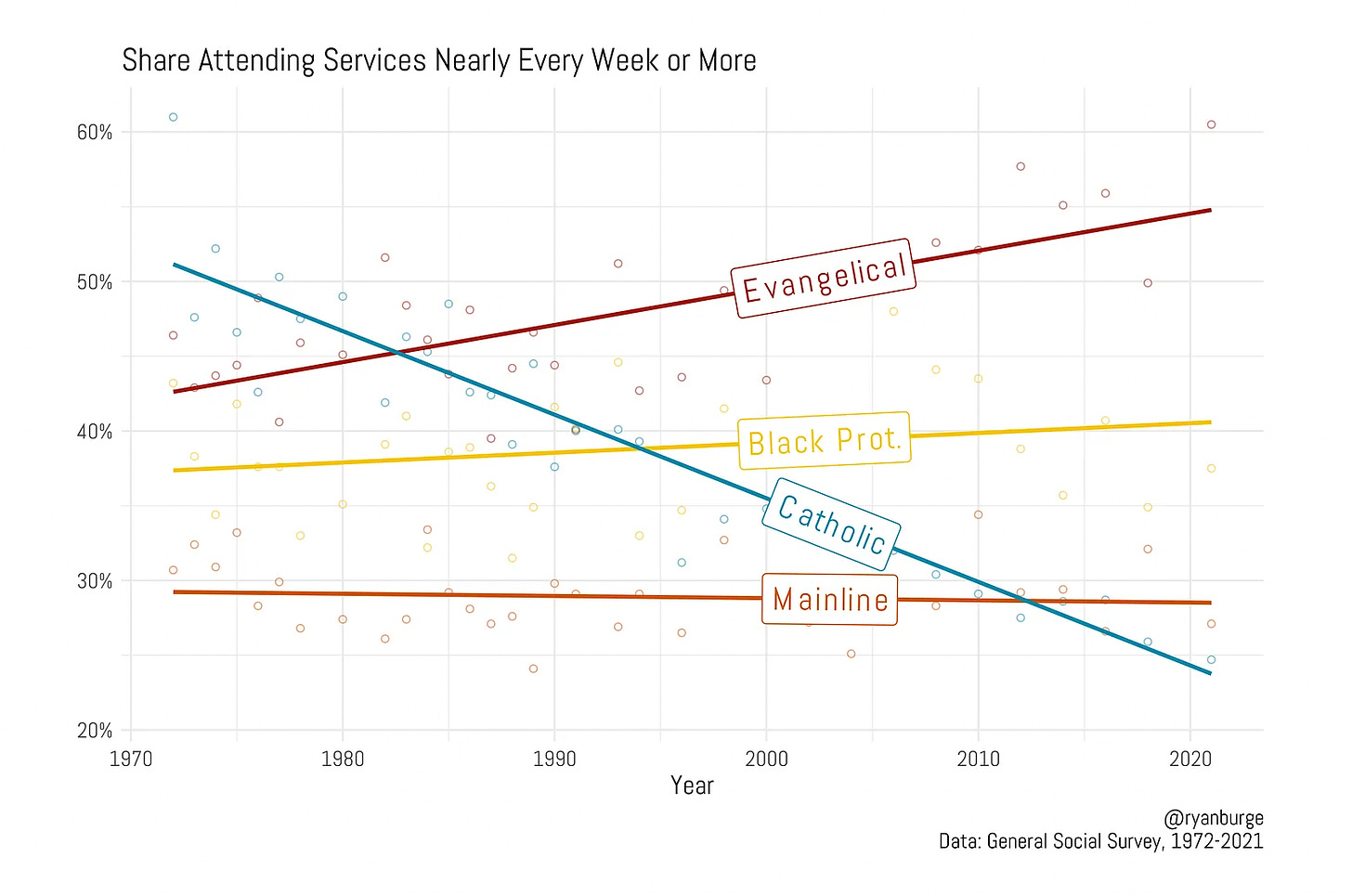
It’s a real dog-bites-man story, to write about how religious liberalism is dying. But Ryan Burge, a political scientist who specializes in religion (and a pastor of a liberal Baptist congregation), notes a new academic paper producing more evidence that liberals abandon religion, while conservatives find churches where they feel comfortable with their politics. Read the paper via the link.

Via Rod Dreher (emphasis added).

I consider it a shame and a scandal that there should be a measurable link between conservative politics and religiosity. I could be wrong — specifically, I could be over-reacting to the toxicity of so much of American politicized religion (the bane of my existence for more than 30 years) — but I think authentic Christianity is substantially orthogonal to American political categories, or at least can accommodate a bit more than center-left to center-right. Churches should make very few feel like aliens because of their politics.

Magnificent scatological rant

Silicon Valley’s worldview is not just an ideology; it’s a personality disorder. It even drove me to the dictionary twice. (I had no idea what a fluffer was.)

City Lights go out

On Monday, Rachel Swan reported for the San Francisco Chronicle:

Czech TV journalist Bohumil Vostal was capturing what he thought would be a majestic shot — San Francisco’s iconic City Lights bookstore, steeped in the gathering dusk — when three masked assailants approached with guns pointed.

“They were heading at my camera man, aiming a gun at his stomach, and one at my head,” Vostal said in an interview Monday, growing breathless as he recounted the harrowing incident at 5 p.m. the night before.

…Like many reporters, Vostal had seen news coverage of unruly shoplifters, open-air drug markets and commercial vacancies, but he hoped to portray the city in a more positive light…

The Chronicle notes that Mr. Vostal and his colleagues are from a public television station, so perhaps they were just as eager as U.S. public broadcasters to paint flattering portraits of jurisdictions run by leftists. But that was before the harrowing incident. And if you’ve lost Bohumil Vostal, you’ve lost middle America.

Heather Knight [reports](https://www.nytimes.com/2023/11/14/us/san-francisco-apec-czech-reporter.html#:~:text=The thieves grabbed $18,000 worth,lost all of his footage.) for the New York Times:

The thieves grabbed $18,000 worth of equipment, including a camera, lights and a tripod, and jumped into a getaway car as a stunned Mr. Vostal futilely tried to memorize its license plate.

“They took my research, my time, my ideas,” Mr. Vostal said, distraught that he lost all of his footage. “That is why I’m angry, you know?”

James Freeman, Wall Street Journal

I’m not gloating. I’m not feeling schadenfreude. I was fond of San Francisco, though I visited only once and only very briefly. Now they’ve taken it away by crime.

I’m not certain, though, about the Wall Street Journal’s habitual spin about “jurisdictions run by leftists” or such. My midwestern city is hugely more crime-ridden than when I was growing up, and it’s run by Chamber of Commerce types from center left to, occasionally, center-right (the further right seems unable to field appealing candidates).

Authoritarian, Totalitarian

“To grasp the threat of totalitarianism, it’s important to understand the difference between it and simple authoritarianism. Authoritarianism is what you have when the state monopolizes political control. That is mere dictatorship—bad, certainly, but totalitarianism is much worse. According to Hannah Arendt, the foremost scholar of totalitarianism, a totalitarian society is one in which an ideology seeks to displace all prior traditions and institutions, with the goal of bringing all aspects of society under control of that ideology.

Rod Dreher, Live Not by Lies.

Two lawyers agree: lawyering is for lawyers, and in courtrooms

David French: You know, I’m glad you said what you said about the importance of legal advocates because I mean, it’s just absolutely indispensable as a truth seeking mechanism to have smart people on 100% on the side of their respective clients, but I haven’t found a better way to get to truth.

Sarah Isgur: Haven’t found a better way.

David French: But for that Sarah that I think people haven’t really absorbed and that the “but” is that only works in the court system, okay.

Because in the court system you have rules of evidence you have rules of decorum you have all of that energy, and advocacy is channeled through a code of ethics into a formalized system where your advocacy is tested in front of an impartial judge or impartial jury, where you have a capable opponent, where you have rules of evidence.

Here’s what’s really hurting our society, is we have people who adopt a lawyer mentality in life, in activism writ large, where there aren’t rules of evidence, where there aren’t codes of ethics, and so what’s happening is we’re having this activism-driven world, where people are approaching their political cause, or their political candidate, with all the zeal that a lawyer has for their client and none of the rules and none of the limitations. And it’s creating this activist-driven culture where, as opposed to in courts, where the two advocates going at each other is a truth-seeking function because it’s channeled through all the rules with an impartial jurist. And outside of the courtroom, that same zealous advocacy mindset. becomes a truth-obscuring function. And it’s one of the reasons why we have such a problem with just knowing basic simple facts in this country right now is that we have two sides that are treating their life as partisans as if they’re lawyers unbounded by rules of ethics.

And that is really destroying … our society’s truth-seeking ability because it’s a bastardized form of the truth-seeking function we pour into our court system. And this activist mindset and the sort of activist ethos is really sort of eating our institutions alive, and so, yeah, it’s honorable to be a lawyer as a lawyer in a court system. If you’re going to take the lawyer mindset, just as a citizen, talking about your sort of favorite ideas or your political ideas. political party or your candidate, et cetera, you’re missing it, you’re missing it.

We need a lot more jurists, people who are trying to discover the truth, then we need more activists, and we’re overrun with activists right now.

Advisory Opinions

Add the vote of this retired lawyer to those of David and Sarah.

Half right

Subsidies for electric vehicles are a huge mistake. These cars are conceptually the same battery and motor as a fourth-grade science project—not a great innovation. And given high prices for EVs, subsidies are mainly a giveaway to the already well-off. If you add up carbon emissions from manufacturing, daily use and end of life, EVs have total life-cycle emissions 30% lower than gasoline-powered autos. In Silicon Valley, something is considered truly transformational if it’s 10 times better, not a third.

Andy Kesler, Wall Street Journal. Kesler thinks that infrastructure for autonomous cars is a better investment. He makes a good case, but I can’t entirely shake Matthew Crawford’s Why We Drive

Political-ish

Looking back

The reality of Biden becoming president on Wednesday is too difficult to square away, so it is simply not being squared. Instead, some are falling deeper into delusion, expanding a divide on the right that New York Times columnist Ross Douthat called “not a normal ideological division or an argument about strategy or tactics, but a split between reality and fantasy that may be uniquely hard for either self-interest or statesmanship to bridge.”

Rosie Gray, Trump Supporters’s Break With Reality Will Outlast Him, January 18, 2021.

I’d say she nailed that. We have not bridged it yet, nearly three years later, and I don’t even see much progress on bridge-building.

Contrasting demeanors

Trump has built a base of fanatic messianic support on the right preaching that America is terrible and only he can save it. Scott, essentially, is arguing that America is wonderful and his ascension to the Senate in the first state to secede from the Union before the Civil War proves it. For the party to suddenly shift from Trumpism to Scottism would be as disorienting and unlikely as shifting from, er, Tea Party conservatism to Trumpism.

Nick Cattogio, How Tim Scott Wins, published May 5 of this year.

Judging by his own rhetoric, Trump’s become the most overtly fascist major-party candidate in American history, yet he’s trouncing respectable opponents like Tim Scott in the Republican primary and would likely defeat Biden if the election were held today. How can that be? Do American voters agree with the right about “what time it is”? (You wouldn’t know it from last week’s election result.) Or have they not realized yet what they’re getting themselves into?

Nick Cattogio, What Time It Is

I hope you don’t need my commentary on this

Mike Davis, who’s a likely pick for Attorney General in a restored Trump administration, has listed five top-priority agenda items for such a restoration:

  1. Fire members of the deep state executive branch [using Schedule F reform];
  2. Indict the entire Biden family;  
  3. Deport 10 million people;
  4. Detain people at Gitmo;
  5. Pardon all people serving time or on trial for acts undertaken on January 6.

Via Damon Linker


The human voice: That we can sing seems basis for conjecture that, despite our stupidities and our sinfulness, we might be the reason the universe exists.

Alexander Riley

You can read most of my more impromptu stuff here (cathartic venting) and here (the only social medium I frequent, because people there are quirky, pleasant and real). Both should work in your RSS aggregator, like Feedly or Reeder, should you want to make a habit of it.

The Christian Conversion of Ayaan Hirsi Ali

Ayaan Hirsi Ali very recently announced that she now identifies as a Christian. She followed up the announcement with an essay in UnHerd explaining somewhat more fully.

I noted the UnHerd essay, and noted its arguable inadequacy, but held counsel, commenting only guardedly in my personal journal. Now two others,* Rod Dreher and Mark Tooley, have published comments, and they’re on roughly the same wavelength with me.

Both note the arguable inadequacies of her UnHerd essay, but both graciously defend her.

Tooley:

It sounds like she is church going but not does not describe herself as a confessional Christian. Maybe she is where the English journalist Malcolm Muggeridge was after his conversion from atheism (also like Ali disdaining British atheist Bertrand Russell), at which point he affirmed the idea but not the specific historicity of Christianity.

There are of course many, many people who convert to Christianity not because of an intense personal spiritual crisis resulting in a cathartic acceptance of Jesus Christ but because of revulsion against the world’s distortions. For such converts, Christianity is at first an intellectual and aesthetic oasis to which they flee from an arid desert. Later they often in their spiritual journey become more theologically specific. Muggeridge, in his interview with William Buckley, said he did not care if Jesus Christ physically arose from the dead. Presumably later, upon joining the Catholic Church, he did in fact care.

Dreher, who definitely suffers logorrhea and bouts of exhibitionistic transparency, had more to say:

Absent a ‘road to Damascus’ conversion moment for Hirsi Ali, it seems to these critics that she is merely a ‘cultural Christian’ as opposed to a believing one.

My fellow conservative Christian intellectuals who call out Hirsi Ali’s ‘instrumentalist’ Christianity may mean well, but they are making a serious mistake. For one, they lack charity. It is an astonishing thing to see a woman who renounced the idea of God because of the cruel and insane treatment she received from Muslims, and who turned herself into a prophet of atheism, now publicly attest to being a follower of Jesus Christ. Note well that she has done this while living around Stanford University in northern California, one of the most woke and anti-Christian places in America. This is difficult and very brave. It seems to me that we owed her more understanding than some of us gave her in light of her news.

More importantly, these critics misunderstand the nature of religious conversion, and do so in a way that is particular to intellectuals. St. Paul’s dramatic experience on the aforementioned road to Damascus is the paradigmatic conversion: in a flash of overwhelming awe, a man experiences God, and is changed instantly. That’s not how it works with most people.

The thing is, faith is poetry, not syllogism.

To be honest, I was for a long time ashamed of my conversion to Orthodoxy, because it wasn’t intellectually clean. I wanted to be able to state with the kind of clarity of an expert witness in the dock that I had examined the claims for authority of the Roman church, and of the Eastern churches, and the weight of evidence lay with Byzantium. It didn’t happen that way. I came into Orthodoxy as a drowning man desperate to keep his head above water. In the end, this was the best way for me to have done it. My intellectual pride—my sin, not the Catholic Church’s—had led to my spiritual shipwreck. By showing me the primacy of the conversion of the heart, and teaching me how to achieve it, Orthodox Christianity showed me out of the dark wood.

I say all this not to make a pitch for Orthodoxy, but simply to show, by using my own example, how ragged these things can be.

When I heard her in London, and read her testimony in Unherd, I felt not like marking down a theology undergraduate paper with a red pen, but like rushing in with my prayers to help a broken angel learn to fly. She is imperfectly Christian today; she may be more perfectly Christian tomorrow. And so, by God’s grace, will you and I.

Note especially Dreher’s identification of an “astonishing thing.” This is not a woman who would just go along to get along with her current post-Christendom milieu; her announcement means something.

Now, please! please! please! please! please!, just leave her alone and don’t try to put her on the Christian speaking circuit. Give this seedling a chance to grow.

* Doubtless more than two have commented, but I try to stay away from the internet’s garbage pails.

St. John the Merciful, 2023

It’s my 75th birthday and my “Name Day.”

The coincidence of birthday and name day isn’t universal in Orthodoxy, but I chose St. John the Merciful (or Almsgiver) by looking at Saints commemorated on my birthday after a futile search for inspiring lawyer-saints (the jokes almost write themselves). I do find his open-handedness admirable, and I presumably was underwhelmed by Bl. John “the Hairy”, Fool-for-Christ, at Rostov, also commemorated today.

A timely Psalm

In the midst of our domestic political chaos, the wars and threats of war in the world, and three-quarters of a century on this earth, this Psalm hit a sweet spot:

If it had not been the Lord who was on our side, let Israel now say—
if it had not been the Lord who was on our side, when men rose up against us,
then they would have swallowed us up alive, when their anger was kindled against us;
then the flood would have swept us away, the torrent would have gone over us;
then over us would have gone the raging waters.
Blessed be the Lord, who has not given us as prey to their teeth!
We have escaped as a bird from the snare of the fowlers;
the snare is broken, and we have escaped!
Our help is in the name of the Lord, who made heaven and earth.

Psalm 123/124, Revised Standard Version, via Bible Gateway (reformatted)

“Religion”

Religion has played such a large part in the lives of human beings throughout human history. In some ways, I wish we could outgrow it; I think at this point it does a lot of harm. But then, I’m fairly sure that if we do outgrow it, we’ll find other reasons to kill and persecute each other. I wish we were able to depend on ethical systems that did not involve the Big Policeman in the sky.

Octavia Butler via Maria Popova

I’m not sure what religion she has in mind — nor, I suspect, is she.

“Religion” is, in the grand scheme of things, a neologism invented in the Western world. It obscures as much or more than it reveals. I’m reminded of a cartoon I saw more than 50 years ago:

Speaker 1: All religions are alike. Just name any two and I’ll prove it.
Speaker 2: Christian Science and Melanesian Frog Worship.

Despite all that, “religion” seems to have become an indispensable word, and I confess to using it even without scare quotes. But it worries me that discussion about religion may be a diversion from growing closer to God.

A possible example of where the term “religion” might be indispensable:

False religions, perpetuate the great divide between flesh and spirit, rather than between good and evil where Christianity says it lies.

Thomas Howard, Evangelical Is Not Enough.

Speaking of Tom Howard …

Tom Howard’s book, just quoted, cleared away some of my mental rubble and spiritual biases on my road to Orthodoxy (though Howard himself “swam the Tiber” to Catholicism).

Unlike many people from backgrounds roughly like mine, I found his approach more persuasive then Peter Gillquist’s Becoming Orthodox, written about a clique of Campus Crusade for Christ (now Cru) staffers who entered Orthodoxy en masse. Suffice that Howard’s evangelical millieu was more aligned with my temperament than Gillquist’s.

I would do well to emulate Howard, who wrote sincere appreciation for all he gained through his evangelical childhood before reaching his eponymous conclusion. My own evangelical childhood was not dissimilar, but then in adolescence I encountered a fuller evangelical culture, and that’s what I (too often) excoriate. And I won’t even get started on the devolution of “evangelical” to a political label, which is beyond the control of sober evangelicals to remedy.

More Howard:

The evangelicalism of my childhood church taught me true doctrine about the incarnation. It taught me about creation and about Eden and about the Fall. But somehow it never, at least in its piety, put Humpty-Dumpty back together again. … A whole array of pickets had been thrown up between us and civilizations, lovely diversions, such as ballet, theater, cinema, and wine, and each point had its rationale, certainly. But the net effect was the plant in our imaginations the notion that spirituality was more a matter of excision than of transfiguration.

Speaking of God …

Although one must think of God constantly, he said, one must not speak of God quickly or readily. One acquires knowledge of God through the mind, but only with the aid of prayer and ascetic discipline. Gregory taught that theology is not for all people or for all occasions. Knowledge of theological matters is not necessary for salvation; only simple faith is needed. Speaking of God is a great task, but spiritual purification is far more important.

Dr. Eugenia Scarvelis Constantinou, Thinking Orthodox

Who finds the Orthodox Church?

This is kind of the culture that we’re up against. The only people who are finding the Orthodox Church, essentially right now, are people who are discontented in a current Christian experience and who have read widely enough, or are theologically savvy enough, to at least have a intellectual connection to the existence of the Orthodox Church.

Steve Robinson (at 42:00)

Of the late Francis Schaeffer …

… a theory advanced by his son:

My father’s theology was formed in a particularly bitter moment and never evolved along with the rest of his thinking. The theological battles of the 1920s and 1930s shaped Dad in the same way that political battles would shape the Vietnam generation in the 1960s. Passions forged in those battles became part of a personal identity that was difficult for people who did not share the passionate and polarizing experiences to understand.

Frank Schaeffer, Crazy for God

It has been a long time since I mentioned or quoted from Frank(y) Schaeffer. Suffice that I’ve read most of his books and do not recommend that you do so. But this theory joins one other quote from him as worth sharing.

The most dangerous foe, as seen from Mercerburg

The most dangerous foe with which we are called to contend, is again not the Church of Rome but the sect plague in our own midst; not the single pope of the city of seven hills, but the numberless popes—German, English, and American—who would fain enslave Protestants once more to … mere private judgment and private will. … the deceived multitude, having no power to discern spirits, is converted not to Christ and his truth, but to the arbitrary fancies and baseless opinion of an individual, who is only of yesterday.

Nathan O. Hatch, The Democratization of American Christianity, quoting “Mercerburg Theologians” Philip Schaff and John W. Nevin.

I did not know of Mercerburg Theology until after I’d become Orthodox, though Philip Schaff compiled a collection of patristic writings that’s still popular, perhaps because it’s free on the internet.

Mercerburg is a fascinating “so near yet so far” moment in Protestantism.

Straight answers, true answers

We often avoid giving a straight answer because the nature of true answers [is] often not straight.

Fr. Stephen Freeman, Lost and Found: Playing Hide n Seek with God Session 1


The human voice: That we can sing seems basis for conjecture that, despite our stupidities and our sinfulness, we might be the reason the universe exists.

Alexander Riley

You can read most of my more impromptu stuff here (cathartic venting) and here (the only social medium I frequent, because people there are quirky, pleasant and real). Both should work in your RSS aggregator, like Feedly or Reeder, should you want to make a habit of it.

Sunday, 11/5/23

Blind spot

Like Billy Graham, [Francis Schaeffer] took American capitalism as a given and never thought about how it might be contributing to the secularization of the country.

Frances FitzGerald, The Evangelicals

Ecumenical Councils

In the century from 1123 to 1215, it was popes who called together synods of bishops that were thereby declared ecumenical. And they did so with the principal goal of reforming the Church. Historically, ecumenical councils had been called to address great heresies, such as Arianism, Nestorianism, or iconoclasm. Not so those designated ecumenical by the reform papacy. In less than one century, no fewer than four such councils were called at the papal headquarters at the Lateran Palace.

John Strickland, The Age of Division

Miracles you won’t see on TV

I shared a meal this week with some Orthodox friends. One had just returned from Thessaloniki, Greece, where he visited a parish where a newborn baby who had been pronounced dead was given a kind of baptism ritual, even though he was not alive. The child was born on the feast of St. Demetrios, the early fourth-century patron of the city. When the priest baptized him “Demetrios,” they all heard a sharp intake of breath, and the baby began to cry. This just happened.

[J]ust as the prayers of St. Demetrios raised a baby from the dead the other day, none of us know what God has in mind for us if we choose to turn away from our corruption and to Him. At that same meal with the Orthodox guys, another told a story about an American Orthodox priest of his acquaintance who was serving liturgy when an elderly man dropped dead. He rushed over to him to try to help, but it was too late. He was quite dead. Paramedics were called. The priest anointed the dead man with holy oil … and he woke up. It was a miracle. We need a miracle like that.

Rod Dreher

That hits home as I was in Thessaloniki, in Church named for St. Demetrios, within the past two weeks.

(I heard a more coherent version of the first story, no less miraculous, from another source, but I’m too lazy to transcribe that podcast account. I believe the accounts. Help, O Lord, my unbelief.)

Historic Christianity, Reformational Christianity, Evangelicalism

Catholicism had, by this time, reoriented my theological concerns around the concerns of the Church catholic. My assumptions, and the issues that animated me, were those of the Church of history. My evangelical upbringing had led me to believe that Protestantism entailed the rejection of these concerns. But this notion exploded upon contact with the Protestantism of history.

Onsi A. Kamel, Catholicism Made Me Protestant, H/T Rod Dreher. I’m not sure how I missed this four years ago; it’s quite good. The key, though, is that Evangelicalism, as Kamel experienced it, didn’t even seem to ask the right questions.

I recommend this review of In Search of Ancient Roots as a companion to the Kamel essay.

One of my favorite prayers

Bless my enemies, O Lord. Even I bless them and do not curse them.
Enemies have driven me into Your embrace more than friends have. Friends have bound me to earth, enemies have loosed me from earth and have demolished all my aspirations in the world.
Enemies have made me a stranger in worldly realms and an extraneous inhabitant of the world. Just as a hunted animal finds safer shelter than an unhunted animal, so have I, persecuted by enemies, found the safest sanctuary, having ensconced myself beneath Your tabernacle, where neither friends nor enemies can slay my soul. Bless my enemies, O Lord. Even I bless them and do not curse them.
They, rather than I, have confessed my sins before the world.
They have flagellated me, whenever I have hesitated to flagellate myself.
They have tormented me, whenever I have tried to flee torments.
They have scolded me, whenever I have flattered myself.
They have spat upon me, whenever I have filled myself with arrogance.
Bless my enemies, O Lord. Even I bless them and do not curse them.
Whenever I have made myself wise, they have called me foolish.
Whenever I have made myself mighty, they have mocked me as though I were a dwarf.
Whenever I have wanted to lead people, they have shoved me into the background.
Whenever I have rushed to enrich myself, they have prevented me with an iron hand.
Whenever I thought that I would sleep peacefully, they have wakened me from sleep.
Whenever I have tried to build a home for a long and tranquil life, they have demolished it and driven me out.
Truly, enemies have cut me loose from the world and have stretched out my hands to the hem of Your garment.
Bless my enemies, O Lord. Even I bless them and do not curse them.
Bless them and multiply them; multiply them and make them even more bitterly against me –
so that my fleeing to You may have no return; so that all hope in men may be scattered like cobwebs; so that absolute serenity may begin to reign in my soul; so that my heart may become the grave of my two evils twins: arrogance and anger;
so that I might amass all my treasure in heaven;
ah, so that I may for once be freed from self-deception, which is entangled me in the dreadful web of illusory life.
Enemies have taught me to know – what hardly anyone knows – that a person has no enemies in the world except himself.
One hates his enemies only when he fails to realize that they are not enemies, but cruel friends.
It is truly difficult for me to say who has done me more good and who has done me more evil in the world: friends or enemies.
Therefore bless, O Lord, both my friends and my enemies.
A slave curses enemies, for he does not understand. But a son blesses them, for he understands.
For a son knows that his enemies cannot touch his life.
Therefore he freely steps among them and prays to God for them.
Bless my enemies, O Lord. Even I bless them and do not curse them.

St. Nikolai Velimirovich, Prayers by the Lake

Where to begin an answer …?


A fundamental reality of human existence is that vice often leaves virtue with few good options. Evil men can attach catastrophic risks to virtually any course of action, however admirable.

David French

You can read most of my more impromptu stuff here (cathartic venting) and here (the only social medium I frequent, because people there are quirky, pleasant and real). Both should work in your RSS aggregator, like Feedly or Reeder, should you want to make a habit of it.

Sunday, 10/29/23

A chorus cries out

“All the prophets have from the beginning cried out to my soul, imploring her to make herself a virgin and prepare herself to receive the Divine Son into her immaculate womb;

Imploring her to become a ladder, down which God will descend into the world, and up which man will ascend to God.

Imploring her to drain the red sea of sanguinary passions within herself, so that man the slave can cross over to the promised land, the land of freedom.

The wise man of China admonishes my soul to be peaceful and still, and to wait for Tao to act within her. Glory be the memory of Lao-tse, the teacher and prophet of his people!

The wise man of India teaches my soul not to be afraid of suffering, but through the arduous and relentless drilling in purification and prayer to elevate herself to the One on high, who will come out to greet her and manifest to her His face and His power. Glorious be the memory of Krishna, the teacher and prophet of his people!

The royal son of India teaches my soul to empty herself completely of every seed and crop of the world, to abandon all the serpentine allurements of frail and shadowy matter, and then–in vacuity, tranquility, purity and bliss–to await nirvana. Blessed be the memory of Buddha, the royal son and inexorable teacher of his people!

The thunderous wise man of Persia tells my soul that there is nothing in the world except light and darkness, and that the soul must break free from the darkness as the day does from the night. For the sons of light are conceived from the light, and the sons of darkness are conceived from darkness. Glorious be the memory of Zoroaster, the great prophet of his people!

The prophet of Israel cries out to my soul: Behold, the virgin will conceive and bear a son, whose name will be — the God~man. Glorious be the memory of Isaiah, the clairvoyant prophet of my soul!

O heavenly Lord, open the hearing of my soul, lest she become deaf to the counsels of Your messenger.“

Saint Nikolai Velimirovic in his Prayers by the Lake, via Steve Robinson.

A horrible scandal and its roots

After I moved back to East Texas from college, my sister’s husband invited me to hear their “new preacher,” which was always their evangelical hook—”Wait till you hear our new preacher!” Cornered, without an excuse at the ready, I accompanied them one night to their revival. It was a stem-winder lesson on the “End Times,” the “Rapture,” and the assorted framework of beliefs that held that construction together.  This was a long time ago, so long ago that it was back when he was still speaking to me. I think I must have been twenty-two years old at the time, and the sermon was certainly effective, just not in the way he expected it to be. The Baptist church was everything I remembered it to be, and I have, except for the occasional funeral or wedding, never been back.

Instead, I joined up with the Restorationist church of my dad’s people, at least on his mother’s side.  I met my wife there and spent a little over twenty-five years with them.  We claimed not to be nondenominational, but rather _un_denominational.  This was believed to be true because: 1) our hermeneutic was the correct one; 2) we “went just by the Bible,” and of course, nobody in Protestant history had ever thought of that before; and 3) we said so. I never bought into this foundational underpinning, but largely kept my mouth shut as long as I could.  In my observation, we still quacked and waddled just like the other waterfowl in the Protestant pond.  But I will have to hand it to my old church:  we were decidedly not Pre-millennial. Charles Darby meant nothing to us. We avoided Scofield Reference Bibles. The words “rapture,” and “Great Tribulation,” and “Thousand-year reign,” were not in our vocabulary.

The Orthodox Church has a 2,000 year old stake in the [Middle East]. The people who suffer under the yoke of Zionist policy–Palestinian Arabs–can just as easily be Orthodox (or Catholic) Christians as Muslims. True, the percentages are small, and due to the persecution, continuing to shrink. But when Israelis look at them, they do not see a Christian, but rather a Palestinian. I have always been amazed that American Christian Zionism is such a one-way street: it is all about Evangelicals bending over backwards to accommodate the Israeli state, whereas there is no reciprocal behavior on their part towards Christians.

Terry Cowan

Terry and I are cyber-friends of what seems like more than a decade now. I quote the first two paragraphs because they’re roughly parallel to my experience over my lifetime, the last because indifference to Christians in the Middle East, especially if Israel is in the mix, is a horrible scandal, rooted in the prophecy-porn devolution of dispensationalist heresy, for which scandal (and heresy) evangelicals must one day give an account.

Truth about the End Times

Orthodox Holy Tradition says clearly that the Second Coming, the General Resurrection, and the Last Judgment are three facets of one single, overwhelming event. There is no divide (which is the meaning of the heresy of chiliasm, which was rejected in the Second Ecumenical Council, and the reason why we say “and His Kingdom shall have no end” in the Creed). There is no Rapture. There is no Seven Year Tribulation. There is no single human individual who is the Antichrist or the Beast — the Antichrist is not a Jew, not a Muslim, not a Communist, nor is he the Pope or any one of the many theories that have been published over the centuries.

There is no literal thousand-year-long Millennium. There is no reappearance of Satan setting off the last Armageddon.

There will indeed come the Great Universal Transfiguration that overwhelms time and space and all Creation.

This is the Kingdom i[n] its infinite, almost terrifying fullness and glory.

Fr. Jonathan Tobias, The Last Judgment and the Problem of Goathood

Throwing down the gauntlet

[A]t the outset I will state:

  1. The Bible is not the Christian Holy Book.
  2. Christians (and Jews) are not People of the Book.
  3. Submission to God is not a proper way to describe the Christian faith.

Further, any and all of these claims, once accepted, lead to fundamental distortions of Christianity. An extreme way of saying this is that much of modern Christianity has been “Islamified.” Thinking critically about this is important – particularly in an era of renewed contact with Islam.

Fr. Stephen Freeman, Has Your Bible Become A Quran?

If you’re so godly, why ain’t you rich?

I frequently think about our technical prowess and material prosperity in The Thing That Used to Be Western Christendom, in contrast to Eastern Christendom.

The west has developed technically in direct relationship to the decline of the Christian consciousness, for the simple reason that the “secularization“ of nature that permits it to be regarded as an object and so to be exploited technically, is in direct contradiction to the sacramental spirit of Christianity, wherever and whenever this is properly understood, as it was at least to some extent in the medieval world.

Philip Sherrard, The Rape of Man and Nature


You can read most of my more impromptu stuff here (cathartic venting) and here (the only social medium I frequent, because people there are quirky, pleasant and real). Both should work in your RSS aggregator, like Feedly or Reeder, should you want to make a habit of it.

Sunday, 10/15/23

Orthodoxy

I came across a lot of things recently that illuminate the Orthodox Christian faith.

Collected thoughts on Orthodoxy

The knowledge about God results in definitions and distinctions. The knowledge of God leads to this one, incomprehensible, yet obvious and inescapable word: holy. And in this word we express both that God is the Absolutely Other, the One about whom we know nothing, and that He is the end of all our hunger, all our desires, the inaccessible One who mobilizes our wills, the mysterious treasure that attracts us, and there is really nothing to know but Him.

Fr. Alexander Schmemann, For the Life of the World

Tradition will always feel nebulous, indefinable, and inscrutable, and yet we differentiate between truth and falsehood, right and wrong, Orthodox and not Orthodox based on whether the idea comports with Tradition.

Dr. Eugenia Scarvelis Constantinou, Thinking Orthodox

Orthodoxy is not so much a series of doctrines and practices to be grasped once and for all, but a way of life that one takes up, growing in perfection with each passing year.

Rod Dreher, Reconciling With the Really Real

From the rising of the sun even to the place where it goes down, my name shall be great among the nations; and in every place incense shall be offered to my name, and a pure offering: for my name shall be great among the nations, says the Lord of Hosts.

Malachi 1:11 (emphasis pointedly added)

Grokking Orthodoxy

What changed my mind is my own writing. The older I got, the more I felt the need to share my belief with others. I felt it in a good and peaceful way in the Catholic Mass. I prefer the Orthodox Mass, but for a Westerner, it’s very hard to get into the Orthodox mindset — the references are quite different. I knew so much of the Catholic Church that I didn’t manage to jump over to the Orthodox Church.

Jon Fosse, Nobel Laureate in literature, 2023.

This comment surprised me yet, considering what I’d learned about Fosse’s prose style, didn’t entirely surprise me.

He is correct that “for a Westerner, it’s very hard to get into the Orthodox mindset.” I’ve been at it for more than 26 years now, and it’s still a challenge. But it seems to me that the “problem” is the Western mindset — drilled into me pervasively for almost 50 years, including in church to a shameful extent — not the Orthodox mindset.

For most of the world

Wise government, and knowledge in general, were deemed more likely to come from ancient learning than experimental progress. Similar things were true in the Islamic world. Europeans were the anomaly here. Historically speaking, virtually all cultures put a higher value on tried and tested ancestral wisdom than on newfangled, unproven contemporary innovation. That is easy to forget in the contemporary West, where we are so shaped by the notion of progress and the expectation that we will know more tomorrow than we do today. But from an eighteenth-century perspective, what needs explaining is not why Chinese education centered on two-thousand-year-old Confucian texts, or Islamic learning on the Koran, or why traditional societies prized certainty over possibility. These represent the norm in almost all times and places, including medieval Europe. What needs explaining is why early modern Westerners started doing the opposite. Why did their cafes, museums, and stately homes fill with “curiosities”? Why did the pursuit of novelty, discovery, and possibility begin to win out over antiquity, familiarity, and fidelity?

Three factors were particularly significant. The first was [Western] Christianity, whose influence on the psychology, sociology, eschatology, and theology of Western Europeans over the course of a millennium or more can scarcely be exaggerated. Psychologically, as we saw from Joseph Henrich’s work in chapter 2, we can thank the Roman Catholic Church and its theology of marriage for the “highly individualistic, self-obsessed, control-oriented, nonconformist and analytical” way our brains work. Sociologically, the Western Church also created the European bourgeoisie—the urbanized middle class of “burghers” or “townsfolk” with their charters, guilds, and universities—as an unintentional by-product of the papal revolution in the eleventh and twelfth centuries. Eschatologically, the hope of the coming kingdom generated an expectation that the future would be better than the present, and that progress was therefore possible (in contrast to religious systems in which history is a series of cycles, or even a steady decline from a Golden Age in the distant past).

Andrew Wilson, Remaking the World, pp. 231-32

There’s more to it than this, but this is important: Orthodoxy is more like the rest of the world than like the progress-seeking Westerners. Yet living here, I’m still subject to all the blandishments of our WEIRDER culture:

  • Western
  • Educated
  • Industrialized
  • Rich
  • Democratic
  • Ex-Christian
  • Romantic

Martin Shaw’s Christian journey

Of his Christian journey, fairly recently begun:

I’ve grown a little in a sense of theology and church history, but not, I hope, at the exclusion of the thing itself; a stumbling encounter with divine ground. And the more I experience that, the quieter I feel. I remember St Ignatios of Antioch: ‘he who possesses the word of Jesus can even hear his silence’. I would make no claims to have that mastery, but I do have experience – however briefly – of to what he’s referring.

And for us Christian worker-bees, some of us have to be careful of gargling with too much overt mysticism. It can distract us from the voluminous-ordinary. Me at least. We start proclaiming about hesychasm when we’ve spent roughly five minutes being vaguely quiet and twiddling our prayer rope.

(I think the silence of God is for me partially a sense of an abiding presence as well as active instruction. By their nature, these things require sitting with.)

Martin Shaw

I’ll be “sitting with” on Mt. Athos for a while, during which imminent trip I won’t be blogging.

Dogma

Dogmas are important, but not as the building blocks of some comprehensive account of the Divine Mysteries, but rather a series of decisions, arrived at by the Church, that are there to prevent ways of thinking that might obscure or bypass the mystery of God before which we stand in awe…

Andrew Louth via Martin Shaw

Christian voices from other traditions

The American religious scene

The result is a religious landscape dominated by popular Christian ideas that have “gone mad,” as G.K. Chesterton once put it, “because they have been isolated from each other and are wandering alone.” This America has a church of self-love, with prophets like Oprah Winfrey preaching a gospel of the divine self, a “God Within” spirituality that risks making selfishness a virtue. It has a church of prosperity, with figures like Joel Osteen as its bishops, that insists that God desires nothing more for his elect than American prosperity, capitalist success. And it has churches of politics, preaching redemption through political activism — a Christian nationalism on the right, by turns messianic and apocalyptic, and a progressive utopianism on the left, convinced that history’s arc bends always in its favor.

Ross Douthat, The Americanization of Religion

Re-enchantment as a luxury belief

Now that we are comfortably on the other side of scarcity, tyranny, ignorance, and the likelihood of dying young, it’s easy to overlook the material, moral, and political accomplishments of modernity and note only its fragmentation, irrationalities, alienation, and malaise. For some religious people, malaise provides a motivation to re-enchant the world, and, indeed, the theme and hope of re-enchantment is prevalent among young Christians. While I have genuine sympathy for their frustrations at the state of the world, too often they express a craving for meaning more than truth, and not always in entirely reasonable ways, including ways that exacerbate the anxieties and frustrations of the moment.

R.J. Snell, Life in the Ruins: Keeping Faith within the Immanent Frame

That paragraph encapsulates a lot. I’m one of those who tends “to overlook the material, moral, and political accomplishments of modernity and note only its fragmentation, irrationalities, alienation, and malaise”.


As noted, I’m heading for Mount Athos, and when this posts, I’ll already be in Thessaloniki, preparing for a Monday boat trip to the Mount. I’ll not be posting this week and will be largely incommunicado.

Thursday, 8/12/23

Culture

Literature versus mere words

Jon Fosse

Some insights into Nobel Literature Laureate Jon Fosse:

You don’t read my books for the plots …

Jon Fosse to the Financial Times in 2018.

I don’t write about characters in the traditional sense of the word. I write about humanity

Jon Fosse to Le Monde in 2003.

[T]he book doesn’t say something; it does something—it works on us, giving us a kind of experience that’s impossible to get any other way.

Damion Searls of Jon Fosse, who Searls translates.

Despite my backlog of bought books, I’ve got a feeling that Fosse’s Septology is in my future.

The Bunkinator

Whatever you think about Arnold Schwarzenegger, his films, or his donkey, his book—Be Useful: Seven Rules for Lifeis bunk: “Permit me to save you the trouble of finding out for yourself: Be Useful is a raw deal, a hollow PR exercise filled with precepts and quips but devoid of self-awareness or humility. You might be swayed by Arnie’s touching faith in bipartisanship and the need to tackle the climate crisis or moved by his tales of heroic procurement of personal protective equipment during the early days of the COVID-19 pandemic. But as a pitch for Marcus Aurelius status (the erstwhile emperor is thanked in the acknowledgments), it’s thoroughly expendable — an overpromoted TED Talk, just another cross-promotional weapon in the Schwarzenegger multimedia arsenal.”

Charles Arrowsmith, Sensei Schwarzenegger? The Governator attempts a reboot with a pallid self-help book via Prufrock

Stop Reading the News

This one’s aimed at me, but you might benefit, too:

We’re all connected. The planet is a global village. We sing “We Are the World” while swaying back-and-forth in harmony with thousands of others, holding our tiny lighters. This sense of empathy, magnified a thousandfold, feels wonderfully soft and cozy end yet it achieves absolutely nothing. This magical sense of all-encompassing, worldwide fellowship is a gigantic act of self-deceit. The fact is, consuming the news does not connect to other people and cultures. We’re connected to each other because we cooperate, trade, cultivate friendships and relationships, fall in love.

Rolf Dobelli, Stop Reading the News.

From my earliest youth, I understood that keeping up on current affairs was considered the lowest of low bars for good citizenship. I now seriously doubt that — though I really appreciate our local retired ink-stained wretch’s Substack, which in some ways outperforms his former employer’s newspaper in coverage of relevant local news (where individuals might influence things).

The present madness

Gate-crashers

But they identify as Women in Tech: There is a conference for women in tech, a group we used to care about a lot. It’s called Grace Hopper Celebration of Women in Computing, after the pioneering computer scientist. And since 1994, it’s been a place for women in the industry to gather, meet with recruiters, and hear female leaders talk onstage, though more recently the conference has opened to women and nonbinary folk. Something strange occurred this year: a ton of people signed up, claiming to be nonbinary. Those people happened to look a lot like what we used to call men. An event organizer took to the stage to say: “Simply put, some of you lied about your gender identity when you registered.” But how can they know this? What special test is there for nonbinary identification? Having more than two earrings? Hating your dad? 

Suddenly, NPR was engaging in transphobic gender essentialism, writing that “men took over” the job fair. Suddenly it was very, very easy for NPR to see that men would take advantage of gender self-ID to get into a women’s space. But it remains impossible to imagine a man would also do this to get into, let’s say, a women’s prison, or a women’s-only hospital ward, or a rape crisis center, or a domestic violence shelter, or a women’s changing room, or a women’s bathroom. You see, the women in prison are poor and are not friends with NPR employees; the women at the tech conference went to Barnard! Big difference

Speaking of something no one would never take advantage of—sports. The Swimming World Cup announced a whole new category this year for trans and gender-nonconforming folks to compete. I think it’s great—everyone who wants to race ought to be able to race, and this seemed really logical. Weirdly, when barred from competing against biological women but instead offered a trans category. . . no one signed up. World Aquatics, the governing body of the Swimming World Cup, announced this week they plan to try again. 

Nellie Bowles

Triggers

Life is triggering. Part of being an adult is learning to take responsibility for your feelings instead of insisting that it’s the world’s responsibility not to trigger you.

Coleman Hughes, whose TED Talk advocating color-blindness somehow has not yet been published. Reports of the reason(s) vary, and I’d only be revealing my cognitive bias if I noted that the true reason is obviously that some malcontent progressives at TED prefer antiracism™ to color-blindness.

(Oops!)

(Via Andrew Sullivan)

Rootedness and identitarianism

In all the time I have spent with people who live in genuinely rooted cultures – rooted in time, place and spirit – whether that be here in the remnants of rural Ireland, in indigenous communities in Mexico, Papua or India, on some of the last small farms in England, or simply talking to Maori or Native American or Aboriginal Australian people, I have been struck by one fact: people don’t tend to talk much about their ‘identity’ unless it is under threat. The louder you have to talk about it, the more you have lost. Once an entire country is talking about nothing else, that’s a pretty good sign that the Machine has sprayed the roots of its people with Roundup and ploughed the remains into the field.

Paul Kingsnorth

Theory belied by practice

The legislation also demonstrates one of the oddest results of the modern emphasis on the radical freedom of the individual. In such a world, all must theoretically be allowed to have their own narratives of identity. But because some narratives of identity inevitably stand in opposition to others, some identities must therefore be privileged with legitimate status and others treated as cultural cancers. And that means that, in an ironic twist, the individual ceases to be sovereign and the government has to step in as enforcer. The lobby group of the day then decides who is in and who is out, with the result that, in this instance, the gay or trans person who wants to become straight or “cis” (to use the pretentious jargon), cannot be tolerated. His narrative calls into question that of others. We might say that his very existence is a threat. To grant any degree of legitimacy to his desire is to challenge the normative status of the desires of others.

Carl R. Trueman, Prohibiting Prayer in Australia (emphasis added)

Boo-boo about BOBOs

“The educated class is in no danger of becoming a self-contained caste,” I wrote in 2000. “Anybody with the right degree, job, and cultural competencies can join.” That turned out to be one of the most naive sentences I have ever written.

David Brooks, How the Bobos Broke America

What the happy man does

If any human acts may loosely be called causeless, they are the minor acts of a healthy man; whistling as he walks; slashing the grass with a stick; kicking his heels or rubbing his hands. It is the happy man who does the useless things; the sick man is not strong enough to be idle.

G. K. Chesterton, Orthodoxy

Politics

Backlash

Back in October of 2020, when Amy Coney Barrett was teed up to replace the Notorious RBG, Emma Green wrote:

Others believe Supreme Court victories for the anti-abortion-rights movement could be Pyrrhic, prompting a cultural backlash that will tilt public opinion in favor of expanded abortion rights.

At Least You Get a Judge Out of It

At the time, I annotated her observation:

I believe that fairly strongly. If the Supreme Court reverses Roe, thus returning the issue to the legislative process, we will see a lot of fake pro lifers change the tune they’ve been whistling. That’s why I long ago stopped fetishizing a human life amendment or a supreme court reversal of Roe v. Wade. We are saving more lives through crisis pregnancy centers. (On the other hand, the legislative process is precisely where the issue truly belongs, because the constitution is silent about it.)

I was wrong about the fake pro lifers abandoning the cause. Instead we saw, in the reddest of states, a Gadarene rush toward total abortion bans, no exceptions. I definitely did not foresee that.

I suspect that overreach, not the reversal of Roe v. Wade standing alone, is what has indeed created a backlash. Meanwhile, the media blackout on the Democrats’ opposite abortion extremism remains.

Effective LARPing the dark side

Of Donald Trump, Ted Cruz, Josh Hawley (and probably a few others):

[L]ike so very many elite members of the Republican Party, they’re standing well outside the white working class while they role-play a dark caricature of its values and interests. And all too many members of the American working class are eager to embrace that caricature. They soak up the pandering and pledge their loyalty in return.

David French

Radioactive

As a religious conservative, watching the MAGA Religious Right rally at the Jericho March was a red pill experience for me … The joining of religious faith to conspiracy theory, and the juicing it with nationalist fervor, and Trumpist cult of personality — it was radioactive.

Rod Dreher

Impenetrable Illogic

Then came a climactic mystification. There came along the first Yugoslavian ticket-collector, a red-faced, ugly, amiable Croat. The Germans all held out their tickets, and lo and behold! They were all second-class. My husband and I gaped in bewilderment. It made the campaign they had conducted against the young man in coffee-and-cream clothes completely incomprehensible and not at all pleasing. … young man turned out of the carriage because he had a second-class ticket,’ they would have nodded and said, ‘Yes,’ and if I had gone on and said, ‘But you yourselves have only second-class tickets,’ they would not have seen that the second statement had any bearing on the first; and I cannot picture to myself the mental life of people who cannot perceive that connexion.

Rebecca West, Black Lamb and Grey Falcon.

We are once again to a point where the reasoning of some of our fellow-citizens is impenetrable.

The Druids strike!

John Michael Greer, former Grand Archdruid of the Ancient Order of Druids in America, sees and seizes his opportunity: How magical combat can win the next election: Only a powerful spell can break our political disillusionment

Hiatus

I will be traveling on a tour of parts of Greece and a pilgrimage to Mount Athos, an Orthodox monastic Republic, and likely will not be posting again until sometime the week of October 22.


A fundamental reality of human existence is that vice often leaves virtue with few good options. Evil men can attach catastrophic risks to virtually any course of action, however admirable.

David French

You can read most of my more impromptu stuff here (cathartic venting) and here (the only social medium I frequent, because people there are quirky, pleasant and real). Both should work in your RSS aggregator, like Feedly or Reeder, should you want to make a habit of it.

Sunday, 10/8/23

From cultural criticism to bearded religious men living in caves

Paul Kingsnorth, known for his decades of cultural criticism, is explicitly giving it up — for now at least:

When I started this Substack, a few hundred people read it. Today I have 44,000 readers. The great majority are free subscribers, it must be said, so I don’t know how much they’re paying attention. But most probably got on board to read the ‘cultural criticism’ of my Machine essays. Now they’re getting stories about bearded religious men living in caves.

While I sympathise with their trauma, this is actually less of a wrench than it might seem. My writing life – my published writing life, anyway – extends back three decades now. In that time I have published nine books, only three of which might be described in any way as ‘cultural criticism’ or ‘current affairs’ or the like. The rest were novels, books of poetry and a strange memoir which in retrospect is the story of my being dismembered by God in preparation for something I couldn’t see coming.

Well, that something he was being prepared for came, and it changed him:

The comedian Stewart Lee, in his book How I Escaped My Certain Fate, wrote of how his experimental comedy routines, which largely consist of two hours of complex, interconnected, audience-insulting idea-play, had rendered him unable to do shorter stand-up gigs, formulaic jokes, or the once-simple job of acting as an MC for a roster of other comics. Though he was often asked, he said, he would always say no. ‘I am no longer fit for purpose’ he wrote, only half-jokingly. I feel the same about that ‘cultural criticism’.

Of course, I’m publishing this on a Sunday because the something that came, the something he was being dismembered in preparation for, was Jesus Christ, and specifically in the Orthodox Christian Church. Orthodoxy probably is more congruent with his prior life than other flavors of Christian piety, but it’s not the same, and it’s not the same as the culture he’d been critiquing, either.

So I think his backing away from what had been bread-and-butter publishable writing has got to be scary, but I can readily see how it’s something he needs to do if only to make more time for the things he now needs to do. I wish him well, and remember him daily in my prayers.

A different kind of teacher

Jesus is a teacher who doesn’t just inform our intellect but forms our very loves. He isn’t content to simply deposit new ideas into your mind; he is after nothing less than your wants, your loves, your longings.

James K. A. Smith, You Are What You Love

Net gain?

We have tried to escape the sweat and sorrow promised in Genesis—only to find that, in order to do so, we must forswear love and excellence, health and joy.

Wendell Berry, The Unsettling of America

Evangelical clairvoyants

Shortly after his letter appeared, Cal Thomas and Ed Dobson, who had been Falwell’s chief lieutenants in the Moral Majority, published a book questioning not just the efficacy of political action but the righteousness of the enterprise. In Blinded by Might they argued that in the process of trying to win elections conservative Christians had been seduced by the lure of power. What had begun as an effort to restore Christian values to the nation had degenerated into an unbridled partisan struggle, creating an atmosphere in which it was assumed that Democrats could not be Christians and that Bill and Hillary Clinton were the Antichrist.

Frances FitzGerald, The Evangelicals

It’s worth remembering that a few Evangelicals recognized what was happening. I do tend to forget that.

Rolling their own

Nobody came in with substantial theological or pastoral training. They were all making things up on the fly. At the time, they thought this was a good thing, because it helped them think creatively and outside the box.

Jon Ward, Testimony


Here is a quick and generally reliable rule to follow. If people have always said it, it is probably true; it is the distilled wisdom of the ages. If people have not always said it, but everybody is saying it now, it is probably a lie; it is the concentrated madness of the moment.

Anthony M. Esolen, Out of the Ashes

You can read most of my more impromptu stuff here (cathartic venting) and here (the only social medium I frequent, because people there are quirky, pleasant and real). Both should work in your RSS aggregator, like Feedly or Reeder, should you want to make a habit of it.

Sunday, October 1, 2023

Let my prayer arise

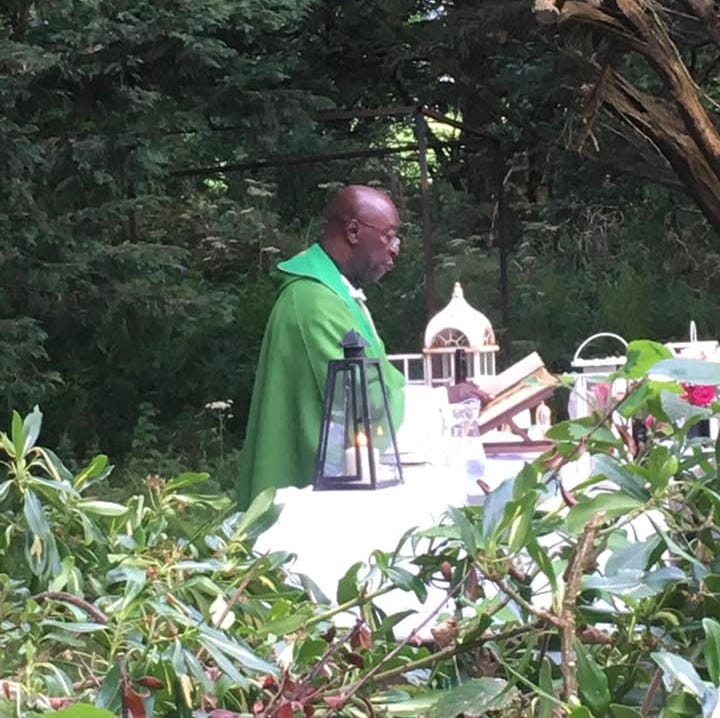
We read, “Let my prayer arise in your sight as incense,” but what we hear is, “Let the incense be like my prayer…” In the inverted world of modernity, ideas are considered spiritually “real,” while actions and rituals are somehow suspect. “If incense is like prayer, then perhaps it is legitimate,” we reason. And this is precisely how its use is often explained to those who ask.

But this reasoning inverts the Scriptures themselves. For the writer of Psalm 141, the offering of incense to the Lord is spiritual reality. It is an obedience to the command of God and a fulfillment of His divine will. It is “prayer” that is suspect – so much so that he must ask that his prayer be accepted in the same manner as incense.

During the early Roman persecutions of the Christian Church, among the most common demands made of Christians was that of the offering of incense before the image of the Emperor. It was perceived as an act of worship – an honor that belonged to a god. Christians did not disagree with this interpretation – and chose martyrdom instead. The modern Christian would today argue, “But it’s only incense.”

What our thoughts betray is a deep disconnect between the material world and the world of our thoughts. Ideas, with all of their abstract qualities, are seen as the stuff of reality, while material things are somehow superficial and devoid of content. What matters for us is not matter itself – but the ideas that we associate with it. Thus nothing has any inherent meaning – only imputed meaning. Things are only valuable and important because we think they are.

Fr. Stephen Freeman, The Sweet Smoke of Prayer

Excarnation

As Western culture has shifted its focus inward, toward disengaged reason, [Charles] Taylor sees a parallel move within Christianity—a move from embodied forms of religious worship to those in which religion is essentially something that only happens in your head.

Alan Noble, Disruptive Witness. See the preceding item, too.

Foreshadowing

May your roots go down deep into the soil of God’s marvelous love; and may you be able to feel and understand, as all God’s children should, how long, how wide, how deep, and how high his love really is; and to experience this love for yourselves, though it is so great that you will never see the end of it or fully know or understand it. And so at last you will be filled up with God himself.

For whatever reason, this passage, in that very translation, became my favorite during High School. The ethos is different enough from bog standard Evangelicalism, and close enough to Orthodoxy, that I see it now as a foreshadowing of what took a bit more than 30 more years to begin resume in earnest.

Crypto-baptists

According to legend, Roman Emperor Julian the Apostate, having failed to suppress Christianity, at his death uttered: “Thou has conquered, oh thou Galilean.”

Nobody has ever tried to suppress Baptists in America since colonial church establishments were overthrown.  But the Baptists and the non-denominationals who are mostly Baptist in all but name have indeed conquered. Nearly every other branch of U.S. Christianity is shrinking. The Baptist ethos is prevailing.  That ethos includes independent churches governed congregationally with pastors ordained by their congregations with a spiritual authority, believers’ baptism instead of infant baptism, the centrality of pulpit preaching, deemphasis on liturgy, typically more contemporary in worship, and more often than not, affirming once saved, always saved, precluding a fall from grace.

Mark Tooley, Thou Has Conquered, Oh Thou Baptists

“Small-B baptists” is what I’ve called non-baptist Evangelicals for decades now.

Is there any such thing as a non-evangelical non-denominational church? I’m not sure I’ve ever seen such a thing.

Ordinary Glory

[W]hat use is a religion that only produces characters in history books? Was there not room for more ordinary glory? Civil rights activists inspired me, but the people who changed my life were regular members of my congregation.

My mother recently purchased about an acre of land on the plantation where many of the Black Bones lived and died. She got it for around $500 because it was the slave burial site. Their bodies, never finding rest on land owned by others, now repose on land purchased by their descendants. We hold it in trust for them as their due. If the hope of Christians is true and there is a indeed a resurrection of the dead, they will emerge from those graves as free people, and their last moments on this side of the new creation will be spent on their own soil. That is a hope worthy of my allegiance.

Esau McCaulley, Why I Am Still a Christian

European Values

A reference to Christianity as an important part of European identity in the Preamble to the EU Constitutional Treaty provoked such an angry reaction that it had to be dropped as allegedly incongruent with what the EU calls “European values.” Even acknowledging the historical role of the Christian heritage is now thought too extravagant to be tolerated.

Ryszard Legutko, The Demon in Democracy

Dubious decision

Recently, Ancient Faith has announced that it will be discontinuing its blog publishing ministry in order to concentrate on other areas.

Fr. Stephen Freeman

More evidence that I’m a dinosaur. I plan to continue blogging, and wish that Ancient Faith would continue its blog publishing ministry as well.

I question Ancient Faith’s judgment at times: for instance, what improvement is it to add to a wonderful audio teaching or Bible study podcast by turning it into a YouTube of — wait for it! —the podcaster sitting in her study with headphone, boom mike, computer screen and notes? Seriously?

The Devil probably didn’t make you do it

I do believe, like billions of the world’s Christians, in the existence of the Devil. But it is precisely those who have believed in such an entity the longest, as part of a disciplined tradition of theological reflection, who will tell you how fruitless it often is to invoke Satan as the direct cause of events.

Paul Christmann, The Monster Discloses Himself, 25.1 Hedgehog Review

Words to live by

Turn off your radio. Put away your daily paper. Read one review of events a week and spend some time reading such books as the above. They tell too of days of striving and of strife. They are of other centuries and also of our own. They make us realize that all times are perilous, that men live in a dangerous world, in peril constantly of losing or maiming soul and body.

Part of Dorothy Day’s diary entry for September 28, 1940.


A fundamental reality of human existence is that vice often leaves virtue with few good options. Evil men can attach catastrophic risks to virtually any course of action, however admirable.

David French

You can read most of my more impromptu stuff here (cathartic venting) and here (the only social medium I frequent, because people there are quirky, pleasant and real). Both should work in your RSS aggregator, like Feedly or Reeder, should you want to make a habit of it.