August 4, 2024

August in Indiana is making itself felt in pretty nasty heat index numbers.

Orthodoxy proper

Catholic polemicist swims the Bosphorus

Theophan Davis, f/k/a Michael Warren Davis, has become Orthodox.

I had encountered Davis at his Theologumena blog, where he engaged in Roman Catholic polemics, and perhaps at Crisis and/or American Conservative. I have no idea why and how a post from his new Substack, YankeeAthonite, was sent to me, but the subject, Why I Became Orthodox, definitely got my attention.

On Sunday, June 23—the Feast of Pentecost—I was received into the Orthodox Church. I had announced my conversion a few weeks earlier, on May 17, via my old Substack. Then I deleted my account.

I did this for three reasons.

Firstly, the conversion process made me painfully aware of my own ignorance. For years, I worked as a Catholic journalist. I trumpeted my Catholic opinions so confidently all over the internet. In becoming Orthodox, I had to admit that I’d been wrong on some pretty big questions. Shutting up for a while seemed like the appropriate response.

Secondly, I assumed folks wouldn’t care what I have to say anymore. I’m not sure how much credibility I have left. If the answer is “none whatsoever,” I’d understand.

Thirdly, as we said, folks just aren’t terribly interested in other people’s conversion stories—not unless they’re extremely dramatic, which mine wasn’t. It destroyed my career. It ruined many of my friendships with Roman Catholics and caused a terrible strain on many others. And I will say, there were some dramatic moments: the weeping icon, etc. But if you’d been a fly on the wall, watching me for the last two years, all you would have seen was me reading, talking, praying, and sitting quietly in front of my icon corner.

“The conversion process made me painfully aware of my own ignorance” definitely resonates. For me, it was 47+ years as a fairly sophisticated Protestant layman pretty much all down the drain. It reminds me of Moody Bible Institute’s program for training missionary pilots: the first thing they tell (told?) licensed pilots entering the program is “forget everything you think you know about flying.” Ouch!

Davis continues:

What’s odd is that everyone seems to agree that my conversion was, ultimately, a rejection of Pope Francis. Let me be absolutely clear on this point: it wasn’t …

So, let me give you the cliffnotes version.

I joined the Orthodox Church because I came to believe that it’s the one, true Church founded by Jesus Christ. I became Orthodox because I believe Orthodoxy is the one, true Faith handed down by Christ to His Apostles, and by the Apostles to the Fathers of the Church.

I believe the four Eastern patriarchs were right to resist those novelties which the Western Church embraced in the centuries leading up to the Great Schism 1054. I believe they were right to reject the insertion of the filioque into the Nicene Creed. I believe they were right to condemn the popes’ efforts to expand their own ecclesial and temporal power. I also believe they were right to reject innovations such as the celibate priesthood and the use of unleavened bread during the Holy Mass/Divine Liturgy, though these are of lesser significance.

So far, so typical. Then the surprising turn:

As an aside: it’s true, the current pope did influence my conversion, though not in the way you might expect. Since Francis took office, the Vatican has issued a steady stream of ecumenical statements conceding virtually every point to the Orthodox. Then came the recent “study document” on papal primacy, which calls for a “rereading” and “reinterpretation” of the First Vatican Council.

Now, Catholic apologists are quick to point out that these texts aren’t magisterial. But that’s not the point. The point is that the Catholic Church’s greatest scholars have basically admitted that Rome bears the lion’s share of blame for the Great Schism, and that Vatican I is historically and theologically indefensible, and that the Catholic Church must return to a more Orthodox understanding of ecclesial and magisterial authority. But, then, why not just… become Orthodox?

… [B]oth Catholics and Protestants are slowly groping towards the Orthodox consensus.

Those are pretty solid reasons for leaving Rome.

I have been decidedly negative about Pope Francis — not that I should have an opinion at all. Not my circus, not my monkeys. What Theophan sees as a “steady stream of ecumenical statements conceding virtually every point to the Orthodox” merits some more attention, though I’m not sure when I’ll find the time.

Only in Orthodoxy …

But how could we ever relate to God or, even more challenging, truly unite with Him? Of all religions, only Orthodox theology emphasizes union with God—in a real and actual sense—as the goal and purpose of all human life. We rarely speak of “going to heaven,” as though it were a destination. We do not speak of experiencing a “beatific vision” of God, as though God could be viewed but remained at some distance from us. Rather, Orthodox Christianity speaks of theosis, the divinization of the human person. We expect, hope, and strive for actual union with the perfect, infinite, eternal, omnipresent, and changeless God. But we are flawed, limited, and come into existence for a brief time; we are confined to one place at one time, and we are constantly changing. So how is union with God possible? The Incarnation, the enfleshment of the Son of God, gave us the ability to truly connect to God and become united with Him, transformed and illumined by Him, not simply because He died for us but because of the way He lived among us.

Eugenia Scarvelis Constantinou, Thinking Orthodox.

This is a major difference — perhaps the most significant difference in overall mindset — between Eastern and Western Christianity.

Was it always so? No …

Anselm the Watershed

Theologians beginning with Anselm of Canterbury (d. 1109)—known as “the last of the fathers and the first of the scholastics”—presented human salvation not as the process of deification, of becoming ever more filled with the life of God, but as a one-time release from an impending punishment at the hands of an offended God who demanded satisfaction for man’s offenses.

John Strickland, The Age of Utopia

Other

A vivid (and important) image

Religious ideas have the fate of melodies, which, once set afloat in the world, are taken up by all sorts of instruments, some woefully coarse, feeble, or out of tune, until people are in danger of crying out that the melody itself is detestable.

George Elliot, Janet’s Repentance, via Alan Jacobs

Archetypes

”How has it come about,” C. S. Lewis once asked, “that we use the highly emotive word ‘stagnation,’ with all its malodorous and malarial overtones, for what other ages would have called ‘permanence’?” It is, Lewis suggests, because the dominance of the machine in our culture altered our imagination. It gave us a “new archetypal image.”

Ken Myers, All God’s Children and Blue Suede Shoes

“Religious” but unaffiliated

Both the fundamentalist and the higher critic assume that it is possible to understand the biblical text without training, without moral transformation, without the confession and forgiveness that come about within the church. Unconsciously, both means of interpretation try to make everyone religious (that is, able to understand and appropriate scripture) without everyone’s being a member of the community for which the Bible is Scripture.

Stanley Hauerwas, Resident Aliens.

For several decades now, I’ve watched this assumption play out as sundry atheists and provocateurs read the Bible as fundamentalists (and many Evangelicals) do, and then (with some justification) condemn it as absurd. Oftener than not, the response is a tortured just-so story of how that reading is not absurd at all.

That’s why this has become a favorite quote.

Nationalism

More ominous were the demands of nationalists. Since the fiascos of 1848, they had infiltrated every corner of political life. After the unification of Germany, ethnic nationalism appeared to be the genius of secularization. Deviating completely from traditional Christianity—which, as we have seen, declared the unity of all nations and races in Christ—it divided Christendom like no other force since the Great Division.

John Strickland, The Age of Utopia


… that Christ may dwell in your hearts through faith; that you, being rooted and grounded in love, may be able to comprehend with all the saints what is the width and length and depth and height — to know the love of Christ which passes knowledge; that you may be filled with all the fullness of God.

Ephesians 3:17-19 (NKJV)

You can read most of my more impromptu stuff here and here (both of them cathartic venting, especially political) and here (the only social medium I frequent, because people there are quirky, pleasant and real). All should work in your RSS aggregator, like Feedly or Reeder, should you want to make a habit of it.

Sunday, 6/28/24

Are we all expressive individualists now?

Nor does this allow for any kind of Roman Catholic or Eastern Orthodox triumphalism, whereby the historical continuity and unity of the institutions can be presented as an antidote to Protestant fragmentation. To be a Roman Catholic today is to make a choice. Thoughtful Roman Catholics may object to this claim by pointing to the sacramental power that they ascribe to baptism. But that does not really address the matter of lived experience: every faithful cradle Catholic has still made a decision to live his or her Christian life as a Catholic amid a world of other possible options, from atheism to Islam to Bible churches and Pentecostalism. When it comes to how we think of ourselves, we are all expressive individualists now, and there is no way we can escape from this fact. It is the essence of the world in which we have to live and of which we are a part.

Carl Trueman, The Rise and Triumph of the Modern Self

It has always seemed to me that this argument, which is important for someone to make, is missing some things: truth, historicity, holiness, apostolicity, catholicity. I’m only free to leave the Orthodox Church in the way Shem, Ham or Japheth would have been free to leave the ark on day 30 of The Deluge. We’ve been in a sort of Deluge — the last days — for 2000 years now.

For good reason, though I was nearly 50 years discovering it, I never felt that the Evangelical Covenant Church, Wheaton Bible Church, Lakewood Presbyterian Church in Dallas, First Baptist Church in Prescott, or the Christian Reformed Church in my hometown was the Ark of Salvation.

Western Modernity

It might not be too much of a stretch … to suggest that modernity in itself is primarily a war against religion – and that Western modernity is therefore primarily a war against our Christian heritage.

Paul Kingsnorth, God in the Age of Iron

Images flying around the internet, of a drag Last Supper tableau in the Olympic opening ceremonies, make the snippet more salient than when I first snipped it.

Kill your enemies, but not so much

Do not be overcome by evil, but overcome evil with good.

It is a very simple statement. However, when anyone begins to suggest what that might look like, critics quickly begin to offer egregious examples that would ask us to bear the unbearable, with the inevitable conclusion: “Kill your enemies.” What is suggested, in effect, is that Christians should respond in the same way as any tyrant would, only a little less so. “Kill your enemies, but not so much.”

The patriotic mythologies that came into existence together with modernity’s nationalisms are siren songs that seek to create loyalties that are essentially religious in nature. World War I, in the early 20th century, was deeply revealing of the 19th century’s false ideologies. There, in the fields of France, European Christians killed one another by the millions in the name of entities that, in some cases, had existed for less than 50 years (Germany was born, more or less, in 1871). The end of that war did nothing, apparently, to awaken Christians to the madness that had been born in their midst.

These passions are worth careful examination, particularly as they have long been married to America’s many denominational Christianities. I think it is noteworthy that one of the most prominent 19th century American inventions was Mormonism. There, we have the case of a religious inventor (Joseph Smith) literally writing America into the Scriptures and creating an alternative, specifically American, account of Christ and salvation. It was not an accident. He was, in fact, drawing on the spirit of the Age, only more blatantly and heretically. But there are many Christians whose Christianity is no less suffused with the same sentiments.

Asking questions of these things quickly sends some heads spinning. They wonder, “Are we not supposed to love our country?” As an abstraction, no. We love people; we love the land. We owe honor to honorable things and persons. The Church prays for persons: the President, civil authorities, the armed forces. We are commanded to pray and to obey the laws as we are able in good conscience. Nothing more.

Fr. Stephen Freeman

Universal Therapy

Late last week on his Substack Jemar Tisby shared with his readers some simple counsel:

You, presumably all of you, need to go to therapy:

You need to go to therapy. This is your gentle but firm reminder that mental health is part—perhaps the most crucial one—of your overall health. Physical exercise, a healthy diet, getting enough sleep–all of those matter and impact your mental health. But there is nothing quite like talking to someone who is trained in all the ways our mind can help and hinder us.

… It’s not that therapy is bad, of course. Tisby is correct that there can be value in talking to someone with a particular sort of expertise who will help you think through a problem, make better sense of a painful experience, or develop new ways of understanding or handling complicated relationships. That is certainly true.

Yet to suggest that everyone needs therapy is an excellent example … in which therapeutic concepts effectively become our doctrine of sin. … If you can’t think of anyone who does not need therapy or any time when someone might not need therapy, then you’ve elevated therapy to a place it oughtn’t occupy.

Jake Meador, Therapy and Bug Men

JD Vance’s journey

There is no doubt that the J. D. Vance of Hillbilly Elegy has changed. While news outlets will be tempted to tell this story of Vance’s transformation as a simple parable of power’s corrupting effects, there is a more illuminating account of what happened to Vance: namely, his own.

In 2020, Vance wrote an essay about his conversion to the Catholic faith: “How I Joined the Resistance.” Hillbilly Elegy has often been hailed as essential reading for “anyone wanting to understand Trump’s rise.” Vance’s 2020 essay might be the same for anyone wanting to understand the shifting currents in conservative Christianity and politics. Vance’s journey toward religion—the first millennial on a major party ticket—is the same that is and will be trekked by many millennial and Gen Z Christians of a political orientation.

Some conservatives (even religious conservatives like myself) still hold to the same economic outlook Vance did in his 2016 memoir. Some of us even hold to that economic program of tax cuts, Social Security cuts, and a suspicion of even the best-intended of regulations for reasons we find consonant with the Christian faith. But it’s important to note that J. D. Vance abandoned that outlook for religious reasons. While Vance blasts his journey to atheism as “both conventional and boring,” the truth is that his journey to Catholicism and a certain set of politics is becoming increasingly conventional as well—in ways that students of both politics and religion would be foolish to ignore.

John Shelton, When The Resistance Comes To Rule: J. D. Vance and the Apotheosis of Postliberal Politics

Hauerwas on personal relationship with Jesus

Hauerwas also addressed his emphasis upon concern around self-deception and his disagreement with piety, which he sees as an invitation to setting oneself up as a self-exemplar.

The Duke theologian is a curiosity for his disavowal of theological liberalism and simultaneous extreme dislike for evangelicalism. “I’m not a follower of either, because, one, I don’t think you get to make Christianity up: you receive it through the exemplification of people who live in a way that scares you.”

… I just don’t know the Evangelical world, but what I know of it I dislike intensely. I mean, the last thing one should want is a personal relationship with Jesus – I mean, that’s letting yourself control who Jesus is.

Stanley Hauerwas


… that Christ may dwell in your hearts through faith; that you, being rooted and grounded in love, may be able to comprehend with all the saints what is the width and length and depth and height — to know the love of Christ which passes knowledge; that you may be filled with all the fullness of God.

Ephesians 3:17-19 (NKJV)

You can read most of my more impromptu stuff here and here (both of them cathartic venting, especially political) and here (the only social medium I frequent, because people there are quirky, pleasant and real). All should work in your RSS aggregator, like Feedly or Reeder, should you want to make a habit of it.
Pre-Olympic notebook dump

Public Affairs

Everybody wants everything

Quite recently, I quoted Zaid Jilani:

In our political duopoly, you have to endorse one set of leaders or another in order to do anything constructive.

I responded that perhaps my rejection of the duopoly is because I’m not really trying “to do anything constructive” politically.

I stand by that, and I’m now reinforced by Isaiah Berlin via Alan Jacobs. Berlin:

[I]t is in fact impossible to combine Christian virtues, for example meekness or the search for spiritual salvation, with a satisfactory, stable, vigorous, strong society on earth. Consequently a man must choose. To choose to lead a Christian life is to condemn oneself to political impotence: to being used and crushed by powerful, ambitious, clever, unscrupulous men; if one wishes to build a glorious community like those of Athens or Rome at their best, then one must abandon Christian education and substitute one better suited to the purpose.

Jacobs adds:

I think Berlin is right about Machiavelli, and I think Machiavelli is right about Christianity too. The whole argument illustrates Berlin’s one great theme: the incompatibility of certain “Great Goods” with one another. The more I think about it, the more convinced I am that the inability to grasp this point is one of the greatest causes of personal unhappiness and social unrest. Millions of American Christians don’t see how it might be impossible to reconcile (a) being a disciple of Jesus Christ with (b) ruling over their fellow citizens and seeking retribution against them. Many students at Columbia University would be furious if you told them that they can’t simultaneously (a) participate in what they call protest and (b) fulfill the obligations they’ve taken on as students. They want both! They demand both

Everybody wants everything, that’s all. They’re willing to settle for everything.

If you are fearful about condemning yourself “to political impotence: to being used and crushed by powerful, ambitious, clever, unscrupulous men,” David Brooks has some help to offer: Love in Harsh Times and Other Coping Mechanisms

America’s world mission

After Putin’s invasion of Ukraine, the Biden administration imposed “super sanctions,” promising that such measures would bring the Russian economy to its knees. These measures, and the confidence with which they were imposed, reflected the old consensus, which presupposed the end-of-history dream world. But the outcomes contradict that fantasy. Countries commanding nearly half of global GDP refused to join our sanctions regime, exposing the obvious fact that the “rules-based international order” is not international and never has been. It has always been an instrument of American power.

I’m reluctant to use the word “empire.” After the fall of the Berlin Wall, the United States did not establish colonies. But the term has become unavoidable. The international order was made in our image, an ersatz empire, as recent events have revealed. Faced with the prospect of Russian aggression, the demilitarized nations of Europe are forced to operate as American vassal states.

I’m not a foreign policy expert, but I venture to guess that the combined military firepower of Russia, China, North Korea, and Iran (and its proxies) is substantial, perhaps equal to any force that the United States and its allies can bring to bear on short notice. How is it that we have allowed such a coalition to emerge? The Journal reports this expert opinion: “Russia and the other nations have set aside historic frictions to collectively counter what they regard as a U.S.-dominated global system.” I marvel at the formulation, “what they regard.” In effect, our policymakers suggest that the Russia-China-Iran-North Korea alliance rests on a misconception. Putin and Xi need to wake up to the truth. The “global system” is not U.S. dominated but U.S. sponsored—for the sake of world peace, prosperity, and the triumph of abortion and gay rights . . . er, human rights. It is nothing so narrow and parochial as the imposition of America’s national interests or our activist ideologies.

Maybe the Great and the Good in Washington recognize reality, and they mouth the old pieties out of habit; or perhaps they sense (accurately) the political danger of being the first to break with established orthodoxies. Can you imagine the domestic furor that would be visited upon a Secretary of State who suggested (again, accurately) that a foreign policy promoting gay rights and other progressive causes is a virtue-signaling luxury we can’t afford in an era of great-power competition? But I worry that we are led by true believers. Some imagine that the United States has been ordained by God to defend “democracy.” Others think that we have a secular mission to promote “reproductive freedom” and LGBTQ rights around the world (the arc of history, and so on).

R.R. Reno

Blaming the messenger

In 2023 Christopher Rufo exposed the fact that Texas Children’s Hospital was maiming minors in the service of transgender ideology. The Texas Legislature passed a bill prohibiting transgender medical procedures for minors. Now Rufo reports that the Texas Children’s Hospital has persisted in practicing “gender-affirming care,” committing Medicaid fraud in order to fund the prohibited procedures (“The Murky Business of Transgender Medicine,” City Journal). Federal officials have not stood idle. As the controversy became public in 2023, they were “busy assembling information.” The target? The whistleblowers! “A federal prosecutor, Tina Ansari, threatened the original whistleblower [Eithan] Haim with prosecution.” Then, in early June, “the stakes intensified. Three heavily armed federal agents knocked on Haim’s door and gave him a summons. According to the documents, he had been indicted on four felony counts of violating medical privacy laws. If convicted, Haim faces the possibility of ten years in federal prison.” A sadly familiar story. The rule of law turned into an ideological weapon.

R.R. Reno

Trade-offs

Writing for the Washington Post, Megan McArdle explored the questions posed by the CrowdStrike IT meltdown. “It’s quite efficient for one firm to serve a large number of important customers, as CrowdStrike does,” she wrote. “In some ways, these concentrated players might provide greater reliability, because they develop a lot of expertise by serving many users, and they can invest more in R&D and security than Bob’s Friendly Local Software Co. can. But when outages happen, they happen to seemingly everyone, everywhere, all at once, leaving users no alternatives. How best to try to manage the trade-off between efficiency and redundancy is a hard question for another day. For the moment, the important thing is to recognize that it exists, and that there’s no easy way around it. We probably should have thought more about such trade-offs when the Great Efficiency Drive was underway. We’ll have to think even harder about them now.”

The Morning Dispatch

Model collapse

Training artificial intelligence (AI) models on AI-generated text quickly leads to the models churning out nonsense, a study has found. This cannibalistic phenomenon, termed model collapse, could halt the improvement of large language models (LLMs) as they run out of human-derived training data and as increasing amounts of AI-generated text pervade the Internet. “The message is, we have to be very careful about what ends up in our training data,” says co-author Zakhar Shumaylov, an AI researcher at the University of Cambridge, UK. Otherwise, “things will always, provably, go wrong”. he says.” The team used a mathematical analysis to show that the problem of model collapse is likely to be universal, affecting all sizes of language model that use uncurated data, as well as simple image generators and other types of AI. (Source: nature.com)

John Ellis News Items

Luxury Beliefs

Young Rob Henderson has been deservedly dining out on his memoir Troubled and his coinage of “luxury beliefs.” But once you enter public debates, you not only attract crazies and trolls, but solid critics as well.

Yasha Mounk finds Henderson’s definition of luxury beliefs wanting:

Ideas and opinions that confer status on the affluent while often inflicting costs on the lower classes. And a core feature of a luxury belief is that the believer is sheltered from the consequences of his or her belief. There is this kind of element of duplicity, whether conscious or not.

He offers a substitute:

Luxury beliefs are ideas professed by people who would be much less likely to hold them if they were not insulated from, and had therefore failed seriously to consider, their negative effects.

The differences aren’t just semantic, and between the two of them, I agree with Mounk.

Now I await Mounk’s critics to further refine the definition.

Partisan politics

The Populist id weighs in on Harris

I’m not at all sure I agree with him on this, but Nick Catoggio has some pointed thoughts on GOP reactions to de facto Democrat nominee Kamala Harris:

I don’t believe the jabs about her being a “DEI hire” are part of a strategic calculus. I think they’re a matter of the populist id flaring at the thought of being governed by a black woman who’s not part of the ideological tribe.

It’s a preview of the next four years if Kamala Harris figures out a way to beat Trump this fall, I suspect. Unlike any presidency in my lifetime, her term would be wracked by obstruction, paralysis, and public disillusionment.

If you thought congressional Republicans were reluctant to compromise with Barack Obama, you ain’t seen nothing yet.

Gaslighted about the border

Remember when Joe Biden made Kamala Harris his border czar? Well, bunky, that’s no longer operative. All the cool kids agree that it never happened. Do you want to be know for cooties? C’mon, man!

At this stage of things, perhaps it’s not surprising that reporters aren’t scrutinizing Harris’s record with the same zeal with which they dove into “Russiagate,” but this marks a new low. We told you she was this thing that we’re now telling you she never was. What’s the word for that again? Right. Gaslighting.

We can be sure of this much: If the border was not a mess, if this was not a winning GOP issue, Kamala Harris would be running on it right now. And her media sock-puppet friends—who seem to believe in nothing except making sure she wins—would be celebrating “The Greatest Border Czar Who Ever Was.”

Peter Savodnik, Gaslighting the Public on Kamala Harris as ‘Border Czar’

I understood — indeed, sympathized with — the desperation to keep Trump from the Presidency in 2016. But a lie is a lie, and they’re lying to us again.

It’s not that “they must think we’re stupid.” They do think that we’re stupid, and we give them grounds to think that day after day.

Is this half-apology better than none?

I am writing to offer an apology. The short version is this: I severely underestimated the threat posed by a Donald Trump presidency. The never-Trumpers—who never seemed to stop issuing their warnings and critiques—struck me as psychologically and emotionally weak people with porcelain-fragile sensibilities. It turns out their instincts were significantly better attuned than my own.

My judgment of colleagues and of various conservatives who opposed Trump was privately severe. On the surface, I fully granted the strength of their concerns. But in the confines of my mind, I concluded that they were moral free riders. They wouldn’t sully themselves by voting for Donald Trump, but they would benefit from many of his policies. I have been asked why I voted for him when I live in Tennessee where my vote was not necessary. I voted for him exactly because of my determination not to be a free rider. I would bear the weight of the decision.

I knew I was wrong as January 6 approached and the president started calling for Vice President Mike Pence to reject certification of the electoral college results. This, of course, was on top of his disturbing phone call to the Georgia Secretary of State urging him to “find” additional votes. At the same time, he encouraged Americans to mass at the Capitol to support his cause.

I do not suggest that the Americans who went to the Capitol, the great majority of them peaceful, bore ill intent, but I do think that the president intended to create a spectacle that would put pressure on Mike Pence to take a dramatic and extra-legal step that would fundamentally betray the American political order and its traditions.

Hunter Baker, When Pragmatic Politics Goes Bad: An Apology to the Never Trumpers

This column is ever-so-timely again. I say that not to praise the de facto Democrat nominee, nor even to imply that she’s a “lesser evil.” I say it, first, as a call to repentance from the behavior that got us into this awful mess. Insanity, by one pop-definition, is doing what you’ve always done and expecting a different result.

For me, part of repentance is rejecting “lesser-of-two-evils” voting calculus. Two parties of some sort were (inadvertently?) in our national DNA from the start; if one must win a majority (not plurality) of electors to gain the Presidency, then third parties are overwhelmingly “spoilers” (though not quite inevitably). I nevertheless will spoil my heart out again this quadrennium — taking care not to despise those who make the “binary” choice.

For any Christian Trump voter in 2024 (I suspect Baker will be in that camp in a few months unless he’s changed a lot since 1/21/21, when his apology was dated) whose head or heart is not dead must extend a bit of grace to those who can’t bring themselves to vote for him.

Trump as media favorite

Be at remembered that the media gave Donald Trump so much Free Press in 2016 that they virtually elected him. And while they clearly wanted to be coded as anti-Trump (their “stated preference”), the attention they gave him smells like revealed preference to me. A lot of people do like to watch him — a preference I never understood from the day a friend of mine went gaga over The Art of the Deal.

Adiaphora

Dinosaur

I like technology. I was, for my generation, an early adopter of computers and I spend (too) many hours per day on my MacBook.

But after a few years on Facebook, I dropped it. I got on it to communicate among my high school classmates, but most of them weren’t on it. And it got kind of overwhelmed with commercialism. Maybe there were plugins or something to suppress all that, but I dropped it anyway.

I dropped my Twitter account, too, unable to bear a 1/100 signal-to-noise ratio. I eventually signed up again, for some incomprehensible reason, only to find that the ratio is now 1/10000. I haven’t logged on in months. Is there any more enervating activity in the world than doom-scrolling?

I thought those were two pretty solid decisions. But now I constantly hear things on podcasts like “You can find it on our Facebook page.” (Oof! No I cannot! Why don’t you have a page on the open web?) And yesterday, the President of the United States announced on Twitter/X that he’s ending his campaign for re-election. (Mercifully, professional doomscrollers quickly surface major news like this.)

I still think those were solid decisions, but they seem pretty tame compared friends flirting with stuff like this and repeating mêmes like “be the friction you want to see in the world.”

A blast from the Covid past

I am radically testing the limits of what it fundamentally means to be outdoors by erecting walls, putting a roof on top of those walls, and then insisting that it is still outdoors. This bold subversion of commonly accepted norms challenges and deconstructs “outdoorsness” as we know it. Moreover, by performing this act of deconstruction through a literal act of construction, I am illuminating the contradictory double nature of the mere act of existing. To this end, I search for the strange within the familiar, the indoors within the outdoors, the technically compliant within the clearly unsafe.

Simon Henriques, I Am the Designer of This Restaurant’s Outdoor Seating Space, and This Is My Artist’s Statement

Why resign on August 20?

After half a century in politics, Senator Bob Menendez, found guilty of all 16 counts in his corruption trial, will resign, effective August 20. Why then? Well, as Katherine Tully-McManus notes, senators get paid on the 5th and 20th of each month. Trust old “Gold Bar Bob” to check out after payday. (Politico)

The Free Press

Technology will never end work (at least until we re-jigger our mimesis)

Futurists and their ilk keep predicting the elimination of work by technology, but it never arrives. By some reckonings, we’re working more than ever; we’re certainly not approaching zero work, not even asymptotically.

What gives? We give. We keep working because we want more. We want everything. (See Alan Jacobs, above)

Disciples of René Girard make careers out of analyzing such things, so I’ll dabbling lest I make a fool of myself.


I suffer more from the humiliations inflicted by my country than from those inflicted on her.

Simone Weil, from a letter to Georges Bernanos.

I don’t do any of the major social media, but I have two sub-domains of the domain you’re currently reading: (a) You can read most of my reflexive stuff, especially political here. (b) I also post some things on the only social medium I frequent, because people there are quirky, pleasant and real.

Sunday 7/21/24

Status report

For the second week in a row, my Sunday post is pretty thin. I am seriously trying to get my mind off politics.

On the one hand, “Put not your trust in Princes, in sons of men in whom there is no salvation. When his breath departs, he returns to the earth. On that very day his plans perish … The Lord will reign forever.” (Psalm 145/146)

On the other hand, I grew up with the understanding that responsible citizens read the news and “keep up with things.” In my eighth decade, I still reflexively do that. It’s hard to shake. (It might be easier to quit if I read and audited gutter politics, immiserating myself in the process; but I don’t, and the only thing I hate about it is the other things that get crowded out.)

Practicing contra preaching

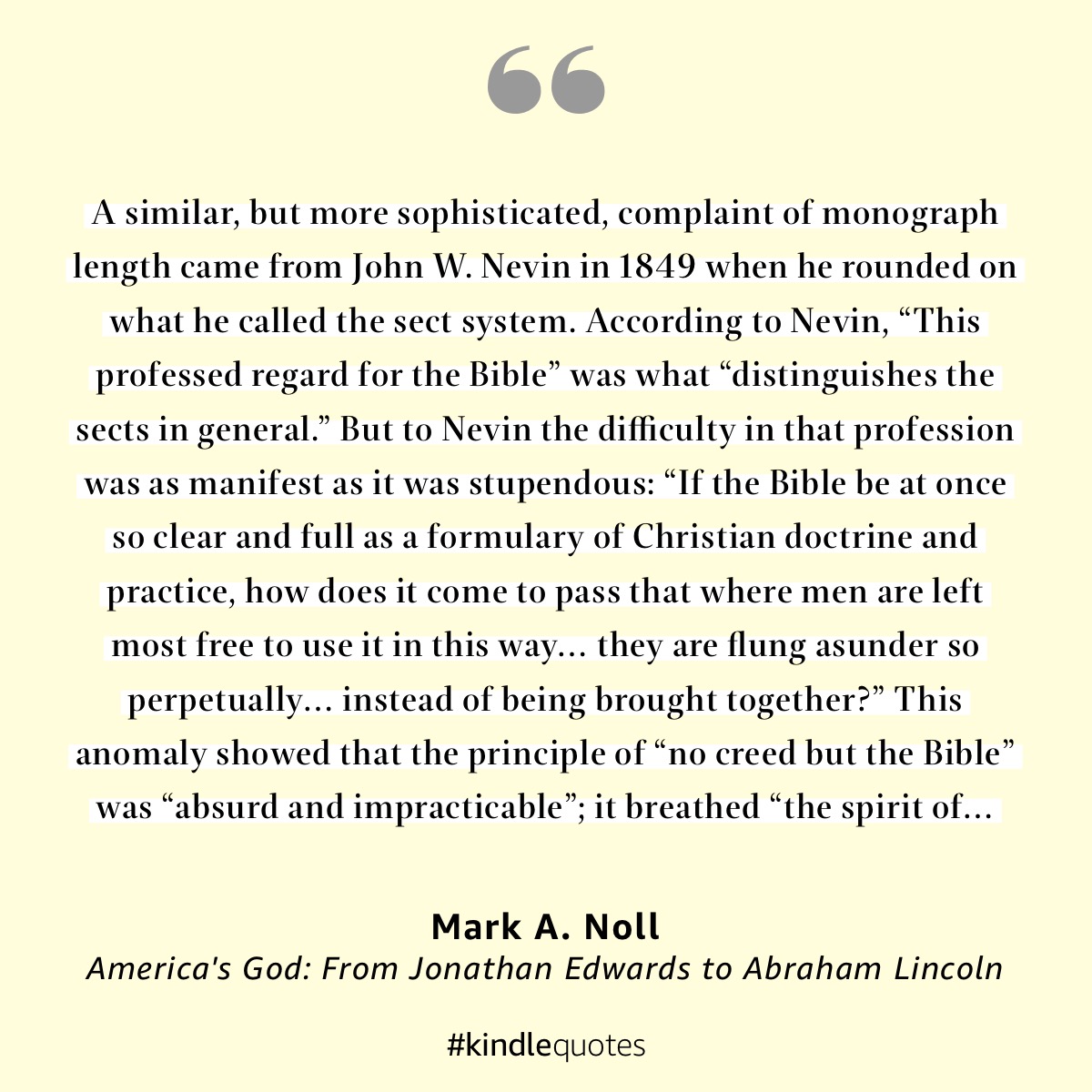
Even as they claimed to rely on the Bible alone, antebellum Protestants frequently turned to Christian saints, exegetical traditions, the practices of Christians past, and official church teachings, employing these sources to complement or clarify what they took the Bible to mean. Perhaps this betrays a deeper sense that the Bible was not as self-interpreting as many Protestants hoped. At the very least, it shows the inescapability of tradition. American Protestants never read, or argued over, the Bible alone.

Paul J. Gutacker, The Old Faith in a New Nation

When religious freedom goes to far

The story of Baptists was the story of religious freedom, and throughout the work Benedict reinforced the connection between Baptist principles and the American experiment. “We have happily arrived at an age,” he concluded, “in which the spirit of imposition has lost much of its former force.”

Paul J. Gutacker, The Old Faith in a New Nation

This spirit — the spirit of putative rebellion against authority (fomented by a competing authority, the free church pastor) — carries on in nondenominational churches, which are uniformly baptistic – “small-b baptists”.

While Methodists, Disciples, and Mormons disagreed radically on what constituted belief in the gospel, they all shared an intense hostility to the passive quality of Calvinist religious experience, and they all made salvation imminently accessible and immediately available.

Nathan O. Hatch, The Democratization of American Religion

Honor to whom honor is due

It is easy to say “give honor to God alone,” but this is contrary to the Scriptures, in which we are told to “give honor to whom honor is due”

Fr. Stephen Freeman, Everywhere Present

Provocation link

On Friday, I published this, which could have been Sunday fare.

Evangelical unawares

I never knew I was an evangelical until I went to a Trump rally.

The speaker of these words was anonymous in the telling, and I lost track of who told the story. I think it was someone on this July 11 Dispatch conversation.


… that Christ may dwell in your hearts through faith; that you, being rooted and grounded in love, may be able to comprehend with all the saints what is the width and length and depth and height — to know the love of Christ which passes knowledge; that you may be filled with all the fullness of God.

Ephesians 3:17-19 (NKJV)

You can read most of my more impromptu stuff here and here (both of them cathartic venting, especially political) and here (the only social medium I frequent, because people there are quirky, pleasant and real). All should work in your RSS aggregator, like Feedly or Reeder, should you want to make a habit of it.

Sunday, 7/14/24

I must have really overdone on politics this week judging from how few items I have for this Sunday.

The Good Life

Disruptions born of doctrinal disagreements among Christians launched the legitimation of acquisitiveness and the strange—although now all but naturalized—Western notion that a “standard of living” refers neither to a normative human model nor even to ethical precepts, but to the quantity and quality of one’s material possessions and the wealth that accompanies them.

Brad S. Gregory, The Unintended Reformation

“The good life” is an advertising theme, a photoshoot of the American Dream where all obstacles are overcome through the miracles of technology, market forces, and unfettered freedom. “A good life” is an entirely different question. A good life may very well include an abundance of suffering, disease, and deprivation. The difference in these two descriptions points towards the overarching narratives that surround them. In effect, they describe two very different religions. True Christianity is incompatible with the American Dream.

… The gospels and our faith describe a normal life, charged with glory but sifted in the suffering of our broken existence. God has entered into this very world, emptying Himself even to encompass the whole of our suffering in the fullness of the Cross. We learn to find Him there and discover that in that very emptiness He has given us His fullness. The normal life, lived fully, becomes the vehicle of our transformation.

Fr. Stephen Freeman, A Good Life Versus The Good Life

It’s all relative

Maybe we’re more conservative now because the culture moved, not because we moved.

Fr. Zachary Galante on the perception that newly-ordained Roman Catholic priests are increasingly conservative.


… that Christ may dwell in your hearts through faith; that you, being rooted and grounded in love, may be able to comprehend with all the saints what is the width and length and depth and height — to know the love of Christ which passes knowledge; that you may be filled with all the fullness of God.

Ephesians 3:17-19 (NKJV)

You can read most of my more impromptu stuff here and here (both of them cathartic venting, especially political) and here (the only social medium I frequent, because people there are quirky, pleasant and real). All should work in your RSS aggregator, like Feedly or Reeder, should you want to make a habit of it.

Saturday, 7/13/24

Democrats’ “revealed preference”

[I]t’s always been clear that the Democratic Party in the age of Trump isn’t as NeverTrump as the truest NeverTrump believers, that it usually chooses “mundane imperatives” and self-interest over emergency measures geared to existential stakes.

Time and again, from 2016 to the present, the Democratic Party has treated Trumpism not as a “civic emergency” but as a political opportunity, a golden chance to win over moderate and right-leaning voters with the language of anti-authoritarianism while avoiding substantive concessions to these voters and actually moving farther to the left.

I’m not saying that you can’t find moments here and there where Democrats moderated on some issue or made a patriotic concession for the anti-Trump cause. But the overarching pattern is better represented by the various times when Democrats deliberately boosted MAGA candidates in Republican primaries on the theory that they’d be easier to beat — or for that matter by the fact that right now, as Biden teeters on the brink, his vice president and natural successor is a figure chosen entirely for the “mundane imperatives” of Democratic interest groups, rather for a scenario where she might be called upon to face Trump with democracy supposedly at stake.

The idea of an anti-Trump “coalition of all democratic forces” has been prominent in the media and the commentariat, and there you have seen big shifts and concessions. But these have mostly been made by anti-Trump conservatives and ex-conservatives moving leftward, not by the political coalition that they’re joining.

Ross Douthat

Douthat goes on to concede some ways in which the Democrats’ approach may not be cynical and deceptive, but I’ve quoted enough. For the rest, my link gets you past the paywall.

Smart people swapping stupid barbs?

It seems that for Roberts, the criminal prosecution of Donald Trump is so transgressive as to demand the immediate intervention of the Supreme Court.

Jamelle Bouie, proving that smart people with blind spots can write stupid things.

If only Bouie had written

It seems that for Roberts, the criminal prosecution of Donald Trump, combined with Trump’s pledge to prosecute Joe Biden and lower court rulings that President’s have no immunity from criminal prosecution, are so transgressive as to demand intervention of the Supreme Court

I wouldn’t have bothered writing my own stupid things.

Lies in service of “higher truths”

This past week, a Pennsylvania man was arrested for the murder and dismemberment of a 14-year-old boy. The man allegedly lured the boy to his death through Grindr, a gay hookup app. The boy’s last Snapchat image was posted at 2:30 in the morning, on a dark road, with the comment that he was just out for a late-night walk. Nobody ever heard from him again.

Several grim and (one would think) obvious lessons should immediately present themselves to all concerned adults here. However, it appears that the adults are determined not to learn them, because this particular boy believed he was a girl. Consequently, all their energy has been spent on making sure nobody “misgenders” him in death, using him as a mascot of “anti-trans” violence, and taking the opportunity to lobby for new “hate-crime” legislation.

[The Free Press sent Ben Kawaller to Laramie, Wyoming, to talk to people about Matthew Shepard, murdered there in 1998 and lionized ever since.]

One resistant young gay man asks Ben what’s to be gained by reassessing the crime. Ben asks whether he would agree that it’s worthwhile simply because the reassessment might be true. The young man pauses for a moment, then stutters a bit, casting about. “There’s a point when you as a person should look around and see, like…read the room. And what has happened, this is really important, the, the…understanding of what happened to Matthew means a lot to a lot of people. So just leave it alone.”

Notice that this young man isn’t even bothering to debate the history or discredit Jimenez. He is saying that even if Jimenez were right, it wouldn’t matter. The truth wouldn’t matter.

Bethel McGrew, What is Truth?

After careful consideration, I decided last fall not to sit out a performance of Considering Matthew Shepard by a chorus I’ve been in for more than two decades now.

Considering Matthew Shepard is a sort of cantata on the murder of young Shepard. I carefully scrutinized the libretto for any explicit perpetuation of the Matthew Shepard myth (i.e., that it was the quintessential anti-gay hate crime) and found none. I considered the feelings of my fellow-choristers and the Artistic Director who programmed it. I also considered the “meta” point that the piece never would have been composed (and nobody would attend if it had been composed) were it not for the prevalence of the myth, and that performing it probably perpetuates the myth tacitly. My decision to go ahead and sing may have been sub-optimal. I’m still not sure.

But I want people to know that there’s almost zero truth to the myth — the standard Matthew Shepard narrative that gave us the federal “Matthew Shepard Hate Crimes” law — and almost no poetry to the truth. If you want to know the grimier and better-substantiated counter-narrative, it’s readily available.


I suffer more from the humiliations inflicted by my country than from those inflicted on her.

Simone Weil, from a letter to Georges Bernanos.

I don’t do any of the major social media, but I have two sub-domains of the domain you’re currently reading: (a) You can read most of my reflexive stuff, especially political here. (b) I also post some things on the only social medium I frequent, because people there are quirky, pleasant and real.

Friday, 7/12/2

Culture

Anti-Christian, anti-religion, anti-tradition

The modern West is said to be Christian, but this is untrue: the modern outlook is anti-Christian, because it is essentially anti-religious; and it is anti-religious because, still more generally, it is anti-traditional; this is its distinguishing characteristic and this is what makes it what it is.

René Guénon Guénon, The Crisis of the Modern World.

Creepier than frank laxity

Just don’t do it again, promise? Remember those kids who got suspended from Harvard after setting up encampments on the lawn and then harassing other students? Well, the Harvard College Administrative Board has reversed the decision, a win for the “student intifada,” which I thought was slanderous but is actually just what they call themselves. And then over at Columbia, the administrators who texted each other vomit emojis during a panel discussing a rabbi’s op-ed about his fears for Jews on campus—they were fired, right? Well, actually they were just put on leave and will be assigned to different jobs later. And remember the Columbia students who were arrested after they occupied a campus building? Most of their charges were dropped. There’s something way creepier about punishing people in the moment only to reverse it as soon as the zeitgeist moves on to the next thing versus not punishing them at all.

Suzy Weiss

Prescient

This was not written of Team Biden, but it sure seems to fit:

The elites who manage the system no longer believe in a way forward. Stuck in the muck, they strive simply to endure: après moi le deluge.

Martin Gurri, The Revolt of the Public and the Crisis of Authority in the New Millennium

Not a flattering juxtaposition

  • In The Guardian, Marina Hyde: “It’s incredible to think that only a short while ago we thought we’d eradicated measles and Nigel Farage. Both have now been brought back, largely by the same people.”

Via Frank Bruni. (I didn’t call this “Politics” because it’s foreign politics.)

Enemies of Article III

Federal Court critics

Never forget, most commentary about the Supreme Court is performative. Critics have a vested interest in making the decisions seem so much worse than they really are.

Josh Blackman, Everyone Needs To Take A Deep Breath About Trump v. United States

AOC, ever-performative, is “trying” to impeach Justices Alito and Thomas — a kind of performative commentary uniquely available to congress-critters.

The Consumer Financial Protection Bureau, supported by left-wing interest groups, demanded that Judge Don Willett of the Fifth Circuit U.S. Court of Appeals recuse himself from a case challenging the CFPB’s rule on credit-card late fees. One of Judge Willett’s child college savings accounts held around $2,000 of stock in Citigroup, which wasn’t a party to the case.

Normally, parties to a lawsuit have a strong incentive not to provoke judges with baseless recusal demands. That makes it surprising the CFPB would join in such an unwarranted demand. But the bureau seems to be more an extension of certain Democratic politicians these days than a federal agency respectful of the rule of law. Several members of Congress, led by Sen. Elizabeth Warren, responded to the committee’s opinion with a hyperbolic letter declaring that the opinion and Judge Willett’s decision not to recuse himself “represent ongoing threats to the integrity of the judicial system.”

Recusal tactics have become more outrageous. Normally, only parties directly involved in the litigation can file a motion to recuse a judge for an alleged conflict of interest. But we now see coordinated campaigns to pressure recusals. Left-wing interest groups are submitting demands for recusal, coupled with press releases and press conferences. This practice should stop. There is no formal mechanism for outsiders to file such recusal demands, and for good reason. They clog courts with additional briefings and hearings, causing delays and distorting outcomes. Courts should refuse to entertain these ill-intended requests, and the lawyers and litigants responsible should be subjected to sanctions.

Theodore B. Olson, Proliferating Recusal Demands Threaten the Judiciary

Politics, more or less

What liberal democracy sounds like

In America, it can be easy to forget what liberal democracy sounds like. But it used to sound something like this:

Whilst he has been my political opponent, Sir Keir Starmer will shortly become our prime minister. In this job, his successes will be all of our successes and I wish him and his family well. Whatever our disagreements in this campaign, he is a decent public-spirited man who I respect. He and his family deserve the very best of our understanding as they make the huge transition to their new lives behind this door, and as he grapples with this most demanding of jobs in this increasingly unstable world.

Those are the words of former British prime minister Rishi Sunak in his farewell speech last week outside Number 10, Downing Street. This is how Keir Starmer responded:

I want to thank the outgoing Prime Minister Rishi Sunak, his achievement as the first British-Asian prime minister of our country. The extra effort that that will have required should not be underestimated by anyone, and we pay tribute to that today. And we also recognize the dedication and hard work he brought to his leadership.

He went on:

If you voted Labour yesterday, we will carry the responsibility of your trust as we rebuild our country. But whether you voted Labour or not, in fact, especially if you did not, I say to you directly, my government will serve you.

And, if you listen to them say these words, they even seemed to mean it. That’s what it takes to put a toxically divided country back on track toward liberal democracy, after a woundingly divisive period centered on Brexit.

No one claimed fraud. No one derided the lopsided unfairness of the parliamentary results, where Labour got 34 percent of the vote and a whopping 63 percent of the seats, and where the new rightist Reform Party won 14 percent of the vote and got only 5 seats. Those were the rules ahead of the game, and they were the rules everyone had agreed to.

There is one reason and one reason only why this kind of conciliatory exchange cannot happen any time soon in America, and that is Donald J. Trump ….

Andrew Sullivan, pitch-perfect.

I wish it were true that Trump is the whole problem, but he tapped into something that won’t go away just because he sheds this mortal coil.

Art of the Deal

  • “That the sheep are still on the air, dispensing undiminished certitudes, is evidence of two things. That — outside of a few bastions of meritocracy and accountability, such as professional sports — there is no penalty for failure in contemporary America. And that many prominent people have the scary strength that comes from being incapable of embarrassment.” (George Will on the Dem/MSM bunker)
  • “If Trump is elected again, Dems should get over it and try to do more deals with him like they did on the USMCA and First Step Act. Trump isn’t an ideologue and just has an enormous ego anyone can exploit,” – Zaid Jilani.
  • “Some will say now that I am calling America a Christian Nation. So I am. And some will say that I am advocating Christian Nationalism. And so I do,” – Josh Hawley.

Via Andrew Sullivan.

Comments:

  • Zaid Jilani’s advice is brilliant! We need more like that!
  • There is all kinds of play in the joints of “Christian Nationalism,” but any politician of Josh Hawley’s intelligence who demagogues the term is playing with fire and is going to find me unmoved when he tries to disambiguate it into something benign. Once a bright hope for the GOP, he’s gone shamelessly whoring after Trump.

You can have my delegates when you pry them from my cold, dead fingers

In his selfish desperation to retain control of his party, the president has resorted to political hostage-taking. His pitch to Democrats for sticking with him has nothing to do with sketching out a compelling plan to win or demonstrating his mental agility by holding numerous live events or even outlining a policy program for a second term. It’s simply this: The delegates he earned by winning this year’s primary (under false pretenses about his fitness) are pledged to him and he’s not giving them up.

Nick Catoggio, The Return of the Smoke-Filled Room

The window into Trump’s id

The best window into Trump’s ignorant and destructive id is often his Truth Social account. While normal Americans were making plans for Independence Day, an obsessive on Truth Social was declaring, “Elizabeth Lynne Cheney is guilty of treason. Retruth if you want televised military tribunals.” “Retruth,” in the idiom of Truth Social, means “to repost.” Trump of course retruthed. The former president also took time to retruth a post calling for Mike Pence, Mitch McConnell, Cheney, and a dozen prominent Democrats to be jailed because they saw fit to tell the American people the truth that the 2020 “elections were fair.” Republicans would be wise to remember that character is destiny and that Trump has never had any.

National Review, The Week


I suffer more from the humiliations inflicted by my country than from those inflicted on her.

Simone Weil, from a letter to Georges Bernanos.

I don’t do any of the major social media, but I have two sub-domains of the domain you’re currently reading: (a) You can read most of my reflexive stuff, especially political here. (b) I also post some things on the only social medium I frequent, because people there are quirky, pleasant and real.

Sunday July 7

Why classical education? Why ecclesial Christianity?

(Sorry if this item feels a bit stream-of-consciousness. If you can’t get into my stream, it’s probably my fault. Skip to the next item if you get lost.)

A cyberfriend, who is both an Anglican rector and a classical school headmaster, posted this as an audio file, which I have (with a little help from VR) transcribed:

I occasionally find myself talking to folks who know that I moved into the classical Christian tradition from other educational models and they’re curious what the draw was into the classical Christian world.

Similarly, I find myself talking to many people who know that I moved into the Anglican tradition from the beginning of the century. from other Christian traditions and they have similar questions. What was it that drew you into the Anglican tradition?

Every once in a while, I also encounter people who are curious about both at the same time. Kind of what moved you into the classical Christian world while you were being moved into the Anglican world as it were, and in conversations with folks like that, I’ve begun to pinpoint some movements, some understandings of who God is, that moved me along in both of those worlds, the worlds of education and the world of Anglicanism.

Here’s one example. Seeing God as infinitely grand was one of those movement moments for me. Once I saw God as infinitely grand, I realized he could no longer be contained to a religion class or a Bible class, and all other disciplines just carry on as usual.

If God is infinitely grand, he must appear pretty thoroughly and visibly and noticeably across all disciplines, and that’s something that the classical Christian movement has focused on for some time. Seeing God in all disciplines.

Similarly, if God is infinitely grand, then he cannot be contained by words alone. We can’t worship him with just words if he’s infinitely grand. Our worship must capture more of the human person than just our words. We can’t fully grasp him, though we can sometimes helpfully describe him with words, but we can’t fully grasp him through doctrine alone. There has to be an element of mystery involved, and when we capture God in some ways through words, we do our best to be as broad as possible with those words. So a preference, for example, for something as broad and ancient as and as ecumenical as the Nicene Creed as a statement of faith, as opposed to some later post-enlightenment, more detailed statements of faith.

… Once I saw God as infinitely grand, that vision moved me both into the world of classical Christian education, where God is throughout all disciplines. It moved me more into a Catholic or Anglican tradition that is going to describe and understand and participate in worship of that infinitely grand God in ways that go beyond mere cognition and mere words.

Things like this make me feel much closer to Anglicans than I do to most Western Christian traditions — some of which I’ve been having trouble seeing even as authentically Christian, so far down Nathan Hatch’s Democratization road have they gone. (But then I go to the website of a Mount Pleasant, South Carolina Anglican parish, pastored by the newly-elected Anglican Presiding Bishop for North America, and find what looks like a cringey megachurch. If I had no Orthodox option, I personally would prefer a dignified Episcopal liturgy to any plexiglas-podium, praise-band “Anglican” operation.)

I don’t remember how far I’d gone along the road into Orthodox Christianity before I internalized that it didn’t have anything equivalent to, say, the massive and detailed Catechism of the Catholic Church, and that wasn’t just because they were too lazy to prepare one.

That was a surprise. I’d previous identified “orthodoxy” as detailed doctrinal rectitude. Now I was finding that it was like a high plateau, with dangerous cliffs all around it. The Nicene Creed was a fence to keep people from careening unwittingly over any of the cliffs; but the plateau was large, and diverse. The residents were not clones. Our priests and confessors may prescribe individual conduct on the plateau, but that can vary from person to person according to the discernment of priests and confessors.

Fr. Jon hints at why this is proper: God’s infinity makes Him apprehendable, but incomprehensible. We can’t fully define Him or cabin him, although doing so would make Him ever so more convenient and comforting. And it’s a fearful responsibility to be a spiritual guide who needs discernment, not just a rulebook with a good table of contents.

In fact, Orthodox (and orthodox) Christianity can feel kind of wild. Coincidentally, or likelier providentially, I’ve been getting a lot of exposure to that wildness lately in ways that I’m not (yet?) ready to articulate.

[John] Moriarty spoke of himself as a singing Christian. I would also suggest we may need to be grieving Christians, earthy Christians, happy Christians, and yes, on occasion, troublesome Christians. How did this Middle-Eastern mystery religion get so corralled?

Martin Shaw

Democratized heresies

Despite the variety of Christian idioms that flowered in the early republic, most seemed to spring from the common conception that Christian tradition since the time of the apostles was a tale of sordid corruption in which kingcraft and priestcraft wielded orthodoxy to enslave the minds of the people. Ties with Catholic and Protestant traditions were severed, with a heady sense that a restoration of the primitive church was at hand.

Nathan O. Hatch, The Democratization of American Christianity

21st Century Rabbinic Judaism isn’t New Testament Judaism

As explained at the outset of this chapter, scholars today commonly presume that a form of Rabbinic Judaism that uniformly promoted a form of unitarian monotheism predated Christianity. New Testament scholars who have accepted this incorrect presupposition and marginalized the Old Testament evidence to the contrary have produced all manner of conjectures to explain how a supposed “transition” to belief in the Holy Trinity must have come about.

Fr. Stephen DeYoung, Religion of the Apostles.

At least two things gave rise to Rabbinic Judaism in the centuries after Christ:

  1. Christ and Christians. From a controversial sect within the worship of the first century synagogue and temple, to the casting out of Christians therefrom, to the growth of Christianity and its eventual embrace by the emperor, Christ and Christianity haunted and bedeviled the Scribes and Pharisees and Rabbis.
  2. The final destruction of the Jerusalem temple in A.D. 70. No temple means no sacrifice. So what do we do now? That, along with “how do we repudiate these Christians?”, led to a refashioning along the lines we see today (though not in final form).

I am told that well-educated modern Rabbis will readily admit this, but cannot confirm it.

Not the only, or last, amnesiac

He was a pure product of the postwar period; his heroes were the post-Left French who suffered for their apostasies, like Aron and Furet and Revel. He was right to honor them.

Right, I say, in what he honored, but wrong in what he ignored. Even on his own terms, [Clive] James should have read, memorialized, and found profit in Dostoevsky, Kierkegaard, Maritain, Eliot, Belloc, Knox, Greene, Undset, Bonhoeffer, Barth, Weil, Mauriac, Bernanos, de Lubac, Auden, Lewis, Tolkien, Fermor, Solzhenitsyn, Ratzinger, Percy, Illich, Berry, MacIntyre, Taylor, Levertov, and so many others. Instead, it’s as if religion in any form except the severely private disappears from the world by the end of the long nineteenth century. You certainly wouldn’t know that theists of any kind put pen to page in the twentieth, much less that it was good, sometimes, and that their words and deeds regularly made a difference on the public stage.

A writer like James, for all his erudition, has amnesia of his own, both in the immediate past and in the distant past. It’s a deficit common to most of his peers: highbrow journalists and elite critics who can’t bother to glance in the direction of the pious (at least, not without cringing). The deficit may be understandable, but it’s not defensible. It renders all that they write incomplete from the outset, by definition. Not just their knowledge but their love is circumscribed artificially by choice, and this alienates them from every human culture of which we have evidence.

Brad East. I’ve quoted most of it, but it would be worth your time to read the rest. Clive James wasn’t the only, or the last, amnesiac.

IVF reconsidered

If you are uneasy about IVF, as am I, you may benefit from reading this brief against it on Christian grounds. I hope I’m not just being contrarian, pushing against a pro-IVF consensus whose “arguments” I find unpersuasive.

Miracles and science

Given the assumptions and endeavor of the modern natural sciences, the profound irony is that science precludes any possible verification of the claim that miracles worked by a transcendent God are impossible. Only a transgression of science understood as an empirical investigation of the natural world could rule out the possibility of miracles. The philosophical belief that natural laws are necessarily exceptionless is not empirically verifiable in our own or any conceivable configuration of human knowledge, because verification would require the observation of all natural events in all times and places.

Brad S. Gregory, The Unintended Reformation

America’s Puritanism

America’s Puritan …, while possessed of many virtues, also brought about deformations of central Christian themes and ideas. The danger of Puritanism lay not just in the incipient utopianism of the “city on a hill” metaphor, but in an excessively low view of nature and creation.

Gregory S. Wolfe, Beauty Will Save the World


… that Christ may dwell in your hearts through faith; that you, being rooted and grounded in love, may be able to comprehend with all the saints what is the width and length and depth and height — to know the love of Christ which passes knowledge; that you may be filled with all the fullness of God.

Ephesians 3:17-19 (NKJV)

You can read most of my more impromptu stuff here and here (both of them cathartic venting, especially political) and here (the only social medium I frequent, because people there are quirky, pleasant and real). All should work in your RSS aggregator, like Feedly or Reeder, should you want to make a habit of it.

July already! Sheesh!

Steve Bannon

Last month, I shared Ross Douthat’s long interview with J.D. Vance. July 1, the Times published a long interview of Steve Bannon by David Brooks. I’m going out on a limb here with a wager that this is one of the ten most shareworthy I’ll read this month in the Times.

For my response, let’s just say I have a presumption against all revolutions; they seldom elevate, frequently immiserate. But they’ll happen when enough people think it couldn’t get any worse.

Bring back frank established religions?

Thoughts as we close out “Pride Month:”

(In my house, we believe the Nicene Creed)

Instead of a naked public square, we see one festooned today with every imaginable image of the rainbow and associated symbology: from flags to backlighting, from crosswalks to entire murals on the sides of buildings. The public square went briefly from being a space where one might once have found images of the Ten Commandments or, during the holidays, a Christmas crèche, to one where the White House might be lit up by the rainbow celebrating a judicial fiat declaring a right to marriage of homosexuals in a constitution written in the 1780s, to public libraries where praise of cross-dressing, transexuality, and gay sex would become run-of-the-mill children’s programming.

When religion in any traditional or recognizable form is excluded from the public square, it does not mean that the public square is in fact naked. When recognizable religion is excluded, the vacuum will be filled by ersatz religion, by religion bootlegged into public space under other names.

The high priests of the new religion insist upon enthusiastic public expressions of support—especially during the holy month of June—lest one’s relative lack of fervency be taken as an indication of disbelief and grounds for being purged from the ranks of the elect. In nearly every respect, expressions of Pride are deployed in identical ways to traditional religious symbols and belief, in the eyes of many constituting a replacement religion. The inescapable, even overbearing presence of Pride symbology thus today bears all the unmistakable features of a “comprehensive doctrine,” the prevention of which earnest liberals of yesteryear insisted was their sole, modest aim.

Any war of “comprehensive doctrines” also brings attendant dangers. However, only someone not paying attention could believe that those dangers have been absent in recent years. My hope is that forthrightness about the terms of the debate may lead not to renewed “wars of religion,” but to a new settlement. A more pacific settlement might arise from acknowledgment that the actual “fact of pluralism” may require increased acceptance and acknowledgement of various state establishments. Such a settlement would return us to the original arrangement of the constitutional order, in which various religious traditions could coexist with robust internal unity amid relative proximate concord. California might thus retain its de facto established religion of Pride, and Alabama would establish some form of broadly nondenominational Protestant Christianity.

Patrick Deneen, inluding a prophetic insight of Richard John Neuhaus.

Comments:

  1. I think Deneen is correct that “Pride” has become a Rawlsian comprehensive doctrine — i.e., a de facto religion. (That doesn’t mean I think it will endure.)
  2. Deneen’s suggestion of permitted state establishments of religion is America’s original pattern (for what it’s worth). The First Amendment’s prohibition of Congress making any “law respecting an establishment of religion” was indeed a restriction on Congress, not the states. Massachusetts (of all places) had a state establishment until the 1830s and abandoned it voluntarily, not because some court declared it unconstitutional.
  3. I suspect I could formulate an argument that a state establishment of religion, unlike a limit on free exercise of religion, ought not be barred by the 14th Amendment “incorporation.” So long as a citizen is not coerced, I question whether their 14th Amendment “rights” are violated by an establishment.
  4. I’m under no illusion that I will like the religion established by any state: While I differ from him in details, I concur with Ross Douthat’s daring book title Bad Religion: How We Became a Nation of Heretics, and the best state establishment I could realistically hope for is mainstream Protestant (i.e., moralistic therapeutic deism).

Progressives verus liberals

You know you’ve touched a nerve with progressive activists when they tell you not just that you’re wrong but that you’re on the other side.

Such is the fate of any old-school liberal or mainstream Democrat who deviates from progressive dogma …

If this was just about our feelings, these denunciations could be easily brushed aside. But the goal and the effect is to narrow the focus of acceptable discourse by Democrats and their allies. If liberals are denounced for “punching left” when they express a reasonable difference of opinion, potentially winning ideas are banished.

In the run-up to a tight election with a weak Democratic candidate and a terrifying Republican opponent, pushing liberals and centrists out of the conversation not only exacerbates polarization, it’s also spectacularly counterproductive.

Those on the left who’ve been dumbstruck as Donald Trump has intimidated his most vociferous Republican critics (see: Chris Sununu, Nikki Haley) into falling in line might exert a little more self-awareness of similar moves by the left.

The goal of progressives may be solidarity, but their means of achieving it are by shutting alternative ideas down rather than modeling tolerance.

Pamela Paul, Who You Calling Conservative?

Note that I am not denying a similar Trumpist lock-step on the Right, nor does Ms. Paul.

Understanding the 2024 Roberts Court

If you really want to understand the conservative-dominated Supreme Court, it’s important to realize that all the Republican nominees who sit on it formed their legal philosophy and forged their legal reputations long before Donald Trump was elected president. This is no less true of Trump’s three nominees than of the three justices who were nominated by previous Republican presidents. Neil Gorsuch, Brett Kavanaugh and Amy Coney Barrett all possessed a robust legal identity and a considerable body of work before their selection to the high court. In fact, each has his or her own maverick streak, with Gorsuch perhaps most notable in his steadfast defense of Native Americans and the rights of criminal defendants.

When you understand this reality, what can seem to be a confounding, surprising Supreme Court term is actually predictable. The Trumpist right is lobbing a number of novel cases presenting aggressive legal theories to justices with pre-Trump legal philosophies, and the pre-Trump justices are rejecting them, repeatedly.

David French (emphasis added).

The Trumpist right is especially getting aggressive in Mississippi, Louisiana and Texas, part of the 5th Circuit U.S. Court of Appeals. The 5th Circuit has become where conservatives play out their fantasies to an obliging court as the 9th Circuit used to be the playground for progressives. You could say the 5th is the new 9th.

Republicans Pounce

A politically inconvenient rape and murder: Two migrants who’d crossed the border illegally have been charged with the rape and murder of 12-year-old Jocelyn Nungaray in Houston. The Associated Press managed to not once mention the status of the killers. The NYT eventually covered it, only in the context of how darned politically inconvenient it is: “The killing of Jocelyn Nungaray in Houston has become the latest crime seized on by Republicans to attack President Biden over his immigration policies.” Right. That 12-year-old, so rude of her to be murdered by the wrong type and letting Republicans “seize on” it. 

Nellie Bowles.

I’ll give the New York Times credit for disguising the usual formulation wherein the real story is “Republicans pounce” instead of what detestable thing they pounce on.

Tradition

Most of the things in our lives are not of our own making – they were given to us. Our language, our culture, the whole of our biology and the very gift of life itself is something that has been “handed down” to us. In that sense, we are all creatures of “tradition” (traditio=“to hand down”). Of course, these things that are not of our own making and are the least controllable are also those things that we take most for granted. We may hate our culture and our biology, but will still have to use our traditioned language (or someone’s traditioned language) to say so. Tradition is simply the most foundational, inescapable aspect of human existence.

Fr. Stephen Freeman, Things You Can’t Invent


So: where did all my mockery of Trump go? Well, first, I resolved to stop harping on it. But then, I just moved it off to my reflexive blog, trying to keep this one relatively reflective.

I suffer more from the humiliations inflicted by my country than from those inflicted on her.

Simone Weil, from a letter to Georges Bernanos.

I don’t do any of the major social media, but I have two sub-domains of the domain you’re currently reading: (a) You can read most of my reflexive stuff, especially political here. (b) I also post some things on the only social medium I frequent, because people there are quirky, pleasant and real.

June 30

Theology is mystery

Ultimately, theology is not a set of definitions or theories. Theology is mystery since it transcends the rational mind and attempts to express the inexpressible. In schools of theology and seminaries, theology is indeed an academic subject and, as such, it requires accuracy and embraces a certain “intellectual rigour,” as Met. Kallistos remarks. This does not conflict with Orthodoxy, since “we do not serve the Kingdom of God through vagueness, muddle and lazy thinking.” But he also notes that in other sciences or areas of investigation, the personal sanctity of the scientist or inquirer is irrelevant. This is not the case with theology, which requires metanoia (repentance), catharsis (purification), and askesis (spiritual struggle).

Dr. Eugenia Scarvelis Constantinou, Thinking Orthodox

The Christian revolution

Only a few peoples—the odd German tribe and, inevitably, the Jews—had stood aloof from the exposure of unwanted children. Pretty much everyone else had always taken it for granted. Until, that was, the emergence of a Christian people.

Tom Holland, Dominion

Inevitability

Looking back, it seems inevitable that I would find a career in writing. Marks on a page are less overbearing than the shrill voices I heard in church revival meetings and in Bible college. They give me a quiet space in which to make up my own mind, to decide what should be salvaged and what jettisoned.

Philip Yancey, Where the Light Fell. Not my story, but very relatable. (And Phil Yancey has been a fairly big-name Evangelical writer for, I’m fairly sure, more than five decades.)

The Great Integrity-Maker

Walking backwards into our own graves, so filled with denial because we lived not really once thinking that such a thing could one day happen to us. We miss the needed consciousness that sitting with a dead body will sober and sanctify us into. We haven’t been done a favour by having the end of life ushered out of sight.

Part of getting made into a human is the final part. Getting un-made. That preparing for death is not the same as what was before it … It’s not my time is not the appropriate mantra of a grown up. One day, any day, it will be my time, is better.

Death is the great integrity maker of us all, if we agree to bend our heads. There is some terrible deficit in the way many of us are born into this world, and it seems there is an equal absence in many of our departures.

Martin Shaw.

UPDATE: I failed to say initially that Shaw’s whole post is excellent.

Avoidance

McLuhan has said that religion dies when it becomes “concept,” not “percept.” The interviewer asks, “If I were to say that the traditional Christian doctrine of the Incarnation can be expressed in the phrase, ‘Christ is the medium and the message,’ is that a percept or a concept?” McLuhan answers:

It is a percept because, as Christ said over and over again, it is visible to babes, but not to sophisticates. The sophisticated, the conceptualizers, the Scribes and the Pharisees — these had too many theories to be able to perceive anything. Concepts are wonderful buffers for preventing people from confronting any form of percept.

Rod Dreher, ’A Serious House On Serious Earth’

Denial

Team Trump’s in denial about January 6.
Team Biden is already moving into denial about June 27.
How long will America remain in denial about the need for deep repentance, individual and national?


… that Christ may dwell in your hearts through faith; that you, being rooted and grounded in love, may be able to comprehend with all the saints what is the width and length and depth and height — to know the love of Christ which passes knowledge; that you may be filled with all the fullness of God.

Ephesians 3:17-19 (NKJV)

You can read most of my more impromptu stuff here and here (both of them cathartic venting, especially political) and here (the only social medium I frequent, because people there are quirky, pleasant and real). All should work in your RSS aggregator, like Feedly or Reeder, should you want to make a habit of it.