
Inauguration Day thoughts
A favorite poem, revised and reprised
“And what rough beast, its hour come round at last,

Slouches towards Washington to be born?”
Farewell, you fools!
I was confident that Biden’s farewell address would be a sufficient for several days’ minimum requirement of laughs, and I was right:
Biden says goodbye: President Joe Biden gave his farewell address Wednesday night, leaving with ominous warnings about dark forces (billionaires) exerting too much influence on American politics. “Today, an oligarchy is taking shape in America of extreme wealth, power, and influence that literally threatens our entire democracy, our basic rights and freedoms, and a fair shot for everyone to get ahead.”
I agree there is a new oligarchy of rich people who manipulate our political landscape, and I, for one, am glad that our president finally sees the danger of MacKenzie Scott and George Soros, billionaire political donors propping up untold numbers of causes. He’s never criticized MacKenzie Scott (formerly Bezos), but I’m sure he was thinking of her, the woman who has thrown $19 billion at activist nonprofits to sway American politics. I’m sure when he just recently gave the Presidential Medal of Freedom to George Soros, he was thinking this is the dangerous oligarch I will speak of soon.
No, I’m being silly. Obviously he means the other side’s dangerous oligarchs! When a billionaire oligarch is throwing money at your own team, they’re just a concerned citizen doing what they can with what they have. Me, I’m balanced, moderate: I love all our oligarchs, on both sides. I want more oligarchs and less democracy. I want our political battles to be fought on warring yachts off the coast of Croatia. See, California lets voters vote on everything, and I’ve seen what too much democracy looks like, and I think that Penny Pritzker and Peter Thiel could sit with each other and come up with something better for us.
Joe Biden bade farewell Wednesday night to a nation that is already done with him. The final CNN poll of his presidency shows that nearly two-thirds of Americans disapprove of the job he did. He drearily recited fictitious accomplishments such as an expansion of broadband access that never actually happened. He took credit for Israel striking a peace deal that it obtained by resolutely ignoring his advice for over a year. He called for tax hikes on the rich, a mantra he has been repeating since the mid-1970s regardless of tax rates or economic conditions. He praised “our system of separation of powers” as if he hadn’t spent four years assaulting it. He could have offered some self-reflection or hard-earned wisdom, but instead—less than two weeks after giving the Presidential Medal of Freedom to billionaire megadonor George Soros—he whined about “an oligarchy” supposedly taking over the country. Where Eisenhower once warned against an unholy alliance of industry and government, what irks Biden is that social-media giants stopped taking marching orders from 1600 Pennsylvania Avenue on what speech may be heard. At least we’ll hear no more of Biden’s.
National Review, The Week, 1/17/25
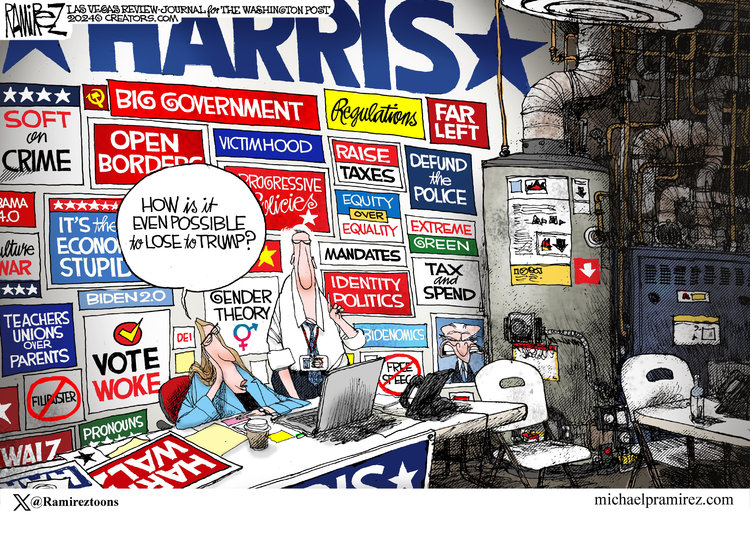
They didn’t really vote for Trump
- As Inauguration Day approaches, President-elect Trump receives his highest favorable rating and half of registered voters approve of his handling of the presidential transition. Still, a majority does not view his election win as a mandate, and more think it was a rejection of the outgoing administration rather than an endorsement of Trump. The latest Fox News Poll, released Wednesday, finds that by a 13-point margin, more voters view Trump’s victory as a referendum on President Biden and Vice President Kamala Harris’ policies and performance (54%) than a validation of Trump’s (41%). That includes 71% of Democrats, 64% of independents and 34% of Republicans saying it was more of a rejection. Overall, 52% approve of Trump’s handling of the transition, while 46% disapprove, a reversal from 2017 when just 37% approved and 54% disapproved. (Source: foxnews.com)
Part of what the voters rejected
Here’s the simplest definition: “Individuals, civil society and companies shape interactions in society, and their actions can harm or foster integrity in their communities. A whole-of-society approach asserts that as these actors interact with public officials and play a critical role in setting the public agenda and influencing public decisions, they also have a responsibility to promote public integrity.”
In other words, the government enacts policies and then “enlists” corporations, NGOs and even individual citizens to enforce them—creating a 360-degree police force made up of the companies you do business with, the civic organizations that you think make up your communal safety net, even your neighbors.
Jacob Siegel, Learn This Term: ‘Whole of Society’
Silicon Valley switcheroo
It’s not just ordinary voters who were queasy about the Democrats’ proclivities. Our tech overloads had a bellyfull, too.
My first shared New York Times link of 2025: Ross Douthat, How Democrats Drove Silicon Valley Into Trump’s Arms: Marc Andreessen explains the newest faction of conservatism.
I thought all the oligarchs were being hypocrites chipping in their milion-per-oligarch contributions to the inauguration, but I now suspect they’re actually pro-Trump because of the alternative. The strong-arm censorship tactics of the Biden administration were really awful (as now has been his lawless final days — declaring the ERA ratified, refusing to shut down TikTok though he signed that law that requires it, a farewell address that’s comedy gold, etc.)
I don’t know that these Techies are now conservatives, but they’ve had their fill of how senescent Joe’s controllers have run things.
What could possibly go wrong?
My biggest fear [for Trump 47] is that another four years with Mr. Trump will lead the Democrats to embrace even more self-destructively the policies that lost them the 2024 election. So come 2029, Mr. Trump will leave a GOP rudderless without its cultic leader and a Democratic Party more awful than ever.
Tunku Varadarajan in Journal Writers Look Ahead to Trump 47
Other stuff
Whataboutism is nothing new
In the view of the Virginian George Fitzhugh, one of the more influential of the proslavery apologists in the 1850s, the paternalism of slavery was far preferable to the “wage slavery” of northern industrial society, in which greedy, profit-oriented capitalists took no responsibility for the comprehensive well-being of their workers but instead exploited them freely and then cast them aside like used tissues when their labor was no longer useful.
Wilfred M. McClay, Land of Hope
The thing about whataboutism is that it generally points to a real problem. Literal slavery has gone away now in the US; wage slavery, not so much.
Government failure elicits self-help
If your first thoughts during a catastrophe are political then maybe something in you has gotten too tight and reflexive, but if your thoughts don’t come to include the political then maybe something in you has gotten too unreflective and rote. All disasters have political reverberations. I suspect for California this will in a general way involve a new shift, a reorientation toward reality.
…
The current facts of California were memorably reported this week by Sean McLain, Dan Frosch and Joe Flint of this newspaper. In Altadena, where the lemons hanging from trees look like lumps of coal, where almost 3,000 structures were lost, scores of residents “have defied orders to evacuate, staying behind to protect what is left of their properties from looters and more fires after losing faith in authorities.”
They have lost faith because they are realists: State and local government have proved unequal to the crisis. Residents patrol the streets and question strangers while living in “a Hobbesian world without electricity or clean drinking water.” Some are armed. The authorities may not let them return if they leave, so they arranged for friends to bring them food at checkpoints. Authorities then ordered supplies not be let through.
Nothing speaks of a failure of government like this: that citizens are forced to function as police, and when officials find out someone is doing what they’ve failed to do, they shut it down. It is an unbelievable breakdown in the right order of things.
Perspective
JPMorgan Chase, a bank, estimates that the bill for the damage will exceed $50bn, making these fires the costliest in American history .
Oddly, that number struck me as kind of low, so I did a little search and here’s what AI offered as an answer to my query:
As of January 2025, the wealth of the top billionaires is as follows:
Elon Musk: $439 billion
Jeff Bezos: $240 billion
Mark Zuckerberg: $216 billion
Bernard Arnault: $190 billion
Larry Ellison: $187 billionThe combined net worth of these five individuals is approximately $1.272 trillion.
Media
It’s interesting that “mainstream media” are now called “legacy media,” which implies that significant parts of new media are already “mainstream.”
Online nihilism
Cal Newport—the anti-social media computer science professor and author of books like Deep Work and Digital Minimalism—detailed his experience of joining TikTok in an essay for the New Yorker. “A decade ago, I viewed social media as Manichaean: these platforms could distract and mislead their users, but they could also topple dictators and enable free expression,” he wrote. “But much of the content on TikTok, and on comparable services like Instagram Reels and YouTube Shorts, borders on nihilism. It seems to revel in meaninglessness, sometimes even poking fun at the idea that a video should be useful. The most popular platforms are saying the quiet part out loud—that there is no deeply meaningful justification for their digital wares—and their users seem to understand and accept this new agreement.”
ADD
I open a book of Aristotle and try to read a page of his choppy, gnomic Greek. After a few lines I start to shift my weight in the chair and drum my fingers on the table. It is Tuesday night, after all. I turn on Sons of Anarchy, and share the experience with 4.6 million of my closest friends. The next day, I have some basis for chitchat with others. I am not a freak. If I had gotten absorbed in the Nicomachean Ethics, my head would still be turning in a spiral of untimely meditations that could only sound strange to my acquaintances.
Matthew Crawford, The World Beyond Your Head. (I’ve sounded strange to my acquaintances many times, but I can’t blame Aristotle.)
FWIW: SeamlessM4T
1. Meta has released a new AI model that can translate speech from 101 different languages. It represents a step toward real-time, simultaneous interpretation, where words are translated as soon as they come out of someone’s mouth. Typically, translation models for speech use a multistep approach. First they translate speech into text. Then they translate that text into text in another language. Finally, that translated text is turned into speech in the new language. This method can be inefficient, and at each step, errors and mistranslations can creep in. But Meta’s new model, called SeamlessM4T, enables more direct translation from speech in one language to speech in another. The model is described in a paper published today in Nature. Seamless can translate text with 23% more accuracy than the top existing models. (Source: technologyreview.com, nature.com)
John Ellis News Item. This is impressive, but I’ve got a bone to pick, probably petty, over “words are translated as soon as they come out of someone’s mouth.” Language doesn’t work word-by-word. If SeamlessM4T really achieves higher levels of accuracy, it surely must wait for the context of words, at least for full phrases.
I’d love to hear John McWhorter weigh in on this, though I suspect that he’d need to get deep into the linguistic weeds to define how much context an AI translator needs around a word before translating.
I suffer more from the humiliations inflicted by my country than from those inflicted on her.
Simone Weil, from a letter to Georges Bernanos.
[N]one of the things that I care about most have ever proven susceptible to systematic exposition.
Alan Jacobs, Breaking Bread With the Dead
I don’t do any of the major social media, but I have two sub-domains of the domain you’re currently reading: (a) You can read most of my reflexive stuff, especially political here. (b) I also post some things on the only social medium I frequent, because people there are quirky, pleasant and real.


 Tipsy Teetotaler ن