Like a pinball, bouncing all over

Pursuit of truth generally

Expertise

Oliver Traldi helps answer “How are those without expertise to determine who has it?”:

Yet another problem for our experts is that the source, nature, and relevance of their expertise is often ill-defined. A degreed professional like First Lady Jill Biden might want to be called “Doctor,” but even those who accede will struggle to articulate just what kind of knowledge she has that the rest of us lack. What is the knowledge-how or knowledge-that accompanying a doctorate degree in educational leadership? Or take the world’s most famous diversity consultant, Robin DiAngelo, Ph.D., whose degree is in “Multicultural Education” and whose “area of research” is “Whiteness Studies and Critical Discourse Analysis.” On what field of propositions would we expect her to be an authoritative source and ask the typical non-expert to defer, setting aside his own judgment for hers?

Even when expertise is genuine, disciplines and professions, along with their practitioners, seem determined to overextend its breadth for purposes of laundering their personal, non-expert opinions under their expert brand. In the summer of 2020, over a thousand public-health researchers signed a letter expressing their support for mass public protests in the midst of the COVID-19 pandemic, even as they insisted that in all other contexts the COVID-19 threat weighed against such gatherings. In The Atlantic, under the headline “Public Health Experts are Not Hypocrites,” Harvard Medical School professor Julia Marcus and Yale School of Public Health professor and MacArthur “Genius Grant” winner Gregg Gonsalves proposed that “systemic racism” was itself “a pervasive and long-standing public-health crisis.” By expanding the reach of the term “health,” the authors seemed to think they could also expand, as though by linguistic fiat, the breadth of their knowledge about the world, and demand new deference on matters of morality and politics. The signatories were public health experts, and systemic racism was a public health crisis, ergo the signatories were systemic racism experts.

Of course, such justification by stipulation is no justification at all. Marcus and Gonsalves never managed to explain what special insight a public health expert might have on the benefits of nationwide protests, or why anyone should defer to their conclusion that “the health implications of maintaining the status quo of white supremacy are too great to ignore, even with the potential for an increase in coronavirus transmission from the protest.” Making matters worse, they warned that even asking, “How many new infections from the protests will public health experts tolerate?” is an impermissible “call to color blindness, to stop seeing the health effects of systemic racism as something worthy of attention during the pandemic.” Now they were self-declared moral experts in two ways: qualified to adjudicate a divisive political debate, and further qualified to scold those who might question that initial qualification. They didn’t just know better than us; they were better than us.

Oliver Traldi, With All Due Respect to the Experts. Brilliant and very worth reading.

Handy heuristic

Here is a quick and generally reliable rule to follow. If people have always said it, it is probably true; it is the distilled wisdom of the ages. If people have not always said it, but everybody is saying it now, it is probably a lie; it is the concentrated madness of the moment.

Anthony Esolen, Out of the Ashes

Misinformation Tech

In keeping with their field’s tolerance for acronyms, they called it AMITT (Adversarial Misinformation and Influence Tactics and Techniques). They’ve identified more than 60 techniques so far, mapping them onto the phases of an attack. Technique 49 is flooding, using bots or trolls to overtake a conversation by posting so much material it drowns out other ideas. Technique 18 is paid targeted ads. Technique 54 is amplification by Twitter bots. But the database is just getting started.

Wired.com, ‌One Data Scientist’s Quest to Quash Misinformation

There’s gold in that there discourse!

Freddie deBoer finally said what I’ve wanted to say, and says it at length, with appropriate contempt, and with contemporary illustrations that I couldn’t have produced because I’m now culturally illiterate as to anything in popular culture. F’rinstance:

[S]ome of the most successful self-marketers of the 21st century are white men. They are, in fact, Good White Men.

These are the guys who put their pronouns in their bios in hopes that doing so might get them a little pussy. These are the guys who will harangue you about how white dudes do this and white dudes do that, speaking to you from their blameless white dude mouths in their righteous white dude faces. These are the guys who look at the discourse about white supremacy and patriarchy and see market opportunity.

… Good White Males think whiteness and maleness are problems to be solved. The trouble here is twofold. First, simply by nature of being Good White Men, by the very act of endlessly talking about the sinful nature of other white men, the Good White Men exonerate themselves from the very critique they advance. Constantly complaining about the evil done by white men inherently and invariably functions to contrast themselves with other, worse white men. Being the white man who talks about the poor character of most white men cannot help but shine your own character. No matter how reflexively you chant that you realize that you yourself are part of the problem, no matter how insistently you say that you’re included in your own critique, you aren’t. You can’t be. To be the one who makes the critique inevitably elevates you above it.

He who humbleth himself wishes to be exalted.

Second, standing up and demanding that everyone pay attention to someone else sure is a good way to monopolize attention for yourself. If you go on your podcast, blog, cable news show, or social network as a white man and tell other white men they need to shut up and listen, you are definitionally not shutting up and listening – and, of course, doing so in such a way as to receive credit for doing it. Put another way, Good White Men constantly tell other men and white people to step back and listen but absolutely never shut the fuck up themselves. Each of these guys could walk the talk by just unplugging and no longer filling the airwaves with their opinions, and in so doing cede space to POC and women and whoever else. That they don’t is the most damning indictment of their project.

Freddie deBoer, The Good White Man Roster

Politics and our common life

Liberalism according to Frank Fukuyama

N.S. Lyons: when he/she is good, he/she is very, very good. The latest is a review essay, mostly of Francis Fukuyama’s Liberalism and its Discontents, but with a quarter or so on Conservatism: A Rediscovery, by Yoram Hazony.

This is a long read. The tl;dr is that Fukuyama’s modest introductory definition of liberalism is tacitly abandoned for most of the rest of the book. I think Lyons is in the camp that liberalism (i.e., classical liberalism, which comes in left and right flavors) is incoherent — and that today’s conservatism is really right liberalism and therefore also incoherent. Hazony’s thicker conservatism fares better.

The preceding paragraph is my next-day-from-memory summary. Your mileage may vary.

Motivated reasoning

Republicans are gloating over the Maya Flores winning election to Congress in a blue Latino pocket in Texas:

The most recent margin in Texas’s 34th congressional district was five points for the Democrats. Flores beat Sanchez by eight points. That’s a 13-point swing toward the Republican Party. And the Texas special election followed similar elections in California and Alaska where Republicans also over-performed.

National Review. Their point is that the GOP is going to slaughter the Democrats in the Fall mid-terms.

That may be true, but Maya Flores isn’t really a good sign of it, as I’ve learned from the Dispatch’s Sara Isgur and nowhere else:

  • This was a special election to fill a vacancy; Flores will serve only until January unless elected again in the Fall.
  • Flores raised something like $700,000; her Democrat opponent more like $46,000.
  • I’m not even sure the Democrat spent all his money; Flores winning doesn’t shift the balance of Congress and is only for about 7 months.
  • A congressional district now has more than 700,000 people in it. Only something like 14,000 voted in Tuesday’s election.

If Flores wins in the Fall, that will be a bigger deal. Meanwhile, the Republicans really aren’t delusional about Latino gains.

(If “Latino” is not currently the preferred word, sorry/not sorry. I can’t keep up. I originally said “hispanic,” but that didn’t sound au courant.)

Structural disadvantage

Monisms are tweetable and retweetable, compressible into soundbites; pluralisms are not. Therefore in our current media environment, all versions of pluralism are structurally disadvantaged.

Alan Jacobs, Ten Theses on Monism and Pluralism, Plus a Quotation

How conspiracy theorists go wrong

What distinguishes conspiracy theorists from the rest of us is their inability or unwillingness to believe that big consequences can flow from small, accidental, disorganized, even ludicrous causes.

Holman W. Jenkins, Jr., Voters Elected the Jan. 6 Donald Trump

Democrat do-over

I believe Democrats know they should have nominated Senator Amy Klobuchar in 2020, and they’ll figure out a way to do it for 2024.

Andrew C. McCarthy, Liz Cheney Is Winning the January 6 Committee.

All I will say is I think that would be very good for the country.

I take that back: we also should consider electoral reforms (ranked-choice voting? open primaries?) that give saner candidates a better chance.

January 6

Side shows and main events

As I have argued at some length, the invasion of the Capitol and the vandalism and violence associated with it were a sideshow, and should be understood as such. The main event was Donald Trump’s attempt to find some legal or procedural fig leaf for invalidating the 2020 presidential election, and by that means to remain in power — a coup d’état under color of law …

The fact that Republicans have cynical, self-serving reasons for not taking the Democrats seriously does not erase the fact that there are excellent reasons for not taking the Democrats seriously — contempt for what the Democratic Party embodies and stands for is in fact a moral necessity.

Kevin D. Williamson, January 6 Hearings: Story without a Hero

Disarming the case against political violence

On both sides of the aisle, there is increasing acceptance of the idea that our political institutions are illegitimate, which while it isn’t in itself a call to violence effectively disarms the strongest argument against violence. This is most obvious on the Republican side, something the ongoing January 6th hearings have provided a powerful reminder of. A huge percentage of the GOP rank and file believe that the last election was stolen and therefore that the current government is illegitimate, and while only a tiny minority participated in violence in response on that fatal day, it’s difficult in practice to convincingly disavow that response without forcefully rejecting the premise that justified it.

Noah Millman, Do We Need To Worry About Violence Against the Court?

Desperate times, desperate measures?

As he sheltered with Mike Pence from the January 6 rioters, Pence’s legal counsel Greg Jacob

emailed constitutional law professor John Eastman, architect of the plan for Pence to reject the electoral votes Congress certified. “Thanks to your bullshit, we are now under siege,” he wrote.

“The siege is because you and your boss did not do what was necessary,” Eastman replied.

Throughout the day yesterday, witnesses—including Jacob—eviscerated the legal arguments underpinning Eastman’s plan, while lawmakers laid out evidence that Eastman and other Trump allies knew full well the flaws in their strategy—but forged ahead with a pressure campaign urging Pence to go along anyway. After the riot, Eastman was so fearful of legal consequences he emailed Rudy Giuliani that he’d “decided that [he] should be on the pardon list, if that is still in the works.” Trump never gave him one, and according to committee members, he’s pleaded the Fifth Amendment 100 times in his testimony before them.

The Morning Dispatch

Some wit put John Eastman’s pardon plea in Haiku:
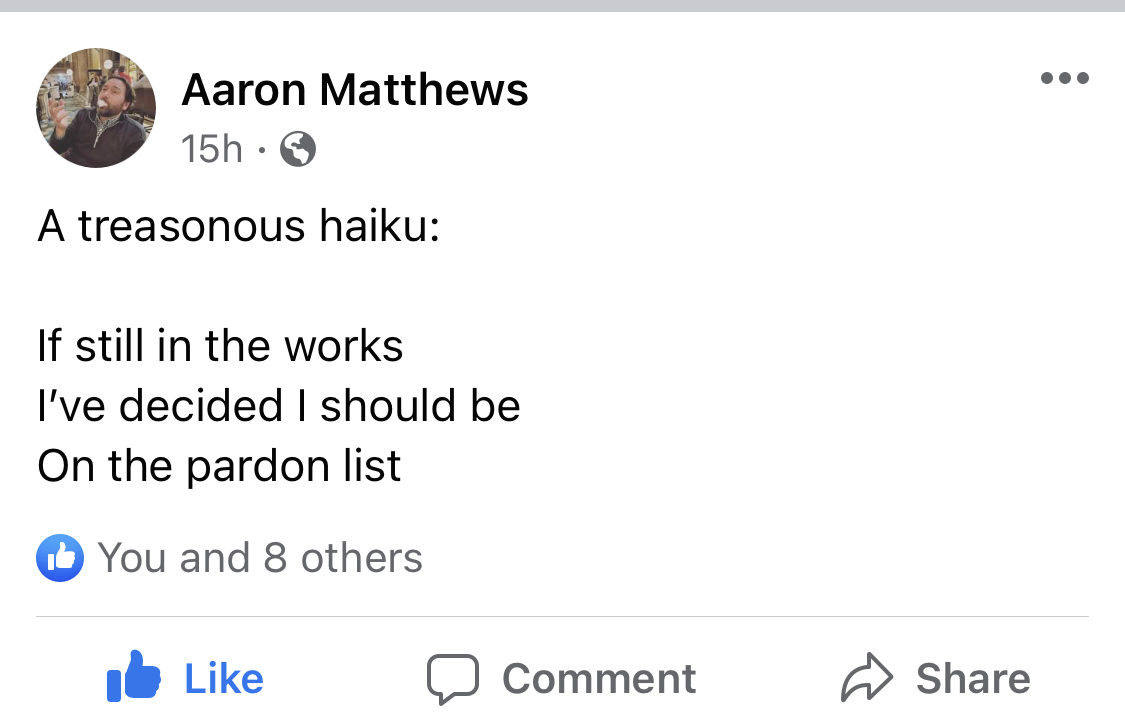
(received through the grapevine).

Sexualia

“Soft Totalitarianism” captures something no other term seems to

I know some good people who scoff that “soft totalitarianism” is an oxymoron, but I haven’t seen a better term for this kind of just-making-shit-up coordinated suppression of unfashionable ideas truths while tolerating truly vile behavior by preferred ideologies:

Not to be outdone, this week, PayPal and Etsy shut down the accounts of biological realist and writer Colin Wright for his persistence in arguing that there are only two sexes. Etsy permanently disabled Wright’s account – where he sold his “Reality’s Last Stand” merch promoting his newsletter – on the grounds that Wright “glorif[ied] hatred or violence toward protected groups.” That’s a lie; Wright never did.

Wright is a biologist who made the grievous error of knowing a thing or two about biology and refusing to genuflect before the Torquemadas who insist he parrot their phony gender science. But of course, while Wright pays this price for his harmless (and, honestly, inoffensive) t-shirts and mugs, Etsy continues to list for sale stickers and pins and other bric-a-brac emblazoned with messages like “Fuck TERFs,” “TERFs can choke,” and “Shut the Fuck up TERF” with an anime creature pointing a semiautomatic handgun at its presumably female interlocutor.

Abigail Shrier

NSFW

The salacious details can’t really be avoided if I want to illustrate how transgender ideology is intruding on the most intimate realms (and I do):

A natal female who had sex with three women using a specially-made prosthetic has been convicted of assault. Tarjit Singh, born Hannah Walters, met women via online dating, and kept clothes on during intimacy in the dark to avoid being revealed as a natal female. It was only several months into one relationship, on discovery of the prosthetic, that Singh’s natal sex was revealed.

This story reads very differently depending on where you’re standing. Is it a case of sexual assault, with a victim tricked into intimate contact she wouldn’t have accepted if she’d known the sex of the individual she was dating? Or is it evidence of our transphobic society, where stigma forced “Tarjit Singh” first to conceal “his” true self only subsequently to be punished for this with the full force of the law?

Mary Harrington, ‌Landmark trans cases show who the men really are

Similar cases are happening and, dare I suggest, increasing;

A recent US case, with similarities to that of ‘Tarjit Singh’, resulted in murder …
Ismiemen Etute, a Virginia college athlete, beat Jerry Smith to death after discovering he’d posed as “Angie Renee” online to obtain sexual contact with Etute.

Lesbians are being called transphobes for wanting sexual contact only with natal real women. Sexual louts like Etute commit murder when tricked by a man pretending to be a horny woman.

It appears that sexual liberation has not produced utopia, no?

Old man led by zealots

Nevertheless, our President thinks we need more of what ails us — the veritable definition of insanity:

Biden has never seemed more like an old man being led by zealots than on the topic of medical interventions for gender dysphoric children, where he is deeply radical. Biden this week is signing an executive order banning any federal funds from “conversion therapy,” which is what activists call it when teen girls go to a therapist for a couple visits before getting a mastectomy. His policies are putting America’s approach to this complex topic far to the left of European nations (some of which are pulling away from under-18 medical interventions altogether) and far to the left even of where many trans leaders think we should be. 

Nellie Bowles (italics added).

Antidote

A Psalm for anxiety over “cancel culture,” “soft tyranny” and some other insanities.

Miscellany

Time-wasters

Although federal, state, and local fair housing laws generally permit discrimination in selecting roommates or housemates, they still prohibit advertisers from mentioning their discriminatory preferences, except for specifying gender. The result is that persons who place classified ads for roommates waste their time, as well as the time of many of those who respond to their ads, by inviting and dealing with inquiries from persons who fail to meet the actual “discriminatory” criteria.

David Bernstein, You Can’t Say That!

New podcast, familiar podcasters

If you liked the All the President’s Lawyers podcast, you are almost certain to like Serious Trouble.

Potty Humor

As long as I’m (uncharacteristically) embedding images, this favorite from the nation of Georgia. There was much, much beauty there, but this gritty, grimy vista along the road from Tbilisi to Stepantsminda was unique:


You can read most of my more impromptu stuff here (cathartic venting) and here (the only social medium I frequent, because people there are quirky, pleasant and real). Both should work in your RSS aggregator, like Feedly or Reeder, should you want to make a habit of it.

Curated just for you, whoever you are

Legalia

Why would a conservative want to serve on SCOTUS?

I can’t fathom why anyone would want to serve on the Supreme Court. To be more precise, I can’t fathom why any conservative would want to serve on the Supreme Court. Liberal jurists are feted with honors at every juncture. But conservative jurists are excoriated and personally attacked. I wonder, in hindsight, if Kavanaugh still would have pursued a position on the Supreme Court, knowing what we know now: the first confirmation hearing, baseball tickets, Spartacus, Christine Blasey Ford, Michael Avenatti, Ronan Farrow, the second confirmation hearing, yearbook, beer, Klobuchar, Saturday Night Live, Matt Damon, the Dobbs leak, and now an assassination attempt outside of his home. During this time, Kavanaugh and his family have been dragged through such painful experiences, one after the other. Was it all worth it? And to what end?

Eugene Volokh

303 Creative

Creative professionals routinely express their politics in their art—through the art they choose or refuse to create. Famously, for example, shortly after the election of Donald Trump, a number of fashion designers (artists, to be sure) declared that they would, under no circumstances, “dress” Melania or Ivanka Trump –this despite the fact that dresses themselves rarely (if ever) contain a political or cultural message as explicit as the words or image a web designer creates. Merely doing business with the Trumps was an intolerable notion to creative professionals who abhorred the Trump family’s political methods and messages.

In an open letter rejecting the idea of working with the Trumps, designer Sophie Theallet said, “We value our artistic freedom, and always humbly seek to contribute to a more humane, conscious, and ethical way to create in this world.” She said, “As an independent fashion brand, we consider our voice an expression of our artistic and philosophical ideas.” And another designer, Naeem Khan, asserted: “A designer is an artist, and should have the choice of who they want to dress or not.”

In reporting on the designer choices, the Washington Post’s Robin Givhan explained well how artists view their work:

Like other creative individuals, Theallet sees fashion as a way of expressing her views about beauty and the way women are perceived in society. Fashion is her tool for communicating her world vision. In the same way that a poet’s words or a musician’s lyrics are a deeply personal reflection of the person who wrote them, a fashion designer’s work can be equally as intimate. In many ways, it’s why we are drawn to them. We feel a one-to one connection.

A web designer’s work is similarly intimate ….

Brief of 15 Family Policy Organizations as Amici Curiae in Support of Petitioners in the 303 Creative case (internal citations omitted).

If you don’t know the case, you should get to know it.

Colorado, with the help of the 10th U.S. Circuit Court of Appealsl, has mounted the worst, and most explicit, attack on freedom from compelled speech since West Virginia v. Barnette in World War II (when West Virginia required recitation of the Pledge of Allegiance by schoolchildren on pain of expulsion).

Colorado claimed that even though 303 Creative was engaged in pure speech (a key legal category; Masterpiece Cakehop, in contrast, had a creative element but in the end produced not speech, but cake), it could be compelled to create a website for a same-sex wedding because none of the other wedding website creators had exactly the talents of 303 Creative, so 303 was effectively a monopoly and could be forced to create the desired site:

In its decision below, the 10th circuit noted that the petitioners’ artistry created something like a “monopoly,” a market where only the petitioners exist.

Id. Only madness-induced blindness could distinguish the relevant facts of this case from those in West Virginia v. Barnette to the detriment of 303 Creative. Read and enjoy the whole Amicus brief.

Understated

The problem is a reflection of a badly broken political culture and it won’t be easily fixed. But, in the meantime, the House should probably go ahead and pass that SCOTUS protection bill.

The Morning Dispatch on increasing political violence, prompted specifically by the plot against Justice Kavanaugh.

More generally, the Morning Dispatch’s coverage of the successful recall of San Francisco Prosecuting Attorney Chesa Boudin confirms its trustworthiness as a news source: It has more points in Boudin’s favor than I’ve noticed anywhere else, and they aren’t insubstantial.

Sexualia

Incoherent Pride

[I]t is interesting that the American Embassy to the Vatican is flying the rainbow flag for Pride month. Commentators have pointed out the obvious intent to cause offense to the Catholic Church. But the embassy’s decision also sends a message to the American people: Another flag has government endorsement. The message of “inclusion” that it represents signals to those Americans who might dissent from the LGBTQ+ movement that in these interesting times their membership in the republic for which the real national flag stands is more a matter of tolerance than full-blooded affirmation.

The problems with LGBTQ+ inclusion are, of course, manifold. First, there is the logical problem that any movement deploying the rhetoric of inclusion has to face: If everyone is included and nobody is excluded, then the movement is meaningless. Thus, the language of “inclusion” here is really a code word for precisely the opposite: It actually means exclusion and the delegitimizing of any person or group that dissents from what the movement’s movers and shakers deem to be acceptable opinion. Acceptable thought will typically tend toward a view of reality that regards such dissenters as mentally deficient, sub-human, or simply evil.

Carl R. Trueman

Succinct

There are masculine girls. There are feminine boys. What are we going to do? Carve them up?

Jordan Peterson on the Official Trailer for the Matt Walsh documentary (prank-a-thon?) What is a Woman?.

Politics

Relatively successful

Purdue University president Mitch Daniels is retiring at the end of the year. Consistent with his maverick ways over the last 10 years, his successor was announced concurrently with his retirement announcement. There was no public Presidential search, and we will doubtless be treated to days of complaints, petty and serious, about that.

His successor will be the professor and Dean, Dr. Mung Chiang, who served as his Executive Vice President for Strategic Initiatives, of which Purdue has formed a great many over the last 10 years, with some of the biggest corporate names in the world.

I’m very proud of Purdue, my neighbor just across the Wabash, but I would prefer that my loved ones not attend there.

First, like most major universities today, the streets of the campus flow with alcohol, which endangers students of both sexes with the ambiguities of sexual interactions between drunks.

Second, I prefer undergraduate liberal arts education to enlisting in the Technocracy fresh out of high school.

But it seems to me that Mitch Daniels has been a tremendously successful Ginormous Research University President, and I wish him well.

"A Crucial Element of Fascism"

The American militia movement is small, but in the early days of 2021, it nonetheless came to the aid of a lawless president seeking to use force to keep himself in power. It did so by attacking the national legislature and threatening to kill elected representatives of the American people. And when this happened, the president himself stood back and stood by, watching expectantly, refusing to call off the armed mob, hoping the violence might empower him to remain in the White House despite losing the election two months earlier. In doing so, Trump ended up injecting a crucial element of fascism into the country’s political system.

I don’t use the F-word lightly. Trump winning the presidency while losing the popular vote by three million isn’t fascism. Trump appointing a record number of judges and three Supreme Court justices who appear poised to overturn Roe v. Wade isn’t fascism. Trump attempting to close the southern border to immigrants and refugees isn’t fascism. Trump’s verbal attacks on the media aren’t fascism (though they could be said to lay the groundwork for it by stoking popular rage against a free press). Trump engaging in the politics of bullshit by lying constantly to the American people isn’t fascism (though it, too, can prepare the way for it by leading voters to despair of firmly distinguishing between fact and falsehood).

But groups of organized, armed thugs allied with the president acting at his request to prevent the peaceful and lawful transfer of power to his successor is absolutely a fascist act. We’ve seen nothing remotely like it elsewhere in the democratic world, no matter how bad the illiberal policies and rhetoric of newly emboldened right-wing populists in other countries have been.

Damon Linker

Holding up that hateful mirror

Republicans are the co-creators of Trump’s corrupt and unconstitutional enterprise. The great majority of them are still afraid to break fully with him. They consider those who have, like Liz Cheney, to be traitors to the party. They hate Cheney because she continues to hold up a mirror to them. They want to look away. She won’t let them.

Peter Wehner

Is racism a public health crisis?

My fair city has approved a resolution declaring racism a public health crisis.

The statistics on racial disparities are stark. But unless the reporting is botched — a very real possibility considering that our Gannett paper hovers near death — the response is one of those "OMG! WE’VE GOT TO DO SOMETHING!" responses, and implicitly accepts the dogma that all racial disparities are caused by racism.

My point would be mere pedantry were it not for the likelihood that a vague diagnosis of "racism" as the cause is likely to lead to errant treatment.

Stochastic Terrorism

I’m kind of a sucker for portentous names given to commonsense observations. My new one is "stochastic terrorism," introduced by David French with a link to Todd Morley.

As French puts the commonsensical translation:

The concept is both common-sense and controversial. The common-sense element is easy to explain. If you’re a normal person and five people hate you, what are the odds you’ll face targeted violence? Unless you’re engaged in criminal activity yourself (and the five people who hate you are other criminals), then the odds are almost impossibly low.

But what if 50,000 people hate you? Or five million? Then the odds change considerably, until they reach a virtual certainty that you’ll face a threat of some kind.

Why did the Californian last week go after Justice Kavanaugh instead of Justice Alito? How many million people hate Brett Kavanaugh? How did there come to be so many who hate him? D’ya think it might have something to do with the over-the-top attacks during his confirmation hearings?

That’s how you build a frenzy from which someone emerges to exact just retribution on some putative fiend. Todd Morely names a few names.

(FWIW: I cooled about 20 degrees on Kavanaugh as soon as it emerged that he has been a heavy recreational beer-drinker since years before he could drink legally. Call me extreme — and on this topic, I clearly am far out of the American mainstream — but I think a Supreme Court Justice should have a history of abiding even by annoying little laws like minimum drinking age, and of sobriety both literal and figurative. Drunken frat boys are a turnoff even when they don’t grope co-eds.)

Well, anyway, back to stochastic terrorism. French again:

Of course the ultimate recent example of hatred and fury spawning violence is the attack on the Capitol on January 6. It was perhaps the most predictable spasm of violence in recent American history. One cannot tell tens of millions of Americans that an election is stolen and that the very fate of the country hangs in the balance without some of those people actually acting like the election was stolen and the nation is at stake.

But if the concept of stochastic terrorism is so obviously connected to human experience, why is it controversial? In part because it aims responsibility upward, and it places at least some degree of moral responsibility for violent acts on passionate nonviolent people. While criminal responsibility may rest exclusively with the person who carries the gun (or his close conspirators), moral responsibility is not so easy to escape.

(Emphasis added).

Too long I have blithely and exclusively "blamed the person who carries the gun", discounting (if not ignoring) incitements that stop short of criminality. I remain a free speech advocate, and I detest the idea that any truth is too dangerous to be uttered lawfully. But it is becoming too, too obvious politicians and pundits who make careers of vilifying specific opponents, and internet jackasses who doxx the scapegoat du jour, are playing with fire, and at the very least should face political, social and commercial* sanctions.

And to the extent that I have dehumanizingly vilified Donald Trump over the last three years, mea culpa, mea culpa, mea maxima culpa!

(* I have in mind commercial sanctions like boycotting Tucker Carlson’s advertisers, but I don’t want to watch him to find out who they are.)

UPDATE: Jonah Goldberg alludes to who Tucker’s advertisers are:

Seb Gorka dron[ing] on about Relief Factor (a fish oil supplement that all super-patriots take before they put their heads on Mike Lindell’s pillows)

No chance for boycotting there.

Religion

Normally, I’d consider putting Religion in first position, but the following are not the kinds of dogma or dogma-adjacent things that cry out for that.

Here’s to you, Mrs. Robinson

In David & Bathsheba, we see a man in the act of either removing—or replacing—a jacket from a woman’s shoulders. Is this the moment before or after King David has committed adultery with the wife of his general? Mrs. Potiphar presents us not with a cartoonish harridan panting after the biblical Joseph, but an attractive, middle-aged woman staring pensively at her reflection in a mirror. McCleary treats the incident not in terms of mere lust, but in a larger psychological and spiritual context of loneliness and fear of death.

Gregory Wolfe, Beauty Will Save the World.

The "Mrs. Potiphar" Wolfe refers to is presumably this:

Mrs. Potiphar

If you don’t know the allusion, read Genesis 39. If you don’t know what Genesis 39 is, may God have mercy on your ignorant soul.

A Dangerous Inversion

To justify Christianity because it provides a foundation of morality, instead of showing the necessity of Christian morality from the truth of Christianity, is a very dangerous inversion; and we may reflect, that a good deal of the attention of totalitarian states has been devoted, with a steadiness of purpose not always found in democracies, to providing their national life with a foundation of morality — the wrong kind perhaps, but a good deal more of it. It is not enthusiasm, but dogma, that differentiates a Christian from a pagan society.

T.S. Eliot via Kevin D. Williamson, who continues:

Eliot’s “dangerous inversion” is very much the model for the intersection of religion with politics in our time: Religion is, and is almost universally assumed to be, the junior partner.

American Evangelicals as Cultural Christians

What has happened is that the Christian sense of collective identity has persisted even among those hollowed-out Christians who have abandoned Christian orthodoxy, reducing the Christian confession to a demographic box to check, one of many constituent parts of an American “national identity.” Never mind, for the moment, that one of the hallmarks of the authentic American identity is approaching Christian orthodoxy and Christian observance with a seriousness that brushes up against fanaticism: The story of the United States does not begin with the arrival of the first slave, as the 1619 Project would argue, but with the arrival of the first Separatist.

For a century or so, Americans have had friends and countrymen who are “culturally Jewish.” We know what that means: a Jewish sense of communal identity bound to that vague American religious sensibility that sits somewhere between Protestant and agnostic — not atheistic, but operatively secular. I have not heard many Catholics call themselves “culturally Catholic” — Catholics who have given up Catholicism mostly just continue to call themselves “Catholic,” with the “cultural” qualifier being understood. In the case of Catholics, the communal identity is not in the end religious at all but is instead only the detritus of immigrant ethnic identities that have been dissolved in the hot soup of modernity. Conservatives used to be the ones who preferred the “melting pot” model of communal life to ethnic and religious particularism, but the rightist element Hochman writes about has, to some considerable degree, abandoned that. And so we have that new thing, the “cultural Christian.” I believe the first time I ever heard the term used was by Richard Spencer, the white nationalist, who found his parents’ Episcopalianism insufficiently invigorating.

Evangelicals, particularly white Evangelicals, are an important part of the new coalition that was formed around the campaign and cult of Donald Trump, but Christian thinking per se plays almost no role in that cult. Indeed, it would be very difficult for these Christians if it were otherwise: Donald Trump is an idolator and a heretic, a blasphemer and a perpetrator of sacrilege, and much more ….

Kevin D. Williamson


You can read most of my more impromptu stuff here (cathartic venting) and here (the only social medium I frequent, because people there are quirky, pleasant and real). Both should work in your RSS aggregator, like Feedly or Reeder, should you want to make a habit of it.

Potpourri 6/9/22

January 6, with us forever

After Mr. Pence was hustled to safety, Mark Meadows, the White House chief of staff, is reported to have told colleagues that Mr. Trump said that perhaps Mr. Pence should have been hanged.

Maggie Haberman, ‌Pence Staff Feared for His Safety Amid Trump’s Pressure Campaign Before Jan. 6.

That’s at least triple hearsay (someone says that Mark Meadows told colleagues that Trump said) plus a "perhaps," but with Trump, it seems sufficiently credible — and yes, I’ll plead guilty to confirmation bias if you can get an indictment.

The most astonishing part of this whole story is that Mike Pence finally said "no" to the Orange God. I thought he’d taken leave of his senses when he agreed to run with Trump, but it was only his principles that he was abandoning.

I’m assuming that the public "hearings" that begin this evening will be agitprop. I assume that it will be the kind of anti-Trump agitprop that I’m predisposed to believe. But the very fact that they brought in a storied documentary producer to help stage it counsels that I avoid it and rely on multiple secondary sources (probably WSJ, NYT and the Dispatch — which culpably leaves out stellar sources like Alex Jones, Breitbart Steve Bannon’s War Room "television show," Think Progress or other emetic productions).

Surely the gist will be something like this:

This was a violent assault on the United States Capitol, and it was provoked by a sitting president of the United States,” Cheney said. “He oversaw a multipart plan, [the] objective of which was for him to stay in power, to overturn the results of an election and stay in power. And I would say to people, as you’re listening to some of my colleagues and others who think that the way to respond to this investigation is with politics and partisanship—those people are not acting in a way that is healthy for the country.

Liz Cheney on the Dispatch Live

Defense/Defiance

Spend much time at gun shows or at gun shops, and you’ll quickly become familiar with something called the “tactical” or “black gun” lifestyle, where civilians intentionally equip themselves in gear designed for the “daily gunfight.” It’s often a form of elaborate special forces cosplay, except the weapons (and sometimes the body armor) are very real.

Something has changed in the streets as well. It’s now common to see men and women armed to the teeth, open-carrying during anti-lockdown protests and even outside public officials’ homes. This is when the gun is used to menace and intimidate. It’s displayed not as a matter of defense but rather as an open act of defiance. It’s meant to make people uncomfortable. It’s meant to make them feel unsafe.

David French,‌Against Gun Idolatry.

I’ve noticed increasingly that I "learn" things by reading other than what the author directly intended. In this case, French helped me put my finger on what I, an enthusiast neither for guns nor for gun bans, find obnoxious about open carry regimes: they enable performative assholery and political intimidation.

Knock-on celebrity

Some individuals reach the unfortunate but not entirely irrational conclusion that the best way to be remembered is by assassinating somebody whose long-lasting fame is guaranteed. There is something very modern about this approach. In the celebrity culture where we all live, nothing is worse to some people than the idea of dying unknown and staying that way. Shooting your way out of this box is a method of leeching off of someone else’s celebrity. In the celebrity culture, a negative reputation for all times is better than no reputation at all. John Wilkes Booth shot Abraham Lincoln because he (Booth) was a Southern partisan. John Hinckley shot Ronald Reagan because he wanted fame, like Travis Bickle in the movie Taxi Driver—or at least an opportunity to touch fame.

Michael E. Kinsley, Old Age

Social Media in the unreal world of celebrities

Somehow, this seems related to the preceding item:

[I]t is difficult for me not to have some level of sympathy for [Amber] Heard. She has not only been found by the jury to have testified falsely as to critical issues of fact—to have lied—but been so pilloried throughout the nation that she has become a public face of falsehood. We have had public figures at the highest level of national authority who have routinely lied about far more important matters and have never been subjected to anything like the level of opprobrium she is now enduring.”

The rage against her—and the worship of him—has been primal. And there was no escaping it. Over the course of the trial, it felt like the algorithms that drive social media were programmed to stoke hatred of Heard.

Famed attorney Floyd Abrams via Bari Weiss.

The delusion of quantification, mastery and management

You likely read or heard about Jonathan Haidt’s big April essay in the Atlantic, “After Babel: Why the Past 10 Years of American Life Have Been Uniquely Stupid.” The thesis is pretty straightforward: social media is ruining America. In the New Yorker, Gideon Lewis-Kraus takes an admirably fair and honest look at Haidt’s claims. Frankly, Lewis-Kraus is to be commended not only for his analysis but for the spirit in which it was presented. Basically, he found that it is difficult to support Haidt’s most dire claims with existing data.

Lewis-Kraus, and the scholars he consulted, are probably right. Haidt’s case is difficult to defend given existing research. Interestingly, however, they all seem to approach this in similar fashion: they grant that Haidt is right to be concerned, but they’re simply not sure if he is concerned about the right things and in the right measure. Lewis-Kraus is also to be commended for the running acknowledgement that it may be difficult to measure and quantify the kind of effects we’re looking for. I remain skeptical that we can rely merely on social scientific data to ground our action. That may very well be a symptom of the deeper (Babel-like!) delusion of mastery and management. But along those lines, this was a particularly interesting observation:

“Gentzkow told me that, for the period between 2016 and 2020, the direct effects of misinformation were difficult to discern. ‘But it might have had a much larger effect because we got so worried about it—a broader impact on trust,’ he said. ‘Even if not that many people were exposed, the narrative that the world is full of fake news, and you can’t trust anything, and other people are being misled about it—well, that might have had a bigger impact than the content itself.’”

Well, that’s kind of the point isn’t it? I mean, that consequence Gentzkow describes is a consequence of social media, which acts as a massive assortment of feedback loops from the social body to the collective consciousness, such that it generates all manner of distorted and disordered actions.

Finally, on this score, I’ll say that the allusion to the Babel narrative amounts to little more than window dressing (curiously, the Atlantic seems to have removed the reference from the title). When Haidt writes, with reference to the tower, that social media platforms “unwittingly dissolved the mortar of trust, belief in institutions, and shared stories that had held a large and diverse secular democracy together,” he seems to be overlooking the fact that in the Hebrew story the destruction of the tower was not something to be lamented. The destruction of the tower was an act of judgment on the hubris of the builders. I think there was an interesting direction in which to take that story, but I’m not sure this was it.

L.M. Sacasas, ‌Readings and Resources (emphasis added because I share his skepticism about our collective delusion).

Writers shouldn’t talk

Who in their right mind would want to talk, much less listen, to a person who has contrived to spend as much of her life as possible crouched over her computer in isolation, deleting unsatisfactory variants of a single sentence for upwards of an hour? Nothing in my daily practice has prepared me for the gauntlet of a tête-à-tête. Writing is an antidote to the immediacy and inexactitude of speech, and I resent any attempt to drag me back into the sludge of dialogue …

Books and essays are the product of long bouts of thinking, which makes writers fantastically ill-suited to summoning opinions instantaneously …

To be adept at honing sentences for weeks or months is no guarantee of any aptitude for improvisation. Nor does skill at fictionalizing life or theorizing about it correlate with any facility for entering into the thick of things.

Becca Rothfeld, Writers Shouldn’t Talk

From my subjective core, this is almost too obvious to say write. I’m myself in Rothfeld’s camp. I’ve labored way too long over relatively short speeches I was expected to give, and then delivered them as closely to the written text as I could manage while maintaining reasonable eye contact. I don’t trust my spontaneous utterances to be worth the attention of assembled auditors. Obviously, I’m less inhibited about the written word.

Celebrate the First Amendment

An Australian court on Monday ordered Google to pay $515,000 to former Australian politician John Barilaro for failing to take down from YouTube a campaign of “relentless, racist, vilificatory, abusive, and defamatory” videos attacking him, which the court ruled “drove Mr. Barilaro prematurely from his chosen service in public life and traumatized him significantly.”

TMD. I do not know the details behind this, so I won’t call Mr. Barilaro a snowflake, but I’m having trouble imagining any possible details that would support liability in U.S. Courts. And with due allowance for familiarity, I like it that way.

Dreherisms

Smart to have a dumb home?

The business rationale for the smart home is to bring the intimate patterns of life into the fold of the surveillance economy, which has a one-way mirror quality.

Matthew B. Crawford, Defying the Data Priests

Librarian cosplay

I’m tired of hearing about supposed book bannings in the U.S.

  • Deleting a book from a curriculum while leaving it in the school library is not a book banning.
  • Someone trying to get a book removed from a public library, which tells that someone to go take a hike, is not a book banning.

What’s going on, I think, is bored librarians (is there another kind?) engaging in ritual cosplay ("You can have To Kill a Mockingbird when you pry it from my cold, dead fingers!").

Wordplay

From the Economist:

Word of the Week: écoponts, “wildlife bridges” in French. France is building overpasses for animals to reduce roadkill and help them roam more freely. Read the full story.


You have to be educated into cant; it is a kind of stupidity that surpasses the capacity of unaided Nature to confer.

Anthony M. Esolen, Out of the Ashes (Kindle location 411)


You can read most of my more impromptu stuff here (cathartic venting) and here (the only social medium I frequent, because people there are quirky, pleasant and real). Both should work in your RSS aggregator, like Feedly or Reeder, should you want to make a habit of it.

Monday collation

Politics

The Irreligious Right

I used to say "If you don’t like the Religious Right, just wait till you see the nonreligious Right." The nonreligious Right is here, and now dominates the grassroots GOP.

Frankly, it’s not (yet) as bad as we feared for varying reasons (but it’s trending worse, I think).

A fantastically good overview, ‌Republicans Are Now the Party of the Nonreligious Right appeared Thursday in, of all places, the New York Times, written by one Nate Hochman of National Review. It is long and deep, and I’m going to need to read it again to sort out what this means for me personally; Hochman already brilliantly identified why the GOP now gives me the willies (as do the Democrats, but then they always have).

I don’t know if I picked up the moniker in the Hochman article, but it appears to me that what he describes may be closely related to what others have calle "Barstool conservatism":

What could unite free-market libertarians, revanchist Catholics, Southern evangelicals, and working-class Reagan Democrats but their shared hatred of… actual Democrats?

Derek Robertson, How Republicans Became the ‘Barstool’ Party.

Drain those brains

In the Washington Post, Josh Rogin argues some congressional Republicans are forgetting one of the key takeaways from the Cold War: that exploiting brain drain from autocratic societies is a “smart and righteous” strategy. “The whole world is competing for the talents of those who are fleeing from Hong Kong and Putin’s Russia,” Rogin writes, noting Republicans have blocked efforts to ease visa restrictions for high-skilled workers from those regions. “Cruz claimed that accepting Hong Kongers was the first step to opening our borders and that the Chinese Communist Party could exploit the program to send spies to the United States. This ignores the fact that China has much easier ways to get spies into our country and that the CCP is trying to stop Hong Kongers from leaving because Beijing knows the brain-drain risk for China is real. … Republicans’ excessive fear of immigration should not waste a strategic opportunity for the United States to strengthen itself and weaken its rivals at the same time. Congress should work to ensure that China’s and Russia’s losses are America’s gains.”

The Morning Dispatch.

Surely Rogin is right, right?

Justin Trudeau

One of the oddities of Canadian politics is that its Liberal Party politicians so often sound like they’re running for office in the U.S. And, right on time this week, Canadian Prime Minister Justin Trudeau has announced that he wants to ban the sale of handguns and confiscate so-called assault weapons via a mandatory buyback.

The timing is no coincidence, as Mr. Trudeau is responding to the U.S. debate over guns and mass shootings. Apparently Canadian politics is too boring, or parochial, or something, because he also vowed to defend abortion rights after the draft Supreme Court opinion overturning Roe v. Wade was leaked. He even made a show of kneeling at a Black Lives Matter rally in June 2020.

Wall Street Journal Editorial Board. I generally avoid Editorial Board offerings on the basis that the King James Bible is the only work of art ever created by a committee, but the title "Justin Trudeau Runs for Congress" was powerful bait.

Answer me this …

This battle has been lost, and I see no hope of reversal. I even suspect, as do others, that reversal would be worse than letting it be. But I don’t think questions like this were ever answered:

Assuming a general policy of recognizing committed dyads, should the benefits that Oscar and Alfred [applicants for a hypothetical marriage license] receive depend on whether their relationship is or can be presumed to be sexual?

Sherif Girgis, Ryan T. Anderson and Robert P. George, What Is Marriage?, Kindle Location 295.

If the benefits received depend on whether the relationship is presumed sexual, then aren’t we leaving a lot of lifelong friends out of the more Platonic benefits that were thrust front and center in rationalizing same-sex marriage?

Damon Linker

Another bright light moves to Substack from legacy media: Damon Linker leaving The Week. His focus, reflected in the Substack title, is the Right.

I’m a Linker fan, but his first three postings seemed a bit underwhelming.

Legalia

Yes, I’m going to (gag!) say something (retch!) about THAT case

The jury in The Case That Kept Gossipy Television Gossiping has decide that she defamed him $15 millionsworth while he only defamed her $2 millionsworth.

It kind of has the feel of a suicide pact from what I could tell in the glimpses I got on TV.

Apparently, the jury verdict identified the three Heard statements they considered defamatory:

The jury was forced to examine three separate statements from the editorial, starting with the headline: “I spoke up against sexual violence—and faced our culture’s wrath. That has to change.”

The second involved Heard’s description of herself as a public figure representing domestic abuse, and the last statement at issue involved the public’s response: “I had the rare vantage point of seeing, in real time, how institutions protect men accused of abuse.”

(Johnny Depp Wins U.S. Defamation Lawsuit Against Amber Heard)

I could easily imagine an appeals court ruling as a matter of law that the second and third were not defamatory. Note, too, that the first technically doesn’t say that she was herself a victim of sexual violence, only that she spoke up against it.

Stay tuned. I don’t think this is over yet, though appeals won’t be blanket-covered like the trial was.

An open letter to SCOTUS Clerks

Very smart blogger David Lat has an open letter to the current Supreme Court clerks — the guilty and the innocent. I think it’s of interest even if you’re not a retired lawyer who still follows Indiana and Federal Courts.

So who’s stupid now?

Man pleads guilty to felony charge in riot at US Capitol

PHILADELPHIA – A suburban Philadelphia man charged in the January 2021 riot at the U.S. Capitol after he was turned in by an ex-girlfriend after reportedly insulting her intelligence for not believing the election had been stolen has pleaded guilty to a felony count. Richard Michetti, 29, of Ridley Park pleaded guilty Tuesday in federal court in Washington to a charge of aiding and abetting obstruction of an official proceeding. Officials said photos showed him inside the Capitol Rotunda. He is to be sentenced Sept. 1.

Wire Service Reports (emphasis added)

Sexual fad du jour

The author provides a high-point estimate of an 11-point increase in LGBT identity between 2008 and 2021 among Americans under 30. Of that, around 4 points can be explained by an increase in same-sex behavior. The majority of the increase in LGBT identity can be traced to how those who only engage in heterosexual behavior describe themselves.

Born This Way? The Rise of LGBT as a Social and Political Identity – CSPI Center (H/T Nellie Bowles)

Meanwhile, it’s hard to overestimate the goofiness and downright offensiveness of U.S. efforts to promote Pride Month.

Abortion

An odd, but telling, tid-bit: When the draft Dobbs opinion leaked, the Washington Post opined that reversing Roe would put us out of step with Western Europe. This myopic bit of mythology was so patently wrong that they had to retract or amend: reversing Roe almost certainly would bring us into better alignment with Europe, where legal abortion is more limited than in the U.S. under our juristocracy.

(Sorry I can’t give a link:

  • I heard it on a reliable podcast, but …
  • I’m persona non grata at WaPo; I suspect that never-subscribers can see more free stuff than former-subscribers.)

Guns

For the Record: 10 Cases in Past Year Where Law-Abiding Defenders "Have Stopped Likely Mass Public Shootings" With Guns

Wordplay

the rainforests of the ocean

The Economist’s poetic description of coral reefs.


When you skip the news, life is a lot more like Anne of Green Gables or The House at Pooh Corner.

Garrison Keillor


They were powerful until they were powerless. They lived on probation their entire lives.

Andrew Sullivan on gay life in Washington, DC for about 2/3 of the last century.

I sometimes second-guess my support (Caution: Ancient history ahead! Youngsters may be shocked!) for decriminalizing consensual adult sodomy in the late 60s and thereafter, since the ensuing 50+ years have brought more dubious demands. It’s good to be reminded of why a decision was right, even if it may have, in some sense, "set a bad precedent."


You can read most of my more impromptu stuff here (cathartic venting) and here (the only social medium I frequent, because people there are quirky, pleasant and real). Both should work in your RSS aggregator, like Feedly or Reeder, should you want to make a habit of it.

It’s Havel’s Greengrocer Month!

SBC’s numbers fetish

“a satanic scheme to distract us from evangelism.”

Augie Boto, Southern Baptist Convention Executive Council general counsel and former vice president, characterizing reports of sexual abuse by Southern Baptist pastors and church employees.

Evangelicalism, of which the SBC is a member in very good standing, had a problem with seeking numerical growth above all else for as long as I was part of it. Psychological trickery and deception were part of the deal (e.g. "Every head bowed and every eye closed. … I see that hand. Is there another?" when nobody had raised a hand.)

The EC’s publishing arm, the Baptist Press, “was also used to portray victims in an unflattering light and mischaracterize allegations of abuse,” according to the report. For example, in 2019 Jennifer Lyell—an abuse survivor and employee of SBC-affiliated Lifeway—was asked to write publicly about her sexual abuse by an SBC seminary professor, but the article was changed before publication to suggest a consensual relationship and only corrected months later.

(Emphasis added)

Hauerwas strikes again

Both the fundamentalist and the higher critic assume that it is possible to understand the biblical text without training, without moral transformation, without the confession and forgiveness that come about within the church. Unconsciously, both means of interpretation try to make everyone religious (that is, able to understand and appropriate scripture) without everyone’s being a member of the community for which the Bible is Scripture.

Stanley Hauerwas, Resident Aliens.

Not-quite-rank speculation

Maybe Mainline Protestantism is less prone to pervasive sex abuse partly because it has far fewer young people for predators to target. Not many Mainline churches have vibrant youth ministries or large programs for children. But Mainline churches do have a genuine institutional advantage with wider systems of accountability that are likelier to address sexual abuse.

In contrast, most of evangelicalism is effectively congregationalist with fewer authoritative structures beyond the local church. Self protective pastors or congregational governing boards can more easily evade accountability than congregations within denominations. Mainline denominations have bishops, superintendents, presbyteries and synods that oversee congregations and clergy. Often this oversight fails to work effectively, but it can be better than no oversight at all.

Perhaps more importantly, there is culturally less deference toward and trust for clergy and for church governance in Mainline Protestantism. As I recall growing up Methodist, critiquing and tearing down the pastor is often the local church’s most fervent sport, sadly. Preoccupation with pastoral flaws obviously is deeply unhelpful and may help explain part of Mainline Protestantism’s dysfunction. But Mainliners are typically not intimidated by clergy or distorted ideas about pastoral authority.

The typical Mainline cleric is not invested with the spiritual authority that many evangelicals accord their pastors. And of course Catholic priests have more spiritual authority than do Protestant clergy. The reasons are ecclesiological but also maybe sociological. Wealthy Ivy League educated parishioners at an Episcopal parish who belong to country clubs, have many lawyer friends, and know the mayor, are less likely to defer to their cleric or congregational leaders than maybe less culturally privileged members of an evangelical church.

Evangelicals maybe are more prone to idealize their pastors than Mainline Protestants, who are more prone to see clerics as the hired help.

Juicy Ecumenism, ‌Mainliners, Evangelicals, Catholics & Sexual Abuse – Juicy Ecumenism (Italics added)

This seemed timely, but don’t think that I’m siding with the Mainline. I have history in Evangelicalism, and write reactively against it, but I can’t say one way or the other whether the Mainline is healthier overall. I will, however, unequivocally endorse accountability — be it bishops, synods, presbyteries or whatever — over congregationalism, or what I call "fiefdoms."

Also, for what it’s worth, I’m skeptical of the claim I italicized, but it’s been a long time since I spent time around Protestants talking about their pastors.

Gun nuts, pro and con

Respected philosopher James K.A. Smith emotes:

We’ve taken too long. Habitualities built up over a 200 year history will not be undone by tweaks on policy and half measures.

We need the collective will to repeal the 2nd Amendment and confiscate guns.

Only Mammon and our idols prevent us from doing so.

Burn them down.

But Mark Tooley has some cautions:

Christian realism always counsels against ambitious absolutist solutions that override precedent, ignore human nature, and downplay the complex social factors that foster the conditions for catastrophe.

Tooley also has cautions for gun hobbyists, too (and by implication, for us all):

Christianity traditionally argues not only against malevolent violence, of course, but also against vain amusements. The vast, vast majority of gun enthusiasts are mainly devoted hobbyists. For most, their pursuits are benign. But traditional Christianity cautions against unhealthy enthusiasms for worldly hobbies, however benign. This is especially the case where a prurient fascination with guns bleeds over into the macabre.

For more than 2,000 years, Christianity often has preached against theaters, salacious literature, dancing, festivals, bear-baiting, carnivals, card playing, horse racing, and other recreations that many Christians see as mostly harmless in themselves. The argument against passions for such pursuits is that life is short and that Christians are called to redeem the time and be sober, alert, and focused on God’s work.

Life under soft totalitarianism*

If I gave in to the Inquisitors, I should at least know what creed to profess. But even if I yelled out a credo when the Eugenists had me on the rack, I should not know what creed to yell. I might get an extra turn of the rack for confessing to the creed they confessed quite a week ago.

G.K. Chesterton, The Established Church of Doubt, in The G. K. Chesterton Collection (Kindle Location 19750)

I had to read that a few times to get it when Readwise coughed it up this morning. It’s as true today as when Chesterton wrote it, though the actors have changed:

  • "Conservatives" who abandoned bog standard conservatism for Trumpist populism, but pre-eminently …
  • Wokesters, who positively make a cruel game out of cancelling anyone who still believes, say, that marriage is between a man and a woman (or other offenses again liberal groin pieties or racial identity politics).

* Soft totalitarianism is that totalitarianism that doesn’t command by pointing a gun barrel. Not yet.

Havel’s Greengrocers

Speaking of liberal groin pieties, it’s Pride Month, and more and more restaurants and other businesses are playing Havel’s Greengrocer.

It’s actually kind of nice of them: it tells me who to avoid this June and, conversely, what courageous little dissident shops I might want to patronize.


You can read most of my more impromptu stuff here (cathartic venting) and here (the only social medium I frequent, because people there are quirky, pleasant and real). Both should work in your RSS aggregator, like Feedly or Reeder, should you want to make a habit of it.

Memorial Day Commentary Dump

Politics

Contemporary American Populism

It has slowly dawned on me that behind all the distracting and constant confabulations and shitpostings, the populists are onto something. I might well have noticed earlier had I not been distracted by said confabulations and shitpostings, but I won’t try to prove that self-congratulatory speculation.

Nevertheless I cannot imagine myself voting for a confabulator or shitposter, so I remain resolutely Never Trump (who I also consider a humbug). Must more serious populists establish their street cred by emulating him?

And I’ll note for the record my suspicion that if we brought back all those offshored jobs, and put them back in Youngstown (a synecdoche), it would lower the standard of living of the currently-ascendent and, perhaps, of the nation overall.

I’m not particularly troubled by that prospect since it bodes to raise the standard of living of the overlooked millions so drawn to populism. Further, it seems to me that we’re not all that happy a nation right now, despite the mind-bending wealth of the ascendent, and that a bit less inequality might just improve that.

The party of us

As the conservative pundit Erick Erickson, a Georgia Republican himself, puts it, “Georgia Republicans do like Trump, but they’re tired of his bullshit and want to move on.” Of course, Georgia may be a special case. This was the state that in 2020 witnessed more directly than any other state Trump’s preference for personal vendettas and loyalty over policy or party unity or anything, actually. But this is also the core truth about Trump — and if more widely believed in other states, it could begin to take a real toll. Chris Christie has honed a good line on this:

What we have to decide is: do we want to be the party of me or the party of us? What Donald Trump has advocated is for us to be the ‘party of me,’ that everything has to be about him and about his grievances.

And I can’t see how even many Trump voters would be able to disagree with that. Henry Olson notes:

An NBC News poll conducted in October 2020 showed that a majority of GOP voters said they supported Trump first over the party. Its May poll shows the situation reversed, with 58 percent saying they back the party first.

Trump once benefited from Americans’ short attention spans; but his continuing ego-driven fixation on 2020 hurts him now for the same reason. He’s become a total bore, a crank looking back, not forward, barely ever mentioning policy, in a way that only underlines his prickly, grudge-driven narcissism.

Andrew Sullivan, ‌Can A Cult Become A Movement?

Sophistication

If I’m a white guy in the middle of Georgia, the ad I see is him fighting for small businesses. If you’re a black farmer in South Georgia, the ad is him fighting the Department of Agriculture over historic racism. If you’re a gay man in Atlanta, the ad you see is Raphael Warnock fighting for civil rights. It’s the most impressive advertising campaign I’ve ever seen of a candidate.

Eric Erickson on the Dispatch Podcast (emphasis added). He still thinks football legend Herschel Walker is likely to win, though Warnock is "the superior candidate."

Warnock’s Republican opponent does, I’ll admit, have a bit less finesse:

Neither party represents America on abortion: Republicans are now saying their real opinions on abortion, and those opinions are to the right of most Americans. Herschel Walker, running for Senate in Georgia, wants a total ban on abortion with no exceptions.

Nellie Bowles.

This item is newsworthy, but not, I believe, because "Republicans are now saying their real opinions on abortion."

I have decades of experience watching Republicans, especially Republican men, singing the pro-life songbook way off key and with smirks on their faces. So I’m cynical at comments like Herschel Walker’s (who as a candidate makes a pretty good fullback). I think the "no exception" position is either an opening gambit in anticipation of post-Dobbs negotiations or, likelier, performative chest-thumping (which may turn off more voters than it fires up).

(Be it remembered, by the way, that Raphael Warnock owes his Senate seat to Donald Trump, who effectively said to Georgia Republicans in the 2020-21 election wind-down "Your election system is utterly corrupt. Why even bother voting in those Senate runoffs?" But Warnock apparently isn’t giving that seat up without a very sophisticated fight.)

Guns

Senators headed home for a 10-day recess on Thursday, but signaled early optimism that a deal could be reached on some narrow pieces of gun-safety legislation when they return. Democratic Sen. Chris Murphy said he’d be willing to accept a more incrementalist approach than he has previously, and Senate Minority Leader Mitch McConnell said he encouraged GOP Sen. John Cornyn of Texas to spearhead bipartisan negotiations on legislation “directly related to the problem.” A bipartisan group of nine senators met in the Capitol on Thursday, and Murphy said he is now “perfectly willing to let the good prevail over the perfect.”

The Morning Dispatch. But before you get your hopes up too high, remember this ancient wisdom:

There are two parties in Washington: the stupid party and the evil party. When they get together and do something stupid and evil, the press calls it "bipartisan."

(Attributed to Senator Everett McKinley Dirksen.)

Immigration

Nellie Bowles notes that our Vice-President seems to have shed immigration from her portfolio:

Kamala Harris is quietly sloughing off the hard part of her job—all immigration-related activity has disappeared from her public schedule.  I don’t blame her! First because jobs are exhausting (I write TGIF barefoot from my kitchen and then I take a nap). Also your only option to remain a good progressive is shouting “open borders!” and running away. Otherwise handling immigration requires diving into a quagmire of issues whose solutions demand (at best) cold pragmatism. It’s an especially unpleasant task when the same detention practices that were a five-alarm-fire under Trump are now considered totally normal and humane, never to be discussed, under Biden. And so, Vice President Harris has looked at the issue long and hard, studied the maps, spoken to the experts, and she has decided: Thanks but no thanks.

Open Arms

Hmmmm. Is it possible that Putin so badly misread things that he expected Ukrainians to open Russian soldiers with open arms? (H/T N.S. Lyons)

Not our politics, exactly — but Ouch! anyway

“[Boris] Johnson believes it is churlish of us not to regard him as an exception, one who should be free of the network of obligations which bind everyone else,” – a school report card in 1982 on the degenerate prime minister who would personally break every Covid rule he set for others.

The Tablet via Andrew Sullivan

The fallacy of Boromir

When people justify their voting choice by its outcome, I always think of The Lord of the Rings. Tolkien emphasizes repeatedly that we cannot make decisions based on the hoped-for result. We can only control the means. If we validate our choice of voting for someone that may not be a good person in the hopes that he or she will use his power to our advantage, we succumb to the fallacy of Boromir, who assumed he too would use the Ring of Power for good. Power cannot be controlled; it enslaves you. To act freely is to acknowledge your limits, to see the journey as a long road that includes dozens of future elections, and to fight against the temptation for power.

What ‘The Lord of the Rings’ Can Teach Us About U.S. Politics, Christianity and Power

Retraction

I now retract my gratuitous comment about never wanting to live in any district in which Marjorie Taylor Green won her primary. I should have been more attentive to the possibility that such a crazy outcome is not the whole story.

Apparently, there were four or five guys splitting the remainder of the primary vote, some of them in pursuit of utterly lost causes.

That’s a very material fact. It’s not easy to find any place in American these days where some idiot cannot win an election if enough other idiots crowd the field.

Hall of Shame

Rep. Paul Gosar and Candace Owens go into my Hall of Shame for this stuff that I’ve tagged #jackasses #know-it-alls and #shitposters.

Not politics

Paris whimsy

Montparnasse Tower This sadly out-of-place 59-story superscraper has one virtue: If you can’t make it up the Eiffel Tower, the sensational views from this tower are cheaper, far easier to access, and make for a fair consolation prize. Come early in the day for clearest skies and shortest lines, and be treated to views from a comfortable interior and from up on the rooftop (consider their €5 breakfast with a view). Sunset is great but views are disappointing after dark. Some say it’s the very best view in Paris, as you can see the Eiffel Tower clearly…and you can’t see the Montparnasse Tower at all.

Rick Steves

Bill Maher on Kids

“Gender fluid? Kids are fluid about everything. If kids knew what they wanted to be at age 8, the world would be filled with cowboys and princesses. I wanted to be a pirate. Thank God nobody took me seriously and scheduled me for eye removal and peg leg surgery,” –

Bill Maher via Andrew Sullivan

Saying the silent part out loud

My crap detector seemed to be particularly sensitive Sunday morning. A National Review sub-headline:

The latest account of police actions [in the Uvalde, Texas shooting]should leave every parent in the country filled with disbelief and rage.

Note:

  1. Every parent in the country, wherever they’re located or whatever else their circumstances, should be filled with rage. (Really? If I’m not, am I a bad person?)
  2. Because NR is "conservative," that rage should be against feckless police, not against gun violence.
  3. Ginning up rage, and justifying it, it part of most journalistic business strategies.

Or, as Ross Douthat put it:

Like many people, the mass shooting of children in Uvalde, Texas, is basically the only thing I’ve read about for days. But as I’ve marinated in the horror — and, increasingly, in rage at the police response — I’ve also been aware of the way our media experience works today, how we are constantly cycled from one crisis to another, each one seemingly existential and yet seemingly forgotten when the wheel turns, the headlines change.

Climate change, systemic racism, toxic masculinity, online disinformation, gun violence, police violence, the next Trump coup, the latest Covid variant, the death of democracy, climate change again. This is the liberal crisis list; the conservative list is different. But for everyone there are relatively few opportunities to take a breath and acknowledge when anything actually gets better.

A good argument for a news approach like Alan Jacobs’, who ordinarily gets all his week’s news through the Economist on Friday or Saturday.

Guns (but from the culture side)

I’m actually grateful that I no longer have a job where I must find some angle from which to write or edit a piece, because I think this leads to a lot of bad writing and thinking, especially in the wake of a catastrophe.

Jesse Singal, Three Quick Thoughts On Guns.

Yes, there has been a lot of bad writing and thinking in the wake of Uvalde — almost everything I’ve read or heard, in fact.

Singal’s three quick thoughts, each one of which he elaborates briefly:

  • The Vast Majority Of Shootings Aren’t In Schools, Aren’t “Mass,” And Don’t Get Much Attention
  • If Significant Gun Reduction Is Off The Table, Nothing Is Likely To Make A Meaningful Dent In Gun Violence
  • There Are Dead-Serious Trade-offs Between “Doing Something About Gun Violence” And A Major Progressive Policy Priority: Criminal Justice Reform

Is the SBC clergy sex abuse scandal the same pattern as the Catholic scandal?

New York Times columnist Frank Bruni wrote a rather balanced commentary on the Southern Baptists’ clergy sexual abuse problem, in which he saw "the same pattern" as that in his own Roman Catholic Church.

Well, yes and no.

The Southern Baptist Convention had, and took advantage of, a defense rooted in its "church polity" or form of governance: Every Southern Baptist Church is independent, self-governing. The Convention has no authority over them except to admit them or disfellowship them. When they got a complaint, they turned it over to their lawyers, who played that church polity to the hilt, thus shielding the Convention from legal liability while wreaking moral havoc. This was a defense utterly unavailable to the Roman Catholic hierarchy because it’s, well, a hierarchy.

I owe the insight in the preceding paragraph to David French on the Advisory Opinions podcast of May 27, which is worth listening to especially if you’re in an independent Evangelical Church, because I see interesting ramifications for the Evangelical World.

The Southern Baptist Convention is the largest Protestant body in the land, but they’re probably outnumbered by the combined memberships of tens of thousands of independent Evangelical Churches. If you doubt that sexual abuse is occurring in those independent churches, you’re not very ight-bray.

But unlike Southern Baptist churches, many or most of them are not remotely answerable to any higher body, not even a "convention" of independent Churches. That means there’s no way for a victim of sexual abuse in those churches to go over the heads of their pastors and local elders (or deacons, or whatever their church calls them). That makes it less likely that the churches will face any day of reckoning collectively. There is no collective.

Instead, there will be occasional yellow-journalism exposes, probably of megachurches (big enough to give the journalists some bragging rights) while tens of thousands of little spiritual fiefdoms continue, too independent to have peers for accountability, too small to attract media attention, their founding pastors exercising an astonishing degree of control.

I had a very pious Uncle, a key figure in our family’s religious life, who at one point decided that denominational structures inevitably drag their denominations into religious liberalism, and that independent churches were the way to safety.

There is no way to safety. The devil is seeking whom he may devour wherever he finds them. Maybe he devours by liberalism when he finds, say, a United Methodist, but devours amid grunts and groans on the pastor’s office floor in Southern Baptist (or Plymouth Brethren, or Calvary Chapel, or "Bible Church") churches.

There’s not even safety in the Orthodox Church. So far as I know, we’ve done pretty well with regard to clergy sexual abuse; the last time I checked, an Orthodox #MeToo site ascribed virtually every act of abuse to fake Orthodox, like defrocked clergy who set up shop on their own or under schismatics. But "Orthodox fundamentalism" claimed one of our families (and then broke that family to pieces), and an unknown number of young white men seem to think we’re the natural home for White Christian Nationalism. (I’d be interested in whether they’re still around after 3 years, and whether they’ve shed most of their racism if they are.) The list of harms from that roaring lion probably could go on.

Our little parish had a three friends who formed a little "byzantine bluegrass" band. The refrain of their song Long Road cautions that going it alone is the unsafest option of all:

It’s a long way to Heaven dear Lord, it’s a hard row to hoe
And I don’t know if I’ll make it dear Lord but I sure won’t make it alone.

Massive Hubris

As a feminist, I can come up with only one reason to stay in the Catholic Church: to try to change it

Rosemary Radford Ruether, who died May 21. Her hubris is manifest in the quote.

Science and faith

Fixing a machine with found parts is an example of human ingenuity. Making a cheese is too, but it is also something more. It is an example of faith, of placing trust in forces that we do not fully understand. Cheesemakers should know the science, but say a prayer to Saint Brigid anyway.

Flat Hats and Fatalism, ‌Lost cheeses and impersonal cruelty

Wordplay

Mispronouning: failing to use an individuals preferred nonsensical or ungrammatical pronoun. A school district in Wisconsin "appears to believe that once a student announces different pronouns to others, any subsequent use of the biologically and grammatically correct pronouns—even when not directed to the student—may be punishable as sexual harassment under Title IX." (WSJ).

The Journal describes the counties in the district as "deep red," so I’d wager a modest amount that the only heads that will roll will be those of woke administrators.

Revenge travel. As in, "I’m fed up and I’m not going to stay put any more!" Dare I suggest that this may contribute to the stunning price I just paid to fly to and from a Pacific-Northwest port for Alaska Cruising?

‌Paradoxical counterproductivity: a dynamic that takes hold “whenever the use of an institution paradoxically takes away from society those things the institution was designed to provide.” It appears to be a coinage of Ivan Illich. Though Illich was a man of the left, a lot of his insights resonate on the right, too:

Anyone who has taught will be familiar with the type of student who hasn’t the slightest interest in the subject matter but an intense concern with how to get an A. Whatever their other faults, such students are proceeding from a realistic view of the institution they are operating within, which has replaced learning with artificial signs of it.


You can read most of my more impromptu stuff here (cathartic venting) and here (the only social medium I frequent, because people there are quirky, pleasant and real). Both should work in your RSS aggregator, like Feedly or Reeder, should you want to make a habit of it.

“This demonic murder lottery of schoolchildren”

I didn’t have anything to say yet about Uvalde, TX in my last blog. I have a (very) little to say now.

First, a timeless bur under our saddles: ‘No Way To Prevent This,’ Says Only Nation Where This Regularly Happens.

Second, a caution: "We must do something!" is true. But we mustn’t do performative (dare I say "masturbatory"?) things — things that we already know or should know won’t bear any fruit beyond giving supporters momentary catharsis.

Third, two proposals that might actually improve things:

  • David French, Pass and Enforce Red Flag Laws. Now. (I am reliably informed that French is incorrect about only one red state having such a law; my fair state, Indiana, also has one. Surely we’re not considered "purple" because we went for Obama in 2008!) But Red Flag Laws won’t do any good until people hate slaughter of the innocents enough to risk destroying a friendship with someone who is taking leave of reality while stockpiling weapons.
  • Nicholas Kristof, These Gun Reforms Could Save 15,000 Lives. We Can Achieve Them

The nature of the problem, as best I can tell, is that American life isn’t about what is good but is rather about nothing at all (which is, at least, broadly inoffensive and inclusive of most tastes and creeds) or about violence itself. The scope of the problem includes every facet of life that culture touches, which means most every element of daily life.

… [A] culture of death is like a prophecy, or a sickness: It bespeaks itself in worsening phases. Right now, we find ourselves foreclosing upon our own shared future both recklessly and deliberately—and perhaps, gradually, beginning to behave as if there is no future for us at all; soon, I sometimes worry, we may find ourselves faced with a darkening present, no faith in our future, and a doomed tendency to chase violence with violence.

… this demonic murder lottery of schoolchildren …

When we say, in despair, that “these men are byproducts of a society we’ve created; how could we possibly stop them?,” we could be referring to almost anyone in the great chain of diffuse responsibility for our outrageous, inexcusable gun-violence epidemic—the lobbyists who argued for these guns to be sold like sporting equipment, the politicians who are too happy to oblige them, the shooters themselves.

Elizabeth Bruenig, as dark as I’ve ever seen her. I can’t unequivocally agree with every word of that ("these guns," as I understand it, are "sporting equipment" even if they’re tricked out to look military) but I surely agree with “these men are byproducts of a society we’ve created.”


I am not a liberal.

At least, not in the way that some people think.

Having grown up in the evangelical community, someone who was “liberal” meant that he did not believe that Jesus is God, or that He was born of a virgin by the Holy Spirit, or that He rose from the dead, or that His crucifixion saved humanity from sin, or that the Bible stories of miracles are true, or that Scripture is authoritative and communicates God’s Word.

I believe all these things.

In this sense, when I became Orthodox, I became even “less liberal.” In addition to the above, I also believe things that are even older than the evangelical community. I believe in the necessity of baptism for the remission of sins. I believe that the Eucharist is the bread and wine transmuted into the Body and Blood of Christ. I believe in the continuing presence of the saints, led by the greatest worshiper, pray-er, and worker of all, the Virgin Mary.

But there has been something of a “confusion of categories.” In the aftermath of the mass shooting of 19 children and 2 teachers on Tuesday (May 24th), I was called “liberal.” Why? Because I called for the minimum age for gun purchase to be raised to 21, nationwide. Because I called for universal background checks at every gun purchase – including gun shows and private sales. Because I called for the ban of the sale of military weaponry – including assault rifles – to civilians.

Fr. Jonathan Tobias. There’s more there.

His positions are not a good proxy for political liberalism in the modern American sense and they’re absurd as a proxy for deviation from Christian orthodoxy.


Sarah Isgur, Harvard-trained lawyer, central advisor to a Republican Presidential campaign, wife of one of the nation’s top SCOTUS advocates, and mother of a Texas toddler, broke down over Uvalde on the Advisory Opinions podcast when she thought about her shopping quest for a backpack for her son to start preschool. (She recovered nicely.)


You can read most of my more impromptu stuff here (cathartic venting) and here (the only social medium I frequent, because people there are quirky, pleasant and real). Both should work in your RSS aggregator, like Feedly or Reeder, should you want to make a habit of it.

So much sadness

I have nothing to say about mass shootings. Maybe some other day.

Faith Matters

Woe!

The Southern Baptist Convention, single-minded champions of “evangelism” and defenders of “church autonomy,” didn’t want to be distracted from its evangelistic mission by widespread credible reports of clergy sexual abuse within the convention.

As I read their evangelistic rationalizations, I couldn’t help but think of a worthy epitaph:

Woe unto you, scribes and Pharisees, hypocrites! for ye compass sea and land to make one proselyte, and when he is made, ye make him twofold more the child of hell than yourselves.

(Matthew 23:15)

A church that doesn’t follow its “evangelism” with disciple-making (including churches where every sermon is predominately evangelistic), and that doesn’t hold its clergy accountable for bad behavior, is a spiritual Ponzi scheme. People get hurt when Ponzi schemes collapse.

Pas d’ennemis à droight?

[T]he next time you’re tempted to say that American Christians today experience hostility unprecedented in our nation’s history, and can escape condemnation only if they bow their knee to the dominant cultural norms; that it didn’t used to be like that, that decades ago no American Christian had to be hesitant about affirming the most elementary truths of the Christian faith — the next time you’re tempted to say all that, please, before you speak, remember Julius Scott.

Alan Jacobs, A Story.

Cultural illiteracy at NPR

Cordileone notified members of the archdiocese in a letter on Friday that Pelosi must publicly repudiate her support for abortion rights in order to take Holy Communion — a ritual practiced in Catholic churches to memorialize the death of Christ, in part by consuming a symbolic meal of bread and wine.

GetReligion passed along that NPR groaner.

Church of the Stilted Euphemism

Is it a sign of bad faith when your local Episcopal Priestx publish a joint open letter that refers to “reproductive healthcare” when they clearly mean “abortion”?

Culture more generally

Adrift

Our pursuit of understanding is often an uneasy admixture of the desire to know and the desire to be known as one who knows by those we admire.

The enchanted world, in Taylor’s view, yielded the experience of a porous, and thus vulnerable self. The disenchanted world yielded an experience of a buffered self, which was sealed off, as the term implies, from beneficent and malignant forces beyond its ken.

If we are, in fact, inhabiting a media ecosystem that, through sheer scale and ubiquity, heightens our awareness of all that is wrong with the world and overwhelms pre-digital habits of sense-making and crisis-management, then meta-positioning might be more charitably framed as a survival mechanism.

There is a picture that is informing my thinking here. It is the picture of being adrift in the middle of the ocean with no way to get our bearings. Under these circumstances the best we can ever do is navigate away from some imminent danger, but we can never purposefully aim at a destination.

L. M. Sacasas, ‌The Meta-Positioning Habit of Mind. Sacasas (a pseudonym, as I recall) is not the originator of all this text, but distinguishing his sources was beyond my scope.

This is an article I’ve flagged to re-read.

Visiting Russia

I woke up on Saturday to the news that my name was on a list of 963 Americans barred for life by the Russian Foreign Ministry from visiting Mother Russia. Which is about as upsetting as waking up to a call from your doctor who says, “It isn’t cancer” or a message from an ex that reads, “I was wrong about everything.”

Bret Stephens.

Up until about, oh, February 23, I hoped to visit Russia some day. Although I’m not a persona non grata, I very much doubt it (not despair of it, mind you).

Now they tell me

When she was an editor at Basic Books, a publishing house, in the 1970s, a manuscript came in. It was a fancy-pants work of high intellectual argle-bargle, and her boss at the time was inclined to reject it. “Don’t you dare,” she said. “It’s utter nonsense and it will sell a billion copies.” That book was called Godel Escher Bach: The Eternal Golden Braid. It won the Pulitzer. It is still in print 43 years later. It is utter nonsense. It has sold, if not a billion copies, then a million copies or more.

John Podhoretz, in his eulogy for his mother, Midge Decter.

Now they tell me. The book was acclaimed. The book proved impenetrable. I blamed my own inadequacies and chalked up the effort as part of my program of self-improvement (I always felt a bit guilty about abandoning a liberal arts degree, especially since I ended up breaking up with the young woman I intended to support through a more “practical” degree). Apparently it was a waste of both time and money.

Maybe someone, some day, will admit the same about David Bentley Hart’s The Beauty of the Infinite. Mr. Hart: Je t’accuse!

Controversy

Let’s get real

A progressive law professor explains how the logic of the draft opinion could be extended to withdraw a right to contraception from constitutional precedent.

Assuming she’s theoretically right (at least in what she says if not in her ignoring of countervailing arguments), so what? Or “let’s get real.”

In 2022, does access to contraception depend on a constitutional right to contraception? Is there any state in the union with a political movement to outlaw contraception? Can anyone (Margaret Atwood and her acolytes excluded) even imagine such a movement arising? Assuming that someone ginned up legislation against IUDs and the morning-after pill on the ground that they’re abortifacient, do you really think it could pass? Or that they’d include other contraceptives? Without such legislation, who could even bring a lawsuit challenging Griswold v. Connecticut‘s contraception conclusions, or even Eisenstadt v. Baird‘s?

Straight talk

Do not miss Bill Maher channeling Abigail Shrier when you have 9:21 to spare.

Primaries

I kinda like Texas, but it saddens me that Texas Republicans chose crooked grifter Ken Paxton in the primary election for Attorney General.

And I categorically wouldn’t want to live in any Congressional District that thinks Marjorie Taylor Green is a keeper.


You can read most of my more impromptu stuff here (cathartic venting) and here (the only social medium I frequent, because people there are quirky, pleasant and real). Both should work in your RSS aggregator, like Feedly or Reeder, should you want to make a habit of it.

“Pro-Abortion” is now official (more)

Blogging the ineffable

It occurred to me recently that my blog is an odd project because, increasingly, the things that matter most to me are ineffable.

I’ve read at least one book that “effed the ineffable” by going on and on, shifting to reflect from varying angles. I actually thought it was pretty effective, but you had to be keenly interested in the topic to wade through so much overlapping, kaleidescopic quasi-repetition. (I did find that 24 years of immersing myself in Orthodox Christian worship, as my Parish’s cantor — and not just the Sunday Liturgy — had “communicated” the same things.)

I’ve taken a stab at poetry occasionally, but rarely have thought it remotely successful. Anyway, I once heard it said that the person who becomes a poet to say something is less poetic than someone who becomes a poet because he/she likes messing around with words.

I guess the reason I keep blogging may be that I, too, am going on and on, in prose, shifting to reflect from varying angles — just not between the covers of a single book and without an explicit Master Goal. But in a lot of ways, my blog is a very large commonplace book, but an online friend (we’ve narrowly missed meeting IRL) already took that in his blog (now Substack) title.

Anyway, I actually looked briefly at what WordPress says about my blog (something I rarely do since I’m not writing to be popular), and apparently it’s emailed to 350 addresses, and I assume that some others get the RSS feed. I’m pretty sure that some of the emails are bogus, created for god-knows-what purpose. But a heartening number probably are real people, and to them I say thank you for your indulgence.

A partisan scold as arbiter of “Disinformation”

The preoccupation with “misinformation” and “disinformation” on the part of America’s enlightened influencers last month reached the level of comedy. The Department of Homeland Security chose a partisan scold, Nina Jankowicz, to head its new Disinformation Governance Board despite her history of promoting false stories and repudiating valid ones—the sort of scenario only a team of bumblers or a gifted satirist could produce.

Barton Swaim, How Disagreement Became ‘Disinformation’ (Wall Street Journal)

Janus-faces

There is something so disingenuous about critical theorists both arguing that they are revealing the real truth about the world in order to change it, and then claiming that they’re just offering an alternative take of history within a liberal context. You can see this intellectually dishonest bait-and-switch in the 1619 Project. It claims something truly radical — that the real founding of America was in 1619 because the core meaning of America is white supremacy, not liberal democracy — and then, when called on it, turns around and says no, silly, we’re just engaging in a thought-experiment to explain how racism has affected all of us, and to provoke debate. Well: which is it? In theory, they tell you it is all compatible with liberalism; in practice, they prove and believe the opposite.

Andrew Sullivan, Don’t Fight CRT. Expose It.

Dobbsian thoughts

Well, then: I’ll be glad to say “pro-abortion”

From an official Planned Parenthood website, an about-face that reveals a lot:

Well-meaning folks often contrast “pro-choice” with “pro-abortion,” as in, I’m pro-choice, not pro-abortion. But that’s hurtful to people who’ve had abortions. It implies that abortion isn’t a good thing, that legal abortion is important but somehow bad, undesirable. That’s deeply stigmatizing, and contributes to the shame and silence around abortion, making people who’ve had abortions feel isolated and ashamed. At least one in four people who can get pregnant will have an abortion during their lives, and they should be supported and celebrated. It’s time to retire the phrase “pro-choice, not pro-abortion” for good.

Maia Baker, What’s wrong with choice?: Why we need to go beyond choice language when we’re talking about abortion.

I heard a youngish woman recently describe her long-ago long bus trip to a D.C. “pro-choice” rally. Older women were talking of abortion as if it were good, not a lesser evil. One even bragged that she’d had 6 abortions, and it was her primary birth control.

The youngish woman emerged from the bus pro-life.

Amnesiac même advocacy

From a supplemental Andrew Sullivan substack May 13:

[Sullivan’s critic1]: You’re conveniently forgetting that five of the nine justices (Roberts, Alito, Gorsuch, Kavanaugh, Barrett) were nominated by presidents who lost the popular vote.
[Sullivan’s rejoinder]: That is completely irrelevant. But even it it weren’t, both of Bush’s appointees were picked during his second term, after he won the popular vote against Kerry.

[Sullivan’s critic2]: Currently, several state legislatures have big GOP majorities that in no way reflect the number of votes each party received in the preceding election. My guess is that one or more of these legislatures will act quickly this summer, after Roe is overturned, to outlaw abortion. Will that be an instance of democracy working well?
[Sullivan’s rejoinder]: Yes, it absolutely will. And voters can vote again in November. Again: is it the pro-choice position that no states be allowed to legislate on abortion because gerrymandering exists? What else are they barred from voting on?

[Sullivan’s critic3]: While I am certain there are women who would never have an abortion — and they cannot imagine allowing any other woman to have an abortion — the majority you refer to as “pro-life” is deeply affected by another condition: religion. The majority of the pro-life women you speak of, through their faith, surrendered any sense of having power that isn’t subjected to the approval of the church or their husbands! They have no distinct awareness or appreciation of the fullness of their own free will — their liberty — or their innate freedom to make decisions on their own, entirely independent of their faith. 
[Sullivan’s rejoinder]: I’m afraid this completely misunderstands Catholic teaching on this. Women are not supposed to submit their moral views to their husbands’ approval. And the thinly veiled contempt for religious people — they don’t have any autonomy or agency — is a form of bigotry, in my view.

On that last point, see Eugene Volokh’s contemptuous response to that kind of motivated reasoning, which he no doubt hears a couple of times each week if not each day.

Talk less, Smile more.

Now when Chief Justice Roberts speaks of the Court as an “institution,” he approaches that concept from a PR perspective–5-4 decisions are bad, incoherent 9-0 decisions are good. Thomas could not care what final votes are. Rather, he worries about attacks on the Court by the political branches, and more recently, from within.

Unlike Justice Ginsburg, no one knows where Chief Justice Roberts is. To quote Aaron Burr, “Talk less, Smile more, Don’t let them know what you’re against or what you’re for.” NFIB v. Sebelius may have saved the ACA, but the controlling opinion destroyed the Supreme Court as we know it. The anonymous conservative told Politico:

“There is a price to be paid for what he did. Everybody remembers it,”

Roberts won the battle, but lost the war. Now Thomas is making this point explicitly.

Josh Blackman (emphasis added)

Selective non-enforcement

Of the laxity of law enforcement in protests at Justices’ homes:

When it comes to the contrast to Jan. 6, what stands out to me is actually a similarity: a large protest gathered on Capitol Hill and authorities responded with much too little force to disperse it — including after it got way out of hand. Where things differ has been the aftermath, with federal prosecutors now aggressively prosecuting people who merely wandered into the building after the most violent and aggressive perpetrators had pushed their way inside. That seems like overreach in the opposite direction — discretion erring on the side of undue harshness. We should absolutely be throwing the book at everyone who ransacked the building and sought to commit acts of violence against members of Congress or the vice president in order to overturn the election. But that likely doesn’t describe everyone, or even most of the people, present at the protests that day.

Damon Linker (who, should it not be clear, favors discretionary non-prosecution of smallish, non-menacing demonstrations at the Justices’ homes).

I’m acquainted with someone who “merely wandered into the building after the most violent and aggressive perpetrators had pushed their way inside” the capitol on 1/6/21, but is being prosecuted nonetheless. The Feds have lost at least one such case at trial, and I’m hoping they’ll now relent on the others.

Point is: I’m willing to extend the same grace I want for him to wrong-headed people who peacefully protest at justices’ homes – even if there’s a federal law that facially makes that illegal.

Overturning nature

[T]he lawn signs in university towns announce, “Hate has no home here.” This sentiment amounts to reversing the fall of man and proclaiming the kingdom of God. And as I have argued, today’s progressive cultural politics seeks to overturn the authority of nature. Thus we have at once widespread resignation—and God-like ambition.

It’s really very strange. One hundred thousand people die of opioid overdoses in a single year, and elites throw up their hands and do nothing. Meanwhile, they put untold millions into transgender activism and insist that the fullest resources of the medical-industrial complex must be employed to attain its goals.

R.R. Reno.

I generally don’t like arguments in the form of “Why are you writing/worrying about X?! You should be writing/worrying about Y!” But I can’t help but suspect that elites have noticed that the people dying of opioid overdoses are mostly deplorables, not real people.

Oh: And that the trans cause is stylishly pseudo-transgressive.

Words to live by

We must always tell what we see. Above all, and this is more difficult, we must always see what we see.

French writer Charles Péguy via R.R. Reno. I’m not sure that Reno is seeing what he’s seeing, but he’s seeing one of the right problems.


You can read most of my more impromptu stuff here (cathartic venting) and here (the only social medium I frequent, because people there are quirky, pleasant and real). Both should work in your RSS aggregator, like Feedly or Reeder, should you want to make a habit of it.

Faith Issues, Roe (and more)

Faith matters

Theology vs. Academic Theology

Theologians, like all academics, have to keep coming up with original things to say. If you just kept repeating the words you received from your old professors, it would get you nowhere. What you need is fresh, even daring, new material. And that means theology will always be in flux.

A venerable Catholic theologian once told me, with great irritation, “Lay people don’t understand what theology is!” They think it’s set in stone, he said, but it’s always evolving and progressing. He seemed to think that theology was something lay people could never hope to keep up with. Their meddling was annoying. They should get out of the way, and wait for the professionals to tell them what the new thinking is.

Theology has a completely different basis in Orthodoxy. It doesn’t change, because it is the faith taught by the Apostles themselves; Orthodoxy is the unbroken continuation of the Church founded by Christ, and carried by the Apostles into the world. We do keep repeating the words we received from our teachers and elders in Christ. Orthodoxy doesn’t need updating, because it provides everything a person needs to be saturated with the presence of God (a process called “theosis”). It fits the needs of every human being like water and air do, no matter what culture or time.

Frederica Matthewes-Green in a letter to Rod Dreher.

Do take note of that first paragraph. Heresy is baked right into the cake of academic theology as presently structured. And that’s an insight that is baked pretty deeply into my bones now. Calling a theological writing “novel” is generally a powerful insult in Orthodoxy.

Not following which faith?

People often talk to me about their adult children who are not following the Lord. I think they want to introduce them to me, as if my brand of wacky Miss Frizzle theologian would inspire them to follow Jesus (reader, I am not that compelling). I have started to ask these folks, which faith do you think your children are longer following? Tell me about it. Was it perhaps one that promised that Jesus would be primarily a place where they got their psychological needs met? Did you raise them to believe that middle-class respectability and good religious feelings were the goal of following Christ? Did you teach them how to suffer?

To the Shire

Classical Liberalism or Postliberalism?

Over a busy weekend (my final choral concert of the Spring), I almost forgot to share two very civil and worthwhile (opening?) arguments on how conservative Christians should behave in 2022:

Apart from the response’s resonance with my lifelong habits of thought, I think the response convincingly shows that the opening volley’s premise that we’ve recently entered “negative world” (cultural hostility to Christianity, which the coiner of the term thinks follows a long stretch of American approbation of Christianity and a few decades of neutrality) is dubious if not mythical. The folks who are more openly hostile now were just subtler before. I fear I greeted the original “negative world” theory with a lot of confirmation bias.

And of course, this debate, nominally about Tim Keller’s approach to politics, is a microcosm of the much larger argument, widely contested among self-identified Christians, about classical liberalism (French) versus some manner of postliberalism (Wood). Don’t cabin this argument.

Update: Rod Dreher weighs in against French, failing badly if he was trying to cover himself in glory instead of just waving the tribal flag. I wonder if American Conservative would give him a sabbatical while he works through a few things? I wonder if it would really make things better if they did.

The impending “reversal of Roe

The salutary political consequences

Peggy Noonan goes a bit meta on the consequences if SCOTUS “reverses Roe“:

[Roe] left both parties less healthy. The Democrats locked into abortion as party orthodoxy, let dissenters know they were unwelcome, pushed ever more extreme measures to please their activists, and survived on huge campaign donations from the abortion industry itself. Republican politicians were often insincere on the issue, and when sincere almost never tried to explain their thinking and persuade anyone. They took for granted and secretly disrespected their pro-life groups, which consultants regularly shook down for campaign cash. They ticked off the “I’m pro-life” box in speeches, got applause and went on to talk about the deficit. They were forgiven a great deal because of their so-called stand, and this contributed, the past 25 years, to the party’s drift.

Abortion distorted both parties.

Advice now, especially for Republican men, if Roe indeed is struck down: Do not be your ignorant selves. Do not, as large dumb misogynists, start waxing on about how if a woman gets an illegal abortion she can be jailed. Don’t fail to embrace compromise because you can make money on keeping the abortion issue alive. I want to say “Just shut your mouths,” but my assignment is more rigorous. It is to have a heart. Use the moment to come forward as human beings who care about women and want to give families the help they need. Align with national legislation that helps single mothers to survive. Support women, including with child-care credits that come in cash and don’t immediately go to child care, to help mothers stay at home with babies. Shelters, classes in parenting skills and life skills. All these exist in various forms: make them better, broader, bigger.

This is an opportunity to change your party’s reputation.

Democrats too. You have been given a gift and don’t know it. You think, “Yes, we get a hot new issue for 2022!” But you always aggress more than you think. The gift is that if, as a national matter, the abortion issue is removed, you could be a normal party again. You have no idea, because you don’t respect outsiders, how many people would feel free to join your party with the poison cloud dispersed. You could be something like the party you were before Roe: liberal on spending and taxation, self-consciously the champion of working men and women, for peace and not war. As you were in 1970.

Or, absent the emotionally cohering issue of abortion, you can choose to further align with extremes within the culture, and remain abnormal.

But the end of Roe could be a historic gift for both parties, a chance to become their better selves.

How will the court “reverse Roe“?

Thursday’s Advisory Opinions podcast persuaded me, without saying it in so many words, that Alito’s first draft won’t be his last. He has a bit of a needle to thread (the needle is oxymoronically named “Substantive Due Process”) and the first draft doesn’t persuasively thread it.

The main article in Friday’s Morning Dispatch also covers the question of unenumerated rights that might theoretically be at risk if the opinion doesn’t get the reasoning right.

My own opinion (caveat: I’m retired and rusty on legal analysis, and my opinion has been clarified only recently by thinking harder than before about stare decisis) is that:

  • almost all the cases recognizing unenumerated rights over the last 60 years have been bogus, the right to marry across lines of “race” (Loving v. Virginia) being the only exception I can think of readily;
  • of the remaining bogus decisions (Griswold, Lawrence, Obergefell) I can think of none that require reversal under the considerations that come into play in stare decisis. That’s another way of saying that “wrongly decided” (or “bogus”) doesn’t necessarily imply “should be reversed”; it’s more complicated than that.

Concise

The latest theme on the political left is that the Supreme Court Justices who might overturn Roe v. Wade are at war with democracy. It’s a strange argument, since overturning Roe would merely return abortion policy to the states for political debate in elections and legislatures. That’s the definition of democracy.

Wall Street Journal Editorial Board. Most Editorial Board editorials aren’t worth reading, but that first paragraph was at least concise. The rest of the editorial? Meh.

American progressives, and some on the right, have convinced themselves that legal abortion will disappear the moment the Supreme Court reverses its Roe v. Wade precedent. Since the Court is contemplating this, readers might appreciate examples from democracies that have grappled with this difficult issue without nine Justices to tell them what to do.

We mean Europe, where abortion is legal in most countries, usually with limits that are more strict than America’s and generally as a result of democratic choice.

Wall Street Journal Editorial Board separately.

Worth your time

Overruling Roe Would Extinguish A Judicially Created Right, But Would Restore The People’s “Precious Right To Govern Themselves”

The other stuff

An artefact of sensible times

For those curious, the Fifth Circuit [U.S. Court of Appeals] is holding its conference in Nashville because, apparently, there are no facilities large enough in Mississippi to host this confab.

Update: I have since been reliably informed that judicial conferences are not held in Mississippi for another reason: all of the hotels large enough in the state are attached to casinos, and some rule prohibits holding judicial functions in places attached to casinos. As a result, several hotels in Mississippi are large enough, but due to the casinos, none are not suitable.

Josh Blackman

An interesting rule from the days when people were smart enough to know that casinos are disreputable. They still are — as is commercial gambling on sports.

But we’ve decided to monetize vice, often with the promise that the revenue will fund schools. Monetizing vice does indeed “school” children, but not in any good way.

Surviving big cultural disasters

Having an inner life is how we can survive if the world falls apart … It’s how people have endured and thrived living under authoritarian regimes … If a populist regime … is in the cards, it’s time to become bird-watchers and hikers and readers of classics and take care of our friends and children and ignore the ignorance and cruelty afar.

Garrison Keillor, with some historic particulars elided. Some of the elisions may leave the impression that Keillor is opposed to all populism, though I don’t know that. I’d like to think there could be a populism that isn’t ignorant and cruel, though I see few signs of one yet.

Facing the end of life

I realize that we are all circling around the Airport of Death, but it just seems to me that if you take that step [moving to a retirement community] it means that you are entering your landing pattern. I think that I will rather just live until I die.

Terry Cowan.

At 73, I think I’ve fairly realistically reckoned with my mortality at last.

But that can be dangerous; you mustn’t just sit and wait for the grim reaper when getting up and moving could keep him away a bit longer. Sloth is a sin even for oldsters. And even if moving hurts a bit.

Wordplay

  • the right place to be is surely in the woods, or in a monastery. Or in a monastery in the woods.

Paul Kingsnorth

  • All slang is metaphor, and all metaphor is poetry.

G. K. Chesterton


You can read most of my more impromptu stuff here (cathartic venting) and here (the only social medium I frequent, because people there are quirky, pleasant and real). Both should work in your RSS aggregator, like Feedly or Reeder, should you want to make a habit of it.