Thursday, 11/17/22

Embodied Perception

To emphasize the role that our bodies play in determining how we inhabit and therefore perceive the world, and to entertain the notion of cognitive extension, is to put oneself on a collision course with the central tenets of the official anthropology of the West. As we have already noted, embodied perception poses a direct challenge to the idea that representation is the fundamental mental process by which we apprehend the world.

Matthew Crawford, The World Beyond Your Head

I think Crawford calls this “the official anthropology of the West” because of our fetish that everyone must go to college to encounter more representations of the world, less actual world.

Long-term readers may justly suspect that, in my behavior, I am slave to this official anthropology. I tend to prefer reading to getting up and going for a walk or making something with my hands.

An opportunity, not a death knell

Let’s start with what the pro-life pessimists get right. Tuesday’s results confirm the anti-abortion movement’s fundamental disadvantages: While Americans are conflicted about abortion, a majority is more pro-choice than pro-life, the pro-choice side owns almost all the important cultural megaphones, and voters generally dislike sudden unsettlements of social issues.

You can strategize around these problems to some extent, contrasting incremental protections for the unborn with the left’s pro-choice absolutism. But when you’re the side seeking a change in settled arrangements, voters may still choose the absolutism they know over the uncertainty of where pro-life zeal might take them.

However, when abortion wasn’t directly on the ballot, many of those same voters showed no inclination to punish politicians who backed abortion restrictions. Any pro-choice swing to the Democrats was probably a matter of a couple of points in the overall vote for the House of Representatives; meanwhile, Republican governors who signed “heartbeat” legislation in Texas, Georgia and Ohio easily won re-election, and there was no dramatic backlash in red states that now restrict abortion.

In other words, Republicans in 2022 traded a larger margin in the House and maybe a Senate seat or two for a generational goal, the end of Roe v. Wade. And more than that, they demonstrated that many voters who might vote pro-choice on an up-down ballot will also accept, for the time being, pro-life legislation in their states.

For a movement that’s clearly a moral minority, that’s an opportunity, not a death knell ….

Ross Douthat

FTX

I have generally avoided getting into discussions about cryptocurrencies, because I am a perennial late-adopter who never understands how the big new thing is supposed to work or why anyone would even be interested in it. Aware of that bias, the fact that crypto always struck me as an elaborate Ponzi scheme wasn’t quite enough for me to be sure that it was an elaborate Ponzi scheme. Besides, even if I was sure, that wouldn’t be reason enough to confidently predict collapse; flim-flam operations sometimes get bought by companies with real businesses—or may even monetize their hype into real currency that they use to buy real companies—and thereby achieve something like an enduring presence in the business landscape that they might not have been able to achieve on their own merits.

So what interests me primarily about the collapse of FTX is this business could ever have been idealized. The premise behind FTX is that, even though nobody is totally sure what crypto is ultimately good for, people love to trade it, and to concoct ever more elaborate schemes for leveraging waves of investor enthusiasm.

Noah Millman

Priorities

My wife and I had a conversation one day with a pleasant couple who were much younger, and much more prosperous, than we were.  Husband and wife were both high-dollar attorneys.  She expressed strong frustration because the kids were in day care, but she wanted to stay with them herself.  “Why don’t you?” we asked.  They answered that they had expenses.  “Like what?” we asked.  Well, they had to keep up the payments on their big, expensive boat and their big, expensive house on the lake.

The difference between her facial expression and his were intriguing.  She became nervous.  He became alarmed.  There was some history here, and he didn’t want his wife going down this road.  She didn’t want to displease him.  We changed the subject.

To one degree or another, almost all husbands and wives divide labor, and they are generally happier doing so.  Obviously, not all women desire an exclusively domestic life, and there is nothing wrong with that.  But there is a great deal wrong with the fact that we force women to act against their domestic inclinations for reasons that have nothing to do with their fulfillment.  We call it being liberated, but it is really about serving the interests of men — and economic managers.

J Budziszewski I have seen another variation on this: high-earners who “can’t afford” to pay the tuition they agreed for private Christian education.

Letting the cat out of the bag

It is important that we start on time. We are training our children for the work force.

Remark from the school on a first-grader’s report card, via Jonathan Malesic, When Work and Meaning Part Ways

There’s another cat in the bag, too. We’re training our children in a second role of consumers. A hyperbolic account:

[S]trange to think that even in Our Ford’s day most games were played without more apparatus than a ball or two and a few sticks and perhaps a bit of netting. Imagine the folly of allowing people to play elaborate games which do nothing whatever to increase consumption. It’s madness. Nowadays the Controllers won’t approve of any new game unless it can be shown that it requires at least as much apparatus as the most complicated of existing games.

Aldous Huxley, Brave New World.

This is one of the reasons I think Huxley far surpasses Orwell as a prophet of dystopia (although I’m pretty sure I had no opinion either way before the year 1984.)

Things they told you that weren’t, now that you think about it, true.

On a note related to the preceding item, this:

The transformation of work into a spiritual enterprise, the site of our highest aspirations—to transcend ourselves, to encounter a higher reality, to serve others—is the work ethic’s cruelest unfulfilled promise.

Jonathan Malesic, When Work and Meaning Part Ways

Speaking of truth, the Wall Street Journal’s Pepper & Salt cartoon is one of few cartoons I view regularly. Wednesday’s gave me a rueful chuckle:

Guilty and unashamed

Caffeine is so widely used and normalised that we don’t think of it as a drug or notice how it alters our minds. Research into its effects is often hampered by the difficulty of finding people who aren’t already dependent on it.

Sophie McBain, The psychoactive plants that change our consciousness, reviewing Michael Pollan, This is Your Mind on Plants.

A Hoosier teetotaler on the Isle of Islay

I opened my first-ever bottle of Laphroaig, “the most richly flavoured of all Scotch whiskies,” Monday night, as nightcap and to usher in the Nativity Fast that began Tuesday (a sort of personal “fat Monday”).

Wow! Now I think I know what Cutty Sark was trying to do when it produced a liquor that tasted like Listerine. In fact, that’s what the smell of Laphroaig reminded me of. Mercifully, the taste is not Cutty Sark.

Laphroaig is to every other scotch I’ve had as Dogfish Head 120 minute IPA is to Bud Light. It’s more — much more — but not just more. It’s different, too. From the label, that difference may be peat and smoke, but I’m forever hearing scotch afficianados talk about “peatiness,” so maybe I’m way off base. My palate and liquor vocabulary reflect my teetotaler roots.

Truth be told, I’m not sure how well I really like it. I’m not exactly alone. It was a shock. But I’ll know by the end of the bottle in a few months.

My last two items are about someone I hate even to name. Skip them if you like.

Trumpism without Trump?

Trumpism can survive without Mr. Trump.

Peter Wehner, Never-Trumper from the early days.

Isolating this phrase, I could hope that we get “Trumpism without Trump,” but that totally depends what one means by that phrase.

I could, and probably would, endorse the GOP continuing toward making itself the party of working-class middle-Americans of all races. Highlighting their plight is one of the (few, but consequential) good things Trump did.

Wehner, though, means by “Trumpism without Trump” a GOP that is malicious, dishonest and destructive. No thanks.


[S]ubordinating truth to politics is a game which tyrants and bullies always win.

Jonathan Rauch, The Constitution of Knowledge

The Orthodox "phronema" [roughly, mind-set] cannot be programmitized or reduced to shibboleths.

Fr. Jonathan Tobias

You can read most of my more impromptu stuff here (cathartic venting) and here (the only social medium I frequent, because people there are quirky, pleasant and real). Both should work in your RSS aggregator, like Feedly or Reeder, should you want to make a habit of it.

It’s about time

Jonathan H. Adler, Trump Lawyers Sanctioned for Frivolous Lawsuit Against Political Opponents

There’s apparently no deterring Trump, but maybe his legal prostitutes (that’s what I consider lawyers who file frivolous lawsuits just because a client is willing to pay them to do so) can be deterred.

Happy Birthday to Me

Social Media, Crypto, and such

Trump, Musk, Ye

When Jaron Lanier writes, I read:

I encountered Donald Trump a few times in the pre-social-media era, and he struck me as someone who was in on his own joke. He no longer does. Elon Musk used to be a serious person more concerned with engineering and building businesses than with petty name-calling. He didn’t seem like the kind of person to amplify a preposterous, sordid story about Paul Pelosi. Kanye West was once a thoughtful artist. Now known as Ye, he radiates antisemitism on top of his earlier slavery denialism.

I have observed a change, or really a narrowing, in the public behavior of people who use Twitter or other social media a lot. (“Other social media” sometimes coming into play after ejection from Twitter.) When I compare Mr. Musk, Mr. Trump and Ye, I see a convergence of personalities that were once distinct. The garish celebrity playboy, the obsessive engineer and the young artist, as different from one another as they could be, have all veered not in the direction of becoming grumpy old men, but into being bratty little boys on a schoolyard. Maybe we should look at what social media has done to these men.

I believe “Twitter poisoning” is a real thing. It is a side effect that appears when people are acting under an algorithmic system that is designed to engage them to the max. It’s a symptom of being part of a behavior-modification scheme.

The same could be said about any number of other figures, including on the left. Examples are found in the excesses of cancel culture and joyless orthodoxies in fandom, in vain attention competitions and senseless online bullying.

Twitter poisoning is a little like alcoholism or gambling addiction, in that the afflicted lose all sense of proportion about their own powers. They can come to believe they have almost supernatural abilities. Little boys fantasize about energy beams shooting from their fingertips.

Jaron Lanier in the New York Times.

Tulip mania

I started to read a story on Sam Bankman-Fried and the collapse of FTX, his cryptocurrency venture. But I stopped when aI realized that I still don’t understand crypto, which I accordingly never trusted, and that I was reading the story mostly for the schadenfreude.

That I mention this, and allude to tulip mania, shows that I, a sinner, still take pleasure in being vindicated.

… an endless stream of content

Instead of facilitating the modest use of existing connections—largely for offline life (to organize a birthday party, say)—social software turned those connections into a latent broadcast channel. All at once, billions of people saw themselves as celebrities, pundits, and tastemakers. A global broadcast network where anyone can say anything to anyone else as often as possible, and where such people have come to think they deserve such a capacity, or even that withholding it amounts to censorship or suppression—that’s just a terrible idea from the outset. And it’s a terrible idea that is entirely and completely bound up with the concept of social media itself: systems erected and used exclusively to deliver an endless stream of content.

Ian Bogost via The Morning Dispatch

What a waste!

The best minds of my generation are thinking about how to make people click ads. That sucks.

Data scientist Jeff Hammerbacher via Nellie Bowles

Please, God, let Twitter live!

The best argument I’ve heard for praying fervently that Twitter survives is this:

Just FYI if Twitter dies, TGIF goes with it. (Nellie Bowles)

Election 2022

The Democrats’ greatest electoral asset

What will Democrats do when Donald Trump isn’t around to lose elections? We have to wonder because on Tuesday Democrats succeeded again in making the former President a central campaign issue, and Mr. Trump helped them do it.

Trumpy Republican candidates failed at the ballot box in states that were clearly winnable …

Since his unlikely victory in 2016 against the widely disliked Hillary Clinton, Mr. Trump has a perfect record of electoral defeat. The GOP was pounded in the 2018 midterms owing to his low approval rating. Mr. Trump himself lost in 2020. He then sabotaged Georgia’s 2021 runoffs by blaming party leaders for not somehow overturning his defeat. That gave Democrats control of the Senate …

Now Mr. Trump has botched the 2022 elections, and it could hand Democrats the Senate for two more years. Mr. Trump had policy successes as President, including tax cuts and deregulation, but he has led Republicans into one political fiasco after another.

Wall Street Journal Editorial Board, Trump Is the Republican Party’s Biggest Loser

Smartest political money of 2022

The smartest money spent in this whole election was the tens of millions the Democratic party spent to help ensure Republicans picked the craziest candidates in nine different state primaries. It was a risky, cynical move for Dems to boost the most radical Republicans—and it paid off. The most effective (i.e.: dangerous) Republican candidate is someone reasonable like Virginia governor Glenn Youngkin. Trumpist Republicans reject these types as RINOs, and Dems were only too happy to help. 

Americans also rejected the #resistance stars. Georgia gubernatorial candidate Stacey Abrams lost again. And Texas’s Beto O’Rourke lost, again again. Not that it will deter either of them from running for President (certainly not from fundraising at least). TGIF looks forward to the Abrams-O’Rourke ticket in 2024.

Nellie Bowles

Look for the Republicans to copy “back the Dems’ craziest primary candidates” to their own playbook.

A Teachable Moment

An esteemed Tory political figure summed it up succinctly in London in August: “Donald Trump ruined the Republican Party’s brand.”

It will now stick with him or not. It will live free or die.

If, in 2024, Republicans aren’t serious about policy—about what they claim to stand for—they will pick him as their nominee. And warm themselves in the glow of the fire as he goes down in flames. If they’re serious about the things they claim to care about—crime, wokeness, etc.—they’ll choose someone else and likely win.

[Of a Trump rally in Ohio:] What I am seeing is the end of something. I am seeing yesterday. This is a busted jalopy that runs on yesteryear’s resentments. A second term of this would be catastrophic, with him more bitter, less competent, surrounded by collapsed guardrails. He and his people once tried to stop the constitutionally mandated electoral vote certification by violently overrunning the U.S. Capitol. If America lets him back, he will do worse. And America knows.

… All About Me is a losing game, because politics is all about us …

The old saying is there’s no education in the second kick of a mule. This is the third kick, after 2018 and 2020. Maybe they will learn now.

Peggy Noonan

The weakness of our major parties

The election of 2022 marked the moment when America began to put performative populism behind us. Though the results are partial, and Trump acolytes could still help Republicans control Congress, this election we saw the emergence of an anti-Trump majority.

According to a national exit poll, nearly 60 percent of voters said they had an unfavorable view of Trump. Almost half of the voters who said they “somewhat disapprove” of Biden as president still voted for Democrats, presumably because they were not going to vote for Trumpianism.

The telling election results were at the secretary of state level. The America First Secretary of State Coalition features candidates who rejected the 2020 election results and who would have been a threat to election integrity if they had won Tuesday. Most either lost or seem on their way to losing. Meanwhile, Brad Raffensperger, the secretary of state of Georgia who stood up to Trump’s bullying, won by a wide margin.

There are two large truths I’ll leave you with. The first is that both parties are fundamentally weak. The Democrats are weak because they have become the party of the educated elite. The Republicans are weak because of Trump. The Republican weakness is easier to expunge. If Republicans get rid of Trump, they could become the dominant party in America. If they don’t, they will decline.

Second, the battle to preserve the liberal world order is fully underway. While populist authoritarianism remains a powerful force worldwide, people, from Kyiv to Kalamazoo, have risen up to push us toward a world in which rules matter, practicality matters, stability and character matter.

David Brooks

This is one of Brooks’ best in a while.

Why Biden should announce his 2024 retirement

By saying he would not run again, Mr Biden would not surrender political leverage so much as enhance his chance to reach at least some deals. And he would make any Republican investigations of him and his family seem like malicious irrelevancies.

Joe Biden should not seek re-election | The Economist

Freddie’s not-so-grand conclusions

  • Trumpism continues to define American politics in many ways. Trumpian candidates appeared to do not great – JD Vance won, but he has a relationship to Trump that’s more complicated than Oedipus’s with Jocasta – but every single Republican Senate candidate had to define him- (or her-, but really him-) self in relationship to Trump. He wasn’t on the ballot, but our country’s political gravity sucks toward him at all times. What’s scary about him is knowing that, for him, nothing else matters – I don’t think he gives a single merciful shit about passing a conservative agenda, so long as people are talking about him. Including – especially – the haters!
  • I think people continue to underestimate the downsides of Trump’s influence on American politics. Yes, he served as president for a term, and just about everyone in politics (if speaking honestly) would say that electing your guy to the presidency is worth any cost. But Trump’s benefits are in some tension – he famously refused to put Social Security or Medicare in harm’s way, defying Paul Ryan’s previous stewardship of the GOP; he made just enough substance-free waves at economic populism and trade protectionism to let some people look past the fact that he’s a lunatic who says wild shit about whatever he wants and appears to barely be holding it together, cognitively. That’s one set of advantages. The other advantage is that he’s a lunatic who says wild shit about whatever he wants and appears to barely be holding it together, cognitively. A lot of Republican primary voters loved him because he would say absolutely whatever it took to most insult his enemies.
  • Finally, I continue to think that the outlook can’t look too rosy for Democrats given a basic question: what happens if an actually-competent populist Republican rises out of the morass of the party? What happens if someone takes Trump’s refusal to threaten SS and Medicare, takes his populist feints, and keeps a little bit of the performative rudeness, but isn’t, you know, absolutely fucking nuts? What if we get a Trump that hasn’t admitted to sexual misconduct on video? What if we get a Trump who doesn’t mock disabled reporters? What if we get a Trump who doesn’t have a mountain of oppos sitting out in the open for any reporter to get a hold of? What happens if, instead, we get a Reaganite figure who preaches a small government gospel while being smart enough to leave entitlements for the elderly alone, can give a speech without telling a thousand lies, and who doesn’t appear seriously cognitively compromised? Hypothetically, that figure could win 40 states. I truly believe that.

Freddie deBoer’s modest post-election analysis. Oddly, Freddie doubts that Ron DeSantis is the hypothetical candidate in his third-quoted excerpt.

Attempted extortion

Ron DeSantis, a Republican, won re-election as governor of Florida by a whopping margin. He is now well placed to run for the presidency in 2024. Donald Trump warned “Mr DeSanctimonious” to stay out of that race, hinting that he might dish up dirt on him if he challenges Mr Trump for the Republican nomination.

True Leadership

The voters have spoken, and they’ve said that they want a different leader. And a true leader understands when they have become a liability.

Virginia Lt. Gov. Winsome Sears on why she will not support 45 if he tries to become 47.

Groveling businesses

In the Holy Land and Jordan in late-October, I encountered the occasional pay toilet (usually, an attendant outside).

Considering the direction of American business, and even my big-clinic doctor, I’m almost surprised I haven’t gotten texts asking me to “Rate you experience breaking wind in our loo” — with a followup robocall if I don’t take the original bait.


[S]ubordinating truth to politics is a game which tyrants and bullies always win.

Jonathan Rauch, The Constitution of Knowledge

The Orthodox “phronema” [roughly, mind-set] cannot be programmitized or reduced to shibboleths.

Fr. Jonathan Tobias

You can read most of my more impromptu stuff here (cathartic venting) and here (the only social medium I frequent, because people there are quirky, pleasant and real). Both should work in your RSS aggregator, like Feedly or Reeder, should you want to make a habit of it.

Thursday, 11/10/22

Election 2022

With a little help from their foes

[M]uch of the conversation about the modern Republican Party assumes … that Republican politicians are impossibly bound to the needs and desires of their coalition and unable to resist its demands. Many — too many — political observers speak as if Republican leaders and officials had no choice but to accept Donald Trump into the fold, no choice but to apologize for his every transgression, no choice but to humor his attempt to overturn the result of the 2020 presidential election and now no choice but to embrace election-denying candidates around the country.

But that’s nonsense. For all the pressures of the base, for all the fear of Trump and his gift for ridicule, for all the demands of the donor class, it is also true that at every turn, Republicans in Washington and elsewhere have made an active and affirmative choice to embrace the worst elements of their party — and jettison the norms and values that make democracy work.

Jamelle Bouie, No One Forced Republicans to Do Any of These Things

Nobody forced them, but a sleazy and dangerous Democrat tactic worked:

Democrats’ cynical decisions to boost more extreme Republican primary candidates seem to have paid off last night, as Price reports, with all six of the boosted primary winners losing to Democratic candidates. That’s likely to encourage future Democratic meddling—but operatives say it should also be a wake up call for Republicans supporting extreme candidates.

The Morning Dispatch

Some of these MAGA candidates were so thinly-funded — apart from the boost the Dems cynically gave them — that they were unlikely to win. And in the end (the general election), they didn’t.

For more, see Price St. Clair, Primary Meddling Pays Off for Democrats. Excerpt:

The Democrats meddling in Michigan’s 3rd District generated the most controversy. Incumbent Peter Meijer was one of only 10 Republican House members to vote to impeach Trump in the aftermath of January 6—but he lost his primary to Trump-aligned candidate John Gibbs after the Democratic Congressional Campaign Committee spent $425,000 boosting Gibbs. Pre-election forecasts suggested that the race was likely to end up being the closest of the six “MAGA meddling” races. On Tuesday, Gibbs lost by 8 points to his Democratic opponent Hillary Scholten, who had run an explicitly moderate campaign.

Lashed to the Orange mast as the ship overturns

Mastriano and Lake, meanwhile, successfully navigated their respective primaries by lashing themselves to the former president in essentially every respect. That meant throwing themselves behind stolen-election conspiracy theories, but it also meant disdaining the notion that they had to care about uniting the party. It was their job to wave the MAGA flag, and everyone else’s job to get in line.

This produced bizarre spectacles, like when Lake went out of her way to attack, not just the late Sen. John McCain, but any of her own potential voters who might have liked him. “We don’t have any McCain Republicans in here, do we?” Lake said at a campaign event. “Get the hell out!”

In a wave election, that sort of behavior might pay off as a triumphal assertion of who is in charge around here. With a loss, it ends up as a remarkable display of political hubris.

Andrew Egger, The End of ‘Stop the Steal’?

Voldemorting 45

“What every Republican leader knows, but few dare say out loud, is that 2022 would mark the third consecutive year that Republicans not named or tainted by Trump had a good election,” Jonathan Martin writes for Politico. “For all the affection Trump enjoys from his base, there’s a reason why it’s Democrats who are the most eager to make him the face of the GOP.”

The Morning Dispatch

Dissent

While others suggest this election was a defeat for Trump, Trumpism, and the Big Steal bullshit, the New York Times narrative makes it about America’s love of abortion together with a defense of democracy against its enemies.

I know I’m nowhere near the mainstream in many ways, and I was sufficiently inattentive to the campaign that I unwittingly early-voted for an Indiana candidate who, I learned on Election Day, is under a dark cloud. But despite the success of a few abortion-permissive post-Dobbs referenda, I’m not buying the Times narrative. It’s not absurd, but I don’t find it persuasive, either.

Politics more broadly

The GOP’s Urban failures

Young, educated urbanites in Texas are a lot like their counterparts anywhere else in the country. Imagine yourself as a high-achieving young Texan who wants to attend an elite university, graduate, move to Austin, and work at Apple. What does the Republican Party stand for that makes you feel that you belong there? Parker, the Fort Worth mayor, looks like precisely the kind of voter Republicans have an increasingly hard time reaching: a millennial woman with an elite university education, a graduate degree, and an address in a major city in what will soon be the nation’s third-largest metropolitan area.

There is good evidence that conservatives can get good things done in big cities. But, for the most part, big-city voters are not interested in Republicans.

“We’re the old man saying, ‘Get off my lawn!’” says Kevin Robnett of Fort Worth, a businessman, veteran, and longtime Republican activist. “We as a party have become anti-intellectual, and we have become anti-institution,” he continues. This has made it more difficult to connect with college-educated professionals in the cities and suburbs. “Our message is: ‘Something has been broken and you have been robbed, and things were better in the past.’ That’s our mantra now, and it is a losing vision for the entire millennial generation. They want to suck the marrow out of life. That’s why you don’t see them in offices, and they’re hard to employ. But one of the things about that generation that I really like—that we are not appealing to—is the sense that we can fix our problems, that our best days are ahead. I have an optimistic view of that generation, but our party does not.”

Worse than merely failing to sympathize with the values and aspirations of these voters, Republicans often sneer at them, denouncing the cities and the mode of life lived there as corrupt, dismissing the colleges and universities that prepare students for professional life as dens of inequity, and, increasingly, treating those at the commanding heights of business as cultural traitors. “You don’t tell a woman she’s ugly and should have made better choices and then try to get her to go out with you,” Robnett says.

Kevin D. Williamson

It can’t happen here

I didn’t read past this, but I’m inclined to agree with the top-level summary:

A MAGA America Would Be Ugly
Forget Orban’s Hungary. We’d be worse. By Paul Krugman

I’m still on the fence about whether Viktor Orban’s “illiberal democracy” is per se anathema (currently reading Karl Popper’s Open Society and Its Enemies), but I don’t think that today’s dramatis personnae on the American Right could pull it off here — with the possible exception of Ron DeSantis, who is far smarter and more thoughtful than his street-brawler looks suggest.

Culture

Good science not (necessarily) welcome here

Students are often happy to hear that there are genes for sexual orientation, but if you teach that most human personality traits, and even school achievement, have a heritable component, they start to squirm …

[I]t has become taboo in the classroom to note any disparities between groups that are not explained as the result of systemic bias.

Some grants focus almost exclusively on identity, as federal agencies, such as the National Science Foundation, now offer a surplus of grants with the purpose of “broadening the participation of members of groups that are . . . currently underrepresented”—instead of funding research to answer scientific questions.

But the field that is most directly affected is research related to humans, especially those dealing with evolution of populations.

As an example: The NIH now puts barriers to access to the important database of “Genotypes and Phenotypes (dbGaP).” The database is an amazing tool that combines genomes (the unique genetic makeup of each individual) and phenotypes (the observable characteristics of each individual) of millions of people. These phenotypes include education, occupation, health and income and, because the dataset connects genetics with phenotype at an individual level, it is essential for scientists who want to understand genes and genetic pathways that are behind those phenotypes.

The NIH now denies scientists access to this data and other related datasets. Researchers report getting permits denied on the grounds that studying their genetic basis is “stigmatizing.” According to one researcher, this happens even if the research has nothing to do with race or sex, but focuses on genetics and education.

Luana Maroja, An Existential Threat to Doing Good Science

Not with a bang but a whimper

Jeffrey Epstein accuser Virginia Giuffre, her lawyer David Boies and the disgraced financier’s former attorney Alan Dershowitz said Tuesday that they have dropped their defamation lawsuits against one another, ending a yearslong feud involving two of the nation’s best-known attorneys.

In announcing the resolution of the lawsuits, Ms. Giuffre said in a statement that she now recognizes that she might have made a mistake in identifying Mr. Dershowitz as one of her alleged abusers.

Mr. Dershowitz said in a statement Tuesday that he never had sex with Ms. Giuffre.

“I have nevertheless come to believe that at the time she accused me she believed what she said,” Mr. Dershowitz said. He added that he now believed that he was mistaken in accusing Mr. Boies of engaging in misconduct and extortion.

Defamation Lawsuits Dropped in Jeffrey Epstein Saga

Well, I’m glad that’s all — well, “cleared up” seems a bit strong.

Pro tip from someone who practiced law for 37 years and heard many jury verdicts announced: very seldom does either side feel fully vindicated and satisfied after the jury comes back.

Too typical

This is a humiliating moment. Or at least it should have been. The Daily Wire’s Matt Walsh went on Joe Rogan’s podcast and asserted that “millions” of kids have been on hormone blockers. That’s laughably absurd. There has been a spike in students identifying as genderqueer or non-binary, but millions of kids on puberty blockers?

Rogan’s team fact-checked Walsh in real time, and found that the true number of children placed on puberty blockers was less than 1,000 kids per year, out of the more than 70 million children in the United States.

[Embedded Tweet omitted]

I want to be crystal clear on where I stand. I don’t believe minor children should receive “gender-affirming” surgery or be placed on puberty blockers. States have the constitutional authority to block such treatments, and they should.

At the same time, one of the reasons why our politics has become so hysterical is constant exaggeration. Critical race theory is everywhere! Drag queens are overrunning our schools! Millions of kids are on puberty blockers!

Take something that’s bad (there are, in fact, harmful anti-racist training modules, drag shows for children are absurd, and no child should be given life-altering “gender-affirming” medical treatment) and then hype the threat. Make it pervasive. Frighten people. It’s a formula for ratings and clicks, but it’s also a formula for reactionary politics and constitutional violations. It’s a formula that heightens American polarization and contributes to pervasive anger and despair.

Walsh has cast himself as an expert on these matters. He created a documentary attacking radical gender ideology. He should know better.

David French

I am sick to death of implausible, if not outright innumerate, hyperbole from people I basically agree with.

(For what it’s worth, contra French, I’m uneasy with outright bans on “gender-affirming care” of adolescents because, even if “trans” is a social contagion, and there has been profiteering and ideological blinders at gender clinics, I’m not prepared to say that no adolescent needs such a band-aid, if only to cover the deep wound of genuine, persistent and extreme gender dysphoria.)


[S]ubordinating truth to politics is a game which tyrants and bullies always win.

Jonathan Rauch, The Constitution of Knowledge

The Orthodox "phronema" [roughly, mind-set] cannot be programmitized or reduced to shibboleths.

Fr. Jonathan Tobias

You can read most of my more impromptu stuff here (cathartic venting) and here (the only social medium I frequent, because people there are quirky, pleasant and real). Both should work in your RSS aggregator, like Feedly or Reeder, should you want to make a habit of it.

Election Day 2022

I’m going to post this Monday evening though some of it is Tuesday-oriented and some (I am included) have already voted, because much if it is relevant to the impending election.

Election 2022

Worrisome

I’m old enough to remember the Beatles appearing on “The Ed Sullivan Show” and I can’t remember an election in which so many political newcomers had a serious shot at taking out established politicians of the opposite party.

Here’s the short list among the Senate races: J.D. Vance in Ohio, Herschel Walker in Georgia, Mehmet Oz in Pennsylvania, Blake Masters in Arizona, Don Bolduc in New Hampshire, Joe O’Dea in Colorado and Tiffany Smiley in Washington. They are, respectively, a venture capitalist/author, an ex-football star, a doctor/television celebrity, another venture capitalist, a retired Army general, a construction company CEO and a nurse. They’re all complete outsiders with no political experience. Their Democratic opponents, except for Pennsylvania’s John Fetterman, on the other hand are all incumbent senators or representatives. Even so, Mr. Fetterman is no rookie, having served as a small-town mayor before becoming lieutenant governor.

Gregg Opelka, GOP Outsiders Dominate the 2022 Midterms

Not just difference, but menace.

Americans are sorting themselves out by education into two roughly equal camps. As people without a college degree have flocked to the G.O.P., people with one have flocked to the Democrats.

“If Democrats can’t win in Nevada,” one Democratic pollster told Politico, “we can complain about the white working class all you want, but we’re really confronting a much broader working-class problem.” Even Black voters without a college degree seem to be shifting away from the Democrats, to some degree.

Back in those days I didn’t find a lot of class-war consciousness in my trips through red America. I compared the country to a high school cafeteria. Jocks over here, nerds over there, punks somewhere else. Live and let live.

Now people don’t just see difference, they see menace. People have put up barricades and perceive the other class as a threat to what is beautiful, true and good. I don’t completely understand why this animosity has risen over the past couple of decades, but it makes it very hard to shift the ever more entrenched socio-economic-cultural-political coalitions.

Historians used to believe that while European societies were burdened by ferocious class antagonisms, Americans had relatively little class consciousness. That has changed.

David Brooks, Why Aren’t the Democrats Trouncing the Republicans?.

I find myself in the odd position of fitting the Democrat college-educated, sushi-eating, jazz-listening, foreign-traveling profile, but rejecting both major parties ideologically. This goes back to 2005, as I’ve said before.

What has changed for me since the 2016 election is that I think I’ve apprehended the new Republican zeitgeist, so that the 2016 election of Trump no longer baffles me nearly so much.

This doesn’t mean that all is normal, all is well. The press won’t let us forget that a great many 2022 Republican candidates are unqualified and/or conscious liars about the 2020 election, but the Democrats have a good share of odd-balls, too.

It’s a very unhealthy polarization, elimination of which I’m inclined to effectuate through ranked-choice voting until I hear a better idea.

Is Democracy on the Ballot?

Sure, Americans like to complain about democracy, but they don’t want to get rid of it. Indeed, besides a handful of fringe dorks and radical fantasists, there is literally no significant constituency on the American right or left for getting rid of democracy. There are significant constituencies for bending the rules, working the refs, even rigging the system, and these constituencies should be fought relentlessly. But while often in error, most of these people believe they are on the side of democracy. The people who wildly exaggerate both voter suppression and voter fraud believe what they’re saying. They’re just wrong.

I take a backseat to no one in my contempt for both the grifters and sincere hysterics on the right who take things like Dinesh D’Souza’s 2000 Mules seriously. But even Dinesh’s carefully crafted crackpottery works on the assumption that democracy is good. Even putsch-peddlers like Michael Flynn argued for rerunning the election, because in America we believe that elections confer legitimacy for elected positions.

For all of Donald Trump’s lies about the election being stolen, his mendacious vice pays tribute to the virtue of democracy. He wants people to believe he actually won. His whole bogus pitch is premised on the idea that democracy should be restored.

Now, I should be clear. I don’t think Donald Trump gives a damn about democracy, but he knows deep in his condo salesman brain that the American people do. His attitude toward democracy is indistinguishable from his attitude toward golf and business—he sees nothing wrong with cheating, but he also wants people to believe he won fair and square.

Cheating is terrible. But there’s a difference between stealing a couple bills from the bank when playing Monopoly and saying, “Screw this game, it’s corrupt. I choose Stratego!”

Jonah Goldberg

The GOP as hostage crisis

The conservative world is, right now, largely split between two camps: the Republican establishment and the MAGA populists. Traditional Republicans still understand the importance of character, at least to some extent. Indeed many of them were proud of a perceived contrast between the Bill Clinton–led Democratic Party and a Republican Party that (once) remembered when character was king.

But now, as my Dispatch colleague Nick Catoggio writes, “The modern Republican Party is essentially a hostage crisis in which each wing could kill the party by bolting the coalition but only one wing is willing to do it and both sides know it.” The MAGA wing will stay home if its demands aren’t met. The establishment, by contrast, dutifully marches to the polls, no matter who has the “R” by their name.

David French

Politics generally

Equivalencies can be true

I find that often the equivalence is not quite as false as individuals like to think that it is. For example, we hear claims that Republicans do not support democratic norms. If someone mentions Abrams as a counter-example then one would be hit with the false equivalency charge. But a recent poll shows that resistance to democratic norms among Democrats is not less common than it is for Republicans …

Many commenters on the left state that politically inspired violence is a problem on the right. Pointing out the attack on Scalise only gets you an accusation of false equivalency. Yet this same poll tells a different story. Democrats are more supportive of politically inspired protesting without a permit (36.6% to 31.6%), vandalism (8.1% to 3.6%), assault (3.5% to 1.1%) arson (2.1% to .9%), assault with a deadly weapon (2.1% to .8%) and murder (1.6% to .1%) than Republicans. It is easy to make the case that attitudes supportive of political violence are much more of a problem on the left than on the right.

But let’s admit that there are times when conservatives are more in the wrong than progressives. Is that still justification to run behind a false equivalency argument to ignore the sins on the left? It is not. A society where men are allowed to hit their wives is better than a society where men are allowed to kill their wives. However, they should not hide behind arguments of false equivalency to avoid the obvious problem that they should not be hitting their wives.

George Yancey, The Problem with False Equivalency Claims

The de-Baathification of the GOP

[H]ere’s the thing for Democrats: There will be no de-Baathification of the Republican Party.

The “reckoning” for which many Democrats and some Republicans have yearned for years—the one in which Trump is ruined and all of the toadies who drooled on his golf shoes will either also be ruined or forced to come begging for forgiveness—is not to be. That’s not to say that Trump might not one day be ruined or that many who once sported red hats with pride will quietly abjure their MAGA membership. It’s just that these things don’t happen all at once.

Almost half of the Republicans in the Senate voted against censuring Sen. Joe McCarthy in 1954 after the Wisconsin red baiter drove one of his fellow senators to suicide with blackmail over the senator’s son’s homosexuality. Out of 206 Democrats in the House in 1998, only five could bring themselves to vote to impeach Bill Clinton for lying and obstructing justice to conceal his assignations with a 21-year-old White House intern, offenses he had obviously committed. It took decades in both cases for the parties to come to terms with what partisanship had blinded them to.

If the GOP ever comes back to being interested in governing again, it will come a little bit at a time.

Chris Stirewalt, Dems Face a Test After Tuesday

The wrongness of Roe

If Dobbs has shown us anything, it is the limited usefulness of constitutional theory to the pro-life movement. The future of the cause will require sustained engagement with the questions of biology and metaphysics upon which the anti-abortion position has always depended, questions that lie outside politics in the conventional sense of the word. Legal thinking is by nature unsuited for such efforts — and perhaps even corrosive to them.

Matthew Walther in the New York Times

As an attorney (albeit retired), I will not apologize for long considering the reversal of Roe v. Wade a good to be sought in and of itself, regardless of what state legislatures subsequently would do on the topic of abortion. In this, I’m not so much arguing with Walther as pointing out that there is more than one perspective on the wrongness of Roe.

Claremont Institute’s diagnosis

I listened recently to an episode of the podcast Know Your Enemy, a couple of articulate young lefties putting American conservatism under the microscope, and I think they helped me figure out what the heck has gone wrong with the Claremont Institute.

The Claremont Institute is broadly “Straussian,” but its “West Coast Straussianism” differs from “East Coast Straussianism.” One way it differs is its valorization of Thumos. That may at least partially explain grotesqueries like Michael Anton’s 2016 Flight 93 Election and Claremont’s continuing favorable orientation toward Orange Man.

Twitter

This is Marx on Twitter. Any questions?

Twitter used to be owned by someone from a particular economic class, and should [Elon] Musk get tired of his new toy he’ll sell it to people from that same class. What I’m complaining about in the essay is not that Musk is being criticized but rather that the criticism leaves off the hook the rest of the ownership class that previously owned Twitter, such as the Saudis. (That is, an autocratic theocracy that beheads people for being gay.) The basic contention of the essay is that Marxist class analysis teaches us that the ownership class as a class is our enemy, and that moralizing about individual members of that ownership class is not a Marxist project. That he is the world’s wealthiest person does little to distinguish himself from the rest of the ownership class, and nothing to change the basic class analysis; he’s no better but not particularly any worse.

Freddie deBoer

On leaving Twitter

While a denizen of Twitter, I prided myself on never having retweeted that picture of the shark swimming down the street during a hurricane, or, for the most part, any of its text equivalents. I don’t think my own mind ever got poisoned, in other words, but I did see minds poisoned. (‘Who goes redpill?’ is an article I would like to read someday.) The thing is that on Twitter there’s always a hurricane, and a shark is always swimming toward you through its chum-filled waters. Repeatedly batting it on the nose takes effort, and is that how you want to spend your one and only life?

Caleb Crain via Alan Jacobs

Culture

How we think

[P]erceptual and pictorial shapes are not only translations of thought products but the very flesh and blood of thinking itself.

Rudolf Arnheim, Visual Thinking, via Iain McGilchrist, The Master and His Emissary

The delusions delivered by ideologies

[A]ll ideologies seek to do the impossible. Which is to contain the uncontainable cosmos in rational, propositional thought in order to fix it …

The theoretical models we create can never—will never— actually match the unspeakable and unsayable fullness of reality, no matter how powerful our computers become, or thorough our thinking. The map can never be the territory—it is as simple as that. This is even more true with those aspects of reality that actually matter, that actually means something to us, e.g., Love, Meaning, Beauty, God, etc. Instead, this impulse focuses on simple systems it can somewhat model and reduces everything to that. Yet this simple-minded approach is what humans have been trying to do for some 500 years or more. It has in some ways worked wonders, but in those wonders, it has created disasters—disasters both psychological, political, and ecological.

This habit of control is built into the way we have been taught to think, be and move into the institutions that are supposedly charged with our well-being. As this becomes clearer, however murky, we try to hide from it2. Since this reductive/abstracted way of relating to the world is what we know because it is what we have been taught, the more we seek to swerve from the catastrophe the more we steer into. We are trying to solve the problem by the same means that got us into it in the first place. Even those who see the problem most clearly are hardly immune from this blindness. To engage with reality differently is now a struggle against ourselves, given the current state of affairs. We need to start from a very different kind of beginning.

Jack Leahy, Where Two or Three are Gathered: On the 12-Steps and Forming Anarcho-Contemplative Community

Or more succinctly:

Let me keep my distance, always, from those
who think they have the answers.

Let me keep company always with those who say
“Look!” and laugh in astonishment,
and bow their heads.

Mary Oliver, Evidence: Poems


[S]ubordinating truth to politics is a game which tyrants and bullies always win.

Jonathan Rauch, The Constitution of Knowledge

The Orthodox “phronema” [roughly, mind-set] cannot be programmitized or reduced to shibboleths.

Fr. Jonathan Tobias

You can read most of my more impromptu stuff here (cathartic venting) and here (the only social medium I frequent, because people there are quirky, pleasant and real). Both should work in your RSS aggregator, like Feedly or Reeder, should you want to make a habit of it.

Friday, 11/4/22

Culture

Doomed, but not gloomy

The Cult of the New rides forward victorious on nearly every front. So, this country I still love is, nevertheless, one that exasperates me. I have no shortage of ideas about just how we have arrived at our present juncture, as well as having some pretty settled notions about where it is all headed. And I do not think there is much we can do about it. Perhaps a different people could do so. Just not us. Things will chug along, until they don’t.

There’s no need to be gloomy about it, however. I agree with John Lukacs, who wrote: So living during the decline of the West—and being much aware of it—is not at all that hopeless and terrible. Indeed, what an exciting time to be alive today! But you have to turn much of the noise off to see this, I think. For example, I tend to avoid any headlines containing the words Arizona, Texas, Florida, Election, or Guns. It should be obvious; these are distractions that keep us from seeing the real story. Accordingly, I no longer worry that half of our citizenry have chosen to believe a fantasy. Over our history, incredibly, we’ve fallen for worse and larger ones. And who can tell what the other half believes, if anything.

Terry Cowan, Another Story to Tell: A Stone for Uncle Charles.

Terry starts roughly where I do, albeit with better academic credentials for doomsaying. For me, it’s less the “cult of the new” and more “how many warnings of divine judgment can we blow off?”, starting most explicitly with 9/11.

His tools for avoiding gloom are exemplary, even if I still indulge too much in ephemera.

Phobias

No … sexism, homophobia, transphobia ….

Some of the rules of a Social Medium I won’t be joining because this -phobia suffix is tribalist contempt disguised as psychological diagnosis. I’m not sure I belong to a tribe, but if I do, it’s not that one.

(It’s not easy running a social medium, though …)

Sells like hotcakes

Nothing sells so well as anger and resentment. Anger moved people to burn other people at the stake, whereas hope is the stuff of Get Well Soon cards that we pitch in the trash. Hope is a cup of chamomile tea; resentment is a double bourbon.

Garrison Keillor

Penguin Random House

You have, no doubt, read about the open letter published by employees of Penguin Random House urging the publisher to rescind its $2 million book contract with Supreme Court Justice Amy Coney Barrett. The employees are “deeply concerned about free speech,” they write, but you can’t use free speech to “destroy . . . rights,” and killing children is an international human right, which makes people like Amy Coney Barrett oh so very bad. The letter has received over 600 signatures so far.

Micah Mattix.

Those 600 signatures include some smart people subscribing some very stupid ideas.

So far, Penguin Random House stands resolute.

Equal Rights for distaff assassins

The two attempted assassinations of Gerald Ford came only 17 days apart, and both would-be assassins were women. Perhaps we should for that reason consider September of 1975 the apex of American feminism, a fortnight and change in which American women finally proved that they had it in them to be as insane and violent as American men.

Kevin D. Williamson

Gaining clarity

I had some thoughts in the cave. Some things settled in me, others clarified themselves. It became clearer what path I was walking, and what it meant. It doesn’t take much time in the woods for clarity to emerge. I have always found this. The peace that passeth all understanding is always available there. The kingdom of God is within us, but the world – the human world – is designed to drown it out. The world and the Earth are not the same thing. God sings in every fibre of the Earth, but we build the world to face in the other direction. We have to die to the world to listen to the Earth. The peace is in the stream running, in the mist wreathing the crags, the growling of the rooks, the squirrel watching from the hazel bough. The voice is in the silence. The silence is easily washed away by what we think we want.

Paul Kingsnorth, having spent the night of his 50th birthday in the cave of a Celtic Saint.

Politics

The battleground of demons

In a piece for The Spectator, David Marcus urges his fellow travelers on the right to be better than unfounded Paul Pelosi conspiracy theories. “Some on the right say that promoting baseless speculation is just fighting fire with fire, that we need to play this game too. Nothing could play more completely into the hands of the far left,” he writes. “This is a battleground of progressives’ choosing. They want a news environment in which nothing is real, everything is partisan and you are free to ignore and even disdain the other side. If conservatives adopt these despicable tactics, they will lose the war for our culture and society before a shot is even fired. You beat conspiracy theories with truth and facts, not by inventing more and more disgusting conspiracy theories of your own.”

The Morning Dispatch.

I’m not onboard with the idea that shit-posting and conspiracy theories are the “battleground of progressives’ choosing.” I’d locate it as in demonic, not progressive, territory.

Our 44th White President

As Obama’s mother was white, it seems to me he has as much claim to being white as to being black. He could be the first black president, but he has equal claim to being the forty-fourth white one. Racial morphology does not matter. That is so nineteenth century. The most radical thing he can do is claim to be white. Or is it that he can only be an authentic black man but an inauthentic white one? What kind of racism is that? Are we still operating under the whites’ ‘one-drop’ rule, still living by the whites’ rules of what we are or what we can be? Why should I jump up and down about that?

Gerald Early in Hedgehog Review, on his response to a white friend who called him the day after President Obama’s election in 2008.

Celebrity losers

In the early 2000s, the Japanese racehorse Haru Urara became something of an international celebrity. This was not because of her prowess on the track. Just the opposite: Haru Urara had never won a race. She was famous not for winning but for losing. And the longer her losing streak stretched, the more famous she grew. She finished her career with a perversely pristine record: zero wins, 113 losses.

American politics doesn’t have anyone quite like Haru Urara. But it does have Beto O’Rourke and Stacey Abrams. The two Democrats are among the country’s best known political figures, better known than almost any sitting governor or U.S. senator. And they have become so well known not by winning big elections but by losing them.

… Abrams and O’Rourke … are perhaps the two greatest exponents of a peculiar phenomenon in American politics: that of the superstar loser.

Jacob Stern, Democrats Keep Falling for ‘Superstar Losers’

Oopsy!

The White House deleted a tweet that attributed the increase in Social Security checks next year to President Biden’s leadership after critics pointed out that the cost-of-living adjustment, the highest in four decades, was a result of high inflation

Wall Street Journal on Twitter.

Barbarian Tribalism

I don’t want to live in a country where it’s normal to ask, even subconsciously, “Was the victim a Democrat?” before deciding whether to be angry, outraged, or compassionate.

Jonah Goldberg

You must vote for me; it’s the only democratic choice

With just days until the midterms, President Joe Biden delivered another speech last night about the state of American democracy, arguing its continuation is on the ballot next week. Josh Barro didn’t like it. “The message makes no sense on its face,” he writes in his latest newsletter. “When Democrats talk about ‘democracy,’ they’re talking about the importance of institutions that ensure the voters get a say among multiple choices and the one they most prefer gets to rule. But they are also saying voters do not get to do that in this election. The message is that there is only one party contesting this election that is committed to democracy—the Democrats—and therefore only one real choice available. If voters reject Democrats’ agenda or their record on issues including inflation, crime, and immigration (or abortion, for that matter), they have no recourse at the ballot box—they simply must vote for Democrats anyway, at least until such time as the Republican Party is run by the likes of Liz Cheney and Adam Kinzinger. This amounts to telling voters that they have already lost their democracy.”

The Morning Dispatch.

This is the sort of incoherence that arises when “democracy” is ill-defined. Mind you, I’m not unsympathetic to Republicans who think this is a year to presume voting Democrat. I’m not even unsympathetic to the idea that the GOP, with its calculated takeover of offices that supervise elections and its pushing the damnable and incoherent “Independent State Legislature” theory, is a genuine threat to Democracy.

I can recall no election in my 74 years when I was less enthused to vote at all.


[S]ubordinating truth to politics is a game which tyrants and bullies always win.

Jonathan Rauch, The Constitution of Knowledge

The Orthodox "phronema" [roughly, mind-set] cannot be programmitized or reduced to shibboleths.

Fr. Jonathan Tobias

You can read most of my more impromptu stuff here (cathartic venting) and here (the only social medium I frequent, because people there are quirky, pleasant and real). Both should work in your RSS aggregator, like Feedly or Reeder, should you want to make a habit of it.

November 1, 2022

Pilgrimage

I’m almost fully readjusted to my home time zone after almost two weeks 7 hours to the East.

My overall “secular” impression of my past two weeks in the Holy Land: if you really want to see a lot of authentic sites, important to the historic (i.e., pre-Reformation) Church, bring good shoes, socks (a pair of Ecco walkers and a second of Mephistos, worn with Wright Socks, kept me blister-free, but didn’t prevent mildly turned ankles), walking stick, and be prepared to walk over a lot of very uneven rubble and pavers that have heaved over 1500-2000 years. Even the Church of Anastasis (a/k/a Holy Sepulchre) isn’t entirely safe for those, like me, of unsteady gait and poor balance.

Also, don’t miss the sacred sites in current Jordan, which astonished me in how successful it has been chasing Mammon. (It feels surprisingly like the U.S., especially in Amman.)

Oh yeah: everybody seems to smoke almost everywhere.

And I’m ready to eat me more pig.

As for the religious impression, words fail me. I got on this trip a strenuous Christian pilgrimage. “Pilgrimage” sadly was not my experience on a prior trip, which had a much different emphasis than vereration of holy places. In contrast, we had an appropriate Gospel reading at site after site. We attended a very early-morning Orthodox Christian liturgy a few feet away from the birthplace of Christ in the crypt of the Church of the Nativity in Bethlehem and a Sunday liturgy at the Tomb of the Theotokos. I venerated the place where Christ’s body lay for three days before He rose from the dead at the Church of the Resurrection (a/k/a Church of the Holy Sepulchre).

An unexpected stunner was an exhibition on the Shroud of Turin. I followed the Shroud just enough to have come around to a presumption that it was authentic. But someone took all the marks on the shroud, showing the multiple flogging/flaying wounds on He whom it had wrapped, and created a bronze figure:


If someone can find words adequate to that, they are better wordsmiths than I am.

I’m glad I went, but I fear that age has caught up with me to the point that I’ll not go again.

I’ll probably post more pictures when I get them sorted out.

Sensible change

England’s National Health Service outlined a new clinical approach earlier this month, issuing an interim service specification that says most pre-pubescent children experiencing gender incongruence—feeling their gender identity doesn’t match their biological sex—are experiencing a phase that “does not persist into adolescence.” The NHS announced plans to close the United Kingdom’s only gender-identity clinic dedicated to children this summer after an independent review found problems including insufficient record-keeping and an “unquestioning affirmative approach.” It will stand up regional centers instead, but reportedly will take a more cautious tack when treating minors’ gender dysphoria and ban the use of puberty blockers in minors outside of clinical trials.

The Morning Dispatch

Attacking with whatever’s handy at the moment

I will first go back to before the Ukrainian crisis to the election of Donald Trump in 2016 as an example of what I mean. Many people recall John McCain saying, “Russia is a gas station masquerading as a country.” President Barack Obama, in his last press conference as President, said Russia could not “change or significantly weaken the U.S..” He said compared to the U.S., “Russia is a smaller and weaker country.” He continued that Russia doesn’t produce anything anyone wants except gas, oil, and arms.

These kinds of statements were what one typically heard about Russia in those days. Russia’s economy was said to be no bigger than that of the state of Texas, and its GDP was miniscule.

Yet, after Donald Trump was elected President, we were told, “Russia did it.” It was as if Putin directed the election of the president of the United States from his Kremlin office. How does a man whom they had said runs a small, weak, “gas station” kind of country control the results of the election of someone to the highest office in the country that claims to be the most powerful on earth? Now, the Mueller Report indicated there was no proof that Russia interfered, but my point is that we had been hearing how weak, small, and economically insignificant Russia was, and then almost all of the mainstream press quickly turned and joined the politicians who said Russia had covertly changed the course of American history. If one holds to both those understandings of Russia some explanation is definitely needed. Otherwise, this is cognitive dissonance on a national level.

Hal Freeman, lightly reformatted.

A marriage that cannot last

[T]here is a fundamental incoherence in an alliance that requires affirmation of the gender binary in the L, the G, and the B whilst emphatically denying it in the T and Q.

Carl Trueman

Affirmative action

The old-style defenders of racial double standards still say they aren’t racist.  Since racial double standards are by definition racist, that’s been a hard line to peddle.  The new line is that they are racist, but in a good way:  Because only racism against whites can remedy the effects of past racism against blacks.

Since this view is relentlessly drummed into the ears of the young – and since few of them have ever been taught the ancient doctrine that justice is giving to each person what is due to him, or the sacred principle that we may never do evil for the sake of good results — perhaps it is not surprising that many of my students find the theory of good racism plausible.

J Budziszewski

Marriage in America

Gay marriage is a luxury good in our society, largely the province of professional men and women. Meanwhile, among Americans without college degrees, marriage is collapsing.

Public health officials scratch their heads, trying to explain the extraordinary decline in life expectancy in the United States, a shocking trend for a country so rich. Their captivity to progressive ideology makes them invincibly ignorant. They cannot acknowledge the obvious truth, which is that isolated, disoriented individuals deprived of the norms that would guide them toward marriage and family have dim prospects. They are more likely to stumble through life and engage in self-destructive behavior.

R.R. Reno

Intelligence, thoughtfulness, and the career they foreclose

The woke takeover of the establishment is so complete that “if you are an intelligent and thoughtful young American, you cannot be a progressive public intellectual today, any more than you can be a cavalry officer or silent movie star.” Every thought on the left is scripted, monitored, and policed. As Lyons observes, “In contrast with this oppressive decadence . . . the dialectic of the countercultural Right crackles with irreverence and intellectual possibility.”

N.S. Lyons Lyons citing Michael Lind and quoted by R.R. Reno


[S]ubordinating truth to politics is a game which tyrants and bullies always win.

Jonathan Rauch, The Constitution of Knowledge

The Orthodox "phronema" [roughly, mind-set] cannot be programmitized or reduced to shibboleths.

Fr. Jonathan Tobias

You can read most of my more impromptu stuff here (cathartic venting) and here (the only social medium I frequent, because people there are quirky, pleasant and real). Both should work in your RSS aggregator, like Feedly or Reeder, should you want to make a habit of it.

Tuesday, 10/11/22

Come out from among them and be ye separate

Between two worlds

The people here were heart-broken over the shelling going on in the Donbass. I saw a video posted by an American in Ukraine showing a march of parents in Donetsk carrying photos of their children who had been killed as a result of the shelling. I had tears in my eyes watching. We all knew it was the U.S. that blocked efforts to implement the Minsk Accords set forth by France and Germany which called for the cessation of the shelling. The people in the Donbass are essentially Russians living in Ukraine. I’ve stated several times that Ukraine refused them independence after the coup removing the democratically elected president of Ukraine. The residents were not allowed to speak Russian, their native language, or, in some cases, even to worship in the Russian Orthodox church. Yet it is still a practical requirement that journalists refer to Russian troops going into Ukraine as an “unprovoked invasion.”

Hal Freeman, an Orthodox American expatriate living in Russia. He is probably too credulous about Russian news of the war, as are most Americans about the American-flavored version, but I consider his blog that of an honest Christian living between two worlds. He’s especially valuable for things like reminding Americans that the U.S., through proxies, subverted and overthrew a democratically-elected Ukrainian government we considered too pro-Russia — things our press will rarely remember.

His final paragraph, as he updates his personal status (his younger Russian wife died leaving him an aging widower with young children) is worth chewing on:

I have had some family members in America encourage me to come back there. But I still think it would be too disruptive to the children. And, furthermore, the U.S. does not look like an attractive place to live anymore. It continues on a trajectory that I do not want to move my children back to. I wish it were not so. I would love to see my family there and have not given up the dream that my toes will be in the South Carolina sand when we hopefully can visit next summer.

(emphasis added)

Why Conservatism failed

The modern conservative project failed because it didn’t take into account the revolutionary principle of technology, and its intrinsic connection to the telos of sheer profit. Decrying left-wing revolutionary politics and postmodern anarchy, conservatives missed that the real moral relativism was to believe that one could change the material form of society without directly affecting its substance or its ends.

In between great-books seminars, conservatives have decried any interference in what technologies the all-knowing market chooses to build, while taking no stance on what technologies we ought to build and accepting with equanimity massive research investment from the private economy and military-industrial complex, at most wringing their hands about the speed and direction of social change (while accepting its inevitability). Not for nothing did the Canadian philosopher George Grant, in an essay on “the impossibility of conservatism as a theoretical stance in the technological society,” describe them as “those who accept the orientation to the future in the modern but who want to stop the movement of modernity at points which touch their special interests.”

Geoff Shullenberger, Why Conservatism Failed.

Shullenberger adds more weight to the argument that to live conservatively is deeply counter-cultural and might even require substantial withdrawal from society — maybe as Hal Freeman has. But even Hal has American Social Security.

We’re all complicit even when we’re not guilty.

Anaxios!

Of the Georgia Senate race:

We don’t know if Reverend Warnock himself has ever personally facilitated an abortion, but we do know he will do everything in his power to keep facilitating them for countless women he will never know. And this is supposed to give him the moral high ground? An old Norm Macdonald line comes to mind, from the scene in Comedians With Cars Getting Coffee where he’s discussing Bill Cosby with Jerry Seinfeld. “The worst part is the hypocrisy,” Seinfeld says earnestly. “Huh,” Norm goes, poker-faced. “I kinda thought it was the rape.”

So, in the end, neither candidate can hide behind a veneer of moral respectability here. This is a choice between two evils. And yet, many voters who share my convictions remain convinced that they must choose …

… My concern is those earnest voters who have still constructed such a consequentialist frame around their vote that there truly seems to be nothing that would cause them to withhold it from a Republican, provided the Democrat was always worse.

I hate to bring him up, but Trump obviously hovers behind all this. Cards on the table, I didn’t vote for him in 2016 or 2020. Many people didn’t vote for him in 2016 but decided to do so in 2020. Now, in the wake of Dobbs, they feel vindicated …

I have seen this presented as a “conundrum” for the conservative voter, something that has to be reckoned and wrestled with. This might have an effect on some people, but I’ve always been singularly immune to this sort of challenge once my mind is firmly made up. I cheered the fall of Roe as loudly as any Trump voter. Yet, in my own mind, I remain quite happy not to have cast a vote for Trump in either year. Because a vote, to me, is more than a utilitarian ticking of a box. It’s more than getting the right warm body in the right seat so that he can vote the right way. To me, a vote is a statement: This candidate is worthy.

When the game is this cynical, we are under no obligation to keep playing. What happens next, whatever happens, is not on us. It is on the people who forgot what it means to be worthy.

Bethel McGrew, Notes from a Christian Humanist (emphasis added)

The mystic among us

Community life loves to flog mystic.

Martin Shaw, commenting on the Inuit story The Moon Palace.

This is my favorite Martin Shaw podcast yet.

Working with What We’ve Got

In stark contrast to the impulse to withdraw for Christian or conservative integrity is the impulse to seize control. There are Christian people who aren’t stupid or notably power-hungry who advocate that option.

Return of the Strong Gods

The way we do education in America results in the “overproduction of elites,” [Patrick] Deneen declared. “There need to be fewer people like me, with jobs like mine.” When I laughed at this, he smiled and said: “I mean, gosh! Just try getting someone to do brick work on your house.”

“So instead of stripping society down to atomized individuals in a ‘state of nature’ and then building up Lockean rights,” I asked Deneen clumsily, “you’re starting with the family, and then society grows out of that?”

“That’s exactly right,” Deneen told me. “It’s conceptually and anthropologically different from liberal assumptions. If you begin by building from that point and you think about the ways that those institutions are under threat from a variety of sources in modern society… to the extent that you can strengthen those institutions, you do the things that someone like David French wants, which is to track a lot of the attention away from the role of central government. One of the reasons liberalism has failed in the thing it claims to do—which is limiting central government—is precisely because it is so fundamentally individualistic that radically individuated selves end up needing and turning to central governments for support and assistance.”

[C]itizens, [R.R.] Reno argues, will not tolerate a society of “pure negation” for long. The strong gods always return. Public life requires a shared mythos and a higher vision of the common good—what Richard Weaver called a “metaphysical dream.” Human beings long to coalesce around shared loves and loyalties.

Jordan Alexander Hill, Return of the Strong Gods: Understanding the New Right. I apparently read this before it was paywalled.

We must pass a law — many laws!

J Budziszewski replies to an anguished postliberal, who’s ready to take some real action against the perceived existential threat of secularism and bad religion. This strikes me, with my long interest in religious freedom law, as a key part of the reply:

It is one thing to say that moralistic monotheism should enjoy some special recognition or privilege over and above the protections that all systems of belief receive through the Free Speech and Assembly Clauses.  It is quite another to say that systems of belief outside of it should be denied freedom of speech and assembly, or that we should round up their adherents and put them in jail.

I would add that I always thought “we must pass a law!” was an anti-conservative impulse.

Five proposed Constitutional Amendments

National Constitution Center Project Offers Constitutional Amendment Proposals with Broad Cross-Ideological Support

Miscellany

NYC

Anarchy is in the water here, like fluoride, and toilet alligators.

Jason Gay, ‘Anarchy’ Is Not a New York City Crisis. It’s a Lifestyle.

Pandemic apocalypse

The pandemic has illustrated all too vividly the meaning of terms like systemic racism and structural inequality in a way anyone can grasp: “Oh, you mean black people are at greater risk from Covid-19 because they’re more likely to be working in supermarkets or other essential jobs, and to use public transportation, and to live in housing that doesn’t allow for social distancing? And their mortality rate is higher because they’re more likely to have pre-existing health conditions?”

Black Lives Matter and the Church: An Interview with Eugene F. Rivers III and Jacqueline Rivers

Wordplay

It isn’t only Hart’s view of the world that has been consistent. It’s also his style. Clause follows clause like the folds in a voluminous garment, every noun set off by beguiling and unusual modifiers (plus some of his old favorites, like “beguiling”). In one way, at least, he is the least American of writers, in that adjectives and adverbs do not give him that twinge of guilt that so many of us have picked up from Hemingway and Twain, the suspicion that we are using them to distract the reader from our failure to describe some particular action or detail—some verb or noun—precisely enough.

Written of David Bentley Hart by Phil Christman, via Front Porch Republic.

I feel that twinge of guilt, but so far as I know, I picked it up by precept from Strunk & White, not by example from Twain and Hemingway.


[S]ubordinating truth to politics is a game which tyrants and bullies always win.

Jonathan Rauch, The Constitution of Knowledge

The Orthodox "phronema" [roughly, mind-set] cannot be programmitized or reduced to shibboleths.

Fr. Jonathan Tobias

You can read most of my more impromptu stuff here (cathartic venting) and here (the only social medium I frequent, because people there are quirky, pleasant and real). Both should work in your RSS aggregator, like Feedly or Reeder, should you want to make a habit of it.

Saturday 10/8/22

Personal

On a personal note, I am excited and optimistic about something, and that doesn’t happen very often.

Late Monday afternoon, a package arrived in the mail. I opened it, watched a YouTube video on getting started one more time, and attached a Continuous Glucose Monitor (CGM) to my upper left arm. Two hours later, after warming up, the monitor began sending information to my smart phone — and my life may have changed.

What I discovered starting with a snack Monday evening was that what I considered a fairly healthy snack or meal could produce alarming blood sugar spikes — spikes that had never shown up on a fasting blood panel and were much higher than the blood sugar levels reflected in my A1C. Such spikes promote responsive insulin spikes, fat storage, and more, in a vicious circle.

Tuesday and Wednesday were eye-openers, too.

Until recently, CGM has been associated mostly with controlling blood sugar levels for Type 1 diabetics and for Type 2 diabetics who have had unusually great difficulty controlling their blood sugar. But I’m neither of those. I am wearing CGM as part of a metabolic study.

But being part of that study is not what motivated me. I’m not altruistic enough for that. What motivated me is the knowledge that I have had metabolic syndrome for more than 30 years, I have been as much is 100 pounds overweight, and my septuagenarian body is starting to feel very vulnerable. My participation in the study, at my own not inconsiderable expense, is motivated by the desire to lose maybe 55 pounds (I’ll settle for 90 pounds!) from my current weight and otherwise to heal my metabolic system so as to slow the aging process.

Essentially every credible thing I have read about metabolic syndrome over the past 30 years has convinced me that uncontrolled spikes of serum glucose (blood sugar) is a root cause of many if not most of America’s chronic health problems, and that the medical profession’s ability to medicate my blood pressure, lipids, and blood sugar “successfully,” grateful as I am for it, is no assurance of true metabolic health. Much of what I have read also has convinced me that metabolism varies quite a bit between individuals, and that what my wife may eat safely may be quite bad for my health.

30 years ago, I lost 35 pounds on a very low carbohydrate diet, but that’s not a diet for a lifetime, and I gradually put it all back on — plus a 30 pound bonus.

But for the last 48 hours or so, I’ve kept my blood sugar in control — no big spikes — without elimination of carbs. Indeed, a favorite bread (Great Harvest’s Dakota Seed bread) is not a real disrupter. Blood sugar’s still too high, but at least it’s stable at “a little too high.” And a few pounds seem to have come off.

Seeing in real time what that food 30 minutes ago is doing to me now now is very empowering. Getting context-sensitive feedback on the app from the study sponsor (which knows my personal goals) multiplies that. I’m pumped!

Now onto the customary kvetching.

Culture

Not the ideology you think

People who think that leftist agitators for gender fluidity are driven by ideology are correct, but it’s probably not the ideology they think it is: it’s good old capitalism — capitalism extended into the deepest recesses of personal identity. We can create that for you wholesale.

Alan Jacobs.

Metaphysical capitalism at work.

Success looks like kin to slavery

Wendell Berry has a new book, The Need to Be Whole: Patriotism and the History of Prejudice. My copy is on the way, but reviews precede it.

[Wendell] Berry reports on an 1820 exchange between the Southern apologist and politician John C. Calhoun and future President John Quincy Adams … During a walk together, Calhoun praised Adams’s principles regarding free labor as “just and noble.” However, he added, in “the Southern Country…they were always understood as applying only to white men.” Hard domestic and manual labor was reserved to black slaves, an approach that was actually “the best guarantee to equality among the whites.” Adams denounced “this confounding of the ideas of servitude and labor,” this “perverted sentiment…mistaking labor for slavery and dominion for Freedom,” as a terrible consequence of slavery.

Adams indirectly affirmed here the immense value to American democracy of the simple freemen who toiled for subsistence on their own family farms or in their own shops. Berry argues, though, that “Calhoun’s values” have in fact won out in America. Success today means to go to the university and so be lifted above the “mind numbing” work of the body and the hands, no matter who gets hurt by the individual’s climb upward. Bluntly put: “We all, black and white together, [now] want to be John C. Calhoun,” leaving the hard and essential work to lesser men and women.

Allan Carlson (emphasis added)

And as lesser the untermenschen do the hard and essential work, we can wank away at bullshit jobs.

Truths that dare not speak their names

An excerpt from Berry’s new book via Katherine Dalton’s review:

I have received a number of warnings of the retribution that will surely follow. But I wonder if they have considered well enough what they have asked of me, which amounts to a radical revision of my calling. They are not asking me for my most careful thoughts about what I have learned or experienced. They are asking me to lay aside my old effort to tell the truth, as it is given to me by my own knowledge and judgment, in order to take up another art, which is that of public relations.

How common such warnings are, and how priceless is Berry’s refusal to abandon the effort to tell the truth!

[T]he courage to ask for historical understanding, charity, and free political speech from a position that will very possibly be labeled “racist” is rare at the moment.

What will we do without Wendell Berry when the day comes? But I wonder, probably not often enough, whether reading and praising Wendell Berry is some kind of cheap grace for over-educated rich people who sense that all is not well but who act as if it’s good enough. People like me.

Superlatively poor medical performance

America’s superlatively poor performance cannot solely be blamed on either the Trump or Biden administrations, although both have made egregious errors. Rather, the new coronavirus exploited the country’s many failing systems: its overstuffed prisons and understaffed nursing homes; its chronically underfunded public-health system; its reliance on convoluted supply chains and a just-in-time economy; its for-profit health-care system, whose workers were already burned out; its decades-long project of unweaving social safety nets; and its legacy of racism and segregation that had already left Black and Indigenous communities and other communities of color disproportionately burdened with health problems. Even in the pre-COVID years, the U.S. was still losing about 626,000 people more than expected for a nation of its size and resources. COVID simply toppled an edifice whose foundations were already rotten.

It would be nice to say that the pandemic revealed deep-seated problems that we had managed to avoid facing — but now we must face them! Nah. We mustn’t, and we probably won’t. It turns out that reality has limited power over an infinitely distractible and distracted society.

Alan Jacobs, block-quoting Ed Yong

First, they cheated at chess …

A cheating scandal has rocked the professional fishing world after two men competing in a tournament Friday were caught stuffing their fish with golf ball-sized weights and fish fillets to, er, tip the scales in their favor.

The Morning Dispatch

The world of Irish step dancing convulsed with cheating allegations after evidence surfaced this week that teachers have been fixing competitions for their students.

The Morning Dispatch

News and not

[T]he third openly transgender actor isn’t news.

Kevin D. Williamson

Award-Winning photo

I always enjoy Atlantic’s photo collections:

“On either side of a highway, gullies formed by rainwater erosion span out like a tree, in Tibet, an autonomous region in southwest China. To capture this image, photographer Li Ping slept alone in a roadside parking lot overnight before using a drone in the early morning hours.”

Politics

Involuntarily moderate

Last month The Atlantic’s Jeffrey Goldberg published a fascinating interview with Israeli prime minister Yair Lapid. … “Everybody is stuck in this left-versus-right traditional dynamic,” he said. “But today, all over the world, it’s centrist versus extremist.”

I wanted to stand up and cheer. Now, to be clear, this is a strange position for me. I’ve always been conservative. In the left versus right context, I’ve always considered myself a man of the right—the Reagan right. But when the extremes grow more extreme, and the classical liberal structure of the American republic is under intellectual and legal attack, suddenly I’m an involuntary moderate.

… [O]utside of criminal law, it’s difficult to think of an exercise of state power more raw, immediate, and devastating than the use of state power to sever the bond between parent and child [as both California and Texas do on adolescents with gender identity issues].

David French.

“Involuntary moderates” indeed. Parents care more about their own kids than do California or Texas, to whom the kids are mere political pawns.

Hecklers, trying to veto SCOTUS

Justice Elena Kagan has warned repeatedly about the risk of courts becoming politicized, but others seem less concerned. “The court has always decided controversial cases, and decisions always have been subject to intense criticism, and that is entirely appropriate,” Chief Justice John Roberts said in September. “I don’t understand the connection between opinions that people disagree with and the legitimacy of the court.”

“A lot of the criticism of the court’s legitimacy is basically a heckler’s veto,” [Adam White of AEI] said. “You now have waves of Democrats and progressive activists denouncing the court as illegitimate and then pointing to complaints about the court’s legitimacy as proof of their own accusations.”

The Morning Dispatch

Nobody today is heckling louder than the New York Times:

Re-Christianizing America

You would think that the most controversial claim made at the recent National Conservatism Conference—that the re-Christianization of American culture is the greatest hope for preserving the republic for future generations—would have been made by a Christian.

It wasn’t. It came from Yoram Hazony, chairman of the Edmund Burke Foundation, who argued that, despite being an Orthodox Jew, he believes Christianity to be the only force strong enough to defeat leftist authoritarianism in America.

Delano Squires, Drag Queen Conservatism Is the Real Threat to Religious Freedom.

Did you catch the meaning of that consequentialist opening: we should re-Christianize American not because Christianity is true but because it’s anti-woke. I do not wish to be governed by consequentialist pseudo-Christians, so I’m still in center-right classical liberal camp.

Why should we support the GOP?

Nobody on the right seems able to stop and ask: “Why? Why do we want a party whose leading lights are such figures as Donald Trump and Herschel Walker to control the Senate? Why would we want such figures as Lindsey Graham or Josh Hawley to control anything?”

Maybe there is a case for that. But I spend a lot of time around politicians, especially Republican politicians, taking copious notes on their emissions, and I have not heard a case for Republicans worth repeating in years—only a case against Democrats.

Democrats, for their part, are in essentially the same rhetorical position.

… Mitch McConnell, shrewd carnivore that he is, has tried to dissuade Republicans from producing any kind of legislative to-do list at all, and his argument for that—Why give the Democrats something to run against?—gives away the game: McConnell knows that Republicans are, at this curious political moment, entirely incapable of producing a positive agenda that is anything other than a net loss for them politically. …

The argument ends up being ridiculous for Republicans: Vote for Donald Trump so that he can snog with Kim Jong-un because Joe Biden is a … socialist? Communist? Fascist? Stalinist? Whatever. Trump was buddies with pretty much every extant Stalinist wielding real political power today, while Biden spends his days mumbling into his tapioca about the glories of the WPA.

Kevin D. Williamson

The tiresomeness of it all

There are times, I confess, when I decide to pass on writing another column on how degenerate the Republican Party is. What else is there to say? It’s not as if the entire media class isn’t saying it every hour of every day.

Andrew Sullivan

This was not a day when Sullivan or I could pass on that topic.

Georgia Senate

Noonan

[V]oters don’t expect much. They’ve had their own imperfect lives, and they long ago lost any assumption that political leaders were more upstanding than they. We are in the postheroic era of American politics. What voters want is someone who sees the major issues as they do. Conservatives especially see America’s deep cultural sickness and wonder if the country is cratering before our eyes. In such circumstances personal histories don’t count as once they did.

But I see the [Herschel] Walker story differently and expect a different outcome.

“The question going forward is how transactional is the average voter going to be?” If you’re sincerely pro-life, how does the Walker story reflect on the pro-life movement?

Peggy Noonan, quoting former DeKalb County GOP Chairman Lane Flynn. Noonan’s focus is not on Walker paying for an abortion, but for his failure to father any of his four (or more) children.

Power, with or without virtue

Conservative radio host Dana Loesch: “I am concerned about one thing, and one thing only, at this point. So I don’t care if Herschel Walker paid to abort endangered baby eagles — I want control of the Senate.”

Sahil Kapur on Twitter (H/T The Morning Dispatch)

Well! That settles that! (What were we talking about again?)

At one time, science said that man came from apes, did it not? But if that’s true, why are there still apes? Think about it.

Herschel Walker, Republican Candidate for the Unites States Senate, via Andrew Sullivan

All Things 45

Writing for the Ages

Kevin D. Williamson’s Bye, Donald Trump — Witless Ape Rides Helicopter is writing for the ages, even if it is going on two years old:

Let me refresh your memory: On the day Donald Trump was sworn in as president, Republicans controlled not only the White House but both houses of Congress. They were in a historically strong position elsewhere as well, controlling both legislative chambers in 32 states. They pissed that away like they were midnight drunks karaoke-warbling that old Chumbawumba song: In 2021, they control approximately squat. The House is run by Nancy Pelosi. The Senate is run, as a practical matter, by Kamala Harris. And Joe Biden won the presidency, notwithstanding whatever the nut-cutlet guest-hosting for Dennis Prager this week has to say about it.

Donald Trump is, in fact, the first president since Herbert Hoover to lead his party to losing the presidency, the House, and the Senate all in a single term …

“But the judges!” you protest. Fair point: Trump’s absurd attempts to overturn the election through specious legal challenges were laughed out of court by the very men and women he appointed to the bench. Even his judges think he’s a joke.

Everybody has figured that out. Except you.

Seemingly a new point about Trump

Ms Haberman makes a particular contribution with this book by describing how the annealing interplay of politics and commerce in the New York of the 1970s and 1980s equipped Mr Trump with the low expectations and cynical convictions that would carry him so far: that racial politics is a zero-sum contest among tribes; that allies as well as enemies must be dominated; that everything in life can be treated as a transaction; that rapidly topping one lie or controversy with the next will tie the media in knots; that celebrity confers power; that not only politicians but even prosecutors are malleable.

Yet these same convictions would also carry Mr Trump only so far. They doomed his presidency. After Mr Trump was elected, James Comey, the FBI director, warned him that a dossier was circulating that alleged Mr Trump had compromised himself in Russia. New York had taught Mr Trump that damaging information was a means of leverage, and so he assumed Mr Comey was threatening him. “Comey was blind to the depths of Trump’s paranoia and to his long history of gamesmanship with government officials,” Ms Haberman writes. Mr Trump would later fire Mr Comey, with disastrous repercussions for himself. The first exchange “set the terms” for Mr Trump’s subsequent interactions with intelligence and law-enforcement officials, according to Ms Haberman.

What Donald Trump Understands, a review of Maggie Haberman’s new book The Confidence Man (emphasis added).

Eating crow

Hunter Baker voted for Trump in 2016.

A binary system dictates binary choices. The Democrats were out for me. Donald Trump was the alternative.

He privately despised the never-Trumpers:

My judgment of colleagues and of various conservatives who opposed Trump was privately severe. On the surface, I fully granted the strength of their concerns. But in the confines of my mind, I concluded that they were moral free riders.

He eventually came to his senses:

I don’t apologize for the votes I cast after careful (indeed, searching) consideration. However, I do have to apologize for my view of the never Trumpers whom I found to be histrionic and unrealistic. They saw further that there were significant risks involved with Donald Trump that could very well outweigh the policy outcomes. They were right about that, and they deserve an apology from me (and perhaps others who saw it the way I did) for not perceiving that their concerns were grounded in reality, not merely some idealistic moral fragility. They perceived a legitimate threat, which did come to significant fruition.

When Pragmatic Politics Goes Bad: An Apology to the Never-Trumpers

I probably haven’t said this in months, so consider this a reminder. I could, given time, come up with thousands of reasons why I can never vote for Donald Trump (if nothing else, I’d chronicle some of his tens of thousands of lies). But the bottom line for me, from the very beginning, was his narcissism along with his sociopathic abuse of people who crossed him. That narcissism sooner or later was going to lead him to dangerously misjudge reality, which does not revolve around him as the planets around the sun. Either he’s lying (again) or it did lead him to his inability to admit losing the 2020 Election.


[S]ubordinating truth to politics is a game which tyrants and bullies always win.

Jonathan Rauch, The Constitution of Knowledge

The Orthodox "phronema" [roughly, mind-set] cannot be programmitized or reduced to shibboleths.

Fr. Jonathan Tobias

You can read most of my more impromptu stuff here (cathartic venting) and here (the only social medium I frequent, because people there are quirky, pleasant and real). Both should work in your RSS aggregator, like Feedly or Reeder, should you want to make a habit of it.

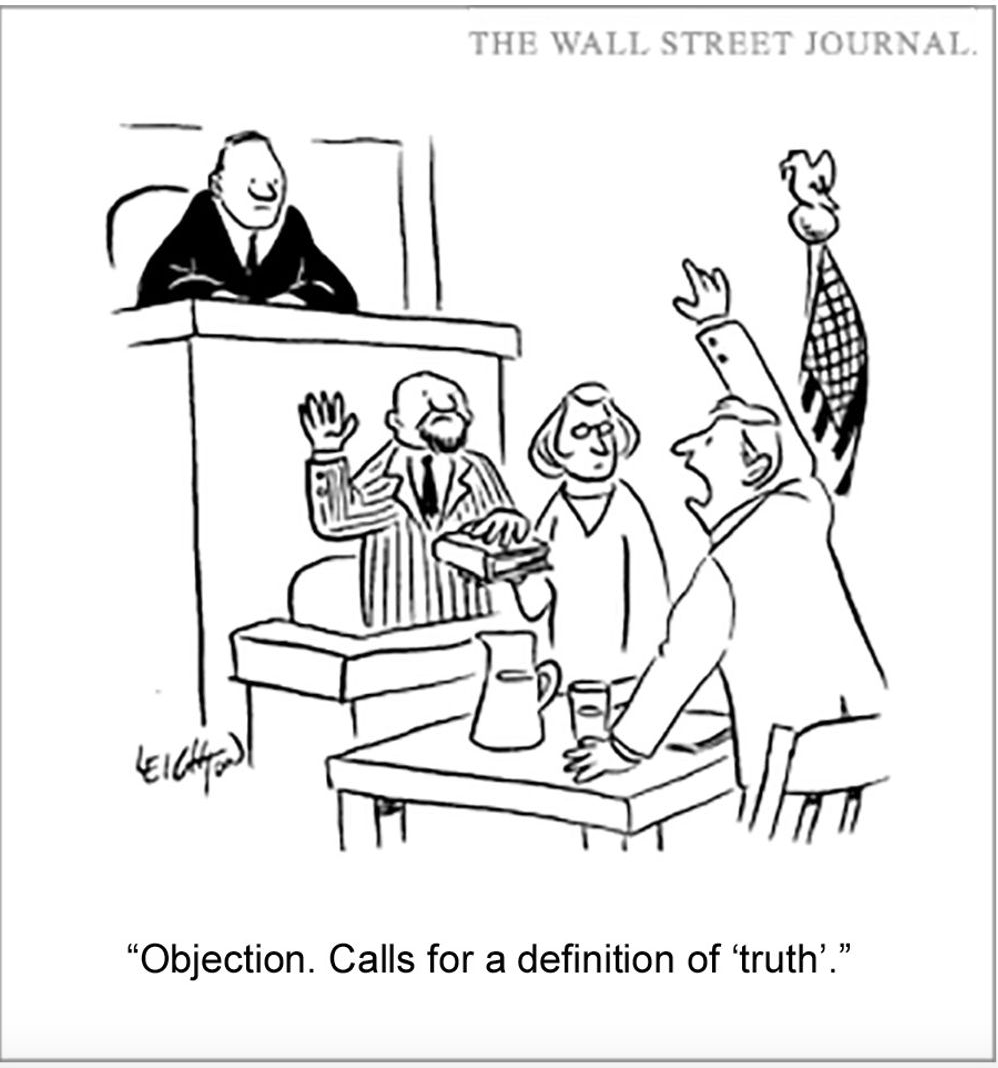
Saturday, 10/1/22

Cursing Darkness

Drink ‘till he’s cute

Purdue University recently was found liable for retaliation against a co-ed for her 2017 complaint that a fraternity member had sex with her without her consent because she was too intoxicated to give real consent. The two female administrators involved remain in their offices with Purdue’s backing (Purdue thinks the jury blew it), and, of course, protests ensued.

Here’s what Purdue had to say about it:

We appreciate our students and their passion on this truly important issue. But we believe, because of the evidence presented, that this is not the correct case to use in advocating for it. This was a very rare case of discipline for making false statements in a sexual assault report. The undisputed facts overwhelmingly established that Roe chose the sexual encounter she later labeled a sexual assault. …

The jury, which in part exonerated university administrators, ruled on the narrow issue of whether Purdue, having conducted a thorough investigation, appropriately disciplined Roe based on its finding of false charges.

Purdue’s position in these matters has long been clear: we will not tolerate sexual harassment in any form, including and especially sexual violence. But neither will we tolerate lying or making false accusations that can have lifelong consequences.

As for our two outstanding administrators, Dr. Katie Sermersheim and Alysa Rollock, we absolutely stand behind them, and any suggestion that they resign is out of the question.

Based in Lafayette.

Here’s a representative protester:

“When you listen to campus tour guides walk by, what do you hear parents ask: ‘Is this campus safe? Can my daughter walk home at night?’” Grace Gochnauer, a Purdue junior, said. “If I was the tour guide, my answer would be no.”

Purdue isn’t Mayberry RFD, but it has no particular problem with stranger rape of co-eds walking home at night. You know what you don’t hear parents ask? “Can my daughter get willingly get blackout drunk at a party, have sex with her apparently enthusiastic consent, and then get a pound of flesh when she regrets it later?”

I once stayed in a girl’s dormitory when on campus for a summer recording session. When I turned out the lights at bedtime, I saw a glowing message on the wall, painted cunningly so it only showed up in the dark: “Drink ‘till he’s cute.” Read between those lines. A frat boy’s equivalent could be “Drink ‘till you’re irresistible.”

I wish Purdue hadn’t found it necessary to ignore the elephant in the room. Call me santimonious, but if campuses could stop binge-drinking, they’d stop maybe 95% of problematic sexual intercourse. Justice Brett Kavanaugh’s unrepentant history of binge-drinking, even when under legal age, was a big reason that I thought the first allegation against him might be true — and why I remain agnostic about it still.

David French never said that!

Jake Meador, one of the good guys, writes about Alternatives to Culture War, but credulously alludes to a slander leveled against David French by tribalist culture warriors.

The slander, widely spread (and here and here ad infinitum), is that French thinks Drag Queen Story Hours are a “blessing of liberty.” Here’s Meador:

It was easier to be anti-culture war when our country still knew what marriage was and what men and women are. But as the SOGI landscape has shifted, culture war has started to look like a viable strategy, especially if the alternative is talking about drag queen story hour as a “blessing of liberty.”

The slander is so prevalent that searching “David French drag queen blessing of liberty” returned, for me at least, six or eight of the lies before it gave one link to the truth. What David French called a blessing of liberty was the absence of viewpoint discrimination in public spaces:

My position was simple — I don’t like drag queen reading hours, but I also want to preserve for all Americans the First Amendment-protected right of viewpoint-neutral access to public facilities when those facilities are opened up for public use. I don’t want the government dispensing access on the basis of its preferred messages or its preferred speakers. Handle bad speech with better speech. Counter bad speakers in the marketplace of ideas, not through the heavy hand of government censorship.

… Our present regime that broadly protects viewpoint neutrality in access to public facilities is the hard-won result of decades of litigation from free speech and religious liberty advocates, and it represents both a public good in its own right and a practical blessing for millions of American Christians. As our government continues to grow — including by creating an immense number of public facilities — it is quite simply just that taxpayers are able to have equal access to the facilities they paid to create.

Viewpoint Neutrality Protects Both Drag Queens and Millions of American Christians | National Review.

Anyone who won’t pause their Jihad long enough to notice the difference between “Drag Queen Story Hour is a blessing of liberty” and “viewpoint-neutral access to public facilities” is a blessing of liberty should stay home and shut up.

And if that’s culture war, so be it.

I’ve certainly flirted with the idea that liberalism has failed, and it’s therefore (almost by definition) time for some kind of post-liberalism. But I’ve yet to find any strange post-liberal devil I prefer to the liberal devils I already know. For that reason, I’m particularly keen to defend right-liberal David French from tendentious slanders by any and all far-right liars.

Conservatisms

If these populist, corporatist, nationalist, ultramontane, oh-so-European ideas succeed in replacing conservatism as we once knew it, they will be called conservatism. But as Friedrich Hayek argued, this conservatism will be “Old World conservatism,” because the conservative in America is necessarily a defender of the liberal tradition of the founding.

[T]he Heritage Foundation is, by any sane reckoning, an elite institution and it admits as much to donors. Second, this us-vs.-them framing implies that the “everyday people” of Italy have more in common with the “everyday people” of America, which is 31 flavors of nonsense for all sorts of reasons, not least that Italians aren’t Americans. Conservatives used to understand that the old Marxist idea that members of the working class were united against the ruling class regardless of nationality—“Workers of the world unite!”—was folly. But now, “Everyday people of the world unite!” is the rallying cry of a leading conservative think tank?

Now, I can’t put “conservative” in scare quotes the way I’d like to, because I think Heritage can still claim to be conservative. But let’s have no illusions: It’s not the same kind of conservative it used to be. Heritage used to champion American exceptionalism with gusto. As Heritage co-founder and longtime president Ed Feulner put it, “And while, in the heat of political battle, we naturally focus on the differences between liberals and conservatives, and their contrasting visions of our country’s future, it is important to remember that regardless of party or political philosophy, we are Americans, we love our country — and we are patriots.” In 2019, Heritage even founded the Feulner Institute for American Exceptionalism, which seems to have had as much impact as the Goldberg Institute for Healthy Living—neither organization even has a website.

Jonah Goldberg, Slouching Towards the Old World

Gotta stay in the limelight, no matter what

[P]erhaps the most revealing aspect of the book, to be published next week, is that Trump gave Maggie [Haberman], a Times reporter since 2015, three interviews for it. This is the same Trump who vilified her on Twitter, called her names and cast her as the personification of “fake news.” Maggie just pressed on, asking the right questions, getting the right people to answer them and seemingly trusting on some level that Trump would never wholly cut her off. She can recognize a performance when she sees one. And she can hear in a narcissist’s self-regarding soliloquies the aching need to babble on.

… Maggie (a friend of mine) and the other journalists whom he publicly insulted but privately indulged were, to him, reserves of precious attention, their discerning gazes trained on him, their busy thoughts dedicated to the puzzle of him, their notepads and audio recordings and television cameras a conduit to ever greater fame. There was danger in letting them in, peril in having them around, but the alternative was worse. They might give prime real estate on the evening’s newscast to some other circus act. They might write books about a lesser clown.

Frank Bruni, Donald can’t quit Maggie.

Lighting Candles

Journalistic bias, journalistic power

[T]he classic critique from the Right about [news] bias and the new critique from the Left about false equivalency often strike me as frivolous. They can often make sense on some particular item — Ouch, gotta admit, that’s a pretty good point — but cumulatively seem to miss the important point.

That point, in my view, is that the power of journalism does not principally flow from word choice. (Don’t call it a “misstatement” when it’s really a “lie.”) It does not flow from tonal presentation. (More than a half-century ago Richard Nixon’s vice president, Spiro Agnew, said network commentators revealed their bias “by the expressions on their faces, the tone of their questions, the sarcasm of their responses.”) The point is that the power of journalism comes from the primacy of reporting — from telling their audiences things that people in power would prefer they not know.

John F. Harris, The Reporters Who Proved That Journalism Is More Powerful Than Trump

Emotional Safetyism

By the mid-1990s, the doctrine was being used to sue an employer who printed a Bible verse on paychecks (which a court found to be religious harassment of non-Christians). A university forced a graduate student to remove a photo of his bikini-clad wife from his desk, because someone filed a harassment complaint. A library worker was forced to remove a New Yorker cartoon from his work area after coworkers said it harassed them. The town of Murfreesboro, Tennessee, removed a painting from a public exhibit in City Hall after a city employee filed a hostile-environment complaint about it. Those incidents and others like them should have been seen as flashing red lights, but weren’t.

Jonathan Rauch, The Constitution of Knowledge, on “emotional safetyism.”

Gestalt switch

[A]s we have already seen, normal science ultimately leads only to the recognition of anomalies and to crises. And these are terminated, not by deliberation and interpretation, but by a relatively sudden and unstructured event like the gestalt switch.

Thomas S. Kuhn, The Structure of Scientific Revolutons

Counting one’s privilege

I highly recommend this Outliers, Revisited episode of Malcolm Gladwell’s Revisionist History podcast. I won’t ruin it for you except that it involves a 40-30-20-10 “rule” that holds true in way too many fields.

Election Prep

Now might be a good time to refresh your memory on whether your congressperson, on January 6, 2021, voted for the United States of America or voted for the “Oathkeepers” and other insurrectionists. My congressman, normally a cipher, voted with the insurrectionists.

Gathering flowers

Bloggers and writers

I’m a blogger. Bloggers have different talents than writers.

We value writers for their prose and their insight. We value bloggers for their speed, their efficiency at curating news, and their ability to formulate strong political opinions—“takes,” we might more aptly call them—about literally anything that might turn up on the Drudge Report or in the average news junkie’s Twitter timeline.

Nick Catoggio at the Dispatch.

Quoted with approval.

The production of “childhood”

If there were no age-specific and obligatory learning institution, “childhood” would go out of production. The youth of rich nations would be liberated from its destructiveness, and poor nations would cease attempting to rival the childishness of the rich.

Ivan Illich, Deschooling Society


[S]ubordinating truth to politics is a game which tyrants and bullies always win.

Jonathan Rauch, The Constitution of Knowledge

The Orthodox “phronema” [roughly, mind-set] cannot be programmitized or reduced to shibboleths.

Fr. Jonathan Tobias

You can read most of my more impromptu stuff here (cathartic venting) and here (the only social medium I frequent, because people there are quirky, pleasant and real). Both should work in your RSS aggregator, like Feedly or Reeder, should you want to make a habit of it.

Thursday, 9/29/22

Today marks the 24th anniversary of my father’s death and 40 days since the death of Metropolitan Kallistos Ware, a titan in Anglophone Eastern Orthodoxy.

I’m surprised at how much I’ve aggregated. It definitely was time to get it out of draft and onto the internet.

Rightward swings in the Western World

When Liberals Won’t Enforce Borders

Rapid mass migration, we now know, is arsenic to egalitarian social democracy.

But why turn to the former neo-Nazis? You won’t find an answer to that in woke-captured media either. The answer is similar to the reason Americans turned to Trump: for a very long time, no one in the mainstream parties or media would acknowledge the reality of the migrant crisis or do anything about it, except call those asking questions racists and fascists.

… In the immortal words of David Frum: if liberals won’t enforce borders, fascists will.

Andrew Sullivan on the roots of Sweden’s political swing to the hard right.

Italy’s rightward swing

We’re left with a picture of a country in which the center-left is supported mainly by the educated, secular, and professional classes, while the right appeals to a cross-section of the rest of the country—the working class as well as the middle and upper-middle classes, along with the religiously pious and the large numbers of Italians who treat religion as a symbol or identity-marker without actually believing in or practicing it.

If that sounds familiar, that’s because similar things have been happening in many places over the past decade. The precise political results of these shifts have varied from country to country as they’ve interacted with different electoral systems, but the underlying trends in public opinion can be seen to a greater or lesser extent in France, Great Britain, the U.S., and other countries. In each case, the center-left has gone into decline with the center-right and anti-liberal populist right rising to take its place.

Until the center-left figures out a way to win back the working- and middle-class, as well as the nominally religious, it will continue to lose precious political ground to the populist and nationalist right.

Damon Linker

I’m quite impressed with Linker’s still-newish Substack. He’s been writing almost daily, but I don’t recall any total duds yet, and that’s a bit of a rarity even with writers whose schedules are more relaxed.

Angry Incoherence from the 5th Circuit

“I think passing this law was so much fun for these [Texas] legislators, and I think they might have expected it would get struck down, so the theater was the point.” But she also believes that there is likely some lack of understanding among those responsible for the law about just how extreme the First Amendment is in practice. “Most people don’t realize how much horrible speech is legal,” she said, arguing that historically, the constitutional right has confounded logic on both the political left and right. “These legislators think that they’re opening the door to some stuff that might offend liberals. But I don’t know if they realize they are also opening the door to barely legal child porn or pro-anorexia content and beheading videos. I don’t think they’ve understood how bad the bad is.

Daphne Keller, director of the Program on Platform Regulation at Stanford’s Cyber Policy Center, via Charlie Warzel on NetChoice v. Paxton, a bizarre 5th Circuit opinion upholding a Texas law that, motivated by a perception of liberal bias in moderation, essentially forbade big internet platforms to moderate content — and forbade them from ceasing to do business in Texas to boot! Is This the Beginning of the End of the Internet?.

Domestic Politics

Proxy or Leader?

The flow-with-the-go model of politics is baked into representative democracy. Or, rather, representative democracy invariably is shaped by the tension between the conception of representative-as-proxy—“I’m just here to represent the Will of the People!”—and representative-as-leader, a  role in which a representative will, from time to time, be obliged to ignore or overrule popular sentiment in service to prudence and justice. This is Edmund Burke 101: “Your representative owes you not his industry only but his judgement; and he betrays you instead of serving you if he sacrifices it to your opinion.”

Kevin D. Williamson, Grift 2.0

Burke’s has been my view of representative democracy for longer than I can remember. And his examples of "Grift 2.0" ring true.

Comparative hate

I don’t know a statement more indicative of the character of our moment than this by J. D. Vance: “I think our people hate the right people.”

Alan Jacobs. Sadly, Vance is quite public about his Christian faith. That he should consider hate-promotion a feature, not a bug, is jarring.

Powered by Pure Spite

The cardinal virtue of modern conservative populism is spite. Whatever gambit a populist is pursuing, whatever agenda he or she might be advancing, the more it offends the enemy the more likely it is to be received by the right adoringly. Ron DeSantis’ Martha’s Vineyard stunt is an efficient example. It accomplished nothing meaningful yet observers on both sides agree that he helped his 2024 chances by pulling it off. He made the right people mad. That’s more important than thoughtful policy solutions.

Why spite has become so important to the right-wing populist ethic is hard to say, as it’s not symmetrical between the parties. The most prominent left-wing populist in Congress is probably Alexandria Ocasio-Cortez, a politician who, despite her many faults, doesn’t want for policy ideas. Ask AOC what her top priority as a legislator is and she might say the Green New Deal or Medicare For All. The most prominent right-wing populist in Congress is likely Marjorie Taylor Greene. Ask Greene what she wants to do with her power as a legislator and she’s apt to say, “Impeach Joe Biden.”

“Impeach Joe Biden for what?” you might ask, as if that matters. …

Spite doesn’t need a reason.

Nick Catoggio (f/k/a Allahpundit), The Wild Ones

True Movements or Mostly Hype?

It is perfectly clear that there is a movement in America of people who call themselves evangelicals but have no properly theological commitments at all. But what’s not clear, to me anyway, is how many of them there are. Donald Trump can draw some big crowds, and those crowds often have a quasi-religious focus on him or anyway on what they believe he stands for — but those crowds are not large in the context of the entire American population. They’re very visible, because both Left and Right have reasons for wanting them to be visible, but how demographically significant are they really?

I have similar questions about, for instance, the “national conservatism” movement. Is this actually a movement? Or is it just a few guys who follow one another on Twitter and subscribe to one another’s Substacks?

Alan Jacobs

Culture

I dread our being too much dreaded

I must fairly say I dread our own power, and our own ambition; I dread our being too much dreaded. . . . We may say that we shall not abuse this astonishing, and hitherto unheard-of power. But every other nation will think we shall abuse it. It is impossible but that, sooner or later, this state of things must produce a combination against us which may end in our ruin.

Edmund Burke via Michael Brendan Dougherty, defending himself and Christopher Hitchens against charges of being Putin apologists for long opposing our policies in Ukraine, almost none of which charges are made in good faith.

Dougherty continues:

To [Peter] Hitchens, whom I have admired greatly for some time, I say now is the time to apply realism to the trolls and demagogues and even to many of the think-tankers and mandarins on the other side. Our case is that they are mishandling grave matters, that they are hubristic and deluded about their own nations and about grand strategy. We think they are casting themselves, absurdly, as great statesmen like Churchill. You and I, having read just a little more history than can fit into a two-hour movie, don’t even belong to that cult in the same way they do. Why, then, should we ever have expected them to treat their powerless critics fairly?

Realism means admitting that our leadership is unworthy, deluded, and stupid. Really they are unprepared, or unfit for their roles. They have led us from one disaster to the next for over two decades. But we may avoid the worst calamity in spite of their failures. We may be saved the miscalculation of others. Or our salvation may be that the huge treasury of power and advantage bequeathed to our nations by previous generations cannot be wasted entirely, even by foolish heirs like these. Or it may be by pure dumb luck, or the grace of God.

White Liberals

I love WL’s [White Liberals], love ’em to death. They’re on our side. But WL’s think all the world’s problems can be fixed without any cost to themselves. We don’t believe that. There’s a lot to be said for sacrifice, remorse, even pity. It’s what separates us from roaches.

Paul Farmer via Alan Jacobs

Invisible infrastructure

Our immigration system is broken, and relies on the invisible infrastructure maintained by non-profits and religious groups.

Leah Libresco Sargeant (italics added).

I think everyone knows the system is broken, but I had not been award of the invisible infrastructure. Maybe Paul Farmer wasn’t completely right about white liberals.

Because I say so. That’s why.

Over two decades ago, when I was getting to know Eric [Metaxas], we had a friendly argument over something theological, as we walked around Manhattan. When I challenged something Eric said, he replied that God had told him it was the thing to do. “How do you know that?” I asked. Because he did. The argument went nowhere. I remember it so clearly because that was the first time I had ever had a conversation with someone who asserted that something was true not because God said it — all Christians must believe that, or throw out Scripture — but because God had said it to them personally.

Rod Dreher, What I Saw at the Jericho March (MAGA at prayer event a shocking display of apocalyptic faith and politics — and religious decadence)

Apple pulls back from China

Apple announced Monday it has already begun manufacturing its new iPhone 14 in India, just weeks after the updated product launched and months earlier than previously expected. Production of the company’s newest line of phones typically begins in Chinese factories because of existing supply-chain efficiencies, with some of it shifting to India after six to nine months. The move is likely indicative of Western companies’ newfound desire to limit reliance on China amid economic uncertainty and geopolitical tensions.

The Morning Dispatch for Tuesday, 9/27/22

Battling Amazon in France

France introduces a delivery charge for books: The “minimum charge of €3 will help small independent booksellers struggling to compete with Amazon and other giant online retailers.”

Micah Mattix

The New Economy

Financialization itself, at the grand scale, was a racket—substituting swindles and frauds for the old economy of industrial production.

James Howard Kunstler, Living in the Long Emergency

Journalism, traditional and new

Toxic News Swamp

[H]ow could MSNBC and CBS News have both purported to “independently confirm” a CNN bombshell that was completely false?

Glenn Greenwald, How Do Big Media Outlets So Often "Independently Confirm" Each Other’s Falsehoods?

Oases of Sanity

If you’re tired of tearing your hair out over political writing, Alan Jacobs has the cure: an array of sane writers who are not carrying water for anyone or any cause:

  • Leah Libresco Sargeant
  • Noah Millman
  • Damon Linker
  • Zeynep Tufecki
  • Yair Rosenberg
  • John McWhorter
  • Freddie deBoer
  • Jonathan Rauch
  • Jonathan Haidt
  • Jesse Singal
  • David French
  • Andrew Sullivan

Wordplay

Shameware

Software voluntarily installed on a smartphone to allow someone else to monitor, and challenge, one’s internet browsing. One group of Churches in particular is using it.

Similar to surveillance software like Bark or NetNanny, which is used to monitor children at home and school, “shameware” apps are lesser-known tools that are used to keep track of behaviors parents or religious organizations deem unhealthy or immoral. Fortify, for instance, was developed by the founder of an anti-pornography nonprofit called Fight the New Drug and tracks how often an individual masturbates in order to help them overcome “sexual compulsivity.” The app has been downloaded over 100,000 times and has thousands of reviews on the Google Play store.

Wired

My first reaction was “maybe some people really need this to straighten out.” But the security holes it creates are technically worrisome apart from spiritual or psychological concerns.

Mechanical Jacobins

Automobiles, in the lexicon of Russell Kirk

Fractally wrong

Techdirt founder Mike Masnick’s summary of the 5th Circuit U.S. Court of Appeals upholding Texas’ ban on big sites moderating content (see above). In greater detail…

made up of so many layers of wrongness that, in order to fully comprehend its significance, “you must understand the historical wrongness before the legal wrongness, before you can get to the technical wrongness.”

Via Charlie Warzel, Is This the Beginning of the End of the Internet?.


[S]ubordinating truth to politics is a game which tyrants and bullies always win.

Jonathan Rauch, The Constitution of Knowledge

The Orthodox "phronema" [roughly, mind-set] cannot be programmitized or reduced to shibboleths.

Fr. Jonathan Tobias

You can read most of my more impromptu stuff here (cathartic venting) and here (the only social medium I frequent, because people there are quirky, pleasant and real). Both should work in your RSS aggregator, like Feedly or Reeder, should you want to make a habit of it.