What if we thought Christianity was about reality?
If it were seriously imagined that the teachings of Christianity or other religions constituted a vital and irreplaceable knowledge of reality, there would be no more talk of the separation of church and state than there is of the separation of chemistry or economics and state.
That word “irreplaceable” is a key; it challenges me in my approach to public affairs, which tends toward Rawlsian public reason even though I’ve read no Rawls.
Maybe I tend that direction because I’ve so rarely heard Christian voices in the public square seasoning the discussion subtly, like salt in a recipe, rather than waving the Bible (sometimes literally) and declaiming what they perceive as God’s “rules” rather than persuading about “reality.”
If we can see that the pre-Christian philosophers did seek the truth, and that they did catch glimpses of it, it only stands to reason that their teachings should bear some similarities, like a broken reflection of the moon in water, to the fullness of truth in Jesus Christ. Therefore, these similarities need not appear as a threat to Christianity; instead, they offer one more proof of Christ as universal truth.
I love that “like a broken reflection of the moon in water.”
Parable of the week
A certain man went down from Athens to Atlanta and fell among thieves, which stripped him of his raiment and wounded him and departed, leaving him half dead. And by chance there came down a certain conservative megachurch head pastor that way. Now, this pastor had 14,000 sheep, and 6,000 camels, and a thousand yoke of oxen, and a thousand she-asses, and a 10,000-person auditorium, and much gyms. He had also seven sons and three daughters, for unto him was a smokin’ hot wife named Cyndi. She did teach yoga, but she sinned not for she called the class Stretching Our Faith and never used Sanskrit words.
And when he saw the man, he passed by on the other side and he said unto himself, “This is what comes with woke politicians, slimy, dirty people everywhere. A decent person can’t even ride the bus. The Uber drivers always want a tip.” And he passed by on the other side.
And came then two Duke Divinity School post-liberals, for there was in those days in that city a theology conference. And they saw him and were moved to pity. And one went to help him. But his friend said unto him, “Ho, consider and be sure. Art thou moved by the charity that is from the Lord? Or doth thou proceed from the superficial liberal humanitarianism of the Enlightenment?”
And the other paused and did bethink himself, for he did not want to proceed from the superficial liberal humanitarianism of the Enlightenment lest the Lord wax wroth with him. And at last, he did say to his friend, “Look, this man suffereth! and would thou be treated thus? Consider that if thou were this man, thou would swap the most of for the least of these.” And his friend replied, “Whoa, buddy, thou soundeth like Rawls.” And they did argue, and growing distracted, did pass by on the other side.
But a certain disenchanted liberal technocrat, as he journeyed, came to where he was. And when he saw him, he had compassion on him and went to him and bound up his wounds, pouring in oil and wine and set him on his own beast and brought him to an inn and took care of him and did exchange with him Reddit handles.
And on the morrow when he departed, he took out two pence and gave them to the host and said unto him, “Take care of him. And whatsoever thou spendest more, when I come again, I will repay thee.” And the host did say, “The doctors say he needeth a new kidney.” And the man was sore afraid, but he was an effective altruist. And he said, “Lo, I have an extra one that I’m not using. And hoarding it would be irrational under the circumstances.” And he gave the man his kidney. And being recovered, he went back to his job as a consultant and great was his reward in the kingdom of God, if he would allow himself to know it.
Phil Christman, The Effective Samaritan, quoted here.
Religious liberalism
Ross Douthat has a fine column on why he’s not a liberal Catholic. With a little effort, you can translate it to liberal versus conservative in other churches, too.
Excerpt:
If liberal forms of Catholicism claimed to be comfortable as a remnant out of step with the spirit of the age, then diminished numbers wouldn’t necessarily demand a self-critique. But again, liberals are the ones most likely to insist that the signs of the times should compel the church to shift in their direction, as an alternative to marginalization or extinction. And there is just no serious or compelling proof of concept here, after so many decades of experiments. “Join or die” is just not a compelling argument if your own movement seems to be dying even faster.
A Christendom vision
Accessing things that are extremely bad for you, like marijuana, gambling, and porn, should be harder than it is. Being able to get married, buy a house (or just afford good housing), and have children should be easier than it is. A great many of our problems, I think, exist because we’ve made a world in which it is desperately difficult to be good, far more difficult than it needs to be. When I envision a Christian society, the ideas near the forefront of my mind mostly have to do with protecting and preserving family life, promoting organized labor so that workers can command better wages and more easily build and form families, and taking some reasonable steps to limit access to some especially dangerous vices, such as gambling and porn, for starters.
What the Fathers decried as schism is now regarded as normal church growth. So long as the new church does not make a point of denying the Trinity, it remains a part of the una sancta.
Basil, a consistent witness to the Eastern principle of deification, wrote about free will in a way that contrasted sharply with that of Augustine: “Good action arising from free choice,” he insisted, “is . . . present in us by nature.”
Fr. John Strickland, The Age of Paradise
The clash of cultures
Several scholars distinguish a separate Orthodox civilization, centered in Russia and separate from Western Christendom as a result of its Byzantine parentage, distinct religion, 200 years of Tatar rule, bureaucratic despotism, and limited exposure to the Renaissance, Reformation, Enlightenment, and other central Western experiences.
Short of constituting a separate civilization, it seems to me that American Orthodox converts are building at least a distinct subculture.
One hundred years of platitudes
Then Almata cried, Why is he called The Prophet? And Gibran spoke, It is a misprint for The Profit. For that is what I have made of the Gullible’s insatiable desire for Platitudes.
The late ‘60s and early ’70s felt like Peak Gibran, but I managed to avoid both Gibran and weed.
Lucky me.
Why do I read anything but poetry …?
Where is the Life we have lost in living? Where is the wisdom we have lost in knowledge? Where is the knowledge we have lost in information? The cycles of Heaven in twenty centuries Bring us farther from God and nearer to the Dust.
The end of the world as we know it is not the end of the world.
You can read most of my more impromptu stuff here (cathartic venting) and here (the only social medium I frequent, because people there are quirky, pleasant and real). Both should work in your RSS aggregator, like Feedly or Reeder, should you want to make a habit of it. I’m even playing around a bit here, but uncertain whether I’ll persist.
I’ve always liked the story with the punchline “What the hell is water?” But I don’t think I’d ever read the full commencement address from which I got it.
Quite good, with anticipations of Iain McGillchrist and of “pay attention to what you’re paying attention to;” but David Foster Wallace’s way may be better.
The law says what the law says. The job of the Supreme Court is to apply the law, not to make up the law, not to reform the law, not to ensure that the law accords with public opinion. If public opinion is opposed to the law, then the public can elect new lawmakers and write new laws. It is not up to the Supreme Court to do that for them. If representative democracy means anything, it is that the law is made by lawmakers who are elected by the people and democratically accountable to them.
…
Even Nina Totenberg has noticed that the progressives on the Supreme Court are more inclined toward bloc voting while the so-called conservatives are more inclined toward intellectual disagreement. If your bookie took bets on how individual justices were going to vote in any given hot-button case, you’d make more money betting on the progressives, who are predictable. When it comes to their most important political commitments, they sometimes have reached their decision before the first arguments are made.
I’m not sure how Williamson supports that last sentence, but otherwise it’s solid.
Damon Linker’s sober assessment
I’m not really interested in debating the substance of the issue. I’m fully vaccinated, so is my wife, and so are my kids. That includes several rounds of Pfizer’s mRNA COVID vaccine. But I’m not anything close to being a medical doctor or an expert on immunology or epidemiology. I’m not even an especially informed amateur observer of issues in public health. What I am is a broadly well-educated writer and citizen who trusts doctors, public-health professionals, government agencies, and the media’s myriad mechanisms of publicity to provide me with accurate information about the world. I trust that since tens of millions of Americans (and hundreds of millions more all over the world) have taken these vaccines, I would have heard about it in the form of a blockbuster news story if they actually did more harm than good.
But note: I don’t know that vaccines are safe in the same way that I know it’s a cloudy day in the Philadelphia suburbs, where I live and am writing this post. And this is true about an enormous number of things. Anytime anyone says “I know X” about a matter that goes beyond direct personal experience—I can see the clouds outside my window with my own eyes—it implicitly involves an act of trust: “I know X because Y says X, and I trust that Y knows what s/he is talking about and wouldn’t deceive me.”
Do you distrust the pronouncements of Anthony Fauci? Fine. But why would that lead you to trust RFK or Joe Rogan more? Just because they’re not employed by the government?
Why indeed? I know full well that governments lie to me constantly — but nowhere near so constantly that I can say “government said it so it must be a lie.” But what I also knowbelieve is that crackpots and grifters are even less reliable than the government (do I really need to cite examples?), and that I lack the time and the knowledge to personally check out every contrarian claim.
Especially at age 74, I am very aware of my mortality, and of the much higher priorities for spending the time until that day.
Maslow’s Hierarchy, level 1
For all I complain about the empty materialism of the West, there is a certain level of wealth essential to human happiness, below which family, faith, and work as a craft, isn’t solace enough. We need a certain amount of stuff to escape the drudgery and toil of existence. That level is probably somewhere above Senegal ($1,800 per capita GDP) and below Vietnam ($4,000).
The policies implementing the Sexual Revolution now have the priority that peace and prosperity used to occupy in political loyalties and discourse. The revolutionary ideology now holds the place of esteem once held by the Judeo-Christian religions.
In general, I did not care for this book, but this particular point is powerful. The Biden administration has proven the truth of it vividly in its enthusiastic celebrations of Pride Month. (If you missed the details, Rod Dreher is ever ready to fill you in.)
The late Joseph Sobran said decades ago that the Democrats had become the “vote your vice” party. It has only gotten worse (with an admixture of perverse obsequiousness toward transgender ideology).
(I grant that there are vices other than sexual, and that when Republicans are in power they either leave the declining status quo untouched or else pass performative and draconian bans that the courts strike down on various grounds, some of those grounds being solid.)
Scotomas
Speaking of vice, the current issue of The American Conservative devotes its current issue to the topic.
Yup. They’ve got the biggies:
Porn
Gambling
Marijuana
Witchcraft
Social Media
But I almost laughed out loud at the absence of binge drinking and at the article titled and subtitled The No Smoking Garden: The crusade against tobacco has depended on shameless propaganda.
I’m thinking the common thread here is “calls to legalize newer vices are bad; traditional legal vices are fine.”
This is typical of why I keep waiting for The American Conservative to realize that my subscription has lapsed.
Don’t worry; science has it all figured out
(An archaeologist finds a motel centuries hence:)
Surrounding almost the entire complex was a vast flat area, marked with parallel white lines. In several of the spaces stood freely interpreted metal sculptures of animals. To avoid the misunderstanding that often arises with free interpretation, each sculpture was clearly labeled. They were inscribed with such names as Cougar, Skylark, and Thunderbird, to name but a few. The importance of animal worship in Yank burial customs has never been more clearly illustrated.
It was easy for my generation of baby boomer liberals to be humble, because we had much to be humble about.
Many on the left had erred on what was perhaps the most important issue of the 20th century, global totalitarianism: Too many had been soft on Soviet Communism or Chinese Maoism. When you see well-meaning people on your side who were catastrophically wrong about profound moral and political issues, humility comes more easily.
These days, however, many conservatives are so ridiculous that I fear they are robbing us liberals of that well-earned humility.
Peter Wehner can always be counted on to oppose Florida Man, but sometimes he hits the nail on the head more squarely than other times:
Trump doesn’t just cross moral lines; he doesn’t appear capable of understanding moral categories. Morality is for Trump what colors are to a person who is color-blind.
Trump’s moral depravity, which touches every area of his life, private and public, has long been in public view, undisguised and impossible to miss.
Other shady and unethical individuals have served in the White House—Richard Nixon and Warren Harding among them—but Trump’s full-spectrum corruption puts him in a category all his own. His degeneracy is unmatched in American presidential history and unsurpassed in American political history.
Donald Trump, rather than using the presidency to elevate human sensibilities, did the opposite, and he did it relentlessly. Among the most damaging legacies of the Trump years is his barbarization of America’s civic and political life. He called the spirits from the vasty deep, and they came when summoned.
Mind you, I’m among those who succumbed to Trump Derangement Syndrome (the first Presidency so to afflict me), so I can’t fault Wehner for a bit of obsessiveness.
What is the reason for Mike Pence?
Pence recently did an interview with right-wing radio hosts Clay Travis and Buck Sexton, in which he refused to say whether he’d pardon Trump once in office. The hosts wanted Trump pardoned, and Pence basically had three answers. First, he riffed on the fact that he believes these are “serious charges” and he “can’t defend what’s been alleged.” Second, he says it’s “premature” to discuss a pardon because we don’t know what “the president’s defense is” or “what are the facts.” And then third, he says “we either believe in our judicial process in this country or we don’t; we either stand by the rule of law or we don’t.”
…
Normally, I’m not impressed with candidates who refuse to answer questions because they look like they’re being evasive for political reasons. The lack of authenticity is like nails on a chalkboard. But here, it actually is a real answer. He thinks the charges are real, but he’s open to hearing Trump’s side of the story.
Sarah Isgur. She analyzes the other GOP candidates, too.
Pence is right, but being right often requires nuance for which voters have no patience.
I was aware of, but did not share, a Pence Derangement Syndrome when he was Governor of Indiana. I have nothing in particular against him now. But on 1/6/21, he assuredly was aware that by honoring our electoral college system over the shenannigans of Florida Man, he was ending his political career.
In 2023, Pence is a stone-cold loser, lacking even the “what the hell, why not tell the truth?” rationale of Chris Christie.
Wordplay
1
Filiation and affiliation
The late Edward Said was known for his distinction between filiation and affiliation. Filiative relations are those that come to us naturally, those that are givens of our birth and into which we are born. Affiliative relations are those we purposefully forge.
Mr. Robertson ran for president in 1988, hoping to channel evangelistic popularity from his growing television empire, the Christian Broadcasting Network, into Republican political might. Ultimately he failed — even devout Christians worried about the intensity with which the celebrity minister blended church and state.
And yet, by the time of his death on Thursday, the vision he championed had gained more power than he could have ever thought possible. The alliance between evangelical Christianity and Republican politics has fused, even as America has grown increasingly secular. The polarizing rhetoric of his often inflammatory views has become a defining feature of American politics.
“Evangelistic popularity” is pretty clumsy. It skips over primary and secondary meanings of evangelism and evangelistic to mash up a tertiary meaning (a meaning which I suggest arose from journalistic misusage, which eventually “makes proper” I guess, as “literal” now is a hyperbolic form of “metaphorical.”)
I have no idea, apart from context, what happens when an alliance fuses, and I’m not persuaded by it.
I recently read Before Religion: A History of a Modern Concept 📚 The idea of religion as a sphere of life distinct from politics, economics, or science is a recent development in European history. That’s not a complete surprise to me, but I’d never before read so much on how that came about. Spoiler alert: there’s a bit of cultural imperialism in the sense of “imposing” on other cultures how the secularized West parses things.
9
Baksheesh, a word meaning bribes in Arabic, which police frequently ask for in Egypt. Read the full story.
This probably is in the same thought constellation as how notoriously hard it is to create compelling good fictional characters.
11
“Random” vs. “Mystery”
To call the unknown “random” is to plant the flag by which to colonize and exploit the known … To call the unknown by its right name, “mystery,” is to suggest that we had better respect the possibility of a larger, unseen pattern that can be damaged or destroyed and, with it, the smaller patterns … But if we are up against mystery, then knowledge is relatively small, and the ancient program is the right one: Act on the basis of ignorance.
So we come to the present pass, with the world’s most powerful nation, with all of its magnificent history and intricate constitutional architecture, at the mercy of a pathological narcissist, trembling at the thought of bringing him to justice — as if it were the act of applying the law to him, and not his brazen defiance of it, that were the anomaly
What he once wore as electoral camouflage is now tattooed all over him, in yet another fulfillment of the late Kurt Vonnegut’s warning that, eventually, “we are what we pretend to be.”
Tom Nichols on the transmogrification of J.D. Vance into a Trumpist.
D
Teenagers suffer for many reasons. One is being fragile and in formation — a human construction site.
The end of the world as we know it is not the end of the world.
You can read most of my more impromptu stuff here (cathartic venting) and here (the only social medium I frequent, because people there are quirky, pleasant and real). Both should work in your RSS aggregator, like Feedly or Reeder, should you want to make a habit of it. I’m even playing around a bit here, but uncertain whether I’ll persist.
Voters have to make a choice. Choices are always binary. In the end the majority of voters who aren’t fans of either man will have to decide whose flaws are greater. The presidential ballot doesn’t allow for a nuanced moral calculus.
Baloney! If the major parties keep serving up sh*t sandwiches, we can always refuse to choose (not vote). And there’s the choice of voting for the American Solidarity Party candidate (my choice the past two presidential elections).
Home-invasion robbers
Its mistake is not in any of the hand-written niceties it revels in, which make life orderly, cozy—even lovely. Its mistake is that it treats Leftist ideologues like quirky out-of-town guests arriving for brunch. It assumes we all want the same things and are equally devoted to the perpetuation of bedrock American commitments: free speech, free exercise of faith, equal protection, rule of law.
But the Woke are not zany guests. They are home-invasion robbers.
Nellie Bowles on Friday had the customary array of nut-picked items, but this one is particularly choice:
Philip Morris gets higher ESG rating than Tesla: Before anyone gets too excited about America making a sensible turn on climate change, let’s check in on our eco-investing program. Environmental, Social, and Governance (ESG) scores are meant to be guides for ethical investing, and a company’s score is extremely influential for where big investors put their money. It’s also fully corrupt, and data firms award high scores only to companies that give money to the most bizarre causes. So for example: Tesla now has an overall score of 37 out of 100, compared to Philip Morris International, which has a score of 84. Never mind that cigarettes accelerate the deaths of 8 million a year. (Read Rupa Subramanya’s Free Press article about ESG.)
(Emphasis added)
USA
American Exceptionalism
America’s “exceptional” nature … doesn’t imply superiority. It doesn’t even suggest excellence. It implies difference.
When the head of USAID, Samantha Power, comes to your country and spouts off about America’s role in facilitating “civil society” and “independent journalism,” you are not only right to be worried—you have a duty to stay vigilant.
In my seemingly endless quest for balanced news and commentary (even if it’s roll-your-own balance by reading across a broad spectrum), I’ve been frustrated again and again. When I started in the early ’90s, with a shortwave radio, almost everyone was playing our music (literally) and singing our tune (figuratively). Soon came the internet, and shortwave went the way of the Dodo Bird.
C.S. Lewis in his essay wrote that “Every age has its own outlook. It is specially good at seeing certain truths and specially liable to make certain mistakes. We all, therefore, need the books that will correct the characteristic mistakes of our own period. And that means the old books.” Every country, too, tends to see some things especially well, others poorly. I try to be aware of that when I read putative enemies, both Americans, arguing with each other; I don’t always spot the hidden premise they share, that the world may not share, but I see it often enough to vindicate Lewis.
But such is the world today that even regions and countries who think differently from us publish their thinking in English, thank goodness, as I’m not currently literate other than in English. That means I can read:
Maybe foreign thinkers writing in English can supplement old books for expanding my mind.
Trump and his woes
Speaking of the Trump indictment
Here’s Marco Rubio:
There is no limit to what these people will do to protect their power & destroy those who threaten it, even if it means ripping our country apart & shredding public faith in the institutions that hold our republic together.
Rubio was speaking of the Democrats, of course; I could muster up some respect for him if it were a tearful admission he had been protecting his power by shredding public faith in the institutions of criminal justice.
Marco Rubio wasn’t necessarily the worst, but there was particular irony here.
Sober Peggy Noonan
My fear is that Mar-a-Lago is a nest of spies. Membership in the private club isn’t fully or deeply vetted; anyone can join who has the money (Mr. Trump reportedly charges a $200,000 initiation fee).
A spy—not a good one, just your basic idiot spy—would know of the documents scattered throughout the property, and of many other things. All our international friends and foes would know.
Strange things happen in Mar-a-Lago. In 2019 a Chinese woman carrying four cellphones, a hard drive and a thumb drive infected with malware breezed past security and entered without authorization. She was arrested and jailed for eight months. Another Chinese woman was arrested soon after; a jury acquitted her of trespassing but convicted her of resisting arrest. In 2021 a “Ukrainian fake heiress and alleged charity scammer” gained access, according to the Guardian.
Who else has?
Mar-a-Lago isn’t secure. Those documents didn’t belong there. It is a danger to our country that they were. This story will do Mr. Trump no good with his supporters. It will hurt him—maybe not a lot but some, maybe not soon but in time. I mean the quiet Trump supporters, not big mouths and people making money on the game, but honest people.
When individuals and communities confront a range of options, all of which are likely to lead to bad consequences, that’s a tragic situation. I think that’s where the country finds itself today—in the midst of an unfolding tragedy. The proper response to such a situation is sobriety and honesty about the dangers that lie ahead.
The New York Times describes advisers to rival campaigns wrestling today with the surreal task of “trying to persuade Republican primary voters, who are inured to Mr. Trump’s years of controversies and deeply distrustful of the government, that being criminally charged for holding onto classified documents is a bad thing.”
Nick Cattogio. Note, too, that the criminal charges came from a grand jury, not straight from DOJ.
Two key ideas for next year
I implore my conservative readers to consider two ideas:
Donald Trump is unfit for the Presidency of the United States.
The Democrats (and substantial portions of the civil service) have treated Donald Trump very shabbily. For sake of argument only, I’ll include the federal criminal indictment in that.
Now here’s the point, which doesn’t seem subtle to me but seems to be widely overlooked: Idea 2 doesn’t negate Idea 1.
Can you see that?
Should we inflict Donald Trump upon ourselves and our children just to get back at those who’ve wronged him? Couldn’t we just throw him a giant pity party? (Sorry: I’m expecting an emergency phone call that evening.)
Nailing the Wall Street Journal
Josh Barro nails the Wall Street Journal. Its opinion pieces really have been as bad as he describes in This Is Solely Donald Trump’s Fault. Excerpt:
People like those who constitute WSJ editorial board, who admit Trump broke the law but still don’t think he should be charged for it, should have to spell out what kinds of crimes a leading politician should not be allowed to commit.
And just in case you’ve wondered what Artificial Intelligence would come up with when asked for “A bathroom with a crystal chandelier, and an orange man with blond hair in a business suit reading a document on the toilet, and boxes and boxes of files stacked up everywhere, Pixar,” Barro answers that, too.
Will Republicans nominate a first-grader?
Overwhelming self-entitlement is just at the core of who Trump and [Boris] Johnson are. It is their character. This is how Johnson’s school principal described him when the future PM was just 17: “[He] sometimes seems affronted when criticized for what amounts to a gross failure of responsibility … I think he honestly believes that it is churlish of us not to regard him as an exception, one who should be free of the network of obligation that binds everyone else.” It could read as a summary of parliament’s report 41 years later.
And as with Trump and his bizarre behavior with “his boxes,” it’s very hard to see some profound, malign motive here in pursuit of something important. It’s just mindless egotism, married with an infinite capacity for deceit. Here’s how George M. White, Trump’s classmate at their military academy, characterized him at 17:
“The most significant incident, which I got into big trouble for, was when we were taking a picture in May of 1964, and Donald Trump refused to draw his sword. I’m the first captain and I order present arms and there are five guys behind me and they draw. But he refuses. I hear behind me, ‘Trump, draw your sword.’ Donald refuses. The picture gets taken. … He was defying a direct order, showing his defiance,” White said. “He was ‘being Trump,’ showing that his ego was more powerful than anybody’s. He later showed that picture around to show how defiant he was because he didn’t draw the sword.”
Trump himself told one biographer that “when I look at myself in the first grade and I look at myself now, I’m basically the same. The temperament is not that different.”
How seriously should we take Donald Trump’s candidacy?
…
Ross Douthat As seriously as a spring tempest. As seriously as a summer forest fire. As seriously as the north wind shaking the barren trees on the last day of autumn. As seriously as the winter wind, blowing in the same bare place, with the nothing that is not there and the nothing that is.
…
What matters most about him as a presidential candidate?
…
Douthat That his second term was foretold in the Necronomicon, written in eldritch script on the Mountains of Madness and carved deep, deep into the white stones of the Plateau of Leng.
…
What do you find most inspiring — or unsettling — about his vision for America?
…
Douthat I believe that before the sixth seal is opened, the sun becomes black as sackcloth and the moon becomes of blood, he will deliver more winning than we have ever seen, and I look forward to it.
…
Imagine you’re a G.O.P. operative or campaign manager. What’s your elevator pitch for a Trump candidacy?
…
Douthat Some say the world will end in fire, some say in ice. From what I’ve tasted of desire, I hold with those who favor fire. But if it had to perish twice, I think I know enough of hate to say that for destruction ice is also great and would suffice. MAGA!
Keeping Trump out of the brain
I can’t quite feel ashamed of my perpetual naïveté toward Donald Trump. I don’t want to be the kind of person who can easily enter the head of an amoral narcissist.
I’d rather not let him infect my brain. I’d rather not let that guy alter my views of the world. If occasional naïveté is the price for mental independence from Trump, I’m willing to pay it.
The end of the world as we know it is not the end of the world.
You can read most of my more impromptu stuff here (cathartic venting) and here (the only social medium I frequent, because people there are quirky, pleasant and real). Both should work in your RSS aggregator, like Feedly or Reeder, should you want to make a habit of it.
I’m a pluralist. I don’t just mean in the sense that I think modern societies are too highly differentiated for them to be oriented toward a single highest good in the way some on the right (the so-called Integralists) like to imagine they were in the supposedly good old days of unified Catholic Europe during the medieval period. I am that kind of pluralist, but I’m also a pluralist in another and deeper sense, one that traces its lineage to the work of Isaiah Berlin, who deployed the term to describe the character of moral reality itself, regardless of the composition of any specific society.
Individual freedom from external constraint or coercion is an important human good. But what about other senses of liberty? Or fairness (proportional justice)? Or solidarity? Or loyalty? Or excellence? Or authority? Or creativity? Or sanctity? Or piety? There are many human goods, each worthy of pursuit. Devoting one’s life to one at the exclusion of others will undoubtedly have value, but it will also require the sacrifice of those other goods. That doesn’t mean we must embrace, affirm, and pursue all values equally. (Equality is itself a good the pursuit of which requires the sacrifice of other goods.) But it does mean that we should make our choices in full awareness of the sacrifices involved, and not deny the reality of the losses.
…
So the love of liberty has its place. The problem is that libertarianism overemphasizes it to the exclusion of other values, and often denies there is any important loss or tradeoff involved in doing so. (Yes, that’s a little ironic for thinkers who usually like to emphasize the need for tradeoffs in the context of fashioning government policy.)
After the way he abased himself to secure the Speakership, I never would have thought Keven McCarthy would be able to get anything done:
Among the various reassessments of Kevin McCarthy following his successful debt ceiling negotiations, the one with the widest implications belongs to Matthew Continetti, who writes in The Washington Free Beacon that “McCarthy’s superpower is his desire to be speaker. He likes and wants his job.”
…
[P]art of what’s gone wrong with American institutions lately is the failure of important figures to regard their positions as ends unto themselves. Congress, especially, has been overtaken by what Yuval Levin of the American Enterprise Institute describes as a “platform” mentality, where ambitious House members and senators treat their offices as places to stand and be seen — as talking heads, movement leaders, future presidents — rather than as roles to inhabit and opportunities to serve.
On the Republican side, this tendency has taken several forms, from Newt Gingrich’s yearning to be a Great Man of History, to Ted Cruz’s ambitious grandstanding in the Obama years, to the emergence of Trump-era performance artists like Marjorie Taylor Greene. And the party’s congressional institutionalists, from dealmakers like John Boehner to policy mavens like Paul Ryan, have often been miserable-seeming prisoners of the talking heads, celebrity brands and would-be presidents.
…
[T]he most notable populist Republican elected in 2022, J.D. Vance, has been busy looking for deals with populist Democrats on issues like railroad safety and bank-executive compensation, or adding a constructive amendment to the debt-ceiling bill even though he voted against it — as though he, no less than McCarthy, actually likes and wants his current job.
The former governor, whose affiliated PAC calls itself “Tell It Like It Is,” didn’t pull any punches during his roughly two-hour town hall last night against the man he’s convinced gave him COVID-19, calling the former president “lonely, self-absorbed, and self-serving.”
“I’m going after Trump for two reasons,” he said in response to an audience question. “Because he deserves it, and because it’s the way to win.”
Christie, a former federal prosecutor, likely views his punch-Trump-in-the-mouth approach as killing three birds with one stone. Not only does it put Trump on the defensive, but picking fights will also earn Christie time on cable news, which amounts to free advertising for the campaign. Plus, it helps him paint himself as a fighter. “He knows how to brawl and we like that in our candidates,” Merrill said of New Hampshire GOP voters.
A Toyota memo to auto dealers in April explained the challenges to full electrification. For instance, “most public chargers can take anywhere from 8-30 hours to charge. To meet the federal [zero-emissions vehicle] sales targets, 1.2M public chargers are needed by 2030. That amounts to approximately 400 new chargers per day.” The U.S. isn’t close to meeting that goal.
Toyota also noted that “more than 300 new lithium, cobalt, nickel and graphite mines are needed to meet the expected battery demand by 2035,” and they could take decades to develop. “The amount of raw materials in one long-range battery electric vehicle could instead be used to make 6 plug-in hybrid electric vehicles or 90 hybrid electric vehicles.”
And here’s an even more striking statistic: “The overall carbon reduction of those 90 hybrids over their lifetimes is 37 times as much as a single battery electric vehicle.” These inconvenient truths undermine the climate religion and government mandates.
“Once upon a time, teachers smoked in classrooms.” There’s no reason we can’t get to a place where sneaking a look at a smartphone would be like sneaking a smoke at school—shameful for adults, a disciplinary offense for students.
The thought crossed my mind that this has become an apt description of me. Looking up definitions, it does seem to fit. I “put a lot of stuff out there,” but have few hills I’m willing to die on. This may be a knock-on effect of a major religious epiphany after almost 50 years of excessive confidence in things I now see as sorely lacking.
A “true” story, in the older understanding, is a story that tells a truth, even if the facts are not true.
Rod Dreher, reporting on a gathering in Dublin that he and I both consider significant.
I may have said this before, but I was still, at age 18, struggling with the idea that something non-factual could be true, and I was suspicious of a young teacher who seemed to believe that it could. No doubt, that was connected to the putative literalism my (then) religious tradition of 1950s and ‘60s Wheaton-College-oriented evangelicalism. But I hesitate to try to unpack it further because the first sentence of this paragraph says all I can really remember of my hangup, which is virtually incomprehensible to me now.
To me, the Vision Pro doesn’t look like something to use, it looks like something to be sentenced to – by an especially cruel judge.
Alan Jacobs (link added, in case you’re not yet caught up in the hype)
Phubbing: contraction of “phone snubbing.” Phubbing is breaking away from a conversation to look at one’s phone screen.
##############################
For all its piety and fervor, today’s United States needs to be recognized for what it really is: not a Christian country, but a nation of heretics.
The end of the world as we know it is not the end of the world.
You can read most of my more impromptu stuff here (cathartic venting) and here (the only social medium I frequent, because people there are quirky, pleasant and real). Both should work in your RSS aggregator, like Feedly or Reeder, should you want to make a habit of it.
We found that the precise mix of events that leads to crisis varies, but two drivers of instability loom large. The first is popular immiseration—when the economic fortunes of broad swaths of a population decline. The second, and more significant, is elite overproduction—when a society produces too many superrich and ultra-educated people, and not enough elite positions to satisfy their ambitions.
These forces have played a key role in our current crisis. In the past 50 years, despite overall economic growth, the quality of life for most Americans has declined. The wealthy have become wealthier, while the incomes and wages of the median American family have stagnated. As a result, our social pyramid has become top-heavy. At the same time, the U.S. began overproducing graduates with advanced degrees. More and more people aspiring to positions of power began fighting over a relatively fixed number of spots. The competition among them has corroded the social norms and institutions that govern society.
…
The long history of human society compiled in our database suggests that America’s current economy is so lucrative for the ruling elites that achieving fundamental reform might require a violent revolution. But we have reason for hope. It is not unprecedented for a ruling class—with adequate pressure from below—to allow for the nonviolent reversal of elite overproduction. But such an outcome requires elites to sacrifice their near-term self-interest for our long-term collective interests. At the moment, they don’t seem prepared to do that.
There’s nothing wrong with studying things, because intuitions can be wrong. But this — not entirely independently, but after lots of reading over lots of years — was my intuition about two major ailments even before reading Turchin.
(Thought for the day from the “History Rhymes” Department: were abolitionists proto-wokesters?)
Brahmins and Trumpists
In a parallel vein to Turchin’s:
We now have whole industries that take attendance at an elite school as a marker of whether they should hire you or not. So the hierarchies built by the admissions committees get replicated across society. America has become a nation in which the elite educated few marry each other, send their kids to the same exclusive schools, move to the same wealthy neighborhoods and pass down disproportionate economic and cultural power from generation to generation — the meritocratic Brahmin class.
And, as Michael Sandel of Harvard has argued, the meritocratic culture gives the “winners” the illusion that this sorting mechanism is righteous and inevitable and that they’ve earned everything they’ve got.
And then we sit around wondering why Trumpian populists revolt.
…
We could have chosen to sort people on the basis of creativity, generosity or resilience. We could have chosen to promote students who are passionate about one subject but lag in the other subjects (which is how real-life success works). But instead we created this academic pressure cooker that further disadvantages people from the wrong kind of families and leaves even the straight-A winners stressed, depressed and burned out.
Why Democrats should not desire a Trump candidacy, even strategically
There is profound discontent in this country, and for all Trump’s lawlessness and ludicrousness, he has a real and enduring knack for articulating, channeling and exploiting it. “I am your retribution,” he told Republicans at the Conservative Political Action Conference this year. Those words were chilling not only for their bluntness but also for their keenness. Trump understands that in the MAGA milieu, a fist raised for him is a middle finger flipped at his critics. DeSantis, Scott, Mike Pence, Nikki Haley — none of them offer their supporters the same magnitude of wicked rebellion, the same amplitude of vengeful payback, the same red-hot fury.
Trump’s basic political orientation and the broad strokes of his priorities and policies may lump him together with his Republican competitors, but those rivals aren’t equally unappealing or equally scary because they’re not equally depraved.
He’s the one who [long bill of particulars on Trumps depravity omitted]. His challengers tiptoe around all of that with shameful timidity. He’s the one who wallows happily and flamboyantly in this civic muck.
There are grave differences between the kind of threat that Trump poses and the kind that his Republican rivals do, and to theorize a strategic advantage to his nomination is to minimize those distinctions, misremember recent history and misunderstand what the American electorate might do on a given day, in a given frame of mind.
I suspect I’d be distraught during a DeSantis presidency and depressed during a Pence one. But at least I might recognize the America on the far side of it.
Put another way, once is what you did (made a mistake, as people and parties do). Twice is what you did (almost out of loyalty to the first mistake). But a third time—that isn’t what you did, it’s who you are.
Peggy Noonan. Noonan believes that renomination of Trump in 2024 will literally destroy the Republican party. So many people will leave, albeit in waves and for different motives, that the party will be unsustainable even as a banner for Trumpism.
Culture
Microcosm
Nearly everything in Phoenix is brand new, and part of a corporate chain. It is the furthest thing from organic. It’s all part of a corporate plan to meet and then newly concoct human needs in the most generic and profit-maximizing way possible. It’s almost as if they could simply roll out new housing developments and Burger Kings like Astroturf. I’m pretty certain they would if they could. It is quite telling that they can’t build more of it fast enough to meet the demand. There are a lot of people drawn to living in this way. The whole thing is premised on the false hope that if all our physical needs are met we would be happy. Which is patently false, though we have a hard time realizing that. This isn’t the only place it is happening. I don’t hesitate to call this kind of growth metastatic. But for that, if the power and water were turned off the whole place would shrivel up to nothing and blow away in a few days. In the meantime, we are golfing our way into the Apocalypse.
…
I don’t know how we will solve the civilizational crisis we are in. But I agree with others who tell us that even trying to solve it is part of the problem itself.
Maybe the first thing we need to do is stop trying to solve and simply acknowledge where we are and the complete mess we are in. Business as usual will no longer suffice. Instead, we should do nothing and stop trying to fix it. It can’t be fixed and the more we meddle the worse things get. I know this might sound ridiculous to some, like giving up, but I don’t think it is. It is rather to admit we are wholly outmatched by the very mess we ourselves have made. I think the best place to start is what might be called radical contemplation. For all the disasters forming up around us, the problem is not out there, but within us. We are the source and nothing else will change—no matter how clever our response may be—unless we are deeply changed. It’s a long shot, for sure.
Jack Leahy, The Golf Course at the End of the World. That last paragraph so completely echoes Paul Kingsnorth, The West Must Die that Leahy either read him or we’re getting a spontaneous consensus among relatively deep thinkers.
It’s exceedingly odd to conclude that one who was born into the world’s most powerful nation-state, forty years later saw it become world hegemon hell-bent on remaking the world in its own image, is now likely to see the ending of an epoch even bigger than all that — and isn’t entirely sorry to see that end.
I’m too much the conservative to applaud the revolution, but I’m having trouble ginning up much fighting spirit against it. Exhaustion, too, is a mark of things ending.
It won’t swing back if it’s not a pendulum
Gender Ideology is not a pendulum, and it will not swing back with a little help from inertia. Gender Ideology is a fundamentalist religion—intolerant, demanding strict adherence to doctrine, hell-bent on gathering proselytes. I do not here use the term “religion” metaphorically or lightly.
Induction into this religion begins with a baptism: the selection of pronouns and often a new name, greeted with all the celebration (and more) of a conversion. It evangelizes aggressively: through social media influencers, who claim to know a teen’s truest self better than her parents and to love that teen so much more than they ever could. Therapists, teachers, and school counselors play evangelist to numberless kids at American school.
There’s no physical evidence that any of us possesses an ethereal gender identity, of course. It may actually be disprovable; there is a good deal of evidence against it. No matter. The adherents take it on faith. The notion that each of us is born with a gender identity, utterly separable from our physiology, known only to us, imagines gender identity as the secular version of the ‘soul.’
Somebody seems to have recognized that they won’t have George Soros to demonize forever, so they’ve started grooming Bill Gates to take his place.
Corporate Capture of one institution
By such men [as Earl Butz] and such careers the land-grant college system, originally meant to enhance the small-farm possibility, has been captured for the corporations.
Wendell Berry, The Unsettling of America.
Should any political party attempt to abolish social security, unemployment insurance, and eliminate labor laws and farm programs, you would not hear of that party again in our political history. There is a tiny splinter group, of course, that believes you can do these things … Their number is negligible and they are stupid.
Dwight Eisenhower in a letter to his brother, quoted by Peter Turchin
For all its piety and fervor, today’s United States needs to be recognized for what it really is: not a Christian country, but a nation of heretics.
The end of the world as we know it is not the end of the world.
You can read most of my more impromptu stuff here (cathartic venting) and here (the only social medium I frequent, because people there are quirky, pleasant and real). Both should work in your RSS aggregator, like Feedly or Reeder, should you want to make a habit of it.
I knew that C.S. Lewis was prescient (less so that Ken Myers was), but this was Copyright 1989.
Blinded by Might
Cal Thomas and Ed Dobson, who had been Falwell’s chief lieutenants in the Moral Majority, published a book questioning not just the efficacy of political action but the righteousness of the enterprise. In Blinded by Might they argued that in the process of trying to win elections conservative Christians had been seduced by the lure of power. What had begun as an effort to restore Christian values to the nation had degenerated into an unbridled partisan struggle, creating an atmosphere in which it was assumed that Democrats could not be Christians and that Bill and Hillary Clinton were the Antichrist.
I never read Blinded by Might, but this characterization of it, which is consistent with the books title, seems prescient.
Is Tim Kellerism outdated?
Some Christian critics say that the “Tim Keller model” of engagement, his winsome, gentle approach to those with whom he disagreed, is outdated. They say that increased secularization and progressive hostility toward traditional Christianity requires the faithful to hit back, respond in kind, dominate or humiliate those who oppose us. But Tim wasn’t kind, gentle and loving to others as some sort of strategy to win the culture wars, grow his church or achieve a particular result. Tim loved his neighbors, even across deep differences, simply because he was a man who had been transformed by the grace of Jesus. As he wrote in The Times, he believed and lived as if “the Gospel gives us the resources to love people who reject both our beliefs and us personally.”
The Christian Scriptures describe “the fruit of the Spirit” — what grows in us as we walk with God — as love, joy, peace, patience, kindness, goodness, faithfulness, gentleness and self-control. Tim’s life was marked by these things. And these dispositions are not a political strategy. They are not a part of a brand. They are not a way to sell books, gain power, win culture wars or “take back America for Christ.” Tim inhabited these ways of being, not as a means to any end, but as a response to his relationship with God and love for his neighbor. The last 10 years or so have been hard on orthodox or traditional Christians who are wary of Christian nationalism, hyperpartisanship and the politics of bitterness or resentment. “Keller’s passing leaves a void in the nascent movement to reform evangelicalism,” wrote Michael Luo in The New Yorker, “and today’s social and political currents make the prospects for change seem dim.”)
Protestant scholars of religion continually try to find in ancient writings the kind of pietistic interiority, feelings, or personal experience of the Numinous, that to these scholars is “true religion.” This underpins practically all modern study of religion and much of interfaith activity. But the sources don’t point to any such thing in the ancient mind; ancient religion is a creation of modern scholarship.
The Religious Right (and more frank and candid atheists)
A motley crew of white evangelicals and traditional Catholics locked arms on some social issues, started voting in large numbers for Republican candidates, and changed American politics forever.
But I think that era of religion and politics is rapidly coming to a close. The Religious Right is no longer a primarily religious movement — from my point of view it’s one about cultural conservatism and nearly blind support for the GOP with few trappings of any real religiosity behind it.
Here’s what I believe to be the emerging narrative of the next several decades: the rise of atheism and their unbelievably high level of political engagement in recent electoral politics.
Unfortunately, some of the Christianists on the “Religious Right” will take this as a call to go big-footing into politics at higher intensity because, as Burge observes, the Religious Right is no longer a primarily religious movement.
As for me, I find this result unsurprising. If you have no hope beyond this life, you’ll be apt to grab for all the temporal gusto you can get. If you’re getting close to the end of life, you look for the resurrection of the dead and the life everlasting, and you’re trying to get ready for all that — heck, you might not even save Burge’s article after reading it and passing along this clip, if you know what I mean.
What it takes for a Tradition to endure
When I first encountered Orthodoxy fourteen years ago, my first thought was, “This is what I thought Catholicism would be when I converted back in the 1990s.” This was BEFORE I knew much of anything about Orthodox theology. This was from what I learned by worshiping liturgically with the Orthodox, and discovering the role of asceticism and related practices in Orthodox life. Years later, as I was writing The Benedict Option, I discovered in anthropological texts why some version of monastic practices is necessary for lay Christian life today, and also why Orthodox Christianity is UNIQUELY SUITED for the Benedict Option.
Rod Dreher, Healing Humanity: Confronting our Moral Crisis (emphases in original). Co-authors include Frederica Mathewes-Green, David Ford, Alfred Kentigern Siewers and Alexander F. C. Webster.
For all its piety and fervor, today’s United States needs to be recognized for what it really is: not a Christian country, but a nation of heretics.
The end of the world as we know it is not the end of the world.
You can read most of my more impromptu stuff here (cathartic venting) and here (the only social medium I frequent, because people there are quirky, pleasant and real). Both should work in your RSS aggregator, like Feedly or Reeder, should you want to make a habit of it.
Lorrie Smith of 303 Creative in Colorado would like to expand her website-design business to wedding websites, but she realizes that she’ll eventually get, and will decline for reasons of conscience, requests for same-sex wedding websites. Colorado antidiscrimination authorities say that’s a no-no. The case is before SCOTUS, awaiting a decision within a month or so.
Hurt Feelings, Conscience, and Freedom
Rick Plasterer, previously unknown to me, lays out some of the social history behind such cases (with an obvious bit of ax-grinding):
Faced with a court intent on protecting freedom of religion and speech, the Left has turned to the claim that civil rights law, and behind it, the Fourteenth Amendment, mandates pro-active government measures to remove social stigma. This is really a very blatant effort to gain what social conservatives have complained about for years, the claim of a right not to be offended.
…
[S]ome research proposes that younger LGBT cohorts seem to be more sensitive to perceived stigmatizing than the older LGBT population. Given the large “snowflake” population in colleges and universities, this is not surprising. As a researcher critical of the consequences of the sexual revolution, Regnerus said he experiences much day-to-day stigma, but has learned to deal with it. The LGBT identifying population can and does deal with it as well. But pro-LGBT stigma research tends to deny “agency on the part of persons. It esteems collective action while implying personal passivity and an externalized locus of control.”
…
But although the claim to “dignitary harm” might be newly raised with LGBT liberation, the claim that there cannot be fundamental differences in society about ultimate things is old. Quoting Jean Jacques Rosseau’s “The Social Contract,” (1762), George observed that “America is stalked by an ancient fear: The creeping suspicion that ‘[i]t is impossible to live with those whom we regard as damned.’”
One of my heroes, Robert P. George of Princeton, has weighed in on behalf of 303 Creative via an amicus brief:
Although the rights to free speech and the free exercise of religion are distinct and thus receive separate protection under the First Amendment, they are often intertwined. “[M]uch . . . religious speech might be perceived as offensive to some,” because faithful adherence to a religious tradition implies the acceptance of certain claims about objective truth and the concomitant rejection of certain conduct as morally inconsistent with that truth.
… the Supreme Court has consistently affirmed that the First Amendment protects even profoundly offensive forms of expressive conduct. See, e. g., Snyder, 562 U.S., at 447 (First Amendment protects group that picketed a soldier’s funeral bearing signs indicating their belief “that God kills American soldiers as punishment” for national sins); Virginia v. Black, 583 U.S. 343, 347–348 (2003) (affirming the right of the Ku Klux Klan to burn crosses at rallies); Johnson, 491 U.S., at 420 (holding a “State’s interest in preserving the [American] flag as a symbol of nationhood and national unity” did not justify a man’s criminal conviction for engaging in protected political expression by burning it). Hence, when a speaker’s message is explicit—as unmistakable in expressive intent as a twenty-five-foot-tall burning cross, for instance, Black, 583 U.S., at 349—it is clearly protected by the First Amendment. But Colorado’s argument would deny protection to far milder forms of speech, such as an artist’s refusal to design a product that promotes a message to which she objects.
The Supreme Court has ruled that “the First Amendment protects flag burning, funeral protests, and Nazi parades.” McCutcheon v. FEC, 572 U.S. 185, 191 (2014). It would be an absurd jurisprudential result to rule that Ms. Smith could not, however, politely tell a couple that satisfying their request would conflict with her deeply held religious beliefs about marriage, and then direct them to a different service provider, without bringing the full force of Colorado law down upon herself.
…
Even if Ms. Smith’s refusal to provide website design services for same-sex ceremonies is deeply upsetting, her customers’ distress would still not justify coercion, because the dignity of both parties would be at stake. Ms. Smith could just as easily claim that Colorado’s attempt to commandeer her voice inflicts a “dignitary harm” upon her. By using its power to take from Ms. Smith the right to speak and disseminate her ideas in the public square, Colorado’s actions deprive Ms. Smith of “the right to use speech to strive to establish worth, standing, and respect” for her voice.
…
The First Amendment is a default setting against governmental restraints on speech that the State can overcome only with a compelling rationale. Allegations of “dignitary harm,” on their own, do not suffice, particularly when state action to remedy that “harm” only transfers the injury to a different party.
I added the boldface because the impossibility of avoiding dignitary harm to someone in situations like this is generally overlooked. Instead, Colorado has been deciding the cases based on an unspoken hierarchy of who’s cool and who’s not. Currently, sexual minorities are cool; Christians who believe that no real marriage is being solemnized when both parties are of the same sex (and that lament, not celebration, is in order) are not cool.
I’m pretty confident that SCOTUS is going to correct that, but it may contrive a narrow, niggling way to avoid hitting it head-on in Lorrie Smith’s case.
Other Legalia
Advice to aspiring law students
Law school opens doors
Law school will not turn a Beta into an Alpha
Big student loan debt closes doors. Want to work for the Innocence Project, or Becket Fund or the like? Fuggedaboudit!
Unless you are a lifetime, Alpha, and you can’t imagine life apart from running with the big dogs, don’t take on heavy student debt on the assumption that you’ll have an Alpha job and Alpha compensation.
Items 1 and 3 have been a mantra of mine for several years. Items 2 and 4 just came to me very recently.
Better Late Than Never
The Texas House voted overwhelmingly on Saturday to impeach the state’s Republican attorney general, Ken Paxton, over accusations of bribery, using his position to enrich himself and a campaign donor, and abuse of public trust. The vote immediately removed Paxton—in his third term as A.G.—from office, pending a trial in the state Senate, where a two-thirds majority of the 31 senators is needed to convict him. If convicted, he would be barred from ever holding office in Texas again. This is the first time since 1917 Texas has impeached a state-wide office-holder.
I like Andrew Sullivan’s take on trangenderism matters even better in distilled form:
A longtime reader quits the Dish:
Andrew, I cannot take your obsession with trans kids any longer. There are so many other issues you could be covering in your weekly essay: the debt ceiling, McCarthy’s tenuous leadership, China, baseball’s new rules, climate change, the Pope, and on and on. As the mother of a trans son who was miserable from age 8 on — and the friend of many other parents of trans kids who were miserable or even suicidal (one at age 6) — I cannot bear your ignorance and fear any longer. I will miss the VFYW and the contest.
I’m sorry you feel this way. As I said in the piece: “We should counter hostility and prejudice toward trans people. We should treat gay kids and kids with gender dysphoria with tenderness, care, and love.” But I confess I am obsessed when gay boys are having their heads filled with notions like “you are in the wrong body” if they are behaving like stereotypical girls, and when so many are irreversibly sterilized before they have even had a chance to grow up. Have you read Time to Think?
I’m also against crude bans on transing children. I’d prefer a European compromise whereby these medical experiments on children can continue — but only with carefully screened patients in rigorous clinical trials. But the American medical establishment refuses to acknowledge any concerns at all, and has recently abolished any lower age limit for transing children. They won’t even engage in debate.
I’m not entirely comfortable with Sullivan’s “European compromise,” because I think it is ontologically false that a female can be born in a male body or vice-versa.
But I’m not comfortable with categorical bans, either, because I recognize the reality of gender dysphoria (at levels a tiny fraction of what we’re currently seeing claimed) that in some cases is intractable and disabling. Social transitioning may give some of these unfortunate people adequate relief, but maybe not all of them. But it generally will not be until adulthood that “so intractable it needs medical intervention” becomes clear, and the social policy calculus changes with adults, doesn’t it?
If I’m wrong about that, the European compromise may be the best we’ve got in a screwed-up world.
Selective enforcement
Homosexual sex has been illegal in Uganda since the days of British colonial rule. No one’s been convicted under the statute since independence in 1962, but the rule provides license for routine repression …
This was essentially the US pattern in the 1960s as well.
It seems to me to be a principle all people of good will should support: there should be no criminal laws that are 99% unenforced, but get trotted out against people who get cross-wise with some prickly official.
Masculine virtues
In 2016, for example, the single most important intellectual work of the new right was an essay by Michael Anton entitled “The Flight 93 Election.” It began like this: “2016 is the Flight 93 election: Charge the cockpit or you die. You may die anyway. You — or the leader of your party — may make it into the cockpit and not know how to fly or land the plane. There are no guarantees. Except one: If you don’t try, death is certain.”
That’s right: The argument was that electing Hillary Clinton, a thoroughly establishment Democrat, would mean the end of America. It’s an argument that people never stopped making. In 2020, I debated the Christian author Eric Metaxas about whether Christians should support Donald Trump against Joe Biden. What did he argue? That Joe Biden could “genuinely destroy America forever.”
Catastrophic rhetoric is omnipresent on the right. Let’s go back to the “groomer” smear. It’s a hallmark of right-wing rhetoric that if you disagree with the new right on any matter relating to sex or sexuality, you’re not just wrong; you’re a “groomer” or “soft on pedos.” Did a senator vote to confirm Ketanji Brown Jackson for the Supreme Court? Then he’s “pro-pedophile.” Did you disagree with Florida’s H.B. 1557, which restricted instruction on sexuality and gender identity? Then “you are probably a groomer.”
But conservative catastrophism is only one part of the equation. The other is meanspirited pettiness. Traditional masculinity says that people should meet a challenge with a level head and firm convictions. Right-wing culture says that everything is an emergency, and is to be combated with relentless trolling and hyperbolic insults.
… And that brings us back to Mr. Hawley. For all of its faults when taken to excess, the traditional masculinity of which he claims to be a champion would demand that he stand firm against a howling mob. Rather, he saluted it with a raised fist — and then ran from it when it got too close and too unruly.
Of course, we don’t need to pay attention to David French since he’s a particularly notorious groomer who has gone to work for the Devil.
Back to The Flight 93 Election. When it was very fresh, I read it and admired the Chuzpah of daring the right wing to live up to its catastrophism (about the end of America if Hillary was elected) by voting for Trump. I thought the author risked undermining the catastrophism rather than exploiting it — another in a long line of bets I’d have lost by overestimating the American electorate.
Selected dramatis personae
Losers
The characteristic feature of the loser is to bemoan, in general terms, mankind’s flaws, biases, contradictions, and irrationality-without exploiting them for fun and profit.
Mind you, I’m not denying I’m a loser by this vivid definition.
Christianists
Professor [Rémi] Brague observed that even today many Europeans defend and fight for Christian morality because they see Christianity as a set of values rather than a religion. They are, as the professor noted, Christianists. They uphold the religion’s moral framework but do not believe in Christ. This paradox leads to a major challenge: Christian values, culture, and civilization cannot be sustained if we are cut off from Christ and tradition as the source.
That strikes me as a pretty good use of the term “Christianist” (Lord knows we’ve got plenty of them in the US), and consistent, I think, of how I’ve generally used the term.
Brief foray into politics
Overloading narrative circuits
I would prefer Trump didn’t become President. But if he became president with 40+ percent of the Hispanic vote and 25+ percent of the black vote, it would be a great thing for the country, finally overloading the circuits of the “everything is white supremacy” machine.
Wesley Yang on an ABC News/WaPo poll showing that 27 percent of black Americans would “definitely or probably vote for Trump in 2024.” (Quoted by Andrew Sullivan)
I’m afraid Linker’s right
DeSantis says: Look at all these great policies I’ve enacted!
Trump says: I’ll kick the shit out of your enemies!
And Republican voters may just prefer the latter.
…
Trump is first and foremost the vehicle of a right-wing revenge fantasy. Everything else follows from that.
You can read most of my more impromptu stuff here (cathartic venting) and here (the only social medium I frequent, because people there are quirky, pleasant and real). Both should work in your RSS aggregator, like Feedly or Reeder, should you want to make a habit of it.
It’s a long one today, but I’ve broken it down by rubric.
And for what it’s worth, Mrs. Tipsy and I have been married 51 years as of today.
Culture
The single most counterintuitive social principle in all of human history.
The idea that obnoxious, misguided, seditious, blasphemous, and bigoted expressions deserve not only to be tolerated but, of all things, protected is the single most counterintuitive social principle in all of human history. Every human instinct cries out against it, and every generation discovers fresh reasons to oppose it. It is saved from the scrapheap of self-evident absurdity only by the fact that it is also the single most successful social principle in all of human history.
I could have classified this under politics, but if we lose all culture of free speech, we’ll eventually lose the law as well — and I wanted anyone who skips politics to see it.
The Europe that came together in 1990 is coming apart again, its people angry and fragmented, its leaders visionless, the once-free-ish West boiling in a stew of hate speech laws, vaccine mandates and ever-accelerating censorship and intolerance. ‘Populists’ continue to barrack and harrass its leaders, and neither they nor their media allies can quite work out why. The last global empire is led by a confused octogenarian, and within a few years the biggest economy in the world will be a communist dictatorship. The Scorpions never saw that one coming.
“White-throated sparrows have four chromosomally distinct sexes that pair up in fascinating ways. P.S. Nature is amazing. P.P.S. Sex is not binary,” – Laura Helmuth, editor-in-chief of Scientific American. The sparrows have just two sexes, as Community Notes corrected. Jerry Coyne has a beaut of a piece on this.
I regret that I have no recollection of the source for this, but I hereby explicitly disclaim adding a word other than the heading.
The elite avatars of proledom
Stanford Law School students were in the news for awhile, thanks to a contingent of them having shouted down a conservative campus speaker … I’ve come to think that the whole frame of the thing speaks to a real refusal of the American left to take its own ideas seriously. The debate fell along the typical lines. Liberals and lefties, as is their habit, rushed not only to defend the student protesters but to lionize them. What I find somewhat depressing is that this has become a habit, anointing representatives of the academic 1% as the footsoldiers of progressive change. The catechism of 21st-century progressivism insists that we are creatures of our immutable demographic traits, that our race and our class and our privilege define us and our influence on the world. If that’s true, how are we to assume that law students at Stanford Law School are anything other than the next generation’s shock troops of the bourgeoisie, whatever their professed politics? Where did all of that demographic determinism go?
This feeling that I’m feeling isn’t schadenfreude …
… because there’s not an ounce of sorrow in it:
Oath Keepers founder and leader Stewart Rhodes—convicted in November on a number of charges, including seditious conspiracy, for his role instigating the January 6 riots and seeking to disrupt the transfer of power—was sentenced on Thursday to 18 years in prison, the longest such term of any January 6 defendant thus far. The head of the Oath Keepers’ Florida chapter, Kelly Meggs, was sentenced to 12 years in prison.
TMD. It’s important that insurrectionists like Rhodes and Meggs pay dearly.
On the other hand, I’m not opposed in principle to Ron DeSantis’ promise to review January 6 convictions and consider Presidential pardons. I know one fellow I’d like to see pardoned, who wandered in rubbernecking like a bog-standard tourist. I at least glimmeringly understand why DOJ prosecuted one and all, but for some of those convicted, the process should be the only lasting punishment.
I had marked this for sharing already, but then I had lunch with someone, soon turning 61, who is feeling his age and wondering if he has mis-spent his life, and it became more salient to me:
I had a dream last night in which I visited [my parents] James and Dora on their farm after the house burned down and saw their seven kids and little Eleanor had a terrible fever and the family sat praying for her — a fleeting dream but I would give anything to revisit it. I feel the same way about the picture of my mother, 17, with sister Elsie and friend Dorothy, three girls in summer dresses standing holding their bikes by Lake Nokomis in 1932, so happy — I want to ask her, “Do you realize you’re going to have six kids and not much money and they’ll cause you a lot of problems? Is this really what you want? I’m a writer, I can send you to Hollywood. You’re very charming, very funny. What he loves about you, millions of others would love too. What do you say, kid?” And she gets on her bike and wheels away.
[T]he analytic process cannot deal with uniqueness: there is an irresistible temptation for it to move from the uniqueness of something to its assumed non-existence, since the reality of the unique would have to be captured by idioms that apply to nothing else.
BitDefender Box protects my entire home network, including IOT devices. I cheerfully pay up each year for software and firmware updates plus anti-virus for all my iOS and MacOS stuff.
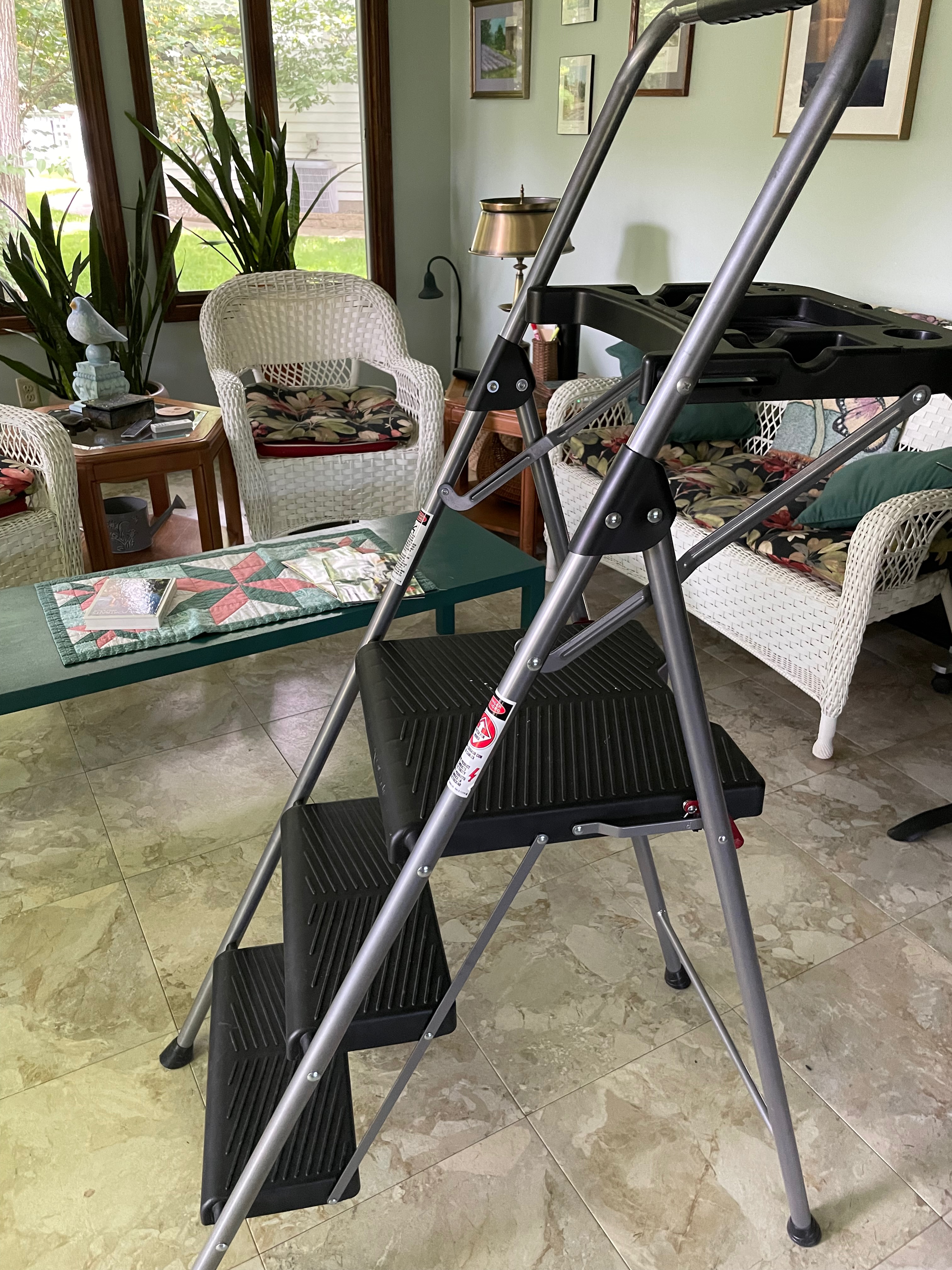
The only kind of stepladder I have any business using these days.
Now, even if you hate politics, you might want to read the opener to the next item.
Politics
The Quaker whose mule wouldn’t plow
One of my favorite stories, for roughly five decades now, is of a Quaker with a mule who wouldn’t plow.
Finally, after various goads, the Quaker walked to the mule, took its ears gently in hand, looked into its eyes, and said “Brother mule. Thee knowest I am a Quaker, Thee knowest I cannot beat thee. Thee knowest I cannot curse thee. What thee does not know is that I can sell thee — to the baptist up the road. And he can beat the living daylights out of thee.”
That’s pretty much how I’m starting to feel about the wokesters/progressive Left/successor ideology. My “baptists” are the Irreligious Right, the Christianist Right — both capable of violence, I think — and a few politicians who can see which way the wind is blowing, such as Ron DeSantis.
I doubt I can vote for DeSantis, in part because of his ham-handed attacks on the progressive Left in Florida and his playing illegal immigrants (I know the adjective is offensive to some, but it’s a perfectly good description) as pawns by putting them on busses headed to Blue zones. So maybe I really wouldn’t sell my cultural adversaries to him.
And I know I can’t vote for Trump.
But I’m starting to feel at least ambivalent, not entirely negative, about how the “baptists” might handle this. And I’m certain I’m not alone.
Fear casts out love
Fear casts out love. And not only love. Fear also casts out intelligence, casts out goodness, casts out all thought of beauty and truth.
At some point, I think soon, he’ll have to make a serious, textured and extended case against Donald Trump. Not insults and nicknames, not “Can he take a punch? Can he throw a punch?” No, something aimed at the big beating heart of the GOP that tells those who’ve gone on the Trumpian journey and aligned with him that they can no longer indulge their feelings. At a crucial point in history they’ll lose again, and the damage to the country will be too great. Throwaway lines like “the culture of losing” aren’t enough. That’s just a line that signals. Don’t signal, say. Include the long history of political losses—Congress, the presidency, the opportunity for a red wave in 2022.
Yes, tell those good people that you served your country in a tragedy called Iraq and the other guy claimed bone spurs and ran during a tragedy called Vietnam. You think you don’t have to say it, but you do. People who love Mr. Trump need reasons they can explain to themselves to peel away.
Religious conservatives in the 2016 election
When religious conservatism made its peace with Donald Trump in 2016, the fundamental calculation was that the benefits of political power — or, alternatively, of keeping cultural liberalism out of full political power — outweighed the costs to Christian credibility inherent in accepting a heathen figure as a political champion and leader.
The contrary calculation, made by the Christian wing of Never Trump, was that accepting Trump required moral compromises that American Christianity would ultimately suffer for, whatever Supreme Court seats or policy victories religious conservatives might gain.
There’s a lot distilled in those two paragraphs. I particularly note that the second paragraph at least hints at the view that Christianity is about something other than political power, a possibility that the New York Times in particular almost never considers. (“Politics is real, religion isn’t” is the gist of it.)
Yet I don’t see my own position reflected in either of them.
My core anti-Trump conviction was that his narcissism would distort his perceptions of reality, and that a President who misperceives reality — or even just a few key realities at a few pivotal times — could damage the nation terribly — worse than Hillary Clinton would.
The current formulation of my former position is inevitably colored by what actually happened, because I didn’t commit my position to writing in 2015-16 so I could some day say “see, I told you so.” But narcissism and misperception of reality was definitely at the core. And in 2016, I still thought that Christian Trump-voters were probably holding their noses because of the alternative. If I spoke or wrote about how wicked he was, it was my trying to pry others away from him with arguments that I thought they’d find weightier than “he’s a toxic narcissist.” I never expected so much troll-like adulation of that man under Christianish auspices.
Had it not been for his mesmerizing narcissism, he’d have never been such an effective demagogue and would not have won the GOP primary. So I’d never have needed to weigh whether a mere serial adulterer and shady casino magnate, without a disabling personality disorder, was an acceptable alternative to a woman who deplored roughly half the nation.
What keeps Damon Linker up at night
I just don’t think, even now, that the imposition of a right-wing tyranny is a likely scenario for the United States. Far more likely is a mutually reinforcing cycle of extra-constitutional power grabs, spasms of civil unrest, efforts to impose order, and more egregious acts of violence aimed at “the system.” This wouldn’t become a civil war like the one that consumed the United States in the 1860s, with massive armies facing each other for protracted, bloody battles aimed at seizing territory. But it would nonetheless be a form of low-boil civil war, perhaps resembling The Troubles in Northern Ireland more than any other recent examples.
… each side’s greatest fear is a dictatorship by the other side.
Another is that when each side is informed about the other side’s fears along these lines, the reaction is angry and mocking dismissal. You’re saying I’m a threat to them_? What a bunch of bullshit. Everybody with a brain and capable of unbiased thinking knows_ they’re the problem.
Yet another fact about our politics is that each side is becoming more willing to entertain (or fantasize about taking?) extra-constitutional acts in order to protect itself from what it’s convinced are the threatening extra-constitutional acts by the other side. Trump’s self-coup-attempt in January 2021 is only the most obvious and egregious example. More recent ones have come up throughout the current debt-ceiling battle, with prominent Democrats proposing all kinds of gambits, justified by the supposed national emergency posed by looming debt default, to get around the Constitution’s placement of the power of the purse in the hands of Congress.
My point, once again, is not to assign or remove blame from either side—or to treat both sides as equally good or bad. If the choice is between Trump’s self-coup to keep himself in power despite losing the 2020 election and the Democratic Speaker of the House talking with the Chairman of the Joint Chiefs about a plan to undertake a coup of their own against that same dictator-president, I would side with the latter every time. But the latter is still a coup—an unconstitutional power grab undertaken to thwart a prior unconstitutional power grab.
I don’t know how to prevent this except by one personal step: declaring myself a noncombatant. That won’t keep “them” from coming for me, whichever “them” it be, and I don’t know how to prevent that, either.
Imagining a Trump reprise
[I]magine a second Trump administration. This time he surrounds himself with loyalists who vow to do his bidding. Among their first acts is to impose Schedule F reform on the executive branch, which enables them to fire tens of thousands of career civil servants and replace them with even more loyalists. This would open up the possibility of a more DeSantis-like Trump administration.
Yet it would still be different in one decisive respect: Trump doesn’t affirm any consistent ideology. Instead, he aims to inflict as much pain and damage as possible on his own enemies and those of his supporters. To that end, he’s perfectly willing and happy to reverse course the moment he sees an opening for a victory or a deal. He relies entirely on his own judgment. He doesn’t follow the lead of advisers. He sizes things up with his own eyes, and makes sudden, snap decisions. He prizes flexibility and despises constraints—and as we all learned in the two months following the 2020 election, this even extends to the Constitution, the rule of law, and the norms of ordinary democratic politics, including the peaceful transfer of power.
This sounds more than a little like the kind of government the ancient political philosophers described as a kingship—albeit one in which the king wholly lacks in virtue or wisdom. They called such a leader a tyrant. Such a tyranny is different than the ideological forms of dictatorship we’re familiar with from the modern age because it has no overarching constellation of ideas it seeks to enact or to which it looks for guidance. It’s the rule, instead, of one man seeking to satisfy his own insatiable hunger for attention and thirst for the adulation of the people.
Modern ideological dictators are ascetics of a kind. Adolf Hitler, Joseph Stalin, and Mao Zedong devoted their lives to a cause.
But Trump’s only cause is himself. Somewhat like the ancient tyrants Plato and Aristotle analyzed, he is a political hedonist who acts as he does out of a craving for the pleasure that comes from being loved and cheered by a crowd.
I’m beginning to despair of the whole right, but especially the anti-woke formation (much as I loathe woke-ism). There’s no positive vision to it. It’s unserious. It seems designed to stave off real populism at the level of political economy.
You can read most of my more impromptu stuff here (cathartic venting) and here (the only social medium I frequent, because people there are quirky, pleasant and real). Both should work in your RSS aggregator, like Feedly or Reeder, should you want to make a habit of it.
True revolutionaries do not need to borrow authority from institutions, because they have the power to take what they want from their unconsenting enemy. The woke Left, whether we want to admit it or not, and whether it is itself conscious of it or not, has no such power. It has only consenting victims.
…
People on the New Right will probably object, claiming that they’re unwilling to listen to and aren’t convinced by the woke Left but are coerced into acquiescing in its beliefs and required conduct thanks to its institutional power—that they are the victims of a form of violence. But the nature of the new Left’s power is not Schmittian. Instead, its power comes from its capacity to influence the state through … “institutional capture” [a/k/a] “cultural hegemony.”
…
The irritating proximity of different ways of life, which is inevitable in complex modern societies, would not lead their proponents to such extreme expressions of disdain and mutual hatred if those proponents were made to bear the consequences of their discourse. Without such a prospect, each side can all too safely afford to see the other as an absolute enemy and claim to heroically stand for its cause. In the spirit of Schmitt, no situation is as little political as ours.
…
The woke Left and the New Right are manifestations of a deeper crisis. Both of them find their origin in the neutral state’s aims to liberate people from the responsibility to determine and to pursue a common good, and therefore focus on the administration of things. The state remains neutral out of fear that our disagreements about the common good might lead us to become enemies. But polarization shows clearly enough that peace reduced to mere coexistence, and the virtues attached to it (tolerance and moderation), fall short of what makes human beings want to form a united people, and ready to cultivate the virtues necessary to achieve such a goal.
Freedom, understood as individual autonomy, can never be the sole or even the main question to which a political regime provides the collective answer: How to live together and still be free?
…
Our problem is not that Left and Right are bringing us to the verge of civil war, but that their political demands have become completely detached from the reality of the human relations that make the satisfaction of such demands possible and just.
Alexis Carré, in the concluding essay in a series on the “coalition of the sensible” at Public Discourse.
That essay was a real mind-bender for someone like me who has bought the narrative that we are dangerously polarized, almost on the brink of a hot civil war. It’s one of the rare pieces I’m flagging (Obsidian bookmark) to re-read after a while.
The other essays in the series are linked at the top of Carré’s essay.
Our ideologically incoherent tribes
Today, the Lewises argue, “Left” and “Right” are competing bundles of unconnected and sometimes incompatible issue commitments held together by tribalism. The authors bring to bear a wealth of social science research that shows that people’s issue commitments are more heavily influenced by group loyalties than by philosophical consistency. They also catalogue a history of various political stances that, for example, began as Right, then were considered Left, and sometimes back again, depending on the coalitions’ needs. Trade protectionism, for example, was “Right;” then “Left;” now “Right” again (or maybe “Right” and “Left”). Foreign interventionism took the reverse course. Today what counts as “Right” and “Left” has become conflated with party, and party with the views of individual leaders. All of this, the Lewises contend, cuts strongly against the “essentialist” concept of ideology and in favor of their “social theory.”
Considering what became of the GOP in 2015-16, this “social theory of ideology” has some obvious appeal, as the GOP now holds policies opposite those held ten years ago, and the change was not gradual and evolutionary.
Covert Culture Wars
No Place of One’s Own
To make every place available to all is not to erase privilege, if by that term we mean something illegitimate. Rather it is to erase an earned ability to know and to use diverse and localized pockets of the world according to different levels of personal investment and responsibility. Another way to name this would be the end of ownership, conceived not simply as private property, but as title to inhabit some place on the earth as one’s own.
Google Street View undermines our ability to inhabit a place on earth as our own, and Google has ambitions toward something even more deracinating (I suspect it involved the map of your home created by your Roomba and uploaded to our overlords.)
It is good periodically to be reminded, first, how evil Google is and, second, to trace the implications of its hubris (and its market-tested insouciant responses to objectors).
Participatory disinformation
Disinformation and conspiracism spread in advanced, individualistic democracies like the United States not because their targets are sheeplike but because, to the contrary, so many people are active collaborators in their own deception. … “It’s a fight between good and evil,” one woman told the Associated Press in 2021, explaining why she spent hours every day scouring the internet for proof that the 2020 election was stolen from Trump. “She saw systems fail those most vulnerable,” reported the A.P., “and her faith in the standard truth-bearers of American democracy—courts, Congress, the media—eroded. She felt she could trust nothing but believe anything.… … Conspiracy theories like the ones about the 2020 election and the COVID-19 pandemic “are profoundly participatory disinformation campaigns,”
Playing in her first real WNBA game in 579 days, Brittney Griner did something Friday night in Los Angeles that national television audiences hadn’t seen her do in a long time: The Phoenix Mercury center stood for the national anthem.
She stopped doing so in 2020 but has resumed the practice after returning from 10 months of imprisonment in Russia. “One thing that’s good about this country is our right to protest,” Griner said after the game when I asked her about the issue. “You have a right to be able to speak out, question, to challenge, and do all these things. [After] what I went through, it just means a little bit more to me now. I was literally in a cage and could not stand the way I wanted to … and a lot of other situations. Just being able to hear my national anthem, see my flag, I definitely wanted to stand.”
The Tavistock Centre, the sole facility in the NHS dedicated to [gender reassignment], kept statistics on the children who came to their doors. Among those referred in 2012, ninetypercent of natal girls and 80 percent of natal boys reported being same-sex attracted or bisexual. There is no inherent relationship between trans and gay and bi people. So why this staggering overlap? No answer. If a Christianist hospital was busy changing the sexes of overwhelmingly gay kids, so that they became straight, what do you think the gay rights establishment would say? But when a queer facility does exactly that, all the worriers are bigots.
So many potentially gay children were being sent down the pathway to change gender, two of the clinicians said there was a dark joke among staff that “there would be no gay people left.” “It feels like conversion therapy for gay children,” one male clinician said. “I frequently had cases where people started identifying as trans after months of horrendous bullying for being gay,” he told The Times. “Young lesbians considered at the bottom of the heap suddenly found they were really popular when they said they were trans.”
Another female clinician said: “We heard a lot of homophobia which we felt nobody was challenging. A lot of the girls would come in and say, ‘I’m not a lesbian. I fell in love with my best girl friend but then I went online and realised I’m not a lesbian, I’m a boy. Phew.”
You might imagine that, given this record, the queers would go out of their way to reassure us, to show how tight the safeguarding is, how they screen thoroughly to ensure that gay kids are not swept up in this. But they regard the very question of whether gay kids are at risk as out of bounds.
Andrew Sullivan, Notes on a Medical Scandal. I don’t recall Sullivan ever before penning such a crie de couer, but I’m glad he did. You should read the whole thing if you can, bearing in mind that “queer” isn’t used as an insult but as the self-chosen adjective of the activists he’s opposing.
I had not known the “staggering” extent of the overlap between homosexual attractions and subsequent trans identification, but had been aware that most adolescents who presented with gender dysphoria would, if denied medical transition, eventually settle into conventional gay or lesbian identities. That probably is why the trans ideologues are ruling the very question of whether gay kids are at risk out of bounds, transphobic and evil.
I should also mention (confess?) that I have previously overlooked (not just underestimated the “stick” of anti-gay bullying, underestimated the role of qualms about homosexual attraction, and overestimated the “carrot” of social valorization as motives for kids to declare themselves trans.
Inconvenient parallel
California banned conversion therapy for minors in 2012. That law later withstood two legal challenges. I wonder if the precedents in those cases will affect legal challenges to the Texas and Florida bills [banning gender transitioning procedures for minors] as judges weigh whether legislators overreached in denying treatments many trans kids want.
[I]f you remember CNN’s ratings during the Trump presidency, then you know that quivering you see among the talking heads now might not be rage so much as thrill. More like the quivering you hear about in romance novels. There’s an unholy but unstoppable union, a love hidden but never extinguished kind of shake—yes yes yes!—it’s the story of Donald J. Trump and cable news.
The ancient philosophers’ primary question was what makes the best regime. Democracy certainly did not qualify. Why not? The answer was simple. They thought democracy was a messy system, systematically undermining the rule of law, profoundly partisan, often hostile to the most prominent leaders and citizens. The famous defense of democratic Athens delivered by Pericles in Thucydides’ The Peloponnesian War is in fact more a defense of Athens and Athenian imperialism than of the democratic political model. When Plato and Aristotle wrote their scathing remarks about the Athenian system, they thought it was already in decline and Athens might soon become a victim of the crisis from which it would not be able to recover. And this is exactly what happened.
There seems to be some titilating about famous men who knew Jeffrey Epstein, the latest being Noam Chomsky.
For the record, I think human beings — even Jeffrey Epstein — are more complicated than that. If every man who knew Jeffrey Epstein was a sexual predator, then I should give up on Christianity and become a frank Manichean.
Miscellany
A student told me there were no objective moral truths. I mentioned a precept of the Decalogue, and asked “What about that?” He replied, “That’s not morality, that’s justice.” But if we take justice in the classical sense – giving to each what is due to him – almost all morality is about justice. To my wife, I owe fidelity; to my parents, honor; to the child whom I sire, an intact family in which to enjoy the care of me and his mother.
A warning to intellectuals such as myself. Supposing the existence of square circles, you can do a lot of things: You can make syllogisms about them, you can develop theories about them, you can even prove theorems about them. But that doesn’t mean that they exist.
As a Christian, I believe in the Messiah. That doesn’t mean I have to like political messianism, which we find both on the right and on the left. The difference is that left-wing political messianism is usually utopian, trusting the hero to take us to a political promised land — but right-wing political messianism is usually reactive, trusting the hero to save us from the crazies who believe in utopia. The advantage here lies with the left, because unfortunately, most people are more impressed by lunatic visionaries than by persons with no vision at all.
I realized at dusk under the flight path of the rooks that this weight on me was perhaps not words or my need to belong but was the weight of knowing too much seeing too much taking on too much staring too long into the abyss taking it all so personally.
(Paul Kingsnorth, versified by me because I felt that it “scanned” as poetry)
Rank Politics
DeSantis head-scratcher
Some of what Ron DeSantis is doing seems sensible, some dubious, some flat-out weird. What in heaven’s name is the purpose of the “2-minute opening remarks” in the fifth item on this list?
Reparations
A group of prominent Democrats are calling for $14 trillion to be paid as reparations to the descendants of slaves. The bill was introduced by Missouri Rep. Cori Bush, who said: “The United States has a moral and legal obligation to provide reparations for the enslavement of Africans and its lasting harm on the lives of millions of Black people.” I’m on board with reparations. At least, I think it’d be better to do a big reparations shebang—cut checks and call it a day—than the strange sort of slow-drip reparations plans we see in liberal institutions. Like, yes, $14 trillion is a lot of money. But if the alternative is Robin DiAngelo trainings till the end of time and making the MCAT illegal and allowing people to self-ID as doctors because that’s more equitable, then $14 trillion is a bargain.
But here’s why reparations … will never happen: simply cutting checks to the descendants of slaves means shuttering all the thousands of racial justice nonprofits that serve as an employment program for America’s white grad students ….
You can read most of my more impromptu stuff here (cathartic venting) and here (the only social medium I frequent, because people there are quirky, pleasant and real). Both should work in your RSS aggregator, like Feedly or Reeder, should you want to make a habit of it.
Peter Wehner recounts an anecdote from a 1985 gathering of the South African National Initiative for Reconciliation, where the Dutch Reformed were guardedly present:
Bishop [Desmond] Tutu was one of the last people to speak; as he was preparing to do so, the leaders of the Dutch Reformed Church were uneasy, visibly stiffening. Tutu addressed his remarks directly to them.
“I just want to thank God that he brought you, my white brothers, here to South Africa,” the Anglican bishop told the Dutch Reformed Church leaders, as best Haugen recalls his words decades later. “I thank God that you came because you brought the mission hospitals, and I was born in a mission hospital. I thank God you brought the mission schools, and I went to a mission school. But most of all, my brothers, I thank God that he brought you because you brought the word of God. But now I’m going to have to open up that word of God and show you why your apartheid system is a sin.”
Tutu proceeded to do just that.
Causation isn’t always obvious in human affairs, but according to Wehner “The following year, the Dutch Reformed Church declared that South Africa’s system of racial separation and minority white rule was morally wrong and had done the country and its people grievous harm.”
My recollection is that they declared it a heresy, which meant a lot to me since I was then a member of the Christian Reformed Church, historically Dutch and quite thoroughly “adjacent” to South Africa’s Dutch Reformed in many ways, and its defense of apartheid was an embarrassment — embarrassing like the Russian Orthodox Patriarch blessing the invasion of Ukraine.
What pluralism is and isn’t
Pluralism is an irreducible, sociological fact of American life. It is not a set of norms that requires perfect neutrality in public spaces; instead, it creates parameters around what’s politically possible amid profoundly diverse views about first principles.
That may be a sleeper. You might want to read it again.
Harder questions for The Man Who Would Be King
What the TV professionals should learn is that they have two choices in dealing with another Trump primary campaign. They can take the kind of this-is-an-emergency path urged on them by some press critics and anti-Trump writers: Don’t platform him or normalize his campaign in any way, don’t let him speak on live TV, cover him only within a set framework that constantly emphasizes his authoritarian tendencies and attempts to overturn the last election. I don’t believe this path is wise or workable, but it at least has a moral consistency lacking in the “democracy is in danger and tune in tonight for an hour with the demagogue!” approach that we already watched play out in 2016.
Alternatively, if the press intends to conduct interviews and run debates as normal, then in preparing for them they need to try to think a little bit more like Republican voters as opposed to center-left journalists. Not in the sense of behaving slavishly toward the former president, but in the sense of writing the kinds of questions that a right-leaning American primed to dislike the media might actually find illuminating.
In part, as Ramesh Ponnuru suggests, that means drilling into Trump’s presidential record on conservative terms rather than liberal ones — asking about, for instance, the failure to complete the border wall or the surge in crime in the last year of his administration. In part, as Erick Erickson writes, it means asking obvious questions that follow from his stolen-election narrative rather than just attacking it head-on — as in, if the Democrats really stole the election, why did your administration, your chosen attorney general and your appointed judges basically just let them do it?
Special Counsel John Durham—appointed during former President Donald Trump’s administration—issued a 306-page report criticizing the FBI’s investigation into allegations linking the Trump campaign and Russia ahead of the 2016 election. Durham found the collusion probe was opened based on “raw, unanalyzed, and uncorroborated intelligence” and that investigators placed too much stock in supposed evidence provided by Trump’s political rivals. The report also alleges the FBI was far more hesitant to investigate claims Hillary Clinton’s campaign had similar foreign ties. GOP Rep. Jim Jordan—chair of the House Judiciary Committee and the Select Subcommittee on the Weaponization of the Federal Government—said yesterday he’d invited Durham to testify next week.
Once again, I’m in the position of holding two truths in tension:
The Media, the FBI, and who knows who all else, will do just about anything, including dirty, sleazy tricks, to keep Donald Trump out of the White House.
Donald Trump nevertheless is deeply unqualified for the Presidency of this troubled nation-state I live in.
The Biden Family Grift
“I don’t see any direct evidence of misconduct in the memo or reports about it,” Ken White, a criminal defense attorney and former federal prosecutor who worked on government fraud and public corruption, told TMD. “When it rises to the level of an official doing things because of payments to a family member, or paying money with the specific intent to change an official’s decision, that’s illegal. But hiring a public official’s idiot brother-in-law for your board of directors generally isn’t.”
…
“There’s a vast amount of activity that’s sleazy but legal in American politics,” White told TMD. “It’s reasonable to make inquiries about why a vice president’s relatives are getting big payments from foreign countries. But so far it’s smoke, not fire.”
…
The House Judiciary and Intelligence Committees released a joint staff report last week claiming a letter signed by former intelligence officials during the 2020 election discounting the legitimacy of the infamous Hunter Biden laptop was coordinated with the Biden campaign and exploited the national security credentials of former officials.
President Biden says he will not negotiate with congressional Republicans over a bill to increase the debt ceiling. This is preposterous and indefensible, for several reasons: For one thing, taxing, spending, and borrowing are inherently congressional powers, not presidential powers. For another thing, Joe Biden is president—not king. The idea that a president would refuse to negotiate with Congress over congressional action is nonsensical from a constitutional point of view and autocratic from a political point of view. Congress is not there to do the president’s bidding—if anything, it is the other way around: The president is charged with the faithful execution of the laws Congress passes, not with barking orders at the branch of government that is actually charged by the Constitution with responsibility for this issue.
I’m pleased to report that Biden was lying/bluffing/bloviating and is indeed talking with congressional Republicans — talks that cynics might even call “negotiations.”
Christian Nationalisms
Michelle Goldberg, who I don’t usually read, caught my attention with this one:
A major question for Republicans in 2024 is whether this militant version of Christian nationalism — one often rooted in Pentecostalism, with its emphasis on prophecy and revelation — can overcome the qualms of more mainstream evangelicals. The issue isn’t whether the next Republican presidential candidate is going to be a Christian nationalist, meaning someone who rejects the separation of church and state and treats Christianity as the foundation of American identity and law. That’s a foregone conclusion in a party whose state lawmakers are falling over themselves to pass book bans, abortion prohibitions, anti-trans laws, and, in Texas, bills authorizing school prayer and the posting of the Ten Commandments in classrooms.
What’s not yet clear, though, is what sort of Christian nationalism will prevail: the elite, doctrinaire variety of candidates like Gov. Ron DeSantis of Florida, or the violently messianic version embodied by Flynn and Trump.
…
If DeSantis treats Christianity as a moral code he’d like to impose on the rest of us, Trump treats it as an elevated status that should come with special perks. That’s how he can slam DeSantis for being “sanctimonious” even as he wraps his own campaign in biblical raiment. If a Republican wins in 2024, the victor will preside over a Christian nationalist administration. The question is whether that person will champion an orthodoxy or a cult.
What a hell of a state we’re in when Donald Trump, with zero Christian bona fides, is considered the avatar of one variety of “Christian Nationalism.” And while I question the use of “Christian Nationalism” to describe MAGAworld, he’s definitely the avatar of something that thinks it’s Christian. So too may be DeSantis, this time with some bona fides.
It’s shaping up once again that I’ll be unable to vote in good conscience for either major party candidate next fall.
Legalia
How much menace can we be required to tolerate?
Today, Kat Rosenfeld of UnHerd gained the coveted status of “Writers the Tipsy Teetotaler intends henceforth to pay closer attention to.”
Her topic is the subway death of Jordan Neely at the hands of Daniel Penny with the approbation of some other passengers. It’s so rich that I commend the whole essay to you at UnHerd though it was reprinted at Bari Weiss’s Free Press behind a paywall:
During the 2017 peak of the #MeToo movement, the conversation about sexual harassment came down to two related but ultimately separate questions. On the one hand, there was the question of what men shouldn’t do; on the other, there was the question of what women could be expected to tolerate.
…
For [Jordan Neeliy] to die on the dirty floor of a subway car, screaming and defecating on himself while three strangers held him by the arms, legs, and neck, he had to be first failed at every turn by a system that was supposed to shelter and protect him — not just from doing harm, but from being harmed by others when his mental illness manifested in frightening ways.
…
Here, one might have expected that many of the same voices who argued so vehemently against the notion of resilience in the midst of MeToo … would now demand zero tolerance for male aggression on public transit …
But, no: instead, many of the people who once insisted that men who slid into DMs deserved the complete destruction of their professional reputations became passionate advocates for toughening up when it came to dealing with volatile people on public transit.
…
To sum up: a man who reposts an off-colour joke is advertising his innate misogyny, to the point where women should feel uncomfortable sharing a workplace with him. But an agitated and clearly unstable man announcing to a crowded subway car — as Neely reportedly did — that he’s been pushed to the brink and is ready to die, or go to prison for life: why in the world would you find that menacing?
…
Of course, today’s 180-degree pivot to brash fearlessness is identitarian horse-trading: MeToo is out, BLM is in. The dynamics of any conflict must be considered along these lines, and the narrative must be massaged accordingly. This was true in 2020 when a white woman called the police on a black man who threatened her in a public park; it is true now, as piety demands that the behaviour of the black, homeless victim of this terrible tragedy must not be scrutinised in any way. On the Left, that is; the Right has spent the past few days waving Neely’s criminal history in the air, singing “He Had It Coming”, in an absolute spectacle of ghoulishness.
…
That mindset, so ubiquitous in the wake of MeToo, so popular among progressives in general, says that no breach of decorum or moment of discomfort is too insignificant to ignore. It must be registered. It must be punished. It’s nothing more or less than a call for constant vigilance. The thing about that: when you demand vigilance, you get vigilantes.
(Italics added)
One cavil: Maybe Rosenfeld has been frequenting further-Right sites than I do, but “singing ‘He Had It Coming’, in an absolute spectacle of ghoulishness” strikes me, for once, as hyperbolic bothsiderism.
There definitely is a reflex to defend Daniel Penny, but the Right-coded commentary I’ve seen appreciates that Jordan Neely was non compos mentos and didn’t “deserve” to die. Were it clear that Daniel Penny intended his death, a lot of his support would disappear.
Meanwhile, I’m at least glad that there’s a generous legal defense fund for Penny — some of it probably ill-motivated, but the shade of green is the same regardless of motive — so he can mount a proper fight against dubious criminal charges.
Abortion extremism
North Carolina state lawmakers voted Tuesday to override Democratic Gov. Roy Cooper’s veto of a bill that prohibits most abortions after 12 weeks of gestation, with exceptions for rape and incest (up to 20 weeks of gestation), “life-limiting anomalies” (up to 24 weeks), and life of the mother (no limit). The bill also appropriates money for child and foster care programs, contraception, and paid parental leave for teachers and government employees. North Carolina’s Republican lawmakers have pitched the legislation as a model for states around the country.
I said previously that Governor Cooper’s veto should brand him as an absolutist and his party’s position on abortion as extreme.
I know I am well out of the mainstream, but this Bill strikes me as being about where the country is likely to end up on average, for the foreseeable future, with a few solid blue states echoing Gov. Cooper’s absolutism in favor of any and all abortions.
A few years before his death in 1972, [C.] Day Lewis was made Poet Laureate of the UK—which is generally a mixed blessing of an honor, tending to mean that the poet in question has their best work behind them and now must try to summon the muses to celebrate the wedding of someone sixth in line to the throne.
Fun fact 1: C. Day Lewis was father of Daniel Day Lewis.
Fun fact 2: Although I recognize the name as that of an actor, I probably could not pick Daniel Day Lewis out of a police lineup of famous middle-age, caucasian (whatever that means), dark-haired actors. I’m just not a movie groupie.
Embrace of Vigilantism
Jamelle Bouie, who I probably should watch more closely, echoes my distress over the Right-wing valorization of white males who arguably acted as vigilantes. (The Republican Embrace of Vigilantism Is No Accident).
He might have mentioned Left-wing valorization of the victims, who generally were not without fault in the lethal incidents, but if I’m going to complain about bothsiderism, I shouldn’t fault writers who don’t practice it — even if it’s because they see no enemies or toxic extremists on their side of the spectrum.
Companion Piece to the Companion Piece: B. D. McClay, Phenomenology of the Gun (Recommended by an acquaintance on micro.blog)
The Good Life
Despite sociological evidence to the contrary, it remains to all appearances virtually axiomatic that the acquisition of consumer goods is the presumptive means to human happiness-and the more and better the goods, the better one’s life and the happier one will be.
Let’s just say you’d better have great discipline and a very rich interior life if you expect to be happy amid great affluence.
If this is true of individuals, that money doesn’t buy happiness, why can’t it be true of a whole society? Perhaps we can sum it up thusly: What does it profit a man to gain the world yet lose his soul? If America has gained the world but lost its soul, we should be anxious indeed.
Ultimately, the education system should commit to spending at least as much on a fifteen-year-old whose next seven years will be spent in a combination of school, apprenticeship, and employment as it spends on one headed to a four-year public university.
In the footer of each blog post, I mention my presence on micro.blog and blot.im for shorter items or outbursts, respectively. Now Alan Jacobs has written a neat summary of micro.blog, the three paths of micro.blog.
For all its piety and fervor, today’s United States needs to be recognized for what it really is: not a Christian country, but a nation of heretics.
You can read most of my more impromptu stuff here (cathartic venting) and here (the only social medium I frequent, because people there are quirky, pleasant and real). Both should work in your RSS aggregator, like Feedly or Reeder, should you want to make a habit of it.