Thursday, 4/11/24

Permanence

“How has it come about,” C. S. Lewis once asked, “that we use the highly emotive word ‘stagnation,’ with all its malodorous and malarial overtones, for what other ages would have called ‘permanence’?” It is, Lewis suggests, because the dominance of the machine in our culture altered our imagination. It gave us a “new archetypal image.”

Ken Myers, All God’s Children and Blue Suede Shoes

Considering how excellent an interviewer Ken Myers is, I’m surprised I don’t have more highlights from this oldish book by him. But this one surfaces just often enough to seem ever green. It’s especially dear to me because one of the common lazy criticisms of Orthodox Christianity is that it’s “stagnant.”

Feckless Diktator

Tens of thousands of people marched in Budapest, Hungary, on Saturday to protest Hungarian Prime Minister Viktor Orbán’s government. Péter Magyar, a former diplomat who was once a senior member of Orbán’s Fidesz party, organized the demonstration and has presented himself as a changemaker with plans to challenge Orbán in upcoming European parliament elections this summer. The rising opposition figure has promised to root out corruption and repair ties with the European Union—of which Hungary is a member—if elected.

The Morning Dispatch

What kind of authoritarian would allow such a thing? Could it be that our press has giving him a bum rap? Surely not!

NCAA wrap-up: Defense always travels

“We’ve played against athletes, played against some really good defensive guys this year in the tournament,” Painter said. “But not the collection of defensive players like UConn has. We play against somebody, they would have a lock-down defender. These guys are bringing lock-down defenders off the bench. Defense always travels. Tip of the hat to them. They were great.”

Kyle Neddenriep

I’ve said without embarrassment that I’m a “fair weather fan.” I think I’ve learned enough about basketball, and about Purdue Coach Matt Painter’s approach to coaching, to change that to “Purdue Men’s basketball fan.”

Caitlin Clark helped the generalized fandom, too.

Where’s a pro-lifer to go in 2024?

I am conflicted. It is tempting to join the pro-life chorus proclaiming that Donald Trump is not a pro-life candidate (because it’s true). But I don’t agree that his not-so-new abortion federalism is the proof that he’s not pro-life.

Abortion federalism is what the law should be. It’s what I said for darn near 50 years that the law would be after the reversal of Roe, and I’m not going to do a bait-and-switch.

So I guess I’m stuck with my fundamental objection that Donald Trump is a toxic narcissist, incapable of reckoning with facts that are inconvenient to him (like “You lost the election, sir”), yet capable of poisoning the culture.

For maybe a decade, from the earlyish eighties forward, I really was a single-issue anti-abortion voter (anti-abortion and pro-life aren’t the same thing, but seamless-garment-of-life candidates were rare). I became disenthralled of single-issue voting when NRLC and its affiliates endorsed nasty people who unconvincingly claimed they were pro-life — like maybe Trump in 2016 (I don’t recall whether they endorsed him; I wouldn’t have paid attention if they had.)

Trump’s pledge to appoint Supreme Court Justices from Leonard Leo’s list, which I only half believed, was not enough to gain my vote in 2016, and nothing he could say about “life issues” in 2024 would outweigh his baneful influence on everything he touches.

A devil is no less a devil if the lie he tells flatters you and stands to help you defeat your enemies and achieve power.

Rod Dreher, Something Demonic Is in the Air (2021)

Other disaffected seamless-garment pro-lifers should join me in voting for this party.

Gaining Perspective

A man who has lived in many places is not likely to be deceived by the local errors of his native village; the scholar has lived in many times and is therefore in some degree immune from the great cataract of nonsense that pours from the press and the microphone of his own age.

C.S. Lewis, The Weight of Glory

Can we afford the rich?

While we talk a lot about the private jet emissions of the rich, the biggest environmental impacts of inequality are actually ‘psychosocial’:

“The well-publicized lifestyles of the rich promote standards and ways of living that others seek to emulate, triggering cascades of expenditure for holiday homes, swimming pools, travel, clothes and expensive cars. Studies show that people who live in more-unequal societies spend more on status goods. … Inequality also makes it harder to implement environmental policies. Changes are resisted if people feel that the burden is not being shared fairly.”

Fierce competition for social status not only turbocharges consumerism, it also reduces social cohesion, worsens mental health and increases crime:

“By accentuating differences in status and social class – for example, through the type of car someone drives, their clothing or where they live – inequality increases feelings of superiority and of inferiority. … Even affluent people would enjoy a better quality of life if they lived in a country with a more equal distribution of wealth, similar to a Scandinavian nation. They might see improvements in their mental health and have a reduced chance of becoming victims of violence; their children might do better at school and be less likely to take dangerous drugs.”

Dense Discovery, quoting Why the world cannot afford the rich

Trump aims at the FBI, kills FISA; gee, thanks Mr. Revenge!

Donald Trump has a special talent for creating chaos that benefits no one except Donald Trump, and doesn’t even do that in the end. That’s the only way to understand his destructive intervention Wednesday on the reauthorization of the Foreign Intelligence Surveillance Act in Congress. “Kill FISA,” he wrote on Truth Social, and the House Republican dunce caucus obliged.

On Tuesday evening the House Rules Committee voted out a rule that would have allowed lawmakers to vote on renewing FISA along with substantive reforms. The proposed bill, a consensus project between the House Intelligence and Judiciary committees, was written to improve safeguards for Americans in Section 702’s surveillance database, which lets intelligence agencies eavesdrop on the communications of foreigners overseas.

Mr. Trump instructed Republicans to kill FISA because “IT WAS ILLEGALLY USED AGAINST ME, AND MANY OTHERS. THEY SPIED ON MY CAMPAIGN!!!” Nice to know that the man who wants to become Commander in Chief again has his eye on his own revenge, rather than public safety.

Trump Blows Up Anti-Terror Surveillance – WSJ

Modernists losing copyright protection

For those of a certain age — who hear the word “modernist” as modern — it’s an astonishment that a good portion of William Carlos Williams’s poetry is out of copyright. After noticing how often the Internet routinely violates poetry copyrights (currently protecting works after 1928), we decided early on here at Poems Ancient and Modern that we would try to be vigilant about copyright, which prevents us (in our current poverty) from running anything from W.H. Auden, Silvia Plath, Delmore Schwartz, Philip Larkin, and many others. But not only is the first modernist generation, with the likes of T.S. Eliot and Ezra Pound, coming into the public domain, but so increasingly is the second generation of such modernists as William Carlos Williams and Wallace Stevens. It’s been a hundred years since the high modernists were the cutting edge of the modern.

Poems Ancient and Modern

Back home in Indiana

The Indiana Court of Appeals rejects a demand that a third “gender” designation be available on drivers licenses:

BMV asserts its binary-only policy for state credentials is designed to accurately, consistently, and efficiently identify licensees. The agency indicates that recording an individual’s objective characteristic of sex better advances the state interest in accurate identification than would recording a person’s subjective non-binary identity. Additionally, identifying an individual’s sex on their state credentials promotes consistency within the system as other statutes require the licensee’s sex to be identified and recorded. Finally, BMV suggests that issuing credentials identifying an individual’s sex better serves to further administrative efficiency than reporting a subjective status with innumerable designations.

Indiana Court Rejects Claim That Driver’s Licenses Must Include Third Gender Option

I appreciate living in a state that isn’t “way out there” to either extreme.

Wordplay

1

… umbraphilia — the love of eclipses …

Where You Can See the Next Total Solar Eclipse, in 2026 – The New York Times

2

You cannot make a competitive selection process a tool for equality, as the entire point of competitive selection is to identify inequality.

Freddie deBoer

3

Quango: a Quasi-NGO; an organisation to which a government has devolved power, but which is still partly controlled and/or financed by government bodies.

4

Sodcasting: a term coined in Britain for playing music on your phone in public — after “sod” for “sodomite”, i.e. something that only a total ASSHOLE would do. H/T Andrew Sullivan, who adds:

It’s not as if there isn’t an obvious win-win solution for both those who want to listen to music and those who don’t. Let me explain something that seems completely unimaginable to the Bluetoothers: If you can afford an iPhone, you can afford AirPods, or a headset, or the like. Put them in your ears, and you will hear music of far, far higher quality than from a distant Bluetooth, and no one else will be forced to hear anything at all! What’s not to like? It follows, it seems to me, that those who continue to refuse to do so, who insist that they are still going to make you listen as well, just because fuck-you they can, are waging a meretricious assault on their fellow humans.

5

fundamentalist, n. Anyone who is more serious about religion than I am, especially if he owns a gun.

Fr. Andrew Stephen Damick], Una Sancta: Fundamentalism, Ecumenism and the One True Church

6

… the Netherlands, a country so flat it feels it’s been ironed into submission.

Chris Arnade

7

I look up from my book,
from the unreality of language,
and stare at the sea’s surface
that says nothing and means it.

R.S. Thomas, Collected Later Poems 1988-2000


So: where did all my mockery of Trump go?

I suffer more from the humiliations inflicted by my country than from those inflicted on her.

Simone Weil, from a letter to Georges Bernanos.

You can read most of my more impromptu stuff here and here (both of them cathartic venting, especially political) and here (the only social medium I frequent, because people there are quirky, pleasant and real). All should work in your RSS aggregator, like Feedly or Reeder, should you want to make a habit of it.
Winter’s reprise, 2024

We got 5 inches of snow yesterday and it’s icy roads today. Next week, we’re expected to get into the upper 50s.

Culture

Why we read

We read to know we’re not alone.

C.S. Lewis via Douglas Murray

Murry continues:

When people wonder or worry about AI, and how it might one day eclipse the human brain, I think of poetry, the arts. The computer brain may be able to store an infinite amount of information, but it cannot have the sense of memory that we humans can. It will not refine its translations of Byron in the Gulag or write poems on a scaffold. It will not be able to leave a few lines that say: “I was here, too.” 

So long as we do these things, and remember these things, the beating human heart will never be burned up utterly.

The inevitability of choice

I think I’ve mentioned dropping Rod Dreher’s Substack, though I’ve been a fan of his since Crunchy Cons. I probably used phrases like logorrhea and low signal-to-noise ratio. The first would come as no surprise to Dreher; the latter may just mean that I’ve read much of his signal multiple times over 18 years and it’s not worth the effort to filter out the noise to read it once more.

But I’ll say this for him: he’s still capable of good writing that’s not overly-larded with catastrophism, as witness this column in the European Conservative, by the reading of which I feel less alone (see preceding item):

[A]ll traditionalism in our wretched age is a bit fake. How could it not be? The fundamental experience of modernity is the shattering of all authoritative traditions and narratives. We can’t escape that. As Charles Taylor, pre-eminently among many others, has observed, even when we affirm tradition today, we do so with the knowledge that we could do otherwise.

I saw this play out in my own family, when as a young man I told my father that I was going to convert to Catholicism. He was dumbstruck by the thought. “But the Drehers have always been Methodist!” he protested. In fact, the first Drehers to move to North America were Lutherans, and not too many generations before that, were Catholics. And for that matter, my dad rarely went to church, which sent a signal to me about how lightly he took his Methodism.

Decades later, having left Catholicism for Orthodoxy in part because I was seeking even deeper roots in tradition, I had to face the fact that my father had a more traditional mindset, and I was, paradoxically, the modernist. That is, my father may not have had much belief in Methodist Christianity, but he accepted that Methodism was part of our collective identity. The Drehers rarely go to church, and the church they rarely go to is the Methodist church, because that’s how it has always been.

What my late father, who was born in 1934, failed to understand is that his children were born into a world that takes almost nothing for granted. His son, in his mid-twenties, was becoming Catholic because he had become more serious about the Christian faith, and had come to believe that the pursuit of truth led him in this direction. Yet when I took up the practice of the Catholic faith, for a long time I felt like an impostor, performing rituals that did not come naturally to me, though they would in time.

It was even more radical when I lost my Catholic faith, and was rescued by Orthodoxy, a form of Christianity that is alien to the West. A well-known Orthodox theologian once, in my presence, called us converts fake—as if Orthodoxy was something that you had to be born into. This is an absurd position for a theologian of a universalist religion that spreads by evangelism to take.

… it’s the LARPers, the eccentrics, and all others willing to be criticized as ‘fake’ are the very people whose devotion to tradition, however skewed and silly, will carry us through the darkness and confusion of the present moment.

(Emphasis added)

An earlier draft included my interjection after the first paragraph, but on second thought, Dreher makes my point better in his remaining paragraphs. The European Conservative brings out the better in him.

Can’t or Won’t?

We live in comforts that the richest of aristocrats not very long ago could never have dreamed of, and yet we claim that we are too poor to have more than a child or two. The truth is the reverse: we are too rich to have more than a child or two, too committed to work for work’s sake and to the purchase of prestige, mansions, the “best” schools, and toys for grown-ups.

Anthony M. Esolen, Out of the Ashes

Scamify

I’ve griped a lot about the fake artists problem at Spotify. It’s like a stone in my shoe, and just gets worse and worse.

I’m especially alarmed by those strange playlists—filled with mysterious artists who may not really exist, or almost identical tracks circulating under dozens of different names.

Here’s a new example—a 20 hour playlist called “Jazz for Reading.”

I’m supposed to be a jazz expert. So why haven’t I heard of these artists? And why is it so hard to find photos of these musicians online?

I’m supposed to be a jazz expert. So why haven’t I heard of these artists? And why is it so hard to find photos of these musicians online?

I listened to twenty different tracks. There’s some superficial variety in the music, but each track I heard had the same piano tone and touch. Even the reverb sounds the same.

When Spotify first listed its shares on the stock exchange, I expressed skepticism about its business model—declaring that “streaming economics are broken.”

I did the math. The numbers told me that you simply can’t offer unlimited music for $9.99 per month. Somebody would get squeezed—probably the musicians (for a start).

And now?

I note that Spotify has sharply increased its subscription price and recently laid off 1,500 employees.

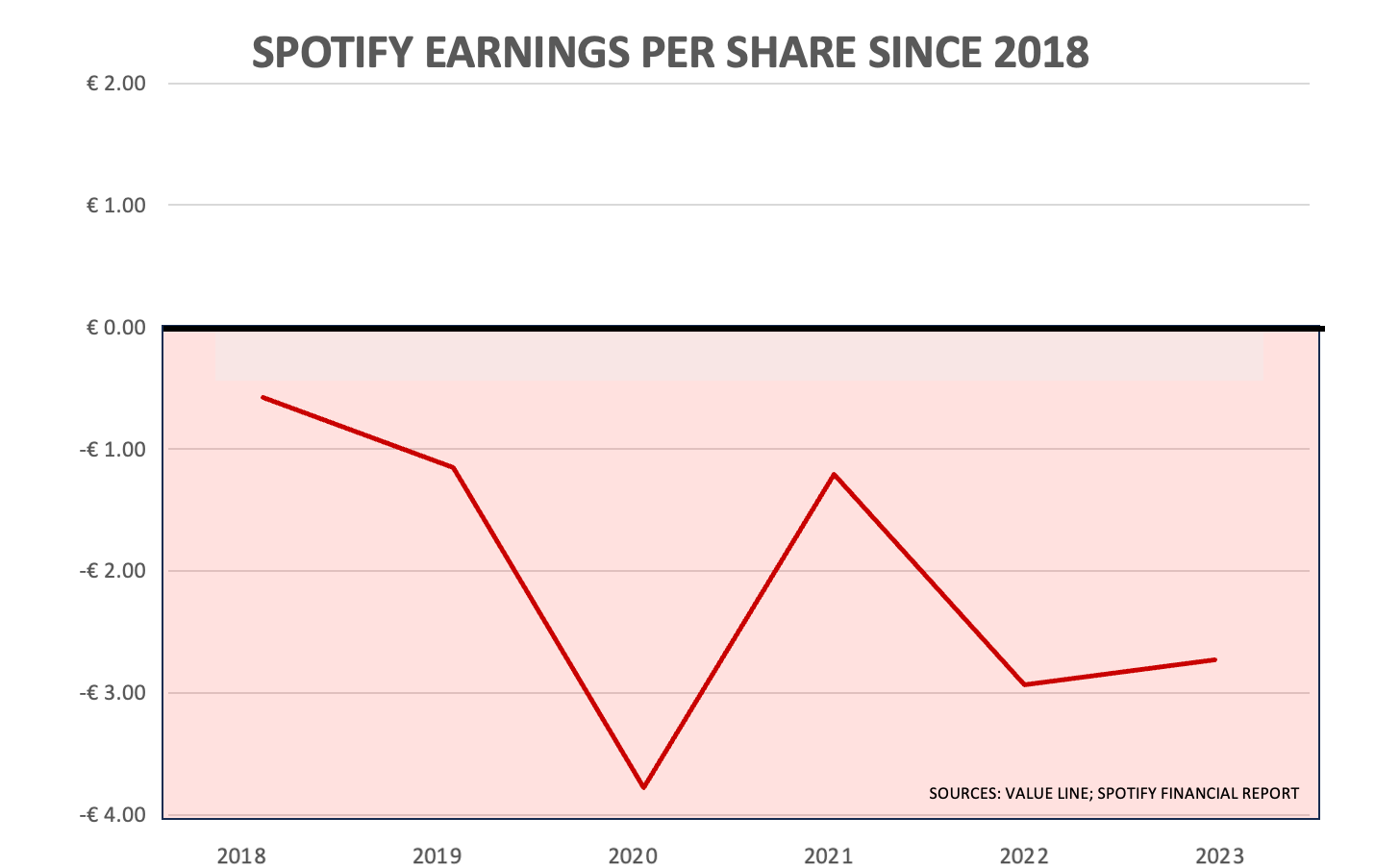
But the company released quarterly earnings this week—and it is still losing money!

chart of spotify's earnings per share since 2018

Meanwhile the CEO continues to sell his shares—another $57.5 million in the last few days.

Let me put this into perspective: Spotify was founded in 2006, and has now been operating for almost 18 years. It has 236 million subscribers in 184 countries. But the business still isn’t profitable.

Ted Gioia

Maybe one path to profitability is to pass off royalty-free AI Muzak as easy-listening jazz. It used to be a mild insult to call any work of art “derivative,” but with AI, it’s turtles all the way down.

Civilization

To realize the relative validity of one’s convictions and yet stand for them unflinchingly is what distinguishes a civilized man from a barbarian.

Joseph Schumpeter, third- or fourth-hand

From the same Damon Linker post that quotes Schumpeter:

Niebuhr rightly remarked that Americans nearly always mean well when they act in the world. Our moral perils are thus “not those of conscious malice or the explicit lust for power.” Yet the rules of the world are such that good intentions—even our own—often lead to unintended bad consequences. This is a lesson we seem incapable of learning, or remembering, so eager are we to deny that the actions of even “the best men and nations” are “curious compounds of good and evil.”

The danger of crafting policy and acting in the world on the basis of an overly exalted view of our ourselves isn’t just that we’ll make foolish decisions that lead to immense suffering and harmful setbacks to our broader strategic aims. It’s also that in raising and dashing lofty expectations, we run the risk of inadvertently inspiring the cynicism to which Niebuhr also thought we were prone, as the inverse of our over-confident moralism.

This happened on the left during the 1970s, in the wake of the Vietnam debacle, with George McGovern’s call for America to “come home” after its ruinous misadventure in southeast Asia. And it’s happening in our own time on the right, after George W. Bush displayed hubris in deciding to topple the regime of Saddam Hussein and then adopted an unmodulated form of theologically infused American exceptionalism to justify the policy once its original rationale (ridding Iraq of weapons of mass destruction it didn’t possess) crumbled to dust. (If you’ve forgotten its details, I urge you to read Bush’s 2005 Inaugural Address, with its 50-odd invocations of “freedom” or “liberty,” and jaw-dropping declaration that the ultimate goal of American foreign policy is nothing less than “ending tyranny in our world.”)

The instant before that “jaw-dropping declaration” was my last as a Republican, as I’ve written about before.

World Affairs

Made in America

Only naive arrogance can lead Westerners to assume that non-Westerners will become “Westernized” by acquiring Western goods. What, indeed, does it tell the world about the West when Westerners identify their civilization with fizzy liquids, faded pants, and fatty foods?

Samuel P. Huntington, The Clash of Civilizations and the Remaking of World Order

Rulers

It pains me to channel this, but Dreher’s right, at least up to the break:

Whatever you think of Vladimir Putin, who is ten years younger than Biden, he is vigorous, sharp, and combative. He gave his American interlocutor a coherent lesson on the past thousand years of Russian history, and hesitated only to tell the Yank to hush, and let him finish. Meanwhile, in Washington yesterday, Joe Biden confused President Sisi of Egypt with the leader of Mexico.

Toggling back and forth online from the Carlson interview to the Biden press conference, staged to address the humiliating Special Counsel’s report, was like moving out on a frail, narrow footbridge over a chasm. It is truly terrifying to consider that the feeble, senile old man desperately trying to rebut charges of dementia is what the U.S. sends to “battle” against a man like Putin.

Even worse, nobody doubts that Putin, for better or for worse, governs Russia. Who is governing America from the White House? Because it is not Joe Biden, that’s for sure.

It is hard for many Europeans to understand, but Americans scarcely know what happened in our country more than five minutes ago. And we only seem to care about it insofar as we can cite history as a reason to justify whatever it is that we want to do now. This is why Americans are living through the catastrophic, indeed totalitarian, leftist stripping of significant historical figures from public life—taking down their monuments, expelling a considered, nuanced treatment of them from history books—without protest. Too few Americans understand why this matters, and why they should care.

Isn’t Vladimir Putin doing the same thing—putting history to use to justify his attack on Ukraine? Yes, but there’s a difference. Russia really does have this incredibly long, dense, and difficult history with the territory we now call Ukraine. One does not have to accept Putin’s conclusion at the end of the story—‘therefore, Russia had to invade’—or accept his version of historical events to grasp that history matters to him in ways that many Americans will fail to appreciate.

National Affairs

Now and then

Is the New York Times suffering cognitive decline?

A tip of the tendentious hat to Nellie Bowles.

What’s wrong with the GOP?

As I frequently remind readers, I’m a former conservative who hasn’t voted for the GOP since 2002. Why?

Because I think the Republican Party and its right-wing media allies intentionally spew demagogic toxins into the civic atmosphere of the nation for the sake of political gain.
Because that isn’t going to change. (Like a three-pack-a-day smoker waiving away the possibility of lung cancer even after symptoms of serious illness have appeared, Republican voters have become addicted to the poison and demand more of it with each new election.)
And most of all, because, like a highly skilled conman/drug pusher, Donald Trump deepens the deadly addiction every day, along with posing a potentially fatal threat to the country’s democratic institutions.

Damon Linker

Another reason to despise the GOP

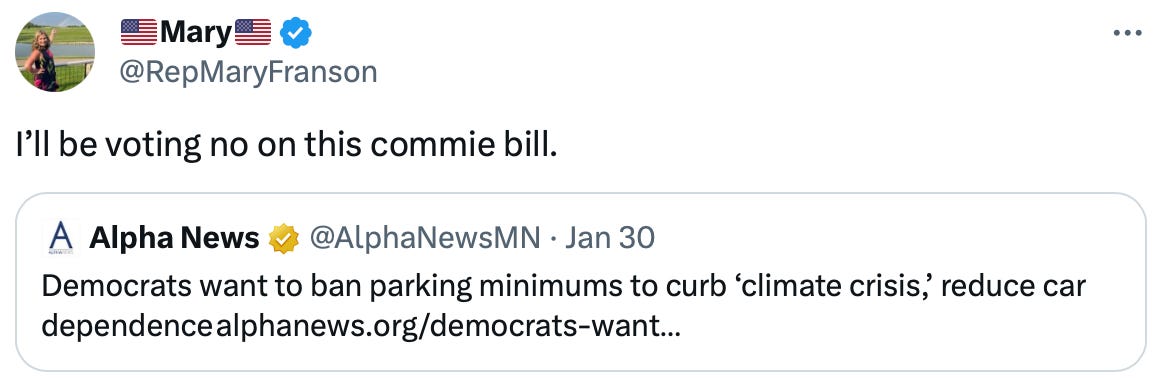
Republicans vs. property rights: Democrats in Minnesota, including Ilhan Omar, are supporting a new bill that would ban something called parking minimums. Parking minimums require property owners and developers to include a certain number of parking spots per apartment or business, and it was useful in the 1950s construction boom but it’s now one of the ways the government forces everyone into sprawling, low-density communities that rely on cars. Left to the free market, people often freely choose to live close together. They like it. I like it! Ever wonder why Paris and London are so charming? Anyway, I’m for freedom and so I err on the side of people being able to do more of what they want with their land, especially when parking lots are genuinely ugly. So oddly enough, when it comes to parking minimums, I’m with Ilhan Omar. The Republican opposition to the bill—again, which would limit the power of government and give property owners more rights to do what they want—goes something like this:

Right. That’s exactly how communism works. 

Nellie Bowles

Apart from the knee-jerk response of “freedom,” which ought to resonate with a Republican (at least as I remember the party), removing that impediments to higher-density living arrangements is the right policy because it promotes more sustainable living.

Another good one steps away from DC

Another respected Republican, Rep. Cathy McMorris Rodgers, also revealed she will retire at the year’s end, despite being the chair of the influential House Energy and Commerce Committee. The 54-year-old lawmaker from Washington state has served in Congress since 2005. McMorris Rodgers and Gallagher join a growing exodus of members of both parties who are leaving Congress frustrated that political infighting has made legislating harder than usual.

Dispatch Politics

Rep. Rodgers is one of a few candidates I supported financially (1) because she was endorsed by the pro-life Susan B. Anthony List and (2) then-35 year-old Rodgers looked electable. I am grateful that she has never engaged in the kind of jackassery that would make me regret my support.

Too many other SBA List endorsees who got elected have turned into embarrassments. One of them was foregrounded at new Speaker Mike Johnson’s coming out party snarling “SHUT UP!” at a reporter for asking an obvious and appropriate question.

I don’t look at SBA List endorsements any more.

Separating the man from the movement

Trigger Warning: If you don’t want to see anything about DJT here, stop. I’m quoting this because the mention of him is incidental to a more important point about how to heal our politics:

I think I detest Donald Trump as much as the next guy, but Trumpian populism does represent some very legitimate values: the fear of imperial overreach; the need to preserve social cohesion amid mass migration; the need to protect working-class wages from the pressures of globalization.

The struggle against Trump the man is a good-versus-bad struggle between democracy and narcissistic authoritarianism, but the struggle between liberalism and Trumpian populism is a wrestling match over how to balance legitimate concerns.

David Brooks, The Cure for What Ails Our Democracy – The New York Times (italics added). This column is so good (edifying good, not trolling good) that I’m using one of my ten monthly New York Times shareable links for it.

Yes, I suppose this is another insouciant assumption that there can be Trumpism without Trump. But we ignore populism’s legitimate values, we’ll see other demagogues arise to exploit them when Trump’s gone.

Resolute yet humble

Isaiah Berlin, concluded one of his most famous essays by quoting an observation by political economist Joseph Schumpeter: “To realize the relative validity of one’s convictions and yet stand for them unflinchingly is what distinguishes a civilized man from a barbarian.” This is also what distinguished postwar liberals such as Berlin and literary critic Lionel Trilling (the subject of this series’ second post) from just about everyone writing and thinking about politics today.

Damon Linker

ICMY, I think he called “just about everyone writing and thinking about politics today” barbarian, and I won’t disagree if one allows for a bit of hyperbole in “just about everyone.”


So: where did all my mockery of Trump go?

You can read most of my more impromptu stuff here and here (both of them cathartic venting, especially political) and here (the only social medium I frequent, because people there are quirky, pleasant and real). All should work in your RSS aggregator, like Feedly or Reeder, should you want to make a habit of it.
Thursday, 11/2/23

Culture

Just paying attention

As for the home-schooling pioneers who left government schools to avoid assaults on their values, they’re looking less like an ideological fringe these days and more like people who were just paying attention.

Home-school Boom – WSJ

Introverts and Extraverts

Alan Jacobs and I share a longing: Back to My Books. (It’s a short piece.)

Indeed, given a common distinction between introversion and extraversion (drained versus energized by significant time socially interacting with non-intimates), I can’t even imagine being an extravert.

Antisemite mightily resents being labeled antisemite

Suit was filed earlier this month in a New York federal district court by Nation of Islam leader Louis Farrakhan against the Anti-Defamation League and the Simon Wiesenthal Center seeking $4.8 billion in damages. The suit alleges that defendants are interfering with Farrakhan’s activities through labeling him as an antisemite.

Louis Farrakhan Sues Anti-Defamation League for $4.8 Billion

ProTip for Farrakhan: If you want to file a lawsuit objecting to getting the antisemite label, it might be wise not to lard your complaint with accusations that Jews control the government.

Free to be me, a hobbyist

It’s my growing conviction that America is on a trajectory toward crack-up, but unlike my longtime muse, Rod Dreher, I’m kind of philosophical about it, believing that what follows the crack-up may be quite bearable. (I wouldn’t cheer for the crackup because I could be wrong: revolutions generally do make things worse.)

In this vein, consider Chris Arnade’s observation about the somewhat parallel calcified cultures of England and Japan:

Because of England’s calcified class structure, they know they can never be anything else, which ironically frees them up to be themselves. Which means, given they aren’t always, like Americans, trying to be more than what they currently are, they have the interest and time to pursue hobbies.

What about the Japanese? In Japan, while class exists (the most obvious difference is home size), it’s not nearly as stratified, or explicit as in England. The wealthy are not as, well, wealthy, or nearly as ostentatious, as they are in the rest of the developed world. At least not outwardly.

That general lack of class division—there really being nothing you can move up to that is much different from where you are now—allows the Japanese the space and time to make the best of the life they have, rather than constantly striving to be something different.

In both cases, the working and middle class Japanese and English are forced by a lack of options, to develop their own sense of self. Which includes lots of hobbies.

Because I respect and enjoy being around people with a well-developed sense of the self, more than I enjoy being around people with lots of stuff.

That’s also why, as much as I love the US, I find it frustrating to come back home, where we are so free to be anything, that so many of us end up being nothing.

Chris Arnade, Walking Japan: From Akashina to Fuji

Why English courses?

English courses in college are a little over a hundred years old, its having been taken for granted before then that you did not need special instruction to read poetry and novels written in your native language.

Anthony M. Esolen, Out of the Ashes

The ever-receding leisure horizon

None of this is how the future was supposed to feel. In 1930, in a speech titled “Economic Possibilities for Our Grandchildren,” the economist John Maynard Keynes made a famous prediction: Within a century, thanks to the growth of wealth and the advance of technology, no one would have to work more than about fifteen hours a week.

Oliver Burkeman, Four Thousand Weeks: Time Management for Mortals

Political

Where is the Democrat mainstream on Israel?

Last week, nine Democrats voted against a House resolution condemning Hamas and backing Israel—a gauge of the extent of hard-line anti-Israel sentiment in Washington. 

“I represent the mainstream of the Democratic Party,” Torres told me, “whereas members like Ilhan Omar represent the fringe. I would hardly call that a divide. A divide would seem to suggest that the Democratic Party is split between the two of us. Quite the contrary. With the exception of a visible, vocal minority, just about every congressional Democrat supports Israel’s right to defend itself in the face of unprecedented terrorism.”

The Free Press

Speaker Mike Johnson (and his goofy muse)

“It’s really hard to overstate the influence that [David] Barton has had in conservative evangelical spaces,” the Calvin University historian Kristin Kobes Du Mez, the author of Jesus and John Wayne: How White Evangelicals Corrupted a Faith and Fractured a Nation, told Politico. “For them, he has really defined America as a Christian nation.”

“What that means is that he kind of takes conservative, white evangelical ideals from our current moment, and says that those were all baked into the Constitution, and that God has elected America to be a special nation, and that the nation will be blessed if we respond in obedience and maintain that, and not if we go astray,” she continued. “It really fuels evangelical politics and the idea that evangelicalism has a special role to play to get the country back on track.”

“David Barton is a political propagandist, he’s a Christian-right activist who cherry picks from the past to promote political agendas in the present, to paint a picture of America’s history as evangelicals would like it to be,” John Fea, the chair of the history department at the evangelical Messiah University, told NBC News. “Mike Johnson comes straight out of that Christian-right world, where Barton’s ideas are highly influential. It’s the air they breathe.”

In 2012, Barton wrote The Jefferson Lies: Exposing the Myths You’ve Always Believed About Thomas Jefferson. Among other things, he argued that Jefferson was a “conventional Christian” despite the fact that Jefferson questioned many of the core tenets of Christianity. Martin Marty, a historian of religion, said it would have been better titled “Barton’s Lies about Jefferson.” “As a piece of historical scholarship, the book is awful,” the Wheaton historian Tracy McKenzie wrote, deeming it “relentlessly anti-intellectual.” The book was so riddled with historical inaccuracies that it was recalled by its Christian publisher, Thomas Nelson, because “basic truths just were not there.”

So in Speaker Johnson we have a man whose Christian worldview has led him into a hall of mirrors—historically, scientifically, legally, and constitutionally. A “rule-of-law guy” who laments a lack of “absolute standards of right and wrong” was a key participant in undermining the rule of law and has been a steadfast defender of Donald Trump, who has done so much to shatter absolute standards of right and wrong.

From what I can tell, Mike Johnson—unlike, say, Kevin McCarthy and Elise Stefanik, or J. D. Vance and Lindsey Graham—is not cynical; he seems to be a true believer, and a zealot. A polite and mild-mannered zealot, to be sure, especially by MAGA standards, but a zealot nonetheless. And what makes this doubly painful for many of us is that he uses his Christian faith to sacralize his fanaticism and assault on truth. I can’t help thinking this isn’t quite what Jesus had in mind.

Peter Wehner, The Polite Zealotry of Mike Johnson

Mike Johnson is the first person to become speaker of the House who can be fairly described as a Christian nationalist, a major development in American history in and of itself. Equally important, however, his ascension reflects the strength of white evangelical voters’ influence in the House Republican caucus, voters who are determined to use the power of government to roll back the civil rights, women’s rights and sexual revolutions.

“Johnson is a clear rebuttal to the overall liberal societal drift that’s happening in the United States,” Ryan Burge, a political scientist at Eastern Illinois University, wrote by email in response to my query. “His views are far out of step with the average American and even with a significant number of Republicans.”

“Yet, he was chosen as speaker,” continued Burge, who is also a pastor in the American Baptist Church. “If anything, it shows us that white evangelicals still have a very strong hold on the modern Republican Party. They are losing overall market share in the larger culture, but they are certainly taking on an outsized role in Republican politics.”

Thomas B. Edsall

Another one bites the dust

Republican Rep. Ken Buck of Colorado confirmed on Wednesday that he would not run for reelection.“Too many Republican leaders are lying to America, claiming that the 2020 election was stolen,” the five-term congressman said in a resignation video released yesterday. “These insidious narratives breed widespread cynicism and erode Americans’ confidence in the rule of law.” Longtime GOP Rep. Kay Granger of Texas, who currently chairs the Appropriations Committee, also announced yesterday she would retire at the end of her term.

TMD

At least a shred

Mike Pence has ceased his campaign for the Republican nomination to the Presidency.

That’s a shame if only because he maintained at least a shred of integrity to the end:

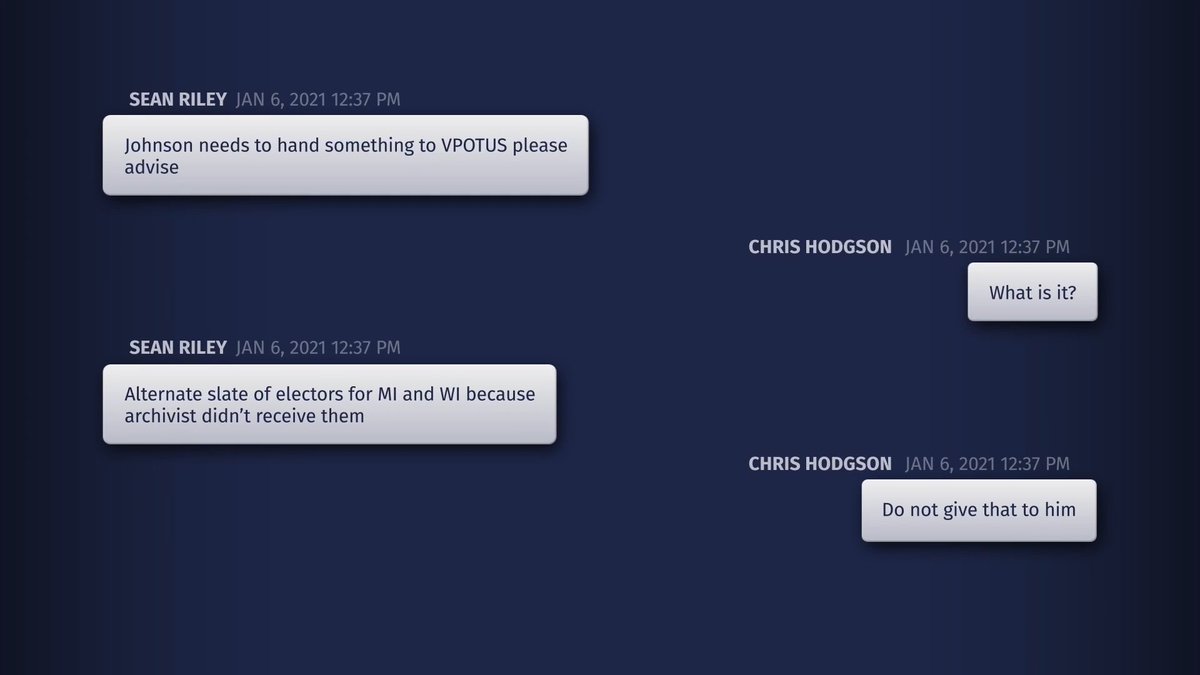
(I’m sorry I don’t remember the source of that. I got it in July of 2022. Might the “Johnson” referenced be the new Speaker?)

Why I remain a liberal

Liberalism has always had two faces. From one side, toleration is the pursuit of an ideal form of life. From the other, it is the search for terms of peace among different ways of life. In the former view, liberal institutions are seen as applications of universal principles. In the latter, they are a means to peaceful coexistence. In the first, liberalism is a prescription for a universal regime. In the second, it is a project of coexistence that can be pursued in many regimes.

John Gray via Jake Meador.

I’m a liberal of the latter kind. I cannot be a Christian Nationalist because the “Christianity” that would hold power in the USA in 2023 and for the foreseeable future would be heretical and oppressive; the very best case would be schismatic Catholic Integralists.


You can read most of my more impromptu stuff here (cathartic venting) and here (the only social medium I frequent, because people there are quirky, pleasant and real). Both should work in your RSS aggregator, like Feedly or Reeder, should you want to make a habit of it.

Tuesday, 12/6/22

It’s been awfully long since I flushed the pipes.

Politicalish

A not-so-great realignment

Alex Jones: The Nazis were thugs.
Kanye West: "But they did good things too. We gotta stop dissing the Nazis all the time."

@Rightwingwatch

So “Ye” is now to the right of Alex Jones?!

Viktor ticks me off

I know that Viktor Orbán isn’t running a liberal democracy. He says it’s an illiberal democracy. “If I could count on American post-liberals being as competent and honest as Orbán,” I thought, “I could tolerate illiberal democracy, even though it wouldn’t be my first choice.”

But now he’s pulled a stunt that bothers me even more than some of the other ways he’s manipulated things to keep winning elections:

In December 2020, when Hungary’s health authority set up a website for citizens to register for covid-19 vaccinations, it included a tick-box for those who wanted to receive further information. Gabor Toka, a political-science professor, found it odd that the box did not specify that future communications should be about covid. To see what would happen, he ticked the box for his own registration but left it unticked for his mother’s. Some months later, when Hungary’s general-election campaign swung into gear, he found that he (but not his mother) started to get campaign emails from the ruling party, Fidesz.

Mr Toka was not the only one. A report published on December 1st by Human Rights Watch suggests that Fidesz seems to have gained access to state databases and used them to send campaign messages to voters. In addition to emails, people got phone calls and text messages from Fidesz candidates urging them to vote and reminding them what a wonderful job the government was doing.

How Hungary used citizens’ covid data to help the ruling party (The Economist)

Thesis Statement

I was just reminded of the excellent capacity of Readwise to share a quote as an eye-grabbing image. Expect to see more.

What authoritarianism does to decent people

Yesterday a friend messaged me to say that one passage from Monday’s newsletter had rung his bell. It had to do with motives. Perhaps some conservatives who’ve moved away from right-wing policies during the Trump era have done so, I wrote, because they’ve begun to doubt the good intentions of leaders who support those policies.

If the average Republican says the law should be harder on drug dealers, you and I might eagerly agree. If an aspiring strongman in the mold of Rodrigo Duterte says the same thing, you and I might worry instead about how a more draconian legal regime would eventually be abused.

Authoritarianism brings out the libertarian in decent people.

All it took was a bare assertion without credible evidence that the election had been rigged against a right-wing president to flip Stewart Rhodes from freedom warrior to fascist goon.

Nick Cattagio

This is a remarkably thought-provoking piece. One more excerpt:

Years ago a fellow Never Trumper told me the great irony of the Tea Party era is that those of us who were viewed at the time as moderates and “RINOs” turned out to be the ones who took conservative principles seriously. We the squishes were told that conservatism was about X, Y, and Z, then suddenly Trump arrived and it wasn’t about those things anymore. So we left.

It was the firebreathing hyper-principled “true conservatives” and small-government radicals who were easily co-opted by a nationalist strongman. They simply adapted and carried on.

I’ve always taken pride in that. But it also feeds my insecurity that on a fundamental level I don’t understand how most people practice politics. I can cite chapter and verse on What Classical Liberalism means, but if 90 percent of those who used to—and maybe still—call themselves classical liberals are okay with an authoritarian personality cult so long as it’s advancing their interests by owning the libs, then how “real” is classical liberalism really?

Legalish

Balancing negative externalities

Free Speech

We still enjoy free speech in the U.S. partly because good people are willing to “sue the bastards” when the bastards try to punish or chill free speech. Eugene Volokh and F.I.R.E., for instance, are suing New York State (New York State Wants to Conscript Me to Violate the Constitution)

One reason why I’m not a Ron DeSantis fan is that his popular (for the GOP’s Florida base, at least) “Stop Woke Act” also violates free speech norms of not the letter of the 1st Amendment (which I think it probably does; caveat: I haven’t thought about that a lot.).

Getting the Analogy Right

SCOTUS heard arguments Monday on another case that people will incline to call gay rights versus religious freedom, though it was argued on free speech grounds. As is so often the case, the questions from the Justices were probing.

Remarkably, a non-lawyer comment aptly summarizes a key point:

[T]he right analogy is crucial here, and correct distinctions are critical. In order to justify racial violence and oppression, white people in America and Europe essentially invented a novel theology, baptizing white supremacy. It was racism in search of an ethic. Sexual ethics, by contrast, are named and addressed in religious scriptures in specific terms. Unlike white supremacy, religious teachings regarding sex, including prohibitions on extramarital and premarital sex, pornography, lust and same-sex sexual activity have been part of the Christian faith from its earliest days. This is not an aberrant view rooted in bigotry but a sincere belief that flows from ancient texts and teaching shared by believers all over the world.

Tish Harrison Warren, When gay rights clash with religious freedom

Culture

What I wouldn’t do if I had #1 billion

If you had $1 billion, what would you do with your life?

How about $190 billion?

The difference between those two seems academic to a middle-class schlub like me, as there’s not a lot one can do with $190 billion that one can’t do with $1 billion. Although if one of your highest ambitions is to make social media safe again for chuds with Pepe avatars, I suppose the distinction is meaningful.

I can tell you what I wouldn’t be doing if my net worth surged to 10 figures. I wouldn’t be spending much time online.

And to the extent that I did, I wouldn’t be using it to sh-tpost.

Nick Cattogio, Kanye. Elon. Trump. (The Dispatch).

Academics and Intellectuals

An academic or a scholar is a specialist in one area of knowledge, whereas an intellectual is a “specialist in generalizations.” That’s a line from one of my intellectual heroes, the sociologist Daniel Bell, and I love it because it’s so delightfully paradoxical. An intellectual is someone who isn’t necessarily a specialist in anything but who reads widely in many subjects and grasps enough of the important aspects of specialized knowledge to render illuminating generalizations about lots of topics.

Another way to put it is to say that an intellectual is a bit of a dilettante or an amateur. I know a little bit about a lot of subjects, and I use that little bit of knowledge to try and understand what’s going on around me in an informed way. But I’m not a specialist in anything—not even the intellectual history and political theory I studied in graduate school, because I finished my studies 24 years ago and haven’t kept up with the latest scholarship.

Damon Linker, Ask Me Anything

This was an interesting installment from Linker, who also deftly fielded this final question:

I would love to get your opinion on what you think Ben Shapiro is up to. He seems to want to be both a conservative intellectual and a purveyor of sensationalist clickbait. And he seems to get a pass from most of the responsible conservative media.

Ben Shapiro interacts with and retweets me from time to time on Twitter. I suspect if you asked him, he’d say I’m one of the few sane and honest liberals around. Because of that, I don’t want to be mean to him here. But I will say that my view of him is precisely the one you sketch in your question. He’s obviously very smart, and the kind of conservatism (in policy terms) that he pushes is continuous with the Reagan-Bush 43 era. That’s not my thing these days, but it once was, and I respect smart people who advocate for those views, even today.

But in style, Shapiro is very much a child of Breitbart—and he appears not to recognize how corrosive that approach to engaging in politics ends up being for the very things he cares most about. If you spend all your days treating the opposition as evil and highlighting only the worst, most ridiculous arguments they make, you’re going to produce an audience that thinks the opposition is evil, stupid, and a threat to the country. And that might get members of this audience to elect someone who views the opposition with so much contempt that acting to overturn an election seems preferable to letting that opposition take power.

So I’d say Shapiro should spend some time re-watching episodes of the old William F. Buckley, Jr. Firing Line and remind himself of a better way—a way that seeks to elevate one’s own side rather than merely denigrate and demonize the other side. (Though it’s also true that this “better way” would probably generate considerably less revenue for The Daily Wire.)

Jesse Jackson’s long-lost daughter?

Nellie Bowles’ crap detector failed her as she joined the world-wide mimetic soccer-flop about British Royal racism.

I didn’t think the exchange was very racist, but one reader knew some detailed backstory that casts it as even more benign:

Nellie, I think you need to do some more digging into the supposedly racist godmother of Prince William, Lady Susan Hussey. When someone shows up at a charity event in African garb and an African name on their nametag, it is neither racist nor offensive to ask about their birthplace.

When the querent is 83 years old, you answer the intent of her question politely: "I don’t know where in Africa my ancestors came from, because they were brought to the Caribbean as slaves, but I myself was born in London."

Considering that Ngozi Fulani has made a career of race hustling, including accusing the Windsors of committing domestic violence against Meghan Markle, I can’t take her obnoxious failure to communicate with an elderly lady as anything but an effort to make trouble.

Race hucksters live on, in Britain, too.

Liberal, but uncivilized

In the era of populism there is a lively debate about when a democracy ceases to be liberal. But the advance of euthanasia presents a different question: What if a society remains liberal but ceases to be civilized?

The rules of civilization necessarily include gray areas. It is not barbaric for the law to acknowledge hard choices in end-of-life care, about when to withdraw life support or how aggressively to manage agonizing pain.

It is barbaric, however, to establish a bureaucratic system that offers death as a reliable treatment for suffering and enlists the healing profession in delivering this “cure.” And while there may be worse evils ahead, this isn’t a slippery slope argument: When 10,000 people are availing themselves of your euthanasia system every year, you have already entered the dystopia.

Ross Douthat

SBF, barbarian

I think, if you wrote a book, you fucked up, and it should have been a six-paragraph blog post.

Sam Bankman-Friedman, to writer Adam Friedman. (H/T L. M. Sacasas)

I hesitate to defend “SBF,” but I have read, or at least started to read, books that could, and perhaps should, have been a six-paragraph blog post. (Smarter people than me, though, aver that though one might convey the “facts” in six paragraphs, the nuances might warrant a full book.)

YouTube TV

I tried YouTube TV for about 15 hours, most of which I spent sleeping, singing, or otherwise not watching it. The low-definition images were annoying. That one must get in bed with Google again is really annoying. Trial ended.

Now maybe I need to figure out how to DVR late sports events on standard cable.

Just sayin’

If a team is going to beat a complete team with a lot of complemetary contributors like Purdue boasts, they’re going to have to catch the Boilermakers on the off-est of off days.

Garrett Shearman, Hammer and Nails, December 4.

Trumpish

A Bad Trip

Napoleon Bonaparte was born on the island of Corsica in 1769, rose to become a French military commander and emperor, and died on the island of Saint Helena in 1821. If I encounter a person on the street in Philadelphia in early December 2022 who insists he is this same Napoleon Bonaparte, I will be quite certain he is wrong about this, which means he is either lying or truly believes it and is insane.

How do I know this? Because I know history. Because I know when the actual Napoleon lived and died. Because I live in a social (intersubjective) world in which widely trusted cultural authorities will vouch for these truths.

But what if other people on the street believe this man and respond to his claim as if what he says about himself is true? What if another set of “experts” emerges to proclaim that, actually, this man is correct? And what if this is followed by the belief spreading further and large numbers of people throughout the country coming to believe it? Before long, newspaper headlines and cable news chyrons scream, “Napoleon Bonaparte Alive and Well in Philadelphia,” as I stand back and observe the spectacle in disbelief and mounting horror.

At what point does this man become sane and I become the madman?

This is a post about a feeling. And the feeling isn’t one in which the whole world, except for you, flips from affirming X to affirming not-X. It’s about the feeling of living in a world in which some of the people—not all of them, but also not just one or a small handful—begin to affirm an alternative reality from within our still-shared world. I’m convinced the emergence and widespread use of the word “gaslighting” during the Trump presidency was an effort to name this feeling of our social world being invaded by elements of psychosis. That feeling repeatedly surged while Trump was in office, and it reached a peak on January 6, when the madness actually burst into physical reality and briefly tried to remake the concrete political world in its image.

Damon Linker, The Week America’s Collective Bad Trip Resumed

The Red-letter Day that fizzled

This ought to be a red-letter day:

Donald Trump called for the “termination” of America’s constitution, in service to the lie that he won the presidential election of 2020. On his own social-media network he said that revoking “all rules” might be necessary to reinstall himself in the White House (notwithstanding his new electoral campaign).

The Economist Daily Briefing for December 4.

I don’t know why I bother clipping these. He called for ignoring the freakin’ constitution and all it has gotten from GOP leaders is disapproving murmurs.

I guess it befalls me and those like me who do not covet public office to keep beating the drum: this man is not fit for Dog-Catcher.


[S]ubordinating truth to politics is a game which tyrants and bullies always win.

Jonathan Rauch, The Constitution of Knowledge

To believe that wealth is the only significant measure of the worth of an individual, a family, or a community is to reject the teaching of nearly every religion and wisdom tradition that ever was.

Mark Mitchell and Nathan Schlueter, The Humane Vision of Wendell Berry

The Orthodox "phronema" [roughly, mind-set] cannot be programmitized or reduced to shibboleths.

Fr. Jonathan Tobias

You can read most of my more impromptu stuff here (cathartic venting) and here (the only social medium I frequent, because people there are quirky, pleasant and real). Both should work in your RSS aggregator, like Feedly or Reeder, should you want to make a habit of it.

Saturday, 8/20/22 (no politics)

Following up my last post, the non-political portion of the stuff I’d collected.

RIP

More on Beuchner

Again, with the caveat that I never read any Beuchner:

His first novel was a great success. After his second, he came to faith. He was attending a church service in New York where the pastor was talking about how Jesus is crowned amid confession, tears and great laughter. “At the phrase great laughter, for reasons that I have never satisfactorily understood, the great wall of China crumbled and Atlantis rose up out of the sea, and on Madison Avenue, at 73rd Street, tears leapt from my eyes as though I had been struck across the face.”

He spent the rest of his life as a border-stalker, too literary for many Christians and too Christian for the literary set. His faith was personal, unpretentious and accessible. “Faith is homesickness. Faith is a lump in the throat. Faith is less a position on than a movement toward.” It is sensing a presence, not buying an argument.

David Brooks, The Man Who Found His Inner Depths

“Too literary for many Christians” means “not sufficiently neat, tidy and pious.”

Norah Vincent

Another author I’ve heard of but not read. (You can learn a fair amount by reading New York Times obituaries.)

In her year and a half living as Ned, Ms. Vincent put him in a number of stereotypical, hypermasculine situations. He joined a blue-collar bowling league, though he was a terrible bowler. (His teammates were kind and cheered him on; they thought he was gay, Ms. Vincent learned later, because they thought he bowled like a girl.)

He spent weeks in a monastery with cloistered monks. He went to strip clubs and dated women, though he was rebuffed more often than not in singles bars. He worked in sales, hustling coupon books and other low-margin products door-to-door with fellow salesmen who, with their cartoon bravado, seemed drawn from the 1983 David Mamet play “Glengarry Glen Ross.”

Finally, at an Iron John retreat, a therapeutic masculinity workshop — think drum circles and hero archetypes — modeled on the work of the men’s movement author Robert Bly, Ned began to lose it. Being Ned had worn Ms. Vincent down; she felt alienated and disassociated, and after the retreat she checked herself into a hospital for depression.

She was suffering, she wrote, for the same reason that many of the men she met were suffering: Their assigned gender roles, she found, were suffocating them and alienating them from themselves.

“Manhood is a leaden mythology riding on the shoulders of every man,” she wrote, and they needed help: “If men are still really in power, then it benefits us all considerably to heal the dyspeptic at the wheel.”

Norah Vincent, Who Chronicled Passing as a Man, Is Dead at 53 – The New York Times. The book alluded to is Self-Made Man.

Science and sciencey

Big Bang?

Another one bites the dust.

Science is tentative, reformable. And so it’s too early conclusively to bid adieu to the Big Bang hypothesis. But stay tuned.

Total dudes, or at least dude-adjacent

I’m glad the hospital produced these videos. They ought to be open about what they’re doing to children. And I’m glad these doctors are talking about their diagnoses of toddlers who dare to play with the wrong color toys or teen girls who hate their bodies. It’s then extremely fair to simply disagree and say, hey this isn’t good. As a former toddler who played with trucks, I’m glad I’ve managed to keep my uterus as long as I have.

Nellie Bowles, Last Hurrah Before the Baby!.

Nellie played with trucks. She’s lesbian, not male, not trans. And she’s having a baby (from her womb, not from her “wife” or a surrogate). I firmly believe that some girls who play with trucks are straight.

The most infuriating part of the trans mania to me is that it takes the most simplistic stereotypes of gender-appropriate behavior and turns deviation from them as evidence of transgender identity. Far likelier that it’s non-conclusive evidence (i.e., a hint) of homosexuality.

The second most infuriating part is of pseudo-science like trans medicine (also from Nellie):

In the new gender belief system, female-ness and male-ness are feelings, removed from the physical body. So what is femaleness, then? It is a sense of weakness, receptivity, softness, and submission. Duh.

And so it makes sense that a powerful, dominant uterus-haver in, say, 15th-century France, could not possibly have identified as a woman, not if she (they?) knew what we know now. Shakespeare’s Globe Theatre is putting on a play about the life of Joan of Arc, and in it she is not a she at all. How could she be? Joan is strong and independent! So Joan is recast as a nonbinary hero and goes by they/them. From the Globe’s website announcing the show:  “Joan finds their power and their belief spreads like fire.” (Spreads like fire . . . you see Joan was burned at the stake, so they’re doing a metaphor with that.)

You know who else was nonbinary, according to the new academic experts? Elizabeth I! Yes, all through history powerful people who thought they were women were, in fact, total dudes or at least dude-adjacent. All of them, from Cleopatra to Sojourner Truth—they were never women. That was just us imposing the gender-binary on all these super awesome people of indeterminate identity.

The way to know that this is sexism is to imagine something similar being done to a historical man. Like: this historical man was really submissive and quiet, so our play now re-imagines him as a woman, which we think he was.

Legalia

Now that you’ve joined our sleeper cell …

here are some guidelines for staying below the enemy’s radar.

Creepy posts like this will certainly not do anything to attract emotionally healthy people who are reticent about integralism or other postliberal legal approaches.

1000 words

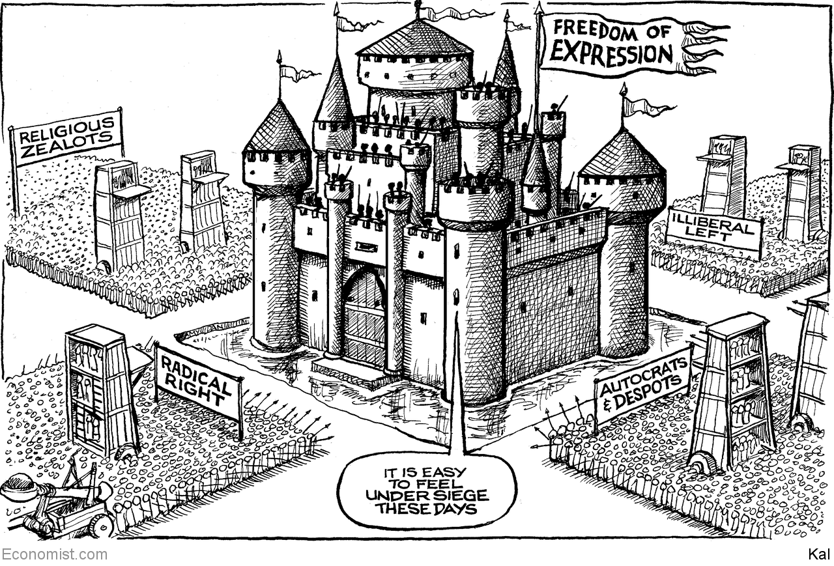
Unusually good KAL cartoon this week in the Economist:

Originalism

Originalism has become, as Richard Primus of the University of Michigan Law School says, a “surname of a family of approaches to constitutional law” that might not recognise one another around the dinner table.

America tussles over a newly fashionable constitutional theory (The Economist)

I’m growing increasingly convinced that originalism is the correct way to analyze constitutional questions, but Professor Primus isn’t totally wrong, either. Inter-originalism tussles will, I hope, resolve to a shared method.

How could there be multiple members of the “originalism” family that don’t recognize one another? Well, for instance, an originalism that reflexively looks only to first founding and averts its eyes from the post-Civil War amendments is missing the mark:

Elizabeth Wydra, president of the Constitutional Accountability Centre, a law firm and advocacy organisation, is not waiting for liberals to take hold of the court. She finds powerful originalist sources for progressive causes—especially in the Reconstruction Amendments. These provisions, which ended slavery and guaranteed equal rights for formerly enslaved people, “reflect broad conceptions of equality, inclusion and liberty”. For true originalists, Ms Wydra says, “the 14th Amendment should matter just as much to you as the Second Amendment.”

This doesn’t mean I’ll agree with Ms. Wydra’s conclusions on cases, but she’s right that the nation had a “second founding” 160 years ago, and that, too, affects “original meaning.”


“The Frenchman works until he can play. The American works until he can’t play; and then thanks the devil, his master, that he is donkey enough to die in harness ….” (G.K. Chesterton)

You can read most of my more impromptu stuff here (cathartic venting) and here (the only social medium I frequent, because people there are quirky, pleasant and real). Both should work in your RSS aggregator, like Feedly or Reeder, should you want to make a habit of it.
Monday, 7/25/22

Trump, Trump, Trump

If you’ve already heard enough, I’ll take no offense if you skip this section. But the first three of these Trump-related items all involve a bit of my own thinking and analogizing, not just quotes without comment.

Flight 93 Indictments

People continue to make the case that what Donald Trump did — here, there, everywhere — was criminal and that he should be charged. I’ll stipulate for sake of argument that every one of those arguments, even the weakest of them, is correct.

Some convictions, I believe (don’t bet anything you can’t afford to lose), would disqualify him from running in 2024.

But can we get convictions? When did Trump’s lawyers ever allow any case against him to go forward expeditiously? When did they not throw up every conceivable preliminary motion to put a spanner in the works?

And with his astonishing continued levels of support (at least as reported to pollsters; I can’t rule out mischievous responses), can we really expect unanimous jury verdicts of "guilty" anywhere in this country?

An acquittal, even if the jury voted 11-1 for conviction, might well strengthen him and his narrative of "all the poopy-heads hate me."

Michael Anton infamously argued in the 2016 Election cycle that it was either Donald Trump or the end of America as we know it. It was like flight 93: storm the cockpit and we just might live.

Let’s not repeat Anton’s mistake in reverse: "if we indict him, we just might get a conviction that will disqualify him from running again; whereas if we don’t, he’ll run again, win, and it will be the end of America as we know it."

I do think that Trump 2024 could be the end of America as we know it, and the January 6 Committee hearings have put at least slightly reinforced that in my mind (I was very anti-Trump before January 6 and before the hearings). They may even have had a net-positive effect on the electorate, swaying more against Trump than toward him in false sympathy for him as victim. But I think that beating him at the polls with a reformed Electoral Count Act to thwart shenanigans is a sounder strategy than trying to disqualify him with a felony conviction.

(David French’s argument in Friday’s Atlantic tends toward indictment despite unnamed risks — because (as I interpret it) we must show that nobody is above the law.)

I confess to TDS

I laughed at Democrats suffering Bush Derangement Syndrome. I laughed at Republicans suffering Obama Derangement Syndrome, but also shook my head at their frequent racist dog-whistles. I was above all that.

Then Donald Trump actually got the Republican nomination, and if someone wanted to call my reaction Trump Derangement Syndrome, I’d understand. My main defense is that I was right: his narcissism eventually so distorted his reality field that he put the nation at grave and unnecessary risk beginning Election Day 2020.

Conspiracy or Tragedy?

It is a sign of the committee Democrats’ love of country that they have allowed the hearings to proceed this way. They are crafting a story about Jan. 6 as a battle between Republican heroism and Republican villainy. It seems intended to create a permission structure for Trump supporters to move on without having to disavow everything they loved about his presidency, or to admit that Jan. 6 was the logical culmination of his sadistic politics.

If you believe, as I do, that Trump’s sociopathy makes him a unique threat to this country’s future, it makes sense to try to lure Republicans away from him rather than damn them for their complicity. There is a difference, however, between a smart narrative and an accurate one. In truth, you can’t cleave Trump and his most shameless antidemocratic enablers off from the rest of the Republican Party, because the party has been remade in his image. Plenty of ex-Trump officials have come off well in the hearings, including the former deputy national security adviser Matthew Pottinger, the former acting attorney general Jeffrey Rosen and, in video testimony, the former White House counsel Pat Cipollone. That shouldn’t erase the ignominy of having served Trump in the first place.

Michelle Goldberg, The Myth of the Good Trump Official.

Goldberg had me in the first paragraph but substantially lost me in the second. My TDS doesn’t make me condemn everyone who served in the Trump administration. For many of them, their service was a sign of their love of country, for which they willingly put their reputations and political futures permanently at risk to be among the adults in the room.

I know, I know: Many of them ended up as infantilized sycophants, but I don’t think that’s how they, or at least most of them, went in.

The difference between Goldberg and me on this topic is that she seemingly views the Trump years mostly as a conspiracy of bad actors against the country whereas I see it more as a tragedy, whereby a malign leader seduced a lot of benign-to-neutral followers — my paradigm being Mark Studdock in C.S. Lewis’ That Hideous Strength.

If you insist on Mephistopheles and a bunch of Fausts, I’d insist back at you that they didn’t think they were Fausts when they initially said "yes." They thought of themselves as the alternative to cronies and crazies who ended up being named Steve Bannon, Rudy Giuliani, Roger Stone, Sydney Powell, Michael Eastman, Mike Lindell and such.

And although I recognized grave danger in Trump’s narcissism, I did not foresee his seductiveness — though his ability to seduce an electoral majority of voters should have warned me.

Why I still read the New York Times

By insisting that he was cheated out of victory, Trump fashioned himself into a king-in-exile rather than a loser — an Arthur betrayed by the Mordreds of his own party, waiting in the Avalon of Mar-a-Lago to make his prophesied return.

As with many forms of dark Trumpian brilliance, though, the former president is not exactly in conscious control of this strategy. He intuited rather than calculated his way to its effectiveness, and he seems too invested in its central conceit — the absolute righteousness of his “Stop the Steal” campaign — to modulate when it begins to reap diminishing returns.

While Ron DeSantis, his strongest potential rival, has been throwing himself in front of almost every issue that Republican primary voters care about, Trump has marinated in grievance, narrowed his inner circle, and continued to badger Republican officials about undoing the last election. While DeSantis has been selling himself as the scourge of liberalism, the former president has been selling himself mostly as the scourge of Brian Kemp, Liz Cheney and Mike Pence.

A counterargument, raised on Friday by New York Magazine’s Jonathan Chait, is that so long as those lukewarm supporters still believe the 2020 election was unfair, Trump will have a trump card over any rival — because if you believe a steal happened, “you are perfectly rational to select a candidate who will acknowledge the crime and do everything to prevent it from reoccurring.”

But it seems just as possible for the lukewarm supporter to decide that if Trump’s response to being robbed was to first just let it happen and then ask his vice president to wave a magic wand on his behalf, then maybe he’s not the right guy to take on the Democratic machine next time.

There is more than one way, in other words, for Republican voters to decide that the former president is a loser ….

Ross Douthat in the New York Times.

Once again, it’s Trump’s narcissism: it’s all about him and to hell with everything else.

Not Trump

The Great EV Scam

Regulators everywhere are structuring their electric-vehicle industries on the Norway model, based on subsidies from less-affluent people who continue to buy gas-powered cars. A zombie business or industry, in today’s parlance, is one sustained less by creative destruction than by a combination of government bailout, regulation and hidden subsidies. This is what the global auto sector is becoming. Germany, having saddled its domestic makers with mandates for diesel and then electric vehicles, has repeatedly had to scarf together hidden rescues when the mandated investments didn’t pay off. Don’t think it can’t happen here. In fact, the history of the U.S. auto sector since the Chrysler bailout of 1980 has been of more or less continuous open and crypto-bailouts.

Holman W. Jenkins, Jr., The Upside-Down Logic of Electric SUVs

America, Abortionmonger to the World

A foreign policy pushing for abortion abroad is also a strategic blunder with long-term consequences. Many countries in Africa, Asia and Latin America have strict limits on abortion, and even most of the free world is closer to Dobbs than to Roe.

Some Western politicians, such as French President Emmanuel Macron, and the European Parliament have joined Mr. Biden in denouncing Dobbs. But their statements reflect more the global solidarity of pro-abortion politicians than diplomatic prudence or even their own nations’ laws and practices.

Jakub Grygiel and Rebeccah Heinrichs, Biden’s Abortion Politics Will Undermine America’s World Standing.

Note that the characterization of the free world in the first paragraph is true only in the sense that Western Europe largely leaves abortion to political processes, as does Dobbs not constitutionalizing it s did Roe. It’s false insofar as it implies that Dobbs sets a national policy of, say, legal abortion in the first trimester, which is roughly where Western Europe tends to be, as compared to Roe‘s much more radically permissive regime.

SCOTUS legitimacy: two views

For three decades, Casey was precedent on precedent. But that is not the only conception of legitimacy.

On Thursday, Justice Kagan spoke to the Ninth Circuit Judicial Conference. She was careful to avoid talking about Dobbs directly, but she clearly alluded to the case. And, according to the Washington Post–I’ve not yet found video of the event–she invoked the concept of "legitimacy" as defined by Casey. That is, the Court’s "legitimacy" is linked to public perception …

The Dobbs Court emphatically repealed and replaced that notion of legitimacy. Now, legitimacy is defined by following written law, without regard to public perception. Linda Greenhouse’s column laments that shift:

. . .  Justice Alito actually had the gall to write that "we do not pretend to know how our political system or society will respond to today’s decision." Polls conducted before the opinion’s release showing that upward of two-thirds of Americans wanted to retain a right to abortion offered a hint and were perhaps what led to Justice Alito’s self-righteous declaration: "We cannot allow our decisions to be affected by any extraneous influences such as concern about the public’s reaction to our work."

Dobbs overruled Casey‘s undue burden framework, but also overruled the precedent on precedent. Justice Scalia would often joke that the Constitution is dead, dead, dead. We should say the same for Casey‘s precedent on precedent. It’s dead, dead, dead.

Josh Blackman at the Volokh Conspiracy.

Medical miracles

What they’re doing with vagus nerve stimulation is fascinating. I got tipped off by the Wall Street Journal, but here’s a solid link sans paywall

The other book-banners

We hear constantly about conservative efforts to "ban books," which accusation sometimes amounts to nothing more than taking a book out of a curriculum while leaving it readily available in the school library. But that’s not the whole story:

Last year, when the American Booksellers Association included Abigail Shrier’s book, “Irreversible Damage: The Transgender Craze Seducing Our Daughters,” in a mailing to member booksellers, a number of booksellers publicly castigated the group for promoting a book they considered transphobic. The association issued a lengthy apology and subsequently promised to revise its practices. The group’s board then backed away from its traditional support of free expression, emphasizing the importance of avoiding “harmful speech.”

A recent overview in Publishers Weekly about the state of free expression in the industry noted, “Many longtime book people have said what makes the present unprecedented is a new impetus to censor — and self-censor — coming from the left.” When the reporter asked a half dozen influential figures at the largest publishing houses to comment, only one would talk — and only on condition of anonymity. “This is the censorship that, as the phrase goes, dare not speak its name,” the reporter wrote.

Pamela Paul, There’s More Than One Way to Ban a Book


It’s a long way to Heaven dear Lord,
it’s a hard row to hoe
And I don’t know if I’ll make it dear Lord
but I sure won’t make it alone.

SmallTown Heroes, Long Road, from their one-and-so-far-only "byzantine bluegrass" album Lo, the Hard Times.

You can read most of my more impromptu stuff here (cathartic venting) and here (the only social medium I frequent, because people there are quirky, pleasant and real). Both should work in your RSS aggregator, like Feedly or Reeder, should you want to make a habit of it.

Wednesday, 7/20/22

You didn’t miss anything. I didn’t publish yesterday because I just didn’t have enough material. That’s likely to recur, as I’m gradually correcting my incorrigible habit of poring over news that seems especially shareable.

Polling

The survey also found that 32% of Latino Catholics said their religious faith dictates their views on abortion, compared to 73% of white evangelical Protestants.

A new survey found Latino Catholics overwhelmingly support abortion rights. Here’s why.

I would be a pollster’s nightmare, as I find so many polling questions unanswerable if not unintelligible.

Orthodox Christianity is opposed to abortion, but I was anti-abortion before I became Orthodox, and (heaven help me, for this may mean that I’m an American individualist) I would affirm that at no time in my life has my religious faith "dictated my views" on abortion.

I have difficulty getting into the mind of anyone who would listen to that polling question, note the import of "dictate," and then answer in the affirmative. Thus the question is a — what? litmus test? ink blot test? I certainly don’t see useful information coming from it.

I don’t consider myself a rebel against my Church. I don’t think it has ever said what an Orthodox political position on abortion should be, though in my parish we especially pray regularly for an end to abortion through changed hearts.

My religious faith does "dictate" some things — say, my rejection of monothelitism and monoenergism and suchlike — important Christological questions of import on which the Church’s position is longstanding and plausibly reasoned (e.g., those teachings effectively denied the full humanity of Christ by saying that He had no human will or energy). Countermanding what the Church says about such theological nuances is above my pay grade and, unlike David Bentley Hart, I’m not arrogant enough to "go there." (I was a Protestant for two-thirds of my life and don’t care to try it again.)

But abortion? Capital punishment? Euthanasia? Eugenics? I can’t help but form my own opinions on those, informed by the Church but not dictated to.

Notes from a roving raconteur

I beat myself up because I’m an old fundamentalist and self-mortification is our specialty. And I’ve been having too much fun lately, which confuses me, doing shows in red states to crowds that include a good many Republicans who voted for the landslide winner in 2020 but nonetheless were warm and receptive to me who voted for the thief. In blue states, audiences are listening to make sure you check the boxes of Inclusivity, Diversity, Equity, and Antiracism. These are people who don’t mind that many theaters refuse to do “Our Town” because the “Our” does not acknowledge that Grover’s Corners was stolen from indigenous people. I use the possessive pronoun in singing “My country, ’tis of thee,” which audiences in red states enjoy singing with me, and also our national anthem, ignoring the fact that Francis Scott Key did own slaves.

Back in the Sixties, when I was in my twenties, we sang “We Shall Overcome” and clearly we did not overcome, we only created new hairstyles. So we pass the torch to the young, some of whom feel the word “person” shows gender bias and want to change it to perself. To which I say, “Good luck with dat.”

Garrison Keillor, national treasure.

Vignettes

There’s no apparent common theme to this two vignettes, but I thought each of them was interesting in different ways:

  • A young Hungarian academic I dined with last evening told me how jarring it was to get his master’s degree at a western European university, and to be congratulated by fellow grad students on how lucky he was to have grown up in a country that had been blessed by Marxist government. His own family had had everything taken from them by the Communists, yet these privileged nitwits could only imagine that life had been glorious under Communism. This has something to do with the fact that he’s living back in Hungary now, though he could make a lot more money working in the West. He can’t bear to deal with such ignorant people.
  • [A correspondent was one of] a bunch of very conservative Catholics who wanted to live rurally, and went out and bought land in the same area. This reader said he has been mostly grateful for having had the chance to live there and raise his kids there, but he’s not sure he would do it again if he had the chance. The reason, he said, is that he was too optimistic about how life would be there. He says he had not counted on the fact that the kind of Catholics who would make such a radical choice — strong-willed Catholics like himself, as he conceded — would find it unusually hard to get along. The reader told me that there were frequent disputes within the community over purity — not strictly sexual purity, but over whether or not it was licit to do things like let your daughters wear pants, or keep them in skirts and dresses. He said it got to be exhausting, dealing with these communal neuroses.

Rod Dreher’s Diary, Sisi, Queen Of The Magyars

Indestructible lies

… There in Boston is a monument to the man who discovered anesthesia; many people are aware, in these latter days, that that man didn’t discover it at all, but stole the discovery from another man. Is this truth mighty, and will it prevail? Ah, no, my hearers, the monument is made of hardy material, but the lie it tells will outlast it a million years ….

Mark Twain via Alan Jacobs

When Wystan met Hannah

“I met Auden late in his life and mine—at an age when the easy, knowledgeable intimacy of friendships formed in one’s youth can no longer be attained, because not enough life is left, or expected to be left, to share with another. Thus, we were very good friends but not intimate friends.”

Hannah Arendt, explaining (it seems) her refusal of a marriage proposal by the poet and friend W. H. Auden (via L. M. Sacasas). I was unaware of that episode, which rather complicates my recollection that Auden eventually gave up trying to resist his homosexuality.

Sacasas continues on other topics:

The examples I have in mind of this receding of materiality arise, not surprisingly, from the most prosaic quarters of daily life. As a bookish person, for example, I think about how the distinct material shape of the book not only encodes a text but also becomes a reservoir of my personal history. I remember where I was when I read it. Or I recall who gave it to me or to whom I have lent it. In other words, the presence of the book on a shelf recalls its contents to mind at a glance and also intertwines an assortment of memories into the backdrop of my day-to-day life. At the very least, it becomes an always available potential portal into my past. I don’t mean to be romantic about any of this. In fact, I think this is all decidedly unromantic, having to do chiefly with the meaning and significance of the stuff that daily surrounds us.

The digitized book by contrast may have its own advantages, but by being the single undifferentiated interface for every book it loses its function as a mooring for the self. It’s not that the e-reader has no materiality of its own—of course it does. Perhaps the best way of conceptualizing this is to say that the device over-consolidates the materiality of reading in a way that smooths out the texture of our experience. Consider how this pattern of over-consolidation and subsequent smoothing of the texture of material culture recurs throughout digital society. The smartphone is a good example. An array of distinct physical objects—cash, maps, analog music players, cameras, calendars, etc.—become one thing. The texture of our experience is flattened out as a result.

He’s not wrong about this (insider joke to one of my readers). Yet, because of the Readwise service, I’m developing a preferential option for eBooks. That and my shelves having filled to overflowing with regular books several times.

It’s helpful to be reminded of what’s lost, though. I hope Warren Farha of the world’s greatest brick and mortar bookstore, Eighth Day Books in Wichita, will forgive my my opinion if he’s reading this.

Awkward

Barton and WallBuilders argue that Jefferson and the Founders, outside of some exceptions, meant for the “wall of protection” to operate in one direction. It also, the group and its founder suggested, applies mostly to the federal government, not the states.

Jack Jenkins, The activist behind opposition to the separation of church and state

Well! This is awkward! I have a bad impression of David Barton, who I’ve understood as a grifter, dining out on "America is a Christian Nation."

But Barton is almost completely correct in what I first quoted. What Thomas Jefferson called a "wall of separation" was meant to protect the churches (I’d prefer "religion," though both terms have shortcomings in this context) from the state; and it was, at the time the First Amendment was ratified, intended to apply only to the federal government ("Congress shall make no law …"). Heck, Massachusetts had an established Congregational Church for 30 more years after Jefferson’s letter to the Danbury Baptists, and that letter was well after the Bill of Rights!

Where Barton may be wrong is in in the report that he thinks that amendment "applies" rather than "applied" mostly to the Federal Government. The First Amendment has been incorporated in the post-Civil War Fourteenth Amendment and thereby made applicable to the states. Thus Saith the Courts.

Thus, it seems to me, Barton may be telling half-truths to embolden crypto-theocrats by whose concepts of Christianity I have no desire to be governed — unless the alternative is the Wokeworld religion. I would almost certainly pick the Bartonites in that contest.

Like I said: awkward.

Is the tide turning?

… there is something undeniably more powerful about reading critiques of contemporary sexual morality that arise not from traditional religious spaces, but from within secular feminism and and from elite media. That’s when you know the tide might be turning.

I bring this up because in every single argument and controversy under the sun, reality gets a vote. Culture wars are ultimately won or lost not by online arguments but through their real-world consequences, and the position that leads to greater human misery tends to lose.

To connect with the issues at the start of this piece, when speaking about the wave of intolerance that’s swept the academy, philanthropy, Hollywood, and much of mainstream media, I’ve told conservative friends that they have no idea how miserable it was making most of the people in those organizations. Something had to give, and the immiserated majority is going to be intimidated by the motivated minority for only so long.

When speaking of the reality of porn-influenced consent culture, there’s a similar dynamic in play. It’s immiserating people by the millions.

David French, in an encouraging column: we seem to have hit bottom and started back up in several ways. At least that’s what French thinks.

Imagine my arse

Comments such as these convince me that John Lennon captured a common liberal dream in his haunting song “Imagine.” Imagine if there were no countries, and no religion too. If we could just erase the borders and boundaries that divide us, then the world would “be as one.” It’s a vision of heaven for liberals, but conservatives believe it would quickly descend into hell. I think conservatives are on to something.

Jonathan Haidt, The Righteous Mind.

I absolutely hate that song, and I was glad to learn I’m not alone.


If people have always said it, it is probably true; it is the distilled wisdom of the ages. If people have not always said it, but everybody is saying it now, it is probably a lie; it is the concentrated madness of the moment.

Anthony Esolen, Out of the Ashes

You can read most of my more impromptu stuff here (cathartic venting) and here (the only social medium I frequent, because people there are quirky, pleasant and real). Both should work in your RSS aggregator, like Feedly or Reeder, should you want to make a habit of it.

Potpourri 6/9/22

January 6, with us forever

After Mr. Pence was hustled to safety, Mark Meadows, the White House chief of staff, is reported to have told colleagues that Mr. Trump said that perhaps Mr. Pence should have been hanged.

Maggie Haberman, ‌Pence Staff Feared for His Safety Amid Trump’s Pressure Campaign Before Jan. 6.

That’s at least triple hearsay (someone says that Mark Meadows told colleagues that Trump said) plus a "perhaps," but with Trump, it seems sufficiently credible — and yes, I’ll plead guilty to confirmation bias if you can get an indictment.

The most astonishing part of this whole story is that Mike Pence finally said "no" to the Orange God. I thought he’d taken leave of his senses when he agreed to run with Trump, but it was only his principles that he was abandoning.

I’m assuming that the public "hearings" that begin this evening will be agitprop. I assume that it will be the kind of anti-Trump agitprop that I’m predisposed to believe. But the very fact that they brought in a storied documentary producer to help stage it counsels that I avoid it and rely on multiple secondary sources (probably WSJ, NYT and the Dispatch — which culpably leaves out stellar sources like Alex Jones, Breitbart Steve Bannon’s War Room "television show," Think Progress or other emetic productions).

Surely the gist will be something like this:

This was a violent assault on the United States Capitol, and it was provoked by a sitting president of the United States,” Cheney said. “He oversaw a multipart plan, [the] objective of which was for him to stay in power, to overturn the results of an election and stay in power. And I would say to people, as you’re listening to some of my colleagues and others who think that the way to respond to this investigation is with politics and partisanship—those people are not acting in a way that is healthy for the country.

Liz Cheney on the Dispatch Live

Defense/Defiance

Spend much time at gun shows or at gun shops, and you’ll quickly become familiar with something called the “tactical” or “black gun” lifestyle, where civilians intentionally equip themselves in gear designed for the “daily gunfight.” It’s often a form of elaborate special forces cosplay, except the weapons (and sometimes the body armor) are very real.

Something has changed in the streets as well. It’s now common to see men and women armed to the teeth, open-carrying during anti-lockdown protests and even outside public officials’ homes. This is when the gun is used to menace and intimidate. It’s displayed not as a matter of defense but rather as an open act of defiance. It’s meant to make people uncomfortable. It’s meant to make them feel unsafe.

David French,‌Against Gun Idolatry.

I’ve noticed increasingly that I "learn" things by reading other than what the author directly intended. In this case, French helped me put my finger on what I, an enthusiast neither for guns nor for gun bans, find obnoxious about open carry regimes: they enable performative assholery and political intimidation.

Knock-on celebrity

Some individuals reach the unfortunate but not entirely irrational conclusion that the best way to be remembered is by assassinating somebody whose long-lasting fame is guaranteed. There is something very modern about this approach. In the celebrity culture where we all live, nothing is worse to some people than the idea of dying unknown and staying that way. Shooting your way out of this box is a method of leeching off of someone else’s celebrity. In the celebrity culture, a negative reputation for all times is better than no reputation at all. John Wilkes Booth shot Abraham Lincoln because he (Booth) was a Southern partisan. John Hinckley shot Ronald Reagan because he wanted fame, like Travis Bickle in the movie Taxi Driver—or at least an opportunity to touch fame.

Michael E. Kinsley, Old Age

Social Media in the unreal world of celebrities

Somehow, this seems related to the preceding item:

[I]t is difficult for me not to have some level of sympathy for [Amber] Heard. She has not only been found by the jury to have testified falsely as to critical issues of fact—to have lied—but been so pilloried throughout the nation that she has become a public face of falsehood. We have had public figures at the highest level of national authority who have routinely lied about far more important matters and have never been subjected to anything like the level of opprobrium she is now enduring.”

The rage against her—and the worship of him—has been primal. And there was no escaping it. Over the course of the trial, it felt like the algorithms that drive social media were programmed to stoke hatred of Heard.

Famed attorney Floyd Abrams via Bari Weiss.

The delusion of quantification, mastery and management

You likely read or heard about Jonathan Haidt’s big April essay in the Atlantic, “After Babel: Why the Past 10 Years of American Life Have Been Uniquely Stupid.” The thesis is pretty straightforward: social media is ruining America. In the New Yorker, Gideon Lewis-Kraus takes an admirably fair and honest look at Haidt’s claims. Frankly, Lewis-Kraus is to be commended not only for his analysis but for the spirit in which it was presented. Basically, he found that it is difficult to support Haidt’s most dire claims with existing data.

Lewis-Kraus, and the scholars he consulted, are probably right. Haidt’s case is difficult to defend given existing research. Interestingly, however, they all seem to approach this in similar fashion: they grant that Haidt is right to be concerned, but they’re simply not sure if he is concerned about the right things and in the right measure. Lewis-Kraus is also to be commended for the running acknowledgement that it may be difficult to measure and quantify the kind of effects we’re looking for. I remain skeptical that we can rely merely on social scientific data to ground our action. That may very well be a symptom of the deeper (Babel-like!) delusion of mastery and management. But along those lines, this was a particularly interesting observation:

“Gentzkow told me that, for the period between 2016 and 2020, the direct effects of misinformation were difficult to discern. ‘But it might have had a much larger effect because we got so worried about it—a broader impact on trust,’ he said. ‘Even if not that many people were exposed, the narrative that the world is full of fake news, and you can’t trust anything, and other people are being misled about it—well, that might have had a bigger impact than the content itself.’”

Well, that’s kind of the point isn’t it? I mean, that consequence Gentzkow describes is a consequence of social media, which acts as a massive assortment of feedback loops from the social body to the collective consciousness, such that it generates all manner of distorted and disordered actions.

Finally, on this score, I’ll say that the allusion to the Babel narrative amounts to little more than window dressing (curiously, the Atlantic seems to have removed the reference from the title). When Haidt writes, with reference to the tower, that social media platforms “unwittingly dissolved the mortar of trust, belief in institutions, and shared stories that had held a large and diverse secular democracy together,” he seems to be overlooking the fact that in the Hebrew story the destruction of the tower was not something to be lamented. The destruction of the tower was an act of judgment on the hubris of the builders. I think there was an interesting direction in which to take that story, but I’m not sure this was it.

L.M. Sacasas, ‌Readings and Resources (emphasis added because I share his skepticism about our collective delusion).

Writers shouldn’t talk

Who in their right mind would want to talk, much less listen, to a person who has contrived to spend as much of her life as possible crouched over her computer in isolation, deleting unsatisfactory variants of a single sentence for upwards of an hour? Nothing in my daily practice has prepared me for the gauntlet of a tête-à-tête. Writing is an antidote to the immediacy and inexactitude of speech, and I resent any attempt to drag me back into the sludge of dialogue …

Books and essays are the product of long bouts of thinking, which makes writers fantastically ill-suited to summoning opinions instantaneously …

To be adept at honing sentences for weeks or months is no guarantee of any aptitude for improvisation. Nor does skill at fictionalizing life or theorizing about it correlate with any facility for entering into the thick of things.

Becca Rothfeld, Writers Shouldn’t Talk

From my subjective core, this is almost too obvious to say write. I’m myself in Rothfeld’s camp. I’ve labored way too long over relatively short speeches I was expected to give, and then delivered them as closely to the written text as I could manage while maintaining reasonable eye contact. I don’t trust my spontaneous utterances to be worth the attention of assembled auditors. Obviously, I’m less inhibited about the written word.

Celebrate the First Amendment

An Australian court on Monday ordered Google to pay $515,000 to former Australian politician John Barilaro for failing to take down from YouTube a campaign of “relentless, racist, vilificatory, abusive, and defamatory” videos attacking him, which the court ruled “drove Mr. Barilaro prematurely from his chosen service in public life and traumatized him significantly.”

TMD. I do not know the details behind this, so I won’t call Mr. Barilaro a snowflake, but I’m having trouble imagining any possible details that would support liability in U.S. Courts. And with due allowance for familiarity, I like it that way.

Dreherisms

Smart to have a dumb home?

The business rationale for the smart home is to bring the intimate patterns of life into the fold of the surveillance economy, which has a one-way mirror quality.

Matthew B. Crawford, Defying the Data Priests

Librarian cosplay

I’m tired of hearing about supposed book bannings in the U.S.

  • Deleting a book from a curriculum while leaving it in the school library is not a book banning.
  • Someone trying to get a book removed from a public library, which tells that someone to go take a hike, is not a book banning.

What’s going on, I think, is bored librarians (is there another kind?) engaging in ritual cosplay ("You can have To Kill a Mockingbird when you pry it from my cold, dead fingers!").

Wordplay

From the Economist:

Word of the Week: écoponts, “wildlife bridges” in French. France is building overpasses for animals to reduce roadkill and help them roam more freely. Read the full story.


You have to be educated into cant; it is a kind of stupidity that surpasses the capacity of unaided Nature to confer.

Anthony M. Esolen, Out of the Ashes (Kindle location 411)


You can read most of my more impromptu stuff here (cathartic venting) and here (the only social medium I frequent, because people there are quirky, pleasant and real). Both should work in your RSS aggregator, like Feedly or Reeder, should you want to make a habit of it.

Culture Wars, Hot War

Canadian Truckers

Organized fear

Since politics exists to organize fears, a major question for people caught between these two camps is which kind of power seems more frightening. The power to shut down the heart of a major city, perhaps even with the sympathy of some of the police, or the power over money and information that the Trudeau government is relying upon in its response? The specter of an insurrection or the specter of a digital police state? A revolt of the disaffected middle or a revolt of the elites?

At the moment, judging by the Canadian polls, people are unhappy with Trudeau but seem to fear the disruptions and shutdowns more than the government response. A similar preference for a disliked elite over a chaotic and disreputable opposition is why Joe Biden is president rather than Donald Trump, and why Emmanuel Macron may yet be re-elected in France.

Ross Douthat, on the “Class War” between Canadian Truckers and Canadian Meritocracy (emphasis added).

Class War

The Canadian trucker protest was a class war, Ross Douthat writes in his latest column, between what N.S. Lyons described as the “virtuals” who live in the digital world and the “practicals” who work in the “mundane physical reality” upon which the virtual society depends. “The truckers have leveraged the imposing presence of their trucks and the sympathy of other Practicals—from tow-truck drivers to cops—to attack the physical underpinnings of the capital’s economy,” he writes. “The counterstrike, while it’s finally evolved to actual physical removal, has been strikingly virtual: first a PR blitz to encourage friendly media to brand all the truckers as racists and anti-Semites and Trump supporters, then the convenient hacking and ‘doxxing’ of donors to the convoy, and then an invocation of the Emergencies Act which lets the government attack the protesters via the digital realm, freezing bank accounts and even cryptocurrency funds connected to the protests.”

The Morning Dispatch.

Ross Douthat has the condensed version, but I read N.S. Lyons’ longer substack (Reality Honks Back), which is one of the best — and most ominous — things I’ve read in weeks. Synopsis follows.

The Physicals and the Virtuals

It’s my understanding that N.S. Lyons is a pseudonym, but I’ll put still say it: “N.S. Lyons is a very smart person.”

In the recent essay ‌Reality Honks Back, Lyons reflects on the Canadian trucker convoy/strike as pitting elites (“the Virtuals,” who trade in thinking and narrative-spinning, not physical reality; in fact, they think reality is socially constructed) against “the Physicals” who trade in actual physical stuff. (Think “deplorables.”)

When the parked trucks became too intolerable a reminder that the Virtuals are utterly dependent on the Physicals (socially construct your way out of that reality if you can!), the Virtuals, having spun a narrative of neo-nazis and other deplorables, played their trump card: they incited their co-conspirators to create a new caste of economic untouchables, cutting off GoFundMe, hacking another crowdfunding site (GiveSendGo) and Doxxing donors to the truckers’ cause, and threatening economic ruin and criminal prosecution against anyone who dared try help them again.

So the Virtuals won because we don’t recognize what they did as virtual violence, whereas the Physicals, this time at least, could have retaliated only by engaging in physical violence.

Something tells me that this is only round one.

Maybe I got some of the details wrong, but I highly recommend the whole piece, and particularly the suggestion that the enmity of the Virtuals toward the Physicals (and vice-versa) is maybe the top conflict driver extant today. (It’s a theory that rhymes with the theory that we’re over-producing and under-employing college-debt-ridden elites, too.)

Update: Justin Trudeau has decided that the emergency is over and the deplorables can have their money back.

Virtuals and Physicals in the USA

Of the nation’s total 3,143 counties, the number of super landslide counties — where a presidential candidate won at least 80% of the vote — has jumped from 6% in 2004 to 22% in 2020.

“Trump’s blowouts were concentrated in white, rural counties in the Greater South, Interior West, and Great Plains,” Sabato writes, “while Biden’s were in a smattering of big cities, college towns, and smaller counties with large percentages of heavily Democratic nonwhite voters.”

Put another way, Biden won 85% of counties with a Whole Foods and only 32% of counties with a Cracker Barrel.

NPR

I thought this was an interesting tidbit until I started thinking “How many counties have both Cracker Barrel and Whole Foods? And then “Is this just a rough proxy for bigger cities versus smaller?

Paul Farmer, RIP

Paul Farmer proves that there are wonderful people doing wonderful work who for some reason never come into my field of vision until there are lamentations and obituaries at their departure. Here, here, here, here.

It’s difficult to find much discussion of religion in the life of this man whose self-sacrificial life had to be inspired by something. Get Religion calls those “God-shaped holes,” and the New York Times, Wall Street Journal and Bill Gates all had huge ones. Even Alan Jacobs didn’t hit it head-on.

But Friends University’s Russel Arben Fox comes to the rescue:

Farmer was raised a Christian believer, but only became truly committed during his years of going back and forth between Harvard and Haiti: “The fact that any sort of religious faith was so disdained at Harvard and so important to the poor–not just in Haiti but elsewhere too–made me even more convinced that faith must be something good” [MBM, pg. 85]. He became a fierce advocate of that element of Catholic social justice teaching that emphasizes giving preference to the poor, or the “option for the poor.” For Farmer, this has meant liberation theology, and a thoroughgoing critique of the failures of the rich capitalist nations of the world to attend to the manifest and desperate needs of the poorest of the poor.

Hyperbolic outrage

I should have known better than to waste any time on Olga Khazan, The New Partisan Fight Over Schools‌. It meandered around teapots, and when it found this tempest I knew I was done reading:

The most explosive example of the Republican crackdown on schools occurred when a school district in a very conservative area of Tennessee removed the Pulitzer Prize–winning Holocaust book Maus from its eighth-grade curriculum because it contains eight swear words and a bit of cartoon nudity. “It looks like the entire curriculum is developed to normalize sexuality, normalize nudity and normalize vulgar language,” the McMinn County school-board member Mike Cochran said, according to meeting minutes. “You put this stuff just enough on the edges, so the parents don’t catch it but the kids, they soak it in.” His view presumes that parents should monitor what their kids are learning.

When removing a glorified comic book from a curriculum is the most “explosive example” you’ve got, and you have to make it sound ominous-by-association that some deplorable thinks “parents should monitor what their kids are learning,” you’ve not got much.

Again, I prefer the lot of a blogger to the lot of a professional who must write even when there’s nothing much to say.

SSM and Creative Artistry

Another artisan is going to SCOTUS seeking exemption from providing creative services for same-sex “weddings”:

Tuesday’s order phrased the question before the court as “whether applying a public-accommodation law to compel an artist to speak or stay silent violates the Free Speech Clause of the First Amendment.”

Granting 303 Creative an exception “would necessarily relegate LGBT consumers to an inferior market because [Ms. Smith’s] unique services are, by definition, unavailable elsewhere,” a 2-1 panel of the 10th U.S. Circuit Court of Appeals, in Denver, said in July.

“The government doesn’t have the power to silence or compel creative expression under the threat of punishment. It’s shocking that the 10th Circuit would permit Colorado to punish artists whose speech isn’t in line with state-approved ideology,” said Kristen Waggoner, general counsel of Alliance Defending Freedom, a religious advocacy group that represents 303 Creative.

Supreme Court to Hear Case of Website Designer Who Won’t Do Same-Sex Weddings – WSJ‌ (emphasis added).

I’ve just seen reports of this case for the first time the day I wrote this item, but it seems to me that the 10th Circuit’s decision says the silent part out loud: it is willing to compel an artist of unique abilities to serve all state-sanctioned “weddings” if she serves any.

The way SCOTUS (Supreme Court of the United States in shorthand) frames the question is highly favorable to 303 Creative, but I get bogged down when I think of the ramifications of this being a declaratory judgment action, where 303 Creative is not in (but wants to expand into) the wedding website business. Thus, it is not currently being compelled to use its creativity contrary to the owner’s conscience.

But I’ve got to ask, in summary of a much earlier and longer blogpost: what kind of creep would want to compel an unwilling creative-type to create for them? What kind of idiot would assume that the resulting work will be as high-caliber as work the creative actually wants to perform?

Self-referentially absurd

After an epiphany of sorts, things came into focus for Paul Kingsnorth. Among other things,

I understood why a (white male) BBC editor would stand before an audience of mostly similarly pale-skinned people and explain that nobody wants to hear white men explaining things anymore..

Russia invading Ukraine

This would deserve top placement, perhaps, if I intended to say much about Russia’s invasion of Ukraine — an invasion which I condemn but probably understand better than most Americans because I’ve been reading guys like Paul Robinson and Gilbert Doctorow as antidotes to mainstream press.

In the case of Robinson, no more:

February 23:

Regular readers will know that I have been decidedly sceptical of the idea that the Russian Federation is about to launch a full-fledged assault on the Ukraine. To be quite frank, I don’t want to believe it, as it would be an act of criminal folly – both criminal and folly, to be precise.

It would also be a humanitarian tragedy, as such an assault could not but result in a large amount of completely unnecessary death and destruction. Let us be quite clear, if it happens, I will condemn it totally and unreservedly. At that point, I will terminate this blog, as its mission to contribute to more rational discussion of both Russia and foreign policy in general will have failed absolutely and without any hope of redemption for many a year. It will be time to call an end to it all. Following a Russian invasion of Ukraine, no even remotely nuanced discussion of things Russian will be conceivable for quite possibly the rest of my life. It will be time for me to drop all punditry, cut all ties with Russia (including ending my relationship with RT), and return to being a historian safely digging in the archives of the past.

I have repeatedly condemned the West’s wars of aggression in recent years. A Russian war against Ukraine would be no worse than, for instance, the invasion of Iraq, but it would be equally criminal.

Let us hope that it doesn’t happen. If it does, you’ve seen the last of me.

(emphasis added)

February 24

In line with my last post, Irrussianality has ceased operation as of today.

God bless you all!

I think I’ll move up Robinson’s book, Russian Conservatism, on my reading list.


You can read most of my more impromptu stuff here (cathartic venting) and here (the only social medium I frequent, because people there are quirky, pleasant and real). Both should work in your RSS aggregator, like Feedly or Reeder, should you want to make a habit of it.

Book notes: The Master and His Emissary

Iain McGilchrist’s The Master and His Emissary is, I’m pretty sure, the heftiest book I read in 2021. I’ve been reviewing my Readwise notes on-and-off now for a full day.

Selected notes are more than enough material for a blog the reader can really chew on for a while. While context is missing, I’ve tried to avoid notes that require the context for any understanding:

  • [B]y showing that the left hemisphere, which underwrites the fragmented vision, is both literally more limited in what it can see, and less capable of understanding what it does see, than the right – and, to cap it all, is less aware of its own limitations – the book gives the reader good reason to reappraise the left hemisphere’s world view, wherever it can be identified as such.
  • [S]ince the Industrial Revolution, but particularly in the last fifty years, we have created a world around us which, in contrast to the natural world, reflects the left hemisphere’s priorities and its vision.
  • A mountain that is a landmark to a navigator, a source of wealth to the prospector, a many-textured form to a painter, or to another the dwelling place of the gods, is changed by the attention given to it. There is no ‘real’ mountain which can be distinguished from these, no one way of thinking which reveals the true mountain. Science, however, purports to be uncovering such a reality. Its apparently value-free descriptions are assumed to deliver the truth about the object, onto which our feelings and desires are later painted. Yet this highly objective stance, this ‘view from nowhere’, to use Nagel’s phrase, is itself value-laden. It is just one particular way of looking at things, a way which privileges detachment, a lack of commitment of the viewer to the object viewed.
  • [I]t is the right hemisphere that has the intuitive sense of numbers and their relative size. However, the sense is approximate and does not have precision. The left hemisphere, by contrast, has precision, but it has no intuitive sense of what it is actually doing, other than following rules and manipulating symbols.
  • ‘If language was given to men to conceal their thoughts, then gesture’s purpose was to disclose them.’ … one feels so hopeless relying on the written word to convey meaning in humanly important and emotionally freighted situations. … It is precisely its accuracy and definiteness that make speech unsuited for expressing what is too complex, changeful and ambiguous. … a right-hemisphere stroke, although not involving speech directly, is in practice more disabling than a left-hemisphere stroke, despite the fact that in a left-hemisphere stroke speech is usually lost.
  • [P]oetry evolved before prose … Prose was at first known as pezos logos, literally ‘pedestrian, or walking, logos’, as opposed to the usual dancing logos of poetry.
  • The belief that one cannot think without language is yet another fallacy of the introspective process, whereby thinking in words about language only serves to confirm the importance of the verbal process. When we consciously introspect, or retrospect, on our own thought processes, and try to construct what happens, how the mind works, we can do so only as we would under those circumstances try to achieve the task, consciously, putting it in words. But the mind is not like this. We carry out most mental processes that would normally constitute what we mean by thinking without doing anything consciously, or in language, at all.
  • [P]hilosophy in the West is essentially a left-hemisphere process. It is verbal and analytic, requiring abstracted, decontextualised, disembodied thinking, dealing in categories, concerning itself with the nature of the general rather than the particular, and adopting a sequential, linear approach to truth, building the edifice of knowledge from the parts, brick by brick. While such a characterisation is not true of most pre-Socratic philosophers, particularly Heraclitus, it is at least true of the majority of philosophers since Plato in the West until the nineteenth century, when, for example, Schopenhauer, Hegel and Nietzsche began to question the basis on which philosophy made its advances.
  • According to the left hemisphere, understanding is built up from the parts … According to the right hemisphere, understanding is derived from the whole ….
  • The statement that ‘there is no such thing as truth’ is itself a truth statement, and implies that it is truer than its opposite, the statement that ‘truth exists’. If we had no concept of truth, we could not state anything at all, and it would even be pointless to act.
  • The fact that in the twentieth century philosophers, like physicists, increasingly arrived at conclusions that are at variance with their own left-hemisphere methodology, and suggest the primacy of the world as the right hemisphere would deliver it, tells us something important.
  • It is only the left hemisphere that thinks there is certainty to be found anywhere.
  • It is not that one or other hemisphere ‘specialises in’, or perhaps even ‘prefers’, whatever it may be, but that each hemisphere has its own disposition towards it, which makes one or another aspect of it come forward – and it is that aspect which is brought out in the world of that hemisphere.
  • The world of the left hemisphere, dependent on denotative language and abstraction, yields clarity and power to manipulate things that are known, fixed, static, isolated, decontextualised, explicit, disembodied, general in nature, but ultimately lifeless. The right hemisphere, by contrast, yields a world of individual, changing, evolving, interconnected, implicit, incarnate, living beings within the context of the lived world, but in the nature of things never fully graspable, always imperfectly known – and to this world it exists in a relationship of care.
  • [T]he immediate pre-conceptual sense of awe can evolve into religion only with the help of the left hemisphere: though, if the process stops there, all one has is theology, or sociology, or empty ritual: something else.
  • With the advent of Romanticism, paradox became once more not a sign of error, but, as it had been seen by Western philosophers before Plato, and by all the major schools of thought in the East before and since, as a sign of the necessary limitation of our customary modes of language and thought, to be welcomed, rather than rejected, on the path towards truth. ‘Paradox is everything simultaneously good and great’, wrote Friedrich Schlegel.
  • The means of argument – the three Ls, language, logic and linearity – are all ultimately under left-hemisphere control, so that the cards are heavily stacked in favour of our conscious discourse enforcing the world view re-presented in the hemisphere which speaks, the left hemisphere, rather than the world that is present to the right hemisphere. Its point of view is always easily defensible, because analytic; the difficulty lies with those who are aware that this does not exhaust the possibilities, and have nonetheless to use analytic methods to transcend analysis. … Coupled with its preference for classification, analysis and sequential thinking, this makes [the left hemisphere] very powerful in constructing an argument. By contrast it is hard for the right hemisphere to be heard at all: what it knows is too complex, hasn’t the advantage of having been carved up into pieces that can be neatly strung together, and it hasn’t got a voice anyway.
  • Although language is the only way we can scientifically bridge the chasm between mind and brain, we should always remember that we humans are creatures that can be deceived as easily by logical rigour as by blind faith … It is possible that some of the fuzzier concepts of folk-psychology may lead us to a more fruitful understanding of the integrative functions of the brain than the rigorous, but constrained, languages of visually observable behavioural acts….
  • One can see the second process (a rejection of the right hemisphere’s world) in the way in which the decline of metaphoric understanding of ceremony and ritual into the inauthentic repetition of empty procedures in the Middle Ages prompted, not a revitalisation of metaphoric understanding, but an outright rejection of it, with the advent of the Reformation … The Reformation is the first great expression of the search for certainty in modern times. As Schleiermacher put it, the Reformation and the Enlightenment have this in common, that ‘everything mysterious and marvellous is proscribed … What is so compelling here is that the motive force behind the Reformation was the urge to regain authenticity, with which one can only be profoundly sympathetic. The path it soon took was that of the destruction of all means whereby the authentic could have been recaptured.
  • Decapitation of statues by the Reformers took place because of the confounding of the animate and the inanimate, and the impossibility of seeing that one can live in the other metaphorically. In a world where metaphoric understanding is lost we are reduced to ‘either/or’, as Koerner says. Either the statue is God or it is a thing: since it is ‘obviously’ not God, it must be a thing, and therefore ‘mere wood’, in which case it has no place in worship.
  • Protestantism being a manifestation of left-hemisphere cognition is – even though its conscious self-descriptions would deny this – itself inevitably linked to the will to power, since that is the agenda of the left hemisphere.
  • Removing the places of holiness, and effectively dispensing with the dimension of the sacred, eroded the power of the princes of the Church, but it helped to buttress the power of the secular state.
  • In essence the cardinal tenet of Christianity – the Word is made Flesh – becomes reversed, and the Flesh is made Word.
  • There are obvious continuities between the Reformation and the Enlightenment. They share the same marks of left-hemisphere domination: the banishment of wonder; the triumph of the explicit, and, with it, mistrust of metaphor; alienation from the embodied world of the flesh, and a consequent cerebralisation of life and experience.
  • The destruction of the sacerdotal power of the Church was a goal of the French Revolution, as it had been of the Reformation. The Reformation, however, had not been nakedly, explicitly, secular: it had purported to replace a corrupt religion with a purified one. All the same its effect had been to transfer power from the sacerdotal base of the Catholic Church to the state, an essential part of the relentless process of secularisation, in the broadest sense – by which I mean the re-presentation of human experience in purely rationalistic terms, necessarily exclusive of the Other, and the insistence that all questions concerning morality and human welfare can and should be settled within those terms – which I would see as the agenda of the left hemisphere.
  • The appeal to reason can lead to sweetness and light, but it can also be used to monitor and control, to constrict and repress, in keeping with my view that the aim of the left hemisphere is power. With time, a dark side to the Enlightenment became too obvious to conceal.
  • In Shakespeare, tragedy is no longer the result of a fatal flaw or error: time and again it lies in a clash between two ways of being in the world or looking at the world, neither of which has to be mistaken. In Shakespeare tragedy is in fact the result of the coming together of opposites.
  • Eichendorff said that Romanticism was the nostalgia of Protestants for the Catholic tradition.

Iain McGilchrist, The Master and His Emissary


You can read most of my more impromptu stuff here (cathartic venting) and here (the only social medium I frequent, because people there are quirky, pleasant and real). Both should work in your RSS aggregator, like Feedly or Reeder, should you want to make a habit of it.