Birth of John the Baptist

So far as I know, we have little or no evidence for when John the Forerunner/Baptist was born, but both Orthodox and Roman Catholics commemorate it on June 24. It’s a big enough deal that my parish had a liturgy for it.

The rest of this post has nothing to do with that.

At Stake in Harvard Grants

Harvard is unique both in the volume of its research output and the extent of these cuts — the government has threatened to end every research dollar to the university. The canceled grants accounted for here add up to about $2.6 billion in awarded federal funds, nearly half of which has already been spent according to government data.

“Even ‘grant’ is a problematic word, because people think they’re just sort of handing this money out for us to do what we want with,” said Marc Weisskopf, who directs a center for environmental health at Harvard that lost its funding from the National Institute of Environmental Health Sciences.

On the contrary, the government is much more explicit in competitive research applications and grant reviews: It wants more neuroscientists. It wants better opioid treatment. It wants to know how lightweight origami-inspired shelters and antennas can be unfurled in war zones.

The money the government sends to Harvard is, in effect, not a subsidy to advance the university’s mission. It’s a payment for the role Harvard plays in advancing the research mission of the United States.

This is the science model the U.S. has developed over 80 years: The government sets the agenda and funds the work; university scientists design the studies and find the answers. The president’s willingness to upend that model has revealed its fragility. There is no alternative in the U.S. to produce the kind of scientific advancements represented by these grants.

Emily Badger, Aatish Bhatia and Ethan Singer, Here Is All the Science at Risk in Trump’s Clash With Harvard

GOP 2012 redux

Many have made the point, but it’s nonetheless true: Presidents can now do pretty anything they want in foreign policy without seeking congressional authorization, provided it involves dropping bombs on other countries.

Five months into the second Trump administration, isn’t it astonishing that we have a Republican president: pushing for passage of a budget bill that cuts Medicaid and Medicare; pursuing an immigration policy focused on workplace enforcement, deportation of non-criminals, and the encouragement of “self-deportation”; and a happy John Bolton cheering the bombing of Iran? After a decade of debates about What Trump Means for the Right, we’ve ended up governed by the GOP circa 2012, as if the Trump administration were just the asshole version of the Romney/Ryan administration we were spared by Obama’s successful bid for re-election that year.

Damon Linker

Received financial wisdom

The longer I live, the more I appreciate that we can’t know everything, and that we live our lives mostly on the basis of trust. What we trust depends largely on our milieu (the polite term for “tribe” for present purposes), despite trying to avoid echo chambers.

Several of my social media cyberfriends (see footer) are living quite counterculturally, and one of them introduced me to the Dense Discovery newsletter. I probably give it awfully short shrift most weeks, but today caught my attention and led to something pretty thought-provoking, starting with a graph:
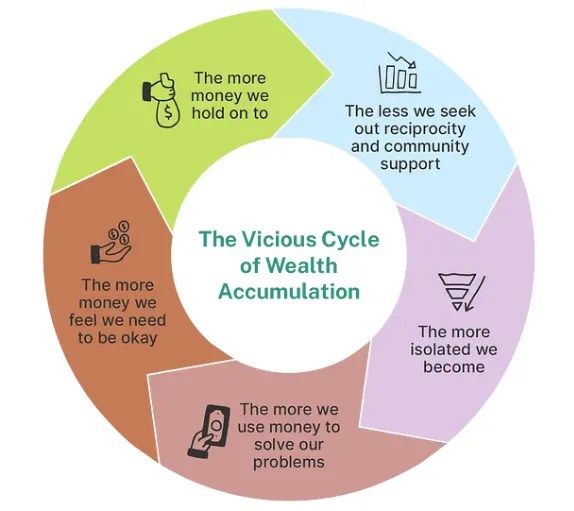
Okay, but let’s talk about the prescribed wealth hoarding model in the United States, otherwise known as prudent financial planning (supposedly). The conventional advice from financial planners is that people of my age are supposed to accumulate something like $1 million in order to retire. Or maybe $1.5 million.1 In case you’re not hip to the logic here – I wasn’t until I married a very specific kind of nerd – we’re supposed to amass so much wealth that we can live off the interest and dividends until we die. It’s not enough to save what we’ll need to make it to the end of our life; we need (ostensibly) way more than that. We need to accumulate so much wealth that we can live off the wealth that our wealth earns. We need – we are told – enough that we never have to touch the principal, and we can pass our wealth along to our next of kin, whoever they may be.2

Interdependence is My New Retirement Plan – by Lisa Sibbett

My father, a professional, seemed to live fairly consistently with the values Lisa Sibbett suggests. My widowed mother had enough and to spare, but their church saw a lot of money over the years, too, and his kids occasionally got gifts at the end of a bountiful year.

My father-in-law, a tradesman, lived the “conventional advice from financial planners,” and we are now benefitting from his success at that model.

I’ve lived somewhere in between those two models. Though I (credulously?) aspired to the “conventional advice” model, I just couldn’t resist living life along the way, and not waiting until I was properly fixed for life. Unlike my parents’ generation, I did not live through any Great Depression and didn’t feel that possibility in my bones. I don’t regret it.

One caveat with Sibbett’s approach is that it requires long-enduring personal bonds. You’ll need to sink roots somewhere, and that somewhere will need to be where others are sinking roots as well. It requires long-enduring personal bonds. It’s not for individualist nomads.

The unmentionable elephant in the room

I confess that I struggled with the reasoning of the Supreme Court in Skrmetti although I reluctantly welcomed the outcome.

I was not alone. Josh Blackman and Hadley Arkes (not a lawyer, but an Amherst professor of Jurisprudence) were in the same position as me, but Arkes in particular pointed to the root problem:

The truth that dares not speak its name here is that this wide array of gender-affirming therapies and surgeries is simply predicated on a falsehood. And yet those are the words that the conservative justices apparently see themselves as barred from speaking. Something in conservative jurisprudence holds them back from appealing to the inescapable and objective truth that lies at the heart of these cases. But without it, what were these accomplished jurists able to explain here? What was their ground of justification in overriding the judgments of those parents who were absorbed in the grief and confusion that seized their children? . . . .

The only “instruction” that would be relevant, Justice Thomas, is the unyielding fact that the child is in a state of confusion: he is not occupying some body apart from his own; his sex was not “assigned” at birth but marked inescapably in the organs of reproduction, in the arrangement of his body. His sex is immutable and printed plainly upon him.

Those were the words that Chief Justice Roberts and five colleagues could not move themselves to speak. Or they thought they were constrained from speaking by a jurisprudence that bars them from invoking truths beyond the text of the Constitution—even on the question of what is a human being, the bearer of rights, and when does that “human person” begin? . . .

Without those points in place, the judgment of the Court simply dissolves into a chain of ipse dixits. Why was it not legitimate for the parents of stricken youngsters to order the procedures that might relieve their “gender dysphoria?” Answer: The legislature of Tennessee did not think it a legitimate medical remedy to choose—even though the children and the parents did not share that judgment and were willing to take their risks. One judgment had to prevail, and it was the judgment backed by the power of the State. To put a high finish on it, that “power” represented the authority of a people to govern itself through elected representatives. But when the people speak through their representatives, and override the judgments of parents about their children, they are still obliged to say something more than “we have brute the power to impose this judgment through brute enactment of the law.”

Arkes singles out Justice Thomas, I suspect, because he said “so-called experts have no license to countermand the ‘wisdom, fairness, or logic of legislative choices.’” (Justice Thomas, concurring in U.S. v. Skrmetti, via Eugene Volokh.) Arkes’ re-formulation, I guess, is that the legislature can tell the experts “your elaborations are predicated on the falsehood that a person can be inhabiting a body of the wrong sex.”

That’s not the end of the story, but it’s a starting point for re-writing a story written up to now by activists hiding something only a few clicks less deranged than the whack-a-doodle Chase Strangio ideology:

Strangio disputed that a trans woman could be “born with a male body” or “born male”; in his view, a trans woman was born a woman just like any other woman. There was no such thing as a “male body,” Strangio told his colleagues: “A penis is not a male body part. It’s just an unusual body part for a woman.” Before the advertisement aired, Strangio elaborated on his critique in an article in Slate. “Many advocates defend the use of the ‘born male’ or ‘born with a male body’ narrative as being easier for nontransgender people to understand,” Strangio wrote. “Of course it is easier to understand, since it reinforces deeply entrenched views about what makes a man and what makes a woman. But it is precisely these views that we must change.”

My own position hasn’t changed in 39 months. I think we’re still seeing a cultural contagion of trans claims in adolescents and must be very cautious – which is a bit easier now that even Strangio has given up on the “live son or dead daughter” emotional blackmail.

Patience, Mercy, Tolerance

For defenders of political liberalism there is perhaps no more pressing problem than this: How do you make a compelling case for liberalism in an era of ascendant [illiberalism or] strong gods? The idea of “strong gods” comes from the book Return of the Strong Gods by R. R. Reno, editor of the conservative ecumenical journal First Things.

By “strong gods” Reno means the kind of visceral or agonistic forces that can compel political or social action through deeper existential or even guttural appeals. The strong gods work not by chiefly targeting the intellect, but the appetites.

Michael Reneau, Evan Spear, and Jake Meador, A Virtue-Centric Argument for Political Liberalism (shared link). This article was welcome in light of the ascendance of various illiberalisms.

With a little help from AI, I got this summary table:

VirtueRole Against Postliberalism & Strong GodsRoot/Source
PatienceProvides long-term perspective, allowing growth and changeChristian theology & history
MercyBreaks cycles of retribution, fosters trust and forgivenessScripture, Shakespeare
ToleranceIntellectual humility; suspends harsh judgment; enables coexistenceLiberal philosophy & Scripture (e.g., parable of wheat and tares)

Wordplay

I know every one of these carries political freight, but that’s the burden of many writers these days:

  • Glenn Thrush, Alan Feuer and Adam Goldman remarked on the right-wing ire confronting Patel and Pam Bondi, the attorney general, as they fail to substantiate the accusations that they hurled in their bid for power: “They are running what amounts to a conspiracy theory fulfillment center with unstocked shelves.” (Jeff Lebsack, Buffalo, and Marianne Painter, Tacoma, Wash., among others)
  • In The Financial Times, Edward Luce worried that certain scenes from the Los Angeles protests played into the president’s hands: “Every rock hurled lands like a penny in Trump’s wishing well.” (Todd Lowe, Simpsonville, Ky., and Al Gallo, Huntersville, N.C., among others)
  • In The Washington Post, Philip Bump expressed skepticism about the government’s claim that immigration officers must wear masks for self-protection: “We should not and cannot take ICE’s representations about the need for its officers to obscure their identities at face value.” (Patrick Bell, Carmichael, Calif.)
  • Also in The Post, Dana Milbank took in Trump’s pleasure at some sycophantic Republicans’ suggestion that the D.C. Metro be renamed the “Trump Train”: “It’s a great idea. Qatar will donate the subway cars, which will be powered by coal. Passengers will pay for fares with cryptocurrency after first showing proof of citizenship. And the trains will reverse themselves regularly and without warning — never quite reaching their original destination.” (Mary Ellen Maher-Harkins, Orwigsburg, Pa., and Stan Shatenstein, Montreal)

Via Frank Bruni

Ceci n’est pas un phone

Methaphone. Like Methadone. Get it?

In case you’ve been wondering …

No, you’re not imagining it. The main source of political violence in the USA in this century has been right-wing, not left. Jamelle Bouie, Right-Wing Violence Is Not a Fringe Issue:

It is simply a fact that the far right has been responsible for most of the political violence committed in the United States since the start of the 21st century.

I had been wondering, because there has been some leftwing violence against persons, and much against property.

Poor fit

If it seems that America’s colleges and universities are poorly suited to the average American eighteen-year-old, perhaps that’s because they were never designed to serve him.

Oren Cass, The Once and Future Worker


Your enemies are not demonic, and they are not all-powerful and the right hasn’t always lost and the left hasn’t always won. But if you convince yourself of that, you give yourselves all sorts of permission to do a lot of stupid and terrible things under the rubric of “Do you know what time it is?”

Jonah Goldberg.

Trumpism can be seen as a giant attempt to amputate the highest aspirations of the human spirit and to reduce us to our most primitive, atavistic tendencies.

David Brooks

I don’t do any of the major social media, but I have two sub-domains of the domain you’re currently reading: (a) You can read most of my reflexive stuff, especially political here. (b) I also post some things on my favorite social medium.

Saturday, 5/31/25

AI doomsday?

[Jaron] Lanier agreed that it’s up to humans to protect the truth in the age of AI, but was less optimistic that we will do so: “The issue with AI is not the AI. It’s not the large language model. It’s the concentration of power and wealth around who owns it,” he said. “You have to look at the big system, including the people, the money, the business, the society, the psychology, the mythmaking, the politics.”

A Free Press Debate on Artificial Intelligence in San Francisco

Jaron Lanier had fallen off my radar for a few years. I’ll forever be interested in his take on anything regarding computers and humanity (together, not separately).

Bon mots

Codgers and technology go together like peanut butter and sardines.

Frank Bruni. Then this, merely via Frank Bruni, not from him:

In the quarterly journal Sapir, Bret Stephens made a kind of peace with the heavily partisan slant of so much cable television news: “To demand scrupulous impartiality on their broadcasts is like expecting fancy linens at a Motel 6.” (Naomi Lerner, West Orange, N.J.)

A non-tribal Democrat

Some of my subscribers dislike when I throw elbows to my left. They share my disdain for Donald Trump and his party, and my commitment to understanding them in light of political theory and history, but they are also devoted Democrats who have warm feelings for Joe Biden, were thrilled by the campaign of Kamala Harris and Tim Walz, and still seethe about Hillary Clinton’s loss in 2016.

That isn’t me. I vote for Democrats. I directionally agree with them on most issues. And I consider the Republican alternative thoroughly unacceptable. Yet I am not a devoted Democrat. A big part of the reason is that I’m not a joiner—of anything. I value my own independence too much and temperamentally resist deploying my talents to advance a cause—any cause, even a worthy one, and even one wrapped up, at this moment, with the fate of liberal democratic self-government in the United States.

But this way of thinking presumes that working to help the Democrats should take the form of deferring to and falling in line behind party leadership and elected officials, taking marching orders, rallying around candidates and nominees endorsed by the party bigwigs, and then maintaining message discipline to get them elected. That’s what I resist. But there’s another kind of devotion—one that expresses itself as tough love and a willingness to speak candidly, and even harshly, about faults.

… a Democratic researcher is quoted as saying that when she asks swing voters to liken the two parties to animals, they consistently describe Republicans as lions, tigers, and sharks—“apex predators” that “take what they want when they want”—but Democrats as tortoises, slugs, or sloths, creatures typically considered “slow, plodding, [and] passive.”

Damon Linker, A Party of Sloths

Substance, process

One of this crazy-making aspects of life in Trump 2.0 is that the media coverage of the administration’s antics focuses, mostly on the substance of what they are doing, ignoring the process, and the question of whether they have the authority to do it at all.

Such, I feared, was the infirmity of NPR and PBS Aren’t Entitled to Your Tax Dollars, a Free Press article by a serious Ivy league constitutional law professor. I slogged my way through it, agreeing with the author again and again, but frustrated that he was ignoring the elephant in the room. Finally, in literally the last paragraph, he mentioned the elephant almost as a throwaway line:

NPR also alleges in its complaint that the federal statute creating the Corporation for Public Broadcasting prohibits Trump from making this defunding decision. That’s a very different argument, which I’m not addressing here ….

I would venture a guess that nine out of ten people who read this column will come away with the impression that NPR and PBS are suffering from a liberal sense of entitlement to tax dollars, and miss the point about there being some limits to executive power.

In the end, it may not matter because this Congress is sufficiently servile that if Trump asks Congress to defund CPB, PBS and NPR (a longtime GOP talking point), it almost certainly will oblige him.

But process does matter, tremendously. Where the power to do something resides also matters.

Dissing Adoption

The New York Times … has never found a basic human good it couldn’t ponderously criticize with the shuffling-foot smarm of the ideas festival class. There’s “I Was Adopted From China as a Baby. I’m Still Coming to Terms With That. There’s “World’s Largest ‘Baby Exporter’ Admits to Adoption Fraud.” There’s “Given Away: Korean Adoptees Share Their Stories.” (In easily-digestible video format!) There’s “I Was Adopted. I Know the Trauma It Can Inflict.” (Subtle.) The New Yorker, a $12,000 espresso machine transformed into a magazine by a mischievous wizard, has “How an Adoption Broker Cashed In on Prospective Parents’ Dreams,” “Living in Adoption’s Emotional Aftermath,” and “Where is your Mother?” (The answer is that she has been separated from her child by a cruel and fickle child welfare system despite being perfectly fit, which I’m sure is how it usually goes.) The Atlantic has “No One’s Children: America’s long history of secret adoption.” (Would you be shocked to learn that said history isn’t a good one?) They’ve got “The New Question Haunting Adoption,” the question being whether adoption is really a secretly selfish act, you know, the selfish act of taking a severely-disabled toddler into your home to provide them with support and love after their birth parents smoked meth throughout pregnancy. They also have, incredibly, “What Adoption ‘Salvation’ Narratives Get Wrong,” “Adoption Is Not a Fairy-Tale Ending,” “The Dark, Sad Side of Domestic Adoption”…. I could go on, and that’s just three prestigious publications. There’s a whole world out of this out there.

This is all, for the record, a really excellent example of what we used to mean when we used the word ideology. Once upon a time, one wouldn’t say “My ideology is…” because ideology referred to the hidden, unexplored, unconscious politics that lay beneath the public, open, explicit politics. An ideology was those pre-political assumptions and beliefs which conditioned and limited political thought, which made the conscious political philosophy of any individual what it was. Ideology is the skeleton that hides unseen within the animal of politics but nevertheless determines the structure of that which is seen. Ideology exists in both the macro and the micro; this bizarre upper-caste antipathy towards ideology is a good example. If you asked leadership at these publications if they had any particular interest in leading a charge against the practice of adoption, they’d say no, of course not, what a weird question! If you were to show them just how repetitively this particular set of critiques and questions and hrm hrm hrm noises gets published in their pages, they’d swear to you that it reflects no underlying party line. And yet there it is, the evidence, in black and white. Something about the current constitution of the anxious educated urbanite liberal soul cries out inside of them: the real problem is adoption.

Freddie deBoer, Adoption is Good

If the shoe fits

A well-regarded Evangelical pastor published this weeks before the 2020 Election.

[T]his is a long-overdue article attempting to explain why I remain baffled that so many Christians consider the sins of unrepentant sexual immorality (porneia), unrepentant boastfulness (alazoneia), unrepentant vulgarity (aischrologia), unrepentant factiousness (dichostasiai), and the like, to be only toxic for our nation, while policies that endorse baby-killing, sex-switching, freedom-limiting, and socialistic overreach are viewed as deadly.

I think it is a drastic mistake to think that the deadly influences of a leader come only through his policies and not also through his person.

This is true not only because flagrant boastfulness, vulgarity, immorality, and factiousness are self-incriminating, but also because they are nation-corrupting. They move out from centers of influence to infect whole cultures. The last five years bear vivid witness to this infection at almost every level of society.

Christians communicate a falsehood to unbelievers (who are also baffled!) when we act as if policies and laws that protect life and freedom are more precious than being a certain kind of person. The church is paying dearly, and will continue to pay, for our communicating this falsehood year after year.

The justifications for ranking the destructive effects of persons below the destructive effects of policies ring hollow.

I find it bewildering that Christians can be so sure that greater damage will be done by bad judges, bad laws, and bad policies than is being done by the culture-infecting spread of the gangrene of sinful self-exaltation, and boasting, and strife-stirring (eristikos).

I think it is baffling and presumptuous to assume that pro-abortion policies kill more people than a culture-saturating, pro-self pride.

When a leader models self-absorbed, self-exalting boastfulness, he models the most deadly behavior in the world. He points his nation to destruction. Destruction of more kinds than we can imagine.

It is naive to think that a man can be effectively pro-life and manifest consistently the character traits that lead to death — temporal and eternal.

John Piper, Policies, Persons, and Paths to Ruin: Pondering the Implications of the 2020 Election

Piper did not say who he was voting for. He did not name names. For that reason, I’m blogging this separately from pointed political material.

But I’m not going to deny that my heart soared to see that our current President had not captured and reduced to servility the entirety of one of America’s most prominent Christian traditions.

The right to know isn’t the whole story

To further clarify our situation, consider W. H. Auden’s discussion, which I’ve cited before, of the idea that, as he put it, “the right to know is absolute and unlimited.” “We are quite prepared,” Auden wrote,

“to admit that, while food and sex are good in themselves, an uncontrolled pursuit of either is not, but it is difficult for us to believe that intellectual curiosity is a desire like any other, and to recognize that correct knowledge and truth are not identical. To apply a categorical imperative to knowing, so that, instead of asking, ‘What can I know?’ we ask, ‘What, at this moment, am I meant to know?’ — to entertain the possibility that the only knowledge which can be true for us is the knowledge that we can live up to — that seems to all of us crazy and almost immoral.”

L.M. Sacasas, Structurally Induced Acedia (The Convivial Society)

Harvard and the Trump administration

Harvard and the Trump administration have each finally met an adversary too big to push around. America’s richest university never really considered how much it depends on government policy, including lavish federal research funding, federal student aid, and a permissive immigration regime for the foreign students—who make up a third of the university’s student body and often subsidize the rest by paying more. Progressives also never thought through how the many tools they devised for using government leverage against private institutions—including threatening tax exemptions, as the Supreme Court allowed on dubious grounds in Bob Jones University v. United States (1983)—could be used against universities that engage in race discrimination for the “right” reasons, cultivate a political monoculture among the faculty, and permit campus mobs to terrorize minority groups who are out of progressive favor (Jews). Now, Trump is trying to strip Harvard of everything—tax exemption, federal funding, and visas for foreign students already enrolled. While the comeuppance for Harvard is admittedly delicious, the president is abusing powers he ought not to have, and Harvard has deep enough pockets to fight him in court.

National Review Weekly email.

Some cases don’t have valid arguments on both sides. That I find nothing “delicious” about Harvard’s “comeuppance” is an example of why I ignore National Review’s regular email invitations to resubscribe.

Can a car have a “catfish smile”?

“Behind that catfish smile, the company’s twin-turbo 4.0-liter DOHC V8 now discharges a drama-drenched 656 hp and 590 lb-ft—153 hp and 85 lb-ft more than the previous Vantage Roadster—thanks to larger turbochargers, revised camshaft profiles, optimized compression ratio and upgraded fueling and cooling.”

Kudos to Dan Neil for the spot-on “catfish smile.”

The car, by the way, is a 2025 Aston Martin Vantage Roadster, which will set you back $300,000 as equipped (this week’s ephemeral tariffs not included).

Credentials, good times, and genuine learning

Most young people today feel, with considerable justification, that they live in an economically precarious time. They therefore want the credential that will open doors that lead to a good job, either directly or (by getting them into good graduate programs) indirectly …

But those same young people also want to have a good time in college, a period of social experience and experimentation that they (rightly) think will be harder to come by when they enter that working world …

… Yes, students understand — they understand quite well, and vocally regret — that when they use chatbots they are not learning much, if anything. But the acquisition of knowledge is a third competing good, and if they pursue that one seriously they may well have to sacrifice one of the other two, or even both. Right now they can have two out of three, and as Meat Loaf taught us all long ago, two out of three ain’t bad.

Alan Jacobs, responding to Ted Gioia on the topic of ending AI cheating.

Potpourri

  • After Trump held a crypto dinner last Thursday night, crypto moguls who paid to be there felt scammed that the president didn’t even stick around at the event they’d hoped to do their own scams at. I saw someone describe him as the apex scammer. Our Scammander in Chief.
  • In other Russia news, a new statue of Joseph Stalin in a Moscow metro station was unveiled this month. President Putin has called Stalin an “effective manager,” and has said that enemies of Russia use the “excessive demonization” of Stalin to attack “the Soviet Union and Russia.” Stalin is back, big time. Interesting that “effective manager” is being used here to describe a man who facilitated the death of millions—and not efficiently. But I’m not a businessman.
  • The continued reckoning: A postmortem on Kamala Harris’s campaign cited a “perception gap” as one of the reasons she lost, saying voters believed she held positions that she didn’t. “Over 80% of swing voters who chose Trump believed Harris held positions she didn’t campaign on in 2024, including supporting taxpayer funding for transgender surgeries for undocumented immigrants (83%), mandatory electric vehicles by 2035 (82%), decriminalizing border crossings (77%), and defunding the police (72%).” But Harris had, in fact, supported all of these positions. Like, she is on record supporting each of those positions (here, here, here, and here). So it’s not really a perception problem so much as a reception problem, like these ideas are not popular even though I support them. There’s a sense among Dems that people should simply ignore the things that are unpopular and that referencing them is fake news. Like, how dare you talk about the surge of migrants coming through our new open borders thanks to swift changes from the Biden admin. Yes, it’s technically true, but it’s disinformation-coded.
  • Leave Bruce alone: A bar in New Jersey canceled a performance by a Bruce Springsteen tribute band after the real Springsteen called Trump “corrupt, incompetent, and treasonous” while on tour in England. Citing the bar’s MAGA clientele, the bar owner said that a Springsteen cover band would be “too risky at the moment.” And: “Whenever the national anthem plays, my bar stands and is in total silence, that’s our clientele. Toms River is red and won’t stand for his bull—.” [But MAGA doesn’t have a violent streak. No way. That’s fake news.]
  • Things that are not antisemitism: The Democratic Socialists of America “Liberation Caucus” has announced its support for Elias Rodriguez, the suspect arrested for slaughtering two Israeli Embassy staffers outside D.C.’s Capital Jewish Museum last week. Here’s the statement signed by the DSA Liberation folks and a bunch of others: “As imperialism has made the entire world its battlefield, it is justified to fight it, by any means necessary, without regard for geography.” And: “[T]here must be consequences for genocidal [Z]ionist imperialism, and those consequences are righteous.”

Nellie Bowles

Fake my …

The latest fitness craze is surely going to be Fake My Run. It fits perfectly with the national ethos whereby university students are already doing Fake My Education.


Your enemies are not demonic, and they are not all-powerful and the right hasn’t always lost and the left hasn’t always won. But if you convince yourself of that, you give yourselves all sorts of permission to do a lot of stupid and terrible things under the rubric of “Do you know what time it is?”

Jonah Goldberg.

Trumpism can be seen as a giant attempt to amputate the highest aspirations of the human spirit and to reduce us to our most primitive, atavistic tendencies.

David Brooks)

I don’t do any of the major social media, but I have two sub-domains of the domain you’re currently reading: (a) You can read most of my reflexive stuff, especially political here. (b) I also post some things on my favorite social medium. I am now exploring Radiopaper.com as well.

Ides of March

Simile of the week

[I] n The New Yorker, Ruth Marcus, who recently resigned from The Washington Post, explained that she and other columnists were confused by the Post owner Jeff Bezos’ new edict that the Opinions section write only in favor of “personal liberties and free markets”: “Without further clarification, we were like dogs that had been fitted with shock collars but had no clue where the invisible fence was.” (Susan Casey, Palm City, Fla.)

Via Frank Bruni

Justice Barrett

After a federal judge blocked the Trump administration’s effort to stop $2 billion in foreign-aid spending, Justice Amy Coney Barrett joined with Chief Justice John Roberts and all three Democratic-appointed justices to leave that order in place. The decision provoked a fiery and warranted dissent from Justice Samuel Alito, as well as some bitter complaints about Barrett from the right-leaning commentariat. It is understandable that conservatives might be nervous about the Supreme Court. For good reason, the names “Stevens,” “Souter,” “Kennedy,” and “O’Connor” echo eerily in the originalist mind. But while she was wrong in this particular case, there is no evidence that Barrett is at risk of joining their ranks. She concurred in Dobbs, the case that overturned Roe; in Students for Fair Admissions, Inc., the case that barred affirmative action; and in Bruen, the case that expanded the protections of the Second Amendment. More important than those outcomes is how she did so. Unlike the judicial nomads of the past, Barrett has a transparent and well-considered approach to the law that explains her actions even when she disappoints. In the case that prompted the criticisms, she was likely motivated by her mistrust of the shadow docket and her dislike of big cases built atop disputed facts. To conclude from this that Barrett was “a mistake”—or, worse, “a DEI hire”—is absurd. Judges are not supposed to play for a team.

National Review email for 3/14/25

Meritocracy is the death of noblesse oblige

In some ways, we’ve just reestablished the old hierarchy rooted in wealth and social status—only the new elites possess greater hubris, because they believe that their status has been won by hard work and talent rather than by birth. The sense that they “deserve” their success for having earned it can make them feel more entitled to the fruits of it, and less called to the spirit of noblesse oblige.

David Brooks, How the Ivy League Broke America

Gold and Bitcoin

I’ve shunned Bitcoin as an investment because it’s useless other than for criming and speculation.

I’ve always shunned gold for similar reasons. Its industrial and jewelry uses are not the reason for it rising to more than $3,000 per troy ounce.

Regarding this Presidency

Trump censorship worse than cancel culture

I’ve been relegating most of my bile toward Trump and his goons to another blog, referenced in the footer below, but this is so patently un-American that it needs the widest exposure I can give it:

[T]his is not about protection from woke professors or ideologically captured deans. It’s protection from direct surveillance by the federal government. The Trump administration has launched a massive, all-of-government, AI-assisted program called “Catch and Revoke,” which will scan every social media comment and anything online they can use to flush out any noncitizen who might be seen as anti-Semitic or anti-Zionist or anti-Israel or indeed just getting on Marco Rubio’s wrong side.

Mahmoud Khalil, a green card holder, has not been accused of a crime. And that is the point. …

JD Vance — who lectured Europeans on free speech online, while his own administration was using AI to police the web for dissent! — said on Fox that a green card holder “doesn’t have an indefinite right to stay in America.”

Andrew Sullivan

In a Feb. 6 editorial, [Purdue] Exponent editors wrote: “And don’t get it twisted: When letters of visa revocation arrive in these students’ mailboxes and federal agents come to Purdue’s campus, no distinction will be made between ‘pro-jihadist’ and pro-Palestinian. Pro-ceasefire will continue to be conflated with ‘antisemitic.’ Anti-war can only now mean ‘pro-Hamas.’ Such twisting of language to be used as a weapon is contrary to the First Amendment, which gives the Exponent its right to exist just as much as it gives the right to students to protest as they see fit. It is the opinion of the Exponent that standing back while our website is potentially used to identify the state’s enemies would be directly against those principles.”

Based in Lafayette, Indiana

The statute cited by the Trump administration for expelling Khalil is very broad — and vague. I don’t think it will be struck down in its entirety, but surely permanent residents are entitled to know with some clarity what behaviors could get them kicked out of the country.

So I think the likeliest outcome is “unconstitutional as applied” to Khalil.

Living in fear

I spoke on Thursday to a university president who told me he was just advised to hire a bodyguard. He said he’d never seen so much fear in the world of higher education that many college presidents are “scared to death” about the Trump administration cutting their funding, Elon Musk unleashing Twitter mobs on them, ICE agents coming on campus, angry email flooding their inboxes, student protests over Gaza and Israel, and worries about being targeted for violence. I was a higher education reporter two decades ago, when universities were widely admired in America, and so I asked this president — what went wrong?

He said presidents and professors had taken too many things for granted — they thought they’d always be seen as a “public good” benefiting society, but came to be seen as elitist and condescending toward regular Americans. And Americans hate a lot of things, but they really hate elites condescending to them. Now we are seeing a big reckoning for higher education — ideological, cultural, financial — driven by Donald Trump and the right.

Patrick Healy, introducing a conversation with M. Gessen, Tressie McMillan Cottom and Bret Stephens.

Just sayin’

Narcissism has a very high correlation with conspicuous consumption in an effort to boost social status and self-esteem. Narcissists are focused on the symbolic, rather than functional, importance of commodities, and the symbolism of the products they purchase is often used to compensate for fragile egos and fluctuating self-esteem.

William T. Cavanaugh, The Uses of Idolatry

Re-assessing

As I have said any number of times, I have voted for the American Solidarity Party in each of the last three election cycles. But in the 2024 election, I was beginning to feel some sympathy for the people who thought Trump was less bad than Kamala Harris in the forced binary choice too many voters feel.

I no longer have any sympathy for that position, although I’m obviously working with the benefit of hindsight: Ready, Fire, Aim — over and over again ad infinitum. This is no way to run anything, quite apart from the autocracy.


I suffer more from the humiliations inflicted by my country than from those inflicted on her.

Simone Weil, from a letter to Georges Bernanos.

[N]one of the things that I care about most have ever proven susceptible to systematic exposition.

Alan Jacobs, Breaking Bread With the Dead

I don’t do any of the major social media, but I have two sub-domains of the domain you’re currently reading: (a) You can read most of my reflexive stuff, especially political here. (b) I also post some things on the only social medium I frequent, because people there are quirky, pleasant and real.

Sunday, January 12, 2025

America’s Puritan-Lockean synthesis

A few months back, I decided once again to subscribe to Touchstone magazine, a subscription I had allowed to lapse for many years.

The first issue to arrive I found disappointing,, but the second included Carlo Lancelotti’s America verus Europe, which advances the idea that the:

notion of a “delayed” American secularization stands in contrast to the views of many prominent European thinkers of the last century. Curiously, they also thought that America was “special” but in the opposite sense. They deemed the United States to be far more advanced than Europe in terms of a scientistic, utilitarian, individualistic, and materialistic worldview. For example, as early as 1943, when Simone Weil returned from New York to London a few months before dying, she wrote that the great danger threatening European Christianity was “Americanization,” by which she meant detachment from the past, which was slowly killing people’s ability to perceive the supernatural. The “Western” spirit of the Enlightenment “is found in America in its pure state and to the second power, and we are in danger of being devoured by it. . . . the Americanization of Europe would lead to the Americanization of the whole world.”

This view rings true to me, as does the idea that this outcome was baked into our founding by a “Puritan-Lockean synthesis.” But I’m still chewing on it, especially the thought of that founding synthesis, which I’m unprepared to expound. The whole constellation of critique is likely to reappear here in the future. Meanwhile, it appears to me that the article already is unlocked for the curious.

Something to chew on

It is a strange yet incontrovertible fact that, when God did take flesh, He in many ways (though certainly not all) revealed himself to be closer in spirit to the Tao of Lao Tzu then to God as conceived by the Hebrews at that time, even though the Hebrews had the revelation of Moses. This might be difficult to accept by those who are accustomed to thinking of Christ as the fulfillment of the expectation specifically of the Hebrews. Ancient Christian tradition, however, holds that Christ satisfied the longing of all the nations.

Hieromonk Damascene, Christ the Eternal Tao

American Pharisaism

I have wondered much that Christianity is not practiced by the very people who vouch for that wonderful conception of exemplary living. It appears that they are anxious to pass on their religion to all other races, but keep little of it for themselves …

It is my personal belief, after thirty-five years experience of it, that there is no such thing as “Christian civilization.” I believe that Christianity and modern civilization are opposed and irreconcilable, and the spirit of Christianity and of our ancient religion is essentially the same.

Charles Alexander Eastman, whose American Indian name was Ohiyesa. Quoted by Paul Kingsnorth in his 2024 Erasmus Lecture.

More of Kingsnorth’s Lecture:

What, actually, is spiritually beneficial about this “Western civilization”—or any civilization? After all, Babylon and Babel, Sodom and Gomorrah, were as civilized as the ancient world got.

To find out, we might hold up the stated values of our civilization against the famous list of seven deadly sins. The list was compiled in the sixth century by Pope Gregory I. He based it on an earlier list of eight passions, compiled by the fourth-century monk Evagrius Ponticus, which is still current in the Eastern Church. How is Western civilization doing today at fending off these sins?

Pride is celebrated everywhere—pride in nation, status, wealth, ethnic group, identity, religion. We have a month-long festival named for it. Greed is the basis of our economy. Along with envy, it is the cornerstone of the idol of our time, the universally worshiped god known as “economic growth.” If we were neither greedy nor envious, the economy would collapse in five minutes. Wrath is the fuel beneath the culture wars and all of our political factions. As for lust—find me a billboard or a film or a song or a brand of shoes that doesn’t piggyback on this most primal human passion. It is perhaps behind only gluttony in its ubiquity. Even sloth has been monetized. How else could something as oxymoronic as a “leisure industry” even exist?

Macho-Man Orthodoxy

There seems to be a surge of interest in the secular and the heterodox press, blogosphere and podcast worlds in the distinctly masculine flavor of Orthodox Christianity’s growth in the USA.

I’m happy that my parish has seen a surge in attendance and people joining. Our growth does skew toward young men, but I have a God-daughter who came on her own, and we recently added a single mom with two kids. A godson, older than me, came with his wife at first from dissatisfaction with his United Methodist church coupled with the ethnic tag on our diocese, which matched his ancestry!

But one particular recent article, in “secular” press, about the male-skewed growth of Orthodox Christianity, rang false more often than it rang true.

False notes:

  • tougher form of Christianity (a Priest lamentably said that, so I can’t blame the author)
  • They must fast, too … (fast from many foods, but not from all food)
  • puts emphasis on denial and pushing yourself physically (superficial and misleading; a good priest likely would tell someone going to extremes to lighten up because they’re missing the point)
  • the strict church (nobody’s monitoring compliance)
  • pushes them physically and mentally
  • masculine

These snippets are not so much false factually as false to my experience of Orthodoxy.

It has been notable since I entered Orthodoxy (or earlier), long before the present growth surge, that converts skewed male, and that if a whole family came in, it likely was the dad who instigated and led the conversion. People puzzled over the reason for that, but the idea of men consciously motivated by “more masculine” wasn’t front and center.

I doubt that it should be so today, but I’m not positive about that. My experience of the Orthodoxy faith is largely confined to one parish, which I’ve served as a tonsured Reader and de facto Cantor/Psaltis from my earliest days in the Church. In other words, I don’t get out much, but I wouldn’t agree that I need to get out more. Sampling other parishes is likely to prove superficial, and as they say “the plural of anecdote is not data.”

In that vein, these are the only two paragraphs that didn’t feel a bit “cringe”:

Father Timothy Pavlatos, who leads St Katherine Greek Orthodox Church in Chandler, Arizona, agrees that the “challenge” of the Orthodox church appeals to many young men.

“Orthodoxy is challenging in the physical sense too, and it requires a lot… they live in a world where it’s instant gratification and just take what you want, what you feel you want, what you think you need, Orthodoxy is the opposite of that, it’s denying yourself.”

The article emphasizes the sentiments of recent male converts, but Orthodoxy is capacious and somewhat disorienting for someone new to it. We (thinking back to myself 27 years ago) ask dumb questions and utter dumber opinions. To the degree that men are interested in Orthodoxy as a kind of spiritual testosterone, promoting distinctly masculine growth, I foresee them dropping out when the reality dawns on them.

We all, converts from other Christianities or not, bring baggage into the Church, and the doors shouldn’t be closed to those kinds of baggage but open to my kind. The important thing is whether a convert wants to conform his (or her) life to Christ through the life of the Church, and is prepared to renounce and repent of un-Christlike opinions along the way.


Religious ideas have the fate of melodies, which, once set afloat in the world, are taken up by all sorts of instruments, some woefully coarse, feeble, or out of tune, until people are in danger of crying out that the melody itself is detestable.

George Elliot, Janet’s Repentance, via Alan Jacobs

[N]one of the things that I care about most have ever proven susceptible to systematic exposition.

Alan Jacobs, Breaking Bread With the Dead

You can read most of my more impromptu stuff here and here (both of them cathartic venting, especially political) and here (the only social medium I frequent, because people there are quirky, pleasant and real). All should work in your RSS aggregator, like Feedly or Reeder, should you want to make a habit of it.

Friday, January 10, 2025

Trump 47

I’m leading with Trump because his coronation is imminent and I’ve encountered a few unfamiliar worthy “takes” on him.

The Solzhenitsyn test

In his 1970 Nobel lecture, Aleksandr Solzhenitsyn said, “You can resolve to live your life with integrity. Let your credo be this: Let the lie come into the world, let it even triumph. But not through me.” The problem presently before the United States is that the Trump administration will be staffed in its upper reaches by political appointees who, without exception, have failed this test.

To get their positions, these men and women have to be willing to declare, publicly if necessary, that Donald Trump won the 2020 election and that the insurrectionary riot of January 6, 2021, was not instigated by a president seeking to overturn that election. These are not merely matters that might be disputed, or on which reasonable people can disagree, or of which citizens in the public square can claim ignorance. They are lies, big, consequential lies that strike at the heart of the American system of government, that deny the history through which we have all lived, that reject the unambiguous facts that are in front of our noses. They are lies that require exceptional brazenness, or exceptional cowardice, or a break with reality to assert.

Whatever the defenses they come up with, however, the senior appointees of the Trump administration will have to enter public service having affirmed an ugly lie, or several. No matter what other qualities they have to their credit, that will remain with them. That, in turns, means that we can never really trust them: We must always suppose that, having told an egregious lie to get their positions, they will be willing to tell others to hold on to them. They can have no presumption of truthfulness in their government service.

That in turn will change them fundamentally. In Robert Bolt’s marvelous A Man for All Seasons, Sir Thomas More explains to his daughter why he cannot yield to Henry VIII’s demand that he declare the king’s first marriage invalid, allowing Henry to marry Anne Boleyn, and hopefully get the male heir the kingdom desperately needs. More knows that that declaration is in the public interest. He also knows that his refusal will sooner or later lead him to the execution block.

When a man takes an oath, Meg, he’s holding his own self in his own hands. Like water. And if he opens his fingers thenhe needn’t hope to find himself again.

To land a top job with Donald Trump, you have to open your fingers. It is, as Solzhenitsyn suggested, the end of your integrity.

Eliot A. Cohen, The Solzhenitsyn Test

The imbecilic clown show 1/6/21 was the least of it

We use “January 6” as a shorthand to talk about what Trump did after losing the 2020 election, but it is important to understand—and I think historians will agree about this—that the imbecilic clown show at the Capitol was the least important and least dangerous part of that episode. Trump’s attempt to suborn election fraud—which is what he was up to on that telephone call with the Georgia secretary of state on January 2, 2021—was the more serious part of the attempted coup d’état. Some coup-plotters are generalissimos who just march their troops into the capital and seize power, but many of them—many of the worst of them—take pains to come up with some legal or constitutional pretext for their actions. Often, the pretext is an emergency, as it was with Indira Gandhi, Augusto Pinochet, the coup that brought Francisco Franco to power, etc. You’ll remember that Donald Trump called for the termination of the Constitution as an emergency measure: “A Massive Fraud of this type and magnitude allows for the termination of all rules, regulations, and articles, even those found in the Constitution,” Trump wrote in his trademark kindergartner’s prose. “Our great ‘Founders’ did not want, and would not condone, False & Fraudulent Elections!”

John Adams knew the secret in the heart of democracy: a death wish. “There never was a democracy yet that did not commit suicide,” he wrote. And so the American people, in their belligerent stupidity, have again given the awesome power of the presidency to the man who attempted to overthrow the government the last time he was entrusted with that power. Trump has, of course, promised to pardon those who carried out the violence and chaos of January 6, which is no surprise: The riot was conducted on his behalf, and that is the kind of riot he likes. His contempt for the law is utter and complete, and the only law that he honors is the one inscribed on his heart: “I should get whatever I want.”

Kevin D. Williamson

Cheap date

Trump is the CCP’s cheapest date: Trump is scrambling to save TikTok. He’s filed an amicus brief to the Supreme Court asking them to treat him like he’s already president and to stop this terrible ban of his favorite piece of Chinese spyware. As The Wall Street Journal editorial board puts it: “The brief is extraordinary in several ways, none of them good.”

As background, Trump was against TikTok until. . . TikTok investor Jeff Yass and his wife Janine dropped about $100 million into Republicans in recent years. And then, what do you know, he’s all in for TikTok! Trump asked the Supreme Court not to act all sus on TikTok’s rizz.

Shadow president Elon Musk has deep business entanglements with China, so it’s a given he’s going to be compromised on this. But Trumpo—Mr. CHYNA—made nationalism his whole thing. And all it took was one Republican donor with cash, but not even that much for China, to continue the colonization of teenage American minds through the infectious disease known as TikTok. Democrats at least genuinely believe in the CCP. Like, they prefer it on an intellectual level. Republicans don’t; they’re just for sale, and cheap.

Meanwhile, the White House confirmed this week that a ninth American telecommunications firm has been hacked by China. Per the AP: “Though the FBI has not publicly identified any of the victims, officials believe senior U.S. government officials and prominent political figures are among those whose communications were accessed.” China just reads all our texts and no one even cares. To explain this in a way you TikTok-addled people might understand: America is the unconscious patient in surgery, and our lawmakers are the surgeons and nurses doing a viral dance around our slack-jawed body.

Nellie Bowles. Remember: This is part of Bowles’ weekly sardonic news wrap-up. Take it seriously, not literally.

Simon won his bet with Ehrlich

Be it remembered that Julian (“The Ultimate Resource Simon, in my younger lifetime, made a wager with Paul (“The Population Bomb”) Ehrlich about what would happen to five key commodity prices over the period of the wager. Ehrich predicted that the prices would rise, Simon that they would fall.

As I read The Ultimate Resource, I thought “surely this is some very clever sophistry.” But Simon won the wager. All five commodities fell in real price.

Infinite growth in a finite world still seems impossible (though Simon probably would say the world isn’t finite in any economically significant way because of human ingenuity). There’s also the matter of externalities, about which “human ingenuity” seems kind of cavalier.

But Simon won the wager. That’s not nothing, and it doesn’t fit the left narrative.

Northstar

Dreher proposed the best way forward for the Republican Party when he wrote Crunchy Cons. In case anyone has forgotten the manifesto, here it is again in brief:

* Conservatism should focus more on the character of society than on the material conditions of life found in consumerism.
* Big business deserves as much skepticism as big government.
* Culture is more important than politics and economics.
* A conservatism that does not practice restraint, humility, and good stewardship—especially of the natural world—is not fundamentally conservative.
* Small, local, old, and particular are almost always better than big, global, new, and abstract.
* Beauty is more important than efficiency.
* The relentlessness of media-driven pop culture deadens our senses to authentic truth, beauty, and wisdom.
* The institution most essential to conserve is the traditional family.

Live Not by Lies From Neither the Left Nor Right (Front Porch Republic)

This is the version of Rod Dreher that first caught my so favorable attention. I’m keeping a wary eye on the current version.

UBI

→ UBI really doesn’t work: It pains me to write this. But yet another study was published that shows universal basic income (UBI) doesn’t work.

Researchers gave $500 a month to a group of California households and compared them to a control group who received no money—quite the short straw to draw. The households that received the stipend ended up only $100 richer and actually purchased more cigarettes. So basically, UBI makes people French. They found that UBI had no positive effect on psychological or financial well-being. It didn’t even improve food security. Except that cigarettes make it so you don’t need lunch, so I guess food security is relative.

I was hoping universal basic income would become a reality nationwide. Then I could pursue my true passions: horseback riding, debutante balls, and cyberbullying.

Nellie Bowles, TGIF

Title IX

The entire point of Title IX is to prevent discrimination based on sex. Throwing gender identity into the mix eviscerates the statute and renders it largely meaningless.

Chief Judge Danny C. Reeves of the Eastern District of Kentucky, rejecting the Biden administration’s novel interpretation of Title IX through federal rule-making.

First-world problems

The FBI has issued a formal warning to sports leagues about organized robberies of professional athletes. Since September, nine pro athletes have had their homes broken into, including Kansas City Chiefs stars Patrick Mahomes and Travis Kelce, Dallas Mavericks guard Luka Dončić, and Bengals quarterback Joe Burrow. According to the FBI, organized crime groups from South America have used high-tech surveillance and hacking methods to spy on athletes and disable their security systems. (It also helps to know when a team is playing an away game.)

Madeleine Kearns, The Free Press

Terrifying Parenting advice

What answer did writer Fyodor Dostoevsky give a concerned mother about how to teach her son the difference between good and evil? “His answer both eased my anxiety and terrified me,” Vika Pechersky wrote for Christianity Today. “On the one hand, Dostoevsky gives simple advice to a set of very complex questions. There is no need to master elaborate philosophical systems and social theories to teach my children the meaning of good and evil. According to Dostoevsky, people have a natural yearning for truth, and this yearning comes to our aid in the work of parenting. Herein lies the terrifying part, for the work of parenting starts with my own self—my love of truth, rectitude, goodness of heart, freedom from false shame, and constant reluctance to deceive. I have to embody the love of truth and goodness and live them out in my daily life if I want to teach my children to love what is good.”

Happy New Year From The Dispatch!

In my anecdotal experience, he’s right.

AI Update

I am, relatively speaking, a grouch about AI, so I’m happy to pass along the bad news.

AI is losing money faster than any technology in human history.

I was stunned when OpenAI said it would charge $200 per month for an AI subscription.

That adds up to $2,400 for a full year. Who pays that much for a chatbot?

But the story gets crazier. OpenAI CEO Sam Altman now admits that the company still loses money at that price—the cost of providing AI to premium subscribers is more than $200 per month.

Ted Gioia

Traffic congention

An online forum was getting slower and slower, and users were complaining. An investigation found that the traffic was not coming from users.

Dennis Schubert, who discovered this, shared his irritation in a testy post:

Looks like my server is doing 70% of all its work for these fucking LLM training bots that don’t to anything except for crawling the fucking internet over and over again.

Oh, and of course, they don’t just crawl a page once and then move on. Oh, no, they come back every 6 hours because lol why not. They also don’t give a single flying fuck… [about making] my database server very unhappy, causing load spikes, and effective downtime/slowness for the human users.

I guess this is the new role for human beings in the digital economy. We teach the bots how to replace us.

Those greedy bots will come back again in a few hours—they always do. So get busy and start posting.

Ted Gioia again.

Why would anyone want to read that?

AI F1 A -FRIEND of mine who sings the praises of AI has suggested that I might farm out Touchstone fundraising letters to Al or perhaps even have it write an article or two for the magazine. What could I say? I shook my head in silence. Failing to catch my meaning, he assured me that improvements to Al over the past year have it writing at a professional level.

“So what?” I said. “Why would anyone want to read it?”

“Because,” he said, “it writes well.”

Again I said, “So what?”

I have all but given up trying to explain my opposition to Al to those who seem to think that, if Al can be programmed to mimic the best writing of which men are capable, then why wouldn’t I want to use it? I tell them that I presume Al is now every bit as capable as they say and will be doubly so six months from now. And still I say, “So what?” And still they earnestly try to convince me that Al writes every bit as well as I just conceded it does.

My friend is a Formula 1 racing fan, so I tried a new angle: “I am certain that if they took the men out of the cars (and the pit crews out of the pits), Al drivers could churn out better lap times than their human counterparts every time.”

He found my suggestion ridiculous. “Who would want to watch that?”

-J. Douglas Johnson, Touchstone magazine, January/February 2025

Patience takes a lot out of you

His father said, “Kindness takes more strength than I have now. I didn’t realize how much effort I used to put into it. It’s like everything else that way, I guess.” … “Maybe I’m finding out I’m not such a good man as I thought I was. Now that I don’t have the strength—patience takes a lot out of you. Hope, too.”

Marilynne Robinson, The Gilead Novels (I can’t way which Gilead novel; I have a Kindle version including all three.)


I suffer more from the humiliations inflicted by my country than from those inflicted on her.

Simone Weil, from a letter to Georges Bernanos.

[N]one of the things that I care about most have ever proven susceptible to systematic exposition.

Alan Jacobs, Breaking Bread With the Dead

I don’t do any of the major social media, but I have two sub-domains of the domain you’re currently reading: (a) You can read most of my reflexive stuff, especially political here. (b) I also post some things on the only social medium I frequent, because people there are quirky, pleasant and real.

Thursday, 12/19/24

Huzzah for the new Tory leader!

The thing that drove me crazy was seeing how the lives of young gay, sometimes autistic, children were being destroyed on the altar of trans activism … and meeting young people who had effectively been sterilized. It’s horrific,” –

Kemi Badenoch, the new British Tory leader, on child sex reassignment. Via Andrew Sullivan.

Long-term forecast: deja vu

The resentment over the expulsion of Stephen Kappes as chief of the clandestine service was ferocious. Kappes, an ex-marine and former station chief in Moscow, represented the very best of the CIA. In partnership with the British intelligence service, he had only recently played a leading role in a triumph of intelligence and diplomacy by persuading Libya to abandon its long-running program to develop weapons of mass destruction. When he questioned Goss’s judgment, he was shown the door. The new director surrounded himself with a team of political hacks he had imported from Capitol Hill.

Tim Weiner, Legacy of Ashes

If you think Team Trump values competence over sycophancy, you haven’t been paying attention.

Destruction — creative or not

On the other side of the Channel, the mass protests of the London taxi drivers both expressed and contributed to the Brexit mood. This was a fight for economic sovereignty by highly trained professionals against the threat posed by foreign ride-hailing firms that rely on map software, U.S. military satellites, and the subsistence drivers of the gig economy. Essentially, Uber created a system of labor arbitrage to sidestep and nullify local control.

Matthew B. Crawford, Why We Drive

(Crawford is talking about Uber/GPS displacing London Cabbies, who take years learning every street in London by heart in order to be licensed.)

Shorts and Wordplay

The inability of some critics to connect the dots doesn’t make pointillism pointless.

Georges Seurat

Notes to self: Don’t take criticism from someone you wouldn’t take advice from.

Steve Brady on micro.blog, though I doubt that it’s original with him.

If people never did silly things nothing intelligent would ever get done.

Ludwig Wittgenstein (Sounds like the Lord of Spirits guiding principle.)

… the eerie, vaguely-writing-flavored products that programs like ChatGPT generate ….

Phil Christman, Does Teaching Literature and Writing Have a Future?

Trump is history in a golfcart

Ross Douthat (who’s pretty sure he stole it but can’t remember from whom)

There is nothing that I may decently hope for that I cannot reach by patience as well as by anxiety.

Wendell Berry

Trump’s super power has always been to get his opponents to bust norms in the name of shutting him down.

Nick Gillespie

Your life is not about you.

Bp. Robert Barron, quoted by Molly Worthen

It was a pleasure to have dinner the other night with Governor Justin Trudeau of the Great State of Canada.

Donald Trump.

Trump Tells Trudeau He Won’t Annex Canada if They Admit Their Bacon Is Just Ham.

The Babylon Bee

[T]he idea that Russia always wins wars of attrition may have exceeded its expiration date.

Andrew Sullivan


I suffer more from the humiliations inflicted by my country than from those inflicted on her.

Simone Weil, from a letter to Georges Bernanos.

I don’t do any of the major social media, but I have two sub-domains of the domain you’re currently reading: (a) You can read most of my reflexive stuff, especially political here. (b) I also post some things on the only social medium I frequent, because people there are quirky, pleasant and real.

Potpourri

Not (especially) political

Wisdom from the third world

We had a lot of trouble with western mental health workers who came here immediately after the genocide and we had to ask some of them to leave. They came and their practice did not involve being outside in the sun where you begin to feel better, there was no music or drumming to get your blood flowing again, there was no sense that everyone had taken the day off so that the entire community could come together to try to lift you up and bring you back to joy, there was no acknowledgement of the depression as something invasive and external that could actually be cast out again. Instead they would take people one at a time into these dingy little rooms and have them sit around for an hour or so and talk about bad things that had happened to them. We had to ask them to leave.

A Rwandan talking to a western writer, Andrew Solomon, about his experience with western mental health and depression. I regret losing the URL, but offer the following in complement:

Serenity in leisure

There is a certain serenity in leisure. That serenity springs precisely from our inability to understand, from a recognition of the mysterious nature of the universe; it springs from the courage of deep confidence, so that we are content to let things take their course; and there is something about it which Konrad Weiss, the poet, called “confidence in the fragmentariness of life and history.”

Josef Pieper, Leisure the Basis of Culture, page 47.

What do you do for a living?

Visit a graveyard; you will search in vain for a tombstone inscribed with the words “steam-fitter,” “executive vice president,” “park ranger,” or “clerk.” In death, the essence of a soul’s being on earth is seen as marked by the love they felt for, and received from, their husbands, wives, and children, or sometimes also by what military unit they served with in time of war. These are all things which involve both intense emotional commitment, and the giving and taking of life. While alive, in contrast, the first question anyone was likely to have asked on meeting any of those people was, “What do you do for a living?”

David Graeber, Bullshit Jobs

… but liars can figure

I saw an item in the Wall Street Journal very recently:

Here’s a statistic to remember next year, as Congress debates extending President Trump’s 2017 tax cuts: The top 1% of income-tax filers provided 40.4% of the revenue in 2022, according to recently released IRS data. The top 10% of filers carried 72% of the tax burden. Self-styled progressives will never admit it, but U.S. income taxes are already highly progressive ….

Then I saw a Politico item lamenting how little income tax the super-wealth pay on their increase wealth.

So, is someone lying?

Yeah, pretty much. Increased wealth doesn’t imply taxable income. I’m confident that the increased wealth figures Politico cited were mostly unrealized capital gains, which we don’t tax for a number of very good (if not ironclad) reasons.

Infrastructure century

Because the highways were gold-plated with our national wealth, all other forms of public building were impoverished. This is the reason why every town hall built after 1950 is a concrete-block shed full of cheap paneling and plastic furniture, why public schools look like overgrown gas stations, why courthouses, firehouses, halls of records, libraries, museums, post offices, and other civic monuments are indistinguishable from bottling plants and cold-storage warehouses. The dogmas of Modernism only helped rationalize what the car economy demanded: bare bones buildings that served their basic functions without symbolically expressing any aspirations or civic virtues.

James Howard Kunstler, The Geography of Nowhere

How long will this hold?

Most Americans say media criticism helps hold politicians accountable | Pew Research Center

One of the things I worry about is unaccountable local officials now that the internet has killed smaller local media. The Lafayette Journal & Courier is a wraith, all but invisible were it not for stories fed from other Gannett papers. WLFI has been gutted with departures as its owner, Allen Media Group, bids billions for new acquisitions but doesn’t pay its bills. Only national politics is really covered any more, and that in only a selective way:

Trans teen health

In oral arguments at the Supreme Court Wednesday, ACLU lawyer and transgender ideologue Chase Strangio was forced to admit that gender realignment surgery for children does not prevent suicide—a core claim of many trans activists, notoriously communicated to parents by doctors as “do you want a live girl or a dead boy?” (Source: The Free Press)

What’s left of the trans argument against Tennessee law, in my view, boils down to “it’s sex discrimination to allow estrogen for girls, testosterone for boys, but not vice versa” — an argument that begs the question of whether the brute fact of sexual binary has any implications for law and medicine.

Wordplay

as man became disenchanted with regards to God and the cosmos, he became enchanted instead with himself and his own potential

Jake Meador

Just as clean air makes it possible to breathe, silence makes it possible to think.

Matthew Crawford

All that is not eternal is eternally out of date.

C.S. Lewis

[T]he forces that are destroying the things I cherish most in the world — faith, family, nation, tradition — all originate in the United States.

A Catholic expat friend of Rod Dreher

Two from Dreher’s latest book

Politics

Thankfulness

The Free Press has its people weigh in on what they’re thankful for at Thanksgiving. Martin Gurri responds:

This year, the petty little man in me is thankful that I won’t have to listen to Joe Biden’s double-dribbling sentences or Kamala Harris’s sitcom canned laughter ever again. The greedy analyst in me is thankful that Donald Trump is coming to burn Washington, D.C., to the ground, so Bari Weiss can keep telling people that I’m the only human on Earth who understands this dread pirate. The lonesome immigrant in me is thankful for my wife, and children, and grandchildren, my country and my street, my plans and my memories—because they make high politics feel like a trivial dream that I wake up from, when I step away from my laptop.

Pete Hegseth

I don’t trust Trump, and it seems to me as if he’s deliberately staffing up with sexual predators — as if that was proof of a decisive “get-things-done” manliness.

Moreover, I distrust pretty boys like Pete Heseth, Gavin Newsom, etc. (Yeah. Maybe there’s a little envy there.)

Nevertheless, I’m withholding my final judgment on Hegseth’s suitability for DoD because his accusers are hiding behind anonymity.

Pardon power

[T]he President is only accountable to the electorate so long as he or his party are up for election. Once the election is over, there’s no one for voters to punish. That’s why Biden waited until after the election to pardon Hunter; why Trump did the same for Steve Bannon and Roger Stone; why Obama did the same when commuting the sentences of Chelsea Manning and the terrorist Oscar López Rivera. And, most notoriously, that’s why Bill Clinton waited until his last full day in office to pardon the fugitive Marc Rich, who had fled to Switzerland to avoid prosecution and whose ex-wife donated $450,000 to the Clinton Library.

Stephen E. Sachs, How To Ban Lame-Duck Pardons

Feather pillows

It is true that in some matters, including a considerable swath of policy issues that he neither understands nor cares about, Trump can be like Lord Derby, who, “like the feather pillow, bears the marks of the last person who has sat on him”—which is no small thing given the assortment of asses we are talking about. But Trump makes a big impression of his own on the feather pillows he encounters.

Kevin D. Williamson


I suffer more from the humiliations inflicted by my country than from those inflicted on her.

Simone Weil, from a letter to Georges Bernanos.

I don’t do any of the major social media, but I have two sub-domains of the domain you’re currently reading: (a) You can read most of my reflexive stuff, especially political here. (b) I also post some things on the only social medium I frequent, because people there are quirky, pleasant and real.

Nominees, Essential Workers and Half-Truths

Trump’s nominees

In The Washington Post, Catherine Rampell evaluated the naming of Musk and Vivek Ramaswamy as heads of a new government agency: “How can you tell Donald Trump’s plan to improve ‘government efficiency’ is off to a promising start? Because his first step was appointing two people to do the same job.” (Gerard Farrell, Summit, N.J., and Bruno Momont, Manhattan)

Also in The Post, Ruth Marcus took in Trump’s galling choice for attorney general: “No mother says to her son, ‘Why can’t you be more like Matt Gaetz.’” (David Sherman, Arlington, Va.) Her Post colleague George F. Will called Gaetz “an arrested-development adolescent with the swagger of a sequined guitarist in a low-rent casino.” (Korleen Kraft, Portland, Ore., and Bill Tanski, Stratford, Conn., among many others)

Via Frank Bruni

Manly men

What’s with all the sociopaths, serial adulterers and accused rapists Trump wants in high office?

Is RFK Jr. a manly man while Mitt Romney is a soy boy?

Noah Millman has an hypothesis about what’s up, and I think it’s a good start on figuring out yet another division in how Americans view the world.

By the way: Trump is throwing out a lot of names that haven’t been vetted by the FBI. Is the Senate going to let him get away with that?

Three lessons from the Gaetz débâcle

Kimberly Strassel draws three lessons from the Matt Gaetz débâcle:

And so, Lesson No 1: Not all allegations against Republicans are partisan shams. That’s surely hard for Republicans to swallow …

The Trump transition team might have also read the insider room. Republicans are well versed in defending their brethren against nonsense attacks—even their unpopular brethren. There was a reason few if any Republican members rushed to Mr. Gaetz’s defense: They know him. Congress is a close space, and most all members had seen or heard something unpleasant enough to make them suspect fire accompanied the smoke. Ergo, Lesson No. 2: Take your lead from people who know, not MAGA Twitter insurgents.

The name of the Trump nominations game is clearly “shakeup”—and that’s to be applauded. Few doubt that Washington is in desperate need of some rattling. But note Lesson No. 3: The Gaetz fiasco is a reminder that there remains a bright line between a candidate who is aggressive, committed and professional and one who is unthinking, partisan and a liability … Mr. Gaetz was always clearly the latter—big on bravado, short on ideas and temperament. While not as discussed as the ethics question, it’s also an important reason his nomination was destined to fail.

(Bold added)

Essential workers

Another vulnerability that the novel coronavirus has exposed is the paradoxical notion of “essential” workers who are grossly underpaid and whose lives are treated as disposable.

Michael Pollan, The Sickness in Our Food Supply

Too good not to be true

Sometimes they lie to you because a story’s too good not to be true. (I hope I’m not doing that.)


[H]istory is well and truly back. Even Francis Fukuyama agrees.

Mary Harrington at UnHerd

I suffer more from the humiliations inflicted by my country than from those inflicted on her.

Simone Weil, from a letter to Georges Bernanos.

I don’t do any of the major social media, but I have two sub-domains of the domain you’re currently reading: (a) You can read most of my reflexive stuff, especially political here. (b) I also post some things on the only social medium I frequent, because people there are quirky, pleasant and real.

On “not going back” (and more)

On “not going back”

Indeed, we’re not going back

While many people voted against Trump because they felt that liberalism or democracy was under threat, many other people moved rightward for the same reason — because they felt that was the way to defend liberal norms against the speech police, or democratic power against control by technocratic elites.

Ross Douthat (unlocked). This is the sort of thing that finally became clear to me in the weeks before the election. I still voted for my third party, but with greater sympathy for Trump voters.

More Douthat:

[T]he first way that we are not going back: We are not returning to the narrowing of political debate that characterized the world after 1989, the converging worldviews of the Reaganite center-right and the Clinton-Blairite center-left, the ruling-out of radical and reactionary possibilities.

Yes, my blog category of “Zombie Reaganism” seems well and truly dead. I haven’t used it in year — probably at least nine — because there isn’t any Zombie Reaganism around any more.

[W]e are also not going back to a world where there is a set of trusted truth-mediating institutions, core sources of news and information that everyone recognizes and trusts, a “mainstream” of argument and opinion-shaping that sets the parameters of debate … the internet remains an acid for trust in institutions and an enabler of rebellions in a way that makes consensus and conformism extremely difficult to sustain.

Then there is the global backdrop: After the past four years, it’s clear that we are not going back to a world of unchallenged American primacy or a liberal international order expanding to encompass more and more regions of the globe … The “global” alliance in support of Ukraine is functionally mostly an American and European coalition, with much of the non-Western world distinctly not on our side.

The dynamics of the 21st century will favor belief over secularism, Orthodox Jews over their modernized coreligionists, the Amish over their modern neighbors, “trads” of all kinds over more lukewarm kinds of spirituality.

It took a lot of links to this article to make me realize that there was something worthwhile in it — even though it felt much different than most Douthat columns. Again: Ross Douthat (unlocked).

Still defining deviancy down

It’s been a little more than three decades since Daniel Patrick Moynihan published his famous essay on “Defining Deviancy Down.”

If Moynihan were writing his essay today, he might have added a section about politics. In 1980, when Ronald Reagan won the presidency, it was still considered something of a political liability that he had been divorced 32 years earlier. In 1987, one of Reagan’s nominees for the Supreme Court, Douglas Ginsburg, had to withdraw his name after NPR’s Nina Totenberg revealed that, years earlier, the judge had smoked pot. A few years later, two of Bill Clinton’s early candidates for attorney general, Zoë Baird and Kimba Wood, were felled by revelations of hiring illegal immigrants as nannies (and, in Baird’s case, of not paying Social Security taxes).

How quaint.

On Monday, a lawyer for two women told several news outlets that former Representative Matt Gaetz used Venmo to pay for sex with multiple women, one of whom says she saw him having sex with a 17-year-old girl at a drug-fueled house party in 2017. Donald Trump is doubling down on Gaetz’s nomination as attorney general, even as the president-elect privately acknowledges that the chances of confirmation are not great.

Still, all this misses the meaning of the Gaetz nomination, the point of which has nothing to do with his suitability for the job. His virtue, in Trump’s eyes, is his unsuitability. He is the proverbial tip of the spear in a larger effort to define deviancy down …

There’s a guiding logic here — and it isn’t to “own the libs,” in the sense of driving Trump’s opponents to fits of moralistic rage (even if, from the president-elect’s perspective, that’s an ancillary benefit). It’s to perpetuate the spirit of cynicism, which is the core of Trumpism. If truth has no currency, you cannot use it. If power is the only coin of the realm, you’d better be on the side of it. If the government is run by cads and lackeys, you’ll need to make your peace with them.

Bret Stephens, Defining Deviancy Down. And Down. And Down. (unlocked)

Donald Trump’s deviancy doesn’t start with nominees. His entire scorched-earth speaking style is nothing any decent person would want to emulate or have his child emulate. (And I’m biting my tongue on at least one other topic.)

Louche is the new Cabinet Qualification

The press is obsessed with whether Fox talking head and Secretary of Defense nominee Pete Hegseth sexually assaulted a woman in 2017. I guess none of the proven stuff even matters any more because, hey!, no fault divorce:

The point of my tweet was to mock the efforts of the Trump-supporting right to use photographs like the one I was commenting on to portray the president-elect’s nomination of Fox & Friends co-host Pete Hegseth for Secretary of Defense as some kind of triumph of wholesome masculinity and family-focused fertility.

Hegseth is 44 years old. He’s been married three times. He was unfaithful to his first two wives. Three of his seven children were born from his second wife. Another of the children was born of his third wife, whom he impregnated while he was still married to his second wife. The other three children come from his third wife’s previous marriage.

Then there’s the story about the late wife of Trump’s nominee to be Secretary of Health and Human Services, Robert F. Kennedy, Jr. Kennedy’s wife killed herself after finding and reading his diary, which recorded details of 37 extramarital affairs, coded by sexual act.

It’s not good that John F. Kennedy got away with appalling behavior with women, just as it’s unfortunate that the Democratic Party circled the wagons around Bill Clinton after his Oval Office liaisons with a 22-year-old White House intern were revealed. Yet it’s healthier for a culture when such behavior is concealed, as Kennedy’s was—and even when partisans defend a perpetrator who already holds high office and will be reaching the end of his final term before long—than it is for a culture seemingly to reward such actions when they are already publicly known.

The old line about hypocrisy—that it’s the tribute that vice pays to virtue—is correct: Hypocritical responses from past Democrats were compatible with continuing to uphold the old standards. Actively elevating, and thereby rewarding, men who are known to treat women like playthings to be used, abused, and discarded at will is, quite obviously, not.

Yet that is precisely where we find ourselves today—confronting the predation unleashed by the rise of a thoroughly post-conservative right.

Damon Linker

Admitting the inadmissible

Consider the ways in which both the Right and the Left now routinely avail themselves of what might be called “the appeal to the calendar.” The Left, including former president Barack Obama, have long spoken of the possibility of being “on the wrong side of history,” as if history itself is a moral force that calls us to certain choices and will judge us should we choose wrongly. Yet the Right makes its own appeal to the calendar. Any number of moral horrors are tolerated and justified through the claim that the offending party “knows what time it is,” and therefore must be allowed or even encouraged. Here the claim is that we live in a unique apocalyptic moment in human history and, given the threats facing us, certain actions and words that might have once been beyond the pale are now admissible.

Jake Meador, The Long Defeat of History. Overall, this pairs nicely with Paul Kingsnorth, The Moses Option.

Standards of proof

I think it is likely that Matt Gaetz is guilty of everything of which he is accused and more. But I do not know what to do with that opinion. 

The accusations against Brett Kavanaugh during his confirmation hearings seemed to me absurd—out of character for the man, based on supposed wrongdoing when he was a teenager, and obviously timed for a specific political purpose, i.e., to prevent his confirmation to the Supreme Court. The accusations against Gaetz are perfectly in character for the man, they preceded his nomination but are based on relatively recent events, they are attested to by more than one person, etc. But they are only accusations. 

There is a kind of no-man’s-land between the sort of proof that will suffice to send somebody to prison and the kind of proof that will suffice to convince us that a man should not be attorney general or hold some other high office and the kind of proof that just makes us recoil from a man on grounds of general ick. The legal and ethical accusations Gaetz faces are both tawdry and serious–the most serious of them involve an underage prostitute–and, if they are substantiated, losing the AG spot would be the least of his worries. In the case of Gaetz, senators—and the public—are spared the necessity of diving too deeply into that to resolve this issue, inasmuch as there are perfectly adequate reasons to reject the Gaetz nomination that do not require any further proof at all: Gaetz is a cretin and a flunky, his low character is attested to publicly by members of his own party in Congress, he lacks any relevant preparation for the job at hand, etc.

Kevin D. Williamson

Miscellany

Ain’t gonna happen. Nope.

Sophia Feingold writing on homeschooling:

Despite parents’ clear desire for alternatives to public schools, progressives remain concerned about homeschooling. Besides concerns rooted in individual children’s welfare, progressives will sometimes hint that too many homeschoolers might lead to disruption in the civil sphere. (See, for instance, the recent Amazon documentary Shiny Happy People.) These latter fears are overblown. Homeschoolers are nowhere near replacing the American liberal regime with a Christian commonwealth (and even if they were, the evangelicals and the Catholic integralists would never be able to agree on a constitution).

Tricksters

I can’t call The Donald a Trickster in the folkloric sense of the word, mythically, because the Trickster in folklore is a regenerative, taboo-busting energy that is still – in the end in service, somehow – to a sacred outcome. I wouldn’t dream of bestowing that kind of generativity on The Donald. His Tourette level fabrications are mesmerically troubling, and yet his story won. A sizeable amount of the American public is not-yet-done with his tale. Sure, here he comes to ‘fix’ Gaza and the Ukraine, he just needs even more power than last time.

… As my old friend Lewis Hyde states:

Most of the travellers, liars, thieves and shameless personalities of the twentieth century (now 21st) are not tricksters at all, then. Their disruptions are not subtle enough, or pitched at a high enough level… when he lies and steals, it isn’t so much to get away with something or get rich as to disturb the established categories of truth and property and, by doing so, open the road to possible new worlds. When Pablo Picasso says that “art is a lie that tells the truth,” we are closer to the old Trickster spirit.

Lewis Hyde and myself on the Trickster, back in 2017

So here we go, another four years on the merry-go-round of what will he do next? I turn to the Teacher and ask:

What shall we do Yeshua?

Don’t freak out, says Jesus. He said this two thousand years ago for just this kind of moment.

And Auden pipes up:

Don’t die in your dread.

It’s a liminal moment, as the anthropologists liked to call it. It’s not business as usual. That’s got to make us curious at the very least.

Martin Shaw

Silliness from Nellie Bowles

  • As a reminder of the official Dem line, here is a real-life sentence in Scientific American on the topic: “Inequity between male and female athletes is a result not of inherent biological differences between the sexes but of biases in how they are treated in sports.” Right. Biases. Nothing inherent going on here. I don’t dominate in football because of biases.
  • Employees at the Federal Emergency Management Agency were told not to help people after Hurricane Milton if those people displayed Trump signage around their homes … So we have the taxpayer-funded federal relief agency explicitly denying certain Americans lifesaving service because of their politics. Basically, you get a lifeboat only if you’re also wearing a pride flag pin. But. . . but I was reliably told by The New York Times that this was a conspiracy theory?! … My worldview is shattered! NYT says something is categorically false but it is, in fact, completely true and simply politically inconvenient. Who can I ever trust?
  • Republicans latched on to the left’s strangest political beliefs and exploited them, spending $143 million on ads that highlighted Kamala’s policies around gender, which most Dems can barely defend. Because she really did support federally funded gender transition surgeries for illegal immigrants in jail. The idea sounds like something a dad would say after taking too much cough syrup. It’s like “Okay, Dad, I’m sure she said that, now let’s get you to bed.” But she really did.

Nellie Bowles, TGIF

It occurred to me recently that Nellie Bowles reminds me of the late Molly Ivins, she who said of Dubya that he couldn’t help himself verbally because “he was born with a silver foot in his mouth.” Treasure Nellie while we’ve got her.

Gaining Independence

[R]eal independence of mind can be won only by a sustained process of submission to authority.

Matthew Crawford, Individualism creates mass men, not individuals

Bad first-world theater

As a Colombia-born friend often reminds me, most of today’s American left has no experience of real poverty or hunger, real political repression, or real civil violence—the kind that leaves a river of blood in the streets. We Americans live in a cocoon of comfort and security compared to most of the rest of the world. MSNBC’s Rachel Maddow earns $30 million a year for her progressive views. In effect, American radicalism on the left, especially in our cultural elite, is a performative faith, a kind of ongoing, immanent religious liturgy. It’s bad First World theater produced by the pampered, the privileged, the intellectually extreme, and hangers-on unaware of the uglier ironies of recent history.

Francis X. Maier, Woke Ideology Is Not Dead and Buried

Death of a menschess

One of my heroines has died: Diane Coleman, Fierce Foe of the Right-to-Die Movement, Dies at 71 – The New York Times.


[H]istory is well and truly back. Even Francis Fukuyama agrees.

Mary Harrington at UnHerd

I suffer more from the humiliations inflicted by my country than from those inflicted on her.

Simone Weil, from a letter to Georges Bernanos.

I don’t do any of the major social media, but I have two sub-domains of the domain you’re currently reading: (a) You can read most of my reflexive stuff, especially political here. (b) I also post some things on the only social medium I frequent, because people there are quirky, pleasant and real.

Elections and consequences

The Election Generally

Finally grokking Trump — as a repudiation of Democrat attitudes and positions

I don’t recall how much, or even whether, I have written about my little epiphany in the last two weeks or so before November election.

I was “never Trump” since I first realized that his candidacy was serious in 2015 or 2016. I confess that I could not imagine anything other than a “tear it all down!” mentality motivating Trump voters. The way I avoided contemning them was to assume that there was some nobler reason that was invisible to me for some mysterious reason.

My little epiphany in the weeks before the election was that the evils of the Democrat party could make it plausible to vote against them, even if doing so meant voting for Trump.

I considered writing about this in last Thursday’s post, but I thought it would be tedious to try to name all the Democrat evils that could repel a voter. After I posted on Thursday, though, Mary Eberstadt kindly posted an item at First Things that listed many of them for me. As does this:

Although Eberstadt specifically refers to Democrat antipathy toward Roman Catholics and Catholic teaching, I’m in the same target zone, just as when I was a conservative Protestant in my beforetimes.

Were my vote determined solely by which party is likelier to persecute me and mine over the next four years, I could imagine voting for Trump, pretty darned confident that he’ll leave me and mine alone. (Even though this little blog has dissed him for 8 years, I don’t flatter myself that he’s noticed.) But my vote tends less toward short-term self-protection and more toward fiat justitia ruat caelum.

Still: the people have spoken, and what they said means I’m likely to be left alone at least until 2029. There’s some small comfort in that.

Is identitarianism a dying delusion?

David Brooks looks at many of the ways the pre-election expectations (of how groups would vote) were dashed.

Why were so many of our expectations wrong? Well, we all walk around with mental models of reality in our heads. Our mental models help us make sense of the buzzing, blooming confusion of the world. Our mental models help us anticipate what’s about to happen. Our mental models guide us as we make decisions about how to get the results we want.

Many of us are walking around with broken mental models. Many of us go through life with false assumptions about how the world works.

Where did we get our current models? Well, we get models from our experience, our peers, the educational system, the media and popular culture. Over the past few generations, a certain worldview that emphasizes racial, gender and ethnic identity has been prevalent in the circles where highly educated people congregate …

The crucial assertion of the identitarian mind-set is that all politics and all history can be seen through the lens of liberation movements. Society is divided between the privileged (straight white males) and the marginalized (pretty much everyone else). History and politics are the struggle between oppressors and oppressed groups.

In this model, people are seen as members of a group before they are seen as individuals …

In this model, society is seen as an agglomeration of different communities. Democrats thus produce separate agendas designed to mobilize Black men, women and so on. The goal of Democratic politics is to link all the oppressed and marginalized groups into one majority coalition.

But this mind-set has just crashed against the rocks of reality. This model assumes that people are primarily motivated by identity group solidarity. This model assumes that the struggle against oppressive systems and groups is the central subject of politics. This model has no room for what just happened.

It turns out a lot of people don’t behave like ambassadors from this or that group. They think for themselves in unexpected ways.

Why We Got It So Wrong (unlocked article)

Liberal democracy vs. populism

For those bewildered by why so many Americans apparently voted against the values of liberal democracy, Balint Magyar has a useful formulation. “Liberal democracy,” he says, “offers moral constraints without problem-solving” — a lot of rules, not a lot of change — while “populism offers problem-solving without moral constraints.” Magyar, a scholar of autocracy, isn’t interested in calling Donald Trump a fascist. He sees the president-elect’s appeal in terms of something more primal: “Trump promises that you don’t have to think about other people.”

Around the world, populist autocrats have leveraged the thrilling power of that promise to transform their countries into vehicles for their own singular will … What they delivered was permission to abandon societal inhibitions, to amplify the grievances of one’s own group and heap hate on assorted others, particularly on groups that cannot speak up for themselves. Magyar calls this “morally unconstrained collective egoism.”

M. Gessen in the New York Times

Go stick your head in a cold Bulwark

A reader did not like Andrew Sullivan’s first post-election post:

When I opened your Dish email last Friday, I fully expected a big serving of both-sides-y handwringing — as in, “Trump is bad, but Harris is also bad, because wokeness/inflation/illegal immigrants … poor voters, what were they to do?” But I was also hoping for an acknowledgement of how terribly painful it is that the lawless kakistocrat has been reelected, more resoundingly than the first time. 

Instead, I got a celebration of the multiracial, multiethnic coalition that brought us Clown Car Horror Show 2: Electric Boogaloo. 

Not a single solitary goddamn word about all the reasons why Agent Orange deserved to lose. Attempting to overturn a free election in 2020? Inciting a mob to attack the Capitol? Running on “retribution” and promising to deploy the justice system against his political opponents? Routine use of crass, ugly insults and normalizing his surrogates’ use of same? Musing about how he wants to be “dictator for a day”? Wanting to fire government workers and replace them with incompetent sycophants? Never heard of it.

Sullivan responded: 

In the immediate wake of the Trump victory, did we really need another account of why I didn’t vote for him? Especially when those arguments failed to work in the campaign yet again? Go read The Bulwark.

The Clown-Car Nominations

A sober lament

On Trump’s choice of Matt Gaetz as Attorney General:

The choice obviously isn’t meant to reassure anyone outside the MAGA base—or even those within it who are intelligent. It is an insolent appointment, guaranteed to cause trouble and meant to cause friction.

We are back to the Island of Misfit Toys. What a mistake. Mr. Trump often confuses his own antic malice for daring, his own unseriousness for boldness. How amazing that in the rosy glow of election, he will spend so much political capital and goodwill on confirmation fights he may well, and certainly deserves to, lose.

Peggy Noonan

Shambolic Kakistocracy

[H]ere is a glimmer of hope: Team Trump’s most human failings may thwart some of their most evil plans.

Take, for instance, appointing Representative Matt Gaetz to be the Attorney General of the United States. If this is a sincere appointment — in other words, if it isn’t a head-fake to get the Senate to accept another candidate later, or a ruse to let Gaetz resign from Congress and avoid a damaging ethics report — it’s an example of self-indulgence thwarting malign intent. Gaetz is a buffoon. He has absolutely no qualifications to run the Department of Justice. Can he wander around firing everyone? Yes. Does he understand how the Department of Justice works in a way that would allow him to maximize its potential for abuse? No. Is he smart enough to figure it out? Also no. Is he charismatic enough to persuade insiders to help him use it effectively? Very much no. Gaetz as Attorney General will do petty, flamboyant, stupid things in clumsy ways. Some of those things will be very bad. But clown shoes are preferable to jackboots. We’d be in much more trouble if someone evil in a smart and competent way who understands how the machine works — say, Jeff Clark or Ken Paxton — took over. That would be terrifying.

Trump’s decision shows his tendency to vent his spleen. Appointing Gaetz owns the libs, humiliates the hated Justice Department, elevates someone who is a vulgar elbow-thrower like him, and is a thumb in the eye to the Republicans who hate Gaetz. It’s not a decision reflecting self-control; it’s a decision reflecting unconstrained anger and resentment. It’s like making your horse a Senator. The point isn’t that the horse will vote the way you want it to. The point is to humiliate the senate and show them you can do what you want. It’s bad, but it’s not smart bad.

[P]erhaps they will not be as bad as they could be because God, in His wisdom, has chosen to make these people weird freaks along the way to letting them run the place. This is a time to cherish every hope and embrace every ally. Trump and Trumpists are dysfunctional weirdos and that fact is our ally. Cold comfort is still comfort.

Popehat, Refuge in Kakistocracy

A vital pardon

Pardon Trump’s Critics Now
President Biden has a moral obligation to do what he can for patriotic Americans who have risked it all.

Paul Rosenzweig


[H]istory is well and truly back. Even Francis Fukuyama agrees.

Mary Harrington at UnHerd

I suffer more from the humiliations inflicted by my country than from those inflicted on her.

Simone Weil, from a letter to Georges Bernanos.

I don’t do any of the major social media, but I have two sub-domains of the domain you’re currently reading: (a) You can read most of my reflexive stuff, especially political here. (b) I also post some things on the only social medium I frequent, because people there are quirky, pleasant and real.