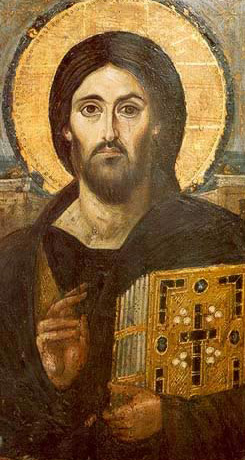
The veneration of saints, the honoring of icons and relics, the place held by the Mother of God are deeply offensive to modern democracy. The complaints heard by those who reject such things are quite telling. It is rarely the classical protest of true iconoclasts that are heard. Rather, it is the modern declaration, “I don’t need anyone between myself and God.” It is the universal access to God, without interference, without mediation, without hierarchy, without sacrament, ultimately without any need for others that is offended by the hierarchical shape of classical Christianity.
A spiritual life without canon, without custom, without tradition, without rules, is the ultimate democratic freedom. But it unleashes the tyranny of the individual imagination. For with no mediating tradition, the modern believer is subject only to his own whim. The effect is to have no Lord but the God of his own imagination. Even his appeal to Scripture is without effect – for it is his own interpretation that has mastery over the word of God. If we will have no hierarchy, we will not have Christ as Lord. We cannot invent our own model of the universe and demand that God conform.
It is a great spiritual accomplishment to not be “conformed to this world.” The ideas and assumptions of modern consumer democracies permeate almost every aspect of our culture. They become an unavoidable part of our inner landscape. Only by examining such assumptions in the light of the larger Christian tradition can we hope to remain faithful to Christ in the truth. Those who insist on the absence of spiritual authority, or demand that nothing mediate grace will discover that their lives serve the most cruel master – the spirit of the age.
(Fr. Stephen Freeman, The Sins of Democracy)
Re-read that, because although I say it differently, I can’t say it better.
So deep-seated is the democratic bias that most readers will, despite this trenchant indictment, locate “the problem” within the “hierarchical shape of classical Christianity.”
But a few readers may have begun to catch a glimmer that all is not well with individualism, that the spirit of the age is insidious, and that most American religion feeds rather than fights The Beast. For individualist religion to proclaim the Lordship of Jesus is always followed, tacitly, with “And what a congenial and accommodating Lord He is! So very like me in all his preferences!”
* * * * *
When I write such finger-pointing things, three fingers point back at me, as I lived with an accommodating “Lord” for a very long time.
My own interpretation had mastery over the word of God.
- I overlooked the end of the Gospel of John, Chapter 6 with the best of them.
- I said, or refrained from saying, “for Thine is the Kingdom …” at the end of the Lord’s prayer depending how we were called to say it: if it was “Let us say in the words our Lord taught us,” I declined because my impression of the “original text” was that the words weren’t there; if it was a summons to say “The Lord’s Prayer,” I would since “Lord’s Prayer” was a term of art that included that closing.
- I had no difficulty rationalizing conscientious objection from, say, the Epistle of James, Chapter 4 (and I’m still not sure I was wrong in seeking conscientious objector status, but that’s a long story and a long argument, with many twists and turns).
- etc., including some etcetera that would be unedifying to tell.
I may be a poor example of an Orthodox Christian, but I’d not go back for anything.
I have found one “downside,” though, of becoming Orthodox.
The time I spent memorizing the books of the Bible and doing “sword drills,” is now substantially useless when it comes to the Old Testament, because the Septuagint on which we base our Old Testament is complete (i.e., we have all the original books, many of which Protestantism has abandoned), some book names differ (e.g., there’s no I Samuel & II Samuel, I Kings and II Kings, but I, II, III & IV Kingdoms instead; Ezra is split), and the book order changes after Ezra. I must use the index of my Bible still for most Old Testament readings.
* * * * *
“The remarks made in this essay do not represent scholarly research. They are intended as topical stimulations for conversation among intelligent and informed people.” (Gerhart Niemeyer)
Some succinct standing advice on recurring themes.