March 5, 2024

Art

Popular “unpopular art”

[A]art is in a peculiar and dangerous position these days. This week, over 17,000 artists and activists signed an open letter demanding that Israeli artists be excluded from the Venice Biennale festival in Italy, simply because they are Israelis. And even while that attempt at censorship is launched, other artists proclaim how brave they are for art on certain pet causes, violating taboos that no one has enforced for decades and everyone they know already mocks. There is no real cost to such stands.

Joseph Bottum

Popular art

Meet Frankey, the Street Artist Delighting Amsterdam – The New York Times (shared link, no paywall). I was afraid this story would be about another Banksy type graffiti artist (I viscerally hate graffiti). Not at all. It’s sheer whimsical delight.

IVF

The ephemeral threat to IVF

In June 2022, the court ended federal access to abortion, kicking abortion policy back to the states.

Since then, nine states—Alabama, Texas, Arkansas, Kentucky, Louisiana, Missouri, Oklahoma, South Dakota, and Tennessee—have outlawed abortion outright, not even allowing the procedure when women become pregnant through rape or incest. (Alabama’s IVF ruling is the most extreme pro-life ruling yet.) …

How Abortion Became ‘the Defund the Police of the GOP’ | The Free Press

Alabama Supreme Court’s decision might ramify unpopularly, bearing in mind the conservative adage that there are popular “unpopular opinions” (i.e., “popular among our leftcoastal readers, less so in flyover country”) and unpopular “unpopular opinions (i.e., “popular among the fundamentalist deplorables in flyover country but vilified by leftcoastal types).

But I digress. The Alabama decision was a ruling in favor of IVF-availing parents whose frozen embryos were negligently destroyed by another patient for lack of safeguards at the IVF clinic. There were no sinister designs on IVF in the opinion at all.* So constantly throwing the decision into the abortion mix strikes me as shit-stirring clickbait.

And “they” must stir the shit, and bait the clicks, vigorously and now, because IVF is in fact popular and the Alabama legislature is hastening to protect it from unintended consequences of the Court’s decision. (I’d say “nobody would dare try to outlaw IVF” except that people are daring some pretty bizarre things these days.)

* Alabama’s Supreme Court had earlier ruled that wrongful death action was allowed to parents for loss of descendants en ventre sa mere; the recent case clarified that intrauterine or extrauterine descendants were within contemplation of the parental wrongful death law.

The case against IVF

While we’re on the subject, I think it’s important for people in secure positions occasionally to voice unpopular unpopular opinions — opinions that others may be too cancelable to voice.

For the record, I have serious moral qualms about IVF, based on a combination of (a) knowing that in the U.S., IVF practice knowingly creates large numbers of embryos that will eventually be destroyed and (b) some Roman Catholic influence that tells me babies should be made in marital beds, not laboratories.

J Budziszewski, What We Can’t Not Know briefly sketches the Roman Catholic case against IVF (thought his immediate target is cloning).

So you would say that aspirin, surgery to remove a tumor, and cloning “respect” nature, too.
Not cloning.
Why not? Doesn’t it assist the natural function of having babies?
Once more: our nature is our design. We are designed to have babies, but we are not designed to have them in that way. To put it another way, our design includes not only certain ends but certain means. There is a difference between repairing the reproductive system and bypassing it.
Well, it doesn’t seem to be a big deal anyway.
I think it is a very big deal. When you try to turn yourself into a different kind of being, you are not only doing wrong but asking for trouble. He who ignores the witness of his design will have to face the witness of natural consequences.

If you think this argument has (not “should have”) any appreciable political valence in the USA, you need to get a grip. I’m just saying it should have some valence.

I don’t know where I ultimately would come out on IVF it were there an opportunity to discuss it, not just Roman Catholic voices crying in the wilderness versus reflexive dismissal of those voices.

Law

Witless Ape returns to ballot

[I]t was a perfectly defensible position to hold that Trump should be disqualified. What was indefensible was the air of swaggering certainty that permeated so many of those takes. … self-evident. Common sense. Obvious. Indisputable. Automatic.

Damon Linker

David French was in the “Common sense. Obvious. Indisputable. Automatic.” camp, and he’s not going down without a final howl of protest:

It’s extremely difficult to square this ruling with the text of Section 3. The language is clearly mandatory. The first words are “No person shall be” a member of Congress or a state or federal officer if that person has engaged in insurrection or rebellion or provided aid or comfort to the enemies of the Constitution. The Section then says, “But Congress may by a vote of two-thirds of each house, remove such disability.”

In other words, the Constitution imposes the disability, and only a supermajority of Congress can remove it. But under the Supreme Court’s reasoning, the meaning is inverted: The Constitution merely allows Congress to impose the disability, and if Congress chooses not to enact legislation enforcing the section, then the disability does not exist. The Supreme Court has effectively replaced a very high bar for allowing insurrectionists into federal office — a supermajority vote by Congress — with the lowest bar imaginable: congressional inaction.

David French

I guess the Supreme Court considers whether it’s best to shade the law when following it fearlessly could unleash chaos. It’s days like yesterday that make that obvious, indisputable.

(H/T Kevin D. Williamson for the “Witless Ape” image; he minted it, and the linked item is a classic.)

The exceedingly long arm of Russian law

The media reported last week that Russian authorities had arrested Ksenia Karelina, a U.S.-Russian dual citizen, and charged her with treason for donating a nominal sum to an organization that aids Ukraine … The charges against Ms. Karelina are an assault on what it means to be American. The Russian state contends that for a U.S. citizen to make a donation to a U.S. charity and to attend a peaceful protest on U.S. soil is a punishable offense on arrival in Russia.

Dora Chomiak in the Wall Street Journal

Trump’s immunity claims

People who want Donald Trump tried, convicted and jailed before November, for acts while he was in office, have my sympathy, but as we head ever deeper into a tit-for-tat polarized political world, I must substantially agree with Lee Kovarsky instead: Trump Should Lose. But the Supreme Court Should Still Clarify Immunity. – The New York Times.

Trump’s immunity claims are far too broad, but ex-Presidents need at least narrow immunity. Running for high office is already so fraught that I question the sanity of anyone who runs. Add to the existing ugliness the prospect of criminal prosecution, with no possible immunity if the other party wins next time, and we’ll have nobody but saints and sociopaths willing to risk it.

Qualified Immunity

In Indiana, we have a political novice candidate for governor whose first major media buy was an ad with him sitting in a rustic church, slightly misquoting the Bible and earnestly telling us he’s a “man of faith.” It kind of turned my stomach.

The second major media buy was an ad with a well-spoken Rwandan refugee, who became his foster daughter, telling us he’s a “man of faith.” It was much more believable.

His third major media buy simplistically says that qualified immunity (over which governors have little or no control) protects police and so protects us and brillig, and slithey toves, gyring and gimbling in the wabe, and “as governor, your safety will always come first” (sic).

Eric Doden has now lost me for sure. Qualified Immunity, a court-created line-item veto, effectively turns “every person” in 42 USC §1983 into “precious few people.”

Miscellany

[Expletive deleted] AI

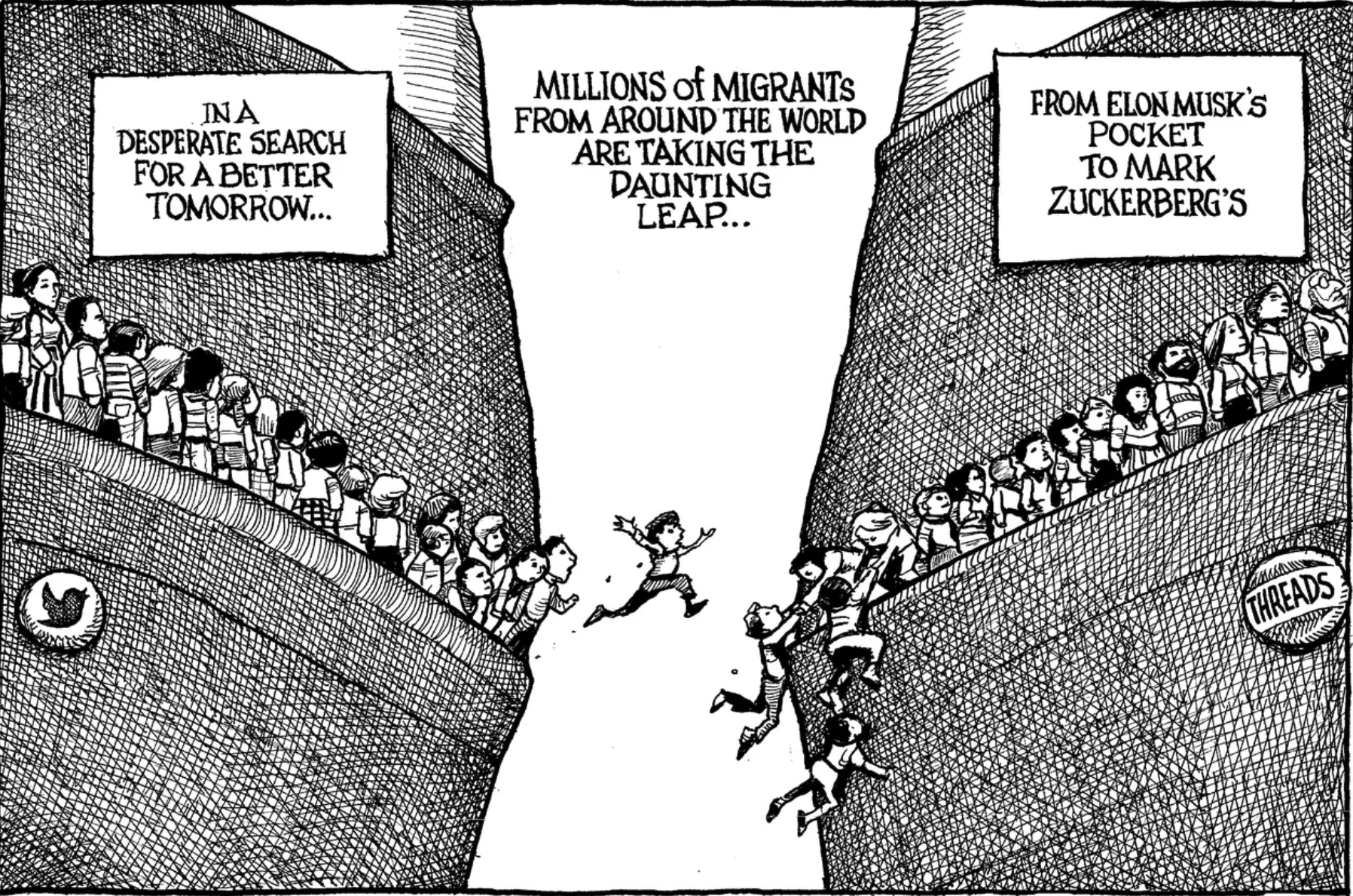
It is not possible to say definitively who negatively impacted society more, Elon Musk tweeting memes or Hitler. Both have had a significant impact on society, but in different ways.

Google’s Gemini AI via Nellie Bowles

Pride before the Fall

No, you dare not make war on cotton. No power on earth dares to make war upon it. Cotton is king.” Such words smacked of hubris, the excessive pride that goes before a fall. And so they would turn out to be, expressing a mistaken vision that would lead to cruel and tragic consequences for the South. Lulled into a false sense of economic security by the illusion that cotton was invincible and its prices would never fall, the South would become fatally committed to a brutal social and economic system that was designed for the lucrative production of cotton on a massive scale but that achieved such productivity at an incalculable cost in human and moral terms. It placed the region on a collision course with changing moral sensibilities in the world, and with fundamental American ideals.

Wilfred M. McClay, Land of Hope

Psychological Man

My grandfather left school at fifteen and spent the rest of his working life as a sheet metal worker in a factory in Birmingham, the industrial heartland of England. If he had been asked if he found satisfaction in his work, there is a distinct possibility he would not even have understood the question, given that it really reflects the concerns of psychological man’s world, to which he did not belong.

Carl R. Trueman, The Rise and Triumph of the Modern Self

Where paranoia is the mark of sophistication

In the offline world, paranoia is a liability. It inhibits you from seeing the world clearly. In parts of the online world, you’re considered a rube if you’re not paranoid, if you’re not seeing a leftist plot around every corner, if you’re not believing that Taylor Swift and Travis Kelce’s romance is a Biden administration psy-op that culminated with rigging the Super Bowl.

David French, Why Elon Musk Is the Second Most Important Person in MAGA


So: where did all my mockery of Trump go?

I suffer more from the humiliations inflicted by my country than from those inflicted on her.

Simone Weil, from a letter to Georges Bernanos.

You can read most of my more impromptu stuff here and here (both of them cathartic venting, especially political) and here (the only social medium I frequent, because people there are quirky, pleasant and real). All should work in your RSS aggregator, like Feedly or Reeder, should you want to make a habit of it.

Thursday, 9/14/23

Culture

Building new kinds of stability

In a world where absolutely everything is unstable, from geopolitics to money and even the climate, some far-sighted younger millennials and Gen Z-ers are already pioneering a new model. Willow, a twenty-five-year-old writer based in rural Canada, married at twenty-three and is cocreating a domestic economy with her husband, Phil, one that is clearly an update of the premodern “productive household.” In addition to her writing projects, she does carpentry with Phil, roughly dividing the work into “first fix” (which requires more strength, and which Phil does) and finishing (which requires more patience and manual dexterity, at which Willow excels). Because they have a small baby, Willow cannot do much carpentry at present, but she is active in finding Phil clients and sometimes apprentices. Willow also tends a small farm on her and Phil’s property.

From an industrial-feminist perspective, Willow’s approach is unacceptably in thrall to patriarchy: She married young, views childcare as largely her domain, and is not the main money earner. Yet Willow is sincerely pursuing her interests as an embodied woman, in her relational context, rather than as an atomized, abstract “human” in an inconveniently female body.

Mary Harrington, Is There Hope for Marriage?

Thought about poetry

Free verse was all the rage at the time, with the Beat poets like Allen Ginsberg also experimenting with the same pharmaceuticals and literary devices. Personally, I remain uncertain about the value of these creative detours. Poetry is meant to be the most distilled way to communicate. Does anyone think Ginsberg and the other Beats were able to distill their thought, or even put their fingers on it? To me, those fellows slowed thought down.

Constraints in poetry do a number of things. They discipline the writer—no small thing. They help the reader, and also, the rememberer. 

It is hard to memorize chunks of free verse, just as it is hard to remember large chunks of prose. There is a reason that almost nobody can say, “Do you know my favorite paragraph from my favorite novel?”—and then recite it.

Douglas Murray

Those grimy white cliffs

Chaplins Restaurant and Carvery in Dover, despite all the visible unhappiness is a happy place. Everyone that came in knew everyone else, including lying Jon, and understood them. They knew where they were coming from and what they were going through.

Because England, even the “worst” parts, still has a real community built around a shared history and culture. Even if it sometimes gets turned into tourism board silliness, it very much matters.

That’s essential, and at a deep level Wall Street me didn’t understand. The English know who they are, and are ok with it.

Chris Arnade, Walking England’s Coast Part 1: From Dover to New Romney

Confusing comfort for civilization

The European talks of progress because by the aid of a few scientific discoveries he has established a society which has mistaken comfort for civilisation.

Benjamin Disraeli, 1st Earl of Beaconsfield, British statesman, Conservative politician, writer, Prime Minister of the United Kingdom, via Life on Dover Beach

AI in medicine

AI without the ballast of intuition represents the tyranny of pure analysis. Unleashed, and without intuition to give it a more profound understanding of humanity, AI stands ready to extend the power of reductive and often dangerously misleading concepts.

Ronald W. Dworkin, Paging Dr. Bot

Subscribing to flatness

Most consumers don’t know that by using internet-based (or -generated) platforms—by buying from Amazon, by staying in an Airbnb, by ordering on Grubhub, by friending people on Facebook—that they are subscribing to a life of flatness, one that can lead directly into certain politics. But they are. Seduced by convenience, we end up paying for the flattening of our own lives. It is not an accident that progressive ideas spread faster on the internet. The internet is a car that runs on flatness; progressive politics—unlike either conservatism or liberalism—are flatness.

Alana Newhouse, Everything Is Broken

Gut-punch

There’s a very short and very brutal poem by the Scottish poet Hollie McNish, written in 2019 and titled “Conversation with an archaeologist”:

he said they’d found a brothel
on the dig he did last night
I asked him how they know
he sighed:
a pit of babies’ bones
a pit of newborn babies’ bones was how to spot a brothel

“It’s true, you know,” said the writer and lawyer Helen Dale when we had lunch in London last year and I mentioned this poem, which I chose as one of the epigraphs to my book The Case Against the Sexual Revolution. Helen was a classicist before she was a lawyer, and as a younger woman she had taken part in archaeological excavations of ancient Roman sites. “First you find the erotic statuary,” she went on, “and then you dig a bit more and you find the male infant skeletons.” Male, of course, because the males were of no use to the keepers of Roman brothels, whereas the female infants born to prostituted women were raised into prostitution themselves.

Louise Perry, We Are Repaganizing

Inflation and privilege

Both being retired persons now, my wife and I are taking our annual week in Traverse City, Michigan next week rather than June, as we used to. A friend who we’ll join up there gives a scouting report that our breakfast favorite (French Omelettes) is closed; they couldn’t afford to pay what staff needed to earn in a quite expensive city.

I peeked at the online menu of a surviving “fine dining” restaurant; this is going to be a fairly expensive vacation. That I can afford it is a privilege. That servers, cooks, busboys, dishwashers and such cannot means that my deliberately high level of tipping hasn’t been enough to make those jobs attractive.

Politics

Social imperialism

Austin Ruse of the Center for Family and Human Rights (C-FAM) sends out weekly missives detailing the machinations of activists at the UN to get abortion and LGBT-supporting language in treaties and formal documents of every kind; Marguerite Peeters described the phenomenon of how institutions were infiltrated and colonized in The Globalization of the Western Sexual Revolution (2012); sociologist Gabrielle Kuby did the same in The Global Sexual Revolution: Destruction of Freedom in the Name of Freedom.

Nigerian human rights activist Obianuju Ekeocha described what the West has been perpetrating on Africa in her essential 2018 book Target Africa: Ideological Neo-Colonialism in the Twenty-First Century as well as the 2019 documentary Strings Attached. So-called humanitarian aid, she writes, nearly always comes with strings attached—contraceptives, demands for the legalization of abortion, perverse Western-style sex education, and the replacement of traditional African values with post-modern Western ones. The desperate need of many African countries for Western foreign aid is exploited to push for the imposition of a top-down sexual revolution.
 

But the Guardian would have us believe that a few Christian groups are imposing their views on unwilling African populations, and that this is also serving as a testing ground for laws in Hungary and American red states. The brazenness of this level of gaslighting is almost impressive—but it needs to be called out. The truth is that rich Western countries are pushing the LGBT agenda and abortion in developing countries, promising them cash in exchange for their souls—but you won’t read that in the mainstream press.

Jonathon Van Maren, The Left’s Colonial Mission (The European Conservative)

As someone said, if a third-world country asks for a bridge, China will build them a bridge; the US will force some aspect of the sexual revolution on them and only then build a bridge.

Who do you think wins more hearts?

Newly-conservative?

Our unabashed dictionary calls a conservative a liberal who’s been mugged:

  • “We are going to dismantle the Minneapolis Police Department. Say it with me. DISMANTLE The Minneapolis Police Department. If you’re still disagreeing with that BASIC FACT, I’m not sure what to say to you,” – Shivanthi Sathanandan, Minnesota DFL’s Second Vice Chair, in June 2020.
  • “Look at my face. REMEMBER ME when you are thinking about supporting letting juveniles and young people out of custody to roam our streets instead of HOLDING THEM ACCOUNTABLE FOR THEIR ACTIONS,” – Sathanandan, this week, after being violently car-jacked and beaten bloody in front of her children in Minneapolis.

(Via Andrew Sullivan)

What if Biden bowed out?

More from Sullivan (see Newly-Conservative, above), begging Biden to bow out of POTUS24:

A new candidate would immediately shift the dynamic of the race. The Democrat would represent the future; and Trump the polarized past. A younger candidate would instantly reverse the age argument in the Democrats’ favor. The news cycles would be full of Dem debates, fights, campaigns and energy — and not dictated by the defensive torpor of a frail octogenarian, or the unending narrative of Trump against the corrupt elites.

Biden was elected as a means to check Trump; the logic of his presidency was always that the old man would get us back to normal; and that argument makes much more sense for a one-term presidency … there could be no worse legacy than handing the country back to the monster you rescued us from.

I agree. Trump’s secret weapon, maybe his margin of victory, is Biden’s manifest infirmity.

But any other Democrat is likely to be even more extreme on sexuality.

Superiority

Democrats who indulge in hubris are liable to assume and sometimes proclaim their innate superiority through their education or their modern morality. Republicans do it by exalting two particular types as superior: the businessman and the pious man.

Henry Olsen, The Three Deadly Sins of the Right (American Compass)

You’re not likely to get American Compass quotes here very often, but this seemed accurate and illuminating.

My problem with Theocracy

[I]n the Christian nation that Wilson and his allies want to bring about, there wouldn’t be much space for Christians like me to operate. He told the Washington Post that

while leaders would strive to ‘maximize religious liberty for everyone,’ Catholics are unlikely to feel welcome — ‘I think it has to be a pan-Protestant project,’ he said — nor would Christians who disagree with his stridently patriarchal social norms. … Asked to explain where liberal Christians fit into his theoretical Christian society, Wilson said they would be excluded from holding office, later noting similar prohibitions in early American Colonial settlements such as the Massachusetts Bay Colony. When it was pointed out that Puritans executed Boston Quakers, Wilson said he would not “defend” the hanging of Quakers, but then argued it was important to understand the context of the time.

It’s gonna be fun to watch these old boys and the Catholic integralists go at each other, if either side can tear themselves away from their keyboards long enough to find their way to the field of battle.

Rod Dreher. That neither Douglas Wilson nor the Catholic Integralists have in mind a world hospitable to Orthodoxy keeps me at arms’-length from them. If I cared to, I could probably impugn their ability to govern wisely even by their own lights.


A fundamental reality of human existence is that vice often leaves virtue with few good options. Evil men can attach catastrophic risks to virtually any course of action, however admirable.

David French

You can read most of my more impromptu stuff here (cathartic venting) and here (the only social medium I frequent, because people there are quirky, pleasant and real). Both should work in your RSS aggregator, like Feedly or Reeder, should you want to make a habit of it.

Happy August

Culture

Frodo failed

Frodo failed.

If you’re a reader of Tolkien’s Lord of the Rings (or just a movie-goer), then you know that the central, heroic character, the young Mr. Frodo, ring-bearer, fails to throw the Ring into the fires of Mt. Doom at the end of his arduous journey. Everything he loved, his home, his friends, every scrap of goodness, depended on the Ring being tossed into those fires, and, when it came down to it, he was unable to let it go. Fortunately for Middle Earth, the wraith-like, pitiable creature, Gollum, bit Frodo’s finger off in order to have the Ring again for his own, and accidentally slipped and fell into the fires, saving Middle Earth in the bargain. All of that drama resolved by an accident?

It is genius.

Fr. Stephen Freeman

Pedagogy after AI

Imagine a culinary school that teaches its students how to use HelloFresh: “Sure, we could teach you how to cook from scratch the way we used to — how to shop for ingredients, how to combine them, how to prepare them, how to present them — but let’s be serious, resources like HelloFresh aren’t going away, so you just need to learn to use them properly.” The proper response from students would be: “Why should we pay you for that? We can do that on our own.”

If I decided to teach my students how to use ChatGPT appropriately, and one of them asked me why they should pay me for that, I don’t think I would have a good answer. But if they asked me why I insist that they not use ChatGPT in reading and writing for me, I do have a response: I want you to learn how to read carefully, to sift and consider what you’ve read, to formulate and then give structure your ideas, to discern whom to think with, and finally to present your thoughts in a clear and cogent way. And I want you to learn to do all these things because they make you more free — the arts we study are liberal, that is to say liberating, arts.

If you take up this challenge you will learn not to “think for yourself” but to think in the company of well-chosen companions, and not to have your thoughts dictated to you by the transnational entity some call surveillance capitalism, which sees you as a resource to exploit and could care less if your personal integrity and independence are destroyed. The technocratic world to which I would be handing you over, if I were to encourage the use of ChatGPT, is driven by the “occupational psychosis” of sociopathy. And I don’t want you to be owned and operated by those Powers

Alan Jacobs, Technologies and Trust

Stripping humanity from homo sapiens

If out of the crooked timber of humanity no straight thing was ever made, then if a thing is made straight it will be because humanity has been stripped out of it.

L.M. Sacasas, Embrace Your Crookedness. This is a very worthwhile reflection on the human condition.

Don’t assume that “they” will be stripping humanity. Some people strip their own humanity. Rebecca West (Black Lamb and Grey Falcon) embeds the story of one who did so:

So with his money he could follow his mania, which was for the new thing, for Science, for the machine, for the artificial, the modern. You may not remember it, for I think it came earlier with you than with us, but there was some time ago a rage for such things. It was partly due to your H. G. Wells and his imitators, and it was partly due to our ideas about America, which we then believed to be entirely covered with sky-scrapers and factories.

I went on so, telling more and more absurd stories, until I said, “And of course I was forgetting, there is the artificial woman that was invented by the celebrated surgeon Dr. Martel. That is quite wonderful.” And my old friend said to me, “An artificial woman? What is that? A woman that is artificial! For God’s sake! Tell us all about it!”

I saw that she was getting very fond of me, like a mother for her son, and I grieved, for I did not like to have brought this sorrow to her by [the silly joke on her husband about the artificial woman]. I felt very ashamed when she came to see me at a time when the cold wind had made me bad with my lungs, and it was as if I should go like my sister, who had died when she was sixteen, and I said to her, “Aunt, you are too good to me. I have done nothing for you,” and she answered with tears in her eyes, “But you have been as good to me as a son. Do you think I am so simple that I do not know the artificial woman must long ago be finished, with such a clever man as you say working on it? You tell my husband that it is not so only because you know that I could not bear to have such a creature in my house.” There was nothing at all that I could say. I could not confess to her that I had been a monkey without making it plain to her that her husband had been an ass.

It came to this poor silly old man and he learned that the most modern thing to do was to kill yourself, and so he did it. He became very melancholy for a time, working at it as other old men work at learning chess, and then went into his stable and hanged himself, to be modern, to have an artificial death instead of a natural. I think he was probably sure that there was immortality, for though he believed he was a freethinker I do not believe it ever crossed his mind that he would not live after death. And soon after his wife also hanged herself, but I do not think there was anything modern about her reasons, they could not have been more ancient.

Whence our delight at athletes?

Gladwell, like many of us, seems to have unwittingly internalized the idea that when professional athletes do the thing they’re paid to do, they’re not acting according to the workaday necessity (like the rest of us) but rather are expressing with grace and energy their inmost competitive instincts, and doing so in a way that gives them delight. We need to believe that because much of our delight in watching them derives from our belief in their delight.

Alan Jacobs, How to Think: A Survival Guide for a World at Odds

Hectoring, dismissive and jejune

[I]f the right has overcorrected to an old-fashioned (and somewhat hostile) vision of masculinity, many progressives have ignored the opportunity to sell men on a better vision of what they can be. … To the extent that any vision of “nontoxic” masculinity is proposed, it ends up sounding more like stereotypical femininity than anything else: Guys should learn to be more sensitive, quiet and socially apt, seemingly overnight. It’s the equivalent of “learn to code!” as a solution for those struggling to adjust to a new economy: simultaneously hectoring, dismissive and jejune.

Christine Emba via DenseDiscovery

Notable passing

SunRay Kelley, Master Builder of the Counterculture, Dies at 71. That link should get you through the Times paywall.

Sinead O’Connor

My cyberfriend Patrick Rhone shares a worthy comment on Sinead O’Connor: some Kris Kristofersson song lyrics in her honor after she was booed off a stage.

Musicians are sometimes prophets, and prophets often get stoned.

Political

Muslim discomfort with Democrat extremists

Asma Uddin, in her book “When Islam Is Not a Religion,” describes “a tacit agreement that Muslims, as religious believers, will never challenge any of the rights championed by the Left, such as a progressive vision of gender or sexual equality.” Muslims became an integral part of the party not as a faith community with distinct theological commitments but as a “marginalized” group requiring protection from Republican bigotry.

But during the Trump years, the Democratic Party veered sharply to the left on social and cultural issues. The Republican Party lost interest in Muslims, with Mr. Trump neglecting to antagonize them during his 2020 re-election bid. The new enemy was “wokeness,” and a growing number of Muslims found themselves on the GOP side of that divide. According to the AP VoteCast Survey, as many as 35% of Muslims voted for Mr. Trump in 2020, compared with 8% to 13% in 2016.

It’s easy enough for the left to dismiss white evangelical Trump supporters. But when the party does the same to Muslims, who for years had been loyal Democrats, it demonstrates its disrespect for actual cultural diversity.

Shadi Hamid, Muslims vs. Democrats: A Story of Betrayal

Conservatives and Reactionaries

When writers at The Bulwark or The Dispatch, or the presidential campaigns of Asa Hutchinson, Chris Christie, and Will Hurd, criticize Trump, they highlight (at least in part) his breaks from longstanding norms, traditions, and expectations of elected officials. Trump shouldn’t have lied about the results of the 2020 election. He shouldn’t have provoked an insurrection and haplessly sought to foment a self-coup to remain in power after losing the vote. He shouldn’t have disregarded laws restricting access to classified documents. And so forth. Those are the kinds of objections one would expect to hear from conservatives.

But DeSantis has nothing critical to say about any of the above. When he goes after Trump, it’s for his failure to break more radically from longstanding norms, traditions, and expectation. Trump was too willing to defer to public-health officials during the COVID-19 pandemic, too quick to believe vaccines could protect people from becoming ill, too inclined to seek support from LGBT voters, too moderate on abortion, too cautious in dealing with the administrative state. In all of these ways, Trump was too conservative. He maintained too many continuities with the past. He should have broken more fully with it in favor of an alternative future that would be more congenial to the right.

Damon Linker, Ron DeSantis, Reactionary Tryhard.

I don’t want Joe Biden to be President for four more years. I’d gladly vote for most conservative alternatives to him — if there were any. Trump is a reactionary and populist (as well as a narcissist and/or a fine illustration of “oppositional defiant disorder”); DeSantis is trying to outdo him on both counts. And I don’t intend to pull punches about that sad reality.

“Spreading democracy”

My nation pretends it’s spreading democracy, and I’ve never (within ready memory) believed that.

Democratization conflicts with Westernization, and democracy is inherently a parochializing not a cosmopolitanizing process. Politicians in non-Western societies do not win elections by demonstrating how Western they are. Electoral competition instead stimulates them to fashion what they believe will be the most popular appeals, and those are usually ethnic, nationalist, and religious in character.

Samuel P. Huntington, The Clash of Civilizations and the Remaking of World Order

Barbarian feigns Christianity

On twitter Stephen Wolfe, author of “The Case for Christian Nationalism,” claimed he didn’t know who Emmett Till was until he recently googled his name. He then commented: “Yea I’m supposed to care about some 1955 event that all the libs care about. Their minds are captured.”

Stephen Wolfe’s book The Case for Christian Nationalism extolls a fantasy Calvinist confessional state in which the elect rule over the lost and reprobate. God’s reputed people have the power, and the people less favored are their subjects, living under their rules. Its vision of power over service isn’t very Christian. And its subjugation of some people over others based on their religion isn’t very nationalist. It certainly isn’t at all American.

But disdaining Emmett Till’s murder, and the civil rights revolution it helped unleash, as part of the wider ongoing, 2000-year-old Christian revolution of equality and dignity for all, is helpfully clarifying.

Mark Tooley

I can’t think of anyone I consider actually Christian who advocates “Christian Nationalism.” Maybe I need to get out more. Maybe some Christians involuntarily drawn to the notion have conscience-pangs and reservations so they don’t talk about it.

One of the reasons why I oppose “Christian Nationalism” in the USA is that notionally-Christian barbarians would almost certainly grab the reins of power, and there’s nobody more remorseless than someone who thinks he has a mandate from heaven to rule righteously.

Tough love

Congratulations to Colombian President Gustavo Petro, who over the weekend set a standard for good governance to which political leaders throughout the Americas can aspire.
“I wish him luck and strength,” he tweeted after his son Nicolás was hit with charges related to money laundering and drug trafficking. “May these events strengthen his character and let him reflect on his own errors.”

TMD

Public transportation is a loser?

The reason most public transportation is seen as ‘losing’ money is precisely because it charges for trips. If you don’t charge fares, suddenly it can’t ‘lose’ money. It just costs money, the same as the roads.
@dx@social.ridetrans.it

Via DenseDiscovery. I confess that I had to read that twice to see the brilliance.

Unwelcome contrast

I myself am a secret monarchist, as were my relatives in Rhode Island and Connecticut in 1775 except they weren’t secret about it. I miss Elizabeth II, the perfect modest model of a modern English monarch, tramping in the rain with her corgis. When Her Majesty met President Schlump and he opened his big yap and hee-hawed at her, we saw a contrast that was not favorable to our side.

Garrison Keillor


We are in the grip of a grim, despairing rebellion against reality that imagines itself to be the engine of moral progress.

R.R. Reno

The end of the world as we know it is not the end of the world.

You can read most of my more impromptu stuff here (cathartic venting) and here (the only social medium I frequent, because people there are quirky, pleasant and real). Both should work in your RSS aggregator, like Feedly or Reeder, should you want to make a habit of it. I’m even playing around a bit here, but uncertain whether I’ll persist.

Saturday, 7/15/23

I forewent a provocative headline and lead paragraph.

You’re welcome.

Culture

Peter Coy brings the receipts

I haven’t harped about this because I didn’t have facts and figures. But the New York Times’ Peter Coy has now provided them (and it’s important enough that I’m giving you a link that pierces the paywall):

  • The amount of lithium, cobalt, manganese, nickel, graphite and other lithium-ion battery materials needed for one long-range electric vehicle would be enough for either six plug-in hybrids or 90 of the type of hybrid that recharges from deceleration and braking.
  • The overall carbon reduction of those 90 hybrids over their lifetimes is 37 times as much as a single battery electric vehicle.
  • The production of electric vehicles produces more greenhouse gases than the production of cars with combustion engines. So E.V.s have to travel between 28,000 and 68,000 miles before they have an emissions advantage over similarly sized and equipped internal-combustion mobiles.

All-electric vehicles are presently a gigantic flim-flam, and considering that third point, they’re going to remain a flim-flam for quite a long time. (Does an EV even get 68,000+ miles before those big honkin’ batteries need replaced?)

The plug-in hybrids have appealed to me, but I’ve got to get over that and to stop feeling like a criminal for (currently) not even driving a conventional hybrid, but a full-blown internal-combustion vehicle. (I’d have bought my second hybrid if they offered one on this model.)

EVs are a kind of social contagion, heavily subsidized by the federal government, which really needs to cut it out.

This is one reason I have almost as little respect for Elon Musk as I do for He Who Shall Not Be Named (another guy who got more-or-less rich dishonorably).

From the July 15 Economist

Pangloss makes the case for AI

Mark Andreesen, giving the Panglossian version of AI, lost me early on at the patently bullshitty “infinitely patient, infinitely compassionate, infinitely knowledgeable, and infinitely helpful.” He reminds me of George Burns: “Sincerity – if you can fake that, you’ve got it made.” Because all those AI virtues are fakes.

I was hoping for something better, because I think there’s a better case available. In fact, I know there’s a better case to be made because I heard it made on a podcast Tuesday on the Ezra Klein show.

Freedom

Aunt Concetta told me that she didn’t like life in America because we had no freedom. That comment baffled me because, like everyone else my age, I believed that America was the land of the free and the home of the brave. But she pulled me up short. “Your grandmother,” she said, “is afraid to walk down the main street at night.”

… That little conversation, more than anything I have read about political life, has put an indelible mark on my thinking about freedom. I have long rejected any view that reduces liberty to the results of a constitutional mechanism, or that identifies liberty with suffrage, or that defines liberty as a negative, as what the government may not tell you that you may not do.

… I think I can venture a suggestion as to gauging the degree of real freedom that a nation, or perhaps your town or your street, enjoys. It is the degree and the character of spontaneous, unencumbered, and undirected action on the street.

Anthony Esolen

I kinda sorta feel for Tommy Tuberville

Terms like “white nationalist” mean something: White nationalism is a form of white supremacy that advocates white dominance and white control. You don’t have to take my word for it, you can look it up. (On Tuesday, Tuberville admitted that white nationalists are racists.)

I don’t normally read Charles Blow, but this time, I read a little bit, including the block-quote, because The Morning Dispatch had called out Tuberville teasingly the day before:

It took him about two months and several botched attempts, but a hearty congratulations to GOP Sen. Tommy Tuberville of Alabama for finally saying these words in this order: “White nationalists are racists.”

I remember in law school insisting that I was a creationist. I said that because I believed that this stuff all around us, out to the furthest reaches of our telescopes, were the result of a divine creation, not an accident or the outworking of eternally-existent matter and energy. Someone pointed out that what I meant, though, was not what creationism had come to mean as a term of art. Creationism had come to mean divine creation roughly 6000 to 10,000 years ago, fixed species, etc.

“White Nationalist” has never been a term I’d apply to myself; first, because race is truly (if not exclusively, in our vexed history) a pigment of the imagination; second, because nationalism holds little to no appeal for me. But it appeared to me to mean “nationalism professed by a pale person,” and its journalistic use to be more epithet than description.

Maybe Tommy Tuberville thought as I did, and that’s why he pushed back so. But Blow cites Merriam-Webster for a term-of-art meaning that implies racist white supremacy.

I still stand by the epithet point, and believe that the term is not yet univocally racist. But sensible people, aware of its equivocal meaning, will steer clear of it.

Paris

Many people who love Paris love it because the first time they came they ate something better than they had ever eaten before, and kept coming back to eat it again.

Adam Gopnik, [The Table Comes First(https://www.amazon.com/Table-Comes-First-Family-Meaning-ebook/dp/B004KPM1EY/ref=sr_1_1)

I find that very plausible.

Legalia

FINALLY someone else says it (and better than I)

The nature of expressive, creative work is also such that consumers would not ordinarily wish to risk the quality of the product or service by conscripting a reluctant vendor to create messages that contradict the vendor’s sincere personal beliefs.

Abram Pafford, “You Couldn’t Pay Me to Say That”: 303 Creative and Compelled Commercial Speech.

303 Creative was a well-warranted pre-enforcement challenge based on the proposition that Colorado’s public accommodations law was unconstitutional as applied to plaintiff’s refusal of website design for same-sex weddings. Colorado never challenged the owner’s standing, and even stipulated the facts that eventually blew a little hole in the hull of its law (which remains resolutely afloat).

Even today, pre-enforcement challenges are pending to, notably, some of the new restrictive abortion laws some states have passed, and to state bans on transgender care for minors. The Left is happy as can be with decades of pre-enforcement challenges like these — of which the Left has been the primary beneficiary. I don’t recall Right-leaning pre-enforcement challenges, other than against college speech codes, until the Obama years.

Not until after Colorado had lost did its Attorney General start joining the ignorant “fake case” chorus.

But in a sense, 303 Creative was a “fake case” — or at least an “engineered case”: the sense that in the real world, untainted by polarization and the insatiable desire of LGBTetc folks for universal affirmation, as if their sexuality were constitutional high trump, such cases would not be brought because — well, see the block quote. That’s why I put it there.

What should happen now is clear enough to me: states should disavow application of their public accommodation laws to creative professionals’ rare refusals to aid in expressing an objectionable message — with the creative professional being the sole judge of “objectionable.”

And I’ll reiterate that the key here is the right of the service provider to be free of compulsion to express sentiments they in fact disapprove. It would apply as much to, say, a Jewish graphic designer declining to work on BDS advocacy as to conservative Christians (and others) declining work on same-sex weddings. I sincerely doubt that Colorado would punish that Jewish graphic designer; this is about forcing Christians to bend the knee to the new sexual orthodoxies.

(It’s surprising how easy it is to mis-state what’s at stake here. This little item took far more time than I expected. I probably should cut some slack to those who make a living minting hot takes on complex topics for siloed readerships and who get sloppy in the process.)

Non-partisan politics

Smoke-filled rooms

I miss smoke-filled rooms.

Not the literal ones, but the ones that brought forth sane and competitive candidates back in the day.

Today, primary voters — often the most extreme members of a party — deliver us unpalatable candidates, with the only gesture toward electability being “will he be perceived as less bad than the other party’s guy?”

Yes, I’m thinking specifically of the likely nomination of Donald Trump by the GOP. But I’m not thinking exclusively of that. Hillary in 2016 is also an example.

Our Unaccountable TechLords

At almost every gathering artificial intelligence came up. I’d say people are approaching AI with a free floating dread leavened by a pragmatic commitment to make the best of it, see what it can do to make life better. It can’t be stopped any more than you can stop the tide. There’s a sense of, “It may break cancer’s deepest codes,” combined with, “It may turn on us and get us nuked.”

My offered thought: AI’s founders, funders and promoters made a big recent show of asking Congress to help them fashion moral guardrails, but to my mind there was little comfort in it. I think they had three motives. First, to be seen as humble and morally serious—aware of the complexities of this awesome new power and asking for help in thinking them through. Second, they are certain government is too incompetent and stupid to slow them down or impede them in any meaningful way, so why not. Third, when something goes wrong they can say, “But we pleaded for your help!”

That unfriendly read is based on 30 years of observing our tech leaders. They have a sense of responsibility to their vision and to their own genius, but not to people at large or the American people in particular. They always claim they’re looking for better communication and greater joy between peoples when in the end it turns out they’re looking for money and power. And they only see the sunny side of their inventions because they were raised in a sunny age, and can’t imagine what darkness looks like, or that it comes.

Peggy Noonan

My skewed perspective

There are too many sensible people writing critically and even bitterly about the government’s Covid pandemic (or is “epidemic” sufficient?) response for me to assume it just partisan politics. But I confess that something about having retired before Covidtide seems to make me largely insensible to the outrage many feel about the government response.

I even joked that “I’m an introvert; social distancing is almost my default.”

So pardon me for not joining the chorus. If I’m consistent, though, I won’t join government’s defenders, either.

But I will make this observation: during the putative lockdowns, our lowest-paid, lowest-status workers had to go ahead and work in “meatspace,” risking infection. They are our truly indispensable workers, and many of them should be paid far better than they are.

Gaming the fat-cat system

The Republican National Committee has set a threshold of 40,000 individual donors, including 200 each in 20 states or territories, to qualify for primary debates. This is supposed to assure broad support and (they say) block candidates with mostly fat-cat donors.

So, how long did it take for candidates to game that system?

So how about using fat-cat donations to buy $20 gift cards for anyone who gives $1? You can buy a lot of $1 gifts if you’re offering an instant 1900% ROI.

(David A. Graham, We’re Entering a New Era of Shady Campaign Finance)


We are in the grip of a grim, despairing rebellion against reality that imagines itself to be the engine of moral progress.

R.R. Reno

The end of the world as we know it is not the end of the world.

You can read most of my more impromptu stuff here (cathartic venting) and here (the only social medium I frequent, because people there are quirky, pleasant and real). Both should work in your RSS aggregator, like Feedly or Reeder, should you want to make a habit of it. I’m even playing around a bit here, but uncertain whether I’ll persist.

Thursday, 6/8/23

Politics of one sort or another

Plus ça change

Metapolitics

I’m a pluralist. I don’t just mean in the sense that I think modern societies are too highly differentiated for them to be oriented toward a single highest good in the way some on the right (the so-called Integralists) like to imagine they were in the supposedly good old days of unified Catholic Europe during the medieval period. I am that kind of pluralist, but I’m also a pluralist in another and deeper sense, one that traces its lineage to the work of Isaiah Berlin, who deployed the term to describe the character of moral reality itself, regardless of the composition of any specific society.

Individual freedom from external constraint or coercion is an important human good. But what about other senses of liberty? Or fairness (proportional justice)? Or solidarity? Or loyalty? Or excellence? Or authority? Or creativity? Or sanctity? Or piety? There are many human goods, each worthy of pursuit. Devoting one’s life to one at the exclusion of others will undoubtedly have value, but it will also require the sacrifice of those other goods. That doesn’t mean we must embrace, affirm, and pursue all values equally. (Equality is itself a good the pursuit of which requires the sacrifice of other goods.) But it does mean that we should make our choices in full awareness of the sacrifices involved, and not deny the reality of the losses.

So the love of liberty has its place. The problem is that libertarianism overemphasizes it to the exclusion of other values, and often denies there is any important loss or tradeoff involved in doing so. (Yes, that’s a little ironic for thinkers who usually like to emphasize the need for tradeoffs in the context of fashioning government policy.)

Damon Linker

Sorta Politics

After the way he abased himself to secure the Speakership, I never would have thought Keven McCarthy would be able to get anything done:

Among the various reassessments of Kevin McCarthy following his successful debt ceiling negotiations, the one with the widest implications belongs to Matthew Continetti, who writes in The Washington Free Beacon that “McCarthy’s superpower is his desire to be speaker. He likes and wants his job.”

[P]art of what’s gone wrong with American institutions lately is the failure of important figures to regard their positions as ends unto themselves. Congress, especially, has been overtaken by what Yuval Levin of the American Enterprise Institute describes as a “platform” mentality, where ambitious House members and senators treat their offices as places to stand and be seen — as talking heads, movement leaders, future presidents — rather than as roles to inhabit and opportunities to serve.

On the Republican side, this tendency has taken several forms, from Newt Gingrich’s yearning to be a Great Man of History, to Ted Cruz’s ambitious grandstanding in the Obama years, to the emergence of Trump-era performance artists like Marjorie Taylor Greene. And the party’s congressional institutionalists, from dealmakers like John Boehner to policy mavens like Paul Ryan, have often been miserable-seeming prisoners of the talking heads, celebrity brands and would-be presidents.

[T]he most notable populist Republican elected in 2022, J.D. Vance, has been busy looking for deals with populist Democrats on issues like railroad safety and bank-executive compensation, or adding a constructive amendment to the debt-ceiling bill even though he voted against it — as though he, no less than McCarthy, actually likes and wants his current job.

Ross Douthat, Can Kevin McCarthy and Joe Biden Fix Washington?.

Bare-knuckle politics

The former governor, whose affiliated PAC calls itself “Tell It Like It Is,” didn’t pull any punches during his roughly two-hour town hall last night against the man he’s convinced gave him COVID-19, calling the former president “lonely, self-absorbed, and self-serving.”

“I’m going after Trump for two reasons,” he said in response to an audience question. “Because he deserves it, and because it’s the way to win.”

Christie, a former federal prosecutor, likely views his punch-Trump-in-the-mouth approach as killing three birds with one stone. Not only does it put Trump on the defensive, but picking fights will also earn Christie time on cable news, which amounts to free advertising for the campaign. Plus, it helps him paint himself as a fighter. “He knows how to brawl and we like that in our candidates,” Merrill said of New Hampshire GOP voters.

TMD, The GOP Field Takes Shape

Delusional politics

A Toyota memo to auto dealers in April explained the challenges to full electrification. For instance, “most public chargers can take anywhere from 8-30 hours to charge. To meet the federal [zero-emissions vehicle] sales targets, 1.2M public chargers are needed by 2030. That amounts to approximately 400 new chargers per day.” The U.S. isn’t close to meeting that goal.

Toyota also noted that “more than 300 new lithium, cobalt, nickel and graphite mines are needed to meet the expected battery demand by 2035,” and they could take decades to develop. “The amount of raw materials in one long-range battery electric vehicle could instead be used to make 6 plug-in hybrid electric vehicles or 90 hybrid electric vehicles.”

And here’s an even more striking statistic: “The overall carbon reduction of those 90 hybrids over their lifetimes is 37 times as much as a single battery electric vehicle.” These inconvenient truths undermine the climate religion and government mandates.

Wall Street Journals Editorial

Culture

The Machine chooses its pronoun: “I”

Gaslit by machinery that calls itself a person :: Writing Slowly

Phone-free schools?

“Once upon a time, teachers smoked in classrooms.” There’s no reason we can’t get to a place where sneaking a look at a smartphone would be like sneaking a smoke at school—shameful for adults, a disciplinary offense for students.

Mark Oppenheimer, quoting David Sax.

Swell article, along with this. Dare I suggest, though, that Apple Watch complicates phone-free school strategies?

Wordplay

the ‘woke’ tribe

a curious agglomeration of international capital and elite progressive opinion posing as an uprising from below. (Paul Kingsnorth, The West Must Die)


It is the greatest of all mistakes to do nothing because you can only do little.

Sydney Smith (via The Economist)


zoonosis

Any disease or infection that is naturally transmissible from vertebrate animals to humans. See also Factory farming will kill us all. I think I’ll keep up buying pastured meat on the theory that — well, see the Sydney Smith quote above.

Apologies to Monbiot? I don’t think so.


The view from nowhere came from somewhere.

Subtitle of an Atlantic Article on the idea of objectivity.


Diffident

The thought crossed my mind that this has become an apt description of me. Looking up definitions, it does seem to fit. I “put a lot of stuff out there,” but have few hills I’m willing to die on. This may be a knock-on effect of a major religious epiphany after almost 50 years of excessive confidence in things I now see as sorely lacking.


A “true” story, in the older understanding, is a story that tells a truth, even if the facts are not true.

Rod Dreher, reporting on a gathering in Dublin that he and I both consider significant.

I may have said this before, but I was still, at age 18, struggling with the idea that something non-factual could be true, and I was suspicious of a young teacher who seemed to believe that it could. No doubt, that was connected to the putative literalism my (then) religious tradition of 1950s and ‘60s Wheaton-College-oriented evangelicalism. But I hesitate to try to unpack it further because the first sentence of this paragraph says all I can really remember of my hangup, which is virtually incomprehensible to me now.


To me, the Vision Pro doesn’t look like something to use, it looks like something to be sentenced to – by an especially cruel judge.

Alan Jacobs (link added, in case you’re not yet caught up in the hype)


Phubbing: contraction of “phone snubbing.” Phubbing is breaking away from a conversation to look at one’s phone screen.

##############################

For all its piety and fervor, today’s United States needs to be recognized for what it really is: not a Christian country, but a nation of heretics.

Ross Douthat, Bad Religion

We are in the grip of a grim, despairing rebellion against reality that imagines itself to be the engine of moral progress.

R.R. Reno

The end of the world as we know it is not the end of the world.

You can read most of my more impromptu stuff here (cathartic venting) and here (the only social medium I frequent, because people there are quirky, pleasant and real). Both should work in your RSS aggregator, like Feedly or Reeder, should you want to make a habit of it.

Experience versus parsing

Culture

AI: Biological minds experience; Synthesis engines parse.

I was not losing any sleep over Artificial General Intelligence, which is good since “Artificial General Intelligence” is (I very recently learned) an hyperbole, inflating what ChatGPT and its ilk really are.

Baldur Bjarnason’s Artificial General Intelligence and the bird brains of Silicon Valley didn’t entirely reassure me that the synthetic text-parser we’ve been having fun with for a few months don’t present some real problems, but the problems are orders of magnitude less, and almost certainly qualitatively different from, the breathless speculations that keep turning up.

But Bjarnason’s article was so laugh-inducing and persuasive debunking that I could easily over-quote. I’ll narrow my focus to the passages I think likeliest to break the spell of any reader(s) who are overestimating AI today’s sophisticated stabs at the Turing Test:

The idea that there is intelligence somehow inherent in writing is an illusion. The intelligence is all yours, all the time: thoughts you make yourself in order to make sense of another person’s words.

Because text and language are the primary ways we experience other people’s reasoning, it’ll be next to impossible to dislodge the notion that these are genuine intelligences. No amount of examples, scientific research, or analysis will convince those who want to maintain a pseudo-religious belief in alien peer intelligences. After all, if you want to believe in aliens, an artificial one made out of supercomputers and wishful thinking feels much more plausible than little grey men from outer space. But that’s what it is: a belief in aliens.**

It doesn’t help that so many working in AI seem to want this to be true. They seem to be true believers who are convinced that the spark of Artificial General Intelligence has been struck.

They are inspired by the science fictional notion that if you make something complex enough, it will spontaneously become intelligent.

General reasoning seems to be an inherent, not emergent, property of pretty much any biological lifeform with a notable nervous system.

Baldur Bjarnason, Artificial General Intelligence and the bird brains of Silicon Valley.

Note that this is not actually human exceptionalism (not that I’d oppose that), but biological exceptionalism, commenting favorably on the actual intelligence of, say, bumble bees, with fewer than half a billion brain cells, in contrast to what machines do.

GenZ vices

People who grow up in this culture of distrust are bound to adopt self-protective codes of behavior. I’ve been teaching college students on and off for 25 years. Over the last few years, students have become much less willing to argue with one another in class. They don’t want to be viciously judged. It’s not even that they are consciously afraid of being canceled. It’s simply that the norm of non-argumentativeness in public has settled over many (but not all) parts of campus culture.

David Brooks, What Our Toxic Culture Does to the Young

History rhymes

Stephen Spender was a friend and contemporary of W. H. Auden’s, but he had nowhere near Auden’s surfeit of talent. Like Auden, he grew up in the 1930s, spent time in Berlin, saw some of what was coming, and wrote about it. His journals have interesting things in them, not least an insight he made in September 1939. “All the nice people I knew in Germany,” he says, “were either tired or weak.” Why was that the case? he asks his journal again two days later. He concludes that Yeats was right when he wrote: “The best lack all conviction, while the worst / Are full of passionate intensity.”

Douglas Murray.

Note the implication: there are people with the time to peruse the journals of second-rate poets.

Coronation

A salutary lesson from the coronation

The most mysterious and sacred centre of Charles’ coronation is the Anointing. In this ceremony, which dates back to the Old Testament, Charles will remove his robes of state. Dressed in a simple white shirt, he will be anointed by the Archbishop of Canterbury with oil of chrism, made on Jerusalem’s Mount of Olives and blessed in a special ceremony by the Patriarch of Jerusalem.

The millions watching the Coronation won’t see any of this. Our screens will see only the anointing screen: an elaborate tapestry embroidered by the Royal School of Needlework, depicting every nation in the Commonwealth as leaves on a tree. Behind this, the Archbishop will pour the oil into an ornate silver-gilt spoon, the only surviving relic of the pre-Civil War coronation regalia, and anoint Charles on the hands, chest and head: a moment traditionally seen as between the sovereign and God, and thus closed to public view.

And in screening this moment from the view of public and cameras alike, Charles makes ceremonial acknowledgement of a truth with both personal and political significance, and profound countercultural power: that some things are not, and never will be, open to all.

Mary Harrington.

That truth is one of the reasons to oppose porn (for all the good opposition will do): it opens to all things that should be kept private.

A more dubious item

Before Charles III and Queen Consort Camilla made the trek from Buckingham Palace in the gilded Diamond Jubilee State Coach to Westminster—the nation’s coronation church since 1066—protests in and around Trafalgar Square were already taking place.

Police arrested Graham Smith, leader of the anti-monarchist group ‘Republic’, along with 52 others, invoking the fact that “their duty to prevent disruption outweighed the right to protest.”

Tristan Vanheuckelom.

We would readily recognize in, say, Red China or Russia, the suppression of dissent to created a comparably tidy spectacle. So are Red China and Russia not as bad as we’re taught, or is Britain worse?

Politics

When all you have is a hammer …

I have my own tribal biases, although lately not the ones I had for most of my life. I used to presume that the leftist take on any given subject wasn’t just wrong but informed by malice, however concealed. In the Trump era, my presumption has shifted: If the populist right is animated over some controversy, chances are the other side of the issue is the morally correct one.

[A] core conviction of Trumpism is the belief that every problem can be made less troublesome by the application of more violence. Illegal immigrants flooding the border? Shoot them in the legs. Fentanyl epidemic in the heartland? Bomb the cartels. BLM protests spiraling into riots? Invoke the Insurrection Act. D.A. breathing down your neck? Threaten “death and destruction” if you’re charged. Demonstrators disrupting your rallies? Offer to pay the legal fees of anyone who assaults them. Risk of a floor fight at your party’s political convention? Warn of riots if it happens. Lost a presidential election? Instigate a mob to overturn it by force.

Alarmed by an unstable homeless person on the subway? Choke him until he stops moving.

When all you have is an authoritarian hammer, everything looks like a nail.

Nick Cattagio, The Death of Jordan Neely.

Part of me — a very large part — regrets that Donald Trump not only hasn’t disappeared, but bodes to be elected in 2024, as America like a dog returns to its 2016 vomit. That’s why I continue to pass along observant stuff like the preceding.

Proud Boys eat Humble Pie

A federal jury on Thursday convicted five leaders of the Proud Boys militia—Enrique Tarrio, Ethan Nordean, Joseph Biggs, Zachary Rehl, and Dominic Pezzola—on multiple felony charges related to their activities on January 6, 2021. Four of the leaders—all except Pezzola—were found guilty of a seditious conspiracy to interfere with the transfer of power from Donald Trump to Joe Biden, and the five were also convicted on charges of obstructing an official proceeding, conspiring to prevent members of Congress and federal law enforcement officers from discharging their duties, civil disorder, and destruction of government property. Prosecutors are likely to seek lengthy sentences for all five.

The Morning Dispatch, 5/5/23.

The Department of Justice apparently decided to prosecute everyone who entered the Capital in the January 6 insurrection. Consequently, a fairly close acquaintance of mine (who strolled in looking like a sightseer, not an insurrectionist, in the photos in his indictment) has been convicted on fairly minor charges.

So it warms my heart to see that the real insurrectionists are getting convicted of some much more serious charges.

A bellwether?

The North Carolina Senate voted 29-20 on Thursday, entirely along party lines, to advance legislation prohibiting most abortions after 12 weeks of gestation, with exceptions for rape and incest (up to 20 weeks of gestation), “life-limiting anomalies,” (up to 24 weeks), and life of the mother (no limit). The bill also appropriates money for child and foster care programs, contraception, and paid parental leave for teachers and government employees. North Carolina’s Democratic Gov. Roy Cooper has said he will veto the measure, but Republicans—who have supermajorities in both chambers after a state representative recently changed parties—believe they have the votes to override him.

The Morning Dispatch, 5/5/23.

Before Roe v. Wade was overturned by Dobbs, I thought that the politics of abortion, back in the states, would eventually play out with abortion laws roughly like this: bans after the first trimester with exceptions.

It’s interesting that a very red legislature may have needed to add such exceptions in order to override a blue Governor’s veto. Were I still a Republican, I would very much enjoy holding up Roy Cooper’s veto threat as proof that Democrats are the real abortion absolutists (though I’d have the extremely restrictive laws of some solid-red states to explain away).

Nellie’s nuggets

I thought banning gas stoves was a conspiracy theory? Now, hold on. I was told just in January of this year that the gas stove ban was a fake right-wing culture war thing. 

NYT: “No One Is Coming for Your Gas Stove Anytime Soon” 

Time: “How Gas Stoves Became the Latest Right-Wing Cause in the Culture Wars”

Salon: “Rumors of a gas stove ban ignite a right-wing culture war”

MSNBC: “No, the woke mob is not coming for your gas stove.”

AP News: “FACT FOCUS: Biden administration isn’t banning gas stoves”

The Washington Post: “GOP thrusts gas stoves, Biden’s green agenda into the culture wars”

Which is why it’s so weird because just this week, New York state lawmakers banned gas stoves from all new construction. So it definitely does seem like Dems are coming for gas stoves, in that they just banned them in one of America’s most populous states. 

There’s usually a slightly longer lag between when the mainstream press tells us something is a crazy lie and when the press says okay, fine, it’s not a lie, it’s actually true, and also it’s a good thing—so this is surprising. I’ll be over here huffing carbon oxides and vapors.


Bud Light mess continues: Anheuser-Busch is offering their distributors free Bud Light to help them out as sales of the very bad beer continue to fall. This is the ongoing backlash for the company making a special beer can with transwoman influencer Dylan Mulvaney’s face on it. But if they want to repair relations, they should try giving out a better beer. If someone gave me boxes of free Bud Light, I would report it as a hate crime.

Nellie Bowles, TGIF: Writers of the World, Unite!.


In that first item, on gas stoves, Nellie’s conclusion echoes Rod Dreher’s Law of Merited Impossibility.

The secret desire of the mainstream press

I … feel a certain vibe, in the eager coverage of DeSantis’s sag, suggesting that at some half-conscious level the mainstream press really wants the Trump return. They want to enjoy the Trump Show’s ratings, they want the G.O.P. defined by Trumpism while they define themselves as democracy’s defenders.

Ross Douthat, Are Anti-Trump Republicans Doomed to Repeat 2016?


For all its piety and fervor, today’s United States needs to be recognized for what it really is: not a Christian country, but a nation of heretics.

Ross Douthat, Bad Religion

You can read most of my more impromptu stuff here (cathartic venting) and here (the only social medium I frequent, because people there are quirky, pleasant and real). Both should work in your RSS aggregator, like Feedly or Reeder, should you want to make a habit of it.

Star Wars Day 2023

The woke aren’t entirely wrong

The ‘woke’ lot are not wrong about standpoint epistemology, they’re just too reductive about it, and they use the wrong metrics. They’re not wrong that it’s impossible to detach yourself entirely from your own background and perspective. And this is a paradigm shift that’s been accelerated by the decentralisation of authority in digital culture: personal authority now counts for more, as does being reflexive about your personal biases. If you want to have an impact now, it’s widely considered good practice and due diligence to acknowledge your own standpoint. I broadly agree with that. I think it’s a basic principle of intellectual hygiene to say: “I can only see things from my perspective and that means that I may have some blind spots.” In that respect, I’m a paid-up postmodernist. 

This is the post-liberal shift in a nutshell. It says that we’re all implicated in what we’re dealing with, all of the time, and it’s just not possible to have a neutral public space. It follows from this that you cannot simply privatise moral goods. That follows logically from the acknowledgment that we’re all implicated in the mess of our condition. You can’t just say, “Well, I’m going to worry about myself, for my life is my business.” No, your life is everybody’s business. The question, then, is: which aspects of my life are whose business? And how and why, and who gets to say so? So, the ‘woke’ crowd are not entirely wrong to say that much of the public debate should orbit around questions of power. To say that everything is a question of power is far too reductive. That quickly takes things in a very nihilistic direction.

The big problem with the ‘woke’ movement, in fact, is that it’s not really postmodern. It’s largely a last attempt at modernism. It says, “If we can’t have a neutral shared public square, we’re just going to destroy all remaining shared meaning because that’s the only way we can all be free.” ‘Wokeness’ is, if you like, modernism’s final temper tantrum. But this temper tantrum, unfortunately, is now being institutionalised by HR departments. 

If Mary Harrington is right (not so much in my quote, but from other parts of the long interview from which I took it), I’ve largely escaped my Boomer generation’s biases and become Gen-X adjacent: I’m pretty sure liberalism is doomed. That’s a Gen-X type conviction. But I’m still committed to what likely is a lost/doomed cause.

Reformers and vandals

Chesterton wrote that “the more modern type of reformer,” encountering a fence across a road, “goes gaily up to it and says, ‘I don’t see the use of this; let us clear it away.’ To which the more intelligent type of reformer will do well to answer: ‘If you don’t see the use of it, I certainly won’t let you clear it away. Go away and think. Then, when you can come back and tell me that you do see the use of it, I may allow you to destroy it.’” Our customs regarding sex and the family have been battered down without anyone’s caring about why they were there in the first place.

Anthony Esolen, Out of the Ashes

Race in historic perspective

If Cleopatra were asked whether she was white or ‘B’lack, she probably would have met the query with a blank stare. Projecting your confused ideas about race onto historical figures is political — but only in the most embarrassingly vain and trifling sense of the word ….

Kmele Foster via Andrew Sullivan.

Words

In the Pensées, Pascal observed that “there are two equally dangerous extremes: to exclude reason, to admit nothing but reason.” With regard to language, we might say that there are two analogous extremes: to exclude the possibility that language can adequately express something truthful about the world, to admit only the truths language can convey. I would assent to the claim that there are truths beyond language. There are inexpressible realities and ineffable experiences. But language is itself a miracle and a gift of extraordinary range, power, and beauty. It is one thing to reach the limits of language by testing its resources and searching its depths, and another thing altogether to mistake our own apathy and incuriosity for the inherent limits of speech.

L. M. Sacasas, Too Many Words, and Not Enough

This week, I watched videos of people literally burning Harry Potter books, like latter-day Nazis, in the cause of transgender liberation. It’s safe to say, I think, that many of these people have lost their minds — just by staying online. And they not only think they’re perfectly sane; they think they’re heroes.

Andrew Sullivan, We’re All Algorithms Now. (This is not a quote from a recent Sullivan post.)

Whither meritocracy?

[I]t seems pretty clear that many schools are really ditching the SAT in response to the following sequence of events: Asian American SAT scores rose to the point where elite colleges were accused of discriminating against Asian American applicants to maintain the racial balance they desired, this led to lawsuits, and those lawsuits seem poised to yield a Supreme Court ruling against affirmative action. So universities are pre-emptively abandoning a metric that might be used against them in future litigation, not for the sake of widening opportunity but just in the hopes of sustaining the admissions status quo.

Ross Douthat, Can the Meritocracy Survive Without the SAT?

Reactionary feminism

I’ve dubbed this fightback “reactionary feminism.” I use “reactionary” in recognition that “progress” in its contemporary form wages war on human nature. It views “freedom” as best served by reframing embodied men and women as atomized, de-sexed, fungible, and interchangeable “humans” composed of disembodied “identity” plus body parts that can be reordered at will, like meat LEGOs. And I use “feminism” in recognition of the fact that proposing to atomize, de-sex, and remodel “humans” has profound negative impacts on women.

Mary Harrington, The Three Principles of Reactionary Feminism

AI perspective

[A] new technology has emerged, and those who stand to make billions off of it are telling you: you will never be lonely again; the meaning you’ve always pined for will be provided for you by superintelligent beings; you will not die, but have eternal life. Or, alternatively, you are soon to witness the end of the world, which will free you from everything you don’t like about your life and yourself. Either way – people are telling you that something very, very important is happening, and right now is important, and you live now, so you’re important, and you want to believe, have to believe, are desperate to believe. And so you do believe, even though it isn’t true.

Freddie deBoer, monkeywrenching all the AI hype.

El Rushbo

At the end of his career, Limbaugh was defending—or allowing himself to be understood as defending—political violence, conspiracy theories, and even secessionism.

If you want to defend that by saying, “We’ll that’s what a lot of right-wingers believe today,” I won’t argue with you. I’m just not sure it’s the defense you think it is.

Jonah Goldberg, Rush Limbaugh, RIP

Why one Florida Man isn’t on a roll

“This is f—ing madness!” [Tim] Miller exclaimed at one point in his piece.

Is it? It seems pretty rational to me.

It’s madness civically. No one who cares sincerely for this country would support returning a coup plotter to power. Every Trump endorsement is tantamount to the endorser declaring that they’re indifferent at best and hostile at worst to the project of American democracy.

But rationally? To behave rationally is to maximize one’s personal self-interest.

It seems to me Daines, Zeldin, and the rest have not only behaved rationally by endorsing Trump but that there’s no rational case—for now—for an influential Republican to endorse Ron DeSantis.

Nick Cattogio, Elected Republicans Have No Reason to Endorse DeSantis

Cautionary tale

Samsung Electronics told staff not to use generative AI tools because of security concerns. In a staff memo, the company said that confidential code was accidentally leaked after engineers uploaded it to ChatGPT in April. It is the latest setback to the rollout of such technology in the workplace: financial firms such as Goldman Sachs have restricted employees’ use of similar platforms.

The Economist

Rueful tech

[I]t is hard to avoid the sense that  today’s “tech” is more often a tax on the real economy, inflicting costs that don’t show up in any ledger because they are paid by you and me in the coin of nuisance.

Matthew Crawford.

Case in point. On May Day, I tried to order a bottomless dark roast coffee at a coffee house where I was setting up office for a few hours. It involved scanning a QR code, loading the app, trying to figure out how to “go dutch” despite the app knowing someone else was at the table (because they’d scanned the code, too). (I eventually ordered, a bit sullenly at the counter, where I had to return for every refill.)

Advice in the Deathworks

As I said in the first item, “I’m pretty sure liberalism is doomed.” I’m inclined to think that out civilization is doomed, too, though by that I do not mean that humanity will go extinct.

One of my wise cyberfriends is perhaps even more pessimistic than I am, but pessimism isn’t incompatible with hope:

Meanwhile, I will keep my head down and live the best life I can for me and mine and my community, as the natural forces of our particular system of governance play themselves out.

[A]s we straddle the globe, Tom McTague again offers some sobering statistics: 3,000 people sleep homeless in the U.K., while 113,000 sleep homeless in California alone: we have 7 murders per 100,000 nationwide, while Western Europe has 1, the rise in mass shootings are simply too grim to note the number; we lost 58,000 to fentanyl overdoses in 2020, while the entire EU lost 97; and our life expectancy is collapsing across all socioeconomic groups.

And so, our problems are deep and wide, the American Dream has taken a nightmarish turn, and “the situation is hopeless, but not serious.” But, it is Spring and my oakleaf hydrangeas are blooming. I have passed the 42-year mark on our marriage, and it looks like it is going to hold. My dog remains ever faithful. And—I have found a solution to keeping the squirrels out of our bird feeder. (I did not , however, take the advice of the woman who made our acquaintance in Walmart. She suggested that we grease the pole with Vaseline, as she does every morning.) So, in all sincerity, I can say that life is good. What an exciting time to be alive!

Terry Cowan, whose Substack I most heartily recommend, though (indeed, probably because) politics is not his regular beat. He doesn’t post often, but what he posts is really sane.


For all its piety and fervor, today’s United States needs to be recognized for what it really is: not a Christian country, but a nation of heretics.

Ross Douthat, Bad Religion

You can read most of my more impromptu stuff here (cathartic venting) and here (the only social medium I frequent, because people there are quirky, pleasant and real). Both should work in your RSS aggregator, like Feedly or Reeder, should you want to make a habit of it.

Bright Wednesday, 4/19/23

Living spaces

Village versus good Urbanism

Modern households with no shared good can end up feeling this way, with each of the members going off to pursue their own aims. Returning, they can only robotically ask, “How was your day?”

This phenomenon is one reason some describe New Urbanist communities as “creepy.” New Urbanist development Seaside, Florida was chosen as the set for “The Truman Show” because it does such a good job at creating the material presentation of a community, while giving some the sense that it is not quite real. Good urbanism, and Seaside is a nearly perfect example, can certainly bring people together, but one must admit that the pattern of causation is a bit backwards.

Phillip Bess, in his important book, Till We Have Built Jerusalem, throws cold water on the aspirations of his fellow urbanists, saying that “something more than urban form is going to be required for a genuine renewal of traditional urbanism. To what extent do the realities of contemporary life even allow for, let alone encourage, a new traditional architecture and urbanism?

We may be able to build Mayberry architecturally, but if it didn’t arise from a real community pursuing a real common good, it would only be a theme park—just a soulless Frankenstein’s monster of urban form. Individualists living in these well-designed neighborhoods may appreciate their beauty, but they will only be lonely individualists mimicking life in a healthy human settlement, like the strangers sharing a home.

David Larson, Man Without A Village: A Beast Or A God? (emphasis added).

Not so simple a story

Fifty years ago, few would have predicted that the American South would emerge as an economic dynamo — and that people would be flocking to places like South Carolina and Tennessee, but it’s happening.

So can we tell a simple story here: Republican policies work, Democratic policies don’t?

Well, not quite. When you look inside the red states at where the growth is occurring, you notice immediately that the dynamism is not mostly in the red parts of the red states. The growth is in the metro areas — which are often blue cities in red states.

If you look at these success stories you see they are actually the product of a red-blue mash-up. Republicans at the state level provide the general business climate, but Democrats at the local level influence the schools, provide many social services and create a civic atmosphere that welcomes diversity and attracts highly educated workers.

We know the policy mix that creates a dynamic society. We just don’t yet have a party that wants to promote it.

David Brooks

Mental spaces

As if disinformation wasn’t bad enough already

Don’t ask who’s funding all the disinfo lists: The nonprofits affiliated with the Global Disinformation Index are hiding just about everything they can. Typically, in exchange for the tax benefits of being a nonprofit, these groups are required to disclose information about leadership and funders. Not the ones around the GDI, which has been a central player in the new censorship efforts and now cites “harassment” as the reason they need to stay super private. From a great Washington Examiner investigation:

“I don’t think I’ve ever seen a 990 that excludes the names of officers and directors,” said Alan Dye, a partner at Webster, Chamberlain & Bean who has specialized in nonprofit law since 1975. “And I’ve looked at hundreds.”

Nellie Bowles

Exonerating witches

Some legislatures, apparently having nothing better to do, are playing with Bills to exonerate those convicted of witchcraft in the 17th century. But they’re meeting some resistance in Connecticut:

The fear in Connecticut, as Republican senator John Kissel put it, is that a precedent would be set; that we would “have to go and redress every perceived wrong in our history”. Similar concerns have been expressed elsewhere. A journalist writing in the Scottish newspaper The Herald worried that pardons vilify accusers and that “we should not judge people for living in the past”.

Yet, it remains reasonable to ask: how can we exonerate a crime that modern society no longer believes exists? This is a question not just of history, but of jurisprudential ethics. An empirically supported understanding of “the great witch-craze” should inform questions of whether we need to act, and if so what to do. Are we quashing what now seem like unsafe convictions of witchcraft or offering modern pardons for contemporaneously just ones?

If we are to exonerate convicted witches, we must ensure that the process is historically rigorous. It undermines the enterprise if, say, we set out to pardon five million people tried for witchcraft when, in fact, we have evidence for only around 100,000. We should know that our ancestors were surprisingly sceptical and wary about pointing the finger, and that across continental Europe about half of trials resulted in acquittal. In England and Connecticut, it was more like 75%, owing to the caution of judges and juries about passing guilty verdicts where the proof for this most secretive crime amounted to little more than hearsay.

Malcolm Gaskill, The pantomime of pardoning witches

C.S. Lewis once observed that it’s no great moral advance that we no longer execute witches — because the reason for our ceasing is that we no longer believe that witchcraft is real.

That’s a bit like the people who can never claim to be tolerant because they say they like (or even love) those they tolerate; you actually need to dislike something in order to tolerate it.

In that vein, I freely admit that I dislike drag, and always have; I nevertheless tolerate it as a lesser evil than suppressing marginal uses of free expression.

But what do I know? …

Somebody from a developing country said to me, “what we get from China is an airport. What we get from the United States is a lecture.”

Larry Summers Warns of US Losing Influence as Other Powers Band Together

The U.S. lecture probably will be about “tolerance” of every flavor of sexual practice, preference, orientation, or line-blurring. By “tolerance” will be meant “enthusiastic approval and suppression of those who dissent.”

I suspect that a major motivator for America’s tolerance toward sexual deviance from norm is that it allows for a Pharisaical attitude in attention-misdirecting from our own sexual transgressions:

I’ve written in this blog numerous times about the “revenge of conscience. Conscience wreaks this revenge in a particularly spectacular way in the domain of sex. We aren’t really shameless; rather, because of our shame, we make excuses.  People on the left make excuses for their shameful practices by saying that now all perversions are okay (in fact, they aren’t perversions). People on the right implausibly say “No, only my shameful practice is okay. Yours isn’t.”  Is it any wonder that the liberal dog is winning this fight?

J Budziszewski

Miscellany

Nellie’s Briefs

  • Welcome to the radical middle, Ana Kasparian: Prominent leftist media personality and cohost of The Young Turks Ana Kasparian recently made enemies within her tribe by saying it was kind of annoying to be called a birthing person and that she’d like to be called a woman. The fallout continued this week as her request is literal violence and means. . . Ana Goes to Gulag! Ana Goes to Gulag!
  • [A] 65,000 square foot downtown [San Francisco] Whole Foods closed, citing staff safety concerns. (A man had died in their bathroom; also, every single shopping cart had been stolen.)
  • The term drug dealer is super stigmatizing. Please call them drug workers, says Canadian PhD student.

Nellie Bowles

Ineffective altruism

[Ken Griffiths’ $300 million dollar] gift basically funds Harvard qua Harvard, carrying coals to the Newcastle that is the school’s almost bottomless endowment, which even by ineffective-altruist standards seems indefensibly useless and pathetic. Even if Griffin’s interests were ruthlessly amoral and familial — all-but-guaranteed admission for all his descendants, say — the price was ridiculously inflated: The Harvard brand and network might be worth something to younger Griffins and Griffins yet unborn, but not at that absurd price. And if he’s seeking simple self-aggrandizement, he won’t gain it, since nobody except the chatbot in charge of generating official Harvard emails will ever refer to the “Kenneth C. Griffin Graduate School of Arts and Sciences.” (At least make them build you some weird pharaonic monument along the Charles, Ken!)

The sheer unimaginativeness makes Griffin’s gift a useful case study in one important ingredient in our society’s decadence: the absence of ambition or inventiveness among of our insanely wealthy overclass when it comes to institution building. There was a time when American plutocrats actually founded new institutions instead of just pouring money into old ones that don’t need the cash. And for the tycoon who admires that old ambition but thinks playing Leland Stanford is too arduous these days, there are plenty of existing schools that could be revived and reconfigured, made competitive and maybe great, with the money that now flows thoughtlessly into the biggest endowments.

Ross Douthat

Projecting the AI future

Today, the World Economic Forum imagines that AI will lead us to a less primitive “utopia”, a 21st-century Promised Land in which people will “spend their time on leisure, creative, and spiritual pursuits”. A safer bet would be drugs and sex robots. Ninety years ago, John Maynard Keynes prophesied, with what looks like eerie accuracy, that machines would make labour obsolete within a century. The prospect filled him with “dread”, because very few people have been educated for leisure.

In 2018, an article in Scientific American predicted that advanced AI will “augment our abilities, enhancing our humanness in unprecedented ways”. This Pollyannaish prognosis ignores the fact that all human capacities tend to atrophy in disuse. In particular, AI is inexorably changing the way we think (or don’t). Students now use ChatGPT to do their homework for professors who perhaps rely on it to write their lectures. What makes this absurd scenario amusing is not just the thought of machines talking to machines, but that intellectually lazy people would employ a simulacrum of human intelligence for the sake of mutual deception.

Compared with the natural endowment of human intelligence, the artificial kind is an oxymoron, like “genuine imitation leather”. AI is a mechanical simulation of only one part of intelligence: the capacity of discursive thinking, or the analysis and synthesis of information. Discursive thinking deals with humanly constructed tokens, including numerical and linguistic symbols (or, in the case of AI, digitally encoded data). While human intelligence can compare these tokens with the things they represent, AI cannot because it lacks intuition: the immediate cognition of reality that roots us in the world and directs our energies beyond ourselves and the operations of our own minds. It is intuition, for example, that tells us whether our nearest and dearest are fundamentally worthy of trust.

Jacob Howland, AI is a false prophet

A couple of little jewels

  • It’s curious that both left and right seem to think that things are falling apart — but what each side views as remedy, the other views as decline. People often say they wish left and right would “come together to solve the country’s problems," but they define the problems in opposite ways. For example, one side thinks that racism is on the increase and reverse racism is necessary to fight it; the other side thinks that racism was on the decline but that reverse racism is bringing it back in force. Again, one side thinks that crime is an innocent response to deprivation, and that the problem lies in the police; the other side thinks crime is wrong and dangerous, and that although we should help disturbed people, the problem lies in punishing the police and encouraging the criminals.
  • The proponents of the so called “new natural law theory,” or “basic goods theory,” say that we shouldn’t speak of the natural purposes of things.  For example, we shouldn’t say that the natural purpose that anchors the sexual powers is procreation, because this “instrumentalizes” and “depersonalizes” us – it makes us tools for making babies.  This is absurd.  One might as well say that it depersonalizes us to say that the natural purpose of the intellectual powers is deliberating and knowing the truth.

J Budziszewski

Cornered, with nothing left to do but confess the truth

The conclusion of Freddie deBoer’s parody dialogue with a standard-issue Lefty about crime, and where the Lefty, cornered, finally fesses up:

Look, I’m gonna level with you here. Like the vast majority of leftists who have been minted since Occupy Wall Street, my principles, values, and policy preferences don’t stem from a coherent set of moral values, developed into an ideology, which then suggests preferred policies. At all. That requires a lot of reading and I’m busy organizing black tie fundraisers at work and bringing Kayleigh and Dakota to fencing practice. I just don’t have the time. So my politics have been bolted together in a horribly awkward process of absorbing which opinions are least likely to get me screamed at by an online activist or mocked by a podcaster. My politics are therefore really a kind of self-defensive pastiche, an odd Frankensteining of traditional leftist rhetoric and vocabulary from Ivy League humanities departments I don’t understand. I quote Marx, but I got the quote from Tumblr. I cite Gloria Anzaldua, but only because someone on TikTok did it first. I support defunding the police because in 2020, when the social and professional consequences for appearing not to accept social justice norms were enormous, that was the safest place for me to hide. I maintain a vague attachment to police and prison abolition because that still appears to be the safest place for me to hide. I vote Democrat but/and call myself a socialist because that is the safest place for me to hide. I’m not a bad person; I want freedom and equality. I want good things for everyone. But politics scare and confuse me. I just can’t stand to lose face, so I have to present all of my terribly confused ideals with maximum superficial confidence. If you probe any of my specific beliefs with minimal force, they will collapse, as those “beliefs” are simply instruments of social manipulation. I can’t take my kid to the Prospect Park carousel and tell the other parents that I don’t support police abolition. It would damage my brand and I can’t have that. And that contradiction you detected, where I support maximum forgiveness for crime but no forgiveness at all for being offensive? For me, that’s no contradiction at all. Those beliefs are not part of a functioning and internally-consistent political system but a potpourri of deracinated slogans that protect me from headaches I don’t need. I never wanted to be a leftist. I just wanted to take my justifiable but inchoate feelings of dissatisfaction with the way things are and wrap them up into part of the narrative that I tell other people about myself, the narrative that I’m a kind good worthwhile enlightened person. And hey, in college that even got me popularity/a scholarship/pussy! Now I’m an adult and I have things to protect, and well-meaning but fundamentally unserious activists have created an incentive structure that mandates that I pretend to a) understand what “social justice” means and b) have the slightest interest in working to get it. I just want to chip away at my student loan debt and not get my company’s Slack turned against me. I need my job/I need my reputation/I need to not have potential Bumble dates see anything controversial when they Google me. Can you throw me a bone? Neither I nor 99% of the self-identified socialists in this country believe that there is any chance whatsoever that we’ll ever take power, and honestly, you’re harshing our vibe. So can you please fuck off and let us hide behind the BLM signs that have been yellowing in our windows for three years?

It would be interesting to see a similar parody featuring a standard-issue Right figure.

Three foundational myths of MAGA

While Trumpism is a complex phenomenon, there are three ideas or principles that are consistently present: First, that before Trump the G.O.P. was a political doormat, helplessly walked over by Democrats time and again. Second, that we live in a state of cultural emergency where the right has lost everywhere and must turn to politics to reverse this cultural momentum. And third, that in this state of emergency, all conservatives must rally together. There can be no enemies to the right.

Add these three ideas together, and you have a near-perfect formula for extremism and authoritarianism.

David French

Prediction

Having a bit of blood in the water, the media (Jamelle Bouie at the New York Times in particular) will be trying to devour Justice Clarence Thomas until they drive him from office (unlikely since Anita Hill could deny him the office), lose interest, or motivate Congress to enact a binding judicial code of conduct (which Chief Justice Roberts has cautioned might violate separation of powers). Stay tuned.


For all its piety and fervor, today’s United States needs to be recognized for what it really is: not a Christian country, but a nation of heretics.

Ross Douthat, Bad Religion

You can read most of my more impromptu stuff here (cathartic venting) and here (the only social medium I frequent, because people there are quirky, pleasant and real). Both should work in your RSS aggregator, like Feedly or Reeder, should you want to make a habit of it.

Tuesday, 3/28/23

Florida

Helen Lewis, Brit, visits Ron DeSantis’ Florida

This one goes out to a certain gun-lover in my life:

When I first arrived in Orlando, in late October, I rented what to me was a comically large Ford SUV and drove to McDonald’s for hash browns and a cup of breakfast tea (zombie-gray, error). Then I went to a gun range, where I began by firing two pistols. The very serious man behind the desk had clocked my teeth (British), accent (Hermione Granger), and sex (female), and expressed skepticism that I would want to fire an AR‑15 assault rifle too. But I did. In the past decade, semiautomatic rifles like the AR-15 have become the weapon of choice for young killers, and I needed to see what America was willing to put into the hands of teenagers in the name of freedom.

With the pistols, my shots pulled down from the recoil or the weight. But the AR‑15 nestled into my shoulder pad, and the shots skipped out of it and into the center of the target. I felt like I was in Call of Duty, with the same confidence that there would be no consequences for my actions; that if anything went wrong, I could just respawn.

Later, a friend texted to ask how firing the rifle had been. I loved it, I said. No one should be allowed to have one_._ This is not a sentiment to be expressed openly in DeSantis’s Florida. When the Tampa Bay Rays tweeted in support of gun control after the Uvalde, Texas, massacre last year, the governor vetoed state funding for a new training facility, saying that it was “inappropriate to subsidize political activism of a private corporation.” You might think: How petty. Or maybe: How effective.

Helen Lewis, How Freedom-Loving Florida Fell for Ron DeSantis

Florida as educational microcosm

[Florida] is a textbook example of academic bloat. The State University System of Florida consists of 12 public universities, with 341,000 enrolled students, of which only four are engaged in what the Carnegie Classification of Institutions of Higher Education refers to as “very high research activity”. The rest of these institutions, such as the enormous Florida Atlantic University, are vast and shabby post-secondary “student warehouses”, similar to UT-Arlington.

It is these universities, not the tiny New College of Florida, that constitute the real threat to public education — and not because they are “woke”, but because their retention and graduation rates are horrific. They are enrolling students, taking their federally-subsidised student loans, and barely graduating around 50% of them.

Oliver Bateman, America is fighting the wrong university wars

Culture

AI Status Report

All signs that I’ve registered counsel me that I’d been wasting my time trying to decide if Artificial Intelligence is boon, bane, or something even further out on the spectrum than those markers. I haven’t chatted with ChatGPT or immersed myself in a single longform essay on how “transformative” (grammatically neutral but functionally adulatory) or “apocalyptic” (mirror-image opposite) the technology is.

They’re all surely speculations by people who don’t really know because nobody knows the future, and I’d be astonished if I found a smoking-gun argument on either side.

I have spent a few minute, though, chuckling at AI screwups.

Routine corporate behavior

Fox News pandering to what its viewers wanted to hear after the last Presidential election is not really out of the mainstream of corporate behavior:

Sycophancy toward those who hold power is a fact in every regime, and especially in a democracy, where, unlike tyranny, there is an accepted principle of legitimacy that breaks the inner will to resist…. Flattery of the people and incapacity to resist public opinion are the democratic vices, particularly among writers, artists, journalists and anyone else who is dependent on an audience.

Allan Bloom, The Closing of the American Mind

Education more generally

The New York Times’ Frank Bruni opines on The Problem With College Rankings, and How We Fix It. The problem revolves around choosing for prestige.

The “fix” he alludes to is an interactive college selector of the Times’ own devising.

Here are the Times’ selection criteria:

Here’s the closest I thought I could come to what I value in a college or university (though “Academic Profile” seems a belamed version of “will they try to make me an educated person?”):

And here’s where I should go based on those criteria:

It was kind of interesting. If I actually were looking for a college, I’d definitely put this in the mix of tools.

Politics

Eric Metaxas and his kin

Eric Metaxas appeared to be a pretty solid guy until he sold his soul to a politician who remains too much in the news. His over-the-top comments between Election 2020 and the cool-down period after January 6 (see this) destroyed any trust I might have felt.

But I recently listened to a podcast discussion of his presumptuous newish book Letter to the American Church. I discerned very little thought, but a lot of rhetorical cunning: staccato riffs salted with endless straw men. I assume that sort of thing persuades some people. His resort to straw men in support of his inexplicably pre-ordained conclusions is of longstanding (see the Emma Green Atlantic story, the first link above).

Specifically, Mr. Metaxas,

  • I did not vote for Hillary Clinton just because I didn’t vote for Trump (have you heard of the “Electoral College” and “Red States”? A protest vote in a Red State need not be a Blue vote); and
  • I didn’t withhold my vote from Trump because I thought his supporters were yucky, tacky or whatever that straw man was. I refused to vote for him (twice now, and the second time the alternative was not Hillary, Trump’s biggest 2016 advantage) because he is a toxic narcissist and because sooner or later his pathological self-regard was going to make him misapprehend reality. (As we see his current deranged output on Truth Social, it’s obvious that I was right.)

I’ve thought about what would make someone like Metaxas lose his mind over this. There are people closer to me than him who’ve done much the same thing, such as the friend who recently faulted “SJW” jackboots at Purdue for disrupting a “conservative speaker.” That version has a few problems:

  1. Purdue has a strong free speech policy.
  2. So the SJWs did not disrupt, but rather counter-protested and acted up nearby.
  3. The dramtis personnae were not a benign conservative and malign SJWs, but rather a Right provocateur (“we must eradicate transgenderism from America”) eager to give offense and Leftish provocatees eager to take it.

What happened was that my friend had taken his Right narrative and applied it to facts that he assumed fit. He hadn’t bothered to ascertain what actually went on.

This suggests to me a possible causal sequence:

  1. My friend (and Metaxas?) assume that, this being America, if there’s a bad American guy or group, there must be a countervailing good American guy or group. It’s unthinkable that God would forsake America, His special darling, leaving its people with only miserably bad political choices (my strong suspicion of what happened).
  2. Having identified the Democrats as bad, the Republicans must be good (because only they are big enough to countervail; a vote for a third party candidate is “wasted”).
  3. Having identified the Republicans as good, their nominees and elected officials must be good — not just “less bad most of the time” but “good,” or “very good” or (as spoke another evangelical friend in 2016) “the best candidate I’ve had the privilege to vote for in my entire life.”
  4. Thus do we get Christian folk who have syncretized the faith with Manicheanism. Pas d’ennemies áu droit.

I suggest that narrative, which I shall for a while be tempted to use to structure what I observe and what I hear vague rumors about.

Where’s the beef? Maybe Georgia

In April 2020, businesses in Georgia were shuttered by government decree as in most of the rest of the country. Mr. Kemp was hearing from desperate entrepreneurs: “ ‘Look man, we’re losing everything we’ve got. We can’t keep doing this.’ And I really felt like there was a lot of people fixin’ to revolt against the government.”

The Trump administration “had that damn graph or matrix or whatever that you had to fit into to be able to do certain things,” Mr. Kemp recalls. “Your cases had to be going down and whatever. Well, we felt like we met the matrix, and so I decided to move forward and open up.” He alerted Vice President Mike Pence, who headed the White House’s coronavirus task force, before publicly announcing his intentions on April 20.

That afternoon Mr. Trump called Mr. Kemp, “and he was furious.” Mr. Kemp recounts the conversation as follows:

“Look, the national media’s all over me about letting you do this,” Mr. Trump said. “And they’re saying you don’t meet whatever.”

Mr. Kemp replied: “Well, Mr. President, we sent your team everything, and they knew what we were doing. You’ve been saying the whole pandemic you trust the governors because we’re closest to the people. Just tell them you may not like what I’m doing, but you’re trusting me because I’m the governor of Georgia and leave it at that. I’ll take the heat.”

“Well, see what you can do,” the president said. “Hair salons aren’t essential and bowling alleys, tattoo parlors aren’t essential.”

“With all due respect, those are our people,” Mr. Kemp said. “They’re the people that elected us. They’re the people that are wondering who’s fighting for them. We’re fixin’ to lose them over this, because they’re about to lose everything. They are not going to sit in their basement and lose everything they got over a virus.”

Mr. Trump publicly attacked Mr. Kemp: “He went on the news at 5 o’clock and just absolutely trashed me …

At that point, Florida was still shut down. Mr. DeSantis issued his first reopening order on April 29, nine days after Mr. Kemp’s. On April 28, the Florida governor had visited the White House, where, as CNN reported, “he made sure to compliment the President and his handling of the crisis, praise Trump returned in spades.”

Three years later, here’s the thanks Mr. DeSantis gets: This Wednesday Mr. Trump issued a statement excoriating “Ron DeSanctimonious” as “a big Lockdown Governor on the China Virus.” As Mr. Trump now tells the tale, “other Republican Governors did MUCH BETTER than Ron and, because I allowed them this ‘freedom,’ never closed their States. Remember, I left that decision up to the Governors!”

James Taranto, Brian Kemp, Georgia’s Affable Culture Warrior.

Res ipsa loquitur.

Ron DeSantis, George Soros and Peter Thiel

Governor Ron DeSantis should be ashamed.

In contemplating the possible criminal indictment of former President Donald Trump, the Florida governor tweeted: “The Manhattan District Attorney is a Soros-funded prosecutor.”

Let us review.

George Soros, the wealthy Hungarian-American financier and philanthropist, is the bogey man of the American right wing. They trace whatever they don’t like about liberalism or progressive politics back to Soros’ imaginary machinations. Soros is the puppet-master.

George Soros is a Jew.

These are antisemitic conspiracy theories. That is what makes antisemitism so potent, and unique among hatred — it has always existed as a network of conspiracy theories. You just have to say the name “Soros,” and you wind up with an antisemitic dog whistle — in much the same way as “Rothschild” has been, and continues to be.

Jeffrey Salkin, Call it Soros-phobia.

I completely agree that George Soros “is the bogey man of the American right wing.” I do not share that feeling about him.

I have no reason to doubt that Soros is a Jew.

I consider DeSantis’s comment about Alvin Bragg a combination of craven servility to Trumpist voters and hackneyed demagoguery about a bogey man.

But it does not follow that criticism of Soros is antisemitic, unless one absurdly considers any criticism of a Jew, at least if coupled with some dark hint that “he’s up to something,” antisemitic. And both Salkin and the ADL seem to have little more than that. (James Kirchik makes a similar point.)

They may nevertheless be right (I’ve been wrong about my “conservative” countrymen before). Let’s try a thought-experiment: Is Left criticism of Peter Thiel’s influence anti-gay?

Trump’s “Retribution Tour”

The accompanying article wasn’t revelatory, but I love Elaine Godfrey’s title: Trump Begins the ‘Retribution’ Tour


For all its piety and fervor, today’s United States needs to be recognized for what it really is: not a Christian country, but a nation of heretics.

Ross Douthat, Bad Religion

You can read most of my more impromptu stuff here (cathartic venting) and here (the only social medium I frequent, because people there are quirky, pleasant and real). Both should work in your RSS aggregator, like Feedly or Reeder, should you want to make a habit of it.

Groundhog Day 2023

Culture

Why would we even want immortality?

Whenever I read about someone who sees a technological route to immortality I think about this “ravenous desire for personal immortality” combined with “a total indifference to all that could, on a sane view, make immortality desirable.” So you want a digital imitation of yourself to live on after you die. But why?

A few people have asked me to write more about recent AI endeavors, but here’s the problem: I can’t summon the interest to become sufficiently well-informed. I wrote a bit about the responses of some writers to the opportunity (as they see it) to outsource their work, but I haven’t used ChatGPT or LaMDA or DALL·E or Stable Diffusion or any other recent AI project — and I haven’t used them because the very idea bores me stiff. It’s as simple as that. I just can’t think of a reason to be interested. So instead I’ll do the things that I am interested in. It’s a good policy, I find.

From Alan Jacobs’ compilation of his limited writing on Artificial Intelligence.

Wouldn’t you want to sell?

Is Jeff Bezos trying to sell The Washington Post? It sure looks like the Bezos team is planting stories that the Post is for sale, because his favored publications are saying, well, it’s for sale. Bezos denies these reports. But when I see something in The Daily Mail, I know someone, somewhere, is scheming. (The Daily Mail also seems like the go-to publication for Bezos’ girlfriend Lauren Sanchez, who it frequently describes as stylish and rocking.) If you owned _The Washington Post—_a place with a few great reporters, and then hundreds of screaming activists who hate journalism, hate each other, and hate you—wouldn’t you want to get the hell out? Meanwhile this week, the Post announced layoffs.

Nellie Bowles

French Laziness

I am determined to retire in order to spend what little remains of my life, now more than half run out … consecrated to my freedom, tranquillity, and leisure.

Montaigne, via Are French People Just Lazy?

Books

“I’m very skeptical of books,” he expands. “I don’t want to say no book is ever worth reading, but I actually do believe something pretty close to that. I think, if you wrote a book, you f***ed up, and it should have been a six-paragraph blog post.”

Sam Bankman-Fried, quoted by Thomas Chatterton Williams

I have read books that (slight hyperbole) could and should have been 6-paragraph blogs. The authors, however, were paid quite well. Those books make me feel cheated.

I have read books that (slight hyperbole) could have been 6-paragraph blogs, but would have been opaque or misunderstood without unpacking those six tight paragraphs. Once that was worthwhile, usually not.

I have read books that never could have been 6-paragraph blogs because they just keep on delivering good stuff and they trust the reader think through most of the ramifications. Those books are hardest to read, but the most rewarding.

Civilizational conflicts, Ideological conflicts

European governments and publics have largely supported and rarely criticized actions the United States has taken against its Muslim opponents, in striking contrast to the strenuous opposition they often expressed to American actions against the Soviet Union and communism during the Cold War. In civilizational conflicts, unlike ideological ones, kin stand by their kin.

Samuel P. Huntington, The Clash of Civilizations and the Remaking of World Order

Ideology in Disguise

As [Patrick Deneen’s Why Liberalism Failed] tells it, what happened when the wall fell was not the triumph of freedom over oppression so much as the defeat of one Western ideology by another. The one that came through was the oldest, subtlest and longest-lasting, one which disguised itself so well that we didn’t know it was an ideology at all: liberalism.

Paul Kingsnorth, In This Free World

Antimodernity

To be resolutely ‘anti-modern’ is not to be in any way ‘anti-Western’; on the contrary, it only means making an effort to save the West from its own confusion.

René Guénon Guénon, The Crisis of the Modern World

Politics

Bermuda Triangle Party

The G.O.P. should be renamed B.T.P., for Bermuda Triangle Party. Enter it, weird stuff happens, and you go straight to the bottom … George Santos is what you inevitably get once you’ve already normalized Donald Trump, Roy Moore, Lauren Boebert and “Space Laser” Greene.

Bret Stephens

Vice President Marjorie Taylor Greene?

We’re in a dark place if Donald J. Trump is no longer crazy enough to win a Republican primary without help from someone crazier, but, well, we are in a dark place. The Dispatch wouldn’t exist if we weren’t.

The core of hardcore partisanship is the belief that the worst member of your party is preferable to whatever the other party is offering. Trump/Greene would test that faith like few other things could. If you can tolerate helping those two to power, you can tolerate anything in the name of brainless Team Red loyalty.

Nick Cattogio, VP MTG?

When Everything Is Classified, Nothing is Classified

“Everything’s secret,” Michael Hayden, former CIA and NSA director, once said. “I mean, I got an email saying, ‘Merry Christmas.’ It carried a Top Secret NSA classification marking.”

The Morning Dispatch

If Mick Mulvaney could get a do-over …

Consensus Winner of Most Embarrassing Op-Ed Ever: If He Loses, Trump Will Concede Gracefully, (Mick Mulvaney, 11/7/2000)


Tradition is a bulwark against the power of commerce and the dissolving acid of money, and by removing these, all revolutions in the modern period have ended up accelerating the commercial and technological shift towards the Machine.

Paul Kingsnorth

You can read most of my more impromptu stuff here (cathartic venting) and here (the only social medium I frequent, because people there are quirky, pleasant and real). Both should work in your RSS aggregator, like Feedly or Reeder, should you want to make a habit of it.