Sunday, 9/4/22

Pray for your pastor

A pastor in Indiana told me that no one in her church denied the importance of Covid precautions, but the new demands that the pandemic placed on her contributed to a sense of burnout.

“I never got tired of pastoring or thinking about Scripture and preaching,” she said. “I just started associating ministry with having to learn new computer programs and having embarrassing, anxious moments around technology.” She continued, “Over time pastoral ministry started to seem like a total absurdity. The world around me was on fire and I was stuck in an empty church building figuring out Zoom.”

Tish Harrison Warren, Why Pastors Are Burning Out

Another difference between East and West

Even during the critical debates of the fourth century, when theological terminology was being fleshed out, Fathers such as Gregory the Theologian rejected the use of clever argumentation and Aristotelian syllogisms, preferring the philosophy of the fisherman, the Tradition of the Church.

Dr. Eugenia Scarvelis Constantinou, Thinking Orthodox

That the Christian Latin West turned eventually toward argumentation and syllogism is a major font of the differences between it and the Christian “Greek” East.

Therapeutic friendship

Since we last met, Marco lost his wife to cancer, and I lost mine to divorce. As I expected, my old friend was in great spirits. With Marco, he’s never faking cheerfulness. It comes from his faith. You can’t imagine faith like he has! When I was on French television a few years ago, the host asked me who my hero is. “Marco Sermarini,” I said, and it was true. I explained that it’s because here is an ordinary man, just like the rest of us, who loves life with great passion, and who has done extraordinary things because above all, he loves Christ.

Rod Dreher, The Gift Of Friendship

I’m glad Rod is spending some time with Marco. He needs it.

Blue Laws

Of course, “lowering religious participation” was always the intent and purpose of repealing blue laws, and this all negatively confirms that law is a teacher, and sometimes teaches what is false and demonstrably bad for a people. The activists who sought (in their hatred of Christianity) to repeal such laws, and the legislators and justices who did the repealing, failed to foresee how damaging the loss of such laws would be on “the social fabric of communities generally.” Among their findings is that the loss of blue laws depressed religious participation, and that this in turn made very significant portion of the population unstable, lacking the strength of “religiosity,” unable to deal with “enormous negative shocks” such as large-scale wars and natural disasters—which is to say, unable to deal with suffering.

Restoring blue laws is not a panacea. Yet as the authors show, the decline of religious adherence in America is not simply one correlative among many, but rather it is so highly correlative as to be reasonably considered the principal cause of our despair. Of course, as a theologian, I could’ve told you that, but it’s nice to have some confirmation from those who practice the dismal science as well.

Chad Pecknold, To Reverse Our Despair. (Emphasis added)

It’s sad to see Pecknold, a solid-enough guy most of the time, fairly obviously making shit up. I guess truth and sobriety come in second (or lower) behind promoting the "Postliberal Order."

Episcopalians

In the early 20th Century, there was extensive rapprochement between the Orthodox and Episcopalians. That eventually broke down, and the Episcopal Church in the U.S. has gone on to pioneer many deviations from historic Christianity, starting, by some accounts, with approving contraception. (What? You’re surprised that all Churches opposed contraception until a loosening began in the 1930s?)

For a variety of reasons, and increasingly as I grew older because of their deviations from historic Christianity, I have always been very leery of the Episcopal Church — so leery, in fact, that I could not quite imagine why a believing Christian from another tradition would become Episcopalian. (By “believing Christian” I mean to exclude those who would become Episcopalian to climb the social ladder.)

Yet I have seen that happen quite a few times in my life, and although I feel no personal draw in that direction, I think I have finally figured out why someone else might: revulsion at frivolousness or bigotry in their corner of Christianity, attraction to well-executed Episcopalian forms of worship, or both.

A large choir I’m in is preparing a celebration of Queen Elizabeth’s Platinum Anniversary, and our repertoire is entirely music that was sung at Westminster Abby at her Coronation in 1953. Some of it is still sung by my local Episcopal Church choir (there’s a lot of overlap between our choir and its choir). I have viewed on YouTube grainy black-and-white videos from the coronation itself, and more recent performances of the same music, and I’ve got to say: if sacred worship music in western Christendom gets any better than that, I sure as heck don’t know where. In fact, it’s widely agreed that Episcopalians do liturgy better than Roman Catholics. (I used to jibe that “Of course they do; it’s all they’ve got.” I’ve softened on any hint that having that isn’t worth much.)

As for frivolousness or bigotry elsewhere, if you can’t spot that on your own I’m not going to wade into fetid waters to point it out. Not today anyway. (And I don’t doubt that Episcopalians are vulnerable to their own peculiar bigotries.)

For me, sound doctrine (as I then saw it) without sound worship was less unpalatable than the opposite. It would be a closer call today, but I’m in a place that has both.

I think that’s all I’ll say for now.

A certain catholic je ne sais quoi

After Brebeuf Jesuit Preparatory School of Indianapolis did not comply with a directive to fire one of its teachers, Archbishop Charles Thompson tried to strip the school of its Catholic school status.

(Caption on an AP photo of the Archbishop, Lafayette Journal & Courier, 9/3/22)

“Tried to”? Really?

Brebeuf, by refusing to rid itself of a scandal as directed, is now just as Catholic as are the excommunicated schismatics styled “Roman Catholic Womenpriests.”

“Catholic” is not ineffable and interior, like “gender identity.”

Orwell in the Mediation Room

Maybe I’m missing something, but “Protocol of Reconciliation and Grace through Separation” has always sounded Orwellian to me. Then came Covid, and reconciliation and grace seem to have gone away.

Doing politics Christianly

Christians seeking social influence should do so not by joining interest groups that fight for their narrow rights and certainly not those animated by hatred, fear, phobias, vengeance or violence.

Michael Gerson, Washington Post, via Alan Jacobs

True Christians and sin

A true Christian is made so by faith and love toward Christ. Our sins do not in the least hinder our Christianity, according to the words of the Savior Himself. He deigned to say: ‘I came not to call the righteous, but sinners to salvation’ (cf. Luke 5:32); ‘There is more joy in heaven over one who repents than over ninety righteous ones’ (cf. Luke 15:7). Likewise concerning the sinful woman who touched his feet, He deigned to say to Simon the Pharisee: ‘To one who has love, a great debt is forgiven, but from one who has no love, even a small debt will be required’ (cf. Luke 7:47). From these considerations a Christian should bring himself to hope and joy, and pay not the least attention to despair that is inflicted on one.

St. Herman of Alaska

A recurring cautionary note

The shift from church power to state power is not the victory of peaceable reason over irrational religious violence. The more we tell ourselves it is, the more we are capable of ignoring the violence we do in the name of reason and freedom.

William T. Kavanaugh, The Myth of Religious Violence


[S]ubordinating truth to politics is a game which tyrants and bullies always win.

Jonathan Rauch, The Constitution of Knowledge

The Orthodox "phronema" [roughly, mind-set] cannot be programmitized or reduced into shibboleths.

Fr. Jonathan Tobias

You can read most of my more impromptu stuff here (cathartic venting) and here (the only social medium I frequent, because people there are quirky, pleasant and real). Both should work in your RSS aggregator, like Feedly or Reeder, should you want to make a habit of it.
Monday, 8/28/22

Student Loan Forgiveness

Student Loan Forgiveness 1

The bigger problem with student debt cancellation, however, is that it’s an ad-hoc, one-off move that does absolutely nothing to fix the deep pathologies in the way America financed undergraduate education. Matt Yglesias was exactly right to ask [on Twitter] what happens on the morning after the debt cancellation:

What is the plan for the day after universal debt cancellation when masters programs raise tuition and tell prospective students not to worry about it because the debt will be cancelled down the road?

But this perverse incentive, which economists call moral hazard, will only exacerbate an underlying problem. For decades, our strategy has been to limit the supply of available college seats while using subsidized loans to pump up the demand for those limited spots.

So we need to ask ourselves why we’re merely applying an expensive band-aid instead of addressing the deeper issue — and why we’re still so enamored of the idea of hurling big wads of cash at already-overpriced service industries.

Noah Smith, America is not fixing its college financing system (H/T The Morning Dispatch)

Student Loan Forgiveness 2

We were propagandized my entire high school simply to go to college, and we were promised if we did we would make more money and have a better life (“College graduates make 1 million dollars more than those who only graduate from high school!”). We received no guidance about which colleges to go to, how much money to take out, what to major in if we wanted return-on-investment, etc. Every guidance counselor told us this; every hallway had a poster proclaiming this; every teacher drilled it into us; from ages 13-18.

And we listened to them. And then we (as a generation) found out we’d have the equivalent of mortgages to pay off before we could get a real house and also that Boomers were not retiring so we couldn’t get jobs.

To put the question simply: In sussing out responsibility for the choice to take on debt, I don’t think “was someone holding a gun to your head when you took out the loan?” is the right question. I think something closer to “when you took out this loan—almost certainly while still a teenager or in your extremely early 20s—did anyone help you understand what you were doing and what the real ramifications of this choice would be?” In most cases, I think the answer is “not really.” Does it follow, therefore, that all the loan must be forgiven? Perhaps not. But at the very least we need to reckon with agency in a serious, thoughtful way and not in the simplistic terms being put forward by many commentators.

Jake Meador, Two Bad Reasons to Oppose Loan Debt Forgiveness and Two Better Ones

No comment

Harvard Law School professor Laurence Tribe made the economic realities inadvertently stark when he tweeted on the day of Biden’s [student loan forgiveness] announcement, “Good news for thousands of my former students. I’m grateful on their behalf, Mr. President.”

David French, Is There a Christian Case for Biden’s Debt Relief Plan?.

Yes, I relented on my intention to pay no more heed to French on the intersection of politics and religion. And, yes, the wisdom of that resolve was confirmed; IMHO, French shed no real religious light on his stated topic.

Rank politics

The Rarest Thing in Politics

Like my friend, I disagree with Liz Cheney’s political positions.

But there is something about her.

As much as I disagree with her, I trust her.

Why? Because she has demonstrated a quality that is so rare in American politics today — perhaps, also, in American life — that we cannot help but find that quality to be attractive.

Liz Cheney has integrity.

When I see Liz Cheney, I feel that I am in the presence of an American patriot. True, I disagree with her. But I know we would have a respectful conversation. Like I said, I trust her.

Liz Cheney makes me think of one of the later verses of “America the Beautiful” — the ones that we rarely sing, but which I think are among the finest lyrics to ever appear in a patriotic song.

O beautiful for heroes proved
In liberating strife,
Who more than self their country loved
And mercy more than life

The verse might have been referring to American heroes who proved themselves in military battle. They loved their country more than they loved their own lives. That is the meaning of sacrifice.

Liz Cheney exemplifies those words as well. When she led a principled fight against Donald Trump, she knew she was sacrificing her run for reelection. “Nevertheless, she persisted.”

Jeffrey Salkin, It’s Cheney-mania!

Whatever happened to the Emerging Democratic Majority?

We didn’t anticipate the extent to which cultural liberalism might segue into cultural radicalism and the extent to which that view, particularly as driven by younger cohorts, would wind up imprinting itself on the entire infrastructure in and around the Democratic Party—the advocacy groups, the foundations, academia of course, certainly the lower and middle levels of the Democratic Party infrastructure itself.

Ruy Teixara, interviewed by the Wall Street Journal, on why his Emerging Democratic Majority hasn’t emerged.

A Real Problem for Republicans

The main thing holding the GOP back from a complete takeover? The Daily Beast’s Matt Lewis is surely onto something when he notes that the Party of Lincoln, in its Trumpified version, has a fondness for nominating “idiots” to run for office.

Indeed, as Nellie [Bowles] noted only last week, there isn’t enough cocaine in the world to keep Mitch McConnell and voters everywhere from recognizing that “candidate quality” is a real problem for Republicans. They tend to nominate people with absolutely zero experience even running for office, much less holding it. The results aren’t just Dr. Oz alienating Pennsylvania voters by suggesting that John Fetterman brought about his own stroke, but Georgia’s favorite son, Herschel Walker, yammering on about too many trees while being unable to accurately count his own children. 

Hillbilly Elegy author J.D. Vance managed to win his primary in Ohio with just 32 percent of the vote but rarely goes a week without some sort of gaffe, such as suggesting that women should stay in violent marriages.

Nick Gillespie

Democrats nominate an occasional loose cannon, but I wouldn’t be all that keen on eliminating party primaries were I a Democrat: the Republican base keeps delivering candidates that a relatively easy to beat.

Russia 2016, USA 2022

A report published this week by Graphika and the Stanford Internet Observatory indicated that Twitter and Meta, for the first time, recently removed a set of fake accounts from their respective platforms for “using deceptive tactics to promote pro-Western narratives in the Middle East and Central Asia.” The influence campaign had reportedly been active for years, promoting the interests of the United States and its allies, spreading anti-extremism messaging, and opposing countries like Russia, China, and Iran. Neither tech platform directly attributed the activity to the U.S. government, but the U.S. and United Kingdom were listed as the “presumptive” countries of origin.

The Morning Dispatch.

Could you remind me again how evil Russia is for trying surreptitiously to influence things like our 2016 election?

Just because it’s a fun simile

We remember Bill Clinton’s sex scandals and not Hillary Clinton’s almost-certainly criminal cattle-futures shenanigans because most people know what sex is and understand that you’re not supposed to cheat on your spouse, but trying to explain futures trading to the typical voter is like trying to get a dachshund to bark in terza rima — they just aren’t equipped. But people naturally get hypocrisy, or at least a dumbed-down version of it.

Kevin D. Williamson, Hypocrisy for Dummies

Culture

Whence cancel culture?

I had to drive a couple of hours yesterday, and I heard on a podcast a sober but startling theory I really need to pass along.

Roughly one-third (I believe he said) of college graduates are supporting themselves through jobs that require no more than a high-school education because there are not enough jobs in “the managerial class” for which they’ve been groomed. We are college-educating more people than the market requires. So the competition for managerial class jobs is fierce.

Whence cancel culture. If you can pick off a superior with a grainy home movie of him in blackface decades ago, you might just move up the ladder — assuming you’re on the ladder. If you’re not on the ladder but want on, picking off a peer by exposing a tasteless Tweet just might eliminate her from consideration.

The dynamics of the New York Times staff as described by escapees seems to fit this theory “to a T.” Restless youngsters have knocked off a number of their bosses, older colleagues and peers.

So cancel culture is (just?) the war of all against all in modern garb.

Do the math

It’s not difficult to see what’s going on here: oil companies haven’t invested in new and better domestic refineries because they know that, even in this hour of essentially free money, their profit margins are shrinking and there aren’t 30 years of crude in the ground to pay off 30-year mortgages on new refineries. The oil companies are in a “sunset industry” and they know it.

James Howard Kunstler, Adapt or Die: Kunstler’s Guide to Living in the Long Emergency.

I like the epigram to this article, too:

It is broadly true that political writing is bad writing. Where it is not true, it will generally be found that a writer is some kind of rebel, expressing his private opinions and not a “party line.”

—George Orwell, “Politics and the English Language”

Maggots doing what comes naturally

A sprawling campus, part of the University …, covers their eastern reaches. The waters are channelled into generic, forgettable pools fringed with generic, forgettable buildings. It is, of course, the modern kind of forgettable architecture. Every chunk of grey and glass has its own unique variation on the shape of a shoebox. The innovations are of the type that everyone in the world has seen so much of that only those paid to do so can even pretend to care anymore.

In this, the University … is no better or worse than every other university. They have all spread their aggressively mediocre buildings across the cities and towns: shiny lumps of architectural conformity that advertise the shallowness, greed, and transience of the institutions to the whole world. We should be thankful for them. They physically represent the death of the modern university’s soul, and so make it obvious. Now a university is just a machine for uprooting humanity. It takes the young from home but gives then no adult responsibilities, drops them into a society of other uprooted youth, habituates them to the mentality of the virtual class, and leaves them drifting in debt and doubt.

At this point, some readers may hope I will criticise the ‘woke’. I will not. A worm digesting a living human being is a problem. A worm digesting a corpse is just the natural order of things. The universities are corpses and fashionable ideologies are maggots.

A terrible decision killed the universities. History, always Sphinx-like, showed them three good things, but only let them keep two. The one that they left on the table was the one that they should have treasured. Without it, their wyrd was written. The three gifts history offered were called ‘important’, ‘new’, and ‘true’.

FFatalism, Academic landscapes.

More: An earnest young postgraduate once told me that texts have no meaning. I said I didn’t know what he meant. He tried to explain it to me again. I’m not sure why. He must have thought that he was saying something.

Quintessentially Legal and Quite Mad

Arkansas banned healthcare professionals providing gender transition procedures to anyone under 18. A Federal District (trial) Court and Circuit (appellate) court have both now held that the law violates the Equal Protection Clause:

[U]nder the Act, medical procedures that are permitted for a minor of one sex are prohibited for a minor of another sex. A minor born as a male may be prescribed testosterone or have breast tissue surgically removed, for example, but a minor born as a female is not permitted to seek the same medical treatment. Because the minor’s sex at birth determines whether or not the minor can receive certain types of medical care under the law, Act 626 discriminates on the basis of sex.

H/T Religion Clause.

I have seen this kind of reasoning over and over as the courts impose on us, and on legislators who beg to differ, their view of “discrimination on the basis of sex.” For instance, if John can marry Suzy then Sally should be allowed to “marry” Suzy.

I’m not alone:

As the [Franciscan Alliance] argues in its brief, in 2016 the government interpreted ObamaCare’s nondiscrimination provisions “to require doctors and hospitals nationwide to perform and insure gender-transition procedures and abortions or else be liable for ‘sex’ discrimination.”

Specifically, the feds read the law to require that services be offered on an equal basis. “If a gynecologist performs a hysterectomy for a woman with uterine cancer,” the alliance’s brief says, “she must do the same for a woman who wants to remove a healthy uterus to live as a man.”

This cultural clash isn’t going away, and the country is in for more trouble if progressives can’t rediscover the principle of pluralism. The government’s appeal shows a bloody-mindedness that is difficult to fathom.

Transgender Patients vs. Religious Doctors – WSJ

However often I’ve seen it, I’ve never been able to get used to such reasoning as being sane. It strikes me as sophistry, though when we set out to outlaw sex discrimination, we implicitly set out to eradicate invidious sexual stereotypes. If we leave it to individual judges to determine what’s invidious, won’t decisions be all over the map? Isn’t a stupid, sophistical woodenness better than that?

Nah!

A Child’s Purpose

“Because children grow up, we think a child’s purpose is to grow up,” Herzen says. “But a child’s purpose is to be a child. Nature doesn’t disdain what only lives for a day. It pours the whole of itself into each moment … Life’s bounty is in its flow. Later is too late.”

Oliver Burkeman, Four Thousand Weeks


[S]ubordinating truth to politics is a game which tyrants and bullies always win.

Jonathan Rauch, The Constitution of Knowledge

The Orthodox “phronema” [roughly, mind-set] cannot be programmitized or reduced into shibboleths.

Fr. Jonathan Tobias

You can read most of my more impromptu stuff here (cathartic venting) and here (the only social medium I frequent, because people there are quirky, pleasant and real). Both should work in your RSS aggregator, like Feedly or Reeder, should you want to make a habit of it.

Sunday, 8/28/22

Memory eternal!

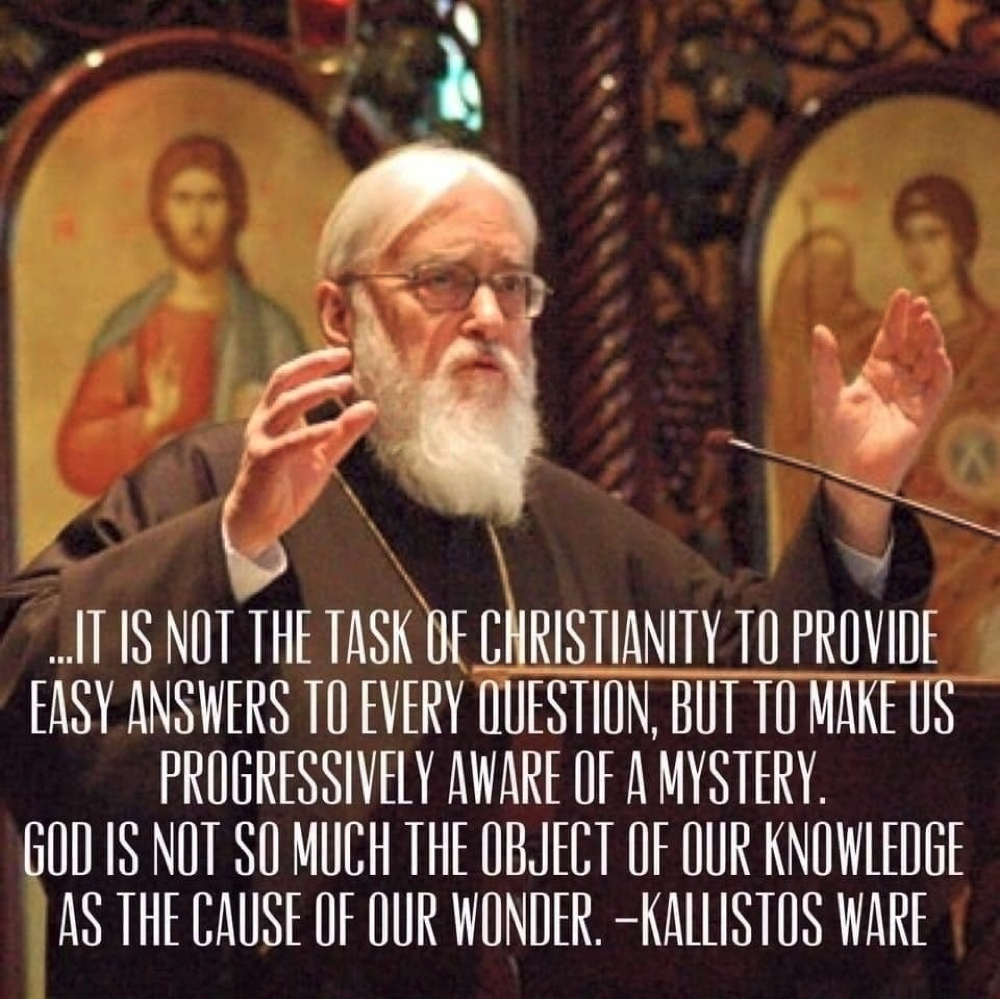
Metropolitan Kallistos Ware has reposed in the Lord

Metropolitan Kallistos Ware reposed in the Lord last Tuesday.

“Let me keep my distance, always, from those who think they have the answers.

Let me keep company always with those who say "Look!" and laugh in astonishment, and bow their heads.”

Mary Oliver, Evidence: Poems

Against David Frenchism

I may have finally reached a tipping point trying to process David French’s commentaries on religion and politics. Henceforth, I will either not bother at all or at least approach his columns and podcasts with an attitude of “tell me, in the first paragraph or two, why I should stick around and hear you out.”

I’ll still listen to him on law, but I don’t think he has anything I need to hear about the intersection of religion and politics.

That problem isn’t that he’s anti-Trump, goodness knows. The problem is that he’s reflexively parochial, and his “parish” is white Evangelicalism; that he says “Christians” when he means “white Evangelicals” drives me to distraction.

(Deep breath.)

I suppose this bugs me so much because French is writing and podcasting in secular, not Evangelical, spaces. He’s being read by people who may judge all of Christianity by his fixations on North American white Evangelical grotesqueries.

There is a Church that is rooted far deeper in history than the Second Great Awakening, utterly orthodox in its Christianity, and ambivalent-to-indifferent in its politics (the impressions of some American converts notwithstanding). If you’ve read me for long, you know where I think it’s found. All we ask of a polity is that we may lead a calm and peaceful lives in all godliness and sanctity.

But you’d never appreciate that by reading David French, who basically tells the Western world that “Christians be like Falwell Jr. and Orange Man.” That’s just not true, and eliding Christianity with Evangelicalism turns people off to the holy and life-giving potential of authentic, historic Christianity.

Up with Jake Meadorism

Here is one of the arguments some friends have made in defending the evangelical hard pivot toward Trump and right-wing politics more generally: The country is changing. No one will be friendly to all of our beliefs or values. However, if the progressives win, the likeliest outcome is some blending of dhimmitude and persecution. On the other hand, if the right wins, religious liberty will at least mostly be safe and we’ll be left alone. So it makes sense for orthodox Christians to migrate rightward.

The difficulty I see with this: Our churches do not exist within sealed spaces closed off from the world outside the congregation. Rather, our parishioners are being discipled all the time by the networks they participate in. So when we strengthen our ties to the political right and, in particular, when we tend to look past or gloss over the right’s sins for sakes of the political coalition (which is just a reality of life with any political coalition you try to participate in), we aren’t simply retreating into a stable space where right-wing governments protect our stable, faithful Christian communities. Rather, our communities are being shaped through the very act of partnering with specific groups, of speaking about some sins and not speaking about others. These things are, in themselves, formative.

To get his core insight, I had to quote most of his short post, but there is a bit of good stuff left, and with no paywall, either.

Jake Meador, Places of Refuge are Places of Discipleship. Meador, too, is Protestant, and as a Reformed Christian, he (as did I) appears to think himself Evangelical or Evangelical-adjacent. Unlike French, he doesn’t parochially collapse Christianity into Evangelicalism.

Why I Will Disregard any American Episcopalian Who Complains About Small States Getting As Many Senators as Big States

“Yes, a bishop’s episcopal charism does not depend on the number of worshipers in their see. But when almost all the micro-dioceses are in the west, and when western bishops are disproportionately present at Lambeth 2022, this is white privilege in action," he wrote. "Lambeth 2022 is taking place even though the bishops of half of African Anglicans have refused to come. Their dioceses constitute a third of the total Anglican Communion. Western bishops may say ‘it was their choice not to come.’ But this is not a good look."

Terry Mattingly, Some trends in global Anglican Communion are starting to look rather Black and White — GetReligion

Context:

  • Many western bishops lead "micro-dioceses" with under 1,000 active members or "mini-dioceses" with fewer than 5,000.
  • The Church of Nigeria claims 17 million members and 22 million active participants.
  • Uganda has 10 million members
  • Rwanda has 1 million members.

A Christian Culture (for the very first time)

By pretty much all measures, the Orthodox Christian countries of Eastern Europe take their faith more seriously than the Catholic countries further West or the Protestant countries which mainly lie around the continent’s fringes. I should really say ‘former Protestant countries’ because, as I have written here in the past, these countries – including mine, Britain – are now post-religious. Faith has been replaced by politics, ideology, activism or the material and technological idolatry which we call ‘progress.’

All of which means that I have until recently never seen a real Christian culture, of the kind my country used to be many centuries ago, and my adopted country, Ireland, used to be until more recently.

Paul Kingsnorth, Intermission: Monasteries of Romania #1

Godsplaining to the Archbishop

“If we say our God is an all-loving god, how do you explain that at any given time probably 400 million living on the planet at one time would be gay?” he asked. “Are the religions of the world, as does Catholicism, saying to those hundreds of millions of people, ‘You have to pass your whole life without any physical, genital expression of that love?’”

Archbishop Rembert G. Weakland, recently deceased, to the New York Times in 2009, roughly seven years after exposure of his hush money payment to a male lover (or rape victim).

It is suggestive that “the religions of the world” seem, to the disgraced Archbishop, to speak with one voice. How could that be if the idea of lifelong sexual abstinence is so stupid? Might it be that the spirit of our age is the anomaly, the deviation from the wisdom of the ages?

Did the Archbishop not confess that Mary, the “Mother of God,” remained ever a virgin? Or did he, like a highly multiparous protestant I corresponded with at some length, rule out Mary’s ever-virginity because that would be “perverted”?

Further, it is famously not just the Church that tells people “You have to” do something you’d rather not do, See, e.g., decalogue.

Still further, surely a substantial part of the work of the Church is dealing sacramentally and pastorally with people who fail to live up to divine expectations. See, e.g., confession.

Finally, the surmised number of gay people is irrelevant to the correct answer to the Archbishop’s tendentious question.

To get other glimpses of the odious decedent, see Rembert Weakland, Proud Vandal

Youth alienation then and now

[T]he thing that disturbs me the most right now is that the conversations often that I’m having with younger evangelicals. When someone says to me I’m thinking about walking away, it’s usually a very different conversation than I would have had 10 years ago. 10 years ago, it would have been with a younger person saying I just can’t believe the supernatural stuff that we believe anymore. Or I really think the moral ideas of the church are too strict and too judgmental, and I want to walk away.

Now it’s almost the reverse, almost directly the reverse. It’s people who are saying, I don’t think the church believes what it says it believes and what it’s taught me, or at least I fear that it doesn’t.

[W]e’re not looking for some Christian America in the past because in order to do that, we would have to redefine what we mean by Christian … [i]n all sorts of ways that I think are harmful.

Russell Moore

Repentance

Repentance is everything you do to get sin, those inborn passions, out of you. It’s reading, thinking, praying, weeding out disruptive influences in your life, sharing time with fellow Christians, following the guidance of the saints. Repentance is the renunciation of what harms us and the acquisition of what is beneficial to us, writes a holy counselor.

Dee Pennock, God’s Path to Sanity

Demoting free exercise

In essence, [Employment Division v.] Smith demoted the Free Exercise Clause of the First Amendment to a glorified nondiscrimination doctrine. Rather than granting Americans an affirmative right to practice their religion absent compelling governmental reasons to restrict that practice, the Free Exercise Clause becomes almost entirely defensive—impotent against government encroachment absent evidence of targeted attack or unequal treatment.

David French


[S]ubordinating truth to politics is a game which tyrants and bullies always win.

Jonathan Rauch, The Constitution of Knowledge

The Orthodox "phronema" [roughly, mind-set] cannot be programmitized or reduced into shibboleths.

Fr. Jonathan Tobias

You can read most of my more impromptu stuff here (cathartic venting) and here (the only social medium I frequent, because people there are quirky, pleasant and real). Both should work in your RSS aggregator, like Feedly or Reeder, should you want to make a habit of it.

Wednesday, 8/24/22

Are all the laws but one to go unexecuted, and the Government itself go to pieces …?

On January 6, 2021, from a parking garage under the Capitol Visitor Center, then–Vice President Mike Pence ordered the military to defend the Capitol against a violent insurrection. According to a taped deposition of General Mark Milley, the chairman of the Joint Chiefs of Staff, Pence “issued very explicit, very direct, unambiguous orders” to him and Secretary of Defense Christopher Miller: “Get the military down here. Get the Guard here. Put down this situation.”

In ordinary circumstances, Pence’s actions would be unconstitutional. Indeed, a vice president who usurped the president’s constitutional authority, and the Cabinet and military officers who followed his orders, could be committing an impeachable offense. …

Jefferson also insisted, the officer who exercises emergency power must justify his actions to “his fellow citizens generally.” For Jefferson, “the good officer” must throw “himself on the justice of his country and the rectitude of his motives.”

From his title (Mike Pence Owes the Country an Explanation) and the first paragraph, I easily figured out where George Thomas was headed and why: he wants Pence to say he perceived an emergency if only because Donald Trump was failing to put down the rump insurrection.

What I didn’t expect was that he would bring Jefferson and Lincoln into it and would persuade me of his case — and by inference to repent of my former judgment on Lincoln for his ultra vires acts.

Yup, the world is messy sometimes. This once was one of my favorite quotes, in part because it challenged my purity fetish:

Purity … is not the one thing needful; and it is better that a life should contract many a dirt-mark, than forfeit usefulness in its efforts to remain unspotted.

William James, Varieties of Religious Experience Lectures 14 and 15, via here.

Sorting out a jumble

[W]e have no ideal path forward. We’re damned if Attorney General Merrick Garland goes forward with a Trump prosecution and damned if Garland holds off. But the latter path should nonetheless be treated as a viable Plan B because it permits the Democrats to continue beating Trump in the political arena by the widest possible margin. That involves all kinds of risks as well, but it’s less risky than the legal option.

Damon Linker, summarizing the case against prosecution that he’s been trying to make.

More:

  • To use the full powers of federal law enforcement during a Democratic administration to indict, try, convict, and punish this man would drive large numbers of Republicans even further into Trump’s arms …
  • The goal should be his political defeat—turning him into a loser in the court of public opinion—not using an extra-political workaround to try and exile him from political competition. If you think making Hitler and Chamberlain analogies clarifies these issues, good for you. I think it’s pretty idiotic.
  • For the sake of argument, I’ve been happy to concede the point and assume Trump is guilty of … something. But is it true? [] After reading a highly illuminating exchange between widely respected legal scholar Jack Goldsmith and journalist Josh Marshall, I’m honestly not sure.
  • Could it be that all of the sound and fury I’ve seen online from the left about the imperative of punishing Trump’s self-evident criminality is based on nothing more than a feeling, a conviction, a moral certainty that he simply must be guilty of something? If so, that would be a further sign that loathing for the former president is a fundamentally political impulse, not a legal one.

Maybe I’ll take a position on “prosecute or nolle prosequi” when someone convincingly shows that Trump committed an actual crime, and that prosecution will be a slam-dunk. Considering the proportion of Trumpists in the land, I’m not sure you’ll ever impanel a jury without one or with one that will vote to convict.

Why colleges are failing

The present model of colleges and universities is failing, for in the first place they have forgotten or even turned against their original mission; in the second, they have picked up a whole lot of unrelated sidelines, none of which they do very well, such as universal job certification; and in the third, the public is beginning to catch on that they cost far too much, and that other institutions can usually do each of these sidelines better.  Barring root and branch reform – for which we must never give up hope — it’s entirely possible that in the not-so-distant future, serious humanities teaching will have to migrate to other settings than colleges and universities.

J Budziszewski

Detritus

In a nutshell

Democracy disconnected from liberalism will not protect diversity, because majorities will use their power to repress minorities.

Francis Fukuyama, Liberalism and Its Discontents

Be careful what you ask for …

History is a prankster. You order a Gray Champion, and cosmic room service sends up a casino developer and New York real estate mogul with a laughable hairdo…

James Howard Kunstler, Living in the Long Emergency

How low can we go?

Hillary Clinton versus Donald Trump seemed like some kind of nadir, but the Florida panhandle is showing that we can go even lower: Matt Gaetz versus Rebekah Jones

Institutions trumping instinct

But it is in fact individualism and not sociability that developed over the course of human history. That individualism seems today like a solid core of our economic and political behavior is only because we have developed institutions that override our more naturally communal instincts.

Francis Fukuyama, The Origins of Political Order

One thing leads to another …

I was good at menial jobs like parking cars but went into radio because it was Minnesota and vacuum tubes give off heat. It was public radio where all the announcers sound like Methodist ministers except not as friendly and there is no Jesus, and I distinguished myself by telling jokes and stem-winding stories about a small town. People liked it; go figure.

Garrison Keillor

American exceptionalism plus

It’s American exceptionalism but goes beyond that. It says that we are the next version of Israel from the Old Testament, that we are God’s chosen nation, and that is a special covenant — a two-way agreement with God. We can’t break it, and if we do, what happened to Israel will happen to us: We will be overrun by whatever the next Babylon is, taken into captivity, and He will remove His blessing from us.

Zack Stanton, It’s Time to Talk About Violent Christian Extremism – POLITICO

Maybe a bit harsh

I would rather have gonorrhea than a record of passionate and convinced #MAGA tweeting.

Graeme Wood, What to Do With Trumpists – The Atlantic.

Maybe a bit harsh, but then it’s dated 1/19/21, the day before Joe Biden officially became President despite Trump’s lawless efforts to retain the Presidency.


[S]ubordinating truth to politics is a game which tyrants and bullies always win.

Jonathan Rauch, The Constitution of Knowledge

You can read most of my more impromptu stuff here (cathartic venting) and here (the only social medium I frequent, because people there are quirky, pleasant and real). Both should work in your RSS aggregator, like Feedly or Reeder, should you want to make a habit of it.

Sunday, 8/21/22

Archeology: a fancy word for speculating about our ancestors

Another distinguished writer, again, in commenting on the cave-drawings attributed to the neolithic men of the reindeer period, said that none of their pictures appeared to have any religious purpose; and he seemed almost to infer that they had no religion. I can hardly imagine a thinner thread of argument than this which reconstructs the very inmost moods of the prehistoric mind from the fact that somebody who has scrawled a few sketches on a rock, from what motive we do not know, for what purpose we do not know, acting under what customs or conventions we do not know, may possibly have found it easier to draw reindeer than to draw religion.

G.K. Chesterton, The Everlasting Man

In the same vein, David MacCauley, Motel of the Mysteries

Worth repeating

Frederick Buechner has met Christians who remind him of American tourists in Europe: Not knowing the language of their listeners, they speak the language of Zion loudly and forcefully, hoping the natives will somehow comprehend. They seem cocky with faith, voluble with their theology, and content with a God who resembles a cosmic Good Buddy. Their certitude both fascinates and alarms him.

Phillip Yancey, Frederick Buechner, the Reverend of Oz

The Machine almost compels a bit of hypocrisy

To fail to reach lofty goals is not hypocritical, and even to publicly defend those goals while knowing you have failed to reach them is not hypocritical if you are open about your limits.

… If stepping outside the Machine were possible, then it would not be necessary.

Irony is politically important. It is important because anything less than an unreachable ideal will be caught by the Machine, eviscerated, repackaged, and sold back to you in a form that is exactly the same apart from the way that it drains everything good from your soul. No idea, no belief, no institution, and no practice is beyond the Machine’s grasp. Only the ideal, being formless, is safe. Of course, the ideal, being formless, is also beyond our grasp, so we cannot cling to it for safety. If we try, then we will cling instead to our idea of it; and if we do that, we will soon find out that our idea was the Machine’s all along. The only way to succeed is by committing so completely that failure is inevitable. And this is the other reason why we need irony. The completeness of our failures reveals to us the depths of our absurdity. This is a gift. Will-to-power needs us take ourselves seriously. It is the product of pride and it struggles when we genuinely laugh at ourselves.

FFatalism, Is asceticism ascetic?

Reassurance

I was a conscientious objector in the Vietnam era, who ended up serving his country by, so to speak, emptying bedpans in Peoria. In the ensuing decades, I’ve never become a hawk, but I’ve wondered whether I was right back then, whether I was trying to retain a purity that this fallen world doesn’t really allow.

Yesterday, I read this (including the full surrounding essay) from a Priest who, serving as chaplain “for the airmen who dropped the atomic bombs on Hiroshima and Nagasaki in August 1945, and gave them his blessing”:

Ethical hairsplitting over the morality of various types of instruments and structures of mass slaughter is not what the world needs from the church, although it is what the world has come to expect from the followers of Christ. What the world needs is a grouping of Christians that will stand up and pay up with Jesus Christ. What the world needs is Christians who, in language that the simplest soul could understand, will proclaim: the follower of Christ cannot participate in mass slaughter. He or she must love as Christ loved, live as Christ lived and, if necessary, die as Christ died, loving ones enemies.

For the 300 years immediately following Jesus’ resurrection, the church universally saw Christ and his teaching as nonviolent. Remember that the church taught this ethic in the face of at least three serious attempts by the state to liquidate her. It was subject to horrendous and ongoing torture and death. If ever there was an occasion for justified retaliation and defensive slaughter, whether in form of a just war or a just revolution, this was it. The economic and political elite of the Roman state and their military had turned the citizens of the state against Christians and were embarked on a murderous public policy of exterminating the Christian community.

Yet the church, in the face of the heinous crimes committed against her members, insisted without reservation that when Christ disarmed Peter he disarmed all Christians. Christians continued to believe that Christ was, to use the words of an ancient liturgy, their fortress, their refuge, and their strength, and that if Christ was all they needed for security and defense, then Christ was all they should have. Indeed, this was a new security ethic.

Father George Zabelka, Blessing the Bombs.

Father George is right about Christian history. The Orthodox Church required a time of repentance, including abstention from the Eucharist, for soldiers who had killed even in a “just war.”

I find reassurance for my youthful conscientious objection in that, thought I was inspired more by Menno Simons (“Spears and swords of iron we leave to those who, alas, consider human blood and swine’s blood of well-nigh equal value.“) than by the Fathers of the Church.


You can read most of my more impromptu stuff here (cathartic venting) and here (the only social medium I frequent, because people there are quirky, pleasant and real). Both should work in your RSS aggregator, like Feedly or Reeder, should you want to make a habit of it.

Saturday, 8/20/22 (no politics)

Following up my last post, the non-political portion of the stuff I’d collected.

RIP

More on Beuchner

Again, with the caveat that I never read any Beuchner:

His first novel was a great success. After his second, he came to faith. He was attending a church service in New York where the pastor was talking about how Jesus is crowned amid confession, tears and great laughter. “At the phrase great laughter, for reasons that I have never satisfactorily understood, the great wall of China crumbled and Atlantis rose up out of the sea, and on Madison Avenue, at 73rd Street, tears leapt from my eyes as though I had been struck across the face.”

He spent the rest of his life as a border-stalker, too literary for many Christians and too Christian for the literary set. His faith was personal, unpretentious and accessible. “Faith is homesickness. Faith is a lump in the throat. Faith is less a position on than a movement toward.” It is sensing a presence, not buying an argument.

David Brooks, The Man Who Found His Inner Depths

“Too literary for many Christians” means “not sufficiently neat, tidy and pious.”

Norah Vincent

Another author I’ve heard of but not read. (You can learn a fair amount by reading New York Times obituaries.)

In her year and a half living as Ned, Ms. Vincent put him in a number of stereotypical, hypermasculine situations. He joined a blue-collar bowling league, though he was a terrible bowler. (His teammates were kind and cheered him on; they thought he was gay, Ms. Vincent learned later, because they thought he bowled like a girl.)

He spent weeks in a monastery with cloistered monks. He went to strip clubs and dated women, though he was rebuffed more often than not in singles bars. He worked in sales, hustling coupon books and other low-margin products door-to-door with fellow salesmen who, with their cartoon bravado, seemed drawn from the 1983 David Mamet play “Glengarry Glen Ross.”

Finally, at an Iron John retreat, a therapeutic masculinity workshop — think drum circles and hero archetypes — modeled on the work of the men’s movement author Robert Bly, Ned began to lose it. Being Ned had worn Ms. Vincent down; she felt alienated and disassociated, and after the retreat she checked herself into a hospital for depression.

She was suffering, she wrote, for the same reason that many of the men she met were suffering: Their assigned gender roles, she found, were suffocating them and alienating them from themselves.

“Manhood is a leaden mythology riding on the shoulders of every man,” she wrote, and they needed help: “If men are still really in power, then it benefits us all considerably to heal the dyspeptic at the wheel.”

Norah Vincent, Who Chronicled Passing as a Man, Is Dead at 53 – The New York Times. The book alluded to is Self-Made Man.

Science and sciencey

Big Bang?

Another one bites the dust.

Science is tentative, reformable. And so it’s too early conclusively to bid adieu to the Big Bang hypothesis. But stay tuned.

Total dudes, or at least dude-adjacent

I’m glad the hospital produced these videos. They ought to be open about what they’re doing to children. And I’m glad these doctors are talking about their diagnoses of toddlers who dare to play with the wrong color toys or teen girls who hate their bodies. It’s then extremely fair to simply disagree and say, hey this isn’t good. As a former toddler who played with trucks, I’m glad I’ve managed to keep my uterus as long as I have.

Nellie Bowles, Last Hurrah Before the Baby!.

Nellie played with trucks. She’s lesbian, not male, not trans. And she’s having a baby (from her womb, not from her “wife” or a surrogate). I firmly believe that some girls who play with trucks are straight.

The most infuriating part of the trans mania to me is that it takes the most simplistic stereotypes of gender-appropriate behavior and turns deviation from them as evidence of transgender identity. Far likelier that it’s non-conclusive evidence (i.e., a hint) of homosexuality.

The second most infuriating part is of pseudo-science like trans medicine (also from Nellie):

In the new gender belief system, female-ness and male-ness are feelings, removed from the physical body. So what is femaleness, then? It is a sense of weakness, receptivity, softness, and submission. Duh.

And so it makes sense that a powerful, dominant uterus-haver in, say, 15th-century France, could not possibly have identified as a woman, not if she (they?) knew what we know now. Shakespeare’s Globe Theatre is putting on a play about the life of Joan of Arc, and in it she is not a she at all. How could she be? Joan is strong and independent! So Joan is recast as a nonbinary hero and goes by they/them. From the Globe’s website announcing the show:  “Joan finds their power and their belief spreads like fire.” (Spreads like fire . . . you see Joan was burned at the stake, so they’re doing a metaphor with that.)

You know who else was nonbinary, according to the new academic experts? Elizabeth I! Yes, all through history powerful people who thought they were women were, in fact, total dudes or at least dude-adjacent. All of them, from Cleopatra to Sojourner Truth—they were never women. That was just us imposing the gender-binary on all these super awesome people of indeterminate identity.

The way to know that this is sexism is to imagine something similar being done to a historical man. Like: this historical man was really submissive and quiet, so our play now re-imagines him as a woman, which we think he was.

Legalia

Now that you’ve joined our sleeper cell …

here are some guidelines for staying below the enemy’s radar.

Creepy posts like this will certainly not do anything to attract emotionally healthy people who are reticent about integralism or other postliberal legal approaches.

1000 words

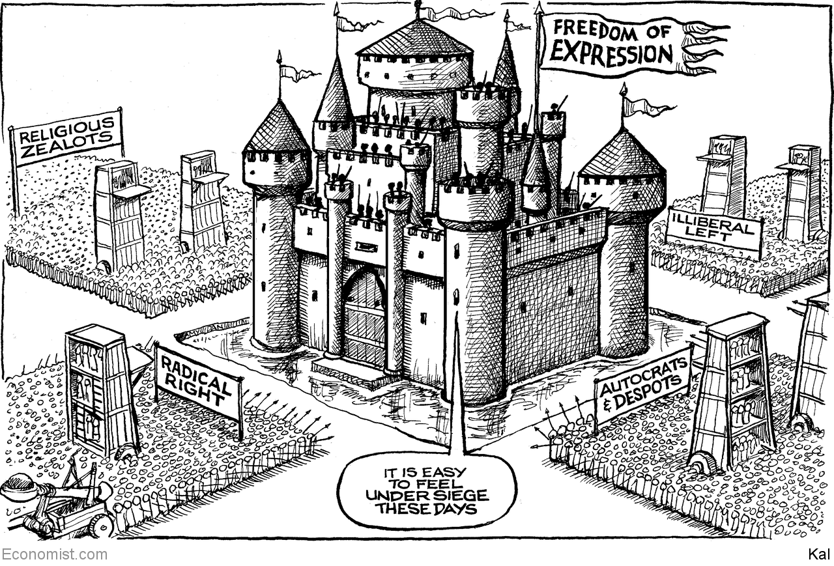
Unusually good KAL cartoon this week in the Economist:

Originalism

Originalism has become, as Richard Primus of the University of Michigan Law School says, a “surname of a family of approaches to constitutional law” that might not recognise one another around the dinner table.

America tussles over a newly fashionable constitutional theory (The Economist)

I’m growing increasingly convinced that originalism is the correct way to analyze constitutional questions, but Professor Primus isn’t totally wrong, either. Inter-originalism tussles will, I hope, resolve to a shared method.

How could there be multiple members of the “originalism” family that don’t recognize one another? Well, for instance, an originalism that reflexively looks only to first founding and averts its eyes from the post-Civil War amendments is missing the mark:

Elizabeth Wydra, president of the Constitutional Accountability Centre, a law firm and advocacy organisation, is not waiting for liberals to take hold of the court. She finds powerful originalist sources for progressive causes—especially in the Reconstruction Amendments. These provisions, which ended slavery and guaranteed equal rights for formerly enslaved people, “reflect broad conceptions of equality, inclusion and liberty”. For true originalists, Ms Wydra says, “the 14th Amendment should matter just as much to you as the Second Amendment.”

This doesn’t mean I’ll agree with Ms. Wydra’s conclusions on cases, but she’s right that the nation had a “second founding” 160 years ago, and that, too, affects “original meaning.”


“The Frenchman works until he can play. The American works until he can’t play; and then thanks the devil, his master, that he is donkey enough to die in harness ….” (G.K. Chesterton)

You can read most of my more impromptu stuff here (cathartic venting) and here (the only social medium I frequent, because people there are quirky, pleasant and real). Both should work in your RSS aggregator, like Feedly or Reeder, should you want to make a habit of it.

Wednesday, 8/17/22

What fools we mortals be

Proof that he knows better

I once ran into an old acquaintance at a Middletown bar who told me that he had recently quit his job because he was sick of waking up early. I later saw him complaining on Facebook about the “Obama economy” and how it had affected his life. I don’t doubt that the Obama economy has affected many, but this man is assuredly not among them. His status in life is directly attributable to the choices he’s made, and his life will improve only through better decisions. But for him to make better choices, he needs to live in an environment that forces him to ask tough questions about himself. There is a cultural movement in the white working class to blame problems on society or the government, and that movement gains adherents by the day.

J.D. Vance, Hillbilly Elegy. The movement to blame someone else now seems to have Vance as one of its leaders.

The great paradox of “queer” ideology

The great paradox of “queer” ideology is that it both seeks the margins and then complains about being marginalized! It wants both the frisson of outsiderdom and total acceptance by insiderdom. It’s the kind of reasoning you expect from a toddler not a grownup. The “centering” of the “marginalized” is how critical queer theory always eventually disappears up its own backhole.

Norm McDonald once said of the term “cisgender” that “it’s a way of marginalizing a normal person.” And he’s right. When “queer theorists” insist they are about diversity, they mean the opposite. The point is not to live and let live; it is to impose their queerness on everyone — to make themselves feel more secure.

Andrew Sullivan

Strategic Name-choosing

“I figured if I called myself Dykewomon,” she joked in an interview with J: The Jewish News of Northern California this year, “I would never get reviewed in The New York Times. Which has been true.”

Obituary of Lesbian “author, poet and activist” Elana Dykewomon (neé Nachman) in the New York Times

Solomon Asch’s corollary

In a famous 1951 experiment, the psychologist Solomon Asch showed how easily humans can be manipulated by social pressure to conform. If everyone else in the room affirms even the most blatant falsehood, we will very often affirm it ourselves, even denying the clear evidence of our own eyes.

But a variation of the Asch experiment gives hope. If only one other person in the room—a single reality ally—tells the truth, the pressure to conform drops sharply and we become much more willing to buck the lie. That is why authoritarian regimes work so furiously to stifle opposition voices, even seemingly weak ones. It is what the Soviet dissident Aleksandr Solzhenitsyn was getting at when he said, “The simple act of an ordinary brave man is not to participate in lies, not to support false actions! His rule: Let that [lie] come into the world, let it even reign supreme—only not through me.”

Jonathan Rauch, The Reality Ally (Persuasion)

So, I’ll join the alliance: Joe Biden won the 2020 Presidential Election. He did not steal it.

Does everyone have a narrative?

Yes, the legacy media, like the New York Times, have a narrative. But so do (some? most?) upstart media, like Quillette.

Ken White (Popehat) demolishes an absurd Quillette story, twisted and jammed into the narrative “kids today are intolerant snowflakes.”

What the story actually shows, stripped of handwaving and unwarranted characterizations, is some private school students protesting perfectly appropriately when a powerful lawyer and Harvard Professor subjected them to repeated use of the word “nigger,” part of the title of a book by another powerful professor. And, ironically, the professor who claims to have been cancelled by kids silently walking out on his lecture, is famously, even performatively, in favor of free speech and expression — for himself, apparently, but not for those who would protest his ideas.

People disagreeing with you or protesting you without trying to silence or deplatform you is not what generally is meant by “cancellation.”

But the Quillette article fits my worldview, so I might have bought it had Popehat not intervened.

‘Murica

Sclerosis plus ideological capture

America’s response to Covid-19 went badly not just for Trump-related reasons, but because of problems inherent to our public health edifice, from bureaucratic sclerosis to the ideological capture of putatively neutral institutions …

And then along with these failures came an absurd ideological spectacle, in which health officials agonized about how to state the obvious — that monkeypox at present is primarily a threat to men who have sex with men — and whether to do anything to publicly discourage certain Dionysian festivities associated with Pride Month. As the suffer-no-fools writer Josh Barro has exhaustively chronicled, public-health communication around monkeypox has been an orgy of euphemism and wokespeak, misleading and baffling if you don’t understand what isn’t being said.

This, too, has repeated Covidian failures. The political anxiety about saying or doing anything that might appear to stigmatize homosexuality mirrors the great public-health abdication to the George Floyd protests — in which a great many members of an expert community that had championed closures and lockdowns decided to torch their credibility by endorsing mass protests because the cause seemed too progressive to critique.

In each case what’s been thrown over is neutrality — the idea that public health treats risky behaviors equally, regardless of what form of expression they represent …

[S]peaking for myself, as a citizen with a personal interest in medical controversy, when I read the kind of blathering, newspeak-infused monkeypox advisories that Barro highlights, all I can think is: I can never trust anything these people say again.

Ross Douthat, The C.D.C. Continues to Lead From Behind – The New York Times

Priceless Americana

6-7 years back, I asked my eldest’s scout leader if he was a Christian. He said, “Of course, it’s the most important thing in my life.” I asked where he went to church and he replied, “I’ve never been, but my wife was raised Catholic.” For him, it was just another part of his … American identity.

One response to a social medium thread on churchless Christianity (that began with the thrown-down gauntlet “Being reliably right-wing doesn’t confer upon you the status of being an “orthodox Christian,” even if it is with a small ‘o.’”)

Is this how tribalism begins?

Protection of freedom of thought requires that no group should be permitted by law to express an opinion. For when a group starts having opinions, it inevitably tends to impose them on its members.

Simone Weil, The Need for Roots. I cannot concur with her literal sense, but today’s tribalism makes me think that she was directionally correct.

There are a number of tribalists who think me a traitor because I unexpectedly and publicly bucked the tribe — a tribe of which I was never a member, but only a co-belligerent.

Prophetic

Christian concern about popular culture should be as much about the sensibilities it encourages as about its content.

Ken Myers, All God’s Children and Blue Suede Shoes.

Just so you don’t miss the prophetic gravamen, not that the book predates social media and the ubiquitous smartphone. (And blogs, too, frankly.)

Hit list

The American Conservative has a list of cases it wants to see reversed now that Roe is reversed:

If you know all those cases without looking them up, you’re a better man than I am.

I’m sympathetic to overturning at least one of them. One other, On birthright citizenship, my reflex is that if Michael Anton or John Eastman is agin it, I’m fer it.

Did I mention that I’ve dropped my American Conservative subscription? So many sites I used to enjoy reading that I now avoid. Maybe I’m the one that’s changing (though I’m confident that the Trump-Sluagh has gotten to some of them).

It’s hard to admit that I really don’t fit anywhere other than an Orthodox Church (and that’s because the Church is mercifully broad in accommodating quirks).

George Soros is not off-limits

Democratic billionaire George Soros has, by his own admission, had an outsized influence on our politics over the years with his political donations—just as GOP mega-donors Sheldon Adelson, Paul Singer, and Charles and David Koch had on the right. “All well and good. America is a free country, and Soros has every right to spend his vast fortune however he wants within the boundaries of the law, as well as to justify that spending in the public square,” James Kirchick writes in Tablet Magazine. “[But] the same applies to those of us inhabiting lower tax brackets, who have no less a right to criticize Soros for how he’s trying to influence American public life.” Because Soros is Jewish, however, many progressives have adopted the tactic of dismissing any criticism of his political advocacy as anti-Semitic—a charge Kirchick, himself Jewish, believes is unfair. “The argument that the mere mention of the name ‘Soros’ is tantamount to antisemitism, which is effectively the position of the progressive political, media, and activist elite, is made entirely in bad faith,” he writes. “If the mind of a Soros supporter, upon hearing his name, races immediately to an image of a ‘Jew,’ and one who serves as a stand-in for ‘the Jews,’ it’s probably not the motives of the critic that need questioning.”

The Morning Dispatch, August 16, 2022

Isms

When I was young, there was a conservative book titled “Today’s Isms.” I was trying to figure out what ISMS stood for. It turns out, it stands for ideologies — communism, socialism, fascism. We could add a few today.

Islamism

There’s nothing freakish about the attack on Salman Rushdie:

And yet as shocking as this attack was, it was also 33 years in the making: The Satanic Verses is a book with a very bloody trail

In July 1991, the Japanese translator of the condemned book, Hitoshi Igarashi, 44-years-old, was stabbed to death outside his office at the University of Tsukuba, northeast of Tokyo. The same month, the book’s Italian translator, Ettore Capriolo, was also stabbed—this time, in his own home in Milan. Two years later, in July 1993, the book’s Turkish translator, the prolific author Aziz Nesin, was the target of an arson attack on a hotel in the city of Sivas. He escaped, but 37 others were killed. A few months later, Islamists came for William Nygaard, the book’s Norwegian publisher. Nygaard was shot three times outside his home in Oslo and was critically injured.

And those are stories we remember. In 1989, 12 people were killed at an anti-Rushdie riot in Mumbai, the author’s birthplace, where the book was also banned. Five Pakistanis died in Islamabad under similar circumstances.

Bari Weiss, We Ignored Salman Rushdie’s Warning

But would we back Rushdie were Satanic Verses being published today?

When Rushdie made those comments to L’Express it was in the fallout of PEN, the country’s premiere literary group, deciding to honor the satirical French magazine Charlie Hebdo with an award. Months before, a dozen staff members of Charlie Hebdo were murdered by two terrorists in their offices. It was impossible to think of a publication that deserved to be recognized and elevated more.

And yet the response from more than 200 of the world’s most celebrated authors was to protest the award. Famous writers—Joyce Carol Oates, Lorrie Moore, Michael Cunningham, Rachel Kushner, Michael Ondaatje, Teju Cole, Peter Carey, Junot Díaz—suggested that maybe the people who had just seen their friends murdered for publishing a satirical magazine were a little bit at fault, too. That if something offends a minority group, that perhaps it shouldn’t be printed. And those cartoonists were certainly offensive, even the dead ones. These writers accused PEN of “valorizing selectively offensive material: material that intensifies the anti-Islamic, anti-Maghreb, anti-Arab sentiments already prevalent in the Western world.”

Bari Weiss, We Ignored Salman Rushdie’s Warning

Trumpism

When I left Above the Law in 2019 for my two-year detour into legal recruiting, it was partly because of Donald Trump. Writing about the law in 2019 meant writing about Trump, and writing about Trump meant unpleasantness.

I returned to writing by launching Original Jurisdiction in December 2020, after Trump lost the presidential election, and I turned it into my full-time job in May 2021, after he left office. I thought it was safe to go back in the water.

Alas, here we are, more than 18 months after his administration’s end, and Trump still dominates the headlines. Almost every category in today’s Judicial Notice relates to the controversial ex-president.

David Lat, We Just Can’t Quit Him

Miscellany

A back-handed recommendation

I’m not generally given to wretched excess, but when I get into a six-episode Shetland on Britbox, I’m apt to binge-watch.

Breaking the Sabbath

The princess—I mean the Shiek’s daughter—was only thirteen or fourteen years old, and had a very sweet face and a pretty one. She was the only Syrian female we have seen yet who was not so sinfully ugly that she couldn’t smile after ten o’clock Saturday night without breaking the Sabbath.

Mark Twain, Innocents Abroad.

I’m not sure the princess would worry about breaking the Christian Sabbath. Twain should have made it “sundown Friday.”

Frederick Beuchner

[Frederick Beuchner] did not hold orthodox religious views.

“Contrary to widespread religious belief,” he wrote in a 1994 essay for The Times, “I don’t think God goes around changing things in the sense of making bad things happen to bad people and good things happen to good people, or of giving one side victory over the other in wars, or of pushing a bill through Congress to make school prayer constitutional.”

Robert D. McFadden’s obituary of Beuchner in the New York Times.

What an odd illustration of un-“orthodox religious views”!

Frederick Buechner has met Christians who remind him of American tourists in Europe: Not knowing the language of their listeners, they speak the language of Zion loudly and forcefully, hoping the natives will somehow comprehend. They seem cocky with faith, voluble with their theology, and content with a God who resembles a cosmic Good Buddy. Their certitude both fascinates and alarms him.

Phillip Yancey, ‌Frederick Buechner, the Reverend of Oz

With the caveat that I, oddly enough, cannot recall reading anything from “the most quoted living writer among Christians of influence” (though I’ve known the name for decades and decades), I recommend the Yancey piece, from Christianity Today, as far more perceptive than the Times obituary.


"The Frenchman works until he can play. The American works until he can’t play; and then thanks the devil, his master, that he is donkey enough to die in harness …." (G.K. Chesterton)

You can read most of my more impromptu stuff here (cathartic venting) and here (the only social medium I frequent, because people there are quirky, pleasant and real). Both should work in your RSS aggregator, like Feedly or Reeder, should you want to make a habit of it.

Tuesday, 8/09/22

I’m back from 5.5 pounds worth of Alaska Cruising. Alaska, even just in little towns along the southeast coast, was awesome. Next time I cruise, though (if there is a next time), I’ll avoid the buffet; I think I actually could have lost weight if I’d stuck with the main dining room.

Insight

The Meaning of Home

Ireland’s government is sabre-rattling about people burning wood or peat to heat their homes, as many are preparing to do in the face of possible rationing or cutoff of natural gas from Russia:

Something else is happening here, though. The campaign against warming your own house with your own fire is not quite what it claims to be. Sometimes it looks more like a displacement activity; as if a government and a nation which has no interest in actually cutting its consumerist lust down to size is going for an easy target. But it is also something with more symbolism, more mythic meat, than any discussion about ‘carbon emissions’ would suggest. The fireplace, whether our dessicated urban authorities know it or not, has a primal meaning, even in a world as divorced as ours from its roots and from the land.

Take the potential firewood ban. When you can no longer grow your own wood or cut your own turf to heat your own parlour, you are made that little bit more dependent on the matrix of government, technology and commerce that has sought to transmute self-sufficiency into bondage since the time of the Luddites. The justification for this attack on family and community sufficiency changes with the times – in seventeenth century England, the enclosures were justified by the need for agricultural efficiency; today they are justified by the need for energy efficiency – but the attack is always of the same nature. Each blow struck against local self-sufficiency, pride and love of place weaves another thread into the pattern which has been developing for centuries, and which is almost compete now in most ‘developed’ (sic) countries.

Like so much of Berry’s work, it locates the centrepoint of human society in the home, and explains many of the failures of contemporary Western – specifically American – society as a neglect of that truth. The home, to Wendell Berry, is the place where the real stuff of life happens, or should: the coming-together of man and woman in partnership; the passing-down of skills and stories from elders; the raising and educating of children; the growing, cooking, storing and eating of food; the learning of practical skills, from construction to repair, tool-making to sewing; the conjuration of story and song around the fire.

Universally, across the world and across cultures, the family and the home, however they were quite constituted, have always been the heart and root of culture. It follows, therefore, that the Machine must uproot both in order that culture may be destroyed and replaced with a marketplace in which we can buy and sell products, identities and ideologies while our ground source heat pumps maintain a constant and inoffensive temperature around us. Self-sufficient people, skilled people, independent people, thinking people: these are anathema; these are a threat. The home must go, so that the Machine might live.

In my lifetime, in my part of the world, the notion and meaning of ‘home’ has steadily crumbled under this external pressure until it is little more than a word. In a Machine anticulture, the ideal (post) modern home is a dormitory, probably owned by a landlord or a bank, in which two or more people of varying ages and degrees of biological relationship sleep when they’re not out being employed by a corporation, or educated by the state in preparation for being employed by a corporation.

Paul Kingsnorth, Keep The Home Fires Burning

Counter-intuitive consequences

The legislation also demonstrates one of the oddest results of the modern emphasis on the radical freedom of the individual. In such a world, all must theoretically be allowed to have their own narratives of identity. But because some narratives of identity inevitably stand in opposition to others, some identities must therefore be privileged with legitimate status and others treated as cultural cancers. And that means that, in an ironic twist, the individual ceases to be sovereign and the government has to step in as enforcer. The lobby group of the day then decides who is in and who is out, with the result that, in this instance, the gay or trans person who wants to become straight or “cis” (to use the pretentious jargon), cannot be tolerated. His narrative calls into question that of others. We might say that his very existence is a threat. To grant any degree of legitimacy to his desire is to challenge the normative status of the desires of others.

Carl R. Trueman, Prohibiting Prayer in Australia

The Arsenios Option

Jack Leahy has recently written about the Arsenios Option, a response to the times that he summarises as ‘flee, be silent, and dwell in stillness’. He draws on long traditions of asceticism; and I think these traditions, and people like him, are more important than is generally understood. When lives organised around the pursuit of luxury stop being possible, masses of people will need new sources of significance. At that point, ascetics can provide dramatic counter-examples that help society to refocus. It happened after Rome’s collapse. It may happen again.

A mind that takes no joy in the wonders of this age is as guilty of waging war on nature as the fools who cannot tell the difference between a factory and a farm. Some wonders do great harm, some should be renounced, and most are only here for a short season anyway. They are, nevertheless, wonders.

Those who would resist or avoid the Machine, the monster of coercion that slowly incorporates the whole world into itself, need this expansive joy that includes humans and the things we make. Joy helps us to see the enemy better.

FFatalism, Joy and laughter

Uppers

Sam the Man

Justice Alito, speaking in Rome, reportedly had some sharp words for Prince Harry, Boris Johnson, Emmanuel Macron and Justin Trudeau for their virtue-signaling criticism of the Supreme Court un-inventing the invented constitutional right to abortion.

[T]here is no prohibition on justices discussing cases publicly once they are decided, said Akhil Reed Amar, professor of constitutional law at Yale Law School. Alito’s comments weren’t about the underlying issue of abortion, but rather about foreign dignitaries weighing in on American law without necessarily being well versed in the subject, he said.

(Lindsay Whitehurst, Associated Press)

Precisely so, Professor Amar. If they won’t stay in their lanes, it’s appropriate to throw a few elbows when the get into ours.

How dare they be more careful!!!!

What’s being recommended now is a slower and more careful psychological assessment of each child to ensure that other factors — family stress, autism, depression, peer pressure, trauma — are fully explored, before a diagnosis is made.

Andrew Sullivan.

Who could object to careful consideration of other factors in diagnosing a problem? American transgender activists, that’s who. If a middle-school girl says she’s a boy, that should end the inquiry, say they.

Downers

Inchoate Rage

I left [CPAC in] Dallas with a deep sense of unrest about the future of America. People aren’t wrong to be angry! I don’t think I heard a single story in which the people who had been radicalized had no right to be angry over some very real injustice they had lived through, or watched happen to people they love. It’s that they saw no hope of justice coming via corrupted institutions, and apparently had no idea how to deal with the rage they felt.

Rod Dreher, Meeting ‘Father Maximos’ (emphasis in original)

All the green shoots have died

Previously, [Jonathan Haidt] explored the rise of adolescent depression, anxiety, and suicide in The Coddling of the American Mind (2018), written with free speech lawyer Greg Lukianoff. At the end of that book, the authors identified several “green shoots”—encouraging developments in politics and culture that could reverse these trends. But four years later, as America reels from COVID-19 and the final months of Donald Trump’s presidency, things have only gotten worse. “Massively worse,” in fact, Haidt tells me as we prepare to order our food. “We saw these green shoots and none of them have grown. All the green shoots are dead.”

Is this America’s future?

“Someone has been caused anxiety based on your social media post. And that is why you’re being arrested,” – a British policeman.

Via Andrew Sullivan

A bad, bad week for “follow the science”

Fake science: In one week, three major debunkings are a good reminder that “trust the science” is silly. Science is always a work in progress.

(Nellie Bowles)

Low-Down Liars

Your BLM Virtue-Signaling Money at Work

Shaun King used donor funds to buy a $40k dog: As the biological mother of two deranged shelter dogs, I actually didn’t know that you could spend $40,000 on a dog. But the Black Lives Matter activist Shaun King reportedly did just that, buying a very well-bred mastiff using donated money. Apparently rattled by the coverage, King defended the purchase and then took to social media to call for his followers to help him stalk two reporters who have covered his finances: “This is Kevin Sheehan of the @NYPost. ⁣He has been attacking me and my family. Send me photos of his home. Send me photos of him. ⁣And his family.”  And of Isabel Vincent, he wrote: “The amount of pain this woman caused my family is incalculable. Send me details and photos. Of her. And her home.” The key for King and others in the movement who’ve used money in sketchy ways is to terrify reporters away from covering it. Many are already too scared of their colleagues’ rage to look into BLM finances. But for anyone willing to get past that, King adds a little extra risk: He’ll make sure you’re physically unsafe that night.

Nellie Bowles (emphasis and hyperlinks omitted)

Monkeypox incoherence

People who meet all of the following conditions can now be vaccinated:

Gay, bisexual, or other man who has sex with men, and/or transgender, gender non-conforming, or gender non-binary Age 18 or older Have had multiple or anonymous sex partners in the last 14 days

New York City Health Department

There’s a notion that health officials need to lie a little to protect everyone’s feelings; it’s somehow hurtful to say guys there’s a bad virus, let’s slow down the summer parties. First, I really don’t think gay men are that sensitive. Also, you know what’s worse than hurt feelings? Getting freaking monkeypox! Oh sorry, I forgot that term is illegal now. Here’s New York City’s Department of Health and Mental Hygiene Commissioner: “We have a growing concern for the potentially devastating and stigmatizing effects that the messaging around the ‘monkeypox virus’ can have on these already vulnerable communities. Therefore, I write to urge you to act immediately on renaming the ‘monkeypox’ virus.” It’s a virus that manifests as horrible boils all over your body and health officials are freaking out about the name!

Nellie Bowles


"The Frenchman works until he can play. The American works until he can’t play; and then thanks the devil, his master, that he is donkey enough to die in harness …." (G.K. Chesterton)

You can read most of my more impromptu stuff here (cathartic venting) and here (the only social medium I frequent, because people there are quirky, pleasant and real). Both should work in your RSS aggregator, like Feedly or Reeder, should you want to make a habit of it.

Friday, 7/29/22

R.I.P. William Jon Gray

William Jon Gray, undoubtedly the best Choral Conductor I ever sang under, has died at his home in New York state at age 66. I have the impression (from someone saying “You sung under him?!”) that he was widely known in American choral music circles.

That’s all I know about his death at this point, the news having just come to me Thursday through the (reliable) grapevine.

Bill was Artistic Director of the Bach Chorale Singers from 1994 to 2010. I re-joined the Chorale, after a very brief prior experience in the 1980s, in 1997. In addition to his formal education, Bill learned from the Master, Robert Shaw, having sung with him for some period of time. He forever followed what I understand was “Mr. Shaw’s” practice of meticulously marking scores before distributing them to his singers and, heaven help us, count-singing. His other accomplishments can be seen at the first link, above.

The pinnacles of my experience with Bill were, in no particular order:

  • performance of Rachmaninoff’s Vespers,
  • a professional recording of the Latin Organ and Choral Music of Zoltan Kodaly, with Organist Marilyn Keiser, on the Pro Organo label. One track unfailingly brings tears to my eyes, and
  • in retrospect, sitting a couple of feet from our Guest Tenor Soloist, Lawrence Brownlee, days after he had won the Metropolitan Opera Auditions. (Bill said “Enjoy him. We’ll never be able to afford him again.”)

Signs of the Times

  • A handful of former Democratic and Republican officials announced Wednesday they are forming a new national political party—Forward—that they believe will appeal to voters frustrated with the United States’ current two-party system. The centrist party will be chaired by former Democratic presidential candidate Andrew Yang and former Republican New Jersey Gov. Christine Todd Whitman, and plans to gain ballot access in all 50 states in time for the 2024 presidential and congressional elections.
  • A new FBI search warrant claims the man who allegedly attempted to assassinate Justice Brett Kavanaugh last month was also planning to kill two other Supreme Court justices. The FBI alleges the man searched “assassin skills,” “most effective place to stab someone,” and “quietest semi auto rifle” online before he was arrested, and that he messaged unnamed users on Discord that he was going to “stop Roe v. Wade from being overturned” and that he would “remove some people from the Supreme Court.”

The Morning Dispatch, July 28.

Turning Point, USA?

I conducted dozens of focus groups of Trump 2020 voters in the 17 months between the storming of the Capitol on January 6 and when the hearings began in June. One measure was consistent: At least half of the respondents in each group wanted Trump to run again in 2024. The prevailing belief was that the 2020 election was stolen—or at least unfair in some way—and Trump should get another shot.

But since June, I’ve observed a shift. I’ve conducted nine focus groups during this period, and found that only 14 percent of Trump 2020 voters wanted him to run in 2024, with a few others on the fence. In four of the groups, zero people wanted Trump to run again. Their reasoning is clear: They’re now uncertain that Trump can win again.

[U]nlike the impeachment hearings, which in some ways made GOP voters more defensive of Trump, the accumulating drama of the January 6 hearings—which they can’t avoid in social-media feeds—seems to be facilitating not a wholesale collapse of support, but a soft permission to move on.

Sarah Longwell, The January 6 Hearings Are Changing Republicans’ Minds

In [Peter Thiel’s] view, much of what passes for “progress” is in truth more like “distraction”. As he puts it, “the iPhone that distracts us from our environment also distracts us from the ways our environment is unchanging and static.” And in this culture, economy and politics of chronic self-deception, as Thiel sees it, we tell ourselves that we’re advancing because “grandma gets an iPhone with a smooth surface,” but meanwhile she “gets to eat cat food because food prices have gone up.”

Mary Harrington, Peter Thiel on the dangers of progress.

One of many provocative observations in this long piece.

And yes, I’ve read accusations that he’s a fascist. I’m just saying he’s smart, not that he’s good.

Nothing pointless

Speaking of fascists …

Himmler quite aptly defined the SS member as the new type of man who under no circumstances will ever do “a thing for its own sake.”

Hannah Arendt, The Origins of Totalitarianism

Church/State

Lifeway research suggests that as many as 2/3 of American churches incorporate patriotic music into their liturgy for public worship during the time around the 4th of July holiday.

So this is one piece of the problem: For many of our nation’s white evangelicals, their patriotic commitments as Americans are so intertwined with their Christian faith that it is very hard for them to imagine a scenario where Christian fidelity actually requires them to reject standard American ideas about identity, wealth, success, and so on.

Jake Meador, Defining “White Evangelical Crap”.

Was MLK antiracist? Barack Obama?

Martin Luther King Jr.’s most famous speech would not meet Kendi’s definition of anti-racism, nor would the one Barack Obama made about there being too many fatherless Black families. Indeed, nearly everything that Americans have been taught about how to be anti-racist for the past several decades is, according to Kendi’s explicit definition, racist.

Bari Weiss, Stop Being Shocked

Flash!

This just in: With Russia at war in Ukraine, and Putin’s stench in American nostrils increasing, our 45th POTUS has declared himself an acolyte of Shiite cleric Muqtada al-Sadr now. al-Sadr’s followers are very special people.

(Pass it on.)

Note to Readers

I will be traveling for more than a week. I may or may not get a post scheduled for tomorrow or intermittently during travel, but I should be back sometime the week of August 7.

And I just realized that today is the 57th anniversary of my most serious accident, on a motorcycle at age 16.


“The Frenchman works until he can play. The American works until he can’t play; and then thanks the devil, his master, that he is donkey enough to die in harness ….” (G.K. Chesterton)

You can read most of my more impromptu stuff here (cathartic venting) and here (the only social medium I frequent, because people there are quirky, pleasant and real). Both should work in your RSS aggregator, like Feedly or Reeder, should you want to make a habit of it.

Sunday, 7/24/22

Francis Beckwith writes of his return to Roman Catholicism

Because I am a philosophy professor—someone who traffics in concepts, ideas, and arguments, and gets paid to do it—you would think my reversion was purely a matter of the intellect, that my choosing to return to full communion with the Church was the result of a detached rational consideration of the contending arguments offered by competing Christian groups. Although a decade ago I would have agreed with that account, or at least been highly sympathetic to it, I am not too sure about it anymore.

In my 2009 memoir, Return to Rome: Confessions of An Evangelical Catholic, I carefully explain what I thought were the primary reasons for my reversion. As I note in that volume, I was impressed and moved by the Catholic Church’s liturgical and doctrinal continuity with the earliest Christians, its unity and apostolicity even when enduring dissent and courting controversy, its uncanny ability to have within its ecclesial leadership both the wheat and the chaff while never abandoning the rule of faith, and its remarkable dexterity in remaining rooted in unchanging truths while faithfully addressing the theoretical challenges and practical problems endemic to every age and culture.

But now I realize that that cannot be the whole story. Becoming Catholic is not like buying a car, selecting a health-care plan, or picking out a pair of slacks tailored to one’s specifications. It is not just a matter of weighing pros and cons and making a choice. It is more like falling in love. Yes, you have your reasons, but you are also moved by something that is not directly under your control.

The Heart Has Its Reasons.

Every part of that resonates with me as I think on my journey from Evangelicalism to Calvinism to Orthodox, including the part where I was initially a bit deluded about the role of logic in it all.

The key event in modern disenchantment

It is certainly a beautiful space, but it felt looted to me. This is a statement about my own deep sacramental sensibility, I guess, and one about how difficult it is for me to get into a religious frame of mind in a Protestant space … The blankness of it all, you know? … For me, to be in a holy space like this fills me with an alienating sense of abstraction — as if God were far away and unlike us.

To be clear, I do recognize austere beauty in the Protestantized Oude Kerk, but it does testify to a faraway God. At least it feels that way to me — and this matters for my re-enchantment project. As with my previous two books, I am writing for all small-o orthodox Christians, and I want to be able to encourage my Protestant readers to find pathways back to enchantment. What I’m running hard up against is the fact that the Reformation was the key event in modern disenchantment.

Rod Dreher, In The Oude Kerk (emphasis added)

Gimme that new time religion

The better our science gets, it seems, the harder the creationists fight. As Ronald Numbers points out in his definitive history of creationism, at the beginning of the 20th century the first creationists did not contest geological time. Devising workarounds for the biblical six days, they concerned themselves with how life on Earth had come about. It is only in our own time that young Earth creationism has become a touchstone of fundamentalist belief.

The Webb telescope vs. young Earth creationism

The Commonality of Putative Opposites

Both the fundamentalist and the higher critic assume that it is possible to understand the biblical text without training, without moral transformation, without the confession and forgiveness that come about within the church. Unconsciously, both means of interpretation try to make everyone religious (that is, able to understand and appropriate scripture) without everyone’s being a member of the community for which the Bible is Scripture.

Stanley Hauerwas, Resident Aliens

A sense of entitlement

According to this vision, people need and are entitled to sexual activity: that is the underlying idea. A person deprived of sex has a life scarcely worth living.

Jennifer Robach Morse, The Sexual State: How Elite Ideologies Are Destroying Lives and Why the Church Was Right All Along.

I do not recommend this book. My objection is mostly to its tone, I suppose — like fingernails on a blackboard to me.

But the quoted excerpt hits a bullseye.

Illustration of how this even affects putative Christians. When I was new in Orthodoxy, I got into an excessively-long email discussion about Orthodoxy with a conservative activist woman of my acquaintance, who was a pastor’s wife in the Calvary Chapel movement (you can find less flattering accounts than the movement’s own mothership site by a simple search for "Calvary Chapel"). One of the most gobsmacking moments was how she denied the ever-virginity of the Virgin Mary (Theotokos in the ancient dogmas of the Church) roughly thus: "It would be perverted if she and Joseph didn’t have sex after Jesus was born." I’m quite certain that "perversion" was the concept she deployed.

I’m not aware (both from memory but also from seven decades of observing human behavior) of how powerful the sexual appetite is. I have reflected a lot on the ease with which one can slip into sexual sin, though I doubt it would be edifying if I tried to put my reflections into words. I feel less appalled and more "well, that seems to be business as usual" when it happens.

But the sheer presumptuousness of some motormouthed heretic calling the Virgin Mary a pervert, and by implication calling all Catholic and Orthodox monasticism perverted, still boggles my mind.

Preview

I’ve been gazing, then averting my gaze, from the hot steaming mess at Ravi Zacharias International Ministries since his postmortem disgrace. Nothing I’ve written is ready for prime time. Maybe it never will be. How do you write anything meaningful about the mystery of iniquity?


It’s a long way to Heaven dear Lord,
it’s a hard row to hoe
And I don’t know if I’ll make it dear Lord
but I sure won’t make it alone.

SmallTown Heroes, Long Road, from their one-and-so-far-only "byzantine bluegrass" album Lo, the Hard Times.

You can read most of my more impromptu stuff here (cathartic venting) and here (the only social medium I frequent, because people there are quirky, pleasant and real). Both should work in your RSS aggregator, like Feedly or Reeder, should you want to make a habit of it.