Thursday, 12/18/25

Quietly grassing up the neighbor

Of the Bondi Beach terrorist shootings by Muslim men Sajid Akram and Naveed Akram (unconfirmed by police at this writing) and the heroic intervention of one Ahmed al-Ahmed:

Let it be said, and said with firmness and gratitude, that a Muslim fruit seller named Ahmed al-Ahmed rushed one of the gunmen and disarmed him, saving Jewish lives and taking a couple of bullets himself for his trouble. May God bless that brave man. Here is video of him courageously tackling the gunman. This brings to mind something I was told back in 2002 by a Jewish friend who worked in counterterrorism. Be careful not to accuse every Muslim, she said. Some of our best sources are Muslims within Muslim communities who hate what they’re seeing, but know that if they speak out publicly against it, they will be killed. So they come to us quietly.

Rod Dreher

I wish we could figure out what makes many Muslims exemplary citizens, others murderous fanatics. Though I reject Islam as a false religion, I don’t want to think it’s simply that the former don’t take it seriously.

I have a theory, but it’s at a high enough level of generality that it’s not much use, I fear: that Islam, like Evangelicalism, has no authority beyond a sacred text, so Imams/Preachers can twist the text as they wish, limited only by what their congregants will tolerate.

The Other Terrorists

“Right-wing attacks and plots account for the majority of all terrorist incidents in the United States since 1994, and the total number of right-wing attacks and plots has grown significantly during the past six years,” the Center for Strategic & International Studies concluded after examining terror plots in the United States from 1994 to May of this year. “Right-wing extremists perpetrated two-thirds of the attacks and plots in the United States in 2019 and over 90 percent between January 1 and May 8, 2020.”

Nicholas Kristof, The Lawbreakers Trump Loves (August 29, 2020)

AI moves fast, breaks things

A woman in a service industry, an immigrant to America from Eastern Europe who’s been here about 20 years, took me aside recently. Her eldest child, a senior in high school, is looking around at local colleges. She was worried about AI and asked for advice on what her son might study so that in four years he could get a job. We asked ChatGPT, which advised “embodied in-person work” such as heating and air conditioning technician, pool cleaner. She wasn’t happy with that. She’d worked herself to the bone to get her son higher in the world than she is. She wants him to own the pool.

Peggy Noonan, Trump may be losing his touch

Grievance Memoirs

Political memoirs tend to fall into recognizable categories.

There is the sanitized precampaign memoir, gauzy life stories mixed with vague policy projects and odes to American goodness. There is the postcampaign memoir, usually by the losers, assessing the strategy and sifting through the wreckage. There are memoirs by up and comers who dream of joining the arena and by aging politicos rewriting their careers once more before the obits start to land. There are memoirs by former staff members who realize that proximity to power gives them a good story and memoirs by journalists who chronicle power so closely that they imagine themselves its protagonists.

But a recent spate of books highlights the presence of a new category, one well suited to our time: the grievance memoir. In their books, Eric Trump (“Under Siege”), Karine Jean-Pierre (“Independent”) and Olivia Nuzzi (“American Canto”) are all outraged by affronts real and imagined, fixated on nefarious, often unspecified enemies, obsessed with “the narrative” over the facts and oblivious to their complicity in the conditions they decry.

The authors (a third child embracing on to his father’s legal and political grudges, a former White House press secretary groping for a new brand, a boutique political journalist enmeshed in a self-made scandal) are animated, above all, by a certainty that they’ve been wronged not just by people or institutions but also by broader forces. They are ancillary characters inflating themselves into victims, heroes, even symbols. It is the inevitable memoir style for a moment when everyone feels resentful, oppressed, overlooked — in a word, aggrieved.

Carlos Lozado (who’s famous among his New York Times colleagues as a voracious book-reader).

Add to Lozado’s list a longish article by Jacob Savage in Compact magazine, which Rod Dreher found “one of the most powerful essays I’ve read all year.” Its gist seems to be that straight, white, young men can’t catch a break any more – for reasons predating AI.

Ross Douthat thinks Savage has a point; that Douthat has an opinion suggests that Dreher isn’t just playing Chicken Little again.

I’m fortunate to be chronologically beyond gathering personal straight white male grievance anecdotes (and that my grandson is thrilled at, not resigned to, the prospect of a sort of Shop Class As Soulcraft career).

Are we the baddies?

Remizov and other conservative democrats complain that modern Western liberalism is in fact anti-democratic, as it tramples on national traditions and subordinates national authorities to international ones and to the impersonal forces of globalization.

Paul Robinson, Russian Conservatism. This book is pretty good at giving the gift to see ourselves as others see us.

When your only tool is anger, every little problem looks infuriating

Trump has never shined in moments that call for dignity and restraint … This is what makes Trump’s post about the Reiners not just despicable and cruel but also bad for the country. In moments of national mourning or trauma, a president can seek to bring people together … But not Trump. He finds the most divisive way to insert himself … His choices … take moments that could be unifying—surely Americans of all political views can agree on the greatness of When Harry Met Sally and The Princess Bride—and turn them into opportunities for anger.

Which is, in effect, Trump’s political project.

David Graham, Trump Blames Rob Reiner for His Own Murder

Shorts

  • I like ebooks because nobody can tell that I’m performative reading. (@restlesslens on micro.blog)
  • Be regular and orderly in your life, so that you may be violent and original in your work. (Gustave Flaubert)
  • Insofar is not the same as inasmuch, and I don’t know why the current style is to break the former into three words.
  • I remember mocking people for thinking the Covid vaccine was Bill Gates’ way of getting microchips into us. Hmmm.
  • This is the paradox of politics: Every time you solve a major problem, you’re removing a weapon from your political arsenal. (Peggy Noonan, Trump may be losing his touch)
  • If “TDS” is the tendency to become irrationally obsessed with Donald Trump and project that obsession onto everyone else, then somebody is indeed deranged, and it wasn’t Rob Reiner. (David Graham, Trump Blames Rob Reiner for His Own Murder.
  • A tool always implies at least one small story[:] There is a situation; something needs doing. (L.M. Sacasas)
  • Anyone claiming to know the future is just trying to own it. (L.M. Sacasas)
  • After this awful weekend, Trump has once again lowered the bar for what we can expect from the president. (The Free Press, Mr. President, Don’t Mock the Dead)
  • The odds are good, but the goods are odd. (Advice given to incoming women at Georgia Tech).

Elsewhere in Tipsyworld


We are all gatekeepers now.

Peggy Noonan

Your enemies are not demonic, and they are not all-powerful and the right hasn’t always lost and the left hasn’t always won. But if you convince yourself of that, you give yourselves all sorts of permission to do a lot of stupid and terrible things under the rubric of “Do you know what time it is?”

Jonah Goldberg.

[A] critical mass of the American people … no longer want[s] to govern themselves, … are sick of this republic and no longer want to keep it if it means sharing power with those they despise.

Nick Catoggio

I don’t do any of the major social media, but I have two sub-domains of the domain you’re currently reading: (a) You can read most of my reflexive stuff, especially political here. (b) I also post some things on my favorite no-algorithm social medium.

Thursday, 12/4/25

Luxury Beliefs

There are all kinds of ideas and policies that would have bad effects if implemented. But there is a special class of bad ideas and policies that proliferate in good part because those who hold them, being insulated from their effects, have never seriously thought about the consequences that would ensue from their implementation. The reason why the concept of luxury beliefs has resonated so widely is that it gives a name to people who treat as a parlor game questions that potentially have very serious consequences—just not for themselves.

Yasha Mounk, Luxury Beliefs Are Real.

We owe a debt of gratitude to the young man who coined this phrase. It strikes me as analogous to the whoring and wenching of the rich and famous which does not, shall we say, translate well to kids in The Projects (but is more like a transgressive raised-middle-finger than a “belief”).

The Hive Mind

Consider this ominous anecdote from Steven Mintz, a history professor at the University of Texas at Austin:

I require substantial writing in my 400-person U.S. history survey course—but now I largely receive 400 variations on the same essay. The wording, structure, transitions, tone, even the closing sentences are largely identical.

This is eerily like the zombie-ish characters in Pluribus, who all say the exact same thing.

But in Mintz’s case, this is real behavior from real students. They have voluntarily abandoned their individual opinions and embraced the hive mind.

And the hive mind is available to all of them via Chat GPT.

I actually take some solace in TV series such as Pluribus and Severance. They show how anxious we are about this threat. At some deep level in our souls, we know that the destruction of our autonomy and selfhood is not a good thing.

It isn’t progress. It isn’t utopia. It isn’t liberation.

And that is the first step in escaping the ant hill. The next step is to bring others along with us.

This is why I keep talking about a New Romanticism (see here and here). That is our counter-offensive, and it’s already starting.

Ted Gioia, The New Anxiety of Our Time Is Now on TV (bold added)

Fundamental law

Ultimately, however, constitutionalism means that society must accept an unpopular policy that respects constitutional limits over a popular policy that violates them. The very foundation of constitutionalism is that certain fundamental protections—whether for free speech or the separation of powers—must be beyond the reach of popular majorities. There will almost always be some policy that is popular but unconstitutional.

Andrew O’Donohue on “court-baiting.”

The Reality of Irreligious Violence

The shift from church power to state power is not the victory of peaceable reason over irrational religious violence. The more we tell ourselves it is, the more we are capable of ignoring the violence we do in the name of reason and freedom.

William T. Cavanaugh, The Myth of Religious Violence.

I have published this on several Sundays over the years, I’m sure, but with our POTUS and ever-so-manly-and-full-of-lethality “Secretary of War” gleefully murdering supposed drug dealers in the Caribbean in the name of fighting “narco-terrorism,” it seems like a worthy weekday reminder now.

As a Chosen People with what Niebuhr refers to as a “Messianic consciousness,” Americans came to see themselves as set apart, their motives irreproachable, their actions not to be judged by standards applied to others.

Andrew Bacevich in his Introduction to a 2008 University of Chicago Edition of Rheihold Niebuhr’s The Irony of American History.

Shorts

  • What’s important to notice is that it isn’t, and never was, “Orthodoxy is masculine.” It only felt masculine, in comparison with the general run of American churches. (Frederica Matthewes-Green)
  • Put someone with a complex about not being respected in charge of an agency with guns and you’re asking for trouble. (Nick Catoggio, A Few Bad Men)
  • The problem is not so much that public policy has failed as that it has succeeded at the wrong things. (Oren Cass, The Once and Future Worker)

Elsewhere in Tipsyworld

Monday, 11/17/25

It’s been a while since a non-Sunday post, so a few of these items may be a bit stale.

Heritage Foundation

Is the wind shifting?

Kevin Roberts, clutching Nick Fuentes and Tucker Carlson to his heart, walked into a buzzsaw. Despite back-tracking, the consequences may be getting even more consequential.

David French marks the occasion (gift link) and prognosticates:

“We will always defend truth,” Roberts said. “We will always defend America, and we will always defend our friends against the slander of bad actors who serve someone else’s agenda.”

“That includes Tucker Carlson,” Roberts continued, “who remains — and as I have said before — always will be a close friend of the Heritage Foundation. The venomous coalition attacking him are sowing division. Their attempt to cancel him will fail.”

It’s hard to overstate how much this approach tends to work in the modern Republican Party. The hatred of the left — and of conservatives who are critical of Donald Trump — is so overwhelming that even the most basic acts of moral hygiene are considered weak or woke, or worse.

Even if you are uncomfortable with the words or actions of your fellow Republicans, there is relentless pressure to swallow your tongue. There should be no enemies to your right. The left is the true existential threat to the United States.

Except suddenly it appears that enemies to the Right just might be permissible after all:

Readers might be a little bit stumped. Wait, this is what’s splitting the right? A podcast conversation? It’s not that dialogues like this don’t matter (they do), but after everything that America has seen and endured since 2015, why now?

For French’s conjectures on “why now?”, and his prognosis, follow the gift link above.

Forfeiting influence for clicks

Kevin D. Williamson was on fire Monday:

I would not say that Kevin Roberts of the Heritage Foundation is an antisemite. He is arguably an apologist for antisemites. He is without question an apologist for apologists for antisemites. 

And, under his incompetent—I do not see how you could call it anything else at this point—leadership, Heritage has followed rage-addled small-dollar donors down to the bottom of the political gutter.

Beyond the moral repugnance that necessarily attends being an apologist for apologists for neo-Nazis, Heritage’s recent organizational trajectory also has been idiotic from a merely calculating point of view: Heritage has always had a more activist character than organizations such as the American Enterprise Institute or Cato (and I should note here that I am affiliated with the Competitive Enterprise Institute), but the point of being an activist organization is to influence outcomes, to push a party, a coalition, or a faction in a particular policy direction. Heritage has taken the opposite approach: It simply takes its marching orders from Donald Trump and then backfills in whatever arguments or analysis are necessary—which is to say, it does not use activism to shape outcomes but uses propaganda to further someone else’s agenda. Explaining his position on one of the great policy disputes of his time, William Jennings Bryan reportedly said: “The people of Nebraska are for free silver, so I am for free silver. I will look up the arguments later.” Heritage has been demoted—by its own leadership—to the role of research assistant for the Trump administration.

It is not impossible to imagine an organization such as the Heritage Foundation trying to turn itself around, but Heritage will have the same problem as the Republican Party it serves: Recovering lost popularity or position is not the same thing as recovering lost credibility.

Immigration/Emigration

ICE

What do you do when you took a perfectly honorable government job but a new Administration turns it into a dishonorable spectacle?

Veteran ICE officials I spoke with view the use of masks as an unquestionably negative development. But most of them see an evil that is necessary.

The job, under Trump, has changed. Immigration enforcement has traditionally happened more quietly and administratively, in jails or at ICE check-in offices, where the work is more akin to case management. Trump officials ordered officers into the streets and pressured them to meet arrest quotas, while turning the job into a kind of public performance by bringing news cameras and the administration’s own film crews to make Department of Homeland Security propaganda videos. Activist groups and protesters record everything too, trailing the agents and officers with cellphone cameras, berating them and broadcasting the ugliest moments. Every encounter carries the risk of a viral interaction and online infamy that could lead to doxxing or something worse.

Nick Miroff, Why They Mask

It’s easy to say to confliced ICE agents “quit,” and some have done exactly that, but as a financially secure retiree, I try not to set myself up for “easy for you to say” rejoinders.

Seamless web redux

The holistic pro-life view doesn’t just ask, “Is a baby being harmed?” It asks, “Are people being harmed?”

David French

Greasing the Wheels

There is one aspect of living abroad that is rarely mentioned in travel books and completely ignored in the printed guides, even though it often causes more anxiety than any other. It is how to handle financial inducements. Everyone hears that if you expect services in countries around the Mediterranean you have to oil the wheels. This is not, we are told, immoral; it is simply a different way of doing things. But there’s a dearth of reliable information on how to set about it.

Peter France, A Place of Healing for the Soul: Patmos.

Other

Porn

Don’t think that Nellie Bowles isn’t serious just because she’s funny:

Porn flood meets its first dam: People have finally figured out how to stymie online porn, and it’s with age verification. Because no one wants to upload a photo of their driver’s license to Pornhub, which most certainly will get hacked and leaked one day, and then your grubby paw holding that ID will certainly be online. Everyone knows this. And now we have the data: In the UK, website traffic to Pornhub is down 77 percent since the introduction of the age verification rule in July. Under the new Online Safety Act, anyone in the UK visiting pornographic sites now has to verify they’re over 18 through age checks.

I’m mixed here. As a freedom-loving, narc-hating American, I’m anti–age verification rules. I also think porn is neutering men and making them into eunuchs who can’t reproduce without Viagra, and I want to shake hands with whoever came up with this plan. I’m impressed by the efficacy of the anti-porn crusaders, but I fear the nanny state they portend. Just promise to keep to NSFW content, okay? Pornhub, the most-visited porn site in the world, reporting a 77 percent traffic reduction in Britain? One must admit, their trick works. The remaining 33 percent of Pornhub visitors—those brave British men who uploaded age verifications, proudly standing on their indecencies with legal identification, as if handing over to an officer their license, registration, and tighty-whities—are already lost to society. We don’t speak of them.

Adrift at sea with no populist panacea

Populists are destined to be bad at policy for the same reason they’re destined to be authoritarians, I think. They believe that social problems result from failures of will, not failures of imagination. If America is bedeviled by some ill, it’s not because the incentive structure created by policymakers to remediate it is flawed. It’s because policymakers lack the nerve to deter the villains behind the problem by inflicting enough pain on them to make them stop.

Through a populist lens, every complex problem is simple. According to progressives, for instance, the wealth we need to make America equitable and prosperous for all already exists. It’s just being hoarded by the rich. Muster the will to seize it, and our problems will supposedly be solved.

The right’s cultural populism is even simpler: Whatever the problem might be, the solution is to get rough. Deter drug dealing by blowing up boats in the Caribbean. Deter illegal immigration by letting ICE go rogue. Deter resistance to the administration by threatening critics or indicting them. Win wars by letting American soldiers commit war crimes. With enough ruthlessness, any impediment to asserting one’s will can be overcome with ease. It’s not a coincidence that Trump won the 2016 Republican nomination running on a message as elementary as “build the wall.”

You can understand, then, why the affordability crisis would leave him feeling at sea and sounding like a lost tourist. Unlike the type of cultural fracas in which he typically involves himself, it’s not a problem that lends itself to a dopey “get rough” solution. High grocery prices, expensive homes, and sky-high health insurance premiums are three complicated and distinct challenges, and Republicans don’t have the ideological luxury that Democrats do of shouting “tax the rich!” or “Medicare for all!” to address them.

Nick Catoggio

Last Chopper out of Nam

… married people watch gen z dating and feel like they caught the last chopper out of Nam ….

Leah Libresco Sargent, How to Fix Our Broken Dating Culture, in First Things, quoting someone else’s Tweet. Libresco Sargent has been on my radar for so long that it’s tempting just to call her “Leah.” She’s current on the book circuit with her The Dignity of Dependence and formerly wrote Arriving at Amen.

Infinite length, zero depth

When the Supreme Court announced a “right to define one’s own concept of existence, of meaning, of the universe, and of the mystery of human life”, some thought it was rejecting the very idea of natural law. Really it was asserting a degenerate theory of natural law, one widely held in the culture—or at least in those parts of it which our controllers choose to recognize, such as law schools, abortion facilities, and liberal seminaries. It was propounding a universal moral right not to recognize the universal moral laws on which all rights depend. Such liberty has infinite length but zero depth.

J Budziszewski, What We Can’t Not Know.

Losing focus

The Sierra Club Embraced Social Justice. Then It Tore Itself Apart. – The New York Times (gift link).

The problem is pretty clear, yet Sierra Club leadership persists in its folly.

There was a time I’d have felt schadenfreude over a story like this. But:

  1. My wife and I were members of Sierra Club for a number of years early in our marriage.
  2. We can ill afford the self-destruction of liberal-coded institutions when there’s a formidable and relatively cohesive MAGA movement.

Just as we need (at least) two healthy political parties (currently we have zero), so do we need healthy parapolitical institutions of various stripes.

What’s missing?

You might notice a paucity of stuff about Trump and Trumpism. I’m experimenting with moving that elsewhere, if not reducing the volume. As somebody told a preacher, “nobody gets saved after the first twenty minutes of a sermon.” I’ve preached for more than twenty minutes here.

As a consequence, I accidentally just kept adding items that weren’t TDS rage-bait until this unusually long big post had crept up on me.

I have posted these TDS-related items elsewhere:

  1. The Broken Windows Presidency
  2. Imagining Trump’s Brain
  3. I hadn’t heard this before

We are all gatekeepers now.

Peggy Noonan

Your enemies are not demonic, and they are not all-powerful and the right hasn’t always lost and the left hasn’t always won. But if you convince yourself of that, you give yourselves all sorts of permission to do a lot of stupid and terrible things under the rubric of “Do you know what time it is?”

Jonah Goldberg.

[A] critical mass of the American people … no longer want[s] to govern themselves, … are sick of this republic and no longer want to keep it if it means sharing power with those they despise.

Nick Catoggio

I don’t do any of the major social media, but I have two sub-domains of the domain you’re currently reading: (a) You can read most of my reflexive stuff, especially political here. (b) I also post some things on my favorite no-algorithm social medium.

(Sigh!) Politics, 10/30/25

General

History rhyming

In the 1991 Louisiana governor’s race, voters were faced with two revolting choices: David Duke, a neo-Nazi and former grand wizard of the Ku Klux Klan, and Edwin Edwards, a former three-term Democratic governor who had been indicted and acquitted on corruption charges.

Edwards’ supporters printed bumper stickers with what became an unofficial slogan of his campaign: “Vote for the Crook: It’s Important.”

Well, today, New Yorkers face an equally unpalatable choice between the Marxist Zohran Mamdani and Andrew M. Cuomo, the sleazy former three-term Democratic governor who was forced to resign in a sexual harassment scandal and whom many New Yorkers blame for the deaths of their grandparents during the covid pandemic.

Well, to those New Yorkers I say: “Vote for the Sleazeball: It’s important.”

Mark A. Thiessen.

I’m inclined to think the national press is paying too much attention to the NYC mayoral race, but maybe Mamdani really is the Democrats’ future, not just a lefty press reverie. But I always chuckle at the old “Vote for the Crook” story from Huey Longistan.

Not even subtle

They say” that some guy named Jack Posobiec is the heir apparent of Charlie Kirk as top MAGA influencer. Among other things, he’s author of a book titled Unhuman, which is a polemic against progressives.

The working title for the German translation surely is “Untermensch.”

National

Incorrigibly ignorant

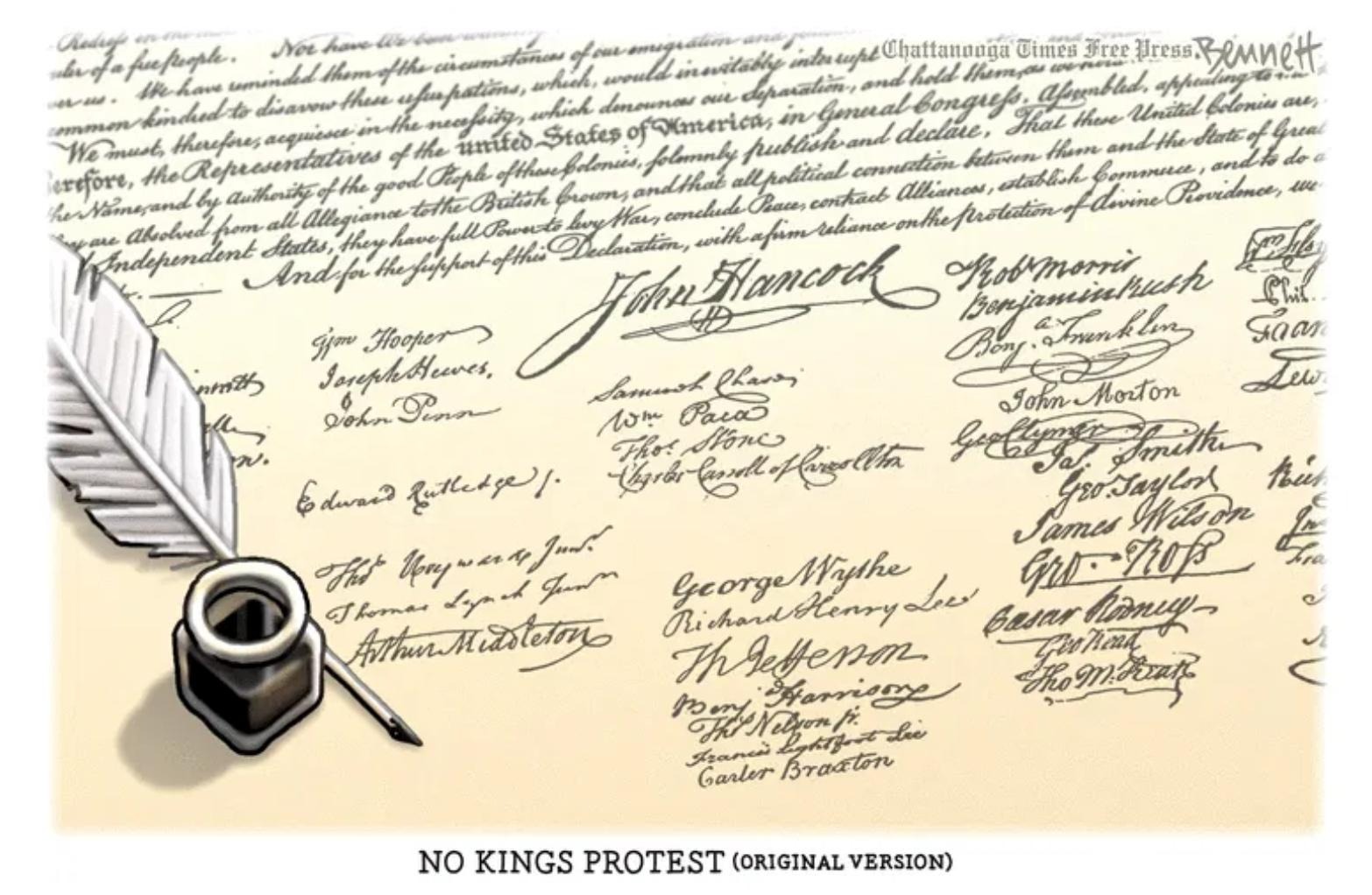
[V]arious right-wingers feigned confusion earlier this month about the “No Kings” rallies across the country. What exactly were the protesters protesting, they wondered? Where did they get the idea that Donald Trump presumes himself a king?

Well, in the nine days since those protests were held, the president slapped a new 10 percent tax on Americans for no better reason than that he’s mad about a TV commercial; he’s preparing to go to war with Venezuela without authorization or even meaningful input from Congress; he’s told people privately that he’s effectively the speaker of the House now, insofar as the House still exists after being out for about a month; he’s pardoned a corrupt Chinese crypto mogul who helped enrich him and the Trump family; he’s thinking of looting nearly a quarter billion dollars from the U.S. Treasury to reward himself for beating the rap on various crimes he almost certainly committed; and he demolished part of the White House so that he could build himself a ballroom worthy of a proper palace.

As others have noted, some of Trump’s sins against democracy are so quintessentially monarchical that they appear in the bill of particulars against George III in the Declaration of Independence. If you can digest all of that and still end up scratching your head at what the “No Kings” demonstrators were on about, it’s not because you don’t understand. It’s because you won’t understand. You’ve resolved psychologically not to take Trump’s autocratic desires seriously because doing so would force you to choose between loyalty to your tribe and loyalty to the Founders’ vision.

Nick Catoggio

Small favors

Kudos to Republicans for passive-aggressively monkey-wrenching, at least as to the Federal District courts, Trump’s effort to pack the federal courts with political cronies rather than qualified judges.

Senate Republicans are holding firm against President Donald Trump’s pressure to scrap a longtime tradition in Congress’ upper chamber, issuing a substantive rebuke to his desires and openly disagreeing with him on the issue.

Trump has repeatedly called on the Senate GOP to eliminate its blue slip practice, which allows senators from the minority party to block judicial appointments such as lower court nominees and U.S. attorneys who hail from their states. The president has argued that Democratic senators are obstructing his nominees, but Senate Judiciary Committee Chairman Sen. Chuck Grassley of Iowa is staunch in his resolve not to take away the century-old tradition.

“After a hundred years, why would you do away with it?” he told The Dispatch. “It’s supported by a hundred members of the United States Senate.”

Senate Republicans’ defiance of Trump here is perhaps the most substantive stand they have taken since they stonewalled the nomination of former Rep. Matt Gaetz to be his attorney general after last year’s election. To this point, members of the congressional GOP have often raised concerns or pushed for more information about Trump’s actions, but rarely have they obstructed his agenda. This time, however, they are refusing to sacrifice one of the Senate’s time-honored traditions, one that guards Congress’ power in an age where the legislative branch is often happy to cede authority to the executive.

Charles Hilu, Senate Republicans Are Actually Defying Donald Trump.

Passive-aggression is probably all we can hope for from Republican Senators who often appear emasculated by Trump.

But continuing the blue slip tradition is only part of it. Unusually high numbers of nominees to various offices have been withdrawn after back-channel communication:

[T]he Trump administration has faced some very significant resistance more privately to a large number of nominees, and that this has led a surprising number of them to be withdrawn. So far this year, the White House has withdrawn 49 nominations for Senate-confirmed positions. As Gabe Fleisher pointed out earlier this week, that is a (much) larger number of nominees than any modern president has had to withdraw from consideration in any year of his presidency.

And it is a particularly large number of withdrawn nominees in the first year of a new presidency. Ronald Reagan withdrew five nominations in his first year; for George H.W. Bush it was three; for Bill Clinton six; for George W. Bush seven; for Barack Obama twelve; for both Donald Trump in his first term and for Joe Biden the number was 13. The year is not even over and Trump has had to withdraw 49 nominations.

This is surely in part because it is in no one’s interest to draw attention to it. The administration wants to always look triumphant, regardless of reality. Republican senators want to appear to be firmly backing the president, which they mostly are ….

Yuval Levin

Your tax dollars at work

Who says government can’t do anything right? ICE is advertising for thuggish goons and it’s getting them.

In today’s hiring binge, ICE recruiting ads ask: “Which way, American man?” Testosterone is the not-very-sub subtext. Recruits will “defend the homeland,” “recapture our national identity,” stymie an “invasion,” halt “cultural decline” and even save “civilization.”

Something uncivilized is indeed happening. What jobs, if any, are recruits leaving for the glory of donning battle gear and masks (hiding what from whom?) and roaming U.S. communities, throwing their weight around and throwing unarmed people to the ground?

Says who? Says mild-mannered true conservative octagenarian George Will (When ICE came for a U.S. citizen and Army veteran).

And just like that, bribes are a normal business expense in Trumpistan

To bribe or not to bribe: When voters turn their country into a banana republic by making a gangster president, kickbacks become part of the cost of doing business. If I were a CFO in 2025 in need of government approval for some new project, I’d feel obliged to allot a certain amount of the budget for a “donation” to the Donald J. Trump Presidential Library and Casino.

Nick Catoggio, To Bribe or Not to Bribe

The kid with the Golden Shield

This kid (who supposedly has a law degree already) can magically provide a “Golden Shield” of immunity from prosecution for assassination, murder, torture and other governmental passtimes by writing a secret opinion that they’re legally A-Okay. Jack Goldsmith tells us all about it.

Not that the President needs it, mind you.

I wonder where the snowflakes are?

Any writer these days, who hasn’t been radicalized or redpilled, can tell you who the snowflakes are now. The people who were not long ago the loudest in preaching free speech are today the quickest to silence anyone who uses it to disagree with them. The people who railed against cancel culture are now trying to use the machinery of the state to try to destroy anyone who dares to posthumously criticize Charlie Kirk and the stances he took—which, it should be continually pointed out, included proudly sending buses to the Capitol on January 6, 2021.

It’s the people who love to dish out jokes and criticisms, but are not only outraged at Jimmy Kimmel’s distasteful jokes about Kirk, but fine with overt government pressure to take him off the air.

Ryan Holiday.

50 days after assassination, I think de mortuis nil nisi bonum passes its freshness date.

A real downer

Charles de Gaulle began his war memoirs with this sentence: “All my life I have had a certain idea about France.” Well, all my life I have had a certain idea about America. I have thought of America as a deeply flawed nation that is nonetheless a force for tremendous good in the world. From Abraham Lincoln to Franklin D. Roosevelt to Ronald Reagan and beyond, Americans fought for freedom and human dignity and against tyranny; we promoted democracy, funded the Marshall Plan, and saved millions of people across Africa from HIV and AIDS. When we caused harm—Vietnam, Iraq—it was because of our overconfidence and naivete, not evil intentions.

Until January 20, 2025, I didn’t realize how much of my very identity was built on this faith in my country’s goodness—on the idea that we Americans are partners in a grand and heroic enterprise, that our daily lives are ennobled by service to that cause. Since January 20, as I have watched America behave vilely—toward our friends in Canada and Mexico, toward our friends in Europe, toward the heroes in Ukraine and President Volodymyr Zelensky in the Oval Office—I’ve had trouble describing the anguish I’ve experienced. Grief? Shock? Like I’m living through some sort of hallucination? Maybe the best description for what I’m feeling is moral shame: To watch the loss of your nation’s honor is embarrassing and painful.

[I]f Trumpism has a central tenet, it is untrammeled lust for worldly power. In Trumpian circles, many people ostentatiously identify as Christians but don’t talk about Jesus very much; they have crosses on their chest but Nietzsche in their heart—or, to be more precise, a high-school sophomore’s version of Nietzsche.

To Nietzsche, all of those Christian pieties about justice, peace, love, and civility are constraints that the weak erect to emasculate the strong. In this view, Nietzscheanism is a morality for winners. It worships the pagan virtues: power, courage, glory, will, self-assertion. The Nietzschean Übermenschen—which Trump and Musk clearly believe themselves to be—offer the promise of domination over those sick sentimentalists who practice compassion.

As the conference went on, I noticed a contest of metaphors. The true conservatives used metaphors of growth or spiritual recovery. Society is an organism that needs healing, or it is a social fabric that needs to be rewoven. A poet named Joshua Luke Smith said we needed to be the seeds of regrowth, to plant the trees for future generations. His incantation was beatitudinal: “Remember the poor. Remember the poor.”

But others relied on military metaphors. We are in the midst of civilizational war. “They”—the wokesters, the radical Muslims, the left—are destroying our culture. There were allusions to the final epochal battles in The Lord of the Rings. The implication was that Sauron is leading his Orc hordes to destroy us. We are the heroic remnant. We must crush or be crushed.

David Brooks, I Should Have Seen This Coming.

I got over naïve American exceptionalism a very long time ago — or so I like to imagine. The speed of our descent astonished (astonishes? do we have further to go?) me; that America was capable of deep descent does not.

And I don’t know how to climb out of the hole in an America where thinking outside the tribe will draw death threats for both the politician and his or her family.


We are all gatekeepers now.

Peggy Noonan

Your enemies are not demonic, and they are not all-powerful and the right hasn’t always lost and the left hasn’t always won. But if you convince yourself of that, you give yourselves all sorts of permission to do a lot of stupid and terrible things under the rubric of “Do you know what time it is?”

Jonah Goldberg.

[A] critical mass of the American people … no longer want[s] to govern themselves, … are sick of this republic and no longer want to keep it if it means sharing power with those they despise.

Nick Catoggio

I don’t do any of the major social media, but I have two sub-domains of the domain you’re currently reading: (a) You can read most of my reflexive stuff, especially political here. (b) I also post some things on my favorite no-algorithm social medium.

No Kings Saturday, 10/18/25

No kings!

Binding precedent

Protesters have protested at an ICE facility a few miles west of Chicago for the past 19 years—with somewhat more intensity recently following the announcement of Operation Midway Blitz. A month after the announcement, the president federalized the Illinois National Guard. District court: Enjoined. Seventh Circuit: Just so. Political opposition is not rebellion, and a protest doesn’t become a rebellion merely due to a few isolated incidents of violence. Without that, none of the statutory predicates for federalizing the National Guard have been met.

Institute for Justice, Short Circuits for 10/17/25 (bold added). This is now the law in the 7th U.S. Circuit – Indiana, Illinois and Wisconsin.

Look for the Administration to try to provoke a rebellion it can crush. Everyone who’s paying attention knows Trump wants to invoke the Insurrection Act (as he stuffs his pockets and those of his family).

Wanted: a viable counternarrative

Trump’s actions … are part of one project: creating a savage war of all against all and then using the presidency to profit and gain power from it. Trumpism can also be seen as a multipronged effort to amputate the higher elements of the human spirit—learning, compassion, science, the pursuit of justice—and supplant those virtues with greed, retribution, ego, appetite. Trumpism is an attempt to make the world a playground for the rich and ruthless, so it seeks to dissolve the sinews of moral and legal restraint that make civilization decent.

Trumpism, like populism, is more than a set of policies—it’s a culture. Trump offers people a sense of belonging, an identity, status, self-respect, and a comprehensive political ethic. Populists are not trying to pass this or that law; they are altering the climate of the age. And Democrats think they can fight that by offering some tax credits?

To beat a social movement, you must build a counter social movement. And to do that, you need a different narrative about where we are and where we should be heading, a different set of values dictating what is admirable and what is disgraceful. If we fail to build such a movement, authoritarian strongmen around the globe will dominate indefinitely.

David Brooks.

You can’t beat something with nothing. I can’t come up with a political counternarrative to Trumpism. The Democrats can’t come up with a political counternarrative, either. Brooks couldn’t come up with a strong political counternarrative.

I can only hope and pray that people will look for their compelling (counter-)narrative to the Gospel of Jesus Christ. (And that meantime there will be some legal counternarratives to prevent irretrievable damage, as in the preceding item.)

Music Reviews

There may be nothing better than old music reviews to let you know that it’s okay to like what you like, critics be damned.

I like Debussy’s La Mer, and I don’t care what the stupid early reviews said:

On today’s date in 1905, Claude Debussy’s orchestral suite La Mer or The Sea was performed for the first time in Paris. Today this music is regarded as an impressionistic masterpiece, but early audiences — especially those in America — found it rough sailing.

“We clung like a drowning man to a few fragments of the tonal wreck,” wrote a 1907 Boston critic, and suggested that instead of The Sea Debussy should have titled his piece Sea-Sickness.

“The Sea is persistently ugly,” wrote The New York Times that same year. “Debussy fails to give any impression of the sea … There is more of a barnyard cackle in it than anything else.”

And in 1909, this on La Mer from The Chicago Tribune: “It is safe to say that few understood what they heard and few heard anything they understood … There are no themes … There is nothing in the way of even a brief motif that can be grasped securely enough by the ear and brain to serve as a guiding line through the tonal maze. There is no end of queer and unusual effects, no end of harmonic complications and progressions that sound so hideously ugly.”

Ah, the perils of “modern music” in the early 20th century!

Giving the Devil his due, impressionism had to be a real mind-blower for critics attuned to, say, the sonata-allegro form.

Comprehensive tradition

We’re often not very aware of the “tradition” in which we live. A student in a classroom would readily agree that the words of a teacher or professor were a “traditioning” of sorts. But they will fail to notice that how the room is arranged, how the students sit, what the students wear (or don’t wear), how the professor is addressed, how students address one another, what questions are considered appropriate and what are not, and a whole world of unspoken, unwritten expectations are utterly required in the process. The modern world often imagines that “online” education is equivalent to classroom education since the goal is merely the transmission of information. But the transmission of information includes the process of acquiring the information and everything that surrounds it. Those receiving the “tradition” online will have perhaps similar information to those receiving it in a classroom – but they will not receive the same information.

Fr. Stephen Freeman, The Tradition of Being Human

Stages of life

Two questions:

  1. Do I want to read/watch/listen to this?
  2. Should I read/watch/listen to this?

When I was younger the second question often dominated my decision-making. Now that I am officially ancient that question has virtually disappeared and the first one is usually the only one I ask. That’s been the single most notable change in my personality in these my declining years.

Alan Jacobs

Alan is a decade or more younger than me, yet I only very recently seem to have arrived at this point, especially regarding political matters.

Note that he’s talking about a change in personality. This isn’t a life rule. There are things that younger people should read/watch/listen to, in order to become well-formed human beings.

Two ways

[R]evival begins with the people proclaiming, by word and deed, “I have sinned.”

MAGA Christianity has a different message. It looks at American culture and declares, “You have sinned.”

David French

Noteworthy

In the aftermath of Kirk’s murder, we witnessed young people at vigils rather than at “mostly peaceful” demonstrations.

R.R. Reno in First Things


We are all gatekeepers now.

Peggy Noonan

Your enemies are not demonic, and they are not all-powerful and the right hasn’t always lost and the left hasn’t always won. But if you convince yourself of that, you give yourselves all sorts of permission to do a lot of stupid and terrible things under the rubric of “Do you know what time it is?”

Jonah Goldberg.

[A] critical mass of the American people … no longer want[s] to govern themselves, … are sick of this republic and no longer want to keep it if it means sharing power with those they despise.

Nick Catoggio

I don’t do any of the major social media, but I have two sub-domains of the domain you’re currently reading: (a) You can read most of my reflexive stuff, especially political here. (b) I also post some things on my favorite no-algorithm social medium.

Authoritarianism in the 21st century

My father died 27 years ago today. It was too early, but I wouldn’t have wanted to see him at the age he’d be now.

This just might be faintly relevant

There isn’t a single instance of a fentanyl seizure in the Caribbean:

Last month, the U.S. cutter Hamilton returned to Florida with what the agency called “the largest quantity of drugs offloaded in Coast Guard history”: 61,740 pounds of cocaine and 14,400 pounds of marijuana (that’s the weight of about three city buses). The haul, gathered by multiple federal agencies during 19 seizure incidents in the Caribbean as well as the Pacific, had an estimated street value of $473 million. But there wasn’t any fentanyl on the boat.

(Nick Miroff)

Authoritarianism in the 21st century

We are living in an authoritarian state.

It didn’t feel that way this morning, when I took my dog for his usual walk in the park and dew from the grass glittered on my boots in the rising sunlight. It doesn’t feel that way when you’re ordering an iced mocha latte at Starbucks or watching the Patriots lose to the Steelers. The persistent normality of daily life is disorienting, even paralyzing. Yet it’s true.

We have in our heads specific images of authoritarianism that come from the 20th century: uniformed men goose-stepping in jackboots, masses of people chanting party slogans, streets lined with giant portraits of the leader, secret opposition meetings in basements, interrogations under naked light bulbs, executions by firing squad … I’d be surprised if this essay got me hauled off to prison in America. Authoritarianism in the 21st century looks different, because it is different. Political scientists have tried to find a new term for it: illiberal democracy, competitive authoritarianism, right-wing populism …

… To keep their jobs, civil servants have to prove not their competence but their personal loyalty to the leader. Independent government officers—prosecutors, inspectors general, federal commissioners, central bankers—are fired and their positions handed to flunkies. The legislature, in the hands of the ruling party, becomes a rubber stamp for the executive. Courts still hear cases, but judges are appointed for their political views, not their expertise … There are no meaningful checks on the leader’s power.

Today’s authoritarianism doesn’t move people to heroic feats on behalf of the Fatherland. The leader and his cronies, in and out of government, use their positions to hold on to power and enrich themselves. Corruption becomes so routine that it’s expected; the public grows desensitized, and violations of ethical norms that would have caused outrage in any other time go barely noticed. … At important political moments it mobilizes its core supporters with frenzies of hatred, but its overriding goal is to render most citizens passive. If the leader’s speech gets boring, you can even leave early (no one left Nuremberg early). Twenty-first-century authoritarianism keeps the public content with abundant calories and dazzling entertainment. Its dominant emotions aren’t euphoria and rage, but indifference and cynicism. Because most people still expect to have certain rights respected, blatant totalitarian mechanisms of repression are avoided. The most effective tools of control are distraction, confusion, and division.

“If everybody always lies to you, the consequence is not that you believe the lies, but rather that nobody believes anything any longer,” the political philosopher Hannah Arendt said near the end of her life. “And a people that no longer can believe anything cannot make up its mind. It is deprived not only of its capacity to act but also of its capacity to think and to judge. And with such a people you can then do what you please.”

These are the features of the modern authoritarian state. Every one of them exists today in this country …

… It sometimes seems as if the only check on Trump’s power is his own attention span.

George Packer, America’s Zombie Democracy.

Railway to the Moon

Imagine if you were trying to write intelligently about the socioeconomic impact of the railroad in the middle of the 19th century, and half the people investing in trains were convinced that the next step after transcontinental railways would be a railway to the moon, a skeptical minority was sure that the investors in the Union Pacific would all go bankrupt, many analysts were convinced that trains were developing their own form of consciousness, reasonable-seeming observers pegged the likelihood of a train-driven apocalypse at 20 or 30 percent, and peculiar cults of engine worship were developing on the fringes of the industry.

What would you reasonably say about this world? The prime minister of Denmark already gave the only possible answer: Raise your alert levels, and prepare for various scenarios.

Ross Douthat, Drones, Denmark and Dark Magic

PK snippets

  • “I’m not proposing a political program,” he told me. “This isn’t some Christian civilizational vision. It’s much more personal.” You decide how and where to wage battle: at a community garden, on the Appalachian Trail, in a mosque.
  • He was struck by how commonplace legal cannabis had become. “It’s a really, really useful drug for the state to be legalizing,” he said. “Because it’s not like alcohol. It doesn’t get you violent. And maybe life is a bit less crappy. It’s the best antidote to revolution that you could possibly have.”
  • “When you’re sitting in your living room with your Punjabi wife reading a bunch of stuff about how you’re a white nationalist, it makes you want to punch people in the face,” he said. “Luckily, I’m a Christian, so I don’t do that.”

Paul Kingsnorth via Alexander Nazaryan in the New York Times


We are all gatekeepers now.

Peggy Noonan

Your enemies are not demonic, and they are not all-powerful and the right hasn’t always lost and the left hasn’t always won. But if you convince yourself of that, you give yourselves all sorts of permission to do a lot of stupid and terrible things under the rubric of “Do you know what time it is?”

Jonah Goldberg.

[A] critical mass of the American people … no longer want[s] to govern themselves, … are sick of this republic and no longer want to keep it if it means sharing power with those they despise.

Nick Catoggio

I don’t do any of the major social media, but I have two sub-domains of the domain you’re currently reading: (a) You can read most of my reflexive stuff, especially political here. (b) I also post some things on my favorite social medium.

Wenesday evening

Poking the Bear

Many sober voices warned that an expansion of NATO to Russia’s border would poke the Bear, leading to an inevitable war. As long ago as 1998, following the U.S. decision to expand NATO eastwards, George Kennan said the following to Thomas Friedman:

I think it is the beginning of a new cold war. I think the Russians will gradually react quite adversely and it will affect their policies. I think it is a tragic mistake. There was no reason for this whatsoever. No one was threatening anybody else. This expansion would make the founding fathers of this country turn over in their graves.

Patrick Deneen. (Link may be inaccurate; I don’t think it was on Substack when I read it.)

Unless we’re prepared to drop our Monroe Doctrine, we ought to be able to understand Russia’s prickliness about Ukraine’s loving glances at the West and the West sidling up to Russia’s “near abroad.”

Spencer Cox

If you had asked me last week to handicap Utah Gov. Spencer Cox’s chances of winning the 2028 Republican presidential primary, I’d have said 1 percent. But after watching him demonstrate impressive moral leadership in calling on Americans to unite after Charlie Kirk’s murder, I’ve changed my mind. It’s zero percent.

The governor is a good man in a party that’s led by hideous people and backed by voters who consider being a hideous person a political virtue

Nick Catoggio

Catoggio continues, pivoting to an important distinction I hadn’t made and that few others seem to have made, either:

Cancel culture, properly understood, is an attempt to bully institutions like businesses into enforcing one faction’s cultural preferences in the absence of moral consensus around those preferences. It doesn’t involve subjects about which we’re all in broad moral agreement, like whether pedophilia should be a crime. It involves subjects about which we disagree, like whether trans women are women. As Thomas Chatterton Williams put it in The Atlantic, “Cancel culture is more fundamentally about solidifying norms that haven’t yet been established.”

That seems like a very sensible way to distinguish “cancellation” of those who celebrate Kirk’s murder from cancellation of those who pointed out that Kirk was no saint (e.g., me, humanizing him) or even demonized him (tastelessly, given the timing).

Is this possible, circular-firing-squad style?

Vacationing in Michigan, I’m struck by all the Marijuana stores. People have spent a lot of money to build or remodel stylish stores in densities that boggle the mind (at least along major roads).

I hate it. So I was heartened by the account of a native Michigander who tells me that competition is so fierce that prices have dropped 91%. That’s one of those facts that’s too good to check. I hope every last one of them is driven out of business by every last one of them.

I’ll spare you catching up on commentary

I’ve been wading through a backlog of reading as my vacation permits. A lot of it, from guttersnipes to established journalists at major publications, comes down to arguing that the other guys are more prone to lethal political violence.

I have concluded (actually, had concluded before Charlie Kirk’s murder) that lethal political violence is bad. I’ve also concluded that the argument about which side is guiltier of it is stupid and likely to be forever inconclusive.

You’re welcome.

Loyalty over competence

Word on the street is that the attorney general is a moron.

Could be. I’m open to the possibility.

Accusing the head of the Justice Department of being an idiot would seem like a lazy smear during any other administration, but Pam Bondi wasn’t selected for her legal acumen. She was picked for the same reason that Kash Patel and Pete Hegseth were, because the president wants the most dangerous arms of the federal government led by people whom he knows will choose him over the law.

When you select for loyalty instead of competence in staffing your government, you’re guaranteeing yourself a higher than usual quotient of morons ….

[Bondi’s moronic comments about “hate speech” and “discrimination” omitted.]

We’re left with two explanations, then. One is that Pam Bondi truly is a moron, irresponsibly BS-ing her way through questions on what can and can’t legally be said in the United States like a 1L who hasn’t done the reading. The other is that Pam Bondi knows what time it is.

In a government distinguished by extreme malevolence and extreme incompetence, it’s hard to tell.

Postliberals don’t worry about what Democrats will do when they return to power because they have the ability right now, or so they believe, to make sure that Democrats never do.

That’s the alternate explanation for Pam Bondi’s “hate speech” comments. She’s not stupid. She just “knows what time it is” and is proceeding accordingly.

Nick Catoggio, riffing off Pam Bondi’s unironic rant and declaration of war against “hate speech.”

Why Tyler Robinson shot Charlie Kirk

I submit that we don’t really know why, and that Nick Cattogio raced just a bit ahead of the evidence here:

Unless the indictment omitted something important, though, the motive was straightforward: Like practically every progressive in this country, he abhorred Kirk’s condemnations of transgenderism. That’s legibly leftist.

Nick Catoggio.

I find that very plausible, but I don’t think we’re to the point where the official allegations or known evidence compel it.

In point of fact, Catoggio and I, as inactive and retired lawyers respectively, probably should be saying “it’s not looking good for him, but Robinson is innocent until proven guilty.”


Your enemies are not demonic, and they are not all-powerful and the right hasn’t always lost and the left hasn’t always won. But if you convince yourself of that, you give yourselves all sorts of permission to do a lot of stupid and terrible things under the rubric of “Do you know what time it is?”

Jonah Goldberg.

[A] critical mass of the American people … no longer want[s] to govern themselves, … are sick of this republic and no longer want to keep it if it means sharing power with those they despise.

Nick Catoggio

I don’t do any of the major social media, but I have two sub-domains of the domain you’re currently reading: (a) You can read most of my reflexive stuff, especially political here. (b) I also post some things on my favorite social medium.

From grim to grimmer

Bummer

I could have filled this post with many clippings colorfully describing how bad things are. I’ve done it before and I’ll probably do it again. That’s just the kind of guy I am: melancholic.

But it just seems too much this week. I’m having trouble identifying anything going right in the USA.

I came of age in the 60s, and although I’ve been expecting our collapse for a long time, the manner and speed of the seeming collapse are a surprise.

I’ll summarize what’s a bit unsettling, even for me, thus:

  • We are moving rapidly from American hegemony to a multipolar world.
  • The very best President imaginable couldn’t stop, but could at best slow, our relative decline.
  • The very best President imaginable wouldn’t even run because of the politics of personal destruction.
  • But a toxic narcissist, jilted by voters in 2020, would run again in 2024 on a platform of vengeance. “Vengeance” turned out to mean turning America into a “shithole country.” (That will teach us!)
  • The Mainstream media are whistling past the cemetery as all this goes down.
  • UPDATE: Charlie Kirk, who it seems was more consequential than I had realized, gunned down Wednesday. I wrote everything in this post, other than this bullet point, before the murder of young Kirk. I knew little about him. My first impression was unfavorable because he was associated with Jerry Falwell, Jr. at the time that Falwell’s Potemkin Piety was collapsing. Thereafter? Well, I’m about 50 years older than his target demographic. (My wife didn’t even know who he was.) I’ve read a lot about him this morning, but the most interesting observation I read was too frank for this raw moment, so I’ll let you ferret out your own information if you care to.

With that off my chest, I’ll try to edify y’all for a while.

Repelled by conservatism, but not a liberal

Conservatism, as you know, is a complete mess in America right now. But reading conservative authors like Edmund Burke, Samuel Johnson, Fyodor Dostoyevsky, Gertrude Himmelfarb and James Q. Wilson does give you an adequate appreciation for the power of nonmaterial forces — culture, moral norms, traditions, religious ideals, personal responsibility and community cohesion.

I’ve been driven away from the right over the past decade, but I can’t join the left because I just don’t think that tradition of thought grasps reality in all its fullness. I wish both right and left could embrace the more complex truth that the neocon Democrat Daniel Patrick Moynihan expressed in his famous maxim: “The central conservative truth is that it is culture, not politics, that determines the success of a society. The central liberal truth is that politics can change culture and save it from itself.”

David Brooks, Why I Am Not a Liberal. This pretty clearly was one of the ten best things I’ll see in the New York Times this month, so that’s one of my gift links.

Breakneck: what you get in an engineered society

Publishers have figured out how to get limelight for their new titles, and one new title that’s deservedly getting a lot is Dan Wang’s Breakneck, about the astonishing ascendancy of China.

For a solid interview with Dan Wang (interviewer Ross Douthat), click this shared link: This Is Why America Is Losing to China.

Wang attributes this in substantial part to the relative influence of engineers in China versus that of lawyers in the USA. Engineers build; lawyers obstruct.

I find that somewhat plausible. But I write this precis not as an uncritical defense of my former profession, but to call attention to where engineered China went off the rails: trying to engineer China’s demographics led to over 300,000,000 abortions, over 100,000,000 sterilizations, and a population that’s skewed toward males.

That is, in my experience of engineers, classic engineering myopia. China could have benefitted from a bit more rule of law, less engineering “logic.”

What’s “fair” got to do with it?

There are people who get outraged when a court — especially the Supreme Court — impose or affirm what seems like an “unfair” result.

The scare-quote is not because fairness is a fantasy. It’s there because courts’ “unfair” decisions are mostly decisions to follow the law despite any countervailing sense of fairness.

And I approve of that approach. Consider: what is truly “fair” about denying a win to a guy who followed all the legal rules and then got sued by a guy who ignored the rules but somehow feels cheated (and has a good lawyer to sell his sob story)?

Liberalism without illusions

William A. Galston, a blast from the Clintonian past, has a wonderful article in Democracy Journal. I summarize, but I fully intend to read it several more times.

My summary:

Liberal democracy (a/k/a classical liberalism) has some inherent weaknesses:

  1. Because liberal democracy restrains majorities and gives even small minorities a say, it slows the achievement of goals that majorities support. In other words, it requires more patience than many possess.
  2. Liberal democracy requires tolerance for minority views and ways of life to which many citizens are deeply opposed.
  3. Liberal democracy requires a distinction between civic identity and personal or group identity.
  4. Liberal democracy requires compromise.

Liberals (left-liberals, or “liberals” in the modern pejorative sense) complicate these weaknesses with characteristic illusions:

  1. Myopic materialism: the belief, especially pervasive among elites, that economic issues are the real issues and that cultural issues are diversionary, deliberately heightened by unscrupulous leaders to gain support for their anti-liberal agendas.
  2. Parochialism. Yes, transnationalism is the parochialism of elites, because most people in advanced democracies as well as “developing” nations value particular attachments—to local communities and to the nation, to friends and family and compatriots.
  3. Naivete about the course of human events and the possibilities of human nature.

Credit for my discovery of this article goes to Rod Dreher.

Broken Windows

Okay, everyone is writing about it, and Trump’s vehement denials and $10 Billion lawsuit against Dow Jones makes it newsworthy that there’s now potent corroboration of Dow Jones’ (via the Wall Street Journal) claim about Trump’s hand-rendered birthday card for ephebophile Jeffrey Epstein’s 50th birthday. But I can’t say anything smarter than this:

From what I can tell, in fact, there’s no actual theory underlying the impromptu new conspiracy theory that the letter was forged. No one can explain how or why a birthday message purporting to be from Trump to one of his close associates would have been doctored for a privately published book compiled in 2003. Did time-travelers from the present day fake the letter and plant it knowing that it would come out someday and damage him—after he’d already been elected president twice?

If so, their plot failed. This isn’t going to damage him. It’s just another broken window in a neighborhood that’s full of them.

Andrew Egger explains at The Bulwark:

In a way, Donald Trump and his allies have spent their entire political lives preparing for this moment. The whole miserable decade of “alternative facts,” of witch hunts, of flooding the zone with sh-t—it all amounted to a long, powerful education for his base. It’s a training in a certain kind of zen meditation, in which stories damaging to Trump pass from the eyes and ears directly out of the body without ever intersecting the brain. By now, the base has gotten in their 10,000 hours. They’ve become masters of the craft. They can perform all sorts of remarkable feats—the media-cope equivalent of lying on beds of nails while cinderblocks are smashed on their chests. These cinderblocks, they whisper serenely, are just a liberal plot. If I pay attention, the Democrats win.

The Epstein scandal is the “final boss” of Trump scandals, the supreme test of reality-defying propaganda skills that MAGA has acquired over the course of 10 years. The crime involved, pedophilia, is one of their obsessions; the villain, Jeffrey Epstein, is a lead character in their hysteria about an elite child-abuse cabal; yet the evidence continues to mount that their own messiah, Donald Trump, knew what was happening as it happened and—at best—did nothing to stop it. It’s like the Access Hollywood scandal but with the spin difficulty dialed up by a factor of 10. 

Think of American government as a big neighborhood. The neighborhood has started to go to hell. Its residents are adjusting their expectations for it accordingly.

Bad things happen when neighborhoods start to go to hell. As public evidence of minor disorder and neglect rises, crime gets worse. That’s the “broken windows” theory of criminology—the idea that letting lesser offenses like window-breaking go unpunished signals to good guys and bad guys alike that laws won’t be enforced. Criminals respond by escalating to more serious offenses and law-abiding locals become fatalistic or apathetic.

Trump has broken a lot of windows in our government. How can we expect Americans to maintain the same expectations for civic order that they used to have as the proverbial neighborhood falls into disrepair?

Nick Catoggio.


Somehow, this seemed like the time to resurrect an item I only recently deleted from my footer:

Your enemies are not demonic, and they are not all-powerful and the right hasn’t always lost and the left hasn’t always won. But if you convince yourself of that, you give yourselves all sorts of permission to do a lot of stupid and terrible things under the rubric of “Do you know what time it is?”

Jonah Goldberg.

[A] critical mass of the American people … no longer want[s] to govern themselves, … are sick of this republic and no longer want to keep it if it means sharing power with those they despise.

Nick Catoggio

I don’t do any of the major social media, but I have two sub-domains of the domain you’re currently reading: (a) You can read most of my reflexive stuff, especially political here. (b) I also post some things on my favorite social mediu

Dateline, Weimar America, 8/28/25

CrackerBarrelGate

This story strikes me as stupid, stupid, stupid. Here, through the voices of others, is why.

The chain was founded in 1969 — not 1776. It adopted the country branding because down-home cooking and folksy kitsch were trendy back then, not because they were trying to restore America to the Good Ole Days. Now, the market has moved on, and Cracker Barrel has been trying to adapt …

We have confused brands with moral values, and we demand to see our politics reflected everywhere, even in restaurant signage. We have also confused social media with social lives. And alone with our screens, too many of us have become addicted to rage, mashing the refresh button for the dopamine that rushes through us every time we discover that someone, somewhere, is wrong on the internet.

The addiction is so consuming that when no ready source of rage is available, we start cooking up our own out of whatever we can find in the cupboard. But if the cupboard is really this bare, I suggest people put down the phone and head to Cracker Barrel, rock themselves to serenity in the chairs on the porch, then head inside for a delicious helping of hashbrown casserole.

Megan McArdle

This, too:

The Cracker Barrel farce … is the first case of “cancel culture” I’m aware of in which the accusers couldn’t articulate why the accused was being canceled. 

Which was to their advantage, I think. An offender charged with a particular thoughtcrime can answer the charge but an offender charged with nothing in particular has little choice but to surrender. Which is what the company did on Tuesday.

Christopher Rufo, probably the New Right’s most influential culture warrior, admitted that he’s never set foot in the restaurant but declared war on it nonetheless in the name of making an example of any business “considering any move that might appear to be ‘wokification.’”

“The Barrel must be broken,” he announced with no apparent irony. If a progressive culture warrior had said something as clownishly imperious, self-important, and Stalinist as that 10 years ago, right-wingers would still be making scornful jokes about it today.

Nick Catoggio.

In a Man-Bites-Dog story, Christopher Rufo recently wrote a little piece that was not knee-jerk shit-stirring! But this episode tells me he hasn’t really mended his ways.

I expect no better from Rufo, frankly, but Hillsdale College has no excuse — and no more respect from me, though I thought very highly of it ten years ago when it was, like I was and am, conservative, not Trumpist. (Two Hillsdale alums, who became expats for a while, were cool on their alma mater well before I was. I guess they read the signs: Hillsdale becoming a caricature of anti-woke education.)

Television rights, National rites

They will never do it, because it’s too tacky to bear, and they don’t need the money, but here’s an interesting thought exercise for media dorks: What would the price be if Swift and Kelce were to sell the live rights to their wedding for television? 

We know the NFL collects more than $110 million for a single playoff game—that’s what Peacock paid, and that was two whole years ago. Your standard live sports deal now hits 10 figures, easy. March Madness gets a billion annually to show college kids bricking 3-pointers. Paramount is set to pay more than $1 billion a year for humans pounding each other inside a steel cage.

A Swift-Kelce nuptial is bigger than all of that, mainly because of Swift, whose fame is vast and fierce, and if you don’t believe that, try criticizing one of her singles on Reddit sometime. There would be outrageous interest for both a live telecast and repeat viewing—you could do remixes, Taylor’s versions, on and on.

I think $500 million. That would be the absolute floor.

Jason Gay, Wall Street Journal

My better half wants a televised wedding opposite the State of the Union address, but that would reduce revenues quite a bit.

That is, I suppose it would reduce revenues. Who knows? I didn’t even know that Travis Kelce wasn’t a quarterback.

Nobel Laureate

FBI agents searched the Maryland home and Washington, D.C., office of former national security adviser John Bolton on Friday morning, reportedly as part of an investigation into his potential mishandling of classified documents. Bolton was not charged or detained during the operation. President Donald Trump—who revoked Bolton’s security clearance and Secret Service protection days into his second term—told reporters he had no prior knowledge of the searches but described Bolton, who has been a sharp critic of Trump in recent years, as “a real sort of a low life” and “not a smart guy.”

The Morning Dispatch

Congratulations, Mr. Bolton! Being described by Donald Trump as “a real sort of a low life” and “not a smart guy” is like winning a Nobel Prize for Integrity and Rectitude.

UPDATE: Even a blind pig finds the occasional acorn, or even a truffle: John Bolton Inquiry Eyes Emails Obtained by Foreign Government – The New York Times. So maybe Bolton actually, technically kinda broke a law. “Show me the man and I’ll show you the crime” (Lavrentiy Beria, Soviet secret police chief).

The most miserable habitation in the world

The fundamental structural problem of our government during the Trump administrations is this: our constitution assumed the George Washington was President. It assumed that our high officials would be men of high character, virtuous men. It assumed that of the American people as well.

So John Adams was dead right in this quote, the last sentences of which are fairly well-known:

While our country remains untainted with the principles and manners which are now producing desolation in so many parts of the world; while she continues sincere, and incapable of insidious and impious policy, we shall have the strongest reason to rejoice in the local destination assigned us by Providence. But should the people of America once become capable of that deep simulation towards one another, and towards foreign nations, which assumes the language of justice and moderation while it is practising iniquity and extravagance, and displays in the most captivating manner the charming pictures of candor, frankness, and sincerity, while it is rioting in rapine and insolence, this country will be the most miserable habitation in the world; because we have no government armed with power capable of contending with human passions unbridled by morality and religion. Avarice, ambition, revenge, or gallantry, would break the strongest cords of our Constitution as a whale goes through a net. Our Constitution was made only for a moral and religious people. It is wholly inadequate to the government of any other.

John Adams, October 11, 1798

This President of the United States is not a virtuous man, but a vicious one. Empowered by shrewd and evil advisors (no more “adults in the room”) and motivated by avarice, ambition, and revenge, he is the whale breaking through the net, pushing the “unitary executive theory” (which wouldn’t be a problem were George Washington President) to the breaking point, turning the Department of Justice into the Department of Revenge and now trying to take over the Federal Reserve System – the better to blow a bubble from the bursting of which we may never recover.

I’m not going to resume lamenting what else bothers me about this administration (David French has some of the receipts), but I thought the fundamental problem, though it is not my original insight, might be helpful to pass along.

Do we have any reason to hope that men and women of high virtue will fill the Oval Office and Congress come 2029?

To be a conservative in 2025 …

To be a conservative in 2025 is to be politically homeless—but perhaps not entirely politically friendless.

At home, the party of Donald Trump—the party of J.D. Vance and Ted Cruz and Marco Rubio and Tucker Carlson, not to mention supposed normies such as Mike Pence, et al.—currently is engaged in answering a question I hadn’t thought anyone was asking: “What would national socialism look like if antisemitism were less of a political priority?”

Kevin D. Williamson

Apropos of the first paragraph, the bulk of Williamson’s column is about how liberals-in-the-American-polarity-sense are starting to discover some timeless truths that just might allow conservatives to become allies if not intimates.

On that lone hopeful note, adieu!


Nick Catoggio:

[A] critical mass of the American people … no longer want[s] to govern themselves, … are sick of this republic and no longer want to keep it if it means sharing power with those they despise.

I don’t do any of the major social media, but I have two sub-domains of the domain you’re currently reading: (a) You can read most of my reflexive stuff, especially political here. (b) I also post some things on my favorite social medium.

Saturday, 8/23/25

Public Affairs

Ted Cruz knows better

[Ted] Cruz was an intellectually serious politician of the kind who would quote Hayek and reference Milton Friedman off-the-cuff in private conversation until he discovered—and this is a thing with Texas politicians—that there was more juice to be had from pretending to be the good ol’ boy that he is not than in simply being the Ivy League lawyer he is. Cruz’s current position in American public life is that of a piteous and contemptible figure. … [F]or the moment, he is still a senator caught between the fringeward push of his radicalizing party and the centerward pull of his state’s urbanizing electorate. 

Cruz is (or should be) smart enough to have figured out by now that he is never going to be president, and he ought to allow himself to be liberated by this and take on a new role—one that the genuine Ted Cruz, if there is anything left of him inside the chrysalis of grotesque opportunism and self-degradation in which he has enveloped himself, would be well-suited to undertake: defending the Constitution and the American order from a sustained assault that is coming from within his own party.

It would not take very much: “No, Mr. President, you may not willy-nilly create a new national sales-tax regime with rates based on how you’re feeling that day, even if you call it a tariff; no, you may not federalize the Philadelphia police department or deploy troops in U.S. cities based on whatever phony emergency pretext occurs to you in between social media posts; no, the states are not your ‘agents,’ and they most certainly do not have to do ‘whatever the president of the United States tells them’ to do, even if you put ‘FOR THE GOOD OF OUR COUNTRY’ in capital letters. And if you refuse to honor the constitutional limits on your office, then you can be removed from that office—with my vote, if necessary, though I would regret it and would probably lose my Senate seat as a result. But there are things more important than winning the next election.” 

No, I do not think Cruz has it in him. 

But he is starting to reach the stage of life when, to borrow David Brooks’ formulation, it is time to stop thinking about one’s résumé and start thinking about one’s eulogy.

Kevin D. Williamson, Ted Cruz Knows Better.

In which I reveal an unpopular opinion

Almost everything I knew about him, and particularly his professional accomplishments and opinions, made me think that Brett Kavanagh would be a good Supreme Court justice, and I haven’t been disappointed.

Why “almost”? It wasn’t really the Christine Ford Blasey accusations, but it was related to them: Brett Kavanaugh was an underage, binge-drinking party boy.

That was never in dispute. And I hate that. From him, there wasn’t so much as a “when I was young and foolish, I was young and foolish” acknowledgment. I don’t care if his parents winked at it or even bought the beer.

Now I don’t recall anyone else who was bothered enough even to shrug it off with “boys will be boys.” I seemingly stood alone in thinking underage binge drinking a blot on his character and fitness to uphold the law — all of it, including the parts that inconvenience him.

It’s not okay, and if that makes me a prig, so be it.

There is no possible religious neutrality in schools. So there!

J Budziszewski wants to make Catholic education more widely available without the governmental “strings attached” of Charter School (or presumably vouchers):

Please let’s not blather about religious “neutrality.”  So called secular education is not neutral, but reflects a bias against faith in favor of irreligion.

In fact, even that way of putting it is not precisely accurate. It isn’t that public schools have no god; in fact they place many gods before God. Superficial thinkers suppose that unconditional loyalties – whether of the “woke” or another variety — don’t count as religion just because they don’t use the word “god” for their gods. But the crux of the matter does not lie in the words they use.

I take a different minor issue with the first paragraph quoted than Budziszewski himself does. What “secular education” does is inculcate indifference. Purporting to teach children what they need to know without telling them anything about religion tacitly tells them that they need not know anything about it.

And this is not a straw man. The two-hundred-page course guide for Advanced Placement (AP) course in U.S. government and politics “doesn’t mention Christianity or the Bible—not once, even though it professes to cover ‘the intellectual traditions that animated our founding.’” (Mark Bauerlein)

But that’s not the same as teaching hostility toward religion (“irreligion”).

On the point about unconditional loyalties I couldn’t agree more. I just don’t know what we do about it. Deschooling Society?

DOGE

I have had a faint hope that we would discover that DOGE has begun modernization of software and strategic use of AI in the agencies they blitzkrieged immediately after our latest Presidential inauguration.

But they appears at this point to have been engaged in pure, nihilistic destruction — a style that, along with vengeance-destruction, appears to be what this 47th Presidency is all about.

Capitalist Economy

Pay no heed to the man in the management handcuffs

Ted Gioia was writing a book and looking for a publisher:

This person ran a legendary publishing house, and was also a jazz lover. He was a fan of my writing. We exchanged some emails, and then had a phone conversation.

“Ted, I love the book you’re writing,” he told me. “The sample chapters you sent are outstanding. You’re a special writer, and I’d love to sign you a contract. But…”

My head was already spinning. These people typically pay out big advances. I could finish the book and pay all my bills—no sweat! But before I could pursue these daydreams any further, this famous editor went on:

“I’d love to sign you to a contract. But I can’t.”

“Why not?” I asked—and even I could hear the plaintive note in my voice.

“Well, I’m sure your book would sell. But we evaluate books on their projected sales during the three years following release. If a book doesn’t have a three-year payback, we don’t do it.”

“I don’t think I understand this,” I whimpered in reply. “What are you saying?”

“It’s simple. Your book will probably sell for the next ten years or more. But I can only consider the first three years in making an offer—that’s why I have to turn you down.”

Okay, I understood discounted cash flow even better than this editor. I could give you a lecture on the Capital Asset Pricing Model in my sleep. In my early days, I made a living doing this kind of analysis.

But this way of thinking is wrong in the world of arts and culture.

When I tell editors that my books demonstrably sell for 25-50 years and longer, this is a turn-off. They actually hate it when I say it.

They won’t be around that long—editors constantly change jobs. They don’t give a hoot what sales will be like in the year 2050. They want something with cocktail party buzz for the six weeks following publication.

That’s the world they live in. But I don’t—and I refuse to move there.

How I Learned to Stop Worrying About Short-Term Results in My Career (bold added)

There’s a lot more where that came from because Ted Gioia is a freakin’ polymath. His has become (probably) my favorite Substack that doesn’t focus on religious subjects.

Work-life balance

I’m 22 and I’ve built two companies that together are valued at more than $20 million. I’ve signed up my alma mater as a client, connected with billionaire mentors and secured deferred admission to Stanford’s M.B.A. program. When people ask how I did it, the answer isn’t what they expect—or want—to hear. I eliminated work-life balance entirely and just worked. When you front-load success early, you buy the luxury of choice for the rest of your life.

… I averaged 3½ hours of sleep a night and had about 12½ hours every day to focus on business. The physical and mental toll was brutal: I gained 80 pounds, lived on Red Bull and struggled with anxiety. But this level of intensity was the only way to build a multimillion-dollar company.

Emil Barr, ‘Work-Life Balance’ Will Keep You Mediocre

So that’s the world he lives in. I don’t, never have, and I refuse to move there — or to recommend it to anyone I care about.

Culture

Gay race communism

Now, Cracker Barrel is updating its décor and branding—slightly. The bulk of the update is a brighter, less cluttered interior design, but the “controversial” decision is to change its logo. The company removed the old white guy in overalls sitting by a barrel, and now just has a text-only sign that reads “Cracker Barrel.” 

And people are losing their minds, claiming that it has gone “woke.” What seems to have sparked this brouhaha is a tweet saying that the store has “scrapped a beloved American aesthetic and replaced it with sterile, soulless branding.” 

This prompted an outraged “WTF is wrong with @CrackerBarrel??!” tweet from Donald Trump Jr., that loyal guardian of all that is homey and traditional in American life. The very popular End Wokeness Twitter account proclaimed: “Cracker Barrel CEO Julie Masino should face charges for this crime against humanity.”

Chris Rufo then came out with a Cracker Barrel delenda Est pronunciamiento:

Alright, I’m hearing chatter from behind the scenes about the Cracker Barrel campaign and, on second thought: we must break the Barrel. It’s not about this particular restaurant chain—who cares—but about creating massive pressure against companies that are considering any move that might appear to be “wokification.” The implicit promise: Go woke, watch your stock price drop 20 percent, which is exactly what is happening now. I was wrong. The Barrel must be broken.

Now, it’s true that Cracker Barrel has done some LGBT marketing stuff, probably as a result of being criticized for alleged discriminatory policies in the 1990s. But maybe also because gay people—and people who aren’t particularly horrified by gay people—might like good, affordable breakfasts, too. They’ve also tried to cultivate Hispanic customers. I’m not sure this means they’ve been taken over by the Latinx reconquista

I am also, shall we say, skeptical that a few old website screenshots of these efforts are proof that, in the words of Federalist co-founder Sean Davis, “Cracker Barrel’s CEO and leadership clearly hate the company’s customers and see their mission as re-educating them with the principles of gay race communism.”

Jonah Goldberg. It’s enough to make me want to try to remember that I keep forgetting to eat at Cracker Barrel.

What nihilists can’t believe

It’s hard enough to get people to believe something, but it’s really hard to get people to believe in belief — to persuade a nihilist that some things are true, beautiful and good.

David Brooks, The Rise of Right-Wing Nihilism (gift link)

I just can’t root for a guy who looks like Caligula

My libertarian and anti-state impulses incline me to be favorable toward Julian Assange, but I’ve never been able to shake how much he looks like John Hurt’s Caligula.

Technology

The technologies we use to try to “get on top of everything” always fail us, in the end, because they increase the size of the “everything” of which we’re trying to get on top.

Oliver Burkeman, Four Thousand Weeks

Brought to you by the letter “D”

Dust and decay,
ditherers upon the doorstep
of death itself; dried-
up ghosts of daisy-chain
days that were once dappled
with dew and delight.

R.S. Thomas, Anybody’s Alphabet, Collected Later Poems 1988-2000.

The Los Alamos Sin

As Freeman Dyson put it, the “sin” of the scientists at Los Alamos was not that they made the bomb but that they enjoyed it so much.

Walker Percy, Lost in the Cosmos


I don’t do any of the major social media, but I have two sub-domains of the domain you’re currently reading: (a) You can read most of my reflexive stuff, especially political here. (b) I also post some things on my favorite social medium.