Thursday, 12/18/25

Quietly grassing up the neighbor

Of the Bondi Beach terrorist shootings by Muslim men Sajid Akram and Naveed Akram (unconfirmed by police at this writing) and the heroic intervention of one Ahmed al-Ahmed:

Let it be said, and said with firmness and gratitude, that a Muslim fruit seller named Ahmed al-Ahmed rushed one of the gunmen and disarmed him, saving Jewish lives and taking a couple of bullets himself for his trouble. May God bless that brave man. Here is video of him courageously tackling the gunman. This brings to mind something I was told back in 2002 by a Jewish friend who worked in counterterrorism. Be careful not to accuse every Muslim, she said. Some of our best sources are Muslims within Muslim communities who hate what they’re seeing, but know that if they speak out publicly against it, they will be killed. So they come to us quietly.

Rod Dreher

I wish we could figure out what makes many Muslims exemplary citizens, others murderous fanatics. Though I reject Islam as a false religion, I don’t want to think it’s simply that the former don’t take it seriously.

I have a theory, but it’s at a high enough level of generality that it’s not much use, I fear: that Islam, like Evangelicalism, has no authority beyond a sacred text, so Imams/Preachers can twist the text as they wish, limited only by what their congregants will tolerate.

The Other Terrorists

“Right-wing attacks and plots account for the majority of all terrorist incidents in the United States since 1994, and the total number of right-wing attacks and plots has grown significantly during the past six years,” the Center for Strategic & International Studies concluded after examining terror plots in the United States from 1994 to May of this year. “Right-wing extremists perpetrated two-thirds of the attacks and plots in the United States in 2019 and over 90 percent between January 1 and May 8, 2020.”

Nicholas Kristof, The Lawbreakers Trump Loves (August 29, 2020)

AI moves fast, breaks things

A woman in a service industry, an immigrant to America from Eastern Europe who’s been here about 20 years, took me aside recently. Her eldest child, a senior in high school, is looking around at local colleges. She was worried about AI and asked for advice on what her son might study so that in four years he could get a job. We asked ChatGPT, which advised “embodied in-person work” such as heating and air conditioning technician, pool cleaner. She wasn’t happy with that. She’d worked herself to the bone to get her son higher in the world than she is. She wants him to own the pool.

Peggy Noonan, Trump may be losing his touch

Grievance Memoirs

Political memoirs tend to fall into recognizable categories.

There is the sanitized precampaign memoir, gauzy life stories mixed with vague policy projects and odes to American goodness. There is the postcampaign memoir, usually by the losers, assessing the strategy and sifting through the wreckage. There are memoirs by up and comers who dream of joining the arena and by aging politicos rewriting their careers once more before the obits start to land. There are memoirs by former staff members who realize that proximity to power gives them a good story and memoirs by journalists who chronicle power so closely that they imagine themselves its protagonists.

But a recent spate of books highlights the presence of a new category, one well suited to our time: the grievance memoir. In their books, Eric Trump (“Under Siege”), Karine Jean-Pierre (“Independent”) and Olivia Nuzzi (“American Canto”) are all outraged by affronts real and imagined, fixated on nefarious, often unspecified enemies, obsessed with “the narrative” over the facts and oblivious to their complicity in the conditions they decry.

The authors (a third child embracing on to his father’s legal and political grudges, a former White House press secretary groping for a new brand, a boutique political journalist enmeshed in a self-made scandal) are animated, above all, by a certainty that they’ve been wronged not just by people or institutions but also by broader forces. They are ancillary characters inflating themselves into victims, heroes, even symbols. It is the inevitable memoir style for a moment when everyone feels resentful, oppressed, overlooked — in a word, aggrieved.

Carlos Lozado (who’s famous among his New York Times colleagues as a voracious book-reader).

Add to Lozado’s list a longish article by Jacob Savage in Compact magazine, which Rod Dreher found “one of the most powerful essays I’ve read all year.” Its gist seems to be that straight, white, young men can’t catch a break any more – for reasons predating AI.

Ross Douthat thinks Savage has a point; that Douthat has an opinion suggests that Dreher isn’t just playing Chicken Little again.

I’m fortunate to be chronologically beyond gathering personal straight white male grievance anecdotes (and that my grandson is thrilled at, not resigned to, the prospect of a sort of Shop Class As Soulcraft career).

Are we the baddies?

Remizov and other conservative democrats complain that modern Western liberalism is in fact anti-democratic, as it tramples on national traditions and subordinates national authorities to international ones and to the impersonal forces of globalization.

Paul Robinson, Russian Conservatism. This book is pretty good at giving the gift to see ourselves as others see us.

When your only tool is anger, every little problem looks infuriating

Trump has never shined in moments that call for dignity and restraint … This is what makes Trump’s post about the Reiners not just despicable and cruel but also bad for the country. In moments of national mourning or trauma, a president can seek to bring people together … But not Trump. He finds the most divisive way to insert himself … His choices … take moments that could be unifying—surely Americans of all political views can agree on the greatness of When Harry Met Sally and The Princess Bride—and turn them into opportunities for anger.

Which is, in effect, Trump’s political project.

David Graham, Trump Blames Rob Reiner for His Own Murder

Shorts

  • I like ebooks because nobody can tell that I’m performative reading. (@restlesslens on micro.blog)
  • Be regular and orderly in your life, so that you may be violent and original in your work. (Gustave Flaubert)
  • Insofar is not the same as inasmuch, and I don’t know why the current style is to break the former into three words.
  • I remember mocking people for thinking the Covid vaccine was Bill Gates’ way of getting microchips into us. Hmmm.
  • This is the paradox of politics: Every time you solve a major problem, you’re removing a weapon from your political arsenal. (Peggy Noonan, Trump may be losing his touch)
  • If “TDS” is the tendency to become irrationally obsessed with Donald Trump and project that obsession onto everyone else, then somebody is indeed deranged, and it wasn’t Rob Reiner. (David Graham, Trump Blames Rob Reiner for His Own Murder.
  • A tool always implies at least one small story[:] There is a situation; something needs doing. (L.M. Sacasas)
  • Anyone claiming to know the future is just trying to own it. (L.M. Sacasas)
  • After this awful weekend, Trump has once again lowered the bar for what we can expect from the president. (The Free Press, Mr. President, Don’t Mock the Dead)
  • The odds are good, but the goods are odd. (Advice given to incoming women at Georgia Tech).

Elsewhere in Tipsyworld


We are all gatekeepers now.

Peggy Noonan

Your enemies are not demonic, and they are not all-powerful and the right hasn’t always lost and the left hasn’t always won. But if you convince yourself of that, you give yourselves all sorts of permission to do a lot of stupid and terrible things under the rubric of “Do you know what time it is?”

Jonah Goldberg.

[A] critical mass of the American people … no longer want[s] to govern themselves, … are sick of this republic and no longer want to keep it if it means sharing power with those they despise.

Nick Catoggio

I don’t do any of the major social media, but I have two sub-domains of the domain you’re currently reading: (a) You can read most of my reflexive stuff, especially political here. (b) I also post some things on my favorite no-algorithm social medium.
Friday, 10/24/25

Against the Machine?

I’ve paid closer attention (plus Substack subscription fees and book purchases) to Paul Kingsnorth since his conversion to Christianity and specifically to Orthodox Christianity. (No, he did not convert to “Romanian Orthodoxy,” though his regular parish is predominately Romanian. There is no substantial difference between Romanian, Serbian, Greek, Russian, Georgian, Syrian or other Orthodox ethnic identifiers.)

I’ve also paid closer attention (plus Substack subscription fees and a book purchase) to Martin Shaw since his reversion to Christianity, this time as Orthodox.

But I’ve been trying to keep in mind the scriptural cautions against putting novices on a pedestal Cf. I Timothy 3:6. Neither novice, Kingsnorth or Shaw, is a Christian authority – yet.

Mercifully, neither is claiming the prophet’s mantle, but careless readers can cloak them with it anyway.

I’m happy for Kingsnorth that his new polemic, Against the Machine, is selling well, and that he is getting blogged and podcasted by everyone and his brother. I’ve read the book, which was more than a stitching together of old internet posts. But if you read it, do also read some critiques, such as ‘Unnatural’ Doesn’t Mean ‘Wicked’, by non-Orthodox Christian Tara Isabella Burton.

Elites failing to reproduce

PhDs are falling: At Harvard, PhD programs are collapsing amid budget woes. The Faculty of Arts and Sciences just slashed the number of PhD student admissions slots by more than 75 percent in the Science division and 60 percent in the Arts & Humanities division for the next two years.

The PhD racket was always a weird one. These schools pushed their smartest, most annoyingly ambitious kids to get a PhD (there but for the grace of god go I). During that PhD, these guys do all the work of being a professor—teaching courses, grading papers. But they’re paid next to nothing. And then the clincher is that at the end, there are no jobs available. Maybe one English department job in Idaho for a group of 300 of them to battle to the death over. So I support this belt-tightening. We will have about 5,000 fewer antifa soldiers produced each year. They might even spend their 20s making money.

Nellie Bowles

Claiming a privileged position

Over the past decade a new, and very revealing, locution has drifted from our universities into the media mainstream: Speaking as an X . . . This is not an anodyne phrase. It tells the listener that I am speaking from a privileged position on this matter. (One never says, Speaking as a gay Asian, I feel incompetent to judge this matter.) It sets up a wall against questions, which by definition come from a non-X perspective. And it turns the encounter into a power relation: the winner of the argument will be whoever has invoked the morally superior identity and expressed the most outrage at being questioned.

Mark Lilla, The Once and Future Liberal.

Legal realism

A new analysis of insurance data finds that more than one in ten of the women who take the abortion pill experience sepsis, infection, hemorrhaging, or another “serious adverse event.”  The only reason regulators tolerate such a high level of danger to the mother is that the ability to kill her baby cheaply and conveniently trumps all considerations.

J Budziszewski (bold added).

High tide recedes

Wow, it really was a social contagion: As the great vibe shift sweeps our country, it turns out that the rise in transgender identities really was a fad—between 2022 and 2024, the number of trans-identifying young people has dropped in half. Last week, another study hinted at the same conclusion, but it was widely criticized due to its failure to distinguish between trans and nonbinary identities, which are obviously very different, you ignoramus. This week’s data from writer and psychology professor Jean Twenge proved that both identities are in free fall among the youth. …

This is good for a lot of reasons—but in particular, it’s good for trans people! Why? Because there have always been a small number of people who feel truly dysphoric in their sex. And the last thing you want is a horde of depressed teen girls latching on to your situation as a way to rage against their bodies, a stand-in for anorexia or cutting. I’ve never been more worried about my rights as a gay person than when all the angry youth started announcing they were gay or trans or queer because then I just knew backlash was coming. Anything funky they did, they called it gay. They wore a weird jacket and got creative with their haircuts and all of a sudden, they’re claiming my identity. I say, scram, kids! Get out of here! I’m putting up a border around Gay Territory and saying No more may enter. It’s me, it’s everyone in Provincetown, and it’s my dykes in the Midwest, and that’s it. We’re full up. Go see if the Mormons are taking applications.

Nellie Bowles

Politics

The next two items are the most pointedly political in this post – and that’s not very pointed. I just don’t have it in me to spit into the wind recently.

A new presumption of bad faith

I was reminded by a New York Times guest editorial on the dangers of the Insurrection Act that our laws almost all assume that the law enforcer will be sane and will act in good faith. As a consequence of electing an insane and vengeful President, we now “enjoy” the full American expression of Joseph Stalin’s “show me the man and I’ll show you the crime.” My reflex is to disbelieve every word Trump says and to suspect invidious discrimination in all his Orders.

It might behoove our legislators to consider, before passing a law, what injustices could be wrought by bad actors wielding the proposed law.

Bring back hypocrisy

The Wall Street Journal has somehow decided to position its Editorial Page just slightly “left” (whatever those terms mean any more) of the Falun Gong’s Epoch Times. Thursday, it was Barton Swaim’s both-sides demi-defense of Trump’s lawfare against his perceived enemies.

I counter with “Yes, but Trump truly is worse because he does it right out in the open, shamelessly.” If hypocrisy is the tribute vice pays to virtue, it joins smoking and drinking on the very short list of vices Trump doesn’t practice. Otherwise, his brazenness coarsens every thing he touches and everyone who cheers him. For a guy so enamored of gold leaf, he’s oddly opposite King Midas.

I never thought I would lament the loss of hypocrisy.

Conservatives in Academia

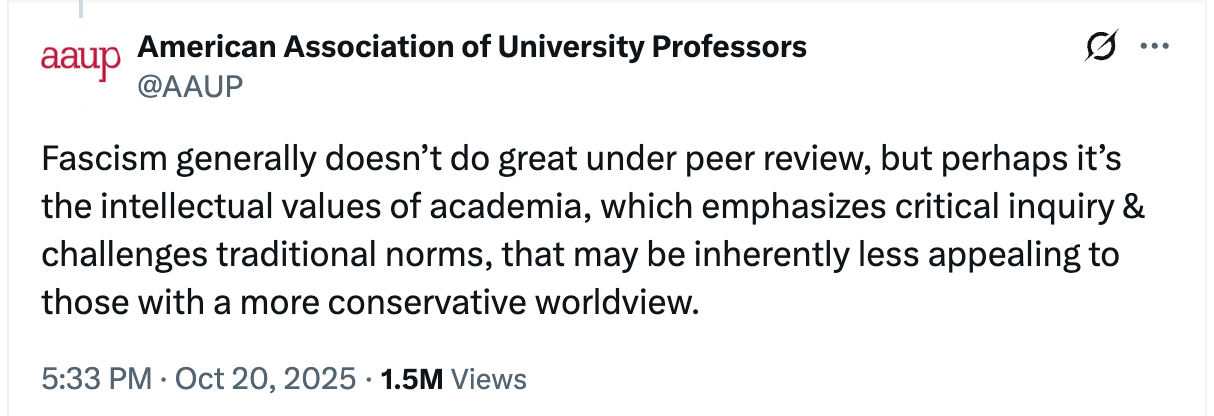
Writing in the magazine of the American Association of University Professors (AAUP), Lisa Sirangian, a Johns Hopkins literature professor, offers seven reasons why “viewpoint diversity” — that is, making room for conservatives on campus — is wrong. I’ll summarize it for you: “Because conservatives are wrong and don’t care about truth; ‘viewpoint diversity’ is a MAGA plot.”

The WaPo’s Megan McArdle isn’t having it. Excerpt:

In the wider world, asking whether academia really skews left makes you look like an idiot or, slightly more charitably, like someone so encased in a bubble that they don’t even know what they’re missing. As for insisting on your right to complete self-governance, free from “secondary, external aims,” as Siraganian puts it … well, if you expect someone else to pay you to pursue truth, at some point, you must accept some secondary, external aims.

Academics tend to recoil from such a crass and mercenary idea, and fair enough, but the world is a crass and mercenary place. We talk about pursuing truth for its own sake, but most academics are pursuing it in exchange for money they can use to satisfy their many less elevated needs. The people who provide that money want something in return. Many will not be content to know that somewhere the global stock of Truth is increasing. Especially if one of the Truths you insist on is that they are dim-witted bigots.

Anyway, this is how the AAUP responds to the conversation on X:

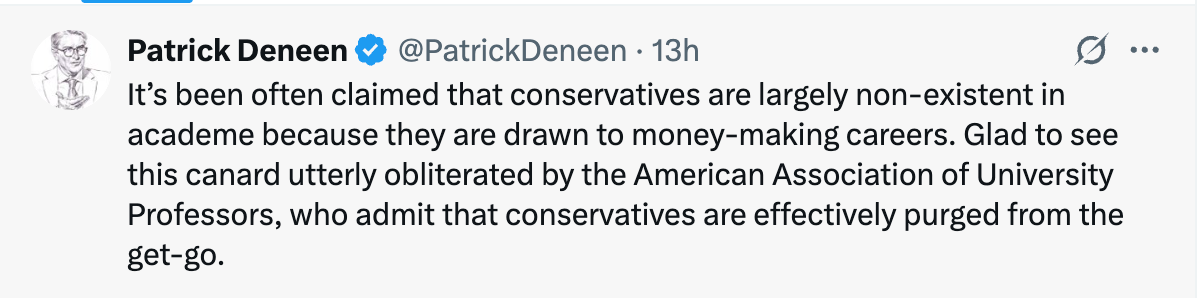
Well, there it is. Conservatives are FASCISTS! Patrick Deneen responds to that tweet:

The more I see institutional elites, in government and the private sector, the more I realize these people are like the pre-revolutionary Tsarist circles. They had no idea why so many people hated them, and what kind of precarious situation they were in.

Rod Dreher

Google

They always invest in businesses that put them in the ‘trade routes’—controlling the linkages, and never getting involved in the creation of tangible value.

Ted Gioia, Google Is Now the East India Company of the Internet

Today in History

Kagi News, a new and useful aggregator, offers “Today in History as one of its tabs, with events at the top, people at the bottom.

For some reason, I find that a lot of composers and poets I had place mentally in the late-19th century were actually in early-19th century. Edgar Allen Poe never even saw the late-19th. Who knew?

Snippets

  • … the Conservative Political Action Conference, a kind of movable rent-a-troll event … (Anne Appelbaum via Frank Bruni)
  • The old Saudi brand was ‘austere theocracy,’ but the new one is ‘fun, fun, fun, but still with beheading.’” (Helen Lewis via Frank Bruni)
  • We live the given life and not the planned. (Wendell Berry, Sabbath poems 1994 number 3)
  • I love her more than evolution requires. (Charles Murray’s wife, reflecting on their first child. Attributed to others as well. The insight doubtless matters more than the source.)
  • Mad Ireland hurt you into poetry. (W. H. Auden, in memory of W. B. Yeats)
  • Music is a conspiracy to commit beauty. (Linda Ronstadt)
  • States, particularly liberal democracies, are heavily dependent on wars for moral coherence. (Stanley Hauerwas, Resident Aliens). Looking at the last 62 years of American history seems to confirm this.

We are all gatekeepers now.

Peggy Noonan

Your enemies are not demonic, and they are not all-powerful and the right hasn’t always lost and the left hasn’t always won. But if you convince yourself of that, you give yourselves all sorts of permission to do a lot of stupid and terrible things under the rubric of “Do you know what time it is?”

Jonah Goldberg.

[A] critical mass of the American people … no longer want[s] to govern themselves, … are sick of this republic and no longer want to keep it if it means sharing power with those they despise.

Nick Catoggio

I don’t do any of the major social media, but I have two sub-domains of the domain you’re currently reading: (a) You can read most of my reflexive stuff, especially political here. (b) I also post some things on my favorite no-algorithm social medium.
Tuesday, 1/21/25

Does 47 have what greatness takes?

[T]he heroic presidency runs the persistent danger of becoming craven or abusive, as Vietnam and Watergate taught. This is what so many critics worry about with Mr. Trump — that his transformations will be more resonant of Richard Nixon than of our most esteemed presidents.

Yet there is a complementary question that should concern supporters of Mr. Trump: Can he succeed? He has amassed enormous power in his party and is building an intensely devoted administration. Those factors will bring him wins in the short run.

But it takes extraordinary skill to wield executive power successfully throughout an administration. If past is prologue, Mr. Trump lacks the acumen to carry out his ambitious agenda.

The first problem is management style. In his first term, Mr. Trump was a poor administrator because of his mercurial, polarizing style and a general indifference to facts and the hard work of governance. …

Second is the question of whether Mr. Trump knows where he wants to go. … Mr. Trump has a powerful slogan, “America first,” a robust agenda, and many discrete and often insightful political instincts. But he lacks a coherent sense of the public ends for which he exercises power. …

Third, personal gain was neither a priority of the great presidents nor a guide to their exercise of power. …

Fourth, Mr. Trump is unlike any previous president, even Jackson, in broadly delegitimating American institutions — the courts, the military and intelligence communities, the Justice Department, the press, the electoral system and both political parties. This will do him no favors when he needs their support, as he will.

Fifth, Mr. Trump’s obsession with hard executive power and an extreme version of the unitary executive theory will be self-defeating. If his stalwart subordinates carry out his every whim, as he hopes, bad policies will result. If the loyalists Mr. Trump is putting at the top of the Justice Department do not give him candid independent advice that he follows, he will violate the law and often lose in court, as happened in his first term.

The great presidents … understood that hard power could go only so far and that persuasion and consent were surer tools to achieving lasting presidential goals in our democracy. This idea is lost on Mr. Trump.

Finally, as Mr. Schlesinger noted, the great presidents all “took risks in pursuit of their ideals” and “provoked intense controversy.” And, except for Washington, they all “divided the nation before reuniting it on a new level of national understanding.”

Mr. Trump is a risk taker and a divider. But it is hard to see how his approach to the presidency ends in national reunion.

Jack Goldsmith (unlocked article)

Offshore politics

Velocior, superior, stupidior

What runners they were,
round and round the arena
in their expensive armour

like that other runner
from Marathon, his time
unsurpassed until the arrival
of steroids. We cover the ground
faster, but what news do we bring?

Excerpt from Postcard, in R.S. Thomas, Collected Later Poems 1988-2000

The neutering welcome

Merkel, when she insisted that Islam belonged in Germany just as much as Christianity, was only appearing to be even-handed. To hail a religion for its compatibility with a secular society was decidedly not a neutral gesture. Secularism was no less bred of the sweep of Christian history than were Orbán’s barbed-wire fences. Naturally, for it to function as its exponents wished it to function, this could never be admitted.

Tom Holland, Dominion

If this makes no sense to you, read it again. And again. If it still makes no sense, you need to read some history, and Dominion wouldn’t be a bad place to start.

What is truly “self-evident”?

So yes, the equality of all humans seemed staringly obvious (at least in theory) to Franklin and Jefferson. But that was because their culture was saturated with Christian assumptions―so much so that the concepts and phrases they used were taken from Locke, who had got them from Hooker, who had got them from Scripture.”

Franklin’s brief, scribbled correction is a marvelous metaphor for the ex-Christian West. His replacement of the words “sacred and undeniable” with “self-evident” echoes what was happening across European society as a whole in 1776, at least among elites. It was an attempt to retain Christianity’s moral conclusions while scrubbing out its theological foundations: keeping the fruits while severing the roots, if you will. And it resulted in the insistence that JudeoChristian convictions on anthropology and ethics were now to be regarded as universal norms on which all reasonable people would agree.

Andrew Wilson, Remaking the World

See my remark in the prior item.

Oblivious

On this bitter-cold January morning in the American midwest, my thoughts turned to hot, hearty soup, and this quickly led to a reflection.

There is a catering service in my fair city that used to be open to the public for sit-down lunch. Its kitchen included a soup genius.

I’d go there on a wintery day, and once I learned of it, I would invariably check their freezer before leaving, buying as many as four quarts of frozen, leftover soup.

Then one day the proprietress approached me: “Did you realize that a lot of people on fixed incomes come here to buy soup?” Crestfallen, I answered “No, I didn’t. I’m sorry. Thank you for telling me. I’ll leave the soup for them.”

My obliviousness fit my recent description of non-rebellious sin.

God never said “Thou shalt not buy leftover soup.” He didn’t say “Thou shalt think twice or thrice about the indirect consequences of buying leftover soup.” And, since this was a rather upscale eatery (albeit in a downscale neighborhood), I’m not sure that the proverbial “moment’s reflection” would have revealed the indirect consequences to me; I just saw it as “I get good soup and this caterer gets more money.”

But I was, quite obliviously, snatching food from the mouths of poor pensioners. Greater awareness might have prevented that, and the proprietress’ consciousness-raising was welcome.

Proof

Woozle Effect

When a source makes an unproven claim and it’s then cited as proof by another, which is cited by another, and so on, until the chain of citations looks like evidence. This is common because, while many writers check their sources, few check their sources’ sources.

A recent example: evidence that puberty blockers are safe and effective was overestimated because institutions were circularly citing each other.

Hitchens’s Razor

“What can be asserted without evidence can be dismissed without evidence.” ― Christopher Hitchens. If you make a claim, it’s up to you to prove it, not to me to disprove it.

Gurwinder Bhogal

Time to pull this out (again?)

I don’t recall if I’ve shared this favorite here:

Love the quick profit, the annual raise,
vacation with pay. Want more
of everything ready-made. Be afraid
to know your neighbors and to die.
And you will have a window in your head.
Not even your future will be a mystery
any more. Your mind will be punched in a card
and shut away in a little drawer.
When they want you to buy something
they will call you. When they want you
to die for profit they will let you know.
So, friends, every day do something
that won’t compute. Love the Lord.
Love the world. Work for nothing.
Take all that you have and be poor.
Love someone who does not deserve it.
Denounce the government and embrace
the flag. Hope to live in that free
republic for which it stands.
Give your approval to all you cannot
understand. Praise ignorance, for what man
has not encountered he has not destroyed.
Ask the questions that have no answers.
Invest in the millennium. Plant sequoias.
Say that your main crop is the forest
that you did not plant,
that you will not live to harvest.
Say that the leaves are harvested
when they have rotted into the mold.
Call that profit. Prophesy such returns.
Put your faith in the two inches of humus
that will build under the trees
every thousand years.
Listen to carrion — put your ear
close, and hear the faint chattering
of the songs that are to come.
Expect the end of the world. Laugh.
Laughter is immeasurable. Be joyful
though you have considered all the facts.
So long as women do not go cheap
for power, please women more than men.
Ask yourself: Will this satisfy
a woman satisfied to bear a child?
Will this disturb the sleep
of a woman near to giving birth?
Go with your love to the fields.
Lie easy in the shade. Rest your head
in her lap. Swear allegiance
to what is nighest your thoughts.
As soon as the generals and the politicos
can predict the motions of your mind,
lose it. Leave it as a sign
to mark the false trail, the way
you didn’t go. Be like the fox
who makes more tracks than necessary,
some in the wrong direction.
Practice resurrection.

“Manifesto: The Mad Farmer Liberation Front” from The Country of Marriage, Harcourt Brace Jovanovich, Inc. 1973. Also published by Counterpoint Press in The Selected Poems of Wendell Berry, 1999; The Mad Farmer Poems_, 2008;_ New Collected Poems, 2012.


I suffer more from the humiliations inflicted by my country than from those inflicted on her.

Simone Weil, from a letter to Georges Bernanos.

[N]one of the things that I care about most have ever proven susceptible to systematic exposition.

Alan Jacobs, Breaking Bread With the Dead

I don’t do any of the major social media, but I have two sub-domains of the domain you’re currently reading: (a) You can read most of my reflexive stuff, especially political here. (b) I also post some things on the only social medium I frequent, because people there are quirky, pleasant and real.

A Grim Anniversary

Three days in a row! When did I last blog three days in a row?!

I have nothing to say about Israel, Hamas, Gaza, Lebanon, Iran, hostages and any piece I’ve left out, but I’m not oblivious to this anniversary.

Not politics

Tradition

Tradition refuses to submit to the small and arrogant oligarchy of those who merely happen to be walking about. All democrats object to men being disqualified by the accident of birth; tradition objects to their being disqualified by the accident of death.

G.K. Chesteron, Orthodoxy

Here is a quick and generally reliable rule to follow. If people have always said it, it is probably true; it is the distilled wisdom of the ages. If people have not always said it, but everybody is saying it now, it is probably a lie; it is the concentrated madness of the moment.

Anthony M. Esolen, Out of the Ashes

Sportsball

Gladwell, like many of us, seems to have unwittingly internalized the idea that when professional athletes do the thing they’re paid to do, they’re not acting according to the workaday necessity (like the rest of us) but rather are expressing with grace and energy their inmost competitive instincts, and doing so in a way that gives them delight. We need to believe that because much of our delight in watching them derives from our belief in their delight.

Alan Jacobs, How to Think

Dreaming is just about our only break from rationalism

Ted Gioia asks Are Visionary Artists Mentally Ill?. I can’t do justice to it without plagiarism, but here’s a sample:

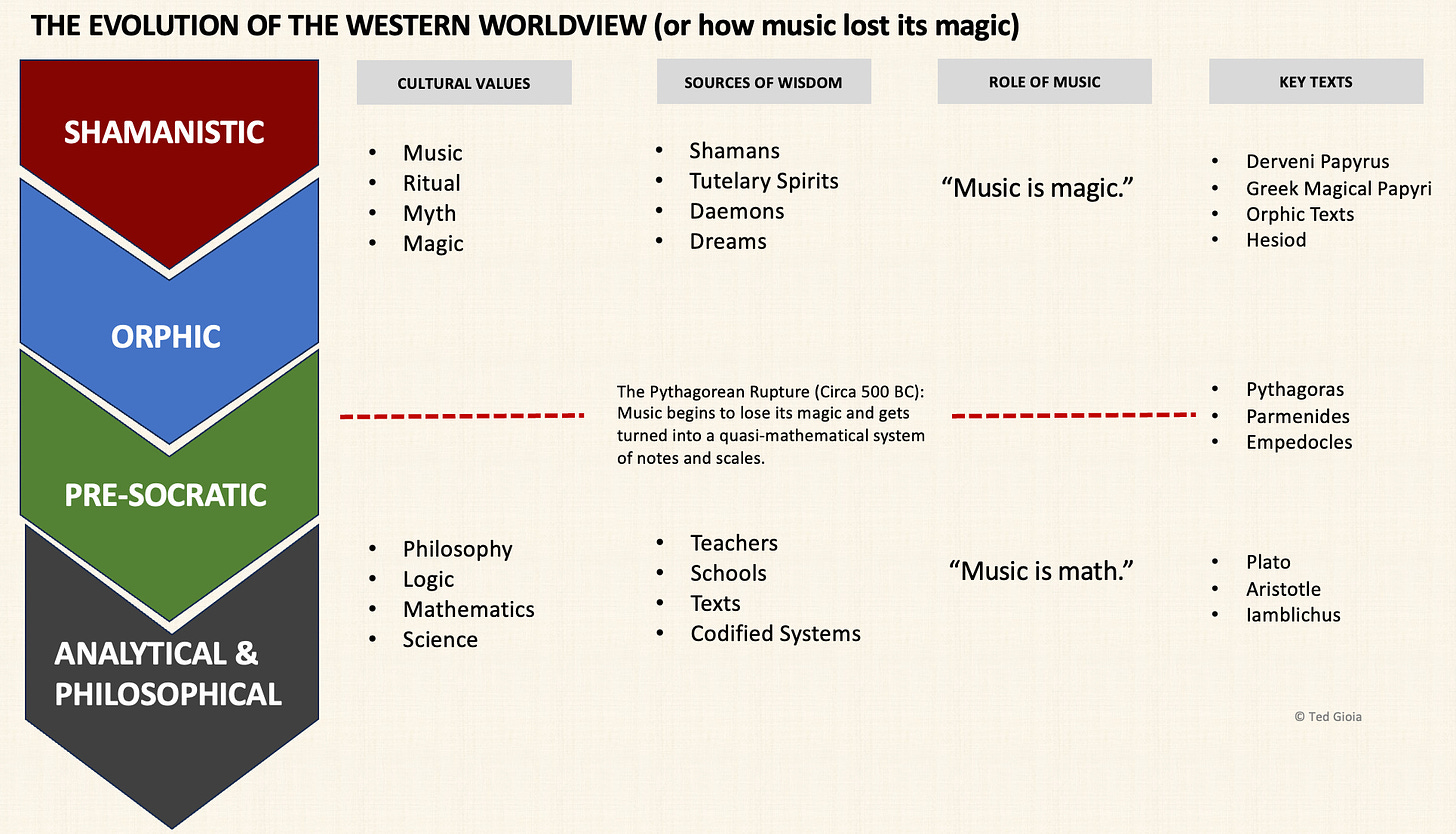
The whole evolution of music as an academic discipline tends to destroy the most important reason to care about music in the first place.

Here’s one of my charts on the subject:

That’s why I started to write about sleeping.

No music writer talks about sleep more than me. And that’s because dreams happen when we sleep—and this is the one type of visionary experience everybody can still access.

We all become a little unhinged and crazy in those dreams. Even the most rationalistic STEM advocate.

Could something like this—dream therapy for creatives— exist in the current day?

I wondered about this for a long time. I finally decided to ask musicians about whether they had learned songs from their dreams.

Nothing prepared me for the response I got. I heard from hundreds of musicians—and learned that the gift of a song during a dream is quite common. And it’s usually a powerful song.

I note that many musicians have told me that they are reluctant to discuss their dream songs. The subject is just too strange and antithetical to our dominant rationalist paradigm.

And that reluctance is even greater if the artist has a hallucination or out-of-body experience or something else that ‘medical experts’ might want to treat.

My hunch is that these happen frequently to intensely creative people—even in an age of rationalism.

The world isn’t as neat and rigorously logical as you’ve been told. And the world of artistic inspiration is the least logical of all. There’s a good reason why the ancients believed that creative works were a gift from the muse.

I continue to research this subject, and I think about it all the time. Even more important, I try to open up my mind to realms of experience beyond the empirical. That’s where creativity comes from, and I don’t want to shut myself off from the source because of close-mindedness.

Above all, I don’t mock or dismiss artists who have these visions, or assume that in every instance they are suffering from mental illness. Some of them might be a lot wiser or healthier than the rest of us.

I can’t think of a solo-effort Substack that delivers more bang for the buck that Ted Gioia, The Honest Broker. And the guy is really smart about some things that interest me.

From the Department of Free-Association: Has Rod Dreher, once again, seized the moment to shape a coming conversation, as he did in Crunchy Cons, Benedict Option and Live Not By Lies?

Politics

Serious people earnestly disagreeing

Back in August I was watching the DNC with my old mom in California. Kamala and Tim and Michelle and Barack and all the others kept talking about our reasons for aiding Ukraine in its fight against the Russian occupation of its eastern territories. They consistently appealed to the apparently essentialized fact that the Ukrainians, like the Americans, “love freedom”, and that it is only natural and right to help other peoples who share this love with us. There was zero acknowledgment of the complexities of geopolitics and historical legacies, or of the situated perspective a Russian might non-crazily come to have, according to which parts of what is now Ukraine seem naturally and justly to fall more into the sphere of influence of the Russian Empire than of the North Atlantic one.

I know a lovely man in his 60s, an outstanding member of the vanishing breed of the Homo Sovieticus, whose father is Ukrainian and whose mother is Russian, and who grew up in Kazakhstan. He tells me his parents waited to get married so that the celebration would take place on the 300th anniversary of the 1654 Pereyaslav Agreement, in which the Cossack Hetmanate in control of much of Ukraine made a ceremonial pledge of loyalty to Moscow. This friend of mine is in exile, and is no admirer of Putin. He greatly regrets the 2022 invasion. But he could never make any sense of any claim to the effect that Ukraine rightly belongs to NATO and not to Russia in virtue of some mysterious essential trait of the Ukrainian people, that they “love freedom” while the Russians do not.

And here we arrive at what really gets me about the Democrats. If we are going to risk direct conflict with another nuclear-armed superpower, let us not be lulled into it by bullshit and platitudes. Why do the Democrats have to talk that way? It’s as if the Republican tactic of portraying “the libs” as effeminate hyper-woke safe-spacers has really only caused the Democrats themselves to double down with absurd displays of hawkish masculinity. We’re supposed to love Kamala because she’s a tough-on-crime prosecutor, and that therefore corrects for the slip-ups of the past years when some in the progressive wing of the party have suggested, on the contrary, that all cops are bastards. Tim Walz, meanwhile, seems to have been chosen primarily because he wears flannel shirts, and has been put on display in the most implausibly kayfabe campaign ads purportedly fixing his own pick-up truck. One almost expects them next to come out with an ad depicting Walz in the act of dressing a deer, looking every bit the caricature of the Minneapolis goy neighbor in the Coen Brothers’ A Serious Man (2009). He’s a hunter and a football coach, but he’s also a faculty advisor for the LGBTQIA+ club! What a model of enlightened masculinity! She’s a prosecutor and a foreign-policy hawk, but she’s a she and she brings “joy”! The problem is that none of the rest of the world cares about any of that childish stuff. They all know that for all the equally kayfabe retrograde masculinity of Trump, that man is an absolute pussy, and it is in fact the Democrats who represent the greatest threat to any hot-spot of resistance to the US’s arch-imperial ambitions throughout the world.

JSR, Founding Editor of the Hinternet, explaining why he wouldn’t join the Hinternet endorsement of Kamala Harris.

What are the odds that a world in which the American Empire is beaten into desperate retreat would be any sort of world our children and grandchildren might want to live in? … Trump, in a second term as president, is practically guaranteed to assume the role of overseer of American imperial retreat, in favor not of a global community of equals such as some naïve progressives might have hoped for in the early years of the League of Nations, but of nationalist isolation and at most pragmatic cooperation with other self-sequestering nation-states, somewhat along the lines of what Marine Le Pen envisions for Europe in the phrase “association des nations libres”. That phrase might sound innocent enough, but nations that are free to dispense with any idea of reciprocal obligations are unlikely to remain in a stable “association” for long, and Trump, at least, hardly gives any indications of knowing how to guide the ship of state as it weathers the inevitable storms that will whip up unstable waters in our years of decline. Far better, far surer, we believe, to have a party in power that understands and accepts the nature of the that power: imperial power, namely, which might aspire in the years ahead not only to face off with steely resolve in our current global showdown, but, eventually, to emerge as its undisputed champion.

Most of us on the Editorial Board, even the Americans among us, do not live in the United States, and from our respective vantages it is pretty hard to concentrate on any aspect of American political life that does not have to do with its role as a globe-spanning empire. Just manage your domestic affairs however you see fit, we are tempted to say; our overwhelming concern is with what you get up to beyond your borders. We therefore have rather little patience for that current of Democratic partisan discourse that would like for American politics to sound more or less like, say, Danish politics. Denmark, if we may be blunt, and all of the Scandinavian countries with such high marks on all the usual tests, is able to focus on maintaining its robust welfare state primarily because its defense is entirely outsourced to the American Empire. The American Democrats who fawn over European national health systems seldom realize that by seeing to the defense of other NATO members, the United States is at the same time freeing up European national budgets for other more humane uses. Americans pay for European defense rather than paying for their own welfare; Europeans get health care in turn, but only through de-facto vassalization.

We would like to see this arrangement continue, at least for now, at least until NATO can be expanded to include all of those states that currently set themselves up in opposition to it, a prospect even Russia’s own leaders in the early post-Soviet years were able to entertain with some seriousness.

You might think our reasons for voting for the Democrats are not good ones, or that we are merely “joking” when we give them. We can only reply that your reasons really do not matter. You might well imagine your are voting, for your part, for “decency”, or “joy”, or sane gun-control laws or a woman’s right to choose. But the only way to vote for any of these things is to cast a vote for American empire. That’s the bargain. We here at The Hinternet, minus our Founding Editor, believe this is a bargain worth accepting, but that is only because we believe it is the United States under Democratic leadership that offers us the single best shot at subduing all the planet’s lingering zones of discontent, and delivering us into a future of perpetual peace. This is what we at The Hinternet want. Do you?

The remainder of the Hinternet Editorial Board.

These seem to be serious people having a serious disagreement, not just swapping bullshit and platitudes. It’s a habit most of us, myself included, could benefit by emulating.

Agreement on norms trumps disagreement on policy

Cheney’s argument for Harris is a classical liberal version of the GOP’s “Flight 93 election” reasoning from 2016. It’s a basic matter of proper prioritizing: Agreement on norms trumps disagreement on policy. If you hand power back to Trump, he’ll crash the constitutional order. The conservative thing to do under the circumstances is to storm the cockpit by backing Harris, who’ll at least keep the plane in the air.

Nick Catoggio

(I wonder how Lisa Beamer feels about Flight 93 as a recurring political trope?)

Those conservative Democrats!

The truth, I think, is that the Democratic Party is drifting. Coasting. Dems are buoyed at the national level by Trump’s personal unpopularity but lacking in any kind of compelling vision for the future of the country. For the third cycle in a row, the Democrats have been freed up to run a mostly substanceless campaign that boils down to “Vote for us so Trump will lose.” But what besides that promise of negation does the party stand for? What does it hope to accomplish? Or does it just want to be empowered to manage for a little longer the well-functioning system of domestic and international institutions that already exists?

The answer, it would seem, is the latter. From what I can tell, the Democrats are proposing little beyond a defense of the status quo (or, in the case of abortion rights, a return to the status quo as of a few years ago) against all the unorthodox things their opponents aim to accomplish (including mass deportations, a revolution in how the executive branch is staffed, and the imposition of sweeping tariffs).

That means the Democrats have inadvertently become America’s conservative party, championing the views and interests of those Americans who are content with the country’s present and recent past. When that stance is combined with opposition to the widely loathed Trump, it can (just barely) deliver victory …

The term “conservative” has many meanings, but the most elementary one—the one associated with the man generally considered to be the first conservative writer and thinker, Edmund Burke—grows out of the name itself: To be conservative is to seek to conserve the present’s inheritance from the past: the accomplishments, authoritative institutions, norms, habits, policies, and traditions that have been handed down to us by previous generations.

That’s the meaning of Liz Cheney’s enthusiastic endorsement of the Harris/Walz ticket late last week. It’s not a signal that Harris will govern as a Republican from the era when Cheney’s father (who has also endorsed Harris) served as George W. Bush’s vice president. It’s an expression of Burkean conservatism against the disruptive-revolutionary impulses of the MAGA movement.

Damon Linker

What is he talking about?

The American multiculturalists similarly reject their country’s cultural heritage. Instead of attempting to identify the United States with another civilization, however, they wish to create a country of many civilizations, which is to say a country not belonging to any civilization and lacking a cultural core. History shows that no country so constituted can long endure as a coherent society. A multicivilizational United States will not be the United States; it will be the United Nations.

Samuel P. Huntington, The Clash of Civilizations and the Remaking of World Order.

I was not a very good student of history, but I wonder what historic precedents Huntington has in mind when he says “History shows …”. Sincere question. Surely it’s not just that nobody has tried a multicivilizational nation before; that would not yield a verdict of history.

Please comment if you know. (Comments are moderated but not censored for viewpoint.)

We knew damn well he was a snake …

before we took him in.

I love editorial cartoons, and am fond of comic strips as well. As newspapers are dying, I mainline mine from here.


I suffer more from the humiliations inflicted by my country than from those inflicted on her.

Simone Weil, from a letter to Georges Bernanos.

I don’t do any of the major social media, but I have two sub-domains of the domain you’re currently reading: (a) You can read most of my reflexive stuff, especially political here. (b) I also post some things on the only social medium I frequent, because people there are quirky, pleasant and real.

Saturday 9/28/24

This is Purdue’s Homecoming weekend. They’re playing football — or pretending to. I’m looking forward to basketball season.

Miscellany

An odd job title, if you think about it

“Content Creator” is a title that inadvertently tells on itself. It’s a tacit admission that the nature of the “content“ is meaningless and it exists to fill space. Might as well call yourself “Stuff Maker” or “Thing Doer.”

Dominic Armato via Alan Jacobs

As wrong as possible

“Poverty just doesn’t happen,” Rep. [Barbara] Lee, a California Democrat, declared at the launch of the “Children’s Budget,” a kind of progressive wish list, last week. “It’s a policy choice.” Rep. Lee has run up against a kind of metaphysical limit there: She is as wrong as it is possible for a human being to be. 

As practically every serious thinker about the issue has understood for a few thousand years at least, poverty does just happen—it is, in fact, one of the few things that does just happen. Poverty is the natural state of the human animal. Do nothing, and you will have poverty. Thomas Hobbes knew it. Aristotle knew it 2,000 years before Hobbes. Hesiod knew it centuries before Aristotle. The authors of the Upanishads knew it centuries before Hesiod. “Throughout history, poverty is the normal condition of man,” the American sci-fi writer Robert Heinlein observed. Or, as Thomas Sowell spent a lifetime explaining to an apparently impenetrable public, poverty has no causes—the absence of poverty has causes. Rep. Lee’s error is not novel. Her mistake repeats—nearly verbatim—the error of Rep. Ayanna Pressley: “Poverty is not naturally occurring; it is a policy choice.”

Kevin D. Williamson

Nothing more freeing

Of The Bulwark’s Mona Charen:

In 2018, she appeared on a panel at the Conservative Political Action Conference. When asked about feminism, she attacked her own tribe, saying, “I’m disappointed in people on our side for being hypocrites on sexual harassers and abusers of women who are in our party, who are in the White House, who brag about their extramarital affairs, who brag about mistreating women. And because he happens to have an R after his name, we look the other way; we don’t complain.”

The crowd erupted in jeers and shouts of “Not true!” Charen had been a speechwriter for Nancy Reagan! This was CPAC, Republican prom! Security guards escorted her out for her own protection.

The incident didn’t seem to shake her. “There is nothing more freeing than telling the truth,” Charen later wrote in a New York Times op-ed.

Olga Khazan, Never Trump, Forever

Decades ago, Mona Charen was one of my favorite conservative columnists. I rarely read her these days because, in the anti-Trump cosmos, I’m on planet Dispatch and find planet Bulwark a bit weird tedious. Thus has the black hole of Donald Trump disrupted the cosmos.

What unites us

Americans are less divided politically than the media likes to pretend.

Yes, it’s a big, diverse electorate, but there are certain opinions we all share. Like this one: I can’t believe the party I hate isn’t getting clobbered in the polls.

From the Liz Cheney left to the Robert F. Kennedy Jr. right, ask any voter at random whether they’re surprised at how close this race is, and my guess is they’ll talk your ear off in exasperation.

Nick Catoggio

Banned Books Week

The Orwellian Evolution of Banned Books Week

Vice and Virtue

Neither fear nor courage saves us. Unnatural vices
Are fathered by our heroism. Virtues
Are forced upon us by our impudent crimes.
These tears are shaken from the wrath-bearing tree.

T.S. Eliot, Gerontion, via J. Bottum

The gay guy pundits agree

Harris’ Context

I can’t say what Vice President Kamala Harris’s favorite word is — the one time I met with her, I didn’t ask — but I’d put a big stack of chips on “context.” She said it not once, not twice, but three times in her signature May 2023 “coconut tree” riff, and I’ve heard it tumble from her lips on other occasions as well. It’s like some oratorical caftan, warming and comforting her.

That turns out to be apt. Her bid for the presidency is all about context.

Any realistic response to it hinges not on the policy details that she has or hasn’t provided, not on the fine points of her record over time, not on her interview with Stephanie Ruhle of MSNBC on Wednesday, not on her previous sit-down with CNN’s Dana Bash. It hinges on context. She cannot be sized up outside of or apart from the alternative, a man of such reprehensible character, limitless rage, disregard for truth, contempt for democracy, monumental selfishness and incoherent thinking that even discussing Harris’s virtues and vices feels ever so slightly beside the point. She’s not Donald Trump.

Frank Bruni

The words are different but the melody’s the same

In the culture war, we know exactly what she is: an equity leftist, a strong believer in race and sex discrimination today to make up for past race and sex discrimination yesterday, and a politician who favors redefining womanhood to include biological men, and conducting medical experiments on gay, autistic and trans children, based entirely on self-diagnosis. These are her values, they are the values of every Dem special interest group, and she assures us they have not changed. I believe her.

I have yet to hear her say a single interesting or memorable thing in her entire career. Have you?

If a serious Republican candidate were up against her — even Nikki Haley — this election would not be even faintly close.

But we do not have a serious Republican candidate.

We have the most shameless charlatan in American political history — and there are plenty of competitors. He is unfit in every respect to be president of the United States …

Trump does not merely break norms. He has broken the norm, the indispensable norm for the continuation of the republic, the norm first set by George Washington when he retired from office, the norm that changed the entire world for the better: accepting the results of an election … I do not think this is even within his personal control. He is so genuinely psychologically warped that he has never and will never agree to the most basic requirement of public office: that you quit when you lose; and that the system is more important than any individual in it.

He is not lying when he insists that he won in 2016 and 2020 by massive landslides in the popular vote. He believes it. He believes he will win by a landslide in November, and there is no empirical evidence that could convince him otherwise. If he loses the election, he will call it a massive fraud one more time, and foment violence to protest it. We know this more certainly than we know anything about Kamala Harris. He tried to leverage mob violence to disrupt our democracy once. If that was not disqualifying, nothing is …

So I will vote for Harris, despite my profound reservations about her. Because I have no profound reservations about him. I know who he is and what he is. I know what forces he is conjuring and the extremes to which he will gladly take his own personal crusade. To abstain, though temptingly pure, is a cop-out. I vote not for Harris as such, but for a conservatism that can emerge once the demon is exorcized.

And exorcize it we must. Now, while we still can.

Andrew Sullivan

Other thoughts on POTUS Election 2024

Uninteresting and unmemorable

We have to guard that spirit. Let it always inspire us. Let it always be the source of our optimism, which is that spirit that is uniquely American. Let that then inspire us by helping us to be inspired to solve the problems.

Kamala Harris. I hate to belittle her, because her context is him, and he is everything that Bruni and Sullivan said. If Indiana is in play, I’ll vote for the sane-but-empty suit who’ll leave office in 2028 if defeated, leaving our political system intact.

Suttons Bay, MI, last week

Donald Trump According to Those Who Know Him

My last NYT “gift article” for September, and one of the most important. Donald Trump According to Those Who Know Him

Even when he’s right, he’s wrong

Somebody apparently told Trump about, say, ProPublica attacking the Dobbs decision (substantially reversing Roe v. Wade). His over-the-top response, directionally right, was this:

When speaking to supporters from the swing state, where both Trump and Vice President Kamala Harris have doubled efforts to capture the election count in November, Trump lamented the criticism aimed at the Supreme Court‘s conservative supermajority and said it should be “illegal.”

“They were very brave, the Supreme Court. Very brave. And they take a lot of hits because of it,” said the former president. “It should be illegal, what happens. You know, you have these guys like playing the ref, like the great Bobby Knight. These people should be put in jail the way they talk about our judges and our justices, trying to … sway their vote, sway their decision”

Trump Says People Criticizing Supreme Court Justices Should Be Jailed

So he also is profoundly ignorant of our most fundamental rights, including the right to say stupid things about any branch of government we care to kvetch about.

Some Nationalist, this

Donald Trump is a funny kind of patriot. 

He loves America—except for the cities, the people who live in the cities, about half of the states, the universities, professional sports leagues, Hollywood, Silicon Valley, Wall Street, the legal system, immigrants, the culture. He thinks the Capitol Police are murderers and that the FBI is a gestapo, that the government is an illegitimate junta maintained through election fraud, that the January 6 rioters are political prisoners, that the nation is a ruin, that it is “failed.” And when it fell to him to explain to [a] debate audience why he should be president, he spent most of his time repeating the praise of Hungarian autocrat Viktor Orbán.

Trump’s enemies are all Americans, his friends are all foreign dictators, and his money lives in Dubai and Indonesia. Some nationalist. 

Trump lives in a very strange little bubble: His world is Palm Beach, a handful of golf courses and hotels, and Fox News. The smallness of his frame of reference is a problem for him ….

Kevin D. Williamson

Trump’s victims

Depending on how you count them, 19 or 26 or 67 women have accused Mr. Trump of sexual misconduct. Women who have said he “squeezed my butt,” “eyed me like a piece of meat,” “stuck his hand up my skirt,” “thrust his genitals,” “forced his tongue in my mouth,” was “rummaging around my vagina,” and so on.

Mr. Trump has denied any misconduct. He, in turn, has accused the women of being “political operatives,” plotting a “conspiracy against you, the American people,” looking for their “10 minutes of fame” and not being his “type.”

“It couldn’t have happened, it didn’t happen,” Mr. Trump sneered during a recent news conference, referring to Ms. Leeds, the one who accused him of assaulting her on an airplane. “And she would not have been the chosen one.”

Jessica Bennett, Trump’s Female Accusers Are Begging You Not to Forget Them

He can’t even deny his sexual assaults without:

  1. Sneering at how homely his accuser is and
  2. Tacitly admitting that he assaults women lucky enough to be “chosen.”

I suffer more from the humiliations inflicted by my country than from those inflicted on her.

Simone Weil, from a letter to Georges Bernanos.

I don’t do any of the major social media, but I have two sub-domains of the domain you’re currently reading: (a) You can read most of my reflexive stuff, especially political here. (b) I also post some things on the only social medium I frequent, because people there are quirky, pleasant and real.

Thursday, 9/5/24

Culture

A key moment in modernity

One of the key moments in the creation of modernity occurs when production moves outside the household. So long as productive work occurs within the structure of households, it is easy and right to understand that work as part of the sustaining of the community of the household and of those wider forms of community which the household in turn sustains. As, and to the extent that, work moves outside the household and is put to the service of impersonal capital, the realm of work tends to become separated from everything but the service of biological survival and the reproduction of the labor force, on the one hand, and that of institutionalized acquisitiveness, on the other. Pleonexia, a vice in the Aristotelian scheme, is now the driving force of modern productive work.

Alasdair MacIntyre, After Virtue

Why essays?

Of all the literary genres, I am fondest of the essay, with its meandering course that (we hope) faithfully represents the meanderings of the human mind … certain images in advance and people will recur throughout this book, returning perhaps when you think we’re done with them. I write this way because none of the things that I care about most have ever proven susceptible to systematic exposition.

Alan Jacobs, Breaking Bread with the Dead (emphasis added)

Interrogating “Self-expression”

[A]lthough everything we do is self-expression, we normally describe an action as self-expression only to say “this is good.” Used that way, the term is powerful. For example, foul pictures and language weren’t formerly counted as free speech because they didn’t communicate ideas and arguments. Today, though, they are counted as free speech, just because we say they “express” the “self.” And of course, logically, they do. If I spout a stream of profanities, I may be expressing nothing more of myself than an urge to blow off steam. But I may also be divulging my desire for attention, my craving to sound tough, my enjoyment of filthiness, or even my inability to express a cogent argument.

But why should the term “self-expression” have such power to connect itself with our approval? Probably for at least two reasons. The first is that the idea of expressing ourselves validates our narcissism. The second is that it shields us from criticism.

J Budziszewski

Modern finance is a shell-game

John Lanchester:

Lending money where it’s needed is what the modern form of finance, for the most part, does not do. What modern finance does, for the most part, is gamble. It speculates on the movements of prices and makes bets on their direction. Here’s a way to think about it: you live in a community that is entirely self-sufficient but produces one cash crop a year, consisting of a hundred crates of mangoes. In advance of the harvest, because it’s helpful for you to get the money now and not later, you sell the future ownership of the mango crop to a broker, for a dollar a crate. The broker immediately sells the rights to the crop to a dealer who’s heard a rumour that thanks to bad weather mangoes are going to be scarce and therefore extra valuable, so he pays $1.10 a crate. A speculator on international commodity markets hears about the rumour and buys the future crop from him for $1.20. A specialist ‘momentum trader’, who picks up trends in markets and bets on their continuation (yes, they do exist), comes in and buys the mangoes for $1.30. A specialist contrarian trader (they exist too) picks up on the trend in prices, concludes that it’s unsustainable and short-sells the mangoes for $1.20. Other market participants pick up on the short-selling and bid the prices back down to $1.10 and then to $1. A further speculator hears that the weather this growing season is now predicted to be very favourable for mangoes, so the crop will be particularly abundant, and further shorts the price to 90 cents, at which point the original broker re-enters the market and buys back the mangoes, which causes their price to return to $1. At which point the mangoes are harvested and shipped off the island and sold on the retail market, where an actual customer buys the mangoes, say for $1.10 a crate.

Notice that the final transaction is the only one in which a real exchange takes place. You grew the mangoes and the customer bought them. Everything else was finance – speculation on the movement of prices. In between the time when they were your mangoes and the time when they became the customer’s mangoes, there were nine transactions. All of them amounted to a zero-sum activity. Some people made money and some lost it, and all of that cancelled out. No value was created in the process.

That’s finance. The total value of all the economic activity in the world is estimated at $105 trillion. That’s the mangoes. The value of the financial derivatives which arise from this activity – that’s the subsequent trading – is $667 trillion. That makes it the biggest business in the world. And in terms of the things it produces, that business is useless. (Source: lrb.co.uk)

John Ellis News Items

Word-of-the-day

Word of the day: coprophagia

Definition: gobbling up Tucker Carlson other than for a detailed exposé. (Note that there are three hyperlinks in the preceding sentence.)

I don’t think Carlson has lost his mind, or at least no more so than anyone who’s been politically radicalized has. He’s been engaged in a coherent, if despicable, ideological project for years. As far back as 2017, he was airing segments in Fox News prime time on the gypsy infiltration of America. He surrounded himself at the network with white-nationalist chuds. He’s become a committed postliberal. It was inevitable that he’d start pulling his chin one day about the supposed moral complexity of World War II.

There’s nothing unusual about populists Nazi-pilling themselves with historical revisionism in search of their next contrarian high. What’s unusual about Tucker is that he’s maintained a degree of national popularity and even mainstream acceptance as he goes about trying to make the world unsafe for democracy. 

How? He’s taking advantage of a leadership vacuum on the right.

Creeping fascism on the right has been a-creepin’ since at least 2016. If you’re shocked, shocked to find that there’s gambling going on in here in 2024, it can only be because you went out of your way for tribal reasons not to notice.

Nick Catoggio

Covering what others don’t

If there is a criticism I’ve gotten over the past several years it’s that I pay too much attention—and apply too much scrutiny—to the excesses of the illiberal left at the expense of the illiberal right. Wasn’t I ignoring the elephant and allowing myself to get distracted by the gnat?

My response to that is twofold.

The first is that there is no shortage of writers, reporters, and outlets focusing on the dangers of the far right. I saw the far left as conspicuously overlooked by people who otherwise take a great interest in political extremism. And I understand why they were averting their gaze: The social cost of noticing this subject is very high. Given that the job description of a journalist is to observe the world, uncover things in the public interest, and then tell the plain truth about it, choosing topics where others fall silent seems wise to me. It still does.

The second is that I have been concerned for years now that the illiberal ideology that has become increasingly mainstream on the political left—one that makes war on our common history, our common identity as Americans, and fundamentally, on the goodness of the American project—would inspire the mirror ideology on the right. 

And that is exactly where we find ourselves, with an illiberal left that defaces Churchill statues—and an illiberal right that defaces Churchill’s legacy. With a left that insists 1619 was the year of the true founding of America—and a right that suggests the Greatest Generation was something closer to genociders. With a left that sympathizes with modern-day Nazis in the form of Hamas—and a right that sympathizes with the original ones.

Bari Weiss

Public affairs

Military valor

[Adam] Kinzinger’s political stance—his willingness to criticize the most popular and feared figure in his party, when the overwhelming majority of his colleagues have either gone silent or defended the ex-president’s indefensible actions—can’t be understood apart from his military service.

“Because we ask [service members] to die for the country, we have to be willing to do the same thing. But”—here he turned incredulous—“we’re too scared to vote for impeachment, because we’re going to lose our job? Like, seriously?”

For most of Kinzinger’s colleagues, the answer is: Yes, seriously. When I asked Kinzinger how many Republican votes there would have been in favor of impeachment if it had been a secret ballot, he told me 150. Instead, there were only 10.

The Man Who Refused to Bow

Richard Lugar

Tuesday, a bronze statue of Richard Lugar was unveiled in Indianapolis, with considerable ceremony including a speech by, appropriately, Condoleeza Rice.

I recall when I first was awed by Lugar. At our County’s Lincoln Day dinner (the closest I ever got to being a partisan activist) around 1982 or 1983, he was the featured speaker. He spoke for a very long time, without notes, mostly about his trip to the Phillipines, which had just ended. He shot straight, eschewing the B.S. about Ferdinand Marcos. One of the “conservative” talking points of the day was that Marcos’ only opponents were communists. “Don’t you believe it,” Lugar essentially said. “His only supporters are the oligarchs of the country. Small business, the Chamber of Commerce types, oppose him strongly.”

It all seemed to cohere. I couldn’t give such a speech even with notes. That he’d been a Rhodes Scholar showed.

Lugar was the kind of statesman who’d have voted to convict Trump on the Articles of Impeachment. If more Republicans had his balls, Trump would be behind us by now.

Understudy to Russia’s role as whipping boy

Yesterday Politico dropped a story about how “former GOP officials are sounding the alarm over Trump’s Orban embrace.” Gosh, where would we be without Former GOP Officials, eh? The story attempts to demonize anyone who has anything to do with the Hungarian prime minister. Excerpt:

The Conservative Partnership Institute, a nerve center for incubating policies for a second Trump administration, co-sponsored a discussion in October 2022 about how to bring “peace in Ukraine” featuring Hungarian Minister of Foreign Affairs Peter Szijjarto.

Audience members included conservative policy and national security officials and GOP strategists, according to a person familiar with the meeting. Once seated, they were given pamphlets pushing unabashedly pro-Russia talking points.

“Russia has the will, strength, and patience to continue war,” warned the document, which was given to POLITICO by a participant. “U.S aid to Ukraine must be severely constricted and Ukrainian President Zelensky should be encouraged by U.S. leadership to seek armistice and concede Ukraine as a neutral country.”

“If the U.S. continues to enable war, it will result in the destruction of Ukraine and provoke further Russian aggression toward the West, with the potential for nuclear conflict,” it said.

You see what Politico is doing here? We are not supposed to evaluate these claims; we are supposed to reject them out of hand as “pro-Russian talking points.”

This is the same kind of manipulation the Blob used to manufacture consent of the American people to support the Iraq War. What, you think Arabs don’t deserve democracy? You want Iraq to create a mushroom cloud over an American city? You want the terrorists to win?!

The Orban government might be wrong in its analysis of the Ukraine war, but characterizing it as nothing more than “pro-Russian talking points” does a profound disservice to democratic publics in the US and Europe, who are financing NATO’s participation in this war. If Orban’s government is wrong, then explain how they’re wrong. Don’t talk to people like we’re morons.

Rod Dreher (who you can safely ignore because he just channels pro-Russian talking points).

The Best fall outcome, in the long-term, for the GOP

For the GOP, might the ingredient for long-term success be its defeat in the 2024 election? “The best possible outcome in November for the future of the Republican Party is for former President Donald Trump to lose and lose soundly,” Jonathan Martin wrote for Politico. “Trump will never concede defeat, no matter how thorough his loss. Yet the more decisively Vice President Kamala Harris wins the popular vote and electoral college the less political oxygen he’ll have to reprise his 2020 antics; and, importantly, the faster Republicans can begin building a post-Trump party,” Martin continued. “For most Republicans who’ve not converted to the Church of MAGA, this scenario is barely even provocative. In fact, asking around with Republicans last week, the most fervent private debate I came across in the party was how best to accelerate Trump’s exit to the 19th Hole. … Yes, moving past Trump in the aftermath of another defeat will hardly be easy. But it’s essential if Republicans want to become a viable national party once more.”

The Morning Dispatch

Politics more narrowly

Kamala Harris is an enemy of free speech

In 2019, well before the January 6 riot that ultimately led to President Trump’s Twitter ban, then–Senator Harris publicly and repeatedly called on Twitter to ban him. On October 1, 2019, in a letter to Dorsey, Senator Harris called Trump’s tweets “blatant threats,” and claimed that other users “have had their accounts suspended for less offensive behavior.” She tweeted at Twitter’s then-CEO Jack Dorsey, pleading with him “to do something about this.”

Apparently surprised by Harris’s casual use of her pulpit to call for Twitter to ban a sitting president, CNN’s Jake Tapper asked Harris in an interview: “How is that not a violation of free speech? The president has the same rights that you have, that I have. How would that not be a slippery slope to ban half the people on Twitter?” 

Harris doubled down: “I’ve heard that argument, but here’s the thing, Jake. A corporation—which is what Twitter is—has obligations and in this case, they have terms of use policy. Their terms of use dictate who receives the privilege of speaking on that platform and who does not. And Donald Trump has clearly violated the terms of use, and there should be a consequence for that,” she said [emphasis mine]. “Not to mention the fact that he has used his platform, being the president of the United States, in a way that has been about inciting fear and potentially inciting harm against a witness to what might be a crime against our country and our democracy.”  

In case Twitter had somehow failed to notice the directive, then–Senator Harris said: “And I am asking that Twitter does what it has done on previous occasions, which is revoke someone’s privilege because they have not lived up to the advantages of the privilege.”

Two weeks after the Tapper interview, at the Democratic primary debate on October 15, 2019, Harris repeated her call for Twitter to ban President Donald Trump from its platform. Harris claimed that the mass shooter at an El Paso Walmart had been “informed by how Donald Trump uses that platform.” She several times urged Elizabeth Warren, “Join me in saying his Twitter account should be shut down.” Even

Even Elizabeth Warren seemed appalled. She refused with a simple “No.” She is a law professor, after all. 

After that debate, Harris told Tapper flatly:  “The bottom line is you can’t say you have one rule for Facebook and another rule for Twitter. The same rule has to apply which is that there has to be a responsibility placed on social media sites to understand their power. They are directly speaking to millions of people without any level of oversight or regulation and that has to stop.” [empahsis mine]

Did you get that? It’s worth watching: Harris said social media sites should not be able to communicate information directly with the public without government oversight.

Abigail Shrier, Elon Musk, Mark Zuckerberg, and Our Government Censors

This item via Bari Weiss’s Free Press, as she does indeed cover what others don’t. (See above.)

Swing states

I don’t believe we have the luxury of writing in candidates’ names, particularly in swing states … As a conservative, as someone who believes in and cares about the Constitution, I have thought deeply about this and because of the danger that Donald Trump poses, not only am I not voting for Donald Trump, but I will be voting for Kamala Harris.

Liz Cheney

I have just one question: Is Wyoming really a swing state?

Trump’s off his game

I get the sense that the assassination attempt spooked him more than he’s willing to admit and also slowed him down. And yes, there are those niggling details about him being a nut, a narcissist, a boor, a bigot, a blowhard, a tornado of baloney — a man who, to borrow from an old joke, could commit suicide by leaping from his ego to his I.Q.

Bret Stephens


I suffer more from the humiliations inflicted by my country than from those inflicted on her.

Simone Weil, from a letter to Georges Bernanos.

I don’t do any of the major social media, but I have two sub-domains of the domain you’re currently reading: (a) You can read most of my reflexive stuff, my primal screams, here. (b) I also post some things on the only social medium I frequent, because people there are quirky, pleasant and real.

Friday, 6/7/24

Legalia

Musical rackets

Copyright law is just a big steaming mess. Whenever you think it can’t get crazier, it always does.

YouTube is the ultimate battlefield for copyright claims gone wild. Even when I do a short YouTube video about music, I can never play examples from actual recordings. (That’s why I’ve never given an online course on music history. Corporate lawyers would shut me down in a New York minute.)

Consider the case of the YouTuber whose video got demonetized because his “Samsung washing machine randomly chimed to signal a laundry cycle had finished while he was streaming.”

How is that even possible? But it gets even stranger.

Ashley Belanger reports in Ars Technica:

Apparently, YouTube had automatically scanned Albino’s video and detected the washing machine chime as a song called “Done”…[but it] actually comes from the song “Die Forelle” (“The Trout”) from Austrian composer Franz Schubert.

The song was composed in 1817 and is in the public domain. Samsung has used it to signal the end of a wash cycle for years.

I’m not sure what Schubert would make of all this. But I can assure you that none of his heirs will get a penny from this. That’s not the purpose of song copyrights anymore.

Ted Gioia, in a thoroughly disheartening chronicle of where AI appears to be taking us.

See also James O’Malley, Music Just Changed Forever

One crime with 34 cooties

I have added a P.S. to my recent post “34 Counts!”:

I don’t think I’ll dwell on the 34 counts any more, and regret having done so. The 34 counts were 34 bookkeeping entries. In most courts — and in best practice — this would have been charged as one crime, or so I’m told.

Politics

Sheep

Most Church leaders—conscious that to condemn Nazis for blasphemous kitsch might prove risky—opted to bite their tongues. Some, though, actively lent it their imprimatur. In 1933, the year that Hitler was appointed chancellor, Protestant churches across Germany marked the annual celebration of the Reformation by singing Wessel’s battle hymn. In Berlin Cathedral, a pastor shamelessly aped Goebbels. Wessel, he preached, had died just as Jesus had died. Then, just for good measure, he added that Hitler was ‘a man sent by God’.

Tom Holland, Dominion

I heard David French tell a story about masculinity today that was very David Frenchy in that it was based on a movie, American Assassin:

This is the story of Chris Kyle. And it was — I remember seeing it here in Tennessee. And you couldn’t find a parking spot in our theater. That movie was an absolute sensation.

And one of the most memorable parts of that movie is when Chris Kyle is involved in a playground fight, and his father goes through this sheepdog, sheep, wolf analogy. And that is there’s three kinds of people in this world. There’s the sheep, there are the wolves who prey on the sheep, and the sheepdogs who protect the sheep from the wolf.

And he says, I’m not raising any sheep in this household. So what are you? And at that point, Chris Kyle identifies himself as a sheep dog, as somebody who protects the weak against the wolf. OK? And so it’s a very anti-bullying sort of vision of male courage.

And then here comes Donald Trump, who fits to a T the definition of a wolf, of a bully. The story the right told about itself was that they would be inoculated against the wolf, against the bully, because they have this ethos of the sheepdog.

But then when the wolf arose and the bully arose, they went with the bully, the very person that a generation of young right-wing men were warned about. And so that’s what makes this, in many ways, so much more deeply disturbing even than it otherwise been (sic), because it called into question kind of the cultural enterprise that was happening before Trump.

On that same podcast, Jamelle Bouie, riffing on Trump’s first post-conviction public appearance being UFC (Universal Fight Club), quipped that “Professional wrestling is camp for straight men..”

Not a referendum on Trump?!

I believe I recently passed on an opinion that both Trump and Biden want this election to be a referendum on Trump. Now I pass along the opinion that it’s a referendum on Biden:

[Y]ou can just look at the polls in the US: 51 percent of Americans now support mass deportations of the kind Trump is proposing; including 42 percent of Democrats, and 45 percent of Hispanics. That was unthinkable four years ago — and it’s entirely on Biden. The revolt against this basic failure of governance is now strong even in big cities, run by Democrats, and among non-whites, who are moving toward Trump.

Joe Biden’s main campaign theme seems to be that he alone can defend liberal democracy from Donald Trump. What Biden has never understood is that restricting immigration is absolutely critical to defending liberal democracy. Everything else is just words, condescending words. If Trump triumphs in November, Biden will be responsible for simply ignoring basic political reality, alienating the very people he needs.

One person was responsible for Trump’s first term: Hillary Clinton. And one will be responsible for his second: Joe Biden.

I guess it’s worth reiterating at this point that I’m not anti-immigration. It remains the lifeblood of America, and immigration is vital for our future fiscal balance. I’m a proud immigrant myself — and America will always be able to integrate newcomers in ways European countries simply cannot. But, like a huge majority of Americans, I’m in favor of legal, orderly, controlled immigration — and not the chaos we now see everywhere in the West. This is not racism or xenophobia; it’s a recognition that borders and the rule of law matter; and that without secure borders, we risk losing the core reality of a nation-state; and without a better-paced influx, we risk delegitimizing immigration altogether, and balkanizing our societies.

Andrew Sullivan

Loser Trump

Trump’s base does not win elections outside of party primaries. It did not win the midterms for the Republican Party in 2018, it did not win re-election for the Trump in 2020, and it did not win a red wave for Republicans in 2022. The signature Republican victory of the last four years, the election of Glenn Youngkin over Terry McAuliffe in the 2021 Virginia race for governor, rested on an effort to marginalize the Trump base so that party leaders could engineer a nominee with the ability to distance himself from the former president and his movement.

Jamelle Bouie.

And true to form, the RNC’s Lara Trump has issued a fatwa against Larry Hogan, Republican candidate from U.S. Senate from Maryland, for saying the public should respect the process and the verdict in the Trump felony trial. Kiss that seat goodbye, GOP.

Chicken Littles of the Left

Some people reportedly (I haven’t met one outside of click-bait stories) are worked up that some Trump supporters want to ban IVF, contraception, and recreational sex. Though I know some arguments against each of those sacred cows, this strikes me as a reverse mirror-image of QAnon.

I would welcome more careful thought about IVF, but I’m an outlier. Anyone who thinks that a lame duck Donald Trump is going to pander to a very small group of ideologues who are seriously out of step with 90%+ of their countrymen needs to take a deep breath. Anyone who thinks that Donald Trump (who probably has frequent sperm donor perks at the fertility clinics of Manhattan) is personally opposed to IVF, contraception and recreational sex (“I never did anything that needed forgiveness” or something like that, he said) needs inpatient psych care.

Culture

Defining deviancy down … and up

When and why did American life become so coarse, amoral and ungovernable? In his classic 1993 essay, “Defining Deviancy Down”, the late Senator Daniel Patrick Moynihan offered a semantic explanation. He concluded that, as the amount of deviant behaviour increased beyond the levels the community can “afford to recognise”, we have been redefining deviancy so as to exempt conduct we used to stigmatise, while also quietly raising the “normal” level in categories where behaviour is now abnormal by any earlier standard. The reasons behind this, he said, were altruism, opportunism and denial — but the result was the same: an acceptance of mental pathology, broken families and crime as a fact of life.

In that same summer, Charles Krauthammer responded to Senator Moynihan with a speech at the American Enterprise Institute. He acknowledged Senator Moynihan’s point but said it was only one side of the story. Deviancy was defined down for one category of society: the lower classes and black communities. For the middle classes, who are overwhelmingly white and Christian, the opposite was true. Deviancy was in fact defined up, stigmatising and criminalising behaviour that was previously regarded as normal. In other words, there was a double standard at work.

Ayaan Hirsi Ali

Presented without express comment

A new poll from Ipsos has found that support for same-sex marriage among Americans has fallen to just 51% approval.

Following a years-long rise in support for gay marriage, a groundswell of anti-woke sentiment emerged around 2021, much of it directed at LGBT activism as parents gained a new window into their children’s curriculum when schooling went remote during the Covid-19 pandemic …

Gay rights have since been lumped in with trans rights in the popular imagination, which may have chipped away some public support for gay marriage at the margins. …

Bev Jackson, co-founder of the LGB Alliance, said the decline in support for same-sex marriage had causes on both the Left and the Right. “Blame for the fall in US support for gay marriage lies partly with the homophobic religious Right. But equally to blame are treacherous organisations like GLAAD and the ACLU which promote insane, deeply unpopular concepts such as gender self-ID and child ‘transition’,” she said. “Gender identity ideologues have been riding on LGB’s coattails for too long, and they’re helping to destroy support for the rights we fought for decades to win.”

Laurel Duggan

Junk info

Junk info is often false info, but it isn’t junk because it’s false. It’s junk because it has no practical use; it doesn’t make your life better, and it doesn’t improve your understanding. Even lies can be nourishing; the works of Dostoevsky are fiction, yet can teach you more about humans than any psychology textbook. Meanwhile, most verified facts do nothing to improve your life or understanding, and are, to paraphrase Nietzsche, as useful as knowledge of the chemical composition of water to someone who is drowning.

Gurwinder

Privileging victims, real and imagined

The intuitive moral structure of our modern social imaginary prioritizes victimhood, sees selfhood in psychological terms, regards traditional sexual codes as oppressive and life denying, and places a premium on the individual’s right to define his or her own existence.

Carl R. Trueman and Rod Dreher, The Rise and Triumph of the Modern Self

Safetyism today

They want revolutionary ends, but they want to hide behind establishment credibility.

Jonah Goldberg, describing the successor ideology, which has famously “march[ed] through the institutions.”

Tipsy the squish

I finally had to replace the color toner cartridges on my laser printer. I opened the red-and-white Canon box I’d ordered months ago. I found unfamiliar packaging of the cartridges and unfamiliar cartridge configuration. I figured out how to install them and then looked for the instructions on recycling them (back to Canon). It was nowhere to be found.

Having seen the word “compatible” a few times, I looked more closely at the box. Where the word Canon should have been, the word “Cartridge” appeared.

I remembered when I purchased them my shock at the low price, but I double- and triple-checked. I thought I was getting an inexplicable price on Canon goods. They still conned me with the Canon-looking box.

Now I’ve got three laser cartridges I can’t recycle, and it bothers me more than such a thing is supposed to bother a conservative.

Which reminds me again of how close “conservative” today is to “barbarian.” My gut-identification today remains “conservative,” but my considered identification is center-right.

Progress

Progress should be about improving the quality of life and human flourishing. We make a grave error when we assume this is the same as new tech and economic cost-squeezing.

Ted Gioia, I Ask Seven Heretical Questions About Progress

GD Misinformation

Mainstream coverage of this issue is a buffet of sanctimonious overclaiming. It says authoritatively that kids in the US can’t go on blockers or hormones prior to lengthy, in-depth assessment (false). That no one under 18 is getting surgery (false). That the worldwide rise in referrals to youth GD clinics is almost entirely the result of reduced stigmatization (no one knows). That GD, or the perception that one has GD, can’t spread through adolescent social networks (almost certainly false on the basis of anecdotal evidence and any familiarity with developmental psychology). That it’s a ‘myth’ that significant number of kids who believe themselves to be trans will later feel differently (false, according to all the existing data). That only a tiny percentage of people detransition (we have no data at all on this in the context of youth gender care in the States).

What the Media Gets Wrong on Gender Reassignment. This is from 2021 when the elites were uniformly purveying lies about Covid, gender dysphoria and who knows what all else. Things have gotten markedly better in recent months on adolescent gender dysphoria.

Capitalistic algorithmic ideological hairball

For many of our applicants—and this, of course, is what the program is about, what the humanities are about—learning has, or ought to have, an existential weight. Beneath their talk of education, of unplugging from technology, of having time for creativity and solitude, I detected a desire to be free of forces and agendas: the university’s agenda of ‘relevance,’ the professoriate’s agenda of political mobilization, the market’s agenda of productivity, the internet’s agenda of surveillance and addiction. In short, the whole capitalistic algorithmic ideological hairball of coerced homogeneity. The desire is to not be recruited, to not be instrumentalized, to remain (or become) an individual, to resist regression toward the mean, or meme.

William Deresiewicz, Deep Reading Will Save Your Soul H/T Frank Bruni (who led me to actually read a piece I’d only skimmed). Ted Gioia, My Lifetime Reading Plan, practiced it before Deresiewicz preached it.

Losers

The characteristic feature of the loser is to bemoan, in general terms, mankind’s flaws, biases, contradictions, and irrationality-without exploiting them for fun and profit.

Nassim Nicholas Taleb, The Bed of Procrustes


So: where did all my mockery of Trump go? Well, first, I resolved to stop harping on it. But then, I just moved it off to my reflexive blog, trying to keep this one relatively reflective.

I suffer more from the humiliations inflicted by my country than from those inflicted on her.

Simone Weil, from a letter to Georges Bernanos.

I don’t do any of the major social media, but I have two sub-domains of the domain you’re currently reading: (a) You can read most of my reflexive stuff, especially political here. (b) I also post some things on the only social medium I frequent, because people there are quirky, pleasant and real.

Sunday of the Paralytic, 2024

No sectarians in post-Christian foxholes

… churches centered on the Bible, evangelism, and personal faith in Jesus; often but not necessarily nondenominational, with moderate to minimal emphasis on sacraments, liturgy, and ecclesiastical authority; and marked by a revivalist style as well as conservative beliefs about sex, marriage, and other social issues. Historically, … white and middle- to lower-class …

Brad East, describing the sorts of churches in which he has noticed a loosening of social taboos (and in some cases, abandonment of prior understandings of scripture), and some putting on of liturgical airs, in The Loosening of American Evangelicalism.

East describes a lot of the changes he sees, and then speculates on the reasons for them. His fourth suggested reason got my attention as a plausible “silver lining” to secularization:

Fourth and finally, there are no sectarians in post-Christian foxholes. As counterintuitive as it may seem, the same forces leading evangelicals to start drinking, getting tattoos, and watching HBO are also leading them to say the creeds, receive ashes on their forehead, and read Pope Benedict XVI. When the world feels arrayed against faithfulness to Christ, you need all the friends you can get. Doctrinal differences that aren’t relevant to current cultural battles—think infant baptism, not theologies of sex and gender—can be overlooked in a pinch.

What intellectuals are searching for

[S]uppose you are an atheist or agnostic exposed, over time, to the desert fathers, or to the pro-Nicene fathers of the fourth and fifth centuries, or to Saint Maximus Confessor or Saint John of Damascus, or to Benedictine monks, or to Saint Thérèse of Lisieux, or to Julian of Norwich, or to Saint Francis or Saint Bernard or Saint Anselm. It would simply never occur to you that what you find in these authors is what you’d find in the Methodist congregation on the corner, or the Baptist church around the block, or the non-denom start-up across town. Not only do the devotional and liturgical, spiritual and theological worlds conjured by these writers and texts not exist in such spaces. The traditions themselves do not claim the figures in question. You go, therefore, to the people and the places who are bold enough to say, “Those names are our names; those saints are our saints; those books are our books. We nurture and preserve and pass them on. Come learn them from us; indeed, come learn from us what they learned themselves, in their own time.”

In sum: What intellectuals, especially agnostic intellectuals in midlife, are restlessly searching for is something not man-made, but divine; not provisional, but final; not a question, but an answer. They are looking for rest, however penultimate in this life, not more open-ended restlessness. Something that lasts. Something that can plausibly make a claim both to antiquity and to permanency. A bulwark that will not fail. Something to defer to, submit to, bow one’s head in surrender to; something to embrace and be embraced by: a teacher but also a mother. And the truth is that Rome plausibly presents itself as both mater et magistra, the pillar and bulwark of the truth. Orthodoxy does as well. The plausibility explains why so many intellectuals find port of harbor with each of them. The reverse, in turn, explains why so few of those sorts of people convert from rudderless adult atheism to Protestantism with a capital-p.

Brad East, musing on why intellectuals and other public figures convert to Christianity in Catholic, Orthodox (or perhaps Anglican) traditions.

A life-giving gift

I’m almost certain I’ve shared this before, but I share it again not only because it seems wise, but because I lived it — with a big caveat: happy-clappy is not confined to youth groups, and I wasn’t young when I discovered ancient Christianity.

For those young people who are either scared or suspicious of happy-clappy versions of youth group Christianity, ancient Christian disciplines and historic Christian worship can be received as a life-giving gift. When you have only seen forms of piety that value spontaneous expression and clichéd sincerity, to be given the cadences and rhythms of the Book of Common Prayer can be like receiving the gift of tongues. In my experience, many young people are intensely ritual animals without realizing it. And when they are introduced to habit-forming practices of Christian faith, invited into ways of following Jesus that are ancient and tested, their faith is given a second life.

James K.A. Smith, You Are What You Love

Context is broader than the text itself

Context includes not only the historical and cultural setting and textual elements such as literary arrangement and relationship of the words. Context includes the original setting in which the Scriptures were written—the Church. The author belonged to the community of faith, as did his anticipated audience…

Dr. Eugenia Scarvelis Constantinou, Thinking Orthodox

The democratic spirit at prayer

Much of what today passes for Protestantism is nothing of the sort. Rather, it is a thinly veiled cloak for the democratic spirit at “prayer.”  “Salvation by grace through faith” is a slogan for individualism, a Christianity “by right.” There are no works, no requirements, only a “grace-filled” entitlement. For the ultimate form of democracy is the person who needs no one else: no Church, no priest, no sacrament, only the God of my understanding who saves me by grace and guarantees that I can do it alone.

Fr. Stephen Freeman

If you think that’s a cheap shot, you need to read Nathan Hatch, The Democratization of American Christianity.

Nine paths of complicity

I returned to following the Mere Fidelity podcast after a year or two absence (when I was more preoccupied with other things). One back episode I manually downloaded was Moral Complicity, which took as its springboard a controversy over one Alistair Begg’s faux pas.

It was an interesting episode, part of which lamented Evangelicalism’s lack of tools and training in moral reasoning, leaving Evangelicals to live in ambiguous situations based on shibboleths.

I was surprised at my own inability to justify my reaction to the particular question posed. Then I remembered that even my tiniest prayer book has some resources:

NINE WAYS OF PARTICIPATING IN ANOTHER’S SIN

  • By counsel.
  • By command.
  • By consent.
  • By provocation.
  • By praise or flattery.
  • By concealment.
  • By partaking.
  • By silence.
  • By defense of the sin committed.

THE CHIEF SPIRITUAL WORKS OF MERCY

  • To admonish sinners.
  • To instruct the ignorant.
  • To counsel the doubtful.
  • To comfort the sorrowful.
  • To suffer wrongs patiently.
  • To forgive injuries.
  • To pray for the living and the dead.

Wise eunuch

Then the Spirit said to Philip, “Go near and overtake this chariot.” So Philip ran to him, and heard him reading the prophet Isaiah, and said, “Do you understand what you are reading?” And he said, “How can I, unless someone guides me?” And he asked Philip to come up and sit with him.

Acts 8:29-31.

I was rather old when I learned (as I understood it) that reading silently, sola mentes, was unknown in the ancient world.

I wasn’t quite as old when I realized that “How can I, unless someone guides me?” was a wise answer, not a pathetic one.

Col. R.B. Thieme, Jr.

“Well-nigh 50 years ago,” wrote the geezer, “I heard a guy who in retrospect was the weirdest, but most mainstream, preacher I ever heard.”

I’m the geezer. The guy I heard was “Col. R.B. Thieme, Jr..” See also R. B. Thieme, Jr., Bible Ministries | Home

Thieme was not outside the Evangelical Overton Window, but I recall two really weird things he said during the week or so of meetings I attended in Prescott, Arizona (I have a vague idea that I listened to him on the radio even longer):

  1. Nothing pleases God more than doctrine in the frontal lobe. It is fair to say that this was an obsessive theme of Thieme, if you’ll pardon the wordplay.
  2. The human ovum is the only sinless cell in the human body. Were it not sinless, Christ would have inherited sin from Mary.

I immediately thought the first thing quoted (almost verbatim) was weird and off-key. Now I’m quite sure it was wrong to the point of heresy. God desires several things more than storing up doctrine in one’s wetware. It is spiritually perilous not to value them as He does.

But the idea that mastery of doctrine was paramount was mainstream western Christianity. Since Thomas Acquinas, over-intellectualizing the Christian life has been (dare I say it?) a major way of avoiding actual encounter with God. In that sense, he was mainstream. And his website doesn’t put this idea front and center, portraying instead an extraordinarily hard-working dispensational premillennial evangelical pastor — adherent to a doctrinal scheme that led me to distance myself from evangelicalism around the time I encountered Thieme, though I don’t recall any cause-and-effect relationship.

The ovum remark was not an obsession, in my limited experience. The idea of inheriting sin and guilt is ubiquitous in Western Christianity (and repudiated in Eastern Christianity, which recalls that the wages of sin is death, not guilt — but that’s a longer story, and one that I’m probably not qualified to tell). Nevertheless, I don’t recall any other teacher ever making anything like Thieme’s weird remark.

Wedding rites

Contrast the vision of family carried in these cultural liturgies—and played out in television dramas and romantic comedies—with the countercultural, biblical vision that is carried in an Orthodox wedding rite. The rite has two “movements” or stages. The first is the Service of Betrothal. In the entrance or vestibule of the church, the priest asks both the groom and the bride a question. To the groom: “Have you, Nicholas, a good, free, and unconstrained will and a firm intention to take unto yourself to wife this woman, Elizabeth, whom you see before you?” And to the bride: “Have you, Elizabeth, a good, free, and unconstrained will and a firm intention to take unto yourself to husband this man, Nicholas, whom you see before you?” Each in turn replies, “I have,” and these are the only words they will speak in the ceremony. This won’t be an expressive opportunity for them to “show their love.” There’s no fixation on novelty in the idiosyncratic writing of their own vows. The actor and agent here is the Lord, the church’s Bridegroom, and their lives as husband and wife (and as mother- and father-to-be) are here being taken up into that life. The Triune God is the center of this ceremony, exhibiting a vision of marriage in which this is also true. This is beautifully signaled in vows that echo their baptism “in the name of the Father, and of the Son, and of the Holy Spirit.”

James K. A. Smith, You Are What You Love: The Spiritual Power of Habit

It occurred to me as I was posting this that Smith’s book is one of extremely few contemporary Protestant-written books I can commend — not that I read all that many, mind you. It’s one of a few (along with books by Hans Boersma) that leave me wondering “why haven’t these guys shed their obviously uncomfortable Protestantism for Orthodoxy?”

When I heard the learn’d theologian …

When I heard the learn’d astronomer,
When the proofs, the figures, were ranged in columns before me,
When I was shown the charts and diagrams, to add, divide, and measure them,
When I sitting heard the astronomer where he lectured with much applause in the lecture-room,
How soon unaccountable I became tired and sick,
Till rising and gliding out I wander’d off by myself,
In the mystical moist night-air, and from time to time,
Look’d up in perfect silence at the stars.

Walt Whitman

Do American Evangelicals despise history?

Last night, I began reading Paul Gutacker, The Old Faith in a New Nation: American Protestants and the Christian Past. Gutacker doesn’t buy the standard narrative that bibicist American Evangelicalism has no interest in Church history and traditions. It sounded promising enough that I bought it without any personal recommendations from trusted sources.

I’m especially interested to see whether it will call into question anything I’ve internalized from Nathan Hatch, The Democratization of American Christianity. So far, it seems to accept Hatch’s work.


… that Christ may dwell in your hearts through faith; that you, being rooted and grounded in love, may be able to comprehend with all the saints what is the width and length and depth and height — to know the love of Christ which passes knowledge; that you may be filled with all the fullness of God.

Ephesians 3:17-19 (NKJV)

You can read most of my more impromptu stuff here and here (both of them cathartic venting, especially political) and here (the only social medium I frequent, because people there are quirky, pleasant and real). All should work in your RSS aggregator, like Feedly or Reeder, should you want to make a habit of it.

Saturday Notebook Dump 5-11-24

Culture

Mind your own business

I have mixed feelings about Aaron Renn, of whom you may not even have heard. But he has a provocative suggestion, which I’ll paraphrase.

Why should conservatives, and especially Christian conservatives, oppose jackassery like the Columbia University occupation? Columbia doesn’t love conservatives, or Christians.

Columbia itself produced the brats who now threaten it. Do we even have a horse in this race? Would it be bad for us if Columbia paid the price for what it has become?

Such is liberal hegemony in the cultural institutions (arts, education, media) that we lament it constantly. Why then should we leap to defend these leftist institutions when they’re under threat from folks even further to the left?

There’s something to be said for sitting back and enjoying the show.

AR-15 as totem

In 2023, the Washington Post published a series of articles about AR-15-style rifles. The series was scientifically illiterate, error-ridden, propagandistic, and willfully misleading. 

Naturally, it has just been awarded the Pulitzer Prize.

Kevin D. Williamson. Williamson then really gets into the weeds. Though I’m not a huge gun enthusiast, I enjoy reading columns like this because of what they say about the sloppy journalism they’re critiquing and because I often learn things I didn’t know, like:

It is probably worth noting here that AR-style rifles are used in a very, very small share of shootings in the United States: All rifles together typically account for something less than 3 percent of the firearms homicides in the United States in a given year. Rifles are more commonly used in mass shootings, but, even in those high-profile crimes, they are used in a minority of cases, about 28 percent. The most common firearm used in a violent crime in the United States is the 9mm semiautomatic handgun—which is the most common handgun found in the United States.

Mass shooters often choose AR-style rifles for obvious reasons—because they are common, relatively easy to operate, and the rifle that most Americans are most familiar with—and for reasons that are best described as totemic. … Gun-control advocates who want to prohibit only AR-style rifles are seeking a merely symbolic victory—those other semiautomatic rifles would remain on the market and presumably would be used for the common legitimate and rare criminal purposes AR-style rifles are used for.

We could—and probably should—be more aggressive in prosecuting the crime of simple illegal firearm possession absent some additional violent offense, and we probably should hand down stiffer sentences more consistently for that crime rather than doing what we do now—which is dismissing the great majority of those cases or pleading them down to some trivial misdemeanor.

But rigorously enforcing the laws regarding firearm possession with prison sentences is going to mean a lot more young men becoming incarcerated felons earlier in life, and it is nearly certain that those young men will be disproportionately black and poor. … We should probably arrest and prosecute a lot more straw-buyers than we do, but we should be clear-eyed about who those straw-buyers are going to be—people with otherwise clean criminal records, often girlfriends or family members of convicted felons—before we start locking them up.

And they wonder why demagogues get so much mileage out of claims about “fake news.” It’s shameful stuff.

Whew! That’s a relief!

Even the most challenging writer will not always want to read works that constantly challenge or repudiate his or her expectations. Auden used to say that great masterpieces demand so much of their readers that you simply can’t take one on every day, not without either trivializing the experience or exhausting yourself.

Alan Jacobs, back to the brows

I know the internet has dumbed us down, and I’m not exempt from that. But I try to keep challenging books in my book list. My need to read other things, too, is hereby vindicated!

Jacobs throws out another thesis about “the brows” (low-, middle-, and high-):

For a long time now there has been no genuine lowbrow reading. Those who insist on all their expectations being fulfilled can get that hit much more efficiently through movies, TV, Instagram, TikTok, etc.

Intrinsic values

When people say that something is “valuable in and of itself,” I think what they mean is simply that it has no economic or social value — note Kirsch’s contrast between intrinsic value and something valued because it “makes us more virtuous citizens or more employable technicians of reading and writing.” Someone might say that when we say some artifact or experience is intrinsically valuable we’re saying that it does not have any instrumental value — but isn’t a song that delights me instrumental to that delight? And isn’t that okay? 

So I think that when we describe something as having intrinsic value, what we really mean is that the value it provides is higher than or nobler than any furthering of crassly economic or social ambitions. We’re indirectly and somewhat sloppily appealing to a hierarchy of goods. And maybe — especially in the context of debates about liberal education, which is at least partly the context of Kirsch’s essay — we should be more explicit about that, and conscious of what our hierarchy is and why we affirm it.

We are blessed that Alan Jacobs, (intrinsic values) uses this blog as a digital notebook, tagging his entries for future retrieval.

AI gonna sell us stuff

[W]hen the hysterical claims about the coming of “the Singularity” and quickly-approaching AI doom/utopia subside, what we’ll find is that most of what AI is doing is a more complex and sophisticated version of what Silicon Valley already does: giving us increasingly-aggressive recommendations for how to sate our various needs.

The longstanding battle between the individual and the state will come to look quaint in comparison to the battle of the human against the profit-maximizing AI, an entity that is distributed and depersonalized and so can have no personal accountability. And it will all be happening with a populace that has grown used to seeing digital systems as permanent authorities that they have no ability to defy.

Freddie deBoer

Peak Woke?

Both wokeness and anti-wokeness have lost their transgressive edge. Now they’re both kind of “cringe,” as the kids say.

And that is a sign of healing. 

One of the worst annoyances of polarized politics is the way the fringes symbiotically feed off each other. Like bootleggers and Baptists both benefiting from blue laws, the extreme left and extreme right need each other to justify their catastrophizing. The worst thing that could happen for Republican House fundraising efforts would be for the “Squad” of far-left members of Congress to be replaced by sensible Democrats. And the last thing the Democratic Congressional Campaign Committee wants is for Marjorie Taylor Greene to be primaried by an intelligent Republican who doesn’t talk about Jewish space lasers.

Jonah Goldberg

News-Be-Gone

The news industry is Society’s appendix – permanently inflamed and completely pointless. You’re better off simply having it removed.

Rolf Dobelli, Stop Reading the News

This is advice I’ve been unable to follow very far.

Legalia

Picking dead pigeons in the Park

Jonathan Alter has a better idea than putting Trump in jail for further contempt, with all the Secret Service and other complications. Jail for the Chief? There’s a Better Punishment.

Education

The beginning of the end … of this particular miserable chapter

MIT sours on DEI: MIT has done away with mandatory diversity statements in their hiring process. The president of the school, Sally Kornbluth, told John Sailer: “We can build an inclusive environment in many ways, but compelled statements impinge on freedom of expression, and they don’t work.” This is a watershed moment: MIT is the first elite school to reverse course on this policy. Let’s see what schools follow suit.

Oliver Wiseman, The Free Press

DEI was the latest chapter in the effort to purge wrongthinking conservatives from our institutions. Its end will be the beginning of a re-branded effort.

Campus

  • As university administrators nationwide grapple with how to deal with anti-Israel encampments, former Nebraska senator and current University of Florida President Ben Sasse wrote in the Wall Street Journal of a model to follow. “At the University of Florida, we have repeatedly, patiently explained two things to protesters: We will always defend your rights to free speech and free assembly—but if you cross the line on clearly prohibited activities, you will be thrown off campus and suspended,” he wrote. “We said it. We meant it. We enforced it. We wish we didn’t have to, but the students weighed the costs, made their decisions, and will own the consequences as adults. We’re a university, not a daycare. We don’t coddle emotions, we wrestle with ideas. … For a lonely subset of the anxious generation, these protest camps can become a place to find a rare taste of community. This is their stage to role-play revolution. … Universities have an obligation to combat this ignorance with rigorous teaching. Life-changing education explores alternatives, teaches the messiness of history, and questions every truth claim. Knowledge depends on healthy self-doubt and a humble willingness to question self-certainties.”

The Morning Dispatch

The World

Israel, Hamas, Gaza

  • A Palestinian man living in the U.S. offers both grief for his family who have died in Israel’s war against Hamas and condemnation for the terrorist organization that sacrificed his homeland. “Thirty-one,” Ahmed Fouad Alkhatib wrote for The Times of London. “That’s how many of my extended family members have died in Gaza since October 7. … The past seven months have entailed endless sleepless nights, close calls, false alarms and frantic attempts to help locate missing family members.” But the pro-Palestianian, anti-Israel narrative in the West misses a key truth, he argued. “Many believe Gaza was this unbelievably awful place before October 7, an unrelenting prison with nothing in it worth living for. They then conclude that Hamas’s horrendous attack was a legitimate reaction to Israeli policies that made Gaza a concentration camp. But this perspective misses an important truth. It fails to recognise that even with Israel’s multifaceted blockade, which has been in place since 2007, Gaza was a beautiful place that meant so much to its residents and people. … Hamas needlessly and criminally threw all of this away as part of nefarious calculations by violent and homicidal leaders who have utter disregard and contempt for the average Palestinian citizen.”

The Morning Dispatch

Politics

On not doubling down

Glenn Loury thought maybe the world — maybe he — had been wrong about Derek Chauvin, the police officer convicted of murdering George Floyd in 2020. Loury had watched a documentary, “The Fall of Minneapolis,” that had circulated largely on right-wing social media, arguing that Chauvin had been wrongly convicted, and found himself persuaded. Was it possible, he wondered, that Floyd had actually died of a drug overdose?

… Then Radley Balko, an independent journalist, published a lengthy and meticulous critique of the film, calling it “all nonsense.”

“I pride myself on remaining open to evidence and reason, even if they disconfirm something I had formerly thought to be true,” Loury wrote in a mea culpa for his Substack, calling his error egregious. …

How had he made such a mistake?

“The real story is I hated what happened in the summer of 2020,” he told me. “I think these moral panics we have around these police killings are over the top and it’s bad for the country.” He had supported the filmmakers, he confessed, because they were attacking people he opposed. “I let that cloud my judgment.”

Pamela Paul, One Black Conservative Continues to Stand Apart (emphasis added)

Forming alliances on the basis of shared hatreds is soul-scarring.

Of course he said the quiet part out loud

That brings us to a Washington Post article this morning. At a Mar-a-Lago meeting in April, oil executives complained that despite pouring hundreds of millions into lobbying the government, the Biden administration had pursued stronger environmental regulations. “Trump’s response stunned several of the executives in the room overlooking the ocean: You all are wealthy enough, he said, that you should raise $1 billion to return me to the White House,” the Post reports. In exchange, Trump vowed to roll back current regulations and freeze future ones. He told them that, given the savings, a billion bucks would be a “deal” for them.

What Trump was offering is entirely legal and absolutely corrupt. (Or to borrow a phrase: very legal and very uncool.) Thanks to Trump’s bluntness, there can be no hair-splitting about what’s going on here, and that’s good for public understanding. Trump asked special interests for an eye-popping fee in exchange explicit favors. Trump and the oil companies might argue (dubiously) that their preferred regime would actually be better for consumers, but they are cutting “the people” out of the discussion entirely, subverting democracy. The deal is getting done between Trump and the suits, behind closed doors. It’s a good reminder that Trump’s claim to being an outsider is a sham.

David A. Graham, Trump’s Legal, Corrupt Offer to Oil Executives

Bipartisanship today

Who’s responsible for the illegal immigration problem?

When it comes to immigration, it’s true that the Biden administration belatedly worked with legislators to settle on a compromise bill that would stem the flow of migrants (including refugees) to the southern border. But it’s also true that Republicans, led by Trump, decided they’d prefer to keep the border a festering problem through an election year in order to hurt the president.

That’s cynical, hardball politics. But that’s just another way of saying it’s politics well played. (It ain’t beanbag, after all.)

Damon Linker. The key words are belated, prefer, fester and cynic.

Momala

[2020] was the year when friendships were shattered and livelihoods ruined because someone didn’t post a black square on Instagram; when every suburban wine mom was frantically reading White Fragility for her anti-racist book club; when members of Congress posed for an absurdly self-serious photo shoot draped in kente cloth. It was the year when representation mattered—to the exclusion of basically everything else. 

This miasma of liberal white guilt and frantic, performative virtue-signaling was the birthplace of many a bizarre cultural artifact, like the anti-racism research center for which Ibram X. Kendi received (and squandered) $43 million, or the $250,000 “Woke Kindergarten” program that taught five-year-olds in San Francisco to “disrupt whiteness.” But its most lasting legacy, arguably, is Kamala Harris, who ended up a skipped heartbeat away from the top job for reasons that were primarily aesthetic: once Biden promised to pick a woman of color as his running mate, her selection was all but guaranteed.

[H]er social justice credentials are thoroughly undermined by her actual record: one of a career prosecutor with a penchant for authoritarian overreach and a hostility to civil liberties.

As an attorney, she—or people working on her behalf—routinely fought to keep innocent people in prison, to avoid compensating the wrongfully convicted, and to protect corrupt cops and prosecutors. In her capacity as California’s district attorney, she stood in the way of advanced DNA testing that could have proved the innocence of a man who had spent four decades on death row—until a 2018 story about the case created bad press for her presidential campaign, at which point she hastily (and uselessly) declared that she now supported the test.

==And then there’s her legal war against the founders of Backpage.com, a classified ads site with a robust “Adult Services” section. Harris charged Michael Lacey and James Larkin with conspiracy to commit pimping back in 2016. This eight-year effort is the clearest manifestation I have ever seen of the phrase “the process is the punishment.” In August 2023, on the eve of yet another court battle, James Larkin committed suicide. In reaction to this news, Reason’s Matt Welch noted: “You will see 100 times more ink spilled this year on chimerical right-wing book bans than you will on the vice president’s scapegoat blowing his brains out.” He was right, sort of; the actual ratio of book ban coverage as compared to Larkin’s suicide was more like 10,000 to one.

I’ve commented little on Kamala Harris because she has been nearly invisible as Vice President in these tumultuous times. But I’m grateful to Kat Rosenfield (America Doesn’t Need Momala Harris) for this reminder of why I detested her conduct in California government and rued Joe Biden selecting her for VP.

Misogyny

Last year, my colleague Sophie Gilbert wrote that a second Trump presidency would produce four more years of unchecked misogyny. “I don’t believe Donald Trump hates women. Not by default, anyway,” she wrote. “The misogyny that Trump embodies and champions is less about loathing than enforcement: underscoring his requirement that women look and behave a certain way, that we comply with his desires and submit to our required social function.” Daniels’s account of her encounter with him showed exactly how that can work. It’s not that Trump bore any malice toward Daniels (that came later); it’s that she mattered to him only as a vehicle to sex.

By now, Trump has gotten a great deal more than he expected or wanted that day in his Tahoe penthouse. Following a lunch break today, his attorneys argued for a mistrial on the basis of Daniels’s answers. Merchan refused but said several times that some things that came up would have been “better left unsaid.” The newly demure defendant would surely agree.

David A. Graham, Trump’s Misogyny and Stormy Daniels


So: where did all my mockery of Trump go?

I suffer more from the humiliations inflicted by my country than from those inflicted on her.

Simone Weil, from a letter to Georges Bernanos.

You can read most of my more impromptu stuff here and here (both of them cathartic venting, especially political) and here (the only social medium I frequent, because people there are quirky, pleasant and real). All should work in your RSS aggregator, like Feedly or Reeder, should you want to make a habit of it.

Culture

Made Men

I cannot remember the books I’ve read any more than the meals I have eaten; even so, they have made me.

Ralph Waldo Emerson

A perennial favorite for the internet age

I can take a virtual tour of the Forbidden City in Beijing, or of the deepest underwater caverns, nearly as easily as I glance across the room. Every foreign wonder, hidden place, and obscure subculture is immediately available to my idle curiosity; they are lumped together into a uniform distancelessness that revolves around me. But where am I? There doesn’t seem to be any nonarbitrary basis on which I can draw a horizon around myself—a zone of relevance—by which I might take my bearings and get oriented. When the axis of closer-to-me and farther-from-me is collapsed, I can be anywhere, and find that I am rarely in any place in particular.

Matthew Crawford, The World Beyond Your Head

Another oldie

To say that we and the Soviet Union are to be compared is the equivalent of saying that the man who pushes the old lady into the way of an oncoming bus, and the man who pushes the old lady out of the way of an oncoming bus, are both people who push old ladies around.

William F. Buckley via Douglas Murray

New Illustration for the Urban Dictionary

Cringe: It’s like this.

(H/T Nellie Bowles)

Owning the full weight of your worldview

One doesn’t see this sort of observation much any more:

Reason is an absolute … Yet those who ask me to believe this world picture also ask me to believe that Reason is simply the unforeseen and unintended by-product of mindless matter at one stage of its endless and aimless becoming. Here is flat contradiction. They ask me at the same moment to accept a conclusion and to discredit the only testimony on which that conclusion can be based. The difficulty is to me a fatal one; and the fact that when you put it to many scientists, far from having an answer, they seem not even to understand what the difficulty is, assures me that I have not found a mare’s nest but detected a radical disease in their whole mode of thought from the very beginning.

C.S. Lewis, Weight of Glory

Good Dad

Dad only had three stages in his day. He was either (1) drinking coffee, (2) had just finished drinking coffee, or (3) was brewing a fresh pot right now.

Ted Gioia, How Coffee Became a Joke. Unlike Ted, I rather like Starbucks, but the only frou-frou I ever ordered was one, and only ever one, Pumpkin Spice Latté, just to see what the buzz was about. Otherwise, I’m happy with whatever dark roast is on offer or even Pike Place if necessary.

Ruso-Ukraine war and NATO

Be it remembered:

Many sober voices warned that an expansion of NATO to Russia’s border would poke the Bear, leading to an inevitable war. As long ago as 1998, following the U.S. decision to expand NATO eastwards, George Kennan said the following to Thomas Friedman:

“I think it is the beginning of a new cold war. I think the Russians will gradually react quite adversely and it will affect their policies. I think it is a tragic mistake. There was no reason for this whatsoever. No one was threatening anybody else. This expansion would make the founding fathers of this country turn over in their graves.

“We have signed up to protect a whole series of countries, even though we have neither the resources nor the intention to do so in any serious way. [NATO expansion] was simply a lighthearted action by a Senate that has no real interest in foreign affairs. What bothers me is how superficial and ill informed the whole Senate debate was. I was particularly bothered by the references to Russia as a country dying to attack Western Europe.

Patrick J. Deneen, Russia, America, and the Danger of Political Gnosticism

And recently, we’ve had people in the know bragging that we are going to bring Ukraine itself into NATO, though “we have neither the resources nor the intention” of following through by vigorously defending, with troops, a new member that was already under attack when admitted to NATO.

Campus Protests

Coddled2

[S]ociety takes the attitudes and antics of the young far too seriously. In an era when we are reliably informed that adolescence persists well into the twenties, it is strange that we deem the views of anyone under the age of thirty to have any real significance or merit. Yet it seems to be an unspoken assumption that young people, especially young, angry, and opinionated people, are to be indulged as important … 

This exaltation of youth is simultaneously the exaltation of ignorance and incompetence. Early claims of Israeli occupation of Gaza and the continued sloppy use of the language of genocide, fueled by people at the U.N. who could benefit from using a dictionary, are two obvious examples of the former. As for the latter, when, for example, did adult revolutionaries hold hunger strikes lasting a whole twelve hours or seize buildings and then demand that the university authorities give them food and water? I have no affection for Che Guevara, but he did at least spend time in a Bolivian jungle while trying to foment revolution. I presume he never once considered whining to the Bolivian government about the harsh conditions of jungle life and had to find his own food and water. A cynic might say that even our revolutionaries are pathetic these days.

Carl R. Trueman, ‌What the Pro-Palestinian Campus Protests Are Really About

One of the voices on the Matter of Opinion podcast Friday likened Columbia University getting police to clear our an occupied hall to “calling the police on your own kids” because the University is in loco parentis. I think the voice belonged to someone named “Van Winkle.”

I was in college when students effectually abolished in loco parentis. They didn’t want anyone telling them what to do and what not to do. But, giving credit to Ms. Van Winkle, they did generally whistle a different tune when there was the threat of police being brought in.

I’ve long thought take your pick; you don’t deserve protective in loco parentis (“we’ll take care of this ourselves, officer”) if you’re not willing to live by university rules (“here’s the rules you’re expected to live by”).

Radical Revolutionaries on the cheap

And of course the protesters all want (and I’m sure will get) the arrests taken off their records. They want to be radical revolutionaries holding a radical protest. They also want the protest catered ASAP. And when it’s done for summer, they want good grades in all the classes and squeaky-clean records. McKinsey doesn’t staff itself!

Nellie Bowles.

Another thing I seem to remember is that civil disobedience includes taking the consequences for breaking an unjust law. Scott free for breaking a just law does not compute.

Forewarding illiberalism

As readers know, I’m deeply sympathetic to the argument that Israel has over-reached, over-bombed, and over-reacted in its near-unhinged overkill of Palestinian civilians, especially children, in the wake of 10/7’s horrors. It has been truly horrifying. I begrudge no one demonstrating passionately to protest this. But as I watch the rhetoric and tactics of many — but not all — of these students, I’m struck by how this humane concern is less prominent than the rank illiberalism and ideological extremism among many.

Preventing students from attending classes, taking exams, or even walking around their own campus freely is not a protest; it’s a crime. So is the destruction of property, and the use of physical intimidation and violence against dissenting students. The use of masks to conceal identity is reminiscent of the Klan, and antithetical to non-violent civil disobedience. It’s a way for outsiders to easily infiltrate and a way to escape responsibility for thuggishness. It’s menacing, ugly and cowardly.

It did not have to be this way. Imagine if students simply demonstrated peacefully for a cease-fire, placed the victims and hostages at the forefront of the narrative, and allowed themselves to be arrested proudly on camera and face legal consequences for their actions, as the civil rights movement did. Imagine if they were emphatically non-violent and always open to debate.

But they aren’t, because they are not the inheritors of the Christian, universalist civil rights movement but its illiberal, blood-and-soil nemesis, long curated in the Ivy League.

And they will help Trump get an Electoral College landslide, just as the new left handily elected Nixon in 1968 and 1972.

Andrew Sullivan

Politics

Life in the Stupid Party

(I don’t remember the source, but someone called our two major parties the Evil Party and the Stupid Party.)

The so-called hard right in the House is learning an old lesson: Life is hard, but it’s harder if you’re stupid.

Kevin D. Williamson

On Democrats’ promise to help defeat Marjorie Taylor Greene’s effort to oust Speaker Mike Johnson:

Republicans, rather than fume that Democrats have denied them a chance to self-destruct, should consider that perhaps this is the inevitable result of the mid-session motion-to-vacate game that has brought them to the brink of losing their majority without an intervening election. A conference that can’t bear to see any of its members lead the House will soon enough encounter a cure for that.

National Review, The Week email for 5/3/24.

Meanwhile, over at the Evil Party

Once someone determined Trump was so bad it was okay to lie about him, it set the precedent that the only thing that mattered was a subject’s politics.

Matt Taibbi via James Howard Kunstler


So: where did all my mockery of Trump go?

I suffer more from the humiliations inflicted by my country than from those inflicted on her.

Simone Weil, from a letter to Georges Bernanos.

You can read most of my more impromptu stuff here and here (both of them cathartic venting, especially political) and here (the only social medium I frequent, because people there are quirky, pleasant and real). All should work in your RSS aggregator, like Feedly or Reeder, should you want to make a habit of it.