Three days in a row! When did I last blog three days in a row?!
I have nothing to say about Israel, Hamas, Gaza, Lebanon, Iran, hostages and any piece I’ve left out, but I’m not oblivious to this anniversary.
Not politics
Tradition
Tradition refuses to submit to the small and arrogant oligarchy of those who merely happen to be walking about. All democrats object to men being disqualified by the accident of birth; tradition objects to their being disqualified by the accident of death.
G.K. Chesteron, Orthodoxy
Here is a quick and generally reliable rule to follow. If people have always said it, it is probably true; it is the distilled wisdom of the ages. If people have not always said it, but everybody is saying it now, it is probably a lie; it is the concentrated madness of the moment.
Anthony M. Esolen, Out of the Ashes
Sportsball
Gladwell, like many of us, seems to have unwittingly internalized the idea that when professional athletes do the thing they’re paid to do, they’re not acting according to the workaday necessity (like the rest of us) but rather are expressing with grace and energy their inmost competitive instincts, and doing so in a way that gives them delight. We need to believe that because much of our delight in watching them derives from our belief in their delight.
Alan Jacobs, How to Think
Dreaming is just about our only break from rationalism
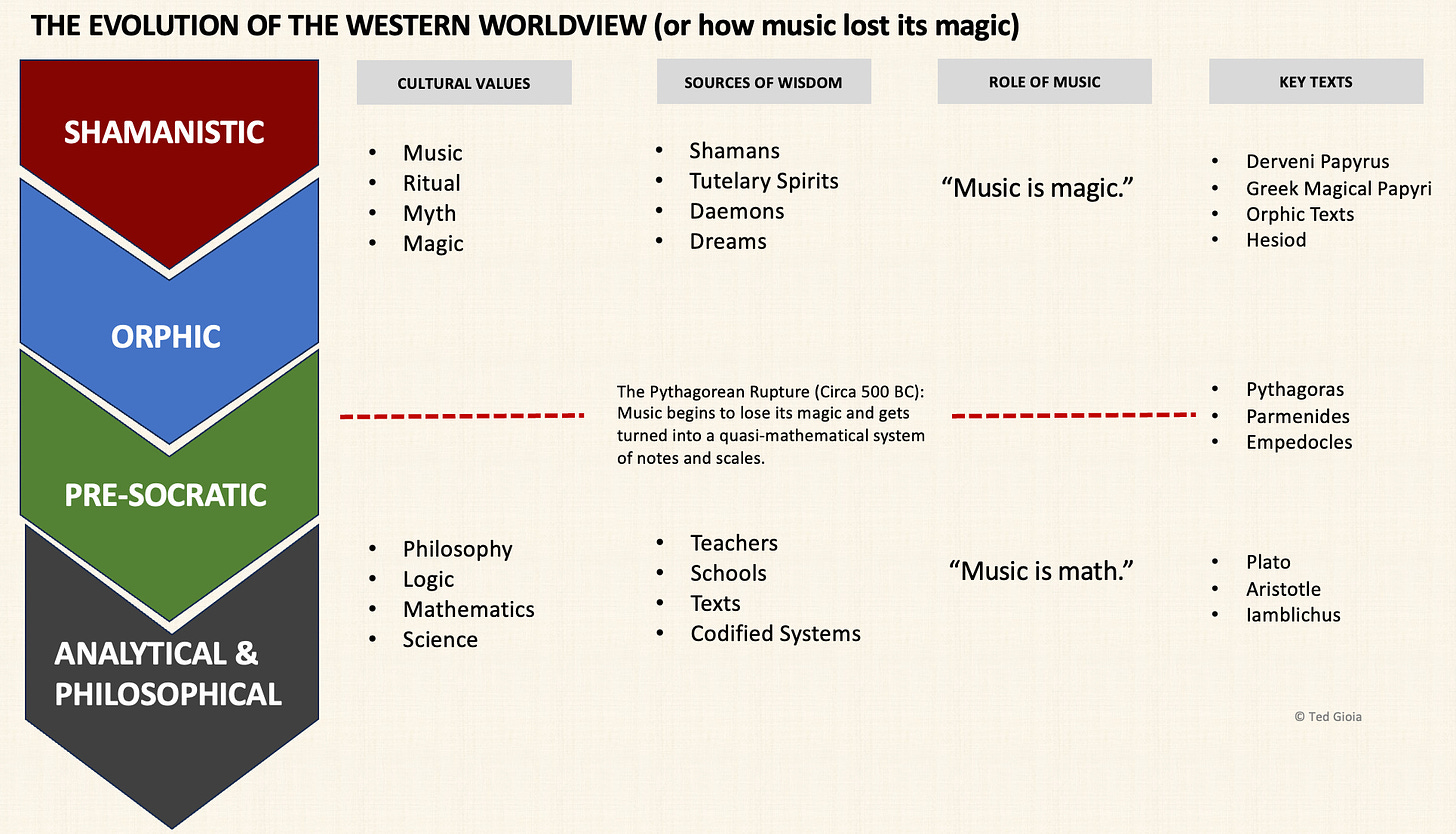
The whole evolution of music as an academic discipline tends to destroy the most important reason to care about music in the first place.
Here’s one of my charts on the subject:
That’s why I started to write about sleeping.
No music writer talks about sleep more than me. And that’s because dreams happen when we sleep—and this is the one type of visionary experience everybody can still access.
We all become a little unhinged and crazy in those dreams. Even the most rationalistic STEM advocate.
…
Could something like this—dream therapy for creatives— exist in the current day?
I wondered about this for a long time. I finally decided to ask musicians about whether they had learned songs from their dreams.
Nothing prepared me for the response I got. I heard from hundreds of musicians—and learned that the gift of a song during a dream is quite common. And it’s usually a powerful song.
…
I note that many musicians have told me that they are reluctant to discuss their dream songs. The subject is just too strange and antithetical to our dominant rationalist paradigm.
And that reluctance is even greater if the artist has a hallucination or out-of-body experience or something else that ‘medical experts’ might want to treat.
My hunch is that these happen frequently to intensely creative people—even in an age of rationalism.
The world isn’t as neat and rigorously logical as you’ve been told. And the world of artistic inspiration is the least logical of all. There’s a good reason why the ancients believed that creative works were a gift from the muse.
…
I continue to research this subject, and I think about it all the time. Even more important, I try to open up my mind to realms of experience beyond the empirical. That’s where creativity comes from, and I don’t want to shut myself off from the source because of close-mindedness.
Above all, I don’t mock or dismiss artists who have these visions, or assume that in every instance they are suffering from mental illness. Some of them might be a lot wiser or healthier than the rest of us.
I can’t think of a solo-effort Substack that delivers more bang for the buck that Ted Gioia, The Honest Broker. And the guy is really smart about some things that interest me.
From the Department of Free-Association: Has Rod Dreher, once again, seized the moment to shape a coming conversation, as he did in Crunchy Cons, Benedict Option and Live Not By Lies?
Politics
Serious people earnestly disagreeing
Back in August I was watching the DNC with my old mom in California. Kamala and Tim and Michelle and Barack and all the others kept talking about our reasons for aiding Ukraine in its fight against the Russian occupation of its eastern territories. They consistently appealed to the apparently essentialized fact that the Ukrainians, like the Americans, “love freedom”, and that it is only natural and right to help other peoples who share this love with us. There was zero acknowledgment of the complexities of geopolitics and historical legacies, or of the situated perspective a Russian might non-crazily come to have, according to which parts of what is now Ukraine seem naturally and justly to fall more into the sphere of influence of the Russian Empire than of the North Atlantic one.
I know a lovely man in his 60s, an outstanding member of the vanishing breed of the Homo Sovieticus, whose father is Ukrainian and whose mother is Russian, and who grew up in Kazakhstan. He tells me his parents waited to get married so that the celebration would take place on the 300th anniversary of the 1654 Pereyaslav Agreement, in which the Cossack Hetmanate in control of much of Ukraine made a ceremonial pledge of loyalty to Moscow. This friend of mine is in exile, and is no admirer of Putin. He greatly regrets the 2022 invasion. But he could never make any sense of any claim to the effect that Ukraine rightly belongs to NATO and not to Russia in virtue of some mysterious essential trait of the Ukrainian people, that they “love freedom” while the Russians do not.
…
And here we arrive at what really gets me about the Democrats. If we are going to risk direct conflict with another nuclear-armed superpower, let us not be lulled into it by bullshit and platitudes. Why do the Democrats have to talk that way? It’s as if the Republican tactic of portraying “the libs” as effeminate hyper-woke safe-spacers has really only caused the Democrats themselves to double down with absurd displays of hawkish masculinity. We’re supposed to love Kamala because she’s a tough-on-crime prosecutor, and that therefore corrects for the slip-ups of the past years when some in the progressive wing of the party have suggested, on the contrary, that all cops are bastards. Tim Walz, meanwhile, seems to have been chosen primarily because he wears flannel shirts, and has been put on display in the most implausibly kayfabe campaign ads purportedly fixing his own pick-up truck. One almost expects them next to come out with an ad depicting Walz in the act of dressing a deer, looking every bit the caricature of the Minneapolis goy neighbor in the Coen Brothers’ A Serious Man (2009). He’s a hunter and a football coach, but he’s also a faculty advisor for the LGBTQIA+ club! What a model of enlightened masculinity! She’s a prosecutor and a foreign-policy hawk, but she’s a she and she brings “joy”! The problem is that none of the rest of the world cares about any of that childish stuff. They all know that for all the equally kayfabe retrograde masculinity of Trump, that man is an absolute pussy, and it is in fact the Democrats who represent the greatest threat to any hot-spot of resistance to the US’s arch-imperial ambitions throughout the world.
What are the odds that a world in which the American Empire is beaten into desperate retreat would be any sort of world our children and grandchildren might want to live in? … Trump, in a second term as president, is practically guaranteed to assume the role of overseer of American imperial retreat, in favor not of a global community of equals such as some naïve progressives might have hoped for in the early years of the League of Nations, but of nationalist isolation and at most pragmatic cooperation with other self-sequestering nation-states, somewhat along the lines of what Marine Le Pen envisions for Europe in the phrase “association des nations libres”. That phrase might sound innocent enough, but nations that are free to dispense with any idea of reciprocal obligations are unlikely to remain in a stable “association” for long, and Trump, at least, hardly gives any indications of knowing how to guide the ship of state as it weathers the inevitable storms that will whip up unstable waters in our years of decline. Far better, far surer, we believe, to have a party in power that understands and accepts the nature of the that power: imperial power, namely, which might aspire in the years ahead not only to face off with steely resolve in our current global showdown, but, eventually, to emerge as its undisputed champion. … Most of us on the Editorial Board, even the Americans among us, do not live in the United States, and from our respective vantages it is pretty hard to concentrate on any aspect of American political life that does not have to do with its role as a globe-spanning empire. Just manage your domestic affairs however you see fit, we are tempted to say; our overwhelming concern is with what you get up to beyond your borders. We therefore have rather little patience for that current of Democratic partisan discourse that would like for American politics to sound more or less like, say, Danish politics. Denmark, if we may be blunt, and all of the Scandinavian countries with such high marks on all the usual tests, is able to focus on maintaining its robust welfare state primarily because its defense is entirely outsourced to the American Empire. The American Democrats who fawn over European national health systems seldom realize that by seeing to the defense of other NATO members, the United States is at the same time freeing up European national budgets for other more humane uses. Americans pay for European defense rather than paying for their own welfare; Europeans get health care in turn, but only through de-facto vassalization.
We would like to see this arrangement continue, at least for now, at least until NATO can be expanded to include all of those states that currently set themselves up in opposition to it, a prospect even Russia’s own leaders in the early post-Soviet years were able to entertain with some seriousness.
You might think our reasons for voting for the Democrats are not good ones, or that we are merely “joking” when we give them. We can only reply that your reasons really do not matter. You might well imagine your are voting, for your part, for “decency”, or “joy”, or sane gun-control laws or a woman’s right to choose. But the only way to vote for any of these things is to cast a vote for American empire. That’s the bargain. We here at The Hinternet, minus our Founding Editor, believe this is a bargain worth accepting, but that is only because we believe it is the United States under Democratic leadership that offers us the single best shot at subduing all the planet’s lingering zones of discontent, and delivering us into a future of perpetual peace. This is what we at The Hinternet want. Do you?
These seem to be serious people having a serious disagreement, not just swapping bullshit and platitudes. It’s a habit most of us, myself included, could benefit by emulating.
Agreement on norms trumps disagreement on policy
Cheney’s argument for Harris is a classical liberal version of the GOP’s “Flight 93 election” reasoning from 2016. It’s a basic matter of proper prioritizing: Agreement on norms trumps disagreement on policy. If you hand power back to Trump, he’ll crash the constitutional order. The conservative thing to do under the circumstances is to storm the cockpit by backing Harris, who’ll at least keep the plane in the air.
(I wonder how Lisa Beamer feels about Flight 93 as a recurring political trope?)
Those conservative Democrats!
The truth, I think, is that the Democratic Party is drifting. Coasting. Dems are buoyed at the national level by Trump’s personal unpopularity but lacking in any kind of compelling vision for the future of the country. For the third cycle in a row, the Democrats have been freed up to run a mostly substanceless campaign that boils down to “Vote for us so Trump will lose.” But what besides that promise of negation does the party stand for? What does it hope to accomplish? Or does it just want to be empowered to manage for a little longer the well-functioning system of domestic and international institutions that already exists?
The answer, it would seem, is the latter. From what I can tell, the Democrats are proposing little beyond a defense of the status quo (or, in the case of abortion rights, a return to the status quo as of a few years ago) against all the unorthodox things their opponents aim to accomplish (including mass deportations, a revolution in how the executive branch is staffed, and the imposition of sweeping tariffs).
That means the Democrats have inadvertently become America’s conservative party, championing the views and interests of those Americans who are content with the country’s present and recent past. When that stance is combined with opposition to the widely loathed Trump, it can (just barely) deliver victory …
The term “conservative” has many meanings, but the most elementary one—the one associated with the man generally considered to be the first conservative writer and thinker, Edmund Burke—grows out of the name itself: To be conservative is to seek to conserve the present’s inheritance from the past: the accomplishments, authoritative institutions, norms, habits, policies, and traditions that have been handed down to us by previous generations.
That’s the meaning of Liz Cheney’s enthusiastic endorsement of the Harris/Walz ticket late last week. It’s not a signal that Harris will govern as a Republican from the era when Cheney’s father (who has also endorsed Harris) served as George W. Bush’s vice president. It’s an expression of Burkean conservatism against the disruptive-revolutionary impulses of the MAGA movement.
The American multiculturalists similarly reject their country’s cultural heritage. Instead of attempting to identify the United States with another civilization, however, they wish to create a country of many civilizations, which is to say a country not belonging to any civilization and lacking a cultural core. History shows that no country so constituted can long endure as a coherent society. A multicivilizational United States will not be the United States; it will be the United Nations.
Samuel P. Huntington, The Clash of Civilizations and the Remaking of World Order.
I was not a very good student of history, but I wonder what historic precedents Huntington has in mind when he says “History shows …”. Sincere question. Surely it’s not just that nobody has tried a multicivilizational nation before; that would not yield a verdict of history.
Please comment if you know. (Comments are moderated but not censored for viewpoint.)
We knew damn well he was a snake …
before we took him in.
I love editorial cartoons, and am fond of comic strips as well. As newspapers are dying, I mainline mine from here.
I suffer more from the humiliations inflicted by my country than from those inflicted on her.
I don’t do any of the major social media, but I have two sub-domains of the domain you’re currently reading: (a) You can read most of my reflexive stuff, especially political here. (b) I also post some things on the only social medium I frequent, because people there are quirky, pleasant and real.
… churches centered on the Bible, evangelism, and personal faith in Jesus; often but not necessarily nondenominational, with moderate to minimal emphasis on sacraments, liturgy, and ecclesiastical authority; and marked by a revivalist style as well as conservative beliefs about sex, marriage, and other social issues. Historically, … white and middle- to lower-class …
Brad East, describing the sorts of churches in which he has noticed a loosening of social taboos (and in some cases, abandonment of prior understandings of scripture), and some putting on of liturgical airs, in The Loosening of American Evangelicalism.
East describes a lot of the changes he sees, and then speculates on the reasons for them. His fourth suggested reason got my attention as a plausible “silver lining” to secularization:
Fourth and finally, there are no sectarians in post-Christian foxholes. As counterintuitive as it may seem, the same forces leading evangelicals to start drinking, getting tattoos, and watching HBO are also leading them to say the creeds, receive ashes on their forehead, and read Pope Benedict XVI. When the world feels arrayed against faithfulness to Christ, you need all the friends you can get. Doctrinal differences that aren’t relevant to current cultural battles—think infant baptism, not theologies of sex and gender—can be overlooked in a pinch.
What intellectuals are searching for
[S]uppose you are an atheist or agnostic exposed, over time, to the desert fathers, or to the pro-Nicene fathers of the fourth and fifth centuries, or to Saint Maximus Confessor or Saint John of Damascus, or to Benedictine monks, or to Saint Thérèse of Lisieux, or to Julian of Norwich, or to Saint Francis or Saint Bernard or Saint Anselm. It would simply never occur to you that what you find in these authors is what you’d find in the Methodist congregation on the corner, or the Baptist church around the block, or the non-denom start-up across town. Not only do the devotional and liturgical, spiritual and theological worlds conjured by these writers and texts not exist in such spaces. The traditions themselves do not claim the figures in question. You go, therefore, to the people and the places who are bold enough to say, “Those names are our names; those saints are our saints; those books are our books. We nurture and preserve and pass them on. Come learn them from us; indeed, come learn from us what they learned themselves, in their own time.”
In sum: What intellectuals, especially agnostic intellectuals in midlife, are restlessly searching for is something not man-made, but divine; not provisional, but final; not a question, but an answer. They are looking for rest, however penultimate in this life, not more open-ended restlessness. Something that lasts. Something that can plausibly make a claim both to antiquity and to permanency. A bulwark that will not fail. Something to defer to, submit to, bow one’s head in surrender to; something to embrace and be embraced by: a teacher but also a mother. And the truth is that Rome plausibly presents itself as both mater et magistra, the pillar and bulwark of the truth. Orthodoxy does as well. The plausibility explains why so many intellectuals find port of harbor with each of them. The reverse, in turn, explains why so few of those sorts of people convert from rudderless adult atheism to Protestantism with a capital-p.
Brad East, musing on why intellectuals and other public figures convert to Christianity in Catholic, Orthodox (or perhaps Anglican) traditions.
A life-giving gift
I’m almost certain I’ve shared this before, but I share it again not only because it seems wise, but because I lived it — with a big caveat: happy-clappy is not confined to youth groups, and I wasn’t young when I discovered ancient Christianity.
For those young people who are either scared or suspicious of happy-clappy versions of youth group Christianity, ancient Christian disciplines and historic Christian worship can be received as a life-giving gift. When you have only seen forms of piety that value spontaneous expression and clichéd sincerity, to be given the cadences and rhythms of the Book of Common Prayer can be like receiving the gift of tongues. In my experience, many young people are intensely ritual animals without realizing it. And when they are introduced to habit-forming practices of Christian faith, invited into ways of following Jesus that are ancient and tested, their faith is given a second life.
Context includes not only the historical and cultural setting and textual elements such as literary arrangement and relationship of the words. Context includes the original setting in which the Scriptures were written—the Church. The author belonged to the community of faith, as did his anticipated audience…
Dr. Eugenia Scarvelis Constantinou, Thinking Orthodox
The democratic spirit at prayer
Much of what today passes for Protestantism is nothing of the sort. Rather, it is a thinly veiled cloak for the democratic spirit at “prayer.” “Salvation by grace through faith” is a slogan for individualism, a Christianity “by right.” There are no works, no requirements, only a “grace-filled” entitlement. For the ultimate form of democracy is the person who needs no one else: no Church, no priest, no sacrament, only the God of my understanding who saves me by grace and guarantees that I can do it alone.
I returned to following the Mere Fidelity podcast after a year or two absence (when I was more preoccupied with other things). One back episode I manually downloaded was Moral Complicity, which took as its springboard a controversy over one Alistair Begg’s faux pas.
It was an interesting episode, part of which lamented Evangelicalism’s lack of tools and training in moral reasoning, leaving Evangelicals to live in ambiguous situations based on shibboleths.
I was surprised at my own inability to justify my reaction to the particular question posed. Then I remembered that even my tiniest prayer book has some resources:
NINE WAYS OF PARTICIPATING IN ANOTHER’S SIN
By counsel.
By command.
By consent.
By provocation.
By praise or flattery.
By concealment.
By partaking.
By silence.
By defense of the sin committed.
THE CHIEF SPIRITUAL WORKS OF MERCY
To admonish sinners.
To instruct the ignorant.
To counsel the doubtful.
To comfort the sorrowful.
To suffer wrongs patiently.
To forgive injuries.
To pray for the living and the dead.
Wise eunuch
Then the Spirit said to Philip, “Go near and overtake this chariot.” So Philip ran to him, and heard him reading the prophet Isaiah, and said, “Do you understand what you are reading?” And he said, “How can I, unless someone guides me?” And he asked Philip to come up and sit with him.
Acts 8:29-31.
I was rather old when I learned (as I understood it) that reading silently, sola mentes, was unknown in the ancient world.
I wasn’t quite as old when I realized that “How can I, unless someone guides me?” was a wise answer, not a pathetic one.
Col. R.B. Thieme, Jr.
“Well-nigh 50 years ago,” wrote the geezer, “I heard a guy who in retrospect was the weirdest, but most mainstream, preacher I ever heard.”
Thieme was not outside the Evangelical Overton Window, but I recall two really weird things he said during the week or so of meetings I attended in Prescott, Arizona (I have a vague idea that I listened to him on the radio even longer):
Nothing pleases God more than doctrine in the frontal lobe. It is fair to say that this was an obsessive theme of Thieme, if you’ll pardon the wordplay.
The human ovum is the only sinless cell in the human body. Were it not sinless, Christ would have inherited sin from Mary.
I immediately thought the first thing quoted (almost verbatim) was weird and off-key. Now I’m quite sure it was wrong to the point of heresy. God desires several things more than storing up doctrine in one’s wetware. It is spiritually perilous not to value them as He does.
But the idea that mastery of doctrine was paramount was mainstream western Christianity. Since Thomas Acquinas, over-intellectualizing the Christian life has been (dare I say it?) a major way of avoiding actual encounter with God. In that sense, he was mainstream. And his website doesn’t put this idea front and center, portraying instead an extraordinarily hard-working dispensational premillennial evangelical pastor — adherent to a doctrinal scheme that led me to distance myself from evangelicalism around the time I encountered Thieme, though I don’t recall any cause-and-effect relationship.
The ovum remark was not an obsession, in my limited experience. The idea of inheriting sin and guilt is ubiquitous in Western Christianity (and repudiated in Eastern Christianity, which recalls that the wages of sin is death, not guilt — but that’s a longer story, and one that I’m probably not qualified to tell). Nevertheless, I don’t recall any other teacher ever making anything like Thieme’s weird remark.
Wedding rites
Contrast the vision of family carried in these cultural liturgies—and played out in television dramas and romantic comedies—with the countercultural, biblical vision that is carried in an Orthodox wedding rite. The rite has two “movements” or stages. The first is the Service of Betrothal. In the entrance or vestibule of the church, the priest asks both the groom and the bride a question. To the groom: “Have you, Nicholas, a good, free, and unconstrained will and a firm intention to take unto yourself to wife this woman, Elizabeth, whom you see before you?” And to the bride: “Have you, Elizabeth, a good, free, and unconstrained will and a firm intention to take unto yourself to husband this man, Nicholas, whom you see before you?” Each in turn replies, “I have,” and these are the only words they will speak in the ceremony. This won’t be an expressive opportunity for them to “show their love.” There’s no fixation on novelty in the idiosyncratic writing of their own vows. The actor and agent here is the Lord, the church’s Bridegroom, and their lives as husband and wife (and as mother- and father-to-be) are here being taken up into that life. The Triune God is the center of this ceremony, exhibiting a vision of marriage in which this is also true. This is beautifully signaled in vows that echo their baptism “in the name of the Father, and of the Son, and of the Holy Spirit.”
It occurred to me as I was posting this that Smith’s book is one of extremely few contemporary Protestant-written books I can commend — not that I read all that many, mind you. It’s one of a few (along with books by Hans Boersma) that leave me wondering “why haven’t these guys shed their obviously uncomfortable Protestantism for Orthodoxy?”
When I heard the learn’d theologian …
When I heard the learn’d astronomer, When the proofs, the figures, were ranged in columns before me, When I was shown the charts and diagrams, to add, divide, and measure them, When I sitting heard the astronomer where he lectured with much applause in the lecture-room, How soon unaccountable I became tired and sick, Till rising and gliding out I wander’d off by myself, In the mystical moist night-air, and from time to time, Look’d up in perfect silence at the stars.
Last night, I began reading Paul Gutacker, The Old Faith in a New Nation: American Protestants and the Christian Past. Gutacker doesn’t buy the standard narrative that bibicist American Evangelicalism has no interest in Church history and traditions. It sounded promising enough that I bought it without any personal recommendations from trusted sources.
I’m especially interested to see whether it will call into question anything I’ve internalized from Nathan Hatch, The Democratization of American Christianity. So far, it seems to accept Hatch’s work.
… that Christ may dwell in your hearts through faith; that you, being rooted and grounded in love, may be able to comprehend with all the saints what is the width and length and depth and height — to know the love of Christ which passes knowledge; that you may be filled with all the fullness of God.
You can read most of my more impromptu stuff here and here (both of them cathartic venting, especially political) and here (the only social medium I frequent, because people there are quirky, pleasant and real). All should work in your RSS aggregator, like Feedly or Reeder, should you want to make a habit of it.
I finally dipped my toe into ChatGPT, having been inspired by a story of a mom who used it to plan her child’s birthday party.
I had it draft a policy on delinquent tuition payment for a private school. High marks. Over the coming days, I’ll see what other logjams it can break on my project list.
I asked it “What are some real-world applications of the quadratic equation?” It gave a plausible answer, which I cannot evaluate since I haven’t used the equation since high school and cannot remember it. (If any kids are reading this, that’s probably because I became a lawyer, not an engineer.)
Since I get too easily enamored of technology, it behooves me to read smart critiques and concerns as they come along, if only to guide my personal conduct toward AI.
Nashville shooting
Journalistic lacunae
Why not explore [journalistically] how the attack on children and teachers in a Christian school affects Christians. This massacre may have been what some call a “hate-crime” against a religious group. And it’s odd that the community whose actual children were murdered seems less deserving of coverage than the community wrongly associated with a child-killer. It would be the equivalent of asking the Muslim community how they felt about a mass shooting in a synagogue, but never asking Jews.
It also seems legit to me to cover how violent memes and slogans and rhetoric can prime already-unstable people to commit violence. If it’s fair to call out the NRA’s materials after a mass killing (and I think it is), it’s also fair to note how common violent imagery and rhetoric has become in the TQIA+ world.
“Kill Terfs” is not a fringe slogan; it’s everywhere. A leader of the TQIA+ movement, Chase Strangio, has written that laws restricting child sex-changes are, in fact, laws to “criminalize known survival care for trans youth … That goal is akin to a goal of killing us.“ He has also claimed that his opponents “want to control and eradicate” trans people. Last weekend, a trans activist assaulted a gender-critical speaker with tomato juice in New Zealand, telling a crowd that “I want her to be full of blood, because that’s what she’s advocating for. She’s advocating for our genocide … our extermination.” The mob violently shut the event down. Then there are the many
grimacing skulls that promise “DEATH BEFORE DETRANSITION”, knives, baseball bats wrapped in barbed wire, assault rifles painted in the pastel tones of the trans flag, torrents of rape and death threats, the grim vow that “EVERY DAY IS TRANS DAY OF VENGEANCE.
And it would also be great if the press could fact-check not just the falsehood that trans people are more likely to murder, but also the idea, constantly reiterated by TQIA+ groups, of an “epidemic” of anti-trans, hate-motivated murders. That notion has been repeatedly debunked ….
I was just about ready to join the demand for release of the Nashville Christian School shooter’s reported “manifesto” when this brought me up short:
consider this other possibility: Might the shooter’s manifesto contain accusations of some kind against family, school, church or others? If that’s the case, police and legal officials may be investigating these claims before airing them to the public.
That’s not an entirely idle speculation, as you’ll see if you follow the hyperlink, nor is it implausible: an extremely conservative Presbyterian church in my hometown badly mishandled sexual abuse in the congregation.
So, yes, sooner or later we need to see the “manifesto.” If they’re investigating claims of the manifesto, it would be nice to know.
The Trump Indictment
Selected quotes
I’ve written a bit about the New York case against Trump, now gone to indictment. None of it was particularly original, and neither is this, but then I’m pretty selective about what sources I’ll spend time reading.
That said, some notable commentary by others:
David Frum notes that the charges might not even be about Stormy Daniels. (Deciding what a grand jury’s up to is a bit like reading chicken entrails.)
In his statement responding to the indictment, the former president said, “Never before in our Nation’s history has this been done.” But never before in our nation’s history have we had a president as dishonorable, as unethical, and as malicious as Donald Trump. (Peter Wehner)
There’s something very, well, Trumpy about this: He has a way of making everything sordid. Instead of a dramatic discussion about the meaning of accountability for a president who sought to overthrow the will of the voters to stay in power, we’re arguing about the dirty mechanics of hush-money payments to an adult-film star. (Quinta Jurecic)
I worry that a failed prosecution might strengthen Trump. Yet I’d also worry — even more — about the message of impunity that would be sent if prosecutors averted their eyes because the suspect was a former president. [Paragraph break omitted] The former president’s fixer, Michael Cohen, was sentenced to three years in prison for doing Trump’s bidding, and a fundamental principle of justice is that if an agent is punished, then the principal should be as well. That is not always feasible, and it may be difficult to replicate what a federal prosecution achieved in Cohen’s case. But the aim should be justice, and this indictment honors that aim. (Nicholas Kristoff, I Worry About a Failed Prosecution of Trump, but I Worry More About No Prosecution)
There is a counterargument that this is America’s moment for prosecutorial discretion to allow the country to recover and move on. As a teenager, I was outraged when President Gerald Ford pre-emptively pardoned former President Richard Nixon, yet over time I came to think that it was the right call and allowed the country to heal. Yet one difference is obvious: Nixon in 1974 was already completely discredited, ostracized and broken, while Trump denies any wrongdoing and is running again for the White House. (Nicholas Kristoff, I Worry About a Failed Prosecution of Trump, but I Worry More About No Prosecution)
Extradition
When someone on the Right accuses a progressive of being funded by George Soros, it damages my regard for the accuser more than for the accused. It’s a mark either of stupidity by the accuser or of his contempt for those listening. (The same goes for Lefties’ obsessions with the Koch brothers or Peter Thiel.)
Ron DeSantis is not stupid. You draw the necessary inference.
By the way, as Radley Balko points out, DeSantis famously removed a local prosecutor from office last year for declaring that he wouldn’t enforce the law as written for political reasons. That’s no different from what DeSantis himself is guilty of here [in claiming that “Florida will not assist in an extradition request”].
I want to leave a note here, because I expect to have many occasions to link back to it in the next several months.
Americans and Republicans, remember: You asked for this. Given the choice between a dozen solid conservatives and one Clinton-supporting con artist and game-show host, you chose the con artist. You chose him freely. Nobody made you do it.
I will be reminding you all of that, from time to time.
In a lot of ways, the reversal of party affiliation by the white working class, in increasingly by “POCs” in the working class, is the most astonishing part of the realignment since witless ape rode escalator.
Elite Populism
There is an elite version of populism that masquerades as technocracy.
I’m not sure who first said it, but it’s been observed that Trump’s fundamental political proposition is not really populism, or foreign policy isolationism, or economic protectionism. Trump’s political pitch is, simply, “I will destroy your enemies.” Which is part of what makes him a monster, his zeal for attacking his targets and the targets he picks. But when I see people who favor police and prison abolition exactly up until the police and prisons become useful tools to them, it convinces me even more that “I will destroy your enemies” is all that politics is. When you scrape the surface even a little bit, that’s all that you find, the will to destroy the other side.
I do not agree with Freddie on “all that politics is,” but he’s got an awfully good point about Trump.
Freddie gems
I am waiting for someone to tell me what the radical left approach to law and order adds up to, these days, other than an injunction against ever calling the cops for anything and people screaming on Twitter that it’s fine if you smoke meth in a crowded elevator. No one has taken me up on the offer to explain how any of this works. Because none of it works, and it’s not clear if it was ever intended to work as an actionable set of proposals. It’s all pose, all fashion. Three years after “defund the police” became a ubiquitous slogan in left spaces, nobody knows what it means, nobody feels any pressure to figure that out, but everyone is still sure that if you expect any enforcement of basic order at all, you’re a fascist.
Trump stood for very little in any conventional political terms, barely attempted to define a political agenda on the campaign trail, and was most notable in policy terms for his willingness to defend Medicare and Social Security after Paul Ryan’s former stranglehold on Republican fiscal ideals. Instead, he offered the ritualistic scourging of the people his fans found detestable – first in the primary, mocking John McCain and Jeb Bush and whoever else stood in his way, then the effete liberals who were allowing immigrants and criminals to ruin the country. His potential successor, Ron Desantis, is something of an idea man, but he tilts those ideas towards the urge to destroy constantly. His signature policies are all oriented towards reminding voters that he will target their enemies and use government to oppose them. He has to; it’s a political necessity for a 21st-century Republican with great ambitions.
What all of us have to recognize is that the nihilism and score-settling of the past seven years are not the fault of a single awful man but emergent properties of a toxicity deeply embedded in the guts of this country. We can’t cure that toxicity if we spend all of our time diagnosing it in the other side. Of course I think Republicans are mostly to blame. But that belief tells us nothing about how to build a better, healthier political culture.
Here’s the funny thing: while conservatives balk at even the mildest gun control efforts on account of it being a slippery slope (fine), progressives have absolutely no intention of enforcing even existing gun control laws. What could I mean by this? Just listen to Philadelphia District Attorney Larry Krasner this week on how his office won’t prosecute illegal gun possession:
We do not believe that arresting people and convicting them for illegal gun possession is a viable strategy to reduce shootings,” the DA’s office said.
This is the ur-progressive prosecutor, saying gun control doesn’t stop shootings and that he’s just not going to do it. Because enforcing gun control laws would mean—it’s almost too terrible to say—enforcing laws. And that’s a line that America’s progressive prosecutors simply cannot cross.
Gun control gets a boost every time there’s a mass shooting, especially of schoolchildren. But when you get into the weeds, the details, where the devil notoriously lurks, it’s far from obvious what to do. We can wish that we’d never become so gun-infatuated as a nation, but we did.
Kevin D. Williamson demolishes (as have countless others before him) the case against the AR-15 in The Washington Post Misfires—Again. The only thing particularly dangerous about the AR-15 seems to be its cool factor, its status as an icon of toughness.
So what now? “Do something! (however symbolic, ill-advised or constitutionally provocative)” is not an answer I’ll accept.
Challenge
Purity … is NOT the one thing needful; and it is better that a life should contract many a dirt-mark, than forfeit usefulness in its efforts to remain unspotted.
William James
Pure religion and undefiled before God and the Father is this, To visit the fatherless and widows in their affliction, and to keep himself unspotted from the world.
If I were to support, much less endorse, Donald Trump for president, I would actually have to go back and apologize to former President Bill Clinton.
Southern Baptist Seminary President Al Mohler, 2016. “By 2020, Mohler had nonetheless become a public supporter of Trump, even standing by his vote for Trump after the Jan. 6 insurrection. ‘Based upon the binary choice we faced on November the third, I believe then that that was the right action to take,’ Mohler said on his podcast on January 7, 2021. ‘And going back to November the third, I would do the same thing again.’ To my knowledge, Mohler has yet to issue an apology to Bill Clinton.” (Robert P. Jones, Why a Trump indictment will matter so little to most of his Christian supporters)
Then the angel of the Lord went forth, and smote in the camp of the Assyrians a hundred and fourscore and five thousand: and when they arose early in the morning, behold, they were all dead corpses.
Isaiah 37:36 (King James Version)
‘Traditional art invites a look’, she wrote. ‘[Modernist art] engenders a stare’. The stare is not known for building bridges with others, or the world at large: instead it suggests alienation, either a need to control, or a feeling of terrified helplessness.
Iain McGilchrist, The Master and His Emissary. (I don’t recall who he was quoting.)
Disneyland is presented as imaginary in order to make us believe that the rest [of America] is real.
You can read most of my more impromptu stuff here (cathartic venting) and here (the only social medium I frequent, because people there are quirky, pleasant and real). Both should work in your RSS aggregator, like Feedly or Reeder, should you want to make a habit of it.
It also makes sense to assume that Fox’s behavior will change if it ends up losing this [Dominion] lawsuit. I certainly think it will. Specifically, the people who work there will take care not to put it in writing the next time they quietly conspire to smear someone into oblivion.
…
Murdoch’s shop has always followed the herd, a reminder that its core mission was and remains to advocate for its audience’s political priorities, not to provide them with news. Especially when the news happens to contradict those priorities.
…
If you happened to tune into Fox [February 2] you found [Tucker] Carlson still at it more than a year later, promising fans that he’s unearthed video that’ll soon prove the government is “lying” about the insurrection.
“The time to decide whether or not you want to kill a deer is before you go hunting.”
“If you don’t want to get a haircut, don’t hang around the barbershop.”
Wisdom via Chris Stirewalt, who preaches a eulogy of sorts for Bill Sammons, late of Fox News, who definitely decided to kill the deer.
Generally
Flipping the script on its head
I ask Oizumi why he is so drawn to this country. “I like to go places where there are people with a real history. In Korea, that same tribe, that same culture has been there for a very long time.” “Well,” I say, “Europe has a long history too.” “No way! That place is frightening.” “Frightening?” “Yes. I went to Italy, Spain, Milan, Florence, and all the buildings were made from stone—the churches, the castle walls, and ramparts. Now, how did they make that? That would take a tremendous amount of energy. In those days there were no bulldozers. Everything was done by hand. A place with that many stone buildings would have needed some kind of slavery system to build them. When I saw that I thought, Wow, Asia was still relatively peaceful back in the olden days.
We are offended only by those who are boorish in the way that working class people are boorish, not by those who are boorish in the way that our powerful classes are boorish.
To the extent that a Disney production manifests the sort of obvious and literal-minded progressive messaging that might outrage some Republican official, it is already failing by the Mouse’s own standards and is destined for obsolescence no matter what. What survives to become fixed in the Disney canon has to feel deeply in tune with its vast and bipartisan audience even when there’s some kind of ideological vision underneath. Politics is welcome in the temple but never nakedly or openly, never crudely — only clothed in the robes of princesses and filtered through the lyrics of Howard Ashman or Lin-Manuel Miranda.
Never have I been more grateful to teach where I do: at a men’s maximum-security prison. My students there, enrolled in a for-credit college program, provide a sharp contrast with contemporary undergraduates. These men are highly motivated and hard-working. They tend to read each assignment two or three times before coming to class and take notes as well. Some of them have been incarcerated for 20 or 30 years and have been reading books all that time. They would hold their own in any graduate seminar. That they have had rough experiences out in the real world means they are less liable to fall prey to facile ideologies. A large proportion of them are black and Latino, and while they may not like David Hume’s or Thomas Jefferson’s ideas on race, they want to read those authors anyway. They want, in short, to be a part of the centuries-long conversation that makes up our civilization. The classes are often the most interesting part of these men’s prison lives. In some cases, they are the only interesting part.
…
In many ways, it is the Platonic ideal of teaching, what teaching once was. No faculty meetings, no soul-deadening committee work, no bloated and overbearing administration. No electronics, no students whining about grades. Quite a few of our students are serving life sentences and will never be able to make use of their hard-won college credits. No student debt, no ideological intolerance, no religious tests—whoops, I mean mandatory “diversity” statements. And in our courteous, laughter-filled classroom there is none of the “toxic environment” that my friends in the academy complain about, and that I experienced during my own college teaching career.
The author gives a lot of credit to the absence of cell phones and internet connections.
Breaking Covenant
I think the truth is that we have been breaking our covenants with students for quite some time. The rise in student debt is a broken covenant. Adjunctification is a broken covenant. The fact that at some research universities a significant portion of student tuition pays faculty to not teach is a broken covenant. According to this study from Charles Schwartz, an emeritus professor at Cal Berkeley, 40 percent of student tuition at his institution goes toward funding departmental research.
Pardon me while I briefly geek out on constitutional legalia.
As a threshold matter, I’m not even certain the Establishment Clause can be incorporated. … Akhil Amar has written … that this federalism provision prevents the federal government from interfering with state established churches. But that ship has probably sailed.
I’m quite certain that the original meaning of the establishment clause was that the federal government could not lawfully interfere with state established churches. Fer cryin’ out loud, people, Massachusetts had an established Congregational Church into the 1830s and nobody thought it was uncontitutional.
Perhaps it also meant that the federal government could not lawfully establish its own national church; that would be nice.
But it never occurred to me that because the Establishment Clause was a federalism provision, it’s illegitimate to use the anti-slavery Civil War Amendments to apply it to the states (the “incorporation doctrine”).
So Indiana could still establish Preacher Boy Billy-Bob’s Landmark Baptist Church as the state religion. That would not be nice.
Politics
Damon Linker: Ron DeSantis Is Not a Fascist
Tens of millions of our fellow citizens don’t like where they think our country is headed, and they’re expressing that dislike at the ballot box. The response to them shouldn’t be you’re not allowed to dislike and attempt to change the country’s direction. The response should be here are reasons why you should be less hostile to recent trends and more fearful that the illiberal reforms you favor will end up making you less free in the long run, too
One of the most impressive things about Barack Obama was that he could make the conservative case more eloquently than 90% of conservatives. One of the most infuriating things about him was he would then do the progressive thing — invariably in the Senate, oftener than not as President.
Damon Linker had replicated that impressive feat with contemporary right-illiberals, like Ron DeSantis. But he remains a liberal (center-left, I’d say). The linked column (and I think the link will get you to it for free) is one of his best and is food for productive thought both for right-illiberals (or those tempted by it) and liberals of both left and right.
The fashy essence of authoritarian populism
[P]er his keynote speech at CPAC on Saturday, it appears the coming campaign will be Trump Unleashed.
My hat is off to whichever speechwriter came up with the line “I am your retribution.” With remarkable efficiency, it divines the fashy essence of authoritarian populism.
Tradition is a bulwark against the power of commerce and the dissolving acid of money, and by removing these, all revolutions in the modern period have ended up accelerating the commercial and technological shift towards the Machine.
You can read most of my more impromptu stuff here (cathartic venting) and here (the only social medium I frequent, because people there are quirky, pleasant and real). Both should work in your RSS aggregator, like Feedly or Reeder, should you want to make a habit of it.
Wednesday evening I watched a Netflix documentary titled Fantastic Fungi. The first voice in the documentary turned out to be the voice of Fungi, who returns for further narration (largely in the form of self-adulation) repeatedly over the 80 minutes of the show.
The last 15 minutes or so built to a crescendo which can only be described as religious in its fervor, leading me almost to expect an altar call. And fairly early in the program, I commented to my wife that there was a little bit "too much of the spirit of Carl Sagan" in the production — a foreshadowing, it proved.
However, there came a point when people described experimental treatment with magic-mushroom type stuff during terminal illness as the most profound religious experience of their lives.
At that point, my (Calvinist) wife expressed scorn. At that point, I (Orthodox, having read a lot in popular treatments of neuropsychology lately) thought I perceived an additional "data point" in my case against living life as if it was all made up of data points.
the Saints of my Church, not one of whom was canonized for analytical rigor
the monastics of my Church, canonized or not
a lifetime of singing sacred choral music, mostly in Western Christian tradition.
There probably are other influences, too.
So I’m now going to advance a hypothesis, which has been taking vague shape in my mind over several months (or longer, as in Polanyi).
My hypothesis is that psychedelics, particularly including magic mushrooms or other fungi, subvert the dominance of the analytical left cerebral hemisphere — a dominance that has arisen in part from our adulation of science and its susceptibility of objective proof. Concurrently, our use of the right hemisphere has atrophied.
If I had to refine my hypothesis, it would be that psychedelics give a boost particularly to the more intuitive or emotional right hemisphere, with which we have become so unfamiliar as late modern or early postmodern humans, that the experience of meta-perception via the right hemisphere is overwhelming and perceived as a religious experience. Many people have never experienced such a thing at all and I hypothesize that vanishingly few of us have experienced it as intensely as occurs during a "good trip."
I find corroboration for this hypothesis in the long-lasting effects of a single trip, without a need to repeat the experience frequently because the sense of well-being persists, and in the evidence that mushrooms were almost sacramental in ancient practices we now would call “religious.”
I further hypothesize that the rebalancing of the two hemispheres is part of what can happen in a modern or early postmodern monastic life. And I confess (no longer hypothesizing) that an ascetic life is the approved Orthodox Christian manner of rebalancing the hemispheres (not referred to in those terms, though, and not the ultimate goal) and, particularly, activating that portion of the right hemisphere that our God-bearing fathers have identified as the nous — a capacity much disabled in our times.
I find a slight analogy to this in my increase appreciation of much poetry after a generous pour of whiskey.
If we do not regain a balance of the hemispheres through changes in our collective life, and if research on magic mushrooms continues (which research I support), I could imagine a day when the church would approve tripping to overcome the disability life has inflicted on us — to jump-start the ascetic life, in essence.
But my hypothesis is pretty far out there, and this is not that day. As a faithful Orthodox Christian, let alone a tonsured Reader, I’m not at liberty to take a stab at chemical or fungal shortcuts to theosis, especially when they’re marketed (for thinly-veiled marketing is what Fantastic Fungi was) as an alternative religion.
You can read most of my more impromptu stuff at here. It should work in your RSS aggregator, like Feedly, should you want to make a habit of it.
The loss of Christendom gives us a joyous opportunity to reclaim the freedom to proclaim the gospel in a way in which we cannot when the main social task of the church is to serve as one among many helpful props for the state.
Stanley Hauerwas, Resident Aliens. Hauerwas is one of a handful of Protestants who can still stir my Orthodox soul.
Evangelicals who by some accounts (see below) are grieving their loss of political power should take heart at this, too. When life gives you lemons, make lemonade. Make a virtue of necessity.
Futile persuasion
… you can’t fact-check, plead, or argue a person out of a conspiracy, because you’re trying to fact-check, plead, and argue them out of their community.
This is something I never thought I’d say. According to this landscape report, there are more Americans who are white mainline protestants (16%) than there are Americans who are white evangelicals (14%).
What accounts for this? There is no new big influx into the mainline churches. Most of their gain seems to be coming from those who had left the mainline community for the evangelical community years ago, but who are simply returning to the church of their upbringing.
The decline of white evangelicals seems mostly to result from the larger changing demographics of America. This is obvious. There is an irreversible change from a white majority to a plurality of ethnicities in the country. This is happening no matter what one thinks about immigration or voting policies.
But there is another factor that has contributed to the decline. When Dean Kelly wrote his book in 1972, the evangelical community was focussed upon concrete “Biblical lifestyle issues.” Since then, the focus has broadened to involvement in political, partisan issues and the “culture wars” — the very sort of involvement that Kelly had blamed for mainline decline 50 years before.
Now it seems that the chickens have come home to roost. The Pew report of 2019 observed that it was just because of explicit political partisanship that many young adults are leaving the evangelical community, most likely landing squarely in the “unaffiliated” category.
In addition to shrinking as a share of the population, white evangelicals were also the oldest religious group in the United States, with a median age of 56. “It’s not just that they are dying off, but it is that they’re losing younger members,” Jones told me. As the group has become older and smaller, Jones said, “a real visceral sense of loss of cultural dominance” has set in.
White evangelicals once saw themselves “as the owners of mainstream American culture and morality and values,” said Jones. Now they are just another subculture.
…
QAnon is essentially a millenarian movement, with Trump taking the place of Jesus. Adherents dream of the coming of what they call the storm, when the enemies of the MAGA movement will be rounded up and executed, and Trump restored to his rightful place of leadership.
“It’s not unlike a belief in the second coming of Christ,” said Jones. “That at some point God will reorder society and set things right. I think that when a community feels itself in crisis, it does become more susceptible to conspiracy theories and other things that tell them that what they’re experiencing is not ultimately what’s going to happen.”
… white evangelicals probably aren’t wrong to fear that their children are getting away from them. As their numbers have shrunk and as they’ve grown more at odds with younger Americans, said Jones, “that has led to this bigger sense of being under attack, a kind of visceral defensive posture, that we saw President Trump really leveraging.”
I was frightened by the religious right in its triumphant phase. But it turns out that the movement is just as dangerous in decline. Maybe more so. It didn’t take long for the cocky optimism of Generation Joshua to give way to the nihilism of the Jan. 6 insurrectionists. If they can’t own the country, they’re ready to defile it.
I wouldn’t bet too much on Goldberg’s construal of QAnon, but she may have gotten into it (for professional reasons only) more deeply than I.
Hymns, east and west
As I approached the Orthodox Church almost 25 year ago, I was astonished at how different it was in “feel” from anything I’d previously encountered. Timothy (Now Bishop Kallistos) Ware provides a glimpse:
Orthodox feel thoroughly at home in the language of the great Latin hymn by Venantius Fortunatus (530 – 609), Pange lingua, which hails the Cross as an emblem of victory: Sing, my tongue, the glorious battle, Sing the ending of the fray; Now above the Cross, our trophy, Sound the loud triumphal lay: Tell how Christ, the world’s redeemer, As a victim won the day. They feel equally at home in that other hymn by Fortunatus, Vexilla regis: Fulfilled is all that David told In true prophetic song of old: Among the nations God, said he, Hath reigned and triumphed from the Tree. But Orthodox feel less happy about compositions of the later Middle Ages such as Stabat Mater: For His people’s sins, in anguish, There she saw the victim languish, Bleed in torments, bleed and die: Saw the Lord’s anointed taken; Saw her Child in death forsaken; Heard His last expiring cry.
Expounding that glimpse is above my pay grade, but I’m pretty confident that it reflects a non-Anselmian view of atonement by us Orthodox (which is also a reason why most Protestant writers on religion leave me cold).
You can read most of my more impromptu stuff at here. It should work in your RSS aggregator, like Feedly, should you want to make a habit of it.
UPDATE: A premier sociologist of religion is not buying that mainline Protestants now outnumber Evangelicals. He explains why here.
I’m still bereft of worthy, fresh ideas for blogging since blogging for me is part of an iterative search for truth and I don’t have a good enough handle on coronavirus to say a whole lot confidently and truthily.
Except maybe this: If you think the coronavirus is a hoax and not very serious, pull your head out of those nether-regions where the sun don’t shine (i.e., shut off Limbaugh, Hannity and their ilk), get a few basic facts, and think about how many Chinese, Italian and Spanish people died, how many international organizations sounded alarms, in this elaborate hoax to dethrone King Donald. Does that sound plausible?
Lacking something fresh, I found another incomplete draft, from September 9, took it and dusted it off. Enjoy!
* * *
Sohrab Ahmari and David French finally faced off live at Catholic University of America Thursday evening [September 5?], moderated by Ross Douthat.
In debating terms, it was no contest: French cleaned up. In fairness to Ahmari, his wife had a child on Wednesday, so he had things on his mind more important than a mere livestreamed national debate of sorts.
But again and again, French, in good Evangelical style, spoke of the freedom to preach the Gospel in a content-neutral public square, to lead drag queens to Jesus, and such. That’s pretty consistent with the forward-facing values of ADF, the Evangelical-leaning public-interest law firm for or with whom he formerly worked.
It started to sound as obsessive as Ahmari’s concern over Drag Queen Story Hour. So I was glad to see Jake Meador at Mere Orthodoxy argue for something a bit thicker than mere neutrality:
For most of the … campus ministries at Nebraska, …universities were convenient social institutions because they rounded up a large number of demographically similar young people into a single place where they would have broadly identical routines, all of which made it very easy to evangelize them. Many of these groups did not think anything of taking their students away from campus regularly on retreats, heavily programming their weeks (thereby cutting into their time to give to their studies), and even sometimes suggesting that their academic work was of mostly incidental importance. The real life happened in Bible studies and when you prayed and over coffee with your discipler or disciplee. College, much like one’s eventual career, was mostly a necessary evil that simply secured material goods for you.
While watching the French-Ahmari debate last night it occurred to me that French seems to have a fairly similar vision of the nation—it’s an incidental good that is useful for advancing certain strictly material goods but it pales in significance when set next to the work of the church …
The point is not necessarily that French should endorse some species of integralism, although it is worth noting that in his handling of rights and the nature of religious doctrine as it relates to public life French is far closer to the Baptists than he is the traditional views of the reformed tradition to which he belongs. But that point aside, French could preserve many of the rights he cares about preserving while anchoring his account of the political in something more real than the pragmatic adjudication of disputes within a pluralistic society.
… That the government could be something more than a mere arbiter who threatens to hit you in the head with a brick if you don’t play nicely with your neighbor seems to be unimaginable ….
There’s much more Jake wrote, but you can go read it yourself readily enough.
By lifelong mental habit and eventual initiation into the solemn mysteries of “thinking like a lawyer,” I don’t suppose I’ll ever be able to leave the camp of classical procedural liberalism, but the Ahmaris and Meadors of the world at least drive home that there are trade-offs in our pluralistic experiment.
One of the trade-offs is the risky one of declaring, a priori, that we must never agree on just what is the “common good” because we know that there’s no such thing as human nature, just humans with various and sundry natures, each, probably, as unique as a snowflake. I disagree with both dogmas, but for the foreseeable future, I’m a loser. It will take some undeniable anthropological catastrophe, the equivalent of COVID-19, to turn those tables.
* * * * *
[O]nce you say you are ashamed,
reading the page they hold out to you,
then such light as you have made
in your history will leave you.
They will no longer need to pursue you.
You will pursue them, begging forgiveness,
And they will not forgive you.
There is no power against them.
It is only candor that is aloof from them,
only an inward clarity, unashamed,
that they cannot reach ….
If I weren’t so compulsive, I’d probably say of my reading this late-morning, “That’s enough! Time to stop and chew on this for a couple of hours.”
Educated cynics suspect that all uses of … stock phrases are empty of thought; like a college professor whom I admired, they feel a burden to respond to every “How are you?” with a seven-seconds’ pause and measured reply. But imagine the strain, the impossibility, of trying to invent a unique response to every “How are you?”, a unique phrase for each circumstance needing “I’m sorry” or “I love you” or “You have my sympathy”, a unique creed for every Christian. In this latter case particularly, pursuing freshness of expression would be _wrong. _A creed is not meant to express individual or innovative understanding and belief, but to give voice to communal, traditional understanding and belief. It is not expression but identification, not communication but communion.
That pedantic college professor is me, which is why I should chew on the rest of this very thoughtful and humane author’s insights.
And so the educated person must reassess, or risk the irony of his scorn of clichés becoming yet one more: the cliché of overeducated cynicism. Without denying Orwell’s point, could there still be an acceptable place for the cliché? Not in things meant to present and provoke fresh thought, but in circumstances that call for identification and communion? In circumstances when the rhythm of exchange, and not the reasoning of language, bears more weight?
* * * * *
Secularism, I submit, is above all a negation of worship. I stress:—not of God’s existence, not of some kind of transcendence and therefore of some kind of religion. If secularism in theological terms is a heresy, it is primarily a heresy about man. It is the negation of man as a worshiping being, as homo adorans: the one for whom worship is the essential act which both “posits” his humanity and fulfills it.
I appreciate Donald Trump’s judicial appointments and a few other things he has done, but I’m utterly opposed to allowing that hateful, unstable and completely self-serving man to serve as President. Maybe by saying it here, I’ll feel less compelled to fault his multiple daily outrages — mere corroboration of his dark soul and tormented mind — in the body of the blog.
You can read most of my more impromptu stuff at here. It should work in your RSS aggregator, like Feedly, should you want to make a habit of it.
The year after [Shane] Claiborne graduated, he and five friends pooled their savings and bought a rowhouse in Philadelphia’s Kensington neighborhood, one of the city’s poorest areas, where they had already gotten to know many of the residents. They filed paperwork to become a 501(c)(3) — an “antiprofit organization,” Claiborne later wrote — and moved there in January 1998, opening their doors to everyone who needed food or clothing. They dubbed their community the Simple Way and took inspiration from long-established “intentional communities” like the Catholic Worker and Bruderhof.
I would not have given their enterprise much chance of success. They beat the odds.
More:
It wasn’t until 1995, after the Republicans had swept the midterm elections, propelled by the release of Newt Gingrich’s conservative legislative blueprint “Contract With America,” that Ralph Reed, the Christian Coalition’s director, could say his movement was “thoroughly integrated and enmeshed into the machinery of the Republican Party.” In the short term, this partnership was a boon for both the GOP and the conservative faith leaders. But it had an unintended consequence: People who came of age in the ’90s or later learned to see the GOP and evangelicalism — or even religion more broadly — as almost synonymous. Rejecting one would mean rejecting the other.
(Emphasis added)
Because so many Evangelicals have sold their souls to Donald Trump, I’m especially glad that Shane Claiborne exists (though I knew about him long before Trump). At least a few for whom the Religious Right never held any charm (or perhaps lost its charm) have turned Claibornesque progressive Christian rather than leave the faith.
As for those souls of who left the faith because it was “thoroughly integrated and enmeshed into the machinery of the Republican Party,” the Ralph Reeds, conservatives and Trumpians who confounded the faith and partisanship will have to answer.
* * * * *
All Christian readers could benefit from listening to the podcast The Struggle Against the Normal Life. It’s a short (11:05) detox for our toxic faux Christian environment.
You can read most of my more impromptu stuff at here. It should work in your RSS aggregator, like Feedly, should you want to make a habit of it.
A dialog between conservative lawyers, one certifiable Never-Trumpish, the other too new to me for me to say, on the FBI’s counter-intelligence investigation of the Trump campaign:
French: Do you think they thought it was gonna all come out fine because they believed they were gonna have the goods, and they were going to be the team that exposed it? Ummm. Because you know, when you have a successful prosecution — let’s say you send a Gotti to jail — there are often elements of that prosecution that are bad. You’ll have suppression motions that evidence was collected unconstitutionally, you’ll have a henchman who walks because that prosecution was so bad — whatever. But the fundamental bottom-line story is “We got him,” and everyone who’s involved in that is a hero … And it just feels to me like this is the kind of thing you do when you are pretty darn sure that you know what the ultimate outcome is going to be.
Isgur: Well, let me use a more concerning example. I have worked on cases where defendants, including one who was on death row, [were] framed. Prosecutors and police don’t frame people who they believe to be innocent — at least I have not seen that happen. They hide evidence or manufacture evidence against people they believe to be guilty. I have no doubt in reading all of this that they truly believed that this was true and it was just a matter of proving it. They were not using these investigative techniques against innocent people …
French: Well, let me make another argument for my theory about the malignancy of the Steele Dossier … If you look at the alacrity with which the ratcheted up the effort to get the Carter Page FISA after they got the Steele Dossier — I have long thought that what the Steele Dossier did effectively was create the blueprint of what they were going to prove ….
I think French and Isgur are right (and that their new podcast is very promising — better than one French did with Alexandra DeSanctis, not a lawyer, at NRO), and I think so largely for my convictions about human nature — essentially what Isgur says about prosecutors and police.
I also coincidentally read a review of Clint Eastwood’s new movie Richard Jewel that posits that it has no heroes and no villains — just ordinary people doing their jobs (and making life hellish for an innocent oddball). Then I read another that makes it a parable of the Russiagate investigation, with Trump being the oddball who ipso facto was guilty.
That Trump seemed such an oddball that he must be guilty (and that “oddball” is massively understated) rings emotionally true, but I’ll withhold judgment on whether Clint Eastwood is so clairvoyant that he’d make a parable based on Trump’s innocence, which was not then manifest (even if you think it is now).
* * * * *
Sailing on the sea of this present life, I think of the ocean of my many offenses; and not having a pilot for my thoughts, I call to Thee with the cry of Peter, save me, O Christ! Save me, O God! For Thou art the lover of mankind.


 Tipsy Teetotaler ن