Miscellany, 4/23/21

For many years now it has been crystal clear to me that the shape of reality is the shape of a myth, not a hard drive, and that the path back to understanding it – the way out of the cul de sac of Machine modernity – is a spiritual one.

Paul Kingsnorth, Intermission: The Empty Throne (The Abbey of Misrule)


First, I’d like to say I’m not surprised by much today, but I was taken aback by the rage in some parts of the right at the conviction of Derek Chauvin …

I could fill an entire newsletter with strange and dangerous reactions from prominent right-wing voices after the Chauvin verdict. The pathologies of right-wing infotainment are one reason why I have so little patience for most of the right’s relentless criticism of the mainstream media. Somehow, in all their rage and fury, they’ve created a competing media ecosystem that’s actually worse than the institutions they hate. Take the log out of your own eye.

But then, over in Ohio, many of the biggest public figures and news outlets in America got busy reminding us exactly why so many in the right feel such deep frustration. They reminded us why it’s often accurate to critique left-wing media narratives, especially when it’s obvious that those narratives will force people to deny or to ignore the witness of their eyes just as thoroughly as the far-right ignored the witness of their own eyes in the Chauvin trial.

The police shooting of 15-year-old Ma’Khia Bryant was tragic and deeply, deeply sad. It was also nothing like the police murder of George Floyd. Yet immediately important voices tied the deaths together ….

David French, Don’t Create False Villains To Serve a Greater Good. I boldfaced the part that made me want to stand up and cheer, but felt obliged to provide the context, too.


… the Politician’s Fallacy: we need to do something; this is something; therefore we need to do this. There’s lots of racism in the workplace, no doubt. So the answer is to… pay businesses millions of dollars to come and preemptively scold bored employees who are only attending these workshops out of coercion? That’s the solution? Seems like a great way for a few people to get rich, but sure doesn’t seem like it’ll do jack shit to actually reduce workplace racism. Also… you get that employers pay for these things purely because they can use them as evidence that they have not created a racially discriminatory workplace in the event that they get sued, right? So Robin Diangelo’s business is literally making it harder for employees of color to get financial compensation for being the victims of discrimination. Cool, cool, cool. Anti-racism!

Ah, but I’m questioning a progressive and anti-racist and her worldview (and hustle), so I am surely just a classic Substack guy. When you can’t object to anything at all, lest you be consigned to the list of “anti-cancel culture guys,” you can’t ask if things make sense, if the tactics people in the social justice world endorse actually do what they’re meant to do. The point is to build an actually-more just world, right? So we have to figure out what actually works. I don’t begrudge people who are casting around for solutions to entrenched problems. But it’s not enough for a solution to have good intentions. It has to actually be a solution. To figure out if something actually is a solution you have to have an internal debate. You have to ask tough questions – not “just asking questions” but actual hard questions that stem from the world being a complicated place. But you can’t do that if you insist that any internal criticism is a con or a way to show allegiance to the alt-right.

This is the culture that liberals have created: asking “is this really going to make the world more just?” is itself impermissible. You aren’t allowed to ask if tactics work anymore! Ask David Shor. Do riots help Black people? We’ll never know. Racist even to ask, I’m told. Hard questions are not permitted ….

Freddie deBoer, Cynical Motives for a Cynical Time.


The Maxine Waters Problem
When America’s officials desert any standards for public or personal behavior, expect violence.

Those were the un-ironic headline and sub headline for a Daniel Heninger editorial in the Wall Street Journal on April 22. There was no mention in the editorial of Donald Trump or the violent storming of the U.S. Capital on January 6.

A strange thing has happened: I no longer enjoy the Wall Street Journal Opinion page. I still enjoy the Journal, though, for straight reporting — just about the straightest major newspaper reporting available today.

I only regret that WSJ mostly finds "newsworthy" stories about business and finance.

No, that’s not true. I even more regret that it dare not notice the signs that we’re headed for another bubble burst. Irrational optimism is more marketable.


Republican politicians who don’t toe the Trump line are speaking of death threats and menacing verbal attacks.

It’s as if the Trump base felt some security when their man was at the top, and that’s now gone. Maybe Trump was the restraining force.

What’s happening can only be called a venomous panic attack. Since the election, large swathes of the Trumpian right have decided America is facing a crisis like never before and they are the small army of warriors fighting with Alamo-level desperation to ensure the survival of the country as they conceive it.

The first important survey data to understand this moment is the one pollster Kristen Soltis Anderson discussed with my colleague Ezra Klein. When asked in late January if politics is more about “enacting good public policy” or “ensuring the survival of the country as we know it,” 51 percent of Trump Republicans said survival; only 19 percent said policy.

The level of Republican pessimism is off the charts. A February Economist-YouGov poll asked Americans which statement is closest to their view: “It’s a big, beautiful world, mostly full of good people, and we must find a way to embrace each other and not allow ourselves to become isolated” or “Our lives are threatened by terrorists, criminals and illegal immigrants, and our priority should be to protect ourselves.”

Over 75 percent of Biden voters chose “a big, beautiful world.” Two-thirds of Trump voters chose “our lives are threatened.”

…

The fact that Donald Trump was no kind of realistic solution does not mean that the conditions that led to his rise are false, or that the Republicans who see things apocalyptically are wrong. I too would have been one of the 51 percent of conservatives in that poll who said that politics is primarily about “ensuring the survival of the country,” though I emphatically do not believe the threat to us comes from terrorists, criminals, and illegal immigrants. The threat to us comes primarily from the elite leadership class in government, academia, corporate America, media, and other institutions.

Rod Dreher, after long block-quote of David Brooks


Providing poor and minority families the same choice of schools that their wealthier neighbors enjoy is the purest example of ‘social justice’ in our society today.

Former Indiana Governor Mitch Daniels, quoted by the Wall Street Journal Editorial Board.


When I was a Calvinist, I had a young friend who was working on his PhD and then went on to become an academic in a well-regarded Christian college. So even though I had become Orthodox in the meantime, I eagerly bought a book he co-authored — a book about "Church."

What a revelation! It was difficult to find any common ground with this, for instance:

There is no single correct way of doing and being church. Trying not to be like other churches is, of course, just another conception and idealization, albeit a pathological one. While our prophetic visions of church should help us see where churches are not boasting solely in Jesus, they too often boast in themselves, and they justify their “correctness” by letting others know how they are not like “incorrect” models of church.

Thinking one has a "prophetic vision[] of church" according to which the church should be re-fashioned is just not on my radar any more — not as friendly forces, at least.


Luther once declared from the pulpit that he could commit adultery one hundred times in a day and it would not affect his justification before God.

Kimberly Hahn and Scott Hahn, Rome Sweet Home


I do not need another computer. I do not need another computer. I do not need another computer.

Darn, that new iMac looks awesome! Darn, that new iMac looks awesome! Darn, that new iMac looks awesome!


You can read most of my more impromptu stuff at here. It should work in your RSS aggregator, like Feedly, should you want to make a habit of it.

I do not need another computer. I do not need another computer. I do not need another computer.

Darn, that new iMac looks awesome! Darn, that new iMac looks awesome! Darn, that new iMac looks awesome!


You can read most of my more impromptu stuff at here. It should work in your RSS aggregator, like Feedly, should you want to make a habit of it.

Three shorts

Our society has attached a meaning to greatness that is not as far away from Hitler’s as it would like to believe, despite our cant about democracy and freedom. Our idols today are economic conquest, unending ‘growth’ built on turning all life into ‘resources’ for human consumption, scientism disguised as objective inquiry, manic forward-motion, and the same old quest for perfectability.

…

We in the West invented this thing called ‘modernity’, and then we took it out into the world, whether the world wanted it or not. Once we called this process ‘the white man’s burden’ and exported it with dreadnoughts. Now we call it ‘development’ and export it via the World Bank. But – and here is the point so often missed, especially by the ‘progressives’ currently leading the charge in the culture wars – before we could eat the world, we first had to eat ourselves. Or rather: our states, our elites, our ideologues and power-mongers, had to dispossess their own people before they could venture out to dispossess others. We were the prototype; the guinea pigs in a giant global experiment. Now we find ourselves rootless, rudderless, unmoored in a great sea of chaos; angry, confused, shouting at the world and each other. We have made of our world a nihil. We are both perpetrators and victims of a Great Unsettling.

…

[P]eople don’t tend to talk much about their ‘identity’ unless it is under threat. The louder you have to talk about it, the more you have lost. Once an entire country is talking about nothing else, that’s a pretty good sign that the Machine has sprayed the roots of its people with Roundup and ploughed the remains into the field.

Paul Kingsnorth, The Great Unsettling (The Abbey of Misrule)


[T]he most remarkable thing about Great Hearts’ college-admissions culture is its lack of emphasis on elite universities. Kathryn LeTrent, a drama and poetry teacher at Glendale Prep, reflects: “We ask our students to reflect and write on the connection between virtue and happiness. If we emphasized that they needed to attend an elite college, that would be very hypocritical.”

Max Eden, Great Hearts Academies Charter School Network Gets Results


Nobody is going to cancel a Christian for his or her traditional beliefs and practices regarding luxury, avarice, gluttony, or any of the other so-called “deadly sins”. But resist the world’s view on lust, and you find yourself in a world of trouble.

… [T]he fundamental materialism of our consumerist, hedonistic society is profoundly anti-Christian. This challenge to fidelity would exist even if the Sexual Revolution had never happened.

…

The ugly truth is that far too many of us conservatives — Christian and otherwise — are not really conservatives, but anti-liberals.

Rod Dreher, What’s The Source Of The Church’s Problems

I enjoy David French quite a lot on legal analysis, but the more he writes about religion, the more I recognize a gulf between his version of Calvinism and Orthodox Christianity. Rod Dreher apparently noticed something like that, too.

If I were to summarize, I’d make up a quote and put it in French’s mouth: "Original sin! Total depravity! Now what’s your question?"

(Inspired by this misfire).


You can read most of my more impromptu stuff at here. It should work in your RSS aggregator, like Feedly, should you want to make a habit of it.

Pathos, Ethos, Logos

A [large] group of [Evangelicals] opposed to the current social justice turn in the church created a document called the Statement on Social Justice and the Gospel to stake out their position. This was a classic attempt to debate substance. It contains a number of specific affirmations and denials based on the signers’ interpretations of scripture …

[T]hey attempted to find common ground, but ultimately rejected today’s social justice movement. The key is that this statement was a list of substantive affirmations and denials that represented a form of logical argument.

…

[S]omebody asked Tim Keller about the statement during the Q&A period of a conference he was speaking at. A video of his response (which has subsequently been removed due to a copyright claim) was posted. Here’s what he said:

It’s not so much what [the statement] says, but what it does. It’s trying to marginalize people talking about race and justice, it’s trying to say, “You’re really not biblical” and it’s not fair in that sense … If somebody tried to go down [the statement] with me, “Will you agree with this, will you agree with this,” I would say, “You’re looking at the level of what it says and not the level of what it’s doing." I do think what it’s trying to do is it’s trying to say, “Don’t make this emphasis, don’t worry about the poor, don’t worry about the injustice.” That’s really what it’s saying.

This was an off-the-cuff response to a question and probably did not reflect a fully considered and thought-out position on the matter. It was also not officially taped and was captured by cell phone. However, after the video caused a small controversy, he could have issued a clarifying statement. He did not and to the best of my knowledge has never done so, allowing his statement to stand as his take.

Aaron Renn, If You’re Debating Substance, You’ve Already Lost (emphasis added)

I could have lost a lot less time losing arguments over my life, or at least saved the time it took to lose them, had I not utterly disregarded pathos and ethos in favor of logos.

I always considered pathos– and ethos-heavy arguments a form of cheating. Aristotle apparently did not. I just might possibly have gotten this one wrong, right?

By the time the ink has dried on this, figuratively speaking, I probably will have forgotten the important lesson Aaron Renn carried from Aristotle. But as I’m no longer arguing publicly and passionately, it doesn’t much matter.


Jesse Singal is a card-carrying progressive who, lucky for us, has a very good crap-detector for progressive quackery. A progressive has heightened ethos when critiquing any progressive phenomenon, which by explains why conservatives love guys like him and, by analogy, Thomas Sowell and Clarence Thomas.

But calling "Bullshit!" in a way conservatives like will get a progressive falsely labeled reactionary by other progressives, and so it is with Singal.

Social Science Is Hard: Resume Audit Studies Edition is not really calling Bullshit, but pointing out the difficulties of social science, using an example from studies that purport to show racism in the U.S. I won’t try to summarize it, but it will be misrepresented as a denial that racism is real rather than affirming the elusiveness of proof.

I suspect that Singal’s problem is akin to mine: his logos is fine, but he refuses resort to pathos, and his ethos — what he’s (allegedly) doing (aid and comfort to the enemy), not what he’s saying — make his substantive points categorically impermissible.

Damn shame. He’s perceptive. I’ve learned a lot from him.


We invaded shortly after the 9/11 attacks with two limited goals in mind: decapitating Al Qaeda (including capturing or killing Osama bin Laden) and toppling the Taliban government that had allowed the group to use the country as a launching pad for terrorism targeting the United States. The second goal was accomplished very quickly. The first took far longer — nearly a decade — because bin Laden escaped into the mountains and managed to elude capture in Pakistan. But this goal, too, was finally achieved in May 2011.

While the hunt for bin Laden dragged on, the American military took on numerous additional goals. Before we knew it, we were committed to transforming Afghanistan into a functional, stable democracy with a military and police force capable of standing up to and fighting back against the Taliban’s unceasing efforts to exert and expand control over parts of the country. This aim also required fighting corruption. And providing education for girls and opportunities for women. And working to grow the economy. And fighting the drug trade.

In the process, Afghanistan became an American vassal state … American withdrawal is highly likely to result in a reversal of all the goals that have been added to the mission over the years.

That, in effect, is what Biden was saying in his speech on Wednesday officially announcing the intent to withdraw all troops from the country (aside from a limited number of soldiers left behind to secure the American embassy in Kabul) by the 20th anniversary of 9/11 in September. The message was that we succeeded in achieving our original goals years ago, we’ve failed to achieve the additional ones, there’s no realistic path to changing this outcome, and so it’s time for America to come home and stop trying to do the impossible.

Damon Linker, When the Taliban takes Kabul

Linker had another fine column recently, too, but since I don’t have to write about 45 any more, I shan’t.


Chuck Marohn of StrongTowns has written an extremely timely five-part critique of the Biden administration’s "infrastructure" bill, the American Jobs Plan. It is not a partisan hit job; the Republicans (had they gotten beyond "Infrastructure Week" being a sardonic joke) would have made the same sorts of mistakes because those mistakes are now an American tradition.

The gist is that we haven’t figured out the wisdom of stopping digging because the hole we’ve dug ourselves is plenty deep enough already.

  1. The American Jobs Plan Will Make Our Infrastructure Crisis Worse
  2. The Half-Truth on Infrastructure at the Heart of the American Jobs Plan
  3. When it Comes to Infrastructure, the American Jobs Plan is Business as Usual
  4. The American Jobs Plan Delays Necessary Infrastructure Reform
  5. How Local Leaders Should Adapt to the American Jobs Plan]([The American Jobs Plan Delays Necessary Infrastructure Reform)

It’s a longish read. If you haven’t paid any attention to our infrastructure folly in the past, and you don’t want to snort and dismiss it, it will be a longer read (to grasp his blindingly obvious points that so few have been making).


You can read most of my more impromptu stuff at here. It should work in your RSS aggregator, like Feedly, should you want to make a habit of it.

A markedly different—and jarring—model of a disillusioned evangelical

I also happened to sincerely believe in my father’s message, though “believe” is perhaps the wrong word. Rather, I had not yet begun to question my indoctrination.

Frank Schaeffer, Crazy for God.

I have almost certainly grumbled about Franky Schaeffer here in the past (he’s so like me in so many ways that his biliousness worries me), but his distinction between belief and indoctrination has some merit, and has its analogs in my own Christian pilgrimage.

But what do you do when your indoctrination gives way to incompatible belief? What do you do particularly if you have made a career of passing the indoctrination along? In some cases, obviously, people just go right along as before, becoming the rankest hypocrites in the process.

Immediately preceding the block-quote above is this revealing glimpse into Schaeffer:

What is sad to me now (in a maudlin, self-pitying way) is that some of my paintings were good. And they were getting better. If I’d had the discipline to concentrate on my art and had found a way of distancing myself from the evangelical community (and the easy money it soon offered), I might have gotten somewhere. In fact, I was getting somewhere in New York, Geneva (Aubonne), and London. But I was also broke. And Genie was pregnant with our second child.

I think that Franky Schaeffer came to a place where he didn’t believe as an Evangelical Christian any longer, and deeply regretted his (exaggerated) role in the Religious Right. I give him partial credit for not continuing to sell a product in which he no longer believed.

But, having foregone art training, he also lacked marketable skills other than polemical writing, so to polemical writing about his parents, his Evangelical acquaintances, and his former political allies he turned with unseemly ardor. At last sighting, he was a regular at the Huffington Post, preaching to a choir of "all those religious people are phonies" types.

That type certainly comes from somewhere, of course, and Southern Baptist misfit Russell Moore (via Anglican Alan Jacobs), lays out a damning thesis:

When I was fifteen years old, I considered suicide—and it was because I didn’t want to lose my religion. As I’ve written about elsewhere, I went through a prolonged spiritual crisis then because of what I was seeing all around me in Bible Belt Christianity. Not only were the televangelist scandals all over the news, but also I knew that this wasn’t the half of it.

…

I started to wonder whether religion itself—or at least the kind of Christianity that showed up in the slogans all around me—might really be about something else: southern culture or politics. If so, I thought, that would mean that Jesus is not the Way, the Truth, and the Life, but a means to an end. And that would mean that the gospel is not “You must be born again,” but “You must be one of us.”

…

[T]he evidence is mounting that a significant amount of secularization is accelerated and driven not by the “secular culture,” but by evangelicalism itself.

Many of us have observed, anecdotally, a hemorrhaging of younger evangelicals from churches and institutions in recent years. What seems different about this quiet exodus is that the departures are heightened not among the peripheries of the church—those “nominal” or “cultural” Christians who grow up to rebel against their parents’ beliefs—but instead among those who are the most committed to what were previously thought to be the hardest aspects of Christian religion in modernity: belief in “the supernatural,” the rigorous demands of discipleship, and a longing for community and accountability in a multigenerational church with ancient roots and transcendent authority.

Where a “de-churched” (to use an anachronistic term) “ex-vangelical” (to use another) in the early 1920s was likely to have walked away due to the fact that she found the virgin birth or the bodily resurrection to be outdated and superstitious or because he found moral libertinism to be more attractive than the “outmoded” strict moral code of his past or because she wanted to escape the stifling bonds of a home church for an autonomous individualism, now we see a markedly different—and jarring—model of a disillusioned evangelical. We now see young evangelicals walking away from evangelicalism not because they do not believe what the church teaches, but because they believe the church itself does not believe what the church teaches. The presenting issue in this secularization is not scientism and hedonism but disillusionment and cynicism.

(Emphasis added)

Alan Jacobs, who pointed me to the Moore article, adds his own take:

Thousands upon thousands of young people are leaving evangelicalism because they have been told all their lives that evangelicals hold up Jesus as Lord and the Bible as God’s Word — and have seen all their lives that many evangelical leaders ignore Jesus and ignore Scripture whenever those witnesses conflict with the leaders’ preferred cultural politics. “And what if people don’t leave the church because they disapprove of Jesus, but because they’ve read the Bible and have come to the conclusion that the church itself would disapprove of Jesus? That’s a crisis.”

My own initial reaction to Moore was an unspoken "What a stinging indictment! I hope it produces repentance and course correction!"

But as things fermented a bit more I realized that the political offensiveness is a feature, not a bug, in a faith whose Great Commission is "go ye into all the world and own the libs." There is no hypocrisy because there is no awareness that the Christian faith must never be instrumentalized. So there will be no repentance.

A subsidiary reaction was "Moore is being typically evangelical-insouciant, referring to ‘the Church’ as if Evangelicalism was all the Church there is.

I can speak with high confidence only about my own Orthodox Parish, since I don’t get around to many others, but of it I can say it is not the "kind of Christianity that showed up in the slogans all around" younger Russell Moore. It’s my strong impression that Orthodox Christianity in other parishes is also, if only because of structural constraints, politically agnostic: there’s almost no opportunity to inject politics into Orthodox liturgy outside of the homily.

Should a newly-minted "none" of the sort Russell Moore describes happen to read this, I implore them to come and see how Orthodox Christian Churches does believe the Christian faith it professes.

Oh, yeah: Orthodox Christianity is where Frank Schaeffer (last I knew; he said something to the effect that it was the last stop, and if it didn’t work, he’d be out of Christianity altogether) and I both ended up after interrogating our prior traditions in the clumsy and episodic ways people do.


You can read most of my more impromptu stuff at here. It should work in your RSS aggregator, like Feedly, should you want to make a habit of it.

What a normal human being looks like

The monasticism of the desert fathers is a major influence in Orthodoxy, and the Apophthegmata Patrum—the sayings of the fathers (and mothers) of the desert—range from remarkably practical advice to a startling sense of participation in the divine. Take these two selections, from Benedicta Ward’s translation in The Sayings of the Desert Fathers (Cistercian Publications):

Abba Pambo asked Abba Anthony, “What ought I to do?” and the old man said to him, “Do not trust in your own righteousness, do not worry about the past, but control your tongue and your stomach.”

Abba Lot went to Abba Joseph and said to him, “Abba, as far as I can I say my little office, I fast a little, I pray and meditate, I live in peace as far as I can, I purify my thoughts. What else can I do?” Then the old man stood up and stretched his hands toward heaven. His fingers became like ten lamps of fire and he said to him, “If you will, you can become all flame.”

Note the words, “the old man.” The idea is preserved in the Greek word for “an elder”—geron—still used of wise monks and spiritual directors, the idea being that it takes time and patience to get there.

…

At one moment, my friend pointed to where a group of young converts were sitting — all men and women in their twenties — and said to me, “Do you know why they are all here?”

“No,” I said, mindful that he had spent a lot more time talking to them than I had.

“They’re here because they came and found something deep, and real. They all came from Protestantism, which is falling apart. They were looking for something that they could stand firm on, that wasn’t going to collapse. They found it here.

“Look at me,” he went on. “Why do you think I’m here? Well, my wife and I came because you invited us, but we kept coming because we saw the same thing that they saw. That’s why we’re Orthodox. It’s real, more real than anything we had ever seen before.”

Rod Dreher, Abba Joseph’s Fingers (paywall likely)

Note: Abba Joseph is extraordinary only by the low standards fallen humanity has set. Sub specie aeternitatis, he’s normal — what God intended humans to be. It’s just that the rest of us are severely disabled.


The real irony of this past century of innovation is that the modern innovators are perplexed by the outcome which they themselves conditioned. The global pandemic has exposed the irony. COVID is surging and the conditioners cannot understand why people will not simply listen to the experts. Of course, they have ignored the simple question: which experts ought we to listen and why ought we to listen? You cannot derive an ought from an is. The entire foundation of their worldview is instinct, and they have built an entire ethic upon it. However, instincts are the “is” and they desperately want for us to derive from instinct their desired “ought.” Their answer to the question, why, is the paternalistic response, “because I said so.”

We decry the rise of QAnon and wonder aloud why people can no longer think critically. The conditioners built a system which rendered useless the very critical thinking for which they now plead. If there is no universal objective value, then by what measure do we think critically? We have access to endless facts and no mind with which to critique them. How can a student solve a math problem if conditioned to believe that 2+2 has no solution which is transcendent of and objectively discoverable by the pupil’s mind? Universal subjectivity of all truth has no limiting principle. In Lewis’ day, the conditioners came for language. The deconstructionists finished in the 70’s the work begun by Lewis’ contemporaries decades before. Now, the conditioners have come for everything. Subjectivity in biology. Subjectivity in mathematics. Each man is to follow his instincts. Each man has become his own epistemological center. Perception is reality.

Lewis foresaw this inevitability nearly 80 years ago. Now, in the midst of political polarization, rampant conspiracy theorizing, a global pandemic, racial injustice, and economic uncertainty, our conditioners make demands of the polis which they themselves have made impossible. “Follow the science!” “Trust the election officials!” “Do not fall prey to conspiracy theories circulating on social media!” C.S. Lewis provides the response to such demands, “In a sort of ghastly simplicity, we remove the organ and demand the function. We make men without chests and expect of them virtue and enterprise. We laugh at honour and are shocked to find traitors in our midst. We castrate and bid the geldings be fruitful.”

James Ranieri, The Restoration of a Thinking Polis Has but One Solution: Classical Education, Part One


Similar agencies of deceit, militarism and imperialism now robustly use this same branding tactic. The CIA — in between military coups, domestic disinformation campaigns, planting false stories with their journalist-partners, and drone-assassinating U.S. citizens without due process — joyously celebrates Women’s Day, promotes what it calls The Agency Network of Gay, Lesbian, Bisexual, and Transgender Officers (ANGLE), hosts activities for Pride Month, and organizes events to commemorate Black History Month. The FBI does the same.

It’s so sweet that one is tempted to forget about, or at least be more understanding of, all the bombing campaigns and all the dictatorships they install and prop up that repress and kill the very people that they purport to honor and cherish. Like the GCHQ, how menacing can an intelligence agency be when it is so deeply and sincerely supportive of the rights of the people they routinely spy on, repress and kill?

Again, this does not make the CIA perfect — sure, they make some mistakes and engage in some actions that are worthy of criticism — but to combat real evil, you do not go protest at Langley. They are engaged in important work combating homophobia, racism and misogyny. Thus, real warriors against evil look not to them but instead go searching online for the Boogaloo Boys and boomers on Facebook who post Q-Anon and other problematic memes. That is where your focus should remain if you want to root out the real threats.

Large corporations have obviously witnessed the success of this tactic — to prettify the face of militarism and imperialism with the costumes of social justice — and are now weaponizing it for themselves.

Glenn Greenwald has quickly become one of my indispensible Substack subscriptions. He’s got a fabulous crap detector (sometimes it almost seems like a death wish), and you can’t even distract him by playing “woke” on liberal groin pieties.

Greenwald puts all the big-name media to shame with their lazy facilitation of diversionary tactics by woke capital and governmental power centers. They’re too busy chasing stick figures and, increasingly, simply making stuff up, to really speak truth to power.


What a piece or work Andrew Cuomo is! Revisiting Governor Cuomo’s Hostility Towards Orthodox Jews In Light of His “Fucking Tree Houses” Comment – Reason.com.

I wish the difference between him and me was one of kind rather than of degree. That’s all I’m going to say about that.


You can read most of my more impromptu stuff at here. It should work in your RSS aggregator, like Feedly, should you want to make a habit of it.

Fragmentary oppositions

Forty years ago, a group of Situationists, building on their original 1968 manifesto, wrote of the progress of the ‘spectacle’, the name that Guy Debord had given to the bread-and-circuses face of modern Machine capitalism. They maintained that ongoing, surface-level conflict – what we would today call a culture war – was not a manifestation of rebellion against the Machine, but an necessary part of its functioning:

Fragmentary oppositions are like the teeth on cogwheels: they mesh with each other and make the machine go round — the machine of the spectacle, the machine of power.

Unlike many of their fellow travellers on the left, the Situationists had identified the true tenor of the times: no longer a clarifying class war over the means of production, but a fog of constructed and managed lies, consumer images, competing media narratives and fomented cultural divisions, all of it serving the interests of those who run the show. Fragmentary oppositions, the machine of the spectacle, the machine of power: it’s a description of our time. There are a lot of people out there who benefit daily from us all being at each others’ throats: arguing furiously over surface trivia while the money and the power funnel upwards, as they ever did.

Paul Kingsnorth, Under the spreading walnut tree, the introduction to his new Substack, The Abbey of Misrule.


Based on the conversations I hear these days among the New Urbanists, there is a division now in the movement between those on-board with a techno-utopian vision of an alt-energy economy that allows us to maintain the current standard of living, with all its comforts and conveniences, and another faction who recognize that something quite different and rather ominous is underway—a combination of economic de-growth, vanishing capital resources, political disorder, and environmental crises. The first group tends to get the most attention, because “green optimism” has such palliative appeal, just as the purity of modernism was so appealing after the gigantic mess of World War II. But the second faction, the adaptationists, have a better grip on reality.

I’m for the adaptationists because they are more in tune with the way circumstances actually roll out, that is, emergently. Societies are organisms that respond to the forces that reality brings to bear at a particular time. They self-organize and reorganize as reality compels them to. The signals now say: get smaller, get simpler, get less technocratic, get finer, and get more local. Despite all the portentous chatter about a “great reset” or a coming global government, centralized authority (in the U.S., anyway) only becomes increasingly impotent and ineffectual. Don’t make the mistake of thinking they will “solve” the problems at hand. The real trend is not to greater concentrations of power but dispersed autarky, or local self-reliance. We’re on our own.

James Howard Kunstler, The Next New Urbanism


For our reading group, we decided to go through N.T. Wright’s 2008 publication Surprised by Hope: Rethinking Heaven, the Resurrection, and the Mission of the Church. This work expanded on many of the concerns Wright had raised when I heard him speak in 2006. He shared a body of evidence which suggested that there has been widespread compromise with the heresy of Gnosticism. “A good many Christian hymns and poems,” he warned, “wander off unthinkingly in the direction of Gnosticism.” Wright used the doctrine of physical resurrection as the linchpin to refute this implicit Gnosticism, as well as to undermine a type of evangelical pietism that is so heavenly minded that it ceases to be of any earthly good. Using scriptural exegesis, Wright showed that although going to heaven is important, it is only one part of the Christian hope. The early Christians, he pointed out, actually believed that heaven is more like a waiting room where we will anticipate the final resurrection. In the final resurrection, the faithful will be given new bodies to enjoy in the renewed heaven and earth. This scriptural hope, Wright suggested, has implications in the here-and-now, transforming how we view the earth and the mission of the church …

I did not expect Surprised by Hope to be particularly controversial, as it simply articulates the historic Christian hope. Nevertheless, much of the public reaction to Wright’s book treated his teaching as something of a novelty. In February 26, 2008, ABC news ran a story claiming that Wright’s idea that “God will literally remake our physical bodies” was “a radical departure from traditional belief.” Although the Nicene Creed contains the statement “We look for the resurrection of the dead and the life of the world to come”, and although the Apostles’ Creed professed belief in “the resurrection of the body”, the wider public appeared to assume that this is no longer part of traditional Christian belief. The widespread assumption seemed to be that eternal disembodiment is the orthodox Christian hope. For example, in his compendium of information about what happens after death, Biochemical researcher Brian Innes observed that “current orthodox Christianity no longer holds to the belief in physical resurrection, preferring the concept of the eternal existence of the soul, although some creeds still cling to the old ideas.”

The fact that the media treated Bishop Wright as a novelty for simply articulating the doctrine of physical resurrection, convinced me that I needed to take another look at the phenomenon of implicit Gnosticism ….

Robin Mark Phillips, Confessions of a Recovering Gnostic.

It is astonishing that orthodox, historic, credal Christianity should be flagged by media as a novelty, but I think Robin Phillips was onto something when he proposed that the West’s implicit theology is gnostic.


I just (as I’m writing, undecided when to publish) finished listening to a Vox Conversations podcast about George Soros (Who is the real George Soros?), of whom I have an unfashionably neutral-tending-positive opinion.

There came a point in the podcast, though, where I yelled bad words at the participants. They had just set up a trick bag to the effect that one cannot criticize the "open society" idea because it’s antisemitic to do so because the open society idea is associated with Jews and criticism of it is always, and by definition, implicitly antisemitic.

If that sounds confusing and circular, it’s because it was. And I have enough sympathy for the case against the open society (and especially some of what have become its corollaries, like open borders) that it infuriates me to hear it insouciantly dismissed out of hand as tainted.


Speaking of open societies:

Because [Karl] Popper did not anticipate threats to open societies outside of grand historical narratives, he did not imagine that the source of fanatical certitude would one day be individuals, who would fashion it out of a veritable flood of discordant facts and suspicions … Americans have increasingly come to see themselves as capable of sifting through all the available evidence to discover unerring truths that their political opponents are too biased, ignorant, or corrupt to see.

The Danger of Fact-ist Politics


You can read most of my more impromptu stuff at here. It should work in your RSS aggregator, like Feedly, should you want to make a habit of it.

Meanderings 4/8/21

I did an interview today with someone in London whose final question contained within it a statement. He said that he is a “cultural Christian” — he doesn’t believe, but he considers himself an ally of the church, and wants to see it thrive. He told me that more and more, he’s having conversations with people who aren’t believers, but who “are saying things now that they never would have said.” He explained that they are saying that the insanity overtaking our civilization has them thinking maybe they should look closer at the Church, and be more than fellow travelers.

I was taken aback by that remark … I [brought] up Auden’s return to Christianity after going to the movie in Manhattan … The English poet was living in New York when the Germans invaded Poland in 1939. He went to see a movie at a theater in the Yorkville neighborhood of Manhattan, which was heavily German at the time. As a newsreel showed images of German troops brutalizing the Poles, members of the audience stood and began screaming bloody murder, demanding the slaughter of Germany’s enemies.

Auden left shaken, and resolved to return to the faith. Only the Christian faith could muster the force to defeat evil so pure, he reckoned.

Maybe that’s what’s going on with people like my interviewer. Maybe they see that things are falling apart quite rapidly, and are feeling in their bones that they can no longer be free riders on what Christianity has built. I told the man that he could not believe because it seemed like a good thing to do, or because it supported the right things. Jesus is either Lord, or he’s not. But I told him that Christ stands at the door of his heart, and knocks.

Social Credit Bunnies – Daily Dreher

I have no particular bone to pick with Dreher’s response to this remark, but I think I would have been less taken aback by it. In fact, my reflex would probably be "what an opportunity for the Church!"

That would be my reflex because I spent nearly 50 years in Christian traditions that were obsessed with numerical growth, and we were always tempted to generate it with gimmicks. In other words, my response would be perverse.

Every church loves to get new members, of course, and I would be thrilled if American turned en masse toward Christian Orthodoxy.

But if it were up to me, I would try to structure Orthodox Christian catechesis in a way that would flush out real versus notional (or even ulterior) conversions to the Orthodox Christian faith.

Here’s the sort of thing I’m concerned about.

  • In 2016, Matthew Heimbach was excommunicated from the Orthodox Church, which he apparently had joined because of what he thought was an ideological traditionalism. Matthew Heimbach is a pretty nasty piece of work.. In fairness to the Southern Indiana parish that received him into the Church, I don’t think they remotely saw such a thing coming, and he wasn’t even nominally Orthodox for very long before they found out and took care of it.
  • Any number of people who (understandably) have problems with developments in the Episcopal Church (or other Protestant Churches) express interest in the Orthodox Church, when what they really want is a nostalgic, early 20th-century version of the tradition they’re pissed off at. Maybe Orthodoxy would work out for them in the end (i.e., they’d be drawn into something they never imagined when they switched), but even our Western Rite Liturgies are expressing a much different faith than anything in Western Christendom.
  • Joining a Church because of concern over "the insanity overtaking our civilization" could work out, as it apparently did for Auden, but I fear it would further politicize the Church rather than making solid Christians of the new members.

I had a client once, a genteel Episcopalian Republican, who was disgusted with the political liberalism in the Episcopal Church, and kept expressing, on her own behalf and that of a like-minded friend, interest in my Orthodox Church. In my notional catechesis, anyone like that who came and sought catechesis would be kept in catechesis until they reached the point where they wanted to be Orthodox because that’s where they find Christ. That’s the only valid reason for an adult conversion.


Words cannot convey how chilling and authoritarian this all is: watching government officials, hour after hour, demand censorship of political speech and threaten punishment for failures to obey. As I detailed last month, the U.S. Supreme Court has repeatedly ruled that the state violates the First Amendment’s free speech guarantee when they coerce private actors to censor for them — exactly the tyrannical goal to which these hearings are singularly devoted.

There are genuine problems posed by Silicon Valley monopoly power. Monopolies are a threat to both political freedom and competition, which is why economists of most ideological persuasions have long urged the need to prevent them. There is some encouraging legislation pending in Congress with bipartisan support (including in the House Antitrust Subcommittee before which I testified several weeks ago) that would make meaningful and productive strides toward diluting the unaccountable and undemocratic power these monopolies wield over our political and cultural lives. If these hearings were about substantively considering those antitrust measures, they would be meritorious.

But that is hard and difficult work and that is not what these hearings are about. They want the worst of all worlds: to maintain Silicon Valley monopoly power but transfer the immense, menacing power to police our discourse from those companies into the hands of the Democratic-controlled Congress and Executive Branch.

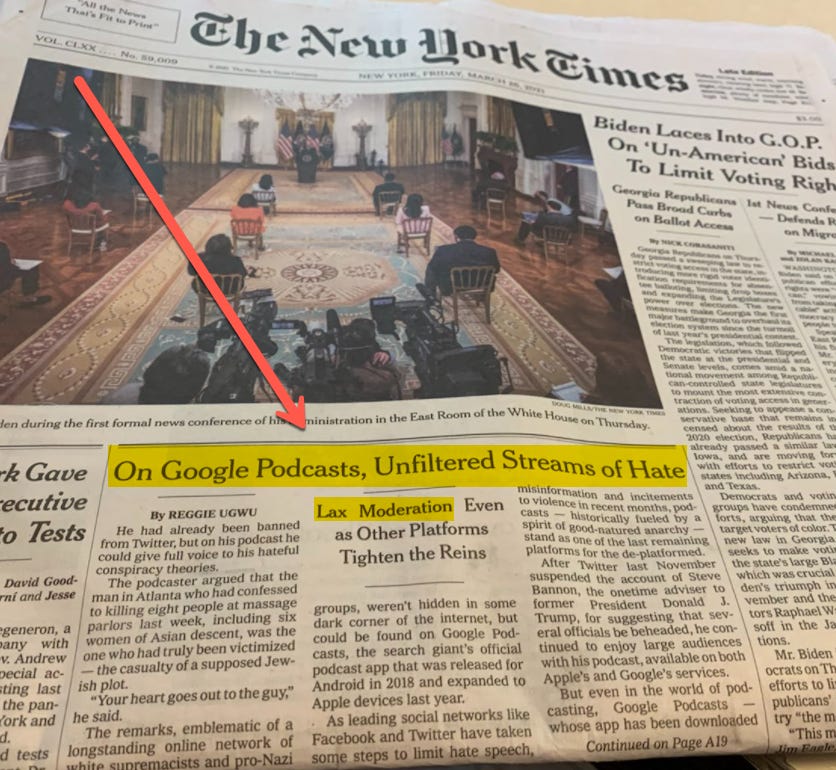
And as I have repeatedly documented, it is not just Democratic politicians agitating for greater political censorship but also their liberal journalistic allies, who cannot tolerate that there may be any places on the internet that they cannot control. That is the petty wannabe-despot mentality that has driven them to police the “unfettered” discussions on the relatively new conversation app Clubhouse, and escalate their attempts to have writers they dislike removed from Substack. Just today, The New York Times warns, on its front page, that there are “unfiltered” discussions taking place on Google-enabled podcasts:

New York Times front page, Mar. 26, 2021

We are taught from childhood that a defining hallmark of repressive regimes is that political officials wield power to silence ideas and people they dislike, and that, conversely, what makes the U.S. a “free” society is the guarantee that American leaders are barred from doing so. It is impossible to reconcile that claim with what happened in that House hearing room over the course of five hours on Thursday.

Glenn Greenwald. This is the conclusion to the latest of Greenwald’s very, very good work on the specter of government-coerced "private" censorship on the internet.


3. Real creativity will die out. Instead, we shall get a multitude of mediocre pseudo-thinkers and vulgar groups and organizations. Our belief systems will turn into a strange chaotic stew of science, philosophy, and magical beliefs.  “Quantitative colossalism will substitute for qualitative refinement.” What is biggest will be regarded as best. Instead of classics, we shall have best-sellers. Instead of genius, technique. Instead of real thought, Information. Instead of inner value, glittering externality.  Instead of sages, smart alecs. The great cultural values of the past will be degraded; “Michelangelos and Rembrandts will be decorating soap and razor blades, washing machines and whiskey bottles.”

Morris Berman, discussing Pitirim Sorokin’s predictions on the collapse of our sensate culture, in 2012.

For more on Sorokin, a fascinating figure, see:


You can read most of my more impromptu stuff at here. It should work in your RSS aggregator, like Feedly, should you want to make a habit of it.

Sundries

My notional first item is omitted because my doctor says I don’t need to touch any third rails today.


Abigail Shrier is Exhibit A for the proposition that “it is unforgivable to speak truth about matters of sexuality when the elite are pushing lies.”

This item appears because I sometimes ignore my doctor.


Why I Wouldn’t Recommend Adjunct Teaching at Law Schools Now.

Note well the second reason.

But cancel culture doesn’t exist. No sirree!


Rod Dreher has broken out of his Covid den and finds there’s still life, and hope for the counter-cultural causes he champions (likely paywall). And Freddie deBoer reads mainstream journalists the riot act from his perch at Substack (an odd place for a communist, but a guy’s gotta eat, right? Possible paywall.)

Putting these together (the building of Benedict Options and the collapsing of the media that have been taken over by wokesters) gives me hope that the cultural pendulum be reversing toward equilibrium (before overshooting in the other direction).


There is law school lore about “alternative pleading.” Smith sues Jones, alleging that “Jones borrowed Smith’s bucket and returned it with a hole in it.”

Jones replies:

  1. Jones did not borrow Smith’s bucket.
  2. There was no hole in the bucket when Jones returned it.
  3. The hole was in the bucket when Jones borrowed it.

Trump’s “Kracken” lawyer Sidney Powell’s lawyers apparently went to law school, too:

Powell pushed a variety of conspiracies before settling on her foreign-intervention fantasy. “There has been a massive and coordinated effort to steal this election from We the People of the United States of America, to delegitimize and destroy votes for Donald Trump, to manufacture votes for Joe Biden,” she told Maria Bartiromo—and millions of Fox Business viewers—on November 8. “They have done it in every way imaginable, from having dead people vote in massive numbers, to absolutely fraudulently creating ballots that exist only voting for Biden. … They also used an algorithm to calculate the votes they would need to flip. And they used the computers to flip those votes from Biden to—I mean, from Trump to Biden.”

But Powell may have flown too close to the sun. She was hit with a $1.3 billion defamation lawsuit in January from Dominion alleging she spread her false claims about the company’s machines deleting or flipping votes “to financially enrich herself, to raise her public profile, and to ingratiate herself to Donald Trump.”

Now that Powell is facing real consequences for her rhetoric, she is singing a different tune. Seeking to dismiss Dominion’s lawsuit, the pro-Trump lawyer and her legal team filed a motion on Monday arguing that “no reasonable person would conclude that [Powell’s] statements were truly statements of fact.”

…

Powell’s legal team went on to argue that the case involves “a matter of public concern,” and that Dominion had “already been subject to scrutiny” well before Powell entered the scene. Plus, they made the case that Dominion failed to prove Powell knew her statements were false. “In fact,” the motion reads, “she believed the allegations then and she believes them now.”

The Morning Dispatch: The Kraken is Backtrackin’.


Although I think the press and the politicos are overplaying the race angle on the Atlanta shootings, a surge of violence against Asians, racially motivated, apparently is real.

Be it suggested hereby that our former President’s smash-mouth about “China flu” (and relentless rhetorical debasement of people he disliked) bears much responsibility for that.

I don’t give a [insert vulgarity here] what his supposed “policies” were. A President who comports himself that way is irredeemable by good policies because a President’s toxicity debases the whole body politic.


Speaking, however, of the Atlanta shootings, David French has a Sunday column on a weird Evangelical subculture that may have contributed. I don’t want to jump to a conclusion on that, but some of the shooter’s reported comments reflect the “purity culture” mentality, experienced as condemnatory by one whose impurity troubled him mightily.

Side note: The Bill Gothard David French alludes to was allowed to mentor me and my classmates at Wheaton Academy in the Fall of 1966 (so dated because (1) I remember that Mellow Yellow was on the charts and (2) Wikipedia). He was a little strange, but the full-blown flakiness hadn’t yet emerged — unless some of my female classmates have stories they haven’t told me.

I later noted that he had become a kind of under-the-radar cult figure for Evangelical homeschoolers and couldn’t quite grasp it, since I don’t recall much charisma.


You can read most of my more impromptu stuff at here. It should work in your RSS aggregator, like Feedly, should you want to make a habit of it.

Catching up …

I’ve been, as previously mentioned, focusing on a fun personal project, which entails lots of rabbit-trails and techie learning. But I’ve noticed a few things that seem worth sharing.


The longer Trump is out of office, and the more the press treatment of Biden so starkly contrasts to that of Trump when they take identical substantive positions (e.g., no action against Saudi Arabia for the killing of Jamal Khashogi), the more I understand (not to say “agree with”) the Trump revolution. I don’t expect to be backtracking after reading Christopher Lasch’s Revolt of the Elites and Martin Gurri’s Revolt of the Public, both on my bookshelf awaiting me.


We are a sick country when Netflix has a show top 10 show, Marriage or Mortgage, featuring couples agonizing over whether to have a vulgarly lavish wedding or whether to buy a vulgarly lavish house and postpone any wedding.

Does nobody ever think of a modest wedding and a modest starter home?


America has gone through four Great Awakenings. The first (1730–1755) and second (1790–1840) were rooted in the conviction that Christ reigns victorious over the invisible economy, that the debts incurred by human transgression have been offset by divine innocence. Christ the Scapegoat, through his unmerited death on the Cross, did what we could not: He paid our debts. He took on the stain of sin in order to wipe it clean. These awakenings had a political significance. By preaching the universality of sin and the wideness of God’s mercy, they helped shape the disparate colonies, and later states, into a nation. One could say something similar about America’s third awakening (1855–1930), which was fired by the social gospel. It sought to employ the universality of divine solicitude to unify the country beyond the divisions of economic class.

We are now undergoing a fourth awakening, and matters are very different. The previous awakenings took place under the firm hand of American Protestantism. But today, Mitchell observes, “we are living in the midst of an American Awakening, without God and without forgiveness.” In the century that separates us from the outburst of the social gospel, our society lost its hope in the Cross but not its sense of guilt. The panic over righting wrongs remains, but gone is the promise of redemption. Without the Cross of Christ, the transactions of the invisible realm must be set to balance wholly within the power dynamics of the visible world.

Mitchell sees the rise of identity politics as a crisis of the invisible economy erupting into the visible. No longer guided by the Christian insight that the universality of sin means its resolution must be a divine act, identity politics apportions guilt and innocence according to a person’s race, ethnicity, gender, and sexual orientation, each weighed according to intersectional theory. Guilt and innocence no longer attach to one’s freely chosen actions over the course of a life but are imputed on the basis of one’s inherited and immutable characteristics, skin color above all. The idea of original sin abides but is tragically twisted. It is still something one is born with, but it is no longer universal. Rather, like the Angel of Death, it passes over some and lands upon others.

James F. Keating, Woke Religion, reviewing Joshua Mitchell, American Awakening: Identity Politics and Other Afflictions of Our Time.


I grew up fundamentalist and we avoided rhythm for fear it would lead to dancing and copulation so we praised God in slow mournful voices, like a fishing village whose men had been lost in a storm. We never learned to play a musical instrument for fear we might have talent and this would lead to employment in places where people drink liquor.

What it’s like to be old, if you want to know | Garrison Keillor


When I hear descendants of the Magisterial Reformation saying that sola scriptura isn’t what I think it is, I’m reminded of the perennial excuse of die-hard Communists that “real Communism hasn’t been tried.”

Protestantism was fissiparous (schism-prone) even during Luther’s lifetime. And if one glosses sola scriptura to require heedfulness to the interpretations of one’s clergy, then what you’re left with is simply scriptura, with no the sola. And adherence to scriptura is not at all uniquely Protestant if one insists on proper and not private interpretation.


The coverage of the Atlanta massage parlor murders this week may have destroyed any vestige of respect for media and elite opinion. I was thinking along those lines, but Andrew Sullivan says it better:

Here’s the truth: We don’t yet know why this man did these horrible things. It’s probably complicated, or, as my therapist used to say, “multi-determined.” That’s why we have thorough investigations and trials in America. We only have one solid piece of information as to motive, which is the confession by the mass killer to law enforcement: that he was a religious fundamentalist who was determined to live up to chastity and repeatedly failed, as is often the case. Like the 9/11 bombers or the mass murderer at the Pulse nightclub, he took out his angst on the source of what he saw as his temptation, and committed mass murder. This is evil in the classic fundamentalist sense: a perversion of religion and sexual repression into violence.

We should not take the killer’s confession as definitive, of course. But we can probe it — and indeed, his story is backed up by acquaintances and friends and family. The New York Times originally ran one piece reporting this out. The Washington Post also followed up, with one piece citing contemporaneous evidence of the man’s “religious mania” and sexual compulsion. It appears that the man frequented at least two of the spas he attacked. He chose the spas, his ex roommates said, because he thought they were safer than other ways to get easy sex. Just this morning, the NYT ran a second piece which confirms that the killer had indeed been in rehab for sexual impulses, was a religious fanatic, and his next target was going to be “a business tied to the pornography industry.”

We have yet to find any credible evidence of anti-Asian hatred or bigotry in this man’s history. Maybe we will. We can’t rule it out. But we do know that his roommates say they once asked him if he picked the spas for sex because the women were Asian. And they say he denied it, saying he thought those spas were just the safest way to have quick sex. That needs to be checked out more. But the only piece of evidence about possible anti-Asian bias points away, not toward it.

And yet. Well, you know what’s coming. Accompanying one original piece on the known facts, the NYT ran nine — nine! — separate stories about the incident as part of the narrative that this was an anti-Asian hate crime, fueled by white supremacy and/or misogyny. Not to be outdone, the WaPo ran sixteen separate stories on the incident as an anti–Asian white supremacist hate crime. Sixteen! One story for the facts; sixteen stories on how critical race theory would interpret the event regardless of the facts. For good measure, one of their columnists denounced reporting of law enforcement’s version of events in the newspaper, because it distracted attention from the “real” motives. Today, the NYT ran yet another full-on critical theory piece disguised as news on how these murders are proof of structural racism and sexism — because some activists say they are.

When The Narrative Replaces The News – The Weekly Dish. There’s more than that:

  • Harvard sent out a note to students premised on this being an anti-Asian crime.
  • Nikole Hannah-Jones wove it into her narrative of “racism and White Supremacist domestic terror.”
  • The Root ominously prophesied that “White supremacy is a virus that, like other viruses, will not die until there are no bodies left for it to infect ….”
  • Trevor Noah insisted that the killer’s confession was self-evidently false (direct quote from Sullivan).

All of that, on the currently-available evidence, is false and absurd. Sullivan again:

But notice how CRT operates. The only evidence it needs it already has. Check out the identity of the victim or victims, check out the identity of the culprit, and it’s all you need to know. If the victims are white, they don’t really count. Everything in America is driven by white supremacist hate of some sort or other. You can jam any fact, any phenomenon, into this rubric in order to explain it. 

The only complexity the CRT crowd will admit is multiple, “intersectional” forms of oppression: so this case is about misogyny and white supremacy. The one thing they cannot see are unique individual human beings, driven by a vast range of human emotions, committing crimes with distinctive psychological profiles, from a variety of motives, including prejudices, but far, far more complicated than that.

…

The media is supposed to subject easy, convenient rush-to-judgment narratives to ruthless empirical testing. Now, for purely ideological reasons, they are rushing to promote ready-made narratives, which actually point away from the empirical facts. To run sixteen separate pieces on anti-Asian white supremacist misogynist hate based on one possibly completely unrelated incident is not journalism. It’s fanning irrational fear in the cause of ideological indoctrination. And it appears to be where all elite media is headed.

Others reached that conclusion about media and elite opinion ahead of me. Just because they jumped the gun doesn’t mean they were wrong.

That’s it for now.


You can read most of my more impromptu stuff at here. It should work in your RSS aggregator, like Feedly, should you want to make a habit of it.

Status Update

I think I mentioned a serious computer crash and consequent problems in an earlier blog. It appears that the problems cannot be resolved and 15 months of data were lost from a database. Mercifully, the database was kind of a hobby,  where I put clippings I read in the news mostly to be doing some thing and theoretically to be able to access them later. 

Such is life

For the things that are seen are transient, but the things that are unseen are eternal.

II Corinthians 4:18

I may actually have a hardware problem on the computer, which I will try to have diagnosed before too long, though that is complicated by the distance of the nearest Apple store and by Covidtide.

Meanwhile, my loss of data got me thinking about alternative approaches to florilegeum, and based on its prevalence among some nerdy social media friends, I decided to download and learn about Obsidian, a relatively new database manager — no, make that freeform relational database manger — for plain text markdown files.

Obsidium is not transparently friendly, but once I took a YouTube tutorial, I got fired up about the possibilities to take a more disciplined approach to what I clip and save, and to pause for some thought as I collect things. And the learning curve isn’t all that high.

So to make a long story short, I’ve spent considerable time this week learning some new software and putting it (and myself) through our paces together.

I suspect that the consequence for my blogging will be that it is less frequent but much more thoughtful, as I’m forcing myself, I hope, to become more thoughtful.


You can read most of my more impromptu stuff at here. It should work in your RSS aggregator, like Feedly, should you want to make a habit of it.