I’ve paid closer attention (plus Substack subscription fees and book purchases) to Paul Kingsnorth since his conversion to Christianity and specifically to Orthodox Christianity. (No, he did not convert to “Romanian Orthodoxy,” though his regular parish is predominately Romanian. There is no substantial difference between Romanian, Serbian, Greek, Russian, Georgian, Syrian or other Orthodox ethnic identifiers.)
I’ve also paid closer attention (plus Substack subscription fees and a book purchase) to Martin Shaw since his reversion to Christianity, this time as Orthodox.
But I’ve been trying to keep in mind the scriptural cautions against putting novices on a pedestal Cf. I Timothy 3:6. Neither novice, Kingsnorth or Shaw, is a Christian authority – yet.
Mercifully, neither is claiming the prophet’s mantle, but careless readers can cloak them with it anyway.
I’m happy for Kingsnorth that his new polemic, Against the Machine, is selling well, and that he is getting blogged and podcasted by everyone and his brother. I’ve read the book, which was more than a stitching together of old internet posts. But if you read it, do also read some critiques, such as ‘Unnatural’ Doesn’t Mean ‘Wicked’, by non-Orthodox Christian Tara Isabella Burton.
Elites failing to reproduce
PhDs are falling: At Harvard, PhD programs are collapsing amid budget woes. The Faculty of Arts and Sciences just slashed the number of PhD student admissions slots by more than 75 percent in the Science division and 60 percent in the Arts & Humanities division for the next two years.
The PhD racket was always a weird one. These schools pushed their smartest, most annoyingly ambitious kids to get a PhD (there but for the grace of god go I). During that PhD, these guys do all the work of being a professor—teaching courses, grading papers. But they’re paid next to nothing. And then the clincher is that at the end, there are no jobs available. Maybe one English department job in Idaho for a group of 300 of them to battle to the death over. So I support this belt-tightening. We will have about 5,000 fewer antifa soldiers produced each year. They might even spend their 20s making money.
Over the past decade a new, and very revealing, locution has drifted from our universities into the media mainstream: Speaking as an X . . . This is not an anodyne phrase. It tells the listener that I am speaking from a privileged position on this matter. (One never says, Speaking as a gay Asian, I feel incompetent to judge this matter.) It sets up a wall against questions, which by definition come from a non-X perspective. And it turns the encounter into a power relation: the winner of the argument will be whoever has invoked the morally superior identity and expressed the most outrage at being questioned.
Mark Lilla, The Once and Future Liberal.
Legal realism
A new analysis of insurance data finds that more than one in ten of the women who take the abortion pill experience sepsis, infection, hemorrhaging, or another “serious adverse event.” The only reason regulators tolerate such a high level of danger to the mother is that the ability to kill her baby cheaply and conveniently trumps all considerations.
Wow, it really was a social contagion: As the great vibe shift sweeps our country, it turns out that the rise in transgender identities really was a fad—between 2022 and 2024, the number of trans-identifying young people has dropped in half. Last week, another study hinted at the same conclusion, but it was widely criticized due to its failure to distinguish between trans and nonbinary identities, which are obviously very different, you ignoramus. This week’s data from writer and psychology professor Jean Twenge proved that both identities are in free fall among the youth. …
This is good for a lot of reasons—but in particular, it’s good for trans people! Why? Because there have always been a small number of people who feel truly dysphoric in their sex. And the last thing you want is a horde of depressed teen girls latching on to your situation as a way to rage against their bodies, a stand-in for anorexia or cutting. I’ve never been more worried about my rights as a gay person than when all the angry youth started announcing they were gay or trans or queer because then I just knew backlash was coming. Anything funky they did, they called it gay. They wore a weird jacket and got creative with their haircuts and all of a sudden, they’re claiming my identity. I say, scram, kids! Get out of here! I’m putting up a border around Gay Territory and saying No more may enter. It’s me, it’s everyone in Provincetown, and it’s my dykes in the Midwest, and that’s it. We’re full up. Go see if the Mormons are taking applications.
The next two items are the most pointedly political in this post – and that’s not very pointed. I just don’t have it in me to spit into the wind recently.
A new presumption of bad faith
I was reminded by a New York Times guest editorial on the dangers of the Insurrection Act that our laws almost all assume that the law enforcer will be sane and will act in good faith. As a consequence of electing an insane and vengeful President, we now “enjoy” the full American expression of Joseph Stalin’s “show me the man and I’ll show you the crime.” My reflex is to disbelieve every word Trump says and to suspect invidious discrimination in all his Orders.
It might behoove our legislators to consider, before passing a law, what injustices could be wrought by bad actors wielding the proposed law.
Bring back hypocrisy
The Wall Street Journal has somehow decided to position its Editorial Page just slightly “left” (whatever those terms mean any more) of the Falun Gong’s Epoch Times. Thursday, it was Barton Swaim’s both-sides demi-defense of Trump’s lawfare against his perceived enemies.
I counter with “Yes, but Trump truly is worse because he does it right out in the open, shamelessly.” If hypocrisy is the tribute vice pays to virtue, it joins smoking and drinking on the very short list of vices Trump doesn’t practice. Otherwise, his brazenness coarsens every thing he touches and everyone who cheers him. For a guy so enamored of gold leaf, he’s oddly opposite King Midas.
I never thought I would lament the loss of hypocrisy.
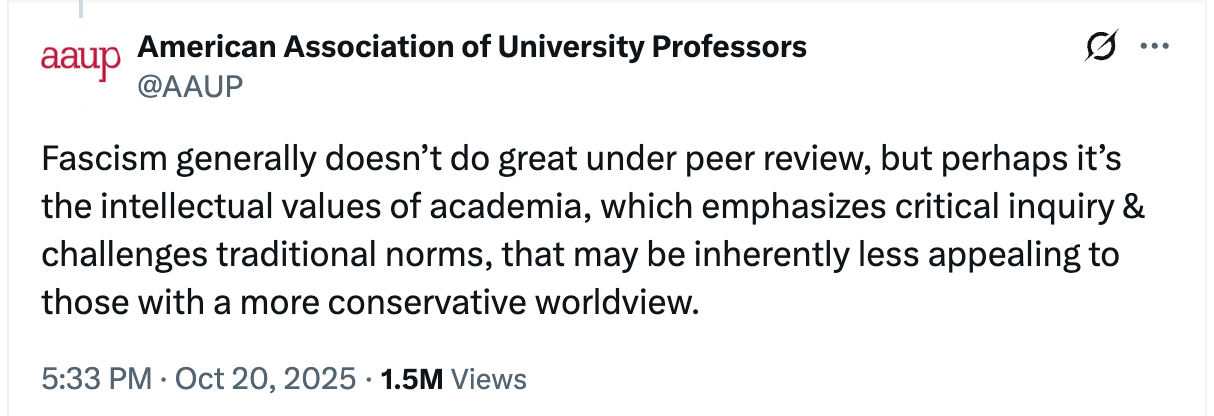
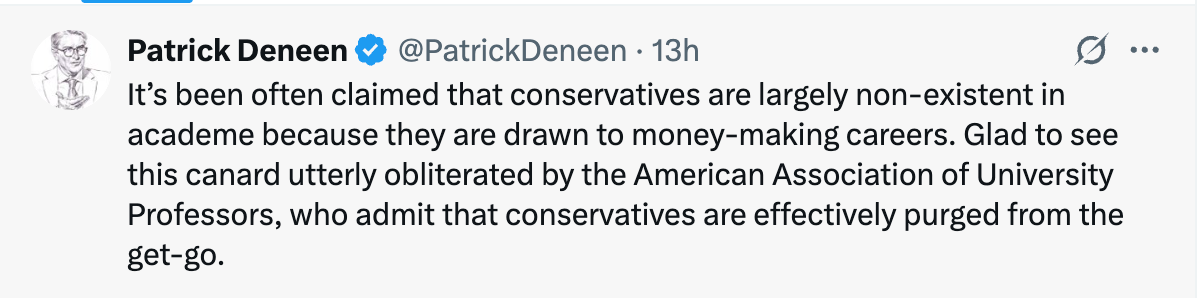
In the wider world, asking whether academia really skews left makes you look like an idiot or, slightly more charitably, like someone so encased in a bubble that they don’t even know what they’re missing. As for insisting on your right to complete self-governance, free from “secondary, external aims,” as Siraganian puts it … well, if you expect someone else to pay you to pursue truth, at some point, you must accept some secondary, external aims.
Academics tend to recoil from such a crass and mercenary idea, and fair enough, but the world is a crass and mercenary place. We talk about pursuing truth for its own sake, but most academics are pursuing it in exchange for money they can use to satisfy their many less elevated needs. The people who provide that money want something in return. Many will not be content to know that somewhere the global stock of Truth is increasing. Especially if one of the Truths you insist on is that they are dim-witted bigots.
Anyway, this is how the AAUP responds to the conversation on X:
The more I see institutional elites, in government and the private sector, the more I realize these people are like the pre-revolutionary Tsarist circles. They had no idea why so many people hated them, and what kind of precarious situation they were in.
They always invest in businesses that put them in the ‘trade routes’—controlling the linkages, and never getting involved in the creation of tangible value.
Kagi News, a new and useful aggregator, offers “Today in History as one of its tabs, with events at the top, people at the bottom.
For some reason, I find that a lot of composers and poets I had place mentally in the late-19th century were actually in early-19th century. Edgar Allen Poe never even saw the late-19th. Who knew?
Snippets
… the Conservative Political Action Conference, a kind of movable rent-a-troll event … (Anne Appelbaum via Frank Bruni)
The old Saudi brand was ‘austere theocracy,’ but the new one is ‘fun, fun, fun, but still with beheading.’” (Helen Lewis via Frank Bruni)
We live the given life and not the planned. (Wendell Berry, Sabbath poems 1994 number 3)
I love her more than evolution requires. (Charles Murray’s wife, reflecting on their first child. Attributed to others as well. The insight doubtless matters more than the source.)
Mad Ireland hurt you into poetry. (W. H. Auden, in memory of W. B. Yeats)
Music is a conspiracy to commit beauty. (Linda Ronstadt)
States, particularly liberal democracies, are heavily dependent on wars for moral coherence. (Stanley Hauerwas, Resident Aliens). Looking at the last 62 years of American history seems to confirm this.
Your enemies are not demonic, and they are not all-powerful and the right hasn’t always lost and the left hasn’t always won. But if you convince yourself of that, you give yourselves all sorts of permission to do a lot of stupid and terrible things under the rubric of “Do you know what time it is?”
[A] critical mass of the American people … no longer want[s] to govern themselves, … are sick of this republic and no longer want to keep it if it means sharing power with those they despise.
I don’t do any of the major social media, but I have two sub-domains of the domain you’re currently reading: (a) You can read most of my reflexive stuff, especially political here. (b) I also post some things on my favorite no-algorithm social medium.
[Jaron] Lanier agreed that it’s up to humans to protect the truth in the age of AI, but was less optimistic that we will do so: “The issue with AI is not the AI. It’s not the large language model. It’s the concentration of power and wealth around who owns it,” he said. “You have to look at the big system, including the people, the money, the business, the society, the psychology, the mythmaking, the politics.”
Codgers and technology go together like peanut butter and sardines.
Frank Bruni. Then this, merely via Frank Bruni, not from him:
In the quarterly journal Sapir, Bret Stephens made a kind of peace with the heavily partisan slant of so much cable television news: “To demand scrupulous impartiality on their broadcasts is like expecting fancy linens at a Motel 6.” (Naomi Lerner, West Orange, N.J.)
A non-tribal Democrat
Some of my subscribers dislike when I throw elbows to my left. They share my disdain for Donald Trump and his party, and my commitment to understanding them in light of political theory and history, but they are also devoted Democrats who have warm feelings for Joe Biden, were thrilled by the campaign of Kamala Harris and Tim Walz, and still seethe about Hillary Clinton’s loss in 2016.
That isn’t me. I vote for Democrats. I directionally agree with them on most issues. And I consider the Republican alternative thoroughly unacceptable. Yet I am not a devoted Democrat. A big part of the reason is that I’m not a joiner—of anything. I value my own independence too much and temperamentally resist deploying my talents to advance a cause—any cause, even a worthy one, and even one wrapped up, at this moment, with the fate of liberal democratic self-government in the United States.
But this way of thinking presumes that working to help the Democrats should take the form of deferring to and falling in line behind party leadership and elected officials, taking marching orders, rallying around candidates and nominees endorsed by the party bigwigs, and then maintaining message discipline to get them elected. That’s what I resist. But there’s another kind of devotion—one that expresses itself as tough love and a willingness to speak candidly, and even harshly, about faults.
…
… a Democratic researcher is quoted as saying that when she asks swing voters to liken the two parties to animals, they consistently describe Republicans as lions, tigers, and sharks—“apex predators” that “take what they want when they want”—but Democrats as tortoises, slugs, or sloths, creatures typically considered “slow, plodding, [and] passive.”
One of this crazy-making aspects of life in Trump 2.0 is that the media coverage of the administration’s antics focuses, mostly on the substance of what they are doing, ignoring the process, and the question of whether they have the authority to do it at all.
Such, I feared, was the infirmity of NPR and PBS Aren’t Entitled to Your Tax Dollars, a Free Press article by a serious Ivy league constitutional law professor. I slogged my way through it, agreeing with the author again and again, but frustrated that he was ignoring the elephant in the room. Finally, in literally the last paragraph, he mentioned the elephant almost as a throwaway line:
NPR also alleges in its complaint that the federal statute creating the Corporation for Public Broadcasting prohibits Trump from making this defunding decision. That’s a very different argument, which I’m not addressing here ….
I would venture a guess that nine out of ten people who read this column will come away with the impression that NPR and PBS are suffering from a liberal sense of entitlement to tax dollars, and miss the point about there being some limits to executive power.
In the end, it may not matter because this Congress is sufficiently servile that if Trump asks Congress to defund CPB, PBS and NPR (a longtime GOP talking point), it almost certainly will oblige him.
But process does matter, tremendously. Where the power to do something resides also matters.
This is all, for the record, a really excellent example of what we used to mean when we used the word ideology. Once upon a time, one wouldn’t say “My ideology is…” because ideology referred to the hidden, unexplored, unconscious politics that lay beneath the public, open, explicit politics. An ideology was those pre-political assumptions and beliefs which conditioned and limited political thought, which made the conscious political philosophy of any individual what it was. Ideology is the skeleton that hides unseen within the animal of politics but nevertheless determines the structure of that which is seen. Ideology exists in both the macro and the micro; this bizarre upper-caste antipathy towards ideology is a good example. If you asked leadership at these publications if they had any particular interest in leading a charge against the practice of adoption, they’d say no, of course not, what a weird question! If you were to show them just how repetitively this particular set of critiques and questions and hrm hrm hrm noises gets published in their pages, they’d swear to you that it reflects no underlying party line. And yet there it is, the evidence, in black and white. Something about the current constitution of the anxious educated urbanite liberal soul cries out inside of them: the real problem is adoption.
A well-regarded Evangelical pastor published this weeks before the 2020 Election.
[T]his is a long-overdue article attempting to explain why I remain baffled that so many Christians consider the sins of unrepentant sexual immorality (porneia), unrepentant boastfulness (alazoneia), unrepentant vulgarity (aischrologia), unrepentant factiousness (dichostasiai), and the like, to be only toxic for our nation, while policies that endorse baby-killing, sex-switching, freedom-limiting, and socialistic overreach are viewed as deadly.
…
I think it is a drastic mistake to think that the deadly influences of a leader come only through his policies and not also through his person.
This is true not only because flagrant boastfulness, vulgarity, immorality, and factiousness are self-incriminating, but also because they are nation-corrupting. They move out from centers of influence to infect whole cultures. The last five years bear vivid witness to this infection at almost every level of society.
…
Christians communicate a falsehood to unbelievers (who are also baffled!) when we act as if policies and laws that protect life and freedom are more precious than being a certain kind of person. The church is paying dearly, and will continue to pay, for our communicating this falsehood year after year.
The justifications for ranking the destructive effects of persons below the destructive effects of policies ring hollow.
I find it bewildering that Christians can be so sure that greater damage will be done by bad judges, bad laws, and bad policies than is being done by the culture-infecting spread of the gangrene of sinful self-exaltation, and boasting, and strife-stirring (eristikos).
…
I think it is baffling and presumptuous to assume that pro-abortion policies kill more people than a culture-saturating, pro-self pride.
When a leader models self-absorbed, self-exalting boastfulness, he models the most deadly behavior in the world. He points his nation to destruction. Destruction of more kinds than we can imagine.
It is naive to think that a man can be effectively pro-life and manifest consistently the character traits that lead to death — temporal and eternal.
Piper did not say who he was voting for. He did not name names. For that reason, I’m blogging this separately from pointed political material.
But I’m not going to deny that my heart soared to see that our current President had not captured and reduced to servility the entirety of one of America’s most prominent Christian traditions.
The right to know isn’t the whole story
To further clarify our situation, consider W. H. Auden’s discussion, which I’ve cited before, of the idea that, as he put it, “the right to know is absolute and unlimited.” “We are quite prepared,” Auden wrote,
“to admit that, while food and sex are good in themselves, an uncontrolled pursuit of either is not, but it is difficult for us to believe that intellectual curiosity is a desire like any other, and to recognize that correct knowledge and truth are not identical. To apply a categorical imperative to knowing, so that, instead of asking, ‘What can I know?’ we ask, ‘What, at this moment, am I meant to know?’ — to entertain the possibility that the only knowledge which can be true for us is the knowledge that we can live up to — that seems to all of us crazy and almost immoral.”
Harvard and the Trump administration have each finally met an adversary too big to push around. America’s richest university never really considered how much it depends on government policy, including lavish federal research funding, federal student aid, and a permissive immigration regime for the foreign students—who make up a third of the university’s student body and often subsidize the rest by paying more. Progressives also never thought through how the many tools they devised for using government leverage against private institutions—including threatening tax exemptions, as the Supreme Court allowed on dubious grounds in Bob Jones University v. United States (1983)—could be used against universities that engage in race discrimination for the “right” reasons, cultivate a political monoculture among the faculty, and permit campus mobs to terrorize minority groups who are out of progressive favor (Jews). Now, Trump is trying to strip Harvard of everything—tax exemption, federal funding, and visas for foreign students already enrolled. While the comeuppance for Harvard is admittedly delicious, the president is abusing powers he ought not to have, and Harvard has deep enough pockets to fight him in court.
National Review Weekly email.
Some cases don’t have valid arguments on both sides. That I find nothing “delicious” about Harvard’s “comeuppance” is an example of why I ignore National Review’s regular email invitations to resubscribe.
Can a car have a “catfish smile”?
“Behind that catfish smile, the company’s twin-turbo 4.0-liter DOHC V8 now discharges a drama-drenched 656 hp and 590 lb-ft—153 hp and 85 lb-ft more than the previous Vantage Roadster—thanks to larger turbochargers, revised camshaft profiles, optimized compression ratio and upgraded fueling and cooling.”
Kudos to Dan Neil for the spot-on “catfish smile.”
The car, by the way, is a 2025 Aston Martin Vantage Roadster, which will set you back $300,000 as equipped (this week’s ephemeral tariffs not included).
Credentials, good times, and genuine learning
Most young people today feel, with considerable justification, that they live in an economically precarious time. They therefore want the credential that will open doors that lead to a good job, either directly or (by getting them into good graduate programs) indirectly …
But those same young people also want to have a good time in college, a period of social experience and experimentation that they (rightly) think will be harder to come by when they enter that working world …
… Yes, students understand — they understand quite well, and vocally regret — that when they use chatbots they are not learning much, if anything. But the acquisition of knowledge is a third competing good, and if they pursue that one seriously they may well have to sacrifice one of the other two, or even both. Right now they can have two out of three, and as Meat Loaf taught us all long ago, two out of three ain’t bad.
After Trump held a crypto dinner last Thursday night, crypto moguls who paid to be there felt scammed that the president didn’t even stick around at the event they’d hoped to do their own scams at. I saw someone describe him as the apex scammer. Our Scammander in Chief.
In other Russia news, a new statue of Joseph Stalin in a Moscow metro station was unveiled this month. President Putin has called Stalin an “effective manager,” and has said that enemies of Russia use the “excessive demonization” of Stalin to attack “the Soviet Union and Russia.” Stalin is back, big time. Interesting that “effective manager” is being used here to describe a man who facilitated the death of millions—and not efficiently. But I’m not a businessman.
The continued reckoning: A postmortem on Kamala Harris’s campaign cited a “perception gap” as one of the reasons she lost, saying voters believed she held positions that she didn’t. “Over 80% of swing voters who chose Trump believed Harris held positions she didn’t campaign on in 2024, including supporting taxpayer funding for transgender surgeries for undocumented immigrants (83%), mandatory electric vehicles by 2035 (82%), decriminalizing border crossings (77%), and defunding the police (72%).” But Harris had, in fact, supported all of these positions. Like, she is on record supporting each of those positions (here, here, here, and here). So it’s not really a perception problem so much as a reception problem, like theseideas are not popular even though I support them. There’s a sense among Dems that people should simply ignore the things that are unpopular and that referencing them is fake news. Like, how dare you talk about the surge of migrants coming through our new open borders thanks to swift changes from the Biden admin. Yes, it’s technically true, but it’s disinformation-coded.
Leave Bruce alone: A bar in New Jersey canceled a performance by a Bruce Springsteen tribute band after the real Springsteen called Trump “corrupt, incompetent, and treasonous” while on tour in England. Citing the bar’s MAGA clientele, the bar owner said that a Springsteen cover band would be “too risky at the moment.” And: “Whenever the national anthem plays, my bar stands and is in total silence, that’s our clientele. Toms River is red and won’t stand for his bull—.” [But MAGA doesn’t have a violent streak. No way. That’s fake news.]
Things that are not antisemitism: The Democratic Socialists of America “Liberation Caucus” has announced its support for Elias Rodriguez, the suspect arrested for slaughtering two Israeli Embassy staffers outside D.C.’s Capital Jewish Museum last week. Here’s the statement signed by the DSA Liberation folks and a bunch of others: “As imperialism has made the entire world its battlefield, it is justified to fight it, by any means necessary, without regard for geography.” And: “[T]here must be consequences for genocidal [Z]ionist imperialism, and those consequences are righteous.”
The latest fitness craze is surely going to be Fake My Run. It fits perfectly with the national ethos whereby university students are already doing Fake My Education.
Your enemies are not demonic, and they are not all-powerful and the right hasn’t always lost and the left hasn’t always won. But if you convince yourself of that, you give yourselves all sorts of permission to do a lot of stupid and terrible things under the rubric of “Do you know what time it is?”
Trumpism can be seen as a giant attempt to amputate the highest aspirations of the human spirit and to reduce us to our most primitive, atavistic tendencies.
I don’t do any of the major social media, but I have two sub-domains of the domain you’re currently reading: (a) You can read most of my reflexive stuff, especially political here. (b) I also post some things on my favorite social medium. I am now exploring Radiopaper.com as well.
[Charles] Haywood says that if you want to call out someone on the Right, you should do it privately, not publicly. Sometimes, yes. But this is the exact same line of thinking that allowed the Catholic priest sex abuse scandal to metastasize. Don’t talk about it publicly, you’ll only help the enemies of the Church. Secrecy about evil — not moral misdemeanors, but evil — allowed it to grow in the darkened networks within the Church, until it was eventually exposed, and all but destroyed the Church’s moral authority. Don’t talk about it publicly, you’ll only help the Left. Yeah, well, screw that.
Rod Dreher after playing a role in exposing a white-supremacist headmaster and teacher in a Classical Christian School, via Andrew Sullivan.
I’ve read enough to know that Charles Haywood personally adheres to No Enemies to the Right — i.e., he was not just assigned that side by the debate organizers.
I’m with Rod on NETTR (he’s against it), which has gotten me crosswise with Rightwing cranks occasionally. Lacking any notable national platform, the worst I’ve gotten was Judas accusations — nary a death threat. And since I was defending the truth rather than trolling anyone, that’s as it should be.
Odder than the Judas accusation, though, was a comment by a Jewish colleague suggesting that it took special courage to diss some outsider Klansmen (or was it Nazis?) who were planning a big demonstration downtown, as if I were breaking ranks and burning bridges. Sheesh! That sad misimpression illustrates why we need to rebuke the reprobate Right more regularly: so nobody will think it’s courageous for someone on the Right to repudiate racist terrorists and neo-Nazis.
The worst of the right wingnuts are those who wear a cross on their sleeves but prove by their commission of (or cooperation with) evil that it’s really about political power, not Christ.
We live in culture war hell. The internet ensures that many of us spend all day, every day surrounded by the opinions of people we can’t stand. In the scrum of the day-to-day turf war for the American soul, even minor skirmishes can seem to take on world-historical purpose. And in a relentlessly binary political culture, people frequently feel that to give any ground to “the other side” at all is to admit defeat. Which means that progressive culture warriors will often go to the wall for positions they see as broadly on their side, even if they’re so extreme as to be ridiculous. They’ll throw their full weight behind ideas and statements and arguments that they secretly feel to be stupid, so as not to tacitly lend support to the right.
I promise: you don’t have to do that.
For example, there are people who earnestly believe that the phrase “I see what you mean” is ableist—that is, disrespectful and oppressive toward people with disabilities—because some people can’t see. This is—and I choose the word carefully—nuts.
…
As I write this, a minor controversy has erupted of just the kind that I’m talking about here: the University of Southern California’s School of Social Work has recently banned the use of the word field to refer to an academic discipline, as in the field of history. This is ostensibly because the word field might make black students and staff think of slavery. What black person could ever avoid hearing talk about fields, real or metaphorical?
When nonsense goes unchallenged because it’s perceived to be “on our side,” it metastasizes and spreads until suddenly, the majority of left-leaning people feel compelled to defend it. And ordinary people (that is, people not marinating in Twitter every day) will rightfully recognize the absurdity when they see it.
I’m not interested in spending a lot of time chewing through social justice language or norms. But I do want to say this: It’s okay to call nonsense nonsense, even if you feel it’s on your side. I promise. You can defend your values, be a soldier for social justice, and be merciless toward conservatives while still admitting when feckless people take liberal ideology to bizarre ends.
The is the Left equivalent of No Enemies to the Right. I confess that for some reason I find it easier to spot NETTR than NETTL; maybe because that’s because I spend more time contemplating thought on the Right half of the spectrum than on the Left half, or maybe it’s because NETTL is no longer notable.
(Of course, I should note that the French may have gotten here first with pas d’ennemis au gauche and pas d’ennemis au droite.)
Yes, there are enemies to the Right
I will not let some redpill pick-up artist pimp become a role model to my sons or to other young men in my church because I refuse to rebuke them publicly.
Neil Shenvi, making the case against NETTR. Anyone tempted by the NETTR nuttiness should read the whole piece. He’s quite disturbed that young Christian men may be looking to filthy reprobates like Andrew Tate or Bronze Age Pervert for lessons on how to combat the woke Left, and I am too.
Flannery’s violence and grotesqueries
Her fiction, which employed violence and the grotesque, horrified her mother. “Why can’t you write something uplifting,” Regina would say, “like the folks at Reader’s Digest?” As [Flannery] O’Connor confided in a letter to a friend: “This always leaves me shaking and speechless, raises my blood pressure 140 degrees, etc. All I can say is, if you have to ask, you’ll never know.”
“Heaven is where the cooks are French, the police are British, the mechanics are German, the lovers are Italian and everything is organized by the Swiss.
Hell is where the cooks are British, the police are German, the mechanics are French, the lovers are Swiss, and everything is organized by the Italians.”
It doesn’t matter that America is not part of Europe, because to Europeans America is worse at everything (except war), especially food.
In France, simple tastes, orderly manners, domestic affections, and the attachments which men feel to the place of their birth, are looked upon as great guarantees of the tranquillity and happiness of the State. But in America nothing seems to be more prejudicial to society than these virtues.
Alexis de Tocqueville, Democracy in America
High-Toned Gobbledygook
[I]t’s not anti-intellectual to say that the left desperately needs to lose its academic vocabulary, which is overwhelmingly influenced by trends in humanities departments at elite universities.
That’s because it is incomprehensible to ordinary Americans.
Students go through those programs and absorb a certain vocabulary, they graduate and go to work at nonprofits and in media and in Hollywood, and from there they spread the terminology. Social media, especially Tumblr and Twitter, helps ensure that this fancy vocabulary colonizes left-leaning spaces. Nobody wants to sound unsophisticated, so everyone adopts these terms even if they’re not particularly comfortable with them. Like seemingly everything in the internet age, it’s mimetic. And that’s how you get people talking about the role of Latinx intersectionality in queering BIPOC spaces in the Global South.
Texas AG Ken Paxton, having dodged conviction in the Texas Senate after impeachment by the Texas House, is tacitly appealing to the Texas GOP base by filing a red-meat lawsuit.
Dump on Trump
On the off chance that one reader is MAGA but persuadable, I shall continue to dump on Trump for the foreseeable future.
Bankrupt Donnie from Queens
Trump’s business—as we New Yorkers always knew—was bilking people. Oh, he had a few slam-dunk construction projects early on, using his daddy’s money. And he did prove himself more competent than the City of New York when it came to completing the Wollman Rink in Central Park. But almost everything else crashed. He declared bankruptcy four times. He stiffed the small contractors who built his casinos. He stiffed his lawyers. The real property developers in New York—no shrinking violets themselves—told jokes about what an egomaniacal phony he was.
Trump only began to make money when he signed on as an actor playing a billionaire in a reality TV series. This enabled him to take the grift to new levels: he sold his name to overseas developers who slapped it on apartment buildings, he sold steaks and wine and bottled water; he used the money to buy golf resorts and a few buildings.
…
Trump is a fraud and also a traitor. He tried to overthrow our government. But he persists, an icon, because he doesn’t “sound like a politician.” Nice work if you can get it. And the Democrats can’t seem to understand that they will make little progress against him if they don’t address the issues that built his brand—the crisis at the Southern Border and the refugees in Northern cities, crime (Target is closing nine stores, including one in Harlem, because of rampaging hordes of shoplifters), the false pomposities of identity politics…and, of course, the fact that Joe Biden seems to be doddering.
Four years into his presidency, Trump isn’t boring in the way a dull, empty afternoon is boring. Trump is boring in the way that the seventh season of a reality-television show is boring: A lot is happening, but there’s nothing to say about it. The president is a man without depths to plumb. What you see is what you get, and what you get is the same mix of venality, solipsism, and racial hatred that has long been obvious. Trump’s abuses of the presidency are often compared to those of Richard Nixon, but Nixon had a deep, if troubled, interior life; one biographer characterized Nixon as struggling with “tragic flaws,” a description hard to imagine any credible biographer using to describe Trump.
There’s quite an illustration at the top of Jurecic’s article, too.
Flaunt/Flout
Donald Trump does not flaunt the rules of golf—that is a vicious lie.
He flouts the rules of golf—just as he flouts good taste, common decency, the Constitution, etc.
To flaunt something is to show it off: A rich man might flaunt his wealth, a beautiful woman might flaunt her beauty, one of those younger Kardashians I can’t tell apart might very well flaunt both. To flout something is to disregard it: Rolling Stone writers routinely flout English grammar and usage both.
Poor Mike Pence. For one brief shining moment back in January 2021, standing in marbled majesty, gavel in hand, he did the Right Thing and refused to turn the Republic into a Fiefdom, which caused a mob of knuckleheads to storm the Capitol and send Pence running to an undisclosed location, but he stood tall for Rectitude and Devotion to Duty, and now here he is on the campaign trail making small talk in a Dunkin’ Donut shop with a couple of truckers trying to decide between the Caramel Crème and the Pumpkin Peppermint.
Poor Chris Christie. Once the Emperor’s Boon Companion, now his lone accuser, the former governor does his spiel for a crowd of six Starbucks sales associates on their vaping break who haven’t the ghost of an idea who this porky guy is.
Confabulation is subtly different than I’d thought. I considered it casual, habitual lying about trivial stuff; apparently, it’s not considered lying at all.
So much for Joe “The Confabulator” Biden.
#Fail
She “sought forms that give shape to the infinite and spiritual dimensions ….”
The problem with a theocracy is everyone wants to be Theo
James Dunn via @ChrisJWilson on micro.blog
Philo T. Farnsworth
Tonight Show host Johnny Carson once quipped, “If it weren’t for Philo T. Farnsworth, the inventor of television, we’d still be eating frozen radio dinners.”
Hermit kingdom: a characterization of North Korea in the Economist. It may not be novel, but it had fallen off my radar.
Undecided
Some problems are so complex that you have to be highly intelligent and well informed just to be undecided about them.
Laurence Peter, via The Economist World in Brief
A fundamental reality of human existence is that vice often leaves virtue with few good options. Evil men can attach catastrophic risks to virtually any course of action, however admirable.
You can read most of my more impromptu stuff here (cathartic venting) and here (the only social medium I frequent, because people there are quirky, pleasant and real). Both should work in your RSS aggregator, like Feedly or Reeder, should you want to make a habit of it.
First, live as though in the coming of Jesus Christ, the Kingdom of God has been inaugurated into the world and the outcome of history has already been determined. (Quit worrying)
Second, love people as the very image of God and resist the temptation to improve them.
Third, refuse to make economics the basis of your life. Your job is not even of secondary importance.
Fourth, quit arguing about politics as though the political realm were the answer to the world’s problems. It gives it power that is not legitimate and enables a project that is anti-God.
Fifth, learn to love your enemies. God did not place them in the world for us to fix or eliminate. If possible, refrain from violence.
Sixth, raise the taking of human life to a matter of prime importance and refuse to accept violence as a means to peace. Every single life is a vast and irreplaceable treasure.
Seventh, cultivate contentment rather than pleasure. It will help you consume less and free you from slavery to your economic masters.
Eighth, as much as possible, think small. You are not in charge of the world. Love what is local, at hand, personal, intimate, unique, and natural. It’s a preference that matters.
Ninth, learn another language. Very few things are better at teaching you about who you are not.
Tenth, be thankful for everything, remembering that the world we live in and everything in it belongs to God.
I’ve probably shared these before, but I review them monthly for my own sake, so I thought you might benefit, too. In fact, I just reviewed the full blog post and all of it is excellent.
Zero-sum church
From an institutional perspective [Pope Francis’] move [against the Latin Mass] arguably appears perverse: Here you have a Western church conspicuously lacking in public zeal, religious vocations, large families, liturgical seriousness … and yet the leaders of the church have decided to act punitively against a small minority that, whatever its highly-debated growth rate, clearly is a locus for intense forms of piety and practice. It’s as if a major auto manufacturer whose big brands were all struggling decided to kill off one of its few profitable lines of cars, because it only turned a profit in a niche market and wasn’t big enough to subsidize the whole. A strange decision …
… but under the psychological conditions created by decline also an understandable one. In a general corporate climate of diminishment and disappointment a small form of success invites resentment: If the small brand isn’t capable of subsidizing the whole, then why are its engineers and salesman wasting their talents on its niche market, when they should be contributing to saving the larger company? Shouldn’t they be expected to chip in where the need is greatest, in the main brands — by analogy, big, empty diocesan seminaries and struggling Novus Ordo parishes and schools — instead of concentrating their talents serving a more intense but (it’s assumed) self-limited market?
…
In the specific case of traditionalism, it was that sense of relative stability that helped pave the way for the Latin Mass’s return from its 1970s exile, for the permissions issued by first by John Paul and then more sweepingly by Benedict. And then it’s the subsequent weakening of both conservative and liberal Catholicism — the former pushing more right-wing Catholics tradward, the latter making tradness appear more of a threat to a necessary acceleration of the Vatican II revolution — that’s given us the sharpened conflicts between traditionalism and Pope Francis, and now the attempt at outright suppression.
My reaction to Pope Francis’ suppression of the Latin Mass (after reading some articulate howls from its proponents) was "doesn’t Francis see that this move tends to eradicate the Catholicism of his own youth and tends to the schism of those who won’t give it up?!" After reading Douthat, my reaction is "Of course he knows that. He wants a Novus Ordo Catholicism purged of Latin Mass Catholicism. He even said the Novus Ordo is now the exclusive Lex Orandi of the Church, and that he may be remembered as the Pope who split the Church."
In retirement, I have little occasion to bump into highly traditionalist Catholics (and a round of well-warranted litigation by my firm on behalf of the siblings of one of them estranged us even before I retired). But I read a few of them, and with Covid and Afghanistan and seeming national collapse of the U.S., and now the suppression of the Mass they love by a Pope they are obliged to obey, this is not a happy time to to be an American Latin Mass Catholic.
Always in the wrong
Revolutionaries are always in the wrong, since, in their juvenile fervor for everything new, in their hopes for a better future, and a way of life built on justice, they always base themselves on theories that are abstract and artificial, making a clean sweep of living tradition which is, after all, founded on the experience of centuries.
Conservatives are always wrong, too, despite being rich in life experience, despite being shrewd and prudent, intelligent and skeptical. For, in their desire to preserve ancient institutions that have withstood the test of time, they decry the necessity of renewal, and man’s yearning for a better way of life.
Both attitudes carry within themselves the seeds of death. Is there, then, a third way? Another destiny for society than of always being subject to the threat of revolutions which destroy life, or reactionary attitudes which mummify it? Or is this the inevitable fate of all terrestrial cities, the natural law of their existence?
In fact, only in the Church can we find both a Tradition that knows no revolution and at the same time the impetus towards a new life that has no end. Her theory (understood in the true sense of the word, namely “vision”) is based on a constant experience of Truth. Which is why she is in possession of those infinite resources upon which may draw all who are called to govern the perishable cities of this world.
Vladimir Lossky in Seven Days on the Roads of France, his account of fleeing the Nazis from Paris as he and his father had previously fled the Bolsheviks. (Via Fr. Stephen Freeman). I’ve ordered the book.
You can read most of my more impromptu stuff at here. It should work in your RSS aggregator, like Feedly, should you want to make a habit of it.
I understand Omarosa, a con woman, playing around with an allegation that Donald Trump used the n-word and she has a recording to prove it. It keeps her in the limelight and sells books. But I have no idea how Trump used it which, heaven help me, seems relevant even when the user is Donald Trump.
I couldn’t recall any account of how “Papa John” of pizza fame used it, so I Googled it and found this report, in which the journalist won’t spell out the word (but which reveals a use for which firing, return of millions of dollars of charitable donations, and erasure of the donor’s name from endowed buildings seems a bit hysterical — but admittedly the broader context of the narrower context is missing).
A black sociologist argues that “the n-word” is more toxic than “honky,” but he won’t spell out “the n-word” as he discusses it (and the legitimate reasons why sauce for the goose isn’t sauce for the gander when it comes to hateful language hurled across racial lines).
I “get it” that it is uniquely toxic as an epithet directed at another human being, especially when a pale (or orange) person hurls it at a dark person, in person or even in absentia. (Heck, it’s even worse than “dog“!)
But not all uses are epithets. Some people use it as a negative example, to criticize it and forbid its use as epithet. It seems to me that journalists could legitimately use it in the context of reporting on a controversy over its use as an epithet.
Should a law ever be written to criminalize it, describing it as “the n-word” would be, I think, an independent, void-for-vagueness constitutional infirmity.
But no. Not done. Can’t go there. Can’t go anywhere.
I’m half expecting some playwright or novelist to go coy on us in dialog.
It’s as if the very mention of it, howsoever legitimate and non-epithetic, threatens (social) death.
I may be a little bit Aspie, but I just don’t get it.
If it’s just a crazy fad, I have a suggestion for a much more sensible fad. The metaphorical use of “impact” and its derivatives as verbs by any journalist or other professional shall result in immediate termination for malpractice and, where applicable, license revocation. “Impactful” shall be a capital offense.
One may, however, use those words in drafting appropriate legislation or advocating its passage.
UPDATE: I deleted a rambling introduction, venting about something happening to a friend of mine that, in cool light of day, looked terribly out of place.
* * * * *
Our lives were meant to be written in code, indecipherable to onlookers except through the cipher of Jesus.
Follow me on Micro.blog, too, where I blog tweet-like shorter items and … well, it’s evolving. Or, if you prefer, those micro.blog items also appear now at microblog.intellectualoid.com.
I awoke Monday to an NPR story about same-sex couples in New Jersey starting to get married at Midnight. One newlywed man (I’m resisting scare quotes) remarked that he’d grown up when “it was illegal to be gay.”
I would be astonished if that is true, but it illustrates continued equivocation about the meaning of “gay.” “Equivocation” does not necessarily imply deception, though it is sometimes used for that purpose — including, I suspect, on the topic of gayness. But there’s a wide, wide range of “gay.” And I’m talking about the logical error of equivocation that can muddy up discussions of homosexualities.
Anyway, it’s far likelier that it was illegal in New Jersey to do certain acts with a member of the same sex. In many states, it was illegal to do those acts with a member of the opposite sex as well. It’s hard for most people today to apprehend that the alimentary canal is for food, not eroticism. It wasn’t easy for me to recover that conviction. I still can’t agree that it should be a crime for consenting adults to misuse it.
Meanwhile, one of the admirable people at the Spiritual Friendship site, writing this time for Ethika Politika, says that “For most young people, ‘gay’ is simply a word that designates attraction to the same sex. It is not per se morally evaluative of that experience.” (Whose Gayness? Which Homosexuality?)
It does turn conversation into a bit of a minefield for those who aren’t yet fully on board with the sexual revolution, or at least with the homosexual portion of it.
2
As awkward and tentative as those conversations might be, I’d much prefer them to spending time being “evangelized” at a Hell House Halloween show at one of my local fundy cherches:
Shake your city with the most “in-your-face, high-flyin’, no denyin’, death-defyin’, Satan-be-cryin’, keep-ya-from-fryin’, theatrical stylin’, no holds barred, cutting-edge” evangelism tool of the new millennium!
“The method is timely! The message is timeless! Desperate times call for drastic measures! If your church or ministry is determined to take a stand against sin and the kingdom of darkness and to reach people for Jesus like never before, then this outreach is for you! Get prayed up and powered up and be prepared for the ride of your ministry life!”
(Emphasis added) Timothy George comments on this sort of thing in The Gospel of Ghoul:
C. S. Lewis famously described two equal and opposite errors into which people fall when thinking about things infernal. The first is disbelief and denial, a familiar pattern in forms of rationalist religion. The other is to cultivate “an excessive and unhealthy interest” in Satan and his pomp. The latter is on full display in what has become a thriving phenomenon within the subculture of American fundamentalist and evangelical churches: the seasonal appearance of a Halloween alternative known as Hell House or Judgment House.
Hell Houses can be found from New England to the Northwest, though they thrive in those red states where Pentecostal and fundamentalist churches are strongest. Hundreds of thousands of teens and tweens will stand in line for hours and pay good money (about the price of a premium movie ticket) in order to be scared out of their wits by this bizarre form of entertainment evangelism.
There are many variations on this theme: a hayride through hell, a demon-guided stroll in a cemetery, a train trip of terror, and so on ….
Our local public high school had an annual “Haunted House” fundraiser for the Show Choir (an excuse for tarting up adolescent girls and putting them on display – yes, I’m ambivalent about Show Choirs and show biz generally) when my son was there. I played a role scaring people inside one year, then declared conscientious objector status and volunteered as a traffic cop outside thereafter. I didn’t like the ghoulishness, even as a secular fundraiser, and one major religious epiphany later, I like them even less.
But to use ghoul as “evangelism”!? Is escaping hell the “the chief and highest end of man?” If this be Christianity, no wonder there be atheists.
3
Speaking of evading hell, NPR had a recent series, What Comes Next?, where people from different traditions commented on the afterlife.
The Orthodox Rabbi, apropos of the preceding item if only in my mind, notes that the “the sort of people who have vivid depictions of hell in their minds, often ended up making life hell for people down here.” Touché!
I was favorably impressed, to my surprise, with the answers from Rev. Gabriel Salguero, a pastor of The Lamb’s Church in New York City and president of the National Latino Evangelical Coalition. I can’t endorse them fully, but I was ready to cringe and didn’t need to.
Philosopher Samuel Scheffler doesn’t believe in a traditional afterlife — that is, he doesn’t think that a spirit or soul survives the body’s physical death. But he does believe in another kind of afterlife: Regardless of what we think about our own life after death, Scheffler tells NPR’s Robert Siegel, we all trust that others will continue to live after us. And, much like faith in a spiritual afterlife, that belief changes what we choose to do with our days on earth.
This philosopher’s non-eternal “afterlife” was pretty stimulating listening, too. Should you do your homework if the world were ending in 20 years?
Not surprisingly, Sr. Mary Catherine Hilkert, a Catholic Theologian and nun, had some sensible things to say although she’s a bit on the wishy-washy side for my tastes. It sounds so attractive that I might want to go even if the alternative was obliteration, not the Hell House vivid depiction.
The Imam said the kinds of cringe-inducing things I feared I’d hear from Rev. Salguero — and a revealing something more:
And one of the pleasures of paradise is maidservants, and … any type of desire that one wants to fulfill in paradise, one will get to enjoy. And this is what God has mentioned in the Quran.
That includes, by the way, endless Cardinals games.
“The only sin that Muslims believe is not forgivable by God,” saith the Imam opaquely, “is the sin of associating partners with him.” Huh?!
The interviewer, being less religiously literate than he should have been, didn’t follow up, but this reference is to what the Muslims contemptuously refer to as God’s “consort” – i.e., the Virgin Mary, the Theotokos, the birthgiver of God:
Muslims believe in one, unique, incomparable God, Who has no son nor partner …
Ya’ learn something new every day, and today I learned that basic Christian belief, enshrined in the creeds and Ecumenical Councils, is not just considered error, but unforgivable sin in Islam. So we Christians, who worship one “conceived of the Holy Spirit and born of the Virgin Mary” can be damned sure that we’re not going to get to the Imam’s carnal heaven.
He can keep it. The last thing I need is anything I want. If this be Islam, no wonder there be Islamophobes.
Kline’s ostensible objective was ferreting out cases of child sexual abuse, which he undertook by means such as opining that “As a matter of law [any pregnant child under age 16] has been the victim of rape or one of the other sexual abuse crimes and such crimes are inherently injurious.” The suspicion of pro-life people, which I share for reasons that have been fairly well documented by whats-their-names, the young guerilla film-makers, was that perverts were covering up their crimes by taking their pregnant young victims to abortuaries, which obligingly presumed a Romeo & Juliet backstory instead of “Roman Polanski and yet another Lolita.”
The Kansas Supreme Court, in a 154 page opinion, said that his over-zealous pursuit of his goal and his failure to acknowledge wrongdoing was a bit too much to take. Kline, sitting in Virginia at Jerry Falwell’s law school, responded with “Neener, neener, neener” — or something like that.
This is at least the second case I know where a putatively Christian lawyer thought the noble pro-life end justified any means necessary. In my demurral from that view, I seem to stand in a small minority, but I’m heartened to suspend disbelief, credit the movie version of his life, and count St. Thomas More among that minority.
* * * * *
“The remarks made in this essay do not represent scholarly research. They are intended as topical stimulations for conversation among intelligent and informed people.” (Gerhart Niemeyer)
I heard that English is the only language with a word for “fun.”A quick Google search suggests that there’s a Spanglish word, too – borrowed, I suspect.
Three questions:
Do any of you know this story about “fun” to be false? Or to be true?
If language is integral to thought, how would people think differently without a word equivalent to “fun”?
If true, does that signify that we Anglophones are particularly prone to frivolousness?
This is not a test. You won’t be graded for any response or lack thereof.




 Tipsy Teetotaler ن