420 2024

I have to be reminded every year that “420” is a winky feast for weed afficianados.

Trans in the news

MSM largely ignores the voice of sanity on teen trans

A short note on the MSM coverage of last week’s publication of the Cass Report — the most comprehensive review of all the scientific evidence around the sex reassignment of children. There was barely any. Nada at CNN. Zippo by the Washington Post. NPR — surprise! — ignored it. So did NBC, which covers trans issues obsessively, and CBS.

The transqueer groups who’ve backed transing children with gender dysphoria — primarily HRC and GLAAD — have also said nothing on their websites. GLAAD was the group that brought a van with the words “The Science Is Settled” to intimidate the NYT into not covering the issue. You might think they’d say something, now that a definitive study has shown the science is anything but settled. But nah.

The New York Times ran a real story; so did the WSJ; David Brooks has a piece today praising the fairness and compassion of the Cass Repot; and the Washington Post, despite its news division, published a remarkable op-ed by a gay detransitioner, reflecting on how his own internalized homophobia had led him astray under the guidance of the trans industry. That’s the first time I’ve read in the MSM how transing children is putting countless gay kids at terrible risk — a vital point, deliberately obscured by formerly gay rights groups that have now gone fully trans. So there’s hope in the wilderness. But not much.

Andrew Sullivan (bold added)

“Protecting trans kids”

Being in favour of the sterilisation of autistic and gay children — or “protecting trans kids”, as it’s been known — has long been a way to advertise one’s right-side-of-history credentials.

Victoria Smith, Puberty blocker ruling won’t cure Scotland’s gender problem

If that quote makes no sense to you, have you considered

  • the prevalence of autism in gender dysphoric kids (a “co-morbidity”) and
  • the prevalence of homosexuality among kids who, once gender dysphoric, grow out of it?

(Surely you know that sterility is a side-effect of medical interventions via surgery or even just hormones.)

Culture

René Girard, call your office

Pierre Valentin … who authored the first French study of the woke phenomenon, described wokeness as “a spirit of sheer negation.” He insightfully observed that wokeness is an inversion of the traditional scapegoat mechanism. The scapegoat mechanism sacrifices the exception, the outsider, for the sake of preserving the whole. But in the woke paradigm, you sacrifice the whole to coddle the exception.

Rod Dreher, reporting from the National Conservatism Conference that Brussels’ mayor tried to cancel three times. A midnight court hearing turned back those efforts.

Liberalism’s trajectory

I’m kind of with those who say there’s a trajectory within classical liberalism toward where we are now because, you’ve got to just keep finding new groups to liberate, and new forms of oppression, and then the ever-increasing focus on the self and the sovereignty of choice. But that’s such a desert landscape.

… [W]e’re beginning to see some really frightening instances: people are so tired of wokeism and the exaggerated forms of liberalism that they want the absolute contrary as you take solace or consolation in something that’s a violent overthrow of that.

Catholic Bishop Robert Barron via Juicy Ecumenism

Meatspace

The greater the social value produced by a job, the less one is likely to be paid to do it.

David Graeber, Bullshit Jobs

These are the jobs done in meatspace, which jobs manifested their importance during the Covid pandemic.

Sleepwalking despite it all

Even after the terrorist attacks of September 11, 2001, that collapsed the twin towers of the World Trade Center and sliced through the Pentagon, America is are still sleepwalking into the future.

James Howard Kunstler, The Long Emergency

NPR

Wokeness is illiberal

The point I have been trying to make for years now is that wokeness is not some racier version of liberalism, merely seeking to be kinder and more inclusive. It is, in fact, directly hostile to liberal values; it subordinates truth to ideology; it judges people not by their ability but by their identity; and it regards ideological diversity as a mere dog-whistle for bigotry. [NPR CEO Katherine] Maher has publicly and repeatedly avowed support for this very illiberalism. If people with these views run liberal institutions, the institutions will not — cannot — remain liberal for very long. And they haven’t. Elite universities are turning into madrassas, and media is turning into propaganda.

Yes, Fox News is worse. The right-leaning media, apart from the WSJ, is woefully lacking in solid reporting and sober argument. But that’s why it matters that the big fish remain liberal. And it’s one thing when propaganda pervades private institutions, but at NPR, you and I are also subsidizing it with our tax dollars. I fail to see how that is in any way fair or sustainable — for its listeners or donors.

NPR’s biggest staff cuts since the Great Recession and its rapid decline in listenership — while radio and podcasts are booming everywhere else — are telling us something. It’s just something that the smug fanatics now running the place don’t want to hear.

Andrew Sullivan, Katherine Maher is not a Liberal

Relativist on facts, absolutist on morals

For [NPR CEO Katherine] Maher, authoritative platforms have a duty to control knowledge production and police the boundaries of speech, imposing formal relativism while writing the Good People’s moral precepts into the parameters of what is sayable and knowable. Meanwhile, the counter-melody of NPR’s staffers contesting [Uri] Berliner’s article reminds us that while we may not like Maher’s moral framework, she’s right about the politicisation of truth.

Maher would never put it so bluntly, but the difference between the free circulation of information in the print and the digital eras is gatekeeping, effectively on the basis of intelligence and wealth (via the proxies of reading ability and leisure to write).

Mary Harrington

Politics

Why Biden shouldn’t debate Trump

A consortium of television networks yesterday released a joint statement inviting President Joe Biden and his presumptive opponent, Donald Trump, to debate on their platforms: “There is simply no substitute for the candidates debating with each other, and before the American people, their visions for the future of our nation.”

President Biden’s spokesperson should answer like this: “The Constitution is not debatable. The president does not participate in forums with a person under criminal indictment for his attempt to overthrow the Constitution.”

Until tried and convicted, Trump must be regarded as innocent in the eyes of the law.

But the political system has eyes of its own. No doubt exists about what Trump did, or why, or what his actions meant. Trump lost an election, then incited a violent mob to attack the Capitol. He hoped that the insurrectionists would terrorize, kidnap, or even kill his own vice president in order to stop the ceremony to formalize the victory of Biden and his vice president, Kamala Harris. By disrupting the ceremony, Trump schemed to cast the election’s result to the House of Representatives, where Republican voting strength might proclaim him president in place of the lawful winner. Many people were badly injured by Trump’s violent plan, and some died as a result.

Imagine watching the debate with the sound off—what would you see? Two men, both identified as “president,” standing side by side, receiving equal deference from some of the most famous hosts and anchors on American television. The message: Violence to overthrow an election is not such a big deal. Some Americans disapprove of it; others have different opinions—that’s why we have debates. Coup d’état: tip of the hat? Or wag of the finger?

For Biden to refuse to rub elbows with Trump won’t make Trump go away, of course. The Confederacy did not go away when Abraham Lincoln refused to concede the title of president to Jefferson Davis. That’s not why Lincoln consistently denied Davis that title. Lincoln understood how demoralizing it would be to Union-loyal Americans if he accepted the claim that Davis was a president rather than a rebel and an insurrectionist. Biden should understand how demoralizing it would be to democracy-loyal Americans if he accepted the claim that Trump is more than a January 6 defendant.

David Frum

Ornamenting Orange Man

[H]is life with his family — his feelings about his family — are something we can’t see. And that blind spot is a significant part of what can make him seem so inhuman.

His predecessors in the White House had their own family dramas. Can we talk about Bill and Hill? But in President Clinton’s voice and eyes — when he spoke of Hillary, when he looked at Chelsea — there were genuine sorrow for the screw-ups and a whole riot of raw emotions. His lack of discipline wasn’t a lack of heart.

George W. Bush’s and Barack Obama’s interactions with their wives and daughters were suffused with a palpable tenderness.

But when Trump talks about Melania, Ivanka, Donald Jr.? Even as he praises them, he seems really to be complimenting himself. And he uses the same stock phrases, the same braggart’s diction, the same isn’t-my-life-enviable boilerplate with which he discusses his foreign policy, his economic record, his golf resorts, his crowds. It could be A.I.-generated: ChatDJT.

Are his family members’ meanings to him more ornamental than sentimental? … And Melania? How much does she matter to him, and vice versa?

Frank Bruni

Is this the understatement of the decade?

After Jan. 6, 2021, any future election involving Donald Trump was going to make a sizable bloc of Americans anxious about the state of U.S. democracy.

Thomas Shull

Erick’s got some ‘splainin’ to do

“There was no insurrection. That is a left/media talking point. It was a riot, yes. It was not an insurrection. Those who believe this don’t actually care about the truth though,” – Erick Erickson this week.

“This was insurrectionist, and it was inspired by the President of the United States — I don’t care about your damn feelings this morning. … [Trump] encouraged people to storm the United States Capitol to stop a democratic election after lying [about it] for two months” – Erickson on January 7, 2021.

Via Andrew Sullivan

Neville Chamberlain

Irritated by Rep. Marjorie Taylor Greene’s tireless dedication to serving Moscow’s interests, Democratic Rep. Jared Moskowitz offered an amendment to the Ukraine aid bill that would have renamed her office the “Neville Chamberlain Room.” It was an ugly, stupid, juvenile insult.

Say what you will about Marjorie Taylor Greene, she is no Neville Chamberlain.

Neville Chamberlain was an honorable and decent man …

What was Winston Churchill’s judgment? He eulogized his former rival in Parliament: 

It fell to Neville Chamberlain in one of the supreme crises of the world to be contradicted by events, to be disappointed in his hopes, and to be deceived and cheated by a wicked man. But what were these hopes in which he was disappointed? What were these wishes in which he was frustrated? What was that faith that was abused? They were surely among the most noble and benevolent instincts of the human heart—the love of peace, the toil for peace, the strife for peace, the pursuit of peace, even at great peril, and certainly to the utter disdain of popularity or clamour.

Neville Chamberlain made the wrong decision at the most important juncture of his public life. But he was an authentic statesman who put service over self, even at the cost of his reputation, personal fortune, and health. For most of the world—and particularly for Americans, who care so little for history—all that remains of Neville Chamberlain is his worst mistake. But he did what he thought was right, received very little thanks for it in the end, and never stopped working for his country until the last few weeks of his life, when he was physically unable to continue. He died, as he wished, plain Mr. Chamberlain.

Marjorie Taylor Greene is no Neville Chamberlain. Not on her best day.

Kevin D. Williamson.

I share this in equal parts to contemn MJT and to marvel at the rhetorical gifts of Winston Churchill, of whom and of which gifts I stand in awe.

Tell us what you really think, Kevin

The winner of the Democratic primary on April 23 will have the honor of almost certainly losing the R+8 district to House Freedom Caucus Chairman Scott Perry, the sycophantic cretin and half-assed QAnon cultist who helped to execute the legislative leg of Donald Trump’s failed coup d’état in early 2021. There must be something in the water down in Dillsburg.

Kevin D. Williamson


I suffer more from the humiliations inflicted by my country than from those inflicted on her.

Simone Weil, from a letter to Georges Bernanos.

You can read most of my more impromptu stuff here and here (both of them cathartic venting, especially political) and here (the only social medium I frequent, because people there are quirky, pleasant and real). All should work in your RSS aggregator, like Feedly or Reeder, should you want to make a habit of it.
Tuesday, March 12, 2024

Why I read Damon Linker

But several of the comments said much the same thing—and others left similar remarks in response some statements I (and others) made about Biden on to the “Beg to Differ” podcast last week (which was recorded before the SOTU). I’m going to quote one of those comments, anonymously, because it so nicely distills the criticism I keep hearing in both places.

Damon [and others on the podcast] are so completely negative and pessimistic that they are contributing to the downfall of our Democracy. … It is past time to put aside your trepidation about Biden’s candidacy and policies and do everything you can to get him elected. Hopelessness and apathy are friends to authoritarians. They lead to people staying home. You can offer suggestions for changes in policy without gloom and doom and trashing Biden.

The message here is admirably clear: The critic wants me to write and say things that will contribute to Biden winning and stop saying things that will supposedly demoralize voters, leading them to give up hope for victory and so possibly skip voting on Election Day. Which means the critic wants me to suppress my critical intellect or otherwise bring it into alignment with the kind of talking points that might be released by the Biden campaign’s communications office.

I very much want Trump to lose—and by the widest possible margin. But nothing I write can make that happen. So instead of writing things with an eye to contributing to Biden’s campaign, I devote my time and talents (such as they are) to trying to understand what is happening—above all: Why has Trump succeeded in taking over the Republican Party? And how does this manifestly unfit, seditious, and corrupt bullshit artist manage to command enough support in the electorate that he will be seriously competitive for the presidency for the third election in a row?

Democracy is being threatened democratically, in other words, which means, as the old horror-movie tag line has it, the call is coming from inside the house. It’s important to remember that. Trump isn’t some foreign agent. He’s as American as can be, and so are those who have voted for him in the past and will vote for him in November. They are our fellow citizens. This is their country, too—as much theirs as it is ours. If we outnumber them, we will win and America will remain a liberal democracy for another four years. If they outnumber us, they will prevail and our liberalism will be tested, again—and, I fear, more severely than the last time.

But that won’t be the end of the story, because the story never ends ….

Damon Linker

This is why I expect to continue reading Damon Linker even as I cut away political reading that tends merely to inflame the reader.

As for that last paragraph, remember that neither party’s win in November is “the end of the world.” It is at worst “the end of a world.”

There is no “labor shortage”

I’m a libertarian, let-markets-work kind of guy, and some of my lefty or populist friends sometimes act like they’ve pulled a dispositive rabbit out of the rhetorical hat when they point out that there exist—angels and ministers of grace, defend us!—badly run businesses, dysfunctional markets, dishonest businessmen, etc. They don’t seem to understand that the choice is between stupid, greedy men and stupid, greedy men with an army and a police force. One of these groups of stupid, greedy men has to compete for your business, and you can say “no” to them; the other kind doesn’t have to take “no” for an answer. That’s the whole enchilada, really: I want more decisions affecting my life made in the context of negotiations I can walk away from and fewer of them made at the point of a bayonet.

… when it comes to immigration, I keep coming back to one thing: We have enough poor people in our country, and we don’t need to import more of them. There’s a lot more to citizenship than economic calculation, but if it’s just green cards or the equivalent we’re talking about, then I’m all for opening the national door to people who have offers for jobs at, say, $200,000 a year, or people with seven-to-10-figure sums to invest in businesses and projects. But unskilled and low-wage workers? We have plenty. And if I have to pay more for an avocado to get control of our runaway illegal (literally illegal, Mr. President—literally) immigration problem—fine.

Kevin D. Williamson

Not a strong draw

We’ve reached the stage of American decline in which smashing the constitutional order is just another issue in the upcoming election, something to be weighed alongside the candidates’ respective positions on taxes, say.

It’s not clear anymore that Trump even has a firm position on most policy issues.

He fights! his fans insist. But what, at this point, is he fighting for?

Trump’s policy preferences can usually be explained straightforwardly by ignorance, selfishness, or, in rarer cases, ideological nationalism.

None of which is a strong draw for conservative voters, I hope you’ll agree.

Nick Catoggio

Personality profiles

“We are unknown to ourselves, we knowers…and there is good reason for this. We have never looked for ourselves—so how are we ever supposed to find ourselves?” Much has changed since the late nineteenth century, when Nietzsche wrote those words. We now look obsessively for ourselves, and we find ourselves in myriad ways. Then we find more ways of finding ourselves. One involves a tool, around which grew a science, from which bloomed a faith, and from which fell the fruits of dogma. That tool is the questionnaire. The science is psychometrics. And the faith is a devotion to self-codification, of which the revelation of personality is the fruit.

[T]he self has never been more securely an object of classification than it is today, thanks to the century-long ascendence of behavioral analysis and scientific psychology, sociometry, taxonomic personology, and personality theory. Add to these the assorted psychodiagnostic instruments drawing on refinements of multiple regression analysis, and multivariate and circumplex modeling, trait determination and battery-based assessments, and the ebbs and flows of psychoanalytic theory. Not to be overlooked, of course, is the popularizing power of evidence-based objective and predictive personality profiling inside and outside the laboratory and therapy chambers since Katherine Briggs began envisioning what would become the fabled person-sorting Myers-Briggs Type Indicator (MBTI) in 1919. A handful of phone calls, psychological referrals, job applications, and free or modestly priced hyperlinked platforms will place before you (and the eighty million or more other Americans who take these tests annually) more than two thousand personality assessments promising to crack your code. Their efficacy has become an object of our collective speculation. And by many accounts, their revelations make us not only known but also more empowered to live healthy and fulfilling lives. Nietzsche had many things, but he did not have PersonalityMax.com or PersonalityAssessor.com.

Christopher Yates, Sorting the Self

I must confess that I read no further. Spritely writing just could not overcome my indifference to the topic (relative to other topics). Your mileage may vary.

A picture worth how many words

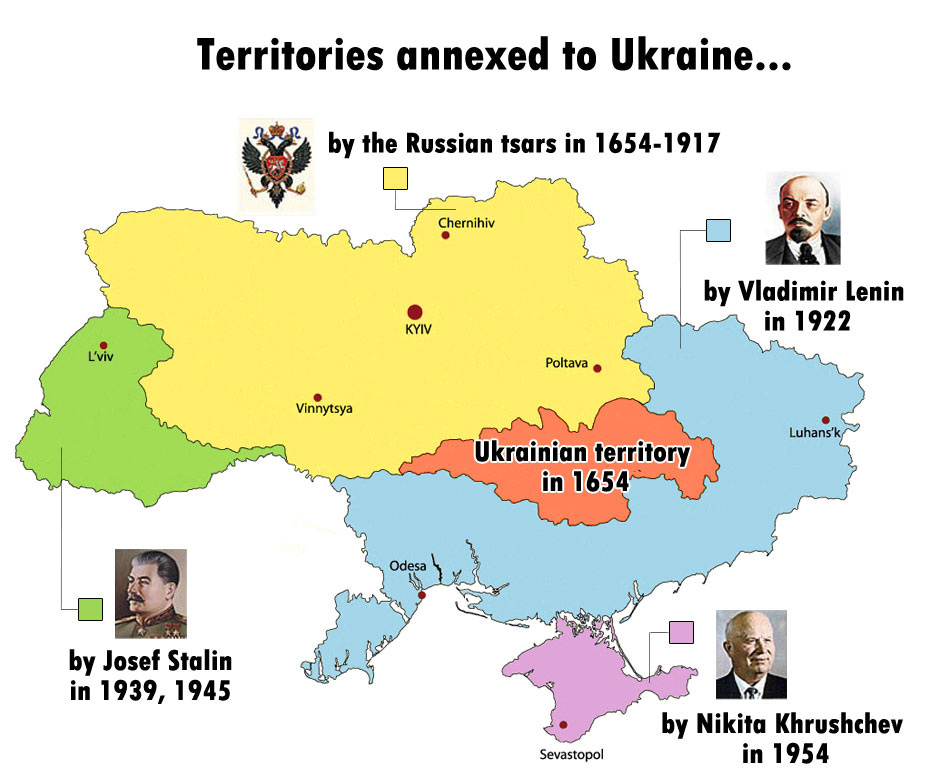
This map has kind of bothered me since I first saw it:

Look at tiny Ukraine, 1654, the orange mass in the middle, before Russia expanded it.

I can’t put it in words, but this somehow seems relevant to current travails. The heart of it, I suspect, is the question “just what is a nation-state?”

I’m sure smart people have pondered that a lot, though I don’t hear it spoken of very often. I have no illusions that I have anything to add.

Wordplay

Sexual creationism

The narrow progressive stance on gender ideology. (Pamela Paul, discussing John B. Judis and Ruy Teixeira’s Where Have All the Democrats Gone?)

Thermostatic voting

Used by a New York Times pundit to describe voters’ preference for moderate candidates.

Bafflegab

A good alternative to gobbledygook if you fear you’ve overused it.

Dirigiste

relating to a system in which a government has a lot of control over a country’s economy

Egregious

The etymology is the fun part here, via Merriam-Webster:

Some words originally used for animals that gather in flocks have been herded into use for people, too. The Latin word grex means “flock,” “herd,” or “group,” and is the root of several English words. Gregarious originally meant “tending to live in a flock, herd, or community rather than alone” but has become a synonym for “sociable.” Egregious literally meant “out of the herd” in Latin — something that stands apart. Its first meaning in English was consequently “outstanding” or “remarkable for good quality,” but over time that changed to become “very bad and easily noticed” or “flagrant.”

Interpellate/Interpolate

Stolpersteine

Literally stumbling-stones: brass plates, embedded in concrete, in the streets where victims of the Nazi Holocaust lived. 100,000 Stopersteines have now been laid.

Fluffers

Tech bros like Thiel, Musk and Andreesen are the fluffers in the global authoritarian circle jerk.

Maria, Silicon Valley’s worldview is not just an ideology; it’s a personality disorder (Crooked Timber) (hyperlink added)

Bon mots

Politicians and diapers must be changed often, and for the same reason.

Not Mark Twain

… a strangulated piety which was little more than a mask ….

Martin Shaw, The Problem With Peace

Weeds are flowers, too, once you get to know them.

A.A. Milne

Imagine a double-masked bureaucrat running a white-privilege workshop, forever.

Ross Douthat

You can make a throne of bayonets, but you can’t sit on it for long.

Boris Yeltsin

Paranoia is the opiate of those who fear they may be insignificant.

David Brooks

[T]o be human is to long for constancy, to crave the touchingly impossible assurance that what we have and cherish will be ours to hold forever, just as it is now. We build homes — fragile haikus of concrete and glass to be unwritten by the first earthquake or flood. We make vows — fragile promises to be upheld by selves we haven’t met in a future we can’t predict.

Maria Popova

Ill fares the land, to hast’ning ills a prey,
Where wealth accumulates and men decay.

Oliver Goldsmith, The Deserted Village (1770)


So: where did all my mockery of Trump go?

I suffer more from the humiliations inflicted by my country than from those inflicted on her.

Simone Weil, from a letter to Georges Bernanos.

You can read most of my more impromptu stuff here and here (both of them cathartic venting, especially political) and here (the only social medium I frequent, because people there are quirky, pleasant and real). All should work in your RSS aggregator, like Feedly or Reeder, should you want to make a habit of it.
Wanted: a robust culture of free speech

David French had a powerful New York Times column (shared link) detailing how much the constant threat of violence, principally from MAGA sources, is warping American politics. “If you wonder why so few people in red America seem to stand up directly against the MAGA movement, are you aware of the price they might pay if they did?”

I’m sufficiently fed up with almost all things MAGA that I’m disinclined to engage in any whataboutism in its defense. But this bit from French seemed a little too facile:

And no, threats of ideological violence do not come exclusively from the right. We saw too much destruction accompanying the George Floyd protests to believe that. We’ve seen left-wing attacks and threats against Republicans and conservatives. The surge in antisemitic incidents since Oct. 7 is a sobering reminder that hatred lives on the right and the left alike.

But the tsunami of MAGA threats is different. The intimidation is systemic and ubiquitous, an acknowledged tactic in the playbook of the Trump right that flows all the way down from the violent fantasies of Donald Trump himself. It is rare to encounter a public-facing Trump critic who hasn’t faced threats and intimidation.

There’s a lot of play in the joints of “an acknowledged tactic in the playbook of the Trump right” — I wish he had corroborated that —but even apart from that it seems too facile not because the Left is engaged in systemic and ubiquitous threats of death to officials and their families, but because the Left’s less violent version of cancel culture does have some pretty deep systemic effects of its own, starting with epistemology:

  • When comes to science—whether something like vaccines, or climate change (which I use as examples in my book)—there’s a fear of going against the grain. It’s the same with things like conversations around gender, diversity, and geopolitics. The problem is that as a society, we do not know if we are making the right decisions on these fronts, or are even presented with all the relevant information because there’s this silencing culture where the moderate voices are too often afraid to speak due to the heavy consequences for doing so, and those on either extreme of an issue have a monopoly on the discourse, because they are loud and aggressive.
  • There’s no need for overt state enforcement if people voluntarily conform to oppressive ideologies and behaviors, policing themselves—often defined by those in power, even if not directly.  And like we discussed earlier, power isn’t always about the state—it’s also those on the fringes who are willing to, essentially, bully others into submission. They don’t necessarily need to use force. We are social creatures, so social ostracism, condemnation, and shaming are all really powerful tools when it comes to suppressing dissenting views that might goes against a seemingly prevailing ideology.
  • What kind of person demands or feels entitled to an apology for something that wasn’t even done to them? By answering that question, you’ll begin to understand who you’re really dealing with. It’s not about accountability, redemption, self-reflection, or protecting society. It’s about power.

Katherine Brodsky, a liberal who has experienced the Left’s version a lot.

Yes, one could say that you resist the Left be growing some balls, whereas resisting the Right could put spouse and children at risk of death, but the Left version ain’t nothing.

Our first amendment has held fairly well as a legal matter, but we need a more robust culture of free speech.


So: where did all my mockery of Trump go?

You can read most of my more impromptu stuff here and here (both of them cathartic venting, especially political) and here (the only social medium I frequent, because people there are quirky, pleasant and real). All should work in your RSS aggregator, like Feedly or Reeder, should you want to make a habit of it.

Winter’s reprise, 2024

We got 5 inches of snow yesterday and it’s icy roads today. Next week, we’re expected to get into the upper 50s.

Culture

Why we read

We read to know we’re not alone.

C.S. Lewis via Douglas Murray

Murry continues:

When people wonder or worry about AI, and how it might one day eclipse the human brain, I think of poetry, the arts. The computer brain may be able to store an infinite amount of information, but it cannot have the sense of memory that we humans can. It will not refine its translations of Byron in the Gulag or write poems on a scaffold. It will not be able to leave a few lines that say: “I was here, too.” 

So long as we do these things, and remember these things, the beating human heart will never be burned up utterly.

The inevitability of choice

I think I’ve mentioned dropping Rod Dreher’s Substack, though I’ve been a fan of his since Crunchy Cons. I probably used phrases like logorrhea and low signal-to-noise ratio. The first would come as no surprise to Dreher; the latter may just mean that I’ve read much of his signal multiple times over 18 years and it’s not worth the effort to filter out the noise to read it once more.

But I’ll say this for him: he’s still capable of good writing that’s not overly-larded with catastrophism, as witness this column in the European Conservative, by the reading of which I feel less alone (see preceding item):

[A]ll traditionalism in our wretched age is a bit fake. How could it not be? The fundamental experience of modernity is the shattering of all authoritative traditions and narratives. We can’t escape that. As Charles Taylor, pre-eminently among many others, has observed, even when we affirm tradition today, we do so with the knowledge that we could do otherwise.

I saw this play out in my own family, when as a young man I told my father that I was going to convert to Catholicism. He was dumbstruck by the thought. “But the Drehers have always been Methodist!” he protested. In fact, the first Drehers to move to North America were Lutherans, and not too many generations before that, were Catholics. And for that matter, my dad rarely went to church, which sent a signal to me about how lightly he took his Methodism.

Decades later, having left Catholicism for Orthodoxy in part because I was seeking even deeper roots in tradition, I had to face the fact that my father had a more traditional mindset, and I was, paradoxically, the modernist. That is, my father may not have had much belief in Methodist Christianity, but he accepted that Methodism was part of our collective identity. The Drehers rarely go to church, and the church they rarely go to is the Methodist church, because that’s how it has always been.

What my late father, who was born in 1934, failed to understand is that his children were born into a world that takes almost nothing for granted. His son, in his mid-twenties, was becoming Catholic because he had become more serious about the Christian faith, and had come to believe that the pursuit of truth led him in this direction. Yet when I took up the practice of the Catholic faith, for a long time I felt like an impostor, performing rituals that did not come naturally to me, though they would in time.

It was even more radical when I lost my Catholic faith, and was rescued by Orthodoxy, a form of Christianity that is alien to the West. A well-known Orthodox theologian once, in my presence, called us converts fake—as if Orthodoxy was something that you had to be born into. This is an absurd position for a theologian of a universalist religion that spreads by evangelism to take.

… it’s the LARPers, the eccentrics, and all others willing to be criticized as ‘fake’ are the very people whose devotion to tradition, however skewed and silly, will carry us through the darkness and confusion of the present moment.

(Emphasis added)

An earlier draft included my interjection after the first paragraph, but on second thought, Dreher makes my point better in his remaining paragraphs. The European Conservative brings out the better in him.

Can’t or Won’t?

We live in comforts that the richest of aristocrats not very long ago could never have dreamed of, and yet we claim that we are too poor to have more than a child or two. The truth is the reverse: we are too rich to have more than a child or two, too committed to work for work’s sake and to the purchase of prestige, mansions, the “best” schools, and toys for grown-ups.

Anthony M. Esolen, Out of the Ashes

Scamify

I’ve griped a lot about the fake artists problem at Spotify. It’s like a stone in my shoe, and just gets worse and worse.

I’m especially alarmed by those strange playlists—filled with mysterious artists who may not really exist, or almost identical tracks circulating under dozens of different names.

Here’s a new example—a 20 hour playlist called “Jazz for Reading.”

I’m supposed to be a jazz expert. So why haven’t I heard of these artists? And why is it so hard to find photos of these musicians online?

I’m supposed to be a jazz expert. So why haven’t I heard of these artists? And why is it so hard to find photos of these musicians online?

I listened to twenty different tracks. There’s some superficial variety in the music, but each track I heard had the same piano tone and touch. Even the reverb sounds the same.

When Spotify first listed its shares on the stock exchange, I expressed skepticism about its business model—declaring that “streaming economics are broken.”

I did the math. The numbers told me that you simply can’t offer unlimited music for $9.99 per month. Somebody would get squeezed—probably the musicians (for a start).

And now?

I note that Spotify has sharply increased its subscription price and recently laid off 1,500 employees.

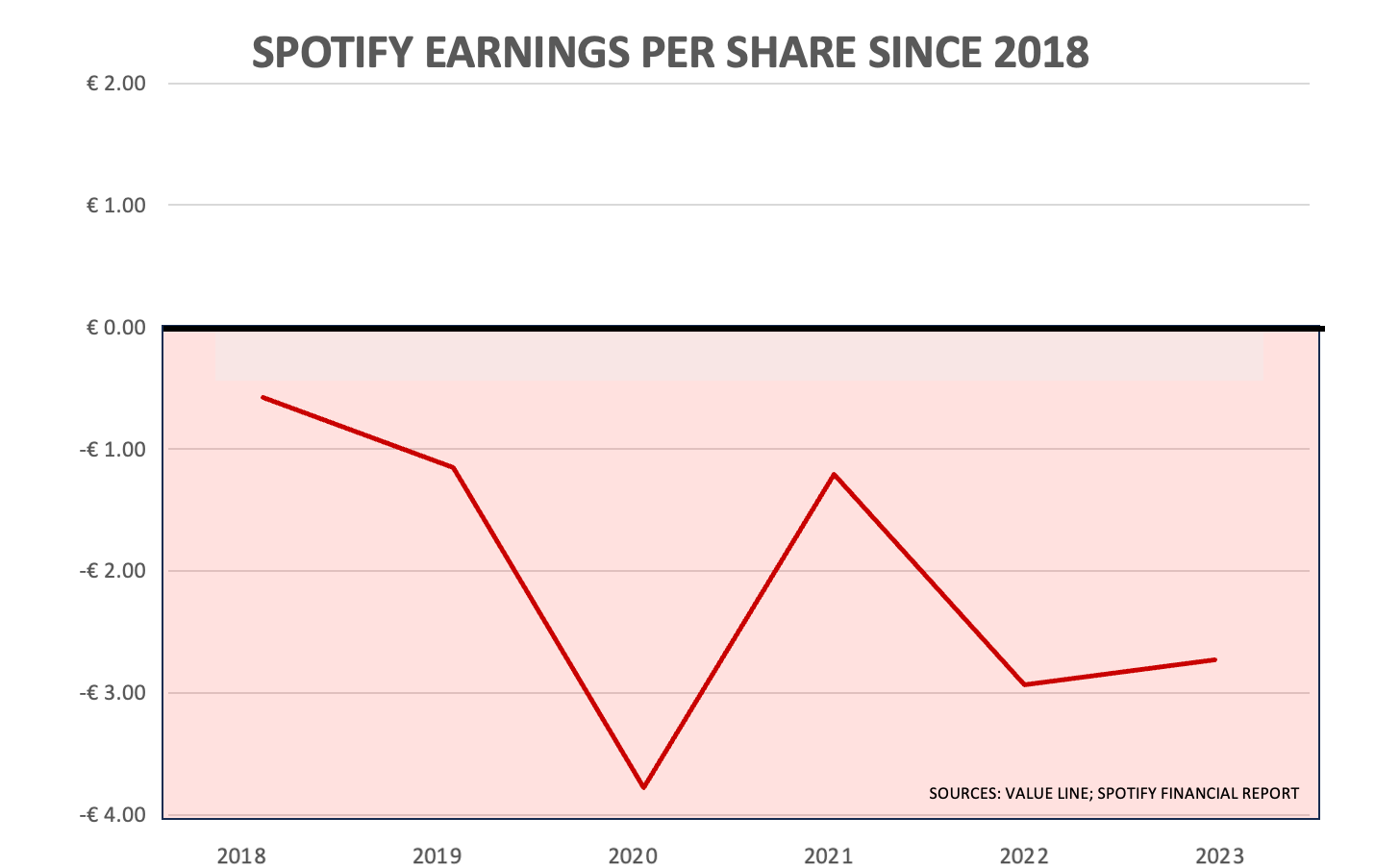
But the company released quarterly earnings this week—and it is still losing money!

chart of spotify's earnings per share since 2018

Meanwhile the CEO continues to sell his shares—another $57.5 million in the last few days.

Let me put this into perspective: Spotify was founded in 2006, and has now been operating for almost 18 years. It has 236 million subscribers in 184 countries. But the business still isn’t profitable.

Ted Gioia

Maybe one path to profitability is to pass off royalty-free AI Muzak as easy-listening jazz. It used to be a mild insult to call any work of art “derivative,” but with AI, it’s turtles all the way down.

Civilization

To realize the relative validity of one’s convictions and yet stand for them unflinchingly is what distinguishes a civilized man from a barbarian.

Joseph Schumpeter, third- or fourth-hand

From the same Damon Linker post that quotes Schumpeter:

Niebuhr rightly remarked that Americans nearly always mean well when they act in the world. Our moral perils are thus “not those of conscious malice or the explicit lust for power.” Yet the rules of the world are such that good intentions—even our own—often lead to unintended bad consequences. This is a lesson we seem incapable of learning, or remembering, so eager are we to deny that the actions of even “the best men and nations” are “curious compounds of good and evil.”

The danger of crafting policy and acting in the world on the basis of an overly exalted view of our ourselves isn’t just that we’ll make foolish decisions that lead to immense suffering and harmful setbacks to our broader strategic aims. It’s also that in raising and dashing lofty expectations, we run the risk of inadvertently inspiring the cynicism to which Niebuhr also thought we were prone, as the inverse of our over-confident moralism.

This happened on the left during the 1970s, in the wake of the Vietnam debacle, with George McGovern’s call for America to “come home” after its ruinous misadventure in southeast Asia. And it’s happening in our own time on the right, after George W. Bush displayed hubris in deciding to topple the regime of Saddam Hussein and then adopted an unmodulated form of theologically infused American exceptionalism to justify the policy once its original rationale (ridding Iraq of weapons of mass destruction it didn’t possess) crumbled to dust. (If you’ve forgotten its details, I urge you to read Bush’s 2005 Inaugural Address, with its 50-odd invocations of “freedom” or “liberty,” and jaw-dropping declaration that the ultimate goal of American foreign policy is nothing less than “ending tyranny in our world.”)

The instant before that “jaw-dropping declaration” was my last as a Republican, as I’ve written about before.

World Affairs

Made in America

Only naive arrogance can lead Westerners to assume that non-Westerners will become “Westernized” by acquiring Western goods. What, indeed, does it tell the world about the West when Westerners identify their civilization with fizzy liquids, faded pants, and fatty foods?

Samuel P. Huntington, The Clash of Civilizations and the Remaking of World Order

Rulers

It pains me to channel this, but Dreher’s right, at least up to the break:

Whatever you think of Vladimir Putin, who is ten years younger than Biden, he is vigorous, sharp, and combative. He gave his American interlocutor a coherent lesson on the past thousand years of Russian history, and hesitated only to tell the Yank to hush, and let him finish. Meanwhile, in Washington yesterday, Joe Biden confused President Sisi of Egypt with the leader of Mexico.

Toggling back and forth online from the Carlson interview to the Biden press conference, staged to address the humiliating Special Counsel’s report, was like moving out on a frail, narrow footbridge over a chasm. It is truly terrifying to consider that the feeble, senile old man desperately trying to rebut charges of dementia is what the U.S. sends to “battle” against a man like Putin.

Even worse, nobody doubts that Putin, for better or for worse, governs Russia. Who is governing America from the White House? Because it is not Joe Biden, that’s for sure.

It is hard for many Europeans to understand, but Americans scarcely know what happened in our country more than five minutes ago. And we only seem to care about it insofar as we can cite history as a reason to justify whatever it is that we want to do now. This is why Americans are living through the catastrophic, indeed totalitarian, leftist stripping of significant historical figures from public life—taking down their monuments, expelling a considered, nuanced treatment of them from history books—without protest. Too few Americans understand why this matters, and why they should care.

Isn’t Vladimir Putin doing the same thing—putting history to use to justify his attack on Ukraine? Yes, but there’s a difference. Russia really does have this incredibly long, dense, and difficult history with the territory we now call Ukraine. One does not have to accept Putin’s conclusion at the end of the story—‘therefore, Russia had to invade’—or accept his version of historical events to grasp that history matters to him in ways that many Americans will fail to appreciate.

National Affairs

Now and then

Is the New York Times suffering cognitive decline?

A tip of the tendentious hat to Nellie Bowles.

What’s wrong with the GOP?

As I frequently remind readers, I’m a former conservative who hasn’t voted for the GOP since 2002. Why?

Because I think the Republican Party and its right-wing media allies intentionally spew demagogic toxins into the civic atmosphere of the nation for the sake of political gain.
Because that isn’t going to change. (Like a three-pack-a-day smoker waiving away the possibility of lung cancer even after symptoms of serious illness have appeared, Republican voters have become addicted to the poison and demand more of it with each new election.)
And most of all, because, like a highly skilled conman/drug pusher, Donald Trump deepens the deadly addiction every day, along with posing a potentially fatal threat to the country’s democratic institutions.

Damon Linker

Another reason to despise the GOP

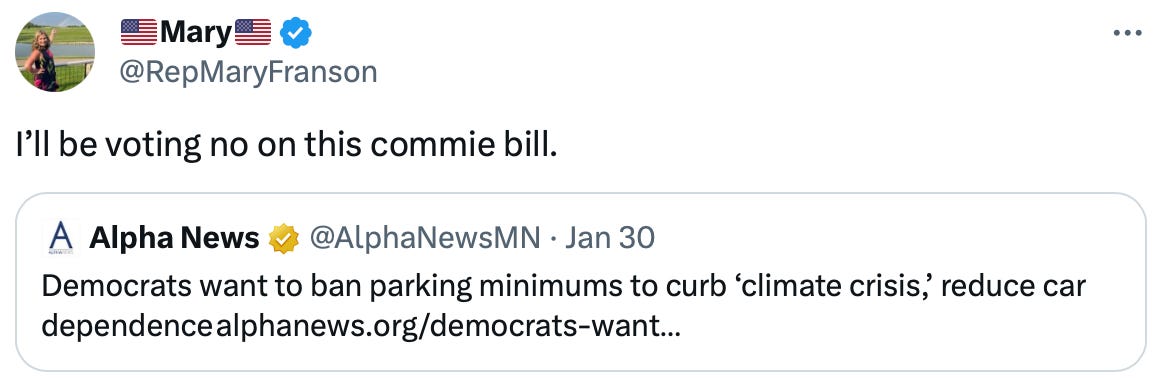
Republicans vs. property rights: Democrats in Minnesota, including Ilhan Omar, are supporting a new bill that would ban something called parking minimums. Parking minimums require property owners and developers to include a certain number of parking spots per apartment or business, and it was useful in the 1950s construction boom but it’s now one of the ways the government forces everyone into sprawling, low-density communities that rely on cars. Left to the free market, people often freely choose to live close together. They like it. I like it! Ever wonder why Paris and London are so charming? Anyway, I’m for freedom and so I err on the side of people being able to do more of what they want with their land, especially when parking lots are genuinely ugly. So oddly enough, when it comes to parking minimums, I’m with Ilhan Omar. The Republican opposition to the bill—again, which would limit the power of government and give property owners more rights to do what they want—goes something like this:

Right. That’s exactly how communism works. 

Nellie Bowles

Apart from the knee-jerk response of “freedom,” which ought to resonate with a Republican (at least as I remember the party), removing that impediments to higher-density living arrangements is the right policy because it promotes more sustainable living.

Another good one steps away from DC

Another respected Republican, Rep. Cathy McMorris Rodgers, also revealed she will retire at the year’s end, despite being the chair of the influential House Energy and Commerce Committee. The 54-year-old lawmaker from Washington state has served in Congress since 2005. McMorris Rodgers and Gallagher join a growing exodus of members of both parties who are leaving Congress frustrated that political infighting has made legislating harder than usual.

Dispatch Politics

Rep. Rodgers is one of a few candidates I supported financially (1) because she was endorsed by the pro-life Susan B. Anthony List and (2) then-35 year-old Rodgers looked electable. I am grateful that she has never engaged in the kind of jackassery that would make me regret my support.

Too many other SBA List endorsees who got elected have turned into embarrassments. One of them was foregrounded at new Speaker Mike Johnson’s coming out party snarling “SHUT UP!” at a reporter for asking an obvious and appropriate question.

I don’t look at SBA List endorsements any more.

Separating the man from the movement

Trigger Warning: If you don’t want to see anything about DJT here, stop. I’m quoting this because the mention of him is incidental to a more important point about how to heal our politics:

I think I detest Donald Trump as much as the next guy, but Trumpian populism does represent some very legitimate values: the fear of imperial overreach; the need to preserve social cohesion amid mass migration; the need to protect working-class wages from the pressures of globalization.

The struggle against Trump the man is a good-versus-bad struggle between democracy and narcissistic authoritarianism, but the struggle between liberalism and Trumpian populism is a wrestling match over how to balance legitimate concerns.

David Brooks, The Cure for What Ails Our Democracy – The New York Times (italics added). This column is so good (edifying good, not trolling good) that I’m using one of my ten monthly New York Times shareable links for it.

Yes, I suppose this is another insouciant assumption that there can be Trumpism without Trump. But we ignore populism’s legitimate values, we’ll see other demagogues arise to exploit them when Trump’s gone.

Resolute yet humble

Isaiah Berlin, concluded one of his most famous essays by quoting an observation by political economist Joseph Schumpeter: “To realize the relative validity of one’s convictions and yet stand for them unflinchingly is what distinguishes a civilized man from a barbarian.” This is also what distinguished postwar liberals such as Berlin and literary critic Lionel Trilling (the subject of this series’ second post) from just about everyone writing and thinking about politics today.

Damon Linker

ICMY, I think he called “just about everyone writing and thinking about politics today” barbarian, and I won’t disagree if one allows for a bit of hyperbole in “just about everyone.”


So: where did all my mockery of Trump go?

You can read most of my more impromptu stuff here and here (both of them cathartic venting, especially political) and here (the only social medium I frequent, because people there are quirky, pleasant and real). All should work in your RSS aggregator, like Feedly or Reeder, should you want to make a habit of it.

I never promised to blog something every day but I’ve gotten this odd idea that I should. I almost let the cosmos down this morning by failing.

I had a lovely weekend, which included dinner with a friend and her sister, a newer friend, plus much reading from The Demon in Democracy: Totalitarian Temptations in Free Societies.

I inadvertently bought the hardback version of the book, but by page 3 or 4, I had already marked so much that I immediately bought the Kindle version, too, which better fits how I “process” non-fiction. (Passages highlighted in Kindle are saved to “My Kindle Highlights” at Amazon, from which I clip them into Evernote.)

The Demon in Democracy is an unlikely candidate for reading over a “lovely weekend,” but if you’ve read this blog for long, you’ll know I’m pretty bearish about most of what’s going on around me. Any help in figuring out “How did this happen?” is welcome.

I saw two related news items this morning that finally gave me something blogworthy:

  1. A Tweetstorm vilifying House Speaker Paul Ryan, who had the temeritity to wish L’Shana Tova! while formally supporting Donald Trump.
  2. A loaded video at the Washington Post, “Watch Trump’s surrogates defend his handling of tax laws“, which concluded with a Bernie Sanders wrap-up.

It’s not enough, I guess, to oppose Trump and point out his flaws. One must oppose, vilify and shame those who for whatever reason support him, howsoever unenthusiastically.

This brought to mind passages like this from The Demon in Democracy:

The liberals adopted a similar Leninist practice, though probably they would not find the adjective pleasing. When faced with a statement, or an opinion, or an idea, the first and most important question they ask is whether any of these may be dangerous: that is, whether they may potentially contradict liberal assumptions … This kind of argument—outrageous, let us admit it—is considered by the liberals to be decisive, and it serves them to disparage opponents by suggesting that by making seemingly harmless theoretical statements they open the gates to totalitarianism, fascism, inquisition, torture, Hitler, and various other horrors.

One is an enemy of the regime if one doesn’t hate those who don’t hate one who threatens the regime. Four legs good, two legs bad.

* * * * *

“In learning as in traveling and, of course, in lovemaking, all the charm lies in not coming too quickly to the point, but in meandering around for a while.” (Eva Brann)

Some succinct standing advice on recurring themes.

Too Big to Govern

Not too long ago, I encountered an item reminding me of a little-remarked feature of our national polity: the immense dilution of the meaningful individual voice in governance.

At our nation’s founding, each Congressman represented few people – 50,000 or something. Today he or she represents roughly 700,000. This historic figure may be wrong, but the difference is by orders of magnitude.

And even at that, with 435 members, Congress is pretty unruly. We really can’t grow Congress back to where a Congressman represents something like the relatively few of yesteryear. It would be totally unworkable.

This leaves voters alienated from the national government.

In contrast, I have for a number of years, on and off, participated in my local Chamber of Commerce’s “Third House” program. Every Saturday or two during the Indiana legislative session, the “Third House” meets to eat an excessively large breakfast, hear reports from our representatives and to give them feedback on Bills that affect us. They sit at table and break hash browns with us, sharing a common cup of orange juice. Thus there’s informal chatter as well as formal reports from them to us and votes by us to inform them. It’s not uncommon for as many as 5 State Senators and Representatives to be present, nor for our input to influence their votes.

So what if we broke up government and devolved power back to the states so as once again to empower and dis-alienate voters? We’d still need, I think, a national assembly to provide for the national defense and a few other limited functions, but there would be multiple more regional assemblies. Like, maybe, fifty of them. Doing meaningful things independently of what happens in Washington, DC.

This ought to appeal to the Left counterculture and to the Right as well. Indeed, although I still very much consider myself a conservative, I’m finding plenty of kindred spirits on the Left, courtesy of this wonderful gathering place of cyberspace.

But I just described (except for the cyberspace thingy) Federalism, the intent of the Founders. Somehow, some centripetal force has driven the real power toward Washington, DC contrary to the original design. We can argue about why (I have some half-baked theories, riffing off the trope “nation with the soul of a Church” the dogmas of that Church being “democracy” and “American Exceptionalism” and the undermining of Federalism’s political safeguards by the direct election of Senators), but it’s hard to argue that the effect has been entirely healthy (or so it seems to me).

This gives me great appreciation for the wisdom of the Founders, who gave us a Republic, if only we’d kept it.

These thoughts brought to you courtesy of a goading by this Wilfred McClay article on Federalism.

* * * * *

Some succinct standing advice on recurring themes.

God bless the child

Sometimes a song is more than a song:

Them that’s got shall get
Them that’s not shall lose
So the Bible said and it still is news
Mama may have, Papa may have
But God bless the child that’s got his own
That’s got his own

Yes, the strong gets more
While the weak ones fade
Empty pockets don’t ever make the grade
Mama may have, Papa may have
But God bless the child that’s got his own
That’s got his own

Money, you’ve got lots of friends
Crowding round the door
When you’re gone, spending ends
They don’t come no more
Rich relations give
Crust of bread and such
You can help yourself
But don’t take too much
Mama may have, Papa may have
But God bless the child that’s got his own
That’s got his own

Mama may have, Papa may have
But God bless the child that’s got his own
That’s got his own
He just worry ’bout nothin’
Cause he’s got his own

God Bless the Child, Billie Holliday and Arthur Herzog, Jr.

Nothing much has changed, has it? Ross Douthat’s Monday column at the New York Times, “The Great Consolidation,” surveys the events of the past few years and concludes:

This is the perverse logic of meritocracy. Once a system grows sufficiently complex, it doesn’t matter how badly our best and brightest foul things up. Every crisis increases their authority, because they seem to be the only ones who understand the system well enough to fix it.

But their fixes tend to make the system even more complex and centralized, and more vulnerable to the next national-security surprise, the next natural disaster, the next economic crisis. Which is why, despite all the populist backlash and all the promises from Washington, this isn’t the end of the “too big to fail” era. It’s the beginning.

If it doesn’t ring true to you, I’m surprised you’re reading this blog at all.

Is this the result of a conspiracy? Are there some bastards we can shoot to end it? I rather think of it as tragedy, not conspiracy. And, having grown up as I did, I sometimes think of it as misadventure (looks sorta like tragedy, but the reversal of fortune is brought about by an external cause, says Aristotle).

Even in tragedy, there can be comic moments, as when POTUS (President of the United States) rationalizes a Supreme Court Appointment:

In the past week, I’ve read two news stories about Kagan in my local paper that featured absurd language.  The first was an AP story by Ben Feller on May 10.  The second was an AP story by Julie Hirschfeld Davis on May 12.

The second story quotes Harry Reid as saying Kagan “has fresh ideas” because she’s been “out in the real world recently.”  Reid is trying to turn a negative into a positive. Kagan’s lack of judicial experience means she has been doing other things instead of being cloistered among black robes.  But are the other things she’s been doing part of “the real world”?  For the past decade, she has been professor and then dean of Harvard Law School, followed by a year as U.S. solicitor general.  That’s pretty rarefied living.  In the ‘90s, she was a White House counsel and policy advisor.  Is there anything “fresh” about a retread from the corrupt and sleazy Clinton years?

The first story reports, “The president has grown vocal in his concern that the conservative-tilting court is giving too little voice to average people.”  Obama—he of the famed analysis regarding bitterness and clinging—has now condescended to express a tender regard for the vox populi.  In between his policy talks with Bernanke, Geithner, and Blankfein; his strategy sessions with Chicago machine cogs; and his social visits with the Beverly Hills and Martha’s Vineyard set.  Somehow he finds time to worry about the little guys and gals and then express that worry while the press dutifully notes the expression.

We are told that Kagan is a manifestation of Obama’s concern that the common people are not being heard by the Supreme Court.  So he appoints a person who attended an exclusive high school, then Princeton, then Oxford, and then Harvard.  Just the sort of person who is most likely to be in touch with the struggles and aspirations, the stances and aims of We the People.  Ain’t democracy grand?

(Jeff Taylor, Few v. Many: The Topsy-Turvy World of Judicial Demographics, at Front Porch Republic)

Rima Fakih is soooo yesterday. Where’s my bread? Where’s the next circus?

Yes, Jeff: Democracy is grand.