Thursday, 12/4/25

Luxury Beliefs

There are all kinds of ideas and policies that would have bad effects if implemented. But there is a special class of bad ideas and policies that proliferate in good part because those who hold them, being insulated from their effects, have never seriously thought about the consequences that would ensue from their implementation. The reason why the concept of luxury beliefs has resonated so widely is that it gives a name to people who treat as a parlor game questions that potentially have very serious consequences—just not for themselves.

Yasha Mounk, Luxury Beliefs Are Real.

We owe a debt of gratitude to the young man who coined this phrase. It strikes me as analogous to the whoring and wenching of the rich and famous which does not, shall we say, translate well to kids in The Projects (but is more like a transgressive raised-middle-finger than a “belief”).

The Hive Mind

Consider this ominous anecdote from Steven Mintz, a history professor at the University of Texas at Austin:

I require substantial writing in my 400-person U.S. history survey course—but now I largely receive 400 variations on the same essay. The wording, structure, transitions, tone, even the closing sentences are largely identical.

This is eerily like the zombie-ish characters in Pluribus, who all say the exact same thing.

But in Mintz’s case, this is real behavior from real students. They have voluntarily abandoned their individual opinions and embraced the hive mind.

And the hive mind is available to all of them via Chat GPT.

I actually take some solace in TV series such as Pluribus and Severance. They show how anxious we are about this threat. At some deep level in our souls, we know that the destruction of our autonomy and selfhood is not a good thing.

It isn’t progress. It isn’t utopia. It isn’t liberation.

And that is the first step in escaping the ant hill. The next step is to bring others along with us.

This is why I keep talking about a New Romanticism (see here and here). That is our counter-offensive, and it’s already starting.

Ted Gioia, The New Anxiety of Our Time Is Now on TV (bold added)

Fundamental law

Ultimately, however, constitutionalism means that society must accept an unpopular policy that respects constitutional limits over a popular policy that violates them. The very foundation of constitutionalism is that certain fundamental protections—whether for free speech or the separation of powers—must be beyond the reach of popular majorities. There will almost always be some policy that is popular but unconstitutional.

Andrew O’Donohue on “court-baiting.”

The Reality of Irreligious Violence

The shift from church power to state power is not the victory of peaceable reason over irrational religious violence. The more we tell ourselves it is, the more we are capable of ignoring the violence we do in the name of reason and freedom.

William T. Cavanaugh, The Myth of Religious Violence.

I have published this on several Sundays over the years, I’m sure, but with our POTUS and ever-so-manly-and-full-of-lethality “Secretary of War” gleefully murdering supposed drug dealers in the Caribbean in the name of fighting “narco-terrorism,” it seems like a worthy weekday reminder now.

As a Chosen People with what Niebuhr refers to as a “Messianic consciousness,” Americans came to see themselves as set apart, their motives irreproachable, their actions not to be judged by standards applied to others.

Andrew Bacevich in his Introduction to a 2008 University of Chicago Edition of Rheihold Niebuhr’s The Irony of American History.

Shorts

  • What’s important to notice is that it isn’t, and never was, “Orthodoxy is masculine.” It only felt masculine, in comparison with the general run of American churches. (Frederica Matthewes-Green)
  • Put someone with a complex about not being respected in charge of an agency with guns and you’re asking for trouble. (Nick Catoggio, A Few Bad Men)
  • The problem is not so much that public policy has failed as that it has succeeded at the wrong things. (Oren Cass, The Once and Future Worker)

Elsewhere in Tipsyworld

Friday, 10/10/25

Nonpartisan

Levelers

Emily Ruddy was traveling the country with her new husband, Mike, when news reached them of Charlie Kirk’s shooting, then death:

Back in the car with Mike, approaching the Florida border, I’m looking at pictures of Charlie Kirk on my phone. He is staggeringly tall, taller than I ever realized, with a celebratory fist in the air. Reading his Wikipedia page, which has now been changed to past tense, I am reminded of a story I first read in middle school: Kurt Vonnegut’s “Harrison Bergeron.” The story is set in the late twenty-first century, in a dystopian America where the authorities have taken it upon themselves to ensure no person is better than another, be it in athleticism, intelligence, or beauty. The strong citizens get weighed down with bags of bird shot. The attentive citizens are intermittently bombarded with hideous sounds through tiny radios in their ears. The most beautiful faces are concealed by hideous masks.

But it’s the title character, Harrison Bergeron—exceptionally tall, handsome, brilliant and outspoken—who is shackled most heavily. At the end of the story he breaks through the shackles, and as punishment he is shot down on live TV: a warning to whoever tries to pull a similar stunt. Or at least, it would be a warning, if the viewers’ memories weren’t instantly blasted away by the ear radio’s next awful sound.

Emily Ruddy, Battle Above the Clouds.

If you haven’t read Harrison Bergeron, a (very) short story, by all means do. It’s freely available, like, for instance, here.

After Christian faith dies

The biggest confusion among my own students used to be rudderless moral relativism.  Although there is still a lot of that, it seems to be on the decline.  Now the problem is the explicit embrace of evil.  The suggestion that one must never do what is intrinsically evil for the sake of a good result is a hard sell.  Many of students are strongly attracted to “consequentialism,” the view that whether an act is right or wrong is determined only by the result.  To say that the ends do not justify the means puzzles them.

The decline of faith has also produced changes in character.  Young people who were raised in Christian homes, but then abandoned Christianity, often used to retain vestiges of their moral upbringing, and accepted such ideas as courtesy, love of neighbor, and the sacredness of innocent human life.  Today, having grown up in faithless homes, many seem to think that courtesy is for fools, that no one with whom they disagree is their neighbor, and that they should hate those they consider wrong instead of praying for their repentance and restoration.  As for the sacredness of innocent human life – for them, that idea went out when they embraced abortion.

I don’t spend much time asking what is going to happen, but I do ask what God would like me to do in my own place.  He sees the whole shape of things.  I can’t, but like a faithful bone, I can try to turn nimbly in the joint where I’m placed.

J Budziszewski, How Can I Think About the Assassination?

Budziszewski’s description of the decline of faith, as early as the second generation (the first generation of lapsed Christians lives on the vapors of the empty tank), is a description of devolution toward the “nasty, short and brutish” of pre-Christian antiquity.

If you think I’m just making a casual partisan slur, take a look at either of these two books, the first lengthy, the second shorter and more focused.

Wordplay

Frank Bruni’s back with recent favorite sentences. (Do not read this with beverages or food in your mouth.):

  • Also in The New Yorker, Jessica Winter read the infamous Jeffrey Epstein birthday book so that you and I don’t have to: “Sometimes it’s like you’ve discovered a rich man’s contract with the devil, and next to his signature, he’s drawn a little penis cartoon.” (Matthew Ferraro, East Providence, R.I.)
  • And Kelefa Sanneh, reporting from a recent Bad Bunny concert, described an ecstatic fan who “danced so vigorously with a decorative plant that he seemed to be trying to pollinate it.” (Bob Marino, Paris)
  • In The Los Angeles Times, Christopher Goffard tried to make sense of a former Los Angeles County sheriff’s rambling: “As he sat down to face questions from the feds, his sentences traveled winding paths through vague precincts to fog-filled destinations.” (Robin April Dubner, Oakland, Calif.)
  • In The Guardian, Bryan Armen Graham commiserated with the polite subgroup of American fans at an annual Europe-versus-United States golf tournament, who were too often “drowned out by the performative tough guys in flag suits and plastic chains who treat the Ryder Cup like a tailgate with better lawn care.” (John LeBaron, Acton, Mass.)
  • In The Dispatch, Nick Catoggio regarded the marks that President Trump and Defense Secretary Pete Hegseth made to military leaders last week as “a case of two men who radiate neurosis about their own toughness lecturing a roomful of actual tough guys about how to be tough. It had the feel of Pop Warner players scolding a group of N.F.L. linebackers about the importance of hustle.” (Glen T. Oxton, Mamaroneck, N.Y., and John Sabine, Dallas)
  • And John McWhorter analyzed the president’s loopy language: “Even Trump’s most positive-sounding coinages are acts of a certain kind of verbal aggression. I sometimes stop to marvel that the House passed something with the actual official title the One Big, Beautiful Bill Act. That goofy bark of a name is a boisterous clap back against opposing views, an attempt to drown out inconvenient facts with braggadocio. It is a linguistic snap of the locker room towel.” (Matt Masiero, Richmond, Mass., and Sue Hudson, Simi Valley, Calif., among many others)

Anarchism

[T]he essential practices of anarchism — negotiation and collaboration among equals — are ones utterly neglected and desperately needed in a society in which the one and only strategy seems to be Get Management To Take My Side.

Alan Jacobs, Should Christians be Anarchists?

Partisan

Transparent pretext

Trump’s remarks on the night of Kirk’s murder redefined violent incitement to include harsh criticism of judges. (“My administration will find each and every one of those who contributed to this atrocity and to other political violence, including the organizations that fund it and support it, as well as those who go after our judges, law-enforcement officials, and everyone else who brings order to our country.”) Now [aide Stephen] Miller himself is going after judges.

To call this “hypocrisy” is to engage Miller’s reasoning at a level upon which it does not operate. The essence of post-liberalism is the rejection of the notion that some neutral standards of conduct apply to all parties. Miller, like Trump, appears to believe his side stands for what is right and good, and his opponents stand for what is evil. Any methods used by Trump are ipso facto justified, and any methods used against him illegitimate.

A couple of weeks ago, Miller claimed that a disturbed gunman shooting Charlie Kirk impelled the government to crack down on the left. Now he says a handful of activists protesting ICE impel the government to crack down on the left.

Violence is not the cause of Trump and Miller’s desire to use state power to crush their opposition. It is the pretext for which they transparently long.

Jonathan Chait, Stephen Miller is Going for Broke

Bad faith

You can and should worry about American leaders at any level viewing their opponents as the enemy within, whether it’s the president of the United States or a random [Democratic] candidate for state AG. But if you’re more vocal about the latter than the former, forgive me for thinking you’re more interested in contriving a “both sides” equivalency to minimize what the White House is up to than you are about addressing the problem of incitement.

Two things are remarkable about [continuing troop deployments in “blue cities”]. One, which almost goes without saying, is that it’s another case of the Trump administration aiming to normalize unprecedented authoritarian shows of force. But the other is underappreciated: It’s all being done in bad faith, as a provocation, and quite plainly. There’s barely a pretense anymore of a colorable emergency like a riot that might justify the president deploying troops. He’s doing it unbidden and enthusiastically, looking for excuses to intimidate Democrats by symbolically occupying their cities with troops yanked from duty [and civilian jobs] in other states.

Needless to say, this is why the Trump White House didn’t get the benefit of the doubt from Judge Immergut on the Portland deployment, or from Judge Waverly Crenshaw on whether Kilmar Abrego Garcia was vindictively prosecuted. It’s also why the case against James Comey will end up in the toilet sooner rather than later. Courts have traditionally given the president and the Justice Department wide discretion in commanding the military and choosing whom to prosecute, but that’s because presidents traditionally haven’t given courts good reason to think they’re acting in bad faith.

Nick Catoggio, American versus American.

I look forward to the day when judges cease giving a “presumption of regularity,” of good faith, to the actions and legal arguments of this Administration. They have forfeited it because so much of what they do plainly is done in bad faith.

On keeping an impossible promise

Anyone with brown skin and the wrong kind of tattoo is therefore now at risk of being carted off to torture by the US government, with absolutely no safeguards that they have gotten the right people. Or do you think that an administration that confuses billions with millions, and puts classified intelligence on a Signal app, is incapable of making an error?

Andrew Sullivan, Two Perfect Months (March 2025)

I will give Trump “credit” for trying to keep his deportation campaign promise. The problems is, it’s impossible even for competent, non-malicious government workers to keep it (it included luridly-high numbers) without wholesale errors and ubiquitous denials of due process (i.e., in context, the process by which we assure that a person truly is subject to deportation under the law).

Your tax dollars at work

Short Circuits is a punchy weekly summary of notable Federal Court of Appeals decision, like this summary of activities by an ICE goon:

ICE agent escorting passenger from Dallas to Miami takes upskirt pictures and videos of flight attendant. He’s convicted of interfering with her flight-crew duties, sentenced to two years’ probation. Agent: I didn’t know that she was aware of my “clandestine video voyeurism,” and that’s an element of the crime. Eleventh Circuit (unpublished): It is not.

Divine retribution in Dallas

The covert operations of the Kennedys haunted Lyndon Johnson all his life. He said over and over that Dallas was divine retribution for Diem. “We all got together and got a goddamn bunch of thugs and we went in and assassinated him,” he lamented. In his first year in office, coup after coup wracked Saigon, a shadowy insurgency started killing Americans in Vietnam, and his fear that the CIA was an instrument of political murder festered and grew.

Tim Weiner, Legacy of Ashes

Rulebreaker

There are certain unwritten rules in American life, and one of them is that before your face is featured on the nation’s currency you are first obliged to die. There is no constitutional provision that mandates this, nor any law written tightly enough to guarantee it. But, as a general matter, we have shied away from putting living figures on our notes and coins, on the grounds that it is monarchical behavior and that the United States is not a monarchy. Unsurprisingly, this salutary tradition is not of great interest to the Trump administration, which intends to put an image of Trump on both sides of a commemorative $1 coin that will be produced for the 250th anniversary of the Declaration of Independence. On one side, Trump will appear in profile. On the other, he will appear pumping his fist, with the words “Fight Fight Fight” lining the coin’s perimeter. Answering questions about the plan, Trump’s press secretary, Karoline Leavitt, said that she was unsure if Trump had seen it, but that she was “sure he’ll love it.” He will. But that’s not really the important point, is it?

National Review week in review email.

Here’s a coin suggestion:


We are all gatekeepers now.

Peggy Noonan

Your enemies are not demonic, and they are not all-powerful and the right hasn’t always lost and the left hasn’t always won. But if you convince yourself of that, you give yourselves all sorts of permission to do a lot of stupid and terrible things under the rubric of “Do you know what time it is?”

Jonah Goldberg.

[A] critical mass of the American people … no longer want[s] to govern themselves, … are sick of this republic and no longer want to keep it if it means sharing power with those they despise.

Nick Catoggio

I don’t do any of the major social media, but I have two sub-domains of the domain you’re currently reading: (a) You can read most of my reflexive stuff, especially political here. (b) I also post some things on my favorite no-algorithm social medium.

Saturday, 9/6/25

A question to keep you up tonight

The Uniform Code of Military Justice (UCMJ), particularly Article 92, mandates obedience to lawful orders but distinguishes that unlawful orders—those that require criminal acts or violate the Constitution, U.S. federal law, or international law—must not be followed. Military personnel are legally required to refuse unlawful orders, with the understanding that obeying illegal orders does not absolve one from responsibility under both U.S. military law and international law. This principle was firmly established by precedents such as the Nuremberg Trials, which rejected “just following orders” as a defense for war crimes. (Via Perplexity AI, but confirmed)

If you believe or suspect, as I do, that Donald Trump plans a series of provocations toward the end of declaring martial law and remaining in office, UCMJ Article 92 might come as at least a small comfort. “If they order troops to fire on peaceful civilian demonstrators, the troops should refuse, right?”

Well, “should” is doing a lot of work there. An incident last week gives great pause:

I ran across this dystopian sentence in the New York Times: “Pentagon officials were still working Wednesday on what legal authority they would tell the public was used to back up the extraordinary strike in international waters.”

The vice president was asked yesterday to specify the legal authority that entitled Trump to blow up a bunch of people in the Caribbean. The authority, he replied, is that there are “literal terrorists who are bringing deadly drugs into our country and the president of the United States ran on a promise of stopping this poison from coming into our country.”

He and I happened to attend the same law school, so from one alumnus to another: That’s not the correct answer, J.D. The president’s campaign pledges don’t magically acquire the force of law because a plurality of the electorate decided he’d be marginally preferable to his opponent.

[So w]here is that authorization? Since 2001, presidents from both parties have strained the logic of the post-9/11 AUMFs against al-Qaeda and Iraq by citing them to justify attacks on adjacent jihadist threats like ISIS. No one seriously believes they can be stretched so far as to encompass drug trafficking in the Caribbean, though. Absent any new approval from Congress, letting Trump mark people for death based on an assessment of “terrorism” by his own State Department amounts to granting him the power to kill anyone whom he deems a threat.

That’s how we ended up with Pentagon lawyers poring over law books on Wednesday, desperately trying to find some statute that might retroactively justify blowing up 11 Venezuelans.

The answer to the question posed to J.D. Vance is that there is no obvious legal authority for what the president did. There’s only what we might call post-legal authority, the idea that—as Trump himself once put it—“He who saves his Country does not violate any Law.” Which, I think, cuts to the heart of the difference between conservatives and postliberals.

To ask which legal authority gives Trump the power to kill Venezuelans on mere suspicion of drug trafficking is to engage in non sequitur. The president said he would save the country by preventing drugs from entering the U.S. and he’s going to do that. What does law have to do with anything?

On that note, here’s a question to keep you up tonight: If the Times is correct that the Pentagon couldn’t identify a legal justification for Trump’s order to kill a bunch of people, why did it obey his order?

To ask that question is to invite demagoguery about not taking crime seriously or knowing “what time it is,” blah blah, but I know exactly what time it is and it’s exactly the right question for the hour. Our new government fundamentally believes that law is an obstacle to American greatness—that law, normally just a nuisance, has itself become a major problem bedeviling the country—and it intends to solve this problem too. One way is to normalize shooting first and asking questions later. That’s the significance of what just happened to that Venezuelan ship.

Nick Cattogio (bold added)

Mind-boggling

I suspect you haven’t heard more about this because the ramifications boggle the mind:

3. China may have hacked data from every single American in one of the largest-ever cyberattacks, experts fear. Hackers backed by Beijing targeted more than 80 countries, stealing information on telecoms, transport and military infrastructure in a year-long campaign, investigators concluded in a report released last week. Since 2021, the group, known as Salt Typhoon, has accessed data that could enable the Chinese intelligence services to monitor global communication networks and track targets including politicians, spies and activists. Even the telephone conversations of Donald Trump and JD Vance were compromised, according to the FBI. Hackers sponsored by the Chinese government “are targeting networks globally, including, but not limited to, telecommunications, government, transportation, lodging, and military infrastructure networks”, the joint statement, from agencies including the National Security Agency, Cybersecurity and Infrastructure Security Agency (CISA) and FBI, said. (Source: telegraph.co.uk)

John Ellis News Items

Noted


[A] critical mass of the American people … no longer want[s] to govern themselves, … are sick of this republic and no longer want to keep it if it means sharing power with those they despise.

Nick Catoggio

I don’t do any of the major social media, but I have two sub-domains of the domain you’re currently reading: (a) You can read most of my reflexive stuff, especially political here. (b) I also post some things on my favorite social medium.

New, chill Tipsy

Rules, Codes

The modern sexual marketplace

Half a century on from the contraceptive technology transition, and Greer’s call for women to emancipate desire from family formation, some 40 percent of Americans now meet their partners via the frictionless, boundary-less, disembodied free-for-all of online dating. And what this delivered wasn’t the blossoming of sexuality Firestone imagined: it was the modern ‘sexual marketplace’. In this ‘marketplace’, age-old sexed asymmetries have returned in cartoon form – without social codes to govern their action.

Mary Harrington, Feminism Against Progress

Weird, democratic, recognizable rules

Of HBO’s series The Gilded Age:

I think we like its picture of a society that had brute but recognizable rules that, in some weird way, were democratic. Make a whole pot of money, be generous with it to gain notice but enact modesty when thanked, learn to imitate personal dignity and a little refinement, and you’re in. It wasn’t much tighter than that. Now it’s more just the money, no one has to bow to some phony old value system, and the money spurts in all directions, creating a themeless chaos, and tech billionaires in sweatshirts give us moral lectures from Jeffrey Epstein’s plane.

Peggy Noonan

How are things holding up?

Can anything good come out of DOGE?!

My provisional verdict on the Trump administration is written and published and I do not intend to dwell on it anymore. But when DOGE started on its rampage, I wondered if the lads might, incidentally, do some good with their techie tools.

It appears that they have, and the tool was an AI thingamajig called SweetREX Deregulation AI. Who can object in principle to identifying regulations that are not required by statute and to flagging them for possible repeal? I cannot.

Hey, Mussolini reportedly made the trains run on time.

The judicial system still stands

I’m happy to say that the judicial system is serving as a fairly effective check on some of Trump’s worst impulses. And I say this, despite the sloppy narrative in the progressive press that the Supreme Court has become a rubberstamp for Trump. (One suspects that they’ve been written for months, just waiting for a few “statistics” to plug in before running them.)

Harvard Law Professor Jack Goldsmith methodically demolishes much of the nonsense channeled from Adam Bonica through Thomas Edsall at the New York Times. Goldsmith’s is a substack and likely is paywalled.

Suffice for now that the most dramatic claim, which involves federal District Court ruling against Trump more than 93% of the time and the Supreme Court upholding Trump more than 93% of the time is really preposterous. Goldsmith:

This analysis points the most fundamental problem with Bonica’s efforts to draw inferences from the Court’s Trump-related interim orders. The Court reviews only applications filed by parties. The Solicitor General seeks interim relief when he thinks the chances of success are relatively high. As Steve Vladeck explained in June, there are “literally dozens of adverse rulings by district courts that the Trump administration has been willing to leave intact—either by not appealing them in the first place, or by not pushing further after being rejected by courts of appeals.” (By my count that number is around four dozen right now.)==

… When Bonica says that the Supreme Court “reverses almost automatically,” he is ignoring the crucial fact that the Court sees only a fraction of lower court rulings, and then only ones that are skewed for likely government success.

Bonica and the New York Times are committing a variant of the political science sin of “testing on the dependent variable”: they draw sweeping conclusions from a subset of cases that is small, highly unrepresentative, and unexplained. Other critical claims in the Edsall piece ignore this fundamental point.

Goldsmith (bold added)

Jonathan Adler’s subsequent comments on Edsall and Goldsmith are not paywalled. Adler largely agrees with Goldsmith.

My point is not that Trump is exactly “right” about anything. It’s more that some of the wrongness is not illegal or unconstitutional.

Ailments and symptoms

[R]esistance is treating the symptom, not the ailment. The ailment is the tide of global populism that has been rising across the developed world for years, if not decades. And the cause is that our societies have segregated into caste systems, in which almost all the opportunity, respect and power is concentrated within the educated caste and a large portion of the working class understandably wants to burn it all down.

David Brooks, America’s New Segregation (gift link)

Authority

Following

Let’s begin by considering the sentence “We must follow the science.” It is one we have heard, in various forms, repeatedly since about the middle of March 2020 via the various propaganda platforms that saturate our lives: the electronic billboards, the websites, the TV ads, the Tweets and Instagram posts. No sentence better captures the core convictions and commitments of our well-educated, well-heeled, and well-regarded.

Think of the parallel commands never heard. No one who is today in a position of cultural authority ever says, “We must follow our guts.” No one says, “We must follow tradition.” No one says, “We must follow our religious leaders.” No one says, “We must follow the poets.” No one says, “We must follow what the majority decides.” No one says, “We must follow those who have displayed wisdom.”

Importantly, no one in a position of cultural authority even says, “We must follow no one but ourselves. No one can legitimately set limits on our behavior!”

No, the widely held, seemingly unchallengeable cultural belief is: We must follow the science.

Jeremy Beer, Limits, Risk Aversion, and Technocracy

Xenogender: just one question, but it’s kind of tough

If you read the UNESCO documents on childhood sexuality education …, you will find pages and pages about protecting children from sexual abuse.  Sprinkled through them are much briefer passages which let the cat out of the bag — but you have to look for them.  It’s true that the activists who run these agencies don’t want children to be raped.  But they do want to sexualize them, and they want it very much.

They explain that “comprehensive sexuality education” “equips” young people including children to develop sexual relationships.  Among its many goals are that five-to-eight year olds are to be taught that they can masturbate and it will give them pleasure; nine-to-twelve year olds, that abortion is safe; and twelve-to-fifteen year olds, that there are various and sundry “gender identities” which deserve equal respect.

Speaking of so called gender identities:  The UNESCO documents don’t list them, but did you know that activists now claim that some people are “xenogender”?  That’s a gender “that cannot be contained by human understandings of gender.”

I wonder:  If it can’t be contained by human understandings of gender, then how do the activists know that it is one?

J Budziszewski (bold added)


I don’t do any of the major social media, but I have two sub-domains of the domain you’re currently reading: (a) You can read most of my reflexive stuff, especially political here. (b) I also post some things on my favorite social medium.

Howl

My goodness, these people talk like cretins

Imagine being Pete Hegseth … a Princeton- and Harvard-educated … idiot—standing there insisting that the recent attack on Iranian nuclear facilities was “the most complex and secretive military operation in history.”

… “Midnight Hammer” … wasn’t the most complex or secretive military operation of the past ten months—surely that laurel goes to the Israelis and the “Grim Beeper” caper—much less the whole of human history. 

… my goodness, these people talk like cretins. Trump himself is, of course, all superlatives all the time, the sort of man who was born to sell fake Rolexes out of the trunk of a Nissan Altima and would be a tedious barstool blowhard if only he had the decency to drink. When a Defense Intelligence Agency analyst suggested that the Iran mission may have amounted to less than we all hoped, Karoline Leavitt—who is the White House press secretary in large part because she lacks the intellectual sophistication to turn the letters around on “Wheel of Fortune”—raged that the report was the work of a “loser.” Nobody bothered to ask her why it is that Donald Trump, supposedly an executive for the ages, has had so many losers working under him, often in senior security and intelligence roles: John Bolton, Rex Tillerson, Gen. John Kelly, Gen. Mark Milley, Gen. James Mattis, Gen. H.R. McMaster, Gen. Stanley McChrystal, etc. 

Trump is out there insisting that he is the greatest president since George Washington—and maybe greater than Washington, too. Eisenhower, who at the apex of his military career outranked George Washington (Washington died a three-star general; his posthumous promotion to his current statutorily unsurpassable rank came in 1976), knew that he would lie in state after his death and insisted that he did so in his regular army uniform, in an $80 standard-issue soldier’s coffin, with a minimum of decoration … (Specifically, only his Army and Navy distinguished-service medals and the Legion of Merit.) Who doubts that Donald Trump will be entombed in whatever Tutankhamun would have dreamed up if he’d had Liberace to consult? 

Kevin D. Williamson, at the top of his game.

Show me the man and I’ll show you the crime

The Trump administration found yesterday that Harvard University’s failure to address antisemitism on campus violated civil rights law. In a letter to Harvard’s president, Alan M. Garber, officials from four government agencies said the university’s “commitment to racial hierarchies” had “enabled antisemitism to fester.”

The Free Press

Does anybody doubt that if Harvard had suppressed anti-Zionist, anti-Israel or antisemitic sentiments, the Trump administration would have found that Harvard violated free speech rights?

This isn’t about antisemitism; Trump just wants to wound or destroy Harvard for the perverse pleasure of the sans-culottes.

Hocus-Pocus

Republicans are waving a $3.8 trillion magic wand over their tax-and-spending megabill, declaring that their extensions of expiring tax cuts have no effect on the federal budget. The unprecedented maneuver is a crucial part of the GOP plan to squeeze permanent tax cuts through Congress on a simple-majority vote in the coming days. Republicans are expected to endorse the accounting move in a procedural vote early Monday. (Source: wsj.com)

John Ellis News Items

Deporting those nasty Christians

Christianity Today reports that the Trump Administration is targeting Iranian Christian migrants for deportation:

If deported back to  their country of origin, Iranian Christians face severe persecution at the hands of Iran’s radical Islamist theocracy. That persecution has actually intensified in recent years, and includes criminalization of the promotion Christianity, and severe punishments for Christians considered to be “apostates” from Islam. This persecution makes Iranian Christians obvious candidates for asylum or refugee status (for which applicants are eligible based on persecution on the basis of religion, among other possible criteria). At the very least, those who have filed such applications must not be deported until those applications have gotten proper consideration.

I’m old enough to remember a time when conservative Republicans saw themselves as defending Christians against radical Islamism. Today, a GOP administration wants to deport Christians to persecution by a radical Islamist regime. The only people Trump considers worthy of refugee status  seem to be white Afrikaner South Africans. While they may have a plausible case (and I don’t oppose admitting them), that of Iranian Christians – and many other severely oppressed groups – is much stronger.

People who genuinely oppose socialism and radical Islamism would not close the doors against those regime’s victims. Doing so is both unjust and harmful to the US economy (to which these immigrants contribute) and to America’s struggle in the international war of ideas against these regimes. It’s hard to credibly tell people we are better than these brutal despots when we callously deport their victims back to them, thereby facilitating the very oppression we claim to oppose.

Ilya Somin (hyperlink added).

The entrepreneur’s new clothes

These days, Donald Trump (the man who “obliterated” Iran’s nuclear program) and Jeff Bezos (the man whose second nuptials raised the bar for vulgar displays of wealth and celebrity connection) are kindred spirits:

Bezos is a man of extraordinary, awe-inspiring accomplishment. He has changed the way many of us live. But what he seems to be after these days isn’t so much respect as its quicker, lesser cousin — envy. That’s the braggart’s quarry. That’s what Trump wants, too. And it’s pursued not through substantive works but through superficial theater (military parade, anyone?), which is another of the braggart’s tells.

Boasts aren’t deeds. They’re often TikTok-friendly, Instagram-ready substitutes. Somehow, we’ve cultivated a culture that invites such camouflage and elevates the people who don it most shamelessly, even if the less impressionable among us can see it as a sign that the emperor — or entrepreneur — has no clothes.

Frank Bruni

Well, when you put it that way …

“When a court concludes that the Executive Branch has acted unlawfully,” Justice Amy Coney Barrett, who authored the majority opinion, wrote, “the answer is not for the court to exceed its power, too.”

The Morning Dispatch


Your enemies are not demonic, and they are not all-powerful and the right hasn’t always lost and the left hasn’t always won. But if you convince yourself of that, you give yourselves all sorts of permission to do a lot of stupid and terrible things under the rubric of “Do you know what time it is?”

Jonah Goldberg.

Trumpism can be seen as a giant attempt to amputate the highest aspirations of the human spirit and to reduce us to our most primitive, atavistic tendencies.

David Brooks

I don’t do any of the major social media, but I have two sub-domains of the domain you’re currently reading: (a) You can read most of my reflexive stuff, especially political here. (b) I also post some things on my favorite social medium.

Pure politics, 6/5/25

The Courts

Petulant Trump disavows his signature success (1)

Mr. Trump lashed out at the Federalist Society, blaming it for bad advice on whom to appoint to judgeships. He singled out Leonard Leo, a former longtime leader of the Federalist Society who helped recommend his first-term nominees and who exemplifies the conservative legal movement.

“I was new to Washington, and it was suggested that I use the Federalist Society as a recommending source on judges,” the president wrote. “I did so, openly and freely, but then realized that they were under the thumb of a real ‘sleazebag’ named Leonard Leo, a bad person who, in his own way, probably hates America, and obviously has his own separate ambitions.”

Mr. Leo and Mr. Trump had a falling out in 2020, but the personal attack was a sharp escalation. In a statement, Mr. Leo said, “I’m very grateful for President Trump transforming the federal courts, and it was a privilege being involved.”

Still, Mr. Trump’s tirade strained an already uneasy relationship with traditional legal conservatives.

Many share the president’s goals of strengthening border security, curbing the administrative state and ending “diversity, equity and inclusion” programs, said John Yoo, a conservative law professor. But, he added, they dislike some of Mr. Trump’s methods, whether that is prolifically invoking emergency powers or insulting judges who rule against his administration.

And Professor Yoo, who wrote memos advancing sweeping theories of presidential power as a Bush administration lawyer, said Mr. Trump’s attacks on Mr. Leo were “outrageous.”

“Calling for the impeachment of judges, attacking Leonard Leo personally and basically calling him as traitor as far as I can tell — Trump is basically turning his back on one of his biggest achievements of his first term,” he added, referring to the reshaping of the federal judiciary.

Charlie Savage, Trump, Bashing the Federalist Society, Asserts Autonomy on Judge Picks

For what it’s worth, Trump’s pledge to appoint federal judges from a list compiled by Leonard Leo (not the Federalist Society, which doesn’t do endorsements) was pivotal to his 2016 Election victory, especially among abortion foes who understandably did not trust a twice-divorced narcissist playboy with gambling and porn connections. Charlie Savage hasn’t forgotten that, but I shouldn’t quote his whole article.

If the Senate has a couple of Republicans with integrity, hack appointees like Emil Bove will not be confirmed. C’mon, guys! Save him from himself!

Petulant Trump disavows his signature success (2)

There are many stories in literature about people making deals with the devil. Weirdly, in most of them the devil is a square dealer.

That is, he keeps up his end of the bargain. He offers the protagonist wealth or power in exchange for something ethereal, like their immortal soul, and when they agree he delivers. The Prince of Lies turns out not to be a swindler. Most of the drama happens after he makes good on his promise and comes to collect.

The moral of those stories isn’t that you’re a fool to trade with Beelzebub because you’ll be cheated. It’s that you’re a fool to sacrifice your noblest self for something as fleeting as worldly power.

Conservatives made a deal like that in 2016. Donald Trump offered to stock the federal judiciary with their favorite judges, beginning with the vacancy left by Antonin Scalia on the Supreme Court; in return they would set aside their moral, civic, and ideological objections to him and support him in virtually anything he wanted to do, even if it affronted their conservative beliefs. Or basic decency.

The bargain was struck—and he delivered. Three eminent conservative jurists were added to the Supreme Court. Hundreds more were confirmed to federal appellate and district courts. The great white whale of social conservatism, Roe v. Wade, was harpooned in 2022 after a 50-year chase. Many other landmark legal victories for the American right have accumulated since Trump took office in 2017.

Conservatives weren’t cheated. The devil made good.

Fast-forward to last night …

[Leonard] Leo spent many years as the Federalist Society’s sherpa on judicial nominees, advising Republican presidents on whom to appoint and helping to shepherd candidates through the confirmation process. With the exception of Mitch McConnell, no one has done more this century to build a federal bench of originalist judges. But Trump didn’t want originalists—he wanted flunkies—and so Leo’s influence, and the influence of the organization he serves, have gone up in smoke …

Conservatives got the judiciary they wanted in exchange for supporting a man who radiates contempt for the constitutional order. In doing so, they empowered a postliberal movement that despises judges who do their jobs conscientiously instead of dutifully midwifing a Trumpist autocracy. As the Republican Party proceeds further down the path to fascism that those conservatives enabled, eventually the federal judiciary will consist entirely of believers in the “living Constitution,” half authoritarian and half progressive. In the long run, as Reaganites age out and are replaced by younger Trumpists, conservative judges as we’ve known them will go mostly extinct.

That’s what conservatives got for their bargain. The devil has come to collect.

Nick Catoggio

Pardons

The concept of a pardon, of course, is extremely hard for Trump to understand. Traditionally, a pardon is due to someone who has completed (or nearly completed) their sentence, expressed remorse, and turned their life around — and thereby been the recipient of mercy. But remorse is a concept unknown to a pathological narcissist. Mercy is even stranger. After all, who wins and who loses in an act of mercy? It’s one of those acts defined by grace — another literally meaningless concept for Trump. For him, all human conduct is built on a zero-sum, winner-vs-loser foundation. So a pardon is always instrumental — a way to reward allies, win credits, and enlarge his power by announcing to the world that he alone is the ultimate rule of law, and can intervene at any point to ensure his version of justice is the dispositive one. A monarch, in other words.

But Trump is the real outlier (and Biden, in his defense, used Trump’s abuse as a justification for his own self-dealing). In recent times he’s out in front in numbers: more than 1,700 full pardons so far, and we have three-and-a-half years to go. Nixon’s 863, Carter’s 574, Clinton’s 396, W’s 189, and Obama’s 212 put it in perspective. But these previous presidents abused the power occasionally — it’s an absolute power after all — while largely respecting the contours of the rule of law.

Trump has dispensed with any pretense of that. He is an instinctual tyrant — see his immigration overreach and his unilateral tariff mania — and the pardon power was almost made for him. The weakness of any constitution is the virtue — or, more often, the lack of it — in its office-holders. And Trump has the civic virtue of Jeffrey Epstein. The pardon power was always going to be a loaded gun in his tiny, careless hands.

… [H]e is using the pardon power all the time, rather than waiting till the end of his term. It replaces the rule of law with monarchical discretion. That’s why he could not tolerate Jeff Sessions all those years ago. Because Sessions, for all his passionate partisanship, still understood the system he was operating in and still believed that the appearance of impartial justice was integral to liberal democracy’s survival. Sessions was an American.

A majority of the American electorate, mind you, endorsed this lawlessness last November. It’s hard to pity them, as they absorb or ignore all the corruption they voted for and are still content to tolerate. They love crypto-monarchy as long as their king is on the throne. They do not seem to understand that this version of monarchy is still an elected one, and that another king from the other tribe may wear the crown some day. They may miss the benefits of liberal democracy once they have succeeded in killing it.

Andrew Sullivan, Pardon The Death Of Liberal Democracy

TACO

I’m not an active investor. I tend to buy and hold Mutual Funds and ETFs. (That’s just me; you do you.) But it did not escape my notice, even before the term was coined, that what’s now dubbed “TACO trades” could be profitable.

Wall Street is all over the “TACO trade,” another instance of people realizing they shouldn’t take the president at face value. “TACO” is short for “Trump always chickens out.” Markets have tended to go down when Trump announces new tariffs, but investors have recognized that a lot of this is bluffing, so they’re buying the dip and then profiting off the inevitable rally.

A reporter asked Trump about the expression on Wednesday, and he was furious. “I chicken out? I’ve never heard that,” he said. “Don’t ever say what you said. That’s a nasty question. To me, that’s the nastiest question.” The reaction demonstrates that the traders are right, because—to mix zoological metaphors—a hit dog will holler. The White House keeps talking tough about levying new tariffs on friends and geopolitical rivals alike, but Trump has frequently gone on to lower the measures or delay them for weeks or months.

Foreign leaders had figured out that Trump was a pushover by May 2017, and a year later, I laid out in detail his pattern of nearly always folding. He’s a desirable negotiating foil, despite his unpredictable nature, because he doesn’t tend to know his material well, has a short attention span, and can be easily manipulated by flattery. The remarkable thing is that it’s taken this long for Wall Street to catch on.

David A. Graham, The TACO Presidency

Now that the cat’s out of the bag, the profitability will diminish and what’s left will mostly be the pleasure of annoying Velveeta Voldemort.

The most incompetent administration ever

A federal appeals panel ordered officials not to deport a 31-year-old to El Salvador. Minutes later, it happened anyway. The government blamed “administrative errors.”

Alan Feuer, NYT

Will Trump pay any price for this fishy string of “administrative errors”?

Among his voters, I doubt it. But with the courts, the toll is steep and rising. They just cannot believe anything Administration lawyers promise. And they shouldn’t.

DJT, the anti-conservative

[I]t’s hard to think of a more anti-conservative figure than President Donald Trump or a more anti-conservative movement than MAGA. Trump and his supporters evince a disdain for laws, procedures, and the Constitution. They want to empower the federal government in order to turn it into an instrument of brute force that can be used to reward allies and destroy opponents.

Trump and his administration have abolished agencies and imposed sweeping tariffs even when they don’t have the legal authority to do so. They are deporting people without due process. Top aides are floating the idea of suspending the writ of habeas corpus, one of the most important constitutional protections against unlawful detention. Judges, who are the target of threats from the president, fear for their safety. So do the very few Republicans who are willing to assert their independence from Trump.

In one of his first official acts, Trump granted clemency to more than 1,500 people charged in connection with the violent attack on the Capitol on January 6, 2021, including those convicted of seditious conspiracy. The president and his family are engaging in a level of corruption that was previously unfathomable. And he and his administration have shown no qualms about using the federal government to target private companies, law firms, and universities; suing news organizations for baseless reasons; and ordering criminal probes into former administration officials who criticized Trump.

The Trump administration is a thugocracy, and the Republican Party he controls supports him each step of the way. Almost every principle to which Republicans once professed fealty has been jettisoned. The party is now devoted to the abuse of power and to vengeance.

The significance of this shift can hardly be overstated. A party that formerly proclaimed allegiance to the Constitution and the rule of law, warned about the concentration and abuse of power, and championed virtue, restraint, and moral formation has been transmogrified. The Republican Party now stands for everything it once loathed.

Peter Wehner

Thugocracy update

And she has been frank about the dilemma faced by Republicans like her who are dismayed about the president’s policies and pronouncements but worried that speaking out about them could bring death threats or worse.

“We are all afraid,” she told constituents in April, adding: “I’m oftentimes very anxious myself about using my voice, because retaliation is real. And that’s not right.”

Catie Edmondson, Lisa Murkowski Isn’t Using ‘Nice Words’ About Life Under Trump

I do acknowledge threats against Trump’s life, too. Several isolated nuts have been arrested and charged. But it seems to me that a President and his supporters holding Congress hostage for fear of their lives is an order of magnitude worse.

No laughing matter

Next month will be the first anniversary of Tim Walz’s branding of Donald Trump, JD Vance and, by implication, some of their political associates as “weird,” and it’s obvious now that Walz spoke too soon, before Trump won in November and his administration turned weirdness into a credential and an operating principle, before weirdness started afflicting Trump allies who seemed a little less weird in the past, before episodes of Trump-adjacent weirdness proliferated.

… [T]his pageant of peculiarity isn’t a laughing matter. It reflects Trump’s confusion of nonconformity with boldness. It speaks to his love of performance, even if it’s the fruit of a loopy performer. It demonstrates his desire to rattle, no matter how infantile the rattling.

Frank Bruni

Same column, change of topic:

If I’m subjected to one more lamentation, one more rant, about how lost and pitiable and shameful the Democratic Party is, my head is going to explode. Not because the Democratic Party is in good shape — it isn’t. Not because it can make do with only minor adjustments — it can’t. It’s guilty of the arrogance and incompetence of which it’s accused. And the country’s future as a reasonably healthy and prosperous democracy depends on Democrats’ recognition and remedy of that.

But some of the extravagant lashing of the party carries the implicit suggestion that Republicans, by contrast, have their act together. Excuse me? If success at the polls is the only metric for that, then sure, yes, they’re in an enviable spot. But it’s a wretched (and, I have to believe, vulnerable) one. Republican lawmakers who rightly gaped in horror at the events of Jan. 6, 2021, later developed collective amnesia, putting power several light-years above principle. They then indulged or outright applauded Trump’s laughable cabinet picks and his adoration of Musk and his cockamamie tariffs and his abandonment of due process and his swag from Qatar and his sadistic humiliation of President Volodymyr Zelensky of Ukraine and so many other cruelties and outrages that this sentence could go on forever. I struggle to admire Republicans’ political chops. I’m too distracted by their moral rot.

For love of sentences

In Esquire, Dave Holmes marveled at Senator Lindsey Graham’s suggestion, in a social media post before the conclave, that cardinals consider the idea of Trump as the next pope: “I guess he had not yet closed the day’s humiliation ring on his Apple Watch.” Holmes added that while Graham was probably joking, “You can’t be tongue-in-cheek when you are actively licking the boot. There is just not enough tongue for both jobs.” (Susan Fitzgerald, Las Cruces, N.M.)

Frank Bruni (a prior week)

Dissing the Dems

I confess that my laser-focus on Trump can sound like excusing the Democrats’ problems. It really isn’t. I’m just madder at my former party than at the I party whose Presidential nominee I voted for only once, 53 years ago.

An Andrew Sullivan podcast this week with the authors of Original Sin reminded me of just how screwed we are in the other of our major-party choices, the Dems, and how Joe Biden fooled me with his “nice guy” schtick. Though I didn’t vote for him, I would have done so if my fair state hadn’t been a lock for Trump.

Hypocrisy

Hypocrisy is the tribute paid to virtue by vice.

I will give Trump 2.0 credit for not adding hypocrisy to its countless other sins.

On second thought, his attacks on Ivy League universities for suffering antisemites gladly may qualify.

The best jokes

It has been said that the best jokes are dangerous because they are in some way truthful.

On Wednesday, a dangerous joke was told in the Oval Office. The South African president turned to the American president and said: “I’m sorry I don’t have a plane to give you.”

NYT

FWIW

  • Trump lost 96% of federal court cases in May. Even GOP-appointed judges ruled against him 72% of the time,” – Jack Hopkins.
  • “The Washington Post has now confirmed that it was Trump who asked the Qataris to gift him the plane for free (rather than the Qataris offering it), and that Qatar is demanding a written memo from the White House to this effect before the deal is finalized,” – Tom Malinowski.

Andrew Sullivan, Pardon The Death Of Liberal Democracy

PBS

… and by the numbers 86 and 47.


Your enemies are not demonic, and they are not all-powerful and the right hasn’t always lost and the left hasn’t always won. But if you convince yourself of that, you give yourselves all sorts of permission to do a lot of stupid and terrible things under the rubric of “Do you know what time it is?”

Jonah Goldberg.

Trumpism can be seen as a giant attempt to amputate the highest aspirations of the human spirit and to reduce us to our most primitive, atavistic tendencies.

David Brooks)

I don’t do any of the major social media, but I have two sub-domains of the domain you’re currently reading: (a) You can read most of my reflexive stuff, especially political here. (b) I also post some things on my favorite social medium. I am now exploring Radiopaper.com as well.


Saturday, 5/31/25

AI doomsday?

[Jaron] Lanier agreed that it’s up to humans to protect the truth in the age of AI, but was less optimistic that we will do so: “The issue with AI is not the AI. It’s not the large language model. It’s the concentration of power and wealth around who owns it,” he said. “You have to look at the big system, including the people, the money, the business, the society, the psychology, the mythmaking, the politics.”

A Free Press Debate on Artificial Intelligence in San Francisco

Jaron Lanier had fallen off my radar for a few years. I’ll forever be interested in his take on anything regarding computers and humanity (together, not separately).

Bon mots

Codgers and technology go together like peanut butter and sardines.

Frank Bruni. Then this, merely via Frank Bruni, not from him:

In the quarterly journal Sapir, Bret Stephens made a kind of peace with the heavily partisan slant of so much cable television news: “To demand scrupulous impartiality on their broadcasts is like expecting fancy linens at a Motel 6.” (Naomi Lerner, West Orange, N.J.)

A non-tribal Democrat

Some of my subscribers dislike when I throw elbows to my left. They share my disdain for Donald Trump and his party, and my commitment to understanding them in light of political theory and history, but they are also devoted Democrats who have warm feelings for Joe Biden, were thrilled by the campaign of Kamala Harris and Tim Walz, and still seethe about Hillary Clinton’s loss in 2016.

That isn’t me. I vote for Democrats. I directionally agree with them on most issues. And I consider the Republican alternative thoroughly unacceptable. Yet I am not a devoted Democrat. A big part of the reason is that I’m not a joiner—of anything. I value my own independence too much and temperamentally resist deploying my talents to advance a cause—any cause, even a worthy one, and even one wrapped up, at this moment, with the fate of liberal democratic self-government in the United States.

But this way of thinking presumes that working to help the Democrats should take the form of deferring to and falling in line behind party leadership and elected officials, taking marching orders, rallying around candidates and nominees endorsed by the party bigwigs, and then maintaining message discipline to get them elected. That’s what I resist. But there’s another kind of devotion—one that expresses itself as tough love and a willingness to speak candidly, and even harshly, about faults.

… a Democratic researcher is quoted as saying that when she asks swing voters to liken the two parties to animals, they consistently describe Republicans as lions, tigers, and sharks—“apex predators” that “take what they want when they want”—but Democrats as tortoises, slugs, or sloths, creatures typically considered “slow, plodding, [and] passive.”

Damon Linker, A Party of Sloths

Substance, process

One of this crazy-making aspects of life in Trump 2.0 is that the media coverage of the administration’s antics focuses, mostly on the substance of what they are doing, ignoring the process, and the question of whether they have the authority to do it at all.

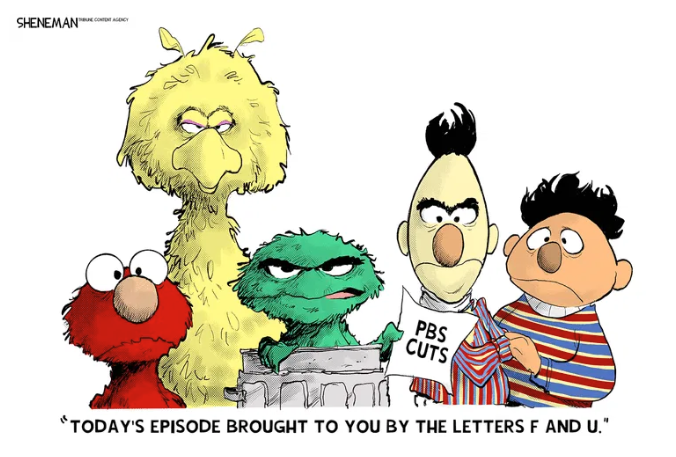
Such, I feared, was the infirmity of NPR and PBS Aren’t Entitled to Your Tax Dollars, a Free Press article by a serious Ivy league constitutional law professor. I slogged my way through it, agreeing with the author again and again, but frustrated that he was ignoring the elephant in the room. Finally, in literally the last paragraph, he mentioned the elephant almost as a throwaway line:

NPR also alleges in its complaint that the federal statute creating the Corporation for Public Broadcasting prohibits Trump from making this defunding decision. That’s a very different argument, which I’m not addressing here ….

I would venture a guess that nine out of ten people who read this column will come away with the impression that NPR and PBS are suffering from a liberal sense of entitlement to tax dollars, and miss the point about there being some limits to executive power.

In the end, it may not matter because this Congress is sufficiently servile that if Trump asks Congress to defund CPB, PBS and NPR (a longtime GOP talking point), it almost certainly will oblige him.

But process does matter, tremendously. Where the power to do something resides also matters.

Dissing Adoption

The New York Times … has never found a basic human good it couldn’t ponderously criticize with the shuffling-foot smarm of the ideas festival class. There’s “I Was Adopted From China as a Baby. I’m Still Coming to Terms With That. There’s “World’s Largest ‘Baby Exporter’ Admits to Adoption Fraud.” There’s “Given Away: Korean Adoptees Share Their Stories.” (In easily-digestible video format!) There’s “I Was Adopted. I Know the Trauma It Can Inflict.” (Subtle.) The New Yorker, a $12,000 espresso machine transformed into a magazine by a mischievous wizard, has “How an Adoption Broker Cashed In on Prospective Parents’ Dreams,” “Living in Adoption’s Emotional Aftermath,” and “Where is your Mother?” (The answer is that she has been separated from her child by a cruel and fickle child welfare system despite being perfectly fit, which I’m sure is how it usually goes.) The Atlantic has “No One’s Children: America’s long history of secret adoption.” (Would you be shocked to learn that said history isn’t a good one?) They’ve got “The New Question Haunting Adoption,” the question being whether adoption is really a secretly selfish act, you know, the selfish act of taking a severely-disabled toddler into your home to provide them with support and love after their birth parents smoked meth throughout pregnancy. They also have, incredibly, “What Adoption ‘Salvation’ Narratives Get Wrong,” “Adoption Is Not a Fairy-Tale Ending,” “The Dark, Sad Side of Domestic Adoption”…. I could go on, and that’s just three prestigious publications. There’s a whole world out of this out there.

This is all, for the record, a really excellent example of what we used to mean when we used the word ideology. Once upon a time, one wouldn’t say “My ideology is…” because ideology referred to the hidden, unexplored, unconscious politics that lay beneath the public, open, explicit politics. An ideology was those pre-political assumptions and beliefs which conditioned and limited political thought, which made the conscious political philosophy of any individual what it was. Ideology is the skeleton that hides unseen within the animal of politics but nevertheless determines the structure of that which is seen. Ideology exists in both the macro and the micro; this bizarre upper-caste antipathy towards ideology is a good example. If you asked leadership at these publications if they had any particular interest in leading a charge against the practice of adoption, they’d say no, of course not, what a weird question! If you were to show them just how repetitively this particular set of critiques and questions and hrm hrm hrm noises gets published in their pages, they’d swear to you that it reflects no underlying party line. And yet there it is, the evidence, in black and white. Something about the current constitution of the anxious educated urbanite liberal soul cries out inside of them: the real problem is adoption.

Freddie deBoer, Adoption is Good

If the shoe fits

A well-regarded Evangelical pastor published this weeks before the 2020 Election.

[T]his is a long-overdue article attempting to explain why I remain baffled that so many Christians consider the sins of unrepentant sexual immorality (porneia), unrepentant boastfulness (alazoneia), unrepentant vulgarity (aischrologia), unrepentant factiousness (dichostasiai), and the like, to be only toxic for our nation, while policies that endorse baby-killing, sex-switching, freedom-limiting, and socialistic overreach are viewed as deadly.

I think it is a drastic mistake to think that the deadly influences of a leader come only through his policies and not also through his person.

This is true not only because flagrant boastfulness, vulgarity, immorality, and factiousness are self-incriminating, but also because they are nation-corrupting. They move out from centers of influence to infect whole cultures. The last five years bear vivid witness to this infection at almost every level of society.

Christians communicate a falsehood to unbelievers (who are also baffled!) when we act as if policies and laws that protect life and freedom are more precious than being a certain kind of person. The church is paying dearly, and will continue to pay, for our communicating this falsehood year after year.

The justifications for ranking the destructive effects of persons below the destructive effects of policies ring hollow.

I find it bewildering that Christians can be so sure that greater damage will be done by bad judges, bad laws, and bad policies than is being done by the culture-infecting spread of the gangrene of sinful self-exaltation, and boasting, and strife-stirring (eristikos).

I think it is baffling and presumptuous to assume that pro-abortion policies kill more people than a culture-saturating, pro-self pride.

When a leader models self-absorbed, self-exalting boastfulness, he models the most deadly behavior in the world. He points his nation to destruction. Destruction of more kinds than we can imagine.

It is naive to think that a man can be effectively pro-life and manifest consistently the character traits that lead to death — temporal and eternal.

John Piper, Policies, Persons, and Paths to Ruin: Pondering the Implications of the 2020 Election

Piper did not say who he was voting for. He did not name names. For that reason, I’m blogging this separately from pointed political material.

But I’m not going to deny that my heart soared to see that our current President had not captured and reduced to servility the entirety of one of America’s most prominent Christian traditions.

The right to know isn’t the whole story

To further clarify our situation, consider W. H. Auden’s discussion, which I’ve cited before, of the idea that, as he put it, “the right to know is absolute and unlimited.” “We are quite prepared,” Auden wrote,

“to admit that, while food and sex are good in themselves, an uncontrolled pursuit of either is not, but it is difficult for us to believe that intellectual curiosity is a desire like any other, and to recognize that correct knowledge and truth are not identical. To apply a categorical imperative to knowing, so that, instead of asking, ‘What can I know?’ we ask, ‘What, at this moment, am I meant to know?’ — to entertain the possibility that the only knowledge which can be true for us is the knowledge that we can live up to — that seems to all of us crazy and almost immoral.”

L.M. Sacasas, Structurally Induced Acedia (The Convivial Society)

Harvard and the Trump administration

Harvard and the Trump administration have each finally met an adversary too big to push around. America’s richest university never really considered how much it depends on government policy, including lavish federal research funding, federal student aid, and a permissive immigration regime for the foreign students—who make up a third of the university’s student body and often subsidize the rest by paying more. Progressives also never thought through how the many tools they devised for using government leverage against private institutions—including threatening tax exemptions, as the Supreme Court allowed on dubious grounds in Bob Jones University v. United States (1983)—could be used against universities that engage in race discrimination for the “right” reasons, cultivate a political monoculture among the faculty, and permit campus mobs to terrorize minority groups who are out of progressive favor (Jews). Now, Trump is trying to strip Harvard of everything—tax exemption, federal funding, and visas for foreign students already enrolled. While the comeuppance for Harvard is admittedly delicious, the president is abusing powers he ought not to have, and Harvard has deep enough pockets to fight him in court.

National Review Weekly email.

Some cases don’t have valid arguments on both sides. That I find nothing “delicious” about Harvard’s “comeuppance” is an example of why I ignore National Review’s regular email invitations to resubscribe.

Can a car have a “catfish smile”?

“Behind that catfish smile, the company’s twin-turbo 4.0-liter DOHC V8 now discharges a drama-drenched 656 hp and 590 lb-ft—153 hp and 85 lb-ft more than the previous Vantage Roadster—thanks to larger turbochargers, revised camshaft profiles, optimized compression ratio and upgraded fueling and cooling.”

Kudos to Dan Neil for the spot-on “catfish smile.”

The car, by the way, is a 2025 Aston Martin Vantage Roadster, which will set you back $300,000 as equipped (this week’s ephemeral tariffs not included).

Credentials, good times, and genuine learning

Most young people today feel, with considerable justification, that they live in an economically precarious time. They therefore want the credential that will open doors that lead to a good job, either directly or (by getting them into good graduate programs) indirectly …

But those same young people also want to have a good time in college, a period of social experience and experimentation that they (rightly) think will be harder to come by when they enter that working world …

… Yes, students understand — they understand quite well, and vocally regret — that when they use chatbots they are not learning much, if anything. But the acquisition of knowledge is a third competing good, and if they pursue that one seriously they may well have to sacrifice one of the other two, or even both. Right now they can have two out of three, and as Meat Loaf taught us all long ago, two out of three ain’t bad.

Alan Jacobs, responding to Ted Gioia on the topic of ending AI cheating.

Potpourri

  • After Trump held a crypto dinner last Thursday night, crypto moguls who paid to be there felt scammed that the president didn’t even stick around at the event they’d hoped to do their own scams at. I saw someone describe him as the apex scammer. Our Scammander in Chief.
  • In other Russia news, a new statue of Joseph Stalin in a Moscow metro station was unveiled this month. President Putin has called Stalin an “effective manager,” and has said that enemies of Russia use the “excessive demonization” of Stalin to attack “the Soviet Union and Russia.” Stalin is back, big time. Interesting that “effective manager” is being used here to describe a man who facilitated the death of millions—and not efficiently. But I’m not a businessman.
  • The continued reckoning: A postmortem on Kamala Harris’s campaign cited a “perception gap” as one of the reasons she lost, saying voters believed she held positions that she didn’t. “Over 80% of swing voters who chose Trump believed Harris held positions she didn’t campaign on in 2024, including supporting taxpayer funding for transgender surgeries for undocumented immigrants (83%), mandatory electric vehicles by 2035 (82%), decriminalizing border crossings (77%), and defunding the police (72%).” But Harris had, in fact, supported all of these positions. Like, she is on record supporting each of those positions (here, here, here, and here). So it’s not really a perception problem so much as a reception problem, like these ideas are not popular even though I support them. There’s a sense among Dems that people should simply ignore the things that are unpopular and that referencing them is fake news. Like, how dare you talk about the surge of migrants coming through our new open borders thanks to swift changes from the Biden admin. Yes, it’s technically true, but it’s disinformation-coded.
  • Leave Bruce alone: A bar in New Jersey canceled a performance by a Bruce Springsteen tribute band after the real Springsteen called Trump “corrupt, incompetent, and treasonous” while on tour in England. Citing the bar’s MAGA clientele, the bar owner said that a Springsteen cover band would be “too risky at the moment.” And: “Whenever the national anthem plays, my bar stands and is in total silence, that’s our clientele. Toms River is red and won’t stand for his bull—.” [But MAGA doesn’t have a violent streak. No way. That’s fake news.]
  • Things that are not antisemitism: The Democratic Socialists of America “Liberation Caucus” has announced its support for Elias Rodriguez, the suspect arrested for slaughtering two Israeli Embassy staffers outside D.C.’s Capital Jewish Museum last week. Here’s the statement signed by the DSA Liberation folks and a bunch of others: “As imperialism has made the entire world its battlefield, it is justified to fight it, by any means necessary, without regard for geography.” And: “[T]here must be consequences for genocidal [Z]ionist imperialism, and those consequences are righteous.”

Nellie Bowles

Fake my …

The latest fitness craze is surely going to be Fake My Run. It fits perfectly with the national ethos whereby university students are already doing Fake My Education.


Your enemies are not demonic, and they are not all-powerful and the right hasn’t always lost and the left hasn’t always won. But if you convince yourself of that, you give yourselves all sorts of permission to do a lot of stupid and terrible things under the rubric of “Do you know what time it is?”

Jonah Goldberg.

Trumpism can be seen as a giant attempt to amputate the highest aspirations of the human spirit and to reduce us to our most primitive, atavistic tendencies.

David Brooks)

I don’t do any of the major social media, but I have two sub-domains of the domain you’re currently reading: (a) You can read most of my reflexive stuff, especially political here. (b) I also post some things on my favorite social medium. I am now exploring Radiopaper.com as well.
Political 5/30/25

What it takes to tick off David Brooks

Last Monday afternoon, I was communing with my phone when I came across a Memorial Day essay that the Notre Dame political scientist Patrick Deneen wrote back in 2009. In that essay, Deneen argued that soldiers aren’t motivated to risk their lives in combat by their ideals. He wrote, “They die not for abstractions — ideas, ideals, natural right, the American way of life, rights, or even their fellow citizens — so much as they are willing to brave all for the men and women of their unit.”

This may seem like a strange thing to get angry about. After all, fighting for your buddies is a noble thing to do. But Deneen is the Lawrence Welk of postliberalism, the popularizer of the closest thing the Trump administration has to a guiding philosophy. He’s a central figure in the national conservatism movement, the place where a lot of Trump acolytes cut their teeth.

In fact, in his acceptance speech at the Republican National Convention, JD Vance used his precious time to make a point similar to Deneen’s. Vance said, “People will not fight for abstractions, but they will fight for their home.”

Elite snobbery has a tendency to set me off, and here are two guys with advanced degrees telling us that regular soldiers never fight partly out of some sense of moral purpose, some commitment to a larger cause — the men who froze at Valley Forge, the men who stormed the beaches at Normandy and Guadalcanal.

But that’s not what really made me angry. It was that these little statements point to the moral rot at the core of Trumpism, which every day disgraces our country, which we are proud of and love. Trumpism can be seen as a giant attempt to amputate the highest aspirations of the human spirit and to reduce us to our most primitive, atavistic tendencies.

Mild-mannered David Brooks, popping a vein (shared link, bold added).

The rest of the column was quite good, but the idea that a primitive, atavistic President would deploy his “throne-sniffing sycophants” (H/T Kevin D. Williamson, below) to reduce the nation to primitive atavism struck me as (a) too sophisticated conceptually, but perfect temperamentally, for Trump (a “stupid, lazy and angry” man — Kevin D. Williamson again); (b) exactly what his smart and unprincipled intimates would realize is necessary for their success; and (c) the kind of radical moral rot that Brooks sniffs out and exposes to us all.

And for his ability to distill evils to their essence, I am grateful.

Stupid, lazy and angry

We’ve been here before, of course. Donald Trump and his team have been three weeks away from announcing a groundbreaking new health care plan for … what, just about a decade now? Donald Trump’s confidence in addressing a complex subject has a linear relationship to his ignorance regarding that subject, and so we have got gems like this presidential declaration of ineptitude: “Nobody knew that health care could be so complicated.” It isn’t the case that nobody knew—lots of people knew. Some of those people had good ideas, some had terrible ideas, but they knew it was complicated. The guy who didn’t know? The one who spent most of his life as a Manhattan gadfly, a game-show host with side hustles in pro wrestling and porn. That guy didn’t know.

There are no conspiracies. There are no secrets. Everything is more or less what it seems. … [T]he obvious explanation for Trump’s eccentricity (or most anything else) is almost always the correct explanation. Which is why I have been writing for all these years that the key to understanding the Trump administration is that its central figure, Donald Trump, is stupid, lazy, and angry …

There are people around Trump, such as Marco Rubio and J.D. Vance, who are not stupid or lazy (though both are distinctly angry men) but are functionally indistinguishable from the stupid and the lazy because they are throne-sniffing sycophants who dread a return to the private sector more than almost anything else in this life.

It’s all right there to see: Trump, the supposed master negotiator, is as a matter of practical fact able to effectively negotiate exclusively in situations in which no substantial negotiation is required: with people he can fire, for example, or with utterly dependent parties. He calls this “negotiating from a position of strength” instead of “bossing around your cowering flunkies.”

Kevin D. Williamson

It didn’t take long for the courts to figure this out

The Abrego Garcia ruling and the Alien Enemies Act litigation have left legal scholars warning of a constitutional crisis. But a more tangible effect, attorneys told me, has been the erosion of the “presumption of regularity”—the benefit of the doubt given to the government in court proceedings. It’s based on the idea that federal officers and attorneys are operating in good faith, and not trying to achieve political goals through acts of subterfuge.

As judges see the administration saying one thing in public and another in court, they have started to treat the government’s claims with more skepticism and, sometimes, with outright suspicion of criminal contempt. A recent Bloomberg analysis found that the Trump administration has been losing the majority of its immigration-related motions and claims, regardless of whether the judges overseeing their cases were appointed by Democrats or Republicans.

Nick Miroff, In Trump Immigration Cases, It’s One Thing in Public, Another in Court

I’m not by any means certain that it will all be alright, i.e., that the courts can protect us from Trump’s lawlessness. But denying his administration the presumption of regularity is an important and needed step.

Note well that when a government lawyer tried to address the court honestly, the Attorney General fired and defamed him:

When a senior ICE official said in sworn testimony in March that Abrego Garcia had been deported to El Salvador because of an “administrative error,” the Justice Department attorney who initially represented the Trump administration, Erez Reuveni, relayed that characterization to the court. When asked why the administration hadn’t taken steps to correct the error and bring Abrego Garcia back, Reuveni said his client—the Trump administration—hadn’t provided him with answers.

The top Trump aide Stephen Miller soon began insisting publicly that Abrego Garcia’s deportation was not, in fact, an error—the opposite of what the government admitted in court. Vice President J. D. Vance claimed that Abrego Garcia is a “convicted MS-13 gang member with no legal right to be here,” even though he has no criminal convictions in the United States or El Salvador. Attorney General Pam Bondi cast the error as missing “an extra step in paperwork” and said that Abrego Garcia should not be returned.

Reuveni was fired. Bondi said he had failed to “zealously advocate” for the government. “Any attorney who fails to abide by this direction will face consequences,” she told reporters.

Nick Miroff

It’s a good time to be a retired attorney or, failing that, to practice outside a Department of Justice that requires you to lie (the normal term for Bondi’s “zealously advocate”) in court.

Marks of dystopia

Speaking of lying to court and losing in court:

I offer you the most dystopian thing I’ve read about the state of the federal government this year—so far:

Amid rising tensions between the Trump administration and the judiciary, some federal judges are beginning to discuss the idea of managing their own armed security force.

The Supreme Court has its own dedicated police force, but other federal judges are protected by the U.S. Marshals Service, which reports to Attorney General Pam Bondi. Security committee members worried that Trump could order the marshals to stand down in retaliation for a decision that didn’t go his way.

A country where judges need their own bodyguards because they no longer trust the president to guarantee their safety if they rule against him (and understandably so) is a country waaaaay too far down the slope of banana republicanism to chastise anyone else about failing to live up to Western “virtue ethics.”

[Trump named Ed Martin acting U.S. attorney in Washington] earlier this year despite the fact that he hadn’t worked a day in his life as a prosecutor. The president later nominated him to fill the position permanently, but that required Senate confirmation. And although Senate Republicans have set the bar for confirming Trump cronies on the floor, somehow Martin still failed to clear it. You need to be awfully sketchy—like, Matt Gaetz levels of sketchy—for John Thune’s conference to bork you.

From time to time I think back to what Sen. Susan Collins said when she was asked during Trump’s first impeachment trial whether she’d vote to convict him for demanding a quid pro quo of Ukraine. No, she answered, there’s no need. “I believe that the president has learned from this case,” she told CBS News. “The president has been impeached. That’s a pretty big lesson.”

He did learn a lesson. What he learned was that Senate Republicans would never hold him accountable for blatantly abusing his power.

Nick Catoggio

Whole-of-Government Gaslighting

[W]hy is the Justice Department not only settling the lawsuit that [Ashli] Babbitt’s relatives filed but also mulling an apology in the millions? Because Trump’s alternate reality demands it. Because that is how you turn truth entirely on its head.

You don’t simply challenge what really happened at the Capitol, which is that lawless hooligans in thrall to Trump’s delusions attempted a kind of coup. You chip-chip-chip away at it in so many ways over so much time and with such unflagging frequency that many people who thought they understood what they were seeing aren’t wholly sure anymore — or give up trying to make sense of it.

Trump recast a day of shame as a “day of love.” The rioters became “patriots” and Babbitt a martyr. As soon as Trump returned to the Oval Office, he pardoned nearly all of the roughly 1,600 people criminally charged in connection with the rioting. He even floated the idea of a compensation fund for them. Everybody gets a prize!

To live in fiction, commit to it. That’s the moral not merely of Trump and Jan. 6 but of Trump, period. Yesteryear’s hand-wringing about whether to label his individual falsehoods “lies” and those periodic tallies of his misstatements now seem quaint; they don’t do justice to the scope and audacity of what he’s up to. Nor does the occasional current chatter about “propaganda.” Trump is engaged in a multifront, multipronged attack on any and every version of events that impedes his goals and impugns his glory. It makes the spin control of presidents past look like child’s play.

Frank Bruni (shared link) This is so good I probably would have shared one of my ten monthly links even if it weren’t the end of the month.

86ing the important stuff

Kash Patel Says He’s Prioritizing Social Media Mocking Trump Over ‘Child Sex Predators, Fentanyl Traffickers, Terrorists’ – Above the Law

He didn’t say that in so many words, but his meaning was clear:

FBI Director Kash Patel took a break from his busy schedule of hanging out in Las Vegas instead of actually running the FBI, to go on Fox News last night to rant a bit about James Comey. After Comey posted his beachside “8647” insta, Patel quickly took to social media — where all professional law enforcement vents about its investigation priorities — to pretend that “86,” a century old term for bouncing unruly customers or canceling food orders, actually amounted to an assassination threat directed at Donald Trump.

This was, to use the technical term, f ****** stupid. Though against all odds, it was not nearly as stupid as Patel’s next move. Per the Daily Beast:

“Do you know how many copycats we’ve had to investigate as a result of that beachside venture from a former director?” he asked Baier. “Do you know how many agents I’ve had to take offline from chasing down child sex predators, fentanyl traffickers, terrorists?”

Hopefully some career law enforcement professional within the FBI intervened to make sure the answer to both questions is close to zero.

First of all, since threats to the president are the jurisdiction of the Secret Service — something Patel publicly acknowledged at the time — why the hell is he pulling agents off ANYTHING to run down a soccer mom who took a picture of her bottomless mimosa brunch bill having tipped to make sure the total was 8647?

So our President’s ego is more important protecting us from child sex predators, fentanyl traffickers, and terrorists. Keep that in mind. It’s barely 19 months to Retribution Day 2026.

That’s assuming the Democrats can serve up something palatable. But they’re convened in luxury hotels to do some

soul-searching after November’s defeat. “Democratic donors and strategists,” Goldmacher writes, “have been gathering at luxury hotels to discuss how to win back working-class voters, commissioning new projects that can read like anthropological studies of people from faraway places.”

One of those proposals is a $20 million effort “to reverse the erosion of Democratic support among young men, especially online.” The goal is to “study the syntax, language and content that gains attention and virality in these spaces.”

David French.

This is a reprise of this era’s Democrat delusion: “We just aren’t communicating our message right.” Au contraire, mon frere: your message is your problem.

86 both major parties.

Woke Right

Richard Hanania is a longtime critic of DEI, but has a few bones to pick with Trump 2.0 fake demolition of it:

Unfortunately, it is now clear that, rather than sticking to the principles of colour blindness, merit and individual liberty that I believe in, the Trump administration seeks to implement its own version of thought control and federal-government overreach.

This can be seen most clearly in the letter of demands the administration sent to Harvard on April 11th and its announcement that it was cutting off research funds to the university. The letter stated that Harvard must cease all DEI and affirmative-action policies in hiring, promotions and admissions.

So far, so good …

… [T]here is a direct contradiction between the goal of viewpoint diversity and the principle of merit, which the administration is claiming to defend. We all have an interest in our top institutions selecting students and faculty based on intelligence, competence and their fit within a programme. Having ideological litmus tests for professors and scientists would do more damage to the principle of merit than race and sex preferences ever have, given how few individuals with advanced degrees identify as conservatives …

… Harvard may never be an institution where MAGA has a large constituency. Accepting that is necessary for being at peace with the idea of America as a pluralistic society.

An influential voice from the right laments Trump’s attack on universities

When the rhetoric comes home to roost

“I voted for Donald Trump, and so did practically everyone here,” said Vanessa Cowart, a friend of Ms. Hui from church. “But no one voted to deport moms. We were all under the impression we were just getting rid of the gangs, the people who came here in droves.”

She paused. “This is Carol.”

A Missouri Town Was Solidly Behind Trump. Then Carol Was Detained. – The New York Times (shared link)

Prelude to a pissing contest

Elon Musk said he would step down as a “special government employee” with the Trump administration. The billionaire has led a radical effort to overhaul the American state through the Department of Government Efficiency. He has been critical of Mr Trump’s budget bill, which would add trillions to debt. He recently said he wanted to spend more time on his businesses—which have themselves suffered a backlash.

The Economist

Neither Trump nor Musk can keep his mouth shut. The Bromance is over. The divorce oughta be good — “good television” as Trump likes to say.


Your enemies are not demonic, and they are not all-powerful and the right hasn’t always lost and the left hasn’t always won. But if you convince yourself of that, you give yourselves all sorts of permission to do a lot of stupid and terrible things under the rubric of “Do you know what time it is?”

Jonah Goldberg.

Regarding said “lot of stupid and terrible things,” my failure to call out anything about the current regime does not mean I approve. There’s just too much, and on some of the apparent illegalities I don’t want to abuse my rusty credentials without thinking it through.

I don’t do any of the major social media, but I have two sub-domains of the domain you’re currently reading: (a) You can read most of my reflexive stuff, especially political here. (b) I also post some things on my favorite social medium. I am now exploring Radiopaper.com as well.

Bright Thursday

I don’t know about your Inbox, but mine tends to fill up especially on Friday. So I’m posting this now rather than in the wee hours tomorrow.

Trump 2.0

I haven’t been able to eliminate sharp criticism of Trump from today’s post because there are too many issues and I’ve read too much that isn’t just “same old same old.” As has become my habit, I’ve posted most of my anti-Trump stuff here.

National “Emergencies”

Source: Andrew Sullivan

The Meta-Concern about summary deportation

United States law allows for a quite expedited process to remove people from the country, to deport them. You don’t get a big trial. You don’t get a jury trial. You are moved rapidly because the theory of the case is: First, you don’t have a right to immigrate to the United States, so you have not been deprived of your rights. And secondly, once you’re removed from the United States, you remain a free person. You are sent back to the place you came from or some other place to which you have some connection, and then you’re free to go about your business. You’re not sent to a prison—not sent to a prison for life.

But as I talk about this, the thing that has most gripped my mind with worry and anxiety is not only the effect on the individuals themselves, some of whom may be genuinely innocent, but the effect on those who are sending human beings to a prison without a hearing.

You know, the United States government is now building an apparatus of lawyers, of officials of all kinds, who plan and think every day, How can we apprehend people on American soil and bundle them to a prison without giving them any show of a hearing? They’re building skills and competencies at non-due-process forms of arrest and incarceration that are going to be very hard to limit.

… I remember when I was a Canadian citizen in the United States on a student visa, we were warned if you got into a bar fight, you could theoretically lose your student visa. Now, in those days, that meant that you’d have to go back to Canada and go to school in Canada, which is not the end of the world. In today’s America, that could mean you could lose your student visa and be accused of terrorism, and a bag put over your head and be put into a car and sent to a prison in El Salvador for the rest of your life.

Now, maybe that doesn’t happen in every case. Maybe that doesn’t happen in many cases. But there are people in the employ of the United States government, paid by taxpayers to think about how can we daily broaden the category of people who can be arrested and detained and imprisoned without any showing to any authority at all, without any opportunity to make themselves heard, without any evaluation by an independent fact finder—by any of the things we call due process.

David Frum, introducing a terrific conversation about The Crisis of Due Process with Peter Keisler. (bold added)

Do we really believe in free speech?

Trump 2.0 has been deporting foreign students and others for constitutionally protected speech, using as its current go-to bad-faith excuse that the speech is antisemitic.

The late British-American journalist Christopher Hitchens is a more recent testament to the long tolerance of America toward foreign dissent. Before becoming a U.S. citizen in 2007, Hitchens spent decades as a legal resident—and as one of America’s most acerbic public intellectuals. He accused Ronald Reagan of being “a liar and trickster,” called Israel America’s “chosen surrogate” for “dirty work” and “terrorism,” lambasted Bill Clinton as “almost psychopathically deceitful,” and accused the George W. Bush administration of torture and illegal surveillance. If a student can be deported for writing a campus op-ed critical of Israel, any of Hitchens’ views could have been used to justify deporting him.

Jacob Mchangama, A New McCarthyism

Law and its limits

This isn’t how our system is supposed to work. When a president does the kinds of things Donald Trump is doing, his popularity should sink so low that Congress will feel empowered to stand up to him. Ideally, they would impeach and remove him from office for attempting to govern like an absolute monarch. Short of that, Congress and the courts would be working in tandem to impose and enforce constraints on the wayward executive until the next election strengthens their hand against him.

But none of this is happening—because our system has broken down. The parties are ideologically sorted, with almost no remaining overlap. And Trump has transformed the GOP into a cult of personality more loyal to him personally than to the Republican Party, the other institutions of American democracy, the law, or the Constitution.

In a situation like this, the only thing preventing the president from transforming himself into a tyrant is his own willingness to do it. The courts can tell him to stop. But will he? If he does, democracy survives, at least for the time being. If he doesn’t, democracy is over, at least until it can be reconstituted at some point in the future.

One should never hope to live through a moment of great political precarity like our own. But one tiny compensation is that such moments bring clarity about certain fundamental matters. How has the United States managed to survive for nearly 250 years without evolving into a dictatorship? The answer really may be this simple: By never electing a man willing to do what it takes to effectuate the change.

Until now.

Damon Linker

It’s not clear that the courts will suffice, but the courts — having already, and deservedly, come to treat the Administration as bad-faith, untrustworthy actors — will provide partial deterrence and may help sway public opinion by the cogency (and sometimes, the tartness) of their reasoning.

[I]f you want a really extraordinary example of that, you would look at the order that the Court issued at 1 a.m. on Saturday morning this last weekend, because even though they had held that everybody has to be given meaningful notice before they could be removed in this way, there was credible evidence that the administration was loading people onto buses without giving them anything like the notice that was required. And the ACLU went to the Supreme Court and said, you know, Please, as you listen to the rest of this case and get briefing, stop this from happening.

And if the administration were a normal administration and had compiled a record so far of being a normal administration, the Court would’ve said, Well, I can be confident they’re not going to do this while we are hearing your petition, so let’s give the government a chance to respond. Let’s see what they say, and then we’ll decide what to do. Because, of course, the government wouldn’t spirit these people away while we are actually in the process of deciding whether it can do so on this emergency application you filed. But they knew that the government had done exactly that with the first 200 or so people they had sent away.

The case was before a district judge, and they rushed to secretly get the people out before he could issue an order. And they didn’t quite succeed on that, which is why you have these issues of contempt floating around now. But at 1 a.m., the Court by a 7–2 vote said, Don’t remove anybody in the class represented by these lawyers until you hear otherwise from us.

And that shows that there is a cost to the administration of acting the way it’s acting towards the courts, because if you squander the reputation that governments of both parties have had for credibility and fair dealing and honest brokering with the Court, then they’re going to treat you different because they know they can’t quite trust you.

Peter Keisler with David Frum

Miscellany

The new Republican coalition

Thus we have arrived at a new Republican coalition that looks like this:

  • The tech right, which is essentially a weirder and more evil upgrade of the pro-business libertarians
  • The barstool right, which is a genuinely new constituency made up of hedonistic anti-woke libertarians that has replaced the Christian conservatives
  • The neo-conservative foreign policy hawks, who are the weakest member of the coalition, but can still get what they want on certain issues, as seen with the attacks on the Houthis as well as the saber rattling regarding Greenland

In other words, the Christian influence on actual Republican policy items and their political vision is going to be exceedingly negligible going forward. Sure, Vice President Vance will make an appearance at the March for Life. President Trump will show up to the National Prayer Breakfast. But even when he does acknowledge a Christian event, it often will come loaded with hatred and vile self-aggrandizement, as seen yesterday:

And ultimately when push comes to shove on the policy level, Christian concerns will always be backgrounded or eliminated relative to the priorities of the three above groups, as we have already seen on abortion, marriage, and PEPFAR.

Jake Meador

I originally thought to post this on a Sunday, when my focus is narrower, but it didn’t fit there because I don’t value “religion” for its instrumental partisan-political value.

It was a very few years ago when I warned (as had others) “If you don’t like the Religious Right, just wait ‘till you see the irreligious Right.” Well you’ve been seeing them in power for three months now.

Beta-testing tyranny in the Sunshine State

Ron DeSantis walked so that Donald Trump could run. When the time came to formulate a policy response to the woke left, no one mattered more than the governor of Florida.

He tried to ban critical race theory in education. He sharply limited discussion of gender and sexuality in public schools. He tried to limit the free speech of university professors. He retaliated against Disney when it had the audacity to exercise its freedom of speech to criticize the governor’s policies.

And through it all, DeSantis declared that Florida was the place where “woke goes to die.”

In his second term, Trump is a scaled-up version of DeSantis. Every element of the DeSantis model has been deployed against Trump’s ideological enemies …

At first I was optimistic about the anti-woke right. Their free speech argument resonated with me. I’d spent decades litigating free speech cases, after all, and I’d never really seen anything like a mass movement for free expression.

But my optimism quickly faded. In 2021, the anti-woke right embraced a series of state laws that were designed to ban critical race theory. Rather than meet critical race theorists in the marketplace of ideas, the right chose to try to suppress their expression.

A movement that had spent decades fighting speech codes on college campuses was now enacting speech codes of its own. States that once passed laws meant to protect free speech on campus were now passing laws suppressing the discussion of so-called divisive concepts about race.

By this time I was familiar with the right’s authoritarian turn — and getting very worried about it. In 2019, parts of the intellectual right were consumed with a fight over liberalism itself, with the new right arguing that liberal values — freedom of speech and free trade, for example — were hollowing out American culture, creating a nation of atomized individuals who were consumed with self-actualization (and consumption itself) at the expense of family and community.

David French, The Anti-Woke Right and the Free Speech Con

Context

Ironically, the left, now alarmed by the federal government’s intrusive reach [into, say, Harvard], bears direct responsibility for crafting the very legal weapons wielded against the universities it dominates. Almost four decades ago, progressive legislators demanded sweeping amendments to civil rights law, expanding federal oversight over higher education. The sequence of events reveals a cautionary tale of political hubris: progressive confidence that state power would reliably serve their ends overlooked the reality that governmental authority, once unleashed, recognizes no ideological master. Today’s circumstances starkly illustrate how expansive federal control over civil society, originally celebrated by progressives, returns to haunt its architects. The left’s outrage ought to focus not on this particular administration but on its own reckless empowerment of the state.

Yet for all its courage, Harvard’s response stopped short of making the argument that would best protect the values for which it was fighting. It defended the university’s independence without explaining why that independence deserves protection. It invoked values like “pluralism” and “inquiry,” but it did not fully explain why those values are essential to a liberal democratic society. The letter therefore missed an opportunity to articulate what a university is for — not just to students or donors, but to the country. And this matters, because Trump’s attack against this and other universities is not only about the balance of power between universities and the government. It is, at bottom, about the legitimacy of higher education as a public good.

Alan Jacobs, quoting, respectively, John O. McGinnis and Edward Frame

Dangers of debunking

The danger of being a professional exposer of the bogus is that, encountering it so often, one may come in time to cease to believe in the reality it counterfeits.

Alan Jacobs, The Year of Our Lord 1943


Your enemies are not demonic, and they are not all-powerful and the right hasn’t always lost and the left hasn’t always won. But if you convince yourself of that, you give yourselves all sorts of permission to do a lot of stupid and terrible things under the rubric of “Do you know what time it is?”

Jonah Goldberg.

Regarding said “lot of stupid and terrible things,” my failure to call out anything about the current regime does not mean I approve. There’s just too much, and on some of the apparent illegalities I don’t want to abuse my credentials without thinking it through.

I don’t do any of the major social media, but I have two sub-domains of the domain you’re currently reading: (a) You can read most of my reflexive stuff, especially political here. (b) I also post some things on the only social medium I frequent, because people there are quirky, pleasant and real.

March 26, first year of the Trumposcene

I won’t waste my time or yours weighing in on what has predictably been labeled “Signalgate” except to note that Trump, Gabbard and Hegseth are all trying to brazen it out with transparent lies.

Most chilling of all

The ochre emperor, having figured out that he cannot control life-tenured federal judges, has taken to kidnapping law firms, negotiating ransoms that include not taking any cases he doesn’t like.

Courts decide cases. They don’t inject themselves unbidden into the affairs of the Executive and Legislative branches. If Trump’s kidnappings work (and so far they have worked pretty well), don’t trust the courts to keep him in line because people won’t be able to get law firms to represent them against the Administration’s already-lawless behaviors.

Earlier this month, President Donald Trump delivered a speech in the Great Hall of the Justice Department. But he did not laud the impartial application of the law, as past presidents have done in the staid space. Instead, he took the opportunity to signal some score-settling against the lawyers involved in legal challenges against him. 

“They spied on my campaign; launched one hoax and disinformation operation after another; broke the law on a colossal scale; persecuted my family, staff, and supporters; raided my home, Mar-a-Lago; and did everything within their power to prevent me from becoming the president of the United States,” Trump said, referencing his past campaigns and some of the criminal and civil cases brought against him. He went on to single out several lawyers allegedly involved in the scheme by name, including “radicals like Marc Elias, Mark Pomerantz” and “scum” like “Andrew Weissmann, deranged Jack Smith.” 

As of Tuesday, each of those attorneys has something else in common: They all have current or former ties to law firms now in Trump’s crosshairs. Over the last month, Trump has threatened four law firms in what appears to be a broader campaign of intimidation directed at the legal profession. Coinciding with the administration’s recent attacks on judges, legal scholars fear the moves could represent a serious threat to the independence of the bar and the ability of individuals to effectively challenge the government in court.

The Morning Dispatch

You’d think that BigLaw could stand up and fight, but it’s a dog-eat-dog world out there, and Paul Weiss found the other dogs trying to poach their top lawyers and clients rather than offering help. That’s why they felt they had to pay Trump’s ransom demand.

Let me get this straight …

Donald Trump is, as he will tell you, the world’s greatest negotiator, and he feels the need to renegotiate the existing U.S.-Canada trade deal, which was negotiated by an utter incompetent: Donald Trump, whose administration oversaw the replacement of NAFTA by the (rather lightly modified) USMCA the last time he was president. And now Canadians have learned what banks, investors, vendors, small business partners, wives, ex-wives, and pornographic performers rapidly approaching their expiration dates have all learned over the years: If you think you have a deal with Donald Trump, you are a fool.

Kevin D. Williamson

The Roy Cohn theory of university perfidity

[T]he tone was a diatribe, the kind of ill-informed, red-meat rant Tucker Carlson honed throughout the first Trump administration every weeknight in prime time on Fox News: Come out of gate with guns blazing and never relent. Concede nothing to any less severe view of the topic. Reject any form of nuance. Illustrate the absolute truth of one’s position by giving a handful of outrageous-sounding anecdotes cherry-picked to demonstrate the absurdity of holding any other position.

On that day three years ago, it took Vance exactly 40 seconds to declare how important it was for conservatives like himself to “honestly and aggressively attack the universities in this country”—just as it took just a few weeks for the second Trump administration to follow through on precisely this agenda.

Damon Linker. I quote it because the bolded part is the Trump style, which he learned from the infamous Roy Cohn. That’s why you dare not rely on anything anyone in this administration says.

More:

I know enough about what goes on in the country’s universities to recognize that the right-wing thugs currently running the executive branch and taking a baseball bat to higher education are utterly full of shit. They are poised to do an immense amount of damage to something valuable and good. And much of the broader public appears not to care—in no small part because of the incendiary lies the ideological propagandists behind the MAGA movement have been propagating for years. I won’t say they must be stopped, because I don’t know if they can be stopped. Still, it’s important we recognize exactly what they’re doing and the price our country and our world are going to end up paying for their destructive zealotry.

Of course a narcissist would feel this way

I believe that CNN and MS-DNC, who literally write 97.6 percent bad about me, are political arms of the Democrat Party and in my opinion, they’re really corrupt and they’re illegal, what they do is illegal, … And it has to stop, it has to be illegal, it’s influencing judges and it’s really changing law, and it just cannot be legal. I don’t believe it’s legal, and they do it in total coordination with each other.

Nellie Bowles quoting Trump’s speech to the DOJ.

Change “I” to “we,” format it, sign it, and file it with the District Court. That’s how Trump’s new toadies at DOJ operate.


I suffer more from the humiliations inflicted by my country than from those inflicted on her.

Simone Weil, from a letter to Georges Bernanos.

I don’t do any of the major social media, but I have two sub-domains of the domain you’re currently reading: (a) You can read most of my reflexive stuff, especially political here. (b) I also post some things on the only social medium I frequent, because people there are quirky, pleasant and real.