If you believe that all reactions ought to be ‘rational’, which means open to examination by calculative reason, then all reactions which stem from felt intuition, but which reason has trouble explaining, are at a disadvantage. This explains why a mystic will never win a debate with an atheist: he may have a truth on his side, but it will not be demonstrable through anything other than personal experience, and that doesn’t count. Therefore, he loses.
I understand why we developed a social convention that one is only obligated to believe things that can be rationally proven. But I do not understand the irrational corollaries that one is barely permitted to believe what one cannot rationally prove and certainly may not try to persuade others of it.
I don’t think those corollaries are straw men, but I have no rational proof at hand that they’re real.
One person seeks to be admired for the clothes he is wearing; another seeks the same admiration in priestly vestments. One wishes to be admired for singing on stage, another for chanting in church. One wants to be thought of as tough and cool, another as prayerful and humble. It is the same vainglory in them all.
Vassilios Papavassiliou, Thirty Steps to Heaven
More Anecdata
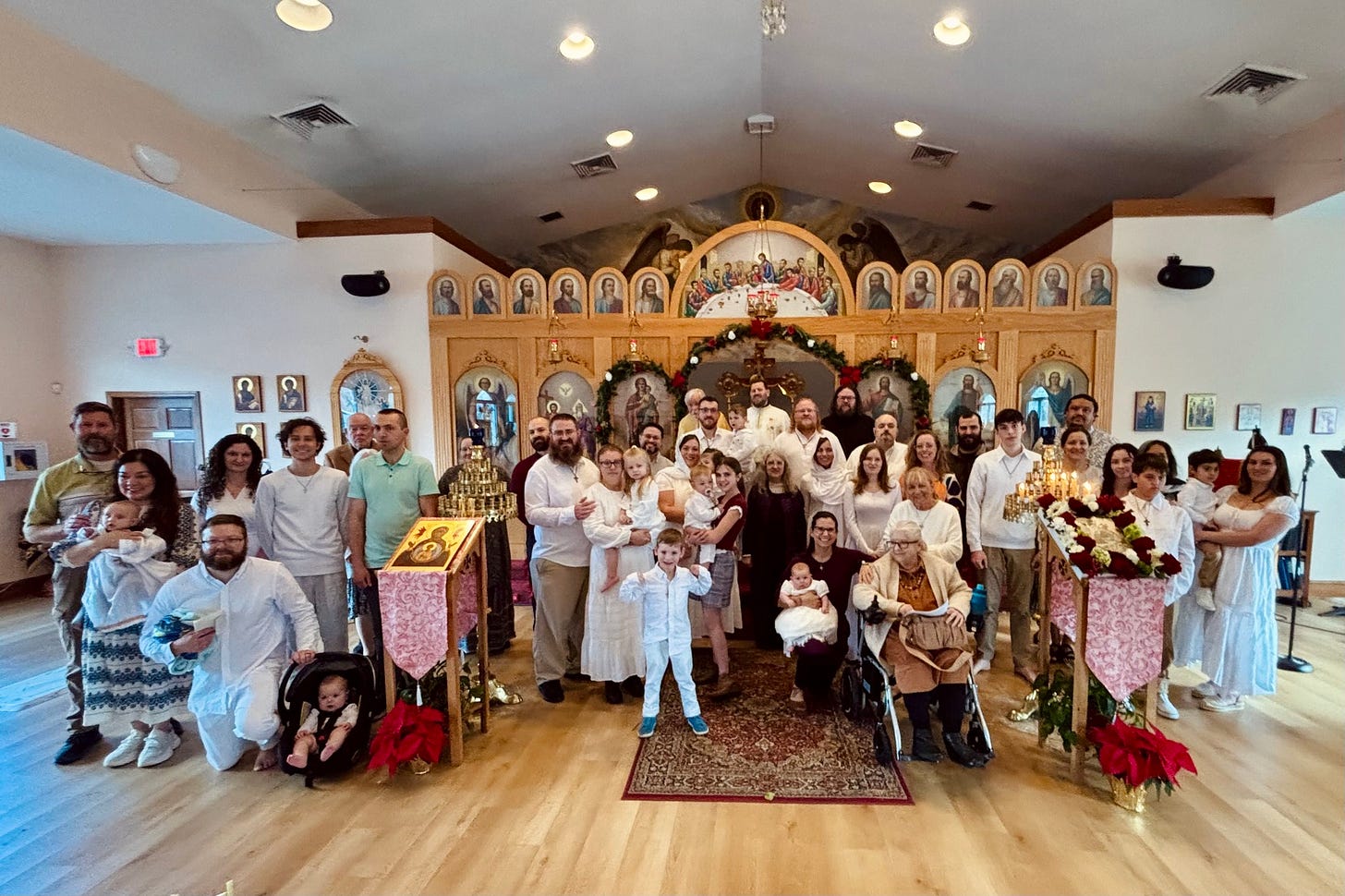
A congregation that is overflowing. On Christmas Eve morning we baptized 25 adults and 2 babies. We borrowed a second adult-size immersion “font” (actually, a Rubbermaid cattle trough) from a neighboring church, and the two priests just kept baptizing side-by-side till they got through them all.
Also, you can see that the majority of the baptized, wearing white, are young. This is going on all over the country. It’s a fine time to be Orthodox, just as a wave is rising. It’s not always been this way in the past, and may not always be this way in days to come; but right now, it’s pretty terrific.
Iona remained a place of pilgrimage, until the Protestant Reformation snuffed out its monastic life. The abbey was dissolved, and its traditions dispersed.
Nothing makes me angrier at the Protestant Reformation than two sentences like this, which recur depressingly in history.
Orthodox Christianity is the branch of the Christian faith that split from Roman Catholicism in the Great Schism of 1054.
Nothing makes me angrier at lazy journalists than a sentence like this, which recurs depressingly in stories about Orthodox Christianity.
The Orthodox side had four patriarchs. The Roman Catholic side had one patriarch, who had increasingly claimed supremacy over the four others. Prima facie, if you know nothing but that, who’s likelier to have been schismatic: the one or the four?
The Journalist even knows better, though he hasn’t bothered connecting the dots:
[Orthodox Christianity] retains the early creeds, sacraments, and saints of Western Christianity; but where the Western faith has diverged, its theology, liturgy, and rhythms of life have remained unchanged.
UPDATE: I left a thought hanging. The second sentence makes me angry because the Protestant Reformation sometimes bore an uncanny resemblance to ISIS, destroying anything “religious” it didn’t understand, including genuine and venerable Christian practices and symbols its bad religion disallowed. See Eamon Duffy, The Stripping of the Altars: Traditional Religion in England, 1400-1580.
Reaching the lost as a journeyman trade
Finney’s Lectures on Revivals of Religion (1835), which is discussed at greater length below in chapter 15, was important for summarizing a new approach toward reaching the lost. Since God had established reliable laws in the natural world and since humans were created with the ability to discern those laws, it was obvious that the spiritual world worked on the same basis. Thus, to activate the proper causes for revivals was to produce the proper effects: “The connection between the right use of means for a revival and a revival is as philosophically [i.e., scientifically] sure as between the right use of means to raise grain and a crop of wheat. I believe, in fact, it is more certain, and there are fewer instances of failure.”
Because the world spiritual was analogous to the world natural, observable cause and effect must work in religion as well as in physics. The wine of revival—confidence in God’s supernatural ability to convert the sinner—may have looked the same in antebellum America as it had in earlier centuries, but the wineskin was of recent manufacture.
This account of Finney’s stunningly presumptuous theory of revival is in a section of Noll’s book titled “Assumptions and Assertions of American Theology.” I strongly suspect that this theory is how we got the foregrounding of manipulative rhetorical technique:
The rising and falling of the preaching voice; the shouting followed by the whisper
dimmed lights
“every head bowed and every eye closed” altar calls,
If manipulating people to an emotional climax, to get insta-saved, is your metric for “revival,” I suppose Finney was right. But I’ve lived too long and seen to much to think that such manipulated response is in any very meaningful sense a conversion to Christian faith. The wiser course is the Orthodox catechumenate.
What St. John Chrysostom knew that Jefferson Davis wanted to forget
Chrysostom’s Homilies posed problems for slaveholders, as elsewhere in this work the bishop instructed Christians to educate their slaves and manumit them as soon as possible.
Paul Gutacker, The Old Faith in a New Nation. I had never heard of St. John Chrysostom until I entered an Orthodox Church for a Sunday observance of his Liturgy. He was perhaps the greatest preacher in Christian history — in the 4th century.
Credit where credit is due: though Gutacker is neither Orthodox nor Roman Catholic, he knows of Chrysostom.
Is Christianity a Religion?
I recall the formulation, uttered many times in my presence (or written many times in sources I read), that “Christianity is not a religion; it’s a relationship.”
As best as I can recall, I thought that was facile, though not entirely worthless, and was formulated in response to a then-current cultural bias that religion was bad (which bias I think I never shared).
But here’s a weightier explanation of why Christianity is not a religion:
Nowhere in the New Testament, in fact, is Christianity presented as a cult or as a religion. Religion is needed where there is a wall of separation between God and man. But Christ who is both God and man has broken down the wall between man and God. He has inaugurated a new life, not a new religion.
Unlike immediately after the Protestant Reformation, almost all Christians today are happy to affirm that Protestants or Catholics or the Orthodox are truly Christians—and are thereby burdened to explain why their differences actually matter. The partial success but overall failure of the modern ecumenical movement has meant that many members of churches, especially Protestant, have become fundamentally post-denominational in their outlook. When churches can acknowledge that other churches from whom they are separated are equally valid as Christian churches, but don’t overcome the actual divisions, the unintended message is that the divisions are evidently not so theologically important after all, and the result is a church culture of consumer choice about where to worship and what to believe. But a faith decision based on preference is no faith decision at all—it permits no authority. The agony of those with faith is to respond to authority in this situation of choice.
Matthew Burdette, Zero Gravity. I struggled with “the unintended message is that the divisions are evidently not so theologically important after all.” It seemed to me that the unintended message is that that divisions are important — almost like we’re just being polite when we acknowledge that other traditions are Christian, too. But he said “that the divisions are … not so … important,” not “that doctrine is not important.” We’re too dismissive of the grave sin of schism seems to be his meaning.
I’m going to forego my temptation to theorize why we’re dismissive of schism.
No, on second thought, I’m going to give the short answer: we’re “making a virtue of necessity.” We can’t stop doing it, and we’re good people, aren’t we? So how can it be all that bad?
Religious ideas have the fate of melodies, which, once set afloat in the world, are taken up by all sorts of instruments, some woefully coarse, feeble, or out of tune, until people are in danger of crying out that the melody itself is detestable.
George Elliot, Janet’s Repentance, via Alan Jacobs
[N]one of the things that I care about most have ever proven susceptible to systematic exposition.
You can read most of my more impromptu stuff here and here (both of them cathartic venting, especially political) and here (the only social medium I frequent, because people there are quirky, pleasant and real and it has no-algorithms). All should work in your RSS aggregator, like Feedly or Reeder, should you want to make a habit of it.
The best thing about New Years Day 2026 is that it means 2025 is over. President Ozymandias really hit the ground running for his second term, having surrounded himself with evil, shrewd, and power-hungry operatives this time instead of Republican normies who muted his bellowing. It’s hard to imagine (knocks on wood) that the worst of the self-aggrandizing vandalism isn’t over now.
Wordplay
Aphorisms
A platitude is a placebo for the mind; an aphorism is a wake-up call. Aphorisms provoke debate; they don’t promote dogma. Though they’re short, aphorisms spur considered reflection, not Pavlovian partisanship. At a time when polarization is so amped up, aphorisms can serve as psychological circuit breakers, interrupting our comfortable assumptions and prodding us to open our minds, unclench our fists, and think for ourselves.
In The Washington Post, Dana Milbank responded to some Republicans’ suggestion that the D.C. Metro be renamed the “Trump Train”: “It’s a great idea. Qatar will donate the subway cars, which will be powered by coal. Passengers will pay for fares with cryptocurrency after first showing proof of citizenship. And the trains will reverse themselves regularly and without warning — never quite reaching their original destination.” (Mary Ellen Maher-Harkins, Orwigsburg, Pa.)
In The Atlantic, David A. Graham processed the addition of “Trump” to “Kennedy” in the moniker for Washington’s premier performing arts center: “He asks not what he can do for his country, but what his country can name for him.” (Darrell Ing, Honolulu)
In Esquire, Dave Holmes acknowledged that Senator Lindsey Graham was maybe joking that Trump should be the next pope — but maybe not: “You can’t be tongue-in-cheek when you are actively licking the boot. There is just not enough tongue for both jobs.” (Susan Fitzgerald, Las Cruces, N.M.)
In The Wall Street Journal, Jason Gay rued the effect of obsessive replays on the determination of what, in pro football, constitutes a catch. “It’s the affliction of overthinking: If it walks like a duck, and talks like a duck, wait, hold on, it must be a chandelier,” he wrote. “It’s further evidence humans can ruin the spirit of anything, if given the time and technology.” (Bill Sclafani, Rockport, Mass.)
\[I\]n The Washington Post, Ron Charles assessed “The Little Book of Bitcoin,” by the supremely self-confident pitchman Anthony Scaramucci: “In one passage, he touts the convenience of transporting $500 million in Bitcoin on a thumb drive, which is the best news I’ve heard since my yacht got a new helipad.” (Stephen S. Power, Maplewood, N.J., and Hannah Reich, Queens, among others)
Charles also observed that the scolds who ban books have taken issue with “Maurice Sendak’s ‘In the Night Kitchen,’ which has been proven in the state of Florida to turn straight white Christian boys into polygender Marxists who eat only quinoa.” (Jill Gaither, St. Louis, and John Jacoby, North Andover, Mass.)
In The Times, Kevin Roose worried that when it comes to regulations, the stately metabolism of institutions is no match for the velocity of A.I.: “It feels, at times, like watching policymakers on horseback, struggling to install seatbelts on a passing Lamborghini.” (Conrad Macina, Landing, N.J.)
In The Times, A.O. Scott sang a similar song: “Occam’s razor, the venerable philosophical principle that the truest explanation is likely to be the simplest, has been thrown away. We’re living in the age of Occam’s chain saw, when the preferred answer is the one that makes the loudest noise and generates the most debris.” (Charles Kelley, Merrimack, N.H., and Trisha Houser, Durham, N.C., among others)
I saved three of Bruni’s best as personal favorites:
Also in The Times, Matt Hongoltz-Hetling considered the importance of an annual communal feast to a Vermont town’s special fellowship: “Whether a vibrant community created the potluck or the potluck created a vibrant community is like asking which came first, the fried chicken or the deviled egg.” (Stacey Somppi, Cottonwood, Ariz., and Hillary Ellner, Durham, N.C., among others)
In The Times, James Hamblin parodied the typical message and script of a television drug ad: “You will frolic on the beach at sunset psoriasis-free, with a golden retriever, smiling into the distance. You also may experience sudden loss of cardiac function, seizures of the arms or intermittent explosive ear discharge. Talk to your doctor.” (Susan Casey, Palm City, Fla.)
In The Dispatch, Kevin D. Williamson gave thanks for academia, despite its flaws: “The American university system is the envy of the world, and we are burning it down because there’s a couple of nonbinary gender studies professors at Bryn Mawr who say crazy stuff from time to time and there is a brain-dead gaggle of Jew-hating weirdos at Columbia. Of course, there is room for reform. But you don’t have to love every feather on the goose when it is laying golden eggs.” (Dan Markovitz, Corte Madera, Calif.)
The first just feels perfect; “explosive ear discharge” in the second was the only thing in the list that made me laugh uncontrollably; Kevin Williamson captures perhaps the single most tragic thing about what “we” are doing, (purely by coincidence, of course, during the second reign of the orange barbarian).
Finally: “Some of you should walk a mile in my shoes, because then you would be a mile away from me. Keep the shoes.” (Encountered by my wife on Pinterest)
My 2025
Reading
As I always note in my footer, I blog and socialize at micro.blog in addition to here. One of my friendlies at MB, an uncommonly sane Evangelicalish pastor in Chicagoland (very keen on racial reconciliation is he), posted his 2025 reading list and inquired about what others read this year.
My response:
At 77, I feel the Grim Reaper breathing down my neck, and I already own more books than I’ll get read before he wins. Further, I’ve read many, many books in my life already, including multiple books on many perennial themes. And although I love poetry, I either had poor teachers or was too barbarian to learn how to read demanding examples.
So I don’t have much toleration for books that are cumulative of what I already understand, or are neither pleasurable nor (so far as I can tell after reading a bit) profitable, including ones that many good people were raving about.
To avoid performative listing, then (e.g., Geoffrey Hill poetry, which defeated me utterly), I’ve eliminated all the books I abandoned part way in. Finally, listing a volume of poetry doesn’t mean I’ve read it all yet.
Book
Author
Rings Trilogy
Tolkien
Albion’s Seed
David Hackett Fischer
The World After Liberalism
Matthew Rose
Coracle
Kenneth Steven
Table for Two
Amor Towles
Till We Have Faces
C.S. Lewis
Godric
Beuckner
Stalingrad
Anthony Beever
Small Is Beautiful
Schumacher
Rilke Poetry
Rilke
Apocrypha
Stephen De Young
The Greek East and the Latin West: A Study in the Christian Tradition
Philip Sherrard
A Time of Gifts
Patrick Leigh Fermor
The New Science of the Enchanted Universe
Marshall Sahlins
Bread & Water, Wine & Oil
Fr. Meletios Webber
Lost in the Cosmos
Walker Percy
Giovanni’s Room
James Baldwin
The Long Loneliness
Dorothy Day
The innocence of Father Brown
G.K. Chesterton
Against the Machine
Paul Kingsnorth
You Have Arrived at Your Destination
Amor Towles
The Air We Breathe: How We All Came to Believe in Freedom, Kindness, Progress, and Equality
Extra pills are piling up across America. Excessive refills by U.S. pharmacies cost Medicare and patients $3 billion between 2021 and 2023, according to a WSJ analysis of Medicare prescription data.
WSJ. Based on my own rigorous anecdata, this is 1000% true. Which means that although mail-order pharmacies may have started it, brick-and-mortar local pharmacies are in the game now, too.
I really would rather not manually refill every prescription, but my pharmacy seems incapable of waiting 90 days to refill a 90-day prescription, and when I get a text that a prescription is ready for pick-up, I go pick it up (with rare exceptions, like a post-op opioid painkiller I definitely did not need).
Sam Altman, OpenAI’s chief executive, said in a recent podcast he can see ways that seeking companionship from an AI chatbot could go wrong, but that the company plans to give adults leeway to decide for themselves.
Nothing in her political career before September inclined me to cut Marjorie Taylor Green any slack whatever, but something has happened since then.
Her political conversion story, if you can call it that (it’s not about changing from MAGA to progressive or any other political position), rings true.
It started at the Charlie Kirk Memorial service:
What stayed with Greene long afterward were the last two speakers who took the stage. First there was Kirk’s widow, Erika, who stood in white before the crowd filling the Arizona stadium, lifted her tear-filled eyes and said that she forgave her husband’s killer. And then there was President Trump. “He was a missionary with a noble spirit and a great, great purpose,” he said of Kirk. “He did not hate his opponents. He wanted the best for them. That’s where I disagreed with Charlie. I hate my opponent, and I don’t want the best for them.”
“That was absolutely the worst statement,” Greene wrote to me in a text message months after the memorial service. And the contrast between Erika Kirk and the president was clarifying, she added. “It just shows where his heart is. And that’s the difference, with her having a sincere Christian faith, and proves that he does not have any faith.”
I thought at the time that should have been a wake-up call for every “Christian” Trump supporter in America. I still do. It speaks ominous things about our religious and political culture that it seems to have awoken so few.
But Marjorie Taylor Green, of all people, recognized it! And it appears that she has genuinely repented of her role in stoking hatred and division!
Time will tell; she’s been taking the potent MAGA pill for a long time, and withdrawal may prove too hard. But it’s looking good so far.
I wish her what I wished for Jimmy Carter on January 20, 1981: a long and happy and private life — plus a sustained repentance.
Paganism with worship music
We seem to be entering a pagan century. It’s not only Trump. It’s the whole phalanx of authoritarians, all those greatness-obsessed macho men like Vladimir Putin and Xi Jinping. It’s the tech bros. It’s Christian nationalism, which is paganism with worship music. (If you ever doubt the seductive power of paganism, remember it has conquered many of the churches that were explicitly founded to reject it.)
“If you dislike the religious right, wait till you meet the post-religious right,” Ross Douthat warned presciently at the dawn of Trumpism in 2016. … What Douthat calls the “post-religious right” certainly is more obnoxious and morally degenerate than its Bush-era forebear was, but it’s not correct to call a movement that’s developed its own alternate morality “post-religious.” It’s not even correct to call it “post-Christian,”…
The modern right is boisterously Christian, but without Christ. It extols Christianity aggressively but has ditched most of the moral content …
…
The purest expression of Christianity without Christ came from Trump himself, not coincidentally. At Charlie Kirk’s memorial service, shortly after Kirk’s widow, Erika, moved viewers by publicly forgiving her husband’s killer, the president strode to the mic and said, “That’s where I disagreed with Charlie. I hate my opponents, and I don’t want the best for them. I’m sorry.” That’s the literal antithesis of Christian morality …
But there were no mass defections by Christians from the president’s camp after his heresy. Erika Kirk herself remains a loyal Trump ally in good standing. And why not? Hating one’s enemies is squarely in line with the three purposes of post-Christ right-wing Christianity. The first is establishing the right’s cultural hegemony over other American factions; the second is narrowing the parameters of the right-wing tribe to exclude undesirables; and the third is deemphasizing morality as a brake on ruthlessness toward one’s opponents.
Almost everything written about the “alternative right” has been wrong in one respect. The alt-right is not stupid; it is deep. Its ideas are not ridiculous; they are serious. To appreciate this fact, one needs to inquire beyond its presence on social media, where its obnoxious use of insult, obscenity, and racism has earned it a reputation for moral idiocy.
Matthew Rose, A World After Liberalism
At the outset of debate
If we are willing to grant, at the outset, that the people we’re debating agree about ends—that they want a healthy and prosperous society in which all people can flourish—then we can converse with them, we can see ourselves as genuine members of a community. And even if at the end of the day we have to conclude that we all do not want the same goods (which can, alas, happen), it is better that we learn it at the end of the day than decide it before sunrise.
Would we necessarily say that government, civic life, the media, or high finance work better now than in the mid-20th century? We can scorn the smug WASP blue bloods from Groton and Choate—and certainly their era’s retrograde views of race and gender—but their leadership helped produce the Progressive movement, the New Deal, victory in World War II, the Marshall Plan, NATO, and the postwar Pax Americana. After the meritocrats took over in the 1960s, we got quagmires in Vietnam and Afghanistan, needless carnage in Iraq, the 2008 financial crisis, the toxic rise of social media, and our current age of political dysfunction.
We are also offended by the contumely of allies as well as foes, who refuse to regard our prosperity as fruit and proof of our virtue but suggest that it may be the consequence of our vulgar Philistinism.
Reinhold Niehbur, The Irony of American History
Read the fine print
On the surface, it would seem that the assurances given in the Declaration of the Rights of the Peoples of Russia were clear and unequivocal. But lurking in the shadowy annals of communist polemics there was a catch. To paraphrase, but not distort, Lenin’s position, nations have the right to self-determination, but only the proletariat has the right to decide. And, as if that were not enough, only the Communist Party can speak for the proletariat.
Jack Matlock, Autopsy on an Empire
Raising the bar for Tinhorn Dictators
Ramsey’s intolerance for dissent has created what former employees call a cultlike environment, where leaders proclaim their love for staff and then fire people at a moment’s notice.
A new crop of moderate Democrats is trying to counter both President Trump and progressive influence in their own party. (WSJ) May their tribe increase.
And so we have before us one of the characteristic political necessities of our time: to take seriously what we cannot respect. (Wendell Berry, The Unsettling of America)
Conservative and mainstream media were drifting apart, not just ideologically but epistemically… (Jonathan Rauch, The Constitution of Knowledge) This epistemic drift (of the Right, I think, not the mainstream) tempts me to despair.
“The only thing we have to fear is fear itself,” … was a damned funny thing for Franklin Roosevelt to say in 1933, the year Adolf Hitler came to power. (Kevin D. Williamson)
The face of my fear is not a new Hitler but the Old Adam. It is the face in the mirror. (Kevin D. Williamson)
One category I used to apply to some of my posts became obsolete almost overnight around 1/20/2017: Zombie Reaganism. You never see that any more, and I miss it more than I thought I would.
I don’t do any of the major social media, but I have two sub-domains of the domain you’re currently reading: (a) You can read most of my reflexive stuff, especially political here. (b) I also post some things on my favorite no-algorithm social medium.
… in the Christian East, that is. The West commemorated him yesterday.
A profitable political pairing
Two Right-coded voices, Glenn Loury and Ilya Somin, take up recent events, emblemized by Tucker Carlson’s softball interview of Nick Fuentes, and reach similar conclusions: a fundamental rift in the Right is between universalists and particularists/nationalists.
For figures such as Robert P. George, McCormick Professor of Jurisprudence at Princeton University and perhaps the single most influential moral philosopher within conservative intellectual circles, conservatism begins with the claims of natural law. Its founding premise is the inherent dignity of every human being—an anthropology that descends from classical philosophy, Christian theology, and the Enlightenment. For George, conservatism is first a moral project: It safeguards life, liberty, marriage, family, and religious freedom because these institutions reflect universal truths about the human person. George has spent his career articulating these principles in philosophy, public policy, and constitutional thought. His is an approach to conservatism that emphasizes the primacy of the permanent things, the universals that transcend time and place.
Opposing this universalist strand is the ascendant nationalist wing of the right—a coalition influenced by the populist energies that surged after 2016 and represented by Tucker Carlson, Kevin Roberts of the Heritage Foundation, and polemicists such as John Zmirak. This faction sees conservatism less as an expression of moral philosophy than as a defense of Western civilization: a concrete culture, a historical inheritance, with its own people, faith, memories, and vulnerabilities. This conservatism is particularist rather than universalist. It begins not with abstract principles but with cultural loyalties. Whereas George begins with human dignity, Carlson begins with civilizational survival. Whereas George sees imperatives and violations of the moral law, Carlson sees a beleaguered West beset by global elites, porous borders, and cultural disintegration.
[T]he root of the problem is the Trump-era shift of most of the American right towards ethno-nationalism. For reasons outlined in detail in my recent UnPopulist essay on this topic, nationalist movements are inherently prone to anti-Semitism and other forms of racial and ethnic bigotry. It is not surprising that anti-Semitism among MAGA conservatives has risen alongside nativism and bigotry towards other minority groups, such as Indian-Americans.
As I explained in the UnPopulist article, the only sure way to avoid this problem is to reject ethnic nationalism and instead recommit to the universalist principles of the American Founding, which the Heritage Foundation once claimed to stand for, but has more recently betrayed ….
As I skimmed Lourie’s article (which I’m pleased to see in First Things, which under R.R. Reno has been leaning increasingly toward particularist nationalism), I felt a flush of shame (or was it the shiver of a near-miss?) as I looked back on my admiration of “paleoconservative” thinkers and commentators — guys who now appear to be the ancestors of today’s ethno-nationalist types.
Even now, I sense the fortress America appeal of the nationalist appeal. But when I watch ICE trying to evict putative undesirables from the fortress before we pull up the drawbridge, and see antisemitism rising among the nationalists as well, I can’t help coming down on the side of human dignity: Fiat justitia ruat caelum.
Slouching Toward Something Worse
[Ben] Shapiro originally hired [Candace] Owens at The Daily Wire, thereby helping to launch her career into the stratosphere. The fact that he now feels the need to try and drive a stake through her heart “contains the entire story of the conservative movement within it,” in the words of Substacker John Ganz.
…
[Rod] Dreher longs for Vance to take a firm stand against Fuentes and his followers. But will he?
So far, there’s no sign of it. And yes, that includes in the recent UnHerd interview, where Vance told Fuentes (in the debased public rhetoric favored by populists) to “eat shit.” The vice president made clear that his rightward volley was provoked, not by any of Fuentes’ political views, but by him insulting Vance’s (South Asian) wife. “Anyone who attacks my wife,” Vance declared, will be attacked in turn, “whether their name is Jen Psaki or Nick Fuentes.”
That’s right: the sitting vice president of the United States made clear he was equally inclined to rise up in defensive anger against a former White House Press Secretary from the mainstream opposition party and a man who regularly proclaims his admiration for Adolf Hitler and loathing for Jews.
I’m afraid anyone placing their hopes in Vance serving in the role of gatekeeper or force for moderation is going to be sorely disappointed.
…
It’s not clear a right-populist political movement needs policy intellectuals at all. After all, intellectuals are elites who think they sometimes know better than the elected Leader of the People. That is unacceptable. What a right-populist political movement needs, instead, is propagandists to justify what the Leader already intends to do.
In case you’ve forgotten, do not trust any high-generality assessment of JD Vance by Rod Dreher. Dreher “discovered” Vance’s book, Hillbilly Elegy, and his discovery elevated mediocre sales to stratospheric sales. He and Vance are now friends, Rod feels a personal investment in him, and Vance probably feels a debt of gratitude to Rod for launching his explosive political rise.
So Dreher is just not capable of objectivity about his friend, and that’s probably to his credit; dissecting friends is kinda reptilian — and certainly is a deviation from the conservative tendency on Jonathan Haidt’s Loyalty/betrayal moral foundations axis.
Too ad hoc to be fascist
Take the word fascism, properly applied to Franco’s Spain or Mussolini’s Italy, and to some extent beyond. The fasces were the bundles of rods carried by Roman lictors: symbols of punishment and magisterial authority, but in modern times also of a tightly unified society controlled from above, and organized in corporate form. The desire of totalitarians everywhere is to achieve harmonization, with all of society marching in military cadence under the guidance of an omnipresent government.
But the Trump administration is more interested in blowing up the state than in extending its power.
…
He is, to be sure, cruel and malicious, but unlike the others, has no real governing vision.
…
Trump himself is not Mussolini, or Hitler, or Orbán ….
Eliot A. Cohen, America Needs a Mirror, Not a Window
French Integrity
The headline read, “What It’s Like to Experience the 2016 Election as Both a Conservative and a Sex Abuse Survivor.”
Nancy French, Ghosted. As the book blurb has it, “when she was unwilling to endorse an unsuitable president, her allies turned on her and she found herself spiritually adrift, politically confused, and occupationally unemployable.”
Part of the reason for David French and Nancy French becoming personae non grata in much of the North American white Evangelical world was candor, like in the cited article Nancy wrote, and their various relatively unflinching looks at topics like sexual abuse at a very popular Evangelical summer camp for kids. I learned recently that they fairly quietly have moved out of their deep red part of Tennessee to the Chicago area (I was aware that Tennessee Evangelicalism exhibited pretty unrelenting and vocal antipaty to Frenches). That move won’t do much for Nancy’s work as a ghost-writer in Evangelical and Conservative circles, but they should at least be able to find a Church whose Christianity matches theirs (Reformed-tinged Evangelical) without the political tribalism. (That’s my read on it.)
The differences between their Evangelical/Reformed piety and my Orthodoxy manifests in my ill-ease with some of their takes on things (I will never again trust a David French endorsement of a movie or television series, for instance), but I’ll give them high marks for trying to act with integrity (which endears them to me despite reservations).
Quantum physics
Quantum entanglement blows my mind. How do they even find the entangled needles in the cosmic haystack to study entanglement?
That they manage to find and study them makes me sympathetic to the predictions that we’re going to figure out everything — predictions I nonetheless think are ultimately delusional.
Trying to deal with things like this has sent me back to Iain McGilchrist for a second round of mind-bending, this time via The Matter with Things.
The mixture of politics and religion in this theory makes my head hurt, and my eyes avert, but I suspect that Mattingly knows more about Kirk, and about the consequences of his assassination, than I do.
Jingoists and Patriots
The worst jingoes do not love England, but a theory of England. If we love England for being an empire, we may overrate the success with which we rule the Hindoos. But if we love it only for being a nation, we can face all events: for it would be a nation even if the Hindoos ruled us.
To prepare young Oklahomans for the demands of a high-tech future, the state’s board of education mandated instruction about “discrepancies” in the 2020 presidential election. (Via George Will)
Your enemies are not demonic, and they are not all-powerful and the right hasn’t always lost and the left hasn’t always won. But if you convince yourself of that, you give yourselves all sorts of permission to do a lot of stupid and terrible things under the rubric of “Do you know what time it is?”
[A] critical mass of the American people … no longer want[s] to govern themselves, … are sick of this republic and no longer want to keep it if it means sharing power with those they despise.
I don’t do any of the major social media, but I have two sub-domains of the domain you’re currently reading: (a) You can read most of my reflexive stuff, especially political here. (b) I also post some things on my favorite no-algorithm social medium.
In recent years, I’ve read a lot of American religious history, and I’ve shared snippets of those histories constantly. This year brought a particular question into focus:
A theological Rip Van Winkle falling asleep in the early 1740s and waking up half a century later would have found Americans speaking his language with such a decidedly strange inflection as to constitute a new dialect; yet those Americans would have been hard-pressed to tell him why and how their speech had grown so different from his own.
…
The striking contrast was that amid America’s post-Revolutionary tide of antiformalism, antitraditionalism, democratization, and decentralization, trust in the Bible did not weaken but became immeasurably stronger. It was still “the Bible alone,” as proclaimed during the Reformation, that American Protestants trusted. But it was also “the Bible alone” of all historic religious authorities that survived the antitraditional tide and then undergirded the remarkable evangelical expansion of the early nineteenth century. … Deference to inherited authority of bishops and presbyters was largely gone, obeisance to received creeds was largely gone, willingness to heed the example of the past was largely gone. What remained was the power of intuitive reason, the authority of written documents that the people approved for themselves, and the Bible alone.
By the 1840s one analyst of American Protestantism concluded, after surveying fifty-three American sects, that the principle “No creed but the Bible” was the distinctive feature of American religion. John W. Nevin surmised that this emphasis grew out of a popular demand for “private judgment” and was “tacitly if not openly conditioned always by the assumption that every man is authorized and bound to get at this authority in a direct way for himself, through the medium simply of his own single mind.” Many felt the exhilarating hope that democracy had opened an immediate access to biblical truth for all persons of good will. Americans found it difficult to realize, however, that a commitment to private judgment could drive people apart, even as it raised beyond measure their hopes for unity.
I highly, highly recommend both Noll and Hatch if American religious history is of interest to you. Their two tomes are among my most heavily-highlighted (along with Brad Gregory’s The Unintended Reformation, which sort of sets the stage for America’s religious tragedy). But I never synthesized them explicitly.
One of the big ideas that captured my imagination this year, and that seemed at least a start on my overdue synthesis, is that Evangelicalism is not unequivocally Protestant. It took Brad East to water and fertilize Noll’s and Hatch’s seeds:
As I use it, “evangelical” names non-Catholic Christians who are “low church.” By this I mean that evangelicals are:
1) biblicist, meaning the Bible isn’t just chief among many authorities, including church tradition, but the one and only authority;
2) autonomous, meaning their organizational leadership structures are either local or, if trans-local, then voluntary and quite loose;
3) egalitarian, meaning they either do not ordain pastors or, if they do, then the qualifications for and prerogatives of the ministry are modest;
4) entrepreneurial, meaning churches are often analogous to start-up business ventures, founded and led by charismatic individuals who cast a vision for the community;
5) evangelistic, meaning proselytization is high on the agenda, using money, grassroots training, and parachurch ministries to support foreign missions and local efforts at gaining new converts;
6) affective, meaning their piety is focused on the heart, which is more likely to find expression in music, song, and spontaneous spiritual gifts than in robes, rituals, and sacraments.
a third species in the genus of Western Christianity. Neither Catholic nor Protestant, it has taken more than two centuries to come into clear view. It goes by many names, but the best is also the most hotly contested: evangelical.
But that third species has changed:
[A]s I have documented almost obsessively, biblicist churches are moving in a post-biblicist direction while younger generations have utterly lost even the rudiments of biblical literacy, along with literal literacy. (Translation: They don’t read, period.)
Beyond such literacy—beyond intensive, universal lay Bible study (should we call it IULBS?)—there is nothing left; at least, not if you remain, on the surface or even beneath the skin, biblicist-primitivist-congregationalist in polity, doctrine, and practice. The rug has been pulled out beneath your feet, the branch you were sitting on has been sawed off, the pillars have all been thrown down: there is nothing left.
Besides, that is, the Zeitgeist. But discerning the spirits is no longer possible when the word of the Lord in Holy Scripture is no longer known, cherished, prized, read. Where else is there to turn? Either to tradition or to the culture. I see no third option.
I don’t do any of the major social media, but I have two sub-domains of the domain you’re currently reading: (a) You can read most of my reflexive stuff, especially political here. (b) I also post some things on my favorite no-algorithm social medium.
The religious/secular distinction is not a neutral set of descriptive categories, and the idea that religion has a greater tendency than the secular to promote violence is not a commonsense observation about the world. Both are ideological constructs that privilege certain Western secularist arrangements.
William T. Cavanaugh, The Uses of Idoloatry
Don’t try to titrate poison
This French reactionary antisemitism came to a head in 1940, when the Nazis invaded, France surrendered, and Philippe Pétain became the dictator. Right-wing reactionaries, (including the vast majority of French bishops) were all too happy for the regime to enact laws that limited the civil rights of Jews. Many of those same bishops would later regret this when the cruelty of the anti-Jewish legislation became too blatant to ignore. In the end, around 70,000 Jews who had been under the jurisdiction of Vichy France would perish in concentration camps.
I sometimes worry that populist rabble-rousers, with the roused rabble SWATting and making death threats against recalcitrant authorities, were the inevitable result of the “conservative” politics I long favored.
I don’t think that’s true, but once stung, twice cautious: these days, when I see an opinion piece that seems to make sense, but with comment boxes full of cheering conspiracy theorists and antisemites, I reflexively drop (or at least loosen my grip on) the opinion.
If you’re looking for rigorous logic in that, you’ll not find it. It’s just one geezer’s heuristic.
Primarying faithful legislators
The first time I recall hearing of Charlie Kirk was in connection with “The Falkirk Center,” the name being a portmanteau of “Falwell” and “Kirk.” Yeah, that Falwell. The Junior one. The sleazy one driven out of Liberty University eventually.
So I had a bias against Kirk from the start. No, he didn’t deserve to be murdered. Nowhere near. But 3+ months is long enough. I’m not going to bite my tongue any longer about the him and his Turning-Point-this-and-Turning-Point-that constellation of Christianish MAGA adjuncts.
He wasn’t my cup of tea. His Christianity was substantially alien to any traditional Christianity. I object to him being lionized as a Christian martyr and to the erection of a sort of cult around him. The more I learn about Turning Point shamelesslessly subordinating its version of Christianity to the will of über-pagan narcissist Donald Trump, the more it nauseates me.
All that to introduce much less:
[A]s early as August 18, Charlie Kirk said in an X post: “We will support primary opponents for Republicans in the Indiana State Legislature who refuse to support the team and redraw the maps.” Months later, on the eve of the vote, Trump ratcheted up the warnings to Indiana Republicans, saying as part of a lengthy post on Truth Social: “Indiana Senate ‘Leader’ Rod Bray enjoys being the only person in the United States of America who is against Republicans picking up extra seats. … He’s either a bad guy, or a very stupid one!”
The way primary elections tend to turn out the most extreme members of the party base, it’s possible that primarying Indiana Legislators who voted for the will expressed by the people of Indiana, rather than for the imperious wills of Donald Trump and Turning Point Action, will succeed. But I think not. I think the spell is broken. I’m looking forward to three years of quacking.(Yeah, that’s got a bit of wishcasting in it.)
Turning Point just concluded its conference
I suppose if Turning Point USA wanted its conference to make a big splash, it accomplished its mission. But a movement led by a president who made regular appearances in the world of professional wrestling now has rallies that resemble WrestleMania with podcasters, complete with boasts and threats and chest-thumping.
When you book a bunch of clowns, don’t be surprised if you end up with a circus.
Wherein I register a rare disagreement with Kevin D. Williamson
A person who evacuates is emptying his bowels. A person removed from a place of danger is a person being evacuated. If you have 100,000 people evacuating all at once … well, maybe they won’t notice it too much in Seattle.
Those 100,000 were not ordered to evacuate; they were ordered to leave, to seek safety, to head for the hills, to make forhigher ground, etc.
I love Williamson, but he’s lost me on this one. From the Department of Usage Makes Proper, evacuate has become broader than he insists. Even I, a card-carrying curmudgeon, would not use “evacuate” as he does; I’d add “evacuates his bowel” if that’s what I meant.
I completely agree with Williamson on something else, though. After alluding to things like “messaging” in the upcoming election, he simplifies things:
I would like to suggest a relatively simple approach: Democrats should run on a platform of what it is they actually intend to do in office, and that platform should be what they believe to be the right thing. I would offer the same advice to Republicans if they had not made it so perfectly clear that they cannot and will not do any such thing, that their party and their movement is incapable of candor and good faith.
Thoughts at 3 am
That’s a metaphor. I rarely if ever fret about things at 3 am, and it I fret, it’s likelier to be about family or things closer to me than politics.
My current “political” concerns, though, seem to be antisemitism and the quest for certainty — even false certainty preferred to uncertainty.
According to the Manhattan Institute’s recent survey of registered Republicans and others who voted for Donald Trump last fall, no less than 25 percent of those under 50 admit—admit—to expressing antisemitic views. Among those over 50, just 4 percent do.
The Nazis gave antisemitism a bad name. The memory of that is fading.
[Bari] Weiss has an impossible dilemma [in running CBS]. She’s in charge of a first-world news organization that aims to hold government accountable (especially when it’s run by Republicans) but was appointed to the position to satisfy a third-world regime led by a demagogic boor who believes “news” should look like … this.
…
“The Failing New York Times, and their lies and purposeful misrepresentations, is a serious threat to the National Security of our Nation,” the president declared this morning. “Their Radical Left, Unhinged Behavior, writing FAKE Articles and Opinions in a never ending way, must be dealt with and stopped. THEY ARE A TRUE ENEMY OF THE PEOPLE!” He didn’t specify the supposed “national security” threat that prompted that, but earlier this month he accused the Times of “seditious, perhaps even treasonous” behavior for reporting on his obviously declining health.
That’s the kind of media Trump wants. Not one where Stephen Miller does more interviews but one where you go to prison if you acknowledge the plainly observable fact that the president sounds addled.
This particularly cursed holiday week kicked off in earnest last night when my father turned his iPad in my direction. On its screen was a terribly disturbing post on X containing two images. In the first, Jeffrey Epstein was hugging and kissing a little girl. In the second, that girl was bound and gagged on a bed.
Dad was rightly outraged and disgusted. He asked me if I’d seen the photos in my time going through the Epstein files. I immediately recognized the first image of Epstein and deduced that it had been Photoshopped from a widely distributed photo of Epstein hugging Ghislaine Maxwell. The second image seemed to be an AI rendering. (To add to the confusion, images reportedly do exist of Epstein cuddling children.) I let him know that the imagery was fake, and a distinctly non-yuletidy conversation ensued. Yes, Epstein was a heinous pedophile and convicted sex offender. Also, the internet is awash in fake, traumatizing slop that’s being used to score points in an ongoing information war. Happy holidays!
Every journalist who is not too stupid or too full of himself to notice what is going on knows that what he does is morally indefensible. He is a kind of confidence man, preying on people’s vanity, ignorance, or loneliness, gaining their trust and betraying them without remorse.
Janet Malcolm, The Journalist and the Murderer, Via Peggy Noonan
Shorts
In such an ugly time, the true protest is beauty. (Phil Ochs)
He is like a strange general who can’t quietly establish camp or dig new fortifications. He shoots his cannon for no reason, just for the sound. (Peggy Noonan describing you-know-who)
He just can’t do intimacy. He can’t do reassurance. His fireside manner has always been gasoline. (Andrew Sullivan)
Prediction markets may promise clarity, but what they really offer is another way to feel excitement in a world that feels rigged. (Charlie Warzel)
Having elevated her in large part for her willingness to say outrageous things about her opponents, people on the right are now surprised by her willingness to say outrageous things about them. (Michelle Goldberg about the rise of toxic influencer Candace Owens)
In The Times, Glenn Thrush and Alan Feuer … mused about Trump’s troubles prosecuting his perceived enemies: “Revenge, it turns out, is a dish best served with evidence.” (Via Frank Bruni)
In her newsletter, Stacey Patton recognized the humiliation of the Trump administration’s repeated failures to convince a grand jury of its case against Letitia James: “In federal court, a prosecutor not getting an indictment is like a chef burning cereal.” (Via Frank Bruni)
A fundamentalist can see every person who’s wrong as a kind of Patient Zero in a potential pandemic of paganism. (David French)
AI Sends School Into Lockdown After It Mistook a Student’s Clarinet for a Gun. (Futurism – H/T TMD)
We take the state’s monopoly of violence for granted, but when that monopoly is challenged, people turn to gangsters to keep the peace. Eli Lake, A History of Tough Jews (podcast episode)
Why these people are coming our way is that Heritage and some other voices and commentators have embraced big-government populism and have been willing to tolerate antisemitism. (Former Vice President Mike Pence on the (ahem!) evacuation of the Heritage Foundation, with refugees fleeing to a Pence-founded, more traditionally conservative, alternative.)
Your enemies are not demonic, and they are not all-powerful and the right hasn’t always lost and the left hasn’t always won. But if you convince yourself of that, you give yourselves all sorts of permission to do a lot of stupid and terrible things under the rubric of “Do you know what time it is?”
[A] critical mass of the American people … no longer want[s] to govern themselves, … are sick of this republic and no longer want to keep it if it means sharing power with those they despise.
I don’t do any of the major social media, but I have two sub-domains of the domain you’re currently reading: (a) You can read most of my reflexive stuff, especially political here. (b) I also post some things on my favorite no-algorithm social medium.
I had a mid-week post that dealt with a detour in my religious history. Other than that, I have just one tidbit today:
In our desire to be real we start thinking that authenticity is another word for spontaneity, as if everything we say at the spur of the moment is more true, more sincere than words we craft carefully. For many, the Freudian slip is considered more authentic than the measured reply. Indeed, sometimes what we blurt out thoughtlessly is actually what we mean and feel. But more often than not, what we blurt out is ill-considered and something we either need to qualify or apologize for.
I have not read this book, but I stumbled across this quotation anyway.
Religious ideas have the fate of melodies, which, once set afloat in the world, are taken up by all sorts of instruments, some woefully coarse, feeble, or out of tune, until people are in danger of crying out that the melody itself is detestable.
George Elliot, Janet’s Repentance, via Alan Jacobs
[N]one of the things that I care about most have ever proven susceptible to systematic exposition.
You can read most of my more impromptu stuff here and here (both of them cathartic venting, especially political) and here (the only social medium I frequent, because people there are quirky, pleasant and real and it has no-algorithms). All should work in your RSS aggregator, like Feedly or Reeder, should you want to make a habit of it.
Of the Bondi Beach terrorist shootings by Muslim men Sajid Akram and Naveed Akram (unconfirmed by police at this writing) and the heroic intervention of one Ahmed al-Ahmed:
Let it be said, and said with firmness and gratitude, that a Muslim fruit seller named Ahmed al-Ahmed rushed one of the gunmen and disarmed him, saving Jewish lives and taking a couple of bullets himself for his trouble. May God bless that brave man. Here is video of him courageously tackling the gunman. This brings to mind something I was told back in 2002 by a Jewish friend who worked in counterterrorism. Be careful not to accuse every Muslim, she said. Some of our best sources are Muslims within Muslim communities who hate what they’re seeing, but know that if they speak out publicly against it, they will be killed. So they come to us quietly.
I wish we could figure out what makes many Muslims exemplary citizens, others murderous fanatics. Though I reject Islam as a false religion, I don’t want to think it’s simply that the former don’t take it seriously.
I have a theory, but it’s at a high enough level of generality that it’s not much use, I fear: that Islam, like Evangelicalism, has no authority beyond a sacred text, so Imams/Preachers can twist the text as they wish, limited only by what their congregants will tolerate.
The Other Terrorists
“Right-wing attacks and plots account for the majority of all terrorist incidents in the United States since 1994, and the total number of right-wing attacks and plots has grown significantly during the past six years,” the Center for Strategic & International Studies concluded after examining terror plots in the United States from 1994 to May of this year. “Right-wing extremists perpetrated two-thirds of the attacks and plots in the United States in 2019 and over 90 percent between January 1 and May 8, 2020.”
A woman in a service industry, an immigrant to America from Eastern Europe who’s been here about 20 years, took me aside recently. Her eldest child, a senior in high school, is looking around at local colleges. She was worried about AI and asked for advice on what her son might study so that in four years he could get a job. We asked ChatGPT, which advised “embodied in-person work” such as heating and air conditioning technician, pool cleaner. She wasn’t happy with that. She’d worked herself to the bone to get her son higher in the world than she is. She wants him to own the pool.
Political memoirs tend to fall into recognizable categories.
There is the sanitized precampaign memoir, gauzy life stories mixed with vague policy projects and odes to American goodness. There is the postcampaign memoir, usually by the losers, assessing the strategy and sifting through the wreckage. There are memoirs by up and comers who dream of joining the arena and by aging politicos rewriting their careers once more before the obits start to land. There are memoirs by former staff members who realize that proximity to power gives them a good story and memoirs by journalists who chronicle power so closely that they imagine themselves its protagonists.
But a recent spate of books highlights the presence of a new category, one well suited to our time: the grievance memoir. In their books, Eric Trump (“Under Siege”), Karine Jean-Pierre (“Independent”) and Olivia Nuzzi (“American Canto”) are all outraged by affronts real and imagined, fixated on nefarious, often unspecified enemies, obsessed with “the narrative” over the facts and oblivious to their complicity in the conditions they decry.
The authors (a third child embracing on to his father’s legal and political grudges, a former White House press secretary groping for a new brand, a boutique political journalist enmeshed in a self-made scandal) are animated, above all, by a certainty that they’ve been wronged not just by people or institutions but also by broader forces. They are ancillary characters inflating themselves into victims, heroes, even symbols. It is the inevitable memoir style for a moment when everyone feels resentful, oppressed, overlooked — in a word, aggrieved.
Carlos Lozado (who’s famous among his New York Times colleagues as a voracious book-reader).
Add to Lozado’s list a longish article by Jacob Savage in Compact magazine, which Rod Dreher found “one of the most powerful essays I’ve read all year.” Its gist seems to be that straight, white, young men can’t catch a break any more – for reasons predating AI.
I’m fortunate to be chronologically beyond gathering personal straight white male grievance anecdotes (and that my grandson is thrilled at, not resigned to, the prospect of a sort of Shop Class As Soulcraft career).
Are we the baddies?
Remizov and other conservative democrats complain that modern Western liberalism is in fact anti-democratic, as it tramples on national traditions and subordinates national authorities to international ones and to the impersonal forces of globalization.
Paul Robinson, Russian Conservatism. This book is pretty good at giving the gift to see ourselves as others see us.
When your only tool is anger, every little problem looks infuriating
Trump has never shined in moments that call for dignity and restraint … This is what makes Trump’s post about the Reiners not just despicable and cruel but also bad for the country. In moments of national mourning or trauma, a president can seek to bring people together … But not Trump. He finds the most divisive way to insert himself … His choices … take moments that could be unifying—surely Americans of all political views can agree on the greatness of When Harry Met Sally and The Princess Bride—and turn them into opportunities for anger.
If “TDS” is the tendency to become irrationally obsessed with Donald Trump and project that obsession onto everyone else, then somebody is indeed deranged, and it wasn’t Rob Reiner. (David Graham, Trump Blames Rob Reiner for His Own Murder.
A tool always implies at least one small story[:] There is a situation; something needs doing. (L.M. Sacasas)
Anyone claiming to know the future is just trying to own it. (L.M. Sacasas)
After this awful weekend, Trump has once again lowered the bar for what we can expect from the president. (The Free Press, Mr. President, Don’t Mock the Dead)
The odds are good, but the goods are odd. (Advice given to incoming women at Georgia Tech).
Your enemies are not demonic, and they are not all-powerful and the right hasn’t always lost and the left hasn’t always won. But if you convince yourself of that, you give yourselves all sorts of permission to do a lot of stupid and terrible things under the rubric of “Do you know what time it is?”
[A] critical mass of the American people … no longer want[s] to govern themselves, … are sick of this republic and no longer want to keep it if it means sharing power with those they despise.
I don’t do any of the major social media, but I have two sub-domains of the domain you’re currently reading: (a) You can read most of my reflexive stuff, especially political here. (b) I also post some things on my favorite no-algorithm social medium.
Last Sunday, I referred to my brush with Bill Gothard. I don’t think I’ve ever adequately and dispassionately described that experience.
“Brush” is maybe too dismissive. It was prolonged. Gothard did not totally dominate my spiritual life, but these six decades later it feels as if he virtually lived on campus for the full 1966-67 school year. He even packed us all off for a “Retreat” at an off-season summer camp facility.
His presence made at least one of our teachers uncomfortable, but he was very, very junior, and I’m not sure his opinion would have been welcome among the deciders.
It was like alpha- or beta-testing. Gothard didn’t really have any slick, integrated program yet. I describe it as “nascent” (or maybe even “pupal”).
“Brush” is right inasmuch as I do not feel scarred by the experience. If I wanted to juice up readership I could probably fake some trauma, but that would be … well, fake.
I’m unaware of whether any of my schoolmates feel scarred.
I never got the feeling that we were there at the beginning of something huge — something that would be made universally famous/notorious through the Duggar family portrayed in Shiny Happy People.
What his “ministry” became, according to the descriptions I’ve read (from dissenting Evangelicals and from muck-raking secular journalists), seems consistent with the direction of Gothard’s thought as I experienced it. I don’t think I could have predicted the later developments, but they don’t surprise me. (I wonder if they loosely fit Cass Sunstein’s internet-era theory of echo chambers radicalizing the participants by mutual escalation. Maybe adulation can do the same thing.)
I think that about covers it.
In retrospective theorizing, and especially after reading David French’s report of his brush with Gothard, the Gothard enterprise stands out starkly as a manifestation of Iain McGilchrist’s “left brain” quest for certainty — that quest being what motivates the parents who trust him for parenting advice and probably Gothard himself.
Nothing I’ve seen or read about this weird little bachelor makes me think he is or was insincere. Even his denials of fetishistic dirty-old-man behavior with young women could be sincere because dirty old men may think they’re just giving grandfatherly encouragement and praise especially in a mindset that is literalistic, with bright lines.
Gothard vehemently denies ever kissing young women or touching them in a sexually arousing way, so how could he have sexually harassed them? That general fawning creepiness might weird out a young woman is the sort of blurry and subjective line he contemns.
Search for certainty in all the wrong places
Insofar as the Gothard movement is a quest for certainty, it stands in a long Protestant line:
The Reformation is the first great expression of the search for certainty in modern times. As Schleiermacher put it, the Reformation and the Enlightenment have this in common, that “everything mysterious and marvellous is proscribed. Imagination is not to be filled with [what are now thought of as] airy images.’” In their search for the one truth, both movements attempted to do away with the visual image, the vehicle par excellence of the right hemisphere, particularly in its mythical and metaphoric function, in favour of the word, the stronghold of the left hemisphere, in pursuit of unambiguous certainty. … What is so compelling here is that the motive force behind the Reformation was the urge to regain authenticity, with which one can only be profoundly sympathetic. The path it soon took was that of the destruction of all means whereby the authentic could have been recaptured.
The title of this blog cam after I realized that I had randomly (providentially?) picked excerpts with a theme. Above, I suggested a plausible exoneration of Gothard for his denials of sexual misbehavior (basically, cluelessness or lack of empathy). But were he in a more ancient tradition, he’d have better tools available.
The prayer of penitence leads us to reflect critically on our own lives. If it is uttered sincerely, it leads us to repent in humility, not just of particular wrongs we have done, but of our whole shameful and degraded state of being. The paradox is that, far from leading to lethargy or despair, such penitence brings a new kind of strength. Sexual sin is never merely sexual, but always has motives that are rooted in the passions—whether the need to be loved, or the lust for domination, or the desire to prove oneself attractive, or any of a dozen other motives that come readily to mind.
Religious ideas have the fate of melodies, which, once set afloat in the world, are taken up by all sorts of instruments, some woefully coarse, feeble, or out of tune, until people are in danger of crying out that the melody itself is detestable.
George Elliot, Janet’s Repentance, via Alan Jacobs
You can read most of my more impromptu stuff here and here (both of them cathartic venting, especially political) and here (the only social medium I frequent, because people there are quirky, pleasant and real and it has no-algorithms). All should work in your RSS aggregator, like Feedly or Reeder, should you want to make a habit of it.
For the second time this late Autumn (remember: winter isn’t official until December 21, give or take a day according to some refinement that messes up my tidy grade-school precision), our Liturgy is cancelled because of hazardous travel conditions. Today, it’s sub-zero cold and winds whipping around perhaps seven inches of yesterday’s light powdery snow.
Learning to pray as we ought
No one may mock another’s form of prayer. Extempore prayers and set prayers both reach the Throne if there is any spark of desire in the one praying that they do so. God is not a literary critic or a speech teacher. He does not grade our prayers. But it is for us to realize that there is great help available for us in our prayers. Spontaneity is impossible sooner or later; there only remains for us to choose which set of phrases we will make our own. The prayers of the church lead us into regions that, left to our own resources, we might never have imagined. Also, in this connection, it is worthwhile remembering that prayer is as much a matter of our learning to pray what we ought to pray, as it is expressing what we feel at given moments. The prayer of the church gives us great help here.
Tom Howard, Evangelical is Not Enough.
I have doubtless been guilty of facile caricatures of evangelicalism. But what struck me when I first read Evangelical is Not Enough is that the evangelicalism in which Howard was raised was utterly sane and genuinely pious (it made my sane and pious childhood home look almost secular). Its fruit was not only Tom Howard, but his less-renowned sister, Elizabeth Elliot Leach.
Although I swam the Bosporus instead of the Tiber, I benefited greatly from his conclusion that even great Evangelical piety was not enough. The quote above is reflects just one of the glories of traditional Christian churches, and it’s one that I appreciated.
The inadequacies of Evangelicalism, combined with the compelling character of Jesus Christ and, these days, the shallowness of much Evangelicalism, is at the root of young people flooding into Roman Catholic and Orthodox Churches.
Music in the House of Love
Not all Evangelicalism (broadly construed) is as healthy as that of the Howard household:
My music phobia began when I first converted to Christianity in my early twenties. During that time, I came into contact with well-meaning but strict Pentecostals who tended to view secular music as spiritually dangerous. Though I’d grown up with parents who had the classic and independent rock stations on all day (even when we weren’t home), and though my happiest memory was seeing Counting Crows at Jones Beach Theater with my mom at eight years old, the Pentecostals’ caution rubbed off on me. And it rubbed off badly.
In an effort to purge my home of demons, I deleted all of my favorite music (to the extent that it’s possible to do so in our digital age). I burned all my musical biographies in the wood-burning stove, including my prized possession: A large gray book of Bob Dylan’s lyrics from 1962-85, complete with recreations of sketches and notes from his journal. I tore up my collections of Leonard Cohen lyrics, frantically praying, “Lord, is there anything he has written that pleases you?”
And I swear, when I flipped open the book, it opened to Cohen’s poem “Prayer for Messiah.” I wish I could say this small miracle kept me from burning the book, but it didn’t. …
This kind of thing was part of the Bill Gothard cult, the nascent version of which my Evangelical high school foolishly allowed in. But it was not ubiquitous in the sort of Evangelicalism I experienced. I rejected Gothard’s view and any others like it.
Ruddy continues:
… Several years into my conversion to Orthodoxy, after a long stretch of heartbreaking silence and bad Christian pop, I’ve fallen in love with music again, my music. I’ve replaced the Bob Dylan book with an identical copy I found on Poshmark. According to my Spotify Wrapped playlist, I’m actually in the top 0.001% of Dylan listeners worldwide. I’m not in the 0.001% of many things in life, so I’ll take what I can get.
My healing in this area corresponds to my entry into this ancient incarnational tradition. Orthodox Christians, for the most part, truly believe what they pray: That God is everywhere present and fills all things. They have a much healthier relationship with music, literature and culture than my Pentecostal companions did, which was a part of the draw. That, and the fact that the Orthodox sanctuary truly felt like a sanctuary. No yelling, no flailing, no smoke except incense smoke. Only worship.
Nicea and its Creed
This year marks the 1700th anniversary of the First Council of Nicaea, a milestone observed by churches, seminaries, and religious institutions but largely ignored by the secular press. Perhaps that is to be expected, since most readers who don’t know their homoousios (of same substance) from their homoiousios (of like substance) can hardly be expected to care about a few hundred bishops, priests, monks, and ascetics convened nearly two millennia ago in an Anatolian backwater. Sadly, that is the public’s loss. Whatever the intricacies of theology debated at Nicaea, this first of seven ecumenical councils did nothing less than create (or rather confirm) the core doctrine of orthodox Christianity.
Constantine, who had not yet converted to Christianity or declared it the official religion of his empire, convened the gathering to address the difficult questions raised by Arius concerning the nature of Christ’s divinity: namely, whether the Son of God was created by or coeternal with the Father. “The main imperial Churches in the Latin West and the Greek East, but also on the imperial frontier, all agreed on the outcome,” writes historian Diarmaid MacCulloch in his provocatively titled book, A History of Christianity: The First Three Thousand Years, “Jesus Christ the Son of God is not created and is equal to the Father in the Trinity.”
That interpretation was more a confirmation than a conclusion, the purpose of the council having been to rectify the supposed errors of Arius and his considerable following who maintained that Christ, though divine, was still created by the Father …
…
High Church or low church, smells and bells or white-washed walls, Gregorian chants or praise bands, all orthodox believers affirm the words of that early credo.
…
Although I am not attempting to write apologetics on behalf of those long-dead bishops or even some kind of “mere orthodoxy” for the millennial set, I would note that when it comes to the major controversies that preceded Nicaea, those who maintain that the heretical is always more radical, subversive, and ecstatic than orthodoxy are misinformed. In truth, the orthodox position was more at home with mystery and paradox than the interpretations or imaginings of erstwhile renegades.
…
[W]hen believers eschew the language of paradox, they display discomfort with the faith. A 2025 poll from the Cultural Research Center at Arizona Christian University reports that only 16 percent of American Christians are Trinitarian, even though the vast majority are members of denominations that profess the Nicene Creed. On one hand, who can blame them? The Nicene Creed, and other statements of the early Church, are complicated, counterintuitive, baroque, and Byzantine (in both senses of that last word). Better to streamline it, clean it up, rationalize it, tame it.
Appreciative, I nevertheless beg to differ a bit. 28+ years ago, I thought I affirmed the Nicene Creed, without mental reservation, and as for the person of Jesus Christ, I probably did. But when it came to “… in one holy, catholic and apostolic Church,” I meant something other than what the 318 Holy Fathers assembled at Nicea had meant.
That was one of the two major epiphanies that shamed me out of the constellation of Protestant and Evangelical assemblies, who thought nothing of schism and who fancied the “one holy, catholic and apostolic Church” a ghostly, invisible, spiritual fellowship among all individuals who trusted Jesus properly, wheresoever they might be on Sunday morning.
(The other epiphany was that the Reformation principle of sola scriptura, scripture alone, was a Pandora’s Box of mischief, schism and disunity.)
Averting our eyes
Walking backwards into our own graves, so filled with denial because we lived not really once thinking that such a thing could one day happen to us. We miss the needed consciousness that sitting with a dead body will sober and sanctify us into. We haven’t been done a favour by having the end of life ushered out of sight.
Part of getting made into a human is the final part. Getting un-made. That preparing for death is not the same as what was before it. Denial is not just a river in Egypt. It’s not my time is not the appropriate mantra of a grown up. One day, any day, it will be my time, is better.
Religious ideas have the fate of melodies, which, once set afloat in the world, are taken up by all sorts of instruments, some woefully coarse, feeble, or out of tune, until people are in danger of crying out that the melody itself is detestable.
George Elliot, Janet’s Repentance, via Alan Jacobs
[N]one of the things that I care about most have ever proven susceptible to systematic exposition.
You can read most of my more impromptu stuff here and here (both of them cathartic venting, especially political) and here (the only social medium I frequent, because people there are quirky, pleasant and real and it has no-algorithms). All should work in your RSS aggregator, like Feedly or Reeder, should you want to make a habit of it.
I don’t mean a world without Christians who are neither Catholic nor Orthodox. I mean a world in which there are only two groups of Christians. The first group encompasses believers who belong to ancient fellowships led by bishops and ordained priests, who confess the Creed and their sins and celebrate the Eucharist in a traditional liturgy of word and sacrament. These believers hand on tradition, petition the saints, venerate icons, and baptize their babies. Call them “catholic.”
Call the other group “evangelicals.” They have no creed but the Bible. They have no bishops or priests; instead, they have ministers and elders, who are rarely ordained. They baptize not infants but adults, who can make a public declaration of faith. They reject the interposition of anyone or anything between the individual and Jesus, who is known immediately in the soul and clearly through the Scriptures.
Imagine a world in which every Christian is either catholic or evangelical, with nothing in between. It is a world without Protestantism—for the religion of the magisterial Reformers in the sixteenth century did not desire, commend, or practice either of these options. Theirs was a via media. They baptized babies, recited the Creed, ordained pastors to the service of word and sacrament, practiced baptism and communion as sacraments (not as symbols), and insisted on the validity of the early councils.
The world I invite you to imagine, then, is one in which this middle way—neither Roman nor Anabaptist, both traditional and reformed—has vanished. Is such a world possible? It is. In fact, we are living in it right now. Ours is a world without Protestantism.
A very arresting five-paragraph introduction to an article earlier this year in First Things. Saucedo goes on to analyze how very few Christians remain “in between” the catholics and the evangelicals. My wife is part of that remnant, as was I before entering Orthodoxy (one of the “catholic” churches).
I think Saucedo may have a point that I need to digest: at some point (during my lifetime, I think, though maybe 200 or so years ago in the Second Great Awakening), the Venn Diagrams of “Protestant” and “Evangelical” lost most of their overlap.
I believe there’s no paywall for First Things articles older than the current issue.
Standpoint epistemology
I, for instance, feel differently about these subjects than an unbeliever. I hear, “Christ was crucified” and immediately I admire His loving-kindness to men. The other hears and esteems it as weakness. I hear, “He became a servant” and I wonder at his care for us. The other hears and counts it as dishonor. I hear, “He died” and I am astonished at His might, that He was not held in death, but even broke the bands of death. The other hears and surmises it to be helplessness. He, on hearing of the resurrection, says the thing is a legend. I, aware of the facts which demonstrate it, fall down and worship the dispensation of God. . . . For not by the sight do I judge the things that appear, but by the eyes of the mind. I hear of the “Body of Christ.” In one sense I understand the expression, in another sense the unbeliever.
Saint John Chrysostom
Religious ideas have the fate of melodies, which, once set afloat in the world, are taken up by all sorts of instruments, some woefully coarse, feeble, or out of tune, until people are in danger of crying out that the melody itself is detestable.
George Elliot, Janet’s Repentance, via Alan Jacobs
[N]one of the things that I care about most have ever proven susceptible to systematic exposition.
You can read most of my more impromptu stuff here and here (both of them cathartic venting, especially political) and here (the only social medium I frequent, because people there are quirky, pleasant and real and it has no-algorithms). All should work in your RSS aggregator, like Feedly or Reeder, should you want to make a habit of it.