
Category: Faith & Ideology
Tuesday, 5/20/14
Monday, 5/19/14
How Orthodox don’t (and do) read scripture
All literalisms seek to rid Scripture of its mystery. The “plain sense” in the hands of a modern reader is simply the “modern sense.” And though such literalisms may yield readings that are deeply opposed to certain modern conclusions (such as those common in modern science, etc.), they are not therefore ancient and traditional. Such conclusions yield nothing more than a modern man with odd opinions. They do not transform or transfigure anyone or anything.
The debate about the interpretation of Scripture, particularly on the level of most argumentation, is a strikingly modern debate. At stake are modern issues born of the modern era. But they are not the issues of salvation.
Whether evolution is true or not, whether the earth is young or not, and whether the Scriptures lend any clue to such questions is, frankly, beside the point… No saints will emerge from the debate.
But consider this short hymn (typical of the Orthodox understanding of Scripture):
O noble Virgin, truly you are greater than any other greatness. For who is your equal in greatness, O dwelling place of God the Word? To whom among all creatures shall I compare you, O Virgin? You are greater than them all, O Ark of the Covenant, clothed with purity instead of gold! You are the Ark in which is found the golden vessel containing the true manna, that is, the flesh in which Divinity resides (Homily of the Papyrus of Turin).
That Mary is the true Ark, containing the true Manna, is more than a mental exercise in theological exegesis. If truly and rightly perceived, it is the utterance of a heart that is being pierced by the mystery of the gospel. For the gospel is made known to us in a mystery – it is hidden.
(Fr. Stephen Freeman, Making Known the Mystery, emphasis added)
Another Example:
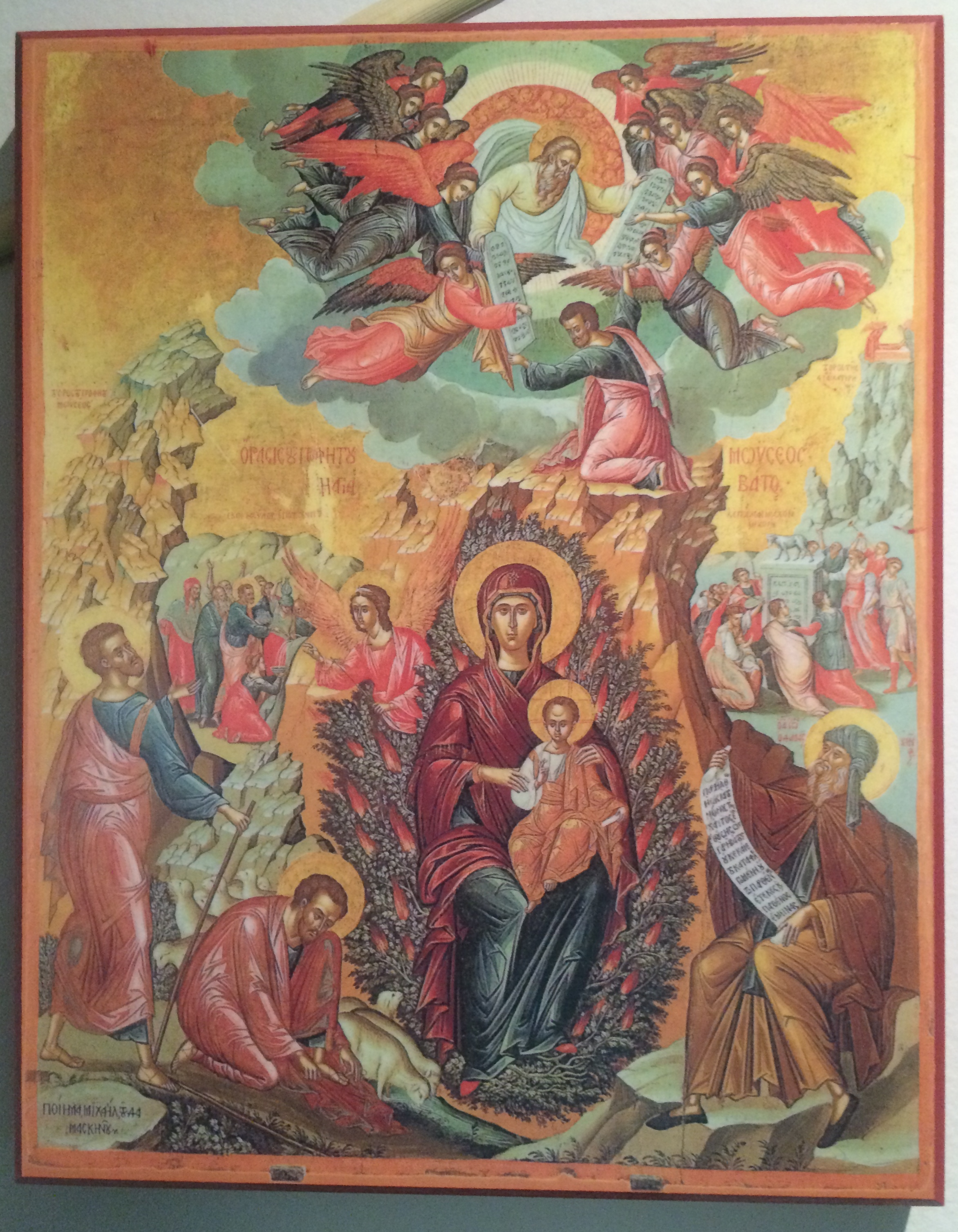
As I sat on my bed staring down at the image, the first sight that caught my eye was the Mother of God, surrounded by green leaves and red flames. I realized that this icon was a representation of Moses and the Unburnt Bush from The Book of Exodus. I recalled that Exodus describes the bush as burning, yet unconsumed. Gears turned in my head, and it clicked that the Unburnt Bush was a prefiguring of the Mother of God in the paradox of her virgin motherhood. At that time, I found myself focused on the primary images of the icon rather than those in the background. I noticed Moses, removing his sandals, kneeling below the Mother of God as she holds her infant Son …
(Sarah)
Do I contradict myself? Does the Church contradict itself? Which is Mary: Ark or Burning Bush? Stop the double-talk and give an answer!
Very well then: Yes. Ark and Burning Bush and more:
- Joseph is a Christ figure.
- Moses in a basket on the Nile is baptism.
- The sacrifice of Isaac? Christ again.
- Jonah? Take a guess.
- Manna? The Eucharist.
And, yes, Sarah (whatever her undisclosed Christian tradition may be) is right about the burning bush and the icon pictured.
Ought not Christ to have suffered these things, and to enter into his glory? And beginning at Moses and all the prophets, he expounded unto them in all the scriptures the things concerning himself.
This is not an optional alternative to literalism. Literalism is mistaken. The New Testament doesn’t take the Old “literally” in its countless “that it might be fulfilled that was written by the prophet” asides. The path of literalism is the way to become “a modern man with odd opinions.”
Indidualism and “soul competency” are mistaken, too:
The trouble with reading Scripture is that almost everybody thinks they can do it … The concept of any intervening authority is anathema to the Protestant project. It is equally unsuitable to the assumptions of the modern world. For the modern world, born in the Protestant milieu, is inherently democratic. The individual, unaided, unbridled, and unsubmitted, is the ultimate authority.
A book that could not have been owned by an individual prior to the printing press in the 15th century (by reason of cost) cannot be used philosophically to support the autonomy of the individual right and competency to read and interpret. With the sole exception of Philemon, the letters of the New Testament are not written to individuals (Timothy and Titus receive letters only by virtue of their position as leaders of a community). They are letters to the Church and the individual is not a Church. The practice of the reading of Scripture for nearly 1400 years was largely that of listening to its being read within the assembly of the Church – and this continued for quite some time even after the printing press’ advent. The doctrine of “soul competency” is a modern invention, contrary to the New Testament itself and the practice of primitive and early Christianity. The Kingdom of God is not a democracy. Every pretender to its throne is a usurper.
(Fr. Stephen, whose Making Known the Mystery and Again – The Sin of Democracy I’ve conflated)
Typology is not an Orthodox exclusive. Some Old Testament types are so obvious, you can’t miss them, and few do. But Orthodox typology runs deeper and broader. And it’s our predominant approach to the Old Testament.
* * * * *
“The remarks made in this essay do not represent scholarly research. They are intended as topical stimulations for conversation among intelligent and informed people.” (Gerhart Niemeyer)
Friday, 5/16/14
Scandal
The celibate authors at A Queer Calling reflect on the ease with which people are “scandalized” by two females, when “people nearly always [can and do correctly] assume that [one] is a member of the LGBT community because of [her] physical appearance.”
People have all sorts of advice: we should not refer to ourselves as a couple and instead choose the more neutral language of friend or roommate, we should avoid describing ourselves as LGBT, we should constantly stress our commitment to celibacy, etc. We take significant time to reflect on how we’re being received by other people even as we simply try to live our lives. We do not pretend for an instant that we’re above having our way of life challenged, but we often wonder if, in a number of situations, people allege scandal rather than inviting conversations about how we’ve offended their sensibilities.
…
We can, and do, appreciate that these concerns have some merit when considered exclusively against the backdrop of a Church besieged by the culture wars. Unfortunately, the emphasis many churches place on the current political and social climate frames the conversation in terms of LGBT issues rather than LGBT people. Focusing on the culture wars places all the responsibility on LGBT people to address the fears of cisgender, heterosexual people. When a person perceives himself or herself on the “right” side, that individual can fall into a pattern of avoiding questions about his or her own discomfort. It seems to us that many cisgender, heterosexual Christians think they deserve a free pass on these questions because they aren’t actively doing anything that violates their sense of orthodoxy.
(Hyperlinks added)
Then Rod Dreher, prompted by her scatological rant, gets a little overwrought (it seems to me) about a homeschooled girl’s embarrassment at being challenged at her homeschool prom about the length of her skirt:
I absolutely agree that if what Clare reports is how it went down, that she was humiliated, and treated disgracefully all around. She is owed a public apology. One of the infuriating things about this episode is that this treatment has probably alienated Clare from religion for a long time to come. I am all for modesty, but this is ugly stuff. The essay appears on her sister Hannah Ettinger’s website, in which the sister describes herself as a survivor of fundamentalist Christian homeschooling.
I know that people who hate homeschooling think we’re all like this. We’re not, not by a long shot. But this kind of thought and behavior does exist within religious homeschooling circles, and when we see it, we should have no hesitation to criticize it.
The common thread is people scandalized by their own imaginations. “These women may be a sleeper cell among us, feigning piety while doing raunchy things together at home and just waiting to attack our historic stance on sexuality.” “That girl is trying to inflame boys sexually even if she’s in technical compliance with our ‘fingertip length’ rule.”
If you read Clare’s rant, you’ll see that she’s scandalized, too (“I only got kicked out of the prom because the dads got as turned on as the boys”).
Perhaps even Rod (“People are going to think we homeschoolers are all like the folks who kicked Clare out of the prom”). I know that feeling, as I’ve frequently blogged, Tweeted, and otherwise disclaimed that Christians are all like some whack-job out their getting his 15 seconds of fame.
In any event, the cases seemed linked, and here, at least preliminarily and most superficially, is the link I see: someone is using “I’m scandalized” as a heckler’s veto. “It’s your job not to offend or arouse me, and if I’m offended, or aroused, by definition your words or actions were disorderly conduct. Away with you!”
”Shut[/cover] up’, he explained.”
Is this fundamentally different from the campus speech codes and other “political correctness” conservative Christians (notable among the easily scandalized) lament, or for the Muslim cultures that still cover women in Burkas so men won’t lust quite so much?
* * * * *
“The remarks made in this essay do not represent scholarly research. They are intended as topical stimulations for conversation among intelligent and informed people.” (Gerhart Niemeyer)
 Tipsy Teetotaler ن