Sunday, 11/30/25

Prayer

On sin

Most Holy Trinity, have mercy on us. Lord, cleanse us from our sins. Master, pardon our transgressions. Holy One, visit and heal our infirmities for Your name’s sake.

This is part of the Orthodox Trisagion (“thrice-holy”) prayers. And the first time I heard or read that prayer, I thought they get it!

I had recognized for a long time that part of the way I contributed to the chaos and evil in the world was not by shaking my fist in God’s face and saying “I know what You want, but I’m gonna do it my way!” Part of my contribution was cluelessness, self-absorption, clumsiness.

And my Protestant milieu seemed totally not to get that.

I remember being told in my Evangelical and Evangelical-adjacent Protestantism that sin was rebellion against God. “Period. Full stop.” as they say. Those four short trisagion sentences would not compute in that scheme as anything but redundant. “Transgression” was a synonym for “sin.” There was no concept of “infirmity” that needed healed, or of “sin” that needed cleansed rather than simply forgiven.

In Orthodoxy I learned that the Greek for “sin” is amartia (sometimes render hamartia), meaning essentially “missing the mark.” In that broad sense, it probably includes transgression and infirmity. “Transgression” strikes me as being the fist-shaking defiance my former milieu called sin. Infirmity strikes me more as the inability to know or do what’s right in some situations.

If I’m serious about the Christian life, I don’t just want God to forgive me of transgression after transgression. I want cleansing and healing as well so that I can “do better” and become more like Christ.

I suffer from all three, sin, transgression and infirmity (mark-missing, defiance and cluelessness) and I suspect my readers do, too. All three hurt those around me. All three make the world a worse place. It reassured me that Orthodoxy, which I was just exploring when I first noticed that prayer, was wiser than where I’d been all my life, and that it recognized that each of the three needs something a bit different (cleansing, pardon, healing) from God.

Frederica Matthewes-Green distills some of this Orthodox view:

[S]in is a danger, a poison, not merely superficial matter like breaking a law. Sin is infection, not infraction.

Breastplate

I came across another version of St. Patrick’s breastplate, this one rhymed:

I bind unto myself today
The strong Name of the Trinity,
By invocation of the same,
The Three in One and One in Three.

I bind this day to me for ever.
By power of faith, Christ’s incarnation;
His baptism in the Jordan river;
His death on Cross for my salvation;
His bursting from the spicèd tomb;
His riding up the heavenly way;
His coming at the day of doom;
I bind unto myself today.

I bind unto myself the power
Of the great love of the cherubim;
The sweet ‘well done’ in judgment hour,
The service of the seraphim,
Confessors’ faith, Apostles’ word,
The Patriarchs’ prayers, the Prophets’ scrolls,
All good deeds done unto the Lord,
And purity of virgin souls.

I bind unto myself today
The virtues of the starlit heaven,
The glorious sun’s life-giving ray,
The whiteness of the moon at even,
The flashing of the lightning free,
The whirling wind’s tempestuous shocks,
The stable earth, the deep salt sea,
Around the old eternal rocks.

I bind unto myself today
The power of God to hold and lead,
His eye to watch, His might to stay,
His ear to hearken to my need.
The wisdom of my God to teach,
His hand to guide, His shield to ward,
The word of God to give me speech,
His heavenly host to be my guard.

Against the demon snares of sin,
The vice that gives temptation force,
The natural lusts that war within,
The hostile men that mar my course;
Or few or many, far or nigh,
In every place and in all hours,
Against their fierce hostility,
I bind to me these holy powers.

Against all Satan’s spells and wiles,
Against false words of heresy,
Against the knowledge that defiles,
Against the heart’s idolatry,
Against the wizard’s evil craft,
Against the death wound and the burning,
The choking wave and the poisoned shaft,
Protect me, Christ, till Thy returning.

Christ be with me, Christ within me,
Christ behind me, Christ before me,
Christ beside me, Christ to win me,
Christ to comfort and restore me.
Christ beneath me, Christ above me,
Christ in quiet, Christ in danger,
Christ in hearts of all that love me,
Christ in mouth of friend and stranger.

I bind unto myself the Name,
The strong Name of the Trinity;
By invocation of the same.
The Three in One, and One in Three,
Of Whom all nature hath creation,
Eternal Father, Spirit, Word:
Praise to the Lord of my salvation,
Salvation is of Christ the Lord.

(Source: Fr. Stephen Freeman)

Authority

Bible

Harold Lindsell launched … a “theological atom bombing.” … history provided no example of a group that had given up on inerrancy when defections from other basic doctrines did not follow. After all, if the Bible could err, it lost its authority. … Inerrancy was a watershed issue—and those who denied it were not evangelicals at all. … None of the neo-evangelical scholars Lindsell named changed their positions because of it. Northern evangelical institutions were too many and too various to be brought into line. Instead of leading to a purge of noninerrantists, the threat of excommunication merely helped to demonstrate that neo-evangelicals were irreparably divided—and further, not in control of northern evangelicalism.

Frances Fitzgerald, The Evangelicals.

After so much controversy and so many books on inerrancy, it seems mad to think that there’s a mike-drop response to it all, but here goes: What good is an inerrant Bible without inerrant interpreters?

So far as I know, nobody in the Evangelical world has claimed that there are such interpreters.

Related: One qualification on inerrancy was that the Bible was inerrant “in its original autographs.” This was the position I came to hold, and which I think I relinquished only on discovering Orthodoxy.

But again: of what use is that doctrine when we don’t have a single original autograph?

So what position do I hold on inerrancy now? I don’t know. The question seems irrelevant in Orthodox context. We’re not a Bible-only Church, nor were we built on the Bible:

The early Church had no Scripture of its own, and the Jews had no defined canon of Scripture; therefore, sola scriptura as the foundation for what Christians believed was absolutely impossible.

Dr. Eugenia Scarvelis Constantinou, Thinking Orthodox.

Yet I’m bold to boast that we revere the Bible more than Evangelicals do. We literally elevate the Epistles and the Gospels in our Liturgies. Our services are suffused with scriptural quotations (not in a preachy or proof-texty way) and allusions. If you really know the Bible, you’ll recognize its ubiquity in the Church’s services.

Come and see, I’ve got to say, though my parish is closed today because of treacherous travel conditions. Maybe next week.

Harmonizing evolution and creation

In years past (mostly long past), I’ve read a lot about the widely-assumed conflict between faith and science, but I hadn’t encountered this interesting, almost Chestertonian, twist:

One of the things that put me off of Christianity when I was young (beyond an intellectual vanity that was out of place) was that the greater part of Christian conversation and teaching, in my experience, had been intended to keep us from thinking about it too hard or taking it very seriously. Simple faith. That old-time religion. Just believe. Most of us have met That Christian—I sat next to her at my local café earlier in the week, and she was trying to convince her college-age children that there were no dinosaurs. “You have to ask yourself who pays for those studies,” she said. “I just believe the Bible.” I tried to concentrate on my eggs. 

But what I wanted to tell her is that there is an interesting concurrence between certain implications of evolution and the plainest kind of Christianity. From evolution, we learn that our bodies and our behavior were shaped by natural pressures to maximize our chances of survival in ancestral conditions of radical scarcity and, hence, we could reasonably assume that at least some of our modern problems—the prevalence of obesity and anxiety, for example, in the rich, digitally saturated world—are the result of living in an environment that is radically different from the one for which we were optimized by evolution. From Christianity, we learn that man is fallen and out of step with his intended place in creation, that we have been separated from that condition for which we were fitted. And at whatever level of literalism you wish to apply to Genesis and whatever degree of sophistication you can bring to bear on your biological analysis, there is a point of commonality:

This is not the world we were made for. We are outcasts and misfits—or, if our separation is sanctified, we are pilgrims.

Kevin D. Williamson, We Are Pilgrims, Still. I think of Williamson as a political writer, not religious, but he’s been returning to religious topics for a week or so.

Dogma

Christian or Pagan?

T.S. Eliot wrote:

Our preoccupation with foreign politics during the last few years has induced a surface complacency rather than a consistent attempt at self-examination of conscience. Sometimes we are almost persuaded that we are getting on very nicely, with a reform here and a reform there, and would have been getting on still better, if only foreign governments did not insist upon breaking all the rules and playing what is really a different game. What is more depressing still is the thought that only fear or jealousy of foreign success can alarm us about the health of our own nation; that only through this anxiety can we see such things as depopulation, malnutrition, moral deterioration, the decay of agriculture, as evils at all. 

And what is worst of all is to advocate Christianity, not because it is true, but because it might be beneficial. 

Towards the end of 1938 we experienced a wave of revivalism which should teach us that folly is not the prerogative of anyone political party or anyone religious communion, and that hysteria is not the privilege of the uneducated. The Christianity expressed has been vague, the religious fervour has been a fervour for democracy. It may engender nothing better than a disguised and peculiarly sanctimonious nationalism, accelerating our progress towards the paganism which we say we abhor. To justify Christianity because it provides a foundation of morality, instead of showing the necessity of Christian morality from the truth of Christianity, is a very dangerous inversion; and we may reflect, that a good deal of the attention of totalitarian states has been devoted, with a steadiness of purpose not always found in democracies, to providing their national life with a foundation of morality—the wrong kind perhaps, but a good deal more of it. It is not enthusiasm, but dogma, that differentiates a Christian from a pagan society.

Kevin D. Williamson.

No “kumbaya moment” here

The expression “what unites us is greater than what divides us” is typically a liberal ecumenical manner of speaking, spoken to inspire us to ecumenical charitable and “social reform” efforts. But Fr. Stephen DeYoung thinks the current and more threatening version, from the perspective of the Orthodox Church, is a right-coded version:

The threat right now is this idea that there is a thing called “conservative Christianity,” and the Orthodox Church is a branch of it.

He’s having none of it:

What divides us is a fundamental difference in how we think God works in the human heart to bring about salvation. [Many people believe] that there is a one-time act, done unilaterally by God, that labels them as being saved so that when they die they will go to heaven.

[But] I believe that God is continually pouring forth his love and his mercies and his goodness in the world and that by cooperating with what God is doing in the world I could be transformed into his likeness and find salvation.

Those are not the same thing. Those are not two different ways of describing the same thing. And one of them is a lie.

I know I’m being super hardcore today, but I don’t care, because this is really bothering me, and if this offends you as an unorthodox listener, maybe you need to be offended by it and think about it. Those aren’t the same thing.

My religion centers on the Eucharist. If yours doesn’t, we don’t practice the same religion.

I don’t relish that. Like I’m not rejoicing in the fact that there are people who consider themselves Christians—and who honestly are Christians in the sense that they’re people who love our Lord Jesus Christ as they understand him and they’re doing their best to follow him as best they understand as best they can … Mostly if they’re wrong. It’s because they’ve been misled. So I’m not judging you as a person if you’re one of those people.

But what I want for you is not to hold your hand and say “kumbaya” and pretend that there’s no difference between us and those differences aren’t significant. I want you to come to know the truth. I want you to come to know Christ more deeply. I want you to understand how salvation actually is and I want you to experience it yourself ….

Podcast, beginning about 10 minutes from the end (Edited for clarity).

Fissiparous

Luther’s nuclear reaction

…in the wake of his defiant appearance at Worms, he found himself impotent to control the explosions that he had done so much to set in train. Nor was he alone. Every claim by a reformer to an authority over his fellow Christians might be met by appeals to the Spirit; every appeal to the Spirit by a claim to authority. The consequence, detonating across entire reaches of Christendom, was a veritable chain reaction of protest.

Tom Holland, Dominion

Pandering

I have long wondered at the sad side-effect of the Reformation, that there were suddenly many different versions of Christianity to choose from. Each person was free to hear the current thought-leaders, read the Scriptures, and come to their own conclusions.

That meant churches were in competition with each other to attract members. (I’m not arguing about the content of the Reformation now—just focusing on this inevitable side-effect.)

Horribly, in 20th century America the choose-your-own-theology option blended with the developing consumerist ethos, and churches began thinking they’d better “be relevant” (there were dire warnings about that, in the 1960s) and “seeker-friendly” (likewise dire, 1980s).

Churches yearned to reach unbelievers by identifying their “felt needs” (hoo boy), that is, what unbelievers thought their needs were. Churches should find out what unbelievers thought they needed, and offer it, to attract them.

It was assumed that people felt sad and lonely, so these churches offered comfort and reassurance. And entertainment. Mega-churches were mega for a reason. Sadly, their offerings largely attracted already-Christians rather than unbelievers, so the earnest motivation of evangelism went mostly unfulfilled.

Frederica Matthewes-Green, Men and Orthodoxy Revisisted

A motley crew

Americans are a motley bunch when it comes to religion—unorthodox, undisciplined, and wildly entrepreneurial, having invented more religions, Christian sects, and Christian-adjacent sects in our few short centuries than the Fertile Crescent did in an active millennium or two. Within a few decades, often within a few miles of one another, and sometimes involving some of the same people, Americans dreamt up Mormonism, Seventh-day Adventism, Christian Science, the Jehovah’s Witnesses, the Church of God in Christ, the Unity Church, the Theosophical Society, the Christadelphians, the Restoration Movement, Ethical Culture, the Reformed Mennonites, and many more—not to mention more recent developments such as the Nation of Islam and Scientology. Americans may have given up, en masse, on most forms of orthodoxy and on practically all forms of discipline, but we remain God-haunted and Bible-spooked.

Kevin D. Williamson.

So, 60 years or so ago …

… my world was solidly and unequivocally “evangelical,” and my critical faculties were not well-enough honed for anything to bother me about my world very much.

Fast forward ten or fifteen years and some of the not-very-much” bothers had encountered some attractive resolutions. Generally speaking, I discovered that evangelical obsessions like “the Rapture” (which I had thought were obligatory but suspiciously convenient) were not obligatory unless one put solidarity with evangelicalism ahead of historic Christian truths. In short, I became a convinced Calvinist, which in my mind made me sort of evangelical-adjacent or equivocally evangelical.

I have recounted my subsequent spiritual life elsewhere, which included leaving behind Protestant and Evangelical worlds unequivocally 28 years ago this month. So active evangelicalism is but a fading memory for me, and though I read about developments there, it’s not the same as living there or next door.

But from what I read, evangelicalism is in much turmoil. And reading the many accounts of huge majorities of evangelicals supporting Donald Trump, that’s to be expected; I still think too well of evangelicalism, maybe naïvely, to see Trumpism as anything but an aberation—because that man ticks every box of vice and vulgarity, not because “real evangelicalism” inexorably leads to preferring a different political flavor.

With the end of the month approaching, and some of my New York Times gift articles set to expire, unused, I want to share with you an article from someone who I think is more in touch with evangelicalism these days than I am: David Brooks.

If you know Brooks, you likely think of him as Jewish, but he’s been on a long spiritual pilgrimage and came to identify as Christian (without, as I recall, ceasing to identify as Jewish or adopting the “Messianic Jew” moniker. I’m not sure how that works.). He’s now married to a Wheaton College alum (likely evangelical). And almost 4 years ago, he took a pretty deep dive (gift link) into how Trump and other things have divided/corrupted evangelicalism and how some prominent evangelicals are fighting back.

The Dissenters Trying to Save Evangelicalism From Itself is a long read but I found it rewarding then and still find it so when I occasionally revisit it.


Religious ideas have the fate of melodies, which, once set afloat in the world, are taken up by all sorts of instruments, some woefully coarse, feeble, or out of tune, until people are in danger of crying out that the melody itself is detestable.

George Elliot, Janet’s Repentance, via Alan Jacobs

[N]one of the things that I care about most have ever proven susceptible to systematic exposition.

Alan Jacobs, Breaking Bread With the Dead

You can read most of my more impromptu stuff here and here (both of them cathartic venting, especially political) and here (the only social medium I frequent, because people there are quirky, pleasant and real and it has no-algorithms). All should work in your RSS aggregator, like Feedly or Reeder, should you want to make a habit of it.

3rd Sunday of Pascha

Who will be the next Pope?

We’ll probably know by next Sunday, but for now:

JD Vance, it seems, is responsible for the death of Pope Francis. In this case, I believe that to the victor should go the spoils, and Vance should be the next Roman pontiff. The circumstantial evidence is beyond doubt: Vance and Pope Francis had a public disagreement over the concept of ordo amoris, and then the pope died shortly after they met for the first time. There are no coincidences. This isn’t even without precedent: Pope Sergius III (allegedly) killed his two predecessors Pope Leo V and Antipope Christopher. Don’t we want a return to tradition? The tradcath convert Vance could take the name Sergius, and then even have one of his sons installed after him, just like his namesake. Besides, there’s nothing in the Constitution that says the vice president can’t also be the pope. Maybe in a few years Pope JD can also be President JD. This would also be very traditional and return secular power to the papacy, and I look forward to a return of Renaissance-era political intrigue in the Vatican. (Virginia Aabram)

David Bentley Hart’s election as pope would give the Church a leader who is sure of his own infallibility. As a dogmatic Catholic, I would welcome such a development. I would also be glad to have a pope with a first-class theological mind, a due appreciation for Robert Louis Stevenson, and a desire to heal the schism between East and West. There is of course a risk that Hart would seek to suppress people with my conservative theological views. But I believe that his doctrinal chief, Roland, would help to ensure a just and liberal policy. If Hart concludes that he must refuse the burdens of the papal office, I could reconcile myself to the election of Cardinal Sarah. (Matthew Schmitz)

The First Things Conclave

Okay, sex fiends, answer me these:

I was doing some computer housekeeping Thursday and came across this. It reminded me of one of the weirdest things I ever heard a fringe Christian say: “It would have been perverted if Mary and Joseph didn’t have sex after Jesus was born!”

For those who think it’s obvious that Joseph and Mary had normal marital relations, and younger brothers and sisters of Jesus, because the scriptures refer to his “brothers”:

  • When you say that they were his brothers, do you mean that they had the same parents?
  • If so, are you saying that Joseph was Jesus’ father?
  • If Joseph was not Jesus father, then wouldn’t any brothers spoken of in scripture be half-brothers?
  • Have you ever considered the possibility that Joseph and Mary were not teenagers in love, but that Joseph was an older man, a widower, with children by a prior marriage?
  • Did you know that this is the tradition of the orthodox church? (I believe it is the tradition of the Roman Catholic Church that the brothers and sisters were more like cousins.)
  • If the Orthodox church is right, then the brothers referred to are older stepbrothers, right?
  • Is it any stranger calling stepbrothers “brothers” then it is calling half-brothers “brothers”?
  • If not, and since Christians believe that Joseph was not Jesus father, but rather that Jesus was conceived of the Holy Spirit and the Virgin Mary, why not just accept that they were stepbrothers?
  • Considering the times when Jesus brothers tried to stage a sort of intervention, wouldn’t it make sense that they were older stepbrothers, rather than younger siblings?
  • Does it bother you at all that all of the protestant reformers believe that Mary remain a virgin, the rest of her life, after giving birth to Jesus as a virgin?

Transhumanism: Christianity without all those God parts

The Silicon Valley agenda, the transhumanist agenda, is extremely utopian, and actually very religious. I think it’s like if you took the Christian religion — which they’re all sort of steeped in because they’re in America — and you take out the actual bits about God and Jesus and things, you’re left with a desire for transcendence and utopia and life after death, living forever and universal justice — all of which are sort of Christian notions — and so they’ve decided they’re going to build those themselves.

Paul Kingsnorth, interviewed by Freddie Sayers

A pagan century?

We seem to be entering a pagan century. It’s not only Trump. It’s the whole phalanx of authoritarians, all those greatness-obsessed macho men like Vladimir Putin and Xi Jinping. It’s the tech bros. It’s Christian nationalism, which is paganism with worship music. (If you ever doubt the seductive power of paganism, remember it has conquered many of the churches that were explicitly founded to reject it.)

… Christianity is built on a series of inversions that make paganism look pompous and soulless: Blessed are the meek. Blessed are the poor in spirit. The last shall be first. The poor are closer to God than the rich. Jesus was perpetually performing outrageous acts of radical generosity, without calculating the cost.

David Brooks, How to Survive the Trump Years With Your Spirit Intact

Brooks’ impression will be hard to vindicate if we continue with our “religious revival,” so very much of which is crypto-pagan.

Ordinary

You have permission to be ordinary. To live a quiet life. To go for a walk without turning it into content. To do good work without chasing viral. To be present with your people instead of always ‘building something.’ Your life doesn’t have to be optimized to be meaningful. The Ordinary creates space for what truly matters.

David Keeler.

Thanks

Weep
If you can,
Weep,
But do not complain.
The way chose you –
And you
must be thankful.

(Dag Hammarskjold)


Religious ideas have the fate of melodies, which, once set afloat in the world, are taken up by all sorts of instruments, some woefully coarse, feeble, or out of tune, until people are in danger of crying out that the melody itself is detestable.

George Elliot, Janet’s Repentance, via Alan Jacobs

[N]one of the things that I care about most have ever proven susceptible to systematic exposition.

Alan Jacobs, Breaking Bread With the Dead

You can read most of my more impromptu stuff here and here (both of them cathartic venting, especially political) and here (the only social medium I frequent, because people there are quirky, pleasant and real). All should work in your RSS aggregator, like Feedly or Reeder, should you want to make a habit of it.
Belated thoughts on the Olympic opening ceremony kerfuffle

Since I finally decided that the content of the Lord of Spirits podcast outweighed the obscure pop-culture references and other drollery, I’ve been binge-listening, and I’m now within seven months of being current.

Seven months ago, the Summer Olympics were airing, and you may recall the calculated provocation of one Opening Ceremony tableau, reminiscent of Leonardo’s Last Supper:

So those people freaking out about this whole Olympics thing. It is if they’ve suddenly discovered that the Olympics are pagan. And if you’re one of those folks who just discovered this I have bad news for you because the Olympics have always been pagan. They started out pagan.

… Like the first one a guy sacrificed a baby. [He] committed an act of cannibalism to get demonic power to win the Olympics, okay? The Olympics are pagan.

Why am I pointing this out? Not just to say like, “yeah duh, why do you think the opening ceremonies look like that?” But I think this is emblematic of a larger thing, a larger cultural thing, that while it’s not germane to tonight’s topic, it’s very germane to the theme of our show, as a whole.

And that’s that we’ve been sold this bill of goods. since we were kids in our education. We’ve been taught about this thing that isn’t real, and it’s called Western civilization where they try to draw a historical throughline starting in like ancient Sumer and ending — depending on your vintage — either in like 19th century Germany, or 19th century British Empire, or if you’re more my age, ending in late 20th century United States of America. And this is the March of Civilization. This is all one thing, one stream.

And uh, religiously, what this does, is it tries to draw through line from Sumerian religion, a development line from there to 19th century German Lutheranism, the 19th century Church of England, or 20th century, late 20th century American evangelicalism, as the culmination not just of Christianity but is of human religion as a whole. Finally got it right, but everything along the way is part of this tapestry part of this one tradition, right? We all grew up thinking that cupids were cherubs; they’re not.

When this whole idea was concocted through the Renaissance and the Enlightenment, when the basically European pagan tradition was fusing itself to the Western Christian tradition, it was sort of a devil’s bargain from both sides, right? There were people who, didn’t much like the Western Christian tradition and were chafing at it, because they wanted to live their lives or exercise their intellects in other ways, and so they wanted the freedom that a revised and hollowed-out version of the Western pagan tradition offered them. And then on the other side, there were people who were still loyal to the Western Christian tradition, but who wanted to claim credit for the glories of Greece and Rome and all the pagan stuff and pagan art and culture. And so they came to this agreement we’ll just fuse all this together and call it Western culture and Western civilization.

And now very timely you can go all over YouTube — you know it’s in some of our own circles, so shall we say — people talking about the demise of the West, and the demise of Western civilization and Western culture — this thing that was phony and never existed, that we were all pretending to exist it.

It’s not that this thing was real and now it’s going away. It’s that those two things which are fundamentally incompatible, Christianity and paganism, are pulling themselves apart again. And guess what: The paganism side is rediscovering its antipathy toward Christianity faster than the opposite is happening.

Because the folks who are still on the Western Christian side still want to keep things like the Olympics. still want to keep a bunch of these things that ultimately are not germane to the Christian tradition that come out of the Renaissance and the Enlightenment and the pagan alt recovery they’re in — they want to cling to those they want to keep those right and just keep pretending that they’re Christian. But… the pagan side won’t accept that bargain anymore. They’re feeling their oats now right and they want to take the back (sic) and just be pagan, as pagan as they could be.

Now that’s going to lead to them to very dark places; hopefully some of them will yo-yo back to Christianity and realize what they’ve lost. But that’s what’s happening in our culture right now. That’s what everybody could observe in the opening ceremony of the Olympics was, oh, the Olympics are now just being openly pagan again. They’re not pretending anymore.

The nations worshiped demons, not God. Both the Torah and St. Paul say so, and we need to stop trying to fuse the city of God and the city of man and trying to hold those things together and pretend that they’re the same city.

Fr. Stephen De Young, August 1, 2024 (emphasis added)


I suffer more from the humiliations inflicted by my country than from those inflicted on her.

Simone Weil, from a letter to Georges Bernanos.

[N]one of the things that I care about most have ever proven susceptible to systematic exposition.

Alan Jacobs, Breaking Bread With the Dead

I don’t do any of the major social media, but I have two sub-domains of the domain you’re currently reading: (a) You can read most of my reflexive stuff, especially political here. (b) I also post some things on the only social medium I frequent, because people there are quirky, pleasant and real.

Sunday, 7/17/22

Poetry and Myth

Christianity and Poetry

The Incarnation requires an ode, not an email.

Poet Dana Gioia, Christianity and Poetry commenting on the poetry of the Magnificat.

More:

  • For most believers, the truths of their faith have become platitudes taught in catechism or Sunday school. The mysteries of faith—those strange events such as the Incarnation, Transfiguration, and Resurrection—have lost their awe and wonder and become replaced by sensible morality and proper reverence. There is nothing wrong with morality or reverence, but pious propriety is a starvation diet for the soul. Modern versions of the Bible, which translate verse passages into prosaic language for the supposed sake of clarity, are mistranslations, since they change the effect of the text.
  • When Jesus preached, he told stories, spoke poems, and offered proverbs. The Beatitudes are a poem about the merciful Kingdom of God in contrast to the selfish world of mankind. Jesus was not much concerned with theology. He left that to posterity. He did not ask his listeners to think their way to salvation; he wanted them to taste and see the goodness of God. He told them stories in which they could see themselves. He spoke to people as creatures with both a body and soul. He addressed them in the fullness of their fallen humanity, driven by contradictory appetites, emotions, and imagination.
  • When the Second Vatican Council dropped these sequences from the Catholic missal, it demonstrated how remote the Church had become from its own traditions. The new Church wanted to reengage the broader world and get rid of the musty traditions of the past. Vatican II wanted to be practical, positive, and modern; its motto was aggiornamento, Italian for “bringing things up to date.” The poetic sequences, which had seemed so splendid to the old Church—rapturous artistic vehicles for the contemplation of divine mysteries—felt too pious, formal, and elaborate for modern worship.
  • William Wordsworth was a religious man who saw the poet’s role as prophetic, but his Christianity expressed itself most eloquently in pantheistic Deism. He grew more devout and conventional in middle age, to the detriment of his verse. His pious Ecclesiastical Sonnets (1822) marked the lowest point of his career. Read any page of it outdoors—the stupefied bees will stop buzzing and the birds fall senseless from the trees.
  • Minor poets with major minds, Chesterton and Belloc were smart, brash, and wickedly funny. Unintimidated by their intellectual foes, they swaggered when others would have taken cover. For the first time since the Elizabethan Age, there was an outspoken Catholic presence in English verse.

And then, in conclusion:

Christianity has survived into the twenty-first century, but it has not come through unscathed. It has kept its head and its heart—the clarity of its beliefs and its compassionate mission. The problem is that it has lost its senses, all five of them. Great is the harvest, and greater still the hunger it must feed, but its call into the world has become faint and abstract. Contemporary Christianity speaks mostly in ideas. Potent ideas, to be sure, but colorless and hackneyed in their expression …

A major challenge of Christianity today is to recover the language of the senses and to recapture faith’s natural relationship with beauty. There is much conversation nowadays about beauty among theologians and clergy. They seem to consider it a philosophical problem to be solved by analysis and apologetics. Those are the tools they have. Their relation to beauty is passive rather than creative. Even the clearest thinking can’t close the gap between how people experience their existence—a holistic mix of sensory data, emotions, memories, ideas, and imagination—and how the Church explains it—moral and spiritual concepts organized in a rational system. The theology isn’t wrong; it’s just not right for most occasions. It offers a laser when a lamp is what’s needed.

These things matter because we are incarnate beings. We see the shape and feel the texture of things. We instinctively know that the form of a thing is part of its meaning. We are drawn to beauty, not logic. Our experience of the divine is not primarily intellectual. We feel it with our bodies. We picture it in our imaginations. We hear it as a voice inside us. We are grateful for an explanation, but we crave inspiration, communion, rapture, epiphany.

It probably will come as no surprise to you that I do not think that Orthodoxy has "lost its senses."

But I am one man, formed in the West, which has lost its senses, so I face extra hurdles acquiring the mind of the Church.

(A "brilliant and substantive new essay" like this pops up just often enough that I still subscribe to First Things.)

Deep magic

I read more on Saturday of his first book, A Branch from the Lightning Tree, and it was so overwhelming that despite having had two giant cups of coffee, I had to come back to the room to sleep. There is deep magic in his words. I see now why Guite, an Anglican priest, told me that only Orthodox Christianity will be able to contain the immensity that is Martin Shaw’s imagination and sensibility.

Rod Dreher.

I’m experiencing Martin Shaw that way, too, though I’ve only caught snippets and haven’t yet read the book I bought.

C.S. Lewis, reacting to the claim that society was returning to paganism, said something to the effect of "Would that it were so! The pagan is an eminently convertible man." Paul Kingsnorth and Martin Shaw may be the first fruits that add "prophet" to Lewis’ encomiums.

What Athos has on offer

Why have western scholars virtually ignored this experiential form of mystical Christianity at a time when numerous Westerners have turned their gaze toward Hinduism and Buddhism? What does Mount Athos have to offer to the Western world today that is not available within the mainstream churches?

Kyriacos C. Markides, The Mountain of Silence

What myths mean

However nonrational myths were, they betrayed man’s urge to explain what he found in himself and in the world, as well as his belief that explanation was somehow possible.

David V. Hicks, Norms and Nobility

Analysis

Hypocrisy or Mimesis?

Remember that old saw "hypocrisy is the tribute vice pays to virtue"?

Gilbert Meilander, with help from C.S. Lewis throughout, reminds me that a charge of "hypocrisy" ought to be used very sparingly. Excerpt from the introduction:

Discussing his experience as a soldier in the Great War, he writes of a fellow soldier who was not only (like Lewis) a scholar from Oxford, but also—alarmingly to Lewis—“a man of conscience,” committed to adhering to taken-for-granted moral principles.

Embarrassed by the contrast with his own life, Lewis did his best to conceal the fact that he himself had not taken moral obligations so seriously. “If this is hypocrisy,” Lewis writes:

then I must conclude that hypocrisy can do a man good. To be ashamed of what you were about to say, to pretend that something which you had meant seriously was only a joke—this is an ignoble part. But it is better than not to be ashamed at all. And the distinction between pretending you are better than you are and beginning to be better in reality is finer than moral sleuthhounds conceive. . . . When a boor first enters the society of courteous people what can he do, for a while, except imitate the motions? How can he learn except by imitation?

Belonging, truthing

For human beings, the ability to belong is more [evolutionarily] adaptive than the ability to see what’s true.

Alan Jacobs citing Jonathan Haidt.

I’m thinking of an American-made religion with (1) what strikes me as an unusually implausible founding story, but (2) a very strong sense of community. That religion was still growing rapidly last time I looked at the stats (though that has been a while). Score one datapoint for Haidt and Jacobs.

Tonic

You’re churches, for God’s sake. Quit fighting for social justice. Quit saving the bloody planet. Attend to some souls. That’s what you are supposed to do. That’s your holy duty. Do it. Now. Before it’s too late. And the hour is nigh.

Jordan Peterson via Aaron Renn

Well, that’s bracing — unless your church was already doing that.


If people have always said it, it is probably true; it is the distilled wisdom of the ages. If people have not always said it, but everybody is saying it now, it is probably a lie; it is the concentrated madness of the moment.

Anthony Esolen, Out of the Ashes

You can read most of my more impromptu stuff here (cathartic venting) and here (the only social medium I frequent, because people there are quirky, pleasant and real). Both should work in your RSS aggregator, like Feedly or Reeder, should you want to make a habit of it.

Sunday bright spots

If with all your heart you truly seek me …

… ye shall ever truly find me. Thus saith our God. (Mendelsohn, Elijah, paraphrasing Jeremiah 29:13)

Martin Shaw, a notable in British Neo-Paganism, went out to to the woods for a 101-day vigil (!) of some pagan sort, roughly around the beginning of Covidtide. At the end, he had an attention-getting vision, and then began having the dreams — like Christ coming to him like a stag:

Shaw says he used to think Christianity was dull and domesticated. “I was wrong.”

His problem was that he thought the tame bourgeois Evangelicalism in which he was raised was the be-all and end-all of Christianity. He says, of that church, “What on earth would they have done with Blake?”

Shaw says that he believes he was in contact with the One who made the universe. It rendered him speechless. “I have been appropriately silent,” he tells Mark Vernon, adding that this is the first time he has revealed in public his conversion.

“You could not have argued me into Christianity,” Shaw says. It took this overwhelming experience of awe.

He goes on to say that Christianity is the fulfillment of all kinds of pagan myths.

“There was this deep interior announcement: ‘You knocked, and now I’m here. What should we do?”

On modern Christianity:

“We seem to have lost our saints, we’ve lost our monks, we’ve lost our connection to our bush soul, we’ve lost the angular, strange, weirdness of Christ.”

Shaw describes the call to Christ as “an invitation, not an imposition. … It’s chucking keys into cells to try to get you out into fresh air.”

He tells Mark Vernon that he’s been trying to figure out which church to embed himself in. He’s visited a Baptist church, an Anglican church, and a Catholic Church. “People will forgive almost anything except for becoming a Christian,” he says, alluding to the anti-Christian propaganda that’s everywhere. He found in all those churches “really kind, gracious, invested people.”

“But last Sunday, I walked into the Eastern Orthodox church, into the Divine Liturgy. I walked into a kind of Christian dream that was so deep. It had no beginning, and no end. It was absolutely unlike any form of Christianity I’ve yet come across.”

“It was as if every 15 minutes that passed, the door through the centuries was opening. I found in an almost unimaginably deep way a contact with … a sort of Christian dreaming.”

Shaw says he had never thought about Orthodoxy’s “aboriginal presence in Britain” before the great schism of 1054.

Vernon, a former Anglican priest, suggests that Orthodoxy, not having gone through the Reformation, could be more about drawing us into participation with the mysteries — doing something, rather than having something done to us.

Shaw responds by saying the last time he felt like he did after that liturgy was when he was in a sweat lodge with an American Indian twenty-five years ago. He was so dazed after the Divine Liturgy that he drove through a stop light, and almost caused a crash. Everybody was yelling at him. He rolled down his window and yelled, “I’ve just been to church! And I don’t know what’s going on!”

Shaw, who is best known says the truth about myth is that it’s not about the past at all, but about something always present. This resonated with me in light of what the Cambridge cultural anthropologist Paul Connerton said about the qualities traditional cultures that have successfully resisted modernity have in common. As I recall, they all 1) have a sacred story that tells them who they are; 2) celebrate the sacred story in an unvarying liturgy; 3) use their body in their liturgy; and 4) experience the liturgy as taking place in some sense outside of time.

Rod Dreher, writing about the conversion of Martin Shaw, "a big name in the neopagan/neopagan-ish world, who recently converted to Christianity." It appears that he isn’t going to be satisfied with anything less than the fulness of the faith that’s found in Christian Orthodoxy.

I would suggest that God saw Shaw’s heart and said "time to reclaim my own."

I also would suggest that Protestantism (perhaps Catholicism, too) may "have a sacred story that tells them who they are" and "use their body in their liturgy," but they vary their liturgies, which in no sense take place outside time.

Paul Kingsnorth and now Martin Shaw. God is up to something He hasn’t shared with me. He’s like that, you know. I have no other explanation for how Shaw could apprehend the timelessness of the Divine Liturgy on first exposure than that his paganism has kept his intuitive powers sharper than most of ours.

Elizabeth Oldfield perceives some commonalities in these and other "later in life" conversions:

[T]hey are slowly losing the youthful idealistic sense that they alone can locate the levers of change. They are butting up against the limits of their own intelligence and agency, and looking for something other than themselves to have faith in.

… Men who are arrogant or apathetic cause harm, and a path that requires humility, courage, vulnerability and service might just act as an antidote.

There was some of all that in my conversion, from deracinated to primal Christianity, at 48-49.

I’ve subscribed to Martin Shaw’s Substack, and it looks as if it could rise very near my favorites. He’s doing something I think is unique, valuable, and congruent with Orthodoxy (assuming that’s where he settles for a spiritual home).

A remarkable execution

I’ve never read last words like these:

First, thank you, my precious Father, for shepherding me for over 20 years and leading me to the edge of Paradise. I want to thank my beautiful wife who has loved me with everything she has. I want to thank my friends and legal team, and, most of all, Jesus Christ, through this unfair judicial process that led to my salvation. I pray the Lord will have mercy on all of us and that the Lord will have mercy on me. Lord Jesus Christ have mercy on me! Panagia Theotoke soson me! [All Holy Mother of God save me].

Last words of Monk Ephraim, formerly known as Frank Atwood, before his recent execution in Arizona for a murder which I doubt he committed:

on june 8, an american orthodox monk was executed for murder. how did this come to be? in 1987 frank atwood was convicted in arizona for the murder of a child. at the time of his arrest & trial, & ever since, he insisted on his innocence of the crime. (i have no way of knowing whether he was guilty or not, but that may also be true of those who tried & convicted him.) in prison, he read the mountain of silence: a search for orthodox spirituality by kyriakos markides. powerfully moved by it, he wrote to metropolitan athanasios of limassol in cyprus, who appears in the book. a correspondence began, which led to frank’s coming under the spiritual care of fr paisios at st anthony the great monastery in arizona. he was baptized & began to practice a life of prayer & asceticism. a few days before his execution, he was tonsured a monk & received the name ephraim, after fr ephraim, founder of st anthony’s monastery. his spiritual father paisios said that, regardless of his guilt or innocence, he had undergone a "complete transformation of life".

the case received great attention in greece, but as far as i know was ignored by american secular media outside of arizona. this account of his execution includes a powerful first-hand report from the arizona republic. you can see photos & video of his funeral at st anthony’s monastery here. metropolitan athanasios, who first received frank’s inquiries, has some remarks here.

frank.jpeg

as it happens, the assembly of canonical orthodox bishops of the united states of america has just published a "statement on the sacredness of human life & its untimely termination". it offers a whole-life teaching, rejecting abortion, euthanasia, & capital punishment.

o lord, remember us in thy kingdom.

From the rags of light monthly newsletter of my cyber-friend, John Brady, an Orthodox fellow of about my age (original formatting). You can subscribe here.

I formerly opposed the death penalty because our criminal justice system is more error prone than the powers and dominions want to admit. I’m aware, obviously, of the Innocence Project, but this is the first case I can recall where an innocent man was executed (rather than conclusively exonerated while on death row).

Now, with a push from my nation’s bishops, I’m opposed because it’s morally wrong even when they get the right guy.

From a reporter who witnessed the execution:

The Department of Corrections protocols ensure that few people see an execution, and there is little public awareness of this most serious and final act of justice. The death penalty is presented as a clean, sterile, administrative procedure carried out flawlessly and by the book. Now I know what they were trying to hide.

I have looked behind the curtain of capital punishment and seen it for what it truly is: a frail old man lifted from a wheelchair onto a handicap accessible lethal injection gurney; nervous hands and perspiring faces trying to find a vein; needles puncturing skin; liquid drugs flooding a man’s existence and drowning it out.

I have written extensively about Atwood’s case. I listened to the victim’s family talk about the pain and suffering the murder of Vicki Lynne, and subsequent court case, caused them — the generational trauma it left with their family and the community of Tucson. I talked with every attorney I know about the process and asked questions about what I was about to witness.

But I was not prepared to see the act of capital punishment carried out in front of me.

The state of Arizona conducts executions in all of our names. I thought I understood the weight of that process, but now I feel the reality of it. We killed a man today. I killed a man today. And I will live with that realization for the rest of my life.


If people have always said it, it is probably true; it is the distilled wisdom of the ages. If people have not always said it, but everybody is saying it now, it is probably a lie; it is the concentrated madness of the moment.

Anthony Esolen, Out of the Ashes

You can read most of my more impromptu stuff here (cathartic venting) and here (the only social medium I frequent, because people there are quirky, pleasant and real). Both should work in your RSS aggregator, like Feedly or Reeder, should you want to make a habit of it.

Three worth mentioning, 3/1/22

Happy March. It really felt like Spring here today.

Something weirdly, unnervingly demonic

There are points in time at which whole cultures can become possessed. I mean that literally. There is something weirdly, unnervingly demonic going on at the moment, and it is not going to end well. I know that this is worse in America than it is where I live, but to different degrees it is overcoming the whole of the West.

Paul Kingsnorth.

Kingsnorth has only been a Christian for about a year, but he’s pretty perceptive.

Kingsnorth’s longer story of his conversion from paganism to Orthodox Christianity is remarkable, no less to him than to others. He very recently spoke of it:

[T]he mystical heart of Orthodoxy, which still beats strongly, is a unique thing. Not unconnected in many ways from the approaches of some other faiths, but entirely of itself as well. I have a lifetime to learn from it. I can only say that I was dragged into this—I didn’t choose it—and so I can’t really rationalise why it happened. But already the world makes more sense.

And he speaks of how it might change his writing:

[T]rying to produce ‘Christian writing’ or any kind of ‘Christian’ art or music is to set yourself up to fall into the abyss of agitprop. It’s a hard abyss to avoid, which is why there are so few good protest songs or funny political comedians. But there are great writers and artists. who are Christian who wear it lightly but with truth. Tarkovsky comes to mind, or Dostoyevksy. My favourite recent example is the novelist Eugene Vodolazkin’s book Laurus. I’ve just noticed that all my examples are Russian! Maybe I need to visit and learn something.

Paul Kingsnorth.

Mark Bauerlein, The Director

In this podcast, First Things‘ Mark Bauerlein kept trying — through winks, nods and don’t-you-want-to-be-one-of-the-cool-kids insinuendo — to get Katie Geary of Becket Fund for Religious Liberty to cast her lot not just for religious liberty, but for the whole hive of Conservatism, Inc.

Katie resolutely, and wisely, stuck to the topic she was invited for, Becket’s Religious Freedom Index 2021 — because Becket is not part of Conservatism, Inc. That’s why I love them. They do what they promise to do and don’t get distracted.

When Bauerlein does that winky-noddy schtick, as he does on almost every podcast, it reminds me (a little) of The Director at N.I.C.E., trying to compromise Mark Studdock, in C.S. Lewis’s That Hideous Strength. Most of Bauerlein’s guests play along gladly, but he was painfully slow on the uptake that Becket doesn’t play such games.

A Safe Place to Inquire

I came to Orthodoxy 25 or 26 years ago, initially self-instructing with three principal books and, at some peril, the internet — an infamous garbage dump you may have heard of.

I was not the first to brave the internet for information about Orthodoxy, nor will I be the last. That’s just how we roll, now and for the foreseeable future.

Fortunately, there recently debuted a non-toxic, authoritative guide to mainstream Anglophone Orthodox Christianity. I can’t say it’s comprehensive, but considering the depth of Orthodoxy, I don’t see how it could be. And if it tried, it might feed the avoidance of real life in a real church community under the guidance and care of a real pastor.

Ten or fifteen minutes there will give you a pretty good hint of how Orthodoxy differs from Western Christianity.


You can read most of my more impromptu stuff here (cathartic venting) and here (the only social medium I frequent, because people there are quirky, pleasant and real). Both should work in your RSS aggregator, like Feedly or Reeder, should you want to make a habit of it.

Meanderings 4/8/21

I did an interview today with someone in London whose final question contained within it a statement. He said that he is a “cultural Christian” — he doesn’t believe, but he considers himself an ally of the church, and wants to see it thrive. He told me that more and more, he’s having conversations with people who aren’t believers, but who “are saying things now that they never would have said.” He explained that they are saying that the insanity overtaking our civilization has them thinking maybe they should look closer at the Church, and be more than fellow travelers.

I was taken aback by that remark … I [brought] up Auden’s return to Christianity after going to the movie in Manhattan … The English poet was living in New York when the Germans invaded Poland in 1939. He went to see a movie at a theater in the Yorkville neighborhood of Manhattan, which was heavily German at the time. As a newsreel showed images of German troops brutalizing the Poles, members of the audience stood and began screaming bloody murder, demanding the slaughter of Germany’s enemies.

Auden left shaken, and resolved to return to the faith. Only the Christian faith could muster the force to defeat evil so pure, he reckoned.

Maybe that’s what’s going on with people like my interviewer. Maybe they see that things are falling apart quite rapidly, and are feeling in their bones that they can no longer be free riders on what Christianity has built. I told the man that he could not believe because it seemed like a good thing to do, or because it supported the right things. Jesus is either Lord, or he’s not. But I told him that Christ stands at the door of his heart, and knocks.

Social Credit Bunnies – Daily Dreher

I have no particular bone to pick with Dreher’s response to this remark, but I think I would have been less taken aback by it. In fact, my reflex would probably be "what an opportunity for the Church!"

That would be my reflex because I spent nearly 50 years in Christian traditions that were obsessed with numerical growth, and we were always tempted to generate it with gimmicks. In other words, my response would be perverse.

Every church loves to get new members, of course, and I would be thrilled if American turned en masse toward Christian Orthodoxy.

But if it were up to me, I would try to structure Orthodox Christian catechesis in a way that would flush out real versus notional (or even ulterior) conversions to the Orthodox Christian faith.

Here’s the sort of thing I’m concerned about.

  • In 2016, Matthew Heimbach was excommunicated from the Orthodox Church, which he apparently had joined because of what he thought was an ideological traditionalism. Matthew Heimbach is a pretty nasty piece of work.. In fairness to the Southern Indiana parish that received him into the Church, I don’t think they remotely saw such a thing coming, and he wasn’t even nominally Orthodox for very long before they found out and took care of it.
  • Any number of people who (understandably) have problems with developments in the Episcopal Church (or other Protestant Churches) express interest in the Orthodox Church, when what they really want is a nostalgic, early 20th-century version of the tradition they’re pissed off at. Maybe Orthodoxy would work out for them in the end (i.e., they’d be drawn into something they never imagined when they switched), but even our Western Rite Liturgies are expressing a much different faith than anything in Western Christendom.
  • Joining a Church because of concern over "the insanity overtaking our civilization" could work out, as it apparently did for Auden, but I fear it would further politicize the Church rather than making solid Christians of the new members.

I had a client once, a genteel Episcopalian Republican, who was disgusted with the political liberalism in the Episcopal Church, and kept expressing, on her own behalf and that of a like-minded friend, interest in my Orthodox Church. In my notional catechesis, anyone like that who came and sought catechesis would be kept in catechesis until they reached the point where they wanted to be Orthodox because that’s where they find Christ. That’s the only valid reason for an adult conversion.


Words cannot convey how chilling and authoritarian this all is: watching government officials, hour after hour, demand censorship of political speech and threaten punishment for failures to obey. As I detailed last month, the U.S. Supreme Court has repeatedly ruled that the state violates the First Amendment’s free speech guarantee when they coerce private actors to censor for them — exactly the tyrannical goal to which these hearings are singularly devoted.

There are genuine problems posed by Silicon Valley monopoly power. Monopolies are a threat to both political freedom and competition, which is why economists of most ideological persuasions have long urged the need to prevent them. There is some encouraging legislation pending in Congress with bipartisan support (including in the House Antitrust Subcommittee before which I testified several weeks ago) that would make meaningful and productive strides toward diluting the unaccountable and undemocratic power these monopolies wield over our political and cultural lives. If these hearings were about substantively considering those antitrust measures, they would be meritorious.

But that is hard and difficult work and that is not what these hearings are about. They want the worst of all worlds: to maintain Silicon Valley monopoly power but transfer the immense, menacing power to police our discourse from those companies into the hands of the Democratic-controlled Congress and Executive Branch.

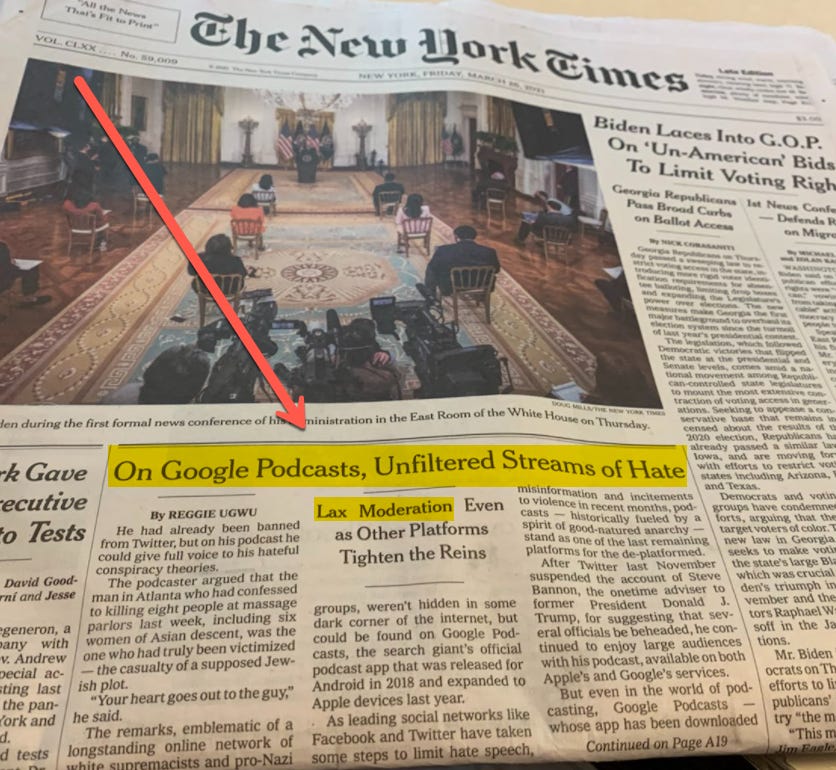
And as I have repeatedly documented, it is not just Democratic politicians agitating for greater political censorship but also their liberal journalistic allies, who cannot tolerate that there may be any places on the internet that they cannot control. That is the petty wannabe-despot mentality that has driven them to police the “unfettered” discussions on the relatively new conversation app Clubhouse, and escalate their attempts to have writers they dislike removed from Substack. Just today, The New York Times warns, on its front page, that there are “unfiltered” discussions taking place on Google-enabled podcasts:

New York Times front page, Mar. 26, 2021

We are taught from childhood that a defining hallmark of repressive regimes is that political officials wield power to silence ideas and people they dislike, and that, conversely, what makes the U.S. a “free” society is the guarantee that American leaders are barred from doing so. It is impossible to reconcile that claim with what happened in that House hearing room over the course of five hours on Thursday.

Glenn Greenwald. This is the conclusion to the latest of Greenwald’s very, very good work on the specter of government-coerced "private" censorship on the internet.


3. Real creativity will die out. Instead, we shall get a multitude of mediocre pseudo-thinkers and vulgar groups and organizations. Our belief systems will turn into a strange chaotic stew of science, philosophy, and magical beliefs.  “Quantitative colossalism will substitute for qualitative refinement.” What is biggest will be regarded as best. Instead of classics, we shall have best-sellers. Instead of genius, technique. Instead of real thought, Information. Instead of inner value, glittering externality.  Instead of sages, smart alecs. The great cultural values of the past will be degraded; “Michelangelos and Rembrandts will be decorating soap and razor blades, washing machines and whiskey bottles.”

Morris Berman, discussing Pitirim Sorokin’s predictions on the collapse of our sensate culture, in 2012.

For more on Sorokin, a fascinating figure, see:


You can read most of my more impromptu stuff at here. It should work in your RSS aggregator, like Feedly, should you want to make a habit of it.

Antipopes, Jackasses, Jennyasses, and more

Best Historical Analogy for Loser Trump?

[Antipope Benedict XIII] retain[ed] sufficient political capital to pressure heads of states to pick sides, bestowing benedictions and other benefits and if nothing else gumming up earnest efforts to allay divides. Weary, irritated leaders, both religious and royal, “said, ‘You’re out, you’re out, you’re out,’” … “and he said, ‘No, I’m in, I’m in, I’m in.’”

“Donald Trump’s not an ex-president—he’s a right-wing, nativist, revolutionary leader,” presidential historian Doug Brinkley told me recently. “He has a movement that is massive with global implications—that kind of revolutionary—and he took on the entire federal government of the United States. That kind of character doesn’t register as a typical ex-president.”

Across the Atlantic, some 600 years back, everybody said they wanted unity.

But unity was hard. “Comparing a pre-democratic system with a democratic system, there is kind of something odd,” Rollo-Koster said, offering a necessary caveat. “But behaviors remain constant throughout history regardless of the political system.” And unity was hard at that moment because of the whims and wants of leaders, because of ever-shifting protections and allegiances, and because people who had power didn’t want to give it up. “The schism,” wrote Barbara Tuchman in A Distant Mirror, “was a trap not easy to get out of.” It “lasted as long as it did,” as Rollo-Koster put it in her book, “because it benefited the private interests of many parties.”

Michael Kruse, The Antipope of Mar-a-Lago – POLITICO

GOP Hijinks

The Oregon GOP’s official position is that the assault on the Capitol was a false flag operation, mounted to “discredit” President Trump.

The infinitely flexible Nikki Haley asks not whether former President Trump attempted to steal the election, but how low the base would like her to sink. Appearing on the Laura Ingraham show, she offered up the expected persecution narrative: “They beat him up before he got into office. They are beating him up after he leaves office. I mean, at some point, I mean, give the man a break. I mean, move on.”

See how this works? It was Trump who was beaten, not Officer Sicknick.

Mona Charen, Republicans Make Me Proud I Voted for Biden – The Bulwark

You can’t make this stuff up, and there’s so much of it (read Charen’s full column) that it’s hard to pick an emblematic examples.

Charen continues:

Republicans are like toddlers encouraged to put on big boy underpants. They understand that it’s exciting to be a big boy. They want to. But they also know that if they put on big boy underpants, they will have responsibilities. They will have to act like big boys. So they retreat to the comfort of their diapers.


MTG

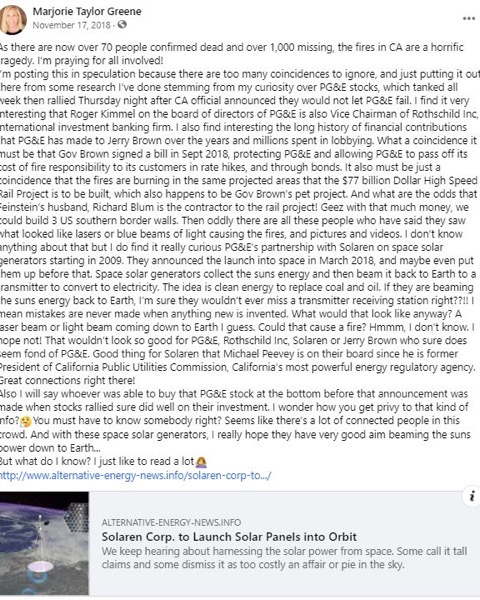
I “find it interesting” that Marjorie Taylor Greene finds interesting (i.e., makes up) a bunch of “speculation” that would warm the cockles of Nazi hearts.

What a coincidence! What are the odds that that a sane person would entertain such odd views?

H/T Jonathan Chait, GOP Congresswoman Blamed Wildfires on Secret Jewish Space Laser


[N]umerous liberal democracies have seen right-wing “populist” movements and parties emerge. So far, those that have risen to power have done so through liberal institutions — and despite moves to rig the systems in their own favor (most boldly in Hungary and Poland), nowhere has liberal government been fully overturned in favor of outright authoritarian rule or worse.

But the United States presents a distinctive, and potentially ominous, case.

Over the past three months, the Republican Party has proven itself to be a right-wing antiliberal party. Yes, this has been the culmination of a long process. Yes, it has antecedents in the American past. Yes, there are still some decent people in the party trying to oppose the trend from within. But despite all of these caveats, what we’ve recently witnessed in the GOP is something new — and newly alarming.

… [T]he Republican Party is now dominated by ideas and individuals who consider it acceptable to reject the legitimacy of democratic elections when they deliver a loss, and to encourage, affirm, and spread outright lies in order to gain and hold political power. That makes the Republican Party a great danger to liberal democratic government in the United States.

Damon Linker, Liberal democracy’s Achilles Heel


Over the years when national events have turned especially murky, I’ve asked [Senator Rob Portman’s] read on things, and what’s always struck me is his stubborn sense of reality: He doesn’t let his wishes get in the way of what he sees. In the geography of the Republican Party he’d be placed with figures like Mitch Daniels —the We Actually Know Things Caucus.

It really is something that we’re living in a time when ambitious people leave the U.S. Senate to get things done.

I asked about the comment of his former campaign manager Corry Bliss, published Tuesday in National Journal, on Portman’s decision not to run: “If you want to spend all your time on Fox and be an a—h—, there’s never been a better time to serve. But if you want to spend your time being thoughtful and getting s— done, there’s never been a worse time to serve.” Mr. Portman roared with laughter. “Did he say that?” He roared again. “Yeah, I won’t comment.”

Peggy Noonan, Rob Portman’s Exit Interview

Mitch McConnell’s Hijinks

Just as [Mitch McConnell] played Donald Trump for three Supreme Court justices and a tax cut, here he is convincing Democrats to let him have veto power over what happens in the upper chamber for years to come.

[T]he horrifying truth about American partisanship, the reason that the National Football League is vastly more entertaining than what goes on in Washington, D.C[. is that] almost no one there actually cares about winning. Holding on to office, getting the paychecks and the perks, receiving all the attention and adulation their parents and classmates apparently failed to shower upon them in their youth — these are what motivates most of our elected officials.

Which is why at the end of the day I am not hesitant to call McConnell the most effective Senate leader of the last half century, for the not very complicated reason that he not only cares about winning but does win more consistently than anyone else, regardless of the position in which he finds himself.

Mitch McConnell is the GOAT

GameStop Hijinks

The market can remain irrational longer than you can remain solvent.

John Maynard Keynes via Axios, Gamestop trading pits Wall Street’s powerful against the powerless

Insurrection after-effects

Acting D.C. Police Chief Robert Contee III said this week that another police officer who was on duty during the January 6 Capitol attack, Jeffery Smith, died by suicide on January 15. Capitol Police Officer Howard Liebengood also died by suicide on January 9, three days after the riot, and Officer Brian Sicknick died after sustaining injuries during the insurrection. “Between USCP and our colleagues at the Metropolitan Police Department, we have almost 140 officers injured,” Gus Papathanasiou, the chair of the Capitol Police Labor Committee said in a statement. “I have officers who were not issued helmets prior to the attack who have sustained brain injuries. One officer has two cracked ribs and two smashed spinal discs. One officer is going to lose his eye, and another was stabbed with a metal fence stake.”

The Morning Dispatch


If all we do as a nation is lock up some individual pelt-wearing yahoos and cringe in fear from holding a public man to account for a catastrophic abuse of leadership in public office — if we have one law against the common man, another for the elite — we will have failed to deliver that message. If you take this from an American national perspective rather than a narrowly partisan one, that ought to be obvious.

… What we witnessed on January 6 … requires a more vigorous, less timorous, response.

And one man above all others was responsible for inspiring it and setting it in motion.

It is hard to think of any abuse of high office, short of treason itself, that would have alarmed the Founding Fathers more than inspiring a mob to target the democratic transfer of power.

Did Trump do that? Unquestionably. I walked in detail through his speech that day, and asked:

> If you heard and believed every word of this speech, coming from the president of the United States . . . what would you do? Would you believe that the time had come to take up arms to save your country and democracy? A lot of Americans, people of good will, very well might.

Neither Davidson nor Domenech answers that question. Neither deals with the speech or its claims at length, falling back on generality and euphemism. Davidson says that my view “boils down to arguing that because people feel strongly about elections, Trump should have toned down his criticism of election fraud because some radicals in his party might get crazy ideas about storming the Capitol.” But in fact, as the president, he should not have said those things while setting a crowd in motion toward the Capitol with the aim of getting them to pressure Congress and the vice president in the midst of the counting process. You cannot extract Trump’s speech from the time, the place, and the context in which he chose to make it. Nor can you present it as some sort of generalized critique of election integrity, when it bluntly asserted that the stealing of an election was ongoing just down the block, and that Trump expected the crowd to participate in stopping it.

Trump Impeachment & Mob Rule — A Reply to the Federalist | National Review

This was a masterful reply to two of the heavier hitters at The Federalist (the now-Trumpist website I stopped reading, oh, around election day 2016, not the esteemed professional Society) who were engaging in sophistries against convicting Trump in the impeachment trial.

Media lowjinks

“Whatever the platform, the competitive advantage belongs to those who can best habituate consumers, which in the stunted, data-obsessed thinking of our time, means avoiding at almost any cost impinging on the reality so painstakingly built around them. As outlets have increasingly prioritized habituation over information, consumers have unsurprisingly become ever more sensitive to any interruption of their daily diet. … Having been cosseted by self-validating coverage for so long, many Americans now consider any news that might suggest that they are in error or that their side has been defeated as an attack on them personally.

Chris Stirewalt, formerly of Fox News, in the Los Angeles Times via The Morning Dispatch (emphasis added)


The Deep Lie … does not merely mislead — it is a lie so deeply embedded in the media and political ecosystem that it distorts reality and shapes our political world. It is immune to evidence, to logic, or new information, and it is endlessly recycled until its shatters our sense of sanity.

It works this way. The lie (any lie) begins in the fever swamp—>social media —> Fox News/talkradio —> goes viral —> achieves critical mass —> politicians begin to “ask questions” because “people are saying” —> dominates political debate….and the loop continues until the lie shatters our polity.

Tucker Carlson and The Deep Lie – Morning Shots

Scott Alexander is back (and gives the skinny on the gender binary)!

Scott Alexander, late of SlateStarCodex, is back with AstralCodexTen on Substack. He stretches one’s brain.

They also have a category called “gender”. They say they included measures like “femininity” and “sex-stereotyped activities” in there – I can’t find more specifics. It has a CCFI of 0.42 with confidence interval including 0.5, so looks slightly more dimensional, but can’t quite rule out it being slightly more categorical. If anyone ever demands you have an opinion on the question “is binary gender real?”, I think the most scientifically-supported answer would be “it has a Comparative Curve Fit Index of 0.42 plus or minus 0.1, which means it trends towards dimensionality but taxonicity cannot be ruled out”.

Ontology Of Psychiatric Conditions: Taxometrics

Education Hijinks

Of all the stupid arguments the politically correct trot out to justify savaging reading lists, the idea that kids should see themselves in literature is the dumbest — but just about perfect for our narcissistic culture.

Cicero said, “Not to know what happened before you were born is to remain a child forever.” Similarly, not to know, through books, worlds and peoples other than your own is to remain a child forever. It is to remain narrow, self-centered, and frightened of anything that is unfamiliar. I’m not the sort of person who is particularly interested in the life of a Norwegian farm woman of the Middle Ages, but Kristin Lavransdatter absolutely captivated me, because it transported me into a radically different world, but introduced me to people whose dreams and struggles seemed very human, and very relatable. What a poverty to hand a teenager some YA crap novel about alienated suburban teens cutting themselves and dreaming of changing their sex, when they could be reading Kristin Lavransdatter. What kind of culture does this to its kids?

Rod Dreher, A Door, Not A Mirror – Daily Dreher

Benediction

Out of the crooked timber of humanity no straight thing was ever made.

Immanuel Kant, Idea for a Universal History with a Cosmopolitan Purpose

You shall love your crooked neighbour
With your crooked heart.

W.H. Auden, As I Walked Out One Evening

The worst judge of all is the man now most ready with his judgements; the ill-educated Christian turning gradually into the ill-tempered agnostic, entangled in the end of a feud of which he never understood the beginning, blighted with a sort of hereditary boredom with he knows not what, and already weary of hearing what he has never heard.

G.K. Chesterton, The Everlasting Man (PDF)

You can read most of my more impromptu stuff here or join me and others on micro.blog. You won’t find me on Facebook any more, and I don’t post on Twitter (though I do have an account for occasional gawking).

Shame Culture and lesser things

In twenty minutes or so, the Saints and the Bucaneers, Brees and Brady, will be competing. 85 total years of quarterback. And they’re both still really good. So I’m done websurfing today.

Someone pointed out that according to the prophecies of Q, in turn according to the consensus of Q scholars (since Q is reportedly pretty cryptic), President Trump is to sweep up the evil, cannibalistic, pizza-pedophile Democrats and RINOs. I confess that I’m no Q scholar, but his days are prima facie dwindling down to a precious few.

I’d bet a modest amount that, rather than admitting their delusion, QAnon scholars will reinterpret things. My money is on some version of “this will all come to pass at the great and glorious second coming of The Donald in 2024. It is prophesied.”

This will be the proof, for those in the real world, that Q goes beyond politics, beyond conspiracy theory, and is in fact a new pagan religion (and one that’s less rational than worshipping nature) even if (this being America), it’s a paganism with some distracting Christianish cammo.

Shame culture

David French is trying to analyze some fundamental things, and not being a Southerner, I don’t quickly grasp it. But my absolute favorite Orthodox Priest-Blogger, Fr. Stephen Freeman, writes much of the crushing weight of shame, and he writes from southern culture, so French has my attention.

[W]hat we’re watching right now in much of our nation’s Christian politics is an explosion not of godly Christian passion, but rather of ancient southern shame/honor rage.

There’s an enormous amount of literature describing shame/honor culture in the South and shame/honor culture generally, but I like this succinct description from David Brooks:

> In a guilt culture you know you are good or bad by what your conscience feels. In a shame culture you know you are good or bad by what your community says about you, by whether it honors or excludes you. In a guilt culture people sometimes feel they do bad things; in a shame culture social exclusion makes people feel they are bad.

Shame/honor cultures are very focused on group reputation and group identity. Again, here’s Brooks:

> People are extremely anxious that their group might be condemned or denigrated. They demand instant respect and recognition for their group. They feel some moral wrong has been perpetrated when their group has been disrespected, and react with the most violent intensity.

Brooks was writing about the general growth of shame culture in America, including in left-wing circles on campus. But doesn’t this sound familiar on the right? Have you noticed how much of the GOP, the party of white Evangelicals, is often positively obsessed with grievance, how it marinates in anger at the insults of the “elite” or the “ruling class”?

Franklin Graham, Billy Graham’s son, has done an immense amount of good through his organization, Samaritan’s Purse. He and his legion of Christian employees and volunteers have sacrificially served the sickest and most vulnerable members of society. But when it comes to politics, Graham’s voice is radically angry and viciously tribal.

David French, Where Does the South End and Christianity Begin?

This is of concern to me in part because my Christian tradition has by some accounts grown faster in the south than elsewhere, but angry tribalism contradicts the Orthodox faith profoundly.

Trump’s Big Lie

[I]t was striking that President-elect Joe Biden chose the term [“big lie”] when he slammed two Republican senators — Ted Cruz and Josh Hawley — who have amplified Trump’s falsehood.

“I think the American public has a real good, clear look at who they are,” Biden told reporters two days after the Capitol was attacked. “They’re part of the big lie, the big lie.”

Biden nodded to the term’s origin in Nazi Germany, as embodied in Hitler’s propaganda minister Joseph Goebbels.

“We’re told that, you know, Goebbels and the great lie. You keep repeating the lie, repeating the lie,” Biden said. “The degree to which it becomes corrosive is in direct proportion to the number of people who say it.”

A big lie has singular potency, says Timothy Snyder, the Levin Professor of History at Yale University, whose books include studies of Hitler, Josef Stalin, the Holocaust and tyranny.

“There are lies that, if you believe in them, rearrange everything,” he says.

“Hannah Arendt, the political thinker, talked about the fabric of reality,” Snyder says. “And a big lie is a lie which is big enough that it tears the fabric of reality.”

In his cover story for The New York Times Magazine this week, Snyder calls Trump “the high priest of the big lie.”

As for where big lies lead, Snyder writes: “Post-truth is pre-fascism, and Trump has been our post-truth president.”

Can The Forces Unleashed By Trump’s Big Election Lie Be Undone?

Flight 93 (still)

Somewhere along the line, the “Flight 93 Election” proponents decided that their insane gamble with the country had paid off in a fabulously successful Presidency, and that was that, in saecula saeculorum. After January 6, they’re trying to change the subject:

[Laura] Ingraham says that the idea that character and norms don’t mean anything to people like her is a “straw man argument,” while always only being willing to criticize Trump’s “tone” and “style” and praising Trump for “fighting for others.” Is that what he was doing when he lied about having won the election and encouraged an angry mob of wayward souls to march on the legislative branch and his own vice president? Who was doing the fighting that day? Who was fighting for whom? And how many ultimately died? Ingraham says that the rioters were not intent on overthrowing the republic, but were just “desperate people.” Who, exactly, made them feel so desperate? Who told them their country was being “stolen” from them? It wasn’t Mitt Romney, and it wasn’t National Review.

Enter Anton, who took a brief victory lap on “predicting” that the Left would get crazier before asking if National Review’s subscribers knew that its editor had made the case for supporting Hillary Clinton in 2016 (he didn’t), and blasting Lowry for publishing his column in Politico where they couldn’t see it. Of course, Lowry’s column is now up here at National Review, where all of his Politico pieces eventually go up, but even if it wasn’t, he has not exactly hidden the ball on this site.

That Anton and Ingraham disregard the truth so blatantly and resort to such tinny arguments is probably a sign that they know that their Flight 93 presidency is ending very badly, that the project that they invested in so fully and threw away every standard to support is coming apart at the seams.

They’re letting their desperation show.

Isaac Schorr, Ingraham and Anton vs. Lowry: The Sad Descent of the Flight 93 Apologists | National Review

Cruz’s and Hawley’s Infamy

Some Republicans are hurtin’ because of what their party did over their objections. Not one pair — who are involved not romantically, but as rivals for Trump’s shitty mantle:

After the fact, the White House very quickly found itself in a supercharged version of the situation that Cruz and Hawley are also in. They presumed they could cynically ride this movement for their own ends. They gleefully lit match after match, and eventually to their horror they managed to set themselves on fire along with everyone else. They clearly incited these events. They saw them spin rapidly out of control. They ended Wednesday afternoon with five people dead, the Capitol defiled, and the country stunned. They definitely wanted to overturn the election, which by itself is a subversion of representative government. Their efforts produced a messy putsch into the bargain, and got people killed. They should be punished for it as severely as the law permits, and they should never be allowed to live down their responsibility for what happened.

Kieran Healy, What Happened? H/T Conor Friedersdorf, Recommended Reading (a paid Mailchimp weekly email)

The Falkirk Center — Liberty University’s continuing shame

Helfenbein has stated that the goal of the Falkirk Center is to have “massive cultural influence,” and I believe him after watching 12 hours of Falkirk’s nonsense podcast episodes, reading months’ worth of its articles, and scrolling through its near-endless social media feeds. “This is not your dad’s or granddad’s think tank,” says Helfenbein. Yeah, well it’s not your dad’s or granddad’s critical thinking either.

Much of Falkirk’s content is facially ridiculous, deceptive, or easily debunked. But that’s because Falkirk is not selling truth. Like any propaganda outlet, Falkirk melds partial truths with distortions to create a coherent worldview—one that comforts the audience while misleading it. There is no other way to explain the debunked claims of election fraud that Falkirk treats seriously, or the consistently shoddy interpretations of the Bible and history that would be considered sophomoric in Liberty’s own undergraduate classes. The Falkirk Center doesn’t even do a good job at creating alternate realities. Everything falls apart under the barest level of scrutiny—that is, if you can steel yourself to actually engage with all the mind-numbing content.

The Falkirk Center: Liberty University’s Slime Factory – The Bulwark

Antifa? Yeah, that’s the ticket!

One of the organizers of the Trump boat parade that sank a family’s boat in Portland, Oregon, in August was arrested Wednesday in the attempted coup on the Capitol.

Kristina Malimon, 28, was arrested on charges of unlawful entry and violating curfew. Her mother, Yevgeniya Malimon, 54, was also arrested on the same charges.

Malimon is the vice chair for the Young Republicans of Oregon. According to her bio on the organization’s website, she is also an ambassador to Turning Point USA and Liberty University’s pro-Trump think tank, the Falkirk Center. She is also listed as a delegate for the Multnomah County Republican Party.

Julia Reinstein, Kristina Malimon, Organizer Of A Trump Boat Parade, Arrested (Buzzfeed).

Yeah. It was all Antifa false flag stuff. That’s the ticket.

TOS

We talked about why we need more social media bans earlier this week and a friend who works in a tech-adjacent sector sent along something great. My buddy drafted the “Terms of Service” agreement he would use in the event he created a social network. Here they are:

> This social network is like a party I’m throwing at my house, and you’re all invited. So here’s the deal. I’m not gonna write a whole list of rules on a chalkboard like I’m your third-grade substitute teacher. I don’t mind you being rowdy because this is a fun party in my house. But if you cross the line, I’ll kick you out on your ass. Where is the line? I’m not going to try to explain it to you, so just keep yourself in check so you don’t cross it.
>
> But I’m not going to make any pretense here that I’m “fair” or “objective”. If I like you, I’ll probably let you get away with more. If I don’t like you but you’re still making the party cool, I’ll probably cut you some slack. You might get a warning, or you might not. Look, I’m partying too, and I don’t always have time to do warnings. Sometimes there will be a misunderstanding and I’ll kick you out when I should not have, and maybe I’ll regret it later. But probably not.
>
> But if you’re a real ass, you’ll be kicked out so hard that you’ll be staggering your drunken way down the street, mumbling to yourself about how unfair it was, and hearing the loud music from my amazing party which will be going on without you. And we won’t even miss you.
>
> So don’t complain to me about my party. Behave yourself and know that I am arbitrary and capricious in defense of the rocking time we are having. And don’t ask me to be “fair” because I’m just not.

This is exactly right. A TOS is not Hammurabi’s Code. It’s a set of guidelines subject to change at any minute that exist not to protect any individual “rights” but to make the product the company owns function better.

And people who pretend that this isn’t the case are either lying. Or socialists.

Jonathan V. Last, This Cult Is Ruining People’s Lives – The Triad

This, too, needs to be said:

I am insisting upon a different sort of consistency, one that rejects easy explanations and accepts that occurrences like the breaching of the Capitol on January 6 are as complex as any other part of human life. What I refuse to concede is the inhumanity of the costumed hundreds — a fraction of the total number of those who had traveled to Washington to hear President Trump speak. It is absurd, as Dickens once put it, to talk of such an event

> as if it were the only harvest ever known under the skies that had not been sown—as if nothing had ever been done, or omitted to be done, that had led to it—as if observers of the wretched millions … and of the misused and perverted resources that should have made them prosperous, had not seen it inevitably coming, years before, and had not in plain words recorded what they saw.

Last year I recognized the unmistakable signs of coming violence, and not only of the sort we are used to regarding as “political,” the surge in crime rates, drug addiction, sexual exploitation of children, and so-called deaths of despair. I for one do not understand how it is that people accustomed to talking about the very real consequences of unemployment, who take mental health seriously and understand the relationship between crime, education, poverty, and civil unrest, were able to wave away the cost of our lockdown measures.

… Washington, D.C., is under martial law, which means thousands of National Guardsmen reading Atlas Shrugged or sleeping under the same statues protesters would have been allowed to destroy only a few weary months ago. Joe Biden’s inauguration will become what President Trump once fantasized about: a military event, a quasi-fascistic spectacle of raw power, like the proclamation of a new emperor by a detail of leering praetorians.

This is the sort of thing people usually protest.

Matthew Walther, Where do riots come from?.

Not all January 6 demonstrators are criminals in any sense, insofar as not all entered the Capitol.

Not all January 6 demonstrators who entered the Capitol are guilty of the same seditious crimes.

For Civic Hygiene and deterrence, we need to hammer the worse offenders with the most serious charges the evidence supports. I don’t know how many of those there are, but I wouldn’t be surprised by hundreds of 10+ year sentences.

But I’ll be disappointed if some who entered the Capitol, if convincingly chastened, don’t get something like probation with low felonies reduced to high misdemeanors if the probationary period is completed without violation of any conditions.

Lie down with dogs, rise up with fleas

This isn’t about, anymore, the Electoral College, this is about the future of the party, and whether you’re going to ostracize and excommunicate President Trump from the party. Well, guess what? Millions of his fans will leave as well.

Rand Paul, quoted by Zachary Evans, Rand Paul: Senator Warns Republicans Will Leave Party if GOP Senators Back Impeachment | National Review

He’s probably right, which is what makes doing the right thing for the country so hard now that Trump has taken the GOP from Zombie Reaganism to the main host of QAnon.


The Four Caucuses of the GOP.

Here’s where we are: the GOP (at least in the House) broke down into four broad groups: The Profiles in Courage; the Sedition Caucus; the Mugwumps; and the Terrified.

I. The Profiles in Courage Caucus

The 10 Republicans who voted to impeach Trump

II. The Mugwump Caucus

This consisted of representatives who seemed to fully understand the enormity of Trump’s conduct… but still voted against impeachment.

III. The Sedition Caucus

We know their names: the 138 GOP reps who voted to overturn the presidential election, even after the failed insurrection attempt. Many of them had also signed a letter of support for the absurd and mendacious Texas lawsuit that sought to disenfranchise tens of millions of voters, and overturn the presidential election.

They make up nearly 2/3 of the House GOP Conference.

IV. The Terrified.

We don’t know how many Republicans were simply too afraid to vote yes, but fear was definitely a factor.

Charlie Sykes, Defeated, Disgraced, Twice Impeached – Morning Shots


When Trump leaves office, my party faces a choice: We can dedicate ourselves to defending the Constitution and perpetuating our best American institutions and traditions, or we can be a party of conspiracy theories, cable-news fantasies, and the ruin that comes with them. We can be the party of Eisenhower, or the party of the conspiracist Alex Jones. We can applaud Officer Goodman or side with the mob he outwitted. We cannot do both.

In 1922, G. K. Chesterton called America “a nation with the soul of a church.” But according to a recent study of dozens of countries, none has ditched religious belief faster since 2007 than the U.S. Without going into the causes, we can at least acknowledge one cost: For generations, most Americans understood themselves as children of a loving God, and all had a role to play in loving their neighbors. But today, many Americans have no role in any common story.

Conspiracy theories are a substitute. Support Donald Trump and you are not merely participating in a mundane political process—that’s boring. Rather, you are waging war on a global sex-trafficking conspiracy! No one should be surprised that QAnon has found a partner in the empty, hypocritical, made-for-TV deviant strain of evangelicalism that runs on dopey apocalypse-mongering. (I still consider myself an evangelical, even though so many of my nominal co-religionists have emptied the term of all historic and theological meaning.)

Senator Ben Sasse (emphasis added) did not willingly lie down with the Orange dog, but his party did. He really grasps the nettle here. Highly recommended unless you shun politics entirely.

Does “Constantinius” rhyme with “Obama”?

Caveat: I’m not sure this is even half-baked yet.

Rod Dreher invoked in a Polish context and I’m extending to our American context a possibly instructive historic type, involving the epochal replacement of one dominant religion by another:

Constantine died in 337, and civil conflict followed. Roman leaders faced pressure from more radical Christians to step up the de-paganization, and tried to walk a balance between their demands and not upsetting the still large pagan population. In 356, Constantius stepped up the anti-pagan laws.

Interestingly, the pagan elites didn’t take all this too seriously …

Towards the end of his reign, Constantius’s anti-pagan laws grew even stronger, but paganism was still such a vivid and powerful presence in daily life that the pagan elites felt confident that the danger would pass when the emperor did …

Constantius was succeeded in the 360s by Julian the Apostate, so called because he had been raised a Christian, but left the faith and sought to re-establish paganism. He rolled back some of his predecessor’s pro-Christian laws, and most controversially, promulgated a law that would have prevented Christians from teaching in schools. Watts points out that these laws were strange, in part because Julian involved the state in regulating pagan belief in ways that it had not been before, even when the Empire was pagan. The laws didn’t survive Julian. According to Watts, the reality of the Empire, at least among the elites of that time, was such that pagans and Christians were already knitted together in a social fabric that could not effectively be sundered by imperial decree. That is, pagans didn’t want to see Christians thrown out of their jobs, or punished.

One of the young conservative Catholics I met in Warsaw expressed his deep anxiety over what he sees as essentially a “Julian the Apostate” move by the current populist conservative government (for which he voted!) to reinstate the Catholic faith as the source of political and social norms. This man told me that he agrees with those norms, but what older Catholic conservatives don’t understand is how thin those norms, and the faith on which they are based, are within his generation. This was the guy who told me that he believes that Catholic Poland will go the way of Catholic Ireland within a decade or two.

Rod Dreher (emphasis added)

Now imagine orthodox Christians as the passing pagan order, Progressives as the ascendant faith (and remember: history doesn’t repeat, but it rhymes):

  • Was Obama our (effectively pagan) Constantinius, conducting the funeral of orthodox Christendom on behalf of Progressivism in its liberal Christian manifestation?
  • Is Trump making a Julian the Apostate move, trying to suppress Progressivism and to revive Christendom as imagined by his Evangelical base and “historian” David Barton)?

The rhyme is imperfect, of course. For instance, some people on the Left do want to see Christians thrown out of their jobs, or punished, merely for refusing to offer their pinch of incense (e.g., bake the custom cake). That complicates things.

And there’s a third America for whom the new religion combines NASCAR and NFL (Ivan Illich wrote of such things), with overlap between them and the other two constellations of rites. There dwell some people — some very prominent people — who want heretics (those who won’t stand when the standard hymn is sung at the preliminary patriotic orgy) cast our of their jobs.

But I think I’m onto something even if counter-narratives can be spun and even if our left coasts and our flyover land in this grand empire have competing religions.

* * * * *

You can read most of my more impromptu stuff at here. It should work in your RSS aggregator, like Feedly, should you want to make a habit of it.

I highly recommend blot.im as a crazy-easy alternative to Twitter (if you’re just looking to get your stuff “out there” and not pick fights).