A Family Saturday

Today is an important one in our family’s life. Sunday, too. I wish life weren’t too hectic to figure out how we’re celebrating.

America’s war on traditional cultures

When it comes to culture, America and Western NGOs are global aggressors. For a long time, we’ve been promoting contraception and abortion throughout the world. More recently, we’ve promoted gay rights as well. The U.S. Department of State’s Global Equality Fund, dedicated to advancing LGBT rights, is one among many initiatives, some government sponsored, others carried forward by international organizations. In these and in other ways, progressives in the West are carrying the war on traditional culture to the rest of the world. Reproductive rights, gay rights—they’re the new White Man’s Burden.

R.R. Reno, Global Culture War

I believe this, and it humiliates me as an American.

What could possibly go wrong?

President Biden announced Wednesday the cancellation of $1.2 billion in student loans for about 153,000 borrowers, affecting individuals enrolled in the income-based repayment program called Saving on a Valuable Education (SAVE) who have been in repayment for 10 years and took out $12,000 or less. “If you qualify, you’ll be hearing from me shortly,” Biden said Wednesday, referring to an email selected borrowers would receive alerting them that their loans had been canceled. “The Biden-Harris Administration has now approved nearly $138 billion in student debt cancellation for almost 3.9 million borrowers through more than two dozen executive actions,” a White House fact sheet said.

The Morning Dispatch (emphasis added).

First Joe trolls them, soon (if not already) bad actors will phish them. Has the President no tech-literate advisors?

Four norms to delay children’s immersion in the virtual world

Jon Haidt (I don’t know when he dropped “Jonathan” in favor of “Jon”) has a new book coming out, and he’s on a crusade to curtain children’s a tweens’ suffering from social media:

A theme of the book is that we are stuck in a series of collective action traps, and the only way to break out of them is with collective action, such as coordinating with the parents of your kids’ friends to all agree to give smartphones later (not before high school) and independence earlier (starting in elementary school). We must stop overprotecting children in the real world and underprotecting them online.

“How can you do this to our children?” the senators asked, in a variety of ways. The response from the social media executives was usually some version of “But Senator, we spend X billion  dollars each year to create industry-leading tools to find and remove such content.” That phrase, “industry-leading,” was used six times during the hearing; five times by Mark Zuckerberg, and once by Shou Chew from TikTok.

But as I watched the hearing, I kept thinking about how content moderation is to some extent a red herring, a distraction from larger issues. Yes, it must be done and done better, but even if these platforms could someday remove 95% of harmful content, the platforms will still be harmful to kids. The discussion of online harms can’t just be about making an adolescent’s time on Instagram safer, not even 95% safer, because so many of the harms I describe in The Anxious Generation are not caused by bad content. They are caused by a change in the nature of childhood when kids begin to spend many hours each day scrolling, posting, and commenting. Even if Instagram could remove 100% of harmful content and leave only photos of happy girls and young women enjoying their beautiful lives, the effect on adolescent girls would still be devastating from the chronic social comparison, loss of sleep, addiction, perfectionism, and decline of time spent with their real friends in the real world. Even if social media companies currently enjoy protection from lawsuits based on the content that other people have posted (Section 230), they absolutely must be held legally responsible for the hundreds of design choices and marketing strategies they have used to hook tens of millions of children.

… [T]he medium is the message …

This is why two of the four norms I propose for solving our collective action problems are about delaying children’s complete immersion in the virtual world. Here are those four norms:

1) No Smartphone Before High School (give only flip phones in middle school)
2) No Social Media Before 16
3) Phone Free Schools (all phones go into phone lockers or Yondr pouches)
4) More independence, free play, and responsibility in the real world, at an earlier age

Jon Haidt, Marshall McLuhan on Why Content Moderation is a Red Herring. This presumably is a public posting since Haidt asked readers to share it. I’m past the child state, but my grandchildren are in the creeps’ targeted group.

Coincidentally, the New York Times has articles here and here that illustrate how stupid parents can be about social media.

Every time I see pre-teen girls tarted up for beauty contests I imagine a mom who needs to be [graphic punishment details omitted]. I didn’t know until now about mom-run tarts-for-pedophiles Instagram accounts.

Dr. Phil, transphobe?

Dr Phil, America’s controversial prime-time TV psychologist, slammed the medical community this week for rushing to put gender-confused children on hormonal therapy or give them reassignment surgery. 

Appearing on The Joe Rogan Experience podcast, Dr Phillip McGraw, 73, said he was shocked that America’s leading child doctor group had endorsed the treatments despite countries like the UK and swathes of Europe restricting them due to fears about long-term side effects. 

He said: ‘It’s interesting they choose words like gender-affirming care. That’s interesting that they call it that but really what they’re talking about is hormonal therapy or sex reassignment surgery on children.

‘All of the major American medical associations have signed off on this… and I have never seen those organizations sign off on anything with less information as to whether or not it does long-term harm of anything in my life.’

Alexa Lardieri, Dr Phil slams US doctors for performing sex-change surgeries on hundreds of trans children a year during Joe Rogan podcast: ‘It’s a social contagion’

Pere la Chaise

One of our pleasantest visits was to Pere la Chaise, the national burying-ground of France, the honored resting-place of some of her greatest and best children, the last home of scores of illustrious men and women who were born to no titles, but achieved fame by their own energy and their own genius.

Mark Twain, Innocents Abroad

I’m with Twain. I only regret that I got to Pere la Chaise late in the day, and was run out at closure long before I was satisfied.

A taste.

Henhouse

There is a henhouse of fashion editors who gate-keep and are still living their Sex and the City ‘best life,’ who moved to New York to pursue their dream of being a snob.

Designer Elena Velez

It’s not just “fashion editors.” It’s the Economist, too

Viktor Orban, Hungary’s cantankerous prime minister, will strike a note of triumph in his state-of-the-nation address on Saturday. He always does. Last year he boasted of his Fidesz party’s huge win in the election of 2022. This year he has a tougher job. Two of his party’s bigwigs—Hungary’s president, Katalin Novak, and the former justice minister turned MP, Judit Varga—recently quit over their roles in pardoning an orphanage official who covered up sexual abuse.

That scandal stained Mr Orban’s image as an exponent of Christian values and a hero of the international “national conservative” movement Mr Orban likes to brag about standing up to Brussels. In December the EU let him have €10bn ($10.8bn) in aid it had blocked over his rule-of-law violations. But earlier this month, under pressure, he dropped his veto of EU aid to Ukraine. He has since returned to form, holding up sanctions on Chinese firms that have aided Russia’s war effort. No doubt his audience will lap it up.

The Economist World in Brief for 2/17/24

Multiculturalism

The American multiculturalists similarly reject their country’s cultural heritage. Instead of attempting to identify the United States with another civilization, however, they wish to create a country of many civilizations, which is to say a country not belonging to any civilization and lacking a cultural core. History shows that no country so constituted can long endure as a coherent society. A multicivilizational United States will not be the United States; it will be the United Nations.

Samuel P. Huntington, The Clash of Civilizations and the Remaking of World Order

A realistic precis of realingment

The fact is that over the past few decades, and across Western democracies, we’ve been in the middle of a seismic political realignment — with more-educated voters swinging left and less-educated voters swinging right. This realignment is more about culture and identity than it is about economics.

College-educated voters have tended to congregate in big cities and lead very different lives than voters without a college degree. College-educated voters are also much more likely to focus their attention on cultural issues like abortion and L.G.B.T.Q. rights, and they are much more socially liberal than noncollege-educated voters.

David Brooks, The Political Failure of Bidenomics

A local story

My fair county made national news, sort of.

Somehow, we managed to get two wonky Township Trustees, a sensitive position that exists for poor relief. One of them squandered money on nonsense, spa trips, and such. She was recently sentenced on criminal charges.

The other became something of a nomad while insisting that her fixed residence was appropriately local. I thought it wasn’t possible to do the job remotely, but she apparently disagreed.

The prosecutor charged her criminally. She was convicted, but the Court of Appeals and now the state Supreme Court reversed (the Supreme Court’s logic differed from the Court of Appeals; that’s probably why they took it.)

A Quo Warranto action, saith the Supreme Court, might well have succeeded, but not a criminal case for theft when every indication was that the peripatetic Trustee sincerely thought she was doing her job and earning her paycheck. Quo Warranto is kind of obscure, but knowing obscure remedies is part of what we go to law school for.

So an embarrassment for the prosecutor and a win for the Trustee who the prosecutor came at too aggressively. There’s typically no love lost between Prosecutors and private practitioners (like me, though I’ve retired), so I find this a suitable outcome.

Automation

Automation did, in fact, lead to mass unemployment. We have simply stopped the gap by adding dummy jobs that are effectively made up.

David Graeber, Bullshit Jobs

Aphorism du jour

Freedom for the pike is death for the minnow.

Louise Perry.


So: where did all my mockery of Trump go?

You can read most of my more impromptu stuff here and here (both of them cathartic venting, especially political) and here (the only social medium I frequent, because people there are quirky, pleasant and real). All should work in your RSS aggregator, like Feedly or Reeder, should you want to make a habit of it.

Sunday, 1/28/24

A most palatable “gospel”

Predictably, secular authorities convinced by the reformers’ truth claims liked the distinction drawn between the necessity of obedience to them and of disobedience to Rome. They liked hearing “the Gospel” accompanied by such “good news”—it would allow them, for starters, to appropriate for themselves all ecclesiastical property, including the many buildings and lands that belonged to religious orders, and to use it or the money from its sale in whatever ways they saw fit. In two stages during the late 1530s, seizing for himself the vast holdings of all the hundreds of English monasteries and friaries, Henry VIII would demonstrate how thoroughly a ruler could learn this lesson without even having to accept Lutheran or Reformed Protestant doctrines about grace, faith, salvation, or worship.

Brad S. Gregory, The Unintended Reformation

Strong advice

There are also obvious reasons why a Christian should never attend a gay wedding. Many wedding liturgies, including that of the Book of Common Prayer, require the officiant to ask early in the service if anyone present knows any reason why the couple should not be joined together in matrimony. A Christian is at that point obliged to speak up. I would hazard a guess that such an intervention would be far more offensive than simply refusing to be at the service. 

The issue can also not be separated from the broader question of sex, gender, and human nature. If marriage is rooted in the complementarity of the sexes, then any marriage that denies that challenges the Christian understanding of creation. It is one thing for the world to do that. It is quite another for Christians to acquiesce in the same.

Carl Trueman

FBI and the RAD-TRADs

This week marks the one-year anniversary of the so-called Richmond memo, the leaked FBI paper calling for surveillance and infiltration of “radical-traditionalist Catholic” parishes to combat their supposed threat to national security.

Ed Condon, The Pillar

My favorite C.S. Lewis

  • If we insist on keeping Hell (or even Earth) we shall not see Heaven: if we accept Heaven we shall not be able to retain even the smallest and most intimate souvenirs of Hell.
  • “Milton was right,” said my Teacher. “The choice of every lost soul can be expressed in the words ‘Better to reign in Hell than serve in Heaven.’ There is always something they insist on keeping even at the price of misery. There is always something they prefer to joy—that is, to reality. Ye see it easily enough in a spoiled child that would sooner miss its play and its supper than say it was sorry and be friends. Ye call it the Sulks. But in adult life it has a hundred fine names—Achilles’ wrath and Coriolanus’ grandeur, Revenge and Injured Merit and Self-Respect and Tragic Greatness and Proper Pride.”

C.S. Lewis, The Great Divorce.

This short book has become my favorite Lewis less for its literary qualities than for its effect on me.

Sometime during my journey to Orthodoxy from Calvinism, it made me ask myself “What are you doing, Mr. Once-Saved-Always-Saved, to become the kind of person who wouldn’t get back on the bus at the end of the day trip?” (I saw some reason to think I was such a person.)

Contra the Gnostics

  • “The central truth affirmed by the doctrine of the resurrection of the body,” writes the British theologian and priest Fr. Andrew Louth, “is that human beings are not simply spiritual, but are constituted by both soul and body: a body on its own is a corpse, a soul on its own is one of the departed. Human beings only exist as soul-and-body.” … “The inclination, in the late classical culture in which Christianity first developed, to think of human life in essentially spiritual terms is to be resisted. At death, the body becomes a corpse; the gift of life in the kingdom of heaven means, in some sense, the restoration of the body.
  • “Antipathy to the body now carries the day in many a Christian funeral, particularly among suburban, educated, white Protestants, where the frank acknowledgement of the pain of death and the firm hope in the resurrection of the body get nosed out by the sort of vague, body-denying, death-defying blather expressed in this popular anonymous funeral poem. Do not stand at my grave and weep; I am not there, I do not sleep. I am a thousand winds that blow. I am the diamond glints on snow. I am the sunlight on ripened grain. I am the gentle autumn rain. It is important to emphasize that these are not the sentiments of non-Christian services but the funerals of modern Protestants.

Robin Phillips and Stephen De Young, Rediscovering the Goodness of Creation


… that Christ may dwell in your hearts through faith; that you, being rooted and grounded in love, may be able to comprehend with all the saints what is the width and length and depth and height — to know the love of Christ which passes knowledge; that you may be filled with all the fullness of God.

Ephesians 3:17-19 (NKJV)

You can read most of my more impromptu stuff here (cathartic venting) and here (the only social medium I frequent, because people there are quirky, pleasant and real). Both should work in your RSS aggregator, like Feedly or Reeder, should you want to make a habit of it.
Sunday, 1/21/24

Re-enchantment

The secularist’s cosmology

A modern secularist quite often accepts the idea of God. What, however, he emphatically negates is precisely the sacramentality of man and world.

Alexander Schmemann, For the Life of the World

I sometimes fear that tantalizing quotes like this will make a reader think “I ought to read that book.” What I really intend is that the reader think “Maybe I ought to become an Orthodox Christian.”

Iconoclasm

At the time of the Reformation, the effigies of saints had sometimes been dragged to the public square and there decapitated by the town’s executioner. This not only in itself prefigures the French Revolution, and emphasises the continuity between regicide and the abolition of the sacramental, but also powerfully enacts two other left-hemisphere tendencies that characterise both the Reformation and the Enlightenment, to which we now might turn.

Iain McGilchrist, The Master and His Emissary

Hubris

Zwingli’s work also repudiated the entire patristic and medieval theology of the sacrament: “I can conclude nothing else but that all the doctors have greatly erred [vil geirret habend] from the time of the apostles. . . . Therefore we want to see what baptism actually is, at many points indeed taking a different path against that which ancient, more recent, and contemporary authors have taken, not according to our own whim [nitt mit unserem tandt] but rather according to God’s word.” Just like his Anabaptist opponents, Zwingli was following God’s word.

Brad S. Gregory, The Unintended Reformation.

On a European Tour with the Wheaton College Men’s Glee Club, long ago and far away, I was thrilled to sing at Grossmünster Church in Zurich, where “Huldrych Zwingli initiated the Swiss-German Reformation in Switzerland from his pastoral office …, starting in 1520.” (Wikipedia)

That thrill is a mark of my delusion. I now think Zwingli a particularly fiendish Reformer, and as regards the sacraments, the true father of the kind of gnostic Evangelicalism I inhabited for 30 years, more or less. Neither Calvin nor Luther was so thoroughly iconoclastic.

And if you think “iconoclastic” is eulogistic, may God have mercy on your soul.

Imagine there’s no religion

In the the pre-modern West, as in much of the world today, there was no such thing as “religion”. The Christian story was the basis of peoples’ understanding of reality itself. There was no “religion”, because there was no notion that this truth was somehow optional or partial, any more than we today might assume that gravity or the roundness of the Earth are facts we could choose to engage with only on Sunday mornings.

Paul Kingsnorth, Is There Anything Left to Conserve?

The public effects of private matters

About a third of the way through the discussion, Douthat asks Ahmari to explain a couple of chapters in his recent book, The Unbroken Thread. The second chapter Ahmari discusses is entitled “Is Sex a Private Matter?” In that chapter, Ahmari turns to a surprising authority: Andrea Dworkin. Ahmari appeals to Dworkin to argue that sex is never purely private: what is done in the bedroom or viewed on a screen has inevitable public consequences …

Onsi Kamel, The Power of the Catholic Intellectual Ecosystem

Anthropogenic comological consequences

The plausibility of anthropogenic climate change ought to be abundantly evident to Christians; scripture is full of admonitions on how the sinfulness of man has cosmological consequences. See also Prayers by the Lake number 39. (H/T Fr. Steven DeYoung)

Do you know, my child …

Rod Dreher has a book coming out on re-enchantment of our world. This “prayer” may be all the re-enchantment I need:

Do you know, my child, why the clouds are closed when the fields are thirsty for rain, and why they open, when the fields have no desire for rain?
Nature has been confused by the wickedness of men, and has abandoned its order.
Do you know, my child, why the fields produce heavy fruit in the springtime, and yield a barren harvest in the summer?
Because the daughters of men have hated the fruit of their womb, and kill it while it is still in blossom.
Do you know, my child, why the springs have gone dry, and why the fruits of the earth no longer have the sweetness that they used to have?
Because of the sin of man, from which infirmity has invaded all of nature.
Do you know, my child, why a victorious nation suffers defeats as a result of its own disunity and discord, and eats bread made bitter by tears and malice?
Because it conquered the bloodthirsty enemies around it-self, but failed to conquer those within itself.
Do you know, my child, how a mother can feed her children without nourishing them?
By not singing a song of love to them while nursing them, but a song of hatred towards a neighbor.
Do you know, my child, why people have become ugly and have lost the beauty of their ancestors?
Because they have cast away the image of God, which fashions the beauty of that image out of the soul within, and removes the mask of earth.
Do you know, my child, why diseases and dreadful epidemics have multiplied?
Because men have begun to look upon good health as an abduction of nature and not as a gift from God. And what is abducted with difficulty must with double difficulty be protected.
Do you know, my child, why people fight over earthly territory, and are not ashamed to be on the same level as moles?
Because the world has sprouted through their heart, and their eyes see only what is growing in the heart; and because, my child, their sin has made them too weak to struggle for heaven.
Do not cry, my child, the Lord will soon return and set everything right.

(St. Nikolai Velimirovich, Prayers by the Lake, XXXIX)

Miscellany

Is silence violence?

There are more evil things going on in the world than any one person can respond to. You could spend all day every day on social media just declaring that you denounce X or Y or Z and never get to the end of what deserves to be denounced. If my silence about Gaza is complicit in the violence being done there, what about my silence regarding the Chinese government’s persecution of the Uighurs? Or the government of Myanmar’s persecution of the Rohingya? Or what Boko Haram has done in Nigeria? Or what multinational corporations do to destroy our environment? Or dogfighting rings? Or racism in the workplace? Or sexism in the workplace?

[P]ick your spots and pick them unapologetically. It’s perfectly fine for people to have their own causes, the causes that for whatever reason touch their hearts. We all have them, we are all moved more by some injustices than by others; not one of us is consistently concerned with all injustices, all acts of violence, nor do we have a clear system of weighting the various sufferings of the world on a scale and portioning out our attention and concern in accordance with a utilitarian calculus.

The silence-is-violence crowd, to their credit, don’t think that money is the only commodity we have to spend: they think we can and must spend our words also. And they always believe they know what, in a given moment, we must spend our words on. What they never seen to realize, though, is that some words are a debased currency. As the Lord says to Job, “Who is this that darkeneth counsel by words without knowledge?” To speak “words without knowledge” is to “darken counsel,” that is, confuse the issue, mislead or confuse one’s hearers. The purpose of counsel is to illuminate a situation; one does not illuminate anything by speaking out of ignorance or mere rage. 

Alan Jacobs, Silence, Violence, and the Human Condition

Pointed question

In 2024, do priests and pastors have influence on their people anywhere near as that of random internet influencers?

You can’t fight something with nothing

You can’t fight something with nothing. If the French don’t like the Islamification of French public life, then they aren’t going to stop it by doubling down on laïcisme.

Rod Dreher in the European Conservative (where he reins in his catastrophism)

Confessing others’ sins

Anthony Lusvardi, S.J., teaches sacramental theology at the Pontifical Gregorian University in Rome. In “Confessing Other People’s Sins” (The Lamp, Issue 19), he takes issue with the practice of apologizing for historic wrongs. In his experience, there’s a certain type who enters the confessional only to launch into complaints about other people’s misdeeds, which amounts to a spiritual evasion of his own sins. Is something like that happening when a city council or college president issues statements that repent of past harms? “The problem with historical apologies is that they never involve taking responsibility for one’s own actions but necessarily mean confessing sins committed by others.” And it is in the faux penitents’ interest to exaggerate those sins. “The more heinous the crimes of others, the more venial our own offenses seem. We can get off the hook for our smaller sins by spotlighting the graver sins of others.”

R. R. Reno at First Things.

Talking out of class

Christians are often tempted, particularly in this time called modern, to say more than we know. We are so tempted because we fear we do not believe what we say we believe. So we try to assure ourselves that we believe what we say we believe by convincing those who do not believe what we believe that they really believe what we believe once what we believe is properly explained.

Stanley Hauerwas via Jake Meador

Christian atheists

I believe there’s a rational way to begin sketching what people like Murray, Ali, Tom Holland, and other “Christian atheists” in this space are attempting to articulate. On Twitter, my friend Jay Richards proposes a sort of first inference to the best explanation. It goes something like this:

(1) I’m far more certain of the truth of my moral convictions A, B, and C than I am certain that atheism is true. So, let’s take A, B, and C as given.

(2) A, B, and C don’t make a lot of sense given atheism.

(3) A, B, and C are consistent with and seem to follow from the truth claims of Christianity.

(4) A, B, and C historically emerged from a broadly Christian culture.

(5) Given (1) through (4), the truth of Christianity seems more likely than the truth of materialism/atheism.

Bethel McGrew

Fine and good. I’ve heard far stranger ways that people began their Christian lives. But that’s only a beginning. Rationality is not the telos of the Logos.

However human reason is construed or understood, it cannot fathom what is by definition unfathomable, and so despite traditional Christian theology’s pervasive and variegated use of reason it can never finally grasp directly that with which it is chiefly concerned. This makes it a sort of intellectual endeavor different from any other.

Brad S. Gregory, The Unintended Reformation

Why true Christianity can’t be a political faith

Philip Sherrard has further noted that Christianity is uniquely ill-suited to function as a political religion because, alone among the Abrahamic faiths, it has no body of legislation intended to function as civil law. The Christian Church is set up to facilitate communion between the human and the divine. This is obviously a process from which the coercive sanction of positive law and coercive violence is excluded. If the Church is conceived of as a voluntary assembly of believers in communion with God, then no political party can claim to be a part of either its successes or its failures; politics is, after all, nothing more the organized use of violence.

Put Not Your Trust in Princes, an article I no longer can access at nationalreview.com, though I retain the URL. The title is from Psalm 146.

Incense

If you think there’s something fishy about incense in Christian worship, read Fr. Stephen Freeman, The Sweet Smoke of Prayer

Dogma

Dogmas are important, but not as the building blocks of some comprehensive account of the Divine Mysteries, but rather a series of decisions, arrived at by the Church, that are there to prevent ways of thinking that might obscure or bypass the mystery of God before which we stand in awe.

Andrew Louth via Martin Shaw, What We Don’t Know, We Don’t Know

This is a very Orthodox attitude toward dogma. I don’t know if there are any other Christian traditions that so view it. My former traditions definitely did not.

Reductionism

One of the oddest thoughts to have crept its way into the Christian mind is the notion of what is “necessary to salvation.” The simple questions within the New Testament, “What must we do to be saved?” quickly become the stuff of bumper-stickers and a reduced version of Christianity unable to sustain a genuine spiritual life.

In my seminary years (Anglican), I had a professor who stated that he did not believe in angels. I was puzzled and asked him why. “Because they are not necessary. Anything an angel can do can be done by the Holy Spirit.” And there you have it. Only things that are necessary need to be posited as existing …

Fr. Stephen Freeman, * An Unnecessary Salvation*, who disagrees.


… that Christ may dwell in your hearts through faith; that you, being rooted and grounded in love, may be able to comprehend with all the saints what is the width and length and depth and height — to know the love of Christ which passes knowledge; that you may be filled with all the fullness of God.

Ephesians 3:17-19 (NKJV)

You can read most of my more impromptu stuff here (cathartic venting) and here (the only social medium I frequent, because people there are quirky, pleasant and real). Both should work in your RSS aggregator, like Feedly or Reeder, should you want to make a habit of it.
Sunday, 12/11/22

Big day today for the vocal chords. Church, then warmups, then a Chamber Singers concert.

Let my prayer arise …

Incense

Sermon on the Mount

Those Sermon on the Mount Virtues …

… just don’t work any more

Pastors have spoken to [Russell] Moore about getting blowback from their congregants for preaching biblical ideas about mercy, with people saying, “That doesn’t work anymore, in a culture as hostile as this.”

Michelle Goldberg.

So mercy (and other Sermon on the Mount virtues) are just some kind of jujitsu? A tactic rather than a principle?

Pathetic! Any pastor with integrity will recognize that it’s time to preach the whole Gospel until those who don’t like it repent or leave.

Worldview

Can a place be holy?

Rod Dreher is doing tons and tons of research and thinking for a forthcoming book on the re-enchantment of imagination (my version of his project, not his). Preparation includes visiting ancient Christian sites — presumably to try to recapture the context in which a more expansive view of reality than ours prevailed.

He’s been going back and forth with another American on the tour:

Pat and I got into another argument on the bus. I mentioned that the holiest place on earth for Christians is Jerusalem, especially inside the Church of the Holy Sepulchre, which takes in the spot where Jesus died, and the place where he rose from the dead. “You can’t say that,” said Pat. “I’m a Christian, and I don’t necessarily agree with you.” And then we were off. Pat’s view — a thoroughly nominalist one — is that when you say a place is “holy,” you are offering an opinion about the emotions it evokes within you. To Pat, there is no intrinsic holiness to a place, or an object. If the Prayer Tower at Oral Roberts University makes you feel closer to God than the Holy Sepulchre, well, then it is holier for you. Nobody can say that one place is more sacred than another.

You can imagine how I reacted to that line of argument. But again, I think it was important for me to hear it — I mean, to encounter someone who believes these things, and who thinks this way. Remember, Pat is not a liberal; in fact, Pat complained at one point on the trip about how the cultural climate in the city requires non-progressive Christians like him to be closeted. I never could really figure Pat out, to be honest, but he seems to sincerely believe that true Christianity can only be disembodied. He deflected every challenge from me with some form of, “That’s your perspective.” My guess is that he has only lived and dwelled among fellow Pentecostals, and assumes that Pentecostalism is normative. He had no awareness how very, very modern his take on Christianity is. I said to him at one point that if the early church had thought and lived as he does, it would not have survived. I got the sense that he regards me as a nut who worships Tradition, not God.

Again: it’s really useful for me to know as I write this book. Pat — who is a nice guy, actually — and I are at two extremes of the Christian spectrum, but I suspect that most contemporary American Christians are a lot closer to Pat’s end than mine.

Rod Dreher

So at which end, or where along the spectrum, do you stand? My reasoning as an ecclesial Christian puts me with Rod; my culture — and I cannot deny being its creature to a substantial extent — sides with Pat.

So I wouldn’t argue against Rod’s project, but my visceral reactions might not be consistently welcoming.

An older system of values

David French had a very powerful Sunday column last week, Remembering What Repentance Looks Like.

He leads with the story of Johnny Hunt, a big-name Southern Baptist pastor (and former national President) who in May, after finding that his lies about sexually assaulting another pastor’s wife weren’t fooling anybody, was forced out of ministry.

Now a self-appointed committee of four lackies/pastors declare that he’s ready to be restored — less than seven months after removal, and despite a recent SBC resolution (toothless, like all SBC resolutions, because each local church is entirely autonomous) that “any person who has committed sexual abuse is permanently disqualified from holding the office of pastor.”

Lots of juicy stuff in that story, including a cameo appearance by Herschel Walker, whose “repentance” looks more like intransigence. But I want to note two un-juicy things:

  1. Southern Baptist scripture-twisting. Johnny Hunt never confessed his sin to his congregation, citing Psalm 51:4, which states, “against You and You only have I sinned and done this evil in Your sight.” Further, one of the four lackeys justified his whitewashing of Hunt with the story of the Good Samaritan — which should have led him to run to the aid of the low-status victim pastor’s wife who’d been assaulted by Hunt, not to Hunt, the high-status perpetrator.
  2. The contrast with disgraced John Profumo, the backstory to which I personally recall: “the dignity, discretion, restraint, and repentance with which Profumo lived his life after his fall were the last gasp of an old system of values. His honorable conduct—continued for years, away from the blaze of publicity—would now be almost inconceivable among the political elite.”

We first of all need more men to keep their zippers up, but among those who fail, we need more John Profumos and fewer Johnny Hunts.

Freddie demolishes a straw man

For what it’s worth, I recognize almost nothing as authentically Christian in the straw man Freddie DeBoer attacked Monday.

I should say that Freddie almost certainly is not aware that he has set up a straw man. He’s a painfully honest man, who is describing the kind of Christianish stuff he’s seen on television or encounted beyond whatever church doors he has darkened.

The only thing he says about such Christianish stuff that belongs to authentic Christianity is his tacit acknowledgement that Christianity holds that Christ was more than a man and that his incarnation is salvific.

Curiously, on Friday, Freddie ranked the works of his favorite film director, Terrence Malick. Is there a more Christian director than Malick?

Modern syncretism

I’m very glad we live in a society that is more religiously tolerant. But this has also come at the cost of a greater indifference to the truths our various religions proclaim. Walking around these ancient once-pagan cities, thinking about how syncretic Greco-Roman polytheism was, it’s easy to grasp what a mortal threat monotheism combined with universalism was to the settled order. (The Jews were also monotheistic, but they did not proselytize, because their faith was not universalist.) How strange it is to think that Christianity in the contemporary West has become a lot like the syncretism of the ancient pagan world, in the sense that most Christians (myself included) don’t have a reflexive willingness to throw down to defend theological truths and police ecclesial borders. The Christians who lived in these Asia Minor cities were a threat to the settled social order precisely because they refused to worship the local gods. Had they just added Jesus into the mix, nobody would have bothered them. Had they kept their religion to themselves, as the Jews did, nobody would have bothered them.

In our time, the only Christians who get marked out for opprobrium are those who refuse to observe the dominant culture’s religious feasts (e.g., Pride Month), and who insist that all those who profess the faith they evangelize must also refuse. The Christians who assimilate easily to the idolatries of the day (“idolatry” is worshiping anything but the true God) have no problems. It’s helpful to think about if you were a Jesus believer in first-century Ephesus or Pergamum, if you would have been Christian enough to be persecuted.

Rod Dreher, pensive as he tours the Seven Churches of the Apocalypse in Asia Minor.

Disillusionment

Damon Linker, when he worked at First Things in 2003 and beyond, wrote an article on becoming a father, which produced many negative letters to the editor, most of them the equivalent of shit-posting comments on the web. Since First Things was a high-toned magazine, the contrast with its readers was revealing:

But reading all of those angry, sometimes vulgar, letters from First Things readers attacking me and the magazine, accusing us of abandoning the properly gendered outlook on the family, supposedly rooted in Scripture (but actually derived from pop-culture representations of 1950s middle-class white suburban family life), was significant, too. Doing so left me feeling deeply alienated from the place I worked. Not, again, in terms of the workplace. But in terms of the workplace’s telos—its end or goal. I was an editor for an opinion magazine. But who were its readers? What did its “base” believe about the world? How did I feel about devoting myself and my talents to serving this group of people and its prejudices, which I now began to wonder if I shared?

Damon Linker

What Linker writes there is part of what I felt when shifting from Evangelicalism, many long decades before Florida Man’s seduction of Evangelicalism, to the sober Calvinism of the Christian Reformed Church. Alienation. “These are not really my people.” That sort of thing, along with a more intellectual rationale that wasn’t entirely rationalization.

From what was I alienated?

  • Taboos that lacked even minimally plausible scriptural roots.
  • Altar calls in churches, irnoically without altars and without scriptural precedent.
  • Psychological manipulation in those altar calls: “I see that hand.” (There was no hand, but how was anyone to know with “every head bowed, every eye closed”? I guess I’ve outed myself.) “Is there another?”
  • Flagrant scripture-twisting.

There’s probably more.

Miscellany

Quality

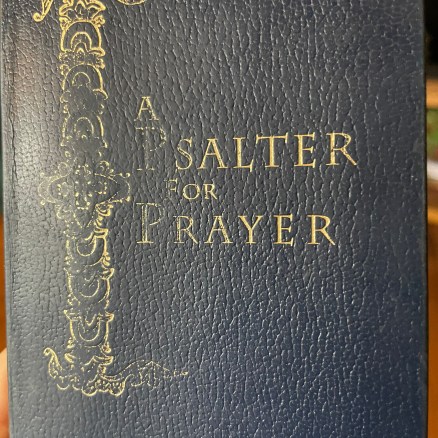
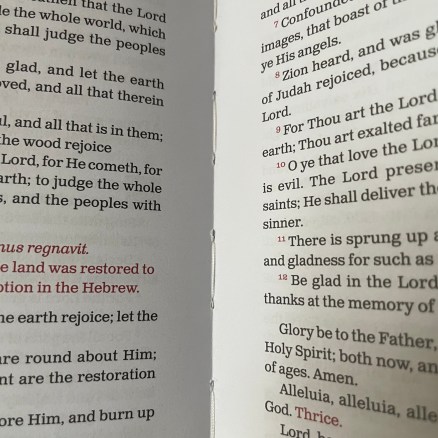
I don’t know much about book-binding, but it appears to me that my small Psalter’s cover letting will wear off before the binding shows any wear.

There’s even a sort of hinge so I can hold it open without straining the spine:

Essentials

American Gnostics

Be careful what you aim for


[S]ubordinating truth to politics is a game which tyrants and bullies always win.

Jonathan Rauch, The Constitution of Knowledge

To believe that wealth is the only significant measure of the worth of an individual, a family, or a community is to reject the teaching of nearly every religion and wisdom tradition that ever was.

Mark Mitchell and Nathan Schlueter, The Humane Vision of Wendell Berry

The Orthodox "phronema" [roughly, mind-set] cannot be programmitized or reduced to shibboleths.

Fr. Jonathan Tobias

You can read most of my more impromptu stuff here (cathartic venting) and here (the only social medium I frequent, because people there are quirky, pleasant and real). Both should work in your RSS aggregator, like Feedly or Reeder, should you want to make a habit of it.

Saturday, 12/10/22

Politics

Georgia Voters Call B*llsh*t on Existential Threatism

If you’ve spent any time in Republican circles since 2016, you’re familiar with a particular pattern of GOP political pressure. No, pressure is perhaps too mild of a word. The better word is bullying. 

The pattern works like this. Trumpist activists seize disproportionate power in the grassroots, work with the Trump team to nominate Trumpist candidates, and then browbeat every conservative who raises objections in the general election. They use negative polarization (with a helpful assist from Democratic extremism) to present voters with the “binary choice.” 

Are you pro-life? Then you can’t vote for the Democrat. Are you worried about the border? Then you can’t vote for the Democrat. Even if the Republican’s character is so deficient that you wouldn’t want your kid working for them if they managed the local McDonald’s, the MAGA movement will yell, “Still better than the Democrat!”

It turns out that people don’t want to be bullied into the ballot box. It turns out a significant enough number of Republicans and Republican-leaning voters will turn to their own party and say, “Do better.” They’ll call the Trumpist bluff and turn the challenge back to them—if these issues are so vital, why are you nominating obviously deficient candidates? Why aren’t you taking the high demands of public office seriously? 

But this point becomes truly powerful only combined with this last observation. MAGA losses combined with normie Republican wins shows there’s life left in conservatism yet. Here’s the tale of the tape in Georgia: Walker was the only Republican this year to lose a statewide race.

David French, Georgia Exposed the Trumpist Scam (Emphasis added)

Of course, a similar argument applies to Democrats: If Doug Mastriano was an existential threat to democracy, why did you spend money to get him elected in the primary?

Bad Omen

Any Republican that’s out there trying to work with [Democrats] is wrong.

Kevin McCarthy, quoted in the Economist

Culture

What subscriptions should I cancel next?

One of my most vital convictions is summed up in this post: “Wondering how to decide what to read? Here’s a simple but effective heuristic to cut down the choices significantly. Ask yourself one question: Does this writer make bank when we hate one another? And if the answer is yes, don’t read that writer.” Americans have these wildly distorted views of people whom they perceive to be their political enemies because so many journalists and talking heads enrich themselves through stoking hatred. Those people should be utterly shunned.

Alan Jacobs, via a reminder from John Brady.

I’ve looked ahead on my list of books to read and eliminated a few based on this wise heuristic.

But what of newspaper editorials that say “hateful rhetoric directed toward transgender people and the broader LGBTQ community” aired from “church pulpits” to “school board debates and libraries” causes people who’ve rarely or never darkened the door of any church open fire in gay bars and clubs? Aren’t those newspapers making bank on hatred?

Alan Jacobs at least is consistent. Last I knew, he read news once per week, on Friday, from The Economist, which doesn’t write such piffle.

Noble lies

The Matthew Shepard myth — that he was murdered by two redneck strangers because he was gay — is still widely believed, even though the hideous murder was far more complex and fundamentally about meth. The idea that the Pulse shooting was motivated by homophobia — not true — is routinely repeated …

This is not healthy. Noble lies are still lies. And lies always fail in the end.

“I sure hope Trump has some more brilliant ideas for can’t-miss Senate candidates. Omarosa maybe? Carrot Top? Ghislaine Maxwell?” – Ann Coulter on the Georgia runoff.

“Can’t believe Lindsey Graham’s pitch of ‘vote for the brain damaged guy to show you’re not racist’ fell short,” – Richard Hanania.

Andrew Sullivan

Wordplay, an occasional feature

When the right words won’t suffice

We are currently in a time, perhaps unprecedented, when talk about all kinds of sexual behavior is pervasive, even inescapable. And we Christians who value purity are very much on the outside, expressing beliefs that the culture can’t even understand. There’s little likelihood that, if we could only find the right way to say it, we’d win people over; I found that out with the pro-life issue. It’s the beliefs themselves that they reject, and changing the words won’t fool them.

Professor David Bradshaw, The Beauty of Chastity, a chapter in Healing Humanity

Words of the Year

For the first time in its history, the Oxford English Dictionary trusted the general public to vote on the word of the year instead of having its esteemed lexicographers make the choice.

Predictably, the general public immediately abused this trust by voting overwhelmingly for the slang term “goblin mode.”

The Morning Dispatch

… “goblin mode”. That means a state in which someone indulges their laziest or most self-indulgent habits—perhaps suitable as a symbol for the first proper post-lockdown year.

The Economist Daily Briefing for December 5

the stink of loserdom

The aura now surrounding Florida Man, per Ross Douthat


[S]ubordinating truth to politics is a game which tyrants and bullies always win.

Jonathan Rauch, The Constitution of Knowledge

To believe that wealth is the only significant measure of the worth of an individual, a family, or a community is to reject the teaching of nearly every religion and wisdom tradition that ever was.

Mark Mitchell and Nathan Schlueter, The Humane Vision of Wendell Berry

The Orthodox “phronema” [roughly, mind-set] cannot be programmitized or reduced to shibboleths.

Fr. Jonathan Tobias

You can read most of my more impromptu stuff here (cathartic venting) and here (the only social medium I frequent, because people there are quirky, pleasant and real). Both should work in your RSS aggregator, like Feedly or Reeder, should you want to make a habit of it.

An oddball Evangelical finds a home in Orthodoxy

One of his first converts was Samuel Crane, who had been a devout Calvinist but was deeply perplexed by the apparent contradiction between the idea of an eternally fixed number of elect and reprobate and the idea that salvation was free for anyone to take: He supposed it must be as the [Calvinist] minister said, for he was a good man, and a very learned man; and of course it must be owing to his own ignorance and dulness that he could not understand it. On one occasion, as he was returning home from church, meditating on what he had heard, he became so vexed with himself, on account of his dulness of apprehension, that he suddenly stopped and commenced pounding his head with his fist, for he really thought his stupidity must be owing to his having an uncommonly thick skull. When Crane finally accepted Methodism, “he found a system that seemed to harmonize with itself, with the Scriptures, with common sense, and with experience.”

Nathan Hatch, The Democratization of American Religion

Unlike Samuel Crane, I was not as perplexed by Calvinism as I probably should have been. Yet the Sunday after my 49th birthday, I left Calvinism and formally entered the Eastern Orthodox Christian Church. It seemed to harmonize with itself, with the Scriptures (including the ones we were never told to underline), with common sense, and with experience. It was so obviously right once I explored it that I assumed lots of others would follow. It’s fair to say that only one did.

So I’m left wondering "why me?" Why am I the lucky one?

It’s inevitable that telling of one’s religious conversion — and it’s hard for me to view a move from Calvinist to Orthodox as anything less than a conversion, though both are Christian in some sense — will have a whiff of proselytism to it. I’ve tried to minimize that and just tell my story, though my story would be incomplete without a modest conclusion.

Major life decisions, I’m pretty well convinced, rarely hinge on arguments. They’re always undergirded by life experiences and attitudes, which are at most obliquely causal. They’re also so complex as to seem inexhaustible. I told a fuller story of going Evangelical-to-Calvinist-to-Orthodox in one truthful way almost five years ago: A life in a string of epiphanies – Tipsy Teetotaler ن.

But I often think that seeds were planted, and that my disposition somehow was shaped, decades earlier, so that my reception into Orthodoxy truly was a sort of "coming home" — like an adoptee stumbling across his birth parents.

Here’s what I mean.

My favorite Bible verses were not even in the "Top 100" list of favorite Evangelical Bible verses.

As long ago as high school, I became (and remained) fixated on some New Testament passages that were, shall we say, far out of the Evangelical mainstream.

First was Ephesians 3:17-18 in the Living Bible that was so popular then, praying that “Christ will be more and more at home in your hearts” and “May your roots go down deep into the soil of God’s marvelous love.” My Evangelical contemporaries were likelier to pick John 3:16 or Acts 16:31, relieved that one key decision for Christ, once-in-a-lifetime, sealed the deal and there really was nothing more required.

But I didn’t think I had the deep roots the Apostle was praying for, but I wanted them, for myself and my friends. I may even have declared it my “life verse,” life verses being an Evangelical kid thing at least where I was. If I did, it has held up very well.

But in Evangelicalism, sinking deep roots seemed to be off the radar, or reduced to a matter of becoming more theologically astute, doing more Bible study, elaborating doctrinal outlines and such. Those are mostly good things (I’m not so sure about doctrinal outlines any more), but they amount to knowing about God, not knowing Him or having deep roots.

I was also fascinated with Romans 12:2, about the transforming of our “minds” (which came close to “life verse” status), which I thought would eventually come if I became more theologically astute. That was a fool’s errand.

And then there was a real baffler, Hebrews 6:1-2, which referred to “repentance from dead works … faith toward God … the doctrine of baptisms, of laying on of hands, of resurrection of the dead, and of eternal judgment” as “the elementary principles of Christ!” I just couldn’t imagine what more advanced there could be than these seemingly weighty things, but I wanted it. And here I wasn’t convinced that theological astuteness in the Evangelical manner had any chance of hitting pay dirt.

I wanted to worship God when I went to a "Worship Service"

Call me petty, or Aspie, or whatever, but I thought worship services should be full of, like, y’know, worship or something.

I had no objection in principle to Christians playing hail-fellow-well-met, back-slapping and exchanging anodynes and nostrums, or talking like coaches getting the guys ready to go out there and win one for Jesus. But the time and place for that was somewhere other than the Nave between 9:30 and noon on Sunday.

So it seemed to me, and I was adamant about that. The irresistable force of happy-clappy and motivational Church services was strangely resistable to me.

Music selection was what really bugged me. By the time I was Christian Reformed, I was in a Church that had a full Psalter, versified for congregational singing. But even there, we sang way too few of them, preferring to sing things that were relatively emotional and manipulative, that 100 years earlier would have gotten one in deep trouble in that denomination. I called them "gospel songs" instead of "hymns," but I see some sign that my terminology isn’t undisputed. In any event, they weren’t Psalms, which alone were sung in the CRC until maybe the late-19th Century.

There were other things I could have taken exception to, but the music was what got me riled. And then a faction of the Church wanted drums and guitars and more "celebrative" services, which horrified me. I just didn’t think that an emotion jag meant one was worshipping.

So my entire Protestant experience of "worship" was years of drought with an occasional delightful shower (a very good "hymn" as I defined hymn).

(Brief digression: to my knowledge, the Orthodox Church only sings one hymn that appeared in any hymnal in any church I regularly attended. We sing Let All Mortal Flesh Keep Silent on Great and Holy Saturday. I’m even allowed to do the versified version, Picardy (8.7.8.7.8.7), which is used in Western Rite Orthodoxy. We share some ancient hymns with Episcopalians and Roman Catholics, too, but I was never Episcopalian or Roman Catholic.)

I had, apparently, a latent desire to worship with my body

As noted in my prior telling of my conversion:

My first experience of [Orthodox] Liturgy shocked me. I found myself immediately making a clumsy sign of the cross and genuflecting toward the Catholic hospital chapel’s altar, like a Roman Catholic.

It felt good. It felt as if those bodily gestures had been bottled up and were now breaking out. They felt natural

Maybe I should call those feelings “epiphany number four,” but it didn’t impress me quite that strongly at the time. And there’s a reason I blog under the rubric “Intellectualoid”: I tend to discount feelings as a reliable guide.

I didn’t consciously experience that Liturgy as "I’ve come home," but there was more than a whiff of that to it.

Orthodox worship is full of signing ourselves with the cross, bowing, kneeling, prostrating. My experience of body-involvement in Protestant worship was limited to a few gestures like holding up hands and lifting up fluttering eyelids, which somehow felt ersatz.

I was at best reluctantly dispensational premillennialist

Again, I told about my relationship to dispensationalism as Epiphany 3 in my prior telling of my conversion. It’s not worth quoting again, but my hesitancy about dispensationalism left me outside of the Evangelical mainstream.

I hesitate to make discomfort with that novelty a mark of Orthodoxy, because dispensationalism is only about 200 years, when Presbyterian, Reformed and Anglican churches were already a few hundred years old. My attitude toward end-times prophecy would have been pretty mainstream in any of those slightly-older churches, as it’s totally mainstream in Orthodoxy.**

But in my perception, dispensationalism is a mark of mainstream Evangelicalism and even has infected Presbyterian and Reformed Churches that tend to the Evangelical side. So my discomfort was likely to crop up most anywhere I went in Protestantism in these days.

I believed the Creeds and thought they were important

I suspect that the "Apostles Creed" is said rarely in frankly-Evangelical Churches today, and that the Nicene Creed is vanishingly rare. That’s a trend I think was starting 50 years or more ago. (Spot check: Willow Creek Church in South Barrington, Illinois lists its "Beliefs and Values" as "Love God. Love People. Change the World." That’s even worse that I feared.)

The Apostles Creed, though, remained a weekly feature in the Christian Reformed order of worship, with the Nicene Creed thrown in occasionally for a little spice.

By the end of my 20s, I think, I began calling myself “orthodox with a lower-case O.” I was, I thought, a “Mere Christian,” which I described as “believing the ecumenical creeds of the Church without mental reservations.” I learned more about them when I was Christian Reformed.

I’ve learned even more as an Orthodox Christian, but that could be its own story.

I wanted the original faith, which I took to be the purest

I wanted to be orthodox in that creedal sense. I and others detected proto-Calvinism in St. Augustine, and he was early enough that I thought I had finally joined with the early church, which is also what I wanted.

But I knew almost nothing about actual Orthodoxy. (Summary of what I knew: The Russian Orthodox have some awesome music. Orthodox Priests wear beards and funny hats. Orthodox isn’t the same as Catholic. Those were, mostly, true.)

An iconographer I met recently told of his first encounter with Orthodoxy:

I went to the Holy Land and encountered Orthodoxy. I didn’t know what to make of it. It was Christian, but vastly different, far older than my Methodist Church.

Indeed, and a few centuries older even than St. Augustine, who I looked to to buttress the "original faith" bona fides of Reformed Christianity.

The Orthodox Church recognizes Augustine as a Saint, but an unusually flawed one owing to his isolation in the West, when was still a Christian backwater, and his substantial ignorance of Greek and the Greek Church Fathers. So when I thought Augustine was early enough to be the original faith, I was wrong for practical purposes.

Afterthought

These are the things in my history and attitude that I think foreshadowed that my heart would find rest only in the Orthodox Faith. I began writing this many months ago, thinking that more proto-Orthodoxies would occur to me, but they really haven’t, and I don’t want to make things up.

My story would be incomplete were I not to say that all these desires that made me an odd-ball Evangelical and Calvinist have been (or are being) satisfied in Orthodoxy (though I’ve come to understand Creeds differently now). I cannot deny that they might have been satisfied in traditional Roman Catholicism, but that seems largely to have disappeared as Rome has Protestantized in the wake of Vatican II.


You can read most of my more impromptu stuff here (cathartic venting) and here (the only social medium I frequent, because people there are quirky, pleasant and real). Both should work in your RSS aggregator, like Feedly or Reeder, should you want to make a habit of it.

Journeys to Orthodoxy (and more)

A Peace Activist’s Journey to Orthodoxy

The recently-deceased peace activist Jim Forest tells how he, a “red diaper baby,” came to be an Orthodox Christian. These bits amused me and rang a faint bell:

Thanks mainly to [Thomas] Merton and Dorothy Day, I was more aware than many Western Christians of the Eastern Church, but I had no more thought about becoming Orthodox than a visitor to the zoo thinks about becoming a flamingo … I thought that Orthodoxy was like certain wines that are best drunk at the vineyard.

A Cistercian Monk’s journey to Orthodoxy

I liked Thomistic philosophy very much. I found in it an excellent antidote to the poisons of individualism, subjectivism, and idealism that have infected modern thought. But the manner in which Thomas Aquinas conceived the relations between nature and grace, and the use he made of reason—even if dependent on the Faith—to construct a theology answering to the Aristotelian definition of ‘science’ troubled me. It was profoundly different from the Fathers’ approach to theology. I had no trouble in admiring the coherence and harmony of Thomism’s theological synthesis, but for me it recalled the gothic architecture of Thomas’s era: quite brilliant, but where reason is too rigorous in forcing the materials to submit to its demands. By its nature, the Scholastic method seemed to me open to reducing the mysteries of God to what reason can grasp of them, hemming them in with its definitions, or enclosing them in syllogisms. The writings of the Fathers, on the other hand, breathed a sense of the sacred and of the mystery, evoked a reciprocal penetration of the human and divine, and found their corresponding school of plastic arts in the art of the Romanesque and of Byzantium.

During the years 1962-1965 … [i]t became obvious that I could not think and live in accordance with the principles that seemed to me to be true without creating tensions and pointless conflict in the very heart of the monastery. All the same, I was certain that the fullness of the truth belonged on the side of the Fathers and the Early Church, on the side of that Orthodoxy that I loved without yet realizing that it could be, purely and simply, the Church.

Archimandrite Placide Deseille, Holy Hesychia: Stages of a Pilgrimage.

Archimandrite Placide, who I just discovered, became a Trappist Cistercian monk at 16, but found the Early Church Fathers and the piety of Orthodox monasticism inescapable. He and his monastery finally united with the Orthodox faith, without, however, feeling that they had become “eastern” or “oriental”:

[G]iven the state of things, the practice of the Byzantine liturgy seemed to me to be the most suitable means for entering into the fullness of the patristic tradition in a way that would be neither scholarly nor intellectual, but living and concrete. The Byzantine liturgy has always appeared to me much less as an “eastern” liturgy than as the sole existing liturgical tradition concerning which one could say: “It has done nothing more nor less than closely incorporate into liturgical life all the great theology elaborated by the Fathers and Councils before the ninth century. In it the Church, triumphant over heresies, sings her thanks-giving, the great doxology of the Trinitarian and Christological theology of Saint Athanasius, the Cappadocians, Saint John Chrysostom, Saint Cyril of Alexandria, and Saint Maximus the Confessor. Through it shines the spirituality of the great monastic movements, from the Desert Fathers, from Evagrius, Cassian, and the monks of Sinai, to those of Studion and, later, of Mount Athos. … In it, in a word, the whole world, transfigured by the presence of divine glory, reveals itself in a truly eschatological dimension.”

[T]here is no doubt that many aspects of the Catholic Church changed very much in the years following the Council. And there can be no doubt that the most symptomatic change is that which has taken place in her liturgy. As Father Joseph Gelineau, one of the men deeply involved in these reforms, wrote after Vatican II: “It is a different liturgy from the Mass. In plain language: the Roman rite, as we knew it, no longer exists. It has been done away with.”

Step aside, Jesus. I’ll build this.

[E]vangelical leaders are the products of the institutions of that movement — colleges, seminaries, various parachurch organizations — and those institutions either have failed to provide serious intellectual equipment or, when they done their jobs well, their voices have been drowned out by the entrepreneurial/marketing noisemakers who insist that the building of churches is exactly like the building of businesses.

Alan Jacobs

Gnosticism in a nutshell

In Greek, Gnosis means “knowledge,” and to be a Gnostic is to claim to possess a special kind of knowledge: the knowledge that the world isn’t the reality it supposes to be.

So basically it’s religion for super-fans of The Matrix.

N.S. Lyons, ‌The Reality War


You can read most of my more impromptu stuff here (cathartic venting) and here (the only social medium I frequent, because people there are quirky, pleasant and real). Both should work in your RSS aggregator, like Feedly or Reeder, should you want to make a habit of it.

War, education, leisure, Soros, Roe and more

Seven Days on the Roads of France, June 1940

Within the past few days, I finished Seven Days on the Roads of France, June 1940 by Vladimir Lossky. I should get to Lossky’s theological masterpiece, The Mystical Theology of the Eastern Church, within the next few months.

Meanwhile, selected highlights from his account of fleeing Paris ahead of the Nazis, hoping to enlist and fight them. As indicated by my added emphasis, I thought his reflections on war, in the chapter "Day 1," were timely as, by some accounts, we’re headed into dark times or worse:

Preface to the original French edition of 1998, by Nicholas Lossky

To begin with, it must be made clear that for this Russian Orthodox theologian – who remained very authentically Russian in many respects – France was not, as it was for many émigrés, simply a land of asylum. To be sure, it was that; but above all, in this case it was a land chosen quite deliberately. Indeed his great love for the country began in childhood. It came first of all from his governess ….

On the notion of dogma from an Orthodox perspective, [Olivier] Clément writes as follows: “For Orthodoxy, Lossky insists, a dogma is not an attempt to explain a mystery or even an attempt to make it more comprehensible. Rather, it seeks to encircle the ineffable and to compel the mind to surpass itself by a clear minded sense of wonder and adoration. […] Thus a dogma is not a solution to a problem but the protection of a mystery, in the Christian sense of Revelation of the unfathomable, the inexhaustible, the personal. In defining a dogma, the sole aim of the church is to preserve the possibility for each Christian of participating in revelation with his whole being; that is, of communicating with the very life of the One who reveals Himself.“

Day 1: Thursday 13th June 1940

Those who resigned themselves to staying in their homes, their streets, their quartier, their city – now become a prey to enemy invasion – were right. Equally right were those whose conscience dictated that they should set out on the great adventure of the open road.

“We shall conquer,“ we were told, “because we are the strongest, because we are the richest. We shall conquer because we have the will to do so.“ As if bons d’armement in themselves could bring about victory. As if war were nothing other than a vast industrial undertaking, a mere matter of capital. Such a war – a war of equipment and weaponry, inhuman, materialistic – yes, we have no doubt lost such a war. We must have the courage to say so. What is more, France could never have won such a war. Otherwise, she would no longer have been France, preeminently humane. If she had won such a war – one without a human face, a war of equipment (the kind of war being presented to us) – she would have lost the most precious thing she possesses, the essential characteristic of her very being. She would have lost that which makes her France, that which differentiates her from every other country on earth. (emphasis added)

There was another heresy, too -spiritual, this time – one which sought to superimpose itself on the materialism of the ‘war of equipment’ argument, to infuse into it an artificial soul. This was the ideology of a ‘holy war’, ‘crusade’. It came in several varieties: the struggle for democracy, for freedom, for human dignity, for western culture, for Christian civilization, even for divine justice itself. I say ‘heresy’ because such ideas, often just in themselves, were not based on lived experience. They did not well up from a deep, wholesome spring, which alone could have transformed them into ideas having a motivating force. Moreover, such words rang false, like all abstractions. They rang false above all since they sought to present as absolutes, concepts and values that are secondary, relative … No, war is not waged for absolute values. This has been the mistake of all so-called ‘religious’ wars, and the main cause of the atrocities associated with them. Nor is it waged for relative value that one endeavors to turn into absolutes, nor yet for abstract concepts which have been lent a religious character. Even if one were to set against the idol of a ‘pure race’ the more benign idol of Law, Liberty and Humanity, they are still idols – concepts that have been personified and made into absolutes. This would still result in a war of idols. The only just war – in so far as a war may ever be styled just – is a war for relative values, for values known to be relative. A war in which man – a being destined for an absolute end – sacrifices himself spontaneously and without hesitation for a relative value that he knows to be relative: his native soil, his land, his country. It is the very sacrifice that acquires a value that is absolute, incorruptible, eternal. (emphasis added)

Day 3: Saturday June 15th

Suddenly I was struck by the sound of a hoarse, muffled voice. I was not alone, after all. A tall old man with a stoop, wearing an old-fashioned fin-de-siècle frock coat, was waving his arms about, threatening and cursing someone. He had a fine face, the look of a well bred provincial gentleman, a devout and God-fearing type. I drew nearer to see who he was so angry with. He was going round the cathedral, stopping before each statue of a saint. It was to them that he was addressing his curses, his cries, his threats. “Alors, quoi?” Damn it all, then! Don’t you want to help us? Can’t you help us?“

I left the cathedral, quite overcome. You really need to have a faith that was deep and sincere, a genuine inner freedom before God and his Saints, to be able to talk to them like that. No, he wasn’t a madman. Rather, a noble Christian soul, seized with despair and bitterness, pouring out his pain to the Saints, who remained motionless and silent, guides of the divine ways that are so painful for us to follow.

Day 4: Sunday 16th June

[R]evolutionaries are always in the wrong since, in their juvenile fervour for everything new, in their hopes for a better future and a way of life built on justice, they always base themselves on theories that are abstract and artificial, making a clean sweep of living tradition which is, after all, founded on the experience of centuries.

Conservatives are always wrong, too, despite being rich in life experience, despite being shrewd and prudent, intelligent and sceptical. For, in their desire to preserve ancient institutions that have with stood the test of time, they decry the necessity of renewal, and man’s yearning for a better way of life.

The Royal Court, grouped round the Imperial Chapel and, seized with theological fervour, sought to ensure the triumph of a novel teaching concerning the procession of the Holy Spirit. Pressure from the Frankish empire caused this strange teaching to triumph in the West. After resisting for a while, the Popes were in the end obliged to alter the traditional, sacred text of the Creed. From then on, schism from the Eastern Patriarchates became inevitable. (Byzantium, on the other hand, never experienced such an extreme case of Caesaropapism.)

Day 5: Monday 17th June

Faced with Latin Christianity and its tendency to abstractions, to homogenization and sterilization; faced with a pagan and only too concrete pan-Germanism founded upon a mystique of “blood and soil“ that seeks to refashion the world according to its creed, France could then become a focus of regeneration for Western Christianity in a Europe that is becoming de-Christianized.

"Not very concerned with how much money you make when you grow up … where you go to college"

Genuine red-pilling from a classical educator:

Welcome to your sophomore humanities class.

This year, we will be reading early modern literature, which is roughly the seventeenth century through the nineteenth century. I have some fairly lofty goals for this class and I hope you do, as well. To be honest, when this class finishes nine months from now, I won’t know if I have accomplished any of those goals. I will need more time. Perhaps when you are forty or so, which is how old I am, we will both know whether this class has done you any good.

It will take at least this long to determine if I have accomplished my goals because I am not very concerned with how much money you make when you grow up, which means that I am not all that interested in where you go to college. Many of my students still labor under the delusional belief that if they can just get into the right college, they will be successful. If you are primarily concerned about getting good grades so you can get into the right college, you’re worrying about the wrong things, because beyond the age of 22 or 23, what matters is not grades, but whether you’re good at doing something that matters and whether you can be content doing that thing for the next thirty years. If the only thing you’re good at doing is getting good grades, your life is going to fall apart after you graduate college ….

Joshua Gibbs. Read it all.

We get leisure all wrong

Leisure is useful—but only insofar as it remains leisure. Once that time is viewed as a means to improve employee morale and higher growth, then leisure loses the very quality that makes it so potent. As Pieper wrote, “Leisure is not there for the sake of work.” Leisure is doing things for their own sake, to pursue what one wants. We should fight the urge to reduce it to a productivity hack.

We yearn to “make the most of” our free time, so we are constantly giving our evenings, weekends, and vacations over to our self-advancement. Labor-market precarity and the growth of the gig economy have sharpened these incentives. Pure leisure now feels like pure indulgence.

If leisure is justified by its contribution to other social ends—innovation, productivity, growth—it stands to lose any perceived worth as soon as it comes into conflict with those goals. An eventual clash between the two will always be settled in favor of work. The result is 768 million hours of unused vacation days. And even when employees take time off, they feel an urge to log in to their work email between dips in the ocean.

Krzysztof Pelc, ‌Why Your Leisure Time Is in Danger

When all your colleagues are, by definition, prickly progressives

George Soros’ Open Society Foundations are restructuring:

The tensions boiled over at the all-staff meeting in early May. On the eve of the voluntary buyouts, executives took part in a video call, in which staff members shared their misgivings and grievances.

After looking at a series of slides prepared by Bridgespan, which painted the organization as less streamlined than Gates or the Ford Foundation, with large numbers of staff approving lots of small grants, employees called out executives for their handling of the restructuring, according to several staff members who participated in the call and transcripts of both the video call and the simultaneous chat, where things got even rougher.

One commenter in the group chat called the process “unaccountable, and unscientific.” Another referred to the “frustration with respect to racism and sexism and other forms of oppression that are alive and well within the institution.”

Lie down with progressives, rise up with vague charges against you.

How to overturn Roe

“It grinds my gears when people say what’s been done here is genius, novel or particularly clever — it was only successful because it had a receptive audience in the Supreme Court and Fifth Circuit,” said Khiara M. Bridges, a professor of law at the University of California at Berkeley, referring to the conservative-leaning federal appeals court that also weighed in on the Texas law.

“If you want to overturn Roe v. Wade, you create a law that is inconsistent with the Supreme Court’s precedent and someone will challenge it and you work it through the federal courts,” she said. “You don’t create a law that is designed to evade judicial review.”

The Conservative Lawyer Behind the Texas Abortion Law – The New York Times

The second paragraph is, in a nutshell, why the Texas law is a sideshow and the real action (currently) is the Mississippi law that bans abortions after 15 weeks.

Ah, California!

“Enslavement of both adults and children, mutilation, genocide, and assault on women were all part of the mission period initiated and overseen by Father Serra,” declares Assembly Bill 338, which passed both chambers by wide margins and now awaits Gov. Gavin Newsom’s signature. None of that is true. While there is much to criticize from this period, no serious historian has ever made such outrageous claims about Serra or the mission system, the network of 21 communities that Franciscans established along the California coast to evangelize native people. The lawmakers behind the bill drew their ideas from a single tendentious book written by journalist Elias Castillo.

Abp. Salvatore J. Cordileone and José H. Gomez, ‌Don’t Slander St. Junípero Serra

This sort of self-important nonsense, California, as much or more than envy, is why the rest of us make fun of you.

Shorts

  • Because of the divorce from the historic Church, Evangelicalism has sought for a new way to satisfy the need for materiality. This is why such believers have welcomed pop music and rock-n-roll into their churches. It is why emotion is mistaken for spirituality. It is why sentiment is substituted for holiness. Sincere feeling is the authenticator. Instead of icons of Christ, whose piercing stare calls you to repentance, the Evangelical can go to a Christian bookstore and buy a soft-focus, long-haired picture of Jesus. He’s a “nice” Jesus, but it is hard to believe that He is God. (Fr. Andrew Stephen Damick, Orthodoxy & Heterodoxy)
  • The project, begun at the time of Constantine, to enable Christians to share power without being a problem for the powerful, had reached its most impressive fruition. If Caesar can get Christians there to swallow the “Ultimate Solution,” and Christians here to embrace the bomb, there is no limit to what we will not do for the modern world. (Stanley Hauerwas, Resident Aliens)
  • The perfect fictitious charity benefit, for "Rich People Who Wish To Help Poor People Without Having To Be In Physical Contact With Them," joins up with the perfect limerick for a well-nigh perfect blog post from Garrison Keillor.
  • Seekers of religious exemptions to vaccine mandates demonstrate that there is literally no limit to what folly you can "prove" from motivated reasoning recast as "personal bible study." Vaccine Resisters Seek Religious Exemptions. But What Counts as Religious?
  • It is a signal characteristic of “hermeneutic philosophy” to say we can no longer believe in something rather than arguing that it is false. (R.R. Reno, Return of the Strong Gods)
  • As parishioners, we believed that Christ had come to give us abundant life, yet the nature of that abundant life was conceived as simply more of what we already had as pleasure-seeking, comfort-loving Americans. (Robin Mark Phillips, Confessions of a Recovering Gnostic)

You can read most of my more impromptu stuff at here. It should work in your RSS aggregator, like Feedly, should you want to make a habit of it.

The moral horse and the doctrinal cart

Once again, Fr. Stephen gets my juices going:

In early centuries, [the catechumenate, that process by which we initiate persons into the life of the Orthodox faith,] lasted as much as three years. Surprisingly, it consisted primarily in “moral instruction” (teachings on how to behave). Instruction in the doctrines of the faith did not take place until after Baptism! The assumption behind this was (and still should be) that catechumens needed spiritual formation before they were ready to receive doctrinal instruction. This assumption has been greatly weakened in our modern culture.

We labor under the myth of being an “information-based” society. We imagine that we are deeply informed, have ready access to massive amounts of information on the basis of which we are able to make free and well-considered decisions. This over-simplification of our human experience is deeply flawed …

Catechumens, if given only a diet of information, … fail to thrive. Above all else, it is the practice of the faith that makes faith possible.

Then Jesus said to those Jews who believed Him, “If you abide in My word, you are My disciples indeed. And you shall know the truth, and the truth shall make you free.” (Jn. 8:31-32)

“Abiding in the word” (keeping the commandments, engaging in the practices of the faith) is the necessary pre-condition for “knowing the truth.”

This suggests to me that we set our minds to become “perpetual catechumens” in which we give our attention to the softening of our hearts rather than inundation of our minds …

The heart’s learning is the true point of salvation. Information does not save us – but there is such a thing as “saving knowledge.” We speak of this, formally, as “holy illumination.” It is the consistent teaching of the Church that holy illumination is our desired path to God.

Fr. Stephen Freeman, ‌The Perpetual Catechumen

Had I read this 25 years ago, I’d have wondered what kind of squishy Kum-Bah-Yah cult taught such things as "spiritual formation before doctrinal instruction."

Not a digression: I remember a rather fringe figure in my Evangelical years, Col. R.B. Thieme, Jr., teaching sometime in the 1976-79 range that "God loves nothing better than doctrine in the frontal lobe."

I didn’t believe him — but I lived as if it were true, or as if enough doctrine in my frontal lobe would eventually cure my disordered life. It never did, and it never would have. The trajectory it put me on was that of an irascible "discernment blogger" with a hot steaming mess of a private life. Only the lack of a consumer internet spared me that fate.

When I entered the Orthodox Christian faith some 20 years later, I did so expecting to get my doctrine straightened out, having seen a couple of fundamental flaws in my prior approach — the kinds of things you can’t un-see — and having somehow gained an implicit trust in the Church.

But for some reason, early in that same transitional period of my life, I saw in re-reading C.S. Lewis’ The Great Divorce that I needed to forsake one particular moral failing, lest it make me the kind of person who wouldn’t even like heaven had he inherited it. In that regard, Anglican Lewis — and his message to my imagination, not my intellect — was my Orthodox moral catechist.

And now, twenty-four more years down the road, Fr. Stephen makes perfect sense to me. To my surprise, "Orthodox" Christianity turned out not to be all that much about doctrine. Beyond the Nicene Creed, there are few doctrinal dogmas. We are conspicuously apophatic, a tendency that Col. Thieme presumably would have anathematized.

What it is about is — well, you’ll just have to come and see.


You can read most of my more impromptu stuff at here. It should work in your RSS aggregator, like Feedly, should you want to make a habit of it.

Hodge-Podge

Spengler on Afghanistan

When David P. Goldman is in the mood to write grimly realistic assessments of our present difficulties, he adopts “Spengler” as his pen name, a hat tip to the German author of the early-twentieth-century apocalyptic best-seller The Decline of the West. And when Goldman feels the situation especially dire, Spengler consults the ghost of Cardinal Richelieu, one of history’s most thoroughgoing realists. Here is what the shrewd cardinal had to say about the Taliban’s triumph in Afghanistan:

America set out to create a modern democracy out of a tribal society, an enterprise as likely to succeed as the attempt to breed a griffin by mating a lion with an eagle. It poured US$2 trillion into Afghanistan, or one hundred times the country’s gross domestic product. It paid Afghani politicians, generals and warlords to play-act at democracy in a revolting, silly masquerade.

Whatever was not corrupt before America came in became corrupt in the maelstrom of American money. Meanwhile, American soldiers and bureaucrats made fortunes as consultants, contractors, sutlers and armorers to the dream palace of Afghan democracy.

Because the entire project was a monstrous hoax to begin with, everyone associated with the project lied—lied about the state of Afghan government forces, lied about the disposition of the Taliban, lied about the robustness of supplies to Afghan troops, lied about their dependence on airpower.

Afghan officials lied to their American paymasters, American commanders on the ground lied to their superiors and American generals lied to the politicians. The key to promotion, and to wealth, lay in perpetuating the ridiculous fiction that motivated the occupation of the country in the first place.

Where did $2 trillion go? The Taliban offensive began in April after the Americans announced their intent to depart. No one fought for Afghanistan because there was no Afghanistan to fight for. Within weeks the Afghan army had no ammunition, no food and no air support. Whoever could steal from the Americans did so. The Afghanistan government collapsed in a matter of days because it was never there to begin with.

The ghost of Richelieu gets it pretty much right.

R.R. Reno in First Things

Manchin and Sinema, designated drivers

Dear Senators Manchin and Sinema,

Whether the occasion is social or political, the hero of the party is the person who’ll grab the keys before the drunks can get behind their wheels.

This week, it falls to the two of you to be that person. The progressives in your party think you’re all that stands in the way of their expensive utopia, and they’re willing to hold a popular infrastructure bill as hostage in order to get their wish …

This is dumb. The likeliest way for President Biden to fail — and for Democrats to lose their congressional majorities next year and for Donald Trump to return to the White House next term — is for the spending bills to pass mostly as they are. A Democratic Party that abandons its center (where many congressional seats are vulnerable) for the sake of its left (where the seats are usually safe) is heading straight for the minority come November 2022.

Let them call you names now so that they can thank you for your sobriety later ….

Bret Stephens, ‌Manchin and Sinema Should Just Say No to Big Spending Plans (emphasis added)

What matters in our democracy

The only people in America who didn’t seem to understand that making Trump president was the equivalent of handing a gun to a chimpanzee were the people who voted for him.

And in our democracy, that’s all that matters. Yay people!

Jonathan V. Last, ‌Why Didn’t They Say Something?

I diss Trump a lot, but relatively rarely say "I told you so." But my major, overarching, distilled objection to Trump before the 2016 election was that his epic narcissism would one day dangerously distort his apprehension of reality.

I didn’t foresee just how and when the distortion would come. Indeed, as the 2020 election approached, I was in the camp that said he would turn over power peacefully as had all his predecessors. That’s what most of the "experts" and pundits I trust were confidently predicting, but frankly, the alternative was so ghastly that I probably would have believed it all by my lonesome, unbidden.

So offensive I’m tempted to become antivax-adjacent

[L]iberal elites continue to call anyone who is unvaccinated "stupid,” ignorant and immoral. On Sunday, New York’s Democratic Governor Kathy Hochul, when announcing her intent to use National Guard soldiers to replace health care workers fired for refusing the vaccine, told her audience: “yes, I know you’re vaccinated, you’re the smart ones.” She then said those who refuse to get the vaccine are not just stupid but have turned their back on God: “there’s people out there who aren’t listening to God and what God wants.” Gov. Hochul added that the vaccine “is from God to us and we must say, thank you, God,” and said to her "smart” vaccinated supporters: “I need you to be my apostles.”

Glenn Greenwald.

Her statement was offensive because (1) it’s cringe-worthily condescending (as if she reasoned "the stupid ones, the ones who aren’t vaccinated, are probably religious so I’ll try a faux-religious approach") and (2) I thought God-talk was forbidden in the public square.

Gov. Hochul’s rhetoric has little of his hectoring tone, but her substance is maybe even more condescending and insulting than was Al Gore’s during the 2000 Election season.

Democratic contempt for the demos

When they were young, these leaders were believed to be the architects of the new world that was to emerge as a result of the revolution; now, being old, they claim to be the authors of the institutional system they think is the greatest political success in history. The attitude in both cases is the same: a hasty and arrogant dismissal of what stands in their way and what they readily qualify as prejudice and anachronism. In this respect, the EU leaders and bureaucrats are no different from other enlightened governments of the past, except perhaps that they manage to conceal their contempt for the demos.

Ryszard Legutko, The Demon In Democracy

No GMOs

The very premise for relying on the mass and crass forms of Christianity that flourish in the United States runs on the fuel that the spiritual crisis of our age is so great that it demands genetically engineered spiritual nourishment.

Mark Mitchell and Nathan Schlueter, The Humane Vision of Wendell Berry.

I’m not so sure I’m cool with "premise … runs on the fuel …", but "genetically engineered spiritual nourishment" gets two thumb up as a formulation, two thumbs down as actually nourishing.

The Orthodox Church has no GMOs, by the way.

For the flourishing of all

Kurt Vonnegut’s classic 1961 short story “Harrison Bergeron” pictures a supposedly utopian version of the United States in which strict equality is enforced through the use of mandated handicaps such as earpieces that transmit piercing sounds to disrupt thought for those with above-average intelligence. Few of us would take our commitment to equality to such lengths. Yet many of us do view equality – of opportunity and outcome – as something worth approximating as a benchmark for justice in our society. But is such equality achievable, and is it even necessary for the well-being and flourishing of all?

… DeBoer asserts that if we are serious about justice, we need to take seriously the fact that natural intelligence is not equally distributed. Given this inequality, one’s degree of natural intelligence is not an appropriate basis for assigning value or determining who gets to live the good life any more than race or some other contingent factor of human existence.

Anthony M. Barr, reviewing The Cult of Smart in Plough.

Two observations:

  • Harrison Bergeron is one of my all-time favorite short stories.
  • I have maintained for 50+ years that human equality does not require fictive interchangeability or blinders about differences.

Epic political malpractice

  • Tyler Cowen pointed something interesting out in his Bloomberg column on Wednesday: Democrats aren’t really making a proactive policy argument in favor of their $3.5 trillion reconciliation plan. “Crazy as my hypothesis may seem, given all the stuff about Biden’s agenda on the internet, there has been remarkably little policy debate about it, and remarkably little attempt to persuade the American public that this spending is a good idea,” he writes. “My colleague Arnold Kling put it well: ‘With the reconciliation bill, there is no attempt to convince the public that it is desirable to enact an enormous child tax credit or to mandate ending use of fossil fuels in a decade. Instead, what we read is that if you’re on the blue team you want the number to be 3.5, but a few Democrats are holding out for something lower.’”

  • Peter Suderman took the Biden administration’s reconciliation sleight of hand to task in his latest for Reason. “The simplest way to understand economics is that it is a reckoning with unavoidable tradeoffs. If you spend money on something, you may obtain something in return—but you lose the ability to use those resources on something else,” he writes. “Under President Joe Biden, however, Democrats in Washington have decided that they can simply wish those tradeoffs away by declaring that they do not exist. Over and over again, they have argued that their policies do not or should not have any costs whatsoever.” The reconciliation package, for example, “is a plan that, in its broadest form, calls for spending $3.5 trillion. Even in the unlikely event that such a plan turns out to be truly fully paid for, it would still spend $3.5 trillion. Those economic resources would be used to do some specific things, which in turn would reduce the ability to do other things. In other words, there would be costs and tradeoffs.”

Adjacent items in Thursday’s Morning Dispatch

Biden does seem to be doing his best to re-elect Donald Trump in 2024. One can be pretty confident that’s not his intention. I’ll leave it at that and let you draw your own conclusions (or theories, or hypotheses) about why he subverts himself.

Three-dimensional chess?

On Orange Man back-handedly endorsing Democrat Stacey Abrams over Republican Brian Kemp:

A former Republican president, one who appears eager to run again in 2024, attempting to torpedo a Republican and endorsing a progressive Democrat in his place? That Abrams is best known for combatting the very forms of voter suppression that Trump’s constantly champions only makes the gesture more absurd — a form of political madness bred by spite and stupidity.

What if instead of trying to win the most votes, Trump’s goal is to remake the GOP into a party that doesn’t particularly care about being declared the official winner because those who oversee the official count are untrustworthy, and because a Republican, by definition, can never legitimately lose?

In that case, Brian Kemp and others in the Republican Party who follow the democratic rules even when they deliver a loss — like, for instance, Georgia Secretary of State Brad Raffensperger, Wyoming Rep. Liz Cheney, Utah Sen. Mitt Romney, and the other members of the House and Senate who voted to impeach and convict Trump after the insurrection of Jan. 6 — are a two-fold problem. They are a problem, first, because they stand in the way of delivering the party’s inevitable victory in particular cases; and second, because, in displaying such recalcitrance, they deny the definitional principle that losing is impossible for a Republican.

That’s why Kemp and everyone else who stood in the way of Trump’s strenuous effort to overturn the results of the 2020 election must be defeated and eliminated, even if it is accomplished in some cases by endorsing Democrats. Because that’s the path to inevitable victory: the creation of a party that, from top to bottom, believes it is always and everywhere destined to win power and that the denial of this principle in all cases is irrefutable evidence of cheating, fraud, and illegitimacy.

Damon Linker

No-brainer

Religion Clause: Russia Labels Church of Scientology As "Undesirable" Organization

If a government is to have a category of "undesirable organizations," then Scientology should be a shoo-in.


You can read most of my more impromptu stuff at here. It should work in your RSS aggregator, like Feedly, should you want to make a habit of it.