Amazon Prime Day 1

Having dated other blogs according to the Christian calendar, it seems only fair to date one according to the Consumerist calendar. I’m debating whether next June I should date things Pride 1, Pride 2, etc.

Okay, the debate’s over: I’ll do that only if I can figure out how to make it clear that I’m being a sarcastic dissenter.

Public affairs

Toward a better understanding of MAGA America

I’ve been trying to understand Trumpworld since Trump started winning GOP primaries in 2016. Really I have. I don’t want to think that almost 50% of this country just raised a middle finger in November 2016 and said “Just watch us blow up your precious nation!”

It has been slow going, but I have made some progress. First was remembering that the alternative was HRC, and that most Americans can’t bear the thought of voting other than for a major party. Second, was appreciating the legitimacy of some of Trumpworld’s grievances, which appreciation began in the run-up to the 2016 election as I left the main highway in eastern Ohio and found Trump signs everywhere in the sorry little town where I re-fueled.

But why Donald Trump felt like the solution to those grievances has eluded me — at least until late last week.

I won’t even try to capture the essence of David French’s The Rage and Joy of MAGA America, published Thursday. It’s David French at his best, as he writes from his home county, just 15% Democrat.

If you want to go deeper into the mindset of what 7 years ago proved to be an electoral majority of your countrymen, I urge you to read it, carefully and sympathetically, bearing in mind the categorical contempt felt toward “flyover country” by our national elites. The link I’ve provided should get you to it even if you’re not a New York Times subscriber.

But Paul A. Djupe in We Should Probably Stop Thinking Religion is a Solution to MAGA specifically faults any implication that MAGA evangelicals would be less MAGA if they attended church more regularly.

Parenthetical

Nick Cattogio feels his own kind of “joy” less by understanding Trump sellouts — the public-figure Never Trumpers who folded for a bit of power — than by something more primal:

The dirty little secret about being an anti-Trump conservative is that it too is often joyous.

In this case the joy derives not from belonging but from not belonging. Many times I’ve heard Jonah Goldberg say on The Remnant how his position on Trump has cost him friendships on the right, and I always sympathize—but cannot empathize. My contempt for those who traded their commitment to classical liberalism to protect their status within a Trumpifying right is so boundless that I’ve never stopped feeling grateful to be rid of them. If ever I should return to their good graces somehow, they’ll discover that they haven’t returned to mine.

It’s an almost spiritual pleasure to find yourself surrounded by people without dignity and to know that you don’t belong. 

The other joy of opposing Trump from the right is the satisfaction one gets from speaking one’s mind when others fear speaking their own. The happiest character in literature must be the boy in The Emperor’s New Clothes who shouted the truth about the sovereign’s attire as the adults around him bit their tongues and kept up a silly pretense so as not to cause themselves trouble.

The emperor wasn’t wearing any clothes. Trump is a criminal reprobate who’s morally and intellectually unfit to wield any sort of power. These are simple truths, acknowledged privately by all but the most devout loyalists. But to say them aloud, in public, when others don’t dare is liberating in a way that’s difficult to describe. If you know, you know. Dispatch readers know.

Chris Christie, very much a latecomer to the practice, knows too.

About saying the truth out loud, see Orange Man Bad in my July 7 post. Want to wager whether Cattogio read that?

Now, though the writing is entertaining, I am conscience-bound to note that the “almost spiritual pleasure” of “find[ing] yourself surrounded by people without dignity and [knowing] that you don’t belong” has a name, Pharisaism, and a “spiritual” pedigree of the diabolical sort. I can only hope Cattagio is exercising artistic license.

Deep-state BlackOps

In The Bourne Supremacy all a journalist had to do is say “Blackbriar” into a cell phone and minutes later, vans full of hyper-efficient assassins scrambled to snatch him up. Jack Bauer could not only direct phone taps and hack security cameras with a few keystrokes on his Blackberry, he could weave through miles of LA traffic in a few minutes. When he calls various government agencies, including after hours, he always gets them on the phone and not some, “Our offices are currently closed. Press 1 for English” message.

That’s all fine for escapist fare. But if you think real life works remotely like that, your assumptions about a lot of politics are going to be really stupid and maybe dangerous.

Jonah Goldberg, who 13 years ago imprudently asked “Why isn’t Julian Assange dead?” — his point being that our BlackOps aren’t as omnipotent as the Left thought.

Now he’s asking a different question, and asking it of a different delusional demographic:

No, the reason I’m going down memory lane is I want to ask a similar question: Why hasn’t the deep state gotten rid of Donald Trump yet? … If the deep state were remotely as powerful, wicked, and skilled as many claim, why let Trump live?

It’s a fair question, with a lot more colorful detail than I’m quoting.

Which brings me to the second problem: A lot of idiots and unwell people don’t realize that a lot of the deep state stuff is a grift. Devin Nunes used to sell deep state collectibles. There are no end of books claiming to expose the deep state and the cabal running our country. Here’s the description of The Deep State Encyclopedia: Exposing the Cabal’s Playbook:

Our country is being attacked from within. The past several years showed us that the shadow government seeks to assert absolute control over the human cattle, but what if we could stop them? What if we could take away the cabal’s power by exposing their entire playbook?

If this was their playbook, it wouldn’t be on Amazon.

And the pseudonymous author, “Grace Reallygraceful,” would be dead, too.

Tribal identity, fluid identity

In Hungarian, the word for their country is “Magyarország” — Land of the Magyars. Russia, in the Hungarian language, is “Oroszország” — Land of the Russians. Unlike the USA, where identity is fluid and contractual, these nations are tribes with flags. In Hungary, for example, they were occupied for 150 years by the Ottoman Empire, which, as you know, was Islamic. These things matter to them — and who are we Americans to say it shouldn’t? … I feel at home here in Hungary, in most respects, as I would in any other country of Europe. But whatever my migration status, I will never allow myself to think of myself as European, because that’s just not how it works. We Americans tend to assume that our openness and fluidity of identity is a natural stance. In fact, we are far outliers on national experience around the world.

Rod Dreher, who has some other worthwhile comments on immigration as well. I am encouraged. Rod has been far too often unreadable for a long time now.

NATO

Oh, my! The Nato mindset leads to war pulls a lot of threads together, and it doesn’t make me like post-cold war NATO any better than I did before. That it is purely defensive and that Russia therefore had nothing to fear from its expansion is a tale told by liars and believed by amnesiacs.

Conservatives today

If conservatism is support of the status quo, then the Democrat Party is today’s conservative party. So argues David Graham.

Homefront

We’ve had a run of cool days, and particularly of cool mornings. I’ve enjoyed sitting in my east-facing sunroom with windows open, sun streaming in, and I have been surprised how quiet my neighborhood is in the morning.

Not today, though. The sound of heavy equipment engines has begun. They are swarming my neighborhood for the next few days (or weeks) with those mechanical monsters that eat up the top few inches of pavement to permit new pavement to be laid without raising the street too high. Then we’ll get some shiny new asphalt. It will, no doubt, look very spiffy.

I have said, and probably have written, before, that I have the good fortune of living in a place that can still afford to repair its infrastructure. But I question why they are repairing in my neighborhood, and I’m not questioning just because I don’t like the noise.

I’m questioning because our streets have no potholes, cracks, irregularities, or other compelling reasons for repair. What they do have is a lot of fading and some tar strips running like spider veins where small cracks have been repaired over the years.

I’ve driven in enough neighborhoods to know that ours are not the city’s worst streets. But we are a wealthy neighborhood, and I suppose that explains much more than I wish it did.

(If I were king of the world, they’d be narrowing the streets by half and repairing the sidewalks. It would still be about as unpleasant to walk as Tokyo, but it would be a step in the right direction.)

Legalia

Consequentialism in jurisprudence

One of the really knotty problems with our public debates is that we often are having two or three debates at the same time, and it is easy to get confused about which question is actually in dispute at any given moment. 

Take, for example, the recent debate about racial preferences in college admissions: The question before the Supreme Court was only a legal one—not that you’d know it from the campaign-style rhetoric of Ketanji Brown Jackson or Sonia Sotomayor!—to wit, whether the law permits what Harvard and the University of North Carolina were doing, or whether that amounted to unlawful racial discrimination. The majority of the Supreme Court rightly found that this racial discrimination was unlawful. A second question—an unrelated question from the point of view of a Supreme Court justice who is actually doing his or her job instead of trying to act as an unelected legislator—is whether racial-preference policies such as those that had been implemented at Harvard are good policies. A third question—never quite explicitly discussed—has to do with “legal consequentialism,” the notion (which has official legal standing in some countries, such as Brazil) that legal questions per se should be made subordinate to utilitarian calculation. As the Brazilian statute puts it, “a decision shall not be made based on abstract legal values without considering the practical consequences of the decision.”

Kevin D. Williamson

Qualified Immunity hits a wall — finally

Seventeen-year-old student is required to participate in police ride-along for a class, and the Hammond, Ind. officer she shadows spends the day groping her, making lewd remarks, and even taking her to a remote location where he offers her to another officer for sex. Officer: This mere “boorish flirtation” was just “making for an exciting ride along.” District court: Qualified immunity. Seventh Circuit: Reversed. “Sexual assault is an intentional act that never serves a legitimate governmental purpose.”

Short Circuit: A Roundup of Recent Federal Court Decisions.

It’s actually a bit surprising, not to mention heartening, that the 7th Circuit reversed this. “Qualified immunity” has become the monster that devoured 42 USC §1983 (the post-Civil War law that gives a remedy for deprivation of rights under color of law).

More:

It is obviously unreasonable for an off-duty, out-of-uniform police officer to lose his temper on the road, follow another motorist home, box him in his driveway, scream profanities, and point a gun at him when the other motorist is nonthreatening. So says the Tenth Circuit, reversing a grant of qualified immunity to a (now-former) Chaves County, N.M. sheriff’s deputy. Claims against the county, which hired him in spite of his history of volatile behavior, are on the table, too.

Purging an evil

A District of Columbia-based disciplinary panel has recommended Rudy Giuliani be disbarred for his “frivolous” efforts on behalf of then-President Donald Trump to overturn the results of the 2020 election.

The committee, an arm of the District of Columbia Bar, found in a report released on Friday that Giuliani had undermined trust in federal elections by directing Trump’s legal challenge to the presidential vote count in Pennsylvania and promoting unfounded theories of fraud in court.

“He claimed massive election fraud but had no evidence of it,” the committee wrote. “By prosecuting that destructive case Mr. Giuliani, a sworn officer of the Court, forfeited his right to practice law.”

Wall Street Journal

Culture

AI wins where people have been deskilled

My present thesis is something like this: The claim or fear that AI will displace human beings becomes plausible to the degree that we have already been complicit in a deep deskilling that has unfolded over the last few generations. Or, to put it another way, it is easier to imagine that we are replaceable when we have already outsourced many of our core human competencies.

L.M. Sacasas, Render Unto the Machine. This is an idea I keep running into. It was a thread through Matthew B. Crawford’s Why We Drive

Wordplay

1

trying to ride a bicycle in zero gravity

Sven R. Larson This seems to be a more refined version of “nailing jello to the wall” or even my father’s favorite, “goosing butterflies.” I assume the metaphor hitch-hikes on the further metaphor of “getting no traction” (in an argument, in this case).

2

As ever more laity, especially young people, seek out the ancient liturgy of the Church, the Eye of Sauron in Rome has turned towards these congregations …

Sebastian Morello, The Tragedy of the Sarum Rite (The European Conservative)

3

[T]he difference between being gay and being black is that if you’re black you don’t have to tell your mother.

Simon Fanshawe

4

[Great Britain’s National Health Service] looms so large in our politics as to wholly justify the sardonic description of Britain as “a health service with a country attached”.

Mary Harrington

5

Mountebank: A hawker of quack medicines who attracts customers with stories, jokes, or tricks; A flamboyant charlatan. (Wordnik)

I’m shocked that his was not already in my vocabulary. Maybe I couldn’t decide on pronunciation, since it was fairly obviously of foreign (Italian, apparently) origin.

6

Insufficient nihilism: David Graham’s characterization of the real reason for Marjorie Taylor Greene’s expulsion from the House Freedom Caucus. (That she had called fellow HFC member Lauren Boebert “a little bitch” was just a plausible excuse.)

7

“Tact” is insulting a man without his knowing it

John “Jackie” Fisher via the Economist

8

… he’s 22, and like many intelligent and loquacious 22-year-olds, quickly got out far over his skis.

Rod Dreher, on a recent conversation

9

Alethic commitment: Committing and belonging because of considered belief that a thing is true. (J Budziszewski)

I no longer believe that the essence, the sina qua non, of authentic Christian life is alethic commitment. I don’t even believe that it’s the proper goal of a Christian life.

Those possibilities seems too left-brain for me, and too culture-bound. Fr. Stephen DeYoung describes it as “checkbox religion.” “Jesus is God?” Check. “Bible miracles were miraculous?” Check. Etc

Experience or immersion might count for as much as considered belief.

By some combination of nature and nurture, I’m an alethic commitment kind of guy, but on entering Orthodoxy, I had a few stumbling blocks — boxes I couldn’t check yet. Because I’d seen enough of the Church to trust it, and to even assume that where I demurred I was wrong, I immersed.

10

All men profess honesty as long as they can. To believe all men honest would be folly. To believe none so is something worse.

John Quincy Adams via the Economist

11

Suddenly life became more like it used to be than it ever was before.

Garrison Keillor on the social effects of Covid.

12

My theory of economics is called Gratitudemy, as found in Psalm 23: “My cup runneth over.”

Garrison Keillor


We are in the grip of a grim, despairing rebellion against reality that imagines itself to be the engine of moral progress.

R.R. Reno

The end of the world as we know it is not the end of the world.

You can read most of my more impromptu stuff here (cathartic venting) and here (the only social medium I frequent, because people there are quirky, pleasant and real). Both should work in your RSS aggregator, like Feedly or Reeder, should you want to make a habit of it. I’m even playing around a bit here, but uncertain whether I’ll persist.
Sunday, 7/9/23

Churches I have regularly attended in my life

This may well seem too personal and of low interest, but my life has been lived in and around the church to a great extent. These nine churches are important, not incidental, to my life story. (Minor updates since first posted.)

1. Evangelical Covenant Church, Lafayette, IN, 1948-1967

My parents, after conscious adult decisions for Christ, got their own Christian formation at a fundamentalist Baptist Church in Bloomington, Indiana as my dad finished law school after World War II. But for some reason, they settled us, as dad began his law practice, in the much more moderate Evangelical Covenant Church, part of a denomination rooted in Swedish pietism, and with an evangelical rather than fundamentalist identity.

My parents remained members there until death. While this was our family church, I made my very young “decision for Christ,” which I still count, in a sense, as the beginning of my “Christian life.”

The denomination was relatively broad. If parents wanted a baby baptized, the church would baptize by sprinkling. If parents, like my own, believed in “believers baptism,” the church would go so far as to baptize in a creek if one wanted immersion. They were not dispenationalist prophecy fanatics, but they had a few of those as members. They used the Apostles Creed; I don’t believe I ever heard the Nicene Creed there.

I attended two years of “confirmation class” on Saturday mornings in 7th and 8th grade; I remember no substance from them, and I did not get baptized and join the church at confirmation class conclusion. That’s probably on me or on the very idea of catechizing middle-schoolers. Maybe the theory is that kids can’t handle paradoxes like the Trinity until that age.

So far as I know, no other males in my age cohort still attends any church faithfully, though somewhere between one and three females did (one loses track). The main thing I got at ECC, consciously, was a taste for coffee, black, beginning at about age 12.

The current building is the third in my memory. The first was a different, old, building on this land. The second, where I took those confirmation classes, is now one of two Reformed Presbyterian Churches in town. I have never been regular at the third building.

2. Wheaton Bible Church, Wheaton, IL 1963-1974 (but not continuous)

This is where I was baptized on a winter’s night at age 17. I began attending while in boarding school nearby. We were bussed into town Sunday morning and the busses would make stops at (unofficially?) approved churches. I fell in love with pipe organ here. I heard good preaching and had good enough Sunday School classes here. I had a girlfriend who went here. I eventually attended here with my wife, who is not that former girlfriend, and its pastor did our wedding service (at a more intimate Evangelical Covenant Church in town, which church was without a pastor and could use the fee, I assume).

Today, if forced to attend WBC in its current incarnation or the Lutheran Church that now occupies WBC’s old building, I’d probably choose the latter: the Bible Church has gone happy-clappy megachurch, though they retain a “traditional service” in one of their “worship spaces.”

This makes me sad. I liked WBC a lot.

3. Westminster Presbyterian Church, Peoria, IL 1970-73

This is the church I attended during my terminal undergrad years, and my wife and I walked half a block here as newlyweds as well (while she finished her undergrad degree). Again, the pipe organ, music, and erudite preaching were the draw, but a plus was our InterVarsity Christian Fellowship faculty sponsor’s membership there.

I saw some things there that in retrospect were just flat wrong, such as the junior pastor’s involvement in a “clergy network” for abortion referrals before Roe v. Wade. I wonder now how Christian was the erudite preaching that so pleased me.

Occasionally I attended a larger, more evangelical and obsessively anti-Catholic Presbyterian Church in Peoria. But the obsession was too much even for me, though I, too, was hostile to Rome.

4. Lakewood Presbyterian Church, Dallas, TX 1974

When we arrived in Dallas on an employment assignment, we went next door the first Sunday to a Missouri Synod Lutheran Church. I think it was the first time I’d seen a more-or-less historical Christian liturgy, and I was having none of it. “Too Catholic” for me, was my thought.

So the second Sunday we walked past it to this church, which at the time was, oxymoronically, an “Independent Presbyterian Church.” They were independent, I think, because the available Presbyterian denominations were too hot or too cold, too soft or too hard. We rather liked it.

During our stay in Dallas, I had need (more than I knew) for a little pastoral correction. Rev. John Pyles pulled button-holed me and did it. I thank him.

During our too-short time there, it was approaching the new Presbyterian Church in America (PCA) for affiliation. I was in favor.

5. Watonga Christian Church, Watonga, OK 1974-1976

I had a 15- or 16-month, eventful job assignment to the municipal hospital in this small Oklahoma town. We had a terrible time finding a Church that we considered minimally acceptable, so we defined acceptable downward.

I believe, but would not bet anything I couldn’t afford to lose, that this is where we settled. I believe it was part of the Disciples of Christ denomination.

I don’t think it’s the same building (but it appears to be in the right neighborhood, so it could be an expansion and remodel). There was nothing memorable about the music, but I believe that the preaching included an “altar call” every Sunday.

While we were in Watonga, our son was born (albeit at a hospital in Enid — long story).

6. First Baptist Church, Prescott, AZ 1976-79

After Watonga, I left my employer and became a small-business proprietor in the mountains of Arizona. For some reason, I thought it was important that we be members of a church, not mere faithful attenders. After a visit here, we chose this church because it was large, the preaching was pretty good, and the young adult Sunday School was outstanding (Harold Waters, if you’re still living, thank you!). My wife’s baptism was deemed inadequate (sprinkling, and before she made a personal commitment to Christ) so she had to be baptized again — one of several things I’d do over if I had the chance.

In fact, if I had it to over, we probably would have attended the uninvitingly-named Church of All Christian Faiths which, unbeknownst to me before we committed to the Baptist Church, was becoming a PCA Presbyterian Church under Pastor Charles Turner. He and I talked quite a bit.

First Baptist was affiliated with the Conservative Baptist Conference (or Convention, or something), with a seminary in Denver.

It was during my time in Prescott that my reading took me from Evangelical to Calvinist. It was also during that time that I encountered Col. R.B. Thieme, Jr. Sadly, he had many fans at First Baptist Church, and I followed along for a week of meetings in a gym at a local college.

Col. Thieme was the rare dispensationalist whose other heresies and peculiarities were even more serious than his eschatological errors. Samples: Did you know that God loves nothing more than “doctrine in the frontal lobe”? Did you know that the ovum is the only human structure untainted by Original Sin? I learned both of those things during my distressing week of auditing his faux-erudite talks. I don’t recall if I was a Calvinist before he came to town, but I was not taken in by any of that, and it rather lowered my esteem for his followers in our church.

After, I ended up teaching a breakoff younger-adult Sunday School class, which of course had to be on the book of Revelation initially because … reasons … unhealthy obsessions. (Fun fact: Revelation is part of the Orthodox canon, but has zero appointed readings in Orthodox services. Having seen Evangelicals act as if it’s the centralmost book of the Bible, I appreciate that very much.) I told the Church leaders that I could no longer in good conscience teach dispensational premillennialism, which didn’t bar my Church membership but I thought would disqualify me to teach. I was wrong. So I picked fights with young dispensationalist students for a while before selling my business and heading for law school, my hometown in sight longer-term.

7. Bloomington United Presbyterian Church, Bloomington, IN 1979-81

This was an intimate, warm, evangelical Church (the pastor was a Wheaton College graduate) where we easily settled during law school. I was too busy with studying law to have deep involvement, and even may have missed a Sunday or two here and there.

8. Lafayette Christian Reformed Church, Lafayette, IN 1982-1997

After law school, returned to my hometown but not to my childhood church. I wanted a Calvinist Church as a permanent home, but the non-instrumental Reformed Presbyerian approach to worship left me cold (remember: I was a pipe organ fan).

This is where we comfortably settled. I served both as deacon and elder, and on the Pastoral Search Committee — twice, I think. During the second search, and after about fifteen years here, I discovered Orthodox Christianity and was emotionally committed to it before the pastor we called had arrived.

The Christian Reformed Church requires elders to sign a “Form of Subscription,” which basically says “I believe what the CRC teaches and if I develop doubts, I’ll pursue them only through proper channels, not stirring things up openly.” (I think that’s a pretty good idea, by the way.) So when I left this Church, it was a surprise to everyone but my wife and the pastor. I no doubt appeared impetuous — a cross to bear in the “first world problems” sense.

My wife still attends here.

9. Saint Alexis Orthodox Church, Lafayette/Battle Ground, IN 1997-present

Our home website is badly outdated: we have many more icons on the walls of the altar area; Subdeacon Gregory has moved on to a job out of state. This has now been my “church home” for more than 25 years.

Having decided to make the most momentous religious change of my life, I realized I should look at Roman Catholicism, which by then I considered the only serious contender to Orthodoxy. I had occasionally seen and admired “little old ladies” kneeling in prayer in Catholic churches at random times during the week. But when I looked with fresh eyes, it did not draw me; I probably had already absorbed the Orthodox version of the Great Schism (including that the sack of Constantinople by Latin Crusaders was the last straw in a 150-year rift). I’ve never regretted my decision, though I was something of a fan of Benedict XVI and even of John Paul II.

Throughline

There were occasional compromises, because no better Church was available (see Watonga) or because a church offered some recompense (see Prescott), but two common threads, through the parts of this ecclesial meandering that I freely chose, was a quest to worship God worthily, particularly in hymnody, and to be in historic continuity with my spiritual forefathers. I don’t expect I’ll ever need to move again. A picture of me about my Sunday business is here.

Tao Teh Ching

It is also not surprising that so many are turning to the profound and enigmatic work of pre-Christian China, the Tao Teh Ching. In reading Lao Tzu, they sent the spirit similar to that of Jesus Christ. They see a poetic glimpse of Christ in Lao Tzu — a reflection that is faint but somehow still pure. And to them, this faint but pure image is better than the more vivid but tarnished image of Him that they encounter in much of what now passes for Christianity.

In the traditions of ancient China, the western spiritual seeker can learn the basics of spiritual life which the churches failed to teach him: how to be free of compulsive thinking and acquire stillness of thoughts, how to cut off desires and addictions, and how to conquer negative emotions.

Monk Damascene, Christ the Eternal Tao

Secular versions of fullness

I would venture to say that most of us have already adopted parts of these secular visions of fullness. To take the most personally convicting example, many of us who profess faith in Christ actually find most of our existential justification in romance or career success or intelligence or beauty or popularity, and we find our meaning in a secular telos of achievement.

Alan Noble, Disruptive Witness

Setting the bar low

If in a hundred years, Christians are identified as the people who don’t kill their children or kill their elders, we will have done well.

Stanley Hauerwas on MAiD, Canada’s euthanasia program, via the epigram here.

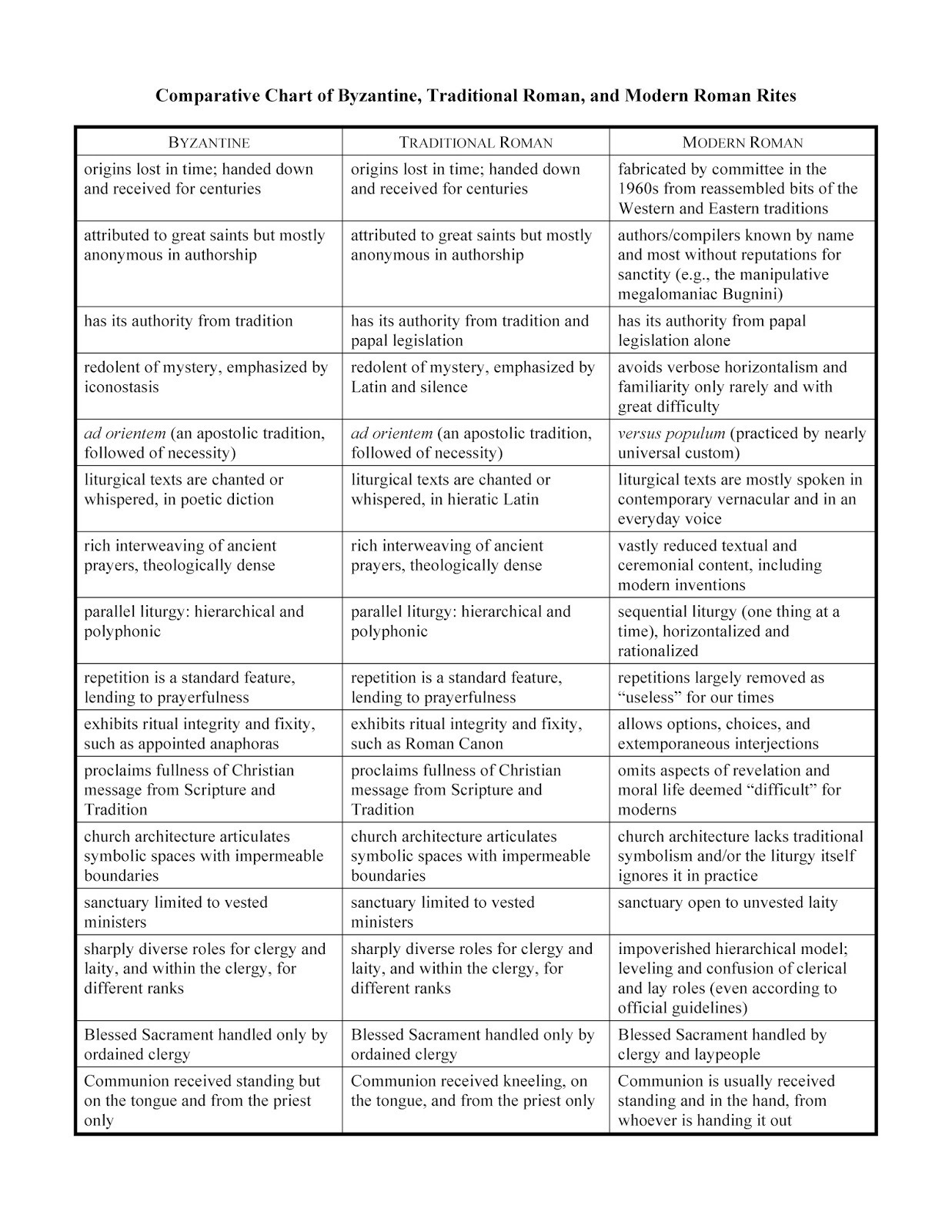
Taking Rites comparatively*Byzantine Rite, Latin Mass, and Novus Ordo Compared*

I can’t feel smug about this because I didn’t fashion the Byzantine Rite (used in Orthodox Churches) — and if I had fashioned it, much of the basis for smugness would vanish.

See New Liturgical Movement: The Byzantine Liturgy, the Traditional Latin Mass, and the Novus Ordo — Two Brothers and a Stranger as well.

My Orthodox friend John Brady has pointed out that even the Traditional Latin Mass had dropped the Epiclesis in favor of a supposed “consecration”, which this chart does not reflect.

A caution to culture warriors

No man can concentrate his attention upon evil, or even upon the idea of evil, and remain unaffected. To be more against the devil than for God is exceedingly dangerous. Every crusader is apt to go mad. He is haunted by the wickedness which he attributes to his enemies; it becomes in some sort a part of him.

Possession is more often secular than supernatural. Men are possessed by their thoughts of a hated person, a hated class, race or nation. At the present time the destinies of the world are in the hands of self-made demoniacs – of men who are possessed by, and who manifest, the evil they have chose to see in others. They do not believe in devils; but they have tried their hardest to be possessed – have tried and been triumphantly successful. And since they believe even less in God than in the devil, seems very unlikely that they will ever be able to cure themselves of their possession. Concentrating his attention upon the idea of a supernatural uncommon among secular demoniacs. But his idea of good was also supernatural and metaphysical, and in the end it saved him.

Aldous Huxley, The Devils of Loudun. (H/T Paul Kingnorth, who is ready to turn away from focusing on evil)

A writer I long greatly admired has seemingly fallen into the maw of focusing on evils. I will continue to pray for him, but I rarely can bear to read what he writes any more.

Religion is not a domesticated animal

Church and state would not be such a difficult subject if religion were, as the Court apparently thinks it to be, some purely personal avocation that can be indulged entirely in secret, like pornography, in the privacy of one’s room. For most believers it is not that, and has never been.

Antonin Scalia, quoted in Francis J. Beckwith, Taking Rites Seriously

Christian Nationalist cherry-pickers

Apparently, some self-styled Christian Nationalists have been taking refuge in a quote from St. Augustine:

[S]ince you cannot do good to all, you are to pay special regard to those who, by the accidents of time, or place, or circumstance, are brought into closer connection with you.

Our countrymen are closer than foreigners. Therefore, piss on everyone but our countrymen. Q.E.D.

Jake Meador schools these lame-brains, starting with, like y’know, the full Augustine quote.


We are in the grip of a grim, despairing rebellion against reality that imagines itself to be the engine of moral progress.

R.R. Reno

The end of the world as we know it is not the end of the world.

You can read most of my more impromptu stuff here (cathartic venting) and here (the only social medium I frequent, because people there are quirky, pleasant and real). Both should work in your RSS aggregator, like Feedly or Reeder, should you want to make a habit of it. I’m even playing around a bit here, but uncertain whether I’ll persist.

All Saints, 2023

A Fatal Difficulty

The perennial temptation

Old-style blasphemy involved desecrating God because it was God who was sacred. Today’s blasphemy involves suggesting that man is not all-powerful, that he cannot create himself in any way he chooses.

Carl R. Trueman’s summary of Blasphemy Then and Now, a posting at First Things. I’m starting to think this is one of the most important things to keep ever in mind about some cultural tsunamis.

Everybody knows there is something very wrong with us, but not everybody knows what it is. If you would know, then go back to the beginning.

There we find the primordial sin: acting out our desire to be God.

Kingsnorth spoke about transhumanists openly talking about creating God. Martine Rothblatt, born Martin, says proudly that transgenderism is an onramp to transhumanism. We are reliving the drama of the Garden of Eden all over again. Kingsnorth said we have lost touch with biological reality, with nature, and knowledge of our own telos — that is, for what we were created.

Rod Dreher, channeling Paul Kingsnorth.

Did dispensationalism die when I wasn’t looking?!

Maybe I’ve been beating a dead horse in my criticisms of dispensationalism. But I have some concern here:

When our grandkids find themselves alone in the house on a summer afternoon, few will find themselves gripped by a sudden fear that everyone except them has been taken in the rapture. By itself, that is a good thing. The eclipse of an unbiblical and thoroughly annoying doctrine is hardly something to mourn. Yet Hummel is perceptive enough not to allow the reader such a hasty judgment. The Rise and Fall of Dispensationalism obliquely but powerfully gestures toward a hole often found in the gospel that post-dispensationalist evangelicals believe today. “In the wake of dispensationalism’s collapse,” he writes in the epilogue, “the eschatological sight of the American church has blurred.” That means that our hope is less fervent, thinner, colder.

The emphasized part makes me crazy! It’s like an invitation to make up some new heresy to fill an eschatological “hole,” the old heresy having passed its sell-by date and been swept from the shelves (unnoticed by me).

If evangelicals need something to fill the eschatological-expectation hole, let me suggest (the first and maybe the last time I’ll commend syncretism) that they adopt Orthodox Bridegroom Matins for Monday, Tuesday and Wednesday of their Holy Week, which could use a bit of thickening up anyway.

Bridegroom Matins even has a catchy theme song:

Behold, the Bridegroom comes at midnight,
and blessed is the servant whom He shall find watching;
and again, unworthy is the servant whom He shall find heedless.
Beware, therefore, O my soul, do not be weighed down with sleep,
lest you be given up to death,
and lest you be shut out of the Kingdom!
But rouse yourself, crying: “Holy, holy, holy, are You, O our God!”
Through the Theotokos have mercy on us!

Voilà! Eschatological problem solved! And it’s better than some idiotic “prophecy conference” at maintaining memento mori and a sane expectation that “He shall come to judge the living and the dead.”

Shiny Happy People

Speaking of fundamentalists, for my many sins I did penance by watching Amazon Prime’s Shiny Happy People. I don’t give a rip about the hyper-fertile Duggars, but I had a brush with the series villain Bill Gothard in 1966-67 and wanted to catch up.

He was a weird little man then and appears to have gotten a bit weirder over the decades, right down to the absence of any grey hair and his ephebophilia.

His message was not a healthy Christian message. It’s not even biblical except in the formulaic sense of “proof-texts for nearly everything,” as if scripture-twisting weren’t a real thing.

I know a few people in the Protestant world who are devoted to IBLP, more fully known as Institute on Basic Life Principles — the organization that survives Gothard’s scandal and forced retirement — and I’m kind of worried about them now. Judging from a visit to the IBLP website’s “Statement of Faith,” Shiny Happy People is correct to classify IBLP as fundamentalist, though the line between fundamentalism and the evangelicalism of my youth is a fine one.

A few thoughts:

  • That I thought it necessary to check out IBLP for myself reflects how unpersuasive Shiny Happy People was at nailing down hard facts, preferring innuendo and the charges of critics, some of whom had no first-hand knowledge.
  • That IBLP feels it necessary to publish a roll-your-own statement of faith, eschewing the Nicene Creed and elevating its obsessions to creedal status, reflects how far removed it is from historic Christianity. (IBLP’s statement of faith is sorely lacking, too.)
  • That IBLP is “parachurch” means it can infiltrate most any Protestant denomination and makes it harder to unequivocally speak of it as a “cult” — though that label is tempting.

You could probably find better ways to spend three or four hours unless you have some compelling personal motivation (as did I) to watch this poorly-aimed shotgun blast toward unhealthily patriarchal fundamentalists.

Distress

The distress this insight speaks of was the beginning of my conscious Christian commitment, long ago (but not very far away):

To have offended God is more distressing than to be punished … If only we loved Christ as we should love Him, we would have known that to offend Him whom we love is more painful than hell.

St. John Chrysostom, Homily V on Romans 1, citing II Samuel 24:17.

Continuity

The primary aim of this book is to demonstrate the absolute continuity of ancient Israelite religion, the religion of the Second Temple, first-century Christianity, and the religious life preserved and practiced in the Orthodox Church …

Fr. Stephen DeYoung makes a bold claim. Something lured him out of a Reformed Protestant pulpit into Orthodoxy. It might merit investigation.


For all its piety and fervor, today’s United States needs to be recognized for what it really is: not a Christian country, but a nation of heretics.

Ross Douthat, Bad Religion

We are in the grip of a grim, despairing rebellion against reality that imagines itself to be the engine of moral progress.

R.R. Reno

The end of the world as we know it is not the end of the world.

You can read most of my more impromptu stuff here (cathartic venting) and here (the only social medium I frequent, because people there are quirky, pleasant and real). Both should work in your RSS aggregator, like Feedly or Reeder, should you want to make a habit of it.

New Year’s Day 2023

Happy New Year!

I rarely go back and read things I wrote earlier in the life of this blog, but I did so recently and was pleased with, for instance, 50th Anniversary. Indeed, I’m a bit ashamed at how much thought I put into that compared to my current tendency to curate other people’s memorable passages.

I suspect that I’ve resorted to curation because I long ago blogged my big ideas and I’m under no pressure (financial, for instance) to generated new content on some schedule or other.

I’m hoping to publish more of my own thoughts in 2023, but we’ll see how that goes.

Evangelicals and Evangelicalism

I have written many a critical word about Evangelicals and Evangelicalism. I’m going to step back from that a bit.

First, it’s exceedingly difficult to define who is an Evangelical or what is Evangelicalism. I’ve tended to go with the term when my sources used it. That’s a problem when some of the press may over-apply the term.

But there’s a bigger reason than that for backing off a bit: what I have been calling “Evangelical” or “Evangelicalism” is almost entirely non-denominational Protestantism. With a few possible exceptions, Evangelical denominations (there are a few), especially those denominations wherein local churches aren’t entirely at liberty to do their own thing (unlike the Souther Baptist Convention, where they are entirely free to go astray), tend not to be the perpetrators of the stuff I criticize.

These thoughts came to me as I thought about the Religion News Association’s #9-ranked religion story of 2022:

Non-denominational Christian churches soar in growth, according to the newly released 2020 U.S. Religion Census, a decennial survey conducted by the Association of Statisticians of American Religious Bodies. There are now more non-denominational churches than any denominations’ churches but Southern Baptists, and their 21 million adherents outnumber every group but Catholics.

I also think it’s time for me to re-re-read Tom Howard’s Evangelical is Not Enough. It’s not that I’m tempted to return to Evangelicalism; it’s that I tend to forget what Evangelicalism at its best can be (Howard’s childhood Evangelical home was idyllic), and that in a non-trivial sense, believing Evangelicals (as opposed to Trumpists who use Evangelical as a political identity), however misguided I think them, are fellow-Christians.

How capacious is “Christian”?

I was preparing something for publication a few days ago on the boundaries of the term “Christian.” Part of the question in mind was “can a sect hold such a skewed idea of Christ that I need not credit their claims to be “Christian” because they follow the “Christ” of their skewed ideas?”

More specifically, “Do Mormons hold such a skewed idea of Christ that I need not credit their claims to be “Christian”?

Then I stumbled onto something I’d written on the topic earlier that was better than what I was in the process of writing. My bottom line: if a sect rejects the Christology of the first three or four ecumenical councils, I won’t acknowledge them as Christians. And the Mormons, for all their clean living, are dead wrong about Christ.

For those who think “Christian” is the equivalent of “nice guy,” this doubtless seems unkind, but we already have “nice guy” to describe nice guys, and “Christian” is not a synonym.

Caesaropapism

The Royal Court, grouped round the Imperial Chapel and, seized with theological fervour, sought to ensure the triumph of a novel teaching concerning the procession of the Holy Spirit. Pressure from the Frankish empire caused this strange teaching to triumph in the West. After resisting for a while, the Popes were in the end obliged to alter the traditional, sacred text of the Creed. From then on, schism from the Eastern Patriarchates became inevitable. (Byzantium, on the other hand, never experienced such an extreme case of Caesaropapism.)

Vladimir Lossky, Seven Days on the Roads of France: June 1940

The “novel teaching concerning the procession of the Holy Spirit” was the filioque, the unilateral corruption of the Nicene Creed’s declaration that the Holy Spirit “proceeds from the Father” by changing it to “proceeds from the Father and the Son.”

Human reasoning

Metropolitan Hierotheos Vlachos also noted the difference in process and perspective between Latin scholasticism and the patristic approach. He concluded that the emphasis on human reasoning led to the collapse of Western Christian theology.

Dr. Eugenia Scarvelis Constantinou, Thinking Orthodox: Understanding and Acquiring the Orthodox Christian Mind

The more I understand the real-world limits of human reasoning, the truer this seems.

The Fall

There is a common mistaken notion about the fall (the sin of Adam and Eve). That mistake is to think that the fall somehow changed all of creation and human beings from a state of original innocence into an altered state of evil and corruption. This is not the teaching of the Scriptures or of the Tradition.

Occasionally you hear the term “fallen nature” which is another inaccurate term. “Nature,” in theological terms, is synonymous with “essence,” or “ousia.” It is the very “thing” that something is. What is understood, theologically, is that the fall has brought death into the world. What is different about human beings is not our nature, but our inability to actually fulfill our nature.The bondage that comes into our lives through death is what we term “sin.” But this is not our “nature” causing the problem.

Fr. Stephen Freeman, The Essential Goodness of All Things


[S]ubordinating truth to politics is a game which tyrants and bullies always win.

Jonathan Rauch, The Constitution of Knowledge

To believe that wealth is the only significant measure of the worth of an individual, a family, or a community is to reject the teaching of nearly every religion and wisdom tradition that ever was.

Mark Mitchell and Nathan Schlueter, The Humane Vision of Wendell Berry

The Orthodox “phronema” [roughly, mind-set] cannot be programmitized or reduced to shibboleths.

Fr. Jonathan Tobias

You can read most of my more impromptu stuff here (cathartic venting) and here (the only social medium I frequent, because people there are quirky, pleasant and real). Both should work in your RSS aggregator, like Feedly or Reeder, should you want to make a habit of it.

Sunday, 12/11/22

Big day today for the vocal chords. Church, then warmups, then a Chamber Singers concert.

Let my prayer arise …

Incense

Sermon on the Mount

Those Sermon on the Mount Virtues …

… just don’t work any more

Pastors have spoken to [Russell] Moore about getting blowback from their congregants for preaching biblical ideas about mercy, with people saying, “That doesn’t work anymore, in a culture as hostile as this.”

Michelle Goldberg.

So mercy (and other Sermon on the Mount virtues) are just some kind of jujitsu? A tactic rather than a principle?

Pathetic! Any pastor with integrity will recognize that it’s time to preach the whole Gospel until those who don’t like it repent or leave.

Worldview

Can a place be holy?

Rod Dreher is doing tons and tons of research and thinking for a forthcoming book on the re-enchantment of imagination (my version of his project, not his). Preparation includes visiting ancient Christian sites — presumably to try to recapture the context in which a more expansive view of reality than ours prevailed.

He’s been going back and forth with another American on the tour:

Pat and I got into another argument on the bus. I mentioned that the holiest place on earth for Christians is Jerusalem, especially inside the Church of the Holy Sepulchre, which takes in the spot where Jesus died, and the place where he rose from the dead. “You can’t say that,” said Pat. “I’m a Christian, and I don’t necessarily agree with you.” And then we were off. Pat’s view — a thoroughly nominalist one — is that when you say a place is “holy,” you are offering an opinion about the emotions it evokes within you. To Pat, there is no intrinsic holiness to a place, or an object. If the Prayer Tower at Oral Roberts University makes you feel closer to God than the Holy Sepulchre, well, then it is holier for you. Nobody can say that one place is more sacred than another.

You can imagine how I reacted to that line of argument. But again, I think it was important for me to hear it — I mean, to encounter someone who believes these things, and who thinks this way. Remember, Pat is not a liberal; in fact, Pat complained at one point on the trip about how the cultural climate in the city requires non-progressive Christians like him to be closeted. I never could really figure Pat out, to be honest, but he seems to sincerely believe that true Christianity can only be disembodied. He deflected every challenge from me with some form of, “That’s your perspective.” My guess is that he has only lived and dwelled among fellow Pentecostals, and assumes that Pentecostalism is normative. He had no awareness how very, very modern his take on Christianity is. I said to him at one point that if the early church had thought and lived as he does, it would not have survived. I got the sense that he regards me as a nut who worships Tradition, not God.

Again: it’s really useful for me to know as I write this book. Pat — who is a nice guy, actually — and I are at two extremes of the Christian spectrum, but I suspect that most contemporary American Christians are a lot closer to Pat’s end than mine.

Rod Dreher

So at which end, or where along the spectrum, do you stand? My reasoning as an ecclesial Christian puts me with Rod; my culture — and I cannot deny being its creature to a substantial extent — sides with Pat.

So I wouldn’t argue against Rod’s project, but my visceral reactions might not be consistently welcoming.

An older system of values

David French had a very powerful Sunday column last week, Remembering What Repentance Looks Like.

He leads with the story of Johnny Hunt, a big-name Southern Baptist pastor (and former national President) who in May, after finding that his lies about sexually assaulting another pastor’s wife weren’t fooling anybody, was forced out of ministry.

Now a self-appointed committee of four lackies/pastors declare that he’s ready to be restored — less than seven months after removal, and despite a recent SBC resolution (toothless, like all SBC resolutions, because each local church is entirely autonomous) that “any person who has committed sexual abuse is permanently disqualified from holding the office of pastor.”

Lots of juicy stuff in that story, including a cameo appearance by Herschel Walker, whose “repentance” looks more like intransigence. But I want to note two un-juicy things:

  1. Southern Baptist scripture-twisting. Johnny Hunt never confessed his sin to his congregation, citing Psalm 51:4, which states, “against You and You only have I sinned and done this evil in Your sight.” Further, one of the four lackeys justified his whitewashing of Hunt with the story of the Good Samaritan — which should have led him to run to the aid of the low-status victim pastor’s wife who’d been assaulted by Hunt, not to Hunt, the high-status perpetrator.
  2. The contrast with disgraced John Profumo, the backstory to which I personally recall: “the dignity, discretion, restraint, and repentance with which Profumo lived his life after his fall were the last gasp of an old system of values. His honorable conduct—continued for years, away from the blaze of publicity—would now be almost inconceivable among the political elite.”

We first of all need more men to keep their zippers up, but among those who fail, we need more John Profumos and fewer Johnny Hunts.

Freddie demolishes a straw man

For what it’s worth, I recognize almost nothing as authentically Christian in the straw man Freddie DeBoer attacked Monday.

I should say that Freddie almost certainly is not aware that he has set up a straw man. He’s a painfully honest man, who is describing the kind of Christianish stuff he’s seen on television or encounted beyond whatever church doors he has darkened.

The only thing he says about such Christianish stuff that belongs to authentic Christianity is his tacit acknowledgement that Christianity holds that Christ was more than a man and that his incarnation is salvific.

Curiously, on Friday, Freddie ranked the works of his favorite film director, Terrence Malick. Is there a more Christian director than Malick?

Modern syncretism

I’m very glad we live in a society that is more religiously tolerant. But this has also come at the cost of a greater indifference to the truths our various religions proclaim. Walking around these ancient once-pagan cities, thinking about how syncretic Greco-Roman polytheism was, it’s easy to grasp what a mortal threat monotheism combined with universalism was to the settled order. (The Jews were also monotheistic, but they did not proselytize, because their faith was not universalist.) How strange it is to think that Christianity in the contemporary West has become a lot like the syncretism of the ancient pagan world, in the sense that most Christians (myself included) don’t have a reflexive willingness to throw down to defend theological truths and police ecclesial borders. The Christians who lived in these Asia Minor cities were a threat to the settled social order precisely because they refused to worship the local gods. Had they just added Jesus into the mix, nobody would have bothered them. Had they kept their religion to themselves, as the Jews did, nobody would have bothered them.

In our time, the only Christians who get marked out for opprobrium are those who refuse to observe the dominant culture’s religious feasts (e.g., Pride Month), and who insist that all those who profess the faith they evangelize must also refuse. The Christians who assimilate easily to the idolatries of the day (“idolatry” is worshiping anything but the true God) have no problems. It’s helpful to think about if you were a Jesus believer in first-century Ephesus or Pergamum, if you would have been Christian enough to be persecuted.

Rod Dreher, pensive as he tours the Seven Churches of the Apocalypse in Asia Minor.

Disillusionment

Damon Linker, when he worked at First Things in 2003 and beyond, wrote an article on becoming a father, which produced many negative letters to the editor, most of them the equivalent of shit-posting comments on the web. Since First Things was a high-toned magazine, the contrast with its readers was revealing:

But reading all of those angry, sometimes vulgar, letters from First Things readers attacking me and the magazine, accusing us of abandoning the properly gendered outlook on the family, supposedly rooted in Scripture (but actually derived from pop-culture representations of 1950s middle-class white suburban family life), was significant, too. Doing so left me feeling deeply alienated from the place I worked. Not, again, in terms of the workplace. But in terms of the workplace’s telos—its end or goal. I was an editor for an opinion magazine. But who were its readers? What did its “base” believe about the world? How did I feel about devoting myself and my talents to serving this group of people and its prejudices, which I now began to wonder if I shared?

Damon Linker

What Linker writes there is part of what I felt when shifting from Evangelicalism, many long decades before Florida Man’s seduction of Evangelicalism, to the sober Calvinism of the Christian Reformed Church. Alienation. “These are not really my people.” That sort of thing, along with a more intellectual rationale that wasn’t entirely rationalization.

From what was I alienated?

  • Taboos that lacked even minimally plausible scriptural roots.
  • Altar calls in churches, irnoically without altars and without scriptural precedent.
  • Psychological manipulation in those altar calls: “I see that hand.” (There was no hand, but how was anyone to know with “every head bowed, every eye closed”? I guess I’ve outed myself.) “Is there another?”
  • Flagrant scripture-twisting.

There’s probably more.

Miscellany

Quality

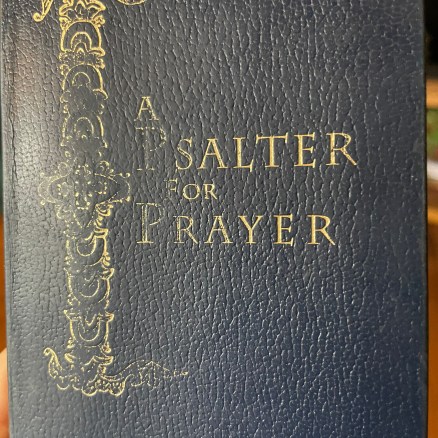
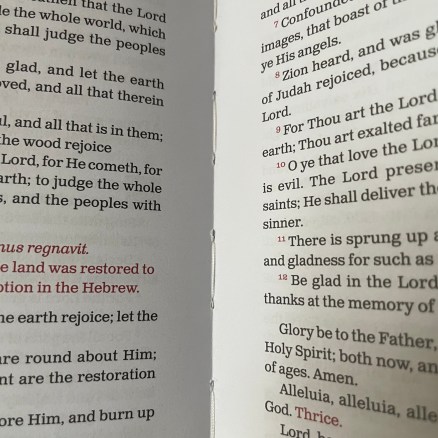
I don’t know much about book-binding, but it appears to me that my small Psalter’s cover letting will wear off before the binding shows any wear.

There’s even a sort of hinge so I can hold it open without straining the spine:

Essentials

American Gnostics

Be careful what you aim for


[S]ubordinating truth to politics is a game which tyrants and bullies always win.

Jonathan Rauch, The Constitution of Knowledge

To believe that wealth is the only significant measure of the worth of an individual, a family, or a community is to reject the teaching of nearly every religion and wisdom tradition that ever was.

Mark Mitchell and Nathan Schlueter, The Humane Vision of Wendell Berry

The Orthodox "phronema" [roughly, mind-set] cannot be programmitized or reduced to shibboleths.

Fr. Jonathan Tobias

You can read most of my more impromptu stuff here (cathartic venting) and here (the only social medium I frequent, because people there are quirky, pleasant and real). Both should work in your RSS aggregator, like Feedly or Reeder, should you want to make a habit of it.

Wednesday, 12/7/22

Today is my father’s 103rd birthday. I’m now officially past the "I wish he were still with us" stage (though he regularly appears in dreams), since he presumably would be pretty miserable if he were.

Yes, his 22nd birthday got quite a cloud over it.

Legalia

How long, O Lord?

How many times do Republican- and Trump-appointed federal judges have to totally smack down Team Trump arguments before the mainstream media stop insinuating that Republican judges uniquely cannot separate law and politics?

303 Creative

Cage Fighting comes to SCOTUS

I listened to about an hour of Supreme Court Oral Argument in Monday’s 303 Creative case.

I thought I was confused because I’m old and rusty, but two younger, un-rusty commentators, Sara Isgur and David French, flagged the argument as very low-caliber and peppered with lurid hypotheticals designed not to explore the the implications of each advocate’s position, but to make the advocates whose arguments they disfavored look monstrous.

In other words, it was more like a televised Senate hearing than an ordinary Oral Argument. (Pro tip: if you consistently defend free speech, you can be “hypoed” into defending really abhorrent speech. Get a backbone.)

I am relieved. I may be rusty, but it was a poor argument, courtesy of the Justices.

Look for very sharp dissents from the justices on the losing side, because both sides seemed pretty heavily-invested.

An academic frames the question

The question is whether civil rights protections properly include the suppression of speech that disagrees with legal norms, or compels speech that celebrates those norms. Alternatively: do artists (including web designers) have the freedom to depict what subjects they wish, and how—even if they take money for doing it, and even if their perspective is hurtful (to some people)?

Prof. Michael McConnell

Moore v. Harper

Prof. Akhil Amar’s oddly-compelling, low-tech podcast had a couple of podcasts (October 26 and followup episodes with Steven Calabresi) on the Independent State Legislature doctrine purportedly at issue in Wednesday’s Moore v. Harper SCOTUS oral argument.

For the first time, though, I’m now feeling misled by Prof. Amar. Wednesday’s Wall Street Journal features two pieces, one by the Editorial Board and one by lawyers, casting the controversy in terms that seem to make Prof. Amar’s argument peripheral if not irrelevant to the real issues.

Prof. Amar legitimately notes that each state legislature is created by that state’s constitution, and the boundaries of the “legislature” vary according to things like whether the governor has veto power, thus making him a part of the legislative process. This matters because elections are unusually entrusted not to the states generally, but specifically to their legislatures.

The Wall Street Journal pieces legitimately note that under no sane construal are state courts part of the legislative process. Thus, state courts have no role in overseeing federal elections, though federal courts may.

That is perhaps an over-simplification, but it struck me as a powerful point against the backdrop of state courts making up anti-gerrymander rules not found explicitly in their state constitutions, or overruling the legislature’s absentee ballot deadlines in favor of their own.

Maybe litigants took more extreme positions, justifying Prof. Amar’s characterization of ISL’s danger.

I expect SCOTUS, as I almost always do, to adopt narrow reasoning in Moore v. Harper — to deal with the case(s) at hand without sweeping pronouncements that they might regret later.

P.S.: I listened to a half-hour or so of arguments in the case Wednesday, and it seems that SCOTUS views the case more as does Wall Street Journal, less as does Akhil Reed Amar.

Trumpish

Snivelling cowards cool on Florida Man

He used us to win the White House. We had to close our mouths and eyes when he said things that horrified us.

Mike Evans, a former member of Trump’s evangelical advisory board, via Michelle Goldberg

You only had to close your mouth if you valued power and proximity over integrity. Don’t come snivelling to me now.

Pissing away Georgia — again

I’m gratified at the loss of Herschel Walker in the Georgia runoff for U.S. Senate.

I loved Walker as a football player. I probably could tolerate him as a former football player, bastard children and absentee fatherhood notwithstanding.

But his only claim to qualification for the U.S. Senate is that Florida Man endorsed him and encouraged him, despite patent unfitness intellectually. And when his sins found him out, his response was not that of a repentant Christian, but of someone with a sense of entitlement.

To drive a stake squarely through Florida Man’s heart, I only wish Walker had lost by more. He now has twice cost the GOP some national elective offices from Georgia that really should have been theirs:

All of this [context of Trump behavior] predictably helped make the runoff a fractal of the larger 2022 pattern: Under Trump’s influence, with Trump’s preferred candidates, the Republican Party first sacrificed a potential Senate majority and then sacrificed one more Senate seat for good measure.

Ross Douthat

Unrealistic, but instructive nonetheless

National Review’s Charlie Cooke would like a word with those arguing that, because Donald Trump’s call to suspend the Constitution won’t be heeded, it doesn’t really matter. “During the closing days of the 2020 election, I wrote repeatedly about the seriousness of Joe Biden’s refusal to reject his party’s growing demand to ‘pack’—i.e. destroy—the United States Supreme Court,” Cooke writes. “Not once did I receive an email from a Trump voter telling me that my alarm was misplaced on the grounds that, in all likelihood, Biden would not have the votes to do it. Back then—and rightly so—the mere fact that Biden was entertaining the idea was deemed instructive: ‘When people tell you what they want to do with power,’ my correspondents invariably opined, ‘you should believe them. Joe Biden cannot be trusted with power.’ Well, so it is with Donald Trump once again. … American patriots do not seek to overturn legitimate election results or recommend the suspension of the United States Constitution; they respect and defend both at all costs. Donald Trump is not a patriot. He is, in his heart of hearts, a tyrant. Take note, America.”

The Morning Dispatch


[S]ubordinating truth to politics is a game which tyrants and bullies always win.

Jonathan Rauch, The Constitution of Knowledge

To believe that wealth is the only significant measure of the worth of an individual, a family, or a community is to reject the teaching of nearly every religion and wisdom tradition that ever was.

Mark Mitchell and Nathan Schlueter, The Humane Vision of Wendell Berry

The Orthodox "phronema" [roughly, mind-set] cannot be programmitized or reduced to shibboleths.

Fr. Jonathan Tobias

You can read most of my more impromptu stuff here (cathartic venting) and here (the only social medium I frequent, because people there are quirky, pleasant and real). Both should work in your RSS aggregator, like Feedly or Reeder, should you want to make a habit of it.

An Anniversary

November 16 is the 25th anniversary of my reception into Orthodox Christianity, from a background of Calvinism (proximate) and generic evangelicalism (20 years remote).

This post isn’t meant as an apologetic, though if it convicts someone that they should give Orthodoxy a look, I’d be glad. It’s also not intended to be a comprehensive story of why I didn’t, say, become Roman Catholic, or how all the little things, not just a few big things, pointed toward Orthodoxy. Something closer to a comprehensive story, or at least a complement to this post, is here.

I can’t give a neat connect-the-dots account of going from Christian Reformed Elder to Orthodox layman because I don’t remember everything I read or in what order I read them. But I tend to mention Peter Gilquist’s Becoming Orthodox: A Journey to the Ancient Christian Faith, The Orthodox Church: An Introduction to Eastern Christianity by Timothy Ware (later Metropolitan Kallistos Waare), and the monograph Sola Scriptura by then-Deacon, now Priest John Whiteford.

The first made conversion fairly “thinkable.” The second familiarized me with Orthodoxy at a basic level. The monograph disenthralled me of sola scriptura, the battle cry and foundation of the Protestant Reformation. When pondering why I remain Orthodox, I think of this monograph and say “there are some things you just can’t un-see.”

For some reason, I too rarely mention C.S. Lewis’s The Great Divorce, which played what feels like a very important (if idiosyncratic) role as well — perhaps because it was not a direct apologetic for Orthodoxy.

If you’re not familiar with The Great Divorce, you can fix that in one evening. Summarizing, many in Lewis’s tale of a day trip from hell to heaven, where they were given the option of staying, found that heaven was just a bit too real, or too little about them, or too inhospitable to their petty grudges, and so got back on the bus for hell.

Re-reading it a bit more than 25 years ago, I for the first time saw in myself hellion habits that could lead me back onto that bus, though I was offered heaven and had thought my salvation eternally secure. I asked myself: “What are you doing to become the kind of person who would stay in the hyper-real place, who wouldn’t get back on the bus to the grey city? Are you certain that some post-death miracle is going to eradicate a lifetime of cherished vices and self-regard? Shouldn’t you be starting a bit of self-mortification now?”

So what does that have to do with Orthodoxy? Orthodoxy is, so far as I know, uniquely urgent about the necessity of cooperating with God in our salvation (synergy). Most Protestant traditions I know seem utterly unable to distinguish cooperation with God from “earning salvation,” which they rightly believe is impossible. So they have nothing to offer one who wants to know how merely to cooperate.

It helps that Orthodox worship is distinctively “not about me” — if not uniquely, then at least counter-culturally. Decades before I found Orthodoxy, I was dissatisfied with most of the music we sang (in the whole succession of Churches I attended in my very mobile younger year), the gist of which was how God makes me feel — i.e., they weren’t really about God.

But “[w]e are homo adorans, creatures capable of self-transcendence through worship. Without this ability and capacity for worship, we are not fully human; even in our pomp we are like the beasts that perish (Psalm 49:20).” (Fr. Lawrence Farley)

Not even fully human without worship. That rings so very true to me! Whatever my faults, and they are many, inconstancy in Sunday church attendance has never been one of them. Because I need it — need to worship, and (I now recognize) need this stiff and willful stuff called “me” to be molded into a godlier likeness.

More than rejection of any particular Protestant doctrine, the awareness of the need — in this present life — to grow toward God, to become more Christlike, to work out my salvation with fear and trembling, has guided my past 25 years.

For some reason, I thought you might want to know that.

One more thing, not at all unrelated:

I believe the greatest heresy of all is the belief of some Christians that they are “saved.” If we believe we are categorically and without question already saved, it is a good sign that we have been dominated by demonic pride. St. Paul’s statement, “If you confess with your mouth the Lord Jesus and believe in your heart that God has raised Him from the dead, you will be saved” (Rom. 10:9), must be read in the context of Christ’s words: “Not everyone who says to me, ‘Lord, Lord,’ will enter the kingdom of heaven, but only the one who does the will of my Father who is in heaven.

Vassilios Papavasiliou, Thirty Steps to Heaven


You can read most of my more impromptu stuff here (cathartic venting) and here (the only social medium I frequent, because people there are quirky, pleasant and real). Both should work in your RSS aggregator, like Feedly or Reeder, should you want to make a habit of it.

Sunday 9/18/22

Liturgies

How Elizabeth experienced her coronation

Over here, people did not get that fairy-tale feeling about the coronation. What impressed most who saw it was the fact that the Queen herself appeared to be quite overwhelmed by the by the sacramental side of what we going on.

C.S. Lewis on the 1953 Coronation of Elizabeth II Regina, attributed to a personal letter.

In contrast to sacramentality, America developed …

Proto-Populism in the Pews

Simply put, the Antichrist now worked his evil machinations through elites of all kind, particularly the clergy.

Nathan Hatch, Thundering Legions in The Democratization of American Christianity

Or so Americans leaned to think. Bereft of sacrament, they invented tawdry substitutes, personal and collective:

C.S. Lewis on Christian patriotism

From Screwtape Letters:

Let him begin by treating the Patriotism or the Pacifism as a part of his religion. Then let him, under the influence of the partisan spirit, come to regard it as the most important part. Then quietly and gradually nurse him on to the stage at which the religion becomes merely part of the ’cause’, in which Christianity is valued chiefly because of the excellent arguments it can produce in favor of the British war-effort or of Pacifism. The attitude which you want to guard against is that in which temporal affairs are treated primarily as material for obedience. Once you have made the World an end, and faith a means, you have almost won your man, and it makes very little difference what kind of worldly end he is pursuing. Provided that meetings, pamphlets, policies, movements, causes, and crusades, matter more to him than prayers and sacraments and charity, he is ours—and the more ‘religious’ (on those terms) the more securely ours. I could show you a pretty cageful down here,

Your affectionate uncle
Screwtape

I think things would be better if supposedly serious Christian people stopped talking like demons, don’t you?

Jake Meador

What happens to churches that forsake liturgy

What strikes me about certain low church communities is that they sometimes imagine themselves to have no liturgy at all. In some cases, they might even be overtly hostile to the very idea of a liturgy. This is interesting to me because, in practice, it is not that they have no liturgy at all as they imagine—they simply end up with an unacknowledged liturgy of a different sort. Their services also feature predictable patterns and rhythms, as well as common cadences and formulations, even if they are not formally expressed or delineated and although they differ from the patterns and rhythms of high church congregations. It’s not that you get no church calendar, for example, it’s that you end up trading the old ecclesial calendar of holy days and seasons, such as Advent, Epiphany, and Lent, for a more contemporary calendar of national and sentimental holidays, which is to say those that have been most thoroughly commercialized.

L.M. Sacasas, The Convivial Society

What happens to politicians formed spiritually in such churches

When Vice President Mike Pence delivered his speech at the Republican National Convention, it was like witnessing a Walker Percy satire. Pence remixed Hebrews 12:1-2 and 2 Corinthians 3:17, by replacing “Jesus” with “Old Glory,” the “saints” with “this land of heroes,” and even interjected his own biblical gloss—“that means freedom always wins.”

In Love in the Ruins, the Roman Catholic Church has split into three groups, one of which is the American Catholic Church, whose new “Rome” is Cicero, Illinois. The protagonist Tom More attends church there with his mother to celebrate Property Rights Sunday, a major feast day for the church.

Unlike its forebear, the American Catholic Church “emphasizes property rights and the integrity of neighborhoods, retained the Latin Mass, and plays ‘The Star-Spangled Banner’ at the elevation.”

In response to Pence’s speech, some Christian leaders denounced his idolatry, a great start to warding off Percy’s “Christ-forgetting Christ-haunted death-dealing Western world.” However, if we want to avert the American apocalypse, we need better readers and thinkers of the Word. As Americans, we should prioritize reading well, learning what words mean, why context matters, and how to be comfortable with mystery.

Jessica Hooten Wilson, Percy and Pence and the American Sense of Scripture

The Religion of American Greatness

Paul D. Miller, Professor of the Practice of International Affairs at Georgetown University, recognizes that most of the existing works on Christian nationalism “are rather extreme and almost comical examples of beating up on straw men—or would be, if they weren’t also fear-mongering scurrilous libel masquerading as scholarship.” In The Religion of American Greatness, Miller, who identifies himself as a “Christian scholar, political theorist, veteran, and former White House staffer,” proposes to offer a “detailed portrait of—and case against—Christian nationalism.”

Mark David Hall, Christian Nationalism: An Existential Threat?

Deja Vu

I guess it’s time for somebody to mention, and even to elaborate upon, white Evangelicalism’s pathetic, unbiblical obsession with celebrities: Richard Ostling Is celebrity culture eroding American evangelicalism? This publishing insider says ‘yes’

Yes, I send “unbiblical.” Elevating novice Christian celebrities is pathetic and it’s dangerous to the celebrities themselves.

None of the periodic commentary on this weakness has changed a damned thing, of course.

Hidden life

Enough of my rough and critical thoughts on American religious life.

God Saved the Queen

In all of human history Queen Elizabeth II is the single person who has been most prayed for. From her birth in 1926 she was included in a petition myriads of people prayed day after day: It called upon the Almighty to bless and preserve “all the Royal Family.” From her accession to the throne in 1952, millions began to pray for her daily by name: “That it might please thee to keep and strengthen . . . thy Servant Elizabeth, our most gracious Queen and Governor.” A modern form introduced during her reign that is often used today pleads, “Guard and strengthen your servant Elizabeth our Queen.”

Prayers Answered: God Saved the Queen via Alan Jacobs. The author goes on with other notable things about the late Queen.

Learning to Let Things Be

We seem to be on the verge of choosing what and whether human life—and with it, all life—will continue to be on this planet. Whether science fiction or not there are a lot of brainy people with a lot of money behind them trying to turn us into something quite different than what we have been. I think they will fail. But I don’t really know, maybe they won’t. They will likely do tremendous of damage in the process regardless. Yet nobody is able to give a fully coherent explanation of what we are doing or why. Instead, we are drowning in partial, often unhelpful explanations. I have to wonder whether our situation even can be understood. Have we reached our cognitive and moral limits? Or are the cacophony of reasons we give merely an implicit way of admitting we don’t really know why we do what we do? Admitting our fundamental ignorance would at least be refreshing in its honesty. Instead, it is not unusual to find various deep, sincere, erudite, and eloquent views of our situation that are in nearly complete contradiction with one another. It actually is quite common. Many of them are done with the same air of certainty—where there likely is none.

I myself offer only the Arsenios Option, i.e., fleeing the world of distraction and ambition, being silent, and dwelling in stillness. I don’t offer it as way to understand our situation. It’s what you do when all explanations have failed and when talking turns to gibberish … It is the hope that we can go deeper than the problem itself. In silence, stillness not-knowing, we might possibly learn to stop trying to fix everything. Maybe thereby we can avoid the inevitable catastrophe our solutions themselves are causing. We can learn to accept that we don’t see things clearly and that we probably never will. We can accept that we don’t really know and that not-knowing is actually the better and more human way to live. We can live humbly with each other and upon the earth and with the Divine. We can finally learn to simply let things be.

For although at certain times and in certain circumstances it is necessary and useful to dwell on the particular situation and activity of people and things, during this work it is almost useless. Thinking and remembering are forms of spiritual understanding in which the eye of the spirit is opened and closed upon things as the eye of a marksman is on his target. But I tell you that everything you dwell upon during this work becomes an obstacle to union with God. For if your mind is cluttered with these concerns there is no room for him.

—The Cloud of Unknowing

Jack Leahy, Cloud-Hidden (footnotes omitted)


[S]ubordinating truth to politics is a game which tyrants and bullies always win.

Jonathan Rauch, The Constitution of Knowledge

The Orthodox “phronema” [roughly, mind-set] cannot be programmitized or reduced into shibboleths.

Fr. Jonathan Tobias

You can read most of my more impromptu stuff here (cathartic venting) and here (the only social medium I frequent, because people there are quirky, pleasant and real). Both should work in your RSS aggregator, like Feedly or Reeder, should you want to make a habit of it.

Friday, 7/29/22

R.I.P. William Jon Gray

William Jon Gray, undoubtedly the best Choral Conductor I ever sang under, has died at his home in New York state at age 66. I have the impression (from someone saying “You sung under him?!”) that he was widely known in American choral music circles.

That’s all I know about his death at this point, the news having just come to me Thursday through the (reliable) grapevine.

Bill was Artistic Director of the Bach Chorale Singers from 1994 to 2010. I re-joined the Chorale, after a very brief prior experience in the 1980s, in 1997. In addition to his formal education, Bill learned from the Master, Robert Shaw, having sung with him for some period of time. He forever followed what I understand was “Mr. Shaw’s” practice of meticulously marking scores before distributing them to his singers and, heaven help us, count-singing. His other accomplishments can be seen at the first link, above.

The pinnacles of my experience with Bill were, in no particular order:

  • performance of Rachmaninoff’s Vespers,
  • a professional recording of the Latin Organ and Choral Music of Zoltan Kodaly, with Organist Marilyn Keiser, on the Pro Organo label. One track unfailingly brings tears to my eyes, and
  • in retrospect, sitting a couple of feet from our Guest Tenor Soloist, Lawrence Brownlee, days after he had won the Metropolitan Opera Auditions. (Bill said “Enjoy him. We’ll never be able to afford him again.”)

Signs of the Times

  • A handful of former Democratic and Republican officials announced Wednesday they are forming a new national political party—Forward—that they believe will appeal to voters frustrated with the United States’ current two-party system. The centrist party will be chaired by former Democratic presidential candidate Andrew Yang and former Republican New Jersey Gov. Christine Todd Whitman, and plans to gain ballot access in all 50 states in time for the 2024 presidential and congressional elections.
  • A new FBI search warrant claims the man who allegedly attempted to assassinate Justice Brett Kavanaugh last month was also planning to kill two other Supreme Court justices. The FBI alleges the man searched “assassin skills,” “most effective place to stab someone,” and “quietest semi auto rifle” online before he was arrested, and that he messaged unnamed users on Discord that he was going to “stop Roe v. Wade from being overturned” and that he would “remove some people from the Supreme Court.”

The Morning Dispatch, July 28.

Turning Point, USA?

I conducted dozens of focus groups of Trump 2020 voters in the 17 months between the storming of the Capitol on January 6 and when the hearings began in June. One measure was consistent: At least half of the respondents in each group wanted Trump to run again in 2024. The prevailing belief was that the 2020 election was stolen—or at least unfair in some way—and Trump should get another shot.

But since June, I’ve observed a shift. I’ve conducted nine focus groups during this period, and found that only 14 percent of Trump 2020 voters wanted him to run in 2024, with a few others on the fence. In four of the groups, zero people wanted Trump to run again. Their reasoning is clear: They’re now uncertain that Trump can win again.

[U]nlike the impeachment hearings, which in some ways made GOP voters more defensive of Trump, the accumulating drama of the January 6 hearings—which they can’t avoid in social-media feeds—seems to be facilitating not a wholesale collapse of support, but a soft permission to move on.

Sarah Longwell, The January 6 Hearings Are Changing Republicans’ Minds

In [Peter Thiel’s] view, much of what passes for “progress” is in truth more like “distraction”. As he puts it, “the iPhone that distracts us from our environment also distracts us from the ways our environment is unchanging and static.” And in this culture, economy and politics of chronic self-deception, as Thiel sees it, we tell ourselves that we’re advancing because “grandma gets an iPhone with a smooth surface,” but meanwhile she “gets to eat cat food because food prices have gone up.”

Mary Harrington, Peter Thiel on the dangers of progress.

One of many provocative observations in this long piece.

And yes, I’ve read accusations that he’s a fascist. I’m just saying he’s smart, not that he’s good.

Nothing pointless

Speaking of fascists …

Himmler quite aptly defined the SS member as the new type of man who under no circumstances will ever do “a thing for its own sake.”

Hannah Arendt, The Origins of Totalitarianism

Church/State

Lifeway research suggests that as many as 2/3 of American churches incorporate patriotic music into their liturgy for public worship during the time around the 4th of July holiday.

So this is one piece of the problem: For many of our nation’s white evangelicals, their patriotic commitments as Americans are so intertwined with their Christian faith that it is very hard for them to imagine a scenario where Christian fidelity actually requires them to reject standard American ideas about identity, wealth, success, and so on.

Jake Meador, Defining “White Evangelical Crap”.

Was MLK antiracist? Barack Obama?

Martin Luther King Jr.’s most famous speech would not meet Kendi’s definition of anti-racism, nor would the one Barack Obama made about there being too many fatherless Black families. Indeed, nearly everything that Americans have been taught about how to be anti-racist for the past several decades is, according to Kendi’s explicit definition, racist.

Bari Weiss, Stop Being Shocked

Flash!

This just in: With Russia at war in Ukraine, and Putin’s stench in American nostrils increasing, our 45th POTUS has declared himself an acolyte of Shiite cleric Muqtada al-Sadr now. al-Sadr’s followers are very special people.

(Pass it on.)

Note to Readers

I will be traveling for more than a week. I may or may not get a post scheduled for tomorrow or intermittently during travel, but I should be back sometime the week of August 7.

And I just realized that today is the 57th anniversary of my most serious accident, on a motorcycle at age 16.


“The Frenchman works until he can play. The American works until he can’t play; and then thanks the devil, his master, that he is donkey enough to die in harness ….” (G.K. Chesterton)

You can read most of my more impromptu stuff here (cathartic venting) and here (the only social medium I frequent, because people there are quirky, pleasant and real). Both should work in your RSS aggregator, like Feedly or Reeder, should you want to make a habit of it.

Thursday, 7/21/22

Newsie

Good guys with guns

[A] common argument in favor of "high capacity" magazine bans is that defensive gun use never needs more than a few bullets. Here, the good samaritan used ten bullets, and he could have needed even more. In California, for example, magazines are limited to ten rounds. Had the good samaritan needed one more bullet to drop the assailant, he would have been out of luck in California.

Update 2: The Greenwood Police now report that the Good Samaritan acted quickly. In the span of 15 seconds (not 2 minutes), he fired 10 rounds, eight of which hit the assailant. And his first shot hit the assailant from 40 yards!

That is some top-level accuracy.

Josh Blackmun

I wasn’t going to say much about this until I saw that second update. That was the first time I heard that 8 of 10 shots hit the terrorist, one from 40 yards. It kind of boggles the mind.

Covid vaccination breakthrough?

The Centers for Disease Control and Prevention on Tuesday recommended Novavax’s COVID-19 vaccine for use in people age 18 and older, clearing the last regulatory hurdle before the shot’s widespread distribution in the U.S. Novavax’s two-dose vaccine relies on well-established vaccine technology, providing an alternative for people reluctant to take the newer mRNA vaccines made by Pfizer and Moderna. The U.S. has purchased 3.2 million doses of the Novavax shot.

The Morning Dispatch makes a good point about the likely nexus between new mRNA technology and vaccine resistance. I thought mRNA, which I didn’t really understand, was a lesser evil than Covid, but some other opinions varied.

News you can abuse, ignore

In the parts of the world where monkeypox is newly spreading, like the United States and Europe, the people currently most at risk of getting the disease are gay and bisexual men. A recent update from the World Health Organization noted that cases in newly afflicted countries have mainly been among “men who have had recent sexual contact with a new or multiple male partners.” In Europe, just 0.2 percent of the men who have gotten the disease identify as heterosexual. Reports from the center of the U.S. outbreak—New York City—show that “the number of monkeypox cases has nearly tripled in the last week, nearly all of them among men who have sex with men.” The infectious-disease and LGBTQ-health journalist Benjamin Ryan notes that though the U.S. is, frustratingly, not collecting demographic details on monkeypox patients, Britain is, and the numbers there are clear: “Half of men screened for monkeypox tested positive; women, by contrast, tested positive only 0.6 percent of the time.”

Opening paragraph of U.S. Messaging on Monkeypox Is Deeply Flawed.

If AIDS was the first politically-protected disease, Monkeypox is the second. Most of our media and government simply cannot find the integrity to speak plain, helpful English about diseases that are sexually transmitted among gay men. They’re probably trying to protect them; as so often, they may accomplish the opposite of their intention.

Politics and Legal Wrangling

Contraception, Sodomy, Same-sex marriage

I agree that “[n]othing in [the Court’s] opinion should be understood to cast doubt on precedents that do not concern abortion.”

For that reason, in future cases, we should reconsider all of this Court’s substantive due process precedents, including Griswold, Lawrence, and Obergefell. Because any substantive due process decision is “demonstrably erroneous,” … we have a duty to “correct the error” established in those precedents. After overruling these demonstrably erroneous decisions, the question would remain whether other constitutional provisions guarantee the myriad rights that our substantive due process cases have generated. For example, we could consider whether any of the rights announced in this Court’s substantive due process cases are “privileges or immunities of citizens of the United States” protected by the Fourteenth Amendment.

Clarence Thomas’s concurrence in the Dobbs case (which overruled Roe v. Wade and Planned Parenthood v. Casey).

I looked this up because I doubted news stories that said Thomas had "called for" re-examination of these other "substantive due process" decisions. I publish what I found to acknowledge that he did call for that, and to provide context:

  • Justice Thomas’s dictum tacitly invites challenges to these other "substantive due process" decisions, but I’m not sure he’ll get any challenges unless some government in the U.S. tries to undermine the court-decreed rights to contraception, consensual adult sodomy or same-sex marriage. Unlike the situation with abortion, I’m just not sure there’s anywhere left in the U.S. where a legislative majority could mistake opposition to these for a winning political position. In other words, how would SCOTUS get a case challenging contraception, consensual adult sodomy or same-sex marriage? Am I missing something?
  • You can certainly accuse Thomas of pedantry in his criticism of "substantive due process" while explicitly leaving open a door to recognizing the selfsame rights as "privileges or immunities of citizens of the United States," but that strikes many as a better legal foundation. Liberal Yale Law School Professor Akhil Amar heartily respects, perhaps even embraces, that approach.

Where should America go legislatively on abortion?

I’ve said that any legislative resolution will have greater constitutional legitimacy than did Roe‘s bogus constitutional pretexts, and I meant and mean that.

But I now should add the qualifier that I’m not sure this is a fit subject for national legislation on the circumstances where abortion should or shouldn’t be lawful. Maybe there’s room for some Congressional legislation, like maybe protecting the right to travel (which already is judicially recognized, be it noted), but historically, abortion is a matter for the states. (I’d say the same, by the way, if Congress was weighing restriction rather than liberalization.)

I’ve always assumed that once Roe was out of the way, we’d eventually reach some ideologically-unsatisfying legislative compromise, as have western European nations. I don’t think my opinionating could change that.

A Bill with exceptions exceptions for rape, incest and life of the mother was introduced in Indiana’s Special Session Wednesday (a Session called to rebate some of our budget surplus, but expanded after Dobbs). Legislators who are fighting against those compassionate exceptions (and there are some) are likely to pay a political price.

Democracy and distrust

The Secret Service reportedly told the January 6 select committee on Tuesday that it cannot recover deleted text messages from the days surrounding the Capitol attack after all, and has no new messages to provide. The agency says the messages were lost as part of a technology upgrade. The National Archives has asked the Secret Service to report within 30 days on the “potential unauthorized deletion” of agency records, including what was lost and how.

The Morning Dispatch.

This story has me as frustrated as any recent story. I would have thought the Secret Service above such stuff. Everything Orange Man/Reverse Midas touches turns to merde.

Norms

We no longer honor norms; we weaponize them.

Jonah Goldberg on Bari Weiss’ Honestly podcast Election Denial: A Roundtable. Jonah had Bari laughing out loud so many times (e.g., Trump "Tweeting like a monkey escaped from a cocaine study") that I see one of two futures:

  1. Jonah becomes a frequent flyer with Bari; or
  2. Bari, fearing loss of gravitas, never invites him again.

For what it’s worth, I found her laughter delightful.

Why we need philosophers

Over forty years, Kant taught this lecture series forty-eight times. In his Physische Geographie, as the series was called, Kant insisted that knowledge was a systematic construct in which individual facts needed to fit into a larger framework in order to make sense. He used the image of a house to explain this: before constructing it brick by brick and piece by piece, it was necessary to have an idea of how the entire building would look. It was this concept of a system that became the linchpin of Humboldt’s later thinking.

Andrea Wulf, The Invention of Nature: Alexander Von Humboldt’s New World.

Note that Kant was referring to knowledge, not just scientific knowledge.

Why we don’t need end-times opinions

“We may have another year, maybe two years, to work for Jesus Christ, and [then] . . . it’s all going to be over,” he said in 1951. Two years later he said, “I sincerely believe, if I can study the Scriptures aright and read current events and keep with my current reading, that we are living in the latter days. I sincerely believe that the coming of the Lord draweth nigh.”

Frances Fitzgerald, The Evangelicals: The Struggle to Shape America

I admired Billy Graham. Now, I’d call him "consequential" rather than "great." Maybe that’s hair-splitting.

Self-sabotage

Many years ago I had a student who took several classes from me and never got anything better than a C. At the beginning of his senior year he came to my office and asked me why. I reminded him that I had always made detailed comments on his paper; he said, yeah, he knew that, but he had never read the comments and always just threw the papers away. So I explained what his problem was. He nodded, thanked me, went away, and in the two classes he had from me that year he got the highest grades in the class.

improving – Snakes and Ladders

Organic towns, functional cities

Town and city are no longer the organic growths they once were. They have begun to operate on a purely functional level that has little to do with what actually brings grace into our lives. You eviscerate a habitat of its culture and the species it supports will find it increasingly difficult to survive or else they’ll mutate into something else.

Marius Kociejowski, A Factotum in the Book Trade, via Prufrock

Why do we so mythologize the sixties?

So why do those that would lead us treat the sixties as though they were our Heroic Age?

My theory is very simple: it is the last time that any of them mattered.

Those on the left pretend that society can be guided with the right policies from powerful institutional centres. They flatter themselves otherwise, but so do those on the right, even if their versions of ‘right policies’ often involves slimming down some institutional centres. The seventies taught us a harsher lesson. They ended one of modernity’s founding political myths, the idea that the vast bureaucratic engines the modern state uses to intimately order the lives of millions could be understood as a variation on the Greek city-states. They cannot: a modern state is a different order of being. It cannot be controlled by institutional centres, and even those centres can no longer be controlled. Any attempt to limit them only renders them more powerful. Nowadays, even the Machine’s smaller cogs are too big for human hands. This is the truth that our ‘leaders’ cannot even whisper. For if social institutions have become invulnerable to meaningful control, then their entire caste – politicians, journalists, civil service managers, researchers, and all – serve no purpose. To admit their pointlessness would end them. So, liberal and conservative alike, they retreat to the sixties and pretend that it matters as they launch into another round of culture war. It doesn’t matter and they don’t matter. They cannot prevent the end that is coming.

FFatalism, The culture wars were irrelevant by 1976


If people have always said it, it is probably true; it is the distilled wisdom of the ages. If people have not always said it, but everybody is saying it now, it is probably a lie; it is the concentrated madness of the moment.

Anthony Esolen, Out of the Ashes

You can read most of my more impromptu stuff here (cathartic venting) and here (the only social medium I frequent, because people there are quirky, pleasant and real). Both should work in your RSS aggregator, like Feedly or Reeder, should you want to make a habit of it.