Sunday, 11/30/25

Prayer

On sin

Most Holy Trinity, have mercy on us. Lord, cleanse us from our sins. Master, pardon our transgressions. Holy One, visit and heal our infirmities for Your name’s sake.

This is part of the Orthodox Trisagion (“thrice-holy”) prayers. And the first time I heard or read that prayer, I thought they get it!

I had recognized for a long time that part of the way I contributed to the chaos and evil in the world was not by shaking my fist in God’s face and saying “I know what You want, but I’m gonna do it my way!” Part of my contribution was cluelessness, self-absorption, clumsiness.

And my Protestant milieu seemed totally not to get that.

I remember being told in my Evangelical and Evangelical-adjacent Protestantism that sin was rebellion against God. “Period. Full stop.” as they say. Those four short trisagion sentences would not compute in that scheme as anything but redundant. “Transgression” was a synonym for “sin.” There was no concept of “infirmity” that needed healed, or of “sin” that needed cleansed rather than simply forgiven.

In Orthodoxy I learned that the Greek for “sin” is amartia (sometimes render hamartia), meaning essentially “missing the mark.” In that broad sense, it probably includes transgression and infirmity. “Transgression” strikes me as being the fist-shaking defiance my former milieu called sin. Infirmity strikes me more as the inability to know or do what’s right in some situations.

If I’m serious about the Christian life, I don’t just want God to forgive me of transgression after transgression. I want cleansing and healing as well so that I can “do better” and become more like Christ.

I suffer from all three, sin, transgression and infirmity (mark-missing, defiance and cluelessness) and I suspect my readers do, too. All three hurt those around me. All three make the world a worse place. It reassured me that Orthodoxy, which I was just exploring when I first noticed that prayer, was wiser than where I’d been all my life, and that it recognized that each of the three needs something a bit different (cleansing, pardon, healing) from God.

Frederica Matthewes-Green distills some of this Orthodox view:

[S]in is a danger, a poison, not merely superficial matter like breaking a law. Sin is infection, not infraction.

Breastplate

I came across another version of St. Patrick’s breastplate, this one rhymed:

I bind unto myself today
The strong Name of the Trinity,
By invocation of the same,
The Three in One and One in Three.

I bind this day to me for ever.
By power of faith, Christ’s incarnation;
His baptism in the Jordan river;
His death on Cross for my salvation;
His bursting from the spicèd tomb;
His riding up the heavenly way;
His coming at the day of doom;
I bind unto myself today.

I bind unto myself the power
Of the great love of the cherubim;
The sweet ‘well done’ in judgment hour,
The service of the seraphim,
Confessors’ faith, Apostles’ word,
The Patriarchs’ prayers, the Prophets’ scrolls,
All good deeds done unto the Lord,
And purity of virgin souls.

I bind unto myself today
The virtues of the starlit heaven,
The glorious sun’s life-giving ray,
The whiteness of the moon at even,
The flashing of the lightning free,
The whirling wind’s tempestuous shocks,
The stable earth, the deep salt sea,
Around the old eternal rocks.

I bind unto myself today
The power of God to hold and lead,
His eye to watch, His might to stay,
His ear to hearken to my need.
The wisdom of my God to teach,
His hand to guide, His shield to ward,
The word of God to give me speech,
His heavenly host to be my guard.

Against the demon snares of sin,
The vice that gives temptation force,
The natural lusts that war within,
The hostile men that mar my course;
Or few or many, far or nigh,
In every place and in all hours,
Against their fierce hostility,
I bind to me these holy powers.

Against all Satan’s spells and wiles,
Against false words of heresy,
Against the knowledge that defiles,
Against the heart’s idolatry,
Against the wizard’s evil craft,
Against the death wound and the burning,
The choking wave and the poisoned shaft,
Protect me, Christ, till Thy returning.

Christ be with me, Christ within me,
Christ behind me, Christ before me,
Christ beside me, Christ to win me,
Christ to comfort and restore me.
Christ beneath me, Christ above me,
Christ in quiet, Christ in danger,
Christ in hearts of all that love me,
Christ in mouth of friend and stranger.

I bind unto myself the Name,
The strong Name of the Trinity;
By invocation of the same.
The Three in One, and One in Three,
Of Whom all nature hath creation,
Eternal Father, Spirit, Word:
Praise to the Lord of my salvation,
Salvation is of Christ the Lord.

(Source: Fr. Stephen Freeman)

Authority

Bible

Harold Lindsell launched … a “theological atom bombing.” … history provided no example of a group that had given up on inerrancy when defections from other basic doctrines did not follow. After all, if the Bible could err, it lost its authority. … Inerrancy was a watershed issue—and those who denied it were not evangelicals at all. … None of the neo-evangelical scholars Lindsell named changed their positions because of it. Northern evangelical institutions were too many and too various to be brought into line. Instead of leading to a purge of noninerrantists, the threat of excommunication merely helped to demonstrate that neo-evangelicals were irreparably divided—and further, not in control of northern evangelicalism.

Frances Fitzgerald, The Evangelicals.

After so much controversy and so many books on inerrancy, it seems mad to think that there’s a mike-drop response to it all, but here goes: What good is an inerrant Bible without inerrant interpreters?

So far as I know, nobody in the Evangelical world has claimed that there are such interpreters.

Related: One qualification on inerrancy was that the Bible was inerrant “in its original autographs.” This was the position I came to hold, and which I think I relinquished only on discovering Orthodoxy.

But again: of what use is that doctrine when we don’t have a single original autograph?

So what position do I hold on inerrancy now? I don’t know. The question seems irrelevant in Orthodox context. We’re not a Bible-only Church, nor were we built on the Bible:

The early Church had no Scripture of its own, and the Jews had no defined canon of Scripture; therefore, sola scriptura as the foundation for what Christians believed was absolutely impossible.

Dr. Eugenia Scarvelis Constantinou, Thinking Orthodox.

Yet I’m bold to boast that we revere the Bible more than Evangelicals do. We literally elevate the Epistles and the Gospels in our Liturgies. Our services are suffused with scriptural quotations (not in a preachy or proof-texty way) and allusions. If you really know the Bible, you’ll recognize its ubiquity in the Church’s services.

Come and see, I’ve got to say, though my parish is closed today because of treacherous travel conditions. Maybe next week.

Harmonizing evolution and creation

In years past (mostly long past), I’ve read a lot about the widely-assumed conflict between faith and science, but I hadn’t encountered this interesting, almost Chestertonian, twist:

One of the things that put me off of Christianity when I was young (beyond an intellectual vanity that was out of place) was that the greater part of Christian conversation and teaching, in my experience, had been intended to keep us from thinking about it too hard or taking it very seriously. Simple faith. That old-time religion. Just believe. Most of us have met That Christian—I sat next to her at my local café earlier in the week, and she was trying to convince her college-age children that there were no dinosaurs. “You have to ask yourself who pays for those studies,” she said. “I just believe the Bible.” I tried to concentrate on my eggs. 

But what I wanted to tell her is that there is an interesting concurrence between certain implications of evolution and the plainest kind of Christianity. From evolution, we learn that our bodies and our behavior were shaped by natural pressures to maximize our chances of survival in ancestral conditions of radical scarcity and, hence, we could reasonably assume that at least some of our modern problems—the prevalence of obesity and anxiety, for example, in the rich, digitally saturated world—are the result of living in an environment that is radically different from the one for which we were optimized by evolution. From Christianity, we learn that man is fallen and out of step with his intended place in creation, that we have been separated from that condition for which we were fitted. And at whatever level of literalism you wish to apply to Genesis and whatever degree of sophistication you can bring to bear on your biological analysis, there is a point of commonality:

This is not the world we were made for. We are outcasts and misfits—or, if our separation is sanctified, we are pilgrims.

Kevin D. Williamson, We Are Pilgrims, Still. I think of Williamson as a political writer, not religious, but he’s been returning to religious topics for a week or so.

Dogma

Christian or Pagan?

T.S. Eliot wrote:

Our preoccupation with foreign politics during the last few years has induced a surface complacency rather than a consistent attempt at self-examination of conscience. Sometimes we are almost persuaded that we are getting on very nicely, with a reform here and a reform there, and would have been getting on still better, if only foreign governments did not insist upon breaking all the rules and playing what is really a different game. What is more depressing still is the thought that only fear or jealousy of foreign success can alarm us about the health of our own nation; that only through this anxiety can we see such things as depopulation, malnutrition, moral deterioration, the decay of agriculture, as evils at all. 

And what is worst of all is to advocate Christianity, not because it is true, but because it might be beneficial. 

Towards the end of 1938 we experienced a wave of revivalism which should teach us that folly is not the prerogative of anyone political party or anyone religious communion, and that hysteria is not the privilege of the uneducated. The Christianity expressed has been vague, the religious fervour has been a fervour for democracy. It may engender nothing better than a disguised and peculiarly sanctimonious nationalism, accelerating our progress towards the paganism which we say we abhor. To justify Christianity because it provides a foundation of morality, instead of showing the necessity of Christian morality from the truth of Christianity, is a very dangerous inversion; and we may reflect, that a good deal of the attention of totalitarian states has been devoted, with a steadiness of purpose not always found in democracies, to providing their national life with a foundation of morality—the wrong kind perhaps, but a good deal more of it. It is not enthusiasm, but dogma, that differentiates a Christian from a pagan society.

Kevin D. Williamson.

No “kumbaya moment” here

The expression “what unites us is greater than what divides us” is typically a liberal ecumenical manner of speaking, spoken to inspire us to ecumenical charitable and “social reform” efforts. But Fr. Stephen DeYoung thinks the current and more threatening version, from the perspective of the Orthodox Church, is a right-coded version:

The threat right now is this idea that there is a thing called “conservative Christianity,” and the Orthodox Church is a branch of it.

He’s having none of it:

What divides us is a fundamental difference in how we think God works in the human heart to bring about salvation. [Many people believe] that there is a one-time act, done unilaterally by God, that labels them as being saved so that when they die they will go to heaven.

[But] I believe that God is continually pouring forth his love and his mercies and his goodness in the world and that by cooperating with what God is doing in the world I could be transformed into his likeness and find salvation.

Those are not the same thing. Those are not two different ways of describing the same thing. And one of them is a lie.

I know I’m being super hardcore today, but I don’t care, because this is really bothering me, and if this offends you as an unorthodox listener, maybe you need to be offended by it and think about it. Those aren’t the same thing.

My religion centers on the Eucharist. If yours doesn’t, we don’t practice the same religion.

I don’t relish that. Like I’m not rejoicing in the fact that there are people who consider themselves Christians—and who honestly are Christians in the sense that they’re people who love our Lord Jesus Christ as they understand him and they’re doing their best to follow him as best they understand as best they can … Mostly if they’re wrong. It’s because they’ve been misled. So I’m not judging you as a person if you’re one of those people.

But what I want for you is not to hold your hand and say “kumbaya” and pretend that there’s no difference between us and those differences aren’t significant. I want you to come to know the truth. I want you to come to know Christ more deeply. I want you to understand how salvation actually is and I want you to experience it yourself ….

Podcast, beginning about 10 minutes from the end (Edited for clarity).

Fissiparous

Luther’s nuclear reaction

…in the wake of his defiant appearance at Worms, he found himself impotent to control the explosions that he had done so much to set in train. Nor was he alone. Every claim by a reformer to an authority over his fellow Christians might be met by appeals to the Spirit; every appeal to the Spirit by a claim to authority. The consequence, detonating across entire reaches of Christendom, was a veritable chain reaction of protest.

Tom Holland, Dominion

Pandering

I have long wondered at the sad side-effect of the Reformation, that there were suddenly many different versions of Christianity to choose from. Each person was free to hear the current thought-leaders, read the Scriptures, and come to their own conclusions.

That meant churches were in competition with each other to attract members. (I’m not arguing about the content of the Reformation now—just focusing on this inevitable side-effect.)

Horribly, in 20th century America the choose-your-own-theology option blended with the developing consumerist ethos, and churches began thinking they’d better “be relevant” (there were dire warnings about that, in the 1960s) and “seeker-friendly” (likewise dire, 1980s).

Churches yearned to reach unbelievers by identifying their “felt needs” (hoo boy), that is, what unbelievers thought their needs were. Churches should find out what unbelievers thought they needed, and offer it, to attract them.

It was assumed that people felt sad and lonely, so these churches offered comfort and reassurance. And entertainment. Mega-churches were mega for a reason. Sadly, their offerings largely attracted already-Christians rather than unbelievers, so the earnest motivation of evangelism went mostly unfulfilled.

Frederica Matthewes-Green, Men and Orthodoxy Revisisted

A motley crew

Americans are a motley bunch when it comes to religion—unorthodox, undisciplined, and wildly entrepreneurial, having invented more religions, Christian sects, and Christian-adjacent sects in our few short centuries than the Fertile Crescent did in an active millennium or two. Within a few decades, often within a few miles of one another, and sometimes involving some of the same people, Americans dreamt up Mormonism, Seventh-day Adventism, Christian Science, the Jehovah’s Witnesses, the Church of God in Christ, the Unity Church, the Theosophical Society, the Christadelphians, the Restoration Movement, Ethical Culture, the Reformed Mennonites, and many more—not to mention more recent developments such as the Nation of Islam and Scientology. Americans may have given up, en masse, on most forms of orthodoxy and on practically all forms of discipline, but we remain God-haunted and Bible-spooked.

Kevin D. Williamson.

So, 60 years or so ago …

… my world was solidly and unequivocally “evangelical,” and my critical faculties were not well-enough honed for anything to bother me about my world very much.

Fast forward ten or fifteen years and some of the not-very-much” bothers had encountered some attractive resolutions. Generally speaking, I discovered that evangelical obsessions like “the Rapture” (which I had thought were obligatory but suspiciously convenient) were not obligatory unless one put solidarity with evangelicalism ahead of historic Christian truths. In short, I became a convinced Calvinist, which in my mind made me sort of evangelical-adjacent or equivocally evangelical.

I have recounted my subsequent spiritual life elsewhere, which included leaving behind Protestant and Evangelical worlds unequivocally 28 years ago this month. So active evangelicalism is but a fading memory for me, and though I read about developments there, it’s not the same as living there or next door.

But from what I read, evangelicalism is in much turmoil. And reading the many accounts of huge majorities of evangelicals supporting Donald Trump, that’s to be expected; I still think too well of evangelicalism, maybe naïvely, to see Trumpism as anything but an aberation—because that man ticks every box of vice and vulgarity, not because “real evangelicalism” inexorably leads to preferring a different political flavor.

With the end of the month approaching, and some of my New York Times gift articles set to expire, unused, I want to share with you an article from someone who I think is more in touch with evangelicalism these days than I am: David Brooks.

If you know Brooks, you likely think of him as Jewish, but he’s been on a long spiritual pilgrimage and came to identify as Christian (without, as I recall, ceasing to identify as Jewish or adopting the “Messianic Jew” moniker. I’m not sure how that works.). He’s now married to a Wheaton College alum (likely evangelical). And almost 4 years ago, he took a pretty deep dive (gift link) into how Trump and other things have divided/corrupted evangelicalism and how some prominent evangelicals are fighting back.

The Dissenters Trying to Save Evangelicalism From Itself is a long read but I found it rewarding then and still find it so when I occasionally revisit it.


Religious ideas have the fate of melodies, which, once set afloat in the world, are taken up by all sorts of instruments, some woefully coarse, feeble, or out of tune, until people are in danger of crying out that the melody itself is detestable.

George Elliot, Janet’s Repentance, via Alan Jacobs

[N]one of the things that I care about most have ever proven susceptible to systematic exposition.

Alan Jacobs, Breaking Bread With the Dead

You can read most of my more impromptu stuff here and here (both of them cathartic venting, especially political) and here (the only social medium I frequent, because people there are quirky, pleasant and real and it has no-algorithms). All should work in your RSS aggregator, like Feedly or Reeder, should you want to make a habit of it.

Hal Lindsey, Nihilist Cathedral (and more)

Hal Lindsey

… it is appointed for men to die once, but after this the judgment …

Hebrews 9:27

Hal Lindsey’s appointed time came November 25.

Lindsey was the author of the notorious 1970 The Late Great Planet Earth.

Lindsey seemingly came by his kookery honestly, having studied at the feet of “Colonel” R.B. Thieme, Jr. (I once heard Thieme say that “the ovum is the only sinless cell in the human body”) and then pursuing a degree at Dallas Theological Seminary, a hotbed of dispensational premillenialism that was inordinately esteemed by Evangelicals back in the beforetimes.

Lindsey’s influence was such that his eschatology, or understanding of the Last Days, virtually became a part of accepted Christian orthodoxy for much of the church. Christians who did not understand the Trinity or know the Nicene Creed knew a lot about Lindsey’s End Times scenarios.

Mark Tooley, Juicy Ecumenism.

Tooley is correct — and though I had been heavily exposed to that genre of eschatological flakiness starting around 1964, Lindsey dialed it up to 11 in the Evangelical world.

By the end of the ’70s, having providentially discovered that dispensationalism was the worst and most novel of four basic Protestant eschatological schemes, I could bear its imposition as Evangelical dogma no longer. I left frank Evangelicalism for the Christian Reformed Church, which at least locally turned out to be Evangelical-adjacent in the pews because Lindseyist preoccupations were so contagious. It took even me a long time to realize that I, though born in 1948, was not particularly unlikely to celebrate my 40th birthday in the land of the living.

Well, apparently the novelty wore off while I wasn’t looking any more:

In the midst of his professional success, Lindsey’s personal life suffered. His first marriage failed around the time of his conversion. He got divorced and remarried to Jan Houghton, who worked alongside him at Campus Crusade and appeared with Lindsey in author photos until the mid-1980s, when an updated edition of Late Great Planet Earth used a different picture and removed her name from the dedication.

Lindsey’s second divorce—and subsequent third and fourth marriages—raised questions about his character for many evangelicals. But the biggest blow to his reputation was his failed predictions.

In his early books, Lindsey said all of the Bible’s prophecy would likely be fulfilled “within forty years or so of 1948,” when the nation of Israel was founded, based on his typological reading of Matthew 24. He qualified his prediction, giving himself an escape hatch with phrases like “or so.” But few readers came away with the impression that Lindsey was unsure whether Christ would return by 1988.

When 1988 came and went and the Soviet Union, one of the main objects of dispensational analyses, ultimately collapsed, Lindsey was forced to defend himself and his end times speculation. He directed his book The Road to Holocaust at evangelicals and fellow conservatives in 1989, making the case for the continued relevance of dispensationalist interpretations of Scripture and current events. 

While he was dismissed and marginalized by many evangelicals, Lindsey continued to see commercial success. Retooling his analysis for a post–Cold War geopolitics, he returned to bestseller lists with Planet Earth Two Thousand AD: Will Mankind Survive? in 1994.

That Hal Lindsey did not repent and shut up after 1988 came and went without a “Rapture” is one of life’s least vexing mysteries: he made beaucoups bucks off his spiritual thalidomide.

I hate dispensational premillenialism with a passion. I’d be more relieved at learning that it now is a bit passé were the Evangelical world in North American not running after political power instead now.

His appointed time having come, I strain to pray mercy on his soul at the judgment, but I do so anyway, as I would wish others to do for me.

One more thing

Here’s a suggestion about the influence of Hal Lindsey that had not occurred to me:

In retrospective (sic), Hal Lindsey’s popularity was a major harbinger of the decline of denominations. No longer were they the definitive teaching source for their flocks. Emerging new post denominational evangelicalism, with its own books, radio stations, television and entrepreneurial personalities displaced the old denominations and their traditional teachings.

The most favorable interpretation of Lindsey’s work is that hopefully many who read him or were influenced by him at least were drawn closer to God, even if amid much confusion and foreboding. It’s tempting to find in the Bible a direct explanation for disturbing events. It’s harder to live in the mystery of trusting God without knowing all His plans.

Mark Tooley, Juicy Ecumenism.

A place for perverse prayer

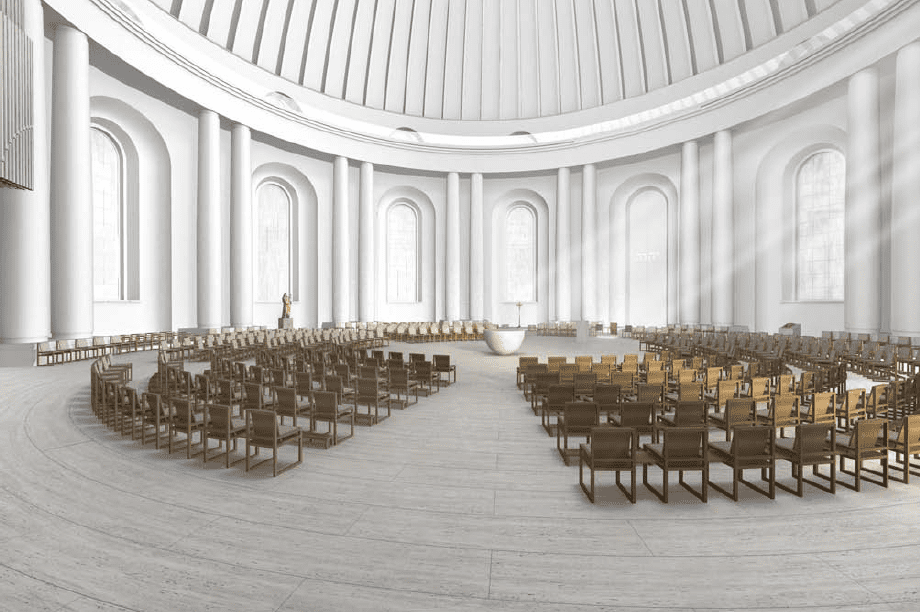
Continuing my drumbeat of dread and decline, the dead German Roman Catholic Church has a new Cathedral in Berlin — a whited sepulchre signaling fealty to something nihilistic:

Rod Dreher, writing for the European Conservative, is duly appalled:

There is scarcely anything visibly Christian about the space. Aesthetically and symbolically, it invites visitors to worship the sacred Nothing. It is a “clean, well-lighted place,” in the nihilistic sense of Ernest Hemingway’s 1933 short story of the same name. It is a hauntingly spare tale about an elderly, suicidal Spanish man who frequents a certain café, described in the story’s title, seeking refuge from nihilism. In the tale, an older waiter in the café reflects on why the clean, well-lighted café drew men like the suicidal customer:

What did he fear? It was not a fear or dread. It was a nothing that he knew too well. It was all a nothing and a man was a nothing too. It was only that and light was all it needed and a certain cleanness and order. Some lived in it and never felt it but he knew it all was nada y pues nada y nada y pues nada. Our nada who art in nada, nada be thy name thy kingdom nada thy will be nada in nada as it is in nada. Give us this nada our daily nada and nada us our nada as we nada our nadas and nada us not into nada but deliver us from nada; pues nada. Hail nothing full of nothing, nothing is with thee.

This is the perverse prayer one imagines visitors to the bleached-out St. Hedwig’s will pray, if they pray at all.

Devolution

It is not an exaggeration to claim that this nineteenth-century Protestant evangelicalism differed from the religion of the Protestant Reformation as much as sixteenth-century Reformation Protestantism differed from the Roman Catholic theology from which it emerged.

Mark A. Noll, America’s God

How many times can such devolutionary leaps happen before the result is not authentically Christian?

Spontaneity is the new requirement

Speaking of which:

I laughed out loud, paused the podcast where I heard the phrase, and wrote down Rituals of Spontaneity, which now sits in my book queue to complement America’s God and The Democratization of American Christianity. Although none of them writes as well as Kevin D. Williamson, I’m more interested in the religious aspects than in the prospect of President Dwayne Elizondo Mountain Dew Camacho in 2028.

Elastic “religion”

Taylor is not unaware that the term “religion” is fraught, but, as we have seen, he thinks the reason it defies definition is that its different manifestations are so diverse. But how do we know that these different manifestations are all “religion” to begin with? Taylor says “the phenomena we are tempted to call religious are so tremendously varied in human life.”175 But why are we “tempted” to call them all religious if they are so varied? More to the point, why do we want to call some things religious and some other, very similar things nonreligious? What makes nontheistic Buddhist rituals “religious,” by Taylor own reckoning, but rituals surrounding the proper treatment of the American flag—very precise rules for folding, displaying, venerating, and keeping it from touching the ground or being otherwise “desecrated”—are not? Taylor uses “religion” broadly when he wants to include Buddhism, but narrowly when he wants to exclude nationalism.

William T. Cavanaugh, The Uses of Idolatry

Migration of the Holy

After only a few years, America’s religious population, with Protestant evangelicals in the forefront, began in similar fashion to tailor their religious projects to fit the language of republicanism. The implications for both politics and religion from this tailoring were momentous. In the immediate context, the argument against Parliament acquired the emotive force of revival. In the longer term, religious values migrated along with religious terms into the political speech and so changed political values. But the migration also moved the other way: a religious language put to political use took on political values that altered the substance of religion.

Mark A. Noll, America’s God


Sometimes this whole 2000-year-old faith seems like a living koan. Chew on this until you are enlightened. Keep walking.

Paul Kingsnorth

You can read most of my more impromptu stuff here and here (both of them cathartic venting, especially political) and here (the only social medium I frequent, because people there are quirky, pleasant and real). All should work in your RSS aggregator, like Feedly or Reeder, should you want to make a habit of it.

Sunday, 9/17/23

Novices in the limelight

I found myself very recently worrying about Paul Kingsnorth and his sorta-kindred spirit Martin Shaw:

It is dubious to thrust Paul Kingsnorth and Martin Shaw onto the Orthodox “Christian stage.” Nothing they’re saying offends me, but I see an analogy to the qualifications of deacons in the New Testament, who are not to be novices lest they get puffed up. I saw countless Evangelical let-downs as celebrity converts crashed and burned.

Both of these men — moderately famous overall and certainly with devoted fans — have arrived at Orthodox Christianity from paganish backgrounds (I mean pagan as a descriptor, not as dismissive) within the past five years. Both lost fans who felt betrayed, and both risked (or incurred) a financial hit as a result. Both have added Christian followers, especially from Orthodoxy, as well as losing followers.

But there’s a great risk in newbie Christians being thrust forward for adulation. (“Let them be tested first.” I Timothy 3:10) Am I being an enabler by subscribing to their Substacks? Am I spurning a brother in Christ who needs to replace his former, more pagan, income sources if I don’t subscribe?

So it came as a relief to read this from Kingsnorth:

A new Christian with a platform who wants to write about his Christian journey is sailing on a sea which could sink him any time. I have prayed about this consistently, of course, and I’ve asked advice of everyone I know. Friends, family, teachers, my spiritual father, wise heads both Christian and not. I’ve even sought – and been given – answers from monks on Mount Athos. Should I really be writing about this? I have asked, over and over. I don’t know anything.

The answer has always been the same, and it has always been: yes, you should. Sometimes that has excited me, and at other times it has felt like a millstone around my neck. Of course, the ‘yes’ always comes with important caveats. If I start writing as if I were a teacher or a leader or some kind of wise or accomplished Public Christian, or somebody who knows much at all of any depth, I will fall on my face. Probably some people would enjoy that, and perhaps it would be a good lesson in humility, but still, I am going to try and avoid it.

It’s good that he recognizes the risk and is asking wiser heads. It’s good that they have given, and he apparently has heard, cautions on how he should write as a Christian novice.

So here’s some of how he’s struggling with his new task:

Here I am, surprisingly and yet not suprisingly, a Christian. It is on the one hand not surprising, because I have never been a materialist; I have always had some intuition of God or gods or spirits, usually experienced for me through the natural world, and I have always been searching for the truth of that, always scanning the horizon for the true harbour. Yet it is surprising too, because I never imagined that, in the words of Seraphim Rose, patron saint of Lost Western People, the truth was ‘a person, not an idea.’

I have noticed in the last few years a constant temptation to systematise Christianity; to bend it into a shape that fits a pre-existing pattern in people’s heads…

My version of this temptation is to view the deep mystery of creation and creator through the prism of my attitudes to the Machine, and then to bend the former to suit the latter, rather than the other way around. I think that I have been stuck for words all week because I was struggling with this tendency. I found, when I stood outside myself and looked in, that I was almost unconsciously seeking a grand theory big enough to accommodate Christ. The old habit of constructing some thesis or other was refusing to die. It was as if I couldn’t write about this journey at all without knowing the destination in advance. As if this ancient spiritual pathway were not an exploration or an unfolding, but a thesis or an argument.

‘Ideas create idols’, said St Gregory of Nyssa. ‘Only wonder leads to knowing.’ St Augustine agreed. ‘If you understand,’ he said, ‘it is not God you understand.’

Paul Kingsnorth, Inis Cealtra

Christian Zionism

Christian Zionism is the term used to describe the view that the Old Testament prophecies of the return of exiled Israel to the Promised Land find their fulfillment in the establishment of the State of Israel in 1948, and not in Christ and the Christian Church.  This theological view is comparatively recent, and is totally at odds with the views of the Church Fathers.  A more detailed critique of this theology can be found here.

Fr. Lawrence Farley. I quote this for its succinctness, first, and to retell (briefly, I hope) why I have a particular wariness of Christian Zionism.

My Evangelical boarding school of 60 years ago was less homogenous in thought than I imagined going into it, but I didn’t tease out that observation until much later. (This is because “Bible only Christianity” has always produced flaky opinions and eventual schisms.) One teacher was, by Fr. Lawrence’s definition, a Christian Zionist, but with an overlay on that.

  • The founding of Israel in 1948 started the end-times clock running.
  • The Great Tribulation, the rule of Antichrist, and the return of Christ would all be within 40 years of the founding of Israel.
  • A Biblical generation is 40 years.
  • Therefore we would not see 1988 before Christ’s return.
  • (And therefore, I would not live to age 40.)

I add the obligatory caveat that my parents did not inculcate stuff like this, and I don’t recall whether I mentioned it to them. By God’s grace, and perhaps partly by the parents’ sobriety about “Bible prophecy,” I never fully bought into this. I thought this lurid schema stretched the plain meaning of the Bible past the breaking point and I (tacitly) rejected approaching the Bible as if it were some kind of cypher, which if broken could satisfy our curiosity about the near future.

Still, it haunted me a little.

So far as I can tell, the false prophets who peddled that sort of crap (I’m looking at you, Hal Lindsey) never repented but presumably came up with just-so stories on how they were fundamentally right all along — just like all the Adventists and other 19th-century sects they deride.

Young, headstrong, and hurtful

There must have been moments during those formational years when someone said something like this: “We don’t really know what we are doing. We need to join a larger group or institution or denomination. We need oversight and accountability and guidance.” But that attitude did not prevail. If these young, headstrong men had more fully embraced all that history and tradition had to teach them, they might not have tried to reinvent the wheel. It would have spared many people some of the pain to come.

Jon Ward, Testimony.

Irreligious Right

[W]e are far more likely to see the coming of a right-wing, essentially pagan political order than we are the restoration of anything meaningfully Christian … The Left, by attacking Christianity directly and indirectly, has torn down the greatest barrier holding back political paganism of the Right. Christian parents now have to worry that their children will be seduced by cultural leftism (including the sanctification of LGBT and other forms of sexual paganism), or by post-Christian right-wing paganism, which entails white identity and other forms of militant racism. We have to watch out for syncretism of white identity with hardline conservative Christianity …

You can lose your Christian soul to the far right as easily as you can to the far left. The devil doesn’t care how you lose it; he just wants you to lose it.

Rod Dreher.

I quote Rod much less than I used to for reasons I haven’t entirely sorted out in my own head. I’m not going to try to sort them out here in public.

But on this, I’m confident that he’s right, including about the infiltration of the most “conservative”-looking versions of Christianity. Pastors looking for disciples of Christ must be on alert; pastors happy with disguised pagans in the pews may be in for a bonanza.

Of what one may not speak one must remain silent

The full doctrine of the Church was made available only to baptized Christians. It still is. Much of it is written and so accessible to all, but the most important aspects are passed on orally and symbolically because they can only be transmitted to someone who is ready to receive them. And by their very nature they cannot be written. By taking the first step, by being baptized into the Orthodox Church, I had not experienced any new convictions but had opened myself to an evolving mystery which the Church has preserved and which exists to communicate to its members. And, on Patmos, I had become normal.

Peter France, Patmos: A Place of Healing for the Soul

New eyes

How do we become uncomplicated and unsophisticated? Can we simply unlearn all that we have learned?

No, we cannot, but what we can do is to separate ourselves from it in order to look at it with new eyes. For us Westerners to truly enter into the ancient Christian transmission and catch the essence of Christ’s teaching, it is necessary for us to crucify our rationalizing minds and arise above the level of thought and emo for a society founded on Descartes’ proposition “I think, therefore I am,” this of course means a kind of suicide; and it is to precisely such an ego-death that Christ calls us. Contemporary western Christianity trained us how to think and what to think; whereas Christ himself, as did Lao Tzu before Him, taught us how not to need to think.

Hieromonk Damascene, Christ the Eternal Tao

Invisible realities

To be a devout Christian or a believing Jew or Muslim is to be a bit like a conspiracy theorist, in the sense that you believe there is an invisible reality that secular knowledge can’t recognize. But the great religions are also full of warnings against false prophets and fraudulent revelations. My own faith, Roman Catholicism, is both drenched in the supernatural and extremely scrupulous about the miracles and seers that it validates. And it allows its flock to be simply agnostic about a range of possibly supernatural claims.

Ross Douthat, quoted in a lengthy New Yorker profile by Isaac Chotiner

Stagnation or permanence?

”How has it come about,” C. S. Lewis once asked, “that we use the highly emotive word ‘stagnation,’ with all its malodorous and malarial overtones, for what other ages would have called ‘permanence’?” It is, Lewis suggests, because the dominance of the machine in our culture altered our imagination. It gave us a “new archetypal image.”

Ken Myers, All God’s Children and Blue Suede Shoes

Just askin’

Why is it unjust for a nation, convinced of the truth of Islam or Christianity or Judaism, to give preference to truth over falsehood in education, law, and cultural institutions? Don’t all regimes claim to give preference to truth over falsehood? Or, to bring the question down from the metaphysical stratosphere: Is it unjust for, say, Ireland to give discriminating support to Irish holidays, cultural traditions, or language? If that is ­unobjectionable, why can’t Ireland give preference to its traditional Catholic religion? Questions of truth aside, why should religion be treated differently than other national traditions?

Peter J. Leithart, Rethinking Religious Freedom. Leithart presumably used and Irish example because he is not Roman Catholic.

Evangelistic gimmickry is nothing new

”Original sin, [Charles Finney] declared, is not a “constitutional depravity” but rather a deep-seated “selfishness” that people could overcome if they made themselves “a new heart.” “Sin and holiness,” he declared, “are voluntary acts of mind.” He was just as clear about the role of the preacher in bringing people to salvation. “A revival,” he wrote in 1835, “is not a miracle, or dependent on a miracle, in any sense. It is a purely philosophical result of the right use of the constituted means.””

Frances FitzGerald, The Evangelicals

And now for something quite different …

I syng of a m[a]yden that is makeles.
kyng of alle kynges to here sone che ches.
he cam also stylle there his moder was
as dew in aprylle, that fallyt on the gras.
He cam also stylle to his moderes bowr
as dew in aprille, that fallyt on the flour.
He cam also stylle ther his moder lay
as dew in aprille, that fallyt on the spray.
Moder & mayden was never non but che–
wel may swych a lady godes moder be.

Eamon Duffy, The Stripping of the Altars


A fundamental reality of human existence is that vice often leaves virtue with few good options. Evil men can attach catastrophic risks to virtually any course of action, however admirable.

David French

You can read most of my more impromptu stuff here (cathartic venting) and here (the only social medium I frequent, because people there are quirky, pleasant and real). Both should work in your RSS aggregator, like Feedly or Reeder, should you want to make a habit of it.

Sunday, 7/9/23

Churches I have regularly attended in my life

This may well seem too personal and of low interest, but my life has been lived in and around the church to a great extent. These nine churches are important, not incidental, to my life story. (Minor updates since first posted.)

1. Evangelical Covenant Church, Lafayette, IN, 1948-1967

My parents, after conscious adult decisions for Christ, got their own Christian formation at a fundamentalist Baptist Church in Bloomington, Indiana as my dad finished law school after World War II. But for some reason, they settled us, as dad began his law practice, in the much more moderate Evangelical Covenant Church, part of a denomination rooted in Swedish pietism, and with an evangelical rather than fundamentalist identity.

My parents remained members there until death. While this was our family church, I made my very young “decision for Christ,” which I still count, in a sense, as the beginning of my “Christian life.”

The denomination was relatively broad. If parents wanted a baby baptized, the church would baptize by sprinkling. If parents, like my own, believed in “believers baptism,” the church would go so far as to baptize in a creek if one wanted immersion. They were not dispenationalist prophecy fanatics, but they had a few of those as members. They used the Apostles Creed; I don’t believe I ever heard the Nicene Creed there.

I attended two years of “confirmation class” on Saturday mornings in 7th and 8th grade; I remember no substance from them, and I did not get baptized and join the church at confirmation class conclusion. That’s probably on me or on the very idea of catechizing middle-schoolers. Maybe the theory is that kids can’t handle paradoxes like the Trinity until that age.

So far as I know, no other males in my age cohort still attends any church faithfully, though somewhere between one and three females did (one loses track). The main thing I got at ECC, consciously, was a taste for coffee, black, beginning at about age 12.

The current building is the third in my memory. The first was a different, old, building on this land. The second, where I took those confirmation classes, is now one of two Reformed Presbyterian Churches in town. I have never been regular at the third building.

2. Wheaton Bible Church, Wheaton, IL 1963-1974 (but not continuous)

This is where I was baptized on a winter’s night at age 17. I began attending while in boarding school nearby. We were bussed into town Sunday morning and the busses would make stops at (unofficially?) approved churches. I fell in love with pipe organ here. I heard good preaching and had good enough Sunday School classes here. I had a girlfriend who went here. I eventually attended here with my wife, who is not that former girlfriend, and its pastor did our wedding service (at a more intimate Evangelical Covenant Church in town, which church was without a pastor and could use the fee, I assume).

Today, if forced to attend WBC in its current incarnation or the Lutheran Church that now occupies WBC’s old building, I’d probably choose the latter: the Bible Church has gone happy-clappy megachurch, though they retain a “traditional service” in one of their “worship spaces.”

This makes me sad. I liked WBC a lot.

3. Westminster Presbyterian Church, Peoria, IL 1970-73

This is the church I attended during my terminal undergrad years, and my wife and I walked half a block here as newlyweds as well (while she finished her undergrad degree). Again, the pipe organ, music, and erudite preaching were the draw, but a plus was our InterVarsity Christian Fellowship faculty sponsor’s membership there.

I saw some things there that in retrospect were just flat wrong, such as the junior pastor’s involvement in a “clergy network” for abortion referrals before Roe v. Wade. I wonder now how Christian was the erudite preaching that so pleased me.

Occasionally I attended a larger, more evangelical and obsessively anti-Catholic Presbyterian Church in Peoria. But the obsession was too much even for me, though I, too, was hostile to Rome.

4. Lakewood Presbyterian Church, Dallas, TX 1974

When we arrived in Dallas on an employment assignment, we went next door the first Sunday to a Missouri Synod Lutheran Church. I think it was the first time I’d seen a more-or-less historical Christian liturgy, and I was having none of it. “Too Catholic” for me, was my thought.

So the second Sunday we walked past it to this church, which at the time was, oxymoronically, an “Independent Presbyterian Church.” They were independent, I think, because the available Presbyterian denominations were too hot or too cold, too soft or too hard. We rather liked it.

During our stay in Dallas, I had need (more than I knew) for a little pastoral correction. Rev. John Pyles pulled button-holed me and did it. I thank him.

During our too-short time there, it was approaching the new Presbyterian Church in America (PCA) for affiliation. I was in favor.

5. Watonga Christian Church, Watonga, OK 1974-1976

I had a 15- or 16-month, eventful job assignment to the municipal hospital in this small Oklahoma town. We had a terrible time finding a Church that we considered minimally acceptable, so we defined acceptable downward.

I believe, but would not bet anything I couldn’t afford to lose, that this is where we settled. I believe it was part of the Disciples of Christ denomination.

I don’t think it’s the same building (but it appears to be in the right neighborhood, so it could be an expansion and remodel). There was nothing memorable about the music, but I believe that the preaching included an “altar call” every Sunday.

While we were in Watonga, our son was born (albeit at a hospital in Enid — long story).

6. First Baptist Church, Prescott, AZ 1976-79

After Watonga, I left my employer and became a small-business proprietor in the mountains of Arizona. For some reason, I thought it was important that we be members of a church, not mere faithful attenders. After a visit here, we chose this church because it was large, the preaching was pretty good, and the young adult Sunday School was outstanding (Harold Waters, if you’re still living, thank you!). My wife’s baptism was deemed inadequate (sprinkling, and before she made a personal commitment to Christ) so she had to be baptized again — one of several things I’d do over if I had the chance.

In fact, if I had it to over, we probably would have attended the uninvitingly-named Church of All Christian Faiths which, unbeknownst to me before we committed to the Baptist Church, was becoming a PCA Presbyterian Church under Pastor Charles Turner. He and I talked quite a bit.

First Baptist was affiliated with the Conservative Baptist Conference (or Convention, or something), with a seminary in Denver.

It was during my time in Prescott that my reading took me from Evangelical to Calvinist. It was also during that time that I encountered Col. R.B. Thieme, Jr. Sadly, he had many fans at First Baptist Church, and I followed along for a week of meetings in a gym at a local college.

Col. Thieme was the rare dispensationalist whose other heresies and peculiarities were even more serious than his eschatological errors. Samples: Did you know that God loves nothing more than “doctrine in the frontal lobe”? Did you know that the ovum is the only human structure untainted by Original Sin? I learned both of those things during my distressing week of auditing his faux-erudite talks. I don’t recall if I was a Calvinist before he came to town, but I was not taken in by any of that, and it rather lowered my esteem for his followers in our church.

After, I ended up teaching a breakoff younger-adult Sunday School class, which of course had to be on the book of Revelation initially because … reasons … unhealthy obsessions. (Fun fact: Revelation is part of the Orthodox canon, but has zero appointed readings in Orthodox services. Having seen Evangelicals act as if it’s the centralmost book of the Bible, I appreciate that very much.) I told the Church leaders that I could no longer in good conscience teach dispensational premillennialism, which didn’t bar my Church membership but I thought would disqualify me to teach. I was wrong. So I picked fights with young dispensationalist students for a while before selling my business and heading for law school, my hometown in sight longer-term.

7. Bloomington United Presbyterian Church, Bloomington, IN 1979-81

This was an intimate, warm, evangelical Church (the pastor was a Wheaton College graduate) where we easily settled during law school. I was too busy with studying law to have deep involvement, and even may have missed a Sunday or two here and there.

8. Lafayette Christian Reformed Church, Lafayette, IN 1982-1997

After law school, returned to my hometown but not to my childhood church. I wanted a Calvinist Church as a permanent home, but the non-instrumental Reformed Presbyerian approach to worship left me cold (remember: I was a pipe organ fan).

This is where we comfortably settled. I served both as deacon and elder, and on the Pastoral Search Committee — twice, I think. During the second search, and after about fifteen years here, I discovered Orthodox Christianity and was emotionally committed to it before the pastor we called had arrived.

The Christian Reformed Church requires elders to sign a “Form of Subscription,” which basically says “I believe what the CRC teaches and if I develop doubts, I’ll pursue them only through proper channels, not stirring things up openly.” (I think that’s a pretty good idea, by the way.) So when I left this Church, it was a surprise to everyone but my wife and the pastor. I no doubt appeared impetuous — a cross to bear in the “first world problems” sense.

My wife still attends here.

9. Saint Alexis Orthodox Church, Lafayette/Battle Ground, IN 1997-present

Our home website is badly outdated: we have many more icons on the walls of the altar area; Subdeacon Gregory has moved on to a job out of state. This has now been my “church home” for more than 25 years.

Having decided to make the most momentous religious change of my life, I realized I should look at Roman Catholicism, which by then I considered the only serious contender to Orthodoxy. I had occasionally seen and admired “little old ladies” kneeling in prayer in Catholic churches at random times during the week. But when I looked with fresh eyes, it did not draw me; I probably had already absorbed the Orthodox version of the Great Schism (including that the sack of Constantinople by Latin Crusaders was the last straw in a 150-year rift). I’ve never regretted my decision, though I was something of a fan of Benedict XVI and even of John Paul II.

Throughline

There were occasional compromises, because no better Church was available (see Watonga) or because a church offered some recompense (see Prescott), but two common threads, through the parts of this ecclesial meandering that I freely chose, was a quest to worship God worthily, particularly in hymnody, and to be in historic continuity with my spiritual forefathers. I don’t expect I’ll ever need to move again. A picture of me about my Sunday business is here.

Tao Teh Ching

It is also not surprising that so many are turning to the profound and enigmatic work of pre-Christian China, the Tao Teh Ching. In reading Lao Tzu, they sent the spirit similar to that of Jesus Christ. They see a poetic glimpse of Christ in Lao Tzu — a reflection that is faint but somehow still pure. And to them, this faint but pure image is better than the more vivid but tarnished image of Him that they encounter in much of what now passes for Christianity.

In the traditions of ancient China, the western spiritual seeker can learn the basics of spiritual life which the churches failed to teach him: how to be free of compulsive thinking and acquire stillness of thoughts, how to cut off desires and addictions, and how to conquer negative emotions.

Monk Damascene, Christ the Eternal Tao

Secular versions of fullness

I would venture to say that most of us have already adopted parts of these secular visions of fullness. To take the most personally convicting example, many of us who profess faith in Christ actually find most of our existential justification in romance or career success or intelligence or beauty or popularity, and we find our meaning in a secular telos of achievement.

Alan Noble, Disruptive Witness

Setting the bar low

If in a hundred years, Christians are identified as the people who don’t kill their children or kill their elders, we will have done well.

Stanley Hauerwas on MAiD, Canada’s euthanasia program, via the epigram here.

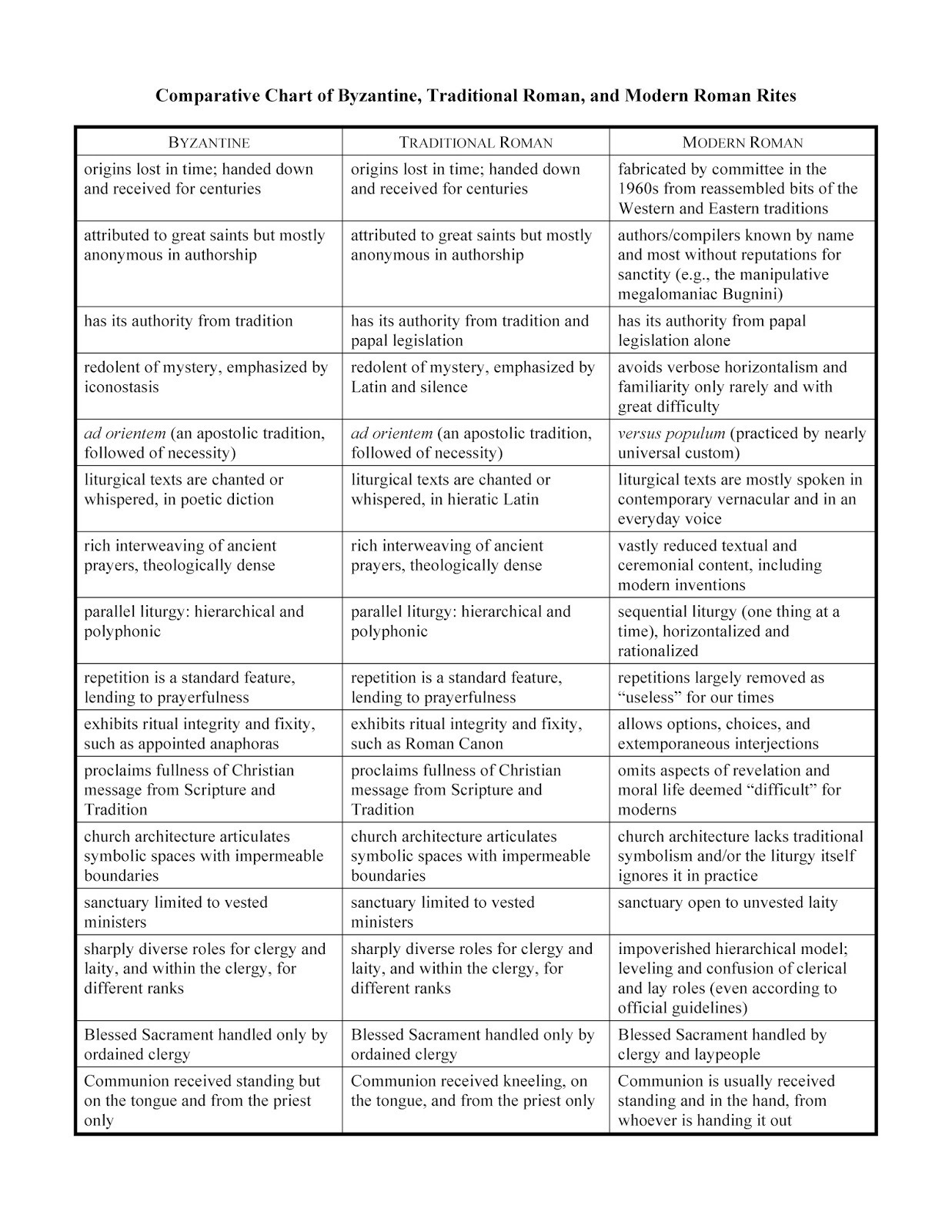
Taking Rites comparatively*Byzantine Rite, Latin Mass, and Novus Ordo Compared*

I can’t feel smug about this because I didn’t fashion the Byzantine Rite (used in Orthodox Churches) — and if I had fashioned it, much of the basis for smugness would vanish.

See New Liturgical Movement: The Byzantine Liturgy, the Traditional Latin Mass, and the Novus Ordo — Two Brothers and a Stranger as well.

My Orthodox friend John Brady has pointed out that even the Traditional Latin Mass had dropped the Epiclesis in favor of a supposed “consecration”, which this chart does not reflect.

A caution to culture warriors

No man can concentrate his attention upon evil, or even upon the idea of evil, and remain unaffected. To be more against the devil than for God is exceedingly dangerous. Every crusader is apt to go mad. He is haunted by the wickedness which he attributes to his enemies; it becomes in some sort a part of him.

Possession is more often secular than supernatural. Men are possessed by their thoughts of a hated person, a hated class, race or nation. At the present time the destinies of the world are in the hands of self-made demoniacs – of men who are possessed by, and who manifest, the evil they have chose to see in others. They do not believe in devils; but they have tried their hardest to be possessed – have tried and been triumphantly successful. And since they believe even less in God than in the devil, seems very unlikely that they will ever be able to cure themselves of their possession. Concentrating his attention upon the idea of a supernatural uncommon among secular demoniacs. But his idea of good was also supernatural and metaphysical, and in the end it saved him.

Aldous Huxley, The Devils of Loudun. (H/T Paul Kingnorth, who is ready to turn away from focusing on evil)

A writer I long greatly admired has seemingly fallen into the maw of focusing on evils. I will continue to pray for him, but I rarely can bear to read what he writes any more.

Religion is not a domesticated animal

Church and state would not be such a difficult subject if religion were, as the Court apparently thinks it to be, some purely personal avocation that can be indulged entirely in secret, like pornography, in the privacy of one’s room. For most believers it is not that, and has never been.

Antonin Scalia, quoted in Francis J. Beckwith, Taking Rites Seriously

Christian Nationalist cherry-pickers

Apparently, some self-styled Christian Nationalists have been taking refuge in a quote from St. Augustine:

[S]ince you cannot do good to all, you are to pay special regard to those who, by the accidents of time, or place, or circumstance, are brought into closer connection with you.

Our countrymen are closer than foreigners. Therefore, piss on everyone but our countrymen. Q.E.D.

Jake Meador schools these lame-brains, starting with, like y’know, the full Augustine quote.


We are in the grip of a grim, despairing rebellion against reality that imagines itself to be the engine of moral progress.

R.R. Reno

The end of the world as we know it is not the end of the world.

You can read most of my more impromptu stuff here (cathartic venting) and here (the only social medium I frequent, because people there are quirky, pleasant and real). Both should work in your RSS aggregator, like Feedly or Reeder, should you want to make a habit of it. I’m even playing around a bit here, but uncertain whether I’ll persist.

All Saints, 2023

A Fatal Difficulty

The perennial temptation

Old-style blasphemy involved desecrating God because it was God who was sacred. Today’s blasphemy involves suggesting that man is not all-powerful, that he cannot create himself in any way he chooses.

Carl R. Trueman’s summary of Blasphemy Then and Now, a posting at First Things. I’m starting to think this is one of the most important things to keep ever in mind about some cultural tsunamis.

Everybody knows there is something very wrong with us, but not everybody knows what it is. If you would know, then go back to the beginning.

There we find the primordial sin: acting out our desire to be God.

Kingsnorth spoke about transhumanists openly talking about creating God. Martine Rothblatt, born Martin, says proudly that transgenderism is an onramp to transhumanism. We are reliving the drama of the Garden of Eden all over again. Kingsnorth said we have lost touch with biological reality, with nature, and knowledge of our own telos — that is, for what we were created.

Rod Dreher, channeling Paul Kingsnorth.

Did dispensationalism die when I wasn’t looking?!

Maybe I’ve been beating a dead horse in my criticisms of dispensationalism. But I have some concern here:

When our grandkids find themselves alone in the house on a summer afternoon, few will find themselves gripped by a sudden fear that everyone except them has been taken in the rapture. By itself, that is a good thing. The eclipse of an unbiblical and thoroughly annoying doctrine is hardly something to mourn. Yet Hummel is perceptive enough not to allow the reader such a hasty judgment. The Rise and Fall of Dispensationalism obliquely but powerfully gestures toward a hole often found in the gospel that post-dispensationalist evangelicals believe today. “In the wake of dispensationalism’s collapse,” he writes in the epilogue, “the eschatological sight of the American church has blurred.” That means that our hope is less fervent, thinner, colder.

The emphasized part makes me crazy! It’s like an invitation to make up some new heresy to fill an eschatological “hole,” the old heresy having passed its sell-by date and been swept from the shelves (unnoticed by me).

If evangelicals need something to fill the eschatological-expectation hole, let me suggest (the first and maybe the last time I’ll commend syncretism) that they adopt Orthodox Bridegroom Matins for Monday, Tuesday and Wednesday of their Holy Week, which could use a bit of thickening up anyway.

Bridegroom Matins even has a catchy theme song:

Behold, the Bridegroom comes at midnight,
and blessed is the servant whom He shall find watching;
and again, unworthy is the servant whom He shall find heedless.
Beware, therefore, O my soul, do not be weighed down with sleep,
lest you be given up to death,
and lest you be shut out of the Kingdom!
But rouse yourself, crying: “Holy, holy, holy, are You, O our God!”
Through the Theotokos have mercy on us!

Voilà! Eschatological problem solved! And it’s better than some idiotic “prophecy conference” at maintaining memento mori and a sane expectation that “He shall come to judge the living and the dead.”

Shiny Happy People

Speaking of fundamentalists, for my many sins I did penance by watching Amazon Prime’s Shiny Happy People. I don’t give a rip about the hyper-fertile Duggars, but I had a brush with the series villain Bill Gothard in 1966-67 and wanted to catch up.

He was a weird little man then and appears to have gotten a bit weirder over the decades, right down to the absence of any grey hair and his ephebophilia.

His message was not a healthy Christian message. It’s not even biblical except in the formulaic sense of “proof-texts for nearly everything,” as if scripture-twisting weren’t a real thing.

I know a few people in the Protestant world who are devoted to IBLP, more fully known as Institute on Basic Life Principles — the organization that survives Gothard’s scandal and forced retirement — and I’m kind of worried about them now. Judging from a visit to the IBLP website’s “Statement of Faith,” Shiny Happy People is correct to classify IBLP as fundamentalist, though the line between fundamentalism and the evangelicalism of my youth is a fine one.

A few thoughts:

  • That I thought it necessary to check out IBLP for myself reflects how unpersuasive Shiny Happy People was at nailing down hard facts, preferring innuendo and the charges of critics, some of whom had no first-hand knowledge.
  • That IBLP feels it necessary to publish a roll-your-own statement of faith, eschewing the Nicene Creed and elevating its obsessions to creedal status, reflects how far removed it is from historic Christianity. (IBLP’s statement of faith is sorely lacking, too.)
  • That IBLP is “parachurch” means it can infiltrate most any Protestant denomination and makes it harder to unequivocally speak of it as a “cult” — though that label is tempting.

You could probably find better ways to spend three or four hours unless you have some compelling personal motivation (as did I) to watch this poorly-aimed shotgun blast toward unhealthily patriarchal fundamentalists.

Distress

The distress this insight speaks of was the beginning of my conscious Christian commitment, long ago (but not very far away):

To have offended God is more distressing than to be punished … If only we loved Christ as we should love Him, we would have known that to offend Him whom we love is more painful than hell.

St. John Chrysostom, Homily V on Romans 1, citing II Samuel 24:17.

Continuity

The primary aim of this book is to demonstrate the absolute continuity of ancient Israelite religion, the religion of the Second Temple, first-century Christianity, and the religious life preserved and practiced in the Orthodox Church …

Fr. Stephen DeYoung makes a bold claim. Something lured him out of a Reformed Protestant pulpit into Orthodoxy. It might merit investigation.


For all its piety and fervor, today’s United States needs to be recognized for what it really is: not a Christian country, but a nation of heretics.

Ross Douthat, Bad Religion

We are in the grip of a grim, despairing rebellion against reality that imagines itself to be the engine of moral progress.

R.R. Reno

The end of the world as we know it is not the end of the world.

You can read most of my more impromptu stuff here (cathartic venting) and here (the only social medium I frequent, because people there are quirky, pleasant and real). Both should work in your RSS aggregator, like Feedly or Reeder, should you want to make a habit of it.

Sunday, 9/11/22

Yes, it’s the 21st anniversary of the Twin Towers (and related) attack.

Orthodoxy

Strangers in Strange Lands

In traditional Orthodox countries, the general culture supports, or at least is not hostile toward, Orthodox phronema. But in other countries, Orthodox Christians are usually a tiny minority in a sea of other religious traditions. Acquiring and maintaining our Orthodox phronema in a very pluralistic society is much more difficult and requires real effort and dedication.

Dr. Eugenia Scarvelis Constantinou, Thinking Orthodox

Theodicy

God allowed suffering to enter the world. He did this not out of vengeance, but out of love for man, so that through suffering arising from self-love, sensual pleasure, and the resulting desire for created things, man might see through the illusion of his self sufficiency and return to his original designation: the state of pristine simplicity and communion with the Way.

Hieromonk Damascene, Christ the Eternal Tao

Repentance

Repentance is everything you do to get sin, those inborn passions, out of you. It’s reading, thinking, praying, weeding out disruptive influences in your life, sharing time with fellow Christians, following the guidance of the saints. Repentance is the renunciation of what harms us and the acquisition of what is beneficial to us, writes a holy counselor.

Dee Pennock, *God’s Path to Sanity

Five takes on Protestantism

I didn’t set out to collect critiques, but these all came to my attention (several through Readwise, which I enjoy and recommend), and they felt compelling.

I’ve been Protestant, remember — just one beggar suggesting to another that there’s no bread here.

Searching for Authenticity in All the Wrong Places

The Reformation is the first great expression of the search for certainty in modern times. As Schleiermacher put it, the Reformation and the Enlightenment have this in common, that ‘everything mysterious and marvellous is proscribed. Imagination is not to be filled with [what are now thought of as] airy images.’ In their search for the one truth, both movements attempted to do away with the visual image, the vehicle par excellence of the right hemisphere, particularly in its mythical and metaphoric function, in favour of the word, the stronghold of the left hemisphere, in pursuit of unambiguous certainty. … What is so compelling here is that the motive force behind the Reformation was the urge to regain authenticity, with which one can only be profoundly sympathetic. The path it soon took was that of the destruction of all means whereby the authentic could have been recaptured.

Iaia McGilchrist, The Master and His Emissary

Performance Art

America is a Protestant country and we skipped the foot-washing, love-thy-neighbor aspects of the faith, preferring preaching, a performance art that lets you despise your neighbor and thereby raise yourself up. Our politics today is tortured by its Protestantism. The Sisters of St. Mary who founded this hospital may have inherited some dreadful theology but they took a better path, they lay hands on the suffering, they soothed the fevered brow, they lifted the fallen.

Garrison Keillor, reflecting on his medical procedures at a Catholic hospital in the Mayo Clinic system.

Happy imposture

It is an imposture—this grotto stuff—but it is one that all men ought to thank the Catholics for. Wherever they ferret out a lost locality made holy by some Scriptural event, they straightway build a massive—almost imperishable—church there, and preserve the memory of that locality for the gratification of future generations. If it had been left to Protestants to do this most worthy work, we would not even know where Jerusalem is to-day, and the man who could go and put his finger on Nazareth would be too wise for this world. The world owes the Catholics its good will even for the happy rascality of hewing out these bogus grottoes in the rock; for it is infinitely more satisfactory to look at a grotto, where people have faithfully believed for centuries that the Virgin once lived, than to have to imagine a dwelling-place for her somewhere, any where, nowhere, loose and at large all over this town of Nazareth.

Mark Twain, The Innocents Abroad (emphasis added)

Populism

What then is the driving force behind American Christianity if it is not the quality of its organization, the status of its clergy, or the power of its intellectual life? I have suggested that a central force has been its democratic or populist orientation.

Nathan Hatch, “Epilogue: The Recurring Populist Impulse in American Christianity” in The Democratization of American Christianity

Escapist Fiction

The pre-Tribulationist party eventually gained the upper hand for reasons that, according to Sandeen, had less to do with their superior skill at exegesis than with the attractiveness of their position that Christians would be raptured before the Tribulations.

Frances Fitzgerald, The Evangelicals

Healthcare-sharing ministries

California congressman demands more transparency from health care sharing ministries

This question was bound to arise and probably needs to. If people aren’t already disguising their sketchy health insurance plans as “ministries,” they soon enough will.


[S]ubordinating truth to politics is a game which tyrants and bullies always win.

Jonathan Rauch, The Constitution of Knowledge

The Orthodox "phronema" [roughly, mind-set] cannot be programmitized or reduced into shibboleths.

Fr. Jonathan Tobias

You can read most of my more impromptu stuff here (cathartic venting) and here (the only social medium I frequent, because people there are quirky, pleasant and real). Both should work in your RSS aggregator, like Feedly or Reeder, should you want to make a habit of it.

An oddball Evangelical finds a home in Orthodoxy

One of his first converts was Samuel Crane, who had been a devout Calvinist but was deeply perplexed by the apparent contradiction between the idea of an eternally fixed number of elect and reprobate and the idea that salvation was free for anyone to take: He supposed it must be as the [Calvinist] minister said, for he was a good man, and a very learned man; and of course it must be owing to his own ignorance and dulness that he could not understand it. On one occasion, as he was returning home from church, meditating on what he had heard, he became so vexed with himself, on account of his dulness of apprehension, that he suddenly stopped and commenced pounding his head with his fist, for he really thought his stupidity must be owing to his having an uncommonly thick skull. When Crane finally accepted Methodism, “he found a system that seemed to harmonize with itself, with the Scriptures, with common sense, and with experience.”

Nathan Hatch, The Democratization of American Religion

Unlike Samuel Crane, I was not as perplexed by Calvinism as I probably should have been. Yet the Sunday after my 49th birthday, I left Calvinism and formally entered the Eastern Orthodox Christian Church. It seemed to harmonize with itself, with the Scriptures (including the ones we were never told to underline), with common sense, and with experience. It was so obviously right once I explored it that I assumed lots of others would follow. It’s fair to say that only one did.

So I’m left wondering "why me?" Why am I the lucky one?

It’s inevitable that telling of one’s religious conversion — and it’s hard for me to view a move from Calvinist to Orthodox as anything less than a conversion, though both are Christian in some sense — will have a whiff of proselytism to it. I’ve tried to minimize that and just tell my story, though my story would be incomplete without a modest conclusion.

Major life decisions, I’m pretty well convinced, rarely hinge on arguments. They’re always undergirded by life experiences and attitudes, which are at most obliquely causal. They’re also so complex as to seem inexhaustible. I told a fuller story of going Evangelical-to-Calvinist-to-Orthodox in one truthful way almost five years ago: A life in a string of epiphanies – Tipsy Teetotaler ن.

But I often think that seeds were planted, and that my disposition somehow was shaped, decades earlier, so that my reception into Orthodoxy truly was a sort of "coming home" — like an adoptee stumbling across his birth parents.

Here’s what I mean.

My favorite Bible verses were not even in the "Top 100" list of favorite Evangelical Bible verses.

As long ago as high school, I became (and remained) fixated on some New Testament passages that were, shall we say, far out of the Evangelical mainstream.

First was Ephesians 3:17-18 in the Living Bible that was so popular then, praying that “Christ will be more and more at home in your hearts” and “May your roots go down deep into the soil of God’s marvelous love.” My Evangelical contemporaries were likelier to pick John 3:16 or Acts 16:31, relieved that one key decision for Christ, once-in-a-lifetime, sealed the deal and there really was nothing more required.

But I didn’t think I had the deep roots the Apostle was praying for, but I wanted them, for myself and my friends. I may even have declared it my “life verse,” life verses being an Evangelical kid thing at least where I was. If I did, it has held up very well.

But in Evangelicalism, sinking deep roots seemed to be off the radar, or reduced to a matter of becoming more theologically astute, doing more Bible study, elaborating doctrinal outlines and such. Those are mostly good things (I’m not so sure about doctrinal outlines any more), but they amount to knowing about God, not knowing Him or having deep roots.

I was also fascinated with Romans 12:2, about the transforming of our “minds” (which came close to “life verse” status), which I thought would eventually come if I became more theologically astute. That was a fool’s errand.

And then there was a real baffler, Hebrews 6:1-2, which referred to “repentance from dead works … faith toward God … the doctrine of baptisms, of laying on of hands, of resurrection of the dead, and of eternal judgment” as “the elementary principles of Christ!” I just couldn’t imagine what more advanced there could be than these seemingly weighty things, but I wanted it. And here I wasn’t convinced that theological astuteness in the Evangelical manner had any chance of hitting pay dirt.

I wanted to worship God when I went to a "Worship Service"

Call me petty, or Aspie, or whatever, but I thought worship services should be full of, like, y’know, worship or something.

I had no objection in principle to Christians playing hail-fellow-well-met, back-slapping and exchanging anodynes and nostrums, or talking like coaches getting the guys ready to go out there and win one for Jesus. But the time and place for that was somewhere other than the Nave between 9:30 and noon on Sunday.

So it seemed to me, and I was adamant about that. The irresistable force of happy-clappy and motivational Church services was strangely resistable to me.

Music selection was what really bugged me. By the time I was Christian Reformed, I was in a Church that had a full Psalter, versified for congregational singing. But even there, we sang way too few of them, preferring to sing things that were relatively emotional and manipulative, that 100 years earlier would have gotten one in deep trouble in that denomination. I called them "gospel songs" instead of "hymns," but I see some sign that my terminology isn’t undisputed. In any event, they weren’t Psalms, which alone were sung in the CRC until maybe the late-19th Century.

There were other things I could have taken exception to, but the music was what got me riled. And then a faction of the Church wanted drums and guitars and more "celebrative" services, which horrified me. I just didn’t think that an emotion jag meant one was worshipping.

So my entire Protestant experience of "worship" was years of drought with an occasional delightful shower (a very good "hymn" as I defined hymn).

(Brief digression: to my knowledge, the Orthodox Church only sings one hymn that appeared in any hymnal in any church I regularly attended. We sing Let All Mortal Flesh Keep Silent on Great and Holy Saturday. I’m even allowed to do the versified version, Picardy (8.7.8.7.8.7), which is used in Western Rite Orthodoxy. We share some ancient hymns with Episcopalians and Roman Catholics, too, but I was never Episcopalian or Roman Catholic.)

I had, apparently, a latent desire to worship with my body

As noted in my prior telling of my conversion:

My first experience of [Orthodox] Liturgy shocked me. I found myself immediately making a clumsy sign of the cross and genuflecting toward the Catholic hospital chapel’s altar, like a Roman Catholic.

It felt good. It felt as if those bodily gestures had been bottled up and were now breaking out. They felt natural

Maybe I should call those feelings “epiphany number four,” but it didn’t impress me quite that strongly at the time. And there’s a reason I blog under the rubric “Intellectualoid”: I tend to discount feelings as a reliable guide.

I didn’t consciously experience that Liturgy as "I’ve come home," but there was more than a whiff of that to it.

Orthodox worship is full of signing ourselves with the cross, bowing, kneeling, prostrating. My experience of body-involvement in Protestant worship was limited to a few gestures like holding up hands and lifting up fluttering eyelids, which somehow felt ersatz.

I was at best reluctantly dispensational premillennialist

Again, I told about my relationship to dispensationalism as Epiphany 3 in my prior telling of my conversion. It’s not worth quoting again, but my hesitancy about dispensationalism left me outside of the Evangelical mainstream.

I hesitate to make discomfort with that novelty a mark of Orthodoxy, because dispensationalism is only about 200 years, when Presbyterian, Reformed and Anglican churches were already a few hundred years old. My attitude toward end-times prophecy would have been pretty mainstream in any of those slightly-older churches, as it’s totally mainstream in Orthodoxy.**

But in my perception, dispensationalism is a mark of mainstream Evangelicalism and even has infected Presbyterian and Reformed Churches that tend to the Evangelical side. So my discomfort was likely to crop up most anywhere I went in Protestantism in these days.

I believed the Creeds and thought they were important

I suspect that the "Apostles Creed" is said rarely in frankly-Evangelical Churches today, and that the Nicene Creed is vanishingly rare. That’s a trend I think was starting 50 years or more ago. (Spot check: Willow Creek Church in South Barrington, Illinois lists its "Beliefs and Values" as "Love God. Love People. Change the World." That’s even worse that I feared.)

The Apostles Creed, though, remained a weekly feature in the Christian Reformed order of worship, with the Nicene Creed thrown in occasionally for a little spice.

By the end of my 20s, I think, I began calling myself “orthodox with a lower-case O.” I was, I thought, a “Mere Christian,” which I described as “believing the ecumenical creeds of the Church without mental reservations.” I learned more about them when I was Christian Reformed.

I’ve learned even more as an Orthodox Christian, but that could be its own story.

I wanted the original faith, which I took to be the purest

I wanted to be orthodox in that creedal sense. I and others detected proto-Calvinism in St. Augustine, and he was early enough that I thought I had finally joined with the early church, which is also what I wanted.

But I knew almost nothing about actual Orthodoxy. (Summary of what I knew: The Russian Orthodox have some awesome music. Orthodox Priests wear beards and funny hats. Orthodox isn’t the same as Catholic. Those were, mostly, true.)

An iconographer I met recently told of his first encounter with Orthodoxy:

I went to the Holy Land and encountered Orthodoxy. I didn’t know what to make of it. It was Christian, but vastly different, far older than my Methodist Church.

Indeed, and a few centuries older even than St. Augustine, who I looked to to buttress the "original faith" bona fides of Reformed Christianity.

The Orthodox Church recognizes Augustine as a Saint, but an unusually flawed one owing to his isolation in the West, when was still a Christian backwater, and his substantial ignorance of Greek and the Greek Church Fathers. So when I thought Augustine was early enough to be the original faith, I was wrong for practical purposes.

Afterthought

These are the things in my history and attitude that I think foreshadowed that my heart would find rest only in the Orthodox Faith. I began writing this many months ago, thinking that more proto-Orthodoxies would occur to me, but they really haven’t, and I don’t want to make things up.

My story would be incomplete were I not to say that all these desires that made me an odd-ball Evangelical and Calvinist have been (or are being) satisfied in Orthodoxy (though I’ve come to understand Creeds differently now). I cannot deny that they might have been satisfied in traditional Roman Catholicism, but that seems largely to have disappeared as Rome has Protestantized in the wake of Vatican II.


You can read most of my more impromptu stuff here (cathartic venting) and here (the only social medium I frequent, because people there are quirky, pleasant and real). Both should work in your RSS aggregator, like Feedly or Reeder, should you want to make a habit of it.

Shame Culture and lesser things

In twenty minutes or so, the Saints and the Bucaneers, Brees and Brady, will be competing. 85 total years of quarterback. And they’re both still really good. So I’m done websurfing today.

Someone pointed out that according to the prophecies of Q, in turn according to the consensus of Q scholars (since Q is reportedly pretty cryptic), President Trump is to sweep up the evil, cannibalistic, pizza-pedophile Democrats and RINOs. I confess that I’m no Q scholar, but his days are prima facie dwindling down to a precious few.

I’d bet a modest amount that, rather than admitting their delusion, QAnon scholars will reinterpret things. My money is on some version of “this will all come to pass at the great and glorious second coming of The Donald in 2024. It is prophesied.”

This will be the proof, for those in the real world, that Q goes beyond politics, beyond conspiracy theory, and is in fact a new pagan religion (and one that’s less rational than worshipping nature) even if (this being America), it’s a paganism with some distracting Christianish cammo.

Shame culture

David French is trying to analyze some fundamental things, and not being a Southerner, I don’t quickly grasp it. But my absolute favorite Orthodox Priest-Blogger, Fr. Stephen Freeman, writes much of the crushing weight of shame, and he writes from southern culture, so French has my attention.

[W]hat we’re watching right now in much of our nation’s Christian politics is an explosion not of godly Christian passion, but rather of ancient southern shame/honor rage.

There’s an enormous amount of literature describing shame/honor culture in the South and shame/honor culture generally, but I like this succinct description from David Brooks:

> In a guilt culture you know you are good or bad by what your conscience feels. In a shame culture you know you are good or bad by what your community says about you, by whether it honors or excludes you. In a guilt culture people sometimes feel they do bad things; in a shame culture social exclusion makes people feel they are bad.

Shame/honor cultures are very focused on group reputation and group identity. Again, here’s Brooks:

> People are extremely anxious that their group might be condemned or denigrated. They demand instant respect and recognition for their group. They feel some moral wrong has been perpetrated when their group has been disrespected, and react with the most violent intensity.

Brooks was writing about the general growth of shame culture in America, including in left-wing circles on campus. But doesn’t this sound familiar on the right? Have you noticed how much of the GOP, the party of white Evangelicals, is often positively obsessed with grievance, how it marinates in anger at the insults of the “elite” or the “ruling class”?

Franklin Graham, Billy Graham’s son, has done an immense amount of good through his organization, Samaritan’s Purse. He and his legion of Christian employees and volunteers have sacrificially served the sickest and most vulnerable members of society. But when it comes to politics, Graham’s voice is radically angry and viciously tribal.

David French, Where Does the South End and Christianity Begin?

This is of concern to me in part because my Christian tradition has by some accounts grown faster in the south than elsewhere, but angry tribalism contradicts the Orthodox faith profoundly.

Trump’s Big Lie

[I]t was striking that President-elect Joe Biden chose the term [“big lie”] when he slammed two Republican senators — Ted Cruz and Josh Hawley — who have amplified Trump’s falsehood.

“I think the American public has a real good, clear look at who they are,” Biden told reporters two days after the Capitol was attacked. “They’re part of the big lie, the big lie.”

Biden nodded to the term’s origin in Nazi Germany, as embodied in Hitler’s propaganda minister Joseph Goebbels.

“We’re told that, you know, Goebbels and the great lie. You keep repeating the lie, repeating the lie,” Biden said. “The degree to which it becomes corrosive is in direct proportion to the number of people who say it.”

A big lie has singular potency, says Timothy Snyder, the Levin Professor of History at Yale University, whose books include studies of Hitler, Josef Stalin, the Holocaust and tyranny.

“There are lies that, if you believe in them, rearrange everything,” he says.

“Hannah Arendt, the political thinker, talked about the fabric of reality,” Snyder says. “And a big lie is a lie which is big enough that it tears the fabric of reality.”

In his cover story for The New York Times Magazine this week, Snyder calls Trump “the high priest of the big lie.”

As for where big lies lead, Snyder writes: “Post-truth is pre-fascism, and Trump has been our post-truth president.”

Can The Forces Unleashed By Trump’s Big Election Lie Be Undone?

Flight 93 (still)

Somewhere along the line, the “Flight 93 Election” proponents decided that their insane gamble with the country had paid off in a fabulously successful Presidency, and that was that, in saecula saeculorum. After January 6, they’re trying to change the subject:

[Laura] Ingraham says that the idea that character and norms don’t mean anything to people like her is a “straw man argument,” while always only being willing to criticize Trump’s “tone” and “style” and praising Trump for “fighting for others.” Is that what he was doing when he lied about having won the election and encouraged an angry mob of wayward souls to march on the legislative branch and his own vice president? Who was doing the fighting that day? Who was fighting for whom? And how many ultimately died? Ingraham says that the rioters were not intent on overthrowing the republic, but were just “desperate people.” Who, exactly, made them feel so desperate? Who told them their country was being “stolen” from them? It wasn’t Mitt Romney, and it wasn’t National Review.

Enter Anton, who took a brief victory lap on “predicting” that the Left would get crazier before asking if National Review’s subscribers knew that its editor had made the case for supporting Hillary Clinton in 2016 (he didn’t), and blasting Lowry for publishing his column in Politico where they couldn’t see it. Of course, Lowry’s column is now up here at National Review, where all of his Politico pieces eventually go up, but even if it wasn’t, he has not exactly hidden the ball on this site.

That Anton and Ingraham disregard the truth so blatantly and resort to such tinny arguments is probably a sign that they know that their Flight 93 presidency is ending very badly, that the project that they invested in so fully and threw away every standard to support is coming apart at the seams.

They’re letting their desperation show.

Isaac Schorr, Ingraham and Anton vs. Lowry: The Sad Descent of the Flight 93 Apologists | National Review

Cruz’s and Hawley’s Infamy

Some Republicans are hurtin’ because of what their party did over their objections. Not one pair — who are involved not romantically, but as rivals for Trump’s shitty mantle:

After the fact, the White House very quickly found itself in a supercharged version of the situation that Cruz and Hawley are also in. They presumed they could cynically ride this movement for their own ends. They gleefully lit match after match, and eventually to their horror they managed to set themselves on fire along with everyone else. They clearly incited these events. They saw them spin rapidly out of control. They ended Wednesday afternoon with five people dead, the Capitol defiled, and the country stunned. They definitely wanted to overturn the election, which by itself is a subversion of representative government. Their efforts produced a messy putsch into the bargain, and got people killed. They should be punished for it as severely as the law permits, and they should never be allowed to live down their responsibility for what happened.

Kieran Healy, What Happened? H/T Conor Friedersdorf, Recommended Reading (a paid Mailchimp weekly email)

The Falkirk Center — Liberty University’s continuing shame

Helfenbein has stated that the goal of the Falkirk Center is to have “massive cultural influence,” and I believe him after watching 12 hours of Falkirk’s nonsense podcast episodes, reading months’ worth of its articles, and scrolling through its near-endless social media feeds. “This is not your dad’s or granddad’s think tank,” says Helfenbein. Yeah, well it’s not your dad’s or granddad’s critical thinking either.

Much of Falkirk’s content is facially ridiculous, deceptive, or easily debunked. But that’s because Falkirk is not selling truth. Like any propaganda outlet, Falkirk melds partial truths with distortions to create a coherent worldview—one that comforts the audience while misleading it. There is no other way to explain the debunked claims of election fraud that Falkirk treats seriously, or the consistently shoddy interpretations of the Bible and history that would be considered sophomoric in Liberty’s own undergraduate classes. The Falkirk Center doesn’t even do a good job at creating alternate realities. Everything falls apart under the barest level of scrutiny—that is, if you can steel yourself to actually engage with all the mind-numbing content.

The Falkirk Center: Liberty University’s Slime Factory – The Bulwark

Antifa? Yeah, that’s the ticket!

One of the organizers of the Trump boat parade that sank a family’s boat in Portland, Oregon, in August was arrested Wednesday in the attempted coup on the Capitol.

Kristina Malimon, 28, was arrested on charges of unlawful entry and violating curfew. Her mother, Yevgeniya Malimon, 54, was also arrested on the same charges.

Malimon is the vice chair for the Young Republicans of Oregon. According to her bio on the organization’s website, she is also an ambassador to Turning Point USA and Liberty University’s pro-Trump think tank, the Falkirk Center. She is also listed as a delegate for the Multnomah County Republican Party.

Julia Reinstein, Kristina Malimon, Organizer Of A Trump Boat Parade, Arrested (Buzzfeed).

Yeah. It was all Antifa false flag stuff. That’s the ticket.

TOS

We talked about why we need more social media bans earlier this week and a friend who works in a tech-adjacent sector sent along something great. My buddy drafted the “Terms of Service” agreement he would use in the event he created a social network. Here they are:

> This social network is like a party I’m throwing at my house, and you’re all invited. So here’s the deal. I’m not gonna write a whole list of rules on a chalkboard like I’m your third-grade substitute teacher. I don’t mind you being rowdy because this is a fun party in my house. But if you cross the line, I’ll kick you out on your ass. Where is the line? I’m not going to try to explain it to you, so just keep yourself in check so you don’t cross it.
>
> But I’m not going to make any pretense here that I’m “fair” or “objective”. If I like you, I’ll probably let you get away with more. If I don’t like you but you’re still making the party cool, I’ll probably cut you some slack. You might get a warning, or you might not. Look, I’m partying too, and I don’t always have time to do warnings. Sometimes there will be a misunderstanding and I’ll kick you out when I should not have, and maybe I’ll regret it later. But probably not.
>
> But if you’re a real ass, you’ll be kicked out so hard that you’ll be staggering your drunken way down the street, mumbling to yourself about how unfair it was, and hearing the loud music from my amazing party which will be going on without you. And we won’t even miss you.
>
> So don’t complain to me about my party. Behave yourself and know that I am arbitrary and capricious in defense of the rocking time we are having. And don’t ask me to be “fair” because I’m just not.

This is exactly right. A TOS is not Hammurabi’s Code. It’s a set of guidelines subject to change at any minute that exist not to protect any individual “rights” but to make the product the company owns function better.

And people who pretend that this isn’t the case are either lying. Or socialists.

Jonathan V. Last, This Cult Is Ruining People’s Lives – The Triad

This, too, needs to be said:

I am insisting upon a different sort of consistency, one that rejects easy explanations and accepts that occurrences like the breaching of the Capitol on January 6 are as complex as any other part of human life. What I refuse to concede is the inhumanity of the costumed hundreds — a fraction of the total number of those who had traveled to Washington to hear President Trump speak. It is absurd, as Dickens once put it, to talk of such an event

> as if it were the only harvest ever known under the skies that had not been sown—as if nothing had ever been done, or omitted to be done, that had led to it—as if observers of the wretched millions … and of the misused and perverted resources that should have made them prosperous, had not seen it inevitably coming, years before, and had not in plain words recorded what they saw.

Last year I recognized the unmistakable signs of coming violence, and not only of the sort we are used to regarding as “political,” the surge in crime rates, drug addiction, sexual exploitation of children, and so-called deaths of despair. I for one do not understand how it is that people accustomed to talking about the very real consequences of unemployment, who take mental health seriously and understand the relationship between crime, education, poverty, and civil unrest, were able to wave away the cost of our lockdown measures.

… Washington, D.C., is under martial law, which means thousands of National Guardsmen reading Atlas Shrugged or sleeping under the same statues protesters would have been allowed to destroy only a few weary months ago. Joe Biden’s inauguration will become what President Trump once fantasized about: a military event, a quasi-fascistic spectacle of raw power, like the proclamation of a new emperor by a detail of leering praetorians.

This is the sort of thing people usually protest.

Matthew Walther, Where do riots come from?.

Not all January 6 demonstrators are criminals in any sense, insofar as not all entered the Capitol.

Not all January 6 demonstrators who entered the Capitol are guilty of the same seditious crimes.

For Civic Hygiene and deterrence, we need to hammer the worse offenders with the most serious charges the evidence supports. I don’t know how many of those there are, but I wouldn’t be surprised by hundreds of 10+ year sentences.

But I’ll be disappointed if some who entered the Capitol, if convincingly chastened, don’t get something like probation with low felonies reduced to high misdemeanors if the probationary period is completed without violation of any conditions.

Lie down with dogs, rise up with fleas

This isn’t about, anymore, the Electoral College, this is about the future of the party, and whether you’re going to ostracize and excommunicate President Trump from the party. Well, guess what? Millions of his fans will leave as well.

Rand Paul, quoted by Zachary Evans, Rand Paul: Senator Warns Republicans Will Leave Party if GOP Senators Back Impeachment | National Review

He’s probably right, which is what makes doing the right thing for the country so hard now that Trump has taken the GOP from Zombie Reaganism to the main host of QAnon.


The Four Caucuses of the GOP.

Here’s where we are: the GOP (at least in the House) broke down into four broad groups: The Profiles in Courage; the Sedition Caucus; the Mugwumps; and the Terrified.

I. The Profiles in Courage Caucus

The 10 Republicans who voted to impeach Trump

II. The Mugwump Caucus

This consisted of representatives who seemed to fully understand the enormity of Trump’s conduct… but still voted against impeachment.

III. The Sedition Caucus

We know their names: the 138 GOP reps who voted to overturn the presidential election, even after the failed insurrection attempt. Many of them had also signed a letter of support for the absurd and mendacious Texas lawsuit that sought to disenfranchise tens of millions of voters, and overturn the presidential election.

They make up nearly 2/3 of the House GOP Conference.

IV. The Terrified.

We don’t know how many Republicans were simply too afraid to vote yes, but fear was definitely a factor.

Charlie Sykes, Defeated, Disgraced, Twice Impeached – Morning Shots


When Trump leaves office, my party faces a choice: We can dedicate ourselves to defending the Constitution and perpetuating our best American institutions and traditions, or we can be a party of conspiracy theories, cable-news fantasies, and the ruin that comes with them. We can be the party of Eisenhower, or the party of the conspiracist Alex Jones. We can applaud Officer Goodman or side with the mob he outwitted. We cannot do both.

In 1922, G. K. Chesterton called America “a nation with the soul of a church.” But according to a recent study of dozens of countries, none has ditched religious belief faster since 2007 than the U.S. Without going into the causes, we can at least acknowledge one cost: For generations, most Americans understood themselves as children of a loving God, and all had a role to play in loving their neighbors. But today, many Americans have no role in any common story.

Conspiracy theories are a substitute. Support Donald Trump and you are not merely participating in a mundane political process—that’s boring. Rather, you are waging war on a global sex-trafficking conspiracy! No one should be surprised that QAnon has found a partner in the empty, hypocritical, made-for-TV deviant strain of evangelicalism that runs on dopey apocalypse-mongering. (I still consider myself an evangelical, even though so many of my nominal co-religionists have emptied the term of all historic and theological meaning.)

Senator Ben Sasse (emphasis added) did not willingly lie down with the Orange dog, but his party did. He really grasps the nettle here. Highly recommended unless you shun politics entirely.

Un-learning

I recall from my late high school days a presentation by Moody Bible Institute about its school for missionary aviators in Tennessee. It has stuck with me for something like 55 years now that applicants who already had pilots licenses were not ahead of the game: “We have to un-teach them everything they’ve learned.”

Moody was quintessentially Evangelical, so it’s a bit ironic that Evangelicals must now unlearn what they’ve been taught in order to become better, more historically-rooted Christians.

Take conversion, for instance (a topic I began last night, not knowing I’d be continuing).

“Saints are made by good conversions.” In this challenging and provocative book, Gordon T. Smith contends that a chief cause of spiritual immaturity in the evangelical church is an inadequate theology of conversion. Conversion, he says, involves more than a release from the consequences of sin–the goal is spiritual transformation. But there is little transformation without a complete and authentic conversion. The key is beginning well. In this age of false starts and stunted growth, maturing Christians need help reflecting on and interpreting their own religious experience. Christian leaders need to rethink the way that conversions happen. Beginning Well is a catalyst toward this end. Surveying Scripture, spiritual autobiographies and a broad range of theologies of conversion (Protestant and Catholic, Reformed and Wesleyan), the author seeks to foster in the Christian community a dynamic language of conversion that leads to spiritual transformation and mature Christian living. In the process he moves us from a short-sighted “minimalist” view to one that recognizes seven elements necessary for good conversions. This book–a stirring call to rethink the relationship between conversion and transformation–is a must read for pastors, evangelists, spiritual directors, seminary professors and others who are concerned about the nurture and development of Christian converts, and the nature of authentic religious experience.

Book notes for Gordon T. Smith’s Beginning Well: Christian Conversion & Authentic Transformation.

Evangelicals are known for their emphasis on conversion. But what about life after conversion and beyond justification?
Desperately needed is a comprehensive theology of the Christian life from beginning to end, along with the means of formation and transformation. In Called to Be Saints, Gordon Smith draws on a distinguished lifetime of reflecting on these themes to offer us a theologically rich account of our participation in the life of Christ.
Both profound and practical, this book is a trinitarian theology of holiness that encompasses both justification and sanctification, both union with Christ and communion with God. Smith unfolds how and why Christians are called to become wise people, do good work, love others and enjoy rightly ordered affections.
If holiness is the ongoing journey of becoming mature in Christ, then there is no better guide than Smith. Christians in every walk of life will find this a rich resource for learning what it means to “grow up in every way . . . into Christ” (Ephesians 4:15).

Book notes for Gordon T. Smith’s Called to Be Saints: An Invitation to Christian Maturity, which was Evangelical enough to win a book award from Christianity Today.

This volume offers much-needed theological reflection on the phenomenon of conversion and transformation. Gordon Smith provides a robust evaluation that covers the broad range of thinking about conversion across Christian traditions and addresses global contexts. Smith contends that both in the church and in discussions about contemporary mission, the language of conversion inherited from revivalism is inadequate in helping to navigate the questions that shape how we do church, how we approach faith formation, how evangelism is integrated into congregational life, and how we witness to the faith in non-Christian environments. We must rethink the nature of the church in light of how people actually come to faith in Christ. After drawing on ancient and pre-revivalist wisdom on conversion, Smith delineates the contours of conversion and Christian initiation for today’s church. He concludes by discussing the art of spiritual autobiography and what it means to be a congregation.

Book notes for Gordon T. Smith’s Transforming Conversion: Rethinking the Language and Contours of Christian Initiation.

Next, they really need to unlearn the heresy of chiliasm/millenialism in all its forms, not just the novel and particularly virulent dispensational premillennialism.

* * * * *

Secularism, I submit, is above all a negation of worship. I stress:—not of God’s existence, not of some kind of transcendence and therefore of some kind of religion. If secularism in theological terms is a heresy, it is primarily a heresy about man. It is the negation of man as a worshiping being, as homo adorans: the one for whom worship is the essential act which both “posits” his humanity and fulfills it.

Alexander Schmemann, For the Life of the World, Appendix 1

[O]nce you say you are ashamed,
reading the page they hold out to you,
then such light as you have made
in your history will leave you.
They will no longer need to pursue you.
You will pursue them, begging forgiveness,
And they will not forgive you.
There is no power against them.
It is only candor that is aloof from them,
only an inward clarity, unashamed,
that they cannot reach ….

Wendell Berry, Do Not Be Ashamed

You can read most of my more impromptu stuff at here. It should work in your RSS aggregator, like Feedly, should you want to make a habit of it.
Continue reading “Un-learning”

Not just another warring Hobbesian voice

The press — especially the prestige press like the New York Times — has trouble seeing religion as anything real. They so thoroughly view everything through a political lens that they assume that religion is just politics in disguise.

Some Christians feed that perception, though — and insofar as they do, they are behaving somewhere between dubiously and very badly — closer to the latter than the former, in my opinion.

Consider:

In a conversation with a young friend, I was told that “politics is the only way to get anything done.” This is not true. Politics (the use of civil power) is a means to gain the upper hand in a Hobbesian struggle. It is war, fought by other means. It is for that reason that politics is a questionable activity for Christians. The victories achieved are often brief, and, depending on the opposition, only maintained by the continued use of force.

It is profoundly the case that civil (or military) force are not the tools of the Kingdom of God. It is among the many reasons why the Kingdom of God is not, and never can be a human project …

What Christ brought was not a set of ideas to be shared in the Hobbesian conflicts of this world. What He brought was the Kingdom itself and the means for our entrance into that Kingdom and for its life to be manifest in us. It has become commonplace for modern Christians to espouse some ideas based on Christian “moral principles” and to make them the guiding light for political projects, sometimes saying that they are “building up the Kingdom in this world” (or words to that effect).

When the Christian life is reduced to moral and political principles, it simply becomes one more warring voice within Hobbes’ nightmarish description of life. This is true regardless of how noble our intentions might be. This is also deeply frustrating for us. The Christian life as moral and political principle does not require anything more than new opinions. It masquerades as renewal and change when it is nothing more than the same war fought by unbelievers.

Fr. Stephen Freeman

In my perception, “building up the Kingdom in this world” is a characteristically progressive Christian trope.

The dread “Religious Right” tends so strongly toward dispensational premillennialism that it would be a feat of theological code-switching of epic proportions for them to say that with a straight face. That doesn’t mean the Religious Right doesn’t “espouse some ideas based on Christian ‘moral principles’ and to make them the guiding light for political projects,” however — which feeds the media bias first cited above.

On the precedent of the Apostle Paul, however, I think we may assert our legal rights defensively (and in most cases, Christians are legally aggressed against more than aggressors).

But we mustn’t kid ourselves that we’re building the Kingdom of God when we do. Whatever you label it, it’s something other than that.

* * * * *

The waters are out and no human force can turn them back, but I do not see why as we go with the stream we need sing Hallelujah to the river god.

(Sir James Fitzjames Stephen)

Reality is that which, when you stop believing in it, doesn’t go away.

(Philip K. Dick)

Some succinct standing advice on recurring themes. Where I glean stuff.

Follow me on Micro.blog Follow me on Micro.blog, too, where I blog tweet-like shorter items and … well, it’s evolving.