Summer Solstice 2023

Culture

Commencement Wisdom

I’ve always liked the story with the punchline “What the hell is water?” But I don’t think I’d ever read the full commencement address from which I got it.

Quite good, with anticipations of Iain McGillchrist and of “pay attention to what you’re paying attention to;” but David Foster Wallace’s way may be better.

Is SCOTUS out of step?

About the Supreme Court, the New York Times wants to know “whether the court’s decisions are out of step with public opinion.” Here is the answer to that question:

It does not matter.

The law says what the law says. The job of the Supreme Court is to apply the law, not to make up the law, not to reform the law, not to ensure that the law accords with public opinion. If public opinion is opposed to the law, then the public can elect new lawmakers and write new laws. It is not up to the Supreme Court to do that for them. If representative democracy means anything, it is that the law is made by lawmakers who are elected by the people and democratically accountable to them.

Even Nina Totenberg has noticed that the progressives on the Supreme Court are more inclined toward bloc voting while the so-called conservatives are more inclined toward intellectual disagreement. If your bookie took bets on how individual justices were going to vote in any given hot-button case, you’d make more money betting on the progressives, who are predictable. When it comes to their most important political commitments, they sometimes have reached their decision before the first arguments are made.

Kevin D. Williamson, When Public Opinion Is Irrelevant.

I’m not sure how Williamson supports that last sentence, but otherwise it’s solid.

Damon Linker’s sober assessment

I’m not really interested in debating the substance of the issue. I’m fully vaccinated, so is my wife, and so are my kids. That includes several rounds of Pfizer’s mRNA COVID vaccine. But I’m not anything close to being a medical doctor or an expert on immunology or epidemiology. I’m not even an especially informed amateur observer of issues in public health. What I am is a broadly well-educated writer and citizen who trusts doctors, public-health professionals, government agencies, and the media’s myriad mechanisms of publicity to provide me with accurate information about the world. I trust that since tens of millions of Americans (and hundreds of millions more all over the world) have taken these vaccines, I would have heard about it in the form of a blockbuster news story if they actually did more harm than good.

But note: I don’t know that vaccines are safe in the same way that I know it’s a cloudy day in the Philadelphia suburbs, where I live and am writing this post. And this is true about an enormous number of things. Anytime anyone says “I know X” about a matter that goes beyond direct personal experience—I can see the clouds outside my window with my own eyes—it implicitly involves an act of trust: “I know X because Y says X, and I trust that Y knows what s/he is talking about and wouldn’t deceive me.”

Do you distrust the pronouncements of Anthony Fauci? Fine. But why would that lead you to trust RFK or Joe Rogan more? Just because they’re not employed by the government?

Why indeed? I know full well that governments lie to me constantly — but nowhere near so constantly that I can say “government said it so it must be a lie.” But what I also know believe is that crackpots and grifters are even less reliable than the government (do I really need to cite examples?), and that I lack the time and the knowledge to personally check out every contrarian claim.

Especially at age 74, I am very aware of my mortality, and of the much higher priorities for spending the time until that day.

Maslow’s Hierarchy, level 1

For all I complain about the empty materialism of the West, there is a certain level of wealth essential to human happiness, below which family, faith, and work as a craft, isn’t solace enough. We need a certain amount of stuff to escape the drudgery and toil of existence. That level is probably somewhere above Senegal ($1,800 per capita GDP) and below Vietnam ($4,000).

Chris Arnade

Vote your vice

The policies implementing the Sexual Revolution now have the priority that peace and prosperity used to occupy in political loyalties and discourse. The revolutionary ideology now holds the place of esteem once held by the Judeo-Christian religions.

Jennifer Roback Morse, The Sexual State.

In general, I did not care for this book, but this particular point is powerful. The Biden administration has proven the truth of it vividly in its enthusiastic celebrations of Pride Month. (If you missed the details, Rod Dreher is ever ready to fill you in.)

The late Joseph Sobran said decades ago that the Democrats had become the “vote your vice” party. It has only gotten worse (with an admixture of perverse obsequiousness toward transgender ideology).

(I grant that there are vices other than sexual, and that when Republicans are in power they either leave the declining status quo untouched or else pass performative and draconian bans that the courts strike down on various grounds, some of those grounds being solid.)

Scotomas

Speaking of vice, the current issue of The American Conservative devotes its current issue to the topic.

Yup. They’ve got the biggies:

  • Porn
  • Gambling
  • Marijuana
  • Witchcraft
  • Social Media

But I almost laughed out loud at the absence of binge drinking and at the article titled and subtitled The No Smoking Garden: The crusade against tobacco has depended on shameless propaganda.

I’m thinking the common thread here is “calls to legalize newer vices are bad; traditional legal vices are fine.”

This is typical of why I keep waiting for The American Conservative to realize that my subscription has lapsed.

Don’t worry; science has it all figured out

(An archaeologist finds a motel centuries hence:)

Surrounding almost the entire complex was a vast flat area, marked with parallel white lines. In several of the spaces stood freely interpreted metal sculptures of animals. To avoid the misunderstanding that often arises with free interpretation, each sculpture was clearly labeled. They were inscribed with such names as Cougar, Skylark, and Thunderbird, to name but a few. The importance of animal worship in Yank burial customs has never been more clearly illustrated.

David Macaulay, Motel of the Mysteries

Politics

Donald Trump as an occasion of sin

It was easy for my generation of baby boomer liberals to be humble, because we had much to be humble about.

Many on the left had erred on what was perhaps the most important issue of the 20th century, global totalitarianism: Too many had been soft on Soviet Communism or Chinese Maoism. When you see well-meaning people on your side who were catastrophically wrong about profound moral and political issues, humility comes more easily.

These days, however, many conservatives are so ridiculous that I fear they are robbing us liberals of that well-earned humility.

Nicholas Kristof, In the Age of Trump, It’s Hard to Be Humble

Florida Man is one-of-a-kind

Peter Wehner can always be counted on to oppose Florida Man, but sometimes he hits the nail on the head more squarely than other times:

  • Trump doesn’t just cross moral lines; he doesn’t appear capable of understanding moral categories. Morality is for Trump what colors are to a person who is color-blind.
  • Trump’s moral depravity, which touches every area of his life, private and public, has long been in public view, undisguised and impossible to miss.
  • Other shady and unethical individuals have served in the White House—Richard Nixon and Warren Harding among them—but Trump’s full-spectrum corruption puts him in a category all his own. His degeneracy is unmatched in American presidential history and unsurpassed in American political history.
  • Donald Trump, rather than using the presidency to elevate human sensibilities, did the opposite, and he did it relentlessly. Among the most damaging legacies of the Trump years is his barbarization of America’s civic and political life. He called the spirits from the vasty deep, and they came when summoned.

Mind you, I’m among those who succumbed to Trump Derangement Syndrome (the first Presidency so to afflict me), so I can’t fault Wehner for a bit of obsessiveness.

What is the reason for Mike Pence?

Pence recently did an interview with right-wing radio hosts Clay Travis and Buck Sexton, in which he refused to say whether he’d pardon Trump once in office. The hosts wanted Trump pardoned, and Pence basically had three answers. First, he riffed on the fact that he believes these are “serious charges” and he “can’t defend what’s been alleged.” Second, he says it’s “premature” to discuss a pardon because we don’t know what “the president’s defense is” or “what are the facts.” And then third, he says “we either believe in our judicial process in this country or we don’t; we either stand by the rule of law or we don’t.”

Normally, I’m not impressed with candidates who refuse to answer questions because they look like they’re being evasive for political reasons. The lack of authenticity is like nails on a chalkboard. But here, it actually is a real answer. He thinks the charges are real, but he’s open to hearing Trump’s side of the story.

Sarah Isgur. She analyzes the other GOP candidates, too.

Pence is right, but being right often requires nuance for which voters have no patience.

I was aware of, but did not share, a Pence Derangement Syndrome when he was Governor of Indiana. I have nothing in particular against him now. But on 1/6/21, he assuredly was aware that by honoring our electoral college system over the shenannigans of Florida Man, he was ending his political career.

In 2023, Pence is a stone-cold loser, lacking even the “what the hell, why not tell the truth?” rationale of Chris Christie.

Wordplay

1

Filiation and affiliation

The late Edward Said was known for his distinction between filiation and affiliation. Filiative relations are those that come to us naturally, those that are givens of our birth and into which we are born. Affiliative relations are those we purposefully forge.

James Matthew Wilson

2

Mr. Robertson ran for president in 1988, hoping to channel evangelistic popularity from his growing television empire, the Christian Broadcasting Network, into Republican political might. Ultimately he failed — even devout Christians worried about the intensity with which the celebrity minister blended church and state.

And yet, by the time of his death on Thursday, the vision he championed had gained more power than he could have ever thought possible. The alliance between evangelical Christianity and Republican politics has fused, even as America has grown increasingly secular. The polarizing rhetoric of his often inflammatory views has become a defining feature of American politics.

Elizabeth Dias at the New York Times, writing about the political side of Pat Robertson, who died June 8. (Emphasis added)

“Evangelistic popularity” is pretty clumsy. It skips over primary and secondary meanings of evangelism and evangelistic to mash up a tertiary meaning (a meaning which I suggest arose from journalistic misusage, which eventually “makes proper” I guess, as “literal” now is a hyperbolic form of “metaphorical.”)

I have no idea, apart from context, what happens when an alliance fuses, and I’m not persuaded by it.

3

hysteria

Boy! I had never stopped to think how loaded that word is!

“Mass hysteria” is out; “psychogenic illness” is in.

4

If demography is destiny, population movements are the motor of history.

Samuel P. Huntington, The Clash of Civilizations and the Remaking of World Order

5

Getting offended by something on the internet is like choosing to to step in dog crap instead of walking around it.

Found by my wife on Pinterest

6

ESPN is now a gambling-promotion network that finds sports useful.

Alan Jacobs

7

holobionts: a united meta-organism whose components evolve in concert with each other. (The idea of “holobionts” represents a paradigm shift in biology). See also, of course, Wikipedia.

8

Word of the Era: Religion

I recently read Before Religion: A History of a Modern Concept 📚 The idea of religion as a sphere of life distinct from politics, economics, or science is a recent development in European history. That’s not a complete surprise to me, but I’d never before read so much on how that came about. Spoiler alert: there’s a bit of cultural imperialism in the sense of “imposing” on other cultures how the secularized West parses things.

9

Baksheesh, a word meaning bribes in Arabic, which police frequently ask for in Egypt. Read the full story.

10

Happiness writes white ink on a white page.

Henry de Montherlant via Things Worth Remembering: The Joy of Requited Love

This probably is in the same thought constellation as how notoriously hard it is to create compelling good fictional characters.

11

“Random” vs. “Mystery”

To call the unknown “random” is to plant the flag by which to colonize and exploit the known … To call the unknown by its right name, “mystery,” is to suggest that we had better respect the possibility of a larger, unseen pattern that can be damaged or destroyed and, with it, the smaller patterns … But if we are up against mystery, then knowledge is relatively small, and the ancient program is the right one: Act on the basis of ignorance.

Mark Mitchell and Nathan Schlueter, The Humane Vision of Wendell Berry

12

From Frank Bruni’s “For Love of Sentences” segment:

A

We can’t shuffle off the mortal coil of Trump. He has burrowed, tick-like, into the national bloodstream, causing all kinds of septic responses.

Maureen Dowd

B

So we come to the present pass, with the world’s most powerful nation, with all of its magnificent history and intricate constitutional architecture, at the mercy of a pathological narcissist, trembling at the thought of bringing him to justice — as if it were the act of applying the law to him, and not his brazen defiance of it, that were the anomaly

Andrew Coyne

C

What he once wore as electoral camouflage is now tattooed all over him, in yet another fulfillment of the late Kurt Vonnegut’s warning that, eventually, “we are what we pretend to be.”

Tom Nichols on the transmogrification of J.D. Vance into a Trumpist.

D

Teenagers suffer for many reasons. One is being fragile and in formation — a human construction site.

Suzanne Garfinkle-Crowell


We are in the grip of a grim, despairing rebellion against reality that imagines itself to be the engine of moral progress.

R.R. Reno

The end of the world as we know it is not the end of the world.

You can read most of my more impromptu stuff here (cathartic venting) and here (the only social medium I frequent, because people there are quirky, pleasant and real). Both should work in your RSS aggregator, like Feedly or Reeder, should you want to make a habit of it. I’m even playing around a bit here, but uncertain whether I’ll persist.

Thursday, 6/8/23

Politics of one sort or another

Plus ça change

Metapolitics

I’m a pluralist. I don’t just mean in the sense that I think modern societies are too highly differentiated for them to be oriented toward a single highest good in the way some on the right (the so-called Integralists) like to imagine they were in the supposedly good old days of unified Catholic Europe during the medieval period. I am that kind of pluralist, but I’m also a pluralist in another and deeper sense, one that traces its lineage to the work of Isaiah Berlin, who deployed the term to describe the character of moral reality itself, regardless of the composition of any specific society.

Individual freedom from external constraint or coercion is an important human good. But what about other senses of liberty? Or fairness (proportional justice)? Or solidarity? Or loyalty? Or excellence? Or authority? Or creativity? Or sanctity? Or piety? There are many human goods, each worthy of pursuit. Devoting one’s life to one at the exclusion of others will undoubtedly have value, but it will also require the sacrifice of those other goods. That doesn’t mean we must embrace, affirm, and pursue all values equally. (Equality is itself a good the pursuit of which requires the sacrifice of other goods.) But it does mean that we should make our choices in full awareness of the sacrifices involved, and not deny the reality of the losses.

So the love of liberty has its place. The problem is that libertarianism overemphasizes it to the exclusion of other values, and often denies there is any important loss or tradeoff involved in doing so. (Yes, that’s a little ironic for thinkers who usually like to emphasize the need for tradeoffs in the context of fashioning government policy.)

Damon Linker

Sorta Politics

After the way he abased himself to secure the Speakership, I never would have thought Keven McCarthy would be able to get anything done:

Among the various reassessments of Kevin McCarthy following his successful debt ceiling negotiations, the one with the widest implications belongs to Matthew Continetti, who writes in The Washington Free Beacon that “McCarthy’s superpower is his desire to be speaker. He likes and wants his job.”

[P]art of what’s gone wrong with American institutions lately is the failure of important figures to regard their positions as ends unto themselves. Congress, especially, has been overtaken by what Yuval Levin of the American Enterprise Institute describes as a “platform” mentality, where ambitious House members and senators treat their offices as places to stand and be seen — as talking heads, movement leaders, future presidents — rather than as roles to inhabit and opportunities to serve.

On the Republican side, this tendency has taken several forms, from Newt Gingrich’s yearning to be a Great Man of History, to Ted Cruz’s ambitious grandstanding in the Obama years, to the emergence of Trump-era performance artists like Marjorie Taylor Greene. And the party’s congressional institutionalists, from dealmakers like John Boehner to policy mavens like Paul Ryan, have often been miserable-seeming prisoners of the talking heads, celebrity brands and would-be presidents.

[T]he most notable populist Republican elected in 2022, J.D. Vance, has been busy looking for deals with populist Democrats on issues like railroad safety and bank-executive compensation, or adding a constructive amendment to the debt-ceiling bill even though he voted against it — as though he, no less than McCarthy, actually likes and wants his current job.

Ross Douthat, Can Kevin McCarthy and Joe Biden Fix Washington?.

Bare-knuckle politics

The former governor, whose affiliated PAC calls itself “Tell It Like It Is,” didn’t pull any punches during his roughly two-hour town hall last night against the man he’s convinced gave him COVID-19, calling the former president “lonely, self-absorbed, and self-serving.”

“I’m going after Trump for two reasons,” he said in response to an audience question. “Because he deserves it, and because it’s the way to win.”

Christie, a former federal prosecutor, likely views his punch-Trump-in-the-mouth approach as killing three birds with one stone. Not only does it put Trump on the defensive, but picking fights will also earn Christie time on cable news, which amounts to free advertising for the campaign. Plus, it helps him paint himself as a fighter. “He knows how to brawl and we like that in our candidates,” Merrill said of New Hampshire GOP voters.

TMD, The GOP Field Takes Shape

Delusional politics

A Toyota memo to auto dealers in April explained the challenges to full electrification. For instance, “most public chargers can take anywhere from 8-30 hours to charge. To meet the federal [zero-emissions vehicle] sales targets, 1.2M public chargers are needed by 2030. That amounts to approximately 400 new chargers per day.” The U.S. isn’t close to meeting that goal.

Toyota also noted that “more than 300 new lithium, cobalt, nickel and graphite mines are needed to meet the expected battery demand by 2035,” and they could take decades to develop. “The amount of raw materials in one long-range battery electric vehicle could instead be used to make 6 plug-in hybrid electric vehicles or 90 hybrid electric vehicles.”

And here’s an even more striking statistic: “The overall carbon reduction of those 90 hybrids over their lifetimes is 37 times as much as a single battery electric vehicle.” These inconvenient truths undermine the climate religion and government mandates.

Wall Street Journals Editorial

Culture

The Machine chooses its pronoun: “I”

Gaslit by machinery that calls itself a person :: Writing Slowly

Phone-free schools?

“Once upon a time, teachers smoked in classrooms.” There’s no reason we can’t get to a place where sneaking a look at a smartphone would be like sneaking a smoke at school—shameful for adults, a disciplinary offense for students.

Mark Oppenheimer, quoting David Sax.

Swell article, along with this. Dare I suggest, though, that Apple Watch complicates phone-free school strategies?

Wordplay

the ‘woke’ tribe

a curious agglomeration of international capital and elite progressive opinion posing as an uprising from below. (Paul Kingsnorth, The West Must Die)


It is the greatest of all mistakes to do nothing because you can only do little.

Sydney Smith (via The Economist)


zoonosis

Any disease or infection that is naturally transmissible from vertebrate animals to humans. See also Factory farming will kill us all. I think I’ll keep up buying pastured meat on the theory that — well, see the Sydney Smith quote above.

Apologies to Monbiot? I don’t think so.


The view from nowhere came from somewhere.

Subtitle of an Atlantic Article on the idea of objectivity.


Diffident

The thought crossed my mind that this has become an apt description of me. Looking up definitions, it does seem to fit. I “put a lot of stuff out there,” but have few hills I’m willing to die on. This may be a knock-on effect of a major religious epiphany after almost 50 years of excessive confidence in things I now see as sorely lacking.


A “true” story, in the older understanding, is a story that tells a truth, even if the facts are not true.

Rod Dreher, reporting on a gathering in Dublin that he and I both consider significant.

I may have said this before, but I was still, at age 18, struggling with the idea that something non-factual could be true, and I was suspicious of a young teacher who seemed to believe that it could. No doubt, that was connected to the putative literalism my (then) religious tradition of 1950s and ‘60s Wheaton-College-oriented evangelicalism. But I hesitate to try to unpack it further because the first sentence of this paragraph says all I can really remember of my hangup, which is virtually incomprehensible to me now.


To me, the Vision Pro doesn’t look like something to use, it looks like something to be sentenced to – by an especially cruel judge.

Alan Jacobs (link added, in case you’re not yet caught up in the hype)


Phubbing: contraction of “phone snubbing.” Phubbing is breaking away from a conversation to look at one’s phone screen.

##############################

For all its piety and fervor, today’s United States needs to be recognized for what it really is: not a Christian country, but a nation of heretics.

Ross Douthat, Bad Religion

We are in the grip of a grim, despairing rebellion against reality that imagines itself to be the engine of moral progress.

R.R. Reno

The end of the world as we know it is not the end of the world.

You can read most of my more impromptu stuff here (cathartic venting) and here (the only social medium I frequent, because people there are quirky, pleasant and real). Both should work in your RSS aggregator, like Feedly or Reeder, should you want to make a habit of it.

Saturday, 5/27/23

It’s a long one today, but I’ve broken it down by rubric.

And for what it’s worth, Mrs. Tipsy and I have been married 51 years as of today.

Culture

The single most counterintuitive social principle in all of human history.

The idea that obnoxious, misguided, seditious, blasphemous, and bigoted expressions deserve not only to be tolerated but, of all things, protected is the single most counterintuitive social principle in all of human history. Every human instinct cries out against it, and every generation discovers fresh reasons to oppose it. It is saved from the scrapheap of self-evident absurdity only by the fact that it is also the single most successful social principle in all of human history.

Jonathan Rauch, The Constitution of Knowledge

I could have classified this under politics, but if we lose all culture of free speech, we’ll eventually lose the law as well — and I wanted anyone who skips politics to see it.

Tasting monasticism

Fascinating: Molly Worthen, What College Students Need Is a Taste of the Monk’s Life

RIP Europe, age 33

The Europe that came together in 1990 is coming apart again, its people angry and fragmented, its leaders visionless, the once-free-ish West boiling in a stew of hate speech laws, vaccine mandates and ever-accelerating censorship and intolerance. ‘Populists’ continue to barrack and harrass its leaders, and neither they nor their media allies can quite work out why. The last global empire is led by a confused octogenarian, and within a few years the biggest economy in the world will be a communist dictatorship. The Scorpions never saw that one coming.

Paul Kingsnorth, In This Free World

“Science” in service of ridiculous ideologies

“White-throated sparrows have four chromosomally distinct sexes that pair up in fascinating ways. P.S. Nature is amazing. P.P.S. Sex is not binary,” – Laura Helmuth, editor-in-chief of Scientific American. The sparrows have just two sexes, as Community Notes corrected. Jerry Coyne has a beaut of a piece on this.

I regret that I have no recollection of the source for this, but I hereby explicitly disclaim adding a word other than the heading.

The elite avatars of proledom

Stanford Law School students were in the news for awhile, thanks to a contingent of them having shouted down a conservative campus speaker … I’ve come to think that the whole frame of the thing speaks to a real refusal of the American left to take its own ideas seriously. The debate fell along the typical lines. Liberals and lefties, as is their habit, rushed not only to defend the student protesters but to lionize them. What I find somewhat depressing is that this has become a habit, anointing representatives of the academic 1% as the footsoldiers of progressive change. The catechism of 21st-century progressivism insists that we are creatures of our immutable demographic traits, that our race and our class and our privilege define us and our influence on the world. If that’s true, how are we to assume that law students at Stanford Law School are anything other than the next generation’s shock troops of the bourgeoisie, whatever their professed politics? Where did all of that demographic determinism go?

Freddie deBoer, Stanford Law Students Are Your Class Enemy

Legalia

This feeling that I’m feeling isn’t schadenfreude

… because there’s not an ounce of sorrow in it:

Oath Keepers founder and leader Stewart Rhodes—convicted in November on a number of charges, including seditious conspiracy, for his role instigating the January 6 riots and seeking to disrupt the transfer of power—was sentenced on Thursday to 18 years in prison, the longest such term of any January 6 defendant thus far. The head of the Oath Keepers’ Florida chapter, Kelly Meggs, was sentenced to 12 years in prison.

TMD. It’s important that insurrectionists like Rhodes and Meggs pay dearly.

On the other hand, I’m not opposed in principle to Ron DeSantis’ promise to review January 6 convictions and consider Presidential pardons. I know one fellow I’d like to see pardoned, who wandered in rubbernecking like a bog-standard tourist. I at least glimmeringly understand why DOJ prosecuted one and all, but for some of those convicted, the process should be the only lasting punishment.

It pays to increase your word-power

With the etiology now explained (Happy 20th Birthday to the Streisand Effect), I may add “Streisand Effect” to my vocabulary.

It doesn’t pay (easily) to win a bet with PillowMan

As long as I’m channeling Volokh Conspiracy postings, here’s another one, equally gratifying and more contemporary: MyPillow CEO Mike Lindell Taken to Court for Refusing to Pay the Person who Proved Him Wrong

Asymmetry

It is in the nature of American justice that anger can end a life, yet forgiveness cannot necessarily save one.

Elizabeth Bruenig, A Murder Forgiven

Just because

You only live once

I had marked this for sharing already, but then I had lunch with someone, soon turning 61, who is feeling his age and wondering if he has mis-spent his life, and it became more salient to me:

I had a dream last night in which I visited [my parents] James and Dora on their farm after the house burned down and saw their seven kids and little Eleanor had a terrible fever and the family sat praying for her — a fleeting dream but I would give anything to revisit it. I feel the same way about the picture of my mother, 17, with sister Elsie and friend Dorothy, three girls in summer dresses standing holding their bikes by Lake Nokomis in 1932, so happy — I want to ask her, “Do you realize you’re going to have six kids and not much money and they’ll cause you a lot of problems? Is this really what you want? I’m a writer, I can send you to Hollywood. You’re very charming, very funny. What he loves about you, millions of others would love too. What do you say, kid?” And she gets on her bike and wheels away.

Garrison Keillor

The problem of Uniqueness

[T]he analytic process cannot deal with uniqueness: there is an irresistible temptation for it to move from the uniqueness of something to its assumed non-existence, since the reality of the unique would have to be captured by idioms that apply to nothing else.

Iain McGilchrist, The Master and His Emissary

Two favorite safety devices

BitDefender Box protects my entire home network, including IOT devices. I cheerfully pay up each year for software and firmware updates plus anti-virus for all my iOS and MacOS stuff.

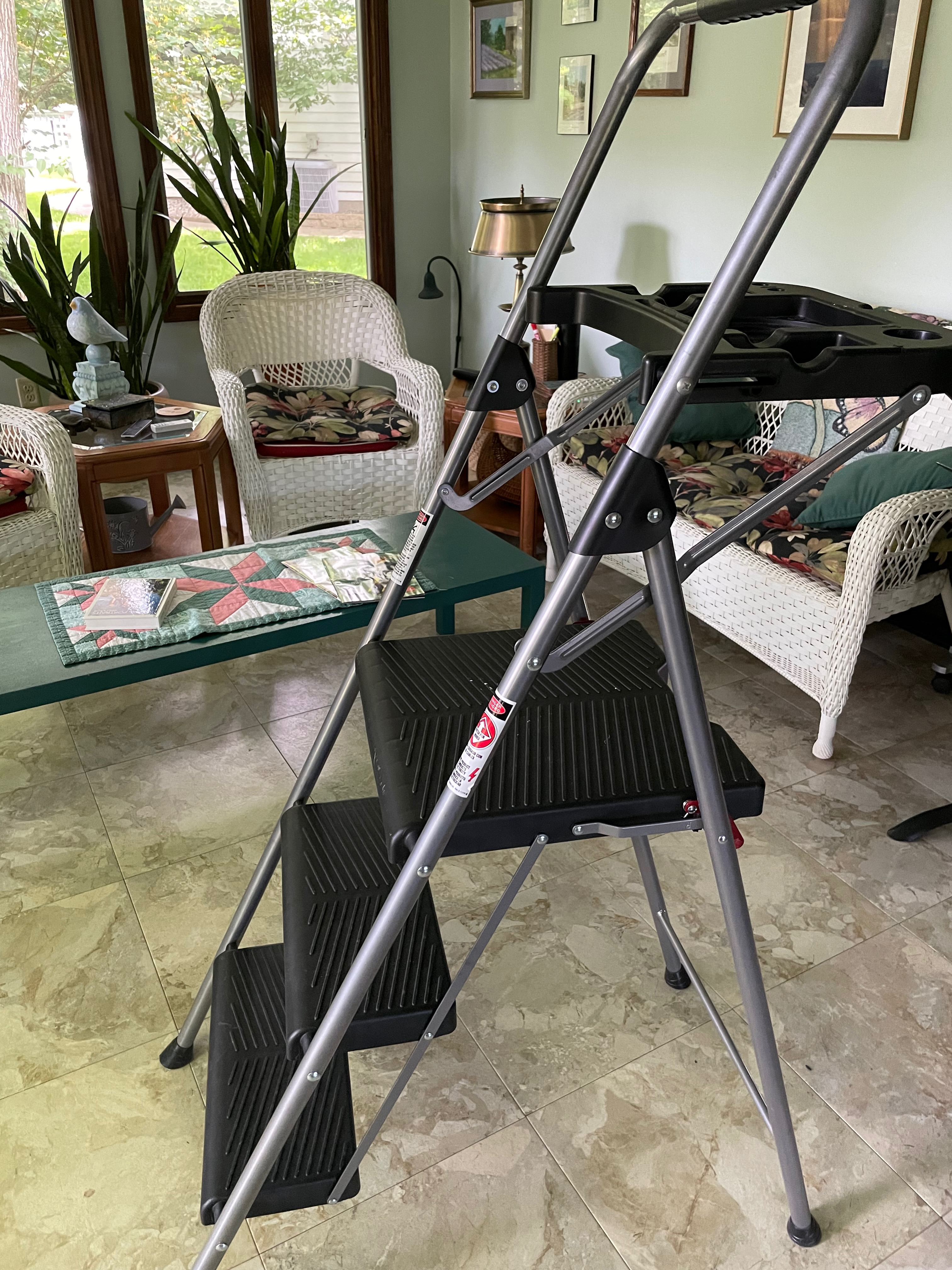
The only kind of stepladder I have any business using these days.

Now, even if you hate politics, you might want to read the opener to the next item.

Politics

The Quaker whose mule wouldn’t plow

One of my favorite stories, for roughly five decades now, is of a Quaker with a mule who wouldn’t plow.

Finally, after various goads, the Quaker walked to the mule, took its ears gently in hand, looked into its eyes, and said “Brother mule. Thee knowest I am a Quaker, Thee knowest I cannot beat thee. Thee knowest I cannot curse thee. What thee does not know is that I can sell thee — to the baptist up the road. And he can beat the living daylights out of thee.”

That’s pretty much how I’m starting to feel about the wokesters/progressive Left/successor ideology. My “baptists” are the Irreligious Right, the Christianist Right — both capable of violence, I think — and a few politicians who can see which way the wind is blowing, such as Ron DeSantis.

I doubt I can vote for DeSantis, in part because of his ham-handed attacks on the progressive Left in Florida and his playing illegal immigrants (I know the adjective is offensive to some, but it’s a perfectly good description) as pawns by putting them on busses headed to Blue zones. So maybe I really wouldn’t sell my cultural adversaries to him.

And I know I can’t vote for Trump.

But I’m starting to feel at least ambivalent, not entirely negative, about how the “baptists” might handle this. And I’m certain I’m not alone.

Fear casts out love

Fear casts out love. And not only love. Fear also casts out intelligence, casts out goodness, casts out all thought of beauty and truth.

Aldous Huxley via Peter Wehner, who was explaining ‌The Minds of Trump Supporters

I am aware of the possible irony of placing this after the immediately preceding item.

When Peggy Noonan speaks, one should listen

Peggy Noonan gives Ron DeSantis some advice:

At some point, I think soon, he’ll have to make a serious, textured and extended case against Donald Trump. Not insults and nicknames, not “Can he take a punch? Can he throw a punch?” No, something aimed at the big beating heart of the GOP that tells those who’ve gone on the Trumpian journey and aligned with him that they can no longer indulge their feelings. At a crucial point in history they’ll lose again, and the damage to the country will be too great. Throwaway lines like “the culture of losing” aren’t enough. That’s just a line that signals. Don’t signal, say. Include the long history of political losses—Congress, the presidency, the opportunity for a red wave in 2022.

Yes, tell those good people that you served your country in a tragedy called Iraq and the other guy claimed bone spurs and ran during a tragedy called Vietnam. You think you don’t have to say it, but you do. People who love Mr. Trump need reasons they can explain to themselves to peel away.

Religious conservatives in the 2016 election

When religious conservatism made its peace with Donald Trump in 2016, the fundamental calculation was that the benefits of political power — or, alternatively, of keeping cultural liberalism out of full political power — outweighed the costs to Christian credibility inherent in accepting a heathen figure as a political champion and leader.

The contrary calculation, made by the Christian wing of Never Trump, was that accepting Trump required moral compromises that American Christianity would ultimately suffer for, whatever Supreme Court seats or policy victories religious conservatives might gain.

Ross Douthat

There’s a lot distilled in those two paragraphs. I particularly note that the second paragraph at least hints at the view that Christianity is about something other than political power, a possibility that the New York Times in particular almost never considers. (“Politics is real, religion isn’t” is the gist of it.)

Yet I don’t see my own position reflected in either of them.

My core anti-Trump conviction was that his narcissism would distort his perceptions of reality, and that a President who misperceives reality — or even just a few key realities at a few pivotal times — could damage the nation terribly — worse than Hillary Clinton would.

The current formulation of my former position is inevitably colored by what actually happened, because I didn’t commit my position to writing in 2015-16 so I could some day say “see, I told you so.” But narcissism and misperception of reality was definitely at the core. And in 2016, I still thought that Christian Trump-voters were probably holding their noses because of the alternative. If I spoke or wrote about how wicked he was, it was my trying to pry others away from him with arguments that I thought they’d find weightier than “he’s a toxic narcissist.” I never expected so much troll-like adulation of that man under Christianish auspices.

Had it not been for his mesmerizing narcissism, he’d have never been such an effective demagogue and would not have won the GOP primary. So I’d never have needed to weigh whether a mere serial adulterer and shady casino magnate, without a disabling personality disorder, was an acceptable alternative to a woman who deplored roughly half the nation.

What keeps Damon Linker up at night

I just don’t think, even now, that the imposition of a right-wing tyranny is a likely scenario for the United States. Far more likely is a mutually reinforcing cycle of extra-constitutional power grabs, spasms of civil unrest, efforts to impose order, and more egregious acts of violence aimed at “the system.” This wouldn’t become a civil war like the one that consumed the United States in the 1860s, with massive armies facing each other for protracted, bloody battles aimed at seizing territory. But it would nonetheless be a form of low-boil civil war, perhaps resembling The Troubles in Northern Ireland more than any other recent examples.

… each side’s greatest fear is a dictatorship by the other side.

Another is that when each side is informed about the other side’s fears along these lines, the reaction is angry and mocking dismissal. You’re saying I’m a threat to them_? What a bunch of bullshit. Everybody with a brain and capable of unbiased thinking knows_ they’re the problem.

Yet another fact about our politics is that each side is becoming more willing to entertain (or fantasize about taking?) extra-constitutional acts in order to protect itself from what it’s convinced are the threatening extra-constitutional acts by the other side. Trump’s self-coup-attempt in January 2021 is only the most obvious and egregious example. More recent ones have come up throughout the current debt-ceiling battle, with prominent Democrats proposing all kinds of gambits, justified by the supposed national emergency posed by looming debt default, to get around the Constitution’s placement of the power of the purse in the hands of Congress.

My point, once again, is not to assign or remove blame from either side—or to treat both sides as equally good or bad. If the choice is between Trump’s self-coup to keep himself in power despite losing the 2020 election and the Democratic Speaker of the House talking with the Chairman of the Joint Chiefs about a plan to undertake a coup of their own against that same dictator-president, I would side with the latter every time. But the latter is still a coup—an unconstitutional power grab undertaken to thwart a prior unconstitutional power grab.

Damon Linker

I don’t know how to prevent this except by one personal step: declaring myself a noncombatant. That won’t keep “them” from coming for me, whichever “them” it be, and I don’t know how to prevent that, either.

Imagining a Trump reprise

[I]magine a second Trump administration. This time he surrounds himself with loyalists who vow to do his bidding. Among their first acts is to impose Schedule F reform on the executive branch, which enables them to fire tens of thousands of career civil servants and replace them with even more loyalists. This would open up the possibility of a more DeSantis-like Trump administration.

Yet it would still be different in one decisive respect: Trump doesn’t affirm any consistent ideology. Instead, he aims to inflict as much pain and damage as possible on his own enemies and those of his supporters. To that end, he’s perfectly willing and happy to reverse course the moment he sees an opening for a victory or a deal. He relies entirely on his own judgment. He doesn’t follow the lead of advisers. He sizes things up with his own eyes, and makes sudden, snap decisions. He prizes flexibility and despises constraints—and as we all learned in the two months following the 2020 election, this even extends to the Constitution, the rule of law, and the norms of ordinary democratic politics, including the peaceful transfer of power.

This sounds more than a little like the kind of government the ancient political philosophers described as a kingship—albeit one in which the king wholly lacks in virtue or wisdom. They called such a leader a tyrant. Such a tyranny is different than the ideological forms of dictatorship we’re familiar with from the modern age because it has no overarching constellation of ideas it seeks to enact or to which it looks for guidance. It’s the rule, instead, of one man seeking to satisfy his own insatiable hunger for attention and thirst for the adulation of the people.

Modern ideological dictators are ascetics of a kind. Adolf Hitler, Joseph Stalin, and Mao Zedong devoted their lives to a cause.

But Trump’s only cause is himself. Somewhat like the ancient tyrants Plato and Aristotle analyzed, he is a political hedonist who acts as he does out of a craving for the pleasure that comes from being loved and cheered by a crowd.

Damon Linker, The Rise of the Anti-Ideological Right—2 I’m not sure how “political hedonist” differs from political narcissist, but I’ll let that go.

Surely not!

I’m beginning to despair of the whole right, but especially the anti-woke formation (much as I loathe woke-ism). There’s no positive vision to it. It’s unserious. It seems designed to stave off real populism at the level of political economy.

Sohrab Ahmari on Twitter (H/T Nellie Bowles)


For all its piety and fervor, today’s United States needs to be recognized for what it really is: not a Christian country, but a nation of heretics.

Ross Douthat, Bad Religion

We are in the grip of a grim, despairing rebellion against reality that imagines itself to be the engine of moral progress.

R.R. Reno

You can read most of my more impromptu stuff here (cathartic venting) and here (the only social medium I frequent, because people there are quirky, pleasant and real). Both should work in your RSS aggregator, like Feedly or Reeder, should you want to make a habit of it.

This was my week that was

Priorities

Rs are gonna lose a consequential Supreme Court race in WI and watch the soft defund candidate win the mayoralty in Chicago tonight, and they’ll spend all day tomorrow talking about Trump. And no one will see the problem.

Noah Rothman on the evening of 4/4.

I’m no longer an R, and not even sure I lean that way any more. But I’m going to try to be less obsessive in my denunciations of Orange Man. In fact, I’ll let him speak for himself. https://www.youtube-nocookie.com/embed/ERUngQUCsyE?rel=0&autoplay=0&showinfo=0&enablejsapi=0

Gun culture

I think I’ve said, maybe even recently, that the 2nd Amendment is no special preoccupation for me. I just accept what the Supreme Court says about it.

But that’s not the end of the topic. There are cultural questions, too. And I think Matthew Walther’s voice is valuable:

The AR-15 is situated at the intersection of a relatively innocent hobbyism and the sinister mainstreaming of features of the militia culture of the 1990s, even among people who lead law-abiding lives. The primary selling point of the AR-15 is that it can be endlessly modified, configured, reimagined. It can become louder or quieter, easier to carry, wield, fire and reload, or more lethal. It is meant to be combined with a seemingly endless array of customizable stocks and grips, blast mitigation devices, piston uppers and conversion kits. These components are themselves paired with a vast assortment of accessories — vests, helmets, straps and other gear unfailingly designated as “tactical.”

It is this adjective, and the ubiquity of references to “tacticians” in advertising copy, review sites and hobby forums, that suggests the baleful aspect of AR-15 culture. Who exactly is practicing these tactics, and where and for what purpose? What this “tactics” business signals is not so much a commitment to action (the overwhelming majority of those who own AR-15s are law-abiding) as a general frame of mind. To the would-be tactician, every place that humans inhabit — housing developments, apartment complexes, stores, strip malls, hotels, churches, hospitals and, yes, schools — is another opportunity to imagine oneself taking part in military-style maneuvers. Where would you go for cover if you were here? How would you hold this position? What weapons and gear would you use?

… For AR-15 enthusiasts, the gun is not a means to an end — a tool with which you hunt, a weapon with which you protect your family and property — but rather the end itself, a site of fantasy and meaning making.

I suspect that part of the reason for the rise of AR-15 fandom is the decline of other American hobby cultures …

But for all the amateur tinkering, the reality is that these fetishized murder weapons, so often treated by their owners as if they were indistinguishable from model ships or Pokémon cards, have been used repeatedly in incidents like the recent one in Nashville. …

… My opposition to what the AR-15 represents is not a methodologically rigorous attempt to identify the primary cause of what social scientists call mass shootings. In some ways it is simply an expression of hope for a saner culture, a plea for something other than hypothetical terrorism to form the basis of our leisure time and family memories.

Interesting hypothesis about American hobby cultures, too. The link, above, should get you through the Times paywall.

I’m broadly supportive of a saner culture. If my Congressman posed with his family armed with AR-15s on his Christmas card, I’d never again vote for him, much as I’ve never voted for the current Indiana Attorney General, who early in his very first campaign did something (the specific having been lost to memory) that showed him a base and demagogic liar.

Ephemeral “growth”

Sometimes growth is an accounting artifact, with work formerly done in the home moving into the market. For example, two mothers who would prefer to take care of their own children would create GDP growth by hiring each other as nannies instead, because unpaid work for one’s own family goes uncounted but paid work for someone else’s represents new economic activity.

Oren Cass, The Once and Future Worker

I felt just covered with dirt afterwards

Auden experienced some of the complexities of this situation in early 1939, soon after his arrival in the United States. He gave a speech at a dinner in New York convened to raise money for refugees from the Spanish Civil War, and, as he later reported to an English friend, “I suddenly found I could really do it, that I could make a fighting demagogic speech and have the audience roaring. So exciting but so absolutely degrading. I felt just covered with dirt afterwards.”

Alan Jacobs, The Year of Our Lord 1943

I experienced that thrill once as Emcee, warming up a crowd. It took some years for the shame to sink in with me, though, and that the demagoguery was in a “good cause” doesn’t much help.

She made her bed …

Wisconsin has elected to its Supreme Court a candidate who has all but promised how she would vote on issues including abortion and redistricting. The way she campaigned is a huge breach of how judicial candidates are supposed to behave.

Her breach will open her up to many recusal motions. I cannot explain it better than Josh Blackman did in Justice Janet Protasiewicz, Say Hello To Caperton v. Massey. Short version: there’s an ill-reasoned Supreme Court precedent (by Anthony Kennedy, king of ill-reasoned precedents) that denial of a motion to recuse can violate the federal due process clause.

Meanwhile, the prominence of abortion in that election further confirms my suspicion that most states are going to end up with European-type laws, permitting abortion for roughly one trimester, than generally banning it, in order to lay the issue more or less to rest. Specifically, the total bans (not even exceptions for the life of the mother) enacted in several red states are unsustainably unpopular.

Rhetorical escalation

I have complained more than once that is one (I have in mind a pompadoured southern pastor preaching in demagogic tones) calls Playboy “hard core pornography,” he’s limited his options for describing Hustler (and even worse publications).

It dawns on my that our current demagogues of the press have done something similar in describing Viktor Orbán’s Hungary as “authoritarian.” Yes, they’ve left room for “totalitarian” to describe Russia, but what then do we call North Korea?

How about acknowledging that Hungary is a kind of democracy — an illiberal one — and that an electoral majority seems to like it that way?

Child and Adolescent Gender Transitioning

On different sides of the Atlantic, medical experts have weighed the evidence for the treatment of gender-dysphoric children and teenagers, those who feel intense discomfort with their biological sex. This treatment is life-changing and can lead to infertility. Broadly speaking, the consensus in America is that medical intervention and gender affirmation are beneficial and should be more accessible. Across Europe several countries now believe that the evidence is lacking and such interventions should be used sparingly and need further study. The Europeans are right.

Proponents say that the care is vital to the well-being of dysphoric children. Failure to provide it, they say, is transphobic, and risks patients killing themselves. The affirmative approach is supported by the American Academy of Paediatrics, and by most of the country’s main medical bodies.

Arrayed against those supporters are the medical systems of Britain, Finland, France, Norway and Sweden, all of which have raised the alarm, describing treatments as “experimental” and urging doctors to proceed with “great medical caution”. There is growing concern that, if teenagers are offered this care too widely, the harms will outweigh the benefits.

The Economist, What America has got wrong about gender medicine

A Finnish review, published in 2020, concluded that gender reassignment in children is “experimental” and that treatment should seldom proceed beyond talking therapy. Swedish authorities found that the risks of physical interventions “currently outweigh the possible benefits” and should only be offered in “exceptional cases”. In Britain a review led by Hilary Cass, a paediatrician, found that gender-affirming care had developed without “some of the normal quality controls that are typically applied when new or innovative treatments are introduced”. In 2022 France’s National Academy of Medicine advised doctors to proceed with drugs and surgery only with “great medical caution” and “the greatest reserve”.

The Economist, The evidence to support medicalised gender transitions in adolescents is worryingly weak

Humanities murdered?

The end of the humanities: Fewer and fewer college students are choosing to study the humanities.

I will say the very best place to hide something interesting is inside a 10,000-word New Yorker story on the crisis. Thankfully, Blaise Lucey at Litverse read the whole thing and pulled the numbers.

“From 2012 to 2020:

Tufts lost ~50% of humanities majors 

Boston University lost 42% of humanities majors 

Notre Dame lost 50% of humanities majors

The study of English and history at the college-level dropped by 33% 

More than 60% of Harvard’s class of 2020 planned to enter tech, finance, and consulting jobs”

The crash makes sense. How much do you really want to pay for a semester on the white supremacy of Jane Austen, the blinding cis-ness of Homer, the anti-lesbianism of Gilgamesh? More efficient just to burn the books and major in statistics. According to a new WSJ poll, the majority of Americans, especially young Americans, now say a college degree isn’t worth the money.

Nellie Bowles

If that last paragraph really reflects how humanities are taught today, it’s no wonder — though it remains a tragedy — that enrollments are dropping.

Soros: Now you see him, Now they mustn’t

It is sometimes allowed to be said that Alvin Bragg was funded by George Soros, but only when New York mag Soros want it to be noted in a positive way, but if it’s said with a vaguely negative tone then it’s a Fact Check: False.

Nellie Bowles

Hate to say it …

[S]ometimes you come across certain places, and even certain countries, that are clean and well-lighted. They are pleasant and harmonious. They work. …

What strikes me today is how impossible it is to feel this about the United States. As Robin Williams joked, Canada is like a nice loft apartment, but America is the party raging underneath. That party, though, is turning sour; something is rotten in the state of America. Even Williams later changed his analogy. Canada was still a nice apartment, but America had turned into the nightmare meth lab below.

Tom McTague, America’s desperate dysfunction


For all its piety and fervor, today’s United States needs to be recognized for what it really is: not a Christian country, but a nation of heretics.

Ross Douthat, Bad Religion

You can read most of my more impromptu stuff here (cathartic venting) and here (the only social medium I frequent, because people there are quirky, pleasant and real). Both should work in your RSS aggregator, like Feedly or Reeder, should you want to make a habit of it.f

Tuesday, 3/28/23

Florida

Helen Lewis, Brit, visits Ron DeSantis’ Florida

This one goes out to a certain gun-lover in my life:

When I first arrived in Orlando, in late October, I rented what to me was a comically large Ford SUV and drove to McDonald’s for hash browns and a cup of breakfast tea (zombie-gray, error). Then I went to a gun range, where I began by firing two pistols. The very serious man behind the desk had clocked my teeth (British), accent (Hermione Granger), and sex (female), and expressed skepticism that I would want to fire an AR‑15 assault rifle too. But I did. In the past decade, semiautomatic rifles like the AR-15 have become the weapon of choice for young killers, and I needed to see what America was willing to put into the hands of teenagers in the name of freedom.

With the pistols, my shots pulled down from the recoil or the weight. But the AR‑15 nestled into my shoulder pad, and the shots skipped out of it and into the center of the target. I felt like I was in Call of Duty, with the same confidence that there would be no consequences for my actions; that if anything went wrong, I could just respawn.

Later, a friend texted to ask how firing the rifle had been. I loved it, I said. No one should be allowed to have one_._ This is not a sentiment to be expressed openly in DeSantis’s Florida. When the Tampa Bay Rays tweeted in support of gun control after the Uvalde, Texas, massacre last year, the governor vetoed state funding for a new training facility, saying that it was “inappropriate to subsidize political activism of a private corporation.” You might think: How petty. Or maybe: How effective.

Helen Lewis, How Freedom-Loving Florida Fell for Ron DeSantis

Florida as educational microcosm

[Florida] is a textbook example of academic bloat. The State University System of Florida consists of 12 public universities, with 341,000 enrolled students, of which only four are engaged in what the Carnegie Classification of Institutions of Higher Education refers to as “very high research activity”. The rest of these institutions, such as the enormous Florida Atlantic University, are vast and shabby post-secondary “student warehouses”, similar to UT-Arlington.

It is these universities, not the tiny New College of Florida, that constitute the real threat to public education — and not because they are “woke”, but because their retention and graduation rates are horrific. They are enrolling students, taking their federally-subsidised student loans, and barely graduating around 50% of them.

Oliver Bateman, America is fighting the wrong university wars

Culture

AI Status Report

All signs that I’ve registered counsel me that I’d been wasting my time trying to decide if Artificial Intelligence is boon, bane, or something even further out on the spectrum than those markers. I haven’t chatted with ChatGPT or immersed myself in a single longform essay on how “transformative” (grammatically neutral but functionally adulatory) or “apocalyptic” (mirror-image opposite) the technology is.

They’re all surely speculations by people who don’t really know because nobody knows the future, and I’d be astonished if I found a smoking-gun argument on either side.

I have spent a few minute, though, chuckling at AI screwups.

Routine corporate behavior

Fox News pandering to what its viewers wanted to hear after the last Presidential election is not really out of the mainstream of corporate behavior:

Sycophancy toward those who hold power is a fact in every regime, and especially in a democracy, where, unlike tyranny, there is an accepted principle of legitimacy that breaks the inner will to resist…. Flattery of the people and incapacity to resist public opinion are the democratic vices, particularly among writers, artists, journalists and anyone else who is dependent on an audience.

Allan Bloom, The Closing of the American Mind

Education more generally

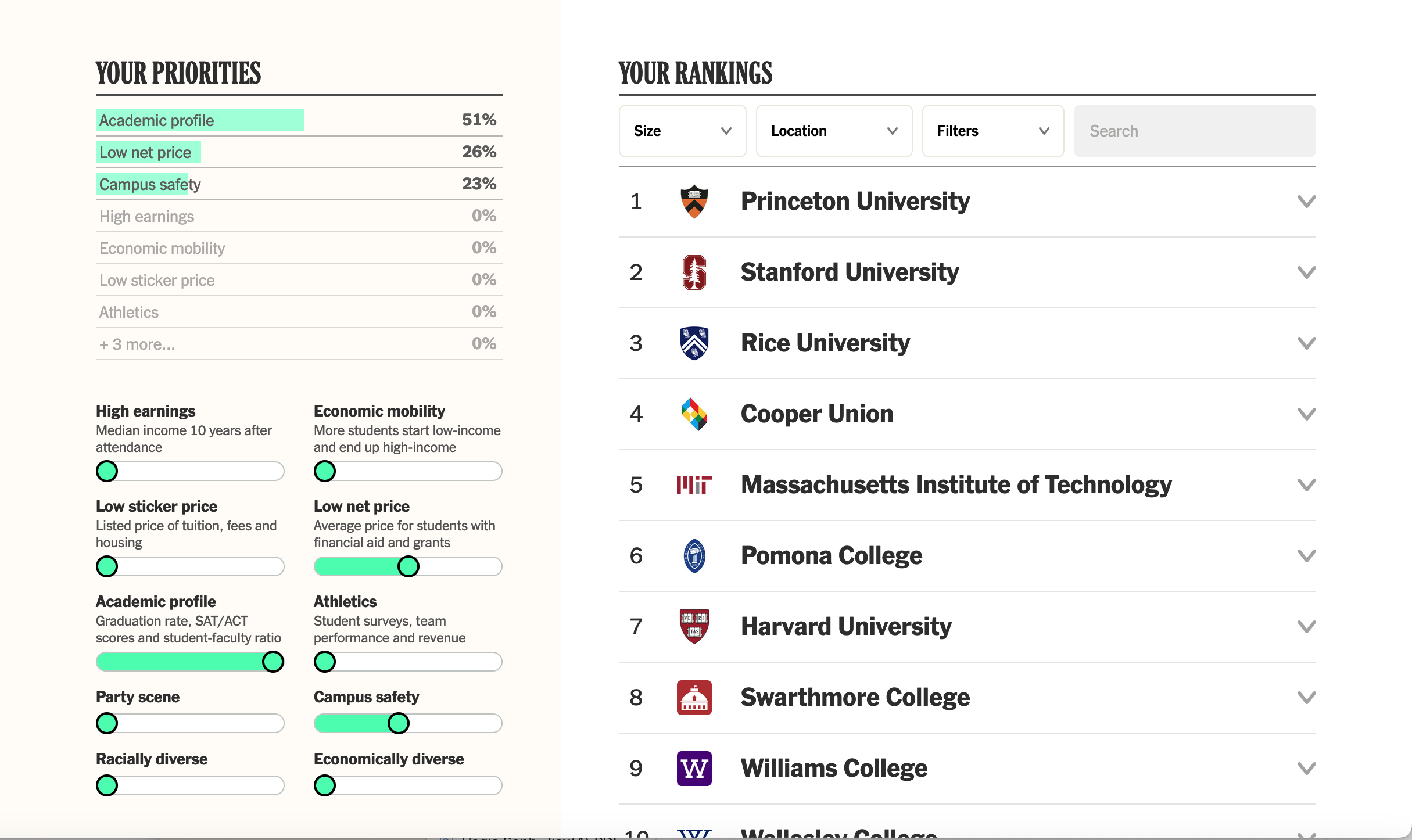
The New York Times’ Frank Bruni opines on The Problem With College Rankings, and How We Fix It. The problem revolves around choosing for prestige.

The “fix” he alludes to is an interactive college selector of the Times’ own devising.

Here are the Times’ selection criteria:

Here’s the closest I thought I could come to what I value in a college or university (though “Academic Profile” seems a belamed version of “will they try to make me an educated person?”):

And here’s where I should go based on those criteria:

It was kind of interesting. If I actually were looking for a college, I’d definitely put this in the mix of tools.

Politics

Eric Metaxas and his kin

Eric Metaxas appeared to be a pretty solid guy until he sold his soul to a politician who remains too much in the news. His over-the-top comments between Election 2020 and the cool-down period after January 6 (see this) destroyed any trust I might have felt.

But I recently listened to a podcast discussion of his presumptuous newish book Letter to the American Church. I discerned very little thought, but a lot of rhetorical cunning: staccato riffs salted with endless straw men. I assume that sort of thing persuades some people. His resort to straw men in support of his inexplicably pre-ordained conclusions is of longstanding (see the Emma Green Atlantic story, the first link above).

Specifically, Mr. Metaxas,

  • I did not vote for Hillary Clinton just because I didn’t vote for Trump (have you heard of the “Electoral College” and “Red States”? A protest vote in a Red State need not be a Blue vote); and
  • I didn’t withhold my vote from Trump because I thought his supporters were yucky, tacky or whatever that straw man was. I refused to vote for him (twice now, and the second time the alternative was not Hillary, Trump’s biggest 2016 advantage) because he is a toxic narcissist and because sooner or later his pathological self-regard was going to make him misapprehend reality. (As we see his current deranged output on Truth Social, it’s obvious that I was right.)

I’ve thought about what would make someone like Metaxas lose his mind over this. There are people closer to me than him who’ve done much the same thing, such as the friend who recently faulted “SJW” jackboots at Purdue for disrupting a “conservative speaker.” That version has a few problems:

  1. Purdue has a strong free speech policy.
  2. So the SJWs did not disrupt, but rather counter-protested and acted up nearby.
  3. The dramtis personnae were not a benign conservative and malign SJWs, but rather a Right provocateur (“we must eradicate transgenderism from America”) eager to give offense and Leftish provocatees eager to take it.

What happened was that my friend had taken his Right narrative and applied it to facts that he assumed fit. He hadn’t bothered to ascertain what actually went on.

This suggests to me a possible causal sequence:

  1. My friend (and Metaxas?) assume that, this being America, if there’s a bad American guy or group, there must be a countervailing good American guy or group. It’s unthinkable that God would forsake America, His special darling, leaving its people with only miserably bad political choices (my strong suspicion of what happened).
  2. Having identified the Democrats as bad, the Republicans must be good (because only they are big enough to countervail; a vote for a third party candidate is “wasted”).
  3. Having identified the Republicans as good, their nominees and elected officials must be good — not just “less bad most of the time” but “good,” or “very good” or (as spoke another evangelical friend in 2016) “the best candidate I’ve had the privilege to vote for in my entire life.”
  4. Thus do we get Christian folk who have syncretized the faith with Manicheanism. Pas d’ennemies áu droit.

I suggest that narrative, which I shall for a while be tempted to use to structure what I observe and what I hear vague rumors about.

Where’s the beef? Maybe Georgia

In April 2020, businesses in Georgia were shuttered by government decree as in most of the rest of the country. Mr. Kemp was hearing from desperate entrepreneurs: “ ‘Look man, we’re losing everything we’ve got. We can’t keep doing this.’ And I really felt like there was a lot of people fixin’ to revolt against the government.”

The Trump administration “had that damn graph or matrix or whatever that you had to fit into to be able to do certain things,” Mr. Kemp recalls. “Your cases had to be going down and whatever. Well, we felt like we met the matrix, and so I decided to move forward and open up.” He alerted Vice President Mike Pence, who headed the White House’s coronavirus task force, before publicly announcing his intentions on April 20.

That afternoon Mr. Trump called Mr. Kemp, “and he was furious.” Mr. Kemp recounts the conversation as follows:

“Look, the national media’s all over me about letting you do this,” Mr. Trump said. “And they’re saying you don’t meet whatever.”

Mr. Kemp replied: “Well, Mr. President, we sent your team everything, and they knew what we were doing. You’ve been saying the whole pandemic you trust the governors because we’re closest to the people. Just tell them you may not like what I’m doing, but you’re trusting me because I’m the governor of Georgia and leave it at that. I’ll take the heat.”

“Well, see what you can do,” the president said. “Hair salons aren’t essential and bowling alleys, tattoo parlors aren’t essential.”

“With all due respect, those are our people,” Mr. Kemp said. “They’re the people that elected us. They’re the people that are wondering who’s fighting for them. We’re fixin’ to lose them over this, because they’re about to lose everything. They are not going to sit in their basement and lose everything they got over a virus.”

Mr. Trump publicly attacked Mr. Kemp: “He went on the news at 5 o’clock and just absolutely trashed me …

At that point, Florida was still shut down. Mr. DeSantis issued his first reopening order on April 29, nine days after Mr. Kemp’s. On April 28, the Florida governor had visited the White House, where, as CNN reported, “he made sure to compliment the President and his handling of the crisis, praise Trump returned in spades.”

Three years later, here’s the thanks Mr. DeSantis gets: This Wednesday Mr. Trump issued a statement excoriating “Ron DeSanctimonious” as “a big Lockdown Governor on the China Virus.” As Mr. Trump now tells the tale, “other Republican Governors did MUCH BETTER than Ron and, because I allowed them this ‘freedom,’ never closed their States. Remember, I left that decision up to the Governors!”

James Taranto, Brian Kemp, Georgia’s Affable Culture Warrior.

Res ipsa loquitur.

Ron DeSantis, George Soros and Peter Thiel

Governor Ron DeSantis should be ashamed.

In contemplating the possible criminal indictment of former President Donald Trump, the Florida governor tweeted: “The Manhattan District Attorney is a Soros-funded prosecutor.”

Let us review.

George Soros, the wealthy Hungarian-American financier and philanthropist, is the bogey man of the American right wing. They trace whatever they don’t like about liberalism or progressive politics back to Soros’ imaginary machinations. Soros is the puppet-master.

George Soros is a Jew.

These are antisemitic conspiracy theories. That is what makes antisemitism so potent, and unique among hatred — it has always existed as a network of conspiracy theories. You just have to say the name “Soros,” and you wind up with an antisemitic dog whistle — in much the same way as “Rothschild” has been, and continues to be.

Jeffrey Salkin, Call it Soros-phobia.

I completely agree that George Soros “is the bogey man of the American right wing.” I do not share that feeling about him.

I have no reason to doubt that Soros is a Jew.

I consider DeSantis’s comment about Alvin Bragg a combination of craven servility to Trumpist voters and hackneyed demagoguery about a bogey man.

But it does not follow that criticism of Soros is antisemitic, unless one absurdly considers any criticism of a Jew, at least if coupled with some dark hint that “he’s up to something,” antisemitic. And both Salkin and the ADL seem to have little more than that. (James Kirchik makes a similar point.)

They may nevertheless be right (I’ve been wrong about my “conservative” countrymen before). Let’s try a thought-experiment: Is Left criticism of Peter Thiel’s influence anti-gay?

Trump’s “Retribution Tour”

The accompanying article wasn’t revelatory, but I love Elaine Godfrey’s title: Trump Begins the ‘Retribution’ Tour


For all its piety and fervor, today’s United States needs to be recognized for what it really is: not a Christian country, but a nation of heretics.

Ross Douthat, Bad Religion

You can read most of my more impromptu stuff here (cathartic venting) and here (the only social medium I frequent, because people there are quirky, pleasant and real). Both should work in your RSS aggregator, like Feedly or Reeder, should you want to make a habit of it.

Annunciation 2023

Do the math. If we observe the birth of Christ on December 25, what prerequisite of birth might a Church want to observe, and when should they observe it?

I will post separately today on accumulated stuff about a certain notoriously toxic narcissist who’s been in the news. None of that here, save this paragraph.

Civil War

As recently as 40 years ago, and probably more like 30 years, I flirted with (and probably played devil’s advocate for) the idea that the Civil War was about states’ rights.

History had not been a strong academic interest, but even if it had, I was wrestling around then with the realization that in some very important ways, we are no longer living under that Constitution of 1787; that’s just how radical (in a neutral, not pejorative, sense) the Civil War Amendments were, both initially and as they ramified over the next century or more.

But I was clearly mistaken — and I say that not as a dog who’s tired of being whipped, but as someone who just today (March 21) encountered Alexander H. Stevens’ “Cornerstone Speech.”

Stephens was a high-ranking Confederate figure:

The new [Confederate] constitution has put at rest, forever, all the agitating questions relating to our peculiar institution, African slavery as it exists amongst us – the proper status of the negro in our form of civilization. This was the immediate cause of the late rupture and present revolution. Jefferson in his forecast, had anticipated this, as the “rock upon which the old Union would split.” He was right. What was conjecture with him, is now a realized fact. But whether he fully comprehended the great truth upon which that rock stood and stands, may be doubted. The prevailing ideas entertained by him and most of the leading statesmen at the time of the formation of the old constitution, were that the enslavement of the African was in violation of the laws of nature; that it was wrong in principle, socially, morally, and politically. It was an evil they knew not well how to deal with, but the general opinion of the men of that day was that, somehow or other in the order of Providence, the institution would be evanescent and pass away. This idea, though not incorporated in the constitution, was the prevailing idea at that time. The constitution, it is true, secured every essential guarantee to the institution while it should last, and hence no argument can be justly urged against the constitutional guarantees thus secured, because of the common sentiment of the day. Those ideas, however, were fundamentally wrong. They rested upon the assumption of the equality of races. This was an error. It was a sandy foundation, and the government built upon it fell when the “storm came and the wind blew.”

Our new government is founded upon exactly the opposite idea; its foundations are laid, its corner-stone rests, upon the great truth that the negro is not equal to the white man; that slavery subordination to the superior race is his natural and normal condition. This, our new government, is the first, in the history of the world, based upon this great physical, philosophical, and moral truth. This truth has been slow in the process of its development, like all other truths in the various departments of science. It has been so even amongst us. Many who hear me, perhaps, can recollect well, that this truth was not generally admitted, even within their day. The errors of the past generation still clung to many as late as twenty years ago. Those at the North, who still cling to these errors, with a zeal above knowledge, we justly denominate fanatics. All fanaticism springs from an aberration of the mind from a defect in reasoning. It is a species of insanity. One of the most striking characteristics of insanity, in many instances, is forming correct conclusions from fancied or erroneous premises; so with the anti-slavery fanatics. Their conclusions are right if their premises were. They assume that the negro is equal, and hence conclude that he is entitled to equal privileges and rights with the white man. If their premises were correct, their conclusions would be logical and just but their premise being wrong, their whole argument fails. . . .

As I have stated, the truth of this principle may be slow in development, as all truths are and ever have been, in the various branches of science. . . . May we not, therefore, look with confidence to the ultimate universal acknowledgment of the truths upon which our system rests? It is the first government ever instituted upon the principles in strict conformity to nature, and the ordination of Providence, in furnishing the materials of human society. Many governments have been founded upon the principle of the subordination and serfdom of certain classes of the same race; such were and are in violation of the laws of nature. Our system commits no such violation of nature’s laws. With us, all of the white race, however high or low, rich or poor, are equal in the eye of the law. Not so with the negro. Subordination is his place. He, by nature, or by the curse against Canaan, is fitted for that condition which he occupies in our system. The architect, in the construction of buildings, lays the foundation with the proper material – the granite; then comes the brick or the marble. The substratum of our society is made of the material fitted by nature for it, and by experience we know that it is best, not only for the superior, but for the inferior race, that it should be so. It is, indeed, in conformity with the ordinance of the Creator. It is not for us to inquire into the wisdom of His ordinances, or to question them. For His own purposes, He has made one race to differ from another, as He has made “one star to differ from another star in glory.” The great objects of humanity are best attained when there is conformity to His laws and decrees, in the formation of governments as well as in all things else. Our confederacy is founded upon principles in strict conformity with these laws. This stone which was rejected by the first builders “is become the chief of the corner” – the real “corner-stone” in our new edifice.

(Emphasis added, footnotes omitted. Source.)

As we face talk of “civil war” or “national divorce” again today, what ugly realities lie behind that talk?

Big, meddlesome, micro-managing government at its best

The Federal Trade Commission proposed a rule on Thursday that would make it easier for consumers to cancel recurring subscriptions. The so-called “click-to-cancel” provision would require companies to allow customers to cancel a subscription in the same mode they originally signed up—online, rather than on the phone or in person, for instance. The proposal is now subject to public comment.

The Morning Dispatch. My public comment: Huzzah!

Circular criticism

It is certainly possible that my pessimistic outlook on Christianity in the West [in The Benedict Option] may be wrong. But most of the criticism I’ve seen has been based on the idea that Dreher cannot be right. What is so frustrating to me about this is not that I might be wrong — I hope I am wrong! — but that most of the opposition to my thesis has been in bad faith. I mean, it has been based not on an objective analysis of my claims and my logic, but on the general idea that Dreher must be wrong because he’s defeatist, or guilty of some other moral fault.

Rod Dreher

Wokeness

“Weird to have a Twitter debate about the definition of ‘wokeness,’ when everyone knows it just means treating everybody with kindness and decency and respect, except of course for liberals one standard deviation to your right, who must be burned,” – Ross Douthat.

H/T Andrew Sullivan

Orwellian obfuscation from our government

How corrosive our undeclared wars are to our language!

It was during the war in Iraq that Orwell’s insistence on clear language first came roaring back. This time, the newspeak was coming from the neocon right. We heard the term “enhanced interrogation techniques” to describe what any sane person would instantly call “torture.” Or “extraordinary rendition” — which meant kidnapping in order to torture. There was “environmental manipulation” — freezing naked human beings to near-death and back again. All the terms followed Orwell’s rules for new words “needed if one wants to name things without calling up mental pictures of them.” All the new terms were opaque and longer than the original.

“[Gitmo detainees] would wage jihad any way they can. … [T]hey would do hunger strikes. And you actually had three detainees that committed suicide with hunger strikes,” – Ron DeSantis. There is a deep kind of sickness in believing that human beings completely under your control are still some kind of threat — and that suicide is an act of aggression.

Andrew Sullivan

Incorrigible Nature

Political Science

Shock study: endorsing a political candidate seems political: The stately science and health journal Nature endorsed Joe Biden in 2020. That must have swayed a lot of Trump voters, right? Nature looked into that this week: “A survey finds that viewing the endorsement did not change people’s views of the candidates, but caused some to lose confidence in Nature and in US scientists generally.” And: “Viewing Nature’s political endorsement reduced Trump supporters’ willingness to obtain information about COVID-19 from Nature by 38%.” 

Okay, so it had the opposite intended effect. Now, of course Nature is going to learn from this very smart survey it did? They considered that—and decided on a hard no. Here’s Nature doubling down on taking sides in elections, despite the evidence: “Political endorsements might not always win hearts and minds, but when candidates threaten a retreat from reason, science must speak out.”

Nellie Bowles. Gosh, suddenly I feel some hesitancy to “follow the science.” D’ya think?\

Follow the scientists? Nah!

Ahead of the 2020 presidential election, several top scientific publications backed Joe Biden for president. In Politico, media writer Jack Shafer questions the value of such endorsements, which a recent study concluded not only failed to shape the election’s outcome but also undermined trust in the publications. “If Nature’s Biden endorsement had little or no effect on readers except to make some Trump supporters disdain Nature in specific and the scientific establishment in general, why did the publication endorse any candidate?” Shafer asks. “The question is there for the taking by all publications, not just Nature. In many cases, editorials—especially editorials of endorsement—exist not to persuade readers of a viewpoint or a candidate’s soundness, but to feather the nest of the editorialist (or his publisher) for a moment or two with the illusion that he has struck a blow for all that is right. Why bother editorializing? Doesn’t seem very scientific.”

The Morning Dispatch

Food, Inc.

Night cereal: It’s hard that food corporations have only three meals a day to shovel corn and vegetable oil down our gullets. To solve for this, they have invented a new meal: bedtime cereal. “Post Consumer Brands is looking to help make your sleep dreams come true with Sweet Dreams—the first ready-to-eat cereal designed to be part of a healthy sleep routine,” the marketing copy reads. At 10 p.m., when you are watching YouTube, slack-jawed and looking like the peak of sleep hygiene, you might as well complete the scene with some Sweet Dreams Honey Moonglow

In what can only be described as a hate crime against millennial women, they call the night cereal “self-care.” From that same press release: “ ‘More than ever, consumers are looking to embrace acts of self-care, particularly as it relates to bedtime routines and we believe a relaxing bedtime routine is key to a good night’s sleep,’ said Logan Sohn, Senior Brand Manager.” The worst part is that I ordered some.

Nellie Bowles aga

Lockdown Consequences

[I]f I’d have stayed closed, I had a 95% chance of losing everything I’ve ever worked for. But if I open, I only had a 5% chance of getting Covid.

A Georgia barber, expressing appreciation for Gov. Kemp allowing businesses to reopen in April, 2020.

Destroying the Family

It cannot be too often repeated that what destroyed Family in the modern world was Capitalism. No doubt it might have been Communism, if Communism had ever had a chance, outside the semi-Mongolian wilderness where it actually flourishes. But, so far as we are concerned, what has broken up households, and encourages divorces, and treated the old domestic virtues with more and more open contempt, is the epoch and power of Capitalism. It is Capitalism that has forced a moral feud and a commercial competition between the sexes; that has destroyed the influence of the parent in favor of the influence of the employer; that has driven men from their homes to look for jobs; that has forced them to live near their factories or their firms instead of near their families; and, above all, that has encouraged, for commercial reasons, a parade of publicity and garish novelty, which is in its nature the death of all that was called dignity and modesty by our mothers and fathers.

G.K. Chesterton

J.K. Rowling

I am glad that I decided to listen to The Witch Trials of J.K. Rowling.

The main thing I’ve gained is from “Chapter 6,” Natalie and Noah. Natalie and Noah are, respectively, a “trans woman” and a young “trans man,” both of whom were able to critique Rowling without resorting to thoughtless insults and threats.

I did not find either critique persuasive; I do not think the things for which she is condemned are contemptible. But the critiques were the first attempts at reasonable and temperate critiques I had heard or read, and I think it is almost always a good idea to hear an adversary’s best case (and to keep very low-key about an issue if it’s not important enough to you to take that step).

Noah was particularly interesting because he was an example of Sudden-Onset Gender Dysphoria (SOGD), having passed childhood fairly happily as a girl, looking forward to becoming a woman. Butshe developed dysphoria pretty rapidly with her changing body at puberty around age 12. She was not rushed into sex-change surgery; she didn’t even start using a new name (“social transitioning”) for two years and didn’t get her breasts removed until shortly before her 17th birthday.

I instinctively used different pronouns for Noah in the prior paragraph. Having noticed that, I’m going to leave it. His voice was the voice of a thoughtful, not-very-masculine boy. But sex is real; he’s really a she. You can look it up in her chromosomes — and in countless rhetorical tell-tales.

But there are cases of gender dysphoria severe and persistent enough to warrant sex-change surgery, and we must respect the humanity of the people who have undergone it, even as we reject grand categorical pronouncements about the ontology of GD and the evil of those who won’t mouth lies about it.


For all its piety and fervor, today’s United States needs to be recognized for what it really is: not a Christian country, but a nation of heretics.

Ross Douthat, Bad Religion

You can read most of my more impromptu stuff here (cathartic venting) and here (the only social medium I frequent, because people there are quirky, pleasant and real). Both should work in your RSS aggregator, like Feedly or Reeder, should you want to make a habit of it.

Tuesday 2/21/23

Personal

Last October, I began wearing a continuous glucose monitor (CGM).

My diabetes has never been bad. I’ve never needed insulin. The Family Practitioner who started me on Piaglitazone and Metformin never even uttered the word “diabetes.” He said “I’m going to put you on some meds to control your blood sugar, which is a bit too high.” Soon he dropped the Piaglitazone.

Since my Doc was sort of proactive, I suspect that I never actually made it past “pre-diabetes,” which I think is pretty much the same as “metabolic syndrome.” I’ve known I had metabolic syndrome/pre-diabetes for more than 30 years. And while my doctors (past and present) seemed to consider my A1C of 6.2 pretty good, I looked at it, and at the scale, and eventually said “maybe I put weight on so easily because of what high blood sugar does,” and began thinking that CGM technology might help me control that.

That thought became a reality shortly thereafter when I learned of Levels Health. Through them, I got a Dexcom G6 CGM. This is my personal, subjective report.

First, using a CGM requires some acclimation. Levels didn’t mention that CGM sensors only last about 10 days, and each one measures serum glucose differently. I had to figure that out by looking at the Dexcom app and puzzling over the blank next to “last calibration date.” Yes, you do need to calibrate your CGM sensor unless you want merely to get an idea of the direction your serum glucose is moving twelve times an hour.

Thus, second, the ads for Dexcom that say “no more finger pricks” are exaggerating. You need finger pricks in order to calibrate the new CGM sensor. In my experience, I really need two finger-pricks per sensor: one when glucose is low, another when it’s high. I only calibrated my current sensor at low glucose, and I’m all but positive that it’s exaggerating the rise caused by benign meals that have not been a problem before. Still, two finger-pricks in ten days is much better than what some diabetics experience.

Third, there’s only one good place on my arms to wear a CGM, and if I sleep on that arm with a CGM, it’s apt to disrupt the sensor’s operation. What that means is that my phone is likely to erupt in the dead of night with shrill false alarms (overriding the “off” switch on the phone) of dangerously low blood sugar. Were I frankly diabetic, especially Type I, that no-opt-out alarm might save my life, but for me it’s a definite bug, not a feature.

Fourth, in my experience, the area where I habitually insert the CGM sensor becomes sensitive, giving off stinging sensations and other unpleasant sensations at times.

Fifth, my CGM sensors have intermittent outages where they cease communicating with the app. For that reason, I hesitate to push my luck by swimming or sinking into a hot bathtub, even though that’s supposed to be okay for up to 20 minutes. My hygiene grade is down a bit.

Sixth, it really is interesting, after 30+ years of metabolic syndrome, to watch in more objective terms how a single meal can send my glucose soaring, with all that implies.

Seventh, it worked. I dropped my A1C from 6.2 to 5.7 in four months. I lost a modest amount of weight. Then my new doctor (the old one, younger than me, retired) monkey-wrenched things by saying that he didn’t like diabetics to have A1C that low, for fear of their blood sugar dropping dangerously low. (The likelihood of me ever observing a diet so strictly that I drive my blood sugar too low seems vanishingly low.) I also broke through a weight-loss plateau, though total weight loss with CGM remains modest.

Eighth (and here I pivot), it turns out that controlling serum glucose, for me at least, means eating a low-carbohydrate diet. I know how to do that without a monitor.

Finally, there’s something about CGM that feels to me like biohacking, like quantifying things that really require only generality, like being a control freak. And biohacking seems adjacent to transhumanism, with which I want nothing whatever to do.

So I have told Levels not to ship my next CGM order. I plan to continue a low-carb diet. I plan to do occasional pin-pricks before and after planned binges. If you are pre-diabetic or put weight on too easily, I would recommend giving a look at Levels Health and CGM for a while to get in touch with your very own metabolism.

I haven’t even ruled out returning to CGM during my year-long Levels Health membership. But in a few weeks, I’m done with CGM to give me “metrics” (beyond my weight) on the effects of low-carb eating.

Cultural

Thought fodder

One historical analogy does seem salient to me, though: the drugs [gender clinics] now give to gender-dysphoric teens are very closely related to the drugs they used to “cure” Alan Turing of his gayness. Every time I think of that I shudder.

Andrew Sullivan

Fox civil war

Fox news is supposed to be separate from Fox opinion, and the few times I’ve watched the former, that seems broadly true. But that doesn’t mean that there’s perfect mutual understanding and harmony:

  • On Nov. 9, 2020, host Neil Cavuto cut away from White House press secretary Kayleigh McEnany as she made unsubstantiated claims of a stolen election. “Unless she has more details to back that up, I can’t in good countenance continue to show you this,” Cavuto said on the air. For this, Fox News Senior VP (and former Trump White House press aide) Raj Shah labeled Cavuto a “brand threat” in a message to top corporate brass.
  • Hannity and Carlson tried to get Fox News reporter Jacqui Heinrich fired for fact-checking a Trump tweet about Dominion and noting that there was no evidence of votes being destroyed. “Please get her fired. Seriously… What the fuck?” Carlson texted Ingraham and Hannity on Nov. 12, 2020. “It’s measurably hurting the company. The stock price is down. Not a joke.” Hannity exploded on top execs, including one who panicked and wrote that Heinrich “has serious nerve doing this and if this gets picked up, viewers are going to be further disgusted” with Fox
  • On Nov. 19, 2020, after Fox broadcasted the now-infamous Giuliani and Powell press conference about Dominion, then-White House correspondent Kristen Fisher got in trouble for fact-checking their bogus claims. Per the filing, “Fisher received a call from her boss, Bryan Boughton, immediately after in which he emphasized that higher-ups at Fox News were also unhappy with it, and that Fisher needed to do a better job of, this is a quote, respecting our audience.”

Nick Cattogio, Fox News Hates Its Viewers

White race hucksters — it’s all about the incentives

if you want a job in DEI – especially an enviable senior position like [Rachel Elizabeth] Seidel [a/k/a Raquel Evita Saraswati] enjoys – being a person of color is explicitly an advantage, as those job listings pretty much universally list coming from a minority background as an advantage in the hiring process. If you create an advantage, people are going to pursue that advantage. Whether or not such a pursuit is ethical is not really relevant to the basic question of incentives and behavior. But like so much else in our contemporary racial conversation, there’s an element of unreality here, as every new Dolezal results in a round of shaking heads and “why would somebody do this?” But it’s obvious why they’re doing it. Progressives created the incentives that are provoking the behavior! This is the world we’ve made.

But the incentives are still unmentionable. As I wrote a couple years ago, we’re in this permanently unsettled position regarding efforts to diversify institutions: all right-thinking people are meant to support such efforts, but if you speak directly about the impact of those efforts – if you acknowledge that programs intended to benefit some minorities in a selection process result in some minorities benefitting in that selection process – then that’s an impermissible microaggression that suggests minorities aren’t deserving. I invite you to go into certain circles of Twitter and say “a lot of Black students get into Ivy League schools because of affirmative action.” You’d be pilloried. But the people pillorying you would all be supporters of affirmative action programs… which exist to get more Black students into Ivy League schools. You must support the intent of the programs but deny their effects. You need to advocate for affirmative action that helps Black and Hispanic students get into elite colleges; you are never to say that some Black and Hispanic students got into college because of affirmative action. But the latter statement forbids expressing precisely the condition endorsed by the former. It’s all deeply bizarre and a product of our permanently-enflamed racial discourse.

Freddie deBoer, We’ll Get Dolezals Until the Incentives Change

But Freddie states the other side, too:

With both the Dolezal phenomenon and affirmative action, we’re laboring under an inability to frankly reflect on racial progress and benefits that accrue to being a people of color. The reasons for this are eminently understandable; there’s a fear of taking the focus off of all the work we still have to do to achieve racial equality, and of seeming to suggest that the benefits for people of color I’m talking about are of anything like the same scale or intensity as the challenges they face. They aren’t, of course. But if part of our duty as people opposed to racism is to create social structures that address inequality, some of those structures are going to result in benefits to people of color that could potentially be exploited. The only other alternative is the kind of racial fatalism that’s admittedly quite popular, the belief that we can never create any benefits for people of color at all.

Facebook

More recent Freddie:

Facebook makes me feel the way I feel when I’m in a hospital.

Political

High admiration for the speech I despised

It is the policy of the United States to seek and support the growth of democratic movements and institutions in every nation and culture, with the ultimate goal of ending tyranny in our world.

At those words, spoken by George W. Bush on January 20, 2005 (and penned by the late Michael Gerson), I repudiated my notional membership in the Republican Party. (I call it “notional” because Indiana doesn’t register voters by party, and while I consistently voted Republican primary ballots, I was never a party activist, precinct chairman or such.) I probably also uttered some sort of epithet and commented that Dubya had just declared perpetual war.

I wasn’t wrong, and I don’t regret my independence. But maybe I should have listened attentively to the rest of that second inaugural address:

I remember being startled the moment I heard the words. My ears flinched. I wasn’t sure if I had heard what I thought I had heard. I looked around at the bundled-up men and women shivering on the Mall with me to see if they had heard the same thing I had. They were politely clapping their mittened hands. I thought I caught an undercurrent of murmuring, as if they didn’t know what to make of it.

Some critics called it “messianic” and “extraordinarily ambitious,” and accused Bush of announcing a “crusade.” The conservative columnist and former Reagan speechwriter Peggy Noonan said the speech “left me with a bad feeling, and reluctant dislike,” because it had “no moral modesty,” no “nuance.” The goal of ending tyranny was “somewhere between dreamy and disturbing,” a case of “mission inebriation.” “This world is not heaven,” she chided. 

But, as Gerson later noted, “in the speech, this goal is immediately and carefully qualified.” Bush noted that ending tyranny “is not primarily the task of arms,” that “freedom, by its nature, must be chosen,” and that “when the soul of a nation finally speaks, the institutions that arise may reflect customs and traditions very different from our own.” It was “the concentrated work of generations,” and “America will not impose our own style of government on the unwilling.” Noonan was wrong: Bush was remarkably and explicitly humble and realistic in describing the goal of ending tyranny, which elevated his vision further. 

This was no utopian or imperial mission to conquer the world in the name of saving it. It was a statement of principle, sketching an orienting framework within which to understand who we are and what we stand for. Bush was pointing to a polestar, a single fixed point to help guide the ship of state through the storms and winds that would always come.

The problem with the speech’s legacy is not the presence of moral ambition, which is necessary, but that we failed to take note of the rest of the speech, after the declared goal of ending tyranny. We forget the humility and realism, and we forget that Bush went on to speak of the importance of character, integrity, and family; of community, religion, and service to others with “mercy, and a heart for the weak.” He called on Americans to embrace love for their neighbors and to “abandon all the habits of racism.” Ambition without character does indeed lead to arrogance, moral compromise, and failure, Bush seemed to be saying, even as he warned that character without ambition is too passive in the face of evil.

Paul D. Miller

Bruni on DeSantis

So now Ron DeSantis is wishy-washy. A bit of a wimp. Or at least runs the risk of looking like one.

That’s a fresh sentiment discernible in some recent assessments, as political analysts and journalists marvel at, chew over and second-guess his failure to return Donald Trump’s increasingly ugly jabs.

I wish I agreed. I’m no DeSantis fan. But where those critics spot possible weakness, I see proven discipline. Brawling with Trump doesn’t flex DeSantis’s muscle. It shows he can be baited. And it just covers them both in mud.

Frank Bruni

Supreme Court shortlist

Perry Bacon Jr. said the quiet part out loud in his Washington Post column, titled There is only one way to rein in Republican judges: Shaming them.

So at least in the short term, there is only one real option to rein in America’s overly conservative judiciary: shame.

Democratic politicians, left-leaning activist groups, newspaper editorial boards and other influential people and institutions need to start relentlessly blasting Republican-appointed judges. A sustained campaign of condemnation isn’t going to push these judges to write liberal opinions, but it could chasten them toward more moderate ones.

Bacon names and shames federal judges who halted the student loan cancellation policy (Erickson, Grasz, Pittman, and Shepherd), judges in the CFPB funding case (Engelhardt, Willett, and Wilson), and judges in a recent Second Amendment case involving domestic violence restraining orders (Wilson, Ho, and Jones). We should thank Bacon for helping to assemble the next Supreme Court shortlist.

Josh Blackman

Be it remembered …

Trump’s lying began with the crowd size of the 2017 inaugural and ended with his denial of the 2020 election results. In between these two events, it was, indeed, literally, morning, noon, and night—without ceasing.

Live Not by Lies From Neither the Left Nor Right


Tradition is a bulwark against the power of commerce and the dissolving acid of money, and by removing these, all revolutions in the modern period have ended up accelerating the commercial and technological shift towards the Machine.

Paul Kingsnorth

You can read most of my more impromptu stuff here (cathartic venting) and here (the only social medium I frequent, because people there are quirky, pleasant and real). Both should work in your RSS aggregator, like Feedly or Reeder, should you want to make a habit of it.

Friday, 2/10/23

Culture

Malodorous and malarial overtones

” How has it come about,” C. S. Lewis once asked, “that we use the highly emotive word ‘stagnation,’ with all its malodorous and malarial overtones, for what other ages would have called ‘permanence’?” It is, Lewis suggests, because the dominance of the machine in our culture altered our imagination. It gave us a “new archetypal image.”

Ken Myers, All God’s Children and Blue Suede Shoes

Enabling the trans social contagion

There’s a reckoning coming for this — or so I hope. The alternative to a reckoning is people like assistant secretary for health Dr. Rachel Levine continuing to lie and cover up this scandal, and getting away with it.

Before I published, there were signs of a reckoning coming, from Senator Josh (“I used to be a conservative till I discovered the joy of demagoguery”) Hawley and the Missouri Attorney General.

Hold off on the funeral plans

Red states like Florida and Texas are growing at the expense of Blue states like New York and California. The main driver is said to be housing costs.

But beware jumping to a triumphalist conclusion, Red-staters:

Blue states aren’t doomed or dying. At any rate, high housing costs generally reflect very high demand from lots of people to live in a particular area; New York City isn’t some dystopian wasteland where no one can see their future. But even relatively small changes (minorities of workers working from home or moving away) can still lead to acute crises for cities ….

Jerusalem Demsas, How Florida Beat New York

The telltale need for affirmation

Stalinism made courage in thought especially dangerous, but the pressure to align one’s opinions with those of a favored group is universal. Solzhenitsyn detected this pressure even before the Revolution. Vorotyntsev, the hero of his novel November 1916, finds himself at a meeting of Kadets (the Russian liberal party). He listens as everyone voices the proper views they all already hold. He is struck that their confidence needs constant reinforcement and that those with progressive opinions regard it as “imperative . . . to meet and hear all over again what they collectively knew. They were all overpoweringly certain they were right, yet they needed these exchanges to reinforce their certainty.” An experienced colonel, Vorotyntsev knows that their opinions about common soldiers are absurd, but for a reason he cannot explain, he finds himself expressing agreement.

Gary Saul Morson

Oddballs

Age six, I once ruined Pass the Parcel at a schoolfriend’s birthday party, because I was distracted by a headline on a layer of discarded newspaper. MIND BOMBED BY THE MOONIES. I remember being intensely annoyed when it was taken off me before I could find out what that meant, and confused as to why all the adults thought my outrage was funny. It marked me out as one of those oddballs generally more interested in ideas than in who and what is immediately present. That trait has persisted: my mad professor streak is trying to friends and family, to this day.

Mary Harrington, Are effective altruists more horny?.

I watched Harrington in a YouTube dialog, and her physical mannerisms were completely consistent with the “oddball” she describes.

They also reminded me of me.

IDW Alums

Interesting podcast about the Intellectual Dark Web (you remember that, don’t you?). It seems that if you put like-minded extremists in a room and close the door for a while (literally or by lumping them under a label like “IDW”), they emerge more extreme.

Still, I’m puzzled that so many of the IDW figures started on the Left but the whole thing now (apparently) codes Right.

Bingo

Now is not the time to discuss this is not an argument — it’s a derailing tactic.

Jesse Singal, The New, Highly Touted Study On Hormones For Transgender Teens Doesn’t Really Tell Us Much Of Anything

Politics

SOTU 1

You can say Mr. Biden fibbed, misled and exaggerated, and you wouldn’t be wrong, but in rope-a-doping Republicans on Medicare and Social Security he showed real mastery. “Some Republicans—some Republicans—want Medicare and Social Security to sunset. I’m not saying it’s the majority.” When they catcalled and booed he said he was glad to see it—“I enjoy conversion.”

I don’t care how planned that line was, it was good.

“So folks, as we all apparently agree, Social Security and Medicare is off the books now, right?” He meant off the table. “All right. We’ve got unanimity.”

The Republicans, as we all know, made a mistake in taking his bait. They should have laughed. Instead, when he painted them as dogs they barked and snarled. Much has been made of Marjorie Taylor Greene and her grimacing and jeering. In her flamboyant fur-collared jacket she was compared, on social media, with Cruella de Vil and late-stage Sharon Stone in “Casino.” That was unkind. She seemed to me more like the colorful Belle Watling, although without the kindness and dignity.

Peggy Noonan

SOTU 2

“I thought [Sarah Huckabee Sanders’] speech was terrible. If you’re going to give a counter speech, you’ve got to talk about important issues. Don’t get me wrong, the wokeism is very important. But it’s not quite the heart of the matter right now, right? It’s not the heart of the matter. Let’s be blunt,” – Steve Bannon, via Andrew Sullivan.

SOTU 3

Biden was triangulating hard. Stylistically, this was not-Trump at all. Substantively, it was Trump all the way. If Trump were not mentally ill, he’d sit back and bask in his legacy of reorienting US politics — including the Democrats — toward all the themes he stressed from 2015 on. He’d be happy to go down in history as populism’s bipartisan legitimizer. (But of course he’s out of his mind.)

Andrew Sullivan, William Jefferson Biden

An extremely sensible proposal

Kevin D. Williamson:

My own belief is that the senior figures in the Trump administration—Donald Trump himself, Mike Pence, the various Cabinet secretaries and agency chiefs, etc.—should never again hold any position of public trust—or, if not never again, at least not in the foreseeable future … The same is true for those in Congress who voted against certifying the 2020 election results and those who were otherwise involved with the attempted coup d’etat of 2020-2021. Trumpworld lawyers such as John Eastman, Rudy Giuliani, and Cleta Mitchell should be disbarred.

I do not think that any of this should be done in a spirit of vengeance, nor do I believe that we should work to socially ostracize these people or go out of our way to ruin them financially, though, of course, their employment prospects would be narrowed in some cases. Rather, I think that we should think of them the way Marcus Aurelius thought about his hypothetical sparring partner: We have had a bad experience with them, and we should take such steps as are necessary to avoid repeating that experience. Once is enough. 

Put another way: The point of keeping Trump administration veterans out of positions of public trust is not to punish them—it is to keep them out of positions of public trust.

I am not saying that Nikki Haley and other veterans of the Trump administration are necessarily villains or dishonorable people or anything like that. I am saying that they are an avoidable risk—and we should avoid them.

I shall do my part.

Russia, Ukraine, U.S.

Beyond a certain point, the United States is no longer “helping” or “advising” or “supplying” the Ukrainians, the way it did, say, the Afghan mujahedeen during the Cold War. It is replacing Ukraine as Russia’s main battlefield adversary. It is hard to say when that point will be reached or whether it has been already. With whom is Russia at war — Ukraine or the United States? Russia started the war between Russia and Ukraine. Who started the war between Russia and the United States?

In an age of smart devices, robotics and remote control, the United States’ involvement in the war has always been greater than it appeared. The computer-guided rocket artillery that Ukraine has received from the United States may seem analogous to the horses and rifles that a government might have sent to back an insurgency in the old days. They look at first like traditional weapons, albeit advanced ones.

But there is an important difference. Most of the new weapons’ destructive power comes from their being bound into an American information network, a package of services that keeps working independently of the warrior and will not be fully shared with the warrior. So the United States is participating in these military operations at the moment they happen. It is fighting.

Russians say the war is about preventing the installation of an enemy military stronghold on the Black Sea, strong enough to close off what has for centuries been Russia’s main access to the outside world. Without Ukraine, Russia can be turned into a vassal state. That NATO intends to bring about the subjugation, breakup or even extinction of Russia may be true or false — but it will not sound implausible to a Russian.

We should not forget that, whatever values each side may bring to it, this war is not at heart a clash of values. It is a classic interstate war over territory and power, occurring at a border between empires. In this confrontation Mr. Putin and his Russia have fewer good options for backing down than American policymakers seem to realize, and more incentives to follow the United States all the way up the ladder of escalation.

Christopher B. Caldwell, Russia and Ukraine Have Incentives to Negotiate. The U.S. Has Other Plans. (The link is to an unlocked NYT article; no subscription necessary.)

Personal immunity, hard-won insight

Donald Trump’s detractors—including yours truly—would often make the mistake of downplaying his political effectiveness simply because we were utterly immune to his (alleged) charms.

Jonah Goldberg, Falling in Line, Not in Love

I’m in that camp with Goldberg: utterly immune. I struggled to figure out his effectiveness even intellectually, but I’ve eventually settled on something like these:

  • When you tell a large chunk of the country that their voices are not worth hearing, they are going to react badly—and they have. (David Brooks, How the Bobos Broke America)
  • Telling parents they’re bigots or are unenlightened for not embracing the latest faddish orthodoxy is not a winning message. (Pamela Paul, What Liberals Can Learn From Ron DeSantis)

Prudential calculation

[T]he classical statesman permits errors and vices, not because he believes in tolerance for its own sake, but because state action would, in his estimation, harm the common good of the polity more than the vices or errors do.

Ius & Iustitium, The Iron Law of Tolerance

This very much was why I opposed criminal laws against sodomy 50+ years ago — not because I thought that vice was a virtue or even neutral.

It seems quaint even to mention that now, but my position remains substantially the same today.


Tradition is a bulwark against the power of commerce and the dissolving acid of money, and by removing these, all revolutions in the modern period have ended up accelerating the commercial and technological shift towards the Machine.

Paul Kingsnorth

You can read most of my more impromptu stuff here (cathartic venting) and here (the only social medium I frequent, because people there are quirky, pleasant and real). Both should work in your RSS aggregator, like Feedly or Reeder, should you want to make a habit of it.

Wednesday, 1/18/23

“Science”

Follow the scien(tists’ secret agendas)

Few areas of medicine have become as politically heated, and in need of cool-headed research, as treatment of transgender children. Neither side seems to be engaging in good faith. Some Democrats have misrepresented the medical consensus on how best to help children with gender-related distress, presenting this as a closed matter when there is no global scientific consensus. The cherry-picking of evidence by medical bodies such as the American Academy of Paediatrics helps explain why Republicans have become twice as likely as Democrats to believe scientists have agendas beyond the pursuit of scientific fact.

The Economist, 1/14/123

The Über-Agenda

More drugs and surgery for kids: The American Academy of Pediatrics this week came out with new recommendations: Obese children should be given weight loss drugs and surgery at ages as young as 12 and 13, respectively. Now, that is probably the right thing to do for severely obese children. But also: The new recommendations argue that “obesity is a chronic disease.” Obesity, in the new mindset, can never be about choices. It is not a lifestyle problem. 

The message is: body positivity and junk food are a-ok (can’t be shaming anyone!) until the American medical establishment can profit, and then it’s a sharp pivot to  hardcore drugs and surgery. It’s cheap, government-subsidized corn products shoveled into school lunches, then a series of expensive drugs for chemically imbalanced adolescents. There is no middle ground. 

One thing I noticed in the new pediatric guideline is they use the word overweight in a way I’d never seen. It goes: “youth with overweight and obesity.” As in: “This is the AAP’s first clinical practice guideline (CPG) outlining evidence-based evaluation and treatment of children and adolescents with overweight and obesity.” Obesity and “overweight” is a disease you catch.

Nellie Bowles

Has anyone devised and deployed an effective incentive for doctors to learn about, and prescribe, good nutrition — patient-tailored if necessary?

Legalia

Notably off-narraative

Some LGBetc students sued to circumvent or invalidate exemptions for certain religious schools from certain nondiscrimination rules:

To recap, a coalition of students sued the Biden Department of Education, seeking to roll back religious liberty and place a high price on the autonomy of religious organizations, the Biden administration defended religious liberty, and a Clinton-appointed judge dismissed the case, relying in part on unanimous Supreme Court precedent decided by both Republican and Democratic-appointed justices.

This is not exactly the culture war narrative you hear on cable news.

David French, trying to inject a little anti-inflammatory into the culture war narrative.

(H/T Get Religion, critiquing the pathetic coverage of the story by RNS).

Covenants not to compete

For the record, I viscerally and strongly support the Biden FTC’s move to abolish Covenants Not to Compete. I do so because I have seen their abuse over and over again.

My state, Indiana, always greets lawsuits over these covenants with ritual incantations that they are viewed with disfavor. Then it always upholds them, no matter how ludicrous and unreasonable.

What I most hate about the Indiana approach is the perversity of this reasoning:

  1. Unless otherwise agreed, all employees are “at will.”
  2. It’s sad that you uprooted your family and moved X miles for a job with an employer who didn’t mention covenants not to compete, but when your new employer thrust the covenant before you on your first day and said “sign,” it was supported by adequate consideration because employer didn’t fire you then and there.
  3. Yes, the employer could still fire you without cause tomorrow. What is it about “at will” you don’t understand, dummy?

I suppose if you checked, you might find one or two covenants rejected by an Indiana appellate court, though I don’t recall one. So sue me.

And I suppose that the FTC probably lacks lawful power to abolish them. So sue it. I know someone will.

Politics

The difference between conservatives and Freedom Caucus

Some people have asked me, “How has the Trump era changed you?” For one thing, it has made me a lot more conservative — not in the Fox-and-talk sense, but in an older, Burkean one. Most of the radicalism in me has been snuffed out.

One of the GOP’s new congressmen, Madison Cawthorn, said, “I want a new generation of Americans to be radicals.”

Well, to hell with that.

Jay Nordlinger, Lies, Patriotism, and Consequences, January 11, 2021.

The populism that the press keeps styling as some sort of conservatism is still radical two year later, as shown by legislation that proposes wholesale to tear down systems and replace them with untried “conservative” alternatives. Florida Governor DeSantis is not exempt from this observation, as he loads up the Board of New College of Florida with populists like Christopher Rufo, who are in a hurry to demolish and rebuild.

One Simpson’s episode worth ten thousand words

As we approach the 30th anniversary of The Simpsonslegendary Monorail episode, Alan Siegel caught up with Conan O’Brien—a former writer for the show—on what it was like to pitch what is now considered one of the most timeless bits in sitcom history. “[“Marge vs. the Monorail”] warned the world about charismatic men selling foolishly grandiose solutions to problems that don’t need fixing,” Siegel writes for The Ringer. “References to the episode will never cease making O’Brien happy. While browsing the Rose Bowl flea market, his friend once noticed a framed travel poster showcasing Homer and the monorail. ‘It says, “Glides as smoothly as a cloud,’’’ O’Brien says. ‘I was like, “You have to buy that for me.” It wasn’t even that much. That’s hanging in my house, and I kind of smile every time I see it.’ Still, the fact that ‘Marge vs. the Monorail’ is seemingly brought up whenever a grifter dupes the public surprises O’Brien. After all, it was an idea that started very, very small.”

The Morning Dispatch

Gun control as culture war

[A]ttempts to ban ordinary weapons such as semiautomatic rifles and handguns are plainly unconstitutional, that they would be unlikely to do much to deter violent crime, and that they are at root intellectually dishonest: They are more genuinely a culture-war assault by progressive-leaning urbanites and suburbanites on gun owners as a demographic, one that is perceived (not entirely accurately) as being socially retrograde, white, male, rural, Southern, middle-aged—everything that communicates “Trump voter” to people living in Greenwich, Connecticut.

Kevin D. Williamson

Face the GOP Facts

[I]t’s long past time for well-meaning conservatives writing in good faith to face up to the facts: The GOP is not an economically populist party and shows no signs at all of becoming one. It’s a culturally populist party with a plutocratic economic agenda.

Damon Linker, The Right’s Economic Populism is Stillborn

Realistic Expectations

“The only reason for a Republican hopeful to put their own aspirations aside and back DeSantis in 2024 is because it would be good for the country for the GOP to finally rid itself of Trump,” Nick writes in Tuesday’s Boiling Frogs. “I doubt a single one will pass on the race for that reason.”

The Morning Dispatch

January 6

The Stanford historian David M. Kennedy has spent a career as an authority on American society and politics; winner of a Pulitzer Prize, he wrote one of the most popular textbooks on American history and has delved into a number of controversies and political movements. But he has struggled to come up with any analogue from the past for what he describes as the “insurrection” at the U.S. Capitol on January 6. “This is a unique moment,” he says, “where a degree of insanity and irrationality has infected a large enough sector of our body politic that we’re really sick. I think we are politically sick, and I use that word advisedly.”

Ruairí Arrieta-Kenna and Emily Cadei, The Education of Josh Hawley – POLITICO

Nonpartisan Gmail filters

The Federal Election Commission decided last week to dismiss a complaint brought by the Republican National Committee and other GOP campaign groups that alleged Gmail’s spam filter constituted “illegal, corporate in-kind contributions to the Biden campaign and Democrat[ic] candidates across the country.” Republicans cited a North Carolina State University study that found GOP campaign emails were sent to spam at a significantly higher rate than Democratic ones, but FEC officials found no evidence any disproportionate results were intentional and held that Google had “credibly supported its claim” that the spam filter exists for commercial purposes. As Sarah noted last year, Republican campaigns have a long history of overusing and sharing email lists, resulting in spam filters being triggered at a higher rate.

The Morning Dispatch

Quoted without concurrence

I doubtless suffer from Trump Derangement Syndrome, even after having watched with bemusement people with Bush or Obama derangements. By admitting this, I’m saying that I simply have never understood how Donald J. Trump could appeal to any upright adult human, let alone appeal as POTUS.

I know he does appeal to some such people, though, and is at least tolerable to many more. So I need periodically to let one of his defenders make the case:

When it comes to Donald J. Trump, people see what they wish to see. Much like with the audio debate a few years ago “Do you hear ‘Laurel’ or ‘Yanny’?,” what some perceive as an abrasive, scornful man bent on despotism, others see as a candid, resolute leader unflinchingly committed to America’s interests.

Kellyanne Conway, The Cases for and Against Trump

(Another thing I can’t understand is how vocal NeverTrumper George Conway and Kellyanne kept their marriage intact 2015-2020.)

Cited without any conviction that it really matters

Renato Mariatti makes the case that Biden’s retention of classified documents is nothing like Trump’s:

Based on what we know now, Biden’s sloppy retention of a smattering of classified documents looks more like former Secretary of State Hillary Clinton’s inadvertent retention of classified material on a private email server than former President Donald Trump’s stubborn refusal to return hundreds of classified documents to the DOJ despite repeated demands from federal officials.

Trump is under investigation for willful retention of classified records because he ignored direct requests from national archives officials, a grand jury subpoena and even a personal visit from DOJ’s top counterintelligence official. The FBI seized the documents pursuant to a search warrant only after they discovered that Trump’s attorneys lied to them and that documents had been moved inside Mar-a-Lago after their visit.

While the Biden investigation is at an early stage, and there may be key facts that are not yet public, Biden’s actions appear to have been sloppy and inadvertent rather than willful and obstructive. Most of the statutes that Trump is under investigation for violating wouldn’t apply to Biden’s conduct. The only statute that Hur would likely investigate is 18 U.S.C. 793(f)(1), which punishes the loss or removal of national defense information resulting from “gross negligence.”

Culture

Woke schoolmarms

[W]hy does wokeness … drive me crazy?

The beginning of an answer can be found in the fact that wokeness makes me feel like I’m attending Sunday school in a denomination and parish I never chose to join. I just turn on the radio or open the paper or scroll through Twitter — and the next thing I know, a finger-wagging do-gooder with institutional power behind him is delivering a sermon, showing me The Way, calling on me to repent, encouraging me to be born again in the moral light.

Damon Linker, Why does wokeness drive me crazy?

Too much of a good thing?

To minimize suffering and to maximize security were natural and proper ends of society and Caesar. But then they became the only ends, somehow, and the only basis of law—a perversion. Inevitably, then, in seeking only them, we found only their opposites: maximum suffering and minimum security.

Walter M. Miller Jr. [A Canticle for Leibowitz]()

Faces and heels

Aaron Renn has a fascinating account of “heels” and “faces,” a dichotomy from the argot of professional wrestling that I’d not heard before, including this interesting take on the Trump phenomenon:

Playing the heel is not always a strategic failure. Some people can succeed in both using heel mode to benefit themselves, and having some strategic success as well.

The big example is Donald Trump. The party system, political finance structure, and media apparatus made it essentially impossible for any fundamental changes to or questioning of the system to gain traction. Trump, in a judo type move, was able to use the media’s desire for a conservative heel to draw immense media attention that catapulted him to the presidency. Most of the time, he was able to successfully parry media attacks using some variation of heel tactics.

Not only that, his candidacy and presidency shook up the system in a way that I don’t recall ever happening since the Reagan era. While ultimately it might be completely suppressed – every major institution in society, including the Republican Party establishment, is aligned with making that suppression happen – he certainly made an impact. And that would not have happened without using heel tactics.

Unsurprisingly, Donald Trump has not only spent decades in the media spotlight, he’s also in the pro wrestling hall of fame. He has a deep understanding of how these dynamics work and how to deploy them successfully.


Tradition is a bulwark against the power of commerce and the dissolving acid of money, and by removing these, all revolutions in the modern period have ended up accelerating the commercial and technological shift towards the Machine.

Paul Kingsnorth

You can read most of my more impromptu stuff here (cathartic venting) and here (the only social medium I frequent, because people there are quirky, pleasant and real). Both should work in your RSS aggregator, like Feedly or Reeder, should you want to make a habit of it.

Thursday, 1/12/23

Culture

Beware, lest the fate of Jordan Peterson befall thee

Now, no one who has followed [Jordan] Peterson—presumably including the higher-ups at the College of Psychologists of Ontario—seriously believes he would agree to such a request. He has confirmed as much on Twitter. (This is a guy who burst onto the scene in 2016 after refusing to use gender-neutral pronouns.) And Peterson is famous enough at this point to be inoculated against the financial consequences of refusing to submit, which the college must know.

The college’s statement, then, is not a message to Peterson, but a message to other would-be dissenters: Comply with our politics, or risk losing your livelihood.

[T]here is something about the [Jordan] Peterson story that is more chilling. It was not enough for the College to declare his comments offensive. It had to go one step further and imply that there was something about him that was unwell. By referring Peterson to a therapist for daring to speak his mind, the College of Psychologists of Ontario has pathologized dissent. It has made political disagreement into an illness.

Neeraja Deshpande, Will Jordan Peterson Lose His License for Wrongthink?

Moot Now

Stanford University has, mercifully, retreated from some seriously deranged and intellectually incoherent rules:

To mention but a single category of forbidden words, Stanford’s thirteen-page index prohibits terms that define people by just one of their characteristics.  “Prisoner,” for example, defines people by the characteristic of being, or having been, in prison.  Instead, Stanford says, one should say “person who is/was incarcerated.”  My first, uncharitable thought was that Stanford’s DEI experts hadn’t gone nearly far enough, for as you will see if you think deeply about it, the expression “person who is/was incarcerated” still identifies people according to just one of their characteristics, the characteristic of being incarcerated.

Another of the banned words on Stanford’s list is “prostitute.”  Anyone can see why.  Who wants to be called a prostitute?  The Stanford DEI administrators suggest substituting the phrase “person who engages in sex work,” which is considerate of them.  After thinking it over, however, I thought “Oho!  Does not this phrase too define people according to just one of their characteristics, the characteristic of engaging in sex work?”  Perhaps one might say “person who may, sometimes, perform sexual acts for money, as anyone might from time to time.”  But who is to say what counts as a sexual act these days?  So that’s out.  This is a tough one.  For now, the best substitute for “prostitute” I’ve been able to come up with is “political consultant.”

J Budziszewski, Sympathy for Stanford

An effective heuristic

One of my most vital convictions is summed up in this post: “Wondering how to decide what to read? Here’s a simple but effective heuristic to cut down the choices significantly. Ask yourself one question: Does this writer make bank when we hate one another? And if the answer is yes, don’t read that writer.” Americans have these wildly distorted views of people whom they perceive to be their political enemies because so many journalists and talking heads enrich themselves through stoking hatred. Those people should be utterly shunned.

I’m confident this originated with Alan Jacobs, though I don’t have a URL.

This admonition hasn’t been far from my mind since I first saw it. But I would refine it: “Does this writer, in this blog or publication, make bank when we hate one another?” I have to have that refinement or else Rod Dreher’s Chicken Little routine at The American Conservative would disqualify him even though his Substack, Rod Dreher’s Diary, is just fine — so intense that I want to avert my eyes sometimes, but not making bank on hate.

For Rod’s sake, I wish he’d find a way to dump his Chicken Little gig.

Populists, too, can march

Ron DeSantis has appointed a bunch of conservatives, even a rabble-rouser or two, to the Board of New College of Florida, the most liberal (in the political sense — i.e., “progressive”) of Florida’s state schools.

Michelle Goldberg refers to it as Christopher Rufo’s “long march through the institutions,” which strikes me as just about perfect, if you know the allusion.

The end of woke capital?

Is the politically active CEO poised to become a thing of the past? “Businesses waded into these once-taboo topics to begin with because they claimed they aligned with their corporate values, and—let’s be real—because they viewed it as good PR,” Beth Kowitt writes for Bloomberg. “[But] the era of widespread corporate outspokenness is ending. Part of the calculus for corporations is that they may be realizing they overestimated the goodwill their public stances generate. Research from Vanessa Burbano, a professor at Columbia Business School, has found that there is a ‘significant demotivating effect’ if an employer takes a stance an employee disagrees with, but no statistically motivating effect if the employee agrees. ‘The blowback you get is greater than the benefit,’ she told me. The reason, she says, is likely what’s called a ‘false consensus effect.’ People tend to assume that others share their values and are surprised and react more strongly when they find out that’s not the case.”

The Morning Dispatch.

I don’t know about the wider trends, but woke capital is still trying to tell Indiana’s legislature what to do. Maybe they’re doing that because they succeeded with Indiana RFRA in 2005 and there’s no reason to think they can’t succeed again, so highly do we value our image as business magnet.

Social Climbing

It’s not the sort of thing I’d usually read, but for some reason, this caught my eye: Xochitl Gonzalez, The New Case for Social Climbing. Recommended.

Ethnomasochism

The passing of the Queen became primarily an occasion for a recitation of the crimes of British imperialism, both real and imagined. This catechism, and those that follow the same template in other Western countries, ironically serves to provide a kind of cohesion — not of the nation, but of a post-national ruling class that regards itself as the civilized minority and defines itself against a backward majority.

Matthew B. Crawford, Love of one’s own. I just discovered that Crawford has a Substack. I’m in!

Uniqueness

It must surely be granted that whatever is unique defies definition. Definition then must depend on some kind of analogical relationship of a thing with other things, and this can mean only that definition is ultimately circular.

Richard Weaver, Ideas Have Consequences

Politics

The January 6 Committee Report

The committee’s report documents starkly how Trump literally erased and stopped history from being recorded as he waited to see how the storming of the Capitol would unfold: He stopped the White House photographer from taking pictures between 1:30 and 4 pm, there are no official records—as there should be—of his telephone calls that afternoon despite his assistant saying “he was placing lots of calls,” and, “the President’s official Daily Diary contains no information for this afternoon between the hours of 1:19 pm and 4:03 pm, at the height of the worst attack on the seat of the United States Congress in over two centuries.” These are huge historical holes, as anyone who studies the presidency knows—the daily diary usually tracks every single interaction a president has to the minute, including who stepped into or out of what room when, when telephone calls were attempted, whether they were successful, etc. And we have these records from the darkest and most fraught moments of American history—the Cuban Missile Crisis, the Saturday Night Massacre, 9/11, and so on. Trump’s foresight to stop these records on January 6 is as solid evidence of a mens rea, a guilty mind, as you could imagine.

Garrett M. Graff, January 6 Report: 11 Details You May Have Missed | WIRED (emphasis added)

I got an email from a Florida Man today, saying the January 6 report is all LIES! LIES! LIES! and PLEASE, PLEASE, PLEASE, stupid people, send money to this grift I call a defense fund!

Those who haven’t figured out that this is a grift, funnelling money straight into his pocket, deserve to lose whatever they send.

Mitch McConnell ain’t afraid of Florida Man

In another sign that Republicans are really ready to ditch Trump, Mitch McConnell was brutal on the former president in a recent interview with NBC News: “Here’s what I think has changed: I think the former president’s political clout has diminished.” And then on losing the midterms: “We lost support that we needed among independents and moderate Republicans, primarily related to the view they had of us as a party—largely made by the former president—that we were sort of nasty and tended toward chaos.” Nasty and trending toward chaos is a pretty perfect way to describe the former president and his would-be political successors.

Nellie Bowles

Conservative versus Amateurish and Crazy

If the House was full of Dan Crenshaws, Mike Gallaghers, Steve Scalises, and Pete Meijers and purged of all the Marjorie Taylor Greenes and Matt Gaetzes, it would be just as ideologically conservative if not more so, but it would be a lot less amateurish and crazy. And that would be good for the GOP, conservatism, and the country—because voters don’t just vote for individual candidates, they vote for which party they want to see in power. So of course, all things being equal, the “establishment” should err on the side of supporting candidates who make the party more attractive to voters generally.

Jonah Goldberg

Call us unreliable

[A]llies and rival powers alike know that a Republican winning the White House could portend foreign policy reversals on multiple fronts around the globe. That makes us a far less reliable partner and source of stability than we have been in the past.

Damon Linker, Foreign Policy and the Right

Social media carrying water for the Administration

Email exchanges between Rob Flaherty, the White House’s director of digital media, and social-media executives prove the companies put Covid censorship policies in place in response to relentless, coercive pressure from the White House—not voluntarily. The emails emerged Jan. 6 in the discovery phase of Missouri v. Biden, a free-speech case brought by the attorneys general of Missouri and Louisiana and four private plaintiffs represented by the New Civil Liberties Alliance.

These emails establish a clear pattern: Mr. Flaherty, representing the White House, expresses anger at the companies’ failure to censor Covid-related content to his satisfaction. The companies change their policies to address his demands. As a result, thousands of Americans were silenced for questioning government-approved Covid narratives. Two of the Missouri plaintiffs, Jay Bhattacharya and Martin Kulldorff, are epidemiologists whom multiple social-media platforms censored at the government’s behest for expressing views that were scientifically well-founded but diverged from the government line—for instance, that children and adults with natural immunity from prior infection don’t need Covid vaccines.

Emails made public through earlier lawsuits, Freedom of Information Act requests and Elon Musk’s release of the Twitter Files had already exposed a sprawling censorship regime involving the White House as well as the Centers for Disease Control and Prevention, the Department of Homeland Security, the Federal Bureau of Investigation and other agencies. The government directed tech companies to remove certain types of material and even to censor specific posts and accounts. Again, these included truthful messages casting doubt on the efficacy of masks and challenging Covid-19 vaccine mandates.

Jenin Younes and Aaron Kheriaty, The White House Covid Censorship Machine

This story is significant because private actors can violate first amendment free speech rights if they are acting under government coercion to do so — as they apparently have been.

I have taken all recommended Covid vaccines and available boosters. I know that “do your own research” can easily lead one to quacks and deliberate liars, and a realistic assessment of my science literacy suggests I’d be susceptible to that. I don’t object to the government communicating its official position to citizens. But I draw the line at government censoring dissent — directly or by turning social media into its agents.


Tradition is a bulwark against the power of commerce and the dissolving acid of money, and by removing these, all revolutions in the modern period have ended up accelerating the commercial and technological shift towards the Machine.

Paul Kingsnorth

You can read most of my more impromptu stuff here (cathartic venting) and here (the only social medium I frequent, because people there are quirky, pleasant and real). Both should work in your RSS aggregator, like Feedly or Reeder, should you want to make a habit of it.