Life goes on — and maybe gets better

I have been enjoying Jake Meador and the other young folks who write for Mere Orthodoxy for several years now, as it accelerates its publishing pace and the breadth of its author pool.

I can’t say for sure I’ve encountered Bart Gingerich more than once before, and that one encounter was at Mere Orthodoxy, too. Now I’m recommending another article from him, this time for orthodox Christians who are feeling anxious about their future in a world where the new civic religion, Pride, forces itself on one and all for the full month of June, and where woke capital guard against excessive virtue the remaining 11 months as well.

Young Gingerich’s message is twofold:

  1. We’ve lost on the sexual revolution, humanly speaking, for an indeterminate future. Get over it. We have plenty of rot in our own church environs to occupy us for the duration.
  2. We are not helpless economically against the predations of woke capital. There are things we can and should do.

Excerpts:

Be Holy

In a certain sense, our current “post-Obergefell moment” presents an opportunity to take stock of ourselves as American Christians. With such an important battle for sexual morality lost, now is a time to turn our focus and attention to things matters of holiness afflicting the Church. In being so focused on the homosexuality issue and the political fights that took place in legislatures and court rooms, I fear many Christians have ignored other pressing matters of holiness that are just as deleterious to the Church and to the nation at large.

Having a fulsome Christian sexual ethic that is enforced consistently across the board in our ecclesiastical contexts makes our teaching on LGBT issues credible to up-and-coming generations. But the main motivating factor for us to pursue sexual holiness corporately is because it pleases the Lord. So let us not waste our Obergefell; let us recommit ourselves to holiness.

Be Strong for Others

This is an old maxim from the days of chivalry: might for right. In this case, I have economic might in mind. I beseech those in the Church who are talented and enterprising: consider bulking up to provide shelter to the brethren …

This is not to say that enterprising Christians should not pursue old stand-bys: the trades, contracting, real estate, farming, and more. The goal, as Pastor Chris Wiley says in his excellent little book Man of the House, is to acquire productive property …

This is part of what it means to be strong for others … [W]ith ownership comes liberty. This is why political concerns still matter. Lawsuits against Christian bakers, photographers, and more will have a big effect on other Christian business owners. But many decisions on this front have been encouraging, making self-employment and ownership of productive property a desirable alternative to laboring for a progressive institution.

… [A]cross the board, this is likely going to involve making households productive again. No longer will households be simply centers of recreation, which is where we find ourselves today thanks to the Industrial Revolution and other shifts. The homeplace will once again be the workplace, and that will be a good thing …

Be Anxious for Nothing: Love One Another

At the heart of the previous section and this one is this: no one is going to starve. Plenty of vitriol in Christian reactions to the LGBT+ agenda has been fueled by disgust for homosexual and transsexual promiscuity and its effect on our families, communities, nation, and world. But there is also a desperation apparent in the rhetoric and activism that springs from a fear for survival, both materially in terms of livelihood and spiritually in terms of the Church’s continued existence in the United States. I would like to tackle the former fear first: no one is going to starve.

… If things continue on their current trajectory in the United States (and that is a big “if,” for history if full of surprises), the individualism and isolation that has become so typical of the American Church is going to come to an end due to necessity.

Bart Gingerich, Traditional Christians in America Post-Obergefell: Now What?

This is serious analysis. I’d paraphrase part of his “Be Strong for Others” as “stop thinking about jobs and start thinking about vocations.” And I’d also note that this vision for economic well-being at a more intimate scale than that of the progressive corporations is essentially Distributist.

* * * * *

You can read most of my more impromptu stuff at here. It should work in your RSS aggregator, like Feedly, should you want to make a habit of it.

I highly recommend blot.im as a crazy-easy alternative to Twitter (if you’re just looking to get your stuff “out there” and not pick fights).

The Antifa Spirit in America

Three related items deserve memorialization:

First, the beating-with-impunity of journalist Andy Ngo by antifa thugs in Portland. Portland police are AWOL; most or all left-of-center condemnations blame the victim, too:

[T]o insist that we call antifa fascists’ only plays into antifa’s own infantile game of seeing fascism everywhere. We can say antifa is censorious, authoritarian and intolerant without having to call them fascists.

But the main problem with singling out antifa idiots for particular opprobrium is that it overlooks the utterly mainstream role antifa plays these days. These people are best seen as the violent enforcers of political orthodoxy, the masked footsoldiers of an elite wounded and dizzied by the votes for Trump and Brexit. It is not remotely coincidental that antifa in its modern incarnation came into its own in the aftermath of these two electoral earthquakes — it is because it embodies … the fury of a bourgeoisie that has found itself rejected by voters.

Brendan O’Neill, Andy Ngo and the Violence of Political Correctness (emphasis added).

Second, Amazon, which got its start in books, has begun retrospective woke corporate book-burning. I will be less inclined now to buy Kindle books and strongly more inclined to buy paper books from other sources.

If you say “Joseph Nicolosi was a crackpot and his quack theories have harmed people,” Rod Dreher has a few words and phrases for you:

Third, Brett Stephens musters still more damning evidence:

According to last year’s Hidden Tribes” report on U.S. political polarization, Around two in three Americans feel that there is a pressure to think a certain way about Islam and Muslims, as well as about race and racism.” Similarly, a 2017 poll by the Cato Institute found that 58 percent of Americans, most of them conservative-leaning, believe the political climate prevents them from sharing their own political beliefs.”

The data confirm what one hears and experiences anecdotally all the time: In the proverbial land of the free, people live in mortal fear of a moral faux pas. Opinions that were considered reasonable and normal a few years ago are increasingly delivered in whispers. Professors fear their students. Publishers drop books at the slightest whiff of social-media controversy. Twitter and other similar platforms have delivered the tools of reputational annihilation (without means of petition or redress) into the hands of millions, so that no comment except the most private is entirely safe from the possibility of instantaneous mass denunciation.

If the House of York had fallen to the Lancastrians as quickly as corporate and academic America has capitulated to Woke culture, the War of the Roses would have been over in a week.

I’m writing this column on the eve of July 4. But the country I’m describing each year seems to feel the spirit of 1776 less and the spirit of 1789 more. Armed with the truth,’ Jacobins could brand any individuals who dared to disagree with them traitors or fanatics,” historian Susan Dunn wrote of the French Revolution. Any distinction between their own political adversaries and the people’s enemies’ was obliterated.”

Today’s Jacobins don’t have the means, but they do have the will. Look at what happened to gadfly journalist Andy Ngo when he tried to report on radical counter-protests in Portland and ended up being violently assaulted by Antifa protesters. Antifa is not typical, but the yes, but” excuses progressives have offered for Ngo’s assault hint at how readily those progressives would embrace violence if circumstances allowed.

Brett Stephens, Robespierre’s America (emphasis added).

* * * * *

You can read most of my more impromptu stuff at here. It should work in your RSS aggregator, like Feedly, should you want to make a habit of it.

I highly recommend blot.im as a crazy-easy alternative to Twitter (if you’re just looking to get your stuff “out there” and not pick fights).

Patriarchy is dead

Giant media companies like Disney, Netflix, and Warner Media have threatened to cripple Georgia’s film industry if its residents don’t bend the knee and betray their pro-life convictions. And just last Monday, the New York Times ran a full-page advertisement organized by the pro-abortion lobby and signed by the CEOs of hundreds of companies saying that legal protections for unborn babies are “bad for business.” How disgusting is that? Caring for a little baby is “bad for business.”

Now, I get why outfits like Planned Parenthood or NARAL would say babies are “bad for business.” Abortion is their business, after all, and they’re just protecting their market share. But what about those other CEOs? Why do they think babies are “bad for business?”

Perhaps because they want their workers to focus single-mindedly on working—not building a family and raising children. All these politically correct CEOs want company men and women, not family men and women. They’ll support your individuality and self-expression just so long as you stay unattached and on the clock.

You couldn’t find a more perfect example of this than &Pizza, one of the companies whose CEO signed the pro-abortion ad. &Pizza doesn’t even offer paid maternity leave to all its employees ….

Tom Cotton, The Dictatorship of Woke Capital

All the Handmaiden’s Tale regalia seems curiously oblivious to our current reality, where women are not forced to conceive and bear children, but “empowered” by their self-interested corporate masters to be barren – or else.

Cultural Marxism?

When I was a conservative Protestant 20+ years ago, I and others developed the bad rhetorical habit of labeling any liberalizing trend we disliked as “Secular Humanism” at work. That term was used every bit as imprecisely as the journalistic “fundamentalist” so often applied to us.

Today, many conservatives, both religious and secular, have developed a verbal tic of calling everything they dislike “cultural Marxism.” I rise to my own defense to note that (a) “cultural Marxism” has no home in my mental framework and (b) at least secular humanism was something that actually existed (and still exists, as does religious humanism of which I’m an adherent), whereas I’m not sure that there exists anything corresponding to the epithet “Cultural Marxism.”

My skepticism was reinforced last evening as I listened to an Orthodox Christian giving a talk at a symposium held at a Russian Orthodox monastery recently. His overall thesis (don’t essentialize the sexual passions) was attractive, and probably could have been stated in just a few minutes. But he was allocated 20 minutes, so he recounted his version of how sexual passions came to be essentialized, and Cultural Marxism kept popping up.

At one point, he said this:

The idea of individual customized sexual identities and rights to the same paradoxically grew from western legalistic tendencies, originating in the emphasis on Original Sin in the west, and the desire to replace in the Church the laws of the fallen western empire.

The type of disembodiment we see in current secular sexual ideology, based on a twisted version of that earlier western sense of natural law, oddly reflects the materialism of both Cultural Marxism and capitalism. Their common ethos encourages us to be what we will, what we conceptualize, to break down boundaries of organic physical form and mortal limitation by technology.

In this lies a utopianism ….

Immediately, the coin dropped. There’s nothing “odd” about materialism producing similar idiocy in Marxist bogeymen and our beloved-but-straying capitalist bretheren and sisteren: Indeed, one could as well describe all the baneful developments attributed to a conspiratorial-sounding “cultural Marxism” to the late-stage eventuality of consumer capitalism — with neither so much as one tin hat nor one hypothesis about smoke-filled rooms (in the Frankfurt School, presumably).

I’m going to be reading and listening critically hereafter to see if my new hypothesis fits the facts, as I don’t think the Cultural Marxism trope has fully run its course yet.

* * * * *

You can read my more impromptu stuff at Micro.blog (mirrored at microblog.intellectualoid.com) and, as of February 20, 2019, at blot.im. Both should work in your RSS aggregator, like Feedly, should you want to make a habit of it.

Meritocracy or virtue?

I’ve noticed something odd about the (still relatively early but) angry commentary over the college admissions scandal, whereby celebrities, “ethical fund” managers, parenting book authors and others crossed legal lines to get their slacker children into elite colleges (or at least more elite than they could get into on true merit). The odd thing is the trope that these parents are arranging for their children to “get ahead” unfairly.

But what is this “getting ahead” in the first place? What virtue is there in it? So far as I can tell, there is none whatsoever.

“Getting ahead” means superficially looking like a meritocratic success. And America is all about superfice.

What is the reality for these slackers? So far as I can tell, it’s going to hell in a delusional cocoon — or whatever sad fate awaits those lacking virtue.

So it seems to me that the most fruitful discussions that can arise out of this chapter in the annals of American superficiality are, as has always been the case, what it means to be human, and more particularly what it means to be a person of virtue — a prize infinitely more valuable than glitz and glamor.

And if you happen to favor deontological or consequentialist ethics, as the commentariat appears to, what these parents did will still fail your ethical tests. It’s unethical all the way down.

But it’s all these parents know in their bones, whatever platitudes pass their lips or gets printed in a child-raising book or fund prospectus.

So why would any sane person want their child to join their ranks?

* * * * *

You can read my more impromptu stuff at Micro.blog (mirrored at microblog.intellectualoid.com) and, as of February 20, 2019, at blot.im. Both should work in your RSS aggregator, like Feedly, should you want to make a habit of it.

Clippings & Comments 2/17/19

1

One thing we must not allow ourselves to forget: Our “rising tide” did not “lift all boats.”

That’s a major reason we got Donald “Wake Up Call” Trump as President of the United States. He got that, and at least pretended to care.

2

Joshua Gibbs, a classical educator, has taken to a sort of Socratic Dialogue form of late in his blogging:

[Gibbs:] Children have common sense and knowing that Jackson Pollock’s art is no good is simply a matter of common sense. It’s just a lot of painted scribbles. The same kind of common sense informs little children that two women cannot marry each other and that eating an entire birthday cake will lead to a stomach ache. On the other hand, children have terrible taste, which means they think Thomas Kinkade and Bratz dolls are interesting. You have got to train them out of that kind of delusion by showing them things of real beauty, and a thing of real beauty can be appreciated by bishop and child alike. If I want to tell my children that Bratz dolls are ugly, I cannot, in good faith, tell them that Jackson Pollock is good.

McLaren: How can you decide whether an idea should be taken seriously until you’ve heard it out? Until you’ve engaged with it?

Gibbs: Here’s what I want you to do, McLaren. I want you to drop this argument, abandon your position, accept my position, and never mention it again.

McLaren: (laughing) Absolutely not. Why should I? That kind of power move is typical of—

Gibbs: See? You also believe some ideas are so absurd they can be blithely dismissed with a laugh. You rejected my idea without hearing my explanation, then moved into an accusation.

McLaren: That’s because your request was absurd!

Gibbs: No more absurd that treating a lot of splattered paint as legitimate art.

[Gibbs:] An idea is taken seriously when time and space are given for the careful explanation of that idea, and when those hearing the idea ask probative questions to make sure they have rightly understood the idea. An idea is taken seriously when those listening to the idea hear with sympathy, interest, and attempt to discern both the discreet inner-logic of the idea, but also the way in which the idea rhymes with the world and underwrites the harmony of created things. A idea is taken seriously when it warrants a patient and reasonable response … An idea which has lasted deserves to be taken seriously, as do ideas which are held by many kinds of people. Ideas which have prompted great acts of charity, ideas which have proven rallying points for the pursuit of truth, beauty, and goodness deserve to be taken seriously. Ideas which are staked in common sense, reason, and intuition deserve to be taken seriously.

Must We Treat Every Bad Idea With Respect And Patience?


Student: I meant that so far as the spirit goes, everyone is different. No two souls are the same.

Gibbs: Classical educators are not terribly interested in the ways that everyone is different. That is a mantra of public school educators. Classical education is interested in virtue, in the human things, in transcendent things, in divine things. All people need to love God, love what is good, and hate what is evil

Student: Is it not insulting to claim that all people are the same?

Gibbs: I didn’t say that all people are the same. I simply claimed that classical educators are far more interested in what human beings have in common than in what makes each human being distinct. Every one of my students is unique, but the uniqueness of each student has very little influence over how I govern my classroom or deliver my lectures.

Student: Why not?

Gibbs: Because a classical education is about growing in virtue, not self-fulfillment or self-discovery. “Don’t be yourself. Be good.” You’ve heard me say it a hundred times before.

Why Do We Have To Wear Uniforms? (emphasis added because I’m in love with classical education)


If your faith is strong, it doesn’t need a challenge. If your faith is weak, it cannot stand a challenge. I simply don’t see why anyone should seek out a challenge to their faith.

Should I Go To Public School To Challenge My Faith?


I believe Rousseau was often wrong, but he was gloriously wrong. Classical schools borrow one of their great rallying cries from Renaissance schools, and that is, “Ad fontes,” which means, “Back to the sources.” To understand what things are, we must know where they come from. Rousseau is one of the great architects of modern thought; encountering the modern spirit in its nascent form allows us to see the philosophy and theology which underwrites our own world. A classical education assumes students want to know the hidden causes of the world, and to discern those causes, we must dig. So Rousseau was wrong, but he was wrong with style, with clarity, with poetry, and he persuaded millions.

Should We Replace Rousseau And Augustine With John Piper?

I left the Protestant world so long ago that I don’t know who John Piper is, but apparently he’s widely considered a pretty solid guy — no Jimmy Swaggart, Jim Bakker or Benny Hinn.

3

Words are a president’s strongest weapon. Trump is terrible at words.

I saw this yesterday and thought it was a pretty succinct summary. Now I’m wondering of just what it’s a summary.

The author seems to think Trump will turn to will and force, failing persuasion.

I now wonder whether Trump supporters mean something like this when they tell us to watch what he does, not listen to how he describes it (tacitly admitting how inarticulate he is).

4

Freddie has a few pointed thoughts about Amazon pulling out of the New York City deal. He uses some naughty words.

5

Clarissa, an immigrant, publishes occasionally on her Merited Impossibility blog, the title of which is obviously inspired by Rod Dreher’s Law of Merited Impossibility: “It’s a complete absurdity to believe that Christians will suffer a single thing from the expansion of gay rights, and boy, do they deserve what they’re going to get.

Sunday, she muses about parents who move heaven and earth to conceive children and then abandon them to the electronic Nanny.

6

When it comes to hate crime hoaxes, the Reichstag fire is eternal.

Rod Dreher, noting that no apologies have come forth yet from those who swallowed Jussie Smollet’s hate crime (likely) hoax hook, line and sinker.

For such counter-hegemonic thinking, Dreher’s blog was banned from Facebook at least for a while.

* * * * *

Follow me on Micro.blog Follow me on Micro.blog, too, where I blog tweet-like shorter items. Frankly, it’s kind of becoming my main blog. If you prefer, those micro.blog items also appear now at microblog.intellectualoid.com. Both should work in your RSS aggregator, like Feedly.

Ephemera, 2/12/19

1

Apropos of gazing on the Jeff Bezos crotch selfies and suchlike, past and future:

[H]aving a gander at the daily catch of ill-gotten erotica seems hard to fit into any preexisting category of wrongdoing. After all, looking at it doesn’t make you responsible for the initial invasion involved in stealing it. Not looking at it won’t put it back where it was, so to speak: What’s public is relentlessly public. Looking also doesn’t mean you have to participate in any kind of public shaming or pile-on. So what’s the harm in simply knowing what somebody texted to somebody else?

When it comes to viewing leaked sexual ephemera, the knowing is its own harm. This doesn’t necessarily count for every kind of secret; being aware of somebody’s private dislike of a mutual friend, for instance, doesn’t represent the same kind of violation as having ungranted sexual knowledge of them, because sex is different from other things. The exclusivity, the secrecy, that’s all part of the point — they’re the essential ingredients of intimacy. And simply knowing the details without invitation jeopardizes that.

Elizabeth Breunig. This principle can be extended to pornography generally, but I won’t go there just in case some reader believes in “ethically-sourced porn.”

2

For over 50 years, the Democratic Party has carried the banner of racial and gender equality, and all the more so during the Trump era. In contrast to an increasingly dystopian Republican Party, Democrats from the left and the center have united behind an idealistic image of their party as a rainbow coalition of resistance against racism and sexism.

The last 10 days in Virginia have thrown all of that into disarray — and demonstrated that political power will always trump political idealism.

For the Democratic Party, the recent series of blackface and sexual assault scandals at the top of the state’s leadership at first seemed like a moment for a thorough house cleaning. By the standards of an institution that has recently redefined itself in part by what Donald Trump and the Republicans are not, we would expect Democratic politicians to call for everyone’s resignation. Racism should have no quarter in the Democratic Party. Neither should sexual assault.

But reality, as the party is once again learning, is never that simple, especially where power is involved.

Leah Wright Rigueur

Note the tacit admission: It was never about purity. It was always about political posturing (and, thus, pursuing power).

I’m especially amused that “an assistant professor of public policy at the Harvard Kennedy School of Government” should find herself bereft of enough insights to populate a guest column without repeating the same points in very thin disguise.

3

Identity politics is the key to understanding the ACLU’s apparent change of heart. The antiboycott laws the ACLU has defended are meant to protect gays and lesbians, an identity group they favor. The ACLU acknowledges that in many states it is “legal to fire or refuse to hire someone based on their sexual orientation,” but argues that companies that do so “must not be allowed to do so with taxpayer dollars.” It inexplicably ignores that the logic of those antiboycott laws applies equally to Israel.

The ACLU may think that refusing to do business with people because of their sexuality is immoral while refusing to do business with people connected with Israel is a blow for justice. That’s an intelligible political position, but it’s lousy First Amendment jurisprudence. First Amendment protections are the same regardless of what one thinks of the underlying conduct.

I played a role in developing the state anti-BDS laws, submitting testimony to legislatures and advising private groups that supported the measures. To avoid any constitutional doubts, I stuck to the model of antiboycott laws that the ACLU supports, comfortable in the knowledge that their constitutionality was unquestioned. I underestimated how much changes when sexual identity is replaced with Israeli identity.

There is more at stake here than hypocrisy. The ACLU’s enthusiasm for Israel boycotts has led it to take legal positions that threaten to undermine the antidiscrimination norms it has worked for decades to achieve. Now it is prepared to risk legal protections for sexual minorities for the sake of creating a constitutional right to boycott Jews. The ACLU probably hopes to have it both ways, arguing that boycotts of Israelis are “political” and boycotts of gays and lesbians are just mean. But courts won’t maintain one standard for boycotts of progressives’ favored targets and another standard for everyone else.

Eugene Kontorovich. A very interesting point I hadn’t seen made before. I consider vindicated my opposition to anti-BDS law and my opposition to indiscriminate extension of anti-discrimination laws.

4

Mr. Cuomo is blaming the state’s $2.3 billion budget shortfall on a political party that doesn’t run the place. He says the state is suffering from declining tax receipts because the GOP Congress as part of tax reform in 2017 limited the state-and-local tax deduction to $10,000.

“What it does is it has created two different tax structures in this country,” Mr. Cuomo said Monday. “And it has created a preferential tax structure in Republican states. It has redistributed wealth in this nation from Democratic states” to “red states.” In reality, the once unlimited deduction allowed those in high tax climes to mitigate the pain of state taxes. It amounted to a subsidy for progressive policies.

… The Tax Foundation reported last month that repealing the cap would “almost exclusively provide tax relief to the top 20 percent of income earners, the largest tax cut going to the top 1 percent of earners.” The government would lose $600 billion over 10 years. This must be the first time in years that a Democrat has said the government needs less money, or that the rich need a tax cut.

The real problem is New York’s punitive tax rates, which Mr. Cuomo and his party could fix. “People are mobile,” Mr. Cuomo said this week. “And they will go to a better tax environment. That is not a hypothesis. That is a fact.” Maybe Mr. Cuomo should stay in Albany and do something about that reality.

Wall Street Journal Editorial Board. Cuomo’s complaint about people leaving the state now vindicates the Editorial Board’s characterization that the unlimited deduction amounted to a subsidy for [big-spending] progressive policies.

5

Meghan Murphy, a gender-politics blogger, alleges that Twitter violated unfair-competition law when it changed its hateful-conduct policy late last year. Under Twitter’s new policy, users can be banned for calling a transgender individual by their pre-transition names or referring to them with the wrong pronouns

Ms. Murphy says that Twitter locked her account on Nov. 15, telling her that to regain control of her account, she would need to remove two tweets she posted the prior month. One tweet stated: “How are transwomen not men? What is the difference between a man and a transwoman?” The other said: “Men aren’t women.”

Ms. Murphy deleted the tweets, and posted a response to Twitter, saying, “I’m not allowed to say that men aren’t women or ask questions about the notion of transgenderism at all anymore?” The post went viral, according to her suit, receiving 20,000 likes. Days later, Twitter informed Ms. Murphy that she needed to delete this tweet as well ….

I’m glad I left Twitter. Any platform that hostile to reality is nowhere I want to be.

But a coin just dropped: trans women are nominalist women but realist men. An awful lot of what ails us in Nominalism in one drag or another.

6

Parent: Are you worried that students will be suckered by the seductiveness of figures like Rousseau?

Dean: Yes.

Parent: Does it not seem dangerous to expose students to figures like Rousseau?

Dean: Yes, it seems dangerous.

Parent: Then why do it?

Dean: Because I am far more worried that students who never encounter Rousseau will get suckered by the delicious mediocrity of the world and be mindlessly swept along with the spirit of our age …  Classical schools tend to teach books which require a tutor or a guide. Rousseau requires a guide, as does St. Augustine, say.

Parent: So you’re not opposed to new things?

Dean: Heavens, no. I want to be patient, though, and I want to second guess myself. A great many “life-changing” bestsellers are read once, then shelved, never picked up a second time, and summarily forgotten by the time the next life-changing bestseller comes out.

Parent: So what books would you advise someone like myself to read?

Dean: I would advise you to read books which are good for your soul, and to force yourself to read classics as often as possible.

Joshua Gibbs

7

Rod Dreher’s test kitchen is starting to get feedback on his newest recipes.

8

My Church doesn’t use name tags, but if it did, one could do worse than this.

One also could do better, like “I once was dead but now I live.” (As Fr. Stephen Freeman truly says, “Christ did not come to make bad men good, but to make dead men live.”)

* * * * *

Follow me on Micro.blog Follow me on Micro.blog, too, where I blog tweet-like shorter items. Frankly, it’s kind of becoming my main blog. If you prefer, those micro.blog items also appear now at microblog.intellectualoid.com. Both should work in your RSS aggregator, like Feedly.

Clippings & Comment, 2/9/19

1

Coincidentally, I came across this Dilbert strip minutes later.

2

Adidas made two mistakes:

  1. Making a Black History Month sneaker.
  2. Making it white.

The sneaker has been pulled from the market.

[C]an we all snort derisively at a global corporation for making a Black History Month sneaker? Did George Washington Carver and Frederick Douglass live and die so Adidas could sell more shoes?

Rod Dreher

3

Anti-Catholicism now exists to a great degree as Catholic self-loathing. Like the Italians and Irish who have made their way into country clubs and now resent talk of gangsters such as Tony Soprano or Whitey Bulger, polite Catholics dislike the reminder that, despite all, they still profess an unfashionable faith. For these upwardly mobile souls, professing Christian sexual teaching is just shy of running an extortion racket or putting out a hit. They not only seek to dissociate themselves from such Catholics, they do what they can to silence and suppress them.

Matthew Schmitz

4

Went on FB, scrolled down my feed, wanted to like a bunch of jokes, make a couple of comments, and repost a funny picture but was too terrified of a prospective employer seeing it and thinking I’m not woke enough to be employed.

Quickly left FB and switched off the phone, shaking with fear. And if you don’t know what I’m on about, you probably don’t work in academia. But don’t worry. It’s soon coming to a workplace near you.

Clarissa at Merited Impossibility.

In case you hadn’t gotten the memo yet, we’ve passed a tipping point and the greatest threat to free thought and speech is now corporate power, including colleges and universities vis à vis staff and students — not government.

Take Clarissa seriously. I may start boning up on what the Church Fathers have to say about “666.”

5

By stretching the boundaries of normal conversation, [trolls] shift the “Overton window” — widening the range of ideas and policy considered acceptable in public discourse.

Ocasio-Cortez has done exactly that …

The thing is, trolling works. Consider that Trump is the first troll president, having risen to prominence on the strength of birther conspiracies and Russian memes (all aboard the Trump Train!).

… And though Ocasio-Cortez often seems to be at the extremes of our discourse, she’s also speeding the movement toward change.

Whether we like it or not, provocation is how we conduct business today. Maybe we should be happy that someone is finally trolling for good.

Christine Emba.

Kimberly Strassel has a different take on AOC, “the secret Republican weapon for 2020.”

I was so wrong about the electoral prospects of the clownish Trump that I’m not taking sides, though I lean toward Emba and suspect that Strassel is “whistling in the dark.”

6

May the flawed prevail over the wicked.

Kathleen Parker on the “21st-century battle royal between good and evil, represented by” Jeff Bezos and David Pecker.

Through divine providence, the evil guy’s last name eventuated in one of the all-time great New York Post screamers: “Bezos Exposes Pecker.”

7

I’ve pretty much concluded, subject to dissuasion, that “cultural Marxism” is a meaningless epithet most of the time, and may not even be a real thing at all. It’s sort of a successor to “secular humanism,” “fellow traveler” and the like.

You may say terrible things about me if I ever use it without previously having repented of my skepticism and explained what the hell it is, because right now I haven’t got a clue — despite some writers I follow having used it and even having tried to explain it: “Frankfurt School blah blah blah blah ….”

8

People who are well-informed tend to say that North Korea will never denuclearize, mainly because its government has no meaningful incentive to do so in a world where Muammar Gaddafi was murdered in the streets as a direct result of US regime change interventionism shortly after relinquishing Libya’s nuclear program. As bad as western sanctions are, they’re nothing compared to what happened to Libya.

Caitlyn Johnstone, one of my favorite “Alternative News & Commentary” RSS feeds. I’ve picked up The Intercept, too.

They require more skepticism than even the rest of the media require, but if you haven’t got some truly dissident voices in you news mix, I think your missing something potentially important.

* * * * *

Follow me on Micro.blog Follow me on Micro.blog, too, where I blog tweet-like shorter items. Frankly, it’s kind of becoming my main blog. If you prefer, those micro.blog items also appear now at microblog.intellectualoid.com. Both should work in your RSS aggregator, like Feedly.

Clippings and Comment, 2/6/19

1

Ms. Devi publicly defended Mr. Fryer. Since then, she says she’s struggled to find research collaborators and has lost nearly every female friend at Harvard: “Suddenly, I would find that my emails were going unanswered. People would avert their gaze from me walking down the hall. There was this culture of guilty until proven innocent and, if you’re defending him, guilt by association.”

Ms. Devi adds that every one of her remaining friends has advised her not to defend Mr. Fryer. One told her that “at a place like this, which is extremely progressive, it will only have a cost—it will have no benefit.” Ms. Devi says she knows of others who also wanted to defend Mr. Fryer but “don’t want to go against the social-media mob.”

An immigrant from India, Ms. Devi fears her outspokenness will limit her job prospects in the U.S. “It’s very, very high-risk to identify myself and defend an accused person,” Ms. Devi says. “Everyone protects the identity of the accuser. She gets to hide under the mask of anonymity, and we have to destroy our futures.”

Jillian Kay Melchior, Title IX’s Witness Intimidation, Wall Street Journal.

This is the kind of toxic culture against which Betsy DeVos’s regulatory legal changes are powerless.

2

It’s nice to be Trump. His bragging is unencumbered by his past. His self-satisfaction crowds out any self-examination. What he needs isn’t a fact check. It’s a reality check, because his worst fictions aren’t statistical. They’re spiritual.

The State of the Union address was a herky-jerky testament to that. I say herky-jerky because it was six or eight or maybe 10 speeches in one, caroming without warning from a plea for unity to a tirade about the border; from some boast about American glory under Trump to some reverie about American glory before Trump (yes, it existed!); from a hurried legislative wish list to a final stretch of ersatz poetry that read like lines from a batch of defective or remaindered Hallmark cards. As much as Trump needed modesty, his paragraphs needed transitions.

“Don’t sit yet,” he told them when he feared that they would end their celebration too soon, before his next great pronouncement. “You’re going to like this.”

Even the newly, briefly, falsely sensitive version of Trump couldn’t lose his bossy streak — or stop hungering for, and predicting, the next round of applause.

Frank Bruni.

3

I’m tempted to write “Democrats are reduced to pointless obstructionism,” but “obstructionism” implies the ability to obstruct. Senate Democrats lack that ability, having done away with the filibuster for lower-court judicial nominations when they were in control. Thus they are reduced even further, to “pointless mudslinging.”

Yet “pointless” doesn’t mean “harmless.” The Democratic senators’ juvenile tactics will not stop Rao’s confirmation, but they are lowering the already debased national discourse.

Rao is now 45 years old, solidly middle-aged. To reach middle age, one must first pass through an earlier stage of simultaneously knowing very little about the world while believing oneself to understand it completely. Youthful folly is particularly unfortunate in budding writers, who inevitably commit their stupidity to the page. If they write for publication — rather than privately composing the worst novel ever written in the English language, as I did at that age — their silliness will linger for posterity to sample.

… [F]rankly, Rao’s college writing wasn’t nearly as bad as it could have been. It wasn’t even as bad as I expected from early media coverage.

Megan McArdle

4

[F]rom the moment he announced his run for the presidency, I believed that Trump was intellectually, temperamentally, and psychologically unfit to be president. Indeed, I warned the GOP about Trump back in 2011, when I wrote an op-ed in The Wall Street Journal decrying his claim that Barack Obama was not born in America. From time to time, people emerge who are peddlers of paranoia and who violate unwritten codes that are vital to a self-governing society, I wrote, adding, “They delight in making our public discourse more childish and freakish, focusing attention on absurdities rather than substantive issues, and stirring up mistrust among citizens. When they do, those they claim to represent should speak out forcefully against them.”

Today I see the Republican Party through the clarifying prism of Donald Trump, who consistently appealed to the ugliest instincts and attitudes of the GOP base—in 2011, when he entered the political stage by promoting a racist conspiracy theory, and in 2016, when he won the GOP nomination. He’s done the same time and time again during his presidency—his attacks on the intelligence of black politicians, black journalists, and black athletes; his response to the deadly violence in Charlottesville, Virginia; and his closing argument during the midterm elections, when he retweeted a racist ad that even Fox News would not run.

Peter Wehner, on why he left the GOP and what he has gained thereby.

Apart from my having left the party earlier than Wehner, he captures my feelings very well.

5

What is the statute of limitations for being a jerk-goofball-hellraiser? asks Kathleen Parker of Virginia Gov. Ralph Northam:

In 1983, just before winning a third term as Louisiana’s governor, Edwin Edwards famously said that the only way he could lose the race was “if I’m caught in bed with either a dead girl or a live boy.”

Presumably, no one checked his yearbook.

Parker must have tenure, a large 401k, and a looming retirement, because it is now forbidden, on pain of professional death, to forgive youth and foolishness.

6

Had you heard about Liam Neeson making terrible, racist comments? Did your source bother quoting what he actually said, in context, or was your source someone like the preening Peacock Piers Morgan (“so full of shit his breath makes acid rain,” as Bruce Cockburn sang of someone else), who tells you what to think before he tells you what Neeson said?

We have created a culture that despises repentance, and condemns grace.

If you can’t multiply examples of that during the past week, you weren’t paying attention.

7

Of late, I’ve found a term for my political temperament: “trimmer” (second listed meaning). So I am today declaring myself a centrist non-candidate for POTUS. The toxicity of Left and Right, sampled above, have become intolerable.

8

My Church is the best Church because it never interferes with a man’s politics or his religion.

Uncle Toby in Tristram Shandy, via John Senior, The Death of Christian Culture, page 136.

Uncle Toby is Andrew Cuomo’s patron saint.

9

Because I find his droning, vulgar cadences intolerable, I did not listen to even to that portion of the President’s State of the Union address that may have been continuing as I left a musical rehearsal.

But it sounds as if I may have missed something even worse than the usual vulgarity: I may have missed a scripted approximation of normalcy, which would make the return to vulgar reality even more agonizing.

I’m too old for roller coasters, even if they’re just emotional.

10

A Canadian cryptocurrency exchange says about $140 million worth of customers’ holdings are stuck in an electronic vault because the company’s founder, and sole employee, died without sharing the password.

But two independent researchers say publicly available transaction records associated with QuadrigaCX suggest the money may be gone, not trapped.

They say it appears Quadriga transferred customer funds to other cryptocurrency exchanges, although it isn’t clear what might have happened to the money from there.

Paul Vigna, Wall Street Journal.

My avoidance of cryptocurrencies is vindicated.

11

In a reflection on the Nashville Statement written a few years ago, I wrote:

Like me, Justin grew up Southern Baptist. Sometimes, someone will ask me why I think Justin “changed his theology” to support gay marriage, while I stuck with conservative theology. However, the question actually rests on a misunderstanding. I did not “hold onto” the theology of marriage I learned in Southern Baptist Churches growing up. If I had, I would support same-sex marriage.

When I listen to Justin’s presentations, what I hear in his arguments for same-sex marriage is simply the logical outworking of the theology of marriage we both grew up with. Many of his arguments are modified versions of the arguments which I heard to rationalize divorce and contraception in the Southern Baptist congregation I grew up in.

And because of the obvious prejudice of so many conservative Christians toward gay people, it’s easy for him to dismiss conservative exegesis as Pharisaical legalism.

You might say that I “backed” my way into the Catholic Church,first by recognizing the link between accepting contraception and accepting same-sex marriage, and only later recognizing the flaws of the “slow motion sexual revolutionaries” I grew up with in the Southern Baptist Church.

Ron Belgau. This “alternate universe” argument, where one says “If I believed X, I would eventually come to believe Y,” is one that I have made, if only when arguing with myself about what I would believe today had I remained in the Christian Reformed Church.

12

Oh, how we miss the trolley problem .

There’s a runaway trolley plunging toward a widow and five orphans, but if you pull the lever to divert it, you’ll hit Elon Musk. Which do you choose?

This is a problem?!. Quick! Where’s that lever?!

* * * * *

Follow me on Micro.blog Follow me on Micro.blog, too, where I blog tweet-like shorter items. Frankly, it’s kind of becoming my main blog. If you prefer, those micro.blog items also appear now at microblog.intellectualoid.com. Both should work in your RSS aggregator, like Feedly.

How Conservatives are deviant

1

Conservatives React Differently to Disgusting Pictures

Differently that who? Differently than normal people? Isn’t “normalcy” an invidiously discriminatory concept?

No! That kink of question brands me an enemy of the people — not Donald Trump’s people, but the ones who really matter:

In social science and popular writing about social science, liberal views are always the norm and conservative views are always deviations from that norm, deviations in need of explanation. Liberal views don’t need to be explained — after all, they’re so obviously correct.

Alan Jacobs.

2

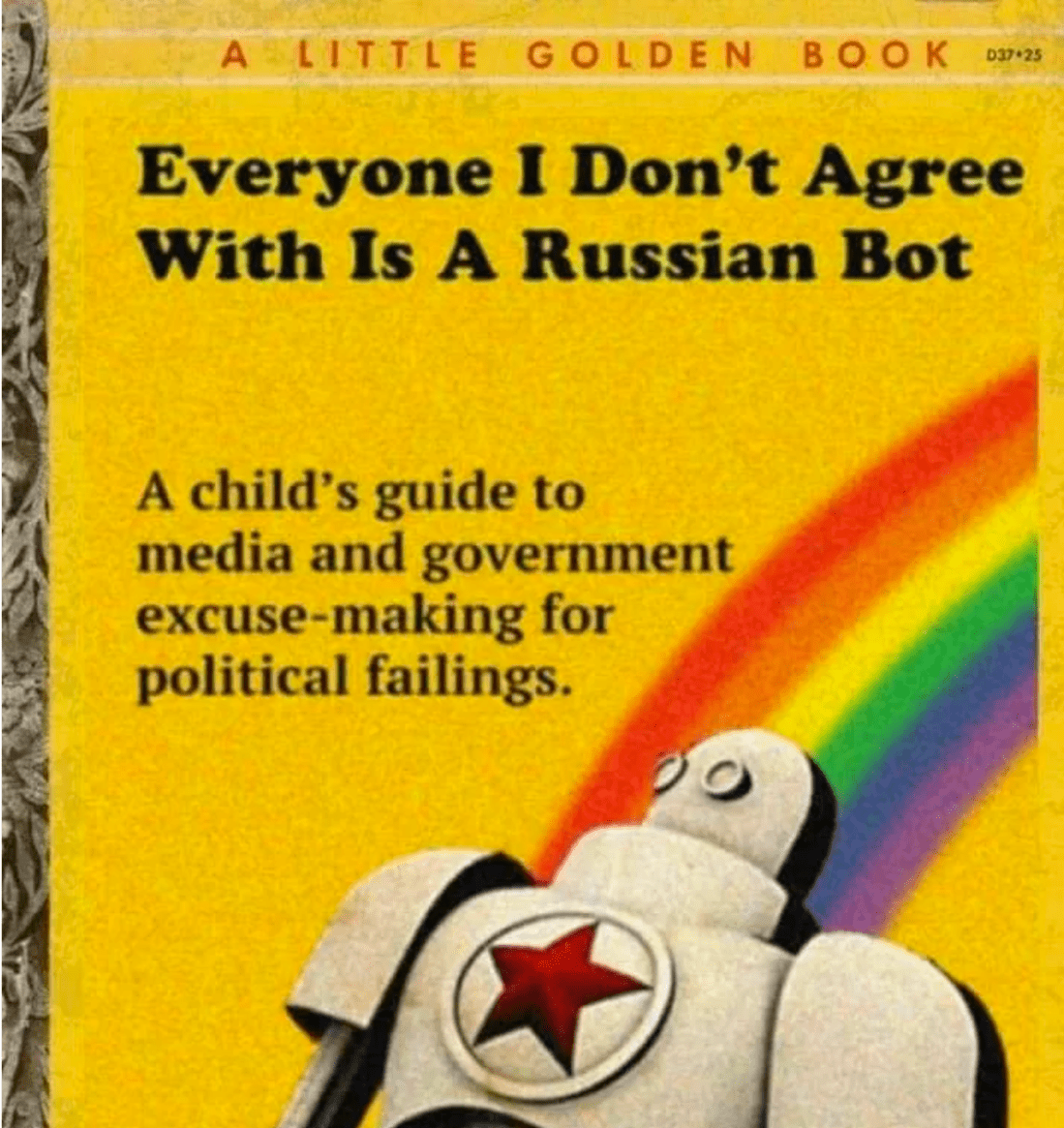
They aren’t smearing Tulsi Gabbard as a Kremlin asset because they don’t want her to be president … [T]hey fear … allowing her anti-interventionist ideas to take hold within the mainstream consciousness of a nation whose nonstop military interventionism is the glue that holds the empire together.

Let’s stop allowing the mass psychosis of these paranoid cold war feeding frenzies to be the new normal, please. If we keep going this way it’s only going to get worse for everyone.

Caitlyn Johnstone. I don’t know whether there really is a concerted effort to brand Gabbard a Kremlin asset or if this is just a tempest in blogger Johnstone’s teapot. But I love her illustrations:

Screen Shot 2019-02-05 at 8.54.44 AM

That one was an animated GIF. This one really captures the mentality of some of these people:

Screen Shot 2019-02-05 at 8.50.36 AM

3

Our politicians reliably fetishize two constituents of American life: the middle class and small business. The Democrats used to talk a bit more about the poor before they became the Harvard party — poor people are lousy donors, as it turns out — and the Republicans used to be a lot warmer toward Big Business before the GOP became a right-wing farmer-labor party and Big Business came to mean Howard Schultz, Mark Zuckerberg, and Lloyd Blankfein.

Kevin D. Williamson. That’s a pretty good snapshot of our current stage of political realignment.

The rest of the column is in praise of Big Business, debunking Small Is Beautiful mythology.

I can’t deny Williamson’s numbers, but I deny that numbers tell a plausibly “whole story”. The reflexive premise that they do is part of what is deeply wrong with movement conservatism (for lack of a better term; “conservatism” without adjectival modifiers is totally useless). Here’s another part of the story: a community that works to live (and pray) rather than living to work.

4

As the Epiphany season draws to a close, one is forced to conclude that the “woke” Episcopal Church of 2019 stands firmly with Team Herod.

Kari Jenson Gold

5

If bigotry is repugnant, why not demand the resignation of Vice President Pence for his ugly views on homosexuality? And while they’re at it, why not insist that Pence’s wife Karen resign her position at a school that discriminates against gays and lesbians?

Pence has long been criticized as being hostile toward LGBTQ issues. He has linked same-sex couples to a “societal collapse” and even once seemed to support conversion therapy, which is a form of torture.

Richard Cohen.

The second paragraph is the entirety of Cohen’s evidence that Pence has ugly views on homosexuality. Read it slowly and shudder.

Cohen needs no evidence, as all the bien pensants agree with him.

I was not thinking of this sort of thing — at least not consciously — when I signaled several days in a row my incredulity at the calls for Virginia’s Governor to resign over a 35-year-old yearbook picture. Perhaps it was in the back of my mind, though: The callout culture is really toxic, and orthodox Christianity is now worse than faux pas.

Further, although I though I do not consider Cohen’s question bona fide, a sufficient answer were it bona fide would be that the voters knew when voting for him that Mike Pence triggers people like Cohen, and that his alleged sexual atavism is the ostensible reason, whereas the Governor’s secret was, well, secret.

* * * * *

Follow me on Micro.blog Follow me on Micro.blog, too, where I blog tweet-like shorter items. Frankly, it’s kind of becoming my main blog. If you prefer, those micro.blog items also appear now at microblog.intellectualoid.com. Both should work in your RSS aggregator, like Feedly.