Dave Portnoy can’t even deal right now. Shortly after the Dobbs news broke, the “barstool conservative” celebrity took to Twitter with an “Emergency Press Conference.” “I feel like I have to speak on this issue,” Portnoy announced. There followed 2.5 minutes of semi-coherent ranting, where he proposes that we are “literally going backwards in time,” that “maybe not everything is to a T in the Constitution,” considering it was written by “people who own slaves,” and that he’s pretty sure “95 percent of people in the country think like me — they’re socially liberal and financially conservative.”
…
Of course, it’s tempting to point out that this is the hot take we would expect from a guy who defended himself against charges of being a repulsive womanizing scumbag by countering that maybe he was, but he didn’t break the law. Portnoy would hardly be the first of his kind to wax vehemently eloquent on the sanctity of women’s reproductive autonomy. But his take also reflects the whole political oeuvre he represents—that areligious potpourri of sexual libertinism, anti-authoritarianism, anti-wokeness, and lots of f-bombs.
I don’t know much about Portnoy. I first paid attention to the phenomenon of “barstool conservatives” within the last month. But I like, and credit, the observation that keeping women “reproductively autonomous” is damned convenient for guys with Satyriasis.
Andrew C. McCarthy, citing newly-salient Federal Criminal laws after Cassidy Hutchinson’s Tuesday testimony.
McCarthy continues:
In any event, Hutchinson explained that the speech, like all presidential speeches, was carefully vetted by staff. White House counsel Pat Cipollone and his staff pleaded for removal of the exhortations Trump was insistent on including — “fight for me,” “fight for the movement,” and so on. They were too close to the legal line of incitement. It was plainly foreseeable that the mob could take forcible action; if it did, White House lawyers feared that this rhetoric would place Trump squarely in legal jeopardy for whatever mayhem resulted — obstruction of congressional proceedings, intimidation of and assault on federal officials, and so on.
The rhetoric stayed in the speech.
So did Trump’s vow that he would be marching to the Capitol with the mob.
A mea culpa: I just assumed that Trump’s vow that he would be marching to the Capitol with the mob was just another of his (literally) innumerable lies to whip up mobs. But if you’re familiar with Hutchinson’s testimony, you now know that he was prevented from doing so by the Secret Service — and may have tried to wrest the steering wheel away from his Secret Service chauffeur.
On the observation that a lot of Hutchinson’s testimony was hearsay:
Still, a few things are worth bearing in mind. First, this isn’t just any hearsay — like idle chatter a witness might eavesdrop on. We’re talking here about a chain of command, where government officials are expected to report things to their superiors — in this instance, up to the president’s chief-of-staff. More to the point, Hutchinson learned these details just minutes after the encounter in the limo. Ornato came directly to Meadows’s office with Engel. As Engel looked on in apparent affirmation, Ornato relayed what had just happened to Hutchinson. Engel gave no indication that Ornato had gotten any of the details wrong. And if Hutchinson is lying or exaggerating, it’s strange that, under oath, she would voluntarily identify so many witnesses who could contradict her.
… [W]hen we say the committee lacks due-process legitimacy, that means it lacks legitimacy as an ultimate finder of fact. It does not mean that we can blithely dismiss any evidence the committee discloses. It does not mean that, because we’d prefer that the evidence not be true, we can dismiss it out of hand because we don’t like the Democrats or the committee process. These witnesses are testifying under oath. There is significant risk to them if they are found to have committed perjury.
For now, all we can responsibly do is ask ourselves whether the evidence presented under these deficient procedures seems coherent and credible ….
In that last assessment, confirmation bias is inevitable. To me, the evidence is coherent and credible.
Many rejoiced at [Roe v. Wade], but it also angered lots of people—at first, mainly Catholics, who strongly opposed abortion, but they were soon joined by evangelical Christians and even some secular activists. These critics of Roe made two main arguments: first, that the decision was immoral because it declared that women had a constitutional right to murder their babies; second, that the decision was tyrannical because it negated democratically enacted laws.
Before long, those making these arguments came to be called the “pro-life movement.” For the past forty years, it has fought to influence public opinion and gain support in the legal community. That effort finally achieved its goal last Friday, after 49 years, when a Supreme Court majority took its side, declaring, in part, that enough Americans consider abortion to be murder that it should not be treated as a constitutional right; states should be free to permit or forbid the procedure based on the outcome of democratic debate.
I think Linker’s account is extraordinarily fair.
For whatever reason rooted in my emotional make-up, I have always been more in the “Roe was tyrannical” rather than “Roe was immoral” camp. Perhaps it’s because my pro-life awakening came when I was in Law School, already enrolled in a Constitutional Law class.
I believe I have written here that any state legislation on abortion would have a constitutional legitimacy that Roe and its progeny lacked. At least for now, that’s all I’m going to say about my position on what restrictions my state should enact, confident that it’s not going to declare a 40-week open season on the unborn, or even 20+ weeks. In a few weeks, when our legislature convenes, my attention will presumable sharpen.
If people have always said it, it is probably true; it is the distilled wisdom of the ages. If people have not always said it, but everybody is saying it now, it is probably a lie; it is the concentrated madness of the moment.
You can read most of my more impromptu stuff here (cathartic venting) and here (the only social medium I frequent, because people there are quirky, pleasant and real). Both should work in your RSS aggregator, like Feedly or Reeder, should you want to make a habit of it.
If you’ve read me for very long, you’ll know I’m pretty tepid about gun rights. But I’m going to weigh in on last week’s Bruen decision anyway: I don’t like it.
What I don’t like is the approach Justice Thomas took to reach his results. For ease, and because I’m not so hot on guns to go any deeper, I’ll quote my beloved Morning Dispatch:
Thomas’ majority opinion does rework how courts should assess the constitutionality of gun legislation. Courts must drop their previous efforts to balance the interest of the state in preventing gun violence against the Second Amendment rights of individuals, Thomas wrote, and instead consider only the Second Amendment’s text and the “history and tradition” of gun legislation when the Second and 14th Amendments passed.
“They’re not looking for whether there was the exact same gun regulation,” Stephen Gutowski, founder of gun policy outlet The Reload, told The Dispatch. “They’re looking at whether there was a similar gun regulation.”
Thomas writes that courts are more equipped to perform a historical legal analysis than the cost-benefit analysis they’ve been attempting, but Breyer’s esoteric weapons list highlights that it could still be a challenge to properly identify and apply relevant regulations. “I just think [Thomas is] a little overconfident in the ability of particularly lower courts, which don’t have endless resources and immense law libraries,” Seth Chandler, a University of Houston law professor who has taught Constitutional law, told The Dispatch. “Even Justice Thomas acknowledges that this process of analogous reasoning, it’s not straightforward and obvious.”
(Italics added)
It’s not just that history offers only analogies in many cases but that, reportedly, Justice Thomas discarded some historic restrictions as not relevant for one reason or another. How are the lower courts supposed to evaluate history when he was kind of cavalier about it.
So Bruen has not added consistency and clarity to Second Amendment Jurisprudence. It may have diminished it.
On Monday, I began reading Samuel P. Huntington’s Clash of Civiliztion, which I’m enjoying very much, but not at the moment because I’m typing about a case I was surprisingly ambivalent about.
So let’s see if we can make some brief sense of it and get me back to Huntington. I am hugely indebted to the Advisory Opinions podcast because when I saw all those printed words I said “No, siree! I’m not going to cut-and-paste from all that! I just don’t care that much!”
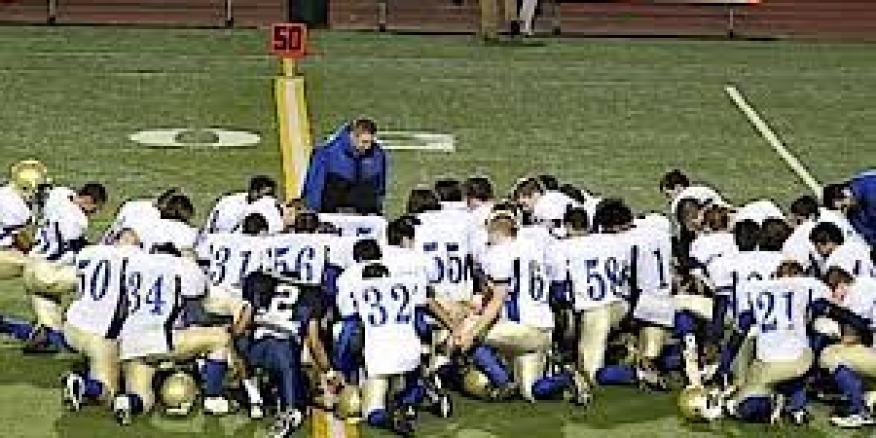
Majority version: Saintly Joseph Kennedy only wanted a moment of private, personal prayer at the 50 yard line immediately after the football games he’d just coached. Conscience-bound, he conscientiously violated oppressive directives from the school district, which suspended, then fired him. He wins on both religious speech and general free speech grounds, the gap between which we’re now narrowing. By the way, we hereby drive a stake through the heart of Lemon v. Kurtzman, one of several zombie precedents we’ve left haunting the countryside, while giving the side-eye to lower courts who don’t get the joke.
Dissent: WTF! You’re describing a completely different case! This is a case of a willful provocateur seeking to lead his players to Evangelical-Jesus, praying in a very public place, in front of most of the stadium, and by winks and nods inviting players to join him at mid-field and yelling “Neener! Neener! Neener!” at the School Board. If we allowed this sort of thing, it would lead to terrible places and he really should have lost.
Coach Pharisee and his entirely voluntary flock. He has his reward.
Yes, the facts stated in the opinion and those stated in the dissent differed almost that wildly. My impression has been that the dissent’s version is closer to the whole truth, the majority’s version a bit — Ahem! — curated. (I also thought trials, not appeals, were supposed to determine the facts, but never mind.)
Net result: Kennedy wins and nobody should cite Lemon v. Kurtzman any more. Future courts are again told to consult “historical practices and understandings.” You may genuflect now and back out of the room slowly — and try to wipe that look of puzzled incredulity off your faces.
Hard cases make bad law, but this one seemingly made almost no law at all except that a zombie is now declared a corpse. That’s my story and I’m stickin’ to it unless I stumble across a more compelling version.
Do not forward; moved, left no forwarding address
The West Caldwell Police Department has responded to multiple calls at a residence formerly owned by Justice Samuel Alito. Erroneous information was circulating on the internet that indicated that Justice Alito still resides in West Caldwell, and individuals have been sending harassing packages to the current resident.
Justice Alito moved out of West Caldwell Just after being confirmed to the US Supreme Court, 15 years ago in 2007. The current homeowner has no affiliation with Justice Alito and deserves to live in peace in their home free from harassment, regardless of anyone’s political beliefs.
All incidents will be investigated and those responsible will be charged and prosecuted.
Please like and share this post to hopefully put an end to this activity.
I will never again complain about people who ignore my voicemail greeting and leave messages for an auto parts place with a number one digit off our home phone number.
Tallying the cost of Dobbs
It is done. The decision by the U.S. Supreme Court in Dobbs v. Jackson Women’s Health Organization overturned Roe v. Wade, ending 50 years in which abortion has been a constitutional right.
Now Catholic and evangelical Christian leaders need to acknowledge the costs of their victory. The most visible is nearly a half-century of being in bed with the Republican Party, and most recently its leader Donald Trump, a man of low morals willing to lie, cheat and, to hear the Jan. 6 committee tell it, break the law in order to stay in office.
It also meant becoming a single-issue constituency who sacrificed nearly every social justice issue to create a Supreme Court that would reverse Roe v. Wade.
…
Yes, the Republicans finally delivered on their promise to reverse Roe, but in every other way it is making the world less hospitable to life. To call this pro-life is absurd.
I would find just as creepy, I think, if it was an opposite-sex pair of yuppies staring into each others eyes, congratulating each other on outsourcing a job they just wouldn’t disrupt their careers for.
This instrumentalizes women and commodifies babies, so it’s in perfect keeping with the zeitgeist.
If people have always said it, it is probably true; it is the distilled wisdom of the ages. If people have not always said it, but everybody is saying it now, it is probably a lie; it is the concentrated madness of the moment.
You can read most of my more impromptu stuff here (cathartic venting) and here (the only social medium I frequent, because people there are quirky, pleasant and real). Both should work in your RSS aggregator, like Feedly or Reeder, should you want to make a habit of it.
As I know the lay of the land uncommonly well, I am trying to say some genuinely useful things, that are not being said very commonly, on the reversal of Roe and Casey. I’m also trying to avoid worsening tensions. I even exited social media for a few days (maybe more than necessary — I’ve been peeking) when a discussion started getting unproductively heated.
Face-saving failure
Confirmation hearing vignettes:
Here’s Justice Gorsuch: “Roe v. Wade, decided in 1973, is a precedent of the U.S. Supreme Court. It has been reaffirmed. . . . So a good judge will consider it as precedent of the U.S. Supreme Court worthy as treatment of precedent like any other.”
He added that “If I were to start telling you which are my favorite precedents or which are my least favorite precedents, or if I viewed precedent in that fashion, I would be tipping my hand and suggesting to litigants that I have already made up my mind about their cases.”
And here’s Justice Kavanaugh: “Roe v. Wade is an important precedent of the Supreme Court. It has been reaffirmed many times. It was reaffirmed in Planned Parenthood v. Casey in 1992. . . . So that precedent on precedent is quite important as you think about stare decisis in this context.” He made no specific pledge about either case that we have seen. Justice Amy Coney Barrett expressly rejected the idea that Roe was a super precedent.
Sens. Susan Collins and Joe Manchin said Friday they feel Justices Brett Kavanaugh and Neil Gorsuch deceived them on the precedent point in testimony and in their private meetings with the Justices. We weren’t in those meetings, but we’d be stunned if either Justice came close to making a pledge about Roe.
The reason is that the first rule of judging is that you can’t pre-judge a case. Judges are limited under Article III of the Constitution to hearing cases and controversies, and that means ruling on facts and law that are specific to those cases.
No judge can know what those facts might be in advance of a case, and judges owe it to the parties to consider those facts impartially. A judge who can’t be impartial, or who has already reached a conclusion or has a bias about a case, is obliged to recuse himself. This is judicial ethics 101.
An authority on this point is no less than the late progressive Justice Ruth Bader Ginsburg, as she explained in 1993. “It would be wrong for me to say or preview in this legislative chamber how I would cast my vote on questions the Supreme Court may be called upon to decide,” she said. “A judge sworn to decide impartially can offer no forecasts, no hints, for that would show not only disregard for the specifics of the particular case, it would display disdain for the entire judicial process.”
Frankly, no nominee should ever pledge their vote on any issue at confirmation hearings. That alone would be a disqualifier. Any Senator worth his or her seat should understand that, and since I respect them as senateworthy, I suggest that both Collins and Manchin do understand it. Their face-saving isn’t convincing.
Now flooding the zone shamelessly
As I scan the New York Times Opinion page since Friday morning, it’s apparent that "flooding the zone with sh*t" is not a MAGAworld exclusive.
Do not trust the Grey Lady for reliable interpretation of Dobbs overruling Roe or for prognostications about what a supposedly agenda-driven court is going to do next. (Exception: Ross Douthat wrote one of the wisest things I’ve read in the aftermath, and they did publish it.)
Is the court going to ban contraception? Ban sodomy? Ban same-sex marriage? Overrule the precedents that dogmatized rights to each into existence?
Just remember: courts decide cases. They don’t go out and make mischief on their own. So how would SCOTUS even get a chance to rescind these other "unenumerated rights"?
Damon Linker (After Roe: The Reversals to Come), who I respect enough to read when it’s obvious we disagree, imputes a nefarious agenda to the court but skips any suggestion of how it would get the opportunity to realize that agenda.
I can think of no obvious way other than some jurisdiction banning contraception, sodomy or same-sex marriage, resulting in a fresh round of litigation.
What do you think of the life expectancy of a legislator, even in Texas, who proposed to outlaw contraception? Outlawing sodomy would be a hard sell in 2021 even in red states. I could imagine a performative bill to define marriage as sexually binary, but have trouble imagining it getting very far.
If it did, the lower Federal courts would almost certainly strike such a law down under Griswold, Lawrence or Obergefell. Then SCOTUS could just decline to grant certiorari.
If it granted "cert," the stare decisis analysis on those precedents would include factoring in some very, very concrete reliance on Obergefell in the SSM context.
I’m no prophet, and I’m not close enough to the political poles to be incapably of suffering rude surprises, but I just don’t see those other precedents falling until there’s I’m long in the grave and there have been some major wake-up calls from realities we’ve had on call-blocking for a while.
Heartening
After weeks of incendiary rhetoric, attacks on crisis pregnancy centers, and a foiled attempt on Justice Brett Kavanaugh’s life, Planned Parenthood and other pro-abortion groups formally disavowed violence in the name of their cause. Those who use “destruction and violence” do not speak for them or the movement, the groups said in a statement.
On a related note, one of my favorite Substackers, Freddie deBoer, scared me by opening that it’s time for the Left to engage in extralegal resistance. Fortunately, it turned out that he meant things like helping abortion-minded women get to states where abortion is legal, or even to help them find clandestine abortions in their own states.
I don’t even think the former could be criminalized; the latter, perhaps.
Victor Rosenblum
As I was writing yesterday that I wish Nat Henthoff had lived to see Friday’s Dobbs decision, I was wracking my brain for the name of his "country cousin" (also a prolife liberal Jewish Democrat) at Northwestern University Law School. I finally gave up. Of course, it finally came to me this morning. So: I also wish Victor Rosenblum had lived to see this day.
Advice for the despondent
After stylishly signaling his pro-choice virtue, Garrison Keillor shows some sympathy for the 6 justices who are now pariahs, and then turns to some good advice for his own tribe:
Meanwhile, remind yourself that other people have thrived under wretched governors so don’t be discouraged. The Duke of Saxe-Weimar threw Bach in jail for daring to think he had individual rights. Dante was sent into exile and he wrote the Inferno so he could put the politician Argenti into the Fifth Circle of Hell. Dostoevsky joined a liberal study group for which, in 1849, he was thrown into prison and sentenced to death by firing squad, and was third in line to be executed when a pardon arrived. He lit out for Paris, London, Berlin, and figured out how to survive, writing Crime and Punishment in serial installments for magazines, avoiding politics. While cruelty is in power, do what Mozart did. Exercise your gifts. Create beautiful things. Wolfgang stayed clear of emperors and did his work and he lives on today and the emperors are just moldy names on marble slabs covered with pigeon droppings. If you can’t write The Marriage of Figaro, write your own marriage and make it a work of art.
That’s kind of what I’ve been trying to do, in my very limited way, for more than a decade. I like to think of myself as that proverbial butterfly in the Amazon, very subtly changing the weather in Indiana.
Not Dobbs
Still flooding the zone
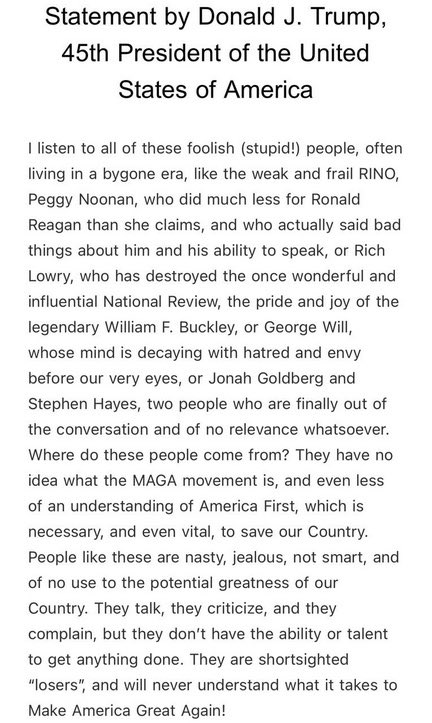
The Donald reads conservatives out of MAGAworld
Bozos on the bus
What we need as a nation, more than anything else I can think of, is a recommitment to basic competence, and, especially, a refusal to accept ideological justifications for plain old ineptitude. Too often Americans give a free pass to bunglers and bozos who belong to their tribe.
When a clown moves into a palace, he doesn’t become a king. The palace becomes a circus.
Turkish Proverb (reportedly)
A little levity
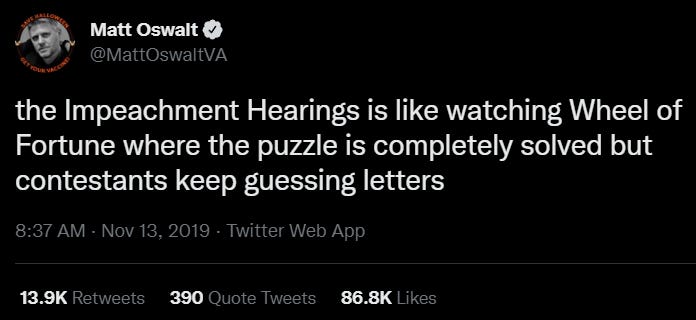
I probably have given too short shrift to the January 6 Committee hearings because … well, I didn’t think anything they said would change my life or my vote. But I sure got a chuckle out of this:
If people have always said it, it is probably true; it is the distilled wisdom of the ages. If people have not always said it, but everybody is saying it now, it is probably a lie; it is the concentrated madness of the moment.
You can read most of my more impromptu stuff here (cathartic venting) and here (the only social medium I frequent, because people there are quirky, pleasant and real). Both should work in your RSS aggregator, like Feedly or Reeder, should you want to make a habit of it.
After some 40 years as consciously pro-life, most of those years being actively pro-life as well, I feel a strange let-down and foreboding:
Dobbs means pro-abortion terrorism for a while;
Dobbs means prolonged political debate in many of the 50 states, some of which will swerve performatively too far left or right;
Dobbs is messier procedurally than I remembered; and
I have friends who are beside themselves with grief and rage (I hope they appreciate that I was constitutionally outraged by Roe for 40 years).
UPDATE: Of course! Duh! The leak made this anticlimactic all by itself! (H/T Advisory Opinions podcast)
Yes, I’m satisfied with the outcome: Roe was wrongly decided, and Casey may have been even worse. It’s important for the structural integrity of our constitutional system that political issues not be hijacked by the courts under constitutional pretexts.
On what becomes of birth control, inter-racial marriage, same-sex marriage, anti-sodomy laws, and any remaining liberal groin pieties, I suggest that the most important observation in Alito’s opinion is this:
… even putting aside that these cases are distinguishable, there is a further point that the dissent ignores: Each precedent is subject to its own stare decisis analysis, and the factors that our doctrine instructs us to consider like reliance and workability are different for these cases than for our abortion jurisprudence.
(Opinion at 71-72)
Homework: using the factors for upholding or overruling precedent outlined by Alito, do your own stare decisis analysis on each. I’ll get you started: not one of the four is deeply rooted in our history and traditions, but that’s only the beginning of the analysis. From there, it gets more interesting.
Night of Rage
In a recent video essay, my friend James Wood has suggested that in this day and age, thinking Christians should work to recover a theology of the demonic. I don’t assume this suggestion will be equally meaningful to all my readers. But I submit that you can’t contemplate what drives men to organize a “Night of Rage” against Christian charities whose sole purpose is aiding pregnant women, and not wonder if there is a dark something or other lurking back of it all.
Bethel McGrew, Morning in America. I quote it because I was thinking exactly the same thing. There is no logic to vandalizing or even firebombing pro-life pregnancy centers unless the motivation is consciously pro-abortion, not pro-choice, or else one is demonically confused.
Other Legalia
Principled
We could not abandon ongoing representations just because a client’s position is unpopular in some circles.
Former Solicitor General Paul Clement on leaving Chicago’s Kirkland & Ellis when they decided to abandon second amendment litigation. He is forming his own firm with another Kirkland partner.
Best wishes. Even though I’m at best lukewarm about guns, this stand is principled, and nobody’s going to have to pass the hat so Paul Clement can pay for his lunch.
Correct facts, dubious conclusion
One of the reasons I think the Supreme Court got it right in Carson v. Makin is the poor quality of the dissents. Justice Sotomayor actually invoked the "wall of separation," an extraconstitutional metaphor that probably has never actually fit our nation’s polity (starting with the little-known fact that we had state-established churches into the 1830s).
But an odder one is Justice Breyer’s:
This potential for religious strife is still with us. We are today a Nation with well over 100 different religious groups, from Free Will Baptist to African Methodist, Buddhist to Humanist. See Pew Research Center, America’s Changing Religious Landscape 21 (May 12, 2015). People in our country adhere to a vast array of beliefs, ideals, and philosophies. And with greater religious diversity comes greater risk of religiously based strife, conflict, and social division. The Religion Clauses were written in part to help avoid that disunion. As Thomas Jefferson, one of the leading drafters and proponents of those Clauses, wrote, “ ‘to compel a man to furnish contributions of money for the propagation of opinions which he disbelieves, is sinful and tyrannical.’ ” Everson, 330 U. S., at 13. And as James Madison, another drafter and proponent, said, compelled taxpayer sponsorship of religion “is itself a signal of persecution,” which “will destroy that moderation and harmony which the forbearance of our laws to intermeddle with Religion, has produced amongst its several sects.” Id., at 68–69 (appendix to dissenting opinion of Rutledge, J.). To interpret the Clauses with these concerns in mind may help to further their original purpose of avoiding religious-based division.
Is there any evidence whatever that increased religious diversity leads to greater strife? Doesn’t Western history’s putatively religious strife generally involve Protestants versus Catholics in a society where almost everyone was one or the other? Doesn’t our present reality belie Breyer’s logic, i.e., doesn’t our lack of strife despite "well over 100 different religious groups" tend all by itself to disprove Breyer’s prophecy?
Let’s end the end-runs now
Anticipating this week’s school funding decision, Maine lawmakers enacted a crucial amendment to the state’s anti-discrimination law last year in order to counteract the expected ruling. The revised law forbids discrimination based on gender identity and sexual orientation, and it applies to every private school that chooses to accept public funds, without regard to religious affiliation.
It would be interesting to learn whether the debate over S.P. 544 (the Bill in question) included any invidiously discriminatory snark about religion.
But the legislature avoided one other potential infirmity.
Previously, Maine law allowed sexual discrimination in education (some of the private schools receiving aid while religious schools did not were either all-male or all-female) while forbidding sexual orientation discrimination (with an exception for religious schools). That seems exceedingly odd, as bans on sexual discrimination are generally older than those based on sexual orientation.
The revision adds a prohibition on sex discrimination as well as sexual orientation discrimination, and thus will put those other private schools to the choice of going co-ed or forfeiting aid.
I can’t think of a legal theory I’d want to see recognized by courts that would allow Maine private schools to do an end-run around the legislature’s end-run. It’s always been the case that state money comes with strings attached.
The challenge for private schools now is the get parents to care enough about their children’s longterm wellbeing to reject the economic values society promotes, notably including consumerism, and to redirect some dollars to tuition in schools that won’t perpetuate those ultimately-immiserating values. Sad to say, most "Christian" schools are consumerist with a religious veneer.
January 6
Liz Cheney, kamikaze pilot
[Florida Governor Ron] DeSantis … is capturing the Republican imagination as tough and committed but not unstable or criminal.
"Not unstable or criminal" is an improvement for the post-2015 GOP.
But I, a former Republican and still reflexively concerned about that party, am not enthusiastic about DeSantis for more than maybe 30 seconds at a time. His appearance, unfortunately, is kind of Mafia. He is quite smart but too often "politically savvy" in crudely manipulative way.
More Noonan:
Mr. Trump’s national polling numbers continue underwater, but the real test will be to see those numbers after the Jan. 6 hearings are over. I believe we’ll see Rep. Liz Cheney’s kamikaze mission hit its target, and the SS Trump will list.
…
This is one of the great stories. Mr. Trump won’t recover from it.
I think Republicans, including plenty of Trump people, are slowly but surely solving their party’s Trump problem.
Liz Cheney, or Providence through her, has turned the January 6 Committee into a nothingburger for the Democrats and a boost for sane, non-criminal Republicans. Some day, maybe, a renewed GOP will issue her a posthumous pardon and even lionize her as a self-sacrificial heroine in our nation’s hour of need — no less than Mike Pence’s steadfastness on January 6 itself, and equally "kamikaze."
Still, I’ll be voting American Solidarity Party again in 2024, I think, and don’t expect ever to declare myself Republican again. And I don’t expect politics from any perspective, to really accomplish much of lasting importance.
The January 6 Committee, a liberal view
The decision by the House minority leader, Kevin McCarthy, to keep pro-Trump Republicans off the Jan. 6 committee has eliminated the back-and-forth bloviating that typically plague congressional inquiries, allowing investigators to present their findings with the narrative cohesion of a good true-crime series. Trump, who understands television, appears to be aware of how bad the hearings are for him; The Washington Post reported that he’s watching all of them and is furious at McCarthy for not putting anyone on the dais to defend him.
…
Dustin Stockton helped organize the pro-Trump bus tour that culminated in the Jan. 6 rally at the Ellipse in front of the White House. Politico once called him and his fiancée, Jennifer Lawrence, the “Bonnie and Clyde of MAGA world.” On Tuesday, after a hearing that included testimony by Rusty Bowers, the speaker of the Arizona House, and the Georgia election workers Ruby Freeman and Shaye Moss, Stockton tweeted, “This has been the most impactful of the January 6th Committee hearings. Embarrassed that I was fooled by the Fulton County ‘suitcases of ballots’ hoax.”
He was referring to the conspiracy theory, pushed by Trump and his allies, that election workers smuggled fraudulent ballots into the State Farm Arena in Atlanta and ran them through the voting machines multiple times. Tuesday, he said, was the first time he realized the tale was a complete fabrication.
… The hearing on Tuesday … got to him, especially the testimony from Freeman and Moss about how their lives were upended by the lie Stockton helped spread.
“To see the just absolute turmoil it caused in her life, and the human impact of that accusation, especially, was incredibly jarring,” Stockton said of Freeman.
… Elite conservatives mostly understood that Trump’s stories about a stolen election were absurd; as one senior Republican official asked The Washington Post, “What is the downside for humoring him for this little bit of time?” But his rank-and-file devotees weren’t all in on the con. Instead, they were the marks.
I think we know now what the downside was of humoring Trump.
Politics Generally
Biden’s incoherence on LGBT
In no area has the Biden administration been more appallingly misled by extremists than in "LGBT" issues. His ignorance of what constitutes "conversion therapy" has led to a particularly perverse result — as shown in the last sentence below:
Some therapists who work with children with gender dysphoria worry that [a June 15 Biden executive order “advancing equality for lgbtqi+ Individuals”] could be interpreted to mean therapists should not investigate why someone feels distressed about their biological sex. … It has long been held that people with gender dysphoria should have therapy before drugs.
Increasingly, however, such talking therapy has clashed with “gender-affirmative” care, which accepts patients’ self-diagnosis that they are trans. That is now considered best practice in America’s booming trans health-care field. Therapy has been dismissed as “gatekeeping”, even when applied to trans-identifying minors for whom gender-affirming drugs can be particularly harmful. … Finland and Sweden have mostly stopped prescribing blockers to under-18s in favour of talking therapy, because the evidence base for them is thin. Mr Biden’s order, by contrast, asks federal departments to expand access to “gender-affirming care”.
The order does not impose an outright ban on therapy for gender-dysphoric youth. But it will have a “chilling effect”, says Lisa Marchiano, a Jungian therapist and a co-founder of the Gender Exploratory Therapy Association. Most decent therapists should be able to help people with gender dysphoria, she says. Yet America’s focus on affirmation means many are wary of doing so. Instead, they refer children to gender therapists, who are likely to affirm a trans identity and suggest drugs. Some gay adults who struggled with gender nonconformity in adolescence say they believe that encouraging children with gender dysphoria to consider themselves trans is in effect conversion therapy.
If there is any grain of truth in the conservative charge of "grooming" or "recruitment," it’s that foreclosing or chilling pre-transition psychological assessment delivers gender-dysphoric kids to the tender mercies of people who don’t make real money unless the kid transitions.
What liberals can learn from conservatives
By and large, I’ve been underwhelmed by Damon Linker’s new Substack. It’s a big commitment to write and some length many times per week, and Linker seems, ummmm, out of the habit.
He tacitly challenges Haidt to "do better" on measuring the moral values of liberals;
He explains why he thinks liberals profess disinterest in the values of sanctity, authority and loyalty;
He suggests that liberals are missing out on a full appreciation of moral pluralism by discounting sanctity, authority and loyalty; and
Bonus for me who wasn’t familiar at all with Isaiah Berlin (beyond knowing that he was an important intellectual of some sort), he summarizes Isaiah Berlin’s thoughts on moral pluralism along the way.
I have reason to think that this link will get you Linker’s full piece even if you’re not a subscriber.
Face-plant
Lauren Boebert apparently thinks that if Jesus and da boyz had them some AR-15s, He wouldn’t have had to die that yucky ole death.
To be fair, the response to her was tepid at best.
They never should have invited her, but it’s weird what some "Christians" will do to raise money.
I attended a Christian college once (not Wheaton) that honored archaeologist and oil multi-millionaire Wendell Phillips (back when "millionaire" meant something) with an honorary doctorate. After he used his acceptance speech to contradict things the university considered part of the faith, they barred faculty from later rebutting him from that same pulpit.
I do not name it because I have some reason to think it’s doing better now.
Unclassifiable (unless the class is "Bless Their Hearts")
This NYT item would have me tearing my hair out if I had any hair.
In short, it’s about some Christianish or Christianist business that are hawking guns for Jesus, and they wear their faith (such as it is) on their sleeves, or gunstocks, or anywhere else they can put it to be noticed.
I’m a fallible interpreter of scripture, but doesn’t "put not your trust in princes, in sons of men in whom there is no salvation" include putting trust in the arms you keep and bear, as in declarations like the "Second Amendment to our Constitution is the cornerstone of the freedom we enjoy as American citizens"?
(Reminds me, by the way, of an actual quote from an Oklahoma legislator in the mid-70s: "The first thing the communists do when they take over is outlaw cockfighting." Bet you thought it was going to be "take away all the guns," didn’t you.)
If people have always said it, it is probably true; it is the distilled wisdom of the ages. If people have not always said it, but everybody is saying it now, it is probably a lie; it is the concentrated madness of the moment.
You can read most of my more impromptu stuff here (cathartic venting) and here (the only social medium I frequent, because people there are quirky, pleasant and real). Both should work in your RSS aggregator, like Feedly or Reeder, should you want to make a habit of it.
Ten years ago, let’s say fifteen to be safe, if you saw an essay titled “Consequences are Good, Actually,” you might naturally assume that it came from the political right. Conservatives, after all, believe in law and order, retributive justice, and the God of the Old Testament. But nowadays, it’s liberals who constantly call for consequences, liberals who sneer at the concept of forgiveness, liberals who stand for a Manichean worldview that permits no deviation from white-hat/black-hat morality …
We’ve spent the past two years with the left-of-center world debating, and largely endorsing, quite radical ideas about ending policing and prisons. This would seem to suggest a certain predisposition to forgiveness and equanimity in human affairs, a communal understanding that life is complicated, all of us are sinners, and there but for the grace of God go we. But as the various groans about the New York piece show, the urge to defund the police etc. is really much less about a particular ethic of caring and much more about simply nominating a communally-approved target for progressive anger. It happens that the abstract category “the cops” is a good thing for people to target, but the broader point is that most liberal criminal justice reform energy isn’t derived at all from a desire to be more compassionate and understanding but simply to have a new designated hate object ….
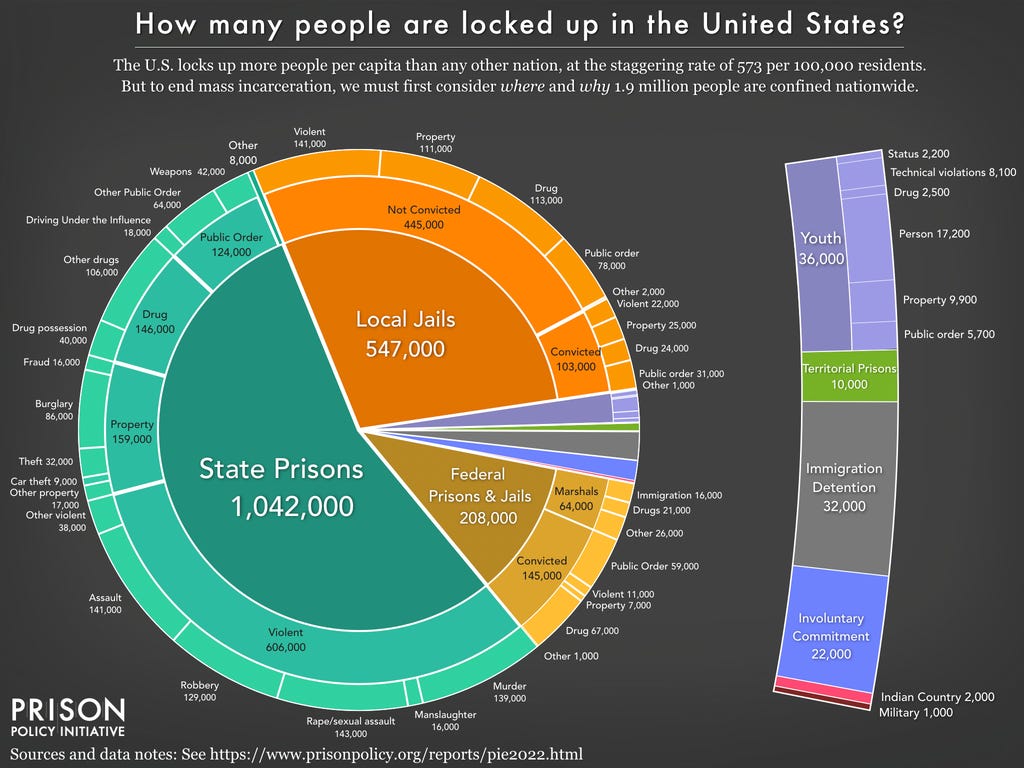
1.9 million people incarcerated in a nation of (roughly) 340 million. This is an extremely high rate in comparison to other nations.
What the heck is wrong with us? Are we more lawless? More punitive? Both?
Mencken Memorializes Machen
I’d never seen this before — an excerpt from H.L. Mencken’s obituary for J. Gresham Machen:
There was a time, two or three centuries ago, when the overwhelming majority of educated men were believers, but that is apparently true no longer. Indeed, it is my impression that at least two-thirds of them are now frank skeptics. But it is one thing to reject religion altogether, and quite another thing to try to save it by pumping out of it all its essential substance, leaving it in the equivocal position of a sort of pseudo-science, comparable to graphology, “education,” or osteopathy.
That, it seems to me, is what the Modernists have done, no doubt with the best intentions in the world. They have tried to get rid of all the logical difficulties of religion, and yet preserve a generally pious cast of mind. It is a vain enterprise. What they have left, once they have achieved their imprudent scavenging, is hardly more than a row of hollow platitudes, as empty as [of] psychological force and effect as so many nursery rhymes. They may be good people and they may even be contented and happy, but they are no more religious than Dr. Einstein. Religion is something else again — in Henrik Ibsen’s phrase, something far more deep-down-diving and mudupbringing, Dr. Machen tried to impress that obvious fact upon his fellow adherents of the Geneva Mohammed. He failed — but he was undoubtedly right.
The only thing worse, for a community, than what Radley Balko has famously called the “warrior cop” is a bunch of people who are cosplaying warrior cops.
Alan Jacobs. The whole thing is brief and worth reading.
Wordplay
Providence-washing
My very own coinage for baffling, bad or wicked decisions being justified, post hoc, by some good thing coming from it. Example: "Why did prissy Mike Pence ever agree to run with Donald Trump?" Answer: "Maybe God had January 6 in mind."
Phrase of the era: Gish-Galloping
The term “Gish Gallop” was coined by Eugenie Scott of the National Center for Science Education. The phrase refers to a debate tactic that was a favorite of Duane Gish, a young-Earth creationist who was also a highly skilled debater.
The Gish Gallop is the tactic of snowing your opponent under a mountain of supposed “pieces of evidence” or “problem cases” and claiming that the opponent’s inability to respond to this pile of evidence shows that your side is right. This tactic counts as a fallacy because its effectiveness doesn’t depend on presenting arguments that are right or even well-supported. Quantity is offered as a substitute for quality.
As the January 6 hearings restarted today after the long weekend, I was thinking about the weird, psychotic fear that has overtaken millions of Americans. I include in those millions people who are near and dear to me, friends I have known for years who now seem to speak a different language, a kind of Fox-infused, Gish Galloping, “what-about” patois that makes no sense even if you slow it down or add punctuation.
High marks to Nichols for applying "Gish Galloping" to the Trumpian patois. I was getting weary of "flooding the zone with shit," which really should be in the Urban Dictionary as a synonym for Gish-Galloping.
Conundrum of the week
May a baptismal regnerationist who never had a "born again experience" represent that he or she is born again for purposes of an Evangelical School requirement that teachers be "Born Again Christians"? (See, e.g., Carson v. Malkin, Breyer, J, dissenting) After all, the very essence of baptismal regnerationism is the belief that a proper baptism is how one actually gets born again.
I’m inclined to say "no" in both cases because, bless their hearts, those schools just don’t really know how one gets regenerate, and they’re using "born again" as a term of Evangelical art.
Had I remained in Dallas, I would have become a PCA Presbyterian because our "Independent Presbyterian" church (dear to us even though "Independent Presbyterian" is an oxymoron) was in the process of affiliating when we left.
If people have always said it, it is probably true; it is the distilled wisdom of the ages. If people have not always said it, but everybody is saying it now, it is probably a lie; it is the concentrated madness of the moment.
You can read most of my more impromptu stuff here (cathartic venting) and here (the only social medium I frequent, because people there are quirky, pleasant and real). Both should work in your RSS aggregator, like Feedly or Reeder, should you want to make a habit of it.
[A]fter a runoff and a recount, Rep. Henry Cuellar—the last pro-life Democrat in the House—narrowly edged out progressive attorney Jessica Cisneros to win the Democratic primary in Texas’ 28th District.
Four hearings in, the overall purpose of the public hearings of the House January 6 Committee is clear: to remind you how much more outrageous and unforgivable former President Donald Trump’s brazen attempt to steal the 2020 election was than how you remember it. In that respect, Tuesday’s hearing, featuring the testimony of state and local officials the president’s team tried to malign or manipulate, might have been the most successful one yet.
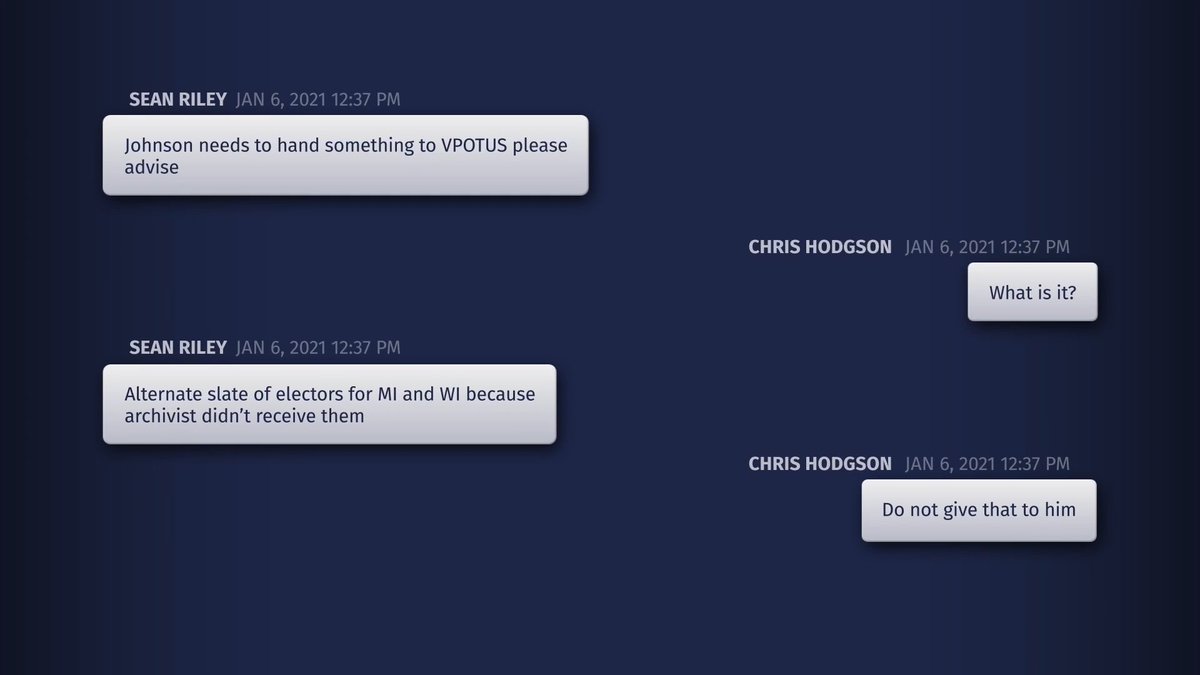
Here are the texts the Jan 6 Cmte just showed of @RonJohnsonWI’s chief of staff asking how he can give VP Pence alternate slates of electors for WI and MI on Jan 6th —>
As the January 6 hearings restarted today after the long weekend, I was thinking about the weird, psychotic fear that has overtaken millions of Americans. I include in those millions people who are near and dear to me, friends I have known for years who now seem to speak a different language …
Arizona House Speaker Rusty Bowers and others, describ[ed] the threats and harassment they have received for doing their duty to the Constitution.
And the threats don’t stop with political figures; families are now in the crosshairs. Representative Adam Kinzinger, for example, tweeted Monday about a letter he received in which the writer threatened not only to kill him, but to kill his wife and infant son.
…
I think the Trump superfans are terrified of being wrong. I suspect they know that for many years they’ve made a terrible mistake—that Trump and his coterie took them to the cleaners and the cognitive dissonance is now rising to ear-splitting, chest-constricting levels. And so they will literally threaten to kill people like Kinzinger (among others) if that’s what it takes to silence the last feeble voice of reason inside themselves.
We know from studies (and from experience as human beings) that being wrong makes us feel uncomfortable. It’s an actual physiological sensation, and when compounded by humiliation, it becomes intolerable. The ego cries out for either silence or assent. In the modern media environment, this fear expresses itself as a demand for the comfort of massive doses of self-justifying rage delivered through the Fox or Newsmax or OAN electronic EpiPen that stills the allergic reaction to truth and reason.
These outlets are eager to oblige. It’s not you, the hosts assure the viewers. It’s them. You made the right decisions years ago and no matter how much it now seems that you were fooled and conned, you are on the side of right and justice.
If people have always said it, it is probably true; it is the distilled wisdom of the ages. If people have not always said it, but everybody is saying it now, it is probably a lie; it is the concentrated madness of the moment.
You can read most of my more impromptu stuff here (cathartic venting) and here (the only social medium I frequent, because people there are quirky, pleasant and real). Both should work in your RSS aggregator, like Feedly or Reeder, should you want to make a habit of it.
I have long said that when a denomination forms a committee to study whether they’ve been wrong about something that puts them at odds with the culture (and in recent years that almost always involves homosexuality), it invariably leads the denomination to capitulate to the culture.
I was wrong. Wrong about "invariably." Such studies are usually charades, but not, apparently, always.
The Christian Reformed Church in North America (the denomination in which I was an Elder until I left to become Orthodox, and in which my wife so far remains) studied sexuality from 2016 until last week. Then it "voted Wednesday at its annual synod to codify its opposition to homosexual sex by elevating it to the status of confession, or declaration of faith."
The vote, after two long days of debate, approves a list of what the denomination calls sexual immorality it won’t tolerate, including “adultery, premarital sex, extra-marital sex, polyamory, pornography, and homosexual sex.”
Note that homosexual sex is not singled out, though it leaps out on its own to everyone who knows what specific sexuality triggered the six-year study.
The reactions from the dissenters so far have run along predictable lines, which I resist critiquing except to say "It is not compassionate to affirm people’s sins." If you think "homosexual sex" is not a sin, and should be affirmed, then we do not agree.
(I do not mean by "sin" what most western people mean by "sin." Sin is "missing the mark." Deciding on the eternal consequences of particular sins, including the sin of the dissenters from the CRC synod’s decision, is infinitely above my pay-grade.)
The heaviest price the CRC will pay will almost certainly be at its highly-regarded Calvin University, a third of whose faculty publicly voiced opposition to the report from which the synod’s decision flowed:
What’s going to happen to Calvin? It’s going to lose its rock star faculty. But it’s probably going to remain Christian. These liberal faculty are going to go on to greater things, professionally, and be able to dine out on how they were badly treated by the homo-hating fundagelicals at Calvin. But the CRC has taken a brave and unpopular stand for the Gospel. God sees.
Rod Dreher. Most gay-affirming faculty will leave because they will no longer be able to subscribe (literally, as in "sign below" — I signed something analogous as an Elder) the denomination’s fortified faith statement; it would mark them as not among the cool kids to relent now by subscribing The Loathsome Thing, especially if they earlier subscribed the pre-emptive dissent.
Rod’s reader Andrew S. comments:
The momentary rush of conservative enthusiasm for this move will please Rod’s readers, but the fury of the left will be in full force over the next several weeks and months. Any university board contemplating a similar move better should study what will likely happen, and plan accordingly for a media siege of their institution. Watch for the following:
a sudden drop in college rankings, unattributable to any objective criterion currently used by the major ranking media;
a tsunami of requests, using already existing anonymous online reporting portals, for Biden’s Department of Education to open Title IX investigations at the universities in question;
calls by social media talking heads to blacklist graduates of the schools;
a sudden mysterious dearth of available federal and private grant money for faculty at these schools, along with the denial of conference platforms for faculty members.
Financial pressures are such that many if not most religiously-affiliated schools will quickly develop new “insights” into the Bible that permit them to cave in to the left, if they haven’t already. Board members sticking to Christian principles better raise prodigious sums of cash to plow into their endowments and strengthen ties with allied Christian schools to bolster their financial self-sufficiency. Woke winter is coming, and Calvin will provide an example of what other colleges should expect.
Do you doubt this? This manifests the "soft tyranny" that a few on the center-right ridicule, but which I take quite seriously, as recently as Tuesday morning:
It has now become indisputable that the liberal order not only uses a variety of quasi coercive legal instruments such as bureaucratic guidances, selective funding of NGOs, and so forth, but it also exploits the liberal version of the public-private distinction to full advantage. It deploys selective enforcement of the law against “private violence” and takes political advantage of background conditions of economic necessity (“the market”) and of the radical conformity of public opinion under liberalism, instigated by the media. It controls its subjects with mobs both virtual and real, threats of ostracism, loss of employment, and a sort of reputational death (the dreaded state of being “out of the mainstream,” enforced politically by a cordon sanitaire).
I have said at least once before and will say it again: the Christian Reformed Church was a very good place from which to come to Orthodoxy. It never dove into the zaniness of broader evangelicalism (thought many parishes and individuals have dipped their toes, or even waded in up to the knees). Rather, from my earliest arrival struck me as sober and serious-minded.
Yet I expected it to cave in, because I do not trust Protestantism over the long haul to interpret their touchstone, their scriptures, in any seriously countercultural way.
I’m heartened that this was not the CRC’s year to swallow the zeitgeist. And they set such a firm precedent that it will be hard to backslide very soon. By then, the zeitgeist may have moved on, as zeitgeists are wont to do.
Why the rule remains generally valid
We are not in a post-Christian age, but in a post-Enlightenment age. The reason why these Christianities are collapsing is that they were rationalized.
Calvinism ("the Reformed faith") is surely among the most rationalized. Its system fails, in my opinion, not for lack of rationality, but for lack of humanity: it’s hard to see daylight between Reformed predestination and simple fatalism, hard to see room for meaningful human agency.
Denialisms
I can have an argument with you about what to do about climate change. I can even accept somebody making an argument that, based on what I know about human nature, it’s too late to do anything serious about this—the Chinese aren’t going to do it, the Indians aren’t going to do it—and that the best we can do is adapt. I disagree with that, but I accept that it’s a coherent argument. I don’t know what to say if you simply say, “This is a hoax that the liberals have cooked up, and the scientists are cooking the books. And that footage of glaciers dropping off the shelves of Antarctica and Greenland are all phony.” Where do I start trying to figure out where to do something?
You can swap "climate change" with a lot of other issues, most famously Alex Jones’ claim that Sandy Hook was a hoax, the bereaved parents "crisis actors." On second thought, "the Democrats stole the 2020 Election" may be more famous.
Hard words
A. G. Sertillanges wrote in The Intellectual Life: “The mind is dulled, not fed, by inordinate reading, it is made gradually incapable of reflection and concentration, and therefore of production…. Never read when you can reflect; read only, except in moments of recreation, what concerns the purpose you are pursuing; and read little, so as not to eat up your interior silence.”
Another excellent article read, on the perils of too much reading.
Babylon, not Israel
[S]ome see America as a new Israel, God’s chosen country that’s now being taken over by His enemies, rather than a new Babylon in which Jesus-followers are mixed in with many others.
The cities lie. Their radical chic is stretched tight over the bare lust for money. Their cosmopolitan diversity hides the uniformity of clawing ambition. Their youth is stolen from elsewhere, used for a time, and discarded when its looks and gullibility begin to fade. They grow little food and make fewer objects every year. They offer only services no one needs and knowledge no one believes. A blustering businessman sinks deeper into debt; but, risking it all again and again, he’ll keep up his pretence until the bailiffs arrive. That is the soul of the city.
FFatalism, The dishonest land The whole short posting was excellent in a bleak sort of way.
And, God help me, I love cities anyway.
Dad theory
My kids—if I can even use the possessive—are a part of me, but I cannot see them if I reduce them to my own reflection. Parenthood entails limitless closeness; all parents see more of their very young children than their kids can see of themselves. Being a dad, though, means perceiving this intimacy from a distance and working to make it outwardly manifest through awkward, conscious effort. This dialectical relationship resembles good thinking, which brings us to the first moment of Dad Theory. Dads guard against losing themselves in particularity, on one hand, and losing themselves in abstraction, on the other. Being a dad means being neither too attached to one’s own concerns to see things clearly, nor too impressed by speculation to see the messiness of real life. To practice Dad Theory is to negotiate with the known unknowns—and to trust that love is a stable point you can use to navigate through ambiguity to reach something solid and sure.
The American Conservative‘s Peter Van Buren looks at January 6 and concludes that the coup attempt was so stupid and so deficient in his post-hoc markers of coup attempts (he sets a remarkably high bar) that it couldn’t possibly have been a coup attempt at all.
I’m so glad he cleared that up. It will be a relief when my subscription expires and I no longer feel duty-bound to rummage through such garbage in search of nourishment.
Word of the day:
Portent. Since portents don’t come with Divinely-inscribed subtitles, I’ll leave it to you to decide what this means.
But if you want to call it "mere coincidence," note that your case is no stronger than mine for "portent."
To the woke, discernment is discrimination and boundaries are oppression.
Richard Abbot, who I don’t know from Adam but who responded to this.
You can read most of my more impromptu stuff here (cathartic venting) and here (the only social medium I frequent, because people there are quirky, pleasant and real). Both should work in your RSS aggregator, like Feedly or Reeder, should you want to make a habit of it.
So far, there has only been circumstantial evidence that Trump knew he lost the 2020 Election, so news that he admitted his loss theoretically could be huge.
However, if you have access to the New York Times, do yourself a favor and read Prosecute Trump? Put Yourself in Merrick Garland’s Shoes. I think I’d call it a day at step two of the analysis: the unlikelihood of a unanimous guilty verdict in a country where so many worship the guy. Not even in the very liberal District of Columbia.
If I made it to step three, I’d again hit a wall: Do we really want that disgraceful and disgraced humbug to star as Johnny Depp with the prosecution as Amber Heard?
So I say "no prosecution." Our best outcome will be if the current Congressional hearings sufficiently disgrace him, even to those who voted for him, that he’s politically dead and buried.
Kudos to the Dispatch
Your membership allows us to do this kind of high-quality, in-depth journalism rather than chase clicks or attempt to monetize the latest outrage. Thank you.
I’ve subscribedbeen a member from the beginning, and the Dispatch has consistently made good on not chasing clicks or attempting to monetize the latest outrage. Its voice is unique: clearly not Trumpist, yet not obsessively anti-Trump like The Bulwark. It is one of my most valued news and commentary sources (though Jonah Goldberg alone talks and writes more than I can find time to listen and read).
Consider joining and enjoying a play-it-straight source in this tribalist historic hiatus.
Summer Kwaanza?
Juneteenth—the annual observance celebrating the end of slavery in the United States in 1865—is a holiday that many Americans haven’t heard of until recently. That has caused some to wonder if it’s just some new “woke” holiday invented by Marxist academics, the creators of the historically inaccurate 1619 Project, or some other group on the left.
It is not.
Juneteenth has been celebrated since 1866, mostly by Black Americans; yet it’s a day that’s worthy of celebration by every American, as it represents a critical turning point in American history, not just Black history. It is the day that we as a people finally began to live up to one of the greatest principles we professed: a nation devoted to liberty for all.
Yes, I was among those world-weary folks who assumed Juneteenth was a summer Kwaanza. My bad.
How should we celebrate this newest national holiday?
Second-hand reading list
American Rhyd Wildermuth is writing about his new life in Luxembourg, discovering the complexity of European culture from the perspective of a recovering US ‘progressive’. His observations about the mapping of a simplistic American race narrative onto the old and ever-shifting cultures and ethnicities of Europe is spot-on, I think. I have long felt that the language in which British and some European cultural elites now talk about race – dividing the world artificially into ‘whites’ and ‘people of colour’, for example – is a form of American colonialism which both obscures the reality of European culture and history, and increases or introduces racial tension. Rhyd writes about this sensitively and sharply.
If ‘the modern world is a hell’ seems like overkill to you, this recent Guardian interview with transhumanist author Elise Bohan may wake you up, for Bohan is quite clear about where it is leading, and she can’t wait. The aim of transhumanism, she explains, is to allow us to move beyond the ‘ape-brained meat sack’ otherwise known as the human body, so that we can beat death, remake humanity, perfect nature and ultimately, in her own words ‘build God’ anew. Bohan, of course, like her interviewer, doesn’t believe in God. If she did, she might recognise that the argument she is making is precisely the same one that was made by the serpent in the Garden of Eden – which is to say that, as I suggested in my last essay, it is literally Satanic.
What is the alternative to this future? Neuroscientist Erik Hoel, in a long and interesting essay on his own Substack, suggests that the answer might lie in Shakespeare. Humanity is messy. Nature is complex, and not under our control. The likes of Bohan, who are designing our future, can’t cope with this mess, just as they can’t cope with loss, death, humility, the unknown, the transcendent or anything else they can’t turn into an equation or replicate in a lab. The ‘coming inhuman future’, as Hoel calls it, can only be fought with a defence of the irrational, messy, dark, light and mysterious complexity of nature, which includes our human nature. Arm yourselves.
It has now become indisputable that the liberal order not only uses a variety of quasi coercive legal instruments such as bureaucratic guidances, selective funding of NGOs, and so forth, but it also exploits the liberal version of the public-private distinction to full advantage. It deploys selective enforcement of the law against “private violence” and takes political advantage of background conditions of economic necessity (“the market”) and of the radical conformity of public opinion under liberalism, instigated by the media. It controls its subjects with mobs both virtual and real, threats of ostracism, loss of employment, and a sort of reputational death (the dreaded state of being “out of the mainstream,” enforced politically by a cordon sanitaire).
I continue to struggle: I want classical liberalism to work, but I am conversant with powerful critiques, including from sorta-scary guys like Vermeule. Monday, I finally ordered a primary source for its defense: Francis Fukuyama’s End of History and the Last Man, having read quite a bit about it over the past few days.
If people have always said it, it is probably true; it is the distilled wisdom of the ages. If people have not always said it, but everybody is saying it now, it is probably a lie; it is the concentrated madness of the moment.
You can read most of my more impromptu stuff here (cathartic venting) and here (the only social medium I frequent, because people there are quirky, pleasant and real). Both should work in your RSS aggregator, like Feedly or Reeder, should you want to make a habit of it.
Oliver Traldi helps answer “How are those without expertise to determine who has it?”:
Yet another problem for our experts is that the source, nature, and relevance of their expertise is often ill-defined. A degreed professional like First Lady Jill Biden might want to be called “Doctor,” but even those who accede will struggle to articulate just what kind of knowledge she has that the rest of us lack. What is the knowledge-how or knowledge-that accompanying a doctorate degree in educational leadership? Or take the world’s most famous diversity consultant, Robin DiAngelo, Ph.D., whose degree is in “Multicultural Education” and whose “area of research” is “Whiteness Studies and Critical Discourse Analysis.” On what field of propositions would we expect her to be an authoritative source and ask the typical non-expert to defer, setting aside his own judgment for hers?
Even when expertise is genuine, disciplines and professions, along with their practitioners, seem determined to overextend its breadth for purposes of laundering their personal, non-expert opinions under their expert brand. In the summer of 2020, over a thousand public-health researchers signed a letter expressing their support for mass public protests in the midst of the COVID-19 pandemic, even as they insisted that in all other contexts the COVID-19 threat weighed against such gatherings. In TheAtlantic, under the headline “Public Health Experts are Not Hypocrites,” Harvard Medical School professor Julia Marcus and Yale School of Public Health professor and MacArthur “Genius Grant” winner Gregg Gonsalves proposed that “systemic racism” was itself “a pervasive and long-standing public-health crisis.” By expanding the reach of the term “health,” the authors seemed to think they could also expand, as though by linguistic fiat, the breadth of their knowledge about the world, and demand new deference on matters of morality and politics. The signatories were public health experts, and systemic racism was a public health crisis, ergo the signatories were systemic racism experts.
…
Of course, such justification by stipulation is no justification at all. Marcus and Gonsalves never managed to explain what special insight a public health expert might have on the benefits of nationwide protests, or why anyone should defer to their conclusion that “the health implications of maintaining the status quo of white supremacy are too great to ignore, even with the potential for an increase in coronavirus transmission from the protest.” Making matters worse, they warned that even asking, “How many new infections from the protests will public health experts tolerate?” is an impermissible “call to color blindness, to stop seeing the health effects of systemic racism as something worthy of attention during the pandemic.” Now they were self-declared moral experts in two ways: qualified to adjudicate a divisive political debate, and further qualified to scold those who might question that initial qualification. They didn’t just know better than us; they were better than us.
Here is a quick and generally reliable rule to follow. If people have always said it, it is probably true; it is the distilled wisdom of the ages. If people have not always said it, but everybody is saying it now, it is probably a lie; it is the concentrated madness of the moment.
In keeping with their field’s tolerance for acronyms, they called it AMITT (Adversarial Misinformation and Influence Tactics and Techniques). They’ve identified more than 60 techniques so far, mapping them onto the phases of an attack. Technique 49 is flooding, using bots or trolls to overtake a conversation by posting so much material it drowns out other ideas. Technique 18 is paid targeted ads. Technique 54 is amplification by Twitter bots. But the database is just getting started.
Wired.com, One Data Scientist’s Quest to Quash Misinformation
There’s gold in that there discourse!
Freddie deBoer finally said what I’ve wanted to say, and says it at length, with appropriate contempt, and with contemporary illustrations that I couldn’t have produced because I’m now culturally illiterate as to anything in popular culture. F’rinstance:
[S]ome of the most successful self-marketers of the 21st century are white men. They are, in fact, Good White Men.
…
These are the guys who put their pronouns in their bios in hopes that doing so might get them a little pussy. These are the guys who will harangue you about how white dudes do this and white dudes do that, speaking to you from their blameless white dude mouths in their righteous white dude faces. These are the guys who look at the discourse about white supremacy and patriarchy and see market opportunity.
… Good White Males think whiteness and maleness are problems to be solved. The trouble here is twofold. First, simply by nature of being Good White Men, by the very act of endlessly talking about the sinful nature of other white men, the Good White Men exonerate themselves from the very critique they advance. Constantly complaining about the evil done by white men inherently and invariably functions to contrast themselves with other, worse white men. Being the white man who talks about the poor character of most white men cannot help but shine your own character. No matter how reflexively you chant that you realize that you yourself are part of the problem, no matter how insistently you say that you’re included in your own critique, you aren’t. You can’t be. To be the one who makes the critique inevitably elevates you above it.
He who humbleth himself wishes to be exalted.
Second, standing up and demanding that everyone pay attention to someone else sure is a good way to monopolize attention for yourself. If you go on your podcast, blog, cable news show, or social network as a white man and tell other white men they need to shut up and listen, you are definitionally not shutting up and listening – and, of course, doing so in such a way as to receive credit for doing it. Put another way, Good White Men constantly tell other men and white people to step back and listen but absolutely never shut the fuck up themselves. Each of these guys could walk the talk by just unplugging and no longer filling the airwaves with their opinions, and in so doing cede space to POC and women and whoever else. That they don’t is the most damning indictment of their project.
N.S. Lyons: when he/she is good, he/she is very, very good. The latest is a review essay, mostly of Francis Fukuyama’s Liberalism and its Discontents, but with a quarter or so on Conservatism: A Rediscovery, by Yoram Hazony.
This is a long read. The tl;dr is that Fukuyama’s modest introductory definition of liberalism is tacitly abandoned for most of the rest of the book. I think Lyons is in the camp that liberalism (i.e., classical liberalism, which comes in left and right flavors) is incoherent — and that today’s conservatism is really right liberalism and therefore also incoherent. Hazony’s thicker conservatism fares better.
The preceding paragraph is my next-day-from-memory summary. Your mileage may vary.
Motivated reasoning
Republicans are gloating over the Maya Flores winning election to Congress in a blue Latino pocket in Texas:
The most recent margin in Texas’s 34th congressional district was five points for the Democrats. Flores beat Sanchez by eight points. That’s a 13-point swing toward the Republican Party. And the Texas special election followed similar elections in California and Alaska where Republicans also over-performed.
National Review. Their point is that the GOP is going to slaughter the Democrats in the Fall mid-terms.
That may be true, but Maya Flores isn’t really a good sign of it, as I’ve learned from the Dispatch’s Sara Isgur and nowhere else:
This was a special election to fill a vacancy; Flores will serve only until January unless elected again in the Fall.
Flores raised something like $700,000; her Democrat opponent more like $46,000.
I’m not even sure the Democrat spent all his money; Flores winning doesn’t shift the balance of Congress and is only for about 7 months.
A congressional district now has more than 700,000 people in it. Only something like 14,000 voted in Tuesday’s election.
If Flores wins in the Fall, that will be a bigger deal. Meanwhile, the Republicans really aren’t delusional about Latino gains.
(If “Latino” is not currently the preferred word, sorry/not sorry. I can’t keep up. I originally said “hispanic,” but that didn’t sound au courant.)
Structural disadvantage
Monisms are tweetable and retweetable, compressible into soundbites; pluralisms are not. Therefore in our current media environment, all versions of pluralism are structurally disadvantaged.
What distinguishes conspiracy theorists from the rest of us is their inability or unwillingness to believe that big consequences can flow from small, accidental, disorganized, even ludicrous causes.
All I will say is I think that would be very good for the country.
I take that back: we also should consider electoral reforms (ranked-choice voting? open primaries?) that give saner candidates a better chance.
January 6
Side shows and main events
As I have argued at some length, the invasion of the Capitol and the vandalism and violence associated with it were a sideshow, and should be understood as such. The main event was Donald Trump’s attempt to find some legal or procedural fig leaf for invalidating the 2020 presidential election, and by that means to remain in power — a coup d’état under color of law …
The fact that Republicans have cynical, self-serving reasons for not taking the Democrats seriously does not erase the fact that there are excellent reasons for not taking the Democrats seriously — contempt for what the Democratic Party embodies and stands for is in fact a moral necessity.
On both sides of the aisle, there is increasing acceptance of the idea that our political institutions are illegitimate, which while it isn’t in itself a call to violence effectively disarms the strongest argument against violence. This is most obvious on the Republican side, something the ongoing January 6th hearings have provided a powerful reminder of. A huge percentage of the GOP rank and file believe that the last election was stolen and therefore that the current government is illegitimate, and while only a tiny minority participated in violence in response on that fatal day, it’s difficult in practice to convincingly disavow that response without forcefully rejecting the premise that justified it.
As he sheltered with Mike Pence from the January 6 rioters, Pence’s legal counsel Greg Jacob
emailed constitutional law professor John Eastman, architect of the plan for Pence to reject the electoral votes Congress certified. “Thanks to your bullshit, we are now under siege,” he wrote.
“The siege is because you and your boss did not do what was necessary,” Eastman replied.
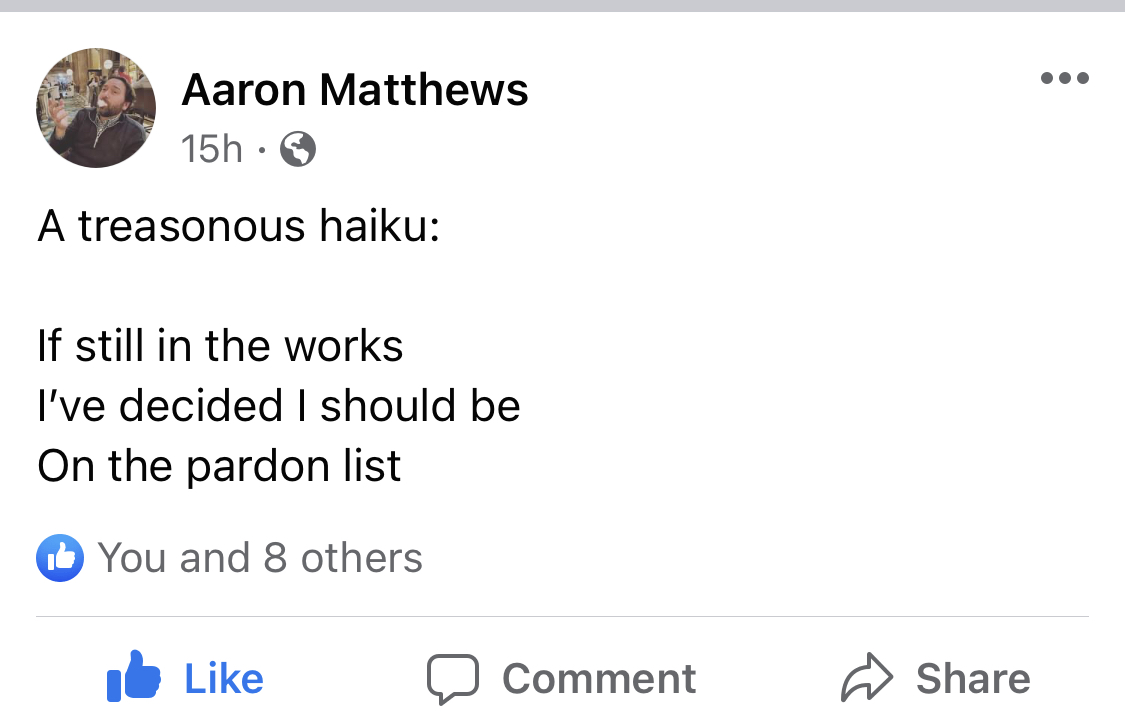
Throughout the day yesterday, witnesses—including Jacob—eviscerated the legal arguments underpinning Eastman’s plan, while lawmakers laid out evidence that Eastman and other Trump allies knew full well the flaws in their strategy—but forged ahead with a pressure campaign urging Pence to go along anyway. After the riot, Eastman was so fearful of legal consequences he emailed Rudy Giuliani that he’d “decided that [he] should be on the pardon list, if that is still in the works.” Trump never gave him one, and according to committee members, he’s pleaded the Fifth Amendment 100 times in his testimony before them.
“Soft Totalitarianism” captures something no other term seems to
I know some good people who scoff that “soft totalitarianism” is an oxymoron, but I haven’t seen a better term for this kind of just-making-shit-up coordinated suppression of unfashionable ideastruths while tolerating truly vile behavior by preferred ideologies:
Not to be outdone, this week, PayPal and Etsy shut down the accounts of biological realist and writer Colin Wright for his persistence in arguing that there are only two sexes. Etsy permanently disabled Wright’s account – where he sold his “Reality’s Last Stand” merch promoting his newsletter – on the grounds that Wright “glorif[ied] hatred or violence toward protected groups.” That’s a lie; Wright never did.
Wright is a biologist who made the grievous error of knowing a thing or two about biology and refusing to genuflect before the Torquemadas who insist he parrot their phony gender science. But of course, while Wright pays this price for his harmless (and, honestly, inoffensive) t-shirts and mugs, Etsy continues to list for sale stickers and pins and other bric-a-brac emblazoned with messages like “Fuck TERFs,” “TERFs can choke,” and “Shut the Fuck up TERF” with an anime creature pointing a semiautomatic handgun at its presumably female interlocutor.
The salacious details can’t really be avoided if I want to illustrate how transgender ideology is intruding on the most intimate realms (and I do):
A natal female who had sex with three women using a specially-made prosthetic has been convicted of assault. Tarjit Singh, born Hannah Walters, met women via online dating, and kept clothes on during intimacy in the dark to avoid being revealed as a natal female. It was only several months into one relationship, on discovery of the prosthetic, that Singh’s natal sex was revealed.
This story reads very differently depending on where you’re standing. Is it a case of sexual assault, with a victim tricked into intimate contact she wouldn’t have accepted if she’d known the sex of the individual she was dating? Or is it evidence of our transphobic society, where stigma forced “Tarjit Singh” first to conceal “his” true self only subsequently to be punished for this with the full force of the law?
Similar cases are happening and, dare I suggest, increasing;
A recent US case, with similarities to that of ‘Tarjit Singh’, resulted in murder … Ismiemen Etute, a Virginia college athlete, beat Jerry Smith to death after discovering he’d posed as “Angie Renee” online to obtain sexual contact with Etute.
Lesbians are being called transphobes for wanting sexual contact only with natalreal women. Sexual louts like Etute commit murder when tricked by a man pretending to be a horny woman.
It appears that sexual liberation has not produced utopia, no?
Old man led by zealots
Nevertheless, our President thinks we need more of what ails us — the veritable definition of insanity:
Biden has never seemed more like an old man being led by zealots than on the topic of medical interventions for gender dysphoric children, where he is deeply radical. Biden this week is signing an executive order banning any federal funds from “conversion therapy,” which is what activists call it when teen girls go to a therapist for a couple visits before getting a mastectomy. His policies are putting America’s approach to this complex topic far to the left of European nations (some of which are pulling away from under-18 medical interventions altogether) and far to the left even of where many trans leaders think we should be.
A Psalm for anxiety over “cancel culture,” “soft tyranny” and some other insanities.
Miscellany
Time-wasters
Although federal, state, and local fair housing laws generally permit discrimination in selecting roommates or housemates, they still prohibit advertisers from mentioning their discriminatory preferences, except for specifying gender. The result is that persons who place classified ads for roommates waste their time, as well as the time of many of those who respond to their ads, by inviting and dealing with inquiries from persons who fail to meet the actual “discriminatory” criteria.
If you liked the All the President’s Lawyers podcast, you are almost certain to like Serious Trouble.
Potty Humor
As long as I’m (uncharacteristically) embedding images, this favorite from the nation of Georgia. There was much, much beauty there, but this gritty, grimy vista along the road from Tbilisi to Stepantsminda was unique:
You can read most of my more impromptu stuff here (cathartic venting) and here (the only social medium I frequent, because people there are quirky, pleasant and real). Both should work in your RSS aggregator, like Feedly or Reeder, should you want to make a habit of it.
I can’t fathom why anyone would want to serve on the Supreme Court. To be more precise, I can’t fathom why any conservative would want to serve on the Supreme Court. Liberal jurists are feted with honors at every juncture. But conservative jurists are excoriated and personally attacked. I wonder, in hindsight, if Kavanaugh still would have pursued a position on the Supreme Court, knowing what we know now: the first confirmation hearing, baseball tickets, Spartacus, Christine Blasey Ford, Michael Avenatti, Ronan Farrow, the second confirmation hearing, yearbook, beer, Klobuchar, Saturday Night Live, Matt Damon, the Dobbs leak, and now an assassination attempt outside of his home. During this time, Kavanaugh and his family have been dragged through such painful experiences, one after the other. Was it all worth it? And to what end?
Creative professionals routinely express their politics in their art—through the art they choose or refuse to create. Famously, for example, shortly after the election of Donald Trump, a number of fashion designers (artists, to be sure) declared that they would, under no circumstances, “dress” Melania or Ivanka Trump –this despite the fact that dresses themselves rarely (if ever) contain a political or cultural message as explicit as the words or image a web designer creates. Merely doing business with the Trumps was an intolerable notion to creative professionals who abhorred the Trump family’s political methods and messages.
In an open letter rejecting the idea of working with the Trumps, designer Sophie Theallet said, “We value our artistic freedom, and always humbly seek to contribute to a more humane, conscious, and ethical way to create in this world.” She said, “As an independent fashion brand, we consider our voice an expression of our artistic and philosophical ideas.” And another designer, Naeem Khan, asserted: “A designer is an artist, and should have the choice of who they want to dress or not.”
In reporting on the designer choices, the Washington Post’s Robin Givhan explained well how artists view their work:
Like other creative individuals, Theallet sees fashion as a way of expressing her views about beauty and the way women are perceived in society. Fashion is her tool for communicating her world vision. In the same way that a poet’s words or a musician’s lyrics are a deeply personal reflection of the person who wrote them, a fashion designer’s work can be equally as intimate. In many ways, it’s why we are drawn to them. We feel a one-to one connection.
If you don’t know the case, you should get to know it.
Colorado, with the help of the 10th U.S. Circuit Court of Appealsl, has mounted the worst, and most explicit, attack on freedom from compelled speech since West Virginia v. Barnette in World War II (when West Virginia required recitation of the Pledge of Allegiance by schoolchildren on pain of expulsion).
Colorado claimed that even though 303 Creative was engaged in pure speech (a key legal category; Masterpiece Cakehop, in contrast, had a creative element but in the end produced not speech, but cake), it could be compelled to create a website for a same-sex wedding because none of the other wedding website creators had exactly the talents of 303 Creative, so 303 was effectively a monopoly and could be forced to create the desired site:
In its decision below, the 10th circuit noted that the petitioners’ artistry created something like a “monopoly,” a market where only the petitioners exist.
Id. Only madness-induced blindness could distinguish the relevant facts of this case from those in West Virginia v. Barnette to the detriment of 303 Creative. Read and enjoy the whole Amicus brief.
Understated
The problem is a reflection of a badly broken political culture and it won’t be easily fixed. But, in the meantime, the House should probably go ahead and pass that SCOTUS protection bill.
The Morning Dispatch on increasing political violence, prompted specifically by the plot against Justice Kavanaugh.
More generally, the Morning Dispatch’s coverage of the successful recall of San Francisco Prosecuting Attorney Chesa Boudin confirms its trustworthiness as a news source: It has more points in Boudin’s favor than I’ve noticed anywhere else, and they aren’t insubstantial.
Sexualia
Incoherent Pride
[I]t is interesting that the American Embassy to the Vatican is flying the rainbow flag for Pride month. Commentators have pointed out the obvious intent to cause offense to the Catholic Church. But the embassy’s decision also sends a message to the American people: Another flag has government endorsement. The message of “inclusion” that it represents signals to those Americans who might dissent from the LGBTQ+ movement that in these interesting times their membership in the republic for which the real national flag stands is more a matter of tolerance than full-blooded affirmation.
The problems with LGBTQ+ inclusion are, of course, manifold. First, there is the logical problem that any movement deploying the rhetoric of inclusion has to face: If everyone is included and nobody is excluded, then the movement is meaningless. Thus, the language of “inclusion” here is really a code word for precisely the opposite: It actually means exclusion and the delegitimizing of any person or group that dissents from what the movement’s movers and shakers deem to be acceptable opinion. Acceptable thought will typically tend toward a view of reality that regards such dissenters as mentally deficient, sub-human, or simply evil.
There are masculine girls. There are feminine boys. What are we going to do? Carve them up?
Jordan Peterson on the Official Trailer for the Matt Walsh documentary (prank-a-thon?) What is a Woman?.
Politics
Relatively successful
Purdue University president Mitch Daniels is retiring at the end of the year. Consistent with his maverick ways over the last 10 years, his successor was announced concurrently with his retirement announcement. There was no public Presidential search, and we will doubtless be treated to days of complaints, petty and serious, about that.
His successor will be the professor and Dean, Dr. Mung Chiang, who served as his Executive Vice President for Strategic Initiatives, of which Purdue has formed a great many over the last 10 years, with some of the biggest corporate names in the world.
I’m very proud of Purdue, my neighbor just across the Wabash, but I would prefer that my loved ones not attend there.
First, like most major universities today, the streets of the campus flow with alcohol, which endangers students of both sexes with the ambiguities of sexual interactions between drunks.
Second, I prefer undergraduate liberal arts education to enlisting in the Technocracy fresh out of high school.
But it seems to me that Mitch Daniels has been a tremendously successful Ginormous Research University President, and I wish him well.
"A Crucial Element of Fascism"
The American militia movement is small, but in the early days of 2021, it nonetheless came to the aid of a lawless president seeking to use force to keep himself in power. It did so by attacking the national legislature and threatening to kill elected representatives of the American people. And when this happened, the president himself stood back and stood by, watching expectantly, refusing to call off the armed mob, hoping the violence might empower him to remain in the White House despite losing the election two months earlier. In doing so, Trump ended up injecting a crucial element of fascism into the country’s political system.
I don’t use the F-word lightly. Trump winning the presidency while losing the popular vote by three million isn’t fascism. Trump appointing a record number of judges and three Supreme Court justices who appear poised to overturn Roe v. Wade isn’t fascism. Trump attempting to close the southern border to immigrants and refugees isn’t fascism. Trump’s verbal attacks on the media aren’t fascism (though they could be said to lay the groundwork for it by stoking popular rage against a free press). Trump engaging in the politics of bullshit by lying constantly to the American people isn’t fascism (though it, too, can prepare the way for it by leading voters to despair of firmly distinguishing between fact and falsehood).
But groups of organized, armed thugs allied with the president acting at his request to prevent the peaceful and lawful transfer of power to his successor is absolutely a fascist act. We’ve seen nothing remotely like it elsewhere in the democratic world, no matter how bad the illiberal policies and rhetoric of newly emboldened right-wing populists in other countries have been.
Republicans are the co-creators of Trump’s corrupt and unconstitutional enterprise. The great majority of them are still afraid to break fully with him. They consider those who have, like Liz Cheney, to be traitors to the party. They hate Cheney because she continues to hold up a mirror to them. They want to look away. She won’t let them.
My fair city has approved a resolution declaring racism a public health crisis.
The statistics on racial disparities are stark. But unless the reporting is botched — a very real possibility considering that our Gannett paper hovers near death — the response is one of those "OMG! WE’VE GOT TO DO SOMETHING!" responses, and implicitly accepts the dogma that all racial disparities are caused by racism.
My point would be mere pedantry were it not for the likelihood that a vague diagnosis of "racism" as the cause is likely to lead to errant treatment.
Stochastic Terrorism
I’m kind of a sucker for portentous names given to commonsense observations. My new one is "stochastic terrorism," introduced by David French with a link to Todd Morley.
As French puts the commonsensical translation:
The concept is both common-sense and controversial. The common-sense element is easy to explain. If you’re a normal person and five people hate you, what are the odds you’ll face targeted violence? Unless you’re engaged in criminal activity yourself (and the five people who hate you are other criminals), then the odds are almost impossibly low.
But what if 50,000 people hate you? Or five million? Then the odds change considerably, until they reach a virtual certainty that you’ll face a threat of some kind.
Why did the Californian last week go after Justice Kavanaugh instead of Justice Alito? How many million people hate Brett Kavanaugh? How did there come to be so many who hate him? D’ya think it might have something to do with the over-the-top attacks during his confirmation hearings?
That’s how you build a frenzy from which someone emerges to exact just retribution on some putative fiend. Todd Morely names a few names.
(FWIW: I cooled about 20 degrees on Kavanaugh as soon as it emerged that he has been a heavy recreational beer-drinker since years before he could drink legally. Call me extreme — and on this topic, I clearly am far out of the American mainstream — but I think a Supreme Court Justice should have a history of abiding even by annoying little laws like minimum drinking age, and of sobriety both literal and figurative. Drunken frat boys are a turnoff even when they don’t grope co-eds.)
Well, anyway, back to stochastic terrorism. French again:
Of course the ultimate recent example of hatred and fury spawning violence is the attack on the Capitol on January 6. It was perhaps the most predictable spasm of violence in recent American history. One cannot tell tens of millions of Americans that an election is stolen and that the very fate of the country hangs in the balance without some of those people actually acting like the election was stolen and the nation is at stake.
But if the concept of stochastic terrorism is so obviously connected to human experience, why is it controversial? In part because it aims responsibility upward, and it places at least some degree of moral responsibility for violent acts on passionate nonviolent people. While criminal responsibility may rest exclusively with the person who carries the gun (or his close conspirators), moral responsibility is not so easy to escape.
(Emphasis added).
Too long I have blithely and exclusively "blamed the person who carries the gun", discounting (if not ignoring) incitements that stop short of criminality. I remain a free speech advocate, and I detest the idea that any truth is too dangerous to be uttered lawfully. But it is becoming too, too obvious politicians and pundits who make careers of vilifying specific opponents, and internet jackasses who doxx the scapegoat du jour, are playing with fire, and at the very least should face political, social and commercial* sanctions.
And to the extent that I have dehumanizingly vilified Donald Trump over the last three years, mea culpa, mea culpa, mea maxima culpa!
(* I have in mind commercial sanctions like boycotting Tucker Carlson’s advertisers, but I don’t want to watch him to find out who they are.)
UPDATE:Jonah Goldberg alludes to who Tucker’s advertisers are:
Seb Gorka dron[ing] on about Relief Factor (a fish oil supplement that all super-patriots take before they put their heads on Mike Lindell’s pillows)
No chance for boycotting there.
Religion
Normally, I’d consider putting Religion in first position, but the following are not the kinds of dogma or dogma-adjacent things that cry out for that.
Here’s to you, Mrs. Robinson
In David & Bathsheba, we see a man in the act of either removing—or replacing—a jacket from a woman’s shoulders. Is this the moment before or after King David has committed adultery with the wife of his general? Mrs. Potiphar presents us not with a cartoonish harridan panting after the biblical Joseph, but an attractive, middle-aged woman staring pensively at her reflection in a mirror. McCleary treats the incident not in terms of mere lust, but in a larger psychological and spiritual context of loneliness and fear of death.
The "Mrs. Potiphar" Wolfe refers to is presumably this:
If you don’t know the allusion, read Genesis 39. If you don’t know what Genesis 39 is, may God have mercy on your ignorant soul.
A Dangerous Inversion
To justify Christianity because it provides a foundation of morality, instead of showing the necessity of Christian morality from the truth of Christianity, is a very dangerous inversion; and we may reflect, that a good deal of the attention of totalitarian states has been devoted, with a steadiness of purpose not always found in democracies, to providing their national life with a foundation of morality — the wrong kind perhaps, but a good deal more of it. It is not enthusiasm, but dogma, that differentiates a Christian from a pagan society.
Eliot’s “dangerous inversion” is very much the model for the intersection of religion with politics in our time: Religion is, and is almost universally assumed to be, the junior partner.
American Evangelicals as Cultural Christians
What has happened is that the Christian sense of collective identity has persisted even among those hollowed-out Christians who have abandoned Christian orthodoxy, reducing the Christian confession to a demographic box to check, one of many constituent parts of an American “national identity.” Never mind, for the moment, that one of the hallmarks of the authentic American identity is approaching Christian orthodoxy and Christian observance with a seriousness that brushes up against fanaticism: The story of the United States does not begin with the arrival of the first slave, as the 1619 Project would argue, but with the arrival of the first Separatist.
…
For a century or so, Americans have had friends and countrymen who are “culturally Jewish.” We know what that means: a Jewish sense of communal identity bound to that vague American religious sensibility that sits somewhere between Protestant and agnostic — not atheistic, but operatively secular. I have not heard many Catholics call themselves “culturally Catholic” — Catholics who have given up Catholicism mostly just continue to call themselves “Catholic,” with the “cultural” qualifier being understood. In the case of Catholics, the communal identity is not in the end religious at all but is instead only the detritus of immigrant ethnic identities that have been dissolved in the hot soup of modernity. Conservatives used to be the ones who preferred the “melting pot” model of communal life to ethnic and religious particularism, but the rightist element Hochman writes about has, to some considerable degree, abandoned that. And so we have that new thing, the “cultural Christian.” I believe the first time I ever heard the term used was by Richard Spencer, the white nationalist, who found his parents’ Episcopalianism insufficiently invigorating.
…
Evangelicals, particularly white Evangelicals, are an important part of the new coalition that was formed around the campaign and cult of Donald Trump, but Christian thinking per se plays almost no role in that cult. Indeed, it would be very difficult for these Christians if it were otherwise: Donald Trump is an idolator and a heretic, a blasphemer and a perpetrator of sacrilege, and much more ….
You can read most of my more impromptu stuff here (cathartic venting) and here (the only social medium I frequent, because people there are quirky, pleasant and real). Both should work in your RSS aggregator, like Feedly or Reeder, should you want to make a habit of it.