
Category: Architecture
The Essence of The Essence (4/21/14)
I’m unapologetically light on blogging post-Pascha. Or was that prior sentence a sort of apology?
The Essence of Conservatism is an uneven book, with lots of typos in the Kindle edition (which may be the only form in which the book exists) but it’s well worth $2.99.
- Americans know what they can expect from the left—an endless series of upheavals aiming at utopia. But for too long the right has offered much the same thing, pursuing its own utopia through wars and nation-building abroad and the debt economy at home.
- A mere decade after the end of the Cold War had delivered history to a neat and satisfying conclusion the 9/11 attacks occurred. Along with horror and heartbreak came humiliation. How could 19 thugs armed with nothing more than box cutters have caught the indispensable nation so completely off-guard? Many factors contributed to the United States being surprised. Prominent among them was the self-congratulatory mindset to which Washington had succumbed during the 1990s…
- As Richard Perle and David Frum, co-authors of the agitprop classicAn End to Evil, put it, “There is no middle way for Americans: It is victory or holocaust.” … Along with victory or holocaust there turned out to be a third possibility that Perle and Frum had overlooked: exhaustion resulting from our own folly and malfeasance. (Typo in original)
- Rather than peering deep into the future, the United States is demonstrably unable to see even into next week, with major events—the Arab Spring being the most recent example—catching Washington asleep at the switch.
- The years 1991 and 2001 are commonly treated as breakpoints, markers that inaugurate distinctive chapters of history, the first labeled “Post-Cold War,” the second “Post-9/11.” Yet there is a strong case to be made for amalgamating the two decades into a single period: call it the “era of ideological fantasy,” when U.S. self-regard and Washington’s confidence in its ability to remake the world in America’s image reached unprecedented heights.
- Burkean conservatism has never sat easily with the conditions of American life. Whereas Europe provided conservatism with history and tradition, the United States emerged as a “nation without a past.” That overstates things, but the quest for roots, stability, continuity, and tradition has never been simple here.
- The notion that wisdom somehow lies in the intuitive sense of the majority at any time, Babbitt wrote, “should be the most completely exploded of all fallacies.”
- [T]he really animated core of the political lobby that supports illegal immigration—its mass base, so to speak—is composed of rich homeowners, who desperately want someone to do their dirty work and to do it cheaply.
- The wealth of the very rich is never the product of free enterprise and the free market alone but comes by operating within and exploiting a network of government supports, such as licenses, regulations, subsidies, and contracts. It is the product of a sort of giveaway. [Yes, a conservative just said, in effect, “You didn’t build that.”]
- The way people define themselves is different in a consumer society, with a total focus upon individual self-gratification, than it is in a producer society, with an emphasis on the social consequences and connections of one’s work. It is obviously much more difficult to politically organize masses of people if they all think of themselves as individual consumers or as expressive individualists, each freely choosing his own unique (even if vapid and banal) lifestyle, than to organize masses of people who think of themselves as members of working classes or local communities, who share in common most of the important conditions of their lives.
- [T]he most rational thing about rationality is that it knows its own limits. When even sensible economists forget they are dealing with human beings, we should forget them.
-
Roepke’s world collapsed in August 1914. Our world collapsed in September 2008. Both, we can now see, were doomed long before they fell. Out of the ruins what shall we build? Another Tower of Babel, another building too big to fail? Perhaps, if we are wise, we might try smallness for a change.
-
Conservatism has become so weak in ideas that during the presidency of George W. Bush, the word “conservative” could be and was applied with scant objection to policies that were starkly anti-conservative. Americans witnessed “conservative” Wilsonianism, if not Jacobinism, in foreign policy and an unnecessary foreign war; record “conservative” trade and federal budget deficits; major “conservative” expansions of the power of the federal government at the expense of traditional liberties; and nonchalant “conservative” de-industrialization and dispossession of the middle class in the name of Ricardian free trade and Benthamite utilitarianism. No wonder the American people are confused and disillusioned by conservatism.
- This is the second action the next conservatism must take: putting power in its place. Tolkien’s ring of power is power itself, which in the long run cannot be used for good.
- [T]he next conservatism should revive the dormant conservative agrarian tradition. As the Amish demonstrate, the small family farm can be economically viable. Organic farming, conservation and restoration of the soil, farmers’ markets and “crunchy cons” should find an honored place in the next conservative agenda. Family farms are good places for children to grow up. While environmentalism is becoming an ideology, conservation and care in the use of God’s creation have long-standing conservative credentials. In turn, agriculture has always been a conservative culture. [Agenda-driven conservatism is an odd fit in this collection of essays that focuses more on disposition than agenda.]
-
Another old conservative issue the next conservatism should revive is aesthetics. America may be the richest nation in history, but that has not made it the most beautiful. Strip malls, suburban sprawl, and hollowed-out cities have created an environment few people can love. The New Urbanism offers an alternative that looks to the past to recover traditional designs for towns and cities.
-
Having spent 3,000 bloody years replacing the image with the word, should we now be untroubled that television, video games, and computer screens are replacing the word with the image?
- Lukács was a very clever literary critic, who took part in the Communist revolution in Hungary after World War I and joined the government of Béla Kun. As a political commissar, he was responsible for purges, executions, and cultural suppression. When Kun’s government was overthrown, he fled to Vienna, returning after World War II to assist the revolutionary Communist government in purifying Hungary of dissident intellectuals. His career is one long history of crime and deception, yet he has been consistently revered as a leading left-wing thinker: the person who showed us how to apply Marxism to literary criticism and how to understand literature as a genuinely revolutionary force … Heidegger belonged to the wrong set of criminals.
- [T]his weakness in the statist approach of communism is replicated in some capitalist economies—notably here in the United States with the unscrupulous and often corrupt use of eminent domain.
-
The real cause of the environmental problems we face is not so much large private enterprises or the pursuit of profit or even capitalism as such. It is the habit we all have of externalizing our costs.
-
[S]uburbanization forces millions to go to work in cars everyday when they might have been walking. It requires vast acreages of the countryside to be covered with buildings and roads, destroying natural ecosystems. Yet it goes ahead because it is something that people want, and the cost can be easily externalized onto other generations or people in other parts of the world.
-
“My misgivings are not about the wretched architects,” continued Baker, “who must give Washington what it pays for, but about their masters who have chosen to abandon the human scale for the Stalinesque. Man is out of place in these ponderosities. They are designed to make man feel negligible, to intimidate him, to overwhelm him with the evidence that he is a cipher, a trivial nuisance in the great institutional scheme of things.”
-
“President Reagan’s deepest soul is not Republican-conservative but New Deal-Second World War Democrat. Thus his well noted preference for citing FDR and Kennedy as noble precedents for his actions rather than Coolidge, Hoover, or even Eisenhower.
-
Among the worst aspects of the collapse of traditional conservatism is that my children will grow up in a world in which vulgar and belligerent nationalism will be presented to them as the alternative to leftism.
-
[T]his story-with-a-moral assumes American omnipotence: if any evil is committed anywhere in the world—be it the Ukrainian famine, the Rape of Nanking, or the rise of Benito Mussolini—it is only because we Americans selfishly failed to prevent it.
- For the low church conservative, politics is teleocratic—a purpose-driven activity.
- [Evelyn Waugh] famously greeted the removal of Randolph Churchill’s non-malignant tumor with the verdict: “It was a typical triumph of modern science to find the only part of Randolph that was not malignant and remove it.”
- Late in life, during the Second Vatican Council’s alleged golden dawn, Waugh received an invitation to a book launch by self-consciously “progressive” Catholics. He shot back by postcard his unforgettable RSVP: while he would not attend a social meal in the progressives’ company, “I would gladly attend an auto da fé at which your guests were incinerated.”
- … Vatican II, concerning which [Waugh] proved incapable of accepting casuistic official bromides about how the conciliar church was just like the preconciliar church, only 100 times better.
(Favorites bolded)
* * * * *
“The remarks made in this essay do not represent scholarly research. They are intended as topical stimulations for conversation among intelligent and informed people.” (Gerhart Niemeyer)
Tuesday 1/14/14
Thanksgiving bonus
Anca Petrescu, B.I.H.
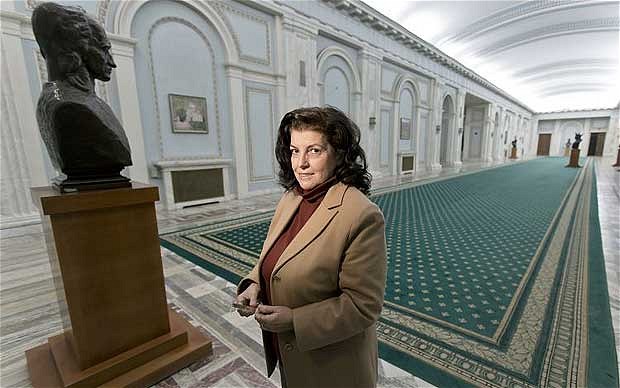
Oh, my! The Telegraph has an obituary of Romanian Architect Anca Petrescu that might as well conclude “Burn in Hell, you brazen hussy”:
Anca Petrescu, who has died following a road accident aged 64, was an architect known as the “Albert Speer of Communism”, responsible for the Romanian dictator Nicolai Ceausescu’s “Palace of the People” in Bucharest — the world’s greatest monument to totalitarian kitsch.
…
In February 1982, at the age of 32, Anca Petrescu was appointed chief architect of a project whose raison d’être, in Ceausescu’s tautological phrase, was to be “a grandiose edifice that reflects the epoch of the time”.
…
When interviewed about her role in building the People’s Palace, Anca Petrescu tended to lapse into evasive, Soviet-style doublespeak, cutting off interviewers brusquely if they enquired about her relationship with Ceausescu. When asked by one western journalist how she justified the suffering Romanians went through as a result of her work, she retorted: “That is a question originating from someone who can only understand a system based on profit as motivation.” Her favourite novels, she revealed, were the “sick works of Dostoevsky and Tolstoy, because they fit my soul”.
The story brings back a bit of the horror of Ceausescu. I recall my then-Calvinist heart swelling with pride as I read about how he was toppled by a doughty band of Romanian Calvinists, who probably toppled him from calloused knees.
I forget the details (but the New York Times remembers) and you’ve probably never heard them since the story’s pretty implausible in retrospect when everyone knows Ronald Reagan toppled Communism on his feet.
Oh. Margaret Thatcher, too. And ordinary Polish Catholics. Led by Lech Walesa. Sound track by the late Lou Reed. With a cameo appearance by Plastic People of the Universe.
But oddly, apart from episodes like the capture of Hussein or the death of Bin Laden, I don’t hear anyone claiming the success someone or other pulled off in Iraq and Afghanistan.
* * * * *
“The remarks made in this essay do not represent scholarly research. They are intended as topical stimulations for conversation among intelligent and informed people.” (Gerhart Niemeyer)
Monday, August 12, 2013
Sunday, July 21, 2013
James Howard Kunstler at NYCNU
Pro Tip: Read from the bottom up. Continue reading “James Howard Kunstler at NYCNU”
Another Potpourri
Property tax death march
I’m not going to waste time speculating about motives, except that it’s hard to imagine that nobody was aware of engaging in sophistry when they sold towns on the need for big-box stores. Nathaniel Hood looks at a microcosm of the larger pattern in WalMart vs. Local Pub.
The WalMart in question pays the equivalent of $23,284 per acre in property taxes. Since it’s at the edge of town, it required a lot of new roads and other infrastructure from the city.
Pub 500 pays the equivalent of $82,125 per acre. It sits on a streetcorner that’s been there since at least 1870. A few new pipes were required from the city when it built (I don’t know what happened to the building that was there before).
Many other numbers cut in favor of small business when you look at them. Maybe the only ones that don’t are “does it have in-house sophists to sell itself to local officials desperate enough for renewal of their cities that they’ll drink the Growth KoolAid?”
Unless you’re affiliated with the WCTU and think Pub 500 should pay disproportionately because it’s evil, what justification can you give for what amounts to a whopping subsidy to WalMart?
A pretty strong case can be made that we cannot afford to maintain a lot of the infrastructure we’ve been enticed to build by the growth sophists and the lure of “free” federal money to help. A rude wake-up call is coming.
A number of my sidebar “sustainability” links deal with these issues, as does the Congress for the New Urbanism, from a more professional and less activist angle.
* * * * *
 Tipsy Teetotaler ن