Thursday, 12/4/25

Luxury Beliefs

There are all kinds of ideas and policies that would have bad effects if implemented. But there is a special class of bad ideas and policies that proliferate in good part because those who hold them, being insulated from their effects, have never seriously thought about the consequences that would ensue from their implementation. The reason why the concept of luxury beliefs has resonated so widely is that it gives a name to people who treat as a parlor game questions that potentially have very serious consequences—just not for themselves.

Yasha Mounk, Luxury Beliefs Are Real.

We owe a debt of gratitude to the young man who coined this phrase. It strikes me as analogous to the whoring and wenching of the rich and famous which does not, shall we say, translate well to kids in The Projects (but is more like a transgressive raised-middle-finger than a “belief”).

The Hive Mind

Consider this ominous anecdote from Steven Mintz, a history professor at the University of Texas at Austin:

I require substantial writing in my 400-person U.S. history survey course—but now I largely receive 400 variations on the same essay. The wording, structure, transitions, tone, even the closing sentences are largely identical.

This is eerily like the zombie-ish characters in Pluribus, who all say the exact same thing.

But in Mintz’s case, this is real behavior from real students. They have voluntarily abandoned their individual opinions and embraced the hive mind.

And the hive mind is available to all of them via Chat GPT.

I actually take some solace in TV series such as Pluribus and Severance. They show how anxious we are about this threat. At some deep level in our souls, we know that the destruction of our autonomy and selfhood is not a good thing.

It isn’t progress. It isn’t utopia. It isn’t liberation.

And that is the first step in escaping the ant hill. The next step is to bring others along with us.

This is why I keep talking about a New Romanticism (see here and here). That is our counter-offensive, and it’s already starting.

Ted Gioia, The New Anxiety of Our Time Is Now on TV (bold added)

Fundamental law

Ultimately, however, constitutionalism means that society must accept an unpopular policy that respects constitutional limits over a popular policy that violates them. The very foundation of constitutionalism is that certain fundamental protections—whether for free speech or the separation of powers—must be beyond the reach of popular majorities. There will almost always be some policy that is popular but unconstitutional.

Andrew O’Donohue on “court-baiting.”

The Reality of Irreligious Violence

The shift from church power to state power is not the victory of peaceable reason over irrational religious violence. The more we tell ourselves it is, the more we are capable of ignoring the violence we do in the name of reason and freedom.

William T. Cavanaugh, The Myth of Religious Violence.

I have published this on several Sundays over the years, I’m sure, but with our POTUS and ever-so-manly-and-full-of-lethality “Secretary of War” gleefully murdering supposed drug dealers in the Caribbean in the name of fighting “narco-terrorism,” it seems like a worthy weekday reminder now.

As a Chosen People with what Niebuhr refers to as a “Messianic consciousness,” Americans came to see themselves as set apart, their motives irreproachable, their actions not to be judged by standards applied to others.

Andrew Bacevich in his Introduction to a 2008 University of Chicago Edition of Rheihold Niebuhr’s The Irony of American History.

Shorts

  • What’s important to notice is that it isn’t, and never was, “Orthodoxy is masculine.” It only felt masculine, in comparison with the general run of American churches. (Frederica Matthewes-Green)
  • Put someone with a complex about not being respected in charge of an agency with guns and you’re asking for trouble. (Nick Catoggio, A Few Bad Men)
  • The problem is not so much that public policy has failed as that it has succeeded at the wrong things. (Oren Cass, The Once and Future Worker)

Elsewhere in Tipsyworld

Saturday, 11/8/25

Public affairs

Give me that old, boring gummint

An aspect of the modern conservative disposition is that we like the arts, culture and technology to be interesting and exciting, but we prefer government be boring, a stabilizing force while we act up in other areas. But it’s never boring now and likely won’t be in this century. Too bad.

Peggy Noonan

Nancy Pelosi

[F]or the anti-Trump right (insofar as such a thing exists outside the Dispatch break room), Pelosi’s departure is a grim symbol of the Duma-fication of Congress. It’s fitting that the most formidable Democratic legislator in modern U.S. history will leave office in 2027 on the same day as the most formidable Republican legislator in modern U.S. history. Serious institutionalists like Pelosi and Mitch McConnell have no business in a branch of government that no longer exists as a serious institution.

Nick Catoggio

Sorry, Senator Young

Sorry, Senator, but I won’t answer.

I could probably rank this list, but I fear I’d see it misrepresented as “my constituents’ most important issue is …”, whereas my real most important issue is the impeachment and conviction of Donald J. Trump, who defiles everything he touches.

Remember: the theory behind Presidential immunity from criminal prosecution was “that’s what impeachment is for.” Well, put on your big-boy pants and take out the trash.

(I was reminded yesterday that my sanctimony toward sleazy politicians is a persistent feature. I voted for McGovern because Nixon was a crook, McGovern an honorable guy I disagreed with on just about everything. I don’t vote for Democrats often, but I’ve found creative ways not to vote for Trump’s corruption and rapacity nonetheless.)

Clueless

A driver smashed into pedestrians and bikers on the beautiful French island of Île d’Oléron.

I’m so excited for the investigation to reveal the motive behind someone driving their car into random French cyclists and screaming “Allahu Akbar.” I don’t know about you, but he sounds like a Christian nationalist to me. Anyone else smell a fresh pine and cinnamon Bath & Body Works candle? This guy is all in on Replacement Theory, I just know it.

Nellie Bowles

Culture

Grief

Grief turns out to be a place none of us know until we reach it. We anticipate (we know) that someone close to us could die, but we do not look beyond the few days or weeks that immediately follow such an imagined death. We misconstrue the nature of even those few days or weeks. We might expect if the death is sudden to feel shock. We do not expect this shock to be obliterative, dislocating to both body and mind. We might expect that we will be prostrate, inconsolable, crazy with loss. We do not expect to be literally crazy, cool customers who believe that their husband is about to return and need his shoes. In the version of grief we imagine, the model will be “healing.” A certain forward movement will prevail. The worst days will be the earliest days. We imagine that the moment to most severely test us will be the funeral, after which this hypothetical healing will take place.

Joan Didion, The Year of Magical Thinking.

This is the first Joan Didion I’ve read. I’m told that it’s not her best, but it was plenty good enough for me.

Me, too

(Yes, I know it’s more than a little absurd that I’m writing a post about a TV show that ended its run eight years in the past. The thing is, I almost never watch series when they first appear. I usually turn to them, instead, years later, after I’ve heard enough praise that I feel like their quality has been adequately verified to justify my time and attention. This way of proceeding has never let me down. And anyway, in an era of streaming, there’s nothing to keep a decade-old show from becoming someone’s big new discovery years after it drops.)

Damon Linker, winding up for a glowing post about an HBO Series, The Leftovers.

I’m with him on not rushing to watch a new series. Most of them are trash – precisely as most of all art, music and literature are trash. It was ever so. What’s good will endure.

Words of the Day

The words of the day are pareidolia and apophenia.

Well, I didn’t know them, and much as I love big words this may be the last time I ever use them.

Snippets

  • Mystery is a great embarrassment to the modern mind. (Flannery O’Connor)
  • Foul is fair and fair is foul. (Shakespeare, though I was thinking of John Maynard Keynes’ distillation of his case for temporary rapacity.)
  • What Stephen A. Smith is to sports talk, Tucker Carlson is to obsessive anti-Zionism. Rich Lowry
  • All civilizations are as transitory as the people now in cemeteries. And just as we must die, so too must we accept that there is no return to a civilization whose time has come and gone. (Abdülhak Şinasi Hisar via Orhan Pamuk, Istanbul)
  • The people [Trump] picks tend to be a grab bag of personality disorders who squabble and fight for power, he tends to screw them over when they annoy him, and they’re all quite annoying. (Ken White, Refuge in Kakistocracy, Popehat)
  • The problem with pornography is not that it shows too much of a person, but that it shows far too little. Pope John Paul II via Isabel Hogben
  • Populism is fundamentally a form of suspicion. Yuval Levin on the Remnant podcast.
  • We need to be a big tent so as to include neo-Nazi and Nazi-adjacent people, [and] if you have a problem with that, you need to get out of the tent. Jonah Golberg on the Remnant podcast criticizing the “popular front mind” on the Right.
  • Dick Cheney couldn’t get over Jan. 6. Ramesh Ponnuru (That’s got to be among the most understated things I’ve seen this week.)

We are all gatekeepers now.

Peggy Noonan

Your enemies are not demonic, and they are not all-powerful and the right hasn’t always lost and the left hasn’t always won. But if you convince yourself of that, you give yourselves all sorts of permission to do a lot of stupid and terrible things under the rubric of “Do you know what time it is?”

Jonah Goldberg.

[A] critical mass of the American people … no longer want[s] to govern themselves, … are sick of this republic and no longer want to keep it if it means sharing power with those they despise.

Nick Catoggio

I don’t do any of the major social media, but I have two sub-domains of the domain you’re currently reading: (a) You can read most of my reflexive stuff, especially political here. (b) I also post some things on my favorite no-algorithm social medium.

No Kings Saturday, 10/18/25

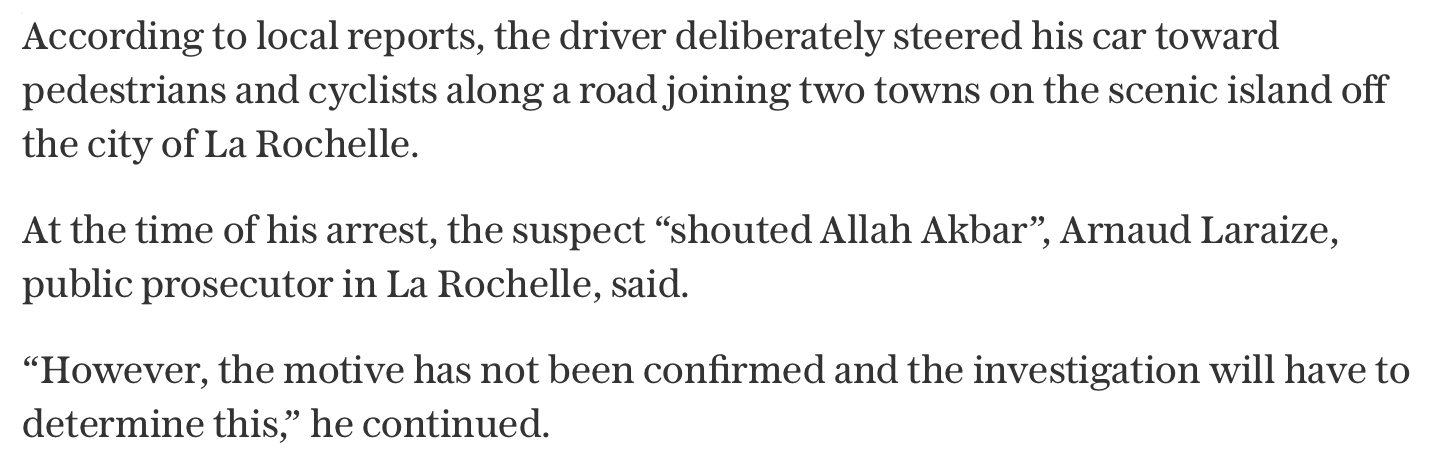
No kings!

Binding precedent

Protesters have protested at an ICE facility a few miles west of Chicago for the past 19 years—with somewhat more intensity recently following the announcement of Operation Midway Blitz. A month after the announcement, the president federalized the Illinois National Guard. District court: Enjoined. Seventh Circuit: Just so. Political opposition is not rebellion, and a protest doesn’t become a rebellion merely due to a few isolated incidents of violence. Without that, none of the statutory predicates for federalizing the National Guard have been met.

Institute for Justice, Short Circuits for 10/17/25 (bold added). This is now the law in the 7th U.S. Circuit – Indiana, Illinois and Wisconsin.

Look for the Administration to try to provoke a rebellion it can crush. Everyone who’s paying attention knows Trump wants to invoke the Insurrection Act (as he stuffs his pockets and those of his family).

Wanted: a viable counternarrative

Trump’s actions … are part of one project: creating a savage war of all against all and then using the presidency to profit and gain power from it. Trumpism can also be seen as a multipronged effort to amputate the higher elements of the human spirit—learning, compassion, science, the pursuit of justice—and supplant those virtues with greed, retribution, ego, appetite. Trumpism is an attempt to make the world a playground for the rich and ruthless, so it seeks to dissolve the sinews of moral and legal restraint that make civilization decent.

Trumpism, like populism, is more than a set of policies—it’s a culture. Trump offers people a sense of belonging, an identity, status, self-respect, and a comprehensive political ethic. Populists are not trying to pass this or that law; they are altering the climate of the age. And Democrats think they can fight that by offering some tax credits?

To beat a social movement, you must build a counter social movement. And to do that, you need a different narrative about where we are and where we should be heading, a different set of values dictating what is admirable and what is disgraceful. If we fail to build such a movement, authoritarian strongmen around the globe will dominate indefinitely.

David Brooks.

You can’t beat something with nothing. I can’t come up with a political counternarrative to Trumpism. The Democrats can’t come up with a political counternarrative, either. Brooks couldn’t come up with a strong political counternarrative.

I can only hope and pray that people will look for their compelling (counter-)narrative to the Gospel of Jesus Christ. (And that meantime there will be some legal counternarratives to prevent irretrievable damage, as in the preceding item.)

Music Reviews

There may be nothing better than old music reviews to let you know that it’s okay to like what you like, critics be damned.

I like Debussy’s La Mer, and I don’t care what the stupid early reviews said:

On today’s date in 1905, Claude Debussy’s orchestral suite La Mer or The Sea was performed for the first time in Paris. Today this music is regarded as an impressionistic masterpiece, but early audiences — especially those in America — found it rough sailing.

“We clung like a drowning man to a few fragments of the tonal wreck,” wrote a 1907 Boston critic, and suggested that instead of The Sea Debussy should have titled his piece Sea-Sickness.

“The Sea is persistently ugly,” wrote The New York Times that same year. “Debussy fails to give any impression of the sea … There is more of a barnyard cackle in it than anything else.”

And in 1909, this on La Mer from The Chicago Tribune: “It is safe to say that few understood what they heard and few heard anything they understood … There are no themes … There is nothing in the way of even a brief motif that can be grasped securely enough by the ear and brain to serve as a guiding line through the tonal maze. There is no end of queer and unusual effects, no end of harmonic complications and progressions that sound so hideously ugly.”

Ah, the perils of “modern music” in the early 20th century!

Giving the Devil his due, impressionism had to be a real mind-blower for critics attuned to, say, the sonata-allegro form.

Comprehensive tradition

We’re often not very aware of the “tradition” in which we live. A student in a classroom would readily agree that the words of a teacher or professor were a “traditioning” of sorts. But they will fail to notice that how the room is arranged, how the students sit, what the students wear (or don’t wear), how the professor is addressed, how students address one another, what questions are considered appropriate and what are not, and a whole world of unspoken, unwritten expectations are utterly required in the process. The modern world often imagines that “online” education is equivalent to classroom education since the goal is merely the transmission of information. But the transmission of information includes the process of acquiring the information and everything that surrounds it. Those receiving the “tradition” online will have perhaps similar information to those receiving it in a classroom – but they will not receive the same information.

Fr. Stephen Freeman, The Tradition of Being Human

Stages of life

Two questions:

  1. Do I want to read/watch/listen to this?
  2. Should I read/watch/listen to this?

When I was younger the second question often dominated my decision-making. Now that I am officially ancient that question has virtually disappeared and the first one is usually the only one I ask. That’s been the single most notable change in my personality in these my declining years.

Alan Jacobs

Alan is a decade or more younger than me, yet I only very recently seem to have arrived at this point, especially regarding political matters.

Note that he’s talking about a change in personality. This isn’t a life rule. There are things that younger people should read/watch/listen to, in order to become well-formed human beings.

Two ways

[R]evival begins with the people proclaiming, by word and deed, “I have sinned.”

MAGA Christianity has a different message. It looks at American culture and declares, “You have sinned.”

David French

Noteworthy

In the aftermath of Kirk’s murder, we witnessed young people at vigils rather than at “mostly peaceful” demonstrations.

R.R. Reno in First Things


We are all gatekeepers now.

Peggy Noonan

Your enemies are not demonic, and they are not all-powerful and the right hasn’t always lost and the left hasn’t always won. But if you convince yourself of that, you give yourselves all sorts of permission to do a lot of stupid and terrible things under the rubric of “Do you know what time it is?”

Jonah Goldberg.

[A] critical mass of the American people … no longer want[s] to govern themselves, … are sick of this republic and no longer want to keep it if it means sharing power with those they despise.

Nick Catoggio

I don’t do any of the major social media, but I have two sub-domains of the domain you’re currently reading: (a) You can read most of my reflexive stuff, especially political here. (b) I also post some things on my favorite no-algorithm social medium.
Friday, 10/10/25

Nonpartisan

Levelers

Emily Ruddy was traveling the country with her new husband, Mike, when news reached them of Charlie Kirk’s shooting, then death:

Back in the car with Mike, approaching the Florida border, I’m looking at pictures of Charlie Kirk on my phone. He is staggeringly tall, taller than I ever realized, with a celebratory fist in the air. Reading his Wikipedia page, which has now been changed to past tense, I am reminded of a story I first read in middle school: Kurt Vonnegut’s “Harrison Bergeron.” The story is set in the late twenty-first century, in a dystopian America where the authorities have taken it upon themselves to ensure no person is better than another, be it in athleticism, intelligence, or beauty. The strong citizens get weighed down with bags of bird shot. The attentive citizens are intermittently bombarded with hideous sounds through tiny radios in their ears. The most beautiful faces are concealed by hideous masks.

But it’s the title character, Harrison Bergeron—exceptionally tall, handsome, brilliant and outspoken—who is shackled most heavily. At the end of the story he breaks through the shackles, and as punishment he is shot down on live TV: a warning to whoever tries to pull a similar stunt. Or at least, it would be a warning, if the viewers’ memories weren’t instantly blasted away by the ear radio’s next awful sound.

Emily Ruddy, Battle Above the Clouds.

If you haven’t read Harrison Bergeron, a (very) short story, by all means do. It’s freely available, like, for instance, here.

After Christian faith dies

The biggest confusion among my own students used to be rudderless moral relativism.  Although there is still a lot of that, it seems to be on the decline.  Now the problem is the explicit embrace of evil.  The suggestion that one must never do what is intrinsically evil for the sake of a good result is a hard sell.  Many of students are strongly attracted to “consequentialism,” the view that whether an act is right or wrong is determined only by the result.  To say that the ends do not justify the means puzzles them.

The decline of faith has also produced changes in character.  Young people who were raised in Christian homes, but then abandoned Christianity, often used to retain vestiges of their moral upbringing, and accepted such ideas as courtesy, love of neighbor, and the sacredness of innocent human life.  Today, having grown up in faithless homes, many seem to think that courtesy is for fools, that no one with whom they disagree is their neighbor, and that they should hate those they consider wrong instead of praying for their repentance and restoration.  As for the sacredness of innocent human life – for them, that idea went out when they embraced abortion.

I don’t spend much time asking what is going to happen, but I do ask what God would like me to do in my own place.  He sees the whole shape of things.  I can’t, but like a faithful bone, I can try to turn nimbly in the joint where I’m placed.

J Budziszewski, How Can I Think About the Assassination?

Budziszewski’s description of the decline of faith, as early as the second generation (the first generation of lapsed Christians lives on the vapors of the empty tank), is a description of devolution toward the “nasty, short and brutish” of pre-Christian antiquity.

If you think I’m just making a casual partisan slur, take a look at either of these two books, the first lengthy, the second shorter and more focused.

Wordplay

Frank Bruni’s back with recent favorite sentences. (Do not read this with beverages or food in your mouth.):

  • Also in The New Yorker, Jessica Winter read the infamous Jeffrey Epstein birthday book so that you and I don’t have to: “Sometimes it’s like you’ve discovered a rich man’s contract with the devil, and next to his signature, he’s drawn a little penis cartoon.” (Matthew Ferraro, East Providence, R.I.)
  • And Kelefa Sanneh, reporting from a recent Bad Bunny concert, described an ecstatic fan who “danced so vigorously with a decorative plant that he seemed to be trying to pollinate it.” (Bob Marino, Paris)
  • In The Los Angeles Times, Christopher Goffard tried to make sense of a former Los Angeles County sheriff’s rambling: “As he sat down to face questions from the feds, his sentences traveled winding paths through vague precincts to fog-filled destinations.” (Robin April Dubner, Oakland, Calif.)
  • In The Guardian, Bryan Armen Graham commiserated with the polite subgroup of American fans at an annual Europe-versus-United States golf tournament, who were too often “drowned out by the performative tough guys in flag suits and plastic chains who treat the Ryder Cup like a tailgate with better lawn care.” (John LeBaron, Acton, Mass.)
  • In The Dispatch, Nick Catoggio regarded the marks that President Trump and Defense Secretary Pete Hegseth made to military leaders last week as “a case of two men who radiate neurosis about their own toughness lecturing a roomful of actual tough guys about how to be tough. It had the feel of Pop Warner players scolding a group of N.F.L. linebackers about the importance of hustle.” (Glen T. Oxton, Mamaroneck, N.Y., and John Sabine, Dallas)
  • And John McWhorter analyzed the president’s loopy language: “Even Trump’s most positive-sounding coinages are acts of a certain kind of verbal aggression. I sometimes stop to marvel that the House passed something with the actual official title the One Big, Beautiful Bill Act. That goofy bark of a name is a boisterous clap back against opposing views, an attempt to drown out inconvenient facts with braggadocio. It is a linguistic snap of the locker room towel.” (Matt Masiero, Richmond, Mass., and Sue Hudson, Simi Valley, Calif., among many others)

Anarchism

[T]he essential practices of anarchism — negotiation and collaboration among equals — are ones utterly neglected and desperately needed in a society in which the one and only strategy seems to be Get Management To Take My Side.

Alan Jacobs, Should Christians be Anarchists?

Partisan

Transparent pretext

Trump’s remarks on the night of Kirk’s murder redefined violent incitement to include harsh criticism of judges. (“My administration will find each and every one of those who contributed to this atrocity and to other political violence, including the organizations that fund it and support it, as well as those who go after our judges, law-enforcement officials, and everyone else who brings order to our country.”) Now [aide Stephen] Miller himself is going after judges.

To call this “hypocrisy” is to engage Miller’s reasoning at a level upon which it does not operate. The essence of post-liberalism is the rejection of the notion that some neutral standards of conduct apply to all parties. Miller, like Trump, appears to believe his side stands for what is right and good, and his opponents stand for what is evil. Any methods used by Trump are ipso facto justified, and any methods used against him illegitimate.

A couple of weeks ago, Miller claimed that a disturbed gunman shooting Charlie Kirk impelled the government to crack down on the left. Now he says a handful of activists protesting ICE impel the government to crack down on the left.

Violence is not the cause of Trump and Miller’s desire to use state power to crush their opposition. It is the pretext for which they transparently long.

Jonathan Chait, Stephen Miller is Going for Broke

Bad faith

You can and should worry about American leaders at any level viewing their opponents as the enemy within, whether it’s the president of the United States or a random [Democratic] candidate for state AG. But if you’re more vocal about the latter than the former, forgive me for thinking you’re more interested in contriving a “both sides” equivalency to minimize what the White House is up to than you are about addressing the problem of incitement.

Two things are remarkable about [continuing troop deployments in “blue cities”]. One, which almost goes without saying, is that it’s another case of the Trump administration aiming to normalize unprecedented authoritarian shows of force. But the other is underappreciated: It’s all being done in bad faith, as a provocation, and quite plainly. There’s barely a pretense anymore of a colorable emergency like a riot that might justify the president deploying troops. He’s doing it unbidden and enthusiastically, looking for excuses to intimidate Democrats by symbolically occupying their cities with troops yanked from duty [and civilian jobs] in other states.

Needless to say, this is why the Trump White House didn’t get the benefit of the doubt from Judge Immergut on the Portland deployment, or from Judge Waverly Crenshaw on whether Kilmar Abrego Garcia was vindictively prosecuted. It’s also why the case against James Comey will end up in the toilet sooner rather than later. Courts have traditionally given the president and the Justice Department wide discretion in commanding the military and choosing whom to prosecute, but that’s because presidents traditionally haven’t given courts good reason to think they’re acting in bad faith.

Nick Catoggio, American versus American.

I look forward to the day when judges cease giving a “presumption of regularity,” of good faith, to the actions and legal arguments of this Administration. They have forfeited it because so much of what they do plainly is done in bad faith.

On keeping an impossible promise

Anyone with brown skin and the wrong kind of tattoo is therefore now at risk of being carted off to torture by the US government, with absolutely no safeguards that they have gotten the right people. Or do you think that an administration that confuses billions with millions, and puts classified intelligence on a Signal app, is incapable of making an error?

Andrew Sullivan, Two Perfect Months (March 2025)

I will give Trump “credit” for trying to keep his deportation campaign promise. The problems is, it’s impossible even for competent, non-malicious government workers to keep it (it included luridly-high numbers) without wholesale errors and ubiquitous denials of due process (i.e., in context, the process by which we assure that a person truly is subject to deportation under the law).

Your tax dollars at work

Short Circuits is a punchy weekly summary of notable Federal Court of Appeals decision, like this summary of activities by an ICE goon:

ICE agent escorting passenger from Dallas to Miami takes upskirt pictures and videos of flight attendant. He’s convicted of interfering with her flight-crew duties, sentenced to two years’ probation. Agent: I didn’t know that she was aware of my “clandestine video voyeurism,” and that’s an element of the crime. Eleventh Circuit (unpublished): It is not.

Divine retribution in Dallas

The covert operations of the Kennedys haunted Lyndon Johnson all his life. He said over and over that Dallas was divine retribution for Diem. “We all got together and got a goddamn bunch of thugs and we went in and assassinated him,” he lamented. In his first year in office, coup after coup wracked Saigon, a shadowy insurgency started killing Americans in Vietnam, and his fear that the CIA was an instrument of political murder festered and grew.

Tim Weiner, Legacy of Ashes

Rulebreaker

There are certain unwritten rules in American life, and one of them is that before your face is featured on the nation’s currency you are first obliged to die. There is no constitutional provision that mandates this, nor any law written tightly enough to guarantee it. But, as a general matter, we have shied away from putting living figures on our notes and coins, on the grounds that it is monarchical behavior and that the United States is not a monarchy. Unsurprisingly, this salutary tradition is not of great interest to the Trump administration, which intends to put an image of Trump on both sides of a commemorative $1 coin that will be produced for the 250th anniversary of the Declaration of Independence. On one side, Trump will appear in profile. On the other, he will appear pumping his fist, with the words “Fight Fight Fight” lining the coin’s perimeter. Answering questions about the plan, Trump’s press secretary, Karoline Leavitt, said that she was unsure if Trump had seen it, but that she was “sure he’ll love it.” He will. But that’s not really the important point, is it?

National Review week in review email.

Here’s a coin suggestion:


We are all gatekeepers now.

Peggy Noonan

Your enemies are not demonic, and they are not all-powerful and the right hasn’t always lost and the left hasn’t always won. But if you convince yourself of that, you give yourselves all sorts of permission to do a lot of stupid and terrible things under the rubric of “Do you know what time it is?”

Jonah Goldberg.

[A] critical mass of the American people … no longer want[s] to govern themselves, … are sick of this republic and no longer want to keep it if it means sharing power with those they despise.

Nick Catoggio

I don’t do any of the major social media, but I have two sub-domains of the domain you’re currently reading: (a) You can read most of my reflexive stuff, especially political here. (b) I also post some things on my favorite no-algorithm social medium.

Authoritarianism in the 21st century

My father died 27 years ago today. It was too early, but I wouldn’t have wanted to see him at the age he’d be now.

This just might be faintly relevant

There isn’t a single instance of a fentanyl seizure in the Caribbean:

Last month, the U.S. cutter Hamilton returned to Florida with what the agency called “the largest quantity of drugs offloaded in Coast Guard history”: 61,740 pounds of cocaine and 14,400 pounds of marijuana (that’s the weight of about three city buses). The haul, gathered by multiple federal agencies during 19 seizure incidents in the Caribbean as well as the Pacific, had an estimated street value of $473 million. But there wasn’t any fentanyl on the boat.

(Nick Miroff)

Authoritarianism in the 21st century

We are living in an authoritarian state.

It didn’t feel that way this morning, when I took my dog for his usual walk in the park and dew from the grass glittered on my boots in the rising sunlight. It doesn’t feel that way when you’re ordering an iced mocha latte at Starbucks or watching the Patriots lose to the Steelers. The persistent normality of daily life is disorienting, even paralyzing. Yet it’s true.

We have in our heads specific images of authoritarianism that come from the 20th century: uniformed men goose-stepping in jackboots, masses of people chanting party slogans, streets lined with giant portraits of the leader, secret opposition meetings in basements, interrogations under naked light bulbs, executions by firing squad … I’d be surprised if this essay got me hauled off to prison in America. Authoritarianism in the 21st century looks different, because it is different. Political scientists have tried to find a new term for it: illiberal democracy, competitive authoritarianism, right-wing populism …

… To keep their jobs, civil servants have to prove not their competence but their personal loyalty to the leader. Independent government officers—prosecutors, inspectors general, federal commissioners, central bankers—are fired and their positions handed to flunkies. The legislature, in the hands of the ruling party, becomes a rubber stamp for the executive. Courts still hear cases, but judges are appointed for their political views, not their expertise … There are no meaningful checks on the leader’s power.

Today’s authoritarianism doesn’t move people to heroic feats on behalf of the Fatherland. The leader and his cronies, in and out of government, use their positions to hold on to power and enrich themselves. Corruption becomes so routine that it’s expected; the public grows desensitized, and violations of ethical norms that would have caused outrage in any other time go barely noticed. … At important political moments it mobilizes its core supporters with frenzies of hatred, but its overriding goal is to render most citizens passive. If the leader’s speech gets boring, you can even leave early (no one left Nuremberg early). Twenty-first-century authoritarianism keeps the public content with abundant calories and dazzling entertainment. Its dominant emotions aren’t euphoria and rage, but indifference and cynicism. Because most people still expect to have certain rights respected, blatant totalitarian mechanisms of repression are avoided. The most effective tools of control are distraction, confusion, and division.

“If everybody always lies to you, the consequence is not that you believe the lies, but rather that nobody believes anything any longer,” the political philosopher Hannah Arendt said near the end of her life. “And a people that no longer can believe anything cannot make up its mind. It is deprived not only of its capacity to act but also of its capacity to think and to judge. And with such a people you can then do what you please.”

These are the features of the modern authoritarian state. Every one of them exists today in this country …

… It sometimes seems as if the only check on Trump’s power is his own attention span.

George Packer, America’s Zombie Democracy.

Railway to the Moon

Imagine if you were trying to write intelligently about the socioeconomic impact of the railroad in the middle of the 19th century, and half the people investing in trains were convinced that the next step after transcontinental railways would be a railway to the moon, a skeptical minority was sure that the investors in the Union Pacific would all go bankrupt, many analysts were convinced that trains were developing their own form of consciousness, reasonable-seeming observers pegged the likelihood of a train-driven apocalypse at 20 or 30 percent, and peculiar cults of engine worship were developing on the fringes of the industry.

What would you reasonably say about this world? The prime minister of Denmark already gave the only possible answer: Raise your alert levels, and prepare for various scenarios.

Ross Douthat, Drones, Denmark and Dark Magic

PK snippets

  • “I’m not proposing a political program,” he told me. “This isn’t some Christian civilizational vision. It’s much more personal.” You decide how and where to wage battle: at a community garden, on the Appalachian Trail, in a mosque.
  • He was struck by how commonplace legal cannabis had become. “It’s a really, really useful drug for the state to be legalizing,” he said. “Because it’s not like alcohol. It doesn’t get you violent. And maybe life is a bit less crappy. It’s the best antidote to revolution that you could possibly have.”
  • “When you’re sitting in your living room with your Punjabi wife reading a bunch of stuff about how you’re a white nationalist, it makes you want to punch people in the face,” he said. “Luckily, I’m a Christian, so I don’t do that.”

Paul Kingsnorth via Alexander Nazaryan in the New York Times


We are all gatekeepers now.

Peggy Noonan

Your enemies are not demonic, and they are not all-powerful and the right hasn’t always lost and the left hasn’t always won. But if you convince yourself of that, you give yourselves all sorts of permission to do a lot of stupid and terrible things under the rubric of “Do you know what time it is?”

Jonah Goldberg.

[A] critical mass of the American people … no longer want[s] to govern themselves, … are sick of this republic and no longer want to keep it if it means sharing power with those they despise.

Nick Catoggio

I don’t do any of the major social media, but I have two sub-domains of the domain you’re currently reading: (a) You can read most of my reflexive stuff, especially political here. (b) I also post some things on my favorite social medium.

New World Order

[H]ere’s the real takeaway: Tianjin is not just hosting another international gathering; it is hosting the embryonic headquarters of a new world order. When half of humanity convenes to discuss not how to obey the old hegemon, but how to craft sovereign industrial futures, the game has already shifted. The West, stuck in yesterday’s script of divide and rule, cannot grasp that the 21st century is already unfolding elsewhere – in Russian engines powering Chinese jets, in oil tankers sailing east, in Modi and Putin shaking hands against the backdrop of an Asia that is no longer waiting for permission. The SCO in Tianjin is Eurasia writing history, while the West scribbles in the margins of its own decline.

My cyberfriend Terry Cowan, commenting on Shangai Cooperation Organization (the SCO) meeting in Tianjin, China — without us. Here’s how a few of our mainstream media covered it (not that Terry thinks they’ve got much true to say):

Then, a day later, Trump exerted his charm:

Twenty-six heads of state joined Xi Jinping to watch a military parade in Beijing. They included many autocrats, including from Russia and North Korea, but no leaders of big Western democracies. Beforehand Mr Xi said mankind faced a choice between peace and war, and called China “unstoppable”. Donald Trump told China’s leader to “give my warmest regards to Vladimir Putin, and Kim Jong Un, as you conspire against The United States”.

The Economist World in Brief, Wednesday 9/3. Fuller Economist coverage here.

John Ellis channels the Financial Times:

Xi Jinping has capped a week of frenetic diplomacy by presiding over one of China’s biggest military parades, projecting his nation’s growing power in a show of solidarity with fellow strongmen Vladimir Putin and Kim Jong Un. A procession of China’s newest tanks, drones and missiles rolled past Tiananmen Square on Wednesday to mark the 80th anniversary of the second world war victory over Japan. The People’s Liberation Army showed off its latest weapons, including hypersonic missiles, with Xi hailing troops as a “heroic force” that should develop into a “world-class military” — implying a full equal to the US’s armed forces. The Chinese president said the PLA would “resolutely safeguard national sovereignty, unity and territorial integrity” — code for Beijing’s goal of gaining control over Taiwan. “The great rejuvenation of the Chinese nation is unstoppable,” Xi added. (Source: ft.com)

I’m not going to blame Donald Trump for all this. I have little doubt that his various tarrifs, trash-talking, vacillation and so forth accelerated it, but the American empire didn’t much rally under Joe Biden, either. We’re at an inflection point, and I expect us to be much closer to “bit player” than to “hegemon” when it’s over.


[A] critical mass of the American people … no longer want[s] to govern themselves, … are sick of this republic and no longer want to keep it if it means sharing power with those they despise.

Nick Catoggio

I don’t do any of the major social media, but I have two sub-domains of the domain you’re currently reading: (a) You can read most of my reflexive stuff, especially political here. (b) I also post some things on my favorite social medium.

Tuesday, 7/22/25

L’affaire Coldplay

If there’s a truly compelling reason not to normalize shaming as a global, always-on public spectator sport, it’s not that it degrades the humanity of the shamed; it’s not even the trite “who among us has not canoodled at a Coldplay concert with his sidepiece” justification. It’s simply this: When we take joy in the distress and ruination of other people, we make monsters of ourselves.

Kat Rosenfield

Apart from taking joy in distress and ruination, I have no reason to seek out the mêmes and other drollery about the ColdPlay kisscam. This, though, came to me unbidden:

Who’s killing the liberal arts?

An unpleasant truth has emerged in [the University of] Tulsa over the years. It’s not that traditional liberal learning is out of step with student demand. Instead, it’s out of step with the priorities, values and desires of a powerful board of trustees with no apparent commitment to liberal education, and an administrative class that won’t fight for the liberal arts even when it attracts both students and major financial gifts. The tragedy of the contemporary academy is that even when traditional liberal learning clearly wins with students and donors, it loses with those in power.

For those who do care to see liberal learning thrive on our campuses, the work my colleagues and I did at Tulsa should be a model. How did we do it? We created an intentional community where our students lived in the same dorm and studied the same texts. We shared wisdom, virtue and friendship as our goals. When a university education is truly rooted in the liberal arts, it can cultivate the interior habits of freedom that young people need to live well. Material success alone cannot help a person who lacks the ability to form a clear, informed vision of what is true, good and beautiful. But this vision is something our students both want and need.

Jennifer Frey, This Is Who’s Really Driving the Decline in Interest in Liberal Arts Education

Voting consequentially

When people justify their voting choice by its outcome, I always think of The Lord of the Rings. Tolkien emphasizes repeatedly that we cannot make decisions based on the hoped-for result. We can only control the means. If we validate our choice of voting for someone that may not be a good person in the hopes that he or she will use his power to our advantage, we succumb to the fallacy of Boromir, who assumed he too would use the Ring of Power for good. Power cannot be controlled; it enslaves you. To act freely is to acknowledge your limits, to see the journey as a long road that includes dozens of future elections, and to fight against the temptation for power.

Jessica Hooten Wilson, What ‘The Lord of the Rings’ can teach us about U.S. politics, Christianity and power

I met Jessica some years ago at a conference where she was the Protestant keynoter. We spoke a bit because she was teaching at a University that I don’t even bother putting on my resumé despite spending three semesters there in the very late 60s. I dare say her scholarship was an order of magnitude higher than any of the mediocrities teaching when I was there.

Even the one prof to whom I owe a debt of gratitude earned that by a pretty banal observation that just happened to be what I needed at the moment — and I can’t even remember his name because at the time I didn’t realize how consequential that moment would prove to be.

Shorts

  • We’ve been telling kids for 15 years to code. Learn to code, we said. Yeah well, AI is coming for the coders. They’re not coming for the welders. (Mike Rowe)
  • I grew up in San Francisco, walking with my family by the Golden Gate Bridge. I still remember the thick and iconic chain railing that gave the place a sense of distinctiveness. Now the chains are gone, and they’ve been replaced by a soulless metal railing that’s colder than a hospital waiting room. … This is how a culture loses its charm: slowly, quietly. (David Perell).

Quotes via Andrew Sullivan

The convoluted feelings behind the right to be killed

Let us first note that the demand for legal assisted suicide addresses not the legality of killing oneself, but the legality of assisting others to kill themselves. The suicidee (patient? victim?) is secondary. The primary object of the right-to-die movement is the living.

People may kill themselves at any time, without permission or even much pain. Even where it is not legally permitted, suicide, once accomplished, is beyond the reach of legal consequence.

… We must … focus on the desire for someone else to do the killing. Alongside fear of a botched attempt or leaving behind a mess for others, I suggest that the desire for assisted suicide is a perverse expression of the need for recognition. People who wish to kill themselves also want their choice to be socially approved.

… Its advocates say they wish to die with dignity, and then they ask to be euthanized like pets. … [T]he “right” to assisted suicide can only be the right not to be recognized as a human being.

When black Americans were struggling for civil and human rights—for the recognition of their humanity— they arrived at the profound conviction that it was dignified to risk death in that struggle. Assisted suicide represents a perverse inversion: a renunciation of dignity, the demand that one’s humanity go unrecognized. A society that honors that demand will not, in the end, recognize the humanity of anyone.

Matthew Burdette, The Right to Be Killed

From “worst of the worst” to “anybody will do”

Earlier this month, 25-year-old George Retes was arriving for work at a Southern California marijuana farm when federal agents circled his vehicle, broke his window, and sprayed him with tear gas and pepper spray before taking him into custody. Retes, among the more than 360 people to be arrested in the large-scale immigration raid, went on to spend three days in a Los Angeles detention center. 

The problem? Retes is a U.S. citizen and Army veteran, and was not charged with breaking any laws. “I want everyone to know what happened. This doesn’t just affect one person,” he told reporters following his release, sharing plans to sue for wrongful detention. “It doesn’t matter if you’re a veteran or you serve this country. They don’t care. They’re just there to fill a quota.”

It’s now been six months since President Donald Trump entered office with a promise to remove “the worst of the worst” from American soil. And indeed, arrests by Immigration and Customs Enforcement (ICE) have shot up as illegal border crossings—and, consequently, detentions by Customs and Border Protection—wane. Yet a significant portion of ICE detainees have no criminal record aside from being in the country illegally, with the Trump administration’s sweeping roundups seemingly targeting individuals on a more or less random basis.

The Morning Dispatch

I don’t particularly care if Trump deports everyone who is in the US illegally, though I doubt that any President will do that as long as we want people to do unattractive jobs for “dirt cheap” — including, I suspect, at Trump’s own Casinos and resorts. On the other hand, I’m not eager for him to do it.

What I definitely object to is the apparatus of terror, with masked ICE agents more-or-less indiscriminately grabbing and gassing people who just might help them meet quota. Or even doing that more discriminatingly, come to think of it.

Dreaming of Europe. And waking up.

Whenever I’m down; whenever I’m blue; whenever I think e.e. cummings retired the poet trophy with one poem; especially whenever I wonder whether it’s too late to become a naturalized Frenchman (or Italian, or …); I should by all means remember this: more Europeans die of heat death—largely due to lack of air-conditioning—than Americans die from gunshot wounds. (Factoid via Tyler Cowen)

I’m not so stupid as to think this is the ultimate answer to whether we’re the greatest country in the world. But even if it’s the best argument we’ve got, it’s not nothing.

It was and is ever so

You can take this to the bank: If the New York Times notices the Buddha, the enlightened one has already left town.

Ted Gioia, The Ten Warning Signs

Two political items

Jonathan Rauch had Trump 2.0 pegged years in advance

In August, 2022, Jonathan Rauch delineated what would happen if America elected Trump again: We Don’t Have to Speculate About Trump’s Next Term

I thought at the time that he was uncharacteristically shrill, even if he was right. But I came across it again, and he was remarkably accurate.

The (In)Effective Executive

President Donald Trump has a couple of problems when it comes to being an effective executive, the top two being: 1) He is an ignoramus and 2) He insists on surrounding himself with yes-men who are too afraid to tell him that he is an ignoramus.

Kevin D. Williamson


Your enemies are not demonic, and they are not all-powerful and the right hasn’t always lost and the left hasn’t always won. But if you convince yourself of that, you give yourselves all sorts of permission to do a lot of stupid and terrible things under the rubric of “Do you know what time it is?”

Jonah Goldberg.

Trumpism can be seen as a giant attempt to amputate the highest aspirations of the human spirit and to reduce us to our most primitive, atavistic tendencies.

David Brooks

I don’t do any of the major social media, but I have two sub-domains of the domain you’re currently reading: (a) You can read most of my reflexive stuff, especially political here. (b) I also post some things on my favorite social medium.

Saturday, 7/12/25

Miscellany

Intellectual honesty got in the way

Over the weekend, I listened to the six episodes of The Protocol, the new NYT podcast on child sex changes. It’s very helpful to get a chronology of the ideologically-motivated shifts in policy and treatments, and to hear a range of views, pro and con. It was also obvious that the two reporters were super-liberal, and desperately wanted to confirm the benefits of child transition – but intellectual honesty got in the way, as it must. This is a more balanced treatment than anything you will find in, say, the Washington Post.

Well worth a listen.

I was struck by a few things. Both Bowers and Kennedy – trans activists and surgeons – still eagerly deploy the trope that transition is necessary to stop children from killing themselves. They know this isn’t true at this point, and the NYT did not provide the data that shows that trans youth suicide is extremely rare (2 cases among kids denied a sex change out of 1500 in the UK over ten years, for example). That anyone would still be telling parents confronting a kid with acute gender dysphoria that their only choice is between a “live boy” or a “dead girl” is appalling, unethical and untrue. yet the leading trans activists know it’s their best line, and are happy to keep lying if it will help keep them transing children.

Bowers denies that there is any debate to be had at all – “there are not two sides” – and denigrates Hillary Cass as “haughty” and “old,” without addressing her findings. Kennedy argues that child sex changes came about at first so that black trans women would be less vulnerable to being murdered because they would pass better. (I’d suspect the opposite: that passing better as female at first makes the subsequent revelation that they are still biological men that more dangerous.) But the data we actually have suggests that black transwomen have a lower chance of being murdered than an average citizen.

Then there was the refusal of the trans activists even to acknowledge the profound differences between adults and minors. You get the sense that these older trans people are telling children to transition before puberty because they regret not having done so themselves. Again, a form of unethical projection.

The podcast argues that politics and medicine should not be entangled – and imply that the backlash to child sex changes is thereby illegitimate. But the “science” of sex and gender itself originated in postmodern ideology.

One other major lacuna: the podcast never tackles how many kids who have been mistakenly transed are gay and lesbian. The children most vulnerable to this irreversible medical treatment are same-sex attracted, which make the whole subject something that destroys the entire premise of a single LGBTQ+ identity. I understand that this is unsayable in the NYT, but it’s true nonetheless.

Listen to it and make your own mind up. It’s designed to engage liberals who have been accepting of anything any minority activists want. And that’s a good thing. Well-meaning liberals need to be better informed by liberals who actually care about the truth. Whether liberals can break free of the tribal politics that have frozen this medical scandal in place remains an open question. But I doubt it.

Andrew Sullivan

A very brief obituary for a very dubious bishop

I clip obituaries, as well as bios and interesting profiles. For reasons I needn’t go into, I’ve been systematically editing those old clips.

It may not qualify as an obituary, but Alan Jacobs, an Anglican, had some pointed words upon the death of John Shelby Spong, an apostate who nevertheless (or was it for that reason?) became a Bishop in the Episcopal Church U.S.:

John Shelby Spong is dead. If he had been an intelligent man, he would have developed more coherent and logical arguments against the Christian faith; if he had been a charitable man, he would have refrained from attempting to destroy the faith of Christians; if he had been an honest man, he would have resigned his orders fifty years or more ago. May God have mercy on his soul.

Ease is the disease

In Bellevue, Washington, [Nick] lands the perfect job: glorified stock boy, hurtling around on a mini-forklift in an enormous Fulfillment Center, unpacking mountainous pallets of books, scanning their bar codes, then storing their precise locations in the vast, 3-D storage matrix. He’s supposed to set land speed records. He does. It’s a kind of performance piece for that most rarefied of audiences, no one.

The product here is not so much books as that goal of ten thousand years of history, the thing the human brain craves above all else and nature will die refusing to give: convenience. Ease is the disease and Nick is its vector. His employers are a virus that will one day live symbiotically inside everyone. Once you’ve bought a novel in your pajamas, there’s no turning back.

Richard Powers, The Overstory

What Musk’s Grok thinks of Musk’s American Party

My favorite take on our newest political party is this one, brimming with nationalist scorn:

The America Party is Elon Musk’s new third-party push in 2025, born from his beef with Trump, aiming to snag a few key seats and shake up the uniparty. … It’s led by immigrants like Musk (South African) and tech bros pushing H-1B visas for cheap foreign talent over Americans. … [It’s a] power grab to flood tech with imports, under the guise of “innovation.”… It’s just elites gaming the system.

The author? Grok, the artificial intelligence chatbot developed for The Platform Formerly Known as Twitter by its owner, Elon Musk.

Nick Catoggio

Your postliberalism versus ours

To these liberals, in Brussels and everywhere else, ‘diversity’ means ‘every place looks like we want it to look,’ and ‘democracy’ means ‘the people agree with Brussels.’ And he fights back, using the same tools these establishments use, even as they deny doing so.

Is it at times illiberal, or postliberal? Yes. But if the alternative is not liberalism vs. postliberalism, but their postliberalism vs. our postliberalism, the choice is rather clearer, isn’t it?

Rod Dreher, America Votes in a Clash of Postliberalisms, regarding the 2024 Presidential election.

I don’t think reframing the clash as between competing postliberalisms makes the choice clearer because I cannot identify with either postliberalism.

I fear that this really is the choice we typically face now, and I pray that whatever rough beast, its hour come round at last, slouches towards Washington to be born will turn out to be a prince.

But I can’t knowingly vote for it. I refuse to choose.

Scientizing the humanities

The scientific conception of knowledge has become virtually equated with the only way of knowing there is. Not only does it dominate its own offspring, such as the social sciences and anthropology, but it has invaded the classical fields of the humanities, a fact which makes a proper understanding of poetry, for instance, almost inaccessible to the modern student. The degree to which philosophy has capitulated is clear from the extent to which it is preoccupied with such mental gymnastics as logical analysis and even mere information theory.

Philip Sherrard, The Rape of Man and Nature

Thugocracy

ICE: random acts of state terror

ICE will now have more resources than all but 15 countries’ military budgets, and is set to grow from an annual budget of $10 billion to $150 billion over four years. This is a ramp up of mind-boggling size and speed. Some of it will be helped by deputizing the military to some tasks, including, as we saw in Los Angeles this week, performative acts of intimidation. Garrett Graff notes the inevitable result of such spurts:

Hiring standards fall, training is cut short, field training officers end up being too inexperienced to do the right training, and supervisors are too green to know how to enforce policies and procedures well. … [We’ll likely see] a tidal wave of applicants who are specifically attracted by the rough-em-up, masked secret police tactics, no-holds-barred lawlessness that ICE has pursued since January.

And indeed the evidence of such recruits exists. From a recent ICE jobs fair:

I spoke to a gregarious New York police officer who was fed up with patrolling Times Square and all “the savages” there. Another applicant said he was sick of installing office furniture in properties subleased by the United States Marines.

And the order is now a simple one: arrest and detain as many as you can: old, young, criminal, lawful, children, those who have lived here for decades with no incident — alongside drug traffickers. Child rapists alongside landscapers. Gang members alongside church regulars. And the percentage of violent criminals is quickly dwindling — only 8 percent of all detainees this year, according to CBS.

And those tasked with enforcing all this will be anonymous. That is utterly new — and a deeply authoritarian and un-American development. Thousands of men and women with the power to seize anyone off the street will have no faces, no badges, no identification, and often no uniform. We are told the reason for this is that the families of the “brave” ICE officers can be doxxed by enraged citizens and potentially harassed or threatened. In the words of one officer:

We wear masks not to scare people, but to protect our families. If our faces are known, our children and spouses could be threatened at school, at church, or even at the grocery store.

But this logic applies to every single law enforcement officer anywhere — to anyone in public anywhere — and yet only the ICE officers get to look like Putin’s thugs. If cops can’t wear masks, and must have ID, neither should ICE cops. Threats to and assaults of them — 79 incidents this year out of a workforce of 20,000, we’re told — can and should be strongly prosecuted. But masks have to go. If we’re going to call ICE officers brave, then showing their faces in public is the least they can do.

With masks, we unleash thousands of unaccountable, unknowable, and armed figures on the streets of America, breaking down doors, scaring kids, raiding Home Depots, SWATing car washes, evoking what can only be called random acts of state terror. And this, we discover, is the point. The whole purpose is to engender so much fear that migrants self-deport and potential migrants never come. The latter is an important tool for border control, as far as Miller is concerned. It’s the new wall.

We also have a president unique in our history in his contempt for the rule of law, who abuses the pardon power to empower lawlessness from his subordinates, deploys a rhetoric designed to encourage thuggery among the ICE rank and file, and who makes memes mocking the detained. He and his minions have also now designed a system that will not speed up legal processing of illegal immigrants,* will not target employers, but will fill our streets with a new stormtrooper army and build super-size detention camps — some surrounded by gimmicks like gators or sharks — to generate sufficient state terror to deter anyone from coming to this country.

Andrew Sullivan

(* When Sullivan says the Administration “will not speed up legal processing of illegal immigrants,” he’s referring to the trivial increase in immigration courts compared both to their backlogs and to the huge increase in ICE’s budget.)

Another sign (as if we needed one) that we’re authoritarian now

“When you see important societal actors — be it university presidents, media outlets, C.E.O.s, mayors, governors — changing their behavior in order to avoid the wrath of the government, that’s a sign that we’ve crossed the line into some form of authoritarianism,” said Steven Levitsky, a professor of government at Harvard and the co-author of the influential 2018 book How Democracies Die.

Elisabeth Bumiller

Morality is not a language Trump speaks

Along comes Trump, who doesn’t even try to speak the language of morality. When he pardons unrepentant sleazeballs, it doesn’t seem to even occur to him that he is doing something that weakens our shared moral norms. Trump speaks the languages we moderns can understand. The language of preference: I want. The language of power: I have the leverage. The languages of self, of gain, of acquisition. Trump doesn’t subsume himself in a social role. He doesn’t try to live up to the standards of excellence inherent in a social practice. He treats even the presidency itself as a piece of personal property he can use to get what he wants. As the political theorist Yuval Levin has observed, there are a lot of people, and Trump is one of them, who don’t seek to be formed by the institutions they enter. They seek instead to use those institutions as a stage to perform on, to display their wonderful selves.

David Brooks, Why Do So Many People Think That Trump Is Good?


Your enemies are not demonic, and they are not all-powerful and the right hasn’t always lost and the left hasn’t always won. But if you convince yourself of that, you give yourselves all sorts of permission to do a lot of stupid and terrible things under the rubric of “Do you know what time it is?”

Jonah Goldberg.

Trumpism can be seen as a giant attempt to amputate the highest aspirations of the human spirit and to reduce us to our most primitive, atavistic tendencies.

David Brooks

I don’t do any of the major social media, but I have two sub-domains of the domain you’re currently reading: (a) You can read most of my reflexive stuff, especially political here. (b) I also post some things on my favorite social medium.

Friday, January 10, 2025

Trump 47

I’m leading with Trump because his coronation is imminent and I’ve encountered a few unfamiliar worthy “takes” on him.

The Solzhenitsyn test

In his 1970 Nobel lecture, Aleksandr Solzhenitsyn said, “You can resolve to live your life with integrity. Let your credo be this: Let the lie come into the world, let it even triumph. But not through me.” The problem presently before the United States is that the Trump administration will be staffed in its upper reaches by political appointees who, without exception, have failed this test.

To get their positions, these men and women have to be willing to declare, publicly if necessary, that Donald Trump won the 2020 election and that the insurrectionary riot of January 6, 2021, was not instigated by a president seeking to overturn that election. These are not merely matters that might be disputed, or on which reasonable people can disagree, or of which citizens in the public square can claim ignorance. They are lies, big, consequential lies that strike at the heart of the American system of government, that deny the history through which we have all lived, that reject the unambiguous facts that are in front of our noses. They are lies that require exceptional brazenness, or exceptional cowardice, or a break with reality to assert.

Whatever the defenses they come up with, however, the senior appointees of the Trump administration will have to enter public service having affirmed an ugly lie, or several. No matter what other qualities they have to their credit, that will remain with them. That, in turns, means that we can never really trust them: We must always suppose that, having told an egregious lie to get their positions, they will be willing to tell others to hold on to them. They can have no presumption of truthfulness in their government service.

That in turn will change them fundamentally. In Robert Bolt’s marvelous A Man for All Seasons, Sir Thomas More explains to his daughter why he cannot yield to Henry VIII’s demand that he declare the king’s first marriage invalid, allowing Henry to marry Anne Boleyn, and hopefully get the male heir the kingdom desperately needs. More knows that that declaration is in the public interest. He also knows that his refusal will sooner or later lead him to the execution block.

When a man takes an oath, Meg, he’s holding his own self in his own hands. Like water. And if he opens his fingers thenhe needn’t hope to find himself again.

To land a top job with Donald Trump, you have to open your fingers. It is, as Solzhenitsyn suggested, the end of your integrity.

Eliot A. Cohen, The Solzhenitsyn Test

The imbecilic clown show 1/6/21 was the least of it

We use “January 6” as a shorthand to talk about what Trump did after losing the 2020 election, but it is important to understand—and I think historians will agree about this—that the imbecilic clown show at the Capitol was the least important and least dangerous part of that episode. Trump’s attempt to suborn election fraud—which is what he was up to on that telephone call with the Georgia secretary of state on January 2, 2021—was the more serious part of the attempted coup d’état. Some coup-plotters are generalissimos who just march their troops into the capital and seize power, but many of them—many of the worst of them—take pains to come up with some legal or constitutional pretext for their actions. Often, the pretext is an emergency, as it was with Indira Gandhi, Augusto Pinochet, the coup that brought Francisco Franco to power, etc. You’ll remember that Donald Trump called for the termination of the Constitution as an emergency measure: “A Massive Fraud of this type and magnitude allows for the termination of all rules, regulations, and articles, even those found in the Constitution,” Trump wrote in his trademark kindergartner’s prose. “Our great ‘Founders’ did not want, and would not condone, False & Fraudulent Elections!”

John Adams knew the secret in the heart of democracy: a death wish. “There never was a democracy yet that did not commit suicide,” he wrote. And so the American people, in their belligerent stupidity, have again given the awesome power of the presidency to the man who attempted to overthrow the government the last time he was entrusted with that power. Trump has, of course, promised to pardon those who carried out the violence and chaos of January 6, which is no surprise: The riot was conducted on his behalf, and that is the kind of riot he likes. His contempt for the law is utter and complete, and the only law that he honors is the one inscribed on his heart: “I should get whatever I want.”

Kevin D. Williamson

Cheap date

Trump is the CCP’s cheapest date: Trump is scrambling to save TikTok. He’s filed an amicus brief to the Supreme Court asking them to treat him like he’s already president and to stop this terrible ban of his favorite piece of Chinese spyware. As The Wall Street Journal editorial board puts it: “The brief is extraordinary in several ways, none of them good.”

As background, Trump was against TikTok until. . . TikTok investor Jeff Yass and his wife Janine dropped about $100 million into Republicans in recent years. And then, what do you know, he’s all in for TikTok! Trump asked the Supreme Court not to act all sus on TikTok’s rizz.

Shadow president Elon Musk has deep business entanglements with China, so it’s a given he’s going to be compromised on this. But Trumpo—Mr. CHYNA—made nationalism his whole thing. And all it took was one Republican donor with cash, but not even that much for China, to continue the colonization of teenage American minds through the infectious disease known as TikTok. Democrats at least genuinely believe in the CCP. Like, they prefer it on an intellectual level. Republicans don’t; they’re just for sale, and cheap.

Meanwhile, the White House confirmed this week that a ninth American telecommunications firm has been hacked by China. Per the AP: “Though the FBI has not publicly identified any of the victims, officials believe senior U.S. government officials and prominent political figures are among those whose communications were accessed.” China just reads all our texts and no one even cares. To explain this in a way you TikTok-addled people might understand: America is the unconscious patient in surgery, and our lawmakers are the surgeons and nurses doing a viral dance around our slack-jawed body.

Nellie Bowles. Remember: This is part of Bowles’ weekly sardonic news wrap-up. Take it seriously, not literally.

Simon won his bet with Ehrlich

Be it remembered that Julian (“The Ultimate Resource Simon, in my younger lifetime, made a wager with Paul (“The Population Bomb”) Ehrlich about what would happen to five key commodity prices over the period of the wager. Ehrich predicted that the prices would rise, Simon that they would fall.

As I read The Ultimate Resource, I thought “surely this is some very clever sophistry.” But Simon won the wager. All five commodities fell in real price.

Infinite growth in a finite world still seems impossible (though Simon probably would say the world isn’t finite in any economically significant way because of human ingenuity). There’s also the matter of externalities, about which “human ingenuity” seems kind of cavalier.

But Simon won the wager. That’s not nothing, and it doesn’t fit the left narrative.

Northstar

Dreher proposed the best way forward for the Republican Party when he wrote Crunchy Cons. In case anyone has forgotten the manifesto, here it is again in brief:

* Conservatism should focus more on the character of society than on the material conditions of life found in consumerism.
* Big business deserves as much skepticism as big government.
* Culture is more important than politics and economics.
* A conservatism that does not practice restraint, humility, and good stewardship—especially of the natural world—is not fundamentally conservative.
* Small, local, old, and particular are almost always better than big, global, new, and abstract.
* Beauty is more important than efficiency.
* The relentlessness of media-driven pop culture deadens our senses to authentic truth, beauty, and wisdom.
* The institution most essential to conserve is the traditional family.

Live Not by Lies From Neither the Left Nor Right (Front Porch Republic)

This is the version of Rod Dreher that first caught my so favorable attention. I’m keeping a wary eye on the current version.

UBI

→ UBI really doesn’t work: It pains me to write this. But yet another study was published that shows universal basic income (UBI) doesn’t work.

Researchers gave $500 a month to a group of California households and compared them to a control group who received no money—quite the short straw to draw. The households that received the stipend ended up only $100 richer and actually purchased more cigarettes. So basically, UBI makes people French. They found that UBI had no positive effect on psychological or financial well-being. It didn’t even improve food security. Except that cigarettes make it so you don’t need lunch, so I guess food security is relative.

I was hoping universal basic income would become a reality nationwide. Then I could pursue my true passions: horseback riding, debutante balls, and cyberbullying.

Nellie Bowles, TGIF

Title IX

The entire point of Title IX is to prevent discrimination based on sex. Throwing gender identity into the mix eviscerates the statute and renders it largely meaningless.

Chief Judge Danny C. Reeves of the Eastern District of Kentucky, rejecting the Biden administration’s novel interpretation of Title IX through federal rule-making.

First-world problems

The FBI has issued a formal warning to sports leagues about organized robberies of professional athletes. Since September, nine pro athletes have had their homes broken into, including Kansas City Chiefs stars Patrick Mahomes and Travis Kelce, Dallas Mavericks guard Luka Dončić, and Bengals quarterback Joe Burrow. According to the FBI, organized crime groups from South America have used high-tech surveillance and hacking methods to spy on athletes and disable their security systems. (It also helps to know when a team is playing an away game.)

Madeleine Kearns, The Free Press

Terrifying Parenting advice

What answer did writer Fyodor Dostoevsky give a concerned mother about how to teach her son the difference between good and evil? “His answer both eased my anxiety and terrified me,” Vika Pechersky wrote for Christianity Today. “On the one hand, Dostoevsky gives simple advice to a set of very complex questions. There is no need to master elaborate philosophical systems and social theories to teach my children the meaning of good and evil. According to Dostoevsky, people have a natural yearning for truth, and this yearning comes to our aid in the work of parenting. Herein lies the terrifying part, for the work of parenting starts with my own self—my love of truth, rectitude, goodness of heart, freedom from false shame, and constant reluctance to deceive. I have to embody the love of truth and goodness and live them out in my daily life if I want to teach my children to love what is good.”

Happy New Year From The Dispatch!

In my anecdotal experience, he’s right.

AI Update

I am, relatively speaking, a grouch about AI, so I’m happy to pass along the bad news.

AI is losing money faster than any technology in human history.

I was stunned when OpenAI said it would charge $200 per month for an AI subscription.

That adds up to $2,400 for a full year. Who pays that much for a chatbot?

But the story gets crazier. OpenAI CEO Sam Altman now admits that the company still loses money at that price—the cost of providing AI to premium subscribers is more than $200 per month.

Ted Gioia

Traffic congention

An online forum was getting slower and slower, and users were complaining. An investigation found that the traffic was not coming from users.

Dennis Schubert, who discovered this, shared his irritation in a testy post:

Looks like my server is doing 70% of all its work for these fucking LLM training bots that don’t to anything except for crawling the fucking internet over and over again.

Oh, and of course, they don’t just crawl a page once and then move on. Oh, no, they come back every 6 hours because lol why not. They also don’t give a single flying fuck… [about making] my database server very unhappy, causing load spikes, and effective downtime/slowness for the human users.

I guess this is the new role for human beings in the digital economy. We teach the bots how to replace us.

Those greedy bots will come back again in a few hours—they always do. So get busy and start posting.

Ted Gioia again.

Why would anyone want to read that?

AI F1 A -FRIEND of mine who sings the praises of AI has suggested that I might farm out Touchstone fundraising letters to Al or perhaps even have it write an article or two for the magazine. What could I say? I shook my head in silence. Failing to catch my meaning, he assured me that improvements to Al over the past year have it writing at a professional level.

“So what?” I said. “Why would anyone want to read it?”

“Because,” he said, “it writes well.”

Again I said, “So what?”

I have all but given up trying to explain my opposition to Al to those who seem to think that, if Al can be programmed to mimic the best writing of which men are capable, then why wouldn’t I want to use it? I tell them that I presume Al is now every bit as capable as they say and will be doubly so six months from now. And still I say, “So what?” And still they earnestly try to convince me that Al writes every bit as well as I just conceded it does.

My friend is a Formula 1 racing fan, so I tried a new angle: “I am certain that if they took the men out of the cars (and the pit crews out of the pits), Al drivers could churn out better lap times than their human counterparts every time.”

He found my suggestion ridiculous. “Who would want to watch that?”

-J. Douglas Johnson, Touchstone magazine, January/February 2025

Patience takes a lot out of you

His father said, “Kindness takes more strength than I have now. I didn’t realize how much effort I used to put into it. It’s like everything else that way, I guess.” … “Maybe I’m finding out I’m not such a good man as I thought I was. Now that I don’t have the strength—patience takes a lot out of you. Hope, too.”

Marilynne Robinson, The Gilead Novels (I can’t way which Gilead novel; I have a Kindle version including all three.)


I suffer more from the humiliations inflicted by my country than from those inflicted on her.

Simone Weil, from a letter to Georges Bernanos.

[N]one of the things that I care about most have ever proven susceptible to systematic exposition.

Alan Jacobs, Breaking Bread With the Dead

I don’t do any of the major social media, but I have two sub-domains of the domain you’re currently reading: (a) You can read most of my reflexive stuff, especially political here. (b) I also post some things on the only social medium I frequent, because people there are quirky, pleasant and real.

Elevation of the Holy Cross 2024

I’m on vacation, so I’m not going to take the time to sort these into topics.

Also, it’s a major Feast day in the Eastern Church. The Orthodox Church at my vacation destination appears to be postponing observance to tomorrow — an Orthodox oddity in my limited experience.

Selling hoi polloi a delusion

Those with a material interest in doing so have learned to speak autonomy talk, and to tap into the deep psychology of autonomy in ways that lead to its opposite.

Matthew Crawford, The World Beyond Your Head

Purposeful to a fault

Himmler quite aptly defined the SS member as the new type of man who under no circumstances will ever do “a thing for its own sake.”

Hannah Arendt, The Origins of Totalitarianism

Sit quietly with that one for a minute. Then consider Josef Pieper, Leisure, The Basis of Culture.

“Televangelists”

Fugitive Televangelist Wanted by F.B.I. Is Caught in the Philippines
Weeks of tense standoff in the Philippines have ended in the capture of a pastor accused of leading an international ring of sex abuse and trafficking of young women and girls.

New York Times

I don’t believe it would be fair to saddle any Christian tradition or denomination with this guy. From what the Times says about the idolatrous adulation he cultivated, he was plainly some kind of one-off cultist.

But I have no idea how many one-off cultists are abroad in the world, when this admonition currently being featured at the end of my Sunday blog posts:

Religious ideas have the fate of melodies, which, once set afloat in the world, are taken up by all sorts of instruments, some woefully coarse, feeble, or out of tune, until people are in danger of crying out that the melody itself is detestable.

George Elliot, Janet’s Repentance, via Alan Jacobs

Huge (if true)

Donald Trump runs no risk of going to prison in the middle of his campaign, thanks to Judge Juan Merchan’s decision Friday to postpone sentencing until Nov. 26. The delay gives his lawyers more time to prepare an appeal. Fortunately for Mr. Trump, his trial was overwhelmingly flawed, and a well-constructed appeal would ensure its ultimate reversal.

A central problem for the prosecution and Judge Merchan lies in Article VI of the U.S. Constitution, which makes federal law the “supreme law of the land.” That pre-empts state law when it conflicts with federal law, including by asserting jurisdiction over areas in which the federal government has exclusive authority.

Mr. Trump’s conviction violates this principle because it hinges on alleged violations of state election law governing campaign spending and contributions. The Federal Election Campaign Act pre-empts these laws as applied to federal campaigns. If it didn’t, there would be chaos. Partisan state and local prosecutors could interfere in federal elections by entangling candidates in litigation, devouring precious time and resources.

That hasn’t happened except in the Trump case, because the Justice Department has always guarded its exclusive jurisdiction even when states have pushed back, as has happened in recent decades over immigration enforcement.

The normal approach would have been for the Justice Department to inform District Attorney Alvin Bragg, who was contemplating charges against Mr. Trump, of the FECA pre-emption issue. If Mr. Bragg didn’t follow the department’s guidance, it would have intervened at the start of the case to have it dismissed. Instead the department allowed a state prosecutor to interfere with the electoral prospects of the chief political rival of President Biden, the attorney general’s boss.

David B. Rivkin Jr. and Elizabeth Price Foley, Why Trump’s Conviction Can’t Stand

They evolved

In the summer of 2015, back when he was still talking to traitorous reporters like me, I spent extended stretches with Donald Trump. He was in the early phase of his first campaign for president, though he had quickly made himself the inescapable figure of that race—as he would in pretty much every Republican contest since. We would hop around his various clubs, buildings, holding rooms, limos, planes, golf carts, and mob scenes, Trump disgorging his usual bluster, slander, flattery, and obvious lies. The diatribes were exhausting and disjointed.

But I was struck by one theme that Trump kept pounding on over and over: that he was used to dealing with “brutal, vicious killers”—by which he meant his fellow ruthless operators in showbiz, real estate, casinos, and other big-boy industries. In contrast, he told me, politicians are saps and weaklings.

“I will roll over them,” he boasted, referring to the flaccid field of Republican challengers he was about to debate at the Ronald Reagan Presidential Library that September. They were “puppets,” “not strong people.” He welcomed their contempt, he told me, because that would make his turning them into supplicants all the more humiliating.

“They might speak badly about me now, but they won’t later,” Trump said. They like to say they are “public servants,” he added, his voice dripping with derision at the word servant. But they would eventually submit to him and fear him. They would “evolve,” as they say in politics. “It will be very easy; I can make them evolve,” Trump told me. “They will evolve.”

Like most people who’d been around politics for a while, I was dubious. And wrong. They evolved.

Mark Leibovich, Hypocrisy, Spinelessness, and the Triumph of Donald Trump

Change of perspective or sign of deline?

The eighteenth-century Humean slave of the passions is thus indistinguishable from the liberated, twentieth-century Sartrean individual living authentically.

Brad S. Gregory, The Unintended Reformation

All that matters is strength

Part of the reason Trump is less constrained on [the abortion] issue than his predecessors is that he’s transformed the Christian right just as he has the broader conservative movement, dethroning serious-seeming figures while promoting those once regarded as flamboyant cranks. In Republican politics, Steve Bannon and Alex Jones now have far more influence than erstwhile conservative stalwarts like Paul Ryan and Dick Cheney. Similarly, in the religious realm, the ex-president has elevated a class of faith healers, prosperity gospel preachers and roadshow revivalists over the kind of respectable evangelicals who clustered around George W. Bush. “Independent charismatic leaders, who 20 years ago would have been mocked by mainstream religious right leaders, are now frontline captains in the American culture wars,” writes the scholar Matthew D. Taylor in his fascinating new book, “The Violent Take It by Force: The Christian Movement That Is Threatening Our Democracy.”

The churches Taylor is writing about exist outside the structures and doctrines of denominations like the Southern Baptists. They’re led by flashy spiritual entrepreneurs who fashion themselves as modern apostles and prophets with supernatural spiritual gifts, and they represent one of the fastest-growing movements in American Christianity. Among many of these churches, Trump remains the anointed one, chosen by God to restore Christian rule to the United States. These Christians care a great deal about abortion, but they appear to care at least as much about Trump. Many of them see him as a modern-day version of the Persian emperor Cyrus, a heathen who, in the sixth century B.C.E., rescued God’s chosen people from Babylonian captivity. In this framework, Trump’s piety is irrelevant; all that matters is his strength.

Michelle Goldberg

I think Goldberg, no Christian, is right. And that means that it’s hard to say that MAGA and I share the Christian tradition; their religion seems from a darker source.

Ted Cruz is no dummie

Liz Cheney famously endorsed Kamala Harris over Donald Trump, and less famously endorsed Democratic U.S. Representative Colin Allred over Ted Cruz for Cruz’s Texas Senate seat.

So has she abandoned the GOP?

I can’t speak for Cheney, but I can tell you why I’m voting for Allred over Cruz—and it has nothing to do with policy or burning anything down.

Since January 6, the threshold question I ask when considering whether to vote for a Republican is how that candidate responded to Trump’s coup attempt. There’s a spectrum of behavior on that point, with Cheney and Kinzinger on one end, Trump himself on the other, and the mass of congressional Republicans somewhere in between.

At the two extremes of the spectrum, policy doesn’t matter to me. Policy debates are things you get to have when everyone agrees on the rules of the game. Rewarding those who defended democratic norms and punishing those who undermined them is more important.

I would vote for Cheney and every other Republican who voted to impeach or convict Trump following the insurrection in hopes that their victories would embolden others in the party to resist his power grabs in a second term. And I would vote against Trump and all of his co-conspirators for the opposite reason, in hopes that their defeats would convince others that civic crime, like trying to overturn an election on false pretenses, doesn’t pay.

Ted Cruz was Trump’s chief co-conspirator in the Senate after the 2020 election, initially agreeing to argue before the Supreme Court that the electoral votes of swing states won by Joe Biden should be thrown out. When the court declined to hear that case, Cruz switched to Plan B and ring-led a scheme on January 6 to stop Congress from certifying Biden’s victory by objecting to those swing-state electoral votes. Had he gotten his way, some sort of chaotic ad hoc election “commission” would have been thrown together before Inauguration Day to decide who the next president should be.

He did all of this knowing full well that Trump was and is a loon and that egging on Americans to doubt the fairness of their own elections will destabilize the country long-term. But he was willing to pay that price because he thought making himself useful to the coup would give him a leg up with Trump’s base when he runs for president again someday.

You don’t need to agree with Colin Allred on a single policy issue to grasp that a person like Ted Cruz cannot be trusted to defend the constitutional order. He was tested and failed grievously. If you believe that a second Trump presidency would create a “unique threat” to American government, as Liz Cheney and I do, it’s urgent that Trump’s most unethical enablers in Congress be replaced by people who won’t rubber-stamp anything he does.

Republicans in Texas had their chance to replace Cruz with a candidate like that in this year’s primary, just as Republicans nationally had their chance to replace Trump. They made their choice. Cheney and I have made ours.

It’s frankly amazing to me that so many conservatives have been left struggling to understand Cheney’s endorsement of Allred. To a certain sort of partisan, it seems, Trump is the only elected Republican who bears meaningful responsibility for the attempt to overturn the 2020 election. Ted Cruz, Mike Lee, the scores of House GOPers who voted to object on January 6—they’re all off the hook because, well, there are just too many of them to punish. Beating them at the polls would wipe out the party, and partisans won’t tolerate that. Even for just one election cycle, to teach their representatives a hard lesson about authoritarian bootlicking.

If you feel obliged to excuse Ted Cruz for his role in a coup plot because that’s what hating Democrats requires of you, you do you. But let’s please stop memory-holing his part in it by feigning confusion as to why Liz Cheney might want to drive him from politics. It’s pathetic.

Nick Catoggio

Ted Cruz is no dummie. He’s whip-smart and cunning. He also is a contemptible human being with no core. His mentor, Princeton’s Robert P. George, must be deeply grieved.

Shanghaied

  • Few cities in Asia match Shanghai’s level of economic development. In the fanciest shopping streets in the city center you can go miles without leaving the realm of luxury stores, with a Hermes outlet abutting a Louis Vuitton outlet, which in turn abuts a Rolex outlet. At times, the city reminded me of an acquaintance’s semi-humorous observation that, in a hundred years, luxury brands may be all that remains of Europe’s once enormous influence on the world.
  • In Postwar, Tony Judt argues that in the 1960s, the restive mood of Europe’s young was in part fueled by the ugliness of the homes in which they had been raised and the new universities in which they were being educated. Comparisons between Europe sixty years ago and China today are certain to be wrong for any number of reasons, but my mind kept going back to Judt’s observation every time I drove past another island of identical, unadorned housing blocks.
  • Preferences about the next American president seem to be nearly as divided among Chinese intellectuals as they are among the American electorate. A senior scholar of international relations told me that Donald Trump would likely be more willing to cut deals with China but that he preferred Kamala Harris because of her greater predictability on the international stage. A senior economist told me that Kamala Harris might prove softer on tariffs but that she would prefer Donald Trump because of his greater predictability on economic policy. The only consistent refrain was the preference for perceived predictability: Chinese elites seem as discombobulated by the sense that it’s impossible to predict what Washington might do as they are by any specific action the next president might take.

Yasha Mounk, 3 of 21 Observations About China

The All-Volunteer Navy at Play

The chief petty officers aboard the USS Manchester (LCS-14) were caught illicitly placing and using a Starlink satellite-internet antenna while the ship was under way. The conspiracy, involving all senior enlisted sailors attached to the littoral combat ship, came to light after months of use, when a civilian contractor came aboard and stumbled upon the bootleg setup. The ship’s command senior chief and ringleader of the operation was convicted at court-martial and reduced in rank from E-8 to E-7: an outrageously light penalty considering her repeated lies to her commanding officer, her background in Navy IT that ensures she was absolutely aware of her transgression, and the cover-up campaign that involved the intimidation and silencing of those below her. This betrayal of the ship’s whereabouts in service to movie-streaming, texting, and other forms of personal entertainment is especially egregious because of the role that chiefs have in preserving good order and discipline among the ranks while upholding Navy traditions. A bad chief is the ruin of a ship and its crew, and the legal equivalent of keelhauling the only correct recourse.

National Review’s The Week Friday email. See also the Navy Times.

Donald Trump after the debate

The Hill: Trump Floats Punishment For ABC After Debate

I mean, to be honest, they’re a news organization. They have to be licensed to do it. They ought to take away their license for the way they did that.

Via The Dispatch

This response is fractally wrong. ABC doesn’t need a license to be a news organization (thank God and the First Amendment).

If they did have a license, it would be dictatorial to revoke it for displeasing the President or anyone else.

Trump once again exhibits his anti-democratic impulses, though once again it probably will deter no fans.

Lesser evils

“Sending migrants away, not allowing them to grow, not letting them have life is something wrong; it is cruelty,” Francis said in a news conference on the plane as he returned to Rome after his long trip to Southeast Asia and Oceania. “Sending a child away from the womb of the mother is murder because there is life. And we must speak clearly about these things.”

But when asked whether it would be morally admissible to vote for someone who favored the right to abortion, he responded: “One must vote. And one must choose the lesser evil. Which is the lesser evil? That lady or that gentleman? I don’t know. Each person must think and decide according to his or her own conscience.”

Pope Says Both Trump and Harris Are ‘Against Life’.

Donald Trump seemingly is Teflon-coated, but explicit Papal permission to vote for the (more) pro-abortion candidate could logically be a factor in this election.

Even WSJ is appalled

Ms. Loomer is usually described in the press as “far right,” but that’s unfair to the fever swamps. On Sunday she posted on X that if Ms. Harris wins the election, “the White House will smell like curry,” a gibe against Ms. Harris’s Indian heritage.

She added that Ms. Harris’s speeches “will be facilitated via a call center.” U.S. companies often farm out their information lines to Indian firms, get it? We wonder if JD Vance’s Indian-American wife thinks that’s funny.

In 2018 Ms. Loomer chained herself to Twitter’s New York headquarters after the platform banned her. She suggested that Casey DeSantis, the wife of Florida Gov. Ron DeSantis, might have lied about having breast cancer: “I’ve never seen the medical records.” This week she smeared Sen. Lindsey Graham after he criticized her association with Mr. Trump.

All of this would be ignorable, except that others close to Mr. Trump say he is listening to Ms. Loomer’s advice. People in the Trump campaign are trying to get her out of the former President’s entourage, to no avail. Even Rep. Marjorie Taylor Greene thinks Ms. Loomer is damaging the former President’s election chances.

As North Carolina Sen. Thom Tillis put it on Friday: “Laura Loomer is a crazy conspiracy theorist who regularly utters disgusting garbage intended to divide Republicans. A DNC plant couldn’t do a better job than she is doing to hurt President Trump’s chances of winning re-election. Enough.”

Wall Street Journal Editorial Board

On the other hand …

If anyone is looking for facts to support a vote for Trump despite loony Loomer (and everything else), these two graphs may be just the ticket. The Biden administration has not covered itself in glory on illegal immigration.

The yellow bar is illegal immigrants and those awaiting adjudication of asylum claims or other claims to remain.

See the Wall Street Journal story.

Where customer service and stalking overlap

Delta wants to know what I thought of my flight. Honda wants to know what I thought of my oil change. The company that inspects my HVAC system twice yearly wants to know what I thought of … the air filter replacements? The technician’s demeanor? I’m not sure because I’ve read only the subject lines of the emails, which keep coming, imploring me to reflect on the experience and charting some strange new territory where customer service and stalking overlap. It may be time for a restraining order. Or, minimally, a different kind of filter, the one that consigns certain senders’ electronic missives to the Spam or Trash folders.

Frank Bruni

Life goes on

O when the world’s at peace and every man is free
then will I go down unto my love.
O and I may go down several times before that.

Wendell Berry


I suffer more from the humiliations inflicted by my country than from those inflicted on her.

Simone Weil, from a letter to Georges Bernanos.

I don’t do any of the major social media, but I have two sub-domains of the domain you’re currently reading: (a) You can read most of my reflexive stuff, especially political here. (b) I also post some things on the only social medium I frequent, because people there are quirky, pleasant and real.