Sunday, 11/16/25

The temptation of simplicity

When an Orthodox Christian is asked questions about the faith, there is often a hesitation. The questions that come to mind (for me) are: “Where do I begin?” and “How much do I try and tell them?” For, in many ways, the amount of information includes about 2,000 years of history and an encyclopedia’s worth of teaching, practice and customs. Sometimes, in the middle of such a conversation, the other person’s eyes become dull and a rebuke comes: “I think the Bible is enough.” …

This drive towards simplicity is a common hallmark within almost all deviations from traditional Orthodoxy. No one, it seems, ever wants to make things more complicated than they already are within the tradition! But there’s the rub. The nature of Orthodox tradition is its commitment to the unchanging fullness of the faith. In that sense, the faith is everything. It is not a small set of religious rules and ideas set within the greater context of the world (that is the essence of modern, secularized religion). The faith is the whole world. Rightly spoken and understood, it must account for everything.

Fr. Stephen Freeman, The Abbreviated God

Is it really as easy as identifying with the sinner instead of with Christ?

Whenever a traditional Christian defends some point of traditional Christian morality, you’ll hear one of our lefty friends cry, “I thought Jesus ate with prostitutes and tax collectors!” Once again, the proper response is: Do you identify with Jesus in that parable?

This is where liberal Christianity becomes—ironically; hilariously—elitist. Sorry, folks, but God’s not saying you must condescend to eat with sinners. No: you are the sinner. He condescends to eat with you.

Michael Warren Davis, You’re Not Jesus (the link I had is now dead)

Not to get too meta about this, but when I first read it (I’ve published it before), I missed the gratuitous jabs at “lefty friends” and the suggestion that “traditional Christians” trigger their response by defending “traditional Christian morality.” I missed that all because (back to earth from the metasphere) the identification with Jesus instead of the sinner was, and often remains, my own default position.

That’s not entirely unwarranted, either. We’re taught to model our lives after Jesus (I Pet. 2:21), and we should, like Jesus, not disdain to eat with sinners.

Identify with Jesus, I say, but not so exclusively as to lose sight of our own need to repent.

Praying the Hours

Several years ago, I decided to marry technology (my smartphone) to piety.

You see, in monasteries—Orthodox monasteries at least—the Monks or Nuns pause their work seven (I believe) time per day to “pray the hours.” You’ll see the roots if you pay attention to Psalms where the Psalmist writes “seven times a day have I praised Thee because of thy righteous judgments” (ps. 118/119:164).

After retiring, I thought “why shouldn’t I at least gesture toward that practice, even if I won’t take ten or fifteen minutes to do the whole shebang multiple times per day. So I looked over the full 1st, 3rd, 6th and 9th Canonical Hours to get their drift and then distilled them down to four ejaculatory prayers:

Clock”Hour”Distilled Prayer
7 am1st HourGuide my footsteps in Thy paths, and so let no sin have dominion over me.
9 am3rd HourTake not Thy Holy Spirit from me.
12 pm6th HourThou who didst stretch forth Thy hands on the Cross at this hour, draw all men to Thyself.
3 pm9th HourThou who didst taste death in the flesh at this hour, mortify my sins in me.

(I’m a little fuzzy on the remaining monastic services, but I believe they’re Vespers, Compline, and Midnight Hour. Compline and Vespers are hard to distill, and I don’t anticipate getting up at midnight.)

Then I pasted those little prayers into daily reminders (Apple is my computer cosmos) that pop up on computer and phone at the appointed time. (They popped up on my watch, too, but I’ve retired that.)

It provides daily reminders of events in the life of Christ or the Church and keeps me more consciously coram deo.

Silly? I need all the help I can get. Your mileage may vary, but borrow freely if you care to.

Religious Left, Religious Right

Last Sunday’s Dispatch Faith column was awfully good – in the sense of making conceptual sense out of something I hadn’t analyzed myself. Titled How the Religious Left Ceded Political Power to the Religious Right (gift link), it does what it says on the label.

The religious right began building infrastructure in the 1950s, eventually emerging in the 1970s and ’80s with a set of powerful leaders and movements such as Jerry Falwell’s Moral Majority, Phyllis Schlafly’s Eagle Forum, and James Dobson’s Focus on the Family. Over time, robust networks, both formal and informal, developed to connect churches, media, think tanks, and political campaigns. 

In comparison, the religious left inherited the United States’ once powerful Protestant establishment. Protestant elites were almost always more liberal than the majority of people in the pews, but their voice carried real authority. Pastors, denominational leaders, and theologians from this group regularly appeared on the cover of Time magazine, while liberal Protestant publications like the Christian Century and Christianity and Crisis, along with denominational magazines like the Methodist Christian Advocate and The Lutheran collectively reached millions of households monthly.

But after the 1960s, the Protestant establishment’s power waned as fewer Americans attended mainline Protestant churches, and the infrastructure that sustained it began to collapse. With fewer people in the pews, budgets declined, clergy lost their social influence, seminary enrollments dropped, and denominational publishing houses sold fewer books. It is not that liberal clergy stopped engaging in political and social rhetoric. It’s just that there were fewer people to hear the message.

Many religious conservatives, particularly those in the Reformed tradition, inherited a Puritan theological legacy that emphasizes God’s sovereignty, power, and glory. This theology breeds comfort with wielding power: If God is sovereign over nations, Christians should seek positions of influence to advance divine purposes. Even the megachurch pastor wrapping theology in self-help packaging is teaching congregants that God cares about outcomes, and importantly, that the faithful should pursue the levers that produce them. The line from “God is in control” to “Christians should control institutions” is short and straight.

The religious left learned different lessons from its history and theology. Influenced by the Progressive Era Social Gospel movement and, later, by liberation theology, progressive Christians came to see power structures themselves as suspect …

Liberation theology, fused with critical theory’s analysis of oppression, taught progressive Christians that power corrupts and that prophetic witness from the margins was more virtuous than wielding influence from the center. But this theological framework emerged after the Protestant establishment had already begun to collapse.

I quote so freely (a) to think through the article myself and (b) because I’ve used a gift link to share the full thing with you. Recommended.

Entry barriers? Not so much.

It was easy to start a nondenominational church. There was no institutional leadership to report to. There was no accreditation or credentialing needed for those who wanted to serve in positions of leadership, including lead pastor. If you were a good speaker and knew a few good musicians, you could start a church.

Jon Ward, Testimony.

Tens of thousands did exactly that, and tens of millions followed.

I have no idea how many of America’s 44,319 nondenominational congregations (2020) are outright heretical, and I’m not sure anyone else reliably knows, either – partly because we have no consensus on what is sound doctrine and practice versus heretical doctrine and practice.

But in a preference poll (that I just made up and has no external existence), I trust a generic institution’s judgment on doctrine more that I trust some random religiopreneur’s judgment.

Random observation

Onlookers jeered when Christ hung on the Cross. But the Gospels do not record any punditry.

Robert Wyllie, commenting on the instapundit reaction to the Charlie Kirk assassination.


Religious ideas have the fate of melodies, which, once set afloat in the world, are taken up by all sorts of instruments, some woefully coarse, feeble, or out of tune, until people are in danger of crying out that the melody itself is detestable.

George Elliot, Janet’s Repentance, via Alan Jacobs

[N]one of the things that I care about most have ever proven susceptible to systematic exposition.

Alan Jacobs, Breaking Bread With the Dead

You can read most of my more impromptu stuff here and here (both of them cathartic venting, especially political) and here (the only social medium I frequent, because people there are quirky, pleasant and real and it has no-algorithms). All should work in your RSS aggregator, like Feedly or Reeder, should you want to make a habit of it.
Sunday, 9/28/25

The mind boggles

Recently, I heard a gifted pastor, a man who leads a large nondenominational church, say this:

“You may not want to hear your pastor say this, but some of the things Jesus says are not very helpful. Loving your enemies, for example. We don’t need to love our enemies. We need to love our friends and crush our enemies.”

I winced, but I could hear my younger self trying to shock an audience with a line like that. I figured the pastor would follow up with something like, “But if that is what our Lord says, we need to be figuring out how we are going to obey him.”

No. His following comments dug in deeper. He said in essence that the Lord’s teaching was unrealistic and damaging to the present cause.

It astounded me.

How can one claim to be defending Christianity by disagreeing with what Christ said?

Defending Christianity? (I believe that this must have been my source for this old digital clip though I’m no longer on Facebook to confirm that.)

Doug Wilson

Calvinist provocateur has been getting a lot of press lately and he doesn’t even have a new book out:

Doug Wilson is not a prophet. He is a gifted writer, a trenchant cultural analyst, and a deliberate provocateur. As one observer memorably put it, “Doug is a Christian shock jock, a cable news host, a Daily Wire program (and I like a lot of what Ben Shapiro says).” Wilson’s approach reflects a right-wing attractional model characteristic of partisan punditry and movements, where the foil of political opponents seldom fades from view. The result is a message that tickles ears, entrenches self-righteousness, and bolsters partisan pride rather than cultivating prophetic witness.

If Wilson positioned himself simply as a cultural commentator, the problems would persist, and whatever good he offers could be found elsewhere without the accompanying liabilities, but at least the genre would be clear. The difficulty is that he holds the office of pastor in a church and denomination unwilling to discipline him for his excesses, however outrageous they become, leaving his rhetorical showmanship to be mistaken for faithful ministry. Worse still, he claims biblical warrant for language that Scripture itself calls ungodly.

Prophets Lament, Wilson Lampoons

Jeremy Sexton. If you don’t know who Doug Wilson is, congratulations! I, unfortunately, did know and once thought highly of him. Today, I’m not so sure that his contribution to Christianity is a net plus.

Old Scratch knows the Good Book

Jesus, in Luke 4, was tempted by the devil after 40 days of fasting.

What I had never noticed before is the escalation of the temptations. The first two temptations are pretty crass and Jesus answers them with “it is written.” So on the third temptation, Old Scratch goes all spiritual on Jesus and supports the temptation with his own “it is written” — indeed, with two “it is writtens.”

(And then my mind raced off to contemn snake-handling Pentecostals.)

Politics taints everything

It might have been expected that, since the situation in which the Greek hierarchy found itself after the fall of Constantinople seemed to provide it with an almost providential opportunity for the reassertion of the original and essential nature of the Church, it would have vindicated through its own actions its claims to superiority over what it regarded as the perverse confusion of temporal and spiritual in the Roman Church; but in fact the Greek hierarchy was to become involved in the ‘concerns of state’, the ‘things of Caesar’, to a degree which threatened not merely to confuse the spiritual and temporal, but to eclipse the spiritual altogether. For Mahomet II, in granting privileges to the Greek episcopate in the person of the Oecumenical Patriarch Gennadios, the first such Patriarch after the fall of Constantinople, did so in accordance with the Islamic tradition that a ‘nation’ (millet) is determined by its religious status: he looked upon the Greek Christians as a ‘nation’ of which the Patriarch was the ‘national’, temporal head, and not, as he is according to Orthodox tradition, merely the bishop of one particular local sacramental centre. Hence it was that the Patriarch assumed what the Pope already possessed, something of the power that belongs to Caesar.

Philip Sherrard, The Greek East and the Latin West

Culture wars

Destitute

Most medieval Europeans probably understood better than do nearly all Westerners today that acquisitive affluence is not a prerequisite for human flourishing—even though they also knew, in times of famine, for example, that utter material destitution made flourishing nearly impossible.

Brad S. Gregory, The Unintended Reformation.

Is this the religious right today, or should I look elsewhere?

A week ago there was a marathon funeral or memorial service for Charlie Kirk. I didn’t know about it in advance, and after it was over I only saw (1) Erika Kirk’s speech and (2) maybe a few other snippets. My first impression was of a syncretistic mash-up of Christianity and Americanism.

My delayed impression, though, was of an orderly affair, without (many if any) calls for vengeance. If this is the “religious right” of 2025, I don’t think secularists or religious folks ouside it have much to fear.

Damon Linker largely agrees, though he wrote a critique of the religious right in 2006 titled The Theocons. He concedes he may have been too shrill in 2006, but also sees more reassuring “facts on the ground” in 2025. He still fears the Right, but no longer so much fears the “religious right.” What gives?

On February 29, 2016, just as the pundit class was beginning to realize that Trump just might manage to win the Republican nomination that year, New York Times columnist Ross Douthat tweeted the following: “A thought sent back in time to the theocracy panic of 2005: If you dislike the religious right, wait till you meet the post-religious right.”

That’s a quote from Linker, and one he uses a lot. There are the Stewart Rhodeses and Andrew Tates and too many others to name who are a both non-Christian and a greater threat than TPUSA.

But “If this is the “religious right” of 2025 …” isn’t a throw-away line. I’m not entirely convinced that it is. But it is, as they say (or used to say), a “datapoint.”

I’m not sure I’ve digested this yet

It is time to recognize the Non-Denom Church as its own cultural and institutional force. It is likely to endure into the future as its own branch of Christianity, with much of its Protestantism left behind.

LONG FORM: Does Traditional Protestantism Have a Future?


Religious ideas have the fate of melodies, which, once set afloat in the world, are taken up by all sorts of instruments, some woefully coarse, feeble, or out of tune, until people are in danger of crying out that the melody itself is detestable.

George Elliot, Janet’s Repentance, via Alan Jacobs

[N]one of the things that I care about most have ever proven susceptible to systematic exposition.

Alan Jacobs, Breaking Bread With the Dead

You can read most of my more impromptu stuff here and here (both of them cathartic venting, especially political) and here (the only social medium I frequent, because people there are quirky, pleasant and real). All should work in your RSS aggregator, like Feedly or Reeder, should you want to make a habit of it.
Sunday, May 11, 2025

Christians in politics

The lure of power

Cal Thomas and Ed Dobson, who had been Falwell’s chief lieutenants in the Moral Majority, published a book questioning not just the efficacy of political action but the righteousness of the enterprise. In Blinded by Might they argued that in the process of trying to win elections conservative Christians had been seduced by the lure of power. What had begun as an effort to restore Christian values to the nation had degenerated into an unbridled partisan struggle, creating an atmosphere in which it was assumed that Democrats could not be Christians and that Bill and Hillary Clinton were the Antichrist.

Frances Fitzgerald, The Evangelicals

So far as I can tell, this continues in full force except that the “Christian” bona fides of the Christian right are becoming ever more dubious.

The need for limits

Localism is modest … and in its modesty it is largely indifferent to the divisions that animate citizens who may hate each other but otherwise share the first premise of the modern age, which is that limits are there to be broken. When the success of the economy depends on perpetual growth fueled by boundless consumption, and the legitimacy of the state depends on a receding horizon of social progress fueled by an ever-expanding list of rights, “modest hopes” are obscene. Simply living as you should, without lending your energies to the machinery of progress, can be a mortal threat to the way things are.

… [I]f there is any such thing as an “ideal regime” it is the peasant village, “a gathering of human families for the sake of endurance across the harsh terrain of mortal life”. But many kinds of actually existing regimes have room for such gatherings, and our proper aim as citizens is not to transform the empires of progress into the Shire. Our business is not with ideals. We have a basic interest in existing institutions that support material life and in their competent management; beyond this realm of “normal politics,” we need not concern ourselves.

… Radner mentions the book of Ecclesiastes as the “scriptural ballast” for his political theory, and calls it “that most political book of the Bible.”

Adam Smith, reviewing Ephraim Radner, Mortal Goods. My copy of Mortal Goods was delivered yesterday and is near the top of the stack to read.

American Christianity

False binary

Christianity as we see it in eighteenth-century Britain or twenty-first-century America is not Christianity as it has always been, and the more fundamental changes may not be those that the received history of religion narrates. The cultural formations of western Christianity, growing as they do in good part from binary, Protestant-Catholic debates, can be thrown into stark relief, for instance, when studied in comparison to that much neglected third term in Christendom: the Eastern Orthodox churches from which Rome severed itself nearly half a millennium before the Reformation, charting a course for Western Christianity wed to rationalism and enamored of individual authority, whether papal or personal.

Lori Branch, Rituals of Spontaneity.

I don’t recall any other non-Orthodox (so far as I know) writer who doesn’t reflexively fall into the trap of treating the Eastern Orthodox as the schismatics, Rome as the orthodox continuation.

Cooties

“There never was a time when it was so much abused, when its simple narrations were so much perverted, and when its true and more important uses were so completely overlooked in following fanciful theories and false deductions; and such as seriously threaten the interests of Protestant Christianity.” [Professor David R. Kerr of the United Presbyterian Theological Seminary in Monmouth, Illinois] warned students to beware of two “fanciful theories”: the “Mercersburg theology” taught by Philip Schaff and John Williamson Nevin, which appeared to depart from traditional Reformed views of the sacraments and of church history, and the Oxford Movement, a group of High Church Anglicans whose writings in the 1830s and 1840s gave birth to Anglo-Catholicism. These errors could not be countered merely with scripture, Kerr argued, but required careful attention to church history, which alone could “correct the gross perversions and false glosses.”

Paul J. Gutacker, The Old Faith in a New Nation

As a Protestant Calvinist, I loved the Mercerburg theologians, who translated the Church Fathers, and was fascinated by the Oxford Movement. Considering where I’ve ended up, I guess it is no surprise that my favorite 19th century protestants, those of catholic leanings, had cooties in the eyes of evangelical sectarians.

Secularizations

After he had twice visited the United States in the 1930s, Dietrich Bonhoeffer wrote a perceptive essay contrasting Christian development in America with parallel developments in the parts of Europe most directly shaped by the Protestant Reformation. His assessment included an observation that was as shrewd in its comparative wisdom as it is relevant for the themes of this book: “The secularization of the church on the continent of Europe arises from the misinterpretation of the reformers’ distinction of the two realms [of church and society]; American secularization derives precisely from the imperfect distinction of the kingdoms and offices of church and state, from the enthusiastic claim of the church to universal influence in the world.” What Bonhoeffer saw has been described with other terms here: The key moves in the creation of evangelical America were also the key moves that created secular America.

Mark A. Noll, America’s God

Why smart atheists admit they’re cultural Christians

At the same time, you hold all sorts of Christian assumptions about the world, even if you do not believe in God. It is clear to you that there are such things as human rights, such that a certain level of dignity belongs to all people simply because they are members of the human race, and laws and customs should reflect this in practice. You reject polygamy. You believe in limitations on the power of the state and that the rule of law is essential to a healthy society, whereby the rex (king) is always subject to the lex (law). You think those with much should provide for those with little, whether this is expressed through a redistributive state, charitable giving, or both. You affirm the fundamental equality of all people before the law. You abhor slavery. You do not seek to justify inequalities in wealth or status seek to reduce them.

You think the central unit in human relations is the self, the sovereign individual, rather than the group to which the self belongs. You think all people are equally endowed with free will, reason, and moral agency. Humility in others is more attractive to you than pride. Love is more appealing to you than honor. You think colonialism is morally problematic, and that those who have benefited from it have obligations (however defined) to those who did not. You think of time as an arrow rather than a wheel: you believe that we are gradually making progress toward a better world rather than declining from a previous Golden Age or recurring in an endless series of cycles, and as such you would think “behind the times” is an insult and “ahead of her time” is a compliment. You admire people who forgive their enemies. You long for transcendence and are likely to describe yourself as spiritual, open to the supernatural, and even as praying sometimes. Even if the God of Abraham is dead to you, your language, legal framework, moral imagination, and sense of self are all haunted by his ghost.

Andrew Wilson, Remaking the World.

Penitence

The prayer of penitence leads us to reflect critically on our own lives. If it is uttered sincerely, it leads us to repent in humility, not just of particular wrongs we have done, but of our whole shameful and degraded state of being. The paradox is that, far from leading to lethargy or despair, such penitence brings a new kind of strength. Sexual sin is never merely sexual, but always has motives that are rooted in the passions—whether the need to be loved, or the lust for domination, or the desire to prove oneself attractive, or any of a dozen other motives that come readily to mind.

Healing Humanity

What fundamentalists and higher critics share

I’ve quoted this before, probably multiple times, but it’s so very perceptive:

Both the fundamentalist and the higher critic assume that it is possible to understand the biblical text without training, without moral transformation, without the confession and forgiveness that come about within the church. Unconsciously, both means of interpretation try to make everyone religious (that is, able to understand and appropriate scripture) without everyone’s being a member of the community for which the Bible is Scripture.

Stanley Hauerwas, Resident Aliens.

I’ve also echoed it when I’ve noted that people who don’t like Christianity cherry-pick hard passages, read them like fundamentalist literalists, and then object at how absurd the Scriptures are.

Cosmologies

The Copernican/Galilean worldview, that is the heliocentric worldview and its further development into our modern cosmology of galaxies and nebulas and black holes has two important aspects. It is an artificial vision and it is an alienating vision. It is artificial in the strictest sense of “art” or “techne”. It is a technical vision because we cannot experience this vision without technology, without telescopes and other apparatuses …

[T]he telescope and microscope are self-effacing artifices, they attempt to replace the eye, to convince us that they are not artificial but are more real than the eye. It is not only the physical gesture of looking at the world through a machine that demonstrates the radical change, though this is symbolic enough, but it is the very fact that people would do that and come to the conclusion that what they saw through these machines was truer than how they experienced the world without them. Yet the great revolution is not simply a technical rectification as it is presented by some today, it is not only that technically speaking we used to believe the earth to be a flat disk at the centre of the cosmos, and now we know the earth to be a big ball of water and dirt swirling around a giant nuclear reactor at the centre of our planetary system. The change happens in the very core of what Truth is, it is a change in the priority of knowledge, a change in what is important to us as human beings. That is the change. In a traditional world, all of reality is understood and expressed in an integrated manner. We describe phenomena in the manner we experience it because what is important is not so much the making of big mechanically precise machines that will increase our physical power, but rather the forming of human beings that have wisdom and virtue. The resistance to the heliocentric model was a desire to “save the phenomena”, the desire to express the world as we experience it because this expression must remain connected to how human beings live their lives and interact with God and their fellow men. So by projecting ourselves out through our machines into an physically augmented world, we “fall” into that materiality, we inevitably live in a more material and materialist world. And this is modern history itself.

What proceeds from this is my second point, which is that modern cosmology is not only artificial, but it is alienating, it moves Man away from himself. Once Man accepted that what he saw through his telescopes and microscopes is more real than his natural experience, he made inevitable the artificial world, he made inevitable as its end the plastic, synthetic, genetically modified, photoshopped, pornographic, social-networked reality we live in.

Jonathan Pageau, Most of The Time The Earth Is Flat.

I enjoyed re-reading this after eleven years and am enjoying (not quite as much) the three other articles Pageau wrote defending ancient cosmology (over “scientific” cosmology).

More:

In 1922 fr. Pavel Florensky wrote an article in his “Imaginary Values in Geometry” in which he attempted to use the general theory of relativity to show that considering the relativity of motion, one could develop a perfectly coherent mathematical model in which the Earth is the reference of motion. This model would in fact correspond to Ptolemy’s cosmological descriptions. This article was one of the reasons the Communist State gave for his trial and execution, a dark irony considering the usual “violent religion” vs. “enlightening science” rhetoric we are taught in primary school regarding Galileo’s censorship.

Jonathan Pageau, Where is Heaven?.

Ah! A kindred spirit! I long thought that Copernicus had the scientific advantage over Ptolemy because his scheme was more parsimonious, but that Ptolemy was coherent, too. The way it gets taught, though, is that Ptolemy was wrong and we know better now.


Religious ideas have the fate of melodies, which, once set afloat in the world, are taken up by all sorts of instruments, some woefully coarse, feeble, or out of tune, until people are in danger of crying out that the melody itself is detestable.

George Elliot, Janet’s Repentance, via Alan Jacobs

[N]one of the things that I care about most have ever proven susceptible to systematic exposition.

Alan Jacobs, Breaking Bread With the Dead

You can read most of my more impromptu stuff here and here (both of them cathartic venting, especially political) and here (the only social medium I frequent, because people there are quirky, pleasant and real). All should work in your RSS aggregator, like Feedly or Reeder, should you want to make a habit of it.

Bright Thursday

I don’t know about your Inbox, but mine tends to fill up especially on Friday. So I’m posting this now rather than in the wee hours tomorrow.

Trump 2.0

I haven’t been able to eliminate sharp criticism of Trump from today’s post because there are too many issues and I’ve read too much that isn’t just “same old same old.” As has become my habit, I’ve posted most of my anti-Trump stuff here.

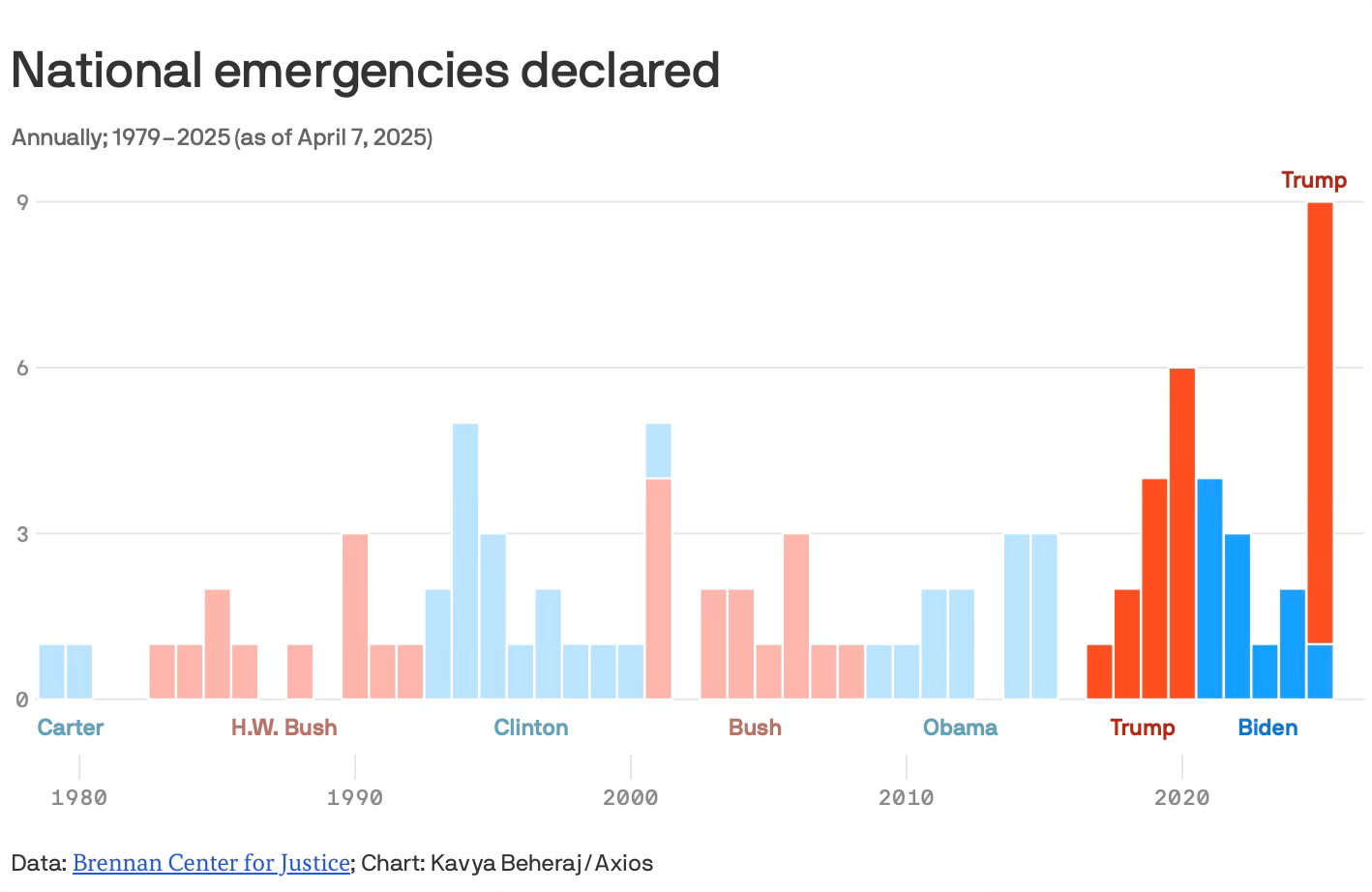
National “Emergencies”

Source: Andrew Sullivan

The Meta-Concern about summary deportation

United States law allows for a quite expedited process to remove people from the country, to deport them. You don’t get a big trial. You don’t get a jury trial. You are moved rapidly because the theory of the case is: First, you don’t have a right to immigrate to the United States, so you have not been deprived of your rights. And secondly, once you’re removed from the United States, you remain a free person. You are sent back to the place you came from or some other place to which you have some connection, and then you’re free to go about your business. You’re not sent to a prison—not sent to a prison for life.

But as I talk about this, the thing that has most gripped my mind with worry and anxiety is not only the effect on the individuals themselves, some of whom may be genuinely innocent, but the effect on those who are sending human beings to a prison without a hearing.

You know, the United States government is now building an apparatus of lawyers, of officials of all kinds, who plan and think every day, How can we apprehend people on American soil and bundle them to a prison without giving them any show of a hearing? They’re building skills and competencies at non-due-process forms of arrest and incarceration that are going to be very hard to limit.

… I remember when I was a Canadian citizen in the United States on a student visa, we were warned if you got into a bar fight, you could theoretically lose your student visa. Now, in those days, that meant that you’d have to go back to Canada and go to school in Canada, which is not the end of the world. In today’s America, that could mean you could lose your student visa and be accused of terrorism, and a bag put over your head and be put into a car and sent to a prison in El Salvador for the rest of your life.

Now, maybe that doesn’t happen in every case. Maybe that doesn’t happen in many cases. But there are people in the employ of the United States government, paid by taxpayers to think about how can we daily broaden the category of people who can be arrested and detained and imprisoned without any showing to any authority at all, without any opportunity to make themselves heard, without any evaluation by an independent fact finder—by any of the things we call due process.

David Frum, introducing a terrific conversation about The Crisis of Due Process with Peter Keisler. (bold added)

Do we really believe in free speech?

Trump 2.0 has been deporting foreign students and others for constitutionally protected speech, using as its current go-to bad-faith excuse that the speech is antisemitic.

The late British-American journalist Christopher Hitchens is a more recent testament to the long tolerance of America toward foreign dissent. Before becoming a U.S. citizen in 2007, Hitchens spent decades as a legal resident—and as one of America’s most acerbic public intellectuals. He accused Ronald Reagan of being “a liar and trickster,” called Israel America’s “chosen surrogate” for “dirty work” and “terrorism,” lambasted Bill Clinton as “almost psychopathically deceitful,” and accused the George W. Bush administration of torture and illegal surveillance. If a student can be deported for writing a campus op-ed critical of Israel, any of Hitchens’ views could have been used to justify deporting him.

Jacob Mchangama, A New McCarthyism

Law and its limits

This isn’t how our system is supposed to work. When a president does the kinds of things Donald Trump is doing, his popularity should sink so low that Congress will feel empowered to stand up to him. Ideally, they would impeach and remove him from office for attempting to govern like an absolute monarch. Short of that, Congress and the courts would be working in tandem to impose and enforce constraints on the wayward executive until the next election strengthens their hand against him.

But none of this is happening—because our system has broken down. The parties are ideologically sorted, with almost no remaining overlap. And Trump has transformed the GOP into a cult of personality more loyal to him personally than to the Republican Party, the other institutions of American democracy, the law, or the Constitution.

In a situation like this, the only thing preventing the president from transforming himself into a tyrant is his own willingness to do it. The courts can tell him to stop. But will he? If he does, democracy survives, at least for the time being. If he doesn’t, democracy is over, at least until it can be reconstituted at some point in the future.

One should never hope to live through a moment of great political precarity like our own. But one tiny compensation is that such moments bring clarity about certain fundamental matters. How has the United States managed to survive for nearly 250 years without evolving into a dictatorship? The answer really may be this simple: By never electing a man willing to do what it takes to effectuate the change.

Until now.

Damon Linker

It’s not clear that the courts will suffice, but the courts — having already, and deservedly, come to treat the Administration as bad-faith, untrustworthy actors — will provide partial deterrence and may help sway public opinion by the cogency (and sometimes, the tartness) of their reasoning.

[I]f you want a really extraordinary example of that, you would look at the order that the Court issued at 1 a.m. on Saturday morning this last weekend, because even though they had held that everybody has to be given meaningful notice before they could be removed in this way, there was credible evidence that the administration was loading people onto buses without giving them anything like the notice that was required. And the ACLU went to the Supreme Court and said, you know, Please, as you listen to the rest of this case and get briefing, stop this from happening.

And if the administration were a normal administration and had compiled a record so far of being a normal administration, the Court would’ve said, Well, I can be confident they’re not going to do this while we are hearing your petition, so let’s give the government a chance to respond. Let’s see what they say, and then we’ll decide what to do. Because, of course, the government wouldn’t spirit these people away while we are actually in the process of deciding whether it can do so on this emergency application you filed. But they knew that the government had done exactly that with the first 200 or so people they had sent away.

The case was before a district judge, and they rushed to secretly get the people out before he could issue an order. And they didn’t quite succeed on that, which is why you have these issues of contempt floating around now. But at 1 a.m., the Court by a 7–2 vote said, Don’t remove anybody in the class represented by these lawyers until you hear otherwise from us.

And that shows that there is a cost to the administration of acting the way it’s acting towards the courts, because if you squander the reputation that governments of both parties have had for credibility and fair dealing and honest brokering with the Court, then they’re going to treat you different because they know they can’t quite trust you.

Peter Keisler with David Frum

Miscellany

The new Republican coalition

Thus we have arrived at a new Republican coalition that looks like this:

  • The tech right, which is essentially a weirder and more evil upgrade of the pro-business libertarians
  • The barstool right, which is a genuinely new constituency made up of hedonistic anti-woke libertarians that has replaced the Christian conservatives
  • The neo-conservative foreign policy hawks, who are the weakest member of the coalition, but can still get what they want on certain issues, as seen with the attacks on the Houthis as well as the saber rattling regarding Greenland

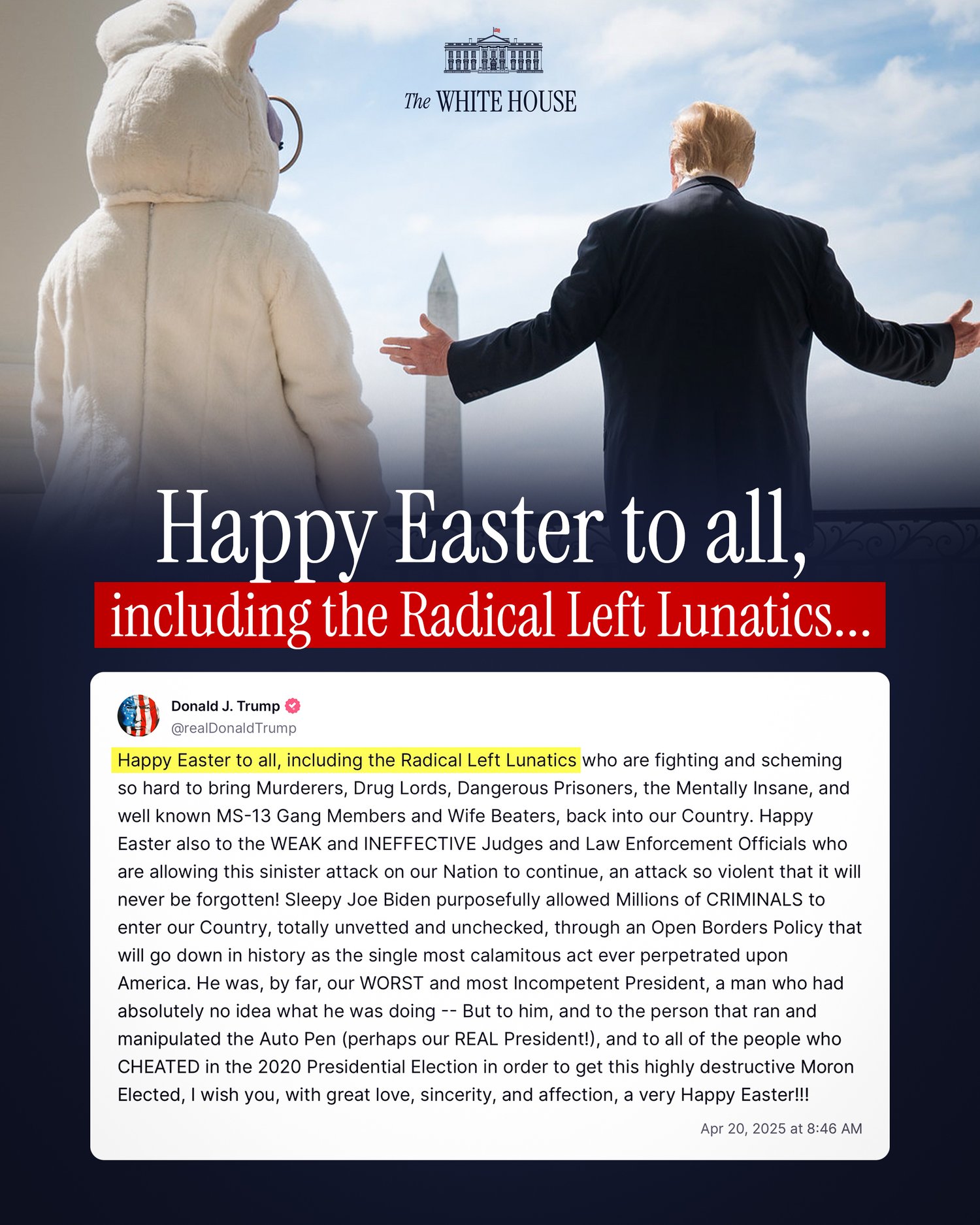
In other words, the Christian influence on actual Republican policy items and their political vision is going to be exceedingly negligible going forward. Sure, Vice President Vance will make an appearance at the March for Life. President Trump will show up to the National Prayer Breakfast. But even when he does acknowledge a Christian event, it often will come loaded with hatred and vile self-aggrandizement, as seen yesterday:

And ultimately when push comes to shove on the policy level, Christian concerns will always be backgrounded or eliminated relative to the priorities of the three above groups, as we have already seen on abortion, marriage, and PEPFAR.

Jake Meador

I originally thought to post this on a Sunday, when my focus is narrower, but it didn’t fit there because I don’t value “religion” for its instrumental partisan-political value.

It was a very few years ago when I warned (as had others) “If you don’t like the Religious Right, just wait ‘till you see the irreligious Right.” Well you’ve been seeing them in power for three months now.

Beta-testing tyranny in the Sunshine State

Ron DeSantis walked so that Donald Trump could run. When the time came to formulate a policy response to the woke left, no one mattered more than the governor of Florida.

He tried to ban critical race theory in education. He sharply limited discussion of gender and sexuality in public schools. He tried to limit the free speech of university professors. He retaliated against Disney when it had the audacity to exercise its freedom of speech to criticize the governor’s policies.

And through it all, DeSantis declared that Florida was the place where “woke goes to die.”

In his second term, Trump is a scaled-up version of DeSantis. Every element of the DeSantis model has been deployed against Trump’s ideological enemies …

At first I was optimistic about the anti-woke right. Their free speech argument resonated with me. I’d spent decades litigating free speech cases, after all, and I’d never really seen anything like a mass movement for free expression.

But my optimism quickly faded. In 2021, the anti-woke right embraced a series of state laws that were designed to ban critical race theory. Rather than meet critical race theorists in the marketplace of ideas, the right chose to try to suppress their expression.

A movement that had spent decades fighting speech codes on college campuses was now enacting speech codes of its own. States that once passed laws meant to protect free speech on campus were now passing laws suppressing the discussion of so-called divisive concepts about race.

By this time I was familiar with the right’s authoritarian turn — and getting very worried about it. In 2019, parts of the intellectual right were consumed with a fight over liberalism itself, with the new right arguing that liberal values — freedom of speech and free trade, for example — were hollowing out American culture, creating a nation of atomized individuals who were consumed with self-actualization (and consumption itself) at the expense of family and community.

David French, The Anti-Woke Right and the Free Speech Con

Context

Ironically, the left, now alarmed by the federal government’s intrusive reach [into, say, Harvard], bears direct responsibility for crafting the very legal weapons wielded against the universities it dominates. Almost four decades ago, progressive legislators demanded sweeping amendments to civil rights law, expanding federal oversight over higher education. The sequence of events reveals a cautionary tale of political hubris: progressive confidence that state power would reliably serve their ends overlooked the reality that governmental authority, once unleashed, recognizes no ideological master. Today’s circumstances starkly illustrate how expansive federal control over civil society, originally celebrated by progressives, returns to haunt its architects. The left’s outrage ought to focus not on this particular administration but on its own reckless empowerment of the state.

Yet for all its courage, Harvard’s response stopped short of making the argument that would best protect the values for which it was fighting. It defended the university’s independence without explaining why that independence deserves protection. It invoked values like “pluralism” and “inquiry,” but it did not fully explain why those values are essential to a liberal democratic society. The letter therefore missed an opportunity to articulate what a university is for — not just to students or donors, but to the country. And this matters, because Trump’s attack against this and other universities is not only about the balance of power between universities and the government. It is, at bottom, about the legitimacy of higher education as a public good.

Alan Jacobs, quoting, respectively, John O. McGinnis and Edward Frame

Dangers of debunking

The danger of being a professional exposer of the bogus is that, encountering it so often, one may come in time to cease to believe in the reality it counterfeits.

Alan Jacobs, The Year of Our Lord 1943


Your enemies are not demonic, and they are not all-powerful and the right hasn’t always lost and the left hasn’t always won. But if you convince yourself of that, you give yourselves all sorts of permission to do a lot of stupid and terrible things under the rubric of “Do you know what time it is?”

Jonah Goldberg.

Regarding said “lot of stupid and terrible things,” my failure to call out anything about the current regime does not mean I approve. There’s just too much, and on some of the apparent illegalities I don’t want to abuse my credentials without thinking it through.

I don’t do any of the major social media, but I have two sub-domains of the domain you’re currently reading: (a) You can read most of my reflexive stuff, especially political here. (b) I also post some things on the only social medium I frequent, because people there are quirky, pleasant and real.

Lazarus Saturday

Today, we commemorate Christ raising Lazarus from the dead. Essentially, I’m now in an eight-day marathon until Pascha/Easter — serving at least two services daily.

Miscellany

FWIW

There was a time when I’d have devoured an article like Best Wireless Headphones (2025): Tested Over Many Hours | WIRED.

Now I think “why bother; what I’ve got is amazing, and quite good enough even if it’s not ‘best’.”

What is the point of being a Republican senator?

“What is the point of being a Republican senator?” one of my editors asked this morning.

It was a rhetorical question.

The remark was inspired by news that former New Hampshire Gov. Chris Sununu won’t run for Democrat Jeanne Shaheen’s Senate seat next year

No thanks, Sununu said Tuesday. “It’s not for me,” he explained in an interview. “I talked to the White House this morning. I talked to Tim Scott [the head of the National Republican Senatorial Committee]. Thanked him for all their support and confidence. But I don’t have to be the candidate, and I’m not going to be the candidate.”

“I don’t have to be the candidate” is interesting phrasing. It’s what you’d say when refusing an unwelcome burden ….

Nick Catoggio

Nellie Bowles excerpts

  • Chiming in on the factory work fetish is—who else?—former gay-turned-antigay Milo Yiannopoulos: “Men are depressed and addicted and broken because they have nothing to do. They get no stimulation or satisfaction from BS email jobs. I’m telling you, white Americans will love working in factories again. Making things, in the image and likeness of God the Maker.” Let me tell you: The image of God is not in the microscopic iPhone screw you’ll be mastering until your eyes burn out, Milo. Installing airbags until your elbows give out is—well, that one’s maybe in His image.
  • [Trump tariff advisor Peter] Navarro’s books have often cited an economist named Ron Vara, who is entirely made up. It’s just an imaginary friend Navarro uses in arguments, created through an anagram of his last name. So he earned his nickname [Peter Retarrdo].
  • Mississippi now has the best standardized test scores for fourth graders, when adjusted for demographics (i.e., taking into account socioeconomic status, native language, race, whether your parents raised you to have enough self-esteem, ate enough broccoli, etc.). The rise follows a 2013 decision to use phonics-based learning statewide and to hold back third graders who failed to pass a reading test, which may seem mean until you realize that blue states are letting entirely illiterate kids graduate into the world, a world that—for now—still requires literacy. Meanwhile, Oregon, whose fourth graders have the lowest demographically adjusted test scores, has paused the use of any standardized test as a graduation requirement until at least 2029 and is, of course, obsessed with the Lucy Calkins school of teaching kids reading with vibes. Sigh. The real tragedy is that these kids will never be able to read my columns. Luckily for them, I will read it out loud!
  • During a lowkey argument over lawn chairs at a track meet, a teenager named Karmelo Anthony allegedly stabbed Austin Metcalf in the heart, killing him. Within days, both 17-year-olds had fundraisers opened in their names. Karmelo’s has raised $330,000, keeping a rough pace with the victim’s. The moment has turned into a race war, with people donating as if these were two teams in some cosmic battle. As if supporting one or the other is part of racial pride. It’s very scary ….
  • Anderson Cooper, leading a town hall with Bernie Sanders, got chastised for using she/her pronouns for a completely normal-looking woman, with a completely normal-woman name of Grace. Called upon by Cooper, she snaps: “I use they/them pronouns actually, thank you,” clearly annoyed, clearly relishing the moment. Then she starts her question, which is about why men aren’t compelled by the Dems anymore, and no, I’m not kidding: “Polling and turnout data indicate that men of all racial demographics are turning away from the Democratic Party. . . ” Yes, it is a great mystery, Grace, they/them. I’m obsessed with Bernie’s face as this is unfolding:
  • John Oliver dedicated his entire show to a monologue about how there are no differences between men and women in athletics, and transwomen should be able to compete against natal females. “Bigger and stronger bodies are not automatically advantaged in every scenario. . . we have no research about how being trans or undergoing gender-affirming treatment impacts athletic performance in teens.” Which is sort of like saying we have absolutely no research indicating that a giraffe is bigger than a goldfish—no double-blind peer-reviewed studies have been done to date, so really, how can you say which is bigger? …

Nellie Bowles

Speaking of John Oliver

Oliver is such a pitch-perfect caricature of progressive self-regard – snarky, aloof, judgmental, incurious – that I sometimes wonder if his show is a brilliant op pulled off by the Heritage Foundation.

Freddie DeBoer

Over/Under

I’ve been puzzling over the term “over/under,” which increasingly seems to be one of the two numbers reported in sports stories where I’m looking for a straightforward prediction of who wins and by how many points.

Since I do not bet on sporting events, I never bothered to try to figure out the term. But the increasingly it is appearing as shorthand in political reporting, e.g.:

One Dispatch colleague told me he’d set the over/under on how many Senate Republicans would vote to convict in the scenario I described at 1.5—and that he’d take the under.

Nick Catoggio

So I finally took the trouble to look it up. You can, too, if you’d like.

It’s not a useless way to express a prediction, but I really hate gambling terminology, becoming obligatory for political discourse. Nick’s Dispatch colleague could have said “I don’t think Senate Republicans could get more than one vote.”

Not so much about Trump as about DC

In a recent members-only Dispatch conversation, Steve Hayes argued that Trump enjoys nothing as much as the exercise of power, and I disagreed with him: It seems to me that Trump does not at all enjoy the actual exercise of power, which is very difficult and demanding work of precisely the sort that he has spent a lifetime avoiding. The counterintuitive fact is that one of the big problems in Washington is that almost nobody enjoys the actual exercise of power, which is why the three branches of government keep trying to hand responsibilities off to each other: from our drama-queen president to our do-nothing Congress to the tortured pseudo-institutionalism of the chief justice, we have a government run by a team of Bizzaro World Kobe Bryants—guys who only know how to pass and never take a shot. Trump wields power in Washington in approximately the way a man playing Macbeth wields power in Scotland. In Trump’s case—which is our case—the damage is real, of course, but that is no more an actual exercise of political power than a drunk crashing his Buick into a school bus is an example of motorsport.

Kevin D. Williamson

Five Current U.S. Protestant Political Outlooks

[MAGA Christianity] is nostalgic for America’s past but not necessarily for America’s founding constitutional principles, which can impair its ambitions.

Mark Tooley, Juicy Ecumenism.

Strongly agree. More:

It mostly hat tips to traditional Christian views about abortion and marriage but is willing to subordinate those stances to wider political ambitions. With the rest of MAGA, it is skeptical if not hostile to American international commitments and to free trade. It’s also impatient with the humanitarian values of the old Religious Right, which it sometimes disdains as signs of weakness if not wokeness. Pentecostal preacher Paul White Cain, the White House faith advisor sometimes associated with the New Apostolic Reformation, is a leading figure. But many others who were conventional Religious Right have aligned with MAGA Christianity. Charlie Kirk of Turning Point USA is a leading cheerleader.

The overall story was about “Five Current U.S. Protestant Political Outlooks.” The other four are:

  1. Religious Left
  2. Religious Right
  3. neo-Anabaptist left
  4. TheoBro right

I find all five options unpalatable. There’s no paywall, so take a look for yourself.

Let’s us three make a deal

Strikingly, … some of the shrewdest officials and analysts in such capitals as Beijing, Brussels and Washington are focused on a challenge to the established world order that is harder to see or hear. To them, the most disruptive force in geopolitics today is Mr Trump’s apparent desire to huddle with other world leaders, and quietly carve up the world together.

The Economist, The dangers of Donald Trump’s instinct for dealmaking

Trump 2.0

For the good of my soul, I’ve got to stop paying so much attention to Donald Trump.

(That paragraph replaces several paragraphs of TMI.)

Due Process

Of all the lawless acts by the Trump administration in its first two and a half months, none are more frightening than its dumping of human beings who have not had their day in court into an infamous maximum-security prison in El Salvador — and then contending that no federal court has the authority to right these brazen wrongs.

Lawrence Tribe and Erwin Chemerinsky

I have been reminded several times lately that this doesn’t quite tell the entire story.

Many of the people swept up and shipped to El Salvador did have their day in court: in ordinary procedures under the Immigration and Naturalization Act, where they were adjudicated deportable. Instead of self-deporting, they remained in the US where nobody got around to deporting them until someone quite suddenly did with lots of fanfare.

Others indeed had no day in court, but were swept up dubiously under the Foreign Enemies Act and summarily deported. They are fairly described by Tribe and Chemerinsky. Moreover, without due process we have no reason to trust that they were deportable at all.

None of this is to defend the prison conditions to which any of the deportees are being subjected and for which we are paying.

Chris Krebs

Lost yesterday amid the public jubilation over being liberated from “Liberation Day” was the signing of two new executive orders, one aimed at Chris Krebs, the other at Miles Taylor.

Krebs led the Cybersecurity and Infrastructure Security Agency during Trump’s first term, placing him in charge of, among other things, detecting and preventing any tampering with America’s election technology. The president fired him on November 17, 2020 not for doing his job poorly but for doing it honestly and well. Krebs insisted repeatedly after Election Day that there had been no security breaches involved in Joe Biden’s victory. That qualified as insubordination in the Trump White House.

Trump’s new memorandum on Krebs accuses him of various offenses, including “censoring” conservative viewpoints, but the true nature of his grievance is right there in the text: “Krebs, through CISA, falsely and baselessly denied that the 2020 election was rigged and stolen, including by inappropriately and categorically dismissing widespread election malfeasance and serious vulnerabilities with voting machines.”

That’s nakedly retaliatory, just like the executive orders targeting law firms that caused legal trouble for the president in the past. Once again, Trump’s corruption is right out in the open. But I believe this is the first time he’s gone as far as to officially penalize someone for rejecting his conspiratorial nonsense about the 2020 election, a position shared by a large majority of the American public and even by some of his own Cabinet nominees. Or former nominees, anyway.

Nick Catoggio

And if he had said there were security breeches, he’s be saying he’d failed at his job.

Dare I suggest that you cannot win working for Donald Trump?

We should have seen this coming

I highly recommend David Brooks’ Article in the Atlantic, I Should Have Seen This Coming


I suffer more from the humiliations inflicted by my country than from those inflicted on her.

Simone Weil, from a letter to Georges Bernanos.

[N]one of the things that I care about most have ever proven susceptible to systematic exposition.

Alan Jacobs, Breaking Bread With the Dead

I don’t do any of the major social media, but I have two sub-domains of the domain you’re currently reading: (a) You can read most of my reflexive stuff, especially political here. (b) I also post some things on the only social medium I frequent, because people there are quirky, pleasant and real.

Sunday, 10/8/23

From cultural criticism to bearded religious men living in caves

Paul Kingsnorth, known for his decades of cultural criticism, is explicitly giving it up — for now at least:

When I started this Substack, a few hundred people read it. Today I have 44,000 readers. The great majority are free subscribers, it must be said, so I don’t know how much they’re paying attention. But most probably got on board to read the ‘cultural criticism’ of my Machine essays. Now they’re getting stories about bearded religious men living in caves.

While I sympathise with their trauma, this is actually less of a wrench than it might seem. My writing life – my published writing life, anyway – extends back three decades now. In that time I have published nine books, only three of which might be described in any way as ‘cultural criticism’ or ‘current affairs’ or the like. The rest were novels, books of poetry and a strange memoir which in retrospect is the story of my being dismembered by God in preparation for something I couldn’t see coming.

Well, that something he was being prepared for came, and it changed him:

The comedian Stewart Lee, in his book How I Escaped My Certain Fate, wrote of how his experimental comedy routines, which largely consist of two hours of complex, interconnected, audience-insulting idea-play, had rendered him unable to do shorter stand-up gigs, formulaic jokes, or the once-simple job of acting as an MC for a roster of other comics. Though he was often asked, he said, he would always say no. ‘I am no longer fit for purpose’ he wrote, only half-jokingly. I feel the same about that ‘cultural criticism’.

Of course, I’m publishing this on a Sunday because the something that came, the something he was being dismembered in preparation for, was Jesus Christ, and specifically in the Orthodox Christian Church. Orthodoxy probably is more congruent with his prior life than other flavors of Christian piety, but it’s not the same, and it’s not the same as the culture he’d been critiquing, either.

So I think his backing away from what had been bread-and-butter publishable writing has got to be scary, but I can readily see how it’s something he needs to do if only to make more time for the things he now needs to do. I wish him well, and remember him daily in my prayers.

A different kind of teacher

Jesus is a teacher who doesn’t just inform our intellect but forms our very loves. He isn’t content to simply deposit new ideas into your mind; he is after nothing less than your wants, your loves, your longings.

James K. A. Smith, You Are What You Love

Net gain?

We have tried to escape the sweat and sorrow promised in Genesis—only to find that, in order to do so, we must forswear love and excellence, health and joy.

Wendell Berry, The Unsettling of America

Evangelical clairvoyants

Shortly after his letter appeared, Cal Thomas and Ed Dobson, who had been Falwell’s chief lieutenants in the Moral Majority, published a book questioning not just the efficacy of political action but the righteousness of the enterprise. In Blinded by Might they argued that in the process of trying to win elections conservative Christians had been seduced by the lure of power. What had begun as an effort to restore Christian values to the nation had degenerated into an unbridled partisan struggle, creating an atmosphere in which it was assumed that Democrats could not be Christians and that Bill and Hillary Clinton were the Antichrist.

Frances FitzGerald, The Evangelicals

It’s worth remembering that a few Evangelicals recognized what was happening. I do tend to forget that.

Rolling their own

Nobody came in with substantial theological or pastoral training. They were all making things up on the fly. At the time, they thought this was a good thing, because it helped them think creatively and outside the box.

Jon Ward, Testimony


Here is a quick and generally reliable rule to follow. If people have always said it, it is probably true; it is the distilled wisdom of the ages. If people have not always said it, but everybody is saying it now, it is probably a lie; it is the concentrated madness of the moment.

Anthony M. Esolen, Out of the Ashes

You can read most of my more impromptu stuff here (cathartic venting) and here (the only social medium I frequent, because people there are quirky, pleasant and real). Both should work in your RSS aggregator, like Feedly or Reeder, should you want to make a habit of it.

Pentecost 2023

Anticipating Paul Kingsnorth?

I knew that C.S. Lewis was prescient (less so that Ken Myers was), but this was Copyright 1989.

Blinded by Might

Cal Thomas and Ed Dobson, who had been Falwell’s chief lieutenants in the Moral Majority, published a book questioning not just the efficacy of political action but the righteousness of the enterprise. In Blinded by Might they argued that in the process of trying to win elections conservative Christians had been seduced by the lure of power. What had begun as an effort to restore Christian values to the nation had degenerated into an unbridled partisan struggle, creating an atmosphere in which it was assumed that Democrats could not be Christians and that Bill and Hillary Clinton were the Antichrist.

Frances Fitzgerald, The Evangelicals

I never read Blinded by Might, but this characterization of it, which is consistent with the books title, seems prescient.

Is Tim Kellerism outdated?

Some Christian critics say that the “Tim Keller model” of engagement, his winsome, gentle approach to those with whom he disagreed, is outdated. They say that increased secularization and progressive hostility toward traditional Christianity requires the faithful to hit back, respond in kind, dominate or humiliate those who oppose us. But Tim wasn’t kind, gentle and loving to others as some sort of strategy to win the culture wars, grow his church or achieve a particular result. Tim loved his neighbors, even across deep differences, simply because he was a man who had been transformed by the grace of Jesus. As he wrote in The Times, he believed and lived as if “the Gospel gives us the resources to love people who reject both our beliefs and us personally.”

The Christian Scriptures describe “the fruit of the Spirit” — what grows in us as we walk with God — as love, joy, peace, patience, kindness, goodness, faithfulness, gentleness and self-control. Tim’s life was marked by these things. And these dispositions are not a political strategy. They are not a part of a brand. They are not a way to sell books, gain power, win culture wars or “take back America for Christ.” Tim inhabited these ways of being, not as a means to any end, but as a response to his relationship with God and love for his neighbor. The last 10 years or so have been hard on orthodox or traditional Christians who are wary of Christian nationalism, hyperpartisanship and the politics of bitterness or resentment. “Keller’s passing leaves a void in the nascent movement to reform evangelicalism,” wrote Michael Luo in The New Yorker, “and today’s social and political currents make the prospects for change seem dim.”)

Tish Harrison Warren

Just one little oversight

Why Antonio García Martínez became Zebulon ben Abraham. Except for the little matter of Christ’s resurrection, he’d have a pretty convincing case against Western Christendom.

Religious, not Spiritual

Occasional strong posts like Why I’m religious, and not spiritual are why I follow Fr. Silouan Thompson. But now I’ve got another book to buy: Before Religion: A History of a Modern Concept — a “modern concept” as in “Procrustean bed,” that variously cuts or stretches reality.

Protestant scholars of religion continually try to find in ancient writings the kind of pietistic interiority, feelings, or personal experience of the Numinous, that to these scholars is “true religion.” This underpins practically all modern study of religion and much of interfaith activity. But the sources don’t point to any such thing in the ancient mind; ancient religion is a creation of modern scholarship.

Why I’m religious, and not spiritual

The Religious Right (and more frank and candid atheists)

A motley crew of white evangelicals and traditional Catholics locked arms on some social issues, started voting in large numbers for Republican candidates, and changed American politics forever.

But I think that era of religion and politics is rapidly coming to a close. The Religious Right is no longer a primarily religious movement — from my point of view it’s one about cultural conservatism and nearly blind support for the GOP with few trappings of any real religiosity behind it.

Here’s what I believe to be the emerging narrative of the next several decades: the rise of atheism and their unbelievably high level of political engagement in recent electoral politics.

Ryan Burge, Religious Right? Those true believers are nowhere near as politically active as atheists.

Unfortunately, some of the Christianists on the “Religious Right” will take this as a call to go big-footing into politics at higher intensity because, as Burge observes, the Religious Right is no longer a primarily religious movement.

As for me, I find this result unsurprising. If you have no hope beyond this life, you’ll be apt to grab for all the temporal gusto you can get. If you’re getting close to the end of life, you look for the resurrection of the dead and the life everlasting, and you’re trying to get ready for all that — heck, you might not even save Burge’s article after reading it and passing along this clip, if you know what I mean.

What it takes for a Tradition to endure

When I first encountered Orthodoxy fourteen years ago, my first thought was, “This is what I thought Catholicism would be when I converted back in the 1990s.” This was BEFORE I knew much of anything about Orthodox theology. This was from what I learned by worshiping liturgically with the Orthodox, and discovering the role of asceticism and related practices in Orthodox life. Years later, as I was writing The Benedict Option, I discovered in anthropological texts why some version of monastic practices is necessary for lay Christian life today, and also why Orthodox Christianity is UNIQUELY SUITED for the Benedict Option.

Rod Dreher, Healing Humanity: Confronting our Moral Crisis (emphases in original). Co-authors include Frederica Mathewes-Green, David Ford, Alfred Kentigern Siewers and Alexander F. C. Webster.


For all its piety and fervor, today’s United States needs to be recognized for what it really is: not a Christian country, but a nation of heretics.

Ross Douthat, Bad Religion

We are in the grip of a grim, despairing rebellion against reality that imagines itself to be the engine of moral progress.

R.R. Reno

The end of the world as we know it is not the end of the world.

You can read most of my more impromptu stuff here (cathartic venting) and here (the only social medium I frequent, because people there are quirky, pleasant and real). Both should work in your RSS aggregator, like Feedly or Reeder, should you want to make a habit of it.

Mostly abortion-related

David French, Cassandra

I follow David French in podcasts and blogs because:

  • He’s a seasoned litigator aligned with me on abortion, free speech, and religious freedom; and
  • I have to put up with hearing him to hear the amazing Sarah Isgur.

But Sunday, I think his reflexive religious provincialism got the better of him in Roe Is Reversed, and the Right Isn’t Ready.

He starts off well enough:

I’ve been a pro-life advocate and activist for more than 30 years …

Through it all, I was guided by two burning convictions—that Roe represented a grave moral and constitutional wrong and that I belonged to a national Christian community that loved its fellow citizens, believed in a holistic ethic of life, and was ready, willing, and able to rise to the challenge of creating a truly pro-life culture.

I believe only one of those things today.

My feelings about Roe are unchanged. …

But then he paints a very bleak picture of the right generally and more specifically his corner of the religious right, which he reflexively equates with "the Church" (it’s one of his most annoying verbal tics, another is hyperbolicic use of "tremendous, tremendous"):

The two sides of the great American divide are now staring at each other and asking, “Now what?” The answer from pro-life America should be clear and resounding—the commitment to life carries with it a commitment to love, to care for the most vulnerable members of society, both mother and child.

But life and love are countercultural on too many parts of the right. In a time of hate and death, too many members of pro-life America are contributing to both phenomena. Is that too much to say? Is that too strong? I don’t think so.

In deep-red America, a wave of performative and punitive legislation is sweeping the land. …

… The vicissitudes of politics haven’t just linked the anti-abortion cause to various toxic forces on the right, they’ve transformed parts of the anti-abortion movement, making many of its members as toxic as their “libertine and hyperindividualist” allies.

In the meantime, the Republican branch of the American church is adopting the political culture of the secular right. With a few notable exceptions, it not only didn’t resist the hatred and fury of the MAGA movement, it was the MAGA movement.

(Emphasis added)

Now I suppose there are at least three possibilities here:

  1. He’s right about pro-life America, period, full stop.
  2. He’s right about Evangelicalism.
  3. He’s engaged in hyperbole to get Evangelicals to to better than settling for liberal tears.

I reject the first possibility. I’ve been pro-life a decade longer than French (mostly because I’m two decades older). I broke markedly, if not completely, with Evangelicism shortly before I became actively pro-life, and left Protestantism entirely a about a decade-and-a-half later.

I do not believe that lib-trolling and vindictiveness is any significant part of Orthodox Christianity, though Orthodoxy is anti-abortion (as the historic church always has been — i.e., before American Evangelicals got recruited to the cause by C. Everett Koop, Francis Schaeffer, and less principled actors).

I also don’t believe that it is a significant factor among observant Roman Catholics, "observant" being measured by adherence to Catholic Social Teaching as well as participation in their Church’s sacramental life. Indeed, Catholic Social Teaching (Christian Democracy) is the North Star of the American Solidarity Party, which party alone I support these days.

Bottom line: I believe French is wrong about the Church because his provincialism blinds him to the bigger picture. I certainly hope he’s wrong.

And French’s turn to anti-vaxx sentiment a red prolife America seems like totally gratuitous grievance-airing.

I suggest to David French that if he’s all that down on Calvinist-tinged Evangelicalism, he step out for a breath of incense-tinged air at one of the Anglophone Orthodox Churches in his area.

Come and see, David. Give it a month or two of Sundays.

Douthat on the risk of toxic response

Observant Catholic (see above) Ross Douthat puts French’s point less apocalyptically (I’m being very selective; read the whole column if you can):

While the pro-life movement has won the right to legislate against abortion, it has not yet proven that it can do so in a way that can command durable majority support … [T]he vicissitudes of politics and its own compromises have linked the anti-abortion cause to various toxic forces on the right — some libertine and hyperindividualist, others simply hostile to synthesis, conciliation and majoritarian politics.

… But among its own writers and activists, the movement has understood itself to also be carrying on the best of America’s tradition of social reform, including causes associated with liberalism and progressivism.

To win the long-term battle, to persuade the country’s vast disquieted middle, abortion opponents … need to show how abortion restrictions are compatible with … the health of the poorest women, the flourishing of their children, the dignity of motherhood even when it comes unexpectedly or amid great difficulty.

These issues … are essential to the holistic aspects of political and ideological debate. In any great controversy, people are swayed to one side or another not just by the rightness of a particular position, but by whether that position is embedded in a social vision that seems generally attractive, desirable, worth siding with and fighting for.

Here some of the pathologies of right-wing governance could pave a path to failure for the pro-life movement. You can imagine a future in which anti-abortion laws are permanently linked to a punitive and stingy politics, in which women in difficulties can face police scrutiny for a suspicious miscarriage but receive little in the way of prenatal guidance or postnatal support. In that world, serious abortion restrictions would be sustainable in the most conservative parts of the country, but probably nowhere else, and the long-term prospects for national abortion rights legislation would be bright.

In a part of French’s column, he quoted this Douthat column but said it didn’t go far enough. I think it does — because Douthat’s vision is more Catholic (and more catholic).

Making abortion unthinkable

Even in the Evangelical world, there are sane people wanting actually to make things better:

Roe was an unjust ruling. I have always believed it would be overturned, as other unjust decisions by the court were, although I thought it would take longer. I rejoice that it did not. But of course it will take longer for abortion to become unthinkable, which is the real goal of the pro-life movement.

Karen Swallow Prior

Prior continues:

Still, I was, like my fellow evangelicals, a Johnny-come-lately in a long line of people who have opposed abortion and infanticide and tried to defend vulnerable life.

Members of the early Christian church within the ancient Roman world rescued abandoned infants (often those who were female or otherwise deemed inferior) from certain death ….

I always appreciate it when Evangelicals admit, even if tacitly, that Evangelicalism is so unlike the earliest church that it cannot claim vicarious credit for what the earliest church did.

Orthodoxy (and even Catholicism) can.

Still more:

The judicial fiat of Roe v. Wade jump-started the culture wars that have poisoned our political process and brought us to a place of polarization and unbridgeable division. Indeed, this division has been capitalized on by far too many pundits and politicians, for whom a position on abortion does not appear to be a sincerely held belief, but merely an issue they can (and do) leverage for votes or monetize for financial gain. Such betrayal casts a shadow on the overturning of Roe, which has been for me and many others a long-awaited event.

Even so, making abortion unthinkable might start with the law, but it won’t end there. For it is not only the supply of abortion that matters but also the demand. I lament the impoverishment of a social imagination that cannot conceive of a world in which women can flourish without abortion.

Nat Henthoff

On this day, I remember with fondness the late Nat Hentoff, a Jewish atheist who nevertheless believed in the right to life of the unborn, and said so in a time and place where that cost him something. Here is a column Hentoff wrote after he hosted pro-life liberal Pennsylvania Democratic Gov. Bob Casey at Cooper Union in downtown Manhattan.

Rod Dreher.

Henthoff was a fierce member of the ACLU back when the ACLU was actually about civil liberties, and was one of the preeminent jazz critics of his age.

I wish he had lived to see last Friday.

He really didn’t need the Committee’s help …

This just seems to make Donald Trump look awful, just awful."

Neil Cavuto, Fox News, on the latest revelations from the January 6 Committee.

You’re surprised that Trump is awful, Neil?

Terrorist wishcasting

I note, with raised eyebrow, the terrorist plans underway to set about attacking Catholic churches and pregnancy resource centers. As someone put it in a dark joke-tweet, this is the state of the discourse in 2022: “You don’t care about pregnant women!” “Well no, we have numerous buildings and institutions expressly set up for that purpose actually, how can we help you?” “Oh really, where? Let’s go firebomb them!”

Bethel McGrew


If people have always said it, it is probably true; it is the distilled wisdom of the ages. If people have not always said it, but everybody is saying it now, it is probably a lie; it is the concentrated madness of the moment.

Anthony Esolen, Out of the Ashes

You can read most of my more impromptu stuff here (cathartic venting) and here (the only social medium I frequent, because people there are quirky, pleasant and real). Both should work in your RSS aggregator, like Feedly or Reeder, should you want to make a habit of it.

Potpourri 6/6/21

Russell Moore and the Southern Baptists

I will not comply with another secret task force meant to silence me about issues I believe are issues of obedience to Christ. I will not sign another “unity” statement meant to “call off the dogs” of scrutiny so that the beatings may begin again in private. If the Southern Baptist Convention wants to be part of a house of prayer for all peoples, then that’s what I signed up for. If the Southern Baptist Convention wants to be one big retirement home for a furious royal family, then, that’s not what I signed up for.

When God called me to himself in Jesus, and when he called me to serve him in ministry, he called me to stand for the truth, to point the way to the kingdom, to die to self, and to carry the cross. He did not call me to provide cover for racial bigotry and child molestation.

Russell Moore, to the Southern Baptist Ethics and Religious Freedom Trustees, February 2020. And now they’ve lost him — forced him to resign or formed another secret task force or something. He not only left his position; he left the Southern Baptist Convention entirely.

The knives are out already, but it sounds as if the knives were out before he left the SBC, too.

David French is quite interested in all this:

Late last month, Religion News reported that the SBC has lost a stunning 435,632 members since its 2020 annual report. Some of those individuals have left for other churches. Some have left the faith entirely.

Why? It’s not hard to analyze. A tolerance for predation and corruption demonstrates no fear of God. A pervasive fear of the world (or “the left”) demonstrates no faith in God. Brazen abusers disregard God’s justice. Fearful believers behave as if the Maker of the heavens and earth needs corrupt politicians or corrupt pastors to preserve his people’s presence in this land.

I can’t put it better than Russell Moore. Writing in April, shortly before his departure from the SBC, Moore said young Evangelicals are “walking away from evangelicalism not because they do not believe what the church teaches, but because they believe the church itself does not believe what the church teaches.” In other words, young Americans are saying to church leaders, “Why should I believe when you so obviously do not?”

One last point. It’s hard to overemphasize how much the church’s defensiveness is at odds with the imperative of repentance. Standing in front of the world, when undeniable scandals rock so many of our most important institutions, and declaring, “We’re better than you think” is the opposite of a penitent spirit.

David French, Russell Moore’s Warnings Should Bring a Reckoning

I probably — no, almost certainly — still spend too much time wallowing in the news despite a very great and intentional reduction of news consumption. Clickbait is effective more often than I like to admit. I really should be more like Gary:

I am going to focus on what I hear directly from people I know. I know two women who recently gave birth to their first babies and are joyful and so are their men and that is real news. A grandson is starting college. A daughter is moving. A friend has finished a novel. A widowed friend, marrying again at 84, writes to say he is well and adds, “And it’s none of your business but the sex is great.” A cousin attended a graduation ceremony at a school for intellectually disabled children and one poor graduate stammered through a speech of which little could be understood and the crowd clapped all the harder for him.

Life Goes On. That’s the news …

I believe in a fraction of what I was taught, my faith wavers … But I do believe that when Jesus, surrounded by the sick and impoverished and oppressed, the blind and demon-possessed, said to his disciples, “Whatsoever you do for the least of these, you do for me and your Father in heaven,” he spoke the truth, and if you wish for some truth in your life, along with your interesting attitudes and opinions, this is the one to go for.

Garrison Keillor

With the benefit of hindsight, I see that much of Evangelicalism was (is?) about ginning up emotions, and affirming happiness as if saying it could make it true, and recruitment of others ("evangelism") as a kind of MLM buttress to one’s own faith. These days, I’ll take a humble faith like Garrison Keillor expresses here over any of that.

It’s not that my own faith is quite as weak as his — if he has a mustard seed, I’ve maybe got a corn kernel — but that all that emotional jag brought me no closer to God and distracted me from things that might.

It feels as if it could be a good time for Orthodox Churches to start advertising:

Sick of Evangelicalism but can’t shake Jesus? Come and see.

("Come and see" isn’t just for "exvangelicals," but I think, perhaps naïvely, that they have a relatively high proportion of "can’t shake Jesus" folks.)

TFPOTUS

1

In my reflections on Donald Trump when he was running for President in 2016, I made one significant error: I didn’t think he would nominate responsible judges and Justices. I thought he would hand out judicial appointments like candy to friends and toadies. But it turned out that the judiciary couldn’t capture his attention, so he farmed out the decisions to others who acted on sound conservative principles. (Given how many of the very judges he appointed ruled against his recent frivolous lawsuits, precisely because they were honest conservative jurists rather than toadies, I wonder if he’s belatedly reassessing his priorities.)

Alan Jacobs

I, too, did not trust Trump to fulfill any campaign promise, however explicit and solemn.

2

Just how far out there is Trump’s theory? Consider that, even if it were true that the 2020 election had been stolen — which it is absolutely not — his belief would still be absurd. It could be confirmed tomorrow that agents working for a combination of al-Qaeda, Venezuela, and George Soros had hacked into every single voting machine in the country and altered the totals by tens of millions, and it would remain the case there is no mechanism within the American legal order for a do-over of any sort. In such an eventuality, there would be indictments, an impeachment drive, and a constitutional crisis. But, however bad it got, Donald Trump would not be “reinstated” to the presidency. That is not how America works, how America has ever worked, or how America can ever work. American politicians do not lose their reelection races only to be reinstalled later on, as might the second-place horse in a race whose winner was disqualified. The idea is otherworldly and obscene.

There is nothing to be gained for conservatism by pretending otherwise. To acknowledge that Trump is living in a fantasy world does not wipe out his achievements or render anything else he has said incorrect. It does not endorse Joe Biden or hand the Republican Party over to Bill Kristol or knock down an inch of the wall on the border. It merely demands that Donald Trump be treated like any other person: subject to gravity, open to rebuttal, and liable to be laughed at when he becomes so unmoored from the real world that it is hard to know where to begin in attempting to explain him.

Charles C. W. Cooke, National Review

3

On August 13, 2015, I predicted in my blog that Donald Trump had a 98 percent chance of winning the presidency based on his persuasion skills. A week earlier, the most respected political forecaster in the United States—Nate Silver—had put Trump’s odds of winning the Republican nomination at 2 percent in his FiveThirtyEight.com blog.

Scott Adams, Win Bigly

"… based on his persuasion skills"?! Trump is to persuasion as a rapist is to seduction.

Undermined democracy

I … consider the GOP’s efforts to use various institutional tricks to win maximal power while failing to win popular majorities or even pluralities to be civically corrosive — and its Trump-inspired flirtation with outright defiance of the results of free and fair elections genuinely dangerous.

But in truth, I don’t simply, or even mainly, fear these developments because I see authoritarianism on the horizon (to paraphrase the headlines of countless opinion columns over the past few months). I fear them far more because such efforts are an expression of political desperation — the actions of a party that considers losing unacceptable. I also fear them because they will drive Democrats to their own acts of desperation, which will justify more Republican panic which will justify more Democratic alarm — with all of it, on both sides, motivated by the intensifying conviction that the only legitimate outcome is for one’s own party to rule uncontested.

Partisan disagreement over policy and even zero-sum cultural disputes are one thing. But liberal democracy — self-government, the system itself — only works if the rules for the alternation of political power are considered legitimate by everyone. What just a few years ago was a sharply polarized partisan environment is now rapidly becoming a battle over these common rules, with the two parties no longer able to reach or maintain consensus about what those rules should be, about what should be considered legitimate.

Damon Linker

If you don’t like the Religious Right …

America is a lonely place. When you hold to a conspiracy theory, you join a community. You’re suddenly part of something. You have new friends you can talk to on the internet to whom you’re joined at the brain. They see the world the way you do; it is a very intimate connection.

Church affiliation and practice have been falling for decades, but people always have a spiritual hole inside, and if God can’t fill it, Q will do.

Peggy Noonan, What Drives Conspiracism (no pay wall)

Never forget the memorable saying: "If you don’t like the Religious Right, just wait ’till you see the Irreligious Right."

Cruelty is here to stay

I promise you that every single day high school students are absolutely savage to each other. What’s more, human nature being what it is, I’m sure that they now do so explicitly utilizing the politicized and therapeutic language that proponents of social justice norms foolishly assume is an antidote to that bad behavior. Because interpersonal cruelty is a universal aspect of the human condition and any philosophy can be bent to its use. This condition can perhaps at times be ameliorated but it can never be eliminated and learning this reality is an important part of growing up. Cruelty is here to stay.

Freddie deBoer, At the Heart of It All

I left the GOP when Dubya delusionally declared it our national policy to eradicate tyranny from the world. One of many reasons why I haven’t become Democrat is that they’re just as delusional about hate, cruelty, bullying and such.

As others see us

We had great conversation about the political and cultural situation here, and in the world. I heard some of the same sadness about America’s self-destruction that I’ve been hearing in Budapest. One of my dining companions said, “Maybe I’m cynical, but I don’t really care if America destroys itself. I worry that it’s going to destroy us too.”

“Yes,” said the man across the table. “Everything that starts in America eventually comes here.”

Rod Dreher, reporting from Bucharest

Invisible Revolution

I always thought that if you lived through a revolution it would be obvious to everyone. As it turns out, that’s not true. Revolutions can be bloodless, incremental and subtle. And they don’t require a strongman. They just require a sufficient number of well-positioned true believers and cowards, like those sitting in the C-suite of nearly every major institution in American life.

That’s one of the lessons I have learned over the past few years as the institutions that have upheld the liberal order — our publishing houses, our universities, our schools, our non-profits, our tech companies — have embraced a Manichean ideology that divides people by identity and punishes anyone that doesn’t adhere to every aspect of that orthodoxy.

Bari Weiss, introducing a long guest essay on Manichean medicine by Katie Herzog.

We must do something. Scapegoating is something.

"What we have to do is make these attacks so costly and painful for the bad guys that they decide the rewards aren’t worth it,” [AEI’s Klon] Kitchen continued. “And specifically, we have to change the political calculus of government leaders like [Russian President Vladimir] Putin."

The Morning Dispatch

Whenever Mrs. Kissel breaks wind we beat the dog.

The Vicar in the movie 10‌.


You can read most of my more impromptu stuff at here. It should work in your RSS aggregator, like Feedly, should you want to make a habit of it.

Monday 9/17/18

1

David French is much more sensible than Damon Linker on the current status of the Brett Kavanaugh nomination. Linker’s approach gives veto power to accusers whose lurid accusations are likelier false than true (by which I’m not pre-judging the current accusations — I’m talking about his rationale).

Neither would approve a Thursday vote, though.

2

I believe it was Ross Douthat who coined “if you don’t like the Religious Right, just wait ’till you see the irreligious right.” That’s panning out — though the “irreligion” is just one facet of communal breakdown:

[T]he different groups make about the same amount of money, which cuts against strict economic-anxiety explanations for Trumpism. But the churchgoers and nonchurchgoers differ more in social capital: The irreligious are less likely to have college degrees, less likely to be married and more likely to be divorced; they’re also less civically engaged, less satisfied with their neighborhoods and communities, and less trusting and optimistic in general.

This seems to support the argument, advanced by Tim Carney of the Washington Examiner among others, that support for populism correlates with a kind of communal breakdown, in which secularization is one variable among many leaving people feeling isolated and angry, and drawing them to the ersatz solidarity of white identity politics.

… only about a third of Trump’s 2016 voters are in church on a typical Sunday, and almost half attend seldom or not at all.

Ross Douthat

3

[T]he Deep State now feels confident enough to say … openly: the Deep State wants international conflict. The op-ed includes a bald-faced declaration to that effect:

Take foreign policy: in public and private, President Trump shows a preference for autocrats and dictators, such as President Vladimir Putin of Russia and North Korea’s leader, Kim Jong-Un . . .

Astute observers have noted, though, that the rest of the administration is operating on another track, one where countries like Russia are called out for meddling and punished accordingly. . .

The op-ed goes on to talk approvingly about how the Deep State has punished Russia against the President’s wishes, to the point of boasting about it:

He (President Trump) complained for weeks about senior staff members letting him get boxed into further confrontation with Russia, and he expressed frustration that the United States continued to impose sanctions on the country . . .

But his national security team knew better – such actions had to be taken, to hold Moscow accountable.

Here is the significance of the op-ed, not in what it reveals about President Trump but what it says about the Deep State itself, namely that it thrives on unnecessary and strategically counterproductive international conflicts. Those conflicts justify the trillion dollar “national security” budget off which the Deep State feeds, they provide the arenas in which the “national security team” builds its careers and power and they distract the public from our sorry military performance against the real threat, the threat of Fourth Generation war and the entities that wage it. They are, in short, bread for the Establishment and circuses for the citizens.

William S. Lind, The Deep State Speaks (emphasis added).

4

First, now that being censored on social media is a surefire way to win conservative clicks, it’s fair to assume that claims of censorship will proliferate, and not all of them will be true. Second, that doesn’t mean they’re all false, either. When it comes to the right, Silicon Valley almost certainly suffers from what the Valley used to call “epistemic closure” before the Valley embraced it. In that climate, “Sorry, mistake” isn’t likely to mollify anyone.

So the right has good reason for its suspicion, and no way to get good evidence that might rebut it. To see if Alex Jones had indeed been turned into Voldemort, I had to put my Facebook account — and a bit of my reputation — at risk. And even then, the fact that my account stayed up might simply show that the censors saw it as a trap that they were smart enough to avoid.

Bottom line: conservative concern about platform bias will continue to grow, and only radical transparency about platform standards and due process is likely to address that concern.

Stewart Baker (emphasis added), who tested reports that linking to Infowars from Facebook could get you suspended from the latter.

My personal “line I won’t cross” is somewhere between Breitbart and Infowars. I’ll occasionally visit the former, never knowingly visit the latter as if I might learn anything except how odious it is.

Where’s Facebook’s? Okay to link to Richard Spencer? Daily Stormer?

5

The McCarrick outcry is fading, it would appear, because his victims are adult men. Apparently sexual abuse of young men by an older man who is their ecclesiastical superior isn’t that big a deal.

Adult men make less instantly sympathetic victims than children, and the alleged incidents involving McCarrick are less headline-grabbingly horrifying than the episodes revealed by Pennsylvania’s recent grand jury report. But the church has more than a duty to ensure that minors aren’t victimized and should be sensitive to the fact that, where religious authority is exploited, the effects of sexual abuse can be especially devastating, as in Reading’s case.

Terry Mattingly, commenting on some fine reporting by Elizabeth Breunig under the Washington Post’s “Acts of Faith” rubric.

Yeah. Right. Winnowing out men who don’t want the priesthood so much that they’ll tolerate hanky-panky is a swell way of making sure you get lots of gay or sexually ambivalent priests who value the prestige of priesthood more than the truth of dogma and moral teaching.

6

Seriously, folks, if you are planning to withhold your regular tithe to your diocese for the time being, why not redirect it to the Norcia monks, who are the real deal? They are a light for the whole world. Please think about making a donation — or sign up for regular donations. You know how much I care about them, and esteem them. If you want to give confidently to help build a Catholic future you can believe in, the Monks of Norcia need your help.

Rod Dreher.

* * * * *

Follow me on Micro.blog Follow me on Micro.blog, too, where I blog tweet-like shorter items and … well, it’s evolving. Or, if you prefer, those micro.blog items also appear now at microblog.intellectualoid.com.