It’s almost over

Not that the replacement of our 2023 calendars with 2024 will necessarily make a difference, but a guy can hope, can’t he?

Legalia

New York Times vs. OpenAI

The New York Times filed a lawsuit on Wednesday against OpenAI and Microsoft over alleged copyright infringement, claiming that the companies exploited the newspaper’s content without permission or authorization to train their AI systems—including the chatbot ChatGPT—and “wrongfully benefited from” the Times’ journalism. “This action seeks to hold them responsible for the billions of dollars in statutory and actual damages that they owe for the unlawful copying and use of the Times’ uniquely valuable works,” the paper argued in the filing.

The Morning Dispatch

Non-lawyers may find puzzling the thought that the main job of law schools is to teach people to think like lawyers. What the heck does that mean?

Among other things, it means that I cannot read an item like this without thinking this is how the common law develops: gripes and competing analogies.

True example: Early in the days of petroleum, Defendant, seeing Plaintiff getting rich off oil wells, slant-drills and taps the same pool of crude oil under Plaintiff’s property. Plaintiff sues, saying he owns everything within his borders from the infernal depths to the furthest skies. Defendant says the crude oil is like a highly mobile animal (a “wild, fugacious mineral-animal” was my property law prof’s description) which is rightfully owned by whoever captures it.

Eventually, a body of law develops from the resolutions of multiple cases, each with some different nuances.

So, is OpenAI like a slant-driller? How did those slant-drilling cases resolve? If the answer were obvious, there’d be no lawsuits or they would quickly settle.

An analyst for Yahoo Finance opines:

The way generative AI works by training on existing data and generating new creative content and text is something that intellectual property as a legal framework has not had to deal with. We’re going to have to litigate and get the ruling from the court.

So this is a very important case that I wouldn’t be surprised that if it doesn’t go all the way to the United States Supreme Court because this has to be settled for us to know what the framework is for generative AI.

That first paragraph describes classic common law development.

The second paragraph is dubious: the Supreme Court doesn’t take cases just because they’re important, and an important case filed in state court would likely not get SCOTUS to review it. But this is probably in Federal Court, since it’s under (federal) copyright law, so SCOTUS might take it if it doesn’t like the decision of the Court of Appeals that eventually reviews the District Court decision.

On whether Trump is disqualified

  1. I detest Donald Trump. It would be a great relief to me, though I cannot bring myself to pray for it, were he (and Joe Biden too, for that matter) to drop dead, soon. Some of his followers would spin conspiracy theories, but nothing any of us can do will stop that whatever happens.
  2. At this stage of our absurdly-long pre-election run-up, it would be terribly, terribly, terribly divisive to exclude Trump from the ballot. What could serve more deeply to delegitimize the whole Presidential election next year?
  3. The legal arguments about the applicability of Section 3 of the 14th Amendment are nuanced, and it’s not just about “insurrection.” The intent of the section was mostly to keep the former Confederate States from sending bomb-throwing racists to the House or Senate, with little worry about a bomb-throwing President, The language of the section arguably sweeps more broadly; but it dances all around naming the Presidency. Did the Reconstruction Congress hide an elephant (the Presidency) in a mouse-hole?
  4. Credible legal scholars deny that the Presidency is a “civil office” of the United States. For instance, Kurt Lash: “According to longstanding congressional precedent and legal authority, the phrase ‘civil office under the United States’ did not include the office of president of the United States. As Joseph Story explained in his influential ‘Commentaries on the Constitution of the United States,’ the congressional precedent known as ‘Blount’s Case’ established that the offices of president, senator and representative were not civil offices under the government of the United States — they were the government of the United States. The phrase ‘civil office under the United States” referred to appointed offices.’
  5. SCOTUS has tended to go with textual arguments rather than intent. I hope they either revert to intent or find a really persuasive textual reason to allow him on the ballot, and Joseph Story may be just the ticket. Some of Trump’s enemies would spin conspiracy theories or shit-talk SCOTUS, but nothing any of us can do will stop that whatever happens.
  6. Then, if Trump is still disappointingly alive and kicking on Election Day, I hope we collectively kick him to the curb by a really convincing margin. (This would be more realistic if the Democrats would turn their attention away from knee-capping Trump and toward a compelling centrist or center-left vision for 2025-2029.)

Culture

Racism

Martin Luther King Jr.’s most famous speech would not meet Kendi’s definition of anti-racism, nor would the one Barack Obama made about there being too many fatherless Black families. Indeed, nearly everything that Americans have been taught about how to be anti-racist for the past several decades is, according to Kendi’s explicit definition, racist.

Bari Weiss, Stop Being Shocked.

Subrena E. Smith, a person of color as such things are styled, proposes that since we invented race for nefarious reasons, it’s time to banish it.

If terrorists win, it will be the transphobes’ fault

Since January of this year, more than 400 anti-LGBTQ+ laws have been introduced at the state level … That number is rising and demonstrates a trend that could be dangerous for service members, their families, and the readiness of the force as a whole.

Lt. Gen. DeAnna Burt

I’m reasonably confident that General Burt is highly educated, because only someone highly educated could believe such drivel:

You have to be educated into cant; it is a kind of stupidity that surpasses the capacity of unaided Nature to confer.

Anthony M. Esolen, Out of the Ashes. I call “Bullshit” and “Shame on you for trying to shame us, General.”

This is a quote that has stuck with me. Yes, it’s a variation on a populist theme, but there’s enough truth to that theme that The Emperor’s New Clothes has become beloved.

Jung versus Freud

Having felt his own seething unconscious erupt into the midst of normal daylight reality served Jung well in his treatment of schizophrenic patients, who in Freud’s judgment were too far gone to reach, but whose bizarre hallucinations and delusions Jung attempted to comprehend with respect and tenderness. Unlike Freud, who maintained a studied distance from his patients, sitting aloof and serene out of the supine sufferer’s sight, Jung would sit face to face with his charges, bumping knees, exhorting with vehement gestures.

In Jung’s estimation, what healed was not disinterested mind alone following a dogmatic trail through the vast wastes of one’s sexual history, but making contact, demonstrating sympathy, aiming at a comprehensive understanding, allowing the free play of humanity at its best. Jung could see that for patients above the age of thirty-five — life’s halfway mark, or what Dante called nel mezzo del cammin di nostra vita — their principal concern was not undoing childhood psychosexual knots that persisted into adulthood, but rather finding the authoritative spiritual truth that one could found a serious life upon.

Algis Valiunas, Wounded Healers.

That kind of explains Jungian Jordan Peterson’s style, doesn’t it?

Adult movies — and literature

I used to say that an adult movie was one where they kiss and then the lights go out (because the adults know what comes next).

I’ve now read Marilynne Robinson’s Gilead and Home, truly adult novels. What child could understand? A rare treat, too rich to binge-read. I can’t even face wading into Lila or Jack immediately.

Journalists are so predictable

After dealing with reporters through many rounds of violence since coming to power in Gaza in 2007, Hamas understood that most can be co-opted or coerced, and that coverage of Gaza would reliably focus on civilian casualties, obscuring the cause of the war, portraying Israel’s military operations as atrocities, and thus pressuring Israel to stop fighting.

Matti Friedman, The Wisdom of Hamas

Ain’t science great?

  • Within eight seconds of flushing, a toilet bowl can shoot a plume of aerosols nearly five feet into the air—and straight into your face.
  • By hacking a Tesla’s rear heated seats, German researchers inadvertently accessed private user data.

The Atlantic Science Desk, 81 Things That Blew Our Minds in 2023

Best Sentences of the Year

Frank Bruni has listed his favorite sentences of the year.

  • [B]ook critic Ron Charles … noted the publication of “Manhood: The Masculine Virtues America Needs,” by Senator Josh Hawley: “The book’s final cover contains just text, including the title so oversized that the word ‘Manhood’ can’t even fit on one line — like a dude whose shoulders are so broad that he has to turn sideways to flee through the doors of the Capitol.”
  • In The Los Angeles Times, Jessica Roy explained the stubborn refusal of plastic bags to stay put: “Because they’re so light, they defy proper waste management, floating off trash cans and sanitation trucks like they’re being raptured by a garbage god.”
  • Of Kevin McCarthy’s toppling as House speaker by Matt Gaetz and his fellow right-wing rebels: “It’s as if Julius Caesar were stabbed to death in the Forum by the Marx Brothers.” (Peggy Noonan)
  • Ron DeSantis, gives off the vibe “that he might unplug your life support to recharge his cellphone.” (Peggy Noonan)
  • Too many voters today are easily conned, deeply biased, impervious to fact and bereft of survival instincts. Contrary to myth, frogs leap out of heating pots. Stampeding cattle stop at a cliff edge. Lemmings don’t really commit mass suicide. We’ll find out about Americans in 2024. (Mort Rosenblum)

While I don’t systematically gather, grade, and keep records on such things, I rather liked two sentences from Daniel Henninger:

The most fraudulent word in higher education is “dialogue.” Real dialogue died years ago, replaced by a soft-pillow politics that envelops anything disagreeable and then smothers it.

Speaking of higher education:

Acknowledging a few exceptions among conservative commentators and public officials, we can still say that universities are to Republicans what guns are to Democrats: an issue they are certain is at the root of great evils, but about which they face a massive knowledge gap that hampers their ability to do anything effective, even within the limited space our legal order allows.

Greg Conti, The Rise of the Sectarian University (Compact Mag) I’m seeing enough good stuff from Compact (which registered with me at its founding) to consider paying its pricey subscription price.

After all the hype, it turns out that “Trump without the crazy” is just an awkward, aggrieved, opportunistic, anti-charismatic, aspiring autocrat with a mile-wide cruel streak and the people skills of Mark Zuckerberg crossed with Richard Nixon.

Michelle Cottle, The Best, Worst and Weirdest Political Stories of 2023

On blogging

Much of the social energy of the old internet has now retreated underground to the cozyweb. Except for a few old-fashioned blogs like this one, there’s not much of it left above-ground now. But there’s an odd sort of romance to holding down a public WordPress-based fortress in the grimdark bleakness, even as almost everything (including the bulk of what I do) retreats to various substacks, discords, and such.

Venkatesh Rao via Alan Jacobs

Politics

Holiday greetings

… MAY THEY ROT IN HELL. AGAIN MERRY CHRISTMAS!

I think you probably know who posted that on TruthSocial.

“Christians tend not to hope other people rot in hell on Christmas Day,” radio host Erick Erickson sniffed afterward, which read like a non sequitur in context. Why would Trump care whether people think he’s a good Christian? And how confident should we be at this point about which sentiments are and aren’t condoned by politically engaged members of the faith? Erickson’s grasp of what’s normal and what isn’t for American Christians may not be as firm as he, and I, might wish.

Nick Catoggio, Farewell to Normalcy — The meaning of 2023

If Trump wins …

If Mr. Trump wins the Republican nomination for the third straight time and then prevails in the general election, he will have sealed the transformation of his party, given new energy to right-wing populism around the world, and called into question the principles that have shaped America’s security policy since World War II.

Voters will have ratified the outlook that Mr. Trump has advocated since the 1980s: opposition to immigration, multilateral trade treaties and globalization. They would give him the opportunity to enact more extreme proposals in his second term—including an all-out attack on the “deep state” federal bureaucracy and the use of the military to fight crime, immigration and domestic dissent. They would embrace his view of the press as the enemy of the people and agree to an all-out culture war led from the White House. After hearing Mr. Trump declare across the country that “for those of you who have been wronged and betrayed, I am your retribution,” they will have replied, in effect, “Retribution is exactly what we want. Use the government to punish our enemies.”

William Galston

Adulting for the children’s sake

Adults have a particular responsibility to model and set a template for the young. It is a primary job of the adults in the room, wherever the room is, to show every day, in dress, speech and comportment, what being adult looks like. At least two generations have come up with no idea. Our national style has grown crude and vulgar; this entered Washington some years back, and that only made it worse. It’s a little sad. Washington used to be so old-fashioned, it was one of its charms, it was a throwback. Decades ago you smiled because female members of Congress, in their suits and high-button blouses, dressed like aspiring librarians. Now some dress like aspiring whores. Can I get in trouble for saying that? Let’s find out.

Peggy Noonan


… that Christ may dwell in your hearts through faith; that you, being rooted and grounded in love, may be able to comprehend with all the saints what is the width and length and depth and height — to know the love of Christ which passes knowledge; that you may be filled with all the fullness of God.

Ephesians 3:17-19 (NKJV)

You can read most of my more impromptu stuff here (cathartic venting) and here (the only social medium I frequent, because people there are quirky, pleasant and real). Both should work in your RSS aggregator, like Feedly or Reeder, should you want to make a habit of it.
Dormition/Assumption 2023

As for the headline, IYKYK.

Culture

A lesson from a thick traveler

Thick travel has made me realise how much chaos we have here in the US, at a spiritual level, compared with the rest of the world. We are becoming a thin culture, obsessed with the surface, more and more in denial about the importance of what is beneath. We have forgotten that we need webs of meaning, eroding so many of them. People are left trying to cope with what we humans are not equipped to cope with — the isolation and chaos that follows from meaninglessness.

… My three years of thick travel, of trying to understand other cultures, has given me a much clearer picture of the problems here in the US. It’s made me aware just how deep they are. Our culture is harsh and transactional; it doesn’t respect the very human need for a deeper sense of meaning. The result is our epidemic of suicides, overdoses, and other early deaths.

Worse still is that culture, while easy to erode, is very hard to rebuild once gone. You can’t legislate back meaning. If thick travel teaches you anything, it’s that people don’t work that way.

Chris Arnade, Why you should be a thick traveller

Reflections on living abroad

It’s that mythical place where New World people come to lead different lives. For centuries, and no matter how much it has changed, Europe, for us, has meant art and architecture, science and philosophy, fashion and fame, sex and perfume — and some connection to the past that, in an unbridgeable way, is unavailable to us back home … To come abroad is to understand yourself as a product of your own culture, and to see just how specific that culture is. So much of what I thought of as my personality — whatever made me different from other people — turned out to pale in comparison with what made me similar to other people, especially other Americans.

Benjamin Moser, My Two Decades Living as an American in Europe

Yup.

Reflecting on Moser’s essay, Rod Dreher adds:

I’ve written here about how living in a small country for a length of time has revealed to me how the US throws its weight around in ways that strike me as bullying. Just today The Intercept reports on a secret Pakistani document purporting to reveal US pressure to remove prime minister Imran Khan (who was, in fact, forced from office) to punish him for being neutral towards US policy in Ukraine. That kind of thing really lands when you start to see the world through the eyes of others.

I meet young Europeans from time to time who can’t wait to get out of here and move to America, where they can have the fantasy life they imagine they can’t here. I try to dissuade them from their false impressions — its hard, for example, to make them understand how impossible most of the US, outside of a handful of East Coast cities, is to navigate without a car — but in the end, they should follow their dream if they have the opportunity to do so. What I find so interesting is that the thing that draws me to Europe — the weight of its history and culture — is precisely the thing that they want to escape by going to America. Who am I to say they are wrong?

[NB]one of these countries can absorb immigrants like America can, because the cultures are way too thick. Any American who thinks that European resistance to mass migration is due to nothing but racism is a fool who ought to have the experience of living here for a time. Assimilation is far, far more difficult here in these thick old cultures than in the thin culture of the United States. America is very different that way; most of the world is like Europe.

Yup again, though one need not live abroad to see the USA as others see it — something I began trying to do in the early 1990s by buying a world band radio when I was too poor (it’s all relative) and busy to travel. One of the blessings of the internet is the ability to get those other perspectives without leaving your armchair. You just need to care to do it.

Too good to last

The students weren’t allowed to take notes. At this stage the experience itself was more important than getting clear ideas and definitions down on paper for later. They had first of all, most of all, to delight and wonder.

Despite appearance, however, in their various meditations the professors were gently leading the students toward two goals. First, by pointing out so much beauty, they were bringing students in an experiential way toward the normal trust that the real is really real, delightful, mysterious, interesting—to wonder, as the program’s motto says …

The second goal was to bring students to the recognition that the Western cultural heritage could be a fountain from which to draw and not just a system to be dismantled …

Despite its popularity, a program so unapologetic in its embrace of traditional thought, values, and methods could not but find itself out of step with the priorities, agendas, and specializations of the modern research university. What’s more, in the eyes of administrators, an alarming number of students were converting to Catholicism. Some had even entered the monastic life! According to a summary report from an investigative committee, the program exhibited “a lack of tolerance for divergent points of view.” Through a series of bureaucratic manoeuvres and internal investigations, the program was slowly sidelined in the university curriculum and stripped of resources. Without the university’s support, and amid continuing hostility to its aims and purposes from administrators and professors, the program was shut down in 1979, not ten years after it had begun.

Fr. Francis Bethel, Let Them Be Born in Wonder

Online dangers

This week, I watched videos of people literally burning Harry Potter books, like latter-day Nazis, in the cause of transgender liberation. It’s safe to say, I think, that many of these people have lost their minds — just by staying online. And they not only think they’re perfectly sane; they think they’re heroes.

Andrew Sullivan, We Are All Algorithms Now (September 2020)

The risible Washington Post

The Washington Post opined that anti-LGBTQ+ moves in the Middle East were “echoing” those of the American culture wars—as if Turkey, Saudi Arabia, and Pakistan had been listed by the Human Rights Campaign as favored vacation destinations until their ruling elites started reading the website of Moms for Liberty.

Carl Trueman

Female defect, male defect

Idiocy is the female defect: intent on their private lives, women follow their fate through a darkness deep as that cast by malformed cells in the brain. It is no worse than the male defect, which is lunacy: they are so obsessed by public affairs that they see the world as by moonlight, which shows the outlines of every object but not the details indicative of their nature.

Rebecca West, Black Lamb and Grey Falcon

Well, duh!

Aaron Sibarium, a rising star reporter for The Washington Free Beacon, recently posted, “Whenever I’m on a career advice panel for young conservatives, I tell them to avoid group chats that use the N-word or otherwise blur the line between edgelording and earnest bigotry.”

To understand the cultural dynamic, I want to introduce you to an obscure online concept, no enemies to the right. A tiny fringe adopts this mind-set as a conscious ethos, but for a much larger group, it is simply their cultural reality. In their minds, the left is so evil — and represents such an existential threat — that any accommodation of it (or any criticism of the right) undermines the forces of light in their great battle against the forces of darkness. Attack the left in the most searing terms, and you’ll enjoy the thunderous applause of your peers. Criticize the new right, and you can experience a vicious backlash. The result is a relentless pull to the extremes.

… To the new right, their opposition to the left is so obviously correct that only moral cowardice or financial opportunism (“grifting”) can explain any compromise.

David French

I don’t think there’s anything “obscure” or “online” about “no enemies to the right.” It’s been around long enough to have a French equivalent, pas d’ennemis à droite, and I suspect that the English version derived from the French. Moreover, don’t forget pas d’ennemis à gauche.

Unabashed dictionary

Thanks to Jesse Singal, (I Have To Admit I Still Don’t Fully Understand Why You Can’t Change Your Race), I have a new unabashed definition of a progressive:

One who, as of mid-2023, insisted vehemently that an individual cannot change race, which is wholly a fictitious social construct, but can change “gender.”

(This definition expires 12/31/23 if not repudiated sooner by the progressive hive-mind.)

Legalia

Pro tip

I suggest that you skip commentary on the latest Trump indictment (Fulton County, Georgia) for at least 24 hours, to August 16, unless you love being misled by rash hot-takes.

After all, the indictment is very long, factually and legally, complicated, based in part on a state RICO law that differs from Federal RICO and probably from any other state RICO.

We really need a top Georgia criminal lawyer who isn’t on either team in this indictment to suss out the RICO implications in particular, don’t we?

Fraud?

In response to those who say (in response to the latest next-to-latest federal Trump indictment) that “fraud” is limited to situations involving money or property; or who say that, “yes, there are cases holding that “fraud” is broader than that in §371, but we think this Supreme Court has been narrowing broad criminal statutes and we think they’ll narrow “fraud” in §371 if Trump is convicted under it”; I go out on a limb to say:

Lenity and other theories notwithstanding, if the Supreme Court narrows “fraud” under §371, it won’t be in reviewing a conviction of Donald Trump for his January 6 shennanigans. His behavior was just too wicked and the risk to the nation too great.

This is my foray into legal realism. And I don’t say there will be no dissents from upholding the (hypothetical) conviction.

Book bans

I wish they’d ban my book Cheerfulness so that more people would read it. I wrote it because the America I know and love is upbeat, enterprising, amiable to a fault, partial to jokes, and the mood of fracture and trauma seems fictitious to me, a far cry from the country that attracted our immigrant forebears. They didn’t cross the border in the hopes of taking vengeance.

Garrison Keillor

Politics

Telltale

A telltale sign of the dishonest interlocutor is if they oppose your right to question them. Politicians who refuse interviews with the press, public health officials who demonize dissenters, activists who demand the muzzling of opposing opinions—such people are simply not to be trusted.

James Kirchick, Pinkwashing the Thought Police

That Lewis feller was pretty smart, warn’t he?

“You mean you’ve engineered the disturbances?” said Mark.
“That’s a crude way of putting it,” said Feverstone.
“But–what’s it all for?”
“Emergency regulations,” said Feverstone. “You’ll never get the powers we want at Edgestow until the Government declares that a state of emergency exists there.”

C. S. Lewis, That Hideous Strength

Encryption

Most Times reporters now also rely on some form of encrypted communication, particularly messaging apps like Signal and WhatsApp or the emailing service ProtonMail, to keep their sources and conversations confidential.

That is a remarkable shift. Encryption technologies became popular only a few years ago, after the former government security contractor Edward Snowden revealed the extent of what the United States government was doing to surveil its own citizens.

What We Learned About the Technology That Times Journalists Use.

I’d love to make Signal my default messaging app and Protonmail my default email app, but too few people, inexplicably, have adopted them. (Hint, hint.)

If you say you don’t trust the government but aren’t encrypting your online communications, I don’t believe you.

Subsidiarity in a nutshell

When government takes over a space formerly held by intermediating institutions or citizens acting through the democratic process, they promise dispassionate expertise, neutrality and justice. But what they deliver is a replacement ideology and a big stick to enforce adherence.

William P. Mumma, Chairman of Becket Law.

The politics of Jesus

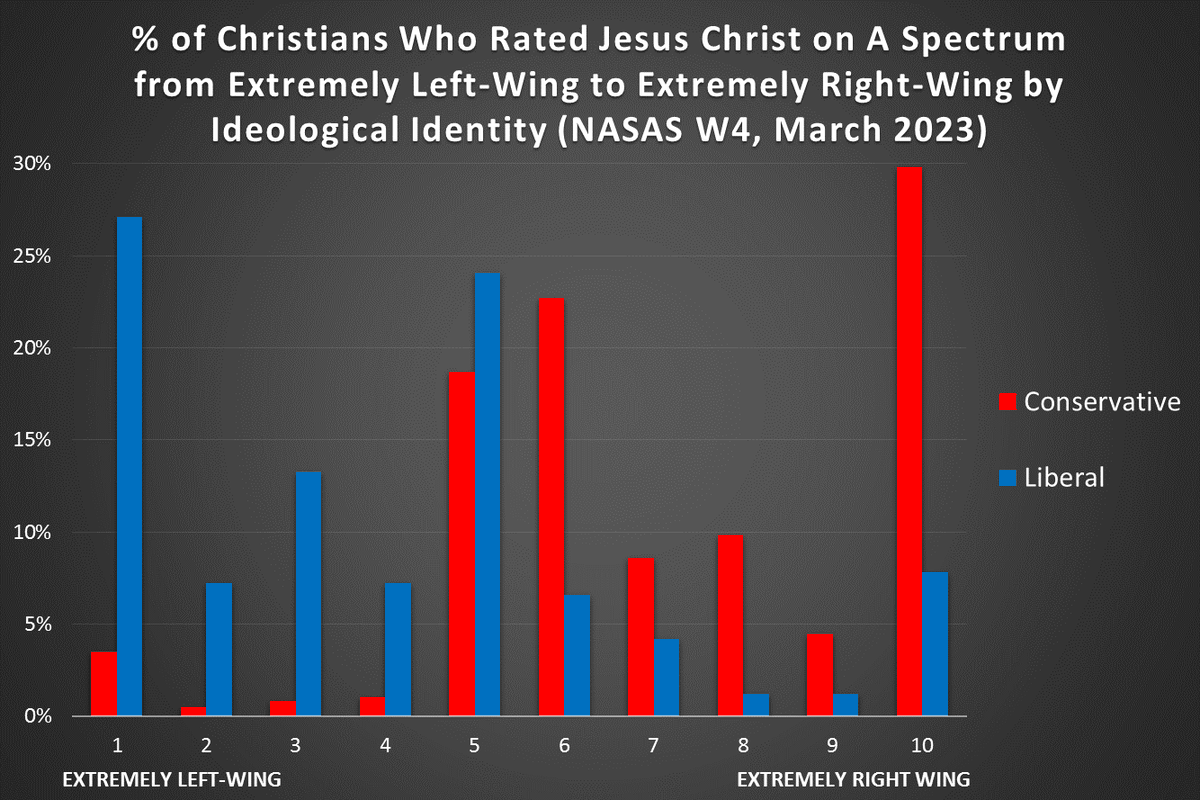
I was scandalized by this poll graphic …

… until I realized that anyone who answered at all (i.e., accepted the premise that Jesus fits on a political scale) is of dubious sanity regardless of the answer.

I want to add “orthogonal” to my vocabulary, and “Jesus is orthogonal to politics as we conceive them” seems apt.

Postscript

Failure of imagination

The problem is that we cannot imagine a future where we possess less but are more.

Charles Bowden


We are in the grip of a grim, despairing rebellion against reality that imagines itself to be the engine of moral progress.

R.R. Reno

The end of the world as we know it is not the end of the world.

You can read most of my more impromptu stuff here (cathartic venting) and here (the only social medium I frequent, because people there are quirky, pleasant and real). Both should work in your RSS aggregator, like Feedly or Reeder, should you want to make a habit of it. I’m even playing around a bit here, but uncertain whether I’ll persist.

Feast of Prophet Elijah

Culture

“Mixed heritage” versus “mixed race”

I have an extraordinary acquaintance on social media whose skin is dark, whereas his wife’s is light. It’s the things he does, and his unusual heritage, that makes him extraordinary. But he also thinks a lot about “race” because of how he and his daughter get categorized.

His daughter is also light-skinned, and was categorized as “white” a few days ago in a class where basically everyone else was a POC (as they say) and they “decided to lean hard into race being about physical characteristics, basically how people look, rather than even addressing the even slightly less dicey definition of shared ancestry.” The story has started a little social media discussion.

In the course, my acquaintance drew a distinction that I’d not heard before:

The main thing to understand is that race is a completely made up construct with no basis in scientific method (with the many, many, outliers like my daughter as proof of that). [So far, so familiar.]

Heritage is scientifically inescapable as it is based on who your direct ancestors are.

This is why I’m careful to say [my daughter] is of “mixed heritage” and not “mixed race”. Because, no one is of “mixed race” because race is based solely on looks and looks are a matter of individual perception.

If I ruled the world, “race” would be banished in favor of “heritage.” It seems like a helpful mind-hack.

Viva la difference!

Japan is very Japanese, intentionally so. You rarely see foreigners here beyond a few Filipinos and Bangladeshis. This annoys the economist technocrat types, sometimes for moral reasons, but mostly for pragmatic reasons. They see immigration, and open borders, as necessary for economic growth, which they view as the only goal for a country. A place must grow, change, and evolve, or else it’s a failure. Or to put it in the words of the economic development IMF types, every country should adopt the US western model of open borders, labor and pension reform, global treaties, and free markets, etc etc etc.

Japan, of all the G7 members, has stubbornly refused to do much of this, from the smaller things like eating whale to the larger things like increasing immigration, especially when it comes to any policy that could corrupt or dilute its culture.

So the technocrat/policy types look at Japan’s last few decades of relative economic stagnation as a failure, while the Japanese just shrug it off and chalk it up to one of the costs of maintaining their cultural identity. Something I intellectually respect, even if it’s not for me. A national identity, through a shared and specialized culture, is one of the easiest webs of meaning to construct, that works for the largest number of citizens, and in a largely secular place like Japan, certainly helps add to its functionality. To it being a high trust society.

That model of “maintaining Japan for the Japanese” might work for Japan, but that doesn’t mean I’m suggesting it would be good for the US. Immigration is central to the US’s last remaining shared web of meaning, which is what we generally call the American Dream. The idea that anybody, with enough hard work, can be successful, without having to break the rules. That someone can come to the US from literally anywhere, with nothing, and build a life for their kids that’s better than their own.

In contrast to Japan, cultural change rather than preservation is our national model, and entrepreneurialism is our national identity. So much so that we have made it a transcendent and spiritual ethos, even though it’s grounded in the material. A nationalism built around a kind of prosperity theology — which is inclusive of different peoples and cultures, as long as they buy into the concept of aspirational wealth.

Chris Arnade, Walking across Japan, part 2: A retreat to Niigata.

I could do with a bit more Japan in my life, figuratively speaking. I’ll never move, and it would not be to the far east if I did. I’m not opposed to (controlled) immigration even at a fairly expansive rate. But the dynamism, the churn, of American modernity I find pretty uncongenial much of the time.

Self-induced flatness?

Most consumers don’t know that by using internet-based (or -generated) platforms—by buying from Amazon, by staying in an Airbnb, by ordering on Grubhub, by friending people on Facebook—that they are subscribing to a life of flatness, one that can lead directly into certain politics. But they are. Seduced by convenience, we end up paying for the flattening of our own lives. It is not an accident that progressive ideas spread faster on the internet. The internet is a car that runs on flatness; progressive politics—unlike either conservatism or liberalism—are flatness.

Alana Newhouse, Everything is Broken

Happy places

In a previous life, Jamie was a MacBook-using, flat white-sipping hipster photographer from east London, growing slowly disillusioned with the pressure and precarity of the city’s gentrification. Then, one day, while hungover at a music festival, she stumbled upon a sauna. “I came out of the sauna into nature and plunged into a cold lake and was reborn,” she says.

Months later, Jamie left London, moved to Sussex and set up her first sauna venture. After just five years, she’s flourishing: “I’ve created a really beautiful life for myself. I live on the beach, I work in a forest, I run my own business. I’m doing work that feels purposeful and impactful.”

Louis Elton, The dawn of the Bohemian Peasants

Tech

Technological downsides

[T]he tendency to disorder [is] greatest when social arrangements are both increasingly complicated, and increasingly unnatural. Hackers couldn’t have kept our ancestors from building cooking fires, but it is very difficult to keep them from knocking out the electrical grid.

J Budziszewski

ChatGPT scholarship

I’ve written before about the ways that ChatGPT and the like are revealing the unimaginative, mechanical nature of so many assignments we college teachers create and administer. In that post I wrote, “If an AI can write it, and an AI can read it and respond to it, then does it need to be done at all?“ Might we not ask the same question about our research, so much of which is produced simply because publish-or-perish demands it, not because of any value it has either to its authors or its readers (if it has any readers)?

Countless times in my career I have heard people talk about their need to publish research — to get tenure or promotion — in an AI-like pattern-matching mode: What sort of thing is getting published these days? What terms and concepts are predominantly featured? What previous scholarship is most often cited? And once they answer those questions, they generate the appropriate “content” and then fit it into one of the very few predetermined structures of academic writing. And isn’t all this a perfect illustration of a bullshit job?

Yes, I’m worried about what AI will do to academic life — but I also see the possibility of our having to face the ways in which our work, as students, teachers, and researchers, has become mechanistic and dehumanizing. And if we can honestly acknowledge the conditions, then maybe we can do something better.

Alan Jacobs, noting another facet to Dan Cohen’s concerns about AI in scholarship.

Jacobs’ path requires reflection and painful course-correction, so I reckon we’ll use AI to fight AI — the usual layering of a technical solution on top of a technology-induced problem.

Until it all breaks.

Legalia

The Lawless GOP Law-Enforcers

I had forgotten that the Republican Attorneys General Association sent robocalls asking people to join a certain rally on January 6, 2021. Hindsight shows this to have been a bad idea.

But foresight would have done the same: what legitimate interest did Republican Attorneys General have in turning out throngs of deluded populists for a rally in support of the idea that Donald Trump had won the election he’d lost two months earlier? Much worse came of it than expected, but no sane person would have expected any good of it.

They should have been supporting the rule of law, not becoming violence-enabling political hacks.

Aim at fat-cats, hit do-gooders

My colleagues at the Competitive Enterprise Institute (where I am a writer in residence) are taking the lead in what will be, almost certainly, the most significant case the Supreme Court hears in its next term: Moore v. United States. (Do not confuse it with the surveillance case of the same name.) Like many such cases, this one really involves, at heart, very little more than the question of whether the Constitution says what it actually says or whether the government can, citing needful exigencies, simply pretend that the Constitution says whatever the powers that be in Washington decide it needs to say on any given day.

Charles and Kathleen Moore invested in a social enterprise in India, KisanKraft Machine Tools Private Limited, which helps Indian farmers in poor and underdeveloped areas improve their businesses—and their lives—by acquiring more modern equipment. KisanKraft now employs hundreds of people in India and has helped a great many marginal farmers—and their families and communities—improve their economic situations by means of their own work and enterprise, not as clients of some political patron or as dependents on some charitable program. (The next time someone tells you free-market economics is for people who care only about themselves … ) KisanKraft is one of those businesses that exists to make a difference rather than a profit, and, for that reason, it reinvests all of its earnings into the business itself. The Moores have never received a penny of income from their investment in the firm, never expected to, and, barring some unforeseeable development, never will. 

But, thanks to the special kind of imbecility that can be produced only by the intellectual fusion of Donald Trump with Elizabeth Warren, the Moores have been given a tax bill not for any income they have realized from their investment—of which there is $0.00—but for imaginary income. KisanKraft could have paid out dividends to its investors, who would then have investment income to pay taxes on. But KisanKraft did not do that. Donald Trump, who has the resume of a villain from an unpublished Ayn Rand novel—second-rater, inherited money, serial business failure, corrupt, seething with hatred for people who succeed in the businesses he failed at—has spent years railing at American investors and businesses with the unpatriotic gall to invest in overseas businesses (that are not golf courses), and in 2017 congressional Republicans, caught up in that unsavory nationalist-populist moment, produced the grievously misnamed Tax Cuts and Jobs Act, which imposed a “one time” (“It’s only this once, we promise!”) tax on unrealized overseas investment income, simply “deeming” profits to have been realized and repatriated for tax purposes. It was one of the dumbest policy ideas of a remarkably dumb era. Of course, it was supposed to wring money out of the scheming shifty corporate “fat cats” who populate the fever dreams of well-heeled Washington populists. 

Of course, it landed on people like the Moores.

Kevin D. Williamson

Early precedent for 303 Creative

Creative artists refusing to create works that violate their conscience is nothing new. Consider, for instance, the Roman Emperor Diocletian:

… the last glimpse that we have of his personal life is his irritation at the refusal of his Christian stone-masons to make him a statue of Æsculapius.

Rebecca West, Black Lamb & Grey Falcon, (Kindle Location 3520).

Sex and gender

Sanity or a ban?

I don’t want to ban any medical procedure. It may be that in a few cases, transition will help at such a young age. But recommending them as a general rule, the minute a child says they’re the opposite sex, without exploration of other possible mental health issues? Reckless beyond belief. That has got to stop. Someone has to protect the children, especially the gay ones, who cannot protect themselves.

Andrew Sullivan. This is the concluding paragraph of a too-long-to-fully-quote item on the continuing scandal of the American medical establishment using junk science or made-up science to support mutilating gender dysphoric children as the first treatment option.

Shmocial Shmontagion

[N]early forty percent of Brown’s student body identifies as “not straight,” which is five times the national average. To be fair, the definition of “not straight” ranges these days from being in a same-sex relationship—which somehow rings very traditional now, very problematic, very “there’s only one sex allowed in this relationship”—to having an edgy haircut. There are two options for what’s going on here. The first is that Alex Jones was right, that our drinking water is screwing with our hormones, and that indeed everyone is becoming gay from it. The second rhymes with Shmocial Shmontagion.

Suzy Weiss, The Free Press


We are in the grip of a grim, despairing rebellion against reality that imagines itself to be the engine of moral progress.

R.R. Reno

The end of the world as we know it is not the end of the world.

You can read most of my more impromptu stuff here (cathartic venting) and here (the only social medium I frequent, because people there are quirky, pleasant and real). Both should work in your RSS aggregator, like Feedly or Reeder, should you want to make a habit of it. I’m even playing around a bit here, but uncertain whether I’ll persist.

Wednesday, 5/17/23

Politics

Gentle Persuastion

Let’s start with something nice.

Peter Wehner recounts an anecdote from a 1985 gathering of the South African National Initiative for Reconciliation, where the Dutch Reformed were guardedly present:

Bishop [Desmond] Tutu was one of the last people to speak; as he was preparing to do so, the leaders of the Dutch Reformed Church were uneasy, visibly stiffening. Tutu addressed his remarks directly to them.

“I just want to thank God that he brought you, my white brothers, here to South Africa,” the Anglican bishop told the Dutch Reformed Church leaders, as best Haugen recalls his words decades later. “I thank God that you came because you brought the mission hospitals, and I was born in a mission hospital. I thank God you brought the mission schools, and I went to a mission school. But most of all, my brothers, I thank God that he brought you because you brought the word of God. But now I’m going to have to open up that word of God and show you why your apartheid system is a sin.”

Tutu proceeded to do just that.

Causation isn’t always obvious in human affairs, but according to Wehner “The following year, the Dutch Reformed Church declared that South Africa’s system of racial separation and minority white rule was morally wrong and had done the country and its people grievous harm.”

My recollection is that they declared it a heresy, which meant a lot to me since I was then a member of the Christian Reformed Church, historically Dutch and quite thoroughly “adjacent” to South Africa’s Dutch Reformed in many ways, and its defense of apartheid was an embarrassment — embarrassing like the Russian Orthodox Patriarch blessing the invasion of Ukraine.

What pluralism is and isn’t

Pluralism is an irreducible, sociological fact of American life. It is not a set of norms that requires perfect neutrality in public spaces; instead, it creates parameters around what’s politically possible amid profoundly diverse views about first principles.

Elayne Allen, Sensible Politics Can’t Ignore Religion.

That may be a sleeper. You might want to read it again.

Harder questions for The Man Who Would Be King

What the TV professionals should learn is that they have two choices in dealing with another Trump primary campaign. They can take the kind of this-is-an-emergency path urged on them by some press critics and anti-Trump writers: Don’t platform him or normalize his campaign in any way, don’t let him speak on live TV, cover him only within a set framework that constantly emphasizes his authoritarian tendencies and attempts to overturn the last election. I don’t believe this path is wise or workable, but it at least has a moral consistency lacking in the “democracy is in danger and tune in tonight for an hour with the demagogue!” approach that we already watched play out in 2016.

Alternatively, if the press intends to conduct interviews and run debates as normal, then in preparing for them they need to try to think a little bit more like Republican voters as opposed to center-left journalists. Not in the sense of behaving slavishly toward the former president, but in the sense of writing the kinds of questions that a right-leaning American primed to dislike the media might actually find illuminating.

In part, as Ramesh Ponnuru suggests, that means drilling into Trump’s presidential record on conservative terms rather than liberal ones — asking about, for instance, the failure to complete the border wall or the surge in crime in the last year of his administration. In part, as Erick Erickson writes, it means asking obvious questions that follow from his stolen-election narrative rather than just attacking it head-on — as in, if the Democrats really stole the election, why did your administration, your chosen attorney general and your appointed judges basically just let them do it?

Ross Douthat, Trump’s Lesson for the Media and Ron DeSantis

Sounds about right

Special Counsel John Durham—appointed during former President Donald Trump’s administration—issued a 306-page report criticizing the FBI’s investigation into allegations linking the Trump campaign and Russia ahead of the 2016 election. Durham found the collusion probe was opened based on “raw, unanalyzed, and uncorroborated intelligence” and that investigators placed too much stock in supposed evidence provided by Trump’s political rivals. The report also alleges the FBI was far more hesitant to investigate claims Hillary Clinton’s campaign had similar foreign ties. GOP Rep. Jim Jordan—chair of the House Judiciary Committee and the Select Subcommittee on the Weaponization of the Federal Government—said yesterday he’d invited Durham to testify next week.

Via The Morning Dispatch for 5/16/23

Once again, I’m in the position of holding two truths in tension:

  1. The Media, the FBI, and who knows who all else, will do just about anything, including dirty, sleazy tricks, to keep Donald Trump out of the White House.
  2. Donald Trump nevertheless is deeply unqualified for the Presidency of this troubled nation-state I live in.

The Biden Family Grift

“I don’t see any direct evidence of misconduct in the memo or reports about it,” Ken White, a criminal defense attorney and former federal prosecutor who worked on government fraud and public corruption, told TMD. “When it rises to the level of an official doing things because of payments to a family member, or paying money with the specific intent to change an official’s decision, that’s illegal. But hiring a public official’s idiot brother-in-law for your board of directors generally isn’t.”

“There’s a vast amount of activity that’s sleazy but legal in American politics,” White told TMD. “It’s reasonable to make inquiries about why a vice president’s relatives are getting big payments from foreign countries. But so far it’s smoke, not fire.”

The House Judiciary and Intelligence Committees released a joint staff report last week claiming a letter signed by former intelligence officials during the 2020 election discounting the legitimacy of the infamous Hunter Biden laptop was coordinated with the Biden campaign and exploited the national security credentials of former officials.

Via The Morning Dispatch for 5/16/23

Point Well Made

President Biden says he will not negotiate with congressional Republicans over a bill to increase the debt ceiling. This is preposterous and indefensible, for several reasons: For one thing, taxing, spending, and borrowing are inherently congressional powers, not presidential powers. For another thing, Joe Biden is president—not king. The idea that a president would refuse to negotiate with Congress over congressional action is nonsensical from a constitutional point of view and autocratic from a political point of view. Congress is not there to do the president’s bidding—if anything, it is the other way around: The president is charged with the faithful execution of the laws Congress passes, not with barking orders at the branch of government that is actually charged by the Constitution with responsibility for this issue.

Kevin D. Williamson, Emperor Malarkey I.

I’m pleased to report that Biden was lying/bluffing/bloviating and is indeed talking with congressional Republicans — talks that cynics might even call “negotiations.”

Christian Nationalisms

Michelle Goldberg, who I don’t usually read, caught my attention with this one:

A major question for Republicans in 2024 is whether this militant version of Christian nationalism — one often rooted in Pentecostalism, with its emphasis on prophecy and revelation — can overcome the qualms of more mainstream evangelicals. The issue isn’t whether the next Republican presidential candidate is going to be a Christian nationalist, meaning someone who rejects the separation of church and state and treats Christianity as the foundation of American identity and law. That’s a foregone conclusion in a party whose state lawmakers are falling over themselves to pass book bans, abortion prohibitions, anti-trans laws, and, in Texas, bills authorizing school prayer and the posting of the Ten Commandments in classrooms.

What’s not yet clear, though, is what sort of Christian nationalism will prevail: the elite, doctrinaire variety of candidates like Gov. Ron DeSantis of Florida, or the violently messianic version embodied by Flynn and Trump.

If DeSantis treats Christianity as a moral code he’d like to impose on the rest of us, Trump treats it as an elevated status that should come with special perks. That’s how he can slam DeSantis for being “sanctimonious” even as he wraps his own campaign in biblical raiment. If a Republican wins in 2024, the victor will preside over a Christian nationalist administration. The question is whether that person will champion an orthodoxy or a cult.

What a hell of a state we’re in when Donald Trump, with zero Christian bona fides, is considered the avatar of one variety of “Christian Nationalism.” And while I question the use of “Christian Nationalism” to describe MAGAworld, he’s definitely the avatar of something that thinks it’s Christian. So too may be DeSantis, this time with some bona fides.

It’s shaping up once again that I’ll be unable to vote in good conscience for either major party candidate next fall.

Legalia

How much menace can we be required to tolerate?

Today, Kat Rosenfeld of UnHerd gained the coveted status of “Writers the Tipsy Teetotaler intends henceforth to pay closer attention to.”

Her topic is the subway death of Jordan Neely at the hands of Daniel Penny with the approbation of some other passengers. It’s so rich that I commend the whole essay to you at UnHerd though it was reprinted at Bari Weiss’s Free Press behind a paywall:

During the 2017 peak of the #MeToo movement, the conversation about sexual harassment came down to two related but ultimately separate questions. On the one hand, there was the question of what men shouldn’t do; on the other, there was the question of what women could be expected to tolerate.

For [Jordan Neeliy] to die on the dirty floor of a subway car, screaming and defecating on himself while three strangers held him by the arms, legs, and neck, he had to be first failed at every turn by a system that was supposed to shelter and protect him — not just from doing harm, but from being harmed by others when his mental illness manifested in frightening ways.

Here, one might have expected that many of the same voices who argued so vehemently against the notion of resilience in the midst of MeToo … would now demand zero tolerance for male aggression on public transit …

But, no: instead, many of the people who once insisted that men who slid into DMs deserved the complete destruction of their professional reputations became passionate advocates for toughening up when it came to dealing with volatile people on public transit.

To sum up: a man who reposts an off-colour joke is advertising his innate misogyny, to the point where women should feel uncomfortable sharing a workplace with him. But an agitated and clearly unstable man announcing to a crowded subway car — as Neely reportedly did — that he’s been pushed to the brink and is ready to die, or go to prison for life: why in the world would you find that menacing?

Of course, today’s 180-degree pivot to brash fearlessness is identitarian horse-trading: MeToo is out, BLM is in. The dynamics of any conflict must be considered along these lines, and the narrative must be massaged accordingly. This was true in 2020 when a white woman called the police on a black man who threatened her in a public park; it is true now, as piety demands that the behaviour of the black, homeless victim of this terrible tragedy must not be scrutinised in any way. On the Left, that is; the Right has spent the past few days waving Neely’s criminal history in the air, singing “He Had It Coming”, in an absolute spectacle of ghoulishness.

That mindset, so ubiquitous in the wake of MeToo, so popular among progressives in general, says that no breach of decorum or moment of discomfort is too insignificant to ignore. It must be registered. It must be punished. It’s nothing more or less than a call for constant vigilance. The thing about that: when you demand vigilance, you get vigilantes.

(Italics added)

One cavil: Maybe Rosenfeld has been frequenting further-Right sites than I do, but “singing ‘He Had It Coming’, in an absolute spectacle of ghoulishness” strikes me, for once, as hyperbolic bothsiderism.

There definitely is a reflex to defend Daniel Penny, but the Right-coded commentary I’ve seen appreciates that Jordan Neely was non compos mentos and didn’t “deserve” to die. Were it clear that Daniel Penny intended his death, a lot of his support would disappear.

Meanwhile, I’m at least glad that there’s a generous legal defense fund for Penny — some of it probably ill-motivated, but the shade of green is the same regardless of motive — so he can mount a proper fight against dubious criminal charges.

Abortion extremism

North Carolina state lawmakers voted Tuesday to override Democratic Gov. Roy Cooper’s veto of a bill that prohibits most abortions after 12 weeks of gestation, with exceptions for rape and incest (up to 20 weeks of gestation), “life-limiting anomalies” (up to 24 weeks), and life of the mother (no limit). The bill also appropriates money for child and foster care programs, contraception, and paid parental leave for teachers and government employees. North Carolina’s Republican lawmakers have pitched the legislation as a model for states around the country.

TMD.

I said previously that Governor Cooper’s veto should brand him as an absolutist and his party’s position on abortion as extreme.

I know I am well out of the mainstream, but this Bill strikes me as being about where the country is likely to end up on average, for the foreseeable future, with a few solid blue states echoing Gov. Cooper’s absolutism in favor of any and all abortions.

And if accepting that reality offends you, I commend The Truth of Sensible Politics at The Public Discourse.

Culture

A Cold Splash of Reality

A few years before his death in 1972, [C.] Day Lewis was made Poet Laureate of the UK—which is generally a mixed blessing of an honor, tending to mean that the poet in question has their best work behind them and now must try to summon the muses to celebrate the wedding of someone sixth in line to the throne.

Things Worth Remembering: A Poem for Parents | The Free Press

Fun fact 1: C. Day Lewis was father of Daniel Day Lewis.

Fun fact 2: Although I recognize the name as that of an actor, I probably could not pick Daniel Day Lewis out of a police lineup of famous middle-age, caucasian (whatever that means), dark-haired actors. I’m just not a movie groupie.

Embrace of Vigilantism

Jamelle Bouie, who I probably should watch more closely, echoes my distress over the Right-wing valorization of white males who arguably acted as vigilantes. (The Republican Embrace of Vigilantism Is No Accident).

He might have mentioned Left-wing valorization of the victims, who generally were not without fault in the lethal incidents, but if I’m going to complain about bothsiderism, I shouldn’t fault writers who don’t practice it — even if it’s because they see no enemies or toxic extremists on their side of the spectrum.

Companion Piece: Recommended: Firearms Classes Taught Me, and America, a Very Dangerous Lesson

Companion Piece to the Companion Piece: B. D. McClay, Phenomenology of the Gun (Recommended by an acquaintance on micro.blog)

The Good Life

Despite sociological evidence to the contrary, it remains to all appearances virtually axiomatic that the acquisition of consumer goods is the presumptive means to human happiness-and the more and better the goods, the better one’s life and the happier one will be.

Brad Gregory, The Unintended Reformation

More, from elsewhere:

Let’s just say you’d better have great discipline and a very rich interior life if you expect to be happy amid great affluence.

If this is true of individuals, that money doesn’t buy happiness, why can’t it be true of a whole society? Perhaps we can sum it up thusly: What does it profit a man to gain the world yet lose his soul? If America has gained the world but lost its soul, we should be anxious indeed.

Jon D. Schaff, Are Americans Better Off?

Parity

Ultimately, the education system should commit to spending at least as much on a fifteen-year-old whose next seven years will be spent in a combination of school, apprenticeship, and employment as it spends on one headed to a four-year public university.

Oren Cass, The Once and Future Worker

Micro.blog

In the footer of each blog post, I mention my presence on micro.blog and blot.im for shorter items or outbursts, respectively. Now Alan Jacobs has written a neat summary of micro.blog, the three paths of micro.blog.


For all its piety and fervor, today’s United States needs to be recognized for what it really is: not a Christian country, but a nation of heretics.

Ross Douthat, Bad Religion

We are in the grip of a grim, despairing rebellion against reality that imagines itself to be the engine of moral progress.

R.R. Reno

You can read most of my more impromptu stuff here (cathartic venting) and here (the only social medium I frequent, because people there are quirky, pleasant and real). Both should work in your RSS aggregator, like Feedly or Reeder, should you want to make a habit of it.

Sunday (and other) stuff

Sunday stuff

Where does patience come from?

O Lord and Master of my life,
Take from me the spirit of sloth, despair, lust of power and idle talk.
But grant rather the spirit of chastity, humility, patience and love to Thy servant.

Yea, O Lord and King,
grant me to see my own transgressions
and not to judge my brother …

(Prayer of St. Ephrem the Syrian, recited over and over and over again, with prostrations, by Eastern Orthodox Christians during Lent.)

I’ve tended for many decades now to discuss things, outside of clearly religious contexts, in non-religious terms. It’s not from any effort to deceive, but instinctive. I guess I’ve absorbed by osmosis the Rawlesian dogma that public discourse requires public reason.

(Lest I now deceive, I acknowledge that many of the terms in the preceding paragraph are debatable, starting with the dubious category of “religion.”)

But I caught myself the other day attributing my increasing patience to my advancing (age and thus the accumulation of anecdotes where I was wrong, someone else right).

But I’m not so sure. Two geezers within the past week or two have impatiently shot innocent people who mistakenly approached their homes. Apparently “older” and “more patient” don’t necessarily go together.

Might my increasing patience have something to do with now 25 years of that prayer?

I’ve only got one life to live. I cannot scientifically separate those prayers, and a quiet divine response, from all else that has accompanied my life. But the concept of “crotchety old man” makes me suspect that mere aging, even self-reflective aging, does not alone explain patience and tolerance.

Socrates, Plato, Lao Tzu

Even the staunchest Christians in Greece refer to Socrates as “the Apostle to the pagans.” The best-loved Greek saint of the 20th century, St. Nektarios of Pentapolis, said that Socrates and “divine Plato” were at times “inspired by God.” If the Greek philosophers can be honored in this way, cannot also Lao Tzu, who came even closer than they to describing the Logos, the Tao, before he was made flesh and dwelt among us?

Hieromonk Damascene, Christ the Eternal Tao

Hard words

The stringency of Christianity’s sexual teachings gets most of the press, but the commandment against avarice, if taken seriously, can be the faith’s most difficult by far. You can wall yourself off from pornography and avoid people who tempt you into adultery, but everybody has to work—and every day in the workplace is a potential occasion of sin. The prosperity gospel does away with this anxiety. Like most heresies, it resolves one of orthodoxy’s tensions by emphasizing one part of Christian doctrine—in this case, the idea that the things of this life are gifts from the Creator, rather than simply snares to be avoided, and that Christians are expected to participate in the world rather than withdraw from it.

Ross Douthat, Bad Religion: How We Became a Nation of Heretics

Why didn’t God simply declare us righteous?

The Egyptian church father next explains why God did not merely save mankind by way of a simple declaration of a clean bill of health. Our cure, Athanasius declares, requires more than merely a spoken word. Salvation, for Athanasius, is not just an external or nominal matter; it is a participatory – or real – event.

Hans Boersma, Heavenly Participation

Emotivism

If you don’t know who Eric Metaxas is, you may just want to skip this one as I’m not sure you need to know.

The thing is, a heck of a lot of Americans, both on the Left and the Right, have done the same thing. Over forty years ago, Alasdair MacIntyre identified “emotivism” as the default moral reasoning position of the contemporary West. That is, we have become the kind of people who believe that truth is what we feel it is. By now, we have created a culture built on emotivism. In one extreme expression of it, we say that an individual can determine his or her sex based not on their body and their genetic profile, but entirely on their feelings. I hope Eric Metaxas and Caitlyn Jenner met in a green room somewhere, and were friendly, because they have a lot more in common than either might have thought.

If you make the pursuit of truth your telos, you might not ultimately find it — truth can be elusive — but you stand a good chance of keeping your integrity, even if you fall into deceit. But if you place fear of the crowd above the pursuit of truth, as Fox did, or live by an emotivist epistemology in which you never analyze your emotional response, as Eric Metaxas did, well, it’s likely to cost you plenty.

On the other hand, last September, Eric released a book titled, Letter To The American Church, in which he goes all Bonhoeffer in calling on US Christians to resist evil. Hey, that’s a message I can endorse! But coming from him? The Upper East Side dandy who exhorted American Christians to shed blood to defend Donald Trump’s election lies?

Rod Dreher, Eric Metaxas And The MAGA Inner Ring. I bought Metaxas’ latest book out of curiosity, and it is truly very bad. My eyes don’t light up at the utility of “emotivism” to explain it, but I have no better summary.

If there is any coherent philosophy behind Metaxas’ strange and vehement Christianish fixations, it must be akin to that of the New Apostolic Reformation folks:

  1. that the offices of Apostle and Prophet still exist; and
  2. that those offices come willy-nilly on whomever the Lord chooses, not by any orderly and ecclesial process.

The NAR folks, however and so far as I know, don’t write letters “to the American Church” haranguing their fellow-Christians that they’re stupid, evil, complicit, crypto-Nazis if they don’t believe the writer’s private revelations.

Other stuff

Game recognizes game

Trump seemed to feel a kinship with prosperity preachers—often evincing a game-recognizes-game appreciation for their hustle.

McKay Coppins, Trump Secretly Mocks His Christian Supporters

Enduring, competing myths

There are few ideas, tropes, narratives, myths—whatever you want to call them—more enduring than the notion that very rich people are villainously pulling strings behind the scenes to do villainous things. 

I want to be clear: It’s a bipartisan tendency. But the chief difference between right-wing and left-wing versions is that the left-wing versions are treated as serious theories by establishment journalists, academics, and experts while the right-wing versions are usually dismissed as paranoid or bigoted fantasies by those very same academics and experts. “The Koch brothers are behind this!” is acceptable political rhetoric, but, “Soros is behind this!” is antisemitic paranoia. (Yes, antisemites use Soros as a foil, but that doesn’t mean he isn’t meddling in American politics.)

Jonah Goldberg

Race

Is equality in America’s DNA?

There’s a story about the USA being dedicated to human equality and dignity from (at least) the time of the Declaration of Independence.

The story is nearly universal, and it’s rhetorically useful in politics, and I dare say denying it would be a political kiss of death in almost every congressional district in the country.

But it is false.

The Declaration of Independence was not a statement about human rights in the abstract; it was not a declaration of concrete human rights, either. As the title tells us, it is not about rights at all; it is about independence. It was written at a specific moment and for a specific purpose, designed to do two things: to announce that the American colonists were throwing off allegiance to the British Crown and to justify that act.

Kermit Roosevelt III, The Nation that Never Was

Thus the 3/5 clause (slaves counting as 3/5 of a person) in the Constitution was not a solecism on the grammar of the Declaration. If you can face up to that, you can take solace that we now are formally dedicated to equality, as a result of the Civil War amendments and Reconstruction. (I would even say we are so madly dedicated to equality that we ignore truly relevant distinctions and increasingly ignore several rights that entitle people to opt out of the equality regime. But that’s a topic for another day.)

I’m not 100% on board with Roosevelt on everything, but having just finished, at age 74, my first actual reading of Uncle Tom’s Cabin, that block quote dovetails not only with the vision of the little woman who wrote the book that started [a] big war, but with some threads of legal realism I’d previously picked up. When you see multiple “data points” pointing in the same direction, you can’t help but feel that you’re onto something.

It was always the race problem

God, it was always the [race problem], now, just as in 1883, 1783, 1683, and hasn’t it always been that since the first tough God-believing Christ-haunted cunning violent rapacious Visigoth-Western-Gentile first set foot here with the first black man: the one willing to risk everything, take all or lose all, the other willing just to wait and outlast because once he was violated all he had to do was wait because sooner or later the first would wake up and know that he had flunked, been proved a liar where he lived, and no man can live with that. And sooner or later the lordly Visigoth-Western-Gentile-Christian-Americans would have to falter, fall out, turn upon themselves like scorpions in a bottle.

Walker Percy

Respect for roots

We owe a cornfield respect, not because of itself, but because it is food for mankind. In the same way, we owe our respect to a collectivity, of whatever kind—country, family or any other—not for itself, but because it is food for a certain number of human souls.

Simone Weil, The Need for Roots

A brief digression

I had paid exactly zero attention to the Dylan Mulvaney kerfuffle. It had peripherally thrusted itself onto my attention a time or two — just enough that I probably could have told you that Dylan Mulvaney was a “trans woman” who did a Budweiser ad, and the some people had their knickers in a knot over it.

But then Andrew Sullivan weighed in, and my default position is that if he takes the time to write about something, it’s probably worth a little of my time to read it.

I won’t say that I was richly rewarded, but I learned some more about Dylan Mulvaney including Andrew’s theory:

There is, in fact, a perfect word to describe Dylan Mulvaney. She isn’t trans or queer or subversive so much as a minstrel. She’s performing a deeply misogynistic version of a Disney princess for an audience that is uncomfortable with actual transgender people whose appearance is not monetizable and whose lives are more than gay parodies of blonde ditzes. But minstrelsy has always been lucrative — and I don’t fault Dylan for seeing an opening here, and succeeding beyond what must have been his/her wildest dreams.

What I worry about is what happens to Dylan as this buzz eventually wears off. She’s only 26, and has a lifetime to live after her 12 months of TikTok fame. The future may not be as pretty as she currently is.

I shall now, I hope, be able to return to ignoring this constellation of unedifying provocations and counter-provocations.

Johnny Cashesque

H/T Andrew Sullivan

Medical Assistance in Dying

MAID is inexpensive, completely effective, and easily delivered. If we do not resist it, the system will, as if pulled by gravity, increasingly provide suicide and euthanasia instead of healing for the poor, elderly, and severely ill.

Bill Gardner

Ideology defined

[A]n ideology is a conceptual system that oversimplifies reality while claiming to explain it comprehensively, and that justifies its political rule by insisting that, if social and political reality could just be made to conform to its conceptual schema, all problems would be resolved … Part of the “real nature of all ideologies” is that, not only do they misrepresent reality, but they are necessarily in active conflict with it.

Mark Shiffman via Matt Crawford


For all its piety and fervor, today’s United States needs to be recognized for what it really is: not a Christian country, but a nation of heretics.

Ross Douthat, Bad Religion

You can read most of my more impromptu stuff here (cathartic venting) and here (the only social medium I frequent, because people there are quirky, pleasant and real). Both should work in your RSS aggregator, like Feedly or Reeder, should you want to make a habit of it.

Tuesday 2/21/23

Personal

Last October, I began wearing a continuous glucose monitor (CGM).

My diabetes has never been bad. I’ve never needed insulin. The Family Practitioner who started me on Piaglitazone and Metformin never even uttered the word “diabetes.” He said “I’m going to put you on some meds to control your blood sugar, which is a bit too high.” Soon he dropped the Piaglitazone.

Since my Doc was sort of proactive, I suspect that I never actually made it past “pre-diabetes,” which I think is pretty much the same as “metabolic syndrome.” I’ve known I had metabolic syndrome/pre-diabetes for more than 30 years. And while my doctors (past and present) seemed to consider my A1C of 6.2 pretty good, I looked at it, and at the scale, and eventually said “maybe I put weight on so easily because of what high blood sugar does,” and began thinking that CGM technology might help me control that.

That thought became a reality shortly thereafter when I learned of Levels Health. Through them, I got a Dexcom G6 CGM. This is my personal, subjective report.

First, using a CGM requires some acclimation. Levels didn’t mention that CGM sensors only last about 10 days, and each one measures serum glucose differently. I had to figure that out by looking at the Dexcom app and puzzling over the blank next to “last calibration date.” Yes, you do need to calibrate your CGM sensor unless you want merely to get an idea of the direction your serum glucose is moving twelve times an hour.

Thus, second, the ads for Dexcom that say “no more finger pricks” are exaggerating. You need finger pricks in order to calibrate the new CGM sensor. In my experience, I really need two finger-pricks per sensor: one when glucose is low, another when it’s high. I only calibrated my current sensor at low glucose, and I’m all but positive that it’s exaggerating the rise caused by benign meals that have not been a problem before. Still, two finger-pricks in ten days is much better than what some diabetics experience.

Third, there’s only one good place on my arms to wear a CGM, and if I sleep on that arm with a CGM, it’s apt to disrupt the sensor’s operation. What that means is that my phone is likely to erupt in the dead of night with shrill false alarms (overriding the “off” switch on the phone) of dangerously low blood sugar. Were I frankly diabetic, especially Type I, that no-opt-out alarm might save my life, but for me it’s a definite bug, not a feature.

Fourth, in my experience, the area where I habitually insert the CGM sensor becomes sensitive, giving off stinging sensations and other unpleasant sensations at times.

Fifth, my CGM sensors have intermittent outages where they cease communicating with the app. For that reason, I hesitate to push my luck by swimming or sinking into a hot bathtub, even though that’s supposed to be okay for up to 20 minutes. My hygiene grade is down a bit.

Sixth, it really is interesting, after 30+ years of metabolic syndrome, to watch in more objective terms how a single meal can send my glucose soaring, with all that implies.

Seventh, it worked. I dropped my A1C from 6.2 to 5.7 in four months. I lost a modest amount of weight. Then my new doctor (the old one, younger than me, retired) monkey-wrenched things by saying that he didn’t like diabetics to have A1C that low, for fear of their blood sugar dropping dangerously low. (The likelihood of me ever observing a diet so strictly that I drive my blood sugar too low seems vanishingly low.) I also broke through a weight-loss plateau, though total weight loss with CGM remains modest.

Eighth (and here I pivot), it turns out that controlling serum glucose, for me at least, means eating a low-carbohydrate diet. I know how to do that without a monitor.

Finally, there’s something about CGM that feels to me like biohacking, like quantifying things that really require only generality, like being a control freak. And biohacking seems adjacent to transhumanism, with which I want nothing whatever to do.

So I have told Levels not to ship my next CGM order. I plan to continue a low-carb diet. I plan to do occasional pin-pricks before and after planned binges. If you are pre-diabetic or put weight on too easily, I would recommend giving a look at Levels Health and CGM for a while to get in touch with your very own metabolism.

I haven’t even ruled out returning to CGM during my year-long Levels Health membership. But in a few weeks, I’m done with CGM to give me “metrics” (beyond my weight) on the effects of low-carb eating.

Cultural

Thought fodder

One historical analogy does seem salient to me, though: the drugs [gender clinics] now give to gender-dysphoric teens are very closely related to the drugs they used to “cure” Alan Turing of his gayness. Every time I think of that I shudder.

Andrew Sullivan

Fox civil war

Fox news is supposed to be separate from Fox opinion, and the few times I’ve watched the former, that seems broadly true. But that doesn’t mean that there’s perfect mutual understanding and harmony:

  • On Nov. 9, 2020, host Neil Cavuto cut away from White House press secretary Kayleigh McEnany as she made unsubstantiated claims of a stolen election. “Unless she has more details to back that up, I can’t in good countenance continue to show you this,” Cavuto said on the air. For this, Fox News Senior VP (and former Trump White House press aide) Raj Shah labeled Cavuto a “brand threat” in a message to top corporate brass.
  • Hannity and Carlson tried to get Fox News reporter Jacqui Heinrich fired for fact-checking a Trump tweet about Dominion and noting that there was no evidence of votes being destroyed. “Please get her fired. Seriously… What the fuck?” Carlson texted Ingraham and Hannity on Nov. 12, 2020. “It’s measurably hurting the company. The stock price is down. Not a joke.” Hannity exploded on top execs, including one who panicked and wrote that Heinrich “has serious nerve doing this and if this gets picked up, viewers are going to be further disgusted” with Fox
  • On Nov. 19, 2020, after Fox broadcasted the now-infamous Giuliani and Powell press conference about Dominion, then-White House correspondent Kristen Fisher got in trouble for fact-checking their bogus claims. Per the filing, “Fisher received a call from her boss, Bryan Boughton, immediately after in which he emphasized that higher-ups at Fox News were also unhappy with it, and that Fisher needed to do a better job of, this is a quote, respecting our audience.”

Nick Cattogio, Fox News Hates Its Viewers

White race hucksters — it’s all about the incentives

if you want a job in DEI – especially an enviable senior position like [Rachel Elizabeth] Seidel [a/k/a Raquel Evita Saraswati] enjoys – being a person of color is explicitly an advantage, as those job listings pretty much universally list coming from a minority background as an advantage in the hiring process. If you create an advantage, people are going to pursue that advantage. Whether or not such a pursuit is ethical is not really relevant to the basic question of incentives and behavior. But like so much else in our contemporary racial conversation, there’s an element of unreality here, as every new Dolezal results in a round of shaking heads and “why would somebody do this?” But it’s obvious why they’re doing it. Progressives created the incentives that are provoking the behavior! This is the world we’ve made.

But the incentives are still unmentionable. As I wrote a couple years ago, we’re in this permanently unsettled position regarding efforts to diversify institutions: all right-thinking people are meant to support such efforts, but if you speak directly about the impact of those efforts – if you acknowledge that programs intended to benefit some minorities in a selection process result in some minorities benefitting in that selection process – then that’s an impermissible microaggression that suggests minorities aren’t deserving. I invite you to go into certain circles of Twitter and say “a lot of Black students get into Ivy League schools because of affirmative action.” You’d be pilloried. But the people pillorying you would all be supporters of affirmative action programs… which exist to get more Black students into Ivy League schools. You must support the intent of the programs but deny their effects. You need to advocate for affirmative action that helps Black and Hispanic students get into elite colleges; you are never to say that some Black and Hispanic students got into college because of affirmative action. But the latter statement forbids expressing precisely the condition endorsed by the former. It’s all deeply bizarre and a product of our permanently-enflamed racial discourse.

Freddie deBoer, We’ll Get Dolezals Until the Incentives Change

But Freddie states the other side, too:

With both the Dolezal phenomenon and affirmative action, we’re laboring under an inability to frankly reflect on racial progress and benefits that accrue to being a people of color. The reasons for this are eminently understandable; there’s a fear of taking the focus off of all the work we still have to do to achieve racial equality, and of seeming to suggest that the benefits for people of color I’m talking about are of anything like the same scale or intensity as the challenges they face. They aren’t, of course. But if part of our duty as people opposed to racism is to create social structures that address inequality, some of those structures are going to result in benefits to people of color that could potentially be exploited. The only other alternative is the kind of racial fatalism that’s admittedly quite popular, the belief that we can never create any benefits for people of color at all.

Facebook

More recent Freddie:

Facebook makes me feel the way I feel when I’m in a hospital.

Political

High admiration for the speech I despised

It is the policy of the United States to seek and support the growth of democratic movements and institutions in every nation and culture, with the ultimate goal of ending tyranny in our world.

At those words, spoken by George W. Bush on January 20, 2005 (and penned by the late Michael Gerson), I repudiated my notional membership in the Republican Party. (I call it “notional” because Indiana doesn’t register voters by party, and while I consistently voted Republican primary ballots, I was never a party activist, precinct chairman or such.) I probably also uttered some sort of epithet and commented that Dubya had just declared perpetual war.

I wasn’t wrong, and I don’t regret my independence. But maybe I should have listened attentively to the rest of that second inaugural address:

I remember being startled the moment I heard the words. My ears flinched. I wasn’t sure if I had heard what I thought I had heard. I looked around at the bundled-up men and women shivering on the Mall with me to see if they had heard the same thing I had. They were politely clapping their mittened hands. I thought I caught an undercurrent of murmuring, as if they didn’t know what to make of it.

Some critics called it “messianic” and “extraordinarily ambitious,” and accused Bush of announcing a “crusade.” The conservative columnist and former Reagan speechwriter Peggy Noonan said the speech “left me with a bad feeling, and reluctant dislike,” because it had “no moral modesty,” no “nuance.” The goal of ending tyranny was “somewhere between dreamy and disturbing,” a case of “mission inebriation.” “This world is not heaven,” she chided. 

But, as Gerson later noted, “in the speech, this goal is immediately and carefully qualified.” Bush noted that ending tyranny “is not primarily the task of arms,” that “freedom, by its nature, must be chosen,” and that “when the soul of a nation finally speaks, the institutions that arise may reflect customs and traditions very different from our own.” It was “the concentrated work of generations,” and “America will not impose our own style of government on the unwilling.” Noonan was wrong: Bush was remarkably and explicitly humble and realistic in describing the goal of ending tyranny, which elevated his vision further. 

This was no utopian or imperial mission to conquer the world in the name of saving it. It was a statement of principle, sketching an orienting framework within which to understand who we are and what we stand for. Bush was pointing to a polestar, a single fixed point to help guide the ship of state through the storms and winds that would always come.

The problem with the speech’s legacy is not the presence of moral ambition, which is necessary, but that we failed to take note of the rest of the speech, after the declared goal of ending tyranny. We forget the humility and realism, and we forget that Bush went on to speak of the importance of character, integrity, and family; of community, religion, and service to others with “mercy, and a heart for the weak.” He called on Americans to embrace love for their neighbors and to “abandon all the habits of racism.” Ambition without character does indeed lead to arrogance, moral compromise, and failure, Bush seemed to be saying, even as he warned that character without ambition is too passive in the face of evil.

Paul D. Miller

Bruni on DeSantis

So now Ron DeSantis is wishy-washy. A bit of a wimp. Or at least runs the risk of looking like one.

That’s a fresh sentiment discernible in some recent assessments, as political analysts and journalists marvel at, chew over and second-guess his failure to return Donald Trump’s increasingly ugly jabs.

I wish I agreed. I’m no DeSantis fan. But where those critics spot possible weakness, I see proven discipline. Brawling with Trump doesn’t flex DeSantis’s muscle. It shows he can be baited. And it just covers them both in mud.

Frank Bruni

Supreme Court shortlist

Perry Bacon Jr. said the quiet part out loud in his Washington Post column, titled There is only one way to rein in Republican judges: Shaming them.

So at least in the short term, there is only one real option to rein in America’s overly conservative judiciary: shame.

Democratic politicians, left-leaning activist groups, newspaper editorial boards and other influential people and institutions need to start relentlessly blasting Republican-appointed judges. A sustained campaign of condemnation isn’t going to push these judges to write liberal opinions, but it could chasten them toward more moderate ones.

Bacon names and shames federal judges who halted the student loan cancellation policy (Erickson, Grasz, Pittman, and Shepherd), judges in the CFPB funding case (Engelhardt, Willett, and Wilson), and judges in a recent Second Amendment case involving domestic violence restraining orders (Wilson, Ho, and Jones). We should thank Bacon for helping to assemble the next Supreme Court shortlist.

Josh Blackman

Be it remembered …

Trump’s lying began with the crowd size of the 2017 inaugural and ended with his denial of the 2020 election results. In between these two events, it was, indeed, literally, morning, noon, and night—without ceasing.

Live Not by Lies From Neither the Left Nor Right


Tradition is a bulwark against the power of commerce and the dissolving acid of money, and by removing these, all revolutions in the modern period have ended up accelerating the commercial and technological shift towards the Machine.

Paul Kingsnorth

You can read most of my more impromptu stuff here (cathartic venting) and here (the only social medium I frequent, because people there are quirky, pleasant and real). Both should work in your RSS aggregator, like Feedly or Reeder, should you want to make a habit of it.

Friday, 11/4/22

Culture

Doomed, but not gloomy

The Cult of the New rides forward victorious on nearly every front. So, this country I still love is, nevertheless, one that exasperates me. I have no shortage of ideas about just how we have arrived at our present juncture, as well as having some pretty settled notions about where it is all headed. And I do not think there is much we can do about it. Perhaps a different people could do so. Just not us. Things will chug along, until they don’t.

There’s no need to be gloomy about it, however. I agree with John Lukacs, who wrote: So living during the decline of the West—and being much aware of it—is not at all that hopeless and terrible. Indeed, what an exciting time to be alive today! But you have to turn much of the noise off to see this, I think. For example, I tend to avoid any headlines containing the words Arizona, Texas, Florida, Election, or Guns. It should be obvious; these are distractions that keep us from seeing the real story. Accordingly, I no longer worry that half of our citizenry have chosen to believe a fantasy. Over our history, incredibly, we’ve fallen for worse and larger ones. And who can tell what the other half believes, if anything.

Terry Cowan, Another Story to Tell: A Stone for Uncle Charles.

Terry starts roughly where I do, albeit with better academic credentials for doomsaying. For me, it’s less the “cult of the new” and more “how many warnings of divine judgment can we blow off?”, starting most explicitly with 9/11.

His tools for avoiding gloom are exemplary, even if I still indulge too much in ephemera.

Phobias

No … sexism, homophobia, transphobia ….

Some of the rules of a Social Medium I won’t be joining because this -phobia suffix is tribalist contempt disguised as psychological diagnosis. I’m not sure I belong to a tribe, but if I do, it’s not that one.

(It’s not easy running a social medium, though …)

Sells like hotcakes

Nothing sells so well as anger and resentment. Anger moved people to burn other people at the stake, whereas hope is the stuff of Get Well Soon cards that we pitch in the trash. Hope is a cup of chamomile tea; resentment is a double bourbon.

Garrison Keillor

Penguin Random House

You have, no doubt, read about the open letter published by employees of Penguin Random House urging the publisher to rescind its $2 million book contract with Supreme Court Justice Amy Coney Barrett. The employees are “deeply concerned about free speech,” they write, but you can’t use free speech to “destroy . . . rights,” and killing children is an international human right, which makes people like Amy Coney Barrett oh so very bad. The letter has received over 600 signatures so far.

Micah Mattix.

Those 600 signatures include some smart people subscribing some very stupid ideas.

So far, Penguin Random House stands resolute.

Equal Rights for distaff assassins

The two attempted assassinations of Gerald Ford came only 17 days apart, and both would-be assassins were women. Perhaps we should for that reason consider September of 1975 the apex of American feminism, a fortnight and change in which American women finally proved that they had it in them to be as insane and violent as American men.

Kevin D. Williamson

Gaining clarity

I had some thoughts in the cave. Some things settled in me, others clarified themselves. It became clearer what path I was walking, and what it meant. It doesn’t take much time in the woods for clarity to emerge. I have always found this. The peace that passeth all understanding is always available there. The kingdom of God is within us, but the world – the human world – is designed to drown it out. The world and the Earth are not the same thing. God sings in every fibre of the Earth, but we build the world to face in the other direction. We have to die to the world to listen to the Earth. The peace is in the stream running, in the mist wreathing the crags, the growling of the rooks, the squirrel watching from the hazel bough. The voice is in the silence. The silence is easily washed away by what we think we want.

Paul Kingsnorth, having spent the night of his 50th birthday in the cave of a Celtic Saint.

Politics

The battleground of demons

In a piece for The Spectator, David Marcus urges his fellow travelers on the right to be better than unfounded Paul Pelosi conspiracy theories. “Some on the right say that promoting baseless speculation is just fighting fire with fire, that we need to play this game too. Nothing could play more completely into the hands of the far left,” he writes. “This is a battleground of progressives’ choosing. They want a news environment in which nothing is real, everything is partisan and you are free to ignore and even disdain the other side. If conservatives adopt these despicable tactics, they will lose the war for our culture and society before a shot is even fired. You beat conspiracy theories with truth and facts, not by inventing more and more disgusting conspiracy theories of your own.”

The Morning Dispatch.

I’m not onboard with the idea that shit-posting and conspiracy theories are the “battleground of progressives’ choosing.” I’d locate it as in demonic, not progressive, territory.

Our 44th White President

As Obama’s mother was white, it seems to me he has as much claim to being white as to being black. He could be the first black president, but he has equal claim to being the forty-fourth white one. Racial morphology does not matter. That is so nineteenth century. The most radical thing he can do is claim to be white. Or is it that he can only be an authentic black man but an inauthentic white one? What kind of racism is that? Are we still operating under the whites’ ‘one-drop’ rule, still living by the whites’ rules of what we are or what we can be? Why should I jump up and down about that?

Gerald Early in Hedgehog Review, on his response to a white friend who called him the day after President Obama’s election in 2008.

Celebrity losers

In the early 2000s, the Japanese racehorse Haru Urara became something of an international celebrity. This was not because of her prowess on the track. Just the opposite: Haru Urara had never won a race. She was famous not for winning but for losing. And the longer her losing streak stretched, the more famous she grew. She finished her career with a perversely pristine record: zero wins, 113 losses.

American politics doesn’t have anyone quite like Haru Urara. But it does have Beto O’Rourke and Stacey Abrams. The two Democrats are among the country’s best known political figures, better known than almost any sitting governor or U.S. senator. And they have become so well known not by winning big elections but by losing them.

… Abrams and O’Rourke … are perhaps the two greatest exponents of a peculiar phenomenon in American politics: that of the superstar loser.

Jacob Stern, Democrats Keep Falling for ‘Superstar Losers’

Oopsy!

The White House deleted a tweet that attributed the increase in Social Security checks next year to President Biden’s leadership after critics pointed out that the cost-of-living adjustment, the highest in four decades, was a result of high inflation

Wall Street Journal on Twitter.

Barbarian Tribalism

I don’t want to live in a country where it’s normal to ask, even subconsciously, “Was the victim a Democrat?” before deciding whether to be angry, outraged, or compassionate.

Jonah Goldberg

You must vote for me; it’s the only democratic choice

With just days until the midterms, President Joe Biden delivered another speech last night about the state of American democracy, arguing its continuation is on the ballot next week. Josh Barro didn’t like it. “The message makes no sense on its face,” he writes in his latest newsletter. “When Democrats talk about ‘democracy,’ they’re talking about the importance of institutions that ensure the voters get a say among multiple choices and the one they most prefer gets to rule. But they are also saying voters do not get to do that in this election. The message is that there is only one party contesting this election that is committed to democracy—the Democrats—and therefore only one real choice available. If voters reject Democrats’ agenda or their record on issues including inflation, crime, and immigration (or abortion, for that matter), they have no recourse at the ballot box—they simply must vote for Democrats anyway, at least until such time as the Republican Party is run by the likes of Liz Cheney and Adam Kinzinger. This amounts to telling voters that they have already lost their democracy.”

The Morning Dispatch.

This is the sort of incoherence that arises when “democracy” is ill-defined. Mind you, I’m not unsympathetic to Republicans who think this is a year to presume voting Democrat. I’m not even unsympathetic to the idea that the GOP, with its calculated takeover of offices that supervise elections and its pushing the damnable and incoherent “Independent State Legislature” theory, is a genuine threat to Democracy.

I can recall no election in my 74 years when I was less enthused to vote at all.


[S]ubordinating truth to politics is a game which tyrants and bullies always win.

Jonathan Rauch, The Constitution of Knowledge

The Orthodox "phronema" [roughly, mind-set] cannot be programmitized or reduced to shibboleths.

Fr. Jonathan Tobias

You can read most of my more impromptu stuff here (cathartic venting) and here (the only social medium I frequent, because people there are quirky, pleasant and real). Both should work in your RSS aggregator, like Feedly or Reeder, should you want to make a habit of it.

Friday, 7/29/22

R.I.P. William Jon Gray

William Jon Gray, undoubtedly the best Choral Conductor I ever sang under, has died at his home in New York state at age 66. I have the impression (from someone saying “You sung under him?!”) that he was widely known in American choral music circles.

That’s all I know about his death at this point, the news having just come to me Thursday through the (reliable) grapevine.

Bill was Artistic Director of the Bach Chorale Singers from 1994 to 2010. I re-joined the Chorale, after a very brief prior experience in the 1980s, in 1997. In addition to his formal education, Bill learned from the Master, Robert Shaw, having sung with him for some period of time. He forever followed what I understand was “Mr. Shaw’s” practice of meticulously marking scores before distributing them to his singers and, heaven help us, count-singing. His other accomplishments can be seen at the first link, above.

The pinnacles of my experience with Bill were, in no particular order:

  • performance of Rachmaninoff’s Vespers,
  • a professional recording of the Latin Organ and Choral Music of Zoltan Kodaly, with Organist Marilyn Keiser, on the Pro Organo label. One track unfailingly brings tears to my eyes, and
  • in retrospect, sitting a couple of feet from our Guest Tenor Soloist, Lawrence Brownlee, days after he had won the Metropolitan Opera Auditions. (Bill said “Enjoy him. We’ll never be able to afford him again.”)

Signs of the Times

  • A handful of former Democratic and Republican officials announced Wednesday they are forming a new national political party—Forward—that they believe will appeal to voters frustrated with the United States’ current two-party system. The centrist party will be chaired by former Democratic presidential candidate Andrew Yang and former Republican New Jersey Gov. Christine Todd Whitman, and plans to gain ballot access in all 50 states in time for the 2024 presidential and congressional elections.
  • A new FBI search warrant claims the man who allegedly attempted to assassinate Justice Brett Kavanaugh last month was also planning to kill two other Supreme Court justices. The FBI alleges the man searched “assassin skills,” “most effective place to stab someone,” and “quietest semi auto rifle” online before he was arrested, and that he messaged unnamed users on Discord that he was going to “stop Roe v. Wade from being overturned” and that he would “remove some people from the Supreme Court.”

The Morning Dispatch, July 28.

Turning Point, USA?

I conducted dozens of focus groups of Trump 2020 voters in the 17 months between the storming of the Capitol on January 6 and when the hearings began in June. One measure was consistent: At least half of the respondents in each group wanted Trump to run again in 2024. The prevailing belief was that the 2020 election was stolen—or at least unfair in some way—and Trump should get another shot.

But since June, I’ve observed a shift. I’ve conducted nine focus groups during this period, and found that only 14 percent of Trump 2020 voters wanted him to run in 2024, with a few others on the fence. In four of the groups, zero people wanted Trump to run again. Their reasoning is clear: They’re now uncertain that Trump can win again.

[U]nlike the impeachment hearings, which in some ways made GOP voters more defensive of Trump, the accumulating drama of the January 6 hearings—which they can’t avoid in social-media feeds—seems to be facilitating not a wholesale collapse of support, but a soft permission to move on.

Sarah Longwell, The January 6 Hearings Are Changing Republicans’ Minds

In [Peter Thiel’s] view, much of what passes for “progress” is in truth more like “distraction”. As he puts it, “the iPhone that distracts us from our environment also distracts us from the ways our environment is unchanging and static.” And in this culture, economy and politics of chronic self-deception, as Thiel sees it, we tell ourselves that we’re advancing because “grandma gets an iPhone with a smooth surface,” but meanwhile she “gets to eat cat food because food prices have gone up.”

Mary Harrington, Peter Thiel on the dangers of progress.

One of many provocative observations in this long piece.

And yes, I’ve read accusations that he’s a fascist. I’m just saying he’s smart, not that he’s good.

Nothing pointless

Speaking of fascists …

Himmler quite aptly defined the SS member as the new type of man who under no circumstances will ever do “a thing for its own sake.”

Hannah Arendt, The Origins of Totalitarianism

Church/State

Lifeway research suggests that as many as 2/3 of American churches incorporate patriotic music into their liturgy for public worship during the time around the 4th of July holiday.

So this is one piece of the problem: For many of our nation’s white evangelicals, their patriotic commitments as Americans are so intertwined with their Christian faith that it is very hard for them to imagine a scenario where Christian fidelity actually requires them to reject standard American ideas about identity, wealth, success, and so on.

Jake Meador, Defining “White Evangelical Crap”.

Was MLK antiracist? Barack Obama?

Martin Luther King Jr.’s most famous speech would not meet Kendi’s definition of anti-racism, nor would the one Barack Obama made about there being too many fatherless Black families. Indeed, nearly everything that Americans have been taught about how to be anti-racist for the past several decades is, according to Kendi’s explicit definition, racist.

Bari Weiss, Stop Being Shocked

Flash!

This just in: With Russia at war in Ukraine, and Putin’s stench in American nostrils increasing, our 45th POTUS has declared himself an acolyte of Shiite cleric Muqtada al-Sadr now. al-Sadr’s followers are very special people.

(Pass it on.)

Note to Readers

I will be traveling for more than a week. I may or may not get a post scheduled for tomorrow or intermittently during travel, but I should be back sometime the week of August 7.

And I just realized that today is the 57th anniversary of my most serious accident, on a motorcycle at age 16.


“The Frenchman works until he can play. The American works until he can’t play; and then thanks the devil, his master, that he is donkey enough to die in harness ….” (G.K. Chesterton)

You can read most of my more impromptu stuff here (cathartic venting) and here (the only social medium I frequent, because people there are quirky, pleasant and real). Both should work in your RSS aggregator, like Feedly or Reeder, should you want to make a habit of it.

Thursday, 7/28/22

Polarized Politics

What would Archie say?

For all his faults, Archie [Bunker] loved his country and he loved his family, even when they called him out on his ignorance and bigotries. If Archie had been around 50 years later, he probably would have watched Fox News. He probably would have been a Trump voter. But I think that the sight of the American flag being used to attack Capitol Police would have sickened him. I hope that the resolve shown by Representatives Liz Cheney and Adam Kinzinger, and their commitment to exposing the truth, would have won his respect.

Norman Lear, in the New York Times on Wednesday, his hundredth birthday.

Perverse polarization

Republican presidential campaigns in 2024 are going to look a whole lot different than they did in 2016: They (think they) have no use for the mainstream press. “I just don’t even see what the point is anymore,’ an adviser to one likely GOP presidential aspirant told New York Magazine’s David Freedlander. “We know reporters always disagreed with the Republican Party, but it used to be you thought you could get a fair shake. Now every reporter, and every outlet, is just chasing resistance rage-clicks.” The result? “Sitting down with the mainstream press has come to be seen by Republican primary voters as consorting with the enemy, and approval by the enemy is the political kiss of death,” Freedlander writes. “Dave Carney, a longtime GOP strategist, said that, according to his team’s research, getting endorsed by a newspaper editorial board, even a local one, hurts Republicans in primaries rather than helps them. ‘No one gives a f— what the New York Times writes,’ he said. ‘In fact, it would be good if you criticize us so that we can say that even the liberal New York Times hates us.’”

The Morning Dispatch, 7/27/22

These are the kinds of Republicans who benefit from false-flag Democrat support attacking them as too extreme, too cozy with Orange Man, in order to boost them in the primaries.

Un-Disappearing Act

Adjust your picture of press corruption. It’s not so much the lies they tell as the truths they withhold. Let Mr. Biden threaten to become an albatross to progressive and Democratic hopes in 2024, and the Hunter story will un-disappear in a hurry.

Holman W. Jenkins, Jr., Hunter and Joe Biden Need Trump

A bit cynical, but only a bit.

Felix culpa

Speaking of Hunter’s laptop and grifting, it sickens me to think that the electoral margin of Joe Biden over Donald Trump could have been lost if American intelligence authorities hadn’t lyingly called Hunter Biden’s laptop “Russian disinformation.”

According to one survey, one out of six Biden voters said that had they known about Hunter’s laptop in time, they wouldn’t have voted for his father.

Lee Smith, The National Tragedy of Hunter Biden’s Laptop.

45’s authoritarian tendencies

[T]he 45th president had numerous authoritarian tendencies and instincts. He believed in personal loyalty, not loyalty to the office he held or to the Constitution. He despised the free press and encouraged popular hatred toward journalists. He treated as a traitor any American who didn’t support him. And then, of course, there were his words and deeds after the 2020 election, which incited an insurrectionary assault on the national legislature in order to keep himself in power despite his failure to win the electoral contest. If that isn’t a tyrannical act, it’s hard to imagine what would be.

Both the frequency of Trump’s lies and exaggerations and the obviousness of their mendacity are what make them fasc-ish. There’s a reason why the term “gaslighting” came into regular usage during the Trump administration: Living in the United States through those years often felt like enduring a sadistic psychological experiment in which we were constantly challenged about whether we would believe our own eyes and minds or the would-be dictator in the Oval Office spouting transparent nonsense. The fascist playbook often involves using precisely this kind of epistemic confusion—a thoroughly polluted information space—as an occasion or opportunity to seize or secure power.

Then there was Trump’s enthusiasm for any extremist group that gave him support. This led him to express ambivalence about the neo-Nazis who marched through and provoked violence in Charlottesville, Virginia in August 2017. And to offer periodic kind words for far-right groups and figures, including the Proud Boys, Oath Keepers, and various heavily armed militias.

Damon Linker, Thinking About Fascism—Part 2.

This is one of the best collections I can recall of the outward manifestations of Trump’s narcissism and worse.

Electoral Count Act Reform

Watch your Step!

“Somehow they’ve come out of the kitchen with something that actually looks as if it is correctly prepared in almost every respect,” said Walter Olsen, senior fellow at the Cato Institute’s Robert A. Levy Center for Constitutional Studies. “Now I’m just holding my breath that someone doesn’t trip and spill the tray.”

Morning Dispatch, Bipartisan Senate Group Unveils Electoral Count Act Reform. See also William A. Galston, Surprise: A Divided Congress Is Making Bipartisan Progress.

The bad news is that some Democrats want to turn this urgently-needed Bill into a Christmas Tree. The good news is that they seem to want it half-heartedly.

Stop Screwing Around

I want to begin with a question I’ve asked before. What if Mike Pence had said yes? What if the history of January 6 was very different, Pence had agreed with the John Eastman memos arguing that he enjoyed a tremendous amount of discretion in counting electoral college votes, and he either declared Trump the winner outright, throwing the election into the House of Representatives, or sent it back to the states for the state legislatures to decide which electors were valid?

America probably would have survived that moment, but the key word there is probably. Does Trump leave the White House? If the Supreme Court intervenes, does he care? Do we see a situation in which Chief Justice Roberts swears in Joe Biden while a MAGA judge swears in Trump for his “second term”? What do state governors do? Does federal law enforcement intervene? What about the military?

Mike Pence saved us from all this chaos, and he deserves our gratitude. But he never should have been put in that position, and we have an opportunity to fix the prime legal reason why he was. The primary blame, of course, rests with the depraved corruption of Donald Trump and his cadre of loyalists. The secondary blame, however, rests with the Electoral Count Act, an absolute mess of a statute.

David French, Stop Screwing Around and Pass the Electoral Count Reform Act

In my opinion, reforming the Electoral Count Act has been Job #1 since January 6, 2021. It’s quite a bit more important than the January 6 Committee, which has been more potent than I foresaw but clearly has not dissuade all Trump supporters.

But I was reminded very recently that we should be looking for, and closing, other loopholes that could be exploited to “elect” someone the voters (yes, allowing for the Electoral College’s “electoral majorities” that differ from the raw national vote majority) rejected. And I don’t think the Democrats’ absurd allegations that, for instance, requiring Voter ID is “worse than Jim Crow” comes anywhere close to meeting the need.

What do you call this?

Voters in Tunisia affirmed a new constitution for their country that would roll back many of the reforms that once made it look like the Arab Spring’s sole survivor. Some 95% of voters opted for the new constitution, but less than one-third of eligible voters turned out. The opposition, which boycotted the poll, said the results were “not credible”. Kais Saied, the president, had pressed for the referendum to transform the young democracy into another strongman system.

The world in brief | The Economist

It seems somehow facile or crypto-imperialist to suggest that a 95% vote for something is not democratic.

Other stuff

Martyrdom and Suicide

Drawing on G. K. Chesterton, we might say that martyrdom and suicide, however similar they might seem on the surface, are diametrically opposed to each other: martyrdom occurs in the recognition of a goodness that is greater than the self, a goodness that is at the source of all things, so that one gives up one’s self in the ecstasy of affirmation; suicide is the absolute negation of all things through the negation of the self: “A martyr is a man who cares so much for something outside him, that he forgets his own personal life. A suicide is a man who cares so little for anything outside him, that he wants to see the last of everything. One wants something to begin: the other wants everything to end.”

D.C. Schindler, Social Media Is Hate Speech: A Platonic Reflection on Contemporary Misology

A little sensible perspective on CRT

The CRT debate is just the latest squall in a tempest brewing and building for five years or so. And, yes, some of the liberal critiques of a Fox News hyped campaign are well taken. Is this a wedge issue for the GOP? Of course it is. Are they using the term “critical race theory” as a cynical, marketing boogeyman? Of course they are. Are some dog whistles involved? A few. Are crude bans on public servants’ speech dangerous? Absolutely. Do many of the alarmists know who Derrick Bell was? Of course not.

But does that mean there isn’t a real issue here? Of course it doesn’t.

Andrew Sullivan, What Happened To You? The radicalization of the American elite against liberalism

It will be a long time, if ever, before I’ll trust Christopher Rufo precisely because of his cynical comment about “freezing the brand” of CRT and then loading it up with extraneous things conservatives don’t like.

Title IX Run Amok

The provisions of Title IX of the Education Amendments Act of 1972 which bar sex discrimination apply to “any education program or activity receiving federal financial assistance”. In Buettner-Hartsoe v. Baltimore Lutheran High School Association, (D MD, July 21, 2022), a Maryland federal district court held that a §501(c)(3) tax exemption for a religiously-affiliated high school constitutes federal financial assistance so that the school is subject to Title IX. The court added that also in its view, schools that discriminate on the basis of sex, just like those that discriminate on the basis of race, are not entitled to federal tax exemptions. The court’s opinion applies to cases brought by 5 women who are former students at the high school who allege sexual assault and verbal sexual harassment by male students at the school. JDSupra reports on the decision.

Religion Clause Blog (emphasis added).

I don’t have deep expertise on this, but I don’t think the District Court decision will (or should) survive appellate review. If tax exemption is federal financial assistance, things are going to get pretty ugly pretty fast.

We need an apocalypse

In modern terms, “apocalypse” has come to mean “the cataclysmic end of everything”. But this is a long way from the ancient Greek understanding: to uncover, to disclose or lay bare. From this perspective, apocalypse isn’t the end of the world. Or at least, not just the end of the world. Rather, it’s the end of a worldview: discoveries that mean a previous way of looking at things is no longer tenable.

In our case, it’s no longer just cranks and prophets coming to the reluctant realisation that our current way of life can’t continue. This suspicion is percolating into the mainstream — along with a raft of increasingly unhinged responses ….

Mary Harrington, Why we need the apocalypse

Unintended second-order effects

I jokingly asked my wife to go back to work.

It’s not the money. It’s that her retirement in May has left me, for the first time in my adult life, unable readily to identify what day of the week it is.

Written May 12, 1944

So Many Blood-Lakes
(written May 12, 1944)

We have now won two world-wars, neither of which concerned us, we were
slipped in. We have levelled the powers
Of Europe, that were the powers of the world, into rubble and
dependence. We have won two wars and a third is coming.

This one–will not be so easy. We were at ease while the powers of the
world were split into factions: we’ve changed that.
We have enjoyed fine dreams; we have dreamed of unifying the world; we
are unifying it–against us.

Two wars, and they breed a third. Now guard the beaches, watch the
north, trust not the dawns. Probe every cloud.
Build power. Fortress America may yet for a long time stand, between the
east and the west, like Byzantium.

–As for me: laugh at me. I agree with you. It is a foolish business to
see the future and screech at it.
One should watch and not speak. And patriotism has run the world through
so many blood-lakes: and we always fall in.

(Robinson Jeffers)


“The Frenchman works until he can play. The American works until he can’t play; and then thanks the devil, his master, that he is donkey enough to die in harness ….” (G.K. Chesterton)

You can read most of my more impromptu stuff here (cathartic venting) and here (the only social medium I frequent, because people there are quirky, pleasant and real). Both should work in your RSS aggregator, like Feedly or Reeder, should you want to make a habit of it.

Friday, 7/22/22

France has a culture, and cares about it

The French, however, are more culturist than racist in any strict sense. They have accepted black Africans who speak perfect French in their legislature but they do not accept Muslim girls who wear headscarves in their schools. In 1990, 76 percent of the French public thought there were too many Arabs in France, 46 percent too many blacks, 40 percent too many Asians, and 24 percent too many Jews.

Samuel P. Huntington, The Clash of Civilizations and the Remaking of World Order.

I ignored this important book for maybe 20 years. Then it sat unread in my Kindle for years after I bought it.

Don’t be like me. Huntington’s theory explains a lot.

How Shakespeare transformed tragedy

In Shakespeare, tragedy is no longer the result of a fatal flaw or error: time and again it lies in a clash between two ways of being in the world or looking at the world, neither of which has to be mistaken. In Shakespeare tragedy is in fact the result of the coming together of opposites.

Iain McGilchrist, The Master and His Emissary, Kindle Location 9415.

I bought and read this book soon after hearing of it. McGilchrist writes well enough to sort out left brain versus right brain and to complicate the simplistic versions I’d heard. I guess it’s sort of brain science meets Jonathan Haidt.

Resolved:

If Joe Biden’s approval ratings weren’t in the tank, nobody would have jumped on Jill Biden for her anodyne-if-goofy tacos quip.

Students today

What I say to students is, you are not unhealthy people in a normal world, despite these statistics that show how anxious, lonely, and depressed young adults are. What you are is normal people in an unhealthy world. It’s not healthy to be anxious, lonely, and depressed, but it is a natural response to a world that is not asking you to become anything, and is not giving you confidence that you can overcome difficulty — one that’s dissociating the different parts of you, compelling you to spend a good part of your time with your body disengaged and your mind occupied. It’s totally understandable that our young people are experiencing such distress, because the world we’re asking them to live in — this world of easy everywhere — this world of superpowers, is not good for them. It would be very odd if, in this world, people were doing just fine. It’s not at all surprising that they’re struggling and feeling disconnected.

Andy Crouch via Alan Jacobs.

Professor Jacobs adds his postscript:

You can be almost certain that people who sneer with ready contempt at today’s college students don’t spend much time around them. Our young people have been given a raw deal, and most of them play it better than we have any right to expect. And the ones who don’t? They’re twenty years old. How put-together were you at age twenty?

They were wrong

The New York Times asked eight columnists to fess up and reflect on when and how they’d been wrong. (Yeah, yeah, yeah; some conservatives think the Times is all wrong, all the time. I get it.) I excerpt a few.

… about Capitalism

In the early 1990s, The [Wall Street] Journal sent me on many reporting trips to the U.S.S.R. and, later, Russia, and everything that was uncool in New York was cool in Moscow, so to be a right-wing editorial writer was to be cutting-edge and hip. I paid close attention to all the privatization plans that were floating around. If state property could be distributed to the masses, then a new capitalist Russia could be born.

I saw but did not see the enormous amount of corruption that was going on. I saw but did not see that property rights alone do not spontaneously make a decent society. The primary problem in all societies is order — moral, legal and social order. It took me a while to see that what Russia really needed was not privatization first, but law and order first.

By the time I came to this [New York Times] job, in 2003, I was having qualms about the free-market education I’d received — but not fast enough. It took me a while to see that the postindustrial capitalism machine — while innovative, dynamic and wonderful in many respects — had some fundamental flaws. The most educated Americans were amassing more and more wealth, dominating the best living areas, pouring advantages into their kids. A highly unequal caste system was forming. …

David Brooks, I Was Wrong About Capitalism

… about Mitt Romney

The campaign was extremely boring, and I really did have to stretch to find some fun ways to approach it …

The story about the dog on the roof came from a Boston Globe profile in which his son told a reporter about the time their pet pooped from his perch and messed up the car’s rear window.

Romney is now in the Senate, where he was the only Republican who voted to remove Trump from office during both of his impeachments and, recently, was the only Republican to vote against repealing Joe Biden’s mask mandate.

He also, of course, supports Mitch McConnell and his party’s agenda. If you don’t agree with that, it’s hard to get all that nostalgic about what might have been. But the one lesson I take away from my Seamus period is that there are some things that are way worse than boring.

Gail Collins, I Was Wrong About Mitt Romney (and His Dog)

… about Trump voters, 2016

What Trump’s supporters saw was a candidate whose entire being was a proudly raised middle finger at a self-satisfied elite that had produced a failing status quo.

I was blind to this … I belonged to a social class that my friend Peggy Noonan called “the protected.” My family lived in a safe and pleasant neighborhood. Our kids went to an excellent public school. I was well paid, fully insured, insulated against life’s harsh edges.

Trump’s appeal, according to Noonan, was largely to people she called “the unprotected.” Their neighborhoods weren’t so safe and pleasant. Their schools weren’t so excellent. Their livelihoods weren’t so secure. Their experience of America was often one of cultural and economic decline, sometimes felt in the most personal of ways.

It was an experience compounded by the insult of being treated as losers and racists —clinging, in Obama’s notorious 2008 phrase, to “guns or religion or antipathy toward people who aren’t like them.”

No wonder they were angry.

Bret Stephens, I Was Wrong About Trump Voters

Wordplay

  1. TQIA++ nutters — (From Andrew Sullivan)

This appears to refer to people who can’t seem to help noticing the differences between LGB and the ever-expanding suffix.

Katie Herzog tacitly recognizes the the reflex to conflate different, um, sexual minorities:

“I heard on NPR that monkeypox is disproportionately impacting the ‘LGBTQ community’ but I’m pretty sure the population of lesbians who frequent bathhouses is approximately zero. … just as we are for all STIs besides bed death,” – Katie Herzog.

I’d never heard of "bed death." Turns out she’s alluding to this:

  1. Lesbian Bed Death (or LBD) is altogether more pedestrian than it first seems. Originally coined by sexologists Pepper Schwartz and Phillip Blumstein in their 1983 book American Couples, it boils down to the idea that lesbians and queer womxn in monogamous, longterm relationships are basically friends without the benefits and are having less sex than any other type of couple.

Hannah Ewens, Daisy Jones, Lesbian Bed Death: What Is It and Does It Even Exist? (all idiosyncratic spellings in original)

  1. The reflex to conflate incommensurables as "the LGBTQ community" reminds me of my former Calvinist denomination, whose magazine referred to individuals who weren’t standard-issue Dutch or Dutch descendants as "multi-ethnic" even if they were, to use the trope, black as the ace of spades.

Inability to distinguish the easily-distinguishable is sad.

  1. As much as Paris stimulated him, he always dreaded his return to Berlin, that ‘dancing carnivalesque necropolis’.

Andrea Wulf, The Invention of Nature: Alexander von Humboldt’s New World (emphasis added)

  1. Word of the Week: post-quantum cryptography, new encryption mathematics that outpaces the capabilities even of quantum computers. Read the full article. (From the Economist)

If people have always said it, it is probably true; it is the distilled wisdom of the ages. If people have not always said it, but everybody is saying it now, it is probably a lie; it is the concentrated madness of the moment.

Anthony Esolen, Out of the Ashes

You can read most of my more impromptu stuff here (cathartic venting) and here (the only social medium I frequent, because people there are quirky, pleasant and real). Both should work in your RSS aggregator, like Feedly or Reeder, should you want to make a habit of it.