An aspect of the modern conservative disposition is that we like the arts, culture and technology to be interesting and exciting, but we prefer government be boring, a stabilizing force while we act up in other areas. But it’s never boring now and likely won’t be in this century. Too bad.
[F]or the anti-Trump right (insofar as such a thing exists outside the Dispatch break room), Pelosi’s departure is a grim symbol of the Duma-fication of Congress. It’s fitting that the most formidable Democratic legislator in modern U.S. history will leave office in 2027 on the same day as the most formidable Republican legislator in modern U.S. history. Serious institutionalists like Pelosi and Mitch McConnell have no business in a branch of government that no longer exists as a serious institution.
I could probably rank this list, but I fear I’d see it misrepresented as “my constituents’ most important issue is …”, whereas my real most important issue is the impeachment and conviction of Donald J. Trump, who defiles everything he touches.
Remember: the theory behind Presidential immunity from criminal prosecution was “that’s what impeachment is for.” Well, put on your big-boy pants and take out the trash.
(I was reminded yesterday that my sanctimony toward sleazy politicians is a persistent feature. I voted for McGovern because Nixon was a crook, McGovern an honorable guy I disagreed with on just about everything. I don’t vote for Democrats often, but I’ve found creative ways not to vote for Trump’s corruption and rapacity nonetheless.)
Clueless
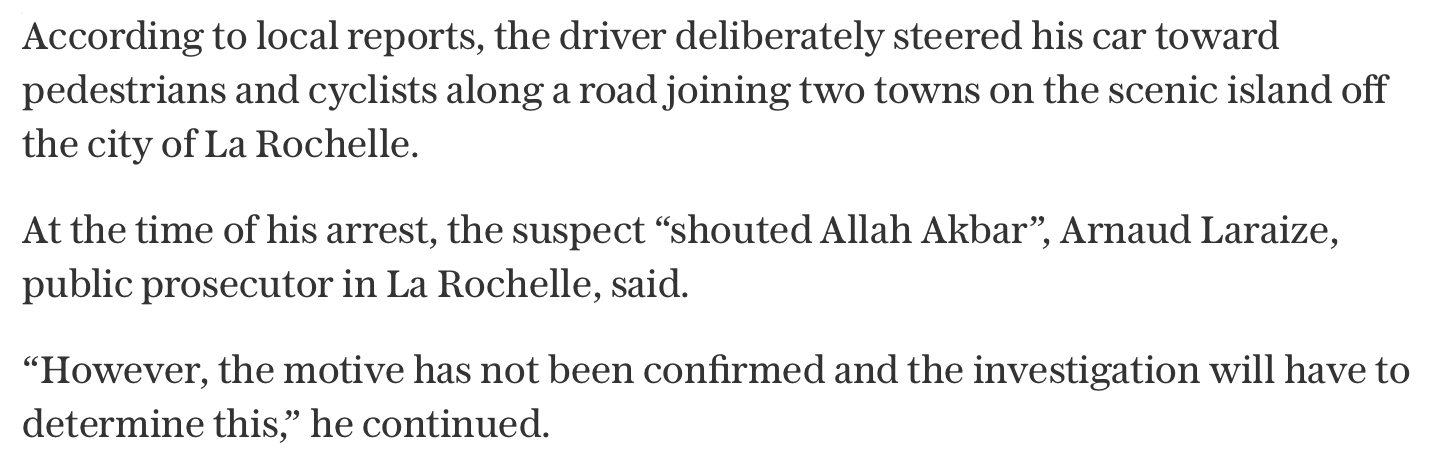
A driver smashed into pedestrians and bikers on the beautiful French island of Île d’Oléron.
I’m so excited for the investigation to reveal the motive behind someone driving their car into random French cyclists and screaming “Allahu Akbar.” I don’t know about you, but he sounds like a Christian nationalist to me. Anyone else smell a fresh pine and cinnamon Bath & Body Works candle? This guy is all in on Replacement Theory, I just know it.
Grief turns out to be a place none of us know until we reach it. We anticipate (we know) that someone close to us could die, but we do not look beyond the few days or weeks that immediately follow such an imagined death. We misconstrue the nature of even those few days or weeks. We might expect if the death is sudden to feel shock. We do not expect this shock to be obliterative, dislocating to both body and mind. We might expect that we will be prostrate, inconsolable, crazy with loss. We do not expect to be literally crazy, cool customers who believe that their husband is about to return and need his shoes. In the version of grief we imagine, the model will be “healing.” A certain forward movement will prevail. The worst days will be the earliest days. We imagine that the moment to most severely test us will be the funeral, after which this hypothetical healing will take place.
Joan Didion, The Year of Magical Thinking.
This is the first Joan Didion I’ve read. I’m told that it’s not her best, but it was plenty good enough for me.
Me, too
(Yes, I know it’s more than a little absurd that I’m writing a post about a TV show that ended its run eight years in the past. The thing is, I almost never watch series when they first appear. I usually turn to them, instead, years later, after I’ve heard enough praise that I feel like their quality has been adequately verified to justify my time and attention. This way of proceeding has never let me down. And anyway, in an era of streaming, there’s nothing to keep a decade-old show from becoming someone’s big new discovery years after it drops.)
I’m with him on not rushing to watch a new series. Most of them are trash – precisely as most of all art, music and literature are trash. It was ever so. What’s good will endure.
Well, I didn’t know them, and much as I love big words this may be the last time I ever use them.
Snippets
Mystery is a great embarrassment to the modern mind. (Flannery O’Connor)
Foul is fair and fair is foul. (Shakespeare, though I was thinking of John Maynard Keynes’ distillation of his case for temporary rapacity.)
What Stephen A. Smith is to sports talk, Tucker Carlson is to obsessive anti-Zionism. Rich Lowry
All civilizations are as transitory as the people now in cemeteries. And just as we must die, so too must we accept that there is no return to a civilization whose time has come and gone. (Abdülhak Şinasi Hisar via Orhan Pamuk, Istanbul)
The people [Trump] picks tend to be a grab bag of personality disorders who squabble and fight for power, he tends to screw them over when they annoy him, and they’re all quite annoying. (Ken White, Refuge in Kakistocracy, Popehat)
The problem with pornography is not that it shows too much of a person, but that it shows far too little. Pope John Paul II via Isabel Hogben
Populism is fundamentally a form of suspicion. Yuval Levin on the Remnant podcast.
We need to be a big tent so as to include neo-Nazi and Nazi-adjacent people, [and] if you have a problem with that, you need to get out of the tent. Jonah Golberg on the Remnant podcast criticizing the “popular front mind” on the Right.
Dick Cheney couldn’t get over Jan. 6. Ramesh Ponnuru (That’s got to be among the most understated things I’ve seen this week.)
Your enemies are not demonic, and they are not all-powerful and the right hasn’t always lost and the left hasn’t always won. But if you convince yourself of that, you give yourselves all sorts of permission to do a lot of stupid and terrible things under the rubric of “Do you know what time it is?”
[A] critical mass of the American people … no longer want[s] to govern themselves, … are sick of this republic and no longer want to keep it if it means sharing power with those they despise.
I don’t do any of the major social media, but I have two sub-domains of the domain you’re currently reading: (a) You can read most of my reflexive stuff, especially political here. (b) I also post some things on my favorite no-algorithm social medium.
Most of what is written about Christian nationalism is silly. Critics and analysts sweepingly deride conventional Christian conservatives as Christian nationalists. By some counts, there are, by this definition, tens of millions of Christian nationalists. Sometimes even civil religion, with its homage to a vague deity, is labeled Christian nationalism. If so, all presidents from George Washington to Joe Biden are Christian nationalists. Sometimes the target is folk religionists who conflate God and country. They sometimes sport paraphernalia with American flags draped around the cross. These folk religionists typically aren’t aware they are Christian nationalists. They don’t publish articles, much less books. And they typically don’t have policy agendas, just an attitude that God and country should be interchangeably honored.
…
Christian nationalism is distinct from conventional Christian conservatism. The former are typically post-liberals who want some level of explicit state established Christianity. The latter have been and largely still are classical liberals who affirm traditional American concepts of full religious liberty for all. Both groups want a “Christian America.” But the former want it by statute. The latter see it as mainly a demographic, historical and cultural reality.
This looks like a solid and helpful piece from a more religiously-sophisticated source than the Politico piece it’s responding to. But it seems to me superficial insofar as it’s credulous about “nations.”
Not this:
The patriotic mythologies that came into existence together with modernity’s nationalisms are siren songs that seek to create loyalties that are essentially religious in nature. World War I, in the early 20th century, was deeply revealing of the 19th century’s false ideologies. There, in the fields of France, European Christians killed one another by the millions in the name of entities that, in some cases, had existed for less than 50 years (Germany was born, more or less, in 1871). The end of that war did nothing, apparently, to awaken Christians to the madness that had been born in their midst.
…
These passions are worth careful examination, particularly as they have long been married to America’s many denominational Christianities. I think it is noteworthy that one of the most prominent 19th century American inventions was Mormonism. There, we have the case of a religious inventor (Joseph Smith) literally writing America into the Scriptures and creating an alternative, specifically American, account of Christ and salvation. It was not an accident. He was, in fact, drawing on the spirit of the Age, only more blatantly and heretically. But there are many Christians whose Christianity is no less suffused with the same sentiments.
Asking questions of these things quickly sends some heads spinning. They wonder, “Are we not supposed to love our country?” As an abstraction, no. We love people; we love the land. We owe honor to honorable things and persons. The Church prays for persons: the President, civil authorities, the armed forces. We are commanded to pray and to obey the laws as we are able in good conscience. Nothing more.
For fifty years I worshipped at the shrine of an Unknown God. It’s better than nothing. This tells us something of the intrinsic nature of humans. That we are wired to adore. It’s been a deception that we can get along without bending our heads, or ‘think’ our way out of our essential religiosity …
I lit candles for the Unknown God, coaxed exotic incense, sought out quiet places, wrapped myself in antelope skins and read ancient texts, hundreds of them. I got myself out into the bush, I abandoned work without real substance, I became a scholar and a seeker. I lived in a circle for four years, no screens anywhere near me. I blew my lantern out early and woke to birdsong. I was devoted, and I was led.
But I would tell by the camp fire every story but the story. The vast, glorious, uneasy elephant in the room.
I loved the Unknown God because it seemed beautiful, ancient, intensely mysterious, but didn’t infringe on how I actually lived. Not if I didn’t want it to. Had no bearing on my ethics or morality – what there was left of them. I dwelt in a world of strong emotion, intuitions and elaborate ceremonies. I learnt an awful lot about being human. I learnt an awful lot about the value of beauty.
And yet, I remained absolutely unaccountable. At the flick of a switch I could be the same old degenerate I’d always been …
Those fifty years got me an awfully long way. They’ve enabled me languages and experiences that gird me well in middle age. They haven’t required abandoning, or disowning, or shamefully chucking on a bonfire. I was a Romantic, that was what I was. But if you’ve really committed to a quest, a day will come when everything you think you know gets rocked, challenged, shaken. That happened to me four years ago up in the forest at the end of a 101-day vigil. When the unthinkable happened.
My unknown God decided to make himself visible to me.
Clause not yet adopted at Rome … omitted from manuscripts of the Creed … inclusion perhaps a copyist’s mistake! H’m … Upheld by Paulinus of Aquileia at the Synod of Friuli, 800, yes, yes, yes … but only adopted among the Franks … Here we are! Frankish monks intoning the Filioque clause at Jerusalem! Outrage and uproar of Eastern monks!’ He paused and rubbed his hands. ‘I wish I’d been there!’ He pushed back his spectacles for a moment and then resumed. ‘Pope Leo III tries to suppress the addition, in spite of the insistence of Charlemagne – a Frank, of course! – but approves of the doctrine.
Patrick Leigh Fermor, Between the Woods and the Water. Patrick Leigh Fermor is not where I expected to find a saucy account of where the filioque came from.
Untenable but appealing
To read [Elaine] Pagels and [Bart]Ehrman, the Jesus Seminarians, and many others, the reader would think that orthodox interpretation of the Christian story has no claim to greater antiquity, and no stronger connection to the first followers of Christ, than the many and various heretical interpretations. In their view, the New Testament reflects only the theological-ideological biases of the “proto-orthodox” party, and the canon as we know it was imposed retrospectively, rather than developing organically in the early Church. These claims are enormously appealing to the modern religious mind, but they aren’t particularly tenable.
Ross Douthat, Bad Religion
Iconodules
A key turning point in my life, during my thesis (“The Icon as Theology”) defense, came with the question, “Do you believe the veneration of icons to be necessary to salvation?” I hesitated (I was an Anglican priest at the time), and responded, “I believe that their veneration is necessary to its fullness.” I have lived with that answer for many years and pondered it and the question as well. Christ, according to the Scriptures, is the “icon of the invisible God” (Col. 1:15). I cannot imagine a salvation that is somehow separate from the veneration, indeed, the worship of that Icon.
Florida’s most notorious abortion clinic is located at 1103 Lucerne Terrace in downtown Orlando. On the sidewalk directly in front of this clinic, the Orlando Women’s Center, there are two prominent marks in the concrete. They are signs of an extraordinary story.
The concrete was worn away by the feet of John Barros, who for nearly two decades stood outside this clinic as a sidewalk counselor …
I asked him, once, how he’d felt called to the pro-life movement. “I wasn’t called to the pro-life movement,” he replied. “God called me to forty feet of sidewalk.”
The new Christendom’s penitential system was often experienced as external to the needs of the penitent. It was based on new patterns of canon law that codified sin and the penances that negated it. The system could be overwhelmingly legalistic and for some authorities was centered not on the penitent but on his clerical confessor. It was concerned more with divine satisfaction than with human transformation.
John Strickland, The Age of Utopia. The “new Christendom” Strickland is referring to is Western Christendom after the Great Schism of roughly 1,000 years ago. Human transformation remains the focus of confession, absolution and penance in the Christian East (and in American Orthodoxy).
Anecdote contra data
Writing on X, a priest reports: “A bit of good news . . . I’ve had more confessions of the ‘Bless me Father, for I have sinned, it’s been 20, 25, 30, 40, 50 years since my last confession . . .’ sort this year than I ever remember. I’m seeing more people at Mass than I ever remember.”
… that Christ may dwell in your hearts through faith; that you, being rooted and grounded in love, may be able to comprehend with all the saints what is the width and length and depth and height — to know the love of Christ which passes knowledge; that you may be filled with all the fullness of God.
You can read most of my more impromptu stuff here and here (both of them cathartic venting, especially political) and here (the only social medium I frequent, because people there are quirky, pleasant and real). All should work in your RSS aggregator, like Feedly or Reeder, should you want to make a habit of it.
I was listening this afternoon to a choral composition by Eric Whitacre, who probably came onto my radar with this a few years ago.
The unfamiliar composition was playing softly, and I was multi-tasking, paying little heed to the words (though a few caught my attention a bit).
Then suddenly I heard something that jolted me. I’d never heard a chorus do anything like that before, and no wonder: it sounded unbelievably difficult.
It was in a setting of this short poem:
Listening to your labored breath, Your struggle ends as mine begins. You rise; I fall.
Fading, yet already gone; What calls you I cannot provide. You rise; I fall.
Broken, with a heavy hand I reach to you, and close your eyes. You rise; I fall.
The piece is titled You Rise, I Fall, and it’s part of the larger piece The Sacred Veil, Whitacre’s setting of a poem by Charles Anthony Silvestri. The poet describes it:
This work features a series of poems written about my relationship with my late wife Julie, her battle with ovarian cancer, and the grief I experienced as a result of her passing in 2005. This is the most intensely personal poetry I have ever written, and it evoked exquisite and heart-breaking music from composer Eric Whitacre.
You can read most of my more impromptu stuff here (cathartic venting) and here (the only social medium I frequent, because people there are quirky, pleasant and real). Both should work in your RSS aggregator, like Feedly or Reeder, should you want to make a habit of it.
What he says rings true about the people I know who’ve been through Christian “worldview camps.”
The author commends wisdom over worldview, but that would only fly if wisdom were as easy to get as an off-the-rack “worldview.”
Getting what you want or wanting what you need?
I think still, in sort of a modernist worldview, people look at this conversation and think, “This will help me get what I want,” instead of understanding that this will change what you want.
[A] direct attempt at a communion ban [of President Biden] will inevitably be interpreted as a partisan intervention, at a time when the partisan captivity of conservative Christianity, Protestant and Catholic alike, is a serious problem for the witness of the church.
By this I mean that however reasonable the bishops’ focus on abortion as a pre-eminent issue, in a polarized nation it’s created a situation where Republicans can seemingly get away with a vast accumulation of un-Catholic acts and policies and simple lies — many of them on display in Donald Trump’s administration, which was amply staffed with Catholics — and be perpetually forgiven because the Democrats support Roe. v. Wade.
Russian soldiers who die in the line of duty in Ukraine have all of their sins forgiven, the patriarch of the Russian Orthodox Church proclaimed in a sermon ….
Remembering not only lurid versions of what Islamic Jihadists are promised if they die in jihad, but that Popes also said such things to Crusaders, always appalls me. That Patriarch Kirill says it now to Russia’s rag-tag conscripts is a stain on my Church, but let my readers be aware that he stands alone, and is widely criticized by Orthodox laity and leaders outside Russia.
Judging from the Loyalty/Betrayal axis of Jonathan Haidt’s Moral Foundations test, I likely suffer from a deficit of patriotism, at least in comparison to a typical conservative. So statements like the patriarch’s particularly grate on me.
I would feel the same if a Bishop of the Ukrainian Church promised forgiveness of all sins to soldiers dying in defense of the homeland.
It’s a fearful thing to be a clergyman. Orthodoxy holds that Priests, Bishops and Patriarchs will be judged by God for misleading the faithful. Does Patriarch Kirill really believe that?
Paul vs. James
Martin Luther had “issues” with Saint James’ Epistle, and reportedly wanted to kick it out of the Bible. Calvinists aren’t too crazy about it, either. The response isn’t that complicated once you see it:
Saint James’s Epistle is unique on several levels. While the Pauline Epistles speak of Christ primarily theologically, explaining the significance of who Christ is and what Christ has accomplished in the Cross and the Resurrection, St. James teaches in a way that is redolent with the teachings of Christ in His earthly ministry.
Over the course of his long book, Haidt builds up a case file of evidence from neuroscience, psychology and other fields to demonstrate that the objective, rational mind, magically divorced from the clumsy, emotional physical body, is a fiction. One of the founding myths of modernity has no basis in reality. Haidt compares the relationship between intuition and reason to the relationship between the US president and his press spokesman. The spokesman’s job is to explain to the world what the president has already decided to do; to rationalise it and to justify it, however unjustifiable it may sometimes be.
I have noted through the years, that some people (including some priests) are convinced that a soul can only be saved with disciplinary slaps and corrections from time to time. If there are such corrections needed in a human life, then it is likely only God who has the wisdom to know when and how such correction should take place. My experience as a priest and confessor is that I simply need to be consistent in sharing God’s love and be patient with what might be a process of healing that takes years. I would add that, in my experience, spiritual abuse is almost always a case of manipulating toxic shame against someone. If that happens, we are not asked to tolerate it.
For the social-gospel-oriented left wing, Christianity exists to build a social order in step with the upward progress of humanity. For the Christian nationalist right wing, Christianity exists to build a social order in step with national or ethnic identity. The gospel is the means for a forward-looking utopianism in the one case and a backward-looking nostalgia in the other. Christian nationalism is a liberation theology for white people.
When you accuse someone of being judgmental, you’re doing the same thing.
Practice at all times compassion for those you disagree with. Try to understand their reasoning, which is different from yours. Perhaps they have had life experiences that you have not had.
Never distort what they are saying in order to make it sound more outrageous. That’s a form of lying. Deal with what they are actually saying, not a parody of it.
With a contentious issue, the goal is to persuade those on the other side. Judging and denouncing does not persuade. No one was ever humiliated into changing their opinion.
We live in a paradoxical time when condemning and judging is severely condemned and judged. It seems like an effective way to stay on the right side of correct opinion is to identify people saying the wrong things, and denounce them. This is not love.
For your own sake, compel yourself to love your opponents (they are not your enemies; we have only one Enemy). Compel yourself to love, for your soul’s sake.
You can read most of my more impromptu stuff here (cathartic venting) and here (the only social medium I frequent, because people there are quirky, pleasant and real). Both should work in your RSS aggregator, like Feedly or Reeder, should you want to make a habit of it.
First, live as though in the coming of Jesus Christ, the Kingdom of God has been inaugurated into the world and the outcome of history has already been determined. (Quit worrying)
Second, love people as the very image of God and resist the temptation to improve them.
Third, refuse to make economics the basis of your life. Your job is not even of secondary importance.
Fourth, quit arguing about politics as though the political realm were the answer to the world’s problems. It gives it power that is not legitimate and enables a project that is anti-God.
Fifth, learn to love your enemies. God did not place them in the world for us to fix or eliminate. If possible, refrain from violence.
Sixth, raise the taking of human life to a matter of prime importance and refuse to accept violence as a means to peace. Every single life is a vast and irreplaceable treasure.
Seventh, cultivate contentment rather than pleasure. It will help you consume less and free you from slavery to your economic masters.
Eighth, as much as possible, think small. You are not in charge of the world. Love what is local, at hand, personal, intimate, unique, and natural. It’s a preference that matters.
Ninth, learn another language. Very few things are better at teaching you about who you are not.
Tenth, be thankful for everything, remembering that the world we live in and everything in it belongs to God.
I’ve probably shared these before, but I review them monthly for my own sake, so I thought you might benefit, too. In fact, I just reviewed the full blog post and all of it is excellent.
Zero-sum church
From an institutional perspective [Pope Francis’] move [against the Latin Mass] arguably appears perverse: Here you have a Western church conspicuously lacking in public zeal, religious vocations, large families, liturgical seriousness … and yet the leaders of the church have decided to act punitively against a small minority that, whatever its highly-debated growth rate, clearly is a locus for intense forms of piety and practice. It’s as if a major auto manufacturer whose big brands were all struggling decided to kill off one of its few profitable lines of cars, because it only turned a profit in a niche market and wasn’t big enough to subsidize the whole. A strange decision …
… but under the psychological conditions created by decline also an understandable one. In a general corporate climate of diminishment and disappointment a small form of success invites resentment: If the small brand isn’t capable of subsidizing the whole, then why are its engineers and salesman wasting their talents on its niche market, when they should be contributing to saving the larger company? Shouldn’t they be expected to chip in where the need is greatest, in the main brands — by analogy, big, empty diocesan seminaries and struggling Novus Ordo parishes and schools — instead of concentrating their talents serving a more intense but (it’s assumed) self-limited market?
…
In the specific case of traditionalism, it was that sense of relative stability that helped pave the way for the Latin Mass’s return from its 1970s exile, for the permissions issued by first by John Paul and then more sweepingly by Benedict. And then it’s the subsequent weakening of both conservative and liberal Catholicism — the former pushing more right-wing Catholics tradward, the latter making tradness appear more of a threat to a necessary acceleration of the Vatican II revolution — that’s given us the sharpened conflicts between traditionalism and Pope Francis, and now the attempt at outright suppression.
My reaction to Pope Francis’ suppression of the Latin Mass (after reading some articulate howls from its proponents) was "doesn’t Francis see that this move tends to eradicate the Catholicism of his own youth and tends to the schism of those who won’t give it up?!" After reading Douthat, my reaction is "Of course he knows that. He wants a Novus Ordo Catholicism purged of Latin Mass Catholicism. He even said the Novus Ordo is now the exclusive Lex Orandi of the Church, and that he may be remembered as the Pope who split the Church."
In retirement, I have little occasion to bump into highly traditionalist Catholics (and a round of well-warranted litigation by my firm on behalf of the siblings of one of them estranged us even before I retired). But I read a few of them, and with Covid and Afghanistan and seeming national collapse of the U.S., and now the suppression of the Mass they love by a Pope they are obliged to obey, this is not a happy time to to be an American Latin Mass Catholic.
Always in the wrong
Revolutionaries are always in the wrong, since, in their juvenile fervor for everything new, in their hopes for a better future, and a way of life built on justice, they always base themselves on theories that are abstract and artificial, making a clean sweep of living tradition which is, after all, founded on the experience of centuries.
Conservatives are always wrong, too, despite being rich in life experience, despite being shrewd and prudent, intelligent and skeptical. For, in their desire to preserve ancient institutions that have withstood the test of time, they decry the necessity of renewal, and man’s yearning for a better way of life.
Both attitudes carry within themselves the seeds of death. Is there, then, a third way? Another destiny for society than of always being subject to the threat of revolutions which destroy life, or reactionary attitudes which mummify it? Or is this the inevitable fate of all terrestrial cities, the natural law of their existence?
In fact, only in the Church can we find both a Tradition that knows no revolution and at the same time the impetus towards a new life that has no end. Her theory (understood in the true sense of the word, namely “vision”) is based on a constant experience of Truth. Which is why she is in possession of those infinite resources upon which may draw all who are called to govern the perishable cities of this world.
Vladimir Lossky in Seven Days on the Roads of France, his account of fleeing the Nazis from Paris as he and his father had previously fled the Bolsheviks. (Via Fr. Stephen Freeman). I’ve ordered the book.
You can read most of my more impromptu stuff at here. It should work in your RSS aggregator, like Feedly, should you want to make a habit of it.
I seldom comment critically on Reformed Christianity – Calvinism, my last waystation before Orthodoxy – but a very telling set of concessions from a Calvinist scholar leaves me wondering what thoughtful Calvinists think they stand to lose by
giving up on restoring missing elements of balance to Calvinism and
returning to the Church that never abandoned those elements.


 Tipsy Teetotaler ن