Elections and consequences

The Election Generally

Finally grokking Trump — as a repudiation of Democrat attitudes and positions

I don’t recall how much, or even whether, I have written about my little epiphany in the last two weeks or so before November election.

I was “never Trump” since I first realized that his candidacy was serious in 2015 or 2016. I confess that I could not imagine anything other than a “tear it all down!” mentality motivating Trump voters. The way I avoided contemning them was to assume that there was some nobler reason that was invisible to me for some mysterious reason.

My little epiphany in the weeks before the election was that the evils of the Democrat party could make it plausible to vote against them, even if doing so meant voting for Trump.

I considered writing about this in last Thursday’s post, but I thought it would be tedious to try to name all the Democrat evils that could repel a voter. After I posted on Thursday, though, Mary Eberstadt kindly posted an item at First Things that listed many of them for me. As does this:
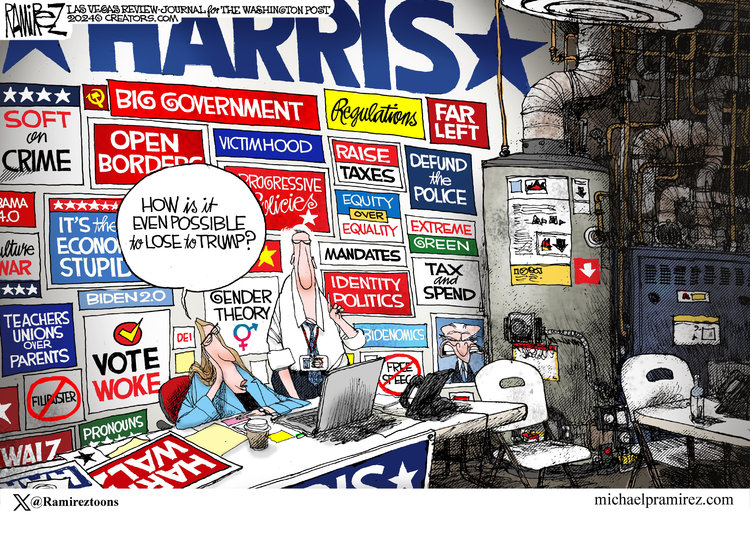
Although Eberstadt specifically refers to Democrat antipathy toward Roman Catholics and Catholic teaching, I’m in the same target zone, just as when I was a conservative Protestant in my beforetimes.

Were my vote determined solely by which party is likelier to persecute me and mine over the next four years, I could imagine voting for Trump, pretty darned confident that he’ll leave me and mine alone. (Even though this little blog has dissed him for 8 years, I don’t flatter myself that he’s noticed.) But my vote tends less toward short-term self-protection and more toward fiat justitia ruat caelum.

Still: the people have spoken, and what they said means I’m likely to be left alone at least until 2029. There’s some small comfort in that.

Is identitarianism a dying delusion?

David Brooks looks at many of the ways the pre-election expectations (of how groups would vote) were dashed.

Why were so many of our expectations wrong? Well, we all walk around with mental models of reality in our heads. Our mental models help us make sense of the buzzing, blooming confusion of the world. Our mental models help us anticipate what’s about to happen. Our mental models guide us as we make decisions about how to get the results we want.

Many of us are walking around with broken mental models. Many of us go through life with false assumptions about how the world works.

Where did we get our current models? Well, we get models from our experience, our peers, the educational system, the media and popular culture. Over the past few generations, a certain worldview that emphasizes racial, gender and ethnic identity has been prevalent in the circles where highly educated people congregate …

The crucial assertion of the identitarian mind-set is that all politics and all history can be seen through the lens of liberation movements. Society is divided between the privileged (straight white males) and the marginalized (pretty much everyone else). History and politics are the struggle between oppressors and oppressed groups.

In this model, people are seen as members of a group before they are seen as individuals …

In this model, society is seen as an agglomeration of different communities. Democrats thus produce separate agendas designed to mobilize Black men, women and so on. The goal of Democratic politics is to link all the oppressed and marginalized groups into one majority coalition.

But this mind-set has just crashed against the rocks of reality. This model assumes that people are primarily motivated by identity group solidarity. This model assumes that the struggle against oppressive systems and groups is the central subject of politics. This model has no room for what just happened.

It turns out a lot of people don’t behave like ambassadors from this or that group. They think for themselves in unexpected ways.

Why We Got It So Wrong (unlocked article)

Liberal democracy vs. populism

For those bewildered by why so many Americans apparently voted against the values of liberal democracy, Balint Magyar has a useful formulation. “Liberal democracy,” he says, “offers moral constraints without problem-solving” — a lot of rules, not a lot of change — while “populism offers problem-solving without moral constraints.” Magyar, a scholar of autocracy, isn’t interested in calling Donald Trump a fascist. He sees the president-elect’s appeal in terms of something more primal: “Trump promises that you don’t have to think about other people.”

Around the world, populist autocrats have leveraged the thrilling power of that promise to transform their countries into vehicles for their own singular will … What they delivered was permission to abandon societal inhibitions, to amplify the grievances of one’s own group and heap hate on assorted others, particularly on groups that cannot speak up for themselves. Magyar calls this “morally unconstrained collective egoism.”

M. Gessen in the New York Times

Go stick your head in a cold Bulwark

A reader did not like Andrew Sullivan’s first post-election post:

When I opened your Dish email last Friday, I fully expected a big serving of both-sides-y handwringing — as in, “Trump is bad, but Harris is also bad, because wokeness/inflation/illegal immigrants … poor voters, what were they to do?” But I was also hoping for an acknowledgement of how terribly painful it is that the lawless kakistocrat has been reelected, more resoundingly than the first time. 

Instead, I got a celebration of the multiracial, multiethnic coalition that brought us Clown Car Horror Show 2: Electric Boogaloo. 

Not a single solitary goddamn word about all the reasons why Agent Orange deserved to lose. Attempting to overturn a free election in 2020? Inciting a mob to attack the Capitol? Running on “retribution” and promising to deploy the justice system against his political opponents? Routine use of crass, ugly insults and normalizing his surrogates’ use of same? Musing about how he wants to be “dictator for a day”? Wanting to fire government workers and replace them with incompetent sycophants? Never heard of it.

Sullivan responded: 

In the immediate wake of the Trump victory, did we really need another account of why I didn’t vote for him? Especially when those arguments failed to work in the campaign yet again? Go read The Bulwark.

The Clown-Car Nominations

A sober lament

On Trump’s choice of Matt Gaetz as Attorney General:

The choice obviously isn’t meant to reassure anyone outside the MAGA base—or even those within it who are intelligent. It is an insolent appointment, guaranteed to cause trouble and meant to cause friction.

We are back to the Island of Misfit Toys. What a mistake. Mr. Trump often confuses his own antic malice for daring, his own unseriousness for boldness. How amazing that in the rosy glow of election, he will spend so much political capital and goodwill on confirmation fights he may well, and certainly deserves to, lose.

Peggy Noonan

Shambolic Kakistocracy

[H]ere is a glimmer of hope: Team Trump’s most human failings may thwart some of their most evil plans.

Take, for instance, appointing Representative Matt Gaetz to be the Attorney General of the United States. If this is a sincere appointment — in other words, if it isn’t a head-fake to get the Senate to accept another candidate later, or a ruse to let Gaetz resign from Congress and avoid a damaging ethics report — it’s an example of self-indulgence thwarting malign intent. Gaetz is a buffoon. He has absolutely no qualifications to run the Department of Justice. Can he wander around firing everyone? Yes. Does he understand how the Department of Justice works in a way that would allow him to maximize its potential for abuse? No. Is he smart enough to figure it out? Also no. Is he charismatic enough to persuade insiders to help him use it effectively? Very much no. Gaetz as Attorney General will do petty, flamboyant, stupid things in clumsy ways. Some of those things will be very bad. But clown shoes are preferable to jackboots. We’d be in much more trouble if someone evil in a smart and competent way who understands how the machine works — say, Jeff Clark or Ken Paxton — took over. That would be terrifying.

Trump’s decision shows his tendency to vent his spleen. Appointing Gaetz owns the libs, humiliates the hated Justice Department, elevates someone who is a vulgar elbow-thrower like him, and is a thumb in the eye to the Republicans who hate Gaetz. It’s not a decision reflecting self-control; it’s a decision reflecting unconstrained anger and resentment. It’s like making your horse a Senator. The point isn’t that the horse will vote the way you want it to. The point is to humiliate the senate and show them you can do what you want. It’s bad, but it’s not smart bad.

[P]erhaps they will not be as bad as they could be because God, in His wisdom, has chosen to make these people weird freaks along the way to letting them run the place. This is a time to cherish every hope and embrace every ally. Trump and Trumpists are dysfunctional weirdos and that fact is our ally. Cold comfort is still comfort.

Popehat, Refuge in Kakistocracy

A vital pardon

Pardon Trump’s Critics Now
President Biden has a moral obligation to do what he can for patriotic Americans who have risked it all.

Paul Rosenzweig


[H]istory is well and truly back. Even Francis Fukuyama agrees.

Mary Harrington at UnHerd

I suffer more from the humiliations inflicted by my country than from those inflicted on her.

Simone Weil, from a letter to Georges Bernanos.

I don’t do any of the major social media, but I have two sub-domains of the domain you’re currently reading: (a) You can read most of my reflexive stuff, especially political here. (b) I also post some things on the only social medium I frequent, because people there are quirky, pleasant and real.
Thursday, 11/14/24

On seeing Trump differently

I’ve already acknowledged that I see Trump differently now than I did in 2016, and I’ll now acknowledge that that change in perception has only been further solidified in the wake of his shooting. Part of this change means that I no longer think it’s useful or meaningful to call him a charlatan, to insist that he’s “faking it”, that he’s actually a really bad businessman who only pretends to be a successful one on TV, that he’s a common low-end huckster of bad steaks and worthless paraphernalia. All of this implies that there are other actors on the world stage who, by contrast, are the real deal, and unlike in 2016 I just don’t believe that’s the case anymore.

Justin Smith-Ruiu, World Spirit on Feedback

Think at least a little bit about the math

One of the problems with being a grievance party for minority interests is that minorities are a minority. If your vision of politics is that what is most important about us is our demographic characteristics—race, sex, education level, etc.—and you understand political life as, essentially, a zero-sum competition between rival groups, then you should probably think at least a little bit about the math, just in case people start to take you seriously. … Doubling down on minority positions is how you become a minority party—and stay one. 

This is Ruy Teixeira’s revenge. 

Teixeira was the co-author (with John Judis) of a very famous book called The Emerging Democratic Majority. The thesis of the book was that as the U.S. electorate became younger, less white, and more immigrant-heavy, Democrats would be able to assemble a durable electoral majority—provided they held on to the working-class voters who had been the keystone of the New Deal coalition

(Teixeira, who has won very little love for himself telling Democrats things they do not want to hear, now hangs his hat at the American Enterprise Institute, which is not famously full of Democrats but is absolutely packed to the rafters with people who know how to count.)

Democrats forgot to do the second part of the Teixeira two-step and keep those working-class voters ….

Kevin D. Williamson

Reactionary Biden

Mr Biden resharpened Mr Trump’s most effective political wedge by doing away with obstacles he had created to illegal immigration, providing no alternative. By the time he restored some of Mr Trump’s restrictions this spring, more than 4m migrants had crossed the southern border, compared with fewer than 1m under Mr Trump.

The Economist’s Lexington, Democrats need to understand: Americans think they’re worse

Little pitchers …

… have big ears.

Trump … is winning culturally in shaping America’s manners and mores.

Peter Wehner

It was such a cozy moment in the Oval Office on Wednesday morning, with the roaring fire and the warm handshake and the past presidents — including George Washington, Abraham Lincoln and F.D.R. — looking down benignly on the scene.

So why did it feel so nauseating?

It is hard to watch Donald Trump be gracious, because he is gracious only when he wins, and that’s not a good lesson for the children of America. When he loses, he tries to burn the democracy down.

Maureen Dowd

I will pray for America and its rulers, but I could not in good conscience tell a child to look up to 47 as an example of goodness or manliness.

They will do so anyway unless, perhaps, their parents tell them not to.

The Kakistocracy

When I first saw and article saying the new word to master was “kakistocracy,” I (incorrectly) confounded it with “kleptocracy.”

I reckon we’ll have both for four years. We’re certainly getting the kakistocracy. Matt Gaetz for Attorney General is banana republic stuff. Hegeth, or whatever his name is, may be a decent human being, but there is no reason to think he can run any large organization, let alone our huge and euphemistically misnamed Department of War.

On the other hand, remember the morass our Best and Brightest got us into.


[H]istory is well and truly back. Even Francis Fukuyama agrees.

Mary Harrington at UnHerd

I don’t do any of the major social media, but I have two sub-domains of the domain you’re currently reading: (a) You can read most of my reflexive stuff, especially political here. (b) I also post some things on the only social medium I frequent, because people there are quirky, pleasant and real.

I for one welcome our new insect overlords

Someone used that on micro.blog this week. I liked it. But it was in quotes, so I think he stole it, too. I think that may be a line from a movie.

The pollsters blow it again

So: the pollsters blew it again. They underestimated Trump support. I should be sitting here in suspense as counts continue; instead, I’m blogging about the soothsayers who couldn’t brace me for what happened Tuesday.

What’s the problem:

  1. They don’t know how to count to 270? In other words, they do polling of the (meaningless) national popular vote but don’t get granular, state-by-state?
  2. Many respondents lie because they’re shy (embarrassed? shamefaced? guilt-wracked?) Trump voters?
  3. Has the historic script flipped so that higher voter turnout benefits Team Red?
  4. Some other durned thing?

No, the Problem Isn’t the Voters

Ever since Donald J. Trump arrived on the political scene in 2015, elites have claimed his rise signals the last gasp of a dying white-majority America alarmed by cultural and demographic shifts. This was always a kind of security blanket—an excuse to ignore uncomfortable truths.

If Tuesday’s election results do not demolish that cope once and for all, we’re not sure what will …

The only group Kamala Harris made gains with was white college-educated women and those over 65.

Just take a look at what has transpired over the last 36 hours: 

  • On MSNBC, Joy Ann Reid said, “anyone who has experienced this country’s history. . . and knows it, cannot have believed that it would be easy to elect a woman president, let alone a woman of color.” Of Harris’s election effort, she added: “I mean, this really was a historic, flawlessly run campaign.”
  • On The View, Sunny Hostin said: “I was so hopeful that a mixed-race woman married to a Jewish guy could be elected president of this country. And I think that it had nothing to do with policy. I think this was a referendum of cultural resentment in this country.”
  • On Morning Joe, Joe Scarborough said to a nodding Al Sharpton that “It’s not just misogyny from white men; it’s misogyny from Hispanic men, it’s misogyny from black men—things we’ve all been talking about—who do not want a woman leading them.” He added that it “might be race issues with Hispanics. They don’t want a black woman as president.” (He left out the fact that Trump performed nine points better with Hispanic women this year compared to 2020.)
  • Laura Helmuth, the editor in chief of Scientific American, chimed in with a now-deleted tweet: “I apologize to younger voters that my Gen X is so full of fucking fascists.” (Fifty-four percent of Gen X voted Trump.)
  • The pastor and activist John Pavlovitz, who has 400,000 followers on X, declared: “Kamala Harris was the perfect candidate and she ran a beautiful campaign of joy, empathy, and unity. She just happened to run in a nation that is addicted to nihilism, cruelty, and division.”
  • Nikole Hannah-Jones, creator of The 1619 Project at The New York Times, warned that: “We must not delude ourselves in this moment.” Among “shifting demographics where white Americans will lose their numeric majority,” she added, there is “a growing embrace of autocracy to keep the ‘legitimate’ rulers of this country in power.”

We could go on, but you get the point. And their point is: Don’t blame Harris, blame the voters.

But you don’t succeed in an election by calling the common people racist or sexist or stupid. You win by listening to them.

And our media elite have put their heads in the sand. Again. They seem to think that if they keep calling Americans knuckle-dragging bigots, one day they’ll get the message.

That’s why you’ll get more insight from our nine-year-old election-night livestream star Josie Savodnik than from some of the best-paid cable hosts on TV. Josie’s take on why Kamala lost? “Maybe because of the border. Maybe it’s because of Kamala’s personality. And she also did kind of a terrible job at being vice president.” 

She’s not wrong.

Bari Weiss and Oliver Wiseman, No, the Problem Isn’t the Voters

Wall Street has rarely been more excited by an election.

U.S. stocks’ capitalization rose by $1.62 trillion on Wednesday, their fifth-best one-day showing ever, following Donald Trump’s decisive election victory. The surge highlights the opportunity that investors, bankers and others in finance are hoping to embrace over four years of tax cuts, deregulation and economic expansion. “Investors are celebrating,” said Jack Ablin, chief investment officer at Cresset Capital in Chicago. He was among those buying shares of smaller companies, on the bet that Trump’s policies will rev up the economy. The enthusiasm is especially heated in a few areas, investors and bankers said. Banks and other financial companies climbed, with the KBW Bank Index rising 11%. Investors expect regulatory scrutiny will ease in a Trump administration. Some also expect more dealmaking, potentially among smaller and midsize banks. The expected departure of Lina Khan, who leads the Federal Trade Commission and has been a thorn in the side of executives hoping to work out tech acquisitions, was cheered by investors and bankers. (Source: wsj.com)

John Ellis

The point is, in Germany, if you didn’t go along with the party line, you would be demonized. You would get in trouble. People just think, I hope I don’t get in trouble, so what do I have to say or not say to get in trouble? At that moment, you cease to be free.

We’re kind of getting there. Even a millimeter in that direction is too close for comfort for me.

Emma Green, quoting the execrable Eric Metaxas.

Metaxas is not entirely wrong about this, but it’s on both sides, albeit asymmetrically.

If you dissent from “liberal” orthodoxy, you may get censored by the Assistant Executive Supernumerary of the Department of Truth whispering in the ears of social media, who then block you in one of several available ways available to them.

If you dissent from the MAGA right, you’ll get death threats. Ask David French about that.

I voted against both.

Nicholas Kristof Manifests

Nicholas Kristof issues a Manifesto for Despairing Democrats, and it’s not all bad:

My country has elected a felon whose former top aides have described him as a fascist and “the most dangerous person to this country.” Yet in an election that wasn’t even close, voters not only chose him but also picked a Republican Senate to empower him further.

This will be a test of our country and of each of us, so let me offer a manifesto for how ordinary Americans of my ilk can respond.

1. I accept Donald Trump’s victory.

2. I will be a watchdog, not a lap dog.

3. I will back organizations fighting to uphold human values.

5. I will try to understand why so many Americans disagree with me. Too many Democrats reflexively assume that any person backing Trump must be a bigot or an idiot. But let’s beware of invidious stereotypes, for finger-wagging condescension alienates centrist voters; it’s difficult to win support from people you’re calling idiots and racists. Many working-class Americans have been left behind economically and have reason to feel angry. And Democrats aren’t going to win elections as long as they seethe at a majority of voters.

7. I will care for my mental health. There’ll be many, many times in the next four years when we’ll be irritated, anxious and alarmed, probably with good reason, so we need to find a way to relax and mellow out. For me, that’s backpacking and wine- and cider-making. In my day job, I shout at the world, and it pays no attention, so it’s a relief to raise grapes and apples and have them listen to me. And remember that sometimes the best therapist has four legs. A few years ago, many families got a pandemic dog, and for some this may be time to get a Trump dog.

12. I will temper my strong views with humility. The challenge is to unflinchingly proclaim our values even as we appreciate that we are fallible and may eventually be proven wrong. Accepting that contradiction curbs the tendency toward arrogance and self-righteousness, which in any case are utterly unhelpful in promoting those values.

13. I will share Thanksgiving with relatives, even if I think they’re nuts. There’s too much division in America, and we hang out too much with people who think just as we do. So if you’re debating whether to break bread with family members whose politics you can’t stand, go for it. Don’t let Trump get between you and your family or friendships.

Loss of faith

[W]e must learn to live in an America where an overwhelming number of our fellow citizens have chosen a president who holds the most fundamental values and traditions of our democracy, our Constitution, even our military in contempt. Over the past decade, opinion polls showed Americans’ faith in their institutions waning. But no opinion poll could make this shift in values any clearer than this vote.

David Frum, Trump Won. Now What?

From across the pond

Why did he win? There might be a thousand particular answers, but the broader reason seems clear: a lot of people are sick of the political-media-cultural establishment, and they want to blow it up. This is the same reason people voted for Brexit in 2016 and continue voting for ‘populist’ parties across Europe today. People feel – correctly – that this establishment serves the elite but not the masses. Worse: it has become so self-referential that it barely even knows who the masses are. I have been writing about how this establishment developed, and about the people opposing it, for thirty years. I can say with some confidence that this is not over yet.

Given all this, I thought it might be useful to reprint this essay, which first appeared here with the title Down the River in April 2022, and will also appear in my forthcoming book. It attempts to understand this moment by exploring how progressive leftism and corporate capitalism, once supposedly sworn enemies, ended up marching in lockstep to build the world we now inhabit. Those who are swept to power on the back of the rejection of that world do not necessarily have any better alternatives – and this post is not an endorsement of Trump or anyone else. The great saviours of the moment often end up making things worse. But they have walked into history for a reason. Maybe this essay will help dig into it.

Paul Kingsnorth

Counting Chickens (and more)

  • In The Washington Post on the eve of Election Day, Monica Hesse imagined Harris winning in spite of many American men’s desires and on the strength of the gender gap: “Their sense of world order is about to be undone by the women in their lives grabbing democracy by the ballot box. (When you’re a registered voter, they let you do it.)” (Douglas Steffes, Madison, Wis., and Stephanie Logan, Centennial, Colo., among others)
  • In The New Yorker, Bruce Handy detailed the stylist Michelle Côté’s ministrations to give Sebastian Stan, the star of the new movie “The Apprentice,” the Trump coiffure: “Stan’s real hair was covered in part by a fake scalp, which was covered in turn by a wig — a tonsorial turducken.” (Betsy Frank, Mattituck, N.Y., and Ann Madonia Casey, Fairview, Texas)
  • And in a less hairy New Yorker essay, Sloane Crosley revisited Dorothy Parker’s book reviews and remarked on how much less efficient critics’ pans are today. “It takes us four times as long to kill our prey,” Crosley wrote, adding: “Our literary criticism features a great deal of ‘I,’ the pronoun most likely to overstay its welcome. In the right hands, this conflation of narrative and critique can have dazzling results. But on the whole? Imagine waiting 20 minutes for a medical diagnosis while your doctor walks you through her commute.” (Nancy Chek, Silver Spring, Md.)

Via Frank Bruni

The Perfectly Blank Face for the Democrats

A very elegant concession from Kamala: For a few hours on Wednesday, her campaign was silent. They didn’t play games and pretend they were winning. They didn’t give comment to the press. They collected themselves. They grabbed the screw cap Oyster Bay out of the fridge and considered it hard before saying, “It’s a gin night, girls.” And then the next day Kamala Harris delivered a beautiful concession speech, which you can read here. It gave me goosebumps and also made me furious, because she’s a good and fine person who ran a truly terrible campaign. It was a campaign that exemplified all of the delusions of the modern Democrats: that you never need to say what you stand for (because people should just assume you know what’s best for them), that you should never answer hard questions or appear with questionable figures, and that the only issue any American woman should care about is abortion.

Nellie Bowles at the Free Press. Nellie’s weekly TGIF is mostly tongue-in-cheek, but that doesn’t keep her from telling the truth.

Peggy Noonan’s debriefing

What are the Democrats? What’s that party for? When I was a kid they were the party of the working man, the little guy. That’s the Trumpian GOP now. When I was a young woman they were the antiwar party. That’s the Trumpian GOP. The party of generous spending? The Trumpian party says hold my beer. What belief do the Democrats hold that distinguishes them? LGBTQ, woke, gender theory, teachers unions, higher taxes? Why not throw in cholera and chlamydia?

The party has lost its specific character and nature; it’s no longer a thing you can name. Democrats have to sit down with a yellow legal pad and figure themselves out. All defeat carries a gift: You get to figure out what you’re getting wrong.

As for me, I don’t like the SOB [Trump], I think him a bad man who’ll cause and bungle crises almost from day one, but he’ll be the American president, and we all deserve grace. I will pray for him, support what I think constructive and oppose what I think destructive, call it straight as I can and take whatever follows. As someone once said, the real story of American life is where you stand and the price you’ll pay to stand there.

Peggy Noonan

Ruy Teixeira maps a route forward

Ruy Teixeira is a wise Democrat:

The Democratic Party may be the party of blue America, especially deep-blue metro America, but its bid to be the party of the ordinary American, the common man and woman, is falling short.

There is a simple—and painful—reason for this. The Democrats really are no longer the party of the common man and woman. The priorities and values that dominate the party today are those of educated, liberal America. They only partially overlap with those of ordinary Americans.

He suggests a list of “principles” Democrat leaders should endorse to win back the eyes, ears, and eventually the votes of voters they’ve lost. Most of them are anodyne. Some are too equivocal to be true “principles” (trying to have it both ways through smooth words). But it looks like a good start.

(Selected) Money Quotes for the Week

  • “To all who celebrate, happy third consecutive Last Election Ever!” – Seth Mandel.
  • “You can’t blame losing the popular vote and all seven swing states on Putin and the Russians,” – Freddie deBoer.
  • “Dem-friendly pundits said one reason for picking Tim Walz was that he’d appeal to blue-collar guys in the industrial Midwest because they’d identify so much with him. He wears flannel shirts and everything. Kamala lost his home county,” – Glenn Greenwald.
  • “[T]he federal government that only got seven electric vehicle charging stations built in two years has performed zero transgender surgeries on detained migrants. That’s the Democrats in a nutshell: the party that promises trans surgeries for illegal immigrants but doesn’t deliver them,” – Josh Barro.
  • “Turns out no one likes neocons. Who knew?” – Ana Kasparian.
  • “Democrats spent the final weeks of the campaign browbeating and shaming black and brown voters and telling them basically that they were stupid to even consider voting for Trump. This is what they got in return,” – Shadi Hamid.
  • “Kamala Harris will fall without a trace, just as she rose without a trace, but she’s nevertheless worth studying, in all her hollowness and banality, as an example of what has gone wrong with modern liberalism,” – Adrian Wooldridge.

Andrew Sullivan


I suffer more from the humiliations inflicted by my country than from those inflicted on her.

Simone Weil, from a letter to Georges Bernanos.

I don’t do any of the major social media, but I have two sub-domains of the domain you’re currently reading: (a) You can read most of my reflexive stuff, especially political here. (b) I also post some things on the only social medium I frequent, because people there are quirky, pleasant and real.

Election sundries

Legacy media versus new

Legacy:

Anti-trans rhetoric

Rogan and Vance spoke at length about transgender rights early in the conversation, specifically about gender-affirming care for minors and whether people should be allowed to play on sports teams that match their gender identity.

‘I’m the father of a 2-year-old daughter,’ Vance said. ‘I don’t want her going into athletic competitions where I’m terrified she’s gonna get bludgeoned to death because we’re allowing a 6-foot-1 male to compete with her in sports,’ Vance said.

Vance also suggested that wealthy parents might go so far as to coerce their children to undergo gender surgeries to get into better colleges and universities.

‘If you are a middle-class or upper-middle-class white parent, and the only thing that you care about is whether your child goes into Harvard or Yale, obviously that pathway has become a lot harder for a lot of upper-middle-class kids,’ he said, adding that ‘the one way that those people can participate in the DEI bureaucracy in this country is to be trans.’

Vance later argued that he wouldn’t be surprised if Trump won ‘the normal gay guy vote because again, they just wanted to be left the hell alone.’

Karissa Waddick, USA Today. (Note that she styled this as “Anti-trans rhetoric,” a lazy, tendentious and ubiquitous formulation.)

New:

It strikes me as quite remarkable that, this week, JD Vance on Rogan aired a real and fascinating divide in the gay and lesbian world over politics — that hasn’t begun to see the light of day in the activist-controlled legacy media.

The official legacy media line is that there is a single, unanimous “LGBTQ+” community, that every one of us supports indoctrinating children in the core ideas of critical queer and gender theory from kindergarten on and transing those kids who say they are the opposite sex, after a mere couple of hours of therapy, even before they have gone through puberty.

All of this, of course, is a lie. Exit polls, for example, showed that roughly a third of gay men and lesbians voted for Trump in 2020. And despite transqueer bullying, many gay men and lesbians see in gender-dysphoric children their own pasts, and are deeply worried that even more gay and lesbian kids could be transitioned in error, and have their bodies wrecked for life.

This is what Vance described as the “normal gay guy” vote. For those appalled at the very idea of such a thing (there is of course massive pressure within left gay culture to demonize anything faintly “normal”), let me proffer a simple definition: a “normal gay guy” is a man solely attracted to biological men, who doesn’t wish to be a female, who believes in the sex binary, whose politics is rooted in something other than tribal victimology, and who does not identify as “queer”. I’d say, outside the woke “transqueer” bubbles, it’s a clear majority. Good luck finding any coverage of us outside Rogan and the web.

And, yes, many of us see “gender-affirming care” as what Vance called it: “pharmaceutical conversion therapy” for gay and lesbian children. That is, in fact, an inspired definition. We want to stop it. And we can’t believe our own organizations are in the vanguard of imposing it.

Andrew Sullivan, A “Normal Gay Guy” Checks In

These two were describing one and the same Joe Rogan show. Is it any wonder that legacy media are losing trust? I certainly won’t rely on them alone (though I can’t read everybody’s opinion on everything MSM insinuates into their narrative); nor can I imagine relying exclusively on new-media sources.

Essentially, this means that I probably don’t know much of anything reliably, though I’m a retired guy who spends shamefully long hours immersed in news and opinion.

So why do I do it? Because that was a mark of responsible citizenship back in the day, and I’m a creature of habit.

Perhaps I don’t frequent explicitly right-wing media because I’m not really tempted to trust the Left or even the Democrats who claim to be in the center. But if you’re willing to dig through the garbage and sort it carefully, you get a much different picture of reality than you get from legacy media. Park MacDougald, writing for the Tablet (The Democrats Insanity Defense) has done some of that garbage-sorting.

The sequence of events neatly encapsulated a pattern that has played out countless times since Trump entered American political life. Trump says something seemingly insane, to many people’s outrage and disbelief, only to have his supposed “lie” revealed to be wholly or at least significantly true. Often the specific truth revealed—that the outgoing Obama administration spied on the Trump transition team in order to gather information for what later became the Russiagate hoax, to cite another example—is in fact “crazier” than Trump’s exaggerations or garbling of the details. The insanity of the policy becomes the front line of defense against potential blowback: Who would believe that anyone would actually propose or support something so obviously at odds with public opinion and basic common sense? Trump must be a raving nutjob, just like we told you he was.

The reason that this strategy has worked is because Democrats rely on all nonexplicitly right-wing media to adopt their framing of issues and cite the party’s preferred experts, which they do. The party’s influence over the country’s communications apparatus has, for the past decade, emerged into something like a political superpower, allowing it to act outside the normal bounds of American politics without suffering from political blowback.

My vote for POTUS this year is unchanged from what I’ve written repeatedly, but read the whole MacDougald piece and you may feel less despondent if Trump pulls it out Tuesday: the alternative is really quite mad in its own way.

Banana Republicans

Election day in America is on Tuesday, but it may take days to know the result. In 2020 it took nearly four days until news outlets called the race for Joe Biden. Then Donald Trump alleged that it had been stolen and pressured state and local officials, as well as federal lawmakers, to reverse his defeat. If Mr Trump loses to Kamala Harris, expect a similar playbook: allegations of fraud, petitions for recounts and strong-arming of officials to withhold “certification”

Certification is the process by which local and state officials attest to the results’ accuracy. It is mandatory. State officeholders are unlikely to block certification should Mr Trump lose; no election deniers hold those jobs. But some rogue MAGA officials might do so at the county level. Courts would then intervene. If that scenario comes to pass, count on lawsuits until January 6th 2025, when Congress affirms the winner. The conspiracy theories and acrimony will persist beyond.

Economist World in Brief 11/3/24

Bret Stephens

Trump’s one of a kind. He leads the G.O.P. not as a party figure in the mold of Lyndon Johnson or as an ideological icon like Ronald Reagan. He’s a cult of personality figure, in the mold of Juan Perón. He draws his power not only from the adulation he inspires among supporters but also from the hatred he generates from his opponents. If he reversed all of his positions tomorrow, his followers would still love him, and his enemies would still hate him. He’s a once-in-a-century phenomenon.

The kind of management-consultant Republicanism epitomized by Romney isn’t particularly responsive to important working-class concerns revolving around, say, rampant opioid abuse, family breakdown or the struggles of alienated and purposeless young people, particularly men, in school and the workplace. I also think my brand of conservatism is probably insufficiently allergic to the cultural left. We dislike it but accommodate it, whereas younger, Trumpier conservatives hate it and mean to wage cultural war on it. Good for them; I lack the energy, and maybe the stomach, to write columns about, say, transgenderism.

On the other hand, some of the G.O.P.’s more populist positions are ones they’ll come to regret. High tariffs on imports sound great until you realize it will raise the prices of thousands of consumer goods without doing much to improve the economy at home. Cutting off aid to Ukraine is another idea Republicans will regret when Russian troops march into Kharkiv and China sees it as a case study in how to wear down the West in its own theater of interests.

I also think it’s important to acknowledge that, as much as I detest Trump the man, there are sides of the MAGA movement that deserve respect. I don’t think of it as a collection of unadulterated bigots. Most Trump voters I know are decent people who don’t like being condescended to by a morally smug and self-serving elite that fails to see the many ways in which the federal government fails ordinary people. I also think Trump’s voters see things that too easily escape the notice of Trump’s haters, whether it was the farce of many of the Covid rules and restrictions or the double standards by which Trump’s opponents claim to be defending democracy while using every trick in the book to put him in prison.

David French

I don’t think there’s any doubt that the young activists online and in Washington are very aggressively anti-woke and much more populist. I also think they’re deeply unrepresentative of their generation and their sense of isolation is driving many of them into dark spaces. The level of outright racism and antisemitism emanating from the young activist right is astounding.

It’s hard for me to forget what Aaron Sibarium, a rising-star reporter at The Washington Free Beacon, posted on X: “Whenever I’m on a career advice panel for young conservatives, I tell them to avoid group chats that use the N-word or otherwise blur the line between edgelording and earnest bigotry.” The fact that his advice is necessary is astounding.

I have to dissent from Bret when he says, “Good for them,” about this young activist response to the cultural left. I spent decades in courtrooms fighting left-wing illiberalism on campus, and I don’t believe right-wing illiberalism is an improvement. If you’re drafting speech codes — for example, Florida’s Stop Woke Act — to target left-wing speech, you’re still drafting speech codes. You’ve become the problem to fight the problem.

If Harris wins — and finally ends Trump’s political career — after tacking away from the left-wing positions she embraced in 2019, I’m hopeful for continued cooling in the culture wars. If she loses, I fully expect parts of the left to take that loss as proof that the path of moderation is the path of defeat, that Harris never should have opened the door to the likes of Adam Kinzinger and Liz Cheney and that it’s time to fight fire with fire.

While I love and respect many, many people who vote for Trump, I do not have anything good to say about the MAGA movement itself. Perhaps you have to be embedded in deep-red communities to see its effect on the ground, but I have never seen people go deep into MAGA without profound negative effects on their character, their temperament and their relationships with people outside MAGA.

For example, to truly be a member of MAGA in good standing, you have to defer to the election lie. Any movement that requires that degree of dangerous dishonesty as a condition of remaining in good standing is corrosive to the country.

Regarding a second Trump term, I do have some degree of optimism that he’ll continue to nominate judges like many of the judges I know from his first term — high-integrity civil servants who’ve proved to be dedicated to the rule of law. In fact, many of them helped block his effort to steal the election in 2020. But I’m worried even about that. There are deep MAGA resentments against many of Trump’s judges, and there is a sense that they don’t want any more justices quite like Amy Coney Barrett, Brett Kavanaugh and Neil Gorsuch.

Also, and this is no small thing, even if a second Trump administration is far more pro-choice than any Republican administration in my adult lifetime, it won’t try to codify Roe, there will be no move to expand or pack the Supreme Court, and it won’t try to aggressively wield Title IX to coerce compliance with far-left theories about gender or to deny due process on campus. Each of those moves can be blocked by courts or Congress, even if Harris wins, but I’d rather not see a presidential administration try any of those things.

New York Times Editorial Board

You already know Donald Trump. He is unfit to lead. Watch him. Listen to those who know him best. He tried to subvert an election and remains a threat to democracy. He helped overturn Roe, with terrible consequences. Mr. Trump’s corruption and lawlessness go beyond elections: It’s his whole ethos. He lies without limit. If he’s re-elected, the G.O.P. won’t restrain him. Mr. Trump will use the government to go after opponents. He will pursue a cruel policy of mass deportations. He will wreak havoc on the poor, the middle class and employers. Another Trump term will damage the climate, shatter alliances and strengthen autocrats. Americans should demand better. Vote.

Nellie Bowles

I told you people to stop calling them Latinxs: Latinos have been abandoning Kamala Harris. And now we may have some clues as to why: They never wanted to be called Latinxs. See, for a few years it was necessary that American Democrats call Latino people Latinxs, despite clear and persistent protests. Why? Because Latino and Latina are gendered words, and binary ones to boot, and the Dems needed a nonbinary way to speak about this population in case any Latinxs use they/them pronouns. Literally the whole group was supposed to accept being renamed for the sake of they/them inclusivity. Needless to say, it didn’t work. And now there is a big, serious study out of Harvard University about how being called Latinx made Latinos turn to Trump.

William McGurn

[M]aybe what Americans who vote for Trump are saying is that they don’t believe the whole lot of you: the press that created a narrative of nonexistent Russian collusion, the scientists and health experts who misled us about Covid, the 51 former intelligence officials who released a statement three weeks before the 2020 election saying the Hunter Biden laptop had “the classic earmarks of a Russian information operation,” the federal and state prosecutors who tried to kill the former president’s re-election by piling up criminal indictments, the FBI that lied to the Foreign Intelligence Surveillance Court in an application for a warrant to spy on Trump campaign adviser Carter Page, etc.

Whatever Mr. Trump’s offenses, his voters have concluded that Mr. Biden and Ms. Harris are worse, if only because they can count on the media and many of the nation’s most important institutions to back them up.

I have come to appreciate in the last week the case against “the whole lot of you.” I’m not going to rush breathlessly to write more about what I’ve finally seen, but perhaps it will come before too long. Meanwhile, you can read part of what I’ve been reading: Nathan Pinkoski, Actually Existing Postliberalism.

Jack Matlock sheds light on (something rather like) the American Electoral College

I began to get a clearer idea of why Gorbachev shied away from an electoral campaign in 1990, however, when the draft legislation was finally published. According to the draft, presidential elections would be decided by a majority vote in a majority of the republics. This provision was obviously designed to avoid Russian domination of the selection of a president. If a president could be elected by a majority of all votes cast, ethnic Russians could elect a president who did not receive majority support in any other republic. The non-Russian republics would not accept a constitution that made this possible.

Autopsy on an Empire

Abi Millar

[A]mid rising speculation that America’s Christian flame is finally dying, it’s wrong to say the 2024 cycle has been free of spirituality. For if personal appeals to organised religion have been notable by their absence, this election is as metaphysical as ever. Whether in Harris’s subtle nods to secular spirituality, or else Trump’s manichaean cosmology of good and evil, the divine still matters. It’s just that the sandals-and-beard Christ is being elbowed aside by something stranger and darker, with consequences that could yet transform America’s political culture.


I suffer more from the humiliations inflicted by my country than from those inflicted on her.

Simone Weil, from a letter to Georges Bernanos.

I don’t do any of the major social media, but I have two sub-domains of the domain you’re currently reading: (a) You can read most of my reflexive stuff, especially political here. (b) I also post some things on the only social medium I frequent, because people there are quirky, pleasant and real.

Are you exhausted too?

Today’s post is all politics — not particularly vitriolic, but political. Turn back if you can’t take any more commentary, howsoever sane.

Two Kamala Harris mysteries

There are for me two Kamala Harris mysteries. The first is why she didn’t give Republicans and conservatives any serious reassurance in terms of policy. I suppose I mean anything at all on cultural issues. She was a California progressive and was part of an administration that frequently bowed to progressives; in a special way it was on her to show to potential supporters some alignment of sympathies. There are many possible examples, but here are six words suburban mothers would have been satisfied to hear: No boys on the girls team. They’re with Ms. Harris on abortion and other issues, but they’ve got seventh-grade girls coming up on the swimming and running teams and they don’t want boys competing with their daughters or in the locker room. Because boys and girls aren’t the same and aren’t built the same. So find a new and humane arrangement. The answer to questions on this is not “I’ll follow the law,” it is, “Believe me, I think we get too extreme sometimes and I’ll push against this.”

The other speaks of something that confuses me as I look at Ms. Harris as a public figure. She slew Donald Trump in debate, live, in front of 67 million people. It was just her, the untried candidate, on a stage with Man Mountain Dean, and she betrayed no fear or tremor. This is someone who can take pressure! Who can think on her feet! If she could do that, why couldn’t she sit down and give an honest, forthright interview, or field questions thoughtfully in a way that coheres, in a live town hall? Why couldn’t she let people in on her real thinking? I don’t recall a single interview she did that didn’t seem full of doubletalk and evasion. When that’s what you give people they assume you’re hiding something. It makes them think, “Maybe stick with the devil I know.”

She veered from simplicity and struggled to answer simple questions. If asked, “Do you like to walk on the street on a sunny day?” She could not say, “Yes, I do.” Instead, she’d answer it in a way she thought a smart person would answer it, full of odd roundabouts and clauses.

“Do you like to walk on the street on a sunny day?”

“I will say that within the general context of weather, and added to that the strolling ability, whether to choose to or not, and reflecting the reality of precipitation, that such strolls, and I’ve always made this clear, are quite possible.”

Peggy Noonan (unlocked).

This is a beautiful, reassuring column, which I’ve unlocked for you.

(I was pleased to see that Peggy Noonan has not voted for either major-party POTUS candidate since 2012. Neither have I.)

So: two elderly men with broken brains walk into a media circus …

It feels right and just that this election will end with Americans arguing over what two elderly men with broken brains actually meant to say while rambling semi-lucidly about their political enemies.

Two days after Joe Biden supposedly described Donald Trump’s supporters as “garbage” (I think he did), Trump supposedly suggested executing Liz Cheney. I think he didn’t …

“Trump Fantasizes About Shooting Female Rival in the Face” is how the Daily Beast characterized his comments. The Washington Post, a bit more precisely, claimed “Trump suggests ‘war hawk’ Liz Cheney should have guns ‘trained on her face’.” Some outlets understood him to mean that Cheney should face a firing squad.

I don’t think Trump was threatening her with death. It would be useful to the cause of defeating him for me to say insincerely that he was, as a final nudge to civic-minded conservatives to vote for Kamala Harris on Tuesday. But only propagandists prioritize what’s useful over what’s true.

Trump wasn’t calling for a firing squad, he was resurrecting ye olde “chickenhawk” smear of the Iraq War era. Many doves at the time insisted that war supporters were hypocrites unless they were willing to enlist themselves—and that logic is tailor-made for an audience that would turn out for an event hosted by isolationist (and amateur demonologist) Tucker Carlson ….

Nick Catoggio

For what it’s worth, I think Catoggio is exactly right about what each of the two elderly men with broken brains actually meant to say — and that what Trump said was easily one of the more benign things he’s said in his mostly-malign campaign.

It’s worth noting because our mainstream media are full of propagandists prioritizing what’s useful over what’s true. I’ve seen several of them misrepresenting Trump’s jibe at hawkish Liz Cheney.

I am so ready for this election to be over, but if Trump wins, I don’t know that I’ll be able to endure press twisting his words for four years. Aren’t his words generally bad enough without twisting to rile the inattentive?

The Domestic Front of the 2024 Election

Sundry “conservatives” (including one I overwhelmingly admire, but who temporarily lost it) have their knickers in a knot over a pro-Harris ad reminding women that their ballot is secret if they want it to be. Damon Linker singles out Charlie Kirk and one other:

As [Jesse] Watters put it, speaking about his wife: “If I found out Emma was going to the voting booth and pulling the lever for Harris, that’s the same thing as having an affair. That violates the sanctity of our marriage. What else is she keeping from me? What is she lying about?”

So let me get this straight: A Democratic-aligned group made an ad implying women married to conservative men are like subjects living in a totalitarian dictatorship who should use the privacy of the voting booth to express their true political preferences and convictions—and the response of conservative men isn’t to laugh at or lightly mock the ludicrous insinuation but to confirm that they think of their wives as vassals who owe them deference when it comes to their voting decisions?

Is this what “Biblical headship” has come to mean in MAGAworld?

We wuz played!

The electoral benefits of encouraging the “anti-” more than the “pro-” are obvious. Anger stirs people and gets them involved. It is often easier to gin up contempt than enthusiasm. If that riles supporters of the other party, so be it. Motivating your own voters to turn out is easier than persuading the other lot to switch sides. Hatred also creates useful elbow room for policy. Because it makes voters care about party-political outcomes more than anything else, they are sometimes willing to support plans that cut against their interests merely for the satisfaction of seeing their enemies suffer.

But a magic potion for elections can be a poison for democracy—and America is a good example of a place that is suffering its ill effects. Before this year’s election campaign, Americans were asked by the Pew Research Centre, a polling organisation, for a word that describes their country’s politics; 79% of them used terms like “divided” or “corrupt”. Only 2% had something good to say. Roughly 90% of them were exhausted and angry; less than half were hopeful. It is hard to see how the contest between Kamala Harris and Donald Trump has done anything to cheer them up. Speaking to Pew this month, four-fifths of respondents said it had not made them proud of America.

Polities cannot sustain such cynicism without suffering grave harm. According to polling last year, almost two-thirds of Americans have little or no confidence in their political system. A bit less than a third have no confidence in either party. If politics is not working, then angry people are more likely to resort to violence, as they did against police officers after the murder of George Floyd in 2020 and against elected politicians in the storming of the Capitol six months later. A survey by the University of Chicago in January found that 12% of Democrats, 15% of independents and 19% of Republicans agree that the “use of force is justified to ensure members of Congress and other government officials do the right thing.” (Source: economist.com)

Via John Ellis

High-T and Pro-T

JD Vance … said that studies “connect testosterone levels in young men with conservative politics” during a three-hour episode of “The Joe Rogan Experience” that was released on Thursday.

New York Times article

At last, a scientific explanation of why this septegenarian conservative can’t connect to Donald Trump’s brand of “conservatism” (which objectively isn’t conservative in any traditional sense, but seems to attract many who I once thought were conservative).

Be it remembered

I tend to forget that one of my subsidiary reasons for opposing Donald Trump is his personal abuse of the legal system through preposterous lawsuits and, by reputation, cheating his creditors by promising a prolonged legal fights if they try to get what he agreed to pay instead of the cut-rate he’s now offering.


I suffer more from the humiliations inflicted by my country than from those inflicted on her.

Simone Weil, from a letter to Georges Bernanos.

I don’t do any of the major social media, but I have two sub-domains of the domain you’re currently reading: (a) You can read most of my reflexive stuff, especially political here. (b) I also post some things on the only social medium I frequent, because people there are quirky, pleasant and real.

Halloween 2024

I’ve been relentlessly venting my spleen against one of the two candidates for President of the United States. Today, I will completely spare you vitriol except to offer this link.

There are, however, a few political comments today, along with much else.

The Machine

That’s not a very imaginative title I came up with. R.S. Thomas is a poet whose Collected Later Poems I bought for some reason, though Thomas was not acclaimed like, say, Dylan Thomas, his fellow Welchman. But I’m very fond of many of his poems.

‘The body is mine and the soul is mine’
says the machine. ‘I am at the dark source
where the good is indistinguishable
from evil. I fill my tanks up
and there is war. I empty them and there is not peace.
I am the sound,
not of the world breathing, but
of the catch rather in the world’s breath.’

Is there a contraceptive
for the machine, that we may enjoy
intercourse with it without being overrun
by vocabulary? We go up
into the temple of ourselves
and give thanks that we are not
as the machine is. But it waits
for us outside, knowing that when
we emerge it is into the noise
of its hand beating on the breast’s
iron as Pharisaically as ourselves.

R.S. Thomas, Collected Later Poems 1988-2000. Bloodaxe Books. Kindle Edition.

Excising personhood

Every attempt to implement machine learning will come at the cost of removing features of personhood from the world. Already, the cost of housing in person-scale environments like the neighborhood where Jacobs herself lived—Manhattan’s Greenwich Village—has soared beyond the reach of almost everyone, leaving those with more modest means to move to places dominated by highways.

Andy Crouch, The Life We’re Looking For

Trusting obliging liars

When I tell people here in Tennessee that I work for The New York Times, I often get a visible negative reaction. Sometimes, the negative reaction is verbal and I’m condemned to my face as “fake news.”

I try to respond with a spirit of curiosity. I know that we make mistakes and I’m curious as to what specifically made them angry. Rarely do I get a precise answer. There is simply a sense that we can’t be trusted, that we’re on the other side.

When I ask which news outlets they follow, invariably they give me a list of channels and sites that were so comprehensively dishonest and irresponsible in 2020 and 2021 that many of them have been forced into settlements, have retracted stories and have issued apologies under pressure.

Yet all these outlets are all still popular on the right. Long after their dishonesty was exposed, the MAGA faithful continue to believe their reports and share their stories. It turns out that people will in fact trust liars — so long as the liars keep telling them what they want to hear.

David French, Four Lessons From Nine Years of Being ‘Never Trump’ (unlocked)

Here are French’s four lessons in summary:

  1. Community is more powerful than ideology
  2. We don’t know our true values until they’re tested
  3. Hatred is the prime motivating force in our politics
  4. Trust is tribal

Problematizing Geography

How Many Continents Are There? You May Not Like the Answers.
Recent earth science developments suggest that how we count our planet’s largest land masses is less clear than we learned in school.

NYT

Sweeties, everything is less clear than you learned in school.

A Moral Choice

Valerie Pavilonis gives a shout-out to the American Solidarity Party in the pages of the New York Times (Is There a Moral Choice for Catholic Voters?) (unlocked).

The imperfection she cites — questioning no-fault divorce — is just fine with me, by the way. I know the arguments that sold no-fault to America, but I also know the reality, and I don’t like it. No-fault deserves to be questioned.

Frivolous pursuits

“Talking? But what about?” Walking and talking—that seemed a very odd way of spending an afternoon. In the end she persuaded him, much against his will, to fly over to Amsterdam to see the Semi-Demi-Finals of the Women’s Heavyweight Wrestling Championship.

Aldous Huxley, Brave New World. I read 1984 long before I read Brave New World. Who in their right mind thinks Orwell saw the future more clearly than Huxley?

Brides of the State

Fifty percent of married women vote Republican, and 45% vote Democratic, which mirrors the GOP advantage in other demographic groups. But, according to Pew, “Women who have never been married are three times as likely to associate with the Democratic Party as with the Republican Party (72% vs. 24%).” In 1980, the number of women over 40 who had never married was around 6%. Now it is 22%, and this has become a crucial bloc for the Democrats.

Matthew Crawford, Brides of the State

A Conservative Case Against Trump

Bret Stephens makes A Conservative Case Against Trump (unlocked). It’s not his best anti-Trump case, in my opinion, but you can judge its persuasiveness for yourself if you like, since the end of the month is nigh and I have unlocked articles to give away still.

An Academic’s Case for Trump

The ideology that believes that humans can change sex; treats children’s and young people’s fantasies as truth; and is willing to put children on puberty blockers, cross-sex hormones, and even butcher them with surgery, is barbaric. There is no other word for it. Men who give themselves female names and pronouns, and put on lipstick and a dress, do not magically become women. Pretending that such men are women puts actual women directly at risk. Men, no matter how they dress or what they call themselves, have no place in women’s bathrooms, in women’s domestic crisis centers, in women’s prisons, or—less critically but somehow more obvious to everyone—in women’s sports.

Heather Heying, discussing one of the reasons she is, surprisingly, voting for Trump.


I suffer more from the humiliations inflicted by my country than from those inflicted on her.

Simone Weil, from a letter to Georges Bernanos.

I don’t do any of the major social media, but I have two sub-domains of the domain you’re currently reading: (a) You can read most of my reflexive stuff, especially political here. (b) I also post some things on the only social medium I frequent, because people there are quirky, pleasant and real.

Election draweth near

Culture

Bad Religion

More than three decades ago, Nathan Hatch published The Democratization of American Christianity, a history of the Second Great Awakening, arguably the most important religious episode in American history. At the recent Intercollegiate Studies Institute annual homecoming, I served on a panel that discussed the award-winning book. It was a pleasure to do so. Hatch gives a magisterial account of the upsurge of religious populism that shaped the new American republic in decisive ways. Anyone who wants to understand the last ten years of American politics should read The Democratization of American Christianity.

Denunciations of the “swamp” echo the Second Great Awakening’s polemics against the clerical establishment of its day, which itinerate preachers derided as complacent, more interested in high salaries and comfortable parsonages than in gospel preaching. Trump rallies follow in the tradition of raucous, call-and-response camp meetings. Commentators wonder at the fact that respectable people support Trump, not knowing that some of the most important leaders of the religious populism of the early 1800s were elites such as Barton Stone, who embraced the new, raw, and uncouth style of religious revival.

Elias Smith was a renegade preacher and journalist who, in 1808, launched America’s first religious newspaper, Herald of Gospel Liberty. He mocked and abused the Calvinist grandees, the “clerical hierarchy” that dominated Protestantism at that time. Establishment clergy like Lyman Beecher raged against preachers like Smith who were disturbing the religious landscape. It does not take much imagination to cast Tucker Carlson in the role of a latter-day Elias Smith. He thrills his populist devotees and outrages the guardians of political respectability such as George Will, a Lyman Beecher of our time.

Hatch raises larger themes. The Second Great Awakening took place during a time of rapid social change. The new republic gave rise to radicalisms of many sorts. People were on the move, as territories west of the Appalachian Mountains were settled. Old institutions and authorities lost their power. As I note above, recent decades have seen similar changes. Globalization, demographic change, the sexual revolution, social media, and other factors have precipitated a quite different but equally significant crisis of authority. We should not be surprised, therefore, that populism has returned, as it did in the late 1800s, when America was transformed by industrialization, urbanization, and swelling waves of immigrants.

Hatch documents that revivalist preachers were confident that their individualist, evangelical Christianity would fulfill the sacred mission of America. In their sermons and broadsides, populist religion mixed freely with populist politics, as was the case for William Jennings Bryan and subsequent American populists. Today’s Trumpian populism is different. To be sure, many pious people support Trump and other populist politicians. Avatars of popular religion like Paula White lurk on the peripheries. But the movement lacks an explicitly religious dimension, which is striking when we compare it to the administration of George W. Bush, an establishment figure who was not shy about his evangelical convictions.

Which makes me wonder: In spite of fascinating parallels to the outpouring of Christian enthusiasm and political radicalism in the Second Great Awakening, does today’s populism ironically contribute to an important elite ambition, the establishment of a post-Christian, entirely secular political culture in America? I hope not.

R.R. Reno

After several readings, I’m not sure what Reno is trying to say here. My impression until that penultimate paragraph was that he though our last decade’s populism just fine and dandy, as was the ferment of the 19th century; then he raises the possibility that the lack of a “religious dimension” is at least a bit worrisome.

But what an odd thing for a Catholic (or Orthodox) to believe. In case after case, the wake of the Great Awakenings was destructive of the Christian institutions that evidenced stability and left us, in the characterization of Ross Douthat, A Nation of Heretics.

Slinging slurs, pitching pity parties

I have no idea how one is supposed to respond to polling questions about the morality of changing one’s gender.

That’s mostly because I don’t think changing gender is possible. How can an impossible thing be immoral?

It’s also partly because I hold open the possibility that presenting as the opposite sex, with or without surgery and hormonal interventions, may for some individuals be the optimal way to quiet intractable gender dysphoria. (Who am I to condemn cosplaying in the cause of lessening psychic pain?)

But I’ll tell you something that is immoral. This kind of un-empathetic poor-mouthing about people disapproving (or denying the reality of) “trans lives”:

Is it morally acceptable to change your gender?

Just over half the country doesn’t think so — a proportion that has stayed fairly stable since 2021, the year after I disclosed my gender transition. It’s disheartening to reflect on the fact that every other person you meet, statistically speaking, disapproves of your existence.

Gina Chua. Nothing in the Gallup poll in question suggests that anyone disapproves the existence of people who’ve carried through on the putatively immoral decision to transition.

We are a low-down, debased people who have made ourselves indisposed toward intelligent discussion of issues. We sling slurs and pitch pity parties.

Journalistic murmurations

World Ends in Nuclear conflagration. Women and children most affected.

Something like this was an old jab at the New York Times’s stylistic preoccupations.

New era, new media, new preoccupations:

Inside the U.S. Government-Bought Tool That Can Track Phones at Abortion Clinics

H/T Nellie Bowles, who didn’t seem to think it the least bit odd that 404 Media’s fears turned immediately to red states tracking their handmaidens to blue state abortuaries.

Politics

MVP of Election 2024?

Bret Stephens hits back-to-back homeruns.

With insanity supporters like this, sanity may stand a chance

Tucker Carlson spoke at the Turning Point USA Trump rally this week and gave the absolute best anti-Trump speech I’ve ever heard. Tucker’s speech is here and excerpted below, somehow kinky and alarming and rousing at the same time: 

“There has to be a point at which Dad comes home [crowd cheers]. Yeah, that’s right. Dad comes home, and he’s pissed. Dad is pissed. He’s not vengeful. He loves his children, disobedient as they may be. He loves them because they’re his children,” said Tucker Carlson, a grown man and a major respected figure on the right. “And when Dad gets home, you know what he says? ‘You’ve been a bad girl. You’ve been a bad little girl, and you’re getting a vigorous spanking right now. And no, it’s not gonna hurt me more than it hurts you. No, it’s not. I’m not gonna lie. It’s gonna hurt you a lot more than it hurts me. And you earned this. You’re getting a vigorous spanking because you’ve been a bad girl. And it has to be this way.’ ” 

If someone spoke like this to me on the street, I would pepper spray them. If I heard someone speak like this to someone else, I would pepper spray them and myself. Tucker Carlson’s endorsement of Trump makes me want to mainline MSNBC. Tucker’s endorsement makes me think Democracy Is On the Line, and Christopher Steele is a respected member of the intelligence community, and I heard there was a box of White House stationery at Mar-a-Lago illegally. Tucker’s endorsement just made me start knitting a pussy hat. Trump is not daddy. America is not his little girl. I believe in free speech except when a grown man is saying the words bad little girl. And Tucker Carlson needs to keep his kinks private and shameful like the rest of us.

Nellie Bowles

Nonsequiturland

Also from the echo chamber of Tucker Carlson’s Daily Caller:

Democrats have continued to liken Trump to Adolf Hitler and assert he poses a grave “danger” to the planet if he is reelected, even after two recent assassination attempts against him.

(Jason Cohen)

How pray tell, Mr. Cohen, do two assassination attempts disprove Trump being a grave danger (or require suppression of the truth)? Do you tacitly call on Trump to cool it when his rhetoric generates death threats to election officials?

(Note that all the hyperlinks in my quote are to other Daily Caller stories; that’s why I thought “echo chamber” was apt.)

Would it help if it were done by image rather than words?

(If you don’t get the allusion, search for “distracted boyfriend même.)

Kamala F.B. Harris

  • In The Bulwark, Jonathan V. Last thanked the vice president for taking on Trump: “I believe that for all her political ambition, Kamala Harris is carrying this burden for us. She’s not Barack Obama, basking in the warmth of a cultural moment en route to becoming a cultural icon. She’s more like Frodo Baggins, walking toward Mordor while carrying a millstone around her neck, in an attempt to save all of Middle-earth from a dark fate.” (Sally McDonald, Cairns, Australia)

Frank Bruni‌

Narcissism from a slightly different angle

I find his immodesty not only a serious character flaw but a danger to his governing ability. I don’t believe he wishes to abolish the Constitution, undermine our democracy, set himself up as dictator. But such full-court immodesty has to work against one’s perspective, make impossible anything resembling a sense of history, allow for necessary accommodations with reality. A man who sees no other picture but those with himself in the center is not a man you want to run your nation.

Joseph Epstein

I quote this not to beat a dead horse, but because it is almost identical in its insight to one of the points I made long ago: Trump’a narcissism distorts his vision of the world, and that kind of distortion is intolerable in a POTUS. It’s so disqualifying that I don’t care what his “positions” are on “the issues.”


I suffer more from the humiliations inflicted by my country than from those inflicted on her.

Simone Weil, from a letter to Georges Bernanos.

I don’t do any of the major social media, but I have two sub-domains of the domain you’re currently reading: (a) You can read most of my reflexive stuff, especially political here. (b) I also post some things on the only social medium I frequent, because people there are quirky, pleasant and real.

Monday, 10/21/24

The second section of this post, “Unapologetic TDS,” is venting, pure and simple. If you’re tired of hearing what’s wrong with Trump, I sort of understand. Trump Derangement Syndrome is that first case of presidential derangement I’ve ever had. And though I’m not ashamed to completely oppose Trump, I understand why someone without TDS might find it unedifying.

Public affairs with the TDS turned off

Aphorism

Don’t run on boutique issues in a Walmart nation.

I was at the wheel of the car when some podcast or other delivered this up as an old saw. I’d never heard it before but found it delightful — even though I’m more boutique than WalMart.

In the same vein, more or less:

Much of what has come to be called “wokeness” consists of highly educated white people who went to fantastically expensive colleges trying to show the world, and themselves, that they are victims, or at least allied with the victims. Watching Ivy League students complain about how poorly society treats them is not good for my digestion.

David Brooks, Confessions of a Republican Exile

(I first went to a WalMart in the south in 1968, not far from Bentonville, AR, WalMart’s home. I had no idea what the future held.)

Marcus Welby, VC

If you let private equity buy a health care business, you run the risk that profits are going to come before patients. That’s the nature of private equity. And right now, private equity firms are buying health care companies in record numbers.

Investments in health care have grown from less than $5 billion in 2000 to more than $120 billion in 2019, according to work done by the Eileen Appelbaum, co-director of the Center for Economic Policy and Research, and Cornell professor Rosemary Batt; private equity owned hospitals now account for approximately one in five for-profit hospitals in the United States. (Sources: penguinrandomhouse.com, washingtonpost.com)

Via John Ellis

Law of Group Polarization

It’s a fact of human nature that when like-minded people gather, they tend to become more extreme. This concept — called the law of group polarization — applies across ideological and institutional lines. The term was most clearly defined and popularized in a 1999 paper by Cass Sunstein. The law of group polarization, according to Sunstein, “helps to explain extremism, ‘radicalization,’ cultural shifts and the behavior of political parties and religious organizations.”

David French, I Don’t Want to Live in a Monoculture, and Neither Do You.

That’s a pretty boring title, but the Law of Group Polarization is a real thing. Whence the put-down “you need to get out more.”

Unapologetic TDS

In what hellscape do vigilantes attack FEMA workers?

To watch as real information is overwhelmed by crank theories and public servants battle death threats is to confront two alarming facts: first, that a durable ecosystem exists to ensconce citizens in an alternate reality, and second, that the people consuming and amplifying those lies are not helpless dupes but willing participants.

Other influencers, such as the Trump sycophant Laura Loomer, have urged their followers to disrupt the disaster agency’s efforts to help hurricane victims. “Do not comply with FEMA,” she posted on X. “This is a matter of survival.”

Charlie Warzel

(I consider this political because the vigilantes strike me as crazed in a generally MAGAfied direction.)

The meta-lesson of Election 2024

An disconcerting old thought: we get the government we deserve.

No election prior to the Trump era, regardless of the outcome, ever caused me to question the fundamental decency of America.

Peter Wehner

Late Weimar America

Rhetoric has a history. The words democracy and tyranny were debated in ancient Greece; the phrase separation of powers became important in the 17th and 18th centuries. The word vermin, as a political term, dates from the 1930s and ’40s, when both fascists and communists liked to describe their political enemies as vermin, parasites, and blood infections, as well as insects, weeds, dirt, and animals. The term has been revived and reanimated, in an American presidential campaign, with Donald Trump’s description of his opponents as “radical-left thugs” who “live like vermin.”

If you connect your opponents with disease, illness, and poisoned blood, if you dehumanize them as insects or animals, if you speak of squashing them or cleansing them as if they were pests or bacteria, then you can much more easily arrest them, deprive them of rights, exclude them, or even kill them. If they are parasites, they aren’t human. If they are vermin, they don’t get to enjoy freedom of speech, or freedoms of any kind. And if you squash them, you won’t be held accountable.

Until recently, this kind of language was not a normal part of American presidential politics. Even George Wallace’s notorious, racist, neo-Confederate 1963 speech, his inaugural speech as Alabama governor and the prelude to his first presidential campaign, avoided such language. Wallace called for “segregation today, segregation tomorrow, segregation forever.” But he did not speak of his political opponents as “vermin” or talk about them poisoning the nation’s blood. Franklin Delano Roosevelt’s Executive Order 9066, which ordered Japanese Americans into internment camps following the outbreak of World War II, spoke of “alien enemies” but not parasites.

In the 2024 campaign, that line has been crossed. Trump blurs the distinction between illegal immigrants and legal immigrants—the latter including his wife, his late ex-wife, the in-laws of his running mate, and many others. He has said of immigrants, “They’re poisoning the blood of our country” and “They’re destroying the blood of our country.” He has claimed that many have “bad genes.” He has also been more explicit: “They’re not humans; they’re animals”; they are “cold-blooded killers.” He refers more broadly to his opponents—American citizens, some of whom are elected officials—as “the enemy from within … sick people, radical-left lunatics.” Not only do they have no rights; they should be “handled by,” he has said, “if necessary, National Guard, or if really necessary, by the military.”

In using this language, Trump knows exactly what he is doing. He understands which era and what kind of politics this language evokes. “I haven’t read Mein Kampf,” he declared, unprovoked, during one rally—an admission that he knows what Hitler’s manifesto contains, whether or not he has actually read it. “If you don’t use certain rhetoric,” he told an interviewer, “if you don’t use certain words, and maybe they’re not very nice words, nothing will happen.”

Anne Applebaum

Wordplay

David Rothkopf, the host of the podcast Deep State Radio, beheld Trump’s descent this week from “being periodically adrift” to something stranger and more savage: “He’s one cloudless night away from baying at the moon.” (Mary Azoy, Chapel Hill, N.C., and Steven Rauch, Claremont, Calif., among many others)

Frank Bruni

Appeal to the distaff

Have you ever looked after toddlers who insist on showing you everything they have done—terrible stick-figure drawings, what they’ve left in the potty—and demand that you admire it? If you have, then you’ve experienced something very similar to Donald Trump’s performance at a Fox News town hall yesterday in Cumming, Georgia, with an all-female audience.

Helen Lewis

“Donald Trump” is “a substantial exaggeration”

U.S. News and World Report: We Created a Monster: Trump Was a TV Fantasy Invented for ‘The Apprentice’

I want to apologize to America. I helped create a monster.

For nearly 25 years, I led marketing at NBC and NBCUniversal. I led the team that marketed “The Apprentice,” the reality show that made Donald Trump a household name outside of New York City, where he was better known for overextending his empire and appearing in celebrity gossip columns.

To sell the show, we created the narrative that Trump was a super-successful businessman who lived like royalty. That was the conceit of the show. At the very least, it was a substantial exaggeration; at worst, it created a false narrative by making him seem more successful than he was.

Via The Dispatch

Kabuki Normality

The point is not that Trump is too bilious to be funny; the point is that Senate Majority Leader Chuck Schumer, Archbishop Timothy Dolan, and many others who should know better sat there and pretended that Trump was just a regular political candidate soft-shoeing his way through an Al Smith dinner. All of these people should have refused to share a stage with Trump, but the dinner was another example of what Jonathan Last acidly—and rightly—calls “Kabuki Normality,” the careful pretense that all is well, and that appearing with a convicted felon, a man found liable for sexual abuse, a racist and a misogynist and a “fascist to the core,” is just another day at the office for the leader of New York’s Catholics and the senior Democratic senator from New York.

Tom Nichols, Trump’s ‘Day of Love’ Caps a Bizarre Week

Make your case

Donald Trump is an ailing, dim, mentally unstable moral grotesque who attempted to stage a coup d’état the last time he lost an election. If your case for Trump is “Yes, but,” then you are going to have to tell me something about Kamala Harris that I do not already know. Maybe there is a persuasive case to be made. But I haven’t heard it. 

Kevin D. Williamson


I suffer more from the humiliations inflicted by my country than from those inflicted on her.

Simone Weil, from a letter to Georges Bernanos.

I don’t do any of the major social media, but I have two sub-domains of the domain you’re currently reading: (a) You can read most of my reflexive stuff, especially political here. (b) I also post some things on the only social medium I frequent, because people there are quirky, pleasant and real.

Wednesday, 10/16/24

Not Politics

Iatrogenic Customer Dissatisfaction

I took my Lincoln into the dealer last week because wiper fluid wouldn’t spray. They fixed it and suggested wiper blades, too.

I of course got a Customer Satisfaction Survey afterword because — well, this is Weimar America 2024.

In my value system, a 3 out of 5 means this was a perfectly okay experience, no problem. I don’t expect bliss or epiphanies from a car repair.

But to Ford-Lincoln, anything less that straight 5s triggers a message to the dealer that it desperately needs to call me to fix things. So the dealer called, and I told him his corporate overlords are idiots.

And then, incredibly, another survey came to ask whether the dealer called me, and now what are my answers to the other questions (how likely are you to recommend, etc.)? I couldn’t just say the dealer called me; the other questions were mandatory so I couldn’t submit the form without answering them.

But, aha!, they had a field for free-form comments, which I filled and submitted thus:

I am never going to answer another customer satisfaction survey. You won’t be satisfied until I’ve lied and given you all fives, so I’m going to lie like a dog and give them to you. But the truth is that Ford-Lincoln has burnt some goodwill by the refusal to accept “this was a satisfactory service call.” You won’t even let me say the dealer followed up and leave it at that, because I can’t say that (which is true) without answering all the other questions and risking another round of fawning attention if the answers are less than 5.
I DON’T WANT FAWNING ATTENTION. I WANTED MY CAR FIXED. I GOT MY CAR FIXED. NOW LEAVE ME ALONE! WHAT KIND OF IDIOTS ARE TELLING YOU THAT THIS HARASSMENT IS A WAY TO BUILD CUSTOMER SATISFACTION?!

(That felt good, but I’m not sure my pulse and blood pressure are back down yet. I claim no copyright on this, and you can substitute another “f-word” for “fawning.”)

Gratitude Grievance

I beam with pride when I see companies like Shopify, GitHub, Gusto, Zendesk, Instacart, Procore, Doximity, Coinbase, and others claim billion-dollar valuations from work done with Rails. It’s beyond satisfying to see this much value created with a web framework I’ve spent the last two decades evolving and maintaining. A beautiful prize from a life’s work realized.

But it’s also possible to look at this through another lens, and see a huge missed opportunity! If hundreds of billions of dollars in valuations came to be from tools that I originated, why am I not at least a pétit billionaire?! …

This line of thinking is lethal to the open source spirit.

The moment you go down the path of gratitude grievances, you’ll see ungrateful ghosts everywhere. People who owe you something, if they succeed. A ratio that’s never quite right between what you’ve helped create and what you’ve managed to capture. If you let it, it’ll haunt you forever.

Thou shall not lust after thy open source’s users and their success.

David Heinemeier Hansson

The Meaning of Existence

Everything except language
knows the meaning of existence.
Trees, planets, rivers, time
know nothing else. They express it
moment by moment as the universe.

Even this fool of a body
lives it in part,
and would have full dignity within it
but for the ignorant freedom
of my talking mind.

Les Murray, New Selected Poems

Religion (whatever that is)

Papering over an abyss of waste and horror

[T]he 2024 presidential campaign is a type of tragedy. For many Evangelicals, choosing between the two is a near-existential psycho-intellectual crisis. Because we lack an understanding of the tragic, we tend to think that everything we do must somehow be “redemptive.” …

Evangelical treatment of politics as nearly sacramental, rather than a part of temporal or natural life, has left them unable to conceive of political tragedy. Greg Wolfe in Image sees this as an essentially American failing, and he’s probably right. “My youthful, earnest religiosity” Wolfe writes, papered over “an abyss of waste and horror with innocuous pieties.”

Evangelicals seem convinced that they could never be a part of a national political tragedy, and their refusal to concede the essentially tragic nature of American politics is to their peril. Every succeeding generation of evangelicals, left right and center, seem convinced that salvation lies in their own political exertions, seemingly unaware that they too could be a part of a national political tragedy, wherein God’s judgment comes on the moral and immoral, on the pious and impious. There are cases, I am sure, to be made for voting for Trump, and that is who most of my tribe will tend towards. Maybe it is necessary. Maybe it is prudent. But don’t tell me it is anything other than tragic that either of the two leading candidates for the presidency will eventually govern the American republic.

Miles Smith at Mere Orthodoxy.

“Charismatics” didn’t used to be “Evangelicals”

There was in fact a strange mix of Evangelicalism clericalism and charismatic political action that Trump effectively harnessed in unique ways.

It is not coincidental that many, if not most, exvangelical memoirs are written by people who have had some background with charismatic influence, and why the specific Cold War confluence of legacy Evangelicals and charismatics created the conditions for the exvangelical movement. In their Washington Post piece Erica Ramirez and Leah Payne rightly note that while the “Pentecostal-Charismatic movement overlaps with evangelical traditions in many ways, especially in their conservative ideas about political issues such as abortion, marriage and prayer in schools,” evangelicals and Pentecostals are “historically distinct — until the mid-20th century, Pentecostals and their Charismatic descendants weren’t routinely grouped with their evangelical counterparts.”

There was in fact a strange mix of Evangelicalism clericalism and charismatic political action that Trump effectively harnessed in unique ways.

Miles Smith, Reading the Exvangelicals

It’s tempting to muse about why both “sides” consented to the conflation of pentecostal/charismatic and evangelical.

Perhaps another day. If I tried it today, I’d be neglecting other things and my take would probably be too cynical.

Politics

New Nadir

The Rutherford County, North Carolina, Sheriff’s Office said on Monday that police officers arrested a 44-year-old man on Saturday suspected of threatening violence against Federal Emergency Management Agency (FEMA) disaster workers. The Washington Post reported over the weekend that FEMA ordered its employees to temporarily evacuate the county after National Guard service members reported seeing a truck of armed militants who were “out hunting FEMA,” though law enforcement said the suspect acted alone. The man—carrying a handgun and rifle at the time of his arrest—was charged with “going armed to the terror of the public” and released later that day on $10,000 bail.

Via The Dispatch.

Militants hunting for FEMA workers in hurricane devastation because — why, in God’s name!? Can we sink any lower?

Kamala’s best case?

Bret Stephens, Harris Needs a Closing Argument. Here’s One. is very appealing.

With Harris I’m pretty sure there will be another Election in four years; I’m not at all sure with Trump. But with Trump at +16 in my state, I have the luxury of voting for neither of them.

Poetic justice

Less than four weeks from the election, Michigan’s Democratic governor made an in-kind contribution to Donald Trump’s campaign. Gretchen Whitmer appeared last week in a video featuring her placing a Dorito chip on the tongue of a kneeling social-media influencer. After Michigan’s bishops denounced the clip as “specifically imitating the posture and gestures of Catholics receiving the Holy Eucharist,” Ms. Whitmer apologized.

The kicker: She was wearing a Harris-Walz campaign hat in the video.

The swing-state governor says she had no idea people might find the post offensive, which speaks to how out of touch Democratic elites are ….

William McGurn

This may qualify as poetic justice. Kamala Harris deserves to be outed as anti-Catholic (see this as well as the McGurn column) quite apart from Gretchen Whitmer’s mockery of the eucharist.

But I’m kind of waiting for the rest of the Whitmer story. What’s above is suspiciously weird; I just don’t know how Whitmer could have blundered her way into that highly-scripted gaff unless it was some kind of Borat or Project Veritas entrapment. Maybe that kneeling social-media influencer was a conservative provocateur, in which case I’d fault her (him?) equally with Whitmer in staging the mockery.

Russian 1988, China 2024

So: Why didn’t Gorbachev’s reforms succeed and save an empire?

Regarding the key figure, opinion was split at least five ways: some said it had been Ukrainian President Leonid Kravchuk; others, Russian President Boris Yeltsin; still others, Soviet President Mikhail Gorbachev or KGB Chairman Vladimir Kryuchkov. Finally, one or two passed the credit (or guilt) back to Leonid Brezhnev.

Each had a cogent reason for his answer. Moscow’s Mayor Gavriil Popov and Alexander Yakovlev fingered Kravchuk because his action in leading Ukraine to complete independence had removed an essential component of any possible union. Without Ukraine, their argument went, a union would be unworkable, since the discrepancy in size between Russia and each of the other republics was so great. At least one unit of intermediate size was needed to create the sort of balance a federation, or even confederation, would require.nov Others, such as Anatoly Sobchak and Konstantin Lubenchenko, the last speaker of the USSR Supreme Soviet, did not agree with this logic.

Russia, Belarus, the countries of Central Asia, and perhaps one or two from the Transcaucasus could have formed a viable union even without Ukraine, they argued. Only one republic was irreplaceable, and that was Russia. Ergo, Yeltsin had been the key figure. If he had not conspired with the leaders of Ukraine and Belarus to form the Commonwealth of Independent States, some form of confederation could have been cobbled together to the benefit of all.

“No,” said others, including Vladislav Starkov and Sergei Stankevich, who felt that Gorbachev’s stubbornness, his failure to understand the force of nationalism, his devotion to a discredited socialism, and the authoritarian streak in his personality had prevented him from voluntarily transferring the sort of power to the republics that their leaders demanded. His failures in leadership, in short, had determined the collapse of the state he headed, and no other political figure could have saved it.

Anatoly Chernyayev, ever loyal to his boss, would have none of that. He felt that a union treaty would have been signed if the attempted coup had not occurred in August. This implied that Vladimir Kryuchkov had been the key figure. He, after all, had organized the coup, and nobody else could have done it without his cooperation.

Starkov, who named Gorbachev as the principal culprit, also pointed out that Leonid Brezhnev had shared much of the responsibility, for he was the Soviet leader who had set the stage for collapse by neglecting the country’s economic, social, and ethnic problems and by permitting local “mafias” under the guise of the Communist Party to obtain a hammerlock on power in many of the union republics.

Jack Matlock, Autopsy on an Empire

This stuff’s complicated and most of us Americans haven’t got a clue what Russia is about. Gobachev tried major reform, but there were too many moving pieces and personalities — so he got collapse in the end.

China seems to be in similar bind as Gorbachev: economic dysfunction, the cure of which might bring down the CCP.


I suffer more from the humiliations inflicted by my country than from those inflicted on her.

Simone Weil, from a letter to Georges Bernanos.

I don’t do any of the major social media, but I have two sub-domains of the domain you’re currently reading: (a) You can read most of my reflexive stuff, especially political here. (b) I also post some things on the only social medium I frequent, because people there are quirky, pleasant and real.

Columbus Day (observed)

History Rhymes

As it turned out, Yeltsin probably did not need to conduct a political campaign in the usual sense. As the Party’s hostility became more evident, Yeltsin’s popularity rose. The public attitude was that anybody the Communist apparatchiks detested must be a hero. The campaign the Party waged against Yeltsin was not merely futile; it was Yeltsin’s strongest political asset.

Jack F. Matlock, Autopsy on an Empire

Hostage situations

Republicans can’t unequivocally say that Joe Biden won the 2020 Presidential election.

But Democrats can’t say that a human being with a penis is not a woman.

Both major parties are hostage to crazies.

Hearsay High Dudgeon

Of Ta-Nahesi Coates

“Part of me would have done anything to go home,” he writes in his new book The Message, about his 10-day trip to Israel and the Palestinian territories in the summer of 2023. “The part that always grouses about the rigors of reporting, the awkwardness of asking strangers intimate questions, the discipline of listening intently.” Readers, if listening to other people is a chore, then journalism might not be the career for you.

It could also be that Coates hates reporting because he is bad at it. Every reporter knows the a-ha moment of living through the anecdote that will make the perfect lead or kicker. No such perfect anecdotes have ever happened to Coates or, if they did, he was oblivious to them. His previous book, Between the World and Me, was an indictment of America as a racist hellscape, yet the worst act of racism he recounted from his own life—not something he read about in a newspaper or a history book—was a white lady on an escalator who shouted at his dawdling son, who was blocking her way, “Come on!”

Helen Andrews.

I have no personal opinion of Mr. Coates. One of my then-favorites, Rod Dreher, was in awe of him as a writer, but before I read anything of his (save possibly a magazine article or such), he turned dour (that much I knew) and pretty much dropped off my radar.

But Andrews’ description of the worst active racism he personally experienced reminds me of a pattern I’ll call “hearsay high dudgeon.”

One notices such things, first, in one’s adversaries. 30+ years ago, my fair city, followed by the sister city across the river and my fair county, decided that we desperately needed to add sexual orientation to our human relations codes. There was no precipitating hate crime. The precipitant was merely that a liberal city councilman’s son came out, and the ordinance amendment felt like a father’s homage to his son.

As I listened to the heated public comments, I waited for evidence that we had unjust discrimination in our collective hearts. In three sets of public comments (one in each of the three jurisdictions in question), I heard one first-hand complaint from a lesbian whose military career was somehow deflected (I do not remember the details) before the military began liberalizing on such matters under the Clinton administration. (Of course, our local ordinance wasn’t going to change how the United States military treated such matters.)

But then there was one other first-hand account of local adverse effects: a male college student’s two male roommates no longer wanted to live with him after they found his stash of gay porn. Arguably, the Ordinances would have made that actionable as “discrimination in housing.” But was that discrimination “unjust”? Do we really want government intruding on roommate preferences?

Yes, we do in my community. Or maybe the testimony was irrelevant because our representatives just know, without evidence, what homophobic blackguards their constituents are.

Only later did I begin noticing similar things said by my allies. Various Christians also live in hearsay high dudgeon, collecting and cherishing accounts of “persecution” against other Christians.

Isn’t it pretty debilitating to present yourself or your tribe as victims to gain sympathy?

* * * * * * *

I have a sequel to the preceding. Some readers might wonder why I opposed extending anti-discrimination measures to the attribute of sexual orientation. They might even be indignant that I did that.

In large part, it was because I don’t think all “discrimination” is invidious (or unjust, if you prefer). “Discrimination” can be the epithet version of “discernment,” a very good and important word.

Let me illustrate. Suppose you run a government institution for troubled adolescent girls. Suppose you need staff and are determined not to “discriminate.” Suppose a 24-year-old man applies for a position that will allow him unsupervised access to those troubled adolescent girls.

Of course you have rules as safeguards against sexual predation, but rules can be broken.

Should you be discerning and recognize that hiring a man likely to be sexually attracted to some of his charges, in a position that allows unsupervised access to the objects of his desire, is a formula for disaster and scandal? Or should you follow your nondiscrimination ideology and hire him if he is otherwise the best candidate, perhaps giving yourself a pat on the back for open-mindedness?

Now flip that script. Suppose one runs a government institution for troubled adolescent boys. Suppose one needs staff and is determined not to “discriminate.” Suppose a 24-year-old “out” gay man applies for a position that will allow him unsupervised access to those troubled adolescent boys.

Same questions.

If you said you’d hire the gay man, consider the story of Greg Ledbetter (and Angela Kalscheur, too – she illustrates the first hypothetical). Greg Ledbetter was the recipient of the legislative homage, the son who came out to his father the City Councilman who started the gay-rights ordinance balls rolling.

Ledbetter was hired by a home for troubled boys after he was “out” to anyone in town who paid any attention. A few years later, two of those troubled boys came forward to say he preyed on them sexually. The local press declared editorially that they were put up to the accusations by fundamentalist homophobes and that the episode was an illustration of blackguard homophobia. Somehow, Ledbetter’s defense attorneys got a signed retraction from one of the boys and the charges went away.

But the accusations were true. Ledbetter had even videotaped the encounters, as Wisconsin police discovered when they investigated him for similar sexual predation up there more than a decade later.

He’s in custody for the rest of his years. His journalistic enablers are complicit in the abuse of dozens of boys — and they didn’t do Ledbetter any favors either.

I didn’t know at the time whether the 1990s accusations were true or false (I had spoken to the boys, but did not undertake to represent them legally) nor do I expect that the journalists would have known. What I expected from the journalists was something better than damnable conspiracy theories about fundamentalist Christians, a fundamentalist being anyone more conservative than the journalist. The journalistic reaction was tribal, not rational; gay is good, conservative Christian bad.

I did not think that a gay man inevitably would bugger boys in his charge if given the chance any more than a straight man would copulate willy-nilly with nubile girls. But I was good and damn sure, from personal experience of male adolescence and young adulthood (from which vantage point some adolescent girls remained alluring), that the chances were way too high for his hiring to have been defensible.

Saying “no” to his application would have been “discernment,” not “discrimination.” But the Ordinance we passed categorically forbids any “difference in treatment in the areas of employment, housing and public accommodations” based on sex or sexual orientation (or other attributed). No discernment is allowed.

Democrat conspiracy kooks

The claims had a powerful effect on public opinion among Democrats, just as Trump’s ranting and raving is doing now among Republicans. In March 2018, a YouGov poll revealed that an astonishingly high 66 percent of Democrats believed that in 2016 Russia tampered with vote tallies in order to get Donald Trump elected president — a claim with no more evidence behind it than Trump’s current assertions about being deprived of victory by voter fraud.

Damon Linker at The Week

Victimhood

In all seriousness, I am offended by the “typical” public school turning Orgasms for All After You Buy Consumer Crap You Don’t Need into our tacit national religion. But I’m roughly as offended by “Christian” clergy and school officials deceptively indoctrinating kids in sectarian Christianity*.

Remember that, dear Christian, next time you’re tempted to paint us as uniquely victims of the Zeitgeist. The Zeitgeist varies from place-to-place.

Empty pantsuit

The closest Harris has gotten to articulating her agenda is the following, from the 60 Minutes interview:

In the last four years, I have been vice president of the United States. And I have been traveling our country. And I have been listening to folks and seeking what is possible in terms of common ground. I believe in building consensus. We are a diverse people. Geographically, regionally, in terms of where we are in our backgrounds. And what the American people do want is that we have leaders who can build consensus. Where we can figure out compromise and understand it’s not a bad thing, as long as you don’t compromise your values, to find common-sense solutions. And that has been my approach.

This is a classic Harris quote. It’s impossible to disagree with, but it’s also so empty that it’s hard even to agree with it either. It doesn’t tell us what she personally would push for before she’d compromise, what she really has conviction about, what she really believes in. In fact, the more I listened to her in these interviews, the more worried I became that she doesn’t actually believe in anything.

… Trump knows how to sell — in fourth grade language. Harris only knows how to charm elite liberals — in language only elite liberals use. It’s the only political skill she’s ever needed to have. And it’s not going to be enough.

Look: I’m voting for her. Or rather, I’m voting against Trump. (The most striking aspect of the various endorsements of Harris — from The New Yorker to The Atlantic — is that they were almost entirely about Trump.) But I’ll tell you this: catching Trump’s various podcast and radio spots gives a very different impression. He is as reckless as she is careful; as conversational and natural as she is stilted and scripted. He is much more comfortable in the new media universe than she is.

Check out his interview with Theo Von, and watch him and Theo talk about cocaine addiction; or see Trump’s appearance on comic Andrew Shulz’s show. Here’s Schulz bursting out laughing when Trump says he’s “a basically truthful person” — and Trump carries on.

Andrew Sullivan, who thinks Harris is losing.

Miscellany

  • In his newsletter, Political Wire, Taegan Goddard surveyed that fabulist’s unfabulous merch: “The constant stream of Trump infomercials — hawking watches, silver coins, sneakers, bibles, coffee table books, NFTs — is beginning to feel like a going-out-of-business sale.” (Nancy Jones, Iowa City)
  • At Defector, David Roth recapped The Washington Post’s interviews with Trump rallygoers who weren’t staying for the whole show: “Some of the people The Post spoke to left because they were sick of ‘the insults,’ which feels a bit like storming out of a steakhouse dinner just before dessert because you don’t eat meat.” (Matt Keenan, Sharon, Mass.)

Frank Bruni


I suffer more from the humiliations inflicted by my country than from those inflicted on her.

Simone Weil, from a letter to Georges Bernanos.

I don’t do any of the major social media, but I have two sub-domains of the domain you’re currently reading: (a) You can read most of my reflexive stuff, especially political here. (b) I also post some things on the only social medium I frequent, because people there are quirky, pleasant and real.